
Texarkana City Zoning Code
ARTICLE V
- SPECIAL DISTRICT DESIGNATIONS
Sec. 140-106.- Reserved.
Editor's note— Ord. No. 2024-002, § 2, adopted Jan. 22, 2024, repealed § 140-106, which pertained to historic designation, and derived from Ord. of 9-7-1970, § 8-200; Ord. No. 138-2005, adopted May 9, 2005; Ord. No. 315-2006, adopted Nov. 13, 2006; Ord. No. 144-2009, adopted Oct. 26, 2009; Ord. No. 2016-040, § 1, adopted May 9, 2016; Ord. No. 2022-123, § 1b, adopted Nov. 14, 2022.
Sec. 140-107. - Floodplain designation.
All development within the floodplain must conform to chapter 110.
(Ord. of 9-7-1970, § 8-300)
Sec. 140-108. - Planned development.
(a)
Purpose and scope. The PD Planned Development District is designed to provide flexibility in development planning and the opportunity for the application of new planning concepts. PD Planned Development zoning shall require the submission and approval of a development site plan before any property can be developed in a planned development district.
(b)
Application procedures. Application for a PD district shall be made in the same manner as an application for any amendment to the zoning ordinance and shall include the following additional information:
(1)
Proposed uses. An application for a PD district shall specify and describe the category or type of use or the combination of uses proposed. Permitted uses under PD zoning shall be specified in each PD ordinance. If such ordinance specifies permitted uses by references to a zoning district, the permitted uses shall include those uses permitted in the referenced district, including those permitted through the cumulative provision of this chapter. If an application for a PD district specifies a tower or stealth tower, regardless of whether such use is a permitted use in the referenced district, a separate application in compliance with the provisions of section 140-178 shall also be required.
(2)
Development requirements. An application for a PD district shall include a list of development requirements which may be incorporated into the PD ordinance. The planning and zoning commission may recommend and the city council may require such modifications of a development site plan that will ensure the proposed project will be in harmony with the existing and anticipated development of surrounding areas. In approving the PD district, the city council may impose conditions relative to the standard of development and such conditions shall be complied with before a certificate of occupancy is issued for the use of the land or any structure which is part of the PD district and such conditions shall not be construed as conditions precedent to the approval of the zoning amendment, but shall be construed as conditions precedent to the granting of a certificate of occupancy.
(3)
Requirements in excess of standards. The conditions for the development as specified in the ordinance and on the site plan may set forth standards in excess of those requirements specified for the particular zoning district to which the planned development designation prefix is added. Development requirements may include, but not be limited to, density, lot size, setbacks, building heights, lot coverage, parking ratios, screening and other requirements the city council may deem appropriate.
(c)
Waiver of requirements. Standards set forth in the specific zoning districts cannot be modified or waived, unless such modification or waiver improves the overall development design of a project or is necessary to provide for a unique project design which cannot readily be accommodated through other districts. All streets, whether public or private, for a proposed PD district shall be constructed in accordance with the applicable standards set forth under chapter 130, article 5. However, the city council may waive such standards for private streets if they determine such waiver is necessary for an improvement of the development design of the project and will not affect the durability of the streets. Under no circumstances shall the standards set forth in section 130-153 be waived for private streets.
(d)
Development site plan. An application for approval of a site plan shall be submitted either at the time of the application for a PD district or separately when actual development of the area is planned. Six copies of the development site plan will be filed with the application and said development site plan shall include the following information: Site description indicating boundaries, public or private rights-of-way and easements on site or abutting or intersecting the site; adjacent properties with zoning and existing uses identified; proposed structures showing approximate outline or perimeter walls and including distances to property lines and other structures; front, side and rear building setback lines; proposed category of use or uses of structures; number of stories in height and feet; gross floor area; location, dimensions and proposed construction of all streets, private drives, alleys, parking areas and drive approaches; number and dimensions of parking spaces and width of drive approaches and aisles; location and width for required fire lanes; location, height and building materials for any proposed or required fences or walls; and location of open areas. A development site plan must designate any proposed variance to the zoning district requirements or variance to the street standards for the construction of private streets. Additional requirements for planned development districts designed for multiple ownership include:
(1)
Subdivision plat required. Where a PD district is designed for multiple ownership of lots, a plat conforming to the requirements of the subdivision ordinance, chapter 135, must be recorded in addition to the development site plan as a prerequisite to the issuance of building permits for any property in a PD district.
(2)
Maintenance requirements. In order to ensure the long term maintenance of common areas, facilities, private streets and prevent unexpected maintenance expenditures by the city, the following shall be required:
a.
Planned development projects designed for multiple ownership shall be approved subject to the submission of a legal instrument creating a property owners' association and setting forth a plan or manner of permanent care and maintenance of open spaces, recreational areas, common parking areas, other communally owned facilities and private streets. No such instrument shall be acceptable until approved by the city attorney as to legal form and effect.
b.
The property owners' association shall be organized as a nonprofit corporation with automatic membership in the property owners' association when property is purchased in the planned development district. This shall be specified in the covenants which run with the land and which bind all subsequent owners. Covenants for maintenance assessments shall also run with the land. Assessments shall also be handled in covenant form rather than as articles of incorporation since the latter may be easily amended.
c.
Included in the maintenance covenants shall be procedures for changing them since maintenance costs may change over time. Deeds shall also mention the rights and responsibilities of property owners to the property owners' association. For common areas and private streets, the property owners' association shall be responsible for the following: liability insurance, taxes and maintenance. The above will be divided among the property owners by use of a pro-rata share formula.
(e)
Approval. Upon approval of a development site plan by the city council, application may be made for the permits and certificates necessary for construction. Subsequent to such approval, minor changes to the development site plan may be authorized by the director of planning. However, such changes may not be made by the planning director if the changes will substantially alter any of the following:
(1)
The character of the development, the density or lot coverage of the development or the effect of the development on adjacent property.
(2)
The setbacks of buildings from property lines.
(3)
The ratio of off-street parking spaces to the building floor area.
(4)
The location, orientation or lighting of signs.
(f)
Amendment to ordinance. Every PD district approved under the provisions of this article shall be considered as an amendment to the ordinance as applicable to the property involved. All PD districts approved in accordance with the provisions of this article in its original form or by subsequent amendments thereto shall be referenced on the zoning district map and a list of such PD districts together with the category of uses permitted therein shall be maintained in the office of the director of planning.
(Ord. of 9-7-1970, § 8-400; Ord. No. 2024-021, § 4, 3-25-2024)
Sec. 140-109. - PUR Planned Unit Residential Districts.
(a)
PUR 1 Planned Unit Residential District 2. The purpose of the PUR Planned Unit Residential District is to provide for the development of unique and innovative forms of single-family housing utilizing individually platted lots. This zoning district shall include both garden home and zero lot line/patio home developments. Lots within subdivisions intended for garden homes or as zero lot line/patio home developments must be noted on the final plat as recorded. These lots shall be solely for the housing types that are specifically noted on the final plats. If a developer chooses to use a combination of these two housing types in a single subdivision, each lot must be designated as to the type home that will be built, and shown on the final plat as recorded. Alleys are not required in a PUR subdivision.
(1)
Garden home developments.
a.
Minimum lot requirements.
1.
Lot area—3,750 square feet.
2.
Lot width—50 feet.
3.
Lot depth—75 feet.
b.
Minimum yard requirements.
1.
Front yard—15 feet.
2.
Rear yard—Ten feet. When rear entry garages or carports are utilized, the opening shall be a minimum of 15 feet from the rear property line.
3.
Side yard—Five feet, unless on a corner lot adjacent to a street. On a corner lot adjacent to a street, the width of the side yard shall be 12 feet.
c.
Maximum building height. Overall height is 35 feet. No home shall exceed two stories. No accessory building shall exceed one story in height.
d.
Spatial control.
1.
Maximum lot coverage is 60 percent, including accessory buildings and other structures, subject to minimum yard requirements and other spatial controls.
2.
Minimum distance between exterior walls is ten feet.
e.
Parking requirements. Each dwelling shall have off street parking sufficient for a minimum of two automobiles or other vehicles, not to exceed one ton capacity. No commercial or panel trucks shall be allowed to be parked in a PUR for non business related reasons. Construction of garages and/or carports shall be at the option of the developer. Garages and carports may be either front or rear entry.
f.
Private streets. Should a developer desire to have private streets within a PUR, compliance with section 140-108 shall be required.
g.
Other requirements. All construction and development within a PUR shall comply with all other appropriate rules and regulations as found in this Code, the zoning chapter and the subdivision chapter of the city.
h.
Density. Garden home subdivisions shall not exceed a density of more than eight units per acre on tracts of land of two acres or less or a density of six units per acre on tracts of land of more than two acres.
(2)
Zero lot line/patio home developments.
a.
Minimum lot requirements.
1.
Lot area—5,000 square feet (zero side option); 6,000 square feet (center option).
2.
Lot width—50 feet (zero side option); 55 feet (center option).
3.
Lot depth—100 feet (zero side or center option).
b.
Minimum yard requirements.
1.
Front yard—15 feet (zero side or center option).
2.
Rear yard—Ten feet (zero side or center option), 20 feet when access to the required off street parking is gained from a dedicated street or alley, either public or private (zero side or center option).
3.
Side yard—Zero feet on one side and ten feet on the opposite side (zero option); 15 feet on a corner lot, the side adjacent to the street (zero option or center option); seven feet on both sides (center option).
4.
A minimum separation of ten feet shall be maintained between the face of exterior walls of neighboring dwelling units. For lots utilizing the zero side option, no roof overhang, gutter, or extension from a wall will be allowed to extend into or over an adjoining property. The closest exterior roofline to an adjoining property shall be storm guttered if the general slope of the roof falls toward said adjoining property. Also, a three-foot-wide access and maintenance easement shall be dedicated on the final plat filed for record for all lots which are adjacent to lots with a zero side. The purpose of this easement is to give the adjoining property owner access for maintenance of the owners dwelling. The majority of the structure shall be located within three feet of one side lot line. Building walls which are located adjacent to the zero side of the lot shall not have any doors, windows, ducts, grills, vents or other openings. This requirement does not include exterior walls forming enclosures for courts, patios, or similar indentations to the zero wall. The "zero side" shall be dedicated on the final plat filed for record.
c.
Maximum building height. Overall height is 35 feet. No home shall exceed two stories.
d.
Spatial control.
1.
Maximum lot coverage is 60 percent, including accessory buildings and other structures, subject to minimum yard requirements and other spatial controls.
2.
Minimum distance between exterior walls is ten feet.
e.
Parking requirements. Each dwelling shall have off street parking sufficient for a minimum of two automobiles or other vehicles, not to exceed one ton capacity. No commercial vehicles or panel trucks shall be allowed to be parked in a PUR for nonbusiness related reasons. Construction of garages and/or carports shall be at the option of the developer. Garages or carports may be either front or rear entry.
f.
Private streets. Should a developer desire to have private streets within a PUR, compliance with section 140-108 shall be required.
g.
Other requirements. All construction and development within a PUR shall comply with all other appropriate rules and regulations as found in this Code, this chapter and the subdivision chapter of the city.
h.
Density. Patio home/zero lot line subdivisions shall not exceed a density of more than eight units per acre on tracts of land of two acres or less or a density of six units per acre on tracts of land of more than two acres.
(3)
Clubhouses In a PUR (Planned Unit Residential) zoning district, a clubhouse shall be an allowed use. A clubhouse shall be defined as a detached accessory building that contributes to the comfort, convenience and social enjoyment of the residents of that particular subdivision, and their guests. When a PUR proposes to include a clubhouse as part of its development, the clubhouse may occupy no more than 40 percent of the lot upon which it is to be built and it shall conform to the setbacks set out as shown:
a.
Front yard: Minimum of 25 feet.
b.
Side yard: Minimum of ten feet.
c.
Rear yard: Minimum of ten feet.
d.
Parking requirements shall be based on gross square footage of the clubhouse at one space for every 300 gross square feet or one space for every three lots in the subdivision whichever is greater, with a minimum requirement of five parking spaces. If the subdivision has a private street, any on-street parking abutting to the clubhouse lot will count toward required parking spaces. The clubhouse is not to be used for general public events.
e.
When a clubhouse is proposed as part of or in conjunction with a subdivision or addition thereto, the following information must be provided to the city for review and approval prior to final acceptance of the subdivision improvements:
1.
Plans and illustrations of the proposed clubhouse which conform to the restrictive covenants and sealed by a registered engineer, are to be submitted with the final plat;
2.
A homeowner's or property owner's association shall be required to maintain the clubhouse. Documents establishing the property owner's association
or the homeowner's association shall be submitted to the office of the city attorney for review and approval. The documents shall specify the following:
(i)
Membership is mandatory for all owners of property within the subdivision.
(ii)
All association responsibilities and property interests shall be noted.
(iii)
By laws relating to the governance of the association.
(iv)
Any and all covenants for maintenance assessments, which run with the land.
(v)
Responsibility for liability insurance and taxes.
(vi)
Written release of liability for maintenance to benefit the city.
(vii)
Written indemnification of the city for any damages, injuries (including death), and/or liability resulting from the clubhouse.
(viii)
Authority of the association to secure funds from its members sufficient to meet its responsibilities. This can include collection of dues, the increasing of dues, the right to charge special assessments and the placing of liens against property for failure to comply with these requirements.
(ix)
Other city requirements as applicable or may become applicable.
(x)
Builders and/or developers shall be required to post notice in a prominent place in all model homes (if any), sales offices and sales documents that a property association has been established and that membership is mandatory for all property owners.
(xi)
Prior to the transfer of the association to the lot owners, the builder/developer must provide an adequate reserve fund to the association for maintenance purposes.
(xii)
Concurrent with the transfer of the association, the builder/developer must transfer to the association control over all utilities related to the clubhouse. The builder/developer must also disclose to the association the total cost to date related to the operation and maintenance of the clubhouse.
(b)
PUR 2 Planned Unit Residential District 2.
(1)
Small lot homes. The purpose of the PUR 2 Planned Unit Residential District 2 is to provide for the development of unique and innovative forms of single-family housing with an emphasis on walkability near the downtown area. This zoning classification will be limited to the area defined as the Downtown Core in the Comprehensive Plan.
a.
Minimum lot requirements.
1.
Lot area—1,750 square feet.
2.
Lot width—35 feet.
3.
Lot depth—50 feet.
b.
Minimum yard requirements.
1.
Front yard—Five feet (porch option allowed within one foot of the property line).
2.
Rear yard—One foot.
3.
Side yard—Five feet, unless on a corner lot adjacent to a street. On a corner lot adjacent to a street, the width of the side yard shall be ten feet.
c.
Maximum building height. Overall height is 35 feet. No home shall exceed two stories. No accessory building shall exceed one story in height.
d.
Spatial control.
1.
Maximum lot coverage is 80 percent, including other structures, subject to minimum yard requirements and other spatial controls.
2.
Minimum distance between exterior walls is ten feet.
e.
Parking requirements. On-street parking will meet parking requirements in the Downtown Core as defined by the Comprehensive Plan. Construction of additional off-street parking, garages and/or carports shall be at the option of the developer. Garages and carports may be either front or rear entry.
f.
Private streets. Should a developer desire to have private streets within a PUR, compliance with section 140-108 shall be required.
g.
Other requirements. All construction and development within a PUR shall comply with all other appropriate rules and regulations as found in this Code, the zoning chapter and the subdivision chapter of the city.
h.
Accessory uses. No accessory buildings will be allowed.
i.
Sidewalks. Sidewalks are required to be built in the ROW or in the 5-foot front yard setback.
(Ord. No. 081-2003, 4-15-2003; Ord. No. 010-2004, 1-12-2004; Ord. No. 213-2006, 8-14-2006; Ord. No. 2019-042, § 1, 6-10-2019)
Sec. 140-110. - Reserved.
Editor's note— Ord. No. 2024-002, § 2, adopted Jan. 22, 2024, repealed § 140-110, which pertained to development standards and preservation criteria for the Highland Park-Bingham Park Historic Residential Overlay District, and derived from Ord. of 9-7-1970.
Sec. 140-111. - UPDD University Planned Development District.
(a)
Purpose of district. The purpose of this district is to provide appropriate design standards for the development of properties within the UPDD University Planned Development District boundary. These standards recognize and support the area's unique development character and significance of the university as a primary source for development in this subject area. This article's purpose and vision are paraphrased below in the goals of the district.
(b)
Goals of the district.
(1)
Land use.
a.
Provide for a more compact and integrated mix of land uses and densities that will encourage economic vitality, maintain and embrace the integrity of the existing single-family neighborhoods, efficient use of land and city services and a strong sense of community.
b.
Provide a greater variety of housing to accommodate a broad range of student and family demand, including both more urban style housing within walking distance of campus amenities and to integrate and complement the existing, single-family housing within the UPDD.
c.
Retail areas should be designed to be pedestrian-oriented and be integrated with neighboring residential and commercial areas. This could be created through a mixed-use project that serves as a transition from retail to its surroundings, by the inclusion of walkways, roadways, trails and other means of access.
d.
Strengthen the university's position as the cultural heart of the district by encouraging retail, restaurant and residential uses with development standards designed to enhance the district's form, character and function.
(2)
Framework.
a.
Provide University Avenue with landscaping, furnishings and public art to enhance the university lifestyle, and provide the district with cohesive design elements that accommodate vehicular, pedestrian and bicycle traffic.
b.
Ensure that the character of both private and public buildings and structures reflects a sense of permanence and public pride through prominent locations and high quality of design, landscaping, materials and construction.
c.
Identify and protect sceneries that contribute to the district's character and uniqueness, particularly Bringle Lake.
(3)
Development.
a.
In the mixed-use areas set out in this plan, the site layout for commercial and for loft, townhome and urban housing developments should encourage buildings to be placed close to the roadway, with parking primarily located to the rear or side of buildings.
b.
Landscaping must be designed, installed, maintained and replanted to ensure that design objectives and the long-term health of plant materials are achieved.
c.
Building facades should be consistent with the overall Texas A&M University-Texarkana (TAMU-T) Campus. The facades of large commercial buildings should be designed and detailed in a manner and scale that minimizes their visual impact on the district.
d.
Implement sign standards to minimize visual clutter while providing clear identity and information.
e.
Use site design considerations including layout, screening and buffering to minimize negative visual impacts on adjacent properties.
(4)
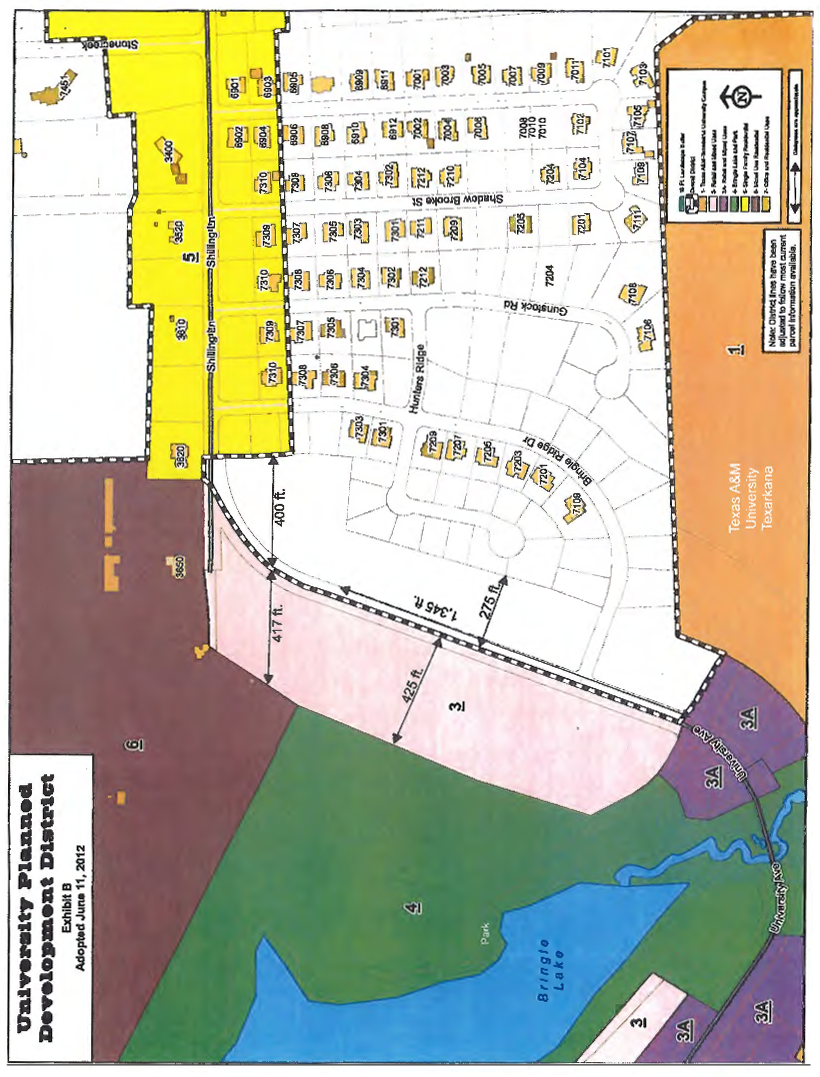
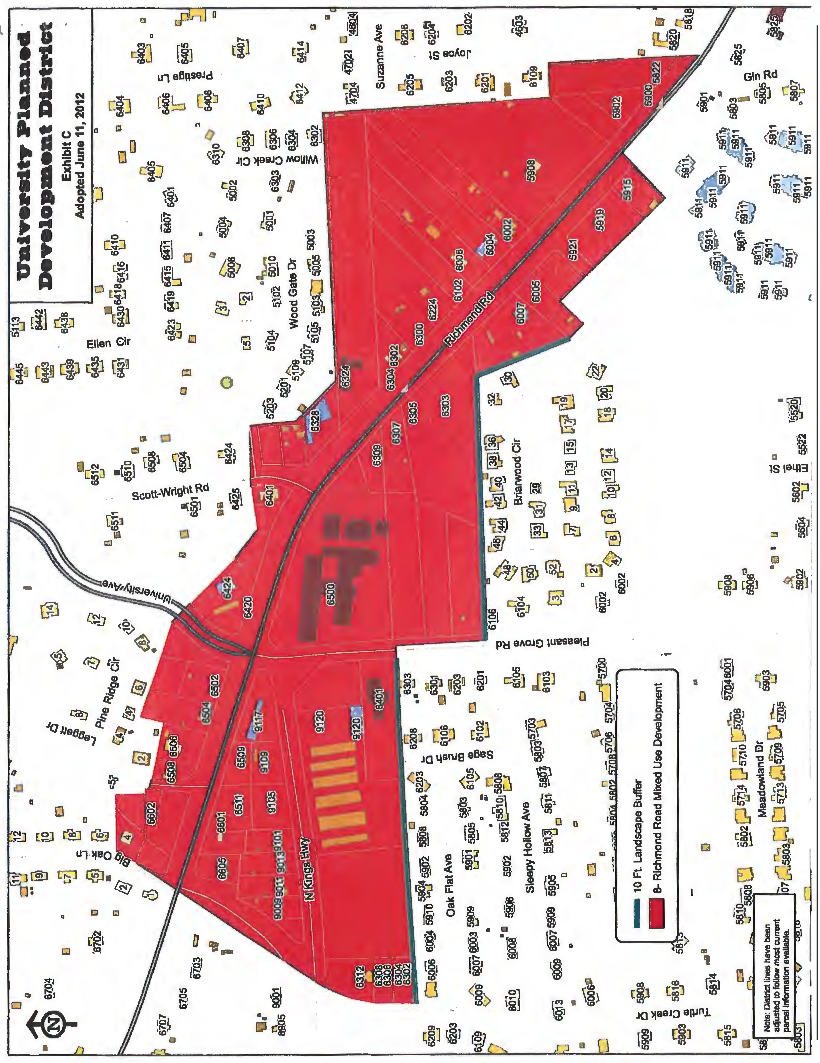
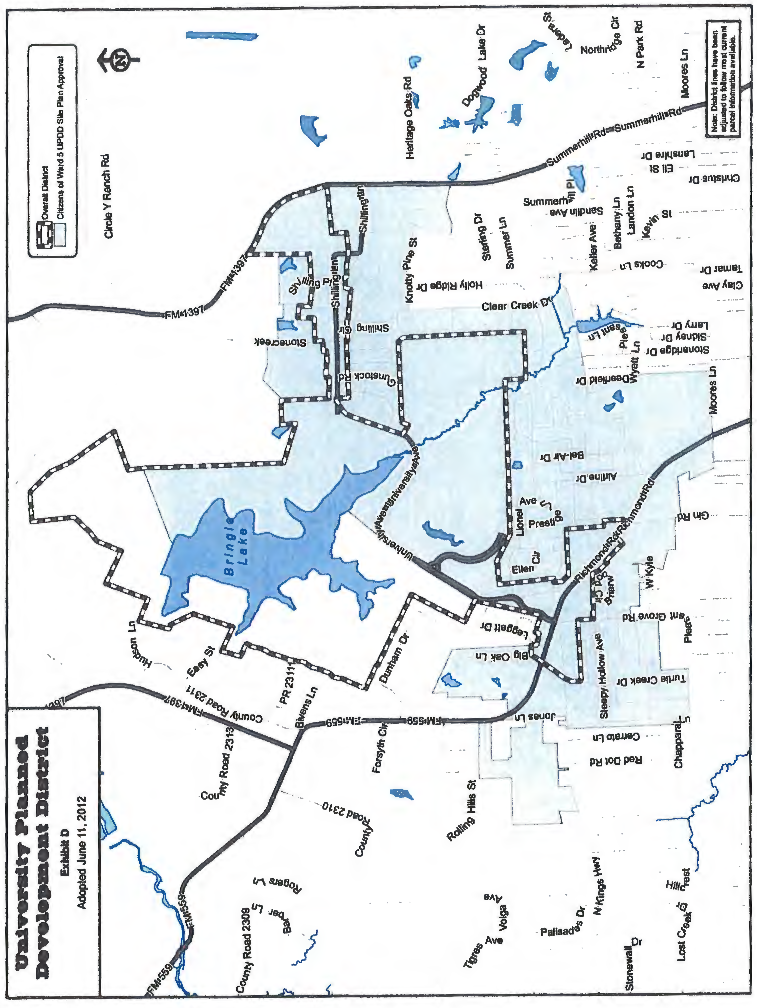
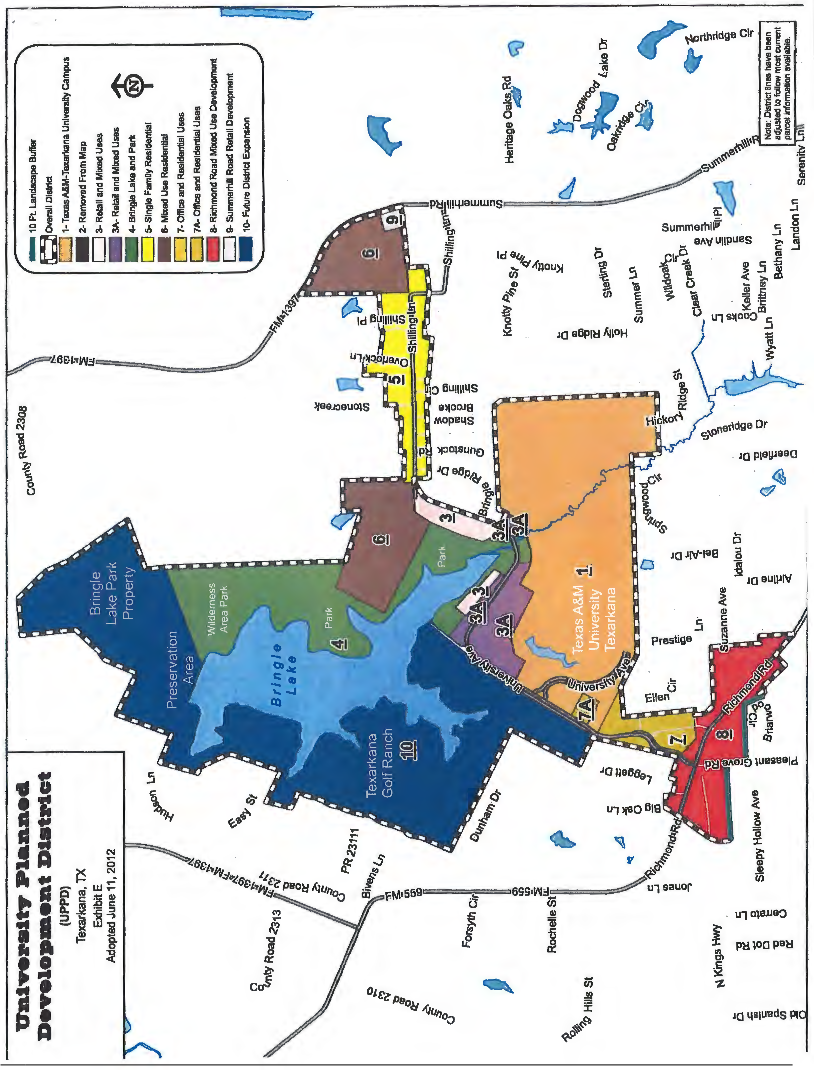
University district design concept (from TAMU-T campus entrance to University Avenue Bridge). Boundary areas (refer to UPDD site map):
a.
Area boundaries. UPDD development areas are those areas within close proximity to Texas A&M University-Texarkana campus and the University Corridor from Richmond Road to Summerhill Road, as shown in the boundary map on file in the city secretary's office.
b.
Compliance required. All property within the boundaries of the UPDD shall adhere to the UPDD development standards.
c.
Application to develop inside UPDD. Upon receipt of a request for building permit or subdivision plat within the designated UPDD development area, the applicant will receive a copy of the UPDD development standards and submittal requirements.
(c)
UPDD zoning districts established. The UPDD is hereby divided into nine zoning districts. The use, height and area regulations as set out herein are uniform throughout each district. The boundaries of the zoning districts set out herein are delineated by the zoning district map of the UPDD on file in the city secretary's office. The nine districts established herein shall be known as:
(1)
Texas A&M University-Texarkana Campus.
(2)
Reserved.
(3)
Retail and Mixed Uses.
Additional Retail and Mixed Uses.
(4)
Bringle Lake and park.
(5)
Single-Family Residential.
(6)
Mixed-Use Residential.
(7)
Office and Residential Uses.
(8)
Richmond Road Mixed-Use Development.
(9)
Summerhill Road Retail Development.
(10)
Future district expansion.
(d)
Use regulations. A church or chapel is allowed in all areas.
(1)
Texas A&M University-Texarkana Campus:
a.
Office use;
b.
Educational buildings;
c.
Public schools;
d.
Food services;
e.
High density university housing;
f.
Parking garages;
g.
Sporting event centers; and
h.
College or university.
(2)
Reserved.
(3)
Retail and Mixed Uses:
a.
School, public;
b.
Bank, credit union, or financial services;
c.
Food and beverage store (no package stores);
d.
Restaurant or eateries (no drive-thru service allowed east of bridge) roof top/patio/outside seating allowed (only along Bringle Lake frontage);
e.
Office use;
f.
Mixed uses with ground floor retail, personal services and/or offices, upper floor condominiums;
g.
Brownstone condominiums;
h.
Department stores;
i.
Dry cleaner stores with cleaning facilities outside the UPDD;
j.
Civic, cultural, and community facilities;
k.
Medical clinic;
l.
Coffee, bakery or confectionary shop;
m.
Retail and shops under 10,000 square feet of gross leasable floor area; and
n.
Single-family homes (site-built homes, not modular or industrial/manufactured homes).
(4)
Additional Retail and Mixed Uses:
a.
Hotels;
b.
Apartments, townhomes;
c.
University housing;
d.
Restaurant or eateries (drive thru service allowed east of bridge);
e.
Parking garages;
f.
Drug store or pharmacy; and
g.
Cinema/theatre.
(5)
Bringle Lake and Park:
a.
Nature and walking/mountain biking trails;
b.
Park pavilions and picnic areas;
c.
Playgrounds;
d.
Boat ramps; and
e.
Park buildings (including restrooms, maintenance and offices).
(6)
Single-Family Residential: Single-family homes (one unit per lot, only site-built homes no modular or industrial/manufactured homes).
(7)
Mixed Use Residential (no apartments, townhomes or duplexes allowed):
a.
Brownstone townhome/condominiums; and
b.
Single-family homes (one unit per lot, only site-built homes no modular or industrial/manufactured homes).
(8)
Office and Residential Uses:
a.
Office use;
b.
Single-family homes (one unit per lot, only site-built homes no modular or industrial/manufactured homes); and
c.
Brownstone townhomes/condominiums.
(9)
Additional Retail and Mixed Use:
a.
Special event venue; and
b.
Bed and breakfast inn.
(10)
Richmond Road Mixed Use Development: All that is allowed in Retail and Mixed-Use, plus:
a.
Fast food eateries;
b.
Gas stations;
c.
Townhomes (no duplexes, triplexes or apartments);
d.
Day care facility;
e.
Neighborhood health center;
f.
Landscape maintenance business with outdoor display sales and equipment;
g.
Application of permanent cosmetics;
h.
Mini-warehouse development with retail and/or office uses fronting on Richmond Road, University Avenue, Kings Highway or Pleasant Grove Road;
i.
Garden shop and plant sales;
j.
Veterinarian (office only);
k.
Barber and beauty shop; and
l.
Day spa.
(11)
Summerhill Road Retail Development (all that is allowed in Mixed Use Residential), plus:
a.
Food and beverage store (no package store);
b.
Fast food eateries;
c.
Gas stations;
d.
Offices;
e.
Retail stores;
f.
Dry cleaners; and
g.
Coffee, bakery or confectionary shop.
(12)
Future Development (golf course and Bringle Lake Park property):
a.
Golf course;
b.
Golf course amenities;
c.
Golf course clubhouse with restaurant and bar;
d.
Golf course clubhouse gift shop; and
e.
Park green space.
(e)
Building and site design.
(1)
Height regulations (see University District map). In the following zoning districts, the maximum height of buildings and structures shall be:
a.
Texas A&M University-Texarkana Campus—No height restriction.
b.
(Removed from district).
c.
Retail and Mixed Uses—Three stories (35-foot maximum) six stories.
d.
Additional Retail and Mixed Uses.
e.
Bringle Lake and Park—2½ stories (35-foot maximum).
f.
Single-family Residential—2½ stories (35-foot maximum).
g.
Mixed Use Residential—3½ stories (40-foot maximum).
h.
Office and Residential Uses—2½ stories (35-foot maximum).
i.
Richmond Road Mixed Use Development—3½ stories (40-foot maximum).
j.
Summerhill Road Retail Development—2½ stories (35-foot maximum).
k.
Future Development—2½ stories (35-foot maximum).
(2)
Architectural style requirements; applicability. All structures/buildings with the exception of Single-Family Residential within the district shall comply with the standards in this section.
a.
Exterior building material requirements; masonry requirement. One hundred percent of the exterior of all buildings (excluding doors and windows) shall be finished in one or more of the following materials:
1.
Brick, stone, cast stone, rock, marble and/or granite shall be used in at least 50 percent of exterior walls of the building.
2.
Exterior Insulating Finishing System (E1FS) shall not exceed 30 percent of any exterior wall of the building, nor be located in the first ten feet of the structure.
3.
Glass with less than 20 percent reflectance. However, only a maximum of 30 percent of a building facade may be constructed in glass. Buildings over three stories will be allowed to increase glass surface with UPDD site plan approval.
4.
Poured-in-place concrete and tilt-wall concrete shall have an integrated color and be textured or patterned. Tilt-wall concrete structures shall include reveals, punch-outs, or other similar surface characteristics and adornments to enhance the facade on at least ten percent of each facade.
5.
Wood and concrete board, such as Hardy Plank or other similar material, properly installed may be allowed up to 30 percent of a facade, excluding all windows, doors and glass construction materials.
6.
Established chain restaurants and national retailers with specific tradedress designs will be allowed with UPDD site plan approval.
b.
Architectural features. The facades of all primary commercial and multifamily structures which face a street shall include the following key architectural features:
1.
Classical architectural elements, such as a distinct base, wall, columns and cornice or top.
2.
The use of covered walkways, architectural awnings, canopies or porticos is required along the primary facade.
3.
Windows, which may include see-through doors, shall be provided along all facades which face streets.
4.
TAMU-T University is the focal point of the district and designs shall enhance or complement the overall architectural features of the campus.
c.
Roofs.
1.
Roofline variations are required to reduce the visual scale of buildings and to create additional interest. The roofs of nonresidential and multifamily residential buildings shall include:
(i)
Parapet walls that conceal flat roofs and rooftop equipment from public view at adjacent public streets. Parapet walls shall vary in height and will include architectural detailing, cornices, moldings, trims, variations in brick coursing and/or other similar type detailing.
(ii)
Or at least two of the following elements:
A.
Overhanging eaves, extending no less than 18 inches past the supporting walls.
B.
Two or more roof slope planes.
C.
Sloped roofs shall be finished with tile, 30-year or better deep profile composite shingle, metal shingles, slate shingles or standing seam metal. UPDD site plan approval is required for material color.
D.
Roof top patios.
2.
Single-family residential buildings shall have sloped roofs.
3.
Brownstone townhomes shall have sloped roofs on 75 percent of the building.
d.
Color. All commercial and multifamily buildings shall comply with the standards in this section.
1.
Exterior colors shall be low reflectance, subtle, neutral, earth tone or colors compatible with the surrounding area. Some color recommendations are neutral or earth tones such as beige, brown, white, earthy greens and yellows or colors matching with the university, such as a muted red brick.
2.
The use of high intensity, primary or fluorescent colors is prohibited.
3.
Established chain restaurants with specific tradedress colors will be allowed with UPDD site plan approval.
e.
Retaining walls; visible.
1.
Retaining wall blocks and designs shall consist of the same materials as the building facade. Keystone or gravity stone may also be used in a color palette consistent to the color palette of the facade.
2.
Retaining wall blocks and designs are required to be detailed in the site plan approval process.
3.
Nonvisible. Alternate materials must be approved by the UPDD.
(3)
Site design.
a.
Building placement and site orientation (except Single-Family Residential).
1.
Minimum setbacks from property lines adjacent to University Avenue:
(i)
Fifteen-foot front yard setbacks;
(ii)
Ten-foot side yard setbacks;
(iii)
Fifteen-foot rear yard setback.
2.
Minimum setbacks from property lines not adjacent to University Avenue:
(i)
Fifteen-foot front yard setbacks;
(ii)
Five-foot side yard setbacks;
(iii)
Five-foot rear yard setback.
3.
Minimum setbacks from property lines adjacent to Bringle Lake:
(i)
Fifteen-foot front yard setbacks (facing university);
(ii)
Ten-foot side yard setbacks;
(iii)
Zero-foot rear setback for deck (lake side);
(iv)
Twenty-foot rear setback for building (lake side).
4.
Minimum setbacks from property lines for Brownstone townhome/condominium:
(i)
Fifteen-foot front yard setbacks (facing university).
(ii)
Ten-foot side yard setback from end of building cluster. No side yard setback is required between attached buildings.
(iii)
Five-foot rear yard setback.
(iv)
A brownstone condominium shall not contain more than eight dwelling units and shall not exceed 200 feet in length.
5.
Buildings not adjacent to the lake should be located as close as possible to the front property line to improve the overall appearance from adjacent streets and provide a strong building wall on either side of street.
6.
Site layouts on individual lots shall be developed in such a manner that pedestrian connections between buildings both on that lot and between lots within the overall district can be achieved.
7.
Residential parking areas shall be placed at the side or rear of buildings adjacent to University Avenue to improve the overall appearance from the streets.
b.
Single-family residential building placement and site orientation.
1.
Minimum setbacks from property lines adjacent to University Avenue:
(i)
Twenty-five foot front yard setbacks;
(ii)
Eight-foot side yard setbacks;
(iii)
Ten-foot rear yard setback.
2.
New driveways for Residential Use must provide an on-site turn-around to prevent backing out onto University Avenue.
c.
Accessory uses.
1.
Residential accessory buildings are structures allowed only within a residential dwelling unit. These structures shall be of consistent material and color to the primary structure and located in the rear yard only. Accessory buildings shall not exceed 50 percent of the rear yard. Only one of each type listed below is allowed per lot:
(i)
Storage building or shed;
(ii)
Free standing garage;
(iii)
Workshops;
(iv)
Gazebos; and
(v)
Pool house.
2.
Commercial accessory buildings shall be of the same material and color of the primary structure.
d.
Lot regulations. The following table provides information on lot regulations:
e.
Parking regulations.
1.
Parking space requirements. It is the intent of the district to be a pedestrian friendly community. In the event of a UPDD parking garage, parking minimums may be decreased. Credit can be given for bike racks. The following table provides parking requirements per building use:
2.
Parking layout and access requirements.
(i)
No on-street parking will be allowed on University Avenue.
(ii)
No parking in grass, yard or landscaped areas.
(iii)
No parking spaces shall be located in front of multiple-family residential units.
(iv)
Parking space sizes shall be 180 square feet. Two-foot overhangs are allowed where a minimum five-foot sidewalk is provided or additional green space.
(v)
Compact car off-street parking spaces may account for up to ten percent of the required parking spaces, provided the spaces are permanently designated by signs as being for use by compact cars only. All compact car parking spaces shall be a minimum eight feet in width and a minimum of 16 feet in depth.
(vi)
All parking areas shall provide a drive aisle connection to adjoining properties for cross access. Pedestrian connections shall also connect to adjoining properties.
(vii)
Three public pedestrian access points will be required from University Avenue to the lakefront boardwalk. These points are subject to development location and access shall be required. Maintenance of these boardwalk connections located off of private property will be the city's responsibility.
(viii)
Required stacking space for drive-through aisles shall be a minimum of three vehicles and shall not block parking drive aisles or passageways. Stacking space shall not impair the streetscape of University Avenue.
(ix)
Parking areas and driveways shall be concrete with curb and gutter. However, the utilization of other paving materials not immediately adjacent to University Avenue is allowable with UPDD approval.
(x)
In areas where sidewalk is not provided adjacent to University Avenue, continuous ten-foot wide concrete sidewalks shall be placed along the entire property frontage.
(xi)
Installation of bicycle racks and seating benches are encouraged to accommodate pedestrian and bicycle traffic. Installation of bicycle racks and seating benches will offset parking space 1:1 for bicycle racks and 2:1 for seating benches up to a total of two parking spaces.
3.
Parking garage requirement.
(i)
Parking spaces for restaurants and businesses may meet requirements by using assigned parking garage spaces.
(ii)
Parking deck shall conform to architectural style requirements of the UPDD.
(iii)
UPDD lighting requirements must be followed, including LED interior lighting or approved equivalent for parking areas.
(iv)
It is encouraged that the structure be mixed use with retail space available on the ground level.
f.
Site drainage.
1.
All parking lot runoff shall be directed to sanitary sewer. Any collection of drainage shall be filtered of hydrocarbons before leaving the site. Proper maintenance of the filtration is the responsibility of the property owner.
2.
Lakefront properties may be allowed to direct runoff towards Bringle Lake. Any discharge towards the lake shall be filtered of hydrocarbons, debris and harmful chemicals to fish and wildlife. Proper maintenance of the filtration is the responsibility of the property owner.
3.
All drainage calculations, sizing and reporting to city engineers shall follow the city drainage ordinance with exceptions as noted in the UPDD.
4.
All stormwater pollution prevention shall be in accordance with the city MS4 permit.
(4)
Landscaping, fencing and screening requirements.
a.
A landscaping plan, including planting and irrigation details, shall be submitted in conjunction with the site plan review process. The landscape plan can either be a separate print or be included on the required site plan print. Minimum information required on the landscape plan shall include:
1.
Locations of existing boundary lines, dimensions of the lot or property, proposed and existing utility easements on or adjacent to the lot and location of overhead power lines and any underground utilities.
2.
The location of the proposed water faucets or a note indicating the installation of the irrigation system covering the entire lot.
3.
A plant schedule listing the botanical and/or common names of all plants and the size of plant material, date, scale, north arrow, name and phone number.
b.
Landscaping shall be required on all developments (except Single-Family Residential) and shall be completed prior to the issuance of the certificate of occupancy.
c.
Tree preservation.
1.
The preservation of existing trees is encouraged throughout the district. No tree over 12 inches caliper shall be removed in the district without a UPDD approved site plan.
2.
All site plans shall be submitted with a tree survey showing location, size, and type of all trees greater than 12 inches in diameter. Additionally, it shall be indicated on all site plans if these trees are to be retained or removed.
3.
Preservation of trees over 12 inches caliper shall be given landscaping credits:
(i)
Twelve inches to 18 inches equals ten points.
(ii)
Eighteen inches to 24 inches equals 15 points.
(iii)
Twenty-four inches and larger equals 20 points.
d.
Every site adjacent to University Avenue shall include a 15 foot buffer strip, landscaped and irrigated. The landscape buffer shall consist of trees, shrubs, groundcover, berms and related elements as specified below. All sidewalks shall be a minimum of four feet in width.
1.
One three-inch caliper or greater deciduous shade tree per 75 feet of linear frontage along University Avenue. Large shade trees:
(i)
Red maple (not silver maple);
(ii)
White oak;
(iii)
Red oak;
(iv)
Shumard oak;
(v)
Pin oak;
(vi)
Additional selections must have UPDD approval.
2.
A landscape screen with a minimum height of 18 inches and a maximum height of 36 inches (as measured from the finished grade of the parking area) shall be provided in locations where the landscape buffer separates a surface parking area from University Avenue. Landscape screens can be achieved through a combination of the following methods:
(i)
Shrubbery hedges forming a continuous living screen not to exceed 36 inches in height. Shrubs shall be one or a combination of the following:
A.
Yaupons;
B.
Boxwoods;
C.
Roses;
D.
Yews;
E.
Additional selections must have UPDD approval.
(ii)
Earthen berms not to exceed 24 inches in height shall be allowed in conjunction with small planting on top of the berm.
(iii)
Any landscaping shall conform to the required visibility triangles.
e.
Every site adjacent to the Bringle Lake Wilderness Area, regardless of zoning use shall include a 15-foot buffer strip, landscaped and irrigated. The landscape buffer shall consist of trees, shrubs, groundcover, berms and related elements as specified in subsection (e)d. of this section.
f.
A ten-foot tree landscape buffer and fencing as noted in subsection (e)5e. of this section. Screening and fencing requirements is required covering 70 percent of the buffer area with trees along the property line between area 5 and area 7 as shown on the UPDD map and shall also include the southern boundary of zone 8 and the southwestern boundary of zone 8 along the Briarwood Circle neighborhood through Parcel 6005.
g.
Parking lot landscaping. Landscaped areas in a parking lot shall be contained within the parking area, based on the standards below:
1.
One two-inch caliper tree and six shrubs shall be planted for each 12 parking spaces.
2.
All new trees within a parking lot shall be planted in a landscaped island of at least 150 square feet and have a minimum dimension of 8½ feet, (e.g., 8.5 feet by 18 feet). However, up to 20 percent of the required trees may be planted in islands of at least 25 square feet and have a minimum dimension of five feet.
h.
Remaining site landscaping. (Points will be allowed for landscaping in the ROW.)
1.
In addition to the above requirements, landscape plans must earn a minimum of 100 points by using some or all of the required electives listed below in a project:
(i)
Irrigation system—20 points.
(ii)
Drought tolerant vegetation (50 square feet/minimum)—Ten points (maximum 20 points).
(iii)
Grass/groundcover (50 square feet/minimum)—Ten points (maximum 20 points).
(iv)
Small tree (each, see plant list)—Five points.
(v)
Large tree (each, see plant list)—Ten points.
(vi)
Planter box (each)—Five points (maximum ten points).
(vii)
Landscape entry/exit (annuals)—Ten points (maximum 20 points).
(viii)
Landscape around signage—Ten points.
(ix)
Foundation planting—Ten points/facade side (maximum 20 points).
i.
All required landscaping shall be maintained in a neat and orderly manner at all times. This shall include mowing, edging, pruning or trimming, fertilizing, weeding, watering and other such activities common to the maintenance of landscaping. Plant materials which die shall be replaced with plant material of similar variety and size within 30 days, weather permitting.
j.
No permits shall be issued for building, paving, grading or construction until a qualifying landscape plan is submitted. In the event that the proposed project is in a planned development district, a landscape plan is required as part of the site plan approval process by the city council.
k.
Prior to the issuance of a certificate of occupancy for any building or structure all landscaping requirements shall be in place. If the building official determines that it would be impractical to plant trees, shrubs, grass or to lay turf, due to the season of the year, a temporary certificate of occupancy may be issued. All landscaping required by the landscaping plan must be installed within six months of the date of the issuance of the certificate of occupancy or penalties shall be applied.
l.
Plant list. (Suggested, but other plants can be approved if plant zone requirements are met according to the temperature ranges of the Texarkana area):
(5)
Screening and fencing requirements (excludes Single-Family Residential).
a.
Screening of mechanical equipment.
1.
Properties that may be viewed from residential uses, streets, lakefront or public park areas shall screen all roof, ground and wall-mounted mechanical equipment (compressors, duct work, transformers, meters, elevator equipment, etc.) from view at ground level on adjacent properties or public streets or parks.
2.
Roof-mounted mechanical equipment shall be shielded from view on four sides; use of dog-house screening is prohibited. Screening shall consist of materials consistent with the primary building materials, and may include metal screening or louvers that are painted to blend with the primary building.
3.
Screening shall result in the mechanical equipment blending in with the primary building, and not appearing separate from the building,
4.
Wall or ground-mounted equipment screening shall be constructed of:
(i)
Planting screens.
(ii)
Brick, stone or other similar masonry materials.
(iii)
Redwood or cedar pressure treated wood.
(iv)
All fence posts shall be rust-protected metal, concrete-based masonry or concrete pillars.
(v)
A combination of the above.
b.
Screening of outside storage.
1.
Outside storage shall be located on the side or rear of the primary building and shall be screened from public view on streets, lakefront or park areas.
2.
Outside storage shall be screened with a minimum seven foot tall screen or a screen that is a minimum of one foot above the top of the storage materials, whichever is taller. Screening shall be:
(i)
A masonry wall or other material that is similar to the primary structure.
(ii)
A berm.
(iii)
A planting enclosure of large evergreen shrubs planted a maximum of four feet apart that shall create a solid screen to a minimum height of seven feet within two years as determined by a registered landscape architect, certified nurseryman or master gardener.
(iv)
A combination of the above.
3.
Outside storage for a landscape maintenance business shall be screened with an eight-foot fence with construction materials of brick or stone columns (maximum of 20 feet between columns) and a wooden fence stained or painted to compliment the business. Gates for access to the area will match fence materials.
c.
Screening of waste containers.
1.
Waste containers shall consist of the following:
(i)
Dumpsters.
(ii)
Compactors.
(iii)
Grease storage.
(iv)
Recycling containers.
(v)
Composting areas.
(vi)
Cardboard storage.
(vii)
Crates/pallets.
2.
Waste containers shall be located on the side or rear of the building and screened from public view on streets, lakefront or public park areas.
3.
Waste containers shall be located outside of the required building setback areas:
(i)
When adjacent to residentially zoned property, the waste container must be located at least 50 feet away from residential property lines.
(ii)
When adjacent to the lakefront, the waste container must be located at least 50 feet away from the northern property line.
4.
Waste containers shall be screened on four sides, using an enclosure that is seven feet tall or of a height that is a minimum of one foot above the top of the dumpster, whichever is taller.
(i)
Screening materials shall match the primary masonry structure exterior.
(ii)
Gates shall be solid and painted to match the primary structure. Gate materials shall consist of metal, redwood or cedar pressure treated wood. All fence posts shall be rust-protected metal, concrete-based masonry or concrete pillars.
5.
Any drainage runoff occurring from dumpster shall be incorporated with overall drainage plan and filtered of pollutants.
d.
Screening of loading and service areas.
1.
Loading and service areas shall be located at the side or rear of buildings. Exception: Lakefront developments shall not have loading docks adjacent to the lake.
2.
Loading areas shall be screened from view of any residential uses, streets, lakefront or public park areas.
3.
Loading areas shall be enclosed on three sides by a wall not less than eight feet in height.
4.
Loading areas shall not be located closer than 50 feet to any single-family lot, unless wholly within an enclosed building.
5.
Screening materials shall be comprised of a wall that has a similar finish and material to the primary structure.
e.
Fencing.
1.
Fencing shall be required whenever a nonresidential development abuts to a single-family and multiple-family residential area. Multiple-family residential areas shall be fenced if adjacent to a single-family residential area. Fencing shall be required when the property is developed and shall be maintained by the property owner.
2.
Fencing shall create a solid visual barrier.
3.
Fencing materials shall be limited to the following or a combination of the following: stone, brick, decorative spit faced block masonry, decorative concrete or other masonry materials.
4.
To create a consistent fence line, fencing along that line, shall be similar in material, pattern and design.
5.
Fences shall be a minimum of seven feet in height, measured from ground level.
6.
Fencing shall not block drainage and shall leave a two-inch space between the ground and the fence. Should drainage require additional spacing, sufficient drainage plans and fence elevations must be provided with UPDD site plan approval.
f.
Retaining walls. See subsection (e)(2) of this section, architectural style requirements.
(6)
Sign regulations (excludes Single-Family Residential).
a.
Monument signage. A permanent ground sign fully supported by the base without the use of poles as the primary support that is constructed out of brick, stone, concrete or similar materials that complement the architecture of the primary structure, across the entire base of the structure.
b.
Lighting.
1.
Sign shall be internally lit or lit by the use of ground lighting incorporated with landscaping (no flood lighting);
2.
No neon lighting;
3.
No electronic or changeable messaging; and
4.
Exception: each entrance into the UPDD will be allowed one electronic or changeable message sign. This sign will have joint use of the district for advertising purposes.
c.
Location.
1.
Signs must be located within 30 feet of ROW;
2.
Signs shall not block sight distances;
3.
Signs shall not be inside a ROW; and
4.
Excepting wayfinding guides, signs shall not be inside a ROW;
5.
Signs can be located within a city utility easement, but any repairs or damage incurred to signage due to utilities will be at owner's expense; and
6.
Wayfinding guides shall only be allowed within 1,000 feet each direction from the street entrance/entrances to the educational institution site; and such guides can be attached to existing street light poles (provided, however, if a pole is not city-owned, written permission from the pole owner shall be a prerequisite to the site plan submittal).
d.
Business name. Name of business and main address must be located on a single tenant sign.
1.
Wall signage. Signs should be located and attached to the exterior of a building.
(i)
Attached signs shall not extend above the roof or parapet wall;
(ii)
Wall signs shall not exceed 150 square feet per wall facade. An additional ten square feet of signage will be allowed per 20 feet in building height over 35 feet in height;
(iii)
Lake front signage shall be limited to 30 square feet in area; and
(iv)
Individual letter height shall not exceed six feet.
2.
Prohibited signs. The following are signs not allowed in district:
(i)
Off-premises advertising signs;
(ii)
Banners (exception: Wayfinding guides)
(iii)
Flags (does not include TAMU-T flags, state or United States of America flags);
(iv)
Inflatable objects;
(v)
3-D imaging;
(vi)
Streamers or balloons;
(vii)
Coroplast, stake or placards;
(viii)
Flashing or arrow signs;
(ix)
A-frame or sandwich boards;
(x)
Writing on windows;
(xi)
Exception: on-campus signage is not regulated.
(7)
Lighting (excludes Single-Family Residential). The intent of the lighting is to enhance amenities, promote safety and encourage dark skies. In an effort to promote dark skies, excess lighting can be limited by the UPDD.
a.
The following standards shall apply to all outdoor lighting:
1.
The use of LIED lighting or approved equivalent is required for all outside fixtures in the UPDD;
2.
Structures of pole lighting shall match or complement the street light pole design;
3.
Lighting for parking light poles shall have a maximum of 20 feet;
4.
No flood lighting will be allowed;
5.
Ground lighting or up lighting can be used along parking lots, screening and landscaping areas;
6.
Christmas outdoor lighting will be consistent for the overall UPDD with the same signage restrictions as section 6;
7.
Outdoor lighting shall be hooded, shielded, and aimed downward as shown in the images below, including doorway lighting;
8.
The hood or shield shall mask the direct horizontal surface of the light source. The light shall be aimed to ensure that the illumination is only pointing downward onto the ground surface;
9.
All outdoor lighting fixtures shall be designed, installed, located and maintained such that all direct illumination is kept within the boundaries of the fixture owner's property;
10.
Ground mounted accent lighting for buildings, directed onto the building.
(i)
Direct light emissions shall not be visible above the roofline or beyond the building edge.
(ii)
All upward aimed light shall be fully shielded, fully confined from projecting into the sky by eaves, roofs or overhangs and all fixtures shall be located as close to the building being illuminated as possible.
(iii)
All ground mounted accent fixtures shall be permanently fixed such that they are resistant from tampering or redirection of the light source. Ground mounted spotlights shall not be located in such a way as to have the bulb or lamp visible from a pedestrian or vehicular egress.
11.
Pedestrian walkway lighting 12 feet or less in height above the adjacent walkway grade may be permitted. This includes lighting applications such as bollards, light fixtures located in retaining and landscape walls, and lighting fixtures located on or within structures utilized for pedestrian safety, for example, stairwell lighting.
(8)
Site plan approval process.
a.
The site plan approval process will be a review to assure compliance, by a five-member panel consisting of the director of city planning or zoning, or their designee, the planning and zoning chairperson, the city engineer, or their designee, and two citizens of Ward 5 who reside in the city limits as shown by the member committee zone map (exhibit "D"). The citizen members shall serve no more than one consecutive three-year term. The initial term of one citizen member shall be two years, which citizen member to be determined by lot or chance. Appointment of the citizen members shall be by nomination from the Ward 5 city councilmember then sitting with confirmation by a vote of the city council.
b.
Site plan submittal requirements for UPDD.
1.
The site plan shall be clearly defined and drawn to an appropriate scale to permit accurate review for compliance with UPDD standards.
2.
Two copies of the site plan shall be given not to exceed 24 inches by 36 inches. The site plan shall be drawn on dimensionally stable reproducible sheets and shall be appropriately drafted at an engineering scale of one inch equals 30 inches or larger.
3.
The following features, as a minimum, shall be required on all site plans before they will be accepted for review:
(i)
Legal description, address, property lines and dimensions;
(ii)
Location, sizes and names of adjacent or included streets, alleys, easements and cross connectivity agreements;
(iii)
Location, setbacks, dimensions and square footage of existing/proposed buildings, existing/proposed elevations with finished floor elevation;
(iv)
Signage location and detail (including, for wayfinding guides, proposed design and graphics);
(v)
Location of buildings on adjoining property within 20 feet of the subject property;
(vi)
Location and dimensions of existing/proposed parking spaces, driveways, vehicle maneuvering areas, curb cuts, loading facilities and sight visibility triangle areas;
(vii)
Parking calculation table;
(viii)
Existing/proposed surfacing, landscape/buffer areas and screening or fencing;
(ix)
Location of facilities for refuse disposal with appropriate screening;
(x)
Landscape and irrigation plan;
(xi)
Lighting plan, including foot candles and areas affected by the lighting;
(xii)
Drainage direction and outfall, filtration device, location type and size of drainage facilities (calculations when necessary);
(xiii)
Proposed uses, north arrow, graphic scale and date of plan preparation;
(xiv)
Floodplain limits, if applicable.
4.
Where not stated in the UPDD, all building codes, drainage ordinances, subdivision platting and stormwater MS4 will still apply.
5.
If denied, the appeal process for the site plan approval will go to the planning and zoning commission for recommendation to the city council. The city council will make the final decision. If the planning and zoning commission recommends for denial, a percent vote of the city council will be required.
6.
To amend this district, a request will be filed with the planning and zoning commission. If the request is recommended by the planning and zoning commission, it will be sent to the city council.
7.
Changes to an approved site plan shall adhere to the same process as required by this section.
(f)
Penalty. Any person violating or failing to comply with any of the provisions of this article shall be fined upon conviction not less than $500.00 or more than $2,000.00, and each day any violation or noncompliance continues shall constitute a separate and distinct offense.
(g)
Applicability of other city ordinances. This article shall take precedence over any other city ordinance governing the matters contained herein. However, any matter not specifically controlled by this article shall continue to be governed by any other city ordinance that may be applicable.
(h)
Definitions.
Accessory use means a use subordinate to and incidental to the primary use of the main building or to the primary use of the premises.
Apartment means a room or suite of rooms in a multifamily dwelling or apartment house arranged, designed or occupied as a place of residence by a single-family, individual or group of individuals.
Building means any structure built for the support, shelter and enclosure of persons, animals, chattels or movable property of any kind. When subdivided in a manner sufficient to prevent the spread of fire, each portion so subdivided may be deemed a separate building.
City council means the governing body of the city.
Coverage means the percent of a lot or tract covered by the roof or first floor of a building. Roof eaves to the extent of three feet from the walls of a building shall be excluded from coverage computations.
District means a section of the city for which the regulations governing the area, height or use of the land and buildings are uniform.
Dwelling, brownstone townhome condominium, means a specific type of family development consisting of single-family attached units, typically with two to four floors per unit. The exterior facade shall comply with all architectural style requirements of the UPDD.
Dwelling, multiple-family, means any building or portion thereof, which is designed, built, rented, leased or let to be occupied as three or more dwelling units or apartments or which is occupied as a home or residence of three or more families.
Dwelling, one-family, means a detached building having accommodations for and occupied by not more than one family or by one family and not more than three boarders and lodgers.
Dwelling, two-family, means a detached building having separate accommodations for and occupied by not more than two families or by two families and not more than three boarders and lodgers.
Dwelling unit means a building or portion of a building which is arranged, occupied or intended to be occupied as living quarters and includes facilities for food preparation and sleeping.
Family means any number of individuals living together as a single housekeeping unit in which not more than three individuals are unrelated by blood, marriage or adoption.
Height means the vertical distance of a building measured from the finished floor of the front door, to:
(1)
The highest point of the roofs surface if a flat surface;
(2)
To the deck line of mansard roofs; or
(3)
To the mean height level between eaves and ridge for hip and gable roofs and, in any event, excluding chimneys, cooling towers, elevator bulkheads, penthouses, tanks, water towers, radio towers, ornamental cupolas, domes or spires and parapet walls not exceeding ten feet in height.
If the street grade has not been officially established, the average front yard grade shall be used for a base level.
LED lighting approved equivalent means a metal halide, high pressure sodium or other fixture with the same color temperature range as existing LED street lighting.
Legal height means the maximum height of a building permitted by any airport zoning ordinance or other ordinance restricting the height of structures.
Living unit means the room, or rooms, occupied by a family and must include cooking facilities.
Lot coverage means the percentage of the total area of a lot occupied by the base (first story or floor) of buildings located on the lot or the area determined as the maximum cross sectional area of a building's. story. The height between the successive floors of a building or from the top floor to the roof. The standard height for a story is 11 feet, six inches.
Planning and zoning commission means the agency appointed by the city council as an advisory body to it and which is authorized to recommend changes in the zoning.
Wayfinding guides means a network of signs, minimal in number, installed and maintained by an educational institution to which the Texas Education Code applies, utilized as a traffic control device in off-street or access areas, whose primary purpose is to direct traffic to said institution.
For additional definitions refer to article II of this chapter.
(i)
Review. The UPDD will be reviewed by the planning and zoning commission and the city council for amendments no sooner than annually but not less than every five years thereafter.
(Ord. No. 052-2012, 6-11-2012; Ord. No. 2014-069, § 1, 7-14-2014; Ord. No. 2017-121, § 1, 12-11-2017; Ord. No. 2019-001, § 1, 1-28-2019; Ord. No. 2024-028, § 1, 3-25-2024)

