
Thomasville City Zoning Code
ARTICLE XV
SPECIAL DISTRICTS3
Editor's note— Ord. No. 24-06122023, § XIV, adopted June 22, 2023, changed the title of art. XV from "overlay districts" to "special districts."
Sec. 22-593. - Purpose and applicability.
22-593.1
Purpose. The purpose of the downtown code is to allow for incremental mixed-use development that is consistent with Thomasville's historic districts and existing downtown character. The downtown code establishes both a regulating plan and a special requirements plan—these plans will provide flexibility and predictability for future development.
22-593.2
Applicability.
(a)
All areas within the Thomasville downtown boundary as noted on the regulating plan shall adhere to these downtown code standards.
(b)
Within the downtown boundary, no building or structure shall be erected or altered or used for any purpose except as provided for within this code.
(c)
Within the downtown boundary, no use shall be permitted except as regulated by the permitted use chart section 22-121.
(d)
In the case of conflict between the standards of the downtown code and those contained elsewhere in this Code, the standards contained in the downtown code shall always prevail.
(e)
Development must comply with all state and local building codes.
22-593.3
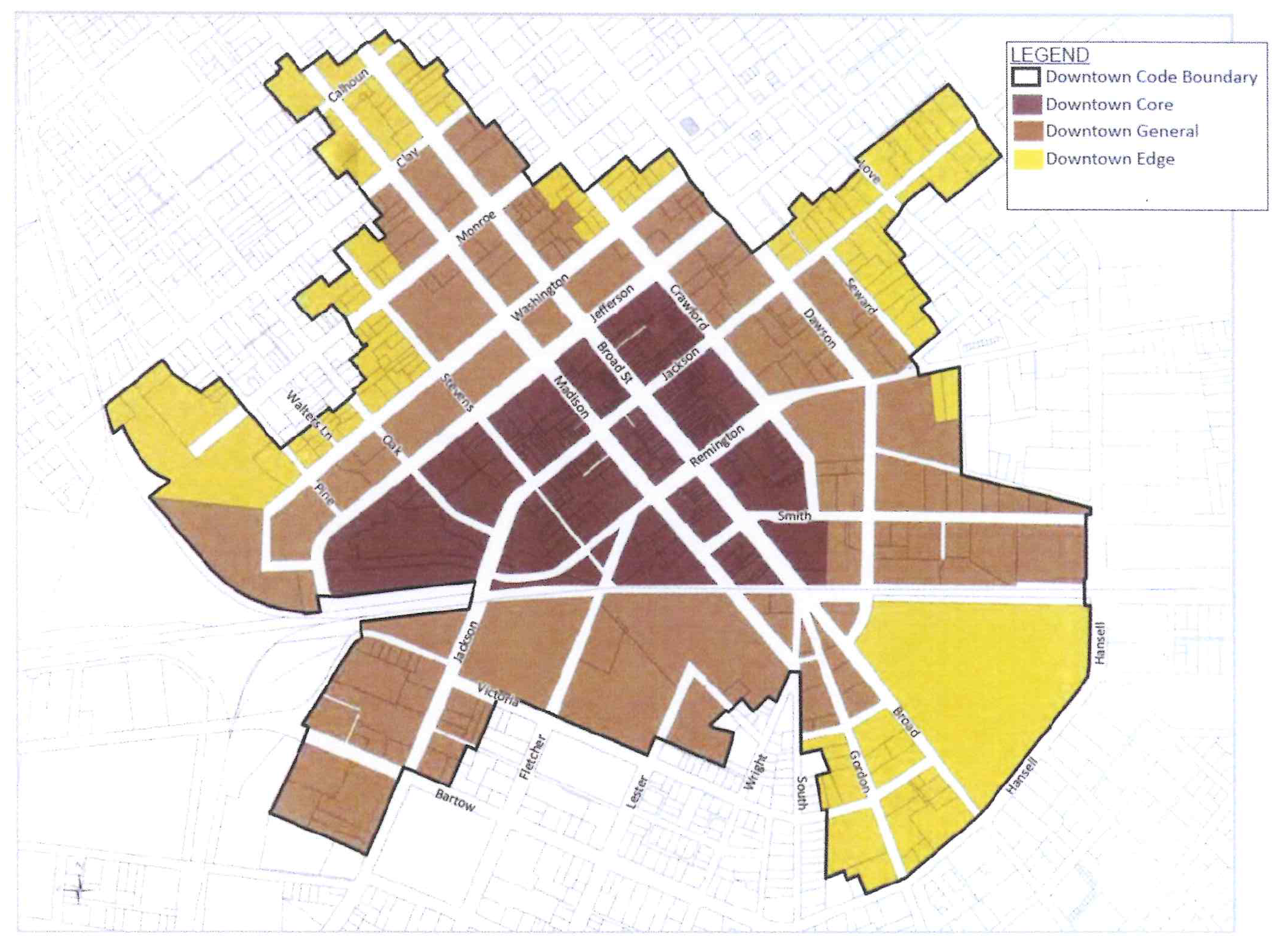
Regulating plan. The regulating plan establishes three transect zones in the downtown district: downtown core, downtown general, and downtown edge. Every parcel located within the downtown code boundary falls under the regulation of one of these three transect zones, which change as you move out from the city's center. Each transect zone regulates development intensity and form through their respective frontage requirements, setbacks, parking requirements, uses, and other important elements that define a development overall.
(a)
The regulating plan clearly illustrates the following:
(1)
The location of streets and alleys.
(2)
Block structure.
(3)
Transect zones.
(b)
The regulating plan is a regulatory map that can be adjusted so long as it meets the following requirements:
(1)
Any adjustments in the designation of a transect zone and its subsequent requirement may be permitted as long as it is consistent with an adjacent transect zone.
(c)
Development shall be consistent with the regulating plan.
Figure 1-1: Regulating Plan
(Ord. No. 23-06122023, § III(Exh. A), 6-12-2023)
Sec. 22-594. - Neighborhood and lot standards.
22-594.1
General to development.
(a)
Block standards. To facilitate connectivity and pedestrian accessibility, the blocks may be further subdivided to provide additional connectivity and shall conform to the following standards:
(1)
The average perimeter of all blocks shall not exceed 1,800 linear feet.
(2)
Any block face that exceeds 600 feet in length shall have a mid-block pedestrian access of at least eight feet in width.
(3)
Dead-end streets and cul-de-sacs shall not be permitted.
(b)
Terminated vistas. In order to improve spatial definition and orientation on each street, terminated vistas shall be encouraged using buildings, civic spaces, roundabouts, statues, ornamentation, or natural features. Some required terminated vistas are designated on the special requirements plan.
(c)
Lot frontage. The primary frontage of a lot shall be along one of the following:
(1)
A thoroughfare right-of-way;
(2)
A thoroughfare with development on one side and a civic space on the other; or
(3)
Directly upon a civic space in which there is no thoroughfare located between the primary frontage and the civic space.
(d)
Building orientation. Buildings have fronts, sides, and backs and how these relate to one another forms neighborhood character.
(1)
Primary façades of every primary building shall be oriented to a front lot line or open space.
(2)
The primary entrance of every primary building giving access to a primary use of the property must directly face a street or a public space.
(3)
All streets should be faced with the fronts or sides of buildings.
(e)
Contextual setback. In order to create consistent front setbacks along a block where buildings are already in existence, any new building may apply the contextual setback. The contextual setback shall be no closer than the closest adjacent building to the public right-of-way, and no greater than the farthest adjacent building to the right-of-way. The area between the closest and farthest adjacent building is the build-to zone.
(1)
Where there is no adjacent building set back farther than the generally-applicable front setback, the build-to zone shall be between the generally-applicable setback and the setback of the closest adjacent building to the right-of-way.
(2)
Where there is no adjacent building setback closer to the right-of-way that the generally applicable front setback, the build-to zone shall be between the generally-applicable front setback and the farthest adjacent building setback from the right-of-way.
(3)
Where there are no adjacent buildings on a block face, then the stated setback shall apply.
(f)
Retail frontage requirement.
(1)
In areas designated as mandatory shopfront on the special requirements plan, at least one ground floor street frontage of a primary building shall be constructed to accommodate retail or personal service uses when there is a market demand for those uses.
(2)
Where there is no market demand, as demonstrated by competent financial and market evidence to the satisfaction of the planning and zoning board, a raised floor for a residential walk-up use may be constructed instead of a space for retail or personal service uses, provided that the design and construction allows for future conversion to retail or personal service use should market demands change.
22-594.2
General street standards. An existing grid of streets exists within the downtown. However there may be a need for additional street connections. The precise location and alignment of new streets may be adjusted to allow flexibility in the design of the site plan; however, the intended purpose and network connectivity of each new street shall not be compromised.
(a)
Street standards. Streets shall be in compliance with city subdivision regulations.
(b)
Downtown street design. The design of new streets and modifications to existing streets shall adhere to the following requirements:
Some dimensional flexibility is permitted for street types to account for varying right-of-way widths, however they shall be designed to have all the basic functional characteristics including roadway width, on-street parking/curbside flex zones, sidewalks, trails, street trees, and landscaped areas shown for their type, and be appropriately sized for the transect zones in which they are located.
All streets shall connect to other streets. Dead-end streets with cul-de-sacs or T-turnarounds shall not be permitted.
(c)
Sidewalks. All streets shall have sidewalks which are a minimum width of six feet, and have a continuous unobstructed path of a width no less than 60 inches. This path shall be unobstructed by utility poles, fire hydrants, benches, street signs, or any other temporary or permanent structures. A shared-use path may take the place of a sidewalk.
(d)
Streetscapes.
(1)
The design of each streetscape zone, the area between the curb and the building frontage, shall comply with the following dimensions:
a.
Frontage zone: two feet.
b.
Pedestrian zone: four feet to 12 feet.
c.
Buffer zone: five feet to six feet.
d.
Curb zone: four inches to nine inches.
(2)
Streetscape elements can occur on public ROW, private property, or a combination of both.
(3)
Within the downtown core, each property with a street frontage of 50 linear feet or more shall install at least one bench, bicycle rack, planter, trash receptacle, or piece of public art per 50 feet of street frontage or part thereof, unless the city manager or their designee waives that requirement based on expected volumes of pedestrian use, site constraints, or potential maintenance issues. Any items placed in the public right-of-way shall require prior approval of the city to ensure that clear pedestrian passages and public health and safety are protected.
(4)
In the downtown general and downtown edge transect zones, if any adjacent lot street frontage includes a tree lawn or planting area between the sidewalk and the curb, a tree lawn or planting area of the same depth from the curb shall be installed across the frontage of the property.
(5)
Sidewalk or outdoor cafes are permitted as an accessory use to restaurants in the downtown districts.
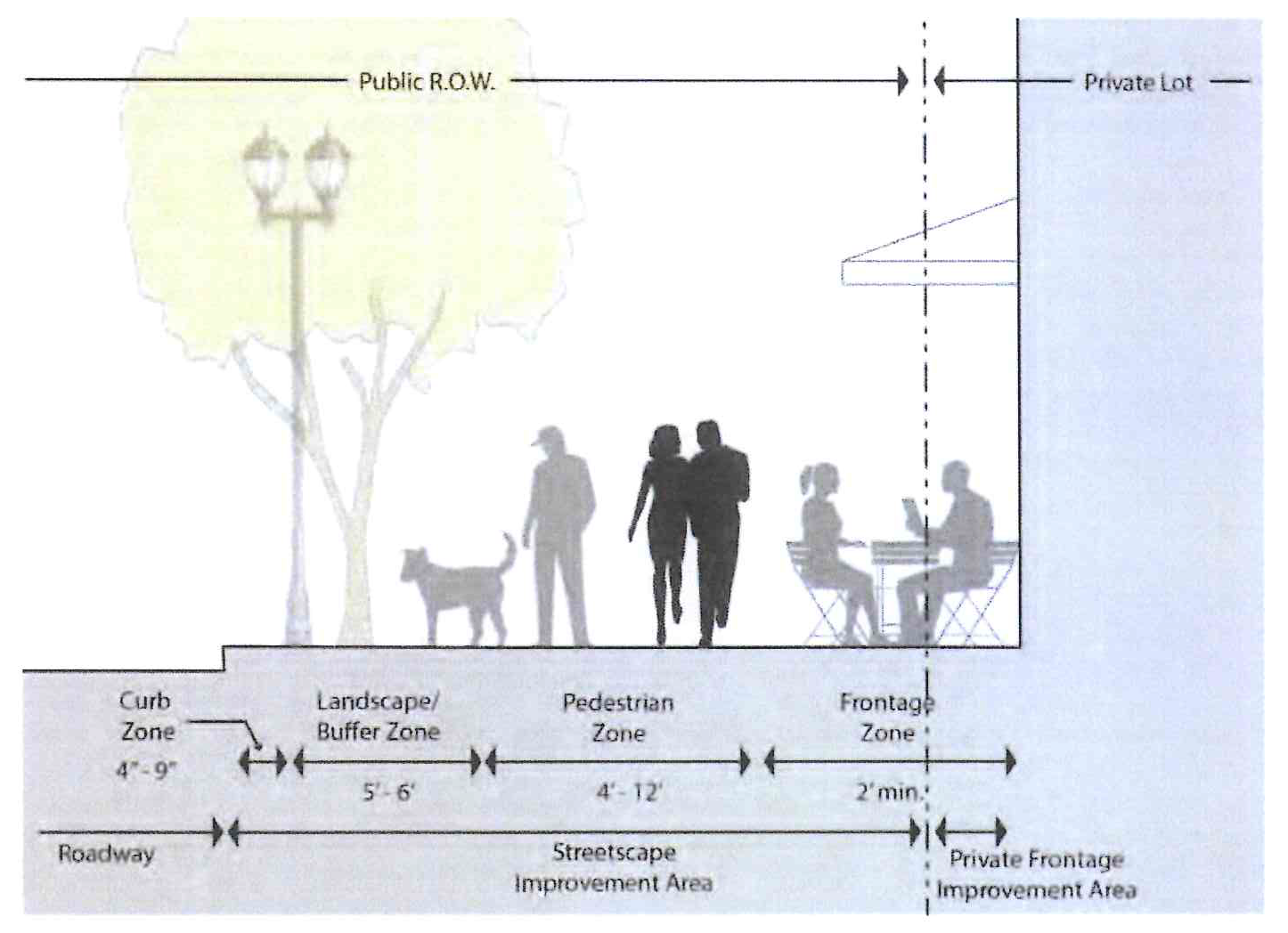
Figure 2-1: Streetscape Diagram
22-594.3
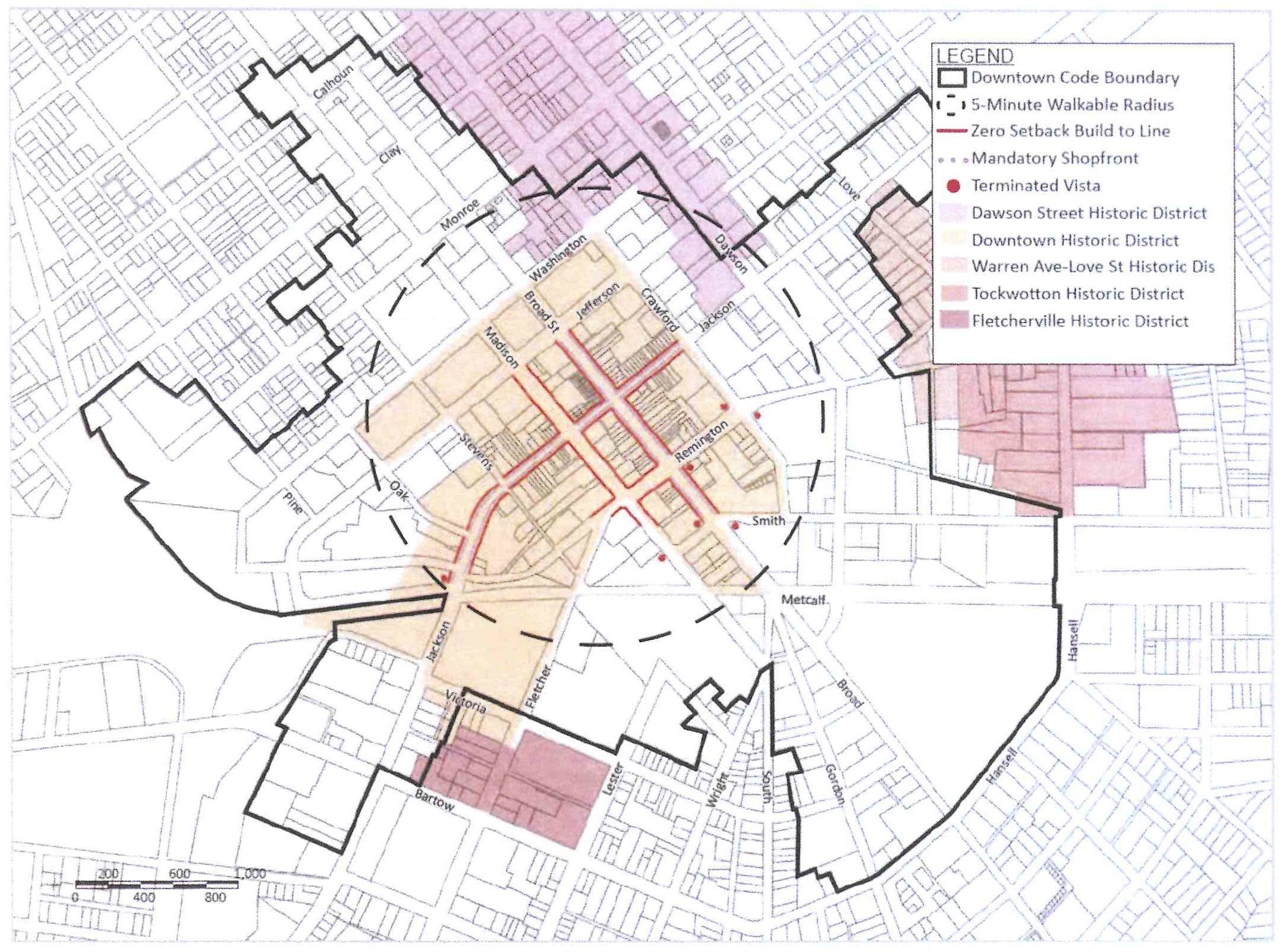
Special requirements plans. The special requirements plan designate the following site-specific standards:
(a)
Zero setback build-to-line. A build-to-line designates a zero setback from the front property line that the building's primary façade shall be built upon in order to create a uniform line of buildings along the street. The build-to-line marked on the special requirements plan shall take priority over the more general setback defined in the transect standards.
(b)
Mandatory shopfront. A ground floor retail shopfront is required along this lot frontage. See requirements for shopfronts in the general development standards.
(c)
Terminated vista location. Designations for mandatory terminated vista location, requiring that the building be provided to mark an important view, assist with wayfinding and add to sense of place.
(d)
Local historic districts. Buildings that are within a designated local historic district shall conform to the historic district architectural guidelines.
Figure 2-2: Special Requirements Plan
22-594.4
Special building types. Some automotive-oriented uses and large footprint buildings may be provided to serve the daily needs of residents. The following criteria shall be used to ensure these uses and buildings do not detract from the overall walkability of the neighborhoods. All requirements that apply to a proposed building must be met.
(a)
Drive-in or drive-through facility.
(1)
A ground-floor shopfront shall face the primary street. All parking shall be located in the rear and accessed from an alley when present.
(2)
Drive-through windows shall be located to the side or rear of the building and accessed from mid-block or alleys, where existing. Where no mid-block or alley access exists, access from a street frontage is permitted, but shall not substantially disrupt pedestrian activity or surrounding uses.
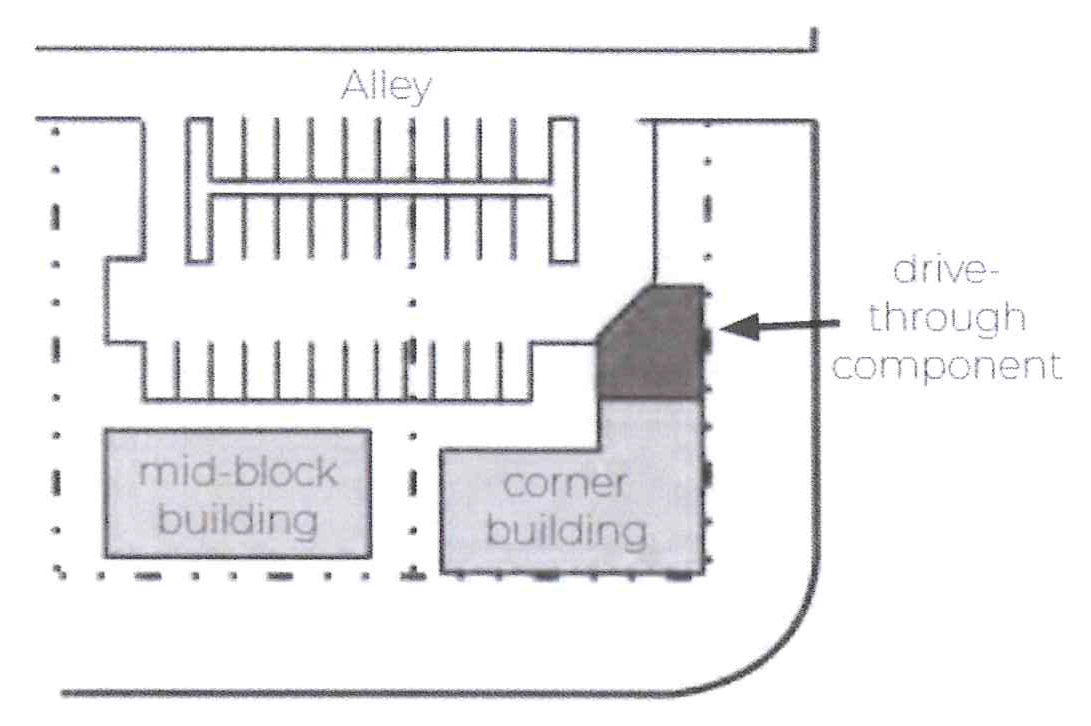
Figure 2-3: Drive-through special building type site design
(b)
Formula business. Thomasville seeks to promote a downtown with attractive retail, merchandising, eating, entertainment and recreation opportunities offering residents and visitors alike a diverse environment for commercial, cultural, civic and social pursuits that are identifiable with the city.
(1)
A conditional use permit is required for a formula business in the downtown.
(2)
In considering a conditional use permit to a formula business in the downtown, the city shall require that all of the following standards be met:
a.
Approval of the formula business establishment will not alter the identity of the downtown in a way which detracts from its uniqueness or contributes to a nationwide trend of standardized downtown offerings;
b.
Approval of the formula business establishment will contribute to a diverse and appropriate blend of businesses in the downtown;
c.
Approval of the formula business establishment will complement those businesses already in the downtown and help promote and foster the local economic base as a whole.
d.
The formula business establishment will be compatible with existing surrounding uses; has been designed and will be operated in a non-obtrusive manner to preserve the community's character and ambiance; and the proposed intensity of uses on the site is appropriate given the uses permitted on the site and on adjoining sites, including but not limited to the following:
1.
The size of any individual formula business should be compatible with the existing surrounding building footprints.
2.
The street frontage of any individual formula business should be compatible with the existing surrounding buildings.
3.
No drive thru windows shall be permitted except as permitted by subsection 22-594.4(a).
4.
The applicant shall submit a plan indicating the provision for rubbish removal, including the dumpster location with proper screening and buffering so that there are not any substantial impacts to abutting properties.
5.
There shall not be a substantial impact to the public safety from increased traffic. At the discretion of the zoning board, the applicant may be required to submit a traffic study.
6.
There shall not be any impacts to the roadway or abutting properties from the loading area.
(c)
Gas station or automobile service. Gas stations should be limited within the downtown. When they are used they should adhere to the urban environment by placing the building toward the street or the corner while the pumps are located to the side or rear of the building.
(1)
Only one gas station is permitted per block along a street. Additionally, no more than one gas station may occupy an intersection.
(2)
A ground-floor shopfront shall face the primary street and define the frontage of the lot.
(3)
All pumps, parking, and drive-through areas must be located behind the shopfront building toward a mid-block location.
(4)
A minimum four-foot wall or garden wall shall be provided along the length of any lot line adjacent to a street.
(5)
Canopy lights shall be located inside the canopy, and shall not be visible from the street.
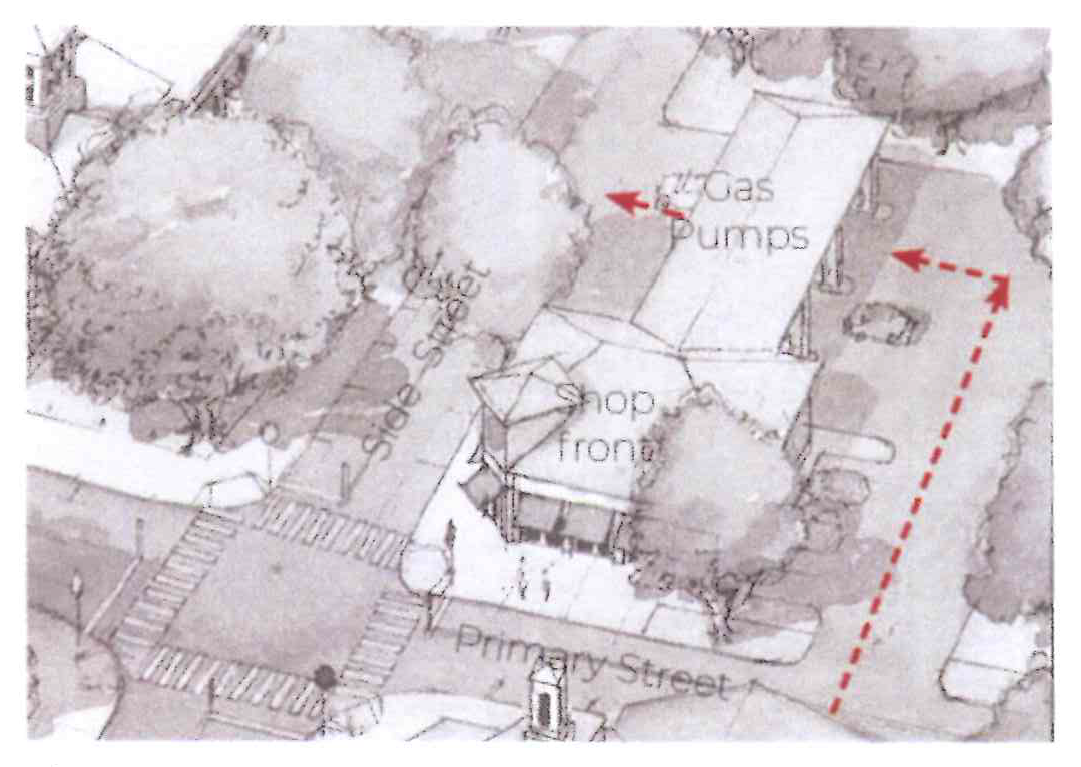
Figure 2-4: Gas Station special building type site design
(d)
Large footprint buildings. Large footprint buildings are those with footprints greater than 30,000 square feet. Examples may include a grocery store, large-format retailer, or theater. Lots may exceed the dimensions set in the transect zone standards provided such buildings comply with the following provisions:
(1)
Habitable frontages (as part of the building or a separate liner building) that provide doors and windows facing the public realm shall be provided along façades that face civic uses or streets.
(2)
To encourage use by pedestrians and decrease the need for solely auto-oriented patronage, large-footprint buildings must reinforce the urban character of the neighborhood and shall therefore continue a connected system of walkable blocks/street frontages (including sidewalks and street trees) through the site as part of the design of parking and drive aisles.
(3)
Building footprints may not be larger than a single block.
(4)
Loading docks, service areas, and trash disposal facilities shall not face streets or civic uses.
(e)
Liner buildings. A liner building is a building specifically designed to mask a parking garage or larger structure that cannot comply with the façade transparency requirements from frontage on a public street. Such buildings may be constructed in a manner that they will be separated from adjacent streets (but not alleys) by liner buildings:
(1)
Liner buildings must be at least two stories in height with no less than 15 feet in depth;
(2)
Liner buildings may be detached from or attached to the principal building or parking garage;
(3)
Liner buildings may be used for any purpose allowed on the lot on which they are located except for parking; and
(4)
Liner buildings must meet the primary facade transparency requirements.
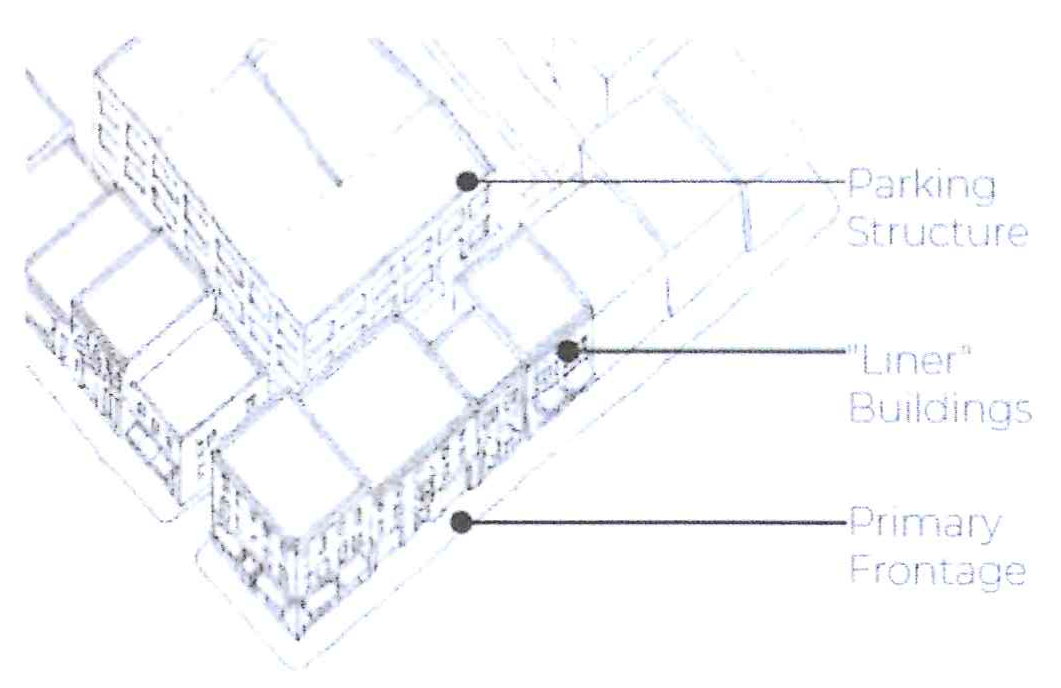
Figure 2-5: Structured Parking Lot Placement
(f)
Civic building. Civic buildings may include, but are not limited to, municipal buildings, religious facilities, libraries, schools, recreation facilities, and places of assembly. The building placement, form, design, and construction of civic buildings should reflect the importance of these buildings within the community and with their function as landmarks in mind. Flexibility in building placement and building form, including any numerical design standard under the codes of the city, may be varied upon a finding that:
(1)
The civic building is to be sited in a location of particular geometric importance, such as anchoring a major civic open space or terminating a street vista.
(2)
The proposed modification is to allow the proposed civic building to better accomplish the design purposes of this code; and
(3)
The proposed flexibility will not be a significant detriment to surrounding properties and the district as a whole.
(4)
Building form.
a.
The scale of civic buildings should typically be larger than surrounding buildings in order to be more prominent and visible across greater distances.
b.
Floor-to-floor heights and architectural details should be proportionately larger than those of private buildings that exist or are anticipated within adjacent blocks.
c.
Prominent roof forms and additive elements such as cupolas can visually extend the height of the building.
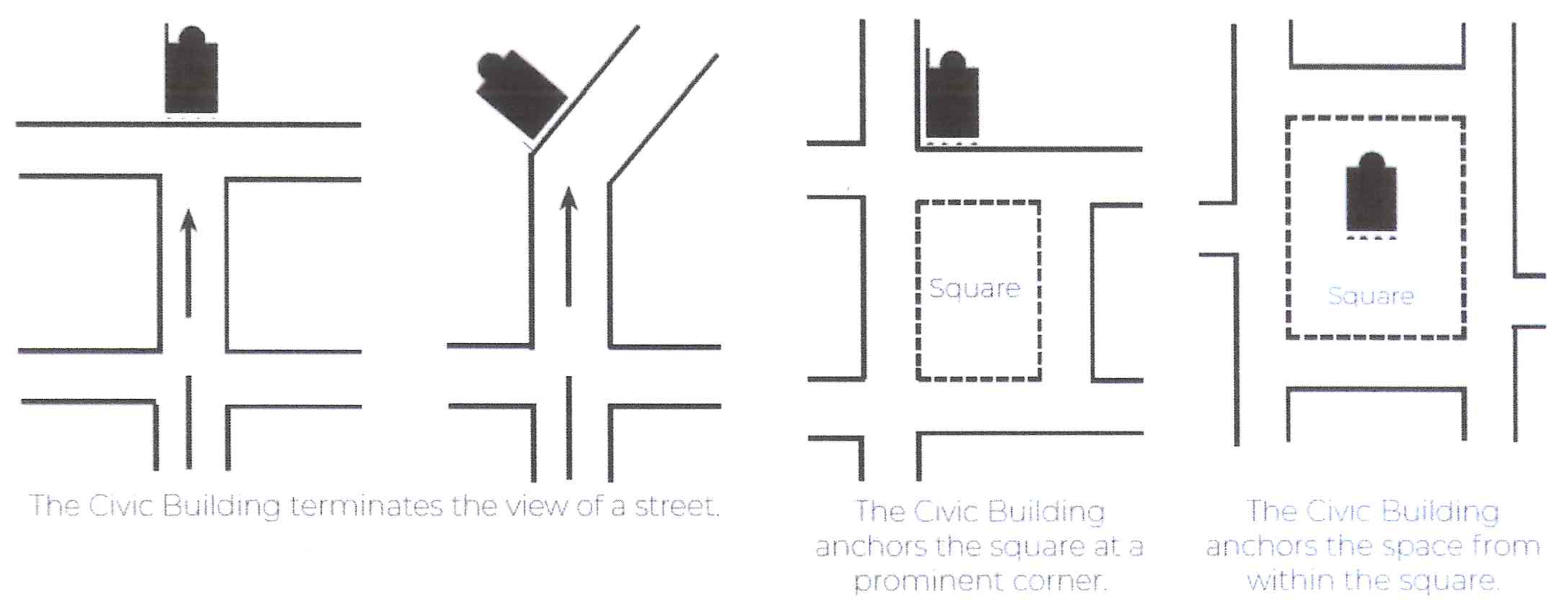
Figure 2-6: Prominent Locations for Civic Buildings
22-594.5
Transect zones.
(a)
This section establishes transect zones applied to property within downtown, as illustrated on the regulating plan (division 1, figure 1-1).
(b)
The transect is a planning and zoning tool that organizes zones in a continuum from rural to urban. Each transect zone has a different set of characteristics that correspond with building placement, building form, and frontage standards, all of which influence the level of walkability and vibrancy in a particular place.
(c)
The regulations related to each transect zone mapped in the downtown regulating plan are hereby established in table 2-1, transect lot standards summary.
(d)
Standards for each of the transect zones are shown for comparison in table 2-1. Each zone is further described in subsections 22-594.6 through 22-594.8.
(e)
Density is controlled through building and lot standards that limit setbacks, lot coverage, building heights, and parking controls.
TABLE 2-1: TRANSECT LOT STANDARDS SUMMARY
Notes:
1.
Where existing buildings on a block face are not consistent with the required setbacks, any new building may apply the contextual setback per subsection 22-594.1(e).
2.
Parking location applies to location of garage door, surface parking lot, and parking structure.
22-594.6
Downtown core.
(a)
Building placement.
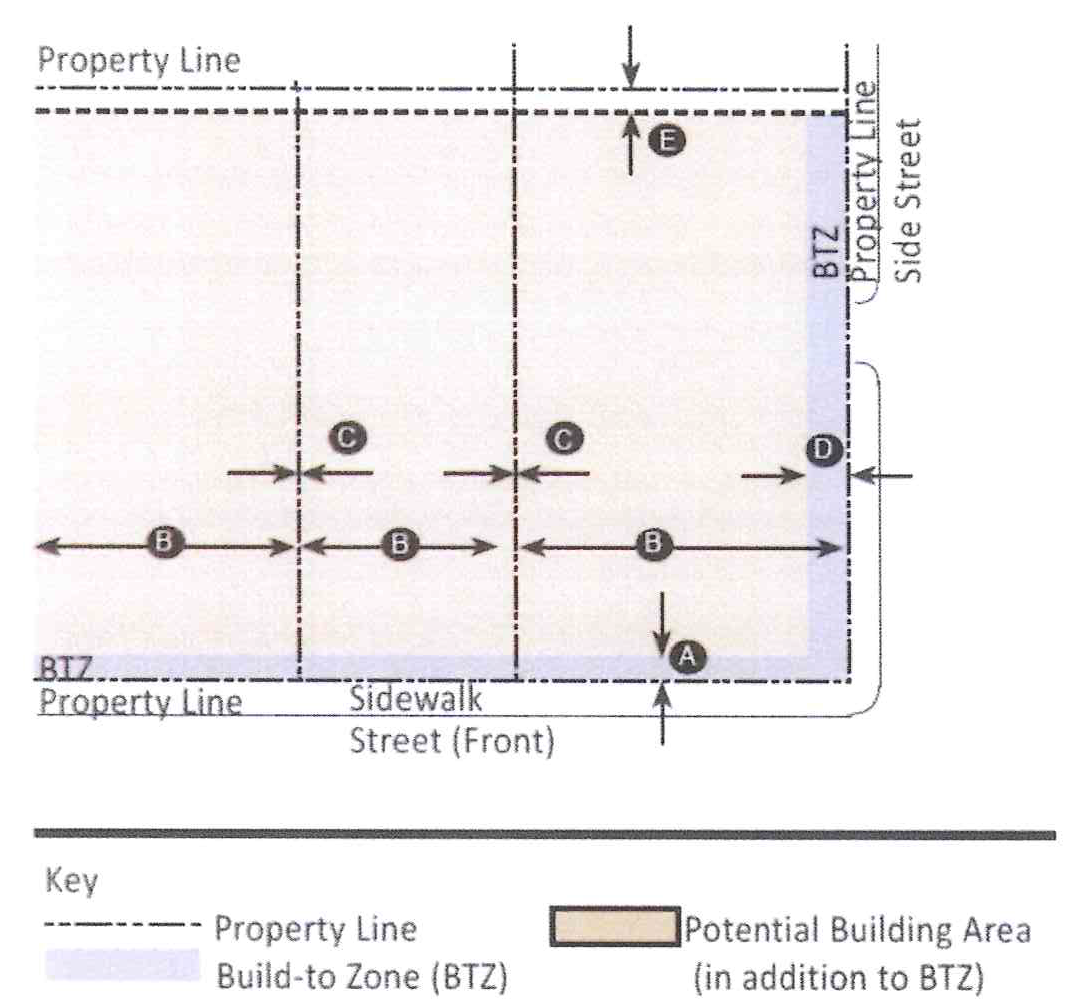
NOTES:
• A minimum front 13-foot streetscape shall be provided in the downtown core. The sidewalk may be a combination of public and private property. An exception to this requirement may be approved by the city manager or their designee if adjacent buildings have a zero side lot line where the new structure may align with the adjacent frontage line.
(b)
Building height.
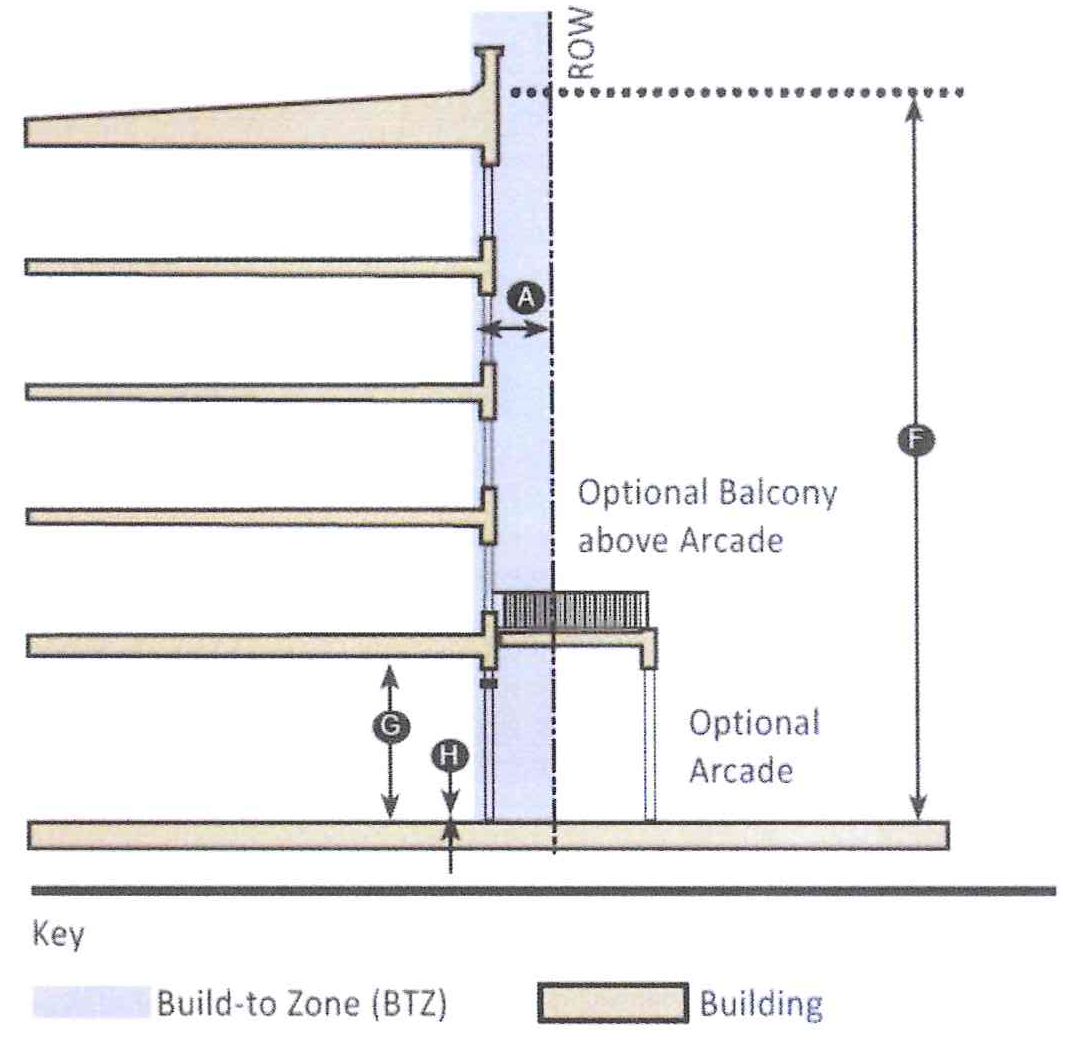
NOTES:
• Basements and attics shall not count as a story.
• Towers, cupolas, and other rooftop features with a footprint smaller than 650 square feet may extend up to one story above the designated height limit.
(c)
Parking location.
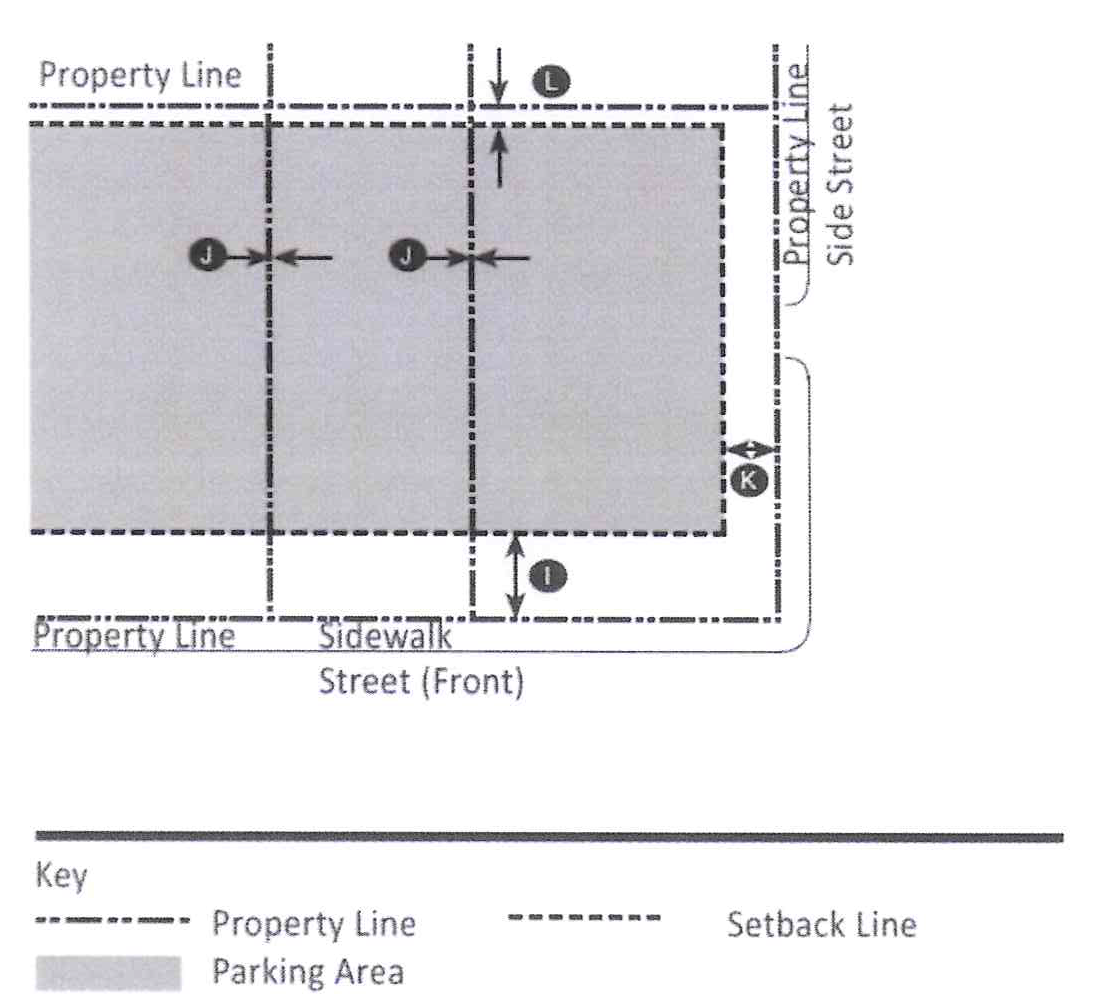
NOTES:
• Parking shall be accessed from rear alleys or side streets whenever possible.
• Opaque screening is required to shield the view of parking from adjacent side streets. Screening may shall consist of garden walls, fences, or hedges (can be a combination of decorative hardscape and landscape) that is 40 inches minimum to seven-foot maximum height installed no less than two feet from walkway to screen parking from side street.
(d)
Frontage elements and encroachments.
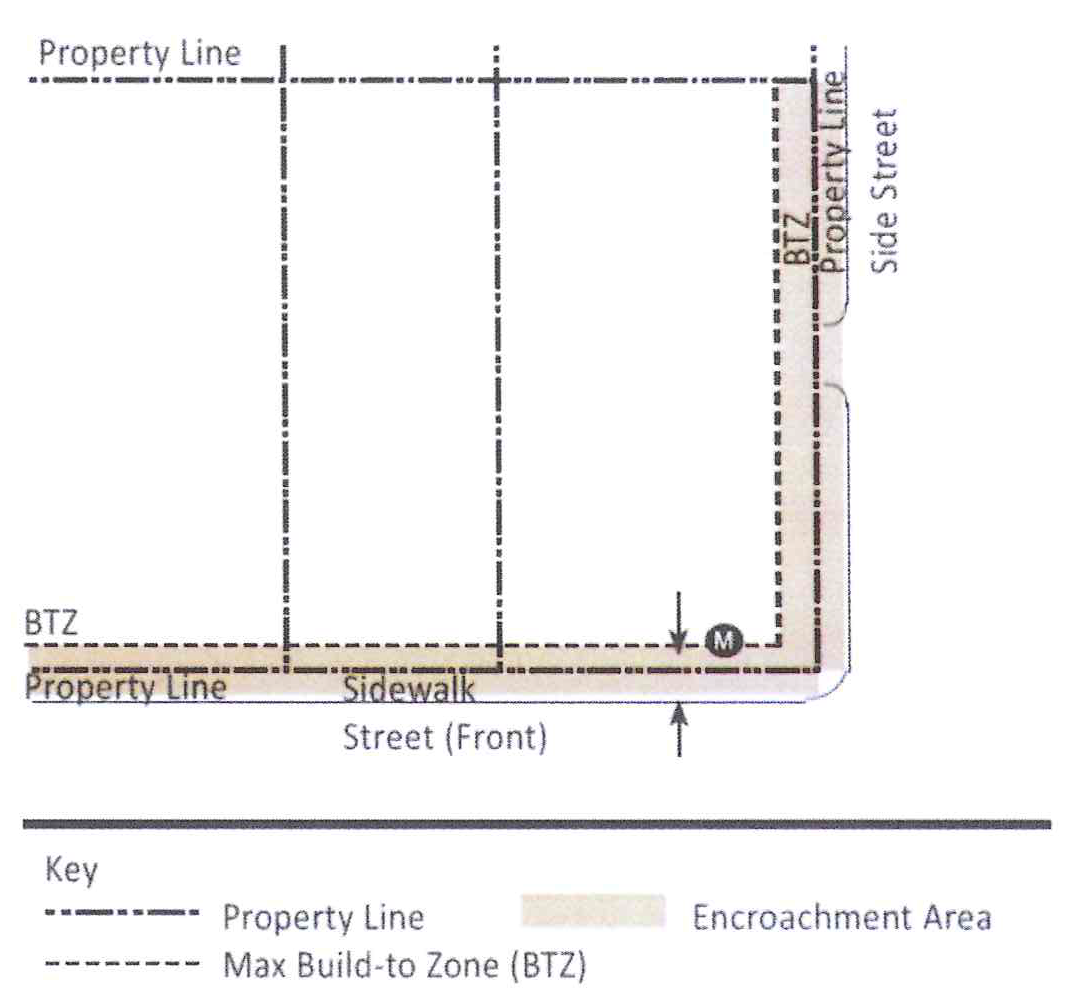
NOTES:
• Frontage elements may encroach forward of the build-to zone and/or into the right-of-way, barring any additional restrictions by the public entity that has control over the public right-of-way.
• See general standards for requirements of frontage elements.
Miscellaneous notes:
• All buildings must have a primary pedestrian entrance along the front façade.
• Loading docks and other service entries shall not be located on downtown core frontages.
22-594.7
Downtown general.
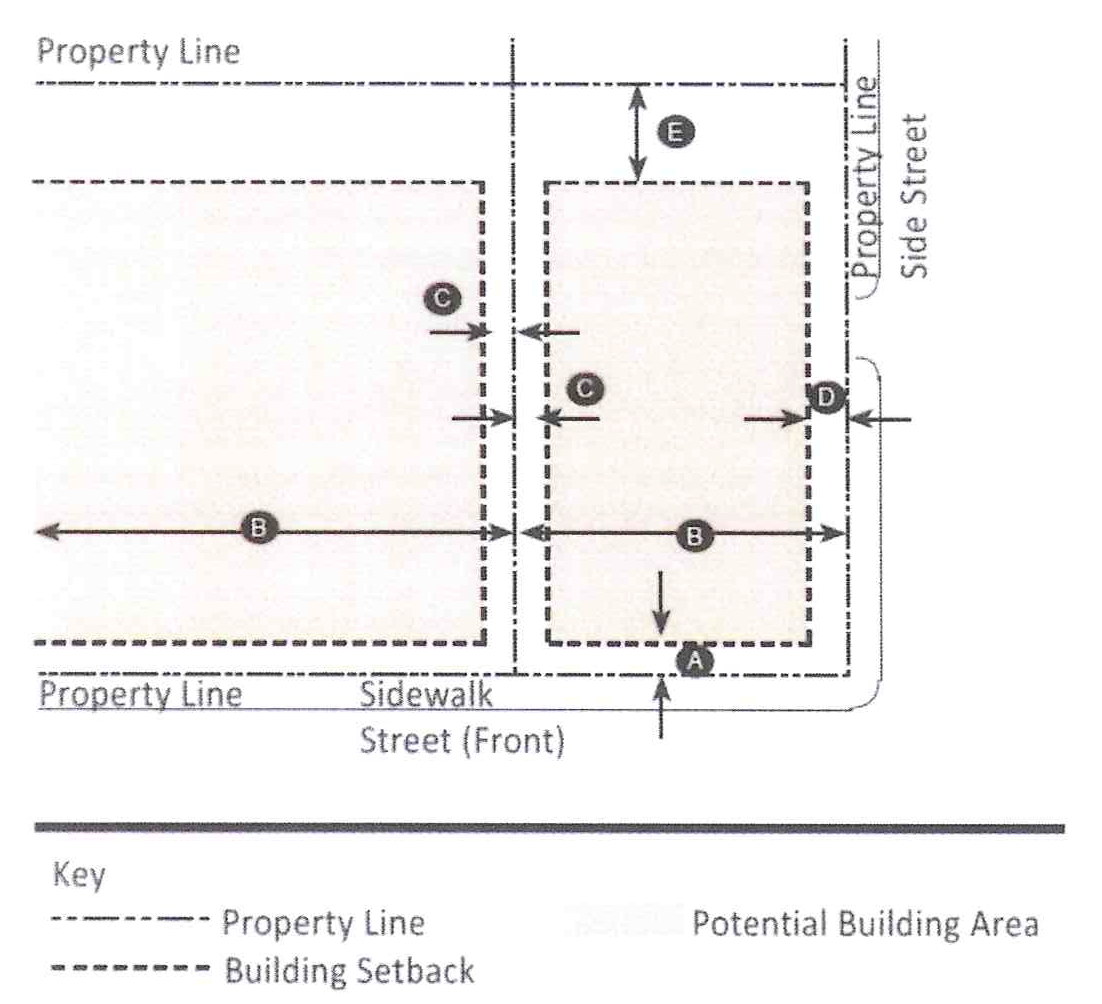
(a)
Building placement.
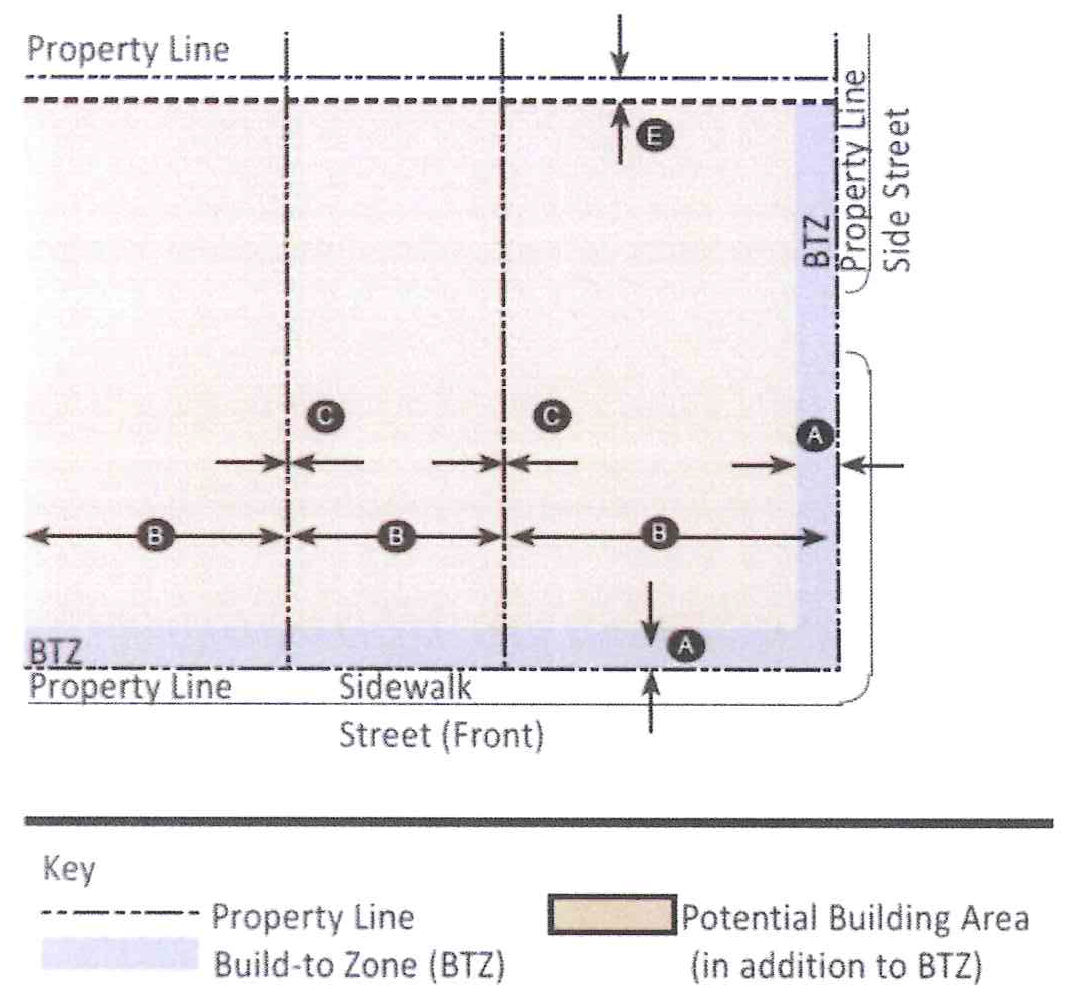
1. Where existing buildings on a block face are not consistent with the required setbacks, any new building may apply the contextual setback per subsection 22-594.1(e).
(b)
Building height.
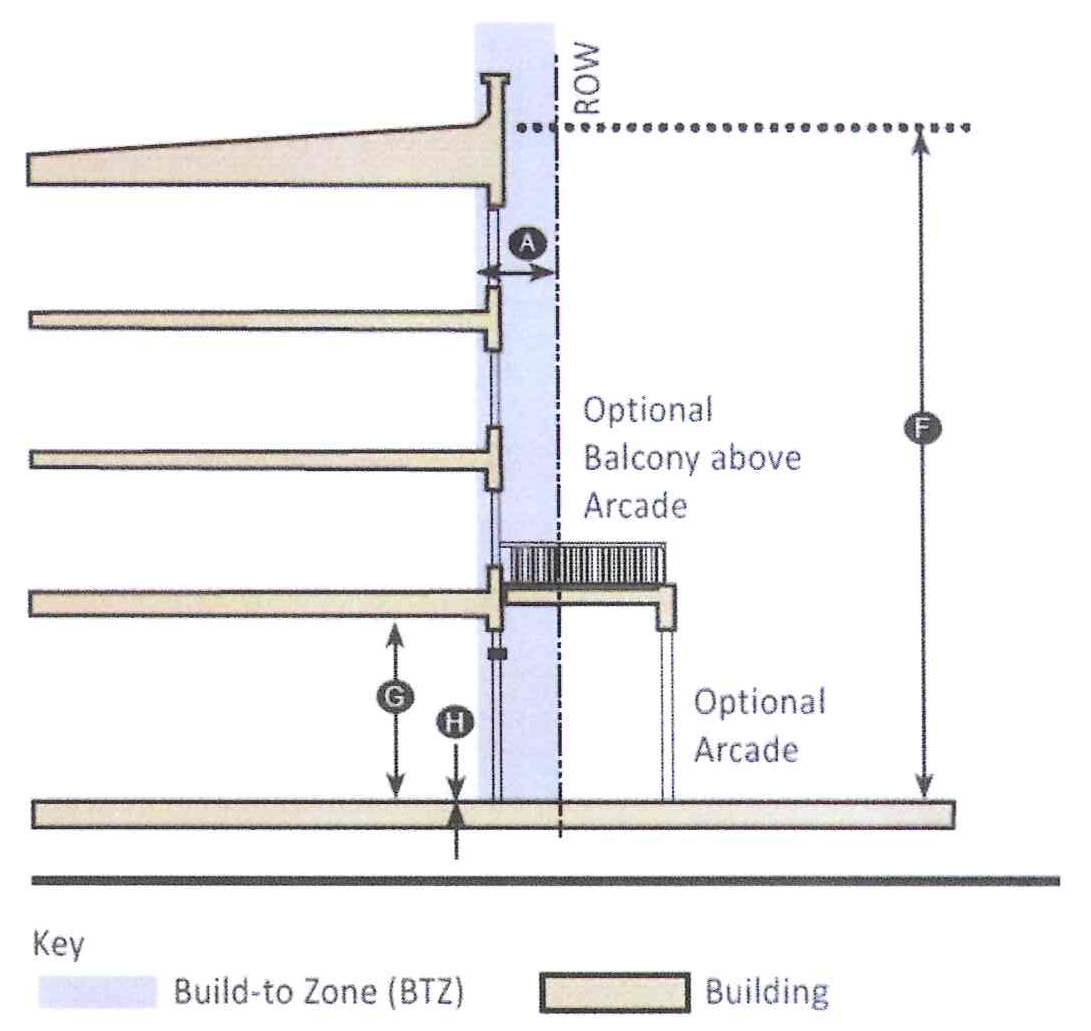
NOTES:
• Towers, cupolas, and other rooftop features with a footprint smaller than 650 square feet may extend up to one story above the designated height limit.
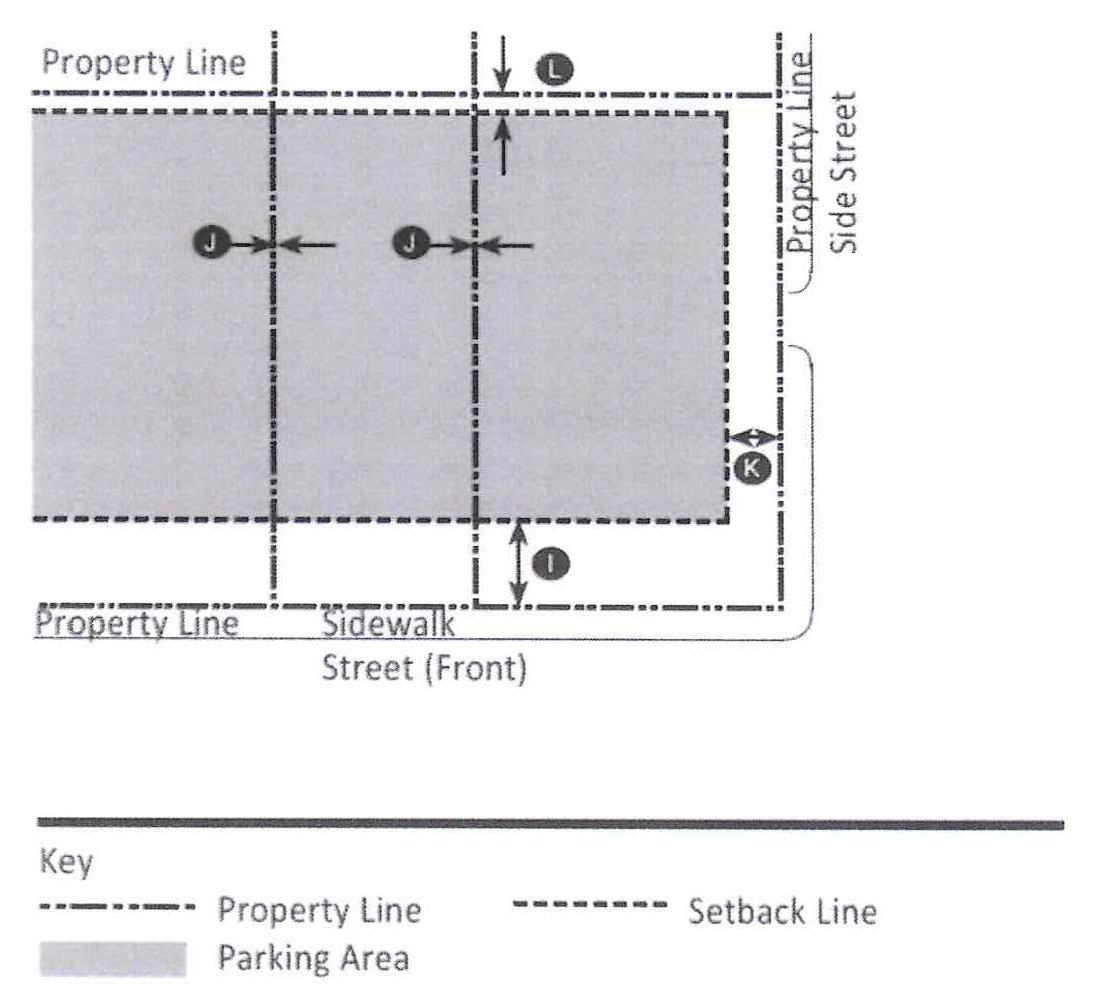
(c)
Parking location.
NOTES:
• Parking shall be accessed from rear alleys or side streets whenever possible.
• Opaque screening is required to shield the view of parking from adjacent side streets. Screening may shall consist of garden walls, fences, or hedges (can be a combination of decorative hardscape and landscape) that is 40 inches minimum to seven-foot maximum height installed no less than two inches from walkway to screen parking from side street.
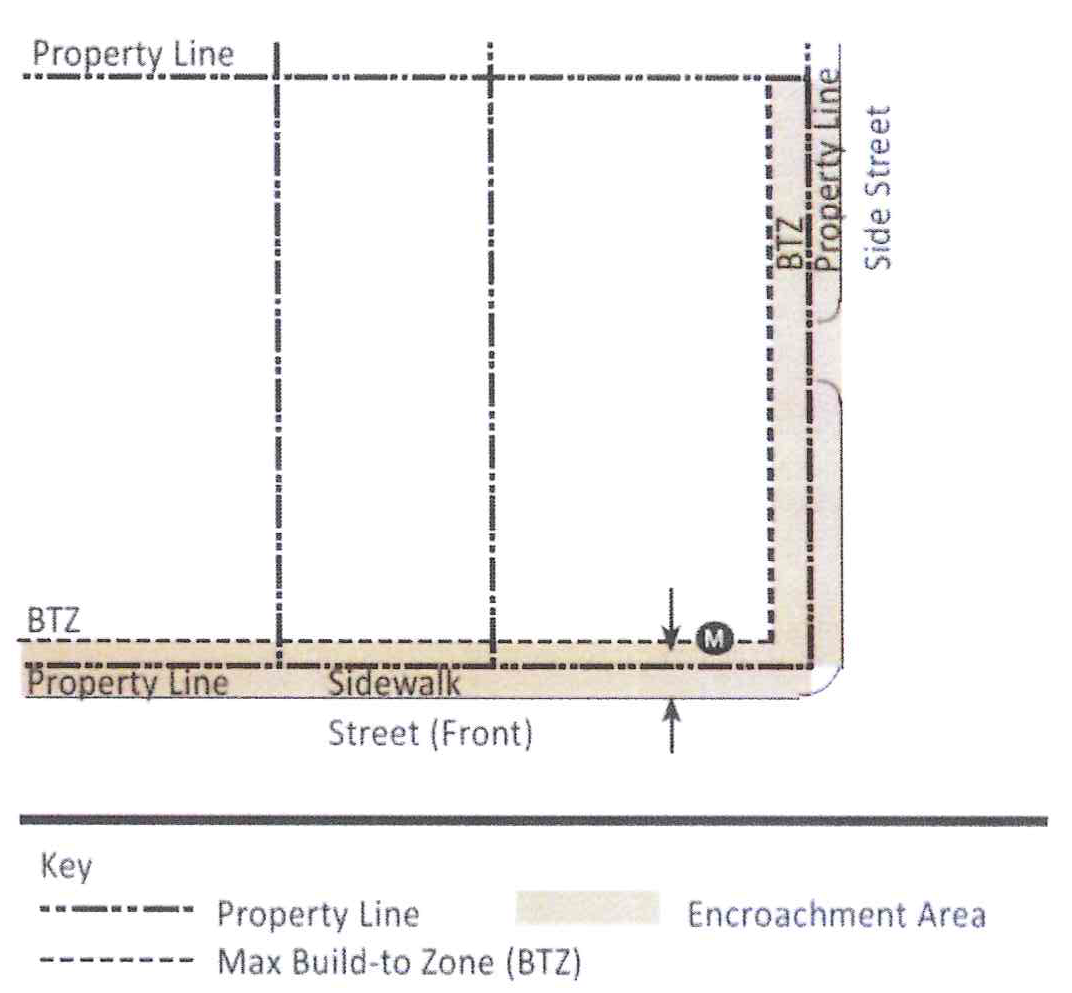
(d)
Frontage elements and encroachments.
NOTES:
• Frontage elements may encroach forward of the build-to zone and/or into the right-of-way, barring any additional restrictions by the public entity that has control over the public right-of-way.
• See general standards for requirements of frontage elements.
Miscellaneous notes:
• All buildings must have a primary pedestrian entrance along the front façade.
22-594.8
Downtown edge.
(a)
Building placement.
NOTES:
• Where existing buildings on a block face are not consistent with the required setbacks, any new building may apply the contextual setback per subsection 22-594.1(e).
(b)
Building height.
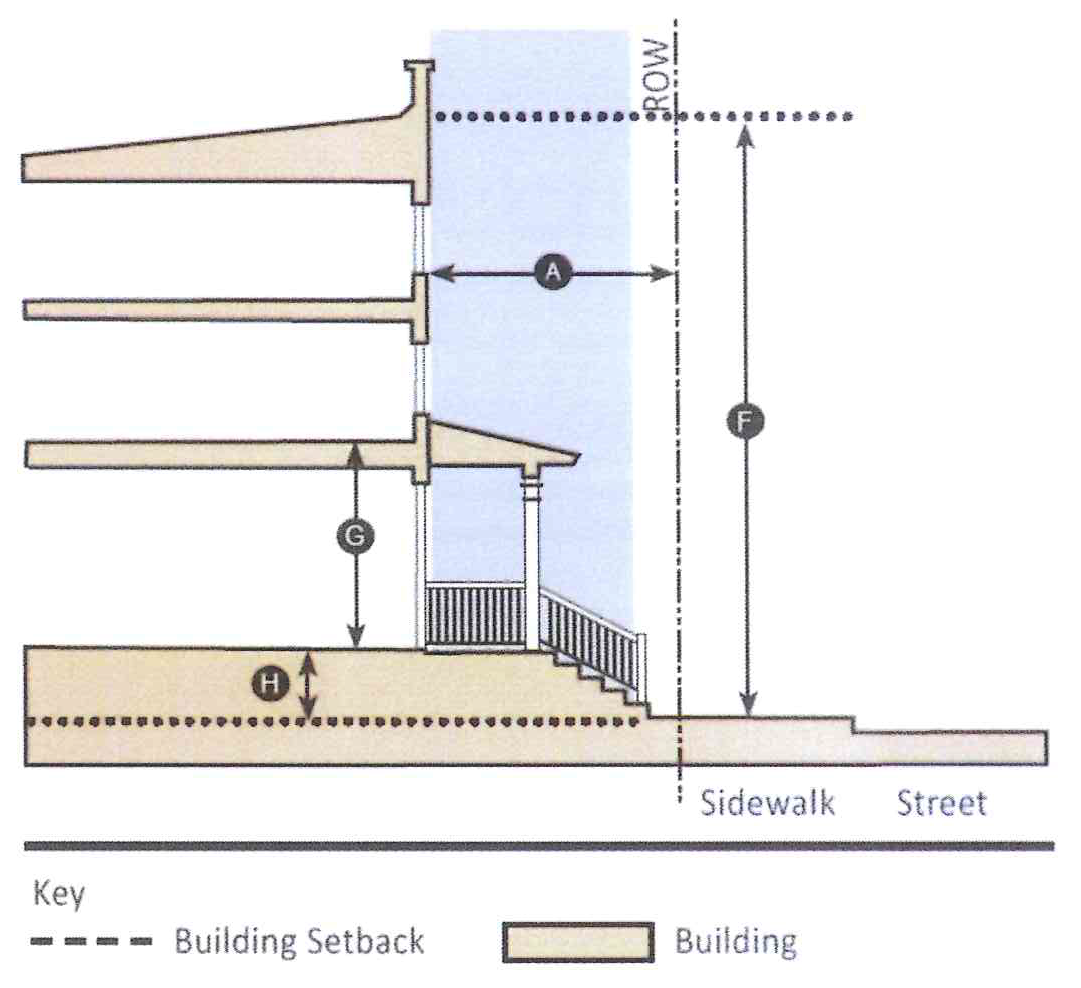
NOTES:
• Towers, cupolas, and other rooftop features with a footprint smaller than 650 square feet may extend up to one story above the designated height limit.
• * Finished ground floor in a converted commercial building is permitted provided ADA accessibility standards are met.
(c)
Parking location.
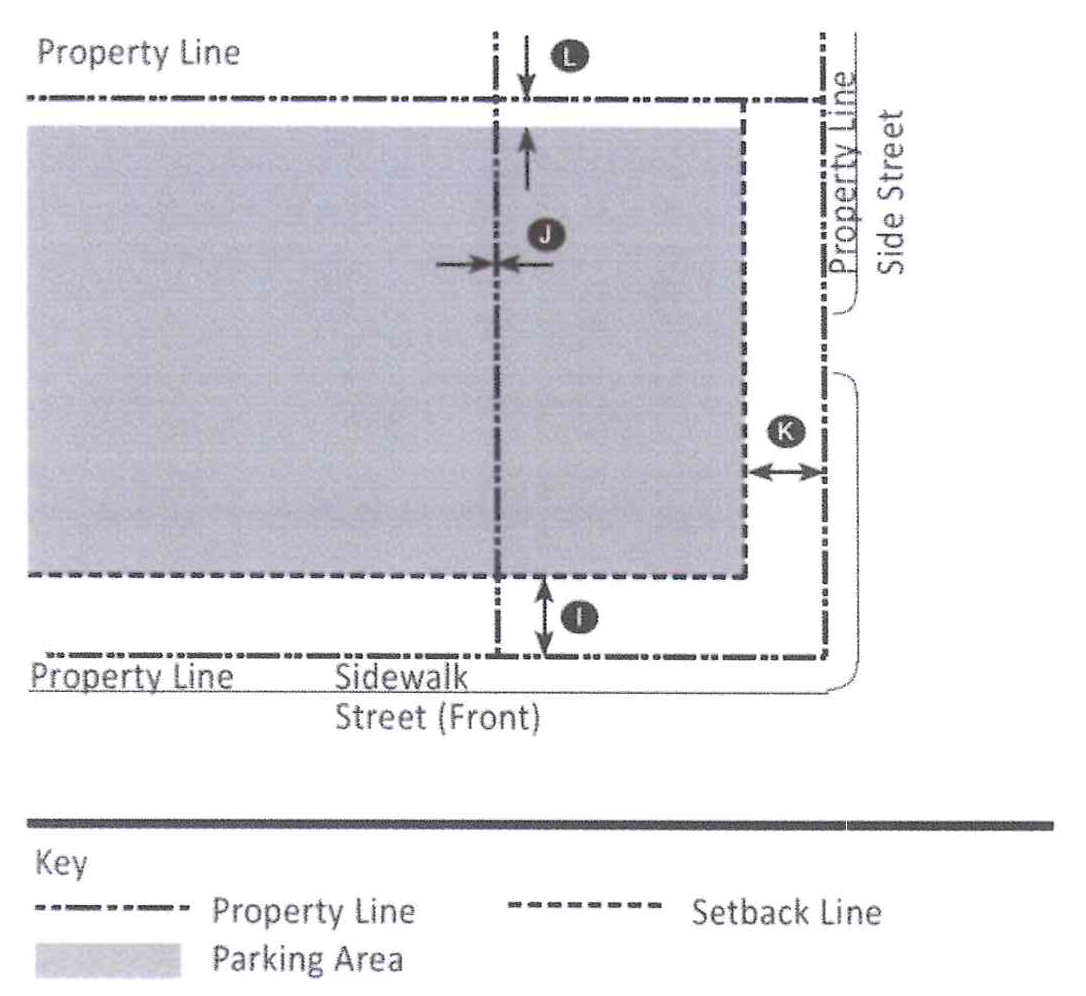
NOTES:
• Parking shall be accessed from rear alleys or side streets whenever possible.
(d)
Frontage elements and encroachments.
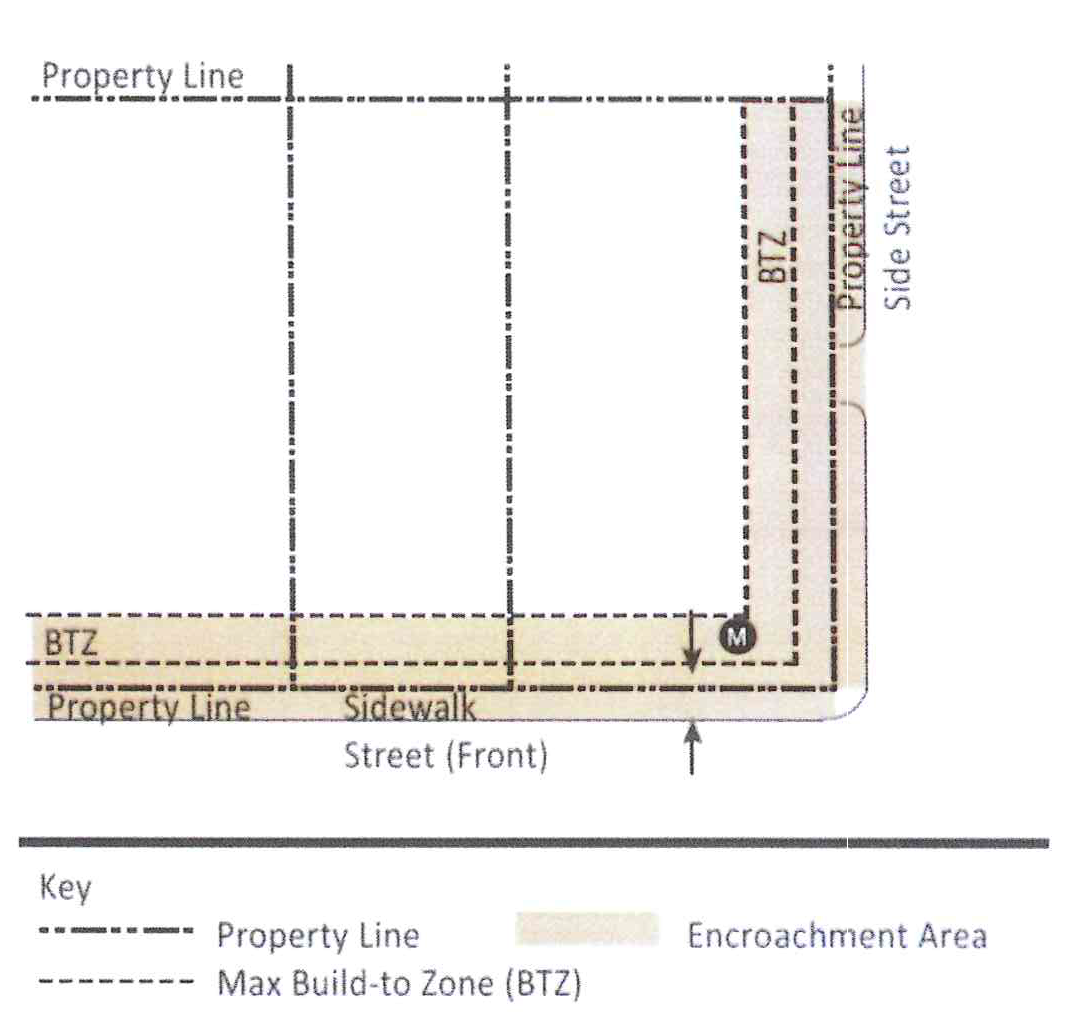
NOTES:
• Frontage elements may encroach forward of the build-to zone and/or into the right-of-way, barring any additional restrictions by the public entity that has control over the public right-of-way.
Miscellaneous notes:
• All buildings must have a primary pedestrian entrance along the front façade.
22-594.9
Parking standards. The intent of the parking standards is to encourage a balance between pedestrian-oriented development and necessary vehicle storage. The goal is to construct neither more nor less parking than is needed.
(a)
Parking requirements.
(1)
The reuse of buildings within the downtown boundary shall not be required to provide any additional parking, granted that the exterior dimensions are not changed.
(2)
Parking shall be provided for each use based upon the minimum and maximum requirements outlined by use in table 2-2, automobile parking requirement chart.
(3)
On-street parking provided adjacent to the site may count as part of the required parking supply, provided the design is deemed appropriate by the city manager or their designee.
(4)
No residential parking shall be allowed on streets designated as "mandatory shopfront" as shown on the special requirements plan.
(5)
Parking shall be located behind the principal façade of buildings whenever possible and according to their allowed location based on transect zone.
(6)
Parking garages shall be masked from the frontage by a liner building. Streetscreens, garden walls, fences, or hedges are required along all rights-of-way without buildings to shield views to parking.
(7)
Shared and reduced parking is encouraged in all transect zones for more efficient parking solutions. The amount of parking required is calculated by adding the total number of spaces required by each separate function in the parking requirement chart and dividing by the appropriate factor from table 2-3, sharing factor matrix. For example, the residential function requires ten spaces while the office function requires 12 spaces. Independently they would require 22 spaces, but when divided by the sharing factor of 1.4, they would require only 16 spaces. When multiple functions share parking, the lowest sharing factor shall apply.
(8)
The ARZA board may allow an additional reduction in the required number of parking spaces if adequate public parking is available or if the applicant submits a parking demand study substantiating the basis for granting a reduction in the number of spaces.
TABLE 2-2: AUTOMOBILE PARKING REQUIREMENT CHART
1 Accessory dwelling units (ADUs) do not require additional off-street parking
TABLE 2-3: SHARING FACTOR
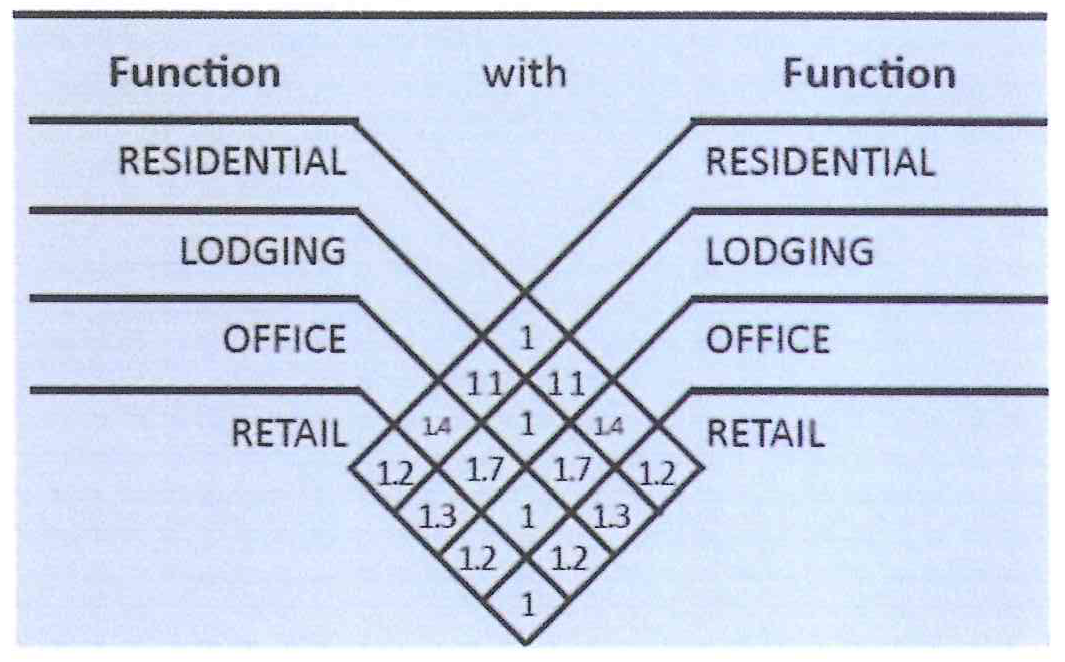
(b)
Accessible parking. Within the requirements of table 2-2 (not in addition to those requirements), accessible parking shall be provided for all multi-family and nonresidential uses as required by the Americans with Disabilities Act (ADA) Accessibility Guidelines for Buildings and Facilities, and state statues, as amended.
(c)
Bicycle parking. Bicycle parking shall be provided in all transect zones per table 2-4, bicycle parking requirement chart, and subject to the subsections below:
(1)
Anchors. All spaces provided shall include a metal anchor sufficient to secure the bicycle frame when used in conjunction with a user-supplied lock.
(2)
Short term bicycle parking accommodates bikes parked for short periods of time in locations that are easily accessible and convenient for visitors, customers and residents.
(3)
Short term bicycle parking shall be located on sidewalk frontage zones, bicycle corrals located in the street parking lane, parks and other public facilities, and on private property.
a.
A fee in-lieu shall be used when short-term bicycle parking spaces are to be located within the right-of-way.
(4)
Long term bicycle parking provides a place that is reasonably free from vulnerability to both weather and theft for bikes typically parked for periods of eight hours or more and on a regular basis. This applies particularly to employees while at work and for residents of multi-family dwellings.
(5)
Long term bicycle parking shall be located in a secure area covered from weather such as a building bike room, shared cage in a garage, or in a standalone enclosure such as a locker or structure.
(6)
Bike parking in parking garages. Parking garages should include bike parking and should be provided on the ground floor.
(7)
Long term bike parking facilities can be provided within parking garages, some of which can be made available for lease to non-residential uses to meet their long term bike parking requirements.
TABLE 2-4: BICYCLE PARKING REQUIREMENT CHART
(d)
Parking access.
(1)
Rear alleys/lanes, where they exist, shall be the primary source of access to off-street parking. Parking along alleys may be perpendicular, diagonal, or parallel.
(2)
Alleys may be incorporated into parking lots as standard drive aisles. Access between parking lots across property lines is encouraged.
(3)
Corner lots that have both rear and side access shall access parking through the rear. If no rear access exists, access to on-lot parking shall be provided from the side street.
(4)
If no alley or side street exists, then efforts should be made to demonstrate an attempt to gain access across neighboring properties.
(5)
When access to rear parking must be directly from the primary frontage, driveways shall be located along the sides of the property lines and designed such that pedestrians crossing on sidewalks always have the right-of-way.
(e)
Off-street surface parking.
(1)
Minimum setbacks for off-street surface parking from all property lines are provided in the transect zone standards.
(f)
Structured parking lot placement.
(1)
Structured parking shall be lined with liner buildings along all adjacent thoroughfares, except rear alleys.
(2)
Liner buildings, where utilized, shall be a minimum of two stories and may be attached or detached from parking structures.
(3)
Liner buildings, where utilized, shall contain a minimum of 30 feet of habitable space behind each building façade along the street frontage.
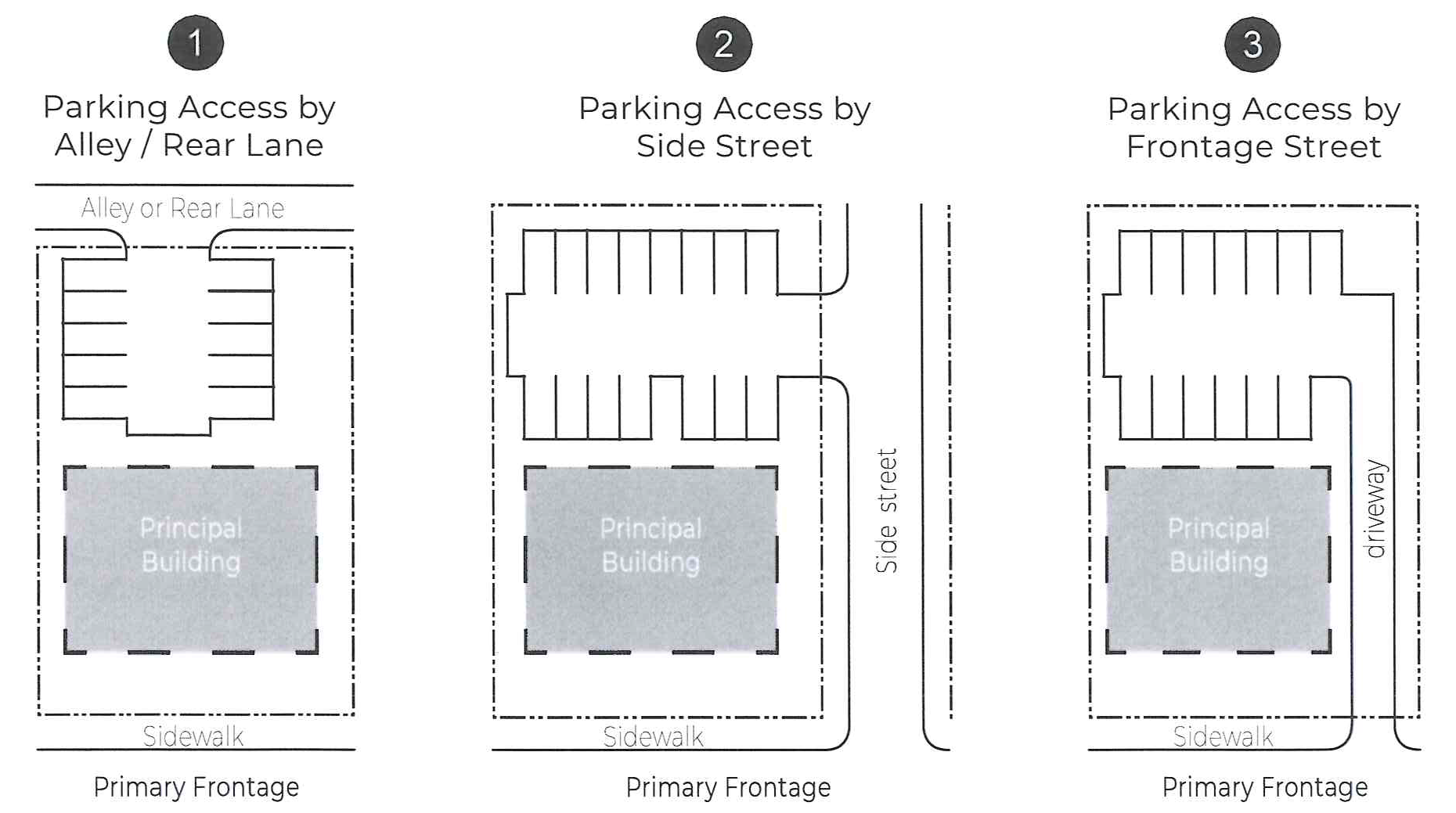
Figure 2-1: Parking Access Diagrams
22-594.10
Lighting standards. Adequate and quality lighting of the sidewalk and street area is essential to creating a safe and inviting streetscape.
(a)
General lighting standards.
(1)
Lighting fixtures within the streetscape shall be provided by the city.
(2)
In order to conserve energy and reduce long-term costs, energy-efficient lamps shall be used for all public realm lighting.
(b)
Light levels.
(1)
Lighting standards protect against glare, preserve the night sky, and reduce unnecessary energy use from over lighting. Residential zones tend to be darker, while higher levels of outdoor lighting may be more suitable in the downtown core.
(2)
Lighting should be warm in color in keeping with the historic amber glow, a color temperature of 2,700 Kelvins maximum shall be maintained.
(c)
Street and public parking lot lighting.
(1)
Street lighting and public parking lot lighting shall be maintained by the city utilities department.
(d)
Private parking lot lighting.
(1)
All new fixtures shall be full cutoff, downward facing.
(2)
Light fixtures located within the interior area of a parking lot shall not exceed 30 feet in height. Light fixtures located along the perimeter edge of a parking area within 50 feet of a property line shall not exceed 16 feet in height.
(e)
Pedestrian walkway lighting.
(1)
Light fixtures located along pedestrian walkways adjacent to parking lots shall not exceed 16 feet in height.
(2)
Light fixtures located along internal pedestrian walkways or paths not adjacent to a parking area shall not exceed ten feet in height.
(f)
Building and security lighting.
(1)
All exterior building or security lighting must be full cutoff, shielded, and/or angled downward to focus the light only on the intended doorway or walkway as necessary.
(2)
Security lighting is encouraged to be provided with regular pedestrian light fixtures where visible from the street or public realm to match others used on site.
(3)
Building mounted architectural "accent lights" are encouraged to emphasize architectural character and signage.
(4)
Business owners are encouraged to assist with lighting the sidewalk and to accent their business location by leaving display window and interior lighting on at night. Lighting shall be designed in such a way as to prevent the direct view of the light source to neighboring residential areas.
22-594.11
Utilities and site standards.
(a)
General standards.
(1)
Wherever practicable, utilities shall run underground and above-ground projections of utilities shall be placed in rear service areas, with the exception of fire hydrants.
(2)
All utility services should be located in the rear of buildings, clear of pedestrian and vehicular interaction, and screened from view from adjacent public rights-of-way, properties, and pedestrian walkways (not including alleys).
(3)
Tree wells or root barriers should be used where proposed trees are near underground infrastructure lines or adjacent to a travel way (vehicular or pedestrian).
(4)
Alleys and portions of the thoroughfare right-of-way should serve as designated drainage and utility corridors/easements.
(5)
Where special circumstances dictate utility easements are needed between lots, utility easements shall be a minimum width as required by the utilities department.
(b)
Service areas and loading docks.
(1)
Trash and recycling dumpsters or similar collection areas shall be located in the rear or to the side of buildings and screened from view from adjacent public rights-of-way, properties, and pedestrian walkways (not including alleys).
(2)
Enclosure and/or screened areas must have adequate storage space for landfill, compostable, and recyclable materials collection dumpsters and/or compactors.
(c)
Mechanical equipment. For the purposes of these standards, mechanical equipment includes any heating, ventilation, and air conditioning (HVAC) or electrical machinery as well as air compressors, hoods, mechanical pumps, exterior water heaters, water softeners, utility and telephone company transformers, meters or boxes, garbage cans, storage tanks, generators, electric vehicle (EV) chargers, geothermal wells, and similar elements.
(1)
If mechanical equipment is located at-grade, and is visible from an adjacent street or sidewalk, it shall be screened by a fence or streetscreen.
(2)
Mechanical equipment located in the rear or to the side of buildings but visible to public parking lots should be screened from view from the parking area. Screening shall allow access to maintain and repair equipment as needed.
(3)
All mechanical equipment or penthouse screening placed on a roof shall be set back from the roof line by a distance at least equivalent to the height of the screening in order to minimize visibility from surrounding streets.
22-594.12
Signage standards. Signage shall be in compliance with the city signage standards.
22-594.13
Landscape standards. Landscaping shall be in compliance with the city landscape standards.
22-594.14
Stormwater management. Stormwater management shall be in compliance with the city stormwater management standards.
(Ord. No. 23-06122023, § III(Exh. A), 6-12-2023)
Sec. 22-595. - Building standards.
22-595.1
Purpose and intent. This section contains standards that apply to the downtown code area, specifying standards for buildings that impact walkability and the quality of the public realm as well as parking requirements, lighting, and public open space.
22-595.2
Applicability. The provisions of this section shall apply to all development and redevelopment in the downtown that involves the construction of a new principal structure on the site, except:
(a)
Where pre-existing development and nonconformities permits the continued use and/or expansion of a structure without compliance with some or all of the standards of this code; and
(b)
Where the structure is a landmark designated by the city, in which case the standards and procedures related to historic landmarks and within historic districts must conform to additional standard.
22-595.3
All buildings.
(a)
Where required, ADA ramps may be incorporated into the architecture of the building, ideally along the side or rear façade.
22-595.4
Existing buildings.
(a)
Existing buildings may be repaired, updated, altered, and have additions in accordance with current adopted codes such as the International Existing Building Code.
(b)
Compatibility of additions, and expansions. Construction on existing structures, including principal structures, accessory structures, and building additions, shall be designed to be no greater than the average setbacks, heights, and building bulk of buildings with similar principal uses on the same block face and the facing block face to the maximum degree practicable. Furthermore, building characteristics such as roof pitches, gables, and the inclusion (or not) of porches, shutters, and other exterior elements shall conform to the buildings on the same block face and the facing block face to the maximum degree practicable, in order to preserve the character of the block face.
22-595.5
New buildings.
(a)
Primary entrances.
(1)
The primary entrance of every principal building giving access to a principal use of the property must directly face a street or a public space. Public space may include a central garden or courtyard when that public space opens directly onto the primary street.
(2)
Buildings shall be designed and oriented with an emphasis on the primary street on which they front.
(3)
Buildings located on corner lots shall use design elements that emphasize the importance of both streets.
(4)
The primary public entrance shall be prominently located, easily identifiable, relate to the human scale, and contribute to the overall design intent.
(5)
The primary public entrance for commercial buildings shall be at grade or seamlessly integrate required handicap accessibility into the design of the building.
(b)
Entry/exit doors. Public entry and exit doors which swing outward shall be recessed into the facade a minimum of three feet where the sidewalk abuts the building.
(c)
Window and door openings. Windows and doors shall be vertically proportioned or subdivided to appear vertical.
(d)
Columns/posts.
(1)
Columns and posts shall not be spaced further apart than they are tall.
(e)
Material changes.
(1)
When materials are combined on a building facade horizontally, heavier materials should occur below lighter materials.
(2)
For buildings of three stories or more, the ground floor should be differentiated from those floors above in order to reinforce the pedestrian space.
(3)
Changes from one material or color to another along the horizontal direction should occur at "inside corner" transitions.
(4)
Changes in material or color along the vertical direction should occur at a hard-edge "bump-out" transition which gives materials a surface to terminate into.
(5)
Façades with an overabundance of different materials or colors are generally discouraged.
(f)
Brick and masonry detailing.
(1)
Headers.
a.
All openings in masonry construction shall be spanned by a header.
b.
Permitted header forms shall be the lintel, arch, and jack arch.
c.
Headers shall be a minimum of four inches in height and shall be slightly wider than the opening they span.
(2)
Sills.
a.
All window and door openings in masonry construction shall have a sill at their base.
b.
Sills shall be generally rectangular in form, and slope slightly away from the opening to shed water.
c.
Sills shall be a minimum of two inches in height and should project from the wall surface a minimum of one-half inch beyond the vertical casing. Sills shall be slightly wider than the opening, the same as the header.
(3)
Caps.
a.
A cap shall protect the tops of all masonry structures exposed to the weather including: garden walls, stair treads, planter edges, parapets, and freestanding piers.
b.
Caps shall be comprised of stone, cast stone, brick, concrete, or slate.
c.
The edges of caps may be rectangular, or may be more ornate.
d.
Caps shall project past the edge of the masonry structure below by a minimum of one-half inch.
(g)
Wide buildings.
(1)
The primary façade of buildings wider than 150 feet shall be varied with a change of architectural expression.
(2)
These changes in expression may be a vertical element running from the ground plane to the roof, a change in fenestration, color, or texture, or a break in building façade plane or roof line.
(3)
These changes may be subtle or significant, but should soften the visual effect of very wide buildings directly across the street from narrower buildings and in general, continue the rhythm of the existing buildings.
(h)
Façade transparency. All building façades that face onto a street (including secondary or side streets) or public space shall meet the minimum transparency requirements outlined below. The percentage of transparency per story shall be calculated within the area between finished floor and finished ceiling and shall be a total percentage of doors and windows along that portion of the façade. An example of appropriate façade transparency is shown in the figure below.
(1)
Buildings with shopfront.
a.
Minimum building façade transparency for ground story: 60 percent and should allow a view of at least five feet of interior space.
b.
Minimum building façade transparency for upper stories: 40 percent.
(2)
Buildings without shopfront.
a.
Minimum building façade transparency for ground story: 30 percent.
b.
Minimum building façade transparency for upper stories: 20 percent.
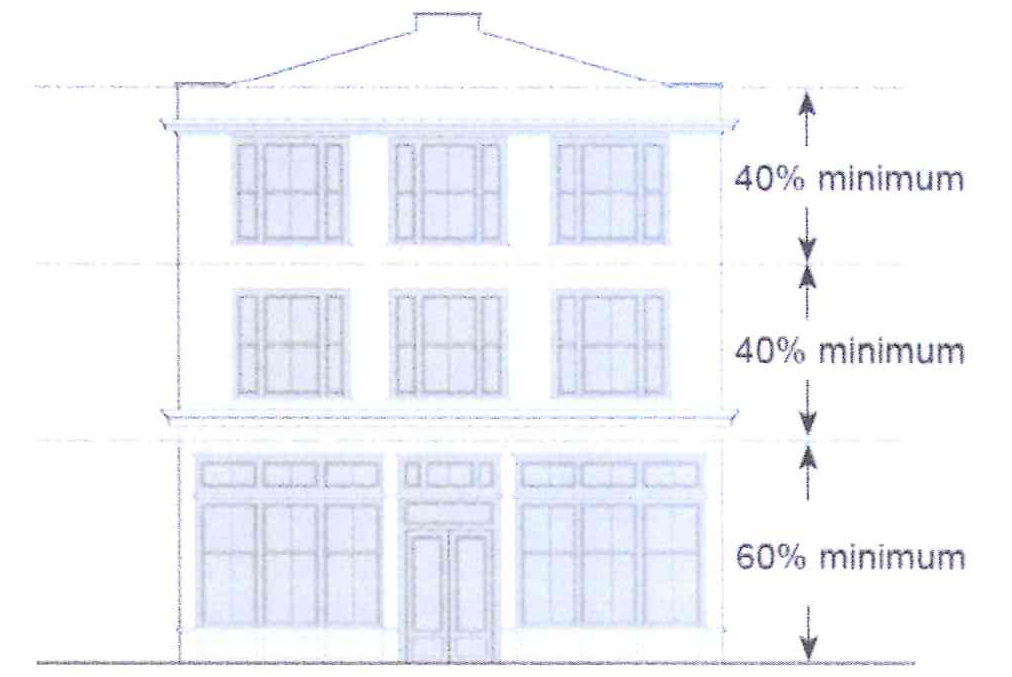
Figure 3-1: Façade transparency requirements for buildings with shopfront.
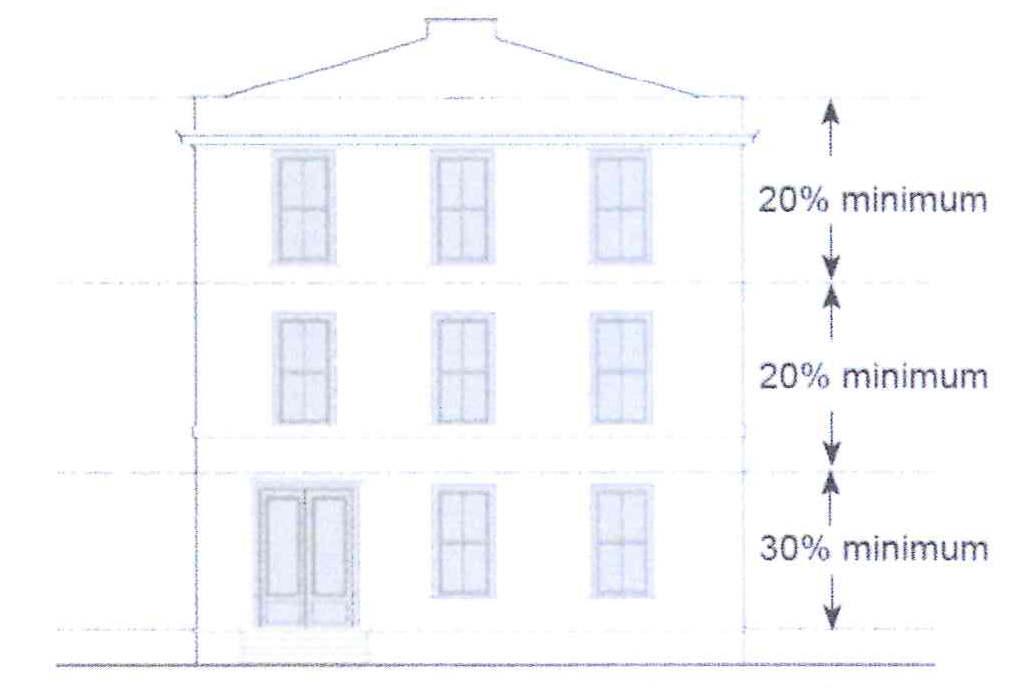
Figure 3-2: Façade transparency requirements for buildings without shopfront.
(i)
Building elements.
(1)
Small footprint towers/cupolas.
a.
These features are designed to extend above the roof line, and are generally intended to be visual landmarks. They are commonly placed at terminate vistas.
b.
Towers/cupolas with a footprint smaller than 650 square feet may extend up to one story above the designated height limit.
c.
All tower/cupola heights shall comply with FAA height regulations.
(j)
Appurtenances and encroachments. Appurtenances are structural or architectural elements, such as balconies, bay windows, awnings, and other frontage elements that extend from the primary mass of the building. Requirements and standards for encroachments are provided in the transect zone standards and the frontage type standards.
Overhead encroachments are encroachments that extend into the right-of-way but do not meet the ground. Overhead encroachments are permitted within the right-of-way by right with a minimum clearance of seven feet six inches above the sidewalk.
All encroachments that have an element that meets the ground must enter into a right-of-way agreement with the city.
(1)
Balconies.
a.
The minimum balcony depth is six feet measured perpendicular to the wall face. Balconies may be inset either partially or wholly within the main body of the building.
b.
The minimum underside clearance of a first floor balcony is ten feet.
c.
Balconies may occur forward of the build-to line or zone, and may encroach within the right-of-way with special easement permission, but shall not extend closer than two feet from the curb line.
d.
Balconies shall be permitted to have roofs, but are required to be open, unconditioned parts of buildings.
e.
Balconies must be visually supported from below by brackets or another structurally implicit mechanism, from above by suspension cables or chains, or adjacent side walls (if the balcony is set completely within the main body of the building).
f.
On corners, balconies shall be permitted to wrap around the side of the building facing the adjacent street.
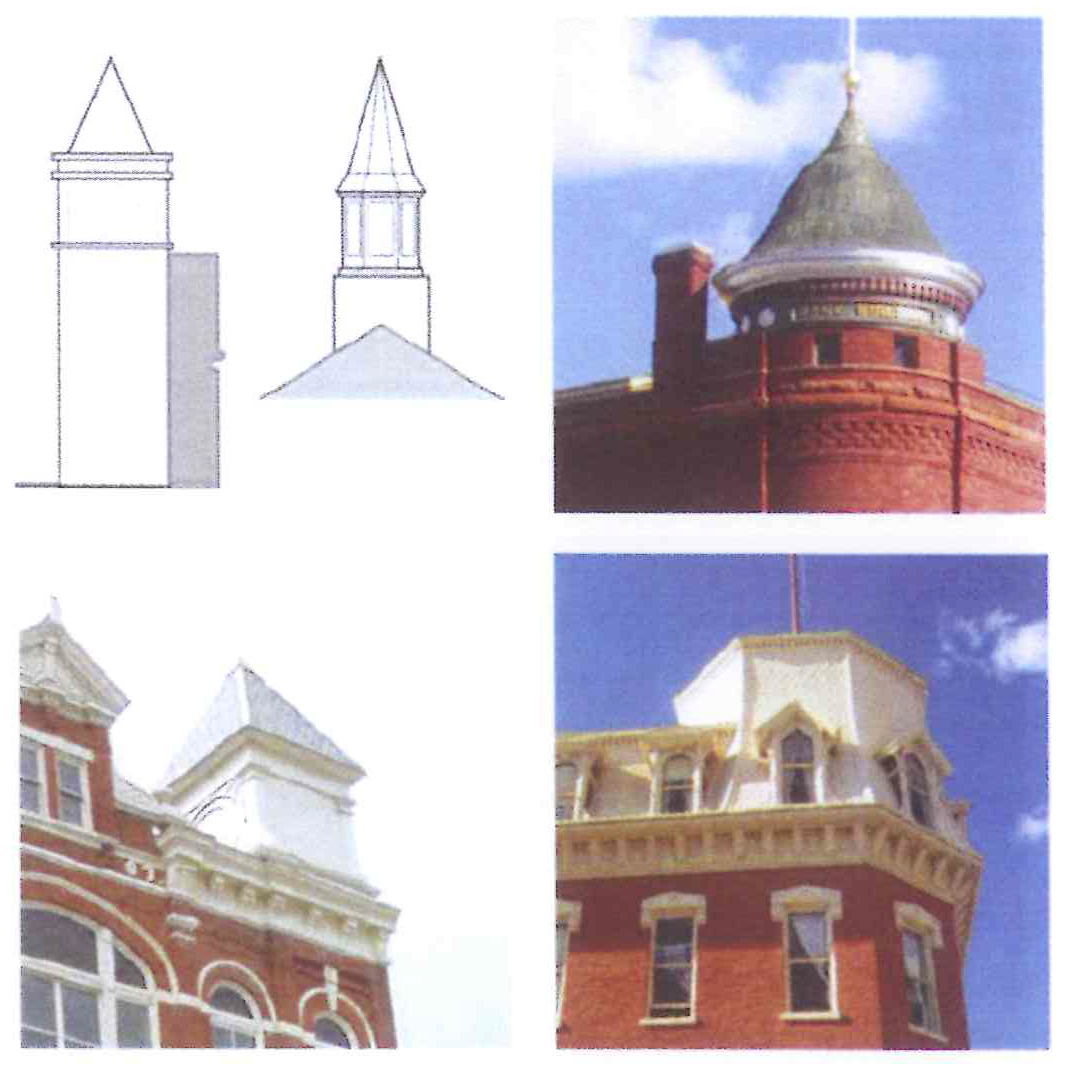
Figure 3-3: Examples of Small Footprint Towers/Cupolas
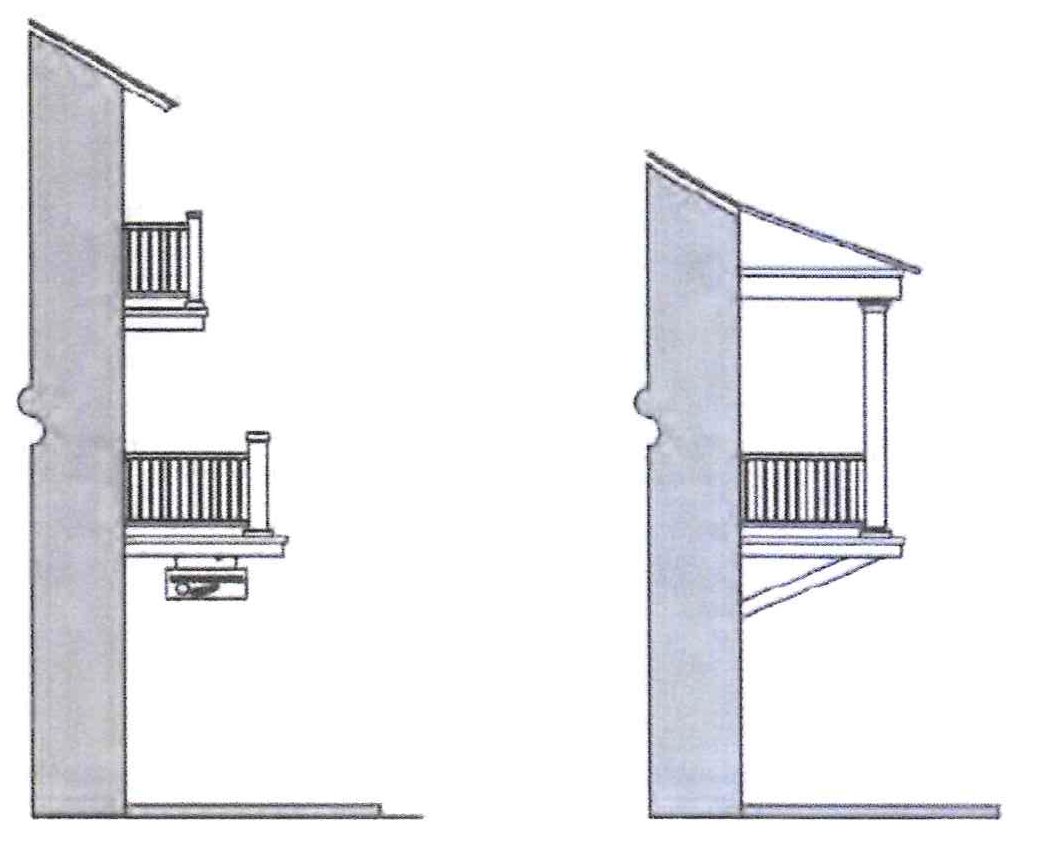
Figure 3-4: Balcony Example
(2)
Awnings or canopies.
a.
The minimum awning depth for a first floor awning is five feet measured perpendicular to the wall face.
b.
The minimum underside clearance of a first floor awning is eight feet.
c.
If a building facade has awnings, they shall occur for at least 25 percent of that facade.
d.
Awnings may occur forward of the build-to line or zone, and may encroach within the right-of-way, but shall not extend closer than two feet to the curb line.
e.
Awnings shall be made of durable fabric and may be either fixed or retractable. High-gloss or plasticized fabrics are prohibited. Backlit awnings are also prohibited.
(3)
Marquees.
a.
Marquees may occur forward of the build-to line or zone, and may encroach within the right-of-way, but shall not extend closer than two feet from the curb line.
b.
Marquees must meet the sign requirements.
(k)
Frontage types. Frontage elements are semi-private elements of the building located in the area between the primary facade and the lot line. Frontage elements may occur forward of the build-to zone or setback. Frontage elements create the transition between the public building and the private or commercial buildings.
Building frontages shall conform with the basic frontage types and the basic standards for those elements. The illustrations and photographs provided are for illustrative purposes.
(1)
Shopfront.
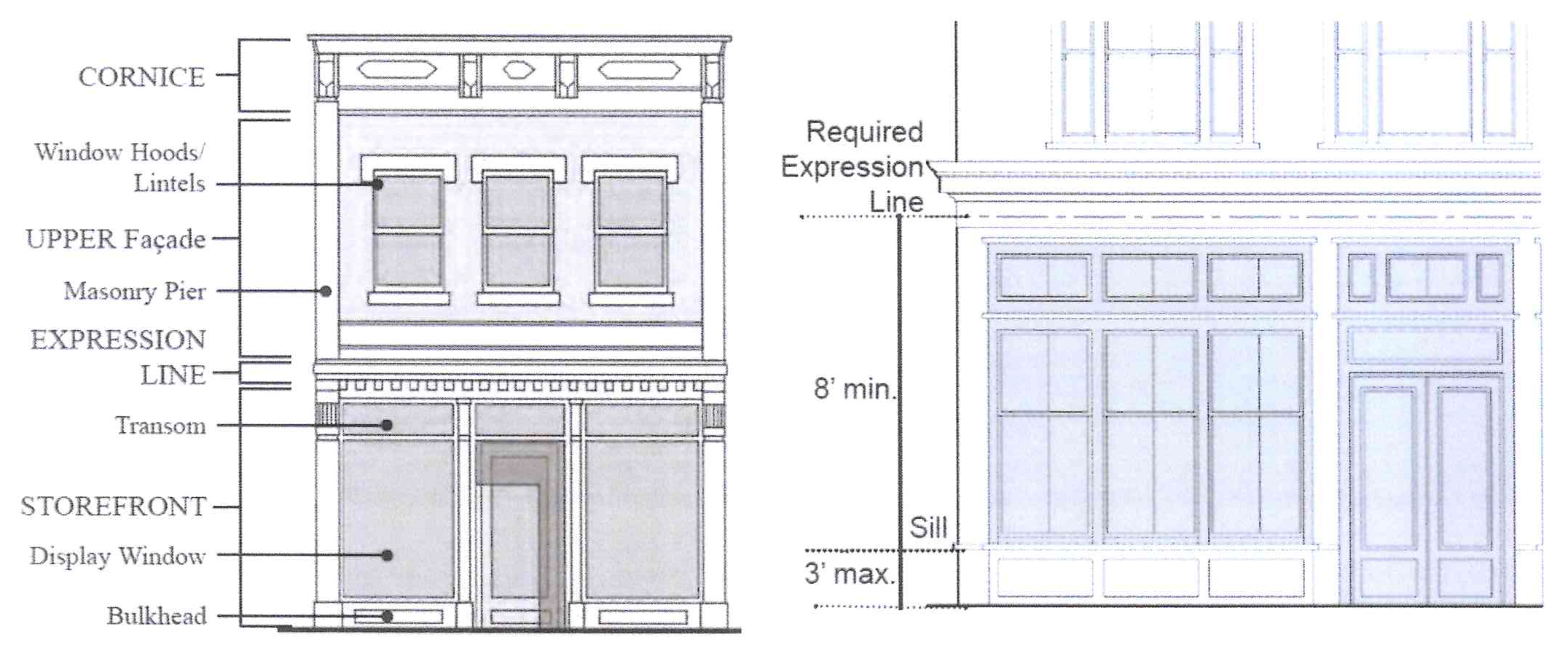
a.
Description. The front façade of the building is at or near the frontage line. The entrances to all shopfronts shall be covered, either by an awning, canopy, marquee, second floor balcony, arcade, colonnade, or by being inset into the main body of the building.
b.
Size.
1 A recessed entry may be designed in a variety of configurations (recessed door, sawtooth pattern, etc.) and may be located on the front facade or the corner of a building. An exception to meet ADA ramp compliance between sidewalk height and inside finished floor is permitted.
c.
Miscellaneous.
Doors may be recessed as long as front façade is at BTZ.
Open ended awnings and operable awnings are encouraged.
Rounded and hooped awnings are discouraged.
Folding or garage doors that open and close a restaurant or retail space to the street are permitted in place of shopfront windows. Such doors shall extend from the adjacent sidewalk to at least eight feet above the adjacent sidewalk.
Shopfronts shall have a cornice or expression line between the first and second story.
Shopfront windows may not be made opaque by window treatments (excepting operable sunscreen devices within the conditioned space and window signs).
Shopfront windows should be transparent to be able see into the space inside.
Shopfront doors shall contain at least 60 percent transparent glass. Solid doors are prohibited.
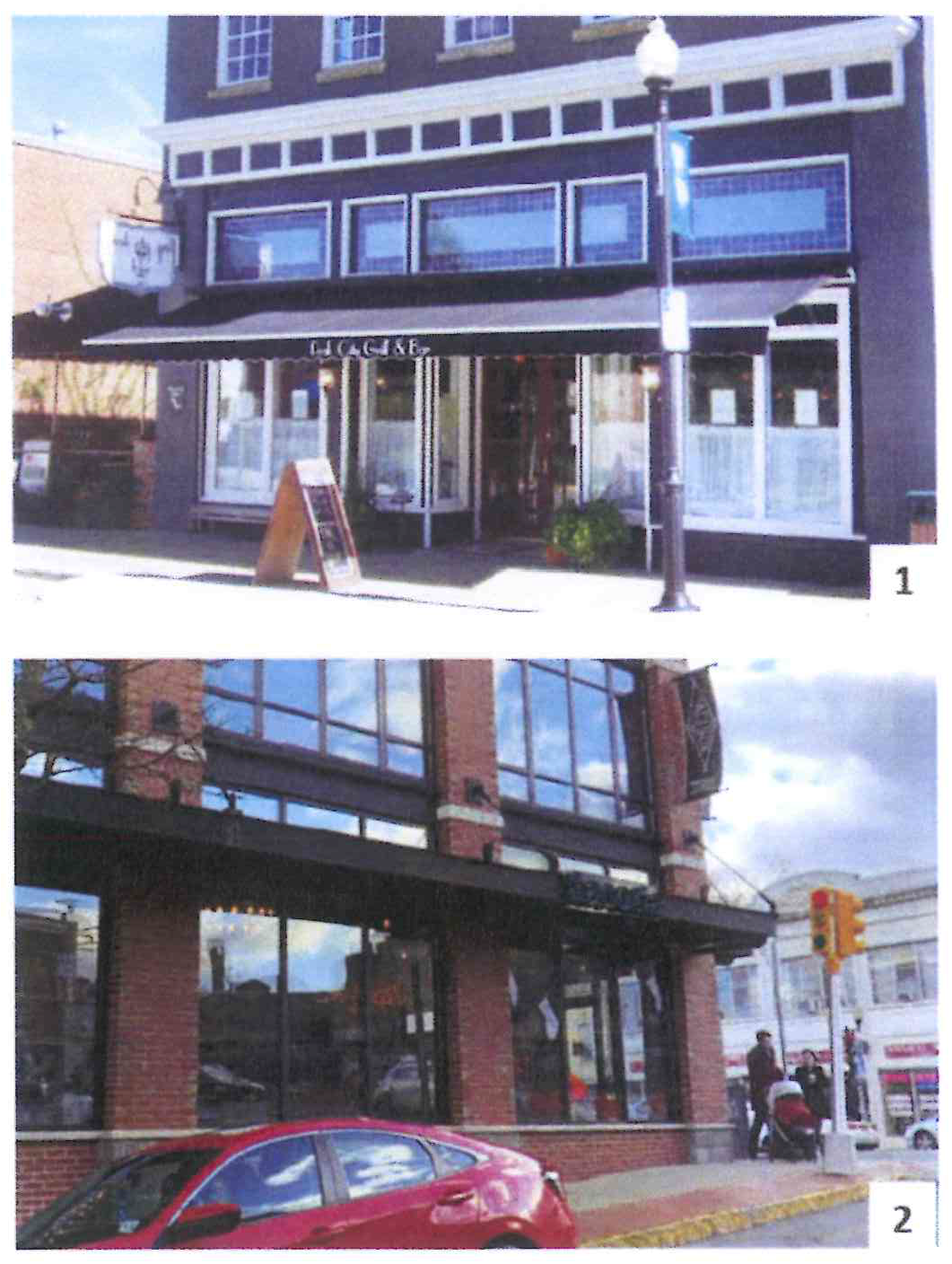
Figure 3-5: Examples of shopfronts and details
1. Shopfront with a recessed doorway
2. Shopfront with metal canopy
(2)
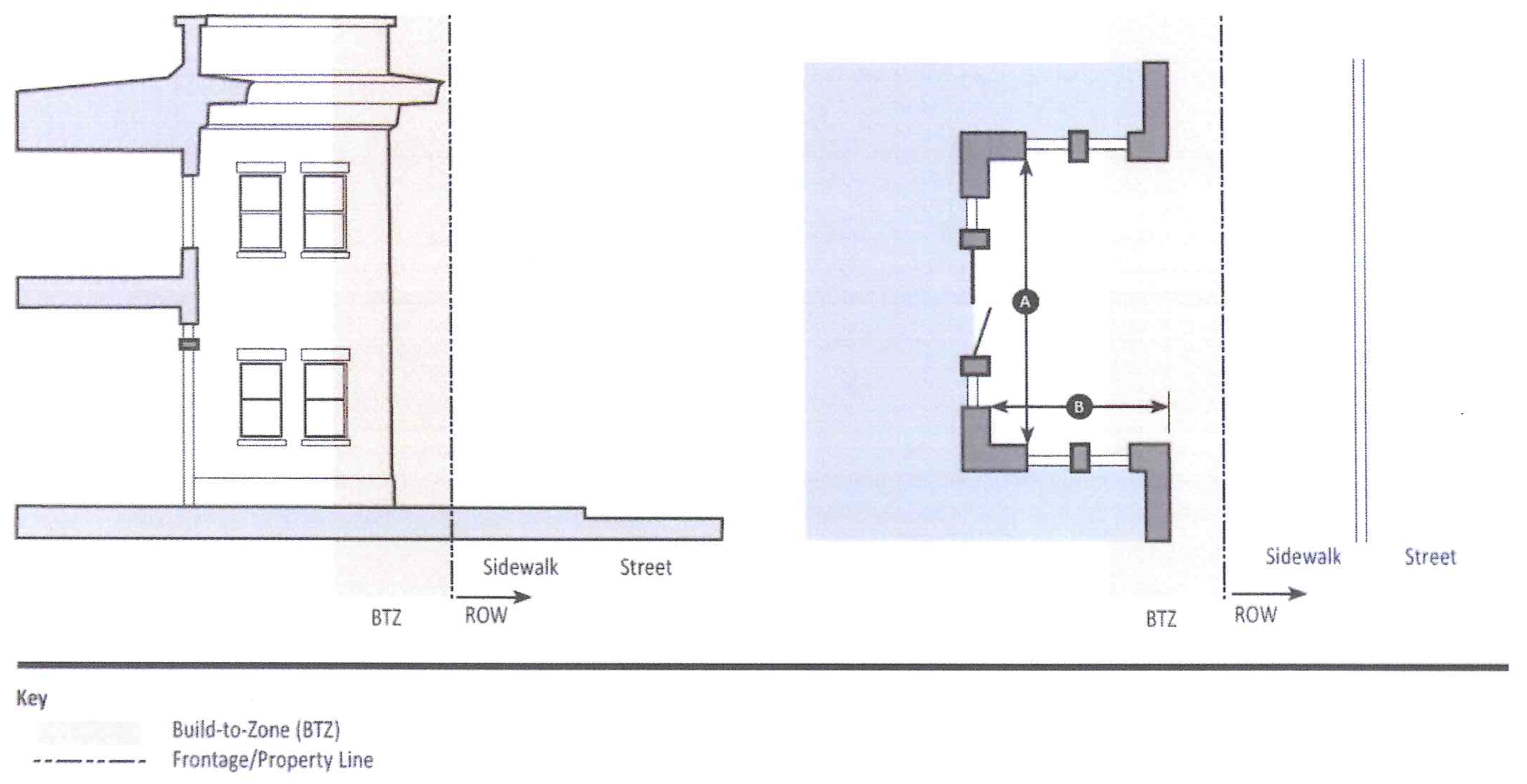
Gallery/arcade.
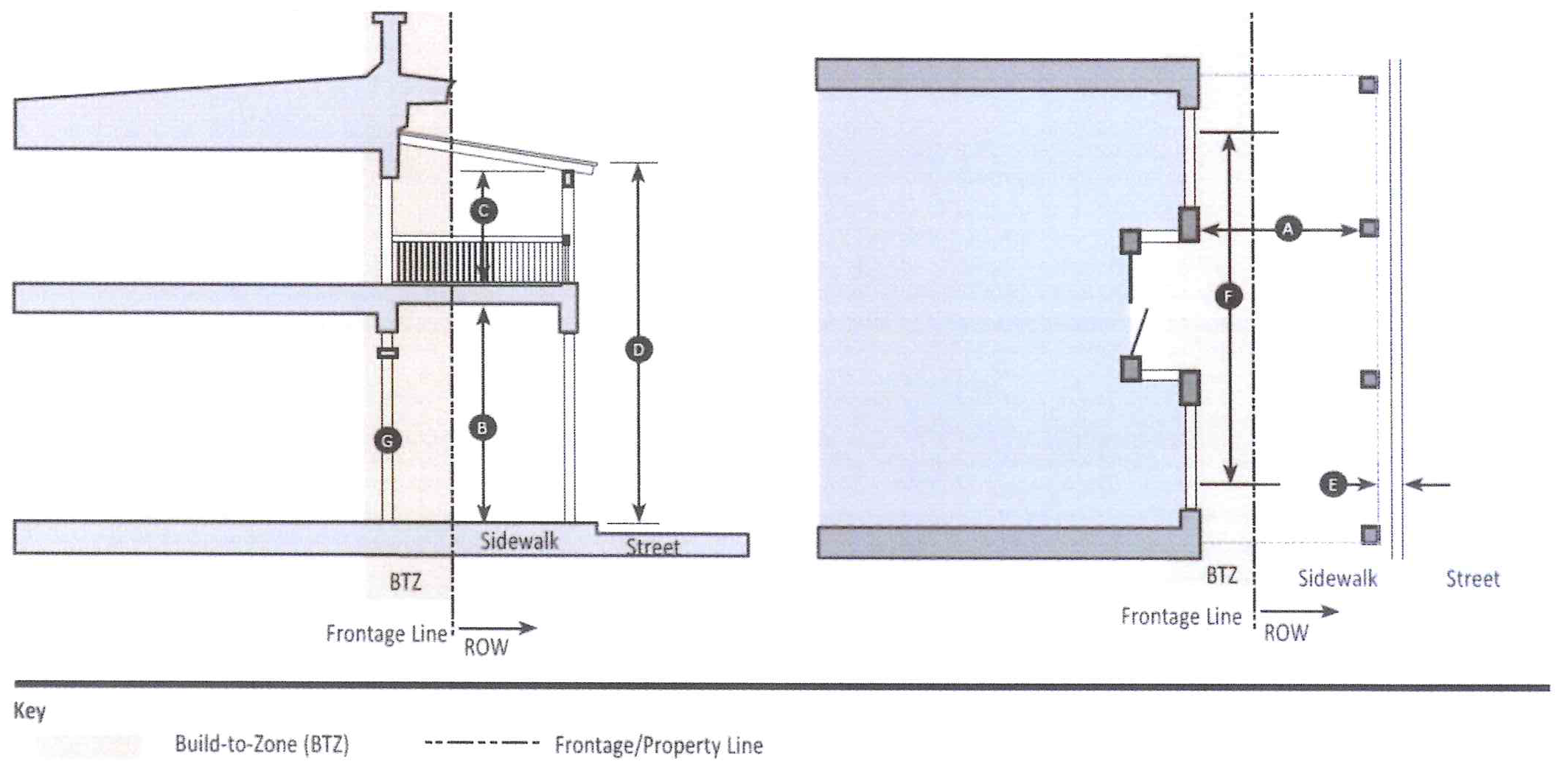
a.
Description. The front façade of the building is at the build-to-zone and the gallery/arcade element overlaps the sidewalk, eliminating the need for an awning or canopy. This frontage type is intended for buildings with ground-floor commercial or retail uses and may be one or two stories in height.
b.
Size.
c.
Miscellaneous.
Galleries/arcades must also follow all the rules of the shopfront frontage type. Ⓖ
Galleries/arcades shall be supported by columns, piers or arches. Support columns can be spaced no farther apart than they are tall.
Galleries/arcades shall occur forward of the build-to zone or setback and may encroach within the right-of-way with the approval of the city. When an arcade extends over a public sidewalk, the property owner may be required to enter into a right-of-way agreement, in a form acceptable to the city, establishing the property owner's sole responsibility for repairing any damage that may result from public maintenance or improvements.
Galleries/arcades shall not extend closer than two feet from the curb line, nor farther than five feet from the curb line.
Enclosed usable space shall be permitted above the galleries/arcades, and within the right-of-way with the approval of the city.
On corner lots, galleries/arcades may wrap around the side of the building facing the secondary street.
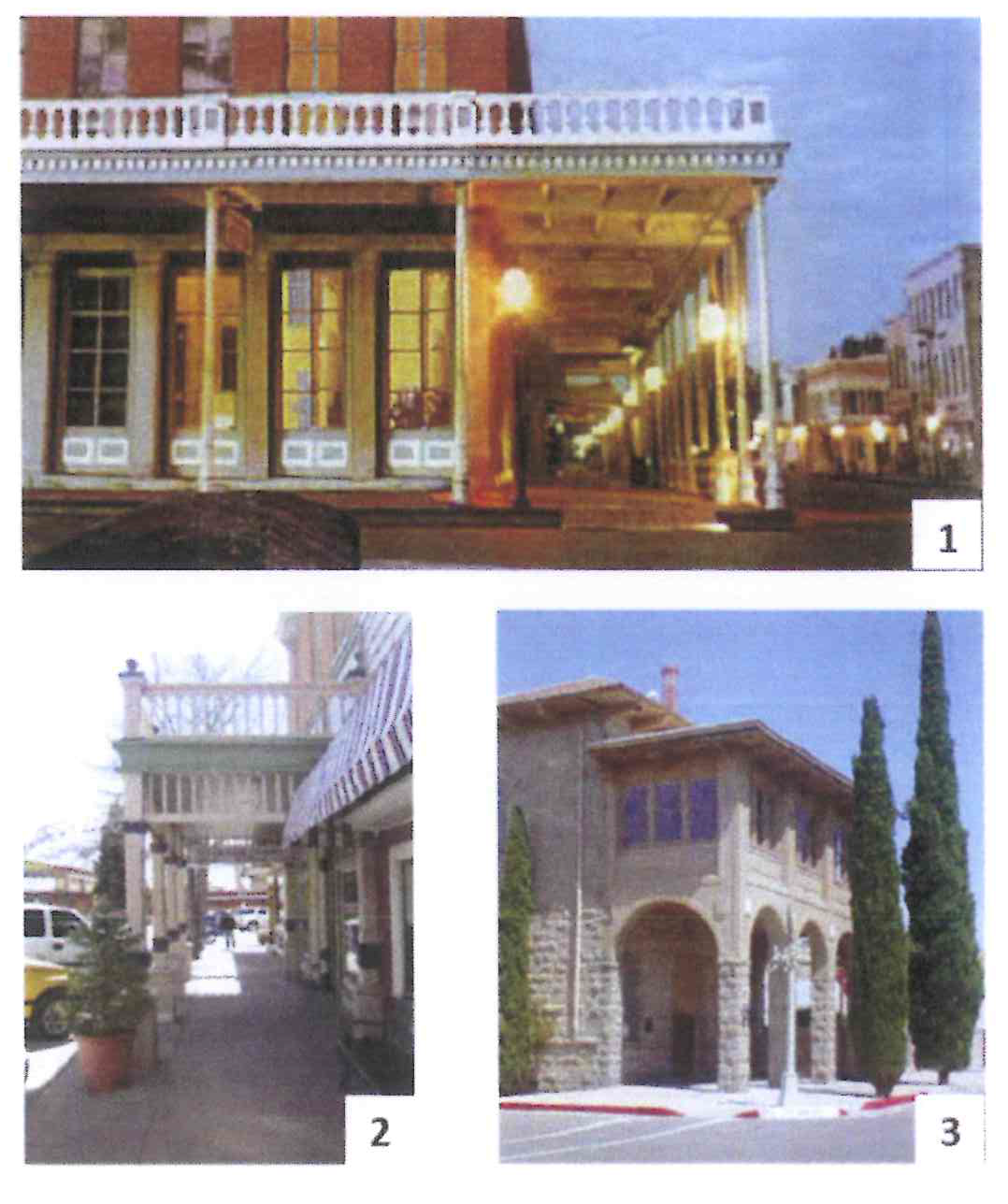
Figure 3-6: Example of galleries
1. Gallery with slender metal columns
2. Wood framer Gallery
3. Masonry Arcade with Habitable Space on the
second floor
(3)
Forecourt.
a.
Description. The primary portion of the building's front façade is at the build-to-zone while a small percentage is set back, creating a courtyard space. This space can be used as an apartment or office entry court, garden space, or for restaurant outdoor dining.
b.
Size.
c.
Miscellaneous. Forecourts are especially useful along larger, more auto-dominant streets in order to provide well-shaped, intimately sized public outdoor spaces. The proportions and orientation of courtyard spaces must be carefully considered for solar orientation and user comfort.
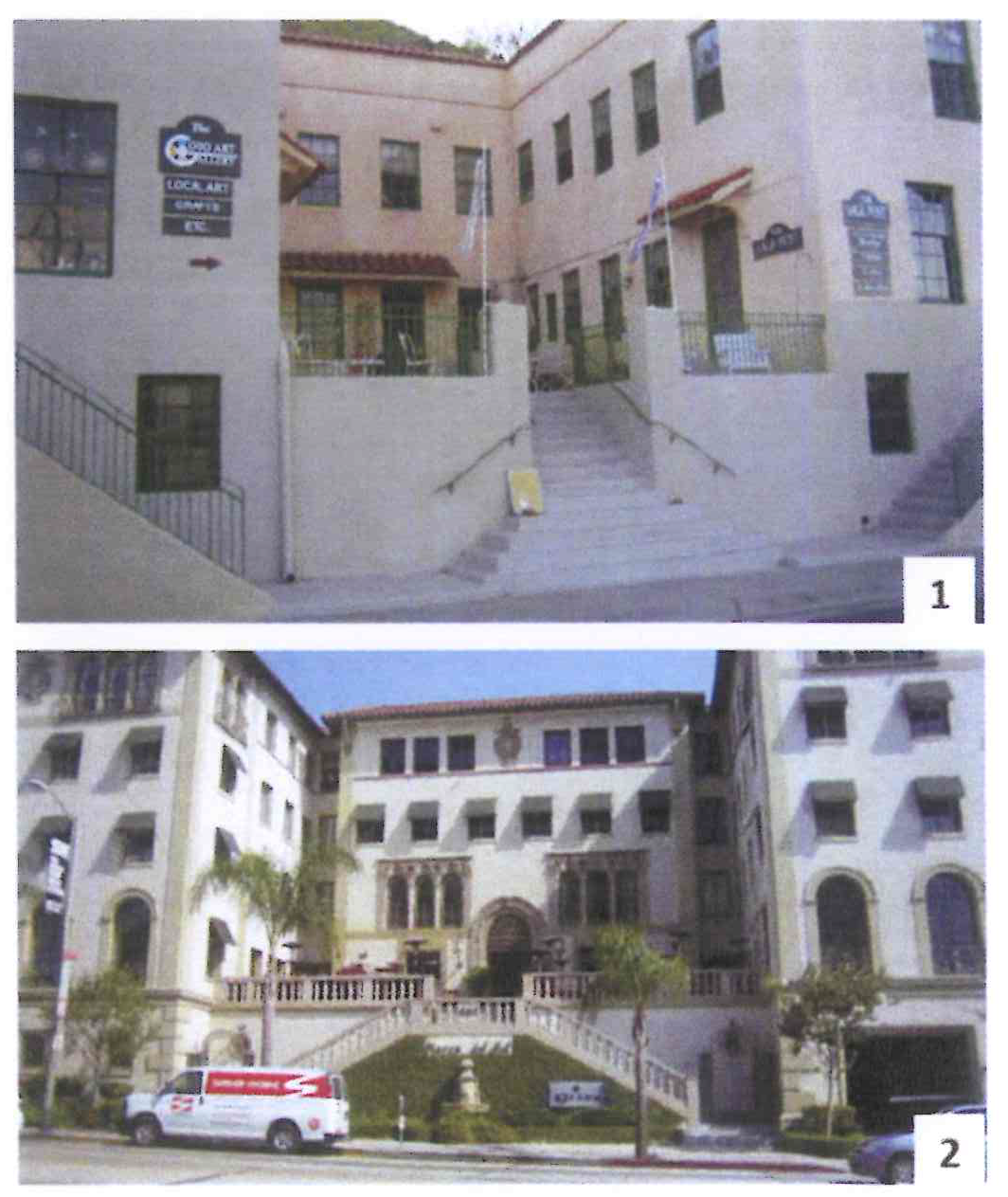
Figure 3-7: Examples of Forecourts
1. Elevated Forecourt
2. Elevated Forecourt forming a dining terrace
(4)
Stoop.
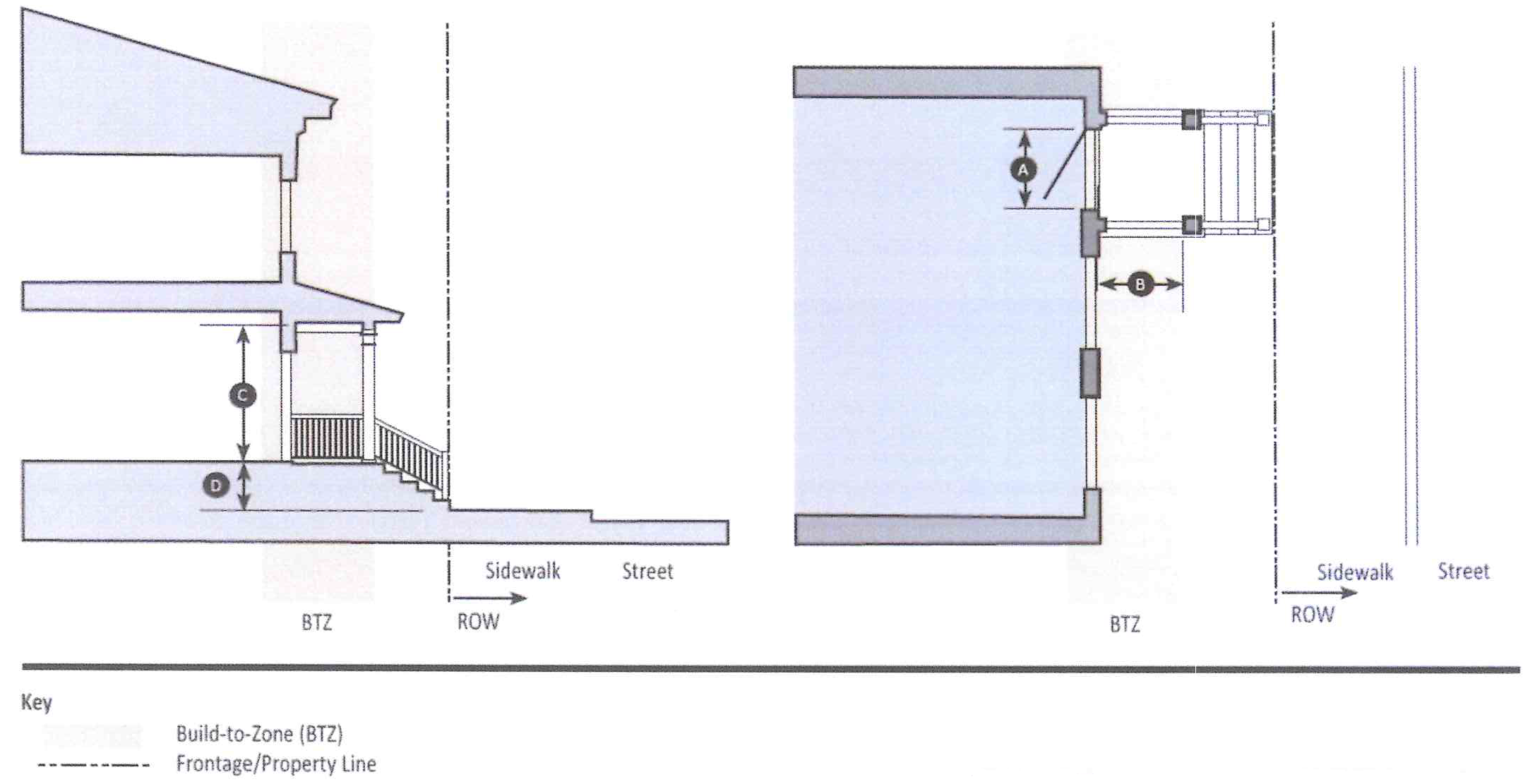
a.
Description. The front façade of the building is at the build-to-zone and the elevated stoop projects forward. The stoop is used to access a first floor that is elevated above the sidewalk to ensure privacy within the building.
b.
Size.
c.
Miscellaneous.
A stoop is appropriate for residential uses with small setbacks.
Stoops may extend forward of the build-to-zone or setback line and, if permitted by the district standards, into the right-of-way.
A six-foot minimum clear zone for pedestrians shall be maintained on the sidewalk.
Stairs may be perpendicular or parallel to the building facade.
The entry doors are encouraged to be covered or recessed to provide shelter from the elements.
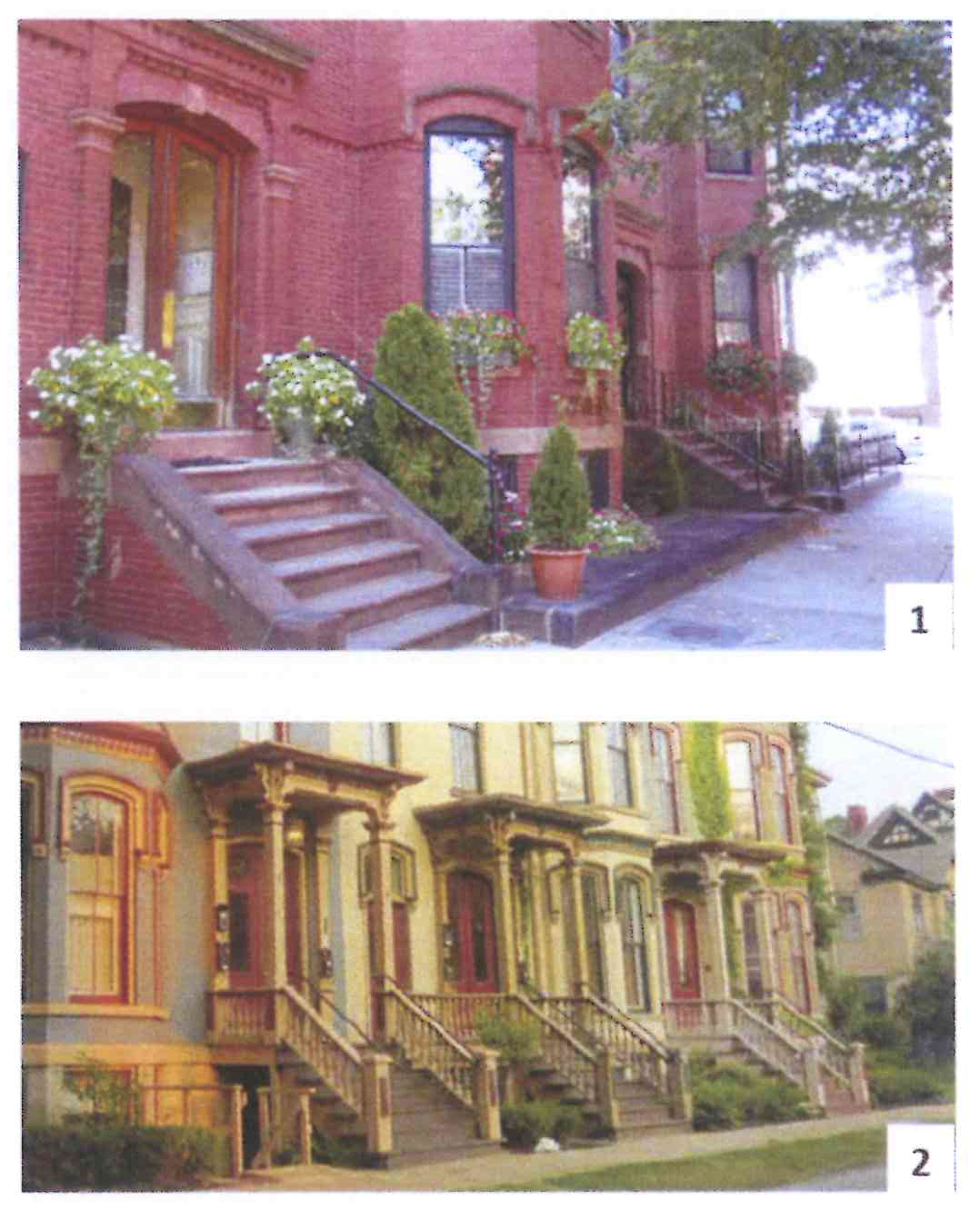
Figure 3-8: Examples of stoops
1. Unroofed stoops
2. Covered stoops
(5)
Porch.
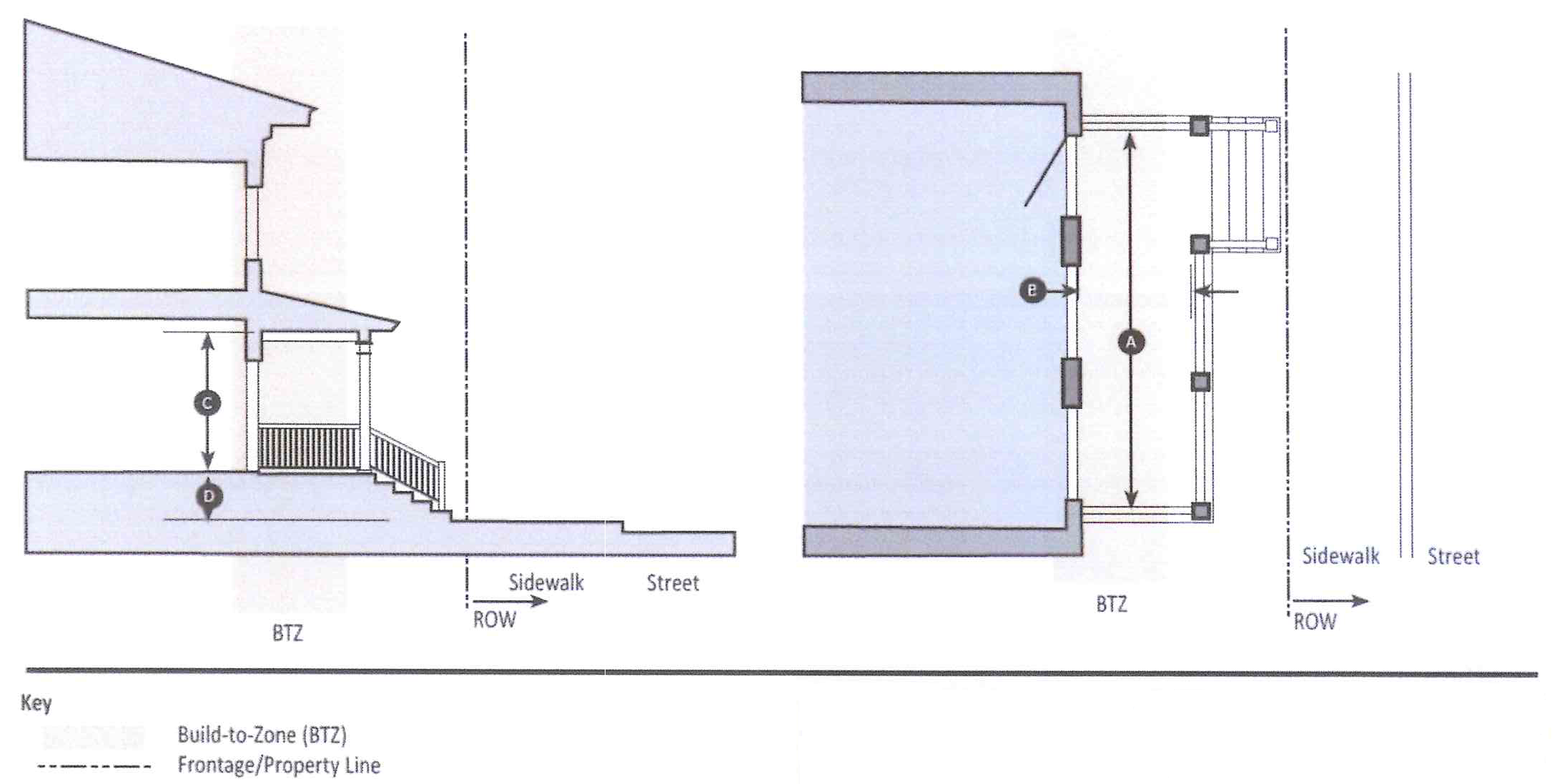
a.
Description. The main facade of the building is at the build-to-zone and the elevated porch projects forward. The porch is used to access a first floor that is elevated above the sidewalk to ensure privacy within the building. A porch is large enough to function as an outdoor living space.
b.
Size.
c.
Miscellaneous.
Porches may extend forward of the build-to-zone or setback line and, if permitted by the district standards, into the right-of-way.
A six-foot minimum clear zone for pedestrians shall be maintained on the sidewalk.
Stairs may be perpendicular or parallel to the building façade.
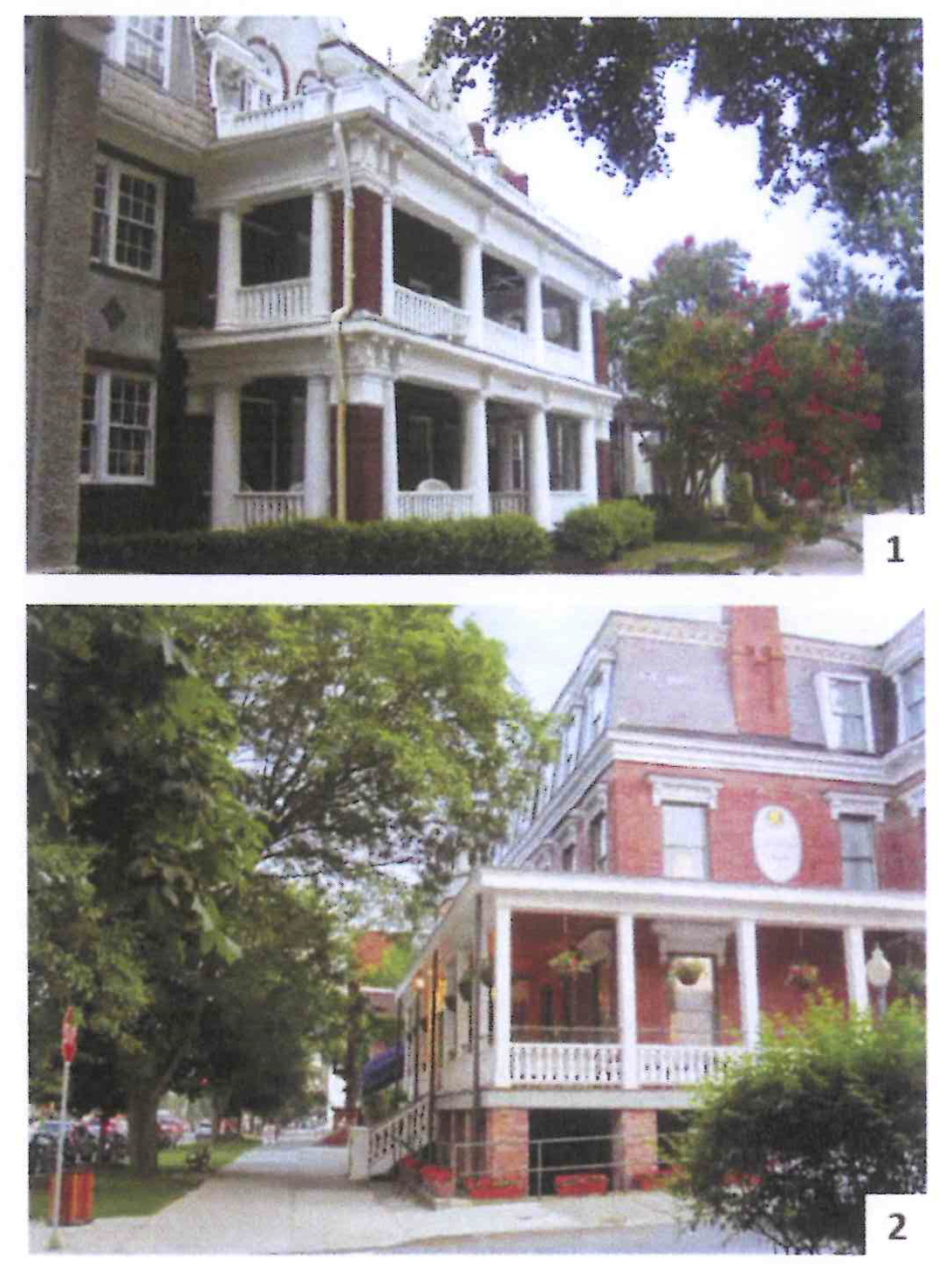
Figure 3-9: Examples of Porches
1. 2-Story Porch on an apartment building
2. Covered wraparound porch located close to the
sidewalk
(6)
Common yard.
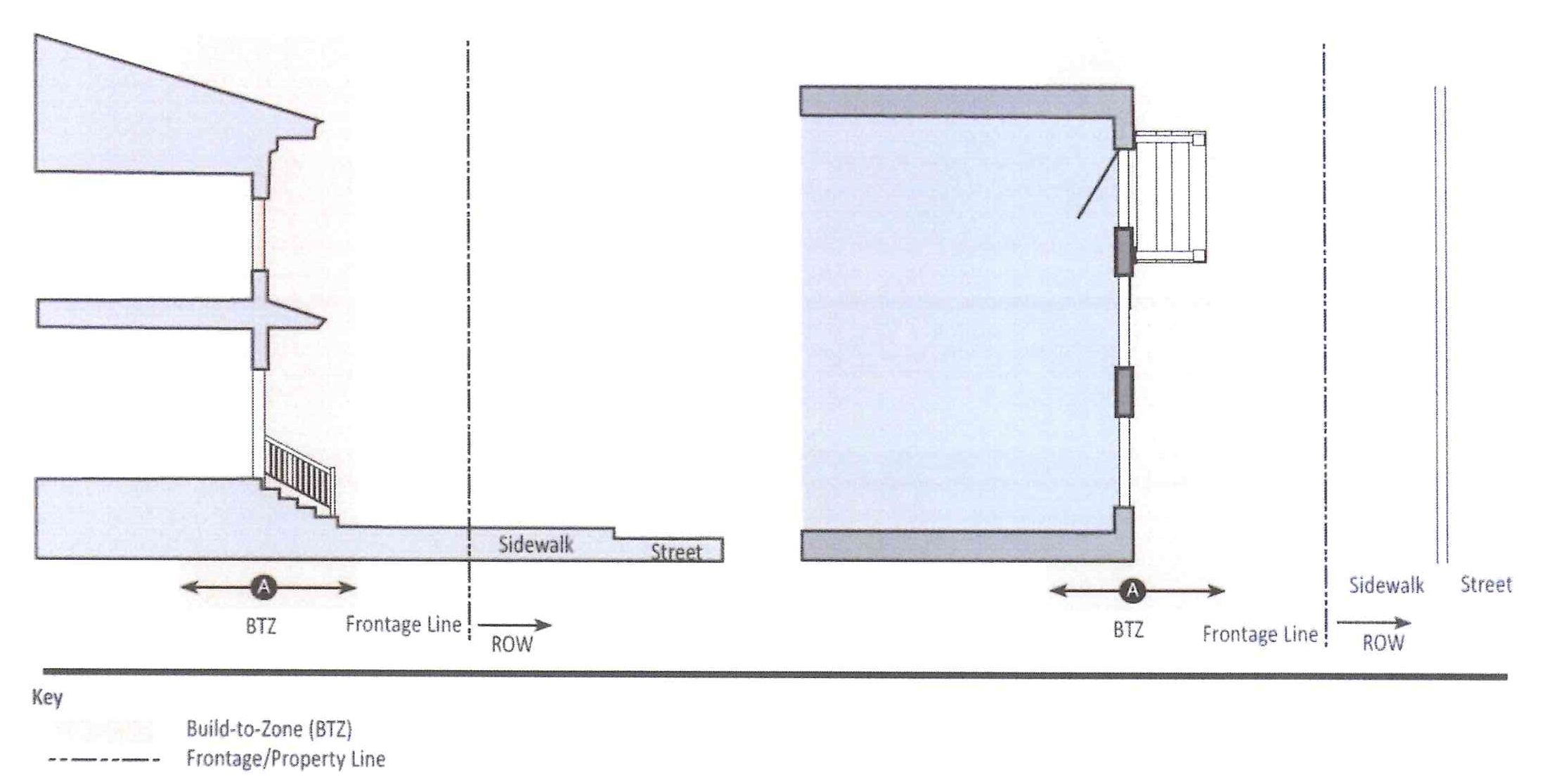
a.
Description. The front façade is set back substantially from the frontage line with a planted frontage. The front yard created remains unfenced and is visually continuous with adjacent yards, supporting a common landscape.
b.
Size.
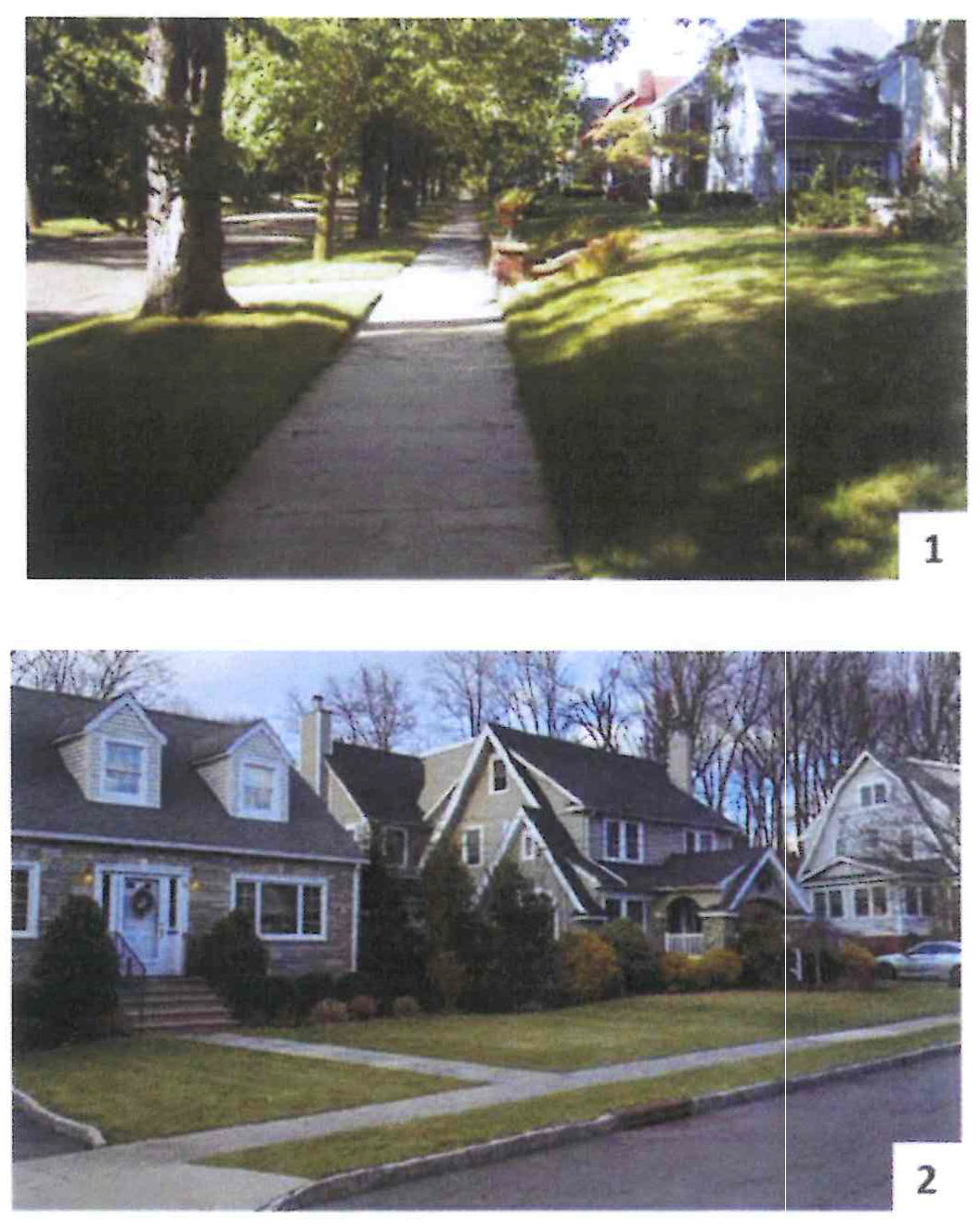
Figure 3-10: Examples of Common Yards
1. Walkways connect homes to the sidewalk
2. Common yards along a Street Frontage
22-595.6
Vacant commercial buildings.
(a)
Thomasville seeks to reduce the problems associated with empty commercial buildings in the downtown and will require the owners of properties to meet minimum standards of maintenance. Empty commercial buildings give the appearance of community blight and disinvestment. Maintenance standards protect property values in an area. They seek to create safe, secure parcels, not conducive to crime, flood, or fire hazards. And they reduce public costs associated with policing, trash build-up, inspections, and responses to complaints.
(b)
The owners of vacant commercial buildings must register with the city and its foreclosed and vacant property registry ordinance.
(c)
Owners must establish a vacant property plan that keeps the building in compliance with minimum regulatory statutes regarding ongoing building maintenance. The vacant property plan must allow code enforcement to regularly inspect the property for the required maintenance. If a building is to be demolished then owners must register the vacant property and submit a plan to demolish the property within one year.
(d)
Minimum building maintenance requires the entire property to be maintained and secure including interiors that are visible to a passerby, and the maintenance and painting of the exterior of the property such that it is kept in good aesthetic condition including instances of visible rotting, rust, or everyday wear and tear.
(e)
The yards of the property; including all parking areas, must be maintained, landscaped, well-lighted, and kept clear of any trash or debris.
(f)
Storefronts, façades, and architectural features such as porches, galleries, dooryards, and signage must be maintained. Windows, doors, and related openings shall be intact, maintained, and operable.
(g)
When it is clear that property owners have no intention of adding uses to a building then the city shall utilize section 1-7, general penalty; continuing violations, of this Code.
(Ord. No. 23-06122023, § III(Exh. A), 6-12-2023)
Sec. 22-618. - Intent.
The city seeks to promote preservation, infill development, and revitalization throughout the city, in its traditional communities, and upon individual blocks and lots. As such, it is the intent of the Victoria Place Overlay District (VPO) to enable, encourage, and qualify the following policies:
(1)
In general and throughout the city:
a.
Implement the comprehensive plan and the Victoria Place redevelopment plan;
b.
Enhance the viability of local businesses and reduce travel demand by focusing growth in existing neighborhoods with infrastructure, services, employment centers, and schools;
c.
Locate workforce housing near job opportunities while avoiding concentrations of poverty;
d.
Establish Thomasville as a city of compact, walkable, mixed-use neighborhoods in which ordinary activities of daily living occur within walking distance of most homes, allowing independence to those who do not drive; and
e.
Create an interconnected network of streets and pathways that are safe and secure for vehicles, bicycles, and pedestrians; and reduce automobile traffic.
(2)
Within the city's neighborhoods:
a.
Preserve and extend the historic neighborhood character through the design and placement of building types and public spaces; and
b.
Enable mixed-use corner stores and main streets to remain or return as vibrant social and commercial centers.
(3)
At the scale of the block and building:
a.
Use buildings to frame streets and public spaces, resulting in a high-quality, interesting, and human-scaled environment;
b.
Ensure that landmark buildings are sited at important locations, and that they promote a form that reflects their civic stature;
c.
Provide a measure of predictability to property owners and occupants about what may be built on their land or that of their neighbors;
d.
Promote sustainability by encouraging a range of building types and sizes that can readily adapt to changes in the economy, the surrounding community, or the needs of their owner; and
e.
Ensure that architecture and landscape grow from local climate, history, and building practice.
(Code 1991, § 22-500; Ord. of 3-10-2014, § 1; Ord. No. 11192014-1, § 1, 11-19-2014)
Sec. 22-619. - General to all development.
(a)
Delineation. The delineation of the VPO is conveyed below and is outlined on the official zoning map of the city.
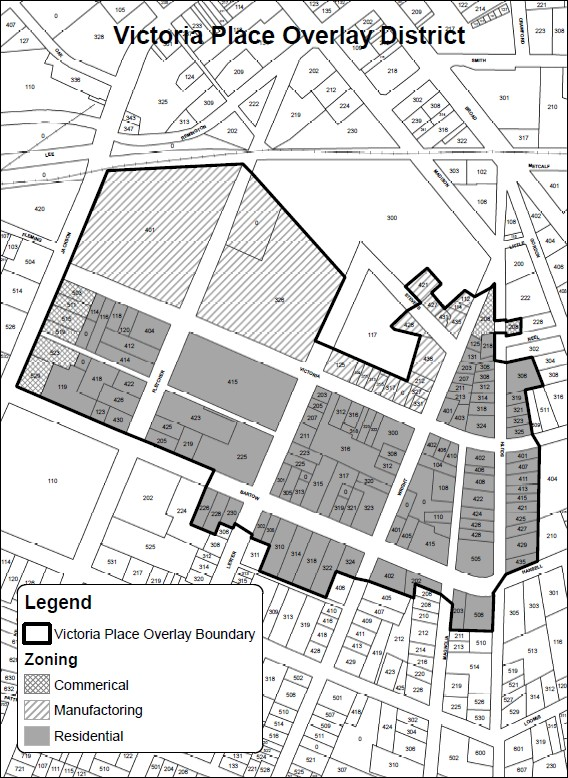
Victoria Place Overlay District Map
(b)
Base zoning. The VPO overlays three current zoning districts that are referred to as "base zoning."
(c)
State and local codes.
(1)
Except where specifically addressed herein, the standards of the underlying zoning district shall apply. In the case of conflict, the standards of the VPO shall take precedent.
(2)
In the case of conflict between the standards of the VPO and those contained elsewhere in this Code, the standards contained in the VPO shall always prevail.
(3)
Development must comply with all state and local building codes.
(d)
Creating streets. New or improved public or private vehicular rights-of-way, easements, access-ways, and driveways that:
(1)
Will front a building type or civic space type depicted in this Code; or
(2)
Are necessary to maintain or establish an uninterrupted and interconnected network of blocks and streets shall, to the maximum extent practicable, be designed as complete (multi-modal) thoroughfares that incorporate on-street parking, sidewalks, lighting, plantings, streetscape elements (furniture, wayfinding signage, etc.), terminated vistas, and where appropriate, bicycle lanes.
(e)
Dead-end streets and cul-de-sacs. Dead-end streets and cul-de-sacs shall not be permitted.
(f)
Terminated vistas. In order to improve spatial definition and orientation on each street, terminated vistas shall be encouraged using buildings, civic spaces, roundabouts, statues, ornamentation, or natural features.
(g)
Traffic calming. To the maximum extent practicable, on-street parking shall be encouraged as a means of calming traffic.
(h)
Lot frontage. The primary frontage of a lot shall be along one of the following:
(1)
A thoroughfare right-of-way;
(2)
A thoroughfare with development on one side and a civic space on the other;
(3)
Directly upon a civic space in which there is no thoroughfare located between the primary frontage and the civic space; or
(4)
Directly upon a pedestrian passage or rear alley/lane.
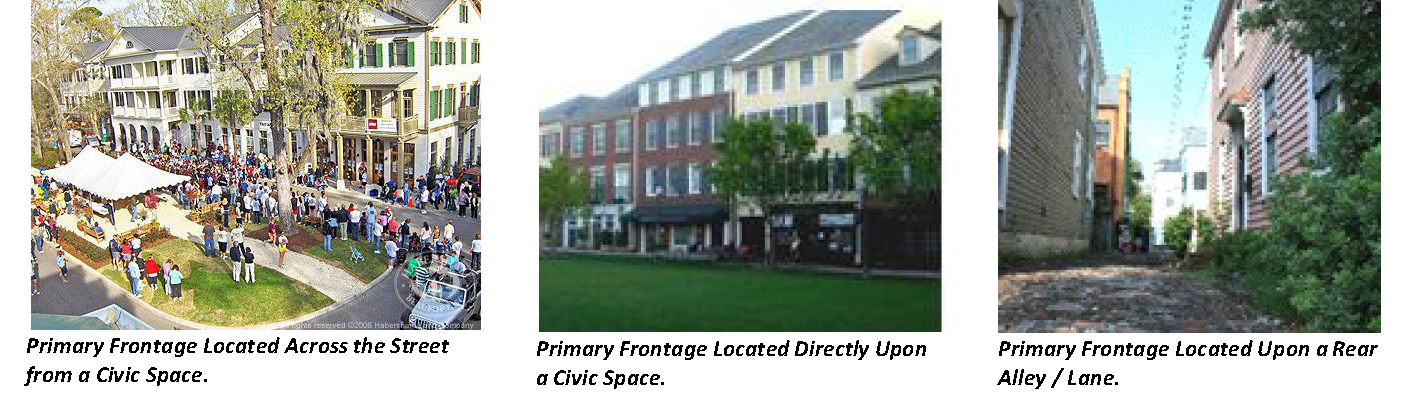
Primary Frontage Located (3 as 1)
(i)
Reverse frontage lots. Reverse frontage lots shall be prohibited. Arterials, collectors, and local streets shall be incorporated into the structure of all future blocks, with access to the first tier of lots provided directly from the thoroughfare, a perpendicular street, or a rear alley/lane.
(j)
Rear alleys and lanes. Rear alleys and lanes shall be provided along the rear property lines of lots intended for new development when the lots are part of a block face with an average lot width of 55 feet or less at the building setback line.
(k)
Exceptions from build-to lines. The zoning administrator may grant an exception to the build-to line requirement in order to avoid one or more trees with a caliper greater than eight inches.
(l)
Exceptions to lot coverage requirements. In the R-2 zone, the required maximum lot coverage shall be 60 percent. If the design is consistent with the intent of this overlay district (section 22-618), the board of architectural review and zoning appeals may grant a variance permitting a proposal for multifamily residential, mixed use, or commercial structures to exceed this percentage.
(m)
Building height.
(1)
Determining overall building height. Building height shall be measured in number of stories from the natural grade or finished grade adjacent to the building exterior to the highest point of coping of a flat roof, the top of a mansard roof, or the highest point of the highest pitched roof.
(2)
Number of stories permitted. The maximum number of stories (floors) is determined by building type. building types are found in section 22-620.
(3)
Ground floor finish level. Minimum and maximum ground floor finish level (measured from adjacent finished grade) are established by building type. Where maximum ground floor finish level exceeds the permitted height, the undercroft (basement, crawl space, or storage area) shall count as a story.
(4)
Half story. A half story is the top floor of a building that has a maximum exterior wall height not to exceed six feet, creating a sloped ceiling on the top level of the structure. Dormers may be used to provide egress windows as required by the adopted building code.
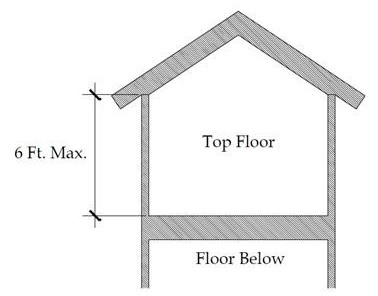
Half Story Depicted
(5)
Appurtenances. Architectural, mechanical, and structural appurtenances may exceed the allowable building height, as conveyed in section 22-622.
(n)
Utilities. To the maximum extent practicable, all utility connections including, but not limited to, electric, phone, cable, etc., shall be placed underground.
(o)
Light impact materials. Where appropriate, the city engineer may approve energy efficient and sustainable materials when utilized as an alternative means of stormwater compliance if they are contextual (see Light Imprint Handbook—Integrating Sustainability and Community Design, v-1.3. DPZ-Charlotte, New Urban Press, 2008) and meet or exceed baseline requirements in the Georgia Stormwater Management Manual.
(Code 1991, § 22-501; Ord. of 3-10-2014, § 2; Ord. No. 11192014-1, § 2, 11-19-2014; Ord. No. 12112017-1, §§ III, IV, 12-11-2017)
Sec. 22-620. - Building types.
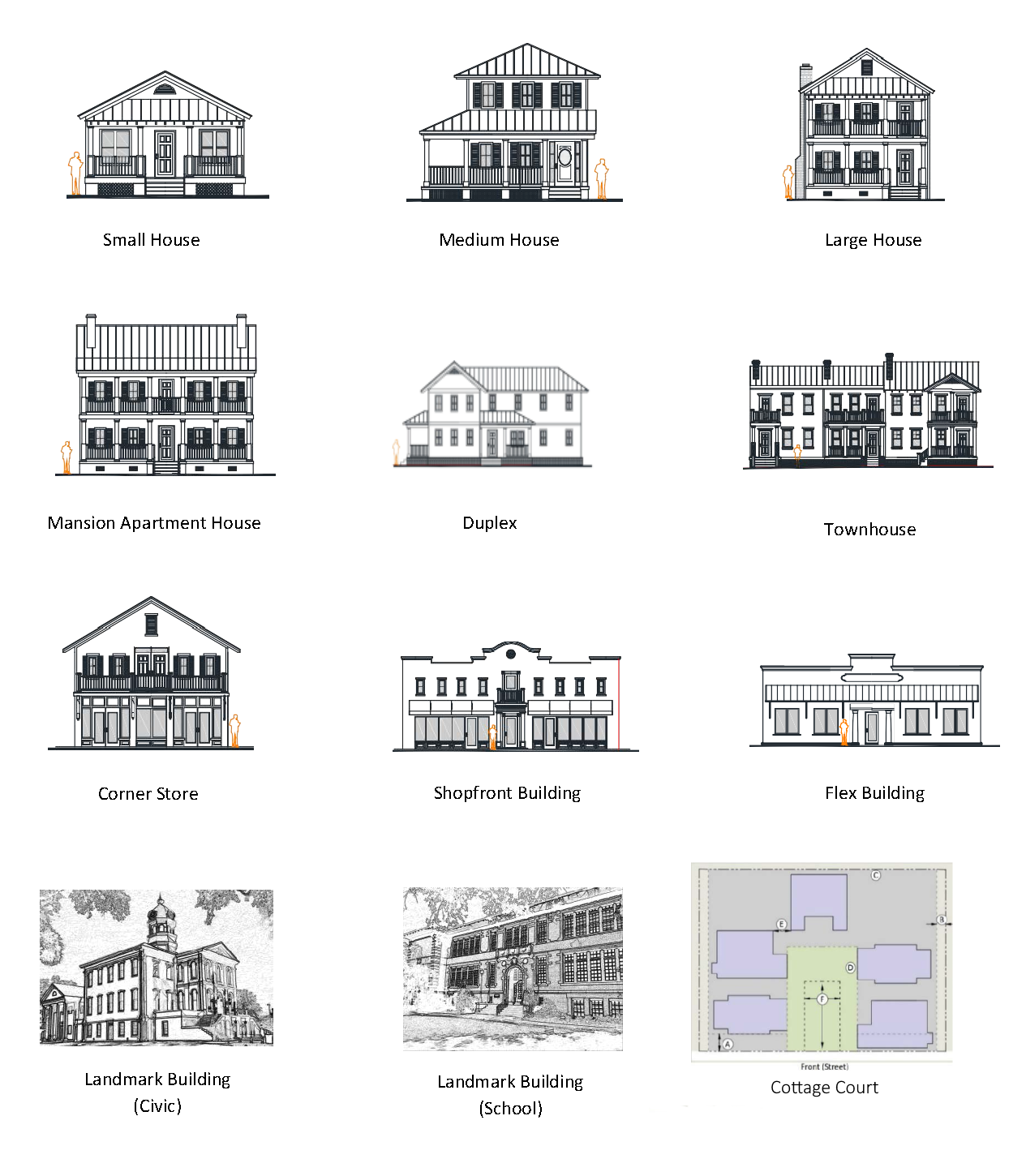
(a)
Small house.
(1)
Building type. This building type is a compact, detached structure on a small lot that incorporates one unit. This type allows for appropriately-scaled, well-designed higher density housing within a primarily single-family, walkable neighborhood. While residential in form, this building type is also appropriate for low intensity retail, service, and office uses, and is often located near, or even on a neighborhood main street.
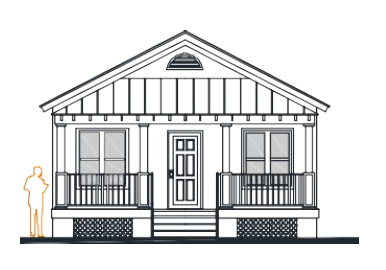
Small House
(2)
Lot.
(3)
Height.
(4)
Required frontage. Buildings are required to have either a front or side porch (may be waived and replaced by a stoop with approval by the city planner).
(5)
Use. This building type/lot may house all permitted uses in the VPO as defined in section 22-626 (uses); except: dwelling, two-family and multifamily; personal care home, family and group; live-work townhouse; corner store; and uses specific to landmark buildings.
(b)
Medium house.
(1)
Building type. This building type is a medium-sized detached structure on a moderate-sized lot that incorporates one unit. It is typically located in a walkable single-family residential neighborhood, potentially near a main street. While primarily used for single-family housing, this type is appropriate for bed and breakfast lodging, as well as low intensity group living, offices, and services.
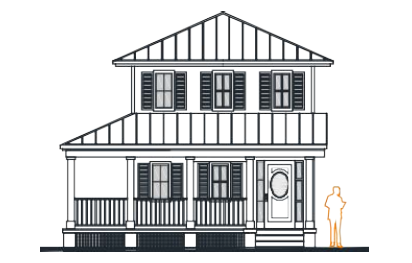
Medium House
(2)
Lot.
(3)
Height
(4)
Required frontage. A front or side porch is required (may be waived and replaced by a stoop with approval by the city planner).
(5)
Use. This building type/lot may house all permitted uses in the VPO as defined in section 22-626; except: dwelling, two-family and multifamily; personal care home (group); live-work townhouse; corner store; and uses specific to landmark buildings.
Note: Where existing adjacent buildings are set behind the required build-to line, the building may be set to align with the facade of the front-most adjacent property.
(c)
Large house.
(1)
Building type. This building type is a large, detached structure on a large lot that incorporates one unit. It is typically located within a primarily single-family neighborhood in an urban setting. While primarily used for single-family housing, this building type is appropriate for bed and breakfast lodging and low intensity group living.
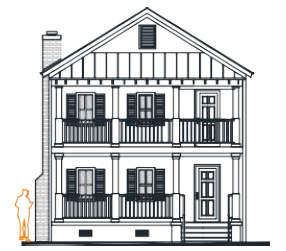
Large House
(2)
Lot.
(3)
Height.
(4)
Required frontage. Buildings are required to have either a front or side porch (may be waived or replaced by a stoop with approval by the city planner).
(5)
Use. This building type/lot may house all permitted uses in the VPO as defined in section 22-626; except: dwelling, two-family; dwelling, multifamily; live-work townhouse; corner store; and uses specific to landmark buildings.
Note: Where existing adjacent buildings are set behind the required build-to line, the building may be set to align with the facade of the front-most adjacent property.
(d)
Mansion apartment house.
(1)
Building type. This building type consists of three to twelve side-by-side and/or stacked dwelling units, typically with one shared entry or individual entries along the front. This type has the appearance of a large-sized family home and is appropriately scaled to fit within a single-family medium-density neighborhood. This building type is critical to the effort to provide a broad choice of housing that promotes walkability. While residential in form, this building type may be appropriate for group living.
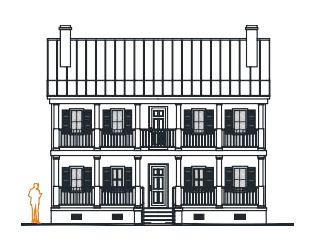
Mansion Apartment House
(2)
Lot.
(3)
Height.
(4)
Required frontage. Buildings are required to have either a front or side porch (may be waived and replaced by a stoop with approval by the city planner).
(5)
Use. This building type/lot may only house multifamily units and personal care homes as defined in section 22-626.
(e)
Duplex.
(1)
Building type. This building type consists of two side-by-side or two stacked dwelling units, both facing the street. The duplex is properly scaled and designed to appear as a moderate to large single-family home, allowing for the introduction of medium density housing within a primarily detached single-family neighborhood. This type is important for providing a broad choice of housing options that promote walkability. While residential in form, this building type is appropriate for low intensity retail, service, and office uses.
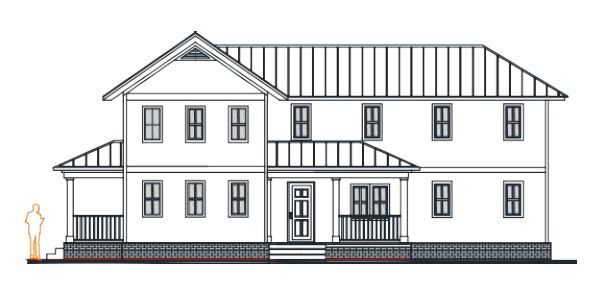
Duplex
(2)
Lot.
(3)
Height.
(4)
Required frontage. Entry frontage for each unit shall have a porch (may be replaced by a stoop with approval by the city planner).
(5)
Use. Where the underlying zoning is R-2, this building type/lot may only house two-family dwellings as defined in section 22-626. Otherwise, this building type/lot may house all permitted uses in the VPO as defined in section 22-626; except: dwelling, single-family and multifamily; live-work townhouse; corner store; and uses specific to landmark buildings.
(f)
Townhouse.
(1)
Building type. This building type is a small to medium-sized attached structure that consists of three to eight dwelling units placed side-by-side. This type is typically located within medium-density neighborhoods or in a location that transitions from a primarily single-family neighborhood into a neighborhood main street. While primarily residential in form, this type may be used for live-work and similar medium intensity retail, service, and office uses.
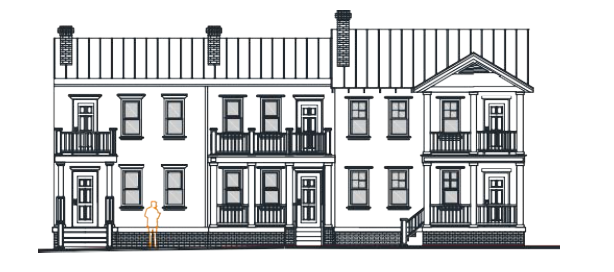
Townhouse
(2)
Lot.
(3)
Height.
(4)
Required frontage. Buildings are required to have either a front porch or stoop.
(5)
Use. Where the underlying zoning is R-2, this building type/lot may only house multifamily dwellings and live-work townhouses as defined in section 22-626. Otherwise, this building type/lot may house all permitted uses in the VPO as defined in section 22-626; except: dwelling, single-family and two-family, corner store, and uses specific to landmark buildings.
Note: Mixed-use with upper-story residential is encouraged. Personal care homes shall be limited to two residents per individual unit (dwelling).
(g)
Corner store.
(1)
Building type. This building type is a small to medium-sized retail structure that sits on a corner facing lot at a prominent intersection or neighborhood center. The building contains a ground floor shopfront located along the sidewalk at the street level. It is typically located within a residential neighborhood in a walkable urban setting. If more than one story, this building type may be mixed-use with either a residence or office space on the upper floor.
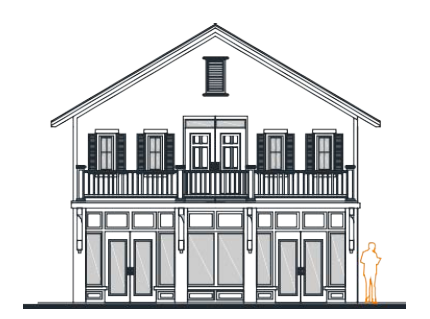
Corner Store
(2)
Lot.
(3)
Height.
(4)
Required frontage. Building fronts are required to have at least one of the following: gallery, colonnade, arcade, terrace, second floor balcony, marquee, awning, or porch (residential character only).
(5)
Use.
a.
First floor. This building type/lot shall house a nonresident corner store use on the first floor as defined in section 22-626.
b.
First floor rear, side, and upper stories. In those areas not occupied by the first floor storefront, including upper stories, this building type may house all permitted uses in the VPO as defined in section 22-626, except: live-work townhouse and personal care home (group). In an effort to create mixed-use residential buildings, single-family, two-family, and multifamily dwellings shall be encouraged on upper floors.
(h)
Shopfront building.
(1)
Building type. This building type is a small to medium-sized detached structure of one to two stories with a storefront treatment that most often accommodates commercial uses. The front facade is typically flat, often with a canopy or awning frontage. The entry may be recessed. This type is a primary component of a mixed-use main street.
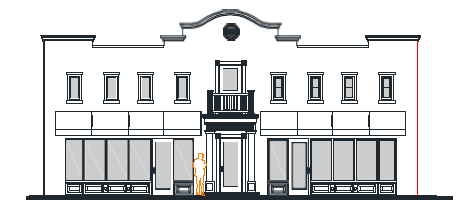
Shopfront Building
(2)
Lot.
(3)
Height.
(4)
Glazing/transparency. In order to provide clear views of merchandise in stores and to provide natural surveillance of exterior street spaces, the ground-floor along the building frontage shall have untinted transparent shopfront windows and/or doors covering no less than 75 percent of the wall area of principal facade. Corner lots: no less than 50 percent of the wall area of the secondary facade.
(5)
Required frontage. Building fronts are required to have at least one of the following: front porch, gallery, colonnade, arcade, terrace, second floor balcony, marquee, or awning.
(6)
Use.
a.
First floor. This building type/lot shall house a nonresidential use on the first floor as defined in section 22-626; except: corner store.
b.
First floor rear and upper stories. In those areas not occupied by a nonresidential use, including upper stories, this building type may house all permitted uses in the VPO as defined in section 22-626. In an effort to create mixed-use residential buildings, single-family, two-family, and multifamily dwellings shall be encouraged on upper floors.
(i)
Flex building.
(1)
Building type. This building type is a small to large-sized detached structure of one to two stories with a storefront or workshop treatment that most often accommodates commercial, recreational entertainment, and light industrial uses that are too large or too intense to be appropriately housed in a shopfront building type. This building is inspired by the local vernacular, including the city's railroad sheds, warehouses, and retail and service establishments on E. Clay Street and W. Jackson Street. The front facade is typically flat, often with a canopy or awning frontage. This type is a primary component of a flexible urban neighborhood that provides a mix of buildings.
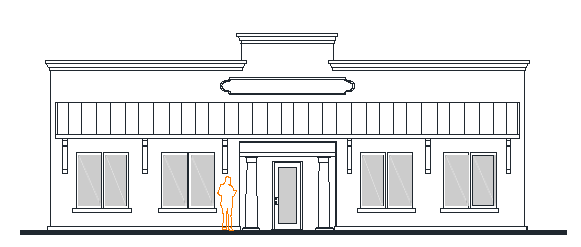
Flex Building
(2)
Lot.
(3)
Height.
(4)
Required frontage. Building fronts are required to have at least one of the following: front porch, gallery, colonnade, arcade, second floor balcony, marquee, or awning.
(5)
Use.
a.
First floor. This building type/lot shall only house a nonresidential use on the first floor as defined in section 22-626; except: corner store.
b.
First floor rear and upper stories. In those areas not occupied by a nonresidential use, including upper stories, this building type may house all permitted uses in the VPO as defined in section 22-626. In an effort to create mixed-use residential buildings, single-family, two-family, and multifamily dwellings shall be encouraged on upper floors.
(j)
Landmark building.
(1)
Generally. Landmark buildings are designed for occupancy by public or commercial uses that provide important services to the community, including recreation, education, safety, assembly, and related functions. They contribute significantly to the quality of the neighborhood and often serve as the focal point of a civic space, terminate a vista, or are placed at a prominent location. The architectural quality and construction of a landmark building shall be of the highest level and exceed that of nearby buildings.
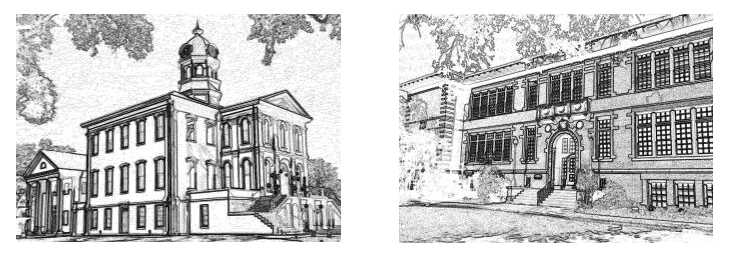
Landmark Building (2 as 1)
(2)
Review process. Design and disposition (dimensional requirements): All landmark buildings shall be negotiated on a case-by case basis with the supervising planner prior to application.
(3)
Building location. The following criteria should be considered when determining the location of a landmark building within the community, on the block, and on the lot:
a.
Primary function;
b.
Perceived level of importance to the community;
c.
Desired level of formality; and
d.
Sense of permanence.
(4)
Location within the community and block. Buildings shall be sited at prominent locations and oriented toward a public street or public space in a manner that:
a.
Provides a corner or midblock terminating vista;
b.
Anchors a civic space; or
c.
Fronts a street and civic space.
(5)
Location on the lot (setback). Landmark buildings often benefit from being set back from the adjacent build-to lines of private development, thereby:
a.
Allowing the scale of the building to have more visual emphasis; and
b.
Creating a public space in the foreground.
The amount of this setback should be carefully determined based on programming and the urban design objectives of the particular site.
(6)
Multiple buildings/campus. Facilities with multiple buildings or a campus-like setting shall comply with the standards of subsection (k) of this section.
(7)
Building type and character. The following facilities may be designed to an existing building type:
a.
Private and quasi-public clubs or lodges;
b.
Small-scaled cultural facilities such as museums;
c.
Public recreation centers and similar facilities that are minor or secondary in nature; and
d.
Small- to medium-scaled bus passenger stations in which passenger boarding occurs outside the building.
(8)
Inspirational structures. Structures that draw inspiration from an existing building type may be integrated into the urban fabric or streetscape with little to no additional emphasis. All other landmark buildings shall be designed as freestanding, "monumental" structures that evoke pride in one's community and convey a sense of timelessness.
(9)
Vehicle access and parking. To the maximum extent practicable:
a.
Parking shall not be located between a principal or secondary facade and a primary or secondary street;
b.
Parking requirements for the site shall be met with on-street parallel and angled parking spaces, or via a remote parking lot or structure;
c.
Parking shall be accessed from a side street or alley;
d.
Parking drives and access shall be shared with adjacent lots; and
e.
Drop-off, pick-up, and stacking for the site shall occur on or along a public street (may be privately-owned).
If the building is sited in a public space, vehicular access shall be limited to service and emergency vehicles utilizing pedestrian walkways of sufficient width and construction.
(10)
Building design; facades and entrances. A facade that fronts a primary street shall be considered to be the building's principal facade, and a facade that fronts a secondary street shall be considered to be the buildings secondary facade.
a.
The principal facade shall be designed to be the most prominent facade of the building.
b.
Building entrances shall always take access from the most prominent facades.
Additional entrances may be provided along secondary and axillary facades.
(11)
Required frontages. Building fronts shall have at least one of the following: porch, stoop, gallery, colonnade, arcade, terrace, balcony, marquee, canopy, or awning.
(12)
Massing.
a.
Symmetrical in form.
b.
The appearance of a balanced design increases the level of formality, and shall be encouraged.
c.
Massing, while often larger as a whole, should be divided into visually distinct sections.
d.
Massing divisions should provide visual order to the building and create vertical proportions within individual elements.
e.
On corner lots, landmark buildings shall be designed with two facades of equal, though not identical architectural quality.
f.
Landmark buildings located in a civic space shall be designed with four facades of equal, though not identical architectural quality.
(13)
Scale.
a.
Size. In order to be more visually prominent across greater distances, the scale of the building should be larger than that of nearby buildings.
b.
Building height. Three stories maximum, 48 feet above grade maximum (excluding appurtenances).
c.
Story height. Floor-to-ceiling heights and architectural details should be proportionately larger than those of nearby private buildings.
d.
Roof appurtenances. Spires, steeples, towers, cupolas, and belfries can visually extend the height of the building, and shall be incorporated when practicable.
e.
Materials. Buildings shall use durable, high quality materials that convey a sense of permanence. These include, but are not limited to, brick, stone, and cast concrete. Wood construction is appropriate, but should only be executed with the highest quality framing and cladding materials. Generally, stucco should be avoided as a material that lacks scale and texture. If used, stucco should be traditional, have integral pigment, and be scored to define human-scaled dimensions on the facade.
(14)
Specific to churches and places of worship. In addition to the above standards, churches and places of worship shall:
a.
Traditional design. A church should be easily identifiable with timeless features such as bell towers, steeples, clearstory windows, and stained glass integrated into the design. Traditionally designed buildings can be navigated easily based on intuition without much signage. For example, if a sign or large symbol (e.g., cross) is needed to identify the sanctuary then the design can be improved.
b.
Vertical massing. The scale of the sanctuary building should not overwhelm the block. Building features such as arches, columns, pilasters, rooflines (including dormers), and masonry patterns shall divide and create a vertical orientation on larger surfaces. Once these proportions have been established, windows (including clearstory) and doors shall reinforce the vertical orientation of the composition.
c.
Be transparent. Being able to see and hear a little bit of what's going on inside makes a church seem less intimidating and peeks the interest of those passing by. This is the same principal as window-shopping, only adapted to a church. It is not uncommon for people to join a service after hearing music wafting through the doors of a church.
d.
Define entrances. The church's buildings should be open and inviting, with a clear sense of where to enter. In no case shall a church's side doors function as a primary entry point.
e.
Entrances close to pedestrians. Use frontage elements such as porches, stoops, galleries, arcades, and canopies to bring the church up to the street or public space, while still providing an area for people to gather.
f.
Doors. Church doors should be prominent and inviting.
g.
Parking. Parking lots disrupt the neighborhood fabric and discourage members from walking to and from church, resulting in less patronage of local shops and cafes. Parking should be on-street or shared with other commercial or institutional buildings in the vicinity.
h.
Create a community focal point. Add neighborhood-friendly features such as athletic fields, tennis or basketball courts, a playground, an outdoor amphitheater, etc.
i.
Permeable campus. Churches that span more than one block shall ensure that their campus is permeable, allowing people to walk through the property using multiple routes.
(15)
Use. This building type/lot may only house churches or other place of worship; public owned recreation centers, YMCAs and institutions of a similar nature; schools (public or private); business schools; clubs or lodges (private); colleges or universities; cultural facilities; railroad or bus passenger stations; and municipal structures as defined in section 22-626.
(k)
Cottage court.
(1)
Building type.. The cottage court consists of a series of small, detached structures on a single lot, providing multiple interior units arranged to define a shared court that is typically open to, and perpendicular to the street. The shared court takes the place of a private rear and becomes an important community-enhancing space.

Cottage Court
(2)
Lot.
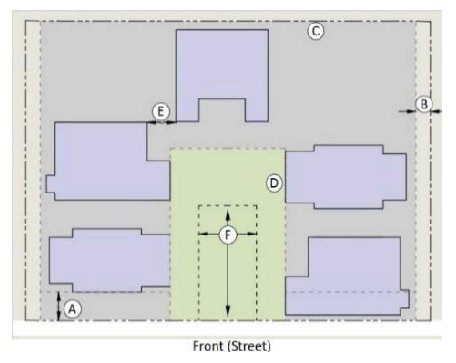
Setback Diagram
(3)
Height.
(4)
Buildings.
(5)
Courtyard.
(6)
Allowed frontages. Buildings are required to have a front porch (may be substituted with a stoop if approved by city planner).
(7)
Use. While typically residential in form, the cottage court allows for the establishment of a single-lot cluster of buildings dedicated to a variety of functions including one- and two-family, and multifamily residential, lodging*, retail, arts, and similar uses. The cottage court functions much like a mansion apartment or shopfront building, only the units have been de-centralized and sited around a common space. Accessory dwelling units (ADUs) are prohibited.
*If used for a B&B, a "unit" equals a "rentable unit," and the maximum permitted number of rentable units is 18.
(Code 1991, § 22-502; Ord. of 3-10-2014, § 3; Ord. No. 11192014-1, § 3, 11-19-2014; Ord. No. 04112016-2, 4-11-2016; Ord. No. 12112017-1, § I, 12-11-2017; Ord. No. 12112017-1, §§ V—VIII, 12-11-2017)
Sec. 22-621. - Frontages and building elements.
(a)
Porches and stoops. Porches and stoops provide outdoor living space. Often, they provide protection from the sun, while still permitting breezes to infiltrate the body of the building. They provide architectural interest and delineate the building's entrance. This type is appropriate for residential building types with small setbacks. Typically, the porch or stoop is located in the build-to zone as close to the sidewalk as possible. It is elevated to ensure privacy within the building from those passing by. Stairs may lead directly to the sidewalk or may be side-loaded.
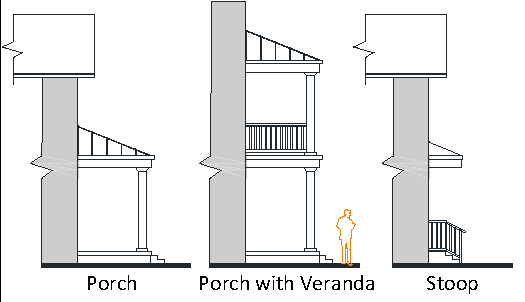
Porches and Stoops (3 as 1)
(1)
Depth:
a.
Porch: eight-foot minimum;
b.
Stoop four-foot minimum; eight-foot maximum.
(2)
Length:
a.
Porch: 25 percent to 100 percent of building front; ten-foot minimum.
b.
Stoop: five-foot minimum; eight-foot maximum.
(3)
Height, clear:
a.
Eight-foot minimum.
b.
Two-stories maximum.
(4)
Porches and stoops may have multi-story verandas and/or balconies above.
(5)
Finish level above grade: Two-foot minimum; five foot-maximum (no more than eight inches below the first interior finished floor level).
(6)
Porches and stoops may occur forward of the build-to line, but shall not extend into the right-of-way. They may extend into the ROW upon the approval of an easement by the board of architectural review and zoning appeals.
(7)
Stairs may extend forward of the build-to line into the right-of-way, or upon a utility easement if constructed of non-masonry, breakaway materials. Full sidewalk clearance shall be maintained.
(8)
Porches and stoops are un-airconditioned. Screens on front porches are prohibited.
(b)
Galleries, colonnades, arcades, and terraces. This frontage is associated with commercial uses, and is permitted to encroach upon the setback, or even into the right-of-way over the sidewalk. The space allows one to window-shop or dine in a shaded environment that also captures breezes. The frontage provides architectural interest and delineates the building's entrance. Upper stories may be enclosed, providing livable bonus space for occupants.
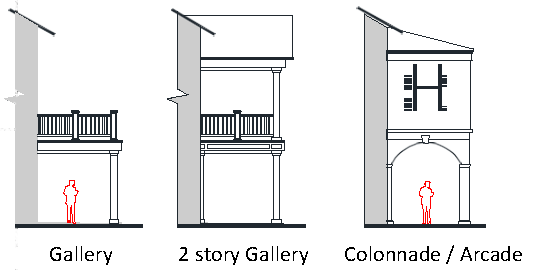
Galleries and Colonnades/Arcades (3 as 1)
(1)
Depth:
a.
Gallery: Eight-foot minimum from front wall of the building to the inside column face.
b.
Colonnade/arcade: Ten-foot minimum from front wall of the building to the inside column face.
(2)
Length: 75 percent to 100 percent of building front. On corners, may wrap around the side of the building facing the side street.
(3)
Height, clear:
a.
Ten-foot minimum.
b.
Two-stories maximum. Additional stories may be permitted by the supervising planner. Colonnades and arcades have two or more stories, with upper stories enclosed as habitable space.
(4)
Finish level above grade: zero inches—six inches maximum.
(5)
Galleries, colonnades, arcades, and terraces may occur forward of the build-to line, but may only extend into the right-of-way (to within two feet of curb) upon the approval of an easement by the board of architectural review and zoning appeals.
(6)
In order to address changes in grade, and upon approval of the city planner, a terrace may be utilized in lieu of a gallery at a minimum depth: ten foot, minimum length: 75 percent to 100 percent of the building front (may wrap building on street side).
Terraces
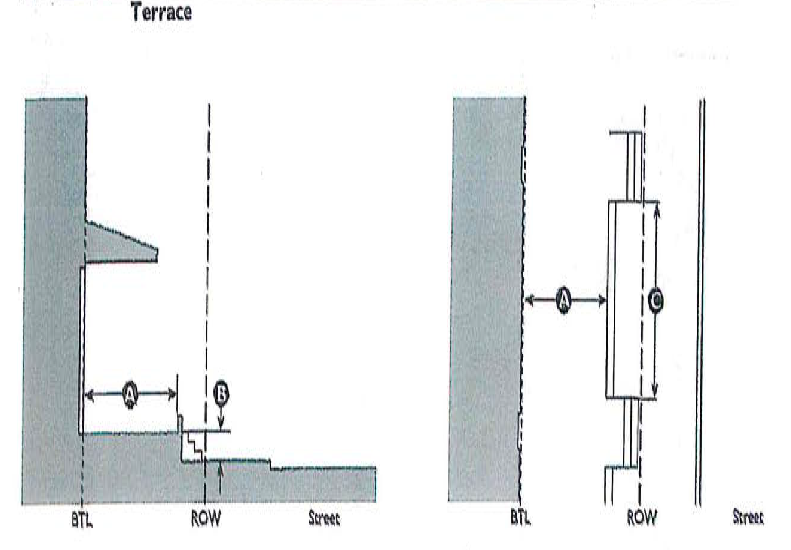
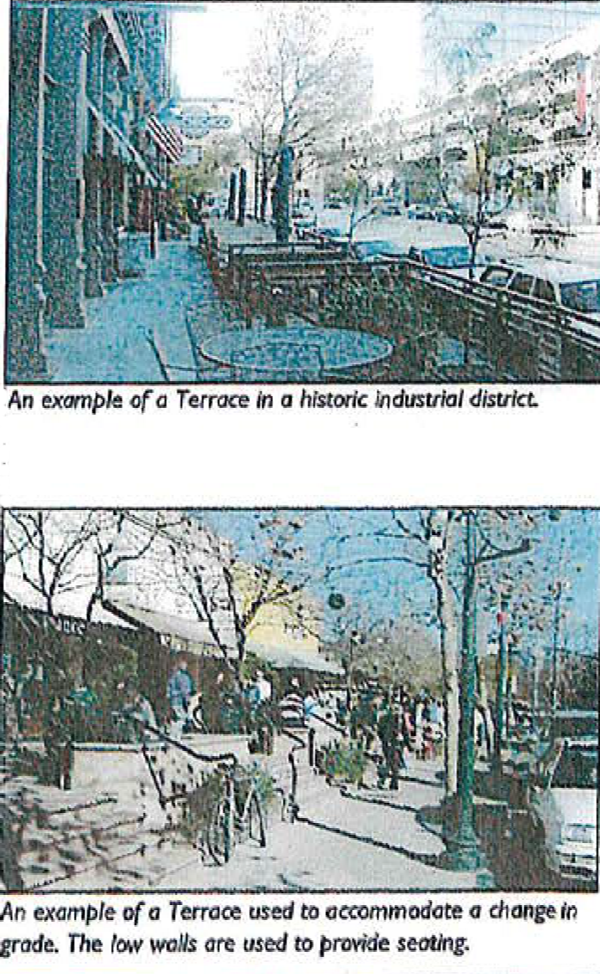
(c)
Balconies. A balcony is connected to a building's upper stories and is supported by either a cantilever or by columns on one side. This type is appropriate for residential and commercial buildings with small setbacks. Typically, the balcony is located forward of the build-to zone over the sidewalk. It allows occupants of the building to experience the activities of the street while also providing significant privacy from those passing by.
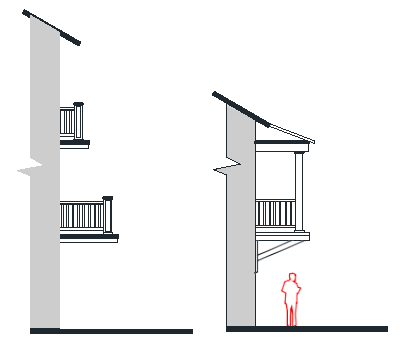
Balconies (2 as 1)
(1)
Depth:
a.
Second story: Five-foot minimum.
b.
Upper story :Three-foot minimum.
(4)
Length: 25 percent to 100 percent of building front; five-foot minimum.
(5)
Height, clear:
a.
First floor residential: Nine-foot minimum.
b.
First floor nonresidential: Ten-foot minimum; eight-foot minimum with suspended signage. Supporting brackets are exempt.
(6)
Balconies shall occur forward of the build-to line and may encroach over the right-of-way to within two feet of the curb.
(7)
Balconies shall be made of wood or metal and may have roofs, but are required to be open, un-airconditioned spaces. Balconies in the rear of the building may have screens.
(8)
Ideally, balconies should be supported from below by visible brackets, scaled as if they are supporting the weight of the mass, or from above by suspension cables or chains.
(9)
On corners, balconies may wrap around the side of the building facing the side street.
(d)
Marquees, canopies, and awnings. A permanently roofed architectural projection whose sides are either vertical or horizontal and are supported entirely from an exterior wall of a building. This frontage is typically used for the display of signs. Horizontal marquees, canopies, and awnings provide shade from the sun, as well as enhanced weather protection for both the building and the passerby.
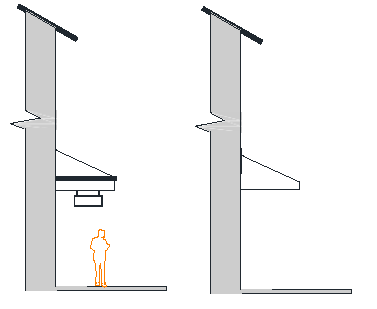
Canopies and Awnings (2 as 1)
(1)
Depth: Five-foot minimum.
(2)
Length: 25 percent to 100 percent of building front.
(3)
Height, clear: eight-foot minimum (including suspended signage). The above requirements apply to the first floor only. There are no dimensional requirements for marquees, canopies, and awnings above the first floor.
(4)
Sign copy on marquees, canopies, and awnings on second story windows is not permitted.
(5)
Marquees, canopies, and awnings shall occur forward of the build-to line and may encroach over the right-of-way to within two feet of the curb.
(6)
Marquees and canopies must be visually supported from below by brackets, or from above by suspension cables or chains.
(7)
The top of each awning shall be at the same height as the top of each opening below.
(8)
Awnings shall be made of fabric. Vinyl and high-gloss or plasticized fabrics are prohibited.
(9)
Backlit awnings are prohibited.
(e)
Drive-through facilities. Retail, restaurant, and service uses with a drive-through facility shall comply with the following standards:
(1)
Building location and circulation. The dimensional and design standards established in this overlay code for building types and parking shall apply.
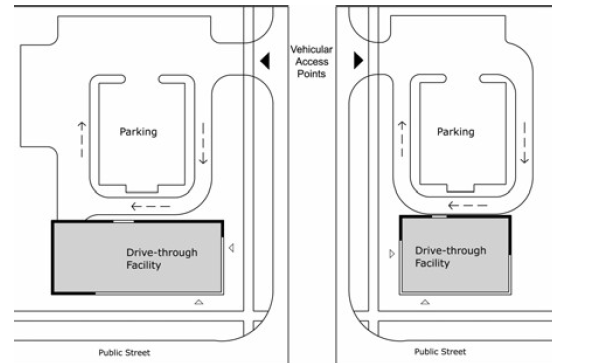
Building Location and Circulation (2 as 1)
In no case shall a vehicular accessway/driveway or off-street parking area be permitted between the front facade of the building and the frontage street; or in the case of a corner lot, between the side facade of the building and the side street. Exception: buildings with a footprint in excess of 35,000 square feet that comprise a multi-building or campus development (see section 22-620(k)).
(2)
Access. Drive-through access may only occur from the front if there is no adjacent side street or alleyway.
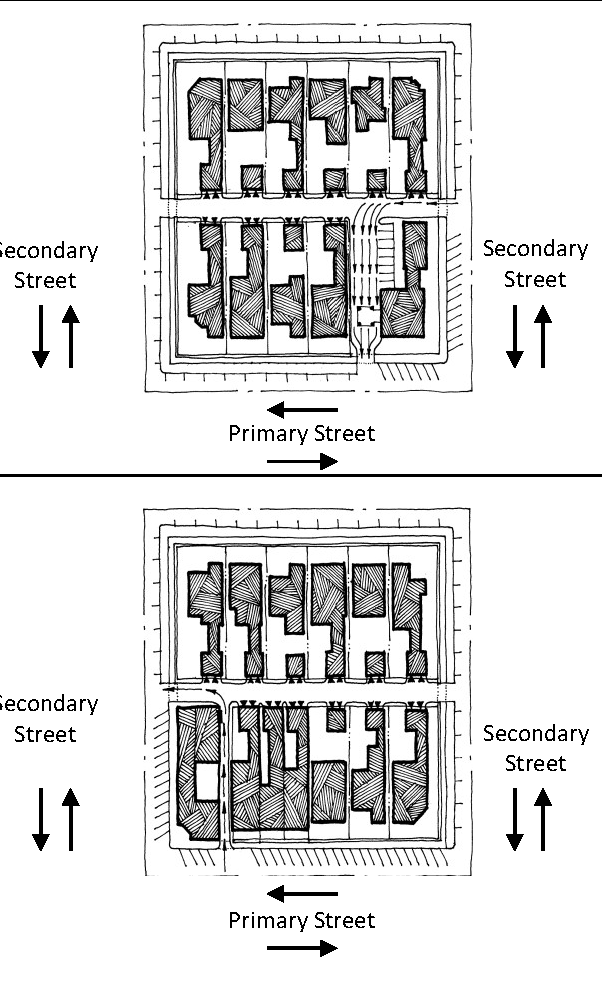
Access (2 as 1)
(3)
Configuration. Drive-throughs shall be located to the side or at the rear of the building and shall be designed so that pedestrian safety is ensured.
(4)
Corner lot. Drive-throughs serving a building located on a corner lot shall be located to the rear or interior side. In no case shall the drive-through be located on the side of a building facing a street.
(5)
Types. Both remote drive-through technology (in which objects are placed in a capsule and delivered to the drive-through via a tube) and attached drive-throughs are permitted.
(6)
Roof. If covered, the roof over the drive-through shall be of a complementary architectural design as the design covering the primary portion of the structure. The roof on a multi-lane attached drive-through that is visible from the street may be designed as a porte cochere.
(7)
Talk boxes. Talk boxes at drive-through facilities shall be screened by a sound barrier such as landscaping, a fence or a masonry wall.
(Code 1991, § 22-503; Ord. of 3-10-2014, § 4; Ord. No. 11192014-1, § 4, 11-19-2014; Ord. No. 04112016-2, 4-11-2016; Ord. No. 12112017-1, § II, 12-11-2017)
Sec. 22-622. - Architecture.
(a)
Description.
(1)
General. Within the overlay district, commercial, multifamily, and residential buildings should reflect a combination of vernacular and more formal architecture. This includes residential building types that are utilized for either residential or commercial purposes, and commercial building types that are used for a mix of nonresidential purposes. Essential characteristics include:
a.
Raised or at-grade foundations.
b.
A clearly discernable base (e.g., foundation/water table), middle, and top (e.g., roof) on each building.
c.
The use of permanent and durable materials.
d.
Buildings are typically simple combinations of one or more rectangular forms.
e.
Simple, two to 2½ story massing, with predominantly gabled or hipped roof forms, and some parapeted roofs.
f.
Both enclosed eaves with simplified classical detailing and exposed rafter ends.
g.
Porches with simplified classical detailing.
h.
Mixed architectural vocabulary, utilizing wood, stucco, and masonry.
(2)
Residential buildings. Residential structures find precedent in the vernacular 1½-story cottages, two-story houses with porches, and larger estates of downtown Thomasville.
(3)
Multifamily buildings. Multifamily buildings find precedent in the mansion apartment houses and rowhouses of downtown Thomasville and are configured to resemble a large single-family house, or row of three or more attached townhouses.
(4)
Commercial buildings. Commercial buildings are typically commercial in character, appearing as detached, single-use structures with parapeted or gabled, pedimented roof forms, and formal shopfronts or workshops.
(5)
Mixed-use buildings. Mixed-use structures are modest in scale, and appear as detached, multi-story commercial buildings.
(b)
Massing.
(1)
General.
a.
Buildings shall incorporate variations in wall heights, facade articulations, and varied roof planes and pitches.
b.
Wall planes shall be divided into visually distinct sections that provide visual order and create vertical proportions by the arrangement of windows and features such as columns, pilasters, canopies, and clearly-articulated entrances.
c.
The main entrance to a building shall be clearly identifiable and shall be oriented to face a public street or space with direct sidewalk access. Entrances shall incorporate design features such as canopies, porticos, arcades, raised cornice parapets or peaked roof forms over the doorways, arches, and display windows.
d.
Buildings in the overlay district shall be articulated and finished on all sides. Sides of commercial or mixed-use buildings that do not face (or will not likely face) a residential building or public street or space are exempt.
(2)
Roofs.
a.
Roofs are typically gabled, or hipped, with some flat.
b.
Half stories are typically articulated utilizing gable ends and dormers.
c.
Commercial and multifamily buildings shall have relatively steep slopes, ranging from eight in 12 to ten in 12. Larger commercial buildings may have slopes from four in 12 to eight in 12 or have flat roofs.
d.
Porch roofs may have a lower pitch with a minimum slope of three in 12.
e.
Roof penetrations and equipment (except chimneys) shall be screened by parapet, located on the rear slope, or otherwise configured to have as minimal visual impact as practicable from the public street or space.
f.
Shed (monopitch) roofs shall only be attached to the principal building walls, with a minimum slope of two in 12.
g.
Applied mansard roofs shall not be permitted.
h.
Architectural (cupolas, towers, steeples, chimneys, etc.) and mechanical (heat and air, elevator enclosure, etc.) appurtenances may exceed the allowable building height as follows:
1.
Roof area (combined): 25 percent maximum; height: 18 feet maximum.
2.
Roof-wall connections.
(i)
Eaves may utilize exposed rafter tails with minimal fascia depth or an enclosed cornice and entablature with simplified classical detailing. Box eaves (porkchops) shall be prohibited.
(ii)
Roof overhangs shall have a minimum eight-inch overhang at eave and rake.
(3)
Primary walls.
a.
Primary walls may be clad in wood, cement fiber siding, brick, concrete masonry units with stucco (CBS), reinforced concrete with stucco, shingle, and/or vertical board and batten.
b.
Siding may be mitered at building corners or clad with a minimum four-inch trim board. Trim board is typically six inches.
c.
Exposed wood shall be unpainted, painted, or stained.
d.
Brick mortar joints shall be struck.
e.
Stucco shall be smooth and sand finish only.
f.
Two or more wall materials may be combined on one facade only with the lighter material above the more substantial material (e.g., wood above stucco or masonry, or stucco above masonry).
g.
Decorative moldings, cornices, or an applied ornament of stone or cast concrete may be used to express the vertical division between the base, body, and the top.
h.
Cantilevers shall be supported by visible brackets scaled as if they're supporting the weight of the mass above.
(4)
Base.
a.
Exposed foundation walls (below first floor) shall be: brick, painted brick, or stucco over block or concrete.
b.
Primary walls, when set on a raised crawlspace foundation, should rest on a drip edge and water table or sill and fascia (wood or cementitious) over foundation piers.
c.
Foundation piers shall be no less than 12-inches square. If the foundation is taller than four feet above grade, than the foundation piers shall be no less than 16-inches square.
d.
Crawlspace openings and the undercroft of foundations, decks, and porches shall be framed in lattice, vertical pickets, and/or hogs pen pattern (wood or similar).
(c)
Openings.
(1)
Facade composition. Simple and regular rhythm of openings, often divided into equal bays of three, five, or seven.
(2)
Windows and doors.
a.
Windows may be double or single hung, or casement; with first story windows taller than upper story windows.
b.
When utilized with wood cladding materials, windows and doors shall be framed with a minimum 3.5-inch wood or fiber cement trim or similar composite trim. When utilized with stucco or masonry cladding materials, windows and doors shall be framed with a minimum 2.5-inch brick mould.
c.
All windows shall have a sill. The sill should not be integrated into a "picture frame" surround.
d.
Windows shall be vertically- or square-proportioned and multi-paned with exterior true or simulated muntins.
e.
Window panes may be in a one-over-one, two-over-two, six-over-six, or six-over-nine divided light pattern.
f.
When windows are ganged together, a three-inch minimum mullion shall be between each individual window.
g.
All glass shall be clear and non-reflective. If glass incorporates tinting, it should be transparent enough for those outside the building to see building occupants.
h.
Shutters, when used, shall be sized equal to one-half the width and the same height as the window; and be operable.
i.
Panels and windows on doors should be simple and rectilinear. Transom and side panel windows are allowed.
(3)
Shopfronts (see section 22-628: definitions).
a.
All regulations regarding windows and doors described above shall apply to a shopfront assembly.
b.
The top of shopfront window sills shall be between one and three feet above the adjacent sidewalk.
c.
Shopfront windows shall extend uninterrupted at least eight feet above the adjacent sidewalk.
d.
Shopfront assemblies shall be made of painted or varnished wood, aluminum-clad wood, or painted metal.
e.
In multi-story buildings, there shall be a horizontal band, articulated fascia, and/or entablature to separate the ground level shopfront from the upper floors. This band may be incorporated into the shopfront design.
f.
Frontage treatments (e.g., porches, galleries, awnings, etc.) may be incorporated into shopfront designs.
g.
Shopfront edges should integrate heavier piers or pilasters to visually carry the weight of the building above.
h.
Lighting shall be mounted on the store front wall, preferably centered on the piers between windows/doors or centered above the windows/doors of the shopfront. Where projected shed roofs are used over entries the lighting may be mounted in the shed underside. Lighting shall comply with section 22-625 (lighting).
(d)
Frontage elements.
(1)
Porches.
a.
Bay spacing on porches shall remain vertically proportioned or square.
b.
Columns should utilize architecturally correct capitals and bases. Columns shall be, width: six-inch minimum; shape: round or square (may be fluted, paneled, or tapered).
c.
Porches shall be made predominantly of wood.
d.
Railing spindles and pickets on porches shall not exceed four inches on center, or as required by the building code, whichever is less. Standard pipe rails are prohibited.
(2)
Galleries, colonnades.
a.
Bay spacing on galleries shall be vertically proportioned or square.
b.
Columns should utilize architecturally correct capitals and bases. Columns shall be:
1.
Width: six-inch minimum;
2.
Shape: square or round.
(3)
Balconies. Spindles and balusters on balconies shall not exceed four inches on center, or as required by the building code.
(4)
Accessibility. ADA ramps may be incorporated into the architecture of the building, ideally along the side or rear facade. Such ramps may occur forward of the build-to line, but shall not extend into the right-of-way. They may encroach upon the side setback by five-foot maximum.
(e)
Permitted materials.
(1)
Cladding.
a.
Siding in:
1.
Wood (termite resistant, 50-year siding product).
2.
Composition board.
3.
Cement fiber siding (50-year siding product).
4.
Vertical board and batten (using materials above).
b.
Concrete masonry units with stucco (CBS).
c.
Reinforced concrete with stucco.
d.
Brick, with struck mortar joints.
e.
Scored stucco imitation brick is prohibited. EIFS, Styrofoam, and other foam-based products are prohibited on building exteriors.
f.
Vinyl and/or T-111 siding are not allowed.
(2)
Foundations.
a.
Brick.
b.
Concrete.
c.
Stucco.
(3)
Roofing.
a.
Narrow standing seam metal.
b.
Painted 5-V or 8-V panel.
c.
Rolled asphalt with ice and water shield.
d.
Fiberglass, wood, or slate shingles.
(4)
Windows.
a.
Wood or clad wood.
b.
Metal.
c.
Steel.
d.
Vinyl.
e.
Fiberglass.
f.
Extruded PVC.
(5)
Doors.
a.
Wood or clad wood.
b.
Metal or steel.
c.
Fiberglass.
(6)
Trim.
a.
Wood (termite resistant, 50-year product).
b.
Composition board.
c.
Fiber-cement board.
d.
Molded millwork for built-up sections.
e.
For soffits and porch ceilings:
1.
Gypsum wall board (GWB).
2.
Plaster.
3.
Tongue and groove (T&G) wood.
4.
Exposed rafters, or composite.
5.
Vinyl panel systems are not permitted on porch ceilings.
6.
If soffit is perforated, the pattern should be fragmented or as ambiguous as possible.
(7)
Gutters.
a.
Half round or ogee-profile metal.
b.
PVC is not permitted.
(8)
Downspouts.
a.
Round or rectangular metal.
b.
PVC is not permitted.
(9)
Columns. Wood, fiberglass, composite, cast iron, concrete with smooth finish, brick, or stone.
(10)
Railings.
a.
Square balusters.
b.
Turned spindles and ornamental shapes in wood or wrought iron.
(11)
Chimneys.
a.
Common brick.
b.
Stucco.
(Code 1991, § 22-504; Ord. of 3-10-2014, § 5; Ord. No. 11192014-1, § 5, 11-19-2014)
Sec. 22-623. - Fences and fence wall design.
| Permitted Fences And Walls | Permitted Height |
Materials
(primary) | 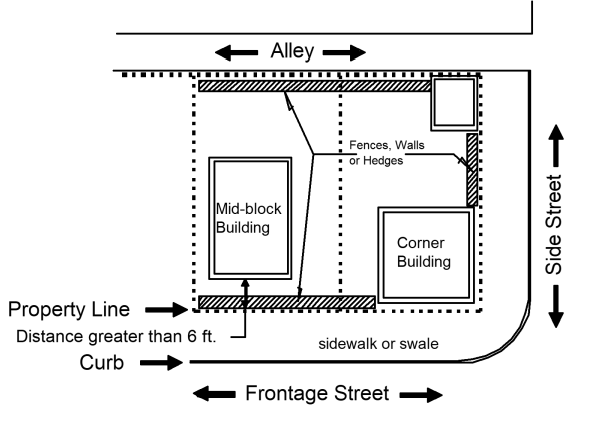 | ||
|---|---|---|---|---|---|
| Front Yard1 | Side and Rear Yard2 | Side and Rear Yard Adjacent to a ROW3 | |||
| Fence Types 1. Living fence 2. Picket or baluster fence with corner posts 3. Wrought iron fence 4. Wrought iron fence with brick posts 5. Privacy fence Wall Types 1. Hedge wall 2. Hedge wall with brick posts 3. Garden wall 4. Garden wall with wrought iron fence |
Minimum 24"
Maximum 48" | Maximum 72" (Where a fence or wall runs parallel to the front facade and adjacent to the principle street the height shall not exceed 48") |
Minimum 36"
Maximum 48" (where a fence or wall runs parallel to the front facade and adjacent to the principle street the height shall not exceed 48"). | Permitted 1. Treated or rot-resistant wood 2. Plants and vines 3. Wrought iron (aluminum w/approval)* 4. Brick 5. Stone 6. Concrete masonry units with stucco (CBS—if primary structure is masonry). 7. Reinforced concrete with stucco (if primary structure is masonry). Prohibited 1. Plastic, sheet metal, vinyl and plywood. 2. Barbed wire and concertina wire not associated with an approved security plan. See General Remarks to the right. | General Remarks 1. Fences and walls are strongly encouraged and if built, should be constructed along all un-built rights-of-ways that abut streets and alleys, as conveyed in the above diagram and this section. 2. Fences and walls greater than 48 inches in height shall be a minimum of 33 percent opaque. 3. The more finished side of a fence or wall shall face the perimeter of the lot. 4. The name assigned to each fence or wall type is based on common industry terminology. 5. Differing fence and wall types may be integrated so long as they comply with this section (e.g., hedge wall with a picketed gate). 6. Pillars and posts may extend up to six inches above the height limitations provided such pillars and posts average no more than ten feet apart. 7. Major utilities and industrial or govt. facilities may submit a security plan to the zoning administrator requesting to increase the maximum fence or wall height to eight feet and/or use barbed or concertina wire. Specific To Fences 1. Fence types may be finished in various styles (e.g., "gothic" or "dog ear" picket fence). 2. Chainlink shall not be permitted in the front yard, or side and rear yard adjacent to a ROW. Living fences shall be encouraged in place of chainlink. 3. A living fence consists of wood posts with hog wire infill and a board rail on top. 4. Wood pickets or balusters shall be rectangular or round. Spacing shall not exceed 1½ inches. 5. Vertical posts on wrought iron fences shall be a minimum of ⅝-inches thick and spaced between four and six inches. Specific To Walls Hedge walls shall be a minimum of eight inches thick. |
*On single- and two-family lots, aluminum may be used as a substitute for wrought iron fencing if approved by the zoning administrator.
Note:
1
Area in front of the primary structure.
2
Side and rear yard (five feet behind the front plane of the primary facade).
3
Side and rear yard (five feet behind the font plane of the primary facade) that abuts
a side street right-of-way.
(Code 1991, § 22-505; Ord. of 3-10-2014, § 6; Ord. No. 11192014-1, § 7, 11-19-2014; Ord. No. 12112017-1, §§ IX—XI, 12-11-2017)
Sec. 22-624. - Parking.
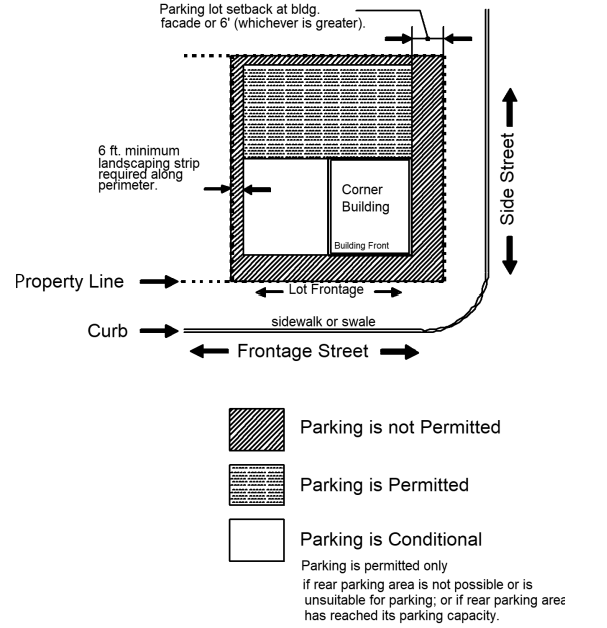 | Parking Location and Design 1. Wherever possible, parking shall be placed along streets and in small, strategically located on-site lots (see diagram at left). 2. Parking lots shall be located behind buildings, such that buildings separate parking areas from the street. 3. In cases where this is not possible, and upon approval of the zoning administrator, parking may be located to the side of a building. In no case shall the side parking area be wider than 50 percent of the lot frontage. 4. In no case shall parking be located between the front facade of the building and the frontage street; or in the case of a corner lot, between the side facade of the building and a side street. 5. Parking lots shall be set back as depicted at left. 6. Single- and two-family (duplex) lots need not provide a perimeter landscape strip. 7. On-street parking shall be encouraged as a means of promoting safety by calming traffic and separating moving vehicles from pedestrians using the sidewalk. 8. Light impact surfaces that promote unique placemaking in keeping with sections 22-618 and 22-619 may be approved by the city engineer. Reference the Light Imprint Handbook (T3, T4 for contextually appropriate materials). |
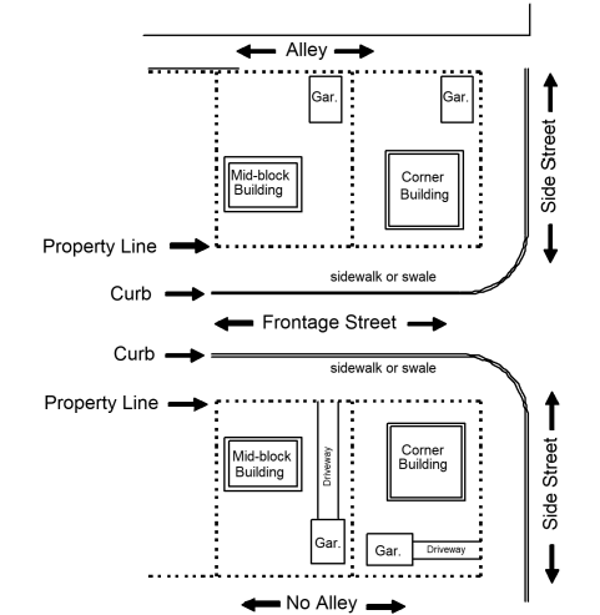 | Access to Off-Street Parking 1. Buildings that have both rear and side access shall access parking through the rear (see diagram at left). 2. Front driveways to rear parking areas are permitted only where rear or side street access is unavailable (see diagram at left). 3. Curb cut or driveway width: Front, 20 spaces or less: 14 feet maximum. >Front, more than 20 spaces: 18 feet maximum. Side or rear alley, 18 feet maximum. 4. The minimum effective curb radius shall be utilized. 5. Ribbon driveways with permeable center strips shall be encouraged for single- and two-family residential lots. 6. Circular drives shall be permitted on a case-by-case basis by the zoning administrator where necessary for drop-off and pick-up only (day care, church, etc.). |
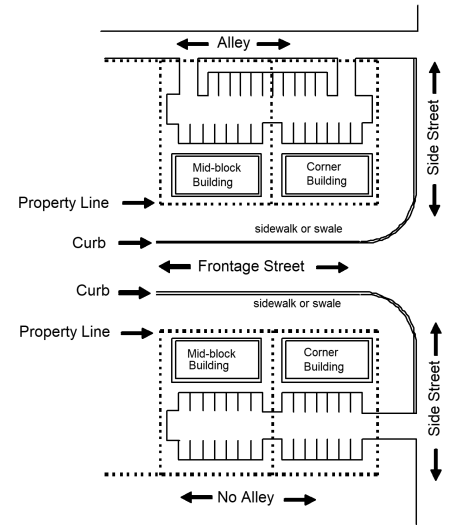 | Linkages Between Off-Street Parking 1. Linkages between parking areas within the perimeter of the block (and half block) should be encouraged when a rear alley or lane is present, and shall be provided when there is no rear alley or lane present (see diagram at left). 2. In no case shall a vehicular accessway/driveway be permitted between the front facade of the building and the frontage street; or in the case of a corner lot, between the side facade of the building and the side street. |
| Heavy and Recreational Vehicle Parking Storage or parking of heavy trucks (over 20,000 GVW), trailers, rec. vehicles, boats, campers, etc., on or about a single-family, duplex, or townhouse lot shall be prohibited. Exceptions: vehicles associated with an approved home occupation, and recreational vehicles utilized for personal use that are parked in the rear or interior side setback behind the front of the building or garage out of site from the street. |
| Appropriate Design | Inappropriate Design | Residential Garages |
|---|---|---|
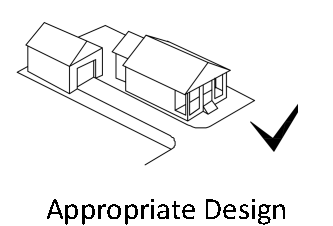 | 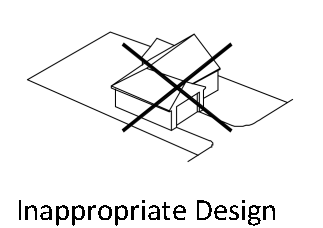 |
1. Garage doors shall be positioned on the back half of the lot and no closer than
20 feet behind the principal plane of the building front
(see diagrams at left). 2. If possible, garage doors shall face the side or rear of the lot, not the frontage street. |
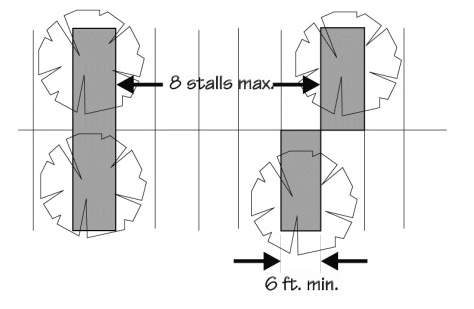 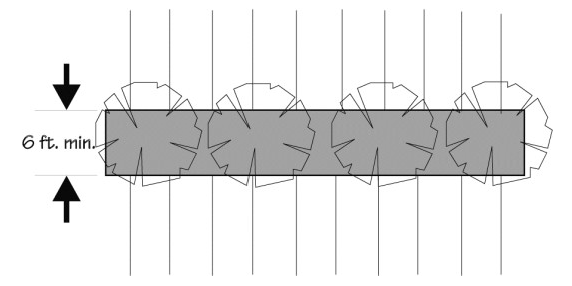 | Interior Parking Lot Landscaping Requirements 1. Landscape islands are required in parking areas at the following intervals for either head-in or diagonal parking stalls: • No more than eight consecutive parking stalls are permitted without a landscape break of at least six feet in width and extending the entire length of the parking stall. • Each landscape break shall have at least one tree for every 90 square feet of area, or portion thereof, and be covered with grass, shrubs, or living ground cover. • To minimize water consumption, the use of low-water vegetative ground cover other than turf is encouraged. 2. In lieu of landscaped islands, landscape strips, of at least six feet in width, can be provided between parking isles. Landscape strips shall have the same landscape requirements as landscape islands. | |
(Code 1991, § 22-506; Ord. of 3-10-2014, § 7; Ord. No. 11192014-1, § 8, 11-19-2014; Ord. No. 04112016-2, 4-11-2016; Ord. No. 12112017-1, § XII, 12-11-2017)
Sec. 22-625. - Lighting.
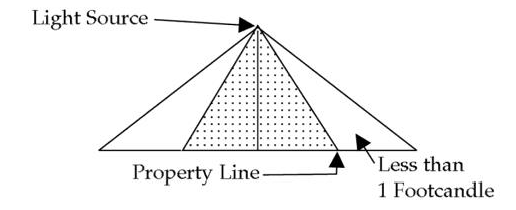 | Residential Garages 1. Fully shielded. All exterior illuminating devices shall be fully shielded. The term "fully shielded" shall mean that those fixtures so designated shall be shielded in such a manner that light rays emitted by the fixture, either directly from the lamp or indirectly from the fixture, are projected below a horizontal plane running through the lowest point of the fixture where light is emitted. 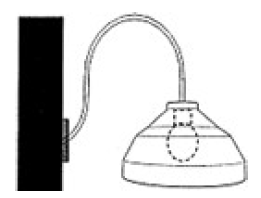 2. Continuous light spillage onto neighboring properties shall not exceed 1 footcandle as measured at the lot line (see diagram at top left). 3. Illumination types. Only those types of lighting listed at left shall be allowed. The same type of lighting must be utilized for all fixtures and light sources on the site. 4. Natural gas lamps are permitted and do not require any type of shielding. 5. Other sources of illumination that minimize undesirable light into the night sky, demonstrate architectural merit, or are energy efficient may be approved by the zoning administrator. 6. Sign lighting. If a sign is to be externally illuminated, a stationary light directed solely at the sign shall be used. • Monument signs may be illuminated with reverse channel/halo lighting or one up-light per side. • Wall signs may be illuminated with reverse channel/halo lighting or down lighting using a fully shielded fixture. • Goose neck lighting fixtures are strongly encouraged. • Neon, krypton, argon and other noble gas-filled tube lighting shall be limited to retail and restaurants. • The use of colored lights to illuminate signage is prohibited. |
| Permitted Illumination Types | |
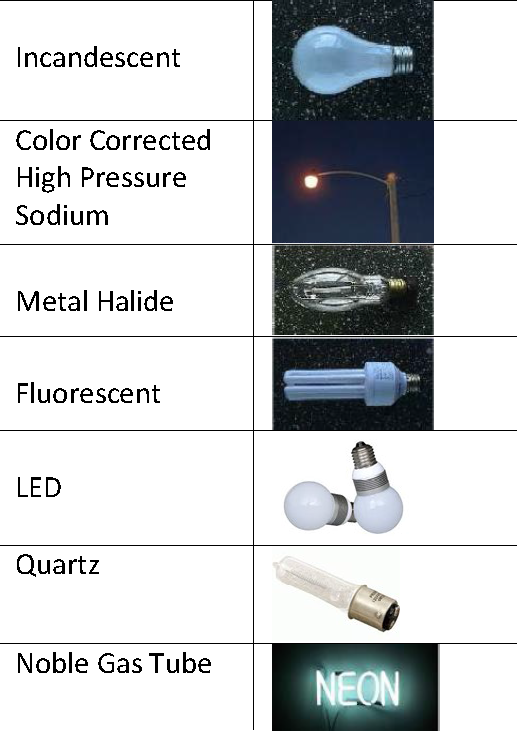 | |
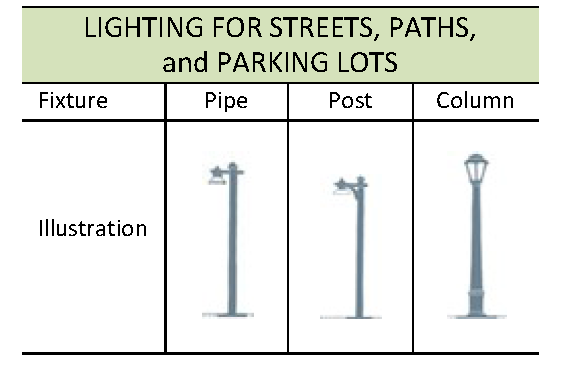 |
1. Streets, paths, and parking lots. New lighting for streets, paths, and off-street parking lots shall be of a general
type illustrated at left. New light poles shall range from ten to 16 feet in height
and be spaced a maximum of 75 feet on center.
2. Cobra head fixtures. Except where required for industrial uses, new cobra head light fixtures shall be prohibited. 3. Light poles should be placed two feet from the back of the curb or street surface and may include brackets for decorative or graphic attachments. 4. Wall packs. Wall packs shall be prohibited as a means of general building and site lighting, and may only be used at auxiliary entrances to a building if fully shielded with limited to no visibility from the street. |
(Code 1991, § 22-507; Ord. of 3-10-2014, § 8; Ord. No. 11192014-1, § 9, 11-19-2014)
Sec. 22-626. - Uses.
(a)
General to the overlay district. In addition to those uses permitted by the underlying zoning district, those uses identified below and in this section shall be permitted within the VPO. Any use permitted "by-right" (x) or as a "conditional use" (CU) in the table of permitted uses (section 22-121) for the R-2 zoning district shall be allowed "by-right" throughout the entire overlay district as conveyed in the aforementioned table. Exceptions:
(1)
Where the underlying zoning district is manufacturing, only those uses listed below and in this section shall be permitted.
(2)
If a use is specifically defined below, the definition in this section shall supersede that which is applicable to the underlying zoning district.
(3)
If the use below is accompanied by "conditional use standards," the standards of this section must be met and shall supersede any conditional use standards found elsewhere in the article.
(4)
In case of conflict, the standards of this section and the overlay district in general shall always prevail.
(b)
Residential.
(1)
Accessory dwelling unit (ADU).
a.
Located on same lot as principal building. An auxiliary dwelling unit located on the same lot as the principal building that may be attached by a backbuilding or contained within a stand-alone outbuilding. Examples include, but are not limited to, a dwelling unit in a guesthouse, pool house, and above or beside a garage. This use shall be used as a substitute, and in place of the garage apartment.
b.
Conditional use standards. An accessory dwelling unit (ADU) shall comply with the following conditional use standards:
1.
Number of units. One ADU shall be permitted per lot.
2.
Ownership. Both the principal dwelling and the accessory dwelling will be in the same ownership.
3.
Size. The maximum footprint for an ADU shall not exceed 720 square feet.
4.
ADU in an existing structure. If the ADU is to be located in an existing accessory structure, the accessory structure shall meet all setback requirements for the district.
5.
Residential form. The structure shall appear residential in form.
6.
Compatible with principal building. To the maximum extent practicable the exterior color, siding, roof pitch, window detailing, roofing materials, and foundation of the accessory dwelling unit shall be compatible to that which is found on the principal building.
7.
Outside entrance. For an attached ADU, additional entrances will be located in the side or the rear of the ADU.
8.
Parking. There will be one on-site, off-street parking space for each ADU in addition to the spaces required for the primary dwelling.
9.
Resale. An ADU shall not be sold apart from the principal dwelling upon the same lot where they are located.
10.
Rental. An ADU may be used as a short-term rental or guest room for a bed and breakfast.
(2)
Dwelling, single-family.
(3)
Dwelling, two-family.
(4)
Dwelling, multifamily. A structure containing three or more dwelling units on a single lot or series of adjacent and/or shared lots. Examples include, but are not limited to, triplexes, condominiums, rowhouses or townhouses, apartments, etc.
(5)
Boardinghouse or roominghouse. This use shall be prohibited in the overlay district.
(6)
Personal care home; group. Limited to not more than 16 persons in a residential zoning district.
(7)
Home occupation.
a.
Spacing for non-retail business. A principal or accessory dwelling unit that contains a space devoted to a non-retail business activity belonging to the resident thereof and allowing up to two outside employees.
b.
Use standards. A home occupation shall comply with the following standards:
1.
Exclusions to home occupations. No home occupation shall be permitted that does any of the following:
i.
Internal or external alterations inconsistent with the residential use of the building;
ii.
Is visible from the street;
iii.
Generates traffic, parking, sewerage, or water use in excess of what is normal in the neighborhood;
iv.
Creates a hazard to persons or property;
v.
Is a nuisance; or
vi.
Results in the outside storage or display of anything.
2.
ADUs. Such use shall not operate from an accessory dwelling unit if it involves visitation by customers.
3.
Display and sales. Incidental retail sales including products made or repaired on-site is permitted. No outdoor display of products for sale is permitted.
4.
Maximum size. Such use shall occupy a maximum of 25 percent of the floor area of the principal dwelling.
5.
Vehicles. Only passenger vehicles shall be permitted in connection with the conduct of such use.
6.
Hours. Deliveries and activities involving visitors/clients shall occur only between 8:00 a.m. and 6:00 p.m.
7.
Parking. Such use shall not result in off-street parking of more than three vehicles at any one time not owned by members of the occupant household. One off-street parking space shall be provided per outside employee in addition to the spaces required for the residence itself.
8.
Prohibited home occupations. The following are prohibited as home occupations:
i.
Adult entertainment;
ii.
Animal boarding facilities (such as animal hospitals, commercial kennels, etc.); and
iii.
Tattoo parlors or studios.
(8)
Live-work townhouse. Specific to the townhouse building type, these dwellings provide flexible space at the street level for retail, service, or office uses; and a complete living unit located above or behind and above that is occupied by the same resident. First floor uses must adhere to all legal requirements of the business. Such uses allow nearby residents to meet their daily needs without leaving the neighborhood, providing a limited variety of low-intensity activities currently associated with the following uses: Art studio; barber or beauty shop; bookbinding, printing, engraving (etc.) shop, flower shop; music teaching studio; personal service shops; photograph studio; professional offices; food catering service; tailor; and taxidermist. Additional uses include, but are not limited to, home medical office (doctor, dentist, counseling, therapeutic massage), framing, locksmiths, shoe repair, tanning salons, etc.
(9)
Offices and services.
a.
Art studio.
b.
Boardinghouse or roominghouse.
c.
This use shall be prohibited in the overlay district.
d.
Day care.
1.
A state-licensed facility that provides non-medical care and supervision for adults or children, typically for periods of less than 24 hours per day for any client. Examples include, but are not limited to, nursery schools, preschools, after-school care facilities, day care centers, etc.
2.
A day care shall comply with the following conditional use standards:
i.
Parking. Provide the required minimum of two off-street parking spaces per 1,000 square feet, as well as one off-street passenger drop off/pick-up space per ten clients/students.
ii.
Vehicular circulation and drop-off and pick-up. Parking areas and vehicular circulation shall be designed to provide a designated pickup and delivery area that is located in such a way that clients/students do not have to cross vehicular travel ways to enter or exit the center.
iii.
Outdoor spaces. Facilities shall provide functional outdoor spaces and play areas that are safely segregated from parking, loading, and service areas.
iv.
Screening. A landscaped hedge or solid fence shall be provided along any rear or side property line adjoining a residential lot. The hedge or fence shall be designed and/or planted to be at least four feet in height at maturity.
(10)
Gas station (service station).
a.
Accessory use. An establishment where petroleum products are dispensed for retail sale. Accessory uses may include a retail convenience store and/or a single-bay carwash. Accessory uses do not include: towing, vehicle body or engine repair, or overnight vehicle storage.
b.
Conditional use standards. Gas stations shall comply with the following conditional use standards:
1.
Location. This use shall be limited to sites in which the underlying zoning is CU2. Only one gas station is permitted per block along a street. Additionally, no more than one gas station may occupy an intersection.
2.
Site. The site is comprised of a main building (typically a convenience store) that is located close to the street with gas pumps sited to the rear or side. In no case shall a vehicular accessway/driveway or off-street parking area be permitted between the facade of the building and the primary street or secondary street (corner lot). Facilities that contain a cashier's booth or kiosk only are prohibited.
3.
Building. To the maximum extent practicable, the main building or convenience store shall utilize and comply with the standards for the shopfront building type.
4.
Pump location. Gas pumps shall be located to the rear or side of the building.
i.
Gas pumps may be located to the side of the building if the canopy and pumps do not project further toward the street than the front plane of the principal facade of the building; and
ii.
On corner lots, the canopy and pumps are located on the interior side. In no case shall the canopy and pumps be located on the side of the lot that abuts the corner.
c.
Wall. A minimum four-foot wall or garden wall shall be provided along the length of any lot line adjacent to a street.
d.
Canopy lighting. Canopy lights shall be located inside the canopy and shall not be visible from the street.
(11)
Retail and restaurant.
a.
Corner store. Specific to the corner store building type, this ground floor establishment customarily services the local neighborhood, providing a limited variety of everyday items currently associated with the following uses: Art studios, bakery, barber or beauty shops, clothing and dry goods stores, drug stores, flower shops, food stores, retail candy and ice cream stores, and specialty shops. Additional uses include, but are not limited to, delicatessens, over-the-counter dining, cafes, small-scale restaurants, hardware sales, etc.
b.
Group development projects. Such development shall conform to the standards contained in section 22-620(k).
(12)
Recreation, education, public assembly.
a.
Church or other place of worship. A facility for public or private worship. Examples include, but are not limited to, religious facilities such as churches, mosques, synagogues, etc.
b.
Clubs or lodges.
c.
Cultural facilities.
d.
Libraries, museums, and similar facilities. This use shall include cinemas, performance theaters and auditoriums currently deemed to be amusement or recreational activities (commercial).
e.
Dance school or studio.
f.
Recreation vehicle parks. This use shall be prohibited in the overlay district.
g.
School, public or private. A public or private academic institution that provides the state-mandated educational curriculum. Examples include elementary schools (kindergarten through sixth grade), middle and junior high schools (seventh and eighth grades), secondary and high schools (ninth through 12th grades), and facilities that provide any combination of those levels. This use also includes schools that provide room and board.
(13)
Industrial.
a.
Shopfront manufacturing. Specific to a shopfront building type, this ground floor facility is engaged in low intensity manufacturing, processing, assembly, and packaging of goods in which the operational characteristics of the production process and materials used are unlikely to cause significant impacts on the surrounding community. Natural, manmade, raw, secondary, or partially completed materials may be used. Products may be finished or semi-finished and are generally made for the wholesale market, for transfer to other plants, or to-order for firms or consumers. Goods are generally not displayed or sold on-site, but if so, they are a subordinate part of sales. Examples include, but are not limited to, artisan/craft product manufacturing; clothing and fabric product manufacturing; furniture and fixtures manufacturing, cabinet shop, media production, photo/film processing lab not accessory to a retail business, printing and publishing, food preparation and packaging, winery, micro-brewery.
b.
Standards. Shopfront manufacturing shall comply with the following conditional use standards:
1.
Location. This use shall be limited to those sites in which the underlying zoning is manufacturing or CU2.
2.
Operations. All operations related to this use shall be conducted completely within a building, except limited daily outdoor operations and storage may occur behind the building and at least 50 feet from any property line. No impacts or byproducts of the use, including noise, dust, or odor shall be discernible from the lot line.
3.
Parking. If the administrator determines that the use functions much like a traditional retail or service establishment, the administrator may require a minimum of two off-street parking spaces per 1,000 square feet.
(Code 1991, § 22-508; Ord. of 3-10-2014, § 9; Ord. No. 11192014-1, § 10, 11-19-2014; Ord. No. 04112016-2, 4-11-2016; Ord. No. 12112017-1, § XIII, 12-11-2017)
Sec. 22-627. - Administration.
(a)
Review process.
(1)
Review responsibility. Interpretation of these standards shall be the responsibility of the city's planning department. This Code is calibrated to implement the vision conveyed in the Victoria Place Urban Redevelopment Plan (VPURA) while also promoting a form and function that is contextual with the existing neighborhood; a complex place in which no single element dominates, but rather many components come together to create a community. In order to ensure the above outcome, certain requirements in this code may be met using the range of options provided herein, and associated with a specific standard.
(2)
Administrative approval. Where waivers of requirements are permitted in this code, the following shall be utilized in determining the appropriate outcome:
a.
Refer to the goals and intentions conveyed in the VPURA.
b.
Refer to the section 22-618.
c.
The proposed matter should be considered in context with the character of the surrounding community and surrounding land uses and the outcome compatible and consistent with the same.
(3)
Map. As this code changes from time to time, so shall the map. The current boundary map is available from the zoning administrator.
(4)
Development review threshold. All new development or modifications to existing development in which:
a.
The impervious surface of the lot is disturbed or altered;
b.
The structure is 60 square feet or greater in size; or
c.
The applicant is required to obtain a building permit;
shall be reviewed per the standards of this overlay district.
(5)
Scope of review. The city planner shall have approval authority for all aspects of site planning and exterior architecture, including aesthetic appropriateness, fit with historic context, environmental implications, traffic impacts, and any other site-specific matters not delineated herein. The supervising planner shall have authority to waive architectural guidelines in specific instances where compliance would create undue hardship such as:
a.
Additions in which new portions would be incompatible with the existing structure; or
b.
In the application of roofing materials that are consistent with the goals of preservation but are not expressly permitted.
(6)
Conformance. Lots with an owner-occupied, single-family residential building that existed at the time of adoption of the ordinance from which the Victoria Place Overlay Code (insert date) is derived shall not be required to comply with the overlay district standards, except when making renovations, repairs, or otherwise improving the principal structure by more than 50 percent of its current square footage or current replacement value (at the time of alteration). In such case, the principal structure shall be brought into conformance with the standards of the overlay district. Otherwise, to the maximum extent practicable, all lots, structures, uses, and associated architectural elements (signs, fences, etc.) shall comply with the standards of this overlay code.
(7)
Mandatory preapplication meeting. Those wishing to develop in the VPO shall meet with the zoning administrator and/or city planner to discuss the project prior to submitting a formal application. Only the city planner shall have the authority to waive this meeting.
(8)
Final approval. Applicants shall submit the items described below for final approval. Both the zoning administrator and the city planner will review the application for final approval. Except where expressed herein, existing development review procedures shall be maintained and implemented.
(b)
Review requirements. The following items are required for review, unless deemed not applicable by the zoning administrator:
(1)
A current site survey, no more than two years old.
(2)
A current tree survey, no more than one year old.
(3)
A site plan, drawn to scale, which shall indicate:
a.
Building locations;
b.
Parking locations and number of spaces;
c.
Paved surfaces, materials and locations;
d.
Site location diagram and legal description; and
e.
Any and all exposures, as defined by NFPA, within 150 feet of the proposed building on- or off-site.
(4)
Building elevations illustrating all sides of all structures.
(5)
Other reasonable supporting documents to indicate intentions and/or any other items required by the zoning administrator.
(c)
Decisions and appeals. The zoning administrator shall issue a written notification concerning any decision made pursuant to this code and such notification shall state that an appeal is available and the procedures for such appeal. Appeals shall be made, publicized and heard in the same manner as provide for in article IX of this chapter.
(Code 1991, § 22-509; Ord. of 3-10-2014, § 10; Ord. No. 11192014-1, § 11, 11-19-2014; Ord. No. 12112017-1, §§ II, XIV, XV, 12-11-2017)
Sec. 22-628. - Definitions.
The following words, terms and phrases, when used in this article, shall have the meanings ascribed to them in this section, except where the context clearly indicates a different meaning:
Accessory structure means a building or structure subordinate to the principal building or lot and used for purposes customarily incidental to the main or principal building and located on the same lot therewith. Accessory structures are permitted with all building types.
Alley means a secondary way which affords access to the side or rear of abutting property.
Appurtenances means architectural features not used for human occupancy consisting of: spires, belfries, cupolas or dormers; silos; parapet walls, and cornices without windows; chimneys, ventilators, antennas, etc.
Build-to line means a line parallel to the property line, along which a building shall be built. Porches and handicap ramps shall be exempt from build-to requirements and shall occur behind the property line. Build-to line locations for specific sites shall be established by the design review board at the time of application.
Building coverage means the horizontal area within the outer perimeter of the building walls, dividers, or columns at ground level including courts and exterior stairways, but excluding uncovered decks, porches, patios, terraces, and stairways.
Building frontage means the side of a building which faces the frontage street.
Dwelling area means the total internal useable space on all floors of a structure, not including porches, balconies, terraces, stoops, patios or garages.
Easement means a legal instrument, recorded in the county records, that allows access through real property of the conveyor.
Elevation means an exterior wall of a building.
Encroachment means any architectural feature, structure or structural element, such as a fence, stoop, balcony, bay window, or deck that breaks the plane of a horizontal regulatory limit extending into a setback or beyond the build-to line.
Entrance, principal, means the main point of access of pedestrians into a building, most often from the primary street.
Entrance, secondary, means the secondary point of access of pedestrians into a building, most often from a secondary street or parking area (rear or side).
Expression line means a line prescribed at a certain level of a building for a major part of the width of a facade, expressed by a variation in material or by a limited projection such as a molding or balcony.
Fascia means a wide band of material covering the ends of roof rafters, sometimes supporting a gutter in steep-slope roofing, but typically it is a border or trim in low-slope roofing.
Footcandle means a unit of measure of the intensity of light falling on a surface, equal to one lumen per square foot and originally defined with reference to a standardized candle burning at one foot from a given surface.
Frontage line means the property line of a lot fronting a thoroughfare or other public way, or a civic space.
Frontage street means the public right-of-way which serves as primary access to a property.
Frontage type means the way in which a building engages the public realm.
Garden wall means a freestanding wall made of masonry, typically used as a screen or enclosure for a yard or open space, or as a divider along a street, alley, or lot line.
Live-work unit means an integrated housing unit and working space in a structure that has been designed or structurally modified to accommodate joint residential occupancy and work activity with a commercial component that may accommodate employees and walk-in trade. The residential component may be located above or behind the commercial space.
Lot frontage means the property line adjacent to the frontage street.
Mixed use means the development of a single building containing more than one type of land use or a single development of more than one building and use including, but not limited to, residential, office, retail, recreation, public, or entertainment, where the different land use types are in close proximity, and shared pedestrian and vehicular access and parking areas are functionally integrated.
Parapet means a low wall along the edge of a roof or the portion of a wall that extends above the roofline.
Pedestrian passage means an open or roofed access passing between buildings. These passageways frequently connect rear parking areas and alleys to frontages, streets, plazas, and other public use spaces. A pedestrian passage provides a shortcut through long blocks and is often restricted to pedestrian use and limited vehicular access.
Private frontage means the privately held space between the front plane of the principal building and the front parcel line/ROW.
Public frontage means the area between the vehicular lanes and the front parcel line that contains the curb assembly, walkway type, planter type, landscaping, lighting, signage, and civic elements (benches, bus stops, etc.).
Public realm means the physical and social domain of the public that is held in common either by their physical presence or by visual association. The term "public realm" includes, but is not limited to, plazas, squares, parks, thoroughfares, public frontages, private frontages, civic buildings and civic spaces.
Rear alley means a vehicular way located to the rear of lots providing a location for utility easements and access to service areas, parking, and outbuildings.
Right-of-way (ROW) means a right-of-way is the actual land area acquired for a specific purpose such as a utility line or roadway.
Setback means the mandatory clear distance between a property line and a structure.
Shared parking means any parking spaces assigned to more than one user, where different persons utilizing the spaces are unlikely to need the spaces at the same time of day.
Shed roof means a roof shape having only one sloping plane.
Shopfront means a private frontage type where the main facade of the building is at or near the frontage line with an at-grade entrance along the public way. This type is intended for retail use. It has substantial glazing at the sidewalk level and may include a canopy or awning that overlaps the sidewalk.
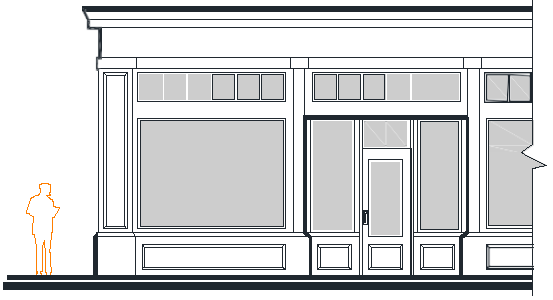
Shopfront Facade
Suspended signs means signs mounted to the underside of beams or ceilings of a porch, gallery, arcade, breezeway or similar covered area. They are typically hung in a manner that allows them to swing slightly. These signs are small, pedestrian scaled, and easily read from both sides.
Thoroughfare means a street. This article mandates that all vehicular rights-of-way, easements, and parking accessways be designed as thoroughfares that both resemble and function as a traditional street would.
(Code 1991, § 22-510; Ord. of 3-10-2014, § 11; Ord. No. 11192014-1, § 12, 11-19-2014; Ord. No. 04112016-2, 4-11-2016)
Sec. 22-630. - Purpose.
The intent of the traditional neighborhoods infill district (TNID) is to allow for and encourage quality infill development within the traditional neighborhoods urban redevelopment area (TN-URA), as defined in the traditional neighborhoods urban redevelopment plan, adopted by the city council by resolution dated May 8, 2023. The TNID is primarily focused on accommodating small-scale residential infill that includes development characterized as "missing middle" housing. Goals of the district include:
(1)
Improve productivity of vacant, non-conforming, and underutilized lots.
(2)
Increase housing stock in centrally located neighborhoods.
(3)
Expand housing choice and affordability within the TN-URA.
(4)
Prioritize development that utilizes existing infrastructure.
(Ord. No. 25-09082025, § V, 9-8-2025)
Sec. 22-631. - Provisions.
To be considered for rezoning to TNID and entitled to the development activities that are enabled by the district, an applicant shall meet the following criteria:
(1)
Location. Any property located within the TN-URA boundary is eligible for a rezoning to TNID.
(2)
Permitted uses. Use of any property zoned TNID must be consistent with section 22-632.
(3)
Development controls. All development on properties zoned TNID must comply with the development standards and requirements in sections 22-633 and 22-634.
(4)
Design compatibility. All development on properties zoned TNID must comply with the design standards and requirements in section 22-635.
(5)
Development orders. Prior to commencing any development activities on a property that is zoned TNID, a site plan must be approved by the zoning administrator. All subsequent development activities shall comply with the plan as approved and all related permitting shall be subject to the procedures for review and approval of development provided in section 22-637.
(6)
State and local codes.
a.
In the case of conflict between the standards of the TNID and those contained elsewhere in this Code, the standards contained in the TNID shall always prevail.
b.
Development must comply with all state and local building codes.
(Ord. No. 25-09082025, § V, 9-8-2025)
Sec. 22-632. - Permitted uses.
The following uses are permitted within the TNID:
(1)
Residential uses.
a.
Single-family detached dwelling.
b.
Duplex.
c.
Neighborhood unit.
(2)
Accessory uses.
a.
Accessory dwelling unit.
b.
Accessory structure.
(Ord. No. 25-09082025, § V, 9-8-2025)
Sec. 22-633. - General standards.
The following development standards shall apply:
(1)
Lot requirements.
a.
Minimum lot area: there is no minimum lot area requirement.
b.
Minimum lot street frontage: 30 feet.
c.
All lots must have primary frontage along an existing public right-of-way.
(2)
Lot coverage requirements.
a.
Maximum lot coverage: 40 percent except as follows:
1.
Lot coverage above 40 percent impervious up to 60 percent impervious is allowed with approved onsite stormwater treatment.
2.
When onsite stormwater treatment is required, proposed treatment facilities must be approved by the city engineer (or their designee) prior to the issuance of any development permits.
(3)
Setback requirements.
a.
Front setbacks. Shall match the contextual front setback in accordance with section 22-25.
1.
If a contextual front setback cannot be determined, the front setback shall be a minimum [of] 20 feet.
b.
Corner setbacks. Comply with section 22-20.
c.
Side setbacks.
1.
Minimum five feet for buildings or portions of buildings 24 feet or less in height.
2.
Minimum ten feet for buildings or portions of buildings more than 24 feet in height.
d.
Rear setbacks. Minimum ten feet.
e.
Exceptions.
1.
Corner setbacks may be administratively reduced to a minimum of five feet when sight triangle requirements are met in accordance with section 22-24.
2.
Side setbacks may be administratively reduced to a minimum of three feet with increased fire protection in accordance with adopted building codes.
3.
Internal setbacks may be reduced to zero feet between attached dwelling units.
(4)
Building requirements.
a.
The primary building on each lot shall be placed as close to the street as possible, within the applicable setbacks.
b.
All buildings shall be a maximum of 2.5 stories or 35 feet, whichever is greater.
c.
All buildings shall have a maximum width of 40 feet and a maximum depth of 70 feet, excluding porches, stoops, and the like.
d.
All buildings shall provide a minimum eight-foot ceiling height for [the] first floor.
e.
All buildings shall provide a minimum finish floor elevation of 12 inches above grade at the front of the building.
1.
Administrative variations from the finished floor elevation requirement shall be permissible if topographic hardship can be demonstrated.
(5)
Utilities requirements.
a.
All newly created lots must have sufficient and direct access to existing public utilities without encroaching on adjacent lots.
1.
Administrative relief may be considered in extremely extenuating circumstances.
b.
To the maximum extent practicable, all utility connections should be placed underground.
(6)
Parking requirements.
a.
Minimum parking for residential uses: one parking space per unit.
b.
On-street parking provided adjacent to the site may count as part of the required parking supply, provided the design is approved by the zoning administrator.
(Ord. No. 25-09082025, § V, 9-8-2025; Ord. No. 01-01262026, § I, 1-26-2026)
Sec. 22-634. - Site design requirements.
(a)
Parking and driveway configurations.
(1)
Off-street parking should be located behind the front façade of the primary building.
(2)
No parking pad or driveway shall be allowed between the front façade of the primary building and street.
(b)
Fence or walls.
(1)
Fences or walls at the side or rear property line shall not exceed 72 inches.
(2)
Fences or walls placed in the front yard or corner side yard shall not exceed 48 inches when located between the front façade and street.
(3)
Chain link fences are not permitted in front yards.
(4)
Barbed wire, plastic slats, and plastic screening fabric are prohibited fencing materials.
(5)
Administrative variations from these height requirements shall be permissible if topographic hardship can be demonstrated.
(c)
Retaining walls.
(1)
Retaining walls in the front yard are limited to 48 inches in height. A retaining wall located adjacent to a sidewalk along a public street shall not exceed 24 inches in height. Retaining walls shall be limited to 72 inches in height within interior side and rear yards.
(2)
Administrative variations from these wall height requirements shall be permissible if topographic hardship can be demonstrated.
(d)
Equipment limitations. Utility meters, air conditioning equipment, permanent grills, permanent swimming pools, recreation and play equipment, doghouses and dog runs, hot tubs and spas, and wood decks shall not be installed in the front yard.
(Ord. No. 25-09082025, § V, 9-8-2025)
Sec. 22-635. - Architectural standards.
The following architectural design standards apply to all new development and redevelopment on properties zoned TNID to ensure compatibility with existing neighborhood character:
(1)
Front porches and stoops.
a.
Every primary residential structure shall have a front porch or stoop on the primary façade of the building. Front porches on the primary façade of the building shall be required when such treatments are established by a majority of the residential dwellings on the block face.
b.
Front porches, when required, shall:
1.
Have a minimum width of ten feet or 25 percent of the front facade width, whichever is greater.
2.
Have a minimum clear depth of six feet.
3.
Contain roofs.
4.
Maximum height shall be level with the finished floor elevation of the front façade; minimum height shall be no more than one step below the finished floor elevation of the front façade, based on maximum allowable stair riser height as defined by the building code.
c.
Stoop requirements:
1.
Have a minimum clear width of five feet, and a maximum width of eight feet.
2.
Have a minimum clear depth of five feet, and a maximum depth of eight feet.
d.
Maximum height shall be level with the finished floor elevation of the front façade; minimum height shall be no more than one step below the finished floor elevation of the front façade, based on the maximum allowable stair riser height as defined by the building code.
e.
Porches and stoops shall be permitted to extend into the front setback a maximum of ten feet. No conditioned space is permitted above any porches that project into front setbacks.
f.
Porches and stoops must connect to sidewalk if present.
g.
General design:
1.
Columns. Columns shall be a minimum of six inches wide. Structural columns shall be clad in finish grade wood trim or be a decorative shape that is compatible with the design of the house.
2.
Base. The base shall be compatible with the form of the house and adhere to the standards that are applied to the building foundation.
(2)
Building foundation.
a.
Exposed foundation walls (below first floor) shall be brick, painted brick, or stucco over block or concrete.
b.
Foundation piers shall be no less than 12 inches square. Foundation piers shall be brick, painted brick, or stucco over block or concrete.
c.
Primary walls, when set on a raised crawlspace foundation, should rest on a drip edge and water table or sill and fascia (wood or cementitious) over foundation piers.
(3)
Façade fenestration.
a.
Façade fenestration (may include windows and doors) shall be a minimum of 25 percent of the area of primary street facing façades along the ground floor, and shall be a minimum of 20 percent of the area for secondary street facing façades.
b.
Window fenestration for upper stories shall be a minimum of 15 percent of the area for all street facing façades.
c.
No more than ten feet in width of any street facing facade may be blank without fenestration provided.
(4)
Window and door requirements.
a.
Exterior window faces shall be recessed from the adjacent trim.
b.
Windows shall have an expressed sill.
c.
When used with wood cladding materials, all windows and doors shall be framed with a minimum 3.5 inches wood or composite trim. When using stucco or masonry materials, windows and doors shall be trimmed with a minimum 2.5 inches masonry trim mold.
(5)
Building trim.
a.
When using approved material other than brick or stucco, a corner board with a minimum width of 5.5 inches shall be provided on front façades.
b.
Boxed or flat soffit end caps shall not be provided at front façades. Sloped soffits or full roof returns shall be required.
(6)
Garages.
a.
Front-facing garage doors shall be recessed and located a minimum distance of 20 feet behind the front façade of the principal structure.
b.
The garage door opening shall be less than 50 percent of the principal façade width.
c.
If possible, garage doors should face the side or rear of the lot, not the frontage street.
(7)
Prohibited materials and features.
a.
The following materials shall be prohibited on the exterior on any new building or redeveloped property zoned TNID:
1.
Vinyl siding less than .044 inches in thickness.
2.
Wood fiber board.
3.
Unfinished pressure-treated wood.
b.
The following features shall be prohibited on the exterior on any new building or redeveloped property zoned TNID:
1.
Undersized shutters. Shutters shall be sized so as to equal the width required to cover the window opening.
(Ord. No. 25-09082025, § V, 9-8-2025; Ord. No. 01-01262026, § II, 1-26-2026)
Sec. 22-636. - Use specific standards.
In addition to the standards set forth in sections 22-633, 22-634, and 22-635, the following use-specific standards shall apply:
(1)
Neighborhood unit.
a.
No more than one neighborhood unit building per lot is permitted.
b.
No more than four dwelling units per neighborhood unit are permitted.
c.
Neighborhood units must have a sloped roof of 6:12 or greater.
d.
Two or more wall materials may only be combined on one façade when the lighter material is above the more substantial material.
e.
Any attached or detached garage or carport must be located behind the principal building.
f.
Screening shall be required for all off-street vehicular use areas serving neighborhood units.
1.
Landscaping or fencing with a minimum of 50 percent opacity are acceptable screening materials.
(Ord. No. 25-09082025, § V, 9-8-2025)
Sec. 22-637. - Procedures for review and approval of development.
It is the intent of the city council that all development on properties zoned TNID shall conform to the standards and procedures set forth in this division.
(1)
Review responsibility. Interpretation of these standards shall be the responsibility of the city's planning department.
(2)
Development review threshold. All new development or modifications to existing development shall be reviewed per the standards of this district.
(3)
Conformance.
a.
Any structure existing on the effective date of a rezoning to this district must be used for one of the approved uses.
b.
Any structure existing on the effective date of a rezoning to this district and is non-conforming or made non-conforming as to the development standards of the district:
1.
May continue; and
2.
May be repaired, maintained or remodeled; and
3.
May be extended or enlarged so long as said extension or enlargement does not contribute to nor increase the specific non-conforming dimensional or site requirements.
c.
Any structure existing on the effective date of a rezoning to this district and is made non-conforming as to architectural standards of the district:
1.
May continue; and
2.
Shall only be required to be brought into conformance with the architectural standards of the district when increasing the principal structure current square footage by 25 percent or more.
(4)
Review requirements.
a.
The following items are required for review, unless deemed not applicable by the zoning administrator:
1.
A current metes and bounds survey of the property.
2.
An existing conditions plan, drawn to scale, which shall indicate:
(i)
All existing structures;
(ii)
All existing paved surfaces;
(iii)
All known utility locations; and
(iv)
Locations of all trees.
3.
A proposed site plan, drawn to scale, which shall indicate:
(i)
Property boundaries and dimensions;
(ii)
Building locations and setbacks;
(iii)
Parking locations and number of spaces; and
(iv)
Paved surfaces, materials and locations.
4.
Building elevations illustrating all sides of all structures.
5.
Other reasonable supporting documents to indicate intentions and/or any other items required by the zoning administrator.
b.
Prior to the issuance of a building permit for any occupied structure to be built on a TNID zoned property, the builder shall provide scaled architectural plans and elevations that demonstrate compliance with the requirements of this division. The zoning administrator shall have the authority to review and approve building plans for conformity with the requirements of this division prior to issuance of any development permits.
(5)
Decisions and appeals. The zoning administrator shall issue a written notification concerning any decision made pursuant to this division and such notification shall state that an appeal is available and the procedures for such an appeal. Appeals shall be made, publicized, and heard in the same manner as provided for in article IX of this chapter.
(Ord. No. 25-09082025, § V, 9-8-2025; Ord. No. 01-01262026, § III, 1-26-2026)
Sec. 22-651. - Intent.
The city seeks to promote investment and contextually appropriate infill within downtown, surrounding neighborhoods, and upon individual blocks and lots. As such, it is the purpose of the Bellamy Place site and design standards is to enable, encourage, and support the following intentions:
(1)
In general.
a.
Ensure that patterns of urbanism, architecture, and landscaping emanate from local climate, history, and building practices in Thomasville.
b.
Implement the Blueprint 2028 Comprehensive Plan by incorporating traditional block, street, lot, and building patterns that allow for compact, complete, connected, mixed-use development that maximizes the potential of the site.
c.
Reinforce (and expand) the interconnected network of blocks and streets in order to ensure that the site blends seamlessly with downtown and the surrounding neighborhoods, contributing to the larger community and not just an isolated project.
d.
Establish appropriately sited and well-proportioned lots, allowing structures to properly orient to streets and civic spaces, yet remain flexible regarding their intensity and function.
e.
Use buildings to frame streets and public spaces, resulting in a high-quality, interesting, and human-scaled environment that will stand the test of time.
f.
Ensure that landmark buildings are sited at important locations, and that they promote a form that reflects their civic stature.
g.
Promote sustainability by encouraging a range of building types and sizes that can readily adapt to changes in the economy, the surrounding community, or the needs of their owner.
h.
Encourage functions that cater to both residents and visitors, allowing both to address as many activities of daily living as possible.
(2)
Specific to the site.
a.
Natural buffer. An undisturbed 30-foot natural buffer shall be provided along the southern edge of the property as shown in the conceptual land use plan. Where the natural buffer does not provide a minimum of 80 percent opacity between the proposed development and adjacent properties, it shall be supplemented with additional planting to achieve the required opacity. These plantings shall include a mixture of canopy trees (50 percent must be evergreen), understory trees, and shrubs. Canopy trees shall be no less than three-inch caliper and no less than 15 feet tall at the time of planting, with a mature height of no less than 25 feet.
b.
Building height setback zone. As depicted on the conceptual land use plan, a two-story building height limit shall be enforced for all development within 150 feet of the southern property line. This shall supersede any general height requirements within these standards.
c.
Uses. Allowable uses within the Bellamy Place Development shall be as following:
1.
The commercial district, which is zoned C-1;
2.
The township district, which is zoned C-1A; and
3.
The park district, which is zoned R-2.
(Ord. No. 38-11102025, § II(Exh. A), 11-10-2025)
Sec. 22-652. - General to all development.
(a)
Applicable codes and administration.
(1)
Underlying zoning. Except where specifically addressed herein, underlying zoning, subdivision, and site layout standards that are currently applicable for this site shall continue to apply.
(2)
Building codes. Development must comply with all state and local building codes.
(3)
Scope and time of compliance. Approval for all development addressed herein, regardless of location and ownership, shall comply with these standards.
(4)
Final review and authority. Interpretation and approval authority of these standards shall be the responsibility of the planning department.
(b)
Conceptual land use plan. The conceptual land use plan delineates Bellamy Place into three distinct districts: the commercial district, the township district, and the park district. Each district will be interconnected by sidewalks, crosswalks, and streets for a pleasantly designed walkable community spanning 17.81 acres. Each district will have its own set of governing architectural standards and guidelines that must be upheld by the developer, builders, and owners. The commercial district will allow for a variety of commercial development, ranging from out-parcels with single use buildings to mixed-use structures. The township district will encourage a mixture of uses and serve as a transition to the residential park district. The park district will be residential only with a variety of dwelling types. The development shall maintain a ten percent minimum amount of area as usable open space, parks, and civic areas.
(c)
Creating districts. As provided in the conceptual land use plan shown below in exhibit 2.3, the property shall be divided into distinct districts. Each district shall correspond with an existing zoning category, with specific requirements/exceptions for each district outlined in these standards.
(1)
Establishing districts. In order to establish a pedestrian friendly environment—in keeping with Thomasville's downtown and surrounding neighborhoods—a minimum of three districts are shown as part of the site.
(2)
Refining districts. As each district becomes more refined, and more intentioned, its boundaries will be delineated using an interconnected network of streets; each of which "creatively" addresses the need for on-site parking, while addressing:
a.
Structured blocks in keeping with a traditional downtown and city;
b.
The location, type and scale of civic spaces and buildings;
c.
The proposed building types, frontages, architecture, and uses within each district; and
d.
Plans for phasing and/or the potential subdivision of property.
(3)
Delineating districts. Streets that are internal to the site and delineate proposed districts shall utilize one of the pre-approved designs conveyed in subsection (d), creating streets.
EXHIBIT 2.3 CONCEPTUAL LAND USE PLAN
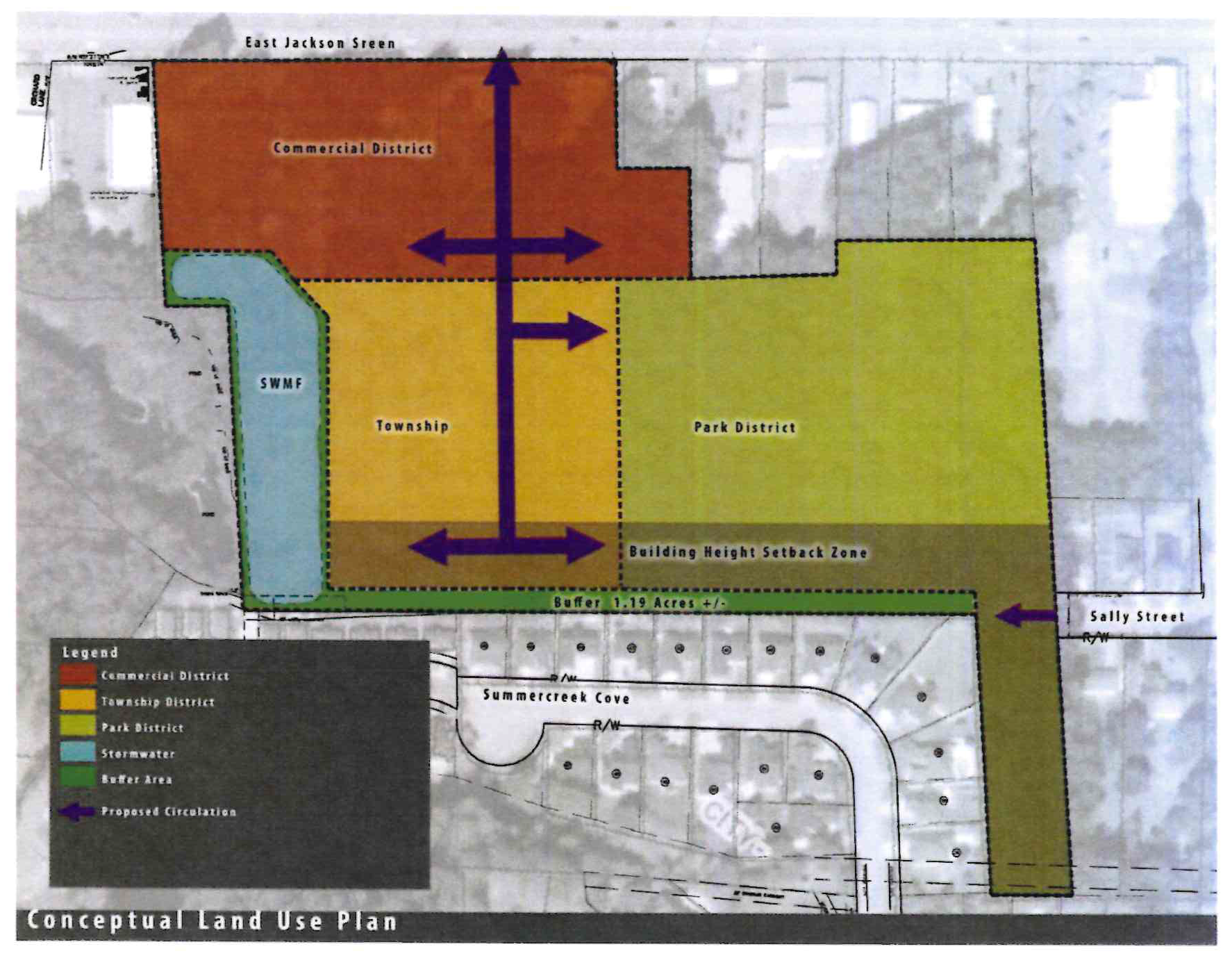
(d)
Creating streets.
(1)
General.
a.
New or improved public or private vehicular rights-of-way, thoroughfares, easements, access-ways, and driveways that are internal to the site; shall, to the maximum extent practicable:
1.
Be designed as complete (multi-modal) thoroughfares that incorporate on-street parking, sidewalks, and streetscape elements (lighting, plantings, furniture, wayfinding signage, etc.); so as to both appear and function as a typical street;
2.
Interconnect with similar rights-of-way, thoroughfares, easements, access-ways, and driveways on the site; thereby "appearing" and "functioning" as one uninterrupted and interconnected network of blocks and streets; and
3.
The internal street network shall give deference to pedestrians, while fully accommodating for vehicles.
b.
Pre-approved public or private vehicular rights-of-way, easements, access-ways, and driveways that are internal to the site and both "appear" and "function" as streets include those shown in exhibit 2.4 on the following page.
c.
Rights-of-way, thoroughfares, easements, access-ways, and driveways that resemble and/ or function as "streets" shall be extended to or along adjoining property boundaries such that a roadway connection or thoroughfare stub shall be provided for future connectivity and development.
d.
Dead-end streets and cul-de-sacs shall be prohibited on the site.
e.
A complete, multi-modal connection shall be made to any existing street that abuts the property.
(2)
Spatial definition.
a.
Focal points. In order to improve spatial definition and establish a focal point on an otherwise straight and uninterrupted street segment (in excess of 250 feet), jogs or off-sets, curvilinear segments, chicanes, neck downs, and roundabouts should be implemented.
b.
Terminating vistas. In more prominent locations, front doors, statues, ornamentation, or landmark elements should be included as a means for "terminating the vista" and accentuating the focal point.
c.
Frontage elements. Only those frontages elements that are permitted for both a street type and building type may be utilized.
(3)
Parking and urbanism. To the maximum extent practicable on-street parking shall be encouraged as a means of addressing parking requirements and promoting the urban character conveyed in the Blueprint 2028 Comprehensive Plan.
EXHIBIT 2.4 PRE-APPROVED PUBLIC OR PRIVATE THOROUGHFARE ASSEMBLIES
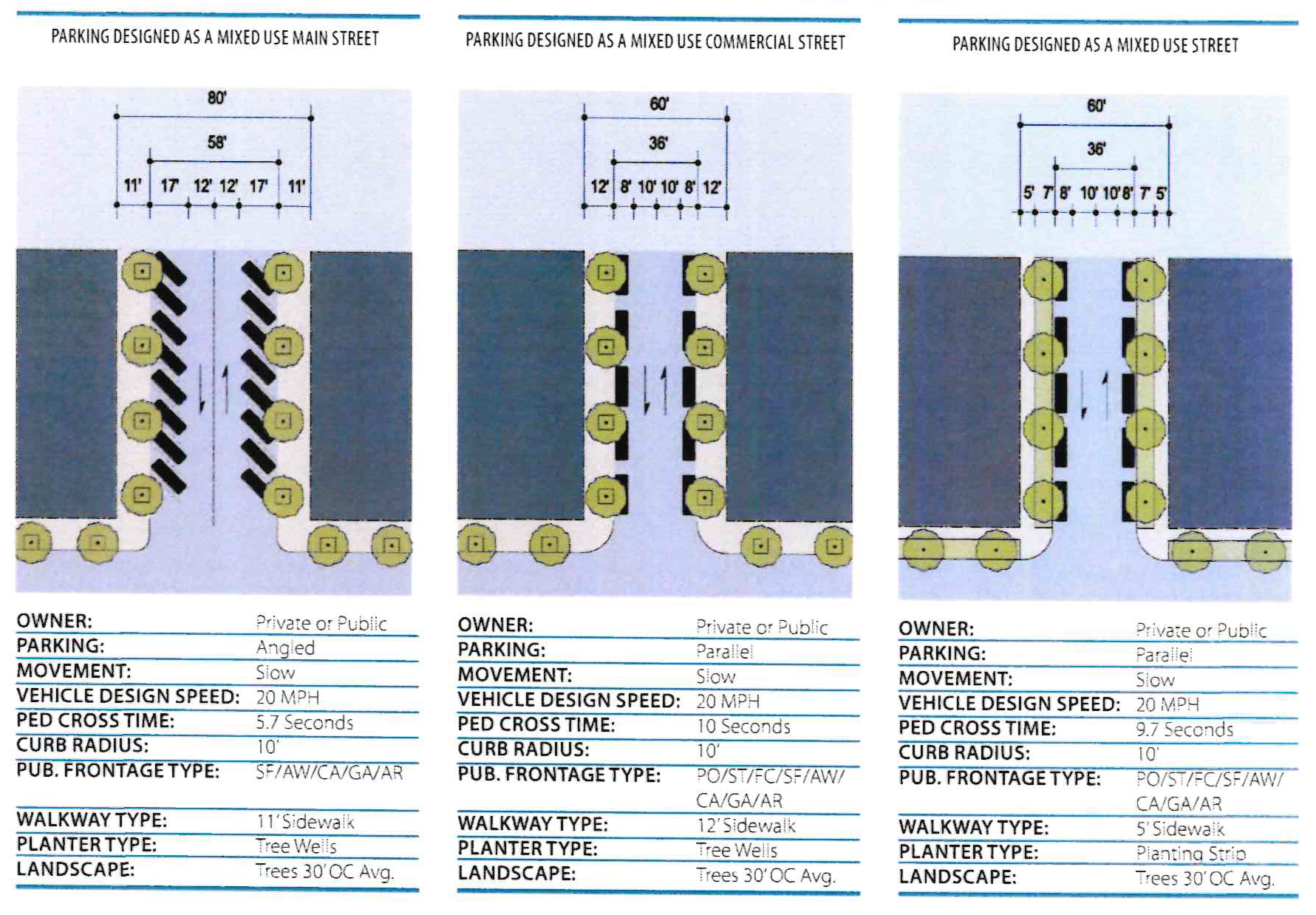
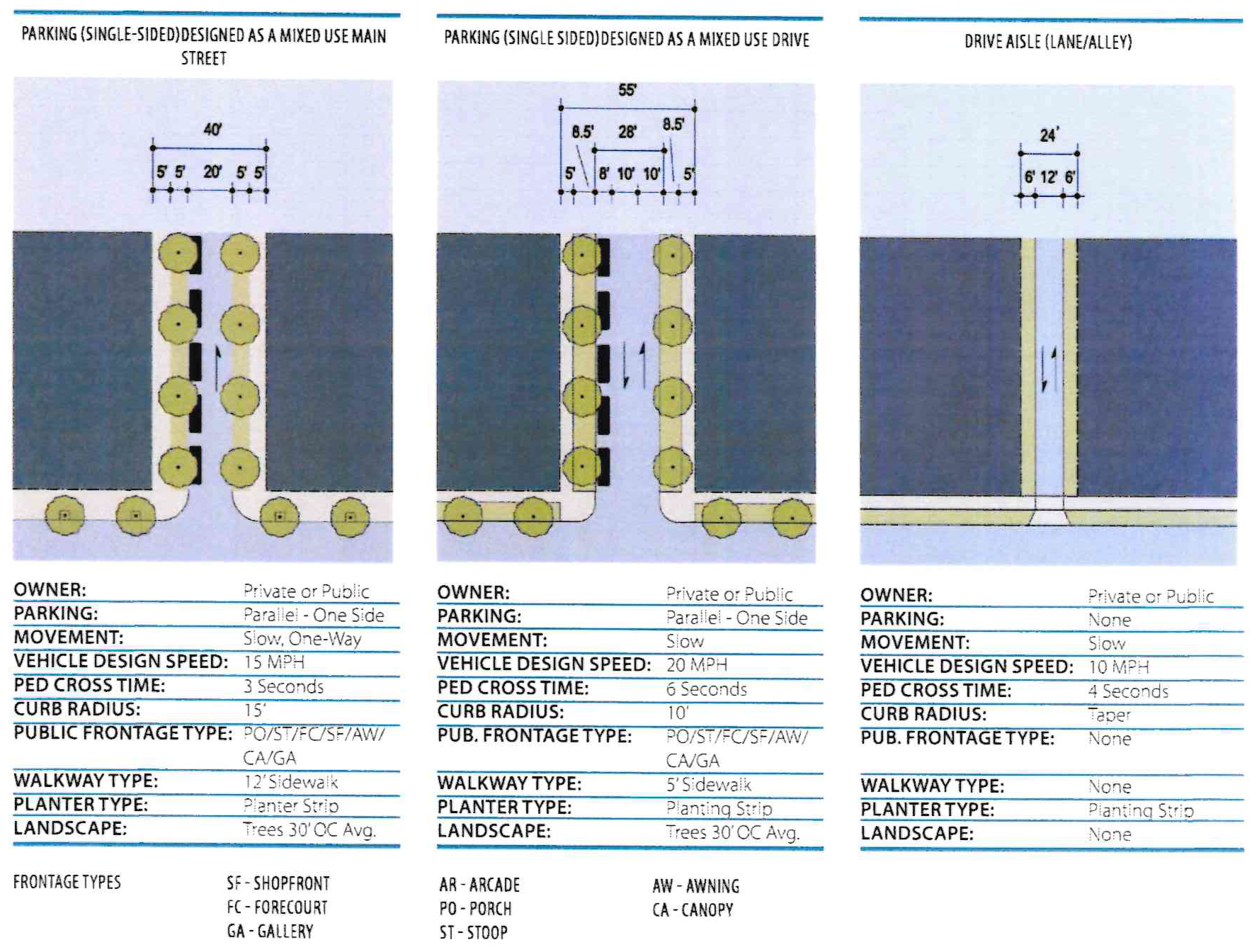
(e)
Establishing lots and buildings.
(1)
Site planning.
a.
Blocks. Block shall have a maximum perimeter length of 2,000 linear feet. The maximum block length shall be 500 feet.
b.
Lots. Lots (whether officially subdivided or not) shall be designed to encourage double-tiered blocks, in which the primary frontage of a lot is located along one of the following:
1.
A street or "thoroughfare that functions as a street";
2.
A street or "thoroughfare functioning as a street" with development on one side and a civic space on the other;
3.
Directly upon a civic space; or
4.
Directly upon a pedestrian passage or rear alley/lane. This site layout shall require the approval of the planning department. Configure and locate buildings to define street edges, development entry points, and spaces for gathering between buildings; and
c.
Buildings. The building façade containing the primary entrance shall be considered as the principal façade. The:
1.
Perimeter and interior buildings shall be oriented so that the principal façade faces a public or private street (including internal rights-of-way, access-ways, or driveways intended to appear and function as a street) or a public space (which may be privately owned).
2.
In no case shall a building turn its back to an existing street.
3.
Buildings that front onto more than two streets, civic spaces, or a combination thereof (including internal rights-of-way, access-ways, or driveways intended to appear and function as a street) shall require the approval of the planning department.
4.
Public spaces and site amenities should be framed and enclosed by buildings on at least two sides.
d.
Public spaces. Public spaces may be privately owned.
1.
To the maximum extent practicable locate public gathering spaces at prominent corners.
2.
Ten percent of the site must be open space. Open space may take the form of an urban plaza with an allee of canopy trees, a manicured public lawn with a canopy of trees, or similar.
e.
Buffer requirement. When a lot with a multi-family or nonresidential structure (including off-street parking) abuts a lot containing a single-family detached dwelling, two-family detached dwelling, or townhouse, a landscaped buffer at least ten feet in width shall be provided along the shared lot line. The buffer shall include:
1.
At least one shade tree for every 35 linear feet of lot line,.
2.
At least three shrubs for every 25 linear feet of lot line.
3.
An opaque wall, fence, or a vegetative screen with at least 50 percent opacity, six feet in height in areas behind the front façade of the primary building, and four feet in height forward of the front façade of the primary building.
4.
Planting design and spacing that minimize sound, light, and noise impacts.
(2)
Notification of future development. Locations where streets or civic spaces are not fronted by a building or structure, but future development is planned or accommodated, a sign shall be installed at the location with the words FUTURE DEVELOPMENT SITE to inform the community and potential stakeholders of coming changes.
(3)
Alternative means of stormwater compliance. Where appropriate the city engineering department may approve energy efficient and sustainable materials when utilized as an alternative means of stormwater compliance if they are contextual (see Light Imprint Handbook—Integrating Sustainability and Community Design. v-1.3. DPZ-Charlotte. New Urban Press. 2008) and meet or exceed baseline requirements in the Georgia Stormwater Management Manual.
(f)
Building height.
(1)
Determining overall building height. Building height shall be measured in number of stories from the natural grade or finished grade adjacent to the building exterior to the highest point of coping of a flat roof, the top of a mansard roof, or the highest point of the highest pitched roof.
(2)
Number of stories permitted. The maximum number of stories (floors) is determined by district. District standards are found in section 22-653.
(3)
Determining the height of each story. All heights are measured finished floor to highest point of the finished ceiling.
(4)
Ground floor finish level. Minimum and maximum ground floor finish level (measured from adjacent finished grade) are established by building type. Where maximum ground floor finish level exceeds the permitted height, the undercroft (basement, crawlspace, or storage area) shall count as a story.
(5)
Half story. A one-half story is the top floor of a building that has a maximum exterior wall height not to exceed six feet, creating a sloped ceiling on the top level of the structure. Dormers may be used to provide egress windows as required by the adopted building code.
(6)
Appurtenances. Architectural, mechanical, and structural appurtenances may exceed the allowable building height, as conveyed in section 22-654 (architecture).
(g)
Alleyways and utilities.
(1)
Alleys and lanes. Rear alleys and lanes shall be encouraged using materials that are contextual with traditional development.
(2)
To the maximum extent practicable, utility lines and connections shall be placed underground.
(3)
Where undergrounding of utilities is not possible, all lines and connections (electric, phone, cable, etc.) shall be placed within the rights-of-way or easement for an alley or lane.
(Ord. No. 38-11102025, § II(Exh. A), 11-10-2025)
Sec. 22-653. - Bellamy Place districts.
EXHIBIT 3.1 BELLAMY PLACE CONCEPT LAND USE PLAN
(a)
Place district standards.
(1)
This section establishes districts applied to property within the development, as illustrated in the concept plan (exhibit 3.1).
(2)
Each district has a different set of characteristics that correspond with building placement, building form, and frontage standards, all of which influence the level of walkability and vibrancy in a particular place.
(3)
The regulations related to each district mapped in the concept plan are hereby established in exhibit 3.2, district frontage standards summary.
(4)
Standards for each of the districts are shown for comparison in exhibit 3.2. Each district is further described in subsections (b) through (d) below.
(5)
Residential density shall be calculated based on the gross area of the development as a whole. Individual parcels, lots, or phases within the development are not required to independently meet maximum density requirements, provided that the overall project complies with the applicable density limits. 4
Exhibit 3.2: District Frontage Standards Summary
Notes:
1. 1 & 2 family residential are required a 10' setback on at least one side.
2. Where applicable, the building height setback zone supersedes these standards.
3. Parking location applies to location of garage door, surface parking lot, and parking structure.
4. Accessory dwelling units (ADUs) shall not be counted separately in the overall density calculations.
(b)
Frontage standards—Commercial district.
(1)
Building placement.
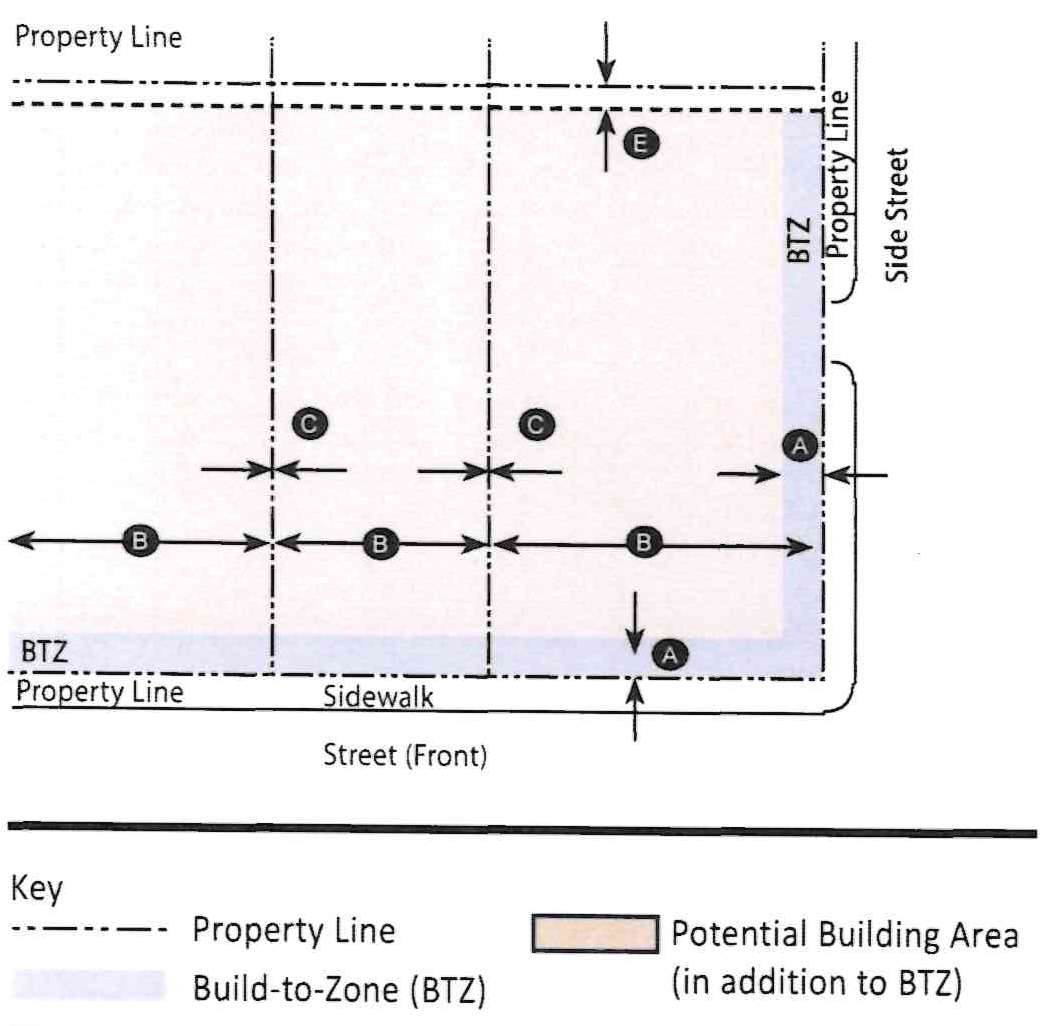
(2)
Building height.
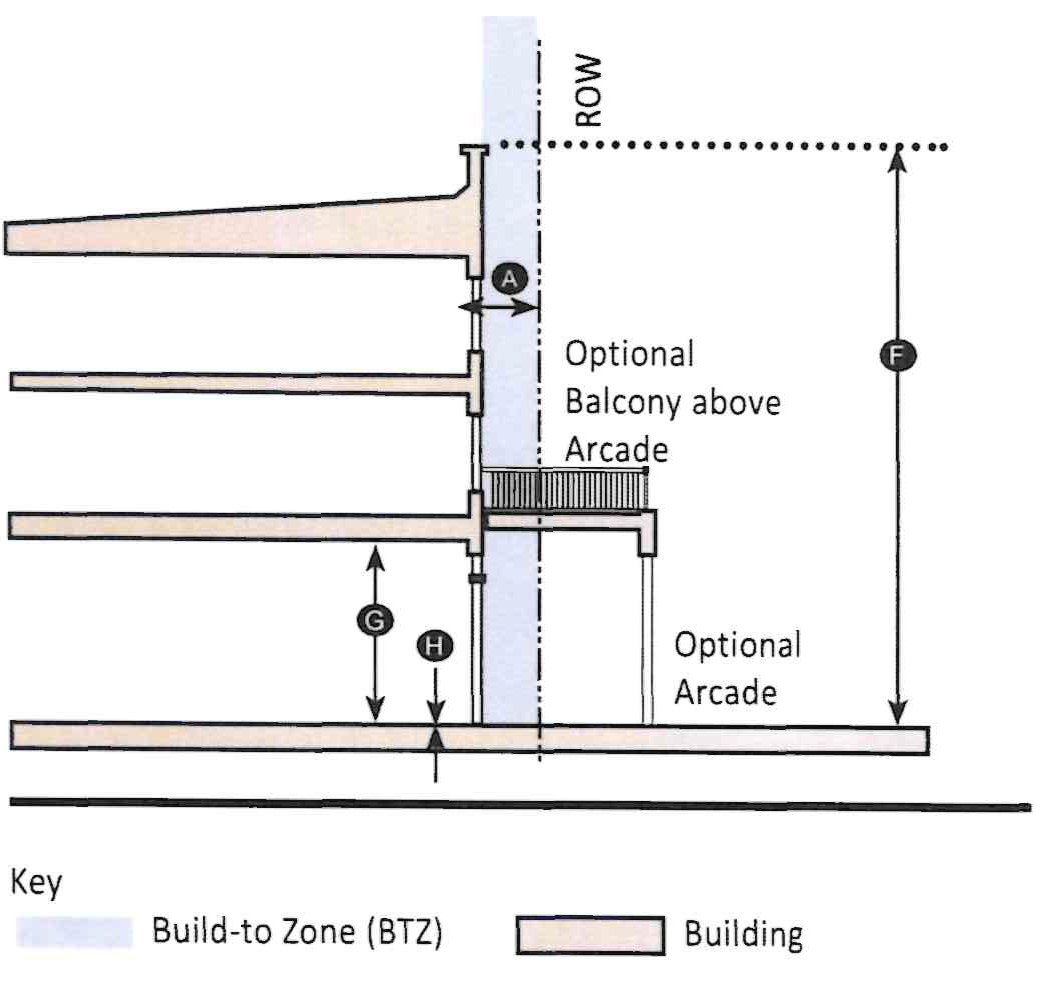
Notes:
• Towers, cupolas, and other rooftop features with a footprint smaller than 20 feet by 20 feet may extend up to 30 feet above the designated height limit.
(3)
Parking location.
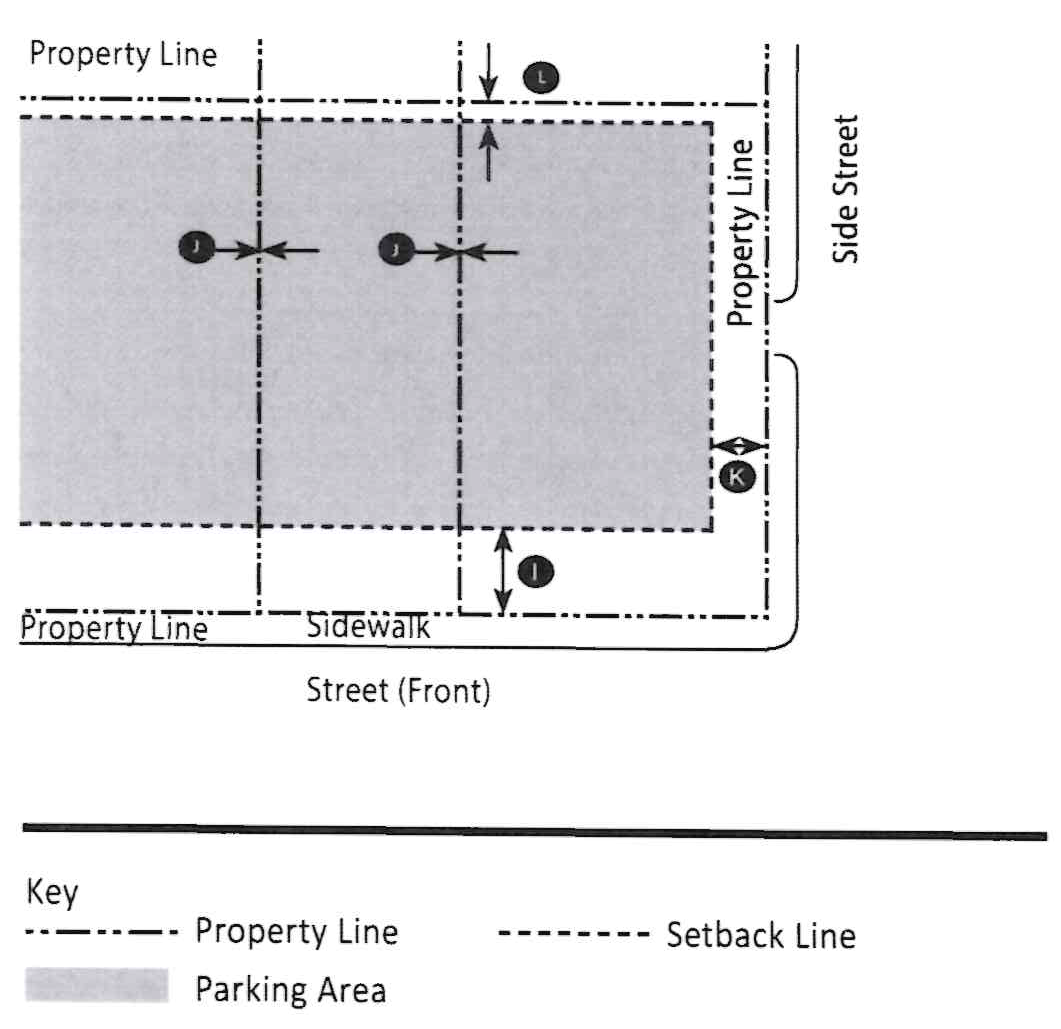
Notes:
• Parking shall be accessed from rear alleys or side streets whenever possible.
• Opaque screening is required to shield the view of parking from adjacent side streets. Screening may shall consist of walls, fences, or hedges (can be a combination of decorative hardscape and landscape) that is 36 inches minimum installed no less than 2 feet from walkway to screen parking from side street.
(4)
Frontage elements.
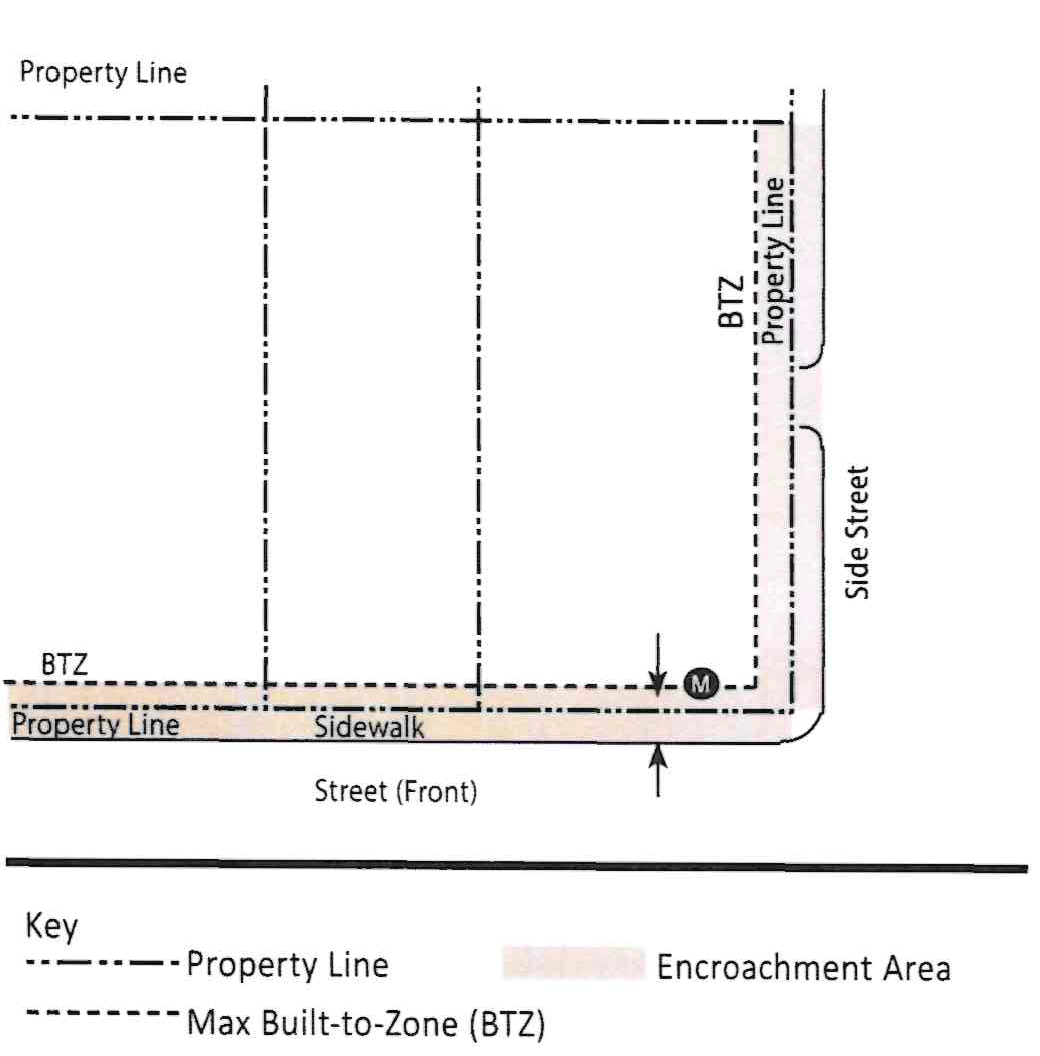
Notes:
• Frontage elements may encroach forward of the build-to zone and/or into the right-of-way, barring any additional restrictions by the public entity that has control over the public right-of-way.
• See section 22-654 (architecture) for requirements of frontage elements.
Miscellaneous notes:
• All buildings must have a principle pedestrian entrance along the front façade.
(c)
Frontage standards—Township district.
(1)
Building placement.
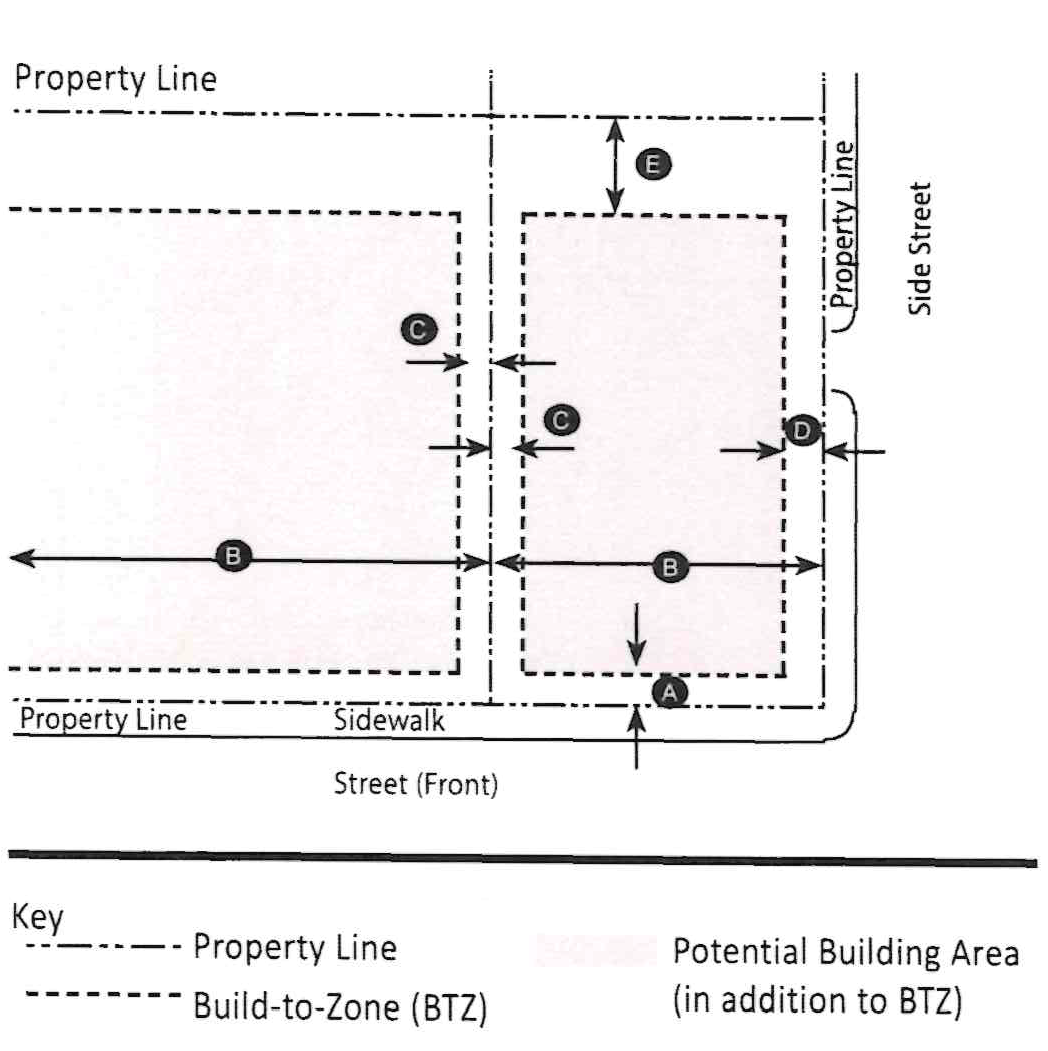
(2)
Building height.
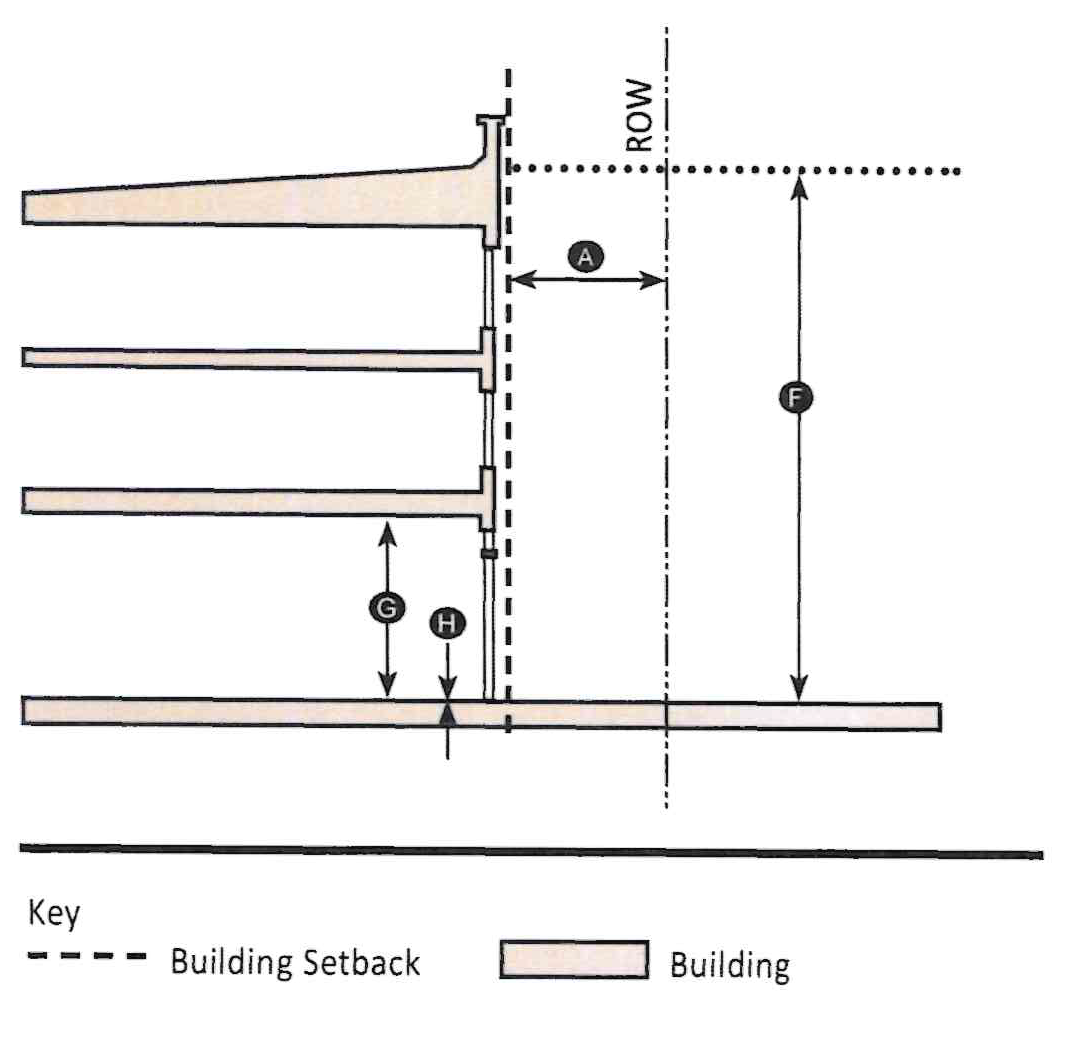
Notes:
• Towers, cupolas, and other rooftop features with a footprint smaller than 20 feet by 20 feet may extend up to 30 feet above the designated height limit.
• Where applicable, the building height setback zone supersedes these standards.
(3)
Parking location.
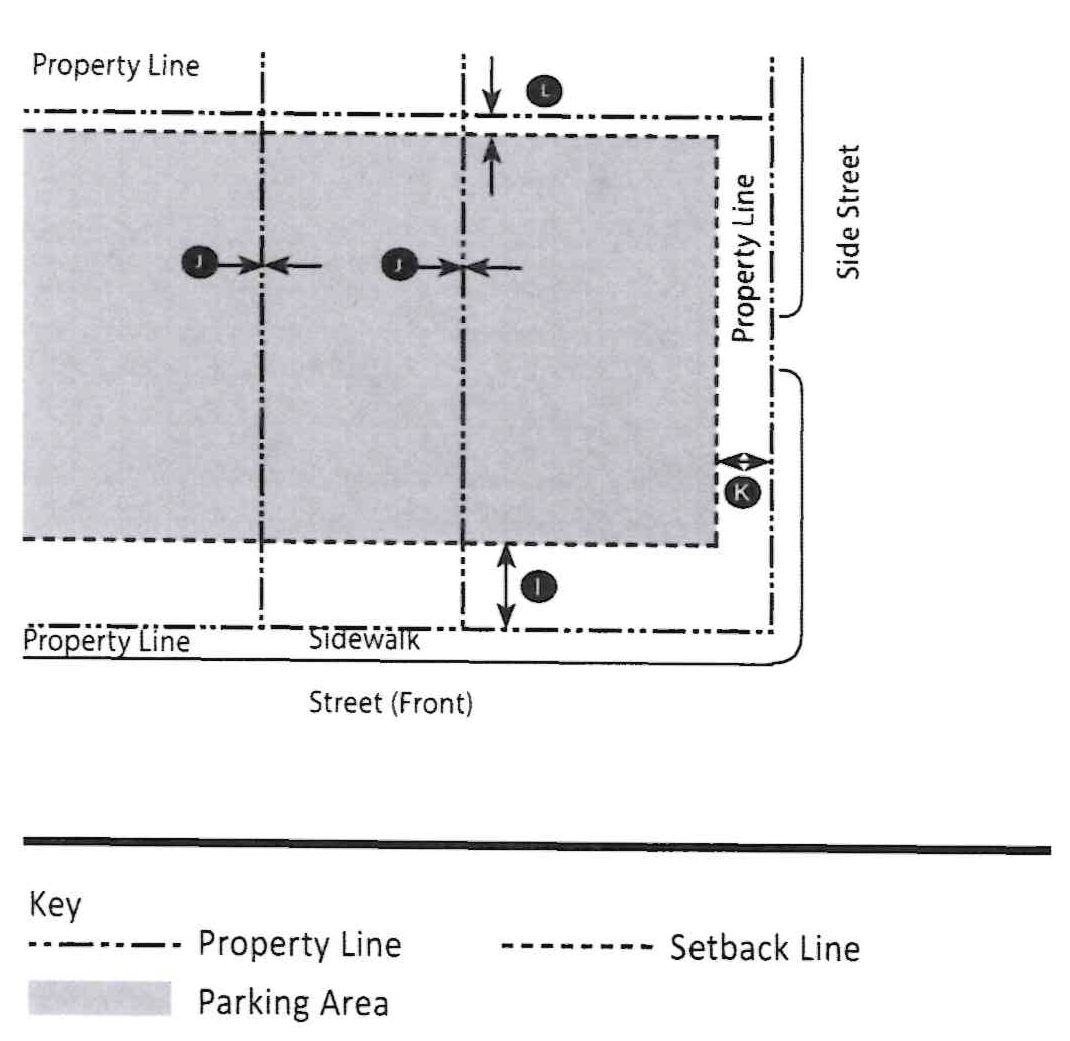
Notes:
• Parking shall be accessed from rear alleys or side streets whenever possible.
(4)
Frontage elements.
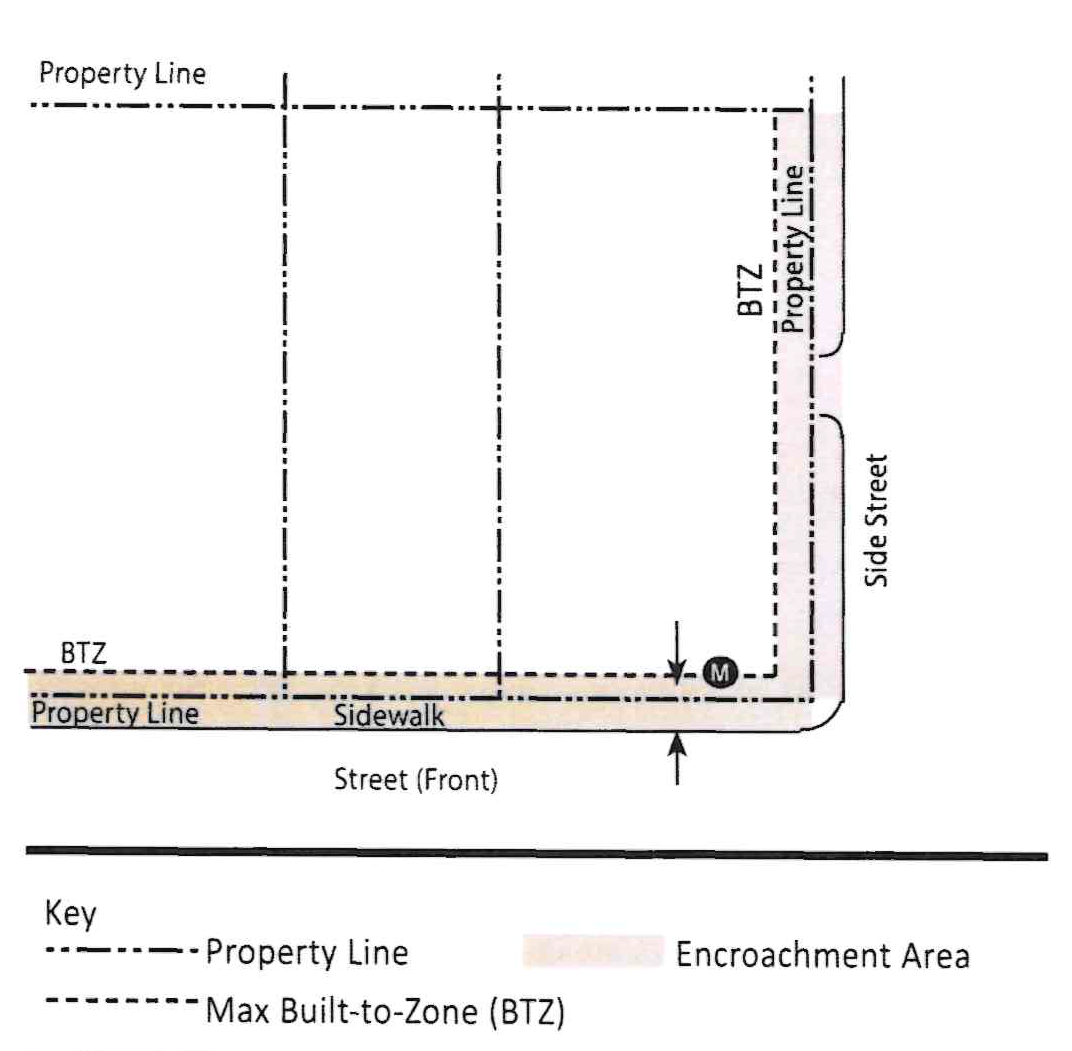
Notes:
• Frontage elements may encroach forward of the build-to zone and/or into the right-of-way, barring any additional restrictions by the public entity that has control over the public right-of-way.
• See section 22-654 (architecture) for requirements of frontage elements.
Miscellaneous notes:
• All buildings must have a principle pedestrian entrance along the front façade.
(d)
Frontage standards—Park district.
(1)
Building placement.
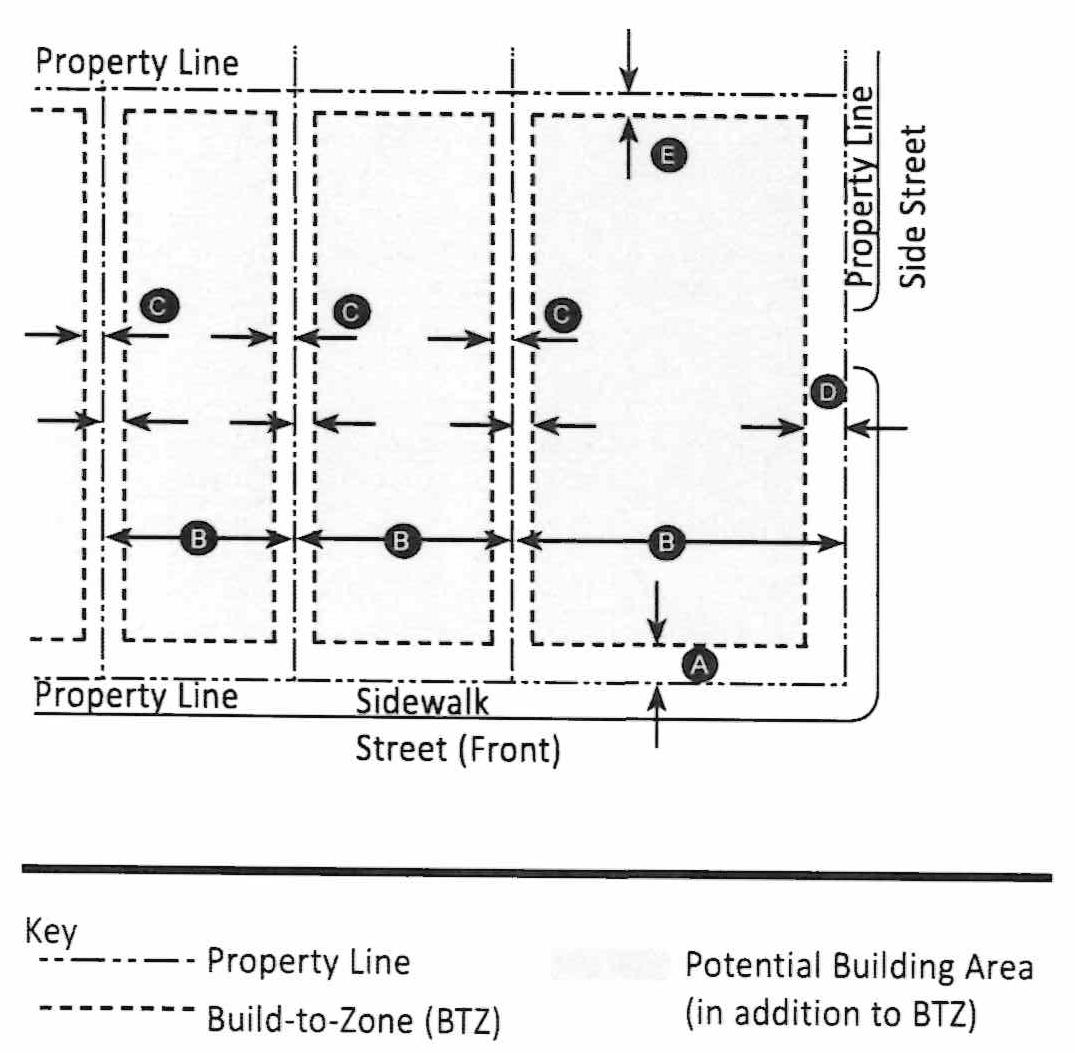
(2)
Building height.
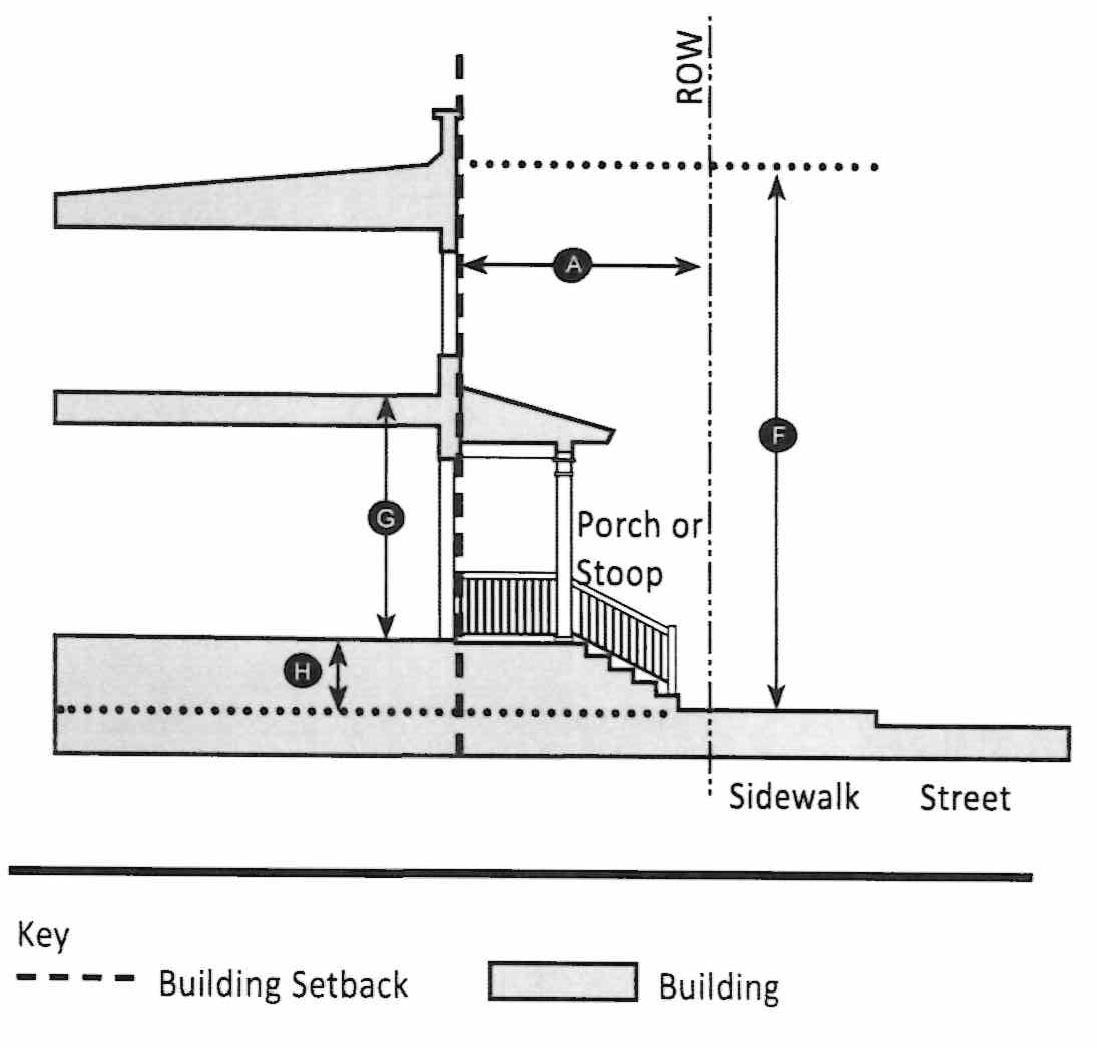
Notes:
• Towers, cupolas, and other rooftop features with a footprint smaller than 20 feet by 20 feet may extend up to 30 feet above the designated height limit.
• Where applicable, the building height setback zone supersedes these standards.
(3)
Parking location.
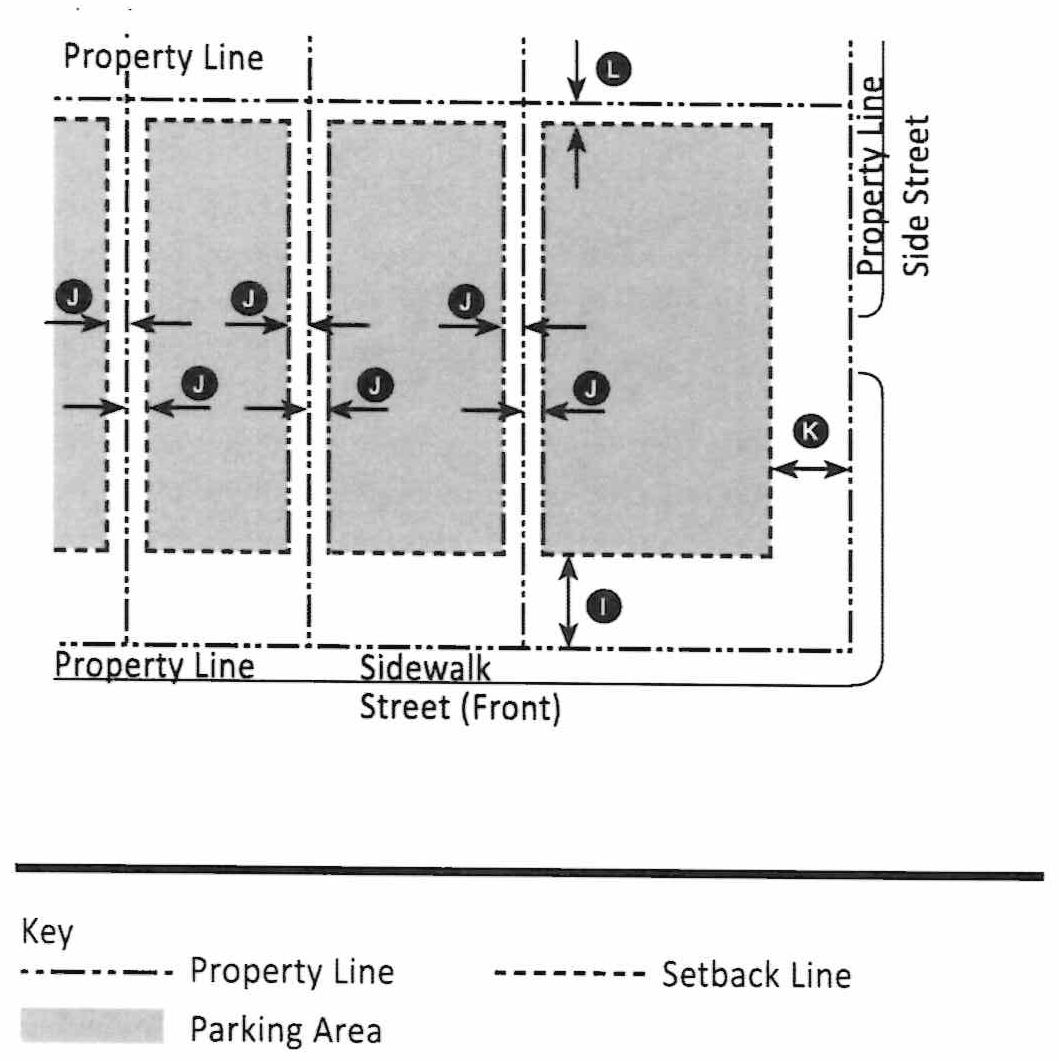
Notes:
• Parking shall be accessed from rear alleys or side streets whenever possible.
(4)
Frontage elements.
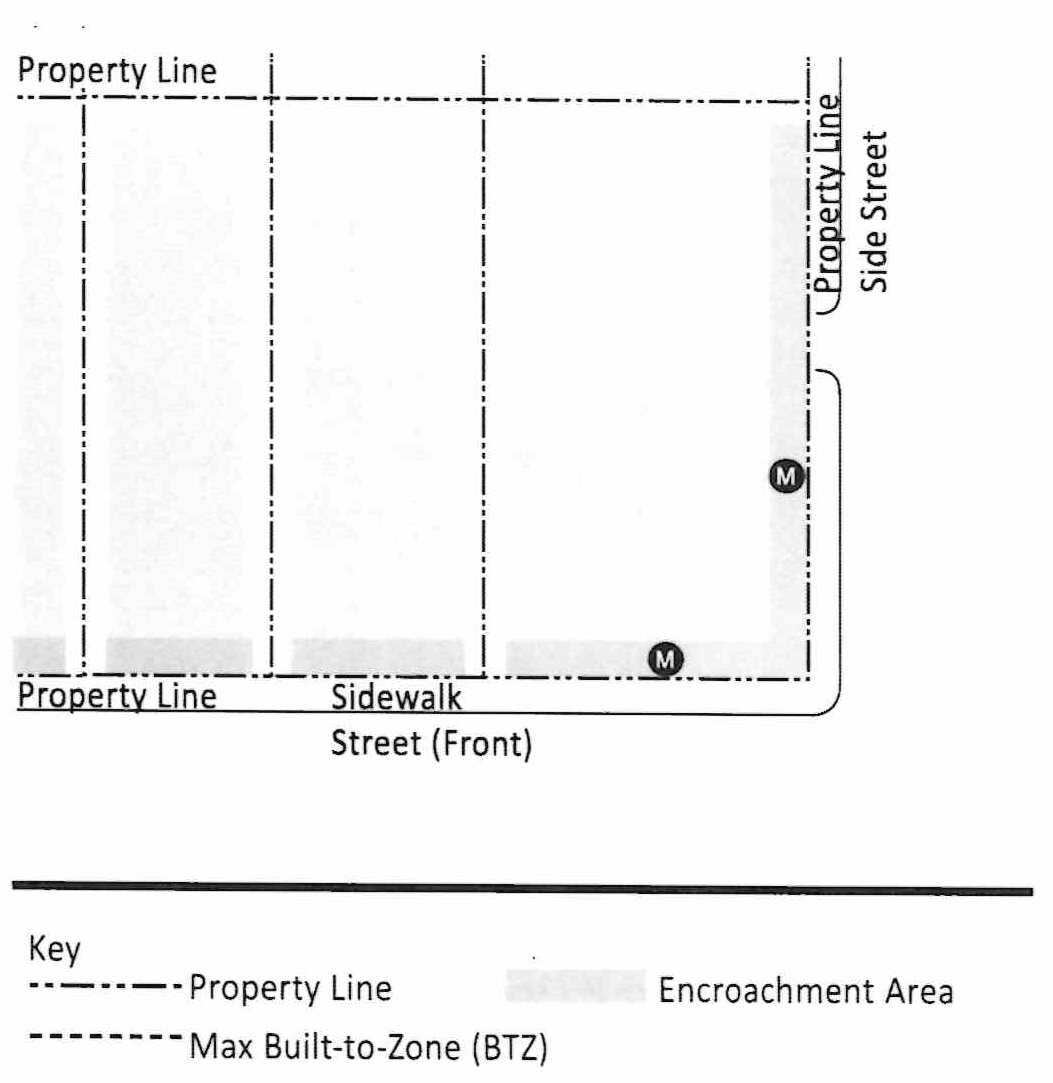
Notes:
• Frontage elements may encroach forward of the build-to zone and/or into the right-of-way, barring any additional restrictions by the public entity that has control over the public right-of-way.
• See section 22-654 (architecture) for requirements of frontage elements.
Miscellaneous notes:
• All buildings must have a principle pedestrian entrance along the front façade.
(e)
Typical building types. A mix of residential building types creates neighborhoods which allow a diversity of ages and incomes, and permit residents to trade up or downsize their homes without having to move away. Multi-generational neighborhoods and life-cycle neighborhoods create strong social networks, avoid concentrations of poverty or wealth, and lead to safer communities. There is a wide array of unit and building types that are appropriate in addition to the single-family homes.
(1)
House and accessory dwelling unit.
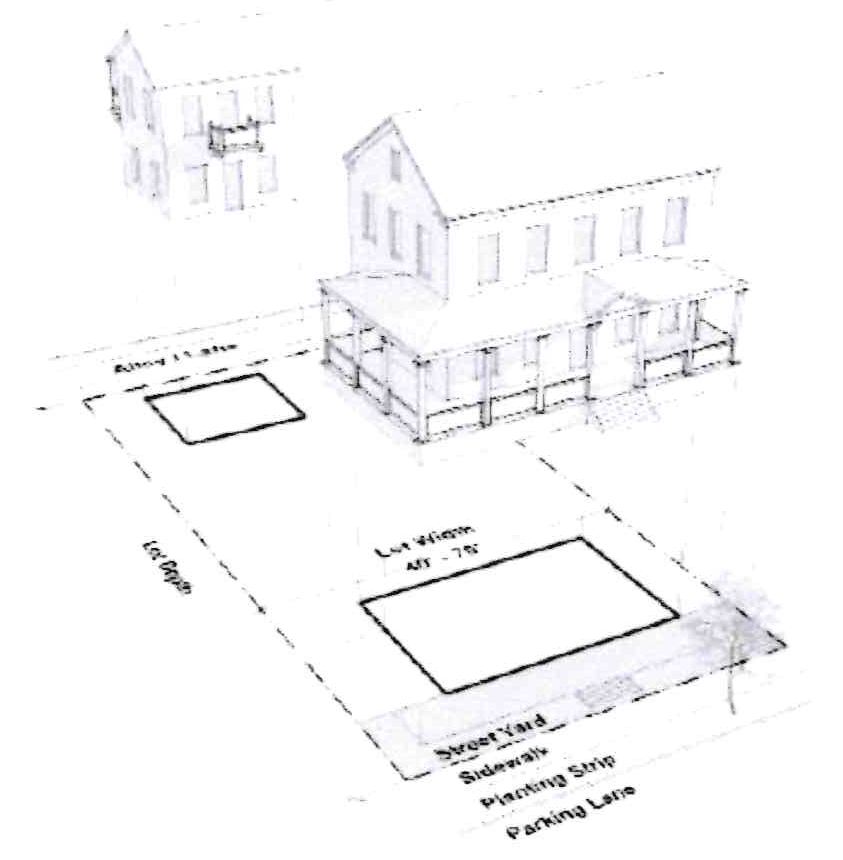
(2)
Cottage.
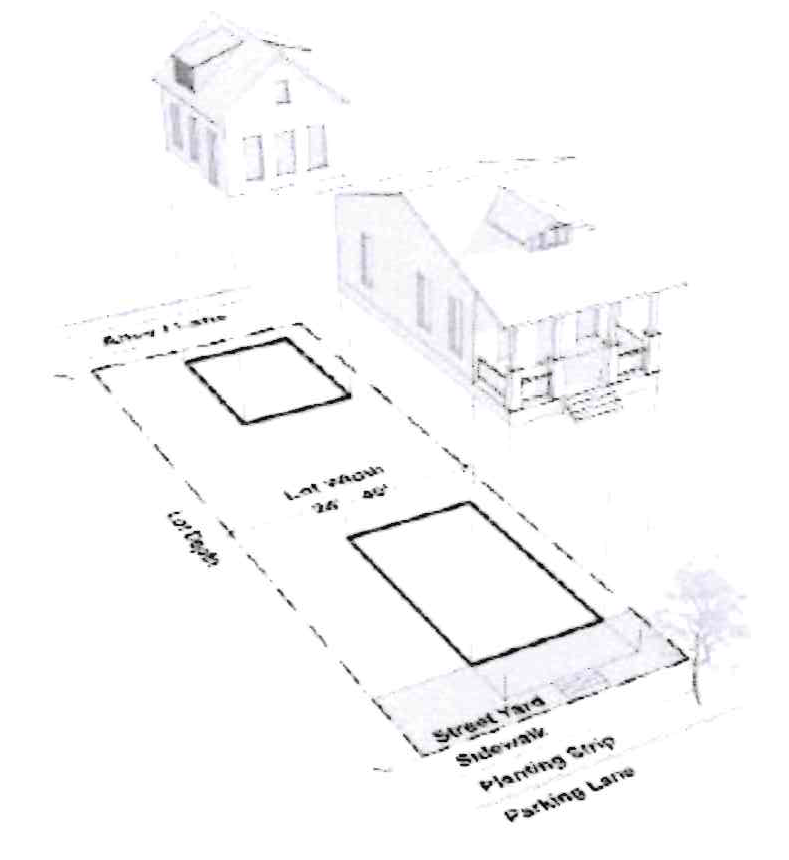
(3)
Duplex.
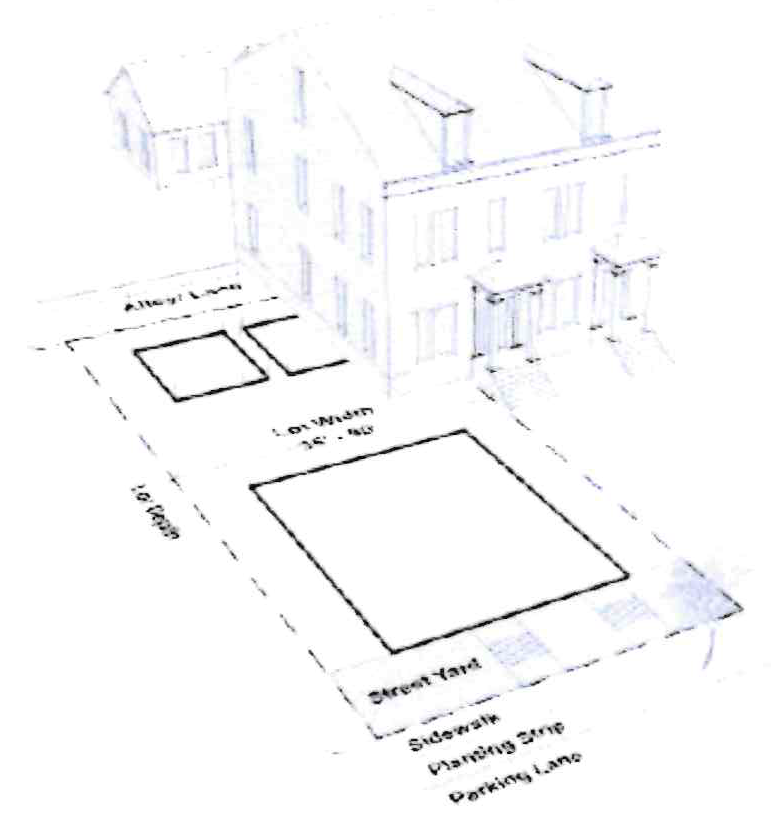
(4)
Apartment building.
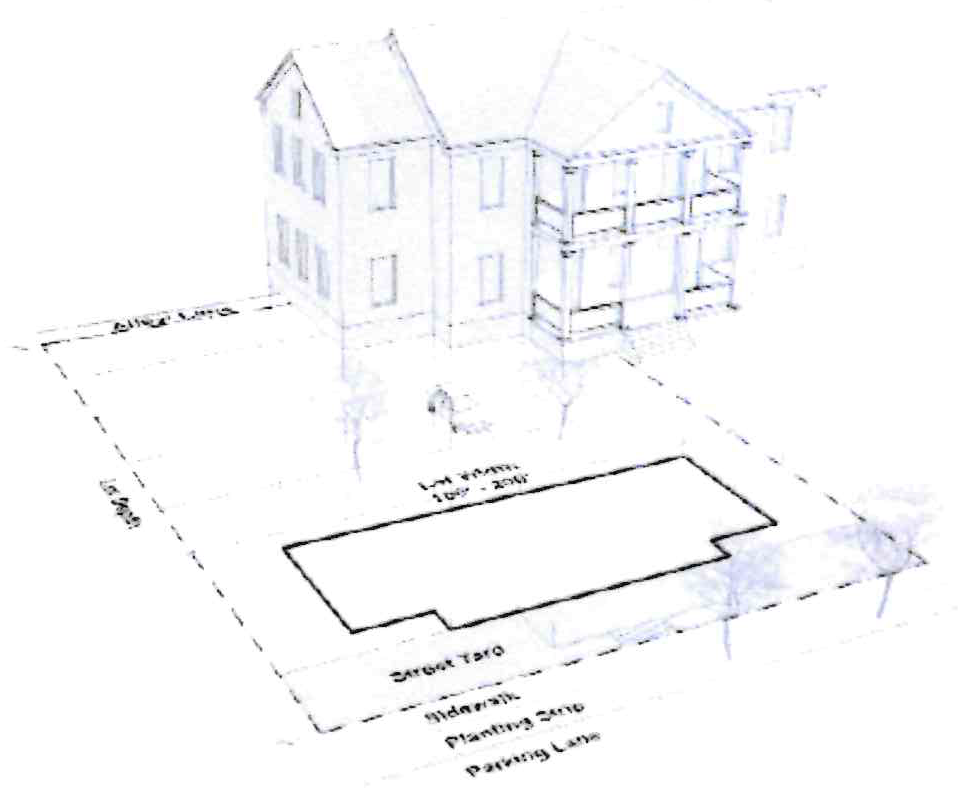
(5)
Courtyard apartment building.
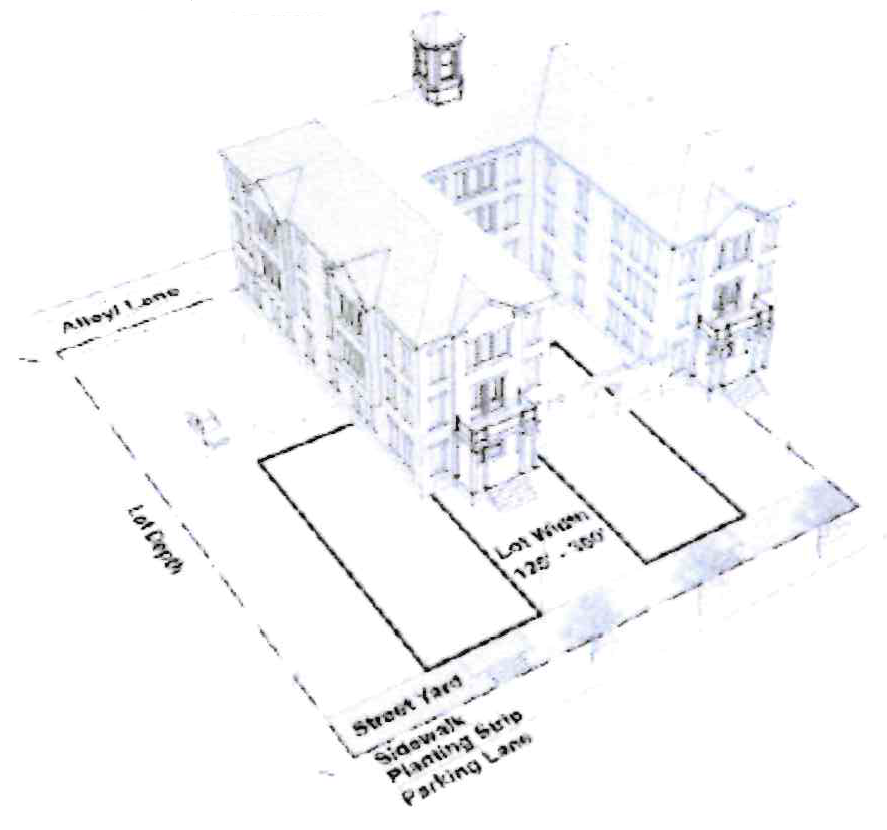
(6)
Townhouse building.
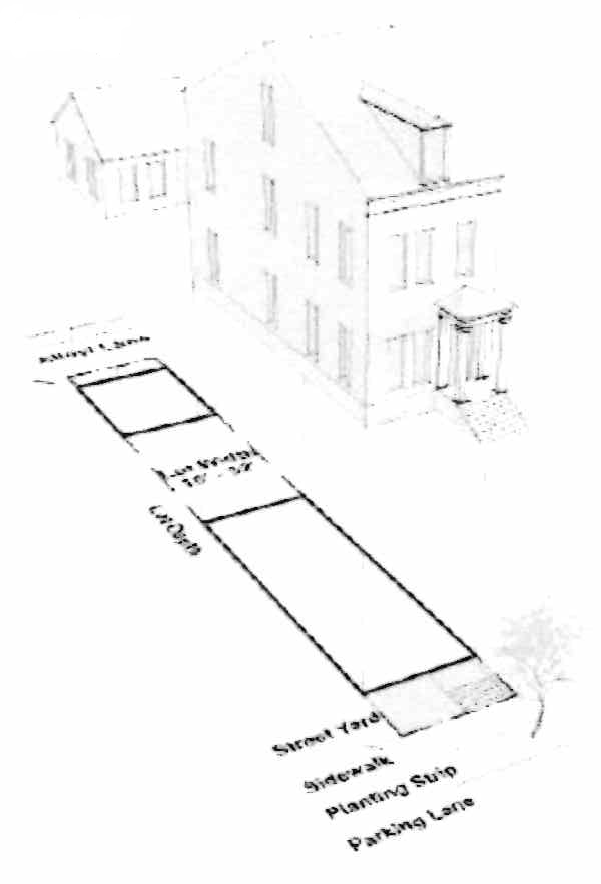
(7)
Mixed-use building.
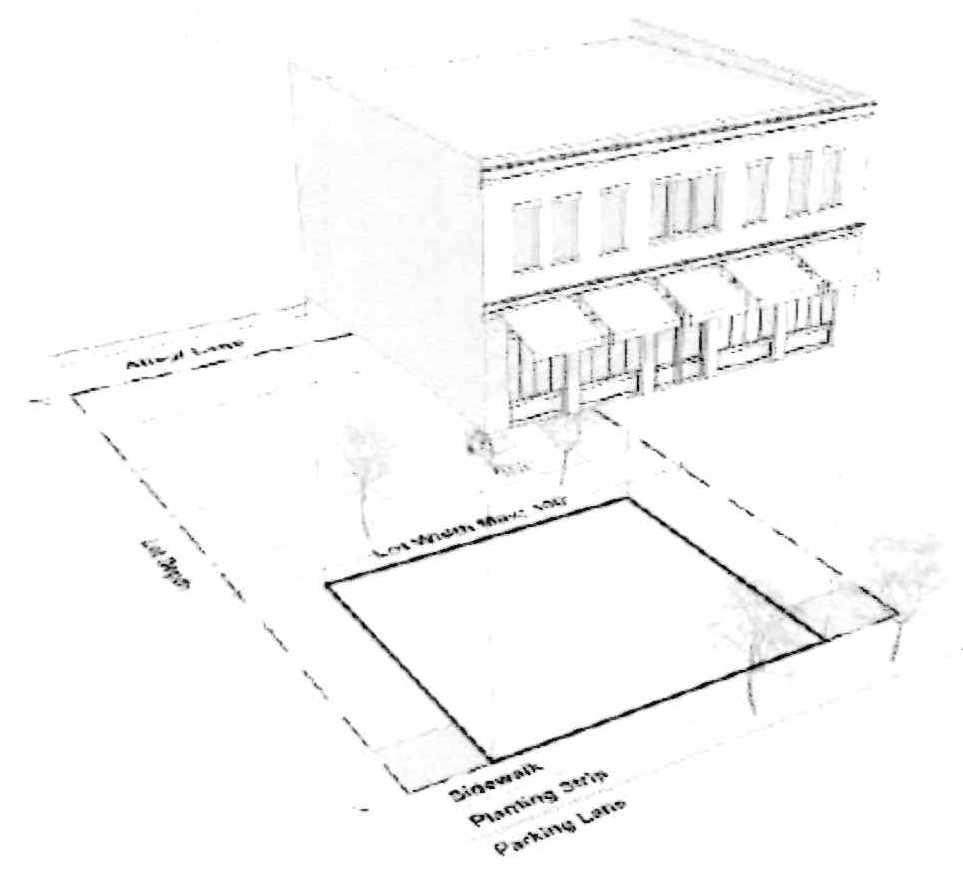
(8)
Live/work building.
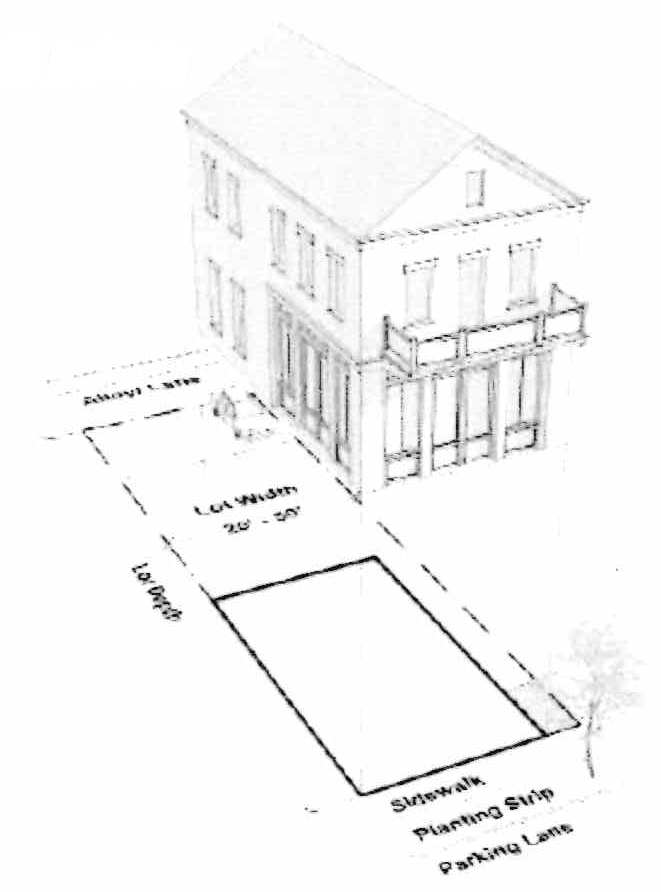
(9)
Corner store.
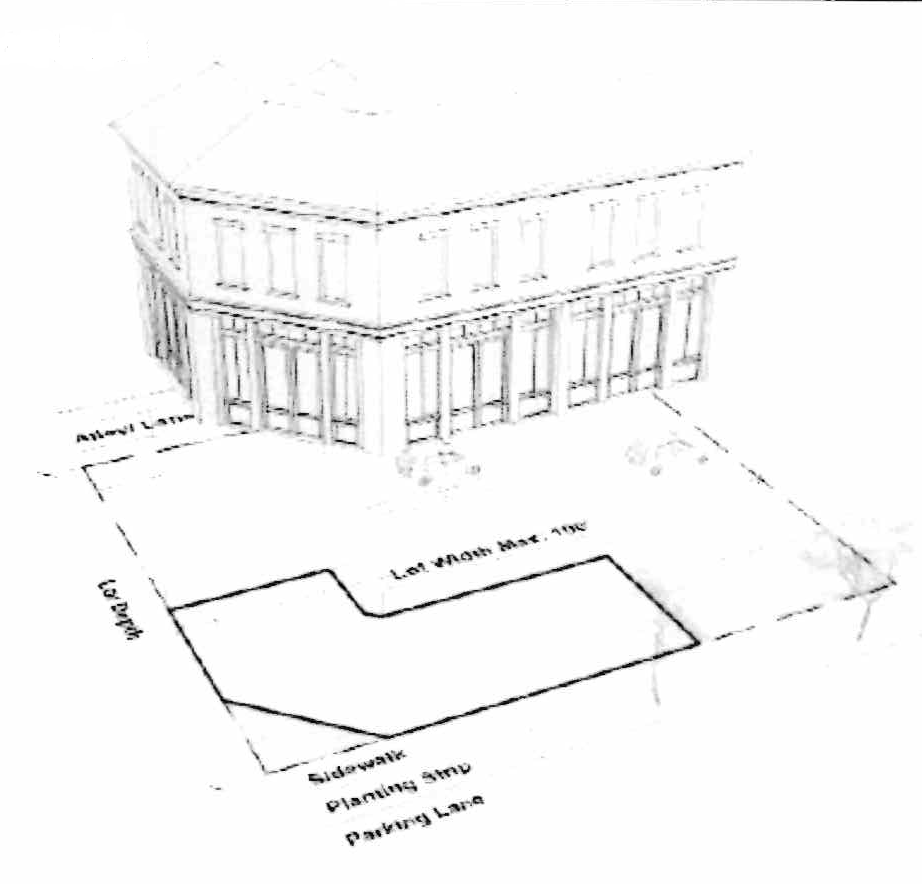
(10)
Park-under building.
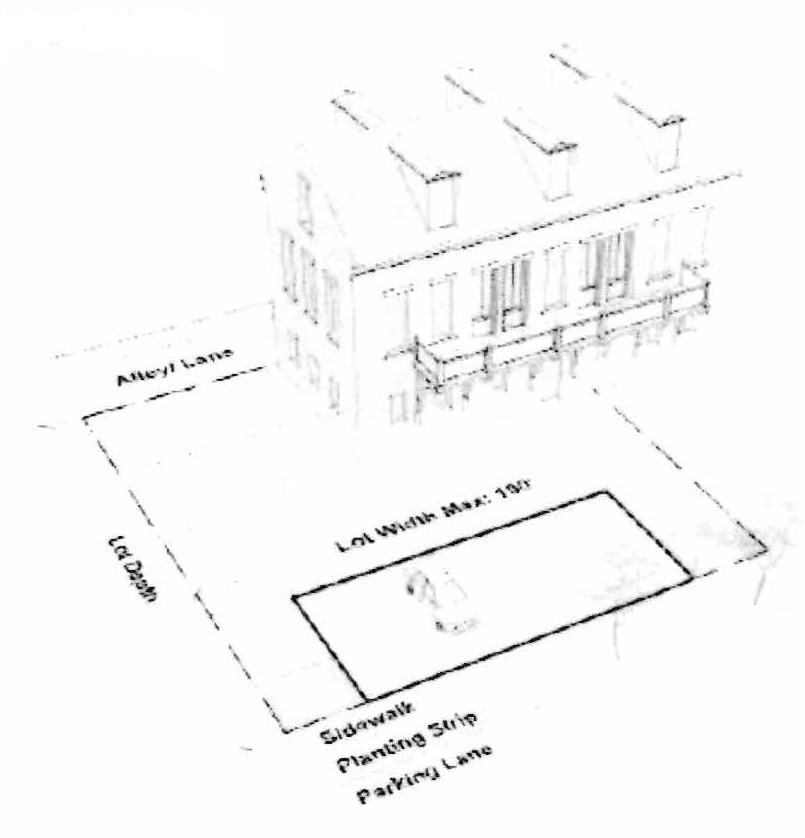
(11)
Civic building with attached residence.
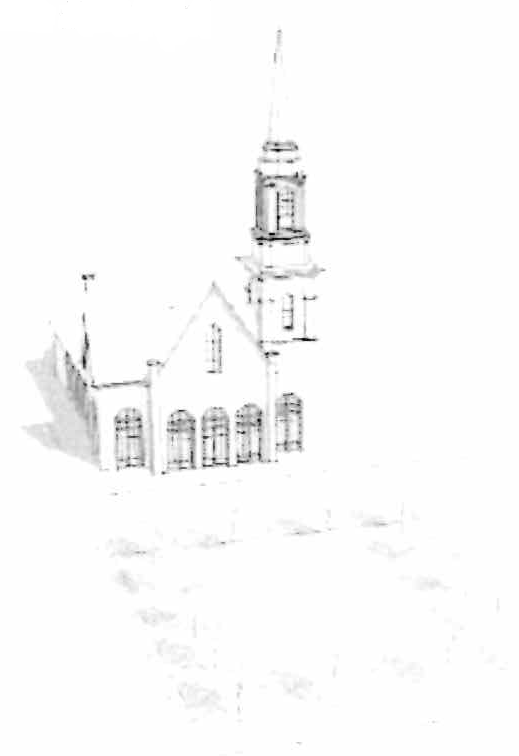
(Ord. No. 38-11102025, § II(Exh. A), 11-10-2025)
Sec. 22-654. - Architecture.
(a)
Frontages and building elements.
(1)
Porches. Porches provide outdoor living space. Often, they provide protection from the sun, while still permitting breezes to infiltrate the body of the building. They provide architectural interest and delineate the building's entrance. This type is appropriate for residential building types with small setbacks. Typically, the porch is located in the build-to-zone as close to the sidewalk as possible. It is elevated to ensure privacy within the building from those passing by. Stairs may lead directly to the sidewalk or may be side-loaded.
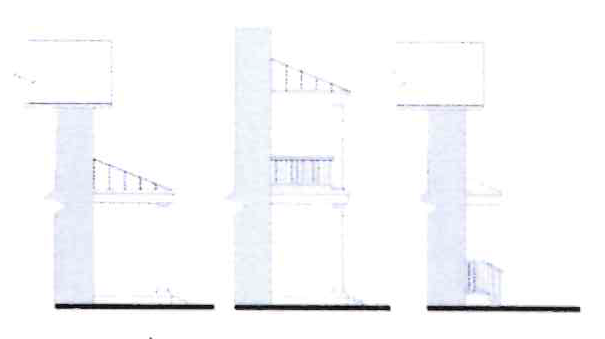
a.
Depth: seven-foot minimum (measured from face of building to outside of column face).
b.
Length: 25—100 percent of building front; ten-foot minimum.
c.
Porches shall be covered by a columned or bracketed roof or set into the main body of the building.
d.
Height, clear = eight-foot minimum.
e.
Height: two stories max; porches may have multi-story balconies above.
f.
Finish level above grade: 12-inch minimum; five-foot maximum (no more than eight inches below the first interior finished floor level).
g.
Porches may occur forward of the build-to line, but shall not extend into the right-of-way. Stairs may encroach within the right-of-way with easement permission, so long as full sidewalk clearance is maintained.
h.
Porches and stoops shall match the architectural language of the building, with similar details and materials. Screens on front porches are prohibited.
(2)
Galleries, colonnades, arcades, and terraces. This frontage is associated with commercial uses, and is permitted to encroach upon the setback, or even into the right-of-way over the sidewalk. The space allows one to window-shop or dine in a shaded environment that also captures breezes. The frontage provides architectural interest and delineates the building's entrance. Upper stories may be enclosed, providing livable bonus space for occupants.
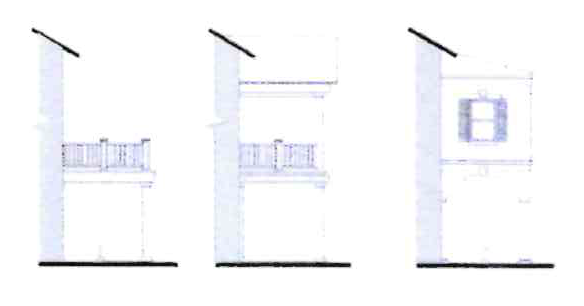
a.
Depth: ten-foot minimum (measured from face of building to outside of column face)
b.
Length: 75—100 percent of building front; may wrap side of building on corners.
c.
Height, clear = nine-foot minimum.
d.
Height: four stories max; may have enclosed habitable space on upper stories.
e.
Finish level above grade: zero- to six-inch max; terraces, whose finish level above grade shall be no more five feet and no more than eight inches below the interior finished floor level.
f.
Galleries, colonnades, and arcades are supported by columns, piers, or arches and may encroach within the right-of-way with easement permission, occurring forward of the build-to line to within two feet of the curb.
(3)
Balconies. A balcony is connected to a building's upper stories and is supported by either a cantilever or by columns on one side. This type is appropriate for residential and commercial buildings with small setbacks. Typically, the balcony is located forward of the build-to-zone over the sidewalk. It allows occupants of the building to experience the activities of the street while also providing significant privacy from those passing by.
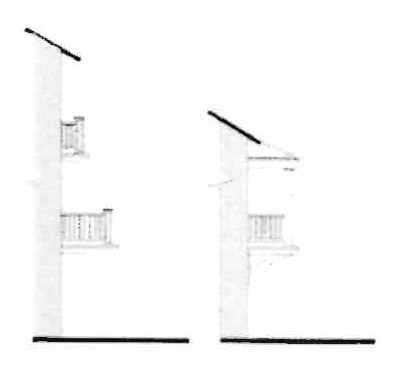
a.
Depth: three to six feet measured perpendicular to wall face (five-foot minimum second story).
b.
Length: 25—100 percent of building front; five-foot minimum.
c.
Height, clear = nine-foot minimum.
d.
Balconies may encroach within the right-of-way with easement permission, occurring forward of the build-to line to within two feet of the curb.
e.
Balconies shall be made of wood or metal and may have roofs, but are required to be open, un-airconditioned spaces. Balconies in the rear of the building may have screens. Balconies shall match the architectural language of the building.
f.
Balconies should be supported from below by visible brackets, scaled as if they are supporting the weight of the mass, or from above by suspension cables or chains. Contemporary, cantilevered balconies may be exempt from this requirement.
g.
On corners, balconies may wrap around the side of the building facing the side street.
(4)
Canopies and awnings. A permanently roofed architectural projection whose sides are either vertical or horizontal and are supported entirely from an exterior wall of a building. This frontage is typically used for the display of signs. Horizontal marquees, canopies, and awnings provide shade from the sun, as well as enhanced weather protection for both the building and the passerby.
a.
Depth: five-foot minimum measured perpendicular to wall face.
b.
Length: 25—100 percent of building front; may wrap side of building on corners.
c.
Height, clear = nine-foot minimum.
d.
Canopies and awnings may encroach within the right-of-way with easement permission, occurring forward of the build-to line to within two feet of the curb.
e.
Canopies and awnings shall be continuous above openings below. Breaks in awnings shall coincide with breaks in shopfront openings below.
f.
Canopies shall be visually supported from below by brackets, or from above by suspension cables or chains spaced at regular intervals.
g.
The top of each awning shall be at the same height as the top of each opening below.
h.
Awnings shall be made of fabric. Vinyl and high-gloss or plasticized fabrics are prohibited.
i.
Backlit awnings are prohibited.
j.
Sign copy on canopies and awnings on upper story windows is not permitted.
k.
The above standards are applicable to first floor awnings and canopies only.
(b)
Scale, massing and roofs.
(1)
Description. Commercial, multi-family, and residential buildings should reflect a combination of vernacular and more formal architecture. Essential characteristics include:
a.
Raised foundations for residential buildings.
b.
At-grade foundations for commercial buildings, low rise hotels, landmark buildings, and mixed use commercial buildings with upper story office or residential.
c.
A clearly discernible base (e.g. foundation/water table), middle, and top (e.g. roof) on each building.
d.
The use of permanent and durable materials.
e.
Buildings are typically simple combinations of one or more rectangular forms.
f.
Simple, one to four story massing, with a mix of gabled, hipped, and parapeted roofs.
g.
Both enclosed eaves with simplified classical detailing and exposed rafter ends.
h.
Porches with simplified classical detailing. Mixed architectural vocabulary, utilizing wood, stucco, and masonry.
1.
Multi-family buildings. Multi-family buildings find precedent in the mansion apartment houses of downtown Thomasville and rowhouses of other larger southern cities. The former are configured to resemble a large single-family house. Both types should convey the character and level of architectural refinement found in traditional neighborhoods.
2.
Commercial buildings. These buildings are typically commercial in character, appearing as attached or stand-alone, single or mixed use structures with parapeted or gabled, pedimented roof forms, and formal shopfronts.
3.
Landmark buildings. These buildings are sited and designed to celebrate the community, its image, values, and priorities. The architectural quality and construction of the building should be of the highest level, and exceed that of nearby buildings.
(2)
Massing.
a.
Buildings shall incorporate variations in wall heights, façade articulations, and varied roof planes and pitches.
b.
Wall planes shall be divided into visually distinct sections that provide visual order and create vertical proportions by the arrangement of windows and features such as columns, pilasters, canopies, and clearly-articulated entrances.
c.
The main entrance to a building shall be clearly identifiable and shall be oriented to face a public street or space with direct sidewalk access. Entrances shall incorporate design features such as canopies, porticos, arcades, raised cornice parapets or peaked roof forms over the doorways, arches, and display windows.
d.
Buildings in the development shall be articulated and finished on all sides. Sides of commercial or mixed-use buildings that do not face (or will not likely face) a residential building or public street or space are exempt.
(3)
Roofs.
a.
Roofs are typically gabled, or hipped, with some flat.
b.
Half stories are typically articulated utilizing gable ends and dormers.
c.
Commercial and multi-family buildings shall have relatively steep slopes, ranging from 8 in 12 to 10 in 12. Larger commercial buildings may have slopes from 4 in 12 to 8 in 12 or have flat roofs.
d.
Porch roofs may have a lower pitch with a minimum slope of 3 in 12.
e.
Parapets are required around the perimeter of all flat roofs and shall extend up to a minimum of two feet above the top of the adjacent roof.
f.
Roof penetrations and equipment (except chimneys) shall be screened by parapet, located on the rear slope, or otherwise configured to have as minimal visual impact as practicable from the public street or space.
g.
Shed (monopitch) roofs shall only be attached to the principal building walls, with a minimum slope of 2 in 12.
h.
Applied Mansard roofs shall not be permitted.
1.
Architectural (cupolas, towers, steeples, chimneys, etc.) and mechanical (heat and air, elevator enclosure, etc.) appurtenances may exceed the allowable building height as follows:
(i)
Appurtenances may extend up to one story above the height limit. Roof area (combined) = 25 percent maximum.
(ii)
Towers are permitted on landmark buildings, low rise buildings, and any corner building. The dimensional footprint shall not exceed 30 by 30 feet.
(iii)
Cupolas are permitted on all building types except townhouse. The maximum height shall be fix feet (measured from ridge of roof upon which it sits, excluding pinnacles). The maximum width shall be four feet including the roof and base. Cupolas shall be either square, round, or octagonal in plan, and their overall proportion shall be vertical.
(4)
Roof-wall connections.
a.
Eaves may utilize exposed rafter tails with minimal fascia depth or an enclosed cornice and entablature with simplified classical detailing. Box eaves (porkchops) shall be prohibited.
b.
Roof overhangs shall have a minimum eight-inch overhang at eave and rake.
(5)
Primary walls.
a.
Primary walls may be clad in wood, cement fiber siding, brick, concrete masonry units with stucco (C.B.S.), reinforced concrete with stucco, shingle, and/or vertical board and batten.
b.
Siding may be mitered at building corners or clad with a minimum four-inch trim board. Trim board is typically six-inch.
c.
Exposed wood shall be unpainted, painted, or stained.
d.
Brick mortar joints shall be struck.
e.
Stucco shall be smooth and sand finish only.
f.
Two or more wall materials may be combined on one façade only with the lighter material above the more substantial material (e.g. wood above stucco or masonry, or stucco above masonry).
g.
Decorative moldings, cornices, or an applied ornament of stone or cast concrete may be used to express the vertical division between the base, body, and the top.
h.
Cantilevers shall be supported by visible brackets scaled as if they're supporting the weight of the mass above.
(6)
Base.
a.
Exposed foundation walls (below first floor) shall be: brick, painted brick, or stucco over block or concrete.
b.
Primary walls, when set on a raised crawlspace foundation, should rest on a drip edge and water table or sill and fascia (wood or cementitious) over foundation piers.
c.
Foundation piers shall be no less than 12 inches square. If the foundation is taller than four feet above grade, than the foundation piers shall be no less than 16 inches square.
d.
Crawlspace openings and the undercroft of foundations, decks, and porches shall be framed in lattice, vertical pickets, and/or hogs pen pattern (wood or similar).
(7)
Openings.
a.
Façade composition. Simple and regular rhythm of openings, often divided into equal bays of three, five, or seven.
b.
Windows and doors.
1.
Windows may be double or single hung, or casement; with first story windows taller than upper story windows.
2.
When utilized with wood cladding materials, windows and doors shall be framed with a minimum three and one-half inches wood or fiber cement trim or similar composite trim. When utilized with stucco or masonry cladding materials, windows and doors shall be framed with a minimum two and one-half inches brick mold.
3.
Windows may not be flush with the wall plane but shall be recessed.
4.
Windows shall be located no closer to the corner of a building than a dimension equal to the width of the window.
5.
All windows shall have a sill. The sill should not be integrated into a "picture frame" surround.
6.
Windows shall be vertically- or square-proportioned and multi-paned with exterior true or simulated muntins. Horizontally proportioned clerestory and transom windows are permitted if part of an overall vertical composition.
7.
Window panes may be in a one-over-one, two-over-two, six-over-six, or six-over-nine divided light pattern.
8.
When windows are ganged together, a three-inch minimum mullion shall be between each individual window.
9.
All glass shall be clear and non-reflective. If glass incorporates tinting, it should be transparent enough for those outside the building to see building occupants.
10.
Shutters, when used, shall be sized equal to one-half the width and the same height as the window; and be operable.
11.
Panels and windows on doors should be simple and rectilinear. Transom and side panel windows are allowed.
12.
On upper floors, a minimum of 25 percent of glazed.
c.
Shopfronts.
1.
All regulations regarding windows and doors described above shall apply to a shopfront assembly.
2.
The top of shopfront window sills shall be one to three feet above the adjacent sidewalk.
3.
Shopfront windows shall extend uninterrupted at least eight feet above the adjacent sidewalk.
4.
Shopfronts shall have a cornice or expression line above, between the first and second floor.
5.
Shopfront assemblies shall be made of painted or varnished wood, aluminum-clad wood, or painted metal.
6.
In multi-story buildings, there shall be a horizontal band, articulated fascia, and/or entablature to separate the ground level shopfront from the upper floors. This band may be incorporated into the shopfront design.
7.
Frontage treatments (e.g. porches, galleries, awnings, etc.) may be incorporated into shopfront designs.
8.
Shopfront edges should integrate heavier piers or pilasters to visually carry the weight of the building above.
9.
Lighting shall be mounted on the store front wall, preferably centered on the piers between windows/doors or centered above the windows/doors of the shopfront. Where projected shed roofs are used over entries the lighting may be mounted in the shed underside.
(c)
Architectural elements.
(1)
Columns.
a.
Columns shall be arranged such that they appear to support the weight of the structure above, for example a beam or arch. The outside edge of the structure (beam or arch) shall align with the neck of the column, not the edge of the capital.
b.
Openings created between columns shall always be vertically proportioned.
(2)
Porches.
a.
Bay spacing on porches shall remain vertically proportioned or square.
b.
Columns should utilize architecturally correct capitals and bases. Columns shall be: width = six-inch minimum; shape = round or square (may be fluted, paneled, or tapered).
c.
Porches shall be made predominantly of wood.
d.
Railing spindles and pickets on porches shall not exceed four inches on center, or as required by the building code, whichever is less. Standard pipe rails are prohibited.
(3)
Galleries, colonnades.
a.
Bay spacing on galleries shall be vertically proportioned or square.
b.
Columns should utilize architecturally correct capitals and bases. Columns shall be: width = six-inch minimum; shape = square or round.
(4)
Balconies. Spindles and balusters on balconies shall not exceed four inches on center, or as required by the building code.
(5)
Brick and masonry detailing.
a.
Header. The horizontal member spanning the top of an opening.
1.
All openings in brick construction shall be spanned by a header.
2.
Acceptable header forms are the lintel, arch and jack arch.
3.
Headers may be comprised of a variety of materials including; brick, stone, cast stone, and metal.
4.
The header should visually appear able to carry the wall load above.
5.
Headers shall be a minimum of four inches in height and slightly wider than the opening they span.
b.
Sill. The horizontal member at the base of a window opening.
1.
All window openings in brick construction shall have a sill at their base.
2.
Sills are generally rectangular in form, and sloped slightly away from the window opening to shed water.
3.
Sills may be comprised of a variety of materials including: brick, stone, cast slone, and terra-cotta.
4.
Sills should be a minimum of two inches in height and should project from the wall surface a minimum of one inch.
5.
Sills should be slightly wider than the window opening.
c.
Cornice. A horizontal molded projection that crowns or completes a brick building wall.
1.
A cornice shall be composed of brick, stone, cast stone or wood.
2.
A cornice may be a simple corbel to provide a shadow line, or may be more ornate in construction.
(6)
Accessibility. ADA ramps may be incorporated into the architecture of the building, ideally along the side or rear façade. Such ramps may occur forward of the build-to line, but shall not extend into the right-of-way. They may encroach upon the side setback by five feet maximum.
(d)
Permitted materials.
(1)
Cladding.
a.
Siding in:
1.
Wood (termite resistant, 50-year siding product).
2.
Composition board.
3.
Cement fiber siding (50-year siding product).
4.
Vertical board and batten (using materials above).
b.
Concrete masonry units with stucco (C.B.S.).
c.
Reinforced concrete with stucco.
d.
Brick, with struck mortar joints.
e.
Scored stucco imitation brick is prohibited.
f.
EIFS, Styrofoam, and other foam-based products are prohibited on building exteriors.
g.
Vinyl and/or T-111 siding are not allowed.
(2)
Foundations. Brick, concrete, or stucco.
(3)
Roofing.
a.
Narrow standing seam metal.
b.
Galvanized or painted metal roof panels.
c.
Rolled asphalt with ice and water shield.
d.
Fiberglass, wood, or slate shingles.
(4)
Windows. Wood, clad wood, metal, steel, vinyl.
(5)
Doors.
a.
Wood or clad wood.
b.
Metal or steel.
c.
Fiberglass.
(6)
Trim.
a.
Wood (termite resistant, 50-year product).
b.
Composition board.
c.
Fiber-cement board.
d.
Molded millwork for built-up sections.
e.
For soffits and porch ceilings:: Gypsum Wall Board (GWB), Plaster, Tongue and Groove (T&G) wood. Exposed rafters, or composite. Vinyl panel systems are not permitted on porch ceilings. If soffit is perforated, the pattern should be fragmented or as ambiguous as possible.
(7)
Gutters.
a.
Half round or ogee-profile metal.
b.
PVC is not permitted.
(8)
Downspouts.
a.
Round or rectangular metal.
b.
PVC is not permitted.
(9)
Columns. Wood, fiberglass, composite, cast iron, concrete with smooth finish, brick, or stone.
(10)
Railings.
a.
Square balusters.
b.
Turned spindles and ornamental shapes in wood or wrought iron.
(11)
Chimneys.
a.
Common brick.
b.
Stucco.
(Ord. No. 38-11102025, § II(Exh. A), 11-10-2025)
Sec. 22-655. - Parking.
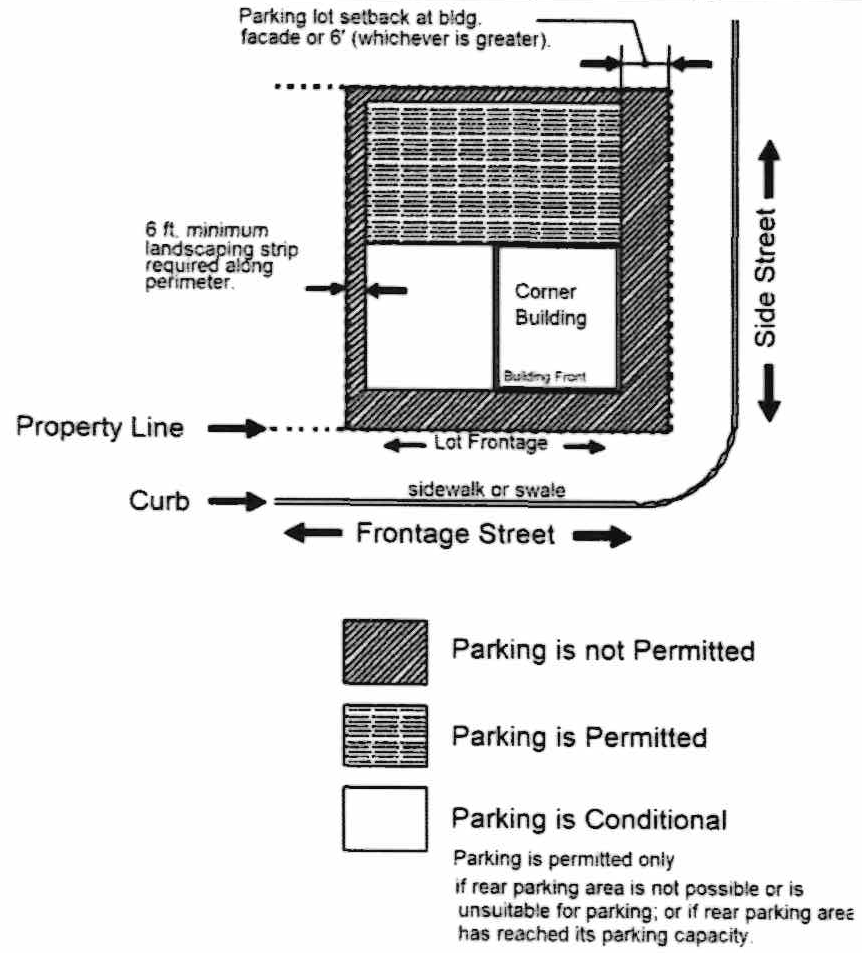 | PARKING LOCATION AND DESIGN |
| 1. Wherever possible parking shall be placed along streets and in small strategically located on-site lots (see diagram at left). | |
| 2. Parking lots shall be located behind buildings, such that buildings separate parking areas from the street. | |
| 3. In cases where this is not possible, parking may be located to the side of a building (non street-side). In no case shall the side parking area be wider than 50 percent of the lot frontage. | |
| 4. In no case shall parking be located between the front façade of the building and the front street; or in the case of a corner lot, between the side façade of the building and a side street. | |
| 5. On-street parking (while technically in the street ROW, shall be encouraged as a means of promoting safety, and separating moving vehicles from pedestrians using the sidewalk. | |
| 6. Perimeter parking lot landscaping is required as depicted at left, and described later in this document (on-site parking lot landscaping). | |
| 7. Light impact surfaces that promote unique placemaking and may be utilized—Reference the Light Imprint Handbook (T4) for contextually appropriate materials. | |
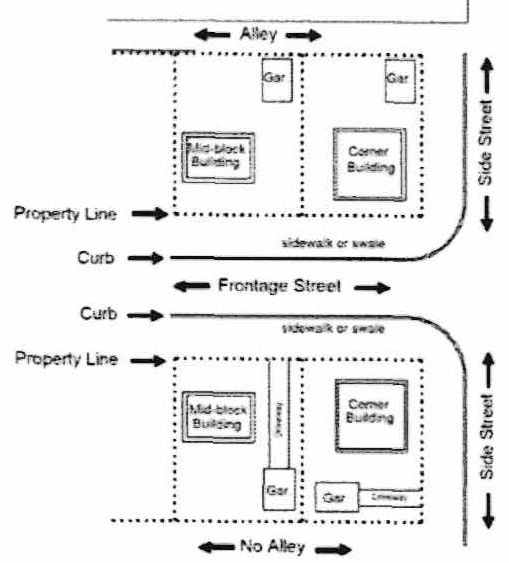 | ACCESS TO OFF-STREET PARKING |
| 1. Buildings that have rear access available shall always access parking through the rear (see diagram at left). | |
| 2. Front driveways to rear parking areas are permitted only where rear or side street access is unavailable (see diagram at left). | |
|
3. Curb cut or driveway width:
# of spaces: 20 or < = 14 ft. max.; > 20 spaces: 18 ft. max. Side or rear alley, 18 ft. max. | |
| 4. The minimum effective curb radius shall be utilized. | |
| 5. Circular drives shall be discouraged with all but those building types in which they are commonplace as a means of drop-off and pick-up. | |
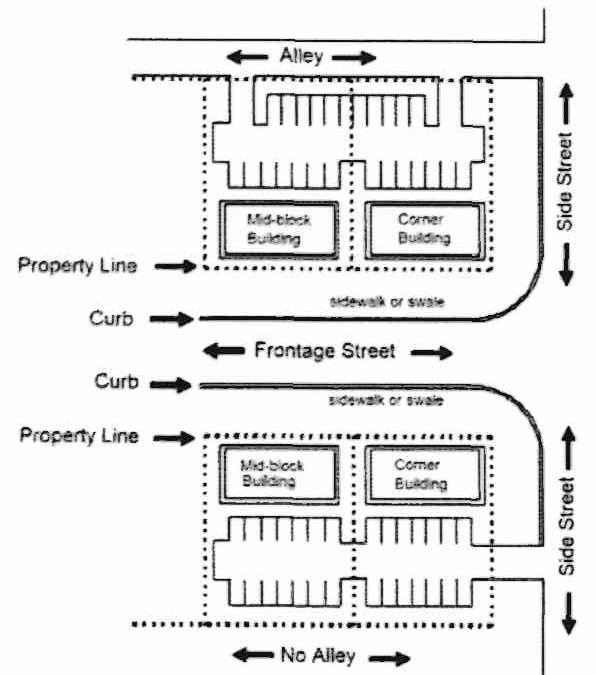 |
LINKAGES BETWEEN OFF-STREET
PARKING |
| 1. Parking areas shall be designed to resemble streets with linkages between the areas taking the form of a "network", no rear alley or lane present (see diagram at left). | |
| 2. In no case shall a vehicular accessway/driveway be permitted between the front façade of the building and the frontage street; or in the case of a corner lot, between the side façade of the building and the side street. | |
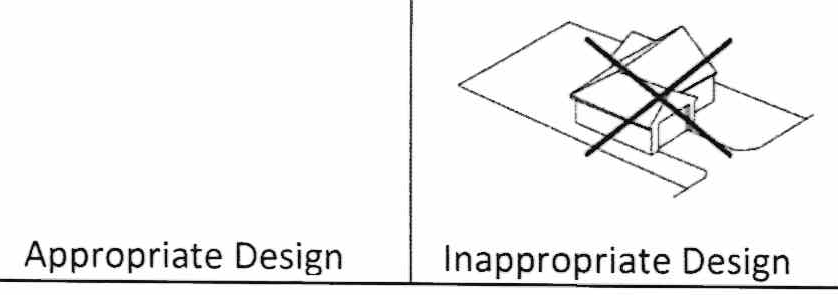 | RESIDENTIAL GARAGES |
| 1. Garage door(s) shall be positioned on the back half of the lot and no closer than 20 feet behind the principal plane of the building front (see diagrams at left). | |
| 2. If possible, garage doors shall face the side or rear of the lot, not the frontage street. | |
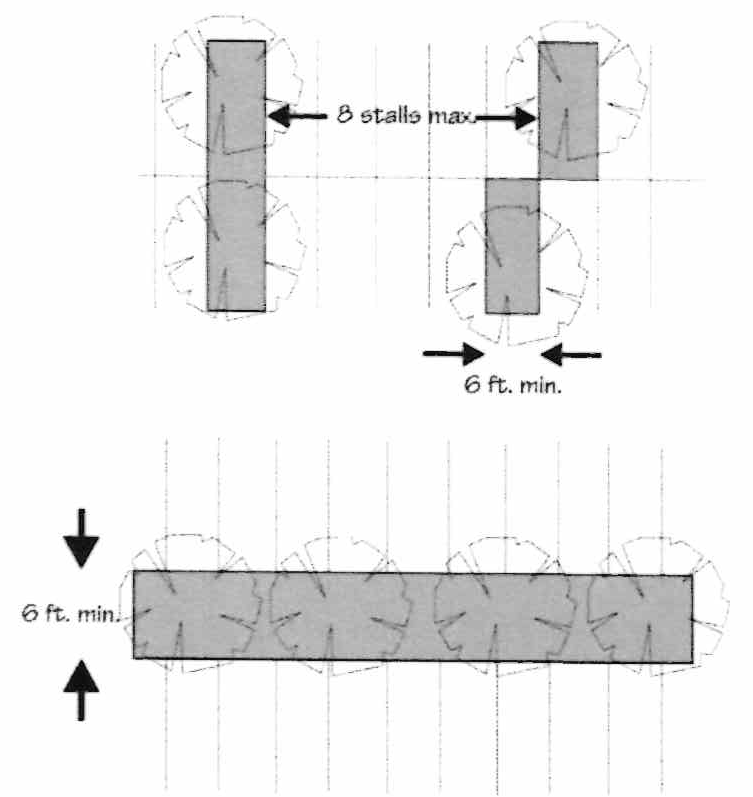 | ON-SITE PARKING LOT LANDSCAPING |
| 1. A 36—42" fence, wall, or hedge with a min. opacity of 75% shall be provided wherever a perimeter landscape strip abuts a street. | |
| 2. Landscape islands are required in parking areas at the following intervals for head-in or diagonal parking stalls: | |
| • No more than eight consecutive parking stalls are permitted without a landscape break of at least six feet in width and extending the entire length of the parking stall. | |
| • Each landscape break shall have at least one overstory shade tree for every 180 square feet of area, or portion thereof, and be covered with grass, shrubs, or living ground cover. | |
| • To minimize water consumption, the use of low-water vegetative ground cover other than turf is encouraged. | |
| 3. In lieu of landscaped islands, landscape strips, of at least six feet in width, can be provided between parking isles. Landscape strips shall have the same landscape requirements as landscape islands. | |
| Residential: |
NUMBER OF PARKING SPACES
REQUIRED |
| 1,000 sf. or less 1 per unit min. | 1. The number of parking spaces provided shall be based on use as provided at left. |
| >1,000 sf. to 1,500 sf. 1.5 per unit min. | |
| >1,500 sf. 2 per unit min. | 2. On-street parking provided on or adjacent to the site may count as part of the required parking supply. |
| Accessory dwelling unit 1 per unit min | |
| Lodging 1.5 per unit min. | 3. Off-site parking that is located off-street and within 500 ft. of the site may count as part of the required parking supply for non-residential uses, provided the peak hours for each use differs significantly. |
| B&B 1 per room min. | |
| All other Lodging 1 per 2 rooms min | |
|
Retail, restaurant, office,
2 per 1,000 sf. min.
and service 1 per 300 sf. max | 4. For two uses, shared parking shall be calculated as follows. The sum of the required parking for the two uses shall be divided by the factor listed in the table at left. The required number of parking spaces shall be rounded up to the closest whole number. |
| Industrial, manufacturing 1 per 1,000 sf. min. | |
|
Civic building,
1 per 5 seats (fixed)
meeting facility, or 1 per 400 gsf. place of worship (no fixed seats) min. | |
|
Parks and
As determined by
recreation the zoning administrator |
Shared Parking Factor for Two Uses
(Ord. No. 38-11102025, § II(Exh. A), 11-10-2025)
Sec. 22-656. - Fence and wall design.
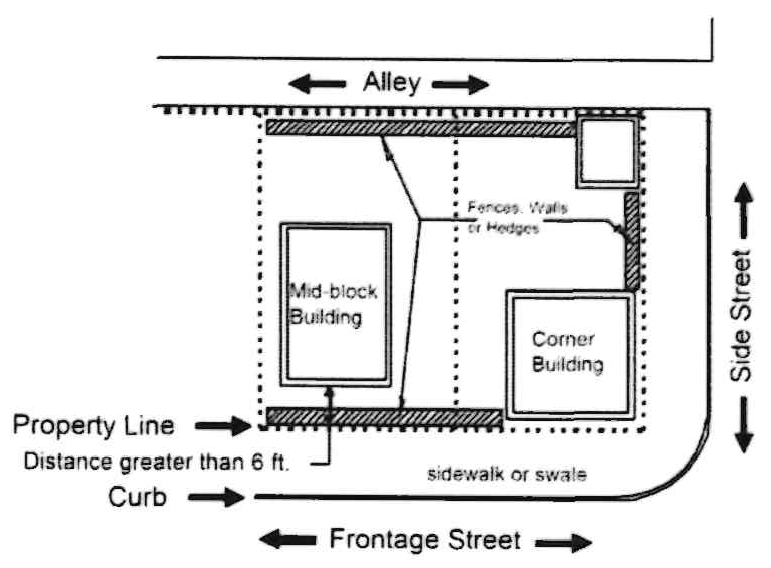
Notes:
1. Area in front of and parallel with the primary façade, often incorporating the frontage or other building elements.
2. Side and rear yard (behind the front plane of the primary façade).
3. Side and rear yard (front most portion of the fence or wall, running parallel and adjacent to the front plane of the primary building façade, as well as the front street.
General remarks:
1. Fences and walls are strongly encouraged and if built, should be constructed along all un-built rights-of-ways that abut streets and alleys, as conveyed in the above diagram and this section.
2. Fences and walls greater than 48 inches in height shall be a minimum of 33 percent opaque.
3. The more "finished" side of a fence or wall shall face the perimeter of the lot.
4. The name assigned to each fence or wall type is based on common industry terminology.
5. Differing fence and wall types may be integrated so long as they comply with this section (e.g. hedge wall with a picketed gate).
6. Pillars and posts may extend up to six inches above the height limitations provided such pillars and posts average no more than ten feet apart.
Specific to fences:
1. Fence types may be finished in various "styles" (e.g. "gothic" or "dog ear" picket fence).
2. Chain link shall not be permitted. "Living fences" shall be encouraged in place of chain link.
3. A "living fence" consists of wood posts with "hog wire" infill and a board rail on top.
4. Wood pickets or balusters shall be rectangular or round. Spacing shall not exceed one and one-half inches.
5. Vertical posts on wrought iron fences shall be a minimum of five-eighths-inch thick and spaced between four and six inches.
Specific to walls:
1. Hedge walls shall be a minimum of eight inches thick.
(Ord. No. 38-11102025, § II(Exh. A), 11-10-2025)
Sec. 22-657. - Lighting.
(a)
Permitted illumination types.
(1)
Incandescent.

(2)
Color corrected high pressure sodium.
(3)
Metal halide.
(4)
Fluorescent.
(5)
LED.
(6)
Quartz.

(7)
Noble gas tube.

(b)
Lighting for streets, paths, and parking lots; fixtures and illustrations
(1)
Pipe.
(2)
Post.
(3)
Column.
(c)
General regulations.
(1)
Fully shielded. All exterior illuminating devices shall be fully shielded. "Fully shielded" shall mean that those fixtures so designated shall be shielded in such a manner that light rays emitted by the fixture, either directly from the lamp or indirectly from the fixture, are projected below a horizontal plane running through the lowest point of the fixture where light is emitted.
(2)
Illumination types. Only those types of lighting listed at left shall be allowed. The same type of lighting must be utilized for all fixtures and light sources on the site.
(3)
Natural gas lamps. Natural gas lamps are permitted and do not require any type of shielding.
(4)
Sign lighting. If a sign is to be externally illuminated, a stationary light directed solely at the sign shall be used.
a.
Monument signs may be illuminated with reverse channel/halo lighting or one up-light per side.
b.
Wall signs may be illuminated with reverse channel/halo lighting or down lighting using a "fully shielded" fixture.
c.
Goose neck lighting fixtures are strongly encouraged.
d.
Neon, krypton, argon and other noble gas-filled tube lighting shall be limited to retail and restaurants.
e.
The use of colored lights to illuminate signage is prohibited.
(5)
Streets, paths, and parking lots. New lighting for streets, paths, and off-street parking lots shall be of a general type illustrated at left. New light poles be spaced a maximum of 75 feet on center with the actual lighting source located between 12 and 16 feet above the sidewalk.
(6)
Cobra head fixtures. Except where required for industrial uses, new cobra head light fixtures shall be prohibited.
(7)
Light poles. Light poles should be placed two feet from the back of the curb or street surface and may include brackets for decorative or graphic attachments.
(8)
Wall packs. Wall packs shall be prohibited as a means of general building and site lighting, and may only be used at auxiliary entrances to a building if "fully shielded" with limited to no visibility from the street.
(Ord. No. 38-11102025, § II(Exh. A), 11-10-2025)
Sec. 22-658. - Definitions.
The following words, terms and phrases, when used in this division, shall have the meanings ascribed to them in this section, except where the context clearly indicates a different meaning:
Accessory structure means a building or structure subordinate to the principal building that is under roof and enclosed, and used for purposes customarily incidental to the main or principal building on the lot. Accessory structures are permitted with all building types and typically include accessory dwelling units (ADU's), private garages, storage buildings, garden sheds, and the like. Accessory structures shall convey a similar character (form and color) as the principal building and comply with the standards for setbacks, building coverage, and permitted materials in section 22-654 (architecture).
Alley means a secondary way which affords access to the side or rear of abutting property.
Appurtenances means architectural features not used for human occupancy consisting of spires, belfries, cupolas or dormers, silos, parapet walls, cornices without windows, chimneys, ventilators, antennas, etc.
Build-to line means a line parallel to the property line, along which a building shall be built. Porches and handicap ramps shall be exempt from build-to requirements, and shall occur behind the property line. Build-to line locations for specific sites shall be established by the design review board at the time of application.
Building coverage means the horizontal area within the outer perimeter of the building walls, dividers, or columns at ground level including porches, stoops, and steps; but excluding driveways, parking, uncovered decks, patios, stairways, and the like.
Building frontage means the side of a building which faces the frontage street.
Dwelling area means the total internal useable space on all floors of a structure, not including porches, stoops, balconies, or patios.
Easement means a legal instrument, recorded in the county records, that allows access through real property of the conveyor.
Elevation means an exterior wall of a building.
Encroachment means any architectural feature, structure or structural element, such as a fence, stoop, balcony, bay window, or deck that breaks the plane of a horizontal regulatory limit extending into a setback or beyond the build-to-line.
Entrance, principal means the main point of access of pedestrians into a building, most often from the primary street.
Entrance, secondary means the secondary point of access of pedestrians into a building, most often from a secondary street or parking area (rear or side).
Expression line means a line prescribed at a certain level of a building for the major part of the width of a façade, expressed by a variation in material or by a limited projection such as a molding or balcony.
Fascia means a wide band of material covering the ends of roof rafters, sometimes supporting a gutter in steep-slope roofing, but typically it is a border or trim in low-slope roofing.
Frontage line means the property line(s) of a lot fronting a thoroughfare or other public way, or a civic space.
Frontage street means the public right-of-way which serves as primary access to a property.
Frontage type means the way in which a building engages the public realm.
Garden wall means a freestanding wall made of masonry, typically used as a screen or enclosure for a yard or open space, or as a divider along a street, alley, or lot line.
Live/work unit means an integrated housing unit and working space in a structure that has been designed or structurally modified to accommodate joint residential occupancy and work activity with a commercial component that may accommodate employees and walk-in trade. The residential component may be located above or behind the commercial space.
Lot frontage means the property line adjacent to the frontage street.
Mixed use means the development of a single building containing more than one type of land use or a single development of more than one building and use including, but not limited to, residential, office, retail, recreation, public, or entertainment, where the different land use types are in close proximity, and shared pedestrian and vehicular access and parking areas are functionally integrated.
Plaza, urban means a type of civic space that is appropriate for more urban areas. It is generally hardscaped with linear rows of trees, and spatially defined by building frontages.
Private frontage means The privately held space between the front plane of the principal building and the front parcel line/ROW.
Public frontage means the area between the vehicular lanes and the front parcel line that contains the curb assembly, walkway type, planter type, landscaping, lighting, signage, and civic elements (benches, bus stops, etc.).
Public lawn means a type of civic space that may be appropriate in some urban areas. It is generally landscaped with a manicured lawn and lined with canopy trees.
Public realm means the physical and social domain of the public that is held in common either by their physical presence or by visual association. This includes, but is not limited to plazas, squares, parks, thoroughfares, public frontages, private frontages, civic buildings and civic spaces.
Rear alley means a vehicular way located to the rear of lots providing a location for utility easements and access to service areas, parking, and accessory structures.
Right-of-way (ROW) means the actual land area acquired for a specific purpose such as a utility line or roadway.
Setback means the mandatory clear distance between a property line and a structure.
Shared parking means any parking spaces assigned to more than one user, where different persons utilizing the spaces are unlikely to need the spaces at the same time of day.
Shed roof means a roof shape having only one sloping plane.
Shopfront means a private frontage type where the main façade of the building is at or near the frontage line with an at-grade entrance along the public way. This type is intended for retail use. It has substantial glazing at the sidewalk level and may include a canopy or awning that overlaps the path.
Suspended signs means suspended signs mount to the underside of beams or ceilings of a porch, gallery, arcade, breezeway or similar covered area. They are typically hung in a manner that allows them to swing slightly. These signs are small, pedestrian scaled, and easily read from both sides.
Terminated vista means a location at the axial conclusion of a thoroughfare. A building located at a terminated vista is required to have workable doors which face the major intersection.
Thoroughfare means a street. This division mandates that all vehicular rights-of-way, easements, and parking access-ways be designed as thoroughfares that both resemble and function as a traditional street would.
(Ord. No. 38-11102025, § II(Exh. A), 11-10-2025)

