
Thornton City Zoning Code
CHAPTER 38
LAW ENFORCEMENT, OFFENSES AND TRAFFIC
ARTICLE II.- EMERGENCY MANAGEMENT[2]
Cross reference— Administration, Ch. 2.
State Law reference— Colorado Disaster Emergency Act of 1992, C.R.S. § 24-32-2101 et seq.; local disaster agencies and services, C.R.S. § 24-32-2107.
Editor's note— Ord. No. 3336, § 1, adopted June 23, 2015 repealed the former Art. II., §§ 38-26—38-32, and enacted a new Art. II as set out herein. The former Art. II pertained to similar subject matter and derived from Code 1975, § 5-61; Ord. No. 705, 12-22-75, Ord. No. 2308, § 21, 2-28-94.
ARTICLE III.- LOST, UNCLAIMED OR ABANDONED PROPERTY[3]
Cross reference— Unclaimed personal property, § 26-26 et seq.; abandoned, inoperable or unsafe motor vehicles, § 38-421 et seq.
ARTICLE IV.- SECONDARY ENTRANCE MARKING[4]
Cross reference— Licenses, permits and businesses, Ch. 42.
ARTICLE V. - ALARM SYSTEMS[5]
Cross reference— Licenses, permits and businesses, Ch. 42.
ARTICLE VI.- OFFENSES INVOLVING PROPERTY RIGHTS[6]
State Law reference— Offenses involving property, C.R.S. § 18-4-101 et seq.; offenses involving fraud, C.R.S. § 18-5-101 et seq.
ARTICLE VII.- OFFENSES AGAINST PUBLIC PEACE OR SAFETY[7]
State Law reference— Offenses against public peace, order and decency, C.R.S. § 18-9-101 et seq.
ARTICLE IX.- OFFENSES AGAINST PUBLIC AUTHORITY[11]
State Law reference— Offenses relating to governmental operations, C.R.S. § 18-8-101 et seq.
ARTICLE X. - NUISANCES[12]
Cross reference— Environment, Ch. 22; health and sanitation, Ch. 30; trees and plants, § 46-76 et seq.; solid waste, Ch. 58.
State Law reference— Authority to define and abate nuisances, C.R.S. § 31-15-401(1)(c).
ARTICLE XI.- SMOKING IN PUBLIC PLACES[15]
Editor's note— Ord. No. 3243, § 1, adopted June 25, 2013, repealed Art. XI and enacted a new article as set out herein. The former Art. XI, §§ 38-456—38-464, pertained to similar subject matter and derived from §§ 33-65—33-73 of the 1975 Code; Ord. No. 1597, adopted Oct. 13, 1986; and Ord. No. 2666, § 20, adopted June 18, 2001.
Cross reference— Health and sanitation, Ch. 30.
State Law reference— Control of smoking, C.R.S. § 25-14-101 et seq.
ARTICLE XII.- TRAFFIC AND VEHICLES[16]
Cross reference— Moving buildings and structures, § 18-458; abandoned, inoperative or unsafe motor vehicles, § 38-421 et seq.
State Law reference— Home rule powers, Col. Const. Art. XX, § 6; Uniform Safety Code of 1935, C.R.S. §§ 42-2-101 et seq., 42-4-101 et seq.; general authority to regulate traffic, C.R.S. §§ 42-4-110, 42-4-111.
Sec. 38-1.- Definitions.
The following words, terms and phrases, when used in this chapter, shall have the meanings ascribed to them in this section, except where the context clearly indicates a different meaning:
Adult means any person who has attained 18 years of age.
Agricultural District means the Agricultural District established under Chapter 18, of the Thornton City Code also known as the "AG" district.
Ammunition means any material which is capable of being discharged or projected from a firearm, air gun, bow, crossbow, slingshot or any weapon, as defined in Division 2 of Article VII of this chapter, including, but not limited to, bullets, cartridges, BBs, pellets, darts, arrows, shrapnel or stones.
Assault means an unlawful attempt coupled with a present ability to commit a bodily injury on the person of another or intentionally, knowingly, or recklessly causing bodily injury to another person.
A-weighted sound pressure level means the sound pressure level as measured with the sound level meter using the A-weighted network. The standard unit notation is dB(A).
Bodily injury means any physical pain, illness, or any impairment of physical or mental condition.
Bona fide business establishment means the entire area contained within the boundaries of an improved or unimproved parcel of land within the city where commercial or professional enterprises or activities are conducted for a profit or intended profit, including manufacturing, mining, storage and warehousing and wholesale or retail sales activities or any other profit-seeking enterprise or concern, and where such activity is legally permitted by the owner of the parcel, the applicable zoning ordinances and all other applicable laws, statutes and ordinances.
Brush means all cuttings from trees, bushes and shrubbery growth.
City means the city and the city manager or other official, body or agency designated by the Charter or this Code or any ordinance to act in its behalf.
Commercial power equipment means any power equipment rated more than five horsepower and includes but is not limited to chain saws, pavement breakers, riding tractors, and powered hand tools.
Common area means an area of land and buildings within a townhouse development, condominium project, manufactured home park or apartment complex which is developed for the use and enjoyment of all residents of the project, as distinguished from land designated for their individual, private use.
Construction activities means any labor performed, including labor associated with the maintenance of construction equipment, the storage of materials on public or private property related to the construction, installation, maintenance and repair of any streets, sidewalks, and driveways, as well as any buildings or structures and all related appurtenances and fixtures including all public improvement projects, and all landscaping projects occurring within the city.
Continuous noise means a steady, fluctuating or impulsive noise which exists essentially without interruption for a period of ten minutes or longer.
Department means the department of city development.
Director means the planning director.
Domestic power equipment means any power equipment rated at five horsepower or less and used for home or building repair or grounds maintenance, including but not limited to lawn mowers, garden tools, chain saws, hand power tools, or any other similar equipment.
Dynamic braking device means a device used primarily on trucks for the conversion of the motor from an internal combustion engine to an air compressor for the purpose of braking with or without the use of wheel brakes.
Emergency medical service means any actual or self-perceived event which threatens life, limb or the well-being of an individual in such a manner that a need for immediate medical care is created.
Emergency medical service provider or provider means a member of a public or private emergency response agency, operating within the city limits under contract, automatic aid or mutual aid agreement, whether that person is a volunteer or receives compensation for services rendered as such emergency responder.
Emergency response agency or agency means the city's emergency medical services unit, any dispatch, mutual aid, automatic aid or emergency response entity operating as a part of the city's emergency response to emergency medical, fire or rescue calls.
Firefighter means a member of the Thornton fire department whose duties, responsibilities and functions include all aspects of fire suppression and prevention.
Fluctuating noise means a noise where the sound pressure level varies more than six dB(A) during the period of observation when measured with the slow meter characteristic of a sound level meter.
Impulsive noise means a noise containing excursions usually less than one second in duration and varying more than 20 dB(A) during the period of observation when measured with the fast meter characteristic of a sound level meter.
Industrial Legacy District means the Industrial Legacy District established in Chapter 18 of the Thornton City Code; also known as the "I-L" District.
Juvenile means any person who has not attained 18 years of age.
Mobile guard (courier) means a person engaged in the business of traveling from one business location to another by private automobile, truck or other conveyance or on foot and who carries with such person valuable items, including but not limited to merchandise, goods, wares, negotiable instruments or currency, and who carries a dangerous or deadly weapon for the purpose of protecting such person and the items which such person carries when such mobile guard (courier) is so employed, is actually performing such services and is in uniform.
Mobile guard (roving patrol) means a person engaged as an employee of an entity under contract to provide guard, security, watch or patrol services to such business or property owner when such mobile guard (roving patrol) is so employed, is actually performing such services and is in uniform. It is the nature of such employment to move from one location to another in a pattern, randomly or in response to an alarm or signal, for the purpose of maintaining surveillance of and the security of buildings, structures or other enclosed areas.
Noise means sound that is unwelcome and unsolicited.
Noisemaker means any device either mechanical or electrical, including battery operated, that emits or produces audible sounds or causes, enables or allows some other device to emit or produce audible sounds.
Nonbusiness purpose means, for the purposes of noise regulations, the use, operation, or maintenance of any sound amplifying equipment for other than a business purpose. It shall include but not be limited to philanthropic, political, patriotic and charitable purposes.
Nonresidential use means uses that fall under the Agriculture and Animal Related; Commercial; Entertainment; Industrial, Automotive, and Transportation; Lodging; Public Institutional; and/or Utilities and Infrastructure Use Categories established in Article IV of Chapter 18.
Noxious weed means any of the following at any stage of growth:
(1)
Leafy spurge (Euphorbia esula);
(2)
Canada thistle (Cirsium arvense);
(3)
Russian knapweed (Centaurea repens);
(4)
Diffuse knapweed (Centaurea diffusa);
(5)
Spotted knapweed (Centaurea maculosa);
(6)
Bindweed (Convolvulus arvensis);
(7)
Whitetop (Cardaria draba);
(8)
Johnson grass (Sorghum halepense); and
(9)
Any other especially troublesome and detrimental plant of little or no use within the jurisdiction of the city which may cause damage or loss to a considerable portion of the land or the livestock of the region.
Occupancy means the purpose for which a building or land is used.
Parent means the natural or adoptive parent or grandparent of a person and includes an adult guardian, a trustee or a conservator, and any adult in legal custody and control of a juvenile.
Person means an individual human being, regardless of age, and any firm, company, corporation, association, partnership, or entity whatsoever.
Plainly audible means a noise or sound where the information content of the noise or sound is unambiguously transferred to or is pervasive enough to be clearly heard by a listener, such as, but not limited to, understanding spoken speech, comprehension of raised or normal voices, or comprehension of musical rhythms.
Police officer means a peace officer, as defined in C.R.S. § 18-1-901(3)(1), Levels I, Ia, II, III and IIIa, who is empowered to enforce the laws of the state and all ordinances and Charter provisions of the city, while acting within the scope of such officer's duty and authority. The term peace officer shall include a duly appointed or authorized law enforcement officer.
Private residence means the residential property of an individual within the city, including but not limited to duplexes, town homes, condominium units and apartment units, and the associated yards, grounds, entryways, and hallways thereof, as well as any privately owned common areas and/or streets of any limited access residential community, which communities may be characterized by a closed perimeter of walls and fences or controlled entrances for pedestrians, bicycles and automobiles, which is intended to limit access to residents and their guests.
Public or private facility means a thing or place within the city designed, built, installed, etc., to serve a specific function affording a service or convenience, whether publicly or privately owned. Such facilities may include but are not limited to educational, recreational, religious, amusement, athletic, transportation, vehicle storage, clubs and institutions, hospitals and shopping facilities.
Public place means a place to which the public or a substantial number of the public has access, and includes, but is not limited to places of amusement, parks, playgrounds, and parking lots, all of which are open for use by the general public, and streets, highways, roads, alleys, sidewalks and walkways when open for use by the general public or when adjacent to publicly-owned land, and the common areas of privately-owned land including, but not limited to, plazas, schools, hospitals, apartments or condominiums, office buildings, shops or business complexes, and transportation facilities.
Residential Estate District means the Residential Estate District established in Chapter 18, of the Thornton City Code also known as the "RE" district.
Right-of-way means an area dedicated to public use for pedestrian, equestrian or vehicular movement; railroads; public utilities; and water and sewer facilities.
Snow removal equipment means any handheld, self-propelled or motorized equipment designed for snow removal, including motorized vehicles specifically designed or equipped for snow removal.
Solicitor means any individual, whether a resident of the city or not, who engages in or attempts to engage in any type of contact for any purpose at a point of entry to any private residence.
Sound means an oscillation in pressure, stress, particle displacement and particle velocity that induces auditory sensation.
Sound level meter means an instrument or apparatus including a microphone, amplifier, attenuator, output meter or frequency weighting networks for the measurement of sound levels. The sound level meter shall be of a design and have the characteristics of a type 2 or better instrument conforming to standards as specified in the American National Standards Institute of Publication Standard S1.4-1983.
Sound pressure level means a measurement of sound that is calculated as 20 times the logarithm to the base 10 of the ratio of the root mean square pressure of a sound to the reference pressure, which is 20 × 10 -6 Newtons per meter squared.
Uniform means clothing of a distinctive nature designed and intended to serve as a method of visual identification of a person engaged in the business, profession or occupation of providing services as a mobile guard, either courier or roving patrol. In order to qualify as a uniform, such clothing must bear the business name of the entity employing such mobile guard, either courier or roving patrol, or must include a distinctive badge or patch indicating either the name of the business entity employing such guard or other wording which includes the term guard.
Unreasonable noise means any noise projected in such a manner to be plainly audible across a property line and by its sound level or duration disturbs or tends to disturb the peace, quiet, and repose of any reasonable person, or injures or endangers the health or safety of any reasonable person, or causes damage to property or business.
Weapon means an instrument of offensive or defensive combat, or anything used or designed to be used in destroying or defacing property, or causing injury to a person.
Weed means any ground cover which:
(1)
Is growing on a site and is typically not installed for the purposes of landscaping.
(2)
Is not typically propagated by the horticultural or nursery trades; or
(3)
Presents a particularly noxious visual, allergenic or growth characteristics.
(Code 1975, § 33-11; Ord. No. 240, 8-2-66; Ord. No. 1365, 6-25-84; Ord. No. 1625, 12-8-86; Ord. No. 2107, § 1, 9-9-91; Ord. No. 2152, § 8, 4-27-92; Ord. No. 2340, § 3, 8-22-94; Ord. No. 2409, § 18, 3-18-96; Ord. No. 2550, § 4, 7-12-99; Ord. No. 2656, § 27, 2-12-01; Ord. No. 2777, § 1, 5-27-03; Ord. No. 2897, § 1, 7-26-05; Ord. No. 2953, § 1, 8-8-06; Ord. No. 2963, § 3, 10-10-06; Ord. No. 3165, § 5, 4-12-11; Ord. No. 3271, § 1, 10-8-13; Ord. No. 3391, § 1, 8-9-16; Ord. No. 3745, § 18, 8-26-25)
Cross reference— Definitions generally, § 1-2.
Sec. 38-26.- Intent and purpose.
It is the intent of the city council to establish and maintain emergency management in accordance with the city charter, ordinances, and other city rules and regulations and the Act as amended from time to time.
(Ord. No. 3336, § 1, 6-23-15; Ord. No. 3360, § 1, 10-27-15)
Sec. 38-27. - Definitions.
For the purpose of this article, the following terms are defined as follows:
Continuity of government ("COG") means activities that address the continuance of local government pursuant to the Colorado Constitution and statutes and city charter and ordinances.
Emergency manager means the person appointed by the city manager to direct appropriate day-to-day planning, management, and coordination of emergency management including but not limited to mitigation, preparedness, response, and recovery.
Emergency plan means an all-hazards plan maintained by the city for responding to a wide variety of potential hazards.
(Ord. No. 3336, § 1, 6-23-15; Ord. No. 3360, § 2, 10-27-15)
Sec. 38-28. - Organization and appointments.
The city manager shall establish an emergency management office as the coordinating entity for all emergency events, utilizing, to the fullest extent necessary, the services and resources of existing departments within the city and appoint an emergency manager.
(Ord. No. 3336, § 1, 6-23-15; Ord. No. 3360, § 3, 10-27-15)
Sec. 38-29. - Duties and responsibilities.
The emergency management office coordination shall include but not be limited to preparedness, prevention, mitigation, response, and recovery activities related to disasters and emergencies within the city.
(Ord. No. 3336, § 1, 6-23-15; Ord. No. 3360, § 4, 10-27-15)
Sec. 38-30. - Emergency plan.
(a)
The emergency plan shall be developed and maintained by the emergency management office and subject to the approval of the city manager. The emergency plan shall be developed to work in coordination with the COG plan.
(b)
All plans and operational procedures shall incorporate current industry approaches to incident management.
(Ord. No. 3336, § 1, 6-23-15; 6-23-15; Ord. No. 3360, § 5, 10-27-15)
Sec. 38-31. - Declaration of emergency.
(1)
The declaration of emergency shall be prepared and signed by the city manager.
(2)
A declaration of emergency shall not be continued or renewed for a period in excess of seven days except by or with the consent of city council. Any consent declaring, continuing or terminating a declaration of emergency shall be promptly disseminated to the public, and shall be filed promptly with the city clerk.
(3)
The emergency management office shall oversee the processing of the disaster declaration and submit it to appropriate county, state, and/or federal emergency management agencies as appropriate and any other government entity as provided by state law. The emergency management office shall also facilitate meetings or communications with federal, state, county and municipal officials as appropriate.
(Ord. No. 3336, § 1, 6-23-15; Ord. No. 3360, § 6, 10-27-15)
Sec. 38-32. - Continuity of government.
(a)
Special meetings.
(1)
A special meeting of city council may be called in accordance with the provisions of the city charter except that, in the event the circumstances of an emergency make it impossible or impractical to meet such provisions related to notice, business may be transacted at such meeting without written or timely notice of such meeting to city council or the public.
(2)
In the event of absence or disability of a city council member(s), a majority of the members present in a special meeting during an emergency shall constitute a quorum for the transaction of business.
(3)
Any action taken, related to an emergency, by city council in a special meeting where the charter requirements of notice or quorum requirements are not met shall be ratified at its next regular meeting.
(4)
Such meetings shall be open to the public and notice of the meeting location shall be timely posted unless such notice and being open to the public is impractical due to the emergency.
(5)
If an emergency hinders the city council member's ability to meet physically, alternative communication systems shall be used to conduct business. These technologies shall include but not be limited to conference calling and telecommunications technologies that provide for video and audio communication via the internet. All such technologies and communications shall be subject to the requirements of the Colorado Open Meetings law unless impracticable in light of the emergency.
(b)
Succession of Mayor.
(1)
During an emergency, in the event of absence or disability of the mayor, the mayor pro tem shall serve as mayor. In the event of the absence or disability of both the mayor and mayor pro tem, the council may designate another of its members to serve as acting mayor only during such absence or disability during the emergency. The acting mayor shall serve until the mayor or mayor pro tem returns or his or her disability is removed, council selects another member to be acting mayor, or the emergency is terminated, whichever occurs first.
(2)
In the event there is no member of city council available to serve as acting mayor during an emergency, the city manager shall serve as acting mayor until the council selects an acting mayor. The city manager shall include in a written policy or provision that addresses line of succession in the event of absence or disability of the city manager.
(Ord. No. 3336, § 1, 6-23-15; Ord. No. 3360, § 7, 10-27-15)
Sec. 38-33. - Emergency regulations
During an emergency, the city manager may promulgate emergency regulations as he or she deems necessary to protect life and property and preserve critical resources. These regulations shall be provided to city council, city residents and businesses as soon as practicable.
(Ord. No. 3336, § 1, 6-23-15)
Sec. 38-34. - Conflicting ordinances, orders, rules and regulations.
Any orders, rules and regulations promulgated during a proclaimed state of emergency shall take precedence over existing ordinances, rules and regulations if a conflict arises.
(Ord. No. 3336, § 1, 6-23-15)
Sec. 38-61.- Definitions.
The following words, terms and phrases, when used in this article, shall have the meanings ascribed to them in this section, except where the context clearly indicates a different meaning:
Abandoned or unclaimed property means property presumed to be abandoned if the owner has failed to contact the city for a period of not less than 30 days and the city, in good faith, is without knowledge of any evidence indicating that the owner does not intend to abandon the property.
Custodian means the chief of police or any other person so designated by the city manager.
Property means tangible personal property.
(Code 1975, § 30-1; Ord. No. 674, 1-13-75; Ord. No. 2364, § 1, 1-9-95)
Cross reference— Definitions generally, § 1-2.
Sec. 38-62. - Custodian.
The chief of police and any other person so designated by the city manager is designated as the official custodian of each and every article or object of property lost or abandoned, which property is not in the lawful custody of any other person or court, and which property has been delivered to the chief of police, and any other person so designated by the city manager for care, custody and control.
(Code 1975, § 30-2; Ord. No. 674, 1-13-75; Ord. No. 2364, § 2, 1-9-95)
Sec. 38-63. - Property held as evidence.
The custodian shall keep in custody all articles of personal property seized or held as evidence, which property has been delivered to the custodian for care, custody and control, for use in any pending or prospective trial, unless otherwise ordered by the court having jurisdiction or upon the proper authorization of the city attorney, until the final disposition of any pending charges, including appeals or the lapse of time for filing an appeal. Thereafter, unless ordered to the contrary by the court having jurisdiction, the custodian shall make disposition of such property in accordance with the provisions of this article.
(Code 1975, § 30-3; Ord. No. 674, 1-13-75)
Sec. 38-64. - Disposition generally.
All lost, unclaimed or abandoned property, which property has been delivered to the custodian for care, custody and control, not being held pending the disposition of charges pursuant to Section 38-63, shall be subject to disposition according to the provisions of Sections 38-64 to 38-70, unless otherwise provided in this article or ordered to the contrary by any court. Abandoned or unclaimed property of nominal resale value held by the custodian for 30 days can be donated to religious, charitable, civic or other organizations by the city pursuant to administrative directive.
(Code 1975, § 30-4; Ord. No. 674, 1-13-75; Ord. No. 2364, § 3, 1-9-95)
Sec. 38-65. - Notification of owner.
The custodian shall examine any such property, and, if the identity of the owner is readily available to the custodian from public records available or otherwise known to the custodian, the custodian shall notify the apparent owner by phone or, if unable to contact by phone, by United States first class mail, postage prepaid, to the last known address of such apparent owner, mailed within a reasonable time after identification of the apparent owner, describing the property and stating that the property is held by the custodian and may be sold or otherwise disposed of unless claimed within 30 days of the giving or mailing of such notice.
(Code 1975, § 30-5; Ord. No. 674, 1-13-75)
Sec. 38-66. - Disposal of unclaimed or abandoned property.
If any unclaimed or abandoned property remains unclaimed 30 days after the unclaimed or abandoned property is no longer required to be held in evidence, pursuant to Section 38-63, or 30 days after the mailing of any letter of notice, provided for in Section 38-65, whichever is the longer time, such property may be retained by the custodian and kept for use by the city for training programs or otherwise disposed of from time to time by the purchasing agent in accordance with city policy on the disposition of surplus property and as follows:
(1)
Bicycles, tricycles or other articles made for use by children may be sold as provided in this section or may, pursuant to city council resolution, be given either directly or by making such available for distribution through religious, charitable, civic or other organizations or institutions.
(2)
Any such property may be sold at public sale, provided that the purchasing agent shall cause to be published, pursuant to Section 2-1, or by auction, a notice setting forth a general description of the articles to be sold; the time, date and place of sale; and the time, date and place for any person who claims to be the owner of or claims any interest in any article so described to appear before the time and date set for sale to reclaim the property upon presentation of satisfactory proof of identity and ownership of such articles.
(3)
Whenever any property is retained by the city as provided for in this section, it shall be added to the city's capital assets inventory, which shall also indicate the location of the assigned property and the designated use thereof, consistent with the city's capital asset inventory policy. Property not retained by the city shall be disposed of pursuant to this article.
(Code 1975, § 30-6; Ord. No. 674, 1-13-75; Ord. No. 2364, § 4, 1-9-95; Ord. No. 3392, § 16, 8-9-16; Ord. No. 3476, §§ 16, 7-10-18)
Sec. 38-67. - Reclaiming property.
All property under this article may be reclaimed by the lawful owner upon proof of identity and ownership satisfactory to the custodian, if claimed before the donation or sale thereof.
(Code 1975, § 30-7; Ord. No. 674, 1-13-75)
Sec. 38-68. - Failure to claim property.
Failure to make a claim of ownership within the time limits prescribed in this article and before the sale or donation of any article shall forever bar the owner or any person claiming ownership by, through or under the owner from making any subsequent claim of ownership.
(Code 1975, § 30-8; Ord. No. 674, 1-13-75)
Sec. 38-69. - Readvertisement.
If any property is advertised for sale as in this article, but is not sold according to the advertisement, the property may again be advertised for sale according to the provisions of this article.
(Code 1975, § 30-9; Ord. No. 674, 1-13-75; Ord. No. 2364, § 5, 1-9-95)
Sec. 38-70. - Destruction of property after sale.
Under this article, if any property has been advertised for sale and has not been sold, the property may be destroyed, donated, kept or used by the city without further notice.
(Code 1975, § 30-10; Ord. No. 674, 1-13-75; Ord. No. 2364, § 6, 1-9-95)
Sec. 38-71. - Proceeds of sale.
All proceeds of a sale under this article shall be paid to the city treasurer, who shall deposit the proceeds in the general fund of the city.
(Code 1975, § 30-11; Ord. No. 674, 1-13-75)
Sec. 38-72. - Exceptions.
Notwithstanding Sections 38-61 to 38-71, objects and articles of property as described in Sections 38-73 and 38-74 may be kept, held or disposed of as provided in Section 38-73 to the end of this article without compliance with the provisions of Sections 38-64 to 38-71 relating to donation or sale.
(Code 1975, § 30-12; Ord. No. 674, 1-13-75)
Sec. 38-73. - Firearms.
Unless ordered to the contrary by a court of competent jurisdiction or otherwise required by state or national law, firearms and other weapons which may not lawfully be kept, possessed or retained by the owner or person otherwise entitled to the possession thereof or which may not otherwise lawfully be returned to the owner thereof or which are abandoned or unclaimed after notice to the owner pursuant to Section 38-65 or the owner of which is not known may be kept and retained by the police department for use in its training programs or, if not used for training programs by the police department, shall be destroyed. Whenever such firearms or weapons are retained by the police department for use in its training programs, such items shall be accounted for in accordance with the provisions of Section 38-66(3).
(Code 1975, § 30-13; Ord. No. 674, 1-13-75; Ord. No. 2364, § 7, 1-9-95)
Sec. 38-74. - Destruction of certain property.
Under this article, if the property consists of burglar tools of any description; unlawful firearms, cartridges, explosives, or armored or bulletproof clothing or other dangerous weapons; gambling apparatus; instruments, articles or medicines for the purpose of inducing abortion or preventing conception; beer, wine, spirituous liquors or fermented malt beverages; soiled, bloody or unsanitary clothing; solids or liquids of unknown or uncertain composition; or drugs, hallucinogenic substances, or hypodermic syringes and needles; obscene pictures, prints, effigies, statues; any poisonous, noxious or deleterious solids or liquids; or any other property which reasonably might result in injury to the health or safety of the public or which might be subject to unlawful use, the chief of police may destroy each and every article of any such nature.
(Code 1975, § 30-14; Ord. No. 674, 1-13-75)
Sec. 38-75. - Specific exceptions.
Motor vehicles, lost or stray animals and other property which is required to be disposed of otherwise than as provided in this article, by the terms of any law or ordinance, shall not be disposed of according to the terms of this article.
(Code 1975, § 30-15; Ord. No. 674, 1-13-75)
Sec. 38-76. - Sales conducted by finance director.
The finance director shall conduct all sales made pursuant to the terms of this article.
(Code 1975, § 30-16; Ord. No. 674, 1-13-75)
Sec. 38-77. - Rights of finder.
Notwithstanding any other provision of this article, whenever any item is lost or abandoned or unclaimed property has been found and delivered to the custodian for care, custody and control, such item shall be returned to the original finder whenever claim has been made by the finder and the following conditions have been met:
(1)
The claimant is the person who originally found the lost, abandoned or unclaimed property.
(2)
The claimant, after surrendering the property to the custodian, has served written notice of intention to make a claim on that item within 30 days of the surrender of the item.
(3)
The lost, abandoned or unclaimed property has remained unclaimed by the owner or person having a right to such property for 30 days after the surrender of the property to the custodian.
(4)
The lost, abandoned or unclaimed property is not stolen or confiscated property, nor is it property held under the exceptions outlined in Sections 38-72 to 38-75, nor is it property held as evidence pursuant to Section 38-63.
(Code 1975, § 30-17; Ord. No. 674, 1-13-75; Ord. No. 2364, § 8, 1-9-95)
Sec. 38-106.- Definitions.
The following words, terms and phrases, when used in this article, shall have the meanings ascribed to them in this section, except where the context clearly indicates a different meaning:
Commercial establishment means any nonresidential structure.
Secondary entrance means any entrance or exit between the exterior and interior of a building or structure other than the primary entrance or exit or any entrance or exit within 50 feet of the primary entrance or exit which is on the same side of the building as the primary entrance.
(Code 1975, §§ 13-2, 13-4; Ord. No. 1926, 12-11-89; Ord. No. 2355, § 2, 11-14-94)
Cross reference— Definitions generally, § 1-2.
Sec. 38-107. - Unlawful acts.
It shall be unlawful for any person who is the owner, lessee, person in possession, manager or director of a commercial establishment to fail to have any secondary entrance doors marked with the appropriate street address as is required by this article.
(Code 1975, § 13-5; Ord. No. 1926, 12-11-89)
Sec. 38-108. - Violations and penalties.
Violation of the provisions of this article shall be punishable by a fine of not less than $100.00 nor more than the maximum fine authorized by Section 1-8.
(Code 1975, § 13-6; Ord. No. 1926, 12-11-89; Ord. No. 2355, § 3, 11-14-94; Ord. No. 3266, § 6, 9-24-13)
Sec. 38-109. - Marking of secondary entrance doors required.
If there is more than one owner or tenant occupying separate and distinct units in a commercial establishment, every secondary entrance door shall be clearly marked with each tenant's or owner's street address and unit number.
(Code 1975, § 13-1; Ord. No. 1926, 12-11-89; Ord. No. 2355, § 1, 11-14-94)
Sec. 38-110. - Conditions constituting clear marking.
A door shall be deemed clearly marked if the street address is painted onto or affixed to the door or located no more than six inches above the door, the lettering is at least three inches in height and the color of the lettering is in clear contrast to its background.
(Code 1975, § 13-3; Ord. No. 1926, 12-11-89)
Sec. 38-136.- Definitions.
The following words, terms and phrases, when used in this article, shall have the meanings ascribed to them in this section, except where the context clearly indicates a different meaning:
Alarm device means any device which, when activated by the victim of a holdup or robbery at a specific location, by forced or other entry into a premises, or by other stimuli, transmits a prerecorded message or other signal by telephone, radio or other means to the police radio dispatch room, where a police response is expected to investigate criminal activity or emergency.
Alarm user means any person who uses an alarm device, an audible alarm device or a system of such devices.
Alarm verification means any alarm signal for which evidence can be provided to substantiate a reasonable belief that criminal activity was occurring or was to occur.
Audible alarm device means any alarm device which produces an audible signal at the premises where it is installed, whether by means of bells, horns, sirens or other mechanism, thereby notifying persons within audible range of the signal that police should be notified.
Central alarm station means any facility which is manned at all times by trained operators employed to receive, record and validate alarm signals and to relay information about validated signals to the police radio dispatch room when appropriate.
False alarm means any alarm signal which causes the police to respond and which results from:
(1)
False activation of an alarm, where there is no evidence to substantiate a reasonable belief that criminal activity was occurring or was to occur.
(2)
Alarm malfunction, including mechanical failure or electrical failure, except when activated by telephone short circuits or by weather conditions where activation could not have been prevented by reasonable precautions.
(3)
An alarm triggered by a subscriber's negligence, including overly sensitive settings.
Operator means any person who has, because of the use, ownership, selling, leasing or maintenance of alarm devices or audible alarm devices, become subject to the requirements of this article.
User fee means fees assessed for false alarms as provided herein.
(Code 1975, § 24A-1; Ord. No. 1304, 12-12-83; Ord. No. 2952, § 1, 7-25-06)
Cross reference— Definitions generally, § 1-2.
Sec. 38-137. - Violations and penalties.
Unless another penalty is provided for in this article, any person who shall violate any of the provisions of this article shall, upon conviction, be punished as provided in Section 1-8(a).
(Code 1975, § 24A-10; Ord. No. 1304, 12-12-83; Ord. No. 1490, 11-12-85; Ord. No. 1520, 12-16-85)
Sec. 38-138. - Promulgation of rules and regulations.
The chief of police may promulgate reasonable rules and regulations that may be necessary for purposes of administering and enforcing the provisions of this article, provided that such rules are not contrary to the provisions of this article and have been approved by the city manager. Such rules and regulations shall include, but are not limited to the following:
(1)
Procedures in making an appeal when user fees have been administratively assessed against an alarm user.
(2)
Declaration of given alarms as being unreliable.
(3)
Police response procedures when an alarm has been declared unreliable.
(Code 1975, § 24A-9; Ord. No. 1304, 12-12-83)
Sec. 38-139. - Direct alarm devices.
(a)
No direct alarm device shall be connected to an alarm console or control panel in police dispatch areas of the city, except for fire alarm devices for hotels or motels, police or fire alarm devices for city facilities, public schools and where the use of such devices is required by virtue of federal or state regulation, such as a nursing home, hospital or an FDIC insured institution.
(b)
It shall be unlawful for direct alarm devices which transmit prerecorded messages to be programmed to dial the police department.
(Code 1975, § 24A-2; Ord. No. 1304, 12-12-83)
Sec. 38-140. - Intentional false alarms unlawful.
It shall be unlawful for any person to cause the transmission of a false alarm.
(Code 1975, § 24A-3; Ord. No. 1304, 12-12-83)
Sec. 38-141. - Audible alarm devices.
(a)
Audible alarm devices shall be equipped with an automatic shutoff mechanism capable of terminating the activated audible signal within a maximum time of:
(1)
Fifteen minutes at or in residential locations.
(2)
Thirty minutes at or in nonresidential locations.
(b)
Audible alarm systems may be disconnected by the city through use of any means reasonable and necessary if the alarm does not automatically shut off as described in subsection (a) of this section. The city or its employees or agent shall not be responsible or liable for damage resulting from such disconnection.
(Code 1975, § 24A-4; Ord. No. 1304, 12-12-83)
Sec. 38-142. - Responsibilities of alarm user.
(a)
Any alarm user must have inspected, personally or by an operator or alarm maintenance person, the alarm system on such user's premises after each activation thereof to ensure proper operation.
(b)
An alarm user shall respond to the location where an alarm originated within 20 minutes after a request by the police department, or contractually provide for such response by an alarm maintenance service.
(Code 1975, § 24A-5; Ord. No. 1304, 12-12-83)
Sec. 38-143. - Warnings and user fees for false alarms.
A user fee or warning shall be imposed against an alarm user in accordance with the following schedule for each false alarm, as defined in this article, originating from such user's premises. In each succeeding calendar year, for the first and second false alarm a warning shall be issued; for the third false alarm a fee, as established by resolution of the city council, shall be charged; for the fourth and each subsequent false alarm a fee, as established by resolution of the city council, shall be charged. No user fee shall be assessed for a false alarm unless police units actually respond to the alarm.
(Code 1975, § 24A-6; Ord. No. 1304, 12-12-83; Ord. No. 2952, § 2, 7-25-06)
Sec. 38-144. - Collection of user fees.
(a)
Whenever the police department has responded to three or more false alarms at a given location in a calendar year, the police department shall notify the finance director, who shall mail a user fee assessment notice to the alarm user stating the assessment which has been made, the reason therefore; the date payment is due, and notifying the alarm user that the user has a right to a hearing with the police department if a request therefore is made before the due date.
(b)
All user fee assessments are due and payable to the finance director within 15 days of mailing of the notice required in subsection (a) of this section, except, if a hearing is timely requested, the assessment is due within ten days after an adverse decision at such hearing.
(c)
If the alarm user shall fail to pay the assessment within 30 days after the assessment becomes due, the finance director may certify such assessment to the county treasurer to be levied on the premises and collected the same as general taxes. Twenty-five percent of the amount shall be added to the assessment to pay the cost of collection.
(d)
Failure of an alarm user to pay a user fee assessment within 30 days after the assessment becomes due shall be deemed a violation of this article. In a prosecution for such a violation, introduction of a true and correct copy of the assessment notice shall be prima facie evidence that a valid assessment was made and is due.
(Code 1975, § 24A-7; Ord. No. 1304, 12-12-83; Ord. No. 2952, § 3, 7-25-06)
Sec. 38-145. - Unreliable systems.
In the event that the police department, due to alarm malfunction, has responded to a total of three or more false alarms at a given property location in a calendar year, which is other than a bank, savings and loan, school, nursing home, hospital or public facility, the chief of police may declare the alarm system unreliable. If an alarm system has been declared unreliable, the chief of police shall notify the alarm user at the user's latest known address of the fact. The police department need not respond to alarm systems declared unreliable at least until such time as evidence has been provided to the chief of police that the system has been repaired and is reliable.
(Code 1975, § 24A-8; Ord. No. 1304, 12-12-83)
Sec. 38-146. - Fire alarm definitions.
The following words, terms and phrases, when used in this article, shall have the meanings ascribed to them in this section, except where the context clearly indicates a different meaning:
False fire alarm means any alarm signal which causes the fire department to respond and which results from a malfunction including mechanical failure or electrical failure where there is no evidence to substantiate a reasonable belief that a fire was occurring.
False fire alarm user fee means fees assessed for false fire alarms as provided herein.
Fire alarm device means a fire alarm system component that originates transmission of a change-of-state condition, such as a water flow alarm, a smoke/heat detector, manual fire alarm box, or supervisory switch.
Fire alarm system means a system or portion of a combination system consisting of components and circuits arranged to monitor and annunciate the status of fire alarm initiating devices or supervisory signal-initiating devices and transmits an electronic signal to a monitoring company in response to a change in status.
Fire alarm user means any person who uses or maintains a fire alarm device or fire alarm system.
Operator means any person who has, because of the use, ownership, selling, leasing or maintenance of fire alarm devices, become subject to the requirements of this article.
(Ord. No. 3151, § 1, 11-23-10)
Sec. 38-147. - Promulgation of rules and regulations.
The fire chief may promulgate reasonable rules and regulations that may be necessary for purposes of administering and enforcing the provisions of Sections 38-146 to 38-149, provided that such rules are not contrary to the provisions of these sections and have been approved by the city manager. Such rules and regulations shall include, but are not limited to the following:
(1)
Procedures in making an appeal when false fire alarm user fees have been administratively assessed against a fire alarm user.
(2)
Declaration of given fire alarms as being unreliable.
(Ord. No. 3151, § 2, 11-23-10)
Sec. 38-148. - Fire alarm user fees for false fire alarms.
A false fire alarm user fee shall be imposed against a fire alarm user with the fourth false fire alarm in an individual building in a consecutive twelve-month period in accordance with the fee resolution established by city council. No false fire alarm user fee shall be assessed for a false fire alarm unless fire department equipment actually responds to the alarm.
(Ord. No. 3151, § 3, 11-23-10)
Sec. 38-149. - Collection of user fees.
(a)
Whenever the fire department has assessed a false fire alarm user fee, the fire chief, or designee, shall notify the finance director, or designee, who shall mail a false fire alarm user fee assessment notice to the fire alarm user stating the assessment which has been made, the reason therefore; the date payment is due, and notifying the fire alarm user that the user has a right to a hearing with the fire department if a request therefore is made before the due date.
(b)
All false fire alarm user fee assessments are due and payable to the finance director within 15 days of mailing of the notice required in subsection (a) of this section, except, and if a hearing is timely requested, the assessment is due within ten days after an adverse decision at such hearing.
(c)
If the fire alarm user fails to pay the assessment within 30 days after the assessment becomes due, the finance director may certify such assessment to the county treasurer to be levied on the premises and collected the same as general taxes. Twenty-five percent of the amount shall be added to the assessment to pay the cost of collection.
(Ord. No. 3151, § 4, 11-23-10)
Sec. 38-171.- Damaging ditches.
It shall be unlawful for any person to either willfully, maliciously, wantonly or negligently fill up, obstruct or otherwise damage any ditch lawfully constructed in the city.
(Code 1975, § 33-36; Ord. No. 240, 8-2-66)
Sec. 38-172. - Damaging property prohibited.
It shall be unlawful for any person to intentionally, knowingly, or recklessly cause damage to or destroy the real or personal property of another without the consent of the owner whether such property is public or private; provided, however, this section shall not apply in the case of one criminal episode in which there is aggregate damage exceeding $2,000.00 or more.
(Ord. No. 2963, § 4, 10-10-06; Ord. No. 2971, § 1, 11-28-06, eff. 1-1-07; Ord. No. 2998, § 1, 7-10-07; Ord. No. 3000, § 1, 7-10-07; Ord. No. 3053, 5-13-08; Ord. No. 3241, § 1, 6-25-13; Ord. No. 3630, § 3, 10-25-22)
Editor's note— Ord. No. 2963, § 4, adopted Oct. 10, 2006, repealed the former § 38-172, and enacted a new § 38-172 as set out herein. The former § 38-172 pertained to similar subject matter and derived from Code 1975, § 33-34; Ord. No. 934, adopted Feb. 25, 1980; Ord. No. 1413, adopted Dec. 3, 1984; Ord. No. 2178, § 4, adopted July 27, 1992; Ord. No. 2473, § 1, adopted Sept. 22, 1997; Ord. No. 2514, § 1, adopted July 27, 1998.
State Law reference— Criminal mischief, C.R.S. § 18-4-501.
Sec. 38-173. - Reserved.
Editor's note— Ord. No. 3241, § 2, adopted June 25, 2013, repealed § 38-173 which pertained to damaging automobiles prohibited and derived from Ord. No. 2963, § 5, adopted Oct. 10, 2006; Ord. No. 2971, § 2, adopted Nov. 28, 2006; and Ord. No. 3000, § 2, adopted July 10, 2007.
Sec. 38-174. - Fraud by check.
(a)
It shall be unlawful for any person, knowing such person has insufficient funds with the drawee and with intent to defraud, to issue a check for the payment of services, wages, salary, commissions, labor, rent, etc.
(b)
The following words, terms and phrases, when used in this section, shall have the meanings ascribed to them in this subsection, except where the context clearly indicates a different meaning:
Check means a written, unconditional order to pay a sum certain in money, drawn on a bank or other financial institution, payable on demand and signed by the drawer. A check, for the purposes of this section only, also includes a negotiable order of withdrawal and a share draft.
Drawee means the bank upon which a check is drawn or a bank, savings and loan association, industrial bank or credit union on which a negotiable order of withdrawal or a share draft is drawn.
Drawer means a person, either real or fictitious, whose name appears on a check as the primary obligor, whether the actual signature be that of such person or of a person authorized to draw the check on such person.
Insufficient funds means a drawer has insufficient funds with the drawee to pay a check when the drawer has no checking account, negotiable order of withdrawal account or share draft account with the drawee or has funds in such an account with the drawee in an amount less than the amount of the check, plus the amount of all other checks outstanding at the time of issuance; and a check dishonored for no account shall also be deemed to be dishonored for insufficient funds.
Issue means a person makes, draws, delivers or passes a check or causes a check to be made, drawn, delivered or passed.
Negotiable order of withdrawal account means an account in a bank, savings and loan association or industrial bank and share draft account means an account in a credit union on which payment of interest or dividends may be made on a deposit with respect to which the bank, savings and loan associations or industrial bank or the credit union, as the case may be, may require the depositor to give notice of an intended withdrawal not less than 30 days before the withdrawal is made, even though in practice such notice is not required and the depositor is allowed to make withdrawal by negotiable order of withdrawal or share draft.
Negotiable order of withdrawal account and share draft means negotiable or transferable instruments drawn on a negotiable order of withdrawal account or a share draft account, as the case may be, for the purpose of making payments to third persons or otherwise.
(c)
Any person having acquired rights with respect to a check which is not paid because the drawer has insufficient funds shall have standing to file a complaint under this section, whether or not such person is the payee, holder or bearer of the check.
(d)
It shall be unlawful for any person to open a checking account, negotiable order of withdrawal account or share draft account using false identification or an assumed name for the purpose of issuing fraudulent checks as defined by this section.
(e)
If deferred prosecution or deferred sentence is ordered for a violation under this section, the court, as a condition of supervision, may require the defendant to make restitution on all checks issued by the defendant which are unpaid as of the date of commencement of the supervision, in addition to other terms and conditions appropriate for the treatment or rehabilitation of the defendant.
(f)
A bank, a savings and loan association, an industrial bank or a credit union shall not be civilly or criminally liable for releasing information relating to the drawer's account to a police officer or authorized investigator for the police department investigating or prosecuting a charge under this section.
(g)
This section does not relieve the prosecution from the necessity of establishing the required culpable mental state. However, for purposes of this section, the issuer's knowledge of insufficient funds is presumed, except in the case of a postdated check or order, if the issuer has:
(1)
No account upon which the check or order is drawn with the bank or other drawee at the time the issuer issues the check or order; or
(2)
Insufficient funds upon deposit with the bank or other drawee to pay the check or order, on presentation within 30 days after issue.
(h)
This section shall not apply if the value of the check is drawn for a sum of $1,000.00 or more.
(Code 1975, § 33-9; Ord. No. 1538, 2-24-86; Ord. No. 1801, 11-14-88; Ord. No. 2178, § 3, 7-27-92; Ord. No. 2514, § 2, 7-27-98; Ord. No. 2963, § 6, 10-10-06; Ord. No. 2971, § 3, 11-28-06; Ord. No. 3000, § 3, 7-10-07)
State Law reference— Similar provisions, C.R.S. § 18-5-205.
Sec. 38-175. - Price switching; false refunds.
(a)
It shall be unlawful for any person to:
(1)
Willfully alter, remove or switch the indicated price of any unpurchased goods, wares or merchandise owned or held by and offered or displayed for sale by any store or other mercantile establishment.
(2)
Willfully apply for false refund, requesting or obtaining a refund in cash or exchange on unpurchased goods or merchandise.
(b)
This section shall not apply to goods, wares or merchandise of a value of $2,000.00 or more.
(Code 1975, § 33-57; Ord. No. 673, 1-13-75; Ord. No. 696, 9-22-75; Ord. No. 1365, 6-25-84; Ord. No. 1413, 12-3-84; Ord. No. 2178, § 6, 7-27-92; Ord. No. 2963, § 7, 10-10-06; Ord. No. 2971, § 4, 11-28-06; Ord. No. 3000, § 4, 7-10-07; Ord. No. 3241, § 3, 6-25-13; Ord. No. 3376, § 1, 4-12-16)
Sec. 38-176. - Shoplifting.
(a)
Unlawful actions.
(1)
It is unlawful for any person to conceal or to aid, abet or assist another person to conceal unpurchased goods, products or merchandise that are owned, held or displayed for sale by any retail outlet, store or other mercantile establishment, with the intent to avoid payment therefor.
(2)
It is unlawful for any person to knowingly carry away or to aid, abet or assist another person in knowingly carrying away unpurchased goods, products or merchandise that are owned, held or displayed for sale by any retail outlet, store or other mercantile establishment. The carrying away of unpurchased gasoline or similar products is included within the acts prohibited in this subsection. The definition of the term "carry away" shall include but shall not be limited to the exiting towards the outside of any such retail outlet, store or other mercantile establishment with any such unpurchased goods or exiting the retail outlet, store or mercantile establishment with any such unpurchased goods by going into any adjacent mall area as such exists or may exist in the various shopping complexes in the city.
(b)
Exceptions. This section shall not apply to goods, products or merchandise of an aggregate retail value of $2,000.00 or more. The retail value of any goods, products or merchandise may be established by any competent evidence. The price marked on any item, by writing or printing thereon or by a tag or sticker attached or affixed thereto, is prima facie evidence of the retail value of that item.
(c)
Interpretation. This section shall be so interpreted and construed as to effectuate its general purpose of prohibiting and providing punishment for the concealing or carrying away of unpurchased goods from retail establishments within the city.
(Code 1975, § 33-56; Ord. No. 673, 1-13-75; Ord. No. 696, 9-22-75; Ord. No. 885, 6-25-79; Ord. No. 944, 4-28-80; Ord. No. 1084, 11-23-81; Ord. No. 1365, 6-25-84; Ord. No. 1413, 12-3-84; Ord. No. 2178, § 5, 7-27-92; Ord. No. 2340, § 19, 8-22-94; Ord. No. 2963, § 8, 10-10-06; Ord. No. 2971, § 5, 11-28-06; Ord. No. 3000, § 5, 7-10-07; Ord. No. 3241, § 4, 6-25-13; Ord. No. 3376, § 1, 4-12-16)
State Law reference— Concealment of goods to constitute theft, C.R.S. § 18-5-406.
Sec. 38-177. - Theft.
(a)
It shall be unlawful for any person knowingly to obtain or exercise control over anything of value of another without authorization or by threat or deception or knowing the thing of value to have been stolen, when the person who so obtains or exercises control over the thing of value:
(1)
Intends to deprive the other person permanently of the use or benefit of the thing of value;
(2)
Knowingly uses, conceals or abandons the thing of value in such manner as to deprive the other person permanently of its use or benefit;
(3)
Uses, conceals or abandons the thing of value intending that such use, concealment or abandonment will deprive the other person permanently of its use and benefit; or
(4)
Demands any consideration to which the person is not legally entitled as a condition of restoring the thing of value to the other person.
(b)
This section shall not apply if the value of the thing involved is $2,000.00 or more.
(Code 1975, § 33-7; Ord. No. 240, 8-2-66; Ord. No. 1538, 2-24-86; Ord. No. 1801, 11-14-88; Ord. No. 2178, § 1, 7-27-92; Ord. No. 2473, § 2, 9-22-97; Ord. No. 2963, § 9, 10-10-06; Ord. No. 2971, § 6, 11-28-06; Ord. No. 3000, § 6, 7-10-07; Ord. No. 3241, § 5, 6-25-13; Ord. No. 3376, § 1, 4-12-16)
State Law reference— Similar provisions, C.R.S. § 18-4-401.
Sec. 38-178. - Theft of rental property.
(a)
It shall be unlawful for any person to:
(1)
Obtain the temporary use of personal property of another, which is available only for hire, by means of threat or deception or knowing that such use is without the consent of the person providing the personal property; or
(2)
Having lawfully obtained possession for temporary use of the personal property of another, which property is available only for hire, knowingly fail to reveal the whereabouts of or return such property to the owner thereof or the owner's representative or to the person from whom such person received it within 72 hours after the time at which the person agreed to return it.
(b)
This section shall not apply if the value of the thing involved is $750.00 or more.
(Code 1975, § 33-8; Ord. No. 1538, 2-24-86; Ord. No. 2178, § 2, 7-27-92; Ord. No. 2514, § 3, 7-27-98; Ord. No. 2963, § 10, 10-10-06; Ord. No. 2971, § 7, 11-28-06; Ord. No. 3000, § 7, 7-10-07; Ord. No. 3241, § 6, 6-25-13)
State Law reference— Similar provisions, C.R.S. § 18-4-402.
Sec. 38-179. - Trespassing.
(a)
Definitions. The following words, terms and phrases, when used in this section, shall have the meanings ascribed to them in this subsection, except where the context clearly indicates a different meaning:
Oral notice means any words or combination of the words set forth directed to the offender and uttered by an owner, tenant, or person authorized by the owner or the tenant to manage, control or care for the premises, which notice must have been given within a reasonable time prior to the violation.
Posted premises means any premises on which a sign having a surface area of not less than one square foot of surface area has been conspicuously placed, containing the words "no trespassing" in letters thereon not less than two inches in height. Such signs may contain additional restrictions designating specified times when access is prohibited or otherwise may prohibit specific conduct at all times. Violations of such time or conduct restrictions shall operate to revoke any authorization or invitation to enter or remain upon the premises.
Premises means any real property, buildings and other improvements thereon.
Written notice means any writing evidencing the intent by the owner, tenant of the premises, or any person authorized by the owner or tenant to manage, control or care for the premises, restricting access. Such notice must have been given to the offender at any time prior to the violation.
(b)
Trespassing prohibited. It shall be unlawful for any person to knowingly:
(1)
Enter, remain upon or refuse to leave any premises of another when, prior to such entry, remaining or refusal to leave, oral or written notice that such entry or continuing presence is prohibited is given by the owner, tenant of the premises or any person authorized by the owner or tenant to manage, control or care for the premises.
(2)
Enter, remain upon or refuse to leave any posted premises at specified times or while engaging in specific conduct prohibited by the posted sign.
(3)
Enter or remain in or upon premises, which are fenced or enclosed in a manner designed to exclude intruders, without permission of the owner, tenant of the premises, or any person authorized by the owner or tenant to manage, control or care for the premises.
(4)
Enter any motor vehicle with intent to commit a crime therein.
(c)
Affirmative defense. It shall be an affirmative defense to charges under this section that the defendant is invited to enter and remain on the premises by a person having authority over the premises or is otherwise privileged by law to enter, remain or refuse to leave the premises.
(d)
Reserved.
(Code 1975, § 33-37; Ord. No. 240, 8-2-66; Ord. No. 1060, 9-28-81; Ord. No. 1211, 2-14-83; Ord. No. 1801, 11-14-88; Ord. No. 1850, 4-10-89; Ord. No. 1892, 8-14-89; Ord. No. 2340, § 12, 8-22-94; Ord. No. 2451, §§ 1—3, 3-24-97; Ord. No. 2963, § 11, 10-10-06; Ord. No. 3630, § 4, 10-25-22)
State Law reference— Criminal trespass, C.R.S. § 18-4-502 et seq.
Sec. 38-180. - No soliciting.
(a)
It shall be unlawful for any solicitor to solicit at a private residence whereon a sign has been conspicuously displayed with the words "no solicitors" or "no soliciting."
(b)
It shall be unlawful for any solicitor to remain on a private residence after the occupant requests the solicitor to leave, whether or not any "no solicitors" or "no soliciting" signs have been displayed.
(c)
The prohibitions contained in this section shall not apply to persons conducting official business on behalf of the city.
(d)
Any person violating any of the provisions of this section shall, upon conviction, be punished as provided in Section 1-8(a).
(Ord. No. 2963, § 12, 10-10-06; Ord. No. 3391, § 2, 8-9-16)
Sec. 38-181. - Motor vehicle theft.
(a)
As used in this section, unless the context otherwise requires, the term "motor vehicle" means all vehicles of whatever description propelled by any power other than muscular, except vehicles running on rails.
(b)
It shall be unlawful to commit motor vehicle theft. A person commits motor vehicle theft if he or she knowingly obtains or exercises control over a motor vehicle of another without authorization or by threat or deception and if none of the aggravating factors or other circumstances listed in C.R.S. § 18-4-409, as amended, recodified, or reenacted, that would otherwise classify the offense as a felony are present.
(Ord. No. 3630, § 1, 10-25-22)
DIVISION 2. - WEAPONS[8]
State Law reference— Offenses relating to firearms and weapons, C.R.S. § 18-12-101 et seq.
DIVISION 2. - CONTROLLED SUBSTANCES[9]
State Law reference— Controlled substances, C.R.S. § 18-18-101 et seq.
DIVISION 3. - GAMBLING AND PROSTITUTION[10]
State Law reference— Gambling, C.R.S. § 18-10-101 et seq.; prostitution, C.R.S. § 18-7-201 et seq.
Sec. 38-351.- Assisting escapees.
It shall be unlawful for any person to assist or aid any person in the custody of or confined under the authority of the city to escape from place of confinement or custody.
(Code 1975, § 33-40; Ord. No. 240, 8-2-66)
State Law reference— Similar provisions, C.R.S. § 18-8-201.
Sec. 38-352. - False alarm of fire.
Any person who shall, in this city, intentionally make or give a false alarm of fire shall be deemed guilty of a violation of this section.
(Code 1975, § 33-3; Ord. No. 240, 8-2-66)
State Law reference— False fire alarms, C.R.S. § 18-8-111.
Sec. 38-353. - Possession of officer uniform, apparel or insignia.
(a)
It shall be unlawful for any person other than an official police officer or member of the fire department to wear the uniform apparel or any other insignia of office like or similar to or a colorable imitation of that adopted and worn by the official police officers and members of the fire department.
(b)
It shall be unlawful for any person to counterfeit, imitate or cause to be counterfeited, imitated or colorably imitated the uniform, apparel or insignia of office used by the police department or fire department.
(c)
Any police officer observing a badge or other insignia of office like or similar to or a colorable imitation of that adopted and worn by the official police officers and fire department members in the possession of a person not a member of the police department or fire department may immediately confiscate the badge or other insignia and deliver it to the chief of police. Any member of the fire department observing any person other than an official member of the fire department displaying a badge or other insignia of office like or similar to or a colorable imitation of that adopted and worn by the official fire department members shall immediately notify the chief of police or any police officer, who shall confiscate such.
(Code 1975, § 33-45; Ord. No. 240, 8-2-66; Ord. No. 2835, § 1, 7-27-04)
State Law reference— Impersonating a Peace Officer, C.R.S. § 18-8-112.
Sec. 38-354. - Injuring or killing police dogs.
It shall be unlawful for any person to knowingly taunt, kick, strike, injure, disable or kill any dog used by the police department in the performance of the functions or duties of such department or to interfere with any such dog while being used by such department or any officer or member thereof in the performance of any of the duties or functions of the department or of such officer or member.
(Code 1975, § 33-51; Ord. No. 240, 8-2-66; Ord. No. 1365, 6-25-84)
Sec. 38-355. - Obstructing.
(a)
Prohibited acts. It is unlawful for any person to knowingly, intentionally or recklessly:
(1)
Obstruct, impair, hinder or interfere with a police officer, peace officer, firefighter, provider or agency as defined in Section 38-1, in the discharge or apparent discharge of their duties or responsibilities. Obstruct, impair, hinder, or interfere may also be defined to include repeated and unfounded calls for emergency medical services, as defined in Section 38-1, to a provider and/or agency.
(2)
Provide a police officer, police agency, peace officer, firefighter, provider or agency, as defined in Section 38-1, with materially false information concerning an incident within their official concern.
(b)
Limitation on affirmative defense. It is no defense to a prosecution under this section that a police officer was acting in an illegal manner if the officer was acting under color of official authority as when, in the course of duty, the officer is called upon to make a judgment based upon surrounding facts and circumstances.
(Code 1975, § 33-32; Ord. No. 240, 8-2-66; Ord. No. 886, 6-25-79; Ord. No. 1801, 11-14-88; Ord. No. 2127, § 1, 11-12-91; Ord. No. 2193, § 3, 9-28-92; Ord. No. 2897, § 2, 7-26-05)
State Law reference— Obstructing peace officer or firefighter, C.R.S. § 18-8-104.
Sec. 38-356. - Refusing to aid police officer.
It shall be unlawful for any person, 18 years of age or older, when commanded by a person known to such person to be a police officer, as defined in Section 38-1, to unreasonably refuse or fail to aid the police officer in effecting or securing an arrest or preventing the commission by another of any offense.
(Code 1975, § 33-33; Ord. No. 1365, 6-25-84; Ord. No. 2340, § 11, 8-22-94)
State Law reference— Similar provisions, C.R.S. § 18-8-107.
Sec. 38-357. - Resisting arrest.
(a)
Use of force or violence; fleeing scene. It is unlawful for any person to:
(1)
Prevent or attempt to prevent a police officer from making an arrest of any person by using or threatening to use physical force or violence against a police officer or another.
(2)
Flee or attempt to flee from the scene of an attempted arrest by a police officer.
(b)
Definitions. The following words, terms and phrases, when used in this section, shall have the meanings ascribed to them in this subsection, except where the context clearly indicates a different meaning:
Arrest means taking physical custody or control of a person, in accordance with law.
Police officer means a police officer in uniform or, if out of uniform, one who has identified oneself as a police officer to the person whose arrest is attempted.
(c)
Enforcement. It is no defense to a prosecution under this section that the police officer was making or attempting to make an arrest which in fact was unlawful if the police officer was acting under color of official authority as when, in the regular course of assigned duties, the police officer is called upon to make a judgment based upon surrounding facts and circumstances that an arrest should be made.
(Code 1975, § 33-25; Ord. No. 886, 6-25-79; Ord. No. 1539, 2-24-86; Ord. No. 3177, § 1, 8-23-11)
State Law reference— Resisting arrest, C.R.S. § 18-8-103.
Sec. 38-358. - Regulation of unmanned aircraft systems.
(a)
It is the purpose and intent of this section to address the potential hazards associated with the use of unmanned aircraft systems (as defined herein) in any manner that poses a threat to other aircraft in flight, to persons and property on the ground, and to critical infrastructure within the city.
(b)
For purposes of this division, defined terms appear in italics. The following definition applies in this section:
(1)
FAA means the Federal Aviation Administration.
(2)
Unmanned aircraft system (UAS) shall mean a device used or intended to be used for flight in the air, operated without the possibility of direct human intervention from within or onboard the device, and includes associated types of equipment necessary to operate the device. This definition includes, but is not limited to, devices commonly known as drones.
(c)
Unlawful acts. It is unlawful for any person to operate a UAS in the air, on the ground, or on the water as follows:
(1)
In a careless manner by operating without due regard of the inherent risks associated with such operation and thereby creating a potential for injury to persons or damage to property of another. In any proceeding charging operation of a UAS in violation of this section, the court, in determining whether the operation was careless, shall consider the following:
a.
Promulgated standards for safe operation of any type of UAS, prescribed by federal statutes or regulations.
b.
The current Advisory Circular 91-57(A), promulgated by the FAA for operation of UAS, as may be amended or replaced.
c.
Community based organizations establishing safety standards for the recreational use and operation of UAS such as, but not limited to, The Academy of Model Aeronautics (AMA).
d.
Whether the UAS is being operated without the UAS being within the line-of-sight of either the operator or a visual observer communicating with the operator during the operating of the UAS.
(2)
In a reckless manner by operating a UAS or model aircraft intentionally disregarding a substantial risk that such operation will cause injury to persons or damage to property. A factor which may be considered in determining recklessness is whether the UAS is being operated without the UAS being within the line-of-sight of either the operator or a visual observer communicating with the operator during the operating of the UAS.
(3)
It shall be unlawful to operate a UAS to observe another person, or to capture or transmit an image, sound, or other physical impression or digital record of another person in a manner that invades the privacy of a person or entity by flying the UAS in areas where a person or entity has a reasonable expectation of privacy.
(4)
It shall be unlawful to operate a UAS in a manner that is intended to harass or annoy any person or group of persons by intentionally, knowingly, or recklessly buzzing or hovering within 15 feet of a non-consenting person or persons.
(5)
It shall be unlawful to operate a UAS in a manner that impedes or in any way interferes with a police officer or firefighter, as defined by Section 38-1 of the Thornton City Code, while in the performance of their authorized duties and responsibilities or any type of governmental emergency operation.
(6)
It shall be unlawful to launch or land a UAS within 25 feet of any person, pedestrians, bicyclists, motorists, livestock, companion animal, or wildlife not directly involved in the UAS operation.
(d)
Exemptions. The following use is exempt from the identified sections of this chapter: operations of a UAS by a police department for law enforcement purposes, and a fire department for firefighting, investigatory, and public safety purposes are exempt from subsection (c)(3) (if otherwise permitted by law).
(e)
Violations and Penalty. Violations of this section are punishable pursuant to Section 1-8(a) of the Thornton City Code.
(Ord. No. 3521, § 1, 4-9-19)
DIVISION 2. - ABANDONED, INOPERABLE OR UNSAFE MOTOR VEHICLES[13]
Cross reference— Unclaimed personal property, § 26-26 et seq.; lost, unclaimed or abandoned property, § 38-61 et seq.; traffic and vehicles, § 38-491 et seq.
State Law reference— Abandoned vehicles, C.R.S. §§ 18-4-512, 18-13-106, 42-4-1801 et seq.
DIVISION 3. - ENVIRONMENTAL REGULATIONS[14]
Cross reference— Environment, Ch. 22.
Sec. 38-456.- Legislative findings.
It is the finding and declaration of the city that the smoking of tobacco or any other plant or weed, as well as the use of electronic cigarettes is a form of pollution and, as such, threatens the health, safety, comfort, and environment of the general public and should be subject to regulation.
(Ord. No. 3243, § 1, 6-25-13; Ord. No. 3342, § 1, 7-28-15)
Sec. 38-457. - Definitions.
The following words, terms and phrases, when used in this article shall have the meanings ascribed to them in this section, except were the context clearly indicates a different meaning:
Bar means any indoor area that is operated primarily for the sale and service of alcoholic beverages for on-premises consumption and where the service of food is secondary to the consumption of such beverages.
Electronic smoking device means any electronic oral device such as one composed of a heating element, battery, and/or electronic circuit which provide a vapor of nicotine or of any substances for inhalation and emits environmental smoke. This term shall include every variation and type of such devices whether they are manufactured, distributed, marketed, or sold as an electronic cigarette, an electronic cigar, an electronic cigarillo, an electronic pen, an electronic pipe, or an electronic hookah or any other product name or descriptor.
Employee means any person who performs any type of work for benefit of another in consideration of direct or indirect wages or profit; or provides uncompensated work or services to a business or nonprofit entity. Employee includes every person described above regardless of whether such person is referred to as an employee, contractor, independent contractor, or volunteer or by another designation or title.
Employer means any person, partnership, association, corporation, or nonprofit entity that employs one or more persons. Employer includes, without limitation, the legislative, executive, and judicial branches of state government; any county, city and county, city, or town, or instrumentality thereof, or any other political subdivision of the state, special district, authority, commission, or agency; or any other separate corporate instrumentality or unit of state or local government.
Entryway means the outside of the front or main doorway leading into a building or facility that is not exempted under Section 38-460. Entryway also includes the area of public or private property within a specified radius outside of the doorway. The specified radius shall be 15 feet.
Environmental tobacco smoke, ETS, or secondhand smoke means the complex mixture formed from the escaping smoke of a burning tobacco product, also known as sidestream smoke, and smoke exhaled by the smoker and includes all types of environmental smoke.
Environmental smoke means the escaping vapor or aerosol of an electronic smoking device, and vapor or aerosol exhaled by the smoker.
Food service establishment means any indoor area or portion thereof in which the principal business is the sale of food for on-premises consumption. The term includes, without limitation, restaurants, cafeterias, coffee shops, diners, sandwich shops, and short-order cafes.
Indoor area means any enclosed area or portion thereof having more than three sides. The opening of windows or doors, or the temporary removal of wall panels, does not convert an indoor area into an outdoor area. The term side does not include constructing a barrier to enclose an area for security, such as fencing or bars, so long as that barrier is constructed so as to leave the area completely open to the free flow of the outdoor atmosphere.
Outdoor area means any area that is enclosed by no more than three sides and may be attached to a structure or building. The term side has the same meaning as used in the definition of an indoor area. An outdoor area may be enclosed so long as the fourth side is completely open to the free flow of the outdoor atmosphere.
Place of employment means any indoor area or portion thereof under the control of an employer in which employees of the employer perform services for, or on behalf of, the employer.
Public building means any building owned or operated by the state, including the legislative, executive, and judicial branches of state government; any county, city and county, city, or town, or instrumentality thereof, or any other political subdivision of the state, a special district, an authority, a commission, or an agency; or any other separate corporate instrumentality or unit of state or local government.
Public meeting means any meeting open to the public pursuant to state or local law.
Smoke-free work area means an indoor area in a place of employment where smoking is prohibited under this Section 38-459 and Section 38-461.
Smoke or smoking means the physical possession of, or exercise or control over, or lighting, burning, heating, electrical ignition, inhaling or exhaling, or vaporizing ETS or environmental smoke of a cigarette, cigar, pipe, electronic smoking device, or any other matter or substance that contains tobacco or tobacco product, as defined below, nicotine or marijuana as defined by state law regardless of the consumption of the burning material.
Tobacco means cigarettes, cigars, cheroots, stogies, and periques; granulated, plug cut, crimp cut, ready rubbed, and other smoking tobacco; snuff and snuff flour; cavendish; plug and twist tobacco; fin-cut and other chewing tobacco; shorts, refuse scraps, clippings, cuttings, and sweepings of tobacco; and other kinds and forms of tobacco, prepared in such manner as to be suitable for chewing or for smoking in a cigarette, pipe, or otherwise, or both for chewing and smoking. Tobacco also includes cloves and any other plant matter or any other product that is packaged for smoking.
Tobacco business means a sole proprietorship, corporation, partnership, or other enterprise engaged primarily in the sale, manufacture, or promotion of tobacco, tobacco products, or smoking devices or accessories used for tobacco, either at wholesale or retail, and in which the sale, manufacture, or promotion of other products is merely incidental. For purposes of this section, a tobacco business shall not engage in the sale or sampling of any type of marijuana, herbal shisha, or spice.
Tobacco product means any product that contains nicotine or tobacco or is derived from nicotine or tobacco and is intended to be ingested or inhaled; or any electronic device that can be used to deliver nicotine to the person inhaling from the device including but not limited to electronic smoking devices, cigarettes, cigars, cheroots, stogies, and periques; granulated, plug cut, crimp cut, ready rubbed, and other smoking tobacco; snuff and snuff flour; cavendish; plug and twist tobacco; fine-cut and other chewing tobacco; shorts, refuse scraps, clippings, cuttings, and sweepings of tobacco; and other kinds and forms of tobacco, prepared in such manner as to be suitable for chewing or for smoking in a cigarette, pipe, or otherwise, or both for chewing and smoking. "Tobacco product" also includes cloves and any other plant matter or product that is packaged for smoking.
Work area means any area in a place of employment where one or more employees are routinely assigned and perform services for or on behalf of their employer.
(Ord. No. 3243, § 1, 6-25-13; Ord. No. 3342, § 2, 7-28-15)
Sec. 38-458. - Violations and penalties.
Any person found guilty of a violation of any provision of this article shall be punished in accordance with Section 1-8(a) of the Code.
(Ord. No. 3243, § 1, 6-25-13)
Sec. 38-459. - Smoking restrictions.
Except as provided in Section 38-460, smoking, as defined in Section 38-457, is prohibited in all indoor areas, including, but not limited to:
(1)
Public meeting places;
(2)
Elevators;
(3)
Taxicabs and limousines;
(4)
Grocery stores;
(5)
Gymnasiums;
(6)
Jury waiting and deliberation rooms;
(7)
Courtrooms;
(8)
Child day care facilities operated as a business;
(9)
Health care facilities including hospitals, health care clinics, doctor's offices, and other health care related facilities;
(10)
Any place of employment that is not exempt;
(11)
In the case of employers who own facilities otherwise exempted from this section, each employer shall provide a smoke-free work area for each employee requesting not to have to breathe environmental tobacco smoke. Every employee shall have a right to work in an area free of environmental tobacco smoke;
(12)
Food service establishments;
(13)
Bars;
(14)
Limited gaming facilities and any other facilities in which any gaming or gambling activity is conducted;
(15)
Indoor sports arenas;
(16)
Restrooms, lobbies, hallways, and other common areas in public and private buildings, condominiums, and other multiple-unit residential facilities;
(17)
Restrooms, lobbies, hallways, and other common areas in hotels and motels, and in at least 75 percent of the sleeping quarters within a hotel or motel that are rented to guests;
(18)
Bowling alleys;
(19)
Billiard or pool halls;
(20)
Facilities in which games of chance are conducted;
(21)
Common areas of retirement facilities, publicly-owned housing facilities, and except as specified in Section 38-460, nursing homes, but not including any resident's private residential quarters or areas of assisted living facilities specified in Section 38-460. Nothing in this article affects the validity or enforceability of a contract that specifies that a part of or all of a facility or home specified in this paragraph (21) is a smoke-free area;
(22)
Public buildings;
(23)
Auditoria;
(24)
Theaters;
(25)
Museums;
(26)
Libraries;
(27)
Public and nonpublic schools;
(28)
Other educational and vocational institutions; and
(29)
Entryways of all buildings and facilities listed in paragraphs (1) to (28) of this subsection.
(Ord. No. 3243, § 1, 6-25-13)
Sec. 38-460. - Exceptions to smoking restrictions.
Section 38-459 shall not apply to:
(1)
Private homes, private residences, and private automobiles; except that Section 38-459 shall apply if any such home, residence, or vehicle is being used for child care or day care operated as a business; or if a private vehicle is being used for the public transportation of children; or as part of health care or day care transportation;
(2)
Limousines under private hire;
(3)
A hotel or motel room rented to one or more guests if the total percentage of such hotel or motel rooms in such hotel or motel does not exceed 25 percent;
(4)
Any retail tobacco business;
(5)
The outdoor area of any business;
(6)
A place of employment that is not open to the public and that is under the control of an employer that employs three or fewer employees;
(7)
A private, nonresidential building on land allowed for agricultural use, as defined in Chapter 18 of the City Code, that has annual gross income of less than $500,000.00; or
(8)
The areas of assisted living facilities that are designated for smoking for residents, that are fully enclosed and ventilated, and to which access is restricted to the residents or their guests. As used in this paragraph (8) "assisted living facility" means a nursing facility, as that term is defined by state law and the term includes land used as "a nursing convalescent home, or hospice," as such use category is set forth in Chapter 18 of the City Code.
(Ord. No. 3243, § 1, 6-25-13)
Sec. 38-461. - Optional prohibitions and signage requirements.
(a)
The owner or manager of any place not specifically listed in Section 38-459, including a place otherwise exempted under Section 38-460, may post signs prohibiting smoking or providing smoking and nonsmoking areas. Such posting shall have the effect of including such place, or the designated nonsmoking portion thereof, in the places where smoking is prohibited or restricted pursuant to this article.
(b)
If the owner or manager of a place not specifically listed in Section 38-459, including a place otherwise exempted under Section 38-460, is an employer and receives a request from an employee to create a smoke-free work area as contemplated by Section 38-459(11), the owner or manager shall post a sign or signs in the smoke-free work area as provided by this section.
(Ord. No. 3243, § 1, 6-25-13)
Sec. 38-462. - Unlawful acts.
It shall be unlawful:
(a)
For a person who owns, manages, operates, or otherwise controls the use of premises subject to any provision of this article to commit or permit or allow any violation of any provision of this article.
(b)
For a person or retail establishment to sell or otherwise distribute any device used for smoking, including an electronic smoking device, to a minor under the age of 21.
(c)
It is an affirmative defense to a charge of violating subsection (b) hereof that the person furnishing the device or product was presented with and reasonably relied upon a document which identified the person receiving the prohibited items as being 21 years of age.
(d)
For a person under the age of 21 to purchase, possess or smoke any device used for smoking, including an electronic smoking device.
(e)
For a person to smoke in an area where smoking is prohibited pursuant to this article.
(f)
For an employer, proprietor or person in charge of premises to fail to post or maintain the signs required pursuant to Section 38-461 herein.
(Ord. No. 3243, § 1, 6-25-13; Ord. No. 3342, § 3, 7-28-15; Ord. No. 3552, § 4-14-20)
DIVISION 2. - MODEL TRAFFIC CODE[17]
Editor's note— Section 3 of Ord. No. 2789, adopted Aug. 12, 2003, provided as follows:
All references throughout the Thornton City Code to provisions of the 1995 MTC are to now reference applicable provisions of the 2003 MTC as adopted and amended by this ordinance.
DIVISION 3. - RESERVED[18]
Editor's note— Section 5 of Ord. No. 2426, adopted July 22, 1996, repealed this division in its entirety. Formerly, Div. 3 consisted of §§ 38-551—38-554, which pertained to child-restraint systems and derived from §§ 35-20, 35-21 and 35-23 of the 1975 Code; Ord. No. 1920, adopted Nov. 13, 1989; and § 5 of Ord. No. 2298, adopted Dec. 7, 1993.
DIVISION 4. - RESERVED[19]
Editor's note— Section 6 of Ord. No. 2426, adopted July 22, 1996, repealed this division in its entirety. Formerly, Div. 4 consisted of §§ 38-581—38-585, which pertained to motor vehicle safety belts and derived from §§ 35-30—35-34 of the 1975 Code; Ord. No. 1921, adopted Nov. 13, 19889; and § 6 of Ord. No. 2298, adopted Dec. 7, 1993.
DIVISION 5. - TRAFFIC CONTROL FOR PRIVATE STREETS[20]
Editor's note— Ord. No. 3240, § 1, adopted June 25, 2013, changed the title of Div. 5 from "Traffic Control in Mobile Home Parks" to "Traffic Control for Private Streets."
Cross reference— Mobile home parks, § 42-431 et seq.
DIVISION 6. - MOTORCYCLES, MOTOR-DRIVEN VEHICLES, MOTOR VEHICLES, AND RECREATIONAL VEHICLES[21]
Editor's note— Ord. No. 2499, § 1, adopted March 16, 1998, changed the title of Art. XII, Div. 6, from "Motorcycles and Motor-Driven Vehicles" to "Motorcycles, Motor-Driven Vehicles, Motor Vehicles, and Recreational Vehicles."
State Law reference— Motorcycles, C.R.S. § 42-4-1501 et seq.; snowmobiles, C.R.S. § 33-14-101 et seq.
Sec. 38-206. - Assault.
It shall be unlawful for any person to assault another. The meaning of the term "assault" is set forth in Section 38-1.
(Code 1975, § 33-27; Ord. No. 780, 11-14-77; Ord. No. 2340, § 9, 8-22-94)
State Law reference— Assault, C.R.S. § 18-3-201 et seq.
Sec. 38-207. - Blocking streets or sidewalks; solicitation on streets or highways.
(a)
The purpose of this section is to prevent dangers to persons, including juveniles placed in hazardous situations, and to property, to prevent delays, and to avoid interference with pedestrian and traffic flow. Roadways that have center medians are designed to deal with specific traffic flow problems. Any delay or distraction to motorists traveling on such roadways or highways may interfere with traffic planning. Sidewalks are designed to transport pedestrians safely and efficiently and any obstruction that impedes travel disturbs planned pedestrian flow.
(b)
It shall be unlawful for any person to block any street or sidewalk in such manner as to hinder or impede the passage of pedestrians or vehicles over, on or along the street or sidewalk.
(c)
It shall be unlawful for any person to solicit employment or contributions, conduct business, or conduct sales of any kind, or collect monies for the same, from the occupant of any vehicle when such vehicle is traveling upon any street or highway located within the city when such solicitation or collection or when conducting such business:
(1)
Causes the person performing the activity to enter onto the traveled portion of a street or highway.
(2)
Involves the person performing the activity to be located upon any median area of a street or highway, which median area separates traffic lanes for vehicular travel in opposite directions.
(3)
The person performing the activity is located where such person obstructs the free flow of traffic and/or where vehicles cannot move into legal parking areas.
(d)
It shall be unlawful for any person to engage in or attempt to engage in any type of contact of any kind and for any purpose with an occupant of any vehicle on any street, roadway or highway included in the interstate system, including any entrance to or exit from such highway.
(e)
For purposes of this section, the traveled portion of the street or highway shall mean that portion of the road normally used by moving motor vehicle traffic.
(f)
It shall be an exception to the prohibitions contained in subsection (c) of this section that the persons in or on the traveled portion of a street or highway are police officers acting within the course and scope of their duties, or construction workers permitted by the city to conduct business in or on the traveled portion of a street or highway.
(g)
A report of any conviction, plea of guilty or nolo contendere to this section, when the facts indicate a juvenile was involved, shall be sent to the Adams County Department of Social Services.
(Code 1975, § 33-60; Ord. No. 1365, 6-25-84; Ord. No. 2385, §§ 1, 2, 9-11-95; Ord. No. 3391, § 3, 8-9-16)
Sec. 38-208. - Curfew.
(a)
Definitions. The following words, terms and phrases, when used in this section, shall have the meanings ascribed to them in this subsection, except where the context clearly indicates a different meaning:
Loiter means to be dilatory; to stand idly around; to linger, delay or wander about; or to remain idle, in or about a public place, whether in or out of a vehicle.
(b)
Unlawful acts.
(1)
It shall be unlawful for any juvenile to loiter in or upon any street, alley, park, playground, schoolyard or other public area between the hours of 11:00 p.m. Sunday until 5:00 a.m. Monday; 11:00 p.m. Monday until 5:00 a.m. Tuesday; 11:00 p.m. Tuesday until 5:00 a.m. Wednesday; 11:00 p.m. Wednesday until 5:00 a.m. Thursday; 11:00 p.m. Thursday until 5:00 a.m. Friday; 1:00 a.m. Saturday until 5:00 a.m. Saturday; 1:00 a.m. Sunday until 5:00 a.m. Sunday.
(2)
It shall not be a violation of this subsection if the juvenile is loitering while accompanied by the parent, legal guardian or person at least 18 years of age with the written permission of the juvenile's parent or legal guardian.
(3)
It shall be unlawful for any parent, legal guardian or other adult person having the physical care and custody of a juvenile to knowingly permit such juvenile to loiter in a public area, as contemplated by subsection (b)(1) of this section, between the hours of 11:00 p.m. Sunday until 5:00 a.m. Monday; 11:00 p.m. Monday until 5:00 a.m. Tuesday; 11:00 p.m. Tuesday until 5:00 a.m. Wednesday; 11:00 p.m. Wednesday until 5:00 a.m. Thursday; 11:00 p.m. Thursday until 5:00 a.m. Friday; 1:00 a.m. Saturday until 5:00 a.m. Saturday; 1:00 a.m. Sunday until 5:00 a.m. Sunday.
(c)
Penalty. Any person violating the provisions of this section shall, upon conviction thereof, be punished as provided in Section 1-8(a).
(Code 1975, § 33-6; Ord. No. 240, 8-2-66; Ord. No. 721, 7-12-76; Ord. No. 1365, 6-25-84; Ord. No. 1642, 1-26-87; Ord. No. 1849, 4-10-89; Ord. No. 2158, 4-27-92; Ord. No. 2340, § 2, 8-22-94)
Sec. 38-209. - Disorderly conduct.
(a)
It shall be unlawful for any person to engage in disorderly conduct or for any person to encourage, abet, aid, assist or participate with another person who is engaging in disorderly conduct. A person engages in disorderly conduct if such person:
(1)
Intentionally, knowingly or recklessly insults, threatens, taunts or challenges another in a manner that would tend to provoke a violent or disorderly response.
(2)
Intentionally, knowingly or recklessly fights with another in a public place, except when using the minimal force necessary to defend such person from imminent physical injury and except in an amateur or professional contest of athletic skill.
(3)
Intentionally, knowingly or recklessly threatens injury to or challenges a peace officer to engage in a fight while such peace officer is on duty.
(b)
Any person who shall commit disorderly conduct under this section shall, upon conviction, be punished as provided in Section 1-8(b), except that for the first offense, the fine shall not be less than $50.00, and for a second offense within one year, not less than $150.00, and for a third offense within five years, not less than $300.00. However, any person who has not become 18 years of age as of the date of violation shall not be subject to imprisonment, unless such imprisonment is imposed for failure to comply with a lawful order of court or for contempt of court as provided by state statute.
(Code 1975, § 33-28; Ord. No. 1199, 1-3-83; Ord. No. 1537, 2-24-86; Ord. No. 1626, 12-8-86; Ord. No. 2121, § 1, 10-28-91; Ord. No. 2340, § 10, 8-22-94; Ord. No. 2408, § 1, 3-18-96)
State Law reference— Disorderly conduct, C.R.S. § 18-9-106.
Sec. 38-209.5. - Harassment.
(a)
Definitions. The following words, terms and phrases, when used in this section, shall have the meanings ascribed to them in this subsection, except where the context clearly indicates a different meaning:
(1)
Electronic communication means a communication by electronic, electro-mechanical, or electro-optical communication device for the transmission and reception of audio, image, or text but does not include broadcast transmissions or similar communications that are not targeted at a specific individual.
(2)
Electronic communication device includes a telephone, a cellular telephone, a facsimile machine, electronic mail, a pager, a computer, or another device or medium that can be used to communicate electronically.
(3)
Intimate part means the buttocks or genitals of any person or the areola of a woman's breast.
(4)
Unless the context otherwise requires, obscene behavior or action means a patently offensive sexual act not for the purpose of sexual arousal including, but not limited to, episodes of nudity by exposing the bare skin of any intimate part or committing an act by the grabbing, touching, slapping, or caressing of ones own or other persons intimate parts including touching the clothes covering such intimate parts.
(5)
Unless the context otherwise requires, obscene language or gesture means a patently offensive description of ultimate sexual acts or solicitation to commit ultimate sexual acts, whether or not said ultimate sexual acts are normal or perverted, actual or simulated, including, but not limited to, masturbation, cunnilingus, fellatio, anilingus, or excretory functions.
(6)
Personal identifying information includes, but is not limited to:
a.
Name;
b.
Birth date;
c.
Address;
d.
Telephone number;
e.
Drivers license number;
f.
Social Security number;
g.
Place of employment;
h.
Employee identification numbers or other personal identification numbers;
i.
Mother's maiden name;
j.
Electronic identification numbers;
k.
Electronic signatures;
l.
Any other numbers or information that can be used to access a person's financial resources or medical information, except for numbers or information that can be prosecuted as financial transaction card offenses;
m.
A photograph or any other realistic likeness.
(b)
A person commits harassment if, with intent to harass, annoy, or alarm another person, such person:
(1)
Strikes, shoves, kicks, or otherwise touches or subjects a person to physical contact or threatens damage to such person's property; or
(2)
Makes repeated communications which invade the privacy of another and interfere in the use and enjoyment of another's home or private residence or other private property;
(3)
In a public place, or place reasonably expected to be viewed by public, directs obscene language or makes an obscene gesture to or at another person, or participates in obscene behavior or action; or
(4)
Follows a person in or about a public place.
(c)
Electronic communication harassment. A person is guilty of electronic communication harassment if with intent to intimidate, abuse, threaten, harass, frighten, or disrupt the electronic communications of another, the person:
(1)
Makes repeated contact by means of electronic communications, regardless of whether a conversation ensues; or
(2)
After the recipient has requested or informed the person not to contact the recipient, the person repeatedly or continuously:
a.
Contacts the electronic communication device of the recipient; or
b.
Causes an electronic communication device of the recipient to ring or to receive other notification of attempted contact by means of electronic communication; or
(3)
Makes contact by means of electronic communication and threatens to inflict injury, physical harm, or damage to any person or the property of any person, or attempts to extort money or other thing of value.
(d)
A person who electronically publishes, posts, or otherwise discloses personal identifying information of another individual in a public online site or forum with the intent to harass, abuse, threaten, or incite violence against such other individual is guilty of electronic communication harassment.
(e)
Any act prohibited by paragraph (e) of subsection (1) of this section may be deemed to have occurred or to have been committed at the place at which the telephone call, electronic mail, or other electronic communication was either made or received.
(f)
The normal use of the telephone or other electronic medium for the purpose of requesting payment of debts or obligations or for other legitimate purposes shall not constitute a violation of this section.
(Ord. No. 2408, § 2 (33-29), 3-18-96; Ord. No. 2942, § 2, 3-28-06; Ord. No. 3606, § 2, 10-26-21)
Editor's note— Section 2 (33-29) of Ord. No. 2408, adopted Mar. 18, 1996, has been included herein as § 38-209.5 at the editor's discretion.
Sec. 38-210. - Obstruction of property.
(a)
Public buildings or grounds. It shall be unlawful for any person to occupy any public building or occupy any public place in such manner as to obstruct, molest or interfere with any person lawfully in such public building or upon such public ground. For the purposes of this subsection, the term "public building" means any building held, used, controlled or maintained primarily for public purposes by any department or branch of state, county or municipal government without reference to the ownership of the building or the realty upon which it is situated; and the term "public grounds" means any real property held, used, controlled or maintained, primarily for use and enjoyment by the general public, by any department or branch of state, county or municipal government without reference to the ownership of such real property.
(b)
School areas. It shall be unlawful for any person to remain in or upon school buildings or grounds or to return without specific consent after having been advised to leave by any school administrator, teacher or law enforcement officer.
(c)
Exceptions. Lawful acts in the course of lawful assembly, as a part of peaceful and orderly petition for the redress of grievances, either in the course of labor disputes or otherwise, shall not be held to be in violation of this section.
(d)
Violations and penalties. Any person who shall violate any provisions of this section shall, upon conviction, be punished as provided in Section 1-8(a).
(Code 1975, §§ 33-61—33-64; Ord. No. 718, 6-14-76; Ord. No. 1490, 11-12-85; Ord. No. 1520, 12-16-85; Ord. No. 2340, § 20, 8-22-94)
State Law reference— Obstructing highway or other public passageway, C.R.S. § 18-9-107.
Sec. 38-211. - Religious worship disturbance.
It shall be unlawful for any person to disquiet or disturb any congregation or assembly for religious worship by making a noise or by rude or indecent behavior or profane discourse within the place of worship or so near the place of worship as to disturb the order or solemnity of the meeting.
(Code 1975, § 33-24; Ord. No. 240, 8-2-66)
State Law reference— Disrupting lawful assembly, C.R.S. § 18-9-108.
Sec. 38-212. - Unlawful assembly.
It shall be unlawful for two or more persons to assemble in any public or private place and to engage or participate in acts or conduct which would disturb the peace or endanger the safety of others. It shall be unlawful for any person to intentionally, knowingly or recklessly disobey a reasonable public safety order to move, disperse or refrain from specified conduct in the immediate vicinity of an unlawful assembly. A public safety order is an order designed to prevent or control disorder or promote the safety of persons or property, issued by an authorized member of a police, fire or civil defense department while in the performance of such member's duties.
(Code 1975, § 33-26; Ord. No. 935, 2-25-80)
Sec. 38-213. - Unlawful disturbance or obstruction by vendors.
It shall be unlawful for any person engaged in any type of activity which in any way obstructs any sidewalk or other public place or impedes others from using a sidewalk or other public place.
(Code 1975, § 33-1; Ord. No. 240, 8-2-66; Ord. No. 3391, § 4, 8-9-16)
State Law reference— Obstructing highway or other passageway, C.R.S. § 18-9-107.
Sec. 38-214. - Prohibition of fireworks.
(a)
Definitions. As used in this section, the following terms shall have the meanings indicated therein:
(1)
The meaning of the term "Peace Officer" is set forth in TCC 14-10(b).
(2)
"Fireworks" means any article, device, or substance prepared for the primary purpose of producing a visual or auditory sensation by combustion, explosion, deflagration, or detonation, including, without limitation, the following articles and devices commonly known and used as fireworks: toy cannons or toy canes in which explosives are used, blank cartridges, the type of balloon which requires fire underneath to propel the same, firecrackers, torpedoes, skyrockets, rockets, Roman candles, dayglo bombs, and torches, or other fireworks of like construction, and any fireworks containing any explosive or flammable compound, or any tables or other device containing any explosive substance.
(3)
"Fireworks" does not include Novelty devices specifically identified as Party Poppers and Snappers, provided the device meets the requirements identified in the American Pyrotechnics Association ("APA") Standard 87-1 currently or as amended, including Sections 2.12 Novelty, 3.2 Novelties, 3.2.1 Party Poppers, and 3.2.2 Snapper. The devices shall be clearly marked and labeled to meet the requirements of the Consumers Product Safety Commission and APA Standard 87-1 as applicable to consumer fireworks devices, and must be packaged in strong outer packaging that is sealed to prevent leakage of the contents.
(4)
"Government-Sponsored or co-sponsored" shall mean the City of Thornton, the State of Colorado, or any political subdivision of the state or the federal government or any agency thereof.
(b)
Sale and use prohibited.
(1)
The possession, manufacture, storage, sale, handling or use of fireworks is prohibited.
(2)
The provisions of this section may be enforced by any Peace Officer.
(3)
Seizure of fireworks. Any Peace Officer shall be authorized to seize, take and remove at the expense of the violator, all stocks of fireworks or combustibles offered or exposed for sale, or otherwise possessed, held or stored in violation of this section.
(c)
Restrictions on displays of fireworks.
(1)
Fireworks displays as authorized by applicable sections of the latest version of the International Fire Code, as adopted and amended by the city, are not allowed in the city except as stated in subparagraph (2) of this Section 38-214(b).
(2)
Fireworks displays are allowed in the city only for government sponsored or co-sponsored events. All permitting requirements contained in the applicable sections of the latest version of the International Fire Code, as adopted and amended by the city are required.
(d)
Penalty.
(1)
Any violation of this section shall also be deemed a public nuisance within the meaning of Section 38-388 of the Thornton Municipal Code. In addition to any individual who is observed to be violating the provisions of this section, any person who owns, possesses, or manages any property upon which a violation of Section 38-214 (b) occurs shall be deemed to be the author of the public nuisance and shall be subject to prosecution under this section and the penalties set forth herein.
(2)
Mandatory minimum penalty. Any person who pleads guilty or is found guilty shall be subject to the penalties found in Section 1-8(b) with the following mandatory minimum penalties:
a.
A mandatory minimum fine of $500.00 for a first violation;
b.
A mandatory minimum fine of $1,000.00 for a second violation within a two-year period; and
(3)
All remedies set forth herein are cumulative, and the exercise of any one shall not be deemed to prevent the exercise of another, nor to bar, nor abate, any prosecution or petition for injunction hereunder.
(Ord. No. 2587, § 1, 11-15-99; Ord. No. 2615, § 1, 6-26-00; Ord. No. 2731, § 14, 10-8-02; Ord. No. 3475, § 1, 6-12-18; Ord. No. 3771 (1), § 1, 5-12-26)
Sec. 38-215. - Fire setting.
It shall be unlawful for a person, within the city, to intentionally, knowingly or recklessly, do the following:
(a)
Start or maintain a fire or cause an explosion on public property or private property unless specifically exempted, as provided herein.
Exceptions:
(1)
Fires contained in an incinerator, fireplace, or similar approved device when used in accordance with this Code and the International Fire Code, as adopted by the city.
(2)
Open burning and open flames conducted in accordance with the provisions of this Code and the International Fire Code, as adopted by the city.
(b)
Set fire to, burn, cause to be burned or by the use of any explosive, damage or destroy, or cause to be damaged or destroyed, the property of another without the consent of the property owner, other than a building or occupied structure, when such property damaged or destroyed is of a value less than $100.00 or the value cannot be ascertained.
(c)
Penalties. Any person found to have violated the provisions of this section shall be punished as provided in section 1-8(b) of the Thornton City Code.
(Ord. No. 2963, § 14, 10-10-06)
Sec. 38-216. - Interfering with staff, faculty, or students of educational institutions.
(a)
No person shall, on or near the premises or facilities of any educational institution, willfully deny to students, school officials, employees, and invitees:
(1)
Lawful freedom of movement on the premises;
(2)
Lawful use of the property or facilities of the institution; and
(3)
The right of lawful ingress and egress to the institution's physical facilities.
(b)
No person shall, on the premises of any educational institution or at or in any building or other facility being used by any educational institution, willfully impede the staff or faculty of such institution in the lawful performance of their duties or willfully impede a student of the institution in the lawful pursuit of his educational activities through the use of restraint, abduction, coercion, or intimidation or when force and violence are present or threatened.
(c)
No person shall willfully refuse or fail to leave the property of or any building or other facility used by any educational institution upon being requested to do so by the chief administrative officer, his designee charged with maintaining order on the school premises and in its facilities, or a dean of such educational institution, if such person is committing, threatens to commit, or incites others to commit any act which would disrupt, impair, interfere with, or obstruct the lawful missions, processes, procedures, or functions of the institution.
(d)
It shall be an affirmative defense that the defendant was exercising his right to lawful assembly and peaceful and orderly petition for the redress of grievances, including any labor dispute between an educational institution and its employees, any contractor or subcontractor, or any employee thereof.
(e)
For purposes of this section, the premises, facilities, and buildings of an educational institution do not include the private residence of a student who is participating in online instruction, as defined in CRS § 22-1-131(2).
(Ord. No. 3630, § 2, 10-25-22)
State Law reference— Interference with staff, faculty, or students of educational institutions, C.R.S. § 18-9-109.
Sec. 38-235. - Authority to seize and forfeiture.
Every police officer of the city who investigates a violation of any subsection of this Division 2 is authorized to seize any dangerous weapon, prohibited weapon, firearm, or ammunition, used in any such violation and remand the same to the custody of the police department or other appropriate law enforcement agency. Upon the motion of the prosecuting attorney, or upon the municipal court judge's own motion, after a plea of guilty, no contest, or finding of guilt of a defendant for a violation of any subsection of this Division 2, the municipal court judge may order the forfeiture of any weapons and ammunition which were used by the defendant during the course of the criminal episode. If no prosecution is instituted or if the prosecution results in acquittal, the municipal court judge may authorize the release of the seized weapon and ammunition. The municipal court clerk's office shall notify the police department of all said dispositions. The disposition of any weapon and associated ammunition impounded and not returned under this section shall be determined by the chief of police of the city.
(Ord. No. 2409, § 17 (33-2(E)), 3-18-96; Ord. No. 2777, § 2, 5-27-03)
Editor's note— Section 17 (33-2(E)) of Ord. No. 2409, adopted Mar. 18, 1996, has been included herein as § 38-235 at the editor's discretion.
Sec. 38-236. - Concealed weapons.
(a)
Definitions. The term "concealed," as it modifies the term "weapon," as is defined in Section 38-1, shall mean any weapon, as specified in subsection (b) of this section, which is worn underneath clothing or on or about a person or within a person's immediate reach and which is fully or partially obscured from ordinary observation.
(b)
Unlawful acts. It shall be unlawful for any person to conceal a dangerous weapon, a prohibited weapon, a firearm or an air gun, whether loaded or unloaded, or whether capable or incapable of being fired, or bludgeon or slingshot on or about such person.
(c)
Exceptions. It shall be an exception to a violation of subsection (b) that:
(1)
A person is issued a written permit to carry a concealed handgun by a sheriff of a county within the state and the carrying of such handgun is within the terms of such permit;
(2)
A person is in such person's own dwelling or place of business or on real property owned or under such person's control;
(3)
A person is carrying a knife or firearm, as defined in Section 38-237 in a private automobile or other private means of conveyance for hunting or lawful protection of such person's or another's person or property while traveling into, through, or within a municipal, county, or city and county jurisdiction, regardless of the number of times the person stops in a jurisdiction.
(Code 1975, § 33-2(D); Ord. No. 240, 8-2-66; Ord. No. 1099, 1-25-82; Ord. No. 1229, 4-11-83; Ord. No. 1598, 10-13-86; Ord. No. 2152, §§ 1—5, 4-27-92; Ord. No. 2340, § 1, 8-22-94; Ord. No. 2409, §§ 12—15, 3-18-96; Ord. No. 2624, §§ 1, 2, 8-14-00; Ord. No. 2777, § 3, 5-27-03)
State Law reference— Concealed weapons, C.R.S. § 18-12-105 et seq.
Sec. 38-237. - Dangerous weapons.
(a)
Definitions. The following words, terms and phrases, when used in this section and applicable to this chapter, shall have the meanings ascribed to them in this subsection, except where the context clearly indicates a different meaning:
Air gun means any instrument, toy or weapon commonly known as an air gun, air rifle, pellet gun, BB gun, paint pellet gun, mechanical gun, blowgun, or spring piston operated gun, which requires air to propel a BB, pellet, dart or other projectile, but excluding children's plastic toy guns which shoot or project plastic or rubber darts and excluding gas guns, as defined in subsection 38-239(a).
Artificial knuckles means an object held in the palm of the hand which is designed to increase the impact of a blow from the fist or hand in which it is held.
Bludgeon means any type of mace, club or cudgel made of any material which may have one end loaded and/or that is worn, altered or marked by "gang signs" in such a manner that it is evident the club or cudgel is not intended to be used for its original purpose. The term bludgeon includes, but is not limited to, a police style straight and side-handle batons and collapsible batons.
Bow means a flexible strip of wood or other material bent by a string or other material stretched between its ends for the purpose of launching or propelling an arrow or other projectiles.
Chemical agents means a chemical or partial chemical liquid propelled by means of aerosol or pump devices which by the composition of such liquid temporarily disables by irritation, inflammation or other discomfort. Chemical agents shall include, but are not limited to, "mace" or any "oleoresin capsicum" based compound.
Crossbow means a stocked fired bow that launches or propels an arrow or other projectiles via a trigger mechanism.
Dangerous weapon means any artificial knuckles, bow, crossbow, machine gun, short rifle, or shotgun, knife, nunchaku, spikes, throwing star, as defined in this subsection, or other weapon, device, instrument, material or substance, whether animate or inanimate, which, in the manner it is used, is intended to produce bodily injury.
Firearm means any handgun, automatic, revolver, pistol, rifle, shotgun, or other instrument or device capable of or intended to be capable of discharging bullets, cartridges or other explosive charges, excluding gas guns, as defined in Section 38-239(a).
Handgun means a pistol, revolver, or other firearm of any description, loaded or unloaded, from which any shot, bullet, or other missile can be discharged, the length of the barrel of which, not including any revolving, detachable, or magazine breech, does not exceed twelve inches.
Knife means any dagger, dirk, knife or stiletto with a blade, as measured from the hilt, over three and one-half inches in length, regardless of the manner in which it is used or intended to be used, or any other dangerous instrument capable of inflicting, cutting, stabbing, or tearing wounds and which, in the manner it is used, is intended to produce bodily injury.
Machine gun means any firearm, whatever its size and usual designation, that shoots automatically more than one shot, without manual reloading, by a single function of the trigger.
Nunchaku means an instrument consisting of two or more sticks, clubs, bars or rods to be used as handles, connected by a rope, cord, wire or chain.
Short rifle means a rifle having a barrel less than 16 inches long or an overall length of less than 26 inches.
Short shotgun means a shotgun having a barrel or barrels less than 18 inches long or an overall length of less than 26 inches.
Slingshot means a hand held device manually drawn or held with a band which is attached to arms or attachment points for propelling stones or other projectiles.
Spikes means any device composed of leather or other material which has sharp metal points, regardless of length or width, protruding from the leather and is capable of being worn on or around any part of the human body; but does not include any item used in commonly recognized sporting activities, such as, but not limited to, golf shoes or cleated football or baseball shoes.
Throwing star means a metal disc having sharp radiating points or any disc-shaped bladed object which is designed to be thrown by hand.
(b)
Unlawful acts.
(1)
It shall be unlawful for any person to knowingly possess on or about the person or within such person's immediate reach any dangerous weapon.
(2)
It shall be unlawful for an adult to knowingly possess an air gun, bludgeon, chemical agent, or slingshot if used in a manner intended to produce bodily injury. It shall also be unlawful for any juvenile to knowingly possess a chemical agent if used in an offensive manner intended to produce bodily injury.
(3)
It shall be unlawful for any juvenile to knowingly possess on or about said person or within said person's immediate reach any dangerous weapon or handgun. It is also unlawful for any juvenile to possess, on or about said person or within said person's immediate reach, any air gun, bludgeon or slingshot. Provided, however, it shall not be unlawful for a juvenile to possess an air gun, bludgeon or slingshot if the juvenile is under the immediate and continuous supervision of a parent or adult who has legal custody; or a grandparent who has been given control of any juvenile by such juvenile's parent or adult who has legal custody over such juvenile and such possession occurs on the property of such parent or adult who has legal custody of the juvenile.
(4)
It shall be unlawful for a parent of any juvenile to knowingly allow such juvenile to possess any dangerous weapon, as defined herein, or any air gun, bludgeon or slingshot, unless under the immediate and continuous supervision of a parent or adult who has legal custody; or an adult who has been given control of any juvenile by such juvenile's parent or adult who has legal custody over such juvenile.
(5)
It shall be unlawful for any person to display or flourish a dangerous weapon, firearm, air gun, bludgeon, chemical agent or slingshot in a manner calculated to alarm another person.
(6)
It shall be unlawful for any person to knowingly supply, sell, loan or furnish any air gun, slingshot, firearm, prohibited weapon, or dangerous weapon, as defined in Section 38-239(a) and subsection (a) of this section to:
a.
Any person under the influence of intoxicating liquor or of a controlled substance, as defined in C.R.S. § 12-22-303(7); or
b.
A firearm other than a handgun, to any juvenile unless the juvenile is accompanied by a parent or an adult who has legal custody; over such juvenile.
(7)
It shall be unlawful for any person to possess a dangerous weapon, as defined in subsection (a) of this section, or a prohibited weapon, as defined in Section 38-239(a), or a firearm, while under the influence of intoxicating liquor or of a controlled substance as defined in C.R.S. § 12-22-303(7). Possession of a concealed handgun permit, issued pursuant to applicable provisions of state law, is not a defense to a violation of this section.
(c)
Affirmative defenses. It shall be an affirmative defense to a violation of subsection (b)(1) of this section that:
(1)
A person is in a private automobile or other mode of vehicular transportation and is transporting a dangerous weapon to or from such person's business, or a place for use in lawful hunting activity or an authorized hunter's safety course, or a firearm safety course, or to or from lawful demonstrations or exhibitions or organized competitions for the use of such weapons at any lawful firing range, or is being transported for the purpose of sale or repair to or from a place of sale or repair, and such dangerous weapon is unloaded and in a closed carrying case or other such device. For purposes of this subsection, a weapon is loaded if there is a cartridge or ammunition in any part of the weapon. In the case of a juvenile, the affirmative defenses contained in this subparagraph (c)(1) shall only apply if the juvenile is accompanied by a parent or adult who has legal custody; or an adult who has been given control of any juvenile by such juvenile's parent or an adult who has legal custody over such juvenile, except a juvenile may possess an unconcealed baseball bat, hockey stick, or other like instrument or equipment for use in a commonly recognized sporting activity;
(2)
A manager or other designated owner's agent or employee is lawfully in control of a bona fide business establishment, as defined in Section 38-1, is actually on the premises of that establishment and is acting in the course and within the scope of such employee's assigned duties;
(3)
A person is employed by or under contract with the owner, owner's agent or a person in lawful control of a bona fide business establishment or public or private facility, as defined in Section 38-1, when the purpose of such employment or contract is to provide security or protection to that business or public or private facility and such person so employed or under contract is actually physically present on the premises at which such person is employed or to which such person is under contract;
(d)
Exceptions. The prohibitions contained in subsection (b)(1) of this section shall not apply to:
(1)
A person in such person's own dwelling or place of business or on real property owned and under such person's control.
(2)
A mobile guard or courier guard, as defined in Section 38-1, in uniform, employed or engaged in the business of making deliveries or pickups of goods, wares, currency or other items of value and who, in the course of such employment or business activity, walks, drives or rides from one location to another when such person is either in a private automobile, truck or other private means of conveyance or when such person is upon the property of another who has given authorization for the person so employed to be in possession of or to carry an openly displayed dangerous weapon. This subsection (d)(2) shall also constitute an exemption for Section 38-241 herein. This category will not provide an exemption when such person is not acting within such person's official employment capacity, or on the property of a person or entity who has not authorized the carrying of such openly displayed dangerous weapon.
(3)
A mobile guard or roving patrol guard, as defined in Section 38-1, in uniform, carrying an openly displayed dangerous weapon, when in uniform and when actually acting in the capacity of providing guard, security, watch or patrol services. Such person is only exempted from prohibitions in subsection (b)(1) of this section when such person is either in a private automobile, truck or other private means of conveyance or when such person is upon the property of another person or entity who has given authorization for the mobile guard or roving patrol guard to be in possession of or to carry an openly displayed dangerous weapon. This subsection (d)(2) shall also constitute an exemption for Section 38-241 herein. This category will not provide an exemption when such person is on publicly owned property, unless such person is acting within said person's scope of employment, or the exemption will not apply if such person is not acting within said person's scope of employment or is on property of a person or entity who has not authorized the carrying of such openly displayed dangerous weapon.
(4)
A person issued a written permit to carry a concealed handgun issued by any sheriff authorized to issue such permits within the state and the carrying of such weapon is within the terms of such permit.
(5)
A person carrying a knife or firearm as defined in Section 38-237 in a private automobile or other private means of conveyance for hunting or for lawful protection of such person's or another's person or property while traveling into, through, or within a municipal, county, or city and county jurisdiction, regardless of the number of times the person stops in a jurisdiction.
(6)
The prohibition contained in subsection (b)(3) of this section shall not apply to a juvenile who possess a firearm during attendance at a hunter's safety course, or a firearm safety course at an authorized firing range, engaged in hunting with a valid license or traveling with an unloaded handgun to or from such activities. For purposes of this subsection, unloaded means no cartridges in the chamber or cylinder and ammunition for the handgun is not in the possession of or in the immediate reach of the juvenile.
(Code 1975, § 33-2(B); Ord. No. 240, 8-2-66; Ord. No. 1099, 1-25-82; Ord. No. 1229, 4-11-83; Ord. No. 1598, 10-13-86; Ord. No. 2152, §§ 1—5, 4-27-92; Ord. No. 2340, § 1, 8-22-94; Ord. No. 2409, §§ 5—8, 3-18-96; Ord. No. 2624, §§ 3, 4, 8-14-00; Ord. No. 2777, § 4, 5-27-03)
Sec. 38-238. - Discharging weapons.
(a)
Unlawful acts. It shall be unlawful for any person to knowingly or recklessly fire, shoot or discharge any air gun, chemical agent, dangerous weapon, slingshot, firearms as defined in Section 38-237(a), or prohibited weapon, as defined in Section 38-239(a), within the city.
(b)
Affirmative defenses. It shall be an affirmative defense to a violation of subsection (a) of this section that:
(1)
A person is firing or discharging an air gun, chemical agent, dangerous weapon, firearm or slingshot to defend one's self or others from the imminent use of deadly force or as specifically authorized by state statute, or a person is discharging a chemical agent or slingshot to defend one's self or others from the imminent use of unlawful force;
(2)
An adult is firing or discharging an air gun, bow, crossbow or slingshot within the confines of any building or any structure located on private property, with the permission of the owner of such private property or an adult occupant of such private property, or such adult's own private property, provided that such air gun, bow, crossbow or slingshot is discharged so as not to endanger any person or property and the discharged projectile does not traverse the confines of the building or structure;
(3)
A juvenile is discharging an air gun, bow, crossbow or slingshot within the confines of the building or any structure located on private property, with the permission of the owner of such private property, or an adult occupant of such private property, and such juvenile is under the immediate and continuous supervision of a parent of such juvenile or the parent of a juvenile occupant of such private property, or adult occupant of such private property; provided however, that such air gun, bow, crossbow or slingshot is discharged so as not to endanger any person or property and the discharged projectile does not traverse the confines of the building or structure.
(c)
Exceptions. The prohibitions contained in subsection (a) of this section shall not apply to:
(1)
Persons using and discharging any dangerous weapon or firearm, as defined in Section 38-237(a), within the premises of any shooting gallery, rifle range or other shooting range lawfully operating and in compliance with the ordinances of the city, or for a demonstration or exhibition as authorized by the chief of police of the city, and used so as not to endanger any person or property;
(2)
Persons using and discharging any dangerous weapon or firearm, as defined in Section 38-237(a), at authorized classes of schools or universities and at all times under proper instruction and supervision;
(3)
Representatives of service, fraternal, athletic or educational organizations/institutions firing blank cartridges at training sessions, ceremonial occasions of the nature of funeral rights, parades, starting guns at formal athletic meets, or rehearsals for such occasions and similar events.
(Code 1975, § 33-2(C); Ord. No. 240, 8-2-66; Ord. No. 1099, 1-25-82; Ord. No. 1229, 4-11-83; Ord. No. 1598, 10-13-86; Ord. No. 2152, §§ 1—5, 4-27-92; Ord. No. 2340, § 1, 8-22-94; Ord. No. 2409, §§ 9—11, 3-18-96; Ord. No. 2777, § 5, 5-27-03)
Sec. 38-238.5. - Law enforcement affirmative defense.
It shall be an affirmative defense to any violation of this division that, at the time of the alleged violation, the act constituting the violation was committed by a peace officer, as defined in C.R.S. § 18-1-901, Level I or Level Ia or by a Peace Officer Level II, while acting within the scope of the peace officer's authority and in the discharge of the officer's duties or by a member of the Armed Forces of the United States or by a member of the Colorado National Guard while in the lawful discharge of their duties.
(Ord. No. 2409, § 17 (33-2(F)), 3-18-96)
Editor's note— Section 17 (33-2(F)) of Ord. No. 2409, adopted Mar. 18, 1996, has been included herein as § 38-238.5 at the editor's discretion.
Sec. 38-239. - Prohibited weapons.
(a)
Definitions. The following devices, as defined below and applicable to this Article VII, Division 2, are prohibited weapons:
Blackjack means any billy club, sand club, sandbag, or other hand-operated striking weapon consisting, at the striking end, of an encased piece of lead or other heavy substance and, at the handle end, of a strap or springy shaft which increases the force of impact.
Booby trap means a concealed or camouflaged device designed to be triggered by an unsuspecting victim or remotely activated by a person other than the intended victim and which, in the manner it is used, is intended to produce bodily injury.
Brass knuckles means a weapon of any composition held in the hand by the insertion of one or more fingers which is designed to increase the impact of a blow from the fist or hand in which it is held.
Concealed bladed weapon means any knife or blade, regardless of length, which by virtue of its design and manufacture is so incorporated into another functioning or non-functioning object so that its function as a knife or blade is disguised or concealed by such design.
Electronic restraining device means a hand-held device which interrupts the neuro-muscular impulses which travel through the body and control and direct voluntary muscle movement. Electronic restraining device shall include, but not be limited to, "stun guns" and "tazers," but shall not include cattle prods when used for livestock control.
Gas gun means a device designed for launching gas filled projectiles which release their contents after having been projected from the device and includes projectiles designed for use in such a device.
Gravity knife means any knife, regardless of blade length, which has a blade released from the handle or sheath thereof by the force of gravity or the application of centrifugal force, which blade, when released, is locked in place by means of a button, spring, lever or other device or means, including, but not limited to, a butterfly knife.
Switchblade means any knife, regardless of blade length, the blade of which opens automatically by hand pressure applied to a button, spring or other device in its handle.
(b)
Unlawful acts. It shall be unlawful for any person to knowingly possess, use, display or sell any prohibited weapon, as defined in subsection (a) of this section, or any weapon, the possession of which is a misdemeanor under state or federal law.
(Code 1975, § 33-2(A); Ord. No. 240, 8-2-66; Ord. No. 1099, 1-25-82; Ord. No. 1229, 4-11-83; Ord. No. 1598, 10-13-86; Ord. No. 2152, §§ 1—5, 4-27-92; Ord. No. 2340, § 1, 8-22-94; Ord. No. 2409, §§ 1—4, 3-18-96)
Sec. 38-240. - Violations and penalties.
(a)
Any person who pleads guilty, no contest, or is found guilty of any violation of this division shall be fined an amount not less than $150.00 and not less than ten days imprisonment for a first offense, $300.00 and not less than 30 days imprisonment for a second offense within one year, and $500.00 and not less than 90 days imprisonment for a third or subsequent offense within two years.
(b)
Nothing in this section is intended to limit the discretion of the municipal court to suspend any portion of the fine or imprisonment except as to the fine portion of a first offense.
(Ord. No. 2409, § 17 (33-2(G)), 3-18-96)
Editor's note— Section 17 (33-2(G)) of Ord. No. 2409, adopted Mar. 18, 1996, has been included herein as § 38-240 at the editor's discretion.
Sec. 38-241. - Prohibition on the open carrying of firearms.
The City of Thornton hereby prohibits the open carrying of a firearm, as defined in Section 38-237 of the Code, in any city building or in or upon any city property including but not limited to parks, open spaces or trails that exist within the City of Thornton and that have a sign posted at the entrance to any city building or city property informing persons that the open carrying of firearms is prohibited in such building or area.
(Ord. No. 2767, § 1, 3-25-03)
Sec. 38-266. - Fraudulent schemes; fortunetelling.
(a)
It shall be unlawful for any person to engage in any fraudulent scheme, device or trick to obtain money or other valuable thing from others or aid or assist such trick, device or scheme.
(b)
It shall be unlawful for any person to ask or receive any compensation, gratuity or reward for practicing fortunetelling, palmistry or clairvoyance.
(Code 1975, § 33-17; Ord. No. 240, 8-2-66; Ord. No. 1365, 6-25-84)
Sec. 38-267. - Reserved.
Editor's note— Ord. No. 2942, § 1, adopted March 28, 2006, repealed § 38-267, which pertained to indecent acts and derived from Code 1975, § 33-15; Ord. No. 240, adopted August 2, 1966; Ord. No. 959, adopted July 28, 1980; Ord. No. 1625, adopted Dec. 8, 1986; Ord. No. 2604, § 1, adopted March 27, 2000.
Sec. 38-268. - Lascivious peeping.
It shall be unlawful for any person to peer into any residential premises in order to view or attempt to view persons in a state of undress or engaged in sexual acts without the consent of such persons.
(Code 1975, § 33-16; Ord. No. 240, 8-2-66; Ord. No. 1365, 6-25-84; Ord. No. 2340, § 6, 8-22-94)
Sec. 38-269. - Obscenity.
It shall be unlawful for any person, if knowing the content and character of the obscene material, to sell or offer for sale any material that is obscene. The terms "obscene," with respect to material regulated under this section, and "material" shall have the meaning set forth in C.R.S. § 18-7-101. In addition to any other civil or criminal process, any person selling or offering for sale any such obscene material is subject to forthwith revocation of any retail sales tax license issued by the city. Any such forthwith revocation shall entitle the holder thereof to apply for reinstatement of the license, upon application to the city for a hearing to be scheduled before the city council not less than three days nor more than 25 days after such revocation. This section shall be interpreted in a manner such that it does not conflict with state law.
(Code 1975, § 33-14; Ord. No. 240, 8-2-66; Ord. No. 1365, 6-25-84; Ord. No. 2340, § 5, 8-22-94)
State Law reference— Obscenity, C.R.S. § 18-7-102.
Sec. 38-270. - Reserved.
Editor's note— Ord. No. 3606, § 1, adopted October 26, 2021, repealed § 38-270, which pertained to unlawful use of telephones, and derived from the Code 1975, § 33-49; Ord. No. 240, adopted Aug. 2, 1966; and Ord. No. 1495, adopted Oct. 28, 1985.
Sec. 38-271. - Urinating or defecating in public.
It shall be unlawful for any person to urinate or defecate on any public street, alley or highway, or in any public parking lot, or in any area open to public view not specifically designated for that purpose.
(Code 1975, § 33-13; Ord. No. 1625, 12-8-86; Ord. No. 2340, § 4, 8-22-94)
Sec. 38-296. - Possession of drug paraphernalia.
(a)
Definitions. The following words, terms and phrases, when used in this section, shall have the meanings ascribed to them in this subsection, except where the context clearly indicates a different meaning:
Controlled substance means a controlled substance, as that term is defined in C.R.S. § 18-18-102(5), which term shall include controlled substance analog, as defined in C.R.S. § 18-18-102(6)(a).
Drug paraphernalia means all equipment, products, and materials of any kind which are used, intended for use or designed for use in planting, propagating, cultivating, growing, harvesting, manufacturing, compounding, converting, producing, processing, preparing, testing, analyzing, packaging, repackaging, storing, containing, concealing, injecting, ingesting, inhaling, or otherwise introducing into the human body a controlled substance in violation of the laws of the state or this city. Drug paraphernalia includes, but is not limited to:
(1)
Testing equipment used, intended for use, or designed for use in identifying or in analyzing the strength, effectiveness, or purity of controlled substances under circumstances in violation of the laws of this state or this city;
(2)
Scales and balances used, intended for use, or designed for use in weighing or measuring controlled substances;
(3)
Separation gins and sifters used, intended for use, or designed for use in removing twigs and seeds from or in otherwise cleaning or refining marijuana;
(4)
Blenders, bowls, containers, spoons, and mixing devices used, intended for use, or designed for use in compounding controlled substances;
(5)
Capsules, balloons, envelopes, and other containers used, intended for use, or designed for use in packaging small quantities of controlled substances;
(6)
Containers and other objects used, intended for use, or designed for use in storing or concealing controlled substances; or
(7)
Objects used, intended for use, or designed for use in ingesting, inhaling, or otherwise introducing marijuana, cocaine, hashish, or hashish oil into the human body, such as:
a.
Metal, wooden, acrylic, glass, stone, plastic, or ceramic pipes with or without screens, permanent screens, hashish heads, or punctured metal bowls;
b.
Water pipes, which means pipes made of any substance with bowls large enough to hold water used for filtering the smoke to be inhaled;
c.
Carburetion tubes and devices;
d.
Smoking and carburetion masks;
e.
Roach clips, meaning objects used to hold burning material, such as a marijuana cigarette that has become too small or too short to be held in the hand;
f.
Miniature cocaine spoons and cocaine vials;
g.
Chamber pipes;
h.
Carburetor pipes;
i.
Electric pipes;
j.
Air-driven pipes;
k.
Chillums;
l.
Bongs; or
m.
Ice pipes or chillers.
(8)
Marijuana accessories means any equipment, products, or materials of any kind which are used, intended for use or designed for use in planting, propagating, cultivating, growing, harvesting, composting, manufacturing, compounding, converting, producing, processing, preparing, testing, analyzing, packaging, repacking, storing, vaporizing, or containing marijuana, or for ingesting, inhaling or otherwise introducing marijuana into the human body. For purposes of this provision, marijuana shall have the meaning as set for in Article VIII, Section 16, subsection (2)(f) of the Colorado Constitution.
(b)
Drug paraphernalia determinations, considerations.
(1)
In determining whether an object is drug paraphernalia, a court, in its discretion, may consider, in addition to all other relevant factors, the following:
a.
Statements by an owner or by anyone in control of the object concerning its use.
b.
The proximity of the object to controlled substances.
c.
The existence of any residue of controlled substances on the object.
d.
Direct or circumstantial evidence of the knowledge of an owner, or of anyone in control of the object, or evidence that such person reasonably should know that it will be delivered to persons who such person knows or reasonably should know could use the object to facilitate a violation of this section.
e.
Instructions, oral or written, provided with the object concerning its use.
f.
Descriptive materials accompanying the object which explain or depict its use.
g.
National or local advertising concerning its use.
h.
The manner in which the object is displayed for sale.
i.
Whether the owner, or anyone in control of the object, is a supplier of like or related items to the community for legal purposes, such as an authorized distributor or dealer of tobacco products.
j.
The existence and scope of legal uses for the object in the community.
k.
Expert testimony concerning its use.
(2)
In the event a case brought pursuant to this section is tried before a jury, the court shall hold an evidentiary hearing on issues raised pursuant to this section.
(c)
Unlawful acts.
(1)
It shall be unlawful for any person to possess any drug paraphernalia if such person knows or reasonably should have known that the drug paraphernalia could be used in a manner which would violate the laws of this state or this city.
(2)
It shall be unlawful for any person to sell or deliver, possess with intent to sell or deliver, or manufacture with intent to sell or deliver equipment, products, or materials, knowing or under circumstances where one reasonably should have known that such equipment, products, or materials could be used as drug paraphernalia in violation of the laws of this state or city.
(3)
It shall be unlawful for any person to place an advertisement in any newspaper, magazine, handbill, or other publication and to thereby intend to promote the sale in this state or this city of equipment, products, or materials designed and intended for use as drug paraphernalia in violation of this code or any state laws or applicable Rules and Regulations.
(d)
Identification card. It shall be an affirmative defense to a prosecution under subsection (c)(1) that a person is in possession of a valid registry identification card authorizing the medicinal use of marijuana issued by the state health agency.
(e)
Exception. It shall be an exception to subsection (c) if a person is possessing, using, displaying, purchasing, selling with a valid license pursuant to 42-701 et al, or transporting marijuana accessories, as defined herein, or using marijuana accessories for manufacturing purposes, and such person is 21 years of age or older as of the date of any alleged violation.
(Code 1975, § 31-2; Ord. No. 2331, § 2, 7-25-94; Ord. No. 2657, 3-15-01; Ord. No. 3230, § 1, 2-12-13; Ord. No. 3401, § 2, 8-23-16)
State Law reference— Drug paraphernalia, C.R.S. § 18-18-425 et seq.
Sec. 38-297. - Possession unlawful; violations and penalties.
(a)
It shall be unlawful for any person to openly and publicly display, consume, or use two ounces or less of marijuana or marijuana product, as defined herein, anywhere within the city, or to consume or use two ounces or less of marijuana or marijuana product in a manner that endangers others.
(b)
It shall be unlawful for any person aged 21 or older to possess more than one ounce, but less than two ounces, of marijuana or marijuana product anywhere within the city except in the person's primary residence where the plants were grown. This section shall not apply to any owner, manager or employee of a marijuana establishment as defined in and that is properly licensed pursuant to Section 42-701 et al, while such owner, manager or employee is on the licensed premises.
(c)
It shall be unlawful for any person, under the age of 21 at the time of the alleged offense, to possess, consume, ingest, display or use any amount of marijuana, marijuana accessories, or marijuana products, as defined herein, anywhere in the city.
(d)
It shall be unlawful to sell, transfer, or convey, for any form of remuneration, any amount of marijuana or marijuana product within the city. This section shall not apply to any owner, manager or employee of a marijuana establishment as defined in and that is properly licensed pursuant to Section 42-701 et al, while such owner, manager or employee is on the licensed premises.
(e)
It shall be unlawful for any person to purchase marijuana or marijuana products in the city from any person not properly licensed to sell marijuana or marijuana products pursuant to Section 42-701 et al.
(f)
Consumption shall be deemed possession thereof, and violations shall be punished as provided for in subsection (n) of this section.
(g)
As used in this Article, the term "marijuana" or "marihuana" means all parts of the plant of the genus cannabis whether growing or not, the seeds thereof, the resin extracted from any part of the plant and every compound, manufacture, salt, derivative, mixture or preparation of the plant, its seeds, or its resin, including marihuana concentrate without regard for cannabinoid concentration levels. The term "marijuana" shall not include fiber produced from the stalks, oil or cake made from the seeds of the plant, or sterilized seed of the plant which is incapable of germination, if these items exist apart from any other item defined as "marijuana" in this subsection.
(h)
As used in this Article, the term "marijuana concentrate" or "concentrated marijuana products" means hashish, tetrahydrocannabinols, or any alkaloid, salt, derivative, preparation, compound, or mixture, whether natural or synthesized, of tetrahydrocannabinols.
(i)
As used in this Article, the term "marijuana products" mean concentrated marijuana products and marijuana products that are comprised of marijuana and other ingredients and are intended for use or consumption, such as, but not limited to, edible products, ointments, and tinctures, as defined in Article XVIII, Section 16, subsection (2)(f) of the Colorado Constitution.
(j)
As used in this section, the term "openly" means occurring or existing in a manner that is unconcealed, undisguised, or obvious.
(k)
As used in this section, the term "publicly" means occurring or existing in a public place, or occurring or existing in any outdoor location where the consumption of marijuana or marijuana product is clearly observable from a public place.
(l)
As used in this section, the term "public place" means a place to which the public or a substantial number of the public has access, and includes, but is not limited to places of amusement, parks, playgrounds, and parking lots, all of which are open for use by the general public, and streets, highways, roads, alleys, sidewalks and walkways when open for use by the general public or when adjacent to publicly-owned land, and the common areas of privately-owned land including, but not limited to, plazas, schools, hospitals, apartments or condominiums, office buildings, shops or business complexes, and transportation facilities. The term "public place" includes any private property accessible to the public such as a trail, bike path, alley, hiking path or shopping center parking lot, as well as in or upon those portions of any private property upon which the public has an express or implied license to enter or remain. If such express or implied license is subject to time or conduct restrictions, display, consumption or use of marijuana or marijuana product shall be deemed to be done "publicly" even if the entry or remaining on the property is in violation of the time or conduct restrictions.
(m)
In addition to any other competent evidence identifying a substance as marijuana or marijuana products, as defined herein:
(1)
Results of the field test known as the "Duquenois-Levine reagent system" shall be admissible in evidence and shall be prima facie evidence of whether or not the substance tested was marijuana.
(2)
The qualitative result of a marijuana test or tests performed by a drug recognition expert ("DRE"), certified as such, or by persons otherwise certified under a drug(s) that impair certification, shall be admissible at the trial of any person charged with a violation of subsection (b) of this section and shall be prima facie evidence of whether the person charged has consumed, ingested or used marijuana.
(3)
Laboratory test of marijuana shall be admitted in evidence pursuant to C.R.S. 16-3-309, as amended.
(n)
Any person found guilty of a violation of this section shall be punished as follows:
(1)
For a violation of subsections (a), (b) and (d), concerning the display, consumption, or use of not more than two ounces of marijuana or marijuana product, or the sale, transfer, or conveyance of any amount of marijuana or marijuana product, and upon conviction thereof, shall be penalized as provided in Section 1-8(b) of this Code. However, a person who has not yet reached 18 years of age as of the date of the violation shall not be subject to a jail sentence except for contempt of court or failure to obey a lawful court order, as specified by state statute.
(2)
For a violation of subsection (c) for persons under the age of 21, at the time of the alleged offense, concerning possession, consumption, ingestion or use of any amount of marijuana or marijuana product, there is a penalty as provided in Section 1-8(b) of this Code. However, a person who has not yet reached 18 years of age as of the date of the violation shall not be subject to a jail sentence except for contempt of court or failure to obey a lawful court order, as specified by state statute.
(o)
Medical marijuana affirmative defenses/exemptions.
(1)
It shall be an affirmative defense to prosecution under subsection (b) of this section that a person is in possession of a valid registry identification card authorizing the medical use of marijuana at the time of the alleged offense, issued by the Colorado Department of Public Health and Environment. The presentation of a registry card valid on the date of the offense at arraignment shall result in dismissal of the charge.
(2)
It shall be an affirmative defense to prosecution under subsections (b) and (c) of this section that a person is a medical marijuana patient or primary care-giver and is in possession of marijuana, for medical use, as the terms primary care-giver and medical use of marijuana are defined in the Colorado Constitution. The presentation of a valid registry identification card or primary care-giver license issued by or other verification of care-giver status provided by the Colorado Department of Public Health and Environment at arraignment confirming that the defendant was a medical marijuana patient or primary care-giver at the time of the alleged offense shall result in dismissal of the charge.
(3)
It shall be an exemption to prosecution under subsections (b) and (c) of this section that a person is in possession of a valid medical marijuana transport manifest approved by the state medical marijuana enforcement division at the time of the alleged offense, in accordance with rules allowing transport promulgated by the Colorado Department of Revenue.
(Code 1975, § 31-1; Ord. No. 1368, 6-25-84; Ord. No. 2185, § 1, 8-24-92; Ord. No. 2331, § 1, 7-25-94; Ord. No. 2657, 3-15-01; Ord. No. 3117, § 2, 10-27-09; Ord. No. 3214, § 1, 10-9-12; Ord. No. 3230, § 2, 2-12-13; Ord. No. 3341, § 1, 7-28-15; Ord. No. 3401, § 3, 8-23-16; Ord. No. 3481, § 1, 7-24-18)
Sec. 38-298. - Prohibitions regarding marijuana cultivation.
(a)
Definitions. The following words, terms and phrases, when used in this section, shall have the meanings ascribed to them in this subsection, except where the context clearly indicates a different meaning:
Cultivate or cultivation means all growing stages of the marijuana plant. Unless otherwise stated, it shall also include all stages of cultivating, processing or preparing the plant material including, but not limited to, cutting, trimming and clipping, drying, curing, and storing the marijuana plant materials. Cultivation shall not include the storage, display, or sale of nonflowering marijuana plants that are no taller than eight inches and no wider than eight inches by a Marijuana Store lawfully licensed to sell retail and/or medical marijuana in the city pursuant to Chapter 42 Article X.
Enclosed locked space means an area having walls and a roof constructed of solid materials, able to be locked either by combination lock or lock and key, so as to prevent unauthorized entry. A hoop house or green house shall not be considered an enclosed locked space.
Flowering means the reproductive state of the cannabis plant in which there are physical signs of flower budding out of the nodes of the stem.
Primary residence means the place that a person by custom and practice, makes his or her principle domicile, and the address to which the person intends to return, following any temporary absence, such as a vacation. Residence is evidenced by actual daily physical presence, use and occupancy of the primary residence, and the use of the residential address for domestic purposes, such as, but not limited to, slumber, preparation of meals, package delivery, vehicle and voter registration, or credit and utility billings. For purposes of this section, a person shall have only one primary residence.
(b)
Cultivation restrictions. It shall be unlawful for any person to cultivate, attempt to cultivate, or in any way cause, allow, or permit the cultivation of marijuana in violation of any of the following:
(1)
Cultivation location. Subject to all other restrictions in this Article, marijuana may only be cultivated within a person's primary residence or detached accessory structure on the lot where the primary residence is located, and only on a lot developed with a detached residential dwelling unit or manufactured home. Marijuana shall not be cultivated in any garage, whether attached or detached, any kitchen, bathroom, or any room concurrently used for the purpose of sleeping. Marijuana shall not be cultivated outdoors.
(2)
Maximum number of plants. A person who may lawfully cultivate marijuana within his or her primary residence or detached accessory structure on a lot developed with a detached residential dwelling unit or manufactured home shall not cultivate more than six marijuana plants anywhere on the lot. In no event shall more than 12 marijuana plants of any size be cultivated anywhere on the lot regardless of the number of persons over the age of 21 or qualified patients or care-givers who reside at the primary residence.
(3)
Maximum area for cultivation.
a.
No person shall cultivate marijuana inside any authorized primary residence in an area exceeding 32 square-feet or exceeding a height of ten feet.
b.
No person shall cultivate marijuana in a detached accessory structure in an area exceeding 50 square-feet or exceeding a height of ten feet.
(4)
Secure area required. Marijuana shall only be cultivated in an enclosed locked space within the primary residence or detached accessory structure, and must not be accessible to anyone under the age of 21. No marijuana shall be grown outside. For purposes of this subsection (4), a hoop house or greenhouse shall not be considered an enclosed, locked space. An enclosed locked space shall mean an area having walls and a roof constructed of solid materials, able to be locked either combination lock or lock and key, so as to prevent unauthorized entry.
(5)
Lighting. No person shall use lighting for the indoor cultivation of marijuana other than light emitting diodes (LED), compact fluorescent lamps (CFL) or fluorescent lighting. All high intensity discharge (HID) lighting, including but not limited to, mercury-vapor lamps, metal-halide (MH) lamps, ceramic MH lamps, sodium-vapor lamps, high-pressure sodium (HPS) lamps and xenon short-arc lamps are prohibited.
(6)
Chemicals. No person shall store chemicals of any kind used in the cultivation of marijuana inside any dwelling unit.
(7)
Extractions and solvents. No person licensed pursuant to Article 43.3 or 43.4 of Title 12, C.R.S. shall use any compressed, flammable gas as a solvent or use any flammable or any combustible liquid for the extraction of tetrahydrocannabinol (THC), or tetrahydrocannabinolic acid (THCA), or any other cannabinoid from marijuana anywhere in the city. All persons not licensed pursuant to Article 43.3 or 43.4 of Title 12, C.R.S. shall be subject to state law regarding the manufacture of marijuana concentrate using an inherently hazardous substance.
(8)
Ventilation. Any marijuana cultivation area shall include a ventilation and filtration system designed to ensure that odors from the cultivation are not detectible beyond the property line.
(9)
Sensory impact. Marijuana growth shall not result in odors, smells, fragrances or other olfactory stimuli or result in light pollution, glare or brightness which interferes with the use and enjoyment of another person's home or other private property.
(10)
Compliance with other codes required. No person shall cultivate marijuana in any primary or accessory structure authorized to cultivate any type of marijuana without complying with applicable building, fire, plumbing, electrical, or mechanical codes as adopted and amended by the city and all applicable zoning codes, including but not limited to, lot coverage, set-back, and height requirements.
(c)
Affirmative defenses.
(1)
It shall be an affirmative defense to prosecution under subsection (b)(2) if a person is cultivating up to a maximum of 12 marijuana plants and the person is in possession of a valid registry identification card issued by the Colorado Department of Public Health and Environment authorizing the medical use of marijuana at the time of the alleged offense.
(2)
It shall be an affirmative defense to prosecution under subsection (b)(4) that the cultivation area for medical marijuana is accessible to a person under the age of 21 if such person is a primary care-giver, as defined in the Colorado Constitution, or if such person is in possession of a valid registry identification card issued by the Colorado Department of Public Health and Environment authorizing the medical use of marijuana at the time of the alleged offense.
(Ord. No. 3341, § 2, 7-28-15; Ord. No. 3401, § 4, 8-23-16; Ord. No. 3481, § 2, 7-24-18; Ord. No. 3745, § 19, 8-26-25)
Sec. 38-321. - Definitions.
The following words, terms and phrases, when used in this division, shall have the meanings ascribed to them in this section, except where the context clearly indicates a different meaning:
Anal intercourse means contact between the genital organs of one person and the anus of another.
Cunnilingus means any act or oral stimulation of the vulva or clitoris.
Fellatio means any act or oral stimulation of the penis.
Gain means the direct realization of winnings.
Gambling means risking any money, credit, deposit, or other thing of value for gain contingent in whole or in part upon lot, chance, the operation of a gambling device, or the happening or outcome of an event, including a sporting event, over which the person taking a risk has no control, but does not include:
(1)
Bona fide contests of skill, speed, strength, or endurance in which awards are made only to entrants or the owners of entries;
(2)
Bona fide business transactions which are valid under the law of contracts;
(3)
Other acts or transactions expressly authorized by law; or
(4)
Social gambling.
Gambling device means any device, machine, paraphernalia, or equipment that is:
(1)
Used or usable in the playing phases of any professional gambling activity, whether that activity consists of gambling between persons or gambling by a person involving the playing of a machine; or
(2)
Any so-called "slot machine" or any other machine or mechanical device, an essential part of which is a drum or reel with insignia thereon; and
a.
Which when operated may deliver, as the result of the application of an element of chance, any money or property; or
b.
By the operation of which a person may become entitled to receive, as the result of the application of an element of chance, any money or property; or
(3)
Any other machine or mechanical device, including but not limited to roulette wheels and similar devices, designed and manufactured primarily for use in connection with gambling; and
a.
Which when operated may deliver, as the result of the application of an element of chance, any money or property; or
b.
By the operation of which a person may become entitled to receive, as the result of the application of an element of chance, any money or property; or
(4)
Any subassembly or essential part intended to be used in connection with any such machine or mechanical device, but which is not attached to any such machine or mechanical device as a constituent part.
Gambling information means a communication with respect to any wager made in the course of and any information intended to be used for professional gambling. In the application of this definition, the following shall be presumed to be intended for use in professional gambling: information as to wagers, betting odds, or changes in betting odds. Legitimate news reporting of an event for public dissemination is not gambling information within the meaning of this article.
Gambling premises means any building, room, enclosure, vehicle, vessel, or other place, whether open or enclosed, used or intended to be used for professional gambling. In the application of this definition, any place where a gambling device is found is presumed to be intended to be used for professional gambling.
Gambling proceeds means all money or other things of value at stake or displayed in or in connection with professional gambling.
Gambling record means any record, receipt, ticket, certificate, token, slip, or notation given, made, used, or intended to be used in connection with professional gambling.
Masturbation means one person's stimulation of the genital organs of another by manual contact, bodily contact or contact with an object. This definition shall not include sexual intercourse, anal intercourse, cunnilingus or fellatio.
Professional gambling means:
(1)
Aiding or inducing another to engage in gambling, with the intent to derive a profit therefrom; or
(2)
Participating in gambling and having, other than by virtue of skill or luck, a lesser chance of losing or a greater chance of winning than one or more of the other participants.
Profit means any other realized or unrealized benefit, direct or indirect, including without lim-itation benefits from proprietorship, management, or unequal advantage in a series of transactions.
Prostitute means one who engages in prostitution.
Prostitution means any act of sexual intercourse, fellatio, cunnilingus, masturbation or anal intercourse with any person not one's spouse in exchange for money or other thing of value.
Sexual intercourse means any penetration, however slight, of the vagina by a penis.
Social gambling means risking any money, credit, deposit, or other thing of value for gain contingent in whole or in part upon lot, chance, the operation of a gambling device, or the happening or outcome of an event, including a sporting event, over which the person taking a risk has no control, where such game, wager, or transaction is incidental to a bona fide social relationship, is participated in by natural persons only, and in which no person is participating, directly or indirectly, in professional gambling.
(Code 1975, § 33-11; Ord. No. 240, 8-2-66; Ord. No. 1365, 6-25-84; Ord. No. 1625, 12-8-86; Ord. No. 2107, § 1, 9-9-91; Ord. No. 2152, § 8, 4-27-92; Ord. No. 2340, § 3, 8-22-94)
Cross reference— Definitions generally, § 1-2.
Sec. 38-322. - Gambling.
(a)
It shall be unlawful for a person to engage in gambling.
(b)
Except as provided in subsections (h), (i) and (j) of this section, it shall be unlawful for a person to own, manufacture, sell, transport, possess, or engage in any transaction designed to affect the ownership, custody, or use of a gambling device or gambling record, knowing that it is to be used in professional gambling.
(c)
It shall be unlawful knowingly to transmit or receive gambling information by telephone, telegraph, radio, semaphore, or other means or knowingly to install or maintain equipment for the transmission or receipt of gambling information.
(d)
It shall be unlawful for any person to knowingly maintain, aid or permit the maintaining of gambling premises as owner, lessee, agent, employee, operator or occupant.
(e)
It shall be unlawful for any person, social club, fraternal order, corporation, partnership, business, commercial establishment, gaming school or other entity to induce any other person to engage in social gambling with the intent to receive any gain or profit from such social gambling through the provision of goods and services used in conjunction with such gambling, including but not limited to the following:
(1)
The lease, sale, use or rental of premises, facilities, cards, dice, gambling devices, script, tokens, chips, counters, play money, tables, chairs or other products used in social gambling.
(2)
The provision of services to persons engaged in social gambling including, without limitation, counting, protecting or distributing the winnings, dealing or shuffling cards, or making change for participation in social gambling.
(3)
The imposition of any charge or fee assessed for participation in social gambling including, without limitation, dues, admission charges, or table fees.
(f)
It shall be unlawful for any person, social club, fraternal order, corporation, partnership, business, commercial establishment, gaming, school or other entity who owns, leases, rents or is in possession of premises on which social gambling occurs to receive any direct or indirect gain or profit from such social gambling through the provision of goods and services, including but not limited to the following:
(1)
The lease, sale, use or rental of premises, facilities, cards, dice, gambling devices, scrip, tokens, chips, counters, play money, tables, chairs or other products used in social gambling.
(2)
The provision of services to persons engaged in social gambling including, without limitation, counting, protecting or distributing the winnings, dealing or shuffling cards, or making change for participation in social gambling.
(3)
The imposition of any charge or fee assessed for participation in social gambling including, without limitation, dues, admission charges, or table fees.
(g)
It shall be unlawful for any person, social club, fraternal order, corporation, partnership, business, commercial establishment, gaming school or other entity who owns, leases, rents or is in possession of premises on which social gambling occurs or which provides personnel, products or services in conjunction with such gambling to take possession of the gambling proceeds or winnings of another person prior to their distribution to the winner or to receive any cut, take, rake, percentage of or monies from social gambling proceeds or winnings other than to the extent that such person won such proceeds or winnings by risking a thing of value for gain.
(h)
The sale, transportation, manufacture, and remanufacture of gambling devices, including the acquisition of essential parts therefor and the assembly of such parts, is permitted if such devices are sold, transported, manufactured, and remanufactured only for transportation in interstate or foreign commerce when such transportation is not prohibited by an applicable foreign, state or federal law. Possession and storage of gambling devices is also permitted but only for purposes of manufacturing, remanufacturing, and transporting such devices in interstate or foreign commerce when their transportation is not prohibited. Such activities may be conducted only by persons who have registered with the United States government pursuant to the provisions of Chapter 24 of Title XV of the United States Code, as amended. Such gambling devices shall not be openly displayed, except to legal buyers, or sold for use in the state regardless of where purchased or manufactured, remanufactured, or stored for purposes of manufacture, remanufacture, and transportation in violation of any applicable state or federal law. For purposes of this subsection, the term "legal buyer" means a buyer who resides in another state or country which does not restrict the possession of the specific gambling device in question.
(i)
The provisions of this section shall not apply to those activities, equipment, and devices authorized and legally operated pursuant to state statutes, C.R.S. § 12-9-101 et seq., pertaining to the Bingo and Raffles Law, Limited Gaming Act (C.R.S. § 12-47.1-101 et seq.), and Racing Act (C.R.S. § 12-60-101 et seq.), respectively, nor to the possession, sale, transportation, storage or sale of antique gambling devices which were manufactured 25 years ago or earlier and which are not operated for gambling purposes for profit or for business purposes.
(j)
Subsections (h) and (i) of this section shall be affirmative defenses to any prosecution under this section.
(k)
Nothing in this section shall be construed as to prevent prosecution of a person for a felony violation as a repeat gambling offender under C.R.S. § 18-10-101 et seq.
(Code 1975, § 33-18; Ord. No. 2107, § 2, 9-9-91; Ord. No. 2340, § 7, 8-22-94)
State Law reference— Gambling, C.R.S. § 18-10-101 et seq.
Sec. 38-323. - Reserved.
Editor's note— Ord. No. 3176, § 1, adopted Aug. 23, 2011, repealed § 38-323 which pertained to prostitution offenses and derived from § 33-12 of the 1975 Code; Ord. No. 240, adopted Aug. 2, 1966; and Ord. No. 1365, adopted June 25, 1984.
Sec. 38-386. - Definitions.
The following words, terms and phrases, when used in this article, shall have the meanings ascribed to them in this section, except where the context clearly indicates a different meaning:
Abandoned motor vehicle means any motor vehicle left unattended on public property, including any portion of the highway right-of-way, for a period of 24 hours or longer.
Box truck means a single-unit motor vehicle with a fully or partially enclosed space with a roof and at least three sides designed for transporting cargo or payload, excluding the driver and passengers. Examples include motor vehicles commonly referred to as step vans, refrigerated vans, dry vans, chipper trucks, and box reefer trucks.
Bus means a motor vehicle designed for carrying more than ten passengers and used for the transportation of persons, including such vehicles which have been repurposed to move cargo or other items.
Code compliance officer means any person specifically designated by the city manager or designee and referred to anywhere in the Code as a "code compliance officer" having the investigation and enforcement authority as provided in the Code.
Dangerous major surface distress means major surface distress that, under the totality of the circumstances, creates a reasonable likelihood of significant vehicle or bicycle damage, or of bodily injury, as defined in Section 38-1, that would require medical attention, based on the following factors:
(1)
The number, depth, and width of the pothole(s) or distressed area(s);
(2)
The proximity of the pothole(s) or distressed area(s) to primary travel routes for bicycles and vehicles or to primary pedestrian pathways;
(3)
The typical number of vehicles, bicycles, or pedestrians traversing the distressed area(s) on any given day;
(4)
The required divergence of vehicles or bicycles into another traffic lane due to the location of the pothole(s) or area(s) of major surface distress;
(5)
The required divergence of pedestrians from a safe and reasonable walking path due to the location of the pothole(s) or area(s) of major surface distress;
(6)
The lack of availability of reasonable alternative routes to avoid traversing the pothole(s) or area(s) of major surface distress;
(7)
Restricted or prohibited access by emergency services due to the location or magnitude of the pothole(s) or area(s) of major surface distress; and
(8)
Any other similar factor relevant to the specific situation.
Deface means to alter the appearance of something by removing, distorting, adding to, or covering all or a part of.
Designated safety zone means an area within a street, highway or public or private parking lot designated as a safety zone for the exclusive use of pedestrians and which is so plainly marked or indicated by proper signs as to be plainly visible at all times while set apart as a safety zone.
Director, for purposes of this Article X, means the building and codes director or designee of the City of Thornton.
Dwelling unit means one or more rooms designed to accommodate one family and containing only one kitchen plus living, sanitary, and sleeping facilities.
Emergency tow truck means a privately owned tow truck that is equipped and operated as an emergency vehicle in the manner prescribed by state law and approved by the public utilities commission to respond to vehicle emergencies.
Gang means a group of three or more individuals with a common interest or bond and engaging in activity specifically characterized by an intent to commit criminal acts.
Graffiti vandalism means defacement of public or private property by means of painting, drawing, writing, etching, or carving, by use of paint, spray paint, ink, knife, or any similar method.
Gross vehicle weight means the weight of the motor vehicle, as registered with the state department of motor vehicles, representing the unladened weight of the motor vehicle, as determined by the manufacturer, without regard to the gross vehicle weight rating for the motor vehicle.
Home site means a plot of ground within a manufactured home park designed for the accommodation of one manufactured home, together with its accessory structures, including carports or other off-street parking areas, storage sheds, patios, patio covers, awnings and other appurtenances.
Implied consent means implied consent given persons parking their vehicles in parking lot areas open for limited public use when persons park vehicles in such parking lots for the purpose of patronizing or otherwise associating with the entities or businesses at such sites. It shall be prima facie evidence that a person parking a vehicle did not have the implied consent of the owner, manager or person in lawful possession or control of the property to so park if:
(1)
The business or entity associated with the parking area is closed or the person parking the vehicle did not patronize a business associated with the parking area;
(2)
The school associated with the parking area is not in session and there is no authorized school activity in progress;
(3)
The vehicle is parked in an area specifically marked to prohibit parking; or
(4)
The vehicle is parked in violation of specifically marked spaces allocated in apartment or condominium complex parking areas.
Inoperable motor vehicle means any motor vehicle which is not capable of travel under its own power for any reason, including but not limited to mechanical failure, collision, fire, damage or lack of parts.
Junk means any manufactured goods, appliances, fixtures, furniture, machinery, motor vehicles or trailers which are abandoned, demolished, dismantled or that are so worn or deteriorated or in such a condition as to be unusable in their existing state, salvage material, scrap metal, scrap material, waste, bottles, tin cans, paper, boxes, crates, rags, used lumber and building materials, motor vehicle and machinery parts, and used tires.
Limousine means a motor vehicle for hire whose chassis and wheelbase have been lengthened beyond the original manufacturer's specifications, whether at or after the time of production.
Loading and unloading shall mean the placement of a motor home on a lot or on the street adjoining a lot, if such parking is available, for placing supplies and materials in the motor home before use or to take off supplies and materials from the motor home after use. This activity can include any necessary charging of systems for motor homes so long as the charging does not exceed 24 hours.
Loading or unloading shall mean the placement of a motor home on a lot or on the street adjoining a lot, if such parking is available, for placing supplies and materials in the motor home before use or to take off supplies and materials from the motor home after use. This activity can include any necessary charging of systems for motor homes so long as the charging does not exceed 24 hours.
Major surface distress means the presence of potholes, raveling, heaving, alligator cracks, upheaval, grade depressions, or other similar distress in a number and/or area large enough to create a reasonable likelihood of vehicle or bicycle damage or of bodily injury, as defined in Section 38-1.
Mobile food truck means as defined in Section 42-802.
Motor home means a type of motor vehicle also designed to be a temporary habitable dwelling unit. The term "motor home" shall include a trailer that is not self-propelled but is also designed to be a habitable dwelling unit. The term "motor home" does not include a manufactured home as defined in Chapter 18 of the Code, or a pickup camper when attached to a pick-up truck.
Motor vehicle means any self-propelled vehicle which is designed primarily for travel on the public highways and which is generally and commonly used to transport persons and property over the public highways. The term "motor vehicle" shall also include the parts of the motor vehicle but, shall not include any type of trailer as regulated in Section 38-430, or motor home as defined herein and regulated in Section 38-430.
Motor vehicle advertised for sale means any type of motor vehicle that is parked, stopped, stored or placed in or upon private or public property in a non-residential or mixed-use zone district or on vacant property anywhere in the city displaying a sign, placard, or sticker or by any other means advertising the motor vehicle for sale.
Owner or property owner means any person leasing, owning, occupying, having the right to possession and/or control of any property real or personal located within the city boundaries.
Person means any individual, corporation, partnership, association, organization or other entity owning, occupying, keeping, leasing or having control of real property located within the city boundaries.
Prohibited motor vehicles are of two types, designated as follows:
(a)
Semitrucks; semitractors; semitrailers; dumptrucks; commercial, vehicle hauling trailers; tractors; buses; mobile food trucks; limousines; box trucks; motor vehicles with three axles or three or more sets of connected axles (a set of axles shall mean two connected axles) or any combination thereof; construction equipment vehicles such as a backhoe, street grader, front-end loader, or other similar vehicle; and,
(b)
Commercial, nonpassenger vehicles weighing 8,000 pounds or more gross vehicle weight which are not designated as a type (a) prohibited motor vehicle herein, unless such commercial, nonpassenger vehicle has been granted a permit pursuant to Section 38-429.
Recreational vehicle means a self-propelled, wheeled or tracked vehicle primarily designed to be operated for recreational purposes on land or on land and water and which is not licensed for travel on public streets, roads or highways. This definition shall include but is not limited to trail bikes, dirt bikes, minibikes, tote-goats, dune buggies, go-carts, snowmobiles and all-terrain vehicles.
Rubbish means all accumulation of waste, refuse, rejected animal, mineral or vegetable matter, manure, ashes, wastepaper, cans, bottles, leaves, grass cuttings, shrubbery and tree trimmings, weeds, or other waste material. Rubbish shall also mean discarded construction materials, including but not limited to the following: lumber, gravel, bricks, sheet rock, concrete blocks and landscaping ground cover.
Stored motor vehicle means a motor vehicle that is parked or stored upon any property for a continuous period of ten days or more, during which time the motor vehicle is not in use.
Unlawful motor vehicle means any motor vehicle which would be unlawful to operate on any street or highway within this city.
Unsafe motor vehicle means any motor vehicle which is in such unsafe condition as to endanger the general public or property owned by the general public, by creating an unreasonable risk of harm, or which, by virtue of its condition, may attract the attention of persons who cannot appreciate the risk of harm, when such vehicle is driven, moved, parked, or left unattended.
(Code 1975, § 34-1; Ord. No. 240, 8-2-66; Ord. No. 1369, 6-25-84; Ord. No. 1623, 12-8-86; Ord. No. 2228, § 5, 1-25-93; Ord. No. 2275, § 1, 7-26-93; Ord. No. 2284, § 1, 9-27-93; Ord. No. 2344, § 1, 9-12-94; Ord. No. 2512, § 2, 6-22-98; Ord. No. 2554, § 1, 8-9-99; Ord. No. 2616, § 6, 7-10-00; Ord. No. 2643, § 1, 11-13-00; Ord. No. 2666, § 9, 6-18-01; Ord. No. 2739, § 2, 11-12-02; Ord. No. 2953, § 2, 8-8-06; Ord. No. 3053, 5-13-08; Ord. No. 3076, § 1, 10-28-08; Ord. No. 3275, § 1, 12-17-13; Ord. No. 3536, § 1, 8-27-19; Ord. No. 3652, § 1, 5-23-23; Ord. No. 3682, § 1, 4-9-24; Ord. No. 3745, § 20, 8-26-25)
Cross reference— Definitions generally, § 1-2.
Sec. 38-387. - Violations and penalties.
Any person who shall violate any of the provisions of this article shall, upon conviction, be punished as provided in Section 1-8(a). Each separate and distinct occurrence constitutes a separate and distinct violation of this article.
(Code 1975, § 34-14; Ord. No. 240, 8-2-66; Ord. No. 1048, 7-27-81; Ord. No. 1490, 11-12-85; Ord. No. 1520, 12-16-85; Ord. No. 2344, § 3, 9-12-94)
Sec. 38-388. - Nuisances unlawful.
(a)
It shall be unlawful for any person having ownership or possession of any building or real estate within the city limits to maintain or allow any nuisance to exist therein.
(b)
Any nuisance which has been declared to be such by state courts, statutes or known as such at common law shall constitute a nuisance in this city, and any person causing or permitting any such nuisance shall be in violation of this division.
(Code 1975, § 34-2; Ord. No. 240, 8-2-66; Ord. No. 1369, 6-25-84)
Sec. 38-389. - Separate offenses.
In the case of any nuisance in or upon any street, alley or other public or private grounds, the author thereof shall be guilty of a separate offense for every period of 48 hours continuance thereof after notice given to abate the nuisance.
(Code 1975, § 34-7; Ord. No. 240, 8-2-66)
Sec. 38-390. - Filing complaint.
In addition to or in lieu of any procedure for abatement, a direct complaint may be filed by any person, police officer or code compliance officer against any person who violates any provision of this article.
(Code 1975, § 34-12; Ord. No. 240, 8-2-66; Ord. No. 2666, § 10, 6-18-01)
Sec. 38-391. - Abatement of nuisance.
(a)
In all cases where a nuisance shall be found within any building, structure, premises, or upon any property within the jurisdiction of the city, 24-hours' notice shall be given in writing, signed by the city manager or designee to the owner of the premises or occupant or person in possession, charge or control of such building, structure or other premises or real property, or to the person creating such nuisance where such person is known and can be found to remove such nuisance.
(b)
Should any such nuisance, within any building, structure, premises, or upon any real property, public or private, not be abated forthwith after the notice provided in subsection (a) of this section shall be given, the city manager or designee may order the chief of police, director, or designee to abate the nuisance, which order shall be executed without delay, and the chief of police, director, or designee shall have the authority to call for the necessary assistance therefor.
(c)
In case of any such nuisance in or upon any street, avenue, alley, sidewalk, highway or public grounds in this city, the city may abate the nuisance forthwith without such notice being given.
(d)
Any police officer or code compliance officer who shall be duly authorized to abate any nuisance specified in this article shall have the authority to engage the necessary assistance and incur the necessary expense therefor.
(e)
The expense incurred by the city in abating any nuisance as provided herein may be recovered by proper action from the person who allowed, created or permitted such nuisance to exist. Items associated with an activity requiring a temporary use permit that are removed from a property will be held for 30 days from the date of removal. After 30 days, the city may dispose of or sell the items. Notice will be provided to the property owner and the owner of the item removed, if the item contains contact information, via first class mail.
(Code 1975, § 34-13; Ord. No. 240, 8-2-66; Ord. No. 1369, 6-25-84; Ord. No. 2616, § 7, 7-10-00; Ord. No. 2666, § 11, 6-18-01; Ord. No. 3433, § 1, 5-9-17; Ord. No. 3690, § 1, 5-28-24)
Sec. 38-392. - Authority to enter property.
Agents, police officers or code compliance officers of the city may enter upon or into any lot, house or other building or premises, with the proper respect of the occupant's constitutional rights, to examine such and to ascertain whether any such nuisance exists and shall be free from any action or liability on account thereof.
(Code 1975, § 34-15; Ord. No. 240, 8-2-66; Ord. No. 1369, 6-25-84; Ord. No. 2666, § 12, 6-18-01)
Sec. 38-393. - Nuisances enumerated.
The following nuisances are unlawful and are a violation of this article:
(1)
Stale matter. No person whomsoever shall keep, collect or use or cause to be kept, collected or used in this city any stale, putrid or stinking fat or grease or other matter.
(2)
Sewer inlet. No person shall, in this city, deposit in or throw into any sanitary or storm sewer, sewer inlet or privy vault that shall have a sewer connection any motor oil, transmission fluid, brake fluid, radiator coolant, gasoline, solvents or any article whatever that might cause such sewer, sewer inlet or privy vault to become nauseous or offensive to others or injurious to public health or cause a restriction or obstruction to the flow.
(3)
Streets, streams, water supply. No person shall throw or deposit or cause or permit to be thrown or deposited any offal composed of animal or vegetable substances or both, any dead animal, excrement, garbage or other offensive matter whatever upon any street, avenue, alley, sidewalk or public or private grounds. No person shall, in this city, throw or deposit or cause or permit to be thrown or deposited anything specified in any foregoing part of this section or any other substance that would tend to have a polluting effect into the water of any stream, ditch, pond, well, cistern, trough or other body of water, whether artificially or naturally created, or so near any such place as to be liable to pollute the water. Without limiting the generality of the foregoing, no person shall introduce sewage effluent or other discharge from any sewage storage, treatment or disposal device or facility into any stream, ditch, pond, well, cistern, trough or other body of water, whether artificially or naturally created, within the city or that enters the city, unless such discharge or the receiving waters, as measured within the city limits, meet or exceed the water quality standard for recreation. Class 1 primary contact, promulgated by the state department of health, or water quality standards for recreational use established by the Environmental Protection Agency or such other standards as may be enacted from time to time by the city, whichever standards are more stringent, and, for such purpose, such standards, as the standards may be amended from time to time, are incorporated by reference into this Code.
(4)
Wells or cisterns. Any well or cistern on any property within the city limits, whenever a chemical analysis or other proper test or the location of such shows that the water of the well or cistern is contaminated, impure or unwholesome, shall be deemed a nuisance. Any abandoned or unused well or cistern shall be filled with dirt and covered. All existing wells and cisterns shall be adequately covered as directed by the city manager.
(5)
Unused appliances. No person whomsoever shall keep any unused refrigerator, washer, dryer, freezer or other appliance within any accessible yard or lot or carport or residential garage within the city limits.
(6)
Posting handbills or posters. Any handbill, poster, placard, painted or printed matter which shall be stuck, posted or pasted upon any public building or upon any fence, power pole, telephone pole or other structure without the permission of the owner, agent or occupant of the structure shall be deemed a nuisance.
(7)
Vacant residential dwellings. All broken windows in each vacant dwelling shall be replaced by the owner or agent within 72 hours after notice is given by the city.
(8)
Incinerators. Only dry, easily combustible materials may be burned in non-gas-fired incinerators. Any material having burned in an incinerator which smolders shall be deemed a nuisance. The term "smoldering" shall be defined as follows: When the flame has subsided to the point where smoke is being emitted and such flame cannot be easily rekindled; provided however that such smoldering shall be a nuisance only if this condition prevails for in excess of 30 minutes.
(9)
Any indoor cultivation or accessory structure cultivation in violation of any of the regulations set forth in section 38-298 of the city Code.
(10)
Any materials, equipment, other items of personal property that are located on real property without a valid temporary use permit, when such permit is required in accordance with Chapter 18 of the Code.
(11)
Dangerous major surface distress located in or on off-street parking or a private street, private access, private drive, access drive, or other vehicle access easement in violation of the maintenance requirements in Chapter 18.
(12)
Abandoned shopping carts as defined in Section 38-454(d) in violation of division 5 of this article.
(13)
Causes of blight or blighting factors in violation of Section 38-400(c).
(Code 1975, § 34-11; Ord. No. 240, 8-2-66; Ord. No. 836, 10-9-78; Ord. No. 1369, 6-25-84; Ord. No. 2268, § 1, 7-12-93; Ord. No. 2297, § 3, 12-20-93; Ord. No. 2344, § 2, 9-12-94; Ord. No. 2550, § 7, 7-12-99; Ord. No. 2953, § 3, 8-8-06; Ord. No. 3341, § 3, 7-28-15; Ord. No. 3433, § 2, 5-9-17; Ord. No. 3536, § 2, 8-27-19; Ord. No. 3690, § 1, 5-28-24; Ord. No. 3745, § 21, 8-26-25)
Sec. 38-394. - Littering.
(a)
Articles thrown onto public places. It shall be unlawful for any person to throw or cause to be thrown or permit anyone in such person's employ to throw or place upon any public street or side-walk or building any kind of litter, trash or refuse of any type or any type of advertising matter or to distribute or cause to be distributed or permit anyone in such person's employ to distribute any type of advertising matter in such a manner so as to cause the littering of any public highway, thoroughfare, street, sidewalk or any public place. It shall further be unlawful for any person to sweep or cause to be swept or cause anyone in such person's employ to sweep from any store, office, warehouse, factory, hotel or any other building, occupied in whole or in part for commercial purposes, any refuse or dirt from such building onto any public highway, thoroughfare, street, sidewalk or other public place in the city.
(b)
Tracking mud, dirt, or rubbish on roadways.
(1)
It shall be unlawful for any person to allow vehicles of any type to track mud, dirt, or rubbish onto public streets, sidewalks, or roadways without cleaning off the street, sidewalk or roadway provided herein. It shall be the duty of every person directing, supervising or overseeing any type of construction, excavation, or earth-moving or grading project to remove accumulated mud, dirt, or rubbish tracked onto streets, sidewalks or roadways from such projects within 24 hours of any such tracking. Each 24-hour period that the tracked material remains shall constitute a separate and distinct violation of this section.
(2)
The following words, terms and phrases, when used in this subsection, shall have the meanings ascribed to them in this subsection, except where the context clearly indicates a different meaning:
Accumulated mud or dirt means a quantity of any mud, or dirt thicker than one-half inch measured at any location.
Person directing, supervising or overseeing includes natural persons and corporations, partnerships and joint ventures employing such natural persons.
(3)
In order to enforce this subsection and to facilitate abatement any person allowing public property to exist in violation of subsection (b)(1) herein shall be considered a nuisance and, the city may, upon notice:
a.
Abate said mud, dirt, or rubbish in accordance with Section 38-391 herein.
b.
Order all work stopped on any project until this subsection is complied with upon a showing that such accumulation of mud, dirt, and rubbish constitutes an immediate threat to the public health and safety.
(c)
Littering of private property. The owner or person in control of any private property shall, at all times, maintain the premises free of litter, trash, garbage or refuse. No person shall throw or deposit litter on any private property in the city, whether owned by such person or not; provided, however, that the owner or person in control of private property may maintain authorized private receptacles for the deposit of rubbish or other waste materials in such a manner that waste materials will be prevented from being carried or deposited onto any public or private property. Weed or grass clippings shall not be left or stored by the property owner or the person cutting such in such a manner as to allow the clippings to be wind-blown onto other private property or public property.
(d)
Dumping garbage into container of another. It shall be unlawful for any person to put, place or dump garbage, trash, refuse or waste material of any kind in, under, on or around a private, public or commercial garbage refuse dumpster, trash container, solid waste container or recyclable container belonging to another, without written permission for such use being granted by the owner, lessee or person in control of the real property upon which the dumpster or other trash container is located. This section shall not apply to public containers which are placed in public locations for use by the public.
(Code 1975, § 34-9; Ord. No. 240, 8-2-66; Ord. No. 1369, 6-25-84; Ord. No. 2249, § 1, 5-10-93; Ord. No. 2297, § 1, 12-20-93; Ord. No. 2616, § 8, 7-10-00)
State Law reference— Littering, C.R.S. § 18-4-511.
Sec. 38-395. - Discharge of nauseous liquids.
No person shall, by such person or by another in this city, discharge out of or from or permit to flow from any house or place any foul or nauseous liquid or substance of any kind whatever into or upon any adjacent ground or lot or into any street, alley or public place.
(Code 1975, § 34-8; Ord. No. 240, 8-2-66)
Sec. 38-396. - Accumulation to constitute nuisance.
It shall be unlawful for any person to allow, upon any lot or piece of ground under such person's ownership or control within the city limits, any damaged merchandise, litter, trash, rubbish, garbage or an accumulation of junk of any type, except in areas authorized in accordance with Chapter 18 for such purposes or otherwise designed by the city for such purposes. The existence of any such material or item shall constitute a nuisance and be in violation of this division.
(Code 1975, § 34-4; Ord. No. 240, 8-2-66; Ord. No. 1369, 6-25-84; Ord. No. 1624, 12-8-86; Ord. No. 3745, § 22, 8-26-25)
Sec. 38-397. - Graffiti vandalism.
(a)
Legislative intent. The city council finds and declares that defacing of public or private property by painting, drawing, writing, etching, or carving, by use of paint, spray paint, ink, knife or any similar method, commonly referred to as "graffiti vandalism," constitutes a serious and growing menace, injurious to the public health, safety, morals, and general welfare of the residents of the city; that graffiti vandalism contributes substantially to the spread of gang activity, violence and crime; and that prompt eradication of graffiti vandalism is necessary to control the spread of graffiti vandalism, and promote the public health, safety, morals and general welfare of the residents of the city.
(b)
It shall be unlawful for any person to intentionally, knowingly, or recklessly deface or cause to be defaced or to permit or aid in the defacing of public or private property by any method of defacement, including but not limited to painting, drawing, writing, or otherwise marring the surface of the property by use of paint, spray paint, ink, or any other substance or object.
(c)
Any person convicted of violating subsection (b) of this section shall, in addition to any penalty imposed by the court, be assessed a surcharge and the surcharge shall be used to defray any expenses associated with or in any way related to costs incurred by the city or property owner for restoration or repair of any type of damage or defaced property as a result of graffiti vandalism, in an amount established by resolution of city council. Provided, however, the court may allow juveniles under 18 years of age to do community service at non-profit community service organizations in lieu of payment of the surcharge at conversion rates for community service established by the court.
(Code 1975, § 34-3; Ord. No. 2240, 3-29-93; Ord. No. 2550, § 8, 7-12-99; Ord. No. 2666, § 13, 6-18-01; Ord. No. 2963, § 13, 10-10-06; Ord. No. 3053, 5-13-08)
Sec. 38-398. - Possession and use of graffiti materials by minors.
(a)
Possession of graffiti materials by minors prohibited:
(1)
Definitions. For purposes of this Section 38-398 the following words and phrases shall have the meaning as set forth herein.
a.
Broad tipped marker pen means a felt-tip marker, or similar implement containing a fluid which is not water soluble with a tip that exceeds one-quarter inch in width.
b.
Minor means any person who has not yet attained the age of 18 years.
c.
Paint pen means a tube, marker, or other pen-like instrument with a tip of one-quarter inch in diameter or less that contains paint or a similar fluid and an internal paint agitator.
d.
Prohibited graffiti material means, but is not limited to, any can of spray paint, spray paint nozzle, broad tipped marker pen, paint pen, glass-cutting tool, or glass etching tool or instrument.
e.
Spray paint means any aerosol container that is made or adapted for the purpose of applying paint or other substance capable of defacing property.
f.
Spray paint nozzle means a nozzle designed to deliver a spray of paint of a particular width or flow from a can of spray paint.
(2)
It shall be unlawful for any minor, except a minor under the direct supervision of the minor's parent, legal guardian, school teacher, or a law enforcement officer in the performance of duty, to purchase, procure or possess, or attempt to purchase, procure or possess any prohibited graffiti material.
(3)
It shall be an affirmative defense to a charge of possession under this section that the minor possessing the prohibited graffiti material was:
a.
Within their home;
b.
While at school;
c.
At their place of employment; or
d.
Upon real property with permission from the owner, occupant, or person having lawful control of such property, to possess such materials.
(b)
Sale, furnishing, and display of prohibited graffiti materials:
(1)
Sale. It shall be unlawful for any person, other than a parent, legal guardian, school teacher, or law enforcement officer in the performance of duty, to sell, exchange, give, deliver, loan, or otherwise furnish or cause or permit to be sold, exchanged, given, delivered, loaned or otherwise furnished any prohibited graffiti material to any minor unless the minor is accompanied by their parent or legal guardian. It shall be a defense to prosecution under this subsection (b)(2) that a business had, at the time of the alleged violation, in place and was enforcing, a written policy against selling prohibited graffiti materials to minors, requiring employees to verify the age of customer's intending to purchase prohibited graffiti materials by way of a photo identification document or otherwise, and has established and imposes sanctions for noncompliance.
(2)
Signs required. It is unlawful for any person who sells or offers to sell any prohibited graffiti material to fail to display a warning sign as prescribed by this subsection (b)(2). Such warning sign shall be displayed in a prominent place in the building at all times and shall have a minimum height of 14 inches and a width of 11 inches, with lettering of at least one-half inches in height and shall read as follows:
WARNING
THE THORNTON CITY CODE MAKES IT UNLAWFUL FOR ANY PERSON UNDER EIGHTEEN YEARS OF AGE TO PURCHASE OR POSSESS SPRAY PAINT, SPRAY PAINT NOZZLE, BROAD TIPPED MARKER PEN, PAINT PEN, GLASS CUTTING TOOL, OR GLASS ETCHING TOOL OR INSTRUMENT UNLESS ACCOMPANIED BY THEIR PARENT OR LEGAL GUARDIAN AND, UPON CONVICTION, A FINE UP TO THE MAXIMUM FINE AUTHORIZED BY SECTION 1-8 MAY BE IMPOSED.
(c)
Contributing to unlawful possession. It shall be unlawful for any person, except a law enforcement officer, school teacher or public official in the performance of their duty, to knowingly allow a minor to possess prohibited graffiti materials upon any public property or upon private property without the permission of the owner, occupant or person having lawful control of such private property. It shall be an affirmative defense to charges under this subsection (c) that the minor possessing the prohibited graffiti material was:
(1)
Within their home;
(2)
While at school;
(3)
At their place of employment; or
(4)
Upon real property with permission from the owner, occupant, or person having lawful control of such property, to possess such prohibited graffiti materials.
(d)
Any person convicted of violating this Section 38-398 shall, in addition to any penalty imposed by the court, be required to pay restitution for abatement or repair of any defacement or damage caused by such violation.
(e)
Any person convicted of violating this Section 38-398 shall, in addition to any penalty imposed by the court, be assessed a surcharge by the court. The surcharge shall be used to defray any expenses associated with or in any way related to or incurred by the city or property owner for restoration or repair of any type of damaged or defaced property as a result of graffiti vandalism, in an amount as established by resolution of city council. Provided, however, the court may allow juveniles under 18 years of age to do community service at non-profit community service organizations in lieu of payment of the surcharge at conversion rates for community service established by the court.
(Ord. No. 2966, § 1, 10-10-06; Ord. No. 2998, § 2, 7-10-07; Ord. No. 3266, § 7, 9-24-13)
Sec. 38-399. - Removal of graffiti vandalism.
(a)
Declaration of nuisance for graffiti vandalism. All property defaced by graffiti vandalism which is visible to public view is declared to be a public nuisance, and in the interest of public health, safety, morals, and general welfare, shall be abated.
(b)
Concurrent remedies.
(1)
The abatement procedures set forth in this article for property defaced by graffiti vandalism shall not be exclusive and shall not restrict the city from concurrently enforcing other city ordinances, or pursuing any other remedy provided by law.
(2)
Graffiti vandalism shall not constitute a nuisance pursuant to subsection (a), and no charges or liens for costs of graffiti abatement by the city shall be imposed on such persons or entities nor shall a summons for an ordinance violation of this section be issued to such persons or entities, if:
a.
A person or entity executes a waiver and consent form authorizing the city to enter onto the person or entity's property to remove graffiti vandalism from fences, walls, or any type of structures or objects located on the property; and
b.
The authorization is executed by:
1.
An individual owning or an appropriate representative from any property where the use of the property is residential, as shown in Section 18-168 of the Code, including but not limited to attached and detached dwellings, townhomes, duplexes, patio homes, residential condominium properties, multi-unit dwellings, or manufactured home parks;
2.
An entity, defined for the purposes of this provision as a residential homeowner association responsible for maintaining any commonly owned residential property in a subdivision, including commonly owned structures, garages, or fencing; or
3.
An individual owning or an appropriate representative from any property where the use of the property is nonresidential, as shown in Section 18-168 of the Code, so long as appropriated funds are available in the city budget for providing abatement services to the property.
c.
The graffiti vandalism is located on properties and surfaces approved for removal via the graffiti removal program and for which proper graffiti removal equipment is available.
d.
Graffiti vandalism located in areas or on surfaces that would require the use of a ladder or other specialized equipment for access, or on any type of receptacle that is labeled as hazardous is ineligible for removal through the graffiti removal program. Further, the city will not remove graffiti in any situation where, at the city's discretion, removal would pose too great a risk of harm or injury to a person removing or abating the graffiti.
(c)
Enforcement. Only police officers or code compliance officers are authorized to cause the removal of graffiti vandalism. Once the notice of nuisance has been given to the property owner, and the property owner has failed to comply or request a hearing, as set forth in subsection (d)(5) of this section, abatement procedures or any other remedy provided by law may be commenced, except as to properties participating in the city's graffiti removal program, as provided for in subsection (b) above.
(d)
Notification of nuisance. The owner of any property defaced by graffiti vandalism, which is located within the city, shall be notified of such graffiti vandalism by the city prior to any abatement procedures. Such notice shall be in written form and shall direct the property owner to remove or eradicate the graffiti vandalism from the property within ten days from the date of such notice. The notice shall contain:
(1)
The address and a description of the property upon which the graffiti vandalism occurred.
(2)
A demand that the owner removes or eradicates the graffiti vandalism from the property within ten days from the date of such notice.
(3)
A statement that the owner may voluntarily agree to immediate removal or eradication of the graffiti vandalism by the city, with the costs assessed against the property owner unless the property owner whose property is eligible for the city's graffiti removal program consents in writing to the city's removal of graffiti vandalism through the city's graffiti removal program.
(4)
A statement that if the owner fails to remove the graffiti vandalism, the city may commence abatement procedures to remove it, and the owner will be charged for the cost of the abatement, including any city expenses and costs for the abatement procedures. If the owner does not pay the assessment, it may be assessed as a lien against the property pursuant to the terms of this article, and collected in the same manner as real estate taxes against the property.
(5)
A statement that the owner may make written demand to the city, for a hearing before abatement procedures are commenced. The hearing shall be conducted by the city manager or designee, provided the written demand for such hearing is made within ten days from the date of the notice of nuisance, and provided the written demand for a hearing contains the owner's current address and a telephone number where such owner can be reached between the hours of 8:00 a.m. and 5:00 p.m., Monday through Friday. Written demand for a hearing shall be sent to the City Development Department, City of Thornton, 9500 Civic Center Drive, Thornton, Colorado 80229.
(e)
Abatement procedure. If the property owner fails or refuses to remove or eradicate the graffiti vandalism as directed by the notice of nuisance within the time permitted, the city is authorized to have the graffiti vandalism removed or eradicated by warrant or any other appropriate means. Police officers or code compliance officers and those persons designated by the city to execute abatement are expressly authorized to enter upon private property for the purpose of causing the removal or eradication of graffiti vandalism. The landowner shall be responsible for all associated costs of abatement, including attorney fees and court costs, if applicable.
(f)
Assessment policies. Assessments imposed under this section shall constitute a continuing lien against the real property and shall be collected in the same manner as outlined in Section 38-453, which procedures are incorporated in this section by reference.
(Ord. No. 3053, 5-13-08; Ord. No. 3145, §§ 1, 2, 9-14-10; Ord. No. 3166, § 1, 4-26-11; Ord. No. 3460, § 1, 1-9-18; Ord. No. 3745, § 23, 8-26-25)
Sec. 38-400. - Blighted property rehabilitation.
(a)
Purpose. The city council finds and declares that certain real property in the city may be or may become blighted, as defined in this section, with the consequential impairment of taxable values upon which, in part, municipal revenues depend. Such blighted real property is detrimental or inimical to the health, safety, and general welfare of the citizens and to the economic welfare of the city. To improve and maintain the general character of the city, it is necessary to rehabilitate such blighted real property. The purposes of this section are to rehabilitate such real property by eliminating blight and blighting factors within such areas for the protection of the health, safety, and general welfare of the municipality, to preserve the existing property values of other real properties within or adjacent to such areas, and to preserve the taxable value of the real property in the city; and the necessity in the public interest for provisions herein set forth is declared as a matter of legislative determination to be a public purpose.
(b)
Definitions. For purposes of this section, the terms "zoned for residential use" and "residentially zoned" shall include the following:
(1)
All property zoned within a categorical residential zone district listed in Chapter 18, Article III, Division 2;
(2)
All properties zoned as an Eastlake Base District listed in Chapter 18, Article III, Division 5 that contain a residential use, subject to the provisions of paragraph (4) of this subsection;
(3)
All property zoned Planned Development - Legacy District in which residential uses are allowed;
(4)
For property developed with a mix of residential and nonresidential uses, the portion of the development occupied by residential uses. When a building is designed for occupancy by both residential and nonresidential uses, the residential provisions shall apply.
(c)
Causes of blight and blighting factors. It is hereby determined that the following uses, activities, structures and items of personal property are causes of blight or blighting factors which, if allowed to exist, will tend to result in blighted and undesirable communities. It shall be unlawful for any person, occupant or owner of real property to maintain or permit to be maintained on any real property within the city, any of the following causes of blight or blighting factors:
(1)
Building materials. In any area zoned for residential use, the outside, uncovered storage upon any real property of building materials unless there is in force a valid building permit issued by the city for construction of a new, or modification of an existing, structure upon said real property and said materials are intended for use in connection with such construction or modification. Building materials may be stored inside an enclosed building on the real property, or may be stacked and covered in the rear of any residentially zoned real property, out of view from any adjoining street, whether or not a building permit is in force. For purposes of this paragraph, the term "building materials" shall include, but not be limited to, lumber, bricks, concrete or cinderblocks, plumbing materials, electrical wiring or equipment, heating ducts or equipment, shingles, mortar, concrete or cement, sand, gravel, dirt, rocks, nails, screws or any other materials used or the debris from such materials that have been used in construction or modifying any building, structure on the real property, or used to enhance or create landscaping improvements to such real property.
(2)
Outside storage. In any area zoned for residential use, the outside storage or accumulation of dilapidated, damaged, or unusable merchandise of any kind. For purposes of this paragraph, the term "unusable merchandise" shall include, but not be limited to, parts of machinery or motor vehicles, appliances of any kind that can no longer be used for their intended purposes, remnants of wood, metal, plastic or any other material or cast-off material of any kind, whether or not same could be put to some reasonable use, and/or any item of merchandise that is so dilapidated or deteriorated that it cannot be reasonably used for its intended purpose.
(3)
Accumulation of trash.
a.
In any area zoned for residential use, the outside storage and/or accumulation of trash, rubbish, garbage, refuse of any kind or litter upon or around any part of the yard or any area of ground immediately surrounding the building or structure located on the real property, including porches or landings of such buildings. In areas zoned for multifamily use, the common areas, parking areas and streets must also be kept clear of trash, garbage, rubbish and refuse, except for common trash enclosure areas.
b.
In areas zoned for commercial use, the proprietor, landlord, or management agency shall be responsible for ensuring that the premises of a commercial center, commercial establishment, or complex, including the parking lot and that part of any street right-of-way adjoining the premises and outside the curb line, are kept free of trash, rubbish, garbage, discarded merchandise, discarded goods or materials, and any other kind of junk or refuse of any kind. The proprietor, landlord, or management agency shall ensure that the premises are cleaned of such garbage and refuse at least each day and take all reasonable steps to provide containers for discards and to order employees and tenants to use them.
(4)
Landscaping. The owner, occupant, or any person in possession of real property shall maintain any landscaping on real property such that all lawns are mowed regularly, all shrubs are adequately trimmed, noxious weeds are eliminated, and dead or diseased plantings are removed and replaced as required by Section 18-619. Any weeds or noxious weeds cannot exceed the height restrictions provided in Section 38-444.
(5)
Motor vehicles. In any area zoned for residential use, the owner or occupant of real property shall maintain any and all areas of said real property free and clear of inoperable, unsafe, unlawful and/or abandoned motor vehicles, motor homes or recreational vehicles as defined in Section 38-386 or any unlicensed or inoperable trailer. In lieu of the requirements of Section 38-424, notice and enforcement pursuant to this section may be used for any of the aforementioned vehicles or trailers. In addition to the authority to impound conferred by Section 38-422, code compliance officers shall have the authority to impound any inoperable, unsafe, unlawful and/or abandoned motor vehicles, motor homes, recreational vehicles or trailers found in or upon any property zoned for residential use within the city.
(6)
Items requiring a temporary use permit. In any case where the use of real property requires the issuance of a temporary use permit, the owner of such property shall ensure that the temporary use permit is obtained and that the person or entity issued such permit remains in compliance with the City Code. Code compliance officers shall have the authority to impound any unpermitted materials, equipment, or other items of personal property found upon any real property within the city when a temporary use permit is required for said materials, equipment or other items.
(7)
Dangerous major surface distress. Failure to maintain, free of dangerous major surface distress, as defined in Section 38-386, the surface of off-street parking or a private street, private access, private drive, access drive, or other vehicle access easement. The city manager or designee shall have the authority to order the repair of dangerous major surface distress in accordance with industry standards and the requirements of the City Code. This paragraph does not apply to single-family detached residential, or duplex, two units attached, triplex, or quadplex residential uses off-street parking or driveways.
(8)
Exceptions. The causes of blight or blighting factors set forth in paragraph (1) through (7) of this subsection, as applicable to areas zoned for residential and/or commercial uses, are hereby determined to be causes of blight or blighting factors and subject to the prohibitions of this section. Provided, however, in areas zoned for commercial uses, if such uses of the property are incidental to and necessary for the carrying out of any business or occupation lawfully being carried on upon the property in question and are expressly permitted in the applicable zoning district, the prohibitions provided in subsections (c)(1), (c)(2), or (c)(5) of this section shall not apply.
(d)
Notice and hearing to show cause.
(1)
Notwithstanding the commencement of any criminal prosecution alleging a violation of this section or the lack of such criminal prosecution, if the owner or occupant of any real property located within the city, upon receiving a notice from a code compliance officer that a violation of this section exists upon such real property and the owner or occupant fails or refuses to remove or eliminate the causes of blight or blighting factors as required by the notice, the code compliance officer shall give the owner or occupant a written notice to show cause. The notice to show cause shall indicate that a hearing shall be held on a specified date to show cause as to why the causes of blight or blighting factors located on the owner's or occupant's real property shall not be removed or eliminated by the city in accordance with this section. If the owner or occupant has been issued a notice to show cause by a code compliance officer in the past 12 months for the same violation, the owner or occupant may be immediately issued a notice to show cause. If it reasonably appears to the code compliance officer that the property is abandoned or unoccupied or if the property is posted as being subject to a foreclosure proceeding, the code compliance officer may immediately issue a notice to show cause.
(2)
The notice to show cause shall be specific as to the causes of blight or blighting factors, shall state that the owner or occupant of the real property may be subject to assessment for all costs associated with a removal or elimination by the city of the causes of blight or the blighting factors, and shall be served upon the owner and the occupant of the real property, if different from the owner, by personal service. If diligent efforts to serve the notice to show cause personally are unsuccessful, it shall be deemed sufficient notice if the notice to show cause is mailed by first class mail to the owner of the real property, as shown by the Adams County Assessor's Office, and to the occupant at the real property address. For property owners who do not reside in Colorado, notice will also be sent by certified mail. If notice is mailed, a copy of the notice to show cause shall also be posted in a conspicuous place on the premises where the causes of blight or blighting factors are found to exist. No further notice shall be necessary.
(3)
Hearing.
a.
At a hearing to show cause, the city manager or designee shall hear such statements and consider such evidence as the code compliance officer, the owner or occupant, and any other witness offers relative to the existence and removal or elimination of the causes of blight or blighting factors. The burden of proof shall be upon the city to establish by a preponderance of the evidence that blight or blighting factors exist on the real property. If the city is seeking a continuing order, as authorized by subparagraph b. of this paragraph, evidence shall be presented establishing the public necessity for such order, which evidence may include, but not be limited to, that the property subject to the order is vacant, foreclosed, or abandoned, or is property where the owner has demonstrated a pattern of repeatedly failing to comply with administrative orders. The hearing shall be an administrative hearing where the strict rules of evidence shall not be adhered to and hearsay shall be admitted, provided that any decision as to causes of blight or blighting factors existing on the property shall not be based solely on hearsay evidence.
b.
The city manager or designee shall issue an order based on the findings of fact made pursuant to the hearing that either relieves the owner or occupant of any responsibility by finding that no causes of blight or blighting factors exist on the real property, or commands the owner or occupant to remove or eliminate the causes of blight or blighting factors within a reasonable time and thereby rehabilitate the real property. In cases where the basis of the violation is noncompliance with Section 38-444, the city may request, and the city manager or designee may issue, an order denoted as a continuing order. Any continuing order issued shall remain in effect for one year from the date of such order requiring the owner of the property to maintain the property in compliance with the specific requirements identified in the continuing order.
(4)
The order of the city manager or designee made pursuant to subsection (d)(3)b. of this section shall be a final decision that may be appealed to the district court pursuant to Colorado Rule of Civil Procedure 106(a)(4). Failure of an owner or occupant to appeal said order constitutes a waiver of any right to contest the city's order and consequential authority to eliminate or remove the causes of blight or blighting factors from the subject property and charge the resulting costs to the owner.
(5)
If any order issued by the city manager or designee pursuant to subsection (d)(3)b. of this section has not been complied with within the designated timeframe contained in the order, the city, at the direction of the city manager or designee, may cause the elimination or removal of the causes of blight or blighting factors as specifically identified in the order, and any continuing order issued may authorize the city to eliminate such conditions so long as the order is in effect and the property is owned by the same owner identified in the order. Any materials, equipment, or other items of personal property determined to be a cause of blight or blighting factor as provided in subsection (c) of this section and that is removed pursuant to this subsection shall be held by the city for 30 days from the date of impound. After 30 days, the city may sell or dispose of the property.
(6)
Any owner or occupant who fails to comply with an order issued by the city manager or designee pursuant to subsection (d)(3)b. of this section shall be charged with all administrative costs and expenses incurred in the eradication and/or removal of the causes of blight or blighting factors. Such administrative costs shall include the cost of said removal or elimination of the causes of blight or blighting factors, inspection fees, postal charges, legal expenses, impoundment fees, storage fees, and other expenses as related to the enforcement of the order and of this section.
(7)
Once the costs for eradication are determined pursuant to subsection (d)(6) of this section, the city shall send a notice of assessment pursuant to Section 38-453(b). Failure to pay in accordance with the notice of assessment may result in enforcement pursuant to the assessment policy provided in Section 38-453(b) and collection of such costs may be by an assessment lien against the real property.
(e)
Application.
(1)
The requirements of this section shall apply to all residential and commercial properties located within the city. Enforcement of this section shall occur with due consideration of the privacy interests of residents and businesses located within the city. Upon an order of the city manager or designee pursuant to subsection (d)(3) of this section, the code compliance officers or contractors of the city shall have the right to enter any blighted property and take corrective action to rehabilitate the causes of blight or blighting factors and to cause any and all costs of rehabilitation to be assessed against the property owner.
(2)
The enforcement and remedies under this section are cumulative and are not exclusive. Enforcement pursuant to this section shall not preclude any other enforcement activity under the City Code.
(Ord. No. 3745, § 24, 8-26-25)
Sec. 38-421. - Unlawful parking—Generally.
It shall be unlawful for any person to park or store or permit to be parked or stored anywhere within the limits of the city, unless expressly authorized in Chapter 18 or specifically stated in, and in accordance with, all applicable subsections of this section:
(1)
Abandoned motor vehicles.
(2)
Inoperable motor vehicles, unless they are completely enclosed in a permanent structure.
(3)
Stored motor vehicles, unless they are completely enclosed in a permanent structure or, if within a residential zoning district, in the driveway or the side or rear yard of a home upon a durable and drainable surface. Not more than one stored motor vehicles is allowed in any such driveway or side or rear yard surface at a time.
(4)
Unsafe motor vehicles, unless they are completely enclosed in a permanent structure.
(5)
Unlawful motor vehicles, unless they are completely enclosed in a permanent structure.
(6)
Prohibited motor vehicles of type (a) or (b), as defined in Section 38-386, within any area zoned residential district or Manufactured Home Legacy district unless the vehicle is being loaded or unloaded or currently being used for on-site construction work or, if a type (b) prohibited motor vehicle, the vehicle has been granted a permit pursuant to Section 38-429. A mobile food truck is not subject to this subsection when it is actively being operated in accordance with Section 42-803. Prohibited motor vehicles of type (a) shall only be parked or stored or permitted to be parked or stored on any public street, road, roadway, alley, or highway that abuts, is adjacent to or runs parallel to any area zoned Industrial Legacy District within the city. Any vehicle illegally parked pursuant to this subsection shall be presumed to have been parked or stored there by the registered owner of the vehicle.
(7)
In residential and mixed-use zoning districts, tow trucks or flatbed tow trucks except when loading or unloading motor or recreational vehicles, provided, however, unladen emergency tow trucks may be kept, parked or stored in the driveway of a home in a residential zoning district or in the side or rear yard of a home in a residential zoning district only upon a durable and drainable surface.
(8)
A motor vehicle advertised for sale; except any property approved by the city under Chapter 18 for the following uses is exempt from this subsection (8): motor vehicle pawnbroker, vehicle display, and vehicle sales.
(Code 1975, § 34-17; Ord. No. 1623, 12-8-86; Ord. No. 1701, 8-24-87; Ord. No. 2228, § 6, 1-25-93; Ord. No. 2284, § 2, 9-27-93; Ord. No. 2297, § 4, 12-20-93; Ord. No. 2554, § 2, 8-9-99; Ord. No. 2643, § 1, 11-13-00; Ord. No. 3076, § 2, 10-28-08; Ord. No. 3149, § 1, 11-9-10; Ord. No. 3682, § 2, 4-9-24; Ord. No. 3745, § 25, 8-26-25)
Sec. 38-421.1. - Same—Immobilization of vehicles.
When a driver or the owner of a vehicle has failed to respond to one or more summons and complaints alleging said vehicle was illegally parked, pursuant to Section 1212 of the Model Traffic Code ("MTC"), as adopted and amended by the city and has also failed to respond to the additional notice sent as provided under Section 1213 of the MTC, or such vehicle is in violation of Section 38-421(6) of the City Code, provided however, that only under the circumstances set forth in this section, employees of the city, contract employees of the city, or Thornton peace officers may and are hereby authorized to temporarily, for a period not to exceed 72 hours, which period shall not include weekends or recognized holidays, immobilize such vehicle whether parked legally or illegally and when found in any public place or any place open to the public within the city by installing on or attaching to such vehicle a device designed to restrict the normal movement of such vehicle. If a vehicle is immobilized, pursuant to this section, the employee, contract employee, or peace officer so installing or attaching such immobilization device shall conspicuously affix to such vehicle a notice, in writing, on a form provided by the city, advising the driver, or the person in operation or control, or the owner of such vehicle, that: Such vehicle has been immobilized by the city for violation of one or more of the provisions of the MTC, or of the City Code, and/or that such person has failed to respond to one or more notices of illegal parking, as provided herein; release from such immobilization may be obtained from the police department only after payment of all prior unpaid parking fines, fees and associated costs, paid to the clerk of the municipal court, or upon posting an appearance bond in the amount of all unpaid parking fines, fees and associated costs; unless arrangements are made for the release of such vehicle within 72 hours, as defined herein, the vehicle will be removed from the streets and impounded; removing or attempting to remove the immobilization device before a release is obtained is unlawful; and containing such other information as necessary for the purpose of providing notice to the driver, a person in operation and control or the owner of such vehicle.
(Ord. No. 2413, § 3 (34-17(B)), 4-8-96; Ord. No. 2666, § 14, 6-18-01)
Sec. 38-421.2. - Same—Immobilization fees; removal unlawful.
It shall be unlawful for any person to remove or attempt to remove any immobilization device before a release is obtained as provided in Section 38-421.1, or to move any such vehicle before the same is released by the police department. Where such vehicle has been properly immobilized, an immobilization fee, as established by the Municipal Court Fine and Fee Schedule, shall be added to any and all fines, fees, and other associated costs related to the illegal parking either at the time the police department releases the vehicle, or by subsequent order of the court, and the parking restrictions, if any, otherwise applicable shall not apply while such vehicle is so immobilized. If the vehicle, as determined herein, has remained immobilized for a period of 72 hours and release has not been obtained, the peace officer, employee or contract employee causing such immobilization shall have the vehicle impounded pursuant to Section 38-422 and/or Section 38-423 of the City Code.
(Ord. No. 2413, § 3 (34-17(C)), 4-8-96)
Sec. 38-422. - Authority to impound vehicles.
Any police officer or code compliance officer is authorized to have any motor vehicle or parts thereof towed to a storage yard designated by the city manager upon notice as provided in Section 38-424 if:
(1)
The motor vehicle is parked or stored in violation of Section 38-421 or Section 38-421.1 or Section 38-430 or in violation of Section 1203 or 1204 of the Model Traffic Code as adopted by Section 38-521 and amended by Section 38-523.
(2)
The driver of the motor vehicle is taken into custody by the police department and it is necessary to tow the vehicle to a storage lot to secure it and its contents.
(3)
Removal of the motor vehicle is necessary in the interest of public health or safety because of fire, flood, snow, storm or other emergency.
(4)
There is probable cause to believe the motor vehicle is stolen.
(5)
The motor vehicle is parked in a designated no-parking or tow-away zone.
(6)
The motor vehicle is illegally parked in a designated handicapped parking space or zone.
(7)
There is probable cause to believe the motor vehicle is being vandalized or its parts are being stolen.
(8)
The engine number, vehicle identification number or manufacturer's serial number has been altered, changed or obliterated.
(Code 1975, § 34-18; Ord. No. 1623, 12-8-86; Ord. No. 1701, 8-24-87; Ord. No. 2228, § 7, 1-25-93; Ord. No. 2413, § 4, 4-8-96; Ord. No. 2522, § 1, 10-12-98; Ord. No. 2554, § 3, 8-9-99; Ord. No. 2666, § 15, 6-18-01; Ord. No. 3076, § 3, 10-28-08)
Sec. 38-423. - Towing without prior notice.
(a)
In the following circumstances motor vehicles may be towed by any police officer immediately and without prior notice to the owner.
(1)
Unsafe motor vehicles.
(2)
Motor vehicles parked, stopped or standing in a manner which creates an obstruction or hazard or potential obstruction or hazard to any lawful function or use of any public street or other public or private property.
(3)
Motor vehicles blocking access to fire hydrants, fire standpipe outlets or fire sprinklers.
(4)
Motor vehicles parked, stopped or standing in designated safety zones or safety lanes.
(5)
Motor vehicles parked in fire lanes as prohibited by Section 1210 of the Model Traffic Code as adopted and amended by Sections 38-521 and 38-523.
(6)
A motor vehicle whose driver is arrested if it is necessary to tow the motor vehicle to a storage lot to secure the motor vehicle and its contents.
(7)
Motor vehicles which are parked, stopped or are standing in such a manner as to endanger the public health or safety because of fire, flood, snow, storm or other emergency or natural disaster.
(8)
Stolen motor vehicles.
(9)
Motor vehicles which are being vandalized or from which parts have been unlawfully removed.
(10)
Motor vehicles parked, stopped or standing in no-parking or tow-away zones.
(11)
Motor vehicles illegally parked in disability parking zones as prohibited by Section 1208 of the Model Traffic Code as adopted and amended by Sections 38-521 and 38-523.
(12)
Motor vehicles parked, stopped or standing in violation of Section 1204 of the Model Traffic Code as adopted and amended by Sections 38-521 and 38-523 so long as such vehicle is parked, stopped or standing in such a way as to represent a substantial threat to the public health, safety or welfare.
(13)
A motor vehicle for which the engine number, vehicle identification number or manufacturer's serial number has been altered, changed or obliterated.
(14)
The vehicle has been immobilized pursuant to Section 38-421.1 of the City Code.
(b)
If a motor vehicle is subject to towing without prior notice to the owner as provided in this section and poses an imminent hazard to public safety or property or to any police officer or fire official, the motor vehicle shall be moved by any means whatsoever, whether or not such means damage or destroy the motor vehicle. If the motor vehicle cannot be moved and blocks access to a fire outlet, its windows may be broken and/or its doors may be pried open to gain access through it for fire hose connection, and any police officer or fire official shall not be held criminally or civilly liable for taking any such action.
(c)
Within 48 hours of towing a motor vehicle pursuant to this section, excluding weekends and holidays observed by this city, the city manager shall, by certified or registered mail, send a notice to the registered owner of the impounded motor vehicle. The notice shall indicate the following:
(1)
The date and time when the motor vehicle was towed.
(2)
The present location of the motor vehicle.
(3)
The location from which the motor vehicle was towed.
(4)
That the owner has a right to a hearing concerning the legality of the towing if, within 15 days of the date on which the motor vehicle was towed, the police department receives a written request from the owner of the motor vehicle for a hearing. The written request must include a telephone number at which the owner of the motor vehicle can be contacted during the day.
(d)
Any hearing held pursuant to the provisions of this section shall comply with the provisions of Section 38-427.
(Code 1975, § 34-19; Ord. No. 1623, 12-8-86; Ord. No. 1701, 8-24-87; Ord. No. 2413, § 5, 4-8-96; Ord. No. 2522, § 2, 10-12-98; Ord. No. 2666, § 16, 6-18-01)
Sec. 38-424. - Notice of towing.
(a)
Any abandoned motor vehicle, inoperable motor vehicle, stored motor vehicle, unlawful motor vehicle, prohibited residential motor vehicle parked in an area zoned to allow residential land uses or a motor vehicle which could be impounded pursuant to Section 38422 may be towed by the city following notice to the owner as provided in subsection (b) unless otherwise specified in subsection (c).
(b)
Any peace officer or code compliance officer shall leave under the windshield wiper or otherwise attached to such a motor vehicle a conspicuous warning notice that:
(1)
States the date and time that the notice was attached to the motor vehicle.
(2)
Orders removal of the motor vehicle from the location within 72 hours of the notice.
(3)
Warns that, if the motor vehicle is still parked in violation of subsection (a) of this section after 72 hours from the date of the notice, it may be impounded and the motor vehicle owner will be liable for the expenses of such impoundment.
(c)
Any peace officer or code compliance officer shall leave under the windshield wiper or otherwise attached to a motor vehicle advertised for sale or a motor vehicle parked in violation of Section 1203 [Model Traffic Code] a conspicuous warning notice that:
(1)
States the date and time that the notice was attached to the motor vehicle.
(2)
Orders removal of the motor vehicle from its current location or any other prohibited location within 24 hours of the notice.
(3)
Warns that, if the motor vehicle is still parked at its current location or at any other prohibited location in violation of subsection (a) of this section after 24 hours from the date of the notice, it may be impounded and the motor vehicle owner will be liable for the expenses of such impoundment.
(4)
The warning notice shall be and remain effective upon expiration of the 24-hour notice provided for herein and for any other prohibited location where the motor vehicle is found, provided the motor vehicle has the same registered owner as when the warning notice was first placed upon the motor vehicle.
(d)
If a motor vehicle or any parts thereof are still parked in violation of subsection (a) of this section after 72 hours from the date and time that the notice prescribed by subsection (b) of this section or after 24 hours from the date and time of the notice prescribed by subsection (c) of this section is attached to the motor vehicle, a peace officer or code compliance officer may cause the vehicle and parts thereof to be removed and impounded pursuant to this article.
(Code 1975, § 34-20; Ord. No. 1623, 12-8-86; Ord. No. 1701, 8-24-87; Ord. No. 2410, § 1, 3-18-96; Ord. No. 2666, § 17, 6-18-01; Ord. No. 2964, § 1, 10-10-06, eff. 11-1-06; Ord. No. 3076, § 4, 10-28-08; Ord. No. 3745, § 26, 8-26-25)
Sec. 38-425. - Reserved.
Editor's note— Ord. No. 3076, § 5, adopted Oct. 28, 2008, repealed § 38-425, which pertained to parking on private property without authorization and derived from Code 1975, § 34-21; Ord. No. 1623, adopted Dec. 8, 1986; Ord. No. 1701, adopted August 24, 1987; Ord. No. 2297, § 5, adopted Dec. 20, 1993; Ord. No. 2410, § 2, adopted March 18, 1996; Ord. No. 2964, § 2, adopted Oct. 10, 2006, eff. Nov. 1, 2006.
Sec. 38-426. - Reports for publicly towed vehicles.
(a)
Upon having any motor vehicle towed, the police department shall ascertain, if possible, whether or not the motor vehicle has been reported stolen, and if so reported the police department shall recover and secure the motor vehicle and notify its rightful owner and terminate any further proceedings under this article. The police department shall have the right to recover from the owner its reasonable costs to recover and secure the motor vehicle.
(b)
As soon as possible, but in no event later than three days after having towed a motor vehicle pursuant to the provisions of this article, excluding weekends and holidays observed by this city, the police department shall report the towing to the state department of motor vehicles by first class or certified mail or by personal delivery, as provided for in C.R.S. § 42-4-1804.
(c)
The police department, upon receipt of a report from the state motor vehicle department on a towed motor vehicle, as provided for by C.R.S. § 42-4-1804, shall determine, from all available information and after reasonable inquiry, whether or not the towed motor vehicle has been reported stolen, and if so reported the police department shall recover and secure the motor vehicle and notify its rightful owner and terminate any further proceedings under this article. The police department shall have the right to recover from the owner its reasonable costs to recover and secure the motor vehicle.
(d)
The police department, within five working days of the receipt of the report from the state motor vehicle department, as provided for in C.R.S. § 42-4-1804, shall notify by certified mail the owner of record, if ascertained, and any lienholder, if ascertained, of the fact of such report and the claim, if any, of a lien under C.R.S. § 42-4-1807 and shall send a copy of such notice to the towing carrier. The notice shall indicate that the identified motor vehicle has been reported abandoned to the department, the location of the motor vehicle and the location from which it was towed and that, unless claimed within 30 days from the date of the postmark on the notice, the motor vehicle is subject to sale. Such notice shall also inform the owner of record that the owner has a right to a hearing concerning the legality of the towing of the motor vehicle if the owner requests it in writing within 15 days of the date of the postmark on the notice. In the request for a hearing, the applicant must provide a telephone number at which the applicant can be reached during the day.
(Code 1975, § 34-22; Ord. No. 1623, 12-8-86; Ord. No. 1701, 8-24-87)
Sec. 38-427. - Hearing regarding impoundment.
(a)
A hearing concerning the legality of impounding or towing a motor vehicle shall be conducted before a judge or a hearing officer appointed by the presiding judge of the municipal court on the next available court date or within five days after the receipt of the request for the hearing, excluding weekends and city holidays. The applicant for the hearing may waive the requirement that the hearing be held on the next available court date or within five days. If a person requests a hearing on the impoundment of a motor vehicle and received a summons and complaint for a parking violation with regard to the same incident, the judge or hearing officer may schedule the hearing provided by this section to coincide with the trial of the infraction or may continue the hearing to such time.
(b)
A person who requests a hearing pursuant to this article may obtain the release of the motor vehicle prior to the hearing by posting a bond in the amount of towing, storage charges and all other expenses incurred by the city as of the date of the request, plus administrative costs as established by resolution of the city council. The failure of such person to attend the hearing at the date and time scheduled shall constitute a waiver of such person's right to such hearing and a determination of all issues then existing as supporting the impoundment. The hearing request shall be dismissed with prejudice, and the bond amount shall be forfeited to the city.
(c)
The court clerk's office, police department or a code compliance officer shall notify by telephone the person requesting the hearing and any record owner of any private property from which a vehicle was removed or impounded pursuant to this article or any known agent of such owner of the date, time and place of the hearing scheduled pursuant to this section. Notice to the person requesting the hearing constitutes notice to the record owner of the motor vehicle.
(d)
The hearing officer shall conduct the hearing in an informal manner and shall not be bound by technical rules of evidence. The person demanding the hearing shall carry the burden of establishing that such person has the right to possession of the motor vehicle. A police officer or code compliance officer shall have the burden of establishing that at the time a tow decision is made there was probable cause to impound the vehicle in question. The standard of proof shall be a preponderance of the evidence. At the conclusion of the hearing, the hearing officer shall prepare a written decision. The issue before the hearing officer shall be whether there was probable cause to impound the motor vehicle in question and whether the motor vehicle was removed and impounded in accordance with the provisions of this article. The term "probable cause to impound" shall mean such a state of facts as would lead a person of ordinary care and prudence to believe that there were adequate grounds for the removal of the motor vehicle under the provisions of this article.
(e)
If the hearing officer finds the impoundment was valid as supported by probable cause when the tow decision is made, subject to subsection (f) of this Section 38-427, the officer may assess all costs of removal and impoundment and all other expenses incurred by the city plus administrative costs as established by resolution of the city council against the motor vehicle owner. If the hearing officer does not so find, the officer shall order the motor vehicle released immediately to the person entitled to possession and shall assess the costs of removal and impoundment against the city.
(f)
The hearing officer has the discretion to consider any mitigating facts or circumstances the motor vehicle owner presents in determining whether to assess payment of all costs of removal and impound, and all other expenses against the motor vehicle owner and if the hearing officer finds, based upon any facts presented at the hearing, that the facts upon which the police officer or the code compliance officer relied to establish probable cause when making a decision to tow the vehicle were incomplete or inaccurate, the hearing officer may allocate costs of removal and impoundment and other expenses incurred by the city, including administrative costs, as deemed appropriate.
(g)
A failure of any person to request an impoundment hearing or attend any such hearing constitutes a waiver of the right to such hearing and a determination of all issues then existing as supporting the impoundment.
(h)
If the hearing officer orders the release of the motor vehicle to its owner or possessor and the possessor fails to present a copy of this order to the operator of the storage lot where the motor vehicle is impounded within 24 hours of its receipt, excluding weekends and city holidays, the owner or possessor shall assume liability for all subsequent storage charges.
(i)
The provisions of this section shall not apply to removal of motor vehicles for any purpose other than those specified in this article.
(Code 1975, § 34-23; Ord. No. 1623, 12-8-86; Ord. No. 1701, 8-24-87; Ord. No. 2666, § 18, 6-18-01; Ord. No. 2964, § 2, 10-10-06, eff. 11-1-06; Ord. No. 3200, § 1, 6-12-12)
Sec. 38-428. - Foreclosure of lien for towing expenses.
(a)
Any motor vehicle towed by the city pursuant to the provisions of this article shall be subject to a lien for all unpaid past, present and future charges incurred by this city or its towing carrier or storage lot operator up to the date of redemption.
(b)
Any motor vehicle subject to this lien and not redeemed by the last known owner of record or lienholder after such owner or lienholder has been sent notice pursuant to this article shall be appraised and sold in accordance with this section.
(c)
Prior to sale, the motor vehicle shall be appraised by a bona fide estimate of reasonable market value by a licensed motor vehicle dealer or a police department employee appointed pursuant to C.R.S. § 42-4-1802(1)(d).
(d)
Towed motor vehicles to be sold shall be appraised and sold by the police department at a public or private sale held not less than 30 days or more than 60 days after the last notice required by this article was mailed or delivered.
(e)
If the appraised value of the towed motor vehicle sold pursuant to this section is $200.00 or less, the sale shall be made only for the purpose of junking, scrapping or dismantling such motor vehicle. The police department shall cause to be executed and delivered a bill of sale, together with those reports required by C.R.S. § 42-4-1806, to the person purchasing such motor vehicle. The police department shall promptly submit a report of sale with a copy of the bill of sale to the state department of motor vehicles and shall deliver a copy of such report of sale to the purchaser of the motor vehicle.
(f)
If the appraised value of an abandoned motor vehicle sold pursuant to this section is more than $200.00, the sale may be made for any intended use by the purchaser thereof. The purchasing agent shall cause to be executed and delivered a bill of sale, together with a copy of the report required by C.R.S. § 42-4-1804 and an application for a state certificate of title to the person purchasing such motor vehicle.
(g)
Proceeds of sale of the motor vehicle shall be distributed pursuant to the provisions of C.R.S. § 42-4-1810.
(Code 1975, § 34-24; Ord. No. 1623, 12-8-86; Ord. No. 1701, 8-24-87)
Sec. 38-429. - Permits for commercial, non-passenger vehicles parking in residential zones.
In residential zoning districts, no commercial, non-passenger motor vehicle weighing 8,000 pounds or more gross vehicle weight designated as a type (b) prohibited motor vehicle in Section 38-386 shall be stored or parked without an approved permit.
(1)
A permit to store or park such type (b) prohibited motor vehicles in residential zoning districts on a residentially zoned lot may be requested from the director pursuant to this section. No permit shall be granted or pursuant to this section if such vehicle exceeds ten feet in height, eight feet six inches in width, 24 feet in length or 20,000 pounds gross vehicle weight.
(2)
The following conditions of use shall apply to all such permits:
a.
Such permit shall be granted only for the property at which the applicant resides.
b.
The permit shall be valid only for the specific vehicle and the specific address for which it is granted. Any change of vehicle or of address shall require a new application.
c.
Only one such permit shall be allowed for a residential lot at any one time.
d.
The vehicle shall be parked on a durable and dustless surface that satisfies Section 18-659(d)(2).
e.
No part of the vehicle shall extend beyond any property lot line, obstruct any public or private walk or fully obstruct access to the side or rear yard of the property.
f.
When the vehicle is parked, its permit shall be displayed in its front or rear window so as to be clearly visible from the street.
g.
When the vehicle is parked, its engine shall not run for a total of more than 15 minutes between the hours of 10:00 p.m. and 7:00 a.m. and comply with Section 38-497, prohibiting puffing, and C.R.S. § 42-14-105's restrictions on idling.
(3)
An initial application for such permit shall be submitted to the director and shall include the following:
a.
The name, address and telephone number of the applicant, which applicant must reside on the subject property and be either the registered owner of the vehicle or otherwise responsible for it.
b.
A site plan of the property, including the proposed parking location of the vehicle and proposed parking surface that satisfies Section 18-659(d)(2).
c.
If the applicant is not the owner of the subject property, a statement of approval signed by the owner of the property on which the vehicle is to be parked.
d.
The make, model, year of manufacture, color, vehicle identification number, license plate number and a copy of the current vehicle registration.
e.
An application fee as established by resolution of the city council from time to time.
(4)
A permit shall be granted by the director principal if the application meets all of the requirements provided in this section.
(5)
Such permit shall be revocable at any time for cause upon the complaint of the city manager or of any city resident who may be especially aggrieved by any violation of the conditions of use of such permit or any other applicable section of this Code. Such revocation may be appealed to a hearing officer appointed by the city manager. The hearing shall be informal in nature, and the city shall bear the burden of establishing by a preponderance of the evidence that a violation described in this subsection occurred.
(Ord. No. 2512, § 3, 6-22-98; Ord. No. 2554, § 4, 8-9-99; Ord. No. 2666, § 19, 6-18-01; Ord. No. 3165, § 6, 4-12-11; Ord. No. 3682, § 3, 4-9-24; Ord. No. 3745, § 27, 8-26-25)
Sec. 38-430. - Recreational vehicle, motor home and trailer parking.
(a)
Recreational vehicles, motor homes and any type of trailer are prohibited from being stopped or parked in the public rights-of-way in residential zoning districts, or in the case of the Manufactured Home Legacy District, are prohibited from being stopped or parked at home sites, except while actively loading or unloading.
(b)
It shall be unlawful for a motor vehicle with any type of attached trailer or a detached pickup camper to be kept, stored or parked in the public rights-of-way in residential zoning districts, except while loading or unloading.
(c)
A recreational vehicle, motor home, any type of trailer, either loaded or unloaded, or a detached pickup camper may be kept, stored or parked:
(1)
In the driveway of a home in a residential zoning district; and
(2)
In the side or rear yard of a home in a residential zoning district only upon a durable and drainable surface, as provided in Section 18-659(d)(2); and
(3)
In a recreational vehicle and utility vehicle storage area in a Manufactured Home Legacy District.
(d)
It shall be unlawful for a recreational vehicle, motor home, or any type of trailer to be kept, stored or parked in a front yard or in a side or rear yard in such a manner as to block or impede any ingress or egress required by the city's Building Code.
(e)
A recreational vehicle, motor home and any type of trailer shall be parked in a manner consistent with the intended access method from the adjoining street or alley. See Figures 430.1 and 430.2. Recreational vehicles, motor homes and any type of trailer are prohibited from being parked at an angle or crosswise across a driveway or parking area in the front, side or rear yard of a home when any of the following conditions occur:
(1)
The recreational vehicle, motor home or trailer is parked parallel to the street or alley, except those located directly in front of the entry to a side-loaded garage.
(2)
The acute angle formed between a line drawn along the street or alley and a line drawn in alignment with the parked recreational vehicle, motor home or trailer is 45 degrees or less.
(3)
The recreational vehicle, motor home or trailer is parked at such an angle that access to the driveway or parking area is only across a landscaped area of the property.
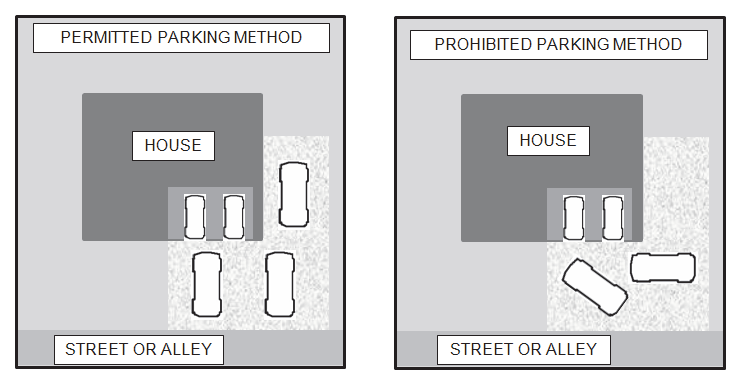
Figure 430.1
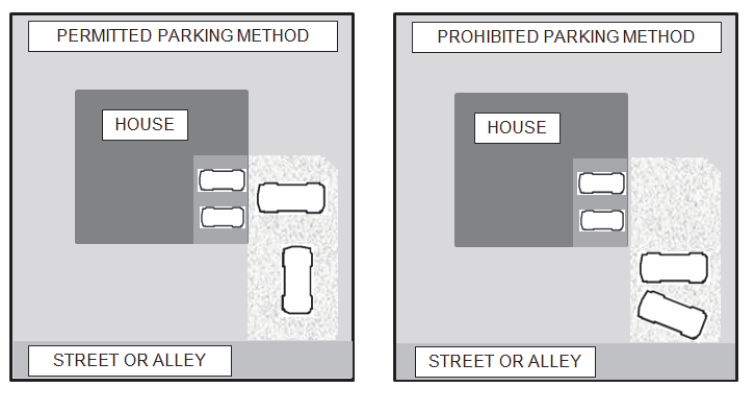
Figure 430.2
(f)
It shall be unlawful to maintain a recreational vehicle, motor home or any type of trailer without proper licensing or in an inoperable condition, as the term inoperable is defined for motor vehicles in Section 38-386, as required by law.
(g)
Recreational vehicles, motor homes or any type of trailer may be towed using the same procedures as for a motor vehicle pursuant to the applicable provisions of this Article X.
(h)
A permit for parking a recreational vehicle, motor home or trailer in the public right-of-way in residential zoning districts, or at home sites in the Manufactured Home Legacy District, may be requested from the city development department for up to four 72-hour periods per calendar year. No permit shall be granted for the parking of any recreational vehicle, motor home, or trailer exceeding either 24 feet in length or 13,000 pounds gross vehicle weight.
(1)
The following conditions of use shall apply to all such permits in all residential and mixed-use zoning districts:
a.
The permit shall be valid only for the specific vehicle and the specific address for which it is granted. Only one such permit shall be allowed for a residence at any time.
b.
When the vehicle is parked, its parking permit shall be displayed in its front or rear window so as to be clearly visible from the street.
c.
The vehicle shall be parked on or adjacent to the property at which the applicant resides.
(2)
An initial application for such parking permit shall be submitted to the city development department and shall include:
a.
The name, address and telephone number of the applicant, which applicant must reside on the subject property and be either the registered owner of the vehicle or otherwise responsible for it.
b.
A statement of approval signed by the management of the manufactured home park where the vehicle is to be parked, if applicable.
c.
The make, model, year of manufacture, color, vehicle identification number, license plate number and a copy of the current vehicle registration.
d.
An application fee as established by resolution of the city council.
(Ord. No. 2512, § 4, 6-22-98; Ord. No. 2554, § 5, 8-9-99; Ord. No. 2739, § 3, 11-12-02; Ord. No. 3165, § 7, 4-12-11; Ord. No. 3275, § 2, 12-17-13; Ord. No. 3281, § 1, 1-14-14; Ord. No. 3508, § 1, 12-18-18; Ord. No. 3745, § 28, 8-26-25)
Sec. 38-440. - Purpose.
(a)
The purpose of this Division 3 is to provide for uniform environmental regulations for the control of noise, humidity and heat, glare, vibration, dust, weeds and brush in recognition that:
(1)
The quality of life in a community is enhanced when free from the nuisances created by these environmental conditions;
(2)
The excessive exposure to these environmental conditions can adversely affect the health and safety of the citizens of the city; and
(3)
The establishment and enforcement of reasonable standards is more effective than waiting until individual citizens have to complain of adverse impacts and therefore contributes to the general welfare of the community.
(4)
The noise regulations contained in Section 38-441 are intended to be comprehensive and shall take precedence over and supersede any existing ordinance, regulation, standard, condition or use restriction the application of which would render Section 38-441 of no force or effect or which is in conflict with it, and supersedes any hours of delivery that are specified in any other ordinance or resolution.
(b)
Any city project that the city manager determines is necessary to maintain or protect public amenities, facilities or infrastructure and thereby promote the public health, safety, and welfare shall be exempt from the environmental regulation contained in Sections 38-441 through 38-444.
(Ord. No. 2550, § 6, 7-12-99; Ord. No. 2766, § 1, 3-25-03; Ord. No. 2953, § 4, 8-8-06)
Sec. 38-441. - Noise disturbances prohibited.
(a)
General provisions.
(1)
It shall be unlawful for any person or entity to knowingly, willfully or recklessly make, permit, cause to be made, or continue any noise from whatever source which noise is projected in such a manner that by its sound level and duration constitutes an unreasonable noise within the city. For purposes of this Section 38-441, code compliance officers and police officers shall apply but need not be limited to applying, the following factors to determine whether a noise constitutes a violation of this section, as follows:
a.
The time of day;
b.
The size of any gathering of persons creating or contributing to the noise;
c.
The presence or absence of noise or sound amplification equipment;
d.
Sound pressure levels measured on a sound level meter of standard design and operation on the A network, which indicate the noise level is in violation of the sound level standards contained in subsection (c), Table A, herein; and
e.
Any other factors tending to show the magnitude and/or disruptive effect of the noise.
(2)
It shall be unlawful for any person or entity to knowingly, willfully, or recklessly cause or permit or to continue any noise when:
a.
The noise is plainly audible at a distance of more than 25 feet from a vehicle in any right-of-way; or
b.
The noise is plainly audible more than 25 feet from its source including, but not limited to, any vehicle within any public place during the hours when businesses are open to the public;
c.
The noise is plainly audible within any public right-of-way more than 25 feet from its source.
Such circumstances and such facts presented shall constitute prima facie evidence and shall be deemed a per-se violation of this section.
(3)
In addition to subsection (a)(1), the following are declared to be noises or sounds which by their sound level and duration disturb, or tend to disturb, the repose of the community and which shall constitute a violation of this subsection (a)(3); provided, however, that the following list is not a limitation of subsection (a)(1) of this section and is not inclusive:
a.
Bells and chimes or any device for the production or reproduction of the sound of bells or chimes operated between the hours of 10:00 p.m. of one day and 7:00 a.m. of the following day and is in violation of the sound level standards contained in subsection (c), Table A herein.
b.
The use or operation of any type of audio or video system, noisemaker or loudspeaker or public address system operated or used on public or private property for any purposes including, but not limited to, vending, advertising, announcements or notifications, or any device used for transmitting music or for giving instructions, talks or lectures to any assembly of persons which results in a noise which is plainly audible across the property line of any property used for residential purposes, unless otherwise permitted by subsection (c)(10) herein.
c.
Any noise that is plainly audible through a common wall, ceiling or floor of a mixed-use building or multi-dwelling building.
d.
Any animal or bird which by frequent or habitual howling, barking, yelping, meowing, squawking, squealing or other noise, creates a plainly audible sound.
e.
Any steam engine, stationary internal combustion engine, air compressor, motorboat, motor vehicle or other power device which is not equipped with a muffler in good working order that is in constant operation and properly maintained and which use is in violation of the sound level standards contained in subsection (c), Table A, except as provided in subsection (b)(7) herein. No such muffler or exhaust system shall be modified or used with a cutoff, bypass, or similar device.
f.
Operating a vehicle that is improperly loaded or so out of repair that it creates noise in excess of the sound level standards contained in subsection (c), Table A, herein.
g.
Operation of a dynamic braking system device that is without a muffler in good working order.
h.
Loading operations:
1.
The loading or unloading operations conducted at anytime, which operations include but are not limited to opening or handling boxes, crates, containers, or other objects within or from a truck or otherwise, in such a manner as to create a noise or sound which is in violation of the sound level standards contained in subsection (c), Table A, herein.
2.
Loading of any garbage, trash or compactor truck or any other similar type vehicle, when:
i.
The loading, unloading or handling is conducted within a zone district which includes residential uses or within 300 feet of any residential home, hotel or motel building,
ii.
Is between the hours of 10:00 p.m. and 7:00 a.m., and
iii.
When such loading or unloading creates noise in violation of the sound level standards contained in subsection (c), Table A, herein.
(4)
Areas around public or private schools, churches or courthouses while such are in use, hospitals, nursing homes, or homes for the aged are especially sensitive to noise. When provided with conspicuous signs displayed on adjacent or surrounding streets, an area containing one of these uses may be declared a quiet zone.
(b)
Exclusions.
(1)
Activities directly connected with the abatement of an emergency, including, but not limited to, construction activities and authorized emergency vehicles when such vehicles are responding to an emergency call or when in pursuit of an actual or a suspected violator of the law or when responding to but not returning from a fire, are excluded from the provisions of this section.
(2)
Bells and chimes or any device for the production or reproduction of the sound of bells or chimes from any church, school, or clock, operated between the hours of 7:00 a.m. and 10:00 p.m., are excluded from the provisions of this section.
(3)
Firework displays, which otherwise comply with this Code, are excluded from the provisions of this section.
(4)
Activated burglar alarms, which otherwise comply with this Code, are excluded from the provisions of this section.
(5)
Operations that create sound related to the care and maintenance of public or private golf course facilities between the hours of 5:30 a.m. and 7:00 p.m., are excluded from the provisions of this section.
(6)
Snow removal equipment operated between the hours of 5:00 a.m. and 9:00 p.m. on any day on which snow has fallen in the prior 24 hours at the location where such equipment is being used are excluded from the provisions of this section. Government operated snow removal equipment is excluded from the provision of this section regardless of the time of day.
(7)
Any power generator providing emergency electrical power at any government owned or operated facility or any hospital or emergency health care facility where the loss of electrical power poses an immediate risk is excluded from the provisions of this section. Any routine testing is also excluded only if such testing is performed between 7:00 a.m. and 7:00 p.m. and conducted in the minimum amount of time designated for routine testing by the manufacturer's guidelines.
(c)
Noise sound level standards.
(1)
Sound pressure levels shall be measured at the approximate location of the property line or, for motor vehicles, at least 25 feet from the motor vehicle, at a height of at least four feet above the immediate surrounding grade, on a sound level meter of standard design and operated on the A network.
(2)
The maximum permissible sound pressure levels of any continuous source of sound is given in subsection (c), Table A, Sound Pressure Level Limits. Sound pressure levels in excess of the limits for the district in which the source is located are considered an unreasonable noise and are prohibited.
Table A. Sound Pressure Level Limits
(3)
The repairing, rebuilding or testing of any type of motor vehicle and the operation of machinery, equipment, pump, air conditioning apparatus or similar mechanical device shall be subject to the maximum permissible sound pressure levels in subsection (c), Table A, for the district in which the source is located.
(4)
The standards in subsection (c), Table A, do not apply to any sources of sound that have their own set of standards in this section.
(5)
Construction activities as defined in Section 38-1 are subject to the following requirements:
a.
Construction activities are prohibited within any zoning district between the hours of 9:00 p.m. and 6:00 a.m. unless specifically authorized in paragraph (5)c or (5)d, below.
b.
Construction activities occurring between 6:00 a.m. and 9:00 p.m. shall comply with the sound pressure level limits for industrial districts given in subsection (c), Table A.
c.
Construction activities in industrial districts are allowed at all times of the day, subject to the sound pressure level limits for that district in subsection (c), Table A .
d.
Construction activities associated with the development of property that has been authorized for administrative review for priority projects in Section 18-38 of the Code, and which are located at least 400 feet from an occupied dwelling unit, may occur at any time of day and shall comply with the sound pressure level limits in subsection (c), Table A.
(6)
Within enclosed places of public entertainment, when individuals are subject to sound levels and exposure durations exceeding those shown in subsection (c), Table B, all feasible administrative or engineering controls shall be utilized to protect against the effects of such noise exposure.
Table B
(7)
It shall be unlawful to operate or permit to be operated on private property or in the public right-of-way any domestic or commercial power equipment unless in compliance with the following standards:
a.
The operation of domestic or commercial power equipment is prohibited between the hours of 9:00 p.m. and 6:00 a.m., unless authorized in paragraph (7)d or (7)e, below.
b.
The operation of any commercial power equipment which exceeds a sound pressure level of 88 dB(A) between the hours of 6:00 a.m. and 9:00 p.m. is prohibited.
c.
The operation of any domestic power equipment which exceeds a sound pressure level of 80 dB(A) between the hours of 6:00 a.m. and 9:00 p.m. is prohibited.
d.
The operation of domestic or commercial power equipment is allowed at all times of the day in industrial districts.
e.
The operation of domestic or commercial power equipment is allowed at all times of the day when associated with the development of property that has been authorized for administrative review for priority projects in Section 18-38 of the Code, when the sound pressure level does not exceed 88 dB(A), and when the operation of the equipment occurs at least 400 feet from an occupied dwelling unit.
(8)
It shall be unlawful for any person to drive or move or for the owner to cause or knowingly permit to be driven or moved any motor vehicle which emits a noise that exceeds the following sound pressure levels:
a.
Eighty dB(A), for any motor vehicle with a manufacturer's gross vehicle weight less than 6,000 pounds or any combination of motor vehicles towed by such a motor vehicle; or
b.
Eighty-eight dB(A), for any motor vehicle with a manufacturer's gross vehicle weight more than 6,000 pounds or any combination of motor vehicles towed by such a motor vehicle; except
c.
These standards shall not apply to vehicles traveling on streets with a posted speed limit greater than 45 miles per hour.
(9)
It shall be unlawful to sound any horn or signal device on any vehicle on any street or highway within the city, except as a danger warning when an emergency exists. It is only lawful to use a horn or signal device as a danger warning for as long as the emergency exists or for a reasonable period of time. Any person using a horn or signal device as a danger warning has the burden of showing that an emergency or crisis did exist.
(10)
It shall be unlawful for any person to install, use or operate on a temporary basis a loudspeaker, any type of sound amplifying device or sound amplifying equipment in a fixed or moveable position or attached to or mounted on any motor vehicle for the purpose of giving instructions, directions, talks, addresses or lectures; or for transmitting music or sound to any person or assemblages of persons for events in areas zoned for commercial use and for government sponsored or co-sponsored special events intended to serve the community or a neighborhood without first obtaining a permit pursuant to this subsection. Permits may also be issued for any type of events permitted or allowed in a city park. Permitted events in city parks shall not create unreasonable noise as described in (a)(1) above, but are exempt from noise level standards contained in subsection (c), Table A.
a.
An applicant shall provide to the city clerk the following information:
1.
Name, address, and telephone number for both the owner and user of the sound amplifying equipment or device;
2.
The license number of the sound truck or other vehicle to be used (if applicable);
3.
A general description of the sound amplifying equipment or device to be used and verification that the applicant has hired a person certified to use noise metering equipment to be present during the event to monitor the sound amplifying equipment to be used to insure compliance with the noise level standards contained in subsection (c), Table A, herein;
4.
A description of the intended purpose or need for use of the sound amplifying equipment or device; and
5.
The dates, times and locations in which the sound amplifying equipment or device will be used.
b.
A permit shall be issued within five business days by the city clerk on condition that the sound amplifying equipment or device will be operated only between the hours of 7:30 a.m. and 10:00 p.m., only on the dates specified and in compliance with the noise level standards contained in subsection (c), Table A, herein.
c.
If the city has probable cause to believe that the applicant has violated any requirements of this subsection (c)(10) or any other City Code provision, the permit shall be automatically revoked by the Thornton police department.
d.
Entities or organizations that are required to obtain a license from the city to operate pursuant to Chapter 42 of the Code are not eligible for a temporary permit under this subsection (c)(10) as operation of any sound amplification equipment will be regulated in connection with the operational license issued by the city.
(Ord. No. 2550, § 6, 7-12-99; Ord. No. 2953, § 5, 8-8-06; Ord. No. 3080, §§ 1, 2, 12-2-08; Ord. No. 3271, § 2, 10-8-13; Ord. No. 3435, § 1, 5-9-17; Ord. No. 3745, § 29, 8-26-25)
Sec. 38-442. - Glare.
(a)
Exterior and interior lighting in all zoning districts shall be designed and installed so that all direct rays are confined to the site on which the lighting is located and so that adjacent residential properties are protected from glare which is deemed to be a public nuisance.
(b)
The installation or erection of any lighting which simulates, imitates or conflicts with warning signals, emergency signals or traffic signals is prohibited.
(Ord. No. 2550, § 6, 7-12-99)
Sec. 38-443. - Dust.
(a)
It shall be unlawful for property owners or lessees of land within the city to allow the blowing of dust from their property when the blowing of dust may or does cause damage to surrounding property or creates a danger to motor vehicle traffic.
(b)
Persons are required to prevent potential damage from blowing dust by watering and wetting down the area, by installing snow fences or other barriers, or by chiseling the ground.
(c)
A property owner or lessee is required to take corrective measures within 24 hours after the date written notification by the city is sent advising that dust blowing from the property is or is likely to cause damage to surrounding properties.
(d)
In the event the property owner or lessee does not take appropriate action, the city shall have the right to:
(1)
Enter the property and take whatever corrective actions are determined to be necessary;
(2)
Assess the property owner or lessee for the actual cost of the dust prevention measures taken, for the purposes of this Section 38-443, property owner shall include any occupant or person in possession of the property; and
(3)
Assess the property owner or lessee for the costs incurred by the city to enforce collection of the costs of the dust prevention measures, including attorney's fees and court costs under the procedure provided in Section 38-453(b).
(Ord. No. 2550, § 6, 7-12-99)
Sec. 38-444. - Weeds and brush.
(a)
It shall be unlawful for a property owner or lessee to permit weeds and brush to grow to a height exceeding eight inches, for the purposes of this Section 38-444, property owner shall include any occupant or person in possession of the property. Excluded from the prohibitions of this subsection (a) are the following:
(1)
In Agricultural Districts, weeds other than noxious weeds shall be controlled for a distance of 100 feet from a property line that adjoins another residential or nonresidential district boundary, or along any street right-of-way;
(2)
In Parks and Open Space Districts, only noxious weeds shall be controlled;
(3)
On lots greater than five acres in size, weeds other than noxious weeds shall be controlled for a distance of 100 feet from the property line of the lot; and
(4)
Noxious weeds shall be kept below eight inches in height regardless of distance to adjacent properties or rights-of-way.
(b)
A property owner or lessee is required to take corrective measures within ten calendar days after the date written notification by the city is sent advising that weeds or brush has become overgrown and that corrective measures shall be taken. The written notification shall contain a description of the property upon which the violation has occurred and will direct the owner or lessee to correct the violation within the time period provided.
(c)
In the event the property owner or lessee does not take appropriate action, the city shall have the right to:
(1)
Enter the property and take whatever corrective actions are determined to be necessary;
(2)
Assess the property owner or lessee for the actual cost of the weed or brush control measures taken; and
(3)
Assess the property owner or lessee for the costs incurred by the city to enforce collection of the costs of the weed or brush control measures, including inspection, attorney's fees and court costs under the procedure provided in Section 38-453(b).
(Ord. No. 2550, § 6, 7-12-99; Ord. No. 3071, § 1, 10-14-08; Ord. No. 3745, § 30, 8-26-25)
Sec. 38-451. - Reserved.
Editor's note— Ord. No. 2953, § 6, adopted August 8, 2006, repealed § 38-451, which pertained to application for relief and derived from Ord. No. 2550, § 6, adopted July 12, 1999.
Sec. 38-452. - Enforcement.
(a)
The city manager is authorized to adopt and promulgate regulations and procedures deemed necessary for the proper and effective enforcement of the environmental standards contained in Division 3 of this Article X. Such rules, regulations and procedures shall be consistent with the provisions and the standards established in Divisions 3 and 4 of this Article X.
(b)
The operation or maintenance of any environmental condition in violation of any provision which causes discomfort or annoyance to reasonable persons of normal sensitiveness or which endangers the comfort, repose, health, or peace of residents in the area shall be deemed and is declared to be a public nuisance and may be subject to abatement by a restraining order or injunction issued by a court of competent jurisdiction.
(c)
Where technical complexity or extraordinary expense makes it unreasonable for the city to maintain the personnel or equipment necessary for making difficult or unusual determinations of code violations relating to performance standards in this article, the city may call in properly qualified experts to make the determination. If expert assistance is used, the city shall:
(1)
Assess the cost of the determination of a violation by an expert against the property owner or lessee responsible for the violation, in addition to other permissible penalties; except
(2)
If no violation is found, costs of the determination shall be paid by the city without assessment against the properties or persons involved.
(d)
Violation of any regulation for noise or glare, except violations where the noise source is a vehicle, shall be cause for summons and complaint to be issued immediately, except in lieu of a summons and complaint a notice to abate the violation may be issued instead. A notice to abate shall:
(1)
Be in writing, signed by the city manager;
(2)
Provide a reasonable amount of time for compliance that is no shorter than 24 hours, or longer than five days;
(3)
Be delivered personally or by certified mail to the owner, occupant, or person in charge or control of the machine, device, building or other premises in violation of this article; or
(4)
If unable to be delivered as provided in subsection (d)(3) of this section, be posted in a conspicuous place on the property in violation;
(5)
State:
a.
"It is hereby declared that failure to reply or to correct the alleged violation to the satisfaction of the city within the time limit set constitutes admission of violation of the terms of the City of Thornton's Environmental Regulations as contained in Article X of Chapter 38 of the Thornton City Code"; and
b.
That upon request by the person to whom the notice is addressed, technical determination by outside experts may be undertaken, and that the cost of this determination shall be added to other permissible penalties, unless no violation exists, in which case the cost of the determination shall be paid by the city.
(e)
Failure to comply with the order so issued and served shall constitute a violation of this Article X.
(f)
Violation of the noise standards in this Article X where the noise source is a motor vehicle shall be cause for a summons and complaint to be issued immediately. Minimum fines for motor vehicle noise violations are as established by council resolution.
(g)
Compliance certification requires that:
(1)
The noise violation can be attributed to faulty or defective equipment;
(2)
The owner has fixed the vehicle prior to the scheduled court appearance;
(3)
The vehicle has been checked for compliance by a designated city compliance officer; and
(4)
The vehicle receives compliance certification.
(Ord. No. 2550, § 6, 7-12-99)
Sec. 38-453. - Assessment policy.
(a)
Purpose. The purpose of this section is to provide for a procedure by which the city can enforce the various environmental concerns addressed by this Article X and to establish a policy authorizing the city to take corrective enforcement measures should a landowner fail to voluntarily comply with the provisions of this Article X.
(b)
Policy.
(1)
Upon the contractor's completing eradication of the violation, a notice of assessment, including the right to a hearing, as set out in subsections (b)(6) and (b)(7) of this section, shall be sent by first class mail, from the city's finance director to the property owner at the address listed for the property owner in the county record and to the property address. If any notice is returned, the property will be posted with such notice.
(2)
For the purpose of this Section 38-453, property owner shall include renters, lessees, occupants or persons in possession of the property.
(3)
The property owner has 30 days from the date the notice of assessment is mailed or if notice is returned, from the date the property is posted to pay the assessment. Failure to pay within the time allotted will cause the assessment to be recorded against the property. The assessment will constitute a continuing lien against such property.
(4)
The amount of the assessment will include, in addition to all contractors' charges, impoundment fees, storage fees, inspection costs, attorneys' fees, court costs, and all other associated costs. The assessment may be paid any time prior to the assessment being turned over to the county treasurer. Payments must be made directly to the city's finance director.
(5)
Unpaid assessments will be filed quarterly with the proper office of the county clerk and recorder's office and annually with the treasury office.
(6)
A property owner may object to such assessment within 30 days from the date the notice of assessment was mailed or if the notice is returned, from the date the property is posted. The objection must be in writing and mailed to and received by the municipal court within the 30-day period. The objection must include a phone number and address of the objecting party, and must state the basis for the objection. Upon receipt of such objection, the city manager will appoint a hearing officer. Such hearing officer will then set a hearing date, which hearing shall be within 30 days from receipt of the objection. Notice of this date will be mailed to the person making the objection. Failure to include an address in the objection will constitute a waiver of the right to file an objection.
(7)
The property owner who requests the hearing will be charged an additional administrative cost, established by resolution of the city council, should the hearing officer find in favor of the city. Failure of such person to attend the hearing at the date and time scheduled shall constitute a waiver of such right to a hearing and a determination of all issues regarding the assessment.
(8)
The hearing officer shall conduct the hearing in an informal manner and shall not be bound by technical rules of evidence. The city shall carry the burden of establishing there was probable cause to cite for a violation and that a violation did occur. The standard of proof shall be by a preponderance of the evidence. A written decision will be prepared at the end of the hearing. This decision will be reached after both the landowner and the city have presented their cases. The decision will be deemed effective three days from the date the decision is mailed to the property owner as provided in subsection (b)(1).
(Ord. No. 2550, § 6, 7-12-99; Ord. No. 2663, § 8, 4-23-01; Ord. No. 3433, § 3, 5-9-17)
Sec. 38-454. - Legislative intent; applicability; declaration of nuisance; definitions.
(a)
Legislative intent. The legislative intent of this division is to:
(1)
Provide for the prompt retrieval of abandoned shopping carts to owners to promote the public health, safety, and welfare, and improve the aesthetic appearance of the city;
(2)
Encourage owners of shopping carts to deter, prevent and mitigate the removal of shopping carts from the premises of retail establishments, and require owners to retrieve any shopping carts that were removed despite these efforts; and
(3)
Mitigate the accumulation of abandoned shopping carts on public and private properties.
(b)
Applicability. This division shall apply to all shopping cart owners that own, possess, control or operate a retail establishment in the city or whose shopping carts become abandoned shopping carts in the city, regardless of whether the owner owns, possesses, or operates a retail establishment in the city.
(c)
Declaration of nuisance. Abandoned shopping carts in the city are detrimental to the public health, safety, and welfare because they can create conditions of blight, obstruct free access to sidewalks, streets, and other rights-of-way, interfere with pedestrian and vehicular traffic on pathways, driveways, and public and private streets, and impede emergency services. For these reasons, abandoned shopping carts are hereby declared to be a public nuisance.
(d)
Definitions. As used in this division, the following terms, phrases, and words shall have the following meanings:
Abandoned shopping cart means a shopping cart that is left unattended, discarded, or abandoned on any public or private property other than the premises of the owner's retail establishment, regardless of whether the shopping cart was removed from the premises with or without the permission of the owner.
Abandoned shopping cart retrieval service means the routine return to owners of abandoned shopping carts.
City manager means the city manager or designee.
Owner means the person, firm, partnership, corporation, association, or other entity that owns or otherwise exercises possession and control over shopping carts for the use of the owner's customers in connection with the management and operation of the owner's retail establishment.
Premises means any building, property, or other area upon which any retail establishment is conducted or operated, including the parking area provided for customers of the retail establishment or the shopping center in which the retail establishment is located.
Retail establishment means any business that offers or provides shopping carts for the use of its customers.
Shopping cart means a basket that is mounted on wheels or a similar device generally used in a retail establishment by a customer for the purpose of transporting goods of any kind whether manually, electrically, or otherwise propelled, including a laundry cart.
(Ord. No. 3690, § 2, 5-28-24)
Sec. 38-455. - Shopping cart abandonment prohibited; owner responsibility; retrieval of shopping carts; administration and enforcement.
(a)
Abandoned shopping carts prohibited. No person shall leave unattended, discard, or abandon a shopping cart on any public or private property other than the premises of the retail establishment of the shopping cart's owner, and no owner shall permit or fail to prevent the same, such that it becomes an abandoned shopping cart within the city.
(b)
Owner responsibility to retrieve shopping carts. Every owner of a retail establishment located within the city shall, when the retail establishment is open to customers, regularly retrieve its shopping carts from the exterior areas of the retail establishment's premises and from the area between the premises and the street pavement within public rights-of-way contiguous with the premises. Such retrieval shall also occur within one hour after each daily closing of the retail establishment or, if the retail establishment is open 24 hours a day, at least twice a day.
(c)
City abandoned shopping cart retrieval service.
(1)
The city may provide an abandoned shopping cart retrieval service to owners of retail establishments located within the city. The city may hire a contractor to return abandoned shopping carts at least once a week directly to the owner's retail establishment. If the retail establishment is part of a chain business, the contractor shall return abandoned shopping carts to the closest location of the chain business's retail establishment in the city.
(2)
The city may require the owner to reimburse the city the cost, on a per cart basis in amount determined reasonable by the city manager, of returning abandoned shopping carts to the owner, but shall not subject the owner to additional fees, except for any recoupment costs the city incurs. The reimbursement shall be due within 30 calendar days of billing and shall accrue interest after the due date. If not paid within 30 calendar days of billing, such amount shall be subject to recoupment by any lawful method, including, but not limited to, the assessment procedures provided in Section 38-453(b), referral to a collections agency, or any other process or action provided by law to recover or collect any amount owing under this subsection.
(3)
Any owner that relies on and reimburses the city for the city's abandoned shopping cart retrieval service in accordance with this subsection shall not be subject to the violations and penalties provided in Section 38-387.
(d)
Owner abandoned shopping cart retrieval service.
(1)
Any owner or group of owners may propose a plan to provide its own abandoned shopping cart retrieval service. The city manager may approve the plan if the city manager finds the proposed abandoned shopping cart retrieval service is comparable to or better than that of the city's or, if the city is not providing its own service, provides for the sufficient return of abandoned shopping carts. The plan shall include measurable standards of success, record keeping and reporting adequate to measure the plan's on-going success, reasonable efforts to include other owners, and provisions to improve the plan or revoke it as appropriate if the city manager determines at any point that the plan is not successful.
(2)
Nothing in this subsection obligates the city manager to approve an owner's abandoned shopping cart retrieval service plan; however, such plans are encouraged and desirable to the extent they are successful and do not unduly compromise the city's abandoned shopping cart retrieval service, including reducing efficiency such that the cost to the city of providing the city's abandoned shopping cart retrieval service becomes unreasonable as determined by the city manager.
(3)
Any owner whose abandoned shopping cart retrieval service plan is approved and implemented pursuant to this subsection shall not be subject to the violations and penalties provided in Section 38-387 as long as the plan remains in effect.
(4)
Notwithstanding any plan approved pursuant to this subsection, nothing in this subsection shall be construed as preventing the city from returning abandoned shopping carts to owners and charging and recouping costs therefor pursuant to subsection (c) of this section.
(e)
Administration and enforcement. This division shall be administered and enforced by the city. The city manager may promulgate and implement standard forms for owner abandoned shopping cart retrieval service plans and rules, regulations, and procedures necessary or appropriate for the administration and enforcement of this division.
(Ord. No. 3690, § 2, 5-28-24)
Sec. 38-491. - Enforcement.
This article shall be enforced in accordance with the provisions of the Model Traffic Code for Colorado Municipalities adopted in Section 38-521.
Sec. 38-492. - Regulation of bicycles approaching intersections.
(a)
A person riding a bicycle or electrical assisted bicycle and approaching an intersection of a roadway with a stop sign shall slow down and, if required for safety, stop before entering the intersection. If a stop is not required for safety, the person shall slow to a reasonable speed and yield the right-of-way to any traffic or pedestrian in or approaching the intersection. After the person has slowed to a reasonable speed and yielded the right-of-way if required, the person may cautiously make a turn or proceed through the intersection without stopping. For purposes of this paragraph, a reasonable speed is 15 miles per hour or less.
(b)
A person riding a bicycle or electrical assisted bicycle and approaching an intersection of a roadway with an illuminated red traffic control signal shall stop before entering the intersection and shall yield to all other traffic and pedestrians. Once the person has yielded, the person may cautiously proceed in the same direction through the intersection or make a right-hand turn. When a red traffic control signal is illuminated, a person shall not proceed through the intersection or turn right if an oncoming vehicle is turning or preparing to turn left in front of the person.
(c)
A person riding a bicycle or electrical assisted bicycle approaching an intersection of a roadway with an illuminated red traffic control signal may make a left-hand turn only if turning onto a one-way street and only after stopping and yielding to other traffic and pedestrians. However, a person shall not turn left if a vehicle is traveling in the same direction as the person and the vehicle is turning or preparing to turn left. If the person is not turning left onto a one-way street, the person shall not make a left-hand turn at an intersection while a red traffic control signal is illuminated.
(d)
As used in this section, "electrical assisted bicycle" means the term as it is defined in Section 38-641 of the Thornton City Code.
(e)
This section is intended to solely govern the regulation of bicycles and electrical assisted bicycles approaching intersections. All other provisions of the Thornton City Code or the Model Traffic Code, as adopted by the city in Section 38-521 of the Thornton City Code, related to bicycles and electrical assisted bicycles remain in full force and effect.
(f)
Any person who violates the provisions of this section, upon conviction thereof, shall be punished as provided in Section 1-8 of the Thornton City Code.
(Ord. No. 3516, § 1, 2-12-19)
Sec. 38-493. - Shortcut to avoid traffic signal or stop sign.
(a)
It is unlawful for any person to drive a motor vehicle from a public street or public way of this city over, across or through any private property or driveway to avoid a traffic control signal, stop sign or other traffic control device, or as a route or shortcut from one public street or public way to another.
(b)
As used in subsection (a) of this section, private property includes but is not limited to any property not dedicated as a public street or public way, alley, right-of-way or easement.
(c)
It shall be an affirmative defense to a charge of violation of subsection (a) of this section that the person charged is the owner of the property or driveway through or across which the motor vehicle is driven or of leasehold or easement rights therein, or of the right to the possession thereof. Also, an affirmative offense shall be if the person charged is able to establish by competent evidence that such person stopped the vehicle on the private property and sought or obtained goods or services from the property.
(Code 1975, § 35-6; Ord. No. 719, 6-14-76)
Sec. 38-493.5. - Unlawful parking of vehicles on public or private property.
It shall be unlawful for any person to park or stand a vehicle, whether occupied or not (except for the purpose of, and while actually engaged in, loading or unloading), in a private driveway, apartment complex parking lot, condominium complex parking lot, business parking lot or a public or private school parking lot, or other real property, public or private, without the express or implied consent of the owner, manager or person in lawful possession or control of such property.
(Ord. No. 2410, § 3 (35-6.1), 3-18-96)
Editor's note— Section 3 (35-6.1) of Ord. No. 2410, adopted Mar. 18, 1996, has been included herein as § 38-493.5 at the editor's discretion.
Sec. 38-494. - Sale of food from vehicles prohibited.
It shall be unlawful to sell or offer for sale any candy, ice cream, confection or any food or beverage for human consumption from any motor vehicle or any vehicle or cart of any kind on any public street or sidewalk in the city, except as provided for in Sections 42-601 through 42613 and 42-801 through 42-805 of the City Code and except in the TOD or MU zoning districts, and in the PD-L or PD-O zoning districts if specifically provided for in the PD-L or PD-O standards. There shall be specifically excluded from the effect of this section delivery trucks delivering milk, bread and other products for human consumption.
(Code 1975, § 35-7; Ord. No. 2317, § 2, 5-9-94; Ord. No. 2432, § 2, 8-26-96; Ord. No. 3144, § 52, 9-14-10; Ord. No. 3594, § 1, 8-24-21; Ord. No. 3745, § 31, 8-26-25)
Sec. 38-495. - All-way stops on residential streets.
(a)
Additional criteria for establishing. In addition to criteria established in Section 2B-6 of the Manual on Uniform Traffic Control Devices, the traffic engineer or official vested with responsibility for traffic control of this city may install all-way stops on residential streets when warranted after the performance of a point assessment study based upon the criteria established in this section.
(b)
Point criteria. A point assessment study shall be performed by the traffic engineer or other official charged with the responsibility for traffic control at the intersection of the proposed all-way stop and the total of all points assessed will be compared with 500 points. If the intersection under study exceeds 500 points and is a residential or residential minor collector, the intersection has met the established criteria for the installation of an all-way stop. The points shall be assessed based upon the following standards:
(1)
Street classification. The installation of all-way stops pursuant to this section shall be used only on streets classified by the traffic engineer or official vested with responsibility for traffic control as local residential or minor collectors in residential areas.
(2)
Eighty-five-percent vehicle speed. Points will be assessed as follows based upon the highest average daily vehicle speed of 85 percent of all vehicle approaches of the intersection within a 24-hour period:
(3)
School pedestrians. At those school pedestrian crossing locations where there is no traffic signal or adult pedestrian crossing guard assigned by the school, points will be assessed during the morning or afternoon hour of highest pedestrian traffic:
Points will also be assessed for pedestrian crosswalks at intersections in close proximity to schools. The primary crossing shall be assessed 200 points and other adjacent crossings shall be assessed 100 points.
Prior to the investigation for installation of all-way stop signs in close proximity to an elementary school, a pedestrian walk route plan shall be developed by the traffic engineer or other official charged with traffic control and reviewed by the school and parent/teacher organization prior to distribution by the school.
(4)
School age pedestrians' midday periods at nonschool locations. Points will be assessed for the average midday hour of pedestrian traffic at nonschool locations as follows:
Fifty points will be assessed for each pedestrian with a physical, visual or auditory disability. Physical disability shall mean those pedestrians utilizing wheelchairs, canes, crutches or other aids, or who walk at a speed of less than three feet per second.
(5)
Intersection accident history. Based upon police department accident reports within the 12 months immediately preceding the point assessment study, each right angle collision and vehicle/pedestrian accident that occurred at that intersection shall be assessed 75 points. All other vehicle/vehicle accidents during that time period at that location shall each be assessed 20 points.
(6)
Critical approach speed. Based upon the Critical Approach Speed Chart (CAS), of the Traffic Engineering Handbook, from the Institute of Transportation Engineers, 1965 edition, points will be assessed for the lowest CAS of approaching traffic. The CAS measures the sight distance for crossing intersecting streets and points shall be assessed as follows:
(7)
Other potential hazards or conflicts. Points will be assessed as follows for the presence of one or more of the following conflicts or hazards at the intersection:
(8)
Public facilities. Twenty-five points shall be assessed for each public facility such as a church, park, pool, bus stop, library, shopping center, or day care facility with ten or more children that is located within 300 feet of the intersection.
(9)
Special concerns. Points shall be assessed for each of the following concerns located at the intersection:
(10)
Traffic volume. Points shall be assessed for the average hour of the highest eight hourly traffic volumes with one point for each vehicle. However if the average of the minor leg hourly volume is less than 160 vehicles per hour, the point assessment is reduced by the following:
120—159 vehicles/hour, subtract 50 points.
119—100 vehicles/hour, subtract 100 points.
99—75 vehicles/hour, subtract 120 points.
74—zero vehicles/hour, subtract 150 points.
(11)
Adjacent traffic control. If the intersection is within 800 feet of another intersection controlled by an all-way stop or traffic signal, 100 points shall be subtracted from the point assessment. If any adjacent intersection controlled by a stop or yield sign on the major street of the intersection is within 800 feet of the intersection that is the subject of the point assessment study, 50 points shall be subtracted from the point assessment. If the intersection is adjacent to a school, no points are to be subtracted regardless of the criteria in this subsection.
(c)
Point evaluation. If the total of all of the points assessed during the point assessment study performed based upon the criteria established in subsection (b) of this section is equal to or more than 500 points and the intersection is a residential street or a residential minor collector, the traffic engineer or other official charged with the responsibility for traffic control may install an all-way stop at that intersection.
(Code 1975, §§ 35-37—35-39; Ord. No. 2369, § 2, 4-10-95; Ord. No. 2522, § 3, 10-12-98)
State Law reference— Authority to provide for stop streets, C.R.S. § 42-4-111(1)(f).
Sec. 38-496. - Special traffic circumstances warrant.
(a)
In addition to criteria established in Section 4C of the Manual on Uniform Traffic Control Devices, the traffic engineer an official vested with responsibility for traffic control of this city may install a traffic control signal based on the criteria established in this section.
(b)
At the city's discretion a traffic control signal may be installed at the intersection of two streets if all of the following are met:
(1)
Based on a traffic engineering study, the available average gap on an arterial street is less than four seconds for any two hours of a 24-hour period; and
(2)
Vehicular traffic has direct or indirect access to only one arterial street; and
(3)
The installation of the proposed traffic control signal will not negatively impact the traffic signal coordination of the arterial street or the traffic signal system of adjacent streets that are coordinated with the arterial street.
(Ord. No. 2719, § 1, 7-10-02)
Sec. 38-497. - Puffing prohibited.
(a)
A person driving or in charge of a motor vehicle shall not leave a motor vehicle unattended while the key is in the ignition and the motor vehicle's engine is on.
(b)
The use or operation of a remote starter system and adequate security measures shall be an affirmative defense to subsection (a).
(c)
This section shall apply to all public and private property within the City limits.
(d)
Any person who violates any provisions of this section commits a class B traffic infraction.
(e)
As used in this section:
(1)
"Adequate security measures" includes, but is not limited to:
a.
Using a vehicle that requires a key to put the vehicle into gear and move the vehicle;
b.
Keeping a keyless start fob out of proximity of the vehicle; or
c.
Employing steering wheel security devices.
(2)
"Remote starter system" means a device installed in a motor vehicle that allows the engine of the vehicle to be started by remote or radio control.
(Ord. No. 3551, § 1, 2-11-20)
Sec. 38-521. - Adoption.
Pursuant to Parts 1 and 2 of Article 16 of Title 31, C.R.S., as amended, there is hereby adopted by this reference Article I and II, inclusive of the 2020 Edition of the Model Traffic Code for Colorado Municipalities, promulgated and published as such by the Colorado Department of Transportation, Colorado, of which three copies are now filed in the office of the city clerk of the city of Thornton, Colorado, and may be inspected during regular business hours, the same being adopted as if set out fully herein, except for those sections amended or deleted as provided in Section 38-523 of this Chapter 38, Article XII.
(Code 1975, § 35-1; Ord. No. 783, 12-12-77; Ord. No. 1624, 12-8-86; Ord. No. 2298, § 1, 12-7-93; Ord. No. 2426, § 1, 7-22-96; Ord. No. 2789, § 1, 8-12-03; Ord. No. 3139, § 1, 7-27-10; Ord. No. 3622, § 1, 5-10-22)
Charter reference— Adoption by reference, § 8.10.
Cross reference— Adoption by reference authorized, § 2-55.
State Law reference— Adoption by reference, C.R.S. § 31-16-201 et seq.
Sec. 38-522. - Reserved.
Editor's note— Ord. No. 3139, § 2, adopted July 27, 2010, repealed § 38-522 which pertained to violations and penalties and derived from § 35-3 of the 1975 Code; Ord. No. 783, adopted Dec. 12, 1977; Ord. No. 1059, adopted Sept. 14, 1981; Ord. No. 1490, adopted Nov. 12, 1985; Ord. No. 1520, adopted Dec. 16, 1985; Ord. No. 1934, adopted Jan. 8, 1990; Ord. No. 2272, §§ 2, 3, adopted July 26, 1993; Ord. No. 2298, § 2, adopted Dec. 7, 1993; Ord. No. 2327, § 2, adopted July 11, 1994; Ord. No. 2426, § 3, adopted July 22, 1996; Ord. No. 2522, § 4, adopted Dec. 12, 1998; Ord. No. 2633, § 2, adopted Sept. 25, 2000; and Ord. No. 2972, § 1, adopted Nov. 28, 2006.
Sec. 38-523. - Additions and modifications.
The 2020 Edition of the Model Traffic Code for Colorado Municipalities as adopted in Section 38-521 is subject to the following additions, deletions, and modifications.
A.
Section 101 is hereby repealed.
B.
Section 102 is hereby repealed.
C.
Section 103 is hereby amended to read as follows:
103. Scope and effect of Model Traffic Code - exceptions to provisions.
(1)
This Model Traffic Code constitutes the model traffic code throughout the City of Thornton (city) and for purposes of Sections 38-521 and 38-523 any reference to "code" throughout such sections shall mean the 2020 Edition of the Model Traffic Code for Colorado municipalities (MTC).
(2)
The provisions of this code relating to the operation of vehicle and the movement of pedestrians refer exclusively to the use of streets and highways except:
(a)
Where a different place is specifically referred to in a given section; or
(b)
Where a different place is designated by ordinance or regulation of this city.
D.
Section 106 is hereby repealed and enacted to read as follows:
106. Who may restrict right to use highways.
(1)
Local authorities with respect to highways under their jurisdiction may prohibit the operation of vehicles upon any such highway or impose restrictions as to the weight of vehicles to be operated upon any such highway, for a total period of not to exceed 90 days in any one calendar year, whenever any said highway by reason of deterioration, rain, snow, or other climatic conditions will be seriously damaged or destroyed unless the use of vehicles thereon is prohibited or the permissible weights thereof reduced.
(2)
After enacting any such ordinance, signs designating the permissible weights shall be erected and maintained.
(3)
This local government, with respect to highways under its jurisdiction, may also prohibit the operation of trucks or other commercial vehicles on designated highways or may impose limitations as to the weight thereof, which prohibitions and limitations shall be designated by appropriate signs placed on such highways.
(4)
Any temporary closing of the street which is a state highway and any rerouting of state highway traffic shall have the approval of the department before such closing becomes effective.
E.
Section 109.5 is hereby repealed and enacted to read as follows:
109.5. Low-speed electric vehicles.
(1)
(a)
A low-speed electric vehicle may be operated only on a roadway that has a speed limit equal to or less than 35 miles per hour; except that it may be operated to directly cross a roadway that has a speed limit greater than 35 miles per hour at an at-grade crossing to continue traveling along a roadway with a speed limit equal to or less than 35 miles per hour.
(b)
Notwithstanding paragraph (a) of this Subsection (1), a low-speed electric vehicle may be operated on a state highway that has a speed limit equal to 40 miles per hour or cross a roadway with a speed limit equal to 40 miles per hour to cross at-grade, if:
(I)
Such roadway's lane width is 11 feet or greater;
(II)
Such roadway provides two or more lanes in either direction; and
(III)
The Colorado department of transportation has determined, in consultation with local government and law enforcement, upon the basis of a traffic investigation, survey, appropriate design standards, or projected volumes, that the operation of a low-speed electric vehicle on the roadway poses no substantial safety risk or hazard to motorists, bicyclists, pedestrians, or other persons.
(2)
No person shall operate a low-speed electric vehicle on a limited-access highway.
(3)
No person shall drive a low-speed vehicle with greater than two wheels on any sidewalk, public trail, or designated public walkway within the city unless authorized by the traffic engineer.
(4)
Low-speed electric vehicles operating on the streets of the city shall be subject to all the duties and penalties applicable to operators of motor vehicles prescribed in the MTC, as adopted in the city code.
(5)
Any person who violates subsection (1) or (2) of this section commits a class B traffic infraction.
F.
Section 109.6 is hereby repealed and enacted to read as follows:
109.6. Class B low-speed electric vehicles - effective date - rules.
(1)
A class B low-speed electric vehicle may be operated only on a roadway that has a speed limit equal to or less than 45 miles per hour; except that it may be operated to directly cross a roadway that has a speed limit greater than 45 miles per hour at an at-grade crossing to continue traveling along a roadway with a speed limit equal to or less than 45 miles per hour.
(2)
No person shall operate a class B low speed electric vehicle on a limited-access highway.
(3)
No person shall drive a class B low speed vehicle on any sidewalk, public trail, or designated public walkway within the city.
(4)
Any person who violates subsection (1) or (2) of this section commits a class B traffic infraction.
(5)
For the purposes of this section, "class B low-speed electric vehicle" means a low-speed electric vehicle that is capable of traveling at greater than 25 miles per hour but less than 45 miles per hour.
G.
Subsection 111(2)(a) is hereby amended to read as follows:
111. Powers of Local Authorities.
(2)(a) An ordinance or regulation enacted under paragraph (a), (b), (e), (f), (g), (i), (j), (k), (l), (m), (n ), (o), (p), (q), (r ), (v), (x), (y), or (aa) of subsection (1) of this section may not take effect until official signs or other traffic control devices conforming to standards as required by Section 42-4-602, C.R.S., and giving notice of the local traffic regulations are placed upon or at the entrances to the highway or part thereof affected as may be most appropriate.
H.
Section 114 is hereby repealed and reenacted to read as follows:
114. Removal of traffic hazards.
(1)
The owner of real property abutting or on the right-of-way of any highway, sidewalk, or other public way shall trim or remove, at the expense of said property owner, any tree limb or any shrub, vine, hedge, or other plant which projects beyond the property line of such owner onto or over the public right-of-way and thereby obstructs the view of traffic, obscures any traffic control device, or otherwise constitutes a hazard to drivers or pedestrians.
(2)
The property owner shall remove any dead, overhanging boughs of trees located on the premises of such property owner that endanger life or property on the public right-of-way upon notice from the city.
(3)
In the event that any property owner fails or neglects to trim or remove any such tree limb or any such shrub, vine, hedge, or other plant within 10 days after receiving written notice from the city to do so, the city may do or cause to be done the necessary work incident thereto, and said property owner shall reimburse the city for the costs of the work performed.
(4)
It shall be unlawful for the owner of real property to refuse or fail to remove any tree limb or any shrub, vine, hedge, or other plant which projects beyond the property line of such owner onto or over the public right-of-way and thereby obstructs the view of traffic, obscures any traffic control device, or otherwise constitutes a hazard to drivers or pedestrians.
(5)
Any person found in violation of this Section 114 shall be subject to a penalty pursuant to Section 1-8(a). All remedies hereby are declared to be cumulative.
I.
Section 117 is hereby repealed.
J.
A new Section 118 is hereby enacted to read as follows:
118. Office of the Traffic Engineer.
(1)
The office of the traffic engineer is hereby established. The traffic engineer shall exercise the powers and duties provided in this code.
(2)
In the absence of a traffic engineer or at such times as the traffic engineer may be temporarily absent from the municipality or unable to perform duties, said duties shall be vested in the executive director of infrastructure or other municipal official as determined and authorized by the city manager.
K.
A new Section 118.5 is hereby enacted to read as follows:
118.5. Duties and powers of traffic engineer or other designated traffic official.
(1)
It shall be the general duty of the traffic engineer or other official vested with the responsibility for traffic as provided herein, to determine the proper location for; cause installation or removal (if necessary) of; and provide for the proper timing and maintenance of all official traffic control devices located within the city. The traffic engineer is also responsible for conducting analyses of traffic accidents and to devise remedial or corrective measures, to conduct investigation of traffic conditions, to plan the operation of traffic on the streets and highways of the city, to cooperate with other municipal officials in the development of ways and means to improve traffic conditions, and to perform such additional duties as are necessary to carry out the responsibilities for traffic control and operation in the city.
(2)
The traffic engineer's determination should be made in accordance with those traffic engineering and safety standards and instructions set forth in the most current edition of the Manual on Uniform Traffic Control Devices as adopted by the Colorado Department of Transportation and as adopted by the United States Department of Transportation Federal Highway Administration (Manual) as a standard for application on all classes of streets and highways. The traffic engineer may develop a revised warrant condition to meet a special traffic circumstance so long as the revised warrant condition meets sound engineering judgment and adoption by city council. A Special Traffic Circumstance is defined as a circumstance where applying the Manual warrant requirements do not adequately meet the city's needs and/or safety requirements.
(3)
The traffic engineer may test traffic control devices under actual traffic conditions and conduct research and tests on new traffic control devices not presently included in the Manual. Such devices are not to remain in force beyond a period of 120 days on an experimental basis, with the exception of devices being tested for durability.
(4)
The traffic engineer shall have the authority and duty to set standards and establish procedures for issuing temporary and/or special permits for street or alley closures;, curb loading operations; construction sites and maintenance locations; parking restrictions for the movement of vehicles for parades, processions, or other similar restrictions; or curb or street markings on or relating to the uses of streets and rights-of-way which would constitute a hazard to life or property within the city.
(a)
The traffic engineer shall also have the authority to set appropriate fees to be charged for the issuance of such permit, to be established by resolution and adopted by council.
(b)
The traffic engineer, or designee, shall have the authority to reduce or waive such fees after adopting written guidelines for the granting of such reduction or waiver.
(5)
No person, public utility, or department of this city shall erect or place any barrier or sign on any street or public right-of-way of the city for any purpose, unless of a type approved by the traffic engineer or in accordance with any permit issued by the traffic engineer.
(6)
All barricading and traffic control in public rights-of-way or on public streets of the city, for any type of restriction, shall be done so in accordance with standards and procedures as established and as stated in any permit issued by the traffic engineer.
(7)
Where barricades are erected to close off a part or all of a street or highway within the city, under conditions of an approved permit authorized by the traffic engineer, it shall be unlawful for a person to drive around, through, or between such barricades or barricaded area except as directed by a police officer or other such authorized person.
L.
A new Section 119 is hereby enacted to read as follows:
119. Official traffic control records. The traffic engineer shall keep records of all the streets or area open to the public where traffic regulations have been authorized and signs posted. Said record shall include schedules of streets or areas open to the public where the following regulations and controls have been authorized by the traffic engineer:
(1)
Speed limits modified pursuant to Sections 1101 and 1102;
(2)
Weight limitations imposed on streets;
(3)
Fire lane designations on private property;
(4)
Handicap parking designations on private property;
(5)
Speed limit enforcement in mobile home parks; and
(6)
Traffic and vehicle enforcement on private streets, pursuant to Section 38-615 of the code, in residential communities.
The traffic control schedules shall be updated annually and authenticated by the city clerk and traffic engineer. Said copies of the traffic control schedules shall be available for inspection during business hours in the office of the city clerk, municipal court clerk's office, and the traffic engineer's office.
M.
Subsection 201(3) is hereby amended to read as follows:
Section 201. Obstruction of view or driving mechanism - hazardous situation.
(3)
A person shall not drive a motor vehicle equipped with a video display visible to the driver while the motor vehicle is in motion. This subsection (3) does not prohibit the usage of a computer, data terminal, or safety equipment in a motor vehicle so long as the computer, data terminal, or safety equipment is not used to display visual entertainment, including internet browsing, social media, and/or e-mail to the driver while the motor vehicle is in motion.
N.
Subsection 202(1) is hereby amended and new Subsections 202(5) and (6) are hereby enacted to read as follows:
202. Unsafe vehicles—Penalty.
(1)
It is unlawful for any person to drive or move or for the owner to cause or knowingly permit to be driven or moved on any highway any vehicle or combination of vehicles which is in such unsafe condition as to endanger any person or property, or which does not contain those parts or is not at all times equipped with such lamps and other equipment in proper condition and adjustment as required in this section and 204 to 231 and Part 3 of this code, or which is equipped in any manner in violation of said sections and Part 3 or for any person to do any act forbidden or fail to perform any act required under said sections and Part 3.
(5)
Exhaust fumes which may reach vehicles' passenger compartments create a danger to occupants of such a vehicle and to other persons on or about the streets and highways as a result of the possibility of these exhaust gases affecting the driver of any such vehicle. Exhaust systems which do not expel exhaust gases to the side, top, or rear of a vehicle render a vehicle unsafe to operate and constitutes a violation of this section.
(6)
Vehicles which do not have fenders installed sufficient to prevent road debris from being thrown by the tires in the direction of drivers and passengers of such vehicles are unsafe to operate.
O.
Section 203 is hereby repealed.
P.
Subsections 205(1), (2), and (3) are hereby amended to read as follows:
205. Head lamps on motor vehicles.
(1)
Every motor vehicle other than a motorcycle or a low-powered scooter shall be equipped with at least two head lamps with at least one on each side of the front of the motor vehicle, which head lamps shall comply with the requirements and limitations set forth in sections 202 and 204 to 231 and part 3 of this code where applicable.
(2)
Every motorcycle and low-powered scooter shall be equipped with at least one and not more than two head lamps that shall comply with the requirements and limitations of sections 202 and 204 to 231 and part 3 of this code where applicable.
(3)
Every head lamp upon every motor vehicle, including every motorcycle and low-powered scooter, shall be located at a height measured from the center of the head lamp of not more than 54 inches nor less than 24 inches, to be measured as set forth in Section 204(3).
Q.
Subsection 225(3) is hereby amended to read as follows:
225. Mufflers - prevention of noise.
(3)
Any person who violates subsection (1) of this section commits a class B traffic infraction.
R.
Subsection 229(4) is hereby amended to read as follows:
229. Safety glazing material in motor vehicles.
(4)
No person shall operate a motor vehicle on any highway within this state unless such vehicle is equipped with a front windshield as provided in this section, except as provided in 232(1) and except for motor vehicles registered as collectors' items pursuant to state law.
S.
A new Subsection 235 is hereby enacted to read as follows:
235. Minimum standards for commercial vehicles - spot inspections.
(1)
A police officer or sheriff's officer may, at any time, require the driver of any commercial vehicle, as defined in Section 42-4-235, C.R.S., to stop so that the officer or deputy may inspect the vehicle and all required documents for compliance with the rules and regulations promulgated by the chief of the Colorado State Patrol.
(2)
A police officer or sheriff's officer may immobilize, impound, or otherwise direct the disposition of a commercial vehicle when it is determined that the motor vehicle or operation thereof is unsafe and when such immobilization impoundment, or disposition is appropriate under the rules and regulations promulgated by the chief of the Colorado State Patrol.
(3)
Any person, as defined in Section 42-1-102(69), C.R.S., who violates subsection (2) of this section commits a traffic offense.
T.
Section 236 is hereby repealed and reenacted, to read as follows:
236. Child restraint systems required - definitions - exemptions.
(1)
As used in this section, unless the context otherwise requires:
(a)
"Child care center" means a facility required to be licensed under the "Child Care Licensing Act," Code 6 of Title 26, C.R.S.
(a.5)
"Child restraint system" means a specially designed seating system that is designed to protect, hold, or restrain a child in a motor vehicle in such a way as to prevent or minimize injury to the child in the event of a motor vehicle accident that is either permanently affixed to a motor vehicle or is affixed to such vehicle by a safety belt or a universal attachment system, and that meets the federal motor vehicle safety standards set forth in Section 49 CFR 571.213, as amended.
(a.8)
"Motor vehicle" means a passenger car; a pickup truck; or a van, minivan, or sport utility vehicle with a gross vehicle weight rating of less than 10,000 pounds. Motor vehicle does not include motorcycles, low-power scooters, motorscooters, motorbicycles, motorized bicycles, and farm tractors and implements of husbandry designed primarily or exclusively for use in agricultural operations.
(b)
"Safety belt" means a lap belt, a shoulder belt, or any other belt or combination of belts installed in a motor vehicle to restrain drivers and passengers, except any such belt that is physically a part of a child restraint system. Safety belt includes the anchorages, the buckles, and all other equipment directly related to the operation of safety belts. Proper use of a safety belt means the shoulder belt, if present, crosses the shoulder and chest and the lap belt crosses the hips, touching the thighs.
(c)
"Seating position" means any motor vehicle interior space intended by the motor vehicle manufacturer to provide seating accommodation while the motor vehicle is in motion.
(2)
(a)
(I) Unless exempted pursuant to subsection (3) of this section and except as otherwise provided in subparagraphs (II) and (III) of this paragraph (a), every child, who is under eight years of age and who is being transported in this state in a motor vehicle or in a vehicle operated by a child care center, shall be properly restrained in a child restraint system, according to the manufacturer's instructions.
(II)
If the child is less than one year of age and weighs less than 20 pounds, the child shall be properly restrained in a rear-facing child restraint system in a rear seat of the vehicle.
(III)
If the child is one year of age or older, but less than four years of age, and weighs less than 40 pounds, but at least 20 pounds, the child shall be properly restrained in a rear-facing or forward-facing child restraint system.
(b)
Unless excepted pursuant to subsection (3) of this section, every child, who is at least eight years of age but less than 16 years of age who is being transported in this state in a motor vehicle or in a vehicle operated by a child care center, shall be properly restrained in a safety belt or child restraint system according to the manufacturer's instructions.
(c)
If a parent is in the motor vehicle, it is the responsibility of the parent to ensure that his or her child or children are provided with and they properly use a child restraint system or safety belt system. If a parent is not in the motor vehicle, it is the responsibility of the driver transporting a child or children, subject to the requirements of this section, to ensure that such children are provided with and that they properly use a child restraint system or safety belt system.
(3)
Except as provided in Section 42-2-105.5(4) C.R.S., the requirements of Subsection (2) of this section do not apply to a child who:
(a)
Is less than eight years of age and is being transported in a motor vehicle as a result of a medical or other life-threatening emergency and a child restraint system is not available;
(b)
Is being transported in a commercial motor vehicle, as defined in state law, that is operated by a child care center;
(c)
Is the driver of a motor vehicle and is subject to the safety belt requirements provided in Section 237;
(d)
[Reserved];
(e)
Is being transported in a motor vehicle that is operated in the business of transporting persons for compensation or hire by or on behalf of a motor vehicle carrier, a contract carrier by motor vehicle, or an operator of a luxury limousine service, as such terms are defined in applicable state law.
(4)
No person shall use a safety belt or child restraint system, whichever is applicable under the provisions of this section, for children under 16 years of age in a motor vehicle unless it conforms to all applicable federal motor vehicle safety standards.
(5)
Any violation of this section shall not constitute negligence per se or contributory negligence per se.
(6)
(a)
Except as otherwise provided in paragraph (b) of this subsection (6), any person who violates any provision of this section commits a class B traffic infraction.
(b)
A minor driver under 18 years of age who violates this section commits a class A traffic infraction.
(7)
The fine may be waived if the defendant presents the court with satisfactory evidence of proof of the acquisition, purchase, or rental of a child restraint system by the time of the court appearance. Court costs may be waived if a violation of this Section 236 is the only charge on the summons.
(8)
Any person who violates any provision of this section commits a traffic infraction and will be subject to enhanced penalties as set forth in the Thornton municipal court fine schedule.
U.
Subsection 237(1)(a) is hereby repealed and reenacted, subsections (4)(a) and (4)(b) are hereby amended to read as follows:
237. Safety belt systems - mandatory use - exemptions - penalty.
(1)
(a)
"Motor vehicle" means any self-propelled vehicle which is designed primarily for travel on the public highways and which is generally and commonly used to transport persons and property over the pubic highways or low-speed electric vehicles, except that the term does not include low-power scooters, wheelchairs, vehicles moved solely by human power, and farm tractors and implements of husbandry designed primarily or exclusively for use in agricultural operations.
(4)
(a)
Except as otherwise provided in paragraph (b) of this subsection (4), any person who operates a motor vehicle while such person or any passenger is in violation of the requirement of subsection (2) of this section commits a class B traffic infraction.
(b)
A minor driver under 18 years of age who violates this section commits a class A traffic infraction.
V.
Subsection 239(5)(a) is hereby amended and subsection (5)(b) is hereby repealed to read as follows:
239. Misuse of a wireless telephone - definitions - penalty - preemption.
(5)
A person who operates a motor vehicle in violation of subsection (2) or (3) of this section commits a class A traffic infraction.
W.
A new Section 241 is hereby enacted to read as follows:
241. Mechanical failure; no defense.
The driver of a vehicle has a responsibility to the public to guarantee the vehicle is at all times in proper mechanical condition so the driver is able to steer, start, proceed, stop, signal, see and be seen properly, and otherwise to comply with the traffic laws. Consequently, mechanical failure, however unexpected, is no defense to a charge of violation of this code except insofar as it serves to negate a reckless, knowing or intentional mental state where such is an element of the violation.
X.
Section 501 is hereby repealed and reenacted to read as follows:
501. Size and weight violations—Penalty.
(1)
Except as provided in Section 509, it is unlawful for any person to drive or move or for the owner of a vehicle to cause or knowingly permit to be driven or moved on any street or highway any vehicle or vehicles of a size or weight exceeding the limitations stated in Sections 502 to 512 or otherwise in violation of said sections or Section 1407, except as permitted in Section 510. Weight limits on municipal streets that are different than those stated in Sections 502 to 512 shall be approved by the traffic engineer and placed in the Traffic Control Records pursuant to Section 114. Official signs shall be erected giving notice of the vehicle weight limitation. When such official signs are erected, it is unlawful for any person to drive or move or for the owner of vehicle to cause or knowingly permit to be driven or moved on any street or highway any vehicle or vehicles of a weight exceeding the limits stated on such official signs without a permit issued pursuant to Section 510.
(2)
The provisions of this article governing size, weight, and load shall not apply to fire apparatus or to implements of husbandry temporarily moved upon a highway or to vehicles such as mobile machinery and self-propelled construction equipment operated under the terms of a special permit issued as provided in Section 510.
Y.
Section 508 is hereby amended to delete subsection (a) and amend subsections (b) and (c), and to enact subsection (d) as follows:
508. Gross weight of vehicles and loads.
(1)
Except as provided in subsection (1.5) of this section, a person shall not move or operate a vehicle or combination of vehicles on any highway or bridge when the gross weight upon any one axle of a vehicle exceeds the limits prescribed in Section 42-4-507.
(a)
Subject to the limitations prescribed in Section 507, the maximum gross weight of any vehicle or combination of vehicles shall not exceed that determined by the formula W = 1,000 (L + 40), where W represents the gross weight in pounds, and L represents the length in feet between the centers of the first and last axles of such vehicle or combination of vehicles, except that in computation of this formula, the gross vehicle weight must not exceed 85,000 pounds. For the purposes of this section, where a combination of vehicles is used, vehicle must not carry a gross weight of less than 10 percent of the overall gross weight of the combination of vehicles; except that these limitations shall not apply to specialized trailers of fixed public utilities whose axles may carry less than 10 percent of the weight of the combination. The limitations provided in this section must be strictly construed and enforced.
(b)
Notwithstanding any other provisions of this section, except as may be authorized under section 510, a person shall not move or operate a vehicle or combination of vehicles on any highway or bridge that is part of the national system of interstate and defense highways, also known as the interstate system, when the gross weight of such vehicle or combination of vehicles exceeds the amount determined by the formula W = 500 [(LN/N-1) + 12N + 36], up to a maximum of 80,000 pounds, where W represents the overall gross weight on any group of two or more consecutive axles to the nearest 500 pounds, L represents the distance in feet between the extreme of any group of two or more consecutive axles, and N represents the number of axles in the group.
(c)
For the purposes of this subsection (1), where a combination of vehicles is used, a vehicle must not carry a gross weight of less than 10 percent of the overall gross weight of the combination of vehicles; except that this limitation does not apply to specialized trailers whose specific use is to haul poles and whole axles may carry less than 10 percent of the weight of the combination.
Z.
Subsection 510(3) is hereby amended and subsections (8) and (9) are hereby enacted to read as follows:
510. Permits for excess size and weight and for manufactured homes - rules.
(3)
Any local authority is authorized to issue or withhold a permit, as provided in this section, and, if such permit is issued, to limit the number of trips, or to establish seasonal or other time limitations within which the vehicles described may be operated on the highways indicated, or otherwise to limit or prescribe conditions of operation of such vehicles, when necessary to protect the safety of highway users, to protect the efficient movement of traffic from unreasonable interference, or to protect the highways from undue damage to the road foundations, surfaces, or structures and may require such undertaking or other security as may be deemed necessary to compensate for any injury to any highway or highway structure. In addition to the requirement for obtaining authentication of ad valorem taxes paid to serve as a permit for oversized or overweight manufactured homes to travel within the city, manufactured homes must also meet single trip or annual trip local permitting requirements imposed by this section.
(8)
This local government may impose a fee, in addition to but not to exceed the amounts required in Section 42-4-510(11), C.R.S., as provided by ordinance or resolution; and, in the case of a permit under Section 42-4-510(11)(a)(IV), C.R.S., the amount of the fee shall not exceed the actual cost of the extraordinary action.
(9)
(a)
Any person holding a permit issued pursuant to this section or any person operating a vehicle pursuant to such permit who violates any provision of this section, any ordinance or resolution of this local government, or any standards or rules or regulations promulgated pursuant to Section 42-4-510, C.R.S., by the Colorado Department of Transportation except the provisions of Section 42-4-510(2)(b)(IV), C.R.S., commits a traffic offense.
(b)
This local government with regard to a local permit may, after a hearing under Section 24-4-105, C.R.S., revoke, suspend, refuse to renew, or refuse to issue any permit authorized by this section upon a finding that the holder of the permit has violated the provisions of this section, any ordinance or resolution of this local government, or any standards or rules or regulations promulgated pursuant to this section.
AA.
Section 511 is hereby repealed in its entirety.
BB.
Reserved.
CC.
Subsection 606(1) is hereby amended to read as follows:
606. Display of unauthorized signs or devices.
(1)
It is unlawful for any person to place, maintain, or display upon or in view of any highway any unauthorized sign, signal, marking, or device which purports to be or is an imitation of or resembles an official traffic control device or railroad sign or signal, or which attempts to direct the movement of traffic, or which hides from view or interferes with the effectiveness of any official traffic control device or any railroad sign or signal, and no person shall place or maintain nor shall any public authority permit upon any highway any traffic sign or signal bearing thereon any commercial advertising. The provisions of this section shall not be deemed to prohibit the use of motorist services information of a general nature on official highway guide signs if such signs do not indicate the brand, trademark, or name of any private business or commercial enterprise offering the service, nor shall this section be deemed to prohibit the erection upon private property adjacent to highways of signs giving useful directional information and of a type that cannot be mistaken for official signs.
(2)
It is unlawful for any person, unless authorized by the traffic engineer, to paint or deface any curb, sidewalk, street, or highway within the city; provided, however, that this section shall not apply to the painting of numbers on a curb surface by any person who has obtained a permit pursuant to Section 113.5 of this code.
(3)
Every such prohibited sign, signal, or marking is declared to be a public nuisance, and the authority having jurisdiction over the highway is empowered to remove the same or cause it to be removed without notice.
(4)
Any person who violates any provision of this section commits a class A traffic infraction.
(5)
The provisions of this section shall not be applicable to informational sites authorized under Section 43-1-405, C.R.S.; or to specific information signs authorized under Section 43-1-420, C.R.S.
DD.
Subsections 607(2)(b) and (3) are hereby amended to read as follows:
607. Interference with official devices.
(2)
(b)
A person who violates any provision of paragraph (a) of this subsection (2) and thereby proximately causes bodily injury to another person commits a class 1 misdemeanor traffic offense.
(3)
It is unlawful for any person to ride or drive any animal or any vehicle over or across any newly laid pavement or freshly laid sealed coating, or freshly painted markings on any street when a barrier sign, cone marking, or any other warning device is in place, warning persons not to drive over or across such pavement, seal coating or marking, or when any portion thereof is closed. Any person who violates this Subsection (3) commits a class B traffic infraction.
EE.
Subsection 611(2) is hereby amended to read as follows:
611. Paraplegic persons or persons with disabilities - distress flag.
(2)
It shall be unlawful for any person who is not a paraplegic person or a person with a disability to use such flag as a signal or for any other purpose. Any person who violates this subsection commits a traffic offense.
FF.
Subsection 614(1) is hereby repealed and enacted to read as follows:
614. Designation of highway maintenance, repair, or construction zones—Signs—Increase in penalties for speeding violations.
(1)
(a)
If maintenance, repair or construction activities are occurring or will be occurring within four hours on a municipal street, the city may designate such portion of the street as a street maintenance, repair, or construction zone.
(b)
The city shall designate by appropriate signs that maintenance, repair, or construction activity is taking place or will be taking place within four hours. Such sign shall be in a conspicuous place and notify the public.
(c)
Signs used for designating the beginning and end of a maintenance, repair, or construction zone shall conform to Department of Transportation requirements. The city may display such signs on any fixed, variable, or moveable stand. The city may place such a sign on a moving vehicle if required for certain activities, including but not limited to, highway painting work.
GG.
Section 615 is hereby repealed and reenacted as follows:
615. School zones - increase in penalties for moving traffic violations.
(1)
It is unlawful to commit a traffic violation in a school zone.
(2)
For the purposes of this section, "school zone" means an area that is designated as a school zone and has appropriate signs posted indicating that the penalties and surcharges will be higher. The city may, for streets under its jurisdiction, designate the placement of traffic signs that designate the area that will be deemed to be a school zone for the purposes of this section. In making such designation, local government authorities shall consider when increased penalties are necessary to protect the safety of school children.
HH.
Subsection 703(3) is hereby amended to read as follows:
703. Entering through highway—Stop or yield intersection.
(3)
Except when directed to proceed by a police officer, every driver of a vehicle approaching a stop sign shall stop at a clearly marked stop line, but if none, before entering the crosswalk on the near side of the intersection, or if none, then at the point nearest the intersecting roadway where the driver has a view of approaching traffic on the intersecting roadway before entering it. After having stopped, the driver shall yield the right-of-way to any vehicle in the intersection or approaching on another roadway so closely as to constitute an immediate hazard during the time when such driver is moving across or within the intersection or junction of roadways. If a driver is involved in a collision with a vehicle or pedestrian after driving past a stop sign, such collision shall be deemed prima facie evidence of failure to yield the right-of-way.
II.
Subsections 705(2)(a), (b) and (c) and (3)(b) are hereby amended to read as follows:
705. Operation of vehicle approached by emergency vehicle - operation of vehicle approaching stationary emergency vehicle or stationary towing carrier vehicle.
(2)
(a)
A driver in a vehicle that is approaching or passing a stationary authorized emergency vehicle that is giving a visual signal by means of flashing, rotating, or oscillating red, blue, or white lights as permitted by section 213 or 222 or a stationary towing carrier vehicle that is giving a visual signal by means of flashing, rotating, or oscillating yellow lights shall exhibit due care and caution and proceed as described in paragraphs (b) and (c) of this subsection (2).
(b)
On a highway with at least two adjacent lanes proceeding in the same direction on the same side of the highway where a stationary authorized emergency vehicle or a stationary towing carrier vehicle is located, the driver of an approaching or passing vehicle shall proceed with due care and caution and yield the right-of-way by moving into a lane at least one moving lane apart from the stationary authorized emergency vehicle or a stationary towing carrier vehicle, unless directed otherwise by a peace officer or other authorized emergency personnel. If movement to an adjacent moving lane is not possible due to weather, road conditions, or the immediate presence of vehicular or pedestrian traffic, the driver of the approaching vehicle shall proceed in the manner described in paragraph (c) of this subsection (2).
(c)
On a highway that does not have at least two adjacent lanes proceeding in the same direction on the same side of the highway where a stationary authorized emergency vehicle or a stationary towing carrier vehicle is located, or if movement by the driver of the approaching vehicle into an adjacent moving lane, as described in paragraph (b) of this subsection (2), is not possible, the driver of an approaching vehicle shall reduce and maintain a safe speed with regard to the location of the stationary authorized vehicle or stationary towing carrier vehicle, weather conditions, road conditions, and vehicular or pedestrian traffic and proceed with due care and caution, or as directed by a peace officer or other authorized emergency personnel.
(3)
(b)
Any person who violates subsection (2), (2.5), or (2.6) of this section commits careless driving as described in Section 42-4-1402.
JJ.
Subsection 706(1)(a) is hereby amended to read as follows:
706. Obedience to railroad signal.
(1)
(a)
Stop so that the front of the vehicle is no closer than five feet from the traffic control device nor more than 50 feet from the nearest rail of the railroad grade crossing and shall not proceed until the railroad grade can be crossed safely; or
KK.
Subsection 710(3) is hereby amended to read as follows:
710. Emerging from or entering alley, driveway, or building.
(3)
No person shall drive any vehicle other than a bicycle, electrical assisted bicycle, or any other human-powered vehicle over any curb or upon a sidewalk or sidewalk area or bikeway within the city except to enter or leave an established driveway; and except upon a permanent or duly authorized temporary driveway. Maintenance vehicles duly authorized by the city are excluded from the prohibitions of this section when performing within the scope of assigned duties.
LL.
Section 711 is hereby repealed in its entirety.
MM.
Section 712 is hereby repealed and enacted to read as follows:
712. Driving in highway work area.
(1)
The driver of a vehicle shall yield the right-of-way to any authorized vehicle or pedestrian engaged in work upon a highway within any highway construction or maintenance work area indicated by official traffic control devices.
(2)
The driver of a vehicle shall yield the right-of-way to any authorized service vehicle engaged in work upon a highway whenever such vehicle displays flashing lights meeting the requirements of section 214.
(3)
Local road authorities, within their respective jurisdictions and in cooperation with law enforcement agencies, may appoint adult civilian personnel for special traffic duty as highway flagpersons within any highway maintenance or construction work area. Whenever such duly authorized flagpersons are engaged in the performance of their respective duties and are displaying any official hand signal device of a type and in the manner prescribed in the adopted state traffic control manual or supplement thereto for signaling traffic in such areas to stop or to proceed, no person shall willfully fail or refuse to obey the visible instructions or signals so displayed by such flagpersons.
(4)
Any person who violates any provision of this section commits a class A traffic infraction.
NN.
A new section 804 is hereby enacted to read as follows:
804. Pedestrians use of crosswalks.
Pedestrians shall move whenever practicable upon the right half of crosswalks. No pedestrian shall cross a roadway at any place other than at a marked crosswalk, but, if none, then only by a route at right angles to the curb or by the shortest route to the opposite curb except where angle crossing is authorized as provided in subsection 803(4).
OO.
Subsections 901(1)(a) and (b) are hereby amended, a new subsection 901(1)(d) is hereby enacted, and subsection 901(2) is hereby amended to read as follows:
901. Required position and method of turning.
(1)
The driver of a motor vehicle intending to turn shall do so as follows:
(a)
Right turns. Both the approach for a right turn and a right turn shall be made as close as practicable to the right-hand curb or edge of the roadway; and the turn shall be completed into the right lane or edge of the roadway on the roadway turned onto; and the vehicle shall remain in said right lane after the turn for at least 100 feet before changing lanes in order to allow a proper lane change signal to be given.
(b)
Left turns. The driver of a vehicle intending to turn left shall approach the turn in the extreme left-hand lane lawfully available to traffic moving in the direction of travel of such vehicle. Whenever practicable, the left turn shall be made to the left of the center of the intersection so as to leave the intersection or other location in the extreme left hand lane lawfully available to traffic moving in the same direction as such vehicle on the roadway being entered and said vehicle shall remain in said lane after the turn for at least 100 feet before changing lanes in order to allow proper lane change signal to be given.
(d)
No "double turns" [two vehicles turning abreast of one another] are allowed unless specifically authorized by signs, signals, or markings.
(2)
Local authorities may cause official traffic control devices, including solid white lines, arrows, and single- or double-solid yellow lines, to be placed and thereby require and direct that a different course from that specified in this section be traveled by turning vehicles, and, when such devices are so placed, no driver shall turn a vehicle other than as directed and required by such devices. In the case of streets which are a part of the State highway system, the local regulation shall be subject to the approval of the department of transportation as provided in Section 43-2-135(1)(g), C.R.S., as amended.
PP.
Subsection 902(3) is hereby amended to read as follows:
902. Limitations on turning around.
(3)
Local authorities subject to the provisions of Section 43-2-135(1)(g), C.R.S., as amended, in the case of streets which are state highways, may erect "U-turn" prohibition or restriction signs at intersections or other locations where such movements are deemed to be hazardous, and, whenever official signs are so erected, no driver of a vehicle shall disobey the instructions thereof. In other cases where official signs are erected prohibiting or restricting a right turn or left turn, a U-turn, or all turns, it is unlawful to disobey the directions of any such sign.
QQ.
A new subsection 1005(2)(d) is hereby enacted to read as follows:
1005. Limitations on overtaking on the left.
(2)
(d)
When the vehicle(s) being overtaken is making or is about to make a left turn.
RR.
Subsection 1007(2)(a) is hereby amended to read as follows:
1007. Driving on roadways laned for traffic
(2)
(a)
The department of transportation may designate with signage an area on a Colorado Department of Transportation roadway not otherwise laned for traffic for use by commercial vehicles, as defined in Section 235(1)(a), that are designed to transport 16 or more passengers, including the driver, and that are operated by a governmental entity or government-owned business that transports the general public or by a contractor on behalf of such an entity or government-owned business. Use of such an area is limited to vehicles authorized by the department operating under conditions of use established by the department but, subject to the conditions of use, the driver of an authorized vehicle has sole discretion to decide whether or not to drive on such an area based on the driver's assessment of the safety of doing so. The department shall consult with the Colorado state patrol before granting authorization for the use of the area and establishing conditions of use. The department shall impose and each authorized user shall acknowledge the conditions for use by written agreement, and the department need not note the conditions of use in roadway signage. An authorized user does not violate this section or Section 1004 when operating in accordance with the conditions of use for an area imposed by the department and acknowledged by the user in a written agreement.
SS.
Subsection 1008(1) is hereby amended to read as follows:
1008. Following too closely.
(1)
The driver of a motor vehicle shall not follow another vehicle or approach more closely than is reasonable and prudent, having due regard for the speed or location of such vehicles and the traffic upon and the condition of the highway.
TT.
Subsection 1010(3) is hereby amended to read as follows:
1010. Driving on divided or controlled-access highways.
The city may by ordinance consistent with the provisions of Section 43-2-135(1)(g), C.R.S., with respect to any controlled-access highway under its jurisdiction, prohibit the use of any such highway by any class or kind of traffic which is found to be incompatible with the normal and safe movement of traffic. After adopting such prohibitory regulations, the city shall install official traffic control devices in conformity with the standards established by Sections 601 and 602 at entrance points or along the highway on which such regulations are applicable. When such devices are so in place, giving notice thereof, no person shall disobey the restrictions made known by such devices.
UU.
Section 1011 is hereby repealed in its entirety.
VV.
Section 1012 is hereby repealed in its entirety.
WW.
Subsections 1101(1), (2) and (3) are hereby repealed and reenacted and subsection 1101(8)(g) is hereby repealed to read as follows:
1101. Speed limits.
(1)
No person shall drive a vehicle on a highway at a speed greater than is reasonable and prudent for the conditions then existing; provided, however, the maximum lawful speed limit for all vehicles traveling in the city is 25 miles per hour, except as provided in subsection (2) herein.
(2)
Whenever the city determines that the city speed limit of 25 miles per hour is greater or less than is reasonable or prudent under the conditions found to exist, the city shall determine the safe speed limit which shall become effective when appropriate signs giving notice thereof are erected anywhere along the street and/or highways affected. It is unlawful for any person to drive a vehicle at any speed in excess of the posted limits in the city or the speed limit established for interstate highways as defined in 43-2-101(2), C.R.S., or in excess of the limits established in subsection (1) above, in unposted areas.
(3)
The fact that the speed of a vehicle is lower than the limits established by law or the posted speed limits shall not relieve the driver from the duty to decrease speed when a special hazard exists with respect to pedestrians or traffic or by reason of weather or highway conditions, and speed shall be decreased as may be reasonable and prudent in compliance with the legal requirements herein and the duty of all persons to use due care. Loss of control of a vehicle on a street due to such special hazards shall be prima facie evidence of a violation of this section.
XX.
Subsection 1102(2) is hereby repealed and subsection (4) is hereby amended to read as follows:
1102. Altering of speed limits - when.
(4)
No alteration of speed limits on state highways within cities, shall be effective until such alteration has been approved in writing by the department of transportation.
YY.
Section 1203 is hereby repealed and reenacted to read as follows:
1203. Parking for certain purposes prohibited.
No person shall park a vehicle upon a roadway for the principal purpose of:
(1)
Displaying such vehicle for any commercial purpose;
(2)
Washing, greasing, painting, or repairing such vehicle except repairs necessitated by an emergency;
(3)
Displaying advertising.
ZZ.
Section 1204 is hereby amended by the enactment of new subsections 1204(1)(l) through(o), amending subsection 1204(2)(b), by the enactment of new subsections 1204(2)(g) through(i), and enacting a new subsection 1204(9) to read as follows:
1204. Stopping, standing, or parking prohibited in specified places.
(1)
(l)
In the area between the curb of a street and the furthest extent of the public right-of-way;
(m)
In the area between the edge of street or alley and the furthest extent of the public right-of-way; except upon the shoulder provided for emergency purposes;
(n)
Upon any street or highway in such a manner or under such conditions as to interfere with the free movement of vehicular traffic or proper street or highway maintenance;
(o)
No person shall park a vehicle over or upon a curbwalk unless there exists an additional attached or detached paved surface for pedestrian use (i.e., a sidewalk).
(2)
(b)
Within 15 feet of a fire hydrant or fire standpipe outlet or fire sprinkler outlet anywhere within the city;
(g)
No person shall park any vehicle in any designated safety lane, such as those established in shopping centers, schools, arenas, and athletic events;
(h)
No person shall stand or park a vehicle in such a manner as to leave available less than two feet clearance between vehicles when parked;
(i)
The driver of a vehicle while waiting for a parking space to be cleared by another vehicle which is in the actual process of leaving such parking space shall stop on the roadway side of and immediately to the rear of such leaving vehicle and shall remain in such position until the parking space has been cleared.
(9)
No person shall park a vehicle within an alley except during the necessary and expeditious loading and unloading of merchandise or freight. Nor shall a person stop, stand, or park a vehicle within an alley in such position as to block the driveway entrance to any abutting property.
AAA.
Section 1207 is hereby amended to read as follows:
1207. Opening and closing vehicle doors.
No person shall open the door of a motor vehicle on the side available to moving traffic unless and until it is reasonably safe to do so and can be done without interfering with the movement of other traffic; nor shall any person leave a door open on the side of a vehicle available to moving traffic for a period of time longer than necessary to load or unload passengers. No person shall board or alight from any vehicle while such vehicle is in motion. Any person who violates any provision of this section commits a class B traffic infraction.
BBB.
Subsection (2)(e)(II), (2)(e)(III), (6)(c), (6)(d), (6)(e) and (6)(k) are hereby repealed in their entirety. Subsection 1208 (5) is hereby amended and new subsection (7) is hereby enacted to read as follows:
1208. Parking privileges for persons with disabilities.
(5)
Any person who is not a person with a disability and who exercises the privilege defined in subsection (2) of this section or who violates the provisions of subsection (3) or subsection (4) of this section commits a class B infraction.
(7)
Any state agency or division thereof that transports persons with disabilities may obtain a placard for persons with disabilities in the same manner provided in this section for any other person. It shall be unlawful for any employee of such state agency or division when not transporting persons with disabilities to use such placard, and the executive director of such agency and the offending employee. A violation of this subsection is a class A traffic infraction. The provisions of this subsection (7) shall apply to any corporation or independent contractor as determined by rule of the department to be eligible to transport persons with disabilities; except that the chief executive officer or an equivalent of the corporation or independent contractor and the offending employee shall be subject to the fine.
CCC.
Section 1210 is hereby repealed and reenacted to read as follows:
1210. Standing in fire lane.
No person shall stop, stand, or park a vehicle, or permit a vehicle to be stopped or parked, within a designated fire lane on any street or at any other place within the city.
(1)
"Designated fire lane" shall mean a location determined by the fire chief and marked with an official sign in order to provide access to firefighting equipment.
(2)
A standard traffic parking sign shall be presumed to be an official sign unless otherwise shown by competent evidence.
(3)
Any person who violates any provision of this section commits a traffic infraction.
DDD.
Section 1211, subsection (1)(a), Limitations on backing, is hereby amended to read as follows:
1211. Limitations on backing.
(1)
(a)
The driver of a vehicle, whether on public property or private property which is used by the general public, shall not back the same unless such movement can be made with safety and without interfering with other traffic.
EEE.
A new section 1214 is hereby enacted to read as follows:
1214. Notice on illegally parked vehicle.
Whenever any motor vehicle without a driver is found parked or stopped in violation of any of the restrictions imposed by the ordinances of the city, the officer finding such vehicle shall take its registration number and any other information displayed on the vehicle which may identify its user or owner, and shall conspicuously affix to such vehicle a summons and complaint directing the driver or owner thereof to respond to and answer the charge against him at a place and a time specified in said summons and complaint.
FFF.
A new section 1215 is hereby enacted to read as follows:
1215. Presumption in reference to illegal parking.
(1)
In any prosecution charging a violation of any provision of this Part 12 governing the stopping, standing, or parking of a vehicle, proof that the particular vehicle described in the complaint was parked in violation of any such regulation, together with proof that the defendant named in the complaint was at the time of such parking the registered owner of such vehicle, shall constitute in evidence a prima facie presumption that the registered owner of such vehicle was the person who parked or placed such vehicle at the point where, and for the time during which, such violation occurred.
(2)
Computer generated listings identifying the registered owner, certified as such by the Colorado State Department of Revenue, Motor Vehicle Division, or the municipalities' Traffic Violations Bureau, shall be received as evidence to show the identity of the registered owner of such vehicle.
GGG.
Section 1401(1) is hereby amended to read as follows:
1401. Reckless driving - penalty.
(1)
Any person who drives any motor vehicle, bicycle, electrical assisted bicycle, low-powered scooter, or low-speed electric vehicle in such a manner as to indicate either a wanton or a willful disregard for the safety of persons or property is guilty of reckless driving. A person convicted of reckless driving of a bicycle or electrical assisted bicycle shall not be subject to the provisions of C.R.S. § 42-2-127.
HHH.
Subsection 1402(1) is hereby repealed and reenacted to read as follows:
1402. Careless driving - penalty.
(1)
Any person who drives any motor vehicle, bicycle, electrical assisted bicycle, low-powered scooter, or low-speed electric vehicle in a careless and imprudent manner, without due regard for the width, grade, curves, corners, traffic, pedestrian traffic, users of trails, bike or pedestrian paths, unpaved surfaces not designated for wheeled travel, use of the streets and highways, and all other attendant circumstances, is guilty of careless driving. A person convicted of careless driving of a bicycle or electrical assisted bicycle shall not be subject to the provisions of 42-2-127, C.R.S.
III.
Subsection 1406(5)(b)(I) is hereby amended, subsections(b)(II) and (6) are hereby repealed, to read as follows:
1406. Foreign matter on highway prohibited.
(b)
(I)
Any person who violates any provision of paragraph (b) of subsection (1) of this section commits a class 2 misdemeanor offense.
JJJ.
Section 1409, subsections (4) and (7) are hereby repealed and reenacted to read as follows:
1409. Compulsory insurance—Penalty.
(4)
(a)
Any person who violates the provisions of subsection (1), (2), or (3) of this section shall be punished by a fine of not less than $500.00, nor more than $1,000.00 and, in addition, the court may impose imprisonment for a period not to exceed one year. Provided, however, the court may suspend up to half of said fine, if it is established that appropriate insurance as required under state law has been obtained or if in the court's discretion good cause exists to suspend up to half of the fine or impose jail in lieu of a fine.
(b)
Upon a second or subsequent conviction under this section, or a comparable municipal ordinance to this section or C.R.S. § 42-4-1409, within a period of two years following a prior conviction, the defendant shall be punished by a fine of not less than $750.00, nor more than $1,000.00 and, in addition, the court may impose imprisonment for a period not to exceed one year. Provided, however, the court may suspend up to half of said fine, if it is established that appropriate insurance, as required pursuant to applicable state law has been obtained or if in the court's discretion good cause exists to suspend up to half of the fine or impose jail in lieu of a fine.
(7)
As used in this Section 1409, public highways of the state shall include every street, alley, sidewalk area, driveway, park, and every other public way or public parking area, either within or outside the corporate limits of the city, the use of which the city has jurisdiction and authority to regulate.
KKK.
A new subsection 1412(14)(b)(III) is hereby enacted to read as follows:
1412. Operation of bicycles and other human-powered vehicles.
(III)
The bicycle is being used by an on-duty Thornton police officer.
LLL.
Subsection 1415(4) is hereby amended to read as follows:
1415. Radar jamming devices prohibited - penalty.
(4)
A violation of subsection (1) of this section is a class 2 misdemeanor traffic offense.
MMM.
Section 1701 is hereby repealed and reenacted to read as follows:
1701. Traffic offenses and infractions.
It is unlawful for any person to violate any of the provisions of this code. Violations denoted as traffic offenses, misdemeanor traffic offenses, or class 1 or class 2 misdemeanor traffic offenses shall be punishable pursuant to Section 1-8(b) of the city code, unless a specific penalty is prescribed in the provisions defining the offense. Violations denoted as class A or class B infractions shall be punishable pursuant to 1-8(a) of the city code and the fine will be in an amount as set forth in the Thornton municipal court fine schedule.
NNN.
Section 1702 is hereby repealed and reenacted to read as follows:
1702. Authority of officer at scene of accident.
A police officer at the scene of a traffic accident may issue a written summons and complaint to any driver of a vehicle involved in the accident when, based upon personal investigation, the officer has reasonable and probable grounds to believe that the person has committed any offense under the provisions of this code or pursuant to state law in connection with the accident.
OOO.
Section 1705 is repealed and reenacted to read as follows:
1705. Person arrested to be taken before the proper court.
(1)
Whenever any person is arrested by a police officer for any violation of this code, the arrested person shall, in the discretion of the officer, either be given a written notice or summons to appear in court as provided in Section 1707 or be taken without unnecessary delay before a municipal judge who has jurisdiction of such offense when the arrested person does not furnish satisfactory evidence of identity or when the officer has reasonable and probable grounds to believe the person will disregard a written promise to appear in court or will disregard a summons to appear. The court shall provide a bail bond schedule and available personnel to accept adequate security for such bail bonds.
(2)
Any other provision of law to the contrary notwithstanding, a police officer may place a person who has been arrested and charged with a violation of C.R.S. § 42-4-1301(1)(a) or (2) and who has been given a written notice or summons to appear in court as provided in Section 1707 in a State-approved treatment facility of alcoholism even though entry or other record of such arrest and charge has been made. Such placement shall be governed by Part 3 or Article 1 of Title 25, C.R.S., except where in conflict with this section.
PPP.
Subsection 1706(1) is hereby repealed and reenacted to read as follows:
1706. Juveniles - convicted - arrested and incarcerated - provisions for confinement.
Notwithstanding any other provision of law, a child, as defined in Section 19-1-103(18), C.R.S., convicted of a misdemeanor traffic offense under this code, violating the conditions of probation imposed under this code, or found in contempt of court in connection with a violation or alleged violation under this code shall not be confined to a jail, lockup, or other place used for the confinement of adult offenders.
QQQ.
Section 1709 is hereby repealed in its entirety.
RRR.
Subsection 1716(4)(b) is hereby amended as follows:
1716. Notice to appear or pay fine - failure to appear - penalty.
(4)
(b)
A person who violates any provision of paragraph (a) of subparagraph (1) of this subsection (4) commits a class 1 petty offense.
SSS.
Part 18 is hereby repealed in its entirety.
TTT.
Subsection 1903(1)(a) is hereby amended and (1)(c) is hereby repealed to read as follows:
(1)
(a)
Except as provided in this Subsection (1)(b) the driver of a vehicle upon any highway, road, or street, upon meeting or overtaking from either direction any school bus which has stopped, shall stop his vehicle before reaching such school bus if there are in operation on said school bus visual signal lights as specified in subsection (2) of this section, and said driver shall not proceed until specified in subsection (2) of this section, and said driver shall not proceed until the visual signal lights are no longer being actuated; but, in the case of small passenger-type vehicles operated as school buses having a seating capacity of not more than 15, no such visual signal lights need to be displayed or actuated.
UUU.
Article II, Appendices, Definitions, is hereby amended by the enactment of the following new subsections (6.1), (6.2), (21.1), (21.2), (21.3), (74), (85.1), (89.1), (90.1), (101.7), and (114) and the amendment of subsections (6), (19), (43), (45), (55), (58) and (112), to read as follows:
As used in this code, unless the context otherwise requires:
(6)
"Authorized emergency vehicle" means such vehicles of the fire department, police vehicles, ambulances, and other special-purpose vehicles as are publicly owned and operated by or for a governmental agency to protect and preserve life and property in accordance with state laws regulating emergency vehicles; said term also means the following if equipped and operated as emergency vehicles in the manner prescribed by state law:
(a)
Privately owned vehicles as are designated by the state motor vehicle licensing agency necessary to the preservation of life and property; or
(b)
Privately owned tow trucks approved by the public utilities commission to respond to vehicle emergencies.
(6.1)
"Bus" means every motor vehicle designed for carrying more than 10 passengers and used for the transportation of persons; and every motor vehicle, other than a taxicab, designed and used for the transportation of persons for compensation.
(6.2)
"Bus stand or stop" means a designated area adjacent to a curb or edge of the roadway assigned for the use of buses during the loading or unloading of passengers.
(19)
"Convicted" or "conviction" means:
(a)
A plea of guilty or nolo contendere;
(b)
A verdict of guilty;
(c)
An adjudication of delinquency under title 19, C.R.S.; and
(d)
The payment of a penalty assessment under Section 42-4-1701 C.R.S., or this code, if the summons states clearly the points to be assessed for the offense.
(e)
As to a holder of a commercial driver's license as defined in Section 42-2-202 or the operator of a commercial motor vehicle as defined in Section 42-2-402:
(i)
An unvacated adjudication of guilt or a determination by an authorized administrative hearing that a person has violated or failed to comply with the law;
(ii)
An unvacated forfeiture of bail or collateral deposited to secure the person's appearance in court;
(iii)
The payment of a fine or court cost or violation of a condition of release without bail, regardless of whether or not the penalty is rebated, suspended, or probated; or
(iv)
A deferred sentence.
(21.1)
"Curb barrier" means that portion of a street delineating the edge of a roadway intended for vehicular traffic, constructed with a vertical face for the purpose of restricting vehicular access from the roadway.
(21.2)
"Curb mountable" means that portion of a street delineating the edge of a roadway intended for vehicular traffic, constructed with a sloping face allowing for vehicular access from the roadway to other paved surfaces intended for vehicular use.
(21.3)
"Curbwalk" means that portion of a street located directly adjacent to a mountable curb between the curb and the outside limit of the public right-of-way for use by persons entering or exiting vehicles, not being a sidewalk for use by pedestrians.
(43)
"Highway" means the entire width between the boundary lines of every way publicly maintained or inspected by the city's traffic engineer when any part thereof is open to the use of the public for purposes of vehicular travel or the entire width of every way declared to be a public highway by any law of this state.
(45)
"Intersection" shall mean the area embraced within the prolongation of the lateral curb lines or, if none, then the lateral boundary lines of the roadways of two highways which join one another at, or approximately at, right angles, or the area within which vehicles traveling upon different highways joining at any other angle may come in conflict. Where a highway includes two roadways 30 feet or more apart, every crossing of each roadway of such divided highway by an intersecting highway shall be regarded as a separate intersection. In the event such intersecting highway also includes two roadways 30 feet or more apart, every crossing of two roadways of such highways shall be regarded as a separate intersection. Except as provided for herein, the junction of an alley with a street or highway does not constitute an intersection. The junction of a street, including any public or private alleyway or driveway where a traffic control device is maintained or inspected by the city, with another street or highway is considered an intersection.
(55)
"Motorcycle" means a motor vehicle that uses handlebars to steer and that is designed to travel on not more than three wheels in contact with the ground, except that the term does not include a "farm tractor" or low-power scooters.
(58)
"Motor vehicle" means any self-propelled vehicle that is designed primarily for travel on the public highways and that is generally and commonly used to transport persons and property over the pubic highways or a low-speed electric vehicle; except that the term does not include low-power scooters, wheelchairs, or vehicles moved solely by human power. For the purposes of the offenses described in Sections 42-2-128, 42-4-1301, 42-4-1301.1, and 42-4-1401 for farm tractors and off-highway vehicles, as defined in Section 33-14.5-101(3), C.R.S., operated on streets and highways, "motor vehicle" includes a farm tractor or an off-highway vehicle that is not otherwise classified as a motor vehicle. For the purposes of Sections 42-2-127, 42-2-127.7, 42-2-128, 42-2-138, 42-2-206, 42-4-1301, and 42-4-1301.1, "motor vehicle" includes a low-power scooter.
(74)
"Public right-of-way" means the land between adjacent property lines used or dedicated for street and utilities purposes.
(85.1)
"Road machinery" means those vehicles, self-propelled or otherwise, which are not designed primarily for the transportation of persons or cargo over the public highways, and those motor vehicles which may have originally been designed for the transportation of persons but which have been redesigned or modified by the mounting thereon of special equipment or machinery, and which may be only incidentally operated or moved over the public highways. This definition includes but is not limited to wheeled vehicles commonly used in the construction, maintenance, and repair of roadways and the digging of ditches.
(89.1)
"Shoulder" means that portion of a street or highway not improved, designed or ordinarily used for vehicular traffic, but provided for emergency stopping or standing of disabled vehicles.
(90.1)
"Snowmobile" means a self-propelled vehicle primarily designed for travel on snow or ice, and supported in part by skis, belts, or cleats.
(101.7)
"Street" shall mean and include any local street, private street, avenue, boulevard, parkway, highway, roadway, public way, or other public thoroughfare, and each of the terms shall include them all. The terms public way and public thoroughfare shall include any private property over which the city is authorized by any type of easement grant over private property for public vehicular travel, or by a dedication to the city or directly to the public for public vehicular travel over such private property, or any public places, as defined in Section 1-2 of the city code, used for public vehicular travel. The term local street shall mean any public or private land within the territorial limits of the city which is authorized to be used for public vehicular travel and shall include any public way or public thoroughfare. The term private street shall mean a private local street constructed for the movement of all types of vehicle and traffic within the geographical boundaries of a residential community, within the city, that are privately owned and maintained.
(112)
"Vehicle" means a device that is capable of moving itself, or of being moved, from place to place upon wheels or endless tracks. "Vehicle" includes, without limitation, a bicycle, and an electrical assisted bicycle, but does not include a wheelchair, or any off-highway vehicle, snowmobile, farm tractor, or implement of husbandry designed primarily or exclusively for use and used in agricultural operations or any device moved by muscular power or moved exclusively over stationary rails or tracks or designed to move primarily through the air.
(114)
"Yield" for the purposes of this code shall mean to take appropriate action to grant the right-of-way.
(Code 1975, § 35-2; Ord. No. 783, 12-12-77; Ord. No. 933, 2-11-80; Ord. No. 958, 6-23-80; Ord. No. 1018, 2-23-81; Ord. No. 1173, 9-27-82; Ord. No. 1214, 3-14-83; Ord. No. 1409, 11-19-84; Ord. No. 1462, § 3-6(b), 7-22-85; Ord. No. 1466, 8-12-85; Ord. No. 1467, 8-12-85; Ord. No. 1496, 10-28-85; Ord. No. 1624, 12-8-86; Ord. No. 1910, 9-25-89; Ord. No. 2091, § 2, 8-12-91; Ord. No. 2327, § 1, 7-11-94; Ord. No. 2369, § 1, 4-10-95; Ord. No. 2413, §§ 1, 2, 4-8-96; Ord. No. 2426, § 2, 7-22-96; Ord. No. 2522, §§ 5—12, 10-12-98; Ord. No. 2700, § 1, 1-22-02; Ord. No. 2789, § 2, 8-12-03; Ord. No. 2895, § 1, 7-26-05; Ord. No. 2963, § 15, 10-10-06; Ord. No. 2972, § 2, 11-28-06, eff. 1-1-07; Ord. No. 2997, § 1, 7-10-07; Ord. No. 3104, § 1, 8-25-09; Ord. No. 3139, § 3, 7-27-10; Ord. No. 3142, § 1, 8-31-10; Ord. No. 3143, § 1, 8-31-10; Ord. No. 3169, §§ 1, 2, 7-12-11; Ord. No. 3212, § 1, 9-25-12; Ord. No. 3242, § 1, 6-25-13; Ord. No. 3266, § 8, 9-24-13; Ord. No. 3272, § 1, 10-8-13; Ord. No. 3514, § 1, 1-22-19; Ord. No. 3554, § 1, 4-28-20; Ord. No. 3622, § 1, 5-10-22; Ord. No. 3682, § 4, 4-9-24; Ord. No. 3773, § 1, 6-9-26)
Sec. 38-524. - Application.
This Division 2, including all provisions of the Model Traffic Code, as adopted by Section 38-521 and amendments thereto in Section 38-523, shall apply to every public street, private street, local street, public alley, sidewalk area, public driveway, public park and to every other public way, public thoroughfare, intersection or parking areas open to the public, either within the corporate limitations of this municipality, the use of which this municipality has jurisdiction and authority to regulate. Without in any way limiting the force and effect of the prior sentence and in addition thereof, the provisions of Sections 606, 1401, 1402, 1413 and all applicable sections of Part 17 of the adopted Model Traffic Code concerning display of unauthorized devices, reckless driving, careless driving, eluding or attempting to elude a police officer, respectively, shall apply to all streets and highways and all other places throughout this municipality.
(Code 1975, § 35-4; Ord. No. 783, 12-12-77; Ord. No. 2426, § 4, 7-22-96; Ord. No. 3169, § 3, 7-12-11; Ord. No. 3242, § 2, 6-25-13)
Sec. 38-525. - Interpretation.
This Division 2 shall be so interpreted and construed as to effectuate its general purpose to complement the state's uniform system for the regulation of vehicles and traffic by enforcement not only public streets but also on private streets and on local streets in the same manner as with state violations adopted by reference and thereby applicable within the city. Article and section headings of this division and the adopted Model Traffic Code shall not be deemed to govern, limit, modify or in any manner affect the scope, meaning or extent of the provisions of any article or section of this division.
(Code 1975, § 35-5; Ord. No. 783, 12-12-77; Ord. No. 3169, § 4, 7-12-11; Ord. No. 3242, § 3, 6-25-13)
Sec. 38-641. - Definitions.
The following words, terms and phrases, when used in this division, shall have the meanings ascribed to them in this section and shall also be applicable to the provisions of Sections 38-521 and 38-523, except where the context clearly indicates a different meaning or term should be applied:
Adult means a person 18 years of age or older.
Area means the geographical boundaries within which an operating motorcycle or operating motor-driven cycle can be heard.
Electrical assisted bicycle means a vehicle having two tandem wheels or two parallel wheels and one forward wheel, fully operable pedals, an electric motor not exceeding 750 watts of power, and a top motor-powered speed of 20 miles per hour and shall comply with all applicable equipment requirements of Article 4, Part 2, of Title 42, and bicycle operational requirements of C.R.S. 42-4-1412, subject to the permissible uses of power-driven mobility devices by individuals with mobility disabilities found in TCC 46-44(a).
(a)
Any electric assisted bicycle that has operable pedals is approved for use on any bike path or pedestrian path and limited to operating at or under 20 miles per hour and bicycle operational requirements of C.R.S. 42-4-1412, subject to the permissible uses of power-driven mobility devices by individuals with mobility disabilities found in TCC 46-44(a).
(b)
Any electric assisted bicycle that does not have operable pedals may not be used on any bike path or pedestrian path except an e-balance bike for children six years of age or younger.
Low-power scooter means a self-propelled vehicle designed primarily for use on the roadways with not more than three wheels in contact with the ground, no manual clutch, and either of the following:
(a)
A cylinder capacity not exceeding 50 cubic centimeters if powered by internal combustion; or
(b)
A wattage not exceeding 4,476 if powered by electricity.
Low-speed electric vehicle means a vehicle that:
(a)
Is self-propelled utilizing electricity as its primary propulsion method;
(b)
Has at least three wheels in contact with the ground;
(c)
Does not use handlebars to steer; and
(d)
Exhibits the manufacturer's compliance with applicable federal regulations for such vehicles or displays a 17-character vehicle identification number as approved by such federal regulations.
Minor means a person 17 years of age or younger.
Motorcycle means a motor vehicle that uses handlebars to steer and that is designed to travel on not more than three wheels in contact with the ground, except that the term does not include a "farm tractor," an electrical assisted bicycle or low-power scooter as defined herein.
Motor vehicle means any self-propelled vehicle that is designed primarily for travel on the public highways and that is generally and commonly used to transport persons and property over the public highways, or a low-speed electric vehicle, except that the term does not include low-power scooters except, as otherwise regulated herein, wheelchairs or vehicles moved solely by human power. Provided, however, for the purposes of this division and the offense described in Section 1401, Reckless Driving, for farm tractors operated on streets and highways, "motor vehicles" includes a farm tractor that is not otherwise classified as a motor vehicle.
Operator means every person who drives or is in actual physical control of a motor vehicle or who is exercising control of or steering a vehicle being towed by a motor vehicle.
Permit means a letter on official stationery of the city, which sets out the authorization to use specific property for the operation of certain motor vehicles and recreational vehicles within the city.
Racing of motor means sudden acceleration or deceleration of a motor of a motorcycle or motor-driven cycle.
Recreational vehicle means a self-propelled, wheeled or tracked vehicle primarily designed to be operated for recreational purposes on land or on land and water, other than roads or highways. This definition shall include but is not limited to motorcycles designed as trail bikes or dirt bikes, and vehicles commonly referred to as minibikes, pocket bikes, tote-goats, go-carts, kamikaze boards, go-peds, stand-up scooters, snowmobiles and any type of all terrain vehicles.
Snowmobile means a self-propelled vehicle designed for travel on snow or ice in a natural terrain steered by wheels, skis or runners.
Street or highway means the entire width between the boundary lines of every way, including alleys publicly maintained when any part thereof is open to the use of the public for purposes of vehicular traffic, or the entire width of every way declared to be a public highway by state law.
Stunting means operating a vehicle in a manner causing it to weave or suddenly change course or the loss of body contact with the seat by a driver or passenger and which is not for the purpose of safe operation of such vehicle.
Touring means any repetitious driving in the same area which causes a disturbance or which would call attention to an operator of a motorcycle or motor-driven cycle.
Vehicle means a device that is capable of moving itself, or of being moved, from place to place upon wheels or endless tracks. Vehicle includes without limitation, a bicycle, electrical assisted bicycle, but does not include a wheelchair, recreational vehicle, farm tractor, or implement of husbandry designed primarily or exclusively for use and used in agricultural operations or any device moved exclusively over stationary rails or tracks or designed to move primarily through the air.
Wheelchair means a motorized or nonmotorized wheeled device designed for use by a person with a physical disability.
(Code 1975, § 36-1; Ord. No. 446, 10-11-71; Ord. No. 493, 5-8-72; Ord. No. 768, 9-26-77; Ord. No. 1366, 6-25-84; Ord. No. 2499, § 2, 3-16-98; Ord. No. 2805, § 1, 10-28-03; Ord. No. 3075, § 1, 10-28-08; Ord. No. 3140, § 1, 7-27-10; Ord. No. 3773, § 2, 6-9-26)
Cross reference— Definitions generally, § 1-2.
Sec. 38-642. - Violations and penalties.
Any person who violates any provision of this division, upon conviction thereof, shall be punished as provided in Section 1-8(a).
(Code 1975, § 36-6; Ord. No. 446, 10-11-71; Ord. No. 1366, 6-25-84; Ord. No. 1490, 11-12-85; Ord. No. 1520, 12-16-85; Ord. No. 2316, § 4, 5-23-94)
Sec. 38-643. - Motorcycle regulations.
(a)
No motorcycle shall be operated in any manner so as to cause a disturbance in any area of the city. Touring, stunting, or racing of motors is prohibited in any hospital or nursing home area and in residential areas.
(b)
No operator of a motorcycle shall engage in maneuvers, stunting or other operations dangerous to the operator or a passenger or to the person or property of others.
(c)
It shall be unlawful for any person to use or operate any motorcycle within the city without the consent of the owner.
(Code 1975, § 36-2; Ord. No. 446, 10-11-71; Ord. No. 2316, § 1, 5-23-94; Ord. No. 3099, § 1, 7-14-09; Ord. No. 3140, § 2, 7-27-10)
Sec. 38-644. - Inspection.
police officers, as defined in Section 14-10(b)(1), at any time upon reasonable cause, are authorized to stop and inspect any motorcycle and its equipment, and check the license plate and license number and serial number and may require the operator of the motorcycle to submit such motorcycle and its equipment to an inspection and test with reference thereto as may be appropriate.
(Code 1975, § 36-3; Ord. No. 446, 10-11-71; Ord. No. 1366, 6-25-84; Ord. No. 2316, § 2, 5-23-94)
Sec. 38-645. - Operation of motor vehicles and recreational vehicles generally.
(a)
It shall be unlawful for any person to operate any licensed or unlicensed motor vehicle or recreational vehicle, whether registered or unregistered, on any public or private property, located within the city, except as provided in this division. This section shall not apply to:
(1)
Motor vehicles or vehicles operated on streets or highways.
(2)
Motor vehicles or vehicles operated on public paved driveways, public parking lots or parking on areas adjacent to organized sporting events, fairs and other such city-sponsored or school-sponsored functions.
(3)
Property posted by the owner after receiving a permit for the specific use as a recreational vehicle storage area.
(4)
Motor vehicles, vehicles, or recreational vehicles operated on private property, by the owner of such private property, or persons operating such vehicles, with the permission of the owner of such private property or upon invitation of the owner of such private property when such private property is open to the public.
(5)
Persons performing law enforcement functions or emergency services.
(6)
Property posted by the city as a recreational vehicle area and then only under such restrictions as posted and under such regulations as may be promulgated by resolution of the city council.
(b)
It shall be unlawful for any person to operate an unlicensed motor vehicle, recreational vehicle, or unlicensed low-speed electric motor vehicle on any street or highway, or public parking lot or privately owned parking lot open to the public, within the city, without authorization by the city.
(c)
It shall be unlawful for any parent or any adult to authorize, assist, permit or encourage any minor to operate a motor vehicle, vehicle, or recreational vehicle in violation of the provisions of subsections (a) and (b) of this section.
(d)
It shall be unlawful for any person to operate a motor vehicle, bicycle, scooter, motor bike, or other motorized mobility device that has a combustion powered engine on a trail, bike or pedestrian path, or sidewalk except for on-duty police officers and authorized personnel.
(Code 1975, § 36-5; Ord. No. 446, 10-11-71; Ord. No. 493, 5-8-72; Ord. No. 768, 9-26-77; Ord. No. 1366, 6-25-84; Ord. No. 2499, § 3, 3-16-98; Ord. No. 2805, § 2, 10-28-03; Ord. No. 3140, § 3, 7-27-10; Ord. No. 3622, § 2, 5-10-22; Ord. No. 3773, § 3, 6-9-26)
Sec. 38-646. - Operation of low-speed electric vehicles.
(a)
Persons who are licensed to drive a motor vehicle by the State of Colorado, or who are exempted by the state's driver's license requirement by the laws of the State of Colorado may operate a low-speed electric vehicle upon the streets within the city; provided however, it shall be unlawful to operate such low-speed electric vehicles in violation of the following:
(1)
Low-speed electric vehicles shall be registered and licensed as required by the State of Colorado.
(2)
Low-speed electric vehicles operating on the streets of the city shall be subject to all the duties and penalties applicable to operators of motor vehicles prescribed in the model traffic code, as adopted in the City Code.
(3)
Low-speed electric vehicles may operate on all streets within the city with a posted speed limit of no more than 35 miles per hour. However, low-speed electric vehicles may be operated to directly cross at intersections where streets have posted speed limits in excess of 35 miles per hour and shall be subject to all requirements applicable to pedestrians while crossing such intersections.
(b)
It shall be unlawful for any person or persons to operate a low-speed electric vehicle under any of the following conditions:
(1)
On any limited access highways or any interstate system existing within the city.
(2)
On streets with a posted speed limit in excess of 35 miles per hour, except as provided in subsection (a)(3) above.
(3)
On any sidewalk, public trail or designated public walkway within the city.
(Ord. No. 3075, § 2, 10-28-08; Ord. No. 3140, § 4, 7-27-10)
Sec. 38-971. - Interference with radio or television reception.
(a)
Interference prohibited. It shall be unlawful for any person to install, maintain, use or operate any apparatus or any device, whether electrical, mechanical or of any other kind whatsoever, so as to cause electrostatic or electromagnetic waves to radiate so as to interfere with radio, television including cable television and video playback equipment connected thereto, computer, telephone or audio tape, disk, or record player reception in the city. This prohibition shall be construed to apply to radio, television or telephone receiving equipment, either of the regenerative or any other type, vibrating battery charges, sign changers, electric regenerative or any other type, electric refrigeration machines, electrically driven oil pumps, furnace equipment, electric welding outfits, high tension ignition systems, electric transmission lines, gas or electric power plants, defective insulators, defective transformers, badly sparking motors and badly sparking generators and other similar apparatus which interfere with radio, television including cable television and video playback equipment connected thereto, computer, telephone or audio tape, disk, or record player reception, whether on account of the manner of construction or the manner of operation of the apparatus.
(b)
Exceptions. Subsection (a) of this section shall not apply to the following situations, and it shall not be unlawful to operate:
(1)
Violet-ray machines, diathermal machines or any other electromedical devices causing interference prohibited by subsection (a) of this section, provided that such interference is reduced as much as is reasonably possible in every available way, and particularly by not using the devices except when reasonably necessary and by equipping the devices as far as is reasonably possible with filters, condensers, shields and grounds and with any other apparatus tending to reduce interference.
(2)
X-ray machines causing interference prohibited by subsection (a) of this section, whenever necessary, provided that such interference is reduced as much as is reasonably possible as explained in subsection (b)(1) of this section.
(c)
Electrical inspector's duties. The electrical inspector may inspect any electrical or other devices, appliances, equipment, machines or installations of any kind which may be causing interference with radio, television, including cable television and video playback equipment connected thereto, computer, telephone or audio tape, disk, or record player reception, and whenever, upon such inspection, the electrical inspector shall find that any electrical or other device, appliance, equipment, machine or installation of any kind is unnecessarily or avoidably causing interference with such reception, the electrical inspector may give written notice to the owner or operator of such to abate such interference within a period of not less than two days nor more than ten days from the receipt of such notice.
(d)
Violations and penalties. Any person who shall violate any of the provisions of this section shall, upon conviction, be punished as provided in Section 1-8(a).
(Code 1975, §§ 33-52—33-55; Ord. No. 386, 2-8-71; Ord. No. 1048, 7-27-81; Ord. No. 1490, 11-12-85; Ord. No. 1520, 12-16-85; Ord. No. 1801, 11-14-88; Ord. No. 2340, §§ 15—18, 8-22-94)
Sec. 38-972. - Sexual Offender Registration and Residency Restrictions.
(a)
Registration. Any sexual offender who is required by the Colorado Sexual Offender Registration Act to register with the Thornton Police Department shall register as follows:
(1)
A registration application shall be filed in a form provided by the police department, with a sworn attestation that all information in the application is true and correct.
(2)
Registration shall be annually, at such times as required by the Colorado Sexual Offender Registration Act.
(3)
Registration and annual re-registration fees shall be paid at the time the initial registration application is filed and when any re-registration is required.
(4)
Initial registration fees and annual re-registration fees for sexual offenders required to register with the Thornton Police Department pursuant the Colorado Sex Offender Registration Act are hereby established in an amount to be set forth by resolution of city council.
(b)
Residency Restrictions. The City Council hereby finds that sexually violent predators have a higher rate of recidivism, making the cost of sex offender victimization to society high. Removing such offenders from regular proximity to places where children are located and limiting the frequency of contact is likely to reduce the risk of an offense. This section is intended to serve the City's compelling interest to promote, protect and improve the public health, safety and welfare by creating areas around locations where children regularly congregate in concentrated numbers, where sexually violent predators are prohibited from establishing temporary or permanent residence.
(c)
Definitions. Unless context clearly indicates otherwise, terms used in the section shall have the meanings ascribed to them in Chapter 18 of the Thornton City Code, except for purposes of this section, the following terms shall have the following meanings:
(1)
Permanent Residence: A place where a person abides, lodges, or resides for 14 or more consecutive days.
(2)
Temporary Residence: A place where a person abides, lodges, or resides for a period of 14 or more days in the aggregate during any calendar year and which is not the person's permanent residence, or a place where a person routinely abides, lodges, or resides for a period of 14 or more consecutive or nonconsecutive days in any month and which is not the person's permanent address.
(d)
Prohibitions.
(1)
It is unlawful for any person who has been found to be a sexually violent predator pursuant to C.R.S. § 18-3-414.5 et seq., as amended, to establish or maintain a permanent or temporary residence within 1,000 feet of any city-recognized park area, playground, school, ball field, childcare center, library, recreation center, or swimming pool.
(2)
It is unlawful for any person to lease or rent any portion of any property, room, place, structure, trailer, vehicle, or other living space to a sexually violent predator with the knowledge that it will be used as a permanent or temporary residence in violation of this section.
(3)
No dwelling unit or group home shall include more than one adult who is required to register as a sex offender with the Thornton Police Department pursuant to Section (a) above.
(e)
Exceptions.
(1)
A person is not guilty of a violation of subsection (d)(1) above if:
1.
The person established the permanent or temporary residence prior to the effective date of this section;
2.
The person is under the age of 18 years of age and resides with their parents, step-parents or legal guardians;
3.
The person is placed in the residence pursuant to a State of Colorado foster care program; or
4.
The city-recognized park, playground, school, ball field, childcare center, library, recreation center or swimming pool was opened after the person established the lawful permanent or temporary residence, and is not replacing a city-recognized park, playground, school, ball field, childcare center, library, recreation center, or swimming pool.
(2)
A person is not guilty of a violation of subsection (d)(2) above section if:
1.
The person leases or rents the property, room, place, structure, trailer, vehicle, or other living space to the sexually violent predator prior to the effective date of this section;
2.
The person leases or rents the property, room, place, structure, trailer, vehicle, or other living space to a sexually violent predator pursuant to a state-licensed foster care program; or
3.
The person leased or rented the property, room, place, structure, trailer, vehicle, or other living space to the sexually violent predator prior to the opening of the town-recognized park, playground, school, ball field, childcare center, library, recreation center or swimming pool.
(f)
Measurement. For the purpose of determining the minimum distance separation required herein, the measurement shall be made by following a straight line from the outer property line of the property on which the city-recognized park, playground, school, ball field, childcare center, library, recreation center, or swimming pool is located to the nearest point of the permanent or temporary residence.
(Ord. No. 3150, § 1, 11-23-10; Ord. No. 3178, § 1, 8-23-11; Ord. No. 3753, § 1, 10-14-25)
Sec. 38-991. - Parties to offenses.
(a)
Accountability and complicity.
(1)
A person is guilty of a municipal ordinance or code section violation as a complicitor if the violation is committed by another person or entity for which such person is legally accountable.
(2)
A person is legally accountable for the behavior of another person as a complicitor if:
a.
The person is made accountable for the conduct of another person by the language of the ordinance or code section describing the violation.
b.
The person knowingly participates with another in the commission of a violation or aids, abets, attempts to commit or conspires to commit the violation with another.
c.
The person fraudulently, forcibly or knowingly causes another person to commit a violation.
d.
The person ratifies the commission of a violation by another person. (Example: A person who falsely claims to be the driver of an automobile, whose true driver committed a traffic violation, becomes guilty of that violation as a complicitor by ratification.)
e.
The person knowingly renders assistance to another person who has committed a violation by hindering, delaying or preventing the discovery of the violation or the identification, apprehension, prosecution or conviction of another person for the commission of a violation. "Rendering assistance" includes harboring or concealing such person to avoid apprehension or discovery; warning such person of impending discovery or apprehension; providing such person with money, transportation, weapon, disguise or other thing to avoid discovery or apprehension; using deception to obstruct a law enforcement officer in the discovery, identification, apprehension or prosecution of the person who committed a violation; concealing, destroying or altering any evidence that would aid in the discovery, identification, apprehension, prosecution or conviction or another person.
(3)
A person is legally accountable for conduct constituting an offense which that person performs or causes to occur in the name or in behalf of a corporation to the same extent as if that conduct were performed or caused by that person in that person's own name or behalf. Such accountability may occur not only by the committing of such violation but also by a violation consisting of an omission to discharge a specific duty of affirmative performance imposed on a corporation by ordinance or code section (e.g., a person who operates or manages a business owned by a corporation without the proper license is as guilty as the corporation of the violation; e.g., the officers of a corporation owning a retail business who fail to file returns or pay taxes as required by the tax code are as guilty as the corporation for such violations).
(b)
Prosecution and defense.
(1)
Under this Code, this section is not a separate and distinct violation of an ordinance or code section, and in order for a person to be held accountable, it is only necessary to specifically charge a person with the substantive violation. This section creates a theory by which the defendant becomes accountable for a violation committed by another. The penalty imposed for finding a defendant guilty of a violation in relation to this section is that penalty imposed on the substantive violation.
(2)
In any prosecution for a violation which criminal liability is based upon this section, it is no defense that another person has not been prosecuted for or convicted of any violation based upon the behavior or incident in question or has been convicted of a different violation or degree or offense.
(3)
This section shall be so interpreted and construed as to effectuate its general purpose of consolidating the legal concepts of complicity, conspiracy and accessory to a violation and shall apply to all prosecutions for municipal ordinance violations, including traffic matters.
(Code 1975, § 33-41; Ord. No. 240, 8-2-66; Ord. No. 1365, 6-25-84; Ord. No. 2340, § 13, 8-22-94)
State Law reference— Parties to offenses, C.R.S. § 18-1-601 et seq.
Sec. 38-992. - Aiding or abetting by parent or guardian.
It shall be unlawful for any parent or guardian of any minor child under the age of 18 to aid, abet or encourage in or to approve, allow, permit or consent to the violation of any of the ordinances of the city by such minor child.
(Code 1975, § 33-43; Ord. No. 240, 8-2-66; Ord. No. 1365, 6-25-84)
Sec. 38-994. - Abatement of nuisance properties.
(a)
Findings and purpose.
(1)
The city council finds and declares that the city's neighborhoods are safe, clean, healthy, and desirable for investment because residents and property owners work in collaboration with police and code compliance staff to address crime, disorder and blight.
(2)
The city council further finds that the repeated and chronic violation of certain city codes and state statutes at residential properties are a public nuisance and must be abated by the property owner. The police chief is authorized to advise property owners in abating nuisances at their residential properties.
(3)
The city council further finds that the abatement of public nuisances at residential properties protects public health, safety and welfare and is a matter of purely local and municipal concern. The remedies provided in this code are designed to fulfill that purpose to make property owners vigilant in preventing crime on or in their property; to make property owners responsible for the use of their property by tenants, guests and occupants; and to otherwise deter criminal activity at residential property within the city limits.
(4)
These regulations shall be known as the abatement of nuisance properties code of the City of Thornton, hereafter referred to as "this Code."
(b)
Nuisance properties prohibited, responsibility of property owners and occupants to abate nuisance activity.
(1)
It is unlawful for any property or building to be employed or used as a nuisance property within the city. If a property or building is found to be used or employed in violation of this Code, it is subject to closure for a period of up to 364 days and the city's costs of abatement to be assessed and charged to the property owner and placed against the property as a lien.
(2)
It is unlawful to for any property owner or occupant to intentionally, knowingly, recklessly, or negligently, commit, conduct, promote, facilitate, permit, fail to prevent, or otherwise let happen, nuisance activity at a nuisance property. Any person who shall violate any of the provisions of this code shall, upon conviction, be penalized as provided in Thornton City Code Section 1-8(b). Each separate and distinct occurrence constitutes a separate and distinct violation.
(c)
Definitions.
(1)
Nuisance activity.
a.
Under this Code, nuisance activity is repeated criminal, disorderly, disruptive, violent, loud, noxious, unsafe or unsanitary conduct that unreasonably and adversely affects the tranquility, peaceful enjoyment and use of neighboring properties and are among the violations of law listed in subsection (c)(1)b.
b.
The following violations of Colorado Revised Statutes (C.R.S.) and Thornton City Code (TCC) are deemed nuisance activity per se:
1.
Assault contrary to C.R.S. §18-3-201 et seq. or TCC §38-206.
2.
Disorderly Conduct contrary to C.R.S. §18-9-106 or TCC §38-209.
3.
Noise disturbances contrary to TCC §38-441.
4.
Sale, discharge, or use of fireworks contrary to TCC §38-214, and as provided in the International Fire Code.
5.
Discharge of a firearm or dangerous weapon as provided in TCC §§ 38-237, 38-238.
6.
The sale, offering for sale, bartering, or giving away of any intoxicating liquors or fermented malt beverages without a license as provided in C.R.S. § 44-3-901(1)(g), TCC §42-26.
7.
Underage alcohol activities, as defined in C.R.S. §§ 18-13-122(e), 44-3-901(1)(b)(I) and (b)(II)(A-E), TCC §§ 42-27(f)(2)(d), 42-28, 42-29, 42-30.
8.
Adult contributing, allowing, providing alcohol to underage persons activities, as provided in C.R.S. §§ 18-6-701, 44-3-901(b)(I).
9.
The unlawful manufacture, cultivation, growth, production, processing, or possession of marijuana within the meaning of TCC §§ 18-154, 38-396, 38-297, 38-298, or C.R.S. § 18-18-405.
10.
The unlawful manufacture, cultivation, growth, production, processing, sale, distribution, storage or use, or possession for any unlawful manufacture, sale, distribution or use of a controlled substance, C.R.S. § 18-18-405, or a controlled substance analog, C.R.S. § 18-18-102(5), or an imitation controlled substance, C.R.S. § 18-18-421; except for possession of less than 16 ounces of marijuana, TCC §§ 38-296 and 38-297.
11.
Unlawful manufacture, sale, or distribution of drug paraphernalia, C.R.S. § 18-18-426, TCC §38-296.
12.
Receiving or concealing stolen property as provided in C.R.S. §§ 18-4-404, 18-4-405, 18-1-603, or facilitating the storage of stolen motor vehicles.
13.
Any C.R.S. Title 18 felony offense provided that the property facilitated or concealed the commission of the offense.
14.
Motor vehicle repair, service, or maintenance at any residential property or upon the adjacent public right of way.
15.
Any violation of City Building Code as provided in TCC Chapter 10 and the Development Code as provided in TCC Chapter 18.
16.
Accumulation to constitute nuisance (junk, litter, etc.), TCC §§ 38-396.
17.
Snow, ice and other obstructions, TCC §§ 70-106, 38-207 and 70-76.
18.
Recreational vehicle and trailer parking violations, TCC §§ 38-430.
19.
Prohibited vehicle violations, TCC §§ 38-421(6).
20.
Tow truck violations in residential areas, TCC §§ 38-421(7).
c.
The determination of nuisance activity must be supported by a preponderance of the evidence prior to the issuance of written notice and request for abatement plan. Evidence of nuisance activity may be documented by the issuance of a criminal or civil summons, citation or complaint, an arrest of an offender, or the statements of the property owner or occupant, a neighbor, or otherwise known and identifiable eyewitness available to subsequently testify under oath regarding the alleged nuisance activity. Conviction of an offense constituting nuisance activity is not required to invoke or enforce this Code.
d.
Nuisance activity does not include activities, behaviors, or conduct that result in a call for assistance made by the property owner or occupant requesting police services related to any of the following:
1.
Child abuse, as defined in C.R.S. § 18-6-401.
2.
Domestic abuse, as defined in C.R.S. § 13-14-101(2).
3.
Sexual assault, as defined in C.R.S. § 13-14-101(2.9).
4.
Stalking, as defined in C.R.S. § 18-3-602.
(2)
Nuisance property is broadly defined as any building, structure, lot, parcel, yard or place identified under a single tax assessment and common ownership that facilitates, hosts or accommodates nuisance activity, when, within a one-year period following a nuisance activity, the following number of total nuisance activities has occurred at the property:
a.
Properties with one residential unit, including an individually owned condominium or mobile home: Three nuisance activities.
b.
Properties with two or three units: Five nuisance activities.
c.
Properties with four to nine units: Ten nuisance activities.
d.
Properties with more than ten units: 15 nuisance activities.
e.
Properties with more than one residential unit that share ownership, such as a building containing individually owned condominium units or a mobile home park containing individually owned mobile homes, may be addressed either as a whole, if the common areas are managed under a single property owner or manager, or, by the individually-owned residential unit, at the discretion of the police chief in order to best effectuate this Code.
(3)
Police chief shall mean the person in command of the police department as provided in TCC §18.18(b), or their designee.
(4)
Property. A platted lot or part thereof, or unplatted lot or parcel of land, or plot of land either occupied or unoccupied by any building or structure, equipment, or property of any kind.
(5)
Property occupant. Any resident, tenant, occupant, guest, visitor, patron, or a contractor, employee or agent of any of these persons, associated with a residential property within city limits.
(6)
Property owner. Any person, firm, partnership, company, corporation, association, limited liability company, corporate entity or trust holding title, or any portion thereof, to real property within the city limits as documented by records of the county assessor, recorder of deeds or public utility provider. "Property Owner" shall also mean any person, firm, partnership, company, corporation, association, limited liability company, corporate entity or trust, including their employees, agents, or contractors, that controls, operates, or manages a property on behalf of a property owner.
(7)
Residential property. Any property that contains a building or structure that accommodates daily living activities such as sleeping, eating, socializing, storage of personal property and leisure by a resident or residents, and their guests, visitors and other occupants. "Residential property" includes, but is not limited to, attached and detached residential dwellings, apartments, condominiums, townhomes, halfway houses, group homes, recovery residencies, rooming houses, boarding houses, short term rentals, motels, hotels, campgrounds, and mobile home parks.
(8)
Unit. An individual residential dwelling, including single family homes, in which the occupant(s) have a right to exclusive possession, including, but not limited to, an individual dwelling in a multi-unit dwelling complex, an individual dwelling within a multi-unit dwelling building, or a manufactured home. Single family homes offering rooms for rent or lease with shared kitchen or toileting facilities shall be deemed one unit.
(d)
Procedure.
(1)
Upon the occurrence of nuisance activity at a residential property within the city, or upon the public right of way or property adjacent to that residential property, the police chief may inform the property owner and occupants of the nuisance activity by written notice sent via First Class U.S. mail, personal service, or posting at the residential property. The notice of nuisance activity shall describe the nuisance activity with particularity and inform the notice recipient of the requirements of this Code, their responsibility to abate subsequent nuisance activity, and offer nuisance abatement recommendations.
(2)
Whenever the police chief determines that the city has responded to multiple nuisance activities that have occurred at or near a residential property during a one-year period as set forth in subsection (c)(2), the police chief may notify the property owner and occupants in writing that the premises is a nuisance property and is in violation of this Code. For purposes of this section, each separate and distinct incident shall constitute a nuisance activity, and two or more separate and distinct incidents occurring on the same day shall be counted separately.
(3)
A notice of nuisance property under this section shall contain:
a.
The street address or legal description sufficient for identification of the residential property.
b.
A description of the nuisance activities that have occurred at the residential property or near the property if committed by a property owner or occupant.
c.
Examples of nuisance abatement measures, including Crime Prevention through Environmental Design (CPTED) principles, reasonable property management practices, and contact information for city staff able to assist property owners and occupants to abate subsequent nuisance activity.
d.
A statement that the property owner or occupant shall, within ten days, either respond with a written course of action to abate the nuisance activities at the residential property or file an appeal to the city manager or their designated hearing officer.
(4)
A notice of nuisance property shall be deemed properly delivered if sent by First Class U.S. mail to the property owner's last known address, posting at the property, or by personal service. If a current address for the property owner cannot be located, it shall be deemed sufficient if a copy of the notice is sent by First Class U.S. mail to the last known address of the property owner as identified by the records of the county assessor, recorder of deeds or public utility provider. This notice is deemed delivered three days after mailing by First Class U.S. mail or posting at the property or upon the day of personal service.
(5)
Upon delivery of the notice of nuisance property, the property owner or occupant shall respond within ten days to the police chief with a written course of action outlining the abatement actions the property owner or occupant, or their agents, will take in response to the notice. Upon review of this proposed nuisance abatement plan, the police chief shall accept or reject it.
(6)
If the proposed nuisance abatement plan is accepted, the police chief shall inform the property owner or occupant of same and permit the property owner or other responsible party 45 days to implement the nuisance abatement plan. If the property owner or occupant has implemented the accepted written nuisance abatement plan within 45 days, the property owner or occupant may not be deemed to have failed to abate the nuisance activity under subsection (b)(2) except that if nuisance activity continues, the police chief may request the property owner or occupant to modify the accepted, written nuisance abatement plan.
(7)
If the property owner or occupant fails to respond to a notice of nuisance property within ten days, proposes a nuisance abatement plan that is rejected, or fails to implement an accepted nuisance abatement plan, the occurrence of subsequent nuisance activity at the nuisance property shall be deemed a failure to abate nuisance activity and is a violation of subsection (b).
(e)
Appeal.
(1)
Within ten days of delivery, a property owner or occupant may appeal the following:
a.
The determination that the residential property is a nuisance property under subsection (c)(2);
b.
The rejection of a proposed nuisance abatement plan; or
c.
The determination that the property owner or occupant has failed to comply with an approved nuisance abatement plan.
(2)
The appeal shall be in writing and sent to the address specified in the notice being appealed.
(3)
The appeal shall be heard by the city manager or their designated hearing officer.
(f)
Municipal court jurisdiction and procedure for failure to abate nuisance property, injunctive relief and cost apportionment.
(1)
The police chief may initiate proceedings under this Code against a property owner to recover costs for police and other city services, to petition the municipal court for an injunction to close and secure any building located upon a nuisance property and to assess abatement costs against the property and property owner in response to nuisance activities occurring at or near the nuisance property within one year of the date of a notice provided such nuisance activity occurs under one of the following circumstances:
a.
Thirteen days after notice was given if the property owner fails to respond, proposes a course of action that is rejected, or fails to modify an accepted nuisance abatement plan after notice that the modification is required.
b.
Forty-five days after a proposed nuisance abatement plan was accepted and the property owner failed to properly implement the accepted course of action.
c.
After an appeal to the city manager or their designated hearing officer affirms the nuisance property determination if the appeal is timely filed.
(2)
If, during the proceedings pursuant to this Code, a property owner specifically stipulates with the city that they will pursue a nuisance abatement plan as the parties agree will necessarily abate the conditions giving rise to the nuisance activity, the city may agree to stay the proceedings. However, if the city reasonably believes the property owner is delaying the proceedings or not diligently pursuing the action contemplated by the stipulation, it may then continue or reinitiate proceedings before the municipal court.
(3)
Any person who shall violate the provisions of this Code shall be penalized as provided in TCC §1-8(b). Each separate and distinct occurrence constitutes a separate and distinct violation of this Code.
(4)
If the municipal court finds that a building, structure, unit or property constitutes a nuisance property as defined in this Code, the municipal court may order that it shall be closed for any period of up to 364 days, that the property owner pay the city's abatement costs and penalty to be determined by the court, and assess a lien against the property for any abatement costs, including the actual cost of police, city staff and/or contractor time.
a.
The court may authorize the city to physically secure the structure against use or occupancy if the property owner fails to do so within the time specified by the court. If the city is authorized to secure the property through boards and locks, all costs reasonably incurred by the city to affect a closure shall be made an assessment lien upon the property. As used in this subsection, the term "costs" means those costs actually incurred by the city for the physical securing of the structure. The city shall prepare a statement of costs to be used for the labor and materials and administrative fees. Liens imposed by this division shall be collected in all respects as property taxes.
b.
Any person who is assessed the costs of closure or a civil penalty by the court shall be joint and severally liable for the payment thereof to the city.
c.
Should the court order closure of the building, structure, unit or property, the property owner shall continue to provide for the maintenance, environmental clean-up, sanitation, utilities, insurance, and security of the property during the period of closure.
(5)
In an action seeking the closure of a structure as a nuisance property, the city shall have the initial burden of proof to show by a preponderance of the evidence that the structure is a nuisance property.
a.
In any action brought under this Code, evidence of a building, structure, unit or property's general reputation and/or the reputation of persons residing in or frequenting it shall be admissible.
b.
In establishing any penalty for violation of this Code, or to determine the necessity of closing the residential property, the municipal court may consider any of the following factors, as they may be appropriate, and shall cite those found applicable:
1.
The extent and effect of the nuisance property on neighboring properties and residents.
2.
The excessive use of police or other city resources in responding to nuisance activity at or near the nuisance property, thereby denying city services to other residents and neighborhoods.
3.
The actions taken by the owner to mitigate or correct the problem at the property, or the lack thereof.
4.
The degree of repeated or continuous nuisance activity.
5.
The magnitude or gravity of the nuisance activity.
6.
The economic or financial benefit accruing or likely to accrue to the owner as a result of not abating the nuisance activities at the residential property.
7.
The cooperativeness of the property owner with the city.
8.
The cost to the city of investigating and abating nuisance activity.
9.
Whether the property owner did not have actual knowledge of the conduct constituting a nuisance activity or notice of an act or circumstance creating the nuisance property; and upon learning of the conduct constituting nuisance activity, took reasonable action to prohibit such use of the property and fully cooperated with all law enforcement agencies in any investigation and prosecution of the criminal acts relating to the nuisance property; and did not participate in the criminal acts.
10.
Any other factor deemed by the court to be relevant.
c.
The court may require a nuisance property owner, through a special inspection warrant or otherwise, to have the property inspected by city inspectors and health inspectors, where appropriate, at the owner's expense, for the presence of environmental hazards, prior to the structure being re-occupied.
1.
If the residential property is found to have environmental hazards, the property owner will bear the expense to have the hazards remediated.
2.
The property owner will bear the expense of having a follow-up inspection by city inspectors and county health inspectors to confirm the hazards have been remediated.
3.
During the remediation process, the property owner shall continue to provide for the maintenance, environmental clean-up, sanitation, utilities, insurance, and security of the residential property.
(6)
Closure during pendency of action; emergency closures. If under this code, it is determined that a nuisance property is an immediate threat to the public safety and welfare, the city may apply to the municipal court for such immediate ex parte interim relief that is deemed by the police chief to be appropriate. In such an event, the notification procedures set forth in sub. (d) and the appeal rights of sub. (e) need not be complied with. The municipal court shall order the forthwith service of the normal pleadings together with a copy of an emergency order authorizing temporary closure of the building until such time as the defendant property owner petitions the court for reconsideration. The municipal court shall hear such motions for reconsideration at the earliest possible time.
(7)
Relief from closure order.
a.
A property owner of a building determined to be a nuisance property may obtain relief from the municipal court's judgment if the property owner:
1.
Appears and pays all costs associated with the abatement and proceedings under this Code;
2.
Files a bond in such a place and on such form as the municipal court may by order direct in an amount not less than the tax-assessed value of the residential property and keeps the bond in force for a period of not less than one year or for such longer period as the court directs; and
3.
Enters into a stipulation with the city that the property owner will immediately abate the conditions giving rise to the nuisance property and prevent the conditions from being established or maintained thereafter. The stipulation will then be made part of the municipal court's file.
b.
If the property owner violates the terms of the stipulation, the city may thereafter apply to the court for an order awarding up to the entire amount of the bond to the city as a penalty as well as such other relief, including closure for any additional period of up to 364 days, that is deemed by the municipal court to be appropriate.
(Ord. No. 3645, § 1, 2-28-23; Ord. No. 3745, § 32, 8-26-25)
Sec. 38-611. - Imposition of regulations upon request.
Pursuant to C.R.S. § 42-4-1102, as amended, the city elects to impose and enforce stop sign regulations and speed limits on all highways and streets which are privately maintained within mobile home parks within the city at such time as the owner of any mobile home park shall request in writing such action by the city, provided that such signs as may be required to control traffic have been erected within the mobile home park, in conformity with the most recent version of the Manual on Uniform Traffic Control Devices as adopted by the Colorado State Department of Transportation.
(Code 1975, § 35-8; Ord. No. 802, 2-27-78; Ord. No. 1305, 12-12-83; Ord. No. 2785, § 1, 7-8-03; Ord. No. 3193, § 1, 4-10-12)
Sec. 38-612. - Maximum speed limit.
The maximum speed limit within mobile home courts requesting city enforcement shall be 15 miles per hour, unless a study made by a professional traffic engineer indicates a lower speed limit and appropriate signs are erected giving notice thereof, but the speed limit shall not be inconsistent with the provisions of C.R.S. §§ 42-4-1101 to 42-4-1104.
(Code 1975, § 35-9; Ord. No. 802, 2-27-78)
Sec. 38-613. - Posting of signs.
There shall be posted at each entrance to any such mobile home park, a notice sign, approved by the traffic engineer, giving a notice of such enforcement in the following language:
NOTICE—Stop sign regulations and speed limits enforced by the City of Thornton police department.
The traffic engineer shall cause the notice signs to be posted, at the expense of the owner of the mobile home park, and maintained. Upon the determination that the stop signs and speed limit signs within the mobile home park are in accordance with the sections of the Manual on Uniform Traffic Control Devices referenced in Section 38-611, the Traffic Engineer shall inspect the stop signs and speed limit signs in all mobile home parks receiving city police department enforcement no less frequently than once per year and shall cause the mobile home park owner to be notified of any deficiencies in set signs and shall further be in power to cause the removal of the notice signs, at the expense of the owner of the mobile home park whose signs have not been properly maintained and which are no longer in accordance with the referenced section of the Manual on Uniform Traffic Control Devices.
(Code 1975, § 35-10; Ord. No. 802, 2-27-78; Ord. No. 1305, 12-12-83)
Sec. 38-614. - Enforcement.
When the traffic engineer has determined that all signs are in place, the traffic engineer shall so notify the police department, and the stop sign regulations and speed limits shall be enforced and violations thereof punished in accordance with the provisions of the model traffic code then in effect.
(Code 1975, § 35-11; Ord. No. 802, 2-27-78; Ord. No. 1305, 12-12-83)
Sec. 38-615. - Traffic enforcement on private streets upon request.
The city authorizes enforcement of traffic and vehicle regulations (traffic enforcement) on all private streets which are within residential communities throughout the city. For purposes of this Part 2, private street shall mean a street constructed for the movement of all types of traffic and vehicles in a residential community that is privately owned and maintained. Residential community shall mean a subdivision of residential units. Traffic enforcement on private streets must be requested in writing by a residential community, owner's association, metropolitan district, or other entity representing a majority of the property owners. The entity requesting enforcement shall agree to pay all costs associated with installation of any required traffic control devices deemed necessary by the city's traffic engineer. All traffic control devices shall be installed at locations approved by the traffic engineer and in conformity with the most recent edition of the Manual on Uniform Traffic Control Devices.
(Ord. No. 3240, § 2, 6-25-13)
Sec. 38-616. - Maximum speed limits.
The maximum speed limits upon private streets in a residential community where traffic enforcement has been approved by the city shall be 25 miles per hour, unless a traffic study is provided to the city by a licensed professional traffic engineer indicating a lower speed limit is warranted. Each study shall be approved by the city's traffic engineer and appropriate speed limit signs erected giving notice thereof, which speed limit signs shall meet the requirements for traffic control signs in accordance with Section 38-615.
(Ord. No. 3240, § 2, 6-25-13)
Sec. 38-617. - Posting of signs.
(a)
There shall be a sign posted at each entrance to any residential community, where traffic enforcement has been requested pursuant to Section 38-615 which sign shall be approved by the city's traffic engineer, stating the following:
NOTICE: All vehicular traffic regulations applicable within the City of Thornton are enforced by the Thornton Police Department.
(b)
The traffic engineer shall require the residential community to post and maintain the above referenced sign and all other applicable traffic control signs at the expense of the residential community or owner of the private streets. Upon determination by the traffic engineer that all traffic control signs within the residential community are in accordance with the applicable sections of the Manual on Uniform Traffic Control Devices, referenced in Section 38-615, the traffic engineer shall thereafter inspect all applicable traffic control signs located in all the residential communities requesting traffic enforcement no less frequently than once per year. The traffic engineer shall notify the residential community of any deficiencies in such signs and shall further be authorized to cause the removal of any type of traffic control signs, at the expense of the owner, if they are no longer in conformity with or appropriately maintained in accordance with applicable provisions of the Manual on Uniform Traffic Control Devices.
(Ord. No. 3240, § 2, 6-25-13)
Sec. 38-618. - Enforcement.
When the traffic engineer has determined that all applicable traffic control signs and the notice sign, pursuant to Section 38-617 are properly installed, the traffic engineer shall notify the police department and thereafter traffic enforcement may commence. Violations of any vehicle and traffic regulations, as provided for in this Part 2, shall be enforced and punishable in accordance with the Model Traffic Code as adopted and amended by Sections 38-521 and 38-523 respectively of the City Code.
(Ord. No. 3240, § 2, 6-25-13)

