
Tomball City Zoning Code
ARTICLE IV
- DEVELOPMENT STANDARDS
Sec. 50-112. - Off-street parking and loading requirements.
(a)
Purpose. The purpose of this article is to secure safety from fire, panic, and other dangers; to lessen congestion on public streets; to facilitate the adequate provision of transportation; to conserve the value of buildings; and to encourage the most appropriate and efficient use of land. The minimum off-street parking and loading shall be provided as set forth in the following schedules and provisions.
Table 50-112-1
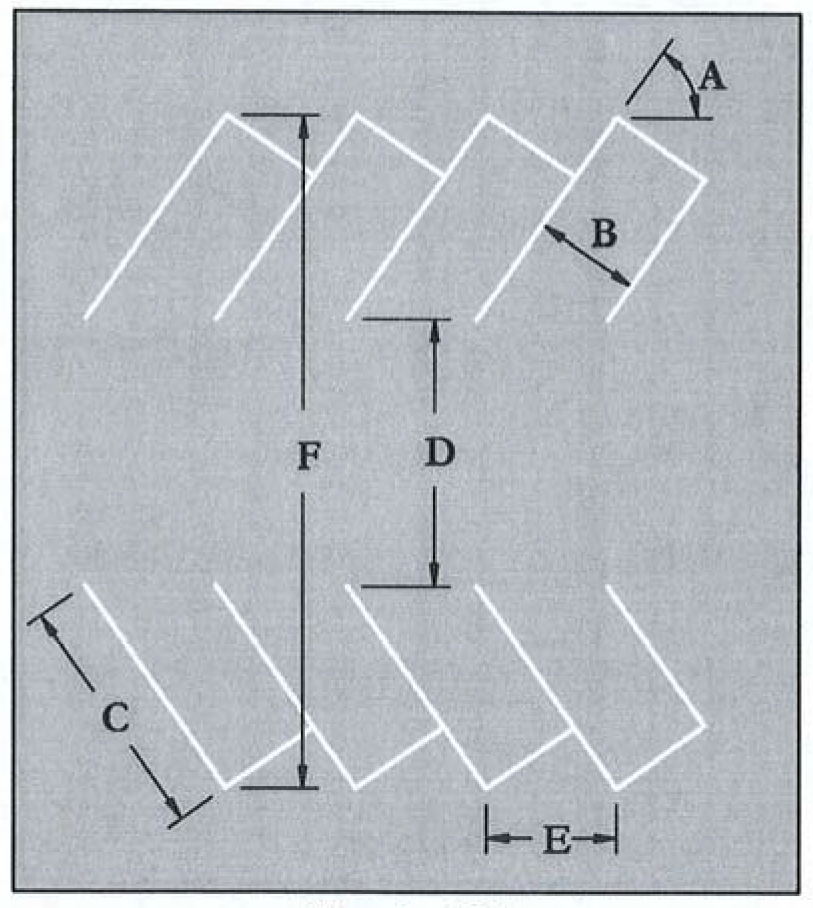
MINIMUM REQUIREMENTS FOR PARKING SPACE CONFIGURATION, ARRANGEMENT, SIZE AND CIRCULATION
Illustration 50-112-1: References for Table 50-112-1
(b)
Residential districts; off-street parking provisions.
(1)
Parking regulations for the AG, SF-20-E, SF-9, SF-7.5, SF-6, and D districts and for planned developments for zero lot line, patio home, townhome and single-family attached dwelling units. For every single-family dwelling unit, a minimum of two off-street parking spaces shall be provided on the same lot as the main structure. For duplexes, two off-street parking spaces for each dwelling unit shall be required. For the purposes of this subsection, the first two parking spaces contained in covered garages and/or covered carports for each dwelling unit shall not be considered as off-street parking spaces. For example, if a dwelling has a three-car garage, one additional off-street parking space would be required in addition to that included within the garage. Off-street parking spaces shall be directly adjacent to a dwelling or garage. If off-street parking spaces are aligned linearly, they shall be directly adjacent to one another. For the purposes of this subsection, the minimum dimensions of each parking space shall be in accordance with table 50-112-1; provided, however, two spaces shall be not less than 12 feet by 40 feet if aligned linearly. All required driveways and parking areas shall have a topping, which is the same as the abutting street, or they may be concrete cement. All additional parking in a required yard must also be of the same material as the abutting street or concrete cement.
(2)
Parking regulations for the MHP District.
a.
Tenant/owner parking. Two spaces per unit located on the same lot as the unit served. Each parking space shall be in accordance with city standards, and shall be located to eliminate interference with access to parking areas provided for other manufactured/mobile homes and for public parking in the park.
b.
Visitor and supplemental parking. In addition to parking spaces required for each manufactured/mobile home unit, there shall be parking provided for the manufactured/mobile home community in general in compliance with the following:
1.
One visitor parking space for every three manufactured/mobile home spaces.
2.
Boats, campers, trailers and other recreational vehicles shall be prohibited unless oversize parking areas are provided and are approved by the city. This parking area shall not be used to meet the minimum parking requirements and shall not be visible from a public street.
3.
Each parking space will be not less than nine feet by 20 feet (nine feet by 20 feet), or as required in Table 50-112-1, which is not to be included in the lot size.
(3)
All required vehicle parking shall be on a concrete or asphalt paved surface.
(4)
All driveways and approaches to parking spaces shall be on a concrete or asphalt paved surface, except in the AG District.
(5)
All existing driveways within the Old Town area as of the effective date of this chapter shall be deemed as conforming (unless they represent a threat to public health, safety and welfare, in which case the city may require removal and/or relocation and/or refurbishment).
(6)
No required parking space, garage, carport, or other automobile storage space shall be used for the storage of any heavy load vehicle (see definitions section). No such vehicle shall be stored or parked for more than 72 hours within a 30-calendar-day period or on a regular, repetitive basis on any street, or within any front yard or street side yard. Such a vehicle shall be parked in a space that is located on a concrete or asphalt paved surface.
(7)
Additional parking shall be required in accordance with this section for any recreational uses, clubhouse, office, sales offices and other similar accessory structures and uses.
(c)
Nonresidential and MF Districts; off-street parking provisions.
(1)
Parking regulations for the MF District.
a.
Off-street parking. Each dwelling unit within a multifamily dwelling complex shall be provided with on-site off-street parking as follows:
1.
Two parking spaces for each one bedroom unit;
2.
Two and one-half parking spaces for each two bedroom unit; and
3.
Three parking spaces for each three bedroom unit.
b.
All parking areas shall be constructed of the same material as the adjoining street, or of concrete cement. No on-street parking shall be counted as meeting the requirements of this chapter and may be restricted or prohibited by the city. All parking areas shall be separated from walkways, sidewalks, streets, or alleys by a wall, fence, curbing, or other protection device in accordance herewith and in accordance with other applicable city specifications.
c.
Covered parking and density bonuses.
1.
An increase in density of a total of up to 24 units per acre is permitted when at least 50 percent of the required parking spaces are constructed as covered or enclosed spaces.
2.
An increase in density of a total of up to 26 units per acre is permitted when 100 percent of the required parking spaces are constructed as covered or enclosed spaces.
d.
No parking space may be located closer than six feet from any building or closer than two feet from any side or rear lot line.
(1.1)
Parking regulations for the NR District.
a.
Parking areas must be located to the side or rear of primary buildings. No parking shall be located between the front and/or side facades of primary buildings and street right-of-way(s) unless otherwise specified by the following:
1.
One-way Vehicle drive-through lanes for overall circulation as well as drive-through and pickup/drop off services shall be exempt from this standard.
2.
A maximum of one, one-way aisle of parallel and/or angled parking stalls shall be permitted between street rights-of-way(s) and facades of primary buildings.
b.
All parking and vehicle maneuvering areas shall be screened from streets by a solid row of hedges. As prescribed by Section 50-113 (f)(3)(f).
1.
EXCEPTION: Vehicle visibility triangles shall be clear of hedges utilized for screening as prescribed by Section 38-34 - Obstructions prohibited in visibility triangle.
c.
No parking area may be located closer than 10 feet from property lines for properties zoned for Single-Family Residential uses.
(2)
To prevent nuisance situations, all parking area lighting shall be designed, shielded and operated so as not to reflect or shine on adjacent properties and in accordance with city ordinances. All streets and driveways shall be lighted at night with a minimum intensity of two foot-candles' illumination if off-street parking or loading facilities are to be used at night.
(3)
For safety and fire-fighting purposes, free access through to adjacent nonresidential parking areas shall be provided in accordance with section subsection (j) of this section.
(4)
All off-street parking, driveways, maneuvering, and loading areas shall be designed in accordance with Table 50-112-1 and Illustration 50-112-1 and shall be paved with a concrete or asphalt surface and shall be curbed, in accordance with the city's parking lot paving requirements. All such areas shall be drained to prevent damage to abutting properties and/or public streets and alleys.
(5)
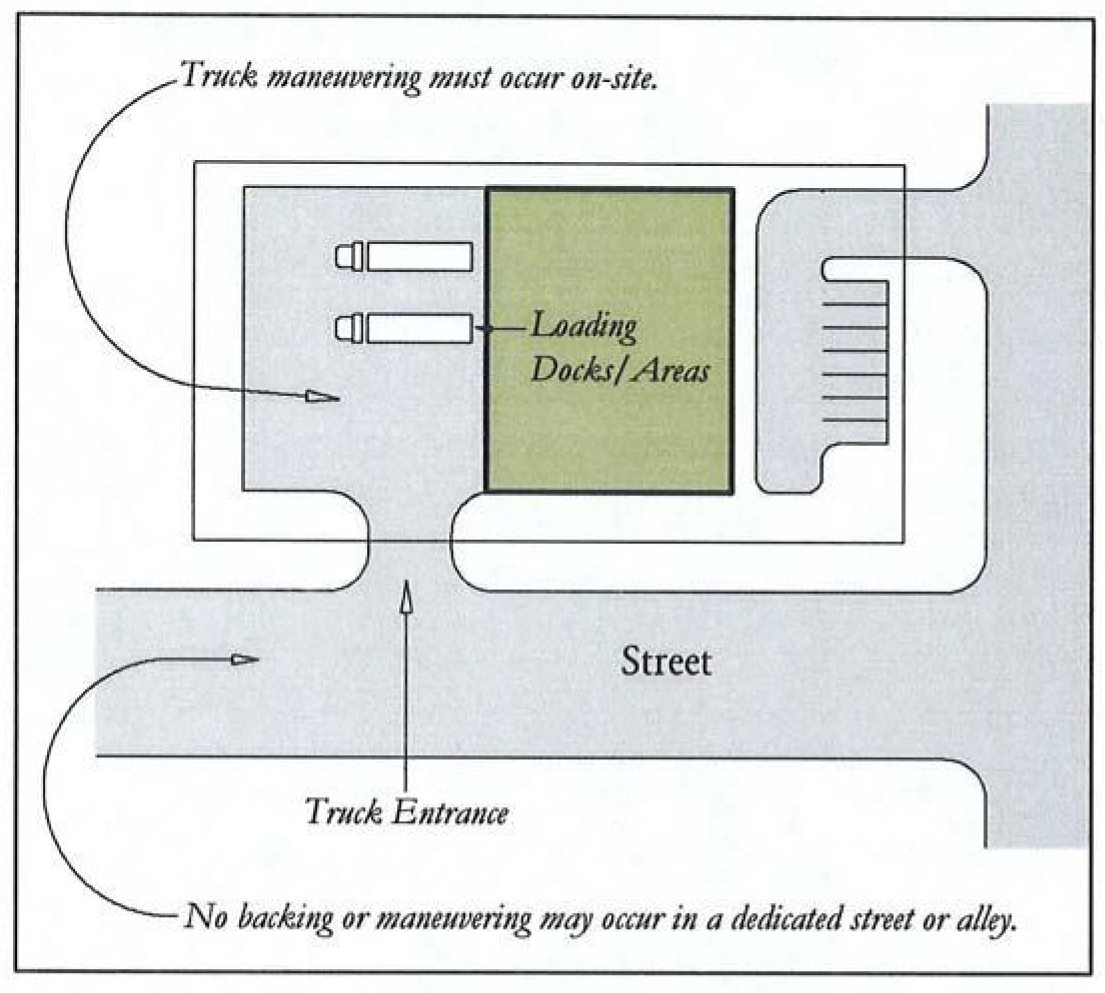
For new construction only, all vehicle maneuvering shall take place onsite. No public right-of-way shall be used for backing or maneuvering into or from a parking space (except business locations in the downtown area that are already in existence as of the effective date of the ordinance from which this chapter is derived), or for circulation within the parking lot.
a.
All entrances into parking lots shall be at least 20 feet in width, or a maximum of 40 feet in width.
b.
Divided entrances into parking lots shall have a minimum ingress lane of 18 feet, a minimum landscaped median width of five feet for an unbroken distance of at least 100 feet, and a minimum egress lane of 22 feet. All divided entrances shall be a maximum of 45 feet in width.
(6)
In all nonresidential and multifamily zoning districts, the perimeter of all parking lots and driveways shall be provided with concrete curbs. Parking shall not be permitted to encroach upon the public right-of-way.
(7)
Refuse storage facilities placed in a parking lot shall not be located in a designated parking or loading space. Each refuse facility shall be located so as to facilitate pickup by refuse collection agencies and ease of egress from the site without having to back up further than 20 feet and without having to go the wrong way in a traffic aisle.
(8)
Parking spaces for persons with disabilities and other associated provisions (e.g., clear and unobstructed pathways into building, crosswalks across parking lots, etc.) shall be provided according to building codes, state laws, and requirements of the Americans with Disabilities Act (ADA).
(9)
Designated parking and loading areas shall not be used for the repair, storage, dismantling or servicing (except for normal maintenance of a private vehicle) of vehicles or equipment, or for the storage of materials or supplies, or for any other use in conflict with the designated parking and loading areas (i.e., advertising or outside storage of raw materials).
(10)
To ensure that all requirements set forth in this section are carried forward, it will be the responsibility of the owner of the parking area to adequately maintain the facility. All off-street parking areas shall be kept free of trash, debris, vehicle repair operation or display and advertising uses. At no time after initial approval of the parking area layout can changes be made in the location and number of provided spaces without city approval of a revised plan, as described in section 50-36.
(11)
A stacking space shall be an area on a site measuring at least eight feet wide by 20 feet long that has direct forward access to a service window or station of a drive-through facility and that does not constitute space for any other circulation driveway, parking space, or maneuvering area. An escape lane of at least eight feet in width and with negotiable geometric design must be provided to allow vehicles to get out of the stacking lane if necessary. Off-street stacking requirements for drive-through facilities shall be as follows:
a.
For financial institutions with drive-through facilities, each teller window or station, human or mechanical, shall be provided with a minimum of five stacking spaces. One escape lane shall be provided.
b.
For each service window of a drive-through restaurant, a minimum of five spaces shall be provided for the first vehicle stop, and two spaces shall be provided for each additional vehicle stop (order/pick-up windows, etc.). One escape lane shall be provided from the beginning of the stacking lane to the first vehicle stop.
c.
For a full-service car wash, each vacuum or gas pump lane shall be provided with a minimum of four stacking spaces. For the finish/drying area, adequate vehicle stacking and storage space must be provided to keep finished vehicles out of circulation aisles, access easements, fire lanes, streets, etc.
d.
For each automated self-service (drive-through/rollover) car wash bay, a minimum of three stacking spaces, in addition to the wash bay itself, shall be provided. One stacking space shall be provided at the exit end of each wash bay for window-drying and other detailing.
e.
For each wand-type self-service (open) car wash bay, a minimum of two stacking spaces, in addition to the wash bay itself, shall be provided. One stacking space shall be provided at the exit end of each wash bay for window-drying and other detailing, unless a separate area/shade structure is provided (outside of circulation aisles) for these activities.
f.
For automobile quick-lube type facilities, a minimum of three stacking spaces shall be provided for each service bay in addition to the service bay itself.
g.
For all other types of land use that provide drive-up service, a minimum of three stacking spaces for each service window shall be provided.
(12)
Dead-end parking areas shall be avoided if possible. If dead-end parking is necessary, then it shall be designed such that it is no more than five parking spaces deep, unless adequate turnaround space is provided. A minimum five-foot deep hammerhead back-up space shall be provided at the end of any dead-end parking area.
(13)
All parking structures must conform to the construction and design standards of the zoning district in which they are located.
(14)
A parking analysis and tabulation shall be required on the site plan for each development and shall be a part of the site plan submittal. Each analysis shall include an explanation of applicable parking requirements (as a minimum, include occupancy classification type, building square footages, and number of employees), total parking spaces required and required and provided for Americans with Disabilities Act (ADA) accessible spaces, and required and provided ADA van accessible spaces. When the director of public works, or designee determines necessary, an additional traffic impact study may be required to determine the impacts of a development on the off-site public street system.
(d)
Off-street loading space—All districts.
(1)
All retail and similar nonresidential structures shall provide and maintain off-street facilities for receiving and loading merchandise, supplies and materials within a building or on the lot or tract. All drives and approaches shall provide adequate space and clearances to allow for the maneuvering of trucks off-street. Each site shall provide a designated on-site maneuvering area for trucks (see Illustration 50-112-1). Such off-street loading space may be adjacent to (but not any portion of) a public alley or private service drive, or it may consist of a truck berth within the structure. The minimum dimensions of a "regular" loading space shall be ten feet by 30 feet, and a "large" loading space shall be at least ten feet by 65 feet. Loading spaces or berths shall be provided as deemed appropriate by the planning director (or designee).
Illustration 50-112-2: Truck maneuvering related to loading areas
(2)
Loading docks for any establishment which customarily receives goods between the hours of 9:00 p.m. and 8:00 a.m. and is adjacent to a residential use or district shall be designed and constructed so as to minimize the effects of the noise of the operation on adjacent residences. Other screening/buffering alternatives may be approved on the applicable required plan (see section 50-116) provided that the city makes a finding that the method of screening/buffering will be adequate to protect nearby residences. Below grade loading docks are required to have operational sump pumps or other approved drainage.
(3)
Kindergartens, elementary schools, day schools, and similar child training and care establishments shall provide one paved off-street pedestrian loading and unloading space for an automobile on a through, "circular" drive for each ten students cared for (excluding child care in a residence). An additional lane shall also be required to allow pass by or through traffic to move while automobiles waiting or parked to pick up children occupy loading/unloading areas.
(4)
Loading spaces that are adjacent and easily accessible to several buildings or uses, including buildings and uses on separate lots, shall be allowed to satisfy the loading requirements for the individual buildings or uses.
(5)
Loading spaces to be shared among separate lots shall be in reasonably close proximity to all potential users and an agreement granting mutual use by the owners of each building shall be executed and provided to the city manager (or his designee).
(e)
Parking access from a public street—All districts.
(1)
Consideration shall be given to providing entrance/exit drives that extend into the site to provide adequate queuing of vehicles on the site.
(2)
Entrance/exit drives shall be appropriately designed and located to minimize traffic congestion or conflict within the site and with adjoining public streets. Based upon analysis by the city, if projected volumes of traffic entering or leaving a development are likely to interfere with the projected peak traffic flow volumes on adjoining streets, additional right-of-way and paving in the form of a deceleration lane, a turn lane, or other roadway improvements may be required of a developer in order to reduce such interference and to help ensure traffic safety and efficiency. The dedication of additional right-of-way or street paving may also be required, and shall be determined at the time the required plan (see section 50-36) and final plat are approved by the city.
(3)
Vehicular access to nonresidential uses shall not be permitted from alleys serving residential areas, and shall not be configured as "head-in" parking spaces that are accessed directly from the street.
(4)
Parking space configuration, arrangement, size and circulation in all districts shall be constructed according to Illustration 50-112-1 and Table 50-112-1.
(f)
Parking requirements based upon use. In all districts, there shall be provided at the time any building or structure is erected or structurally altered, or change of use, off-street parking spaces in accordance with the use chart, section 50-82. Further descriptive requirements have been included herein where applicable, as referenced within the use chart:
(1)
Accessory uses. All areas for accessory uses not listed above or in other parts of this section (such as restaurants, office, etc.), shall be calculated in with the minimum specified for those individual uses.
(2)
Auto dealer (new and/or used auto sales); motorcycle sales/dealer; personal watercraft sales (new/repair). One parking space for each 500 square feet of sales floor/office and other indoor uses, plus one parking space for each 1,000 square feet of exterior lot area used for storage, sales and parking areas, plus one parking space per repair bay in service areas (indoors or outdoors).
(3)
Community center (public), museum, library, or art gallery. Ten parking spaces plus one additional space for each 300 square feet of floor area in excess of 2,000 square feet. If an auditorium is included as a part of the building, its floor area shall be deducted from the total and additional parking provided on the basis of one space for each four seats that it contains (see section 50-82).
(4)
Convenience store (with or without gasoline sales) or gasoline station. One space per 200 square feet of floor area, plus one parking space for each side of a gasoline pump unit (a unit may have up to six nozzles for gasoline disbursement). Spaces within pump areas qualify as spaces for the parking requirement. If no gasoline sales are provided, then the parking requirements shall be the same as for a retail store. Adequate space shall be provided for waiting, stacking, and maneuvering automobiles for refueling.
(5)
Funeral home or mortuary. One parking space for each 200 square feet of floor space in slumber rooms, parlors or individual funeral service rooms, or one space for each three seats in the auditorium/sanctuary (see section 50-82), whichever is greater. Adequate on-site stacking spaces shall also be provided for the organization and forming of processions such that these activities do not cause excessive or extended traffic congestion/delays on a public roadway.
(6)
Golf driving range. 1½ spaces for each driving tee.
(7)
Hotel/motel. One space per guest room for the first 250 rooms and 0.75 space per room for each room over 250, plus one space per five restaurant/lounge area seats (based upon maximum occupancy), plus one space per 125 square feet of meeting/conference areas.
(8)
Mini-warehouse/self storage. Four spaces per establishment, plus two spaces for an on-site manager's residence (if applicable), plus one appropriately sized space for any type of vehicle to be stored on-site (e.g., rental trucks, boats, RVs, etc.)
(9)
Motion picture theater (indoors).
a.
One space per 3½ seats for single-screen theaters;
b.
One space per five seats for motion picture theaters with two or more screens.
(10)
Motor freight transportation, storage, and terminal/transit terminal/truck terminal/other similar transportation uses. For warehouse and staging/loading areas, one space for each 1,000 square feet of floor area; for bus depot or other human transportation use, one space per 100 square feet of passenger waiting area, plus parking spaces for any warehouse and staging/loading areas on the premises (as above).
(11)
Places of public assembly not otherwise specified. One space for each four seats provided.
(12)
Retail or personal service establishment not otherwise specified. One space per 200 square feet of gross floor area in addition to any required stacking spaces for drive-through facilities in subsection (c)(11)d of this section.
(13)
Schools.
a.
Public or denominational—Elementary. Two spaces for every classroom and office;
b.
Public or denominational—Junior high. Three spaces for every classroom and two spaces for each office;
c.
Public or denominational-High school. Eight spaces for every classroom and two spaces for each office;
d.
Other than public or denominational. Same as above, depending on grade.
(14)
Skilled nursing facility. One space per six beds; plus one parking space for each 300 square feet of floor area devoted to offices, cafeterias, exercise/therapeutic rooms, and other similar ancillary uses.
(g)
Rules for computing number of parking spaces and miscellaneous off-street parking requirements. In computing the number of parking spaces required for each of the above uses, the following rules shall govern:
(1)
The term "floor area" means the gross floor area of the specific use.
(2)
The term "seat" shall be interpreted as follows:
a.
For fixed (e.g., church pews, grandstands, benches, etc.) seating, one seat equals 1.75 feet of length; and
b.
For flexible (e.g., folding chairs, etc.) seating areas, one seat equals eight square feet of floor area occupied by such seating area (includes aisles).
(3)
Where fractional spaces result, the parking spaces required shall be calculated by rounding to the nearest whole number.
(4)
The parking space requirements for a new or unlisted use not specifically mentioned herein shall be the same as required for a use of similar nature. If the proposed use is not similar to any of the uses listed herein, a determination shall be made/approved by the city, in conjunction with the request for classification of the new or unlisted use, as provided in section 50-82(b).
(5)
Whenever a building or use is changed or enlarged in floor area, number of dwelling units, seating capacity or otherwise, to create a need for an increase of ten percent or more in the number of existing parking spaces, such spaces shall be provided on the basis of the enlargement or change. If a building or use that was in existence prior to the effective date of the ordinance from which this chapter is derived is enlarged by more than 50 percent in floor area, number of employees, number of dwelling units, seating capacity or otherwise, then said building or use shall be required to conform with the parking requirements herein for the entire building or use.
(6)
For buildings which have a combination of uses within the same structure or on the same premises (such as retail or office), the off-street parking requirement shall be calculated as the summation of the parking requirements for each use, and no parking space for one particular use shall be allowed to count toward the parking requirement for some other use on the premises except in the case of a shared parking arrangement (see subsection (h) of this section).
(7)
Shared parking. Shared parking may be allowed in the case of mixed uses (different buildings) under the following conditions: Up to 50 percent of the parking spaces required for a theater or other place of evening entertainment (after 6:00 p.m.), or for a church, may be provided and used jointly by banks, offices, and similar uses not normally open, used, or operated during evening hours. Shared parking must be on the same parking lot. Reduction due to shared parking shall only be allowed if approved by the city on the applicable required plan (see section 50-36). To ensure retention of the shared parking spaces, each property owner shall properly draw and execute an irrevocable mutual parking agreement document expressing the same, shall file this agreement in the county real property records, and shall provide a copy of the filed agreement to the city prior to issuance of a certificate of occupancy for any use that relies upon the parking agreement.
(h)
Location of parking spaces. In any case where any additional parking spaces are required and are not located on the same lot with the building or use served, or where such spaces are collectively or jointly provided and used, approval by the planning and zoning commission is required subject to the following conditions:
(1)
Except for location, all other requirements relating to off-street parking shall be met.
(2)
Such space shall be conveniently usable without unreasonable:
a.
Hazard to pedestrians;
b.
Hazard to vehicular traffic;
c.
Traffic congestion; or
d.
Detriment to the appropriate use of other properties in the vicinity.
(3)
A written agreement shall be drawn to the satisfaction of the city attorney and executed by all parties concerned, assuring the continued availability of the off-street parking facility for the development it is intended to serve.
(i)
Use of required parking spaces—Nonresidential districts. Off-street parking and loading spaces shall be used only for these respective purposes and shall not be used for refuse containers, cart corrals, recycling kiosks, signs or sign support structures, telecommunications towers or support structures, storage or permanent display of boats, trailers, campers, motor vehicles or other goods, materials, or products for sale/lease/rent.
(j)
Fire lanes. Fire lanes shall be provided in all multifamily (and in some single-family attached) developments, manufactured (mobile) home parks, and nonresidential developments, as required by the adopted fire code of the city (also see chapter 40, pertaining to subdivisions, for certain fire lane regulations).
(k)
Special regulations for recreational vehicles or equipment. No recreational vehicle shall be left unattended or parked for more than 24 hours within any parking lot, parking spaces, drive aisle, vacant or unused property, or pervious/unpaved surface area (except an appropriately zoned and approved/paved parking lot for such vehicles). An owner or tenant of a residential lot may park a recreational vehicle that they own on the same lot in accordance with city regulations. Such vehicle parking must also meet all other required city ordinances.
(Ord. No. 2008-01, § 39, 2-4-2008; Ord. No. 2021-12, § 2, 4-5-2021; Ord. No. 2023-55, § 2(Exh. A), 2-19-2024; Ord. No. 2024-13, § 2(Exh. A), 7-1-2024)
Sec. 50-113. - Landscape requirements.
(a)
Purpose. Landscaping is accepted as adding value to property and is in the interest of the general welfare of the city. The provision of landscaped areas also serves to increase the amount of a property that is devoted to pervious surface area that, in turn, helps to reduce the amount of impervious surface area, stormwater runoff, and consequent non-point pollution in local waterways. Therefore, landscaping is hereafter required of new development, except single- and two-family and agricultural uses.
(b)
Scope and enforcement.
(1)
The standards and criteria contained within this section are deemed to be minimum standards and shall apply to all new nonresidential and multifamily construction, and shall apply in the case of an addition to a nonresidential or multifamily structure or site that alters such structure or site by greater than 25 percent.
(2)
Any use requiring a conditional use permit (CUP) or a PD Planned Development zoning designation must comply with these landscape standards unless special landscaping standards are otherwise provided for in the ordinance establishing the CUP or PD District. In no case shall the standards provided for in the CUP or PD ordinance be less than the standards required by this section.
(3)
The provisions of this section shall be administered and enforced by the city manager or his designee.
(4)
The landscape standards in this section apply only to nonresidential and multifamily developments (including uses such as schools and churches within a residential zoning district).
(5)
If at any time after the issuance of a certificate of occupancy, the approved landscaping is found to be not in conformance with the standards and criteria of this section, the building official (or his designee) shall issue notice to the owner, citing the violation and describing what action is required to comply with this section. The owner, tenant or agent shall have 30 calendar days from date of said notice to establish/restore the landscaping, as required. If the landscaping is not established/restored within the allotted time, then such person shall be in violation of this chapter.
(c)
Permits.
(1)
No permits shall be issued for building, paving, or construction until a detailed landscape plan is submitted and approved by the city manager or his designee, along with other required plans. A landscape plan shall be required as part of other required submissions and may be shown on the concept plan, building permit plan, or site plan, as required by section 50-36, or may be drawn on a separate sheet. Except as provided in subsection (c)(2) of this section, prior to the issuance of a certificate of occupancy for any building or structure, all screening and landscaping shall be in place in accordance with the landscape plan.
(2)
In any case in which a certificate of occupancy is sought at a season of the year in which the city manager, or his designee, determines that it would be impractical to plant trees, shrubs or groundcover, or to successfully establish turf areas, a temporary certificate of occupancy may be issued, provided a letter of agreement and financial assurance by a check or performance bond equivalent to the work yet to be performed from the property owner is submitted that states when the installation shall occur. Such financial guarantee shall be returned when the work is completed.
(d)
Landscape plan.
(1)
The city manager or his designee shall review the plans for completeness in writing within ten business days after filing. If the plans are incomplete, notice shall be sent within the ten business days to the applicant specifying the document or other information to complete the application and the date the plan submission will expire and be considered denied if the applicant fails to provide such information. If the required application and plans are not corrected or completed within 45 calendar days after submission, then the required plan will be deemed to have expired and it will be returned to the applicant together with any accompanying applications. If the plans are deemed complete, or if ten business days passes without notice, the city manager, or his designee, shall review such plans and shall approve same if the plans are in accordance with the criteria of these regulations. If the plans are not in conformance, they shall be disapproved and shall be accompanied by a written statement setting forth the changes necessary for compliance.
(2)
Landscaping plans shall be drawn in a legible engineering scale and shall contain the following minimum information:
a.
The scale shown in both written and graphic form.
b.
Location, size and species of all trees to be preserved (do not use tree stamps unless they indicate true size and location of trees).
c.
Where credited trees are proposed, a plan indicating how these existing trees will be protected from damage during construction.
d.
Location of all plant and landscaping material to be used, including plants, paving, benches, screens, fountains, statues, earthen berms, ponds (to include depth of water), topography of site, or other landscape features.
e.
Species and common names of all plant materials to be used.
f.
Size of all plant material to be used (container size, planted height, etc.).
g.
Spacing of plant material where appropriate.
h.
North arrow/symbol and a small map showing where the property is located.
i.
Date of the landscape plan.
(3)
No major change to an approved landscape plan shall be made prior to the submission and approval of a revised landscape plan meeting the criteria found within this section.
(4)
Upon a recommendation by the city manager or his designee, an alternative plan that is not in compliance with these landscape provisions may be approved. The alternative plan must clearly be superior to a plan or layout that would otherwise be in compliance. In making the determination, the city manager or his designee may consider:
a.
The topography, shape, size, and/or other natural features of the property;
b.
The ability of the alternative plan to enhance a natural feature that is particular to the site; and/or
c.
The opportunity to create a unique atmosphere, attraction, or other similar factors.
(e)
General standards. The following criteria and standards shall apply to landscape materials and installation:
(1)
All required landscaped open areas shall be completely covered with living plant material. Landscaping materials such as wood chips and gravel may be used under trees, shrubs and other plants.
(2)
Plant materials shall conform to the standards of the approved plant list for the city. Grass seed, sod and other material shall be clean and reasonably free of weeds and noxious pests and insects.
(3)
Alternate landscaping design. The planning and zoning commission may consider and approve an alternative plan, which is not in compliance with the requirements of this chapter. Such alternative plan must meet the objectives and purposes of this chapter, as determined by the planning and zoning commission, may not reduce the standards set forth herein, and clearly be superior to a plan that would otherwise be in compliance. In making this determination, the planning commission may consider the topography, shape, size, or other natural features of the building site; the suitability of any alternative screening or buffering proposal; and other similar factors.
(4)
Replacement of dead landscaping plants. If any required landscaping tree, shrub, or groundcover plant should die, the owner shall replace these plants by the end of the next planting season.
(5)
Replacement of existing landscape development. Any major or significant modification to a landscape development constructed or installed in association with this section must be in accordance with this section and must be approved by the city's building official.
(6)
Required crown size, caliper, and height of trees.
a.
Trees shall have an average spread of crown of greater than 15 feet at maturity. Trees having a lesser average mature crown of 15 feet may be substituted by grouping the same so as to create the equivalent of 15 feet of crown spread.
b.
Grouping collectively equals a crown spread of 15 feet.
c.
Large trees shall be a minimum of four inches in caliper measured 12 inches above the ground, and shall be a minimum of seven feet in height at time of planting.
d.
Small trees shall be a minimum of two inches in caliper, measured six inches above the ground, and shall be a minimum of five feet in height at time of planting.
(7)
Shrubs not of a dwarf variety shall be a minimum of two feet in height when measured immediately after planting. Hedges, where installed for general screening purposes, shall be planted and maintained so as to form a continuous, unbroken, solid visual screen that will be six feet in height within three years after the time of initial planting. Hedges, where installed for screening parking areas, shall be planted and maintained so as to form a continuous, solid visual screen that will be three feet in height within two years after the time of initial planting.
(8)
Grass areas shall be sodded, plugged, sprigged, hydro-mulched and/or seeded, except that solid sod shall be used in swales, earthen berms or other areas subject to erosion.
(9)
Ground covers used in lieu of grass in whole and in part shall be planted in such a manner as to present a finished appearance and reasonably completed coverage within one year of planting.
(10)
Earthen berms shall have side slopes not to exceed 33.3 percent (three feet of horizontal distance for each one foot of vertical height). All berms shall contain necessary drainage provisions as may be required by the city's engineer.
(f)
Minimum landscaping requirements for nonresidential and multifamily developments.
(1)
General requirements. The following requirements shall apply:
a.
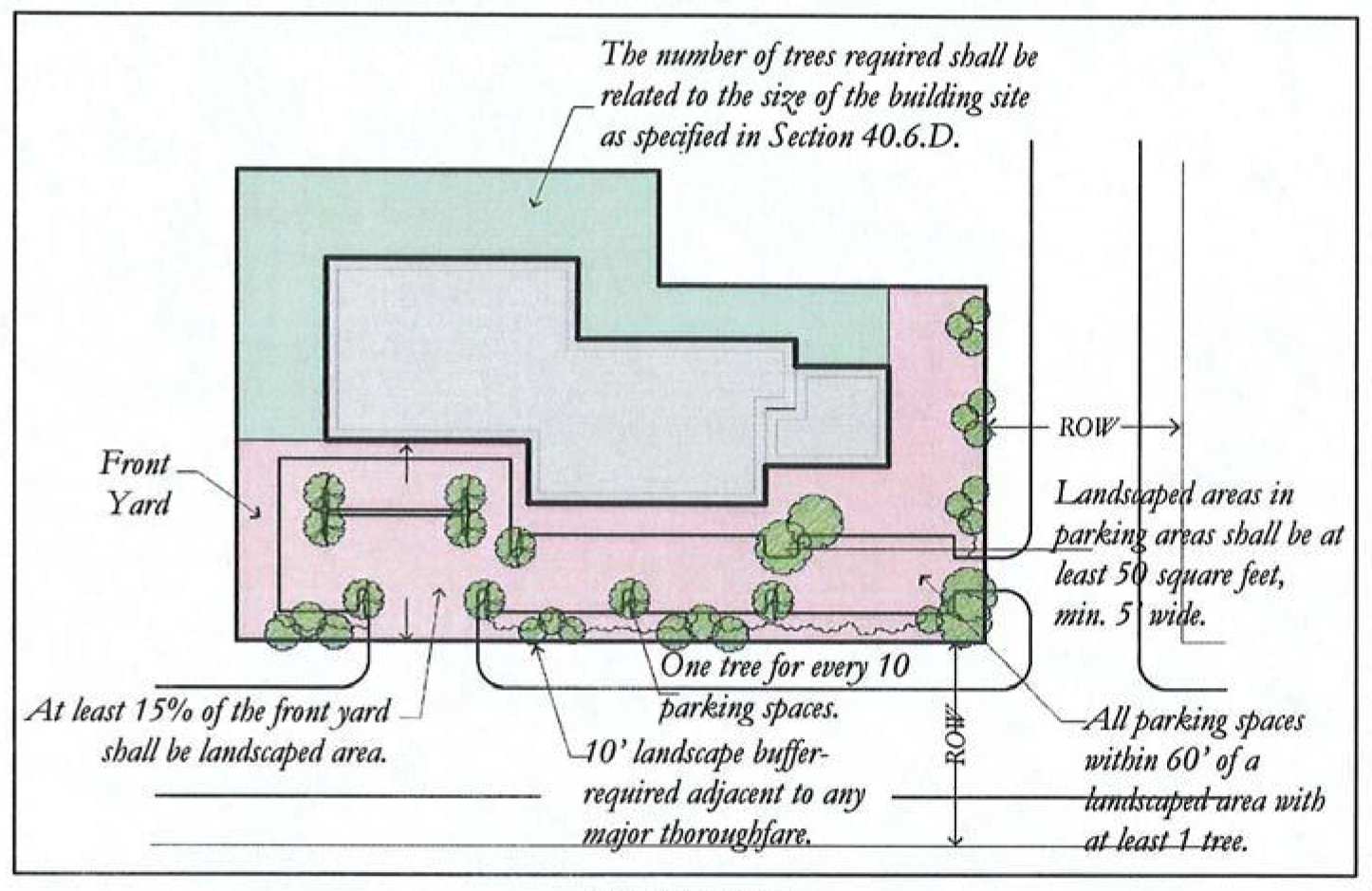
For all nonresidential and multifamily developments (including schools, churches, day care facilities, and other similar uses in a residential district), at least 15 percent of the front yard shall be permanently landscaped area (see Illustration 50-113-1. In addition, with the exception of industrial tracts, the following shall apply:
1.
Sites of up to 20,000 square feet shall have five percent of the area not covered by building or structure permanently landscaped.
2.
Sites of 20,000 to 200,000 square feet shall have 7.5 percent of the area not covered by building or structure permanently landscaped.
3.
Sites of over 200,000 square feet shall have ten percent of the area not covered by building or structure permanently landscaped.
b.
Landscape development located within the rear setback area of a building site, screened from adjacent properties and not adjacent to a public street shall not be considered when determining the minimum requirements of this section.
c.
Only shrubs and groundcovers (i.e., no trees) shall be used under existing or proposed overhead utility lines.
d.
Necessary driveways from the public right-of-way shall be permitted through required landscaping in accordance with city regulations.
(2)
Requirements along major thoroughfares. For the purpose of these requirements, a major thoroughfare is defined as a thoroughfare having a right-of-way of at least 60 feet. The following requirements shall be credited toward the 15 percent landscaped front yard requirement, as specified in subsection (f)(1)a of this section.
a.
A minimum ten foot landscape buffer adjacent to the right-of-way of any major thoroughfare is required, except as specified below.
b.
Any nonresidential or multifamily parcel that fronts onto Main Street shall provide a minimum 15 foot landscape buffer.
c.
Corner lots fronting two major thoroughfares shall provide the appropriate required landscape buffer on both street frontages (i.e., ten feet on major thoroughfares, and 15 feet on Main Street.
d.
All other street frontages shall observe a minimum five foot landscape buffer.
e.
One large tree shall be required per 40 linear feet (or portion thereof) of street frontage. Trees should be grouped or clustered to facilitate site design and to provide an aesthetically pleasing, natural looking planting arrangement; this shall be credited toward the total number of trees required, as specified in subsection (f)(4)d of this section.
(3)
Requirements for landscaping in and around parking lots. The following requirements shall be credited toward the 15 percent landscaped front yard requirement, and total landscaping requirement as specified in subsection (f)(1)a of this section.
a.
Landscape areas shall be a minimum of 50 square feet in area. Landscape areas shall be a minimum of five feet wide.
b.
There shall be a landscaped area with at least one tree within 60 feet of every parking space.
c.
There shall be a minimum of one tree planted in the parking area for every ten parking spaces for parking lots having more than 20 spaces.
d.
There shall be a landscaped area that is a minimum of 12 feet wide to separate parking areas that have 200 or more parking spaces.
e.
Landscape areas should be located to define parking areas and to assist in clarifying appropriate circulation patterns. All landscape areas shall be protected by a monolithic concrete curb or wheel stops, and shall remain free of trash, litter, and car bumper overhangs.
f.
Parking lots, driving lanes, loading areas, or other similar areas of vehicular access shall be screened from residentially zoned property, whether adjacent or across a street, by a continuous hedge, planter, berm, fence, wall, or combination of these, with a minimum height of 36 inches. This requirement shall not be required along state highways.
1.
Shrubs utilized for screening parking areas shall be a minimum 3-gallon planting size spaced 36-inches on center.
Illustration 50-113-1: Selected landscaping requirements illustrated
(4)
Requirements for trees. The following requirements shall apply:
a.
All existing trees that are to be preserved shall be provided with undisturbed, permeable surface area under (and extending outward to) the existing dripline of the tree.
b.
All new trees shall be provided with a permeable surface under the dripline a minimum of five feet by five feet.
c.
A minimum of 50 percent of the total trees required for the property shall be large shade trees as specified on the approved plant list in this section.
d.
Minimum number of trees required. The number of trees specified as required herein shall be in addition to those required for major thoroughfares as outlined in this section. The minimum number of trees shall be provided and maintained on the building site, as outlined below, based on the area of the site not covered by a building or structure:
1.
Less than 3,000 square feet: two.
2.
3,001 to 7,000 square feet: three.
3.
7,001 to 10,000 square feet: four.
4.
10,001 to 20,000 square feet: five.
5.
20,001 to 30,000 square feet: six.
6.
30,001 to 40,000 square feet: seven.
7.
40,001 or greater, per 20,000: three.
Square feet (rounded up to the whole tree)
(h)
Tree preservation. The following provisions shall apply:
(1)
During any construction or land development, the developer shall clearly mark all trees to be preserved/retained on-site, and may be required to erect and maintain protective barriers around all such trees or groups of trees. The developer shall not allow the movement of equipment or the storage of equipment, materials, debris or fill to be placed within the dripline of any trees that are designated for preservation.
(2)
During the construction stage of development, the developer shall not allow cleaning of equipment or material under the canopy of any tree or group of trees that are being preserved. Neither shall the developer allow the disposal of any waste/toxic material such as, but not limited to, paint, oil, solvents, asphalt, concrete, mortar, etc., under the canopy of any tree or groups of trees to remain.
(3)
No attachment or wires of any kind, other than those of a protective or supportive nature, shall be attached to any tree.
(4)
Tree credits.
a.
Landscape plans that preserve existing trees that are found on the approved list shall be given credit toward the total number of trees required as outlined in the following:
b.
If a credited tree dies for any reason, it must be replaced with the credit number of trees within 120 days.
c.
The following activities shall be prohibited within the limits of the drip line of any existing tree to be retained under the provisions of a landscape plan required by this chapter:
1.
Material storage. No materials intended for use in construction or waste materials accumulated due to excavation or demolition;
2.
Equipment cleaning/liquid disposal. No equipment shall be cleaned or other liquids deposited, including paint, oil, solvents, asphalt, concrete, mortar, or other materials;
3.
Tree attachments. No signs, wires, or other attachments, other than those of a protective nature, which have been approved in the tree disposition plan; and
4.
Vehicular traffic. No vehicle, construction equipment or parking is allowed.
d.
On development sites requiring 100 parking spaces or more, the number of parking spaces may be reduced by one percent for every ten percent increase in tree credits provided above the minimum. However, the parking requirement shall not be reduced by more than five percent.
(i)
Sight distance and visibility. The following provisions shall apply:
(1)
Rigid compliance with these landscaping requirements shall not be such as to cause visibility obstructions and/or blind corners at intersections.
(2)
Whenever an intersection of two or more public rights-of-way occurs, a triangular visibility area in accordance with chapter 38, article II shall be created. Landscaping, screening and fencing within the triangular visibility area shall be in accordance with such requirements and provide unobstructed cross-visibility at a level between 36 inches and 15 feet. Trees may be permitted in this area provided they are trimmed in such a manner that no limbs or foliage extend into the cross-visibility area. In addition to the 45 foot visibility triangle at the intersection of two streets as required in chapter 38, article II, the following visibility triangular areas meeting the same requirements are required:
a.
The areas of property on both sides of the intersection of an alley accessway and public right-of-way shall have a triangular visibility area with two sides of each triangle being a minimum of ten feet in length from the point of intersection and the third side being a line connecting the ends of the other two sides.
b.
The areas of property located at a corner formed by the intersection of a private driveway onto a public road shall have a triangular visibility area with two sides of each triangle being a minimum of 20 feet in length along the right-of-way lines (or along the driveway curbline and the road right-of-way line) from the point of the intersection and the third side being a line connecting the ends of the other two sides. (See Illustration 50-116-5 of this chapter).
(3)
Landscaping, except required grass and low ground cover, shall not be located closer than three feet from the edge of any accessway pavement on arterial or collector streets as shown on the adopted comprehensive plan.
(4)
In the event other visibility obstructions are apparent in the proposed landscape plan, as determined by the city manager or his designee, the requirements set forth herein may be reduced to the extent to remove the conflict.
(j)
Approved plant list. The city council shall, by resolution, establish a list of trees, shrubs, and plants that are suitable for and may be used to satisfy the landscape requirements of this section.
(k)
Maintenance. The following provisions shall apply to maintenance:
(1)
The owner, tenant and/or their agent, if any, shall be jointly and severally responsible for the maintenance of all landscaping. All required landscaping shall be maintained in a neat and orderly manner at all times. This shall include, but not to be limited to, mowing (of grass six inches or higher), edging, pruning, fertilizing, watering, weeding, and other such activities common to the maintenance of landscaping. Landscaped areas shall be kept free of trash, litter, weeds, and other such material or plants not a part of the landscaping. All plant material shall be maintained in a healthy and growing condition as is appropriate for the season of the year.
(2)
Required plant materials which die shall be replaced with plant material of similar variety and size, within 90 calendar days. Trees with a trunk diameter in excess of six inches measured 24 inches above the ground may be replaced with ones of similar variety having a trunk diameter of no less than three inches measured 24 inches above the ground on a caliper-inch for caliper-inch basis (e.g., for a six-inch tree, two three-inch replacement trees shall be required).
(3)
A time extension for replacement of plant materials may be granted by the city manager or his designee, if substantial evidence is presented to indicate abnormal circumstances beyond the control of the owner or his agent.
(4)
Failure to maintain any landscape area in compliance with this section is considered a violation of this section and may be subject to penalties of section 50-5.
(Ord. No. 2008-01, § 40, 2-4-2008; Ord. No. 2023-55, § 2(Exh. A), 2-19-2024)
Sec. 50-114. - Accessory buildings and related use regulations.
(a)
Description and regulations. Regulations according to zoning district:
(1)
Residential districts. In a single-family or multifamily district, an accessory building is a subordinate or incidental building, attached to or detached from the main building, not used for commercial purposes and not rented. Accessory buildings shall be located toward the rear portion of the property, and shall conform to applicable provisions of the building code.
a.
Accessory dwellings (including garage/accessory dwellings and detached units) may be permitted as a matter of right or with a conditional use permit, if approved, as specified within a particular residential zoning district (see regulations for the specific district, and the use charts, section 50-82), and shall conform to the height limitations of the zoning district.
b.
No accessory dwelling or quarters shall be used or occupied as a place of abode or residence by anyone other than a caretaker who is actually and regularly employed by the landowner or occupant of the main building, or is a guest or family member of the owner/occupant. Only one accessory dwelling unit (i.e., garage/accessory dwelling, servants/caretakers quarters, etc.) shall be allowed on any lot within a residential zoning district, and they shall be clearly incidental to the primary use. These accessory living structures shall not, in any case, be leased or sold.
(2)
Nonresidential districts. In nonresidential districts, an accessory building is a subordinate building, the use of which is secondary to and supportive of the main building. Accessory buildings should, wherever possible, be located toward the rear portion of the property. Accessory buildings shall conform to applicable provisions of the building code.
(b)
Area regulations for accessory buildings in residential districts. Size of yards:
(1)
Front yard. Accessory buildings shall be prohibited in front of the main building.
(2)
Side yard. Accessory buildings shall conform to the same minimum side yard requirements as the main building, except that:
a.
Garages or carports located and arranged so that entry is from an interior side yard shall have a minimum setback of 25 feet from the side lot line. Carports or garages arranged so that entry is from the side yard, facing a public street, shall have a minimum setback from the side lot line that is equal to the required side yard for the main building or 20 feet, whichever is greater.
b.
Swimming pools may encroach to within three feet of the lot line, provided it does not encroach upon any easement.
(3)
Rear yard. With the exception of the AG and SF-20-E districts, accessory buildings shall have a minimum rear yard of three feet from any lot line or alley or utility easement line.
a.
Carports, garages, or other accessory buildings, located within the rear portion of a lot as heretofore described, constructed closer than ten feet to the main building, shall have a rear yard equivalent to the rear yard requirement for the main building;
b.
Garages and/or carports that are arranged so as to be entered from an alley or rear alley easement shall be set back from the rear property line or alley easement line a minimum distance of 25 feet.
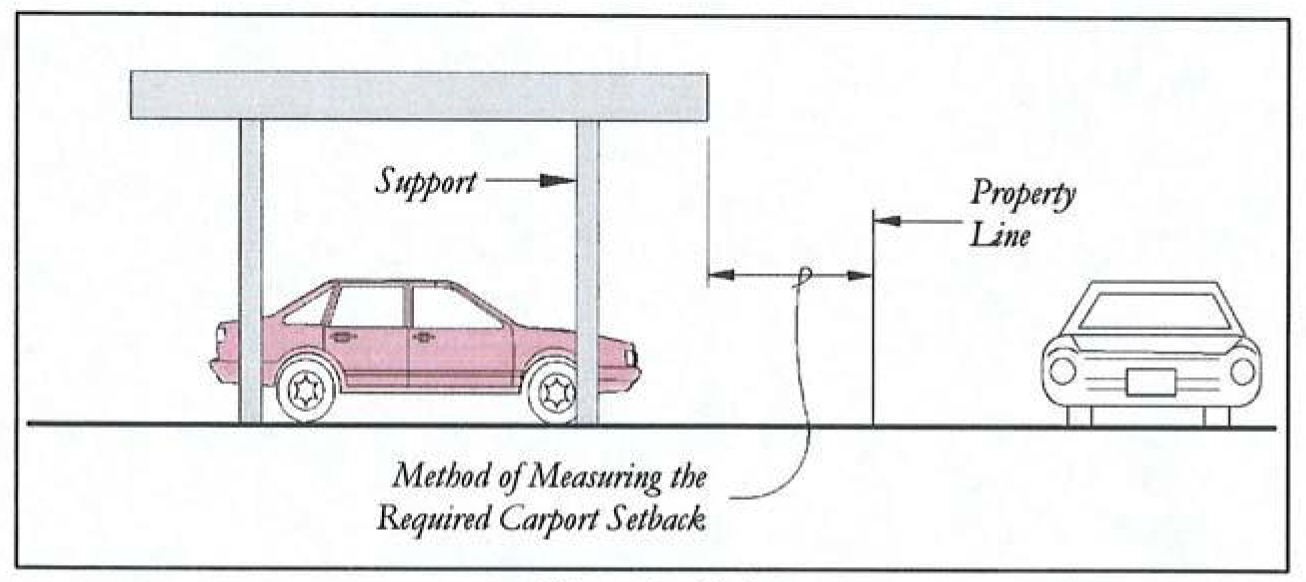
Illustration 50-114-1: Carport setback measurement
c.
Carports shall be measured from the part of the carport (usually the roof) that is closest to the street or alley (see Illustration 50-114-1). In single-family and two-family zoning districts, carports shall be a maximum of 500 square feet.
(Ord. No. 2008-01, § 41, 2-4-2008)
Sec. 50-115. - Screening, buffering and fencing requirements.
(a)
Purpose of screening and buffering. The purpose of screening and buffering is to encourage the most appropriate use of land and conserve and protect the privacy and value of adjacent permitted uses. Regulations are prescribed for the location and type of various screening devices to be used when required in the various zoning districts or in this section in accordance with the following standards.
(b)
Screening of nonresidential, multifamily areas and manufactured (mobile) home parks. The following provisions shall apply to screening of nonresidential, multifamily areas and manufactured (mobile) home parks:
(1)
Land use buffering shall be provided along property lines separating zoning districts as prescribed below:
a.
When non-residential, multi-family residential, or manufactured (mobile) home park zoning shares a common boundary with single-family residential, two-family residential, residential planned developments or agricultural zoning districts.
b.
Required land use buffers must consist of a minimum 10-foot-wide vegetative buffer yard and 7-foot opaque wooden fence plus at least 25 points based on the following criteria:
i.
Points:
1.
Opaque masonry wall with 6-foot minimum height in lieu of providing opaque wooden fence = 10 points
2.
Each additional 5 feet of buffer yard = 5 points (maximum of 10 points)
3.
ONE (1) tree with a mature height of at least 20-feet and height of at least 8-feet and caliper size of 4-inches (measured 12-inches above ground level) at the time of planting per 25 lineal feet of buffer yard = 15 points
4.
THREE (3) smaller trees with a height of at least 8-feet and caliper size of 2-inches (measured 12-inches above ground level) at the time of planting per 25 lineal feet of buffer yard = 15 points
c.
Trees planted to accommodate required land use buffering shall be in addition to the required trees prescribed within Section 50-113 (Landscaping Requirements).
d.
Preservation of existing trees: Each tree preserved to accommodate the required land use buffer shall count as one tree toward the overall land use buffering requirement regardless of size. Trees planned to be preserved must be on the City of Tomball approved planting list.
e.
For purposes of interpreting this section, mixed use zoning shall be considered nonresidential.
f.
Buffer yards are required between adjacent uses as indicated. For purposes of this section adjacent includes properties separated by an alley but does not include properties separated by a street.
g.
Parking lots, driving lanes, loading areas, or other similar areas of vehicular access shall be screened from residentially zoned property, whether adjacent or across a street, by a continuous hedge, planter, berm, fence, wall, or combination of these, with a minimum height of 36 inches. This requirement shall not be required along state highways.
h.
Open space in buffer yards shall be planted in grass or other vegetative ground cover.
i.
Alternative buffering may be permitted by the Director of Community Development or their designee during the site plan review process so long as the buffering and aesthetic intent of these requirements are met.
(2)
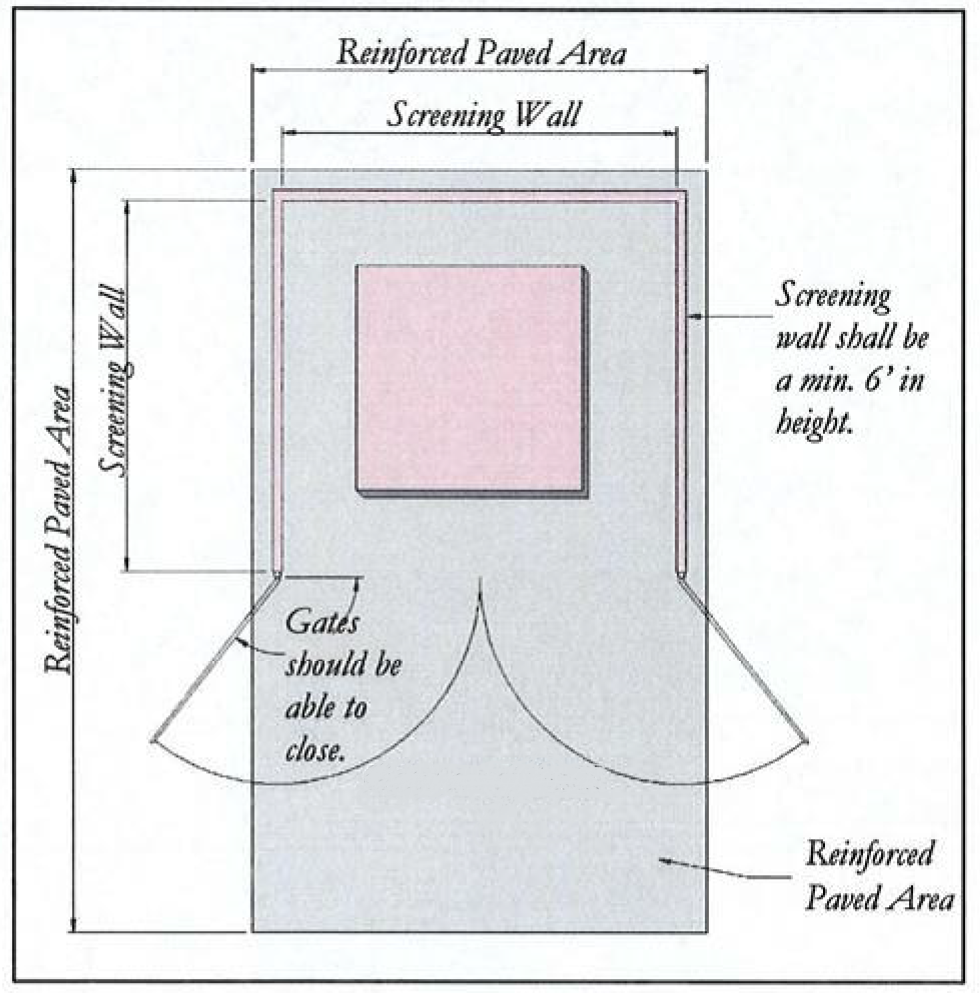
Refuse areas which are not within a rear service area and which are visible from a public right-of-way for all nonresidential, multifamily and manufactured/mobile home park uses shall be visually screened by a minimum six-foot solid masonry wall on at least three sides (see illustration 50-115-1 for refuse container enclosure diagrams). The fourth side, which is to be used for garbage pickup service, shall provide an opaque gate to secure the refuse storage area which shall remain closed at all times except when being used for filling, emptying, cleaning or maintenance. Alternate equivalent screening methods may be approved by the city. Each refuse facility shall be located so as to facilitate pickup by refuse collection agencies. Adequate reinforced paved areas shall be provided for refuse facilities and their approaches for loading and unloading, as per illustration 50-115-1. The standards within this section shall apply to all new enclosures added to a site, a waste/recycle dumpster or permanent roll-off added to a site and in the case of an addition to a structure or site that alters such structure or site by greater than 25 percent in area. Any site that is deemed abandoned by subsection 50-31(c) shall comply with the provisions of this section.
Illustration 50-115-1: Refuse area screening
_____
(3)
The purpose of the screening wall is to provide a visual and protective barrier between the properties, and therefore the following shall apply:
a.
The owner of the multifamily development, nonresidential development, or manufactured (mobile) home property shall be responsible for and shall build and maintain the required wall on the property line dividing the property from the single-family or duplex residential district, unless a buffer is provided and then it shall be on the inside edge of the buffer parallel to the property line.
b.
Any screening wall required under the provisions of this section or under a conditional use permit, PD Planned Development District, or other requirement shall be constructed of treated wood, masonry, reinforced concrete, or other similar suitable permanent materials which do not contain openings. All wall openings shall be equipped with gates equal in height and screening characteristics to the wall.
c.
Alternative equivalent screening may be approved at the time the required plan is approved (see section 50-36).
(4)
See chapter 38, article II and this section for sight visibility requirements.
(5)
Junkyards. Any junkyard, whether a primary use or an accessory use, shall provide an opaque screening device in conformance with the materials and methods described in section 50-116. Said screening device shall be of uniform height in relation to the ground that screens the view from adjoining lots and/or public places from junk. Stacking of junk above the height of the screening device that allows visibility from an adjoining lot or public place shall be prohibited.
(6)
Mechanical equipment, including roof-mounted equipment, must be screened from the view from streets, parking lots, parks, and residential districts with materials consistent with the principal structure, opaque fencing, masonry walls, and/or landscaping. Wall mounted electrical panels are exempt from this standard.
(c)
Purpose of fencing requirements. To encourage safety in residential neighborhoods, regulations are prescribed for the location and type of fencing devices to be used in conjunction with specific site elements.
(d)
Fences in residential areas. The following provisions shall apply to fences in residential areas:
(1)
No fence or gate in a residential district, except as specified in subsection (d)(5) of this section, shall exceed eight feet in height. Fences and gates shall be maintained in good repair at all times, including, but not limited to, ensuring that there be no missing, broken, or leaning slats or panels, and that the condition not to endanger life or property. Such maintenance shall be the responsibility of the owner of the property on which the fence or gate is located.
(2)
a.
Residential fences and gates shall be constructed of materials and colors in character with the area, and may contain a mix of building materials. Residential fences and gates shall consist of durable wood, vinyl, metal, stone, or other materials commonly used in conventional fence construction. Chainlink fencing may be utilized within the area of a rear yard, as defined in section 50-2. Non-opaque hog fencing in a framed construction or installation, no more than six feet in height, may be permitted within the Single-Family Estate Residential-20 District and Agricultural District subject to approval by the city manager or his/her designee.
b.
Except as noted above, fences or gates composed of chain link or similar material (barbed/chicken wire, hog fencing), as well as electrified fences, or any fence upon which spikes, nails, razor wire or other sharp or pointed instruments or security materials are fixed, attached or placed shall be prohibited. Ornamental features on the top of any fencing may be permitted as part of the original construction.
(3)
Fencing between the front property line and the closest primary or accessory structure on the site shall be as follows:
a.
For lots which are less than five acres, the maximum height of a fence shall be four feet.
b.
For lots that are five acres or larger, the maximum height of a fence shall be six feet.
c.
Non-opaque wrought iron fencing or similar metal building material fencing may be permitted within the Single-Family Estate Residential-20 District and the Agricultural District with a maximum height of six feet. Said fencing shall be subject to approval by the city manager or his/her designee.
(4)
Gates designed for vehicular access shall be set back from the edge of street or road pavement a minimum of 25 feet. Locking mechanisms for vehicular gates shall be subject to approval by the city fire marshal or his/her designee.
(5)
Special purpose fencing, and their associated gates, that does not exceed ten feet in height shall be limited to only the perimeter of tennis/ball courts, play areas/fields, or gardens. This type of fencing may be constructed of chain link or fabric-type material in addition to durable wood, vinyl, metal, stone, or other materials commonly used in conventional fence construction. In no case shall barbed/chicken wire, hog fencing, etc., or electrified fences, or any fence upon which spikes, nails, razor wire or other sharp or pointed instruments or security materials are fixed, attached or placed be utilized. Said fences shall not be erected within any setback, easement, or site visibility area detailed in subsection (d)(6) of this section. Such fencing shall be subject to approval by the city manager or his/her designee.
(6)
All fencing shall comply with sections 38-31 through 38-34 and section 50-113(i) for sight visibility requirements.
(e)
Fences in nonresidential areas, multiple-family areas, and manufactured (mobile) home parks. Any fence required under the provisions of this chapter or under a conditional use permit, PD Planned Development District, or other requirement shall be constructed of treated wood, masonry, reinforced concrete, or other similar suitable permanent materials which do not contain openings. The fence or wall may be a diagonal, horizontal, or vertical stockade-type privacy fence, although the framing of such fence may be of metal. All fence openings shall be equipped with gates equal in height and characteristics (e.g., materials, aesthetics, etc.) to the fence.
(Ord. No. 2008-01, § 42, 2-4-2008; Ord. No. 2012-51, § 2, 2-14-2013; Ord. No. 2017-39, § 2, 11-20-2017; Ord. No. 2018-04, § 2, 2-5-2018; Ord. No. 2023-55, § 2(Exh. A), 2-19-2024)
Sec. 50-116. - Supplemental regulations.
(a)
Setbacks and lot configurations. The following requirements shall apply to setbacks and lot configurations:
(1)
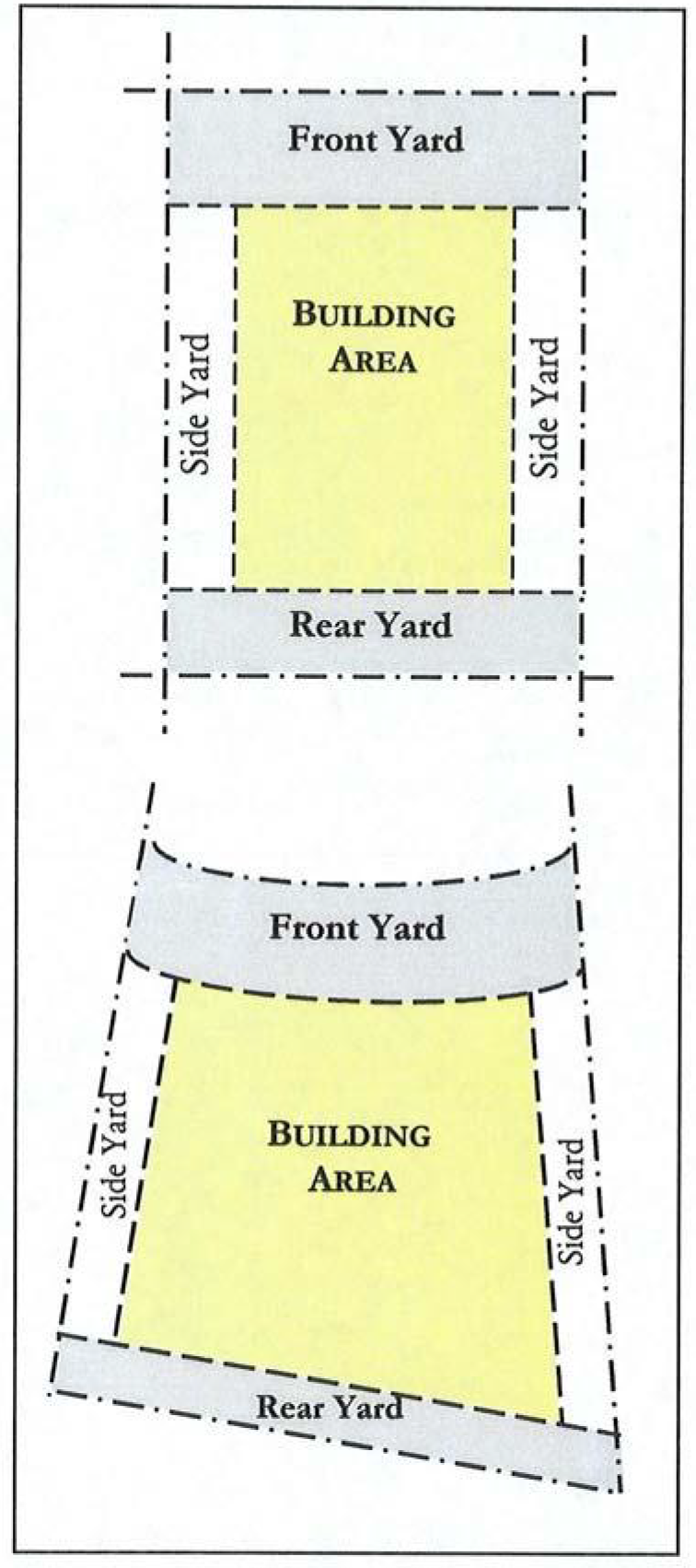
Measuring yards. All yard measurements shall be made in accordance with Illustration 50-116-1.
(2)
Configuration of lots. Wherever possible, flag lots (i.e., lots with minimal, or panhandle type, frontage) shall be avoided. Similarly, through (i.e., double frontage) lots (particularly within residential zoning districts) shall also be avoided wherever possible. (Also see chapter 40, pertaining to subdivisions, for regulations pertaining to the configuration of lots.)
(3)
Building setbacks. All setbacks established on a recorded plat shall be enforced, even if they exceed the required setbacks in this chapter. Setbacks established on a recorded plat shall only be changed through replat proceedings (see chapter 40, pertaining to subdivisions).
Illustration 50-116-1: Measuring yards
(b)
Front yard.
(1)
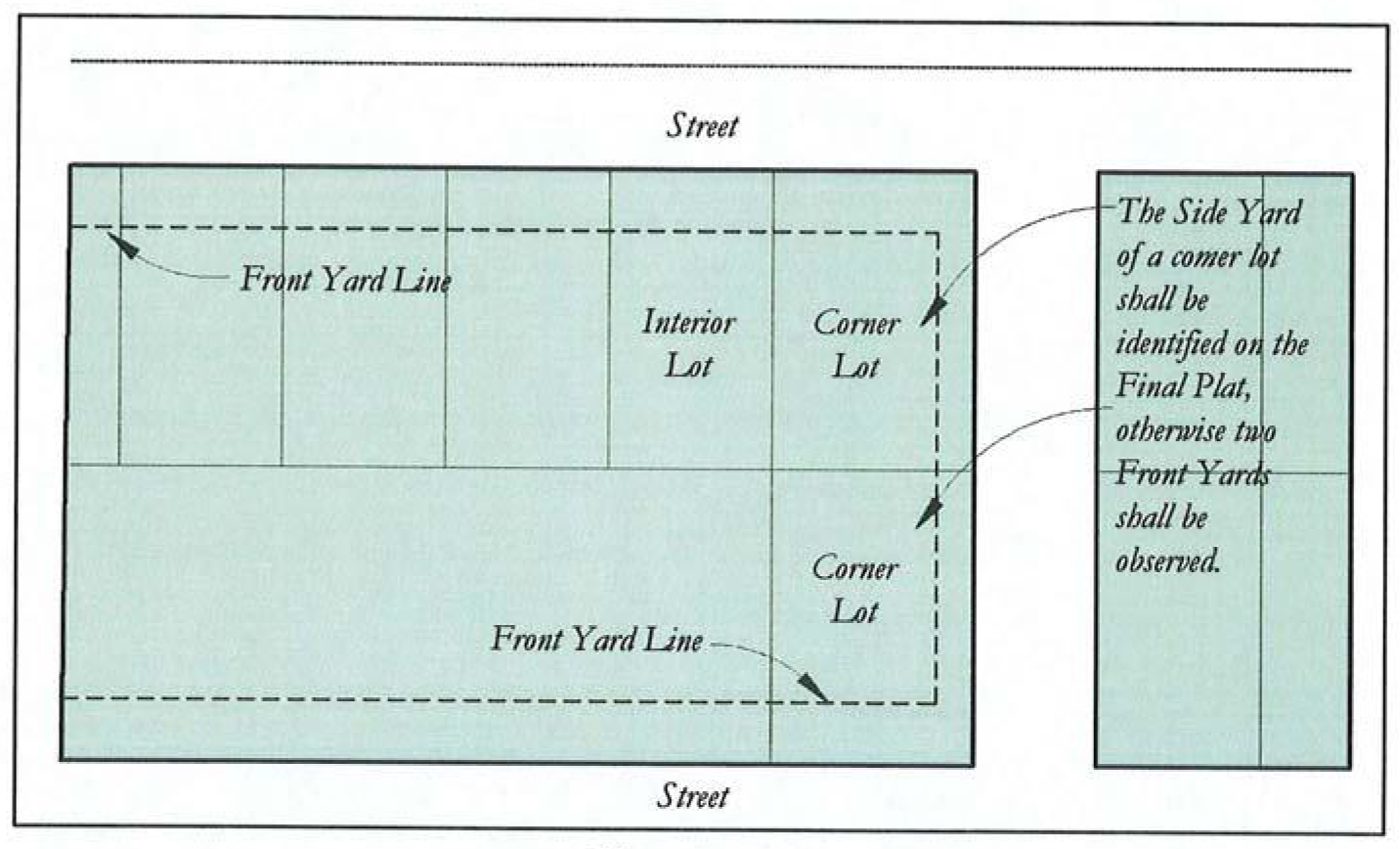
Corner and key lots. On all key lots, the front yard setback shall be observed along the frontage of both intersecting streets. On all other lots, a front and side yard shall be provided as required by the zoning district in which the property lies. Where single-family and duplex (two family) lots have double frontage, extending from one street to another, or are on a corner, a required front yard shall be provided on both streets unless a side or rear yard building line has been established along one frontage on the plat, in which event only one required front yard need be observed. The side and/or rear yards in the case of single-family and duplex uses shall be identified and the front of the structure shall not face the side or rear yard. See Illustration 50-116-2.
Illustration 50-116-2: Corner lots
(2)
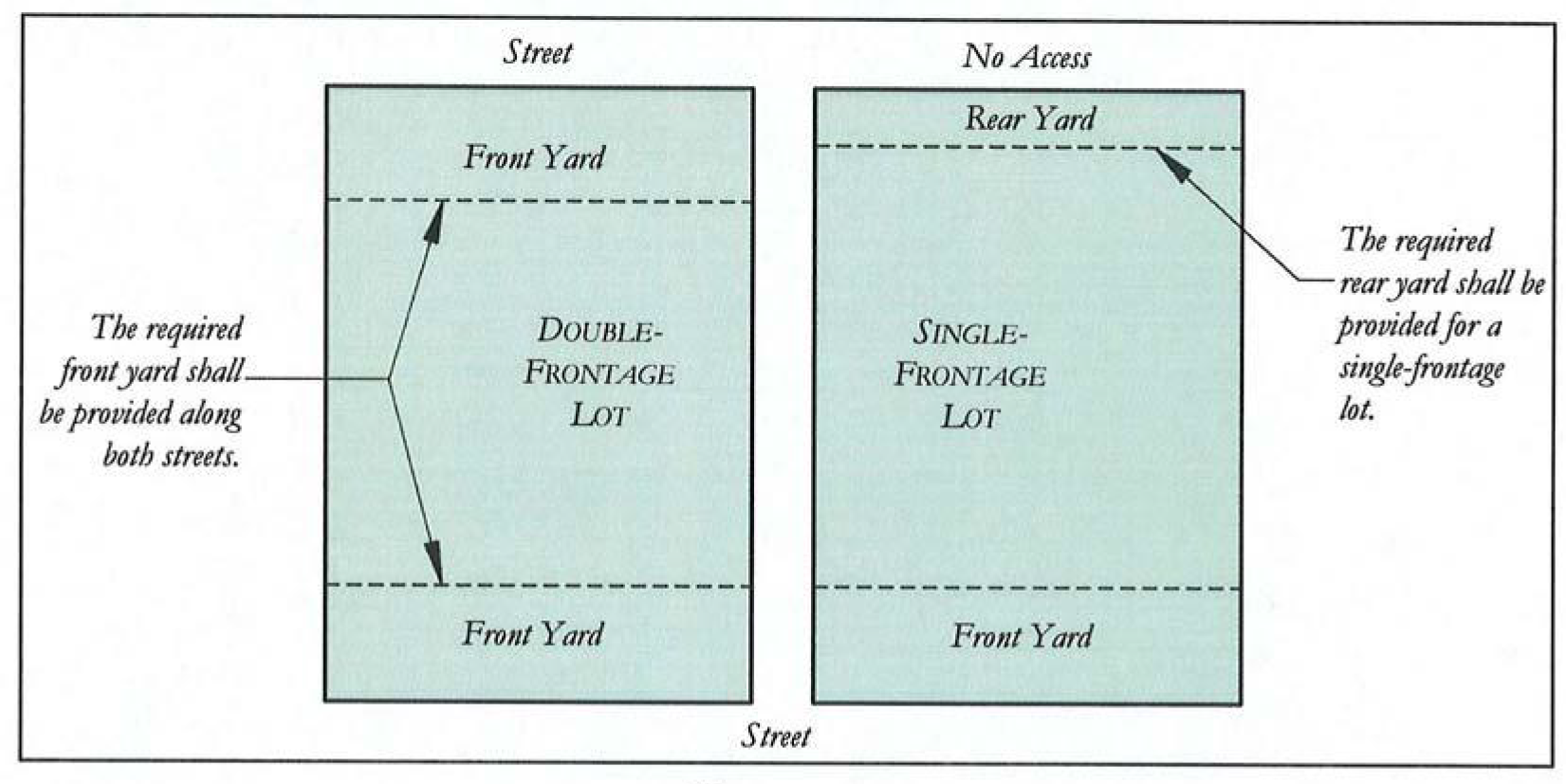
Double frontage. Where lots have double frontage, running through from one street to another, the required front yard shall be provided on both streets. See Illustration 50-116-3.
Illustration 50-116-3: Double-frontage lots
(3)
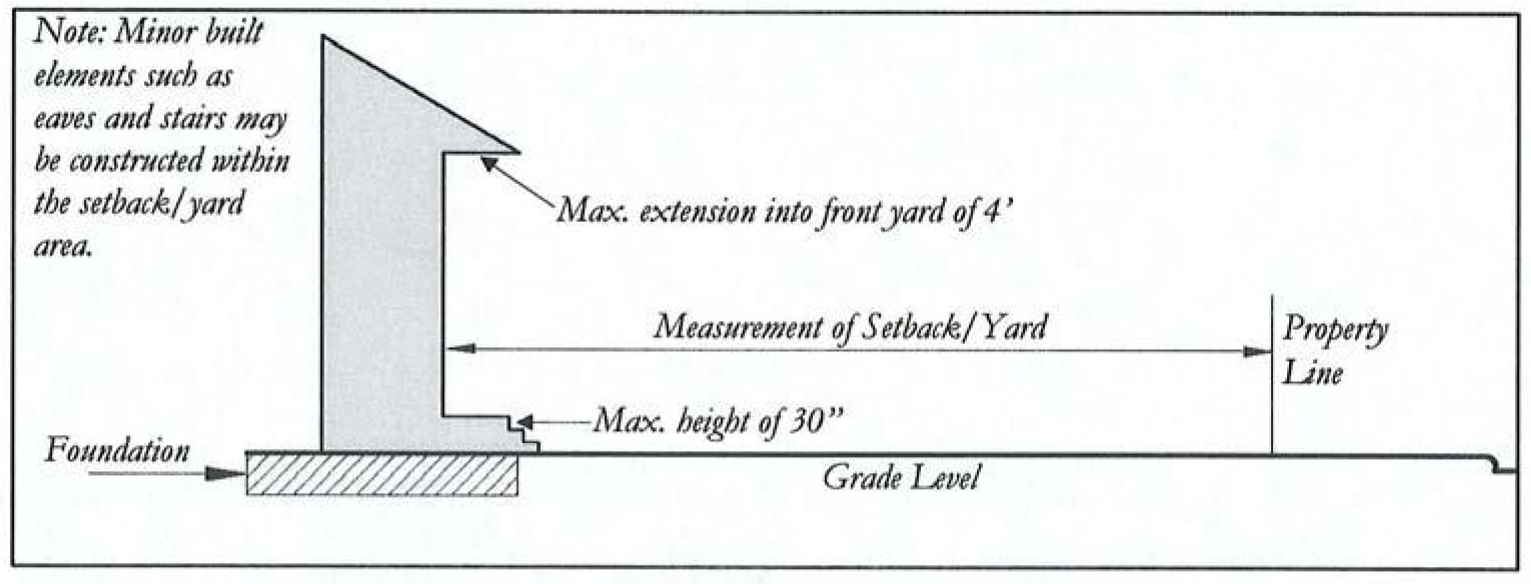
Front yard measurement. The front yard shall be measured from the property line to the front face of the building, to the nearest supporting member of a covered porch or terrace or to any attached accessory building. Eaves and roof extensions or a porch without posts or columns may project into the required front yard for a distance not to exceed four feet, and subsurface structures, platforms or slabs may not project into the front yard to a height greater than 30 inches above the average grade of the yard. See Illustration 50-116-4. Open porches extending into the front yard shall not be enclosed.
Illustration 50-116-4: Measuring front yard
(4)
Lots on curved streets. Minimum lot widths for lots with predominate frontage on the curved radius of a street (e.g., cul-de-sac or "eyebrow" portion of a street) shall be measured as the linear distance of the curved front building line, and shall be shown on the subdivision plat. Lot widths for all lots shall be as set forth in the respective zoning district for each lot.
(5)
Gasoline service station pump islands. Gasoline service station pump islands and related canopy posts that parallel a public street shall be located a minimum of 25 feet to the property line adjacent to a public street. For pump islands that are perpendicular or diagonal to a public street, the setback shall be 30 feet in order to prevent vehicles stacking out into the street while waiting for a pump position. The actual canopy itself may encroach up to four feet into the required setback, provided no posts or vertical structures encroach.
(6)
Rights-of-way. Where a right-of-way line has been established for future widening or opening of a street or thoroughfare, upon which a lot abuts, then the front, side, or rear yard shall be measured from the right-of-way line.
(c)
Side and rear yards.
(1)
Projections. Every part of a required side and rear yard shall be open and unobstructed except for the ordinary projections of window sills, belt courses, cornices, and other architectural features not to exceed 12 inches into the required side or rear yard, and roof eaves projecting not to exceed 24 inches into the required side or rear yard. Air conditioning compressors and similar equipment are permitted in the side or rear yard. Open porches extending into a side or rear yard shall not be enclosed.
(2)
Future rights-of-way. Where a future right-of-way line has been established for future widening or opening of a street or thoroughfare, upon which a lot abuts, then the front, side, or rear yard shall be measured from the future right-of-way line.
(d)
Special requirements.
(1)
Residential districts. For all residential districts, OT and MU Districts, and PD Districts allowing mixed uses, the following shall apply:
a.
Use of RVs, travel trailers, and motor homes. Recreational vehicles, travel trailers or motor homes may not be used for on-site dwelling purposes.
b.
Perimeter fencing. Electrical fencing and barbed wire is prohibited as perimeter fencing except for containment of farm animals on parcels of one or more acres.
c.
Setbacks for garages. Single-family homes with side-entry garages where lot frontage is only to one street (not a corner lot) shall have a minimum of 20 feet from the door face of the garage or carport to the side property line for maneuvering. The minimum setback from any garage door to a street or alley right-of-way line shall also be 20 feet.
d.
Swimming pools. Swimming pools shall conform to city adopted ordinances.
e.
Nonresidential uses and structures in residential districts. A site plan (see section 50-36) shall be required for any nonresidential use (e.g., school, church, child care center, private recreation facility, etc.) within a residential zoning district. Any nonresidential use which may be permitted in a residential zoning district shall conform to the O Office District standards, unless otherwise stated in this chapter or in an ordinance establishing a PD District.
f.
Elements permitted to extend above height limitations. For all residential zoning districts except the AG District, cooling towers may extend for an additional height not to exceed 50 feet above the average grade line of the building. Water stand pipes and tanks, church steeples, domes and spires, ornamental cupolas, city or school district buildings, and institutional buildings may be approved to exceed the height limit at the time the city reviews the applicable required plan.
g.
Refuse facilities in the MF and MHP Districts. Refuse containers shall be located no closer than 30 feet to any adjacent single-family property, shall be located so as to provide safe and convenient pickup by refuse collection agencies, and shall be screened in accordance with section. (See Illustration 50-115-1 within this chapter for refuse container enclosure diagrams).
h.
Other regulations may apply. Other regulations may be established by the individual residential district, article III of this chapter and by other regulations within this development standards part of the zoning ordinance. In any case in which regulations conflict, the more stringent standards shall apply.
(2)
Nonresidential districts. For all nonresidential zoning districts, the following shall apply:
a.
Temporary outdoor sales. Temporary outdoor retail sales, excluding those uses in the use charts (section 50-82) with normal outdoor sales such as automobile lots, which involve the outside display of merchandise and seasonal items (refer to the section 50-2, definitions), shall be limited to the following:
1.
Shall not be placed/located more than 30 feet from the main building in GR, and C Districts, and not more than 12 feet from the main building in the Old Town area.
2.
Shall not occupy any of the parking spaces that are required by this chapter for the primary uses of the property (except on a temporary basis only, which is a maximum of 30 days per display and a maximum of two displays per calendar year).
3.
Shall not pose a safety or visibility hazard, nor impede public vehicular or pedestrian circulation, either onsite or off site, in any way.
4.
Shall not extend into public right-of-way or onto adjacent property.
5.
All outside display items shall be removed at the end of business each day (except for large seasonal items such as Christmas trees).
6.
All merchandise shall be displayed in a neat, orderly manner, and the display area shall be maintained in a clean, litter-free manner.
b.
Temporary seasonal sales. Temporary seasonal sales shall be limited to the following:
1.
Are allowed in the GR, C, and OT and MU Districts.
2.
May occupy the parking spaces that are required by this chapter for the primary uses of the property for seasonal sales on a temporary basis only, which is a maximum of 30 days per display of seasonal materials and a maximum of two displays per calendar year, provided parking is adequate and not overloading the streets or adjacent properties.
3.
Shall not pose a safety or visibility hazard, nor impede public vehicular or pedestrian circulation, either onsite or off site, in any way.
4.
Shall not extend into public right-of-way or onto adjacent property.
5.
All merchandise shall be displayed in a neat, orderly manner, and the display area shall be maintained in a clean, litter-free manner.
c.
Outside storage. Outdoor storage shall be limited to the following:
1.
Is prohibited in O District.
2.
Is permitted in the GR, OT and MU and C Districts with certain standards outlined in the zoning district.
3.
Is permitted in the Industrial District.
4.
Shall be located behind the front building line and observe all setback requirements for the main structure or building.
5.
Shall be visually screened from any public street or adjacent property with a minimum six-foot solid wall or fence.
6.
Note: Outside storage is not outdoor sales; see definitions in section 50-2.
d.
Temporary storage containers. Temporary storage containers shall be limited to the following:
1.
Are prohibited in O and OT and MU Districts, except in accordance with c. below.
2.
Are allowed in GR, C and I Districts provided they do not occupy required parking or loading areas and is behind required setbacks and not contained in a front or side setback adjacent to a street.
3.
May be used in all nonresidential districts on a temporary basis during construction while a valid permit exists. If the business is closed or limited during construction, the containers may occupy required parking.
e.
Use of RVs, travel trailers, and motor homes. Recreational vehicles, travel trailers or motor homes may not be used for nonresidential purposes.
f.
Elements permitted to extend above height limitations. Cooling towers may extend for an additional height not to exceed 50 feet above the average grade line of the building. Water stand pipes and tanks, church steeples, domes and spires, ornamental cupolas, city or school district buildings, and institutional buildings may be approved to exceed the height limit at the time the city reviews the applicable required plan.
g.
Other regulations may apply. Other regulations may be established by the individual residential district, article III of this chapter and by other regulations within this development standards part of this chapter. In any case in which regulations conflict, the more stringent standards shall apply.
(e)
Communications antennas and support structures/towers. The following requirements shall apply to communications antennas and support structures/towers:
(1)
Applicability.
a.
These regulations apply to all commercial and amateur antennae and support structures, unless exempted in subsection (e)(1)b of this section.
b.
Direct broadcast satellite reception, multi-channel multi-point distribution (as defined by the FCC), television reception antenna, and amateur radio antennae meeting the following requirements do not require a permit unless mounted on a pole or mast that is 20 feet or more in height:
1.
In any zoning district, antennae that are one meter (i.e., 39 inches) or less in diameter;
2.
In a nonresidential zoning district, antennae that are two meters or less in diameter;
3.
In any zoning district, antennae designed to only receive television broadcasts;
4.
In any zoning district, amateur radio antennae concealed behind or located upon or within attics, eaves, gutters or roofing components of the building; and
5.
In any zoning district, amateur radio ground-mounted whips and wire antennae.
c.
Support structures or antennae legally installed before the effective date of the ordinance from which this chapter is derived are not required to comply with this chapter, but must meet all applicable state, federal and local requirements, building codes and safety standards.
(2)
Special definitions. For the purpose of this section, the following special definitions shall apply:
Antenna, microwave reflector, wireless communication, and antenna support structure means an antenna is the arrangement of wires or metal rods used in transmission, retransmission and/or reception of radio, television, electromagnetic or microwave signals (includes microwave reflectors/antennae). The term "microwave reflector" means an apparatus constructed of solid, open mesh, bar-configured, or perforated materials of any shape/configuration that is used to receive and/or transmit microwave signals from a terrestrial or orbitally located transmitter or transmitter relay. Microwave reflectors are also commonly referred to as satellite receive only earth stations (T.V.R.O.S.), or satellite dishes. The term "antenna support structure" includes any tower, mast, pole, tripod, box frame, or other structure utilized for the purpose of supporting one or more antennae or microwave reflectors. This definition specifically includes towers (radio, television, microwave, wireless, etc.), mobile antennas, and any type of similar structure that may be temporary.
Antenna (commercial) means an antenna or antenna support structure used for the purpose of transmission, retransmission, and/or reception of radio, television, electromagnetic, or microwave signals primarily for the purpose of operating a business and/or for financial gain (e.g., commercial broadcasting, cellular/wireless telecommunications, etc.). A satellite dish antenna that exceeds six feet in diameter shall also be considered as a commercial antenna.
Antenna (non-commercial/amateur) means an antenna or antenna support structure used for the purpose of transmission, retransmission, and/or reception of radio, television, electromagnetic, or microwave signals for private or personal use and not for the purpose of operating a business and/or for financial gain. A satellite dish antenna not exceeding six feet in diameter shall also be considered as a non-commercial antenna.
Collocation means the use of a single support structure and/or site by more than one communications provider.
Communications operations (commercial) means the transmission, retransmission, and/or reception of radio, television, electromagnetic, or microwave signals primarily for the purpose of operating a business and/or for financial gain.
Communications operations (non-commercial/amateur) means the transmission, retransmission and/or reception of radio, television, electromagnetic, or microwave signals for private or personal use, and not for the purpose of operating a business and/or for financial gain.
Height means the distance measured from the finished grade of the lot/parcel to the highest point on the support structure or other structure, including the base pad and any antennae.
(3)
General requirements.
a.
Antennae and support structures may be considered either principal or accessory uses.
b.
Antenna installations shall comply with all other requirements of this chapter and the city Code of Ordinances with the exception of those specifically cited within these regulations.
c.
No commercial antenna support structure shall be closer to any residential district boundary line or residential dwelling than a distance equal to twice the height of the support structure. Such setback/distance shall be measured as the shortest possible distance in a straight line from the structure to the closest point of a residential district boundary line or residential dwelling. Setbacks from residentially zoned property do not apply to antennas attached to utility structures that exceed 50 feet in height, or to antennae placed wholly within or mounted upon a building (refer to subsection (c) of this section).
d.
No amateur or commercial antenna, antenna support structure, microwave reflector/antenna, or associated foundations or support wires or appurtenances shall be located within any required setback area for the front, side or rear yards.
e.
All antenna and support structures must meet or exceed the current standards and regulations of the Federal Communications Commission (FCC), the Federal Aviation Administration (FAA), and/or all other applicable federal, state and local authorities. If those standards change, then the owner/user of an antenna or support structure must bring the antenna/structure into compliance within 180 calendar days or as may otherwise be required by the applicable regulating authority.
f.
A building permit is required to erect or install an antenna, antenna support structure and related structures/equipment, unless the particular antenna is exempt from these regulations (see subsection (e)(3)b of this section). All installations shall comply with applicable federal, state and local building codes and the standards published by the electronic industries association. Owners/users shall have 30 calendar days after receiving notice that an installation is in violation of applicable codes in order to bring it into full compliance.
g.
Antennae (amateur or commercial) shall not create electromagnetic or other interference with the city's and the county's radio frequencies and public safety operations, as required by the FCC. In accordance with FCC regulations, antennae also shall not interfere with radio or television reception of nearby property owners. In no manner shall the use of such equipment infringe upon adjoining property owners.
h.
No antenna or support structure shall be located so as to create a visual obstruction within critical visibility areas (such as at street intersections or where a private driveway enters a roadway) or a traffic safety problem.
i.
Safeguards shall be utilized to prevent unauthorized access to an antenna installation (e.g., on a water tower or utility structure, a free-standing installation, etc.). Safeguards include certain devices identified/recommended by the manufacturer of the antenna or support structure, a fence, a climbing guard, or other commercially available safety devices. Climbing spikes or other similar climbing device, if utilized, shall be removed immediately following use.
j.
Temporary antenna shall only be allowed in the following instances:
1.
In conjunction with a festival, carnival, rodeo or other special event/activity;
2.
In case of an emergency (e.g., severe weather, etc.) or a news coverage event;
3.
When needed to restore service on a temporary basis after failure of an antenna installation. The city must be notified within 72 hours of the placement of a temporary antenna. If the temporary antenna is to be needed for more than seven calendar days, then the owner/user must apply for and acquire a permit for the temporary installation on or before the eighth day following initial placement of the antenna.
k.
Collection is greatly encouraged by the city.
1.
All new support structures over 50 feet in height shall be constructed to support antennae for at least two carriers, unless the structure is an alternative or stealth design, or the support structure is replacing an existing utility structure or light standard. Sufficient area for associated structures and equipment shall also be provided.
2.
A support structure which is modified or reconstructed in order to accommodate collection shall be of the same type, design and height as the existing structure, and it may be moved on the same property within 50 feet of its original location provided that it is not moved any closer to residentially zoned property (if the structure was allowed by CUP, then its new location shall be within the physical/land boundaries of the CUP). The original (i.e., former) support structure shall be removed from the property within 30 calendar days following completion of the new structure.
3.
Where an additional antenna is to be attached to an existing support structure that already has an antenna mounted upon it, the new antenna shall comply with and be compatible with the design of the existing antenna on the collocated structure.
l.
Support buildings and equipment storage areas/buildings shall be screened from public view if mounted on a rooftop. When ground mounted, they shall meet all applicable front, side and rear yard setback requirements of the applicable base zoning district.
m.
Satellite dishes, television antennas, and other similar antennas shall be permitted on the roof of a building, as long as satellite dishes do not exceed one meter (39 inches) in diameter and antennae do not extend over ten feet above the roof of the building. A letter certifying the roof's/building's structural stability shall be written and sealed by a registered architect or engineer, and shall be submitted to the building official, or his designee, prior to any approval of a roof-mounted antenna. Roof-mounted antenna that comply with the provisions of these regulations do not require additional yard setbacks or setbacks from residential areas or dwellings.
n.
Only one amateur antenna/support structure shall be permitted per residential lot, except that a maximum of two satellite dishes may be allowed if both units are no larger than one meter (39 inches) in diameter (only one allowed if over one meter in diameter).
o.
All commercial signs, flags, lights and attachments other than those required for emergency identification, communications operations, structural stability, or as required for flight visibility by the FAA and/or FCC shall be prohibited on any antenna or antenna support structure. However, lights may remain or be placed upon light standards that are altered or replaced in order for them to serve as antenna support structures provided that said lights are not commercial (i.e., for-profit) in nature, and provided that said lights are placed/replaced as the same size, configuration, number of bulbs, degree of luminance, etc. as they previously existed prior to support structure modification/replacement.
p.
Any publicly owned antennae or antenna support structures are exempt from regulation by this chapter (e.g., public safety communications, etc.).
q.
Location requirements for commercial antennas. A commercial antenna support structure not allowed by right through another provision of this section may be allowed in any zoning district by conditional use permit (CUP) provided that it shall be no closer than a distance equal to twice the height of the support structure to any residentially zoned lot and/or to any residential use. Such setback shall be measured as the shortest distance in a straight line from the structure to the closest point of any residential zoned lot other than the lot upon which the support structure is located.
(f)
Sight visibility. The following requirements shall apply to sight visibility:
(1)
Visual clearance shall be provided in all zoning districts so that no fence, wall, architectural screen, earth mounding, landscaping or other feature obstructs the vision of a motor vehicle driver approaching any street, alley, or driveway intersection. Whenever an intersection of two or more public street rights-of-way occurs, a 45-foot triangular visibility area in accordance with chapter 38, article II shall be created and apply to landscaping, fences, walls, signs, earthen berms and other features. Any features within the triangular visibility area shall be in accordance with such requirements and provide unobstructed cross-visibility at a level between 36 inches and 15 feet. Trees may be permitted in this area in accordance with section 50-113 provided they are trimmed in such a manner that no limbs or foliage extend into the cross-visibility area. In addition to the 45-foot visibility triangle at the intersection of two streets as required in chapter 38, article II, the following visibility triangular areas meeting the same requirements are required:
Illustration 50-116-5: Visual clearance
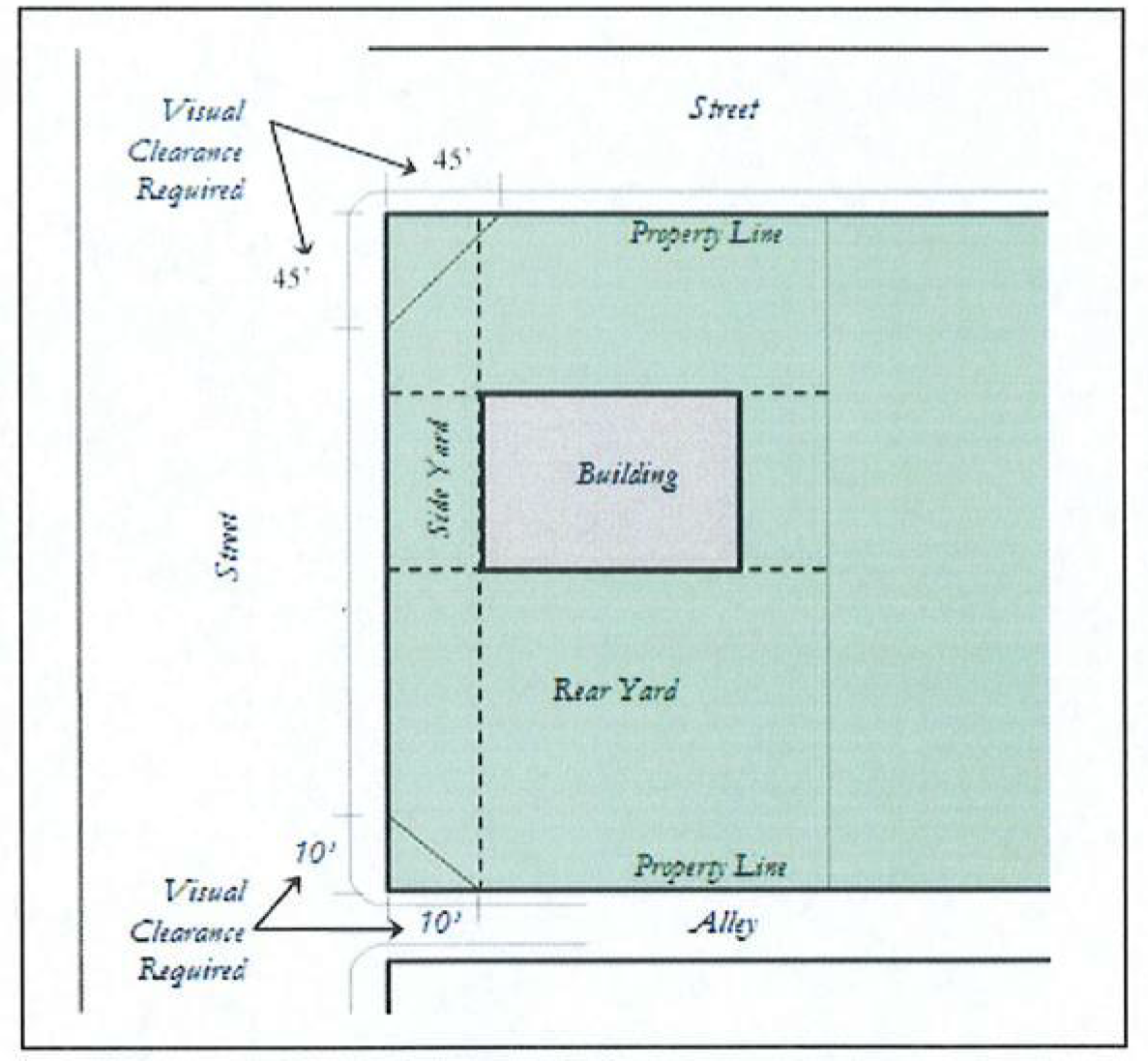
a.
The areas of property on both sides of the intersection of an alley accessway and public right-of-way shall have a triangular visibility area with two sides of each triangle being a minimum of ten feet in length from the point of intersection and the third side being a line connecting the ends of the other two sides.
b.
The areas of property located at a corner formed by the intersection of a private driveway onto a public road shall have a triangular visibility area with two sides of each triangle being a minimum of 20 feet in length along the right-of-way lines (or along the driveway curbline and the road right-of-way line) from the point of the intersection and the third side being a line connecting the ends of the other two sides. (See Illustration 50-116-5 of this chapter).
(2)
Landscaping, except required grass and low ground cover, shall not be located closer than three feet from the edge of any accessway pavement on arterial or collector streets as shown on the adopted comprehensive plan.
(3)
Shrubs and plant materials that are typically less than 24 inches in height at maturity may be located within sight visibility areas provided that they are kept maintained at a maximum height of 24 inches.
(4)
A limited number of single-trunked trees having a clear trunk (i.e., branching) height of at least eight feet may be located within sight visibility areas, provided that they are trimmed in such a manner that no limbs or foliage extend into the cross-visibility area defined in this section, and provided that they are spaced and positioned such that their trunks will not produce a visibility inhibiting, "picket-fence" effect when they attain mature size.
(g)
Garage or yard sales. In connection with the residential or institutional occupancy of a structure, the tenants may offer their personal belongings and household effects for sale to the general public provided that such sales are not conducted on the same lot for more than three days (whether consecutive or not) during any 90-day period.
(h)
Temporary structures and uses. Any temporary use, structure or building permitted under this chapter shall comply with all applicable development standards and setback requirements in the district in which the temporary use, structure or building is located, unless otherwise specified herein.
(1)
Temporary construction office. Temporary construction offices, including trailers and modular offices, are permitted on or adjacent to any site during which construction is undertaken pursuant to a valid building permit. Temporary construction offices may be occupied for office or security purposes, or may be used for storage of equipment and material used during construction of the site. Upon completion or abandonment of construction or expiration of the building permit, the temporary construction office shall be removed at the owner's expense.
(2)
Temporary real estate field office. Temporary real estate sales offices, including trailers and modular offices, shall be permitted in accordance with section 50-82, use regulations when incidental to a residential development. Temporary sales offices shall be located and developed in compliance with the following standards:
a.
The temporary sales office shall be located within the boundaries of the subdivision or tract of land in which the real property is to be sold or leased; and on a property whereon a recorded plat exists and a valid permit for construction has been issued;
b.
Parking shall be permitted on the lot in which the office is located or on an adjacent lot;
c.
Permitted temporary real estate sales offices shall not be used as any type of dwelling;
d.
Use of the temporary real estate sales office for the sale or lease of residential sites or projects located off-site is prohibited; and
e.
All temporary real estate sales offices shall be removed within 30 days after the sale of the last dwelling unit in the development, or within 30 days after 12 continuous months of no construction or sales activity.
(i)
Model home (including sales office). Model homes with or without a sales office shall be permitted in accordance with section 50-82, use regulations when incidental to a residential development. Model homes shall be located and developed in compliance with the following standards:
(1)
The model home shall be located within the boundaries of the subdivision or tract of land where the real property to be sold or leased is situated.
(2)
Parking shall be permitted on the lot in which the model home is located or on an adjacent lot.
(3)
The model home shall be designed as a permanent structure and shall comply with the provisions of this chapter, all applicable building codes of the city, and state law.
(4)
All exterior lighting shall be limited to typical household exterior lighting. The use of commercial grade ground mounted floodlights and search lights are prohibited.
(5)
The model home shall cease operation within 30 days after the sale of the last dwelling unit in the development, at which time the model home shall be vacated and a building permit issued to return the model home to its intended residential use only.
(6)
There shall be no permanent use of temporary buildings or temporary structures.
(7)
Temporary signage and flagpoles advertising the sale of property within the residential development shall not be prohibited provided they comply with the sign ordinance, are permitted, and are maintained at least ten feet away from all lot lines.
(j)
Site development standards for mobile food courts.
(1)
No mobile food vendor nor any associated seating areas shall be located in the required landscape buffer yard, access easement, surface drainage easement, driveway, and/or fire lane(s).
(2)
All activity must occur on private property, outside of the public right-of-way.
(3)
There shall be at least three feet of unobstructed clearance between all individual mobile food vendors and all permanent or accessory structures and at least ten feet of unobstructed clearance for mobile food vendors parked side-by-side.
(4)
Mobile food vendors shall not park in required parking stalls, rather they shall be located on a designated paved surface. Spaces for mobile food vendors shall meet the minimum parking requirements per Table 50-112-1.
(5)
Vehicular drive-thru service of food and/or beverages shall not be permitted.
(6)
Accessible restroom facilities shall be provided within a permanent structure. Temporary or portable toilet facilities are not permitted.
(7)
Electrical service may be provided to the mobile food vendors by a permitted electrical connection or on-board generators. When using on-board generators, sound absorbing devices shall be used.
(8)
A designated seating area shall be provided for patrons.
(9)
Mobile food vendors conducting business operations within an approved mobile food court shall not be subject to restrictions on the length of time that a mobile food vendor may be located at the same location.
(10)
Mobile food vendors conducting business at a mobile food court shall have current vehicular registration and shall be in a suitable operating condition for transit.
(11)
All mobile food vendors shall meet all other requirements per chapter 32, peddlers and solicitors.
(Ord. No. 2008-01, § 43, 2-4-2008; Ord. No. 2010-09, § 3, 5-3-2010; Ord. No. 2012-30, § 2, 9-17-2012; Ord. No. 2013-14, § 2, 2-9-2013; Ord. No. 2016-33, § 4, 1-3-2017; Ord. No. 2020-08, § 2, 5-4-2020; Ord. No. 2022-40, § 2(Exh. A), 12-5-2022)
Sec. 50-117. - Home occupation regulations.
(a)
Purpose. Standards for home occupations are set forth to minimize annoyance and inconvenience to neighboring property owners within residential areas. These standards are intended to allow reasonable and comfortable enjoyment of adjacent and nearby property by their owners and by occupants of neighboring residential dwellings, while providing opportunities for the pursuit of home-based businesses. For the purposes of these regulations, a home occupation is described as an occupation that is carried on in a dwelling unit, or in an accessory building to a dwelling unit, by a resident of the premises only, which is clearly incidental and secondary to the use of the premises for residential purposes, and which can be conducted without any significantly adverse impact on the surrounding neighborhood.
(b)
Special provisions for home occupations.
(1)
Home occupations shall be permitted as accessory uses in single- and two-family residential zoning districts, provided that they comply with all restrictions herein.
(2)
The occupation shall produce no alteration or change in the character or exterior appearance of the principal building from that of a residential dwelling, shall have no signs and performance of the occupation activity shall not be visible from the street.
(3)
Such use shall be incidental and secondary to the use of the premises for residential purposes, and shall not utilize floor area exceeding 25 percent of the combined gross floor area of dwelling unit and any accessory buildings that are used for the home occupation. In no case shall the combined floor area utilized for a home occupation exceed 500 square feet.
(4)
Not more than two patron or business-related vehicles shall be present at one time.
(5)
The operation of such an occupation shall be between the hours of 8:00 a.m. and 6:00 p.m. for outdoor activities, and between 8:00 a.m. and 10:00 p.m. for indoor activities.
(6)
The occupation activity shall not increase vehicular traffic flow beyond what normally occurs within a residential district, and shall not require regular and frequent deliveries by large delivery trucks or vehicles with a rated capacity in excess of 1½ tons, according to the manufacturer's classification.
(7)
There shall be no outside storage, including trailers, or outside display related to the home occupation use.
(8)
No mechanical or electrical equipment shall be employed on the premises other than that which is customarily found in a home environment, and that which is customarily associated with a hobby or avocation which is conducted solely for pleasure and not for profit or financial gain.
(9)
The home occupation shall not generate noise, vibration, glare, fumes/odors, heat or electrical interference beyond what normally occurs within a residential district.
(10)
The occupation shall not require the use of chemicals on the property that are obnoxious or hazardous to the welfare of the neighborhood.
(11)
The home occupation shall not involve the use of advertising signs or window displays, or any other device that calls attention to the business use of the premises through audio and/or visual means.
(12)
The occupation shall not offer a ready inventory of any commodity for sale on the premises (e.g., arts and crafts items, handmade clothing, etc.).
(13)
The occupation shall not be harmful or detrimental to the health, welfare and safety of the neighborhood, nor shall it interfere with the comfortable enjoyment of life, property and recreation by residents of the area.
(c)
Applicability of other regulations. Home occupations shall also be subject to any and all other provisions of local, state and/or federal regulations and laws that govern such uses.
(d)
Uses allowed as home occupations. Subject to the provisions of subsection (b) of this section, home occupations may include the following uses:
(1)
Office facility of an accountant, architect, landscape architect, attorney, engineer, consultant, insurance agent, realtor, broker, or similar profession;
(2)
Author, artist or sculptor;
(3)
Dressmaker, seamstress or tailor;
(4)
Music/dance teacher, or similar types of instruction, provided that instruction shall be limited to no more than four pupils at a time;
(5)
Individual tutoring and home schooling;
(6)
Millinery;
(7)
Office facility of a minister, rabbi, priest or other clergyman;
(8)
Home crafts, such as rug weaving, model making, etc;
(9)
Office facility of a salesman, sales or manufacturer's representative, etc., provided that no retail or wholesale transactions or provisions of services are personally and physically made on the premises;
(10)
Repair shop for small electrical appliances, cameras, watches/clocks, and other small items, provided that the items can be carried by one person without using special equipment, and provided that the items are not equipped with an internal combustion engine;
(11)
Food preparation establishments such as cake making/decorating or catering, provided that there is no on-premises consumption by customers, and provided that all aspects of the business comply with all state and local health regulations;
(12)
Registered family homes (see definition in section 50-2), in compliance with applicable state laws, which are incorporated herein by reference, with no more than six children;
(13)
Swimming lessons and water safety instruction, provided that such instruction involves no more than four pupils at any one time; and
(14)
The building official or his designee shall have discretion to examine all the above factors and any supplemental information provided by the applicant and make a determination of whether the size, scale and effect on neighboring properties and authorize or deny a particular home occupation. Appeals of his decision shall be to the board of adjustments upon proper notice to adjacent property owners.
(e)
Home occupation uses not classified. Any use that is not expressly allowed by subsection (d) of this section is considered prohibited, unless and until such use is classified by amendment to this chapter.
(Ord. No. 2008-01, § 44, 2-4-2008)

