
Treasure Island City Zoning Code
ARTICLE I
- IN GENERAL
Sec. 68-1. - Reserved.
Editor's note— Sec. 2 of Ord. No. 2025-13, adopted October 7, 2025, redesignated § 68-1 as § 60-6, which in effect deleted § 68-1 which pertained to rules of construction, and derived from Ord. No. 95-10, adopted September 19, 1995; and Ord. No. 15-03, adopted July 7, 2015.
Sec. 68-2. - Definitions.
Unless specifically defined below or in the specific article in which they appear, words or phrases used in these regulations shall be interpreted so as to give them the meaning they have in common usage, and to give these regulations their most reasonable application. For the purpose of enforcing and administering this chapter, the following words shall have the definitions and meanings as herein set forth.
Abutting means to physically touch or border upon, or to share a common property line.
Access, vehicular means the principal means of vehicular ingress and egress to property from a right-of-way or easement.
Accessory use or structure means a use or a structure subordinate to the principal use or building on the same lot and serving a purpose customarily incidental to the use of the principal building, provided any such structure is built with or after the construction of the principal building.
Adjacent means property that touches or is directly across a street, access easement, alley, or right-of-way (except those properties separated by an arterial or collector street) from the subject property.
Adult entertainment establishment means a site or premises, or portion thereof, upon which certain adult use activities or operations are conducted, such as, but not limited to adult arcade, adult bookstore, adult booth, adult theater, special cabarets, physical culture establishments, and adult photographic or modeling studios, including any business establishment whose primary business stock in trade is dependent upon the activities relating to specified sexual activities or specified anatomical areas.
Alcoholic beverage establishment means any establishment devoted primarily to the retail sale of alcoholic beverages for consumption on the premises.
Alley means a public right-of-way which affords only a secondary means of access to abutting property.
Alteration means any change, rearrangement, enlargement, extension, reduction of any structure or part thereof or moving on the same site.
Amortization means the installment costs of a use or structure extended throughout a predetermined life of such use or structure.
Ancillary nonresidential use means off-street parking, drainage retention areas, and open space buffer areas for adjacent, contiguous nonresidential uses.
Animal hospital means any building or portion thereof designed or used for the veterinary care, surgical procedures or treatment of animals, but not boarding of well animals.
Antenna means any exterior transmitting or receiving device used in communications that radiates or captures electromagnetic waves, digital signals, analog signals, radio frequencies (excluding radar), wireless communications signals or other communication signals.
Arcade means a series of arches supported by columns, piers, or pillars, either freestanding or attached to a wall to form a covered passageway.
Architect means a person licensed by the state to practice architecture.
Artist studio means a worker's workroom for an individual and their employees for the purposes of activities including but not limited to painting, drawing, ceramics, sculpture, jewelry making, photography, graphic design, dance, glass blowing, film-making, video or film production.
Assembly occupancies means occupancies that include, but are not limited to all buildings or portions of buildings used for gatherings of persons, for such purposes as seminars, conventions, conferences, deliberation, entertainment, dining, religious institution use, amusement facilities or awaiting transportation.
Automobile gas station means any building, structure or land used primarily for the dispensing, sale or offering for sale at retail of any automotive fuels or oils.
Automobile service station means any building, structure or land used primarily for the dispensing, sale or offering for sale at retail of any automobile fuels, oils or accessories, but not including major repair work such as motor overhaul, body and fender repair or spray painting. An automobile service station may provide for minor repair of vehicles and rental of automobiles or trailers.
Availability/available with regard to the provisions of facilities and services concurrent with the impacts of development, means that at a minimum the facilities and services will be provided in accordance with the standards set forth in F.A.C. 9J-5.0055(2).
Awning means an accessory structure, either temporary or permanent, which is supported by an open framework and is covered by material such as but not limited to cloth, plastic, fiberglass, or metal.
Bar. (See "alcoholic beverage establishment.")
Base flood elevation means the elevation of the flood having a one percent chance of being equaled or exceeded in a year as depicted on the flood insurance rate map (FIRM).
Beach shelter means an accessory structure temporary or permanent, consisting of one or more columns and a roof and not including walls or a floor or facilities of any type.
Board of adjustment, for the purposes of this Code, shall mean the planning and zoning board.
Boarding house (rooming house) means a building other than a hotel or motel where lodging with or without meals for three or more persons not of the immediate family is provided for compensation.
Buffer area means a natural or landscaped area or strip of land, with or without such physical separation devices as a fence or wall, established to separate and insulate one type of use from another use; or to shield or block noise, lights or other considerations; or to separate development from a natural feature so as to reduce the incompatibility between uses or features and protect the integrity of each.
Building means any structure used or intended for supporting or sheltering any use or occupancy.
Building height means the vertical distance from the base flood elevation plus two feet of freeboard to the highest point of the building, not including those structures specifically permitted to extend beyond the height of the building, as may be modified by the height adjustment factor.
Building setback line means the required minimum horizontal distance between the front, rear or side lines of the lot and the front, rear or side lines of the building.
Building site means that part of a parcel of land designed to be occupied by the principal building and such accessory buildings or uses customarily incidental to it.
Bus shelter means a covered structure, usually having three walls, located on or adjacent to the right-of-way of a street and designed primarily for the protection and convenience of bus passengers.
Bush means a woody plant, smaller than a tree and having many stems branching out low instead of one main stem or trunk; shrub.
Cafeteria. (See "restaurant.")
Car wash means an establishment for the washing, cleaning, waxing and polishing of the exterior surface of passenger vehicles; and for the incidental cleaning and vacuuming of the interior passenger sections.
Child day care center means a licensed facility which provides, for any portion of the day, care-giving services to three or more persons under the age of 18, who are not related to the owner or operator.
City means the City of Treasure Island located within Pinellas County, Florida.
City manager means the city manager of the city.
Clinic, medical means a facility which does not provide for overnight accommodations wherein professional services concerning personal health of humans are administered by medical doctors, chiropractors, osteopaths, optometrists, dentists or any other such profession, which may lawfully be practiced in the state.
Clinic, veterinary means a facility which provides for care of animals wholly within a soundproof, air conditioned structure and wherein overnight boarding of animals is accommodated for medical reasons.
Club, private means building and facilities owned or operated by a corporation, association, person or persons for social, educational or recreational purpose, but not primarily for profit or to render a service which is customarily carried on as a business.
Commercial means a use or other activity, involving the sale or offering, of goods or services for any and all kinds of vocations, occupations, professions, trades, enterprises, establishments, and all other kinds of activities and matters, together with all devices, machines, private, for profit or not, whether salaried or unsalaried, either directly or indirectly, on any premises in this city, or anywhere else within its jurisdiction.
Commercial property means a building, site, or portion of a structure where commercial use activities occur.
Commercial recreation use means a use of the property for a commercial purpose for a per use fee, where the use of the property by the customer is for a recreational use, such as a miniature golf course, a fishing pier or a commercial swimming pool.
Common lot line means a line dividing one lot or parcel from another.
Community residential home, as defined in F.S. § 419.001, means "a dwelling unit licensed to serve clients of the state department of children and family services, which provides a living environment for seven to 14 unrelated residents who operate as the functional equivalent of a family, including such supervision and care by supportive staff as may be necessary to meet the physical, emotional, and social needs of the residents." This term may include adult congregate living facilities (ACLFs), assisted living facilities (ALFs), and other comparable care and rehabilitative facilities meeting the statutory definition. This category is restricted to persons who do not require special provisions for emergency evacuation.
Comprehensive plan means the comprehensive plan as defined by F.S. ch. 163 "Community Planning Act" as adopted by the city and which may consist of several maps, data and other descriptive matter, for the physical development of the city or any portion thereof, including any amendments, extensions or additions thereto, indicating the general location for major streets, parks, public utilities, land use or other similar information.
Concurrency means that the necessary public facilities and services to maintain the adopted level of service standards are available when the impacts of development occur.
Concurrency management system means the procedures and/or process that the city will utilize to assure that development orders and permits are not issued unless the necessary facilities and services are available concurrent with the impacts of development.
Condo-hotel means a hotel or motel comprised of units that are owned by an individual, corporation, or any other legal entity having mandatory membership into an association comprised of all owners within the same development, and is a building or buildings, collectively, "facility", containing individual guest rooms, units or efficiencies for which daily, weekly or monthly lodging is provided as transient accommodations.
Condominium means a form of ownership as defined by state statutes.
Contiguous means the same as abutting.
County means Pinellas County, Florida.
Coverage. (See "lot coverage.")
Density means the number of dwelling units and hotel or motel units permitted on a particular lot or parcel of property. In determining the number of units permitted on a lot or parcel of land, any fraction of a unit in excess of eight-tenths shall be considered to be a whole unit.
Developer means any party seeking to alter the pre-existing conditions on a lot or parcel of land through such activities as the grading, excavation, dredging, filling, paving, construction of new buildings or accessory structures, expansion of existing buildings or accessory structures, total or partial demolition of existing buildings or accessory structures, connection to public utilities, and other activities commonly associated with the improvement of real property.
Development means any man-made change to improved or unimproved real estate including but not limited to, buildings or other structures, tanks, temporary structures, temporary or permanent storage of equipment or materials, mining, dredging, filling, grading, paving, excavations, drilling operations or any other land altering or land disturbing activities. For example development includes:
(1)
Construction, clearing, filling, excavating, grading, paving dredging, mining, drilling or otherwise significantly disturbing the soil of a site.
(2)
Building, installing, enlarging, replacing or substantially restoring a structure, impervious surface, or water management system, and including the long-term storage of materials.
(3)
Subdividing land into two or more parcels.
(4)
A tree removal for which authorization is required under this Code.
(5)
Erection of a sign for which authorization is required under this Code.
(6)
Alteration of a historic property for which authorization is required under this Code.
(7)
Changing the use of a site so that the need for parking is increased.
(8)
Construction, elimination or alteration of a driveway onto a public street.
Development order means any order granting, denying or granting with conditions an application for a development permit.
Development permit means any one of the following:
(1)
Building permit;
(2)
Site plan;
(3)
Final plat;
(4)
Special exception;
(5)
Variance;
(6)
Development orders for developments of regional impact as defined in F.S. § 380.06; and
(7)
Any other official action of the city having the effect of permitting the development of land.
Development rights means the number of dwelling units or the amount of commercial square footage which may be constructed on a particular parcel or lot as specified in the zoning regulations.
Director means the city manager of the city and/or those to whom he has charged the enforcement or interpretation of the land development regulations or selected provisions thereof.
District means any certain described area to which these regulations apply and within which the zoning regulations are uniform.
Dwelling, multiple-family means a building designed for and/or containing three or more dwelling units.
Dwelling, residential means a single-family, two-family (duplex), or multiple-family dwelling which is not a tourist dwelling.
Dwelling, single-family means a building designed for and/or containing only one dwelling unit.
Dwelling, tourist means a single-family, two-family or multifamily dwelling which is used as a tourist dwelling. A residential dwelling shall be considered a tourist dwelling according to the following criteria:
(1)
If the single-family, two-family or multifamily dwelling is subject to or operates under any arrangement plan or design whereby the use of the dwelling or unit in the dwelling has been segmented over time so that owners, lessees or holders (regardless of the form of ownership or the form in which the right to use is expressed) of such unit has a recurring exclusive right to use either that dwelling or unit or another unit in the same dwelling according to a predetermined fixed schedule and only if the schedule would permit in any one year a change or turnover of occupancy six or more times, it shall be considered a tourist dwelling.
(2)
If the single-family, two-family or multifamily dwelling operates under or is subject to an arrangement plan or design whereby sleeping accommodations and sanitary facilities in the dwelling or in a unit in the dwelling are offered to the public or reserved to private parties, or are advertised as being available, and the use thereof by members of the public or private parties is primarily on a daily, weekly, monthly or seasonal basis, it shall be considered a tourist dwelling. Provided that when the dwelling or unit in the dwelling is the legal domicile, and/or the sole permanent residence of the occupant, occupants, and/or guest(s), a rebuttable presumption arises that the dwelling or unit in the dwelling is not being used as a tourist dwelling. Provided further that if the turnover in occupancy of such dwelling or unit in the dwelling does not change more frequently than six times or more in any continuous 12-month period, then a rebuttable presumption shall arise that the dwelling or unit in the dwelling is not being used as a tourist dwelling. In determining whether a property is used as a tourist dwelling, such determination shall be made without regard to the form of ownership of the dwelling or unit in the dwelling, or whether the occupant, or occupants, has or have a direct or indirect ownership interest in the dwelling or unit; and without regard to whether the right of occupancy arises from a rental agreement other agreement, or the payment of consideration.
(3)
In addition to the above, if a single-family dwelling located in the RU-75 zoning district is operated or used in such a way that it has a turnover in occupancy of more than two times in any one year, it shall create a rebuttable presumption that such single-family dwelling is a tourist dwelling.
Dwelling, two-family (duplex) means a building designed for and/or containing two dwelling units.
Dwelling unit (d.u.) means a single unit consisting of not less than 500 square feet of living area providing complete, independent living facilities for one family, including permanent provisions for living, sleeping, eating, cooking and sanitation, but not including recreation vehicles, tents, hotels, motels or boardinghouses.
Easement means a grant of a right to use land for specified purposes. It is an interest in land granted for limited use.
Educational facilities means a location used for instruction in any branch of knowledge, and including the following: elementary, middle, and high schools, whether public or private; colleges, community colleges and universities; vocational and professional schools giving instruction in vocational, professional, technical, industrial, musical, dancing, dramatic, artistic, linguistic, scientific, religious or other special subjects.
Effluent means the emission of pollutants from any source.
Engineer means a person professionally licensed by the state to practice engineering.
Essential services means public utility facilities above ground which are related to the water, sanitary sewer, storm drainage, solid waste, telephone, cable television, gas and electrical collection or distribution systems that service the city but not including buildings housing employees; or administrative or recreational facilities.
Excavations means removal of 100 cubic yards or more of earth material for purposes other than that incidental to and on the site of authorized construction.
Exhibit hall means an indoor facility for the display of items, art, or materials to the public. This facility may also serve as a place of assembly for lectures or instruction.
FAA means the Federal Aviation Administration.
Fair market value means the value of property or structures, as used in the definition of substantial improvement, as determined by the county property appraiser, or M.A.I. or S.R.A. appraisal, either before the improvement was started, or if the structure has been damaged and is being restored, before the damage occurred.
Family means one or more persons permanently occupying a dwelling unit and living together as a single, nonprofit household unit (excluding section 68-493 pertaining to home occupations). Family does not include any society, club, fraternity, sorority, association, or like organization. This definition does not include any group of individuals whose association is temporary or seasonal or similar to a tourist dwelling, resort, boardinghouse, motel or hotel. This definition shall be construed to include those individuals protected as a family unit by the Fair Housing Act or other applicable laws that do not result in a fundamental alteration of the city's local zoning regulations.
FCC means the Federal Communications Commission.
Fence means any construction of wood, metal, plastic, chain link or other industry standard fence materials, erected for the purpose of privacy, protection or ornamentation.
Fence, open means a fence with horizontal or vertical openings not less than three and a half inches and such that a four-inch-diameter sphere cannot pass through any opening between intermediate pickets not greater than one and one half-inch cross sections. Any solid perimeter supporting rails shall not exceed six-inches.
Final development order means a development permit as defined.
Floor area (gross/total) means the sum of the square footage of the floor area of a structure above the base flood elevation plus the square footage of floor area below the base flood elevation that is enclosed measured from the exterior face of the exterior walls or from the centerline of a wall separating two buildings, but not including interior parking spaces or loading space for motor vehicles.
Floor area ratio (FAR) means a measurement of the intensity of building development on a site. A floor area ratio is the relationship between the gross floor area on a site and the net land area. The FAR is calculated by adding together the gross floor areas of all buildings on the site and division by the net land area.
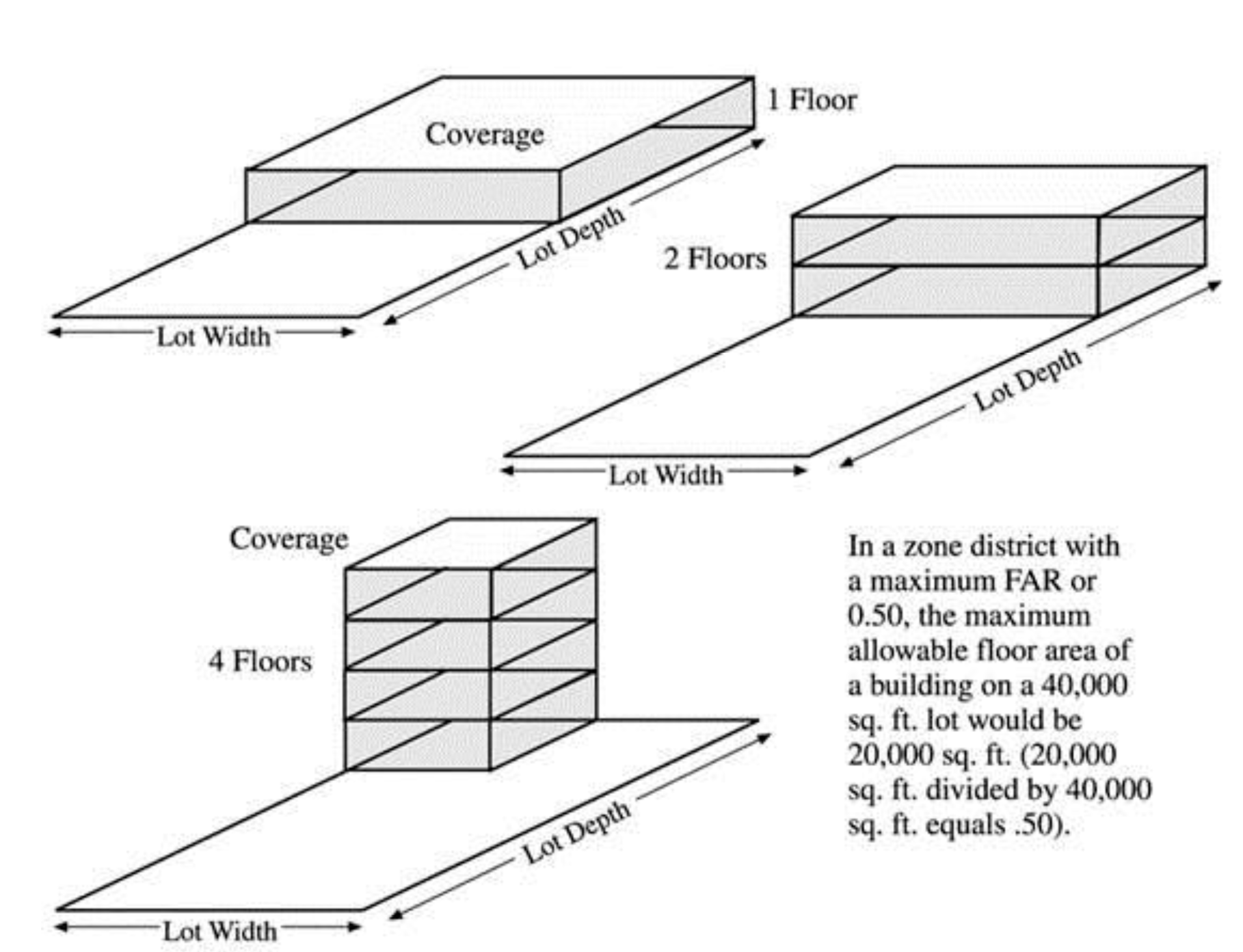
NOTE: Variations may occur if upper floors are stepped back from ground level lot coverage.
Floor, base means an enclosed or non-enclosed area beneath an elevated structure used for parking, storage or access.
Floor, lowest means the lowest floor of the lowest enclosed area of a building or structure, including basement, but excluding any unfinished or flood-resistant enclosure, other than a basement, usable solely for vehicle parking, building access or limited storage provided that such enclosure is not built so as to render the structure in violation of the non-elevation requirements of the Florida Building Code or ASCE 24. (Also defined in FBC, B. Section 202.]
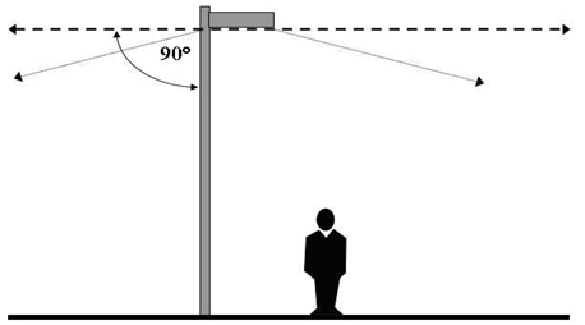
Footcandle means a unit of measure of the intensity of light falling on a surface, equal to one lumen per square foot.
Full cutoff fixture means a type of light fixture with no light emitted above the horizontal no light dispersion or direct glare shines above a 90-degree, horizontal plane from the base of the fixtures.
Frontage means the length of the property line for a parcel which runs parallel to, and along, a road right-of-way or public or approved private street, exclusive of alleyways.
Governing body means the city commission of the city as legally constituted.
Grade, finished means the finished elevation of a site after all fill, land balancing or site preparations have been completed. The finished elevation shall be inclusive of all grasses, landscaping, decks, patios, slabs or other ground coverings.
Grade, natural means the grade unaffected by construction techniques such as filling, landscaping or berming.
Grandfather clause means a clause creating an exemption based on circumstances previously existing.
Gross usable area means that area which is considered to be the total floor area of a building, minus specified storage areas. The gross usable area shall include all service, kitchen, and outdoor areas used for the purposes of the business.
Group home, as licensed by the state department of children and family services, means a residential family living environment with supervision for six or less people. This is not considered a commercial use. Such a home is for persons who do not require special provisions for emergency evacuation. In addition, no such home may be located within 1,000 feet of another existing group home, with the said distance to be measured in a straight line from the nearest point of the property line of the existing home to the nearest point of the property line of the proposed home, except as provided by law
Guard means a required railing as defined by the Florida Building Code.
Hedge means a dense row of shrubs or bushes forming a boundary.
Height means, when referring to a tower, antenna or other structure, the distance measured from the finished grade of the parcel to the highest point on the tower or other structure, even if the highest point on the tower or structure is an antenna.
Height adjustment factor means the mathematical difference between the highest natural grade on a property and the resultant base floor.
Home occupation means the occupation of an individual and/or members of his immediate family conducted entirely in their dwelling when such dwelling is the principal use of the property and all the conditions of this Code, for home occupations, can be affirmatively evidenced and complied with.
Hotel or motel means a building or buildings, collectively, "facility," containing individual guest rooms, units or efficiencies for which daily, weekly or monthly lodging is provided as transient accommodations.
Hotel or motel unit means a room or group of rooms within a hotel or motel, as defined, with individual sleeping facilities having one entrance door.
Impervious surface means a surface that has been compacted or covered with a layer of material so that it is highly resistant to or prevents infiltration by stormwater. It includes surfaces such as compacted limerock, or clay, as well as conventionally surfaced streets, roofs, sidewalks, parking lots and other similar surfaces, and all other artificial or non-natural surfaces.
Impervious surface ratio (ISR) means a measure of the intensity of hard surfaced development on a site. An impervious surface ratio is the relationship between the total impervious surface area on a site and the net land area. The ISR is calculated by dividing the square footage of the area of all impervious surfaces on the site by the square footage of the net land area.
Indoor entertainment facility means a location which provides for activities within the confines of a building. Such uses shall include, but not be limited to, arcade games, miniature golf, movie theater, music, playground equipment, bowling, archery, skating, batting cages, etc. This may also be a location for an exercise facility, martial arts, theater arts, and dance instruction. These facilities generally provide an accessory snack or beverage bar for their patrons.
Junk means inoperative, dilapidated, abandoned or wrecked materials, including but not limited to automobiles, trucks, tractors, wagons, boats and other kinds of vehicles and parts thereof, scrap materials, scrap building material, scrap contractors' equipment, tanks, casks, cans, barrels, boxes, drums, piping, bottles, glass, old iron, machinery and the like.
Junkyard means a place where junk, waste, discarded or salvaged materials are bought, sold, exchanged, stored, baled, packed, disassembled or handled, including automobile wrecking yards where vehicles are dismantled or wrecked and the used parts are stored and/or sold, house wrecking, and structural steel materials and equipment but not including the purchase or storage of used furniture and household equipment, used cars in operable condition, used or salvaged materials as a part of manufacturing operations.
Kennel means an establishment where domestic animals are bred, boarded or sold.
Land use means the development that has occurred on the land, the development that is proposed on the land, or the use that is permitted or permissible on the land, under an adopted comprehensive plan or element or portion thereof and land development regulations.
Landfill (earth, soil and hard materials) means addition of 100 yards or more of earth, topsoil, sand, gravel, rock, concrete products or bricks to any lot or parcel other than that incidental to and on the site of authorized construction.
Landscape architect means a person licensed by the state to practice landscape architecture.
Landscape area or green space means an area or areas including beautification strips, consisting of those materials, such as, but not limited to hedges, trees, planted ground cover, sodded and grassed areas and planted floral installations, all of which must be composed of natural plantings only, as distinguished from artificially manufactured planting reproductions.
Liner building means a shallow storefront at ground level, but may extend to the second story and above, used to block the appearance of vehicles in a parking garage along the principal streets.
Live-work unit means a building in which offices, studios, or other commercial uses are located on the first floor and a residential dwelling unit is located above the first floor.
Living level means the number of floors in a building above the base flood elevation.
Loading space (berth) means a space which provides for the loading or unloading of service vehicles and has a minimum size of 12 feet in width, 30 feet in length and 14 feet in height.
Lot means a parcel of land occupied or intended for occupancy by a use permitted in these regulations, including all structures, required yards, parking spaces, and open space and having frontage upon a public or private street right-of-way or easement for ingress and egress purposes. (See "parcel.")
Lot area means the horizontal plane area within the lot lines expressed in these regulations in square feet or acres exclusive of public or private dedications.
Lot, corner means a lot abutting upon two or more streets at their intersection or at a street corner having an interior angle not greater than 135 degrees. All boundaries abutting streets shall be considered front yards, all other boundaries shall be considered side yards. (See Attachment One).
Lot coverage means the area of the lot expressed as a percentage of the total lot area covered by the ground floor of all principal and accessory uses and structures, including all areas covered by the roof of such uses and structures measured along the exterior faces of the walls or along the foundation wall line or between the exterior faces of supporting columns or from the centerline of walls separating two buildings or a combination of the foregoing whichever produces the greatest total ground coverage for such uses and structures.
Lot depth means the horizontal distance between the front and rear lot lines measured in the mean direction of the side lines of the lot from the midpoint of the front lot line to the midpoint of the opposite mean rear line of the lot.
Lot, interior means a lot other than a corner lot with frontage on one street only. (See Attachment One).
Lot line means the line bounding a lot as herein defined as established by ownership except that where a lot line lies within a private street or waterway the edge of the private street right-of-way or waterway shall be considered to be the lot line for the purposes of calculating density, lot, yard and bulk requirements.
Lot, through (double frontage) means an interior lot which has street frontages at opposite boundaries of the lot excluding alleys. (See Attachment One).
Attachment One
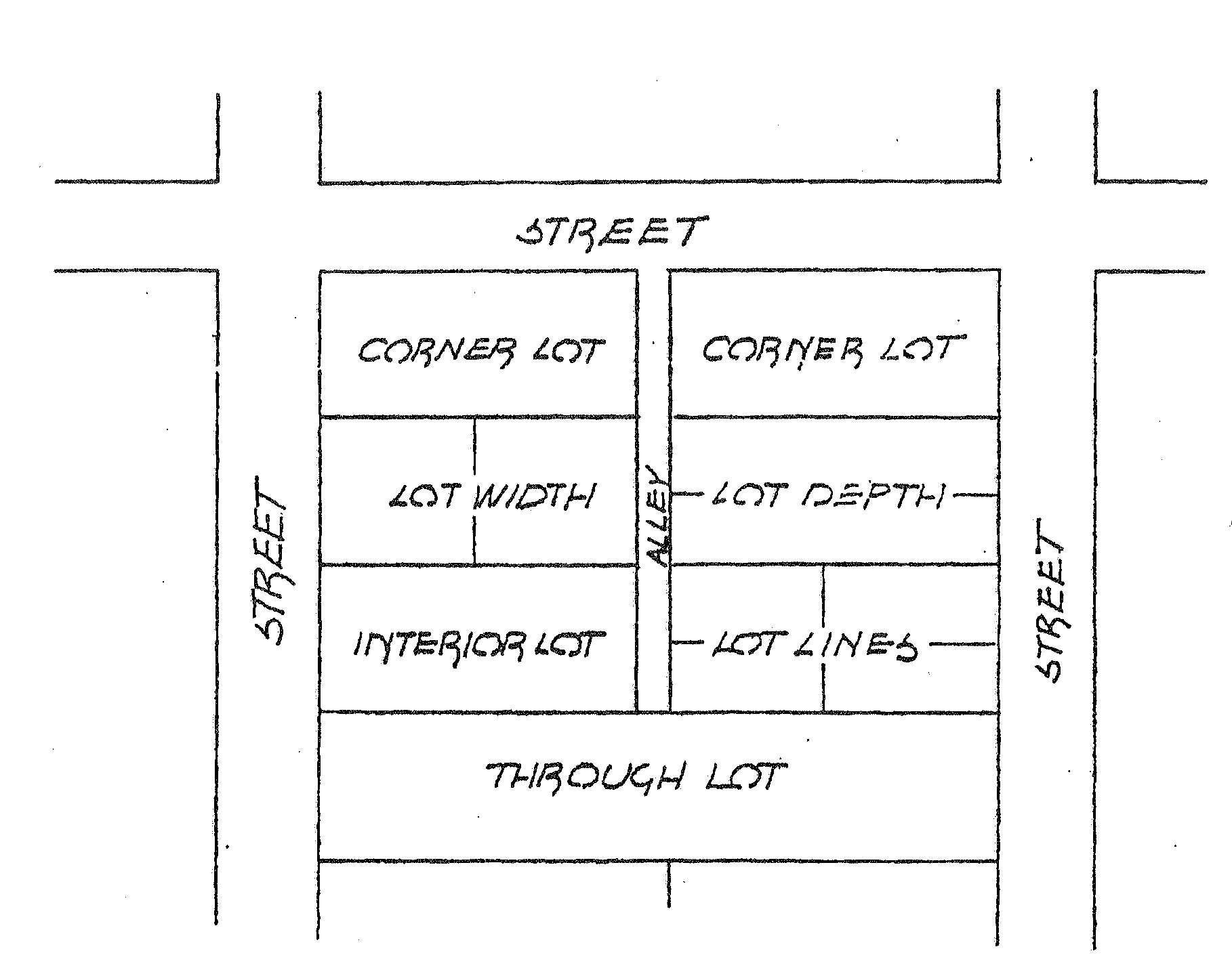
Lot width means the horizontal distance between the side lot lines measured along the front building setback line of the lot as determined by the prescribed front yard requirements of the zoning district.
Lumen means the unit of measure used to quantify the amount of light produced by a lamp or emitted from a luminaire (as distinct from "watt," a measure of power consumption).
Luminaire means the complete lighting unit (fixture), consisting of a lamp, or lamps and ballast(s) (when applicable), together with the parts designed to distribute the light (reflector, lens, diffuser), to position and protect the lamps, and to connect the lamps to the power supply.
Marina, boat yard means a site or commercial establishment which provides minor repair, maintenance or sale of boats, marine engines, marine equipment and marine services of all kinds; including but not limited to rental of covered or uncovered boat slips, dock space, enclosed dry storage space, marine railways or lifting or launching services.
Mean high water means the average height of the high waters over a 19-year period; or for shorter periods of observations, the average height of the high waters after corrections are applied to eliminate known variations and to reduce the result to the equivalent of a mean 19-year value as defined in state statutes.
Mean high waterline means the intersection of the tidal plane of mean high water with the shore as defined in state statutes.
Medical marijuana treatment center means an entity defined in Article X, Section 29 of the Florida Constitution, that acquires, cultivates, possesses, processes (including development of related products such as food, tinctures, aerosols, oils, or ointments), transfers, transports, sells, distributes, dispenses, or administers marijuana, products containing marijuana, related supplies, or educational materials to qualifying patients or their caregivers and is registered by the Florida Department of Health.
Medical marijuana treatment center dispensing facilities means a facility that is established or operated by a medical marijuana treatment center where medical marijuana or any product derived therefrom is dispensed at retail.
Mixed use means a combination of uses on a single property.
Mixed-use building means a building that contains two or more of the following major use types: residential dwelling units, tourist dwelling units, office, or retail establishments.
Mixed-use development means a building, site, or structure whose use will be for two or more of the following major use types: residential dwelling units, tourist dwelling units, office, or retail establishments.
Motel. (See "hotel or motel.")
Net usable area means the area accessible to the public, excluding rest rooms, hallways, kitchens, areas behind bars, but including customer waiting areas, exterior patios and decks that are used for customer service.
Noise means a subjective description to an undesirable or unwanted sound. (See "sound.")
Nonresidential use or property means a building, site, or structure which use does not provide for single-family, two family (duplex), or multifamily dwellings.
Nonconforming lot means a single lot, tract or parcel of land shown on either a recorded or unrecorded map, plat, drawing or survey, where such map, plat, drawing or survey was in existence at the time of the adoption of Ordinance 78-18, adopted on February 1, 1979, such lot failing to meet the requirements for area, width and/or depth for any permitted use within the zoning district in which it is located.
Nonconforming structure or use means a structure or land use legally existing at the time of the passage of this Code or amendment thereto, which does not conform to the provisions, requirements, and regulations of the zoning districts in which it is located.
Nursery school or kindergarten means any premises or portion thereof used for educational work or parental care of nonresident children of less than the age required for enrollment in the public school system whether or not for compensation as licensed by the state.
Nursing home or convalescent home means a home for the aged or infirm in which three or more persons not of the immediate family are received, kept or provided with food and shelter or care for compensation, but not including hospitals, clinics, or similar establishments devoted primarily to the diagnosis and treatment of the sick or injured as licensed by the state.
Occupants means the total number of persons that may occupy a building or portion thereof or other areas designated for occupancy or use at any one time. The term "other areas designated for occupancy or use" shall be deemed to include, but not be limited to, decks, patios, piers, wharves, or other improved areas of the site for use by the patrons.
Odor means an objectionable smell response in a human being.
Off-site means located outside the lot or parcel lines of the principal use.
Office means a building, room or space where clerical or administrative activities are performed or wherein specialized services such as the offices of a doctor, dentist, lawyer, engineer, architect, chiropractor, osteopath, insurance agent or real estate broker are provided.
Official land use map also known as the official future land use map means the official land use map of the city which depicts the future land use classifications of the comprehensive plan. Such map is herewith adopted by reference and shall not be changed except by order of the city commission as provided for herein.
Official zoning map means the map of all zoning districts, delineating the boundaries of the zoning districts, together with all matters and things shown on such maps, as they are updated and amended from time to time, collectively constitute the "official zoning map." The official zoning map is incorporated by reference and made a part of the land development regulations.
Open space means undeveloped land which is suitable for passive recreation, preservation, or conservation uses.
Outdoor dining means an unenclosed, open air area that contains tables, chairs and other similar facilities which is accessory to a licensed and operating restaurant, bakery, café, candy, confectionary and ice cream stores where food and beverage are served and consumed for pay. Outdoor dining shall not include the preparation of food or beverages, cooking, storage or placement of equipment of any kind, except the temporary placement of implements associated with the service of food. Outdoor dining does not include open air market, outdoor display, outdoor storage, mobile food vending vehicles or any use of property that does not provide a permanent structure for restrooms and kitchen facilities.
Outdoor display means the placement of merchandise, commodities, equipment, materials or articles outside of a building for the purposes of attracting customers and displaying examples of items that are for sale within a building. Display shall be limited to the placement of sample items for sale within the building.
Outdoor occupied space means an area that is not enclosed, but is designed and intended for use on an occasional or more frequent basis. Outdoor occupied space may include patios at restaurants, outdoor garden centers, decks for outdoor music, children's play areas, etc. if the space is intended for use in connection with the principal use.
Outdoor storage means the accumulation of merchandise, commodities, equipment, materials, containers, semi-trailers, inoperable vehicles, or articles outside of a building either used as stock in trade or related to the use of the site. This term does not include outdoor display.
Parcel means a tract of land which may be described by metes and bounds or plat. (See "lot.")
Parking area means any public or private land area designated and used for parking motor vehicles including parking lots, garages, private driveways, and legally designated areas of public streets.
Parking lot means an off-street, ground level area improved for the temporary storage of licensed operable motor vehicles. Does not include an area used exclusively for the display of motor vehicles for sale as part of an automobile dealership (all references to parking lot may be commercial, private, valet, and/or public in nature unless otherwise specified).
Parking lot, accessory means a parking lot that is located on the same lot as the permitted or special exception use and is subordinate to such use.
Parking lot, off-site means located outside the lot or parcel lines of the principal use.
Parking lot, shared means parking facilities that may be used jointly with parking facilities for other uses when operations are not normally conducted during the same hours, or when hours of peak use vary, or when excess parking is available; joint use of a parking lot or area for more than one principal use.
Parking lot or structure, commercial means a lot or parcel of land or portion thereof, which is not accessory to any other use of the same or any other lot or parcel, and contains parking space rented to the general public for a fee.
Parking lot or structure, private means a parking lot or structure for the exclusive use of the owners, tenants, lessees, or occupants of the lot or parcel on which the parking area is located or their customers, employees, or whomever else they permit to use the parking area.
Parking lot or structure, public means a parking lot or structure available to the public with or without payment of a fee.
Parking lot, temporary means a parking lot established for a fixed period of time. The use will terminate automatically upon expiration of the fixed time period unless permission to conduct the use is renewed.
Parking lot, valet means the parking of vehicles where a fee may or may not be charged by an attendant provided by the establishment for which the parking is provided.
Parking, off-street means a parking area improved for licensed motor vehicles, temporarily stored in connection with a use requiring same. It includes parking spaces, aisles, access drives, landscaped areas, and vehicular access to a public street.
Parking, on-street means the storage space for a licensed motor vehicle that is located within the street right-of-way.
Parking, remote means a parking lot or structure on a site other than the property it serves, usually at a substantial distance, and often connected by a shuttle bus, but located on Treasure Island.
Parking space means an area, enclosed or unenclosed, sufficient in size to store one motor vehicle and permitting the necessary ingress and egress of a motor vehicle.
Parking, special event means parking for a recurring or non-recurring special event activity.
Parking, stacked means the parking of cars in a parallel line, one in back of the other on private property.
Parking structure means a structure designed to accommodate vehicular parking spaces that are fully or partially enclosed or located on the deck surface of a building. This definition includes parking garages and parking decks.
Pedestrian friendly zone means an area on private property, at least four-foot wide, adjacent and parallel to the public right-of-way. The area is meant to expand the sidewalk for the public to utilize.
Permitted use means the specific purposes for which lands or buildings are maintained in accordance with the zoning district regulations of this Code.
Personal service store means an establishment which provides personal services directly to the consumer, such as barbershop, beauty shop and dry cleaning, but which does not have as its primary function the sale of retail goods.
Pervious area means any portion of lot or parcel not required, designated or encumbered by either principal or accessory uses, buildings and structures and other site uses. Pervious area shall be landscaped or retained in the natural state. Other materials may count as partially pervious as outlined in chapter 76.
Planning and zoning board means the advisory body to the city commission of the city as legally established and referenced in this Code.
Plat means a map depicting the division or subdivision of land into lots, blocks, parcels, tracts or portions thereof; however the same may be designated.
Plat of record means a plat which conforms to all the requirements of the applicable laws of the state and this Code and has been filed and recorded in the office of the clerk of the circuit court for the county.
Portable means able to be moved or carried about by two persons.
Preliminary development order is one of the following:
(1)
Rezoning;
(2)
Special exception;
(3)
Preliminary plat approval.
Premises means any lot and/or all buildings and structures thereon.
Principal use or structure means a use or a structure in which is conducted the predominant or primary function or activity of the lot upon which it is located.
Private yacht club means a site of at least six acres or more which contains at least 20 boat slips contiguous thereto, owned by its members, which members pay dues assessed on no less than an annual basis, the use of which is restricted predominantly to the members and owners, and the use of which is primarily devoted to the promotion of private yachting and boating activities, tennis and other outdoor sports and social activities related thereto.
Professional planner means a person who is a full member of the American Institute of Certified Planners and may be registered by the state as a professional planner.
Professional services means business, including but not limited to, providing the following: medical, veterinary, and other health care services; legal services; consulting, engineering and architectural services; and accounting, auditing, and bookkeeping services in an office setting.
Property line. (See "lot line.")
Property owners'association means a nonprofit organization recognized as such under the laws of the state operated under recorded land agreements through which each owner of a portion of a subdivision, be it a lot, home, property or any other interest, is automatically subject to a charge for a prorated share of expenses either direct or indirect for maintaining common properties within the subdivision, such as roads, parks, recreational areas, common areas or other similar properties. Within the text of this Code, a property owners' association is considered a single entity for property ownership.
Public boardwalk means a public walkway constructed on public lands, which include right-of ways, easements, and properties owned by the city. The public walkway may extend up to the entire length of the property and may extend over water up to seven feet from the centerline of the seawall. A public boardwalk provides public access for the purpose of public recreation and gathering.
Public facilities and services means those covered by the city comprehensive plan required by F.S. § 163.3177, and for which level of service standards must be adopted. These are:
(1)
Roads;
(2)
Sanitary sewer;
(3)
Solid waste;
(4)
Drainage;
(5)
Potable water;
(6)
Parks and recreation.
Public notice means the legal advertisement given of an action or proposed action of the city commission as set forth in these regulations or applicable statute of the state.
Public, semi-public uses means those primary and secondary uses listed under the P (Preservation), R/OS (Recreation/Open Space), I (Institutional), and T/U (Transportation/Utility) zoning districts.
Rear lines means those lines adjoining lots or alleys in the rear.
Recreation area or space (private) means an accessory use consisting of one or more areas, enclosed with a structure and/or open, devoted to the active and/or passive recreational enjoyment of one or more persons residing within the principal use to which it is accessory. When developed and/or equipped for various recreational pursuits, the areas shall not be allowed for any other required site uses except open and/or rear building setback areas.
Religious institutionuse means a site, premise, or location that is used principally, primarily, or exclusively for the purposes of religious exercise as protected by the Religious Land Use and Institutionalized Persons Act.
Residential structure means a structure whose use will be for a single-family home, two-family (duplex), three-family dwelling units, or multifamily dwellings inclusive of apartment house, a townhouse, a condominium, or any type of dwelling unit.
Residential use or property means a building, site, or structure whose use will be for a single-family, two-family (duplex), three-family dwelling or multifamily dwellings.
Restaurant means an establishment where food is ordered from a menu, prepared and served for pay, for consumption on the premises but not a drive-in restaurant.
Restaurant, drive-in means any food or beverage dispensing operation at retail to the general public where the public is served while remaining in automobiles or other motor vehicles.
Retail establishment means any facility where the primary use is the sale of goods or merchandise to the general public. Limited processing or assembly may be permitted as accessory to the selling activity.
Retaining wall means a vertical or near-vertical structure built out of rock, block, wood or other similar material and used to either directly support retained material or to serve as a facing of a cut slope. The definition includes other systems designed to retain earth or other materials such as a geosynthetic-reinforced wall. A retaining wall shall be constructed so that it does not drain onto adjacent private property. The finished grade of the retained material shall be no more than six inches below the top of structure.
Rezoning, an amendment to the zoning map which changes the zoning classification of a parcel or parcels of land.
Right-of-way means the area of a highway, road, street, way or parkway or other such strip of land reserved for public use, whether established by prescription, easement, dedication, gift, purchase, eminent domain or any other legal means.
Satellite antenna means any parabolic or spherical antenna which receives television or other signals from orbiting satellites or other devices. The height of a ground-mounted antenna shall be the maximum height to which it is capable of being raised and shall be measured from the highest point of the natural or finished grade of the roof adjacent to the structure. A satellite antenna shall be considered as an accessory structure when it is not part of a public utility. A web or mesh type antenna is an antenna primarily constructed of a web or mesh material so that it does not substantially impair visibility. A ground mounted or "short pole" installation denotes a pole of nine feet or less in height. A "long pole" installation denotes a pole of greater than nine feet in height which is braced to the side of a building for added rigidity.
Sediment means the mineral or organic particulate material that is in suspension or has settled in surface waters or groundwaters.
Service station. (See "automobile gas station and automobile service station.")
Setback adjustment factor means the mathematical difference between the highest natural grade on a property and the resultant base floor.
Shrub means a low growing perennial, woody or evergreen plant with persistent stems.
Side lines means those lines between lots facing the same street or alley.
Special care facility means an institution such as a hospital, nursing home, or similar type of facility established for the care of non-ambulatory patients or clients who require special provisions for emergency evacuation. Community residential homes providing care for non-ambulatory clients requiring special provisions for emergency evacuation are specifically included in this definition for regulatory purposes.
Special event means an approved activity that can be either recurring or non-recurring. Such event is usually for a short duration of time and is usually an entertainment, education, cultural, or neighborhood event including, but not limited to, activities such as organized neighborhood yard sales, neighborhood block parties, wedding receptions on the beach, spaghetti dinners, special beach events, beach clean-ups, outdoor concerts and movies, outdoor morning markets, bazaars, parades, and carnivals. Such events extend beyond the normal uses and standards allowed by the land development regulations of the city.
Special exception means a use that would not be appropriate generally or without restriction throughout the zoning district, but which, if controlled as to number, area, location, and relation to the neighborhood, would promote the public health, safety, welfare, order, comfort, convenience, appearance or prosperity and is permissible. Such uses may be in accordance with the procedures as set forth in this Code.
State means the State of Florida and all its duly appointed agencies.
Statement of zoningcompliance means a statement issued by the city manager or designated representative of the city setting forth that the permitted construction has been completed in compliance with the approved plans and specifications and conforms with all provisions of the land development regulations.
Store, convenience means a small retail establishment which sells a general line of goods and products intended for the convenience of surrounding residents and whose gross floor area does not exceed 3,000 square feet.
Store, retail means an establishment which sells goods or products directly to the public for compensation.
Stormwater means any stormwater runoff, and surface runoff and drainage.
Stormwater management system, stormwater management, or stormwater system has the same meaning within this article and means all facilities, manmade structures, all natural watercourses used for collecting, treating, storing and conducting stormwater to, through and from drainage areas to, and including points of final outlet. A stormwater management system may include, but is not limited to, any or all of the following: inlets, conduits, valves, creeks, lakes, channels, catch basins, ditches, streams, drainage wells, gulches, gullies, flumes, culverts, siphons, retention or detention basins, dams, flood walls, levies, spillways, pumping stations, and appurtenant features to all of the foregoing.
Street means any thoroughfare, street, avenue, boulevard, highway, parkway or space which may or may not be dedicated or deeded to the public for use and which affords the principal means of access to abutting property for the purposes of vehicular travel.
Street, arterial (major) means streets and highways serving major metropolitan activity centers, the highest traffic volume corridors, the longest trip desires, and a high proportion of total urban area travel on a minimum of mileage. Service to abutting land should be subordinate to the provision of travel service to major traffic movements. This system carries the major portion of trips entering and leaving an urban area, as well as the majority of through movements desiring to bypass the central city, and normally will carry important intra-urban as well as intercity bus routes.
Street, arterial (minor) means streets and highways interconnecting with and augmenting the urban principal arterial system and providing service to trips of moderate length at a somewhat lower level of travel mobility. The system places more emphasis on land access and distributes travel to geographic areas smaller than those identified with the higher system. It includes all arterials not classified as major.
Street, collector means streets penetrating neighborhoods, collecting traffic from local streets in the neighborhoods, and channeling it onto the arterial system. A minor amount of through traffic may be carried on collector streets, but the system primarily provides land access service and carries local traffic movements within residential neighborhoods, commercial and industrial areas. It may also serve local bus routes.
Street, expressway means a street which is to be used only for the movement of vehicles providing for no vehicular or pedestrian access to abutting property except at permitted, authorized and controlled points. The acquisition of right-of-way for expressways includes the acquisition of access rights thereto.
Street, limited access means a highway or freeway which does not permit access except at authorized and controlled points. The acquisition of right-of-way for such highways or freeways usually includes the acquisition of access rights thereto. Access may also be limited through methods other than acquisition of access rights.
Street, local means streets not classified in a higher system, primarily providing direct access to abutting land and access to the higher systems. They offer the lowest level of mobility and usually carry no bus routes. Service to through traffic is deliberately discouraged.
Street, marginal access means a street which is parallel and adjacent to an expressway, arterial or limited access street or in the immediate vicinity of such streets and which has as its principal purpose of relieving such street from local service of abutting property by providing protection from conflicts with through traffic. A marginal access street may also be called a frontage street.
Street, private means any street existing prior to or at the time of adoption of this Code which has not been dedicated for public use and not accepted for ownership or maintenance by the appropriate public agency. After adoption of the ordinance from which this chapter was derived, private streets shall be limited to property under single ownership or a property owners' association.
Street, public means any street designed to serve more than one property owner which is dedicated to the public use and accepted for ownership and maintenance by the appropriate public agency; includes any street right-of-way dedicated to the public prior to or at the time of adoption of the ordinance from which this chapter was derived. Streets controlled by a property owners' association may be retained as private streets by the association as long as the association accepts the obligation for complete control and maintenance. A street designed to serve more than one property owners' association must be public.
Street wall means the part of a building that faces the street, but it generally refers to how and where several buildings line up to define a proper walking environment. At the most basic level, buildings should be set back an equal distance so that facades are even for as far as a pedestrian can see. A street wall helps to promote walking over automobile use by fostering a feeling of safety. Because the upper floors of urban buildings define an enclosed visual space for the pedestrian, they expand the view down the street.
Structural alteration means any change, except the repair or replacement, in the supporting members of a building such as bearing walls, columns, beams or girders; or the rearrangement of interior partitions and/or space affecting more than 20 percent of the total floor area of the building.
Structure means that which is built or constructed. A lawfully permitted mailbox, as provided for in subsection 68-458(e), shall not be deemed to be a structure.
Subdivision means the division of real property into two or more lots, parcels, tracts, tiers, blocks, sites, units or any other division of land, or if the establishment of new streets and alleys is involved, any division of such parcel. The term includes resubdivisions and, when appropriate to the text, relates to the process of subdividing or to the lands or area subdivided; however, the following shall be exempt:
(1)
The public acquisition of strips of land for the widening of existing streets;
(2)
The combination or recombination of portions of previously platted lots where no new parcels or residual parcels smaller than any of the original lots are created;
(3)
The division of land into parcels greater than one and one-fourth acres where no new streets or easements of access are planned;
(4)
The transference of part of one lot or tract to an adjacent lot or tract provided the transference does not reduce any lot or tract to an area or width less than the minimum specified in this chapter.
Submerged land means the land area situated below the mean high water line of a standing body of water, including ocean, estuary, lake, pond, river or stream. For the purpose of this definition retention areas that are a function of development and wetlands shall not be considered submerged land.
Survey, certified means a survey, sketch, plan, map or other exhibit containing a written statement regarding its accuracy or conformity to specified standards certified and signed by the registered surveyor under whose supervision the survey was prepared.
Surveyor means a person licensed by the state to practice land surveying.
Temporary means a time period of not more than 90 days.
Tower means any structure that is designed and constructed primarily for the purpose of supporting one or more antennas, including self-supporting lattice towers, guyed towers or monopole towers. The term includes radio and television transmission/relay towers, microwave towers, common-carrier towers, cellular telephone towers, alternative tower structures and the like. The term includes the structure and any support thereto.
Townhouse or townhouse unit means an attached, privately owned single-family dwelling unit which is a part of and adjacent to other similarly owned single-family dwelling units that are connected to but separated from one another by no more than two party walls having no doors, windows, or other provisions for human passage or visibility. A townhouse or townhouse unit may only be developed with one dwelling unit.
Townhouse development means a site for the design and development of townhouse group(s) that allow for individual ownership of a townhouse or townhouse unit.
Example #1: Townhouse Development with Common Areas
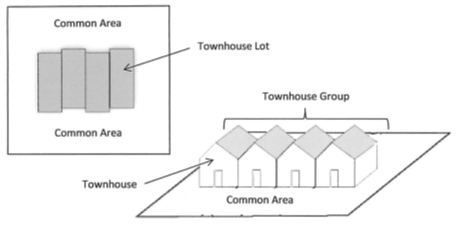
Example #2: Townhouse Development without Common Area.
The individual townhouse lots encompass all of the land in the townhouse development. Typically, there are easements recorded with the townhouse lots to ensure utility services and ingress/egress access is provided to each townhouse lot.
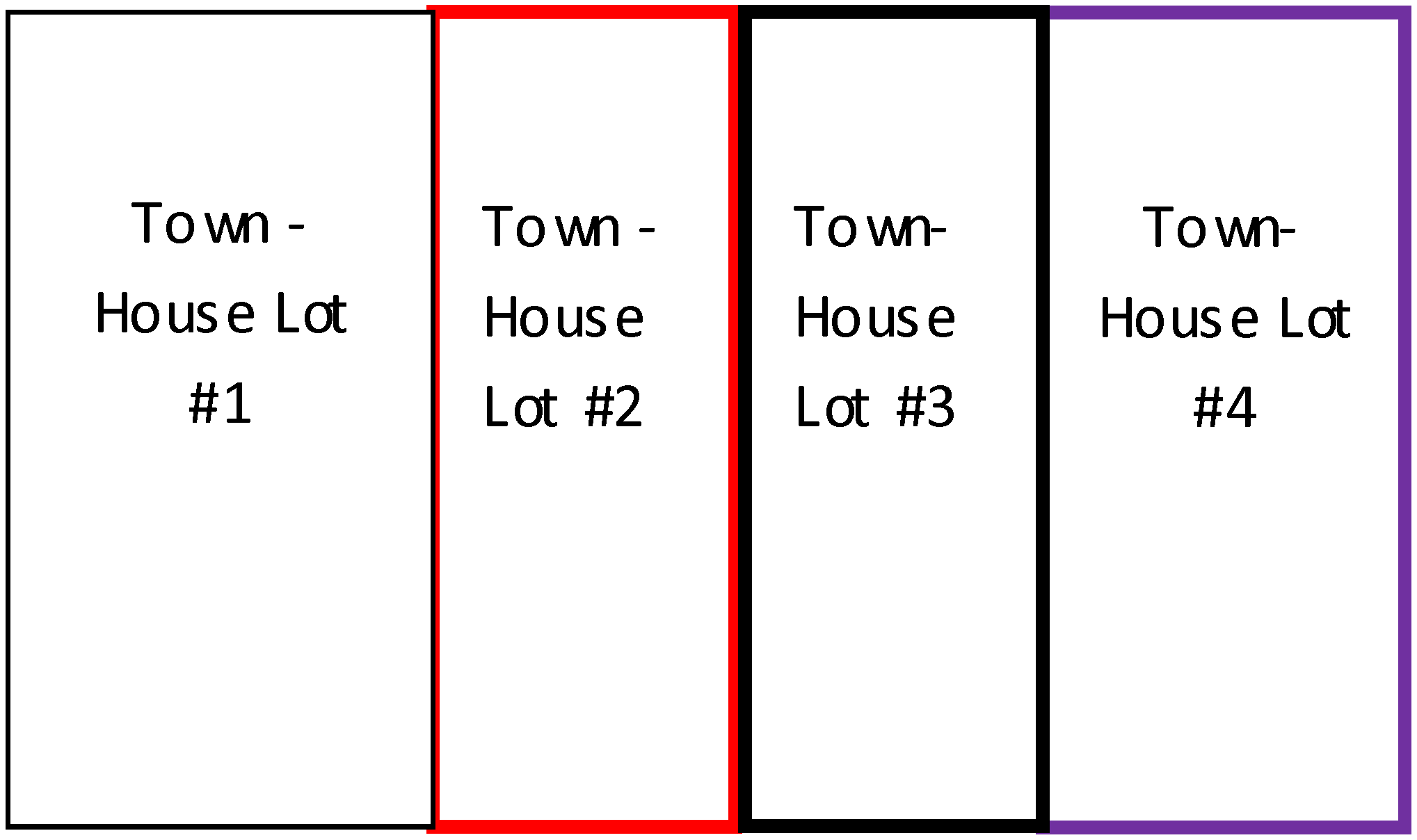
Townhouse group means a cluster or grouping of townhouse units containing no less than three and no more than ten townhouse dwelling units contiguous to one another. A townhouse group or groups are located in a townhouse development. The townhouse group consists of the attached townhouse units in one structure.
Townhouse lot means a recorded and deeded lot upon which a townhouse or townhouse unit is developed. Only one townhouse unit may be constructed on a townhouse lot.
Use, accessory. (See "accessory use.")
Use, principal. (See "principal use.")
Vehicle means a conveyance for persons or materials, as may be licensed by the state.
Wall means when used in the context of the fence, wall, retaining wall and hedge regulations a wall that is masonry with a stucco finish or has a finish or natural materials, such as brick or stone, or has a finish which is accepted for use in the industry.
Yard means that open area of a lot or parcel which is provided as a setback and is unoccupied by any structure.
Yard, required front means a yard extending across the full width of the lot or parcel measured along the frontage from the building setback line. (See Attachment Two.)
Yard, required rear means a yard extending across the full side line width of the lot or parcel and measured between the rear line of the lot or parcel and the building setback line. (See Attachment Two).
Yard, required side means a yard extending along and parallel to the side line and building setback line and located between the required front, rear or waterfront yards. (See Attachment Two).
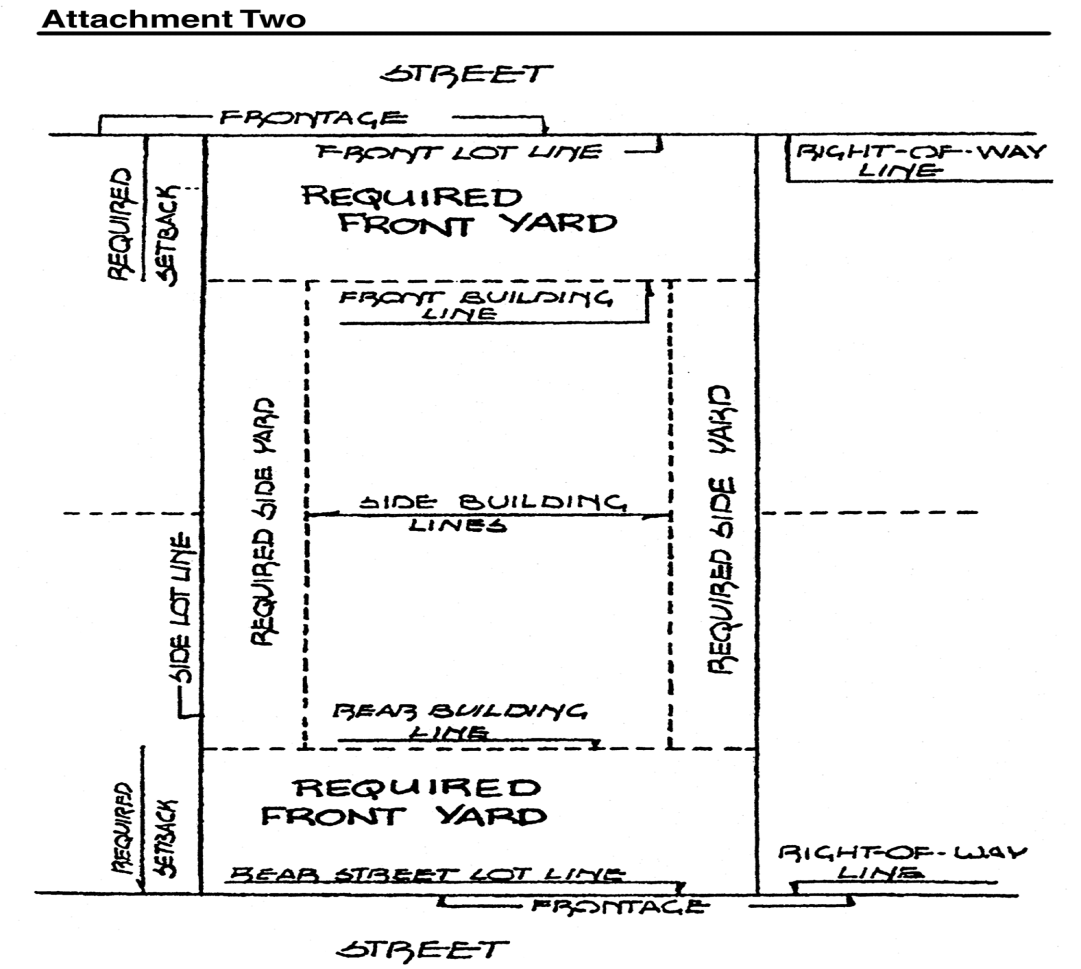
Yard, waterfront means a yard or any portion thereof on lots abutting a waterfront and extending across the full width of the lot or any portion thereof or parcel and measured from the mean high water line, property line or seawall, whichever is closer and the building setback line.
Zoning means the division of land within a jurisdiction into separate districts within which uses are permitted, prohibited or permitted as a special exception. Brief definitions of the different types of uses and structures as relates to zoning are explained in the article VI. Zoning establishes site regulations, such as building heights, density, floor area ratio, setbacks, building coverage, impervious surface ratio, etc.
Zoning districts are established to promote compatible patterns of land use within the city limits. Zoning districts also establish site development regulations and performance standards appropriate to the purposes and the uses allowed in each district. Distinct zoning districts exist for residential, resort, commercial, recreation/open space, etc. uses.
(Ord. No. 95-10, § 36-2, 9-19-95; Ord. No. 97-3, § 1, 4-8-97; Ord. No. 97-4, § 1, 4-22-97; Ord. No. 00-08, § 3, 1-9-01; Ord. No. 01-03, § 1, 8-28-01; Ord. No. 02-06, § 1, 10-22-02; Ord. No. 03-04, § 1, 6-10-03; Ord. No. 05-09, §§ 1, 2, 4-12-05; Ord. No. 06-09, § 1, 9-26-06; Ord. No. 09-03, § 1, 4-21-09; Ord. No. 11-10, § 1, 8-2-11; Ord. No. 11-12, § 1, 8-2-11; Ord. No. 11-08, § 1, 11-1-11; Ord. No. 12-09, § 1, 12-18-12; Ord. No. 14-07, § 1, 9-3-14; Ord. No. 14-08, § 1, 10-7-14; Ord. No. 15-03, § 3, 7-7-15; Ord. No. 16-03, § 1, 5-3-16; Ord. No. 18-05, § 2, 6-19-18; Ord. No. 24-05, § 2, 4-16-24; Ord. No. 24-15, § 2, 4-1-25; Ord. No. 2025-40, § 2, 2-17-26)
Cross reference— Definitions generally, § 1-2.
Sec. 68-3. - Reserved.
Editor's note— Sec. 2 of Ord. No. 2025-13, adopted October 7, 2025, redesignated § 68-3 as § 60-2, which in effect, deleted § 68-3, which pertained to purpose and derived from Ord. No. 95-10, adopted September 19, 1995; and Ord. No. 15-03, adopted July 7, 2015.
Sec. 68-4. - Reserved.
Editor's note— Sec. 2 of Ord. No. 2025-13, adopted October 7, 2025, redesignated § 68-4 as § 60-7, which in effect deleted § 68-4 which pertained to interpretation, and derived from Ord. No. 95-10, adopted September 19, 1995; and Ord. No. 15-03, adopted July 7, 2015.

