
Treasure Island City Zoning Code
ARTICLE VII
- SUPPLEMENTARY LOT AND USE REGULATIONS
Sec. 68-431. - Schedule of lot and bulk regulations.
The restrictions and controls intended to regulate the property development characteristics of each zoning district are set forth in the following schedule of lot and bulk regulations supplemented by other sections of this chapter:
(Ord. No. 95-10, § 36-246, 9-19-95; Ord. No. 00-08, § 28, 1-9-01; Ord. No. 02-06, § 5, 10-22-02; Ord. No. 03-04, § 5, 6-10-03; Ord. No. 04-02, § 1, 2-24-04; Ord. No. 12-09, § 5, 12-18-12; Ord. No. 12-20, § 1, 11-6-12, ref. 3-12-13; Ord. No. 13-04, § 5, 6-4-13; Ord. No. 15-03, § 3, 7-7-15; Ord. No. 24-15, § 12, 4-1-25; Ord. No. 2025-40, § 4, 2-17-26)
Sec. 68-451. - Nonconforming lots.
A single-family structure may be constructed on any nonconforming lot provided all other requirements of this Code are met.
(Ord. No. 95-10, § 36-261, 9-19-95)
Sec. 68-452. - Lot width.
The minimum lot width of any lot shall be as indicated on the schedule of lot and bulk regulations.
(Ord. No. 95-10, § 36-262, 9-19-95)
Sec. 68-453. - Lot depth.
The minimum lot depth of any lot shall be as indicated on the schedule of lot and bulk regulations.
(Ord. No. 95-10, § 36-263, 9-19-95)
Sec. 68-454. - Intersection/driveway visibility.
At all street intersections and at the intersection of any street, driveway, or alley, no obstruction to vision (other than existing buildings posts or tree trunks with a maximum diameter of 12 inches, or existing buildings) between 30 inches and seven feet in height above the established grade of the street at the property line shall be erected or maintained on any lot within the triangle formed by the street, driveway, or alley frontage of such lot and a line drawn between the points along such street, driveway, or alley frontage 50 feet distant from their point of street intersection or ten feet distant from their point of intersection with driveways and alleys. Existing trees must be cleared between 30 inches and seven feet.
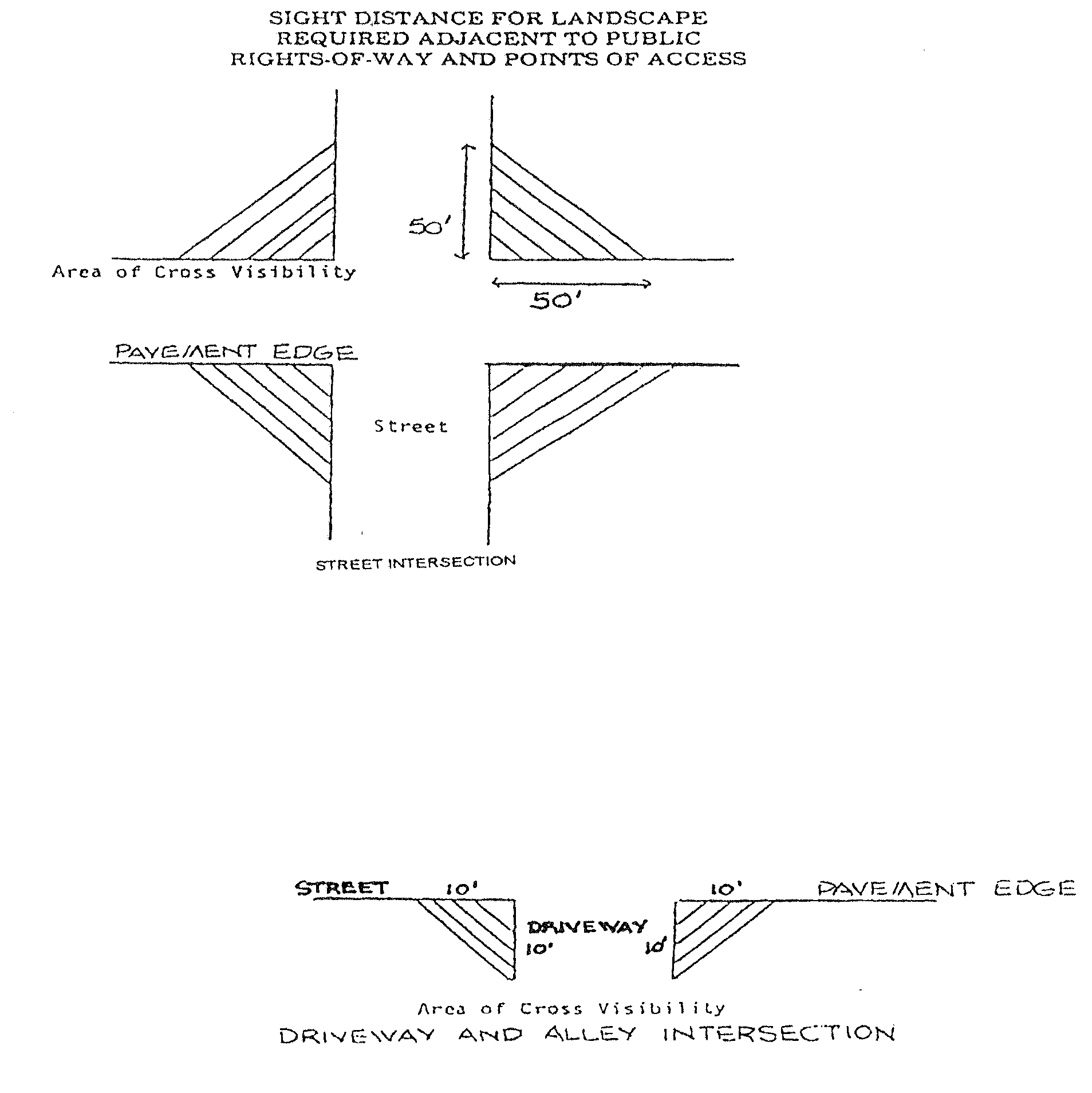
(Ord. No. 95-10, § 36-264, 9-19-95)
Sec. 68-455. - Reduction of lot area.
The area or dimension of any lot, yard, parking area or other space shall not be reduced to less than the minimum required by this chapter, except as provided in this chapter and, if already less than the minimum required by this chapter, such area or dimension may be continued, but shall not be further reduced.
(Ord. No. 95-10, § 36-265, 9-19-95)
Sec. 68-456. - Maximum coverage.
Land coverage by principal and accessory buildings or structures on each lot shall not be greater than is permitted in the zoning district, as set forth within sections 68-226 and 68-431, the schedule of lot and bulk regulations, where such principal and accessory buildings are located.
(Ord. No. 95-10, § 36-266, 9-19-95; Ord. No. 15-03, § 3, 7-7-15)
Sec. 68-457. - Yard regulations.
Every part of a required yard must be open to the sky, unobstructed, except for the ordinary projections of steps, sills, beltcourses, cornices and other ornamental features projecting not more than four inches from the building wall, provided, however, that roof overhangs up to 48 inches or one-half of the required yard, whichever is less, shall be permitted. Specifically exempted from the restrictions of this section are flag poles having a maximum height of 30 feet (one per site), planters not exceeding 30 inches in height or having a cross section of 18 inches or less, wooden decks not exceeding 18 inches in height and freestanding lamp posts having a maximum height of six feet (two per driveway or a maximum of four on any one site). Any side of any wooden deck above grade shall be enclosed from the edge of such deck to the existing grade, by wood slats or lattice work, in such a way as to prevent the area below such wooden deck from being visible from any adjacent property or waterway. In the event of conflict between the yard regulations contained in this section and the setback requirements, the regulation resulting in the largest required yard shall be applicable.
(1)
Transition yard requirements.
a.
Front yard. Where a residential zoning district abuts a nonresidential zoning district, there shall be provided in the nonresidential zoning district for a distance of 50 feet from the zoning district boundary line along the same street, a front yard at least equal in depth to that required in the residential zoning district. Screening requirements shall be as set out in section 68-462.
b.
Side or rear yard. Where the side or rear yard in a residential zoning district abuts a side or rear yard in a nonresidential zoning district, there shall be provided in the nonresidential zoning district along such abutting line or lines, a side or rear yard at least equal in depth to that required in the residential zoning district. In no case, however, shall the abutting side yard or abutting rear yard of the nonresidential zoning district be less than 15 feet. Screening requirements shall be required as set out in section 68-462.
(2)
Waterfront yard requirements. Every lot which abuts the Gulf of Mexico, public beach, Boca Ciega Bay or any of its inlets or basins, shall have, on the waterfront, a waterfront yard. Such waterfront yard is a required yard and shall not be utilized for any purpose other than specifically permitted in this Code.
(Ord. No. 95-10, § 36-267, 9-19-95; Ord. No. 97-1, § 1(36-267), 1-14-97; Ord. No. 15-03, § 3, 7-7-15)
Sec. 68-458. - Garden walls, retaining walls, fences and hedges.
(a)
Generally. All walls, retaining walls and fences shall be located completely within the limits of the property lines. Walls and fences shall have equal architectural treatment on both sides; i.e. the side facing abutting properties, streets, etc., shall be finished. See also section 68-462, Screening regulations. All fees pursuant to this section, shall be set by the city commission in appendix A.
In all cases the height is measured from the lowest of the two adjacent grades based on natural or finished grade whichever is lower as determined by a survey. Adjacent shall mean in the case of a retaining wall, the finished grade at the wall face.
Retaining wall height is limited to six-inches above finished grade. In any case where a fence or wall is allowed to exceed the retaining wall height, the retaining wall plus the fence or wall as outlined below may be combined to meet the maximum height allowed.
Where a guard is required by the Florida Building Code, the combined height of the retaining wall and guard may exceed the maximum fence and wall height shown below. If the guard exceeds the allowable height shown below, then the guard shall meet the spacing requirements for an open fence.
All hedges shall be maintained at or below the maximum height shown and in compliance with the landscaping standards of this code. For this section's purpose, vegetation is considered a hedge when planted and maintained to create an open space less than two-feet wide by seven-feet high between each plant.
All walls retaining walls, fences and hedges must meet the visibility triangle requirements of this code.
(b)
Street side yard.
1.
Walls and fences, within the required street side yard shall not exceed 3-foot solid or 4-foot open fence.
2.
Chain link type fences are specifically prohibited in street side yards.
3.
Hedges shall not exceed 4-feet in height.
4.
Guards must meet the spacing requirements for an open fence.
(c)
Secondary street side yards.
1.
For purposes of this section only, on a lot with one or more street side yards, the secondary street side yards may have lesser setbacks. The primary yard will be the one matching the predominant front yard pattern on the block face of the streets.
2.
On a secondary street side yard the wall, retaining wall or fence setback to be used will be half of the normally required street side yard setback shown in section 68-541.
(d)
Side and non waterfront rear yards.
1.
All walls, fences or hedges located within the required side or nonwaterfront rear yard shall not exceed seven feet in height.
2.
Guards may be solid.
(e)
Waterfront yards.
1.
All walls or fences, within a waterfront yard shall not exceed three-foot solid or four-foot open fence.
2.
Retaining walls in the waterfront yard are limited to 30 inches-in height.
3.
Guards must meet the spacing requirements for an open fence.
4.
Exception for fence height within the inner waterfront yard. Within the dotted area shown in Exhibit A below, fence heights are measured from lowest adjacent grade at the fence location. The inner waterfront yard is within the waterfront yard setback, and measured as follows: 1) Five feet from the waterfront property line and 2) measuring from each side property line at the waterfront and extending across waterfront property line at least one half the distance of the waterfront setback, then from that point extending to the point where the side property line meets the waterfront setback line, as shown in Exhibit A below.
Exhibit A—Waterfront Yard View Setback Line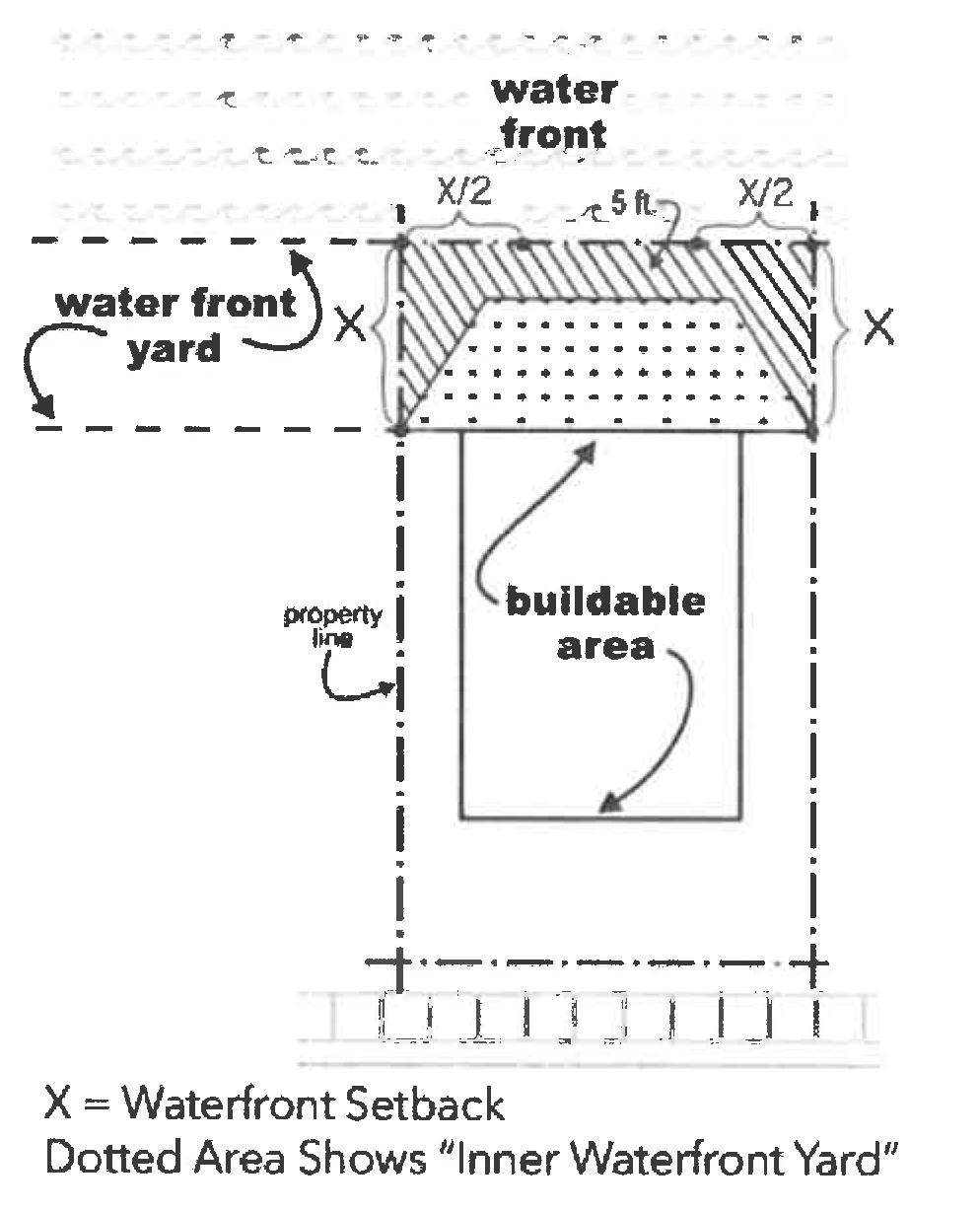
(f)
All yards.
1.
Decorative post caps may be installed on structural posts of the fence but shall not extend more than ten inches above the top rail.
2.
Decorative gate may be installed, but shall not exceed more than 10 inches above the top rail of the abutting fence.
(g)
Right-of-way.
(1)
No walls or fences are permitted to be constructed within or upon any dedicated right-of-way. Planters and decorative rocks not exceeding two-feet in height, and mailboxes as excluded from the definition of "structure" in section 68-2, shall be permitted upon the untraveled
(2)
Vegetation and ornamental plantings are permitted upon the untraveled portion of the dedicated right-of-way beyond front yard setback areas so long as such vegetation or landscaping does not obstruct visibility and hedges do not exceed 30-inches in height.
(3)
A mailbox, as allowed and permitted for by this section, shall not be deemed a structure, and when permitted, shall be allowed to be placed in the right-of-way. Such mailbox shall be supported by nothing stronger than a single four- inch by four-inch wooden support post, or shall be designed to be of breakaway material, in order not to be a hazard to vehicles or pedestrians. Such mailbox shall be a total height of no more than 60 inches, a total width of no more than 20 inches, and a total depth of no more than 32 inches. An applicant for any mailbox who desires such mailbox not to be considered a structure when such mailbox otherwise would be considered a structure, shall obtain a permit for such mailbox from the building department, and shall include with such application for permit a survey or sketch of the property, showing the location of such mailbox. Such mailbox shall be allowed only in locations where the mailbox would not obstruct visibility or traffic.
(h)
Temporary fences. The city may grant a permit for the placement of a temporary construction fence to be erected during the period of construction and maintained until the issuance of a certificate of occupancy. Such fence may be erected on the lot line of the property upon which construction is being maintained and which shall be reasonably designed to protect the public from intrusion upon the construction site. Under no circumstances shall a certificate of occupancy be issued until the temporary construction fence is removed.
(Ord. No. 95-10, § 36-268, 9-19-95; Ord. No. 96-19, § 1, 11-12-96; Ord. No. 21-18, § 35, 9-20-21; Ord. No. 24-15, § 13, 4-1-25)
Sec. 68-459. - Laundry screening.
Laundry shall be properly screened from the street and waterfront.
(Ord. No. 95-10, § 36-269, 9-19-95)
Sec. 68-460. - Minimum yard regulations for accessory structures and accessory equipment.
Accessory structures in residential zoning districts without kitchen or bathroom facilities and accessory equipment may be erected in accordance with the following requirements:
(1)
Accessory structures other than those exempted pursuant to section 68457 shall comply with all setback requirements of the principal structure.
(2)
Air conditioning units, pool equipment, water softening units, and propane gas tanks and similar mechanical equipment may be located within a required side or rear yard; provided, however, that such equipment shall be located adjacent to the principal structure and no closer than three feet to any lot line. Such equipment, including mounting pad, shall not exceed 60 inches above finished grade level, unless a greater height is required under chapter 8, chapter 66 or the Florida Building Code. If required to be elevated by chapter 8, chapter 66 or the Florida Building Code this equipment may encroach further into the setback only if required in order to elevate the equipment. This height limitation shall not apply to restrict the installation of air conditioning units to more than 60 inches above existing grade when the installation of such air conditioning unit is required by chapter 66.
(3)
Reserved.
(Ord. No. 95-10, § 36-270, 9-19-95; Ord. No. 10-07, § 1, 9-18-10; Ord. No. 15-03, § 3, 7-7-15; Ord. No. 24-27, § 2, 1-21-25)
Sec. 68-461. - Height regulations.
(a)
General application. No building or structure shall have an aggregate height of a greater number of feet than is permitted in the zoning district in which such building or structure is located, except as noted in subsection (b). Height shall be defined as in section 68-2, Building height.
(b)
Permitted exceptions. No exceptions to height regulations shall be permitted except enclosed stairways and elevator machinery or shafts not including an elevator exit which shall not exceed a height of seven feet above the roof of the structure and one community television antenna per principal structure shall be allowed but in no instance shall such antenna extend more than 13 feet above the roof of the structure.
(Ord. No. 95-10, § 36-271, 9-19-95; Ord. No. 15-03, § 3, 7-7-15)
Sec. 68-462. - Screening regulations.
(a)
Required screening. Where any nonresidential use directly abuts a residential zoning district or where a nonresidential use within a multifamily residential zoning district abuts a residential use or where a multifamily development abuts an RU-75 zoning district, it shall be screened from the adjoining residential zoning district or use in one of the following ways:
(1)
By a fence or wall at least five feet but not more than seven feet in height. Such fence or wall shall be located completely within the limits of the nonresidential lot and shall have equal architectural treatment on both sides; i.e. the side facing abutting properties, streets, etc., shall be finished. See also section 68-458.
(2)
By landscaping which is selected and arranged to form a visual screen between the nonresidential use and the residential zoning district or use from which it is to be screened. Such landscaping shall be mature plants having already attained a six-foot height and providing the necessary screening; however, a permanent fence to supplement the landscaping may be required.
The provision of appropriate screening shall be an element of site plan review for sight barrier.
(b)
Maintenance. Any fences, walls or landscaping installed in accordance with this section shall be maintained in good order to achieve the objectives of this section. Failure to maintain fencing or to replace dead or diseased landscaping shall be considered a violation of this section.
(Ord. No. 95-10, § 36-272, 9-19-95; Ord. No. 15-03, § 3, 7-7-15)
Sec. 68-463. - Miscellaneous lot regulations.
(a)
Structures over water. No structures shall be erected or constructed beyond the established seawall or seawall line of any body of water except docks, davits, public boardwalks and/or boat lifts.
(b)
Lot excavation. No person, firm or corporation shall strip, excavate or otherwise remove soil, sand, shale or gravel for sale or use and thereby create a borrow pit except in connection with the construction or alteration of a building permitted by the issuance of a building permit on such premises and excavation or grading incidental thereto.
(c)
Lot frontage. Every lot in every zoning district shall have the required frontage on a public or approved private street. An approved private street shall be a street constructed according to the requirements and specifications of the city building department and shall meet all engineering standards for public streets within the city. Upon complying with such requirements, the street shall become an approved private street after approval by the city commission.
(Ord. No. 95-10, § 36-273, 9-19-95; Ord. No. 02-06, § 6, 10-22-02; Ord. No. 03-04, § 6, 6-10-03; Ord. No. 15-03, § 3, 7-7-15; Ord. No. 24-05, § 3, 4-16-24)
Sec. 68-464. - Satellite antenna regulation.
(a)
In all zoning districts, the following requirements apply:
(1)
Guy wires and satellite antennas shall be considered accessory structures and shall meet setbacks for accessory structures.
(2)
Satellite antennas shall be nonreflective and their color shall blend in with the surroundings.
(3)
The satellite antenna shall be installed and maintained in compliance with the requirements of the building code and electrical code as set out in chapter 64. A building permit shall be required prior to construction. In addition, all antennas must be grounded and must contain adequate surge protection devices for all electrical connections.
(4)
No advertising or signage of any type is permitted on a satellite antenna.
(5)
All satellite antenna installations must be certified with the seal of a professional engineer.
(b)
In residential zoning districts (RU-75 and RM-15) the following requirements shall apply:
(1)
Satellite antennas are permitted only within the rear or side yard buildable area for a principal or accessory structure. The location shall be at a fixed point on the ground or on a structure. Portable installation shall be prohibited.
(2)
No roof mounted antennas shall be permitted.
(3)
There shall be no more than one satellite antenna per lot/parcel. (Note: The intent of this rule is that each residential development, whether it be a single-family lot or apartment, or condominium complex, be allowed one satellite antenna. Technology is such that many receivers can be connected to one antenna. This allows everyone, in for example, an apartment complex, to watch the channel of their choice.)
(4)
The maximum satellite antenna diameter is 12 feet for mesh antennas and six feet for solid antennas.
(5)
The maximum satellite antenna height is 15 feet for a short pole installation. The minimum ground clearance is one foot. The maximum height of a long pole installation shall be 12 feet above the peak of the roof. A long pole installation (greater than nine-foot pole height) shall be no greater than three feet from the sidewall of a dwelling unit and braced to it. Only mesh type satellite antennas shall be permitted on long poles. In no event shall the height of any satellite antenna exceed the height requirement for structures in the zoning district.
(c)
In all other zoning districts (RFM-30, RFH-50 and CG) the following requirements shall apply:
(1)
Satellite antennas are permitted anywhere on a lot/parcel within the buildable area for a principal or accessory structure; however, not in the area to the front of the main structure. The location shall be at a fixed point on the ground or on a structure.
(2)
Satellite antennas are permitted on the roof provided that they do not exceed 13 feet in height, including base, from the roof.
(3)
There shall be no more than one satellite antenna per lot/parcel.
(4)
The maximum satellite antenna diameter is 12 feet for mesh antennas and six feet for solid antennas.
(5)
The maximum satellite antenna height is 15 feet if ground mounted (short pole installation). The minimum ground clearance is one foot. The maximum height of a long pole installation shall be 12 feet above the highest point of the roof.
(6)
Roof mounted satellite antennas are allowed, subject to the following requirements:
a.
Roof mounted satellite antennas and the roofs upon which they are placed must be designed, engineered and constructed in compliance with wind and structural loading requirements of the Florida Building Code as adopted in chapter 8.
b.
The maximum height of a roof mounted satellite antenna is 13 feet above the highest point of the roof. The minimum clearance from antenna to roof is one foot.
(d)
Except as provided in subsection (f), variances to these requirements can be requested through the planning and zoning board.
(e)
Satellite antennas legally in existence on the effective date of this section, and properly permitted by the city prior to that date shall be considered "grandfathered" and may remain unless relocated or replaced. A "grandfathered" antenna if replaced or relocated must comply with then current Code requirements and will lose its grandfathered status. Reconstruction or repair of an antenna which has been damaged to any extent of more than 75 percent of the current replacement value shall be considered replacement.
(f)
No variances may be granted after the effective date of this section which would allow satellite antennas in the front yard area.
(Ord. No. 95-10, § 36-274, 9-19-95; Ord. No. 15-03, § 3, 7-7-15)
Sec. 68-465. - Telecommunication towers and antennas.
(a)
Purpose. The purpose of this section is to establish general guidelines for the siting of wireless telecommunication towers and antennas to accomplish the following goals:
(1)
Encourage the location of towers in nonresidential areas;
(2)
Minimize the total number of towers throughout the city;
(3)
Encourage the use of existing structures as an alternative to new tower construction;
(4)
Encourage joint use of new or existing towers as a primary option rather than construction of additional single-use towers;
(5)
Encourage the design and construction of towers and antennas which minimizes the adverse visual impact of the towers and antennas; and
(6)
Enhance the ability of the providers of telecommunications services to provide such services to the community quickly, effectively and efficiently.
In furtherance of these goals, the city shall give due consideration to the comprehensive plan, zoning map, existing land uses and environmentally sensitive areas in approving sites for the location of tower structures.
(b)
Applicability. Towers and antennas installed and maintained in accordance with this section are exempt from the height limitations for buildings and structures set forth elsewhere in this Code. The requirements set forth in this section shall govern the height of towers and antennas. The installation of an antenna on a building which is nonconforming in terms of current height limitations shall not be deemed to constitute the expansion of a nonconforming use. Amateur radio towers and antennas operated by a federally licensed amateur radio station operator are exempt from the provisions of this section. Towers and antennas located on city property are exempt from height limitations set forth elsewhere in this Code and are exempt from the requirements of this section, provided a lease or franchise agreement authorizing such tower or antenna has been approved by the city, or the tower or antenna is city-owned. Satellite antennas are considered an accessory use, are exempt from the requirements of this section and are governed by section 68-464.
(c)
Antennas. Antennas may be installed on existing structures, such as a building or other freestanding structure that is 50 feet in height or greater, provided the antenna adds no more than 20 feet to the height of the existing structure, and provided that the existing building or structure is capable of supporting the additional load imposed by the addition of the antenna, properly anchored, designed and certified by a state registered professional structural engineer. The antenna and supporting electrical and mechanical equipment must be of a neutral color that is identical to or closely compatible with the color of the supporting structure so as to make the antenna and related equipment as virtually unobtrusive as possible. No lighting shall be permitted unless required by the FAA. If the supporting structure to which the antenna is affixed is removed for any reason by or at the direction of the city, the antenna owner shall remove and relocate the antenna to a permitted location at such owner's expense. The installation of antennas and supporting equipment will require a permit from the city's building/code enforcement department. An occupational license is required for every person or entity which is renting space on a supporting structure within the city for one or more wireless communication antennas.
(d)
Towers. In order to be eligible to obtain a permit to construct a tower, the proposed location must have a CG (Commercial), I (Institutional) or T/U (Transportation/Utility) zoning designation. In addition, no new tower shall be permitted unless the applicant demonstrates to the reasonable satisfaction of the city manager that no existing tower, structure or alternative technology that does not require the use of towers or structures can accommodate the applicant's proposed antenna.
(1)
An applicant shall submit information requested by the city manager related to the availability of suitable existing towers, other structures or alternative technology. Evidence submitted to demonstrate that no existing structure or tower can accommodate the applicant's proposed antenna may consist of any of the following:
a.
No existing towers or structures are located within the geographic area required to meet the applicant's engineering requirements.
b.
Existing towers or structures are not of sufficient height to meet the applicant's engineering requirements.
c.
Existing towers or structures do not have sufficient structural strength to support the applicant's proposed antenna.
d.
The applicant's proposed antenna would cause electromagnetic interference with or would be interfered with by other antennas if placed on an existing tower or structure.
e.
The fees, cost or contractual provisions required by the owner in order to share an existing tower or structure exceed the cost of developing a new tower.
f.
The applicant demonstrates that there are other limiting factors that render existing towers and structures unsuitable.
(2)
All applicants for new tower construction shall investigate city property for available space on an existing support structure or as a location for a new tower or other support structure.
(3)
Prior to the request for city approval, the applicant shall notify, by registered mail, return receipt requested, all other cellular and personal communication services providers doing business in the city of the proposed tower and solicit firms for colocation. The notice shall advise the other cellular and personal communication services that they have 30 days to respond to the letter.
(4)
The owner/operator of any proposed tower shall enter into an agreement with the city which requires that the owner/operator of the proposed tower will honor all reasonably and technically feasible requests for shared use of tower. Each year the owner/operator shall notify the city of the extent of the tower's use and identify the users of the tower.
(e)
Height restrictions and design criteria for towers. Upon receipt of a completed application, the city manager shall have 20 business days in which to review the evidence submitted and render a written decision regarding need for the construction of a new tower. Once the city manager has recognized the need for a tower, the plans for the tower and tower site shall comply with the following:
(1)
Single user towers shall not exceed 90 feet in height. Towers for two users shall not exceed 120 feet in height. Towers designed for three or more users shall not exceed 150 feet in height.
(2)
Towers and supporting structures shall maintain a galvanized finish or, subject to any applicable standards of the FAA, be painted a neutral color, so as to reduce visual obtrusiveness.
(3)
Towers shall be set back from abutting existing residential uses, a distance equal to the height of the tower.
(4)
Tower guys and accessory facilities must satisfy the minimum setback requirements as set forth in this Code for the particular zoning district.
(5)
Towers shall be enclosed by security fencing not less than six feet in height and shall be equipped with an anticlimbing device.
(6)
The perimeter of the tower site shall contain landscaping that will blend them into the natural setting and surrounding buildings, consisting of vegetative buffer or native plants that are no less than four feet wide and four feet height planted at three feet on center.
(7)
No tower shall be used for advertising of any type, and the placement of signs, other than warning signs, is strictly prohibited.
(f)
Federal requirements and safety standards.
(1)
All towers and antennas must meet or exceed current standards and regulations of the FAA, the FCC and any other agency of the federal government with authority to regulate towers and antennas. If such standards are changed, the owners of the towers and antennas governed by this section shall bring such towers and antennas into compliance with the revised standards and regulations within six months of the effective date of such standards and regulations, unless a more stringent compliance schedule is mandated by the controlling federal agency. Failure to bring towers and antennas into compliance with such revised standards and regulations shall constitute grounds for removal of the tower or antenna at the owner's expense.
(2)
Towers and antennas shall be constructed, installed and maintained in accordance with chapter 64 and other applicable codes and standards adopted by the city. In addition, the tower and antenna must meet the standards set forth by the Electronic Industries Association, amended from time to time. If upon inspection, the city concludes that the structural integrity of a tower or antenna constitutes a danger to persons or property, the owner of the tower or antenna shall be given notice of the condition and shall have 30 days to bring such tower or antenna into compliance and in accordance with such standards set forth in the applicable codes. Failure to bring such tower or antenna into compliance within 30 days shall constitute grounds for the removal of the tower or antenna at the owner's expense.
(g)
Removal of abandoned antennas and towers. Any antenna or tower which is not operated for a period of 12 consecutive months shall be considered abandoned. Upon written demand by the city, the owner of an abandoned antenna or tower shall remove such antenna or tower within 60 days. Failure to do so shall constitute a violation of this Code. Upon notification to remove an antenna or tower, any previously granted variances shall terminate.
(h)
Variance. The city commission shall have power and authority to grant variance to this section. In the event an applicant for a tower is required to apply for a variance to this section or another related section of this Code, in addition to the variance criteria set forth in section 70-221, the following criteria shall be used:
The variance, if granted will result in a shared use, and thereby ultimately reduce the number of towers necessary to provide telecommunication service within the city.
(i)
Appeals. The applicant may appeal a decision by the city manager that a tower is not necessary, directly to the city commission. The applicant shall notify the city clerk in writing of the appeal, and a hearing that shall be held at the next available regular commission meeting. The city commission shall conduct a quasijudicial de novo hearing and base its decision upon competent substantial evidence. The criteria for the decision shall be the criteria set forth in section 68-481.
(Ord. No. 97-4, § 9, 4-22-97; Ord. No. 15-03, § 3, 7-7-15)
Sec. 68-466. - Lighting.
(a)
Applicability. All outside lighting, (except street lighting), lamps, bulbs, lights, dock lighting, and security lighting producing artificial light from all single-family, multifamily, retail, office, tourist trade, and other land uses which shine or reflect light onto or into neighboring properties or residences so as to annoy or disturb the persons inhabiting such neighboring residences is hereby declared to be a nuisance and is unlawful and prohibited. All exterior lighting shall be installed in such a manner and shielded that the cone of light shall fall, within the perimeter of the property, and where applicable, landward of the coastal construction control line.
All premises shall meet the provisions of this section, unless due to the location of the site, these provisions will be in conflict with Chapter 72 Resources, Vegetation and Environmentally Sensitive Lands, Article V, Lighting Standards for Properties Abutting Public Beaches and/or Along the Gulf of Mexico, or exempted below:
(1)
Premises lawfully existing as of the effective date of the ordinance from which this section is derived.
(2)
Buildings and/or improved premises lawfully existing as of the effective date of this section, may be renovated or repaired without modifying outdoor lighting in conformance with this section, provided any increase in gross floor area of the building or the impervious area of the site is less than ten percent or 2,000 square feet, whichever is less.
(3)
Buildings and/or improved premises lawfully existing as of the effective date of this section that are enlarged by ten percent or 2,000 square feet more, in gross floor area or impervious area on the site, whichever is less, shall comply with outdoor lighting standards as specified in this section.
(b)
Prohibited light fixtures and light sources. The following light fixtures and sources shall not be used where the source of the direct light emitted is visible from adjacent lots:
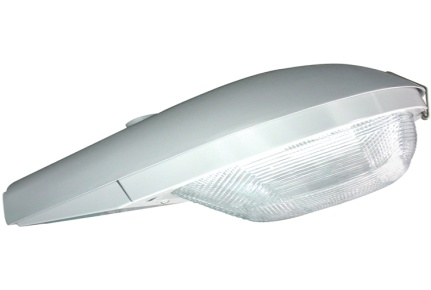
Cobra-head-type fixture with a drop lens
(1)
Cobra-head-type fixtures having drop lenses or refractors which house other than incandescent sources; and
(2)
Searchlights and other high-intensity narrow-beam fixtures, except in conjunction with an approved special event or temporary use permit.
(c)
Design requirements. Outdoor lighting shall primarily be used to provide safety, while secondarily accenting key architectural elements and to emphasize landscape features. Light fixtures shall be designed as an integral design element that complements the design of the project. This may be accomplished through style, material or color. All lighting fixtures designed or placed to illuminate any portion of a site shall meet the following requirements:
Any state-of-the-art technology shall be taken into consideration that is consistent with the intent of this section, as new lighting technology develops that is useful in reducing light above the horizontal plane.
(1)
Fixture (luminaire). The light source shall be concealed and shall not be visible from any street right-of-way or adjacent properties. In order to direct light downward and minimize the amount of light spill into the night sky and onto adjacent properties or waterways, all lighting fixtures shall be cutoff fixtures.
(2)
Mounting. Fixtures shall be mounted in such a manner that the cone of light is contained on-site and does not cross any property line of the site.
(3)
Limit lighting to period of activity. The use of sensor technologies, timers or other means to activate lighting during times when it will be needed is encouraged to conserve energy, provide safety and promote compatibility between different land uses.
(d)
Specific lighting.
(1)
Security lighting.
a.
Building-mounted security light fixtures such as wall packs shall not project above the roof line or parapet wall of the building and shall be shielded.
b.
Security fixtures shall not be substituted for parking area or walkway lighting and shall be restricted to loading, storage, service and similar locations.
(2)
Accent lighting. Only lighting used to accent architectural features, landscaping or art may be directed upward, provided that the fixture shall be located, aimed or shielded to minimize light spill into the night sky.

Canopy Area Lighting
(3)
Canopy area lighting. All development that incorporates a canopy area over fuel sales, automated teller machines or similar installations shall use a cutoff that provides a shielded light distribution.
(4)
Entrances to mixed use building types. All entrances to mixed use building types, and all entrances in apartment building types containing more than four units, shall be adequately lighted to ensure the safety of persons and the security of the building.
(5)
Commercial, hotel/motel and multi-family parking area lighting. All commercial, hotel/motel and multi-family parking areas shall be full cutoff. Light levels shall be a minimum of one initial foot candles of illumination throughout the parking lot. The maximum to minimum foot candle ratio shall not exceed 15 to one. All parking areas shall be required to provide lighting consistent with the design requirement of this section during nighttime hours of operation.
(6)
Excessive illumination.
a.
Lighting within any lot that unnecessarily illuminates and substantially interferes with the use or enjoyment of any other property shall be prohibited. Lighting unnecessarily illuminates another lot if it exceeds the requirements of this section.
b.
Lighting shall not be oriented so as to direct glare or excessive illumination onto streets in a manner that may distract or interfere with the vision of either drivers or pedestrians.
(7)
Beach lighting. No artificial public or private light source shall illuminate where it may deter adult female sea turtles from nesting or disorient hatchlings to the Gulf of Mexico during May 1 — October 31. Refer to Chapter 72 Resources, Vegetation and Environmentally Sensitive Lands, Article V, Lighting Standards for Properties Abutting Public Beaches and/or Along the Gulf of Mexico, for additional regulations of beach lighting in which case the more stringent provisions shall apply.
(Ord. No. 07-01, § 1, 3-20-07; Ord. No. 14-07, § 2, 9-3-14)
Sec. 68-481. - Special exception uses.
Special exception uses, as enumerated in article VI, zoning district regulations, of this chapter, shall be permitted only upon authorization by the planning and zoning board, or city commission, as set forth in this Code, provided that such uses comply with all of the requirements set forth in article VI, zoning district regulations, of this chapter, and providing that:
(1)
The use is a permitted special use as set forth in article VI;
(2)
The use is consistent with the city comprehensive plan;
(3)
The use is designed, located and proposed to be operated in a manner that will protect the public health, safety, welfare and convenience;
(4)
The use will not adversely affect the value of other property in the neighborhood where it is to be located;
(5)
The use will be compatible with development adjacent to and near the property under consideration for a special exception;
(6)
The use will be consistent with the character and purpose of the zoning district where it is to be located;
(7)
The use will ensure that adequate landscaping is provided as required in the land development regulations, or as otherwise required;
(8)
The use will ensure the adequacy of the location and relationship of off-street parking, bicycle parking, and off-street loading facilities to driveways and internal traffic patterns within the proposed development with particular reference to automotive, bicycle, and pedestrian safely, traffic flow and control, and access in case of fire or catastrophe;
(9)
The use will be compatible with the existing natural environment of the site, neighboring public parks and properties in the neighborhood as outlined in the city comprehensive plan;
(10)
The use will orient and locate buildings, recreational facilities and open space in relation to the physical characteristics of the site, the character of the neighborhood, and the appearance and harmony of the building(s) with adjacent development and the surrounding landscape;
(11)
The use will have sufficient setbacks, screens, buffers and general amenities to preserve internal and external harmony and compatibility with uses inside and outside the proposed development and to control any adverse effects of noise, lights, dust, fumes, and other nuisances;
(12)
The use will have sufficient land area;
(13)
The use will meet the adopted levels of service required by the city comprehensive plan and the land development regulations.
(Ord. No. 95-10, § 36-286, 9-19-95; Ord. No. 05-12, § 2, 6-14-05; Ord. No. 15-03, § 3, 7-7-15)
Sec. 68-482. - Accessory uses generally.
Accessory uses shall be clearly supplementary and incidental to the principal use of the lot and shall be located on the same lot as the principal use to which it is subordinate. All such incidental services shall be located within the principal building and no part thereof shall have an exclusive entrance to the street or public way.
Accessory uses exemption. In response to the number of structures damaged by Hurricane Helene and Hurricane Milton in September and October of 2024, the specific accessory uses of docks, lifts and pools with pool equipment shall be allowed to remain through October 8, 2026, without a principal use constructed on the property. In order to be retained a separate permit for a safety barrier which meets the requirements of F.S. § 515.29 must be installed and maintained so as to ensure that there is no access to seawater or pool water. If pool equipment or a lift is retained on the property, then a permit to install a temporary power pole is required.
(Ord. No. 95-10, § 36-287, 9-19-95; Ord. No. 24-27, § 3, 1-21-25)
Sec. 68-483. - Swimming pools.
Swimming pools may be constructed within yard areas except the front yard, provided however, that no part of the pool structure may protrude more than 12 inches above the higher of natural or finished grade level and that the outside of the pool walls shall be at least ten feet from all lot lines except where a greater setback is required under the building code as set out in chapter 64. In determining the percentage of coverage of a lot by buildings, swimming pools which are not enclosed shall not be counted in such computation. In calculating required pervious space swimming pools shall be considered impervious.
(Ord. No. 95-10, § 36-288, 9-19-95; Ord. No. 24-15, § 14, 4-1-25)
Sec. 68-484. - Accessory uses and incidental services in motels or hotels.
(a)
Accessory uses which include restaurants, alcoholic beverage establishments personal service stores and similar uses, may be permitted as allowed in the zoning district, by special exception of the planning and zoning board, provided the following conditions are fulfilled:
(1)
Alcoholic beverage establishments shall not exceed ten percent of the total floor area of the principal building.
(2)
All such accessory uses shall be situated within the principal building.
(b)
Incidental services used in conjunction with either hotels or motels are permitted, provided the following conditions are fulfilled:
(1)
Such incidental services shall be related to the needs of motel or hotel guests and may include tobacco products, snack and candy items, newsstand, pool and beach supplies and similar items.
(2)
Not more than 200 square feet of the total floor area of the principal building shall be so used.
(Ord. No. 95-10, § 36-289, 9-19-95; Ord. No. 24-03, § 4, 7-30-24)
Sec. 68-485. - Private recreational areas.
Tennis courts, shuffleboard courts and similar uses of a recreational nature not to be covered by a structure may be constructed within yard areas except the required front yard. Tennis courts, shuffleboard courts and similar uses shall not be counted in computation of building lot coverage. Private recreational areas within a structure shall conform with all pertinent accessory structure requirements of this chapter.
(Ord. No. 95-10, § 36-290, 9-19-95)
Sec. 68-486. - Off-street parking.
The purpose of this section is to ensure the provision of adequate off-street parking areas. Furthermore, it is the intent to avoid urban congestion on public streets to protect the level of service and capacity of existing streets to avoid unnecessary conflicts between pedestrian and vehicles and to promote the general health, safety, and public welfare. These regulations shall apply to all off-street parking areas, including driveways for single-family and duplex dwellings, established within the city. Any plans for re-striping an existing off-street parking area or modifying the number of parking spaces shall be approved by either the planning and zoning board or the city manager or designee as required by the land development regulations upon the submittal of a parking plan which complies with the land development regulations.
(a)
Number and description of parking spaces required. Proper parking spaces shall be provided at the time of the construction of any main building or structure, or at any time any main building or structure is increased in occupant capacity, or at the time any use or occupancy of an existing building is changed to a use or occupancy which increases the requirements for off-street parking facilities. Off-street parking lots may be allowed as provided for in chapter 68, article VI, Zoning district regulations (see the illustrative parking use table in section 68-486(q). Such parking lots shall be subject to site plan review and shall adhere to all applicable land development regulations. Parking areas shall be surfaced by a dust free paving material such as asphalt, bitumen, concrete, turf block or other similar materials except for that portion of the parking area abutting the Gulf of Mexico or public beach. With the exception of single-family and two-family dwellings, parking lots shall have each parking space and aisle marked. All required parking spaces shall be located at grade level or above. The number of parking spaces required is specified in the following schedule of off-street parking requirements:
In addition to the above, certain parking credits may be allowed as identified as follows:
(b)
Size and access.
(1)
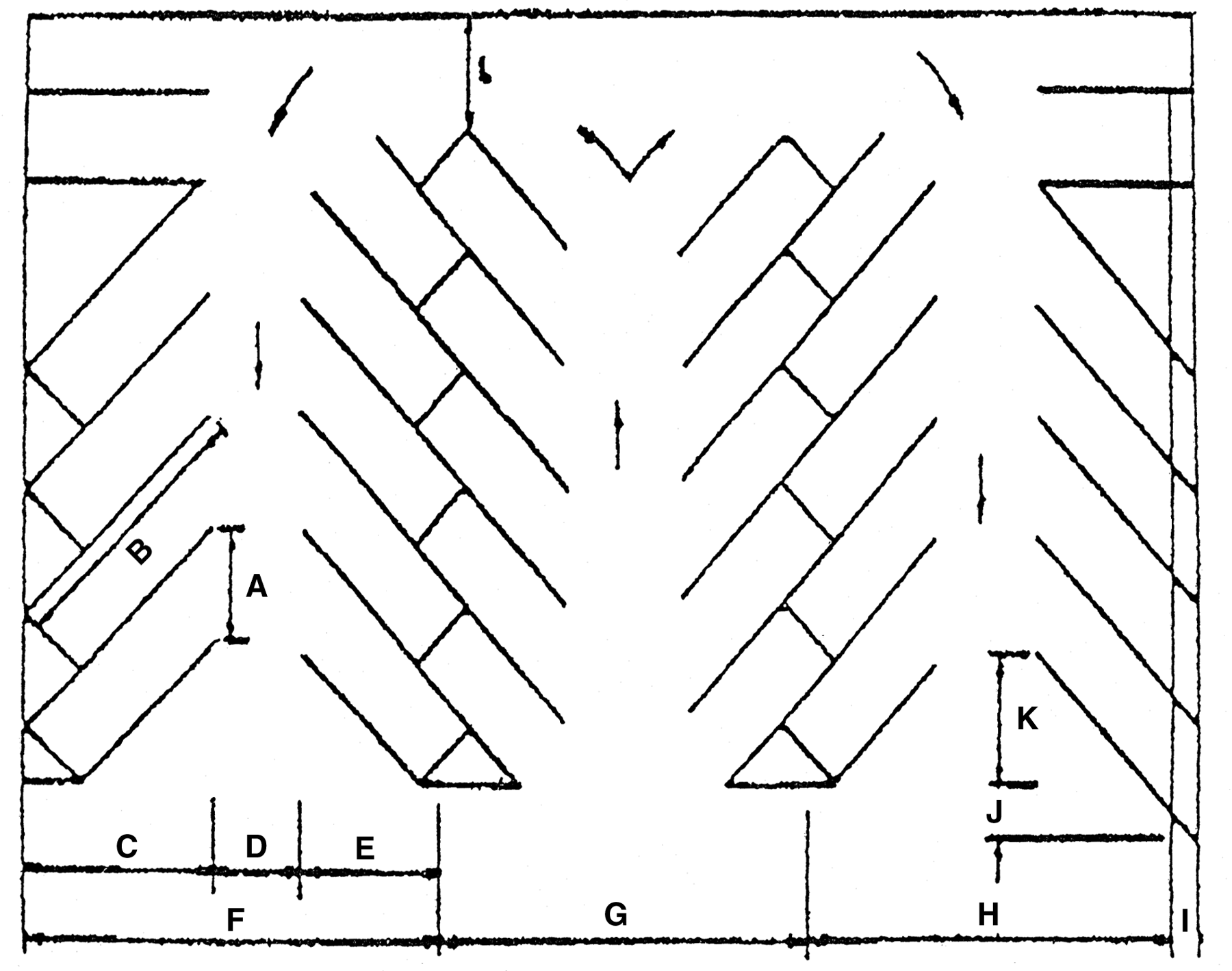
All uses, except single-family. For all uses, except single-family and approved stacked parking, an off-street parking space shall consist of a parking space having minimum dimensions as required in the diagram for regular and compact car parking, or nine feet in width by 22 feet in length for the parallel parking of each automobile, exclusive of access drives or aisles thereto. The parking plan must be so arranged that each automobile may be placed and removed from the parking space assigned thereto and taken to and from the property without the necessity of moving any other automobile to complete the maneuver, except for a licensed and authorized rental car agency. Street and/or sidewalk areas may not be used for off-street parking purposes as herein defined. Individual ingress and egress drives extending across the public sidewalks and curbs and connecting the off-street parking spaces to the public street areas shall not exceed a minimum of 12 feet and a maximum of 15 feet for a one-way drive and a minimum of 24 feet and a maximum of 30 feet for a two-way drive. The design, number and placement of such drives is subject to site plan approval by the city before being constructed. Two or more owners and operators of commercial buildings or uses of the same type in the same zoning district requiring off-street parking facilities may take collective provision for such ingress and egress facilities provided that the combined facility is compatible with the zoning being served.
Exception: Stacked parking may be permitted for businesses in conjunction with legal off-street parking uses as provided for in chapter 68, article VI, Zoning district regulations (see the illustrative parking use table in section 68-486(q) in accordance with the following conditions:
a.
An application for special exception to the planning and zoning board shall be submitted for review and approval.
b.
The application shall reflect that all parties acknowledge that the stacked parking facility is to be used only by the permitted business and is not currently required parking for any other use.
c.
Lots approved for stacked parking shall not be required to have each parking space and aisle marked unless such lot will be used for other than stacked parking.
(2)
Single-family uses. For single-family uses, off-street parking areas shall be a minimum of 324 square feet (equivalent to two nine-foot by 18-foot spaces).
(3)
Plan approval; permits required. The plan for ingress and egress to and from the off-street parking areas shall be subject to the approval of the city. No curbs or sidewalks may be cut or altered in any manner without a permit from the city and all other applicable county or state agencies.
(4)
Variances. Any variance to alter the number or size of parking requirements in any zoning district may only be granted pursuant to section 70-221.
(5)
Regular car parking. Regular car parking shall meet the following minimum dimensions:
(6)
Compact car parking. Compact car parking may be provided for up to 20 percent of the required parking and shall meet the following minimum requirements and dimensions:
a.
Compact car parking may be provided only for parking areas that have ten or more spaces.
b.
Compact car parking may be provided for only nonresidential zoning districts.
c.
Compact parking spaces must be designated as being for the exclusive use of compact cars through the use of signs or pavement marking.
d.
The overall design must be reviewed and approved by the city.
(c)
Location of parking spaces. Parking spaces for all uses and structures which are provided as required parking in conformance with the schedule of parking, off-street and other applicable provisions shall be located on the same lot, and have the same zoning district, as the principal use or structure they are intended to serve unless otherwise allowed by article VI, Zoning district regulations. Those businesses participating in the downtown parking agreement or in a shared parking agreement identified in this section of the land development regulations may be exempted from the same lot requirements of this section per the specific agreement.
(d)
Parking or storage of rental vehicles. Parking or storage of rental vehicles in connection with a licensed and authorized rental car agency shall be located on the same lot or parcel of property as the licensed office of the rental car agency or such lot or parcel shall be contiguous to the lot or parcel on which the main rental agency or office is located. The storage of rental cars does not require standard parking spaces.
(e)
Handicapped parking. Handicapped parking shall meet the requirements of the State Handicapped Access Code, F.S. § 553.501 et seq.
(f)
Utilization of parking structures. When off-street parking facilities are located within a separate parking structure, the following conditions and restrictions shall apply:
(1)
The structure shall conform to all lot, yard and bulk requirements of the zoning district in which it is located.
(2)
The parking facilities shall be designed so as to conform to all other provisions of this chapter and all other ordinances of the city.
(3)
Parking structures shall be architecturally compatible with abutting structures and shall be screened with ornamental grillwork, artwork, or similar architectural features.
(4)
Vehicular access shall be designed in a manner that minimizes disruption to pedestrian corridors and the streetscape.
(5)
All lighting relating to parking structures shall conform with section 68-466 and sections 72-161 through 72-164.
This subsection shall not apply to or be construed to prohibit the construction of freestanding carports or garages as accessory structures to single-family or two-family residential dwellings.
Nothing in this section is intended to prohibit the installation of a fully automatic parking facility in which the placement and removal of automobiles are accomplished wholly by machinery. However, such mechanism shall be completely shielded from public view.
(g)
Utilization of yards.
(1)
In all residential zoning districts, required parking spaces for single-family and two-family dwellings may be permitted in any setback areas or yards, except in a waterfront yard, and shall be counted as meeting off-street parking requirements, except that within a required front yard all parking shall be located in a driveway or turnaround.
(2)
In all zoning districts, for all other permitted uses, approved permitted uses with site plan review or approved special exception uses, required front, side or rear yards may be used for off-street parking except as limited herein. A maximum of 80 percent of a required front yard may be used for off-street parking. All parking areas shall have each parking space and aisle marked and shall be landscaped in conformance with the paved area landscape requirements in chapter 72, article II.
(3)
In all zoning districts, parking area surfaces shall not extend closer than three feet from any abutting property line.
(4)
All parking spaces shall be considered impervious for the purpose of calculating required pervious area pursuant to section 68-226.
(h)
Shared parking. Parking facilities may be used jointly with parking facilities for other uses when operations are not normally conducted during the same hours, or when hours of peak use vary. Requests for the use of shared parking are subject to the approval of the city manager and must meet the following conditions:
(1)
The applicant must demonstrate to the city manager's satisfaction that substantial conflict shall not exist in the principal hours or periods of peak demand for the uses for which the joint use is proposed.
(2)
The number of parking stalls which may be credited against the requirements for the structures or uses involved shall not exceed the number of parking stalls reasonably anticipated to be available during different hours of operation.
(3)
Parking facilities designated for joint use should not be located further than 600 feet from any structure of use served.
(4)
A written agreement shall be drawn to the satisfaction of the city attorney and executed by all parties concerned assuring the continued availability of the number of stalls designated for joint use.
(5)
The applicant shall post a sign at the business indicating the location of the shared parking facility for the customer's benefit in the event overflow parking is needed.
(i)
Bicycle parking. Bicycles are a clean, energy-efficient, alternative means of transportation, especially for those whose access to motorized transportation is limited. Therefore, it is the policy of the city to encourage the use of bicycles by requiring that development and redevelopment provide adequate and properly located bicycle parking facilities, in accordance with the following standards:
(1)
Each commercial, institutional, or recreational development or redevelopment which requires site plan approval shall provide off-street bicycle parking, sufficient to park at least five bicycles, for each freestanding building. In addition, the provision of additional area sufficient to park at least five additional bicycles shall qualify the development for a parking credit of one parking space. The planning and zoning board shall have the option of increasing this requirement as a condition of site plan approval, based upon the type and characteristics of the specific development under review. Only the following type(s) of development shall be exempt from this requirement:
a.
Freestanding uses which require the presence of motor vehicles, such as automobile or motorcycle repair shops, filling stations, body repair shops, and similar uses, provided, however, that should the occupancy of a building change to a non-exempt use, bicycle parking facilities may be required as a condition of reoccupancy. Shopping centers and other multiple-tenant developments which may contain the above uses are not exempted.
(2)
The following design standards shall apply to all bicycle parking facilities:
a.
Bicycle parking facilities shall be separated from automobile parking, conveniently located near the main entrance of a building without obstructing pedestrian walkways, and sufficiently visible to minimize the potential for theft or vandalism.
b.
Bicycle parking facilities shall be placed over paved or otherwise stabilized surfaces not subject to erosion or rutting.
c.
Each bicycle parking space shall provide sufficient area to store a full-sized bicycle, and a rack or other means to support and lock the bicycle in a stable, upright position without damage to wheels, frame, or components.
(j)
Motorcycle/scooter parking. Motorcycle and scooter parking may substitute for required parking spaces, for non-residential uses. Existing parking may be converted to take advantage of this provision for non-residential uses.
(1)
Ratios. Motorcycle and scooter parking may substitute for up to five automobile spaces or five percent of the required parking spaces, whichever is less. For every four motorcycle or scooter parking spaces provides, the automobile parking requirement is reduced by two spaces.
(2)
Identification. Motorcycle and scooter parking spaces must be identified or designated.
(k)
[Remote parking.] Remote parking may be allowed as provided for in article VI, Zoning district regulations (see the illustrative parking use table in section 68-486(q). The owner of a site utilizing a remote parking facility shall provide evidence of the owner's right to use the remote parking area either by license, deed, easement, or by long term lease. Such remote parking facility must be located within the city and must be more than 600 feet in distance of the site serving the principal use and shall be measured from the nearest point of the principal use lot line to an entrance to the remote parking facility. Such separated parking areas shall be usable without causing unreasonable traffic congestion, detriment to any residential neighborhood, or hazard to pedestrians. Such remote parking facilities shall be subject to site plan review and shall be upgraded to meet current city codes for required parking and landscaping as required by chapter 72, article II, of the land development regulations for vehicular use areas. Staff or the planning and zoning board as applicable shall consider specific restrictions pertaining to hours of operation, noise, and lighting among other considerations in the review of such remote parking request. In addition, the owner of the principal use utilizing the remote parking facility shall have a transportation plan to shuttle people between the principal use and the remote parking facility.
(l)
[Valet parking.] Valet parking is a service which may be allowed in conjunction with legal off-street parking uses citywide as provided for in article VI, Zoning district regulations (see the illustrative parking use table in section 68-486(q). This service constitutes a manner of use wherein administrative review is appropriate and may also allow the stacking of parking in the configuration outlined in section 68-486(b)(1). The following criteria shall apply:
(1)
Such use receives administrative approval from the city manager or designee.
(2)
At a minimum, all such valet parking facilities shall be subject to in-house site plan review. Required upgrades to meet required city codes pertaining to parking and landscaping vehicular use areas may also require site plan review by the planning and zoning board unless exempted by section 70-33.
(3)
The city manager or designee may consider specific restrictions pertaining to hours of operation, noise, and lighting among other considerations in the review of such off-site parking request.
(4)
Specific on-site or off-site parking facilities for the exclusive use of valet parking may be provided subject to administrative approval by the city manager or designee.
(5)
The following standards shall apply to all valet parking facilities:
(a)
Property used for valet parking may be allowed as provided for in article VI, Zoning district regulations, (see the illustrative parking use table in section 68-486(r).
(b)
Public parking spaces shall not be utilized for valet parking unless approved through a valid license agreement with the city.
(6)
In addition to the above, the following conditions shall apply to stacked valet parking requests:
(a)
A letter of request and a site plan shall be submitted to the city manager or designee for approval.
(b)
The letter shall reflect that all parties acknowledge that the stacked parking area is to be used only by the permitted business and is not currently required parking for any other use.
(c)
Parking areas approved for stacked parking shall not be required to have each parking space and aisle marked unless such parking area will be used for other than stacked parking purposes.
(m)
Temporary parking review and permit. The following types of temporary parking facilities may be allowed as provided for in article VI, Zoning district regulations (see the illustrative parking use table in section 68-486(r). The power and authority to grant special exceptions and related site plan review for temporary parking will be solely within the jurisdiction of the city commission.
(1)
Temporary, non-recurring parking may be allowed as provided for in article VI, Zoning district regulations (see the illustrative parking use table in section 68-486(r) for a maximum of 90 days. Temporary parking shall not be permitted in the RU-75 or RM-15 zoning districts.
(2)
Temporary, 90 days to one year in duration, as provided for in article VI, Zoning district regulations (see the illustrative parking use table in section 68-486(r). Such review shall include possible reduction or relaxation of specific land development requirements such as paving surface, buffering, and landscaping for vehicular use areas as may be applicable to the specific request. The applicant has the burden of proof to demonstrate the temporary nature of the request which shall include an anticipated date of expiration. Temporary parking shall not be permitted in the RU-75 or RM-15 zoning districts.
(3)
Temporary, off-street or off-site parking facilities, may be allowed as provided for in article VI, Zoning district regulations (see also the illustrative parking use table in section 68-486(r). In addition to the special exception and/or site plan approval requirements, the following conditions shall apply:
(a)
Temporary parking may be approved for a period not to exceed one year. One-year extensions may be allowed by the city commission under the following conditions:
1.
No extensions shall be granted for such parking which is not in compliance with the design standards, maintenance plan, or any conditions of the original approval.
2.
Included but not limited to any adverse impacts to such parking, changes in the land development regulations affecting the parking, crime statistics for such parking, and Code violation history shall be considered in determining whether to grant an extension. Any extension may be conditioned on mitigation of impacts caused by the use of the subject parking.
(n)
Special event parking review and permit. There shall be two tiers of special event parking facilities which may be permitted following administrative review and city commission approval as provided for in article VI, Zoning district regulations (see also the illustrative parking use table in section 68-486(r). All fees pursuant to this section, shall be set by the city commission in appendix A.
(1)
Special event, non-recurring; maximum duration two weeks within a continuous 12-month period.
(2)
Special event, recurring, less than one week duration per episode with limited frequency within a 12-month time period.
(o)
Walk-in credit. Within the CG zoning district, a parking credit for up to 25 percent of the required parking may be allowed provided the following conditions are met:
(1)
A letter of request shall be filed with the city manager or designee containing the following information:
(a)
Name, address, and phone number of the owner of the business requesting the parking credit.
(b)
Number of required parking spaces prior to receiving credit.
(c)
Three copies of a walk-in customer survey, prepared and conducted by a land use consultant, describing the average daily number of customers who walk or ride a bicycle or other non-motorized mode of transportation to the business from their homes or transient accommodation and do not require the use of a parking space. The report shall describe the methodology used and list who conducted the survey and their credentials. The report shall document no less than eight days where this daily customer survey was conducted during peak hours of operation and should have duration of at least four hours.
(2)
The city manager or his designee shall review such survey and make a finding within 30 days of the receipt of a complete application, including the allowable credit of zero to 25 percent of the otherwise required parking. If the applicant agrees with the finding of the city manager, the credit shall be approved.
(3)
If the applicant disagrees with the recommendation of the city manager, the applicant can appeal to the city commission based on the procedures established in section 70-181.
(p)
Downtown redevelopment area credit. An overall reduction of the total minimum off-street parking requirements of up to 20 percent shall be granted to any business participating in a downtown parking agreement. Such document shall be a legal instrument wherein the business agrees to share its parking with other downtown users. Property utilizing this credit must be either commercial or mixed use in nature and shall be located within the downtown redevelopment planning area. The language and legal provisions of this agreement shall be approved by the city manager and the city attorney prior to its initiation and the use of such credits along with a copy of the signed agreement shall be recorded in the public records of the county.
(q)
Landscape credit. A reduction of the required on-site parking by up to ten percent may be allowed in order to enhance on-site landscaping that would be visible from the public right-of-way. Such a reduction requires the review and approval of the city manager or his designee. The decision would be appealable to the city commission following the procedures outlines in section 70-181, Procedures to appeals of administrative decisions, found in the land development regulations. (Does not apply to residential parking requirements.)
(r)
Illustrative parking use table (for illustrative purposes only).
ILLUSTRATIVE PARKING USE TABLE
(for illustrative purposes only)
(Ord. No. 95-10, § 36-291, 9-19-95; Ord. No. 96-16, § 1, 9-24-96; Ord. No. 97-4, § 10, 4-22-97; Ord. No. 00-08, § 29, 1-9-01; Ord. No. 01-03, §§ 2—5, 8-28-01; Ord. No. 11-10, § 7, 8-2-11; Ord. No. 11-08, § 13, 11-1-11; Ord. No. 15-03, § 3, 7-7-15; Ord. No. 21-18, § 36, 9-20-21)
Sec. 68-487. - Off-street loading.
In any zoning district, in connection with every building or building group or part thereof thereafter erected and having a gross floor area of 4,000 square feet or more, which is to be occupied by commercial or industrial uses or other uses similarly requiring the receipt of distribution by vehicles of material or merchandise, there shall be provided and maintained on the same lot with such building, off-street loading berths or unloading berths as follows:
(1)
4,000—25,000 square feet .....1 berth
(2)
25,000—40,000 square feet .....2 berths
(3)
40,000—60,000 square feet .....3 berths
(4)
For each additional 50,000 square feet .....1 berth
(Ord. No. 95-10, § 36-292, 9-19-95; Ord. No. 15-03, § 3, 7-7-15)
Sec. 68-488. - Service stations.
(a)
Location of exits and entrances. Entrances and exits for vehicles to and from gasoline service stations shall not be closer than 30 feet to any intersection.
(b)
Lot size. Gasoline service stations shall be located on a lot not less than 10,000 square feet and shall have a minimum frontage of 100 feet.
(c)
Location of oil drainage pits and hydraulic lifts. All oil drainage pits and hydraulic lifts shall be located within an enclosed structure and shall be located no closer than 25 feet to any interior property line; provided, however, that they may be located within ten feet of a rear lot line if no access doors of any kind whatsoever face such rear property line.
(d)
Mechanical repair. All permitted mechanical repair work shall be conducted within an enclosed structure and shall be located no closer than 25 feet to any interior property line, except the rear property line which setback shall be not less than ten feet, provided that the requirement for access doors set forth in subsection (c) is complied with.
(e)
Gasoline pumps. Gasoline service stations shall have their gasoline pumps, including other service facilities, set back at least 18 feet from any property or street line, except where the required front yard setback is greater.
(f)
Storage of vehicles. No unlicensed vehicles shall be permitted to be stored on the exterior portion of the property.
(g)
Screen. When adjoining a residential zoning district or use, screening shall be provided as required in section 68-462.
(Ord. No. 95-10, § 36-293, 9-19-95; Ord. No. 15-03, § 3, 7-7-15)
Sec. 68-489. - Drive-in facilities.
Drive-in facilities may be permitted only as an accessory use and only when the following provisions are complied with and approved by the city.
(1)
Location and arrangement of exits and entrances. No drive-in accessory use shall have an entrance or exit for vehicles which is closer than 30 feet to any intersection. Individual ingress and egress drives extending across public sidewalks and curbs shall be subject to the same standards and approvals as those for off-street parking access.
(2)
Size and arrangement. Drive-in accessory uses shall be located so as to not restrict pedestrian access to any public entrance of the principal building. It is further provided that any portion of the drive-in facilities, including access drives, which are located between the principal building and the required off-street parking shall have adequate pedestrian safeguards.
(Ord. No. 95-10, § 36-294, 9-19-95)
Sec. 68-490. - Residential uses—Townhouses.
To encourage and facilitate attractive townhouse development, the following general set of standards shall be used by the city. Townhouse developments are permissible in all zoning districts permitting multiple-family dwellings. Unless otherwise provided in this section, all provisions and development standards of the applicable zoning district shall apply to townhouse developments. Each townhouse unit shall be constructed on a separately platted lot.
(1)
Development criteria.
a.
The overall density shall not exceed the maximum permitted in the district as set forth in section 68-431, the schedule of lot and bulk regulations.
b.
Setbacks. The setbacks for the townhouse group(s) located on the townhouse development site are defined in this chapter. Properties located on the Gulf of Mexico shall also meet the alternate setbacks in this chapter.
c.
The minimum individual lot width shall be 16 feet.
d.
No interconnection or overlapping between individual dwelling units shall be permitted.
e.
The screening requirements of this chapter shall apply hereto.
f.
Each interior individual townhouse lot not having a street front access shall have a minimum access easement of 12 feet provided along the rear property line of such lot.
g.
Townhouse developments, in addition to complying with all applicable sections of this chapter, shall comply with one of the following methods of land transfer and ownership:
1.
The subdivision of the whole tract into individual parcels in accordance with this chapter, together with the platting of the property for record in accordance with the state plat law and applicable ordinances of the city;
2.
Providing for the development of the entire tract in accordance with this chapter, retaining, however, title to all of the lands in the name of a condominium corporation and providing for all other usual condominium documents and procedures;
3.
Providing for the development of the entire tract in accordance with this chapter, retaining, however, title to all of the lands in single ownership by recording a duly executed unity of title in the office of the clerk of the circuit court of the county, thereby stipulating that such tract shall not be eligible for further subdivision.
h.
Height of structure. Maximum height for any townhouse structure shall not be greater than that which is permitted in the specific zoning district described for multiple-family in which the townhouse development is proposed.
i.
A townhouse development must have ingress and egress onto public street(s).
j.
Lot coverage. The maximum lot coverage and impervious surface ratio shall apply to the established and specific zoning district in which the townhouse development project is proposed. The maximum lot coverage requirement and the maximum impervious surface ratio shall apply to the townhouse development, not to an individual townhouse lot.
k.
Each townhouse unit shall have an individual identity from the neighboring unit to establish as a separate unit. This may be achieved by at least one of the criteria below:
1.
Varying building unit height;
2.
Varying building unit forms;
3.
Varying roof pitch and pitch directions;
4.
Addition or deletion of patio and patio walls;
5.
Staggering of exterior walls; or
6.
Any another type of architectural design that gives an individual identity.
l.
Parking. There shall be a minimum of two parking spaces per townhouse or townhouse unit.
(2)
Utilities and services.
a.
Each townhouse shall be independently served by separate potable water, sanitary sewer, electric power and other utility services hereinafter referred to as "infrastructure", to ensure each are individual dwelling units.
b.
No townhouse shall be in any way dependent upon services or utility lines located within another townhouse, except as may be installed in public easements.
c.
All townhouses must be connected to public infrastructure and all utility lines in a townhouse development site shall be placed underground per section 68-514 "Placement of utilities."
d.
All townhouse developments shall have proper and adequate access for public safety purposes and access to services, areas to provide for solid waste collection, and for the other necessary services that shall be provided.
(3)
Subdivision approval. Prior to a building permit being issued for construction, a subdivision plat shall be recorded with the county clerk of the circuit court. The plat of the townhouse development shall be developed in accordance with the standards and procedures set out in the city's land development regulations, chapter 74 and pursuant to F.S. ch. 177.
(Ord. No. 95-10, § 36-295, 9-19-95; Ord. No. 15-03, § 3, 7-7-15; Ord. No. 16-03, § 1, 5-3-16)
Sec. 68-491. - Same—Conversions.
(a)
All conversions of single-family dwellings in multifamily residential zoning districts shall comply with off-street parking requirements and each dwelling unit shall have adequate light, air, heating and plumbing facilities. All density and lot area requirements for the converted structure within the zoning district in which it is located shall be complied with; provided however, that each converted dwelling unit shall have at least 500 square feet of floor area.
(b)
Prior to the conversion of multifamily or motel/hotel units to condominium units, the owner shall submit a copy of his proposed condominium documents, as required under the provisions of state law, to the city for review. The conversion, in all respects shall comply with all city ordinances for the converted structure.
(c)
No owner, occupant or user of any structure or dwelling shall alter or amend the use of such structure or dwelling from that which was authorized and permitted at the time it was originally constructed or permitted without first obtaining written approval for such change in use from the city clerk. No such approval shall be granted for any change of use which would render the structure or dwelling nonconforming under the zoning regulations in effect at the time application is made for approval.
(Ord. No. 95-10, § 36-296, 9-19-95; Ord. No. 15-03, § 3, 7-7-15)
Sec. 68-492. - Religious institution uses, and private clubs, and other assembly uses.
Applications for religious institution uses, private clubs, and other assembly uses, either as a permitted use or a special exception use, shall require the submission of a site development plan in accordance with the site plan review requirements in article II of chapter 70. The following regulations shall be utilized as guidelines in reviewing the proposed development:
(1)
Lot and bulk. Such development should not exceed the height and bulk restrictions as provided for in article VI.
(2)
Traffic access. All proposed site traffic accessways are adequate, but not excessive in number, adequate in width, alignment and visibility and so located so as not to be a detriment to surrounding properties.
(3)
Circulation and parking. The interior circulation system is adequate to serve the needs of the development and that all required parking is provided and easily accessible.
(4)
Proper landscaping. The proposed site is properly landscaped, the purpose of which is to further enhance the natural qualities of the land. As provided elsewhere in this chapter, proper screening and buffer zones may be required.
(5)
Secondary and/or accessory uses. The allowance of secondary and/or accessory uses shall be reviewed on a case-by-case basis consistent with the allowable zoning district regulations and adherence to site plan review requirements. Any additional usage shall meet the land development regulations requirements and provide for their respective proportion of density and intensity requirements.
(Ord. No. 95-10, § 36-297, 9-19-95; Ord. No. 11-10, § 8, 8-2-11; Ord. No. 15-03, § 3, 7-7-15)
Sec. 68-493. - Home occupations.
An occupation may be conducted in a dwelling unit or residence, provided:
(1)
No person shall be employed on the premises other than members of the immediate family residing on the premises.
(2)
The use of the dwelling unit or residence for home occupations shall be clearly incidental and secondary to its use for residential purposes. No more than one room within the dwelling unit shall be used to conduct a home occupation, provided the area of that room does not exceed 20 percent of the total living area of the dwelling unit or residence. No more than five percent of that room shall be used for storage of commodities related to the home occupation. No outside display, storage or use of land is permitted.
(3)
There shall be no change in the outside appearance of the building or premises as a result of such occupation with the exception of a sign as provided in the sign requirements in chapter 73.
(4)
No home occupation shall be conducted in any accessory building or attached garage.
(5)
No mechanical equipment shall be used or stored on the premises except such that is normally used for purely domestic or household purposes; nor shall it create noise, vibration, glare, fumes, odors or electrical interference detectable to the normal senses outside the dwelling unit. In the case of electrical interference, no equipment or process shall be used which creates visual or audio interference in any radio or television sets off the premises or causes fluctuation in line voltage.
(6)
No retail or wholesale sales on the premises shall be permitted, not including telephone mail order sales.
(7)
No traffic shall be generated by such home occupation in greater volume than would normally be expected in the neighborhood.
(8)
A home occupation shall not be construed to include, among other uses, personal services such as massage, cosmetology, barbershops, beauty parlors, tea rooms, food processing for sale, kennels, animal grooming, radio and television repair, furniture refinishing or building, cabinet making, boat building, marine charter or towing service, auto servicing or rebuilding and repair for others, metal fabrication or cutting employing welding or cutting torches.
(9)
No more than one vehicle related to the home occupation shall be permitted upon the premises. Such vehicle must be 20 feet or less in overall length and must be parked off any public right-of-way. All exterior storage of cargo, equipment or other materials on such vehicle shall be shielded from view at all times when such vehicle is located on a residential lot.
(10)
A home occupation that is solely used for purposes of receiving phone calls, mail and keeping business records in connection with any profession or occupation, shall be known as an address of convenience.
(11)
The city manager or his designee shall determine whether the home occupation meets the established criteria as set out in subsections (1) through (10). The determination may be appealed to the planning and zoning board.
(Ord. No. 95-10, § 36-298, 9-19-95)
Sec. 68-494. - Condo-hotels, hotels and motels, and transient segmented uses (such as time share and fractional interests).
The city recognizes that the condo-hotel is a hybrid form of ownership of the traditional hotel/motel concept. It must be recognized that condo-hotel is considered to be a transient hotel/motel use, and not a residential use. Additionally, segmented uses, such as time share and fractional interests, are often transient in nature and must also be regulated as a transient use rather than a residential use. Exceptions to the general transient character of segmented uses can be found under the definition of "dwelling tourist" in section 68-2. It is the intent of this regulation to ensure that condo-hotels are operated and governed in substantially the same manner as conventional hotels/motels. It is also the intent of this section to regulate all segmented uses not exempted under the definition of "dwelling, tourist" to be operated and governed in substantially the same manner as conventional hotels/motels. Further, this zoning regulation is designed to protect and preserve the density requirements mandated in zoning districts where traditional hotels and motels are allowed, as well as preserving future transient accommodations on the open market, and made available to the general public and tourists. The operation of condo-hotels, hotels and motels, and transient segmented uses is strictly a commercial activity and is inconsistent with residential use. Transient and business related activities have different impacts on governmental facilities and infrastructure (e.g., density, traffic, parking, schools). As such, this regulation is to ensure that the use and operation of condo-hotels, hotels and motels, and segmented uses remain an exclusively commercial enterprise, and not a residential use.
In addition to any existing regulations relating to hotel/motel development found elsewhere in the land development regulations, the following criteria shall apply to all condo-hotels, hotels and motels, and transient segmented uses except where noted:
(1)
All units in a condo-hotel, hotel or motel, or transient segmented use shall be considered transient accommodation units and must be made available as rentals on a continual daily, weekly or monthly basis. If the occupancy of any such unit does not change more frequently than six times or more in any continuous 12-month period, then a rebuttable presumption shall arise that the unit is not being used for transient accommodations.
(2)
Proper licensing will be required of all transient accommodation units through all applicable agencies that license hotels prior to any certificate of occupancy being issued. All licenses must be kept current.
(3)
A reservation system shall be required as an integral part of the transient accommodation facility for the rental of units.
(4)
There shall be a lobby/front desk area that is internally oriented and must be operated as a typical hotel/motel lobby/front desk area would be operated.
(5)
All units shall be subject to all applicable tourist tax collections, when rented.
(6)
Transient accommodation units shall not be used for homesteading purposes or home occupational licensing.
(7)
Notwithstanding subsection (12), one unit may be used on a full-time basis by a resident manager(s), and, if applicable, subject to the governance of the condominium or transient segmented use association.
(8)
All transient accommodation units, except the resident manager unit, must be included in the inventory of units that are available for rent.
(9)
A condo-hotel or transient segmented use may be allowed in any district where a hotel or motel is allowed.
(10)
Annual occupational licenses for each business operating a condo-hotel unit or transient segmented use shall be required for each such unit from the city, and for each business operating a hotel/motel facility, whichever is applicable.
(11)
All transient accommodation facilities must have sufficient signage viewable by the general public designating the use as a hotel, motel, or transient accommodation.
(12)
Owner-occupation. Units in a condo-hotel, hotel or motel or segmented use facility, may not be occupied by their owner(s) for more than a total of 90 days in any consecutive 12-month period.
(13)
The books and records of the condo-hotel, hotel or motel, or transient segmented use pertaining to the rentals of each unit in the transient accommodation facility shall be open for inspection by authorized representatives of the city, upon reasonable notice, in order to confirm compliance with these regulations as allowed by general law.
(14)
The city may require affidavits of compliance with this section from each condo-hotel unit owner, hotel/motel facility owner, or transient segmented use owner.
(Ord. No. 05-09, § 3, 4-12-05; Ord. No. 06-02, § 1, 2-7-06; Ord. No. 15-03, § 3, 7-7-15)
Sec. 68-495. - Minimum property standards.
The purpose of minimum property standards is to eliminate nuisances that detract from the public health and safety and aesthetic quality of the community. The following requirements are required as minimum property standards:
(1)
Nuisances. The exterior of the premises and of all structures shall be kept free of all nuisances, hazards to residents, occupants and pedestrians utilizing the premises, and free of unsanitary conditions in accordance with the following requirements:
a.
All premises shall be kept free of dead trees and shrubs, excessive brush and overgrowth, excavations, standing water not a component of an approved drainage system, loose overhanging objects, and the accumulation of trash, garbage, refuse, vegetation clippings and/or debris.
b.
The exterior of the structure including signs, screens and store fronts, shall be maintained in good repair, kept painted or have similar protective coating where necessary for appearance and preservation.
c.
All exterior surfaces shall be maintained free of broken glass, loose shingles, excessive paint peeling, excessive mildew, excessive corrosion or other conditions reflective of inadequate maintenance or deterioration.
d.
Metal roofs, including accessory structures, showing signs of decay or corrosion shall be maintained, painted or repaired in accordance with manufacturer specifications.
(2)
Turf maintenance and height of grass. The exterior areas of the premises, including yards, lots and public rights-of-way shall be maintained in a manner free from nuisances, hazards and other unsanitary conditions through the following requirements:
a.
All premises with overgrown grass over six inches high on all residential properties shall be considered excessive growth.
b.
Premises landscaped with lawns, hedges, and bushes edged/or trimmed shall be kept from becoming overgrown and unsightly.
c.
Lawns shall be kept in a condition reflective of reasonable care, with grass showing no excessive signs of neglect, discoloring and/or dead vegetative growth.
d.
Owners of private properties are responsible for the maintenance of vegetation, including weeds, grass and other plant materials in the established abutting right-of-way.
e.
It shall be unlawful to dispose of grass clippings, tree trimmings, and/or other vegetative materials in the right-of-way, street, alley or waterways.
(3)
Gravel lawns. The use and maintenance of gravel lawns shall conform to the following requirements:
a.
Gravel, rock, shell and similar materials lawns are allowed and shall be maintained free of weeds and be permeable. The installation of such material shall require a grounds improvement permit from the city to ensure permeability.
(Ord. No. 07-01, § 2, 3-20-07; Ord. No. 12-01, § 2, 3-20-12; Ord. No. 15-03, § 3, 7-7-15; Ord. No. 17-02, § 1, 6-20-17)
Sec. 68-496. - Development agreements.
Pursuant to the authority granted the city by F.S. §§ 163.3220—163.3243, as amended (known as the Florida Local Government Development Agreement Act, hereinafter the "Act") the city may enter into a development agreement with any person(s) having a legal or equitable interest in real property located within the city. All fees imposed pursuant to this section, shall be set by the city commission in appendix A.
A development agreement shall mean a written agreement between the city and a property owner(s) that identifies fees, dedications, exactions or other public improvements or construction controls that will be provided by the developer, and the land development regulations that will be applied by the city during the term of the agreement.
(1)
A development agreement may be entered into when one or more of the following exist:
a.
Where the development is proposed to be constructed with commitments to substantial public improvements being required in the development process.
b.
Where commitments to public improvements beyond those ordinarily required of similar development are desirable by reason of location, topography, or other characteristics of the property.
c.
Where it is desirable to provide incentives to coordinate developments with a specific plan.
(2)
Procedures and requirements for entering into a development agreement:
a.
Proposal for a development agreement may be made by any interested party at any time prior to the completion of approvals for development of the project. Such proposal shall be formulated with the applicant and the city manager.
b.
A proposed development agreement shall be adopted, amended, or revoked by following the procedures of the Act. At a minimum, the local planning agency and the city commission shall each hold a public hearing following the notification procedures set forth in the Act and section 70-12.
c.
Development agreements shall be adopted by ordinance and may be amended by ordinance with the mutual consent of the parties to the agreement or by their successors in interest.
d.
No development agreement shall be effective or be implemented by the city unless the city's comprehensive plan and plan amendments implementing or related to the agreement are in compliance with F.S. § 163.3184.
(3)
A development agreement shall include the following:
a.
A legal description of the land subject to agreement and the names of its legal and equitable owners.
b.
The duration of the agreement, may not exceed 30 years unless it is extended by mutual consent of the city and the developer, subject to a public hearing in accordance with F.S. § 163.3225.
c.
The development uses permitted on the land including population densities and building intensities and height.
d.
A description of public facilities that will service the development, including who shall provide such facilities; the date any new facilities, if needed, will be constructed; and a schedule to assure public facilities are available concurrent with the impacts of the development.
e.
A description of any reservation or dedication of land for public purposes.
f.
A description of all local development permits approved or needed to be approved for the development of the land.
g.
A finding that the development permitted or proposed is consistent with the city comprehensive plan and the land development regulations.
h.
A description of any conditions, terms, restrictions, or other requirements determined to be necessary for the public health, safety, or welfare.
i.
A statement indicating that the failure of the agreement to address a particular permit, condition, term, or restriction shall not relieve the developer of the necessity of complying with the law governing said permitting requirements, conditions, terms, or restrictions.
j.
A development agreement may provide that the entire development or any phase thereof be commenced or completed within a specific period of time.
k.
All other things required to be addressed by the Act, the city's comprehensive plan, or other city ordinances.
(Ord. No. 08-03, § 1, 7-1-08; Ord. No. 15-03, § 3, 7-7-15; Ord. No. 16-12, § 2, 10-18-16; Ord. No. 21-18, § 37, 9-20-21)
Sec. 68-511. - Continuation.
(a)
A use, building, or structure, lawfully in existence at the effective date of the article from which this chapter is derived which shall be rendered nonconforming with the adoption of the city comprehensive plan, the passage of the article from which this chapter is derived, or any applicable amendment thereto, shall be considered grandfathered and may be continued, except as otherwise provided in this division.
(b)
A use, building or structure is, for the purpose of this chapter, a nonconforming use if the use, building or any physical characteristics of such use or building is not in full compliance with all regulations of the zoning district in which it is situated.
(Ord. No. 95-10, § 36-311, 9-19-95; Ord. No. 00-08, § 30, 1-9-01; Ord. No. 15-03, § 3, 7-7-15)
Sec. 68-512. - Regulation.
No existing building or premises devoted to a nonconforming use shall be enlarged, extended, reconstructed, substituted or structurally altered, except when changed to a conforming use or when required to do so by law and as follows:
(1)
Restoration. Any nonconforming structure which has been damaged or made unsafe or unusable to an extent less than 50 percent of its fair market value may be restored or reconstructed for its intended use provided the floor area of such use, building or structure shall not exceed the floor area which existed prior to such damage. All repairs shall be substantially completed within one year after damages occur or such use shall not be rebuilt except as a conforming use.
(2)
Repairs. Normal maintenance, repair, and incidental alteration of a structure containing a nonconforming use is permitted, provided that it does not extend the area or volume of space occupied by the nonconforming use. It is the intent of these regulations to encourage the conservation, maintenance, and rehabilitation of existing residential land uses. Therefore, a building or other structure containing nonconforming residential uses may be altered in any way to improve interior livability; provided that no structural alterations shall be made which would increase the number of dwelling units.
(3)
Site alterations. Site alterations, including but not limited to off-street parking rearrangement or enlargement of nonbuilding recreational facilities of a nonconforming use are permitted, provided that the proposed alterations do not increase the degree of nonconformity. In order to encourage rehabilitation or redevelopment of an existing nonconforming use, the planning and zoning board may approve a site plan which includes an increase in gross floor area of up to ten percent of the existing gross floor area (not to exceed the maximum allowable under the property's designated zoning district), subject to a finding by the board that the overall degree of nonconformity on the site is significantly reduced and that additional adverse impacts will not be created. In conjunction with this site plan approval, the board may grant an exemption from variance requirements for any and all remaining nonconformities. These site plan and variance exemption provisions may be applied only once to any specific property.
(4)
Exception. Restoration, repairs and site alterations can be made to existing single-family dwellings in zoning districts which allow such single-family dwellings, provided that such restorations, repairs or site alterations do not increase the number of dwelling units, increase density, increase the degree of the nonconformity, or result in a different type of nonconformity from that which is already considered to be grandfathered.
(5)
Nonconforming density. Existing residential dwelling, tourist dwelling, and hotel/motel uses which are nonconforming as to density shall not require a variance to permit the otherwise allowable addition or alteration to the building or site, provided that the density is not increased.
(6)
Repair and reconstruction of existing commercial, residential, and hotel/motel structures and uses.
a.
Residential structures/uses and their permitted accessory uses are grandfathered in the RU-75, RM-15, RFM-30, RFH-50, and CG zoning districts.
b.
Hotel/motel structures/uses and their permitted accessory uses are grandfathered in the RFM-30, RFH-50, and CG zoning districts.
c.
In the event that any residential or hotel/motel structure is damaged or destroyed by a hurricane, tornado, fire, flood, wind, storm or other natural disaster, it can be repaired or reconstructed in a manner which guarantees that each unit and all permitted accessory uses can be restored to the same square footage which existed as of September 19, 1995. If the FAR allowed in the current Code is greater than the September 19, 1995 level, then the square footage or FAR may increase up to the currently allowed maximum so long as the project meets all provisions of the Code. If the number of units allowed in the current Code is greater than the September 19, 1995, level, then the number of units may increase up to the currently allowed maximum so long as the project meets all other provisions of the Code. Repairs and reconstruction shall adhere to all flood management regulations in effect. In the event that such flood regulations require the elevation of a structure, the city shall permit the height of the structure to be increased the minimum necessary to accommodate the required flood elevation. If the repairs or reconstruction cannot be made in accordance with these Code provisions, the city shall grant the owners relief from such Code provisions to permit the grandfathered units and all existing legally permitted accessory uses to be restored without creating a greater nonconformity than existed prior to the disaster.
d.
Nothing contained in this section shall relieve the owner/developer of the obligation to restore the damaged structure in compliance with the building code as adopted in section 64-1 and Life Safety Code as adopted in section 64-1. Except as provided above in subsection c., nothing contained herein shall be construed to permit more dwelling units or an increase in square footage of the structure than existed prior to September 19, 1995. The burden of proof as to what existed prior to September 19, 1995, shall rest with the property owner based upon a site plan on file at city hall. If no site plan is presently on file, each property owner shall provide the city with a site plan, as-built surveys, or architecturally sealed floor plans. The plans or surveys shall provide enough information to determine the existing legally permitted development on the site. Single-family and two-family structures are exempt from the site plan requirements.
e.
Commercial structures/uses and their permitted accessory uses are grandfathered in the RFM-30, RFH-50, and CG zoning districts.
(Ord. No. 95-10, § 36-312, 9-19-95; Ord. No. 00-08, §§ 31, 32, 1-9-01; Ord. No. 02-06, § 10, 10-22-02; Ord. No. 03-04, § 10, 6-10-03; Ord. No. 15-03, § 3, 7-7-15; Ord. No. 24-27, § 4, 1-21-25)
Sec. 68-513. - Termination.
(a)
Abandonment. A nonconforming use not used for a period of six months or the change of use to a more restricted or conforming use for any period of time shall be considered an abandonment thereof and such nonconforming use shall not thereafter be revived.
(b)
Partial destruction. When a building has been destroyed by fire or other casualty or act of God to the extent of 50 percent or more of its fair market value and as a result has become unsafe or unusable, the use of such structure as a nonconforming use shall thereafter be terminated.
(Ord. No. 95-10, § 36-313, 9-19-95)
Sec. 68-514. - Placement of utilities.
All new electric, telephone, cable television and other utility service lines installed for structures within the city shall be placed underground. Any increase in the existing service shall be considered a new service for the purpose of this Code and shall be placed underground unless, in the opinion of the building official, such replacement shall result in an undue hardship being placed upon the owner of such structure.
(Ord. No. 95-10, § 36-314, 9-19-95)

