
Tualatin City Zoning Code
CHAPTER 73A
SITE DESIGN STANDARDS1
Editor's note—Ord. No. 1486-24, § 11, adopted June 10, 2024, repealed ch. 73A, §§ 73A-010, 73A-100—73A-170, 73A-200, 73A-300, 73A-400, 73A-410, 73A-500, 73A-600 and 73A-700 and enacted a new ch. 73A as set out herein. Former ch. 73A pertained to similar subject matter and derived from Ord. 1414-18, adopted December 10, 2018; Ord. No. 1438-20, §§ 15—19, 6-22-20; Ord. No. 1463-21, §§ 23—28, 31—34, adopted December 13, 2021; Ord. No. 1480-23, § 10, adopted August 28, 2023.
TDC 73A.010.- Site and Building Design Standards Purpose and Objectives.
(1)
Purpose. The purpose of the site and building design objectives and standards found in TDC 73A through TDC 73G is to promote functional, safe, innovative, and attractive sites and buildings that are compatible with the surrounding environment, including, but not limited to:
(a)
The building form, articulation of walls, roof design, materials, and placement of elements such as windows, doors, and identification features; and
(b)
The placement, design, and relationship of proposed site elements such as buildings, vehicular parking, circulation areas, bikeways and bike parking, accessways, walkways, buffer areas, and landscaping.
(2)
Objectives. The objectives of site and building design standards in TDC 73A through TDC 73G are to:
(a)
Enhance Tualatin through the creation of attractively designed development and streetscapes;
(b)
Encourage originality, flexibility, and innovation in building design;
(c)
Create opportunities for, or areas of, visual and aesthetic interest for occupants and visitors to the site;
(d)
Provide a composition of building elements which responds to function, land form, identity and image, accessibility, orientation and climatic factors;
(e)
Conserve, protect, and restore fish and wildlife habitat areas, and maintain or create visual and physical corridors to adjacent fish and wildlife habitat areas;
(f)
Enhance energy efficiency through the use of landscape and architectural elements; and
(g)
Minimize disruption of natural site features such as topography, trees, and water features.
(Ord. No. 1486-24, § 11, 6-10-24)
TDC 73A.020. - Residential Design Standards Applicability; Exceptions.
(1)
Applicability. The Residential Design Standards apply to:
(a)
New single-family dwelling;
(b)
Duplex; Triplex, or Quadplex;
(c)
Townhouses;
(d)
An addition or alteration to an existing single-family dwelling, duplex, triplex, quadplex, or townhouse when it results in:
(i)
A 35 percent or more expansion of the structure's existing footprint.
(ii)
An increase in building height of 35 percent or more.
(iii)
A 35 percent or more alteration of an existing wall plane.
(e)
The creation of a new dwelling unit or units through conversion of an existing residential structure, resulting in a duplex, triplex, or quadplex.
(2)
Exceptions.
(a)
The Residential Design Standards in subsection (1) do not apply to a side wall plane that abuts the side yard of an adjacent dwelling.
(b)
Façades of dwellings that are separated from a street by another dwelling are exempt from meeting the standards in TDC 73A.030(1) and (2).
(Ord. No. 1486-24, § 11, 6-10-24; Ord. No. 1454-25, § 1(Exhs. 2, 3), 11-24-25)
TDC 73A.030. - Clear and Objective Residential (Type I) Design Standards.
Residential housing types using the Clear and Objective (Type I) standards must comply with the following:
(1)
Front Face. The front face of a residential structure must contain:
(a)
Windows that occupy at least 12 percent of the wall plane.
(i)
This requirement may be reduced to ten percent if one additional Residential Wall Design Element is provided beyond the minimum.
(ii)
This requirement may be reduced to eight percent if two or more additional Residential Wall Design Element are provided beyond the minimum.
(iii)
Garage door windows may be counted toward the window coverage percentage.
(b)
At least three Residential Roof Design Elements; and
(c)
At least five of the Residential Wall Design Elements.
(2)
Rear. The rear of a residential structure must contain:
(a)
Windows that occupy at least 12 percent of the wall plane
(i)
This requirement may be reduced to ten percent if one or more additional Residential Wall Design Element is provided beyond the minimum.
(ii)
Garage door windows may be counted toward the window coverage percentage.
(b)
At least two Residential Roof Design Elements; and
(c)
At least four Residential Wall Design Elements
(3)
Side-Corner Lot. If the side of a residential structure abuts a public street, the side must contain:
(a)
Windows that occupy at least eight percent of the wall plane;
(i)
This requirement may be reduced to six percent of the wall plane if one or more additional Residential Wall Design Elements are provided on the same side elevation.
(ii)
Garage door windows may be counted toward the window coverage percentage.
(b)
At least two Residential Roof Design Elements; and
(c)
At least four Residential Wall Design Elements.
(4)
Walkways. Walkways must be provided for single-family dwellings, duplexes, triplexes, quadplexes, and townhouses as follows:
(a)
A walkway is required to connect main entrances to sidewalks along the adjacent public right-of-way, in accordance with the following:
(i)
For single-family dwellings, duplexes, triplexes, quadplexes, at least one main entrance of each residential structure must have a connection to the sidewalk.
(ii)
For townhouses, the main entrance of each townhouse must have a connection to the sidewalk.
(b)
Walkways must be a minimum of three feet in width;
(c)
Walkways must be constructed of asphalt, concrete, pervious concrete, pavers, or grasscrete; and
(d)
The walkways must meet ADA standards applicable at time of construction or alteration.
(e)
For single-family dwellings, duplexes, triplexes, quadplexes, this standard may be met by a driveway that has a walkway connection to the main entrance and that connects to the public right-of-way.
(Ord. No. 1486-24, § 11, 6-10-24; Ord. No. 1454-25, § 1(Exhs. 2, 3), 11-24-25)
TDC 73A.040. - Type I Residential Roof Design Elements.
The following are the Type I Residential roof design elements:
(1)
Dormer, such as hipped, gabled, shed, or eyebrow dormer design, which is a projecting structure built out from a sloping roof and housing a window, vent, or decorative element.
(2)
Pitched or sloping roof, such as a gable roof, which slopes downward in two parts from a central ridge forming a gable at each end, or hip roof, which has sloping ends and sides that meet at an inclined projecting angle.
(3)
Roof eave of at least 12 inches.
(4)
Roof overhang (barge-board or verge board) of at least six inches measured outward from the face of the dwelling wall or wall plane.
(5)
Window, decorative vent, door, decorated verge boards, trusses, false beams, corbels, brackets, or other decorative element(s) in gable ends; and
(6)
Variation in roof pitch, height of roof planes, or roof orientation, such as in a roof with multi-level eaves.
(Ord. No. 1486-24, § 11, 6-10-24)
TDC 73A.050. - Type I Residential Wall Design Elements.
The following are the Type I Residential wall design elements:
(1)
Recessed entry—Front façade only;
(2)
Portico—Front façade only. A roofed porch-like space, open along at least one side, connected to the main dwelling entrance, supported by columns or pillars, and either protruding from or recessed within the main dwelling structure;
(3)
Covered porch at least 36 square feet in area and at least four feet deep;
(4)
Balcony, which development from the wall plane and is enclosed by a railing or parapet (low protective wall);
(5)
Vertical offsets, at least two, either projecting or recessed, and at least six inches deep and a minimum of four feet long;
(6)
Horizontal offset, either projecting or recessed, at least five inches deep;
(7)
Bay window, box window, or box bay, which development at least six inches outward from the wall plane and forms a bay, alcove, or window seat;
(8)
Column or pilaster, either complete or engaged (where one part of its surface is in contact with a wall plane), and in the wall plane, at a change in wall plane, or at a corner of the dwelling;
(9)
Exterior chimney of brick, stone, composite masonry or similar materials;
(10)
Engaged tower, either square, rectangular, circular or polygonal in form;
(11)
Window trim or surround (casing) at least three and one-half inches wide that completely surrounds the window, either with or without a sill beneath the window;
(12)
Window grids, windows with multi-paned sashes, or elliptical, palladian, segmental arch, semicircular, or similarly shaped windows;
(13)
Lintel, arch, or similar decorative header casing on windows, the main entry door, portico, garage door(s), or other opening in the wall plane;
(14)
Shutters, as a matched pair for or on a window, either movable or fixed, designed to cover a window and filter light, and usually of wood or similar construction and paneled or fitted with louvers;
(15)
Variation in wall cladding, wall-surface pattern, or decorative materials such as shakes, shingles, brick, stone or other similar;
(16)
Decorative or "architectural" garage door(s), with or without windows, and including patterning relief at least five-eighths inches deep over the door(s) surface, excepting the window area if windows are present;
(17)
Decorative trellis or trellis-work, consisting of open rafter ends or beams and cross pieces to create the appearance of a structure over which climbing plants might be trained to grow; and
(18)
Band, band course, band molding, belly band, belt course, or similar horizontal element of relatively slight projection marking a division in the wall plane and adding architectural interest to a façade or elevation.
(Ord. No. 1486-24, § 11, 6-10-24)
TDC 73A.060. - Discretionary (Type II) Residential Development Design Standards.
As an alternative to the clear and objective Type I standards, residential housing (including detached single-family dwellings, duplexes, triplexes, quadplexes, and townhomes), may be reviewed under Type II discretionary standards. Such applications must demonstrate compliance with the following discretionary standards:
(1)
All roofs must be pitched or sloping and articulated by use of such elements as dormers, gables, overhangs or eaves, and must have variations in roof pitch, height of roof planes, or roof orientation to create visual interest and avoid monotony in appearance;
(2)
Architectural articulation and other design elements, such as balconies, porches, dormers, bay windows, vertical or horizontal offsets, variations in cladding, or moldings must be used on all sides of the dwelling (except for the side of a dwelling adjacent to another dwelling) to avoid stark unarticulated building façades (elevations), to minimize the scale and visual impact of a continuous flat wall surface, and to create a sense of visual interest for passersby and neighboring property owners;
(3)
The architectural character (i.e., exterior materials, architectural articulation, design elements, etc.) of the front façade (elevation) of the dwelling must be utilized on all sides of the structure to create a unified appearance and to avoid a single block or box appearance;
(4)
New dwellings must be designed and situated on a property in order to create and maintain a visual sense of harmony with surrounding development and must not overwhelm the scale of surrounding development; and
(5)
The overall architectural design of the dwelling must foster a compatible, positive relationship with the scale and character of the street, and the scale and character of surrounding existing development.
(6)
Pedestrian connections must be provided from main entrances to the sidewalk in the public right-of-way. Connections should be reasonably direct and constructed of sufficient width and material for safe and convenient access.
(Ord. No. 1486-24, § 11, 6-10-24; Ord. No. 1454-25, § 1(Exhs. 2, 3), 11-24-25)
TDC 73A.070. - Clear and Objective (Type I) Cottage Cluster Design Standards.
(1)
Applicability. The Cottage Cluster Design Standards apply to:
(a)
New cottage cluster developments as defined in TDC 31.060.
(b)
An addition or alteration in one or more structures within a developed cottage cluster when it results in:
(i)
A 35 percent or more expansion of a structure's existing footprint, or an expansion of multiple cottage or community building footprints;
(ii)
An increase in building height of 35 percent or more; or
(iii)
A 35 percent or more alteration of an existing wall plane.
(2)
Cottage Standards. Cottage Cluster developments using the Clear and Objective (Type I) standards must comply with the following:
(a)
Unit Size. The maximum footprint for a cottage is 899 square feet. The maximum average floor area for a cottage cluster is 1,400 square feet per dwelling unit. Community buildings must be included in the average floor area calculation for a cottage cluster.
(b)
Cottage Orientation. Cottages must be clustered around a common courtyard and must meet the following standards (see Figure 1):
(i)
Each cottage within a cluster must either abut the common courtyard or be directly connect to the common courtyard by a pedestrian path.
(ii)
A minimum of 50 percent of cottages within a cluster must:
(A)
Have a main entrance facing the common courtyard;
(B)
Be within ten feet from the common courtyard, measured from the façade of the cottage to the nearest edge of the common courtyard; and
(C)
Be connected to the common courtyard by a pedestrian path.
(iii)
Cottages within 20 feet of a street property line may have their entrances facing the street.
(iv)
Cottages not facing the common courtyard or the street must have their main entrances facing a pedestrian path that is directly connected to the common courtyard.
(3)
Common Courtyard Design Standards. Each cottage cluster must share a common courtyard that must meet the following standards (see Figure 1):
(a)
The common courtyard must be a single, contiguous piece of land.
(b)
Cottages must abut the common courtyard on at least two sides of the courtyard.
(c)
The common courtyard must contain a minimum of 150 square feet for each cottage constructed within the associated cottage cluster.
(d)
The common courtyard must be a minimum of 15 feet wide at its narrowest dimension.
(e)
The common courtyard must be developed with a mix of landscaping, lawn area, pedestrian paths, and/or paved courtyard area, and may also include recreational amenities.
(f)
Impervious elements of the common courtyard must not exceed 75 percent of the total common courtyard area.
(g)
Pedestrian paths must be included in a common courtyard. Paths that are contiguous to a courtyard count toward the courtyard's minimum dimension and area. Parking areas and driveways do not qualify as part of a common courtyard.
Figure 1. Cottage Cluster Orientation and Common Courtyard Standards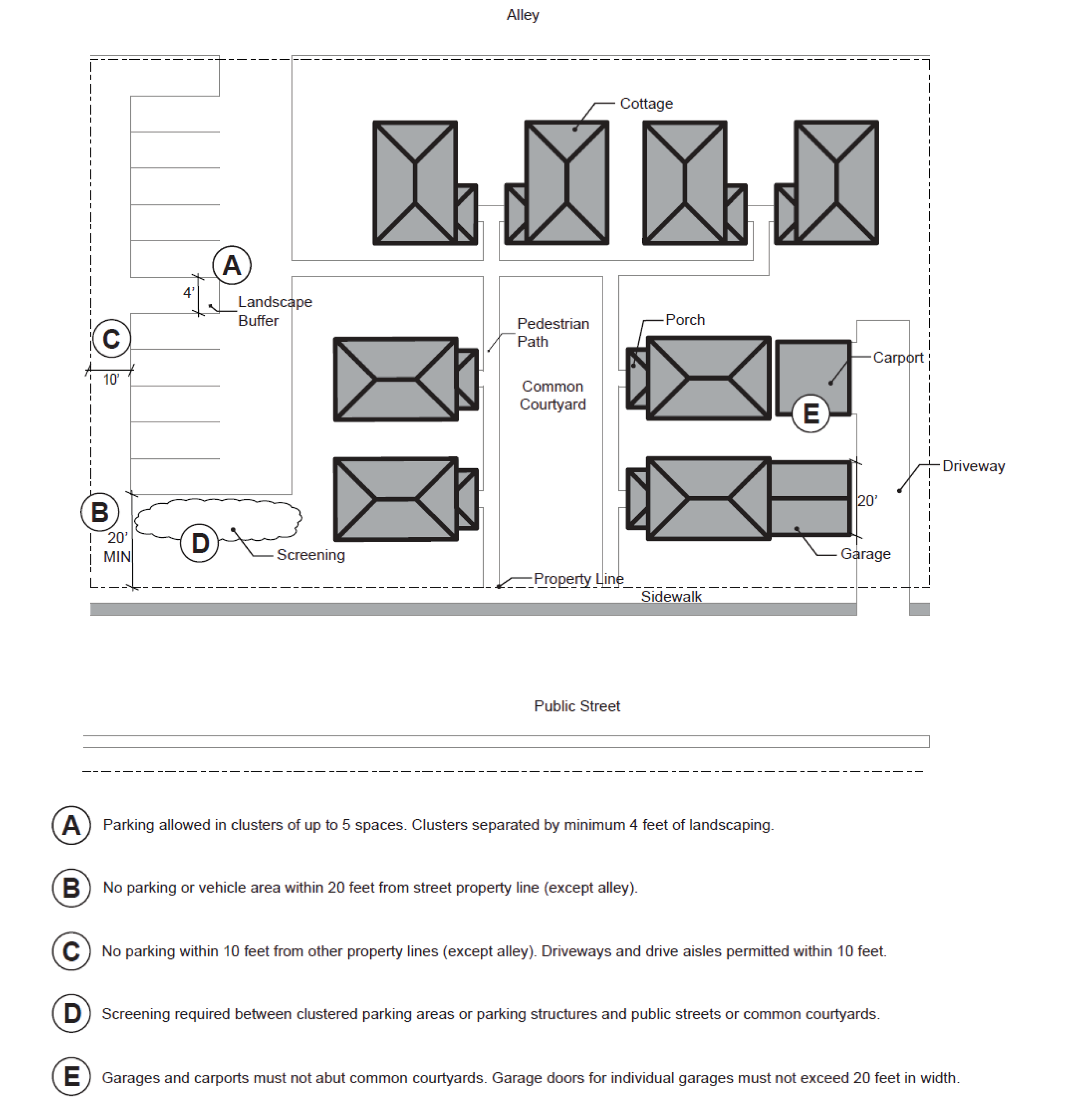
(4)
Community Buildings. Cottage cluster projects may include community buildings for the shared use of residents that provide space for accessory uses such as community meeting rooms, guest housing, exercise rooms, day care, or community eating areas. Community buildings must meet the following standards:
(a)
Each cottage cluster is permitted one community building, which counts toward the maximum average floor area of 1,400 square feet per dwelling unit.
(b)
A community building that meets the development code's definition of a dwelling unit must meet the cottage standards, unless a covenant is recorded against the property stating that the structure is not a legal dwelling unit and will not be used as a primary dwelling.
(5)
Pedestrian Access.
(a)
An accessible pedestrian path must be provided that connects the main entrance of each cottage to the following:
(i)
The common courtyard;
(ii)
Shared parking areas;
(iii)
Community buildings; and
(iv)
Sidewalks in public rights-of-way abutting the site or rights-of-way if there are no sidewalks.
(b)
The pedestrian path must be hard-surfaced and a minimum of four feet wide.
(6)
Windows. Cottages within 20 feet of a street property line must have windows that occupy at least 12 percent of the wall plane.
(7)
Parking Design (see Figure 2).
(a)
Clustered parking. Off-street parking may be arranged in clusters, subject to the following standards:
(i)
Cottage cluster projects with fewer than 16 cottages are permitted parking clusters of not more than five contiguous spaces.
(ii)
Cottage cluster projects with 16 cottages or more are permitted parking clusters of not more than eight contiguous spaces.
(iii)
Parking clusters must be separated from other spaces by at least four feet of landscaping.
(iv)
Clustered parking areas may be covered.
(b)
Parking location and access.
(i)
Off-street parking spaces and vehicle maneuvering areas must not be located:
(A)
Within ten feet from any street property line, except alley property lines.
(B)
Between a street property line and the front façade of cottages located closest to the street property line. This standard does not apply to alleys.
(ii)
Off-street parking spaces must not be located within ten feet of any other property line, except alley property lines. Driveways and drive aisles are permitted within ten feet of other property lines.
(c)
Screening. Landscaping, fencing, or walls at least three feet tall must separate clustered parking areas and parking structures from common courtyards and public streets.
(d)
Garages and carports.
(i)
Garages and carports (whether shared or individual) must not abut more than 25 percent of the rear or side perimeters of a common courtyard.
(ii)
Individual attached garages of up to 200 square feet are exempt from the calculation of the maximum building footprint for cottages.
(iii)
Individual detached garages must not exceed 400 square feet in floor area.
(iv)
Garage doors for attached and detached individual garages must not exceed 20 feet in width.
(8)
Accessory Structures. Accessory structures must not exceed 400 square feet in floor area.
(9)
Existing Structures. On a lot or parcel to be used for a cottage cluster project, an existing detached single family dwelling on the same lot at the time of proposed development of the cottage cluster may remain within the cottage cluster project area under the following provisions:
(a)
The existing dwelling may be nonconforming with respect to the requirements of this Code.
(b)
The existing dwelling may be expanded up to the maximum height permitted in the base zone.
(c)
The floor area of the existing dwelling does not count towards the maximum average floor area of a cottage cluster.
(d)
The existing dwelling may optionally be excluded from the count of cottages that must be oriented to the common courtyard under TDC 73A.100(1)(b).
Figure 2. Cottage Cluster Parking Design Standards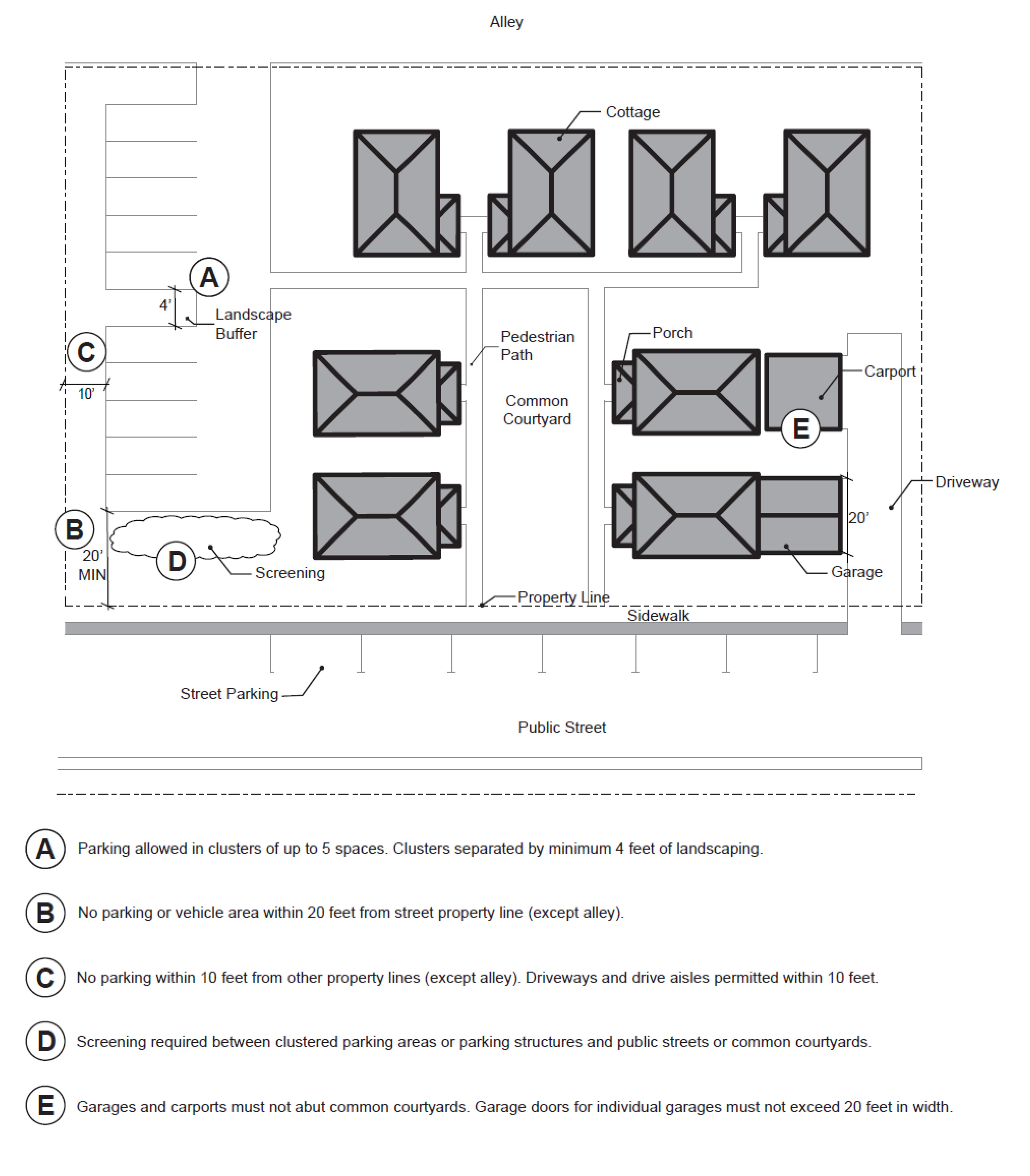
(Ord. No. 1486-24, § 11, 6-10-24; Ord. No. 1454-25, § 1(Exhs. 2, 3), 11-24-25)
TDC 73A.080. - Discretionary (Type II) Cottage Cluster Design Standards.
Cottage Cluster uses using Type II discretionary standards, and not using the clear and objective standards, must demonstrate compliance by following the discretionary standards:
(1)
Special attention should be given to designing the primary building entrance that is both attractive and functional. Primary entrances should incorporate changes in mass surface, or finish to emphasize the entrance.
(2)
Architectural articulation and other design elements, such as balconies, porches, dormers, bay windows, vertical or horizontal offsets, variations in cladding, or moldings must be used on at least one street-facing side of the dwelling (except for the side of a dwelling adjacent to another dwelling) to avoid stark unarticulated building façades (elevations), to minimize the scale and visual impact of a continuous flat wall surface, and to create a sense of visual interest for passersby and neighboring property owners.
(3)
Windows and primary entrances should be oriented to encourage "eyes on the street" within the cluster to encourage a sense of safety and communal responsibility of common spaces.
(4)
Building elevations facing streets should include ample levels of window glazing to ensure articulation on the façade, daylighting of interior spaces, and visibility.
(5)
Driveway approaches and access must be consistent with Chapter 75 or approved by the City Engineer to ensure there are no impediments or obstruction to oncoming traffic or pedestrian pathways and connections.
(6)
Parking bays should be designed with a direct pedestrian pathway to the front entrances and be lit with pedestrian scaled lighting features.
(Ord. No. 1486-24, § 11, 6-10-24)
TDC 73A.090. - Accessory Dwelling Unit Design Standards.
(1)
The purpose of accessory dwelling units, as defined in TDC 31.060, is to increase the variety and availability of housing with the goal of increasing housing affordability.
(2)
Accessory Dwelling Units are allowed on lots or parcels with one or more primary dwelling units and must comply with the following standards:
(a)
An accessory dwelling unit is allowed in the RL and RML Zones.
(b)
There must be no more than one accessory dwelling unit per lot or parcel;
(c)
An accessory dwelling unit must not exceed 800 square feet of gross floor area;
(d)
The accessory dwelling unit must be served by the same water meter, electric meter, and natural gas meter as the primary dwelling, except if prohibited by State building code requirements;
(e)
An accessory dwelling unit must provide at least two Residential Roof Design Elements in TDC 73A.040and at least four Residential Wall Design Elements in TDC 73A.050; and
(f)
An accessory dwelling unit must be set back at least one foot from a line parallel to the main entrance of the primary dwelling.
(Ord. No. 1486-24, § 11, 6-10-24; Ord. No. 1454-25, § 1(Exhs. 2, 3), 11-24-25)
Editor's note— See editor's note, § 34.600.
TDC 73A.100. - Multi-Family Design Standards.
The following standards are the minimum requirements for multi-family development in all zones, except the Central Design District and Mixed Use Commercial (MUC) zones, which have separate standards and may be less than the minimums provided below.
(1)
Private Outdoor Areas. Multi-family uses must provide private outdoor area features as follows:
(a)
A separate outdoor area of not less than 80 square feet must be attached to each ground level dwelling unit; and
(b)
The private outdoor area must be separated from common outdoor areas with walls, fences or shrubs.
(2)
Balconies, Terraces, and Loggias. Multi-family uses must provide balconies, terraces, and loggias features as follows:
(a)
A separate outdoor area of not less than 48 square feet in the form of balconies, terraces, or loggias must be provided for each unit located above the ground level.
(3)
Entry Areas. Multi-family uses must provide entry area features as follows:
(a)
A private main entry area must be provided as a private extension of each dwelling unit;
(b)
The entry area must be separated from on-site parking areas and public streets with landscaping, change of grade, low fences, or walls;
(c)
The entry area must be a minimum of 24 square feet in area for each dwelling unit; and
(d)
The entry area may be combined to serve more than one unit as determined by the City.
(e)
If the site has frontage on a street with a Local classification, the following standards must be met:
(i)
At least one main entry must meet one of the following standards, as applied to the frontage along the Local street:
(1)
Street Option. The main entry must be within eight feet of the building façade that faces the street. The main entry must either face the street; be at an angle of up to 45 degrees from the street; or open onto a covered porch that is at least 25 square feet in area.
(2)
Courtyard Option. The main entry must face a courtyard that abuts the Local street and that is no less than 15 feet in width.
(ii)
At least 25 percent of ground floor dwelling units that have individual entries must have at least one main entry that meets the standards in subsection (i).
(4)
Shared Outdoor Areas. Multi-family uses must provide shared outdoor area features as follows:
(a)
Must provide year round shared outdoor areas for both active and passive recreation;
(b)
The shared outdoor area must be a minimum of:
(i)
Three hundred square feet per dwelling unit; or
(ii)
Four hundred fifty square feet per dwelling unit for 55 and older communities.
(c)
Gazebos and other covered spaces are encouraged to satisfy this requirement;
(d)
The shared outdoor area must be separated from all entryway and parking areas with a landscaped transition area measuring a minimum of ten feet wide;
(e)
The shared outdoor area must have controlled access from off-site as well as from on-site parking and entrance areas with a minimum 4-foot high fence, wall, or landscaping; and
(f)
The shared outdoor area standard does not apply to any development with less than 12 dwelling units.
(g)
Publicly accessible plazas or other pedestrian amenity spaces provided pursuant to TDC 43.315(2) or 43.315(3) shall count toward meeting the shared outdoor area requirements in this subsection.
(5)
Children's Play Areas. Multi-family uses must provide children's play area features as follows:
(a)
The children's play area must be a minimum of 150 square feet per dwelling unit;
(b)
The children's play area must provide a separation from all entryway and parking areas with a landscaped transition area measuring a minimum of ten feet wide;
(c)
The children's play area must have controlled access to shared outdoor areas from off-site as well as from on-site parking and entrance areas with a minimum 4-foot high fence, wall, or landscaping; and
(d)
The children's play area must provide a usable floor surface (material such as lawn, decks, wood chips, sand and hard surface materials qualify); and
(e)
The children's play area standard does not apply to:
(i)
Duplexes and townhouses;
(ii)
Fifty-five and older communities; and
(iii)
Any development with less than 12 dwelling units.
(6)
Storage. Multi-family uses must provide storage features as follows:
(a)
Enclosed storage areas are required for each unit.
(i)
Garages do not satisfy the storage requirements. An enclosed storage area may be located within the garage of the individual unit. Enclosed storage areas may also be located within commonly accessible shared garage.
(b)
Each storage area must be a minimum of six feet in height and have a minimum floor area of:
(i)
24 square feet for studio and one bedroom units;
(ii)
36 square feet for two bedroom units; and
(iii)
48 square feet for greater than two bedroom units.
(7)
Walkways. Multi-family uses must provide walkways as follows:
(a)
Walkways must be a minimum of six feet in width;
(b)
Walkways must be constructed of asphalt, concrete, pervious concrete, pavers, or grasscrete;
(c)
The walkways must meet ADA standards applicable at time of construction or alteration;.
(d)
Walkways must provide pedestrian connections between the main building entrances and other on- site buildings, accessways, and sidewalks along the public right-of-way; and
(e)
Walkways through parking areas must be visibly raised and of a different appearance than the adjacent paved vehicular areas.
(8)
Accessways.
(a)
When Required. Accessways are required to be constructed when a multi-family development is adjacent to any of the following:
(i)
Residential property;
(ii)
Commercial property;
(iii)
Areas intended for public use, such as schools and parks; and
(iv)
Collector or arterial streets where transit stops or bike lanes are provided or designated.
(b)
Design Standard. Accessways must meet the following design standards:
(i)
Accessways must be a minimum of eight feet in width;
(ii)
Public accessways must be constructed in accordance with the Public Works Construction Code;
(iii)
Private accessways must be constructed of asphalt, concrete, pavers or grasscrete. Gravel or bark chips are not acceptable;
(iv)
Accessways must meet ADA standards applicable at time of construction or alteration;
(v)
Accessways must be provided as a connection between the development's walkway and bikeway circulation system;
(vi)
Accessways must not be gated to prevent pedestrian or bike access;
(vii)
Outdoor Recreation Access Routes must be provided between the development's walkway and bikeway circulation system and parks, bikeways, and greenways where a bike or pedestrian path is designated; and
(viii)
Must be constructed, owned and maintained by the property owner.
(c)
Exceptions. The Accessway standard does not apply to the following:
(i)
Where a bridge or culvert would be necessary to span a designated greenway or wetland to provide a connection, the City may limit the number and location of accessways to reduce the impact on the greenway or wetland; and
(ii)
Accessways to undeveloped parcels or undeveloped transit facilities need not be constructed at the time the subject property is developed. In such cases the applicant for development must enter into a written agreement with the City guaranteeing future performance by the applicant and any successors in interest of the property being developed to construct an accessway when the adjacent undeveloped parcel is developed. The agreement recorded is subject to the City's review and approval.
(9)
Carports and Garages. Multi-family uses may provide Carports and Garage features as follows:
(a)
The form, materials, color, and construction must be compatible with the complex they serve.
(10)
Safety and Security. Multi-family units must provide safety and security features as follows:
(a)
Private outdoor areas must be separated from shared outdoor areas and children's play areas with a minimum 4-foot high fence, wall, or landscaping;
(b)
An outdoor lighting system that does not produce direct glare on adjacent properties and without shining into residential units, public rights-of-way, or fish and wildlife habitat areas; and
(c)
Building identification must be provided consistent with the Oregon Fire Code.
(11)
Service, Delivery and Screening. Multi-family uses must provide service, delivery, and screening features as follows:
(a)
Provisions for postal delivery must be made consistent with US Postal Service regulations conveniently located and efficiently designed for residents;
(b)
Pedestrian access from unit entries to postal delivery areas, shared activity areas, and parking areas; and
(c)
Above grade and on-grade electrical and mechanical equipment such as transformers, heat pumps and air conditioners must be screened with sight obscuring fences, walls or landscaping.
(Ord. No. 1486-24, § 11, 6-10-24; Ord. No. 1454-25, § 1(Exhs. 2, 3), 11-24-25)
TDC 73A.110. - General Design Standards.
The following standards are the minimum requirements for nonresidential development in all zones, except the Mixed-Use Commercial (MUC) and Basalt Creek Employment (BCE) zones, which have separate standards:
(1)
Applicability. The General Design Standards apply to:
(a)
New buildings.
(b)
Expansion or substantial exterior remodeling of existing development which is greater than 50 percent of the building's gross floor area or alters any façade which abuts a public or private street frontage by more than 50 percent.
(2)
Exceptions. The City Manager may allow exceptions to these standards without the need to obtain a formal variance pursuant to Chapter 33.120 provided at least one of the following circumstances is met:
(a)
The applicant demonstrates that the physical characteristics of the site or existing structure make compliance impractical (e.g., they include, but are not limited to, steep slopes, wetlands, other bodies of water, trees or other natural features of the site, buildings or other existing development, utility lines and easements, etc.); or
(b)
The applicant demonstrates that the alternative design is exceptional in the quality of detailing, appearance or materials and/or creates a positive unique relationship to other structures, views or open space in a manner that accomplishes the purpose of this section.
(3)
Walkways. Development must provide walkways as follows:
(a)
Walkways must have a minimum width of;
(i)
Six feet for commercial and institutional uses; and
(ii)
Five feet for industrial uses.
(b)
Walkways must be constructed of asphalt, concrete, pervious concrete, pavers, or grasscrete;
(c)
Walkways must meet ADA standards applicable at time of construction or alteration;
(d)
Walkways must be provided between the main building entrances and other on-site buildings, accessways, and sidewalks along the public right-of-way;
(e)
Walkways that cross vehicle areas, including parking areas, driveways, and drive-through stacking areas, must be clearly identifiable through the use of elevation changes, a different paving material, or other similar method. Striping does not meet this requirement;
(f)
Bikeways must be provided that link building entrances and bike facilities on the site with adjoining public right-of-way and accessways; and
(g)
Outdoor Recreation Access Routes must be provided between the development's walkway and bikeway circulation system and parks, bikeways and greenways where a bike or pedestrian path is designated.
(4)
Accessways.
(a)
When Required. Accessways are required to be constructed when a development is adjacent to any of the following:
(i)
Residential property;
(ii)
Commercial property;
(iii)
Areas intended for public use, such as schools and parks; and
(iv)
Collector or arterial streets where transit stops or bike lanes are provided or designated.
(b)
Design Standard. Accessways must meet the following design standards:
(i)
Accessways must be a minimum of eight feet in width;
(ii)
Public accessways must be constructed in accordance with the Public Works Construction Code;
(iii)
Private accessways must be constructed of asphalt, concrete or a pervious surface such as pervious asphalt or concrete, pavers or grasscrete;
(iv)
Accessways must meet ADA standards applicable at time of construction or alteration;
(v)
Accessways must be provided as a connection between the development's walkway and bikeway circulation system;
(vi)
Accessways must not be gated to prevent pedestrian or bike access;
(vii)
Outdoor Recreation Access Routes must be provided between the development's walkway and bikeway circulation system and parks, bikeways, and greenways where a bike or pedestrian path is designated; and
(viii)
Must be constructed, owned and maintained by the property owner.
(c)
Exceptions. The Accessway standard does not apply to the following:
(i)
Where a bridge or culvert would be necessary to span a designated greenway or wetland to provide a connection, the City may limit the number and location of accessways to reduce the impact on the greenway or wetland; and
(ii)
Accessways to undeveloped parcels or undeveloped transit facilities need not be constructed at the time the subject property is developed. In such cases the applicant for development must enter into a written agreement with the City guaranteeing future performance by the applicant and any successors in interest of the property being developed to construct an accessway when the adjacent undeveloped parcel is developed. The agreement recorded is subject to the City's review and approval.
(5)
Parking Location in Commercial Zones. When provided, parking must be provided within garages or parking lots as follows:
(a)
Parking and loading areas are prohibited between the public street and proposed building(s);
(b)
Parking is allowed on the side or rear of proposed building(s). If located on the side, the parking area may not exceed 50 percent of the total frontage of the site; and
(c)
Parking must be setback a minimum of 50 feet from the front property line.
(6)
Drive-Through Facilities. When permitted, drive-through facilities must comply with the following:
(a)
Provide a minimum stacking area clear of the public right-of-way and parking lot aisles from the window serving the vehicles as follows:
(i)
Banks—Each lane must be 100 feet long;
(ii)
Restaurants—Each lane must be 160 feet long; and
(iii)
Other uses—Each lane must be between 80 and 160 feet long, as determined by the City.
(b)
Stacking area must not interfere with safe and efficient access to other parking areas on the property.
(c)
Drive-through aisles and windows must be a minimum of 50 feet from residential zones.
(d)
The width and turning radius of drive-through aisles must be approved by the City.
(e)
A wall or other visual or acoustic screen may be required by the City.
(f)
At least one walk-up service area must be provided that meets the following standards. Examples of a walk-up service area include an indoor service area directly accessible from a public street or an outdoor walk-up service window.
(i)
Walk-up service areas must be accessible by customers arriving on foot, using a mobility device, or by bicycle. Customers using a walk-up service area must have the same or better access to goods and services as customers using the drive-through.
(ii)
If the walk-up service area is limited to an outdoor service window, it must meet the following standards:
(1)
The walk-up service area must not also be used by vehicles. Walk-up service may be provided by facility staff or by automatic teller-style machines.
(2)
The walk-up service area may abut or be connected to the street by a walkway or a pedestrian amenity space.
(iii)
Walk-up service areas must be connected to the street by a direct and convenient walkway that meets the standards in TDC 73A.110(4).
(g)
Driveway entrances, including stacking area entrances, must be at least 50 feet from any street intersection. If a drive-through use has frontage on two streets, it must receive access from the street with the lower classification.
(7)
Safety and Security. Development must provide safety and security features as follows:
(a)
Locate windows and provide lighting in a manner that enables tenants, employees, and police to watch over pedestrian, parking, and loading areas;
(b)
Locate windows and interior lighting to enable surveillance of interior activity from the public right-of-way;
(c)
Locate, orient, and select exterior lighting to facilitate surveillance of on-site activities from the public right-of-way without shining into public rights-of-way or fish and wildlife habitat areas;
(d)
Provide an identification system which clearly locates buildings and their entries for patrons and emergency services; and
(e)
Above ground sewer or water pumping stations, pressure reading stations, water reservoirs, electrical substations, and above ground natural gas pumping stations must provide a minimum six foot tall security fence or wall.
(8)
Service, Delivery, and Screening. Development must provide service, delivery, and screening features as follows:
(a)
Above grade and on-grade electrical and mechanical equipment such as transformers, heat pumps and air conditioners must be screened with sight obscuring fences, walls or landscaping;
(b)
Outdoor storage must be screened with a sight obscuring fence, wall, berm or dense evergreen landscaping; and
(c)
Above ground pumping stations, pressure reading stations, water reservoirs; electrical substations, and above ground natural gas pumping stations must be screened with sight-obscuring fences or walls and landscaping.
(9)
Adjacent to Transit. Development adjacent to transit must comply with the following:
(a)
Development on a transit street illustrated on Comprehensive Plan Map 8-5 must provide either a transit stop pad on-site, or an on-site or public sidewalk connection to a transit stop along the subject property's frontage on the transit street.
(b)
Development abutting major transit stops as illustrated on Comprehensive Plan Map 8-5 must:
(i)
Locate any portion of a building within 20 feet of the major transit stop or provide a pedestrian plaza at the transit stop;
(ii)
Provide a reasonably direct pedestrian connection between the major transit stop and a building entrance on the site;
(iii)
Provide a transit passenger landing pad accessible to disabled persons;
(iv)
Provide an easement or dedication for a passenger shelter as determined by the City; and
(v)
Provide lighting at the major transit stop.
(10)
Building Entries in Commercial Zones. At least one main entrance must meet the following orientation standards:
(a)
The main entrance must either face the street or be located within 25 feet of the public sidewalk.
(b)
The main entrance must include at least three of the following architectural features to distinguish it as the main entrance: canopy, portico, arcade, arch, wing wall, planters, recessed doorway, transom windows, ornamental light fixtures, larger or more prominent doors, pilasters or columns that frame the doorway, or other similar features that increase the visibility of the entrance for pedestrians.
(c)
The main entrance must be unlocked during regular business hours, unless impractical for the operations of the proposed use.
(d)
There must be a direct and convenient walkway from the street sidewalk to the main entrance in conformance with TDC 73A.110(4).
(e)
For buildings with multiple tenant spaces or multiple entrances, only one entrance must meet the standards.
(Ord. No. 1486-24, § 11, 6-10-24; Ord. No. 1454-25, § 1(Exhs. 2, 3), 11-24-25)
TDC 73A.120 - Mixed Use Commercial Design Standards.
(1)
Applicability. The Mixed Use Commercial (MUC) design standards apply to:
(a)
New buildings in the Mixed Use Commercial (MUC) zone.
(b)
Expansion or substantial exterior remodeling of existing development in the Mixed Use Commercial (MUC) zone which is greater than 50 percent of the building's gross floor area or alters any façade which abuts a public or private street frontage by more than 50 percent.
(2)
Exceptions: The City Manager may allow exceptions to these standards without the need to obtain a formal variance pursuant to Chapter 33.120 provided at least one of the following circumstance is met:
(a)
The applicant demonstrates that the physical characteristics of the site or existing structure make compliance impractical (e.g., they include, but are not limited to, steep slopes, wetlands, other bodies of water, trees or other natural features of the site, buildings or other existing development, utility lines and easements, etc.); or
(b)
The applicant demonstrates that the alternative design is exceptional in the quality of detailing, appearance or materials and/or creates a positive unique relationship to other structures, views or open space in a manner that accomplishes the purpose of this section.
(3)
Walkways. Development must provide walkways as follows:
(a)
Walkways must be a minimum of six feet in width;
(b)
Walkways must be constructed with scored concrete or modular paving materials;
(c)
Walkways must meet ADA standards applicable at time of construction or alteration;
(d)
Walkways must be continuous and connect all building entrances within the development to one another and to all public streets or private access abutting the site, all parking areas, storage areas, recreational facilities and common areas associated with the development, adjacent development, transit stops, and public greenways and parks;
(e)
Walkways that cross vehicle areas, including parking areas, driveways, and drive-through stacking areas, must be clearly identifiable through the use of elevation changes, a different paving material, or other similar method. Striping does not meet this requirement; and
(f)
Walkways must provide connection to an abutting street every 200 linear feet of frontage.
(4)
Accessways.
(a)
When Required. Accessways are required to be constructed when a development is adjacent to any of the following:
(i)
Residential property;
(ii)
Commercial property;
(iii)
Areas intended for public use, such as schools and parks; and
(iv)
Collector or arterial streets where transit stops or bike lanes are provided or designated.
(b)
Design Standard. Accessways must meet the following design standards:
(i)
Accessways must be a minimum of eight feet in width;
(ii)
Public accessways must be constructed in accordance with the Public Works Construction Code;
(iii)
Private accessways must be constructed of asphalt, concrete or a pervious surface such as pervious asphalt or concrete, pavers or grasscrete;
(iv)
Accessways must meet ADA standards applicable at time of construction or alteration;
(v)
Accessways must be provided as a connection between the development's walkway and bikeway circulation system;
(vi)
Accessways must not be gated to prevent pedestrian or bike access;
(vii)
Outdoor Recreation Access Routes must be provided between the development's walkway and bikeway circulation system and parks, bikeways, and greenways where a bike or pedestrian path is designated; and
(viii)
Must be constructed, owned and maintained by the property owner.
(c)
Exceptions. The Accessway standard does not apply to the following:
(i)
Where a bridge or culvert would be necessary to span a designated greenway or wetland to provide a connection, the City may limit the number and location of accessways to reduce the impact on the greenway or wetland; and
(ii)
Accessways to undeveloped parcels or undeveloped transit facilities need not be constructed at the time the subject property is developed. In such cases the applicant for development must enter into a written agreement with the City guaranteeing future performance by the applicant and any successors in interest of the property being developed to construct an accessway when the adjacent undeveloped parcel is developed. The agreement recorded is subject to the City's review and approval.
(5)
Parking Location. When provided, parking must be provided within garages or parking lots as follows:
(a)
Parking and loading areas are prohibited between the public street and proposed building(s);
(b)
Parking is allowed on the side or rear of proposed building(s). If located on the side, the parking area may not exceed 50 percent of the total frontage of the site; and
(c)
Parking must be setback a minimum of 50 feet from the front property line.
(6)
Adjacent to Transit. Development adjacent to transit must comply with the following:
(a)
Development on a transit street illustrated on Comprehensive Plan Map 8-5 must provide either a transit stop pad on-site, or an on-site or public sidewalk connection to a transit stop along the subject property's frontage on the transit street.
(b)
Development abutting major transit stops as illustrated on Comprehensive Plan Map 8-5 must:
(i)
Locate any portion of a building within 20 feet of the major transit stop or provide a pedestrian plaza at the transit stop;
(ii)
Provide a reasonably direct pedestrian connection between the major transit stop and a building entrance on the site;
(iii)
Provide a transit passenger landing pad accessible to disabled persons;
(iv)
Provide an easement or dedication for a passenger shelter as determined by the City; and
(v)
Provide lighting at the major transit stop.
(7)
Building Location. Buildings must occupy a minimum of 50 percent of arterial and collector street frontages. Buildings must be located at public street intersections on arterials and collectors.
(8)
Building Entries. At least one main entrance must meet the following orientation standards:
(a)
The main entrance must either face the street or be located within 25 feet of the public sidewalk.
(b)
The main entrance must include at least three of the following architectural features to distinguish it as the main entrance: canopy, portico, arcade, arch, wing wall, planters, recessed doorway, transom windows, ornamental light fixtures, larger or more prominent doors, pilasters or columns that frame the doorway, or other similar features that increase the visibility of the entrance for pedestrians.
(c)
The main entrance must be unlocked during regular business hours, unless impractical for the operations of the proposed use.
(d)
There must be a direct and convenient walkway from the street sidewalk to the main entrance in conformance with TDC 73A.120(4).
(e)
For buildings with multiple tenant spaces or multiple entrances, only one entrance must meet the standards.
(9)
Building Design Standards. Development must meet the following building design standards.
(Ord. No. 1486-24, § 11, 6-10-24; Ord. No. 1454-25, § 1(Exhs. 2, 3), 11-24-25)
Editor's note— Ord. No. 1454-25, § 1(Exhs. 2, 3), adopted November 24, 2025, repealed § 73A.120 and renumbered §§ 73A.130 and 73A.140 as §§ 73A.120 and 73A.130. Former § 73A.120 pertained to mixed use commercial design applicability; exceptions and derived from Ord. No. 1486-24, § 1, adopted June 10, 2024.
TDC 73A.130. - Basalt Creek Employment (BCE) Design Standards.
(1)
Applicability. The Basalt Creek Employment (BCE) design standards apply to:
(a)
New buildings in the Basalt Creek Employment (BCE) zone.
(b)
Expansion or substantial exterior remodeling of existing non-residential development in the Basalt Creek Employment (BCE) zone which is greater than 50 percent of the building's gross floor area or alters any façade which abuts a public or private street frontage or property within a residential planning district by more than 50 percent.
(2)
Exceptions: The City Manager may allow exceptions to these standards without the need to obtain a formal variance pursuant to Chapter 33.120 provided at least one of the following circumstance is met:
(a)
The applicant demonstrates that the physical characteristics of the site or existing structure make compliance impractical (e.g., they include, but are not limited to, steep slopes, wetlands, other bodies of water, trees or other natural features of the site, buildings or other existing development, utility lines and easements, etc.); or
(b)
The applicant demonstrates that the alternative design is exceptional in the quality of detailing, appearance or materials and/or creates a positive unique relationship to other structures, views or open space in a manner that accomplishes the purpose of this section.
(3)
Building Design Standards. Development must provide building design as follows:
(a)
Building Composition. New buildings shall use massing characteristics and asymmetrical composition to avoid the monolithic expanse of frontages and roof lines and break up building sections using elements including variable planes, projections, bays, setbacks, canopies, awnings, and parapets, changes in the roof line, materials, color, or textures.
(b)
Primary Façades. All façades that abut the public right-of-way and/or a residential zone must be architecturally significant and give the appearance of high quality design. Exterior buildings materials must have a durability equivalent to that expected of contemporary office, flex and industrial buildings. Appropriate materials include, but are not limited to: masonry (e.g., brick or architectural block); glass; synthetic plaster; pre-cast concrete; or, stone.
(c)
Secondary Façades. All façades that do not abut the public right-of-way and/or a residential zone may include exterior building materials of lesser durability or appearance. Materials considered of lesser durability or appearance include, but are not limited to: metal panels/sheet metal, fiberglass panels, vinyl or aluminum siding, or wood shingles.
(d)
Exterior Colors. The dominant exterior must have earth-tone shades, such as gray, tan, brown, rust, green, red, etc. The contrast between trim or mortar and the dominant exterior finish should be moderate.
(e)
Upper Floor Appearance. When buildings have two or more stories, the material used at the ground level must differ from that used at upper levels in order to create a clear distinction between the ground and upper levels. For buildings in excess of 12 feet in height, each whole increment of 12 feet shall be considered a story for the purposes of this provision.
(f)
Stepback. Buildings greater than three stories must be stepped back, resulting in no more than three stories of façade being on the same vertical plan. Generally, the fourth (4th) story must be stepped back; however, the required stepback may occur at the third (3rd) floor if the developer prefers. For buildings in excess of 12 feet in height, each whole increment of 12 feet shall be considered a story for the purposes of this provision. Required stepbacks must be a minimum of 12 feet.
(g)
Enclosure or Screening of Mechanical Equipment. Roof mounted mechanical equipment on flat roofed structures must be screened by parapet walls to the maximum degree possible. Site located mechanical equipment must be installed in below grade vaults where possible or screened by a site obscuring fence or landscaping. Other building mounted mechanical equipment must be screened from view to the maximum degree possible.
(4)
Walkways. Development must provide walkways as follows:
(a)
Walkways must be a minimum of five feet in width;
(b)
Walkways must be constructed of asphalt, concrete, pervious concrete, pavers, or grasscrete;
(c)
Walkways must meet ADA standards applicable at time of construction or alteration;
(d)
Walkways must be provided between the main building entrances and other on-site buildings, accessways, and sidewalks along the public right-of-way;
(e)
Walkways through parking areas, drive aisles, and loading areas must be of a different appearance than the adjacent paved vehicular areas; and
(f)
Outdoor Recreation Access Routes must be provided between the development's walkway and bikeway circulation system and parks, bikeways and greenways where a bike or pedestrian path is designated.
(5)
Accessways.
(a)
When Required. Accessways are required to be constructed when a development is adjacent to any of the following:
(i)
Residential property;
(ii)
Commercial property;
(iii)
Areas intended for public use, such as schools and parks; and
(iv)
Collector or arterial streets where transit stops or bike lanes are provided or designated.
(b)
Design Standard. Accessways must meet the following design standards:
(i)
Accessways must be a minimum of eight feet in width;
(ii)
Public accessways must be constructed in accordance with the Public Works Construction Code;
(iii)
Private accessways must be constructed of asphalt, concrete or a pervious surface such as pervious asphalt or concrete, pavers or grasscrete;
(iv)
Accessways must meet ADA standards applicable at time of construction or alteration;
(v)
Accessways must be provided as a connection between the development's walkway and bikeway circulation system;
(vi)
Accessways may be gated for security purposes;
(vii)
Outdoor Recreation Access Routes must be provided between the development's walkway and bikeway circulation system and parks, bikeways, and greenways where a bike or pedestrian path is designated; and
(viii)
Must be constructed, owned and maintained by the property owner.
(c)
Exceptions. The Accessway standard does not apply to the following:
(i)
Where a bridge or culvert would be necessary to span a designated greenway or wetland to provide a connection, the City may limit the number and location of accessways to reduce the impact on the greenway or wetland; and
(ii)
Accessways to undeveloped parcels or undeveloped transit facilities need not be constructed at the time the subject property is developed. In such cases the applicant for development must enter into a written agreement with the City guaranteeing future performance by the applicant and any successors in interest of the property being developed to construct an accessway when the adjacent undeveloped parcel is developed. The agreement recorded is subject to the City's review and approval.
(6)
Safety and Security. Development must provide safety and security features as follows:
(a)
Locate windows and provide lighting in a manner that enables tenants, employees, and police to watch over pedestrian, parking, and loading areas;
(b)
Locate windows and interior lighting to enable surveillance of interior activity from the public right-of-way;
(c)
Locate, orient, and select exterior lighting to facilitate surveillance of on-site activities from the public right-of-way without shining into public rights-of-way or fish and wildlife habitat areas;
(d)
Provide an identification system which clearly locates buildings and their entries for patrons and emergency services; and
(e)
Above ground sewer or water pumping stations, pressure reading stations, water reservoirs, electrical substations, and above ground natural gas pumping stations must provide a minimum six foot tall security fence or wall.
(7)
Adjacent to Transit. Development adjacent to transit must comply with the following:
(a)
Development on a transit street illustrated on Comprehensive Plan Map 8-5 must provide either a transit stop pad on-site, or an on-site or public sidewalk connection to a transit stop along the subject property's frontage on the transit street; and
(b)
Development abutting major transit stops as illustrated on Comprehensive Plan Map 8-5 must:
(i)
Locate any portion of a building within 20 feet of the major transit stop or provide a pedestrian plaza at the transit stop;
(ii)
Provide a reasonably direct pedestrian connection between the major transit stop and a building entrance on the site;
(iii)
Provide a transit passenger landing pad accessible to disabled persons;
(iv)
Provide an easement or dedication for a passenger shelter as determined by the City; and
(v)
Provide lighting at the major transit stop.
(Ord. No. 1486-24, § 11, 6-10-24; Ord. No. 1454-25, § 1(Exhs. 2, 3), 11-24-25)
Editor's note— See editor's note, TDC 73A-120.

