
Umatilla City Zoning Code
CHAPTER 9
- OFF-STREET PARKING AND LOADING
Sec. 10-9-1.- Off-street parking and loading.
A.
Scope. At the time a structure is erected or floor area is enlarged by ten percent, or the use of a structure or parcel of land is changed within any district, off-street parking spaces for motor vehicles and bicycles shall be provided in accordance with the requirements of this chapter unless greater requirements are otherwise established.
B.
Compliance. Occupancy of a building or use will not be permitted without complying with this chapter. If parking space has been provided in connection with an existing use, the parking space shall not be eliminated if it would result in less than is required by this chapter. A permit for the use of property is contingent upon the unqualified continuance and availability of the amount of parking space required by this title. Reduction of the amount of required off-street parking shall be considered a violation of this title.
C.
General requirements.
1.
Gross floor area. Where square feet are specified, the area measured shall be the gross floor area primary to the functioning of the particular use of property.
2.
Number of employee parking spaces. Where employees are specified, persons counted shall be those working on the premises, including proprietors, during the largest shift at peak season.
3.
Vehicle parking; loading spaces. Required vehicle parking shall be available for the parking of operable automobiles and bicycles of residents, customers and employees and shall not be used for the storage of vehicles, materials or for the parking of trucks used in conducting business or use. A required loading space shall not be used for any other purpose than the immediate loading or unloading of goods.
4.
Calculating number of parking spaces. For purposes of calculating the required number of vehicle or bicycle parking spaces, a fractional space shall be counted as a whole space.
5.
Joint use of facilities. The off-street requirements of two or more uses, structures, or parcels of land may be satisfied by the same parking or loading spaces used jointly to the extent that it can be shown by the owners or operators of the uses, structures or parcels that their operations and parking needs do not overlap in point of time. If the uses, structures, or parcels are under separate ownership, the right to joint use of the parking space must be evidenced by a deed, lease, contract, or other appropriately written documents to establish the joint use.
6.
Commercial development parking spaces. The maximum number of parking spaces for a commercial development shall not exceed 150 percent of the required parking.
D.
Accessible parking spaces. Accessible parking spaces shall be provided as required under state and/or federal laws, and shall be clearly marked in a manner to be approved by the building official. Accessible spaces shall be located on the shortest practical accessible route to an accessible building entry. Whenever practical, the accessible route shall not cross lanes of vehicular traffic. Accessible parking spaces shall be a minimum of nine feet wide with a six-foot-wide access aisle between each two spaces. Accessible parking shall be provided according to the following requirements:
One in eight accessible parking spaces, but no less than one space, shall be a van accessible parking space. A van accessible parking space shall be nine feet wide with an eight-foot-wide aisle that can be shared between another nine-foot accessible space. An appropriate sign designating the space as "van accessible" shall be provided.
E.
Joint use. Owners of two or more uses, structures or parcels of land, may agree to utilize jointly the same parking and loading spaces when the hours of operation do not overlap; provided, that satisfactory legal evidence is presented to the City Administrator in the form of deeds, leases or contracts to establish joint ownership.
(Ord. No. 688, 6-15-1999; Ord. No. 723, 6-17-2003)
Sec. 10-9-2. - Design standards for off-street parking facilities.
A.
Surfacing. All off-street parking spaces and driveways shall be hard surfaced with concrete, asphaltic cement, or similar surface that is resistant to dust and mud. Type and thickness of this hard surface shall be approved by the City Administrator.
B.
Bumper rails. All required off-street parking spaces, except those for single-family residences, must be equipped with bumper rails located in such a manner as to prevent vehicles from striking landscaping, fences, buildings, or walls or from overhanging their spaces in a manner which might obstruct aisles, walks, streets, or other spaces or property.
C.
Access.
1.
Groups of more than four off-street parking spaces shall be served by a driveway or aisle so that no backing movements or other maneuvering within a street other than an alley will be required.
2.
Service drives or aisles to off-street parking areas shall be designed and constructed to facilitate the flow of traffic and to provide maximum safety to pedestrians and vehicular traffic on the site.
3.
Service drives or aisles shall be clearly and permanently marked and defined through the use of bumper rails, fences, buildings, walls, painting or other appropriate markers and shall not be considered as parking spaces.
D.
Landscaping.
1.
All parking lots shall be developed with at least ten percent of any uncovered parking area in plantings or other landscaping as approved by the decision maker. Single-family detached and attached residences and two-family residences are exempt from this requirement. Parking areas for three to five dwelling structures may be exempt from this requirement if landscaping is provided around the perimeter of the parking area.
2.
Landscaping shall be located in planter areas that separate parking spaces into groups of ten or less spaces. Each planter area shall include at least one tree with a caliper of 2.0 inches at time of planting and ground cover.
3.
Required planting areas shall have a minimum dimension of not less than five feet.
4.
Required landscaping shall be continuously maintained and shall be provided with an automatic underground sprinkler system or a certification from a landscape architect that plant materials can survive without an automatic sprinkling system.
E.
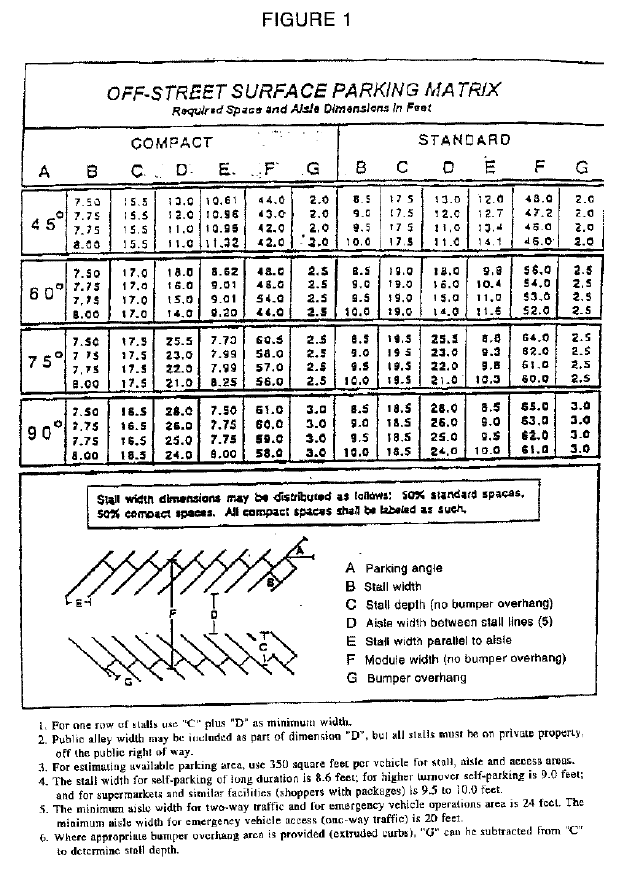
Space size. Each off-street parking space shall have a net area of not less than 180 square feet, exclusive of access drives or aisles, and shall be designed to the dimensional requirements of Figure 1, Section 10-9-6 of this chapter. If determined on a gross area basis, 280 square feet shall be allowed per vehicle. Parking spaces shall be identified with painted stripes or other permanent markings.
F.
Parking area plans. No building permit shall be issued until plans are presented that show property that is and will remain available exclusively for off-street parking. The subsequent use of property for which the permit is issued shall be conditional upon the unqualified continuance and availability of the amount of parking space required by this title. Reduction of the amount of required off-street parking shall be considered a violation of this title. Parking area plans shall be drawn to scale and shall delineate parking spaces, aisle and maneuvering areas, and landscaped areas.
G.
Space location. Off-street parking facilities shall be located as herein specified. Where a distance is specified, such distance shall be the distance measured from the nearest point of the parking facility to the nearest point of the building that such facility is required to serve.
1.
For all dwelling structures and motels. On the same lot with the building they are to serve.
2.
For rooming houses and apartment houses. Within 100 feet of the building they are required to serve, including recreational vehicle storage as may be required.
3.
For uses other than specified above. Within 200 feet of the building they are required to serve.
(Ord. No. 688, 6-15-1999)
Sec. 10-9-3. - Required number of vehicle and bicycle parking spaces.
Required off-street parking spaces are as listed in the following table. Where alternative standards prevail, the greater applies in conflicting computations. For uses not listed, the required vehicle and bicycle parking shall be the same as for the most similar use, as determined by the City Administrator.
(Ord. No. 688, 6-15-1999)
Sec. 10-9-4. - Off-street loading, passengers.
Schools having a capacity greater than 25 students shall provide a driveway designed for continuous forward flow of passenger vehicles for the purpose of loading and unloading children. The driveway shall be located outside of a normal travel lane.
(Ord. No. 688, 6-15-1999)
Sec. 10-9-5. - Off-street loading, merchandise.
Any use which requires supply or delivery of goods or merchandise shall provide off-street loading area which shall not interfere with traffic or block any street, alley or required parking spaces.
(Ord. No. 688, 6-15-1999)
Sec. 10-9-6. - Off-street surface parking matrix.
(Ord. No. 688, 6-15-1999)

