
Vero Beach City Zoning Code
CHAPTER 62
- NONRESIDENTIAL DISTRICTS
ARTICLE I. - PARK AND CONSERVATION DISTRICTS[7]
Editor's note— Ord. No. 2023-14, § 4, adopted September 26, 2023, repealed art. I, §§ 62.01—62.16 and enacted a new art. I as set out herein. Former art. I pertained to P-1 and P-2 Park Districts and derived from Ord. No. 86-43, § 1, adopted December 2, 1986; Ord. No. 87-08, § 1, adopted February 17, 1987; Ord. No. 87-32, § 1, adopted May 5, 1987; No. 89-77, §§ 1, 2, adopted November 21, 1989; Ord. No. 91-35, § 1, adopted October 15, 1991; Ord. No. 2006-08, § 2, adopted June 6, 2006; Ord. No. 2011-10, § 6, adopted August 16, 2011; and Ord. No. 2016-13, § 2, adopted September 6, 2016.
ARTICLE II.- OFFICE AND INSTITUTIONAL DISTRICT[8]
Editor's note— Ord. No. 2023-14, § 5, adopted September 26, 2023, repealed art. II, §§ 62-17—62-33 and enacted a new art. II as set our herein. Former art. II pertained to POI professional, office and institutional districts and derived from Ord. No. 86-43, § 1, adopted December 2, 1986; Ord. No. 87-32, § 1, adopted May 5, 1987; Ord. No. 87-73, § 1, adopted November 17, 1987; Ord. No. 90-02, §§ 1, 2, adopted January 16, 1990; Ord. No. 91-15, § 1, adopted May 21, 1991; Ord. No. 92-43, § 2, adopted December 1, 1992; Ord. No. 00-16, § 2, adopted September 5, 2000; Ord. No. 2003-21, § 5, adopted June 3, 2003; Ord. No. 2009-24, §§ 1, 2, adopted October 6, 2009; and Ord. No. 2011-10, § 7, adopted August 16, 2011.
ARTICLE III.- COMMERCIAL DISTRICTS[9]
Editor's note— Ord. No. 2023-14, § 6, adopted September 26, 2023, repealed art. III, §§ 62.34—62.36 and enacted a new art. III as set out herein. Former art. III pertained to C-1A, C-1B, B-1 and C-1 commercial districts and derived from Ord. No. 86-43, § 1, adopted December 2, 1986; Ord. No. 87-13, § 1, adopted February 17, 1987; Ord. No. 87-20, § 1, adopted April 7, 1987; Ord. No. 87-32, § 1, adopted May 5, 1987; Ord. No. 87-50, § 1 (Exh. A), adopted August 4, 1987; Ord. No. 87-77, § 2, adopted December 1, 1987; Ord. No. 87-79, § 1, adopted December 1, 1987; Ord. No. 89-03, § 1, adopted January 3, 1989; Ord. No. 89-04, § 1, adopted January 3, 1989; Ord. No. 89-77, §§ 1, 2, adopted November 21, 1989; Ord. No. 91-07, §§ 1, 4, adopted March 5, 1991; Ord. No. 92-43, § 3, adopted December 1, 1992; Ord. No. 95-01, §§ 2—4, adopted February 7, 1995; Ord. No. 2003-21, § 6, adopted June 3, 2003; Ord. No. 2003-13, § 1, adopted February 4, 2003; Ord. No. 2003-23, § 1, adopted June 3, 2003; Ord. No. 2006-17, §§ 1, 2, adopted October 3, 2006; Ord. No. 2009-30, § 1, adopted December 1, 2009; Ord. No. 2011-10, § 8, adopted August 16, 2011; Ord. No. 2011-16, § 1, adopted September 20, 2011; Ord. No. 2012-10, §§ 2, 3, adopted July 16, 2012; Ord. No. 2013-21, § 3, adopted October 15, 2013; Ord. No. 2016-03, § 2, adopted January 5, 2016; Ord. No. 2016-09, § 3, adopted June 7, 2016; Ord. No. 2018-05, § 3, adopted May 15, 2018; Ord. No. 2019-24, § 2, adopted October 1, 2019; Ord. No. 2020-19, § 3, adopted October 6, 2020; Ord. No. 2021-07, § 3, adopted June 15, 2021; Ord. No. 2022-06, § 3, adopted March 1, 2022; Ord. No. 2022-13, § 3, adopted May 5, 2022; and Ord. No. 2023-07, § 4, adopted April 18, 2023.
ARTICLE VII.- AIRPORT MASTER PLAN LAND USE ZONES[10]
Editor's note— Section 1 of Ord. No. 89-68, adopted Oct. 17, 1989, amended Art. VII of Ch. 62 in its entirety to read as herein set out. Prior to this amendment, Art. VII contained similar subject matter and was derived from Ord. No. 86-43, § 1, adopted Dec. 2, 1986; Ord. No. 87-33, § 1, adopted May 5, 1987; Ord. No. 87-41, § 1, adopted May 19, 1987; Ord. No. 87-66, § 1, adopted Oct. 6, 1987; Ord. No. 88-64, § 1, adopted Dec. 20, 1988; Ord. No. 89-12, §§ 1—3, adopted March 7, 1989.
ARTICLE VIII.- THREE CORNERS WATERFRONT DISTRICTS[11]
Editor's note— Ord. No. 2025-08, § 5, adopted August 12, 2025, repealed art. VIII, §§ 62-178—62-198 and enacted a new art. VIII as set out herein. Former art. VIII pertained to the H, hospital and institutional district and derived from Ord. No. 86-43, § 1, adopted December 2, 1986; Ord. No. 87-21, § 1, adopted April 7, 1987; Ord. No. 87-32, § 1, adopted May 5, 1987; Ord. No. 89-77, §§ 1, 2, adopted November 21, 1989; Ord. No. 91-07, § 5, adopted March 5, 1991; Ord. No. 92-43, § 6, adopted December 1, 1992; Ord. No. 2003-21, § 7, adopted June 3, 2003; and Ord. No. 2011-10, § 13, adopted August 16, 2011.
Sec. 62.01.- Purpose of districts.
The following districts establish standards and regulations for the City's park and conservation districts and to ensure that park and recreation development is consistent with the policies in the City's Comprehensive Plan related to conservation and park future land uses and policies.
(a)
P-1, Conservation and Open Space District is intended for conservation and protection of lands, such as open space, mangrove areas, mosquito control impoundments, spoil islands, etc. The use of these lands shall be for conservation, resource management, and passive recreation uses and accessory structures that provide for preservation and public enjoyment of the land in its natural state.
(b)
P-2, Neighborhood Park District is intended for lands held for a government purpose designated in the City's Comprehensive Plan for the development of neighborhood parks for outdoor sports and other active recreational activities or for lands to provide community services. The recreational activities for which the P-2 District is provided are primarily conducted in the open air while related accessory activities may be in the open air or within a building or structure.
(c)
P-3, Community and Special Facility Park District is intended for lands held for a government purpose and designated in the City's Comprehensive Plan for the development of community or special facility parks with museums, libraries, community centers, recreational, beach access, and theater uses that create community-wide or special purpose recreational facilities.
(Ord. No. 2023-14, § 4, 9-26-2023)
Sec. 62.02. - Permitted principal uses.
(a)
Table 62.1, Park and Conservation Districts Principal Use Table designates how a building or premises may be used in the park and conservation zoning districts.
Table 62.1 Park and Conservation Districts Principal Use Table
(b)
Except as provided for Sec. 62.03, Permitted accessory uses, the permissible uses enumerated in Sec. 62.02 above shall not be construed to include, as a principal or accessory use, any use type included in the following use classifications:
(1)
Residential Uses - Dwellings
(2)
Residential Uses - Group Living
(3)
Residential Uses - Accommodations
(4)
Nonresidential Uses - Agricultural
(5)
Nonresidential Uses - Commercial
(6)
Nonresidential Uses - Transportation
(7)
Nonresidential Uses - Industrial
(c)
Any development of public park shall be consistent with Sec. 54-31, Rules and regulations, of the City Code and the following:
(1)
Jaycee Park, Humiston Park, South Beach Park, MacWilliam Park, Pocahontas Park, Riverside Park, Michael Field, and Bob Summers Park shall be used primarily for a public or civic purpose which also serves a recreational, artistic, or cultural purpose.
(2)
Veterans' Memorial Island Sanctuary shall be used as a memorial to Indian River County's military heroes, and for the purposes of quiet contemplation, and consistent with the master plan for the Veterans Memorial Island Sanctuary.
(Ord. No. 2023-14, § 4, 9-26-2023)
Sec. 62.03. - Accessory uses.
(a)
Accessory use table. Table 62.2, Allowed Accessory Uses in Park and Conservation Districts, designates the allowed accessory uses in the park and conservation zoning districts.
Table 62.2: Allowed Accessory Uses in Park and Conservation Districts
(b)
Other recreational and institutional accessory uses, not listed in Table 62.2, Allowed Accessory Uses in Park and Conservation Districts, and determined by the Planning Director to be customarily associated with and is appropriately incidental and subordinate to an allowable principal use may be permitted upon written determination by the Planning Director and compliance with the general accessory use standards in Sec. 67.13(b).
(Ord. No. 2023-14, § 4, 9-26-2023)
Sec. 62.04. - Temporary uses and structures.
(a)
Temporary use and structure table. Table 62.3, Allowed Temporary Uses and Structures in Park and Conservation Districts, designates the allowed temporary uses and structures in the park and conservation zoning districts.
Table 62.3: Allowed Temporary Uses and Structures in Park and Conservation Districts
(b)
Other recreational and institutional temporary uses and structures, not listed in Table 62.3, Allowed Temporary Uses and Structures in Park and Conservation Districts, and determined by the Planning Director to be of a limited duration, discontinued upon the expiration of a set time period, do not involve the construction or alteration of any permanent building, and such uses, structures, and events do not negatively affect adjacent land may be permitted upon written determination by the Planning Director and compliance with the general temporary use and structure standards in Sec. 67.15(b).
(Ord. No. 2023-14, § 4, 9-26-2023)
Sec. 62.05. - District density, intensity, and dimensional standards.
Table 62.4, Development Standards for Park and Conservation Districts, provides the density, intensity, and dimensional standards for nonresidential uses in park and conservation zoning districts.
Table 62.4: Development Standards for Park and Conservation Districts
(Ord. No. 2023-14, § 4, 9-26-2023)
Sec. 62.06. - Accessory buildings and structures.
(a)
Accessory buildings and structures table: Table 62.5, Allowed Accessory Buildings and Structures in Park and Conservation Districts, designates the allowed accessory buildings and structures in park and conservation zoning districts.
Table 62.5: Allowed Accessory Buildings and Structures in Park and Conservation Districts
(b)
Dimensional standards for accessory buildings: Table 62.6, Standards for Accessory Buildings, provides the dimensional standards for accessory buildings in park and conservation zoning districts.
Table 62.6: Standards for Accessory Buildings
(c)
Dimensional standards for accessory structures. Accessory structures in park and conservation districts, such as benches, tables, paths, walkways, driveways, fountains, fences, or walls may be located within the required yard, except for required yards adjacent to parcels or lots in single-family residential zoning districts. Parking lots shall not be located in any required yard.
(Ord. No. 2023-14, § 4, 9-26-2023)
Sec. 62.07. - Development standards.
The following development standards apply to any development proposed in park and conservation zoning districts:
(a)
Off-street parking and loading requirements. All uses shall provide off-street parking spaces pursuant to the requirements of Chapter 63, Off-street parking and loading requirements. Any off-street parking lot shall not be located within a required yard.
(b)
Sign standards. All new signs in this district shall meet applicable sign regulations in Chapter 38, Signs.
(c)
Residential screening and buffering. All new development in park and conservation zoning districts shall meet the following screening and buffering requirements when adjacent to single-family residential zoning districts to prevent visual contact between the nonresidential use and single-family residential uses and create a strong impression of total separation:
(1)
Provide either a screening landscape buffer or screening wall located along the outer perimeter of the parcel or lot adjacent to the single-family residential zoning district meeting the following standards:
a.
Screening landscape buffer design standards:
1.
Required landscape width from the property line: 25 feet
2.
Required landscape design shall meet the requirements of Chapter 72, Article II, Landscaping, and include the following material for every 100 linear feet to function as a semi-opaque screen from the ground to at least a height of six feet:
i.
Six (6) small-scale canopy trees
ii.
Twenty five (25) shrubs: a minimum of five feet in height at the time of planting.
iii.
Ground cover shall be provided for the remainder of the landscape buffer.
b.
Screening wall design standards
1.
Minimum five-foot high wall.
2.
Required landscape design shall meet the requirements of Chapter 72, Article II, Landscaping, and include the following material for every 100 linear feet to function as a semi-opaque screen from the ground to at least a height of four feet:
i.
Four (4) small-scale canopy trees
ii.
Fifteen (15) shrubs: a minimum of two feet in height at the time of planting and be species capable of reaching a height of four feet within four years.
iii.
Ground cover shall be provided for the remainder of the landscape buffer.
(2)
No structures, including buildings or parking areas may encroach into the landscape buffer area.
(3)
Sight triangles. No walls or other landscaping features may exceed a height of three feet above grade within required sight triangles for streets, alleys, or driveways.
(4)
Credit for existing vegetation. Existing vegetation located in the perimeter buffer area that meets the size standards of this Section and Chapter 72, Landscaping, may be preserved and credited toward the perimeter buffer standards provided it is retained during and after the development process.
(5)
Credit for required landscaping. Required landscaping associated with perimeter landscaping around a vehicular use area may be credited towards the perimeter buffer requirements of this Section.
(d)
Mechanical and utility equipment screening. Mechanical and utility equipment in nonresidential development shall be located or screened so as not to be visible from public right-of-way.
(e)
Service, loading and storage areas.
(1)
Refuse Collection. Facilities for collection and removal of solid wastes shall be provided. Refuse and waste removal and recycling areas of nonresidential development shall be screened from adjacent properties and public right-of-way by a minimum of a five (5) foot high fence, wall, hedge, or other opaque barrier. Such screening shall be approved by the Planning Director and, if applicable, compliant with the enclosure requirements of Section 66-11 of this Code.
(2)
Storage areas. All services and businesses shall be conducted completely within enclosed buildings. Recreational uses that are commonly located outside are permitted within designated facilities.
(f)
Required site plan.
(1)
A site plan shall be prepared and submitted for approval pursuant to Chapter 64 for development of buildings and any recreational facility within a Park and Conservation District.
(2)
The site plan shall provide for such an arrangement and location of uses and facilities on the land as to give the maximum possible separation from, and protection to, contiguous and nearby residential property.
(Ord. No. 2023-14, § 4, 9-26-2023)
Sec. 62.08. - Environmental standards.
The following environmental standards apply to any development proposed in park and conservation zoning districts:
(a)
Landscaping. In addition to meeting the landscaping requirements of Chapter 72, Article II, Landscaping, the following criteria shall be met:
(1)
In a P-1 district the landscape plan shall identify the natural growth to be protected or conserved, and any proposed landscape improvements.
(2)
In P-2 and P-3 districts, all required front yards and side or rear yards contiguous to residential property shall be planted with landscape material in compliance with Sec. 72.16, Landscaping specifications.
(b)
Tree preservation. The tree preservation standards in Chapter 72, Article III, Tree and Palm Protection shall be met.
(c)
Drainage and stormwater management. All new development and substantial improvements (50% of building value) to existing developments shall meet the requirements of Chapter 73, Article II, Stormwater Management.
(d)
Floodplain management. All new development and substantial improvements (50% of building value) to existing developments shall meet the floodplain management standards in Chapter 73, Article I, Flood Damage Prevention.
(Ord. No. 2023-14, § 4, 9-26-2023)
Sec. 62.09. - Building design standards.
(a)
Purpose. Recognizing the importance of the City's parks and open space, the intent of this Section is to establish building design standards that foster high-quality and attractive development in park and conservation zoning districts consistent with adopted policies in the City's Comprehensive Plan. The intent of the design guidelines is not to impose strict and expensive architectural standards on proposed developments. Rather, the guidelines are meant to enhance the character of the City's park and open space.
(b)
Applicability. These design standards shall apply to all development, including principal and accessory structures, requiring a site plan.
(c)
Building design. Buildings should have a primary architectural theme and that theme should be used around the entire building.
(1)
Building façade. All building elevations shall be architecturally finished with similar levels of materials and detailing (e.g., tiles, moldings, cornices, wainscoting, etc.). Blank walls void of architectural details or other variation are prohibited. Buildings should incorporate other techniques to divide further large building façades, including the following:
a.
The primary material on the front façade of the structure shall be continued on all sides of the building.
b.
On public facing façades (streets or parks), windows and doors shall cover a minimum of 20 percent of the elevation.
c.
Window and door openings shall be articulated on all elevations of the building through the use of:
(i)
Shutters;
(ii)
Enhanced flat or arched lintels and sills (projecting or recessed, or constructed of materials other than the primary building material);
(iii)
Overhangs; or
(iv)
Surrounds and trims.
(2)
Prohibited façade materials. The metal materials are prohibited as exterior façade cladding.
(d)
Appeals. Administrative decisions by the Planning Director regarding the application of the building design standards in this Section may be appealed to the Architectural Review Commission (ARC) pursuant to the procedures in Sec. 64.04.
(Ord. No. 2023-14, § 4, 9-26-2023)
Sec. 62.11.- Purpose of districts.
The following districts establish standards and regulations for the City's office and institutional districts and to ensure that office and institutional development is consistent with the policies in the City's Comprehensive Plan related to future land use designations appropriate for office or institutional development. These districts are designed to provide adequate space in appropriate locations suitable for accommodating various levels of institutional and office commercial development.
(a)
POI, Professional, Office and Institutional District: This district is designed to establish areas of primary office uses and compatible auxiliary uses as support functions. Major areas of implementation should include locations adjacent urban arterial (principal or minor) roadways and areas suitable for providing transitional areas between residential and commercial areas.
(b)
I, Institutional District: This district is designed to establish areas of institutional uses and compatible auxiliary uses as support functions. Major areas of implementation should include locations designated for Mixed-Use and Government Use by the City's Comprehensive Plan.
(Ord. No. 2023-14, § 5, 9-26-2023; Ord. No. 2024-11, § 3, 6-11-2024)
Sec. 62.12. - Permitted principal uses.
(a)
Table 62.7, Office and Institutional Districts Principal Use Table designates how a building or premises may be used in the office and institutional zoning districts.
Table 62.7: Office and Institutional Districts Principal Use Table
(b)
The permissible uses enumerated Table 62.7, Office and Institutional Districts Principal Use Table, shall not be construed to include, as a principal or an accessory use, any use type included in the following use classifications in the Office and Institutional Districts:
(1)
Residential Uses - Accommodations
(2)
Nonresidential Uses - Industrial
(c)
All uses types not specifically identified in Table 62.7, Office and Institutional Districts Principal Use Table, as permitted use in the POI zoning district shall be prohibited, including retail sales and services, restaurants, and multi-family dwelling uses.
(Ord. No. 2023-14, § 5, 9-26-2023; Ord. No. 2024-11, § 3, 6-11-2024)
Sec. 62.13. - Accessory uses.
(a)
Accessory use table. Table 62.14, Allowed Accessory Uses in Office and Institutional Districts, designates the allowed accessory uses in the office and institutional zoning districts.
Table 62.8: Allowed Accessory Uses in Office and Institutional Districts
(b)
Other accessory uses, not listed in Table 62.8, Allowed Accessory Uses in Office and Institutional Districts, and determined by the Planning Director to be customarily associated with and is appropriately incidental and subordinate to an allowable principal use, may be permitted upon written determination by the Planning Director and compliance with the general accessory use standards in Sec. 67.13(b).
(c)
All accessory uses shall be located within buildings devoted to permitted uses and no accessory use shall be provided with an exclusive exterior public entrance.
(Ord. No. 2023-14, § 5, 9-26-2023)
Sec. 62.14. - Temporary uses.
(a)
Temporary use and structure table. Table 62.9, Allowed Temporary Uses and Structures in Office and Institutional Districts, designates the allowed temporary uses and structures in the office and institutional zoning districts.
Table 62.9: Allowed Temporary Uses and Structures in Office and Institutional Districts
(b)
Other office or institutional temporary uses and structures, not listed in Table 62.9, Allowed Temporary Uses and Structures in Office and Institutional Districts, and determined by the Planning Director to be of a limited duration and are discontinued upon the expiration of a set time period, do not involve the construction or alteration of any permanent building, and such uses, structures, and events do not negatively affect adjacent land, may be permitted upon written determination by the Planning Director and compliance with the general temporary use and structure standards in Sec. 67.15(b).
(Ord. No. 2023-14, § 5, 9-26-2023)
Sec. 62.15. - District density, intensity, and dimensional standards.
Table
62.10, Development Standards for Office and Institutional Districts, provides the density, intensity, and dimensional standards for nonresidential uses in office and institutional zoning districts.
Table 62.10: Development Standards for Office and Institutional Districts
(Ord. No. 2023-14, § 5, 9-26-2023; Ord. No. 2024-11, § 3, 6-11-2024)
Sec. 62.16. - Accessory buildings and structures.
(a)
Accessory buildings and structures table: Table 62.11, Allowed Accessory Buildings and Structures in Office and Institutional Districts, designates the allowed accessory buildings and structures in office and institutional zoning districts.
Table 62.11: Allowed Accessory Building and Structures in Office and Institutional Districts
(b)
Dimensional standards for residential dwelling accessory buildings: Table 62.12, Standards for Residential Dwelling Accessory Buildings, provides the dimensional standards for accessory buildings to residential dwelling (single-family residential) uses in office and institutional zoning districts.
Table 62.12: Standards for Residential Dwelling Accessory Buildings
(c)
Dimensional standards for nonresidential accessory buildings: Table 62.13, Standards for Nonresidential Accessory Buildings, provides the dimensional standards for accessory buildings to group living residential and nonresidential uses in office and institutional zoning districts.
Table 62.13: Standards for Nonresidential Accessory Buildings
(d)
Dimensional standards for accessory structures. Accessory structures in office and institutional districts, such as bike racks, decks, generators, mailboxes, patios, play structures, pools, screen enclosures, retaining walls, parking lots, driveways, walkways, fences, or walls may be located within a required yard, subject to the standards in Sec. 60.28(b), Exceptions and variations.
(Ord. No. 2023-14, § 5, 9-26-2023; Ord. No. 2024-11, § 3, 6-11-2024)
Sec. 62.17. - Development standards.
The following development standards apply to any development proposed in the office and institutional zoning districts:
(a)
Off-street parking and loading requirements. All uses, except accessory uses, shall provide off-street parking spaces pursuant to the requirements of Chapter 63, Off-street parking and loading requirements.
(b)
Sign standards. All new signs in this district shall meet applicable sign regulations in Chapter 38, Signs.
(c)
Residential screening and buffering. All new nonresidential development in office and institutional zoning districts shall meet the following screening and buffering requirements when adjacent to single-family residential zoning districts to prevent visual contact between the nonresidential use and the adjacent residential uses and create a strong impression of total separation:
(1)
Provide either a screening landscape buffer or screening wall located along the outer perimeter of the parcel adjacent to the single-family residential zoning district meeting the following standards:
a.
Screening landscape buffer design standards:
1.
Required landscape width from the property line: 20 feet.
2.
Required landscape design shall meet the requirements of Chapter 72, Landscaping, and include the following material for every 100 linear feet to function as a semi-opaque screen from the ground to at least a height of six feet:
i.
Six (6) small-scale canopy trees.
ii.
Twenty-five (25) shrubs: a minimum of five feet in height at the time of planting.
iii.
Ground cover shall be provided for the remainder of the landscape buffer.
b.
Screening wall design standards
1.
Minimum five-foot high wall.
2.
Required landscape width from property line: 10 feet.
3.
Required landscape design shall meet the requirements of Chapter 72, Landscaping, and include the following material for every 100 linear feet to function as a semi-opaque screen from the ground to at least a height of four feet:
i.
Four (4) small-scale canopy trees.
ii.
Fifteen (15) shrubs: a minimum of two feet in height at the time of planting and be species capable of reaching a height of four feet within four years.
iii.
Ground cover shall be provided for the remainder of the landscape buffer.
(2)
No structures, including buildings or parking areas may encroach into the landscape buffer area.
(3)
Low-impact improvements may be permitted by the Planning Director in the landscape buffer area. Examples of such low-impact improvements may include, but are not limited to: concrete sidewalks, fountains, handicap accessibility ramps, drainage pond integral to the landscape design, and decorative lampposts.
(4)
Sight triangles. No walls or other landscaping features may exceed a height of three feet above grade within required sight triangles for streets, alleys, or driveways.
(5)
Credit for existing vegetation. Existing vegetation located in the perimeter buffer area that meets the size standards of this Section and Chapter 72, Landscaping, may be preserved and credited toward the perimeter buffer standards provided it is retained during and after the development process.
(6)
Credit for required landscaping. Required landscaping associated with perimeter landscaping around a vehicular use area may be credited towards the perimeter buffer requirements of this Section.
(7)
If necessary to meet the intent of this section, the Planning Director may impose reasonable development standards and conditions in accordance with F.S. 1013.33(7) to new facilities for public educational institutions owned or maintained by the School District of Indian River County.
(d)
Mechanical and utility equipment screening. Mechanical and utility equipment in nonresidential development shall be located or screened so as not to be visible from public right-of-way.
(e)
Service, loading and storage areas.
(1)
Refuse Collection. Facilities for collection and removal of solid wastes shall be provided. Refuse and waste removal and recycling areas of nonresidential development shall be screened from adjacent properties and public right-of-way by a minimum of a five (5) foot high fence, wall, hedge, or other opaque barrier. Such screening shall be approved by the Planning Director and, if applicable, compliant with the enclosure requirements of Section 66-11 of this Code.
(2)
Storage areas. All services and businesses shall be conducted completely within enclosed buildings.
(Ord. No. 2023-14, § 5, 9-26-2023; Ord. No. 2024-11, § 3, 6-11-2024)
Sec. 62.18. - Environmental standards.
The following environmental standards apply to any development proposed in office and institutional zoning districts:
(a)
Landscaping. In addition to meeting the requirements of Chapter 72, Article II, Landscaping, the following standards apply to developments in these districts:
(1)
Landscape plans for public educational institutions owned or maintained by the School District of Indian River County shall, at a minimum, comply with the landscape requirements of the Florida Building Code for public educational facilities. Compliance with the Landscaping Ordinance of the City of Vero Beach is not required pursuant to F.S. 1013.64(5)(a).
(2)
In the POI zoning district, the front yard for a nonresidential use shall be landscaped to a depth of 10 feet from the property line with the following materials, except where a residential screening and buffer is required:
a.
One tree shall be provided for each 40 feet or fraction thereof;
b.
One shrub shall be provided for each ten feet or fraction thereof;
c.
Clusters of trees or shrubs may be used rather than uniform spacing, if approved by the planning and development department;
d.
Ground cover shall be provided for the remainder of the ten-foot landscape strip;
e.
An automatic irrigation system shall be provided for all landscaped areas;
(b)
Tree preservation. The tree preservation standards in Chapter 72, Article III, Tree and Palm Protection shall be met.
(c)
Drainage and stormwater management. All new development and substantial improvements (50% of building value) to existing developments, in addition to meeting the requirements of Chapter 73, Article II, Stormwater Management, the following standards apply to developments in this POI Zoning District:
(1)
Dry or wet stormwater retention ponds are prohibited in any lot setback (yard) or screening landscape buffer.
(2)
A wet stormwater retention pond may be approved in the lot setback (yard) by the Planning Director, if the wet retention pond is integrated into the landscape design as an integral feature.
(d)
Floodplain management. All new development and substantial improvements (50% of building value) to existing developments shall meet the floodplain management standards in Chapter 73, Article I, Flood Damage Prevention.
(Ord. No. 2023-14, § 5, 9-26-2023; Ord. No. 2024-11, § 3, 6-11-2024)
Sec. 62.19. - Building design standards.
(a)
Purpose. Recognizing that important roadway corridors in Vero Beach are zoned POI, Professional Office and Institutional, and high profile locations are zoned I, Institutional, the intent of this Section is to establish minimal design standards that foster high-quality and attractive development in Office and Institutional Districts. The intent of the design standards is not to impose strict and expensive architectural standards on proposed developments nor to favor one style of architecture over another. Rather, the standards are meant to enhance the character of important commercial corridors in Vero Beach and compatibility with adjacent residential areas by establishing minimum design standards for building features and materials. The standards are intended to:
(1)
Protect and enhance the character and quality of highly visible commercial corridors in Vero Beach;
(2)
Protect and enhance the long-term market value of property within Vero Beach;
(3)
Ensure compatibility between residential neighborhoods and adjacent commercial corridors;
(4)
Mitigate negative visual impacts arising from the scale, bulk, and mass of large buildings;
(5)
Balance the community's economic and aesthetic concerns.
(b)
Applicability. These design standards shall apply to all development, including principal and accessory structures, requiring a site plan in an office or institutional district.
(c)
Building design. Buildings should have a primary architectural theme and that theme should be used around the entire building.
(1)
Building façade. All building elevations shall be architecturally finished with similar levels of materials and detailing (e.g., tiles, moldings, cornices, wainscoting, etc.). Blank walls void of architectural details or other variation are prohibited. Buildings should incorporate other techniques to divide further large building façades, including the following:
a.
The primary material on the front façade of the structure shall be continued on all sides of the building, and on at least 50 percent of each side.
b.
Architectural elements including projecting volumes, windows, balconies, loggias, canopies, pediments, and moldings that break up the mass of the building are encouraged.
c.
Building design should avoid oversimplified, one-dimensional façades that lack human scale.
d.
Design articulation should not apply evenly across the building façade, but should be grouped for greater visual impact, employing changes in volume and plane.
(2)
Orientation of main entrance. The building(s) shall be oriented so that the front façade faces the arterial roadway.
a.
Except for a building devoted exclusively to financial institution uses, there shall be no more than one primary entrance for each 1,000 square feet of ground floor area; provided, however, this shall not be interpreted or applied to limit the number of exterior public entrances designed and maintained exclusively for fire exits which are available only for emergency exit or for service entrances which are not generally available to the public.
b.
Principal buildings shall have their primary entrance directly off the roadway or through a recessed area, courtyard, or plaza located adjacent to the street.
c.
The primary entryway shall be readily apparent as a prominent architectural component from the street, thus creating a focal point.
d.
Primary building entrances are to be defined and articulated with architectural elements such as pediments, columns, porticos, porches, and overhangs.
e.
All ground-floor entrances shall be covered or inset. This requirement shall not apply to loading areas.
f.
Where the principal entrance does not face the arterial roadway, the entrance shall be connected to the roadway and adjacent parking areas with sidewalks.
(3)
Roof design. Variations in rooflines shall be used to add interest and reduce the scale of large buildings. Roof features shall complement the character of the overall development.
a.
Sloped or pitched roofs shall be constructed of asphalt shingles, synthetic shingles, standing seam metal, tile, or other similar architectural design material as approved by the Planning Director.
b.
Flat roofs shall include parapets that adhere to articulation requirements for the main face of the structure. The average height of the parapet shall not exceed 15 percent of the height of the supporting wall, unless rooftop equipment cannot be sufficiently screened. A three-dimensional cornice treatment is encouraged for parapets. Parapets shall look complete from all sides if visible at any distance from the ground. Parapets shall be constructed of the same material as the primary façade.
(4)
Awnings and canopies. Structural awnings are encouraged at the first-floor level to enhance articulation of the building.
a.
The material of awnings and canopies shall complement the building.
b.
Awnings shall not be internally illuminated.
c.
Canopies shall not exceed 40 linear feet without a break.
(5)
Prohibited façade materials. The following materials are prohibited as exterior cladding materials on buildings over 200 sf:
a.
Aluminum siding or cladding,
b.
Galvanized steel or other bright metal,
c.
Unfinished concrete block or concrete wall,
d.
Exposed aggregate,
e.
Reflective glass.
(6)
Façade Colors. Façade colors shall be low reflectance, subtle, neutral, or earth tone colors. The use of metallic colors, black, or fluorescent colors is prohibited.
(d)
Appeals. Administrative decisions by the Planning Director regarding the application of the building design standards in this Section may be appealed to the Architectural Review Commission (ARC) pursuant to the procedures in Sec. 64.04.
(Ord. No. 2023-14, § 5, 9-26-2023)
Sec. 62.21.- Purpose of districts.
The following districts establish standards and regulations for the City's commercial districts and to ensure that commercial development is consistent with the policies in the City's Comprehensive Plan related to commercial future land use and policies related to specific business districts. These districts are designed to provide adequate space in appropriate and highly accessible locations suitable for accommodating various levels of commercial, institutional and residential development.
(a)
B-1, Planned Business District: Reserved to provide adequate space in strategically located and highly accessible areas at intersections of arterial roadways for the development of small and large commercial activity centers or clusters with compatible retail and office uses based on the level of access, potential market area, available public services, and development intensity of the surrounding area. The development standards in this district are designed to provide protections to adjacent residential areas, minimize conflicts between local and through vehicle traffic, and provide attractive and desired environment for compatible retail and office commercial development with adjacent residential development.
(b)
B-2, Royal Palm Pointe Business District: Reserved to provide adequate space in the designated Royal Palm Pointe Business District in the City's Comprehensive Plan for the development of residential, commercial, and entertainment district with a wide range of residential types, accommodation, specialty retail, restaurants, personal services, and recreation uses that create an active, mixed-use area enhanced by the waterfront location. The development standards in this district are designed to ensure compatibility with adjacent residential areas and provide attractive environment for compatible mixed-use residential, commercial and entertainment development.
(c)
B-3, Beachland Boulevard Business District: Reserved to provide adequate space in the designated Beachland Boulevard Business District in the City's Comprehensive Plan for the development of commercial offices to provide professional, medical, and financial service uses with emphasis on creating a premier office corridor. The development standards in this district are designed to provide protections to adjacent residential areas, minimize conflicts between local and through vehicle traffic, and provide attractive and desired environment for compatible office commercial development with adjacent residential development.
(d)
B-4, Miracle Mile Business District: Reserved to provide adequate space in the designated Miracle Mile Business District in the City's Comprehensive Plan for the development of residential and commercial district with a wide range of residential types, accommodation, general retail, restaurants, and personal service uses that create a pedestrian oriented, mixed-use area enhanced by its central location in the City. The development standards in this district are designed to encourage the development of mixed-use projects, including retrofitting existing parking lots to improve safety, stormwater retention, and pedestrian circulation.
(e)
C-1A, Tourist Oriented Commercial: Reserved to provide adequate space along shoreline corridors or other areas having unique characteristics attractive and accessible to tourist or semi-transient markets for the development of multi-family residential, accommodation, specialty retail, restaurants, personal services, offices, and supportive community service uses oriented towards tourists or semi-transient markets. The development standards in this district are designed to ensure compatibility with adjacent residential areas and provide attractive environment for compatible residential, accommodation, retail and office development.
(f)
C-1B, Neighborhood Commercial: Reserved to provide adequate space in strategically located and highly accessible areas along arterial roadways for the development of a wide range of residential, institutional, and commercial developments with office, general retail, trade, and service uses based on the level of access and potential market area. The development standards in this district are designed to provide protections to adjacent residential areas and compatibility between the nonresidential uses in the district.
(g)
C-1, General Commercial: Reserved to provide adequate space in appropriate and highly accessible locations along arterial roadways for the development of automobile oriented or dependent commercial developments with general retail, trade, vehicle sales and service, restaurant uses and separated from low density residential areas. This district may also accommodate a wide range of residential, transient, and institutional uses. The development standards in this district are designed to provide adequate retention of open space and use buffering requirements to increase compatibility of uses and landscape requirements adjacent to roadways to improve visual impacts of the nonresidential uses in the district.
(Ord. No. 2023-14, § 5, 9-26-2023)
Sec. 62.22. - Principal uses.
Table 62.14, Commercial Districts Principal Use Table designates how a building or premises may be used in the commercial zoning districts.
Table 62.14 Commercial Districts Principal Use Table
(Ord. No. 2023-14, § 5, 9-26-2023)
Sec. 62.23. - Accessory uses.
(a)
Accessory use table. Table 62.15, Allowed Accessory Uses in Commercial Districts, designates the allowed accessory uses in the commercial zoning districts.
(b)
Other accessory uses, not listed in Table 62.15, Allowed Accessory Uses in Commercial Districts, and determined by the Planning Director to be customarily associated with and is appropriately incidental and subordinate to an allowable principal use may be permitted upon written determination by the Planning Director and compliance with the general accessory use standards in Sec. 67.13(b).
(Ord. No. 2023-14, § 5, 9-26-2023)
Sec. 62.24. - Temporary uses.
(a)
Temporary use and structure table. Table 62.16, Allowed Temporary Uses and Structures in Commercial Districts, designates the allowed temporary uses and structures in commercial zoning districts.
(b)
Other commercial temporary uses and structures, not listed in Table 62.16, Allowed Temporary Uses and Structures in Commercial Districts, and determined by the Planning Director to be of a limited duration and are discontinued upon the expiration of a set time period, do not involve the construction or alteration of any permanent building, and such uses, structures, and events do not negatively affect adjacent land, may be permitted upon written determination by the Planning Director and compliance with the general temporary use and structure standards in Sec. 67.15(b).
(Ord. No. 2023-14, § 5, 9-26-2023)
Sec. 62.25. - District density, intensity, and dimensional standards.
(a)
Table 62.17, Development Standards for Nonresidential Uses in Commercial Districts, provides the density, intensity, and dimensional standards for nonresidential uses in Commercial Districts.
Table 62.17: Development Standards for Nonresidential Uses in Commercial Districts
(b)
Table 62.18, Development Standards for Residential Uses in Commercial Districts, provides the density, intensity, and dimensional standards for residential uses in Commercial Districts.
Table 62.18: Development Standards for Residential Uses in Commercial Districts
(Ord. No. 2023-14, § 5, 9-26-2023)
Sec. 62.26. - Accessory buildings and structures.
(a)
Accessory buildings and structures table: Table 62.19, Allowed Accessory Structures in Commercial Districts, designates the allowed accessory buildings and structures in commercial zoning districts.
Table 62.19: Allowed Accessory Structures in Commercial Districts
(b)
Dimensional standards for accessory buildings:
(1)
Standards for accessory buildings of multi-family dwellings and nonresidential uses. Table 62.20, Standards for Nonresidential Accessory Buildings, provides the dimensional standards for accessory structures for multi-family dwellings, group living residential uses, accommodation residential uses, and nonresidential uses in commercial zoning districts.
Table 62.20: Standards for Nonresidential Accessory Buildings
(2)
Standards for accessory buildings of single-family attached and zero lot line dwelling uses. Table 62.21, Standards for Residential Accessory Structures, provides the dimensional standards for accessory structures for single-family attached and zero lot line dwelling uses in commercial zoning districts.
Table 62.21: Standards for Residential Accessory Buildings
(d)
Dimensional standards for accessory structures. Accessory structures in commercial districts, such as bike racks, decks, generators, mailboxes, patios, play structures, pools, screen enclosures, retaining walls, parking lots, driveways, walkways, fences, or walls may be located within a required yard, subject to the standards in Sec. 60.28(b), Exceptions and variations.
(Ord. No. 2023-14, § 5, 9-26-2023)
Sec. 62.27. - Development standards.
The following development standards apply to any development proposed in commercial zoning districts:
(a)
Off-street parking and loading requirements. All uses, except accessory uses, shall provide off-street parking spaces pursuant to the requirements of Chapter 63, Off-street parking and loading requirements.
(b)
Sign standards. All new signs in this district shall meet applicable sign regulations in Chapter 38, Signs.
(c)
Residential screening and buffering. All new nonresidential or mixed use development in commercial zoning districts shall meet the following screening and buffering requirements when adjacent to single-family residential zoning districts to prevent visual contact between the nonresidential use and single-family residential uses and create a strong impression of total separation:
(1)
Provide either a screening landscape buffer or screening wall located along the outer perimeter of the parcel adjacent to the single-family residential zoning district meeting the following standards:
a.
Screening landscape buffer design standards:
1.
Required landscape width from the property line: 10 feet
2.
Required landscape design shall meet the requirements of Chapter 72, Landscaping, and include the following material for every 100 linear feet to function as a semi-opaque screen from the ground to at least a height of six feet:
i.
Six (6) small-scale canopy trees.
ii.
Twenty-five (25) shrubs: a minimum of three feet in height at the time of planting.
iii.
Ground cover shall be provided for the remainder of the landscape buffer.
b.
Screening wall design standards
1.
Minimum five-foot high wall.
2.
Required landscape design shall meet the requirements of Chapter 72, Landscaping, and include the following material for every 100 linear feet to function as a semi-opaque screen from the ground to at least a height of four feet:
i.
Four (4) small-scale canopy trees.
ii.
Fifteen (15) shrubs: a minimum of two feet in height at the time of planting and be species capable of reaching a height of four feet within four years.
iii.
Ground cover shall be provided for the remainder of the landscape buffer.
(2)
No structures, including buildings or parking areas may encroach into the landscape buffer area.
(3)
Loading areas, outside storage, and outside display areas shall not encroach into the landscape buffer area.
(4)
Low-impact improvements may be permitted by the Planning Director in the landscape buffer area. Examples of such low-impact improvements may include, but are not limited to: concrete sidewalks, fountains, handicap accessibility ramps, drainage pond integral to the landscape design, and decorative lampposts.
(5)
Sight triangles. No walls or other landscaping features may exceed a height of three feet above grade within required sight triangles for streets, alleys, or driveways.
(6)
Credit for existing vegetation. Existing vegetation located in the perimeter buffer area that meets the size standards of this Section and Chapter 72, Landscaping, may be preserved and credited toward the perimeter buffer standards provided it is retained during and after the development process.
(7)
Credit for required landscaping. Required landscaping associated with perimeter landscaping around a vehicular use area may be credited towards the perimeter buffer requirements of this Section.
(d)
Mechanical and utility equipment screening. Mechanical and utility equipment in nonresidential development shall be located or screened so as not to be visible from public right-of-way.
(e)
Service, loading and storage areas.
(1)
Refuse Collection. Facilities for collection and removal of solid wastes shall be provided. Refuse and waste removal and recycling areas of nonresidential development shall be screened from adjacent properties and public right-of-way by a minimum of a five (5) foot high fence, wall, hedge, or other opaque barrier. Such screening shall be approved by the Planning Director and, if applicable, compliant with the enclosure requirements of Section 66-11 of this Code.
(2)
Storage areas. All services and businesses shall be conducted completely within enclosed buildings.
(Ord. No. 2023-14, § 5, 9-26-2023)
Sec. 62.28. - Environmental standards.
The following environmental standards apply to any development proposed in commercial zoning districts:
(a)
Landscaping. The landscaping requirements of Chapter 72, Article II, Landscaping, shall be met.
(b)
Tree preservation. The tree preservation standards in Chapter 72, Article III, Tree and Palm Protection shall be met.
(c)
Drainage and stormwater management. All new development and substantial improvements (50% of building value) to existing developments shall meet the requirements of Chapter 73, Article II, Stormwater Management.
(d)
Floodplain management. All new development and substantial improvements (50% of building value) to existing developments shall meet the floodplain management standards in Chapter 73, Article I, Flood Damage Prevention.
(Ord. No. 2023-14, § 5, 9-26-2023)
Sec. 62.29. - Building design standards.
(a)
Purpose. Recognizing the importance of the City's commercial and business districts, the intent of this Section is to establish building design standards that foster high-quality and attractive development in commercial zoning districts consistent with adopted policies in the City's Comprehensive Plan. The intent of the design guidelines is not to impose strict and expensive architectural standards on proposed developments. Rather, the guidelines are meant to enhance the character of the City's commercial and business districts.
(b)
Applicability. These design standards shall apply to all development, including principal and accessory structures, requiring a site plan in commercial zoning districts.
(c)
Building design. Buildings should have a primary architectural theme and that theme should be used around the entire building.
(1)
Building façade. All building elevations shall be architecturally finished with similar levels of materials and detailing (e.g., tiles, moldings, cornices, wainscoting, etc.). Blank walls void of architectural details or other variation are prohibited. Buildings should incorporate other techniques to divide further large building façades, including the following:
a.
The primary material on the front façade of the structure shall be continued on all sides of the building, and on at least 50 percent of each side.
b.
Architectural elements including projecting volumes, windows, balconies, loggias, canopies, pediments, and moldings that break up the mass of the building are encouraged.
c.
Building design should avoid oversimplified, one-dimensional façades that lack human scale.
d.
Design articulation should not apply evenly across the building façade, but should be grouped for greater visual impact, employing changes in volume and plane.
(2)
Orientation of main entrance. The building(s) shall be oriented so that the front façade faces the public street.
a.
The main entrance or a courtyard leading to the main entrance of each primary building shall be located on the front façade.
b.
On corner lots, the main entrance shall face one of the streets or be oriented to the corner.
c.
The primary entryway shall be readily apparent as a prominent architectural component from the street, thus creating a focal point. However, nonresidential buildings with multiple tenants on the ground floor or multiple primary entrances shall have all entrances treated architecturally.
d.
Primary building entrances are to be defined and articulated with architectural elements such as pediments, columns, porticos, porches, and overhangs.
(3)
Roof design. Variations in rooflines shall be used to add interest and reduce the scale of large buildings. Roof features shall complement the character of the overall development.
a.
Sloped or pitched roofs shall be constructed of asphalt shingles, synthetic shingles, standing seam metal, tile, or other similar architectural design material as approved by the Planning Director.
b.
Flat roofs shall include parapets that adhere to articulation requirements for the main face of the structure. The average height of the parapet shall not exceed 15 percent of the height of the supporting wall, unless rooftop equipment cannot be sufficiently screened. A three-dimensional cornice treatment is encouraged for parapets. Parapets shall look complete from all sides if visible at any distance from the ground. Parapets shall be constructed of the same material as the primary façade.
(4)
Awnings and canopies. Structural awnings are encouraged at the first-floor level to enhance articulation of the building.
a.
The material of awnings and canopies shall complement the building.
b.
Awnings shall not be internally illuminated.
c.
Canopies shall not exceed 40 linear feet without a break.
(5)
Prohibited façade materials. The following materials are prohibited as exterior cladding on buildings over 200 sf, except as façade accent material:
a.
Aluminum siding or cladding,
b.
Galvanized steel or other bright metal,
c.
Unfinished concrete block or concrete wall,
d.
Exposed aggregate,
e.
Reflective glass.
(6)
Façade Colors. Façade colors shall be low reflectance, subtle, neutral, or earth tone colors. The use of metallic colors, black, or fluorescent colors is prohibited.
(d)
Appeals. Administrative decisions by the Planning Director regarding the application of the building design standards in this Section may be appealed to the Architectural Review Commission (ARC) pursuant to the procedures in Sec. 64.04.
(Ord. No. 2023-14, § 5, 9-26-2023)
Sec. 62.47.- Purpose of district.
This district is designed to accommodate a wide range of industrial and related uses which conform to a high level of performance standards. Industrial establishments of this type within completely enclosed buildings shall, wherever practical, provide a buffer between commercial districts and other higher intensive industrial uses. The uses which this district is designed to accommodate include general assembly, warehousing, and distributive activities. In addition, major repair and service activities, as well as manufacturing activities meeting performance standards, are intended to be accommodated in this district. Finally, commercial trade and service activities not compatible with activities adaptive to more restrictive districts, but which satisfy site plan criteria and performance criteria of the M District, should be accommodated in the M District. Residential development is excluded from this district to protect residences from an undesirable environment and to ensure the preservation of adequate areas for industrial development. Community facilities and trade establishments which provide needed services to industrial development also are intended to be accommodated in this district.
(Ord. No. 86-43, § 1, 12-2-1986)
Sec. 62.48. - Permitted uses.
In this district, a building or premises may only be used for the following:
(a)
Community facilities limited to public and private utilities;
(b)
Commercial activities limited to:
(1)
Business and professional offices;
(2)
Commercial amusement activities;
(3)
Restricted sales and services;
(4)
General retail sales and services;
(5)
Plant nurseries and landscape services;
(6)
Trade service and repair;
(7)
Motor vehicle activities:
a.
Motor vehicle, general repair and service establishment;
b.
Motor vehicle, heavy repair and servicing;
c.
Motor vehicle, heavy sales and service;
d.
Motor vehicle rental establishment;
e.
Motor vehicle sales and service;
f.
Motor vehicle servicing, car wash;
g.
Motor vehicle servicing, gasoline station;
h.
Motor vehicle servicing, self-service car wash.
(8)
Veterinary services provided all such activities are located in a fully enclosed, soundproofed building;
(9)
Boarding of domestic dogs and cats provided such activity is located no closer than 1,000 feet from a residential district; or where the animal refuge will be in a fully enclosed soundproofed building and any animal run is fully screened to a height of six feet and set back from all property lines by at least 25 feet and the outdoor run is only utilized during the hours between 8:00 a.m. and 6:00 p.m. All animals shall be housed within the required soundproof structure between the hours of 6:00 p.m. and 8:00 a.m.;
(10)
Restaurants;
(11)
Wholesale trades and services where all activities and storage are contained in an enclosed building;
(12)
Medical uses;
(13)
Educational institutions;
(14)
Hotels and motels; development guidelines and parking requirements as set forth in article III of this chapter shall apply;
(15)
Self-service storage facilities;
(16)
Clubs;
(17)
Funeral homes;
(18)
Microbreweries; and
(19)
Commercial food services.
(c)
Industrial activities with extensive impact are limited to the following activities and operations:
(1)
Wholesaling, warehousing, furniture store with major warehousing, storage or distribution activities, and similar uses.
(2)
Light manufacturing, fabricating, assembling of components, and similar activities.
(3)
Mechanical repairs and services within an enclosed building.
(4)
Truck or bus terminal facilities.
(5)
Service establishments, such as heavy machinery or equipment rental, laundry or dry cleaning, home equipment rental, and similar activities.
(6)
Construction materials, storage yard or building;
(7)
Crematoriums; and
(8)
Craft distilleries.
(d)
Accessory uses or structures to any principal use permitted in this district.
(e)
Fire stations.
(f)
Recreational uses compatible and in co-location with a city utility subject to the limitation that the total floor area of all buildings occupied by each individual use shall be less than 7,500 square feet.
(Ord. No. 86-43, § 1, 12-2-1986; Ord. No. 90-35, § 1, 8-21-90; Ord. No. 91-41, § 1, 12-17-1991; Ord. No. 94-16, § 2, 1-18-1994; Ord. No. 95-02, § 2, 2-7-1995; Ord. No. 95-13, § 2, 6-6-1995; Ord. No. 95-17, § 2, 7-18-1995; Ord. No. 97-03, § 3, 1-21-1997; Ord. No. 98-05, § 1, 2-17-1998; Ord. No. 2006-17, § 3, 10-3-2006; Ord. No. 2012-13, § 2, 8-16-2012; Ord. No. 2016-07, § 2, 5-19-2016; Ord. No. 2021-07, § 4, 6-15-2021; Ord. No. 2021-12, § 3, 9-7-2021; Ord. No. 2022-06, § 4, 3-1-2022; Ord. No. 2022-13, § 4, 5-5-2022)
Sec. 62.48.1. - Reserved.
Editor's note— Ord. No. 2017-15, § 4, adopted November 20, 2017, repealed § 62.48.1. Former § 62.48.1 pertained to medical marijuana treatment center conditional use and derived from Ord. No. 2014-20, adopted November 4, 2014; Ord. No. 2015-27, adopted October 20, 2015; and Ord. No. 2016-19, adopted December 6, 2016.
Sec. 62.49. - Performance standards and use specific standards.
(a)
Purpose: The purpose of performance standards is to control commercial and industrial uses; to permit potential nuisances to be measured factually and objectively; to ensure that all industries will provide methods to protect the community from hazards and nuisances which can be prevented by processes of control and nuisance elimination; and to protect industries from arbitrary exclusion or persecution based solely on the nuisance production by any particular type of industry in the past.
(b)
Application of Standards:
(1)
Any use established or changed to, and any buildings, structures, or tracts of land developed, constructed, or used for any permitted or permissible principal or accessory use shall comply with all of the performance standards herein set forth for the district involved.
(2)
If any existing use or building or other structure is extended, enlarged, moved, structurally altered or reconstructed, or any existing use of land is enlarged or moved, the performance standards for the district involved shall apply with respect to such extended, enlarged, moved or structurally altered or reconstructed building or other structure or portion thereof.
(3)
All existing uses, buildings, or other structures shall comply with the performance standards herein set forth.
(c)
Performance Standards:
(1)
Purpose of procedure. The purpose of the performance standards procedure is to ensure that an objective, unbiased determination is made in those cases where there may be substantial uncertainty as to whether an individual land use or group of land uses comply with the performance standards of this chapter, and to formulate practical ways for the alleviation of such noncompliance.
(2)
Enforcement procedures. Alleged violations of the performance standards shall be investigated pursuant to Chapter 60, Article II, Enforcement Provisions of the Land Development Regulations.
a.
Required data: Following the initiation of an investigation, the code enforcement officer may require the owner or operator of any proposed use to submit such data and evidence as is needed to make an objective determination. The evidence may include, but is not limited to, the following items:
1.
Plans of the existing or proposed construction and development.
2.
A description of the existing or proposed machinery, processes, and products.
3.
Specifications for the mechanisms and techniques used or proposed to be used in restricting the possible emission of any of the dangerous and objectionable elements as set forth in this section.
4.
Measurements or projections of the amount and rate of emission of said dangerous or objectionable elements.
Failure to submit data required by the code enforcement officer shall constitute grounds for denial or revocation of an occupancy permit, whichever is appropriate to meet the intent of this chapter.
b.
Evaluation of proposed land uses: Subsequent to a review of the proposed land use development plan, the planning director may determine that there are reasonable grounds to believe that the proposed use may violate the performance standards cited herein. In such case where substantial uncertainty exists as to whether a proposed new land use will comply with the performance standards, the planning director may, at the applicant's expense, request a statement of a professional engineer registered in the State of Florida, which certifies that the planned land use is designed to satisfy the performance standards.
c.
Evaluation of existing development: When the planning director ascertains a probable noncompliance by an existing land use, he shall investigate as follows:
1.
Where determination can be made by the planning director, using equipment normally available to the city or obtainable without extraordinary expense, such determinations shall be made before notice of violation is issued.
2.
Where technical complexity or extraordinary expense makes an investigation utilizing city personnel and/or equipment unreasonable, the planning director may retain an expert consultant(s) to determine if a land use activity is in compliance with performance standards. Such consultant(s) shall be fully qualified to give the required information and shall be person(s) or firm(s) mutually agreeable to the planning director and to the owner or operator of the use in question. In the event of inability to select a mutually agreeable consultant(s), the city and the owner or operator may select its independent consultant, in which event each party shall bear its own costs irrespective of the final determination of compliance or noncompliance with the performance standards in question. If one consultant is mutually agreed upon, the cost of the consultant's services shall be borne by the owner or operator of said use, if the use is found to be in violation of the performance standards; but if the use is found by the final authority to be in compliance with the regulation, the city shall bear the cost of the consultant's services.
(3)
Planning director's action. Within 30 days following the receipt of the required evidence, the planning director shall make a determination as to compliance or noncompliance with the performance standards. If the planning director determines the existing or proposed use is in compliance, he shall authorize the issuance of any permits which may have been withheld pending said determination.
(4)
Required alterations. The planning director may require modifications or alterations in the existing or proposed construction or the operational procedures to ensure that compliance with the performance standards will be maintained. The operator shall be given a reasonable length of time to effect any changes prescribed by the planning director for the purpose of securing compliance with the performance standards.
(5)
Appeal to planning and zoning board. The planning and development director's decision holding a person in noncompliance with the performance standards and/or the alterations required may be appealed to the planning and zoning board within ten days following said action by the planning and development director. In the absence of such appeal, the planning and development director's determination shall be final.
(6)
Cancellation of permits. If, after the conclusion of the time granted for compliance with the performance standards, the planning director finds the violation is still in existence, any permits previously issued shall be void in whole or in part and the operator shall be required to cease operation of the noncomplying activity until the violation is remedied.
(d)
Performance Standards Specified:
(1)
General provisions. All uses in this zoning district shall conform to the standards of performance described within the provisions below and shall be so constructed, maintained, and operated so as not to be injurious or offensive to the occupations of adjacent premises by reason of the emission or creation of noise, vibration, smoke, dust, or other particulate matter, toxic, or noxious waste materials, odors, fire, and explosive hazard or glare: All businesses, services, or manufacturing or processing of materials, goods, or products shall be conducted within completely enclosed buildings. Storage may be permitted outdoors but shall be effectively screened by a wall, fence, or planting so that the materials shall not be visible from a public way or a residential area and shall be greater than 200 feet from the nearest residential district.
(2)
Standards regulating nuisances.
a.
Noise: Every use shall be so operated so as to comply with the performance standards governing noise in Chapter 38, Article III, Noise Control, of this Code.
b.
Vibration: Every use shall be so operated that ground vibration inherently and recurrently generated is not perceptible without instruments at any point on the property line of the property on which the use is located.
1.
Vibration shall be measured at or beyond any adjacent lot line or residential district line as indicated in Table I below and such measurements shall not exceed the particle velocities so designated. The instrument used for these measurements shall be a three-component measuring system capable of simultaneous measurement of vibration in three mutually perpendicular directions.
2.
The maximum vibration is given as particle velocity, which may be measured directly with suitable instrumentation or computed on the basis of displacement and frequency. When computed, the following formula shall be used:
Where: P.V. = 6.28 F × D
P.V. = Particle velocity, inches per second.
F = Vibration frequency, cycles per second.
D = Single amplitude displacement of the vibration, inches.
3.
The maximum particle velocity shall be the vector sum of the three individual components recorded. Such particle velocity shall not exceed the values given in Table I.
If the site is greater than 200 feet from the nearest residential district, the particle velocity at the adjacent lot line may not exceed 0.20. Where vibration is produced as discrete impulses, and such impulses do not exceed a frequency of 100 per minute, then the values in Table I may be multiplied by 2.
c.
Air pollutants: Including smoke, particulate matter, odor, and toxic matter.
1.
Smoke. Every use shall be so operated as to prevent the emission of smoke as specified in "Rules of Department of Environmental Regulations: Air Pollution."
2.
Particulate matter including dust. Every use shall be so operated as to prevent the emission into the air of dust or other solid matter as specified in "Rules of the Department of Environmental Regulation: Air Pollution."
3.
Odor. Every use shall be so operated as to prevent the emission of objectionable or offensive odors in such concentration as to be readily perceptible at any point at or beyond the lot line of the property on which the use is located as specified in "Rules of the Department of Environmental Regulation: Air Pollution."
4.
Toxic matter. The ambient air quality standards for guiding the release of airborne toxic materials across lot lines shall be in accordance with "Rules of the Department of Environmental Regulation: Air Pollution."
d.
Fire and explosive hazards: All operations, activities, and uses shall be conducted so as to comply with the performance standards governing fire and explosion hazards prescribed by Indian River County Fire Rescue, and the State of Florida, and applicable technical codes.
e.
Glare: Any operation or activity producing glare shall be conducted so that direct light from the source shall not cause illumination in excess of 0.5 footcandles when measured in a residential district.
(e)
Use specific standards. The following uses allowable as a permitted use in a district may be subject to the following additional standards specific to the particular use.
(1)
Motor vehicle activities. A motor vehicle activity, including motor vehicle, general repair and service establishment, motor vehicle, heavy repair and servicing, motor vehicle sales and service, motor vehicle servicing, car wash, motor vehicle servicing, gasoline station, and motor vehicle servicing, self-service car wash in the Industrial District shall comply with the district density, intensity and dimensional standards specified in this article and comply with the following standards:
a.
All hydraulic hoists, pits, lubricating, washing, repairs, and services not of an emergency nature or short-term diagnostic or minor repair work shall be conducted entirely within a building.
b.
All merchandise and material for sale shall be displayed within an enclosed building.
c.
Flammable materials shall be stored in a storage area located within the building setback lines, in a manner satisfactory to the Indian River County Fire District and the Building Official, and screened from view from the public street or adjacent property by, at a minimum of, a 5-foot high wall, fence, or other opaque barrier approved by the Planning Director.
d.
Outside storage of inoperative or unregistered motor vehicles shall not be permitted on the premises.
e.
Outside storage of motor vehicles, which are being serviced, may be stored in appropriate outside parking areas, for a period not to exceed eight weeks, or a storage area, provided that such storage areas are screened from view at the public right-of-way or adjacent property by, at a minimum of, a 5-foot high wall, fence, or other opaque barrier approved by the Planning Director. Motor vehicles towed from the scene of an accident may be held or stored in appropriate parking areas for a period not to exceed three working days.
f.
Outdoor areas for the display of motor vehicles for sale or rent shall meet the perimeter landscaping requirements for off-street parking areas pursuant to section 72.14 of this Code.
g.
A car wash facility shall be designed and constructed to comply with National Pollutant Discharge Elimination System (NPDES) requirements for car washes to prevent the creation, and carrying off the premises, of airborne particles of water, chemicals, and dust. No wash-water runoff generated by the facility may be conveyed off site into stormwater or wastewater systems without pretreatment. Any wash-water pretreatment, disposal, or recycle system shall be designed pursuant to requirements in Chapter 78, Utilities, of the City Code and in a manner acceptable to the City Engineer.
h.
When a motor vehicle servicing, gasoline station becomes vacant for a period exceeding one year, the property owner shall be required to remove or treat in a safe manner, approved by the Indian River County Fire District and the Building Official, all flammable materials, storage tanks or areas.
(Ord. No. 86-43, § 1, 12-2-1986; Ord. No. 2012-05, § 2, 4-3-2012; Ord. No. 2022-13, § 4, 5-5-2022; Ord. No. 2023-07, § 4, 4-18-2023)
Sec. 62.50. - Building height.
No building shall be erected in excess of 50 feet in height, exclusive of elevator shafts and/or air conditioning condensing units and/or cooling towers, except as provided under modifications and adjustments. And further, no building, structure, or antenna may be hereafter erected or structurally altered which is in conflict with the height regulations established by flight regulations of the Municipal Airport of Vero Beach and the Federal Aviation Administration.
(Ord. No. 86-43, § 1, 12-2-1986)
Sec. 62.51. - Front yard.
There shall be a front yard having a depth of not less than ten (10) feet.
(Ord. No. 86-43, § 1, 12-2-1986)
Sec. 62.52. - Side and rear yards.
There shall be no side or rear yard required; provided, however, that on any side of a lot in this district, which abuts a residential district, there shall be a side or rear yard equal to that required for the residential district which it abuts.
(Ord. No. 86-43, § 1, 12-2-1986)
Sec. 62.53. - Open space.
Every lot shall have a minimum of 25 percent of open space.
(Ord. No. 86-43, § 1, 12-2-1986; Ord. No. 92-43, § 4, 12-1-1992)
Sec. 62.54. - Refuse collection.
Facilities for collection and removal of solid wastes shall be provided.
(Ord. No. 86-43, § 1, 12-2-1986)
Sec. 62.55. - Parking regulations.
Off-street parking spaces shall be provided in accordance with chapter 63 of this title.
(Ord. No. 86-43, § 1, 12-2-1986; Ord. No. 91-41, § 2, 12-17-1991; Ord. No. 95-02, § 3, 2-7-1995; Ord. No. 95-13, § 2, 6-6-1995; Ord. No. 97-05, § 2, 2-4-1997; Ord. No. 98-05, § 1, 2-17-1998; Ord. No. 98-17, § 1, 11-17-1998; Ord. No. 2006-17, § 4, 10-3-2006; Ord. No. 2011-10, § 9, 8-16-2011)
Sec. 62.56. - General modifications.
(a)
Yard and road encroachment including roof overhang. Every part of a required yard shall be open (unobstructed) from its lowest point to the sky, except for the ordinary projection of sills, belt courses, cornices, buttresses, awnings, eaves, and similar features approved by the planning and zoning board. None of the above projections shall project into any yard more than 24 inches, except roof overhangs and awnings which may extend 48 inches.
(b)
Projecting fire escapes, stairways, balconies, chimneys, or flues. Open or closed fire escapes, outside stairways, balconies, chimneys, and flues shall not project into a required yard or court more than three and one-half feet.
(c)
Use of lots less than required size. Any lot of record on February 1, 1969, which contains less land area or width than is required in this district may be used for the uses permitted in such district if such lot, at said time, does not adjoin other land of the same owner available for use in connection with said lot.
(d)
Swimming pool setbacks. The setback of the outside structural wall of any swimming pool shall not be less than ten (10) feet from all property lines.
(Ord. No. 86-43, § 1, 12-2-1986)
Sec. 62.57. - Building height modifications.
Radio and television transmitting and receiving antennas may exceed the building height limits of this zone provided they otherwise comply with the ordinances of the City of Vero Beach and are not in conflict with the height regulations established by flight regulations of the municipal airport of Vero Beach and the Federal Aviation Administration.
(Ord. No. 86-43, § 1, 12-2-1986)
Sec. 62.58. - Front yard modifications.
(a)
Lots with double frontage. The front yard regulations shall apply to both streets on through lots or double frontage lots.
(b)
Corner lots. There shall be a front yard on each street side of a corner lot; provided, however, that the buildable width of such lot shall not be reduced to less than 30 feet; provided further, that no accessory building on a corner lot shall project beyond the front yard setback line on any street.
(Ord. No. 86-43, § 1, 12-2-1986; Ord. No. 97-24, § 2, 10-7-1997)
Sec. 62.59. - Rear yard modifications.
(a)
Lots abutting an alley. When a lot abuts upon an alley, one-half of the alley may be considered as part of the required rear yard.
(b)
Corner lots. For the purpose of applying rear yard modifications as set forth in this section, the rear yard shall be determined by the line that separates two tiers of lots in any block.
(c)
Lots abutting residential property. If the rear property line of a lot abuts a residential district, a rear yard shall be provided equal to the yard required in the residential district it abuts.
(Ord. No. 86-43, § 1, 12-2-1986)
Sec. 62.60. - Side yard modifications.
Whenever a lot in single ownership exists which contains less width than required in this district, no side yard shall be reduced to less than ten (10) feet; provided further, that the buildable width shall not be reduced to less than 20 feet.
(Ord. No. 86-43, § 1, 12-2-1986)
Sec. 62.61. - Accessory buildings and structures.
(a)
Timing of construction and use:
(1)
No accessory building shall be constructed upon a lot until the construction of a main building has been completed and no accessory building shall be used unless the main building is in use.
(2)
Walls, fences, and docks may be constructed prior to the construction of the principal use; provided, however, that any docks constructed shall be limited to two boats being moored at such dock and such boats shall be owned and registered or documented in the name of the owner of record of the property until such time as a principal use is constructed.
(b)
Encroachment of side or rear yards. An accessory building may be located within a side or rear yard if the following conditions are observed:
(1)
Any accessory structure closer than ten (10) feet to the main building shall be constructed to be part of the main building and shall observe all yards required for the main building.
(2)
Any accessory structure located ten (10) feet or more from a main building may be constructed within five feet of any interior side or rear lot line.
(3)
Whenever a lot line is also a street line, the required yard for accessory buildings shall be the same as for main buildings.
(4)
Accessory buildings built within a rear yard shall not occupy more than 30 percent of the required rear yard nor more than 50 percent of the floor area of the main building.
(5)
Screened enclosures may be erected no closer than seven and one-half feet from the side or rear property line, except that no enclosure shall be allowed on any easement.
(Ord. No. 86-43, § 1, 12-2-1986)
Sec. 62.62. - Walls and fences.
Construction, erection, and maintenance of walls and fences shall be permitted only as follows:
(a)
The walls and fences on side or rear property lines in this zone shall be permitted to a maximum height of six feet.
(b)
In this district, there shall be no fences, walls, plantings, or other structures or obstructions erected or maintained within 20 feet of any street intersection which may obstruct the view of the motorist or otherwise cause an obstruction to traffic flow.
(c)
Where a wall or fence is erected along or parallel to any street, such wall or fence shall not be permitted to exceed three feet in height, with the following exceptions:
(1)
A wall or fence may be erected up to five feet in height, except chainlink-type fences which may be erected up to four feet in height, subject to the following conditions:
a.
A two-foot-wide planting strip shall be provided between the right-of-way (property line) and the wall or fence.
b.
One shrub or vine shall be planted for each five feet, or fraction thereof, of the landscape strip.
c.
Ground cover shall be provided for the remainder of the landscape strip.
d.
Plant maintenance and specifications shall be as provided in the Vero Beach Landscape Ordinance.
e.
A fence or wall shall not exceed whichever height is greater: five feet above the crown of the road at any point when measured from the straight line perpendicular to the road and the fence or wall or five feet above the natural grade level of the land on both sides of the fence or wall.
f.
Walls and fences shall be permitted to a height not to exceed ten (10) feet upon demonstration of need. The planning and zoning board shall hear requests for such industrial fences and approve or disapprove based on the demonstration of need.
(2)
Chainlink-type fence, or minimum 14 gauge galvanized wire fence, shall be permitted subject to the landscape and setback requirements in subsection (c)(1)b., c., d., and e. above, but in no instance shall said fence exceed four feet in height.
(3)
Reserved.
(d)
The use of any form of barbed wire in or on fences is prohibited within the city. Exceptions to this requirement may be granted by application for a minor change, if it is found that the granting of the requested exception is for the protection of the public from hazardous materials or operations.
(Ord. No. 86-43, § 1, 12-2-1986; Ord. No. 87-32, § 1, 5-5-1987; Ord. No. 89-77, §§ 1, 2, 11-21-1989)
Sec. 62.63.- Purpose of district.
This district is designed to accommodate watercraft and limited commercial services and facilities oriented to users of the docks, moorings, and watercraft. The marina district is intended to be utilized primarily for the docking, servicing, repairing, and storage of watercraft. Watercraft sales and rentals may also be accommodated in this district. However, major repairs involving reconstruction or substantial alteration are not permitted within this district. This district is intended to accommodate a limited number of motel units and restaurants as an adjunct or accessory use to the docking and storage of watercraft. The scale of such facilities should be directly proportional to the scale of the primary marine craft docking and storage facility. Finally, community facilities and services, including appropriate utilities, are intended to be accommodated within this district.
(Ord. No. 86-43, § 1, 12-2-1986)
Sec. 62.64. - Permitted uses.
In this district, a building or premises may be used only for the following purposes:
(a)
Marinas and marina activities, including the sale and rental of watercraft, watercraft trailers, and related accessories. All marinas and marina activities shall comply with the following provisions:
(1)
Permanent docking is prohibited within 30 feet of fuel pumps or other fueling equipment.
(2)
Dry land storage of watercraft and watercraft trailers shall be contained within an enclosed building, except as follows:
a.
Storage of non-motorized watercraft of 20 feet or less in length in storage racks of no more than ten (10) feet in height as measured from finished grade to the top of the structure;
b.
Storage of watercraft with or without a trailer for sale or rent;
c.
Storage of watercraft trailers without watercraft for sale, rent or repair that are either permanently screened from public view in accordance with (11) below or physically separated from residential zoned uses by more than 150 feet as measured from the storage area to the nearest residential building; or
d.
Storage of watercraft bailed to a commercial entity or the marina operator for repair that is either permanently screened from public view in accordance with (11) below or physically separated from residential zoned uses by more than 150 feet as measured from the storage area to the nearest residential building.
(3)
Outdoor dry land storage areas for watercraft or watercraft trailers shall meet the minimum perimeter landscaping requirements for off-street parking areas pursuant to section 72.14 of this Code, except where screening is provided in accordance with (11) below.
(4)
All docks and structures erected over the water shall be on piers permitting the free flow of water; no bulkhead shall extend beyond the established bulkhead line; and no pier or dock shall extend in public water to such a distance as to interfere with navigation and commerce. Privately owned docks and watercraft slips shall comply with the standards of section 31.05 of this Code.
(5)
All docks and structures erected over or in the water shall be confined to the area which is adjacent to the uplands forming a part of the marina.
(6)
Roofs covering dockage or wet storage of watercraft shall not exceed one-half the total dockage area of the marina; shall be uniform in height not to exceed 15 feet above the mean grade of adjacent marina uplands; and shall only cover the end of the pier nearest to the shore.
(7)
Major watercraft repairs, such as construction or rebuilding of watercraft, installation of new bottoms, or substantial structural additions or alterations, are prohibited.
(8)
Storage of all motors not attached to watercraft shall only be within buildings.
(9)
The capacity of any lift capable of lifting watercraft shall not exceed 20 tons.
(10)
Fuel storage tanks for servicing of watercraft shall be placed underground and shall not cumulatively exceed 25,000 gallons capacity.
(11)
All screening required by this section for the screening of dry land storage of watercraft and watercraft trailers from public view shall be in the form of an opaque ornamental fence, wall, or vegetative screen of five feet in height, as measured from the finished grade to the top of the screening structure or vegetation, and shall be approved by the planning director.
(b)
Restaurants, excluding drive-ins.
(c)
Restricted sales and services.
(d)
Business and professional offices of less than 3,500 square feet of floor area per business establishment.
(e)
Recreation and park areas. Any site proposed for a public park or recreation area shall comply with standards and policies contained in the city comprehensive plan and this Code.
(f)
Public and private utilities.
(g)
Motels and hotels, when incidental to a marina principal use and limited to the provision of a maximum of one motel unit for every two watercraft slips provided in the marina.
(h)
Clubs.
(i)
Fire stations.
(j)
Accessory uses or structures to any principal use permitted in the district.
(Ord. No. 86-43, § 1, 12-2-1986; Ord. No. 91-38, § 1, 11-19-1991; Ord. No. 97-10, § 2, 3-18-1997; Ord. No. 2006-17, § 5, 10-3-2006; Ord. No. 2009-03, § 1, 1-6-2009; Ord. No. 2011-23, § 1, 12-6-2011; Ord. No. 2023-07, § 2, 4-18-2023)
Sec. 62.65. - Building height.
No building or structure shall exceed 35 feet in height, exclusive of elevator shafts and/or air conditioning condensing units and/or cooling towers except as provided for under modifications and adjustments.
(Ord. No. 86-43, § 1, 12-2-1986)
Sec. 62.66. - Minimum lot size.
No minimum lot area is required but each lot shall have a minimum width of 100 feet measured on public navigable waters and a public street.
(Ord. No. 86-43, § 1, 12-2-1986)
Sec. 62.67. - Front yard.
There shall be a front yard having a depth of not less than 25 feet, measured at the building line.
(Ord. No. 86-43, § 1, 12-2-1986)
Sec. 62.68. - Side yard.
There shall be no side yard required for commercial uses; provided, however, that on any side yard which abuts a residential district there shall be a side yard equal to that required for the residential district which it abuts. For motels, a side yard of at least 15 feet in depth shall be provided on each side.
(Ord. No. 86-43, § 1, 12-2-1986)
Sec. 62.69. - Rear yard.
There shall not be a rear yard required except as provided under modifications and adjustments; however, all motels shall have a rear yard of not less than 25 feet in depth.
(Ord. No. 86-43, § 1, 12-2-1986)
Sec. 62.70. - Residential occupancy.
The residential occupancy of marine craft in marinas is prohibited unless adequate on-shore sanitary facilities are provided in accordance with the locally adopted plumbing code. The use of marine sanitary facilities are prohibited. The adequacy of on-shore sanitary facilities shall be determined by the city manager or his duly authorized representatives.
(Ord. No. 86-43, § 1, 12-2-1986)
Sec. 62.71. - Minimum floor area.
Motels shall have an area of 300 square feet of living quarters per unit.
(Ord. No. 86-43, § 1, 12-2-1986)
Sec. 62.72. - Open space.
Every lot shall have a minimum of 25 percent open space.
(Ord. No. 86-43, § 1, 12-2-1986; Ord. No. 92-43, § 5, 12-1-1992)
Sec. 62.73. - Refuse collection.
Facilities for collection and removal of solid wastes shall be provided.
(Ord. No. 86-43, § 1, 12-2-1986)
Sec. 62.74. - Parking regulations.
Off-street parking spaces shall be provided in accordance with chapter 63 of this title.
(Ord. No. 86-43, § 1, 12-2-1986; Ord. No. 97-10, § 3, 3-18-1997; Ord. No. 2006-17, § 6, 10-3-2006; Ord. No. 2009-03, § 2, 1-6-2009; Ord. No. 2011-10, § 10, 8-16-2011)
Sec. 62.75. - General modifications.
(a)
Yard and road encroachment including roof overhang. Every part of a required yard shall be open (unobstructed) from its lowest point to the sky, except for the ordinary projection of sills, belt courses, cornices, buttresses, awnings, eaves, and similar features approved by the planning and zoning board. None of the above projections shall project into any yard more than 24 inches, except roof overhangs and awnings which may extend 48 inches.
(b)
Projecting fire escapes, stairways, balconies, chimneys, or flues. Open or closed fire escapes, outside stairways, balconies, chimneys, and flues shall not project into a required yard or court more than three and one-half feet.
(c)
Use of lots less than required size. Any lot of record on February 1, 1969, which contains less land area or width than is required in this district may be used for the uses permitted in such district if such lot, at said time, does not adjoin other land of the same owner available for use in connection with said lot.
(d)
Swimming pool setback. The setback of the outside structural wall of any swimming pool shall not be less than ten (10) feet from all property lines.
(Ord. No. 86-43, § 1, 12-2-1986)
Sec. 62.76. - Building height modifications.
Radio and television transmitting and receiving antennas may exceed the building height limits of this zone provided they otherwise comply with the ordinances of the City of Vero Beach and are not in conflict with the height regulations established by flight regulations of the municipal airport of Vero Beach and the Federal Aviation Administration.
(Ord. No. 86-43, § 1, 12-2-1986)
Sec. 62.77. - Front yard modifications.
(a)
Lots with double frontage. The front yard regulations shall apply to both streets on through lots or double frontage lots.
(b)
Corner lots. There shall be a front yard on each street side of a corner lot; provided, however, that the buildable width of such lot shall not be reduced to less than 30 feet; provided further, that no accessory building on a corner lot shall project beyond the front yard setback line on any street.
(Ord. No. 86-43, § 1, 12-2-1986)
Sec. 62.78. - Rear yard modifications.
(a)
Lots abutting an alley. When a lot abuts upon an alley, one-half of the alley may be considered as part of the required rear yard.
(b)
Corner lots. For the purpose of applying rear yard modifications as set forth in this section, the rear yard shall be determined by the line that separates two tiers of lots in any block.
(c)
Nonresidential lots abutting residential property. If the rear property line of a lot abuts a residential district, a rear yard shall be provided equal to the yard required in the residential district it abuts.
(Ord. No. 86-43, § 1, 12-2-1986)
Sec. 62.79. - Side yard modifications.
(a)
Lots less than required width. Whenever a lot in single ownership exists which contains less width than required in this district no side yard shall be reduced to less than ten (10) feet; provided further, that the buildable width shall not be reduced to less than 20 feet.
(b)
Building with mixed use. Whenever a portion of a building is used for residential purposes, including a motel, as well as nonresidential purposes, the provision governing residential side yard setbacks shall be applicable.
(Ord. No. 86-43, § 1, 12-2-1986)
Sec. 62.80. - Accessory buildings and structures.
(a)
Timing of construction and use:
(1)
No accessory building shall be constructed upon a lot until the construction of a main building has been completed and no accessory building shall be used unless the main building is in use.
(2)
Walls, fences, and docks may be constructed prior to the construction of the principal use; provided, however, that any docks constructed shall be limited to two boats being moored at such dock and such boats shall be owned and registered or documented in the name of the owner of record of the property until such time as a principal use is constructed.
(b)
Encroachment of side or rear yards. Accessory building may be located within a side or rear yard if the following conditions are observed:
(1)
Any accessory structure closer than ten (10) feet to the main building shall be constructed to be part of the main building and shall observe all yards required for the main building.
(2)
Any accessory structure located ten (10) feet or more from a main building may be constructed within five feet of any interior side or rear lot line.
(3)
Whenever a lot line is also a street line, the required yard for accessory buildings shall be the same as for main buildings.
(4)
Accessory buildings built within a rear yard shall not occupy more than 30 percent of the required rear yard nor more than 50 percent of the floor area of the main building.
(5)
Screened enclosures may be erected no closer than seven and one-half feet from the side or rear property line, except that no enclosure shall be allowed on any easement.
(Ord. No. 86-43, § 1, 12-2-1986)
Sec. 62.81. - Walls and fences.
Construction, erection, and maintenance of walls and fences shall be permitted only as follows:
(a)
The walls and fences on side or rear property lines in this zone shall be permitted to a maximum height of six feet.
(b)
In this district, there shall be no fences, walls, plantings, or other structures or obstructions erected or maintained within 20 feet of any street intersection which may obstruct the view of a motorist or otherwise cause an obstruction to traffic flow.
(c)
Where a wall or fence is erected along or parallel to any street, such wall or fence shall not be permitted to exceed three feet in height, with the following exceptions:
(1)
A wall or fence may be erected up to five feet in height, except chainlink-type fences which may be erected up to four feet in height, subject to the following conditions:
a.
A two-foot-wide planting strip shall be provided between the right-of-way (property line) and the wall or fence.
b.
One shrub or vine shall be planted for each five feet, or fraction thereof, of the landscape strip.
c.
Ground cover shall be provided for the remainder of the landscape strip.
d.
Plant maintenance and specifications shall be as provided in the Vero Beach Landscape Ordinance.
e.
A fence or wall shall not exceed whichever height is greater: five feet above the crown of the road at any point when measured from the straight line perpendicular to the road and the fence or wall or five feet above the natural grade level of the land on both sides of the fence or wall.
(2)
Chainlink-type fence, or minimum 14 gauge galvanized wire fence, shall be permitted subject to the landscape and setback requirements in subsection (c)(1)b., c., d., and e. above, but in no instance shall said fence exceed four feet in height.
(3)
Reserved.
(d)
The use of any form of barbed wire in or on fences is prohibited within the city. Exceptions to this requirement may be granted by application for a minor change, if it is found that the granting of the requested exception is for the protection of the public from hazardous materials or operations.
(Ord. No. 86-43, § 1, 12-2-1986; Ord. No. 87-32, § 1, 5-5-1987; Ord. No. 89-77, §§ 1, 2, 11-21-1989)
Sec. 62.82.- Purpose of district.
Designed to accommodate watercraft and limited commercial services, this district is intended to be used for docking of watercraft. Major repairs or reconstruction of watercraft are not permitted within this district.
(Ord. No. 86-43, § 1, 12-2-1986)
Sec. 62.83. - Permitted uses.
In this district a building or premises may be used only for the following purposes. Site plan review is required for all uses in this district:
(a)
A private yacht club with a minimum building area of 10,000 square feet directly accessible from a primary road system.
(b)
Marina facilities, subject to the following:
(1)
All docks and structures erected over or in the water shall be confined to the area which is adjacent to the uplands forming a part of the marina.
(2)
Major repairs, such as construction or rebuilding of watercraft, installation of new bottoms, or substantial structural additions or alterations, are prohibited.
(3)
All docks and structures erected on the water shall be on piers permitting the free flow of water. No bulkhead shall be permitted to extend beyond the established bulkhead line.
(c)
Restaurants, excluding drive-ins, which have the following:
(1)
Within a principal structure containing no less than 10,000 square feet of area.
(2)
Seating of capacity no less than 300 seats.
(3)
Such restaurant may include serving of alcoholic beverages but only as an accessory use to the restaurant.
(d)
Guest lodges, subject to the following criteria per site or property occupied by a marina:
(1)
The maximum number of guest rooms shall be eight.
(2)
The maximum building height shall be 15 feet with architectural embellishments allowed as described in the definition of building height.
(3)
A minimum of one-third of the building façade shall have a side yard setback of 40 feet. The remaining portions of the building shall have a minimum side yard setback of 25 feet.
(4)
The building shall be of an architectural style similar to the residential buildings in the area.
(5)
The length of stay shall be no less than two days and no more than 14 days in any 30-day period.
(6)
The maximum floor area of a building(s) used for a guest lodge shall be 9,000 square feet or, one square foot of floor area per 45 square feet of total upland area of the yacht club site, whichever is the lesser amount.
(7)
Guest rooms shall be a minimum of 400 and a maximum of 900 square feet.
(8)
Guest rooms may include a single sleeping room, and a separate sitting area.
(9)
Use or advertisement for use of the guest rooms by the general public is prohibited. The guest rooms shall be used by club members or a guest of a club member only.
(10)
Landscaping shall be provided between the guest lodge and the abutting right-of-way as follows:
a.
One canopy tree per 25 lineal feet of right-of-way;
b.
One understory tree per 30 lineal feet of right-of-way; and
c.
Shrubs, or other plant material, to achieve an opaque screen eight feet high between the building and the adjacent roadway.
(11)
Former functions are prohibited in a guest lodge. This provision is not intended to preclude informal gatherings of residents or their guests in or on the premises of the guest lodge.
(12)
A guest lodge shall be under the same ownership and management as the primary permitted uses.
(13)
Other criteria regulating uses in the C-2M district shall apply unless specifically addressed in subsections (d)(1) through (12) above.
(e)
Fire Stations.
(Ord. No. 86-43, § 1, 12-2-1986; Ord. No. 2004-02, § 2, Exh. A, 1-20-2004; Ord. No. 2006-17, § 7, 10-3-2006)
Sec. 62.84. - Accessory uses and structures.
(a)
Recreational facilities, passive and active, including, but not limited to, tennis courts, swimming facilities, and handball.
(b)
Utilities which are incidental to principal uses such as water lines for potable use and fire protection and power lines for servicing watercraft.
(c)
Fuel dispensing station.
(Ord. No. 86-43, § 1, 12-2-1986; Ord. No. 2004-02, § 2, Exh. A, 1-20-2004)
Sec. 62.85. - Building height.
No building or structure shall exceed 35 feet in height, exclusive of elevator shafts and/or air conditioning condensing units and/or cooling towers except as provided for under modifications and adjustments.
(Ord. No. 86-43, § 1, 12-2-1986)
Sec. 62.86. - Minimum lot size.
A minimum land area of five acres, with a minimum of 250 feet on a navigable waterway and a minimum street frontage of 250 feet.
(Ord. No. 86-43, § 1, 12-2-1986)
Sec. 62.87. - Front yard.
There shall be a front yard having a depth of not less than 50 feet, measured at the building line.
(Ord. No. 86-43, § 1, 12-2-1986)
Sec. 62.88. - Side yard.
No side yard shall be required; provided, however, that on any side of a lot which abuts a residential district, there shall be a side yard two times the side yard required for the residential district which it abuts.
(Ord. No. 86-43, § 1, 12-2-1986)
Sec. 62.89. - Open area.
There shall be a minimum of 35 percent of the tract in open space, of which 15 percent of the open area shall be landscaped area. All landscaped areas shall be planted and maintained in lawn, sod, or natural foliage. No part of any open area shall be used for driveways or parking area.
(Ord. No. 86-43, § 1, 12-2-1986)
Sec. 62.90. - Refuse collection.
Facilities for collection and removal of solid wastes shall be provided.
(Ord. No. 86-43, § 1, 12-2-1986)
Sec. 62.91. - Parking regulations.
Off-street parking spaces shall be provided in accordance with chapter 63 of this title.
(Ord. No. 86-43, § 1, 12-2-1986; Ord. No. 2004-02, § 2, Exh. A, 1-20-2004; Ord. No. 2006-17, § 8, 10-3-2006; Ord. No. 2011-10, § 11, 8-16-2011)
Sec. 62.92. - General modifications.
(a)
Yard and road encroachment including roof overhang. Every part of a required yard shall be open (unobstructed) from its lowest point to the sky, except for the ordinary projection of sills, belt courses, cornices, buttresses, awnings, eaves, and similar features approved by the planning and zoning board. None of the above projections shall project into any yard more than 24 inches, except roof overhangs and awnings which may extend 48 inches.
(b)
Projecting fire escapes, stairways, balconies, chimneys, or flues. Open or closed fire escapes, outside stairways, balconies, chimneys, and flues shall not project into a required yard or court more than three and one-half feet.
(c)
Swimming pool setbacks. The setback of the outside structural wall of any swimming pool shall not be less than ten (10) feet from all property lines.
(Ord. No. 86-43, § 1, 12-2-1986; Ord. No. 2004-02, § 2, Exh. A, 1-20-2004)
Sec. 62.93. - Accessory buildings and structures.
(a)
Timing of construction and use:
(1)
No accessory building shall be constructed upon a lot until the construction of a main building has been completed and no accessory building shall be used unless the main building is in use.
(2)
Walls, fences, and docks may be constructed prior to the construction of the principal use; provided, however, that any docks constructed shall be limited to two boats being moored at such dock and such boats shall be owned and registered or documented in the name of the owner of record of the property until such time as a principal use is constructed.
(Ord. No. 86-43, § 1, 12-2-1986; Ord. No. 2004-02, § 2, 1-20-2004)
Editor's note— Ord. No. 2004-02, § 2, Exh. A, adopted Jan. 20, 2004, repealed former § 62.93, which pertained to building height modifications and derived from Ord. No. 86-43, § 1, adopted Dec. 2, 1986. Said ordinance also redesignated the provisions of § 62.97 as § 62.93.
Sec. 62.94. - Walls and fences.
Construction, erection, maintenance of walls and fences shall be permitted only as follows:
(a)
Walls and fences on side or rear property lines in this zone shall be permitted to a maximum height of six feet.
(b)
In this district, there shall be no fences, walls, plantings, or other structures or obstructions erected or maintained within 20 feet of any street intersection which may obstruct the view of a motorist or otherwise cause an obstruction to traffic flow.
(c)
Where a wall or fence is erected along or parallel to any street, such wall or fence shall not be permitted to exceed three feet in height, with the following exceptions:
(1)
A wall or fence may be erected up to five feet in height, except chainlink-type fences which may be erected up to four feet in height, subject to the following conditions:
a.
A two-foot-wide planting strip shall be provided between the right-of-way (property line) and the wall or fence.
b.
One shrub or vine shall be planted for each five feet or fraction thereof of the landscape strip.
c.
Ground cover shall be provided for the remainder of the landscape strip.
d.
Plant maintenance and specifications shall be as provided in the Vero Beach Landscape Ordinance.
e.
A fence or wall shall not exceed whichever height is greater: five feet above the crown of the road at any point when measured from a straight line perpendicular to the road and the fence or wall or five feet above the natural grade level of the land on both sides of the fence or wall.
(2)
Chainlink-type fence, or minimum 14 gauge galvanized wire fence, shall be permitted subject to the landscape and setback requirements in subsection (c)(1)b., c., d., and e. above, but in no instance shall said fence exceed four feet in height.
(3)
Reserved.
(d)
The use of any form of barbed wire in or on fences is prohibited within the city. Exceptions to this requirement may be granted by application for a minor change, if it is found that the granting of the requested exception is for the protection of the public from hazardous materials or operations.
(Ord. No. 86-43, § 1, 12-2-1986; Ord. No. 87-32, § 1, 5-5-1987; Ord. No. 89-77, §§ 1, 2, 11-21-1989; Ord. No. 2004-02, § 2, Exh. A, 1-20-2004)
Editor's note— Ord. No. 2004-02, § 2, Exh. A, adopted Jan. 20, 2004, repealed former § 62.94, which pertained to front yard modifications and derived from Ord. No. 86-43, § 1, adopted Dec. 2, 1986. Said ordinance also redesignated the provisions of § 62.98 as § 62.94.
Secs. 62.95, 62.96. - Reserved.
Editor's note— Ord. No. 2004-02, § 2, Exh. A, adopted Jan. 20, 2004, repealed §§ 62.95 and 62.96, which pertained to rear yard modifications and side yard modifications, and derived from Ord. No. 86-43, § 1, adopted Dec. 12, 1986.
Secs. 62.97, 62.98. - Reserved.
Editor's note— See the editors notes to §§ 62.93 and 62.94.
Sec. 62.98.1.- Land use zones established.
The following land use zones are established:
(a)
ALI-A1 Airport Light Industrial—A-1: Reserved for aviation-related uses only, except for additional specified uses within terminal facilities.
(b)
ALI-A2 Airport Light Industrial—A-2: Reserved for study of possible uses.
(c)
ALI-1 Airport Light Industrial—1.
(d)
ALI-MC Airport Light Industrial—Multiactivity Complex.
(e)
AR-MHP Airport Residential—Mobile Home Park.
(Ord. No. 89-68, § 1, 10-17-1989; Ord. No. 2009-04, § 1, 1-6-2009)
Sec. 62.99. - Purpose of district.
These districts are designed to provide for a distribution of uses at the Vero Beach Municipal Airport which are compatible and complementary of one another and the airport at-large.
(Ord. No. 89-68, § 1, 10-17-1989)
Sec. 62.100. - Development guidelines.
Additional development criteria for ALI-MC District:
(Ord. No. 89-68, § 1, 10-17-1989; Ord. No. 91-42, § 1, 12-17-1991; Ord. No. 92-23, § 1, 8-18-1992; Ord. No. 93-35, § 2, 12-21-1993; Ord. No. 94-32, § 2, 12-20-1994; Ord. No. 98-05, § 1, 2-17-1998; Ord. No. 2005-12, §§ 1, 2, 11-1-2005; Ord. No. 2006-01, § 1, 2-21-2006; Ord. No. 2007-19, § 3, 9-18-2007; Ord. No. 2009-04, § 2, 1-6-2009; Ord. No. 2016-09, § 4, 6-7-2016; Ord. No. 2020-18, § 3, 10-6-2020; Ord. No. 2021-12, § 4, 9-7-2021; Ord. No. 2022-24, § 3, 9-6-2022; Ord. No. 2022-06, § 5, 3-1-2022; Ord. No. 2022-13, § 5, 5-5-2022)
Sec. 62.101. - Parking regulations.
Off-street parking spaces shall be provided in accordance with chapter 63 of this title.
(Ord. No. 89-68, § 1, 10-17-1989; Ord. No. 91-42, § 2, 12-17-1991; Ord. No. 94-23, § 3, 12-20-1994; Ord. No. 98-05, § 1, 2-17-1998; Ord. No. 2005-12, §§ 1, 2, 11-1-2005; Ord. No. 2006-01, § 2, 2-21-2006; Ord. No. 2011-10, § 12, 8-16-2011)
Sec. 62.102. - Performance standards and use specific standards.
(a)
Performance standards applicable to all uses:
(1)
Any use which shall cause or result in dissemination of dust, smoke, gas or fumes, odor, noise, vibration, or excessive light beyond the boundaries of the lot on which the use is conducted; menace by reason of fire, explosion, radiation, or other physical hazards; [result in] harmful discharge of waste materials; or [result in] unusual traffic hazards or congestion due to the type or amount of vehicles required by or attached to the use is prohibited.
(2)
Any use which shall be dangerous to the comfort, peace, enjoyment, health, or safety of the community or the abutting areas or tends to their disturbance or annoyance is prohibited.
(3)
Any use which shall be inconsistent with the appropriate and orderly development of the city and adjacent areas is prohibited.
(4)
Outside storage except within an entirely enclosed, walled area is prohibited. Other screening may be approved by the Planning Director.
(5)
Garage or warehouse use is prohibited, except where the garage or warehouse doors are facing the rear of property or are totally screened from view from any street.
(b)
Use specific standards. The following uses allowable as a permitted use in a district may be subject to the following additional standards specific to the particular use.
(1)
Motor vehicle activities. A motor vehicle activity, including motor vehicle, general repair and service establishment, motor vehicle, motor vehicle sales and service, motor vehicle servicing, car wash, motor vehicle servicing, gasoline station, and motor vehicle servicing, self-service car wash in an Airport Master Plan Land Use Zone District shall comply with the district density, intensity and dimensional standards specified in this article and comply with the following standards:
a.
All hydraulic hoists, pits, lubricating, washing, repairs, and services not of an emergency nature or short-term diagnostic or minor repair work shall be conducted entirely within a building.
b.
All merchandise and material for sale shall be displayed within an enclosed building.
c.
Flammable materials shall be stored in a storage area located within the building setback lines, in a manner satisfactory to the Indian River County Fire District and the Building Official, and screened from view from the public street or adjacent property by, at a minimum of, a 5-foot high wall, fence, or other opaque barrier approved by the Planning Director.
d.
Outside storage of inoperative or unregistered motor vehicles shall not be permitted on the premises.
e.
Outside storage of motor vehicles, which are being serviced, may be stored in appropriate outside parking areas, for a period not to exceed eight weeks, or a storage area, provided that such storage areas are screened from view at the public right-of-way or adjacent property by, at a minimum of, a 5-foot high wall, fence, or other opaque barrier approved by the Planning Director. Motor vehicles towed from the scene of an accident may be held or stored in appropriate parking areas for a period not to exceed three working days.
f.
Outdoor areas for the display of motor vehicles for sale or rent shall meet the perimeter landscaping requirements for off-street parking areas pursuant to section 72.14 of this Code.
g.
A car wash facility shall be designed and constructed to comply with National Pollutant Discharge Elimination System (NPDES) requirements for car washes to prevent the creation, and carrying off the premises, of airborne particles of water, chemicals, and dust. No wash-water runoff generated by the facility may be conveyed offsite into stormwater or wastewater systems without pretreatment. Any wash-water pretreatment, disposal, or recycle system shall be designed pursuant to requirements in Chapter 78, Utilities, of the City Code and in a manner acceptable to the City Engineer.
h.
When a motor vehicle servicing, gasoline station becomes vacant for a period exceeding one year, the property owner shall be required to remove or treat in a safe manner, approved by the Indian River County Fire District and the Building Official, all flammable materials, storage tanks or areas.
(Ord. No. 89-68, § 1, 10-17-1989; Ord. No. 2022-13, § 5, 5-5-2022; Ord. No. 2023-07, § 2, 4-18-2023)
Sec. 62.103. - Limitation on permitted uses for AR-MHP zone.
The following are limitations on permitted uses in this zone:
(a)
The minimal lot rental lease shall be one year.
(b)
Travel trailers or motor homes are not permitted in this district.
(c)
Each mobile home must be served by city water and sewer.
(d)
No commercial uses of any kind are permitted on any lot.
(e)
No advertising signs are permitted in any window or yard of any mobile home.
(f)
All mobile homes and appurtenant structures shall be kept in good repair, painted, and free of rust and other signs of deterioration.
(Ord. No. 89-68, § 1, 10-17-1989; Ord. No. 2009-04, § 3, 1-6-2009)
Sec. 62.104. - Storage yards.
All storage areas shall be within an enclosed yard. The yard must have a minimum of six-foot-high, maximum ten-foot-high, solid wall. The wall must be landscaped as seen from any street. Nothing within the storage yard may be parked or stacked so as to be visible above the wall of the storage yard. There shall be no storage allowed in front of the building setback line.
(Ord. No. 89-68, § 1, 10-17-1989)
Sec. 62.105. - Security fences.
(a)
Fences may be permitted to a maximum height of ten (10) feet upon demonstration of need during the site plan review process. No fence shall be permitted in the first ten (10) feet of the front yard building setback line. All fences must be fully landscaped with solid shrubs as seen from any street. No security fence which obstructs the view of an intersection or creates a traffic or air operation hazard shall be allowed.
(b)
The airport security fence shall be exempt from this section. In conformance with Federal Aviation Administration (FAA) or Transportation Security Administration (TSA) regulations, the site of the airport security fence shall be sufficiently clear of obstructions, and surface irregularities. The airport security fence shall have a clear zone at least 15 feet on each side of the centerline of the fence, or as required by current FAA or TSA regulations and airport operational conditions. The clear zone shall be free of all stumps, brush, rocks, trees, or other obstructions or climbable objects that will interfere with the security of the airport. The height and style of the airport security fence shall meet FAA or TSA requirements. Landscaping and tree protection requirements pursuant to Chapter 72 do not apply to the clear zone of the airport security fence.
(Ord. No. 89-68, § 1, 10-17-1989; Ord. No. 2019-07, § 2, 5-21-2019)
Sec. 62.106. - General modifications.
(a)
Yard and road encroachment including roof overhang. Every part of a required yard or court shall be open (unobstructed) from its lowest point to the sky, except for the ordinary projection of sills, belt courses, cornices, buttresses, awnings, eaves and similar features approved by the planning and zoning board. None of the above projections shall project into any yard more than 24 inches, except roof overhangs and awnings which may extend 48 inches.
(b)
Projecting fire escapes, stairways, balconies, chimneys, or flues: Open or closed fire escapes, outside stairways, balconies, chimneys and flues shall not project into a minimum yard or court more than three and one-half feet.
(Ord. No. 89-68, § 1, 10-17-1989)
Sec. 62.107. - Building height modifications.
Radio, television transmitting, and receiving antennas may exceed the building height limits of this zone provided they otherwise comply with the ordinances of the City of Vero Beach and are not in conflict with the height regulations established by flight regulations of the Municipal Airport of Vero Beach and the Federal Aviation Administration.
(Ord. No. 89-68, § 1, 10-17-1989)
Sec. 62.108. - Front yard modifications.
(a)
Lots with double frontage. The front yard regulations shall apply to both streets on through lots or double frontage lots.
(b)
Corner lots. There shall be a front yard on each street side of a corner lot; provided, however, that the buildable width of such lot shall not be reduced to less than 30 feet; provided further, that no accessory building on a corner lot shall project beyond the front yard setback line on any street.
(Ord. No. 89-68, § 1, 10-17-1989)
Sec. 62.109. - Accessory buildings and structures.
(a)
Timing of construction and use:
(1)
No accessory building shall be constructed upon a lot until the construction of a main building has been completed and no accessory building shall be used unless the main building is in use.
(2)
Walls and fences may be constructed prior to the construction of the principal building.
(b)
Encroachment of side or rear yards. Accessory buildings may be located within a side or rear yard if the following conditions are observed:
(1)
Any accessory structure closer than ten (10) feet to the main building shall be constructed to be part of the main building and shall observe all setbacks required for the main building.
(2)
Any accessory structure located ten (10) feet or more from a main building may be constructed within five feet of an interior side or rear lot line.
(3)
Whenever a lot line is also a street line, the required yard for accessory buildings shall be the same as for main buildings.
(4)
Accessory buildings built within a rear yard shall not occupy more than 30 percent of the required rear yard and shall not be larger than 50 percent of the floor area of the main building.
(5)
Enclosures. Screened enclosures may be erected no closer than seven and one-half feet from the side or rear property line except that no building or enclosure shall be allowed on any easement.
(Ord. No. 89-68, § 1, 10-17-1989)
Sec. 62.110. - Public agricultural and environmental education uses.
(a)
A public agricultural and environmental education use requires site plan approval that shall include specific use and activity areas proposed for the project site.
(b)
An environmental management plan shall be required as part of the site plan approval for any public agricultural and environmental education use. At a minimum, said environmental management plan shall contain the following elements as appropriate unless waived by the planning director:
(1)
Survey and identification of any significant environmental features including, but not limited to, wetlands, ponds, streams and drainage ditches, upland habitat, areas of significant wildlife habitat and protected plant and animal species, and trees classified as undesirable pursuant to section 72.19.
(2)
Identification of proposed activities to be conducted and impacts on wetlands, protected species and habitat, and surface and ground water resources.
(3)
Identification of management actions to mitigate any impacts identified in subsection (2) above including appropriate measures to maintain site and manage animal wastes.
(c)
Cows and other grazing livestock shall be the only animals permitted. These animals shall be used solely for grazing and land laboratory activities in conjunction with a public agricultural and environmental science studies program. The maximum number of animals on the site shall be no greater than one animal per four acres unless further limited by environmental and other constraints.
(d)
Any buildings or covered structures to be installed or constructed on site shall be solely for the storage and protection of equipment or vehicles associated with maintenance and conducting of educational programs on site including the keeping and raising of animals or plants. No single building or covered structure shall cover more than 300 square feet of area.
(e)
The entire perimeter of the site shall be enclosed by a security fence that complies with the requirements for airport security under guidelines provided by the Federal Aviation Administration and to prevent access to or escape of farm animals.
(Ord. No. 2007-19, § 4, 9-18-2007)
Sec. 62.150.- Purpose of districts.
The following districts establish standards and regulations for the City's Three Corners Waterfront District and ensure that redevelopment of the District is consistent with the land use objective and policies in the City's Comprehensive Plan related to the Three Corners Master Concept Plan. These districts are designed to provide adequate space for accommodating various levels of commercial, cultural and park development at the site.
(a)
TC-1, Three Corners Waterfront District: Reserved to provide adequate space along the waterfront of the former power plant site for an iconic village with retail, restaurants, entertainment, and marina uses arranged around pedestrian promenade, recreational areas, gathering gardens, courtyards, and small outdoor music venues. The development standards in this district are designed to create a pedestrian-oriented destination, minimize conflicts between vehicle traffic and pedestrians, and provide an attractive environment for compatible retail, entertainment, and restaurant commercial development.
(b)
TC-2, Three Corners Central Market District: Reserved to provide adequate space on the former power plant site for the development of a central park feature framed with accommodations, entertainment, specialty retail, restaurants, and recreation uses that create an active, mixed-use area. The development standards in this district are designed to provide an attractive environment for compatible mixed-use accommodation, commercial and entertainment development and compatibility with adjacent residential areas.
(c)
TC-3, Three Corners Recreation and Culture District: Reserved to provide adequate space on the former sewer plant site for the development of recreational, artistic, or cultural uses, including incidental concessions that serve a public or civic purpose consistent with the City Charter restrictions on the use of this property. The development standards in this district are designed to be pedestrian-oriented, minimize conflicts between vehicle traffic and pedestrians, and provide compatible recreational and cultural development that supports the retail, entertainment, and restaurant commercial uses on the adjacent power plant site.
(Ord. No. 2025-08, § 6, 8-12-2025)
Sec. 62.151. - Principal uses.
(a)
Table 62.43, Allowed Principal Uses in the Three Corners Waterfront Districts designates how a building or premises may be used in the Three Corners Waterfront District.
Table 62.43 Allowed Principal Uses in the Three Corners Waterfront Districts
(b)
The permissible uses enumerated in Table 62.43, Allowed Principal Uses in the Three Corners Waterfront Districts, shall not be construed to include, as a principal or accessory use, any use type included in the following use classifications:
(1)
Residential Uses - Dwellings
(2)
Residential Uses - Group Living
(3)
Nonresidential Uses - Agricultural
(4)
Nonresidential Uses - Industrial
(c)
Any use or development of the Three Corners Waterfront District properties are restricted by Section 5.05 of the City Charter as follows:
(1)
Three Corners North Property. The use and development of this property shall maintain public access to the waterfront, passive and active recreational space, and pedestrian promenades. The property may be developed with restaurant, retail, hotel or similar commercial uses with parking facilities, as described in the Three Corners Master Concept Plan. All uses shall be open to the public and not include private clubs or facilities.
(2)
Three Corners South Property: This property may be developed or used only for a public or civic purpose which also serves a recreational, artistic, or cultural purpose, including incidental concessions.
(Ord. No. 2025-08, § 6, 8-12-2025)
Sec. 62.152. - Accessory uses.
(a)
Accessory use table. Table 62.44, Allowed Accessory Uses in Three Corners Waterfront Districts, designates the allowed accessory uses in the Three Corners Waterfront District.
Table 62.44: Allowed Accessory Uses in Three Corners Waterfront Districts
(b)
Other accessory uses, not listed in Table 62.44, Allowed Accessory Uses in Three Corners Waterfront Districts, and determined by the Planning Director to be customarily associated with and is appropriately incidental and subordinate to an allowable principal use may be permitted upon written determination by the Planning Director and compliance with the general accessory use standards in Sec. 67.13(b).
(Ord. No. 2025-08, § 6, 8-12-2025)
Sec. 62.153. - Temporary uses and structures.
(a)
Temporary uses and structures table. Table 62.45, Allowed Temporary Uses and Structures in Three Corners Waterfront Districts, designates the allowed temporary uses and structures in the Three Corners Waterfront District.
Table 62.45: Allowed Temporary Uses and Structures in Three Corners Waterfront Districts
(b)
Other accommodation, commercial, institutional or recreational temporary uses and structures, not listed in Table 62.45, Allowed Temporary Uses and Structures in Three Corners Waterfront Districts, and determined by the Planning Director to be of a limited duration and are discontinued upon the expiration of a set time period, do not involve the construction or alteration of any permanent building, and such uses, structures, and events do not negatively affect adjacent land, may be permitted upon written determination by the Planning Director and compliance with the general temporary use standards in Sec. 67.15(b).
(Ord. No. 2025-08, § 6, 8-12-2025)
Sec. 62.154. - District density, intensity, and dimensional standards.
Table 62.46, Development Standards for Three Corners Waterfront Districts, provides the density, intensity, and dimensional standards for the Three Corners Waterfront District.
Table 62.46: Development Standards for Three Corners Waterfront Districts
(Ord. No. 2025-08, § 6, 8-12-2025)
Sec. 62.155. - Accessory buildings and structures.
(a)
Accessory buildings and structures table: Table 62.47, Allowed Accessory Structures in Three Corners Waterfront Districts, designates the allowed accessory buildings and structures in Three Corners Waterfront District.
Table 62.47: Allowed Accessory Structures in Three Corners Waterfront Districts
(b)
Dimensional standards for accessory buildings: Accessory buildings structures for accommodation and nonresidential uses in the Three Corners Waterfront Districts shall comply with the dimensional standards in Table 62.46, Development Standards for Three Corners Waterfront Districts.
(c)
Dimensional standards for accessory structures. Accessory structures in Three Corners Waterfront Districts, such as bike racks, decks, generators, mailboxes, patios, play structures, pools, screen enclosures, retaining walls, parking lots, driveways, walkways, fences, or walls may be located within a required yard, subject to the standards in Sec. 60.28(b), Exceptions and variations.
(Ord. No. 2025-08, § 6, 8-12-2025)
Sec. 62.156. - Development standards.
The following development standards apply to any development proposed in the Three Corners Waterfront District:
(a)
Off-street parking and loading requirements. All uses shall provide off-street parking spaces pursuant to the requirements of Chapter 63, Off-street Parking and Loading Requirements and the following standards:
(1)
Off-street parking spaces shall be provided as shared use parking lots providing sufficient off-street parking spaces for the uses on the entire Three Corners Waterfront District.
(2)
The location of the parking facilities shall be consistent with the Three Corners Master Concept Plan. The major parking facilities shall be located on the edge of the Three Corners North Property near Indian River Boulevard or 17 th Street Bridge or on the Three Corners South Property, west of the site access street. On-street parking may be located on the site access street.
(3)
Individual facilities or establishments may have off-street parking spaces located adjacent to the use or facility. A maximum of 15% of the required parking spaces for the use shall be located adjacent the primary building or facility. The parking spaces shall be standard parking spaces.
(b)
Sign standards. All new signs in this district shall meet applicable sign regulations in Chapter 38 of this title.
(c)
Residential screening and buffering. Development in the Three Corners Waterfront District shall meet the following screening and buffering requirements on the side yards adjacent to residential zoning districts to prevent visual contact between the nonresidential use and the residential uses:
(1)
Provide a screening landscape buffer located along the perimeter of the Three Corners Waterfront District adjacent to the residential zoning district meeting the following standards:
a.
Required landscape width from the property line: 15 feet
b.
Screening landscape buffer design meeting the requirements of Chapter 72, Article II. Landscaping, and shall include the following material for every 100 linear feet to function as a semi-opaque screen from the ground to at least a height of six feet:
1.
Six (6) small-scale canopy trees
2.
Twenty-five (25) shrubs: a minimum of six feet in height at the time of planting.
3.
Ground cover shall be provided for the remainder of the landscape buffer.
(2)
No structures, including buildings or parking areas may encroach into the landscape buffer area.
(3)
Loading areas, outside storage, and outside display areas shall not encroach into the landscape buffer area.
(4)
Low-impact improvements may be permitted by the Planning Director in the landscape buffer area. Examples of such low-impact improvements may include, but are not limited to: concrete sidewalks, fountains, handicap accessibility ramps, drainage pond integral to the landscape design, and decorative lampposts.
(5)
Sight triangles. No walls or other landscaping features shall exceed a height of three feet above grade as measured at the edge of the adjacent street within required sight triangles for streets, alleys, or driveways.
(6)
Credit for existing vegetation. Existing vegetation located in the perimeter buffer area that meets the size standards of this Section and Chapter 72, Landscaping, may be preserved and credited toward the perimeter buffer standards, provided it is retained during and after the development process.
(7)
Credit for required landscaping. Required landscaping associated with perimeter landscaping around a vehicular use area may be credited towards the perimeter buffer requirements of this Section.
(d)
Mechanical and utility equipment screening. Mechanical and utility equipment in the Three Corners Waterfront District shall be located or screened so as not to be visible from right-of-way, site access street, or public pedestrian areas.
(e)
Service, loading and storage areas.
(1)
Refuse collection. Facilities for collection and removal of solid wastes shall be provided. Refuse and waste removal and recycling areas of non-residential development shall be screened from adjacent properties and public right-of-way by a minimum of a five (5) foot high fence, wall, hedge, or other opaque barrier. Such screening shall be approved by the Planning Director and, if applicable, compliant with the enclosure requirements of Section 66-11 of this Code.
(2)
Storage areas. All services and businesses shall be conducted completely within enclosed buildings, except for permitted accessory uses for the Three Corners Waterfront Districts.
(f)
Traffic calming and pedestrian safety enhancements. To maintain a pedestrian-oriented destination, minimize conflicts between vehicular and pedestrian traffic, and improve safety for pedestrians, all development in the Three Corners Waterfront District shall provide a circulation plan pursuant to Sec. 71.14, Circulation plan required, meeting the standards in Chapter 71, Article II, Mobility and Access, and meeting the following requirements:
(1)
Multimodal transportation system. The circulation plan associated with development for Three Corners Waterfront District shall provide for multiple travel modes (vehicular, transit, bicycle, and pedestrian) with the following design elements:
a.
Separated bike lane on the site access roadway or bike path through the Three Corners Waterfront District. Dimensional standards for bike paths or bike lanes shall comply with applicable engineering standards and approved by the City Engineer.
b.
Provide dedicated public transportation drop-off location in compliance with applicable engineering standards and approved by the City Engineer.
(2)
Vehicular traffic and pedestrian safety. The circulation plan associated with development for Three Corners Waterfront District shall provide the following design elements related to vehicular traffic:
a.
The design of the site access roadway and other internal vehicular circulation systems shall be designed to prioritize the concentration of vehicular traffic near major parking facilities, while discouraging vehicular traffic in areas where high volumes of pedestrian traffic is anticipated.
b.
With the exception of valet services, designated drop-off locations shall be located near major parking facilities.
c.
Mid-block crossings shall incorporate raised crosswalks and other safety enhancements approved by the City Engineer.
d.
Signage and pavement markings shall comply with the Manual on Uniform Traffic Control Devices (MUTCD), latest edition.
(3)
Traffic control and calming measures. All new development shall achieve a minimum score of 50 points by employing a combination of traffic calming measures in Table 62.48, Traffic Calming Measures. A minimum of 5 different measures shall be implemented from Table 62.48. These provisions are intended to ensure traffic calming measures and pedestrian safety enhancements are incorporated.
Table 62.48: Traffic Calming Measures
(4)
The City Engineer may waive traffic calming requirements or reduce the points required on determination that a proposed development is of limited scale and is expected to have limited impact on pedestrian or traffic circulation or proposes no change in existing traffic circulation patterns. This provision shall not be construed to exempt development that includes additional parking, driveways, or substantial modifications to the existing pedestrian network.
(Ord. No. 2025-08, § 6, 8-12-2025)
Sec. 62.157. - Environmental standards.
The following environmental standards apply to any development proposed in the Three Corners Waterfront District:
(a)
Landscaping. The landscaping requirements of Chapter 72, Article II, Landscaping, shall be met.
(b)
Tree preservation. The tree preservation standards in Chapter 72, Article III, Tree and Palm Protection shall be met.
(c)
Lagoon and Beach Protection. In addition to meeting the lagoon and beach protection requirements of Chapter 72, Article IV, Lagoon and Beach Protection, the following criteria shall be met:
(1)
Parcels located adjacent to the Indian River Lagoon and connecting waterways shall have an Upland Buffer Zone with a minimum width of 20 feet from the edge of the shoreline or seawall.
(2)
Sidewalks may be located within the Upland Buffer Zone with a maximum 20% impervious coverage of the Upland Buffer Zone on the property. An additional 30% impervious coverage may be allowed in the Upland Buffer Zone on the property for sidewalks and patios using permeable paving techniques.
(d)
Drainage and stormwater management. All development shall meet the minimum requirements of Chapter 73, Article II, Stormwater Management and may be managed through a master stormwater system for the Three Corners Waterfront District.
(e)
Floodplain management. All new development and substantial improvements (50% of building value) to existing developments shall meet the floodplain management standards in Chapter 73, Article I, Flood Damage Prevention.
(f)
Sustainable development. All new development and substantial improvements (50% of building value) to existing developments shall achieve a minimum score of 25 out of 70 possible points by employing a combination of the building and site development practices in Table 62.49, Sustainable Development Practices. These provisions are intended to promote resilient and sustainable development, which reduces the long-term operational costs of buildings and minimizes adverse effects on the environment, public infrastructure, and occupant health and productivity. The following set of building practices is modeled on the "Green Building Rating System for New Construction & Major Renovations (LEED®-NC) Version 2.2" from the United States Green Building Council (USGBC). Categories include Sustainable Sites, Water Efficiency, Energy and Atmosphere, Materials and Resources, and Indoor Environmental Quality.
Table 62.49: Sustainable Development Practices
(Ord. No. 2025-08, § 6, 8-12-2025)
Sec. 62.158. - Site design standards.
(a)
Purpose. Recognizing the importance of the Three Corners Master Concept Plan for the Three Corners Waterfront District, the intent of this Section is to establish site design standards that foster high-quality, publicly accessible, and attractive development in the Three Corners Waterfront Districts consistent with adopted policies in the City's Comprehensive Plan. The intent of the site design guidelines are meant to ensure development consistent with the Three Corners Master Concept Plan.
(b)
Applicability. These design standards shall apply to all development, including principal and accessory structures, requiring a site plan or existing structures substantially improved by 50 percent of the existing building value in Three Corners Waterfront Districts.
(c)
The following site design standards apply to any development proposed in the Three Corners Waterfront Districts:
(1)
The waterfront village shall be designed with the following features:
a.
Pedestrian promenade along the waterfront.
b.
Buildings with retail or restaurant commercial uses should create a village setting with courtyards between the buildings.
c.
Site access roadway located to the west of the waterfront village providing on-street parking and access to the commercial uses.
d.
The site layout and building configuration shall be substantially consistent with the site design presented in Figure 62.1.
e.
Bicycle lanes/paths and pedestrian sidewalks shall be provided.
Figure 62.1. Waterfront Village Site Design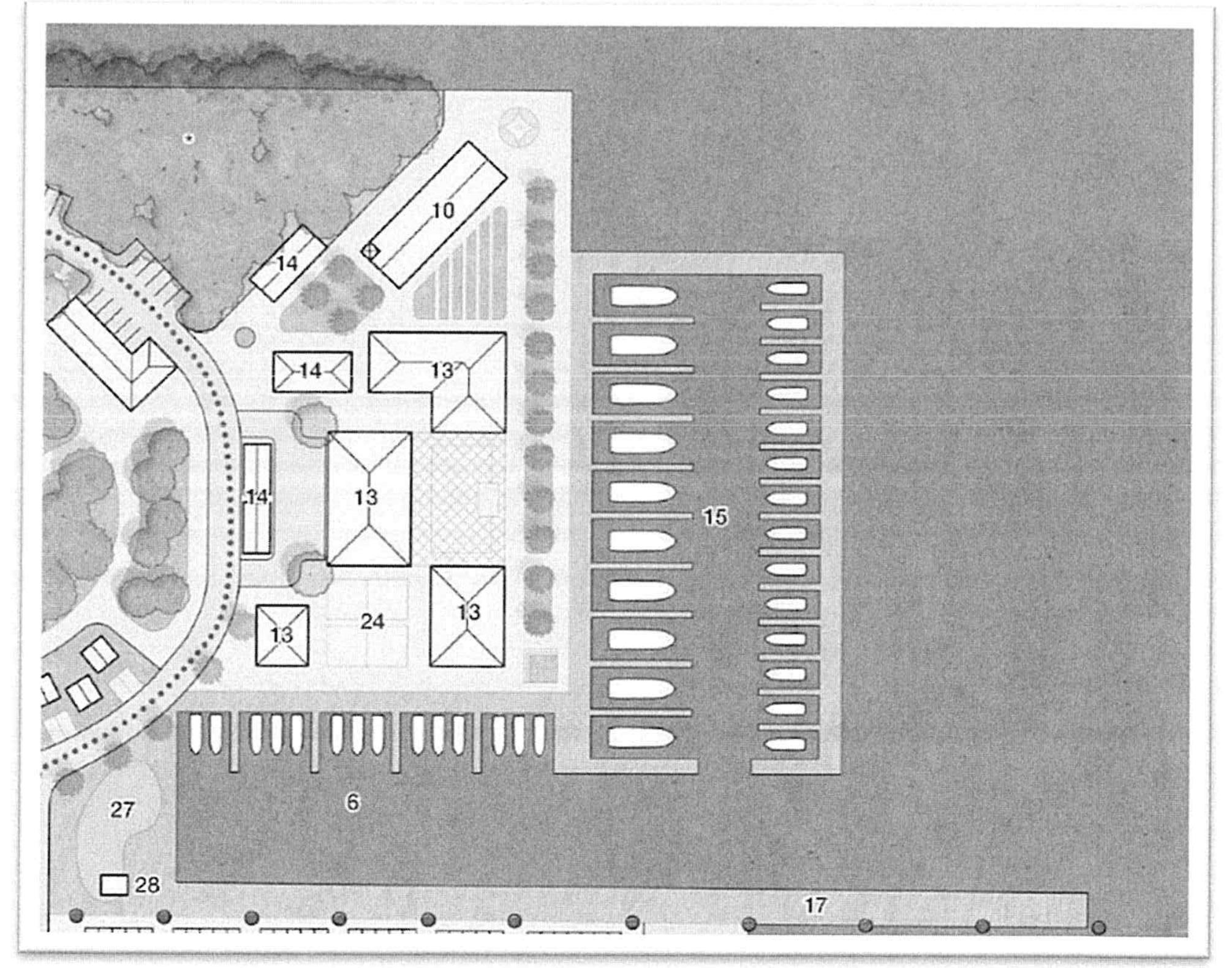
(2)
The central market area shall be designed with the following features:
a.
Central park feature with passive and active recreational features.
b.
Buildings with accommodation or commercial uses should frame the central park.
c.
Site access roadway located on the north end of the site.
d.
Parking facilities located to the perimeter of the site along Indian River Boulevard or 17 th Street Bridge.
e.
The site layout should be similar to the site design presented in Figure 62.2.
Figure 62.2. Central Park Site Design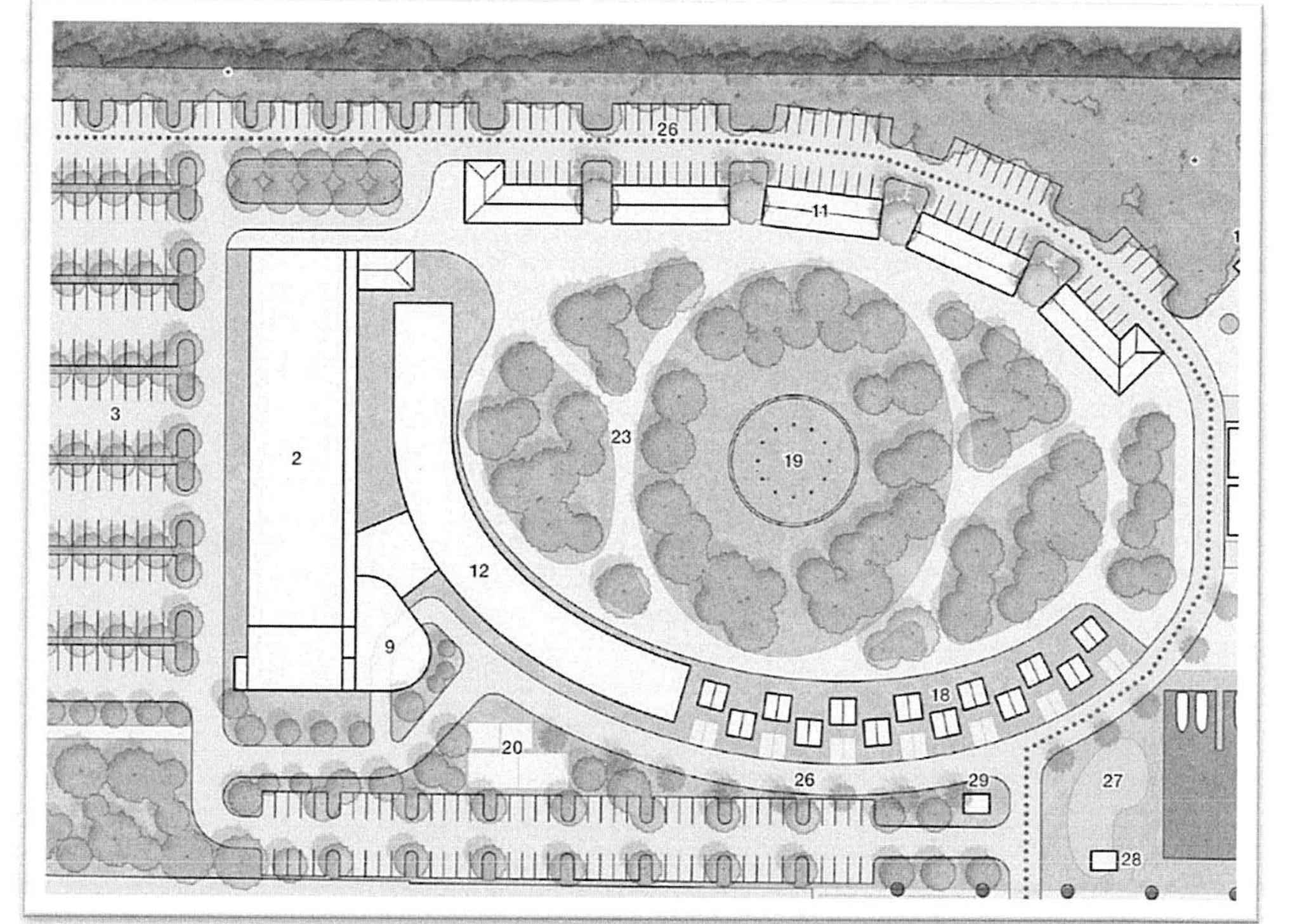
(3)
The recreation and cultural area shall be designed with the following features:
a.
Waterfront active recreation park in compliance with Sec. 67.11(a) with the walking trails, playground structures, shelters, buildings, and other park elements designed to provide a site with high quality, publicly accessible, and attractive development.
b.
Lawn or green for recreational activities or cultural performances framed on the east and south with recreation or cultural buildings.
c.
Site access street located on the south end of the site.
d.
Parking facilities located to the perimeter of the site along 17 th Street Bridge and west of the site access street.
e.
The site layout and building configuration shall be similar to the site design presented in Figure 62.3.
f.
Shall be designed utilizing blue and green stormwater infrastructure.
Figure 62.3. Recreation and Cultural Area Site Design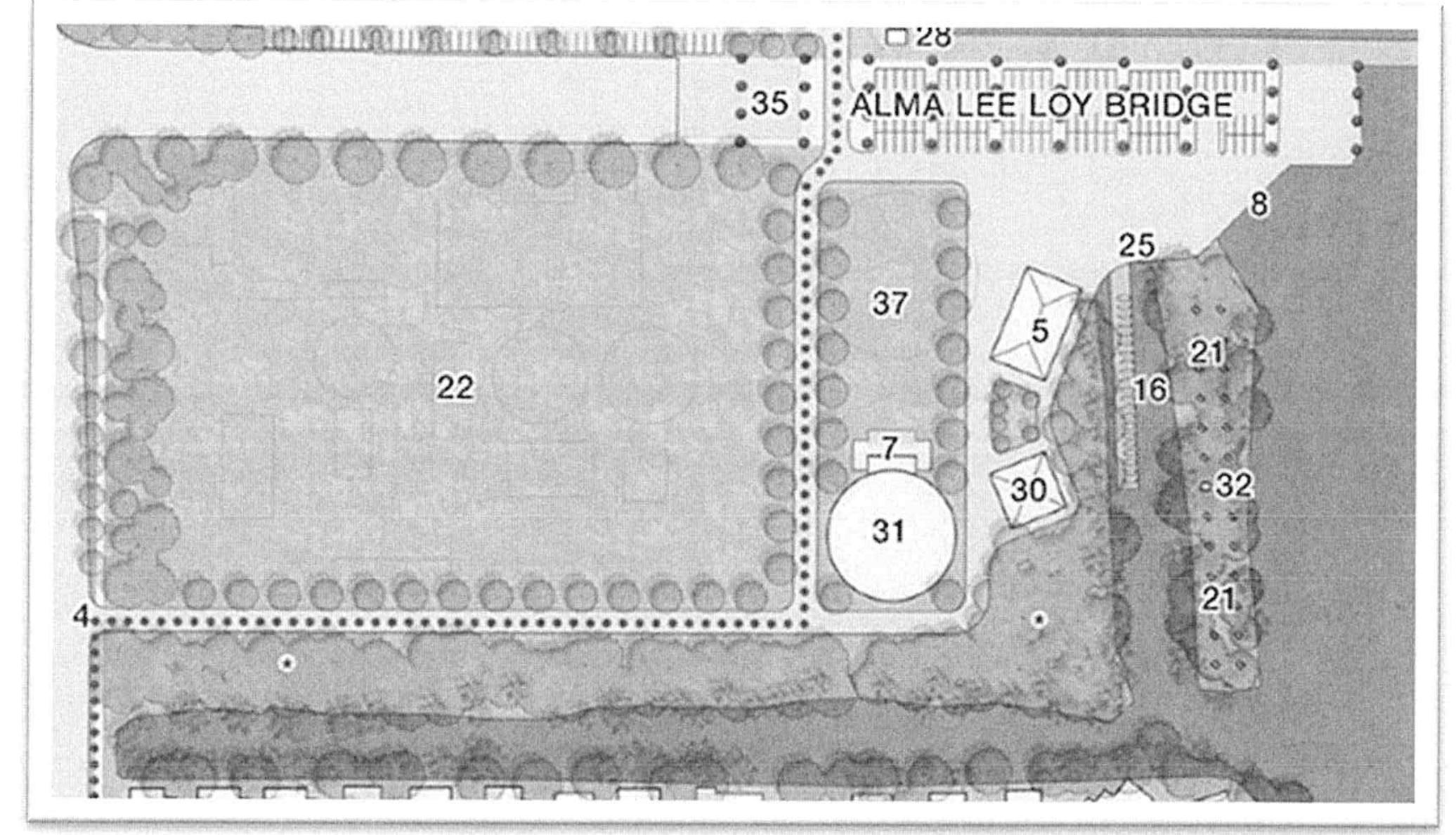
(d)
Appeals. Administrative decisions by the Planning Director regarding the application of the site design standards in this Section may be appealed to the Planning and Zoning Board pursuant to the procedures in Sec. 64.04.
(Ord. No. 2025-08, § 6, 8-12-2025)
Sec. 62.159. - Building design standards.
(a)
Purpose. Recognizing the importance of the Master Concept Plan for the Three Corners Waterfront District, the intent of this Section is to establish building design standards that foster high-quality and attractive development in the Three Corners Waterfront Districts consistent with adopted policies in the City's Comprehensive Plan. The intent of the design guidelines is not to impose strict and expensive architectural standards on proposed developments. Rather, the guidelines are meant to ensure compatible development within the Three Corners Waterfront District.
(b)
Applicability. These design standards shall apply to all development, including principal and accessory structures, requiring a site plan or existing structures substantially improved by 50 percent of the existing building value in Three Corners Waterfront Districts.
(c)
Building design. Buildings should have a primary architectural theme and that theme should be used around the entire building.
(1)
Building appearance. Development shall be constructed to be generally compatible in appearance with other structures on the site. This provision shall be satisfied by constructing the proposed building(s) so that at least three of the following features are substantially similar to the majority of other buildings on the site:
a.
Roof material;
b.
Roof overhang;
c.
Exterior building material;
d.
Shape, size, and alignment of windows and doors;
e.
Front porches or porticos; or
f.
Exterior building color.
(2)
Building façade. All building elevations shall be architecturally finished with similar levels of materials and detailing (e.g., tiles, moldings, cornices, wainscoting, etc.). Blank walls void of architectural details or other variation are prohibited. Buildings should incorporate other techniques to divide further large building facades, including the following:
a.
The primary material on the front façade of the structure shall be continued on all sides of the building, and on at least 50 percent of each side.
b.
Windows are required on all elevations. On public facing facades (streets or parks), windows and doors shall cover a minimum of 20 percent of the elevation. If the building has more than two public facing facades, the façade coverage by windows and doors may be reduced, if the Planning Director or Planning and Zoning Board determines the intent of the building design standards are met.
c.
Window and door openings shall be articulated on all elevations of the building through the use of:
i.
Shutters,
ii.
Enhanced flat or arched lintels and sills (projecting or recessed, or constructed of materials other than the primary building material),
iii.
Overhangs, or
iv.
Surrounds and trims.
(3)
Prohibited facade materials. The following materials are prohibited as exterior cladding on buildings over 200 sf, except as façade accent material:
a.
Aluminum siding or cladding,
b.
Galvanized steel or other bright metal,
c.
Unfinished concrete block or concrete wall.
d.
Exposed aggregate,
e.
Reflective glass.
(d)
Appeals. Administrative decisions by the Planning Director regarding the application of the building design standards in this Section may be appealed to the Architectural Review Commission (ARC) pursuant to the procedures in Sec. 64.04.
(Ord. No. 2025-08, § 6, 8-12-2025)
Sec. 62.200.- Purpose.
The purpose of this district is to:
(a)
Establish flexible development standards which can be implemented in areas of the city that are in a state of decline and areas where residential redevelopment activity is needed and desirable. These development standards are designed to preserve and enhance the residential character of neighborhoods while allowing for greater density residential development and small-scale, low-intensity nonresidential uses;
(b)
Implement policies in the Vero Beach Comprehensive Plan to reduce urban sprawl, encourage infill development in areas with adequate infrastructure, provide for moderate income housing opportunities, discourage strip commercial development, stabilize and increase property values, and reduce energy consumption; and
(c)
Create an environment where people can live, work, and have recreation opportunities in the same area.
It is intended that the combination of traditional residential development patterns and nonresidential uses will make the designated areas a new focus of pedestrian-oriented, residential development activity. Reduced unit sizes, reduced setbacks, transfer development rights, public open space, and design guidelines will be a catalyst for creating moderate-income housing.
(Ord. No. 89-10, § 1, 3-7-1989; Ord. No. 89-42, § 1, 6-20-1989; Ord. No. 91-07, § 9, 3-5-1991; Ord. No. 92-12, § 1, 5-19-1992)
Sec. 62.201. - Permitted uses.
A building or premises may be used for the following purposes:
(a)
Single-family residential;
(b)
Duplex;
(c)
Multiple-family residential;
(d)
Cultural or civic activities;
(e)
Places of worship;
(f)
Educational institutions;
(g)
Day care services;
(h)
Park and recreation areas;
(i)
Nursing homes, adult congregate living facilities and intermediate care facilities;
(j)
Utility facilities; and
(k)
City government purpose.
(Ord. No. 92-12, § 1, 5-19-1992; Ord. No. 2003-24, § 1, 6-17-2003)
Sec. 62.202. - Additional permitted uses.
A maximum of 5,000 square feet per acre of the following uses shall also be permitted; provided, that a minimum of 75 percent of the maximum number of residential units permitted on a site are built in conjunction with these uses:
(a)
Restricted sales and services;
(b)
Personal services;
(c)
Medical offices; and
(d)
Business and professional offices.
(Ord. No. 92-12, § 1, 5-19-1992)
Sec. 62.203. - Density.
Residential development in this district may be developed at a maximum of 17 units per acre, except as provided in section 62.215(a), Transfer Development Rights.
(Ord. No. 89-10, § 1, 3-7-1989; Ord. No. 92-12, § 1, 5-19-1992)
Sec. 62.204. - Minimum floor area.
All residential units shall have a minimum of 500 square feet of floor area except for efficiencies which shall have a minimum of 336 square feet of floor area and a maximum of 500 square feet of floor area.
(Ord. No. 89-10, § 1, 3-7-1989; Ord. No. 92-12, § 1, 5-19-1992)
Sec. 62.205. - Building height.
No building or structure shall exceed 35 feet in height, except radio and television antennas subject to rules of FAA and the Vero Beach Municipal Airport.
(Ord. No. 89-10, § 1, 3-7-1989; Ord. No. 92-12, § 1, 5-19-1992)
Sec. 62.206. - Front yard.
Every lot or parcel shall have a front yard setback of 15 feet. The front yard setback may be increased as provided in section 62.215(c).
(Ord. No. 89-10, § 1, 3-7-1989; Ord. No. 92-12, § 1, 5-19-1992)
Sec. 62.207. - Rear yard.
Every lot or parcel shall have a minimum rear yard setback of 15 feet.
(Ord. No. 89-10, § 1, 3-7-1989; Ord. No. 92-12, § 1, 5-19-1992)
Sec. 62.208. - Side yard.
Every lot or parcel shall have a minimum side yard of ten (10) feet.
(Ord. No. 89-10, § 1, 3-7-1989; Ord. No. 92-12, § 1, 5-19-1992)
Sec. 62.209. - Open space.
A minimum of 25 percent of every lot or parcel shall remain as open space, except as provided in section 62.215(b).
(Ord. No. 89-10, § 1, 3-7-1989; Ord. No. 92-12, § 1, 5-19-1992)
Sec. 62.210. - Pedestrian linkage.
Safe pedestrian linkages between residential and nonresidential uses shall be included on every development site. Sites shall also be designed to accommodate pedestrian linkages to adjoining sites.
(Ord. No. 89-10, § 1, 3-7-1989; Ord. No. 92-12, § 1, 5-19-1992)
Sec. 62.211. - Landscaping.
In addition to the requirements of Chapter 72 of this Code, known as the Environmental Protection Standards, all front yards shall be landscaped with one tree for each 30 linear feet of frontage. Drainage swales and open-pit-type retention or detention areas shall not be permitted in the front yard.
(Ord. No. 89-10, § 1, 3-7-1989; Ord. No. 92-12, § 1, 5-19-1992; Ord. No. 2023-07, § 2, 4-18-2023)
Sec. 62.212. - Parking regulations.
Off-street parking shall be provided in accordance with chapter 63 of this title except for the following:
(Ord. No. 89-10, § 1, 3-7-1989; Ord. No. 92-12, § 1, 5-19-1992; Ord. No. 2011-10, § 14, 8-16-2011)
Sec. 62.212.1. - Accessory buildings and structures.
(a)
Timing of construction and use:
(1)
No accessory building or structure shall be constructed and used prior to the construction and use of the principal building. No accessory building shall remain on a lot or shall be used without a principal building existing on such lot, unless approved in writing by the planning and development director after demonstrated good cause.
(2)
Walls and fences may be constructed prior to the construction of the principal building.
(b)
Encroachment of side or rear yards:
(1)
A one-story accessory building or structure located ten (10) feet or more from a main building, measured from the eave of the main building to the eave of the accessory building or structure shall have a minimum setback of five feet from any interior side or rear lot line, provided:
a.
The accessory building or structure is not located between the main building and a yard abutting a street; otherwise, the yard requirements for the main building apply;
b.
The roof eave height does not exceed ten (10) feet, measured from the weighted average, natural, or required grade elevation, with no more than a maximum of ten (10) feet additional height allowed for architectural embellishments;
c.
The distance to the side or rear lot line is measured from the eave of the accessory building or structure;
d.
Windows constructed above the roof eave of the building shall not face exterior lot lines; and
e.
The building or structure is not located on any easement.
(2)
Screened enclosures may be erected no closer than seven and one-half feet from the side or rear property line, except that no enclosure shall be allowed on any easement.
(c)
Exceeding the height limitation of section (b)(1). An accessory building or structure that exceeds the height limitation of section (b)(1) is permitted, provided:
(1)
The building or structure complies with the yard regulations for the main building.
(2)
The height of the building or structure does not exceed 22 feet, measured from the weighted average, natural, or required grade elevation to the inside ceiling of the highest usable space. An additional ten (10) feet in height is allowed for architectural embellishments.
(d)
Use and size restrictions:
(1)
Accessory buildings shall not be used as dwelling units.
(2)
The cumulative gross square footage of accessory buildings or structures shall not be greater than 50 percent of the floor area of the principal building or greater than 1,200 square feet, whichever is less; however, there shall be no more than three accessory buildings on a development site.
(3)
An accessory building to a single family use shall not be rented or leased and shall only be used by members of the household occupying the principal dwelling or their guests.
(Ord. No. 2006-20, § 6, 11-7-2006)
Sec. 62.213. - Walls and fences.
Construction, erection, and maintenance of walls and fences shall be permitted only as follows:
(a)
The walls and fences on side or rear property lines in this zone shall be permitted to a maximum height of six feet but shall not extend beyond the front yard setback line or the front of the building, whichever is the greater setback.
(b)
In this district, there shall be no fences, walls, plantings, or other structures or obstructions erected or maintained within 20 feet of any street intersection which may obstruct the view of a motorist or otherwise cause an obstruction to traffic flow.
(c)
Where a wall or fence is erected along or parallel to any street or in any front yard area, such wall or fence shall not be permitted to exceed three feet in height.
(Ord. No. 89-10, § 1, 3-7-1989; Ord. No. 92-12, § 1, 5-19-1992)
Sec. 62.214. - Modifications and exceptions.
(a)
Single-family or duplex development on small lots. Individual lots developed for single-family or duplex use, which due to small lot size are unable to meet the development criteria in the Mixed Use District, shall meet the development guidelines established in the R-1 District for single-family or RM-10/12 District for duplexes.
(b)
Community-based correctional facilities. Community-based correctional facilities are prohibited in this district.
(Ord. No. 89-10, § 1, 3-7-1989; Ord. No. 92-12, § 1, 5-19-1992; Ord. No. 93-28, § 2, 10-19-1993)
Sec. 62.215. - Special provisions requiring planning and zoning board approval.
Upon demonstration by an applicant that a proposed development is consistent with and furthers the purpose of the Mixed Use District, the planning and zoning board may grant approval of the following development options:
(a)
Transfer development rights:
(1)
The right to develop a maximum of 1,000 square feet per acre of building space for uses listed in section 62.202 may be transferred to another development site in a Mixed Use District.
(2)
The right to develop a maximum of 25 percent of the allowed number of residential units on a development site may be transferred to another site in the Mixed Use District.
(3)
A development site may receive transfers of building space or residential units from more than one other site; however, a maximum of 1,000 square feet per acre and a maximum of four units per acre shall be added by transfer development rights to any development site.
(4)
All such transfers shall be recorded in the property records at the Indian River County Court House by the owner of the site transferring the development right prior to the owner of the receiving site obtaining a building permit for construction on that site.
(b)
Open space. The requirement to provide a minimum 25 percent of open space may be reduced to a minimum of 15 percent of open space subject to the following:
(1)
Completion of a market value appraisal based on recent sales in the Mixed Use District.
(2)
Contribution of a sum equal to the value of the open space area to be reduced into a city-established open space trust fund.
(3)
If open space in excess of the 25 percent minimum requirement is included in a development plan, the uses listed in section 62.202 may be expanded at the ratio of one-half of a square foot per square foot of additional open space subject to the following:
a.
A maximum of 1,000 square feet of additional floor area is allowed.
b.
The open space shall be arranged to encourage pedestrian use and passive outdoor activity. Long narrow strips along other landscaped or open space areas or isolated portions of the site shall not be considered additional open space for purposes of increasing building area.
(c)
Front yard setbacks. Awnings, terraces, porches, chimneys, stairways, and similar features may project into the front yard a maximum of five feet. The front yard may be increased in order to accommodate a wider porch, terrace or architectural feature of a structure.
(d)
One residential unit/individual business combination. One dwelling unit on a parcel of land combined with one business in any of the categories listed in section 62.202 may be permitted subject to minimum unit size established in section 62.204 and maximum business square footage established in section 62.202. Receipt of transferred development rights shall not be allowed to increase the size of the business or square footage devoted to section 62.202 uses.
(Ord. No. 89-10, § 1, 3-7-1989; Ord. No. 92-12, § 1, 5-19-1992)
Sec. 62.216. - Design guidelines.
The intent of the design guidelines is not to impose strict and expensive architectural standards on mixed use developments nor to favor one style of architecture over another. Rather, the guidelines are meant to enhance the residential character of the district and augment the urban design features of the regulations by focusing on the general organization of building features and materials. These guidelines are suggestions to land developers and shall not be utilized as review criteria when evaluating site plans.
(a)
Exterior building walls. Finish colors and textures should be compatible with surrounding area earth tones. The following materials are recommended:
(1)
Stucco with a smooth sand finish or bag finish;
(2)
Wood clapboard or composition wood grain particle board clapboard;
(3)
Board and batten;
(4)
Keystone;
(5)
Wood shake and wood shingles;
(6)
Trim boards between two inches and six inches at openings and corners;
(7)
All stucco structures;
(8)
All wood structures; and
(9)
A wooded second story above a stucco ground story.
(b)
Garden walls and fences. Long expanses of walls and fences interrupted with piers or larger posts are recommended. The following materials are recommended:
(1)
Stucco and stone to match main structure;
(2)
Fences or masonry walls;
(3)
Wood pickets; and
(4)
Wrought iron or blackened aluminum with stone or stucco.
(c)
Balconies and porches. The following materials are recommended:
(1)
Wood posts and stucco piers;
(2)
Wood and painted aluminum balustrades and handrails for porches;
(3)
Screened porches under roof or balcony without sloped screen coverings; and
(4)
Ornamental wood or stucco bracket supports at cantilevered balconies.
(d)
Roofs and gutters. Recommended materials:
(1)
Standing seam or batten metal (copper, galvanized steel or prefinished aluminum);
(2)
Wood shingles;
(3)
Interlocking tiles; and
(4)
Composition "Dimensional" asphalt shingles.
Recommended roof types:
(1)
Hipped roofs with a pitch between 8:12 and 10:12 and gables roofs with a pitch between 6:12 and 10:12;
(2)
Simple shed with a pitch between 4:12 and 8:12 against a principal building or perimeter wall;
(3)
Dormers;
(4)
Overhang or 24 inches for principal buildings, 18 inches for shed roofs and outbuildings;
(5)
Rafters left open exposing rafter end;
(6)
Decorative wood brackets under eaves; and
(7)
Skylights flat and flush with roof line.
(e)
Windows and doors. The following materials and configurations are recommended:
(1)
Clear glass or gray tinted;
(2)
Painted wood;
(3)
Vinyl-clad wood;
(4)
Painted aluminum;
(5)
Windows with sills which project;
(6)
Circular, semicircular and octagonal windows;
(7)
Recessed wood panel and/or louvered or glazed doors with dividing muntins;
(8)
Single and double hung windows with dividing muntins;
(9)
Casement windows;
(10)
Operable wood or aluminum shutters sized to match openings;
(11)
Operable wood or aluminum Bahama shutters sized to match openings;
(12)
Wood or terra cotta window boxes; and
(13)
Canvas awnings.
(f)
Landscaping and paving. The following materials are recommended:
(1)
Broom, sponge, and rock salt finished concrete; and
(2)
Precast concrete pavers and textured concrete and brick for driveways and walkways.
(Ord. No. 89-10, § 1, 3-7-1989; Ord. No. 92-12, § 1, 5-19-1992)
Sec. 62.217. - Open space trust fund.
An open space trust fund is hereby established. All funds received shall be utilized to purchase and preserve open space in the Mixed Use District.
(Ord. No. 89-10, § 1, 3-7-1989; Ord. No. 89-77, §§ 1, 2, 11-21-1989; Ord. No. 92-12, § 1, 5-19-1992)
Sec. 62.300.- Purpose.
(a)
The purpose of this district is to establish a set of flexible development standards which can be implemented in the Downtown Districts of Vero Beach. The Downtown District is designed to expand development opportunities and activity in the area as described in the Downtown Plan. Development standards in this district are designed to augment the traditional mixed use character of downtown by allowing residential to mix with commercial uses.
(b)
The Downtown District will implement policies in the Comprehensive Land Use Plan by reducing urban sprawl, encouraging infill development in areas with adequate infrastructure, providing for moderate income housing opportunities, discouraging strip commercial development, stabilizing and increasing property values and the overall local tax base, and reducing energy consumption.
(c)
Historically, downtown development has mixed commercial and residential uses. When this traditional downtown pattern is combined with the flexible development guidelines, a catalyst for a vibrant downtown which can accommodate a variety of commercial and lifestyle choices is created. The flexible standards include savings in impact fees, reductions in residential unit sizes, reduced setbacks, reduced concurrency requirements and reduction of site open space requirements. Downtown is to be a place where people can live, work and have recreation opportunities in the same area.
(Ord. No. 93-01, § 1, 1-5-1993)
Sec. 62.301. - Permitted uses.
(a)
In this District, the following uses are permitted:
(1)
Accessories to permitted uses.
(2)
Administrative services.
(3)
Broadcast studios.
(4)
Clubs.
(5)
Commercial amusements.
(6)
Cultural/civic activities.
(7)
Craft distilleries.
(8)
Day care services.
(9)
Duplexes.
(10)
Educational institutions.
(11)
Efficiency apartments.
(12)
Financial institutions.
(13)
Fire stations.
(14)
Funeral homes.
(15)
General and restricted retail.
(16)
Government use.
(17)
Guesthouse/transient quarters.
(18)
Hotels and motels.
(19)
Medical services.
(20)
Microbreweries.
(21)
Multiple-family residential.
(22)
Park and recreation areas.
(23)
Parking lots and garages.
(24)
Personal services.
(25)
Places of worship.
(26)
Plant nurseries.
(27)
Professional offices.
(28)
Restaurants.
(29)
Single-family residential.
(30)
Trade service and repair.
(31)
Utility facilities.
(b)
Use specific standards. The following uses allowable as a permitted use in a district may be subject to following additional standards specific to the particular use.
(1)
Microbreweries and craft distilleries. A microbrewery or craft distillery in the downtown zoning district shall comply with the district density, intensity and dimensional standards specified for commercial zoning districts in this article and comply with the following standards:
a.
At least three thousand five hundred (3,500) square feet of floor area shall be maintained for public use as a restaurant/bar, including tasting area, except that for microbreweries or craft distilleries of less than seven thousand (7,000) square feet of total floor area, a minimum of fifty (50) percent of the total floor shall be maintained for such public use.
b.
No more than seventy-five (75) percent of the floor area shall be used for the brewery or distillery function, including, but not limited to, the brew house, boiling and water treatment areas, bottling and kegging lines, malt milling and storage, fermentation tanks, stilling and chilling tanks, conditioning tanks and serving tanks.
c.
No outdoor storage shall be allowed including portable storage units, cargo containers, and tractor trailers.
(Ord. No. 93-01, § 1, 1-5-1993; Ord. No. 2006-17, § 9, 10-3-2006; Ord. No. 2016-03, § 3, 1-5-2016; Ord. No. 2016-09, § 5, 6-7-2016; Ord. No. 2020-18, § 4, 10-6-2020; Ord. No. 2021-07, § 5, 6-15-2021; Ord. No. 2021-16, § 2, 9-21-2021)
Sec. 62.302. - Concurrency.
Until capacities of present infrastructure exceed service level standards, concurrency studies will not be required. Staff will monitor service levels to ensure compliance with standards established in the Comprehensive Land Use Plan.
(Ord. No. 93-01, § 1, 1-5-1993)
Sec. 62.303. - Mixed uses permitted.
Commercial and residential may occupy a single building, provided all relevant building code standards are met to serve the highest intensity use in the building.
(Ord. No. 93-01, § 1, 1-5-1993)
Sec. 62.304. - Density.
Residential development in this district may be developed at a maximum of 17 units per acre.
(Ord. No. 93-01, § 1, 1-5-1993)
Sec. 62.305. - Minimum floor area.
Floor area for multifamily residential units shall have a minimum of 500 square feet of living area. Efficiency apartments shall have a minimum of 336 square feet of living area.
(Ord. No. 93-01, § 1, 1-5-1993)
Sec. 62.306. - Building height.
Buildings or structures are permitted to a height of 50 feet.
(Ord. No. 93-01, § 1, 1-5-1993)
Sec. 62.307. - Front setback.
There shall be a 10-foot minimum setback. Where existing buildings are setback less than ten (10) feet, a property owner may match existing setbacks. Awnings, terraces, and similar features may project into the front setback. Projections or encroachments into the right-of-way require a permit.
(Ord. No. 93-01, § 1, 1-5-1993)
Sec. 62.308. - Rear and side yard setbacks.
There is no requirement for rear or side yard setback except when abutting a residential district, in which case, the setbacks shall match those of the residential district.
(Ord. No. 93-01, § 1, 1-5-1993)
Sec. 62.309. - Open space.
A minimum of ten percent of a newly developed or redeveloped site shall remain as open space. For the purpose of this district, open space shall include terraces, patios, areas under arcades, and boardwalks as well as landscaped areas. Parking lots must meet the minimum requirements of the Landscape Ordinance. Open space abutting residential uses must be traditional green space.
(Ord. No. 93-01, § 1, 1-5-1993)
Sec. 62.310. - Parking regulations.
(a)
Required parking shall be located in the rear of buildings or be provided through redesign and construction of public or on-street parking areas.
(b)
Off-street parking spaces shall be provided in accordance with chapter 63 of this title except as provided for in this section.
(c)
Existing nonresidential uses and use changes and improvements which do not increase floor area are exempt from parking requirements.
(d)
New nonresidential construction or redevelopment that increase floor area is exempt from providing parking for the first 30 spaces that would be required by chapter 63 of this title. Parking shall be provided at one-half the required applicable parking ratio in chapter 63 of this title for projects exceeding the 30 space exemption.
(Ord. No. 93-01, § 1, 1-5-1993; Ord. No. 2006-17, §10, 10-3-2006; Ord. No. 2011-10, § 15, 8-16-2011)
Sec. 62.311. - Use of public rights-of-way.
With proper permitting and licensing, certain uses of the public rights-of-way are allowed in this district. The following uses may be approved under the minor change process, provided the proposed activity does not impede access to any building or adversely impact pedestrian circulation by creating walkways of less than five feet:
(1)
Festivals, parades, and street parties.
(2)
Awnings.
(3)
Temporary signage, such as:
a.
Sandwich signs up to three feet in width by five feet in height. Sandwich may not block normal pedestrian flow or access to any building.
b.
Informational signs.
c.
Flags.
(4)
Mobile vending carts.
(5)
Street musicians, artists, and artisans.
(6)
Sidewalk cafes.
(Ord. No. 93-01, § 1, 1-5-1993)
Sec. 62.312. - Walls and fences.
Construction, erection, and maintenance of walls and fences are only permitted as follows:
(1)
Long expanses of walls and fences must be interrupted with piers or larger post every 15 feet.
(2)
Walls and fences on side or rear property lines in this zone shall be permitted to a maximum height of six feet.
(3)
No fences, walls, plantings, or other structures or obstructions shall be erected or maintained within 20 feet of any street intersection which may obstruct the view of a motorist or otherwise cause an obstruction to traffic flow.
(4)
Where a wall or fence is erected along or parallel to any street, such wall or fence is permitted up to a maximum height of three feet in height, except as provided in (7) below.
(5)
Chainlink fences are not permitted.
(6)
Only the following fencing materials are permitted:
a.
Stucco and stone to match main structure.
b.
Masonry walls.
c.
Wood pickets.
d.
Wrought iron or blackened aluminum.
(7)
Where a wrought iron or blackened aluminum fence is erected along or parallel to any street, such fence is permitted up to a maximum of five feet in height, with a minimum permanently opened spacing of two inches between vertical or horizontal fence elements.
(Ord. No. 93-01, § 1, 1-5-1993; Ord. No. 2017-07, § 2, 8-8-2017)
Sec. 62.400.- Purpose.
The purpose of this District is to:
(1)
Establish development standards which can be implemented in areas of the city that are stagnant or in a state of decline and areas where residential redevelopment activity is needed and desirable. These development standards are designed to preserve and enhance the safety and residential character of neighborhoods while permitting adult congregate living facilities (ACLF), community residential homes, nursing homes (intermediate, continuing or convalescent care) to mix with well-planned, nonresidential, office-oriented uses which can take advantage of proximity to adjacent medical and commercial corridors;
(2)
Implement policies in the Vero Beach Comprehensive Plan to reduce urban sprawl, encourage infill development in areas with adequate infrastructure, provide for moderate income housing opportunities, discourage strip commercial development, stabilize and increase property values, and reduce energy consumption;
(3)
Create an environment where people can live, work, and have recreation opportunities in a safe neighborhood; and
(4)
Introduce ACLFs, nursing homes, and community residential homes as permitted uses combined with medical-related uses and other well-planned offices as accessory uses, to help stabilize and improve designated areas.
(Ord. No. 93-09, § 1, 5-4-1993; Ord. No. 93-29, § 2, 10-19-1993)
Sec. 62.401. - Permitted uses.
A building or premises may be used for the following purposes:
(1)
Single-family residential structures;
(2)
Duplex residential structures;
(3)
Multiple-family residential structures;
(4)
Cultural or civic activities;
(5)
Places of worship;
(6)
Day care services;
(7)
Park and recreation areas;
(8)
ACLFs;
(9)
Nursing homes (convalescent, intermediate and continuing care); and group homes;
(10)
Community residential homes;
(11)
Utility facilities;
(12)
Accessory structures;
(13)
Community centers;
(14)
Educational instructions; and
(15)
Shared living residences.
(Ord. No. 93-09, § 1, 5-4-1993)
Sec. 62.402. - Additional permitted uses.
Maximum of 5,000 square feet per acre of the following uses shall also be permitted; provided that a minimum of 50 percent of the maximum number of residential units and/or care facility units permitted on a site are built in conjunction with these uses:
(1)
Medical offices;
(2)
Business and professional offices; and
(3)
Personal services.
(Ord. No. 93-09, § 1, 5-4-1993)
Sec. 62.403. - Density.
(a)
Residential development in this district including ACLFs may be developed at a maximum of ten units per acre in areas with a Comprehensive Land Use designation of RM-Residential Medium and 12 units per acre in areas designated RH-Residential High.
(b)
The number of rooms at sites developed for ACLFs; nursing homes, and community residential homes shall be governed by other development parameters such as open space minimums, parking requirements, building height restrictions, setbacks, and minimum unit or room sizes.
(Ord. No. 93-09, § 1, 5-4-1993; Ord. No. 93-29, § 2, 10-19-1993)
Sec. 62.404. - Minimum floor area.
Minimum land and floor area requirements for this district shall be as follows:
(Ord. No. 93-29, § 2, 10-19-1993)
Sec. 62.405. - Building height.
Buildings and structures are permitted to a height of 35 feet, except radio and television antennas subject to rules of FAA and the Vero Beach Municipal Airport.
(Ord. No. 93-09, § 1, 5-4-1993)
Sec. 62.406. - Front yard.
Every lot or parcel shall have a front yard setback of 25 feet except ACLFs, nursing homes, and community residential homes, which may have a 15-foot front yard setback.
(Ord. No. 93-09, § 1, 5-4-1993; Ord. No. 93-29, § 2, 10-19-1993)
Sec. 62.407. - Rear yard.
Every lot or parcel shall have a rear yard setback of 25 feet except ACLFs, nursing homes, and community residential homes, which may have a 15-foot rear yard setback.
(Ord. No. 93-09, § 1, 5-4-1993; Ord. No. 93-29, § 2, 10-19-1993)
Sec. 62.408. - Side yard.
Every lot or parcel shall have a minimum side yard setback of ten (10) feet.
(Ord. No. 93-09, § 1, 5-4-1993)
Sec. 62.409. - Open area.
A minimum of 50 percent of every residential lot shall remain as open space. Lots or parcels developed as ACLFs, nursing homes, community residential homes or for mixed uses shall have a minimum of 25 percent open space.
(Ord. No. 93-09, § 1, 5-4-1993; Ord. No. 93-29, § 2, 10-19-1993)
Sec. 62.410. - Landscaping.
In addition to the requirements of the Landscaping and Tree Protection Ordinance, all front yards, except single-family residences, shall be landscaped with one tree for each 30 linear feet of frontage. Drainage swales and open-pit-type retention or detention areas shall not be permitted in the front yard.
(Ord. No. 93-09, § 1, 5-4-1993)
Sec. 62.411. - Parking regulations.
(a)
Off-street parking shall not be permitted in the front yard or between a building and any street.
(b)
Off-street parking shall be provided in accordance with chapter 63 of this title, except for the following:
(Ord. No. 93-09, § 1, 5-4-1993; Ord. No. 93-29, § 2, 10-19-1993; Ord. No. 2011-10, § 16, 8-16-2011)
Sec. 62.412. - Modifications and exceptions.
(a)
Single-family or duplex development on small lots. Individual lots developed for single-family or duplex use, which due to small lot size are unable to meet the development criteria in this RCLO District, shall meet the development guidelines in the R-1 District for single-family or RM-10/12 District for duplexes.
(b)
Certification of state requirements. Prior to city approval of an ACLF, nursing home, or community residential homes, the applicant shall certify to the city that all applicable state regulations have been met and licenses obtained.
(c)
Setbacks for ACLFs, nursing homes, community residential homes, or mixed uses abutting residential districts. Any ACLFs, nursing homes, or community residential homes or other mixed uses, when developed on sites that abut a single-family residential district, shall meet the setback requirements of the single-family district.
(d)
Community-based correctional facilities. Community-based correctional facilities are prohibited in this district.
(Ord. No. 93-09, § 1, 5-4-1993; Ord. No. 93-29, § 2, 10-19-1993)
Sec. 62.412.1. - Accessory buildings and structures.
(a)
Timing of construction and use:
(1)
No accessory building or structure shall be constructed and used prior to the construction and use of the principal building. No accessory building shall remain on a lot or shall be used without a principal building existing on such lot, unless approved in writing by the planning and development director after demonstrated good cause.
(2)
Walls and fences may be constructed prior to the construction of the principal building.
(b)
Encroachment of side or rear yards:
(1)
A one-story accessory building or structure located ten (10) feet or more from a main building, measured from the eave of the main building to the eave of the accessory building or structure shall have a minimum setback of five feet from any interior side or rear lot line, provided:
a.
The accessory building or structure is not located between the main building and a yard abutting a street; otherwise, the yard requirements for the main building apply;
b.
The roof eave height does not exceed ten (10) feet, measured from the weighted average, natural, or required grade elevation, with no more than a maximum of ten (10) feet additional height allowed for architectural embellishments;
c.
The distance to the side or rear lot line is measured from the eave of the accessory building or structure;
d.
Windows constructed above the roof eave of the building shall not face exterior lot lines; and
e.
The building or structure is not located on any easement.
(2)
Screened enclosures may be erected no closer than seven and one-half feet from the side or rear property line, except that no enclosure shall be allowed on any easement.
(c)
Exceeding the height limitation of section (b)(1). An accessory building or structure that exceeds the height limitation of section (b)(1) is permitted, provided:
(1)
The building or structure complies with the yard regulations for the main building.
(2)
The height of the building or structure does not exceed 22 feet measured from the weighted average, natural, or required grade elevation to the inside ceiling of the highest usable space. An additional ten (10) feet in height is allowed for architectural embellishments.
(d)
Use and size restrictions:
(1)
Accessory buildings shall not be used as dwelling units.
(2)
The cumulative gross square footage of accessory buildings or structures shall not be greater than 50 percent of the floor area of the principal building or greater than 1,200 square feet, whichever is less; however, there shall be no more than three accessory buildings on a development site.
(3)
An accessory building to a single family use shall not be rented or leased and shall only be used by members of the household occupying the principal dwelling or their guests.
(Ord. No. 2006-20, § 7, 11-7-2006)
Sec. 62.413. - Walls and fences.
Construction, erection, and maintenance of walls and fences shall be permitted only as follows:
(1)
Walls and fences on side or rear property lines in this zone shall be permitted to a maximum height of six feet but shall not extend beyond the front yard setback line or the front of the building, whichever is the greater setback.
(2)
No fences, walls, plantings, or other structures or obstructions shall be erected or maintained within 20 feet of any street intersection which may obstruct the view of a motorist or otherwise cause an obstruction to traffic flow.
(3)
Where a wall or fence is erected along or parallel to any street or in any front yard area, such wall or fence shall not exceed three feet in height.
(Ord. No. 93-09, § 1, 5-4-1993)
Sec. 62.414.- Permitted uses.
Site plan review is required for all uses in this district. A building or premises may only be used for the following:
(a)
Educational institutions;
(b)
Government use;
(c)
Hospitals;
(d)
Public health facilities;
(e)
Public and private utilities; and
(f)
Accessory uses.
(Ord. No. 2004-03, § 2, 2-3-2004)
Sec. 62.415. - Minimum property size.
The minimum property size shall be five acres.
(Ord. No. 2004-03, § 2, 2-3-2004)
Sec. 62.416. - Density.
There is no residential density permitted in this zoning district.
(Ord. No. 2004-03, § 2, 2-3-2004)
Sec. 62.417. - Building height.
No building or structure shall exceed 35 feet, except as provided under modifications and adjustments. However, architectural embellishments, including, but not limited to, mansard, gable, hip and gambrel roofs and parapets and parapet walls, and mechanical equipment, including, but not limited to, elevator shafts, air conditioning condensing units, and cooling towers, shall be allowed to exceed the maximum building height by not more than 15 feet.
(Ord. No. 2004-03, § 2, 2-3-2004)
Sec. 62.418. - Lot coverage.
No structure or group of structures shall occupy more than 50 percent of the lot.
(Ord. No. 2004-03, § 2, 2-3-2004)
Sec. 62.419. - Setbacks.
(a)
Front yard. Every lot shall have a front yard or street yard of not less than 25 feet in depth plus an additional one foot for each additional two feet in height for buildings in excess of 25 feet in height.
(b)
Rear yard. Every lot shall have a rear yard of not less than 25 feet in depth. When a structure exceeds 25 feet in height, the rear yard shall be increased by one foot for each additional two feet of height or portion thereof.
(c)
Side yard. A side yard shall be provided on each side of every plot, not less than 25 feet in width; provided that when the structure exceeds 25 feet in height the side yard shall be increased by one foot for each additional two feet in height or portion thereof. When the maximum distance between two parallel lines drawn through the two points of the main building or structure nearest to opposite side property lines exceeds 100 feet, the additional side yard shall be increased above that established by the above as follows: One foot for every ten (10) feet in length in excess of 100 feet.
(Ord. No. 2004-03, § 2, 2-3-2004)
Sec. 62.420. - Open space.
Every lot shall have a minimum of 25 percent of the total parcel area set aside for open space.
(Ord. No. 2004-03, § 2, 2-3-2004)
Sec. 62.421. - Floor/area ratio.
The maximum floor/area ratio shall be 0.50.
(Ord. No. 2004-03, § 2, 2-3-2004)
Sec. 62.422. - Parking regulations.
Off-street parking spaces shall be provided in accordance with chapter 63 of this title.
(Ord. No. 2004-03, § 2, 2-3-2004; Ord. No. 2011-10, § 17, 8-16-2011)
Sec. 62.423. - General modifications.
(a)
Yard and road encroachment including roof overhang. Every part of a required yard or court shall be open (unobstructed) from its lowest point to the sky, except for the ordinary projection of sills, belt courses, cornices, buttresses, awnings, eaves, and similar features approved by the planning and zoning board. None of the above projections shall project into any yard more than 24 inches, except roof overhangs and awnings which may extend 48 inches.
(b)
Projecting fire escapes, stairways, balconies, chimneys, or flues. Open or closed fire escapes, outside stairways, balconies, chimneys, and flues shall not project into a minimum yard or court more than three and one-half feet.
(Ord. No. 2004-03, § 2, 2-3-2004)
Sec. 62.424. - Building height modifications.
Radio and television transmitting and receiving antennas may exceed the building height limits of this zone provided they otherwise comply with the ordinances of the City of Vero Beach and are not in conflict with the height regulations established by flight regulations of the municipal airport of Vero Beach and the Federal Aviation Administration.
(Ord. No. 2004-03, § 2, 2-3-2004)
Sec. 62.425. - Accessory building.
(a)
Timing of construction and use:
(1)
No accessory building shall be occupied on a development parcel until the construction of a main building has been completed and no accessory building shall be used unless the main building is in use.
(b)
Encroachment of side or rear yards. Accessory building may be located within a side or rear yard if the following conditions are observed:
(1)
Any accessory structure closer than ten (10) feet to the main building shall be constructed to be part of the main building and shall observe all yards required for the main building.
(2)
Any accessory structure located ten (10) feet or more from a main building may be constructed within five feet of any interior side or rear lot line.
(3)
Whenever a lot line is also a street line, the required yard for accessory buildings shall be the same as for main buildings.
(4)
Accessory buildings built within a rear or side yard shall not occupy more than 30 percent of the required rear yard nor more than 50 percent of the floor area of the
(Ord. No. 2004-03, § 2, 2-3-2004)
Sec. 62.426. - Walls and fences.
The construction, erection, and maintenance of walls and fences shall be permitted only as follows:
(a)
The walls and fences on side or rear property lines in this zone shall be permitted to a maximum height of six feet.
(b)
In this district, there shall be no fences, walls, plantings, or other structures or obstructions erected or maintained within 20 feet of any street intersection which may obstruct the view of a motorist or otherwise cause an obstruction to traffic flow.
(c)
Where a wall or fence is erected along or parallel to any street, such wall or fence shall not be permitted to exceed three feet in height, with the following exceptions:
(1)
A wall or fence may be erected up to five feet in height, except chain-link-type fences which may be erected up to four feet in height, subject to the following conditions:
a.
A two-foot-wide planting strip shall be provided between the right-of-way (property line) and the wall or fence.
b.
One shrub or vine shall be planted for each five feet, or fraction thereof, of the landscape strip.
c.
Ground cover shall be provided for the remainder of the landscape strip.
d.
Plant maintenance and specifications shall be as provided in the Vero Beach Landscape Ordinance.
e.
A fence or wall shall not exceed whichever height is greater: five feet above the crown of the road at any point when measured from the straight line perpendicular to the road and the fence or wall or five feet above the natural grade level of the land on both sides of the fence or wall.
f.
The fence shall be coated in green or black.
(2)
Chain-link-type fence, or minimum 14-gauge galvanized wire fence, shall be permitted subject to being coated in green or black and subject to the landscape and setback requirements in subsection (c)(1)b., c., d., and e., above, but in no instance shall said fence exceed four feet in height.
(d)
The use of any form of barbed wire in or on fences is prohibited within the city. Exceptions to this requirement may be granted by application for a minor change, if it is found that the granting of the requested exception is for the protection of the public from hazardous materials or operations.
(Ord. No. 2004-03, § 2, 2-3-2004)
Sec. 62.501.- Purpose and applicability.
(a)
Purpose. The purpose of the Ocean Drive/Cardinal Drive Commercial Overlay District (herein referred to as "overlay district") is to encourage the responsible development and redevelopment of the Cardinal Drive and Ocean Drive commercial areas in order to:
(1)
Retain and promote a pedestrian-oriented, mixed residential-commercial district characterized by small-scale specialty retail and services, restaurants, and related supporting uses on the ground floor with office, residential, and hotel uses above the ground floor;
(2)
Retain and promote small to medium scale quality hotel development and redevelopment compatible with the commercial uses and overall pedestrian-oriented character of the district;
(3)
Encourage development that exhibits the physical design characteristics of pedestrian-oriented storefront shopping streets; and
(4)
Promote the health and well-being of residents by encouraging physical activity and greater social interaction.
(b)
Applicability. The provisions of this article shall apply to all real property within the boundaries of the overlay district as depicted on the city's official zoning map.
(c)
Underlying zoning. The underlying regulations of the C-1A zoning district shall remain in full force and effect except as specifically modified or superseded in this article. To the extent that any conflict may arise between the regulations of this article and the regulations of the C-1A zoning district, the provisions of this article shall prevail.
(Ord. No. 2013-03, § 2, 1-22-2013)
Sec. 62.502. - Definitions.
The following words, terms, and phrases, when used in this article, shall have the meanings described to them in this section, except where the context clearly indicates a different meaning:
Authorizing authority: The planning director or planning and zoning board.
Build-to-line: The line parallel to and measured from the front property line along which the front of the principal building façade is required to be built in order to create a compatible line of buildings along frontage streets while providing for a streetscape zone.
Call center: A business office for the primary purpose of receiving and transmitting a large volume of requests by telephonic transmissions, operated by a company to administer incoming product support or information inquiries from consumers, including outgoing calls for, but not limited to telemarketing, clientele and product services, and debt collection.
Hotel: Any building operated, used, maintained, advertised, intended, or held out to the public as sleeping accommodations, for rental to guests for a period of time of less than 30 days.
Liner space: Retail and other commercial space located between the public right-of-way and hotel rooms, surface parking lots, or above-ground multi-level parking structures designed to eliminate "dead space" created by such uses along the public street.
Office uses: Uses permitted in the C-1A zoning district listed as administrative services, business and professional offices, cultural and civic activities, and financial institutions.
Project: Development or redevelopment approved pursuant to the standards of this article and Code.
Public open space: Outdoor areas open during normal business hours to access by the public, such as, but not limited to, terraces, gazebos, patios, boardwalks, fountains, gardens, outdoor dining and sales areas, art and sculpture display areas, benches, tables, and landscaped areas.
Public-private multi-level parking structure: An above ground multi-level parking facility with a minimum of 20 percent of the parking spaces available to the public.
Retail uses: Those uses permitted in the C-1A zoning district listed as restricted sales and services.
Side street: Azalea, Bougainvillea, Camelia, Dahlia, and Flamevine lanes.
Streetscape zone: That area between the public right-of-way and the required front façade build-to-line.
Streetwall: An opaque wall or fence designed and constructed to screen the view of parking areas from public right-of-way.
Substantially improved building or structure: Any existing building or structure when improved in excess of 50 percent of its most recent just valuation as determined by the Indian River County Property Appraiser.
Underground parking: Parking areas with a finished floor constructed completely or partially below the existing or finished grade on all sides, excluding entrances and exits.
(Ord. No. 2013-03, § 2, 1-22-2013)
Sec. 62.503. - Permitted and prohibited uses.
(a)
Table 62.22, Overlay District Principal Use Table designates how a building or premises may be used in the Ocean Drive/Cardinal Drive Overlay District.
Table 62.22 Overlay District Principal Use Table
(b)
Vesting of large restaurants. Any lawfully established restaurant existing on January 22, 2013 exceeding the floor space limitations of this section shall be considered in conformance with the provisions of this section, as long as there is a no net increase in floor area.
(Ord. No. 2013-03, § 2, 1-22-2013; Ord. No. 2023-14, § 7, 9-26-2023)
Sec. 62.504. - Site and building development standards.
(a)
Applicability. New or substantially improved principal buildings shall be required to meet the site and building development standards of this section to the maximum extent practicable as determined by the appropriate authorizing authority based upon documentation provided by the applicant.
(b)
Maximum number of stories. The maximum number of building stories shall be three.
(c)
Building height and measurement. The maximum height of buildings shall be as provided in section 62.38, which is 35 feet with an additional height allowance of 15 feet for embellishments. The measurement of building height shall be pursuant to section 60.15, except that the starting point of measurement shall be the average front façade sidewalk elevation or 18 inches above the required Florida Department of Environmental Protection elevation if the building is located seaward of the Coastal Construction Control Line, whichever elevation is greater.
(d)
Build-to-line. The build-to-line requirements of this paragraph shall supersede the front yard setbacks requirements of the underlying C-1A zoning district. The build-to-line shall be as follows:
(1)
Between 15 and 20 feet from the front property line along Ocean Drive, Cardinal Drive, and Sexton Plaza.
(2)
20 feet from the front property line along Beachland Boulevard.
(3)
10 feet from the front property line along side streets.
(4)
A minimum of 50 percent of the street façade of the building shall be constructed on the build-to-line and any building façade recess shall be a maximum of six feet from the build-to-line. The width of such recess shall be no greater than 25 percent of the street façade of the building, except that the building façade recess may be up to 25 feet from the build-to-line to accommodate public open space as long as the linear distance of such a recess is not more than 25 feet in width or 20 percent of the street façade, whichever is lesser.
(5)
The street façade of the building may have architectural articulations or jogs of 18 inches or less in front or back of the build-to-line.
(6)
Awnings, canopies, and similar forms of weather protection on ground and second floors may project five feet beyond the build-to-line.
(7)
Balconies on the second floor may project up to eight feet beyond the build-to-line.
(8)
The build-to-line of a building on a corner lot of the intersection of Cardinal Drive, Ocean Drive, or Beachland Boulevard shall be modified if the main building entrance is on the intersecting corner of the lot pursuant to section 62.506.
(e)
Build-to-line exception. Notwithstanding subsection (d) above, a project involving substantial improvement or the replacement of existing principal buildings that are located 10 feet or less from the front property line may be constructed to a build-to-line of 10 feet. However, the project shall not be eligible for any of the development incentives provided in section 62.508 of this article unless the authorizing authority makes a finding that the project has met the site and building development standards of this section to the maximum extent practicable based on documentation provided by the applicant.
(f)
Side yard setbacks. The side yard setback requirements of this subsection shall supersede the side yard setback requirements of sections 62.38 and 62.44 of the underlying C-1A zoning district. The minimum side yard setbacks shall be 0 feet except as follows:
(1)
7.5 feet for properties with a lot width of 100 feet or greater along the east side of Ocean Drive.
(2)
25 feet where the side yard of a property abuts a residential zoning district including a landscaped buffer strip pursuant to (i) below.
(g)
Side yard setback modification. Notwithstanding (f) above, in order to create the required street façade any new principal building or substantially improved principal building shall be built to the side property line where the existing principal buildings or structures on the abutting lot are located along such common property line between the two properties and on the required build-to-line in this article.
(h)
Rear yard setbacks. The rear yard setback requirements of this subsection shall supersede the rear yard setback requirements of sections 62.38 and 62.43 of the underlying C-1A zoning district. The required rear yard setback shall be 0, except where the rear yard of the property abuts a residential district. If the rear yard abuts a residential zoning district, a setback from the rear property line of 25 feet shall be provided, including a landscaped buffer strip pursuant to subsection (i) below.
(i)
Landscaped buffer strip requirements. A 10 foot wide landscaped buffer strip shall be provided along the property line of any project abutting a residential zoning district. Said landscaped buffer strip shall consist of a continuous hedge of at least 4.5 feet in height at the time of installation, which hedge shall be located inside the buffer strip and not less than two feet from that portion of the property line that directly abuts the residential zoning district.
(j)
Streetwalls. If required by section 62.505 to meet parking design standards, streetwalls shall be installed and constructed pursuant to the following design standards:
(1)
Streetwalls shall be constructed of the same or complementary materials as the principal buildings and may be a combination of "wall" and metal "fence" materials, except that chain link fencing shall not be allowed.
(2)
Streetwalls shall be four feet in height and shall have a six inch projection or a recess at least every 10 to 12 feet of streetwall length.
(3)
The total length of any streetwall shall be no longer than 50 feet per street frontage unless otherwise approved by the planning and zoning board based on a demonstration of good cause by the applicant.
(5)
Notwithstanding the requirements of section 72.04 of this Code, a minimum of five foot-wide landscaping strip facing the street shall be required with shrubs of at least two feet in height spaced three feet on center at the time of planting together with ground cover other than grass.
(6)
No two streetwalls shall adjoin on a common property line unless otherwise approved by the planning and zoning board based on a demonstration of good cause by the applicant.
(k)
Open space. To encourage the development of pedestrian-oriented spaces, for the purpose of the overlay district, open space shall include terraces, patios, areas under arcades, and boardwalks as well as landscaped areas. Parking lots shall meet the minimum requirements of the landscape ordinance. Open space abutting residential districts shall be landscaped open space without any impervious surface.
(Ord. No. 2013-03, § 2, 1-22-2013; Ord. No. 2021-11, § 2, 9-7-2021)
Sec. 62.505. - Parking design standards.
In addition to the other requirements of this Code, the following parking design standards shall apply for any and all new or substantially improved principal buildings, new surface parking lots, above-ground multi-level parking structures, and the expansion of existing parking by more than ten spaces:
(a)
Parking spaces shall be located in the rear of the property or on the side yard of the property no closer than five feet from the front façade build-to-line unless otherwise approved by the planning and zoning board upon the demonstration of good cause by the applicant.
(b)
Streetwalls shall be required where a surface parking lot or entrance abuts Cardinal Drive or Ocean Drive and such parking is located within 50 feet of the property line without any intervening principal or accessory buildings to screen such parking from the public right-of-way. Such street walls shall be in conformance with the design standards provided in section 62.505.
(c)
Except for public or public-private multi-level parking structures, all above grade parking shall be in surface lots.
(d)
Any above-ground public or public-private multi-level parking structure shall have liner space of at least 20 feet in depth containing commercial uses on the ground floor facing any public street.
(e)
The perimeter landscaping requirements for off-street parking adjacent to a public alley may be waived by the planning and zoning board based on a demonstration of good cause by the applicant
(f)
Perimeter landscaping requirements for off-street parking along side lot lines may be waived by the planning and zoning board based on a demonstration of good cause by the applicant.
(g)
Parking lots/areas on adjoining sites may be physically interconnected only for so long as the affected property owners maintain an executed and recorded cross-easement between or among them permitting such interconnection and access to each other's property. The applicant shall provide proof of such cross-easement satisfactory to the planning director. The design and redesign of parking lots that cross property lines may require landscaping meeting the requirements of section 72.04 of this Code, if the planning and zoning board so determines.
(Ord. No. 2013-03, § 2, 1-22-2013)
Sec. 62.506 - Building design standards.
(a)
Applicability. New or substantially improved principal buildings shall comport with the building design guidelines of this section and all other applicable code design provisions to the maximum extent practicable as determined by the architectural review commission. No project may be approved by the appropriate authorizing authority unless the architectural review commission makes the determination that the overall design of the project is consistent with the intent and provisions of this article to encourage physical design characteristics of a pedestrian-oriented, mixed residential-commercial district with storefront shopping streets. The architectural review commission may approve minor variations from the design guidelines in this section to accommodate varying architectural styles based on a demonstration of good cause by the applicant.
(b)
Building entries. The main doorway for public entry into a principal building shall be from the street façade and shall be clearly defined. A building on a corner lot may have its main entrance on the building corner corresponding to the lot corners. If the main entrance is provided on the corner of the building, rather than meeting the build-to-lines that intersect at the corner, the building façade shall be angled to face the intersection and have architectural features in place making such corner of the building prominent. There shall be no difference in the elevations of a building entry and adjacent sidewalk, unless Coastal Construction Control Line standards apply.
(c)
Modulation. Building elevations shall repeat features that create a logical pattern from each street view. Acceptable features to help define each façade elevation include:
(1)
Consistent window patterns;
(2)
Porches or covered entries;
(3)
Balconies or bay windows;
(4)
Alternating dormers, stepped roofing or gables; and
(5)
Material changes according to building plane, light fixtures, trellises, or key landscape features.
(d)
Passageways. Any building that exceeds 200 feet in length shall provide a pedestrian walkway or passageway at the ground floor in a location that provides convenient access to parking at the rear of the building. The walkway/passageway shall not be less than ten (10) feet in width and may include outdoor dining, retail displays, or other amenities associated with public open space as long as such amenities are otherwise approved under this Code and a five-foot passage for pedestrians is maintained. The walkway/passageway shall be open to the public and shall not be included in the FAR.
(e)
Colors. No more than three colors on the exterior façade plus one accent color shall be allowed. The three colors shall be in a compatible range.
(f)
Roofs. The following design standards shall be followed for roofs:
(1)
Roofs may be hip, gable, or flat with a pitch of between 4:12 to 12:12.
(2)
No mansard roofs shall be allowed.
(3)
All pitched roofs shall have an overhang of at least 12 inches and may extend to a maximum of 30 inches beyond the building façade.
(5)
Buildings with flat roofs shall include a parapet on the street façade and all side façades pursuant to the following guidelines:
a.
The top of the parapet shall be no less than 24 inches in height, but no higher than 48 inches, as measured along the face of the façade from the top of the flat roof.
b.
Parapets shall be treated as unique architectural elements on the façades of flat roof buildings with special attention paid to the use of articulation, signage, details, inlays, friezes or other appropriate elements.
(6)
Street façades, that are 100 linear feet or greater in length, shall incorporate in at least two locations a, minimum three foot change in the roof edge and/or parapet treatment from the dominant roof design.
(g)
Building materials.
(1)
Exterior wall building materials shall include any of the following:
a.
Stucco;
b.
Precast concrete;
c.
Stone;
d.
Wood siding;
e.
Cementitious board products;
f.
Masonry brick (texture masonry shall be permitted); or
g.
Tile.
(2)
No more than two materials in (1) above shall be used in a façade, except for trim elements.
(3)
Except for flat roofs, that shall have no material specifications, roof materials shall include any of the following:
a.
Metal standing seam;
b.
Clay or concrete tile;
c.
Composite tile; or
d.
Slate or synthetic slate (no asphalt or fiberglass shingle shall be permitted).
(4)
Doors and windows shall include any of the following:
a.
Painted or stained wood frame;
b.
Metal; or
c.
Vinyl clad wood frame.
(h)
Windows. Windows shall adhere to the following standards:
(1)
Street level windows shall be clear or lightly tinted glass; no heavily tinted, mirrored, or reflective glass of any kind shall be permitted.
(2)
A minimum of 50 percent of the linear dimension of the ground level street façade shall consist of windows or glass doorways.
(3)
No street façade shall continue uninterrupted by a window or a functional public access doorway for a maximum linear distance of greater than 12 feet.
(Ord. No. 2013-03, § 2, 1-22-2013)
Sec. 62.507. - Use of public right-of-way.
The following uses of public right-of-way may be permitted subject to approval of a right-of-way permit or license as provided in chapter 71 of this Code:
(1)
Outdoor dining associated with an indoor restaurant on the property may encroach on the public sidewalk adjacent to the private property so long as a minimum 3.5 foot clear passage for pedestrians is maintained along the area between the outdoor dining and adjacent vehicle parking areas or roadway.
(2)
Awnings may encroach into the right-of-way so long as the awning is no lower than eight feet above the sidewalk.
(Ord. No. 2013-03, § 2, 1-22-2013)
Sec. 62.508. - Development standards and incentives for eligible projects.
(a)
Purpose. In order to encourage and promote pedestrian-oriented, mixed use development, specific development incentives are provided in this section for eligible projects that meet certain development or use requirements. These incentives are in the form of modifications or waivers to the underlying C-1A zoning district regulations in exchange for meeting specific land use mixes and site and building design standards.
(b)
Application. As part of the applicant's development permit application to be submitted for project approval pursuant to chapter 64, article I, development review, of this Code, the applicant shall identify the specific development incentives being requested for the project.
(c)
Supplemental development standards. No project may receive a development incentive unless the architectural review commission makes a determination that the project meets the open space and streetscape requirements of this section and that the site design of the project meets the intent of this article by encouraging physical design that increases pedestrian-oriented activity and social interaction in the overlay district. In addition to meeting the development standards pursuant to sections 62.504 through 62.506 of this article for new or substantially improved principal buildings, any project receiving a development incentive pursuant to this section shall be required to meet the supplemental development standards, as follows:
(1)
Net loss of public access. The project shall not result in a net loss of public access to the ocean and beach areas.
(2)
Required streetscape zone. New and substantially improved buildings shall be required to provide a streetscape zone if the subject project abuts Ocean Drive, Cardinal Drive, or Beachland Boulevard. Existing development that does not involve the construction of a new principal building or substantial improvements to an existing principal building shall provide a streetscape zone to the maximum extent practicable as determined by the architectural review commission. The following are the streetscape zone requirements:
a.
Along Ocean Drive and Cardinal Drive, the area contained within the streetscape zone shall provide for an interconnected sidewalk to adjacent properties and include shade trees and landscaping and may include other pedestrian features such as, but not limited to, terraces, gazebos, patios, outdoor dining, art and sculpture displays, fountains, gardens, benches, tables, trash receptacles, and other special features approved as part of and in conjunction with the site plan approval for the project.
b.
Along Beachland Boulevard, the area contained within the streetscape zone shall provide for an interconnected sidewalk to adjacent properties and shall require the planting of live oak trees at least six inches diameter at breast height (DBH) at a ratio of one tree for every 50 feet of street frontage along Beachland Boulevard excluding driveways.
(3)
Open space. Following are the open space requirements that shall be met:
a.
The minimum open space shall be 20 percent of the property. Any project not involving the construction of a new principal building or substantial improvements to an existing principal building that exceeds this minimum shall be deemed in conformance with the provisions of subsection; however, no further decrease in the amount of open space shall be permitted.
b.
At least 40 percent of the required open space shall be accounted for as "public open space." Public open space may be within streetscape zones and side and rear setbacks, but shall not include landscaped areas required for parking or any required landscaped buffer strip.
c.
At least 50 percent of the "public open space" shall be landscaped with trees, shrubs, and ground cover.
(4)
Permitted uses by floor level. Any project to be approved pursuant to this section shall meet the following use requirements by floor level:
a.
Ground floor: Only office, retail, restaurant, and hotel lobbies and accessory retail and restaurant uses located within a hotel building shall be allowed on ground floors, except that hotel rooms may be allowed on the ground floor under either of the following conditions:
1.
If a minimum 20 foot deep liner floor space containing other uses permitted on the ground floor is provided between hotel rooms and the build-to-line; or
2.
If that portion of the building containing ground floor rooms is setback more than 50 feet from the front property line along the east side of Ocean Drive.
b.
Second story: Any permitted use may be allowed on the second floor.
c.
Third story: Only residential and hotel uses are allowed on the third floor.
d.
Fourth story: Only hotel uses are allowed on the fourth floor.
(5)
Third and fourth story setback. The façade of the third and fourth floor of any building shall have a setback of at least six feet for at least 50 percent of the building façade from the build-to-line.
(d)
Development incentives. The following development incentives shall apply to a project approved pursuant to this section:
(1)
The maximum lot coverage of principal buildings shall be 50 percent. Any project that does not involve the construction of a new principal building or the substantial improvement of an existing principal building that exceeds this maximum lot coverage shall be deemed in conformance with the provisions of this subsection; however, no further increase in lot coverage shall be permitted.
(2)
The off-street parking and loading requirements of chapter 63, off-street parking and loading requirements, of this Code shall be modified, as follows:
(3)
Any hotel lawfully existing on April 1, 2013, that has an FAR of more than 1.0 shall be deemed to be in conformance with FAR provisions of this section subject to the condition that proposed improvements to the property will not result in an increase in floor area and the principal use of the property will remain as a hotel.
(4)
Any hotel lawfully existing on April 1, 2013, that has a density of more than 30 rooms per acre and average lot size per room of less than 1,450 square feet shall be deemed to be in conformance with the density and average lot size per room provisions of the C-1A zoning district subject to the condition that proposed improvements to the property will not result in an increase in the number of rooms.
(5)
With the approval of the architectural review commission, the build-to-line requirements of subsection 62.504(d) and the maximum number of stories of subsection 62.504(b) may be modified for hotels with 100 or more feet of property frontage along the east side of Ocean Drive, subject to the following provisions:
a.
The approved build-to-line shall be no greater than 80 feet from the front property line.
b.
The maximum number of stories shall be no greater than 4 with the condition that the approved build-to-line shall not be less than 30 feet from the front property line.
To approve such modification, the architectural review commission shall make findings that the project design is consistent with a purpose of the overlay district and that the project fully and appropriately integrates in its site and building design the streetscape zone requirements of this section. In approving any modification, the architectural review commission may attach reasonable conditions to its approval.
(6)
A projects shall be eligible for a FAR bonus incentive if it meets the following use threshold requirements:
a.
Hotel and accessory uses shall have a maximum FAR of 1.0 or the existing FAR of the hotel, if greater than 1.0, subject to the conditions in (3) above.
b.
Any project with 50 to 74 percent of its ground floor area in retail and/or restaurant uses shall have the following maximum FARs based on uses and number of stories:*
i.
Two stories at 0.7;
ii.
Two stories with residential and/or hotel use on 2nd floor at 0.8; or
iii.
Three stories with residential and/or hotel uses on 2nd and 3rd floors at 0.9.
c.
Any project with 75 percent or more of its ground floor area in retail and/or restaurant uses shall have the following maximum FARs based on uses and number of stories:*
i.
Two stories at 0.8;
ii.
Two stories with residential and/or hotel uses on 2nd floor at 0.9; or
iii.
Three stories with residential and/or hotel uses on 2nd and 3rd floors at 1.0.
* The floor area of any parking structure and elevator shafts shall be excluded in determining these use threshold requirements.
(7)
Underground parking shall be excluded from FAR calculations and underground parking levels shall not be considered stories for determination of compliance with subsection 62.504(b).
(e)
Conditions of approval for uses and FAR incentive bonus. At a minimum, any project approved pursuant to this section shall be required to maintain the mix of permitted uses by floor level of subsection (c)(4) above. If the project received a FAR bonus incentive pursuant to this section, it shall be required to maintain the minimum threshold mix of uses by floor for the FAR incentive bonus pursuant to subsection (d) above. Subsequent to approval of the project, no floor space may be occupied by a use that results in any use or a mix of uses that does not comply with this article unless a waiver is first obtained from the planning and zoning board pursuant to section 62.509.
(Ord. No. 2013-03, § 2, 1-22-2013)
Sec. 62.509. - Waivers from use requirements.
(a)
Purpose. The purpose of this section is to provide a process for granting relief to owners of projects that have been approved pursuant to section 62.508, which owners, due to unforeseen and uncontrollable marketplace conditions, are unable to maintain the minimum mix of uses by floor level required for all projects and projects receiving a FAR incentive bonus.
(b)
Waiver eligibility. A project approved pursuant to section 62.508 shall not be eligible to apply for a waiver until at least one year from the date of the certificate of occupancy for the subject building, or if the approved project does not require a certificate of occupancy, no sooner than one year from the date of the development approval of the project.
(c)
Waiver duration. Any waiver granted by the planning and zoning board shall be for a period of not more than two years. No later than 60 days prior to the waiver's expiration, the property owner may submit an application for a one-time extension of the waiver for one additional year pursuant to subsections (e) and (f) below.
(d)
Waiver expiration. Upon expiration of the waiver the project shall become a non-conforming use until the applicable provisions of subsection 62.508(c)(4) or, if applicable, subsection 62.508(d) are met. As a non-conforming use, the project shall comply with the provisions of article II, non-conforming uses, of chapter 64 of this Code, except that the vesting provisions of section 64.27 shall not apply to any floor area above 0.5 FAR not existing on the property prior to the project's approval pursuant to section 62.509.
(e)
Waiver application process.
(1)
Every application for a waiver pursuant to this section shall be in a form prescribed by the planning director and accompanied by a nonrefundable fee in the amount established from time to time by resolution of the city council to defray the actual cost of processing the application and provision of any required notice.
(2)
The completed application shall be submitted to the planning and development department for review. The planning director shall review the application and provide a written report with his findings and recommendations to the planning and zoning board and to the applicant. The planning director shall cause the application to be advertised in a local paper of general circulation no less than 14 days before the date of the hearing.
(3)
The planning and zoning board shall conduct a public quasi-judicial hearing on the waiver application. The planning and zoning board shall make findings based on the criteria in subsection (f) below and issue its written approval, approval with conditions, or denial of the application.
(f)
Waiver review criteria. To approve the waiver or an extension to an existing waiver, the planning and zoning board must find, based on competent substantial evidence, all of the following:
(1)
That the applicant has diligently and in good faith tried to secure a mix of uses that meets the permitted uses by floor level required in section 62.508(c)(4), and, if applicable, the minimum use mix thresholds by floor level required for a FAR bonus incentive granted pursuant to section 62.508(d); and
(2)
That the granting of the waiver will permit the continued use and maintenance of the subject property while providing additional time for the applicant to bring the property into compliance.
(g)
Conditions on waivers. In granting a waiver, the planning and zoning board may include reasonable conditions to ensure the applicant is diligently working toward bringing the subject project into compliance.
(h)
Appeals. Appeals of the planning and zoning board's waiver decision shall be to the city council pursuant to section 64.08 of this Code.
(Ord. No. 2013-03, § 2, 1-22-2013)
Sec. 62.601.- Purpose.
A planned development (PD) is a specially tailored use providing a unique approach to combining and developing parcels of land with the intention of ensuring orderly planning and quality urban design that is in harmony with the existing or potential development of the surrounding neighborhood. Specifically, a PD and the provisions of this article are intended to:
(1)
Implement policies in the comprehensive plan and vision plan to reduce urban sprawl, encourage infill and redevelopment in areas with adequate infrastructure, discourage strip commercial development, stabilize and increase property values, and reduce energy consumption;
(2)
Establish flexible development standards which provide incentives for innovative mixed-use development patterns and allow for the creative use of land;
(3)
Provide incentives to support development that promotes sustainable living, allows for a more efficient use of public services and facilities, and minimizes impacts on surrounding areas through the use of flexible and innovative land development techniques;
(4)
Allow a mixture of uses, structures, facilities, open space, buffers, and conservation areas in a manner compatible with existing, permitted, and planned uses on adjacent properties; and
(5)
Promote a balanced transportation system by providing direct connections and accommodations for automobiles, public transit, bicycles and pedestrians.
(Ord. No. 2013-21, § 3, 10-15-2013)
Sec. 62.602. - Minimum eligibility requirements.
The following are the minimum requirements for a project to be eligible for approval as a PD pursuant to this article:
(1)
The project site shall contain a minimum of 50,000 or more square feet of land area, excluding any intervening right-of-way and contained entirely within the corporate limits of the City of Vero Beach.
(2)
Parcels included within a PD shall be contiguous or separated by no more than 70 feet of right-of-way for a road, railroad, canal, or utility.
(3)
The project site shall be located on or have direct access via a private access road or driveway to an arterial or collector roadway as identified in the comprehensive plan.
(4)
All land within the PD shall be approved under one development order and all development and all uses within the PD shall be subject to the provisions of the approved development order and any subsequent amendments thereto.
(Ord. No. 2013-21, § 3, 10-15-2013)
Sec. 62.603. - Application review and approval process.
The application submittal, review, and approval process to rezone parcel(s) to a PD Zoning District and establish a master plan and agreement for a PD project and any subsequent amendments shall follow the procedures, review standards, and requirements of this article and Planned Development Official Zoning Map amendment procedures in Chapter 65, Article III, Amendments to Comprehensive Plan and Land Development Regulations. Any submittal, review and approval process for code compliance permits or site plans for a PD project shall follow the procedures, review standards, and requirements of this article and Chapter 64, Article I, Development Review.
(Ord. No. 2013-21, § 3, 10-15-2013; Ord. No. 2021-01, § 3, 2-16-2021)
Sec. 62.604. - Conditional use provisions.
(a)
As a conditional use, a PD project may be permitted by the planning and zoning board, provided the project is so designed, located, and proposed to be operated so that the public health, safety, and welfare are protected. Planned developments shall be considered on a case-by-case basis. Findings made in consideration of a PD are not justification for approval of other planned developments. No inherent right exists to be approved as a planned development. Mere compliance with generally applicable development standards of part III of this Code may not be sufficient, and reasonable additional measures and conditions may be necessary as determined by the planning and zoning board.
(b)
Neighborhood compatibility, stability and impact on abutting properties shall be of prime importance in consideration of a PD approval. In addition to meeting all other requirements of the Code, the following criteria shall be considered in decision making of the planning and zoning board relative to approval or denial of a PD based on the evidence presented:
(1)
If the proposed PD will create noise, traffic, odor or other nuisances to a degree that it will be disruptive to abutting or nearby properties, the PD shall not be approved.
(2)
If the scale of a proposed PD is determined to be inconsistent with existing or anticipated development in the vicinity, the PD shall not be approved. Indicators of scale shall be building bulk and height, open space, and the number of new vehicle trips per day and peak hour.
(Ord. No. 2013-21, § 3, 10-15-2013)
Sec. 62.605. - Minimum performance and development standards.
In addition to the development standards of section 64.10(b) and (c) and chapter 63, off-street parking and loading requirements, of this Code, each proposed PD shall meet the following minimum development standards, which modify or supersede the applicable requirements of the applicable zoning district:
(1)
Pedestrian linkages between uses shall be included and shall also be designed to accommodate pedestrian connections to existing roadways and, where practicable, linkages to adjacent sites.
(2)
Bicycle spaces shall be provided through installation of bicycle racks or other storage means. A minimum of one bicycle rack or storage space shall be required. Sufficient space around the bike rack or storage area shall be provided to accommodate bicycles, and these shall be located within 50 feet of a building entrance. Bicycle racks shall be securely affixed to the ground to allow the bicycle to be locked and chained.
(3)
All on-site utility service lines, including telephone, cable, and electric, shall be underground, except where the applicant is able to demonstrate to the satisfaction of the planning director that the applicant is unable to reach reasonable accommodation with the appropriate private utility provider.
(4)
A minimum ten-foot-wide landscape buffer strip shall be provided along the property line of any planned development abutting residentially zoned property. Said landscape buffer strip shall consist of a continuous hedge of at least 4.5 feet in height at the time of installation. The hedge shall be located within the buffer strip and not less than two feet from the portion of the property that directly abuts the residentially zoned property.
(5)
All refuse, waste, and recyclables removal areas shall be screened pursuant to section 64.10(c) of this title and shall be a minimum of 25 feet from abutting single family residentially zoned property.
(6)
No drive-in, drive-through or drive-up facilities for retail sales, personal services, or restaurants shall be permitted.
(7)
All off-street parking spaces for new or substantially improved buildings shall be located behind buildings or on the side of a building no closer than five feet behind the building's front façade facing the public right-of-way, unless otherwise approved by the planning and zoning board upon demonstration of good cause.
(8)
Notwithstanding other provisions in this Code, the maximum density to be permitted in the PD shall be calculated based on the total land area of the project; however, any area of the PD with a C-1 zoning designation may not be applied in the calculation of density for residential development in the PD.
(9)
All ground mounted mechanical equipment shall be located to the rear or side yard and screened from off-site view. All roof top mechanical and utility equipment shall be completely screened by the roof structure or enclosed in building material that matches the structure or is visibly compatible with the structure.
(Ord. No. 2013-21, § 3, 10-15-2013)
Sec. 62.606. - Planned development waivers.
(a)
Purpose. The purpose and intent of waivers is to encourage applicants requesting approval of a PD to propose projects that are innovative, creative, and utilize planning, design, and architectural concepts that will benefit the city and the public. For the purpose of this section, a waiver is defined as a modification of a development standard or other land development requirement normally required by this part.
(b)
Waiver. Except for the minimum development standards governing planned developments in this article, waivers may be requested from the following development standards or requirements:
(1)
Off-street parking and loading regulations.
(2)
Sign regulations.
(3)
Open space requirements.
(4)
Setback requirements.
(5)
Wall and fence regulations.
(6)
Floor area and floor area ratio requirements.
(c)
Waiver criteria. To be approved by the planning and zoning board, each waiver request shall comply with all of the following criteria or it shall not be approved:
(1)
The request is consistent with the city's comprehensive plan.
(2)
The request is consistent with the purpose and intent of this article.
(3)
The request for one or more waivers results from innovative design in which other minimum standards are exceeded.
(4)
The request clearly demonstrates that the waiver is the minimum needed to provide the public benefits to be derived from the planned development, including but not limited to such benefits as right-of-way dedications or improvements, extensions of pedestrian linkages outside of the project boundaries, stormwater improvements exceeding minimum standards of this Code, preservation of important natural resources, and use of desirable architectural, building, and site design techniques.
(5)
The request will be compatible with and will not adversely impact existing and potential land uses adjacent to the development site.
(6)
The request demonstrates the development will be in harmony with the general purpose and intent of this article, and that such waiver or waivers will not be detrimental to the public health, safety, and welfare, and that such waiver will demonstrate and promote a public benefit.
(Ord. No. 2013-21, § 3, 10-15-2013)

