


Vestal City Zoning Code
CHAPTER 18
SEWERS AND SEWAGE DISPOSAL
ARTICLE III.- LATERAL SEWERS[2]
State Law reference— Lateral sewers, Unconsolidated Laws § 6051 et seq. (McKinney).
ARTICLE IV.- EXTENSIONS IN SEWER DISTRICTS[3]
State Law reference— Sewer districts, Town Law, § 190 et seq.
ARTICLE V. - SEWER RENTS[4]
State Law reference— Sewer Rent Law, General Municipal Law, § 450 et seq.
ARTICLE VI.- ILLICIT DISCHARGES, ACTIVITIES AND CONNECTIONS TO SEPARATE STORM SEWER SYSTEM[5]
Editor's note— Local Law No. 11 of 2007, §§ 1—20, adopted December 12, 2007, did not specify manner of inclusion; hence, inclusion as article VI, §§ 18-221—18-240 is at the discretion of the editor.
Sec. 18-1.- Dumping wastes from private system into town's sewage disposal system.
No person shall dump or place any wastes taken from a private sewage disposal system into the town sewage disposal system.
(Code 1966, § 29-22)
Sec. 18-126.- Definitions.
The following words, terms and phrases, when used in this article, shall have the meanings ascribed to them in this section, except where the context clearly indicates a different meaning:
Inspector means the person or persons designated by the town board to inspect lateral lines and connections.
Lateral sanitary sewer means the conduit pipe conveying sewage from house or building to trunk line in street.
Lateral sanitary sewer connection means the connection of the lateral sanitary sewer to the "Y" in the trunk line.
Sanitary sewer system means the system of sanitary sewers installed or to be installed in any sewer district or extension thereof.
Trunk sewer line means one (1) of the main trunk sewers located in the public street or in casements owned by the sewer district.
(Code 1966, § 27-2)
Cross reference— Definitions and rules of construction generally, § 1-2.
Sec. 18-127. - Purpose.
The purpose of this article is to regulate the installation of lateral sanitary sewers and lateral sanitary sewer connections, and to provide specifications in all sanitary sewer districts and within any extensions thereof in the town.
(Code 1966, § 27-1)
Sec. 18-128. - Applicability.
This article shall apply in all sanitary sewer districts of the town, including all extensions thereof, and in any and all sanitary sewer districts to be formed hereafter, including extensions thereof.
(Code 1966, § 27-18)
Sec. 18-129. - Compliance required.
All persons making installation of lateral sanitary sewers and/or lateral sanitary sewer connections with any sanitary sewer district in the town shall comply with each of the provisions of this article.
(Code 1966, § 27-17)
Sec. 18-130. - Permits.
No person shall make an excavation in a public street or sewer district casement for the purpose of connecting a lateral sanitary sewer with trunk sewer, and no person shall connect a lateral sewer line with a trunk line, without first having applied for and received a permit from the inspector, allowing such excavation and allowing the connection to the trunk line at the place indicated on the permit. All permits shall be issued to the owner of the premises who shall be responsible for compliance with this article. All such connections shall be made in conformity with this article and under the supervision of the inspector.
(Code 1966, § 27-3)
Sec. 18-131. - Storm and rain waters.
No groundwater, stormwater, subterranean water, rainwater or water from rain spouts, cellar spouts, eaves or otherwise shall be drained into any lateral or trunk sanitary sewer line. Sanitary sewer drains located in a basement or cellar may be connected to any lateral or trunk sanitary sewer line if the drainage therein conveyed is solely that of sanitary sewage and/or water coming from the water supply system of the subject premises. Any such sanitary sewer drain shall be properly trapped and the property owner shall be solely responsible for providing adequate protection against backflow and/or back pressure.
(Code 1966, § 27-4)
Sec. 18-132. - Excavations.
All portions of the streets excavated shall be placed in as good condition as before excavation and all excavation shall be suitably guarded during the day, and red light shall be so placed at night and before darkness begins, that notices of such excavations will be given to users of the street.
(Code 1966, § 27-5)
Sec. 18-133. - Time of installation.
Lateral lines and connections may be installed during the construction of the sanitary sewer system, in conformity with this article; provided, however, that the connection to the house or building shall not be completed and no sewage or other liquids shall be drained from the lateral line into the trunk sewer until the sanitary sewer system is completed, except in cases where specific authorization is granted by the inspector.
(Code 1966, § 27-6)
Sec. 18-134. - Pipe.
All laterals shall be constructed of minimum four-inch-diameter P.V.C. SDR35 or minimum four-inch extra-heavy cast-iron soil pipe. Through the foundation wall there shall be a minimum four-inch extra-heavy cast-iron soil pipe. Inside the building at the end of the lateral there shall be provided a four-inch cleanout "Y." In no instance shall there be any connection to the lateral on the street side of the cleanout. Any lateral having bends greater than one-sixteenth shall have adequate cleanout at such bends. The size of laterals shall be determined by computed flows.
(Code 1966, § 27-7; L.L. No. 2 of 2000, § 3)
Sec. 18-135. - Joints.
P.V.C. pipe shall have rubber joints. Cast-iron pipe shall have jute and lead or leadite joints.
(Code 1966, § 27-8; L.L. No. 2 of 2000, § 3)
Sec. 18-136. - Grade.
All laterals shall be laid on a uniform ascending grade from the main sewer. The following grades shall be considered the minimum and maximum acceptable grades:
(Code 1966, § 27-9)
Sec. 18-137. - Plugs.
The end of each lateral, when the connection to the house is not completed, shall be securely plugged in a manner satisfactory to the inspector of the district.
(Code 1966, § 27-10)
Sec. 18-138. - Connection at sewer.
The connection of the main sanitary sewer shall be made at the "Y" provided for this purpose. This connection shall not be made at any other point without special permission from the inspector.
(Code 1966, § 27-11)
Sec. 18-139. - Trench.
The trench for house connection shall be open to its full depth for the entire length before any pipe is laid therein. No backfilling shall be made until the work is inspected and approved by the inspector for the district. A lateral sanitary sewer line shall not be located closer than five (5) feet from any water service pipe.
(Code 1966, § 27-12)
Sec. 18-176.- Application.
This article shall govern all extensions of all sewer districts within the town after January 12, 1966, where a petition has been filed requesting an extension of sewer district.
(Res. (2) of 1-12-66)
Sec. 18-177. - Residential extensions—Fee established.
Where public sewer facilities are installed in public streets and available to a residential extension without further expense for connection thereto by the petitioner, the district shall charge the petitioner the sum of two hundred fifty dollars ($250.00) for each residential lot or proposed residential lot within the extension, plus a sum based on one (1) unit for each residential lot or proposed residential lot, which sum shall equal all accrued trunk and district-wide assessments for debt reduction to the date of filing the petition as determined by the previous assessment rolls of the town. Each residential lot shall have a maximum front footage of one hundred twenty-five (125) feet.
(Res. (2) of 1-12-66, § 1)
Sec. 18-178. - Same—Petitioner's expense.
Where a proposed residential extension of sewer district is to install its own public sewer services within the proposed extension at the petitioner's expense or extension expense (assessment), the district shall charge the petitioner a sum based on one (1) unit for each acre thereof in the extension, which sum shall equal all accrued trunk and district-wide assessments for debt reduction to the date of filing the petition as determined by the previous assessment rolls of the town.
(Res. (2) of 1-12-66, § 2)
Sec. 18-179. - Agricultural districts.
The provisions of sections 18-178 and 18-179 shall apply to agricultural districts as designated under chapter 24.
(Res. (2) of 1-12-66, § 5)
Sec. 18-180. - Nonresidential extensions—Fee established.
Where public sewer facilities are installed in public streets and available to a commercial or industrial property in an extension of sewer district without further expense in connection thereto by the petitioner, the district shall charge the petitioner the sum of five hundred dollars ($500.00) for each commercial or industrial lot within the extension, plus a sum based on one (1) unit for each acre in the proposed extension, which sum shall equal all accrued trunk and district-wide assessments for debt reduction to the date of filing the petition as determined by the previous assessment rolls of the town.
(Res. (2) of 1-12-66, § 3)
Sec. 18-181. - Same—Separate determination.
The town board shall make a separate determination based upon relevant facts and circumstances in the event a proposed extension is to include commercial and/or industrial properties within the extension, where the improvements petitioned for are to be installed either at the petitioner's expense or at extension expense (special assessment).
(Res. (2) of 1-12-66, § 4)
Sec. 18-182. - Deposit to utility account.
All moneys received from payments made to a sewer district pursuant to the provisions of this article shall be deposited by the supervisor in the utility account for the sewer district or as the town board may direct.
(Res. (2) of 1-12-66, § 6)
Sec. 18-183. - Annual assessments.
After establishment of an extension to a sewer district, a property owner therein shall thereafter pay all annual trunk and district-wide assessments for both maintenance and debt reduction as shall be determined and levied by the town board, acting for and on behalf of the sewer district.
(Res. (2) of 1-12-66, § 7)
Sec. 18-201.- Definitions.
The following words, terms and phrases, when used in this article, shall have the meanings ascribed to them in this section, except where the context clearly indicates a different meaning:
Industrial waste means any liquid, gaseous, solid or other waste substance, or a combination thereof, resulting from any process of industry, manufacturing, trade or business or from the development or recovery of any natural resources.
Local legislative body means the town board, which also acts as the Board of Sewer Commissioners, Consolidated Sewer District No. 1.
Other wastes means garbage, refuse, decayed wood, sawdust, shavings, bark, sand, lime, cinders, ashes, offal, oil, tar, dyestuffs, acids, chemicals and all other discarded matter not sewage or industrial waste.
Part, if used in relation to the term "sewer system," includes all lateral sewers or all branch sewers or all interceptor sewers or all trunk sewers, and any sewage treatment and disposal works, each part with necessary appurtenances, including sewage pumping stations.
Sewage means the water-carried human or animal wastes from residences, buildings, industrial establishments or other places, together with such groundwater infiltration and surface water as may be present. Sewage includes the admixture with sewage, industrial waste or other waste.
Sewer district means Consolidated Sewer District No. 1, Town of Vestal.
Sewer rent fund means the fund established by the supervisor upon authorization of the town board into which fund shall be deposited the sewer rents established, imposed and collected in accordance with the provisions of this article.
Sewer rents means a scale of charges established and imposed by the sewer district pursuant to this article for the use by a property of a sewer system or any part or parts thereof including charges to cover the cost of operation, maintenance, replacement and capital costs, bond and interest redemption and other authorized expenditures.
Sewer superintendent means the duly authorized and designated superintendent for Consolidated Sewer District No. 1.
Sewer system means all sewer pipes and other appurtenances which are used or useful, in whole or in part, in connection with the collection, treatment or disposal of sewage, industrial waste or other wastes and which are owned, operated or maintained by the sewer district, including sewage pumping stations and sewage treatment and disposal works.
Water rent means the rent, rate or charge established by Consolidated Water District No. 1, Town of Vestal, for the use and supply of water to properties therein.
(Code 1966, § 30-1; L.L. No. 1 of 2014, § 1)
Cross reference— Definitions and rules of construction generally, § 1-2.
State Law reference— Similar provisions, General Municipal Law, § 451.
Sec. 18-202. - Imposition and computation.
(a)
The owner of any parcel of real property situated within Consolidated Sewer District No. 1, Town of Vestal, connected with the sewer system or any part or parts thereof, including but not limited to real property connected with the sewer system or any part or parts thereof by means of a private sewer drain emptying on the sewer system, shall pay an annual sewer rent for the use of the sewer system or any part or parts thereof.
(b)
The annual sewer rent shall be based upon the metered consumption of water on all such real property connected with the sewer system or any part thereof, except as may be otherwise provided. The scale of such annual sewer rents is established as follows:
(1)
For property located in the district, the sewer rent shall be ten dollars and zero cents ($10.00) per one thousand (1,000) gallons of water used with a minimum charge of ninety dollars ($90.00) for each quarter year for each individual user.
(2)
In the absence of a metered water supply, the flat rate of ninety dollars and zero cents ($90.00) per quarter year shall be the sewer rent for single-family residential units. The sewer superintendent may require or permit the installation of a water meter by the owner or occupant of the premises to measure the quantity of water supplied from such source, and the quantity of water measured by such meter shall constitute the basis for computing the sewer rent in accordance with the provisions of paragraph (1). The cost of the purchase and installation of water meters shall be paid by the property owner.
(3)
Any owner or occupant of premises charged for sewer rents may install, without any cost to the town or the sewer district, a sewer meter device acceptable to the sewer superintendent to measure actual sanitary sewage discharge, upon which the same rate shall apply as set forth in paragraph (1) above.
(4)
The quarterly capital cost charge for each property within the sewer district is eight dollars ($8.00) per account. Said monies collected shall be deposited in the reserve fund established for these purposes and no expenditure shall be made from this fund except pursuant to Section 6-C of the General Municipal Law or by resolution of the town board as applicable.
(Code 1966, § 30-2; L.L. No. 3 of 1994, § 1; L.L. No. 3 of 2001, § 1, 11-14-01; L.L. No. 14 of 2004, § 1; L.L. No. 1 of 2009, § 1; L.L. No. 4 of 2012, § 1; L.L. No. 1 of 2014, § 1; L.L. No. 1 of 2017, § 1(b), (c); L.L. No. 7 of 2018, § 1(a), (b))
Editor's note— Per the city's instructions, receieved on May 15, 2025, § 18-202 has been updated.
Sec. 18-203. - Cooperation by owner of real property.
The sewer superintendent may require each owner and/or occupant of real property within the sewer district to furnish him with such information as may be necessary and reasonable in order to carry out the provisions of this article. It shall be permissible for the sewer superintendent or other properly authorized person employed by the sewer district to enter upon real property at reasonable times for the purpose of obtaining such information as may be necessary to carry out the provisions of this article.
(Code 1966, § 30-3)
Sec. 18-204. - Payment and collection.
All sewer rents imposed hereunder shall be due and payable in the same manner and at the same times that water rents due Consolidated Water District No. 1, Town of Vestal, are due and payable. Sewer rent shall be billed and collected in the same manner and at the same times as the billing and collection of water rents due Consolidated Water District No. 1, Town of Vestal. There shall be a penalty of ten (10) percent of the amount due added to a sewer rent bill which is not paid within thirty (30) days after the billing date.
(Code 1966, § 30-4)
Sec. 18-205. - Liens.
Sewer rent shall constitute a lien upon the real property served by the sewer system or such part or parts thereof for which sewer rents are hereby established and imposed. The lien shall be prior and superior to every other lien or claim except the lien or an existing tax assessment or other lawful charge imposed by or for the state or political subdivision or district thereof.
(Code 1966, § 30-5)
State Law reference— Lien, General Municipal Law, § 452(2).
Sec. 18-206. - Sewer rent fund.
Revenue derived from sewer rent, including penalties and interest, shall be credited to a special fund to be known as the "sewer rent fund." Moneys in the fund shall be used in the following order:
(1)
For the payment of the cost of operation, maintenance and repairs of the sewer system or such part or parts thereof for which sewer rents have been established and imposed, except that a portion of the money in such fund collected in Consolidated Sewer District No. 1, Town of Vestal, shall be used to pay the sewer rent charged by the City of Binghamton, New York and the Village of Endicott, New York.
(2)
For the payment of the interest on and amortization of or payment of indebtedness which has been or shall be incurred for the construction of the sewer system or such part or parts thereof for which sewer rents have been established and imposed, other than indebtedness, and the interest thereon, which is to be paid in the first instance from assessments upon benefited real property.
(3)
For the construction of sewage treatment and disposal works with necessary appurtenances, including pumping stations, or for the extension, enlargement or replacement of, or additions to, such sewer systems or part or parts thereof. Revenues from sewer rents shall not be used to finance the cost of, pursuant to the applicable provisions, any extension of any part of a sewer system (other than any sewage treatment and disposal works with necessary appurtenances, including pumping stations) to serve unsewered areas if such part has been constructed wholly or partly at the expense of real property especially benefited; or for the payment of the interest on and amortization of or payment of indebtedness which is to be paid in the first instance from assessments upon benefited real property.
(Code 1966, § 30-6)
State Law reference— Sewer rent fund, General Municipal Law, § 453.
Sec. 18-221.- Purpose/intent.
The purpose of this article is to provide for the health, safety, and general welfare of the citizens of the town through the regulation of non-stormwater discharges to the municipal separate storm sewer system (MS4) to the maximum extent practicable as required by federal and state law. This article establishes methods for controlling the introduction of pollutants into the MS4 in order to comply with requirements of the SPDES general permit for municipal separate storm sewer systems. The objectives of this article are:
(1)
To meet the requirements of the SPDES general permit for stormwater discharges from MS4s, permit no. GP-02-02 or as amended or revised;
(2)
To regulate the contribution of pollutants to the MS4 since such systems are not designed to accept, process or discharge non-stormwater wastes;
(3)
To prohibit illicit connections, activities and discharges to the MS4;
(4)
To establish legal authority to carry out all inspection, surveillance and monitoring procedures necessary to ensure compliance with this article; and
(5)
To promote public awareness of the hazards involved in the improper discharge of trash, yard waste, lawn chemicals, pet waste, wastewater, grease, oil, petroleum products, cleaning products, paint products, hazardous waste, sediment and other pollutants into the MS4.
(L.L. No. 11 of 2007, § 1)
Sec. 18-222. - Definitions.
Whenever used in this article, unless a different meaning is stated in a definition applicable to only a portion of this article, the following terms will have meanings set forth below:
Best management practices (BMPs) means schedules of activities, prohibitions of practices, general good house keeping practices, pollution prevention and educational practices, maintenance procedures, and other management practices to prevent or reduce the discharge of pollutants directly or indirectly to stormwater, receiving waters, or stormwater conveyance systems. BMPs also include treatment practices, operating procedures, and practices to control site runoff, spillage or leaks, sludge or water disposal, or drainage from raw materials storage.
Clean Water Act means the Federal Water Pollution Control Act (33 U.S.C. § 1251 et seq.), and any subsequent amendments thereto.
Construction activity means activities requiring authorization under the SPDES permit for stormwater discharges from construction activity, GP-02-01, as amended or revised. These activities include construction projects resulting in land disturbance of one or more acres. Such activities include but are not limited to clearing and grubbing, grading, excavating, and demolition.
Department means the New York State Department of Environmental Conservation.
Design professional means a New York state licensed professional engineer or licensed architect.
Hazardous materials means any material, including any substance, waste, or combination thereof, which because of its quantity, concentration, or physical, chemical, or infectious characteristics may cause, or significantly contribute to, a substantial present or potential hazard to human health, safety, property, or the environment when improperly treated, stored, transported, disposed of, or otherwise managed.
Illicit connections means any drain or conveyance, whether on the surface or subsurface, which allows an illegal discharge to enter the MS4, including but not limited to:
(1)
Any conveyances which allow any non-stormwater discharge including treated or untreated sewage, process wastewater, and wash water to enter the MS4 and any connections to the storm drain system from indoor drains and sinks, regardless of whether said drain or connection had been previously allowed, permitted, or approved by an authorized enforcement agency; or
(2)
Any drain or conveyance connected from a commercial or industrial land use to the MS4 which has not been documented in plans, maps, or equivalent records and approved by an authorized enforcement agency.
Illicit discharge means any direct or indirect non-stormwater discharge to the MS4, except as exempted in section 18-226.
Individual sewage treatment system means a facility serving one (1) or more parcels of land or residential households, or a private, commercial or institutional facility, that treats sewage or other liquid wastes for discharge into the groundwaters of the state, except where a permit for such a facility is required under the applicable provisions of Article 17 of the Environmental Conservation Law.
Industrial activity means activities requiring the SPDES permit for discharges from industrial activities except construction, GP-98-03, as amended or revised.
MS4 means municipal separate storm sewer system.
Municipal separate storm sewer system means a conveyance or system of conveyances (including roads with drainage systems, municipal streets, catch basins, curbs, gutters, ditches, man-made channels, or storm drains):
(1)
Owned or operated by the town;
(2)
Designed or used for collecting or conveying stormwater;
(3)
Which is not a combined sewer; and
(4)
Which is not part of a publicly owned treatment works (POTW) as defined at 40CFR 122.2
Municipality means the Town of Vestal.
Non-stormwater discharge means any discharge to the MS4 that is not composed entirely of stormwater.
Person means any individual, association, organization, partnership, firm, corporation or other entity recognized by law and acting as either the owner or as the owner's agent.
Pollutant means dredged spoil, filter backwash, solid waste, incinerator residue, treated or untreated sewage, garbage, sewage sludge, munitions, chemical wastes, biological materials, radioactive materials, heat, wrecked or discarded equipment, rock, sand and industrial, municipal, agricultural waste and ballast discharged into water; which may cause or might reasonably be expected to cause pollution of the waters of the state in contravention of the standards.
Premises means any building, lot, parcel of land, or portion of land whether improved or unimproved including adjacent sidewalks and parking strips.
Special conditions means:
(1)
Discharge compliance with water quality standards. The condition that applies where a municipality has been notified that the discharge of stormwater authorized under their MS4 permit may have caused or has the reasonable potential to cause or contribute to the violation of an applicable water quality standard. Under this condition the municipality must take all necessary actions to ensure future discharges do not cause or contribute to a violation of water quality standards.
(2)
303(d) Listed waters. The condition in the municipality's MS4 permit that applies where the MS4 discharges to a 303(d) listed water. Under this condition the stormwater management program must ensure no increase of the listed pollutant of concern to the 303(d) listed water.
(3)
Total maximum daily load (TMDL) strategy. The condition in the municipality's MS4 permit where a TMDL including requirements for control of stormwater discharges has been approved by EPA for a waterbody or watershed into which the MS4 discharges. If the discharge from the MS4 did not meet the TMDL stormwater allocations prior to September 10, 2003, the municipality was required to modify its stormwater management program to ensure that reduction of the pollutant of concern specified in the TMDL is achieved.
(4)
The condition in the municipality's MS4 permit that applies if a TMDL is approved in the future by EPA for any waterbody or watershed into which an MS4 discharges. Under this condition the municipality must review the applicable TMDL to see if it includes requirements for control of stormwater discharges. If an MS4 is not meeting the TMDL stormwater allocations, the municipality must, within six (6) months of the TMDL's approval, modify its stormwater management program to ensure that reduction of the pollutant of concern specified in the TMDL is achieved.
State pollutant discharge elimination system (SPDES) stormwater discharge permit means a permit issued by the department that authorizes the discharge of pollutants to waters of the state.
Stormwater means rainwater, surface runoff, snowmelt and drainage.
Stormwater management officer (SMO) means an employee, the municipal engineer or other public official(s) designated by the town to enforce this article. The SMO may also be designated by the municipality to accept and review stormwater pollution prevention plans, forward the plans to the applicable municipal board and inspect stormwater management practices.
303(d) List means a list of all surface waters in the state for which beneficial uses of the water (drinking, recreation, aquatic habitat, and industrial use) are impaired by pollutants, prepared periodically by the department as required by Section 303(d) of the Clean Water Act. 303(d) listed waters are estuaries, lakes and streams that fall short of state surface water quality standards and are not expected to improve within the next two (2) years.
TMDL means total maximum daily load.
Total maximum daily load means the maximum amount of a pollutant to be allowed to be released into a waterbody so as not to impair uses of the water, allocated among the sources of that pollutant.
Wastewater means water that is not stormwater, is contaminated with pollutants and is or will be discarded.
(L.L. No. 11 of 2007, § 2)
Sec. 18-223. - Applicability.
This article shall apply to all water entering the MS4 generated on any developed and undeveloped lands unless explicitly exempted by an authorized enforcement agency.
(L.L. No. 11 of 2007, § 3)
Sec. 18-224. - Responsibility for administration.
The stormwater management officer(s) (SMO(s)) shall administer, implement, and enforce the provisions of this article. Such powers granted or duties imposed upon the authorized enforcement official may be delegated in writing by the SMO as may be authorized by the municipality.
(L.L. No. 11 of 2007, § 4)
Sec. 18-225. - Severability.
The provisions of this article are hereby declared to be severable. If any provision, clause, sentence, or paragraph of this article or the application thereof to any person, establishment, or circumstances shall be held invalid, such invalidity shall not affect the other provisions or application of this article.
(L.L. No. 11 of 2007, § 5)
Sec. 18-226. - Discharge prohibitions.
(a)
Prohibition of illegal discharges. No person shall discharge or cause to be discharged into the MS4 any materials other than stormwater except as provided in subsection (1). The commencement, conduct or continuance of any illegal discharge to the MS4 is prohibited except as described as follows:
(1)
The following discharges are exempt from discharge prohibitions established by this article, unless the department or the municipality has determined them to be substantial contributors of pollutants: water line flushing or other potable water sources, landscape irrigation or lawn watering, existing diverted stream flows, rising ground water, uncontaminated ground water infiltration to storm drains, uncontaminated pumped ground water, foundation or footing drains, crawl space or basement sump pumps, air conditioning condensate, irrigation water, springs, water from individual residential car washing, natural riparian habitat or wetland flows, dechlorinated swimming pool discharges, residential street wash water, water from fire fighting activities, and any other water source not containing pollutants. Such exempt discharges shall be made in accordance with an appropriate plan for reducing pollutants.
(2)
Discharges approved in writing by the SMO to protect life or property from imminent harm or damage, provided that, such approval shall not be construed to constitute compliance with other applicable laws and requirements, and further provided that such discharges may be permitted for a specified time period and under such conditions as the SMO may deem appropriate to protect such life and property while reasonably maintaining the purpose and intent of this article.
(3)
Dye testing in compliance with applicable state and local laws is an allowable discharge, but requires a verbal notification to the SMO prior to the time of the test.
(4)
The prohibition shall not apply to any discharge permitted under an SPDES permit, waiver, or waste discharge order issued to the discharger and administered under the authority of the department, provided that the discharger is in full compliance with all requirements of the permit, waiver, or order and other applicable laws and regulations, and provided that written approval has been granted for any discharge to the MS4.
(b)
Prohibition of illicit connections.
(1)
The construction, use, maintenance or continued existence of illicit connections to the MS4 is prohibited.
(2)
This prohibition expressly includes, without limitation, illicit connections made in the past, regardless of whether the connection was permissible under law or practices applicable or prevailing at the time of connection.
(3)
A person is considered to be in violation of this article if the person connects a line conveying sewage to the municipality's MS4, or allows such a connection to continue.
(L.L. No. 11 of 2007, § 6)
Sec. 18-227. - Prohibition against failing individual sewage treatment systems.
No persons shall operate a failing individual sewage treatment system in areas tributary to the municipality's MS4. A failing individual sewage treatment system is one which has one or more of the following conditions:
(1)
The backup of sewage into a structure.
(2)
Discharges of treated or untreated sewage onto the ground surface.
(3)
A connection or connections to a separate stormwater sewer system.
(4)
Liquid level in the septic tank above the outlet invert.
(5)
Structural failure of any component of the individual sewage treatment system that could lead to any of the other failure conditions as noted in this section.
(6)
Contamination of off-site groundwater.
(L.L. No. 11 of 2007, § 7)
Sec. 18-228. - Prohibition against activities contaminating stormwater.
(a)
Activities that are subject to the requirements of this section are those types of activities that:
(1)
Cause or contribute to a violation of the municipality's MS4 SPDES permit.
(2)
Cause or contribute to the municipality being subject to the special conditions as defined in section 18-222.
(b)
Such activities include failing individual sewage treatment systems as defined in section 18-227, improper management of pet waste or any other activity that causes or contributes to violations of the municipality's MS4 SPDES permit authorization.
(c)
Upon notification to a person that he or she is engaged in activities that cause or contribute to violations of the municipality's MS4 SPDES permit authorization, that person shall take all reasonable actions to correct such activities such that he or she no longer causes or contributes to violations of the municipality's MS4 SPDES permit authorization.
(L.L. No. 11 of 2007, § 8)
Sec. 18-229. - Requirement to prevent, control, and reduce stormwater pollutants by the use of best management practices.
(a)
Best management practices. Where the SMO has identified illicit discharges as defined in section 18-222 or activities contaminating stormwater as defined in section 18-228 the municipality may require implementation of best management practices (BMPs) to control those illicit discharges and activities.
(1)
The owner or operator of a commercial or industrial establishment shall provide, at their own expense, reasonable protection from accidental discharge of prohibited materials or other wastes into the MS4 through the use of structural and non-structural BMPs.
(2)
Any person responsible for a property or premise, which is, or may be, the source of an illicit discharge as defined in section 18-222 or an activity contaminating stormwater as defined in section 18-228, may be required to implement, at said person's expense, additional structural and non-structural BMPs to reduce or eliminate the source of pollutant(s) to the MS4.
(3)
Compliance with all terms and conditions of a valid SPDES permit authorizing the discharge of stormwater associated with industrial activity, to the extent practicable, shall be deemed compliance with the provisions of this section.
(b)
Individual sewage treatment systems—Response to special conditions requiring no increase of pollutants or requiring a reduction of pollutants. Where individual sewage treatment systems are contributing to the municipality's being subject to the special conditions as defined in section 18-222, the owner or operator of such individual sewage treatment systems shall be required to:
(1)
Maintain and operate individual sewage treatment systems as follows:
a.
Inspect the septic tank annually to determine scum and sludge accumulation. Septic tanks must be pumped out whenever the bottom of the scum layer is within three inches of the bottom of the outlet baffle or sanitary tee or the top of the sludge is within ten (10) inches of the bottom of the outlet baffle or sanitary tee.
b.
Avoid the use of septic tank additives.
c.
Avoid the disposal of excessive quantities of detergents, kitchen wastes, laundry wastes, and household chemicals; and
d.
Avoid the disposal of cigarette butts, disposable diapers, sanitary napkins, trash and other such items.
Most tanks should be pumped out every two (2) to three (3) years. However, pumping may be more or less frequent depending on use. Inspection of the tank for cracks, leaks and blockages should be done by the septage hauler at the time of pumping of the tank contents.
(2)
Repair or replace individual sewage treatment systems as follows:
a.
In accordance with 10NYCRR Appendix 75A to the maximum extent practicable.
b.
A design professional licensed to practice in the state shall prepare design plans for any type of absorption field that involves:
1.
Relocating or extending an absorption area to a location not previously approved for such.
2.
Installation of a new subsurface treatment system at the same location.
3.
Use of alternate system or innovative system design or technology.
c.
A written certificate of compliance shall be submitted by the design professional to the municipality at the completion of construction of the repair or replacement system.
(L.L. No. 11 of 2007, § 9)
Sec. 18-230. - Suspension of access to MS4—Illicit discharges in emergency situations.
(a)
The SMO may, without prior notice, suspend MS4 discharge access to a person when such suspension is necessary to stop an actual or threatened discharge which presents or may present imminent and substantial danger to the environment, to the health or welfare of persons, or to the MS4. The SMO shall notify the person of such suspension within a reasonable time thereafter in writing of the reasons for the suspension. If the violator fails to comply with a suspension order issued in an emergency, the SMO may take such steps as deemed necessary to prevent or minimize damage to the MS4 or to minimize danger to persons.
(b)
Suspension due to the detection of illicit discharge. Any person discharging to the municipality's MS4 in violation of this article may have their MS4 access terminated if such termination would abate or reduce an illicit discharge. The SMO will notify a violator in writing of the proposed termination of its MS4 access and the reasons therefor. The violator may petition the SMO for a reconsideration and hearing. Access may be granted by the SMO if he/she finds that the illicit discharge has ceased and the discharger has taken steps to prevent its recurrence. Access may be denied if the SMO determines in writing that the illicit discharge has not ceased or is likely to recur. A person commits an offense if the person reinstates MS4 access to premises terminated pursuant to this section, without the prior approval of the SMO.
(L.L. No. 11 of 2007, § 10)
Sec. 18-231. - Industrial or construction activity discharges.
Any person subject to an industrial or construction activity SPDES stormwater discharge permit shall comply with all provisions of such permit. Proof of compliance with said permit may be required in a form acceptable to the municipality prior to the allowing of discharges to the MS4.
(L.L. No. 11 of 2007, § 11)
Sec. 18-232. - Access and monitoring of discharges.
(a)
Applicability. This section applies to all facilities that the SMO must inspect to enforce any provision of this article, or whenever the authorized enforcement agency has cause to believe that there exists, or potentially exists, in or upon any premises any condition which constitutes a violation of this article.
(b)
Access to facilities.
(1)
The SMO shall be permitted to enter and inspect facilities subject to regulation under this article as often as may be necessary to determine compliance with this article. If a discharger has security measures in force which require proper identification and clearance before entry into its premises, the discharger shall make the necessary arrangements to allow access to the SMO.
(2)
Facility operators shall allow the SMO ready access to all parts of the premises for the purposes of inspection, sampling, examination and copying of records as may be required to implement this article.
(3)
The municipality shall have the right to set up on any facility subject to this article such devices as are necessary in the opinion of the SMO to conduct monitoring and/or sampling of the facility's stormwater discharge.
(4)
The municipality has the right to require the facilities subject to this article to install monitoring equipment as is reasonably necessary to determine compliance with this article. The facility's sampling and monitoring equipment shall be maintained at all times in a safe and proper operating condition by the discharger at its own expense. All devices used to measure stormwater flow and quality shall be calibrated to ensure their accuracy.
(5)
Unreasonable delays in allowing the municipality access to a facility subject to this article is a violation of this article. A person who is the operator of a facility subject to this article commits an offense if the person denies the municipality reasonable access to the facility for the purpose of conducting any activity authorized or required by this article.
(6)
If the SMO has been refused access to any part of the premises from which stormwater is discharged, and he/she is able to demonstrate probable cause to believe that there may be a violation of this article, or that there is a need to inspect and/or sample as part of a routine inspection and sampling program designed to verify compliance with this article or any order issued hereunder, then the SMO may seek issuance of a search warrant from any court of competent jurisdiction.
(L.L. No. 11 of 2007, § 12)
Sec. 18-233. - Notification of spills.
Notwithstanding other requirements of law, as soon as any person responsible for a facility or operation, or responsible for emergency response for a facility or operation has information of any known or suspected release of materials which are resulting or may result in illegal discharges or pollutants discharging into the MS4, said person shall take all necessary steps to ensure the discovery, containment, and cleanup of such release. In the event of such a release of hazardous materials said person shall immediately notify emergency response agencies of the occurrence via emergency dispatch services. In the event of a release of non-hazardous materials, said person shall notify the municipality in person or by telephone or facsimile no later than the next business day. Notifications in person or by telephone shall be confirmed by written notice addressed and mailed to the municipality within three (3) business days of the telephone notice. If the discharge of prohibited materials emanates from a commercial or industrial establishment, the owner or operator of such establishment shall also retain an on-site written record of the discharge and the actions taken to prevent its recurrence. Such records shall be retained for at least three (3) years.
(L.L. No. 11 of 2007, § 13)
Sec. 18-234. - Enforcement.
(a)
Notice of violation. When the municipality's SMO finds that a person has violated a prohibition or failed to meet a requirement of this article, he/she may order compliance by written notice of violation to the responsible person. Such notice may require without limitation:
(1)
The elimination of illicit connections or discharges;
(2)
That violating discharges, practices, or operations shall cease and desist;
(3)
The abatement or remediation of stormwater pollution or contamination hazards and the restoration of any affected property;
(4)
The performance of monitoring, analyses, and reporting;
(5)
Payment of a fine; and
(6)
The implementation of source control or treatment BMPs. If abatement of a violation and/or restoration of affected property is required, the notice shall set forth a deadline within which such remediation or restoration must be completed. Said notice shall further advise that, should the violator fail to remediate or restore within the established deadline, the work will be done by a designated governmental agency or a contractor and the expense thereof shall be charged to the violator.
(b)
Penalties. In addition to or as an alternative to any penalty provided herein or by law, any person who violates the provisions of this article shall be guilty of a violation punishable by a fine not exceeding three hundred fifty dollars ($350.00) or imprisonment for a period not to exceed six (6) months, or both for conviction of a first offense; for conviction of a second offense both of which were committed within a period of five (5) years, punishable by a fine not less than three hundred fifty dollars ($350.00) nor more than seven hundred dollars ($700.00) or imprisonment for a period not to exceed six (6) months, or both; and upon conviction for a third or subsequent offense all of which were committed within a period of five (5) years, punishable by a fine not less than seven hundred dollars ($700.00) nor more than one thousand dollars ($1,000.00) or imprisonment for a period not to exceed six (6) months, or both. However, for the purposes of conferring jurisdiction upon courts and judicial officers generally, violations of this article shall be deemed misdemeanors and for such purpose only all provisions of law relating to misdemeanors shall apply to such violations. Each week's continued violation shall constitute a separate additional violation.
(L.L. No. 11 of 2007, § 14)
Sec. 18-235. - Appeal of notice of violation.
Any person receiving a notice of violation may appeal the determination of the SMO to the town board within fifteen (15) days of its issuance, which shall hear the appeal within thirty (30) days after the filing of the appeal, and within five (5) days of making its decision, file its decision in the office of the municipal clerk and mail a copy of its decision by certified mail to the discharger.
(L.L. No. 11 of 2007, § 15)
Sec. 18-236. - Corrective measures after appeal.
(a)
If the violation has not been corrected pursuant to the requirements set forth in the notice of violation, or, in the event of an appeal, within five (5) business days of the decision of the municipal authority upholding the decision of the SMO, then the SMO shall request the owner's permission for access to the subject private property to take any and all measures reasonably necessary to abate the violation and/or restore the property.
(b)
If refused access to the subject private property, the SMO may seek a warrant in a court of competent jurisdiction to be authorized to enter upon the property to determine whether a violation has occurred. Upon determination that a violation has occurred, the SMO may seek a court order to take any and all measures reasonably necessary to abate the violation and/or restore the property. The cost of implementing and maintaining such measures shall be the sole responsibility of the discharger.
(L.L. No. 11 of 2007, § 16)
Sec. 18-237. - Injunctive relief.
It shall be unlawful for any person to violate any provision or fail to comply with any of the requirements of this article. If a person has violated or continues to violate the provisions of this article, the SMO may petition for a preliminary or permanent injunction restraining the person from activities which would create further violations or compelling the person to perform abatement or remediation of the violation.
(L.L. No. 11 of 2007, § 17)
Sec. 18-238. - Alternative remedies.
(a)
Where a person has violated a provision of this article, he/she may be eligible for alternative remedies in lieu of a civil penalty, upon recommendation of the municipal attorney and concurrence of the municipal code enforcement officer, where:
(1)
The violation was unintentional.
(2)
The violator has no history of pervious violations of this article.
(3)
Environmental damage was minimal.
(4)
Violator acted quickly to remedy violation.
(5)
Violator cooperated in investigation and resolution.
(b)
Alternative remedies may consist of one (1) or more of the following:
(1)
Attendance at compliance workshops.
(2)
Storm drain stenciling or storm drain marking.
(3)
River, stream or creek cleanup activities.
(L.L. No. 11 of 2007, § 18)
Sec. 18-239. - Violations deemed a public nuisance.
In addition to the enforcement processes and penalties provided, any condition caused or permitted to exist in violation of any of the provisions of this article is a threat to public health, safety, and welfare, and is declared and deemed a nuisance, and may be summarily abated or restored at the violator's expense, and/or a civil action to abate, enjoin, or otherwise compel the cessation of such nuisance may be taken.
(L.L. No. 11 of 2007, § 19)
Sec. 18-240. - Remedies not exclusive.
The remedies listed in this article are not exclusive of any other remedies available under any applicable federal, state or local law and it is within the discretion of the authorized enforcement agency to seek cumulative remedies.
(L.L. No. 11 of 2007, § 20)
Sec. 18-21. - Definitions.
The following words, terms and phrases, when used in this article, shall have the meanings ascribed to them in this section, except where the context clearly indicates a different meaning:
BOD (denoting "biochemical oxygen demand") means the quality of oxygen utilized in the biochemical oxidation of organic matter under standard laboratory procedure for five (5) days at twenty (20) degrees Celsius expressed in parts per million, by weight.
Building drain means that part of the lowest horizontal piping of the drainage system which receives the discharge from soil, waste and other drainage pipes inside of the walls of the building and conveys it to the building sewer beginning five (5) feet outside of the inner face of the building walls, and includes a house sewer or private sewer.
Building sewer means:
(1)
The conduit pipe conveying sewage from the house or building to the public sewer line in the street; or
(2)
The extension from the building drain to the public sewer or to an existing extension from a public sewer when available.
Building sewer connection means the connection of the building sanitary sewer to the wye in the public sewer.
Cooling water means the water discharged from any condensation, air-conditioning, cooling, refrigeration or other system, but which shall be free from odor and oil. It shall contain no polluting substances which would produce BOD or suspended solids in excess of ten (10) parts per million each, by weight.
Engineer or town engineer means the town engineer or his authorized deputy, agent or representative.
Garbage means solid wastes from the preparation, cooking and dispensing of food and from handling, storage and sale of produce.
Industrial waste means any liquid, gaseous, solid or other waste substance, or a combination thereof, resulting from any process of industry, manufacturing, trade or business or from the development or recovery of any natural resources.
Inspector means the person or persons designated by the town board to inspect building sewer lines and connections.
Joint sewage board or board means the Binghamton-Johnson City Joint Sewage Board, established under the contract between the City of Binghamton and the Village of Johnson City for the operation of a joint sewage treatment plant. The term includes any duly authorized designee, agent or representative of the board.
Monitoring and enforcement group means the staff of technicians at the Endicott Sewage Treatment Plant, headed by the Village of Endicott Superintendent of Public Works, who are responsible for administering the industrial/commercial self-monitoring program, determining compliance with pretreatment standards and establishing applicable charges and surcharges for industrial and commercial users within the service area of the Village of Endicott Sewage Treatment Plant.
Natural outlet means any outlet into a watercourse, pond, ditch, lake or other body of surface or ground water.
New source means any source of industrial waste, the construction of which is commenced after the date of promulgation of a USEPA categorical pretreatment standard applicable to such source, or within one hundred twenty (120) days following a proposed standard in the Federal Register which is promulgated within that time frame.
NYSDEC means the New York State Department of Environmental Conservation.
Other wastes means garbage, refuse, decayed wood, sawdust, shavings, bark, sand, lime, cinders, ashes, offal, oil, tar, dyestuffs, acids, chemicals and all other discarded matter which is not sewage or industrial waste.
Owner means the legal owner of the real estate to be improved, or such person designated as his agent.
Owner's engineer means the engineer of record, with reference to the sanitary sewer system.
Part as used in relation to the term "sewer system," includes all building sewers or all branch sewers or all interceptor sewers or all trunk sewers, and any sewage treatment and disposal works, each part, with necessary appurtenances, including sewage pumping stations.
pH means the logarithm of the reciprocal of the concentration of hydrogen ions, in grams per liter of solution. It is used to indicate the concentration of free acid and free alkali.
Plumbing code means article 9 of the New York State Uniform Fire Prevention and Building Code.
Plumbing inspector means the building permit officer of the town.
Pollutants means sewage and/or other wastes.
POTW means the publicly owned treatment works which include the public sewers, pumping stations and the Village of Endicott Sewage Treatment Plant and the Binghamton-Johnson City Joint Sewage Treatment Plant.
Pretreatment means preliminary treatment rendered upon industrial or other wastes prior to discharge to the public sewer system in order to meet prescribed pollutant limitations.
Private sewer means a building sewer and connection or other sewer not controlled by a municipality or other public authority.
Properly shredded garbage means the garbage that has been shredded to such degree that all particles will be carried freely under the flow conditions normally prevailing in public sewers, with no particle greater than one-half inch in any dimension.
Public sewer means a sewer in which all owners or abutting properties have equal rights and which is controlled by public authority.
Rules and regulations of the board means the rules and regulations relating to the use of the Binghamton-Johnson City Joint Sewage Treatment Plant, promulgated by the Binghamton-Johnson City Joint Sewage Board.
Sanitary or domestic sewage means water-carried human or animal wastes sewage discharging from the sanitary conveniences of dwellings (including apartment houses and hotels), office buildings, factories or institutions, and free from stormwaters, surface waters and industrial wastes.
Sanitary sewer means a pipe or conduit for carrying sewage and to which storm, surface and ground waters are not intentionally admitted.
Sanitary sewer system means the system of sanitary sewers installed or to be installed in any sewer district or extension thereof.
Sewage or wastewater means the water-carried human or animal wastes, sanitary or domestic sewage from residences, buildings, industrial establishments or other places, together with such groundwater infiltration and surface water as may be present. "Sewage" includes the admixture with domestic sewage or with industrial waste or other wastes.
Sewerage treatment plant means any arrangement of devices and structures used for treating sewage.
Sewer system, sewage works or sewerage system means all sewer pipes and other appurtenances which are used or useful, in whole or in part, in connection with the collection, treatment or disposal of sewage, industrial waste and other wastes and which are owned, operated or maintained by the town, including sewage pumping stations and sewage treatment and disposal works.
Slug means any water or waste exceeding a concentration greater than five (5) times the normal sewage and which is discharged continually for a period longer than fifteen (15) minutes.
Storm sewer or storm drain means a pipe or conduit which carries storm and surface waters and drainage, but excludes sewage and industrial wastes. It may, however, carry cooling water or other unpolluted waters.
Suspended solids means those solids that either float on the surface of or in suspension with water, sewage or other liquids and which are removable by laboratory filtration.
Town treasurer means the town comptroller.
USEPA means the United States Environmental Protection Agency.
User means any person who contributes, causes or permits the contribution of wastewater to the town-owned public sewer system.
Watercourse means a channel in which a flow of water occurs, either continuously or intermittently.
(Code 1966, § 28-1)
Cross reference— Definitions and rules of construction generally, § 1-2.
Sec. 18-22. - Status of other rules, regulations.
(a)
It is not intended by this article to repeal by implication any existing or future rules or regulations of the state department of environmental conservation, the federal environmental protection agency or the county department of health.
(b)
Nothing herein shall be deemed to relieve any person of the duty and responsibility of complying with the New York State Uniform Fire Prevention and Building Code or the county sanitary code, as amended.
(Code 1966, § 28-10(B), (C))
Sec. 18-23. - General applicability.
Except as otherwise provided, the provisions of this article are applicable to all users of the town-owned public sewer system.
(Code 1966, § 28-13)
Sec. 18-24. - Use of public sewers required.
(a)
It shall be unlawful for any person to place, deposit or permit deposit in an unsanitary manner upon public or private property within the town, or in any area under the jurisdiction of the town, any human or animal excrement, garbage or other objectionable waste.
(b)
It shall be unlawful to discharge into any natural outlet within the town, or in any area under the jurisdiction of the town, any sanitary sewage, industrial wastes or other polluted waters, except where suitable treatment has been provided in accordance with the subsequent provisions of this article, regulations of the state department of environmental conservation and in compliance with federal standards promulgated pursuant to the 1972 Federal Water Pollution Control Act amendments, the 1977 Clean Water Act, USEPA General Pretreatment Regulations and USEPA National Categorical Standards. So far as is practicable, all industrial waste shall be discharged into the town's sanitary sewer system with or without pretreatment, upon issuance of a discharge permit in accordance with this article and all applicable regulations.
(c)
The discharge of industrial cooling water into the town's sanitary sewer system is not permitted.
(d)
It shall be unlawful to construct or maintain any privy, privy vault, septic tank, cesspool or other facility intended or used for the disposal of sewage, within any area where public sewer service is available.
(e)
The owners of all houses, buildings or property used for human occupancy, employment, recreation or other similar purposes, situated within the town and abutting on any street, alley or right-of-way in which there is now located, or may in the future be located, a public sanitary sewer of the town, are hereby required, at the owner's expense, to install suitable toilets and facilities therein and to connect such facilities directly with the proper public sewer, in accordance with the provisions of this article, upon notice from the town, within ninety (90) days, where the town engineer or the county department of health finds that an unsanitary condition exists which may be deleterious to the inhabitants therein or anyone else in the community. If any property owner fails to make a connection to the sewer system within ninety (90) days of the receipt of such an order from the plumbing inspector, the superintendent of the sewer department is authorized to make the connection. The supervisor shall charge the cost thereof to the property owner in the same manner as a sewer district rate.
(f)
All new residential structures within one hundred (100) feet and all new commercial structures within five hundred (500) feet of a public sewer shall extend the town's utility across their frontage.
(Code 1966, § 28-2; L.L. No. 2 of 2015, § 1)
Sec. 18-25. - Building sewers and connections.
(a)
Permit required. It shall be unlawful for any person to make an excavation in a public street or sewer district easement for the purpose of connecting a building sewer with a public sewer or to connect a building sewer line with a public line, without first having applied for and received a permit from the inspector, allowing such excavation and allowing said connection to the public trunk line at the place indicated on the permit. All permits shall be issued to the owner of the premises, who shall be responsible for compliance with this article. All such connections shall be made in conformity with this article and under the supervision of the inspector.
(b)
Classification. There shall be two (2) classes of building sewer permits: Class 1 from residential and Class 2 from establishments producing commercial or industrial wastes. For either class, the owner or his agent shall make application for such a connection on a special form furnished by the town. The permit application shall be supplemented by any plans, specifications or other information considered pertinent in the judgment of the engineer. Permits expire thirty (30) days from the date of issue.
(c)
Liability for expense. All costs and expenses incidental to the installation and connection of the building sewer shall be borne by the owner of the property being served. The owner shall indemnify the town for any loss or damage that may directly be occasioned by installation of the building sewer by filing a bond of five thousand dollars ($5,000.00) with the town board. The bond shall contain a clause stating that permits granted may be revoked at any time.
(d)
Separate sewers for separate buildings. A separate independent building sewer shall be provided for every building, except where one (1) building stands at the rear of another on an interior lot and no sewer is available, or can be constructed to the rear building through an adjoining alley, courtyard or driveway. Under such conditions, the building sewer from the front building may be extended to the rear building and the whole considered as one (1) building sewer. In addition, industrial users shall provide separate connections for process water discharges and domestic wastes to the public sewer system.
(e)
Use of old sewers. Old building sewers may be used in connection with new buildings only when they are found, on examination, and tested by the plumbing inspector, to meet all requirements of this article.
(f)
Compliance with technical codes. The building sewer shall be constructed in accordance with the applicable portions of this article and of the plumbing code.
(g)
Protective measures at excavations. All excavations for building sewer installations shall be adequately guarded with barricades and lights, so as to protect the public from hazard. Streets, sidewalks, sideways and other public property disturbed in the course of the work shall be restored in a manner satisfactory to the town engineer and highway superintendent.
(h)
Obtaining permits. All permits necessary for the opening of town and county streets shall be obtained from the town highway superintendent in advance of the issuance of any sewer permit.
(i)
Maintenance of building sewers. All costs and expenses incident to the installation, connection, repair, and maintenance of the building sewer shall be borne by the owner, and for such purposes, the owner is granted permission to excavate in the public right-of-way subject to the regulations of the water and sewer superintendent. The connection to the main is typically a tee or wye which is considered part of the public sanitary sewer and thus the town's responsibility to maintain.
(j)
Disposal of private wastewater. No person shall discharge private wastewater within the town unless a permit has been obtained in accordance with section 24-73, if required, and all private systems must comply with the standards set forth in the county sanitary code.
(Code 1966, § 28-3; L.L. No. 2 of 2000, § 1; L.L. No. 4 of 2014, § 1)
Sec. 18-26. - Use of public sewers.
(a)
No groundwaters, stormwaters, subterranean waters, rainwaters or waters from rain spouts, cellar spouts, footer drains, eaves or otherwise shall be drained into any building sewer or trunk sanitary sewer line. Sanitary sewer drains located in a basement or cellar may be connected to any building sewer or trunk sanitary sewer line if the drainage therein conveyed is solely that of sanitary sewage and/or water coming from the water supply system of the subject premises. Any such sanitary sewer drain shall be properly trapped and the property owner shall be solely responsible for providing adequate protection against backflow and/or back pressure.
(b)
Stormwater and all other unpolluted drainage shall be discharged into such storm sewers specifically designed therefor or into a natural outlet approved by the engineer.
(c)
No person shall install, or cause to be installed, any interconnections between a potable water supply system and any drain, sewer, pipe, open tank, pressure tank, sump or vat, or other structure which contains liquids, chemicals, nonpotable water, sewage or any other matter, unless approved by the town engineer. Such interconnection shall not be subject to flooding by sewage or surface water.
(d)
No industry shall discharge any flow directly into a sanitary or storm sewer. All such discharge shall be through a manhole to be located between the sidewalk and curb, or a location agreed upon, in writing, between such industry and the town engineer with the written consent of either the Village of Endicott Superintendent of Public Works or the Binghamton-Johnson City Joint Sewage Board.
(e)
Grease, oil and sand interceptors shall be provided when, in the opinion of the plumbing inspector, they are necessary for the proper handling of liquid wastes containing grease in excessive amounts or any flammable wastes, sand and other harmful ingredients; except that such interceptors shall not be required for private living quarters or dwelling units. All interceptors shall be of the type and capacity as approved by the plumbing inspector and shall be so located as to be readily and easily accessible for cleaning and inspection. Grease and oil interceptors shall be constructed of impervious materials capable of withstanding abrupt and extreme changes in temperature. They shall be of substantial construction and equipped with removable covers which, when mounted in place, shall be gastight and watertight. All grease, oil and sand interceptors shall be maintained by the owner, at his expense, in continuous and efficient operation at all times.
(f)
The discharge of industrial waste into the town-owned public sewer system shall, in addition to any other requirements, be governed by the provisions of division 3 or 4 of this article.
(Code 1966, § 28-4; L.L. No. 2 of 2000, § 1)
Sec. 18-27. - Design standards.
The design standards for the town sanitary sewer system shall be the Standards for Waste Treatment Works—Municipal Sewerage Facilities—Ten-States Sewerage Standards, latest edition.
(Code 1966, § 28-6)
Sec. 18-28. - Protection from damage.
It shall be unlawful for any unauthorized person to maliciously, willfully or negligently break, damage, destroy, uncover, deface or tamper with any structure, appurtenance or equipment which is a part of the POTW. Any person violating this section shall be subject to immediate arrest.
(Code 1966, § 28-5)
Sec. 18-29. - Fats, oils, and grease (FOG) control program.
(a)
Purpose. The purpose of the FOG Control Program is to reduce sanitary sewer overflows (SSOs) and blockages, and to protect public health and the environment by minimizing public exposure to unsanitary conditions. By controlling the discharge of FOG to the wastewater collection system, excessive buildup in sewer lines can be lessened, thereby increasing the system's operating efficiency and reducing the number of sewer line blockages and overflows.
(b)
Definitions.
(1)
Fats, oils, and grease (FOG) shall mean material, either liquid or solid, composed of fats, oils, grease, petroleum product, sand or sediment.
(2)
FOG discharger shall mean any commercial, industrial, institutional, or food processing facility discharging kitchen, food preparation wastewaters and wastewaters laden with petroleum products or sediment. These facilities include, but are not limited to, restaurants, commercial kitchens, caterers, motels, hotels, cafeterias, care institutions, hospitals, schools, churches, car washes, vehicle maintenance facilities, automotive sales, etc.
(3)
Oil and grease interceptor shall mean a structure or device, usually located underground and outside a FOG discharger, designed and installed to collect, separate and contain food waste and grease while allowing the wastewater to be discharged to the town's sanitary sewer system by gravity.
(4)
Oil and grease trap shall mean a device typically located indoors and under the sink or in the floor, designed and installed for separating and containing grease prior to the wastewater exiting the trap and entering the sanitary sewer system. Such devices are typically passive (gravity fed) and compact with removable baffles.
(c)
Treatment. To date, the best means of controlling FOG is the use of an oil and grease removal device such as an oil and grease interceptor or oil and grease trap. FOG dischargers will be required to install, operate and maintain an approved-type and adequately-sized oil and grease removal device necessary to maintain compliance with the objectives of this program. The oil and grease removal device shall be adequate to separate and remove FOG contained in wastewater discharges from FOG dischargers prior to discharge to the sewer system. Fixtures, equipment, and drain lines located in the pertinent areas of FOG dischargers that are sources of FOG discharges shall be connected to the oil and grease removal device.
(d)
New construction of facilities for fog dischargers. New FOG dischargers shall install and properly maintain an adequately sized oil and grease interceptor prior to commencing discharges of wastewater to the sewer system.
(e)
Existing fog discharge facilities. All facilities having the potential to discharge fats, greases, oils or sands at any time shall provide interceptors or other best management practices as required in section 18-29. Existing facilities housing FOG dischargers undergoing remodeling or change in operations will be required to install and properly maintain an adequately-sized oil and grease interceptor. FOG dischargers shall install oil and grease interceptors within 180 days upon notification. FOG currently using BMPs may request for more time to install oil and grease interceptors. At the wastewater superintendent's discretion based on inspection, sampling or camera data from the line, the request may be granted if the discharger of FOG is not impacting the collection system.
(f)
Variance of oil and grease interceptor requirement. Existing FOG dischargers may request a variance from the oil and grease interceptor requirement to allow alternative pretreatment technology that is equally effective in controlling the FOG discharge in lieu of an oil and grease interceptor. One such alternate pretreatment technology is the oil and grease trap and is covered individually under section 18-29(t). Consideration of granting the variance will be based on the following:
(1)
There is insufficient space for installation and/or maintenance of an oil and grease interceptor.
(2)
There is inadequate slope for gravity flow between pertinent plumbing fixtures and the oil and grease interceptor and/or between the oil and grease interceptor and the private collection lines or the public sewer.
(3)
The FOG dischargers can demonstrate that the alternative pretreatment technology is equivalent or better than an oil and grease interceptor in controlling FOG discharge. In addition, the FOG dischargers must be able to demonstrate, after installation of the proposed alternative pretreatment, its continued ability to effectively control FOG discharge.
The variance may be rescinded if subsequent monitoring shows accumulation of FOG in the sewer lateral or the collection system immediately downstream of the FOG discharger's connection. This variance does not alter requirements as stated in the New York State Uniform Fire Prevention and Building Code. Additional action would be necessary to gain relief from that regulation. The variance request shall be submitted to the wastewater superintendent for initial review, with engineering and code departments providing recommendations and or comments.
A variance shall contain the terms and conditions that serve as the basis for its issuance. A variance may be revoked at any time when the terms or conditions for issuance are not met or no longer exist. In addition, the variance shall remain in effect until the specified expiration date.
(g)
Waiver from oil and grease removal device installation. No waivers shall be granted for any facility discharging a FOG.
(h)
Cost recovery. A FOG discharger will be required to reimburse the Town of Vestal for all costs incurred for engineering review fees of the FOG removal device application or subsequent modifications, investigating FOG issues, associated with the FOG discharger, inspecting existing infrastructure conditions, cleaning the sewer line to remove FOG buildup, and disposal of removed debris.
(i)
Discharge restrictions.
(1)
Additives. The use of additives (i.e. enzymes, emulsifiers, etc.) is prohibited. The benefits of additives are temporary and defeat the purpose of an interceptor or trap.
(2)
Waste cooking oil. Disposal of waste cooking oil into drainage pipes is prohibited. All waste cooking oils shall be collected and stored properly in receptacles such as barrels or drums for recycling or other acceptable methods of disposal.
(3)
Dishwasher discharges. Discharge of wastewater from dishwashers into any oil and grease trap is prohibited. Dishwashers may be connected to an oil and grease interceptor provided the interceptor is adequately designed and sized to receive such discharge.
(4)
Oil and petroleum products. Discharge of oil and petroleum products to the town's sewer collection system is prohibited.
(5)
Sand and sediment. Discharge of any sand or sediment is prohibited. This includes any discharge from car washes, maintenance facilities with internal drainage systems discharging to the town's sewer collection system.
(6)
High temperature discharges. Discharge of wastewater with temperatures in excess of 140° F (60° C) into any oil and grease removal device is prohibited. Higher temperatures have an increased probably of liquefying oil and grease, thus defeating the purpose of the oil and grease removal device.
(7)
Food grinders. Food grinders are prohibited at all new food service establishments. Existing food service establishments undergoing a remodel will be required to remove all food grinders. Existing food service establishments not undergoing a remodel but which have caused a sanitary sewer overflow will be required to remove all food grinders within one hundred eighty (180) days of notification.
(8)
Sanitary wastes. Discharge of wastes from toilets, urinals, wash basins and other fixtures containing fecal materials into sewer lines intended for oil and grease interceptor service is prohibited.
(9)
Fog and solid material. Discharge of any waste which has been removed from an oil and grease removal device into the sewer system is prohibited. Oil and grease removed from oil and grease interceptors shall be hauled periodically as part of the operation and maintenance requirements for oil and grease removal devices.
(j)
FOG removal device permit. All FOG dischargers proposing to discharge or currently discharging wastewater containing FOG to the town's collection system shall install a FOG removal device and obtain a FOG removal device permit. Existing FOG dischargers discharging to the town's collection system shall obtain a FOG removal device permit within one (1) year subsequent to adoption of this ordinance. Any new FOG dischargers proposing to discharge to the Town's collection system shall obtain a FOG removal device permit prior to beginning the discharge. FOG removal device permits shall be subject to all provisions of the Town's Municipal Code. The FOG removal device permit is not intended to relieve the discharger of any other local, state, or federal regulation.
The cost of the FOG removal device permit shall be as approved by the town board.
(k)
Permit application. All FOG dischargers must complete a permit application. Upon initiation, all existing FOG dischargers must ensure compliance within one hundred eighty (180) days. Upon completion of the application and review of the documentation, a FOG removal device permit will be issued provided that a complete application is provided accompanied by acceptable and suitable backup documentation as outlined by the requirements below:
(1)
Name, address, telephone number, description of the facility and service activities.
(2)
Name of any and all principals/owners of the facility.
(3)
Name and address of property owner or lessor and the property manager where the facility is located.
(4)
Floor, site and plumbing plans showing detailed sewer connections and oil and grease removal devices.
(5)
Specifications of all oil and grease removal devices and any sizing calculations.
(6)
Any other information as may be specified in the application form. Special cases may require additional information related to the applicant's business operations and potential discharge in order to properly evaluate the permit application.
A blank FOG removal device permit is found at the end of this section.
(l)
FOG removal device permit conditions. The FOG removal device permit may contain any of the following conditions or limits:
(1)
Limits on discharge of FOG and other pollutants;
(2)
Requirements to install, operate, and maintain adequate pretreatment devices including oil and grease removal devices;
(3)
Oil and grease interceptor and/or trap maintenance frequency and schedule;
(4)
Requirements for implementing and maintaining all applicable best management practices;
(5)
Requirements for maintaining logs and records, including waste hauling records and manifests and to have such records available for inspection;
(6)
Additional requirements as may be determined to be reasonably appropriate by the water superintendent, code official or as specified by other regulatory agencies to protect the collection system;
(7)
Other terms and conditions, which may be reasonably applicable to ensure compliance with the FOG program.
(m)
FOG removal device permit modifications. A FOG removal device permit may be modified for good cause, including, but not limited to the following reasons:
(1)
To incorporate any new or revised federal, state, or local pretreatment standards or requirements;
(2)
To address significant alterations or additions to the user's operation, processes, or wastewater volume or character since the time of FOG removal device permit issuance;
(3)
Information indicating that the permitted discharge poses a threat to the town's collection system;
(4)
Violation of any terms or conditions of the FOG removal device permit or of conditions listed in this section of the Town Municipal Code;
(5)
Misrepresentations or failure to fully disclose all relevant facts in the FOG removal device permit application or in any required reporting; or
(6)
To correct errors in the FOG removal device permit.
(n)
Best management practices (BMPs). All FOG dischargers shall implement BMPs to minimize the discharge of FOG to the sewer system. Detailed requirements for best management practices shall be specified in the permit. These may include good housekeeping practices and employee training essential in minimizing FOG discharge.
(1)
All waste oil shall be collected and stored properly in recycling receptacles such as barrels or drums. Such recycling receptacles shall be maintained properly to insure that they do not leak. Licensed waste haulers or an approved recycling facility must be used to dispose of waste oil.
(2)
All FOG waste should be disposed of directly into the trash or garbage and not in sinks.
(3)
Employees of the FOG discharger shall be trained by ownership/management periodically as specified in the permit, on proper operating procedures, proper disposal procedures, spill cleanup, etc.
Training shall be documented and employee signatures retained indicating each employee's attendance and understanding of the practices reviewed. Training records shall be available for review at any time by representatives of the town.
(o)
Signage. Best management and waste minimization practices shall be posted conspicuously in the applicable areas (i.e. kitchens, service bays, etc.) at all times.
(p)
Drawing submittal requirements. FOG dischargers may be required to submit a schematic drawing of the FOG control device or other pretreatment equipment, piping and instrumentation diagram and wastewater characterization report. At the water superintendent's discretion, the drawings may be required to be prepared by a New York State Licensed Professional Engineer.
FOG dischargers may be required to submit copies of as-built facility site plans, mechanical and plumbing plans and details to show all sewer locations and connections. The documents shall be in a form and content acceptable to the wastewater superintendent, town engineer and code official for review of existing or proposed oil and grease control devices, monitoring facilities, metering facilities and operating procedures. The review of the plans and procedures shall in no way relieve FOG dischargers of the responsibility to modify the facilities or procedures in the future as necessary to produce an acceptable discharge, and to meet the requirements of this FOG control program.
(q)
Oil and grease interceptor requirements.
(1)
FOG dischargers shall provide wastewater acceptable to the FOG program, under the requirements and standards established herein before discharging to the town's collection system. Any facility required to provide FOG pretreatment shall install, operate and maintain an approved type and adequately-sized oil and grease interceptor necessary to maintain compliance with the objectives of the FOG control program.
(2)
Approved oil and grease interceptor sizing and installation shall conform to the latest approved edition of the New York Plumbing Code. Oil and grease interceptors shall be constructed in accordance with the design approved by the water superintendent, town engineer and code official and shall have a minimum of two (2) compartments with fittings designed for oil and grease retention.
(3)
The oil and grease interceptor shall be installed at a location where it shall be at all times easily accessible for inspection, cleaning and removal of accumulated oil and grease.
(4)
Access manholes, with a minimum diameter of twenty-four (24) inches, shall be provided over each oil and grease interceptor chamber and sanitary tee. The manholes shall also have readily removable covers to facilitate inspection, oil and grease removal and wastewater sampling activities.
(r)
Oil and grease interceptor maintenance requirements.
(1)
Oil and grease interceptors shall be maintained in efficient operating condition by acceptable routine removal of all contents of the devices which include wastewater, accumulated FOG, floating materials, sludge and solids.
(2)
No FOG that has accumulated in an oil and grease interceptor shall be allowed to pass into any sewer lateral, sewer system, storm drain, or public right-of-way during maintenance activities.
(3)
FOG dischargers shall be required to submit data and information necessary to establish a maintenance frequency for their oil and grease interceptor at the discretion of the wastewater superintendent for acceptance.
(4)
The maintenance frequency for all FOG dischargers with an oil and grease interceptor shall be determined in one (1) of the following methods:
a.
The owner/operator shall be required to maintain the oil and grease interceptor to the frequency approved in the permit and as required to eliminate discharge of FOG into the municipal wastewater collection system, however, oil and grease interceptor maintenance shall not exceed six (6) months between cleaning intervals. If the maintenance frequency included as part of the permit is not sufficient, this does not eliminate any responsibility that the FOG discharger has for cost recovery as outlined in section 18-29(i).
b.
The owner/operator of a facility discharging a FOG may submit a request to the wastewater superintendent, town engineer and code official requesting a decrease in the maintenance frequency at any time. The FOG discharger has the burden of responsibility to prove that the change reflects actual operating conditions based on the average FOG accumulation over time. The FOG discharger must also show that it is in full compliance with the conditions of its permit and the Town of Vestal Municipal Code. Upon approval of the wastewater superintendent, town engineer and code official, the FOG permit will be modified accordingly to reflect the change in maintenance frequency.
c.
If, at any time, the oil and grease interceptor contains FOG and solids accumulation that prevents the interceptor from properly pre-treating FOG before entering the collection system, the FOG discharger shall be required to have the oil and grease interceptor serviced immediately such that all materials are completely removed from the interceptor. If necessary, the FOG discharger may be required to increase the maintenance frequency of the oil and grease interceptor from the current frequency.
(5)
Wastewater, accumulated FOG, floating materials, sludge/solids, and other materials removed from the oil and grease interceptor shall be properly disposed off site by waste haulers in accordance with federal, state, and/or local laws.
A sample maintenance log is provided at the end of this chapter.
(s)
Oil and grease trap requirements and maintenance.
(1)
FOG dischargers may be required to install oil and grease traps in the waste line leading from drains, sinks and other fixtures or equipment where oil and grease may be introduced into the sewer system in quantities that can cause blockage.
(2)
Sizing and installation of oil and grease traps shall conform to the latest approved edition of the New York State Plumbing Code. Oil and grease traps shall be maintained in efficient operating condition by removing accumulated oil and grease on a periodic basis. The maintenance frequency may vary depending on the condition of the oil and grease trap or the collection system. The owner/operator shall be required to maintain the oil and grease trap to the frequency approved in the permit and as required to eliminate discharge of FOG into the municipal wastewater collection system. If the maintenance frequency included as part of the permit is not sufficient, this does not eliminate any responsibility that the FOG discharger has for cost recovery as outlined in section 18-29(i).
(3)
Oil and grease traps shall be maintained free of all food residues and any FOG waste removed during the cleaning and scraping process.
(4)
Oil and grease traps shall be inspected periodically to check for leaking seams and pipes, and for effective operation of the baffles and flow regulating device. Oil and grease traps and their baffles shall be maintained free of all caked-on FOG and waste. Removable baffles shall be taken out of the oil and grease trap and cleaned during the maintenance process.
(5)
Dishwashers and food waste disposal units shall not be connected to or discharged into any oil and grease trap, except as required by New York State Uniform Fire Prevention and Building Code.
A sample maintenance log is provided at the end of this chapter.
(t)
Monitoring facilities requirements.
(1)
The wastewater superintendent may require FOG dischargers to construct and maintain in proper operating condition, at the FOG dischargers' sole expense, flow monitoring, constituent monitoring and/or sampling facilities.
(2)
The location of the monitoring and/or metering facilities shall be subject to approval by the wastewater superintendent.
(3)
FOG dischargers may be required to provide immediate, clear, safe and uninterrupted access to authorized representatives of the Town of Vestal to all monitoring and/or metering facilities.
(4)
FOG dischargers may also be required by the wastewater superintendent, town engineer or code official to submit waste analysis plans, contingency plans, and meet other necessary requirements in order to ensure proper operation and maintenance of FOG removal devices and to comply with the Town of Vestal Municipal Code. If the Town requires that a NYS licensed professional engineer reviews these documents, the generator of the FOG shall cover all review fees.
(u)
Record keeping requirements. FOG dischargers shall be required to keep all manifests, receipts and invoices of all cleaning, maintenance, oil and grease removal of/from the oil and grease removal device, disposal carrier and disposal site location for no less than three (3) years. FOG dischargers shall, upon request, make the manifests, receipts and invoices available to representatives of the Town of Vestal. These records should include:
(1)
A logbook of oil and grease removal device cleaning and maintenance practices.
(2)
A record of BMPs being implemented including employee training.
(3)
Copies of records and manifests of waste hauling interceptor contents.
(4)
Records of sampling data and monitoring required by the FOG removal device permit.
(5)
Records of any spills and/or cleaning of the lateral or sewer system.
(v)
Inspections. Town officials or their representatives shall have the right to enter the premises of any user to determine whether the user is complying with the requirements of the FOG permit.
(w)
Penalties. If upon inspection of the premises or investigation of the receiving municipal wastewater collection system, it has been determined by the wastewater superintendent, town engineer or the code enforcement officer that the requirements of the FOG permit have not been meet, then a court appearance ticket will be issued.
Any violations of this section shall be liable to a fine or imprisonment as outlined in section 18-75 or 18-97. Section 18-75 describes penalties for violations occurring within the Village of Endicott Wastewater Treatment Plant Service Area while section 18-97 describes penalties occurring within the Binghamton-Johnson City Joint Sewage Treatment Plant Service Area.
(L.L. No. 1 of 2015, § 1)
TOWN OF VESTAL FATS, OILS and GREASE (FOG) REMOVAL DEVICE PERMIT
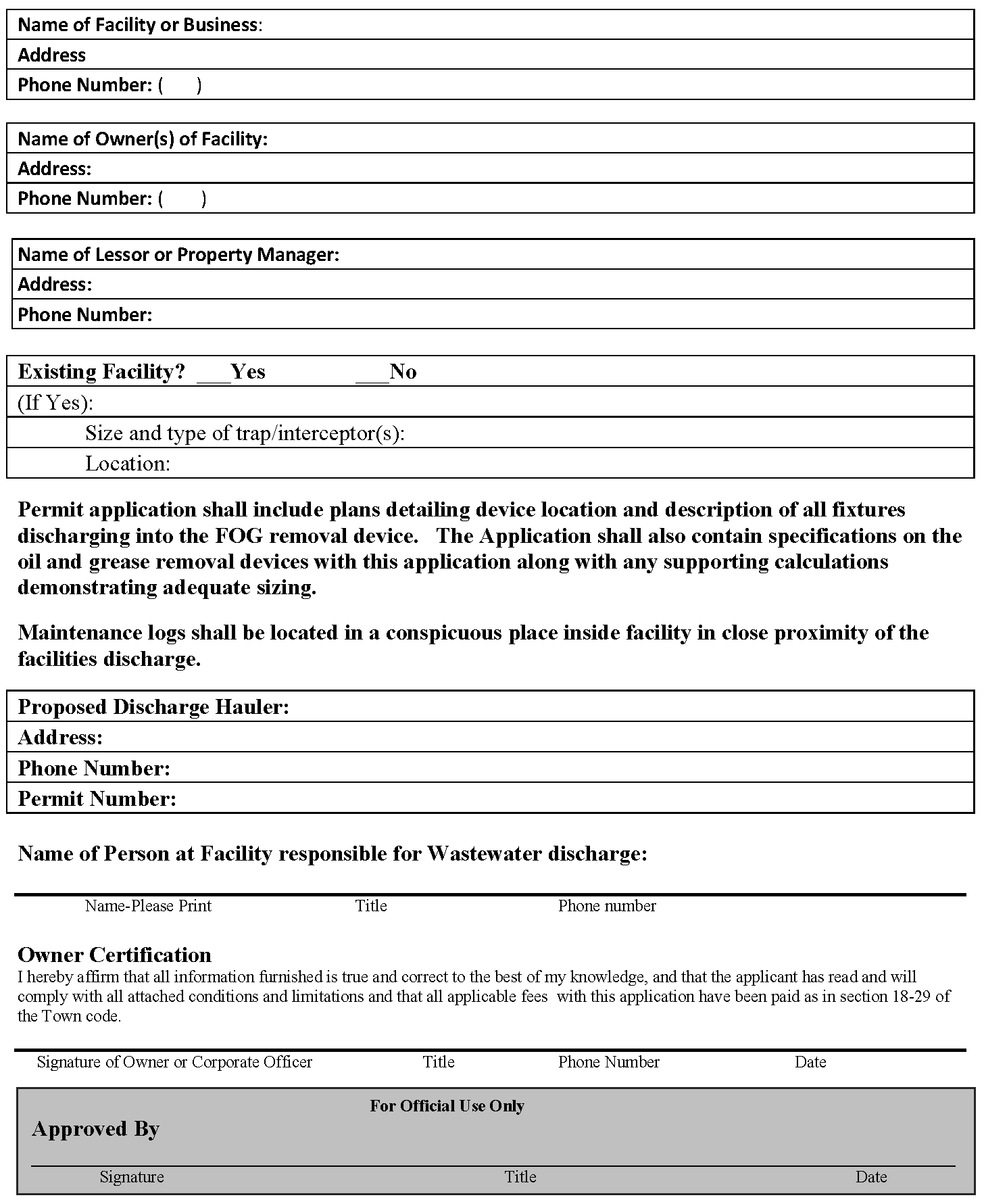
TOWN OF VESTAL
FATS, OIL, GREASE (FOG) REMOVAL DEVICE MAINTENANCE LOG
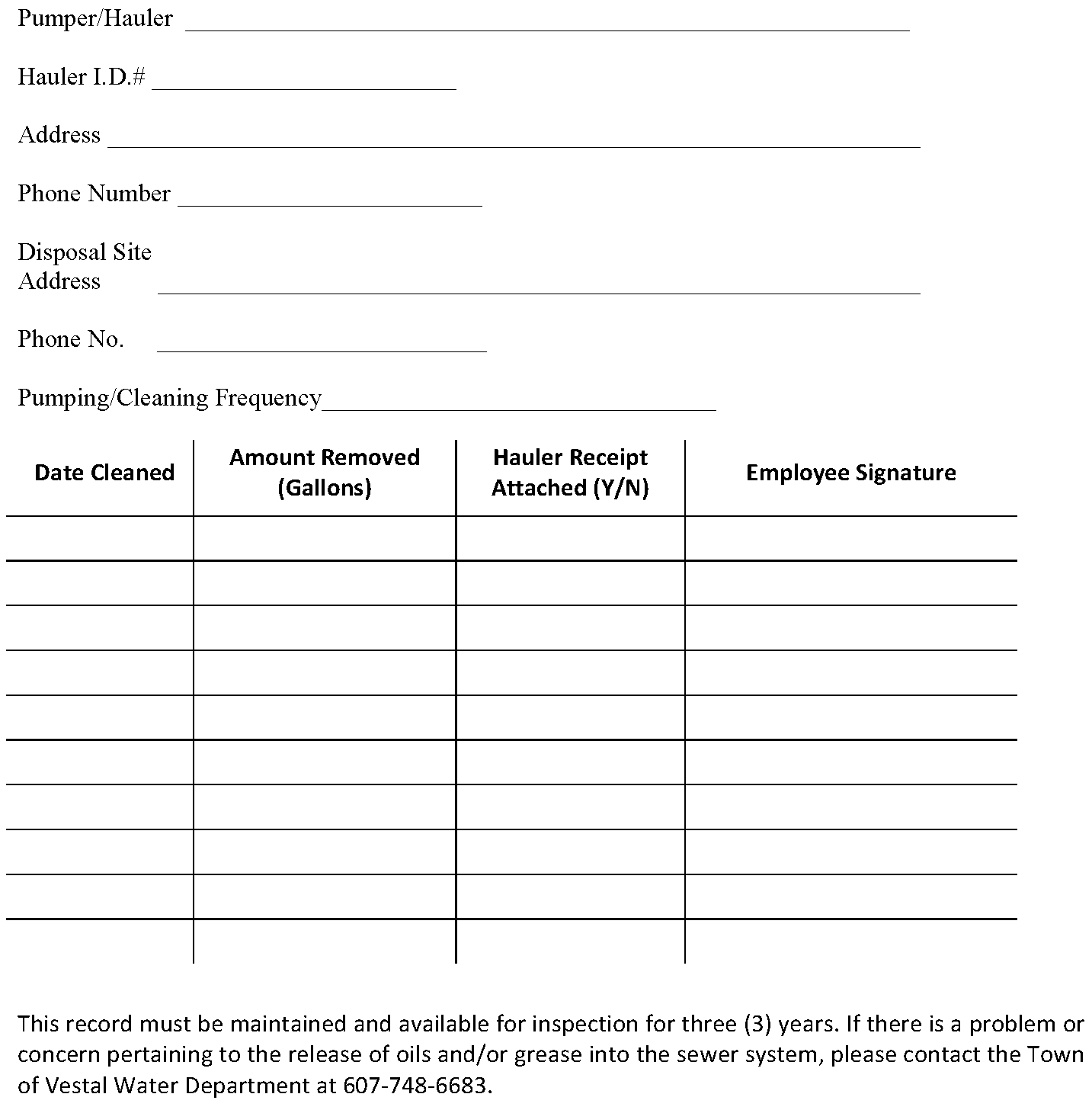
Sec. 18-41. - Scope.
This division applies to the construction of sewers within the town, public sewers, within the streets and on rights-of-way, and building sewers, including the necessary structures, such as manholes, pump stations and appurtenances. This division is the minimum acceptable standards for construction.
(Code 1966, § 28-7(A))
Sec. 18-42. - Abbreviations.
The following abbreviations refer to technical societies or other recognized organizations, as indicated and numbered specifications listed in the specifications in conjunction with these abbreviations shall be construed to mean the latest standard adopted and published at the time the design is approved:
ASA—American Standards Association
ASTM—American Society for Testing and Materials
CISPI—Cast-Iron Pipe Institute
NCPI—National Clay Pipe Institute
(Code 1966, § 28-7(B))
Sec. 18-43. - Permits.
The owner shall obtain such permits as are necessary for the opening of streets, sewer design and building construction, and such other permits as are required by local law. These shall be obtained prior to the start of construction and at no cost to the town. The owner shall be responsible for payment of all fees required by such local laws.
(Code 1966, § 28-7(C))
Sec. 18-44. - Notice of construction.
The town engineer shall be notified at least two (2) working days in advance of the start of construction.
(Code 1966, § 28-7(D))
Sec. 18-45. - Quality, suitability of materials.
All materials becoming a part of the permanent construction, as called for on the approved drawings and in the specifications, shall be first class in every respect and subject to the approval of the town engineer, who shall be the sole judge of their quality and suitability for the purpose for which they are to be used. If any material brought on the site for use in the work is rejected by the town engineer as unsuitable or not in conformity with the specifications, the owner shall immediately remove such materials from the construction site.
(Code 1966, § 28-7(E))
Sec. 18-46. - Approved drawings.
Approved drawings shall consist of a set of plans and profiles prepared by the owner's engineer and submitted to the town engineer for review and approval as to conformity to the basic municipal sewer plan and the specifications. The town engineer's approval shall be affixed to the drawings, and a copy of such approved drawings shall be on the construction site at all times. No deviation shall be made from the line and grade shown on the approved drawings, except by written authorization of the town engineer.
(Code 1966, § 28-7(F))
Sec. 18-47. - As-built drawings.
The owner's engineer shall in a timely fashion provide the town engineer with a revised set of permanent reproducible drawings showing the as-built locations, sizes and elevations of sewers, manholes, building sewers, building sewer terminations and easements, together with such legal descriptions as are required for proper recording of such easements.
(Code 1966, § 28-7(G))
Sec. 18-48. - Excavations and earthwork.
(a)
Definition. In this section "excavation" means the removal from a place of all materials, including soil, structures above and below ground, rock, topsoil, boggy waste, rubbish, ashes, cinders or organic materials, such as peat or humus.
(b)
Cleaning and grubbing. Areas to be excavated, or filled areas to be used for the storage of excavated material and areas of which pavements or other structures will be constructed shall be cleared of all trees, brush, hedges, shrubs, rubbish and other objectionable matter. Such material shall be disposed of in an approved manner.
(c)
Stripping. After clearing and grubbing, all topsoil and other organic material shall be stripped within the limits to be graded, excavated or filled. A minimum of six (6) inches of material shall be removed from all approved areas. All material removed shall be deposited beyond the limits of the work. The material which is of acceptable quality for use in the work such as topsoil shall be kept separate from other excavated materials and protected and maintained until needed. All other stripped material shall be considered as surplus and shall be disposed of in an approved manner.
earth free from stones or rock fragments larger than six (6) inches. Such backfill shall be placed in layers of not more than twelve (12) inches' uncompacted thickness and shall be compacted with flat-faced mechanical tampers or vibratory compactors, depending upon the backfill material, as approved by the town engineer.
(8)
The density of all backfill shall be at least equal to that of the adjacent undisturbed soil so as to avoid future unequal settlement. The moisture content of the backfill material shall be such that proper compaction shall be obtained. Puddling for compaction will not be permitted except with coarse to medium granular materials.
(9)
Where sheeting is withdrawn, all cavities left thereby shall be filled with suitable granular earth, hosed or tamped in place so as to fill all voids thoroughly.
(10)
Backfill and fill shall be carried to a subgrade that permits topsoil or paving of the required depth to be placed to bring it to the finished grade. As far as practicable, the underlying backfill shall be given time to settle, through several heavy rains or by artificial wetting, before the topsoil or pavement is placed.
(11)
The owner shall provide approved material as required to compensate for settlement of backfill and fill for a period of one (1) year.
(n)
Foundation material. Foundation material shall consist of hard and clean gravel or crushed stone. It shall be free from any considerable amount of flat, laminated or elongated particles and shall be free from shell, clay, limestone, shale or other deleterious matter. Gravel or crushed stone shall be graded from one-fourth to three-fourths inch in size. Foundation material shall be placed and firmly compacted by mechanical compacting equipment.
(Code 1966, § 28-7(H))
Sec. 18-49. - Manholes.
(a)
Materials.
(1)
Precast concrete manholes shall conform to the requirements of ASTM:C478, except that joints shall conform to the requirements of ASTM:C433, with O-ring gaskets conforming to ASTM:C361.
(2)
Mortar shall consist of two (2) parts portland cement and five (5) parts sand, thoroughly mixed in the required proportions before adding water.
(3)
Grout shall consist of Type I or Type II portland cement and fine sand and shall contain a compound that will eliminate shrinkage of the grout. The nonshrink grout compound shall be equal to Sika-Kemox-G metallic grout and shall be used in strict accordance with the manufacturer's recommendations.
(b)
Construction. Manholes shall be constructed in accordance with the standard details furnished by the town engineer. The waterways of all manholes shall be formed of the same sizes and shapes as the pipes they connect to. Changes in diameter shall be made gradually and evenly. Special care shall be taken to form channels that will provide the best hydraulic conditions for smooth flow. Steel trowel finish shall be provided. Slopes shall be provided on the benches adjacent to the water-ways as shown on the standard details. Masonry for shallow manholes and for adjustment of the height of manhole chimneys shall be laid in a full bed of mortar with mortar spread on the sides and ends of each unit filled solidly as the work is carried out. The inside of the brick or block shall be rubbed with a burlap sack to clean it of spilled mortar. The exterior surface of the brick or block shall be plastered with a one-half-inch layer of mortar. Particular care shall be taken to secure watertight joints between the manhole chimney and the concrete on which it rests.
(c)
Appurtenances. Manhole frames and covers shall be of the best quality, close-grained, gray iron castings conforming to the requirements of ASTM:A48, Class 30. Standard manhole frames and covers shall be equal to Syracuse Castings Sales Corporation Pattern No. 1104B. Covers shall bear the word "sewer." Letters shall be two-inch Gothic. Covers on manholes on the discharge end of force mains and on manholes adjacent to any pumping station shall be provided with four (4) three-fourths-inch vent holes equally spaced. The casting shall be free from faults, sponginess, cracks, blowholes and other defects affecting their strength and shall be properly cleaned and coated with a waterproof asphalt applied by immersion while the castings are hot. Frames and covers shall be machined to ensure a nonchattering fit. Manhole frames shall be set to grade on full bed of grout.
(Code 1966, § 28-7(I))
Sec. 18-50. - Pipe.
(a)
Pipe and fitting materials. Material for pipe and fittings shall be in accordance with the following schedule:
Notes:
1 Only circular reinforcement will be permitted. Special designed pipe noted as Class VI shall have the following minimum three-edge-bearing test loads:
D: Load to produce a one-hundredth-inch crack: three thousand (3,000).
D: Load to produce ultimate failure: four thousand five hundred (4,500).
2 Fittings for push-on joint pipe shall be mechanical joint fittings or push-on joint fittings conforming to ASA, except for joints, which shall conform to section 11-2.3 of ASA:A21.11.
3 All pipe and fittings shall have a cement mortar lining conforming to the requirements of ASA Standard A21.4 but having twice the thickness specified therein.
All pipe made of any one (1) material shall be from one (1) manufacturer for an entire sewer installation.
(b)
Pipe joints. All pipe joints shall be of a flexible type and shall be in accordance with the following schedule:
Notes:
1 Pipe joints shall be designed to meet the shear loading requirements of ASTM:C425.
2 Section 7 of ASTM:C425 is modified by the requirements specified hereinafter.
3 Rubber rings shall conform to ASTM:D1869 and shall be of the oil-resistant type.
4 Where tied joints are required, they shall be designed to resist the tensile loads, including water hammer. Anchorages and pipe shall be proportioned accordingly.
5 Joints may also be made with oakum or hemp caulked in place followed by not less than one (1) inch of molten lead thoroughly and neatly caulked in place after hardening.
(c)
Shop tests. The owner shall conduct tests for strength, infiltration and exfiltration of selected lengths of pipe prior to and while furnishing the pipe. The owner shall notify the town engineer a minimum of five (5) days prior to the date of testing so that the test may be witnessed. Strength tests shall be as specified in section 18-55.
(d)
Pipe laying. All pipe and fittings shall be installed to the lines and elevations shown on the drawings approved by the town engineer and in accordance with the manufacturer's requirements. In general, all pipe shall be laid in accordance with the requirements of ASTM:C12, utilizing foundation materials as specified under section S1 and in accordance with the applicable portions of section 3A of the current issue of the Handbook of Cast Iron Pipe, as published by the Cast-Iron Pipe Research Association, and alignment shall be maintained by stretching a guideline parallel to and at a determined distance above the pipe invert. The line shall be tight and shall be supported at the required elevation from the guideline. Suitable tools and equipment shall be used for proper handling, storage and laying of pipe and fittings. In order to avoid damage to interior coatings of pipe, lifting hooks or bars shall not be inserted therein. Each pipe and fitting shall be checked by the installer for defects and injuries as laying proceeds. Imperfect pipe material shall be rejected and removed from the work. Pipe found to be defective after laying shall be removed and replaced by undamaged pipe. Pipe shall be cut as required to meet required stations. Where pipe must be cut to fit as closing pieces, such cuts shall be evenly and squarely made in a workmanlike manner with approved equipment. Injury to linings and coatings shall be satisfactorily repaired. All pipe joints shall be made in accordance with the manufacturer's recommendations. Unless otherwise permitted, all finished joints of all kinds of pipe shall be left exposed, and the town engineer shall be notified to inspect the joints, which shall be subject to the town engineer's approval.
(e)
Pipe flotation. Whenever there is a danger of pipe trenches being flooded prior to placing backfill, the pipe shall be filled with water or adequately braced to the sheeting to prevent flotation. The owner shall be responsible for relaying any pipe damaged or moved from the proper line and grade.
(f)
Sewer to be kept clean. The interior of the sewer shall be cleaned of dirt, cement and superfluous materials of every description and kept clean as the next section is installed and shall be provided with temporary covers fitted to the pipe so as to exclude earth and other materials. On completion of the sewer, the lower end shall be securely closed by an approved bulkhead or plug, which shall be removed only on order of the town engineer.
(g)
Field tests.
(1)
The owner shall furnish all labor, testing equipment and materials and shall perform the tests described herein under the supervision, and to the satisfaction, of the town engineer.
(2)
Alignment and openness of joints shall be checked with reflected sunlight and flashlights. The pipe shall be true to both line and grade, shall be free of cracks and protruding joint materials and shall be clean.
(3)
Exfiltration and infiltration tests shall be conducted on completed sections of the sewers, not to exceed one thousand (1,000) feet in length, and each test duration shall be not less than eight (8) hours. Shorter test sections may be required for sewers laid on steep grades. All required pumping shall be carried out.
(4)
Sewer pipes shall first be tested for exfiltration. Plugs shall be provided in manholes to isolate the test sections. The pipe and manholes shall be filled with water to provide at the high points of the test section a minimum head of five (5) feet above groundwater or the top of the pipe, whichever is higher. Approved standpipes or test pits shall be provided to check the groundwater levels. This level must be maintained for the duration of the test. Volumetric measurement of the water added shall be made. Exfiltration shall be limited to a maximum of twenty (20) gallons per day per inch of internal diameter per one thousand (1,000) feet of pipe.
(5)
Upon completion of the exfiltration tests, sewer pipes shall be tested for infiltration. Groundwater levels shall be permitted to return to their normal levels prior to testing. Infiltration shall be checked using weirs, gauges and other measuring devices approved by the town engineer. Temporary bulkheads shall be provided to shut off all flow from above the section to be tested and pumps shall be provided downstream from the weir, in order to assure a free fall over the weir at all times for the duration of the test. Infiltration shall be limited to a maximum of twenty (20) gallons per day per inch of internal diameter per one thousand (1,000) feet of pipe. In addition, the owner and town engineer shall together inspect the interior of all pipe in wet weather, and all obvious leaks shall be repaired even though the total infiltration meets the requirements.
(6)
For the purpose of determining the maximum permissible infiltration and exfiltration, an allowance of one-half gallon per manhole per hour shall be assumed. However, no allowance shall be made for the various lengths of building sewers. If infiltration or exfiltration exceeds the specified amounts, the owner shall do whatever is necessary to reduce the infiltration and exfiltration within the specified limit.
(7)
Force mains shall be bulkheaded as required and tested for leakage at a constant test pressure ten (10) pounds per square inch higher than the anticipated working pressure of the pipe under operation. The duration of the test shall not be less than four (4) hours. Leakage shall not exceed two and one-half (2½) gallons per hour per inch of internal diameter per mile of pipe.
(h)
Choice of pipe.
(1)
The choice of pipe by the owner shall be optional with the owner, with the following limitations:
(2)
Unless otherwise noted, no change in the class or material of sewer pipe shall be made between adjacent manholes, and the greatest depth of trench between the two (2) adjacent manholes shall govern the class of pipe used for that particular section of sewer.
(3)
The drawings submitted to the town engineer by the owner shall contain a detailed list of the type of pipe to be used for the various sections of the work, with the limits designated by street and station.
(Code 1966, § 28-7(J); L.L. No. 2 of 2000, § 2)
Sec. 18-51. - Building sewers.
(a)
Generally. A building sewer shall be extended from the public sewer to within five (5) feet of the inside face of the building foundation in a location which permits ready connection to the building drain. Building sewers shall be subject to review by the town engineer as to suitability of location, depth and slope. The actual location of the end of the building sewer shall be indicated on the working drawings filed with the town engineer. Residential building sewers shall be uniformly four (4) inches in diameter from the public sewer to the building drain and shall be constructed of P.V.C. SDR35 pipe. Adaptors shall be used where required.
(b)
Commercial installations. Building sewers for commercial installations shall be not less than four (4) inches in diameter from the public sewer to the building line and shall be constructed of the materials specified hereinbefore. Building sewers for commercial installations shall be subject to review by the town engineer as to their suitability, and such changes shall be made as required, depending upon the intended usage and flow requirements.
(c)
Bends. All major bends in building sewers shall be by standard fittings. Minor deflections may be made in building sewers without the use of fittings. Fittings shall demonstrate the same strength characteristics as the building sewer. Through the foundation wall there shall be a minimum four-inch, extra heavy cast-iron soil pipe. Inside the building at the end of the building sewer there shall be provided a minimum four-inch cleanout wye. In no instance shall there be any connection to the building sewer on the street side of the cleanout. Any building sewer having bends greater than one-sixteenth shall have adequate cleanouts at such bends and also at intervals no greater than one hundred (100) feet apart. The size of building sewers shall be determined by computed flow.
(d)
Grade.
(1)
Building sewers shall be laid at a uniform grade of not less than one-eighth inch per foot. The provisions of excavation and trenching included in this division shall apply to building sewer construction.
(2)
All building sewers shall be laid on a uniform ascending grade from the main sewer. The following grades shall be considered the minimum and maximum acceptable grades:
(3)
Risers shall be used where the public sewer is deeper than fourteen (14) feet below the grade.
(e)
Connection at sewer. The connection of the building sewer to the main sanitary sewer shall be made at the wye provided for this purpose. This connection shall not be made at any other point without special permission from the inspector.
(f)
Authorization. Building sewers and connections may be installed during the construction of the sanitary sewer system, in conformity with this division; provided, however, that the connection to the house or building shall not be completed and no sewage or other liquids shall be drained from the building sewer into the trunk sewer until the sanitary sewer system is completed, except in cases where specific authorization is granted by the inspector. Watertight caps or plugs shall be provided for building sewers not connected to the building drains.
(g)
Trench. The trench for house connections shall be open to its full depth for the entire length before any pipe is laid therein. No backfilling shall be made until the work is inspected and approved by the inspector for the district. A building sanitary sewer line shall not be located closer than five (5) feet from any water service pipe.
(Code 1966, § 28-7(K); L.L. No. 2 of 2000, § 2)
Sec. 18-52. - Pavement restoration.
Upon backfilling and compacting sewer trenches, the public roads shall be repaired. Base course with a minimum thickness of two and a half (2½) inches shall be installed and maintained by the town until approval is granted by the property owner to complete paving in accordance with the requirements of the town. On private thoroughfares, all effort shall be directed to compacting the trench areas prior to final grading of the subbase. The subbase shall meet the requirements of the town. The owner shall provide such lights, barriers and guards as required by existing safety laws or the town engineer for marking construction on public roads.
(Code 1966, § 28-7(L); L.L. No. 2 of 2000, § 2)
Sec. 18-53. - Supplemental specifications.
The town and the town engineer reserve the right to issue such supplemental specifications describing the workmanship and the material requirements for approved construction not defined by these specifications.
(Code 1966, § 28-7(M))
Sec. 18-54. - Pump stations.
Design criteria for pump stations shall be submitted to the town engineer prior to placement of purchase orders or the start of detail design.
(Code 1966, § 28-7(N))
Sec. 18-55. - Strength tests.
The strength tests referred to in section 18-50 shall be in accordance with the following schedule:
*Percentage applies to the number of pipes of each size and class to be furnished. There shall be not less than two (2) tests for each size and class.
(Code 1966, § 28-7(J)(3); L.L. No. 2 of 2000, § 2)
Sec. 18-71. - Definitions.
The following words, terms and phrases, when used in this division, shall have the meanings ascribed to them in this section, except where the context clearly indicates a different meaning:
Discharge permit means a permit issued by the town engineer with the consent of the Endicott Superintendent of Public Works to an industry authorizing the discharge of industrial wastes into the public sewer system. Such consent shall be reflected by the affixing of the signatures of both officials on the permit for validation and copies shall be kept on file in the offices of both the town and the Village of Endicott.
Normal sewage means sewage shall be regarded as normal for the town if analyses show, by weight, a daily average of not more than four hundred (400) parts per million of suspended solids, nor more than two hundred forty (240) parts per million of BOD and not more than fifty (50) parts per million of either soluble matter (grease or oil) each per million gallons of daily flow, and is neither a prohibited discharge nor other constituents in excess of the limits stipulated in this division.
Sewer fund means the Endicott Joint Water Pollution Control bank account maintained by the Village of Endicott for the benefit of all parties in the sewer service area.
Significant industrial user means an industry subject to promulgated categorical pretreatment standards which uses annually more than ten thousand (10,000) pounds or one thousand (1,000) gallons of raw material containing priority pollutants of which a measurable amount are discharged from the process to the public sewer system and treatment plant, and as otherwise defined by NYSDEC and USEPA.
Superintendent of sewer disposal plant/public works means the superintendent and/or his authorized deputies, agents or representatives of the Village of Endicott responsible for the operation and maintenance of the sewage treatment plant under the provisions of the Environmental Conservation Law and the SPDES permit issued to the village thereunder.
Unpolluted water or unpolluted waste means any water or waste containing none of the following: free or emulsified grease or oil; acids or alkalis; phenols or other substances imparting taste or odor to receiving waters; toxic or poisonous substances in suspension, colloidal state or solution; and noxious or odorous gases. It shall contain not more than ten thousand (10,000) parts per million, by weight, of dissolved solids, of which not more than two thousand five hundred (2,500) parts per million shall be as chloride with permissible volumes subject to review by the engineer, and not more than ten (10) parts per million each of suspended solids and BOD. The color shall not exceed fifty (50) parts per million.
Village means the Village of Endicott.
(Code 1966, § 28-8(B))
Cross reference— Definitions and rules of construction generally, § 1-2.
Sec. 18-72. - Applicability.
The provisions of this division shall apply exclusively to the discharge of industrial and other non-residential wastes to any town-owned public sewer which conveys wastewater to the village sewage treatment plant.
(Code 1966, § 28-8(A))
Sec. 18-73. - Power, authority of inspectors.
(a)
The town engineer and other duly authorized officers and employees of the USEPA, NYSDEC, the village and the town bearing proper credentials and identification shall be permitted to enter upon all private and public property for the purpose of inspection, observation, measurement, sampling and testing in accordance with the provisions of this division during any reasonable hour of the day or at any time during an emergency.
(b)
The town engineer and/or the village superintendent of public works may cease wastewater treatment services by suspension of the discharge or special permit held by a user when in his opinion suspension is necessary to avert an actual or threatened discharge which presents or may present an imminent or substantial endangerment to the health or welfare of persons, to the environment or would cause interference with the POTW operation or cause a violation of the treatment plant SPDES permit. Should a user fail to comply with the suspension notice, the town engineer and/or the village superintendent of public works may take such steps as he deems necessary, including the immediate physical severance of the sewer connections to the public sewer system. Services shall be restored upon proof of the elimination of the noncomplying discharge. Such proof shall be in the form of a written report by the user describing the causes of the condition and the measures taken to prevent future occurrences, followed by an inspection of the facility by the town engineer and the village superintendent of public works to verify such measures.
(c)
The town engineer and/or the village superintendent of public works may suspend the permit of a user who violates the following conditions of this division, or applicable state and federal regulations:
(1)
Failure of a user to factually report the wastewater constituents and characteristics of its discharge.
(2)
Failure of a user to report significant changes in operations and waste characteristics, as well as additions to pretreatment or flow control facilities.
(3)
Refusal of reasonable access to the user's premises for the purpose of inspection or monitoring.
(4)
Failure of a user to correct permit condition violations within time designated by a notice of violation.
(d)
Nothing under this division shall be construed to reduce in any manner the power of the town engineer and the village superintendent of public works to refuse the acceptance of a discharge if in their opinion there is noncompliance with the provisions of this article.
(Code 1966, § 28-8(D))
Sec. 18-74. - Industrial pretreatment and enforcement procedures.
(a)
Whenever the town engineer and/or the village superintendent of public works determines that there are reasonable grounds to believe that there has been a violation of any provision of this division or of any rule or regulation adopted pursuant hereto, he shall give notice of such violation to the person or persons responsible therefor, as herein provided. Such notice shall:
(1)
Be in writing.
(2)
Include a statement of the reasons why it is being issued with reference to the sections of this division deemed to be violated.
(3)
Allow a reasonable time for the performance of any act it requires, not to exceed thirty (30) days.
(4)
Be served upon the owner or his agent, and the occupant, as the case may be, either by registered or certified mail, or by personal service.
(5)
May also contain an outline of remedial action, which if taken will effect compliance with the provisions of this division and/or with rules and regulations adopted pursuant thereto.
(b)
If the violation is not corrected by timely compliance the town engineer and/or the village superintendent of public works may order any person who causes or allows an unauthorized discharge to show cause why service should not be terminated. A notice shall be served on the offending party, specifying the time and place of a hearing to be held regarding the violation, and directing the offending party to show cause why an order should not be made directing the termination of service. The notice of the hearing shall be served personally or by registered or certified mail (return receipt requested) at least ten (10) days before the hearing. Notification may be made on any agent or officer of a corporation. The town and the village or the town itself may conduct the hearing and take the evidence, or may designate any of its members or any officer or employee to:
(1)
Issue in the name of the town and/or village notices of hearings requesting the attendance and testimony of witnesses and the production of evidence relevant to any matter involved in any such hearings.
(2)
Take the evidence.
(3)
Transmit a report of the evidence and hearing, including transcripts and other evidence, together with the recommendations to the town and/or village for action thereon.
At any order to show cause hearing, testimony taken before the hearing authority or any person designated by it, must be under oath and recorded stenographically. The transcript, or any part thereof, so recorded, will be made available to any member of the public upon payment of the cost of preparing same. The town and/or village, however, may, pursuant to law, order certain portions of the hearing be held in private session. The transcript of any hearing held in private session will not be made available to members of the public except as provided by law.
After the town and/or village has reviewed the evidence, it may issue an order to the person responsible for the discharge directing that, following a specified time period, that the person's discharge permit be revoked and that sewer service be discontinued unless adequate pretreatment facilities, devices or other related appurtenances shall have been installed or existing pretreatment facilities, devices or other related appurtenances are properly operated, and such further orders and directives as necessary and appropriate are complied with.
(c)
Any continuance of a violation of the substantive provisions of this division shall be considered a public nuisance. If any person continues to discharge sewage, industrial wastes or other wastes into the public sewer system or into the village sewage treatment plant in violation of this division or any order of the town and/or village, the governing body may commence an action for appropriate legal and/or equitable relief.
(Code 1966, § 28-8(E))
Sec. 18-75. - Penalties.
(a)
Except as may otherwise be determined through the legal process under pretreatment enforcement procedures, any person violating any provisions of this division shall be liable to a fine of not less than one hundred dollars ($100.00) nor more than five hundred dollars ($500.00) in amount, or to imprisonment not exceeding one hundred fifty (150) days, or to both such fine and imprisonment. Each day in which any violation of any provision of this division shall continue shall be deemed a separate violation. In addition, the town may recover court costs, attorneys' fees and other litigation expenses against the person found in violation of the provisions of this division. Any person violating any provisions of this division shall also become liable to the town for any expense, loss or damage sustained or incurred by the town by reasons of such violation. All moneys received as payment of fines shall be deposited into the sewer fund.
(b)
Any person violating any provisions of this division shall become liable to the town and/or village for any expense, loss or damage sustained or incurred by the town and/or village by reasons of such violation. All moneys received as payment of damages related to the POTW shall be deposited into the sewer fund.
(Code 1966, § 28-8(F))
Sec. 18-76. - Prohibited discharges.
(a)
No person shall discharge or cause to be discharged into any public sewer any of the following described substances, materials, waters or wastes:
(1)
Any liquid or vapor having a temperature higher than one hundred four (104) degrees Fahrenheit (forty (40) degrees Celsius). In such cases the engineer may require installation by the industry of an approved temperature recorder in the receiving sewer.
(2)
Any water or wastes which contains grease or oil or other substance that will solidify or become discernibly viscous at temperatures under one hundred twenty (120) degrees Fahrenheit. Any water or wastes containing emulsified oil and grease exceeding on analysis an average of fifty (50) parts per million (four hundred seventeen (417) pounds per million gallons) of either soluble matter.
(3)
Any gasoline, benzene, naphtha, fuel oil or mineral oil or other flammable or explosive liquid, solid or gas.
(4)
Any water or wastes that contain more than two (2) parts per million, by weight, of the following gases: hydrogen sulfide, sulfide, sulfur dioxide or oxides of nitrogen.
(5)
Any ashes, cinders, sand, mud, straw, shavings, metal, glass, rubber, rags, feathers, tar, fleshings, entrails, lime slurry, lime residues, beer or distillery slops, chemical residues, paint residues, cannery waste, bulk solids or any solid or viscous substance capable of causing obstruction to the flow in sewers or other interference with the proper operation of the sewage plant.
(6)
Any waters or wastes that contain phenols in such quantity that the aggregate of contributions throughout the area of service creates treatment difficulties or produces a plant effluent which may be unsatisfactory.
(7)
Any waters or wastes, acid or alkaline, in reaction and having corrosive properties, capable of causing damage or hazard to structures, equipment or personnel of the sewage plant. Free acids and alkalis of such wastes must be neutralized at all times within a permissible range of pH between six (6) and nine (9).
(8)
Any waters or wastes containing a toxic or poisonous substance in sufficient quantity to injure or interfere with any sewage treatment process, constitute a hazard to humans or animals or create any hazard in the receiving waters or stormwater overflows or the effluent of the sewage treatment plant, including the meeting of SPDES effluent criteria.
(9)
Any water or wastes containing the discharges of strong acid iron pickling wastes or concentrated plating solutions, whether neutralized or not.
(10)
Any waters containing suspended solids of such character and quantity that unusual provisions, attention or expense is required to handle such materials at the sewage treatment plant.
(11)
Any noxious or malodorous gas or substance which, either singly or by interaction with any waste, is capable of creating a hazard or menace to life or property, or of preventing entry into sewers for their maintenance and repair.
(12)
Any radioactive substances, without special permit to be applied for and issued in the same manner as set forth in section 18-26, subsection (d).
(13)
Any waters or wastes that for a duration of fifteen (15) minutes have a concentration greater than five (5) times that of normal sewage, as measured by suspended solids and BOD.
(14)
Any concentrated dye wastes, spent tanning solutions or other wastes which are highly colored or wastes which are of unusual volume, concentration of solids or composition, such as, for example, total suspended solids of inert nature (such as fuller's earth) and/or total dissolved solids (such as sodium chloride, calcium chloride or sodium sulfate) or wastes which are unusual in BOD.
(15)
Any waters or wastes which, by interaction with other waters or wastes in the public sewer system, release obnoxious gases or develop color of undesirable intensity or form suspended solids in objectionable concentration or create any other condition deleterious to structures and treatment processes.
(16)
Any garbage other than properly shredded garbage by garbage grinders approved by the town engineer.
(17)
Any wastes which will cause interference as defined by 40 CFR 403.3, with the sewage collection.
(b)
Notwithstanding the provisions of section 18-26, any discharge into the public sewer of wastes, whose concentration exceeds the following pollutant limits, is prohibited:
At no time shall the maximum measured concentration exceed five (5) times the average thirty-day concentration limits specified above. Average concentration means a twenty-four-hour composite sample. Instantaneous stands for a grab sample. Upon promulgation of each federal categorical pretreatment standard for a particular industrial subcategory, the federal standard, if more stringent than limitations imposed under this division, shall immediately supersede those limitations for that particular industrial subcategory. The village superintendent of public works will notify all affected users of the EPA's promulgation of new pretreatment standards which shall have full force and effect as if written in this division. All other limits affecting other users shall remain in effect.
(c)
Any industry discharging more than ten thousand (10,000) gallons per day into the public sewer system shall be required to:
(1)
Obtain a discharge permit in the manner as set forth in section 18-24, subsection (b).
(2)
Install a sewage flow meter at each connection to the public sewer. The flow meter shall record the total gallonage passing through the meter and shall be of a manufacture approved by the town engineer and the village superintendent of public works. Responsibility for keeping the flow meter in continuous, efficient operating order shall rest with the owner and/or operator of the industry discharging the sewage, all at his expense.
(d)
The admission into the public sewers of any waters or wastes having any of the following characteristics shall be prohibited:
(1)
A BOD of more than two hundred forty (240) parts per million.
(2)
A suspended solids content greater than four hundred (400) parts per million.
(3)
A quantity of substances having the characteristics described in section 18-26, subsection (e).
(4)
Pollutants exceeding the limits prescribed in the preceding subsections of this section. Dilution shall not be permitted or accepted as a substitute or alternate for adequate pretreatment.
(e)
Where pretreatment facilities are provided for any water or wastes, they shall be maintained continuously in satisfactory and effective operation by the owner, at his expense, and shall be subject to the periodic inspection by the town engineer and the village superintendent of public works. They must produce an effluent conforming to the provisions of this article. The owner shall maintain operating records and shall submit to the town engineer and the village superintendent of public works a monthly summary report of the character of the influent and effluent as may be prescribed by the town engineer and the village superintendent of public works to show satisfactory performance of the treatment facilities. No subsequent alterations and additions to such pretreatment facilities shall be made without prior approval of the town engineer and village superintendent of public works. The town engineer and/or the superintendent of public works of the village shall have the absolute right to inspect and copy all applicable user records, during regular business hours, in accordance with the requirements of 40 CFR 403.12.
(f)
Any approval by the engineer and/or village superintendent of public works of the type, kind or capacity of an installation shall not relieve the owner of the responsibility of revamping, enlarging or otherwise modifying an installation if it is found inadequate to accomplish the intended purpose.
(g)
All measurements, tests and analyses of the characteristics of waters and wastes to which reference is made herein shall be determined in accordance with Standard Methods for the Examination of Water and Wastewater and shall be determined at a control manhole provided for herein upon the taking of suitable samples at the control manhole. If no manhole has been required, the control manhole shall be considered to be the nearest downstream manhole in the public sewer to the point at which the building sewer is connected or as otherwise prescribed by the state department of environmental conservation and United States Environmental Protection Agency standards for analysis of pollutants.
(h)
If wastewaters containing any substance described in subsection (d) are discharged or proposed to be discharged into the local sewer system or into the Endicott Sewage Treatment Plant, the town engineer, in concert with the village superintendent of public works, may take any action necessary to:
(1)
Prohibit the discharge of such wastewater.
(2)
Require a discharger to demonstrate the in-plant modifications will reduce or eliminate the discharge of such substances in conformity with this division.
(3)
Require pretreatment, including storage facilities or flow equalization necessary to reduce or eliminate the objectionable characteristics or substances so that the discharge will not violate this division.
(4)
Require the person making, causing or allowing the discharge to pay any additional cost or expense incurred for handling and treating excess loads imposed on the local sewer system and the Endicott Sewage Treatment Plant.
Self-monitoring reports shall be submitted by significant industrial users and shall include information on slug loadings that may interfere with or disrupt the process operation at the sewage treatment plant. These will be reviewed by the monitoring and enforcement group. Falsification of information will be subject to penalties as determined by these regulations, to the extent provided by law.
(i)
Each industrial user shall provide protection from an accidental discharge of prohibited materials or other regulated wastes. Facilities to prevent accidental discharge of prohibited materials shall be provided and maintained at the owner's or operator's own cost and expense. Detailed plans showing facilities and operating procedures to provide this protection shall be submitted to the town engineer and the village superintendent of public works, and shall be approved by them before construction of the facility. Review and approval of such plans and operating procedures shall not relieve the industrial user from the responsibility to modify his facility as necessary to meet the requirements of this article.
(j)
If, at any time, a facility has not complied with or will be unable to comply with any prohibition or limitations in this article, the facility responsible for such discharge shall immediately notify the town engineer and the village superintendent of public works so that corrective action may be taken to protect the treatment plant. In addition, a written report addressed to the commissioner of public works, the village superintendent of public works and town engineer detailing the date, time and cause of such discharge, the quantity and characteristics of the discharge and corrective action taken to prevent future discharges, shall be filed by the responsible industrial facility within five (5) days of the occurrence of the noncomplying discharge.
(Code 1966, § 28-8(C))
Sec. 18-77. - Permits.
(a)
Upon enactment of the local law from which this division is derived, every commercial business and industrial user, whether or not a significant industrial user, will be given six (6) months to file for a waste discharge permit. A completed application shall contain the information that would be required to evaluate the industry's waste stream in the case of an industry. In the case of a commercial business or other nonresidential, nonindustrial user, the information required will address substances of concern as defined by the state department of environmental conservation. The forms for which the application is required shall contain all references to listed substances of concern or, in the case of industries, the contents of the waste stream as defined under the environmental conservation law of the state and by the environmental protection agency through published rules and regulations as amended at the time of the application.
Based on information presented in the completed application the monitoring and enforcement group will decide whether:
(1)
Discharges are subject to a surcharge;
(2)
Discharges require pretreatment;
(3)
Discharges may be self-monitored;
(4)
Further waste discharge investigation is necessary;
(5)
Permits will require renewal annually.
Applicants for an industrial/commercial wastewater discharge permit shall complete a prescribed form available at the commissioner of public works office or the village department of public works office. The application will be approved if the applicant has complied with all applicable requirements of this division.
(b)
Users required to file for a discharge permit or special permit shall complete and file an application with the village superintendent of public works, with a copy to the commissioner of public works and the town engineer. The application shall be accompanied by a fee of one hundred fifty dollars ($150.00) for each connection to the public sewer system from the user's facilities in the case of significant industrial users.
For the purposes of this section, a significant industrial user includes:
(1)
All industries subject to promulgated categorical pretreatment standards.
(2)
Industries having substantial impact, either singly or in combination with other contributing industries, on the operation of the treatment works.
(3)
Manufacturing industries using on an annual basis more than ten thousand (10,000) pounds or one thousand (1,000) gallons of raw material containing priority pollutants/substances of concern and discharging immeasurable amounts of these pollutants to the sewer system from the process using these pollutants.
(4)
Those industries discharging more than five (5) percent of the flow or load carried by the treatment plant receiving the waste.
(5)
As otherwise defined by EPA or DEC.
No fee shall be charged to any nonresidential commercial business user who does not qualify as a significant industrial user as herein defined.
(c)
Should pretreatment or other operational controls be determined as necessary by the monitoring and enforcement group in order to comply with the provisions of this division or USEPA national categorical standards as they are promulgated, a waste discharge permit may be issued conditionally providing sufficient time for the user to commence proceedings for the design, construction and approval of a suitable pretreatment facility or other operational controls meeting the prescribed standards. A conditional permit shall require renewal every six (6) months wherein satisfactory progress on the implementation of the facility construction shall be demonstrated. Where progress is unsatisfactory to the village superintendent of public works, he may delay issuance of a renewal permit until satisfactory progress is demonstrated. Each day the user discharges wastes without a valid permit constitutes a violation of this division.
(d)
Within six (6) months of the promulgation of a national categorical pretreatment standard, the discharge permits of users subject to such standard shall be revised to comply with the limits specified therein within the time frame set forth by such standard. Users shall have ninety (90) days thereafter to submit new permit applications to the village superintendent of public works which shall include a report on the disposition of pollutants in their waste streams so affected and, if necessary, a schedule for the construction of pretreatment facilities or other operational controls from meeting the prescribed standard. Conditional permits may be issued as provided in subsection (c).
(e)
Discharge permits shall be expressly subject to all provisions of this division and all other applicable regulations, user charges, compliance schedules, reports and other conditions deemed appropriate by the village superintendent of public works.
(f)
Discharge permits shall require renewal annually. At least one (1) month shall be allowed for processing and issuing of renewal permits. All users required to have discharge permits shall have a valid permit in continuous effect at all times. Each day's lapse constitutes a separate violation of this division.
(g)
Discharge permits are issued to specific users for specific operations. Permits shall not be assigned, transferred or sold to a new owner, new user, a different premises or to a new or changed operation. Each new owner shall be required to apply for a new discharge permit within sixty (60) days of assuming ownership, but prior to commencing waste discharges from an interrupted or modified operation.
(Code 1966, § 28-8(H))
Sec. 18-78. - User charge system.
(a)
A user charge system shall be employed to provide for the recovery of costs from all users of the Endicott POTW based on measured sewage flows (or waste consumption records); biochemical oxygen demand, suspended solids and other pollutants for which costs of treatment and disposal can be assigned. Surcharges shall be applied for biochemical oxygen demand and suspended solid concentrations which exceed normal sewage limits. Costs to be recovered by the user charge system shall include the operation and maintenance of the sewage treatment plant and intercepting system, as defined in the agreements between the village, Town of Union and Town of Vestal in addition to the pretreatment monitoring and enforcement program described in this division. Separate fee schedules shall be established for permit applications from industrial users.
(b)
The formulation of user charge rates will be determined semiannually by the POTW monitoring and enforcement group from actual operating data for the sewage treatment plant and intercepting sewers and the information obtained on each user of the system. For the first billing in a given fiscal year, user charge rates will be predicated upon operation and maintenance budget estimates for that fiscal year. For the final billing, user charge rates will be adjusted to reflect actual costs incurred by the Endicott POTW for the given fiscal year.
(c)
Debt service on capital expenditures and local sewer maintenance costs will not be included under the user charge cost recovery system.
(Code 1966, § 28-8(G))
Sec. 18-91. - Definitions.
The following words, terms and phrases, when used in this division, shall have the meanings ascribed to them in this section, except where the context clearly indicates a different meaning:
Board, joint board or joint sewage board means the Binghamton-Johnson City Joint Sewage Board, established under the contract between the City of Binghamton and the Village of Johnson City for the operation of a joint sewage treatment plant. The term includes any duly authorized designee, agent or representative of the board.
Industrial user means any nonresidential user of the town-owned public sewer system which is identified in the Standard Industrial Classification Manual, 1972, Office of Management and Budget, as amended and supplemented under one (1) of the following divisions:
Division A—Agriculture, Forestry and Fishing
Division B—Mining
Division D—Manufacturing
Division E—Transportation, Communication, Electrical, Gas and Sanitary Services
Division I—Services
Industrial waste means any discarded matter including any liquid, gaseous or solid substance, or a combination thereof, resulting from any process of industry, manufacturing, trade or business or from development or recovery of natural resources. The term shall not include garbage.
Industrial wastewater discharge permit means a permit issued by the board, authorizing the user to deposit or discharge industrial wastewater into any town-owned public sewer served by the Binghamton-Johnson City Sewage Treatment Plant.
Joint sewage treatment plant or treatment plant means the Binghamton-Johnson City Joint Sewage Treatment Plant. The term includes all intercepting sewers, outfall sewers, sewage collection systems, pumping, power and other equipment and appurtenances under the jurisdiction and control of the Binghamton-Johnson City Joint Sewage Board.
Pretreatment means the reduction of the amount of pollutants, the elimination of pollutants, or the alteration of the nature of pollutant properties in wastewater prior to discharge to the town-owned public sewer system.
Rules and regulations of the board means the "Rules and Regulations Relating to the Use of the Binghamton-Johnson City Joint Sewage Treatment Plant," promulgated by the Binghamton-Johnson City Joint Sewage Board.
User means any person who contributes, causes or permits the contribution of wastewater into the town-owned public sewer system and discharged into the joint sewage treatment plant.
Wastewater means the water-carried domestic, human or animal waste from residences, buildings, industrial establishments or other places, together with such ground infiltration, industrial and commercial wastes as may be present.
(Code 1966, § 28-9(B))
Cross reference— Definitions and rules of construction generally, § 1-2.
Sec. 18-92. - Application.
The provisions of this division shall apply exclusively to the discharge of industrial wastes to any town-owned public sewer which conveys wastewater to the Binghamton-Johnson City Joint Sewage Treatment Plant.
(Code 1966, § 28-9(A))
Sec. 18-93. - Authority of joint sewage board.
(a)
The admission into the town-owned public sewers of any industrial wastes shall be subject to the review and approval of the joint sewage board. The joint board is granted authority, concurrent with that of the town, to enforce against any user within the town all requirements necessary to ensure compliance with the provisions of the rules and regulations of the board and this division. Nothing contained herein, however, shall be construed as precluding the town from seeking against any user such remedial action as it deems appropriate for correcting any violation of its local laws, ordinances or regulations governing use of the town public sewer system.
(b)
In exercising its authority over users discharging industrial wastes into the town public sewer system, the joint board may:
(1)
Require pretreatment of the user's wastewater to a condition acceptable for discharge to the public sewer.
(2)
Require the user to apply for and obtain an industrial wastewater discharge permit as a means of controlling the quantities and rates of discharge.
(3)
Require payment by the user to cover any added cost of handling and treating the wastewater not covered by existing fees or charges.
(4)
Require the development of compliance schedules by the user to meet any applicable requirements prescribed by the board's rules and regulations.
(5)
Require the user to submit such reports and supplemental information which the joint board deems necessary to assure compliance with any applicable requirements prescribed by the joint board's rules and regulations.
(6)
Carry out all inspection, surveillance and monitoring necessary to ascertain the user's compliance with applicable requirements prescribed by the joint board's rules and regulations.
(7)
Investigate or make inquiry in a manner to be determined by it, as to any condition within the town affecting the operation of the joint sewage treatment plant, and as to any alleged act or omission or failure to comply with the joint board's rules and regulations.
(8)
Obtain remedies for noncompliance by any such user as specified in section 18-97.
(9)
Reject the user's wastewater where the joint board determines that the wastewater contains substances or possesses characteristics which have a deleterious effect on the sewage treatment plant and its appurtenant facilities, or the processes, equipment or receiving waters of the treatment plant, or which constitute a public nuisance or hazard.
(10)
Take such other measures as it deems necessary and proper to ensure compliance with this law, with applicable state and federal law, and with the rules and regulations of the board.
(Code 1966, § 28-9(C))
Sec. 18-94. - Inspections.
The town, the joint sewage board, and representatives of the EPA and DEC bearing proper credentials and identification shall be permitted to enter all properties at all reasonable times for the purpose of inspection, observation, sampling, flow measurement and testing to ascertain a user's compliance with the applicable provisions of federal, state and local law governing use of the town public sewer system, and with the provisions of the rules and regulations of the board. The town and the joint board shall have the right to set up on the user's property such devices as are necessary to conduct sampling or flow measurement. The town and the joint board shall additionally have access to and may copy any records the user is required to maintain under the rules and regulations of the board or the town's sewer use law. Where a user has security measures in force which would require proper identification and clearance before entry into the premises, the user shall make necessary arrangements so that upon presentation of suitable identification, inspecting personnel will be permitted to enter without delay for the purpose of performing their specific responsibilities.
(Code 1966, § 28-9(D))
Sec. 18-95. - Violations.
(a)
No user discharging or proposing to discharge wastewater into the town public sewer system shall violate any of the provisions of, or fail to perform any duty imposed by, the rules and regulations of the joint board; or any order or determination of the joint board promulgated thereunder; or the terms and conditions of any permit issued by the joint board.
(b)
No unauthorized person shall maliciously, willfully or negligently break, damage, destroy, uncover, deface or tamper with any structure, appurtenance, or equipment which is under the jurisdiction, ownership or control of the joint sewage board.
(c)
No person shall tamper with or knowingly render inaccurate any measuring device or mechanism installed pursuant to any requirement under the rules and regulations of the board.
(d)
No person shall knowingly make any false statement in any application, report, or other document required to be filed pursuant to any provision of the rules and regulations of the board.
(Code 1966, § 28-9(E))
Sec. 18-96. - Industrial waste surcharge.
In addition to any other fees, charges, sewer rents or sanitary district taxes provided by law, industrial users shall pay to the joint sewage board an industrial waste surcharge for the privilege of using the joint sewage treatment plant for treating industrial wastes or other special wastes accepted for discharge into the town public sewer system. The industrial waste surcharge shall be computed and collected by the joint board in accordance with its uniform rules and regulations.
(Code 1966, § 28-9(F))
Sec. 18-97. - Enforcement; penalties.
(a)
Any person who violates any provision of section 18-95 shall be liable to the town for a civil penalty not less than one hundred dollars ($100.00) and not more than five hundred dollars ($500.00) for each violation, to be assessed by the town after a hearing or opportunity to be heard in accordance with the procedures set forth in the joint board's rules and regulations or the town's. Each violation shall be a separate and distinct violation, and in the case of a continuing violation, each day's continuance thereof shall be deemed a separate and distinct violation. Such penalty may be recovered in an action brought by the joint board's attorney in any court of competent jurisdiction.
(b)
In addition to the power to assess penalties as set forth in subsection (a) above, the town and joint board are hereby empowered, following a hearing or opportunity to be heard in accordance with the provisions of its rules and regulations, to issue an order in the name of the joint board and of the town enjoining the violator from continuing the violation. Any such order of the town or joint board shall be enforceable in an action brought by the town or joint board in any court of competent jurisdiction.
(c)
Any civil penalty or final order issued by the town or joint board pursuant to subsection (b) may be reviewed in a proceeding brought pursuant to article 78 [§ 7801 et seq.] of the Civil Practice Law and Rules. Application for such review must be made within thirty (30) days after service in person or by mail of a copy of the determination or order upon the attorney of record for the applicant and of each person who has filed a notice of appearance; or upon the applicant in person if not represented by an attorney.
(d)
Any person who violates any provision of section 18-95 shall be guilty of a misdemeanor, and upon conviction thereof, shall be punished by a fine of not less than three hundred dollars ($300.00) nor more than one thousand dollars ($1,000.00) or by imprisonment of not more than six (6) months, or by both such fine and imprisonment. Each offense shall be a separate and distinct offense, and in the case of a continuing offense, each day's continuance thereof shall be deemed a separate and distinct offense.
(e)
Any person violating any provision of section 18-95 shall, in addition, be liable to the joint sewage board and the town for any expense, loss or damage occasioned to the board and the town by reason of such violation, and any expense incurred in correcting the violation.
(f)
The joint board's attorney, or the town attorney, shall have the right to seek equitable relief in the name of the town to restrain the violation of, or to compel compliance with, any provision of section 18-95.
(g)
Notwithstanding any inconsistent provisions of law, whenever the joint board finds, after investigation, that any user within the town is causing, engaging in or maintaining a condition or activity which, in its judgment, presents an imminent danger to the public health, safety or welfare, or to the environment, or is likely to result in irrevocable or irreparable damage to the Binghamton-Johnson City Joint Sewage Treatment Plant, and it therefore appears to be prejudicial to the opportunity for a hearing can be provided, the joint board may, without prior hearing, order such user by notice in writing wherever practicable, or in such other form as in the joint board's judgment will reasonably notify such person whose practices are intended to be proscribed, to discontinue, abate or alleviate such condition or activity; and thereupon such person shall immediately discontinue, abate or alleviate such condition or activity. In the event of a user's failure to comply voluntarily with such emergency order, or where the giving of notice is impracticable, the joint board may take all appropriate action (including disconnecting the user's premises from the town public sewer system) in order to abate the violating condition. As promptly as possible thereafter, not to exceed fifteen (15) days, the board shall provide the user an opportunity to be heard in accordance with the provisions of its rules and regulations.
(Code 1966, § 28-9(G))
Sec. 18-98. - Cooperation of town officials.
Town officers and employees shall cooperate fully with the joint board in the joint board's enforcement and administration of its rules and regulations within the town.
(Code 1966, § 28-9(H))
Sec. 18-99. - Authority.
The Binghamton-Johnson City Joint Sewage Board (board), having an approved flow management plan, as required under a series of administrative consent orders by the New York State Department of Environmental Conservation (NYS-DEC) to manage and provide for treatment of wastewater flows, is the local authority for the requirements of and implementation of the new or modified sewer connection application program.
(L.L. No. 4 of 2013)
Sec. 18-100. - Purpose and goals.
The purpose of this article is to control sewer flow to the Binghamton-Johnson City Joint Sewage Treatment Plant (treatment plant), and maintain compliance with the City of Binghamton's and the Village of Johnson City's Combined Sewer Overflows Long-Term Control Plan, as required by the U.S. Environmental Protection Agency (US-EPA).
The new or modified sewer connection application program will promote a unified, consistent and coordinated process for evaluating the effects of new or modified sewer connections and assuring that new or modified sewer connections do not result in exceeding the capacity of the sewage collection system.
(L.L. No. 4 of 2013)
Sec. 18-101. - Effective date.
The effective date of this new or modified sewer connection application program regulation is January 1, 2013, except that the requirement stated in the first paragraph of section 18-103 shall be satisfied by each municipal user not later than November 1, 2012.
(L.L. No. 4 of 2013)
Sec. 18-102. - Definitions.
These terms and their definitions whenever used in this regulation shall apply to only this regulation, unless otherwise expressly stated or required by subject matter of context:
Affected owner shall mean the owner whose sewage collection system will transport or convey the wastewater from the new or modified sewer connection.
Applicant shall mean an entity that requests approval for a new or modified sewer connection and/or sewer extension.
Area tributary to refers to a series of pumping stations, force mains and gravity sewers owned by various municipalities that together convey wastewater to a specific location, such as the treatment plant or a combined sewer overflow, in the sewage collection system.
Available sewer capacity shall be the difference between a sewer pipe's theoretical full pipe capacity calculated using Manning's Equation, and the average wastewater flow in the pipe based on the 2006, 2008 and 2010 flow metering data plus the estimated peak sewage flow rate increase from the new or modified sewer connection. The 2006 and 2008 flow metering data was presented in the September 2009 Flow Management Evaluation Report - Appendix C (approved by NYS-DEC in October 2009), and the 2010 flow metering data was presented in the April 2011 Flow Management Process, Collection System Mapping Enhancement and Modeling Study - Section 7 (approved by NYS-DEC in March 2011).
Board or joint sewage board shall mean the Binghamton-Johnson City Joint Sewage Board, established under the contract between the City of Binghamton and the Village of Johnson City for the operation of the joint wastewater treatment facility. The term includes any duly authorized designee, agent, or representative of the board.
Effective date shall mean the date upon which an act of legal significance such as an agreement or a contract is considered to take effect and which may be different from the date upon which the event described therein actually occurs or is recorded.
Flow credit note shall mean an agreement between the board and the applicant that flow credits shall be made available to the applicant, developer, or a municipal user under specific terms.
Flow management plan is specific to the Third Modification Consent Order (Case #R7-0580-90-12) between the New York State Department of Environmental Conservation (NYS-DEC) and respondents City of Binghamton, Village of Johnson City, and the Binghamton-Johnson City Joint Sewage Board, and refers to the written document approved by the NYS-DEC February 29, 2012. The flow management plan describes a programmatic approach to convey, receive, and treat the wastewater and ensure current and future flows receive adequate treatment.
Hydraulic and pollutant loading capacity analysis refers to comparing the average wastewater flow rate and pollutant design values of each unit process at the treatment plant to the average wastewater flow rate and pollutant load plus the estimated peak sewage flow rate and pollutant load from the new or modified sewer connection.
I/I offset flow credits shall mean gallons per day of flow capacity available for proposed new or modified sewer connections that are generated through "I/I remediation projects".
I/I remediation project is an improvement, public work, or repair that reduces infiltration and inflow into the sewage collection system.
Infiltration shall mean wastewater, other than sewage, that enters a sewage collection system, (including sewer service connections) from the ground through such means as defective pipes, pipe joints, connections, or manholes. Infiltration does not include, and is distinguished from, inflow.
Infiltration/inflow or I/I shall mean the total quantity of water from both infiltration and inflow, without distinguishing the source.
Inflow shall mean water, other than sewage, that enters a sewage collection system, (including sewer service connections) from sources such as: roof leaders; cellar drains; sump pumps; missing or defective cleanout caps; swimming pools; yard drains; area drains; foundation drains; drains from springs and swampy areas; manhole covers; cross connections between stormwater sewers and sanitary sewers; catch basins; cooling towers; stormwaters; surface runoff; street wash waters; or drainage. Inflow does not include, and is distinguished from, Infiltration.
Intermediate municipal user shall mean the municipal user whose sewage collection system will transport or convey the new or modified sewage flow from the principal municipal user's sewage collection system to the affected owner's sewage collection system.
Municipal user shall mean a municipality or government entity which owns, or has jurisdiction over, any public sewer which conveys wastewater to the treatment plant.
New or modified sewer connection shall mean the construction of a new sewer connection to a sewer pipe owned by an owner or municipal user tributary to the treatment plant, or the modification of an existing sewer connection to a sewer pipe owned by an a municipal user tributary to the treatment plant.
New or modified connection application program shall refer to the board's application program established pursuant to this article (or, alternatively, these rules and regulations) that will promote a unified, consistent and coordinated process for evaluating the effects of new or modified sewer connections and assuring that new or modified sewer connections do not result in exceeding the capacity of the sewage collection system.
Principal municipal user shall mean the municipal user to whose sewage collection system the new or modified sewer connection is being made.
Private sewer shall mean a sewer not owned or controlled by a municipal user, not including lateral sewers.
Publicly owned treatment works or POTW shall mean a treatment works as defined by Section 212 of the Federal Clean Water Act (33 USC 1292). This definition includes any directly or indirectly connected sewers and appurtenances that convey wastewater to the wastewater treatment plant, but does not include pipes, sewer laterals or other conveyances serving not more than a single home development not connected directly to the POTW.
Sewage shall mean the water-carried domestic human or animal waste from residences, industrial and commercial establishments, together with industrial and commercial waste. Neither infiltration nor inflow are components of "sewage."
Sewage collection system shall mean all facilities for collecting, regulating, pumping, and transporting, sewage and may include a sanitary sewer system or, where permitted by the NYSDEC, a combined sewer system.
Sewer connection application shall refer to the form in which the applicant provides information about the new or modified sewer connection and requests permission to make such connection.
Sewer district shall mean a geographic area within the boundaries of a village, town, or city defined and established in accordance with the applicable provisions of New York's Municipal Home Rule Law, Village Law, Town Law, Second Class Cities Law, and/or County Law for the purpose of collecting and conveying sewage to the treatment plant. Within a village, "sewer district" shall also mean the geographic area within the boundaries of the parcels of real property served by a connection to the village's sewerage system, as established by the board of trustees thereof. The creation, modification, or dissolution of a sewer district itself (i.e., with respect to its geographic area) is outside the coverage of this article, as is the construction and connection within a sewer district of a "sewer extension" (as defined in this article) which has been approved by the New York State Department of Environmental Conservation prior to the effective date of this article, provided such construction is carried-out and connection is made in accordance with the approved plans for such sewer extension.
Sewer extension shall mean any and all sanitary sewer facilities, including sewer pipe and manholes, and any fittings and connections related thereto which are to become part of the POTW and which are anticipated to increase flows in the sewer system by more than two thousand five hundred (2,500) gallons per day. It shall also include, where applicable, all pumping stations, force mains, and associated facilities.
Sewer extension engineering report shall refer to the document that accompanies a sewer connection application in which the applicant provides information about the new or modified sewer connection and the affected sewage collection system.
Sewer system capacity analysis refers to comparing the difference between a sewer pipe's theoretical full pipe capacity calculated using Manning's Equation and the average wastewater flow in the pipe based the 2008 flow metering data as presented in the September 2009 Flow Management Evaluation Report - Appendix C (approved by NYS-DEC in October 2009) plus the estimated peak sewage flow rate increase from the new or modified sewer connection.
Treatment plant shall mean the Binghamton-Johnson City Joint Sewage Treatment Plant.
Wastewater is the composite of all flow constituents conveyed in a sewer including sewage and infiltration and inflow.
(L.L. No. 4 of 2013)
Sec. 18-103. - Program requirements—Sewer connection application.
A municipal user shall prepare in accordance with the provisions of this article (or, alternatively, these rules and regulations) a sewer connection application form that is required to be completed by an applicant and approved by the municipal user (as well as other agencies, as set forth in this article as well as applicable laws and regulations) before a new or modified sewer connection can be made to the POTW. The first two (2) pages of the sewer connection application shall be in the form attached to this article as Appendix A. If a municipal user requires additional information from applicants in order to act on an application to make a new or modified sewer connection to its sewage collection system, the municipal user shall design its sewer connection application form so that such additional information appears on supplemental pages appearing after the second page of the sewer connection application form. Each municipal user shall file a specimen copy of its sewer connection application form with the board not later than November 1, 2012 and, if modified, not later than ten (10) business days after the modification is approved by the municipal user.
In order to be considered fully completed, the sewer connection application shall state in the blanks designated the applicant's name, street address (and, if different, mailing address), telephone number, fax number (or "None" if the applicant does not have a fax number), e-mail address (or "None" if the applicant does not have an e-mail account), the street address at which the proposed project covered by the application is located, a parcel ID number (i.e., tax map number), the I/I remediation basin in which the proposed project is located (determined using the I/I remediation basin map - Figure 13.05-1 of Article 13), the estimated date for completion or occupancy of the new or modification development construction, and an estimate of the pre-construction/modification sewage flow rate (including peaking factor) and post-construction/modification sewage flow rate (including peaking factor).
If a sewer connection or modification results in new sewage flows of more than two thousand five hundred (2,500) gallons per day, then said connection is defined as a sewer extension and the application requires an accompanying sewer connection engineering report, approval from the affected owner, board and, if the sewage discharge from the proposed project must flow through the sewer collection system of another municipal user to reach the sewer collection system of the affected owner, an intermediate municipal user (refer to section 18-107, New or modified sewer connection (greater than 2,500 gallons per day)). In order to be considered fully completed, the sewer connection application for a sewer extension shall also state in the places designated the method in which the applicant proposes to meet the requirements of the infiltration/inflow offset program (article 13 of these rules and regulations).
Other applications or documents or fees may apply to developing a property and supplying the property with utilities with respect to applicable local, county or state laws.
This article pertains only to new or modified sewer connections to the sewage collection system in any sewer district or area tributary to the treatment plant and the required sewer connection application.
(L.L. No. 4 of 2013)
Note— Appendix A referred to in this section is not set out at length herein, but may be found on file in the offices of the town.
Sec. 18-104. - Sewer extension engineering report.
If the sewer connection application is for an increase in sewage flow rate to the treatment plant of more than two thousand five hundred (2,500) gallons per day, then the application must be accompanied by a sewer extension engineering report. The sewer extension engineering report shall include:
(1)
Development location and description.
(2)
Existing site description, including existing sewage flow to the POTW, if any.
(3)
Description of proposed new or modified private sewer.
(4)
(if applicable) Proposed new or modified POTW (sewers or treatment plant), alternatives, financing and permits.
(5)
Anticipated sewage volume/flow in gallons per day (to be used for a computation of the minimum-required I/I offset flow credits under this program) and pollutant load generation to POTW.
(6)
Existing sewer system capacity analysis.
(7)
Listing of all applicable permits.
(8)
Plan and program for construction supervision and sewer testing.
The sewer extension engineering report shall be prepared and certified by a New York State Licensed professional engineer. The sewer extension engineering report shall include a sewer system capacity analysis of the municipal user's and (if applicable) the intermediate municipal user's sewage collection system from the point of the new or modified sewer connection to the affected owner's sewage collection system. The sewer connection engineering report must certify that there is available sewer capacity or make provisions for providing available sewer capacity before submitting the sewer connection application and report for approval.
(L.L. No. 4 of 2013)
Sec. 18-105. - Same—New or modified sewer connection sewage flow rates.
Determining the sewage flow rates of new or modified sewer connections to the POTW shall follow the guidelines shown on Table 18-105.1. Residential, commercial, restaurants, industrial, and other flows are based on the "Design Standards for Wastewater Treatment Works", 1988 edition as published by NYSDEC or future revisions or republications of the same (such revisions or republications shall only be applicable prospectively, however, beginning with respect to applications submitted on or after the first day of the month which is at least ninety (90) days following the public release of the final version of the revision or republication). For industrial and other facilities not listed in the Table 18-105.1, the sewage flow rates will be determined at the time of application by the applicant based on similar type and size of business. Sewage flow rates shall be computed by a New York State licensed professional engineer and are subject to approval by the board.
TABLE 18-105.1
NEW DEVELOPMENT SEWAGE FLOW RATES
(1) In the event that NYSDEC amends the 1988 edition, the amended edition shall govern prospectively only, with respect to applications submitted on or after the first day of the month which is at least ninety (90) days following the public release of the final version of the amendment.
(2) The Design Standards for Wastewater Treatment Works, 1988 edition as published by NYSDEC allow for the following:
a. Hydraulic loading rates based on actual water usage data if available for the specific type of new development/facility.
b. Twenty (20) percent reduction in the above listed flow rates if certified water saving plumbing fixtures are used.
c. Expected hydraulic loading rates (flow rates) based on new/alternative technologies will be considered on a case-by-case basis.
(L.L. No. 4 of 2013)
Sec. 18-106. - Same—New or modified sewer connection (less than or equal to 2,500 gallons per day).
(a)
The applicant shall submit a sewer connection application to:
(1)
Principal municipal user.
(2)
Intermediate municipal user.
(3)
Affected owner.
(4)
Board.
(5)
Other governing agencies (if applicable).
(b)
Other applications or documents or fees may apply to developing a property and supplying the property with utilities. This article pertains only to new or modified sewer connections to the sewage collection system in any sewer district or area tributary to the treatment plant and the required sewer connection application.
(c)
Upon approval of the sewer connection application by the principal municipal user and other governing agencies (if applicable), the applicant can proceed with the new or modified sewer connection.
(L.L. No. 4 of 2013)
Sec. 18-107. - Same—New or modified sewer connection (greater than 2,500 gallons per day).
(a)
The applicant shall submit a sewer connection application and sewer connection engineering report to:
(1)
Principal municipal user.
(2)
Intermediate municipal user.
(3)
Affected owner.
(4)
Board.
(5)
Other governing agencies (if applicable).
(b)
A principal municipal user can be an owner or an outside user to whose sewage collection system the new or modified sewer connection is being made. The principal municipal user is obligated to disapprove a new or modified sewer connection if such action is required for reasons set forth in the local ordinances or if the flows associated with the new or modified sewer connection will exceed the capacity of the principal municipal user's sewage collection system.
(c)
Upon approval of the sewer connection application and sewer connection engineering report by the principal municipal user and (if applicable) the intermediate municipal user, the applicant shall submit the application and report to the affected owner and board.
(d)
The affected owner shall perform a sewer capacity analysis from the point of the outside user's connection to the treatment plant.
(e)
The affected owner shall approve or approve-with-conditions the application based on the sewer capacity analysis limited to conditions required to protect the collection system. Certification of available sewer capacity or provisions for providing available sewer capacity shall be part of the affected owner's approval.
(f)
The affected owner shall send the "approved" or "approved-with-conditions" sewer connection application to the applicant, municipal user(s) and board within forty-five (45) days of receiving the sewer connection application and sewer connection engineering report.
(g)
The board may begin the capacity analysis immediately upon receiving the sewer connection application and sewer connection engineering report from the applicant or wait until receipt of the "approval" notice from the affected owner.
(h)
The board shall perform hydraulic and pollutant loading capacity analysis at the treatment plant.
(i)
The board shall approve or approve-with-conditions the application based on the hydraulic and pollutant loading capacity analysis limited to conditions required to protect the collection system, TPS and plant. Certification of available sewer capacity or provisions for providing available sewer capacity shall be part of the board's approval.
(j)
The board shall send the "approved" or "approved-with-conditions" sewer connection application to the applicant, municipal user(s) and affected owner within forty-five (45) days of receiving the "approved" sewer connection application from the affected owner, with the board's approval being contingent upon issuance of flow credit note (refer to Article 13—I/I Offset program).
(k)
Other applications or documents or fees may apply to developing a property and supplying the property with utilities. This article pertains only to new or modified sewer connections to the sewage collection system in any sewer district or area tributary to the treatment plant and the required sewer connection application and sewer connection engineering report.
(l)
The applicant can begin new/modified sewer connection work upon receiving an "approved" sewer connection application from:
(1)
Principal municipal user;
(2)
Intermediate municipal user;
(3)
Affected owner;
(4)
Board;
(5)
Other governing agencies (if applicable); and
upon receiving a flow credit note (refer to Article 13 of the joint sewage treatment plant law rules and regulations).
(L.L. No. 4 of 2013)
Sec. 18-108. - Same—Administrative procedures.
The provisions of Article IV of the Joint Sewage Treatment Plant Law and Article 3 of the Joint Sewage Treatment Plant Law Rules and Regulations shall govern all matters involving proceedings pursuant to this article.
(L.L. No. 4 of 2013)