
Vienna City Zoning Code
ARTICLE 4A
DEVELOPMENT STANDARDS - SINGLE-UNIT DETACHED RESIDENTIAL USES
Sec. 18-401. - Purpose.
The standards in this Article 4A apply generally to all new construction, additions, and alterations in any RS-10, RS-12.5, or RS-16 zone. Standards for principal structures (single-unit residential homes) relative to maximum permitted heights and required setbacks may be found in Article 2.
(Ord. of 11-22-2024)
Sec. 18-402. - Frontage Improvements.
1.
The developer of any lot shall dedicate land along the lot frontage for sidewalk, curb, and gutter improvements as shown in the adopted Town Pedestrian Plan. Dedication of such improvements shall be in accordance with the standards set forth in this Chapter.
2.
The developer of any lot that fronts an existing street shall dedicate land, construct a sidewalk, and connect such new sidewalk to the existing adjacent sidewalks, if any. Such new sidewalk shall be constructed in accordance with the standards set forth in this Chapter.
3.
Upon application by the developer to the Town, the Town Council designates the Director of Public Works to waive, in exceptional circumstances, in consultation with the Town Attorney and Town Manager, in his or her discretion, the construction of such new sidewalk and permit the deposit of designated funds for such construction.
Sec. 18-403. - Accessory Structures - Generally.
1.
Accessory structures are allowed only in connection with, incidental to, and on the same lot with a principal use or structure that is permitted.
2.
Accessory structures on lots zoned for single-unit detached residential homes may include the following:
A.
Detached garages or carports.
B.
Sheds and similar storage structures.
C.
Green houses.
D.
Gazebos and similar structures.
E.
Animal hutches or other enclosures per § 18-328, § 18-329, and § 18-330.
F.
Other similar structures as determined acceptable by the Zoning Administrator.
3.
Accessory structures shall be located only behind the rear wall of the principal structure, and a projection of this line at the rear corners of the structure.
4.
A two-story accessory building is permitted provided that no part of it shall exceed the height of the principal building.
5.
An accessory structure may not occupy more than thirty (30) percent of the area of a rear yard.
6.
No accessory structure may be used for dwelling purposes.
7.
A private automobile garage having any part of a wall in common with a dwelling is considered a part of the principal building and is not an accessory structure for purposes of this Chapter.
8.
Accessory structures, as discussed in Division 2 of this Chapter, do not include Accessory Living Units. See Section 18-306.5 for Accessory Living Unit use standards.
(Ord. of 11-22-2024; Ord. of 2-24-2025)
Sec. 18-404. - Accessory Structures - Setbacks.
The required setbacks for accessory structures are based on the following criteria, and multiple criteria may apply:
FIGURE 4A.1. Accessory structure setbacks.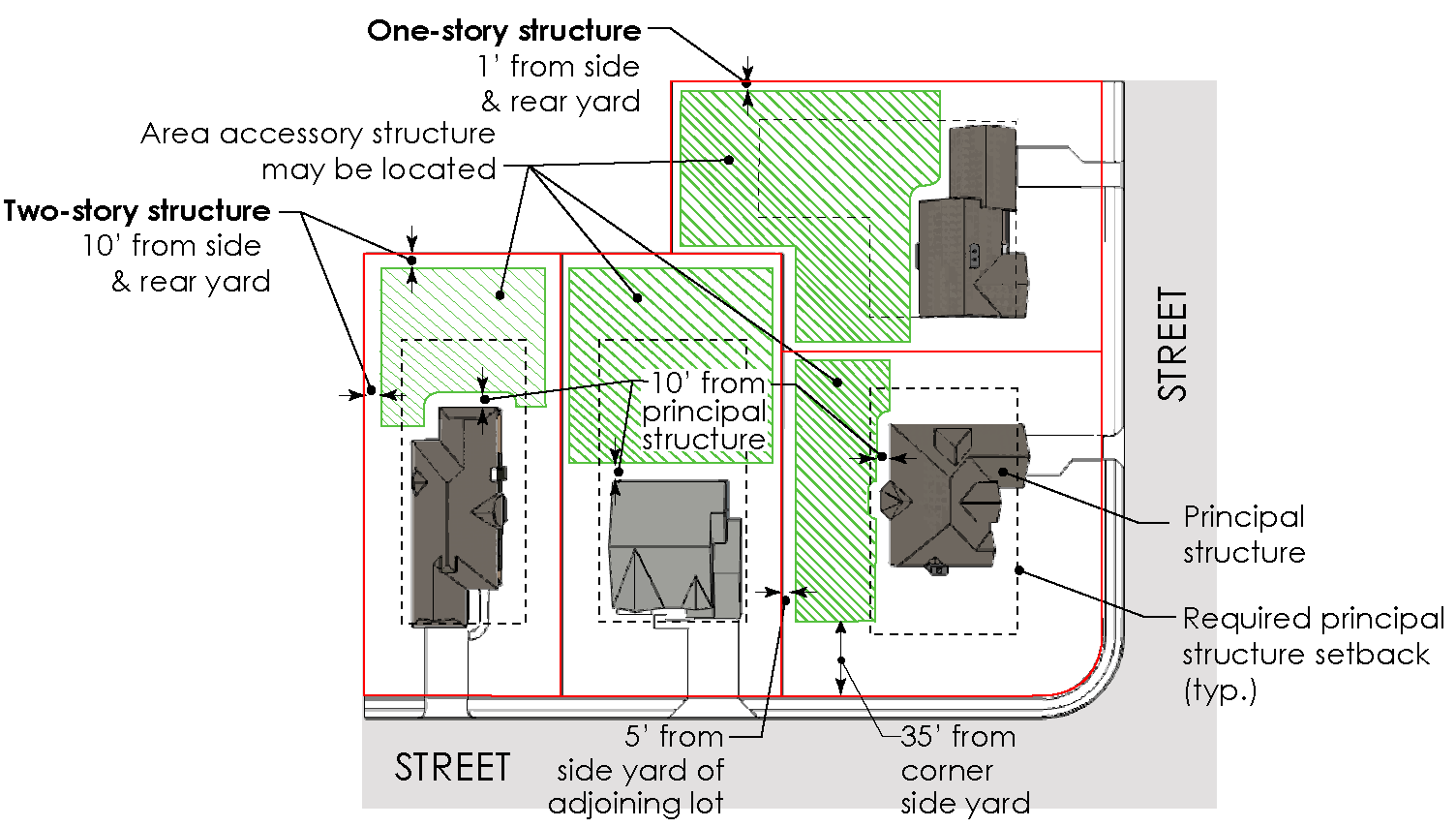
Sec. 18-405. - Decks.
Uncovered decks may encroach into the required rear yard by up to ten (10) feet and any other required yard by up to four (4) feet. See Article 2, § 18-215.
Sec. 18-406. - Patios.
Patios may be located in any yard so long as they are set back at least three (3) feet from any property line.
Sec. 18-407. - Swimming Pools, Spas and Outdoor Hot Tubs.
1.
General regulations. A swimming pool, spa hot tub shall:
a.
Be located to the rear of the principal structure on the same lot.
b.
Not occupy more than twenty-five (25) percent of the area of the yard to the rear of the principal structure.
c.
From the edge of the water, be not less than 10 ft. from the rear wall of the principal structure to the one the same lot, excluding decks and covered decks.
d.
From the edge of the water, be not less than 10 ft. from a side or rear property line.
e.
Be within a fenced yard, within a pool fence, or an appropriate cover.
f.
Spas or hot tubs shall have an appropriate cover.
g.
See Chapter 19, Swimming Pools for more standards and requirements.
2.
Interior Lots. The front edge of the swimming pool, spa or hot tub shall be no less than five (5) feet from an extension of the rear wall line of the principal building on the adjacent lots within fifty (50) feet of the edge of the water of the proposed pool, spa, or hot tub.
3.
Corner Lots. A swimming pool, spa or hot tub shall:
a.
From the edge of the water, be not less than 35 ft. from the corner side yard.
b.
From the edge of the water, be not less than five (5) feet from an extension of the rear wall line of the principal building on the adjacent lots with the same architectural frontage.
c.
From the edge of the water, not less than ten (10) feet from the interior side yard of the adjacent property with an architectural frontage on a cross street.
d.
If the architectural frontage is unclear, the Zoning Administrator may determine the application of the setbacks and properties that will impact the pool location.
FIGURE 4A.2. Swimming pools, spas, and outdoor hot tub standards.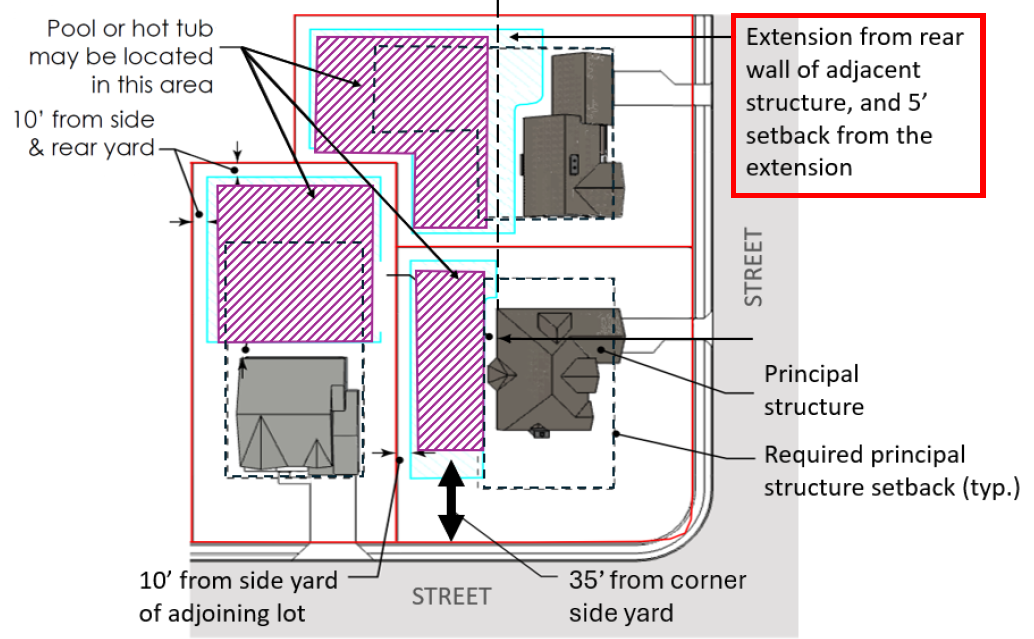
(Ord. of 4-7-2025)
Sec. 18-408. - Satellite Antennae.
1.
Location, number and size.
A.
Only one satellite antenna, which may not exceed fourteen (14) feet in diameter, may be erected or installed on any one building lot in the Town regardless of the zone in which it is located.
B.
Any such antenna shall be located only in the rear yard of such lot no closer than fifteen (15) feet to any side or rear lot line nor less than ten (10) feet from the rear of a principal building; provided, however, that in lieu of any such antenna in a rear yard, one (1) satellite antenna four (4) feet or less in diameter may be suitably mounted to the roof area of a building.
C.
Corner Lot. No satellite antenna on any corner lot shall be erected forward of the building line of any adjoining lot nor closer than fifteen (15) feet to the side of such adjoining lot.
D.
Height limitation. No satellite antennae mounted in any such yard shall exceed eighteen (18) feet measured vertically from the highest point of the signal receiving apparatus, when positioned for operation, to the bottom of the base which supports the satellite antenna, except any antenna which pursuant to this section may be located and suitably mounted to the roof of a building.
2.
Mounting and Screening.
A.
Ground mounting. All satellite antenna shall be ground-mounted pursuant to all requirements of the building code after securing the proper building permits, and shall be sufficiently secured to withstand a 100-year windstorm, with the exception of any such antenna four (4) feet or less in diameter, which is otherwise permitted by this section to be mounted to the roof area of a building.
B.
Screening. All ground-mounted satellite antenna over four (4) feet in diameter shall be screened from adjoining properties by a wooden or masonry fence of six (6) feet in height or by a living screen of evergreen plantings not less than five (5) feet in height at the time of planting, planted no more than five (5) feet on center and of a variety which will mature to a height of at least six (6) feet. All such fences or plantings shall be fully and properly maintained during such time as the antenna being screened shall remain in such location.
Sec. 18-409. - Minimum Tree Canopy Coverage.
See Chapter 17.
(Ord. of 4-29-2024(1), § 1)
Sec. 18-410. - Fences and Decorative Walls.
1.
General Requirements.
A.
Fence height is measured from the ground of each fence panel or post, to the highest feature of the fence panel or post.
B.
All fences or screens shall have the finished side facing the street and the adjoining properties.
C.
The use of barbed wire is not permitted.
2.
Interior lots. Fence height standards shall be as follows:
A.
Front Yard: From the front of the building line to property line the fence may not exceed four (4) feet max. in height.
B.
Interior Side Yard: Six (6) feet max.
C.
Rear Yard: Six (6) feet max.
3.
Corner lots. Fence height standards shall be as follows:
A.
Front yard: From the front of the building line to the property line, the fence may not exceed (4) feet, and the fence may not exceed three (3) feet within the required Sight Triangle (See sight triangle § 18-412).
B.
Corner Side Yard: For the depth of the front yard setback of the adjacent lot zoning, the fence may not exceed four (4) feet in height.
C.
Rear yard: Six (6) feet max.
4.
Construction fences. Temporary fences for construction sites and tree protection are exempted from these standards but shall comply with approved site plan.
(Ord. of 2-24-2025)
Sec. 18-411. - Walls.
1.
Retaining Walls.
A.
Walls of five (5) feet in height or greater must meet the requirements for building setbacks.
B.
Walls located within sight triangle may not exceed three (3) feet in height. See sight triangle § 18-412.
2.
Decorative Walls.
A.
Walls of four (4) feet or greater must meet requirements for building setbacks.
B.
Walls located within sight triangle may not exceed three (3) feet in height. See sight triangle § 18-412.
Sec. 18-412. - Sight Triangle.
On any corner lot there shall be no fences, walls, structure, planting, shrubbery, or obstruction to vision more than three (3) feet above the curb level within twenty-five (25) feet of the intersection of any two (2) street lines. See Figure 4A.4.
FIGURE 4A.4. Illustration of sight triangle at the intersection of two streets in
a residential zone or district.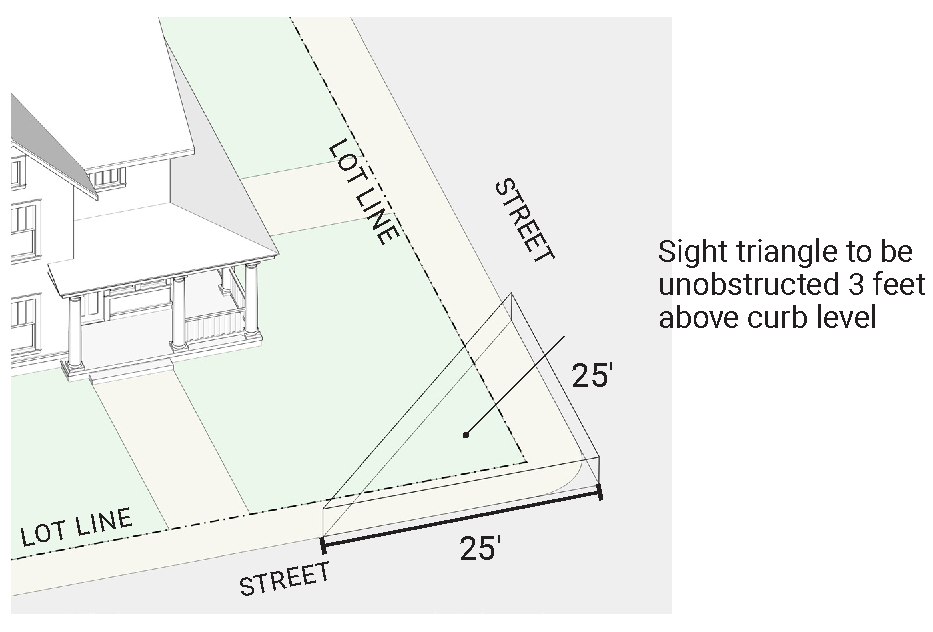
Sec. 18-413. - Purpose and Intent.
The purpose and intent of this division is to regulate exterior lighting to:
1.
Provide security for persons and land;
2.
Ensure all exterior lighting is designed and installed to maintain adequate light levels on a site; and
3.
Ensure that adjacent lands, neighboring areas, and motorists are protected from excessive light spillage and glare.
Sec. 18-414. - Exemptions.
1.
Temporary holiday lighting displayed for a period not exceeding forty-five (45) consecutive days is exempt from the requirements for full cut-off and directional control shields, provided the lighting does not violate any other provisions of this section.
2.
Underwater lighting used for the illumination of swimming pools and fountains.
Sec. 18-415. - Prohibited Outdoor Lighting.
The following outdoor lighting is prohibited:
1.
Lasers, searchlights, strobe lights, and blinking lights, excluding temporary holiday lighting;
2.
Low-pressure sodium and mercury vapor light sources.
Sec. 18-416. - General Outdoor Lighting Standards.
1.
Exterior lighting must consist of full cut-off or directionally shielded lighting fixtures that are aimed and controlled so that the directed light is substantially confined to the object intended to be illuminated and not to exceed the boundary of the property.
2.
No light source shall be located or maintained in any manner such that it creates a nuisance to the users of adjoining properties.
3.
Directional control shields must be installed, maintained, and used to limit stray light and protect motorists and pedestrians from glare.
4.
Use of motion sensors is encouraged.
5.
Spotlighting used to illuminate landscaping, flags, statues, signs, or any other objects must be aimed and shielded to confine light to the object and not violate any of these other requirements of this section.
6.
Maximum luminance levels shall not exceed 0.5 foot-candles at the property boundary.
Sec. 18-417. - Minimum Off-Street Parking Required.
1.
Parking spaces may be located on a driveway, in a garage, or in a carport.
2.
Minimum off-street parking required:
A.
Two (2) spaces for up to three (3) bedrooms.
B.
Three (3) spaces for four (4) bedrooms.
C.
Four (4) spaces for four (4) bedrooms or more.
3.
An Accessory Living Unit (ALU) must include one parking space per sleeping quarters or bedroom within the ALU, in addition to the spaces required for the principal residence.
4.
A single-unit residential parking space shall provide for an area with a minimum width of eight (8) feet and depth of sixteen (16) feet, as it relates to determining the number of off-street parking spaces provided on a driveway or in a garage.
(Ord. of 11-22-2024)
Sec. 18-418. - Non-availability of Parking Area.
At any time that a required parking area shall cease to be available for such use, except as a result of government action, the occupancy or use permit for the principal use to which such parking area is appurtenant shall be revoked and declared null and void, until such time as other acceptable off-street parking space is provided.
Sec. 18-419. - Driveways.
1.
All driveways and parking areas shall be constructed of permanent materials, with an asphalt, concrete, or grid paver surface. Gravel or grass shall not be permitted surface treatments for driveways or parking areas. Other permeable surfaces that are permanent may be proposed, but must be approved by both the Zoning Administrator and the Director of Public Works.
2.
Ingress and egress to a public street shall maintain a width of not less than twelve (12) feet nor more than twenty-four (24) feet at the street right-of-way line.
3.
A width of at least twelve (12) feet shall be maintained for the length of the driveway.
FIGURE 4A.5. Driveway standards.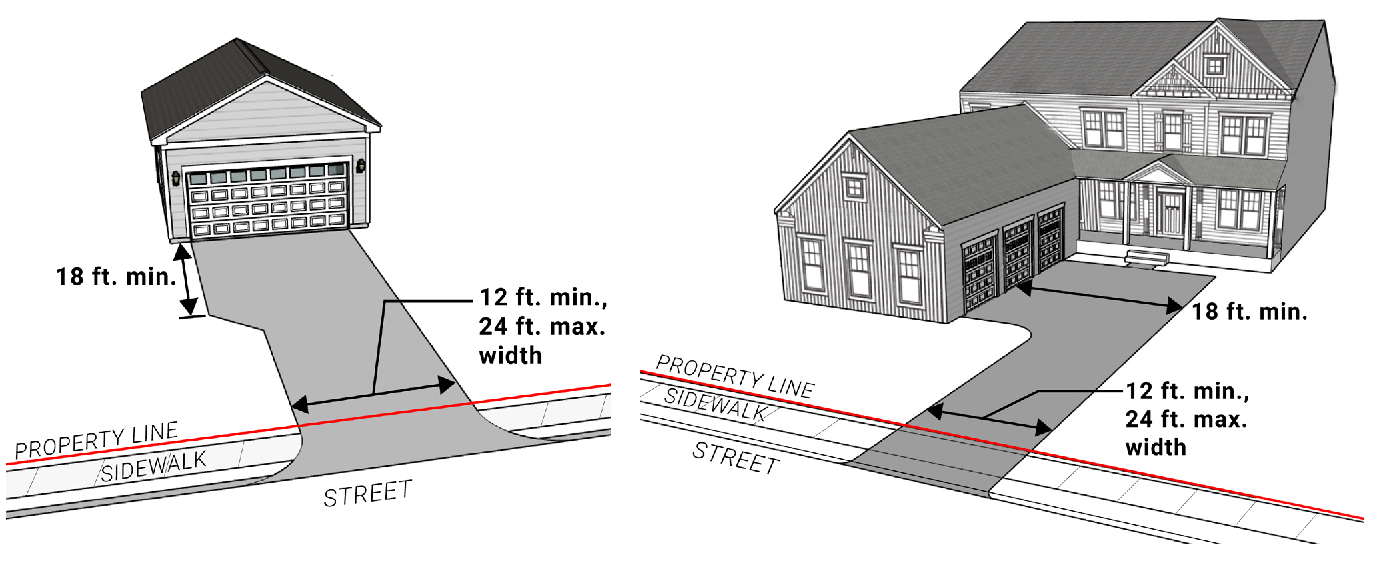
4.
Driveways longer than forty (40) feet from the right-of-way may reduce the driveway width to ten (10) feet starting at a distance of twenty (20) feet from the right-of-way with administrative approval from the Zoning Administrator.
5.
The width of the driveway shall meet the width of the garage opening for a minimum of eighteen (18) feet from the garage.
6.
Driveway design, including access to a garage, must accommodate turning radii that do not force drivers to drive on grass.
7.
Turn around spaces or additional parking spaces shall be located a minimum of six (6) feet from the right-of-way, except that an apron may be provided at the intersection with a driveway. The apron must maintain a minimum setback of a five (5) foot radius from a point that is one (1) foot away from the right-of-way.
8.
Lots with two driveway entrances must have a minimum of fifteen (15) feet between entrances from interior edge to interior edge at the right-of-way line.
Sec. 18-420. - Overnight Parking of Commercial Vehicles.
1.
For the purposes of this section, the term "commercial vehicle" shall include the following:
A.
Any solid waste collection vehicle, tractor truck, tractor truck/semitrailer, tractor truck/trailer combination, dump truck, concrete mixer truck, towing and recovery vehicle with a registered gross weight of 12,000 pounds or more, and any heavy construction equipment;
B.
Any trailer, semitrailer, or other vehicle in which food or beverage are stored or sold;
C.
Any trailer or semitrailer used for transporting landscaping or lawn-care equipment, and whether or not such trailer or semitrailer is attached to another vehicle;
D.
Any vehicle licensed by the Commonwealth for use as a common contract carrier or as a limousine.
2.
It shall be unlawful to park any commercial vehicle in any residential zone of the Town for more than one hour in any 24-hour period, except that not more than one such vehicle which does not exceed 20,000 pounds gross weight may be parked overnight and on Saturdays, Sundays, and holidays on the property owned or leased by the vehicle owner or custodian; provided that while so parked, such vehicle shall not be moved or operated at any time to further any profit-making business or professional enterprise, and further provided that while so parked between the hours of 7:00 p.m. and 5:00 a.m., such vehicle shall not be operated nor its engine run for any purpose whatsoever, nor may such vehicle be driven from the parked location between the hours of 7:00 p.m. and 5:00 a.m.
3.
Notwithstanding the provisions of this section, any such vehicle may be parked on a residential street for more than one hour while actually being loaded or unloaded, while the custodian of any such vehicle is actively performing services in the area, or for the occupants of a residence abutting the street on which the vehicle is parked and the residence is not that of the custodian of such vehicle.
4.
The provisions of this section shall not apply to any waste collection vehicle(s) or the parking or storage of the same on street or off street in any residential zone being hereby strictly prohibited at any and all times of day or night.
5.
The restrictions, prohibitions, and limitations imposed by this section shall not apply to any vehicle, or vehicles owned or used by the Town in furtherance of its municipal purposes when such vehicles are parked on Town-owned property.
6.
It shall be unlawful to park, permit to be parked, or left standing in areas zoned for residential use, any commercial vehicle as defined herein except when such commercial vehicle is being used to pick up or discharge passengers or when temporarily parked pursuant to the performance of work or service at a particular location.
7.
Notwithstanding anything to the contrary in this section, one resident of each single-family dwelling unit zoned residential may be permitted to park one vehicle licensed as a taxicab or limousine on such street or highway, provided other vehicles are permitted to park thereon.
Sec. 18-421. - Purpose and Intent.
1.
The intent of this division is to control all signs within the Town, to ensure that they are appropriate for their respective principal uses and in keeping with the appearance of the affected property and surrounding environment, and to protect the public health, safety, morals and general welfare. In addition, the intent of this article is to:
A.
Encourage good design in the context of the overall image and visual environment of the Town;
B.
Protect property values; enhance the appearance of the business and industrial community;
C.
Stimulate the economic vitality of the Town, encourage a business atmosphere that continues to attract new enterprises to the Town, encourage trade within the Town, and to appropriately inform consumers;
D.
Ensure that signs are adequate, but not excessive;
E.
Prohibit the erection of signs in such numbers, sizes, designs and locations as may create danger to the public by obscuring road signs or by unsafely diverting the attention of motorists;
F.
Prohibit signs which are likely to create unsafe conditions because of unsound structures or unsuitable locations;
G.
Avoid excessive competition for placement of signs, so that permitted signs provide identification, direction, information and advertising while minimizing clutter and unsightliness.
2.
The general premise for the control of signs includes legibility, the effective display of information, the safety of passing traffic, and the coordination of signs with buildings, landscaping and other elements of the visual environment. In particular, signs should be designed and constructed as follows:
A.
For maximum legibility, considering viewing, location and traffic conditions.
B.
For size and dimensions, signs should be related to the frontage and setback of the building.
C.
The setback and size of signs should give a fair exposure to all commercial buildings in a given area.
D.
Signs should be integrated with the architecture of the buildings to which they relate, and with the nearby landscaping.
Sec. 18-422. - Applicability.
1.
This article shall be interpreted in a manner consistent with the First Amendment guarantee of free speech. This article shall allow a noncommercial message to be automatically displayed, whenever a commercial message is allowed to be displayed. If any provision of this article is found by a court of competent jurisdiction to be invalid, such finding shall not affect the validity of other provisions of this article, which can be given effect without the invalid provision.
2.
A sign placed on land or on a building for the purpose of identification, protection, or directing persons to a use conducted therein shall be deemed to be an integral but accessory and subordinate part of the principal use of land or building. Therefore, the intent of this article is to establish limitations on signs in order to ensure they are appropriate to the land, building, or use to which they are appurtenant and are adequate for their intended purpose while balancing the individual and community interests.
3.
These regulations are intended to promote signs that are compatible with the use of the property to which they are appurtenant, landscape and architecture of surrounding buildings, are legible, are not distracting to motorists, and are constructed and maintained in a structurally sound and attractive condition.
4.
Exclusions. The following are not considered signs per this ordinance. Features not considered signs are excluded from the calculation of sign area.
A.
Federal, state, and local flags.
B.
Street address signs.
C.
All displays less than one and one-half (1.5) square feet in area.
Sec. 18-423. - Prohibited Signs.
The following signs are prohibited in all zones and districts:
1.
Signs and/or sign structures that are erected on any property without the express written permission of the property owner or their authorized agent(s).
2.
Signs that are a public nuisance for, without limitation, reasons of amplified sound, smoke, vapor, particle emission or objectionable odors.
3.
Moving or rotating signs, flags, pennants, streamers, balloons, or similar devices that involve motion or rotation of any part or display.
4.
Signs with electronic messages; changeable copy; changing color(s); flashing, blinking, or oscillating effects; that imitate movement through lighting effects; or that use video display of any kind. Exception: As expressly permitted herein or for fuel station pricing signs in which prices are displayed continuously, with occasional changes.
5.
Any exposed-tubing lighting arrangement.
6.
Portable signs. Signs located on trailers, wheels, or affixed to a vehicle intended for advertising. Exception: Business-related vehicles parked on-site with valid tags and registration.
7.
Signs that contain words, pictures, or statements that are obscene.
8.
Signs placed in the right-of-way without the expressed consent of the Town. See Town Code § 10-28.1.
9.
Signs of any type shall not be erected upon the roof of any building, except on the sides of a mansard-type roof.
Sec. 18-424. - Sign Standards - Permanent Signs.
No permanent signs greater than 1.5 square feet in area are permitted for single-unit residential lots.
Sec. 18-425. - Sign Standards - Temporary Signs.
1.
Temporary window and yard signs are permitted provided they meet the following standards:
2.
Signs not exceeding one and one-half (1.5) square feet in area are exempt from these regulations.

