
Volusia County Unincorporated
City Zoning Code
City Zoning Code
DIVISION 8
SUPPLEMENTARY REGULATIONS
Sec. 72-276. - Access control.
To promote the safety of vehicular traffic and pedestrians and to minimize traffic congestion and conflict, access to any project or development shall comply with the requirements of division 4 of the Land Development Code [article III].
(Ord. No. 88-2, § VI, 1-19-88; Ord. No. 90-34, § 47, 9-27-90; Ord. No. 2008-25, § II, 12-4-08)
Editor's note— Ord. No. 2008-25, § II, renamed former sections 800.01—800.05 as 72-276—72-281.
Editor's note— Subsections 800.01—800.05 were repealed by § 48 of Ord. No. 90-34, adopted Sept. 27, 1990. They were amended by the following:
Sec. 72-277. - Accessory structures and exceptions to minimum dimensional requirements; accessory dwelling units.
(a)
Applicability to single-family uses. In the FR, RC, A-1 through A-4, RR, RA, R-1 through R-6, R-9, MH-1 through MH-8, B-8, PUD, OMV, OUR, OTR, ORE, OCR, and SWR classifications, the following regulations apply:
(1)
No accessory structure shall be constructed on any lot until a principal structure is either constructed or permitted for construction on the same lot, except for:
a.
Seawalls on an ocean front lot in which a gap exists as defined by the Florida Department of Environmental Protection, and
b.
Docks in accordance with section 72-278(a).
(2)
Accessory structures shall not be located in any platted easement.
(3)
On an atypical lot, accessory structures are not permitted within the rear yard.
(4)
The cumulative area of all structures, excluding docks and seawalls, pools and screen enclosures, shall not exceed the maximum lot coverage in the applicable zoning classification.
(5)
Accessory structures exceeding 500 square feet in area shall meet the same yard requirements as the principal structure.
(6)
In-ground pools, above-ground pools, hot tubs, spas, and other similar water features shall be located no closer than eight feet, as measured from the water's edge, from any side or rear lot line, with accompanying screen enclosures, if any, located no closer than five feet from any side or rear lot line. On waterfront lots, in-ground pools, above-ground pools, hot tubs, spas, screen enclosures, and other similar water features, shall meet waterfront lot setbacks.
(7)
Accessory structures located in side or rear yards may be located no closer than five feet from the corresponding lot lines, except for fences, walls, and hedges pursuant to section 72-282.
(8)
Accessory structures shall not be located in front yards, including standard lots, double frontage lots, and corner lots, except for fences, walls, and hedges pursuant to section 72-282. On any corner lot, no structure, fence, wall, or hedge shall cause any obstruction to vision of motorists in accordance with the provisions for obstructions to vision in Article III, Division 4 of the Land Development Code.
(9)
The maximum height of an accessory structure, except for docks in accordance with section 72-278 and fences, walls, and hedges in accordance with section 72-282, shall not exceed 25 feet.
(10)
In all residential classifications, where a lot is situated between two lots, each having a principal building which projects beyond the minimum front yard requirements for its classification, its minimum front yard requirement shall be the average of the distance between the front lines and the fronts of the principal buildings on the adjacent properties, but not less than 20 feet.
(11)
On any nonconforming lot not more than 50 feet in width located in a single-family zoning classification, the minimum side yard may be decreased to seven feet.
(12)
On any lot with 50 feet or less of depth and at least 5,000 square feet of area located in a single-family zoning classification, the minimum front yard may be reduced to 12.5 feet and the minimum rear yard may be reduced to ten feet providing:
a.
The lot abuts a county arterial thoroughfare road;
b.
The lot was reduced in size by the action of the county, state or federal government;
c.
The lot is to be utilized only for a single-family residence and its accessory uses and structures;
d.
The proposed single-family residence is to be connected to central water and sewer services; and
e.
The chimneys, fireplaces, roof overhangs, unenclosed balconies and unenclosed stairways of the proposed single-family residence may not project into the reduced front and rear yards more than two feet.
(13)
Awnings, chimneys, fireplaces, pilasters, roof overhangs, unenclosed balconies, and unenclosed stairways may project into any yard for either three and one-half feet or half the yard, whichever is less, except as provided in section (12)e, above.
(b)
All structures erected to protect or support fern or other agricultural crops are exempt from the yard requirements. All buildings erected to protect or grow nursery plants are exempt from the maximum lot coverage requirements in MH-3 and in all of the agricultural zoning classifications.
(c)
Spires, belfries, cupolas, clerestory windows, antennas, water tanks, ventilators, solar panels, windmills, chimneys, penthouses or other similar accessory structures customarily required to extend above the roof level, may extend for an additional 25 feet above the maximum building height prescribed for the classification in which they are located.
(d)
Accessory sheds equal to or less than 480 square feet in size, located on single-family and two-family residential use properties, are subject to the standards of this section and article III, division 7, Flood Hazard Management, but may be constructed without a shed building permit. Such sheds may not be constructed within any wetland or wetland buffer or within 25 feet of any gopher tortoise burrow.
(e)
Accessory dwelling units.
(1)
Accessory dwelling units shall be permitted in the FR, RC, A-1 through A-4, RA, RR, R-1 through R-6, R-9, MH-3 through MH-6, MH-8, B-8, PUD, OMV, OUR, OTR, ORE, OCR, and SWR zoning classifications.
(2)
Development standards.
a.
Accessory dwelling units shall not be greater than 50 percent of the living area of the principal detached single-family dwelling unit on any size parcel. On lots less than one acre in size, an accessory dwelling unit shall have a minimum living area of not less than 240 square feet and a maximum living area of not more than 1,200 square feet. On lots greater than or equal to one acre in size, an accessory dwelling unit shall have a minimum living area of not less than 240 square feet and shall not exceed 50 percent of the principal dwelling unit.
"Living area" shall be defined as conditioned space enclosed within the building thermal envelope that is utilized for living, sleeping, eating, cooking, bathing, washing and sanitation purposes, including hallways; utility rooms; and closets. Unconditioned spaces such as garages or porches (open or screened) are not included in the definition of "living area."
b.
The residential lot shall be occupied by a principal detached single-family dwelling unit that is owner occupied. This requirement shall not be varied.
c.
Accessory dwelling units must meet the same setbacks as required for the principal detached single-family dwelling unit.
d.
On lots less than one acre in size, a detached accessory dwelling unit must be located so that its front façade is rearward of the rearmost point of the principal detached single-family dwelling unit. An attached accessory dwelling unit must be located to the rear of the primary detached single-family dwelling unit. On lots greater than or equal to one acre in size, this requirement does not apply, provided that all other minimum yard requirements are met.`
e.
Only one entrance may be located on the front façade of the primary detached single-family dwelling unit. If the accessory dwelling unit is attached to the primary detached single-family dwelling unit, the entrance must be located on the side or rear façade.
f.
One parking space shall be provided for the exclusive use of the accessory dwelling unit in addition to the parking space(s) required for the principal detached single-family dwelling unit. The parking space shall not be located in the required front yard setback. A tandem parking space (one car parked behind another) with spaces for the principal detached single-family dwelling unit shall not be permitted.
g.
Both the principal detached single-family dwelling unit and the accessory dwelling unit shall be served by one common driveway connecting to a public or private road. The requirement for a single driveway connection may be waived if the Zoning Enforcement Official determines that the waiver of the requirement would not be detrimental to the public health, safety, or general welfare, subject to one of the following circumstances being present:
1.
Where an applicant seeks to convert an existing structure to use as an accessory dwelling unit, and that structure was served by an access driveway separate from the principal detached single-family dwelling unit;
2.
Where the applicant can show that there are already two legally established access driveways to the parcel that are available to serve the primary detached single-family dwelling unit and accessory dwelling units separately;
3.
Where the parcel has frontage on two roads; or
4.
Where the applicant demonstrates an alternative access design that provides an overall reduction in the expanse of driveway area is preferable.
(3)
An accessory dwelling unit may be constructed concurrently with or after construction of the principal detached single-family dwelling unit.
(4)
Accessory dwelling units may have independent meter connections for water, sewer, and electric utilities from the principal detached single-family dwelling unit. Utility impact fees will not be charged if the accessory dwelling unit shares utility connections with the principal detached single-family dwelling unit or if the accessory dwelling unit shares or has an independent well and septic system. However, if the accessory dwelling unit has independent water and sewer connections, then impact fees on these utilities will be charged.
(5)
Restrictions.
a.
An accessory dwelling unit may not be located on any parcel or lot already containing a principal detached single-family dwelling unit, where that dwelling unit is nonconforming with respect to land use or zoning, or developed with a duplex, triplex, or other multifamily dwelling unit.
b.
A lot containing an accessory dwelling unit shall not be subdivided to separate the accessory dwelling unit from the principal detached single-family dwelling unit.
c.
An accessory dwelling unit may not be sold separately from the principal detached single-family dwelling unit.
d.
An accessory dwelling unit may not be a mobile home, unless mobile homes are permitted within the zoning classification of the property and the principal detached single-family dwelling unit is a mobile home.
e.
Perimeter fencing of a property that contains primary detached single-family dwelling units and accessory dwelling units may not appear to separate the units as if they are located on separate lots.
(Ord. No. 81-39, § XXXIV, 11-19-81; Ord. No. 84-1, §§ XLII, XLIII, 3-8-84; Ord. No. 86-16, §§ XIV, XV, 10-23-86; Ord. No. 88-2, § VIII, 1-19-88; Ord. No. 89-20, §§ XIX, XX, 6-20-89; Ord. No. 90-34, §§ 49, 50, 9-27-90; Ord. No. 91-11, §§ X—XIII, 5-16-91; Ord. No. 92-6, § XLVII, 6-4-92; Ord. No. 94-4, §§ XLIX—LII, 5-5-94; Ord. No. 2004-20, § V, 12-16-04; Ord. No. 2005-02, § I, 4-21-05; Ord. No. 2006-18, 9-21-06; Ord. No. 2008-25, § II, 12-4-08; Ord. No. 2010-19, § III, 12-16-10; Ord. No. 2011-03, § I, 1-20-11; Ord. No. 2012-06, § III, 5-3-12; Ord. No. 2015-02, § III, 3-5-15; Ord. No. 2018-05, § XXIV, 1-18-18; Ord. No. 2018-04, § II, 4-17-18; Ord. No. 2019-13, § I, 9-17-19; 2021-14, § III, 7-20-21; Ord. No. 2023-11, § I, 2-21-23; Ord. No. 2025-13, § 3, 5-6-25)
Sec. 72-278. - Docks and boathouses.
(a)
The following regulations shall apply in all zoning classifications that allow residential dwellings:
(1)
The dock area shall not exceed 750 square feet, including any boathouse, but excluding walkway extensions into the water. The area of a boathouse is the square footage under roof. Walkways shall not exceed eight feet in width.
(2)
Docks shall only be constructed on waterfront lots which comply with or are exempt from article III, division 2 and are sufficient in size to meet the minimum area and width requirements for their classifications. Only one dock may be erected on a single waterfront lot.
(3)
Docks shall not be used for dwelling purposes or contain any sleeping or living quarters.
(4)
The highest point of any dock shall not exceed 15 feet above the mean high-water mark in tidal areas or the ordinary high-water mark in nontidal areas.
(5)
No dock shall be permitted within 15 feet of any side lot line, or its extension into the water.
(6)
In addition, docks and boathouses shall be designed and located according to the requirements of this article and the applicable divisions of the Land Development Code and Manatee Protection Plan.
(b)
In all zoning classifications, boathouses and boat docks may be located in waterfront yards but shall not be permitted within 15 feet of any side lot line, or its extension into the water.
(Ord. No. 87-25, § IV, 9-10-87; Ord. No. 94-4, § LIII, 5-5-94; Ord. No. 2004-20, § V, 12-16-04; Ord. No. 2008-25, § II, 12-4-08; Ord. No. 2010-19, § IV, 12-16-10; Ord. No. 2012-11, § I, 5-17-12; 2021-14, § IV, 7-20-21)
Sec. 72-279. - Construction in platted easements.
Principal and accessory structures, other than boat docks, boathouses and walkways, shall not be erected in platted easements.
(Ord. No. 94-4, § LV, 5-5-94; Ord. No. 2008-25, § II, 12-4-08)
Sec. 72-280. - Erection of more than one principal structure on a lot.
(a)
In the FR, RC, A-1, A-2, A-3, A-4, OTR, ORE, OCR, and MH-3 classifications, a principal structure, other than a residential dwelling, may be erected on a parcel, provided, such structure is designed, constructed and used solely for one or more of the following agricultural purposes: Livestock shelters or buildings: poultry buildings or shelters; barns; storage of equipment and machinery used in agriculture; horticultural structures, including detached production greenhouses and crop protection shelters or stables; or, is constructed on a property which satisfies the eligibility criteria for appraisal, assessment and taxation as agricultural parcel. Nothing in this section shall allow the construction of more than one principal, standard or modular, single-family or mobile home dwelling on a parcel. The following guidelines apply to parcels having no agricultural exemption:
(1)
Electric permits are limited to 60 amps, provided, that a property owner may request an additional service size based on a service demand calculation associated with equipment use.
(2)
Minimum parcel size shall be five acres.
(b)
More than one principal structure may not be erected on a nonconforming lot.
(c)
Additional principal structures may be erected on a conforming lot in R-7, R-8, MH-1, MH-2, MH-7, B-1 through B-9, PUD, I-1 through I-4, C, OCV, OMV, OTC, AP and P classifications only when said structure satisfies the applicable lot dimensional requirements as if there were a separate conforming lot. This subsection shall not require subdivision of said lot.
(d)
In commercial, industrial, conservation and public use classifications, more than one principal structure may be erected on a lot, provided that the requirements of this article shall be met for each principal structure as though it were on an individual lot, except hotels and multifamily structures. In all other classifications, only one principal structure may be erected on a lot.
(e)
More than one principal structure may be erected on a lot or parcel in a conservation subdivision if the lot or parcel is designated for agri-business, eco-tourism, or other nonresidential development as approved through the conservation subdivision pursuant to section 72-547.
(Ord. No. 84-1, § XLIV, 3-8-84; Ord. No. 86-16, § XVI, 10-23-86; Ord. No. 90-34, § 51, 9-27-90; Ord. No. 94-4, § LVI, 5-5-94; Ord. No. 2004-20, § V, 12-16-04; Ord. No. 2005-02, § II, 4-21-05; Ord. No. 2008-25, § II, 12-4-08; Ord. No. 2011-02, § III, 1-20-11; Ord. No. 2012-06, § III, 5-3-12; Ord. No. 2013-08, § III, 5-2-13; Ord. No. 2015-02, § III, 3-5-15; Ord. No. 2023-04, § IV, 2-21-23)
Sec. 72-281. - Reserved.
Editor's note— Ord. No. 2021-14, § V, adopted July 20, 2021, repealed § 72-281, which pertained to exceptions to height regulations and derived from Ord. No. 81-39, § XXXV, 11-19-81; Ord. No. 94-4, § LVII, 5-5-94; Ord. No. 97-19, § III, 8-7-97; Ord. No. 2008-25, § II, 12-4-08.
Sec. 72-282. - Fences, walls and hedges.
Fences, walls, and hedges may be permitted in any yard area, provided:
(1)
Residential classifications. Fences and walls in residential use zoning classifications are permitted in any yard area on residential lots provided they comply with the standards of this section and article III, division 7, Flood Hazard Management requirements. Chain link, wood or vinyl fences on single-family residential use properties are subject to the standards of this section but may be constructed without a fence permit. All other residential fences and walls, including residential project walls approved under subsection (8) below, are subject to the standards of this section and require a fence and/or building permit:
a.
Fences, walls and hedges, except those with an opacity of 25 percent or less erected only to meet the minimum safety requirements of the Florida Building Code, as amended, shall not exceed three feet in height when erected on an atypical lot rearward of the rearmost point of the principal structure as defined by the required yard area. Fences, walls and hedges in all other rear and side yards shall not exceed six feet in height.
b.
Except as provided in subsection 72-284(2), fences, walls or hedges in a front yard shall not exceed four feet in height; however, on corner lots also refer to subsection 72-277(a)(8) for obstruction to visibility.
(2)
Retaining walls or retaining walls with fences on top shall not exceed the above height limitations measured from existing grade on both sides of the wall, except a guardrail or fence with an opacity of 25 percent or less erected to meet the minimum three-foot safety requirements of the Florida Building Code.
(3)
Nonresidential classifications and uses. A nonresidential fence, wall, or hedge may be a maximum height of eight feet around the perimeter of the project if the fence does not interfere with vehicle visibility requirements at traffic access points as set forth in subsection 72-277(a)(8). If chain link fencing is used, then it shall be vinyl-coated black and all parts must match. For public utility uses and structures, a minimum fence height of six feet is required.
(4)
This section shall not be applied to any agricultural, conservation or public use classifications.
(5)
Prohibited fencing. Except for public utility uses and structures, barbwire or electric fences are prohibited in the R-1 through R-9, OCV, OMV, OTC, OUR, SWC, SWR, and MH-1, MH-2, MH-5, MH-6 and MH-7 classifications. No wall shall be erected in any platted easements.
(6)
Fences and fence walls must be constructed of conventional and traditional materials, including, but not limited to, concrete block, brick, wood, decorative aluminum, iron or steel, chain link or composite products manufactured specifically for fences and walls. Nontraditional materials, including, but not limited to tires, mufflers, hubcaps, are prohibited. Fabric sheets nets, plastic, metal, vinyl sheets or slats may be used as part of the fence or attached to a fence for the purpose of enhancing privacy or required screening.
(7)
Fences and walls must be constructed to present the finished side of the fence or wall to the adjoining lot or any abutting right-of-way. Where, there is an existing fence, wall or continuous landscape hedge on the adjoining parcel, this provision may be administratively waived upon written request at the discretion of the zoning enforcement official.
(8)
Residential project walls.
a.
Definition: For the purposes of this section, a residential project fence means a wall or fence erected around a residential subdivision (excluding individual lots) or development of 20 or more dwelling units.
b.
A residential project or entry fence:
1.
May be a maximum height of six feet around the perimeter of the project upon a finding by the traffic engineer that the fence does not interfere with vehicle visibility requirements (see subsection 72-277(a)(8)) at traffic access points.
2.
May include entryway structures, including but not limited to walls, columns, lighting and other decorative elements used to defined entrances to single-family or multifamily developments at a height not to exceed twice the fence or wall height allowed provided the features are compatible with the project. Entryway structures proposed at a greater height shall be subject to specific review and approval of the zoning enforcement official as part of the applicable land development review process. Entryway structures must be located outside of any required landscape buffer area.
3.
Must be landscaped on the exterior side (between the wall and the abutting property or street right-of-way) according to section 72-284 of this article. Trees adjacent to a right-of-way must be appropriately sized to avoid conflicts with overhead utilities, lighting and signs upon maturity.
4.
May not be permitted until proper documents have been recorded providing for the maintenance of the project fence and landscaping.
(9)
Method of measurement. In the event that a fence or wall is located at a common property line with varying elevations, the height shall be measured from the existing natural grade, as measured along the outside of the required yard area. A ground clearance of two inches may be factored in to fence height calculations.
(Ord. No. 81-39, §§ XXXVI—XXXVIII, 11-19-81; Ord. No. 84-1, § XLV, 3-8-84; Ord. No. 90-34, § 52, 9-27-90; Ord. No. 94-4, § LVIII, 5-5-94; Ord. No. 98-25, §§ IX, X, 12-17-98; Ord. No. 2004-20, § V, 12-16-04; Ord. No. 2008-25, § II, 12-4-08; Ord. No. 2012-06, § III, 5-3-12; Ord. No. 2013-20, § III, 12-12-13; Ord. No. 2018-05, § IV, 1-18-18; Ord. No. 2018-04, § III, 4-17-18; 2021-14, § VI, 7-20-21; Ord. No. 2025-13, § 4, 5-6-25)
Sec. 72-283. - Home-based businesses.
Home-based businesses must comply with all provisions of F.S. § 559.955, as may be amended. The provisions of F.S. § 559.955, are incorporated into this section as if fully laid out herein, may be enforced pursuant to Chapter 2, Article VII, of the Code, and shall prevail in the event of a conflict with this section.
A home-based business must operate, in whole or in part, from a residential property and must meet the below criteria:
(1)
Employees. The employees of the business who work at the residential dwelling must also reside in the residential dwelling, except that up to a total of two employees or independent contractors who do not reside at the residential dwelling may work at the business. The business may have additional remote employees that do not work at the residential dwelling.
(2)
Parking and storage.
a.
Parking or storage must comply with all requirements of the Code for a residential property.
b.
The need for parking generated by the business may not be greater in volume than would normally be expected at a similar residence where no business is conducted. No more than two dedicated parking spaces for the home-based business are permitted.
c.
Vehicles and trailers used in connection with the business must be parked in legal parking spaces that are not located within the right-of-way, on or over a sidewalk, or on any unimproved surfaces at the residence.
d.
Heavy equipment may not be parked or stored on the property unless it is completely screened from view from the street or neighboring property or unless it is parked or stored on conforming lots in Prime Agriculture (A-1) or Rural Agriculture (A-2) zoning classification . For purposes of this paragraph, the term heavy equipment means commercial, industrial, or agricultural vehicles, equipment, or machinery.
(3)
Use of premises.
a.
As viewed from the street, the use of the residential property is consistent with the uses of the residential areas that surround the property.
b.
External modifications made to a residential dwelling to accommodate a home-based business must conform to the residential character and architectural aesthetics of the neighborhood.
c.
The home-based business may not conduct retail transactions at a structure other than the residential dwelling; however, incidental business uses and activities may be conducted at the residential property.
d.
The activities of the home-based business are secondary to the property's use as a residential dwelling.
(4)
Compliance with other laws, rules, and regulations.
a.
All business activities must comply with any relevant local or state regulations with respect to signage and equipment or processes that create noise, vibration, heat, smoke, dust, glare, fumes, or noxious odors. Relevant county regulations for this paragraph are those that apply to a residence where no business is conducted.
b.
All business activities must comply with any relevant local, state, and federal regulations with respect to the use, storage, or disposal of any corrosive, combustible, or other hazardous or flammable materials or liquids. Relevant county regulations for this paragraph are those that apply to a residence where no business is conducted.
c.
Use of the residential property for a home-based business must comply with all other applicable regulations for the zoning district.
(5)
Exception. This section does not supersede, amend, or modify regulations, restrictions, or prohibitions related to transient public lodging establishments such as hotel/motels, bed and breakfasts, and short-term rentals, that are not otherwise preempted under F.S. ch. 509.
(Ord. No. 81-39, § XXXIX, 11-19-81; Ord. No. 84-1, §§ XLVI—XLIX, 3-8-84; Ord. No. 89-20, §§ XXI—XXV, 6-20-89; Ord. No. 90-34, § 53, 9-27-90; Ord. No. 95-17, § III, 6-15-95; Ord. No. 98-25, §§ XI—XVIII, 12-17-98; Ord. No. 02-10, § II, 4-18-02; Ord. No. 2007-13, § I, 4-19-07; Ord. No. 2008-25, § II, 12-4-08; Ord. No. 2021-34, § II(Exh. B), 12-14-21)
Sec. 72-284. - Minimum landscaping requirements.
The purpose and intent of this section is to encourage the preservation of existing trees and vegetation; to identify landscape standards and plant classifications; to reduce radiant heat from surfaces and conserve energy; to provide shade; to reduce wind and air turbulence; to minimize potential nuisances such as the transmission of noise, dust, odor, litter and glare of automobile headlights; to provide visual buffering and for the separation of spaces; to enhance the beautification of the county; to reduce the amount of impervious surface and stormwater runoff; to safeguard and enhance property values and protect public and private investment; and to protect the public health, safety and general welfare.
The following regulations shall apply where landscaped buffer or off-street parking areas are required:
(1)
All plant materials shall be Florida No. 1 or better grade, according to the current Grades and Standards for Nursery Plants, State of Florida, Florida Department of Agriculture and Consumer Services, and selected from the "Plant Material List" available from the growth and resource management department. All plant materials shall be chosen, spaced and planted according to the current Grades and Standards for Nursery Plants, Florida-friendly best management practices, the Volusia County Environmental Management Division's Habitat Planting Guidelines, and "right plant, right place" principles, to protect and preserve Volusia County's water resources, at least 50 percent of the required landscaping specified in subsections a and b, shall individually be of a native drought tolerant species chosen from the plant material list. The Zoning Enforcement Official (ZEO) has the authority to allow existing native vegetation to provide the necessary visual screening. Existing upland native vegetation shall be incorporated, where appropriate, into off-street parking areas and landscape buffers of a proposed development.
a.
Specific requirements:
1.
Canopy trees (Group A). Canopy tree species shall be a minimum of one and one-half-inch caliper and six feet in overall height immediately after planting. Trees required along county thoroughfares shall be a minimum of two-inch caliper and eight feet in overall height immediately after planting, and planted a minimum of ten feet back from the right-of-way line.
2.
Mid-story trees (Group B). Mid-story tree species shall be a minimum of one and one-half-inch caliper and six feet in overall height immediately after planting. Trees required along county thoroughfares shall be a minimum of two-inch caliper and eight feet in overall height immediately after planting, and planted along a line ten feet back from the right-of-way line.
3.
Understory trees and shrubs(Group C). Understory trees shall be a minimum one and one-half-inch caliper and four feet in overall height and shrubs shall be a minimum of two feet in overall height, immediately after planting.
4.
Groundcovers, large grasses and wildflowers (Group D). Large grasses shall be a minimum of 18 inches in overall height immediately after planting. Ground covers and wildflowers do not have a minimum height requirement, as maximum height is dependent upon the specific plant species. At least 25 percent of the project area outside of any landscape buffers, off-street parking areas, and stormwater management areas, shall be planted and maintained with a drought tolerant ground cover(s). Ground covers must present a finished appearance and provide reasonably complete coverage at time of planting.
b.
Additional requirements:
1.
Palms. Palms shall constitute no more than 25 percent of the required canopy trees and shall have a minimum of six feet of clear wood at planting.
2.
Lawn grass. Grassed areas shall be planted with any species of grass common to Central Florida. They may be sodded, plugged, sprigged or seeded; except that sod is required in swales or other areas subject to soil erosion. Unless sod or grass seed is used, nursegrass seed shall be sown for immediate effect and protection until coverage is otherwise achieved. Grass sod shall be clean and shall be reasonably free of weeds, noxious pests or diseases.
(2)
Landscaped buffer area. Where a landscaped buffer area is required, the following regulations shall apply:
a.
A landscaped buffer area complying with the requirements of the landscape buffer tables (Table I, Table II, Table III, and Table IV), shall be established along the entire length of, and contiguous to, any property line. The width of the area, plant and tree quantities, and type of plant materials shall be determined from the landscape buffer requirements within Table I, Table II and Table III, and landscaped with the required mix of plant species, as determined in Table IV. A driveway or entranceway shall not be considered part of the landscape buffer for the purpose of calculating the required amount of plant material. Landscape buffer widths may be increased to include existing native trees and their associated drip line, and to provide aesthetically pleasing façades to proposed establishments. Compliance with Tables I through IV is achieved through the following steps:
1.
Determine the zoning classification of the premises and the adjoining properties.
2.
Utilize Table I to determine which landscape buffer zoning classification or use group the zoning classification or use of the premises and the adjoining properties fall into.
3.
Determine the buffer type and screening requirements required between the subject group (subject premises) and adjoining groups (adjoining properties) in Table II. Required screen types are listed immediately after Table II.
4.
Determine the specific requirements (i.e. width and required plantings) for each buffer type in Table III by corresponding the required buffer types required by Table II.
5.
Determine the required number of plant species by utilizing Table IV.
6.
Example: The subject premises is within the B-4 General Commercial zoning classification, abuts a property within the R-4 single-family residential zoning classification along its 200 lineal-foot boundary. Pursuant to Table I, the subject premises is within the commercial group and the abutting property is within the one and two-family residential group. Table II states that a subject group of commercial adjoining the One and two-family residential group require Buffer Type 4 and Screen Type 2. Screen Type 2 is listed immediately after Table II, with additional screening requirements referenced in subsection 72-284(2)d. Table III states that Buffer Type 4 has a minimum 25-foot width and requires three Group A canopy trees, five Group B mid-story trees and 25 Group C understory trees/shrubs per 100 lineal feet. A 200 lineal-foot buffer length would then require a minimum of six Group A canopy trees, ten Group B mid-story trees and 50 Group C understory trees/shrubs. Table IV would determine that two species are required for Group A plantings, two species are required for Group B plantings, and seven species are required for Group C plantings.
b.
The landscaped buffer area shall contain existing native vegetation, which is not dependent on irrigation because of the possibility of water use restrictions, which could adversely affect the survival of introduced or exotic plant species. Existing native trees that are situated within the required buffer can be used to satisfy the perimeter tree requirement. The area(s) within the dripline(s) of the existing native trees must be included within the landscaped buffer area.
c.
New trees in required landscape buffers do not have to be equally spaced, but may be grouped to provide areas of visibility from the proposed site to an adjoining road and shall be located out of the driplines of existing specimen and historic trees. New shrubs in required landscape buffers shall also be located to minimize root zone encroachment, if applicable visual screening requirements of subsection 72-284(2)(d) are met.
d.
Required screening specified by Table III shall comply with the following standards:
1.
Brick or masonry walls and vinyl or wood fences utilized as visual screens must be opaque and finished to enhance site aesthetics.
2.
Wood fences shall meet the following requirements: Minimum one-half-inch thick pressure treated boards, minimum three two-inch by four-inch pressure treated horizontal stringers, and minimum four-inch by four-inch-thick pressure treated support posts at eight-foot maximum spacing. Alternate fence materials may be used with the approval of the ZEO.
3.
Hedges, utilized as visual screens, shall be planted at a minimum four feet in overall height and separated at a distance of 30 inches or less. These hedges shall be planted and maintained to provide a six-foot high continuous, unbroken, solid, visual screen within a maximum of one year after date of planting.
4.
A new landscaped earthen berm may only be used in landscaped buffers 50 feet wide or larger. These berms shall be planted in accordance with the requirements of landscape buffer Tables I through IV. Landscaped earthen berms shall have a maximum slope of four feet horizontal to one-foot vertical (4:1) and shall include natural ground covers that provide at least 90 percent coverage of the entire berm area.
5.
When a wall, fence, or hedge is used for screening, existing native vegetation should be retained, or planted in accordance with the requirements of the landscape buffer tables (Table I, II, III and IV). At least 50 percent of the required plant materials shall be planted along the exterior side of the screen. The screen shall include an opaque maintenance gate every 100 lineal feet or half the length of the screen, whichever is less. The remaining plant materials shall be planted on the interior side of the screen to enhance the site's interior.
e.
A minimum of 50 percent of the required landscape buffer shall remain at natural grade or 6:1 slope, while the remaining buffer area shall not exceed a 4:1 slope.
f.
When a recorded subdivision consists of ten lots or more, the required landscape buffer area shall be platted as a separate tract of land and maintained by a homeowners or property owners association to ensure adequate maintenance of the buffer.
g.
Where canopy trees are required in a coastal environment, but appropriate salt tolerant species are not available, the required canopy trees can be substituted with mid-story trees at a ratio of two mid-story trees for every canopy tree, with approval of the zoning enforcement official (ZEO).
h.
Removal of vegetation categorized as an invasive exotic in the Florida Exotic Pest Plant Council's List of Invasive Species and debris is required within all landscaped buffers. Care shall be taken not to damage, destroy, or otherwise remove healthy, beneficial, native vegetation within these areas.
i.
The ZEO or the county council may require a greater buffer area than those listed in Tables II and III for a permitted principal or special exception use, due to specific site conditions in conjunction with the existing character of the surrounding area. The ZEO or county council shall determine the appropriate buffer width, required plantings and screening requirements, if applicable, for special exception uses not listed in the aforementioned tables. In no case shall the required landscaped buffer be less than 25 feet between a nonresidential and residential use.
j.
The ZEO may waive or modify the requirements of subsection 72-284(2), in order to facilitate the redevelopment of existing sites or where environmental constraints (i.e. preservation of existing wetlands, trees or topography) limit the available area to reasonably develop, or if literal interpretation of subsection 72-284(2) creates a hardship. The following items are prohibited within the required perimeter landscaped buffers:
1.
A public or private right-of-way, easement, structure, or impervious surface other than a sign, an entrance or a driveway, or a site specific water or sanitary sewer service line which traverses the landscaped buffer.
2.
Stormwater management areas, and any associated easements and appurtenances.
3.
Private or public utility easements, structures or above-ground and underground improvements, except as stated above.
*Screening shall meet the requirements of subsection 72-284(2)d.
**Landscaping shall not be required adjacent to airside operations.
***Houses of worship shall meet Buffer Type 5 if adjoining the airport/public group.
Screen Type 1: Except for property street frontages, provide a continuous four-foot-high visual screen of landscape planting hedge from Group C of the plant material list, or a finished brick or masonry wall, or wooden fence, or combination of the preceding screens, along and adjacent to all common boundaries.
Screen Type 2: Except for property street frontages, provide a continuous six-foot-high visual screen of landscape planting hedge from Group C of the plant material list, or a finished brick or masonry wall, or wooden fence, or landscaped earth berm, or combination of the preceding screens, along and adjacent to all common boundaries. Landscaped earth berms are only permitted in Buffer Type 6 pursuant to subsection 72-284(2)d.
Screen Type 3: In property street frontages adjacent to parking areas, provide a continuous three-foot-high finished brick or masonry wall or landscaped earth berm or wooden fence or combination of the preceding screens. In addition, along all other common boundaries, provide a continuous six-foot-high visual screen of landscape planting hedge from Group C of the plant material list, a finished brick or masonry wall, or wooden fence, or landscaped earth berm, or combination of the preceding screens. Landscaped earth berms are only permitted in Buffer Type 6 pursuant to subsection 72-284(2)d.
Screen Type 4: Adjacent to all property boundaries, including street frontages, provide a continuous six-foot-high finished brick or masonry wall or wooden fence or landscaped earth berm, or combination of the preceding unless existing vegetation serves as adequate screening within the required buffer.
Screen Type RE: Screens are optional. Screens if required, shall be provided in or adjacent to required landscape buffer(s) and located between any rural event center or any area used for an event, including but not limited to, parking areas, street frontages and adjacent properties. Screens, if required, shall consist of a continuous six-foot-high visual screen of landscape planting hedge from Group C of the plant material list; or a finished brick or masonry wall, or wooden fence.
Screen Type P: In property street frontages adjacent to parking areas, provide a continuous three-foot-high finished brick or masonry wall or wooden fence or combination of the preceding screens. In addition, along other property boundaries, provide a continuous six-foot-high visual screen of landscape planting hedge from Group C of the plant material list, a finished brick or masonry wall, or wooden fence, or combination of the preceding screens, along and adjacent to all common boundaries.
*The required plantings are per 100 lineal feet, or fraction thereof.
(3)
Landscaping of off-street parking areas.
a.
Required vehicular use areas having off-street parking spaces for more than four vehicles shall have interior landscaped areas, excluding any required landscaped buffer areas. A minimum of 35 square feet of landscaping for each parking space shall be provided within the interior of an off-street parking area. A portion of the interior landscaped area shall be located at the ends of each row of interior parking spaces not abutting the perimeter of the parking area. Landscaped islands shall be dispersed within rows of contiguous parking spaces so that there is at least one landscaped island for every ten contiguous parking spaces within the row. Landscaped row ends and landscaped islands shall have a minimum area of 175 square feet with no width less than ten feet measured inside of curb and no length less than 17.5 feet if it abuts one parking space, or 35 feet if it abuts two parking spaces. All landscaped row ends and landscaped islands shall be depicted on the site plan with dimensions measured from inside of curb to inside of curb and total area. Two feet of these interior landscaped areas may be part of the required depth of each abutting parking space, provided curbs are used to protect them.
b.
A protection measure shall be installed along the edges of all landscape areas adjacent to vehicular use areas and may be designed to facilitate the use of LID for stormwater management purposes.
c.
Each interior landscaped area shall include at least one mid-story tree. Canopy trees are only permitted in landscaped islands or row ends with a minimum 500 square feet in area. If shade trees are required for parked cars per subsection 72-303(g)(8), mid-story trees can be utilized. The remaining area shall be landscaped with at least 50 percent shrubs or a mix of suitable groundcovers, large grasses or wildflowers, which are less than four feet high at maturity. Other materials, such as stone, gravel or mulch may be used with the aforementioned plant materials. However, if the interior landscaped area is utilized for LID stormwater management purposes, the developer may install the appropriate size, number, and type of native vegetation to facilitate the LID best management practice.
d.
The ZEO may approve alternative designs utilizing decorative architectural planters in lieu of interior landscaped areas, in order to facilitate the redevelopment of existing sites or where environmental constraints (i.e. preservation of existing wetlands, trees or topography) limit the available area to develop. Such architectural planters shall contain a surface area of not less than ten square feet and shall have a minimum interior width of 15 inches.
e.
Where the strict application of this subsection will seriously limit the function of the parking area, the required landscaping may be located near the perimeter of the paved area, with approval of the ZEO.
(4)
Foundation plantings.
a.
A minimum five-foot wide foundation planting area shall be provided and maintained adjacent to all building façades designed for public view or access. Foundation plantings shall include a combination of drought tolerant shrubs and large grasses. All landscape plant material type, size, and spacing, shall be consistent with the requirements of subsection 72-284(1). Each foundation planting area shall be landscaped as follows:
1.
One understory tree shall be required for every 30 lineal feet of the exterior building façade.
2.
One foundation plant shall be required for every one-lineal foot of the exterior building façade.
3.
Groundcovers and wildflowers are required and shall be maintained along and adjacent to each on-site pedestrian walkway to enhance the site's aesthetics.
b.
The ZEO may approve the reduction or elimination of foundation plantings in order to facilitate the redevelopment of existing sites or where environmental constraints (i.e. preservation of existing wetlands, trees or topography) limit the available area to develop.
(5)
Additional requirements. Premises located in the following special planning areas must comply with additional landscaping requirements. In cases of conflict, the most stringent requirements apply.
a.
1.
Thoroughfare Overlay Zone: Subsections 72-297(d) and (e).
2.
Nonresidential Development Design Standards: Subsections 72-303(g) and (i).
3.
Enterprise Community Overlay Zone: Division 1, section 72-1301 and subsection 72-1303(11), Overlay Zones [article IV].
4.
Osteen Local Plan: Division 2, section 72-1309, Overlay Zones [article IV].
5.
DeLeon Springs Business Corridor: Division 3, section 72-1352, Overlay Zones [article IV].
6.
Southwest Activity Center: Division 5, section 72-1369, Overlay Zones [article IV].
(6)
Irrigation system plan.
a.
An irrigation plan shall be submitted which specifies all irrigation system components and location of water source.
b.
In the interest of conserving the public's diminishing water resources and the promotion of Florida-friendly landscaping principles and dual LID stormwater/landscaped areas, the use of alternative irrigation methods, such as a low-volume drip emitter, porous pipe or similar means as needed to sustain installed landscaping is recommended. Landscaped areas containing primarily native drought tolerant species may provide a temporary irrigation system for a minimum of two years after initial installation. Once the native landscape materials have been firmly established, the temporary irrigation system may be removed.
c.
Where alternative irrigation methods are not used, a workable underground irrigation system shall be installed in any area required to be landscaped. If an automatic sprinkler system is used, the use of a smart irrigation controller is required.
d.
The irrigation system shall be fully operational and shall be operated on a regular basis. In situations where drought-resistant plant materials have not been properly maintained primarily due to lack of sufficient watering, the ZEO may require the installation of a permanent irrigation system or other irrigation methods meeting the specifications of this section. Compliance with the standards of the Volusia County Water Wise Ordinance, as amended, is required.
e.
Where an effluent re-use system is available to serve the premises, and sufficient capacity exists, then reclaimed water from said system shall be used to irrigate any area required to be landscaped in lieu of using potable water.
(7)
Landscape plan. When landscaped areas are required by this article, a scaled and labeled landscape plan prepared by and signed and sealed by a Florida-registered professional, including by not limited to a Florida licensed landscape architect, shall be submitted. The plan shall indicate the type, size, species, quantity, quality grades, common names, and scientific names of all existing and proposed plant materials in a written plant schedule. The location of all plant materials shall be identified on the plan with graphic symbols and callouts. The landscape plan shall identify all landscape buffer areas, vehicular use areas, dimensions, the driplines of existing native trees to be preserved, and scaled, dimensioned and labeled property lines. The proposed and total number(s) of all plant materials in each buffer, each required landscape area, and in each vehicular use area shall be provided. A written statement of how these numbers were calculated is also required. The plan shall be reviewed by the growth and resource management department, and no development order shall be issued until the plan is approved. Any person aggrieved by a determination of the ZEO under this section may appeal that determination as provided in section 72-378.
(8)
Landscape installation. A Florida licensed landscape architect shall submit to the county a dated, signed and sealed affidavit of completion that verifies the landscaping has been installed according to the approved plan(s). The affidavit shall specifically indicate that the required plantings were installed as specified by the approved landscape plan and per Florida Grades and Standards, that all invasive or exotic species and debris were removed, that required site irrigation was installed as designed, and that an on-site irrigation audit has been performed. A final inspection shall not be passed for any site development projects until the landscape affidavit of completion is received, accepted and a site inspection occurs confirming compliance with all approved plans, as determined by the ZEO.
(9)
Maintenance. Where landscaped areas are required by this article, the owner, tenant or agent, of said entity will be responsible for maintenance of all required landscape and irrigation improvements, including the removal of invasive and exotic species and debris, as originally approved, in perpetuity.
Landscape areas and site improvements shall be maintained in good condition for a healthy, neat and orderly appearance and shall be kept free from weeds and debris. All plant materials shall be maintained in a healthy and vigorous condition through proper irrigation, fertilization, pruning, weeding, mowing, and other standard horticultural practices. Plant material should grow to their normal shape, color and height, to fulfill the required functions of screening, shading, buffering and aesthetic appeal. The hatracking of trees is prohibited. All dead plants shall be replaced. This requirement includes, but is not limited to, the replacement of plants damaged by insects, diseases, vehicular traffic, acts of God and vandalism. The county shall notify the property owner in writing of any maintenance violations.
(10)
Use of drought-resistant plants. All new or replacement plantings required for any off-street parking area or landscape buffer shall use, to the fullest extent possible, native plant material or other species with equivalent drought-resistant properties. Salt tolerant plants and trees as identified on the plant material list are required to be used on-sites within the coastal environment. It is the intent of this requirement to promote the conservation of the county's water resources to be consistent with the Florida-friendly principles of F.S. § 125.568.
(11)
Solid waste containers.
a.
All solid waste containers, except approved recycling containers, shall be enclosed on at least three sides with a six-foot high screen, and include an opaque access gate. The screen shall consist of an opaque brick or finished masonry wall, vinyl or pressure treated wood fence. The ZEO may require that a hedge or similar landscaping material be provided and maintained along the enclosure walls.
b.
The container shall be enclosed in such a manner so that said container will be screened from public streets and adjoining properties. A concrete or asphalt pad of appropriate size and construction shall be provided as a base for the container. The container pad shall be at the approximate level of the service vehicle approach area so that the truck's loading mechanism can align with the container's sleeves.
c.
The screened enclosure shall not be located within any street right-of-way or required yard area. Containers and enclosures shall be located to allow ease of access for collection trucks and direct access to drive areas. Straight-in or circular drives are encourage to reduce truck maneuvering problems. No parking or other obstructions shall be permitted in the access area for enclosures.
(12)
Overhead electrical utilities. If the buffer area contains or will contain overhead electrical wires, or if existing or proposed overhead electrical wires are within 30 feet of the buffer area, tree selection shall be limited to those trees that will not, at mature height, conflict with overhead utilities. Canopy trees (height at maturity of greater than 30 feet) shall be planted no closer than a horizontal distance of 30 feet from the nearest existing or proposed overhead conductor. Mid-story trees (height at maturity between 20 and 30 feet) shall be offset at least 20 feet and understory trees (height at maturity of less than 20 feet) require no offset. Palms shall be planted no closer than a horizontal distance equal to the average mature frond length plus two feet from the nearest existing or proposed conductor. Climbing vines shall not be planted adjacent to utility poles, transformers, or guy wires. Plantings near pad-mounted transformers shall not restrict access to, or the maintenance of, the transformer.
a.
If overhead electrical utilities impact the ability to utilize the required number of canopy or mid-story tree plantings, as stated within Tables I, II and III, the ZEO may allow substitution of understory trees or shrubs for required canopy and/or mid-story trees.
(Ord. No. 81-39, § XL, 11-19-81; Ord. No. 84-1, § 6, 3-8-84; Ord. No. 85-24, §§ XIV, XV, 10-10-85; Ord. No. 86-16, §§ XVII—XIX, 10-23-86; Ord. No. 87-14, §§ XI—XIV, 6-18-87; Ord. No. 89-20, §§ XXVI—XXVIII, 6-20-89; Ord. No. 90-34, §§ 54—60, 9-27-90; Ord. No. 91-11, § XIV, 5-16-91; Ord. No. 92-6, § XLIX, 6-4-92; Ord. No. 94-4, §§ LXII, LIX—LXI, LXIV, LXV, 5-5-94; Ord. No. 98-25, §§ XIX—XXIV, 12-17-98; Ord. No. 2004-20, § V, 12-16-04; Ord. No. 2005-02, § III, 4-21-05; Ord. No. 2008-25, § II, 12-4-08; Ord. No. 2013-08, § III, 5-2-13; Ord. No. 2018-05, § XXIV, 1-18-18; Ord. No. 2022-1, II(Exh. B), 1-18-22; Ord. No. 2025-03, § V, 2-11-25; Ord. No. 2025-20, § V, 8-18-25)
Editor's note— Prior to its reenactment by § 59 of Ord. No. 90-24, adopted Sept. 27, 1990, section 808.07, "Guarantee of Installation of Improvements," was repealed by Ord. No. 88-2, § IX, adopted Jan. 19, 1988.
Sec. 72-285. - Mobile home and mobile recreational vehicle park requirements.[33]
(a)
General requirements. The following regulations apply to both mobile home and mobile recreational vehicle parks:
(1)
Recreation area. There shall be at least one active recreational area. It shall constitute at least five percent of the total land area of the project. The recreation area shall be easily accessible to all residents of the project. Any recreational building shall be constructed in accordance with the applicable provisions of the Guidelines for Hurricane Evacuation Shelter Selection ARC (American Red Cross) 4496, July 1992.
(2)
Internal streets width. All mobile home and recreational vehicle parks shall comply with the Land Development Code [article III] regarding internal street and driveway design.
(3)
Entrances and exits. Entrances and exits shall be limited in number and when combined, shall be separated with a landscaped median strip not less than five feet wide. There shall be no direct vehicle access from any space to any exterior street.
(4)
Water supply, sewage disposal and garage and refuse handling. All mobile home and recreational vehicle parks shall comply with the Land Development Code [article III] regarding water supply and sewage disposal and the applicable provisions of the Florida Administrative Code regarding garbage and refuse handling.
(5)
Landscape buffer requirements. Landscaped buffer areas meeting the requirements of section 72-284 shall be constructed.
(6)
Project perimeter setback. No structure shall be located within 30 feet of the project's perimeter.
(7)
Final site plan development order required. A final site plan development order for new parks and expansion of existing parks, meeting the requirements of division 3 of the Land Development Code, shall have been issued prior to commencement of construction. Prior to issuance of any building permit for any sale of the mobile homes in the park, construction of the required improvements shall have been completed in accordance with division 5 of the Land Development Code.
(b)
Additional requirements for recreational vehicle parks.
(1)
Minimum project size: Ten acres.
(2)
Maximum recreational vehicle spaces as determined consistent with the comprehensive plan.
(3)
Minimum recreational vehicle space size:
Space area: 1,500 square feet.
Space width: 30 feet.
(4)
Project perimeter setback: No recreational vehicle space, campsite or structure shall be located within 30 feet of the project perimeter including waterfront.
(5)
Maximum building height: 35 feet.
(6)
Site-built cabins: One unit per 20 recreational vehicle or campsite spaces. In addition, the following requirements shall apply: Said cabins shall contain no plumbing, cooking or sanitary facilities and contain a maximum of 220 square feet.
(7)
Park trailers are permitted and must comply with F.S. § 320.8325. Park trailers shall provide minimum space setback requirements of: Front, ten feet from an interior drive; side and rear, 7½ feet; and waterfront, same as project perimeter setback.
(8)
No accessory structures shall be permitted on any recreational vehicle park space or attached to any mobile recreational shelter or vehicle.
(c)
Existing mobile home parks—Compliance. Any subsequent construction or alteration that extends an existing mobile home park shall comply with the provisions of these regulations, including those provisions requiring a permit. No changes shall be made to the existing design of spaces or streets which increase their nonconformity. Subsequent changes to the basic design of existing spaces or streets which do not increase their nonconformity shall be permitted.
(Ord. No. 82-20, § XVI, 12-9-82; Ord. No. 84-1, §§ LII, LIII, 3-8-84; Ord. No. 85-24, § XVI, 10-10-85; Ord. No. 86-16, § XX, 10-23-86; Ord. No. 87-14, § XV, 6-18-87; Ord. No. 88-2, § X, 1-19-88; Ord. No. 92-6, §§ L, LI, 6-4-92; Ord. No. 98-25, §§ XXV, XXVI, 12-17-98; Ord. No. 2004-20, § V, 12-16-04; Ord. No. 2008-25, § II, 12-4-08)
Editor's note— Section LI of Ord. No. 84-1, adopted Mar. 8, 1984, changed the title of § 72-285 from "Mobile home park and mobile recreational vehicle and shelter park requirements" to "Mobile home and recreational vehicle park requirements."
Sec. 72-286. - Off-street parking and loading.
Where required by this article, every use or structure shall have an adequate number of off-street parking and loading spaces for the use of occupants, employees, visitors, customers, patrons or suppliers. Division 4 of the Land Development Code [article III], shall apply to the design and construction of all required off-street parking and loading areas.
(1)
Lighting. If the off-street parking area is lighted, artificial lighting shall be arranged and installed to minimize or eliminate glare on surrounding residential property and to motorists traveling on adjacent streets.
(2)
Location. Off-street parking areas shall be located to meet the following requirements:
a.
For single-family and duplex uses each off-street parking space shall be located on the premises which it serves; not be located in any front yard except on a driveway but may be located within any garage or carport on the premises; or may be located within any side or rear yard but not closer than five feet to any side or rear lot line, but not in any platted easements. Each such space must be accessible from a driveway connected to the street providing primary access to the premises.
b.
For all other uses, off-site parking and loading areas shall be designed and located according to the requirements of this article and the applicable divisions of the Land Development Code.
c.
If the required off-street parking spaces cannot reasonably be provided on the same lot on which the principal building or use is located, such required off-street parking spaces may be located on another lot, owned or leased by the owner of the lot on which the principal structure or use is located, provided:
1.
The spaces are located within 200 feet of the premises to be served.
2.
The spaces are located only in one or more of the following classifications: OCV, OTC, OMV, SWC, SWR, B-1, B-2, B-3, B-4, B-5, B-6, B-7, B-8, B-9, AP, I-1, I-2, I-3 and I-4.
3.
In the event that an off-site parking area is not under the same ownership as the principal use served, applicants shall provide an affidavit to the county stating that they have the right to use the property for an off-site parking area.
4.
Any off-site parking located on a developed lot shall be in addition to the minimum required parking necessary to support the principal use of said developed lot.
(3)
Plan requirement. An off-street parking or loading space plan shall be submitted as follows:
a.
For single-family and duplex uses, off-street parking plans shall be shown on the plot plans submitted with an application for a building permit. The plot plan shall accurately illustrate the number and location of parking spaces and driveways.
b.
For all other uses, an off-street parking and loading space plan meeting the requirements of section 72-620 of the Land Development Code, shall be submitted and approved during the site plan review process of the Land Development Code.
(4)
Enlargement of structure or change of use. An existing structure or use with insufficient off-street parking may be physically enlarged or undergo a change in use in compliance with the following:
a.
If a structure with insufficient parking is enlarged, the owner must provide additional parking based on the square footage of the enlargement area, but is not required to supplement the number of existing insufficient parking spaces.
b.
If a use with insufficient parking is changed to one that requires more parking than the previous use, only the difference between the number of parking spaces required for the previous use and those required for the new use shall be provided.
(5)
Minimum off-street parking spaces. The minimum number of off-street parking spaces shall be determined from the following table. Numbers for any use not specifically mentioned shall be the same as for the use most similar to the one sought. Fractional spaces shall be rounded to the closest number. In stadiums, houses of worship, sports arenas or other places of assembly where occupants sit on seats without dividing arms, each 18 linear inches of such seat shall be counted as one seat. For modification of certain minimum parking standard, refer to subsection 72-291(b).
(6)
Maximum off-street parking. The maximum number of parking spaces may not exceed 125 percent of the minimum spaces required by this section, except for a single-family residential dwelling unit, and as otherwise modified in accordance with subsection 72-286(5).
(7)
Required off-street loading. Off-street loading areas are required in order to provide adequate space for the loading and unloading of goods, without interfering with the public use of streets, or off-street parking spaces. Off-street parking spaces may not be used to meet off-street loading requirements.
(8)
Off-street loading space dimensional requirements. The dimensions, design, and location of all off-street loading spaces shall meet the requirements of division 4 of the Land Development Code [article III].
(9)
Minimum off-street loading spaces. The minimum numbers of off-street loading spaces shall be determined from the following table:
(10)
Minimum requirements for off-street handicapped parking. Except for standard and modular single-family dwellings, mobile homes and two-family standard or modular dwellings, where off-street parking spaces are required by this article, the number to be reserved for the handicapped shall be determined from the following table:
(11)
Bicycle and motorcycle parking.
a.
Bicycle parking. Each of the following uses shall be required to provide parking spaces for bicycles, parks/recreation areas, convenience stores, restaurants (types A and B), game rooms, pharmacies, shopping centers (regional, community and neighborhood), and any employment facility (i.e., office, industrial) with at least 50 employees. The minimum number of bicycle spaces to be provided shall be determined from the following table:
All bicycle parking shall be located so as to not conflict with automobile or pedestrian traffic flow.
b.
Motorcycle parking. Developments with more than 40 spaces may substitute motorcycle parking for automobile parking at a rate of three percent of required parking. Areas delineated for use by motorcycles shall meet standards consisting of an area of four feet by ten feet and shall be identified as a motorcycle parking area by signs or pavement delineation.
(12)
Mass transit requirements. Community and regional shopping centers shall be designed to accommodate buses for convenient and safe boarding and unloading of passengers as well as maintaining a safe traffic pattern. Shopping centers of greater than 100,000 square feet of gross leasable floor area shall provide a passenger shelter or covered benches.
(13)
Special event off-street parking: During Race Week, Bike Week and Biketoberfest special events, motor vehicles may be temporarily parked on lots in the A-1 and A-2 zoning classifications. The temporary parking period shall be from 8:00 a.m. to 6:00 p.m. on the day of the special event. The temporary parking lots shall have an approved connection (use permit) to the road right-of-way from the appropriate local, state or federal authority.
(Ord. No. 81-42, § IV, 10-8-81; Ord. No. 81-39, § LXII, 11-19-81; Ord. No. 84-1, § LIV, 3-8-84; Ord. No. 85-2, § II, 3-14-85; Ord. No. 88-2, § XI, 1-19-88; Ord. No. 89-20, §§ XXIX, XXX, XXXII, 6-20-89; Ord. No. 90-34, §§ 61, 63—66, 9-27-90; Ord. No. 91-11, § XV, 5-16-91; Ord. No. 94-4, §§ LXVI—LXXIII, 5-5-94; Ord. No. 98-25, §§ XXVII—XXIX, 12-17-98; Ord. No. 2004-20, § V, 12-16-04; Ord. No. 2008-25, § II, 12-4-08; Ord. No. 2012-06, § III, 5-3-12; Ord. No. 2012-10, § I, 6-7-12; Ord. No. 2013-08, § III, 5-2-13; Ord. No. 2018-04, § IV, 4-17-18; Ord. No. 2018-15, § III, 8-21-18; Ord. No. 2023-04, § V, 2-21-23)
Sec. 72-287. - Parking and storage of vehicles, shelters or watercraft.
(a)
Commercial vehicles.
(1)
No truck tractor, semitrailer, commercial bus, cutaway van, (except for those allowed in subsection (b)(6), below, chassis cab truck, or any other commercial vehicle or commercial truck with a gross vehicle weight greater than 26,001 pounds (as determined by the greater of the vehicle registration or the manufacturer's specification) shall be parked, except while being actively loaded or unloaded for legitimate commercial purpose in the R-1 through R-9, MH-1, MH-2, MH-4, MH-5, MH-6, MH-7, and the residential use areas of PUD and SWR classifications.
(2)
The parking of truck tractors and/or semi-trailers is prohibited in the B-1, B-2, B-3, B-4, B-8, B-9 and B-PUD's and commercial use areas of R-PUD's, SWC, SWR, and AP classifications, unless said vehicles are accessory to or associated with the business(es) on the premises.
(3)
A maximum of two commercial vehicles, which includes truck tractors, semitrailer, commercial buses, cutaway vans, and chassis trucks, be parked on a single parcel in the MH-3, MH-4, MH-8, OTR, ORE, OCR, RR, RA, A-1 through A-4, FR and RC classifications provided:
a.
The vehicles are owned by the occupant of the premises.
b.
They shall have a current license tag or validation sticker.
c.
The ground beneath shall be kept free from debris, including excessive weed growth.
d.
They shall not be parked or stored within a street or public right-of-way.
e.
They shall not be parked in the front yard(s), as established by the zoning classification, and must be parked a minimum of five feet from the side or rear property boundaries.
(b)
Mobile recreational shelters and vehicles. Mobile recreational shelters and vehicles, utility trailers, watercraft and other trailers are permitted as an accessory use in all zoning classifications provided:
(1)
They shall have a current license tag or validation sticker.
(2)
The ground beneath shall be kept free from debris, including excessive weed growth.
(3)
They shall not be parked or stored within a street or public right-of-way.
(4)
All wastewater line caps shall be secured at all times in a manner to preclude any leakage from such vehicles, shelters or watercraft onto a lot or street.
(5)
They shall not be connected to water, sewer or electric lines or be used for residential purpose, except in a recreational vehicle park.
(6)
Park trailers shall only be parked in a recreational vehicle park.
(c)
Mobile recreational shelters or vehicles in residential areas. Except as otherwise provided herein, mobile recreational shelters and vehicles, utility trailers, watercraft and other trailers are permitted as an accessory use in the RR, R-1 through R-6, R-9, MH-4, MH-5, MH-6 and the single- and two-family residential areas of the PUD classification; provided that, in addition to the requirements of subsection (b), above, the following additional conditions are also met:
(1)
They shall be parked or stored in full compliance with all requirements for accessory structures, except that pickup covers when appropriately mounted on a vehicle shall not be restricted to the parking requirements of this section.
(2)
Mobile recreational shelters or vehicles and watercraft may also be temporarily parked on the driveway in the front yard of the principal structure for trip preparations, loading, unloading, and cleanup, for a maximum of 36 hours per week.
(3)
Mobile recreational vehicles and cutaway vans may be parked on the driveway in the front yard of the principal structure when the occupant of the principal structure has a disability which may require facilities in the recreational vehicle or cutaway van, and if the occupant has received a handicapped parking decal from the State of Florida for the vehicle.
(4)
Notwithstanding any provision to the contrary, watercraft and watercraft trailers may be parked on the driveway in the front yard of a principal structure in the MH-5 classification without being subject to subsections (c)(1) and (c)(2) of this section, where the principal structure is located in a platted subdivision with canal access directly to the intracoastal waterway and is on a lot no more than 50 feet wide.
(d)
Residential parking. In the RR, R-1 through R-6, R-9, MH-4, MH-5, MH-6, and the single- and two-family residential use areas of PUD classifications, motor vehicles, mobile recreational shelters or vehicles, trailers and watercraft, shall not be parked anywhere within that portion of the lot lying across the full width of the lot between the front lot line and the principal structure. However, such vehicles may be parked on a driveway between the principal structure and the front yard building setback line.
(Ord. No. 2024-07, § II, 6-17-25)
Editor's note— Ord. No. 2024-07, § II, adopted June 17, 2025, repealed the former § 72-287, and enacted a new § 72-287 as set out herein. The former § 72-287 pertained to parking and storage of vehicles, shelters or watercraft and derived from Ord. No. 84-1, §§ LVII—LIX, 3-8-84; Ord. No. 86-16, §§ XXI, XXII, 10-23-86; Ord. No. 89-20, §§ XXXIII, XXXIV, 6-20-89; Ord. No. 90-34, §§ 67, 68, 9-27-90; Ord. No. 91-11, §§ XVII, XVIII, 5-16-91; Ord. No. 92-6, §§ LII—LV, 6-4-92; Ord. No. 94-4, §§ LXXIV—LXXXVI, 5-5-94; Ord. No. 98-25, §§ XXXI—XXXV, 12-17-98; Ord. No. 00-30, § 5, 10-5-00; Ord. No. 2008-25, § II, 12-4-08; Ord. No. 2012-12, § I, 5-17-12; Ord. No. 2013-08, § III, 5-2-13; Ord. No. 2018-05, § XXIV, 1-18-18; Ord. No. 2018-04, § V, 4-17-18.
Sec. 72-288. - Environmental standards.
These environmental standards shall apply in all classifications:
(1)
Air pollution. There shall be no emission of fumes, odors, vapors, gases, chemicals, smoke, dust, dirt, fly ash, or any particulate matter in violation of applicable state standards.
(2)
Water pollution and sewage control. There shall be no discharge of liquid or solid wastes into any public or private sewage disposal system, or into or on the ground, or into any stream, waterway, water body or drainage canal, nor any accumulation of any liquid or solid wastes, in violation of the applicable provisions of the comprehensive plan, Land Development Code [article III], or applicable state standards.
(Ord. No. 90-34, § 69, 9-27-90; Ord. No. 2008-25, § II, 12-4-08)
Sec. 72-289. - Planned unit development regulations.
The following regulations apply to all planned unit developments (PUD) unless the specific type (i.e., RPUD, MPUD, BPUD or IPUD) is otherwise referenced.
(1)
Unified ownership. All land within the PUD shall be under the ownership of one person, either by deed, agreement for deed or contract for purchase. PUD applicants shall present either an opinion of title by an attorney licensed in Florida or a certification by an abstractor or a title company, authorized to do business in Florida, that, at the time of initial application, unified ownership of the entire area within the proposed PUD is in the applicant, or contract seller. Unified ownership shall thereafter be maintained until after the recording of the master development plan or final plat.
(2)
Commercial uses in a MPUD. Commercial uses and structures shall be located and designed primarily to serve the needs of the MPUD residents. Commercial areas should normally be located in an area accessible only from streets within the MPUD. When commercial uses or structures are approved as part of a MPUD, the commercial operation shall not begin until certificates of occupancy have been issued for all dwelling units in the total project, unless otherwise provided in the development agreement.
(3)
Utility distribution lines. All utility distribution lines within the PUD shall be located underground; however, those appurtenances requiring aboveground installations may be exempted by the county council.
(4)
Open space requirements. Twenty percent of an RPUD project or the residential portion of a MPUD containing residential uses shall be common open space. Common open space shall meet the following standards:
a.
It shall be dedicated by plat, deed or other suitable instrument to and usable by all residents of the RPUD/MPUD. Useable space may be in the form of active or passive recreational areas with residents having physical access to the space. Passive facilities such as picnic tables and nature trails shall be placed in a manner that functions with the site's natural amenities or recreational needs of future residents. Examples of active recreational useable space are playgrounds, free play areas, golf courses, nature trails, swimming pools and tennis courts.
b.
To further the county's efforts of tree protection, ten percent of common open space shall be preserved in a natural state (passive recreational uses may be permitted).
c.
Common open or public space should have the following qualities: Accessibility, visibility, security and interconnection (either physical or visual).
d.
Its location, shape, size and character shall be illustrated on the master development plan.
e.
Provisions for maintenance of the common open space shall be provided in the development agreement.
(5)
Procedure for rezoning to PUD.
a.
Preapplication stage. A preapplication meeting is required before a PUD rezoning application can be accepted. After the preapplication meeting, a sketch plan may be submitted for review and comment prior to filing the application for rezoning.
1.
Preapplication meeting. The preapplication meeting is intended to provide an opportunity for an informational exchange between the applicant and the administrative staff. It will be arranged by the department. No fee shall be charged. The applicant need not submit any plans or other information; however, the more information, such as sketch plans, proposed land uses, site information, adjacent land uses, and proposed density, that the applicant does submit, the more complete the responsive comment can be. As a minimum, the applicant will be advised of the usual procedures and requirements. Forms, application materials, guidelines, checklists, copies of the comprehensive plan, and of the zoning and subdivision regulations, will be made available at a reasonable cost.
2.
Sketch plan. After the preapplication meeting, a sketch plan may be submitted to the department. If submitted, written comments on the sketch plan shall be made by the department and any other interested departments within 30 days. The department shall coordinate this review. If submitted, a sketch plan shall indicate general land use categories and the approximate height, location, architectural character and density of dwellings and other structures. The sketch plan shall also show the tentative major street layout, approximate street widths, sites of schools, open space areas and parks, existing structures, waterways, wooded areas, wetlands, floodplain areas (if applicable), total acreage and existing zoning. Finally, it shall include a vicinity map and any other information deemed appropriate by the applicant.
Written comments on the sketch plan are informational only and are subject to change after a more detailed review of the rezoning application.
b.
RPUD application stage. An application for rezoning to RPUD, together with a master development plan (MDP) and such application fees as are set at the preapplication meeting, shall be submitted to the department. If a rezoning applicant desires concurrent review under the Land Development Code [article III], he shall so state at the time of application, and shall submit any additional information required by those regulations. The master development plan shall consist of a preliminary plan and a written development agreement. Those documents shall include the following information:
1.
Preliminary plan exhibits: The preliminary plan shall consist of the following:
i.
Name of project and name, address, telephone number of the developer and his professional project engineers, architects and planners.
ii.
The date the plan was drawn, its scale and a north arrow.
iii.
Names and location of adjoining streets and names of abutting property owners.
iv.
Legal description of property, boundary survey and the location of all existing streets, buildings, railroads, bulkhead lines, easements and other important features in or adjoining the property.
v.
The general topography and physical conditions of the site, including natural areas of vegetation and type, general soil types, wetland areas, 100-year floodplain areas, watercourses, water bodies and natural drainage patterns.
vi.
Conceptual configuration of proposed streets, which depict access into and traffic flow within the development, with particular reference to the separation of vehicular traffic from pedestrian or other types of traffic.
vii.
General feasibility plans for potable water, sewage disposal and stormwater drainage.
viii.
Approximate location and area encompassed for each proposed land use within the development.
ix.
Approximate location and size of common open space.
x.
Such additional material, maps, studies or reports subsequently deemed necessary by any reviewing department or agency.
2.
Written development agreement. In addition to a preliminary plan, a written development agreement shall be prepared, following a general format supplied by the department at the preapplication meeting. The development agreement, along with the preliminary plan, shall govern the development of the PUD and shall regulate the future use of the land. The development agreement shall include any statements or information requested by any reviewing department or agency at the preapplication meeting, such as:
i.
Evidence of unified ownership and control.
ii.
Statement agreeing to:
A.
Proceed with the proposed development according to all regulations;
B.
Provide appropriate performance and maintenance guarantees;
C.
Follow all other provisions of this article to the extent not expressly inconsistent with the written development agreement, and bind the applicant's successors in title to his commitments.
iii.
The acreage and percentage of the total land area devoted to each of the proposed land uses.
iv.
Maximum density for each type of dwelling.
v.
Maximum building heights.
vi.
Minimum building spacing and floor areas.
vii.
Lot sizes, yard areas and buffer areas, including perimeter buffers.
viii.
Statement regarding the disposition of sewage and stormwater and arrangements for potable water.
ix.
When the PUD is planned for phase development, a schedule of the phases.
x.
The proposed language of any covenants, easements or other restrictions.
xi.
Any additional information or statements subsequently deemed necessary by any reviewing department or agency.
c.
BPUD, IPUD or MPUD application stage. An application for rezoning to BPUD, IPUD or MPUD, together with a master development plan (MDP) and such application fees as are set at the preapplication meeting, shall be submitted to the planning and zoning department. If an applicant for rezoning desires concurrent review under the Land Development Code [article III], he shall so state at the time of application and shall submit any additional information required by those regulations. The master development plan shall consist of a preliminary plan and a written development agreement. Those documents shall include the following information:
1.
Preliminary plan exhibits. The preliminary plan shall be drawn to an appropriate engineers scale to include the location and boundary of the site referenced by the legal description and boundary survey; the date the plan was drawn, its scale, and a north arrow; and the name, address and telephone number of the developer and his professional project engineers, architects and planners. In addition, the preliminary plan shall include all of the following, if applicable:
i.
The approximate size and location of all proposed buildings and other structures, the specified use of buildings and structures may be indicated, if known.
ii.
Generalized off-street parking and loading plans, including circulation plans for vehicular movement.
iii.
Driveway and access controls, including number and approximate location of driveways.
iv.
Approximate location, size and description of open spaces, landscaped areas or buffers.
v.
Approximate location and size of all easements, rights-of-way or drainage facilities and structures.
vi.
Approximate boundary lines and dimensions of parcels proposed to be subdivided.
vii.
The general topography and physical conditions of the site, including features such as water bodies, wooded areas, wetland areas, vegetation types, soils, 100-year floodplain areas and steep grades or depressions on the site.
viii.
General location of signs.
ix.
Any other conditions of development, specifications, limitations, constraints, standards or proposed physical features not specifically included in subsections i.—viii., above.
2.
Written development agreement. In addition to a preliminary plan, a written development agreement shall be prepared, following a general format supplied by the department at the preapplication meeting. The development agreement, along with the preliminary plan, shall govern the development of the BPUD, MPUD or IPUD and shall regulate the future use of the land. The development agreement shall include the following information:
i.
Evidence of unified ownership and control.
ii.
Statement agreeing to:
A.
Proceed with the proposed development according to all regulations;
B.
Provide appropriate performance and maintenance guarantees;
C.
Following all other provisions of this article to the extent not expressly inconsistent with the written development agreement, and bind the applicant's successors in title to his commitments.
iii.
A listing of the land uses agreed upon in each component of the BPUD, MPUD or IPUD.
iv.
Maximum building heights.
v.
Minimum building spacing and floor areas.
vi.
Lot sizes, yard areas and buffer areas, including perimeter buffers.
vii.
Statement regarding ingress/egress controls to the site.
viii.
Statement regarding any road improvements to be made and the thresholds for the traffic impact analysis.
ix.
Statement regarding the disposition of sewage and stormwater, and arrangements for potable water.
x.
When the BPUD, MPUD or IPUD is planned for phase development, a schedule of the phases.
xi.
The proposed language of any covenants, easements or other restrictions.
xii.
Any additional information or statements subsequently deemed necessary by any reviewing department or agency.
(6)
Post-approval stage.
a.
Recording MDP. After county council approval of the rezoning application to PUD, the preliminary plan, and the written development agreement, both signed by the chairman of the county council, and attested by the county manager, shall be recorded in the public records of Volusia County, Florida, at the expense of the applicant.
b.
Final site plan approval. After the MDP is recorded, a final site plan shall be prepared and submitted in the manner required by the Land Development Code [article III]. If the PUD includes a subdivision required to comply with the Land Development Code, preliminary and final plats of the subdivision portion may be submitted in lieu of the final site plan, for review and approval as governed under the Land Development Code.
c.
Construction. During construction, the zoning enforcement official shall enforce compliance with the approved final site plan or the final plat.
d.
Amendments. Minor amendments not altering the intent and purpose of the approved master development plan may be approved by the zoning enforcement official after such departmental comment as he deems appropriate. In order to facilitate minor modifications to an approved planned unit development, the zoning enforcement official may authorize administrative amendments which comply with the following criteria:
1.
There is no change in the approved land use(s) including the amount, configuration and location thereof, no increase in the number of dwelling units or amount of nonresidential floor area or acreage, or any associated characteristics of any use.
2.
Driveways and/or streets do not significantly alter the general distribution of traffic or modify public and/or private rights therein.
3.
There is no change to any condition(s) set forth by the county council in the resolution that approved the planned unit development zoning classification.
The zoning enforcement official is authorized to promulgate the rules and procedures necessary to implement a minor amendment within 30 working days from acceptance of an application the zoning enforcement official shall determine that the request is in compliance with the purpose and intent of this article, and shall approve the minor amendment; or that the application is not in compliance with this article and deny this application. The zoning enforcement officials will forward a written recommendation to the Volusia County Council. The council shall have ten working days from date of recommendation to review and comment.
(Ord. No. 84-1, §§ LX, LXI, 3-8-84; Ord. No. 86-16, §§§ XXIII—XXVI, 10-23-86; Ord. No. 87-14, § XVI, 6-18-87; Ord. No. 88-2, § XII, 1-19-88; Ord. No. 89-20, §§ XXXV—XXXVII, 6-20-89; Ord. No. 90-34, §§ 70—76, 9-27-90; Ord. No. 94-4, §§ LXXVII—LXXX, 5-5-94; Ord. No. 98-25, § XXXVI, 12-17-98; Ord. No. 2004-20, § V, 12-16-04; Ord. No. 2008-25, § II, 12-4-08; Ord. No. 2018-05, § V, 1-18-18)
Sec. 72-290. - Reserved.
Editor's note— Ord. No. 2025-20, § VII, adopted Aug. 18, 2025, repealed § 72-290, which pertained to additional regulations for certain permitted principal uses and derived from Ord. No. 87-14, § XVII, 6-18-87; Ord. No. 88-2, § XIII, 1-19-88; Ord. No. 90-34, §§ 77, 102, 103, 9-27-90; Ord. No. 92-6, §§ LVI, LVII, LIX—LXII, 6-4-92; Ord. No. 94-4, § LXXXI, 5-5-94; Ord. No. 98-25, §§ XXXVII—XXXIX, 12-17-98; Ord. No. 2004-20, § V, 12-16-04; Ord. No. 2005-02, § IV, 4-21-05; Ord. No. 2008-25, § II, 12-4-08; Ord. No. 2009-18, § I, 7-16-2009; Ord. No. 2010-06, § II, 6-17-10; Ord. No. 2011-06, § III, 3-17-11; Ord. No. 2012-06, § III, 5-3-12; Ord. No. 2013-08, § III, 5-2-13; Ord. No. 2015-02, § III, 3-5-15; Ord. No. 2018-04, § VI, 4-17-18; Ord. No. 2018-13, § I, 7-24-18.
Sec. 72-291. - Final site plan.[34]
(a)
Procedure. Where final site plan is required by this article, it shall be submitted to the department. An approved final site plan shall expire as provided in division 1, subsection 72-504(9), of the Land Development Code [article III].
(b)
Modification of development standards for site plan approval. This subsection is established to provide standards and procedures for the granting of administrative modifications of development standards. The modification of standards is specifically intended to promote high standards for final site plan reviews under division 3 of the county Land Development Code [article III], provide flexibility in the administration of standards in recognition of site specific conditions, and to establish conditions to ensure compatibility where standards are modified.
(1)
The zoning enforcement official may approve a maximum reduction of up to 20 percent of the required minimum yard setbacks for principal and accessory buildings and/or the number of required parking spaces upon making a finding that the adjustment:
a.
Will protect and encourage the preservation of large canopy, specimen or historic trees;
b.
Is to permit nonresidential uses within a conservation subdivision; or
c.
Is to permit a principal nonresidential structure that is less than 3,000 square feet gross floor area.
(2)
Such modifications shall be deemed to have no effect on adjacent properties.
(3)
Applications for modification of standards may be reviewed prior to application for final site plan review or may be made in conjunction with final site plan review. Application shall be made to the department in conformance with the submittal requirements of this section.
(4)
Upon acceptance of the application, the zoning enforcement official shall review it and render a decision approving, approving with conditions, or denying the request. A modification of standards report shall be issued and be attached the final site plan.
(5)
An appeal of a decision of the zoning enforcement official shall be to the county council, and shall be filed under section 72-378 of this article.
(Ord. No. 86-16, §§ XXVII, 10-23-86; Ord. No. 88-2, §§ XV, XVI, 1-19-88; Ord. No. 94-4, § LXXXII, 5-5-94; Ord. No. 98-25, § XL, 12-17-98; Ord. No. 2008-25, § II, 12-4-08; Ord. No. 2013-08, § III, 5-2-13; Ord. No. 2015-02, § III, 3-5-15; Ord. No. 2018-05, § VI, 1-18-18)
Editor's note— Section XIV of Ord. No. 88-2, adopted Jan. 19, 1988, changed the title of this section from "Site development plan" to "Final site plan."
Sec. 72-292. - General requirements for communication towers and antennas.
(a)
Principal or accessory use. Notwithstanding anything to the contrary in this article, communication antennas and towers, including the equipment buildings or other supporting equipment used in connection with said communication towers and antennas, shall be considered as principal or accessory uses on a lot. An existing principal use and/or an existing structure on a lot shall not preclude the installation of an antenna or communication tower on such lot.
(b)
Federal requirements. All communication towers and antennas or modifications thereof must meet or exceed current standards and regulation of the FAA, the FCC, and any other agency of the federal government with the authority to regulate communication towers and antennas.
(c)
Preexisting communication towers and antennas. All communication towers existing on the effective date of this article, or where there is a valid special exception which exists on the effective date of this article, shall continue as they presently exist. Routine maintenance shall be permitted on such existing communication towers.
(d)
Communication towers and antennas relationship to zoning classification height limitations. The height limitations applicable to buildings and structures contained in the classification shall not apply to communication towers and antennas which are regulated by a special exception and exceed 70 feet in height above ground level.
(e)
Notwithstanding anything to the contrary in this article, the telecommunications towers and antennas as provided hereinafter in this subsection, including the equipment buildings or other supporting equipment structures used in connection with said communication towers or antennas, are deemed to be permitted uses and shall not require a special exception. Nevertheless, such communication towers and antennas shall comply with this section and all other applicable ordinances.
(f)
A communication tower which is being rebuilt to accommodate the co-location of an additional communication antenna may be moved on the site to an area located within 100 feet of its existing location, with the approval of the zoning enforcement official, based upon a finding that such approval would be consistent with and further the intent of this article, where a previous special exception was approved notwithstanding any condition of approval relating to the grant of the special exception. After a communication tower is rebuilt to accommodate co-location, only one communication tower may remain on the site. The new communication tower shall not be required to meet the separation requirements as provided in this article.
(g)
One unmanned communication equipment structure may be constructed for each communication service provided that the communication tower provides for the co-location of one or more antennas on a communication tower site.
(h)
The modification or reconstruction of an existing communication tower to accommodate the co-location of two or more communication service providers shall be allowed without a new special exception, provided that the co-location is accomplished in a manner consistent with the following requirements:
(1)
Type of construction. The modification or reconstruction shall not change the communication tower from one type of tower to another, except that any type of communication tower may be reconstructed as a monopole tower.
(2)
Height.
a.
Except for any communication tower located within four statute miles from any public or private airport or helipad as provided in subsection 72-293(23)c., an existing or pre-existing communication tower exceeding 70 feet in height above ground level may be modified or rebuilt to a taller height, not to exceed 25 feet over the tower's existing height, to accommodate the co-location of one or more additional communication antennas.
b.
The height change referred to in subsection (h)(2).a. above, may only occur one time per communication tower.
c.
The additional height referred to in subsection (h)(2).a. above, shall not require additional distance separation between towers or between towers and off-site uses as set forth in this article.
(i)
Any communication antenna which is not attached to a communication tower shall be a permitted accessory use to any commercial, industrial, professional, institutional, multifamily or an existing utility structure(s) provided that:
(1)
The communication antenna does not exceed more than 25 feet above the highest point of the structure; and
(2)
The communication antenna complies with all applicable FCC and FAA regulations and F.S. ch. 333; and
(3)
The communication antenna complies with all applicable building codes and laws, rules and zoning regulations.
(Ord. No. 97-19, § IV, 8-7-97; Ord. No. 2008-25, § II, 12-4-08)
Sec. 72-293. - Additional regulations for certain permitted uses, special exceptions, and conditional uses.
The following uses or structures are permitted principal uses, special exceptions, and conditional uses when listed in division 7 and meeting all requirements as set forth in division 11. Conditional uses can be denied by staff for failure to adhere to the requirements of this section or those reasons established under subsection 72-415(8) of this Code.
(1)
Adult bookstores and adult theatres.
a.
Additional restrictions for location. Adult bookstores and adult theatres shall be permitted principal uses in the I-1 zoning classification, subject to the following additional location requirements:
1.
No adult bookstore or adult theatre shall be located within 400 feet of any area of the county classified as C, P, FR, RC, A-1 through A-3, RA, RR, R-1 through R-9, MH-1 through MH-8, OUR, AP, SWC, SWR, or PUD, unless the adult bookstore or theatre is a part of the PUD.
2.
No adult bookstore and adult theatre shall be located within 1,000 feet of any other such adult bookstores or adult theatres.
3.
No adult bookstore or adult theatre shall be located within 400 feet of any church, public school, public park or recreational facility, or public school bus stop.
The distances above, shall be measured from property line to property line, without regard to the route of travel.
(2)
Air curtain incinerators.
a.
Unless waived by the approving body, landscape buffer areas meeting the requirements of section 72-284 shall be constructed.
b.
All incendiary operations (including the incinerator and pit) shall be located at least 200 feet from any property line.
c.
The approving body may limit the time of day and days of the week during which the incinerator may be operated and may require such further conditions as would protect the public health, safety, morals and welfare.
d.
The establishment and operation of the air curtain incinerator shall be in compliance with all applicable requirements of the State of Florida and shall be permitted by the appropriate agencies of said jurisdiction. The requirements of this article shall not relieve a person from complying with the state rules, as applicable. Should the requirements of this article conflict with said state rules, the stricter requirements shall govern.
e.
An air curtain incinerator may be temporarily established upon premises without a special exception for a period of time not exceeding one year, provided that the following requirements are met:
1.
The incinerator shall be permitted only if development permit(s) have been issued for the project.
2.
The incinerator shall be removed from the premises upon the cessation/completion of activity as authorized by the development permit.
3.
Materials incinerated shall solely be those which are resultant from the development of the approved project. No materials shall be incinerated which are from a project/premises other than that upon which the incinerator is located.
4.
The incinerator site shall be reclaimed in a manner which has been approved by the environmental management department.
(3)
Animal shelters; kennels; dogs and cats boarded as personal pets exceeding the number permitted. For purposes of this subsection, the term "animals" shall mean "dog" or "cat."
a.
Number limit. The boarding of dogs and cats over six months of age shall be allowed on a premises within the FR, RC, A-1 through A-4, RR, RA, RE, R-1 through R-9, MH-1 through MH-8, Osteen, SWC, SWR, and PUD zoning classifications but shall not exceed the following total combined number:
Lots of one acre or less in size: 5.
Lots greater than one acre but less than five acres in size: 8.
Lots five acres or greater in size: 12.
b.
Exceeding number limits by special exception. The number limits established in subsection (a) may be exceeded if approved by the approving body as a special exception.
c.
Exemption; pets of temporary guests. Dogs or cats belonging to a guest residing at a dwelling for 30 or fewer days in any calendar year shall not be included in the application of the number limits in subsection (a) when said dogs or cats do not exceed a combined total of four.
d.
Application for hobby breeders. Any hobby breeder with a valid hobby breeder license issued by the county may exceed the applicable number limits established in subsection (a) of this section, whichever is greater, upon obtaining approval by the approving body as a special exception for a kennel or animal shelter.
e.
Conditions of approval. No variance or waiver of the terms of this subsection shall be allowed and shall serve as conditions of approval.
f.
Application. An application shall include a conceptual site plan which depicts all structures intended to comply with the requirements of this subsection for the proposed maximum number of dogs and/or cats on the premises.
g.
Setbacks. On a lot of five acres in size or less, any associated attached or detached containment structure shall have a minimum front, rear and side yard setback of 50 feet or the applicable setback provided by the applicable zoning classification, whichever is greater. On a lot of greater than five acres in size, any associated attached or detached containment structure shall have a minimum front, rear and side yard setback of 100 feet or the applicable setback provided by the applicable zoning classification, whichever is greater.
h.
Food. Food shall be transported, handled and stored in a manner that ensures against the introduction of parasites, disease vectors (such as insects) or chemical contaminants. Supplies of dry food shall be stored in areas that are cool, dry, clean and free of vermin and other potential contaminants. Refrigeration shall be provided for supplies of perishable food. Conditions affecting the shelf life of food such as date of manufacture, exposure to extremes in temperature and humidity, exposure to moisture, unsanitary conditions, exposure to light, exposure to oxygen, and exposure to insects shall be monitored to prevent deterioration of the nutrient value of food. Food receptacles shall be accessible to all animals and shall be located to prevent contamination by excreta. Feeding dishes shall be kept clean. Self-feeders may be used for the feeding of dry food and shall be sanitized regularly to prevent molding, deterioration or caking of food. Food must be fresh, wholesome, palatable, nutritionally adequate and offered to each animal at least once daily. Water must be fresh and available at all times.
i.
Structures.
1.
Structural integrity. Any associated structure, whether it be a private residence, portion of a private residence or a separate structure not physically connected to a private residence, shall be structurally sound and maintained in good repair to protect the animals from injury, to protect the animals against overexposure to the elements, to contain the animals and to restrict the entrance of other animals.
2.
Shelter. Access to shelter shall be provided for the animals to allow them to remain dry at all times. When sunlight is likely to cause overheating or discomfort, sufficient shade shall be provided to allow the animals to protect themselves from direct rays of the sun.
3.
Indoor structures. The following provisions shall apply to any structure which is fully enclosed:
i.
Temperature. A source of heat and mechanical ventilation shall be available at the structure for use as necessary in preventing extremes in temperatures. Buildings must be maintained with suitable temperatures, ventilation and lighting. The ambient temperature shall be maintained in a range that ensures that the animals will not suffer from heat stress (heat stroke or hypothermia), nor from cold stress (frostbite or hypothermia).
ii.
Sanitation. The interior building surfaces of any indoor housing structure shall be constructed and maintained so that they are impervious to moisture and can be readily sanitized.
iii.
A primary enclosure shall provide sufficient space to allow each enclosed cat to turn freely and to easily stand, sit and lie in a comfortable position. The minimum primary enclosure space for a single four pound or greater cat is to be 30 cubic feet. When a primary enclosure is used for more than one cat, resting perches shall be provided. Cages, kennels and runs must have enough space for dogs to lie down, stand, sit and stretch without touching the sides or top. Dogs shall be exercised a minimum of 30 minutes twice daily.
iv.
Concrete floors and runs must have a resting board, and cages must have sanitary bedding. Easily accessible litter pans shall be provided for all cats at all times.
v.
The structure shall have ample light of good quality by natural or artificial means or both. The lighting shall provide uniformly distributed illumination of sufficient intensity to permit routine inspection, cleaning and provide for the well-being of the animals. The animals shall be protected from excessive illumination.
vi.
All cages shall be constructed of impervious porous materials. All cages shall have floors of either solid construction or metal grid construction. Cages having metal grid floors can be used provided the grid size is smaller than the pads of the feet of the dogs confined therein. No cages shall be enclosed entirely by solid walls. Stack cages must have solid floors. All primary enclosures shall be constructed and maintained so that cats therein have convenient access to clean food, water and litter. The number of cats in a primary enclosure shall not exceed the number which would prevent proper ventilation and sanitation. A primary enclosure shall not be constructed or maintained with an exposed wire mesh bottom, or any other material that will injure the feet or legs of a cat. If the primary enclosure is not of sufficient size to allow the cat(s) to express their specialized locomotor patterns, then an area shall be made available for the cat(s) to exercise and scratch at least once a day.
vii.
If drains are used, they shall be properly constructed and kept in good repair to avoid foul odors.
viii.
In all primary enclosures with a solid floor, a receptacle containing sufficient clean litter shall be provided to contain excreta. Each primary enclosure shall be provided with a solid resting board and shall be of adequate size to comfortably hold all occupants of the enclosure at the same time. Such resting surface or surfaces shall be elevated in primary enclosures housing two or more cats.
4.
Outdoor structures. The following provisions shall apply to any structure which is not fully enclosed:
i.
Shelter. Sufficient shade shall be provided to afford all animals protection from direct sunlight. Sufficient cover shall be provided to protect all animals from rain. Shelter shall be provided for all animals when the ambient temperature falls below 50 degrees Fahrenheit. Sufficient clean bedding material or other means of protection from the weather elements shall be provided when the ambient temperature falls below that temperature to which the dogs are acclimated. The facility shall be adequately ventilated to provide for the health and comfort of the animals at all times. The facility shall be provided with a source of fresh air by means of windows, doors or vents and shall be ventilated in a manner that minimizes drafts, odors and moisture conditions.
ii.
Cleaning of enclosures. Excreta shall be removed from enclosures as often as necessary to prevent contamination of the animals contained therein and to reduce disease hazards and odors. When a hosing or flushing method is used for cleaning an enclosure commonly known as a cage, any animal contained therein shall be removed from such enclosure during the cleaning process, and adequate measures shall be taken to protect the animals in other such enclosures from being contaminated with water and other waste. A suitable method shall be provided to rapidly eliminate any excess water.
iii.
Sanitation of enclosures required. Prior to the introduction of animals into empty enclosures previously occupied, such enclosures shall be sanitized. Enclosures for animals shall be sanitized often enough to prevent an accumulation of debris or excreta or a disease hazard; provided, however, such enclosure shall be sanitized at least once a week.
iv.
Method of sanitation. Cages, rooms and hard-surfaced pens or runs shall be sanitized by washing them with hot water and soap or detergent, or by washing all soiled surfaces with a detergent solution followed by a safe and effective disinfectant, or by cleaning all soiled surfaces with live steam. Pens or runs using gravel, sand or dirt shall be sanitized by removing the soiled gravel, sand or dirt and replacing it as necessary. Feces and soiled litter material shall be removed from all litter pans at least once a day. Absorbent litter and/or any other material used to absorb urine shall be changed when it becomes 30 percent saturated with urine.
v.
Maintenance of buildings and grounds. Premises (buildings and grounds) shall be kept clean and in good repair. Premises shall remain free of accumulations of trash.
vi.
Pest control. An effective program for the control of insects, ectoparasites and avian and mammalian pests shall be established and maintained.
j.
Containment. Outdoor areas for dogs must be double-fenced in order to ensure all dogs are contained and do not escape. If cats are allowed outdoors they must be kept in an enclosure that has four sides and an attached solid or wire mesh top or roof to prevent the cats from escaping the enclosure.
(4)
Automobile service stations. The following regulations shall apply to automobile service stations, types A, B, and C:
a.
Location of principal and accessory structures. No accessory structures shall be erected closer than ten feet to a street or within the landscape buffer area, whichever is wider. If accessory structures are erected within any front yard, they shall be removed before the property is converted to a use other than an automobile service station.
b.
Points of access. The number of points of access for one automobile service station shall be governed by the Land Development Code [article III].
c.
Landscape buffer requirements. Where lots to be used for service stations abut any property zoned for residential use, a landscaped buffer area meeting the requirements of section 72-284 shall be constructed.
d.
Permanent storage of materials, merchandise, and equipment. All materials, merchandise, and equipment, other than motor vehicle fuels, shall be stored within the principal building.
e.
Trash facilities. Adequate, enclosed trash storage facilities shall be provided on the site.
f.
Parking of vehicles or vehicles offered for sale [or] rent at types A and B stations only. Wreckers, service or customer vehicles, or vehicles offered for sale or rent, may be parked on the premises, but shall be parked in a manner that will not create a traffic hazard or interfere with any vehicular maneuvering area necessary for gasoline pump areas, service bays, or with any required off-street parking spaces. No more than two motor vehicles may be offered for sale on the premises at any one time unless otherwise authorized by the provisions of this article, and in conformity with all applicable state regulations.
A truck or trailer rental service, established primarily for the transporting of household goods, shall be permitted, subject to the following:
The required minimum lot area shall be increased by 480 square feet for the parking of each rental truck proposed, and 50 square feet for each rental trailer proposed.
On corner lots, no vehicles offered for sale or rent shall be parked within a yard abutting a street.
(5)
Backyard chickens.
a.
Backyard chickens may be permitted in the R-1 through R-4, R-6, or MH-6 zoning classifications, by conditional use permit, pursuant to subsection 72-341(j). All backyard chicken conditional use permits shall be subject to the following restrictions:
1.
The number of chickens shall be limited to no more than five, and no ducks, geese, pigeons, turkeys, peafowl, roosters, or any other poultry or fowl are allowed. For the purpose of this section, the term "chicken" refers to hens only.
2.
Chickens shall be kept in an enclosed area with a coop that provides for the free movement of chickens, and are not permitted to be free range. The coop must have a roof, and be completely secured from predators, including all openings, ventilation holes, doors and gates. No more than one coop shall be allowed per permitted parcel. Chickens shall at all times be provided receptacles kept constantly filled with clean water.
3.
No manure may be allowed to accumulate on the floor of the coop or ground. Conditional use permit holders must implement a manure management program, whereby the coop and enclosure are cleaned regularly. A fly-tight bin for storage of manure must be utilized; the size of which must be sufficient to contain all accumulations of manure. The fly-tight bin must be kept at least 20 feet away from all property lines. Composting of chicken manure may be allowed in the enclosed fly-tight bin. There shall be no perceptible odor emanating from the manure storage/composting bin.
4.
The minimum lot size shall be one-quarter of an acre.
5.
The chicken coop and enclosure shall be considered an accessory structure which shall be located between the rear lot line and the rear-most point of the principal structure and shall comply with the requisite accessory use setback requirements of the property's zoning classification, unless otherwise required per section 72-277.
6.
The coop may not be taller than eight feet, measured from the natural grade, and must be easily accessible for cleaning and maintenance. Coops may not exceed a maximum of 150 square feet.
7.
If the coop structure exceeds 120 square feet in size, a building permit is required under the Florida Building Code.
8.
The coop and enclosure shall be screened from view from adjoining properties or the street.
9.
Chickens shall be kept for personal use only. Selling chickens, eggs, or chicken manure, or the breeding of chickens for commercial purposes is prohibited.
10.
The chickens must be sheltered or confined in such fashion as to prevent them from coming into contact with wild ducks or geese or their excrement.
11.
The chickens may not be slaughtered by or at the direction of the owner or keeper thereof except pursuant to the lawful order of state or county health officials, or for the purpose of euthanasia when surrendered to a licensed veterinarian or the Humane Society for such purpose, or as otherwise expressly permitted by law. Deceased chickens must be properly disposed of within 24 hours of expiring and in accordance with Florida law. Conditional use permit holders may contact a University of Florida Agricultural Extension Service Office for requirements regarding proper disposal methods.
b.
In a public health emergency declared by the state or county health department, including, but not limited, to an outbreak of Avian Flu or West Nile virus, immediate corrective action may be required in accordance with applicable public health regulations and procedures. Conditional use permit holders consent to compliance with such required corrective action.
c.
An application for conditional use permit, as well as applications for renewal of conditional use permit, shall be on a form supplied by the department, together with any applicable fees. In addition to those requirements of subsection 72-341(j), the application shall include, the following:
1.
A site plan depicting the location and size of the coop and enclosure and the distance of these accessory structures from the property lines;
2.
The method of screening of the coop and enclosure from adjacent properties;
3.
Proof of successful completion of a University of Florida Agricultural Extension Service (UF IFAS) class on the care and raising of chickens (initial proof of successful completion is sufficient for renewal applications); and
4.
Notarized authorization of the owner, if the applicant is other than the owner.
(6)
Bed and breakfast may be permitted by conditional use permit, pursuant to subsection 72-293(6), provided:
a.
Maximum number of guest rooms for bed and breakfast use in the home: Five.
b.
Owner must reside in the building.
c.
Separate cooking facilities are not permitted in the guest room.
d.
Each guest room shall have private toilet and shower facilities, except where the building is designated as historically significant by the county or is listed on the National Register of Historic Places, in which cases a minimum of one bathroom shall be provided exclusively for use by the guests.
e.
Minimum bedroom area shall be 150 square feet.
(7)
Cemeteries, parochial or private schools are permitted, provided:
a.
No principal or accessory building shall be located less than 50 feet from any property line.
b.
Unless waived by the development review committee (DRC), off-street parking areas meeting the requirements of section 72-286 and landscaped buffer areas meeting the requirements of section 72-284 shall be constructed. Notwithstanding the provisions of subsection 72-286(1) off-street parking and loading areas shall be surfaced with brick, asphalt, bituminous, concrete or packed shall or marl material and shall be maintained in a smooth, well-graded condition.
c.
Cemeteries shall comply with F.S. ch. 497, including the minimum acreage requirements and any other applicable governmental regulations.
d.
All schools must meet the requirements of F.S. § 333.3(3) or obtain a variance under division 10 of this article.
(8)
Clustering of dwelling units and zero lot line residential subdivisions.
a.
Purpose and intent: A development design technique that permits a reduction in lot area by concentrating building in a specific area to allow the remaining land to be used for recreation, open space, or preservation of environmentally sensitive areas. This technique allows for a reduction in lot area provided there is no increase in the number of lots that are permitted under a conventional subdivision.
b.
The following regulations shall apply to cluster and zero lot line subdivisions:
1.
The subdivision must be platted for this type of development, in accordance with the Land Development Code [article III].
2.
Minimum lot size: 5,000 square feet.
Minimum lot width: 45 feet.
3.
All lot area reduction amounts shall be combined to set aside an equivalent land area for common open space or for preserving environmentally sensitive areas that are not jurisdictional wetland under county, state or federal regulations. The set-aside area cannot be used for stormwater retention or detention.
4.
The minimum setbacks for the principal structure shall be:
Front yard: 25 feet, except on a corner lot, one front yard may be reduced to 15 feet.
Rear yard: 20 feet.
Waterfront yard: 25 feet.
Side yard: 5 feet for non-zero lot line lots, 0 feet on one side and 15 feet on the other side yard for zero lot line lots.
Where a dwelling unit is located on a lot line, a legal provision acceptable to the county council shall be made for permanent access to maintain the exterior portion of the dwelling unit wall along the zero lot line.
Doors or other access openings are prohibited on the zero lot line side of the dwelling unit.
Maximum lot coverage: The total lot area covered with principal and accessory buildings shall not exceed 35 percent.
5.
Accessory structures shall be located behind the frontmost part of the principal structure and shall have the following side and rear setbacks:
Rear yard: 5 feet.
Waterfront yard: 25 feet.
Street side yard: 15 feet.
Side yard: 5 feet.
6.
The maximum permissible density of the cluster subdivision shall be consistent with that permitted by the corresponding future land use designation accorded the property by the future land use element of the comprehensive plan.
7.
All other requirements of the applicable zoning classification shall be met.
8.
All cluster and/or zero lot line subdivisions shall adhere to all applicable requirements of the Land Development Code.
(9)
Communications towers. In addition to the applicable provisions of division 11, the following provisions shall govern the issuance of permitted special exceptions relating to communication towers:
a.
Granting special exception; conditions. In granting a special exception, the approving body may impose conditions, including such conditions as are necessary to minimize any adverse effect of the proposed communication tower on adjoining properties.
b.
Certification. Any information of an engineering nature that the applicant submits, whether civil, mechanical, or electrical shall be certified by a professional engineer licensed in the State of Florida.
c.
Information required. To ensure that communication towers are located and buffered for compatibility with the surrounding land use, each applicant requesting a special exception pursuant to this article shall submit a scaled site plan (not more than one inch = 100 feet) and a scaled elevation view and other supporting drawings, calculations, and other documentation, signed and sealed by appropriate licensed professionals, showing the location and dimensions of all improvements, including information concerning topography; site specific radio frequency coverage information; communication tower height requirements; color; setbacks; location of equipment structures/cabinets; separation distance from other communication towers and specified dwellings; drives; parking; fencing; landscaping; adjacent uses; location, type and intensity of lighting and any FAA reports.
In addition the applicant shall identify all public and/or private airports and helipads within four miles from the proposed communication tower. Said four statute miles shall be measured in a straight line from the proposed location of the tower to the nearest point of the airport runway or helipad. Further, the applicant shall send a notice of the time, day, place and purpose of the public hearing of the planning and land development regulation commission at least ten days prior to the date of such public hearing to the last known address of the owner, operator or licensee of said airport by reference to the latest ad valorem tax record. The owner, operator or licensee of said airport or helipad, or his duly authorized agent, shall acknowledge receipt of the notice on form provided by the zoning enforcement official.
The applicant shall supply such other information deemed appropriate by the zoning enforcement official to be necessary to assess compliance with this article.
d.
Factors considered in the granting of special exceptions. The approving body, shall consider the following factors in determining whether to issue a special exception, although the approving body, may waive or reduce the burden of one or more of these criteria as to the applicant if the approving body concludes that the goals of this article are better served thereby.
1.
Height of the proposed communication tower;
2.
Proximity of the communication tower to residential structures;
3.
Nature of uses on adjacent and nearby properties;
4.
Surrounding topography;
5.
Surrounding tree coverage and foliage;
6.
Design of the communication tower, with particular reference to design characteristics that have the effect of reducing or eliminating visual obtrusiveness;
7.
Proposed ingress and egress;
8.
Safety aspects relating to the proposed communication tower; and
9.
Availability of suitable existing communication towers and other structures. No new communication tower shall be permitted unless the applicant demonstrates to the reasonable satisfaction of the approving body, that no existing communication tower or structure can accommodate the applicant's proposed tower. Evidence submitted to the county to demonstrate that no existing communication tower or structure can accommodate the applicant's proposed antenna shall be for any of the reasons provided as follows:
i.
No existing communication towers or structures are located within the geographic area required to meet applicant's engineering requirements; or
ii.
Existing communication towers or structures are not of sufficient height to meet applicant's engineering requirements; or
iii.
Existing communication towers or structures do not have sufficient structural strength to support applicant's proposed antenna and related equipment; or
iv.
The applicant's proposed antenna would cause electromagnetic interference with the antenna on the existing communication towers or structures, or the antenna on the existing communication towers or structures would cause interference with the applicant's proposed antenna; or
v.
The applicant demonstrates that there are other limiting factors, including adverse economic reasons that render existing communication towers and structures unsuitable.
e.
Setbacks and separation. The following setbacks and separation requirements shall apply to all communication towers and antennas for which a special exception is required:
1.
Communication towers must set back a distance equal to one-half of the height of the communication tower from the property line.
2.
Communication tower anchors and guyed supports must meet the zoning classification minimum yard size requirements.
3.
Except for alternative support structures, communication towers whether lattice, guyed or monopole, shall be separated as follows:
4.
Communication tower separation shall be measured from the perimeter of the base or slab of the communication tower to the closest point of the off-site existing communication tower base or slab.
5.
In addition, said towers shall be separated from a single-family, two-family, multifamily, or mobile home dwelling by a distance of at least 1,000 feet. However, this separation requirement may be waived by the approving body but in no case shall said separation distance be less than 500 feet.
f.
Design and lighting standards.
1.
Communication towers shall either maintain a galvanized steel finish or, subject to any applicable standards of the FAA, be painted a neutral color, so as to reduce visual obtrusiveness.
2.
At a communication tower site, the design of the buildings and related structures shall, to the extent possible, use materials, colors, textures, screening, and landscaping that will blend the tower facilities to the natural setting and built environment.
3.
If an antenna is installed on a structure other than a communication tower, the antenna and supporting electrical and mechanical equipment must be of a neutral color that is identical to, or closely compatible with, the color of the supporting structure so as to make the antenna and related equipment as visually unobtrusive as possible.
4.
Communication towers shall not be artificially lighted, unless required or recommended by the zoning enforcement official, FAA, FDOT or the planning and land development regulation commission. If this lighting is so required or recommended, the zoning enforcement official, or the planning and land development regulation commission, as applicable, may review the available lighting alternatives permitted by the FAA or FDOT and approve the alternative that balances the need for safety and causes the least disturbance to the surrounding views.
g.
Security fencing. Communication towers shall be enclosed by security fencing not less than six feet in height and shall also be equipped with an appropriate anti-climbing device; provided, however, that the zoning enforcement official may waive such requirements, as it deems appropriate. Access to the communication tower shall be through a locked gate.
h.
Landscaping.
1.
The visual impacts of a communication tower upon nearby viewers shall be mitigated through landscaping or other screening materials at the base of the communication tower and accessory structures. Landscaping shall be installed on the outside of a fence and shall include a landscape buffer of 15 feet. Further, existing vegetation shall be preserved and may be used as a substitute for or in supplement towards meeting landscaping requirements.
2.
A row of trees a minimum of six feet tall and one and on-half inches in caliper (diameter at breast height) and a maximum spacing of 20 feet apart shall be planted around the perimeter of the fence.
3.
A continuous hedge at least 24 inches high at planting capable of growing to at least 36 inches in height within 18 months shall be planted in front of the tree line referenced above. Hedge material shall be no less than three feet on center.
4.
All landscaping shall be drought-resistant or irrigated and properly maintained to ensure good health and viability.
5.
The approving body may at their discretion, based on good cause shown, waive these landscaping requirements.
i.
Camouflaged towers. The applicant may use a camouflage agent in order to achieve compatibility with the surrounding area in an aesthetic manner. Camouflaging shall be determined on a case-by-case basis. Any proposed camouflaging shall be submitted in conjunction with the special exception application. It shall include the following documentation:
1.
Colorized pictorial representation, artist's rendering, or the like;
2.
Design specifications as follows: total height, diameter and colorations;
3.
A corresponding statement accompanying the graphic representation explaining the following:
i.
What is the nature and character of the area within which the camouflaged tower is proposed, with respect to: Land use, surrounding environment, a general statement of building heights and designs in the area, and building/environment density;
ii.
How the proposed camouflaged agent will blend in and harmonize with the nature and character of the area.
(10)
Community residential homes.
a.
Dwellings of six or fewer residents which otherwise meet the definition of a community residential home are permitted principal uses and structures in all single-family and multiple family zoning classifications and residential areas of PUD, provided that such homes comply with all appropriate requirements of this article and are not located within a radius of 1,000 feet of another existing such home with six or fewer residents. The sponsoring agency or licensing entity, as authorized in F.S. ch. 419, shall notify, in writing, the county manager at the time of occupancy that the home is licensed.
b.
When a premises that is classified as R-7, R-8, or is within a multiple family residential use area of a the OCV, OMV, OUR, or PUD classifications has been selected by a sponsoring agency as a site for a community residential home of seven to 14 residents, then said agency shall comply with the notice and siting requirements set forth in F.S. § 419.001.
(11)
Conservation subdivisions.
a.
Additional principal uses and structures may be permitted in conservation subdivisions to support agriculture, silviculture, sales of agricultural products, equestrian boarding facilities, eco-tourism and agri-tourism facilities including guesthouse, bed and breakfast, boardinghouse, boardwalks and trails, environmental interpretive or learning centers, and other nonresidential development pursuant to section 72-547.
(12)
Day care centers designed and constructed according to the applicable state standards and the following:
a.
The intensity of the facility (e.g., number of residents) shall be compatible with the density and character of the surrounding residential area.
(13)
Excavations.
a.
A special exception is not required for the following activities:
1.
Installation of utilities, provided a valid underground utility permit or right-of-way utilization permit has been issued.
2.
Grading and filling in conjunction with commercial, industrial, or residential construction provided a development order or permit has been obtained.
3.
Foundations and building pads for any building or structure, provided that a valid building permit has been issued by the department.
4.
Minor landscaping projects provided they do not encroach in flood-prone areas as depicted on the flood insurance rate maps, promulgated by the Federal Emergency Management Agency, or change the natural drainage pattern of the ground surface at the property line.
5.
Swimming pool construction provided a building permit has been issued for construction of the pool.
6.
For excavations relating to the accessory use of land and designed to be filled upon completion of excavation, such as septic tanks, graves, etc.
7.
Borrow pits designated or controlled by any federal or state agency or local government; or any federal or state agency or local government created by law to provide for mosquito control or drainage, or any drainage district created pursuant to Laws of Fla. ch. 298.
8.
Where not otherwise governed by zoning requirements, any leveling of land within the confines of a single tract of land where the plans for such leveling are authorized by the Land Development Code [article III]. If such plans are disapproved by the Land Development Code, the applicant may, upon application, appeal such decision directly to the county council.
9.
Excavations of leveling for private drives to provide ingress or egress authorized by the Land Development Code.
10.
Notwithstanding the provisions of subsection g to the contrary, excavated material from a tailwater recovery system or farm pond may be transferred from one parcel of land to a noncontiguous parcel when such system is designed to meet the standards and specifications of the United States Department of Agriculture Soil Conservation Service, or designed by a professional engineer licensed to practice in the State of Florida. Said tailwater recovery system is defined as a facility to collect, store and transport irrigation tailwater in a farm irrigation distribution system. In order to qualify for said exemption, the design for said system shall be approved by the Saint John's River Water Management District or U.S.D.A. Soil Conservation Service and submitted for authorization by the enforcement official. Each tailwater recovery system must be completed within six months of receiving approval.
11.
Any excavation project funded by the Volusia County Department of Public Works and the Florida Department of Transportation which was in operation under a valid contract specifying effective dates thereof and the amount of material to be supplied thereunder, executed with one of those entities and which, pursuant to the predecessor language of this subsection, was being conducted as an exempt excavation on the effective date of this new subsection shall remain exempt until that date which is: (i) the earlier of the expiration of said contract; or (ii) two years from the effective date of this new subsection.
12.
Farm ponds. Accessory ponds may be established in conjunction with an agricultural use with an existing agricultural exemption granted by the property appraiser if said pond is three-fourths of an acre or less in size. The landowner shall forward to the growth and resource management department for approval, a copy of the proposed plans prior to construction of any farm pond. The boundaries of excavation are to be wholly within a single landowner's property, which is used for agricultural purposes. Off-site drainage is not to be affected. Farm ponds are to be constructed to the standards and specifications promulgated by the U.S. Department of Agriculture, Soil Conservation Service, and shall be approved by that agency. Each pond must be completed within six months of receiving soil conservation service approval. Farm ponds shall be limited to a parcel of land ten acres or greater in size and located in an agricultural classification, except RA.
b.
The following requirements and conditions must be met for any nonexempt excavation. A nonexempt excavation requires a special exception to this article and issuance of a permit in accordance with the final site plan procedures of division 3 of the Land Development Code [article III].
1.
Each application for a special exception shall be accompanied by plans, drawings, and information prepared by a Florida registered engineer depicting, at a minimum:
i.
Existing and proposed topography at one-foot contour interval. Such topography shall extend a minimum of 150 feet beyond the top of the bank of excavation.
ii.
Proposed side slopes and depths which meet these minimums: All sides of the excavated area shall, at a minimum, comply with the following:
A.
One foot vertical for each four feet horizontal to a depth of two feet below the seasonal low water table elevation as determined by a geotechnical engineer, unless waived by the county council.
B.
For depths greater than two feet below the seasonal low water table elevation, the slope may be one foot vertical for each one foot horizontal.
Unless waived by the county council, and notwithstanding section 72-282 of this article, any excavation in excess of the aforementioned slope shall be fully enclosed by a six-foot-high chain link fence approved by the CDE, which shall include a gate that shall be closed and locked at all times during which the excavation pit is not in use. Unless determined otherwise by the CDE, said fencing shall be completely installed prior to initiation of the excavating activity and shall remain in place until the excavation is satisfactorily reclaimed.
iii.
Wet and dry season water elevations and the existing surface drainage pattern.
iv.
Notwithstanding any other minimum yard sizes required by this article, the top of the bank of an excavation shall be set back the following minimum distance:
A.
One hundred fifty feet from the right-of-way of any public street, road or highway.
B.
One hundred fifty feet from any abutting property.
C.
Two hundred fifty feet from any natural or manmade surface water body, watercourse or wetland. When dewatering is required, the setback will be measured from the dewatering area or the top of bank of the excavation, whichever point is closest to the wetlands. An applicant, as part of the special exception process, may request a reduction in the setback subject to review and approval of a detailed dewatering plan, prepared by a licensed professional engineer or hydrogeologist that:
i.
Demonstrates, using a commonly accepted hydrologic model, that there will be no short-term or long-term drawdown of the adjacent wetland or water body. This includes an assurance that water extracted from the excavation site shall be directed to the wetland or water body, as appropriate, and that dewatering activities will not negatively impact state water quality standards for surface waters (62-302, FAC) and groundwater (62-520, FAC).
ii.
Assures that the water being pumped into the wetland or water body has an acceptable quality that will not result in degradation of the receiving wetland or water body or groundwater.
iii.
Includes an established a monitoring program to ensure that the pre-development ground water level and quality shall be maintained throughout the excavation and post excavation reclamation so that once the excavation is complete there will be no negative impacts to the wetlands or water body or water quality. The monitoring plan shall include the placement of monitoring wells in strategic locations to ensure that the drawdown does not negatively affect groundwater levels or water quality. The monitoring plan shall identify the frequency and reporting to county staff, but in no event shall the frequency and reporting be less than once per month. Third party review by an entity chosen by Volusia County of the dewatering plan, the hydrologic study, water quality testing, and other technical documents submitted as part of the special exception application for a non-exempt excavation is required. Volusia County shall charge the applicant for the cost of the third party review.
iv.
Provides for a performance bond for the costs of reparations that may be needed if the excavation results in permanent damage to the wetlands or wetland buffers or water quality due to lowering of the groundwater level from mining and dewatering activities.
v.
Regardless of the calculated radius of influence, there shall be a minimum setback of 25 feet as measured from the required wetland buffer for wetlands, natural water bodies, or top of bank for manmade waterbodies or water course.
vi.
Perimeter landscape buffers shall be established prior to initiation of the excavating activity and shall meet the requirements of subsection 72-284(2)a., "Landscape Buffer Table."
vii.
The area and amount of material to be excavated in cubic yards. A discussion of the proposed method of excavation shall be provided.
viii.
The proposed method of dewatering.
ix.
The time, duration, phasing and proposed work schedule of the total project.
x.
A detailed reclamation plan, drawn to an acceptable scale, and program to be performed upon completion of the project. The reclamation plan must be approved by the development review committee. As a minimum, the plan of reclamation shall include:
A.
Time, duration, phasing and proposed work schedule of the reclamation.
B.
Depiction of finished, stabilized, side slopes, including methods and plant materials proposed for use. For a wet excavation, a littoral zone is required to be established around the resultant water body. The specifications of said zone shall be determined in conjunction with the county's environmental management division. The establishment, to the fullest extent practical, of sinuous shorelines is required.
C.
Landscape plan for the portion of the property disturbed by excavation and associated activities, including an inventory of plant/tree species to be used.
D.
The resultant artificial water body shall comply with the standards established by the St. Johns River Water Management District and other appropriate agencies. Said water bodies may be required to be stocked with fish. Ambient water quality testing may also be required.
xi.
A hydrogeologic report, prepared by a licensed professional engineer or hydrogeologist, of the proposed excavation site. Such a report shall, at a minimum, provide:
A.
A detailed description of subsurface conditions.
B.
A groundwater contour map.
C.
A map depicting the thickness and depths of material to be excavated.
D.
A discussion of the environmental impacts of the proposed excavation, including but not limited to the impact of the proposed excavation upon existing area wells, wetlands, water bodies, and groundwater.
E.
A map depicting the location of proposed monitoring wells.
xii.
The proposed location of access points to the site and proposed haul routes for disposal of excavated material. Vehicular access to and from excavations shall be designated by the council at the time of approval of the special exception.
xiii.
Proposed plans for fencing and signs.
xiv.
A statement from the applicant identifying all other federal, state and local permits required, if any.
2.
The bottom of any reclaimed excavation should be graded to allow all water to drain to a sump area not less than 15 feet by 15 feet (225 square feet). The bottom of the excavation shall be graded in a fashion which will not cause water to accumulate in stagnant pools. The bottom of excavations shall be uniformly graded to prevent anoxic sinks.
3.
Whenever the Volusia County Public Works Department determines that the use of any county right-of-way designated by the applicant for ingress and egress to and from the excavation site will be subject to excessive deterioration resulting in the breakdown of the subsurface and base of such right-of-way, the applicant shall be required to provide the county with funds in the amount necessary to mitigate the adverse impact upon the right-of-way that is caused by the excavation operation and to ensure that said roadway is maintained in a satisfactory condition. In furtherance of this agreement, the excavator may be required by the county council to post an acceptable performance bond, irrevocable letter of credit, or funds in escrow in the amount up to 100 percent of the estimated reconditioning costs, as estimated by the Public Works Department.
4.
All excavations, as applicable, shall be reclaimed in accordance with the rules of the Florida Department of Environmental Protection, Division of Water Resource Management, found in the Florida Administrative Code. The requirements of this article shall not relieve a person from complying with the above said state rules, as applicable. Should the requirements of this article conflict with said state rules, the stricter reclamation and restoration requirements shall govern.
5.
All reclamation activities shall be initiated at the earliest possible date. Reclamation of the site concurrent with excavation activities is encouraged provided that the reclamation activities will not interfere with the excavating activity or if the excavating activity will damage the reclaimed areas.
6.
All temporary structures shall be removed from the premises upon completion of the excavation activity unless said structures are of sound construction and are compatible with the reclamation goals. Said structures shall be accurately depicted upon the approved reclamation plan.
7.
Whenever it is determined that reclamation of the excavation pit is required at the termination of the project in order to prevent soil erosion, adverse effects on county-maintained rights-of-way or natural drainage pattern, to protect the natural environment surrounding the excavation pit or to protect the character and value of surrounding property, the county council may require an acceptable performance bond, funds in escrow, or irrevocable letter of credit in the amount of 100 percent of the estimated cost of reclamation. Said cost shall be derived using the proposed plan of reclamation. Said bond or letter of credit shall be conditioned that the excavation and reclamation shall be in accordance with the approved plan.
8.
No person may engage in the business of being an excavator until such person has secured an occupational license in accordance with the county occupational license requirements.
9.
No excavator may excavate a parcel of land until he obtains an excavation permit issued by the growth management department in accordance with the terms of this article prior to any excavation being made on the property to be excavated.
10.
The excavation shall not be used for the disposal of material generated off-site without prior approval from the county's environmental management division and the Florida Department of Environmental Protection and without obtaining all appropriate federal, state and local permits.
11.
The excavation shall comply with the tree protection requirements specified by division 10 of the Land Development Code [article III], and with the requirements of the county noise ordinance [code section 50-491 et seq.].
12.
If upon the conclusion of public hearings the special exception is approved, final site plan approval, as specified by division 3 of the Land Development Code [article III], is required.
13.
A water quality sample demonstrating predevelopment conditions must be submitted to the Land Development Office prior to the issuance of the Final Development Order. Monitoring must be maintained throughout the life of the project according to the approved monitoring plan. A final groundwater sample must be submitted to the Land Development Office upon completion of mining and reclamation activities to demonstrate post development conditions prior to the release of the performance bond.
14.
Off-site discharge is prohibited.
c.
Any excavator shall be responsible for notifying Volusia County and the Florida Department of State, Bureau of Historical Resources when human remains and/or artifactual materials are discovered. The county reserves the right to monitor the excavation activity and to prohibit such activity if artifactual materials and/or human remains are encountered.
d.
All excavations shall use the most current best management practices (BMP) so as to control erosion and prevent violations of state surface water quality standards. The county reserves the right to monitor the excavation activity and prohibit said activity if it is determined that said activity is responsible for off-premises erosion.
(14)
Farm animals and fowl may be permitted by conditional use permit, pursuant to subsection 72-341(j), provided:
a.
It shall be unlawful for any person to keep, harbor, breed or maintain upon any premises not zoned for agricultural use or otherwise excepted in accordance with section 72-293 or elsewhere within this article, any of the following: Bees, roosters, peacocks, horses, ponies, cattle, goats, pigs, or other livestock, pigeons, ducks, or other fowl. Any person who violates the provisions of this section shall be liable in accordance with subsection 72-341(f).
(15)
Farm worker living facility.
a.
The minimum floor area per dwelling shall be 720 square feet.
b.
No detached dwelling used in the farm worker living facility shall be closer than 50 feet to any other detached dwelling.
c.
No dwelling used as a farm worker living facility shall be closer than 100 feet to any property line of the premises on which it is placed.
d.
Potable water and sewage disposal facilities shall be in compliance with all applicable provisions of the Florida law and the comprehensive plan.
e.
If not already in existence; a visual screen of natural plant materials meeting the requirements of subsection 72-284(2)d., located between the dwellings and all adjoining property lines, shall be constructed and maintained.
f.
The area between the ground and the floor of a mobile home dwelling used as a farm worker living facility shall be enclosed with skirting.
g.
No subsequent expansion of a farm worker living facility as shown on the approved site plan shall be allowed unless another review of the final site plan for that expansion is approved. However, subsequent decrease of the approved uses are permitted.
h.
The applicant shall provide information to the enforcement official as to the kind of agricultural operation existing on the premises at the time of application for the farm worker living facility.
i.
[Premises size; maximum number of dwellings.]
The dwellings may be arranged in a cluster fashion on the premises.
(16)
Fertilizer sales, retail and wholesale may be permitted by conditional use permit, pursuant to subsection 72-341(j), provided:
a.
A final site plan meeting the requirements of article III, division III of the Land Development Code is required.
(17)
Fishing docks, wharves, and piers may be permitted by conditional use permit, pursuant to subsection 72-341(j), provided:
a.
A final site plan meeting the requirements of article III, division III of the Land Development Code is required.
(18)
Flea markets are permitted provided:
a.
They operate only during daylight hours.
b.
Adequate refuse containers are provided.
c.
The area is completely clear of litter and other refuse after each day of operation.
d.
They do not contain more than 80 rental spaces or structures per acre.
e.
They contain at least three off-street parking spaces, ten feet by 20 feet in size, for each rental space or structure, all parking areas to have a hard, stabilized, but not necessarily paved, surface.
f.
They do not offer for sale automobiles, motorcycles, watercraft or any item which is prohibited by local, state or federal law.
g.
All merchandise displayed or offered for sale shall be removed from the premises at the end of the day of business, unless such merchandise is stored in any of the following ways:
1.
Stored in a fully enclosed building, meeting all county codes and regulations.
2.
Stored in a fully enclosed booth inside a partially enclosed building meeting all county codes and regulations.
3.
Stored in a portable storage container which meets all county codes and regulations. Vehicles, trailers or truck boxes cannot be used for this purpose.
4.
Stored in a booth inside a partially enclosed building, if enclosed or covered by fire-retardant tarpaulins or other fire-retardant material meeting all county codes and regulations.
5.
Stored in a chest-type locker or cabinet left in the booth inside a partially enclosed or fully enclosed building. The dimensions cannot exceed six feet high by four feet deep, by eight feet long.
Because of their nature, the following merchandise may be stored in the vendor booth without being enclosed or covered:
i.
Plants, shrubs and trees.
ii.
Produce, citrus and fruit.
iii.
Large concrete statuary.
Each of the above types of storage shall be uniform and enhance the appearance of the market. Buildings that were originally designed to have open sides cannot be enclosed beyond 50 percent of their total perimeter. All enclosures shall be of the type approved by Volusia County; and if required, a permit must be obtained prior to constructing the enclosure. Portable storage containers must be placed six feet from the main building and must be adjacent to an open space on one side. Chest-type lockers or cabinets in booths in partially enclosed buildings may be used provided the perimeter wall or the booth housing the locker or the perimeter wall of the adjacent booth are open and can be used for exiting during business hours.
The outside walls of all perimeter booths in partially enclosed buildings shall remain open during business hours unless a permit has been issued to enclose the outside wall. Metal or tarpaulin awnings on the outside wall shall be maintained at a minimum height of seven feet.
All vendor trailers, vehicles, forklifts or similar type equipment must be removed from the premises after the last consecutive day of business unless it is stored in the storage compound area approved by Volusia County.
h.
Flea markets existing on the effective date of this article may continue or remain in operation for one year from the effective date hereof and shall thereafter comply with subsections a. through h. of these regulations.
i.
A letter stating compliance with applicable health department regulations is submitted at the time of application.
(19)
Forestry Resource subdivision may be permitted at a density between one dwelling unit per 20 acres to one dwelling unit per ten acres, provided the following requirements are met:
a.
Subdivision is consistent with the comprehensive plan goals, objectives and policies, in particular, ones specifically relating to the forestry resource category.
b.
Lot size dependent upon character of area and environmental analysis.
c.
Subdivision approval in accordance with the Land Development Code [article III].
d.
No buildings in wetlands.
e.
Consideration of environmental system corridor linkage.
f.
Total number of lots cannot exceed permitted density of one dwelling unit per ten acres. For subdivision purposes, the forestry resource portion of a lot can be combined with environmental system corridor/resource corridor lands to equal the approved minimum lot size.
g.
The area provides a transition for existing development to agriculture and silviculture areas.
(20)
Group homes and nursing homes, boarding houses. Group homes may be permitted by conditional use permit, pursuant to subsection 72-341(j), provided:
a.
The scale of the facility (e.g., number of residents) shall be compatible with the density and character of the surrounding residential area.
b.
No principal or accessory building shall be located less than 45 feet from any property line.
c.
Unless waived by the approving body, off-street parking and loading areas meeting the requirements of section 72-286 and landscaped buffer areas meeting the requirements of section 72-284 shall be constructed.
(21)
Hazardous waste transporter facility. May be permitted provided that the use complies with the standards and regulations adopted by the State of Florida.
(22)
Houses of worship. The following standards shall apply to houses of worship:
a.
Landscape buffer areas shall be provided along the entire length of and contiguous to every property line in accordance with section 72-284.
b.
Notwithstanding the provision of subsection 72-286(1), off-street parking and loading, areas shall be surfaced with brick, asphalt, bituminous, concrete, packed shell or marl material or grass, and shall be maintained in a smooth and well-graded condition. All internal drive aisles and handicap-designated parking shall be constructed of hard or stabilized surfacing material.
c.
There shall be no direct vehicular access from the site directly to any local street, unless deemed necessary for traffic safety purposes under article III of chapter 72 or access to the site is exclusively by a local road.
(23)
Junkyards.
a.
No principal or accessory building shall be located less than 50 feet from any property line of the premises.
b.
No junk shall be maintained less than 50 feet from any property line.
c.
A solid fence or wall at least six feet in height shall completely surround the area of the premises used for placing or storing any of the junk.
d.
Unless waived by the approving body, off-street parking areas meeting the requirements of section 72-286 and landscape buffer areas meeting the requirements of section 72-284 shall be constructed.
e.
All liquid pollutants, including but not limited to petroleum derivatives, shall be contained in such a manner as to prevent said liquids/wastes from reaching the ground and any watercourse or waterbody.
(24)
Landfills, construction and demolition debris disposal facility, materials recovery facility, recovered materials facility or off-site disposal of land clearing debris facility.
a.
No special exception for the deposition of material is required by this article for the following activities provided that the activity does not violate any federal or state laws, rules, regulations or orders:
1.
Normal farming operations/agricultural use.
2.
Grading, filling and moving of earth in conjunction with commercial, industrial or subdivision construction provided a development order or permit has been obtained.
3.
Foundations and building pads for any building or structure, provided that a valid building permit has been issued by the growth management department.
4.
Minor landscaping projects provided they do not encroach in flood-prone areas as depicted on the flood insurance rate maps, promulgated by the Federal Emergency Management Agency, or change the natural drainage pattern of the ground surface at the property line.
5.
Exemptions contained in Rule 62-701.320(2), F.A.C.
b.
The following requirements and conditions shall be met for landfills or other facilities as provided herein, subject to Florida Department of Environmental Protection permit approval:
1.
Each application for a special exception shall be accompanied by plans, drawings, and information prepared by a Florida registered engineer depicting, at a minimum:
i.
Existing and proposed topography at one-foot contour intervals. Such topography shall extend a minimum of 150 feet beyond the toe of slope of the landfill or facility.
ii.
Wet and dry season water elevations and the existing surface drainage pattern.
iii.
Notwithstanding any other minimum yard size requirements of this article, the sides of a landfill or facility shall be set back the following minimum distances:
A.
One hundred twenty-five feet from the right-of-way of any public street, road or highway.
B.
One hundred twenty-five from abutting residential or mobile home classified property.
C.
One hundred twenty-five from any other abutting property.
D.
One hundred twenty-five from any natural surface water body, watercourse or wetlands.
iv.
Perimeter landscape buffers shall be established prior to initiation of the activity and shall meet the requirements of subsection 72-284(2)a., "Landscape Buffer Table."
v.
A description of the area and volume of material to be filled.
vi.
A description of the time, duration, planning and proposed work schedule of the project.
vii.
A detailed reclamation plan, and program to be performed upon completion of the project.
As a minimum, the plan of reclamation shall include:
A.
Time, duration, phasing and proposed work schedule.
B.
Depiction of finished, stabilized sides.
C.
Landscape plan for portion of property disturbed by landfill and associated activities, including an inventory of plant/tree species.
The reclamation plan must be approved by the development review committee (DRC).
viii.
The proposed location of access roads to the sites and proposed haul routes for material to be deposited. Vehicular access to and from the landfill or facility shall be designated by the county council at the time of approval of the special exception.
ix.
Proposed plans for fencing and signs. All proposed signs shall be consistent with section 72-298 et seq. of this article. Notwithstanding the provision of section 72-282 of this article, landfill or facility shall be fenced in a manner approved by the county engineer.
x.
A report prepared by a qualified engineer of the proposed landfill or facility site. Such a report shall at a minimum provide a detailed discussion of the environmental impacts of the proposed landfill or facility and a recommendation of the necessity to install monitoring wells.
xi.
Evidence that the applicant has contacted the Florida Department of Environmental Protection, by certified mail with a copy of the return receipt to the growth management services group, and all other appropriate state and substate agencies, for the requisite permit. Such a landfill or other facility, as a condition of approval of the special exception, shall obtain a permit from the Florida Department of Environmental Protection.
2.
Whenever the public works department determines that the use of any county right-of-way designated by the applicant for ingress and egress to and from the site will be subject to excessive deterioration resulting in the breakdown of the subsurface and base of such right-of-way, the applicant may be required to agree to provide the county with funds in the amount necessary to mitigate the adverse impact upon the right-of-way which is caused by the operation and to ensure that said roadway is maintained in a satisfactory condition. In furtherance of this agreement, the operator may be required by the county council to post an acceptable performance bond, irrevocable letter of credit, or funds in escrow, in the amount up to 100 percent of the estimated reconditioning costs, as estimated by the public works department.
3.
If upon completion of the public hearings the special exception is approved, final site plan approval, as specified by division 3 of the Land Development Code [article III] is required.
4.
The approving body as a condition of the approved special exception may further limit the types of materials that may be deposited in a landfill or facility.
5.
Notwithstanding anything to the contrary within this article, no landfill or facility shall exceed 25 feet in height above existing grade.
(25)
Marinas. The following standards shall apply to marinas:
a.
Contain sufficient uplands to accommodate support facilities such as adequate parking, dry storage, work areas, stormwater management facilities and other nonwater dependent uses.
b.
Facilities shall be designed to maximize or improve water circulation patterns and shall not adversely affect existing circulation patterns.
c.
Any buffer zones established by FDEP's shellfish environmental assessment section shall be maintained and where necessary, enhanced or expanded.
d.
Prior to the operation of any new marina fueling facility or expansion of an existing facility, a fuel management/spill contingency plan shall be approved by the applicable governing authority. The plan shall describe methods to be used in dispensing fuel and all the procedures, methods, and materials to be used in the event of a spill.
e.
In the event new boat slips are constructed, sewer pump-out service and facilities shall be available and accessible.
(26)
Mini warehouses, designed and operated according to the following standards:
a.
No garage sales shall be conducted on the premises. No servicing or repair of motor vehicles, watercraft, trailers, lawn mowers and other similar equipment shall be conducted on the premises.
b.
Parking: As required by subsection 72-286(5).
c.
There shall be a minimum of 30 feet between warehouse buildings for driveway, parking and fire lane purposes.
d.
A landscaped buffer area meeting the requirements of section 72-284 shall be constructed.
(27)
Mobile food dispensing vehicles.
a.
Applicability
1.
The standards within this section shall apply to mobile food dispensing vehicles in unincorporated Volusia County, with the following exceptions:
i.
Mobile food dispensing vehicles associated with a special event in accordance with chapter 20, or outdoor entertainment events in accordance with chapter 10, shall not be subject to the standards in this section, provided the county has approved such event.
ii.
Mobile food dispensing vehicles operating in one location, for less than one hour, in areas of agricultural use as defined in section 72-2 or active construction sites.
iii.
Catered private events where no food product, sale, or service is made available to the general public.
b.
Location and operational requirements.
1.
Within commercial (B-1 to B-9), industrial (I-1 to I-4), or public (P) zoning classifications, or the nonresidential portions of PUD zoning classifications:
i.
Mobile food dispensing vehicles shall be allowed as a conditional use pursuant to subsection 72-341(j). A property owner or authorized agent must receive approval of a conditional use permit prior to the operation of mobile food dispensing vehicles on site. The conditional use permit application shall include a sketch with a level of detail to show that the location of mobile food dispensing vehicle(s) will meet the requirements of this section.
ii.
Mobile food dispensing vehicles shall operate on private property with an existing, operating business, and with the owner's written notarized permission. Written permission from the property owner must be kept inside the mobile food dispensing vehicle at all times when operating on that location.
iii.
Mobile food vending shall not impact required buffers, required parking, drive aisles, any ADA accessible pedestrian access, emergency access, loading zones, or otherwise impede traffic patterns or ingress and egress to buildings and businesses.
iv.
Mobile food vending is prohibited in all areas of the right-of-way or public sidewalks.
v.
A mobile food dispensing vehicle shall not provide any permanent outdoor dining areas but may use existing outdoor dining or other permanent seating authorized for an existing business on site with the business owner's permission.
2.
Within A-1, A-2, A-3, A-4 and FR zoning classifications:
i.
A property owner or authorized agent shall receive approval of a special exception prior to the operation of mobile food dispensing vehicles on site, unless exempt based on subsection (a) above. Special exception application shall include a site plan with a level of detail to show that the location of mobile food dispensing vehicle(s) will meet the requirements of this section.
ii.
Mobile food dispensing vehicles shall operate on private property with an existing, operating business, and with the owner's written notarized permission. Written permission from the property owner must be kept inside the mobile food dispensing vehicle at all times when operating on that location.
iii.
Mobile food vending shall not impact required buffers, required parking, drive aisles, ADA accessible pedestrian access, emergency access, loading zones, or otherwise impede traffic patterns or ingress and egress to buildings and businesses.
iv.
Mobile food vending is prohibited in all areas of the right-of-way or public sidewalks.
v.
A mobile food dispensing vehicle shall not provide any permanent outdoor dining areas.
c.
Vacant and/or unimproved lots. It shall be prohibited for mobile food dispensing vehicles to operate on any vacant or unimproved lot or property.
d.
Compliance with life safety codes. A mobile food dispensing vehicle shall comply with the requirements of applicable fire safety codes and any other applicable government entity including but not limited to the Florida Department of Business and Professional Regulation, Florida Administrative Code, and the U.S. Food and Drug Administrative Food Code.
e.
Hours of operation. Mobile food dispensing vehicles shall not be allowed to operate on any single property for more than 18 hours in a 24-hour period. Mobile food dispensing vehicles may not be stored, parked, or left overnight on any public street or sidewalk.
f.
Storage and parking. Outside of the hours of operation, a mobile food dispensing vehicle may not be stored on the mobile food vending site. If stored on private property within the county, the mobile food dispensing vehicle must meet all applicable county codes and ordinances regulating commercial vehicle parking.
g.
State registration. Mobile food dispensing vehicles shall be licensed as required by state law, including the license required by F.S. § 509.241.
h.
Revocation of permit. Violation of any provision of this section may result in the revocation of any conditional use or special exception permit, in addition to any other remedy for such violation provided in this section or by law.
(28)
Off-street parking areas are permitted as indicated in the zoning classification on vacant lots that are contiguous to or lie directly across the street from the property which the parking will serve, providing the following conditions are met:
a.
The off-street parking area shall be used to serve a proposed or existing conforming commercial or industrial use.
b.
The off-street parking area shall be used exclusively for additional off-street parking spaces that exceed the minimum off-street parking space requirements of subsection 72-286(5) of this article. Access to the off-street parking area shall comply with the requirements of the Land Development Code [article III].
c.
If the off-street parking area is contiguous to the premises on which the principal commercial use is located, motor vehicles shall only enter or exit the parking area through that premises.
d.
If the off-street parking area is across the street from the premises on which the principal commercial use is located, all entrance and exit drives shall be located directly across from that premises.
e.
The off-street parking area shall be designed to meet the dimensional requirements of the Land Development Code.
f.
A landscape plan meeting the requirements of section 72-284 shall be submitted.
g.
The parking area shall not be used until the parking area has been constructed in accordance with the approved plans.
(29)
Outdoor dog dining.
a.
Purpose. F.S. § 509.233 grants the county the authority to provide exemptions from section 6-501.115, 2001 Food and Drug Administration Food Code, as adopted and incorporated by the division of hotels and restaurants ("division") in Rule 61C-4.010(6), Florida Administrative Code ("Food Code"). The purpose of this section is to allow patrons' dogs within certain outdoor portions of restaurants. The procedure adopted pursuant to this section provides an exemption for those restaurants which have applied for and received a conditional use permit to those sections of the Food Code that prohibit dogs in restaurants.
b.
Conditional use permit required. No dog shall be allowed in a restaurant unless allowed by state law or the restaurant has received and maintains an unexpired conditional use permit issued by the county pursuant to this section. Dogs shall only be authorized in a designated outdoor dining area. It shall be unlawful to fail to comply with any of the requirements of this section.
c.
Application requirements. An application for a conditional use permit, as well as applications for renewal of conditional use permit, shall be on a form supplied by the growth and resource management department, together with any applicable fees. In addition to those requirements of subsection 72-341(i), the application shall include the following:
1.
Name, location, mailing address and division issued license number of the restaurant.
2.
Name, mailing address, and telephone contact information of the permit applicant. Name, mailing address, and telephone contact information of the owner of the restaurant shall be provided if the owner is not the permit applicant.
3.
A diagram and description of the outdoor area which is requested to be designated as available to patrons' dogs, including dimensions of the designated area; a depiction of the number and placement of tables, chairs, and restaurant equipment, if any; the entryways and exists to the designated outdoor area; the boundaries of the designated area and of the other outdoor dining area; the boundaries of the designated area and of the other outdoor dining areas not available for patrons' dogs; any fences or other barriers; surrounding property lines and public rights-of-way, including sidewalks and common pathways; and such other information as is deemed necessary by the county.
4.
The diagram shall be accurate and to scale but need not be prepared by a licensed design professional. A copy of the approved diagram shall be attached to the permit.
5.
A description of the days of the week and hours of operation that patrons' dogs will be permitted in the designated outdoor area.
d.
Regulations. Restaurants that receive a conditional use permit for a designated outdoor area pursuant to this section shall require that:
1.
All restaurant employees shall wash their hands promptly after touching, petting, or otherwise handling dogs. Employees shall be prohibited from touching, petting, or otherwise handling dogs while serving food or beverages or handling tableware or before entering other parts of the restaurant.
2.
Patrons in a designated outdoor area shall be advised that they should wash their hands before eating. Waterless hand sanitizer shall be provided at all tables in the designated outdoor area.
3.
Employees and patrons shall be instructed that they shall not allow dogs to come into contact with serving dishes, utensils, tableware, linens, paper products, or any other items involved in food service operations.
4.
Patrons shall keep their dogs on a leash at all times and shall keep their dogs under reasonable control.
5.
Dogs shall not be allowed on chairs, tables, or other furnishings. Dogs must remain on the floor/ground level and shall not be permitted in the lap of the patron.
6.
All table and chair surfaces shall be cleaned and sanitized with an approved product pursuant to the U.S. Department of Health and Human Services Food Code between seating of patrons. Employees shall remove all dropped food and spilled drink from the floor and ground as soon as possible but in no event less frequently than between seating of patrons at the nearest table.
7.
Employees or patrons shall remove all dog waste immediately and the floor or ground shall be immediately cleaned and sanitized with an approved product. Employees shall keep a kit with the appropriate materials for this purpose in the designated outdoor area.
8.
A sign or signs informing employees of these requirements shall be posted on the premises in a conspicuous manner that places the employees on notice.
9.
A sign or signs informing patrons of these requirements shall be posted on the premises in a conspicuous manner that places the patrons on notice.
10.
A sign or signs notifying the public that the designated outdoor area is available for the use of patrons and patrons' dogs shall be posted in a conspicuous manner that places the public on notice.
11.
Employees and patrons shall not permit dogs to be in, or to travel through indoor or nondesignated outdoor portions of the restaurant, and ingress and egress to the designated outdoor portions of the restaurant must not require entrance into or passage through any indoor area of the restaurant.
12.
Employees and patrons shall not allow any dog to be in the designated outdoor areas of the restaurant if the restaurant is in violation of any of the requirements of this section, or if they do not possess a valid conditional use permit.
13.
Permits shall be conspicuously displayed in the designated outdoor area.
e.
Expiration, revocation, and appeals.
1.
A conditional use permit issued pursuant to this section shall expire automatically upon the sale of the restaurant and cannot be transferred to a subsequent owner. The subsequent owner may apply for a conditional use permit pursuant to this section if the subsequent owner wishes to continue to allow patrons' dogs in a designated outdoor area of the restaurant.
2.
A conditional use permit may be revoked by the county if, after notice and reasonable time in which the grounds for revocation may be corrected, the restaurant fails to comply with any condition of approval, fails to comply with the approved diagram, fails to maintain any required state or local license, or is found to be in violation of any provision of this section. If the ground for revocation is a failure to maintain any required state or local license, the revocation may take effect immediately upon giving notice of revocation to the permit holder.
3.
If a restaurant's conditional use permit is revoked, no new conditional use permit may be approved for the restaurant until all issues identified within the revocation have been satisfied. This includes any outstanding fees.
f.
Complaints and reporting.
1.
Complaints may be made to code enforcement who shall accept, document, and respond to all complaints and shall timely report to the division all complaints and the response to such complaints.
2.
The county shall provide the division with a copy of all approved applications and permits issued.
3.
All applications, permits, and other related materials shall contain the division issued license number for the food service establishment.
(30)
Outdoor sales related to principal permitted uses. This section shall not be deemed to further restrict legitimate curb markets, flea markets, and garage sales that otherwise meet the requirements of this article, and shall also not restrict the special provisions for Speed Weeks, Bike Weeks and Biketoberfest as provided for in section 26-54, Code of Ordinances of the County of Volusia.
a.
An outdoor sale related to a principal permitted use is allowed if:
1.
Operated from an approved building;
2.
Conducted by the owner or lessee of the premises;
3.
Limited to the goods and services normally offered by the owner or lessee, or goods and services that are seasonal in nature;
4.
Consistent with the zoning for that parcel;
5.
Required access to the premises is not hindered; and
6.
Parking spaces are not reduced to less than the required minimum.
b.
Outdoor sales on public rights-of-way, landscape buffers and vacant lots are prohibited.
c.
This section shall not affect the itinerant merchant provisions contained in chapter 26, article III, of the Code.
(31)
Package sewage treatment plants and/or package water treatment plants.
a.
Package sewage treatment plants and/or package water treatment plants intended to serve individual subdivisions or projects that require site plan review shall be considered accessory uses and structures. A package sewage treatment plant and/or package water treatment plants may be permitted only if the establishment of said plant is consistent with the applicable provisions of the comprehensive plan. Said package treatment plants shall be designed and constructed to conform with the provisions of the public utility uses and structures subsection and other applicable regulations, including the Land Development Code [article III]; but the requirements for submitting a special exception application shall be waived. All other package sewage treatment plants and/or package water treatment plants shall conform to the special exception application procedures.
(32)
Parking garages may be permitted by conditional use permit, pursuant to subsection 72-341(j), provided:
a.
A final site plan meeting the requirements of Article III, Division III of the Land Development Code is required.
(33)
Permanent and temporary asphalt and cement batching plants are permitted, provided the following conditions are met:
a.
Each application shall be accompanied by a sketch plan at a scale of not less than one inch equals 100 feet, showing the location of the facilities with the proper legal description and such other information as may be necessary to explain the proposed site and facilities operation.
b.
The applicant shall submit a written report outlining the reasons for placing the batching facilities in the particular location and stating the duration of time for which the applicant intends to operate the said batching facilities. Permission to locate and operate temporary batching facilities shall be granted for a period not to exceed six months. An additional extension of time not to exceed six months may be granted upon expiration of the time period initially granted if exceptional circumstances warrant it.
c.
All batching facilities shall be located no closer than 150 feet to the nearest public road, and shall be located no closer than 100 feet to any perimeter property lines, and shall be located no closer than 300 feet to any existing residential dwelling.
d.
All permitted materials shall be maintained in a neat and orderly manner and shall be covered and/or wet down regularly so as to prevent debris from leaving the area of the site.
e.
Routes of supply vehicles or material handling vehicles shall be arranged so as to minimize nuisances or hazards to existing residential neighborhoods or commercial businesses.
f.
The approving body may limit the time of day during which the batching plant may be operated and may make such further conditions as would protect the public health, safety, morals and welfare.
g.
If the plant is temporary, the approving body shall require a performance bond or surety bond conditional upon the removal of the facilities and restoration of the site to an acceptable condition at the time specified by the approving body.
(34)
Private clubs are permitted provided:
a.
The total lot area covered with principal and accessory buildings shall not exceed 15 percent.
b.
No principal or accessory building, swimming pool or tennis court shall be located less than 50 feet from any lot line.
c.
No outdoor loudspeaker or call system shall be audible on adjoining property.
d.
All artificial lights shall be directed away from adjoining properties.
e.
Unless waived by the approving body, off-street parking areas meeting the requirements of section 72-286 and landscaped buffer areas meeting the requirements of section 72-284 shall be constructed.
(35)
Professional or trade schools related to the permitted principal uses.
a.
Unless waived by the approving body, landscaped buffer areas meeting the requirements of section 72-284 and off-street parking and loading spaces, meeting the requirements of section 72-286, shall be constructed.
(36)
Public utility uses and structures.
a.
Unless waived by the approving body, a landscape buffer meeting the requirements of section 72-284 is required.
b.
A final site plan meeting the requirements of division 3 of the Land Development Code [article III] is required.
c.
Package sewage treatment plants may be permitted provided that they are consistent with the comprehensive plan and meet all applicable state requirements and the following additional requirements:
1.
Package sewage treatment plant structures shall not be located closer than 50 feet to adjoining lot lines.
2.
Evaporation/percolation ponds shall not be located within 100 feet of adjoining lot lines, streets rights-of-way, the mean high-water mark or waterbodies or bulkhead lines.
3.
Subsurface drainfields shall not be located within 50 feet of bulkhead lines or mean high-water mark of the waterbodies.
4.
When spray irrigation fields are used, the minimum distance between said fields and adjoining lot lines, street rights-of-way, the mean high-water mark of waterbodies, or bulkhead lines shall be determined on a case-by-case basis after due consideration of prevailing wind direction, average wind velocity or other conditions that might carry sprayed effluent onto adjoining premises.
5.
The package plant structures shall, in the absence of an appropriate natural vegetation screen, be visually screened from adjoining properties or street rights-of-way with an appropriate fence, decorative masonry wall or plant materials.
6.
Plants shall be designed to be transformed into a pump station when public central wastewater facilities are constructed to serve the area, provided that said availability is to be not more than ten years distant from the issuance of the development order/permit, except as provided for in subsection 7., below.
7.
Notwithstanding the provisions of subsection 6. above, a package plant intended to correct any existing problem of public health, safety or welfare, may be permitted.
d.
Package water treatment plants may be permitted providing they are consistent with the comprehensive plan and meet all applicable state requirements and the following additional requirements:
1.
Package water treatment plant structures shall not be located less than 50 feet to adjoining lot lines.
2.
Package water treatment plant structures shall, in the absence of an appropriate natural vegetation screen, be visually screened from adjoining properties or street rights-of-way with an appropriate fence, decorative masonry wall or plant material.
(37)
Publicly owned parks and recreation areas.
a.
Location of principal and accessory structures: No buildings, bleachers, dugouts, restrooms, concession stands, off-street parking areas or other structures, shall be located less than 20 feet from any property line. Edges of playing fields and courts shall be located no closer than 20 feet from any property line.
(38)
Publicly owned or regulated water supply wells.
a.
All publicly owned or regulated water supply wells must be permitted by the Saint Johns River Water Management District and meet the requirements of the Volusia County Land Development Code, Ordinance No. 88-3, as amended [article III].
(39)
Recreational areas and similar uses may be permitted by conditional use permit, pursuant to subsection 72-341(j), provided:
a.
The total lot area covered with principal and accessory buildings shall not exceed 15 percent.
b.
No dwelling units shall be provided on the premises except for living quarters for a resident manager, watchman or caretaker. Those living quarters, if any, shall be constructed as part of the principal building.
c.
No principal or accessory building, swimming pool or tennis court shall be located less than 50 feet from any lot line.
d.
No outdoor loudspeaker or call system shall be audible on adjoining property.
e.
All artificial lights shall be directed away from adjoining properties.
f.
Unless waived by the approving body, off-street parking areas meeting the requirements of section 72-286 and landscaped buffer areas meeting the requirements of section 72-284 shall be constructed.
(40)
Rock crusher.
a.
Unless waived by the approving body, landscape buffer areas meeting the requirements of section 72-284 shall be constructed.
b.
All rock crusher operations shall be located at least 300 feet from any property line.
c.
The approving body may limit the time of day and days of the week during which the rock crusher may be operated and may require such further conditions as would protect the public health, safety, morals and welfare.
d.
The establishment and operation of the rock crusher shall be in compliance with all applicable requirements of the State of Florida and shall be permitted by the appropriate agencies of said jurisdiction. The requirements of this article shall not relieve a person from complying with the state rules, as applicable. Should the requirements of this article conflict with said state rules, the stricter requirements shall govern.
(41)
Rural event center.
a.
The minimum lot area shall be ten acres.
b.
The site must be served by a public road. If located on an unpaved road, a maintenance agreement shall be required.
c.
A 20-foot-wide landscaped buffer shall be provided between the facility, or any area used for an event, including but not limited to parking areas, and adjacent properties. Landscaping shall be in accordance with subsection 72-284(2), Table 1 Landscape Buffer Requirements, item 31d.
d.
All permanent and temporary structures such as tents, stages, and dance floors shall be located a minimum of 50 feet from the property line.
e.
All permanent structures that will be used by the public for events shall be constructed and maintained in accordance with the Florida Building Code and Florida Fire Prevention Code.
f.
No events shall be held between the hours of 11:00 p.m. and 8:00 a.m.
g.
No outdoor loudspeaker or call system shall be audible on adjoining property.
h.
All artificial lights shall be directed away from adjoining properties.
i.
The property must have adequate space available for on-site parking. Parking off-site is prohibited. Parking shall be prohibited within the twenty-foot-wide buffer between the facility and adjacent properties. The number of parking spaces provided shall be in accordance with section 72-286 of the zoning code, including accessible parking spaces.
j.
Overnight stay is prohibited unless approved as a special exception under the requirements for a bed and breakfast per section 72-293 of the zoning code.
k.
As part of the application for a rural event center, the owner/operator shall submit a site plan in accordance with subsection 72-415(1)(d), and include the following information:
1.
A copy of the site plan indicating the location, size, and maximum capacity of all existing or proposed permanent and temporary structures; parking area(s); and ingress/egress point(s).
2.
A traffic control plan that identifies sufficient ingress and egress for emergency vehicles and provides for the orderly and safe arrival, parking, and departure of all vehicles using means such as parking attendants, shuttle service, law enforcement service, directional signage, etc. Additional traffic control measures may be required.
3.
Plans for sanitation and public health protection including bathroom facilities, inspection of food facilities, drainage, garbage and litter control, and recycling as required by the Florida Department of Health.
(42)
Single-family dwelling for owner or manager of existing permitted principal use may be permitted by conditional use permit, pursuant to subsection 72-341(j), provided:
a.
A final site plan meeting the requirements of article III, division III of the Land Development Code is required.
(43)
Solid waste transfer station.
a.
The facility shall not be constructed or operated without being permitted by the Florida Department of Environmental Regulation and other applicable agencies.
b.
Unless waived by the approving body, off-street parking and unloading areas meeting the requirements of section 72-286 and landscape buffer areas meeting the requirements of section 72-284 shall be constructed.
c.
A fence or other effective barrier designed to prevent unauthorized entry and dumping into the transfer station shall be erected.
(44)
Sweepstakes center.
a.
No sweepstakes center shall be located in a thoroughfare overlay zone as defined in subsection 72-297(b) or within 1,000 feet of a house of worship, school, park, or day care center. The distance shall be measured from property line to property line, without regard to the route of travel.
(45)
Temporary outdoor sales.
a.
Prohibitions. Temporary outdoor sales are prohibited:
1.
Upon any land used for an automobile service station;
2.
Within any environmentally sensitive land;
3.
Upon vacant land or within any right-of-way, regardless of zoning classification;
4.
Within any required landscape areas or buffer;
5.
Within required yard areas or driveway;
6.
Within required vehicle or pedestrian circulation areas;
7.
Within any handicapped accessible paths; and
8.
Within any required parking spaces or loading zones.
The sales, rental, leasing and display of automotive, motorcycle and mobile recreational shelters are prohibited.
The alteration, clearing or development of vacant land, alteration of wetlands, or impact to trees to accommodate any temporary outdoor sale is prohibited.
b.
Temporary outdoor sales may be permitted:
1.
In public use and commercial zoning classifications and in residential areas with approved houses of worship;
2.
When located upon the same or a contiguous lot or parcel as an existing retail business under the same ownership, which is currently in operation in compliance with all appropriate Volusia County Land Development Code and Zoning Ordinance requirements; and
3.
When subordinate and accessory to an existing retail business.
c.
Requirements:
1.
Adequate off-street parking shall be provided for both the existing business and the temporary outdoor sales use based upon the current parking requirements of the zoning ordinance.
2.
Proper and safe vehicular and pedestrian ingress and egress to the property and outdoor sales site are required. Vehicular and pedestrian access including parking for the property and the temporary outdoor sale shall meet the requirements of division 6 of the Volusia County Land Development Code, [article III, herein], as amended.
3.
A current occupational license shall be required for both the business owner and person conducting a temporary outdoor sale.
4.
A special building permit is required to erect all tents used for temporary outdoor sales purposes.
5.
Tents and related equipment and services shall be inspected and approved before open to the public.
6.
Electrical permits shall also be obtained and approved as required by the Florida Building Code.
7.
The total number of temporary outdoor sales per site, lot or shopping center during a calendar year is limited to six.
8.
The maximum time limit per site or lot for both holiday sales and all other temporary outdoor sales events shall be 60 days per calendar year. The time limit includes, setup and dismantling of all activities, sales displays and merchandise and completion of all site cleanup activities.
9.
Temporary outdoor sales events are limited to: New Year's, Memorial Day, Fourth of July, Labor Day, Halloween, Thanksgiving and Christmas. The sales event shall only be operated two weeks before, to three days after any of the holidays listed above, excepting that temporary outdoor sales shall be permitted throughout the period between Thanksgiving and Christmas.
d.
Application requirements:
1.
Applications for temporary outdoor sales events shall be submitted at least 30 days prior to the proposed sale.
2.
Applications and related exhibits shall be signed and complete upon submission.
3.
Required application data:
i.
A written, dated, notarized permission letter from the property owner or the designee granting permission to utilize the site for temporary outdoor sales for a specified time period. The letter shall be dated no earlier than two months prior to the date of submission.
ii.
A legible, accurate, scaled site plan or property survey and written information showing the property address, property tax parcel number, property zoning classification, name, address and daytime telephone number of the applicant and property owner, the intended sale, the dates and hours of operation and property boundaries, dimensions and acreage.
iii.
Building permit applications shall include a certificate from an acceptable testing laboratory as referenced in the Florida Building Code certifying that the tent, decorative materials and tarpaulins meet requirements for flame resistance tests prescribed for accelerated water leaching and accelerated weathering in National Fire Protection Association 701.
e.
Application approval or denial criteria:
1.
The zoning enforcement official shall not review, act or approve any improper, incomplete or illegible temporary outdoor sales application.
2.
The zoning enforcement official shall make a final decision on the approval or denial of each request for a temporary outdoor sale. In approving or denying a proposed temporary outdoor sale, the zoning enforcement official shall consider the following:
i.
Property location and zoning classification.
ii.
Sale hours and dates of operation.
iii.
Vehicular and pedestrian access, traffic circulation and flows.
iv.
Location, number and adequacy of driveways, off-street parking spaces and off-street loading areas to safely accommodate the proposed outdoor sale.
v.
Maintenance and means of providing safe ingress and egress to the property, sales site and adjacent buildings.
vi.
Anticipated impacts on public facilities, public health, safety and welfare and adjacent properties.
vii.
Compliance with the requirements of this section and other applicable county code requirements.
viii.
The zoning enforcement official may impose reasonable restrictions and conditions of approval.
f.
Penalty: Violation of this section may result in the imposition of penalties pursuant to subsection 72-341(f).
(Ord. No. 2025-20, § VI, 8-18-25)
Editor's note— Ord. No. 2025-20, § VI, adopted Aug. 18, 2025, repealed the former § 72-293, and enacted a new § 72-293 as set out herein. The former § 72-293 pertained to Special exceptions and derived from Ord. No. 82-20, § XVII, 12-9-82; Ord. No. 84-1, § LXI, 3-8-84; Ord. No. 85-2, § III, 3-14-85; Ord. No. 86-16, §§ XXVIII, XXIX, 10-23-86; Ord. No. 87-14, §§ XVIII—XXI, 6-18-87; Ord. No. 88-2, §§ XVII—XIX, LXXXV, 1-19-88; Ord. No. 89-20, §§ XXXVIII—XLI, 6-20-89; Ord. No. 90-34, § 78, 9-27-90; Ord. No. 91-11, §§ XIX—XXII, 5-16-91; Ord. No. 92-6, §§ LXIV, LXV, 6-4-92; Ord. No. 94-4, §§ LXXXIII—LXXXIX, 5-5-94; Ord. No. 95-17, § IV, 6-15-95; Ord. No. 98-25, §§ XLI—XLVI, 12-17-98; Ord. No. 97-19, § IV, 8-7-97; Ord. No. 00-21, § IV, 5-18-00; Ord. No. 02-10, § III, 4-18-02; Ord. No. 2004-20, § V, 12-16-04; Ord. No. 2005-02, § V, 4-21-05; Ord. No. 2005-11, § I, 8-18-05; Ord. No. 2008-25, § II, 12-4-08; Ord. No. 2009-17, § IV, 5-21-09; Ord. No. 2012-10, § II, 6-7-12; Ord. No. 2018-05, § VII, 1-18-18; Ord. No. 2018-15, § IV, 8-21-18; Ord. No. 2021-17, § II(Exh. B), 12-14-21.
Sec. 72-294. - Waterfront yards.
Such a yard shall be measured from the mean high-water mark on tidal waters or the ordinary high-water mark on non-tidal waters whenever the mean high-water mark or ordinary high-water mark falls within the lot lines. For the purposes of determining the maximum lot coverage and density for lots with waterfront yards, the mean high-water mark or ordinary high-water mark shall be substituted for lot lines wherever said lines fall within the lot lines. Provided, however, on lots with seawalls or revetments the yard shall be measured from the landward edge of the seawall or revetment.
(Ord. No. 81-39, § XLIII, 11-19-81; Ord. No. 94-4, § XC, 5-5-94; Ord. No. 2008-25, § II, 12-4-08; Ord. No. 2018-05, § VIII, 1-18-18)
Sec. 72-295. - Temporary uses and structures.
(a)
Dwelling unit, model. Any new dwelling unit may be used as a model dwelling unit provided:
(1)
It shall have received an approved final inspection pursuant to the building permit which was issued for it.
(2)
There may be displayed per unit used as a model not more than one identification sign not exceeding 16 square feet in size facing any public right-of-way. Additionally, there may be displayed per unit used as a model not more than one flag not larger than 16 square feet in size.
(3)
The model dwelling unit shall not be used as a residence or for a storage area for building materials or equipment.
(4)
Any off-street parking areas temporarily provided in addition to those required by subsection 72-286(5) are exempt from any of the other provisions of section 72-286.
(b)
Mobile offices. Mobile offices or mobile units designed as offices shall be permitted for only the initial builder/developer as temporary on-site contractor construction offices, on-site sales offices or as on-site security offices, providing:
(1)
Such mobile offices may only be used in conjunction with the development of approved subdivisions, mobile home parks, mobile recreational vehicle shelter parks, or in conjunction with the construction of commercial, multifamily or industrial buildings.
(2)
A mobile office may be used in conjunction with the rental or sale of mobile homes from licensed mobile home sales lots.
(3)
Such mobile office shall not be used as a residence. The use shall be limited to on-site construction, sales or security purposes in connection with the project on which the structure is located.
(4)
The person responsible for the development on which the mobile office is to be located shall obtain the proper permits from all applicable governmental agencies, including, but not limited to, electrical, plumbing and building permits.
(5)
Permits for mobile offices shall be issued as follows:
a.
For the construction of approved subdivisions, only after preliminary plat approval.
b.
For the development of mobile home parks, and mobile recreation vehicle shelter parks, only at the same time or after any applicable building permits for the installation of improvements are issued.
c.
For commercial, industrial or multifamily projects, only after final site plan approval.
d.
For the sale or rental of mobile homes, only at the same time or after the occupational license has been issued.
(6)
Permits for mobile offices shall expire and such mobile offices shall be removed as follows:
a.
For the development of approved subdivisions, after 80 percent of the lots have been sold.
b.
For the development of mobile home parks, and mobile recreation vehicle shelter parks, immediately after the park is abandoned.
c.
For commercial, industrial or multifamily projects, immediately after the certificate of occupancy is issued.
d.
For the rental or sale of mobile homes from mobile home sales lots, immediately after the rental or sales lot is abandoned.
(Ord. No. 81-53, § I, 12-17-81; Ord. No. 86-16, §§ XXX, XXXI, 10-23-86; Ord. No. 88-2, § XX, 1-19-88; Ord. No. 2008-25, § II, 12-4-08)
Sec. 72-296. - Airport protection overlay zone.
(a)
Purpose. The purpose of this section is to establish reasonable airport zoning regulations to implement the provisions of state and federal law relating to airport zoning; to provide for airspace protection and land use compatibility with airport operations; to protect the public health, safety and welfare in the vicinity of an airport by minimizing the exposure to hazards and noise levels generated by aircraft operations; to facilitate proper land use planning and to prohibit the location of incompatible land uses and structures in areas surrounding existing or future airports; to provide a process to issue or deny permits and enforcement thereof for airport obstructions; to provide for coordination and notification of airport protection permitting between municipalities and the county; and to provide for coordination of permit applications between the county and state.
(b)
Definitions. In addition to the definitions contained in section 72-2, the following terms shall have the following meanings:
(1)
Aeronautical study: A Federal Aviation Administration study, conducted in accordance with the standards of 14 C.F.R. part 77, subpart C, and Federal Aviation Administration policy and guidance, on the effect of proposed construction or alteration upon the operation of air navigation facilities and the safe and efficient use of navigable airspace.
(2)
Airport: See section 72-2. For purposes of airport protection and land use compatibility regulations in this section, the term also includes all land lying vertically under the designated approach zones.
(3)
Airport elevation: The highest point of an airport's usable landing area measured in feet above Mean Sea Level.
(4)
Airport hazard: An obstruction to air navigation which affects the safe and efficient use of navigable airspace or the operation of planned or existing air navigation and communication facilities.
(5)
Airport hazard area: Any area of land or water upon which an airport hazard might be established.
(6)
Airport layout plan: A set of scaled drawings that provide a graphic representation of the existing and future development plan for the airport and demonstrate the preservation and continuity of safety, utility, and efficiency of the airport.
(7)
Decision height: The height at which a decision must be made during all ILS instrument approach to either continue the approach or to execute a missed approach.
(8)
Educational facility: Any structure, land, or use that includes a public or private kindergarten through 12th grade school, charter school, magnet school, college campus, or university campus. The term does not include space used for educational purposes within a multi-tenant building.
(9)
Ldn: A day/night 24-hour average sound level measurement, expressed in decibels, obtained after addition of ten decibels to sound levels occurring during the nighttime period from 10:00 p.m. to 7:00 a.m.
(10)
Minimum descent altitude: The lowest altitude, expressed in feet above mean sea level, to which descent is authorized on final approach or during circling-to-land maneuvering in execution of a standard instrument approach where no electronic glide slope is provided.
(11)
Nonconforming use: For purposes of airport protection and land use compatibility regulations in this section 72-296, any pre-existing structure, object of natural growth or use of lands which is inconsistent with the provisions therein.
(12)
Obstruction: Any existing or proposed object, terrain, or structure construction or alteration that exceeds the federal obstruction standards contained in 14 C.F.R. part 77, subpart C that obstructs the airspace required for flight of aircraft in landing and takeoff at an airport or is otherwise hazardous to such landing or takeoff of aircraft. The term includes: Any object of natural growth or terrain; permanent or temporary construction or alteration, including equipment or materials used and any permanent or temporary apparatus; or alteration of any permanent or temporary existing structure by a change in the structure's height, including appurtenances, lateral dimensions, and equipment or materials used in the structure.
(13)
Precision instrument runway: A runway having an instrument approach procedure utilizing an instrument landing system (ILS) or a precision approach radar (PAR). It also means a runway for which a precision approach system is planned and is so indicated on an FAA-approved airport layout plan; a military service's approved military airport layout plan; any other FAA planning document, or military service's military airport planning document.
(14)
Public-use airport: An airport, licensed by the state, which is open for use by the public. For the purposes of this section, the public-use airports are: Daytona Beach International Airport (DAB), DeLand Municipal Airport - Sidney H. Taylor Field (DED), New Smyrna Municipal Airport (EVB), Ormond Beach Municipal Airport (OMN), Pierson Municipal Airport (2J8), Orlando-Sanford International Airport (SFB), and Massey Ranch Airpark (X50).
(15)
Runway: A defined area on an airport prepared for landing and takeoff of aircraft along its length.
(16)
Runway protection zone: An area at ground level beyond the runway end to enhance the safety and protection of people and property on the ground.
(17)
Visual runway: A runway intended solely for the operation of aircraft using visual approach procedures with no straight-in instrument approach procedures and no instrument designation indicated on an FAA approved airport layout plan, a military services approved military layout plan, or by any planning document submitted to the FAA by competent authority.
(c)
Airport protection overlay zone. In order to carry out the provisions of this section, there are hereby created and established certain "protected surface zones" that include all lands, in the unincorporated portions of the county, lying beneath the primary, approach, transitional, horizontal, and conical surfaces as they apply to a particular public-use airport. An additional zone also includes the land surrounding an ASR-9 radar site. The boundaries of the airport protection overlay zone shall apply to all zoning classifications established in article II, division 7 of this chapter, and the official zoning map shall identify said overlay zone by adding the letter "A" as a suffix to the existing zoning classification. The zones, or portions thereof, to which these regulations apply are as follows:
(1)
Primary zone. A rectangular area located at each end of a runway, longitudinally centered on the runway. For hard surface runways, the primary surface extends 200 feet beyond each end. For runways without a hard surface, the primary zone ends at each runway end. The width depends on the existing or planned approach and runway type, as follows:
a.
Precision instrument runways: 1,000 feet
b.
Non-precision instrument runways: 500 feet
c.
Public utility visual runways: 250 feet
d.
Private utility visual runways: 100 feet
No structure or obstruction that is not part of the landing and takeoff area and is of a greater height than the nearest point on the runway centerline will be permitted within the primary zone.
(2)
Runway protection zone. A trapezoidal area at ground level beginning 200 feet beyond the end of a runway and centered about the extended runway centerline, with the shortest side of the trapezoid closest to the runway. The runway protection zone dimension for a particular runway end is a function of the type of aircraft and approach visibility minimum associated with that runway end. Its width corresponds to that approach zone. Its length varies as follows:
a.
Precision instrument runways: 2,500 feet
b.
Non-precision instrument runways: 1,000 - 1,700 feet
c.
Public utility visual runways: 1,000 feet
(3)
Horizontal zone. An area around each airport with an outer boundary, the perimeter of which is constructed by swinging arcs or specified radii from the center of each end of the primary zone of the airport's runways and connecting the adjacent arcs by lines tangent to those arcs. The radius for each arc for the horizontal surface is 5,000 feet for visual approach runways, and 10,000 feet for all other approach types. The horizontal zone extends outward from the transitional zone to the edge of the conical zone. No structure or obstruction can extend 150 feet above the established airport elevation.
(4)
Conical zone. The area extending outward from the periphery of the horizontal zone for a distance of 4,000 feet. Height limitations on structures or obstructions begin at 150 feet above the established airport elevation at the inner edge, with permitted height increasing one foot vertically for every 20 feet of horizontal distance.
(5)
Approach zone. An area longitudinally centered on the extended runway centerline, and extending outward and upward from the end of the runway's primary surface. The approach surface begins at the end of the primary surface. An approach zone is designated for each runway based upon the type of approach available or planned for that runway end. Permitted height limitation within the approach zones is the same as the runway end height at the inner edge and increases with horizontal distance outward from the inner edge as follows:
a.
Precision instrument runway: Permitted height increases one foot vertically for every 50 feet horizontal distance for the first 10,000 feet and then increases vertically for every 40 feet horizontal distance for an additional 40,000 feet.
b.
Non-precision instrument runways: Permitted height increases one foot vertically for every 34 feet horizontal distance for a total distance of 10,000 feet.
c.
Visual runways: Permitted height increases one foot vertically for every 20 feet horizontal distance for a total distance of 5,000 feet.
(6)
Transitional zone. The area extending outward and upward at a 7:1 slope from the sides of the primary zones and approach zones connecting them to the horizontal zone. Height limits within the transitional zone are the same as the primary zone or approach zone at the boundary line where it adjoins and increases at a rate of one foot vertically for every seven feet horizontally, extending out at right angles to the runway centerline and extended centerline for a distance of 5,000 feet.
(7)
ASR-9 radar zone. The area extending outward in a four-nautical-mile radius from the ASR-9 radar site. Within a one-mile radius, all proposed above-ground structures are subject to permitting. Within a four-mile radius, all proposed structures 100 feet or higher are subject to permitting.
(d)
Airport land use restrictions. Notwithstanding any other provision of this chapter, no use may be made of land or water within any zones established by this section in such a manner as to interfere with the operation of an airborne aircraft. The following special requirements shall apply to each permitted use:
(1)
Prohibited uses. Notwithstanding the uses permitted in the underlying zoning classifications as provided in section 72-241, the following uses are prohibited within any runway protection zone:
Community residential homes;
Group homes;
Hospitals;
Multifamily standard or modular dwellings;
Schools, public, parochial or private;
Single-family standard or modular dwellings;
Storage of explosive material;
Uses that assemble large groups of people or any other use that could produce a major catastrophe as a result of an aircraft crash.
(2)
Lighting. All lights or illumination used in conjunction with street, parking, signs or use of land and structures shall be arranged and operated in such a manner that it is not misleading or dangerous to aircraft operating from a public airport or in the vicinity thereof, by shielding, directing downwards, or other means as necessary.
(3)
Height. Notwithstanding the preceding provisions in this section, the owner of any structure over 200 feet above ground level shall install lighting in accordance with Federal Aviation Administration Advisory Circular 70-7460-ID, and amendments thereto, on such structure. Additionally, high intensity white obstruction lights shall be installed on a high structure which exceeds 749 feet above mean sea level. The high intensity white obstruction lights must be in accordance with Federal Aviation Administration Advisory Circular 70-7460-ID, and amendments thereto.
(4)
Visibility/glare. No operations from any type shall produce smoke, glare or other visual hazards that endanger or interfere with the landing, takeoff, or maneuvering of aircraft intending to use the airport.
(5)
Airport noise zones.
a.
No new noise-sensitive land uses shall be established within the limits of the 65 L dn /DNL noise exposure contour as delineated in the most current 14 CFR part 150 Airport Noise Compatibility Study in effect at the time of a development proposal. Noise-sensitive land uses include, but are not limited to: single-family residential, multifamily residential, mobile homes, houses of worship, schools (with the exception of aviation schools), group homes, hospitals, day care centers and museums. A complete listing of land use types by their compatibility with aircraft-related noise levels is set forth under 14 CFR Part 150, Appendix A, and is incorporated herein by reference.
b.
Expansion, replacement or renovation (with a cost at least 60 percent of the existing assessed value) of an existing noise-sensitive use or structure within the 65 DNL noise exposure contour may be approved if:
1.
The work incorporates building techniques and materials that will result in a 25-decibel reduction between the exterior noise level and that inside the structure; or
2.
The owner/developer voluntarily provides a recorded avigation easement for noise with non-suit covenant running with the land in a format acceptable to the county.
c.
If a noise study has not been conducted by a public airport, residential construction and any educational facility, with the exception of aviation school facilities, shall be prohibited within an area contiguous to the airport measuring one-half the length of the longest runway on either side of and at the end of each runway centerline.
d.
Subsection (d)(5) may not be construed to require the removal, alteration, sound conditioning, or other change, or to interfere with the continued use or adjacent expansion of any educational facility or site in existence as of July 1, 1993.
(6)
Wildlife hazard attractants. Landfills, waste disposal facilities, and other facilities that store, handle, or process organic or any other material that foster or harbor the growth of insects, rodents, amphibians, or other organisms that result in significant bird population increases above the normal background level, as well as stormwater management facilities, wetlands, and other areas containing aquatic life and vegetation also attract birds and other wildlife that may increase the potential for aircraft bird strikes, resulting in damage to aircraft and injury to occupants shall be subject to the following regulations:
a.
New landfills shall not be located:
1.
Within 10,000 feet of the nearest point of any runway to be used by turbine aircraft; or
2.
Within 5,000 feet from the nearest point of any runway used by only non-turbine aircraft.
3.
Outside the perimeters described in subsections (d)(6)1 and 2 above, but within the lateral limits of the civil airport imaginary surfaces as defined by federal regulations, as amended from time to time, for approaching, departing, and circling aircraft.
b.
All proposed and existing landfills shall be reviewed to determine whether they attract or sustain hazardous bird movements from feeding, water, or roosting areas into or across the runways or approach and departure patterns of aircraft. The existence of such hazards shall be considered in deciding whether to permit a proposed landfill, and whether to require an existing or proposed landfill to use bird management techniques or other practices to minimize bird hazards to airborne aircraft.
c.
Above-ground stormwater management facilities, including open water features, canals, marsh areas, dry detention, and littoral zone areas should not be placed within airport operations areas due to their aquatic and vegetative environments and potential to attract wildlife. Where such facilities are unavoidable, best management practices shall be used to decrease the potential to attract wildlife, such as steep slopes, rip-rap lined detention areas, vegetation managements, and use of dry detention areas, subject to DRC review and approval.
(e)
Permitting.
(1)
Administration and enforcement. It shall be the duty of the zoning enforcement official to administer and enforce the requirements prescribed herein within the territorial limits over which Volusia County has jurisdiction through the permitting process.
(2)
Permit required. Any person proposing to construct, alter, or allow an obstruction in an airport hazard area, as determined by the FAA, must apply for a building or development permit, as applicable. Such permit may not be issued if it would allow the establishment or creation of an airport hazard or if it would permit a nonconforming obstruction to become a greater hazard to air navigation than it was when the applicable airport protection zoning regulation was adopted which allowed the establishment or creation of the obstruction, or than it is when the application for a permit is made.
(3)
Permit application. In addition to the standard submittal documents associated with a building or development permit application, permit applications under this section shall include documentation showing compliance with the federal requirement for notification of proposed construction or alteration of structures and a valid aeronautical study. All such applications shall be accompanied by the appropriate review fee established by council resolution.
(4)
Review criteria. The following criteria shall be considered when determining whether to issue or deny a permit:
a.
The safety of persons on the ground and in the air;
b.
The safe and efficient use of navigable airspace;
c.
The nature of the terrain and height of existing structures;
d.
The effect of the construction or alteration on the state licensing standards for a public-use airport contained in F.S. ch. 330, and rules adopted thereunder;
e.
The character of existing and planned flight operations and developments at public-use airports;
f.
Federal airways, visual flight rules, flyways and corridors, and instrument approaches as designed by the Federal Aviation Administration;
g.
The effect of the construction or alteration of an obstruction on the minimum descent altitude or the decision height at the affected airport; and
h.
Comments provided by affected municipal jurisdictions, if any.
(f)
FDOT review. Upon receipt of a complete permit application, a copy of the application shall be provided to the Florida Department of Transportation Aviation Office by certified mail, return receipt requested, or by a delivery service that provides a receipt evidencing delivery. Pursuant to F.S. § 333.025(4), the department of transportation shall have 15-days to review the application and provide comments, if any, to the county, said time running concurrently with the review of the application by the county.
(g)
Hazard marking and lighting. The owner of a permitted obstruction shall be required to install, operate, and maintain thereon, at his or her own expense, marking and lighting in conformance with the specific standards set forth by the Federal Aviation Administration.
(h)
Nonconforming uses. This section may not require the removal, lowering, or other change or alteration of any obstruction not conforming to the regulation when adopted or amended, or otherwise interfere with the continuance of any nonconforming use, except as provided in subsection (e) above.
(i)
Abandonment. A nonconforming obstruction that has been abandoned or is more than 80 percent torn down, destroyed, deteriorated, or decayed shall not be granted a permit if it would allow the obstruction to exceed the applicable height limit or otherwise deviate from the airport protection zoning regulations. Whether or not an application is made for a permit under this subsection, the owner of the nonconforming obstruction may be required, at his own expense, to lower, remove, reconstruct, alter, or equip such obstruction as may be necessary to conform to the current airport protection zoning regulations. If the owner of the nonconforming obstruction neglects or refuses to comply with such requirement for ten days after notice, the county may proceed to have the obstruction so lowered, removed, reconstructed, altered, or equipped, and assess the cost and expense thereof upon the owner of the obstruction or the land whereon it is or was located.
(j)
Variances and modifications. Unless otherwise provided in this section, a petition for variance from the requirements of this section shall be governed by the provisions of section 72-379. Petitions for modifications from applicable land development requirements shall be governed by section 72-501.
(k)
Exemptions. Notwithstanding any other provisions herein, the following activities and structures shall be exempt from the permitting requirements of this section:
(1)
Existing structures that received construction permits from the Federal Communications Commission that exceed federal obstruction standards before May 20, 1975. A permit is not required for any necessary replacement or repairs to such existing structures if the height and location are unchanged.
(2)
Non-substantial improvements of existing residential structures and parcels, and nonresidential structures or parcels provided the principal use of the property has not been discontinued for a period of no less than 180 consecutive days.
(3)
Cranes, construction equipment, and other temporary structures in use or in place for a period not to exceed 18 consecutive months are exempt from review by the Florida Department of Transportation, unless requested by FDOT.
(Ord. No. 82-20, § XVIII, 12-9-82; Ord. No. 87-25, § V, 9-10-87; Ord. No. 89-20, § XLII, 6-20-89; Ord. No. 91-11, § XXIII, 5-16-91; Ord. No. 94-4, § XCI, 5-5-94; Ord. No. 2008-25, § II, 12-4-08; Ord. No. 2017-06, § I, 5-18-17; Ord. No. 2018-01, § I, 1-18-18; Ord. No. 2023-04, § VI, 2-21-23; Ord. No. 2023-29, § I, 8-1-23)
Sec. 72-297. - Thoroughfare overlay zone regulations.
(a)
Purpose and intent:
(1)
The purpose of this section is to provide regulations to ensure safe ingress to and egress from proposed development along thoroughfares, to maintain adequate highway capacity, eliminate hazardous traffic conditions, lessen or prevent traffic congestion, establish a high standard for development, including additional sign regulations and create a more attractive streetscape. Commercial development typically expands along thoroughfares as population and traffic volumes increase in the vicinity of and along the thoroughfare. Eventually, conflicts result between the thoroughfare's function and its ability to move high volumes of traffic through an area.
(2)
This congestion is intensified when commercial growth increases along the entire length of the thoroughfare.
(3)
The increased commercial growth also changes the public's image of the thoroughfare. What was once considered an attractive tree-lined thoroughfare gradually and often rapidly begins to exhibit characteristics of uncontrolled strip commercial development. Once this pattern has been established, it is difficult to establish alternative types of development (e.g. residential) along these thoroughfares. Therefore, these regulations apply to thoroughfares which; (1) move large volumes of through traffic in addition to significant volumes of everyday local traffic; and (2) do not contain significant amounts of strip commercial development. These thoroughfare overlay zone regulations are intended to supplement all of the regulations of the existing zoning classifications except for permitted uses and special exceptions. The type of permitted uses or special exceptions allowed would be determined according to the existing zoning classification and the site design, signage, building location and the dimensional requirements would be regulated by these overlay zone regulations.
(b)
[Thoroughfare overlay zone:] A thoroughfare overlay zone is hereby established, and the regulations of this section shall apply in said zone. Said zone shall apply to all zoning classifications established in division 7 of this article, and the official zoning map shall identify said overlay zone by adding the letter "C" as a suffix to the existing zoning classification that currently exists on said maps. The thoroughfares, or portions thereof, to which these regulations apply are as follows:
(1)
North coastal area:
State Road #40: Western boundary lines of Section 26, Township 14 South, Range 31 East to Ormond Beach west city limits.
U.S. #92: Indian Lake Road east to Daytona Beach west city limit.
(2)
South coastal area:
State Road #44: New Smyrna Beach city limit west to Tomoka Farms Road (CR 415).
(3)
West Volusia area:
U.S. #92: Eastern boundary line of Section 25, Township 16 South, Range 30 East, to State Road 15-A.
State Road 15-A: U.S. #17 South to U.S. #17-92.
U.S. #17: Eastern boundary of Section 39, Township 16 South, Range 30 East, to South boundary line of Section 4, Township 17 South, Range 30 East.
U.S. #17-92: North Line of Section 21, Township 17 South, Range 30 East, to South line of Section 33, Township 17 South, Range 30 East.
State Road #44: Western boundary line of Section 14, Township 17 South, Range 29 East, to East boundary line of Section 17, Township 17 South, Range 31 East.
West Volusia Beltline: State Road #44, to North boundary line of Section 13, Township 18 South, Range 30 East. (Ord. No. 85-24, § XVII, 10-10-85; Ord. No. 86-16, § XXXII, 10-23-86; Ord. No. 88-2, § XXI, 1-19-88; Ord. No. 84-25, § XXV, 10-10-84; Ord. No. 88-2, § XXII, 1-19-88; Ord. No. 02-07, § I, 3-7-02)
(c)
Dimensional requirements:
(1)
Minimum lot width: No premises shall be divided for the purpose of development of sale such that the width of each or any premises is less than 300 feet measured along the right-of-way line, except as follows:
If vehicle access to any premises is provided by means other than directly onto an arterial, then the minimum lot width requirement may be reduced to 150 feet, and direct vehicle access to a major arterial shall be prohibited.
(2)
Minimum yard size: Front yard: 50 feet.
(3)
Maximum building height: Three stories, not to exceed 35 feet.
(4)
Maximum lot coverage: Total coverage of principal and accessory buildings shall not exceed 30 percent.
(5)
Thoroughfare overlay zone depth: The thoroughfare overlay zone requirements shall be applied to all premises that front onto or have access to the thoroughfare to a distance equal to the depth of the rear property line, but not to exceed a depth of 660 feet as measured perpendicular from the centerline of the thoroughfare right-of-way.
(d)
Off-street parking and loading requirements: Off-street parking and loading space shall meet the requirements of section 72-286 and in addition shall meet the following:
Off-street parking and loading areas shall be permitted in the front yard or the side yard that is adjacent to a thoroughfare as long as the off-street parking and loading areas are designed outside the 35-foot-wide landscaped buffer area along the project perimeter adjacent to thoroughfares. Said area shall contain landscaped fences, walls or berms of sufficient heights and opacity to generally obscure parked vehicles from view of the traveling public. All parking areas shall contain a minimum of 20 percent interior landscaping, excluding any required landscaped buffer area as provided in subsection (e), below.
(e)
Landscaping buffer requirements: In addition to meeting the landscape buffer requirements in section 72-284, the following requirements shall also be met:
(1)
A landscape plan shall be provided identifying the quantity, botanical and common name, size and location of plant material, including those existing plant materials to be retained. Plans and specifications for an underground irrigation system are required for any landscaped area.
(2)
A minimum of 30 percent of the area of the site shall be covered by landscape materials as specified in subsection 72-284(1) of this article.
(3)
Except for access driveways, it is intended that development along the thoroughfare corridor shall be designed to prevent the need for fill material or such other treatment which would remove or harm existing trees within the required front yard.
(4)
A landscaped buffer area shall be provided along the perimeter of the property. The width of the buffer shall be determined by the requirements in subsection 72-284(2) unless the site is located on a thoroughfare, then the front buffer shall be a minimum of 35 feet. If the thoroughfare right-of-way is less than 140 feet, then the buffer area will start at a point 70 feet from the centerline of the thoroughfare.
(f)
Final site plan requirements: In addition to meeting the final site plan requirements in division 3 of the Land Development Code [article III], the following requirements shall be met:
All site plans, reports and general information will be submitted to the development review committee to ensure compliance and consistency for all developments along the thoroughfare.
(g)
Service road requirement: All premises fronting thoroughfares upon which the thoroughfare overlay zone regulations have been applied shall be provided access via a service road, unless as otherwise specified herein. The service road may either be in the front or rear of the project site depending on the location of any existing service road.
(h)
Transportation impact analysis report; purpose: The transportation impact analysis report is designed to identify the transportation impacts and problems which are likely to be generated by a proposed use because of the size, density, traffic generation rates or location. The report will also identify all improvements required to ensure safe ingress and egress from a proposed development, maintenance of adequate street capacity, and elimination of hazardous conditions and improvements necessary for immediately surrounding roadways and intersections as a result of the proposed development.
(1)
Threshold for traffic impact analysis report: A transportation impact analysis report shall be required, unless waived by the county traffic engineer, for all uses which meet or exceed any one or more of the following thresholds:
a.
Any development which proposes to have direct access to any roadway designated in subsection (b) of this section.
b.
Any use which, according to the Institute of Transportation Engineers Trip Generation Manual, latest edition, rates published by the Florida Department of Transportation, or rates documented by study as agreed prior to use by the Volusia County Traffic Engineer will generate in excess of 1,000 trips per day.
(2)
Contents of transportation impact analysis report: The transportation impact analysis report shall include the following:
a.
General site description: A detailed description of the highway network within a radius as determined by the county traffic engineer of the site, a description of the proposed project, the anticipated stages of construction, and the anticipated completion date of the proposed land development. This description, which may be in the form of a map, shall include the following items:
1.
All major intersections;
2.
All proposed and existing ingress and egress locations;
3.
All existing roadway widths and rights-of-way;
4.
All existing traffic signals and regulatory signage;
5.
All existing and proposed public transportation services and facilities within the above-determined radius of the site.
b.
Description of existing traffic conditions: A 24-hour traffic count shall be conducted for a typical weekday on all roadways which have direct access to a proposed development site. The existing average daily traffic volume, and the highest average peak hour volume for any weekday hour between 3:00 p.m. and 6:00 p.m. shall be recorded. These traffic volumes shall be averaged to determine the average hourly peak traffic volume for a weekday. The methodology used to calculate existing traffic conditions and use of traffic counts and data other than those described above to represent existing traffic conditions shall be subject to the approval of the county traffic engineer.
c.
Transportation impact of the development. A report shall be made detailing the nature and extent of the trip generation expected to result from the proposed development. Trip generation analysis shall include an estimate of internal/external split, if applicable, and a determination of what characteristics of the development will yield such a split. The source of all trip generation rates shall be according to the Institute of Transportation Engineers Trip Generation Manual, latest edition, rates published by the Florida Department of Transportation, or rates documented by study and agreed to prior to use by the Volusia County Traffic Engineer.
d.
Determination of roadway service level—Calculate service volumes: Roadway service volumes shall be calculated at the level of service for the thoroughfare which is specified in the comprehensive plan. Data and procedures contained in the Highway Capacity Manual, Special Report, 209, 1985, published by the transportation research board shall be utilized in deriving the information required by the transportation impact analysis report.
e
Determination of intersection service level:
1.
Data and procedures in the Highway Capacity Manual, Special Report, 209, 1985, published by the transportation research board shall be utilized in determining intersection service levels.
2.
The post-developing level of service for all intersections shall be in accordance with the comprehensive plan.
3.
Determine the existing level of service of all intersections within one-half mile of the proposed development using the critical movement analysis techniques provided in subsection e.1., above.
f.
Analysis of transportation impact: An analysis shall be undertaken to determine if roadways and intersections will operate at the level of service specified by the comprehensive plan following completion of the development given the future peak hour traffic that will be generated by the proposed development. This analysis shall consist of a comparison of the total future peak hour roadway traffic demand with the plan's mandated level of service standard and a critical movement analysis for intersections to determine the impact of total future peak hour traffic on intersection level of service. All roadways and intersections that would operate below the required level of service following completion of the development shall be considered deficient.
Maintenance of levels of service. Whenever level of service is determined to be below the level specified by the comprehensive plan, development is not permitted unless the developer makes the roadway or other improvements necessary to maintain the specified level of service.
(3)
Traffic-control devices: Whenever, as a result of additional traffic generated by a proposed development, the manual on uniform traffic control devices determines the need for a traffic signal or regulatory sign, the developer shall be responsible for installing all said devices and signs.
(4)
Large developments: [Large developments] (over 250 vehicle trips generated per one hour during 3:00 p.m. and 6:00 p.m.) shall also include the following:
a.
The impact report for developments which will generate between 250 and 1,000 trips during the peak hour shall involve an analysis of all arterials and all intersections within one mile of the proposed project.
b.
Except for developments of regional impact as defined by F.S. § 380.06, the impact report for developments which will generate over 100 trips during the peak hour shall involve an analysis of all arterial and collector roadways and all intersections within three miles of the proposed project.
(i)
Temporary access: No developer shall be denied a rezoning or building permit for the sole reason that the parcel for which it is sought cannot physically accommodate the requirements of this classification because adjoining segments of service roads or public roadways are not yet constructed. In such an event, a temporary access permit will be issued which shall expire when the proposed access becomes available to the parcel.
(j)
Sign regulations: The sign regulations established in section 72-298 et seq. shall also apply in any thoroughfare overlay zone; provided, however, the maximum permissible height for any ground sign is eight feet, and the maximum permissible copy area for any ground sign is 40 square feet.
(Ord. No. 85-24, §§ XVIII—XXIV, 10-10-85; Ord. No. 86-16, § XXXIII, 10-23-86; Ord. No. 88-2, §§ XXIII—XXX, 1-19-88; Ord. No. 89-20, § XLIII, 6-20-89; Ord. No. 92-6, § LXVI, 6-4-92; Ord. No. 02-07, § II, 3-7-02; Ord. No. 2008-25, § II, 12-4-08; Ord. No. 2018-05, § IX, 1-18-18)
Sec. 72-298. - Sign regulations.
The following sign regulations shall apply within the unincorporated area of Volusia County, Florida, including areas with previously approved community development plans. For purposes of interpretation, the term "residential planned unit development, RPUD," shall include the term "community development plan, CDP."
(1)
Exempt signs: The following signs are exempt from the provisions of this article:
a.
Signs not exceeding 1.5 square feet in area when limited in number to two per lot.
b.
Two-dimensional or three-dimensional figurines not exceeding four feet in height and string lighting, not to exceed seven watts per bulb, provided that no more than ten figurines are permitted on a lot, for a period not to exceed 30 consecutive days, not to exceed four times per calendar year.
c.
Signs carried or worn by a person.
d.
Notices required by local, state or federal law or to provide notice of dangerous conditions.
e.
Flags which are limited in number to four per lot and size to four and one-half feet by six feet.
f.
One temporary sign with 4.5 square feet or less of copy area.
g.
Window signs.
(2)
Prohibited signs: Except as otherwise provided in this article, the following signs are prohibited in all zoning classifications established in division 7 of this article:
a.
Signs erected on public property or public rights-of-way except those placed on public transportation benches or shelters as approved through a competitive selection process of the county.
b.
Signs affixed to trees, shrubbery, vines, utility poles or beach sand dune walkover structures.
c.
Festoon and/or sandwich signs.
d.
Off-premises signs which do not comply with the requirements of subsection (9) of this section.
e.
Temporary projecting signs.
f.
Any sign that obstructs the sightline at private or public driveways as determined by section 72-619.
g.
Signs erected upon or in view of any highway which purport to be or are an imitation of or resemble official traffic-control devices or railroad signs or signals or which attempt to divert the movement of traffic or which hide from view or interfere with the effectiveness of official traffic-control devices or any railroad signs or signals. The zoning enforcement official shall consult with the county traffic engineer and receive his recommendations before making a determination as to whether or not such sign is in violation of this article.
h.
Revolving sign or signs which utilize intermittent or flashing illuminating devices and which result in changing light intensity, brightness, or color, or move or appear to move.
i.
Electronic message centers that do not comply with subsection 72-298(8)b.6. of this section.
j.
Portable signs.
k.
Signs affixed to or painted upon a retention wall.
l.
Roof signs, whether erected, constructed or painted on or above the roof of a building or structure.
(3)
Number of signs: For the purpose of determining the number of signs, a single sign shall be construed to be a sign that has its copy area on one side and contains elements organized, related and composed to form a single unit. A projecting or ground sign with sign copy area on both sides shall be construed as a single sign provided both copy areas are not more than three feet apart at their closest point, and that they describe an internal angle between the copy area planes extended to no more than 30 degrees. (See subsection (6) herein, for example of methods to determine the number of signs.)
(4)
Copy area square footage: A sign's copy area square footage shall be calculated by including the entire area within the periphery of the sign's surface area upon which copy is displayed and also the entire area within the periphery of a regular geometric form, or combinations of regular geometric forms, comprising all of the copy area and including all of the elements of the matter displayed, but not including structural elements of the sign bearing no copy. The total copy area of a projecting or ground sign with sign copy on both sides shall be determined by computing the area on a single side, provided both sides are equal in size and contained within a common perimeter. (See subsection (6) herein, for examples of measuring the copy area of various signs.)
(5)
Maximum sign number and copy area: When the maximum number of signs and the maximum allowable copy area is specified, the maximum number of signs shall not be exceeded even though the maximum allowable copy area is not used. Signs exempted from this article by subsection (1) and temporary signs shall not be calculated in determining the maximum number and area of signs permitted on a premises.
(6)
Examples of sign number, copy area and measurement:
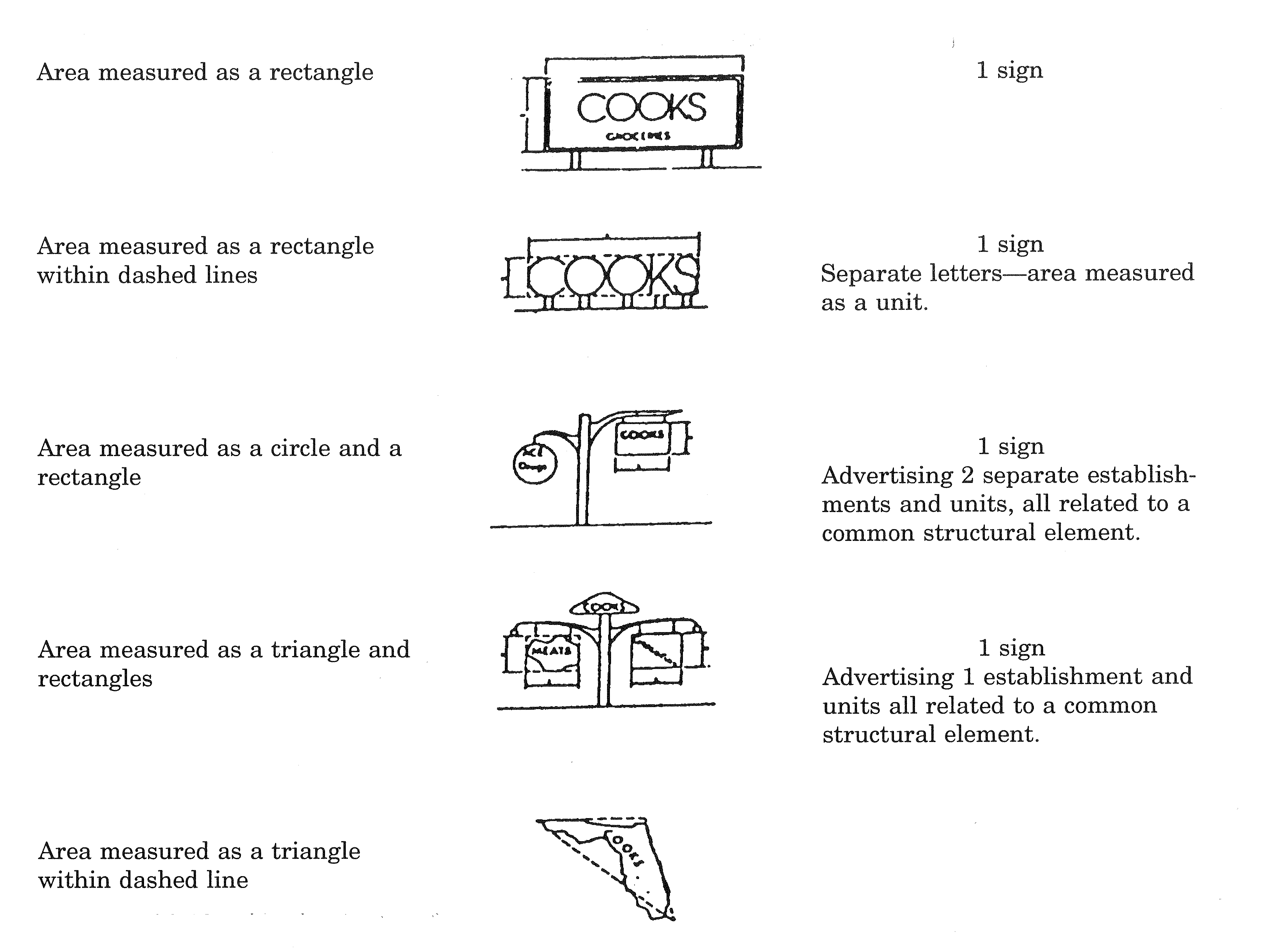
_____
(7)
Application of regulations, FR, RC, C, A, R, MH classifications: The following regulations contained in this subsection shall apply in the FR, RC, C, A-1, A-2, A-3, A-4, RR, RE, RA, R-1 through R-9, MH-1 through MH-8, OTR, ORE, OCR, SWC, and residential use areas in the OMV, OUR, SWC, SWR, RPUD and MPUD classifications established in division 7 of this article:
a.
Maximum allowable sign copy area permitted per premises:
1.
Single-family and two-family residential permitted principal uses: 4.5 square feet (except entrance signs denoting the name of a subdivision) for a lot with less than five acres in area; 32 square feet for a lot with five acres or more of area.
2.
Multifamily residential permitted principal uses: 16 square feet.
3.
Nonresidential permitted principal uses or permitted special exceptions: 32 square feet.
4.
Nonconforming uses: 32 square feet.
5.
Signs located at the entrance of a residential planned unit development, subdivision, mobile home park, or recreational vehicle shelter and park: 60 square feet.
b.
Maximum number of signs permitted:
1.
Single-family and two-family residential permitted principal uses: One per lot.
2.
Multifamily residential permitted principal uses: One per street frontage.
3.
Nonresidential permitted principal uses or permitted special exception: One per street frontage.
4.
Nonconforming uses: One per street frontage.
5.
Signs located at the entrance of a residential planned unit development, subdivision, mobile home park or recreational vehicle shelter and park: Two per entrance.
c.
Maximum height of signs: The height shall not exceed 12 feet measured from finished grade to the highest point on the sign.
d.
Minimum distance from lot lines: No signs shall be located closer than five feet from any lot line.
(8)
Application of regulations; P, B and I districts: The following regulations contained in this subsection shall apply in the P, B-1, B- 2, B-3, B-4, B-5, B-6, B-7, B-8, B-9, I-1, I-2, I-3, 1-4, OCV, OTC, AP, BPUD and the commercial, industrial, and vertically integrated residential/commercial use area of the OMV, OUR, SWC, SWR, RPUD and MPUD classifications:
a.
Maximum copy area permitted per premises:
1.
A premises or leased parcel of land having only one permitted principal use or structure located thereon: 1.5 square feet for each linear foot of total lot frontage on a street for the first 200 feet, plus 0.5 square feet for each linear foot of frontage thereafter.
2.
A premises or leased parcel of land having more than one permitted principal use or structure located thereon: 2.5 square feet for each linear foot of total lot frontage on a street for the first 200 feet, plus 0.5 square feet for each linear foot of frontage thereafter.
3.
Signs located at the entrance of a commercial or industrial subdivision, park or planned unit development: 60 square feet.
b.
Requirements by sign type:
1.
Ground signs:
i
Only one ground sign may be erected per street front.
ii
The copy area shall not exceed five square feet for each ten feet of street frontage, but in no event shall the maximum copy area exceed 125 square feet.
iii
The height shall not exceed 30 feet measured from finished grade to the highest point on the sign, except that signs in the B-6 zoning classifications shall not exceed 50 feet in height.
iv
A clearance of nine feet between the finished grade and the bottom of the sign shall be maintained for any portion of the sign which extends over any sidewalk.
v
On any premises abutting the Atlantic Ocean, no ground signs shall be erected between a principal building and the ocean.
vi
Signs within the thoroughfare overlay zone areas must comply with subsection 72-297(j).
vii
Signs within a non-urban land use category must comply with subsection 72-297(j).
viii.
Signs within the AP zoning classification must comply with the requirements under the AP classification, as described in chapter 72, division 7 of the Volusia County Code.
2.
Marquee signs:
i
Only one marquee sign shall be erected to or hung from a marquee, and such sign when hung from a marquee shall be at least nine feet at its lowest level above the sidewalk or ground level, and further, such sign shall not extend outside the line of such marquee.
ii
Except as provided in subsection 2.i. above, a marquee sign may be erected to the sides and front of a marquee, and such sign may extend the entire length and width of said marquee, provided such sign does not extend more than six feet above, nor one foot below such marquee; but under no circumstances shall the sign have a vertical dimension greater than eight feet.
3.
Projecting signs:
i
Only one projecting sign not exceeding a maximum copy area of 32 square feet may be erected on any premises.
ii
A projecting sign may extend more than 12 inches but less than four feet beyond the wall of the building to which it is attached.
iii
A minimum clearance of nine feet above the finished grade of a sidewalk shall be maintained.
4.
Wall signs: Only one wall sign shall be permitted for each organization or business establishment. The copy area shall not exceed two square feet for each linear foot of building frontage up to a maximum of 750 square feet. On corner or double frontage lots, a maximum of two wall signs are permitted provided that one of the sign's copy areas shall be figured on the basis of half of the percent allowable for lots that front along a single street. Wall signs may be erected on any wall.
5.
Canopy signs. Signage shall meet the requirements of this section [72-298] of this article; provided, however, up to 16 square feet of copy area containing the name, logo, initials, or other identification symbol of the business may be displayed on attached or detached canopy structures. If the total copy area of signage located on the canopy structure exceeds 16 square feet, the canopy shall be considered a ground sign.
6.
Electronic message centers.
i.
An electronic message center shall only be located on parcels zoned P, B-1, B-2, B-3, B-4, B-5, B-6, B-7, B-8, B-9, I-1, I-2, I-3, I-4, OCV, OTC or the following subcategories of PUD, BPUD, IPUD, and MPUD, as described in chapter 72, division 7 of the Volusia County Code.
ii.
The conversion of any existing permitted sign to an electronic message center or the installation of an electronic message center on or within an existing permitted sign shall require the approval of a new county sign permit pursuant to the procedures described in subsection 72-298(13), Volusia County Code.
iii.
The maximum sign area of the electronic portion of an electronic message center shall not exceed 40 percent of the total sign area allowed for ground signs, or 34 square feet, whichever is less.
iv.
An electronic message center may only be constructed on a parcel of land having a minimum of 100 feet of roadway footage. Recognized existing nonconforming parcels may seek a variance from this restriction, provided they meet the variance criteria and requirements of subsection 72-379(1)a.4. of this Code.
v.
An electronic message center must be set back at least five feet from the right-of-way, and shall be part of a ground-mounted monument style sign no greater than eight feet above grade. An electronic message center may not be installed on an existing permitted sign which is taller than eight feet above grade.
vi.
An electronic message center shall not be installed within 1,000 linear feet of a conforming single-family residence as measured along each side of the right-of-way.
vii.
An electronic message center with a sign face on two sides and no more than 4.5 feet of separation between faces shall be considered a single sign, and the total sign area shall be the area on a single face.
viii.
The copy content of an electronic message center may change at intervals of no less than eight seconds. The content image must remain stable; continuous scrolling or flashing of the image is prohibited.
ix.
The copy content of any electronic message center shall not contain effects that are designed to resemble a traffic signal or emergency vehicle strobe lighting.
x.
A malfunctioning electronic message center shall be programmed to turn off or otherwise display a blank screen. Electronic message centers must be equipped with software programming controls that automatically turn the sign off if the display is malfunctioning in any way.
xi.
Exposed neon or fiber-optic tubing on electronic message centers is prohibited.
xii.
If city gateway standards apply to any proposed electronic message center in accordance with the nonresidential design standards of section 72-303, Volusia County Code, and the standards found in the Code of the city at issue differ from those found in the Volusia County Code, then the most restrictive provision shall apply.
xiii.
Electronic message centers are prohibited within the sea turtle lighting ordinance boundary area described in chapter 72, division 12 of the Volusia County Code.
xiv.
Electronic message centers shall be equipped with a sensor or other device that automatically determines the ambient illumination and can be programmed to automatically dim according to ambient light conditions, or that can be adjusted to comply with the 0.3 foot-candle measurements.
xv.
For purposes of operating electronic message centers, the difference between the off and solid message measurements using the electronic measurement criteria described herein shall not exceed 0.3 foot-candles. The illuminance of an electronic message center shall be measured with an illuminance meter set to measure foot-candles accurate to at least two decimals. Illuminance shall be measured with the electronic message center off, and again with the electronic message displaying a white image for full color-capable signs, or a solid message for single color signs. All measurements shall be taken perpendicular to the face of the electronic message center at a distance determined by the total square footage of the sign as set forth in the accompanying "Electronic Message Center Sign Area Versus Measurement Distance Table" below:
Electronic Message Center Sign Area
Versus Measurement Distance
xvi.
Existing nonconforming electronic message centers must be brought into compliance with the dimming and illumination provisions of this subsection (8)b.6. through the adjustment of existing hardware and/or software by October 1, 2012. Violations related to an electronic message center operator's failure to abide by the dimming and illumination standards of this subsection (8)b.6. will result in the immediate initiation of code enforcement procedures by the county. The owner/operator of the electronic message center may offer reasonable evidence to the code enforcement board that the electronic message center in question cannot be dimmed or adjusted to the standards listed herein.
xvii.
Nonconforming electronic message centers that do not comply with the location and size requirements of this subsection (8)b.6. shall be subject to the removal requirements of subsection (15) herein, titled "Nonconforming signs."
c.
Minimum distance from lot lines: No signs shall be located closer than five feet from any lot line.
(9)
Off-premises signs: Off-premises signs may only be erected in the B-6, I-1, or I-2 zoning classifications established in division 7, along federal-aid primary or interstate highways. Provided, however, such off-premises signs shall comply with the thoroughfare overlay zone regulations in section 72-297 and the nonresidential development design standards in section 72-303 if such sign is located in an area in which these regulations are applicable. Off-premises signs shall be included in the number of maximum signs and copy area allowed for the zoning classification in which it is to be placed. Said off-premises signs shall otherwise comply with the requirements of F.S. ch. 479 and chapter 14-10, Fl. Admin. Code.
(10)
Unlawful signs on public property or public right-of-way: Any sign erected on public property or public right-of-way in violation of subsection (2)a. of this section shall be removed by the zoning enforcement official.
(11)
Temporary signs:
a.
Temporary signs may be erected on a premises in accordance with the following requirements:
1.
Only one temporary sign may be erected on a premises for each 1,000 feet of street frontage.
2.
A temporary sign's copy area shall not exceed 4.5 square feet in the R-1—R-6, R-9, OTR, ORE, OCR and RE zoning classifications and 32 square feet in all other zoning classifications except the single- and two-family residential use portions of the RPUD and MPUD zoning classifications. Temporary signs erected in an RPUD or MPUD zoning classification shall not exceed 4.5 square feet in single-family and two-family residential use areas and 32 square feet in all other RPUD and MPUD use areas.
3.
Temporary signs shall not exceed ten feet in height measured from the finished grade to the highest point on the sign.
4.
All temporary signs may be authorized for a total period not to exceed three months during any calendar year. Said sign shall be removed upon the expiration of the above-described period.
5.
Temporary banner signs erected in accordance with this section shall not exceed 30 square feet in copy area.
b.
Conversion of temporary sign into permanent signs: Temporary signs (including portable signs) may be converted into permanent signs to be used for any purpose permitted by this article in accordance with the following requirements:
1.
All regulations contained in this article applying to erection of new permanent signs shall apply to conversion of signs, including all permit requirements.
2.
All exposed trailer frames, legs, service walkways, etc., shall be removed.
(12)
Shielding: The source of illumination from any sign shall be shielded in order to prevent a direct beam of light from shining onto a street or a residential single-family, two-family, or multifamily dwelling.
(13)
Sign permit application; permit required.
a.
A permit shall be required prior to erecting a sign unless otherwise exempt under subsection 72-298(1). An applicant shall deliver a completed sign permit application to, and on a form prescribed by the county manager or designee. The sign permit application shall be reviewed by the county manager or designee for a determination of whether the proposed sign meets the applicable requirements of this Code. The review of the sign permit application shall be completed within 20 calendar days following receipt of a completed application, unless otherwise agreed to in writing by the applicant, and any applicable fees, not counting the day of receipt and not counting any Saturday, Sunday or legal holiday which falls upon the first or the 20th day after the date of receipt, unless otherwise extended upon written request by the applicant for a specified number of days. A sign permit shall either be approved or denied, and the decision shall be reduced to writing. In the event the application is denied, the reasons for the denial shall be set forth in the written decision. In the event that no timely decision is rendered, the application shall be deemed denied. An appeal filed in accordance with section 72-378 of a denial for lack of timely decision by the county manager or designee shall not be charged an appeal fee.
b.
The decision of the county manager or designee shall constitute a final decision and shall be mailed by U.S. Mail or hand delivery. For the purposes of calculating compliance with the deadline for a decision upon an application, the decision shall be deemed made when deposited in the mail to the applicant.
c.
An application which is materially incomplete or which is not accompanied by the required fee shall not be deemed accepted and the time for review of the application shall not commence until a complete application accompanied by the required fee is filed with the county manager or designee.
d.
An applicant may appeal any decision of the county manager or designee made under this article to the county council in accordance with section 72-378.
(14)
Sign permit renewal fees: Except as otherwise provided in this article, a sign permit shall be valid for two years from the date of issuance. Thereafter, a sign permit may be reissued for the same sign for each successive biennial period upon payment of the permit renewal fee and late fee, if the permit was not renewed prior to its expiration. It shall be unlawful to maintain any sign without an original or renewed sign permit. The reissuance of a permit does not waive any other requirements of this article. It is the intent of this provision that the zoning enforcement official may inspect signs subject to the permit renewal fee in order to ascertain if any changes have been made to the sign since issuance of the permit, or renewal thereof, so as to ensure continued compliance with this article.
(15)
Nonconforming signs: All nonconforming signs other than electronic message centers shall only be made to conform with this article when structurally altered, or when said signs are destroyed or damaged by wind, fire, or other means to the extent of 60 percent or more of their replacement value. Existing nonconforming electronic message centers which cannot be brought into conformance with all requirements of this article through software or hardware adjustment shall be removed no later than October 1, 2021. Thereafter, all such nonconforming electronic message centers shall be deemed unlawful.
(Ord. No. 86-16, § XXXIV, 10-23-86; Ord. No. 87-14, §§ XXII, XXIII, 6-18-87; Ord. No. 89-20, §§ XLIV, XLV, 6-20-89; Ord. No. 90-34, §§ 80—89, 9-27-90; Ord. No. 91-11, §§ XXIV, XXV, 5-16-91; Ord. No. 92-6, §§ LXVII, LXVIII, 6-4-92; Ord. No. 94-4, § XCII—XCV, 5-5-94; Ord. No. 96-16, § I, 7-18-96; Ord. No. 98-25, § XLVII, 12-17-98; Ord. No. 2008-25, § II, 12-4-08; Ord. No. 2009-19, § II, 8-6-09; Ord. No. 2010-03, § I, 2-18-10; Ord. No. 2011-02, § IV, 1-20-11; Ord. No. 2011-25, § II, 9-22-11; Ord. No. 2012-06, § III, 5-3-12; Ord. No. 2013-08, § III, 5-2-13; Ord. No. 2018-05, §§ X, XXIV, 1-18-18; Ord. No. 2018-04, § VII, 4-17-18)
Sec. 72-299. - Affordable housing incentives.
(a)
Purpose and intent. To maximize the cost and time savings for affordable housing projects by streamlining regulations and processes to increase and preserve the supply of affordable housing stock.
(b)
Applicability. Projects, including ADUs that meet the county's definition of affordable housing, as certified by the community services division.
This section does not apply to projects seeking approval under the pre-emption authority of the Live Local Act, F.S. § 125.01055(7). F.S. § 125.01055(7) does not apply to projects approved under this section.
(c)
Declaration of restrictive covenant. A declaration of restrictive covenant (covenant) stating that the project will remain affordable [F.S. § 420.0004(3)] for the affordability period shall be filed with the Volusia County Clerk of the Court and shall run with the property for the duration of the affordability period. The deferral period shall be for a period of 20 years, unless a shorter time period is approved by the growth and resource management director and the community services director. The covenant shall list all affordable housing incentives provided for the project including impact fees, fee waivers, and density bonuses, or other incentives approved during the project review process.
(d)
Deferral of impact fees. Volusia County imposed impact fees for affordable housing projects may be deferred upon written request by the applicant for affordable housing projects certified by the community services department. The growth and resource management director, or designee, will generate an itemized list of impact fees being deferred. This list shall be attached to the declaration of restrictive covenant as an exhibit. Failure to maintain affordable housing as defined in the Volusia County Comprehensive Plan and the zoning ordinance shall require payment of impact fees in full upon written notice from Volusia County. All impact fees shall be due and payable to Volusia County at the end of the affordability period, unless the affordability agreement is extended by the community services and growth and resource management directors.
(e)
Fee waivers. Permit fees, inspection fees, and application fees for certified affordable housing projects shall be waived upon written request of the applicant. These fees shall be forgiven in their entirety upon expiration of the initial affordability period. A list of fees shall be generated during the project review and attached to the declaration of restrictive covenant as an exhibit. Failure to comply with the affordability agreement shall require repayment of all fees in full upon written notice by Volusia County.
(f)
Density bonuses. Density bonuses are allowed for affordable housing projects that are certified by the county's department of community services. To ensure that the projects are located near available resources and services, bonuses are limited to the following urban land use designations and will be calculated by the growth and resource management department as follows:
Low Impact Urban — Increase maximum density to five dwelling units per acre.
Urban Low Intensity — Increase maximum density to eight dwelling units per acre.
Urban Medium Intensity — Increase maximum density to 14 dwelling units per acre.
Urban High Intensity — Maximum density cannot exceed 20 dwelling units per acre.
Lands designated as wetlands, wetland buffers, water bodies, the natural resource management area, the resource corridor zoning classification, or in the floodplain are not eligible for density bonuses. A written request shall be submitted by the applicant during the project review notifying the county of the intent to utilize the density bonuses outlined above. The final project design is subject to review and approval by the affordable housing review team.
(g)
New accessory dwelling units. Impact fees may be deferred for newly constructed accessory dwelling units (ADU) used for certified affordable housing upon request by the applicant if all impact fees have been paid on the principal dwelling unit. The applicant shall file a declaration of restrictive covenant with the Volusia County Clerk of the Court stating that the ADU will remain affordable for 20 years, unless the affordability agreement is extended by the community services and growth and resource management directors.
(h)
Affordable housing review team. Certified affordable housing projects will be assigned to a dedicated affordable housing review team for expedited review. The team will be comprised of a county-designated review staff, the county's community assistance director or designee, and affected municipalities. The expedited review process will be facilitated by the land development manager. Upon request by the applicant, the team will be assembled for an initial team meeting within two weeks of the request to discuss the scope, certification requirements, waivers and deferrals, funding sources, and other relevant facts relating to the applicant's proposal. Upon receipt of a completed application, the team will have 90 days to review the application and schedule the project for the development review committee. Final approval of certified affordable housing projects shall be by the development review committee. The applicant may request a waiver to the expedited 90-day review from the land development manager.
(i)
Modification of development standards. Not withstanding any other provision of the Code of Ordinances, the land development manager is authorized to approve up to a ten percent deviation in lot size, lot width, dwelling unit size, setbacks, parking requirements, lot coverage, height, open space, landscaping, and other development standards in chapter 72, Land Planning, unless governed by federal or state law. Any deviations greater than ten percent will require approval by the planning and land development regulation commission or the development review committee, as applicable.
(j)
Commercial or industrial zoning. Volusia County Council may approve the development of affordable housing on any parcel designated or zoned for commercial or industrial uses if any one of the following apply:
(1)
The development receives funding from the Florida Housing Finance Corporation, the State Housing Initiatives Partnership program, or other verified federal, state, or local affordable housing sources; or
(2)
The Volusia County Council approves a resolution of support; or
(3)
The applicant agrees to a land use restriction that reserves 30 percent or more of the dwelling units for affordable housing, as defined by the county's comprehensive plan and zoning ordinance, for a period of 50 years; or
(4)
The new development consists of one principal residential structure and one accessory dwelling unit (ADU) built on a conforming or nonconforming infill lot where the ADU is subject to a 20-year affordability agreement.
(k)
Affordable housing priority overlay. A priority overlay will be used to reflect funding priorities for certified affordable housing. The overlay will help prioritize areas in need of affordable housing projects where services such as public transportation, employment centers, shopping, schools, and social services are available for very low, low, and moderate-income families. While the overlay represents targeted areas for affordable housing projects and funding, projects outside of the overlay may be approved by the community services department at their discretion.
(Ord. No. 2025-01, § II, 5-6-25)
Sec. 72-300. - Natural resource management area.
(a)
Purpose and intent: The purpose of this section is to provide regulations to manage and enhance those lands and waters which, because of past development trends and physiographic characteristics, have remained relatively unfragmented. These areas, among other functions, may support a healthy and diverse array of plant and animal life; continually help recharge the county's groundwater supply; ensure high quality surface waters; and provide recreation, aesthetic and open space areas that have become an integral part of the quality of life for Volusia County residents and visitors. It is intended that the development of land within the natural resource management areas (NRMA) does not adversely impact the quality and quantity of the existing resources. Development activities within the NRMA are intended to be more restrictive than for the same activities falling outside of the NRMA. The natural resource management area is consistent with the future land use map of the comprehensive plan.
(b)
Environmental impact assessment: As required by subsection 72-505(i) of the Land Development Code [article III], an environmental impact assessment (EIA) report is required for proposed developments within the NRMA. The report shall be submitted and reviewed in the manner prescribed by the Land Development Code [article III]. Approval of this report is required prior to the issuance of a development permit.
(c)
Wetlands preservation: All wetlands within the NRMA are to be preserved as required by division 11 of the Land Development Code [article III].
(d)
Shoreline protection:
(1)
The construction of vertical walls or bulkheads along the banks and shorelines of naturally occurring surface waterbodies is prohibited except as may be waived by the county council for those instances where a serious threat to life or property can be demonstrated.
(2)
Other methods of bank and shoreline stabilization (i.e., sloping stabilization methods combined with vegetation) shall be used, to the maximum extent feasible, in lieu of vertical walls or bulkheads when hardening of the shoreline has been approved.
(e)
Upland protection:
(1)
Any required open space for projects within the NRMA (as specified by the comprehensive plan) shall be utilized to preserve upland habitat in an ecologically strategic manner (e.g., adjacent to wetlands, watercourses and waterbodies and other protected resources). Required buffers consisting of uplands may count towards achieving this standard.
(2)
Disturbance or alteration of environmentally sensitive uplands shall be avoided to the greatest extent practical. If unavoidable to attain reasonable use, such disturbances must be minimized and/or mitigated and appropriately managed as described and approved in the required EIA.
(Ord. No. 90-34, §§ 96—100, 9-27-90; Ord. No. 91-11, §§ XXVIII, XXIX, 5-16-91; Ord. No. 94-4, §§ XCIX, C, 5-5-94; Ord. No. 2008-25, § II, 12-4-08)
Sec. 72-301. - Reserved.
Editor's note— Section 825.00 was repealed by § LXXI of Ord. No. 92-6, adopted June 4, 1992. The text is now located in § 814.03. Ord. No. 2008-25, § II, adopted Dec. 4, 2008, renumbered former section 825.00 to 72-301 and former text can now be found in subsection 72-290(3).
Sec. 72-302. - Coastal management.
Hurricane damage: Within the coastal high-hazard area, as defined by the comprehensive plan, it may be possible to rebuild both conforming and nonconforming structures which have been damaged by a hurricane provided that:
(1)
Structures which conform to the requirements of this article and which have been damaged less than 50 percent of their replacement cost at the time of damage may be rebuilt to their original condition, subject only to current building and life safety codes.
(2)
Notwithstanding the provisions of division 6 of this article, structures which have been damaged more than 50 percent of their replacement cost at the time of damage, including nonconforming structures, can be rebuilt to their original square footage and density, provided that they comply with:
a.
Federal requirements for elevation above the 100-year flood level;
b.
Building code requirements for floodproofing;
c.
Current building and life safety codes;
d.
State coastal construction control lines;
e.
Any required zoning or other land development regulations (other than density or intensity), unless compliance with such regulations would preclude reconstruction otherwise intended by this section;
f.
Any other relevant federal regulations; and
g.
Any other relevant local regulations.
Documentation such as, but not limited to, site plans, photographs, appraisals, ad valorem tax records, and previously approved building permits, may be required to substantiate a loss prior to a person being given approval to replace a structure.
(Ord. No. 90-34, §§ 104, 105, 9-27-90; Ord. No. 94-4, § CI, 5-5-94; Ord. No. 2008-25, § II, 12-4-08)
Sec. 72-303. - [Nonresidential development design standards.]
(a)
Purpose and intent. While the county encourages economic growth and nonresidential development in areas with access to county thoroughfares, it also encourages protection of residential and agricultural interests from the impacts of nonresidential development. The integration of flowing traffic circulation and pedestrian accessibility is one primary concern for new development and redevelopment. In addition, the county encourages the design of new development to be visually sensitive and attractive to surrounding development and the environment. The purpose of the architectural guidelines contained herein, is to promote design treatments that enhance the visual appearance of development, ensure compatibility of buildings, and create a strong community image and identity and to protect community aesthetics.
(b)
Applicability.
(1)
Lands. The following design standards are applicable to lands located along identified county thoroughfares or adjacent to cities with gateway/corridor standards. In the event that the said lands are located within one mile of a municipality which has adopted gateway/corridor standards, within an area served by a municipal utility, or within the urban portion of the designated urban growth boundary area, whichever area is greatest, the adopted municipal gateway/corridor standards shall apply in their entirety to said lands.
(2)
Uses. The design standards contained in section 72-303(b) through (j) shall apply to retail, office, institutional, public and other similar facilities. Industrial facilities shall comply with the design standards contained in section 72-303(k).
(3)
Development permits. These design standards shall apply to all development permits except those for redevelopment, expansion, or alteration of an existing structure, which does not increase the cumulative gross floor area by more than 25 percent.
(4)
Conflict with other sections. Development and use of all said lands may occur only in compliance with both this section and with the provisions of this article that govern the underlying zoning classification in which the land is located. When there is conflict between this section and the provisions applying to the underlying zoning classification, this section governs. Design standards applicable under this article to a community of special interest shall prevail over either conflicting county or municipal design standards provided for by this section.
(5)
An applicant may request a waiver from the requirements of section 72-303 from the zoning enforcement official. The applicant shall provide sufficient information or plans to justify the requested waiver. The zoning enforcement official shall review and grant the waiver if conditions, such as size or scale of buildings, existing vegetation, topographic features and/or private covenants restrict the ability to comply with all of the requirements contained in section 72-303.
(c)
Site plan design standards.
(1)
Site layouts shall be designed with special attention to the creation of an attractive, safe and functional urban environment based upon the following standards:
a.
Building orientation. The location of buildings on sites varies depending upon which area of the county the development is located. In the older urban areas, buildings should be located closer to the street to preserve the traditional layout, while newer development in traffic oriented areas should have the buildings located further away from the street. In either case, the building layout selected should contribute to the creation of a healthier pedestrian environment and a more cohesive urban context.
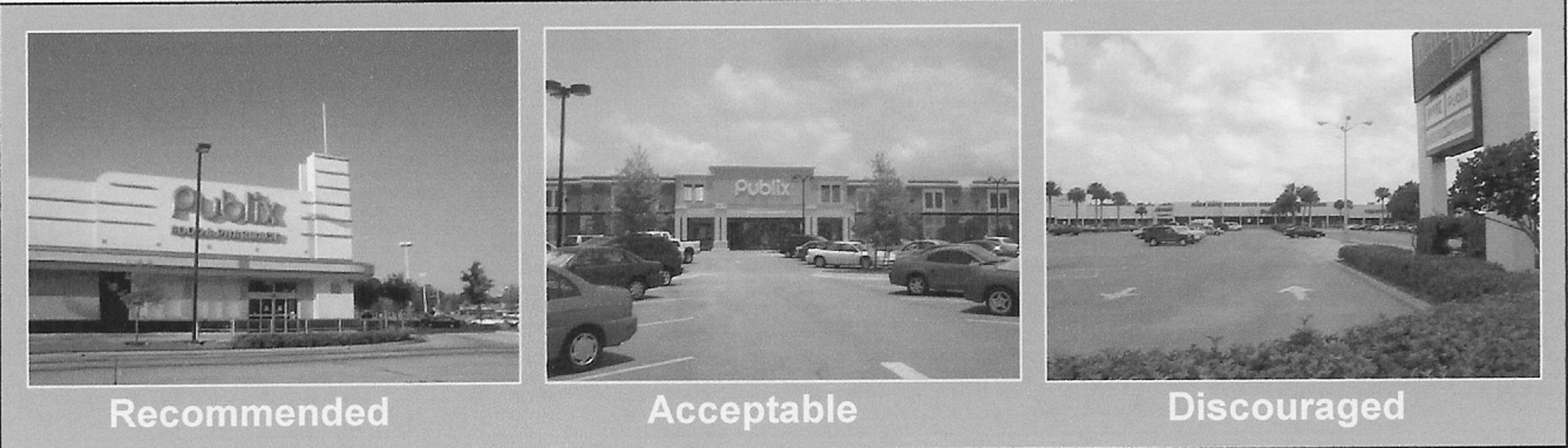
Building Orientation
1.
Buildings shall be oriented to face the public right-of-way.
2.
Buildings shall be oriented to maximize pedestrian access and view of adjacent water bodies and other amenities, even if there is another primary façade on the public right-of-way.
3.
Building location and mass should relate to nearby buildings and to the urban context with off-street parking areas located to the side and rear of the site in the older urban areas where a grid pattern is prevalent.
4.
When parking areas are located behind the businesses, a secondary entrance should be provided in the back of the business. A rear entrance can provide direct service and customer access to the store from parking areas as well as improve circulation between the parking lots and the street. Architectural embellishments, awnings, landscaping and signs shall be used to mark the secondary entrance and the design of the rear of the building shall be consistent with the front façade.
5.
Where the parking is located in front of the building, the parking area shall be designed to avoid the appearance of large masses of pavement, and shall be conducive to pedestrian access and circulation as set forth in subsection (f) of this section.
(2)
Outparcels. Nonresidential developments that have a primary building and/or anchor tenant and outparcel developments on the same site must conform to the following guidelines:
a.
In order to provide a unified design with the main structure and enhance the visual impact of outparcels, all exterior façades of the outparcel buildings shall be considered primary façades and shall employ architectural and landscape design treatments similar to the primary building and/or anchor tenant.
b.
Interconnection of pedestrian walkways with the main structure and adjacent outparcels is required.
c.
Consolidated parking areas are encouraged. The main structure and adjacent outparcels shall share driveway access.
d.
Vehicular connection between the outparcel, the main structure, and adjacent outparcels is required to provide for safe and convenient vehicular movement within the site.
(d)
Architectural design standards.
(1)
Building design. Buildings shall have architectural features and patterns that provide visual interest from the perspective of the pedestrians and motorists. Buildings shall include substantial variation in mass such as changes in height and horizontal plane.
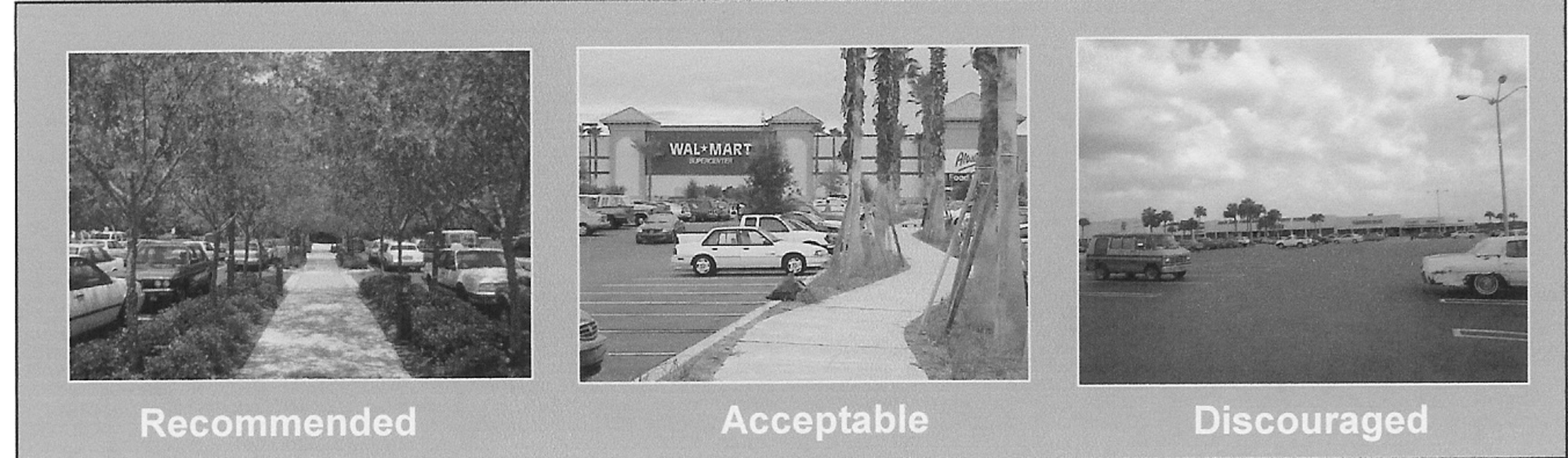
Variation in Mass
a.
Primary building façades shall be enhanced by the use of vertical and horizontal elements. Landscaping may be used to enhance the architectural features and to break the visual monotony but shall not be used in lieu of the following requirements:
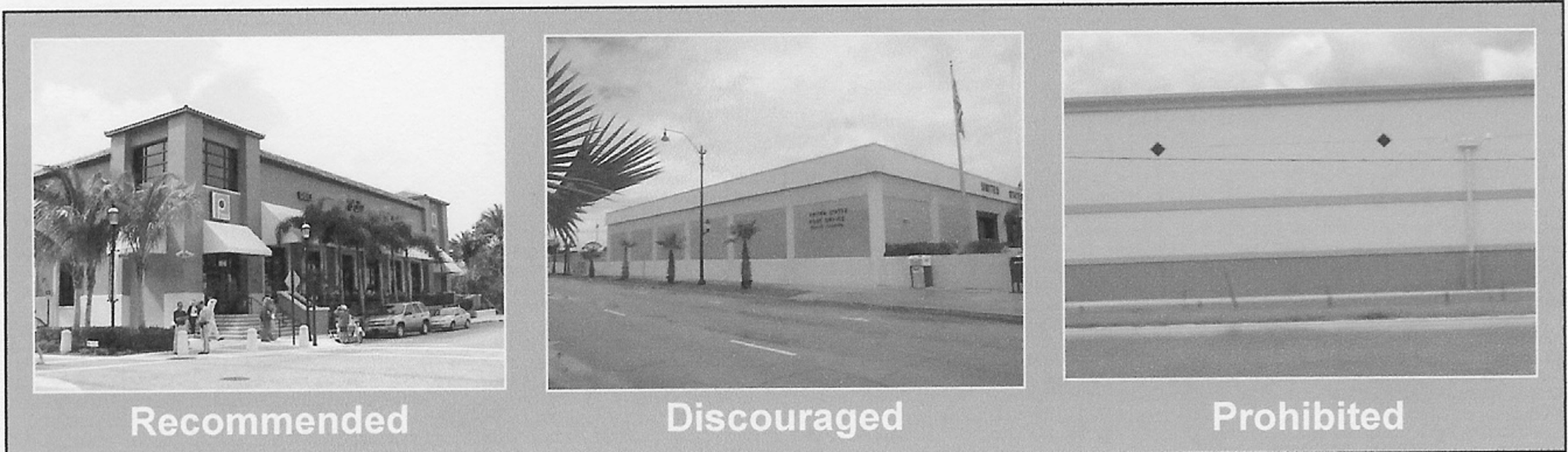
Primary Building Facades
1.
Façades shall not exceed 30 horizontal feet, and ten vertical feet, without two of the following elements:
i.
A change in plane, such as an offset, reveal or projecting rib. Such plane projections or recesses shall have a width of no less than six inches and may include but are not limited to columns, planters, arches, and voids, etc.
ii.
Architectural details such as raised bands and cornices.
iii.
Awnings.
iv.
Change in color.
v.
Change in material.
vi.
Change in texture.
vii.
Doors.
viii.
Windows.
2.
Façades that extend for more than 100 feet in length shall incorporate, in addition to two of the above requirements, at least one of the following elements:
i.
A change in plane, such as an offset, reveal or projecting rib. Such plane projections or recesses shall have a width of no less than three feet, and a depth of at least six inches; or
ii.
Architecturally prominent public entrance; or
iii.
A tower.
b.
The ground floor of the primary façade shall have at least two of the following elements for at least 60 percent of the width of the façade:
1.
Public entrances.
2.
Arcades, or other roof treatment, such as awnings or secondary roofs, to provide shade and façade interest.
3.
Windows/display windows.
4.
Awnings, associated with windows or doors.
5.
Landscaping, adjacent to the building.
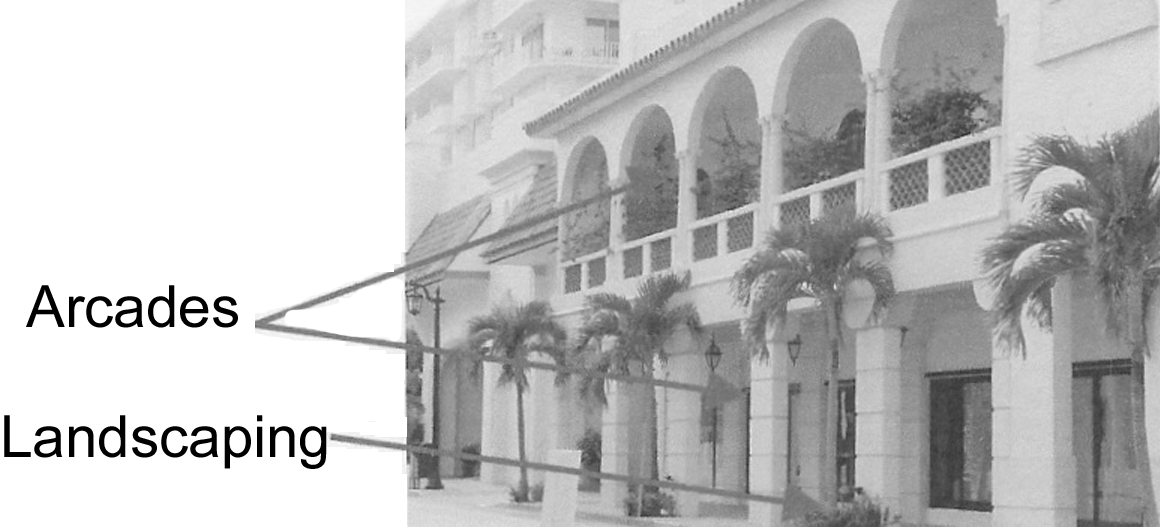
c.
Secondary façades, which are not readily visible from the street right-of-way, shall provide at least two of the elements required for primary façades.
d.
All additions, alterations and accessory buildings shall be compatible with the principal structure in design and materials.
e.
The first floor of all buildings, including structured parking, shall be designed to encourage pedestrian scale activity.
f.
Overhangs/awnings shall be no less than three feet deep to protect pedestrians from inclement weather.
g.
The highest point of a first floor awning on a multistory building shall not be higher than the midpoint between the top of the first story window and the second story windowsill.
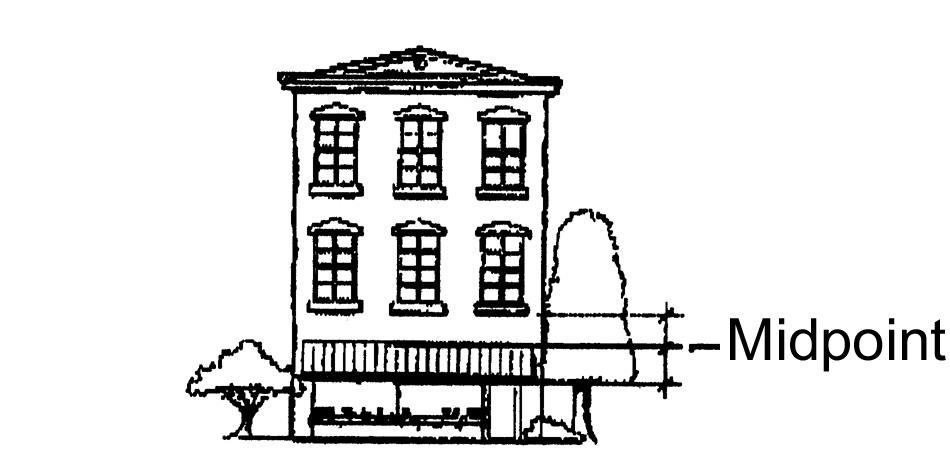
Position of Awning
h.
Accessory structures including, but not limited to, carwash buildings and gas station/convenience store canopies, shall have the same architectural detail, design elements and roof design as the primary structure.
(2)
Fenestration.
a.
At least 30 percent of primary façades shall be comprised of windows and doors. However, nearly continuous expanses of glass for walls shall be avoided. Patterns are encouraged by alternating solid elements and windows.
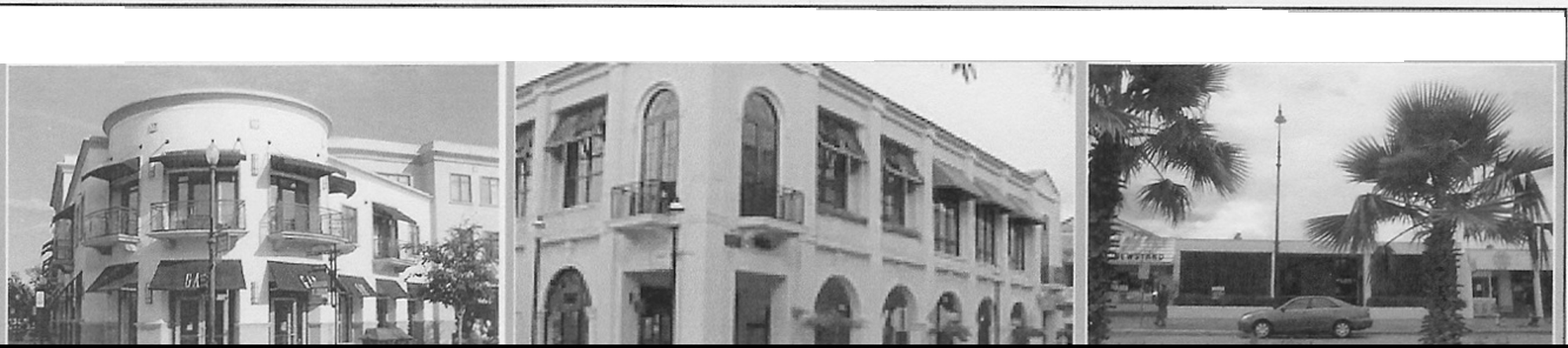
Patterns in Facades
b.
Windows and display cases should be provided along pedestrian corridors.
c.
Where nonresidential buildings contain multiple, separate tenant stores, with separate, exterior customer entrances, the street level façade of such stores shall be transparent between the height of three feet and eight feet above the walkway grade for no less than 60 percent of the horizontal length of the building façade of such additional stores.
d.
Views into the interior of retail storefronts and restaurants are encouraged for pedestrian activity, safety and to create a community window-shopping environment. The use of darkly tinted or reflective glass on these structures is prohibited. Reflective glass will be defined as having a visible light reflectance rating of 15 percent or greater and darkly tinted glass windows include glass with a visible light transmittance rating of 35 percent or less. All plans submitted to the county shall include the glass manufacturer's visible light reflectance and visible light transmittance ratings for review and approval.
e.
Windows shall be recessed a minimum of one-half inch, and shall include visually prominent sills, shutters, stucco relief or other such forms of framing.
(3)
Entrances.
a.
Multiple entryways or architectural features shall be incorporated into the design in order to break up the apparent mass and scale of large structures. All entrances shall be architecturally prominent and clearly visible from the abutting public street. Entrances may lead to tenant spaces other than the primary retail tenant.
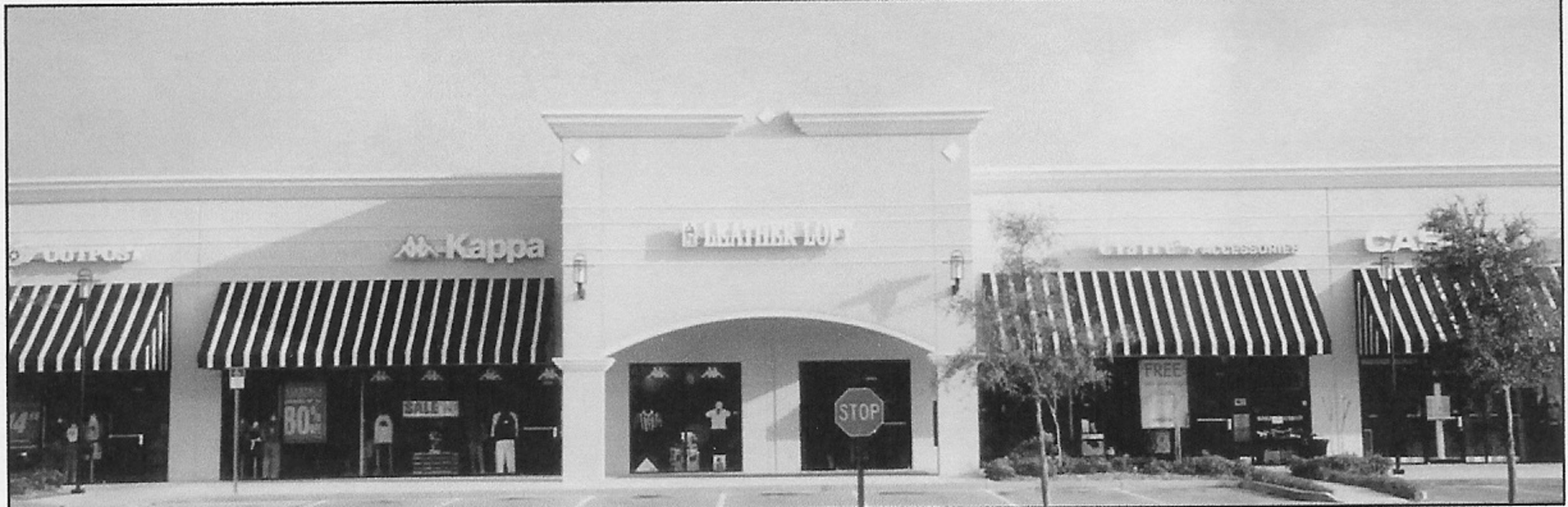
Prominent Entrance
b.
Primary customer entrances should face the street. Buildings larger than 30,000 square feet located on corner lots should provide customer entrances on both streets (movie theaters are exempt), or a corner entrance. Additional entrances are encouraged facing local streets, parking lots, plazas, lakefronts and adjacent buildings.
c.
Primary customer entrances shall be clearly defined and highly visible through the use of architectural detail for all structures. Primary entrances to anchor stores shall be highlighted with tower elements, higher volumes, tall voids, special building materials and/or architectural details. Entrances to smaller stores shall be recessed or framed by a sheltering element such as awning, arcade, porch or portico.
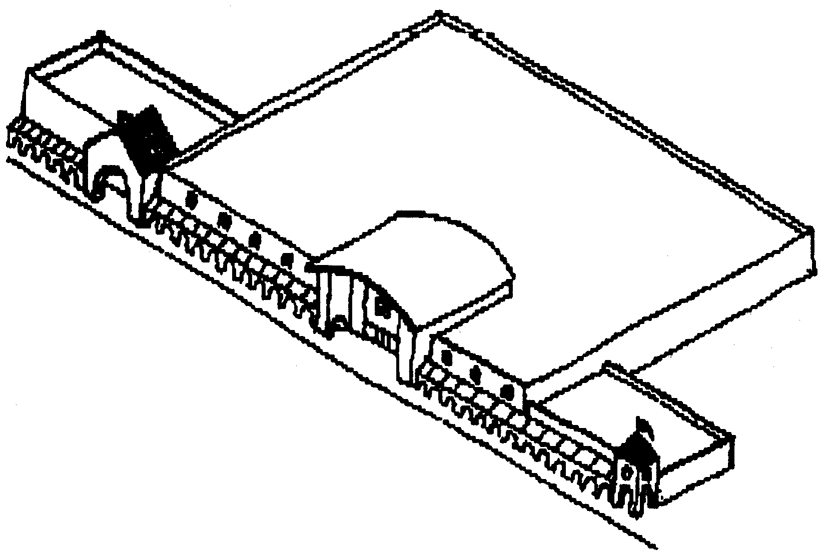
Highly Visible Entrance
d.
Multitenant structures larger than 75,000 gross square feet shall provide either a significant pedestrian amenity or a public entrance at a minimum of one per 75 linear feet of publicly visible façade. The public entrance may be to either the principal retail use or to any other tenant. Examples of significant pedestrian amenities include, but are not limited to, outdoor seating areas, play areas for children, and public courtyards. This provision shall not apply to more than three sides of any structure.
e.
Protection from the sun and adverse weather conditions for patrons should be considered for the entranceways. Awnings, canopies and arcades are allowed to project up to three feet into the required building setback.
f.
Covered visitor drop-off areas shall be provided at entries to institutional buildings.
g.
Each large retail establishment on a site shall have one or more clearly defined, highly visible customer entrances featuring no fewer than three of the following:
1.
Canopies or porticos;
2.
Overhangs;
3.
Recesses/projections;
4.
Arcades;
5.
Raised corniced parapets over the door;
6.
Peaked roof forms;
7.
Arches;
8.
Outdoor patios;
9.
Display windows;
10.
Architectural details such as tile work and moldings which are integrated into the building structure and design; or
11.
Integral planters or wing walls that incorporate landscaped areas and/or places for sitting.
h.
If multiple tenants are located in a nonresidential center, each individual establishment shall have at least one exterior customer entrance, which shall conform to the above requirements set forth in subsection (d)(3)g., of this section.
(4)
Roofs.
a.
Buildings shall have a recognizable top consisting of, but not limited to, cornice treatments, roof overhangs with brackets, steeped parapets, richly textured materials and/or differently colored materials. Color bands are not acceptable as the only treatment. Bands of color, typically used for advertising, are not allowed.
b.
Mechanical equipment located on roofs shall be integrated into the overall design of a building by screening it behind parapets or by recessing equipment into hips, gables, parapets or similar features. Plain boxes are not acceptable.
c.
Backlit awnings used as mansard or canopy roofs are prohibited.
d.
Roofs shall have no fewer than two of the following features:
1.
Parapets concealing flat roofs and rooftop equipment such as HVAC units from public view. The average height of such parapets shall not exceed 15 percent of the height of the supporting wall. The highest point of the parapet shall not at any point exceed 30 percent of the height of the supporting wall.
2.
A three-dimensional cornice treatment, a minimum of 12 inches in height, having a minimum of three vertical (not diagonal) changes in plane, and a variety of thickness in relief ranging from the greatest at the top to the least at the bottom.
3.
Overhanging eaves, extending no less than three feet past the supporting walls.
4.
Sloping roofs that do not exceed the average height of the supporting walls, with an average slope greater than or equal to one foot of vertical rise for every three feet of horizontal run and less than or equal to one foot of vertical rise for every one foot of horizontal run.
5.
Three or more roof planes per primary façade.
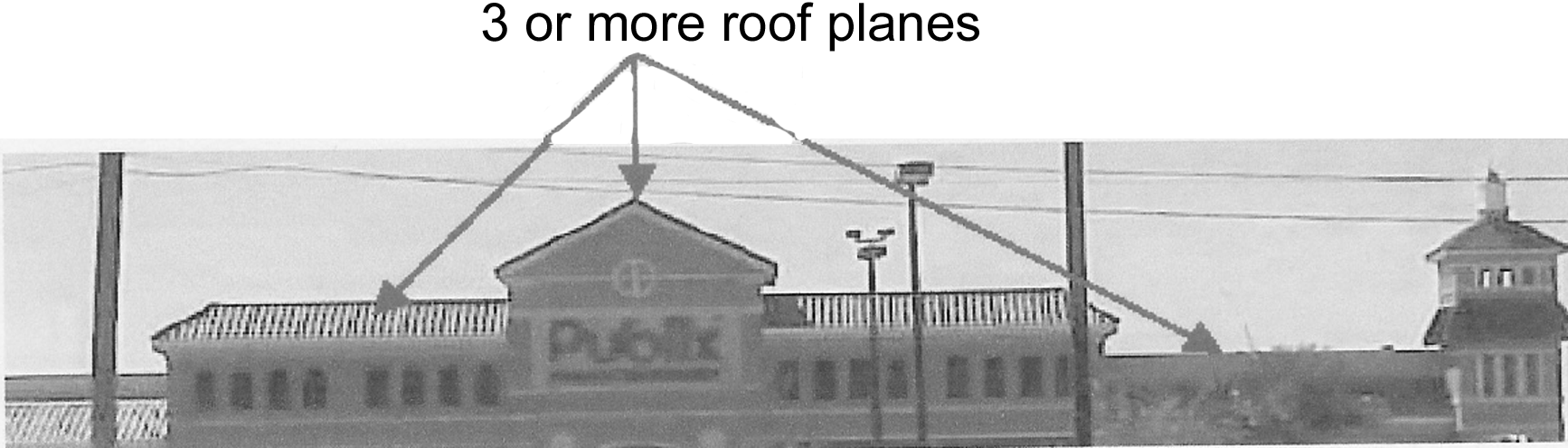
Roof Planes
6.
Any other treatment that, in the opinion of the zoning enforcement official, meets the intent of this section.
(5)
Corner lots.Buildings located at the intersections of thoroughfares shall be designed with architectural embellishments to emphasize their location as follows:
a.
Buildings on corner lots are considered to have double front/primary façades for architectural design purposes.
b.
Buildings on corner lots shall include at least one of the following embellishments: Cornice detail, arches, peaked roof forms, corner towers, clocks, bells or similar design features.
c.
Hardscape design, such as pedestrian plazas with artwork or fountains, may substitute for building embellishments on corner lots.
(6)
Exterior materials.
a.
Materials selected for buildings should have quality and stability in terms of durability, finish and appearance.
b.
Exterior building materials that are encouraged include wood siding, stucco, brick, stone and concrete masonry units. Masonry unit exteriors shall be textured and tinted to avoid the appearance of a smooth monotonous wall.
c.
Predominant materials that are not permitted include flat, corrugated or reflective metal panels, smooth or rib faced concrete block, cedar shakes, textured plywood, and plastic siding.
(7)
Colors. Color has one of the strongest visual effects of all elements of building design. Therefore, colors shall be selected to ensure harmony of the building with adjacent structures:
a.
A wide selection of low reflectance exterior colors should be utilized to promote variety and diversity. The generally approved paint colors for nonresidential uses include light pastel and earth tone colors. Color schemes must be submitted to the county building and zoning division for review and approval.
b.
The following colors are prohibited: Use of intense, fluorescent or day glow colors, black as the predominant exterior building color and monochromatic color schemes (all one paint color).
c.
Building, trim and detail colors must be complementary. Clashing trim colors will not be permitted.
d.
A solid line band of color shall not be used for architectural detail.
(8)
Corporate design. National corporate chains that typically design their buildings to read as signage shall modify their designs to comply with the requirements of this article.
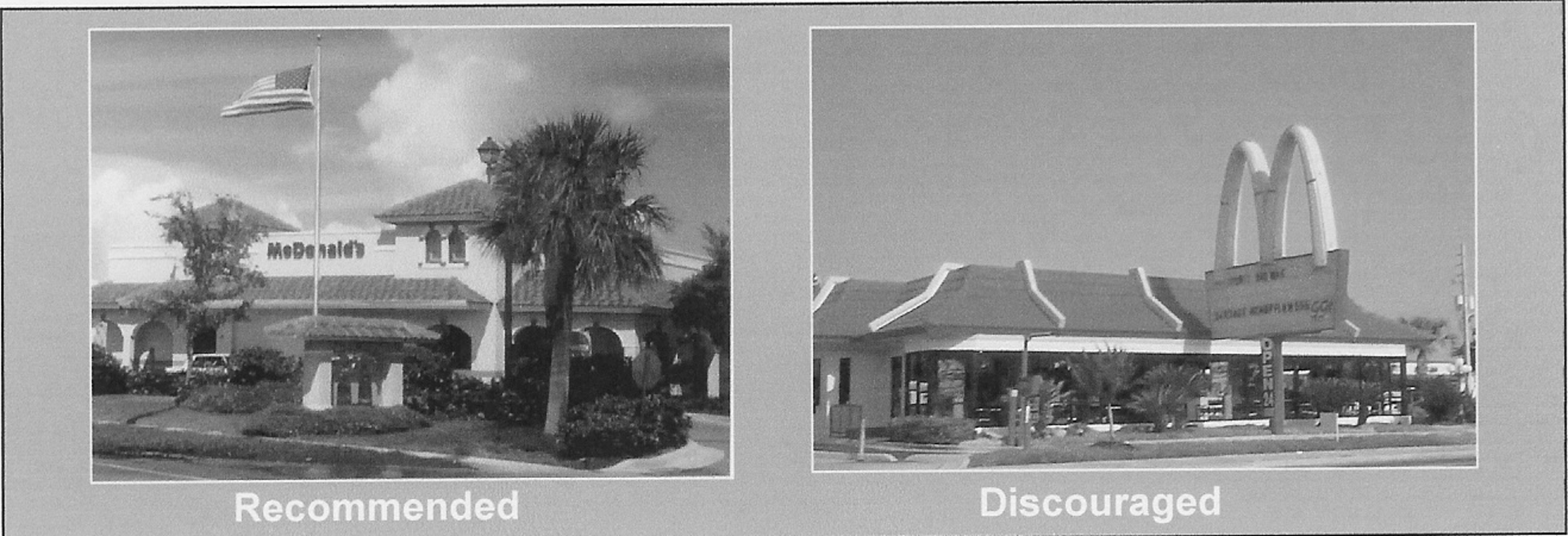
National Corporate Chains
(e)
Minimum tenant mix requirements. Developments with single retail tenants that have more than 75,000 gross square feet shall provide additional tenant spaces occupying the equivalent of 25 percent or more of the primary tenant. Individual tenant spaces shall not exceed 30,000 square feet in gross floor area. In lieu of providing separate tenant space, a developer may construct a design that creates the appearance of individual tenant spaces.
(f)
Site circulation and access. Safe, comfortable and consistent pedestrian connections are required as set forth herein:
(1)
The use of joint access easements is required between sites to reduce the number of access points and driveway area, to increase the amount of landscaping, and to increase traffic safety.
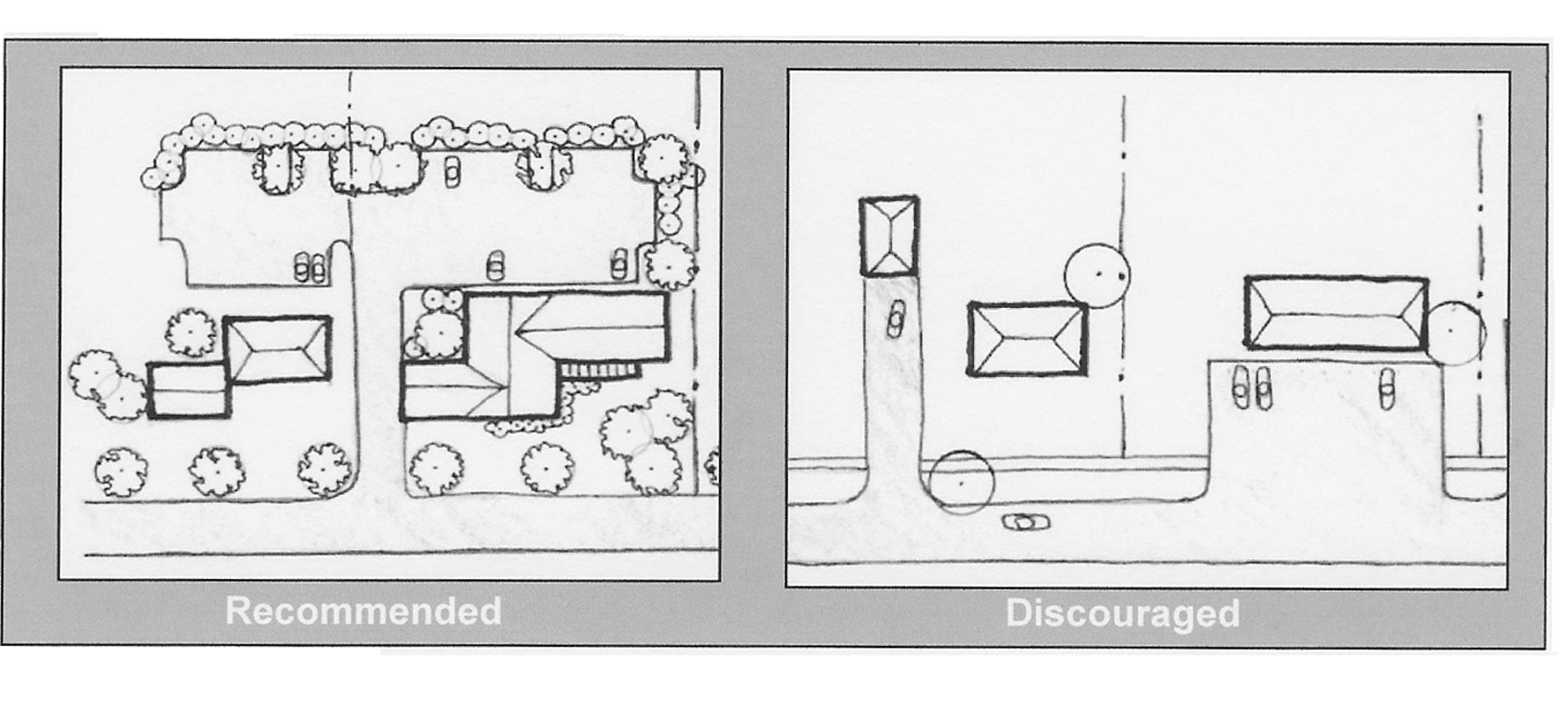
Joint Access Easements
(2)
A safe and landscaped pedestrian circulation system connecting to public streets external sidewalks and outparcels, shall be provided on-site.
(3)
Pedestrian walkways within the development shall be differentiated from driving surfaces utilizing a change in materials.
(4)
To increase pedestrian safety, sidewalks and walkways shall be one step up at a different grade than the vehicular parking lot, and shall be landscaped and have pedestrian scale lighting.
(5)
Large scale retail development with one or more retail tenants of 75,000 gross square feet or more and adjacent to an arterial street, which is or may be used as a transit route, shall provide on-site accommodations for public transit access, including a bus pullout and shelter. All other such developments shall anticipate the need for public transit access and shall provide bus pullouts as warranted.
(6)
Mixed-use and large-scale developments shall incorporate bicycle parking/storage.
(7)
Crosswalks are required wherever a pedestrian walkway intersects a vehicular area. All crosswalks shall be a minimum of five feet wide and shall be paved with concrete modular paving or integrally colored poured concrete.
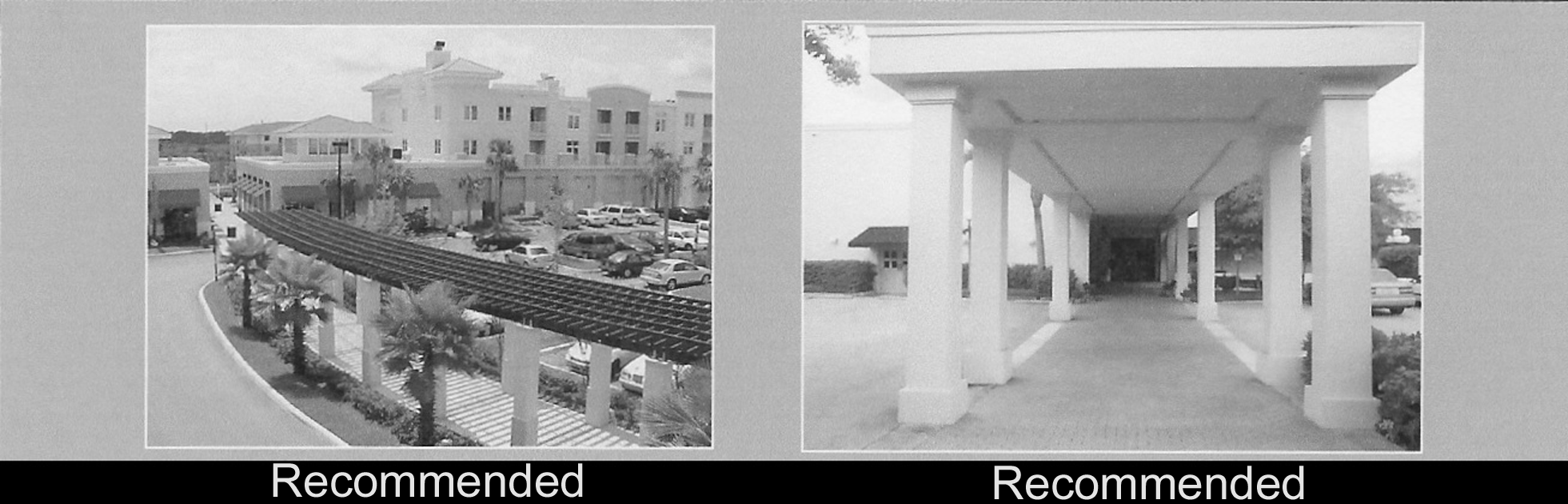
Walkways
(8)
At least one significant pedestrian amenity, such as an outdoor seating area, play area for children, or courtyard, shall be provided for every 75,000 square feet of gross floor area of structure. Required pedestrian amenities may be combined into one or more locations, in order to create a larger amenity.
(g)
Off-street parking standards. While off-street parking is necessary to accommodate automobile demands, it displaces a large percentage of the county's open space and separates structures from the main pedestrian concourses. The purpose of the following guidelines is to avoid large expanses of asphalt and conflicts between vehicles and pedestrians:
(1)
Where a mix of uses creates staggered peak periods of parking demand, shared parking may be utilized to reduce the total amount of required parking.
(2)
Large parking lots shall be visually and functionally segmented into smaller lots with landscaped islands and canopy trees. No single parking area shall exceed 120 spaces.
(3)
Where a nonresidential use abuts an agricultural, residential or mobile home zoning classification, the parking area shall not be located within the building setback abutting the residential area.
(4)
Parking areas should be located behind the building face to prevent parking from dominating the image of the site. Wherever feasible, landscaping should be used to screen the parking area.
(5)
As an incentive to reduce asphalt and encourage landscaping, parking space depth in nonresidential developments may be reduced by two feet if abutting a landscape area as long as vehicle parking will not interfere with required plantings or encroach on sidewalks.
(6)
Vehicle use areas shall be sufficiently screened from public rights-of-way by utilizing landscape berms, themed streetscapes, trees with landscape materials, trellis designs and/or low urban walls that incorporate architectural detail. Perimeter design shall be determined with the assistance of the department to promote the community image for the area in which the development is located.
(7)
The design of parking areas shall avoid the appearance of large masses of parked cars. No more than ten parking spaces may be located side by side without a landscaped parking island. In addition, the maximum amount of off street parking for any development shall not exceed ten percent of the development's minimum parking requirements as set forth in section 72-286, of the Volusia County Zoning Ordinance. The maximum number of parking spaces for nonresidential uses may not exceed 125 percent of the minimum spaces required by section 72-286, "Off-street parking and loading."
(8)
Shade trees shall be provided for parked cars, so that an average ratio of one tree per six automobiles is achieved. Trees shall be planted which will provide shade canopy over the parked cars.
(9)
Developments with buildings not exceeding 10,000 square feet in area shall provide no more than 50 percent of the required off-street parking between the front façade of the establishment and the abutting street.
(h)
Service, utility, display and storage areas standards.
(1)
Areas for outdoor storage, trash collection and loading shall not be located adjacent to residential lots.
(2)
Loading areas or docks, outdoor storage, waste disposal, mechanical equipment, satellite dishes, truck parking and other service support equipment shall be located behind the building line and shall be fully screened from the view of adjacent properties both at ground and roof top levels with masonry, brick or durable manmade material wall.
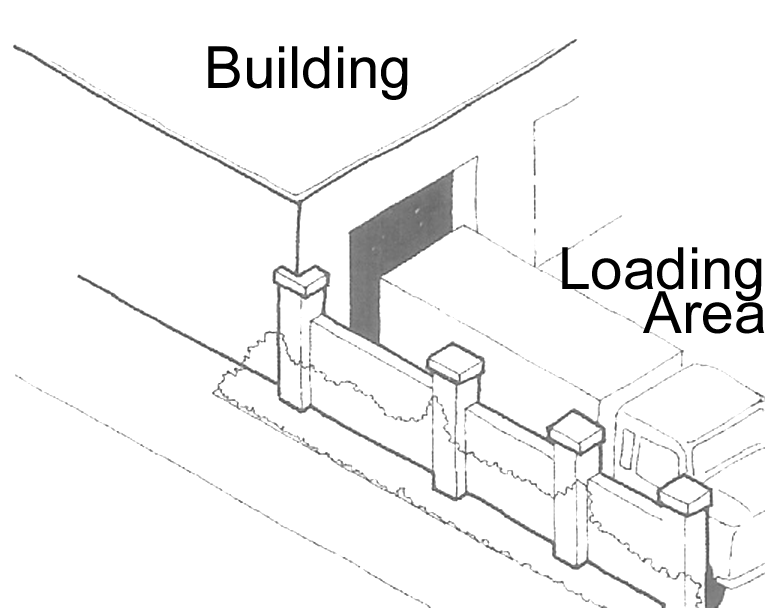
Loading Areas
(3)
Areas for outdoor storage, trash collection and loading shall be incorporated into the primary building design and construction for these areas shall be of materials of comparable quality and appearance as that of the primary building. Facilities located adjacent to residential lots shall utilize a visual and solid opaque acoustic buffer.
(4)
Shopping cart storage shall be located inside the building or shall be screened by a solid landscaping hedge or a four-foot wall consistent with the building architecture and materials.
(5)
Fenced areas, such as garden centers or vehicle storage areas, visible from the public right-of-way shall be screened with vinyl-coated chain link or other decorative fencing material. The area shall be landscaped and designed to be compatible with the design of the building façade.
(6)
When the loading and/or refuse collection area is adjacent to a residential or mobile home zoning classification, deliveries and collections shall not occur between 10:00 p.m. and 6:00 a.m.
(7)
To the extent possible, vehicular idling and standing shall not be allowed in areas adjacent to residential or mobile home zoning classifications. Signage shall be installed prohibiting vehicular idling in areas adjacent to these classifications.
(8)
Utilities for all nonresidential developments shall be located underground. Utility boxes must be totally screened from view of principal streets, as well as pedestrian walkways and areas. Utilities shall not be located within landscape buffers, tree protection and environmentally sensitive areas.
(i)
Landscaping and buffer requirements.
(1)
Landscaping shall provide a suitable setting for the development architecture and also shall serve to create a unified urban look, to define outdoor spaces, to buffer from sound and weather, to screen from view, and to accentuate building elements and vistas.
(2)
Existing trees shall be maintained to the extent possible and protected during construction as required by the Land Development Code, Ordinance No. 88-3, as amended.
(3)
Landscaping and grading shall be designed to enhance the presence of each building.
(4)
Except for public right-of-way, shaded areas must be provided for internal sidewalks at a minimum of 100 square feet of shaded area per 100 lineal feet of walkway.
(5)
Whenever possible, service and utility easements shall be located away from mature trees which must be saved as required by the Land Development Code, Ordinance, No. 88-3, as amended.
(6)
Wet retention areas shall be designed as amenities and shall appear natural by having offsets in the edge alignment to avoid perfect geometric figures. Landscaping is required to soften the visual appearance of the pond edges. Features such as fountains are encouraged to accent the ponds and provide adequate aeration to prevent stagnation.
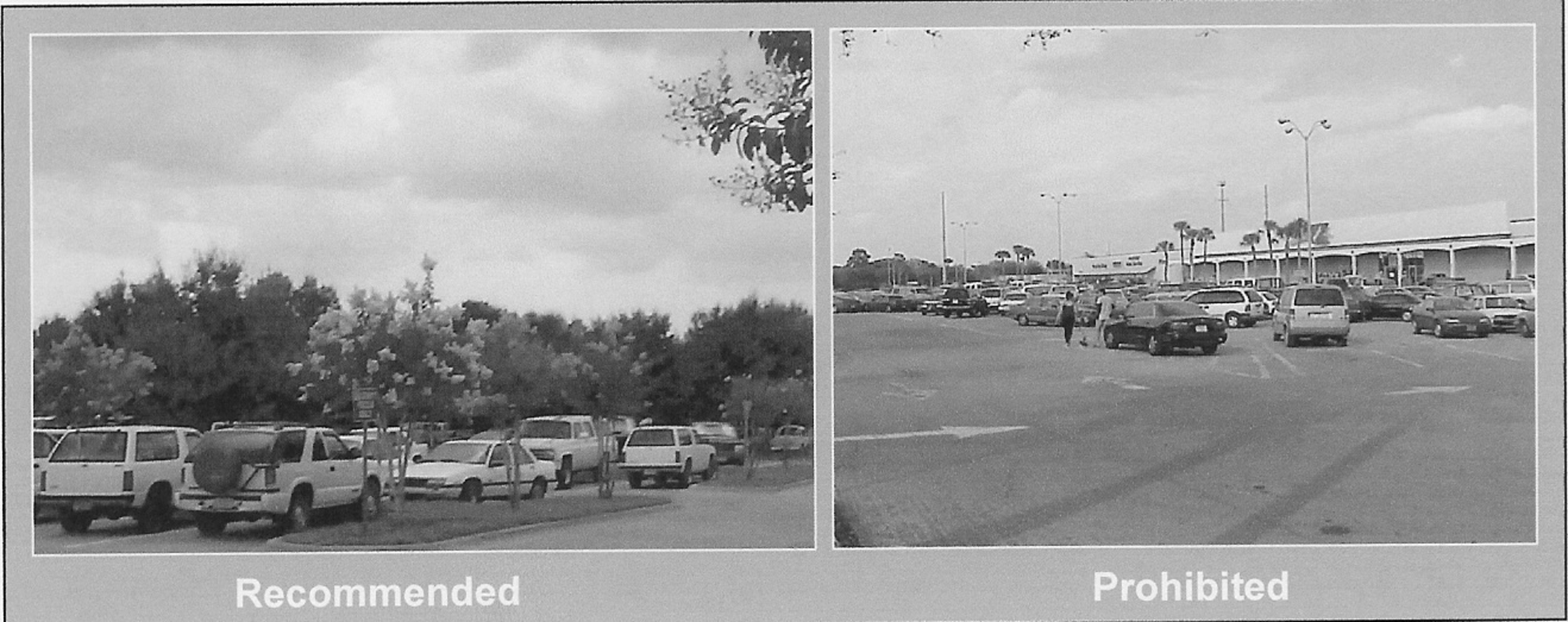
Landscaping
(j)
Sign regulations. The sign regulations established in section 72-298 of the Volusia County Code of Ordinances shall also apply to any nonresidential development meeting the location guidelines of subsection (b) of this section; provided, however, the maximum permissible height for any ground sign is eight feet, and the maximum permissible copy area for any ground sign is 40 square feet.
(k)
Industrial development design standards. Industrial development shall abide by the following design standards to promote design treatments that enhance the visual appearance of development, ensure compatibility of buildings, and to protect community aesthetics.
(1)
Site Orientation: Industrial development shall minimize visual impacts on the thoroughfare road by implementing the following:
a.
Existing trees shall be maintained to the extent possible, and protected during construction as required by the Land Development Code, Chapter 72, article III, as amended.
b.
Orient the building so that the front façade of the building faces the thoroughfare roadway.
c.
Wet retention areas shall be designed as amenities and shall appear natural by having offsets in the edge alignment to avoid perfect geometric figures. Landscaping is required to soften the visual appearance of the pond edges. Features such as fountains are encouraged to accent the ponds and provide adequate aeration to prevent stagnation.
d.
Areas for outdoor storage, trash collection and loading should not be located adjacent to residential lots. Where it is unavoidable to locate these areas other than adjacent to residential lots, a visual and solid opaque acoustic buffer shall be used to screen the residential area from the use.
e.
Loading areas or docks, outdoor storage, waste disposal, mechanical equipment and other service support equipment shall be located behind the building line and shall be fully screened from the view of adjacent roadways and properties, both at ground and rooftop levels.
f.
Vehicle use areas shall be sufficiently screened from public rights-of-way by utilizing landscape berms, themed streetscape trees with landscape materials, trellis designs and/or low urban walls that incorporate architectural details compatible with the principle building.
(2)
Building architecture: The front façades of industrial building abutting a thoroughfare road shall incorporate three or more of the following design standards:
a.
A change in plane, such as an offset, reveal or projecting rib. Such plane projections or recesses shall have a width of no less than three inches and may include but are not limited to columns, planters, arches, and voids, etc.
b.
Architectural details such as raised bands and cornices.
c.
Awnings.
d.
Change in color.
e.
Change in material.
f.
Change in texture.
g.
Doors.
h.
Windows.
(3)
Exterior materials.
a.
Materials selected for buildings should have quality and stability in terms of durability, finish and appearance.
b.
Exterior building materials that are encouraged include stucco, brick, stone and concrete masonry units. Masonry unit exteriors shall be textured and tinted to avoid the appearance of a smooth monotonous wall.
c.
Front building façades facing a thoroughfare road shall not be 100 percent constructed of flat, corrugated or reflective metal panels. A metal building may be allowed to front a thoroughfare road if alternative materials such as brick, block, stone, or stucco are incorporated to cover a minimum of 25 percent of the front façade. The alternative materials shall be wrapped around the sides of the building a minimum of ten feet or ten percent of the side building length, whichever is greatest.
(4)
Colors. Color shall be selected to ensure harmony of the building with adjacent structures:
a.
A wide selection of low reflectance exterior colors should be utilized to promote variety and diversity. The generally approved paint colors for nonresidential uses include light pastel and earth tone colors.
b.
Intense, fluorescent or day glow colors are prohibited.
c.
Black as the predominant exterior building color is prohibited.
d.
Monochromatic color schemes (all one paint color) is prohibited.
e.
Building, trim and detail colors must be complementary. Clashing trim colors will not be permitted.
f.
A solid line band of color shall not be used for architectural detail.
(5)
Mechanical equipment: Mechanical equipment located on roofs shall be integrated into the overall design of a building by screening it behind parapets or by recessing equipment into hips, gables, parapets or similar features. Plain boxes are not acceptable.
(Ord. No. 2004-01, § 2, 1-22-04; Ord. No. 2008-25, § II, 12-4-08; Ord. No. 2018-05, § XI, 1-18-18; Ord. No. 2019-3, § I, 1-22-19)
Sec. 72-304. - Reserved.
Editor's note— Ord. No. 2025-20, § VIII, adopted Aug, 18, 2025, repealed § 72-304, which pertained to clustering of dwelling units and zero lot line residential subdivisions and derived from Ord. No. 90-34, §§ 110, 111, 9-27-90; Ord. No. 91-11, § XXXI, 5-16-91; Ord. No. 94-4, §§ CIII—CV, 5-5-94; Ord. No. 98-25, § XLVIII, 12-17-98; Ord. No. 2008-25, § II, 12-4-08.
Sec. 72-305. - Reserved.
Editor's note— Ord. No. 2025-20, § IX, adopted Aug, 18, 2025, repealed § 72-305, which pertained to air curtain incinerators and derived from Ord. No. 90-34, § 112, 9-27-90; Ord. No. 94-4, § CVI, 5-5-94; Ord. No. 2008-25, § II, 12-4-08.
Sec. 72-306. - Reserved.
Editor's note— Ord. No. 2025-20, § X, adopted Aug, 18, 2025, repealed § 72-306, which pertained to dogs and cats in residential areas and derived from Ord. No. 2009-17, § II, 5-21-09; Ord. No. 2012-06, § III, 5-3-12; Ord. No. 2018-05, § XXIV, 1-18-18; Ord. No. 2018-04, § VIII, 4-17-18.
Sec. 72-307. - Reserved.
Editor's note— Ord. No. 2025-20, § XI, adopted Aug, 18, 2025, repealed § 72-307, which pertained to backyard chickens and derived from Ord. No. 2018-13, § II, 7-24-18.
Sec. 72-308. - Reserved.
Editor's note— Ord. No. 2025-20, § XII, adopted Aug, 18, 2025, repealed § 72-308, which pertained to outdoor dog dining and derived from Ord. No. 2019-11, § I, 8-20-19.
Sec. 72-309. - Reserved.
Editor's note— Ord. No. 2025-20, § XIII, adopted Aug, 18, 2025, repealed § 72-309, which pertained to Mobile food dispensing vehicles and derived from Ord. No. 2023-15 , § 4, 8-15-23.
Sec. 72-310. - Shipping containers.
(a)
Purpose and intent. It is the intent of this section to establish specific development standards allowing for the use of shipping containers as an accessory use or structure for certain agriculture, rural, commercial and industrial zoning classifications. The purpose of this section is to ensure that shipping containers are installed in a manner that is safe, compatible with adjacent surrounding uses, and in compliance with this section to protect public health, safety, and the aesthetic quality of the Volusia County. A building permit is not required if the installation complies with all provisions of this section. Nothing in this section is intended to regulate the normal operations of shipping businesses.
(b)
Applicability.
(1)
The standards within this section shall apply to shipping containers as storage in unincorporated Volusia County in the following zoning classifications: RC, FR, A-1 through A-4, MH-3, RR, RA, OTR, ORE, OCR, B-3 through B-7, I-1 through I-4, P, and nonresidential portions of PUDs.
(2)
No variances pursuant to section 72-379 may be applied for or granted to the provisions of this section.
(c)
General operational requirements.
(1)
Use limitations: Containers are for storage only. Use as habitable space, office, or signage is prohibited. Rental or lease of containers is not permitted.
(2)
Utility restrictions: Containers shall not be connected to water, sewer, air conditioning, or other utilities.
(3)
Placement restrictions: Containers shall not be placed in required parking, access aisles, sidewalks, pedestrian paths, landscaped areas, public streets, or easements.
(4)
Maintenance requirements: Containers must be kept in good condition, free of visible damage or corrosion. They must be located on a stable foundation to prevent shifting and settling.
(5)
Locational requirements:
a.
Shipping containers are allowed as accessory uses and structures, subject to the standards in this section. Containers must meet principal structure setbacks in nonresidential zoning, and 15-foot side and rear setbacks in residential and agricultural zoning. They shall count toward the maximum lot coverage allowed in the applicable zoning classification. Bona fide agricultural uses are exempt from setback requirements.
b.
Shipping containers cannot be visible from a street, unless the container is screened by a fence or landscaping at least six feet in height, as measured from adjacent grade, with the exception of industrial zoned properties.
c.
Shipping containers cannot be placed on vacant or unimproved properties, with the exception of industrial zoned properties, and bona fide agricultural uses.
(d)
Number of shipping containers. Shipping containers shall be limited to two containers on property with a minimum parcel size of one acre, with one additional container per five acres of land up to a maximum of six shipping containers per parcel, as shown in Table I: Number of Shipping Containers Allowed.
Table I: Number of Shipping Containers Allowed
(1)
The limits in the number of shipping containers allowed in this subsection (d) does not apply to industrial zoned properties and bona fide agricultural uses.
(Ord. No. 2024-16, § 3, 9-16-25)
Sec. 72-311. - Reasonable accommodations for certified recovery residences.
(a)
A request for reasonable accommodation under this section from the land development or zoning regulations, rules, policies, and procedures of Volusia County that may prohibit the establishment of a certified recovery residence, as defined in F.S. § 397.311(5), within unincorporated Volusia County shall be made in writing to the growth and resources management department, and shall at a minimum provide the following information:
(1)
The name and contact information of the applicant making the request. If the applicant is not the certified recovery residence administrator, under F.S. § 397.4871, who will be actively managing the recovery residence, the administrator's name, contact information, and a copy of the administrator's certification must also be provided. If the applicant is not the owner of the property where reasonable accommodation is being requested, then the contact information for the owner must be included with a notarized authorization from the owner.
(2)
The location where reasonable accommodation is requested including the address and parcel identification number.
(3)
A description of the accommodation needed, identifying the land use or zoning laws, rules, policies, practices, and/or procedures for which the applicant needs reasonable accommodation, and why it is necessary.
(4)
Any additional information or documentation the applicant feels is necessary to support the request for reasonable accommodation.
(b)
Each application will be date-stamped upon receipt by the growth and resources management department. If reasonably necessary to reach a determination on the request for reasonable accommodation, the growth and resources management department, may request additional information from the certified recovery residence, specifying in sufficient detail what information is required. If additional information is required, the growth and resources management department, shall notify the applicant in writing within the first 30 days after receipt of the application and allow the applicant at least 30 days to respond. If the applicant fails to provide the requested additional information within said 30-day period, the county manager, or designee, shall issue a written notice advising that the applicant failed to timely submit the additional information, and therefore the request for reasonable accommodation shall be deemed abandoned and/or withdrawn and no further action by the county with regard to said reasonable accommodation request shall be required. In the event additional information is requested by the growth and resources management department, the 60-day time frame for issuing a written determination shall be extended by 30 days.
(c)
A final written determination shall be issued within 60 days after receipt of a completed application by the County Manager, or designee, with input from the Community Services Department and the Growth and Resources Management Department. The final written determination shall be consistent with the Fair Housing Amendments Act of 1988, 42 U.S.C. ss. 3601 et seq., and Title II of the Americans with Disabilities Act, 42 U.S.C. ss. 12131 et seq. The determination must:
(1)
Grant the request for reasonable accommodation;
(2)
Grant a portion of the request and deny a portion of the request, and/or impose conditions upon the grant of the request; or
(3)
Deny the request for accommodation stating with specificity the objective, evidence-based reasons for denial and identifying any deficiencies or actions necessary for reconsideration.
(d)
If a final written determination is not issued within 60 days after receipt of a completed application, the request is deemed approved unless the parties agree in writing to a reasonable extension of time. The time periods specified herein may be extended by the mutual agreement of Volusia County and certified recovery residence, with such extension confirmed in writing.
(e)
Within 90 days of written determination, any aggrieved person may appeal the decision to the Volusia County Council by submitting a written appeal to the County Manager.
(f)
The Growth and Resources Management Department, shall reject an application for a reasonable accommodation if a similar request by the certified recovery residence has been considered by the County Manager, or designee, and denied at any time within 12 calendar months immediately prior to the date the application is submitted.
(g)
Approval of accommodation for a certified recovery residence may be revoked or modified for cause, including, but not limited to, a violation of the conditions of approval or the lapse, revocation, or failure to maintain certification or licensure required under F.S. § 397.487, if not reinstated within 180 days. Written notice shall be provided to the applicant of the proposed revocation or modification. If approval of accommodation is revoked or modified, the certified recovery residence must comply with any ordinance, rule, policy, practice and/or procedure of Volusia County in effect and for which there is no accommodation.
(h)
There shall be no fee imposed by Volusia County upon a certified recovery residence in connection with a request for reasonable accommodation under this section, and Volusia County shall have no obligation to pay any aggrieved person's attorneys' fees or costs (or any other fees or costs) in connection with the request, or appeal, as applicable.
(i)
No certified recovery residence shall violate any ordinance, rule, policy, practice and/or procedure of Volusia County until the certified recovery residence has requested and obtained reasonable accommodation. Volusia County shall not be prohibited from enforcing its ordinances, rules, policies, practices and/or procedures in the event of a violation by a certified recovery residence; provided, however, if a certified recovery residence requests a reasonable accommodation, then any enforcement, fine and/or costs, shall only become effective if such request for accommodation has been denied or withdrawn.
(Ord. No. 2025-26, § III, 12-2-25)

