
Wabash City Zoning Code
DIVISION VII
DEFINITIONS AND INTERPRETATIONS
Sec. 10-100.- Definitions.
For the purpose of this ordinance, certain terms or words used herein shall be interpreted and defined as follows:
Words in the present tense shall include the future and vice-versa; words in the singular number shall include the plural and vice-versa; the word "building" includes the word "structure" and vice versa; the word "shall" is mandatory and not directory.
a.
Abutting—Bordering.
b.
Accessory building—A building subordinate to another structure located on the same lot and which does not change or alter the character of the premises and which is not used for human occupancy.
c.
Accessory use—A use such as public utility, communication, electric, gas, water and sewer lines which is incidental to the main use of the premises.
d.
Act—The Communications Act of 1934, as amended from time to time including the Telecommunications Act of 1996, as amended from time to time.
e.
Agriculture—The art or science of cultivating the ground, and raising and harvesting crops. Also often including feeding, breeding and management of livestock; tillage, husbandry; farming; in a broader sense, the science and art of the production of plants and animals useful to man, including to a variable extent the preparation of these products for man's use and their disposal by marketing or otherwise. In this broad use it includes farming, horticulture, forestry, dairying, sugar marketing, etc.
f.
Airport—A use devoted to the take-off, landing and storing of aircraft.
g.
Alley—Any public way or thoroughfare less than sixteen (16) feet but not less than ten (10) feet in width which has been dedicated or deeded to the public for public use.
h.
Alley line—A lot line bordering on an alley.
i.
Announcement sign—A sign directing attention to the use or event of a public or quasipublic institution and located upon the premises of the institution.
j.
Antenna—Any exterior apparatus designed to send and/or receive electromagnetic waves for the purpose of electronic communication including but not limited to telephonic, radio or television, or cellular telecommunications. Antennas used in relationship to residential uses on that premises are excluded from the provisions of this definition.
k.
Apartment house—A building or portion thereof which contains three (3) or more dwelling units.
l.
Automobile or trailer sales—An open area, other than a street, used for display, sale or rental of new or used automobiles or trailers and where no repair work is done except minor incidental repair of new or used automobiles or trailers to be displayed, sold or rented on the premises.
m.
Basement—Any floor level below the first story in a building, except that a floor level in a building having only one (1) floor level shall be classified as a basement unless such floor level qualifies as a first story as defined herein.
n.
Bed and breakfast—A small establishment having one (1) to three (3) bedrooms to rent to transients as an activity which is subordinate and incidental to the main residential use of the building. These are generally treated as tourist homes.
o.
Billboard—A sign used to advertise a business, commodity, or service conducted elsewhere than on the premises on which billboard is located.
p.
Billboard sign—Any sign not directly or incidentally related to a use to which the real estate on which the sign is located is devoted. For purposes of this definition the location of a billboard sign on the real estate shall not be considered to be a use to which the real estate is devoted. A flat surface on which bills are posted; specifically, a large panel designed to carry outdoor advertising.
q.
Block—A unit or property bounded by streets, and/or railroad rights-of-way, waterways, or other barriers.
r.
Board—The Advisory Board of Zoning Appeals of the City of Wabash.
s.
Boarding house—A building, not available to transients, in which meals are regularly provided for compensation for at least three (3) inhabitants but not over thirty (30) persons in addition to the owner occupant.
t.
Building—Any structure used or intended for supporting or sheltering any use or occupancy.
u.
Building area—The maximum horizontal projected area of the principal and accessory building, excluding open steps or terraces, unenclosed porches not exceeding one (1) story in height, or architectural appurtenances.
v.
Building department—The Building Department of the City of Wabash, Indiana, its chief enforcement official (i.e., building commissioner, also known as building inspector) or an authorized deputy.
w.
Building, detached—A building having no structural connection to another building.
x.
Building, front line of—The line of the face of the building nearest the front lot line.
y.
Building, height of— The vertical distance above a reference datum measured to the highest point of the coping of a flat roof or the deck line of a mansard roof, or the average height of the highest gable of a pitched or hipped roof. The reference datum shall be selected by either of the following, whichever yields a greater height of building:
1.
The elevation of the highest adjoining sidewalk or ground surface within a five-foot horizontal distance of the exterior wall of the building when such sidewalk or ground surface is not more than ten (10) feet above the lowest grade.
2.
An elevation ten (10) feet higher than the lowest grade when the sidewalk or ground surface described in item "a" above is more than ten (10) feet above the lowest grade.
3.
The height of a stepped or terraced building is the maximum height of any segment of the building.
z.
Building, principal—A building in which is conducted the main or principal use of the lot on which said building is situated. Where a substantial part of an accessory building is attached to the principal building in a substantial manner, as by a roof, such accessory building shall be counted as a part of the principal building.
aa.
Building setback line—The line nearest the front of and across a lot establishing the minimum open space to be provided between the front line of a building or structure and the front lot line.
bb.
Bulletin board—A changeable announcement sign directing attention to the use or event of a public or quasipublic institution and located on the premises of the institution.
cc.
Business—Engaging, for profit, in the purchase, sale, barter or exchange of goods, wares, merchandise or services, the maintenance or operation of offices, or recreational and amusement enterprises.
dd.
Business sign—A sign which directs attention to the name of the business or establishment, the goods or commodities sold and/or services rendered on the premises on which the sign is located.
ee.
Cellular telecommunications—A commercial wireless radio service licensed by the Federal Communications Commission which provides telecommunications service permitting customers to use wireless telephone technology such as, but not limited to, portable phones, pagers, faxes and computers.
ff.
Cemetery—Land used for the burial of the dead and dedicated for cemetery purposes, including columbariums, crematories, mausoleums, and mortuaries when operated in conjunction with and within the boundary of such cemetery.
gg.
Certificate of occupancy—A certificate signed by the building commissioner stating that the occupancy and use of land or a building or structure referred to therein complies with the provisions of this article.
hh.
Child—A person under the age of eighteen (18) years.
ii.
Child care center (day care center)—See Indiana Code § 12-7-2-28.4—Means a building where at least seventeen (17) children receiving child care from a provider:
1.
While unattended by a parent, legal guardian, or custodian;
2.
For regular compensation; and
3.
For more than four (4) hours but less than twenty-four (24) hours in each of ten (10) consecutive days per year, excluding intervening Saturdays, Sundays and holidays;
4.
The term includes a building where child care is provided to less than seventeen (17) children if the provider has applied for a license under Indiana Code, § 12-17.2-4 and meets the requirements under Indiana Code, § 12-17.2-4.
jj.
Child care home (day care home)—See Indiana Code, § 12-7-2-28.6—Means a residential structure in which at least six (6) children (not including the children for whom the provider is a parent, stepparent, guardian, custodian, or other relative) at any time receive child care from a provider:
1.
While unattended by a parent, legal guardian, or custodian;
2.
For regular compensation; and
3.
For more than four (4) hours but less than twenty-four (24) hours in each of ten (10) consecutive days per year, excluding intervening Saturdays, Sundays and holidays;
4.
The term includes:
a)
A Class I child care home; and
b)
A Class II child care home.
kk.
City—The City of Wabash, Indiana.
ll.
Club—Building and facilities owned or operated by a person or board for a social, educational, or recreational purpose, but not primarily for profit or to render a service which is customarily carried on as a business.
mm.
Co-location—Locating telecommunication facilities from more than one (1) provider on a single site or structure.
nn.
Commercial farm enterprise—An operation or use inherent to or closely associated with a farm or agriculture, such as the buying, selling or distribution of livestock or farm or agricultural products essential to farm operation; but not including industrial grain elevators, industrial mills, abattoir, commercial hatcheries and poultry processing plants, the manufacture of commercial fertilizers and similar enterprises which are of an industrial nature.
oo.
Commission—The plan commission of the City of Wabash.
pp.
Construction—Affix permanently to the ground, not grading.
qq.
Development plan—A drawing, including a legal or site description, of the real estate involved, which shows the location and size of the following both existing and proposed: all buildings, structures, yards; location and dimension of building lines and easements; widths and lengths of all entrances and exits to and from said real estate; location of all adjacent or adjoining streets, service facilities and other improvements such as planting areas.
rr.
Development plan, residential—A plan proposed to use a tract of land for residential development in accordance with the requirements of the ordinance, even though the use of the land, the location of the buildings to be erected in the area, and the yards and open spaces provided in the plan do not conform in certain respects to the regulations for the district or districts in which the residential development is proposed to be located.
ss.
Dwelling—Any building which is wholly or partially used or intended to be used for living or sleeping by human occupants provided that temporary housing shall not be deemed a dwelling.
tt.
Dwelling unit—Any building or portion thereof which contains living facilities, including provisions for sleeping, eating, cooking, and sanitation, as required by this Code, for not more than one (1) family.
uu.
Easement—An authorization grant made by a property owner for use by another of any designated part of his property for a clearly specified purpose and officially recorded.
vv.
Educational institution—Public or parochial preprimary, primary, grade, junior-high, high, prepatory school or academy; junior college, college or university.
ww.
Extermination—The control and elimination of insects, rodents, or other pests eliminating their harborage places; by removing or making inaccessible materials that may serve as their food; by poisoning, spraying, fumigating, trapping; or by any other recognized and legal pest elimination methods approved by the county or state board of health.
xx.
Family—An individual or two (2) or more persons living together in a dwelling unit.
yy.
Family child care—A premises where child care is provided:
1.
For compensation;
2.
For more than four (4) hours in each of ten (10) consecutive days, excluding intervening Saturday, Sunday and holidays; and
3.
To not more than five (5) children at anyone one (1) time, each of whom:
a)
Is less than eighteen (18) years of age; and
b)
Is not attended by:
1)
A parent;
2)
A stepparent;
3)
A guardian;
4)
A custodian; or
5)
A relative who is at least eighteen (18) years of age.
zz.
Farm—A tract of land comprising an area which is devoted to agricultural operations, such as forestry; the growing of crops; pasturage; the production of livestock and poultry; the growing of trees, shrubs and plants; and other recognized agricultural pursuits and including accessory buildings essential to the operation of the farm. Accessory buildings may include barns, equipment and animal sheds, farm residences of the owner, operator or farm assistants, roadside sales structure for the sale of products of the farm, and signs displaying subject matter directly related to the name or the products of the particular farm, but not including industrial or commercial operations or structures.
aaa.
FCC—Federal Communications Commission, or any successor thereto.
bbb.
Filling station—Any building structure, premises or enclosure or other place used for the dispensing, sale, or offering for sale of fuels or oils for motor vehicles. When the dispensing, sale or offering for sale is incidental to the conduct of a public garage, the premises shall be classified as a public garage.
ccc.
Flood hazard area—Those flood plains which have not been adequately protected from flooding caused by the regulatory flood, and are shown on the zoning map and/or on the flood hazard or flood way-flood boundary maps of the federal insurance administration or maps provided to the commission from the Indiana Natural Resources Commission.
ddd.
Flood plain—The area adjoining the river or stream which has been or may hereafter be covered by flood water from the regulatory flood.
eee.
Floor area—The area included within the surrounding exterior walls of a building or portion thereof, exclusive of vent shafts and courts. The floor area of a building, or portion thereof, not provided with surrounding exterior walls shall be the usable area under the horizontal projection of the roof or floor above.
fff.
Floor area, ground—The square foot area of a residential building within its largest outside dimensions, computed on a horizontal plane at the ground floor level exclusive of open porches, breeze-ways, terraces, garages and exterior stairways.
ggg.
Floor area, net—The total area, computed on a horizontal plane, used for a particular business category, exclusive of entrances, hallways, stairs and other accessory areas used for ingress and egress.
hhh.
Foster home—See Indiana Code, § 12-3-2-3.6—Means a place where an individual dwells and provides care and supervision as a substitute family:
1.
For compensation;
2.
For twenty-four (24) hours a day; and
3.
To a child who:
a)
Is not a stepchild, grandchild, niece, nephew, or sibling of the individual providing care and supervision;
b)
Is separated from the child's parent, stepparent, guardian, custodian, or other relative; and
c)
Is receiving care and supervision under an order of a juvenile court.
iii.
Frontage—All the property on one side of a street between two (2) intersecting streets (crossing or terminating) measured along the line of the street, or if the street is dead ended, then all of the property abutting on one (1) side between an intersecting street and the dead end of the street.
jjj.
Garbage—The animal and vegetable waste resulting from the handling, preparation, cooking and consumption of food.
kkk.
Garage, private—A building or a portion of a building, not more than one thousand (1,000) square feet in area, in which only motor vehicles used by the tenants of the building or buildings on the premises are stored or kept.
lll.
Garage, public Any garage other than a private garage.
mmm.
Grade; adjacent ground elevation—The lowest point of elevation of the finished surface of the ground, paving or sidewalk within the area between the building and the property line, or when the property line is more than five (5) feet from the building, between the building and a line five (5) feet from the building.
nnn.
Group home—A single self-contained children's home established and operated by the county department of welfare or its successors, licensed private child placement agency or licensed incorporated group established for the purpose of receiving and caring for up to eight (8) children who are attended by house "parents".
ooo.
Ground sign—A free-standing sign not attached to any building, the top of which is not more than five (5) feet above the ground.
ppp.
Home occupation—Any use conducted entirely within a dwelling and participated in solely by members of the family, which use is clearly incidental and secondary to the use of the dwelling for dwelling purposes and does not change the character thereof and in connection with which there is no commodity sold upon the premises except that which is produced thereon, provided that no sign exceeding one (1) foot square in size other than a nameplate is attached to the building. A contingent use.
qqq.
Hospital—An institution licensed by the state department of health and providing health services primarily for medical or surgical care of the sick or injured and including related facilities such as laboratories, out-patient departments, training facilities, central service facilities, and staff officers which are an integral part of the facility, provided such institution is operated by, or treatment is given under direct supervision of a licensed physician. Types of hospitals include general, mental, chronic disease and allied special hospitals such as cardiac, contagious disease, maternity, orthopedic, cancer and the like.
rrr.
Hotel—Any building containing six (6) or more guest rooms intended or designed to be used, or which are used, rented or hired out to be occupied, or which are occupied for sleeping purposes by guests.
sss.
Identification sign—A sign indicating the name and/or nature of the use of the property on which the sign is located.
ttt.
Improvement location permit—A document issued by the city building commissioner's office, permitting a person, firm or corporation to erect, construct, enlarge, alter, repair, move, improve, remove, convert, or demolish any building or structure within its jurisdiction, or cause the same to be done or to change the use or condition of the land.
uuu.
Industrial park—A group of structures for industrial operations forming a comprehensive arrangement of buildings, grounds, and access ways planned in accordance with harmonious principals of architectural and landscape design and industrial management.
vvv.
Infestation—The presence within or around a dwelling of any insects, rodents, or other pests.
www.
Junkyard—Any place at which personal property is or may be salvaged for reuse, resale or reduction of similar disposition and is owned, possessed, collected, accumulated, dismantled, or assorted, including but not limited to, used or salvaged base metal or metals, their compounds or combinations, used or salvaged rope, bags, paper, rags, glass, rubber, lumber, mill-work, brick and similar property except animal matter, and used motor vehicles, machinery or equipment which is used, owned or possessed for the purpose of wrecking or salvaging parts therefrom.
xxx.
Jurisdiction of the commission—shall include the contagious unincorporated territory extending not more than two (2) miles beyond the corporate limits of the City of Wabash, Indiana, as the same now exists, and as it may hereafter exist, following annexation of additional area. The geographic area encompassed is reflected as a map which is marked exhibit "A", incorporated herein by reference and made a part hereof.
yyy.
Kennel—Any lot on which four (4) or more dogs, or small animals, at least four (4) months of age are kept.
zzz.
Loading and unloading berths—The off-street area required for the receipt or distribution by vehicles of material or merchandise, which in this chapter is held to be a twelve- by forty-five-foot loading space with a fourteen-foot height clearance, except if more than one (1) berth is provided the twelve-foot dimension shall be ten (10) feet.
aaaa.
Lodging house—A building, not available to transients, in which lodgings are regularly provided for compensation for at least three (3) persons in addition to the owner occupant.
bbbb.
Lot—A parcel, tract, or area of land accessible by means of a street or place and for residential uses as set forth in this chapter, abutting upon a street or place for at least fifty percent (50%) of the lot width prescribed for the district in which the lot is located. It may be a single parcel separately described in a deed or plat which is recorded in the office of the recorder of the county, or it may include parts of, or a combination of such parcels when adjacent to one another and used as one (1). In determining lot area and boundary lines no part thereof within the limits of a street or place shall be included.
cccc.
Lot corner—A lot at the junction of and having frontage on two (2) or more intersecting streets.
dddd.
Lot coverage—The percentage of the lot area covered by the building area.
eeee.
Lot, depth of—The mean horizontal distance between the front line and the rear line of the lot, measured in the general direction of the side lot lines.
ffff.
Lot, interior—A lot other than a corner lot or through lot.
gggg.
Lot line, front—In the case of an interior lot, a line separating the lot from the street; and in the case of a corner lot a line separating the narrowest frontage of the lot from street; except in cases where deed restrictions in effect specify another street right-of-way line as the front lot line.
hhhh.
Lot line, rear—A lot line which is opposite and most distant from the front lot line and, in the case of an irregular or triangular-shaped lot, a line ten (10) feet in length within the lot, parallel to and at the maximum distance from the front lot line.
iiii.
Lot line, side—Any lot boundary line not a front lot line or a rear lot line.
jjjj.
Lot, reversed interior—An interior lot, the front lot line of which is formed by a street, which street also forms the side lot line of an abutting corner lot. The corner lot is considered abutting even though separated from the interior lot line by an alley.
kkkk.
Lot, through—A lot having frontage on two (2) parallel or approximately parallel streets.
llll.
Lot, width—The dimension of a lot, measured between side lot lines on the building line.
mmmm.
Manufactured home—A dwelling, designed and built off site, which bears a seal certifying that it was built in compliance with the Federal Manufactured Housing Construction and Safety Standards Law (42 U.S.C. 5401, et seq.) and;
1.
Manufactured after January 1, 1981.
2.
Have more than nine hundred fifty (950) square feet occupied space in double-section or larger multisectional unit;
3.
Be placed onto a permanent perimeter enclosure;
4.
Utilize a permanent foundation;
5.
Be anchored to the ground, in accordance with the one- and two-family code and to the manufacturer's specifications;
6.
Have wheels, axles, and hitch mechanisms removed;
7.
Have utilities connected, in accordance with the one- and two-family code and to the manufacturer's specifications;
8.
Have siding and roofing materials of a type customary for residences, installed according to manufacturer's design and specifications, and approved by the building inspector.
9.
Have a minimum uniform width of twenty-three (23) feet.
nnnn.
Mobile home—A portable structure eight (8) feet or more wide and more than thirty (30) feet long which is designed for or utilized as a place of abode or sleeping place by one (1) or more persons, and which may or may not be supported by a permanent foundation.
oooo.
Mobile home court or park—A mobile home development, designed with a variety of facilities for common use, and in which mobile home spaces are rented.
pppp.
Mobile home subdivision—A mobile home development, designed and intended to provide lots for sale for the placement of mobile homes for residential purposes.
qqqq.
Motel—A building or a detached building used as a dwelling units containing bedroom, bathroom and closet space, and each unit having convenient access to a parking space for the use of the unit's occupants. The units, with the exception of the apartment of the manager or caretaker, are devoted to the use of automobile transients and no unit cooking facilities are offered.
rrrr.
Motor home—A self-propelled vehicle designed or used for cooking, living or sleeping purposes.
ssss.
Multi-family dwelling (apartment)—A detached building designed for or occupied by three (3) or more families.
tttt.
Nameplate—A sign of not more than one (1) square foot area. A sign indicating the name, address and/or title of the owner, renter or lessee of the premises on which the sign is located.
uuuu.
Natural resources—The natural resources commission of the State of Indiana.
vvvv.
Nonconforming use—Any building or land lawfully occupied by a use, which at the time of the passing of this zoning article or an amendment thereto, does not conform with the regulations of the district in which it is located.
wwww.
Nursing home—A facility licensed by the state board of health which:
1.
Provides nursing services on a continuing basis;
2.
Admits the majority of the occupants upon the advice of physicians as ill or infirm persons requiring nursing services;
3.
Provides for licensed physicians' services or supervision;
4.
Maintains medical records.
Such facilities may also provide other and similar medical or health services, provided that no occupant required physical restraint within the facility. Examples of nursing home facilities that provide health services may include, if they comply with all the above criteria, nursing homes, convalescent homes, maternity homes, rest homes, homes for the aged and the like.
xxxx.
Nursing home conversions—A dwelling converted for use as a nursing home.
yyyy.
Occupant—Any person living, sleeping, cooking, or eating in, or having actual possession of a dwelling unit or rooming unit.
zzzz.
Owner—Any person who, alone or jointly or severally with others;
1.
Has legal title to any dwelling unit, with or without accompanying actual possession of it; or
2.
Has charge, care, or control of any dwelling or dwelling unit, as owner or agent of the owner, or as executor, executrix, administrator, administratix, trustee or guardian of the estate of the owner. Any person thus representing the actual owner shall comply with the provisions of this Code section as if he or she were the owner.
aaaaa.
Parking area, private—An area paved with a hard surface, other than a street or alley, designed for use or used for the temporary parking of motor vehicles for clients, customers or employees.
bbbbb.
Parking area, public—An area paved with a hard surface, other than a street or alley, designed for use or used for the temporary parking of more than four (4) motor vehicles for public use, whether free or for compensation, or as an accommodation for clients or customers.
ccccc.
Parking space, off-street—A space other than on a street or alley designed for use or used for the temporary parking of a motor vehicle, and being required not less than nine (9) feet wide and twenty (20) feet long exclusive of passageways.
ddddd.
Permanent perimeter enclosure—Those manufactured homes designated in the zoning article as requiring a permanent perimeter enclosure must be set onto an excavated area, with foundations, footings, and crawl space or basement walls constructed in accordance with the terms of the one- and two-family dwelling code. The space between the floor joists of the home and the excavated underfloor grade shall be completely enclosed with the permanent perimeter enclosure (except for required openings).
eeeee.
Person—A corporation, firm, partnership, association, organization or any other group acting as a unit, as well as a natural person or persons.
fffff.
Place—An open, unoccupied, officially designated space other than a street or alley, permanently reserved for use as the principal means of access to abutting property.
ggggg.
Plat—A map or chart indicating the subdivision or resubdivision of land either filed or intended to be filed for record.
hhhhh.
Plumbing—Includes all of the following supplied facilities and equipment: gas pipes, gas-burning equipment, water pipes, garbage disposal units, waste pipes, water closets, sinks, installed dishwashers, lavatories, bathtubs, shower baths, installed clothes-washing machines, catch basins, drains, vents, and any other similar supplied fixtures, together with all connections to water, sewer, or gas lines.
iiiiii.
Pole sign—Any free standing sign supported by poles, posts or other uprights, having the lower edge of the area for display purposes at least ten (10) feet above the grade at the base of the supports, and completely free of and not attached to any building, and has no more than four (4) upright supports.
jjjjj.
Premises—A lot or plat including buildings thereon, if any.
kkkkk.
Private school—Private primary, grade, high preparatory school or academy.
lllll.
Private sewer—A sewer disposal system which is not constructed, installed, maintained, operated, and owned by a municipality, taxing district established for that purpose, or a utility under the jurisdiction of the Public Service Commission of Indiana. Any such private system shall be in conformance with all local and state codes, articles and regulations.
mmmmm.
Professional office—An office used in a practice of a profession and shall include only the offices of doctors or health practitioners, ministers, architects, professional engineers, lawyers, and other licensed professionals.
nnnnn.
Professional office center—An architectural and functional grouping of professional offices and appropriate associated and accessory uses which is the central feature of a site plan composed of building area, parking area, landscaped reservation and plantation, and other land features appropriate for its use as a professional office enterprise, designed to serve residential neighborhoods, and shall conform to the standards and requirements of this article.
ooooo.
Professional office in residence—An office in the dwelling of a member of a recognized profession, as defined by the United States Bureau of the Census, provided that the professional service is performed by a member or members of the family occupying such dwelling and that no additional persons are employed in rendering such service, and provided further that not more than twenty-five percent (25%) of the gross floor area is devoted to such use and provided also that no sign, other than a nameplate attached to the building not exceeding two (2) square feet in area, is displayed.
ppppp.
Projecting signs—Any sign attached to a building or other structure and which extends beyond the line of such building or structure in such a manner that the exposed face or faces of the sign are generally perpendicular to or at angle to the plane of the wall or the building or structure to which such sign is attached.
qqqqq.
Public sewer—A sewage disposal which is constructed, installed, maintained, operated, and owned by a municipality, taxing district established for that purpose, or a utility under the jurisdiction of the Public Service Commission of Indiana, but shall not include a sewer installed for the purpose of subsoil drainage.
rrrrr.
Public utility installations—The erection, construction, alteration, or maintenance by public utilities, municipal departments, commissions or common carriers of underground, surface or overhead gas, oil, electrical, steam, pipes, conduits, cables, fire alarm boxes, police call boxes, traffic signals, fire hydrants, towers and other similar equipment and accessories in connection therewith, reasonably necessary for the furnishing of adequate service by public utility or municipal departments, commissions or common carriers, for the public health or safety or general welfare.
sssss.
Public water—A water supply which is constructed, installed, maintained, operated and owned by a municipality, taxing district established for that purpose, or a utility under the jurisdiction of the Public Service Commission of Indiana.
ttttt.
Real estate sign—A sign directing attention to the promotion, development, rental, sale, or lease of property on which the sign is located.
uuuuu.
Recreation vehicle or structure—A vehicle or portable structure designed or utilized for travel, recreation or vacation use, including but not limited to travel trailers, pickup campers, motor homes, camping trailers and tents.
vvvvv.
Roof sign—Sign erected, constructed and maintained upon or over the roof or parapet wall of any building and having its principal support on the roof or walls of the building.
wwwww.
Rubbish—Combustible and noncombustible waste materials except garbage; including the residue from the burning of wood, coal, coke, and other combustible material, paper, rags, cartoons, boxes, wood, excelsior, rubber, leather, tree branches, yard trimmings, tin cans, metals, minerals matter, glass crockery, and dust.
xxxxxx.
Safety sign—A sign alerting the public to certain hazards.
yyyyy.
Setback—The minimum required horizontal distance between the property line or the right-of-way and the building line. The setback line shall be parallel to the lot line and no portion of the building shall be closer to the property line than the required minimum setback.
zzzzz.
Shopping center—An architectural and functional grouping of retail stores, generally oriented around a supermarket or department store, and appropriate associated and accessory use, which is the central feature of a site plan or development plan composed of building areas, parking areas, access streets and circulatory ways for vehicles and pedestrians, landscape reservations and plantations and other land features appropriate for its operation as a business enterprise designed to serve residential neighborhoods or communities and which conforms to the requirements of this article.
aaaaaa.
Sign—Any advertising sign, billboard, billboard sign, board, device, or structure, or part thereof, or device attached thereto or painted or represented thereon for advertising, display or publicity purposes, including without limitation flashing lights, flood lights, spot lights, neon lights, neon signs or other illuminated or illuminating devices designed or intended for advertising, display or publicity purposes. Sign also includes any material painted on or attached to a building or structure for advertising, display or publicity purposes. Signs placed or erected by government agencies for the purpose of showing street names or traffic directions or regulations for other governmental purposes shall not be included herein.
bbbbbb.
Sign area—That surface area which is included by a line drawn to surround all elements of the communication, those elements include lettering, accent color, pattern or texture areas and/or other background features which are not a usual part of another structure.
cccccc.
Special exception—Uses publicly operated and patronized and uses entirely private in character but of such an unusual nature that their operation may not be completely compatible with the zone in which they are proposed to be placed.
dddddd.
Special school—Any school which has as its primary purpose the instruction, care, and rehabilitation of a typical or exceptional children or adults such that the usual statutory educational requirements expressly or implicitly do not apply.
eeeeee.
Stealth facility—Any structure which is intended to support one or more antennas which is designed to blend into the surrounding environment; including, but not limited to, architecturally screened roof-mounted antennas, building -mounted antennas painted to match the existing structure or integrated into existing architectural elements, towers designed to look like trees or like light poles, silos, or other man made structure.
ffffff.
Story—That portion of a building included between the upper surface of any floor and the upper surface of the floor next above, except that the topmost story shall be that portion of a building included between the upper surface of the topmost floor and the ceiling or roof above. If the finished floor level directly above a usable or unused underfloor space is more than six (6) feet above grade as defined herein for more than fifty percent (50%) of the total perimeter, or not more than twelve (12) feet above grade as defined herein at any point, such usable underfloor space shall be considered a story.
gggggg.
Story, half—That portion of a building under a sloping gable, hip or gambrel roof, the wall plates on at least two (2) opposite exterior walls of which are not more than three (3) feet above the floor level of such half-story.
hhhhhh.
Street—A right-of-way or thoroughfare, other than an alley, which has been dedicated or otherwise legally established for public use, usually affording the principal means of access to abutting property.
iiiiiii.
Structure—Anything constructed or erected which requires location on the ground or attachment to something having a location the ground except utility towers and poles.
jjjjjj.
Structural alteration—Any change in the supporting members of a building, such as bearing walls or partitions, columns, beams, or girders, or any substantial change in the exterior walls or the roof.
kkkkkk.
Supplied—Paid for, furnished, or provided by or under control of the owner or operator.
llllll.
Swimming pool, private—A swimming pool used only by the owner of the pool and friends as an accessory use at a private residence.
mmmmmm.
Telecommunications facility—A use consisting of the any of the equipment and structures involved in transmitting signals for any type of electronic communication. It includes a studio or station where the content for the electronic communication originates.
nnnnnn.
Temporary housing—Any structure used for human shelter which is designated to be transportable and which is not attached to the ground, to another structure, or to any utilities system on the same premises for more than thirty (30) consecutive days.
oooooo.
Temporary sign—A sign not intended for permanent use.
pppppp.
Tent—A collapsible portable shelter or structure made of canvas or other flexible material which is erected or constructed and supported by a series of ropes, lines or poles.
qqqqqq.
Tourist home—A building in which one (1) but not more than five (5) guest rooms are used to provide or offer overnight accommodations to transient guests for compensation.
rrrrrr.
Tower—A structure intended to support one or more antennas. The term does not include a utility tower.
ssssss.
Tower (alternative tower structure)—Man-made structures such as clock towers, steeples, light poles, and roof tops with antennas integrated into existing architecture or similar alternative designed mounting structures or methods that camouflage or conceal the presence of antennas or towers.
tttttt.
Tower height—The vertical distance measured from grade level to the highest point of the structure.
uuuuuu.
Tower (lattice)—A self supported three- or four-sided, open, steel frame structure, which is intended for supporting antennas.
vvvvvv.
Tower (monopole)—A structure consisting of a single pole, constructed without guy wires and ground anchors, which is intended for supporting antennas.
wwwwww.
Tower (stealth facility)—See definition of stealth facility.
xxxxxx.
Tower (utility)—A structure intended to support or from which hang transmission lines for electricity, telephone or cable television.
yyyyyy.
Trade or business school—Secretarial or business school or college when not publicly owned or not owned or conducted by or under the sponsorship of a religious, charitable or non-profit organization; or a school conducted as a business enterprise for teaching instrumental music, dancing, barbering or hair dressing, drafting or for the teaching of industrial or technical arts.
zzzzzz.
Travel trailer—A vehicle which has a chassis eight (8) feet or less wide and thirty (30) feet or less long and which is designed or used for cooking, living or sleeping purposes.
aaaaaaa.
Use—The employment or occupation of a building, structure or land for service, benefit or enjoyment to a person.
bbbbbbb.
Use, nonconforming—An existing use of land or building which fails to comply with the requirements set forth in this chapter applicable to the district in which such use is located.
ccccccc.
Variance—A variation of the lot size or width requirements, yard requirements, height restriction, sign regulations, parking and loading requirements, or other development standards from those set forth in the zoning article, granted by the board in accordance with the provisions of this article where strict enforcement of the terms of the ordinance would create undue hardship, owing to the unique characteristics of the property for which the variance is sought.
ddddddd.
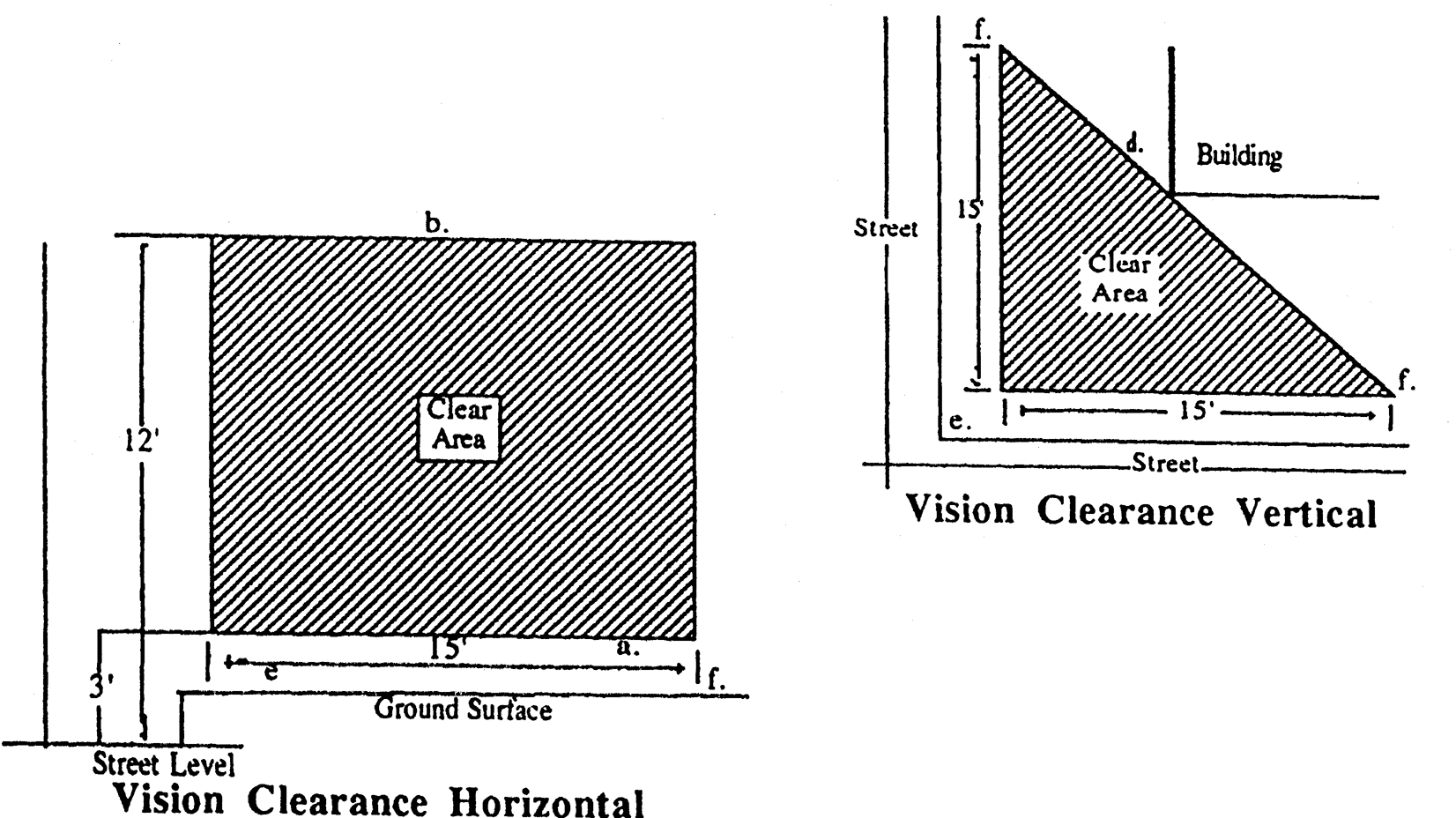
Vision clearance on corner lots—A triangular space at the street corner of a corner lot, free from any kind of construction to vision between the heights of two (2) and twelve (12) feet above the established street grade. The street grade is measured at the intersection of the center lines of the intersecting street pavements, and the triangular space is determined by a diagonal line connecting two (2) points measured fifteen (15) feet along each of the street property lines equidistant from the intersection of the property lines or the property line extended, at the corner of the lot.
a.
Two (2) feet above established street grade
b.
Twelve (12) feet above established street grade.
c.
Point of established street grade.
d.
Diagonal line forming rear line of triangle.
VISION CLEARANCES
e.
Intersection of right-of-way or property lines.
f.
Fifteen (15) feet from intersection of right-of-way or property lines.
eeeeeee.
Wall sign—Any sign painted on, or attached to or erected against the wall of a building or structure, and having the exposed face of the sign in a plane parallel to the plane of such wall.
fffffff.
Yard—A space on the same lot with a building which is open, unoccupied and unobstructed by structures, except as otherwise provided in this article.
ggggggg.
Yard, front—A yard extending across the full width of the lot or in the case of a corner lot extending also along the length of the lot abutting the side street, unoccupied other than by appurtenances, the depth of which is the least distance between the lot line and the building line.
hhhhhhh.
Yard, rear—A yard extending across the full width of the lot between the rear of the principal building and the rear lot line unoccupied other than by accessory buildings which do not occupy more than thirty percent (30%) of the required space, and steps, walks, terraces, driveways, lamp posts and similar structures, the depth of which is the least distance between the rear lot line and the rear of such principal building.
iiiiiii.
Yard, side—A yard between the building line and side lot line, extending from the front yard or from the front line where no front yard is required, to the rear yard, unoccupied other than by architectural appurtenances projecting not more than twenty-four (24) inches from the building, as open or lattice-enclosed fire escapes or fireproof outside stairways, projecting not more than four (4) feet, and certain accessory uses in accordance with the provisions of this article. The width of the required side yard is measured horizontally, at ninety (90) degrees with the side lot line from the nearest point of the building.
jjjjjjj.
Zone map—A map entitled "Zone Map, Wabash, Indiana" dated April 24, 1995 as amended.
(Gen. Ord. No. 1, 1995, art. 7, § 1, 4-24-95; Ord. No. 2, 2001, § 3, 1-22-01)

