
Waconia City Zoning Code
CHAPTER 900
ZONING ORDINANCE
Sec. 900.01. - Short title.
This chapter shall be known, cited and referred to as the Waconia Zoning Ordinance, except as referred to herein, where it shall be known as this chapter.
Sec. 900.02. - Intent and purpose.
The purpose of this chapter is to:
1.
Implement the comprehensive plan as adopted by the city council.
2.
Protect the public health, safety, comfort, convenience and general welfare.
3.
Promote orderly development of the residential, commercial, industrial, recreational and roadway area of the city.
4.
Divide the area within the city into zones and districts regulating the location, construction, reconstruction, alteration and use of structures and land as well as regulating the bulk of structures in relationship to surrounding properties.
5.
Protect and improve the quality of unique natural resources.
6.
Preserve and protect property values.
7.
Provide for the administration of this chapter and define the powers and duties of the administrating officer as provided hereinafter.
8.
Prescribe penalties for the violation of the provisions in this chapter or any amendment thereto.
Sec. 900.03. - Building code.
Subd. 1. Purpose. This chapter provides for the application, administration, and enforcement of the Minnesota State Building Code by regulating the erection, construction, enlargement, alteration, repair, moving, removal, demolition, conversion, occupancy, equipment, use, height, area, and maintenance of all buildings and/or structures in this municipality; provides for the issuance of permits and collection of fees thereof; provides penalties for violation thereof; repeals all ordinances and parts of ordinances that conflict therewith. This chapter shall perpetually include the most current edition of the Minnesota State Building Code with the exception of the optional appendix chapters. Optional appendix chapters shall not apply unless specifically adopted.
Subd. 2. Codes adopted by reference. The Minnesota State Building Code, as adopted by the Minnesota Commissioner of Labor and Industry pursuant to Minn. Stat. §§ 326B.101 to 326B.16, including all of the amendments, rules and regulations established, adopted and published from time to time by the Minnesota Commissioner of Labor and Industry, through the building codes and standards unit, is hereby adopted by reference with the exception of the optional chapters, unless specifically adopted in this chapter. The Minnesota State Building Code is hereby incorporated in this chapter as if fully set out herein.
Subd. 3. Application, administration and enforcement. The application, administration, and enforcement of the Code shall be in accordance with Minnesota State Building Code. The Code shall be enforced within the extraterritorial limits permitted by Minn. Stat. § 326B.121, subd. 2, when so established by this chapter. The Code enforcement agency of this municipality is called the building code department of the city. The administrative authority shall be a state certified "building official" designated by the city to administer the Code pursuant to Minn. Stat. § 326B.133.
Subd 4. Permits and fees. The issuance of permits and the collection of fees shall be as authorized in Minn. Stat. §§ 326B.101 to 326B.16 and this Code. Permit fees shall be assessed for work governed by this code in accordance with Table 1 of this chapter, as adopted by the city. In addition, a surcharge fee shall be collected on all permits issued for work governed by this code in accordance with Minn. Stat. § 326B.148.
(Ord. No. 779, § 1, 12-16-24)
Sec. 900.04. - Rules and definitions.
Subd. 1 Rules.
A.
In constructing this chapter, the following rules of construction shall govern, unless their observance would involve a construction inconsistent with the manifest intent of the council, or be repugnant to the context of the ordinance.
1.
Words used in the present tense shall include the past and future tenses, and the future tense shall include the present.
2.
Words in the singular shall include the plural, and the plural shall include the singular.
3.
The word "shall" is mandatory, and the word "may" is permissive.
4.
The use of one (1) gender shall include all other genders.
5.
References herein to the manager, planner, assessor, engineer, building official, and clerk shall mean the person who then holds that position in the city, unless otherwise expressly stated.
6.
The use of the phrase "used for" shall include the phrases "designed for," "intended for," "improved for," "maintained for," "offered for," and "occupied for."
7.
Words and phrases shall be construed according to rules of grammar and according to their common and approved usage; but technical words and phrases and such others as have acquired a special meaning, or are defined in this chapter, shall be construed according to such special meaning or their definition.
8.
References in this chapter to this chapter or to another city ordinance, whether or not be specific number, shall mean this chapter, and the referred-to ordinance, as it is in force as of the effective date of this chapter, and as such ordinance may from time to time thereafter be amended and modified, and shall also mean and include such ordinances as may supersede or be substituted for the ordinance so referred to.
Subd. 2. Definitions.
The following words, terms, and phrases, as used herein, have the following meanings:
Accessory apartment means a second dwelling unit in an existing single-family detached dwelling for use as a complete, independent living facility with provision within the accessory apartment for cooking, eating sanitation, and sleeping. Such a dwelling is an accessory use to the main dwelling.
Accessory structure means a structure subordinate to, and serving the principal structure on the same lot and customarily incidental thereto.
Accessory use means a use incidental to, and on the same lot as, a principal use.
Adult arcade means any place to which the public is permitted or invited wherein coin-operated, slug-operated, or for any form of consideration, or electronically, electrically, or mechanically controlled still or motion picture machines, projectors, video or laser disc players, or other image-producing devices are maintained to show images to five (5) or fewer persons per machine at any one (1) time, and where the images so displayed are distinguished or characterized by the depicting or describing of "specified sexual activities" or "specified anatomical areas."
Adult bookstore, adult novelty store or adult video store means a commercial establishment which, as one (1) of its principal purposes, offers for sale or rental for any form of consideration any one (1) or more of the following:
A.
Books, magazines, periodicals or other printed matter, or photographs, films, motion picture, video cassettes or video reproductions, slides, or other visual representations which are characterized by the depiction or description of "specified sexual activities" or "specified anatomical areas;" or
B.
Instruments, devices, or paraphernalia which are designed for use in connection with "specified sexual activities."
A commercial establishment may have other principal business purposes that do not involve the offer for sale or rental of material depicting or describing "specified sexual activities" or "specified anatomical areas" and still be categorized as adult bookstore, adult novelty store, or adult video store. Such other business purposes will not serve to exempt such commercial establishments from being categorized as an adult bookstore, adult novelty store, or adult video store so long as one (1) of its principal business purposes is the offering for sale or rental for consideration the specified materials which are characterized by the depiction or description of "specified sexual activities" or "specified anatomical areas."
Adult cabaret means a nightclub, bar, restaurant, or similar commercial establishment which regularly features:
A.
Persons who appear in a state of nudity or semi-nude;
B.
Live performances which are characterized by the exposure of "specified anatomical areas" or by "specified sexual activities;" or
C.
Films, motion pictures, video cassettes, slides or other photographic reproductions which are characterized by the depiction or description of "specified sexual activities" or "specified anatomical areas;" and has a sign visible from the public right of way which advertises the availability of this adult type of photographic reproductions.
Adult motel means a hotel, motel or similar commercial establishment which:
A.
Offers accommodations to the public for any form of consideration; provides patrons with closed-circuit television transmissions, films, motion pictures, video cassettes, slides, or other photographic reproductions which are characterized by the depiction or description of "specified sexual activities" or "specified anatomical areas;" and has a sign visible from the public right of way which advertises the availability of this adult type of photographic reproductions; or
B.
Offers a sleeping room for rent for a period of time that is less than ten (10) hours; or
C.
Allows a tenant or occupant of a sleeping room to sub-rent the room for a period of time that is less than ten (10) hours.
Adult daycare facility means care facilities as licensed by the State of Minnesota.
Adult motion picture theater means a commercial establishment where, for any form of consideration, films, motion pictures, video cassettes, slides, or similar photographic reproductions are regularly shown which are characterized by the depiction or description of "specified sexual activities" or "specified anatomical areas."
Adult theater means a theater, concert hall, auditorium, or similar commercial establishment which regularly features persons who appear in a state of nudity or semi-nude, or live performances which are characterized by the exposure of "specified anatomical areas" or by "specified sexual activities."
Alley means a public right-of-way permanently reserved as a secondary means of access to abutting property.
Animal, food means fish, fowl, cattle, swine, sheep and other raised for purposes of food consumption.
Animal, fur means animals raised for their pelt.
Animal, pleasure means dogs, cats, horses, birds.
Animal unit means the following animals constitute one (1) animal unit equivalency: One (1) cow or steer, one (1) horse, donkey or burro, three (3) sheep, three (3) hogs or one hundred (100) fowl.
Antenna means equipment used for transmitting or receiving tele-communication, television or radio signals which is located on the exterior of, or outside of, any building or structure.
Apartment means a room with full housekeeping facilities which is rented on a monthly basis.
Arterial street means interregional roads conveying traffic between towns and other urban areas as defined in the comprehensive plan.
Basement means a portion of a building located partly underground. A basement shall be counted as a story if it has one-half (½) or more of its height above the highest level of the adjoining ground and/or if it is intended to be used for dwelling or business purposes.
Bed and breakfast means an owner occupied single-family dwelling where lodging in up to four (4) guest rooms and breakfast are provided to the traveling public by the resident owner for compensation.
Boarding house means a building other than a motel or hotel where, for compensation for definite periods of time, meals or lodgings are provided.
Boulevard means that portion of a street right-of-way between the curb or curb line and the property line.
Block means an area of land within a subdivision that is entirely bounded by streets or a combination of street, exterior boundary lines of the subdivision and/or bodies of water.
Building means any structure having a roof which may provide shelter or enclosure of persons, animals or chattel.
Building height means the vertical distance from the average elevation of the adjoining ground level to the top of the highest point of the structure.
Building line means that line measured across the width of the lot at the point where the main structure is placed in accordance with setback provisions.
Business means any occupation, employment or enterprise wherein merchandise is exhibited or sold, or which occupies time, attention, labor, and materials, or where services are offered for compensation.
Cannabis business has the meaning given it in Minn. Stat. § 342.01, subd. 14.
Cannabis mezzobusiness means a vertically integrated license offered by the OCM that allows a license holder to cultivate (fifteen thousand (15,000) square foot plant canopy limit), manufacture, and sell cannabis and related products.
Cannabis microbusiness means a vertically integrated license offered by the OCM that allows a license holder to cultivate (five thousand (5,000) square foot plant canopy limit), manufacture, and sell cannabis and related products.
Cannabis retail business means the retail location(s) of a: i) cannabis mezzobusiness with a retail operations endorsement; ii) cannabis microbusiness with a retail operations endorsement; or iii) medical cannabis combination businesses operating a retail location.
Canopy means a roof-like structure projecting over the entrance to a building.
Cemetery means land used or intended to be used for the burial of the dead and dedicated for cemetery purposes, including columbariums, crematories, mausoleums, and mortuaries when operated in conjunction with and within the boundaries of such cemetery.
Church means a building, together with its accessory buildings and uses, where persons regularly assemble for religious worship and which building, together with its accessory buildings and uses, is maintained and controlled by a religious body organized to sustain public worship.
Clear cutting means the removal of an entire stand of trees.
Club means a non-profit association of persons who are bonafide members paying annual dues; use of premises being restricted to members and their guests.
Collector street means a street whose function is to channel traffic from local streets to major arterial roads. These streets are identified in the city's comprehensive plan.
Commercial recreational facilities means uses including, but not limited, to the following: Miniature golf, driving ranges, waterslides, amusement centers.
Commercial telecommunication antenna means an antenna used for the commercial purpose of sending and receiving electromagnetic signals in the ordinary course of commerce.
Comprehensive plan means a compilation of policy statements, goals, standards and maps for guiding the physical, social and economic development, both private and public, of the city and its environs.
Conditional use means those occupations, vocations, skills, arts, businesses, professions, or uses specifically designated in each zoning use district, which for the respective conduct or performance in such designated use districts may require reasonable, but special, peculiar, unusual or extraordinary limitations, facilities, plans, structures, thoroughfares, conditions, modification or regulations in such use district for the promotion or preservation of the general public welfare, health, convenience, or safety therein and in the county, and therefore may be permitted in such use district only by a conditional use permit (CUP).
Contractor's yard means a building and/or lot specifically used for the storing of construction vehicles, equipment and other related apparatus.
Cul-de-sac means a local street, one (1) end of which is closed and consists of a circular turn around.
Dairy farming means the process of maintaining a herd for the principal purpose of producing milk, plus horticultural activities.
Daycare means a location licensed with the Minnesota Department of Human Services to provide the care of a child in a residence outside the child's own home for gain or otherwise, on a regular basis, for any part of a twenty-four (24)-hour day.
Deck means a structure which is either free standing or attached to a principal or accessory building, constructed at grade or above grade, intended or designed for use as outdoor living space and unenclosed by solid or non-solid walls or a roof.
District refers to a specific zoning district as described in the zoning ordinance.
Dump truck means a truck that: i) unloads contents by tilting the truck bed backwards or sideways; and ii) exceeds seven (7) feet, six (6) inches in height at its highest point (with the truck bed lowered).
Dwelling means a room or group of rooms providing complete living facilities for one (1) household.
Dwelling, single-family means one (1) dwelling unit having open space on all four (4) sides.
Dwelling, two-family means a building having two (2) dwelling units.
Dwelling, multiple family means a building having three (3) or more dwelling units.
Dwelling, townhouse means a dwelling unit attached to other dwelling units by common walls, side by side, extending from the foundation to the roof and without any portion of one (1) dwelling unit located above any portion of another dwelling unit, and with each dwelling unit having a separate entrance from outside the building.
Easement means authorization by a property owner for the use by another, and for a specified purpose, of any designated part of his property.
Engineer means the professional engineer engaged by the city council.
Erosion means the wearing away of land surface by the action of manmade and natural elements.
Escort means a person who, for consideration, agrees or offers to act as a companion, guide, or date for another person, or who agrees or offers to privately model lingerie or to privately perform a striptease for another person.
Escort agency means a person or business association who furnishes, offers to furnish, or advertises to furnish escorts as one (1) of its primary business purposes for a fee, tip, or other consideration.
Extended care facility means facilities where health care services can be administered and/or delivered on an on-call basis.
Family means an individual, or two (2) or more persons each related by blood, marriage, or adoption living together as a single housekeeping unit, or a group of not more than four (4) persons not so related maintaining a common household.
Feed lot means any tract of land, or structure, pen, or corral, wherein cattle, horses, sheep, goats and swine are maintained in close quarters for the purpose of fattening such livestock for final shipment to market.
Fence means a lineal structure including walls, hedges, or similar barriers used to prevent access by persons or animals or prevent visual or sound transference.
Final plat means the final map and/or plan and/or record of a subdivision and any accompanying material presented to the city council for approval and which, if approved, will be duly filed with the County Register of Deeds.
Floor area means the sum of the gross horizontal areas of the several floors of the building measured from the exterior faces of the exterior walls, or from the center line of walls separating two (2) buildings and shall include basement floor area except for porches, balconies, breezeways, and attic areas having head room of less than seven and one-half (7½) feet.
Floor area ratio is determined by dividing the gross floor area of all buildings on a lot by the area of that lot.
Funeral home means a business establishment where the bodies of the dead are prepared for burial or cremation and where funeral services can be held.
Garage means a building for the private use of the owner or occupant of a principal building situated on the same lot of the principal building for the storage of motor vehicles with no facilities for mechanical service or repair of a commercial or public nature.
Garage sale means a sale of used or unwanted possessions, as household articles, often held in the garage of a house.
Gazebo means an independent, open, roofed structure from which one can gaze at the surrounding scenery.
General farming means the process of planting and harvesting a horticultural crop as the principal use of the land plus the keeping of livestock.
Golf course means a tract of land, including a clubhouse, for playing golf, with tees, greens, fairways, hazards, etc.
Governing body means the city council.
Guest cottages means a building solely used for one (1) or more of the following purposes: Scrap booking, stamping, greeting card making, quilting, beading, hosting a book club, hosting a wedding or hosting a baby shower. Such a building may include lodging for persons then using the building for a permitted use. No part of such a building, however, shall be used by its owner or operator as a dwelling.
Hardcover surface means any structure or material that substantially reduces or prevents the infiltration of storm water into the ground including, but not limited to, buildings, other structures, and driveways and parking areas surface with any type of pavement or gravel.
Hardship (associated with variances) means the property in question cannot be put to a reasonable use under the conditions allowed by the official controls; the plight of the landowner is due to circumstances unique in his property, not created by the landowner; and the variance, if granted, will not alter the essential character of the locality. Economic considerations alone shall not constitute a hardship if a reasonable use for the property exists under terms of the official controls.
Home occupation means any occupation or profession carried on by a member of the immediate family residing on the premises in connection with which there is no sign, other display, or other condition permitted that will indicate from the exterior that the building is being utilized in whole or in part for any purpose other than that of a dwelling. There shall be no commodities sold upon the premises and no person employed therein other than a member of the immediate family residing on the premises or domestic servants; and no mechanical or electrical equipment shall be used except such as is normally used for purely domestic or professional purposes. No accessory building shall be used for such home occupation, and entrance to the home occupation shall be gained from within the structure.
Hotel means a facility offering transient lodging accommodations on a daily rate to the general public and providing additional services, such as restaurants, meeting rooms, and recreational facilities.
Incineration means a burning process which converts combustible materials into non-combustible residue or ash.
Industry means an enterprise which involves the production, processing, or storage of materials, goods, or products.
Interim use means a use, allowed on an interim or temporary basis, consistent with the zoning ordinance. An interim use shall have a known termination date.
Kennel, commercial means any place where a person, firm, or corporation accepts animals from the general public and where such animals are kept for the purposes of selling, boarding, breeding, training, treating or grooming.
Kennel, private means any place where more than two (2) animals over four (4) months of age are kept or harbored, such animals being owned by the owner or lessee of the premises wherein or whereupon the animals are kept or harbored.
Kennel license means no person, firm, or corporation shall maintain in this city a private or commercial kennel without securing a license therefor from the city council, and the fee being as set forth in the schedule of fees.
Kennel license, renewal of. Kennel licenses shall expire on the 31 st day of December next following their issuance. Upon application for renewal of a kennel license, an authorized city employee shall inspect the kennel of the applicant. Said employee shall submit to the city clerk either an affirmative certification that said kennel is maintained in a neat, orderly, and safe condition or a negative certification that said kennel is not so maintained. The city clerk may issue a renewal kennel license provided that:
A.
The aforementioned certificate is affirmative;
B.
No complaints have been received by the city; and
C.
In all other cases, the kennel license shall be renewed only upon city council approval.
Landscaping means plantings such as trees, grass, bushes and shrubs.
Large retail building means a building exceeding fifty thousand (50,000) square feet of gross building floor area where the primary use of the building floor area is devoted to the sale or rental of merchandise to the general public, including, but not limited to, department stores, discount stores, supermarkets, superstores and wholesale clubs.
Large retail project means a large retail building and any associated storage areas, parking lots, driveways, sidewalks and any other associated development features.
Licensed engineer means a person licensed as a professional engineer by the State of Minnesota.
Livestock means domestic animals kept for use on a farm and raised for sale and profit.
Local street means a roadway allowing access to abutting land, serving local traffic only.
Lodge. See club.
Lot means a parcel, piece, or portion of land designated by metes and bounds, registered land survey, auditor's plat, or other means and separated from other parcels or portions by said description for the purpose of sale, lease, or separation thereof, abutting a public street.
Lot area means the area of a lot on a horizontal distance between the front lot line and the rear lot line.
Lot depth means the mean horizontal distance between the front lot line and the rear lot line.
Lot of record means a lot whose existence, location, and dimensions have been legally recorded or registered in a deed or on a plat.
Lot width means the horizontal distance between side lot lines, measured at the required front setback line.
Lot, corner means a lot abutting on and at the intersection of two (2) or more streets.
Lot, flag means a lot with access provided to the bulk of the lot by means of a narrow corridor. Flag lots will be allowed only as a way to preserve natural site features of a plat or to enhance the safety of a lot from traffic whose entrance would otherwise be directly onto a collector or arterial street.
Lot, interior means a lot other than a corner lot, including through lots.
Lot, through means a lot having its front and rear yards each abutting on a street.
Lot line means a line dividing one (1) lot from another lot or from a street or alley.
Lot line, front means that boundary of a lot which abuts an existing or dedicated public street, and in the case of a corner lot it shall be the shortest dimension on a public street.
Lot line, interior means any boundary of a lot which does not abut a public right-of-way.
Lot line, rear means that boundary of a lot which is opposite the front lot line. If the rear lot line is less than ten (10) feet in length or if the lot forms a point at the rear, the rear lot line shall be a line ten (10) feet in length within the lot, parallel to the front lot line.
Lot line, side means any boundary of a lot which is not a front lot line or a rear lot line.
Lower-potency hemp edible has the meaning given it under Minn. Stat. § 342.01, subd. 50.
Marina means an inland or offshore area for concentrated mooring of five (5) or more watercraft, wherein facilities are provided for any or all of the following ancillary services: Boat storage, fueling, launching, mechanical repairs, sanitary pump-out and restaurant services.
Manufacturing means uses which include the compounding, processing, packaging, treatment or assembly of products and materials.
Marquee. See canopy.
Medical cannabis combination business has the meaning given it in Minn. Stat. § 342.515.
Microdistillery means a "microdistillery," as such term is defined by Minn. Stat. § 340A.101, subd. 17a, as amended.
Mining means the extraction of sand, gravel, rock, soil, or other material from the land in the amount of four hundred (400) cubic yards or more and the removal thereof from the site. The only exclusion from this definition should be removal of minerals associated with the nominal construction of a building.
Mini-storage facility means a structure or building in which customers can rent space to store possessions.
Mixed-use building means a building containing a retail or commercial use permitted in the district on each floor with an exterior wall at-grade, together with one (1) or more dwellings on other floors of the same building.
Mortuary means a place where dead bodies are kept before burial or cremation.
Motel means a facility offering lodging accommodations for those traveling by car usually with easy access from each room to an area for cars.
Motor freight terminal means a building or area in which freight brought by motor truck is transferred and/or stored for movement.
Motor fuel station means a retail place of business engaged primarily in the sale of motor fuels, but also may be engaged in supplying goods and services generally associated with the operation and maintenance of motor vehicles. These may include sale of petroleum products, sale and servicing of tires, batteries, automotive accessories, and replacement items, washing and lubrication services, and the performance of minor automotive maintenance and repair.
Motor fuel station convenience store means a store operated in conjunction with a motor fuel station offering a limited selection of food and other products and staying open for longer hours at a convenient location.
Motor vehicle means a self-propelled vehicle, excluding vehicles moved solely by human power.
Nameplate sign means a sign which bears the name and address of the occupant of the building.
Nonconforming structure means a structure which does not meet the requirements of the zoning district in which it is located due to the enactment of this chapter or any amendment thereto, but which was lawfully existing as of the date of its construction or placement.
Nonconforming use means a use which does not meet the requirements of the zoning district in which it is located due to the enactment of this chapter, or any amendment thereto, but which was a lawful use as of the date it was first commenced.
Noxious matter means matter capable of causing injury to living organisms by chemical reaction or capable of causing detrimental effects on the physical or economic well-being of individuals.
Nude model studio means any place where a person who appears semi-nude, in a state of nudity, or who displays "specified anatomical areas" and is provided to be observed, sketched, drawn, painted, sculptured, photographed, or similarly depicted by other persons who pay money or any form of consideration. Nude model studio shall not include a proprietary school licensed by the State of Minnesota or a college, junior college or university supported entirely or in part by public taxation; a private college or university which maintains and operates educational programs in which credits are transferable to a college, junior college, or university supported entirely or partly by taxation; or in a structure:
A.
That has no sign visible from the exterior of the structure and no other advertising that indicates a nude or semi-nude person is available for viewing;
B.
Where in order to participate in a class a student must enroll at least three (3) days in advance of the class; and
C.
Where no more than one (1) nude or semi-nude model is on the premises at any one (1) time.
Nudity or a state of nudity means the showing of the human male or female genitals, pubic area, vulva, anus, anal cleft or cleavage with less than a fully opaque covering, the showing of the female breast with less than a fully opaque covering of any part of the nipple, or the showing of the covered male genitals in a discernible turgid state.
Nursing home means a building or group of buildings licensed by the State of Minnesota for the care of the aged or infirm, or a place of rest and care for those suffering physical or mental disorders. Hospitals, clinics, maternity care homes and other buildings or parts of buildings containing surgical equipment are note included.
Off-street parking means a maintained area, other than on a public street or right-of-way, for the storage of an automobile.
Open storage means storage of materials outside of a building.
Owner means any individual, firm, association, syndicate, partnership, corporation, trust or any other legal entity having proprietary interest in the land.
Party wall means a common wall which divides two (2) independent structures by a fire wall.
Pedestrian way means the right-of-way across or within a block for use by pedestrian traffic.
Performance standard means standards that are established to assure that development will not be a detriment to the public health, safety, and general welfare of the municipality.
Person means an individual, to include both male and female and shall also extend and be applied to bodies political and corporate and to partnership and other incorporated associations.
Planned unit development (PUD) means a self-contained development, often with a mixture of housing types and densities, in which the subdivision and zoning controls are applied to the project as a whole rather than to individual lots, as in most subdivisions. Therefore, densities are calculated for the entire development, usually permitting a trade-off between clustering of houses and provision of common open space.
Planning agency means the planning commission or planning department as created by the City of Waconia.
Principal structure means a structure or building used for principal uses, including all seasonal living areas, porches, decks, and breezeways attached to the structure or building.
Private garage. See garage.
Private residential recreational facilities means swimming pools, tennis courts, exercise/weight rooms, club houses and similar facilities owned, operated and maintained by a development or homeowner's association for the benefit of multiple residential users.
Publication means notice placed in the official city newspaper stating time, location and date of meeting and description of the topic.
Public garage means a building or portion of a building used for the storage of vehicles for remuneration.
Public hearing. Whenever the term public hearing is used in this chapter, unless otherwise specifically redefined, it shall mean a public hearing pursuant to a notice published once in the official newspaper of the city and at least ten (10) days before the sate of such hearing, which notice shall specify the general purpose, time and place of such hearing. Any such hearing after such publication may be continued, recessed, or adjourned from time to time without any further publication or notice thereof.
Public service installation means public utility structures including, but not limited to, transformers, substations and lift stations, and public utility buildings.
Public water means any waters of the state as defined in Minn. Stat. 1980 § 105.37, subd. 14. However, no lake, pond or flowage of less than ten (10) acres in size and no river or stream having a total drainage area less than two (2) square miles shall be required for purposes of this chapter.
Refrigerator truck means a truck designed or used to transport property at a specific temperature.
Rental facility means a building specifically used to conduct a business of renting, to the public, general items including, but not limited to, hand power tools, automotive tools, lawn and garden items, tables and chairs, tents, moving supplies, floor care and plumbing tools, cement tools, home improvement tools, painting equipment, generators and other items used by contractors or homeowners.
Repair garage means a building for the maintenance of vehicles but not including auto wrecking or junk yards.
Residential treatment facility means a residential treatment facility, as defined under Minn. Stat. § 245.462, subd. 23.
Rural retails means a retail business on a lot of at least four (4) acres in size where: i) The lot has outdoor storage and display area not exceeding twenty (20) percent of the lot size; and ii) the building and outdoor storage and display areas are primarily devoted to the retail sale or rental of rural related equipment, implements, motorized vehicles, clothing, furnishings, hardware, supplies, and materials.
School means a public school as defined under Minn. Stat. § 120A.05 or a nonpublic school that must meet the reporting requirements under Minn. Stat. § 120A.24.
Semi-nude or in a semi-nude condition means the showing of the female breast below a horizontal line across the top of the areola at its highest point or the showing of the male or female rear of the body which lies between two (2) imaginary lines running parallel to the ground when a person is standing, the first or top of such line drawn at the top of the cleavage of the nates and second or bottom line drawn at the lowest visible point of the cleavage or the lowest point of the curvature of the fleshy protuberance, whichever is lower, and between two (2) imaginary lines on each side of the body, which lines are perpendicular to the ground and to the horizontal lines described above, and which perpendicular lines are drawn through the point at which each nate meets the outer side of each leg. This definition shall include the entire lower portion of the human female breast, but shall not include any portion of the cleavage of the human female breast, exhibited by a dress, blouse, skirt, leotard, bathing suit, or other wearing apparel provided the areola is not exposed in whole or in part.
Semi-trailer means a vehicle of the trailer type so designed and used in conjunction with a truck-tractor that a considerable part of its own weight or that of its load rests upon and is carried by the truck-tractor and includes a trailer drawn by a truck-tractor semi-trailer combination.
Service road means a street which is adjacent to a thoroughfare and which provides access to abutting properties and protection from through traffic.
Setback means the minimum horizontal distance between a structure and the nearest property line or right-of-way line; within shoreland districts it shall also mean the minimum horizontal distance between a structure and the normal highwater mark.
Setback, front yard means the shortest horizontal distance from the forward most point of a building or structure to the nearest point on the front lot line.
Setback, interior side yard means the shortest horizontal distance from any part of a building or structure to the nearest point on an interior side lot line.
Setback, rear yard means the shortest horizontal distance from any part of a building or structure to the nearest point on a rear lot line.
Setback, street side yard means the shortest horizontal distance from any part of a building or structure to the nearest point on a side lot line that adjoins a street.
Sexual encounter center means a business or commercial enterprise that, as one (1) of its principal business purposes, offers for any form of consideration:
A.
Physical contact in the form of wrestling or tumbling between persons of the opposite sex; or
B.
Activities between male and female persons and/or persons of the same sex when one (1) or more of the persons is in a state of nudity or semi-nude.
Sexually oriented business means an adult arcade, adult bookstore, adult novelty store, adult video store, adult cabaret, adult motel, adult motion picture theater, adult theater, escort agency, nude model studio, or sexual encounter center.
Shoreland means land located within the following distances from public water; one thousand (1,000) feet from the normal highwater mark of a lake, pond, or flowage; and, three hundred (300) feet from a river or stream, or the landward extent of a floor plain designated by ordinance of such a river or stream, whichever is greater.
Small brewery means a brewery operated by a brewer who holds an off-sale malt liquor license issued pursuant to Waconia City Code section 580.06, subdivision 11.
Specified anatomical areas means:
A.
The human male genitals in a discernibly turgid state, even if completely and opaquely covered; or
B.
Less than completely and opaquely covered human genitals, pubic region, buttocks or a female breast below a point immediately above the top of the areola.
Specified criminal activity means any of the following offenses:
A.
Prostitution or promotion of prostitution; dissemination of obscenity; sale, distribution or display of harmful material to a minor; sexual performance by a child; possession or distribution of child pornography; public lewdness; indecent exposure; indecency with a child; engaging in organized criminal activity; sexual assault; molestation of a child; gambling; or distribution of a controlled substance; or any similar offenses to those described above under the criminal or penal code of other states or countries; for which:
i.
Less than two (2) years have elapsed since the date of conviction or the date of release from confinement imposed for the conviction, whichever is the later date, if the conviction is of a misdemeanor offense;
ii.
Less than five (5) years have elapsed since the date of conviction or the date of release from confinement for the conviction, whichever is the later date, if the conviction is of a felony offense; or
iii.
Less than five (5) years have elapsed since the date of the last conviction or the date of release from confinement for the last conviction, whichever is the later date, if the convictions are of two (2) or more misdemeanor offenses or combination of misdemeanor offenses occurring within any twenty-four (24)-month period.
B.
The fact that a conviction is being appealed shall have no effect on the disqualification of the applicant or a person residing with the applicant.
Specified sexual activities means any of the following:
A.
The fondling or other erotic touching of human genitals, pubic region, buttocks, anus or female breasts;
B.
Sex acts, normal or perverted, actual or simulated, including intercourse, oral copulation, masturbation, or sodomy; or
C.
Excretory functions as part of or in connection with any of the activities set forth in A. and B. above.
Street means a public or private thoroughfare used, or intended to be used, for passage or travel by motor vehicles.
Street frontage means that portion of a parcel of land abutting one (1) or more street. An interior lot has one (1) street frontage and a corner lot has two (2) such frontages.
Structure means anything built or constructed, an edifice or building of any kind, or any piece of work composed of parts joined together in some definite manner, except parking lots and driveways.
Subdivision means the division of any parcel of land into two (2) or more lots, blocks, and/or sites, with or without streets or highways and includes re-subdivision.
Substandard use means any use of lands existing prior to the date of enactment of this chapter which is permitted within the applicable zoning district but does not meet minimum lot area and length of frontage, structure setbacks, or other dimensional standards of the ordinance.
Surveyor means a person duly registered as a land surveyor by the State of Minnesota.
Taproom means a space within, or in a structure adjacent to, a small brewery where malt liquor manufactured by a small brewer holding a license pursuant to Waconia City Code section 580.06, subd. 12, is sold.
Tower means any pole, spire or structure, or any combination thereof, to which an antenna is attached, or which is designed for an antenna to be attached, and all supporting lines, cables, wires and braces.
Truck means a motor vehicle designed, used or maintained primarily for the transportation of property.
Truck stop means a motor fuel station devoted principally to the needs of trucks and which shall include eating facilities.
Truck-tractor means a motor vehicle designed and used primarily for drawing other vehicles and not constructed to carry a load other than a part of the weight of the vehicle and load drawn.
Use means the purpose or activity for which the land or structure thereon is designated, arranged, or intended, or for which it is occupied, utilized or maintained.
Use, permitted means a use which conforms with the requirements of the zoning district within which it is located.
Use, principal means the primary use of land or structures as distinguished from accessory uses.
Utility building means an accessory building which is not usable for the storage of vehicles; is one-story in nature; is used or intended for the storage of hobby tools, garden equipment, etc.; is detached from the principal structure; and which is naturally and normally incidental to, subordinate to, and auxiliary to the principal dwelling structure.
Variance means any modification or variation of official controls where it is determined that because of hardship, strict enforcement of official control is impractical.
Vehicle means a device in, upon, or by which any person or property is or may be transported or drawn upon a highway, excepting devices used exclusively upon stationary rails or tracks.
Warehousing means the storage of materials or equipment within an enclosed building.
Wholesaling means the selling of goods, equipment and materials by bulk to another business that in turn sells to the final customer.
Yard means a required open space on a lot, which is unoccupied and unobstructed by any structure from its lowest ground level to the sky except as expressly permitted in this chapter.
Yard, front means a yard extending across the front of the lot between the side property lines and lying between the front lot line and the nearest line of the building.
Yard, rear means a yard extending across the rear of the lot between the side property lines and lying between the rear lot line and the nearest line of the building.
Yard, side means a yard between the side lot line and the nearest line of the building and extending from the front yard line to the rear yard line.
Zoning district means an area of the city designated in the zoning ordinance text and delineated on the zoning map, in which requirements for the use of land and building and development standards are prescribed.
Zoning map means the official city map that delineates the various zoning districts.
Zoning ordinance means the official land-use controls, which list various requirements, that guide the physical development of the city.
(Ord. No. 745, 3-7-22; Ord. No. 775, 9-16-24; Ord. No. 779, §§ 2, 3.10, 12-16-24; Ord. No. 782, § 1, 5-19-25)
Sec. 900.05.1. - General provisions.
A.
Establishment of districts. For the purposes of this chapter, the city shall be divided into the following districts.
B.
Zoning districts map. The boundaries of these districts are hereby defined and established as shown on the zoning districts map which accompanies this chapter. Said map with all explanatory matter thereon is hereby made a part of this chapter.
C.
Interpretation of district boundaries. where uncertainty exists with respect to the boundaries of any zoning district indicated on the zoning districts map, the following rules shall apply:
1.
Boundaries indicated as approximately following the center lines of streets or highways shall be construed as following the center lines of streets or highways.
2.
Boundaries indicated as approximately following lot lines shall be construed as following such lot lines.
3.
Boundaries indicated as approximately following city boundary lines shall be construed as following such city boundaries.
4.
Boundaries indicated as approximately parallel to the center lines of streets or highways shall be construed as being parallel thereto and at such distance therefrom as may be indicated on the zoning districts map. If no distance is given, such dimensions shall be determined by the use of the scale shown on the zoning districts map.
5.
Boundaries following the shoreline of a stream, lake or other body of water shall be construed to follow the ordinary high water elevation (OHWE) and in the event of change in the shoreline shall be construed as moving with the OHWE. Boundaries indicated as approximately following the center line of streams, rivers, channels or other bodies of water shall be construed to follow such center lines.
6.
Where the application of the aforementioned rules leaves a reasonable doubt as to the boundaries between two (2) districts, the regulations of the more restrictive district shall govern the entire parcel in question, unless otherwise determined by the city board of adjustments after recommendation from the city planning commission.
D.
Annexation. Areas annexed to the City of Waconia shall be placed in a zoning district most like that which the area was zoned prior to annexation provided said zoning is consistent with the city's comprehensive plan. Where inconsistent, the zoning classification of such areas shall not be designated pending study of the area by the planning commission and approval by the city council. In cases where the planning commission deems it appropriate that a study be made of an area to be annexed to the City of Waconia, the planning commission shall recommend a permanent zoning classification to the city council within six (6) months of the date of annexation of said area. The actual zoning classification shall be designated by the city council within nine (9) months of such annexation.
Sec. 900.05.2. - R-1 Single-Family Residential District.
[A.
Scope of regulations.]
1.
Intent and purpose. The purpose of this district is to provide for areas within the city primarily intended for low density residential development as designated by the comprehensive plan.
2.
Permitted uses. Single-family dwellings.
3.
Permitted accessory uses. Gazebos, decks, private garages, utility buildings, fences, off-street parking, nameplate signs, residential recreation equipment subject to the restrictions imposed by section 900.06, Supplementary Regulations.
4.
Uses permitted with special restrictions.
a.
Boarding of not more than two (2) roomers per residential unit.
b.
Cemeteries provided there is internal road access or off-street parking and screening of residential areas equivalent to one (1) tree per fifty (50) feet of site perimeter based on city code. Residential setbacks shall be maintained at fifty (50) feet from cemetery property. The cemetery shall have accessibility to a major thoroughfare.
c.
Daycare facilitates licensed by the State of Minnesota serving ten (10) or fewer persons.
d.
Gardening and other horticultural uses where no sale of products is conducted on the premises.
e.
Garage sales, estate sales, yard sales, rummage sales and other casual sales of personal property, subject to the following restrictions:
1)
No such sale shall exceed a period of seventy-two (72) consecutive hours, including periods when the sale is temporarily closed (e.g., at night).
2)
No more than two (2) such sales shall be held on the same lot in any twelve (12)-month period.
3)
No items offered for sale shall have been purchased or received by gift for resale or received on consignment for the purposes of resale.
f.
Golf courses provided that it is maintained and operated from a central clubhouse location and adequate off-street parking is provided. Residential setbacks shall be maintained at seventy-five (75) feet from golf course property. The golf course shall have access to a major thoroughfare.
g.
Home occupations may be carried on by a member of the immediate family residing on the premises in connection with which there is no sign, other display, or other condition permitted that will indicate from the exterior that the building is being utilized in whole or in part for any purpose other than that of a dwelling.
Also, no exterior structural modifications are made to change the residential character and appearance of the lot or any buildings or structures on the lot. All parking demands generated by the use shall be accommodated within the accessory garage and the normal driveway area. No more than ten (10) automobile trips weekly by individuals other than the residents of the dwelling unit shall be generated to the dwelling unit as a result of the use. No sale of products or merchandise shall occur on the lot or within any structures or buildings on the lot.
h.
Private residential recreational facilities intended solely for the use and enjoyment of residents of the permitted use and their guests.
i.
Residential facilities licensed by the State of Minnesota serving six (6) or fewer persons and being located no nearer than one thousand (1,000) feet to another such facility.
j.
Utility buildings are allowable, but structures constructed of metal are prohibited. Setbacks within the respective zoning districts shall be met.
5.
Uses permitted by conditional use permit (CUP). The following uses are permitted by CUP subject to the requirements of section 900.11.
a.
Churches.
b.
Public service installations including such uses as public utility buildings, transformers, substations and lift stations.
6.
Uses permitted by interim use permit (IUP). The following uses are permitted by IUP subject to the requirements of section 900.11.
a.
Interim use of non-residential buildings.
b.
Parking lots without a hardcover surface.
7.
Lot requirements. The following minimum lot requirements shall apply. Refer to section 900.06 (Supplementary Regulations) for exceptions.
(Ord. No. 779, § 3.10, 12-16-24)
Sec. 900.05.3. - R-2 Single-Family Residential District.
[A.
Scope of regulations.]
1.
Intent and purpose. The purpose of this district is to establish reasonable standards of development for neighborhood conservation areas designated by the comprehensive plan since much of this district encompasses residential areas of the city that were developed at densities that are generally higher than contemporary development standards.
2.
Permitted uses. Single-family dwellings.
3.
Permitted Accessory Uses. Same as the R-1 District.
4.
Uses Permitted with special restrictions.
a.
All uses permitted with special restrictions in the R-1 District.
b.
Accessory apartments provided such use is in compliance with Uniform Building Code and provisions for off-street parking are met.
c.
Two-family dwellings subject to the following: Off street parking requirements are met and second dwelling meets uniform building code requirements.
5.
Uses permitted by conditional use permit (CUP). The following uses are permitted by CUP subject to the requirements of section 900.11.
a.
All uses permitted by CUP in the R-1 District.
b.
Bed and breakfasts.
c.
Funeral homes and mortuaries.
d.
Guest cottages.
6.
Uses permitted by interim use permit (IUP). The following uses are permitted by IUP subject to the requirements of section 900.11.
a.
All uses permitted by IUP in the R-1 District.
7.
Lot requirements. The following minimum lot requirements shall apply. Refer to section 900.06 (Supplementary Regulations) for exceptions.
* Ten (10) feet if abutting an alley.
(Ord. No. 776, 10-21-24)
Sec. 900.05.4. - R-3 Medium Density Residential District.
[A.
Scope of regulations.]
1.
Intent and purpose. The purpose of this district is to provide for a broad range of housing types that will generally be located adjacent to more active business areas with direct access to collector streets. These areas are found in or near developing residential areas distant from downtown Waconia where non-single-family housing is a desirable alternative.
2.
Permitted uses. Multiple family dwellings, two-family dwellings, townhouse dwellings, boarding houses of more than two (2) roomers per residential units.
3.
Permitted accessory uses. Same as the R-1 District.
4.
Uses permitted with special restrictions.
a.
All uses permitted with special restrictions in the R-1 District, but not including golf courses and cemeteries.
b.
Daycare facilities licensed by the State of Minnesota serving between thirteen (13) and sixteen (16) persons.
c.
Residential facilities licensed by the State of Minnesota serving between seven (7) and sixteen (16) persons and being located no nearer than one thousand (1,000) feet to another state licensed facility.
5.
Uses permitted by conditional use permit (CUP). The following uses are permitted by CUP subject to the requirements of section 900.11.
a.
Churches.
b.
Mortuaries.
c.
Public utility installation.
d.
Garden center uses.
6.
Uses permitted by interim use permit (IUP). The following uses are permitted by IUP subject to the requirements of section 900.11.
a.
All uses permitted by IUP in the R-1 District.
7.
Lot requirements. The following minimum lot requirements shall apply. Refer to section 900.06 (Supplementary Regulations) for exceptions.
1)
Front yard setback will be a minimum of thirty (30) feet from the right-of-way of local streets or fifty (50) feet from the right-of-way of collector or arterial roadways as identified in the comprehensive plan.
2)
Sideyard setback shall equal, in footage, what the height of the structure is. Sideyard setbacks may be reduced to zero (0) feet along the common property line when dwellings share common walls and are subject to site and building plan review.
3)
Rear yard setback will be a minimum of thirty (30) feet from exterior property lines.
4)
Building spacing for multi-family dwellings shall be the average of the height of the buildings.
(Ord. No. 779, § 3.10, 12-16-24)
Sec. 900.05.5. - R-4 Mixed Residential District.
[A.
Scope of regulations.]
1.
Intent and purpose. This is an historic area of the city that lies along the Lake Waconia shoreline and already has an element of mixed residential use ranging from multi-family dwellings to single-family housing. It is intended that uses within this area continue to be predominantly residential in the range of four to six units per acre. Higher densities must be applied for by conditional use permit.
2.
Permitted uses. Single-family dwellings, two-family dwellings, boarding houses of more than two (2) roomers per residential unit.
3.
Permitted accessory uses. Same as the R-1 District.
4.
Uses permitted with special restrictions.
a.
All uses permitted with special restrictions in the R-3 District.
5.
Uses permitted by conditional use permit (CUP). The following uses are permitted by CUP subject to the requirements of section 900.11.
a.
Churches.
b.
Mortuaries.
c.
Bed and breakfasts.
d.
Public utility installations.
e.
Marinas.
6.
Uses permitted by interim use permit (IUP). The following uses are permitted by IUP subject to the requirements of section 900.11.
a.
All uses permitted by IUP in the R-1 District.
7.
Lot requirements. The following minimum lot requirements shall apply. Refer to section 900.06 (Supplementary Regulations) for exceptions.
* Ten (10) feet if abutting an alley.
8.
Two-family dwellings. A two-family dwelling shall comply with all of the requirements of section 900.06.5, C, of this Code if it is divided into individual parcels of record.
Sec. 900.05.6. - R-5 High Density Residential District.
[A.
Scope of regulations.]
1.
Intent and purpose. The purpose of this district is to primarily fill and redevelop sites located north of Highway 5 and in relatively close proximity to downtown where land values warrant higher density development. Densities are targeted for twelve (12) to twenty-two (22) units per acre in this district. Within these areas, housing for senior citizens is intended to be permitted at considerably higher densities than would be permitted by the density range provided adequate open space is demonstrated to exist and parking demand can be justified and documented.
2.
Permitted uses. Multiple family dwellings, boarding houses serving more than two (2) roomers per residential unit, nursing homes, two-family dwellings, townhouse dwellings.
3.
Permitted accessory uses. Same as R-1 District.
4.
Uses permitted with special restrictions.
a.
All uses permitted with special restrictions in the R-3 District.
b.
Residential facilities licensed by the State of Minnesota serving 17 or more persons and being located no nearer than 1,000 feet to another such facility.
5.
Uses permitted by conditional use permit (CUP). The following uses are permitted by CUP subject to the requirements of section 900.11.
a.
Churches.
b.
Mortuaries.
c.
Public utility installations.
6.
Uses permitted by interim use permit (IUP). The following uses are permitted by IUP subject to the requirements of section 900.11.
a.
All uses permitted by IUP in the R-1 District.
7.
Lot Requirements. The following minimum lot requirements shall apply. Refer to section 900.06 (Supplementary Regulations) for exceptions.
1)
Front yard setback will be a minimum of thirty (30) feet from the right-of-way of local streets or fifty (50) feet. from the right-of-way of collector or arterial roadways as identified in the comprehensive plan.
2)
Sideyard setback shall equal, in footage, what the height of the structure is. Sideyard setbacks may be reduced to zero (0) feet along the common property line when dwellings share common walls and are subject to site and building plan review.
3)
Rear yard setback will be a minimum of thirty (30) feet from exterior property lines.
4)
Building spacing for multi-family dwellings shall be the average of the height of the buildings.
Sec. 900.05.7. - B-1 Highway Business District.
[A.
Scope of regulations.]
1.
Intent and purpose. The purpose of this district is to provide for an appropriate range of businesses that will be utilized by area residents as well as vehicular traffic generated from the surrounding area.
2.
Permitted uses. Retail businesses that are not large retail buildings nor large retail projects; eating and drinking establishments; banks; hotels and motels; automobile service and repair; farm equipment/implement sales and service; commercial recreation facilities; laundromats and dry cleaners; barber/beauty shops; mini-storage facilities; churches, off-sale liquor sales; microdistilleries; small breweries; taprooms; lumber yards; animal clinics; commercial kennels; outdoor theaters; bicycle sales/service; copy and printing services; medical related clinics/uses; offices; and retailers selling lower-potency hemp edibles.
3.
Permitted accessory uses. Fences, off-street parking, business signs, incidental repair, processing and storage necessary to conduct a permitted use but not exceeding thirty (30) percent of the floor area of the principal building, gardening and other horticultural uses where no sale of products is conducted within a building.
4.
Uses permitted with special restrictions.
a.
Daycare facilities licensed by the State of Minnesota.
b.
Drive-in businesses (for the purpose of this section, shall mean: Drive-in restaurants, fast food businesses with a drive thru, drive-in theaters and motor fuel stations). Restrictions include:
1)
No drive-in business shall be located within three hundred (300) feet of a school or church.
2)
No drive-in shall be located within one hundred (100) feet of any residentially zoned property, provided:
a)
No public address system shall be audible from any residential zone; and
b)
Screening of the property from residential areas will be required. The city may require fencing, earthen berms and landscaping, or any other method or combination deemed appropriate to accomplish the required screening.
3)
No drive in shall be located on any street other than an arterial roadway, collector roadway or business service road.
4)
No access drive shall be within one hundred (100) feet of intersecting street right-of-way lines.
5)
No less than thirty (30) percent of the gross lot area shall be landscaped.
6)
Adequate area shall be designated for snow storage such that clear visibility shall be maintained from the property to any public street.
7)
A six (6)-inch non-surmountable curb shall separate all walks and landscape areas from parking areas.
8)
Should the use be a drive-in theater, an opaque fence not less than eight (8) feet in height and extending at least to within two (2) feet of the ground shall be constructed around the property.
c.
Motor fuel stations and motor fuel station convenience stores subject to the following:
1)
For architectural purposes, each side of a motor fuel station/convenience store shall be considered as a front face.
2)
The storage for items for sale outside the principal building shall be displayed in specifically designed containers.
3)
All trash, waste materials, and obsolete parts shall be stored within a separate enclosure.
4)
All goods for sale, other than those required for the operation and maintenance of motor vehicles shall be displayed within the principal structure.
5)
No sale of motor vehicles, trailers or campers shall be permitted.
6)
Open dead storage of motor vehicles shall not be permitted for a period of more than seven (7) days.
7)
All rental campers, trailers or motor vehicles shall be stored within the rear and/or sideyard not adjacent to the street.
8)
Wherever a motor vehicle fuel station/convenience store abuts residential property, a fence or compact evergreen hedge not less than fifty (50) percent opaque not less than six (6) feet high shall be erected and maintained along the side and rear property line that abuts the residential property. Application of this provision shall not require a fence within fifteen (15) feet of any street right-of-way line.
9)
Minimum fifteen (15)-foot landscaped yard shall be planted and maintained behind all property lines except at driveway entrances.
10)
The entire site, other than the part devoted to landscaping and structures, shall be surfaced with concrete or bituminous surfacing to control dust and provide adequate drainage.
11)
Driveways shall not exceed thirty (30) feet in width nor be spaced closer than thirty (30) feet apart measured at the property line. No more than two (2) access drives to any street shall be permitted.
12)
A six (6)-inch non-surmountable curb shall separate all walks and landscape areas from parking and maneuvering areas.
13)
The total height of any overhead canopy or weather protection shall not exceed twenty (20) feet.
14)
Setbacks:
15)
The setback of any overhead canopy of weather protection, freestanding or projecting from the station structures, shall not be less than ten (10) feet from the street right-of-way nor less than twenty (20) feet from any adjacent property line.
d.
Car washes provided there is sufficient stacking space outside the wash bay to accommodate that number of vehicles which can be washed during a fifteen (15)-minute period based on the equipment rating.
e.
Motor vehicle sales lots provided that all display lots for vehicles provide curb and gutter per city specifications for storm run-off purposes and all outdoor signs meet city sign regulations.
f.
All other uses that utilize a drive thru service convenience provided that use has sufficient stacking space to accommodate that number of vehicles which can be served during a fifteen (15)-minute period.
g.
Rural retail use is subject to the following:
1)
Outdoor storage and display of new merchandise without screening shall be permitted along the storefront, adjacent to the building, and in other areas designated on a site plan approved by the city council that are not within drainage and utility easement areas;
2)
Outdoor storage and display of rental equipment shall be permitted without screening in areas designated on a site plan approved by the city council that are not within drainage and utility easement areas;
3)
A moveable loading dock may satisfy loading berth requirements and: (i) shall not require screening while in use and (ii) shall be considered screened if stored in the rear of the building and outside the drive aisle when not in use;
4)
Tubed aluminum or black vinyl coated chain link fencing up to twelve (12) feet in height is permitted when used for outdoor storage and display areas immediately adjacent to the retail building;
5)
Except as expressly allowed by the proceeding provisions, no outdoor storage is allowed.
h.
Cannabis retail businesses, subject to the buffer requirements set forth in section 900.06.01, D, of this chapter and the requirements of chapter 515 of the Code.
5.
Uses permitted by conditional use permit (CUP). The following uses are permitted by CUP subject to the requirements of section 900.11.
a.
Mortuaries.
b.
Commercial recreation (which would include miniature golf, driving ranges, waterslides, amusement centers).
c.
Contractors yard.
d.
Large retail projects.
6.
Uses permitted by interim use permit (IUP). The following uses are permitted by IUP subject to the requirements of section 900.11.
a.
Parking lots without a hardcover surface.
b.
Above ground, portable fuel systems.
7.
Lot requirements.
* Thirty-five (35) feet if adjacent to residential district.
(Ord. No. 775, 9-16-24; Ord. No. 776, 10-21-24; Ord. No. 779, §§ 3.1, 3.10, 12-16-24; Ord. No. 782, § 2, 5-19-25)
Sec. 900.05.8. - B-2 General Business District.
[A.
Scope of regulations.]
1.
Intent and purpose. It is intended that this district continue to serve its role as the social, cultural and commercial center of the city and its hinterland and that downtown continue to be redeveloped in a manner that will strengthen it as the market area's shopping, entertainment and office center.
2.
Permitted uses. Shopping facilities that are not large retail buildings nor large retail projects, clothing and apparel, restaurants, governmental buildings, hotels, indoor theaters, financial institutions, fraternal and/or service clubs, offices/office buildings, grocery stores, video stores, barber/beauty shops, commercial kennels, travel agencies, laundromats, dry cleaners, photo/art studios, indoor recreational facilities, on and off sale liquor establishments, small breweries operated in conjunction with taprooms, frozen desserts/delicatessen stores, drug stores, print shops, book stores, real estate sales, medical clinics, nursing homes, assisted living facilities, taverns, mixed-use buildings and multiple family dwellings, parks, churches, schools (public and private), mortuaries, public utility installations, public buildings (community center, museum, library, administrative buildings, specialty care clinics), and retailers selling lower-potency hemp edibles.
3.
Permitted accessory uses. Fences, off-street parking, business signs, any incidental repair, processing, and storage necessary to conduct a permitted principal use but not exceeding thirty (30) percent of the floor area of the principal building.
4.
Uses permitted with special restrictions.
a.
Daycare facilities licensed by the State of Minnesota.
b.
Car washes with same restrictions as in the B-1 District.
c.
Motor vehicle sales lots with same restrictions as in the B-1 District.
d.
Motor fuel stations subject to restrictions in the B-1 District except provisions 4c(9) and 4c(14).
e.
Automobile collision repair facility subject to the following restrictions:
1)
All trash and waste materials shall be stored inside the main building or within a separate enclosure.
2)
There shall be no outside storage of any usable or obsolete automobile parts, junked vehicles, or other items associated with the business.
3)
There shall be no vehicle access to a building that directly faces a residential zoning district.
4)
All other regulations (Uniform Building Code, State, etc.) guiding the use of equipment related to collision repair shall be followed.
f.
Cannabis retail businesses, subject to the buffer requirements set forth in section 900.06.01, D, of this chapter and the requirements of chapter 515 of the Code.
5.
Uses permitted by conditional use permit (CUP). The following uses are permitted by CUP subject to the requirements of section 900.11.
a.
Large retail projects.
6.
Uses permitted by interim use permit (IUP). The following uses are permitted by IUP subject to the requirements of section 900.11.
a.
Parking lots without a hardcover surface.
7.
Lot requirements.
a)
Uses in the B-2 District are exempt from all setback and lot-size requirements except the noted provisions below. Provisions shall be made for meeting parking and on-site loading requirements.
b)
Maximum structure height: Forty-five (45) feet
c)
Side and rear yard setback adjacent to residential district: Ten (10) feet
(Ord. No. 687, 8-8-14; Ord. No. 779, §§ 3.2, 3.10, 12-16-24; Ord. No. 782, § 3, 5-19-25)
Sec. 900.05.9. - B-3 Central Business District.
[A.
Scope of regulations.]
1.
Intent and purpose. It is intended that this district continue to serve its role as the social, cultural and commercial center of the city and its hinterland and that downtown continue to be redeveloped in a manner that will strengthen it as the market area's shopping, entertainment and office center.
2.
Permitted uses. Same as B-2 District.
3.
Permitted accessory uses. Fences, off-street parking, business signs, any incidental repair, processing, and storage necessary to conduct a permitted principal use but not exceeding thirty (30) percent of the floor area of the principal building.
4.
Uses permitted with special restrictions.
a.
Daycare facilities licensed by the State of Minnesota.
b.
Auto service repair subject to the following conditions:
c.
Cannabis retail businesses, subject to the buffer requirements set forth in section 900.06.01, D, of this chapter and the requirements of chapter 515 of the Code.
1)
All trash, recyclable and waste materials shall be stored inside the main building or within a separate, screened enclosure as approved by the city.
2)
There shall be no outside storage of any usable or obsolete parts, junked vehicles as defined by city code.
5.
Uses permitted by conditional use permit (CUP). The following uses are permitted by CUP subject to the requirements of section 900.11.
a.
Large retail projects.
6.
Uses permitted by interim use permit (IUP). The following uses are permitted by IUP subject to the requirements of section 900.11.
a.
Parking lots without a hardcover surface.
7.
Lot requirements.
a.
Uses in the B-3 District are exempt from all setback and lot size requirements except consideration shall be given to providing on-site parking.
b.
Maximum structure height: Forty-five (45) feet
(Ord. No. 779, §§ 3.3, 3.10, 12-16-24; Ord. No. 782, § 4, 5-19-25)
Sec. 900.05.10. - B-4 Health Care Business District.
[A.
Scope of regulations.]
1.
Intent and purpose. The purpose of this district is to provide for areas that will accommodate medical and health related uses.
2.
Permitted uses. Hospitals, nursing homes, public utility installations, emergency care facilities, extended care facilities, medical research facilities, adult daycare service facilities, drug stores with pharmacy departments, pharmacies, health clubs, medical and other human physical and mental health care clinics, laboratories.
3.
Permitted accessory uses. An area not exceeding ten (10) percent of the total gross floor area of the building may be used for facilities providing convenience goods and services for the occupants, business invitees, and visitors. Said accessory uses shall include those listed below and such other accessory uses. These include: Restaurants, cafes, coffee shops, bakeries, related professional shops, newsstands and barber/beauty shops.
4.
Uses permitted with special restrictions.
a.
Daycare facilities licensed by the State of Minnesota.
5.
Uses permitted by conditional use permit (CUP). The following uses are permitted by CUP subject to the requirements of section 900.11.
a.
Heliports.
b.
Incineration.
6.
Uses permitted by interim use permit (IUP). The following uses are permitted by IUP subject to the requirements of section 900.11.
a.
Parking lots without a hardcover surface.
7.
Lot requirements.
(Ord. No. 779, § 3.10, 12-16-24)
Sec. 900.05.11. - I-1 Industrial Park District.
[A.
Scope of regulations.]
1.
Intent and purpose. The purpose of this district is to provide for higher quality employment areas within the city where light manufacturing and related compatible uses can be accommodated in a value enhancing park-like setting. Uses intended to be accommodated include those which generate a minimum of noise, glare, dust, odor, vibration, air and water pollution, fire and safety hazard, and obtrusive views.
2.
Permitted use. Manufacturing, compounding, processing (except live animals), packaging, treatment and assembly of products and materials; warehousing and wholesaling; mini-storage facilities; printing; trade schools; indoor health and recreation clubs; scientific research laboratories; veterinary clinics; public utility installations; microdistilleries; small breweries; taprooms; service establishments catering exclusively to business and industry including linen supply, business machine services, business supply services, business incentive tour/vacation packages, vending machine maintenance/distributing and similar uses.
3.
Permitted accessory uses. Signs, off-street parking and loading, and offices which are incidental to the principal use.
4.
Special requirements. All uses shall comply with following:
a.
Compliance with all performance standards as required by section 900.08 of this chapter.
b.
All storage shall be in completely enclosed buildings.
c.
Off-street loading shall not be located on the side of a building which faces a public street or a residential district. Docks shall be screened so as not to be visible from streets or residential areas.
5.
Uses Permitted with special restrictions.
a.
Daycare centers licensed by the State of Minnesota.
b.
Sexually oriented businesses with a minimum separation of five hundred (500) feet, as measured in a straight line from the closest point of the property line of the building upon which the sexually oriented business is located, from the property line of:
1)
Any church or church related facility or organization;
2)
A public or private educational facility classified as a preschool, elementary, middle, junior high or senior high school;
3)
Residential zoned property;
4)
A public park;
5)
An on-sale liquor establishment;
6)
Another sexually oriented business;
7)
A public library; or
8)
A licensed daycare center.
c.
Cannabis businesses licensed or endorsed for cultivation, manufacturer, wholesale, transportation, or delivery.
d.
Medical cannabis combination businesses.
e.
Businesses licensed or endorsed for low-potency hemp edible manufacturer.
6.
Uses permitted by conditional use permit (CUP). The following uses are permitted by CUP subject to the requirements of section 900.11.
a.
Incineration.
b.
Towers.
7.
Uses permitted by interim use permit (IUP). The following uses are permitted by IUP subject to the requirements of sections 900.11.
a.
Parking lots without a hardcover surface.
8.
Lot requirements.
* Fifty (50) feet where adjacent to a residential district.
(Ord. No. 779, §§ 3.4, 3.10, 12-16-24; Ord. No. 782, § 5, 5-19-25)
Sec. 900.05.12. - I-2 General Industrial District.
[A.
Scope of regulations.]
1.
Intent and purpose. The intent of this district is to primarily fill or redevelop sites that exist in the city's first industrial park and Sudheimer's Industrial Park.
2.
Permitted uses. Manufacturing, compounding, processing (except live animals), packaging, treatment and assembly of products and materials, warehousing and wholesaling, printing, trade schools, indoor health and recreation clubs, microdistilleries, small breweries, taprooms, scientific research laboratories, veterinary clinics, public utility installations, and service establishments catering to business and industry including linen supply, business machine services, business supply services, business incentive tour/vacation packages, building inspection services, vending machine maintenance/distributing, rental facilities and similar uses.
3.
Permitted accessory uses. Signs, off-street parking and loading, and offices which are incidental to the principal use.
4.
Special requirements. All uses shall comply with the following:
a.
Compliance with all performance standards as required by section 900.08 of this chapter.
b.
Off-street loading shall not be located on the side of a building which faces a public street or a residential district. Docks shall be screened so as not to be visible from streets or residential areas.
5.
Uses permitted with special restrictions.
a.
Daycare facilities licensed by the State of Minnesota.
b.
Sexually oriented businesses with a minimum separation of five hundred (500) feet, as measured in a straight line from the closest point of the property line of the building upon which the sexually oriented business is located, from the property line of:
1)
Any church or church related facility or organization;
2)
A public or private educational facility classified as a preschool, elementary, middle, junior high or senior high school;
3)
Residential zoned property;
4)
A public park;
5)
An on-sale liquor establishment;
6)
Another sexually oriented business;
7)
A public library; or
8)
A licensed daycare center.
c.
Cannabis businesses licensed or endorsed for cultivation, manufacturer, wholesale, transportation, or delivery.
d.
Medical cannabis combination businesses.
e.
Businesses licensed or endorsed for low-potency hemp edible manufacturer.
6.
Uses permitted by conditional use permit (CUP). The following uses are permitted by CUP subject to the requirements of section 900.11.
a.
Blacktop and Redi-mix plants.
b.
Poultry and livestock processing.
c.
Truck stops.
d.
Bulk liquid storage.
e.
Incineration.
f.
Contractors yard.
7.
Uses permitted by interim use permit (IUP). The following uses are permitted by IUP subject to the requirements of section 900.11.
a.
Parking lots without a hardcover surface.
8.
Lot requirements.
* Fifty (50) feet where adjacent to a residential district.
(Ord. No. 779, §§ 3.5, 3.10, 12-16-24; Ord. No. 782, § 6, 5-19-25)
Sec. 900.05.13. - P Public District.
[A.
Scope of regulations.]
1.
Intent and purpose. The purpose of the Public District is to provide a procedure for the orderly establishment of public facilities designated in the comprehensive plan.
2.
Permitted uses. Schools, parks and other major community facilities.
3.
Lot requirements.
Sec. 900.05.14. - C Conservation District.
[A.
Scope of regulations.]
1.
Intent and purpose. The purpose of this district is to protect areas designated on the comprehensive plan that are labeled environmentally protected (EP). Environmentally Protected areas are intended to remain undeveloped and in their natural state to the extent possible though their specific boundaries will remain open to interpretation and delineation until adjacent development is planned. This district is established to preserve and perpetuate in an open state, certain areas such as wetlands, marshes, woodlands and other areas of aesthetic and economic value which, because of their unique physical characteristics, are desirable as water retention areas, natural habitat for plant and animal life, open space or other similar uses beneficial to the city.
2.
Permitted uses. Wildlife and forest management, public recreation such as hiking and fishing, public utility installations.
3.
Uses permitted by interim use permit (IUP). The following uses are permitted by IUP subject to the requirements of section 900.11.
a.
Harvesting wild crops.
Sec. 900.05.15. - A Agricultural District.
[A.
Scope of regulations.]
1.
Intent and purpose. Agricultural Districts, for all intent purposes, are transition areas between what is now urbanized city limits and intense agricultural uses allowed in the surrounding townships. In nearly all cases, the agricultural zoning status will be given to lands recently annexed into the city for purposes of land-use development since this is the district the land was most likely in while in the township.
2.
Permitted uses. Cemeteries, public utility installations, gardening, general farming provided animal unit density is not greater than two (2) per acre, dairy farming provided animal unit density is not greater than two (2) per acre, horticultural uses and structures designed for the storage of products and machinery pertaining and necessary thereto, one (1) single-family dwelling per farm, parks and recreation areas.
3.
Permitted accessory uses. Private garages, decks, private swimming pools and tennis courts, signs as regulated by city ordinance, fences, off-street parking.
4.
Uses Permitted with special restrictions.
a.
Golf courses provided that it is maintained and operated from a central clubhouse location and adequate off-street parking is provided. Residential setbacks shall be maintained at seventy-five (75) feet. The golf course shall have access to a major thoroughfare.
b.
Garage sales provided they are in operation during daylight hours only (sunrise to sunset).
c.
Home occupations per R-1 District restrictions.
d.
Cannabis businesses licensed or endorsed for cultivation.
5.
Uses permitted by conditional use permit (CUP). The following uses are permitted by CUP subject to the requirements of section 900.11.
a.
Churches.
b.
Mining operations.
c.
Feed lot.
6.
Uses permitted by interim use permit (IUP). The following uses are permitted by IUP subject to the requirements of section 900.11.
a.
Temporary Blacktop and Redi-Mix plants.
b.
Land reclamation.
7.
Lot requirements.
(Ord. No. 779, § 3.6, 12-16-24; Ord. No. 782, § 7, 5-19-25)
Sec. 900.05.16. - PUD Planned Unit Development District.
[A.
Scope of regulations.]
1.
Intent and purpose. PUD is intended to be used to achieve the following objectives:
a.
Protection of natural and historical features including steep slopes, woodlands, wildlife habitat, wetlands and water surface areas.
b.
Improved human habitats by allowing for greater creativity, innovation and flexibility in site planning and architectural design.
c.
Improved human habitat variety, diversity and interest through the mixing and clustering of land uses and housing types and varied lot sizes.
d.
A higher level of amenity than is normally achieved with traditional zoning.
e.
The provision of affordable housing.
f.
A more efficient use of land and public facilities and services.
g.
The conservation of energy resources through the protection of solar access, solar orientation, earth sheltering and the clustering of development.
h.
The creation of a sense of community by developing larger parcels of land as integrated units.
2.
Eligibility. PUD may be used only under the following circumstances:
a.
A PUD shall have a minimum of five (5) acres except that a smaller parcel may qualify for the use of PUD where total ownership is less than five (5) acres and, in the judgment of the city, there is a benefit to the city to consider a smaller PUD for such reason as the conservation of a natural or historic feature. An exception to the minimum size may also be permitted where the PUD is an extension of an existing PUD and will essentially function as an extension of the existing PUD.
b.
All property within a PUD shall be under the control of one (1) owner or group of owners capable of planning and developing the PUD site as a unit.
3.
Permitted uses. Lands within a PUD shall only be used for uses designated on the comprehensive plan. Conditional uses that are normally associated with a specific class of use (i.e. single-family residential) may also be permitted in a similar PUD class provided the use has been approved as part of the PUD. Upon approval of a development plan, the PUD shall become the zoning for the PUD site and any change in use will require a zoning amendment. Amendments shall follow the procedures established by section 900.12, subdivision 4 of this chapter.
4.
Required development standards. A PUD shall comply with all of the requirements of this chapter except for sections 900.05, District Regulations. In addition the following shall apply:
a.
The minimum building and parking setback from any exterior PUD property line or abutting street shall be forty (40) feet. Refer to section 900.06.3 for required yard expansion adjacent to arterial streets.
b.
The maximum height of structures shall not exceed forty-five (45) feet except as provided for by section 900.06.2 of this chapter.
c.
Overall gross residential PUD densities shall be in the range specified for the site by the comprehensive plan.
d.
Maximum hardcover surface shall be as follows for the following classes of use:
e.
Where the PUD site is designated by the comprehensive plan for more than one land use, the approximate same ratio of land area shall be reflected in the PUD for each use as exists in the comprehensive plan.
f.
Signage variances may be approved by PUD provided a sign plan is approved with the development plan. Generally, section 900.10, Sign Regulations, will be used as a guide in evaluating the signage plan.
g.
Subdivision review shall be carried out simultaneously with the review of the PUD. The plans required by this section shall be submitted in a form which will satisfy the requirements of the subdivision ordinance for the preliminary and final plat.
5.
Procedures for processing a PUD.
a.
Preapplication conference. Upon filing an application for PUD, the applicant may arrange for a conference with the city planner. The purpose of this meeting is to provide the applicant with as much background information as may be available which could have a bearing in the PUD and to obtain guidance as to the general suitability of the proposed PUD.
b.
Sketch plan (optional). The applicant may submit a sketch plan for review by the planning commission and city council as a means to further establish the general suitability of the PUD prior to incurring substantial costs for planning. The sketch plan is optional but is highly recommended for larger PUD's.
1)
Sketch plan requirements. Twelve (12) copies of the sketch plan shall be submitted including the following information:
a)
Proposed street, building and open space locations;
b)
Height and square footage of buildings;
c)
Proposed uses and acreages by use;
d)
Number of dwelling units;
e)
Generalized grading showing major cuts and fills; and
f)
A general staging plan illustrating the sequence and approximate timing of the development phases.
2)
Sketch plan approval. The comments on the sketch plan by the planning commission and city council shall be for guidance only and shall not be binding on the city when the formal PUD application is considered.
c.
Development plan (rezoning).
1)
Development plan requirements. Twelve (12) sets of the following exhibits, maps and plans at a scale of 1" = 100', and written support information shall accompany the PUD application.
a)
An Existing conditions element including maps illustrating existing zoning and land use within three hundred (300) feet of the property, relationship to the comprehensive plan and existing site conditions including:
1.
Existing topography and slopes.
2.
Tree inventory (size, type, condition).
3.
Wetland inventory.
4.
Existing drainage patterns.
5.
Soils conditions.
6.
Existing utilities and streets.
7.
Property lines and easements.
b.
A graphic and tabular development plan element including:
1.
Building locations, height, bulk and square footage;
2.
Areas and square footage of all land uses including parks, open space, water surface areas, and conservation areas;
3.
Number of dwelling units by type;
4.
Major circulation elements (streets and trails);
5.
Drainage and utilities plans;
6.
Grading plan;
7.
A generalized landscaping plan;
8.
A generalized plan for lighting and signage;
9.
A phasing plan illustrating the timing and sequence of development;
10.
Elevation drawings of the entrance side of all phase I buildings; and
11.
A preliminary plat in accordance with part X, chapter 1000, Subdivision Ordinance.
c)
A written element including:
1.
Landowner/applicant's name and address,
2.
Evidence of ownership,
3.
Development objectives,
4.
Legal description,
5.
Proposed restrictive covenants, and
6.
Open space maintenance provisions and agreements.
2)
Findings. The planning commission and city council shall not approve a PUD unless they shall find as follows:
a.
The proposed development is not inconsistent with the city's comprehensive plan,
b.
The development satisfies most, if not all, of the objectives of this district, and
c.
The PUD will not be detrimental to surrounding neighborhoods.
3)
Development agreement. Upon approval of a development plan, the city council shall direct the city attorney to draft a development agreement in a manner so as to allow its filing with the county recorder. The development agreement shall include the plan elements, findings and the conditions upon which the PUD was approved.
d.
Final plan.
1)
Final plan requirements. The final plan shall comply with all of the requirements of section 900.12, subdivision 6, Site Plan Review.
2)
Findings. The planning commission shall not approve the final plan unless it shall find it to be in substantial compliance with the approved development plan. Substantial compliance shall mean:
a)
Buildings, parking and streets are in substantially the same location;
b)
The number of residential units has not increased or decreased by more than five (5) percent;
c)
The size of nonresidential structures has not increased by more than five (5) percent;
d)
There has been no increase in the height of structures; and
e)
Open space has not been decreased.
e.
Notice and hearings.
1)
Development plan. Rezoning to PUD shall follow procedures and requirements established in section 900.12, subdivision 4 of this chapter.
2)
Final plan. Approval of a final plan shall follow the procedures and requirements established in section 900.12, subdivision 6 of this chapter.
3)
Applicants may combine the development plan and final plan approvals by submitting all information required for both stages simultaneously.
6.
Term of approval. If substantial development has not occurred within a reasonable time after approval of the PUD rezoning, the city council may rezone the property to the original district and shall not have to find that the PUD zoning was in error.
7.
Amendments.
a.
The procedure for a major amendment shall be the same as for approval of the original PUD. A major amendment is an amendment which:
1)
Substantially alters the location and size of buildings, streets and parking areas;
2)
Increases or decreases the number of residential dwelling units by more than five (5) percent;
3)
Increases the floor area of nonresidential buildings by more than five (5) percent;
4)
Increases the number of stories of any building;
5)
Decrease the amount of open space so as to alter the original design or intent; and
6)
Does not comply with a condition attached to the approval of the development plan.
b.
Other amendments may be made by a simple majority vote of the planning commission and city council.
Sec. 900.05.17. - F-1 Fairgrounds District.
[A.
Scope of regulations.]
1.
Intent and purpose. The purpose of this district is to provide for an area within the city where county fair activities can take place along with other potential activities that would not adversely affect adjacent residential properties.
2.
Permitted use. Uses associated with the county fair (one (1) week in August) including carnival, concession stands, arts/crafts/hobbies exhibits, animal exhibits/shows, business exhibits, music shows, demolition derby and truck/tractor pull activities, farm implement display areas and administrative office for fair activities.
3.
Uses permitted with special restrictions.
a.
Use of fair buildings for storage (no outdoor storage allowed). Outdoor recreational vehicle and boat storage allowed provided two hundred (200)-foot setbacks from property lines are met and screened as determined by the city and all vehicles/boats are in operable condition.
b.
Auctions, craft sales, trade shows, farmers markets, circus and similar uses provided patrons of such events enter the grounds from the Cherry Street area on the south side of the grounds and provided activities take place between 7:00 a.m. and 9:00 p.m. Patron parking to said events shall take place on fairground property.
c.
Fire department, sheriff's posse and sheriff's department training provided activities take place between 7:00 a.m. and 9:00 p.m.
d.
Animal shows including events for dogs, horses, cattle and other livestock/poultry, provided show activities take place between 7:00 a.m. and 9:00 p.m.
e.
Community and corporate picnic/social events provided activities take place between 7:00 a.m. and 9:00 p.m. and all patron parking takes place on fairgrounds property.
f.
Recreation activities including events sponsored by municipalities or school districts such as ice skating, fitness activities, youth recreation, baseball, soccer and similar activities and provided activities take place between 7:00 a.m. and 9:00 p.m.
g.
Community group use of building facilities including Boy/Girl Scouts, 4-H Groups, and other civic organizations.
h.
Light fixtures (free standing or building mounted) used to illuminate the property provided the fixtures are hooded or shielded and so arranged as to reflect light away from abutting residential uses.
i.
New building construction subject to site plan review standards.
j.
Temporary cannabis events held pursuant to a valid permit issued under section 515.12 of the Code.
4.
Lot requirements. The following minimum lot requirements shall apply:
(Ord. No. 779, § 3.7, 12-16-24)
Sec. 900.06.1. - Supplementary use regulations.
A.
Temporary dwellings. No cellar, garage, tent, trailer, basement with unfinished structure above, or accessory building shall at anytime be used as a dwelling unit. The basement portion of a finished home may be used for normal living, eating and sleeping purposes provided it is properly damp-proofed, has suitable fire protection and exits, conforms with the city building code, and is approved by the city council.
B.
Permanent dwellings. All new development must be served by city sewer and water services.
C.
Accessory structures, recreational vehicles and other matters.
1.
Accessory structures. In the R-1, R-2 and R-4 Residential Districts:
a.
Aggregate coverage limitation. The sum of the building area of all garages, utility buildings and other accessory structures shall not exceed a total of:
b.
Height limitation. No accessory structure detached from the principal structure shall exceed twenty (20) feet in height.
c.
Location limitation. Accessory structures detached from the principal structure shall not be located in any front or side yard, except that a detached garage may be located in a side yard if it meets required setbacks.
d.
Utility buildings. Utility buildings shall not exceed one hundred forty-four (144) square feet.
e.
Access. Any accessory structure in excess of one hundred forty-four (144) square feet that is detached from the principal structure shall provide driveway access to a public street. Any such driveway shall: 1) be no less than ten (10) feet wide and made from a bituminous, concrete or other driveway surface approved by the city; 2) not closer than the required setbacks for such structure to any property line at any given point; and 3) screened or landscaped from neighboring structures as required by the city, in its discretion, if such structure is located in a side yard.
2.
Storm and fallout structures shelters. May be contained in other structures or constructed separately but shall not be used for purposes prohibited expressly or by implication in the district.
3.
Satellite dishes. It is the intent of the city to regulate receiving dishes so as to minimize their visual impact. Satellite receiving dishes may be constructed in any district subject to the following restrictions:
a.
The provisions of this section shall not apply to microwave receiving dishes having a diameter of thirty and four tenths (30.4) inches or less.
b.
Any microwave receiving dish shall be screened by sight-obscuring fences and/or dense landscape buffers as approved by planning commission. Screening techniques shall be such that screening is efficient throughout all seasons of the year.
c.
Location of any microwave receiving dish on a roof is prohibited, except in the central business and general business districts upon review and approval by the planning commission.
d.
Location in any street setback or side yard setback is prohibited in any zoning district.
e.
The maximum height from grade level to the highest point of the microwave receiving dish shall be fifteen (15) feet.
f.
Ground mounted microwave receiving dishes shall only be located in the rear yard and shall not be located within ten (10) feet of any rear lot line.
g.
Ground mounted microwave receiving dishes shall be located at least twenty (20) feet from any neighboring adjacent structure.
h.
Any microwave receiving dish existing at the time of adoption of this chapter which does not conform to the provisions hereto shall be removed within two (2) years after the adoption of this chapter.
4.
Recreational vehicles (RV's) shall not be parked within a required front or street side yard or within five (5) feet of a rear or interior lot line.
5.
Commercial telecommunication antennas. In order to accommodate the communication needs of residents and businesses while protecting the public health, safety and general welfare of the community, the city council finds that the following regulations on telecommunication antennas are necessary in order to: 1) maximize the use of existing structures in order to reduce the number of antennas needed to serve the area, and 2) minimize adverse visual effects of antennas through careful siting standards. Commercial telecommunication antennas shall be permitted, subject to the following requirements:
a.
Said antennas shall be located on municipally owned structures within the city limits provided a lease agreement is entered into between the city and the proposed user.
b.
Antennas attached to existing structures shall not exceed fifteen (15) feet above the highest point of said structure. The city may require the proposed user of the city structure to secure review by the Federal Aviation Agency or Federal Communications Commission for any proposed apparatus that will be taller than the existing municipal structure.
c.
All antennas shall utilize building materials, colors, textures, screening and other means that effectively blend the antenna facilities with the structure it will be attached to.
d.
Prior to application for a building permit, a site plan shall be submitted for city council approval showing the location of the proposed antenna on the structure and indicating the proposed method of attachment to the structure.
e.
Antennas shall be certified by a qualified professional engineer to conform to the latest structural standards of the Uniform Building Code and any other applicable codes (electrical, etc.).
6.
Towers supporting amateur radio antennas. In the R-1, R-2 and R-4 zoning districts, towers supporting amateur radio antennas may be constructed subject to the following:
a.
That such structures are incidental to the principle use on the premises.
b.
Said structure shall not exceed fifty (50) feet in height as measured from ground level. Any proposed structure in excess of fifty (50) feet shall be by conditional use permit.
c.
Metal structures shall be constructed of or treated with corrosive resistant material. Wood poles shall be impregnated with rot-resistant substances.
d.
Only one (1) tower/antenna shall exist at any one (1) time on any one (1) property.
e.
Every tower affixed to the ground shall be protected to discourage climbing of the tower.
f.
Such structures shall be screened to the greatest extent practicable to minimize visual impacts on surrounding properties. Screening shall include landscape materials for ground-mounted tower/antenna structures. Screening plans shall be approved by the zoning officer.
g.
No tower/antenna shall have affixed or attached to it in any way lights, signs, flashers or reflectors unless required by the Federal Aviation Agency or Federal Communications Commission.
h.
A building permit must be obtained prior to construction of said tower/antenna. All towers may be inspected at least once a year by the city building inspector to determine compliance with original construction standards.
i.
Towers/antennas shall meet the setback requirements of the underlying zoning district. No tower/antenna shall be constructed in any easement areas. Towers/antennas shall not be located between a principal structure and a public street, except they may be placed within a sideyard abutting a local street.
D.
Cannabis retail business buffer requirements. In all districts, cannabis retail business uses are subject to the following restrictions:
1.
No cannabis retail business shall be located or operated within one thousand (1,000) feet of a school, as measured in a straight line from the closest point of the property line of the lot where the cannabis retail business is located to the property line of the lot where the school is located.
2.
No cannabis retail business shall be located or operated within five hundred (500) feet of a daycare, as measured in a straight line from the closest point of the property line of the lot where the cannabis retail business is located to the property line of the lot where the daycare is located.
3.
No cannabis retail business shall be located or operated within five hundred (500) feet of a residential treatment facility, as measured in a straight line from the closest point of the property line of the lot where the cannabis retail business is located to the property line of the lot where the residential treatment facility is located.
4.
No cannabis retail business shall be located or operated within five hundred (500) feet of an attraction within a public park that is regularly used by minors, including a playground or athletic field, as measured in a straight line from the closest point of the property line of the lot where the cannabis retail business is located to edge of the attraction within the public park.
5.
Pursuant to Minn. Stat. § 462.357, subd. 1e, nothing in this subsection shall prohibit an active cannabis retail business or a cannabis retail business seeking registration from continuing operation at the same site if a school, daycare, or attraction within a public park that is regularly used by minors moves within an applicable minimum buffer zone.
(Ord. No. 779, § 4, 12-16-24)
Sec. 900.06.2. - Supplementary height regulations.
A.
Permitted exceptions. The following structural appurtenances shall be permitted to exceed the height limitations of this chapter provided they do not impair the solar access of buildings on adjoining properties, are not used for human occupancy or commercial enterprise and do not obstruct aviation air space:
1.
Ornamentation such as church spires, bell towers, cupolas and flag poles.
2.
Mechanical appurtenances such as solar collectors, chimneys and public utility structures.
B.
Required reduction. All lands surrounding a heliport shall comply with the approach and altitude standards established by the FAA.
Sec. 900.06.3. - Supplementary yard regulations.
A.
Prohibited use. No burial of human remains shall be permitted except in church or municipal cemeteries.
B.
Permitted yard encroachment. The following encroachments into required yards shall be permitted:
1.
Architectural elements and ornamental features which are part of a structure.
2.
Yard lights provided the direct light source is not visible from a public right-of-way or an adjacent residential property.
3.
Plant material, trellises and open arbors.
4.
Decks and patios provided they are no higher than the level of the ground floor elevation and are not closer than three (3) feet to any lot line.
5.
Balconies in rear yards.
6.
Awnings and canopies not supported by posts or pillars. In commercial districts, awnings, canopies and marquees shall comply with the requirements of the applicable city building code.
7.
Sidewalks and driveways.
8.
Flagpoles.
9.
Fences. See section 900.07.
C.
Required yard expansion.
1.
Major thoroughfares. The following minimum setbacks shall be required for structures and parking from the right-of-way lines of major thoroughfares established by the city's comprehensive plan:
2.
Landscaping required. Expanded yards shall be landscaped in accordance with section 900.07 Landscaping and Screening Regulations.
D.
Permitted yard reduction.
1.
Single-family attached dwellings may be subdivided along the common party wall between units and setback requirements from the common lot line between units shall not apply provided:
a.
All other lot requirements are complied with.
b.
Protective or maintenance covenants are provided which require that individual owners cooperate in the maintenance of the structure.
2.
Detached zero-lot-line projects. Projects consisting of ten (10) or more residential units which are specifically designed to have no interior side yard on one (1)side of the unit shall be permitted provided:
a.
The sum of both required side yards shall be provided on the opposite side of the unit.
b.
No yard reduction shall be permitted adjacent to a parcel that is not part of the zero-lot-line development.
c.
Access easements or covenants shall be provided which allow for the maintenance of that side of the structure which has no side yard.
Sec. 900.06.4. - Supplementary density, height, lot coverage and open space regulations for senior citizens housing in multi-family districts.
A.
Lot density and building height.
1.
Lot coverage. Not more than forty (40) percent of the lot shall be covered with buildings.
2.
Usable open space. Not less than fifty (50) square feet of usable open space shall be provided per unit in addition to required yards.
3.
Expanded setbacks. Where a project abuts an R-1 or R-2 District, one (1) additional foot of setback shall be required from the residential district boundary for each foot the building exceeds the maximum allowable height for the district.
Sec. 900.06.5. - Supplementary residential lot width and area regulations.
A.
Lots of record. Any residential lot created and recorded prior to the effective date of this chapter may be used for any permitted use even though the lot area and/or dimensions are less than those required for the district in which the lot is located, provided:
1.
That the other requirements of the district are met.
2.
That no adjacent land or lot is owned by the owner of the lot in question or has been sold by an adjacent owner since the effective date of this chapter.
3.
That any lot so excepted shall be not less than forty (40) feet in width.
B.
Affordable housing. Up to twenty (20) percent of new single-family housing units in each development may be permitted to have reduced lot sizes, provided:
1.
The reduction in lot size shall not be greater than twenty-five (25) percent of the chapter requirement for lot width and area.
2.
All other requirements of the district shall apply.
3.
The minimum dimension of any part of the basic dwelling shall be twenty-two (22) feet. This shall not be construed to prohibit smaller individual room additions or to restrict architectural design flexibility or integrity.
C.
Division of a two-family dwelling. Two-family dwellings may be divided into individual parcels of record with the party wall acting as the dividing lot line subject to the following conditions:
1.
To protect the safety and property of the owner and occupants of each unit, no two-family dwelling may be split until the common party wall fire rating is brought up to current Uniform Building Code standards.
2.
To the extent reasonably feasible, separate services shall be provided to each dwelling unit for sanitary sewer, water, electricity, gas, telephone, and other utilities.
3.
The two-family units, either existing or proposed, must be constructed in a side-by-side manner.
4.
Where the subdivision of an existing two-family dwelling is requested, the lot area for each individual unit shall not be less than four thousand (4,000) square feet in size. This provision pertains to all lots final platted prior to 1988.
5.
Newly subdivided lots for two-family dwellings, final platted after January 1, 1988, shall allow provisions for lot sizes in case the dwelling is split into individual parcels at a later date. The resulting lot area from a division of a two-family dwelling shall not be less than seven thousand (7,000) square feet.
6.
A certificate of survey shall be submitted showing the newly created lot line and the proposed legal descriptions of each lot.
7.
The owner of the property to be subdivided shall execute and record at their expense a "Declaration of Covenants, Conditions and Restrictions." This document is necessary to protect the rights of the individual owners sharing a single structure and the public as it relates to maintenance, repair and construction in case of damage to the original structure. The "Declaration of Covenants, Conditions, and Restrictions" shall provide protection to the property owners and the city on the following matters, to name a few.
a.
How disputes will be handled.
b.
Utility and maintenance arrangements (separate or shared).
c.
Party wall agreement.
d.
Building and use restrictions.
The intent of these regulations is to promote harmony between the neighbors sharing a single structure and to protect the city and neighborhood from improper maintenance and/or disputes such as the following examples: Having each unit being painted a different color or having different types and colors of roofing material. The city is concerned that all such disputes be avoided and that the regulations contained within the agreement be designed to establish the rights of the parties prior to their entering into joint ownership of one (1) structure. The city shall receive a copy of this "Declaration of Covenants, Conditions, and Restrictions."
8.
A request for the division of a two-family dwelling shall be approved by the city council. The council may impose other reasonable conditions.
9.
The request shall be accompanied by a fee in the amount established in accordance with the schedule set forth in section 1100 of this Code.
Sec. 900.06.6. - Flood plain overlay regulations.
A.
Statutory authorization and purpose. The legislature of the State of Minnesota has, in Minn. Stat. ch. 103F and ch. 462, delegated the responsibility to local government units to adopt regulations designed to minimize flood losses. Further, these regulations are adopted to comply with the rules and regulations of the National Flood Insurance Program codified as 44 Code of Federal Regulations Parts 59—78, as amended, so as to maintain the community's eligibility in the National Flood Insurance Program.
The purpose of these regulations is to promote public health, safety, and general welfare by preserving the natural characteristics and functions of watercourses and floodplains in order to moderate flood and storm water impacts, minimize losses and disruptions caused by flooding, improve water quality, reduce soil erosion, protect aquatic and riparian habitat, provide recreational opportunities, provide aesthetic benefits and enhance community and economic development.
B.
Definitions. For purposes of this subdivision 6, the following definitions shall control:
Accessory use or structure means a use or structure on the same lot with, and of a nature customarily incidental and subordinate to, the principal use or structure.
Base flood means a flood having a one (1) percent chance of being equaled or exceeded in any given year.
Base flood elevation means the elevation of the "regional flood." The term "base flood elevation" is used in the flood insurance survey.
Basement means any area of a structure, including crawl spaces, having its floor or base subgrade (below ground level) on all four (4) sides, regardless of the depth of excavation below ground level.
Conditional use means a specific type of structure or land use listed in the official control that may be allowed but only after an in-depth review procedure and with appropriate conditions or restrictions as provided in the official zoning controls or building codes and upon a finding that:
1.
Certain conditions as detailed in the zoning ordinance exist, and
2.
The structure and/or land use conform to the comprehensive land use plan and are compatible with the existing neighborhood.
Critical facilities means facilities necessary to a community's public health and safety, facilities that store or produce highly volatile, toxic or water-reactive materials, and facilities that house occupants that may be insufficiently mobile to avoid loss of life or injury. Examples of critical facilities include hospitals, correctional facilities, schools, daycare facilities, nursing homes, fire and police stations, wastewater treatment facilities, public electric utilities, water plants, fuel storage facilities, and waste handling and storage facilities.
Development means any manmade change to improved or unimproved real estate, including buildings or other structures, mining, dredging, filling, grading, paving, excavation or drilling operations, or storage of equipment or materials.
DNR means the Minnesota Department of Natural Resources.
Equal degree of encroachment means a method of determining the location of floodway boundaries so that floodplain lands on both sides of a stream are capable of conveying a proportionate share of flood flows.
Farm fence means a fence as defined by Minn. Stat. § 344.02, subd. 1(a)—(d). An open type fence of posts and wire is not considered to be a structure under these regulations. Fences that have the potential to obstruct flood flows, such as chain link fences and rigid walls, are regulated as structures under these regulations.
FEMA means the Federal Emergency Management Agency.
Flood means a temporary increase in the flow or stage of a stream or in the stage of a wetland or lake that results in the inundation of normally dry areas.
Flood frequency means the frequency for which it is expected that a specific flood stage or discharge may be equaled or exceeded.
Flood fringe means the portion of the special flood hazard area located outside of the floodway. Flood fringe is synonymous with the phrase "floodway fringe" used in the Flood Insurance Study for Carver County, Minnesota.
Flood insurance rate map or FIRM means an official map on which the Federal Insurance Administrator has delineated both the special hazard areas and the risk premium zones applicable to the community. A FIRM that has been made available digitally is called a Digital Flood Insurance Rate Map ("DFIRM").
Flood maps for the city means the Flood Insurance Study for Carver County, Minnesota, and Incorporated Areas, dated effective December 21, 2018, the FIRM panels dated effective December 21, 2018, as listed in subsection C.2 below, and the letter of map revision, dated August 31, 2018, all prepared by FEMA, which maps are on file in the city clerk's office.
Flood prone area means any land susceptible to being inundated by water from any source.
Floodplain means the beds proper and the areas adjoining a wetland, lake or watercourse which have been or hereafter may be covered by the regional flood.
Floodproofing means a combination of structural provisions, changes, or adjustments to properties and structures subject to flooding, primarily for the reduction or elimination of flood damages.
Floodway means the bed of a wetland or lake and the channel of a watercourse and those portions of the adjoining floodplain that are reasonably required to carry or store the regional flood discharge.
Lowest floor means the lowest floor of the lowest enclosed area (including basement). An unfinished or flood resistant enclosure, used solely for parking of vehicles, building access, or storage in an area other than a basement area, is not considered a building's lowest floor; provided, that such enclosure is not built so as to render the structure in violation of the applicable non-elevation design requirements of 44 Code of Federal Regulations, Part 60.3, as amended.
Manufactured home means a structure, transportable in one (1) or more sections, which is built on a permanent chassis and is designed for use with or without a permanent foundation when attached to the required utilities. The term "manufactured home" does not include the term "recreational vehicle."
New construction means structures, including additions and improvements, and placement of manufactured homes, for which the start of construction commenced on or after the effective date of these regulations.
Obstruction means any dam, wall, wharf, embankment, levee, dike, pile, abutment, projection, excavation, channel modification, culvert, building, wire, fence, stockpile, refuse, fill, structure, or matter in, along, across, or projecting into any channel, watercourse, or regulatory floodplain that may impede, retard, or change the direction of the flow of water, either in itself or by catching or collecting debris carried by such water.
One-hundred-year floodplain means lands inundated by the regional flood.
Principal use or structure means any use or structure that is not an accessory use or structure.
Reach means a longitudinal segment of a stream or river influenced by a natural or man-made obstruction. In an urban area, the segment of a stream or river between two (2) consecutive bridge crossings would most typically constitute a reach.
Recreational vehicle means a vehicle that is built on a single chassis, is four hundred (400) square feet or less when measured at the largest horizontal projection, is designed to be self-propelled or permanently towable by a light duty truck, and is designed primarily not for use as a permanent dwelling but as temporary living quarters for recreational, camping, travel, or seasonal use. For the purposes of these regulations, the term recreational vehicle is synonymous with the term "travel trailer/travel vehicle."
Regional flood means a flood which is representative of large floods known to have occurred generally in Minnesota and reasonably characteristic of what can be expected to occur on an average frequency in the magnitude of the one (1) percent chance or 100-year recurrence interval. Regional flood is synonymous with the term "base flood" used in a flood insurance study.
Regulations means section 900.06.6 of the Waconia City Code.
Regulatory flood protection elevation or rfpe means an elevation not less than one (1) foot above the elevation of the regional flood plus any increases in flood elevation caused by encroachments on the floodplain that result from designation of a floodway.
Repetitive loss means damages sustained by a structure on two (2) separate occasions during a ten-year period for which the cost of repairs at the time of each such flood event on the average equals or exceeds twenty-five (25) percent of the market value of the structure before the damage occurred.
Special flood hazard area means a "one-hundred-year floodplain," as such phrase is used for flood insurance purposes.
Start of construction means, for any substantial improvement, the actual start of construction, repair, reconstruction, rehabilitation, addition, placement or other improvement that occurred before the permit's expiration date. The actual start is either the first placement of permanent construction of a structure on a site, such as the pouring of slab or footings, the installation of piles, the construction of columns, or any work beyond the stage of excavation; or the placement of a manufactured home on a foundation. Permanent construction does not include land preparation, such as clearing, grading and filling; nor does it include the installation of streets and/or walkways; nor does it include excavation for a basement, footings, piers, foundations, or the erection of temporary forms; nor does it include the installation on the property of accessory buildings, such as garages or sheds not occupied as dwelling units or not part of the main structure. For a substantial improvement, the actual start of construction means the first alteration of any wall, ceiling, floor, or other structural part of a building, whether or not that alteration affects the external dimensions of the building.
Structure means anything constructed or erected on the ground or attached to the ground or on-site utilities, including, but not limited to, buildings, factories, sheds, detached garages, cabins, decks manufactured homes, recreational vehicles not considered travel ready as detailed in section J.2.b of these regulations and other similar items.
Substantial damage means damage of any origin sustained by a structure where the cost of restoring the structure to its before damaged condition would equal or exceed fifty (50) percent of the market value of the structure before the damage occurred.
Substantial improvement means, within any consecutive 365-day period, any reconstruction, rehabilitation (including normal maintenance and repair), repair after damage, addition, or other improvement of a structure, the cost of which equals or exceeds fifty (50) percent of the market value of the structure before the "start of construction" of the improvement. This term includes structures that have incurred "substantial damage," regardless of the actual repair work performed. The term does not, however, include either:
1.
Any project for improvement of a structure to correct existing violations of state or local health, sanitary, or safety code specifications which have been identified by the local code enforcement official and which are the minimum necessary to assure safe living conditions, or
2.
Any alteration of a "historic structure," provided that the alteration will not preclude the structure's continued designation as a "historic structure." For the purpose of these regulations, "historic structure" is as defined in 44 Code of Federal Regulations, Part 59.1.
Zoning administrator means the zoning administrator appointed by the city council. Unless specifically defined above, words or phrases used in these regulations must be interpreted according to common usage so as to give these regulations their most reasonable application.
C.
General provisions.
1.
Application. These regulations apply to all lands within the jurisdiction of the city that lie within the boundaries of the floodway, flood fringe and general floodplain districts. The boundaries of these districts are determined by scaling distances on the FIRM, or as modified in accordance with section D.2 of these regulations. The floodway, flood fringe and general floodplain districts are overlay districts that are superimposed on all existing zoning districts. The standards imposed in the overlay districts are in addition to any other requirements in these regulations and other provisions of the Waconia City Code. In case of a conflict in these regulations, the more restrictive standards will apply. Where a conflict exists between the floodplain limits illustrated on the flood maps for the city and actual field conditions, the flood elevations shall be the governing factor in locating the regulatory floodplain limits. Persons contesting the location of the district boundaries will be given a reasonable opportunity to present their case to the city's board of adjustment and to submit technical evidence.
2.
Incorporation of maps by reference. The following flood maps for the city (together with all attached material) are adopted by reference and declared to be a part of the city's zoning map and these regulations:
27019C0177D
27019C0181D
27019C0182D
27019C0183D
27019C0184D
3.
Abrogation and greater restrictions. These regulations do not repeal, abrogate, or impair any existing easements, covenants, or other private agreements. However, where these regulations impose greater restrictions, the provisions of these regulations prevail. All other portions of the Waconia City Code that are inconsistent with these regulations are hereby repealed to the extent of the inconsistency only.
4.
Warning and disclaimer of liability. These regulations do not imply that areas outside the floodplain districts or land uses permitted within such districts will be free from flooding or flood damages. These regulations do not create liability on the part of city, its elected officials or employees for any flood damages that result from reliance on these regulations or any administrative decision lawfully made hereunder.
5.
Severability. If any section, clause, provision, or portion of these regulations is adjudged unconstitutional or invalid by a court of law, the remainder of these regulations shall not be affected and shall remain in full force.
6.
Annexations. The flood maps for the city may include floodplain areas that lie outside of the corporate boundaries of the city at the time of adoption of these regulations. If any of these floodplain land areas are annexed into the city after the date of adoption of these regulations, the newly annexed floodplain lands will be subject to the provisions of these regulations immediately upon the date of annexation.
D.
Establishment of floodplain districts.
1.
Districts.
a.
Floodway district. The "floodway district" includes those areas within zones A delineated within floodway areas as shown on the flood maps for the city, which are located in the floodway based on the floodway and flood fringe delineation methods outlined in section H.2 of these regulations. For lakes, wetlands and other basins, the floodway district also includes those areas that are at or below the ordinary high-water level as defined in Minn. Stat. § 103G.005, subd. 14.
b.
Flood fringe district. The "flood fringe district" includes areas within zones A on the flood maps for the city, which are located in the flood fringe based on the floodway and flood fringe delineation methods outlined in section H.2 of these regulations. For lakes, wetlands and other basins, the flood fringe district also includes areas mapped in zones A or AE, which are below the one (1) percent annual chance (100-year) flood elevation but above the ordinary high-water level as defined in Minn. Stat. § 103G.005, subd. 14.
c.
General floodplain district. The "general floodplain district" includes those areas within zone A as shown on the flood maps for the city.
2.
Applicability. Where floodway and flood fringe districts are delineated on the flood maps for the city, the standards in sections F or G of these regulations will apply, depending on the location of a property. Any watercourses identified as zone A on the flood maps for the city are considered to fall within the general floodplain district. Within the general floodplain district, the floodway district standards in section F of these regulations apply unless the floodway boundary is determined, according to the process outlined in section H.2 of these regulations. Areas in and adjoining lakes, wetlands and other basins shall be designated as either floodway district or flood fringe district based on the procedures described in sections D.1.a or D.1.b of these regulations.
E.
Requirements for all floodplain districts.
1.
Permit required. A permit must be obtained from the zoning administrator to verify if a development meets all applicable standards outlined in these regulations prior to conducting the following activities:
a.
The erection, addition, modification, rehabilitation, or alteration of any building, structure, or portion thereof. Normal maintenance and repair also requires a permit if such work, separately or in conjunction with other planned work, constitutes a substantial improvement as defined in these regulations.
b.
The construction of a dam, on-site septic system, or any fence not meeting the definition of a farm fence.
c.
The change or extension of a nonconforming use.
d.
The repair of a structure that has been damaged by flood, fire, tornado, or any other source.
e.
The placement of fill, excavation of materials, or the storage of materials or equipment within the floodplain.
f.
Relocation or alteration of a watercourse (including new or replacement culverts and bridges), unless a public waters work permit has been obtained.
g.
Any other type of development.
2.
Minimum development standards. All new construction and substantial improvements must be:
a.
Designed (or modified) and adequately anchored to prevent floatation, collapse, or lateral movement of the structure resulting from hydrodynamic and hydrostatic loads, including the effects of buoyancy;
b.
Constructed with materials and utility equipment resistant to flood damage;
c.
Constructed by methods and practices that minimize flood damage; and
d.
Constructed with electrical, heating, ventilation, ductwork, plumbing, and air conditioning equipment and other service facilities that are designed and/or located so as to prevent water from entering or accumulating within the components during conditions of flooding.
3.
Flood capacity. Floodplain developments must not adversely affect the hydraulic capacity of the channel and adjoining floodplain of any tributary watercourse or drainage system.
4.
Storage of dangerous materials. The storage or processing of materials that are, in time of flooding, flammable, explosive, or potentially injurious to human, animal, or plant life is prohibited.
5.
Elevation of critical facilities. Critical facilities shall be located so that the lowest floor is not less than two (2) feet above the regional flood elevation, or the 500-year flood elevation, whichever is higher.
F.
Floodway district.
1.
Permitted uses. The following uses, subject to the standards set forth in section F.2 of these regulations, are permitted uses if otherwise allowed in the underlying zoning district or any applicable overlay district:
a.
General farming, pasture, grazing, farm fences, outdoor plant nurseries, horticulture, forestry, sod farming, and wild crop harvesting.
b.
Industrial-commercial loading areas, parking areas, and airport landing strips.
c.
Open space uses, including but not limited to private and public golf courses, tennis courts, driving ranges, archery ranges, picnic grounds, boat launching ramps, swimming areas, parks, wildlife and nature preserves, game farms, fish hatcheries, shooting preserves, hunting and fishing areas, and single or multiple purpose recreational trails.
d.
Residential yards, lawns, gardens, parking areas, and play areas.
e.
Railroads, streets, bridges, utility transmission lines and pipelines, provided the DNR's area hydrologist is notified at least ten (10) days prior to issuance of any permit.
2.
Standards for floodway permitted uses.
a.
The use must have a low flood damage potential.
b.
The use must not involve structures or obstruct flood flows. The use must not cause any increase in flood damages, nor any increase in flood elevations in areas where a floodway has been established, as certified by a registered professional engineer.
c.
Any facility that will be used by employees or the general public must be designed with a flood warning system that provides adequate time for evacuation if the area is inundated to a depth and velocity such that the depth (in feet) multiplied by the velocity (in feet per second) would exceed a product of four (4) upon occurrence of the regional flood.
3.
Conditional uses. The following uses may be allowed as conditional uses following the standards and procedures set forth in section L.4 of these regulations and further subject to the standards set forth in section F.4 of these regulations, if otherwise allowed in the underlying zoning district.
a.
Structures accessory to primary uses listed in sections F.1.a, F.1.b or F.1.c above and primary uses listed in sections F.3.b and F.3.c below.
b.
Grading, extraction, fill and storage of soil, sand, gravel, and other materials.
c.
Marinas, boat rentals, permanent docks, piers, wharves, water control structures, and navigational facilities.
d.
Storage yards for equipment, machinery, or materials.
e.
Fences that have the potential to obstruct flood flows.
f.
Levees or dikes intended to protect agricultural crops for a frequency flood event equal to or less than the ten-year frequency flood event.
4.
Standards for floodway conditional uses.
a.
A conditional use must not cause any increase in flood damages, nor any increase in flood elevations in areas where a floodway has been established, as certified by a registered professional engineer.
b.
Fill; storage of materials and equipment.
1)
Fill, dredge spoil, and other similar materials deposited or stored in the floodplain must be protected from erosion by vegetative cover, mulching, riprap or other acceptable method. Permanent sand and gravel operations and similar uses must be covered by a long-term site development plan.
2)
Temporary placement of fill, other materials, or equipment which would cause an increase to the stage of the one (1) regional flood may only be allowed if the city has approved a plan that assures removal of the materials from the floodway based upon the flood warning time available.
c.
Accessory structures. Accessory structures, as identified in section F.3.a of these regulations, may be permitted, provided that:
1)
Structures are not intended for human habitation;
2)
Structures will have a low flood damage potential;
3)
Structures will be constructed and placed so as to offer a minimal obstruction to the flow of flood waters;
4)
Structures must be elevated on fill or structurally dry floodproofed and watertight to the regulatory flood protection elevation. Certifications consistent with section L.2.b of these regulations shall be required.
5)
As an alternative, an accessory structure may be floodproofed in a way to accommodate internal flooding. To allow for the equalization of hydrostatic pressure, there shall be a minimum of two (2) openings on at least two (2) sides of the structure and the bottom of all openings shall be no higher than one (1) foot above grade. The openings shall have a minimum net area of not less than one (1) square inch for every square foot of enclosed area subject to flooding, have a net area of not less than one (1) square inch for every square foot of enclosed area subject to flooding, and shall allow automatic entry and exit of floodwaters without human intervention. A floodproofing certification consistent with section L.2.b of these regulations shall be required.
d.
Structural works. Structural works for flood control that will change the course, current or cross-section of protected wetlands or public waters are subject to the provisions of Minn. Stat. § 103G.245.
e.
Levees, dikes and floodwalls. A levee, dike or floodwall constructed in the floodway must not cause an increase to the chance of a regional flood occurring. The technical analysis must assume equal conveyance or storage loss on both sides of a stream.
G.
Flood fringe district.
1.
Permitted uses. Permitted uses are those uses of land or structures allowed in the underlying zoning district(s) that comply with the standards in sections G.2 of these regulations. If no pre-existing, underlying zoning districts exist, then any residential or nonresidential structure or use of a structure or land is a permitted use provided it does not constitute a public nuisance.
2.
Standards for flood fringe permitted uses.
a.
All structures. All structures, including accessory structures, must be elevated on fill so that the lowest floor, as defined, is at or above the regulatory flood protection elevation. The finished fill elevation for structures must be no lower than one (1) foot below the regulatory flood protection elevation and the fill must extend at the same elevation at least fifteen (15) feet beyond the outside limits of the structure. Elevations must be certified by a registered professional engineer, land surveyor or other qualified person designated by the community.
b.
Accessory structures. As an alternative to the fill requirements of section G.2.a of the regulations, structures accessory to the uses identified in section G.1 may be designed to accommodate the inundation of floodwaters, meeting the following provisions, as appropriate:
1)
The accessory structure constitutes a minimal investment and satisfy the development requirements in section E.2 of these regulations.
2)
Any enclosed accessory structure shall not exceed five hundred seventy-six (576) square feet in size, and only be used for parking and storage. Any such structure shall be designed and certified by a registered professional engineer, or be designed in accordance with the following floodproofing standards:
a)
To allow for the equalization of hydrostatic pressure, there shall be a minimum of two (2) openings on at least two (2) sides of the structure and the bottom of all openings shall be no higher than one (1) foot above grade. The openings shall have a minimum net area of not less than one (1) square inch for every square foot of enclosed area subject to flooding, have a net area of not less than one (1) square inch for every square foot of enclosed area subject to flooding, and shall allow automatic entry and exit of floodwaters without human intervention.
c.
Fill. The cumulative placement of fill or similar material on a parcel must not exceed one thusand (1,000) cubic yards, unless the fill is specifically intended to elevate a structure in accordance with section G.2.a of these regulations, or if allowed as a conditional use under section G.3.c below.
d.
Utilities. All service utilities, including ductwork, must be elevated or water-tight to prevent infiltration of floodwaters.
e.
Compaction. All fill must be properly compacted and the slopes must be properly protected by the use of riprap, vegetative cover or other acceptable method.
f.
Vehicular access. All new principal structures must have vehicular access at or above an elevation not more than two (2) feet below the regulatory flood protection elevation, or must have a flood warning /emergency evacuation plan acceptable to the city.
g.
Accessory uses. Accessory uses such as yards, railroad tracks, and parking lots may be at an elevation lower than the regulatory flood protection elevation. However, any facilities used by employees or the general public must be designed with a flood warning system that provides adequate time for evacuation if the area is inundated to a depth and velocity such that the depth (in feet) multiplied by the velocity (in feet per second) would exceed a product of four (4) upon occurrence of the regional flood.
h.
Manufactured homes and recreational vehicles. Manufactured homes and recreational vehicles must meet the standards of section K of these regulations.
3.
Conditional uses. The following uses may be allowed as conditional uses following the standards and procedures set forth in section L.4 of these regulations and further subject to the standards set forth in section G.4 if otherwise allowed in the underlying zoning district(s).
a.
Residential basements. The placement of floodproofed nonresidential basements below the regulatory flood protection elevation. Residential basements, are not allowed below the regulatory flood protection elevation.
b.
Fill. The cumulative placement of more than one thousand (1,000) cubic yards of fill when the fill is not being used to elevate a structure in accordance with section G.2.a of these regulations.
c.
Other methods. The use of methods other than fill to elevate structures above the regulatory flood protection elevation. This includes the use of: Stilts, pilings, filled stem walls, or above-grade, internally flooded enclosed areas such as crawl spaces or tuck under garages, meeting the standards in section G.4.d.
4.
Standards for flood fringe conditional uses.
a.
The standards for permitted uses in the flood fringe, listed in sections G.2.d through G.2.h of these regulations, apply to all conditional uses.
b.
All areas of nonresidential structures, including basements, to be placed below the regulatory flood protection elevation must be structurally dry floodproofed, which requires making the structure watertight with the walls substantially impermeable to the passage of water and with structural components capable of resisting hydrostatic and hydrodynamic loads and the effects of buoyancy. A floodproofing certification consistent with section L.2.b of these regulations shall be required.
c.
The placement of more than 1,000 cubic yards of fill or other similar material on a parcel (other than for the purpose of elevating a structure to the regulatory flood protection elevation) must comply with an approved erosion/sedimentation control plan.
1)
The plan must clearly specify methods to be used to stabilize the fill on site for a flood event at a minimum of the regional flood event.
2)
The plan must be prepared and certified by a registered professional engineer or other qualified individual acceptable to the city.
3)
The plan may incorporate alternative procedures for removal of the material from the floodplain if adequate flood warning time exists.
d.
Alternative elevation methods other than the use of fill may be utilized to elevate a structure's lowest floor above the regulatory flood protection elevation. The base or floor of an enclosed area shall be considered above-grade and not a structure's basement or lowest floor if: 1) the enclosed area is above-grade on at least one (1) side of the structure; 2) it is designed to internally flood; and 3) it is used solely for parking of vehicles, building access or storage. These alternative elevation methods are subject to the following additional standards:
1)
Above-grade, fully enclosed areas such as crawl spaces or tuck under garages must be designed to internally flood and include a minimum of two (2) openings on at least two (2) sides of the structure. The bottom of all openings shall be no higher than one (1) foot above grade, and have a minimum net area of not less than one (1) square inch for every square foot of enclosed area subject to flooding unless a registered professional engineer or architect certifies that a smaller net area would suffice.
2)
Floodproofing certifications consistent with section L.2.b of these regulations shall be required. The structure shall be subject to a deed-restricted nonconversion agreement with the issuance of any permit.
H.
General floodplain district.
1.
Permitted uses. The uses listed in section F.1 of these regulations, floodway district permitted uses, are permitted uses. All other uses are subject to the floodway/flood fringe evaluation criteria specified in section H.2 of these regulations. Section F applies if the proposed use is determined to be in the floodway district. Section F applies if the proposed use is determined to be in the flood fringe district.
2.
Procedures for determining floodway boundaries and regional flood elevations.
a.
Detailed study. Developments greater than fifty (50) lots or five (5) acres, or as requested by the zoning administrator, shall be subject to a detailed study to determine the regulatory flood protection elevation and the limits of the floodway district. The determination of the floodway and flood fringe must be consistent with accepted hydrological and hydraulic engineering standards, and must include the following components, as applicable:
1)
Estimate the peak discharge of the regional flood.
2)
Calculate the water surface profile of the regional flood based upon a hydraulic analysis of the stream channel and overbank areas.
3)
Compute the floodway necessary to convey or store the regional flood without increasing flood stages more than one-half-foot. A lesser stage increase than one-half-foot is required if, as a result of the stage increase, increased flood damages would result. An equal degree of encroachment on both sides of the stream within the reach must be assumed in computing floodway boundaries, unless development or geographic features warrant other analysis, as approved by the DNR.
b.
Alternative methods. Provided no detailed study is available, an applicant must identify a base flood elevation, at minimum, to determine the boundaries of the special flood hazard area. The applicant shall obtain and utilize best available data to determine the regional flood elevation and floodway boundaries from a state, federal, or other source. If no such data exists, the applicant may determine the base flood elevation and floodway limits through other accepted engineering practices. Any such method shall assume a one-half-foot stage increase to accommodate for future floodway determination.
c.
Assessment. The zoning administrator will review the submitted information and assess the technical evaluation and the recommended floodway and/or flood fringe district boundary. The assessment must include the cumulative effects of previous floodway encroachments. The zoning administrator may seek technical assistance from an engineer or other expert person or agency, including the DNR. Based on this assessment, the zoning administrator may approve or deny the application.
d.
Issuance. Once the floodway and flood fringe district boundaries have been determined, the zoning administrator must process the permit application consistent with the applicable provisions of sections F and G of these regulations.
I.
Subdivision standards.
1.
Subdivisions. No land may be subdivided that is unsuitable for reasons of flooding or inadequate drainage, water supply or sewage treatment facilities. Manufactured home parks and recreational vehicle parks or campgrounds are considered subdivisions under these regulations.
a.
All lots within the floodplain districts must be able to contain a building site outside of the floodway district at or above the regulatory flood protection elevation.
b.
All subdivisions must have road access both to the subdivision and to the individual building sites no lower than two (2) feet below the regulatory flood protection elevation, unless a flood warning emergency plan for the safe evacuation of all vehicles and people during the regional flood has been approved by the city. The plan must be prepared by a registered engineer or other qualified individual and must demonstrate that adequate time and personnel exist to carry out the evacuation.
c.
For all subdivisions in the floodplain, the floodway district and flood fringe district boundaries, the regulatory flood protection elevation and the required elevation of all access roads must be clearly labeled on all required subdivision drawings and platting documents.
d.
In the general floodplain district, applicants must provide the information required in section H.2 of these regulations to determine the regional flood elevation, the floodway and flood fringe district boundaries and the regulatory flood protection elevation for the subdivision site.
e.
Subdivision proposals must be reviewed to assure that:
1)
All such proposals are consistent with the need to minimize flood damage within the flood prone area,
2)
All public utilities and facilities, such as sewer, gas, electrical, and water systems are located and constructed to minimize or eliminate flood damage, and
3)
Adequate drainage is provided to reduce exposure of flood hazard.
J.
Utilities, railroads, roads, and bridges.
1.
Public utilities. All public utilities and facilities such as gas, electrical, sewer, and water supply systems located in the floodplain must be floodproofed in accordance with the state building code or elevated to the regulatory flood protection elevation.
2.
Public transportation facilities. Railroad tracks, roads, and bridges to be located within the floodplain must comply with sections F and G of these regulations. These transportation facilities must be elevated to the regulatory flood protection elevation where failure or interruption of these facilities would result in danger to the public health or safety or where such facilities are essential to the orderly functioning of the area. Minor or auxiliary roads or railroads may be constructed at a lower elevation where failure or interruption of transportation services would not endanger the public health or safety.
3.
On-site water supply and sewage treatment systems. Where public utilities are not provided: 1) on-site water supply systems must be designed to minimize or eliminate infiltration of flood waters into the systems and are subject to the provisions in Minnesota Rules, Chapter 4725.4350, as amended; and 2) new or replacement on-site sewage treatment systems must be designed to minimize or eliminate infiltration of flood waters into the systems and discharges from the systems into flood waters, they must not be subject to impairment or contamination during times of flooding, and are subject to the provisions in Minnesota Rules, Chapter 7080.2270, as amended.
K.
Manufactured homes and recreational vehicles.
1.
Manufactured homes. Manufactured homes and manufactured home parks are subject to applicable standards for each floodplain district. In addition:
a.
New and replacement manufactured homes must be elevated in compliance with section G of these regulations and must be securely anchored to a system that resists flotation, collapse and lateral movement. Methods of anchoring may include, but are not limited to, use of over-the-top or frame ties to ground anchors. This requirement is in addition to applicable state or local anchoring requirements for resisting wind forces.
b.
New manufactured home parks and expansions to existing manufactured home parks must meet the appropriate standards for subdivisions in section 8 of these regulations. New or replacement manufactured homes in existing manufactured home parks must meet the vehicular access requirements for subdivisions in section I.1.b of these regulations.
2.
Recreational vehicles. New recreational vehicle parks or campgrounds and expansions to existing recreational vehicle parks or campgrounds are prohibited in any floodplain district. Recreational vehicles placed in existing recreational vehicle parks, campgrounds or lots of record in the floodplain must either:
a.
Meet the requirements for manufactured homes in section K.1 of these regulations, or
b.
Be travel ready, meeting the following criteria:
1)
The vehicle must have a current license required for highway use.
2)
The vehicle must be highway ready, meaning on wheels or the internal jacking system, attached to the site only by quick disconnect type utilities commonly used in campgrounds and recreational vehicle parks.
3)
No permanent structural type additions may be attached to the vehicle.
4)
Accessory structures may be permitted in the flood fringe district, provided that they constitute a minimal investment, do not hinder the removal of the vehicle should flooding occur, and meet the standards outlined in sections E.2 and G2.b of these regulations.
L.
Administration.
1.
Duties. The zoning administrator shall administer and enforce these regulations.
2.
Permit application requirements.
a.
Application for permit. Permit applications must be submitted to the zoning administrator on forms provided by the zoning administrator. The permit application must include the following as applicable:
1)
A site plan showing all pertinent dimensions, existing or proposed buildings, structures, and significant natural features having an influence on the permit.
2)
Location of fill or storage of materials in relation to the stream channel.
3)
Copies of any required municipal, county, state or federal permits or approvals.
4)
Other relevant information requested by the zoning administrator as necessary to properly evaluate the permit application.
b.
Certification. The applicant is required to submit certification by a registered professional engineer, registered architect, or registered land surveyor that the finished fill and building elevations were accomplished in compliance with the provisions of these regulations. Floodproofing measures must be certified by a registered professional engineer or registered architect as complaint with applicable floodproofing standards in in the State Building Code. Accessory structures designed in accordance with section G.2.b of these regulations are exempt from certification, provided sufficient assurances are documented. Any development in established floodways must not cause any increase in flood elevations or damages, as certified by a registered professional engineer.
c.
Certificate of zoning compliance for a new, altered, or nonconforming use. No building, land or structure may be occupied or used in any manner until a certificate of zoning compliance has been issued by the Zoning Administrator stating that the use of the building or land conforms to the requirements of these regulations.
d.
Recordkeeping of certifications and as-built documentation. The zoning administrator must maintain records documenting:
1)
All certifications referenced in section L.2.b of these regulations as applicable; and
2)
Elevations complying with section G.2.a of these regulations. The zoning administrator must also maintain a record of the elevation to which structures and alterations to structures are constructed or floodproofed.
e.
Notifications for watercourse alterations. Before authorizing any alteration or relocation of a river or stream, the zoning administrator must notify adjacent communities. If the applicant has applied for a permit to work in public waters pursuant to Minn. Stat. § 103G.245, this will suffice as adequate notice. A copy of the notification must also be submitted to the Chicago Regional Office of FEMA.
f.
Notification to FEMA when physical changes increase or decrease base flood elevations. As soon as is practicable, but not later than six (6) months after the date such supporting information becomes available, the zoning administrator must notify the Chicago Regional Office of FEMA of the changes by submitting a copy of the relevant technical or scientific data.
3.
Variances.
a.
Variance applications. An application for a variance to the provisions of these regulations will be processed and reviewed in accordance with applicable Minnesota Statutes and section 900.12 of the Waconia City Code.
b.
Adherence to state floodplain management standards. A variance must not allow a use that is not allowed in that district, permit a lower degree of flood protection than the regulatory flood protection elevation for the particular area, or permit standards lower than those required by state law.
c.
Additional variance criteria. The following additional variance criteria of FEMA must be satisfied:
1)
Variances must not be issued by a community within any designated regulatory floodway if any increase in flood levels during the base flood discharge would result.
2)
Variances may only be issued by a community upon (i) a showing of good and sufficient cause, (ii) a determination that failure to grant the variance would result in exceptional hardship to the applicant, and (iii) a determination that the granting of a variance will not result in increased flood heights, additional threats to public safety, extraordinary public expense, create nuisances, cause fraud on or victimization of the public, or conflict with existing local laws or ordinances.
3)
Variances may only be issued upon a determination that the variance is the minimum necessary, considering the flood hazard, to afford relief.
d.
Flood insurance notice. The zoning administrator must notify the applicant for a variance that: 1) The issuance of a variance to construct a structure below the base flood level will result in increased premium rates for flood insurance up to amounts as high as twenty-five dollars ($25.00) for one hundred dollars ($100.00) of insurance coverage; and 2) Such construction below the base or regional flood level increases risks to life and property. Such notification must be maintained with a record of all variance actions.
e.
General considerations. The community may consider the following factors in granting variances and imposing conditions on variances and conditional uses in floodplains:
1)
The potential danger to life and property due to increased flood heights or velocities caused by encroachments;
2)
The danger that materials may be swept onto other lands or downstream to the injury of others;
3)
The proposed water supply and sanitation systems, if any, and the ability of these systems to minimize the potential for disease, contamination and unsanitary conditions;
4)
The susceptibility of any proposed use and its contents to flood damage and the effect of such damage on the individual owner;
5)
The importance of the services to be provided by the proposed use to the community;
6)
The requirements of the facility for a waterfront location;
7)
The availability of viable alternative locations for the proposed use that are not subject to flooding;
8)
The compatibility of the proposed use with existing development and development anticipated in the foreseeable future;
9)
The relationship of the proposed use to the city's comprehensive land use plan and flood plain management program for the area;
10)
The safety of access to the property in times of flood for ordinary and emergency vehicles;
11)
The expected heights, velocity, duration, rate of rise and sediment transport of the flood waters expected at the site.
f.
Submittal of hearing notices to the DNR. The zoning administrator must submit hearing notices for proposed variances to the DNR sufficiently in advance to provide at least ten (10) days' notice of the hearing. The notice may be sent by electronic mail or U.S. Mail to the respective DNR area hydrologist.
g.
Submittal of final decisions to the DNR. A copy of all decisions granting variances must be forwarded to the DNR within ten (10) days of such action. The notice may be sent by electronic mail or U.S. Mail to the respective DNR area hydrologist.
h.
Record-keeping. The zoning administrator must maintain a record of all variance actions, including justification for their issuance, and must report such variances in an annual or biennial report to the administrator of the National Flood Insurance Program, when requested by the FEMA.
4.
Conditional uses.
a.
Administrative review. An application for a conditional use permit under the provisions of these regulations will be processed and reviewed in accordance with section(s) 900.11 and 900.12 of the Waconia City Code.
b.
Factors used in decision-making. In passing upon conditional use applications, the city must consider all relevant factors specified in other sections of these regulations, and those factors identified in section L.3.e of these regulations.
c.
Conditions attached to conditional use permits. In addition to the standards identified in sections F.4 and G.4 of these regulations, the city may attach such conditions to the granting of conditional use permits as it deems necessary to fulfill the purposes of these regulations. Such conditions may include, but are not limited to, the following:
1)
Limitations on period of use, occupancy, and operation.
2)
Imposition of operational controls, sureties, and deed restrictions.
3)
Requirements for construction of channel modifications, compensatory storage, dikes, levees, and other protective measures.
d.
Submittal of hearing notices to the DNR. The zoning administrator must submit hearing notices for proposed conditional uses to the DNR sufficiently in advance to provide at least ten (10) days' notice of the hearing. The notice may be sent by electronic mail or U.S. Mail to the respective DNR area hydrologist.
e.
Submittal of final decisions to the DNR. A copy of all decisions granting conditional uses must be forwarded to the DNR within ten (10) days of such action. The notice may be sent by electronic mail or U.S. Mail to the respective DNR area hydrologist.
M.
Nonconformities.
1.
Continuance of nonconformities. A use, structure, or occupancy of land which was lawful before the passage or amendment of these regulations, but which is not in conformity with the provisions of these regulations, may be continued subject to the following conditions:
a.
A nonconforming use, structure, or occupancy must not be expanded, changed, enlarged, or altered in a way that increases its flood damage potential or degree of obstruction to flood flows except as provided in M.1.b below. Expansion or enlargement of uses, structures or occupancies within the floodway district is prohibited.
b.
Any addition or structural alteration to a nonconforming structure or nonconforming use that would result in increasing its flood damage potential must be protected to the regulatory flood protection elevation in accordance with any of the elevation on fill or floodproofing techniques (i.e., FP1 thru FP4 floodproofing classifications) allowable in the state building code, except as further restricted in section M.1.d below.
c.
If any nonconforming use, or any use of a nonconforming structure, is discontinued for more than one (1) year, any future use of the premises must conform to these regulations.
d.
If any structure experiences a substantial improvement as defined in these regulations, then the entire structure must meet the standards of sections F or G of these regulations for new structures, depending upon whether the structure is in the floodway or flood fringe district, respectively. If the current proposal, including maintenance and repair during the previous 365 days, plus the costs of any previous alterations and additions since the first FIRM exceeds fifty (50) percent of the market value of any nonconforming structure, the entire structure must meet the standards of sections F or G of these regulations.
e.
If any nonconformity is substantially damaged, as defined in these regulations, it may not be reconstructed except in conformity with the provisions of these regulations. The applicable provisions for establishing new uses or new structures in sections F or G of these regulations will apply depending upon whether the use or structure is in the floodway or flood fringe district, respectively.
f.
If any nonconforming use or structure experiences a repetitive loss it must not be reconstructed except in conformity with the provisions of these regulations.
N.
Violations and penalties.
1.
Violation constitutes a misdemeanor. Violation of the provisions of these regulations or failure to comply with any of its requirements (including violations of conditions and safeguards established in connection with grants of variances or conditional uses) constitutes a misdemeanor and will be punishable as defined by law.
2.
Other lawful action. Nothing in these regulations restricts the city from taking such other lawful action as is necessary to prevent or remedy any violation. If the responsible party does not appropriately respond to the zoning administrator within the specified period of time, each additional day that lapses will constitute an additional violation of these regulations and will be prosecuted accordingly.
3.
Enforcement. Violations of the provisions of these regulations will be investigated and resolved in accordance with the provisions of section 900.12 of the Waconia City Code. In responding to a suspected ordinance violation, the zoning administrator and city may utilize the full array of enforcement actions available to it including but not limited to prosecution and fines, injunctions, after-the-fact permits, orders for corrective measures or a request to the National Flood Insurance Program for denial of flood insurance availability to the guilty party. The city must act in good faith to enforce these official controls and to correct ordinance violations to the extent possible so as not to jeopardize its eligibility in the National Flood Insurance Program.
O.
Amendments.
1.
Floodplain designation—Restrictions on removal. The floodplain designation on the city's official zoning map must not be removed from floodplain areas unless it can be shown that the designation is in error or that the area has been filled to or above the elevation of the regulatory flood protection elevation and is contiguous to lands outside the floodplain. Special exceptions to this rule may be permitted by the DNR if it is determined that, through other measures, lands are adequately protected for the intended use.
2.
Amendments require DNR approval. All amendments to these regulations must be submitted to and approved by the DNR prior to adoption.
3.
Map revisions require ordinance amendments. The floodplain district regulations must be amended to incorporate any revisions by FEMA to the flood maps for the city.
Sec. 900.06.7. - Shoreland overlay district.
A.
Scope. The shoreland area shall include all land within one thousand (1,000) feet of the ordinary high water mark of a protected water of ten (10) acres or more, within three hundred (300) feet of a river or stream, or the landward extent of a flood plain on such a river or stream, whichever is greater.
B.
Authorization and purpose. The Shoreland Overlay District is adopted pursuant to the authorization contained in the Laws of Minnesota 1973, Chapter 379 and in furtherance of the policies declared in Minn. Stat. 1976, chs. 104, 105, 116 and 462.
The uncontrolled use of shorelands of the City of Waconia affects the public health, safety and general welfare not only by contributing to pollution of public waters, but also by impairing the local tax base. Therefore, it is in the best interests of the public health, safety and welfare to provide for the wise development of shorelands of public waters. The Legislature of Minnesota has delegated responsibility to the municipalities of the state to regulate the subdivision, use and development of the shorelands of public waters, and thus preserve and enhance the quality of surface waters, preserve the economic and natural environmental values of shorelands and provide for the wise utilization of waters and related land resources. This responsibility is hereby recognized by the City of Waconia.
C.
Definitions. For purposes of the Shoreland Overlay District Ordinance, certain terms or words used herein shall be interpreted as follows: The word "shall" is mandatory, not permissive. All distances, unless otherwise specified, shall be measured horizontally.
Accessory structure or use means any building or improvement subordinate to a principal use which, because of the nature of its use, can reasonably be located at or greater than normal structure setbacks.
Bluff means a topographic feature such as a hill, cliff, or embankment having all of the following characteristics:
a.
Part or all of the feature is located in a shoreland area.
b.
The slope rises at least twenty-five (25) feet above the ordinary high water level of the waterbody.
c.
The grade of the slope from the toe of the bluff to a point twenty-five (25) feet or more above the ordinary high water level averages thirty (30) percent or greater.
d.
The slope must drain toward the waterbody. An area with an average slope of less than eighteen (18) percent over a distance of fifty (50) feet or more shall not be considered part of the bluff.
Bluff impact zone means a bluff and land located within twenty (20) feet from the top of the bluff.
Boathouse means a structure used solely for the storage of boats or boating equipment.
Building line means a line parallel to a lot line or the ordinary highwater level at the required setback beyond which a structure may not extend.
Commercial planned unit development means uses that provide transient, short term lodging spaces, rooms, or parcels and their operations are essentially service-oriented. For example, hotel/motel accommodations, resorts, recreational vehicle and camping parks, and other primarily service oriented activities are commercial planned unit developments.
Commercial use means the principal use of land or buildings for the sale, lease, rental or trade of products, goods and services.
Commissioner shall mean the commissioner of the department of natural resources.
Conditional use means a use as defined in Minnesota Statutes, Chapter 394.
Deck means a horizontal, unenclosed platform with or without attached railings, seats, trellises, or other features, attached or functionally related to a principal use or site and at any point extending more than three (3) feet above ground.
Duplex, triplex and quad means a dwelling structure on a single lot, having two, three (3) and four (4) units, respectively, being attached by common walls and each unit equipped with separate sleeping, cooking, eating, living and sanitation facilities.
Dwelling site means a designated location for residential use by one (1) or more persons using temporary or movable shelter, including camping and recreational vehicle sites.
Dwelling unit means any structure or portion of a structure, or other shelter designed as short- or long-term living quarters for one (1) or more persons, including rental or timeshare accommodations such as motel, hotel and resort rooms and cabins.
Extractive use means the use of land for surface or subsurface removal of sand, gravel, rock, industrial minerals, other nonmetallic minerals, and peat not regulated under Minnesota Statutes, Sections 93.44 to 93.51.
Forest land conversion means the clear cutting of forested lands to prepare for a new land use other than re-establishment of a subsequent forest stand.
Guest cottage means a structure used as a dwelling unit that may contain sleeping spaces and kitchen and bathroom facilities in addition to those provided in the primary dwelling unit on a lot.
Hardship means the same as that term is defined in Minn. Stat. ch. 394.
Height of building means the vertical distance between the highest adjoining ground level at the building or ten (10) feet above the lowest ground level, whichever is lower, and the highest point of a flat roof or average height of the highest gable of a pitched or hipped roof.
Industrial use means the use of land or buildings for the production, manufacture, warehousing, storage, or transfer of goods, products, commodities, or other wholesale items.
Intensive vegetation clearing means the complete removal of trees or shrubs in a contiguous patch, strip, row or block.
Lot means a parcel of land designated by plat, metes and bounds, registered land survey, auditors plot, or other accepted means and separated from other parcels or portions by said description for the purpose of sale, lease or separation.
Lot width means the shortest distance between lot lines measured at the midpoint of the building line.
Nonconformity means the same as that term is defined in Minn. Stat. ch. 394.
Ordinary high water level means the boundary of public waters and wetlands, and shall be an elevation delineating the highest water level which has been maintained for a sufficient period of time to leave evidence upon the landscape, commonly that point where the natural vegetation changes from predominantly aquatic to predominantly terrestrial. For watercourses, the ordinary high water level is the elevation of the top of the bank of the channel.
Planned unit development means a type of development characterized by a unified site design for a number of dwelling units or dwelling sites on a parcel, whether for sale, rent or lease and also usually involving clustering of these units or sites to provide areas of common open space, density increases and a mix of structure types and land uses. These developments may be organized and operated as condominiums, time-share condominiums, cooperatives, full fee ownership, commercial enterprises, or any combination of these, or cluster subdivisions of dwelling units, residential condominiums, townhouses, apartment buildings, campgrounds, recreational vehicle parks, resorts, hotels, motels, and conversions of structures and land uses to these uses.
Public waters means any waters as defined in Minn. Stat. § 103, subd. 14 and 15. However, no lake or pond, or flowage of less than ten (10) acres in size and no river or stream having a total drainage area less than two (2) square miles shall be regulated for the purposes of these regulations. A body of water created by private user where there was no previous shoreland, as defined herein, for a designated private use authorized by the Commissioner of Natural Resources shall be exempt from the provisions of these regulations. The official determination of the size and physical limits of drainage areas of rivers and streams shall be made by the Commissioner of Natural Resources. The official size of lakes, ponds, or flowages shall be the areas listed in the Division of Waters' Bulletin 25, AN INVENTORY OF MINNESOTA LAKES, or in the event that lakes, pond or flowages are not listed therein, official determination of size and physical limits shall be made by the Commissioner of Natural Resources in cooperation with the municipality.
Residential planned unit development means a use where the nature of residency is non-transient and the major primary focus of the development is not service oriented. For example, residential apartments, manufactured home parks, time-share condominiums, townhouses, cooperatives and full fee ownership residences would be considered as residential planned unit developments. To qualify as a residential planned unit development, a development must contain at least five (5) dwelling units or sites.
Semi-public use means the use of a land by a private, non-profit organization to provide a public service that is ordinarily open to some persons outside the regular constituency of the organization.
Sensitive resource management means the preservation and management of areas unsuitable for development in their natural stage due to constraints such as shallow soils over groundwater to bedrock, highly erosive or expansive soils, steep slopes, susceptibility to flooding or occurrence of flora or fauna in need of special protection.
Setback means the minimum horizontal distance between a structure, sewage treatment system, or other facility and an ordinary high water level, sewage treatment system, top of bluff, road, highway, property line or other facility.
Sewage treatment system means a septic tank and soil absorption system or other individual or cluster type sewage treatment system as described and regulated within this Code.
Sewer system means pipelines, or conduits, pumping stations, and force main, and all other constructions, devices, appliances, or appurtenances used for conducting sewage or industrial waste or other wastes to a point of ultimate disposal.
Shore impact zone land located between the ordinary high water level of a public water and a line parallel to it at a setback of fifty (50) percent of the structure setback.
Shoreland means land located within the following distances from public water: One thousand (1,000) feet from the ordinary high water level of a lake, pond or flowage; and three hundred (300) feet from a river or stream, or the landward extent of a floodplain designated by ordinance on a river or stream, whichever is greater. The limits of shorelands may be reduced whenever the waters involved are bounded by topographic divides which extend landward from the waters for lesser distances and when approved by the Commissioner.
Significant historic site means any archaeological site, standing structure or other property that meets the criteria for eligibility to the National Register of Historic Places or is listed in the State Register of Historic Sites, or is determined to be an unplatted cemetery that falls under the provisions of Minnesota Statutes, Section 307.08. A historic site meets these criteria if it is presently listed on either register or if it is determined to meet the qualifications for listing after review by the Minnesota state archaeologist or the director of the Minnesota Historical Society. All unplatted cemeteries are automatically considered to be significant historic sites.
Steep slope means land where agricultural activity or development is either not recommended or described as poorly suited due to slope steepness and the site's soil characteristics, as mapped and described in available county soil surveys or other technical reports, unless appropriate design and construction techniques and farming practices are used in accordance with the provisions of these regulations. Where specific information is not available, steep slopes are lands having average slopes over twelve (12) percent, as measured over horizontal distances of fifty (50) feet or more, that are not bluffs.
Structure means any building or appurtenance, including decks, except aerial or underground utility lines, such as sewer, electric, telephone, telegraph, gas lines, towers, poles and other supporting facilities.
Subdivision means land that is divided for the purpose of sale, rent, or lease, including planned unit development.
Surface water-oriented commercial use means the use of land for commercial purposes, where access to and use of a surface water feature is an integral part of the normal conductance of business. Marinas, resorts and restaurants with transient docking facilities are examples of such use.
Toe of the bluff means the lower point of a fifty-foot segment with an average slope exceeding eighteen (18) percent.
Top of the bluff means the higher point of a fifty-foot segment with an average slope exceeding eighteen (18) percent.
Variance means the same as that term is defined or described in Minn. Stat. ch. 394.
Water-oriented accessory structure or facility means a small, above ground building or other improvement, except stairways, fences, docks, and retaining walls, which, because of the relationship of its use to a surface water feature, reasonably needs to be located closer to public waters than the normal structure setback. Examples include boathouses, gazebos, screen houses, fish houses, pump houses and detached decks.
Wetland means a surface water feature classified as a wetland in the United States Fish and Wildlife Circular No. 39 (1971 Edition), which is hereby incorporated by reference, is available through the Minitex interlibrary loan system, and is not subject to frequent change.
D.
Shoreland management classification system. In order to guide the wise development and utilization of shorelands of protected waters for the preservation of water quality, natural characteristics, economic values and the general health, safety and welfare, protected waters in and around the city have been given shoreland management classifications.
The public waters and watercourses of the city have been classified by the commissioner of natural resources as follows:
1 Unnamed Public Water 10-60P is a sloping wetland and its OHWL does not correspond to one elevation. The estimated OWHL of this Public Water is subject to DNR approval.
E.
Zoning provisions. The following standards shall apply to all shoreland areas of the protected waters listed in this section and shown on the official zoning map of the City of Waconia. Shoreland Overlay Districts are shown on the official zoning map. If a conflict appears between these standards and those set within the ordinance, the most restrictive shall apply (lot = single-family dwellings):
1a.
Natural environment lakes, no sewer.
1b.
Recreational development lakes, no sewer.
1c.
General development lakes, no sewer.
2a.
Natural development lakes, sewered.
2b.
Residential development lakes, sewered.
2c.
General development lakes, sewered.
3a.
Setbacks and impacts zones.
3b.
The following additional structure setbacks apply, regardless of the classification of waterbody:
4.
Tributary watercourses.
5.
Exceptions to structure setback standards in section E (above) are allowable where structures exist on the adjoining lots on both sides of a proposed building site. Structure setbacks may be altered without a variance to conform to the adjoining setbacks provided the proposed building site is not located in a shore impact zone or in a bluff impact zone.
6.
Local shoreland controls must regulate placement of structures in relation to high water elevation. Where state-approved, local floodplain management controls exist, structures must be placed at an elevation consistent with the controls. Where these controls do not exist, the elevation to which the lowest floor, including basement, is placed or flood-proofed must be determined as follows:
a.
For lakes, by placing the lowest floor at a level at least three (3) feet above the highest known water level, or three (3) feet above the ordinary high water level, whichever is higher.
b.
Water oriented accessory structures may have the lowest floor placed lower than the elevation determined above if the structure is constructed of flood-resistant materials to the elevation, electrical and mechanical equipment is placed above the elevation and, if long duration flooding is anticipated, the structure is built to withstand ice action and wind-driven waves and debris.
7.
Bluff impact zones. Structures and accessory facilities, except stairways and landings, must not be placed within bluff impact zones.
8.
Steep slopes. Local government officials must evaluate possible soil erosion impacts and development visibility from public waters before issuing a permit for construction of sewage treatment systems, roads, driveways, structures, or other improvements on steep slopes. When determined necessary, conditions must be attached to issued permits to prevent erosion and to preserve existing vegetation screening of structures, vehicles, and other facilities as viewed from the surface of public waters, assuming summer, leaf-on vegetation.
9.
Accessory structures and facilities. Each residential lot may have one (1) water-oriented accessory structure or facility that can be located closer to the public waters than the structure setback if all of the following standards are met:
a.
The structure or facility must not exceed ten (10) feet in height, exclusive of safety rails, and cannot occupy an area greater than two hundred fifty (250) square feet. Detached decks must not exceed eight (8) feet above grade at any point.
b.
The setback of the structure or facility from the ordinary high water level must be at least twenty-five (25) feet.
c.
The structure or facility must be treated to reduce visibility as viewed from public waters and adjacent shorelands by vegetation, topography, increased setbacks, color, or other means acceptable to the local unit of government, assuming summer, leaf-on conditions.
d.
The roof may be used as a deck with safety rails, but must not be enclosed or used as a storage area.
e.
The structure or facility must not be designed or used for human habitation and must not contain water supply or sewage treatment facilities.
f.
On general development and recreational development lakes, water oriented accessory structures used solely for watercraft storage, and including storage of related boating and water oriented sporting equipment, may occupy an area up to three hundred (300) square feet provided the maximum width of the structure is twenty (20) feet as measured parallel to the configuration of the shoreline.
10.
Stairways, lifts and landings. Stairways and lifts are the preferred alternative to major topographic alterations for achieving access up and down bluffs and steep slopes to shore areas. Stairways and lifts must meet the following design requirements:
a.
Stairways and lifts must not exceed four (4) feet in width on residential lots. Wider stairways may be used for commercial properties, public open-space recreational properties and planned unit developments.
b.
Landings for stairways and lifts on residential lots must not exceed thirty-two (32) square feet in area. Landings larger than thirty-two (32) square feet may be used for commercial properties, public open-space recreational properties and planned unit developments.
c.
Canopies or roofs are not allowed on stairways, lifts or landings.
d.
Stairways, lifts and landings may be either constructed above the ground on posts or pilings, or placed into the ground, provided they are designed and built in a manner that ensures control of soil erosion.
e.
Stairways, lifts and landings must be located in the most visually inconspicuous portions of lots, as viewed from the surface of the public water assuming summer, leaf-on conditions, whenever practical.
f.
Facilities such as ramps, lifts or mobility paths for physically handicapped persons are also allowed for achieving access to shore areas, provided that the dimensional and performance standards of subitems (a) to (e) are complied with in addition to the requirements of chapter 1340.
11.
Decks. Except as provided in item 7 above, decks must meet the structure setback standards. Decks that do not meet setback requirements from public waters may be allowed without a variance to be added to structures existing on the date the shoreland structure setbacks were established by ordinance, if all of the following criteria and standards are met:
a.
A thorough evaluation of the property and structure reveals no reasonable location for a deck meeting or exceeding the existing ordinary high water level setback of the structure;
b.
The deck encroachment toward the ordinary high water level does not exceed fifteen (15) percent of the existing shoreline setback of the structure from the ordinary high water level or does not encroach closer than thirty (30) feet, whichever is more restrictive; and
c.
The deck is constructed primarily of wood, and is not roofed or screened.
F.
Shoreland alterations.
1.
Intensive vegetation clearing within the shore and bluff impact zones and on steep slopes is not allowed.
2.
Limited clearing of trees and shrubs and cutting, pruning and trimming of trees to accommodate the placement of stairways and landings, picnic areas, access paths, livestock watering areas, beach and watercraft access areas and permitted water-oriented accessory structures or facilities, as well as providing a view to the water from the principal dwelling site, in shore and bluff impact zones and on steep slopes is allowed, provided that:
a.
The screening of structures, vehicles, or other facilities as viewed from the water, assuming summer, leaf-on conditions, is not substantially reduced;
b.
Along rivers, existing shading of water surfaces is preserved; and
c.
The above provisions are not applicable to the removal of trees, limbs or branches that are dead, diseased, or pose safety hazards.
3.
Use of fertilizer and pesticides in the shoreland management district must be done in a way as to minimize runoff into the shore impact zone or public water by the use of earth, vegetation, or both.
4.
Grading or filling: Before any grading or filling activities take place on steep slopes or within shore or bluff impact zones involving the movement of more than ten (10) cubic yards of material or anywhere else in a shoreland area involving movement of more than fifty (50) cubic yards of material, it must be established by local official permit issuance that all of the following conditions will be met. The following conditions must also be considered during subdivision, variance, building permit, and other conditional use permit reviews:
a.
Before authorizing any grading or filling activity in any type 2 through 8 wetland, local officials must consider how extensively the proposed activity would affect the following functional qualities of the wetland:
1)
Sediment and pollutant trapping and retention;
2)
Storage of surface runoff to prevent or reduce flood damage;
3)
Fish and wildlife habitat;
4)
Recreational use;
5)
Shoreline or bank stabilization; or
6)
Noteworthiness, including special qualities such as historic significance, critical habitat for endangered plants and animals, or others.
This evaluation must also include a determination of whether the wetland alteration being proposed requires permits, reviews or approvals by other local, state or federal agencies such as a watershed district, the Minnesota Department of Natural Resources or the United States Corps of Engineers.
b.
Alterations must be designed and conducted in a manner that ensures only the smallest amount of bare ground is exposed for the shortest time possible.
c.
Mulches or similar materials must be used, where necessary, for temporary bare soil coverage, and a permanent vegetation cover must be established as soon as possible.
d.
Methods to minimize soil erosion and to trap sediments before they reach any surface water feature must be used.
e.
Altered areas must be stabilized to acceptable erosion control standards consistent with the field office technical guides of the local soil and water conservation districts and the United States Soil Conservation Service.
f.
Fill or excavated material must not be placed in bluff impact zones.
g.
Any alterations below the ordinary high water level of public waters must first be authorized by the commissioner under Minnesota Statutes, Section 103.
h.
Alterations of topography must only be allowed if they are accessory to permitted or conditional uses and do not adversely affect adjacent or nearby properties.
i.
Placement of natural rock riprap, including associated grading of the shoreline and placement of a filter blanket, is permitted if the finished slope does not exceed three (3) feet horizontal to one (1) foot vertical, the landward extent of the riprap is within ten (10) feet of the ordinary high water level, and the height of the riprap above the ordinary high water level does not exceed three (3) feet.
5.
Connection to public waters. Excavations where the intended purpose is connection to a public water, such as boat slips, canals, lagoons and harbors must be controlled by local shoreland controls. Permission for excavations may be given only after the commissioner has approved the proposed connection to public waters.
6.
Placement of roads, driveways, parking areas. Public and private roads, driveways and parking areas must be designed to take advantage of natural vegetation and topography to achieve maximum screening from view from public waters. They must be designed and constructed to minimize and control erosion to public waters consistent with the field office technical guides of the local soil and water conservation district, or other applicable technical materials.
a.
Roads, driveways and parking areas must meet structure setbacks and must not be placed within bluff and shore impact zones, when other reasonable and feasible placement alternatives exist. If no alternatives exist, they may be placed within these areas and must be designed to minimize adverse impacts.
b.
Public and private watercraft access ramps, approach roads and access related parking areas may be placed within shore impact zones provided the vegetative screening and erosion control conditions in this subpart are met. For private facilities, the grading and filling provisions of this section must be met.
G.
Stormwater management.
1.
When possible, existing natural drainageways, wetlands and vegetated soil surfaces must be used to convey, store, filter and retain stormwater runoff before discharge to public waters.
2.
Development must be planned and conducted in a manner that will minimize the extent of disturbed areas, runoff velocities, erosion potential and reduce and delay runoff volumes. Disturbed areas must be stabilized and protected as soon as possible and facilities or methods used to retain sediment on the site.
3.
When development density, topographic features and soil and vegetation conditions are not sufficient to adequately handle stormwater runoff using natural features and vegetation, various types of constructed facilities such as diversions, settling basins, skimming devices, dikes, waterways and ponds may be used. Preference must be given to designs using surface drainage, vegetation and infiltration rather than buried pipes and man-made materials and facilities.
4.
Impervious surface coverage of lots must not exceed twenty-five (25) percent of the lot area.
5.
When constructed facilities are used for stormwater management, they must be designed and installed consistent with the field office technical guide of the local soil and water conservation districts.
6.
New constructed stormwater outfalls to public waters must provide for filtering or settling of suspended solids and skimming of surface debris before discharge.
H.
Sanitary provisions.
1.
Water supply. Any public or private supply of water for domestic purposes must meet or exceed standards for water quality of the Minnesota Department of Health and the Minnesota Pollution Control Agency.
a.
Private wells must be located, constructed, maintained and sealed in accordance with or in a more thorough manner than the Water Well Construction Code of the Minnesota Department of Health.
2.
Sewage treatment. Any premises used for human occupancy must be provided with an adequate method of sewage treatment.
a.
Publicly-owned sewer systems must be used where available.
b.
All private sewage treatment systems must meet or exceed applicable rules of the Minnesota Pollution Control Agency, specifically chapter 7080 for individual sewage treatment systems, and any applicable local government standards.
c.
On-site sewage treatment systems must be set back from the ordinary high water level in accordance with the zoning provisions specified in this chapter.
d.
The city and DNR will implement programs to identify and upgrade sewage treatment systems that are inconsistent with the sewage treatment system design criteria identified in item (b) above, exclusive of the appropriate setback from the ordinary high water levels. These programs must require reconstruction of existing nonconforming sewage systems whenever a permit or variance of any type is required for any improvement on, or use of, the property.
e.
In addition, a notification and educational program will be implemented that is oriented toward convincing property owners to evaluate their sewage systems and voluntarily upgrade the sewage treatment system if nonconforming.
I.
Standards for commercial, industrial, public and semi-public uses.
1.
Surface water-oriented commercial uses and industrial, public or semi-public uses with similar needs to have access to and use of public waters may be located on parcels or lots with frontage on public waters. Uses without water-oriented needs must be located on lots or parcels without public waters frontage, or, if located on lots or parcels with public waters frontage, must either be set back double the normal ordinary high water level setback or be substantially screened from view from the water by vegetation or topography, assuming summer, leaf-on conditions. Those with water-oriented needs must meet the following standards:
a.
In addition to meeting impervious coverage limits, setbacks and other zoning standards within this code, the uses must be designed to incorporate topographic and vegetative screening of parking areas and structures.
b.
Uses that require short-term watercraft mooring for patrons must centralize these facilities and design them to avoid obstructions of navigation and to be the minimum size necessary to meet the need.
c.
Uses that depend on patrons arriving by watercraft may use signs and lighting to convey needed information to the public, subject to the following general standards:
1)
No advertising signs or supporting facilities for signs may be placed in or upon public waters. Signs conveying information or safety messages may be placed in or on public waters by a public authority or under a permit issued by the county sheriff.
2)
Signs may be placed, when necessary, within the shore impact zone if they are designed and sized to be the minimum necessary to convey needed information. They must only convey the location and name of the establishment and the general types of goods and services available. The signs must not contain other detailed information such as product brands and prices, must not be located higher than ten (10) feet above the ground and must not exceed thirty-two (32) square feet in size. If illuminated by artificial lights, the lights must be shielded or directed to prevent illumination out across public waters.
3)
Other outside lighting may be located within the shore impact zone or over public waters if it is used primarily to illuminate potential safety hazards and is shielded or otherwise directed to prevent direct illumination out across public waters. This does not preclude use of navigational lights.
J.
Agricultural use standards.
1.
The shore impact zone for parcels with permitted agricultural uses is equal to a line parallel to and fifty (50) feet from the ordinary high water level.
2.
General cultivation farming, grazing, nurseries, horticulture, truck farming, sod farming and wild crop harvesting are permitted uses if steep slopes and shore and bluff impact zones are maintained in permanent vegetation or operated under an approved conservation plan consistent with the field office technical guides of the local soil and water conservation districts or the United States Soil Conservation Service.
3.
Animal feedlots as defined by the Minnesota Pollution Control Agency, where allowed by zoning district designations, must be reviewed as conditional uses and must meet the following standards:
a.
New feedlots must not be located in the shoreland of watercourses or in bluff impact zones and must meet a minimum setback of three hundred (300) feet from the ordinary high water level of all public waters basins.
b.
Modifications or expansions to existing feedlots that are located within three hundred (300) feet of the ordinary high water level or within a bluff impact zone are allowed if they do not further encroach into the existing ordinary high water level setback or encroach on bluff impact zones.
c.
A certificate of compliance, interim permit or animal feedlot permit must be obtained by the owner or operator of an animal feedlot.
K.
Extractive use standards.
1.
Processing machinery must be located consistent with setback standards for structures from ordinary high water levels of public waters and from bluffs.
2.
An extractive use site development and restoration plan must be developed, approved by the city and DNR and followed over the course of operation of the site. The plan must address dust, noise, possible pollutant discharges, hours and duration of operation and anticipated vegetation and topographic alterations. It must also identify action to be taken during operation to mitigate adverse environmental impacts, particularly erosion and must clearly explain how the site will be rehabilitated after extractive activities end.
L.
Subdivision provisions.
1.
Land suitability. Each lot created through subdivision must be suitable in its natural state for the proposed use with minimal alteration. Suitability analysis by the local unit of government shall consider susceptibility to flooding, existence of wetlands, soil and rock formations with severe limitations for development, severe erosion potential, steep topography, inadequate water supply or sewage treatment capabilities, near-shore aquatic conditions unsuitable for water-based recreation, important fish and wildlife habitat, presence of significant historic sites, or any other feature of the natural land likely to be harmful to the health, safety or welfare of future residents of the proposed subdivision or of the community.
2.
Platting. All subdivisions that create five or more lots or parcels that are two and one-half (2½) acres or less in size must be processed by local governments as plats in accordance with Minnesota Statutes, Chapter 505. Local governments must not record parcels or issue building or sewage permits for lots created after enactment of official controls under parts 6120.2500 to 6120.3900 that are not part of officially approved subdivisions.
3.
Consistency with other controls. Subdivisions must conform to all other official controls adopted by local governments under parts 6120.2500 to 6120.3900. Local governments must not approve subdivisions that are designed so variances from one (1) or more standards in official controls would be needed to use the lots for their intended purpose. In areas not served by publicly owned sewer and water systems, subdivisions must not be approved by local governments unless domestic water supply is available and soil absorption sewage treatment can be provided for every lot. A lot shall meet the minimum lot size and include a minimum contiguous lawn area that is free of limiting factors (location and type of water supply, soil type, depth to groundwater or impervious layer, slope, flooding potential and other limiting factors), sufficient for the construction of two (2) standard soil treatment systems. Lots that would require use of holding tanks must not be approved.
4.
Information to be included for subdivision review shall include at least the following:
a.
Topographic contours at ten-foot intervals or less from the U.S. Geological Survey maps or more accurate sources, showing limiting site characteristics;
b.
The surface water features required in Minn. Stat. § 505.02, subd. 1, to be shown on plats, obtained from United States Geological Survey quadrangle topographic maps or more accurate sources;
c.
Adequate soils information to determine suitability for building and on-site sewage treatment capabilities for every lot from the most current existing sources or from field investigations such as soil borings, percolation tests, or other methods;
d.
Information regarding adequacy of domestic water supply; extent of anticipated vegetation and topographic alterations; near shore aquatic conditions, including depths, types of bottom sediments, and aquatic vegetation; and proposed methods for controlling stormwater runoff and erosion, both during and after construction activities; and
e.
Location of 100-year flood plain areas from existing maps or data.
5.
Dedications. If local governments require land or easement dedications, they must provide easements over natural drainage or ponding areas for management of stormwater and significant wetlands.
M.
Planned unit development. The city incorporates part 6120.3800 titled planned unit development into their Shoreland Overlay Ordinance.
N.
Administration.
1.
Administration and enforcement. Local governments must provide for the administration and enforcement of their shoreland management controls by establishing permit procedures for building construction, installation of sewage treatment systems, and grading and filling.
2.
Variances. Variances may only be granted in accordance with Minn. Stat. ch. 394 or 462, as applicable. They may not circumvent the general purposes and intent of the official controls. No variance may be granted that would allow any use that is prohibited in the zoning district in which the subject property is located. Conditions may be imposed in the granting of variances to ensure compliance and to protect adjacent properties and the public interest. In considering variance requests, boards of adjustment must also consider whether property owners have reasonable use of the lands without the variances, whether existing sewage treatment systems on the properties need upgrading before additional development is approved, whether the properties are used seasonally or year-round, whether variances are being requested solely on the basis of economic considerations and the characteristics of development on adjacent properties.
3. Conditional uses. In addition to any existing standards local governments may have reviewing conditional uses, the following standards must be incorporated into local controls and used for reviewing conditional uses located in shoreland areas:
a.
A thorough evaluation of the topographic, vegetation, and soils condition on the site to ensure: Prevention of soil erosion or other possible pollution of public waters, both during and after construction; limiting visibility of structures and other facilities as viewed from public waters; and adequacy of the site for water supply and on-site sewage treatment.
b.
An assessment of the types, uses and numbers of watercraft that the project will generate in relation to the suitability of public waters to safely accommodate these watercraft.
Local governments may impose conditions when granting conditional use permits that specify: Increased setbacks from public waters; vegetation allowed to be removed or required to be established; sewage treatment system location, design or use; location, design and use requirements for watercraft launching or docking and for vehicular parking; structure or other facility design, use and location; phasing of construction; and other conditions considered necessary by the local unit of government.
4.
Nonconformities. Local governments must require upgrading or replacement of any existing, on-site sewage treatment system identified as a nonconformity under a program established under part 6120.3400. Systems installed according to all applicable local shoreland management standards adopted under Minn. Stat. § 105.485, in effect at the time of installation may be considered as conforming unless they are determined to be failing, except that systems using cesspools, leaching pits, seepage pits, or other deep disposal methods or systems with less soil treatment area separation above groundwater than required by chapter 7080, shall be considered nonconforming.
a.
All nonconformities other than on-site sewage treatment systems must be managed according to applicable state statutes and local government official controls.
5.
Notification procedures.
a.
Copies of all notices of any public hearings to consider variances, amendments or conditional uses under local shoreland management controls must be sent to the commissioner or the commissioner's designated representative and postmarked at least ten (10) days before the hearings. Notices of hearings to consider proposed plats must include copies of the plats.
b.
A copy of approved amendments and plats and final decisions granting variances or conditional uses under local shoreland management controls must be sent to the commissioner or the commissioner's designated representative and postmarked within ten (10) days of final action.
6.
Permits required. A permit is required for the construction of buildings or building additions (and including such related activities as construction of decks and signs), the installation and/or alteration of sewage treatment systems, and those grading and filling activities not exempted by section F of this chapter. Application for a permit shall be made to the zoning officer on the forms provided. The application shall include the necessary information so that the zoning officer can determine the site's suitability for the intended use and that a compliant sewage treatment system will be provided.
A permit authorizing an addition to an existing structure shall stipulate that an identified nonconforming sewage treatment system shall be reconstructed or replaced in accordance with the provisions of this chapter.
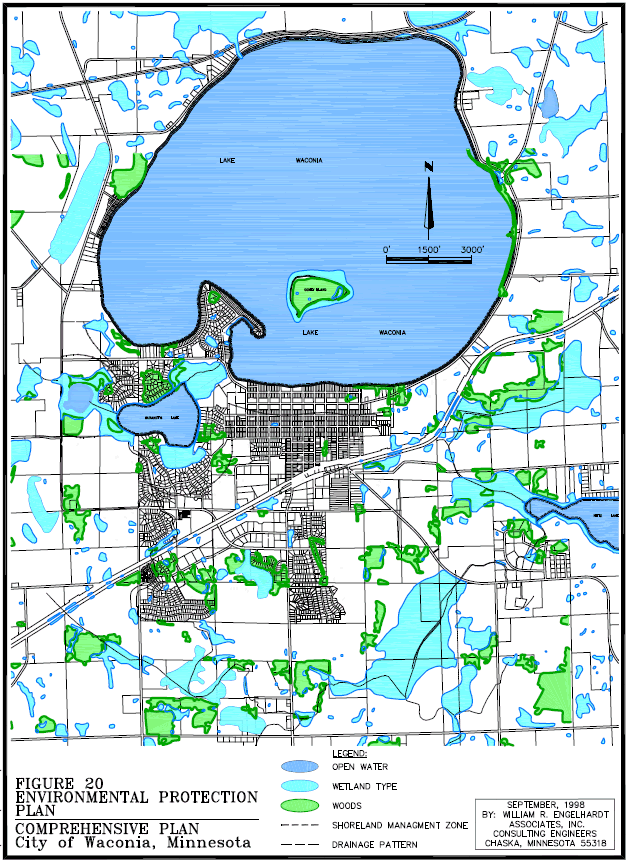
Sec. 900.06.8. - Environmental protection regulations.
A.
Wetlands protection.
1.
Purpose. Wetlands are a valuable resource. For purposes of this chapter a wetland is an area that is inundated or saturated by surface water or ground water at a frequency and duration sufficient to support, and that, under normal circumstances, does support, a prevalence of vegetation typically adapted for life in saturated soil conditions. Wetlands generally include swamps, marshes, bogs, and similar areas.
Wetlands occupy a landscape position that receives surface water runoff and provides possible contact with ground water. Therefore, wetlands have unique and special functions that influence environmental quality. These functions include, but are not limited to:
a.
Flood control. Wetlands can reduce flood levels by storing storm water and releasing it gradually.
b.
Water quality. Most vegetative wetlands are excellent sediment traps. Removing sediment from flood water and storm runoff has a positive influence on water quality. Wetlands can trap and detoxify heavy metals, toxic chemicals and pathogens in runoff waters. Wetlands also have the potential to remove up to eighty-five (85) to ninety (90) percent of the phosphorus and nitrates found in runoff water.
c.
Ground water recharge and discharge. Some wetlands function as ground water recharge and/or discharge sites.
d.
Shoreline stabilization. Wetland vegetation can help stabilize shorelines against erosion by absorbing and dissipating wave energy, binding the soil, and by causing the deposition of suspended material.
e.
Aquatic food chain support. Waterfowl, fish, invertebrates, migratory and non-migratory birds, furbearers, and many plant species depend on wetlands for nourishment.
f.
Fish and wildlife habitat. Wetlands provide the habitat required by many freshwater fish species to spawn, feed, or avoid predators. A wide variety of plants and animals rely on wetlands, including many endangered, threatened, or rare species.
It is the intent of this chapter to establish a program of sound management through regulations that strive toward zero degradation of the wetlands by conserving, protecting and enhancing these environmentally sensitive resources. Furthermore, the specific intent of this section is to:
a)
Protect surface and ground water supplies from the impairment which results from incompatible land-uses by providing safe and sanitary drainage.
b)
Permit and encourage land-uses compatible with the preservation of the natural vegetation and marshes which are a principal factor in the maintenance of constant rates of water flow through the year and which sustain many species of wildlife and plant growth.
c)
Avoid fast runoff of surface waters from developed areas to prevent pollutional materials such as motor oils, paper, sand, salt and other debris, garbage, and foreign materials from being carried directly into the nearest natural streams, lake or other public waters.
d)
Encourage a suitable system of ponding areas to permit the temporary withholding of rapid runoff which presently contributes to downstream flooding and general water pollution giving preference to areas which contribute to ground water infiltration and recharge, thereby reducing the need for public projects to contain, store and control such runoff.
2.
Definition and establishment of protected areas. The wetland protection area, within the City of Waconia, hereinafter referred to as the protected area, is defined and established to be wetland areas delineated on the environmental protection plan (Figure 20 of the City of Waconia Comprehensive Plan) and wetland areas delineated on maps by the United States Department of the interior, through the geological survey and supporting data designated as Waconia Quadrangle, Minnesota (SE/4 Waconia 1981) and Victoria Quadrangle, Minnesota (SW/4 Lake Minnetonka) and by the Soil Survey, Carver County, Minnesota issued November 1968.
3.
Development prohibited. No filling, grading, dredging, excavation or construction shall be allowed within the wetland protection area; nor on lands abutting, adjoining or affecting said area if such activity upon said areas is incompatible with the policies expressed in this chapter and the preservation of those wetlands in their natural state. To insure the policies in this chapter are properly implemented, any persons undertaking improvements to or on any land abutting or adjacent to the protected area shall, prior to commencing work, obtain a permit therefore from the City of Waconia.
4.
Land development, platting and storm water runoff. No lands within the wetland protection area shall be platted for residential occupancy or for other uses which will increase the danger to health, life, property or the public welfare. Whenever a portion of the Wetland Protection Area is located within or adjoins a land area that is being subdivided, the subdivider shall dedicate an adequate easement over the land within the protected area and along each side of such area for the purpose of improving or protecting the area for drainage, or other purposes expressed in this chapter and other recreational uses.
Public or private streets, driveways, drainage openings, storm water retention areas and culverts shall not be constructed unless the design thereof has been approved by the city, and such structures shall be designated so as not to restrict the flow of water. All plans that affect all potential wetlands shall be submitted for review to the department of natural resources, Army Corps of Engineers, city engineer, and the Carver Soil and Water Conservation District during the land subdivision process.
In areas where the alteration of a wetland is allowable, provisions shall be made for acre-for-acre replacement or original wetland losses.
5.
Setbacks. A fifty-foot structure setback for all buildings and parking areas must be maintained from the edge of a designated wetland within a wetland protection area (the edge being the point at which the vegetation changes from aquatic to terrestrial).
B.
Land alteration and erosion control.
1.
Land alteration is the process of changing the existing landscape by excavating, filling, or grading. Subject to the exceptions set forth below, no land shall be altered, excavated, filled or graded and no vegetation shall be removed without first obtaining a permit from the city. The following exceptions shall be allowed:
a.
A fill less than one (1) foot in depth and placed on natural terrain with a slope flatter than five (5) horizontal to one (1) vertical, or less than three (3) feet in depth, not intended to support structures, which does not exceed fifty (50) cubic yards on any one (1) lot and does not obstruct a drainage course, and such other exceptions as are listed in Chapter 70 of the Uniform Building Code.
b.
Construction of buildings for which a permit has been applied for and issued, provided the contemplated excavation or filling operation was sufficiently described at the time of building permit application.
c.
Excavations or fills by state, county, or city authorities in connection with the construction or maintenance of roads, highways, parks or utilities or on slope or utility easements provided such activity is conducted within public rights-of-way or easements.
d.
Curb cuts, utility hook-ups or street openings for which another permit is required from the city.
e.
Grading plans as approved of as part of plat approvals.
2.
Requirements. Issuance of a grading permit shall be made subject to the following minimum requirements, and such other requirements as the city council may specify to protect the public interest:
a.
Setback from adjacent property. All operations shall be conducted within the property lines. Grading that extends over the property lines shall require easements from adjacent property owners. Grading within the rights-of-way shall be by city permission.
b.
It shall be unlawful for any person to dig or leave open unfenced, unbarricaded or uncovered, any pit, quarry, hole or excavation, including basements, wells, septic tanks or cesspools.
c.
Restoration. Upon completion of excavation or filling operations the disturbed area shall be restored with topsoil or other approved cover material and shall be reseeded to establish approved vegetation.
d.
Finished grades. Finished grades shall not adversely affect adjacent properties.
e.
Drainage. Drainage facilities shall be provided to effectively divert or convey storm water run-off.
f.
Fire/rodent/wind/hauling control. Provisions for effectively controlling fire, rodents, and dispersal of material by wind or by hauling to and from the site, and for general maintenance of the site shall be made.
g.
Permit period. The excavation or filling permit shall run for six (6) months unless a lesser or greater period is requested and approved by the city council.
3.
Erosion control. During construction and until permanent cover is established any land alteration that exceeds an area of forty-three thousand five hundred sixty (43,560) square feet (acre) shall require compliance with the Carver Creek Watershed District's regulations and procedures.
C.
Steep slope protection.
1.
Slopes exceeding eighteen (18) percent. Any development on slopes exceeding eighteen (18) percent where there is an elevation difference of twenty (20) feet or more shall first receive a permit from the city.
2.
Slopes exceeding twenty-four (24) percent. No development shall be permitted on slopes exceeding twenty-four (24) percent unless it can be demonstrated that grading can be accomplished without detriment to surface waters, wetlands and woodlands or that impacts on natural features will be mitigated.
3.
Wooded slopes. No development shall be permitted on wooded slopes exceeding twenty-four (24) percent where there is an elevation difference of twenty (20) feet or more. A wooded slope shall be defined as a slope of twenty-four (24) percent or more that contains clusters of significant trees. A cluster shall be defined as two (2) or more significant trees within thirty (30) feet of one (1) another.
D.
Tree preservation regulations.
1.
Purpose. It is the intent and desire of the city to protect, preserve and enhance the natural environment and beauty of the city by encouraging the resourceful and prudent development of wooded areas and with respect to specific site development, to retain as far as practical, substantial tree stands which can be incorporated into the development. The city recognizes that preservation and replanting of trees is important on new development sites in order to maintain a healthy and desirable community. The city also recognizes that a certain amount of tree loss is an inevitable consequence of the urban development process.
The purposes of these tree preservation regulations include, but are not limited to, 1) prevention of soil erosion and sedimentation, 2) improved air quality, 3) reduced noise pollution, 4) energy conservation through natural insulation and shading, 5) control of the urban heat island effect, 6) increased property values, 7) protection of privacy by maintaining and establishing buffers between conflicting land uses, and 8) providing habitat for wildlife.
2.
Scope. The regulations contained in this section shall apply to all properties regulated by chapter 1000 (Subdivision Ordinance) of the Waconia City Code. The city does, however, strongly encourage preservation of trees on all properties within the city.
3.
Removal threshold.
a.
Developments in residential districts may remove or disturb up to thirty (30) percent of the total inches of significant trees. Any removal or disturbance beyond this threshold shall require reforestation or restitution.
b.
Developments in non-residential districts may remove or disturb up to forty (40) percent of the total inches of significant trees. Any removal or disturbance beyond this threshold shall require reforestation or restitution.
c.
Reasonable effort shall be made to preserve all significant trees during the planning process and site development process. No significant trees shall be removed that are within the seventy-five (75) feet structure setback from a recreational development lake (Burandt's Lake) or within the fifty (50) feet structure setback area of a general development lake (Lake Waconia). Diseased trees shall not be subject to the requirements of this chap.
4.
Reforestation/restitution requirement. If a development exceeds the allowable removal or disturbance threshold specified above, the subdivider shall either reforest appropriate areas within the site (or outside the site if appropriate locations within the site are not available) or pay restitution, or provide a combination thereof. For each one (1.0) tree inch that is removed or disturbed beyond the threshold, the subdivider shall replant one and one-quarter (1.25) inches of new trees or provide the city with one hundred twenty-five dollars ($125.00) in restitution, per inch removed beyond the threshold. For a wooded parcel, the reforestation requirement shall be limited to eight (8) trees per platted lot within the wooded parcel in addition to those required by section 900.07, subdivision 2, of the Code. Cash restitution in lieu of planting shall not apply when using the wooded parcel designation.
5.
Tree survey/preservation plan. A tree survey and tree preservation plan shall be submitted with all preliminary plat applications, and with all lot division applications involving the creation of one (1) or more new development parcels. The tree survey and tree preservation plan shall be prepared and signed by a registered surveyor or forester at the developers expense, and shall provide the following information:
a.
Location, diameter, and species of all significant trees on the site.
b.
Identification of which significant trees are 1) to be protected, preserved, or undisturbed, 2) to be removed or disturbed, and 3) exempt from the calculation specified by the removal threshold.
c.
Areas proposed to be designated as natural preserves where all natural vegetation, including significant trees, will be protected and preserved.
d.
Proposed disturbance zones shall be properly identified and marked on all plans submitted for review.
e.
Location and dimensions of building pads, construction zone for each lot, and proposed street layout and grading contours of the site.
f.
Proposed locations and details of tree protection fencing to be installed for all trees to be preserved.
g.
Calculation of removed or disturbed significant tree inches on the site (excluding exempt tree inches) divided by the total significant tree inches on the site (excluding exempt tree inches).
6.
Reforestation/restitution plan.
a.
If the amount of significant tree inches to be removed or disturbed exceeds the specified threshold, the subdivider shall provide a reforestation plan, or a calculation of restitution, or a combination thereof.
b.
A reforestation plan shall be prepared and signed by a registered landscape architect or forester and shall comply with the following criteria:
1)
The plan shall indicate the location and diameter or height of all trees to be planted.
2)
No more than one-fourth (¼) of the trees to be planted may be from any one (1) species, unless recommended by the City of Waconia.
3)
Plantings shall be of similar vegetation as found on the site, with a preference for plantings designated as native to the site.
4)
The minimum planting size for deciduous trees shall be two and one half (2.5) inches in diameter, and the minimum planting size for coniferous trees shall be six (6) feet in height, except that up to fifteen (15) percent of the required tree inches may be of ornamental species of a lesser size, provided the required number of replacement inches is maintained.
5)
Trees designated for replacement shall be of similar variety of trees which are removed as approved by the city.
c.
A replacement tree shown on a reforestation plan may be counted as a tree under the city's landscaping regulations, but only if the replacement tree satisfies every requirement of section 900.07, subdivision 2, as to location, type, and size of the tree. In all other circumstances, trees shown on a reforestation plan shall be in addition to those required by section 900.07, subdivision 2, of the Code.
d.
Restitution shall be paid to the city in cash prior to the city's release of the signed final plat mylars for recording, or prior to approval of a minor subdivision. Any restitution paid shall be placed in the community planting fund and shall be used for reforestation and/or tree disease mitigation projects in the city.
7.
Staff review. The tree preservation plan and any related reforestation plan or calculation of restitution shall be reviewed and evaluated by the City of Waconia. The City of Waconia may make recommendations for adjustment of locations of structures, roadways, utilities, and for replanting and other elements that may be necessary to enhance tree preservation and reforestation efforts.
8.
City action. A tree preservation plan and reforestation plan, including the designation of any natural preserves, shall be considered for approval or denial by the city council as part of the review of a preliminary plat. A tree preservation plan and reforestation plan shall be considered for approval or denial by the zoning administrator as part of the review of a minor subdivision. Any natural preserves included in a request for minor subdivision shall be considered for approval or denial by the city council.
9.
Financial guarantee. The city shall require the owner to provide a performance bond in the form of cash, corporate surety bond, approved letter of credit or other surety satisfactory to the city to guarantee that the required trees to be replaced are done according to this chapter. The performance bond shall be furnished by the developer prior to obtaining a building permit. The performance bond shall be held by the city and must cover one (1) full calendar year subsequent to the installation of said landscaping and must be conditioned upon complete and satisfactory implementation of the approved landscape plan.
10.
Inspection and enforcement of tree preservation plan. Prior to removal of any trees and prior to issuance of a grading permit, or prior to commencement of any grading operations if no grading permit is required, or prior to issuance of a building permit if no grading operations are required, all sites shall be staked and fenced for tree preservation pursuant to the approved tree preservation plan. A copy of the approved tree preservation plan shall be submitted with an application for a grading permit, or with an application for a building permit if no grading permit is required. Such tree preservation plan shall also indicate any reforestation trees to be planted on the site. Upon staking of the site and installation of the tree protection fencing, but prior to issuance of any permits or commencement of any grading operations, the subdivider shall contact the City of Waconia to schedule an inspection of the staking and fence installation on the site. No permits shall be issued, nor shall any grading operations commence, without first receiving authorization by the City of Waconia. Tree protection fencing shall remain in place until after the certificate of occupancy is issued for the building on the site.
a.
Upon completion of the preliminary site grading operations, but prior to any further issuance of permits upon the site, the subdivider shall contact the City of Waconia to schedule a second inspection of the site to verify the preservation of trees, as shown on the approved tree preservation plan. No additional permits shall be issued within the plat until a fine of one hundred fifty dollars ($150.00) per inch is paid for the disturbance of all significant tree inches that have not been protected, but were shown as protected on the approved tree preservation plan. Any such fines collected shall be placed in the community planting fund and shall be used for reforestation projects in the city.
b.
Prior to issuance of a certificate of occupancy, the subdivider (or builder if different from the subdivider) shall contact the City of Waconia to schedule a final tree preservation inspection to verify the preservation of trees and the planting of any reforestation trees, as shown on the approved tree preservation plan. This required inspection shall be made at least five (5) working days before the certificate of occupancy is requested. Prior to issuance of a certificate of occupancy, a fine of one hundred fifty dollars ($150.00) per inch shall be paid for the disturbance of all significant tree inches that have not been protected, but were shown as protected on the approved tree preservation plan. Any such fines collected shall be placed in the community planting fund and shall be used for reforestation projects in the city.
Tree preservation related definitions:
Critical root zone: The circular area measured outward from a tree trunk equaling one foot of radius for each one inch of diameter of the tree.
Disturbance zone: Any area which would be physically altered from its natural state, including but not limited to all areas of grading, utility installation, building pads, driveways, or parking areas.
Natural preserve: Publicly owned lands designated as park or open space or private properties approved by the City which are set aside to preserve their natural characteristics and qualities.
Protected, preserved, or undisturbed tree: Any tree with at least seventy-five (75) percent of its critical root zone left undisturbed, and which has been protected during the construction process by tree protection fencing if its trunk is located within fifteen (15) feet of any disturbance zone.
Significant tree: Any healthy tree measuring six (6) inches in diameter or larger at a height of thirty-six (36) inches above ground for deciduous trees, and measuring six (6) inches in diameter or larger at a distance of thirty-six (36) inches above ground for coniferous trees.
Tree inches: Any species of tree whose diameter is measured at a height of thirty-six (36) inches above the ground.
Wooded parcel: A parcel one (1) acre or greater platted for residential development, exceeding 75 percent summer tree canopy, on which twenty (20) percent or more of the wooded parcel area is retained for natural preserve. Wetlands are exempt from this natural reserve calculation.
Sec. 900.06.9. - Architectural design standards.
A.
Purpose and scope. In the City of Waconia, the visual character and historic resources of the city are important attributes of its quality of life. New development can have substantial impacts on this visual and historic character. Many of these impacts are related not to the type of use but to its design, and the way that design responds to the surrounding context of buildings, streets and open space. The design standards for the City of Waconia have been developed for the following purposes:
* To shape the physical form of the city as it continues to develop;
* To implement the community goals of the comprehensive plan;
* To communicate a clear architectural imagery that reinforces the existing traditional small town development pattern of Waconia's central business district;
* To improve the quality, character and compatibility of new development in Waconia's existing CBD and its developing commercial and medical districts;
* To encourage the sensitive rehabilitation of historic or potentially historic buildings;
* To encourage the continuation of the diverse mix of land uses that characterize Waconia.
The standards have two (2) primary functions:
* To guide developers or business owners wishing to propose expansions, renovations or new construction of buildings or parking within the commercial districts;
* To assist city officials and the public in reviewing development proposals.
B.
Applicability. The standards in this chapter apply to three (3) specific "design districts:"
* The Downtown District includes all lands zoned B-2 and B-3.
* The Highway District includes all lands that are zoned B-1 and B-4.
* The Industrial District includes all lands that are zoned I-1 and I-2.
1.
Within each district, the standards apply to the following activities, with the exemptions noted under paragraph 2:
a.
All new construction of nonresidential and/or multifamily buildings.
b.
Any renovation, expansion or exterior changes to existing nonresidential and/or multifamily buildings, including repainting.
c.
Any development or expansion of parking areas.
d.
Any other alteration that requires a building permit.
2.
Exemptions. The following activities are exempt from design review unless staff determines that the project creates a significant change in the design characteristics of the development:
a.
Internal alterations to buildings that affect less than fifty (50) percent of the building's gross floor area and do not result in a change to the building height, roofline or footprint.
b.
The use of nonconforming exterior materials or colors for a building expansion within the industrial district otherwise permitted by the Code if the gross floor area of the expansion is less than fifty (50) percent of the building's gross floor area prior to expansion.
c.
Replacement or repair of existing materials.
d.
Re-striping and other minor changes to parking lots that do not result in changes to landscaping or circulation patterns, and that do not create more than four (4) new parking spaces.
3.
It is assumed that the intent of the standards shall be met. It is understood that there may be many ways to achieve the same design objective. The city may permit alternative approaches that, in its determination, meet the objective(s) of the design standard(s) equally well.
4.
The standards shall apply only to the building or site elements being developed or altered. That is, a proposal for changes to a building would be required to meet only those standards that pertain to buildings, while changes to a parking area would be required to meet all standards for parking areas, but not for buildings. The city planner will make the initial determination as to which standards are applicable.
5.
The applicant may apply for a variance from any design standards under the requirements of section 900.12, subdivision 4.
6.
Resource materials. The following materials will be provided to applicants as background information to assist in preparation of site plans and building improvements. These materials are advisory in nature.
a.
Design vocabulary: A series of photographs depicting exemplary buildings, building elements and design features from Waconia and other communities.
b.
Resources on storefront restoration: The city planner will maintain a list of resources and may also have some of these materials available for review.
C.
Administration and review procedures. Design review shall be conducted as part of the site plan review process, as specified in section 900.12, subdivision 10 of this chapter.
1.
Submittal requirements. In addition to the site plan required under section 900.12, subdivision 10. B, the following items shall be submitted:
a.
Elevations. Complete exterior elevations of all proposed buildings and existing buildings if they are joined to new development. Elevations should be drawn at an appropriate scale (usually one-quarter (¼) inch — one (1) foot) and should show:
1)
All signs to be mounted on the building(s) or erected on the site;
2)
Designations of materials and colors to be used on all exterior facades.
b.
Materials sample. Material samples should be presented, including color and material type of walls and roof.
c.
Color samples. Samples of all principal and secondary colors to be used.
d.
Context. Photographs of surrounding buildings on the same block or street, to address issues of context.
2.
Review process. Design review will be conducted in the same manner as site plan review, as specified in section 900.12, subdivision 10.C. If a site plan review is needed, the two (2) processes will be conducted concurrently. If no site changes are involved, review by the fire chief and city engineer may not be necessary, as determined by city staff.
D.
Design standards, downtown district.
1.
Building context and character.
a.
Objective: Any new development should relate to the original design of surrounding storefront buildings in scale and character. This can be achieved by maintaining similar setbacks, building height and proportions, cornice lines, horizontal lines of windows and openings, and compatible building materials and colors. Many of these topics are discussed in detail later in this section.
2.
Architectural style.
a.
Objective: To encourage creativity and diversity within a defined framework.
b.
Standard: No single architectural style or styles are required. The design vocabulary is intended to guide in the selection of an overall style or stylistic elements. The contemporary adaptation of elements of historic commercial architectural styles found in downtown Waconia, including Italianate, Neoclassical and Early Twentieth Century Commercial, is encouraged (see Figures 1 and 2). Where used, such elements should be based upon, and consistent with, an architectural inventory of the existing downtown district. Stylistic details characteristic of other regions of the United States are discouraged. Combining of elements from disparate architectural styles or periods in a single building is discouraged.
3.
Build-to line.
a.
Objective: To maintain a consistent street edge, in keeping with traditional downtown character.
b.
Standard: Buildings shall meet the established building façade line on the block where they are located for at least sixty-five (65) percent of the length of their front façade. On most downtown blocks, this is the edge of the sidewalk. For corner buildings, this requirement applies to each façade that fronts a public street. The remaining thirty-five (35) percent of the façade may be set back up to twelve (12) feet to emphasize entries or create outdoor seating and gathering areas (see Figure 3).
4.
Building width and façade articulation.
a.
Objective: To avoid long building facades with a monolithic or monotonous appearance. To divide longer buildings into modules which reflect proportions similar to traditional buildings (see Figures 4 and 5).
b.
Standard: A building width of forty (40) feet or less is encouraged. Buildings of more than forty (40) feet in width shall be divided into smaller increments (between twenty (20) and forty (40) feet) through articulation of the façade. This can be achieved through combinations of the following techniques, and others that may meet the objective:
1)
Façade modulation — stepping back or extending forward a portion of the façade;
2)
Vertical divisions using different textures or materials (although materials should be drawn from a common palette);
3)
Division into storefronts, with separate display windows and entrances;
4)
Variation in roof lines by alternating dormers, stepped roofs, gables, or other roof elements to reinforce the modulation or articulation interval;
5)
Arcades, awnings, window bays, arched windows and balconies at intervals equal to the articulation interval;
6)
Providing a lighting fixture, trellis, tree, or other landscape feature with each interval.
5.
Ground level expression.
a.
Objective: To employ building proportions consistent with those of traditional storefronts and to emphasize the importance of the ground floor as the primary retail or service area.
b.
Standard: The ground level of any multi-story structure must be visually distinct from the upper stories, except as stated in subpart c below. This can be achieved through the use of one or more of the following techniques, and others that may meet the objective (see Figure 6).
1)
An intermediate cornice line;
2)
A sign band;
3)
An awning, arcade or portico;
4)
A change in building materials, texture or detailing;
5)
A change in window shape or treatment.
c.
Exception: The standard stated in subpart b above does not apply to multiple family dwellings.
6.
Building height.
a.
Objective: To encourage two- and three-story buildings within the downtown district. Taller buildings help to define the street edge and provide a sense of enclosure for pedestrians.
b.
Standard: New buildings larger than a single storefront (or a building footprint of five thousand (5,000) square feet) shall be at least two (2) stores in height. This requirement does not apply to existing buildings.
7.
Roof design.
a.
Objectives: To encourage a variety of roof lines that respond to the existing built environment. To ensure adequate screening of rooftop equipment.
b.
Standards: Flat or pitched roofs, or combinations of these, may be used. Pitched roofs should have a minimum roof pitch of one (1) foot of rise to four (4) feet of run. Flat roofs should be defined with an ornamental parapet or cornice. Average parapet height shall not exceed fifteen (15) percent of the height of the supporting wall and maximum parapet height at any point shall not exceed one-third (⅓) the height of the supporting wall (see Figure 7).
c.
Rooftop equipment: All rooftop equipment shall be screened from view from adjacent streets, public rights-of-way and adjacent properties. Preferably, rooftop equipment should be screened by the building parapet, provided that the parapet does not exceed building height limits. Rooftop equipment may also be screened by a smaller accent roof enclosure. This structure shall be set back a distance of one and one-half (1½) times its height from any primary façade fronting a public street. Screens shall be of durable, permanent materials (not including wood) that are compatible with the primary building materials.
8.
Ground-floor windows.
a.
Objective: To provide continuity with older existing "main street" retail shop windows and to enhance security by providing views into and out of buildings.
b.
Standard: Windows and doors must comprise at least fifty (50) percent of the length and at least thirty (30) percent of the area of any ground floor façade facing a public street,except as stated in subpart c below. Windows and doors must comprise at least ten (10) percent of the ground level side or rear façade facing a public right-of-way, parking area or open space. Qualifying windows or doors shall be transparent, allowing views into and out of the interior, or may include display windows set into the wall. Reflective glass is not permitted (see Figure 8). A minimum of twelve (12) percent of the upper story facades shall consist of two (2) or more regularly spaced and symmetrical window openings that are consistent or compatible with those of nearby buildings (see Figure 9).
c.
Exception: The standard stated in subpart b above does not apply to multiple family dwellings.
9.
Entries.
a.
Objective: To establish the visual importance of the primary street entrance, and to ensure that entries contribute to the visual attractiveness of the building and are readily visible to the customer.
b.
Standard: The main entrance should always face the primary street, with the secondary entrances to the side or rear. In the case of a corner building or a building abutting more than one (1) street, the Planning Commission will determine which street should be considered "primary" based on visibility and access patterns. The main entrance should be placed at sidewalk grade. Entries shall be designed with one (1) or more of the following:
1)
Canopy, portico, overhang, arcade or arch above the entrance;
2)
Recesses or projections in the building façade surrounding the entrance;
3)
Peaked roof or raised parapet over the door;
4)
Display windows surrounding the entrance;
5)
Architectural detailing such as tile work or ornamental moldings;
6)
Permanent planters or window boxes for landscaping.
(see Figures 10 and 11).
10.
Architectural details.
a.
Objective: To encourage the use and restoration of traditional architectural details.
b.
Standard: Traditional buildings in downtown Waconia feature architectural details such as cornices, arched windows, decorative brickwork (banding, cornice) transom and display windows, porticos, and awnings over entries. The adaptation of such details to new infill buildings, and their restoration in existing buildings, is encouraged but not required.
11.
Restoration of traditional storefronts and other downtown buildings.
a.
Objective: Encourage sensitive and appropriate restoration of storefronts and other traditional downtown buildings.
b.
Standard: It is understood that appropriate restoration of traditional storefronts and other historically significant or important commercial buildings involves many issues, including costs and choice of materials. A list of sources is provided as an appendix to this chapter to guide property owners in the restoration of such buildings. (Figure 12 identifies components of a typical traditional storefront.)
12.
Building materials.
a.
Objective: To ensure that high-quality, authentic materials typical of traditional downtown buildings are used within the downtown.
b.
Standards: Buildings should be constructed of high-quality materials, including the following:
1)
Brick;
2)
Natural stone;
3)
Wood, consisting of horizontal lap siding with an exposure no greater than five (5) inches or wood shakes; surfaces must be painted;
4)
Precast concrete units and concrete block, provided that surfaces are molded, serrated or treated with a textured material in order to give the wall surface a three-dimensional character;
5)
Stucco;
6)
Jumbo brick may be used on up to twenty-five (25) percent of any façade, provided that it is used only on the lower third of the building wall.
c.
Prohibited materials.
1)
Unadorned plain or painted concrete block
2)
Tilt-up concrete panels
3)
Pre-fabricated steel or sheet metal panels
4)
Reflective glass
5)
Aluminum, vinyl, fiberglass, asphalt or fiberboard siding
6)
Pole buildings
7)
EIFS (exterior insulating finish system) may be used as an accent but not a primary material
d.
Accent materials: Accent materials may be used on up to fifteen (15) percent of the building's façade. These may include metal, glass block, spandrel glass, or similar materials as approved by the planning commission.
e.
Roofs: Pitched roofs on new buildings with a footprint of more than ten thousand (10,000) square feet should be constructed of standing seam metal, slate or wood shingles, but not asphalt shingles.
f.
Other materials. The planning commission may also approve other materials that the planning commission, in its discretion, determines are compatible with any permitted materials if it finds that: 1) the quality and appearance of the proposed materials is consistent with the standard that has been set within the downtown district; and 2) the use of these materials will not have a detrimental effect upon adjacent property values or property values within the city.
13.
Side and rear elevations.
a.
Objective: To ensure continuity of materials and façade treatments on all visible facades.
b.
Standard: All building facades visible from a public street or walkway shall employ materials and design features similar to those of the front façade.
14.
Building colors.
a.
Objective: To ensure that building colors are aesthetically pleasing and compatible with surrounding buildings.
b.
Standard: Building colors shall consist of subtle, neutral, or muted colors, with low reflectance. Recommended colors include browns, grays, tans (including the typical "Chaska brick" used in Waconia), beiges, and dark or muted greens, blues and reds. No more than two (2) principal colors may be used on a façade. Bright, white or primary colors should be used only as accents, occupying a maximum of ten (10) percent of building facades. This standard does not apply to murals or other approved public art.
15.
Signs.
a.
Objective: Signs should be architecturally compatible with the style, composition, materials, colors and details of the building, and with other signs on nearby buildings. Signs should be an integral part of the building and site design (see Figure 13).
b.
Regulations: Regulations for signs in the Downtown District shall be as set forth in section 900.10 of this Code.
c.
Design standards:
1)
Signs should be positioned so they are an integral design feature of the building, and to complement and enhance the building's architectural features. Signs should not obscure or destroy architectural details such as stone arches, glass transom panels, or decorative brickwork. Signs may be placed:
a)
In the horizontal lintel above the storefront windows;
b)
Within window glass, provided that no more than twenty-five (25) percent of the window is obscured;
c)
Projecting from the building;
d)
As part of an awning;
e)
In areas where signs were historically attached.
2)
Shape. Wall signs should generally be rectangular. In most cases, the edges of signs shall include a raised border that sets the sign apart from the building. Individual raised letters set onto the sign area surface are also preferred.
3)
Colors. Sign colors shall be compatible with the building façade to which the sign is attached. No more than three (3) colors should be used per sign, unless part of an illustration. To ensure the legibility of the sign, a high degree of contrast between the background and letters is preferred. A combination of soft/neutral shades and dark/rich shades (see Building Colors standard) are encouraged.
4)
Materials. Sign materials should be consistent or compatible with the original construction materials and architectural style of the building façade on which they are to be displayed. Natural materials such as wood and metal are more appropriate than plastic. Neon signs may be appropriate for windows.
5)
Illumination. External illumination of signs is permitted by incandescent, metal halide or fluorescent light that emits a continuous white light. Light shall not shine directly onto the ground or adjacent buildings. Neon signs are permitted. Internally lit box signs and awnings are not permitted, with the exception of theater marquees. Variable electronic message signs are not permitted, with the exception of existing time/temperature signs.
16.
Placement and screening of equipment and loading areas.
a.
Objective: Ensure that equipment and loading docks are not visible from public streets or pedestrian ways.
b.
Standard: If an outdoor storage, service or loading area faces adjacent residential uses or a public street or walkway, it shall be screened by a decorative fence, wall or screen of plant material at least six (6) feet in height. Fences and walls shall be architecturally compatible with the primary structure. Loading docks or doors should be located on a side or rear elevation.
17.
Parking.
a.
Objective: Ensure that buildings, rather than parking lots, dominate the appearance of the downtown streetscape.
b.
Standard: When off-street parking is provided, it shall be located to the side or rear of the primary building, not between the building and the street (see Figure 14). Sites with more than ten (10) off-street surface parking spaces shall meet the Highway District requirements for parking lot screening and landscaping.
18.
Lighting.
a.
Objective: To ensure that lighting levels are not excessively bright and that light standards are compatible with overall site design.
b.
Standard: Exterior lighting should be the minimum necessary for safety and security. Lighting should be designed to coordinate with building architecture and landscaping. Building-mounted fixtures should be compatible with the building facades. Overall lighting levels should be consistent with the character and intensity of the surrounding area. All light fixtures shall be shielded or other directed to ensure that light is not directed onto adjacent properties.
19.
Streetscape elements. Any streetscape elements included within a development site, including lighting, seating, planters, trees or shrubs, trash receptacles and similar elements, shall be compatible with the city's streetscape improvements to the downtown district. City staff can provide guidance on public streetscape elements.
20.
Site design, large sites. Sites with substantial off-street parking or more than one (1) principal building shall meet the highway district requirements for parking lot landscaping, pedestrian and bicycle circulation, lighting, and other site design features.
E.
Design standards, highway district.
1.
Building character.
Objective: It is understood that the city's Highway Commercial District and Health Care Business District generally lack traditional buildings that provide a "context" or frame of reference for new buildings. The intent of this section is to encourage buildings with a human scale, which evoke traditional buildings without imitating them, and to create a pedestrian-friendly internal site layout and streetscape.
2.
Architectural style.
a.
Objective: To encourage creativity and diversity within a defined framework.
To encourage the adaptation of historic commercial styles in a restrained and appropriate manner.
b.
Standard: No single architectural style or styles are required. The design vocabulary is intended to guide in the selection of an overall style or stylistic elements. The contemporary adaptation of elements of historic commercial architectural styles found in downtown Waconia, including Italianate, Neoclassical and Early Twentieth Century Commercial, is encouraged. If a particular style is used, it should be used consistently. The combination of elements of a variety of styles in one (1) building is discouraged.
3.
Building placement.
a.
Objectives: To encourage pedestrian circulation by maintaining a moderate distance among buildings on the site, and between buildings and abutting streets.
To encourage shared parking among uses.
b.
Standards: Buildings should be located to facilitate pedestrian circulation. Distances between principal buildings, or between the most distant entrances of a single building, should not exceed three hundred (300) feet. This standard can be achieved through the arrangement of freestanding buildings in compact groups, the design of single buildings in an "L" or "T" shape, or similar strategies.
c.
Entrances: Building entrances should be located as close to abutting streets as possible, and no further than eighty-five (85) feet from the street right-of-way. This standard may be achieved through the creation of one (1) or more public or private internal streets within a large site. (See Figures 15 and 16; see also Parking and Pedestrian Circulation standards.)
4.
Building width and façade articulation.
a.
Objectives:
1)
To articulate long or massive building facades in order to reduce their perceived bulk and provide visual interest as viewed from the street or sidewalk.
2)
To ensure that all facades visible to the public shall be visually attractive and compatible with adjacent land uses.
b.
Standard: Buildings of more than forty (40) feet in width shall be divided into smaller increments through articulation of the façade. This can be achieved through combinations of the following techniques, and others that may meet the objective.
1)
Façade modulation - stepping back or extending forward a portion of the façade.
2)
Vertical divisions using different textures or materials (although materials should be drawn from a common palette).
3)
Division into storefronts, with separate display windows and entrances.
4)
Variation in roof lines by alternating dormers, stepped roofs, gables, or other roof elements to reinforce the modulation or articulation interval.
5)
Arcades, awnings, window bays, arched windows and balconies at intervals equal to the articulation interval.
6)
Providing a lighting fixture, trellis, tree or other landscape feature with each interval.
5.
Scale, proportion and placement.
a.
Objective: To encourage building elements that are proportionately scaled to one another.
b.
Standard: In general building elements such as windows, doors, arcades, towers, etc. should be arranged symmetrically across the façade, in a regular and logical manner. Window and door openings should be proportional to façade length and height. Large elements (i.e. clock tower) may be appropriate, but there should be an emphasis on maintaining a human scale at the ground level (see Figure 17).
6.
Building height and roof design.
a.
Objective: To encourage multi-story buildings and varied rooflines in order to add visual interest, emphasize entries, and reduce the perceived length of large buildings.
b.
Standards: Buildings over one hundred (100) feet in length shall be at least one and one-half (1½) stories in height for at least thirty (30) percent of their length.
c.
Roofs: Roofs shall be designed with one (1) or more of the following:
1)
Sloping roofs with a minimum roof pitch of at least one (1) foot of rise to four (4) feet of run.
2)
Flat roofs with a decorative parapet concealing rooftop equipment. Average parapet height shall not exceed fifteen (15) percent of the height of the supporting wall and maximum parapet height at any point shall not exceed one-third (⅓) the height of the supporting wall.
3)
Overhanging eaves, extending no less than eighteen (18) inches past the surrounding walls (see Figure 17).
7.
Ground-floor windows.
a.
Objective: To allow views into and out of buildings in order to increase a sense of security and allow opportunities for display of merchandise.
b.
Standards: The primary street level façade of large retail or office establishments (over twenty-five thousand (25,000) square feet) that faces a public street or walkway shall be transparent between the height of three (3) and eight (8) feet above sidewalk grade for at least forty (40) percent of the horizontal length of the building façade.
The primary street level façade of smaller retail or office establishments (twenty-five thousand (25,000) square feet or less) shall be transparent for at least fifty (50) percent of the horizontal length of the building façade, between the height of three (3) and eight (8) feet above sidewalk grade, at minimum.
8.
Entries.
a.
Objective: To ensure that entries contribute to the visual attractiveness of the building and are readily visible to the customer.
b.
Standards: Entries to principal buildings shall feature at least two (2) of the following features:
1)
Canopy, portico, overhang, arcade or arch above the entrance
2)
Recesses or projections in the building façade surrounding the entrance
3)
Peaked roof or raised parapet over the door
4)
Display windows surrounding the entrance
5)
Architectural detailing such as tile work or ornamental moldings
6)
Permanent planters or window boxes for landscaping.
Primary building entrances shall face the primary abutting public street, not a side or rear parking area.
9.
Number of entrances.
a.
Objective: To provide multiple entrances for large retail buildings in order to reduce walking distance from parking areas, adjoining streets and adjacent buildings, and to avoid the appearance of unbroken walls.
b.
Standards: A retail building accessible by more than one (1) public street shall provide customer entrances on at least two (2) of the street frontages. The entrance facing the secondary street shall be clearly distinguished using the methods listed above under "Entries."
c.
Additional store entrances. Each additional retail store within a principal building shall provide at least one (1) exterior customer entrance clearly distinguished using the methods listed above.
10.
Building materials.
a.
Objective: To ensure that high-quality, authentic materials that evoke traditional downtown settings are used in new commercial development.
b.
Standard: Buildings should be constructed of high-quality materials such as brick, stone, or textured cast stone tinted masonry units, or architectural metal panels.
1)
Unadorned plain or painted concrete block.
2)
Tilt-up concrete panels.
3)
Pre-fabricated steel or sheet metal panels.
4)
Reflective glass.
5)
Aluminum, vinyl, fiberglass, asphalt or fiberboard siding.
6)
Wood siding.
c.
Accent materials. Accent materials may be used on up to fifteen (15) percent of the building's façade. These may include metal, glass block, spandrel glass or similar materials as approved by the planning commission (see Figure 18).
d.
Other materials: The planning commission may also approve other materials that the planning commission, in its discretion, determines ae compatible with any permitted materials if it finds that: 1) the quality and appearance of the proposed materials is consistent with the standard that has been set within the Highway District; and 2) the use of these materials will not have a detrimental effect upon adjacent property values or property values within the city.
11.
Side and rear treatments.
a.
Objective: To ensure continuity of materials and façade treatments on all visible facades.
b.
Standard: All building facades visible from a public street or walkway shall employ materials and design features similar to those of the front façade.
12.
Building colors.
a.
Objective: To ensure that building colors are aesthetically pleasing and compatible with surrounding buildings.
b.
Standard: Building colors shall consist of subtle, neutral or muted colors, with low reflectance. Recommended colors include browns, grays, tans (including the typical "Chaska brick" used in Waconia), beiges, and dark or muted greens, blues and reds. No more than two (2) principal colors may be used on a façade. Bright, white or primary colors should be used only as accents, occupying a maximum of ten (10) percent of building facades.
13.
Signs.
Regulations for signs in the highway districts shall be as set forth in section 900.10 of this Code.
14.
Parking.
a.
Objective: To improve the appearance and convenience of parking lot circulation for vehicles and pedestrians by breaking the parking area up into smaller units. Parking areas should be distributed around large buildings in order to shorten the distance to other buildings and reduce the overall scale of the paved surface.
b.
Standard: No more than fifty (50) percent of the off-street parking area for the entire site shall be located between the front façade of the principal building and the primary abutting street.
Alternatively, one (1) or more internal accessways that are similar to streets may be used to divide the site into parking areas no greater than fifty-five thousand (55,000) square feet.
1)
Internal accessways must have at least one (1) auto travel lane, curbs, and sidewalks on both sides at least six (6) feet wide. Accessways must be landscaped along their entire length with trees, shrubs and planting beds.
2)
On-street parking (angled or parallel) must be provided along both sides of the accessway, except within seventy-five (75) feet of street intersections. Curb extensions that are at least the full depth of the parking stall shall be provided at all internal and external street intersections, as shown.
15.
Parking lot landscaping.
a.
Objective: To soften the appearance of parking lots when viewed from an abutting street or sidewalk.
b.
Standard: All parking and loading areas (including drive-through facilities, pump island service areas and stacking spaces) fronting public streets or sidewalks, and all parking and loading areas abutting residential districts or uses, shall provide:
1)
A landscaped yard at least five (5) feet wide along the public street or sidewalk. If a parking area contains over one hundred (100) spaces, the minimum required yard shall be increased to eight (8) feet in width.
2)
Screening consisting of either a masonry wall, fence, berm or hedge or combination that forms a screen a minimum of three (3) feet in height, a maximum of four and one-half (4½) feet in height, and not less than fifty (50) percent opaque.
3)
One (1) tree shall be provided for each twenty-five (25) linear feet of parking lot frontage on a public street or accessway (see Figure 19).
16.
Interior parking lot landscaping.
a.
General. The corners of parking lots and all other areas not used for parking or vehicular circulation shall be landscaped with turf grass, native grasses, or other perennial flowering plants, vines, shrubs and trees. Such spaces may include architectural features such as benches, kiosks or bicycle parking.
b.
Large lots. In parking lots containing more than one hundred (100) spaces, an additional landscaped area of at least three hundred (300) square feet shall be provided for each twelve (12) spaces or fraction thereof, containing one (1) deciduous shade tree. The remainder shall be covered with turf grass, native grasses, perennial flowering plants, vines or shrubs.
17.
Placement and screening of service, loading and storage areas.
a.
Objective: To mitigate the impacts of views of service and loading areas from surrounding streets and properties.
b.
Standards: Any outdoor storage, service or loading area that faces adjacent residential uses or a public street or walkway shall be screened by a decorative fence, wall or screen of plant material at least six (6) feet in height, or a planting screen shall be provided parallel to the property line, street or walkway.
Loading docks, truck parking, HVAC equipment, trash collection and other service functions shall be incorporated into the design of the building so that the visual and noise impacts of these functions are fully contained and not visible/audible from adjacent properties and public streets.
Areas for the outdoor storage and sale of merchandise, where permitted, shall be permanently defined and screened with walls or fences, with materials compatible with and of similar quality to primary building materials.
18.
Lighting.
a.
Objective: To ensure that lighting levels are not excessively bright and that light standards are compatible with the overall site design.
b.
Standard: Exterior lighting should be the minimum necessary for safety and security. Lighting should be designed to coordinate with building architecture and landscaping. Building-mounted fixtures should be compatible with the building facades. Overall lighting levels should be consistent with the character and intensity of the surrounding area. All light fixtures shall be shielded or other directed to ensure that light is not directed onto adjacent properties.
19.
Pedestrian and bicycle access.
a.
Objective: To ensure that pedestrians and bicyclists have safe and convenient access to all retail establishments.
b.
Standards:
1)
Sidewalks may be required along some or all public streets that abut the proposed development in order to provide pedestrian connections from all adjacent neighborhoods and activity centers.
2)
A well-defined pedestrian path shall be provided from the sidewalk to each principal customer entrance of a building. Walkways shall be located so that the distance between street and entrance is minimized. Walkways shall be at least five (5) feet in width, and shall be distinguished through pavement material from the surrounding parking lot. Walkways shall be landscaped for at least fifty (50) percent of their length with trees, shrubs, and planting beds.
3)
Sidewalks of at least eight (8) feet in width shall be provided along all front building facades that abut public parking areas.
4)
Walkways and sidewalks should be defined by design features such as towers, arcades, porticoes, pedestrian-scale light fixtures, planters, and other architectural elements.
5)
Bicycle parking shall be provided in a convenient and visible location no farther from the principal entrance than the closest automobile parking space, at a ratio of one (1) space per twenty-five (25) automobile parking spaces. Bicycle parking shall consist of a bike rack designed so that the bicycle frame can be locked to the rack, subject to the review of the City Engineer.
20.
Community amenities.
a.
Objective: To provide community and public spaces that can be enjoyed on a seasonal basis by customers and the general public and that will contribute to the attractiveness of the development.
b.
Standard: Each retail development of over seventy-five thousand (75,000) square feet in floor area shall provide a patio or outdoor seating area, which may also provide outdoor cafes or dining areas, with the stipulation that at least fifty (50) percent of the area shall be reserved for public use. The outdoor area shall include seating and a water feature, clock tower or other central focal point.
F.
Design standards, industrial district.
1.
Architectural style. The exterior architectural appearance of the proposed structure shall not be so at variance with the exterior architectural appearance of existing structures within the immediate area, or with the intended character of the applicable zoning districts, taking into consideration building materials, size, shape and heights, so as to cause an adverse impact upon property values in the immediate area, or the city as a whole, or adversely affect the public health, safety and general welfare of the portion of the city in which the property is located or the city as a whole. Mechanical equipment, such as furnaces, air conditioners, elevators, transformers, and utility equipment, shall be screened, whether on the roof or mounted on the ground, with a screening material similar or compatible with material used on the main structure. All additions or remodeling shall be compatible in scale, material and massing.
2.
Permitted materials. Structural systems of all buildings shall be as required by Uniform Building Code. All buildings shall be of masonry construction, an equivalent, or better. No building exterior shall be constructed of sheet aluminum, asbestos, iron, steel, or corrugated metal. No building shall be constructed with a wooden frame. Exterior building materials shall not be so at variance with the exterior materials of existing structures within the immediate area or the city as a whole as to adversely impact the property values in the affected area or the city as a whole, or adversely affect the public health, safety and general welfare.
3.
Exterior materials. Exterior wall surfaces of all building shall be faced with brick, natural stone, architectural concrete cast in place or precast concrete panels, glass curtain wall panels or an equivalent or better. Up to fifteen (15) percent of any wall surface may be wood or metal used as an architectural trim, as approved by the planning commission. The planning commission may also approve other materials that the commission, in its discretion, determines are compatible with these materials if it finds that: 1) The quality and appearance of the proposed materials is consistent with the standard that has been set within the district; and 2) The use of these materials will not have a detrimental effect upon adjacent property values or property values within the city.
(Ord. No. 747, 3-7-22)
Sec. 900.07. - Landscaping and fencing.
Subd. 1. Landscaping. The primary purpose of this policy is to establish minimum requirements and standards relative to landscaping, buffering and screening to be implemented concurrently with site plans approved by the city. The standards and criteria shall be used by city staff and the planning commission in the review and evaluation of such plans and development proposals. The objectives of these requirements are to establish and maintain forestation of the city; to provide appropriate ground cover vegetation for controlled soil erosion; to enhance, when necessary, the natural environment, particularly in instances where the natural environment is disturbed during the course of development; and to establish standards for utilization of natural materials to achieve desired screening and buffering. This policy sets forth minimum requirements of landscaping and limitations to assure that the result is consistent with reasonable maintenance requirements on a long-term basis and to assure that the results provide an aesthetic urban environment.
Subd. 2. Minimum standards for each zoning district.
A.
Industrial districts (I-1 and I-2) and fairgrounds district (F-1).
1.
One (1) tree per one thousand (1,000) square feet of gross building floor area.
2.
Where industrial and fairground zoned land is adjacent to or across the street from property zoned for residential development, that project shall provide screening as follows:
a.
Loading docks and loading berths that face a residentially zoned area shall be screened so as not to be seen from the residential area. Various deciduous and coniferous trees and/or a fencing or wall approved by the planning commission may be used as the screening device.
b.
Proposed parking lots that will serve an industrial or fairgrounds use that face or abut a residentially zoned area shall be screened so as to minimize the visual impact of the large expanses of asphalt and automobiles. This screening can be accomplished by an earth berm with shrub plantings or by a hedge with various deciduous and coniferous trees or by other combinations approved by the planning commission.
c.
Trees planted to satisfy the requirements of sub-paragraphs 2a and 2b above, will not be counted towards the requirement of one (1) tree per one thousand (1,000) square feet of building unless otherwise specified by the planning commission.
3.
All trash and trash handling equipment be stored within the principal structure, in an attached structure accessible from within the principal structure, or totally screened from eye-level view from public streets and adjacent residential properties. If accessory structures are proposed, they shall be constructed of the same building material as the principal structures.
4.
Light from automobile headlights and other sources shall be screened whenever it may be directed onto adjacent residential windows.
B.
B-1 (highway business district) and B-4 (health care business district), and P (public district).
1.
One (1) tree for every one thousand (1,000) square feet of total building floor area or one (1) tree for every fifty (50) feet of site perimeter, whichever is greater.
2.
The light from automobile headlights and other sources shall be screened whenever it may be directed onto adjacent residential windows.
3.
Loading docks and loading berths that face a residentially zoned area shall be screened so as not to be seen from the residential area. Various deciduous and coniferous trees and/or a fencing or wall approved by the planning commission may be used as the screening device.
4.
Parking lots that serve a highway business use or health care use or public district that face or abut a residentially zoned area shall be screened so as to minimize the visual impact of the large expanses of asphalt and automobiles. This screening can be accomplished by an earth berm with shrub plantings or by a hedge with various deciduous and coniferous trees or by other combinations approved by the planning commission.
5.
Trees planted to satisfy the requirements of sub-paragraphs 2), 3) or 4) above, will not be counted towards the requirement of one (1) tree per one thousand (1,000) square feet of building or one (1) tree per fifty (50) feet of site perimeter unless otherwise specified by the planning commission.
6.
All trash and trash handling equipment shall be stored within the principal structure, within an attached structure accessible from within the principal structure, or totally screened from eye-level view from public streets and adjacent residential properties. If accessory structures are proposed, they shall be constructed of the same building material as the principal structure.
7.
Additional plantings shall be required for properties fronting State Highway #5. The following will be required for every forty (40) feet of frontage along Highway #5:
a.
One (1) three-inch minimum deciduous tree.
Or
One (1) eight-foot minimum coniferous tree
C.
B-2 general business district and B-3 central business district.
1.
One (1) tree for every one thousand (1,000) square feet of total building area. If landscaping can not be accommodated on site the city council will require the plantings to be placed in a city park or city right-of-way. Placement of such landscaping shall be approved by the city council.
2.
Any off-street parking areas that serve downtown business district establishments and face or abut a residentially zoned area shall be screened so as to minimize the visual impact of large expanses of asphalt and automobiles. This screening can be accomplished by an earth berm with shrub plantings or by a hedge with various deciduous and coniferous trees or by other combinations approved by the planning commission.
3.
Loading docks and loading berths that face a residentially zoned area shall be screened so as not to be seen from the residential area. Various deciduous and coniferous trees and/or a fencing or wall approved by the planning commission may be used as the screening device.
4.
All trash and trash handling equipment shall be stored within the principal structure, within an attached structure accessible from within the principal structure, or totally screened from eye-level view from public streets and adjacent residential properties. If accessory structures are proposed, they shall be constructed of the same building material as the principal structure.
5.
Light from automobile headlights and other sources shall be screened whenever it may be directed onto adjacent residential windows.
1.
A planting strip and/or earth berm, not exceeding a slope of 3:1, shall be placed in all newly platted residential developments that abut an arterial road as identified in the city's comprehensive plan.
2.
In the R-1, R-2 and R-4 districts each newly platted lot shall have two (2) (2) trees.
3.
Landscaping for PUD districts shall follow the respective land-use guidelines. In other words, if the PUD contains uses consistent with R-1, R-2 or R-4 uses, the landscaping requirements applicable to those districts shall apply to the PUD.
4.
R-3 and R-5 districts shall have the equivalent of one (1) landscape planting for every two (2) dwelling units on any given property.
5.
Where any multiple-family use with more than four (4) parking spaces adjoins another residential use, the off-street parking for such use shall be screened from adjoining properties by a hedge or other various plantings as approved by the planning committee.
6.
Lights from automobiles and parking lot lights shall be screened whenever it may be directed onto residential windows to the extent that it will cause an unreasonable disturbance.
E.
Landscape requirements applicable to all districts.
1.
Unless otherwise directed by the planning commission, all plantings shall be placed on the private property on which the development is taking place.
2.
All areas not otherwise improved in accordance with approved site plans or subdivisions shall be sodded, seeded, or otherwise established with vegetation approved by the city, and maintained in accordance with this subdivision. All grass and vegetiative plantings shall occur over a minimum of six (6) inches of topsoil borrow meeting Minnesota Department of Transportation Specification 3877, Table 3877-1. 100 percent of the material including soil clumps must pass a one (1) inch sieve. Prior to sod installation, all topsoil borrow material must be approved by the city. The grading shall consist of a uniform and smooth surface. Any sags or rises shall be corrected prior to the placement of sod or seed. Further, all grass and vegetative plantings shall be completed no later than six (6) months from the date of issuance of a certificate of occupancy. Grass shall be clean and free of noxious weeds and pests or diseases and shall be of a species normally grown as permanent lawns and suitable to this climate.
3.
All off-street parking areas over one hundred (100) stalls shall include unpaved, landscaped islands. Each landscaped island shall be one hundred eighty (180) square feet in size (9' x 20') and shall be contained and bordered by a raised concrete curb that meets city standards.
a.
Landscaped islands shall be provided every two-hundred and twenty-five (225) feet or more of uninterrupted parking stalls.
Or
One (1) landscape island per sixteen (16) stalls over one hundred (100) stalls.
b.
Plant materials shall be provided for in each landscaped island at the discretion of the planning commission.
4.
The owner shall provide the city with cash, corporate surety bond, approved letter of credit or other surety satisfactory to the city to guaranty the proper installation and growth of the approved landscape plan. The performance bond shall be furnished by the developer prior to obtaining a building permit that is equal to the amount of the required landscaping to be installed. The performance bond shall be held by the city and must cover one (1) full calendar year subsequent to the installation of said landscaping and must be conditioned upon complete and satisfactory implementation of the approved landscape plan.
F.
Minimum size of plantings.
1.
Unless otherwise specified herein with respect to specific zoning districts, required trees shall be of the following minimum planting size:
a.
Deciduous trees — two and one-half (2.5) inches in diameter as measured six (6) inches above ground.
b.
Coniferous trees — six (6) feet in height.
c.
Major shrub/berm plantings — five (5) gallons.
2.
Evergreen shrubs used for screening purposes including those used in conjunction with berming shall be a minimum of twenty-four (24) inches in height.
G.
Species.
1.
All trees used in site developments shall be indigenous to the appropriate hardiness zone and physical characteristics of the site.
2.
All deciduous trees proposed to satisfy the minimum requirements of this policy shall be long lived hardwood species.
3.
The complement of trees fulfilling the requirements of this policy shall be not less than twenty-five (25) percent deciduous and not less than thirty-three (33) percent coniferous.
H.
Prohibited species. The following species shall not count towards meeting the requirements of this chapter:
Subd. 3. Fencing.
A.
Definition. For purposes of this subdivision, a fence is defined as any lineal structure, including walls, hedges, or similar barriers, used to prevent access by persons or animals or prevent visual or sound transference.
B.
Building permit required.
1.
No fence, except temporary fencing, shall be constructed without a building permit. The application shall be accompanied by a plot plan clearly describing the type, location and method of anchoring the fence.
2.
Boundary line fences shall be located entirely upon the private property of the party constructing the fence unless the owner of the property of the adjoining property agrees, in writing, that such fence may be erected on the division line of the respective properties. The persons, firms, or corporations constructing or causing the construction of such fence shall be responsible for maintaining that part of their property between fence and property line. City staff will require any applicant for a fence permit to establish the boundary lines of his property by a survey thereof to be made by any registered land surveyor or by showing the stake markers of the surveyed lot.
C.
Fencing in all districts shall conform to the following:
1.
Fences in all districts shall be maintained so that the exposed outer surface shall be uniformly painted or stained in a neat and aesthetically pleasing condition.
2.
No fence shall be permitted on a public right-of-way or boulevard area without special permission from the city council.
3.
No fence shall be erected on a corner lot that will obstruct or impede the clear view of an intersection by approaching traffic.
4.
All snow-stop fencing may be used from November 1 to April 1. No permit shall be required for temporary fencing.
5.
Any fence which is dangerous to the public safety or general welfare and health is a public nuisance and the city may commence proceedings for the abatement thereof. Electric fences may not be used as boundary fences and such material as hog wire fencing, barbed wire fencing, or snow fencing will not be allowed as permanent fencing.
6.
The side of the fence considered to be the face (finished side as opposed to structural supports) shall face abutting property. Abutting property owners will be notified by constructor of fence five (5) calendar days before the building permit is issued.
D.
Fencing in residential and agricultural districts (R-1, R-2, R-3, R-4, R-5, PD, and AG).
1.
A fence may be located along the rear lot line to a maximum height of six (6) feet and to a maximum of six (6) feet along the side lot lines up to the point where it is parallel with the front edge of the house. From this point forward to the right-of-way the height of the fence shall not exceed three (3) feet. Any fence that crosses the width of the front yard shall not exceed three (3) feet in height. A variance is needed for fences exceeding the above mentioned heights.
2.
Fences around dog kennels not exceeding fifty (50) square feet in size, fences around garbage cans, and garden fences will not require fence permits but shall adhere to the other regulations of this subdivision.
E.
Fencing in business, industrial, public and fairgrounds districts (B-1, B-2, B-3, B-4, I-1, I-2, P and F-1).
1.
Fences may be located along a lot line to a height of eight (8) feet. Fences over eight (8) feet in height shall require a variance.
F.
Fencing for swimming pools (all districts).
1.
A swimming pool shall be completely enclosed with fencing from four (4) to six (6) feet in height to prevent uncontrolled access from adjacent streets and properties. A building permit issued in compliance with subdivision B above shall be obtained before any fence is constructed.
2.
Notwithstanding anything to the contrary in section 1 above, no fencing is required for an above ground pool that has both a capacity of less than 5,000 gallons of water and a water depth of less than twenty-four (24) inches.
3.
If the wall of an above ground swimming pool is four (4) feet or higher, no additional four (4) foot fence is needed if the ladder is removable. If the wall of an above ground swimming pool is less than four (4) feet in height, a railing may be installed on top of the swimming pool wall to create a height of four (4) feet or greater and no additional fencing will be required if the ladder is removable. Provided all other applicable building permits are obtained, no separate building permit for fencing is required for pool walls or railing placed on top of pool walls.
4.
No swimming pool shall be installed until all applicable building, mechanical and electrical permits are first obtained.
Sec. 900.08. - Performance standards.
Subd. 1. Nuisance standards. The guiding of urban development so as to develop a compatible relationship of uses depends upon certain standards being maintained. Uses permitted in the various districts, conditional uses and accessory uses shall conform to the following standards:
A.
Noise. Any use established shall be so operated that no undue noise resulting from said use is perceptible beyond the boundaries of the property on which such use is located. This standard shall not apply to incidental traffic, parking, loading, construction, farming or maintenance operations. Noise standards shall be in compliance with the State of Minnesota Pollution Control Standards.
B.
Vibration. Any use creating periodic earth-shaking vibration shall be prohibited if undue vibrations are perceptible beyond boundaries of the property on which the use is located. The standard shall not apply to vibrations created during the process of construction.
C.
Exterior lighting.
1.
Intent. The intent of this subsection is to minimize the adverse effect of light and glare on operators of motor vehicles, pedestrians, and on residential and other land uses in the vicinity of a light source, to promote traffic and personal safety, and to prevent the nuisance associated with the intrusion of spillover light and glare.
2.
Applicability. The requirements of this subsection apply to all exterior lighting except street lighting within public rights-of-way.
3.
General provisions.
a.
Except for residential dwellings, a light distribution plan as defined herein shall be required for all new development, redevelopment and additions which exceed thirty (30) percent of the floor area of the principal structure. This plan shall include the type, height and arrangement of proposed lighting and proposed lighting levels in foot candles at all locations on the site including its property boundaries. This plan shall be reviewed concurrently during the site plan review process;
b.
Exterior lighting shall be designed and arranged to limit direct illumination and glare in any contiguous parcel of land. Reflected glare or spill light shall not exceed five tenths (0.5) foot candle when the source of light abuts any residential or public use parcel or one (1.0) foot candle when the source of light abuts any commercial or industrial parcel or any public right-of-way measured at one (1) foot above the ground at the property line using Illuminating Engineering Society (IES) measuring standards. The latter requirement shall not apply to properties abutting public streets having foot candle levels above one (1.0) such as Olive, Main and First Street in the downtown business districts;
c.
The city may limit the hours of operation of outdoor lighting equipment if the city believes it necessary to reduce the impact of light on the surrounding neighborhood.
d.
Light poles or standards for exterior lighting shall not exceed a height of thirty-five (35) feet, except when a luminaire is located within one hundred (100) feet of a residential property, in which case the maximum height shall be twenty-five (25) feet;
e.
All luminaries shall have a cut off angle equal to or less than seventy (70) degrees;
f.
The city may require a certificate of compliance from a qualified lighting designer with regard to the approved light distribution plan.
4.
Definitions. For purposes of this subsection, the terms defined herein shall have the meanings given them:
a.
Cutoff angle: The angle formed by a line drawn from the direction of the light rays at the light source and a line perpendicular to the ground from the light source, beyond which no light is emitted.
b.
Foot candle: The international unit of illumination produced on a surface.
c.
Glare: The effect produced by the intensity and direction of any artificial illumination sufficient to cause annoyance, discomfort or temporary loss or impairment of vision.
d.
Light distribution plan: A point-by-point plan formulated according to standard practices of the Illuminating Engineering Society (IES), depicting the intensity and location of lighting on the property.
e.
Luminaire: A complete lighting unit consisting of a light source and all necessary mechanical, electrical and decorative parts. A luminaire does not include a pole or other support.
D.
Smoke and particulate matter. Any use established, enlarged or remodeled after the effective date of this chapter shall be so operated as to control the emission of smoke or particulate matter to the degree that it is not detrimental to or shall endanger the public health, safety, comfort, or general welfare of the public. Any use shall be so operated as to meet the minimum requirements of the State of Minnesota Pollution Control Standards.
E.
Odors. Any use established, enlarged or remodeled shall be so operated as to prevent the emission of odorous matter of such quality as to be readily detectable at any point beyond the lot line of the site on which such use is located. The emission or odor by any use shall be in compliance with and regulated by the State of Minnesota Pollution Control Standards.
F.
Toxic or noxious matter. Any use established shall be so operated as not to discharge across the boundaries of the lot, or through percolation into the subsoil beyond the boundaries of the lot wherein such use is located, toxic or noxious matter in such concentrations as to be detrimental or to endanger the public health, safety, comfort, or welfare, or cause injury or damage to property or business.
Subd. 2. Hazard standards.
A.
Explosives. Any use requiring the storage, utilization or manufacturing of products which could decompose by detonation shall be by conditional use permit only. All uses must have a certificate of compliance from the state fire marshall office as well as the Pollution Control Agency. This section shall not apply to the storage or usage of liquefied petroleum or natural gas for normal residential or business purposes.
B.
Radiation emissions. All activities that emit radioactivity shall comply with the minimum requirements in the State of Minnesota Pollution Standards.
C.
Electrical emissions. There shall be no electrical disturbance adversely affecting the operation of any equipment, including, but not limited to, radio and television reception, other than that of the creator of the disturbance.
D.
Toxic material. Any use shall not discharge toxic matter into the atmosphere, water or subsoil.
Subd. 3. Drainage standards. No land shall be developed and no use shall be permitted that results in water run-off causing flooding, or erosion on adjacent properties. Such run-off shall be properly channeled into a storm drain, water course, ponding area or other suitable facility.
Sec. 900.09. - Off-street parking, loading, and access regulations.
Subd. 1. Off-street parking regulations.
A.
General provisions.
1.
The purpose of this section of the zoning ordinance is to alleviate or prevent congestion of the public streets, and so promote the safety and welfare of the public, by establishing minimum requirements for the off-street parking and loading and unloading of motor vehicles in accordance with the use to which property is put.
2.
These provisions shall not apply to existing B-3 area uses so long as the general use and purpose for which the property is now used shall be continued. This shall not exempt any business from municipal parking assessments.
3.
The replacement or expansion of an existing business shall comply with applicable parking requirements.
4.
If, in the application of these provisions, a fractional number is obtained one (1) parking space shall be provided for that fraction.
5.
Within an area zoned as a residential district, no person shall park or leave standing, whether attended or unattended:
a.
A dump truck, refrigerator truck, semi-trailer, except when such vehicle: i) is lawfully parked or standing on a public street pursuant to section 630.04 of the Code; ii) is parked in a completely enclosed garage; iii) is in the actual process of being loaded or unloaded; or iv) is parked or standing at a location where work is underway and the vehicle is being actively used in regard to such work; or
b.
A vehicle designed and used primarily to transport petroleum products, liquefied gas products or other hazardous substances, except in strict compliance with all applicable laws and regulations.
6.
Required off-street parking space shall not be utilized for open storage of goods or for the storage of vehicles that are inoperable.
7.
Adequate space for snow storage shall be provided on the site so as not to reduce the required minimum number of parking spaces.
B.
Compliance required. All development within the city limits of Waconia must meet minimum standards established for off-street parking, loading and access. No certificate of occupancy will be issued until all minimum requirements of this chapter are met.
C.
Location requirements.
1.
Spaces accessory to one family, two-family, townhouse and multiple family dwellings must be located on the same lots as the principal use served.
2.
Spaces accessory to businesses and industries must be located within three hundred (300) feet of a main entrance to the principal building served except in the B-2 and B-3 zone where municipal and joint ownership parking facilities are used and are within a reasonable walking distance.
3.
Business and industrial off-street parking spaces shall not be less than twenty-five (25) feet from adjacent lots zoned for residential purposes.
4.
No off-street parking area containing more than four (4) parking spaces shall be located closer than fifteen (15) feet from an adjacent lot zoned for residential purposes unless screening of the parking area is provided by the parking area owner and approved by the Zoning Administration.
5.
There shall be no off-street parking within eight (8) feet of any street right-of-way or within five (5) feet of the property line in any residential district.
6.
Except for single-family, two-family, and townhouse dwellings, at least one handicapped parking space shall be provided for each development. An additional space shall be provided for each increment of fifty (50) spaces in excess or the initial fifty (50) spaces. Handicapped spaces shall be at a minimum twelve (12) feet wide by twenty (20) feet long. They shall be located as to provide convenient, priority access to the principal use.
7.
Except for single-family, two-family, and townhouse dwellings, head-in parking, directly off of and adjacent to a public street, with each stall having its own direct access to the public street, shall be prohibited.
D.
Shared parking. Two (2) or more buildings or uses may collectively provide off-street parking provided the number of stalls shall not be less than the sum of the requirements of the individual uses computed separately. In the case of the shared use of the same parking spaces where operating hours do not overlap, the city may grant an exception provided such shared use can be adequately demonstrated by the owner(s) and further provided a shared parking agreement between users is filed with the application.
E.
Design standards.
1.
All off-street parking spaces shall be no less than nine (9) feet in width and twenty (20) feet in length, exclusive of access drives. All parking spaces shall be clearly marked. Minimum aisle width will be dependent upon the angle of the parking stall:
90-degree angle = 24 feet aisle width; 60-degree angle = 18 feet aisle width;
45-degree angle = 13 feet aisle width; 30-degree angle = 10 feet aisle width.
2.
All off-street parking facilities shall be designed and constructed with appropriate means of vehicular access to a public street.
3.
All open off-street parking areas, except for single-family, two-family and townhouse dwellings, shall provide concrete curb and gutter per city engineer specifications to ensure that no portion of a vehicle encroaches into the required setback. All areas intended to be utilized for parking space and driveways shall be surfaced with bituminous or concrete to control dust and drainage, except in the case of farm dwellings and operations. Plans for surfacing and drainage of driveways and stalls for five (5) or more vehicles shall be submitted to the city engineer for his review. All plans shall be subject to the engineer's written approval.
4.
Any lighting used to illuminate an off-street parking area shall be hooded and so arranged as to reflect the light away from adjoining property, abutting residential uses and public rights-of-way.
5.
All open, non-residential off-street parking areas of five (5) or more spaces shall be screened and landscaped from abutting or surrounding residential districts in compliance with section 900.07 of the zoning ordinance.
F.
Exceptions.
1.
Bumper overhang. The minimum length may be decreased by up to one and one-half (l.5) feet for parking stalls which allow the bumper of the vehicle to project beyond the terminus of the parking stall without obstructing other parking stalls or vehicular and pedestrian circulation.
2.
Proof of parking required. Except in approved shared parking situations, parking stalls shall be provided in sufficient number to meet ordinance requirements. If it can be demonstrated by the owner that the parking required exceeds demand, all parking need not be constructed initially but parking required to satisfy the ordinance shall be shown on the official site plan. The CUP shall require that parking be provided in accordance with ordinance requirements at any time, at the discretion of the zoning administrator, if it proves to be needed.
G.
Parking requirements. The following minimum number of off-street parking spaces shall be provided and maintained by ownership, easement and/or lease for and during the life of the respective uses hereinafter set forth:
1.
Residences (Single-family, two-family and townhouses): Two (2) spaces per unit.
2.
Multi-family residences: One and six-tenths (1.6) spaces per one (1) bedroom unit, one and eight-tenths (1.8) spaces per two (2) bedroom unit and two and twenty-five one-hundredths (2.25) spaces per three (3) bedroom and three (3) bedroom + units.
3.
Churches, theaters, auditoriums, mortuaries and other places of assembly: One (l) space for each three and one-half (3.5) seats based on design capacity.
4.
Professional, personal and business offices: One (l) space per two hundred (200) square feet of gross floor area but at least three (3) parking spaces.
5.
Medical, dental and veterinarian clinics: Three (3) spaces plus at least one (l) space for each two hundred (200) square feet of gross floor area.
6.
Hotels and motels: One (l) space for each guest unit, plus one (l) space for each employee on any shift, plus an additional one (l) space for each ten (10) units.
7.
Elementary and Junior High Schools: One (l) space for each employee plus one (l) space per classroom.
8.
Senior High Schools: One (l) space for each five (5) students based on design capacity plus the greater of one (l) space per employee or two (2) spaces per classroom.
9.
Hospitals: One (l) space per bed, plus one (l) space per employee and resident doctor/intern on the major shift.
10.
Rest homes, nursing homes, convalescent homes, or similar institutions: One (l) space for every four (4) patients or residents based on the maximum capacity of the building, plus one (1) space per employee on the major shift, plus one (l) space per vehicle owned by the building's management.
11.
Fast food establishment, drive-in restaurant: One (l) space for each thirty-five (35) square feet of gross floor area and an additional two (2) parking spaces shall be added for drive through service facilities.
12.
Bowling alley: Five (5) spaces for each alley plus additional spaces as may be required herein for related uses such as a restaurant.
13.
Motor fuel station: At least four (4) off-street parking spaces plus two (2) off-street parking spaces for each service stall. Those facilities designed for sale of other items than strictly automotive products, parts or service shall be required to provide additional parking in compliance with other applicable portions of this chapter.
14.
Motor vehicles sales and service establishments: Four (4) spaces for each l,000 square feet of gross floor space, less storage space.
15.
Retail sales: Four (4) spaces for each one thousand (1,000) square feet of gross floor space, less storage space.
16.
Restaurants, cafes, bars, taverns, night clubs: One (l) space for every three (3) seats based on design capacity.
17.
Furniture stores, appliance stores, repair shops, kennels, studios, commercial green houses: Two (2) spaces for each one thousand (1,000) square feet of gross floor area, less storage space.
18.
Manufacturing, fabricating or processing of a product or material: One (l) space for each four (400) square feet of floor area, plus one (1) space for each company owned truck (if not stored inside principal building).
19.
Warehousing, storage or handling of bulk goods: That space which is solely used as office shall comply with the office use requirements and one (l) space for each one thousand (1,000) square feet of floor area, plus one (l) space for each employee on maximum shift.
20.
Uses not specifically noted: Determined by the city council following review by the planning commission.
Subd. 2. Loading regulations.
A.
Purpose. The regulation of loading spaces in these zoning ordinances is to alleviate or prevent congestion of the public right-of-way so as to promote the safety and general welfare of the public, by establishing minimum requirements for off-street loading and unloading from motor vehicles in accordance with the specific and appropriate utilization of various parcels of land or structure.
B.
Location.
1.
All required loading berths shall be off-street and located on the same lot as the building or use to be served.
2.
All loading berth curb cuts shall be located at a minimum of fifty (50) feet from the intersection of two (2) or more street rights-of-way. This distance shall be measured from the property line.
3.
No loading berth shall be located closer than one hundred (100) feet from a residential district unless within a structure.
4.
Loading berths shall not occupy the required front yard setbacks.
5.
Loading berths shall not conflict with pedestrian movement or obstruct the view of the public right-of-way from off-street parking access.
6.
Each loading berth shall be located with appropriate means of vehicular access to a street or public alley in a manner which will cause the least interference with traffic.
C.
General provisions.
1.
Off-street loading spaces or lot area existing upon the effective date of this section shall not be reduced in number or size unless said number of size exceeds the requirements set forth herein for a similar new use.
2.
Should a nonconforming structure or use be damaged or destroyed by fire, it may be re-established if elsewhere permitted in these zoning regulations, except that in doing so, any off-street loading space which existed before shall be retained.
3.
No change of use or occupancy of land already dedicated to a parking area, parking spaces, or loading spaces shall be made, nor shall any sale of land, division or subdivision of land be made which reduces area necessary for parking, parking stalls, parking requirements or loading berth requirements below the minimum prescribed by these zoning regulations.
4.
Any change of use or occupancy of any building or buildings including additions thereto requiring additional loading berths shall not be permitted until there is furnished such additional berths as required by these zoning regulations.
5.
All loading berths and access ways shall be improved with not less than six-inch class five base and two (2) inch bituminous surfacing to control the dust and drainage according to a plan submitted to and subject to the approval of the city engineer.
6.
The first loading berth shall not be less than sixty (60) feet in length and additional berths required shall not be less than thirty (30) feet in length and all loading berths shall not be less than ten (10) feet in width and fourteen (14) feet in height, exclusive of aisle and maneuvering space.
7.
Loading berths required:
a.
Commercial and industrial. All buildings shall have at least one (1) off-street loading berth. Buildings which are ten thousand (10,000) square feet or more, shall have at a minimum two (2) loading berths.
b.
Other uses. uses not mentioned shall be determined on an individual basis by the city council. Factors to be considered in such determination shall include (without limitation) size of buildings, type of use, number of employees, expected volume and turnover of customer traffic and expected frequency and number of delivery or service vehicles.
Subd. 3. Traffic access regulations.
A.
Driveway widths/design.
1.
No curb cut access shall be located less than thirty (30) feet from the intersection of two (2) or more street rights-of-way. The distance shall be measured from the intersection of lot lines. The city may require greater distances if future traffic conditions warrant. Such greater distances shall be required subject to approval by the city council.
2.
Curb cut openings shall be a minimum of five (5) feet from the side yard property line in all districts.
3.
Access driveways for single-family dwellings and townhouse dwellings shall not be less than twelve (12) feet nor more than twenty-four (24) feet wide measured along the property line between curb faces of the driveway unless otherwise recommended by the city engineer.
4.
Access driveways for other than those mentioned above shall be thirty (30) feet wide measured along the property line between the curb faces of the driveway unless other wise recommended by the city engineer.
B.
Access spacing.
1.
Single-family uses shall be limited to one (1) curb cut access per property.
2.
All properties shall be entitled to at least one (1) curb cut.
3.
In all other instances one (1) curb cut access for each one hundred (100) feet of street frontage will be allowed unless otherwise recommended by the city engineer.
4.
In applicable situations, state and/or county access permits must be obtained prior to the city authorizing construction for buildable lots along state or county roads.
5.
Driveway access curb openings on a public street except for single, two-family, and townhouse dwellings, shall not be located less than forty (40) feet from one another.
(Ord. No. 749, 4-4-22)
Sec. 900.10. - Sign regulations.
Subd. 1. Purpose and intent. The purpose of these sign regulations is to protect and promote the general welfare, health, safety and order within the city through the establishment of a comprehensive series of standards and procedures governing the erection, use and display of signs within the city, without regard to content. Accordingly, these regulations are intended to: i) promote signs that are compatible with their surroundings, considering a sense of concern for the visual amenities of the city; and ii) discourage unsafe, disorderly, indiscriminate or unnecessary use of signs. These sign regulations are not intended to create content-based restrictions or to allow content-based enforcement.
Subd. 2. Definitions. The following terms apply to section 900.10:
Abandoned sign means a sign (including any structure whose primary function is to support such sign) whose: i) display surface remains blank for a period exceeding sixty (60) days; ii) which pertains to a time, building, event or purpose that passed or ceased to apply more than sixty (60) days prior to the then applicable date; or iii) that has remained for more than sixty (60) days after demolition of the building it served.
Address sign means a sign including postal identification numbers, whether written or in number form, and, optionally, the name of the street or building.
Area identification sign means a freestanding sign, on the identified premises, which identifies the name of a neighborhood, residential subdivision, multiple residential complex, shopping center, industrial area, office complex, park or any combination of the above.
Awning sign means a sign permanently affixed to an awning providing a shelter or cover over the approach to any building entrance or shading a window area.
Banner means a temporary sign made out of flexible paper, cloth or plastic-like material.
Building face means that portion of any exterior elevation of a building or other structure extending from grade to the top of a wall and the entire width of that particular building or structure elevation.
Canopy and marquee means a roof-like structure projecting over the entrance to a building.
Development means a commercial use of three (3) or more principal structures with common characteristics, as determined by the city, or a platted residential use of twenty (20) or more lots with common characteristics, as determined by the city. Common characteristics may include shared access, similar architecture, single ownership or history of site plan review approval.
Directional sign means a sign erected on a premises of record by the owner of such property solely for the purpose of guiding vehicular and pedestrian traffic.
District means a city zoning district, as defined in the city's zoning ordinance.
Dynamic sign means a sign or portion thereof that appears to have movement or that appears to change using any method other than a person physically removing and replacing the sign or its components. For example, any sign or portion thereof that rotates, revolves, moves, flashes, blinks or changes color or intensity of illumination (using a method other than a person physically removing and replacing the sign or its components) is a dynamic sign. Further, any sign or portion thereof that incorporates LED lights, "digital ink" or any other method or technology that allows the sign face to present a series of images or displays is a dynamic sign.
Freestanding sign means a sign that is placed in the ground and not affixed to any part of any structure.
Government sign means a sign that is erected or maintained by a governmental unit.
Illuminated sign means a sign or portion thereof that: i) incorporates an artificial light source as part of the sign including, but not limited to, a sign with LED lights, neon lights or an interior light; or ii) a sign that has an artificial light source directed upon it.
Marquee sign means a sign that is permanently attached to a marquee.
Monument sign means any one-sided or two-sided free-standing sign with its entire sign area mounted on the ground or mounted on a base at least eighty (80) percent as wide as the sign area.
Multi-tenant building means a building: i) containing two (2) or more tenants; ii) used by the owner of the premises of record and also containing one (1) or more tenants; iii) that is a condominium; or iv) that is a cooperative. For purposes of these regulations, a "tenant" of a multi-tenant building means either: i) a lessee with a right to occupy a portion of a multi-tenant building on a full-time basis; or ii) an owner using a portion of a multi-tenant building on a full-time basis.
Nonconforming existing sign means a sign lawfully existing prior to the adoption of these regulations, but not conforming to the newly enacted requirements of these regulations.
Off-premises commercial sign means a sign (including any structure whose primary purpose is to support such sign) advertising a business, commodity or service (including those of nonprofits) which business, commodity or service is not located or performed on the premises of record where the sign is located (e.g., billboards and other outdoor advertising).
Permitted dynamic sign means a:
a)
Rotating barber pole; or
b)
Any other dynamic sign that meets all the following requirements:
i)
It appears to move or change no more than once every sixty (60) seconds, except for date, time, or temperature. Date, time, or temperature information may change no more than once every three (3) seconds; and
ii)
The images or messages displayed between transitions are static and each transition from one (1) display to the next is instantaneous and without special effects (e.g., scrolling messages or flashing messages); and
iii)
The images or messages displayed are complete in themselves, without continuation in content from one (1) display to the next.
Portable sign means a sign designed to move from one (1) location to another, not permanently attached to the ground or any other surface.
Premises of record means a lot or parcel that has been assigned a tax identification number by Carver County, Minnesota.
Promotional device means air inflated devices, banners exceeding forty (40) square feet in area, non-mechanical whirling devices, spotlights, or any sign resembling the same; provided, however, that banners forty (40) square feet in area or less shall not be considered promotional devices.
Pylon sign means any free-standing sign supported by a column like structure, posts or poles set firmly in or below the ground surface.
Regulations or sign regulations mean the ordinance contained in this section 900.10.
Roof sign means a sign erected upon or above a roof or parapet of a building.
Shielded light source means, as applicable:
i)
For an artificial light source directing light upon a sign, a light source diffused or directed so as to eliminate glare and housed to prevent damage or danger.
ii)
For light source located within a sign, a light source shielded with a translucent material of sufficient opacity to prevent the visibility of the light source.
iii)
For a light source designed to directly display a message (e.g. LED and neon lighting), a light source specifically designed by its manufacturer for outdoor use.
Sidewalk sign means a temporary sign located on a public or private sidewalk adjacent to and directly in front of a building.
Sign means any letter, symbol, device, poster, mural, picture, statuary, reading matter or representation that is displayed outdoors for informational, communicative or artistic purposes.
Sign area means the entire area within a continuous perimeter enclosing the extreme limits of the sign message and background. However, such perimeter shall not include any structural elements lying outside of such sign and not forming an integral part of the sign. The area of a sign within a continuous perimeter shall be computed by means of the smallest circle, rectangle or triangle that will encompass the extreme limits of the writing, representation, emblem or other display, together with any material or color forming an integral part of the background of the display or used to differentiate the sign from the building façade against which it is placed.
Special event sign means a temporary sign erected by a civic or other non-profit organization in connection with a fundraiser, festival, tournament, or other one-time or annual event; examples of which are Winterfest, Music in the Park, Nickle Dickle Day, and the Carver County Fair.
Street frontage means the portion of a premises of record that abuts a public right-of-way.
Temporary sign means a sign placed on a premises of record for a specific purpose that is of limited time duration, after which the sign is to be removed, which does not necessarily meet the structural requirements for a permanent sign.
Wall sign means any sign that is affixed to the wall of any building or structure.
Window sign means any letter, symbol, device, poster, mural, picture, statuary, reading matter or representation that is placed inside a window or upon the interior side of a window pane and that is visible from the exterior of the window. It does not include merchandise on display.
Zoning administrator means the zoning administrator appointed by the city council or such person's designee.
Subd. 3. General provisions applicable to all districts.
A.
Required signs. In all districts, one (1) address sign is required for each premises of record with a building. If a premises of record has multiple buildings with separate addresses, then one (1) address sign is required for each separate address. Each address sign shall be attached flat against a wall of the building on which it is located and have letters/numerals at least four (4) inches high with a minimum stroke width of one-half (½) inch. The sign area of an address sign shall not exceed: i) two (2) square feet in the R-1, R-2, R-4 agricultural, shoreland, public and conservation districts; or ii) four (4) feet in any other district.
B.
Prohibited signs. The following signs are prohibited in all districts:
1.
Signs in, upon or projecting into any public right-of-way or easement, excepting government signs typically found in a public right-of-way or easement (e.g. traffic control and street signs);
2.
Off-premises commercial signs;
3.
Banners, except as expressly allowed by these regulations;
4.
Signs painted, attached, or in any manner affixed to trees, rocks or similar natural surfaces;
5.
Signs painted directly on the wall or roof of a building or other structure;
6.
Signs that obstruct any window, door, fire escape or opening intended to provide ingress or egress to any building or other structure;
7.
Pylon signs;
8.
Signs that fly or float, such as blimps or kites, whether attached or unattached to the ground or an object thereon;
9.
Signs on a vehicle or trailer where the primary purpose of the vehicle or trailer in that location is its use as a sign;
10.
Portable signs, except for freestanding temporary signs as expressly allowed by these regulations;
11.
Signs that interfere with the ability of vehicle operators or pedestrians to see traffic signs or signals or signs that interfere with the ability of vehicle operators or pedestrians to see other traffic;
12.
Abandoned signs;
13.
Roof signs;
14.
Signs mounted on a dock or floatation device attached to a dock;
15.
Dynamic signs that are not permitted dynamic signs;
16.
Signs that contain or are an imitation of an official traffic sign or signal; and
17.
Any sign not expressly permitted by the provisions of these sign regulations, other than a nonconforming existing sign.
C.
Election season preemption. Noncommercial signs are allowed on private property in all districts during election season to the extent required by Minn. Stat. § 211B.045, as amended. Except as preempted by Minn. Stat. § 211B.045, these sign regulations control.
D.
Freestanding temporary signs. Freestanding temporary signs are allowed in all districts subject to the following restrictions and qualifications:
1.
No more than one (1) freestanding temporary sign shall be placed on a premise of record at any given time.
2.
The placement of a freestanding temporary sign on a premises of record is limited to a maximum of sixty (60) days during any calendar year, which days may be consecutive or nonconsecutive. This restriction applies, in aggregate, to all freestanding temporary signs placed on a premises of record during a calendar year.
3.
Each freestanding temporary sign shall:
a.
Not exceed eight (8) feet in height;
b.
Not exceed fifteen (15) feet in width;
c.
Not exceed thirty-two (32) square feet in sign area; and
d.
Not be closer than ten (10) feet from the boundary line of a premises of record or any right-of-way.
4.
Garage sale signs are separately addressed by these regulations and shall be allowed in addition to the freestanding temporary signs described above.
5.
Construction signs are separately addressed by these regulations and shall be allowed in addition to the freestanding temporary signs described above.
E.
Banners. Banners forty (40) square feet in area or less are permitted as follows:
1.
One (1) such banner is permitted per premises of record, unless the premises of record contains a multi-tenant building, in which case the following shall apply:
2.
The placement of a banner at a premises of record is limited to a maximum of sixty (60) days during any calendar year, which days may be consecutive or nonconsecutive. This restriction applies, in aggregate, to all banners placed on a premises of record during a calendar year.
3.
Each banner shall be located on the wall of a building or structure.
4.
A banner may be used in place of an approved wall sign if the banner is approximately equal in size to the approved wall sign and there is intent to replace the banner with the wall sign once the wall sign becomes available for installation. Any such banner shall be allowed until the applicable wall sign is installed or for a period of one-hundred and eighty (180) days from the date the banner is first placed on the building, whichever occurs first.
F.
Properties for lease or sale. In addition to any temporary sign permitted elsewhere in these regulations, a temporary sign may be placed on any premises of record that is actively being marketed for lease or sale, subject to the following restrictions:
1.
Each such temporary sign shall be removed within seven (7) days following the date of leasing or sale.
2.
The maximum sign area for each such temporary sign is as follows:
a.
R-1, R-2, R-4, agricultural, conservation and shoreland districts — nine (9) square feet.
b.
R-3 and R-5 districts — eighteen (18) square feet.
c.
B-1, B-2, B-3, B-4, I-1, I-2, and public districts — thirty-two (32) square feet.
3.
No such temporary sign shall exceed eight (8) feet in height.
G.
Garage sale signs. In addition to any temporary sign permitted elsewhere in these regulations, garage sale signs with a sign area of four (4) square feet or less are allowed during the duration of a garage sale. Any such garage sale signs shall be removed within one (1) day after the end of the sale. Garage sale signs shall not be located in any public right-of-way or easement. The city shall have the right to remove and destroy signs not conforming to this provision. The city shall assess a fee of five dollars ($5.00) per sign removed by the city pursuant to this provision.
H.
Construction signs. If the city issues a grading or building permit for a premise of record, a sign twenty-four (24) square feet in area or less may be placed on the premises of record while the grading or building permit is in effect. For purposes of these regulations, a permit shall be deemed to be in effect from the date it is issued until the date it expires pursuant to its terms.
I.
Special event signs. Special event signs are permitted in all districts subject to the following restrictions:
1.
No more than three (3) special event signs are allowed within the city for any given special event. Further, each premises of record is limited to one (1) special event sign.
2.
Special event signs may be erected and maintained for a period not to exceed thirty (30) days prior to the date of the special event and shall be removed within two (2) business days following the special event.
3.
The maximum sign area for each special event sign is as follows:
a.
R-1, R-2, R-4, agricultural, conservation and shoreland districts — nine (9) square feet;
b.
R-3 and R-5 districts — eighteen (18) square feet; and
c.
B-1, B-2, B-3, B-4, I-1, I-2 and public districts — thirty-two (32) square feet.
J.
Promotional devices. Promotional devices are prohibited except when used in conjunction with a grand opening (the initial commencement of business). For a grand opening, promotional devices shall be allowed for the week, or part thereof, of the grand opening (a week, for purposes of this grammatical paragraph only, meaning from Monday to Sunday). Promotional devices may not be attached to or placed on a building or other structure and may not exceed building height permitted by Code for the applicable district. On the Monday following such grand opening, all promotional devices shall be removed.
K.
Canopy and marquee signs. One (1) sign is permitted on each side and front of a canopy and marquee, but no canopy and marquee shall be considered part of the wall area of a building and thus shall not warrant additional sign area.
L.
Illuminated sign standards. The following standards apply to illuminated signs allowed by these regulations:
1.
Each illuminated sign shall have a shielded light source;
2.
Each illuminated sign shall be equipped with: i) an automatic dimmer control to produce the light intensity changes required by these regulations; and ii) a means to immediately turn off the display or lighting if the illuminated sign malfunctions.
3.
No illuminated sign shall, at any given time, exceed a brightness level of 0.3 foot-candles above ambient light as measured by a foot-candle (Lux) meter using the following procedure:
a.
At least thirty (30) minutes past sunset, the ambient light level shall be measured while the illuminated sign is off, displaying all black copy or completely blocked from displaying any light.
b.
After the ambient light level is measured, a second measurement of the fully operational illuminated sign shall be taken.
c.
If the difference between the ambient and fully operational measurements is 0.3-foot candles or less, the brightness is properly adjusted; otherwise, the illuminated sign must be adjusted to comply with the brightness adjustment standard set forth above.
d.
Each required meter reading shall be taken at the measurement point described below while the meter is aimed toward the center of the illuminated sign.
e.
The measurement point shall be five (5) feet above the finished grade at the following distance in front of the illuminated sign:
4.
Prior to the issuance of a sign permit for an illuminated sign, the applicant shall provide a written certification from the sign manufacturer that the light intensity has been factory pre-set not to exceed the light intensity levels allowed by these regulations.
5.
A person that owns or otherwise controls an illuminated sign shall adjust the illuminated sign, in accordance with the city's instructions, to meet the light intensity standards set forth in these regulations. Such adjustment shall be made immediately upon notice of non-compliance from the city.
M.
Substitution. Signs containing noncommercial speech are permitted anywhere that advertising or business signs are permitted, subject to the same regulations applicable to such signs.
Subd. 4. District regulations. Signs are permitted in the districts as follows:
A.
R-1, R-2, R-4, agricultural, shoreland, public and conservation districts.
1.
Institutional and public recreational signs. One (1) monument sign per premises of record is permitted for a church, public institution or recreational facility. The sign area of each such monument sign shall not exceed thirty-two (32) square feet. The dimensions of each monument sign structure shall not exceed fifteen (15) feet in width and six (6) feet in height, and no monument sign shall be placed closer than ten (10) feet to any public right-of-way line. In addition to any monument sign, one (1) wall sign will be permitted on each building face, not to exceed two (2) wall signs per building. The sign area of each such wall sign shall not exceed five (5) percent of the building face on which it is located.
2.
Area identification signs. A residential subdivision of twenty (20) or more acres is permitted a maximum of two (2) monument signs. The sign area of each such monument sign shall not exceed fifty (50) square feet. The dimensions of each monument sign structure shall not exceed fifteen (15) feet in width and six (6) feet in height. Such monument signs shall be located near the main entrances of the subdivision and shall be limited to one (1) monument sign per intersection.
3.
Directional signs. Directional signs for non-single-family uses are allowed up to three (3) per premises of record. The sign area of each such directional sign shall not exceed four (4) square feet.
B.
R-3 and R-5 districts.
1.
Multiple family dwellings, institutional and public recreational signs. One (1) monument sign per premises of record will be permitted for an apartment building, multiple-family townhome, church, public institution or recreational facility. The sign area of each such monument sign shall not exceed thirty-two (32) square feet. The dimensions of each monument sign structure shall not exceed fifteen (15) feet in width and six (6) feet in height, and no monument sign shall be placed closer than ten (10) feet to any public right-of-way line. In addition to any monument sign, one wall sign will be permitted on each building face, not to exceed two (2) wall signs per building. The sign area of each such wall sign shall not exceed five (5) percent of the building face on which it is located.
2.
Area identification signs. A residential subdivision of twenty (20) or more acres will be permitted a maximum of two (2) monument signs. The sign area of each such monument sign shall not exceed fifty (50) square feet. The dimensions of each monument sign structure shall not exceed fifteen (15) feet in width and six (6) feet in height. Such monument signs shall be located near the main entrances of the subdivision and shall be limited to one (1) monument sign per intersection.
3.
Directional signs. Directional signs for non-single-family uses are allowed up to three (3) per premises of record. The sign area of each such monument sign shall not exceed four (4) square feet.
C.
B-1 and B-4 districts.
1.
Monument signs. One (1) monument sign is allowed per premises of record. The maximum sign area of each such monument sign shall be based on the street frontage of the premises of record on which such monument sign is located as follows:
a.
For corner lots, the owner of the premises of record shall decide which street frontage of the applicable property will be used to calculate the maximum sign area allowed (i.e. the owner may choose one (1) side of the property with street frontage or the other, but not both). The monument sign must be located on the side of the premises of record that was used to perform the above calculation.
b.
No monument sign structure shall exceed fifteen (15) feet in height or fifteen (15) feet in width. The monument sign structure shall not exceed one hundred fifty (150) square feet.
c.
For multi-tenant buildings, one (1) monument sign per premises of record is allowed. The sign area of each such monument sign shall not exceed one hundred twenty (120) square feet, with a maximum sign area of fifty (50) square feet per tenant.
d.
Each monument sign shall be constructed of materials similar in appearance to those of the principal building that it serves. The ground area around the base of each monument sign shall be landscaped with shrubs and landscaping equal to fifty (50) percent of the sign area. Landscape materials shall be selected to withstand the environmental conditions of the site and provide seasonal interest.
e.
No monument sign shall be placed closer than ten (10) feet to any public right-of-way line.
2.
Wall signs. Wall signs are allowed as follows:
a.
For buildings other than multi-tenant buildings, any one (1) of the following configurations is allowed:
i)
One (1) wall sign covering a maximum of ten (10) percent of the building face on which it is located.
ii)
Two (2) wall signs located on separate building faces, each covering a maximum of ten (10) percent of the building face on which it is located.
iii)
Three (3) wall signs located on separate building faces, one (1) covering a maximum of ten (10) percent of the building face on which it is located and each of the other two (2) covering a maximum of five (5) percent of the building face on which it is located.
iv)
Four (4) wall signs located on separate building faces, each covering a maximum of five (5) percent of the building face on which it is located.
b.
For multi-tenant buildings, wall signs may cover a maximum of ten (10) percent of each building face. Further, the number of wall signs located on any building face shall not exceed the number of tenants in a multi-tenant building, subject to the limitations contained in the next two (2) sentences. Wall signs associated with the tenant's use may only be placed on exterior walls of the tenant's space. A tenant shall be allowed up to a maximum of two (2) wall signs with each wall sign located on a separate building face.
c.
Wall sign colors and materials shall coordinate with the building face to which the wall sign is attached.
d.
Wall signs shall use dimensional letters and logos, be back lit or illuminated with a shielded light source if the wall sign is illuminated and be compatible with the building and other signage if a multi-tenant building.
e.
One (1) wall sign shall be permitted on each building face, not to exceed two (2) wall signs per building. For multi-tenant buildings, one (1) wall sign for each tenant is allowed provided that the building face coverage limitation set forth below is met.
f.
A maximum of ten (10) percent of any building face may be used for a wall sign.
g.
Wall signs shall not project above the roof level.
h.
Wall sign colors and materials shall coordinate with the building face to which the wall sign is attached.
i.
Wall signs shall use dimensional letters and logos, be back lit or illuminated with a shielded light source if the wall sign is illuminated and be compatible with the building and other signage if a multi-tenant building. Symbols, pictorial presentations, illustrations, or decorations (anything other than wording) shall not occupy more than fifteen (15) percent of the allowed sign area.
3.
Development identification signs. For every one thousand (1,000) lineal feet that a development fronts a county or state highway, one (1) area identification sign is allowed, up to a maximum of two (2) signs, not to exceed a sign area of fifty (50) square feet per area identification sign. A minimum of one thousand (1,000) lineal feet is required for area identification sign eligibility. Area identification signs must not exceed six (6) feet in height and fifteen (15) feet in width. No area identification sign shall be placed closer than ten (10) feet to any public right-of-way line. Each area identification sign shall only identify the name of the development and shall not contain the name(s) of individual tenants. The area identification sign may not contain advertising.
4.
Auto service station signs. Signs on gas pump island canopies shall not exceed ten (10) percent of the canopy face.
5.
Directional signs. Up to three (3) directional signs per premises of record are permitted. The sign area of each directional sign shall not exceed five (5) square feet.
D.
B-2 and B-3 districts.
1.
Monument signs. Where a building does not cover the full area of the property, one monument sign is allowed per premises of record. The sign area of any such monument sign shall not exceed thirty-two (32) square feet. The structure of each such monument sign shall not exceed twelve (12) feet in height or six (6) feet in width.
2.
Wall signs. For buildings other than multi-tenant buildings, one (1) wall sign is permitted per building face, not to exceed two (2) wall signs per building. For multi-tenant buildings, the number of wall signs located on any building face shall not exceed the number of tenants in a multi-tenant building, subject to the limitations contained in the next two (2) sentences. Wall signs associated with a tenant's use may only be placed on exterior walls of the tenant's space. A tenant leased space with multiple building faces shall be allowed up to a maximum of two (2) wall signs with each wall sign located on a separate building face. In regard to all buildings, the following requirements apply to wall signs:
a.
A maximum of ten (10) percent of the building face may be used for a wall sign.
b.
A wall sign shall not project above the roof level.
c.
The colors and materials of a wall sign shall coordinate with the building facade to which the wall sign is attached.
d.
Wall signs shall use dimensional letters and logos.
e.
If the wall sign is back lit or illuminated, it shall use a shielded light source.
3.
Auto service stations. Signs on gas pump island canopies shall not exceed ten (10) percent of the canopy face.
4.
Directional signs. Directional signs shall be allowed at the discretion of the city. The sign area of directional signs shall not exceed four (4) square feet.
5.
Awning and blade signs. It shall be unlawful for any person within the city to erect, build, set up, place or keep any sign or wooden awning over any street or sidewalk in the city at a height less than eight (8) feet from and above such street and sidewalk. Further, it shall be unlawful for any person within the City of Waconia to erect, build, place, or keep any cloth awnings over any street or sidewalk at a height less than six and one-half (6.5) feet above such sidewalk. One awning sign is allowed per premises of record, provided the sign area does not exceed eight (8) square feet. The sign area shall reduce, square foot for square foot, the sign area of any permitted wall signs on the same building. Awning signs shall be an integral part of the awning and shall not project above or below the vertical awning face.
6.
Sidewalk signs. One (1) sidewalk sign is permitted for each building frontage as a temporary sign. Any such sidewalk sign shall be a maximum of one and one-half (1.5 feet) in width and four (4) feet in height, including support members, with no more than two (2) faces. Plastic letters are not permitted. Sidewalk signs shall not limit pedestrian use of sidewalk and shall be removed at the end of each business day.
E.
I-1 and I-2 industrial districts.
1.
Monument signs. One (1) monument sign is allowed per premises of record. The sign area of any such monument sign shall not exceed sixty (60) square feet. The structure of each such monument sign shall not exceed eight (8) feet in height and fifteen (15) feet in width. No monument sign shall be placed closer than ten (10) feet to any public right-of-way line. For multi-tenant buildings, one (1) monument sign per premises of record is allowed. The sign area of each such monument sign shall not exceed one hundred (100) square feet, with a maximum of sign area of fifty (50) square feet per tenant.
2.
Wall signs. For buildings other than multi-tenant buildings one (1) wall sign shall be permitted per building face, not to exceed two (2) wall signs per building. For multi-tenant buildings, wall signs may cover a maximum of ten (10) percent of each building face. Further, the number of wall signs located on any building face shall not exceed the number of tenants in a multi-tenant building, subject to the limitations contained in the next two (2) sentences. Wall signs associated with the tenant's use may only be placed on exterior walls of the tenant's space. A tenant shall be allowed up to a maximum of two (2) wall signs with each wall sign located on a separate building face.
a.
A maximum of ten (10) percent of the building face may be used for a wall sign.
b.
Signs shall not project above the roof level.
c.
Wall sign colors and materials shall coordinate with the building facade to which the wall sign is attached.
d.
Wall signs shall use dimensional letters and logos, be back lit or illuminated with a shielded light source if the wall sign is illuminated and be compatible with the building and other signage if a multi-tenant building. Symbols, pictorial presentations, illustrations, or decorations (anything other than wording) shall not occupy more than fifteen (15) percent of the allowed sign area.
3.
Area identification signs. One (1) area identification sign per development entrance is allowed. The sign area of each such area identification sign shall not exceed fifty (50) square feet. Area identification signs must not exceed six (6) feet in height and fifteen (15) feet in width. No area identification sign shall be placed closer than ten (10) feet to any public right-of-way line. The area identification sign shall only identify the name of the industrial park.
4.
Directional signs. Up to four (4) directional signs per premises of record are permitted. The sign area of each directional sign shall not exceed four (4) square feet.
F.
F-1 district.
1.
Wall signs. Wall signs shall identify the names of buildings only. The sign area of wall signs shall not exceed five (5) percent of the total area of the building face on which it is located.
2.
Area identification signs. One (1) area identification sign shall be allowed per street frontage. The sign area of each area identification sign shall not exceed fifty (50) square feet in area. Area identification signs must not exceed ten (10) feet in height and fifteen (15) feet in width.
3.
Off premises commercial signs. Existing off premises commercial signs are nonconforming existing signs.
Subd. 5. General design, construction and setback requirements.
A.
General. Except as provided to the contrary in these regulations, a sign shall be designed as an integral architectural element of the building and site to which it principally relates. Materials and colors that are compatible with the character of the building and the surrounding environment should be used on all signage.
B.
Construction. All signs shall be constructed and maintained in conformance with applicable building code requirements. If supporting structures are used in the display of a sign, they shall be of a quality able to withstand the elements. Excessive or unnecessary supporting structures are prohibited.
C.
Setbacks. Except as provided to the contrary in these regulations, all freestanding signs shall meet the building setback requirements of the district in which the sign is located.
Subd. 6. Administration and enforcement.
A.
Sign permit required. No person or entity shall install, erect, relocate or modify any sign in the city without first obtaining a sign permit from the city, except as provided in subdivision 6, D. below.
B.
Permit application.
1.
Applications for sign permits shall be made to the zoning administrator using an application form provided by the city. Each application must include the following information and supporting documentation:
a.
The name and address of the owner of the sign;
b.
The street address or location of the premises of record on which the sign is located, or will be located, along with the name and address of the owner of the premises of record;
c.
The type of sign, as defined in these regulations;
d.
A site plan showing the location of the proposed sign;
e.
Specifications and scale drawings showing the materials, design, dimensions, structural supports, method of attachment and electrical components of the sign;
f.
A plan showing the location and size of all existing signs located on the same premises;
g.
If the sign is a wall sign, a drawing to scale showing the location of the wall sign on the applicable building face and the percentage of the applicable building face covered by the wall sign;
h.
If the sign is to be illuminated, all information required showing the sign will comply with these regulations; and
i.
Any required sign permit fee.
2.
No application will be considered complete until all required information and documentation is submitted to the city.
3.
The zoning administrator shall approve or deny a sign permit within sixty (60) days from the receipt of a complete application, including applicable fee. A copy of the decision will be made in writing and delivered to the applicant electronically at the email address provided in the application. In the alternative, the applicant may request notification via U.S. Mail if the applicant provides a self-addressed, postage prepaid envelope at the time the permit application is submitted. If a permit application is denied, the reason will be stated in writing.
C.
Permit fee. At the time of application, the applicant shall pay the permit fee listed in chapter 1100 of the Waconia City Code unless an exemption listed in subdivision 6, D. applies. No fee shall be refunded in any circumstance, even if the permit application is withdrawn.
D.
Exemptions.
1.
The following signs are exempt from both permit and fee requirements, but subject to all other provisions of these sign regulations:
a.
Directional signs;
b.
Address signs; and
c.
Traffic control signs and street signs placed by a governmental entity in a public right-of- way.
2.
The following signs are exempt from fees, but subject to all other provisions of these sign regulations:
a.
Special event signs; and
b.
Banners.
3.
Noncommercial signs posted on private property during a political campaign in compliance with Minn. Stat. § 211.045, as amended, are exempt from the permit, fee and the other requirements of these regulations to the extent Minn. Stat. § 211.045, as amended, preempts these regulations. These sign regulations apply to such signs in all other circumstances.
E.
Planned unit developments and large developments. The city council may recognize separate sign plans for planned unit developments and large developments that will supersede these regulations. To qualify as a large development, the development must include a commercial use of three (3) or more principal structures with common characteristics, as determined by the City, or a platted residential use of twenty (20) or more lots with common characteristics, as determined by the city. Common characteristics may include shared access, similar architecture, single ownership or history of site plan approval. Any such sign plan approved by the city council will have the effect of a sign ordinance for the applicable premises of record. Such an individual sign plan will only be considered if: (i) the development includes a substantial site area and/or the sign plan is necessary to address the unique visibility needs of the development; and (ii) the city council finds that the sign plan meets the purpose and intent of these regulations.
F.
Appeal. An applicant may appeal any denial of a sign permit application using the appeal procedure set forth in section 900.12, subdivision 3, of the Waconia City Code.
G.
Variances. No variance shall be granted from these sign regulations unless such variance is granted pursuant to section 900.12, subdivision 4, of the Waconia City Code.
H.
Maintenance. Any sign in a state of disrepair shall be restored to good condition and repair by the owner thereof or the owner of the premises of record on which the sign is situated within twenty-one (21) days after the mailing of written notice of repair from the city. In the event of non-compliance with said notice, the city may, at its option, repair or remove such sign at the expense of the owner thereof or the owner of the applicable premises of record, which persons/entities shall be jointly and severally liable for any such removal or repair. The city may enter, at reasonable times, any property to inspect or re-inspect any sign.
I.
Dangerous signs. The city may remove any sign that endangers the public safety, such as a dangerous or structurally unsound sign, or any sign for which no permit was issued. The city shall prepare a notice describing the sign, specifying the violation involved and stating that, if the sign at issue is not removed or the violation is not corrected within five (5) days, the sign shall be removed at the expense of the owner thereof or the owner of the applicable premises of record, which persons/entities shall be jointly and severally liable for the cost of any such removal.
J.
Nonconforming existing signs. Each nonconforming existing sign shall be permitted to remain until such time as the use of the sign materially changes, the premises of record on which the nonconforming existing sign is located is subdivided, or the nonconforming existing sign is removed or replaced. At such time, the nonconforming existing sign shall be brought into full compliance with these regulations. This shall not prevent routine maintenance or repair to any nonconforming existing sign.
K.
Severability. If any subsection, division, sentence, clause or phrase of these sign regulations is for any reason held to be invalid, such determination shall not affect the validity of the remaining portions of these regulations. The city council hereby declares it would have adopted these regulations irrespective of the fact that any one (1) or more subsections, divisions, sentences, clauses, or phrases be declared invalid.
(Ord. No. 781, 4-21-25)
Sec. 900.11. - Uses permitted by conditional use permit (cup) and interim use permit (IUP).
Subd. 1. Uses permitted by CUP.
A.
Permit procedures.
1.
Intent and purpose. Unless carefully controlled and monitored, some uses have the potential to have a deleterious effect on adjacent properties and the community as a whole. They must therefore meet and maintain a higher standard of quality to insure land use and environmental compatibility. Uses possessing unique and potentially detrimental characteristics may be authorized in certain zoning districts by issuance of a CUP where certain conditions are met.
2.
Information required. Applications for a CUP shall be made to the city planning department and shall be accompanied by twelve (12) copies of the following information:
a.
A generalized location map with legal description showing the location of the proposed site in relation to the rest of the community.
b.
A scaled plot plan with north indicated, of the proposed site showing all site dimensions.
c.
All types of proposed uses.
d.
Location of all buildings and structures on and within three hundred fifty (350) feet of the proposed site.
e.
Elevation drawings or illustrations indicating the architectural treatment of all proposed buildings and structures.
f.
An abstracter's certificate showing the names and addresses of all property owners within three hundred fifty (350) feet of the outer boundaries of the property in question.
g.
Any plans for the modification of standards set by this chapter or any other chapter.
h.
Location and size of all required parking spaces.
i.
Landscaping plan including location, size and type of all proposed planting materials.
j.
General floor plans of all proposed buildings and structures.
k.
Indication of location, size and type of storage facilities for the storage of trash and waste materials.
l.
Design layout and size of all proposed signs.
m.
Drainage plan of the proposed site.
3.
Application procedures, public hearings, notice requirements and conditions. The planning commission shall conduct a public hearing on the proposal to issue a CUP and shall report its findings and recommendations to the city council. Upon receipt of the planning commission's report, the city council may hold a public hearing as it deems advisable and shall make a decision on the CUP either to approve, deny or continue the request. If the city council finds that the general and specific requirements of this section are satisfied, it may grant the CUP and attach such conditions and guarantees as may be necessary and appropriate to provide assurances that the development will be compatible with adjacent development, the city and the environment. Public hearing and notice requirements shall be the same as for amendments as provided for by section 900.12, subdivision 4 of this chapter except that the permit shall be issued on the affirmative vote of a majority of the entire city council.
4.
General requirements/findings. Before a CUP shall be issued, the city council shall find that all of the following requirements are met:
a.
The use does not have an undue adverse impact on the public health, welfare or safety of the neighborhood or the city.
b.
The use is consistent with the goals, objectives and policies of the city's comprehensive plan.
c.
The use is consistent with the intent of this chapter.
d.
The use is adequately served by public facilities and services and will not create excessive demands for additional public services.
e.
The use complies with the performance standards specified in section 900.08 of this chapter.
f.
(The use) will not result in the loss of solar access, significant natural, scenic or historical features.
5.
Duration. A CUP shall remain in effect as long as the agreed upon conditions are observed. A CUP shall be issued for a particular use and not a person or firm.
6.
Filing of permit. A certified copy of a CUP shall be filed with the Carver County Recorder or Registrar of Titles.
7.
Annual review/revocation. Any CUP shall be reviewed by the planning commission annually to ensure that its conditions are being complied with. Failure to comply with any condition set forth in a CUP shall constitute a violation of this chapter and shall automatically terminate the permit.
8.
Expiration. A CUP shall become void one (1) year after being granted by the city council if substantial construction has not been completed. Upon reapplication, the city council, after a recommendation from the planning commission, may extend the permit for such period as it deems appropriate.
B.
Conditional uses/specific requirements. In addition to satisfying the general requirements specified in section 900.11, subdivision 1 A4, no CUP shall be granted unless the following specific requirements are met. In addition to basic requirements for zoning districts additional regulations shall be met.
1.
Churches in residential and agricultural districts subject to the following:
a.
Immediate access onto a collector or arterial street as identified in the comprehensive plan.
b.
Minimum parcel size shall be one (1) acre.
c.
A twenty-five (25) percent building coverage maximum shall be allowed.
d.
No building shall be located within fifty (50) feet of any lot line.
2.
Funeral homes and mortuaries in residential and B-1 Districts subject to the following:
a.
Off-street parking facilities are provided.
b.
Light sources on the site are directed away from residential areas.
c.
Landscaping requirements are met.
d.
The facility shall have direct access to a collector or arterial street as identified in the comprehensive plan.
3.
Bed and breakfasts in the R-2 and R-4 districts subject to the following:
a.
That the owner must reside on the premises and be the operator of the facility.
b.
That a maximum of four (4) bed and breakfast units may be established in a structure.
c.
That all bed and breakfast units be established within the principal structure.
d.
That a building permit be applied for to assure conformance to Health, Building and Fire Codes.
e.
The only meal to be served to guests shall be breakfast and only guests shall be served.
f.
Each operator shall keep a list of the names of all persons staying at the bed and breakfast operation. Such list shall be available for inspection by city officials at any time.
g.
The maximum stay for any occupant(s) of bed and breakfast operations shall be fourteen (14) days.
h.
A minimum of one (1) off-street parking stall for each guest room plus two (2) off-street parking stalls for the permanent residents of the primary structure shall be required.
i.
No conditional use permit shall be granted for a bed and breakfast which would be located within two hundred (200) feet of another bed and breakfast.
j.
Signs. On-premises advertising for any bed and breakfast facility shall be limited to either one (1) wall sign measuring four (4) square feet, or, a one (1) or two (2) sided free standing sign not more than two (2) square feet in area. The content of any such sign shall be limited to identifying not more than the name and address of the facility. No sign shall be internally illuminated.
k.
The exterior appearance of the structure shall not be altered from its single-family character.
l.
That no pets of guests be allowed at the facility.
m.
No other uses or functions such as wedding receptions or business meetings will be permitted.
n.
The facility must have access to a collector or arterial street or be contiguous to a commercial district.
4.
Outdoor commercial recreation facilities subject to the following:
a.
Access shall be to a collector or arterial street as identified in the comprehensive plan.
b.
Access to any such site shall not pass through any existing or proposed residential neighborhoods.
5.
Public service installations in residential districts subject to the following:
a.
Light sources be directed away from any residential area abutting the site.
b.
Utility building or any such structure shall be screened or fenced from residential view.
c.
Access to utility facilities shall be located in a manner so as not to pass through residential neighborhoods.
6.
Heliports subject to the following:
a.
All Federal Aviation Administration Guidelines are met.
b.
The heliport is established for medically related uses only.
7.
Blacktop and Redi-Mix Plants subject to the following:
a.
A pre-determined traffic route for all truck traffic shall be submitted and should avoid all residential areas.
b.
Plans for controlling additional dust created by traffic must be submitted.
c.
All applicable screening and landscaping requirements per City Code apply.
d.
Specific hours of operation must be submitted for city review.
e.
All standards relating to potential noise, vibration, smoke and particle matter, odors, noxious matters, explosives, and radiation or electrical emissions shall be in compliance with the State of Minnesota Pollution standards.
8.
Mining operations subject to the following:
a.
Submittal of a registered land survey indicating where the processing is to be done.
b.
A plan showing the route of trucks moving to and from the site in removing processed material from the site.
c.
The site shall be returned to its natural state as it was prior to mining including, but not limited to, trees (on a caliper inch basis), grasses, private roads.
d.
A permit shall not be granted for a period of longer than twelve (12) months.
e.
Operations shall have direct access to a collector or arterial street as identified in the comprehensive plan.
9.
Truck stops subject to the following:
a.
Adequate off-street parking stalls shall be provided, based on number of seats in a truck stop, for semitrailers and trucks.
b.
Must have access to a collector or arterial street as identified in the comprehensive plan.
c.
Adequate turning and receiving lanes are shown for the site.
10.
Bulk liquid storage subject to the following:
a.
All storage tank apparatus be screened from public view.
b.
All liquid storage tanks comply with applicable state codes and documents from those offices shall state that the use is compliant with applicable codes.
11.
Feedlots subject to the following:
a.
Said feed lot is of temporary nature for a period of not more than three (3) months, or for a non-farming use such as a stable, mink ranch or fur farm.
b.
A separate permit shall be issued by the Pollution Control Agency.
c.
A map or aerial photo indicating dimensions of feed lot and showing all existing homes, buildings, lakes, ponds, watercourses, wetlands, dry runs, rock outcroppings, roads, wells, and general contour and north arrow.
d.
A description of the geological conditions, soil types, and groundwater elevations, including the high water table to a depth of ten (10) feet below the lowest elevation on the site.
e.
A plan indicating operational procedures, the location and specifications of proposed animal waste treatment facilities, land used for the disposal of waste, and the quality and type of effluent to be discharged from the site.
f.
Should the land indicated as a disposal site not be owned by the applicant, a lease submitted indicating that the applicant has the right to dispose of waste on said land shall accompany the application, the same showing the duration of the lease.
g.
No feed lot shall be located within two thousand (2,000) feet of the normal high water mark of any lake, pond or flowage, or within six hundred (600) feet of a river or a stream.
h.
No feed lot shall be located within the flood plain.
i.
No feed lot shall be located within a one-half (½) mile of ten (10) or more homes except the following:
1.
Exhibition barns and related structures at fairs.
2.
Corrals for seasonal rodeos.
3.
Tracts of land having no more than one-half (½) animal unit per acre.
12.
Poultry and Livestock Processing subject to the following:
a.
All loading areas shall be screened from public view.
b.
All Pollution Control Agency Standards shall be met for odor, noise and any other potential factors that may disturb the health, welfare and safety of the city. A document from the PCA shall be submitted stating compliance with applicable standards.
13.
Tower subject to the following:
a.
Base of tower is screened from public view.
b.
Tower may not exceed one hundred (100) feet in height above ground level.
c.
Tower shall be protected to discourage climbing by unauthorized persons.
d.
Tower shall be constructed of corrosive-resistant steel or other corrosive resistant, non-combustible materials.
14.
Incineration subject to the following:
a.
Incineration of goods and materials shall be prohibited as a principal use, but may be allowed by CUP if incidental to permitted principal use.
b.
Incineration shall comply with all applicable local, state and federal laws, rules and regulations.
c.
The owner shall pay for an inspection conducted by an independent testing firm as may be ordered by the City of Waconia from time to time.
15.
Contractors yard subject to the following:
a.
Must have access to a collector, arterial or service road.
b.
All storage areas open to vehicles must be paved with asphalt surfacing, crushed rock or other dust-free materials.
c.
All equipment or accessory material stored outside shall be stored in the rear yard of the principal building and be screened with appropriate fencing and/or landscaping material.
16.
Large retail projects subject to the following:
a.
The city determining that the large retail project is compatible with the city's comprehensive plan and any official maps. To support such determination, the applicant shall provide a written compatibility report describing how the large retail project is compatible with adopted city plans, including the comprehensive plan and any official maps.
b.
The city determining that traffic associated with the large retail project will not cause off-site public roads, intersections, or interchanges to function below the service level (as defined by the Institute of Transportation Engineers) that exists at the time of application for the conditional use permit. To support such determination, the applicant shall provide adequate funding to the city to hire a traffic engineer of the city's choice to complete and present a traffic impact analysis. The traffic impact analysis shall consider the Institute of Traffic Engineers trip generation standards. If the city determines the large retail project could cause off-site public roads, intersections, or interchanges to function at a service level below the level existing at the time of application, the city may deny the application, require a size reduction in the proposed development, or require that the applicant construct and/or pay for required off-site improvements.
c.
The city determining that the large retail project is compatible with the community. To support such determination, the applicant shall provide adequate funding to the city to hire a consultant of the city's choice with appropriate experience to complete and present an independent community impact analysis. The applicant shall fully cooperate with such analysis and shall provide information to the city's consultant as requested. Such impact analysis shall identify and assess the impact of the large retail project, including positive, negative, and indirect impacts. It shall also propose measures to mitigate adverse impacts and/or maximize positive impacts including the provision of infrastructure or public services improvements sufficient to support the large retail project. Any adverse impacts that cannot be mitigated shall be identified. Mitigation measures to be implemented by the applicant shall be identified. Every impact statement shall, at a minimum, assess the following in regard to the large retail project and the business to be conducted therein:
1)
The types of jobs created;
2)
The number of full-time (forty (40) hrs/wk) and part time (less than forty (40) hrs/wk) jobs created;
3)
The amount of local labor to be used in the construction of the project;
4)
The geographical market of the business to be conducted;
5)
Any plans for phased construction;
6)
Whether an over-supply of retail space in the city will be created;
7)
The impact on commercial vacancy rates in the city and nearby sites;
8)
The impact on the diversity of the city's economic base by projected elimination of smaller businesses;
9)
The projected costs arising from increased demand for and required improvements to public services and infrastructure;
10)
Projected tax revenues to the city;
11)
Projected impact on land values (both residential and commercial) and potential loss or increase in tax revenues to the city as a result thereof;
12)
An estimation of the revenue to be generated that will be retained and re-directed back into the economy of the city compared to other chain stores and locally-owned, independent retailers in the city;
13)
The extent to which higher value development on the site will be precluded, if at all;
14)
The projected lifespan of building; and
15)
A summary of the written policies concerning the applicant's charitable giving and volunteer participation in the community.
d.
Where the large retail project is proposed to be distant from a public street, as determined by the city, the overall development design shall include smaller buildings, pads or outlots closer to the street. Placement and orientation must facilitate appropriate land use transitions and appropriate traffic flow to adjoining roads and neighboring commercial areas and neighborhoods.
e.
The architectural materials regulations set for in section 900.06.9 of this Code shall be met based upon the design district in which the large retail project is located.
f.
The landscaping and screening regulations set forth in section 900.07 of this Code shall be met.
g.
The nuisance standards set forth in section 900.08 of this Code shall be met.
h.
The large retail project shall have direct access to a collector level street.
i.
Vehicle access to the large retail project shall be designed to accommodate peak on-site traffic volumes without disrupting traffic on public streets or impairing pedestrian safety. This shall be accomplished through adequate parking lot design and capacity; access drive entry throat length, width, design, location, and number; and traffic control devices, and sidewalks.
j.
The site design for the large retail project shall provide direct connections to adjacent land uses if required by the city.
k.
Parking lots with spaces exceeding the minimum number of parking spaces required by this Code shall be allowed only with specific and reasonable justification.
l.
The entire site containing the large retail project shall provide for safe pedestrian and bicycle access to all uses within the site development, connections to existing and planned public pedestrian and bicycle facilities, and connections to adjacent properties. Pedestrian walkways shall be provided from all building entrances to existing or planned public sidewalks or pedestrian/bike facilities. The minimum width for sidewalks adjacent to buildings shall be ten (10) feet; and the minimum width for sidewalks elsewhere in the development shall be five (5) feet. The site shall provide secure, integrated bicycle parking at a rate of one (1) bicycle rack space for every twenty-five (25) vehicle parking spaces.
m.
The entire site containing the large retail project shall provide exterior pedestrian furniture in appropriate locations at a minimum rate of one (1) seat for every five thousand (5,000) square feet of gross building floor area.
n.
The large retail building shall provide interior pedestrian furniture in appropriate locations at a minimum rate of one (1) bench seat for every fifteen thousand (15,000) square feet of gross building floor area. Seating in food service areas, or other areas where food or merchandise purchasing activities occur shall not count toward this requirement. A minimum of four (4) seats shall be located within the large retail building, with a clear view through exit doors to a passenger pick-up or drop-off area.
o.
Each large retail building exceeding seventy-five thousand (75,000) square feet of gross building floor area shall provide exterior central area(s) or feature(s) such as patio seating areas, pedestrian plazas with benches, outdoor playground areas, water features, and/or other such deliberately designated areas or focal points that adequately enhance the development or community. All such areas shall be openly accessible to the public, connected to the public and private sidewalk system, designed with materials compatible with the large retail building and shall be maintained over the life of the large retail project.
p.
A minimum of one (1) two hundred (200) square foot cart return area shall be provided for every one hundred (100) parking spaces. Cart corrals shall be of durable, non-rusting, all season construction, and shall be designed and colored to be compatible with the building and parking lot light standards. There shall be no exterior cart return or cart storage areas located within twenty-five (25) feet of any building within the large retail project.
q.
Exterior display areas shall be permitted only where clearly depicted on the approved site plan. All exterior display areas shall be separated from motor vehicle routes by a physical barrier visible to drivers and pedestrians, and by a minimum of ten (10) feet. Display areas on building aprons must maintain a minimum walkway width of ten (10) feet between the display items and any vehicle drives.
r.
Exterior storage structures or uses, including the parking or storage of service vehicles, trailers, equipment, containers, crates, pallets, merchandise, materials, fork lifts, trash, recyclables, and all other items shall be permitted only where clearly depicted and labeled on the approved site plan and screened as required by section 900.07 of this Code.
s.
Noise associated with activities at the large retail project shall not create a nuisance to nearby properties, and shall comply with applicable city noise requirements.
t.
Storm water runoff, conveyance and detention shall meet the requirements of this Code including, but not limited to, the requirements found in section 1000.06, subdivision 9, and section 1000.07, subdivision 10. Maintenance of storm water conveyance and detention features shall be solely borne by the applicant unless dedicated to and accepted by the city.
u.
If not otherwise required by the Code, the applicant shall enter into a development agreement with the city providing for the payment of on and off site improvements associated with the large retail project.
v.
A conditional use permit shall be required for the expansion of any large retail building, including any large retail building existing at the time of adoption of the requirements set forth in this section 900.11, subdivision 1, B 16.
17.
Guest cottages subject to the following:
a.
No more than twelve (12) persons shall use a guest cottage at any one (1) time, and no more than three (3) persons shall occupy any bedroom at any one (1) time. No more than three (3) groups of persons shall use a guest cottage per calendar week. Calendar week shall mean Monday (12:01 a.m.) to Sunday (midnight).
b.
Each operator of a guest cottage shall keep a current list showing the names of all persons who have used the guest cottage and when they used it. This list shall be available for inspection by city officials at any time to assure compliance with City Code.
c.
No persons shall be allowed to congregate outdoors between the hours of 10:00 p.m. and 7:00 a.m. This restriction shall apply to the lot on which a guest cottage is located as well as all adjoining lots and public streets.
d.
Three (3) off-street parking stalls shall be provided for each guest cottage. In addition, if a guest cottage has lodging facilities, one (1) additional off-street parking stall shall be provided for each bedroom within the guest cottage. All required off-street parking stalls shall be provided on the lot where the guest cottage is located. All parking areas shall be properly screened from abutting properties and shall comply with applicable setback requirements.
e.
No guest cottage shall be located within five hundred (500) feet of any other guest cottage.
f.
One (1) wall mounted nameplate sign may be located on each guest cottage, not to exceed four (4) square feet in area. No other building sign, monument sign or other type of sign shall be allowed.
g.
Containers for garbage, refuse, recyclables and compost must be stored within an enclosed structure, except for the day of pick-up.
h.
Any significant exterior modification or improvements to a guest cottage structure shall require the business owner to go through the site plan review process (i.e. painting, awnings, additions, adding windows/doors, etc.).
i.
The property shall be subject to chapter 541 of the Waconia City Code as it relates to rental dwellings and all necessary inspections.
18.
Garden center use subject to the following:
a.
The facility shall have direct access to a collector or arterial street as identified in the comprehensive plan.
b.
Vehicular access to any such site shall not pass through any existing or proposed residential neighborhoods.
c.
Minimum parcel size shall be five (5) acres.
d.
Off-street parking facilities shall be provided consistent with section 900.09 of the Code.
e.
Light sources on the site shall be screened and directed away from residential areas.
f.
Landscaping and screening requirements shall be consistent with the standards identified in section 900.07 for the B-1, highway business district.
g.
Signage shall be allowed consistent with section 900.10 and the garden center use shall be allowed signage rights consistent with the B-1, highway business district standards.
h.
Hours of operation shall be subject to the city council's approval and memorialized in the resolution approving the conditional use permit. Any change to the approved hours shall require an amendment to the conditional use permit, which may be granted or denied in the city council's discretion.
i.
The use shall be in compliance with the city's nuisance standards identified in section 900.08 of the Code.
j.
The property shall be located within the city limits and connected to city utility services.
Subd. 2. Uses permitted by IUP.
A.
Permit procedures.
1.
Intent and purpose. Interim uses are similar to conditional uses except that they represent a temporary use of property and have a know termination date. All of the procedures established under this section for CUP's shall apply to IUP's except as follows:
2.
General requirements/findings. Before an IUP shall be issued, the city council shall find that all of the following additional requirements are met.
a.
The date or event that will terminate the use can be identified with certainty.
b.
Permission of the use will not impose additional costs on the public if it is necessary for the public to take the property in the future.
c.
The user agrees to any conditions that city council deems appropriate for permission of the use.
3.
Duration. An IUP shall remain in effect only until the agreed upon termination date. Upon a recommendation from the planning commission, the city council may extend the IUP for another specified period of time if the event which was to terminate the use has not yet occurred.
B.
Interim uses/specific requirements. In addition to satisfying the general requirements specified in section 900.11, subdivision 2.A.2, no IUP shall be granted unless the following specific requirements are met.
1.
Temporary Blacktop and Redi-Mix plants in agricultural districts subject to the following:
a.
That a specified time period for operation be stated.
b.
That the temporary plant functions for a specified project such as a highway overlay project or new road construction.
c.
A pre-determined traffic route for all truck traffic shall be submitted and should avoid all residential areas.
d.
Plans for controlling additional dust created by traffic must be submitted.
2.
Land reclamation in agricultural districts subject to the following submittals:
a.
A finished grade plan of the site which will not adversely affect the adjacent lands and as a condition thereof shall regulate the type of fill permitted.
b.
Program for rodent control.
c.
Plan for fire control and general maintenance of the site.
d.
Plan for vehicular ingress and egress to the site.
e.
Plan for the control of material disturbed by wind or hauling of material to or from the site.
3.
Harvesting of wild crops subject to the following:
a.
The applicant must secure permission from the owner of the property that is within the conservation zoning district.
b.
Specify crops and quantity of crop that will be harvested.
c.
Specify time frame in which the harvest will take place.
d.
Specify method in which the crop(s) will be harvested.
e.
If the method of harvest disrupts natural terrain, a plan to restore the terrain to its original state.
4.
Interim use of churches and schools and other non-residential buildings in residential districts subject to the following:
a.
The proposed interim use must be specified.
b.
Detailed plans including hours of operation, number of employees, anticipated traffic estimates, parking, signage, and lights must be submitted. These items shall not disrupt or negatively affect surrounding residential areas to the extent the church, school or non-residential building did prior to the interim use request.
c.
No use shall be allowed that projects noise beyond the boundaries of the property on which the use is located.
d.
A building permit shall be applied for to verify that such use is in conformance with Uniform Building Code Standards.
5.
Unsurfaced parking lots subject to the following:
a.
Alternatives to control dust, subject to city engineer review, shall be submitted and approved.
b.
The unsurfaced parking area shall provide a bumper or fence along the edge of the lot to ensure no vehicle encroaches into landscaped yard areas.
c.
The parking area must be properly identified as such.
d.
The city engineer shall review the site and/or plans to determine adequate drainage capabilities.
6.
Above ground, portable fuel systems subject to the following:
a.
The fuel system must be located on a parcel of land with a minimum aggregate area of fifteen thousand (15,000) square feet.
b.
The fuel system must be located upon the property associated with a commercial fleet of motor vehicles.
c.
Protective bumper guards or pole structures shall be placed around the fuel system to prevent vehicles or objects from striking any fuel system tank. The fire chief shall review and approve the number of poles or amounts and location of bumper guards to be placed.
d.
A fence shall be placed around three (3) of the four (4) sides of each fuel system tank or all sides facing a residential housing unit, whichever is more restrictive. Multiple tanks that are located near each other may be screened by a single fence. Each required fence shall be opaque in nature and shall be of a height set by the city council and memorialized in the applicable interim use permit. Further, each fence shall be maintained in an aesthetically pleasing manner at all times.
e.
Prior to the commencement of construction of fuel system, the city shall have on file, in writing, approvals from the building official, the office of the State Fire Marshal, the Minnesota Pollution Control Agency and the Waconia Fire Chief stating that said fuel system, as proposed, will be in compliance with all local, state and federal fire codes.
f.
The maximum storage capacity of the fuel system shall not exceed ten thousand (10,000) gallons of diesel fuel, two thousand (2,000) gallons of gasoline, and five hundred (500) gallons of propane and shall be limited to no more than four (4) storage tanks.
g.
The fuel system shall be utilized exclusively by a single user for a commercial fleet of motor vehicles stored on the property where the fuel system is located. No retail sale of the fuel to the public is allowed.
h.
The applicant shall agree to remove the fuel system on or before the expiration date of the IUP specified pursuant to section 900.11, subd. 2, A, 3, and to restore the property to the condition which existed prior to construction of the fuel system.
(Ord. No. 776, 10-21-24)
Sec. 900.12. - Administration, enforcement and procedures.
Subd. 1. Enforcing officer. This chapter shall be administered and enforced by a zoning administrator appointed by the city council.
Subd. 2. Duties of the administrator.
A.
Determine if applications comply with the terms in this chapter.
B.
Conduct inspections of buildings and use of land to determine compliance with the terms of this chapter.
C.
Maintain permanent and current records of this chapter, including but not being limited to, maps, amendments, conditional uses, variances, appeals, and applications.
D.
Receive, file and forward all applications for appeals, variances, conditional uses and amendments to the designated official bodies, notify affected property owners of required public hearings and publish notice of such hearings.
E.
Institute in the name of the City of Waconia any appropriate actions or proceedings against a violator as provided for.
F.
Serve as a non-voting ex-officio member of the planning commission.
Subd. 3. Board of appeals and adjustments.
A.
Board created. The city council shall act as the board of appeals and adjustments. The terms of the members of the board shall be coterminous with their terms as council members. No additional compensation shall be paid to the council members for their services on the board of appeals and adjustments.
B.
Procedure. The mayor shall be the chairman of the board of appeals and adjustments and the city clerk or deputy clerk shall be its secretary. A majority of all members of the board shall constitute a quorum and shall be necessary for any decision of the board. The board shall adopt rules for the transaction of its business and such rules may include provisions for the giving of oaths to witnesses and the filing of written briefs by the parties. All meetings shall be open to the public. The board shall provide for a record of its proceedings which shall include the minutes of its meetings, its findings, and the action taken on each matter heard by it, including the final order. The meetings of the board shall be held at the call of the chairman and at such times as the board in its rules of procedure may specify.
C.
Powers and duties of board. The board shall have the power and duty of hearing and deciding appeals or requests in the following cases:
1.
Appeals where it is alleged that there is an error in any order, requirement, decision, or determination made by an administrative officer in the enforcement of this chapter.
2.
Requests for variances from the literal provisions of this chapter in instances where their strict enforcement would cause undue hardship because of circumstances unique to the individual property under consideration.
D.
Appeal. An appeal for administration review as specified in subd. 3. C-1. may be taken to the board by any person, firm or corporation of any city officer, department, or agency affected by a decision of the zoning administrator. Such an appeal shall be taken by filing a notice of appeal specifying the grounds thereof with the Zoning Administrator and the board within thirty (30) days after the decision. If the appeal is not taken by the owner of the property which is the subject matter of the decision appealed from the notice shall not be so filed until after it has been served upon such owner either in person or by mail.
The zoning administrator shall forthwith transmit to the board all papers constituting the record upon which the action appealed from was taken. An appeal from an administrative review or a variance stays all proceedings, including criminal proceedings, in furtherance of the action appealed from unless the zoning administrator certifies to the board that by reason of facts stated in the certificate a stay would, in his opinion, cause imminent peril to life or property. In that case the proceedings shall not be stayed otherwise than by a restraining order granted by a court of competent jurisdiction. An application for variance may be filed by the owner of the affected property at anytime.
E.
Decision by board. Upon filing with the board a request for an appeal from an administrative order or determination, the board shall set a date for hearing thereon, which shall be no later than sixty (60) days from the date of filing, and shall hear such persons as wish to be heard, either in person or by agent or attorney. Within a reasonable time after the hearing, the board shall make its order deciding the matter and serve a copy of such order upon the appellant or the petitioner by mail. The board may reserve or affirm, wholly or partly, or may modify the administrative order, requirement, decision or determination as in its opinion ought to be made and to that end shall have all powers of the administrative officer from whom the appeal was taken and may issue or direct the issuance of a permit. The decision of the board shall be the final municipal administrative remedy and any person having an interest affected by such decision shall have the right of appeal to the district court.
Subd. 4. Variances.
A.
General. Subject to the provisions and requirements of this subdivision 4, the city council, acting as the board of appeals and adjustments, may issue variances from the provisions of the zoning regulations found in part IX of the Code. A variance is a modification or variation of the provisions of this zoning code as applied to a specific piece of property. The board of appeals and adjustments has authority to grant variances pursuant to Minn. Stat. § 462.357, subd. 6, as amended.
B.
Criteria for issuance. The board of appeals and adjustments may only grant a variance when: i) it is in harmony with the general purposes and intent of the ordinance; ii) it is consistent with the city's comprehensive plan; and iii) the applicant for the variance establishes there are practical difficulties in complying with the zoning ordinance. The following provisions apply when applying such criteria:
1.
As used in this subdivision 4, "practical difficulties" means that: i) the property owner proposes to use the property in a reasonable manner not permitted by the zoning ordinance; ii) the plight of the landowner is due to circumstances unique to the property not created by the landowner; and iii) the variance, if granted, will not alter the essential character of the locality. Economic considerations alone do not constitute practical difficulties. Practical difficulties include, but are not limited to, inadequate access to direct sunlight for solar energy systems.
2.
The board of appeals and adjustments may not permit as a variance any use that is not allowed under the city's zoning regulations for property in the zone where the affected person's land is located.
C.
Conditions. The board of appeals and adjustments may impose conditions when granting a variance. A condition must directly relate to and must bear a rough proportionality to the impact created by the variance. A violation of any condition shall automatically terminate the variance.
D.
Special situations. The board of appeals and adjustments may permit as a variance the temporary use of a one-family dwelling as a two-family dwelling. Variances shall be granted for earth sheltered construction as defined in section 216C.06, subdivision 14, when in harmony with the city's ordinance.
E.
Procedure. The procedure for obtaining a variance is as follows:
1.
A request for a variance shall be made on the city's required form and shall be filed with the zoning administrator. The request shall state the practical difficulties and other factors supporting the requested variance.
2.
Each application for a variance shall be referred to the planning commission, which shall conduct a public hearing regarding the requested variance after notice of the time, place and purpose of the hearing is published in the official newspaper of the city at least ten (10) days prior to the hearing. Further, the planning commission shall review the variance application and consider whether the criteria set forth in this subdivision 4 for granting a variance have been met.
3.
After the public hearing and the planning commission's review have been completed, the planning commission shall promptly make its recommendation to the board of appeals and adjustments.
4.
In considering applications for variances, the board of appeals and adjustments shall consider the variance application, the advice and recommendations of the planning commission and the criteria set forth in this subdivision 4 for granting a variance.
5.
If a requested variance is denied, the applicant shall be provided with written reasons for the denial before the expiration of sixty (60) days after the variance application was submitted to the city, as such period may be extended in compliance with Minn. Stat. § 15.99, as amended.
Subd. 5. Conditional use permits.
A.
Conditional use permits may be issued for any of the following:
1.
Any of the uses or purposes for which such permits are required or permitted by the provisions of this chapter.
2.
To permit the location of any of the following uses in a district from which they are excluded by the provisions of this chapter: Airport, library, community center, church, hospital, or any institution of an educational, philanthropic or charitable nature, cemetery, crematory mausoleum, or any other place for the disposal of the human dead.
B.
Procedures. The procedures for the conditional use permit (CUP) process shall be as set forth in section 900.11 hereof.
Subd. 6. Amendments.
A.
The procedure for amending this chapter is the same as prescribed by law for its adoption.
B.
An amendment to this chapter and/or the zoning map shall be construed as an amendment to the comprehensive plan and its map.
C.
Notice of a public hearing on any amendment affecting land within two miles (3.2 km) of the boundary of the City of Waconia shall be sent to the township clerk by certified mail not less than ten (10) days prior to the hearing thereon.
D.
The planning commission shall hold at least one (1) public hearing after not less than ten (10) days nor more than thirty (30) days notice of the time and place of such hearing, published in the designated official newspaper of the city. Such notice shall also contain the description of the land and the proposed changes in zoning. At least ten (10) days before the hearing, and when required by Minnesota Statutes, the planning commission shall order the mailing of an identical notice to the property owners within three hundred fifty (350) feet (106.6m) of the outside boundaries of the land proposed to be rezoned. Failure to mail the notice or failure of the property owners to receive the notice shall not invalidate the proceedings.
E.
Action by the planning commission and city council shall be as follows:
1.
Within sixty (60) days after the date of receipt of the petition by the zoning administrator, and following a public hearing, the planning commission shall make a written report to the city council stating its findings and recommendations unless the applicant, in writing, requests an extension of time.
2.
Amendments to section 900 of the Waconia City Code require a majority vote of all members of the city council, except as provided in subdivision E.3. below.
3.
Any amendment changing all or part of the existing classification of a zoning district from residential to either commercial or industrial requires a two-thirds (⅔) majority vote of all members of the city council.
Subd. 7. Fees.
A.
The fees for a building permit, rezoning, variance, amendment, or conditional use permit shall be established by the city council. The city council may review and revise the fee schedule periodically. The administrator shall issue the building permit only after the fee has been paid and a determination has been made that the building plans, together with the application, comply with the terms of this chapter.
B.
Any person filing a petition for an amendment to this chapter or requesting a variance or a change in regulations within any use district shall pay the prescribed fees according to the schedule established by the city council before any work proposed may commence. The fee is payable at the time of filing a petition and is not refundable.
C.
The City of Waconia shall be exempt from the fee requirements as prescribed by this chapter.
Subd. 8. Violations and penalties.
A.
Violation of this chapter is a misdemeanor, subject to the general penalty provisions of chapter 102 of the Code. Each day that the violation is permitted to exist shall constitute a separate offense.
B.
In the event of a violation or a threatened violation of this chapter, the council, or any member thereof, or the zoning administrator, in addition to other remedies, may institute appropriate actions or proceedings to prevent, restrain, correct, or abate such violations or threatened violations and it is the duty of the attorney to institute such action.
C.
Any taxpayer may institute mandamus proceedings in district court to compel specific performance by the proper official or officials of any duty required by this chapter.
Subd. 9. Separability.
A.
It is hereby declared to be the intention that the several provisions of this chapter are separable in accordance with the following:
1.
If any court of competent jurisdiction shall adjudge any provision of this chapter to be invalid, such judgment shall not affect any other provisions of this chapter not specifically included in said judgment.
2.
If any court of competent jurisdiction shall adjudge invalid the application of any portion of this chapter to a particular property, building or other structure, such judgment shall not affect the application of said provision to any other property, building or structure not specifically included in said judgment.
Subd. 10. Site plan review.
A.
Purpose. In order to further promote the safe and efficient use of land and to further enhance the value of property in the city, the city council deems it advisable to establish site plan review criteria for any construction for which a building permit is required, except for construction of detached, single-family residential structures or structures accessory thereto.
This review is intended to supplement the review and administrative procedures which are carried out under other provisions of this Code. The site plan review process is intended to help ensure that newly developed properties or redeveloped properties are compatible with adjacent development, and that safety, traffic over-crowding and environmental problems are minimized to the extent possible.
B.
Site plan required. As a condition to issuance of a building permit for any structure, except detached, single-family residential structures or structures accessory thereto, any applicant for such a building permit shall be required to submit to the city clerk a site plan which must contain the following information:
*Ten (10) 24" x 36" copies and an 8½" x 11" transparency, drawn to scale and dimensioned, with North arrow showing:
1.
Complete legal description, address, small scale site location.
2.
Site plan drawn at appropriate engineering scale with setbacks noted showing all the items listed below.
3.
Lot dimensions.
4.
All buildings and structures.
5.
Yards and space between buildings, dimensioned.
6.
Buildings, walls, and fences: Location, height, materials and building elevations.
7.
Off-street parking: Locations, layout, dimensions, circulation, landscaped areas, total number of stalls, surface proposed with cross section, elevation, curb and gutter.
8.
Access: Pedestrian, vehicular, service. Points of ingress and egress.
9.
Signs: Proposed location, size and height.
10.
Loading: Location, dimensions, numbers of spaces, internal circulation.
11.
Lighting: Location, height, design, detail.
12.
Street dedications and improvements, existing and required by city right-of-way standards. (Inquire with engineer if applicable.)
13.
Landscaping: With a schedule of the plantings showing quantities, botanical and common names, sizes, root type; also size and location of existing trees.
14.
Outdoor storage activities, where permitted in the district: Type, location, height of screening devices.
15.
Conceptual drainage and grading plan for the site, showing proposed finished floor elevation of each building, street elevation and drainage flow elevations.
16.
Waste disposal facilities.
17.
Easements and location of utilities servicing development.
18.
Statement of use, including type of business with number of employees by shift.
C.
Site plan review process.
1.
The site plan will be reviewed by the fire chief, city engineer and city planner and forwarded to the planning commission and city council for final approval. Such review shall be completed within thirty (30) days of the receipt by the city of the building application. Recommendations and comments from the fire chief, engineer and planner shall be forwarded to the planning commission and city council.
2.
If, during the review process, it is determined that the application does not contain sufficient information to enable the review staff to properly discharge its responsibilities, the review staff may request additional information from the applicant. In that event, the thirty (30)-day period referred to in paragraph 1, above, shall be suspended pending the receipt of all information requested by the review staff.
3.
No building permit shall be issued until site plan approval has been granted by the city council. The city council shall approve or disapprove the site plan by action taken by a majority of the members present at any meeting at which a quorum is present.
4.
If the city council does not approve a site plan, the applicant may appeal the commission's decision to the board of appeals and adjustments pursuant to section 900.12, subd. 3. of the Waconia City Code. A failure by an applicant to file an appeal in accordance with the foregoing provisions shall be deemed to constitute a withdrawal by the applicant of the application for a building permit.
Subd. 11. Land alterations.
A.
Land alteration permit procedures. The following procedures shall apply to all land alterations:
1.
Permit applications/exhibits (same as current ordinance).
B.
Steep slope alteration permit procedures.
1.
Permit application. Prior to the commencement of any development on a steep slope (eighteen (18) percent or greater), an application for a permit shall be made to the city for review and approval by the planning commission and city council. The following information shall accompany the application:
a.
The time period over which the construction will take place.
b.
The mapping and description of soil types, locations and erosion potential.
c.
A topographic map showing existing contours.
d.
A map showing the proposed or altered topography.
e.
A description of vegetation and the amount of disturbance proposed.
f.
Plans showing how the steep slopes will be developed, retained and protected.
g.
Erosion control plans.
h.
A fee in the amount of $_______.
2.
Review. In deciding whether or not to issue a permit, the planning commission shall consider the following in making its recommendation to the city council:
a.
Whether the application is accurate and complete.
b.
The degree to which the proposed development will cause erosion problems.
c.
The degree to which the development will alter vegetation and topography and impact surface waters, drainage and wetlands.
d.
Whether the slope alteration poses a risk of harm to persons or property.
3.
Conditions. At the discretion of the city council, it shall have the authority to impose reasonable conditions such as may be necessary to limit the size of the alteration, require the construction of structures and the replacement of vegetation and other natural features and stage the project.
4.
Term. Work shall commence within ninety (90) days of the date of city council approval and shall be completed within the time limit specified by the permit. If not commenced as specified, the permit shall become null and void unless an extension is applied for and granted by the city council.
Subd. 12. Legal nonconforming uses.
A.
Classification of nonconforming uses. It is the intent of this chapter to permit the continuance of a lawful use of any building or land existing at the effective date of this chapter even though such use may not conform to the provisions of this chapter. For the purpose of this chapter, two (2) classes of legal nonconforming use are defined. Class 1 lawful uses are those which are not permitted in the district within which located and those uses which are permitted in the district but violate one (1) or more lot requirements by more than fifty (50) percent. Class 2 uses are permitted uses which violate no district requirement by more than fifty (50) percent. It is the intent of the section not to allow the expansion of Class 1 nonconforming uses. It is further the intent of this section to encourage the continuance of Class 2 nonconforming uses, to allow for their expansion and to encourage even greater compliance with the requirements of the district within which the use is located.
B.
Nonconforming use regulations.
1.
Structural alterations; Replacement or enlargement. Class 1 nonconforming uses shall not be structurally altered or enlarged unless the resultant altered or enlarged building or use shall conform in terms of usage to the provisions of this chapter and does not violate one (1) or more lot requirements by more than fifty (50) percent. Class 2 nonconforming uses of structures and land which do not meet the district lot requirements or off-street parking and loading regulations of this chapter shall be allowed to be structurally altered, replaced, restored or enlarged provided there is no further violation of said requirements than lawfully exists at the time of said alteration, replacement or enlargement and further provided enlargement can be done in full compliance with the building code.
2.
Repair of nonconforming buildings. Nothing in this chapter shall prohibit the repair, improvement or modernizing of a lawful nonconforming building to prevent deterioration, obsolescence, depreciation and wear.
3.
Restoration. Any nonconforming use existing on the date of this chapter may be continued until its normal expiration except that any Class 1 lawful nonconforming use damaged by fire or other peril in excess of fifty (50) percent of the estimated market value of the entire property, as indicated in the records of the Carver County Assessor at the time of the damage, shall not be reconstructed unless a building permit has been applied for within one hundred and eighty (180) days of the damage and the reconstruction has been approved by the board of adjustment. When a nonconforming structure in the shoreland district with less than fifty (50) percent of the required setback from the water is destroyed by fire or other peril to greater than fifty (50) percent of its estimated market value, as indicated in the records of the Carver County Assessor at the time of damage, the structure setback may be increased, if practicable. Approval to rebuild shall be granted only upon finding:
a.
That restoration will not increase the size, intensity or character of the use that was destroyed;
b.
That restoration constitutes no more than the replacement of the damage nonconforming use; and
c.
That restoration will comply with applicable building code requirements.
4.
Discontinuance or abandonment. Whenever a legal nonconforming use of either class has been discontinued for more than one (1) year, such discontinuance shall be considered conclusive evidence of the intention to abandon the nonconforming use and shall not be reestablished. Any future use shall be in conformance with the provisions of this chapter.
5.
Changing of use. Whenever a Class 1 nonconforming use has been changed to a more nearly conforming use or to a conforming use, such use shall not revert or be changed back to a nonconforming or less conforming use. Whenever a Class 2 nonconforming use is changed to a use requiring the same or less parking, full ordinance compliance shall not be required, but in no case shall existing parking be diminished.
6.
Nonconforming floodplain and shoreland properties. Notwithstanding the preceding sections, nonconforming uses and structures in floodplain areas shall be regulated as allowed by Minn. Stat. § 462.357, subd. 1e(c) and nonconforming shoreland lots of record that fail to meet the minimum standards for lot width or lot size shall be regulated by the terms of Minn. Stat. § 462.357, subd. 1e(d) to (j).
7.
District changes. Whenever the boundaries of a zoning district are revised so as to transfer an area from one (1) district to another district of another classification, the provisions in this section shall also apply to any existing uses that become nonconforming as a result of the boundary changes.
8.
Prior construction approval. Nothing in this chapter shall prohibit the completion of construction and use of a nonconforming building for which a building permit has been issued if the nonconformity results from a change to the Waconia City Code or the boundaries of any zoning district enacted after the building permit issued.
(Ord. No. 673, 12-9-13; Ord. No. 732, 1-21-19; Ord. No. 733, 1-21-20; Ord. No. 779, § 3.9, 12-16-24)

