
Waldo City Zoning Code
ARTICLE 6
DEVELOPMENT DESIGN
6.01.01 Purpose
The purpose of this Article is to provide development design and improvement standards applicable to all development activity within the city.
6.01.02 Responsibility For Improvements
All improvements required by this Article shall be designed, installed, and paid for by the Developer.
6.01.03 Principles Of Development Design
The provisions of this Article are intended to ensure functional and attractive development. Development design shall first take into account the protection of natural resources as prescribed in Article V of this Code. All development shall be designed to provide adequate access to lots and sites and to avoid adverse effects of shadow, glare, noise, odor, traffic, drainage, and utilities on surrounding properties.
6.02.01 Minimum Lot Area Requirements
- Requirements for All Developments. All developments shall have a total land area sufficient to meet all development design standards in this Code including, but not limited to, setbacks from abutting rights-of-way, buffers, stormwater management, off-street parking and circulation, protection of environmentally sensitive lands, and any other provisions which may require land area to be set aside.
- Specific Requirements for Residential Development. In addition, the gross density of the area shall not exceed that specified in the City of Waldo Comprehensive Plan.
6.02.02 Front, Side, And Rear Setbacks
- The minimum distance between any structure and the lot's public right-of-way, as determined by the applicant and subject to approval by the Development Review Coordinator, shall be 25 feet.
- The minimum distance between any structure and the property line opposite the primary right-of-way shall be 10 feet.
- The minimum distance between any structure and the property line on the remaining sides, including any sides adjacent to a secondary public right-of-way, shall be 15 feet.
- Uses in the Center City Land Use District shall be exempt from all setback requirements established by this Code.
6.03.01 Official Street Map
The Official Street Map and any amendments thereto is hereby made a made a part of this Code. The map shall be the basis for all decisions regarding required road improvements, reservation of right-of-way for required road improvements, or access of proposed uses to existing or proposed roadways.
6.03.02 Rights-Of-Way
- Future Rights-of-Way. Where roadway construction, improvement, or reconstruction is not required to serve the needs of the proposed development project, future rights-of-way shall nevertheless be reserved for future use. No part of the reserved area shall be used to satisfy minimum requirements of this Code.
- Protection and Use of Rights-of-Way.
- No encroachment shall be permitted into existing rights-of-way, except for temporary use authorized by the City.
- Use of the right-of-way for public or private utilities, including, but not limited to, sanitary sewer, potable water, telephone wires, cable television wires, or electricity transmission, shall be allowed by the City subject to placement specifications and other applicable city regulations and payment of franchise fees to the City.
6.03.03 Access
- To Residential Lots.
- Access to non-residential uses shall not be through an area designed, approved, or developed for residential use.
- Access to all lots in a proposed residential subdivision shall be by way of a residential access or residential subcollector street.
- From Arterial and Collector Roads.
- Access points on state roads must be in conformance with Florida DOT standards.
- Access points on county roads shall be subject to the following restrictions:
- One access point for ingress and egress purposes shall be allowed to any single property or development.
- Two access points shall be allowed if the distance between the two access points exceeds 20 feet.
- Three access points shall be allowed if the minimum distance between the third access point and both other access points is at least 100 feet.
- More than 3 access points shall be allowed where a minimum distance of 1000 feet is maintained between each additional access point and all other access points.
6.04.01 Generally
- Off-street parking facilities shall be provided for all development within the city pursuant to the requirements of this Code. The facilities shall be maintained as long as the use exists that the facilities were designed to serve.
- Each off-street parking space shall be a minimum of ten 10 feet by 20 feet in size, with the exception of handicapped parking spaces, which shall be a minimum of 12 feet by 20 feet in size.
6.04.02 Number Of Parking Spaces Required
- The table below specifies the required number of off-street automobile parking spaces.
PARKING SCHEDULE USE REQUIRED PARKING SPACES Residential Uses Single family, attached and detached 2 per dwelling unit Multiple family
One bedroom units
Two or more bedroom units
1.5 per dwelling unit, plus 1 per 10 bedrooms 2 per dwelling unit, plus 1 per 10 bedroomsRooming house, dormitory, fraternity or sorority 1 per 2 beds Assisted living facility 1 per bed, plus one per employee on largest shift Manufactured home park 2 per unit space Nursing home 1 per bed, plus one per employee on largest shift Community residential homes 1 per 3 persons of licensed capacity, plus one per employee Public and Civic Uses Auditorium 1 per 5 seats of maximum seating capacity in the principal area of assembly College or university/Vocational, business or technical school 1 per employee plus one space per 4 students of design capacity High school 1.5 spaces per employee plus one space per ten students of design capacity Elementary or middle school 10 plus 2 per classroom Child care center/Adult day care 1 per 6 persons of licensed capacity Fire station 1 per person on duty on the largest shift Hospital 1 per bed Library, museum, art gallery 1 per 400 square feet of gross floor area Medical or dental office/Medical clinic 1 per 200 square feet of gross floor area Mortuary or funeral home 1 per 4 persons of licensed capacity, plus 1 per funeral vehicle, plus 1 per employee Place of assembly/Civic organizations 1 per 5 seats of maximum seating capacity in the principal area of assembly Place of worship 1 per 5 seats of maximum seating capacity in the principal area of assembly Utilities 1 per employee Commercial Uses Arcade 1 per 500 square feet of gross floor area Banks and financial institutions 1 per 400 square feet of gross floor area Barber or beauty shop 2 per operator chair Bar, cocktail lounge, tavern, nightclub 14 per 1000 square feet of gross floor area Bowling establishments 5 per lane Business and non-medical professional offices including governmental offices 1 per 250 square feet of gross floor area Car wash 1 per service bay, plus three stacking spaces Convenience store, with or without fuel sales 1 per fueling position, plus 2 per working bay, plus 1 per 200 square feet of sales area Driving range 1 per tee, plus one space per employee Restaurant, up to 23 seats 8 spaces Restaurant, more than 23 seats 1 per 3 seats Golf course 60 spaces per 9 holes, plus 1 space per employee, plus 50% of the spaces otherwise required for any accessory use (e.g. bar, restaurant) Spa, gym or fitness center 10 plus 1 per 200 square feet of gross floor area in excess of 1000 square feet Movie theaters 1 per 3 seats Personal service-oriented uses, not otherwise specified 1 per 400 square feet of gross floor area Retail sales and service, not otherwise specified Hotel or motel 1 per guest room Entertainment and recreation, not otherwise specified 1 per 4 persons of maximum capacity Self service storage facilities 1 per employee Vehicle sales and rental, including sales of boats and recreational vehicles 1 per 2000 square feet of display area whether indoors or outdoors, plus 1 per 500 square feet of gross floor area devoted to servicing vehicles Vehicle repair 1 per 200 square feet of gross floor area Industrial Uses Industrial uses, other than warehousing 1 per 1000 square feet of gross floor area, plus 1 per company vehicle operating from the premises, plus 1 per 250 square feet of gross floor area of accessory retail or wholesale use Mining, excavation, and fill operations 1 per employee Warehousing, storage, distribution 1 per 1000 square feet of gross floor area Waste-related services 1 per employee - A retail sales and service establishment shall provide parking in accord with the following table:
Gross Floor Area (Square Feet) Spaces Per 1,000 Square Feet Minimum Maximum Up to 20,000 5 5.5 20,000 to 200,000 4.5 5 Over 200,000 4 4.5 - One motorcycle space shall be required per 40 vehicle spaces required by this Section. Motorcycle spaces are optional if less than 40 vehicle spaces are required. Motorcycle stalls shall be clearly labeled as such.
- The number of parking spaces required for uses not specifically listed in the matrix shall be determined by the Plan Board. The Commission shall consider requirements for similar uses and appropriate traffic engineering and planning data, and shall establish a minimum number of parking spaces based upon the principles of this Code.
- Any parking area to be used by the general public shall provide suitable, marked parking spaces for handicapped persons. The number, design, and location of these spaces shall be consistent with the requirements of Sections 316.1955, .1956, Florida Statutes, or succeeding provisions. No parking space required for the handicapped shall be counted as a parking space in determining compliance with 6.04.02, but optional spaces for the handicapped shall be counted. All spaces for the handicapped shall be paved.
6.04.03 Parking Deferral
- To avoid requiring more parking spaces than are actually needed to serve a development, the Plan Board may defer the provision of some portion of the off-street parking spaces required by this Code if the conditions and requirements of this section are satisfied.
- As a condition precedent to obtaining a partial deferral by the Plan Board, the developer must show any one or more of the following:
- The developer has established or will establish an alternative means of access to the use that will justify deferring the number of parking spaces sought to be deferred. Alternative programs that may be considered by the Plan Board include, but are not limited to:
- Private and public car pools and van pools.
- Charging for parking.
- Subscription bus services.
- Flexible work-hour scheduling.
- Capital improvement for transit services.
- Ride sharing.
- The percentage of parking spaces sought to be deferred corresponds to the percentage of residents, employees, and customers who regularly walk, use bicycles and other non-motorized forms of transportation, or use mass transportation to come to the facility.
- The developer has established or will establish an alternative means of access to the use that will justify deferring the number of parking spaces sought to be deferred. Alternative programs that may be considered by the Plan Board include, but are not limited to:
6.05.01 Generally
- Lots or parcels of land on which a one- or two-family home is used as a residence shall be exempt from all provisions of these landscaping regulations. This shall not be construed to exempt any new residential development that requires the approval of a plat or site plan by the County.
- No accessory structures, garbage or trash collection points or receptacles, parking, or any other functional use contrary to the intent and purpose of this section shall be permitted in a required landscape area. This does not prohibit the combining of compatible functions such as landscaping and drainage facilities.
6.05.02 Vehicle Use Areas
- A vehicle use area is any portion of a development site used for circulation, parking, and/or display of motorized vehicles, except junk or automobile salvage yards.
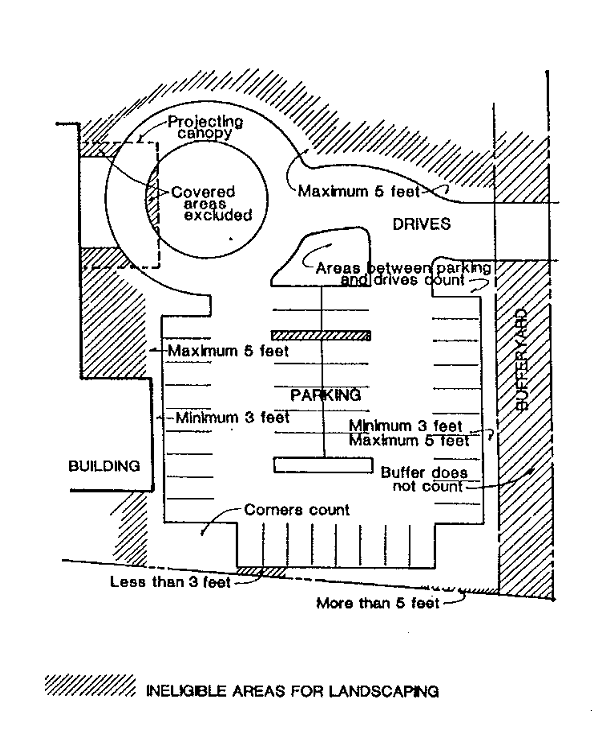
- All vehicle use areas containing more than 1000 square feet shall be landscaped in accord with Figure 6.05.02 A and Figure 6.05.02 B. Figure 6.05.02 C identifies the areas of landscaping that may be counted towards fulfilling the vehicle use area landscaping requirement.
- Proportional amounts of landscaping shall be provided for fractional areas.
- Vehicle use areas designed to accommodate vehicles that are larger or smaller than automobiles, or that do not have designated parking areas, shall meet the requirements of the above figures except that in place of twenty-four parking spaces, the square footage of 4,800 square feet shall be used.
Figure 6.05.02-A Plant Key For Vehicle Use Area Landscaping Standards
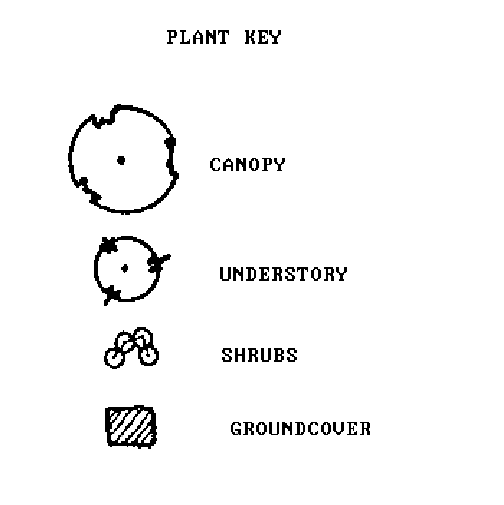 Figure 6.05.02-B
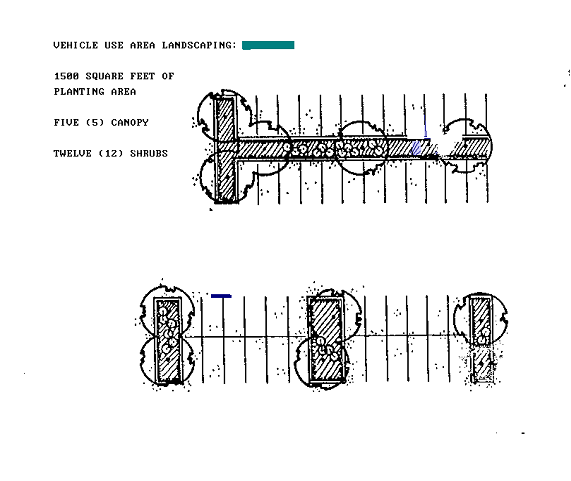 Figure 6.05.02-C
6.05.03 Buffer Zones
- A buffer zone is a landscaped strip along parcel boundaries that serves as a buffer between incompatible uses and zoning districts, as an attractive boundary of the parcel or use, or as both a buffer and attractive boundary. This shall not be interpreted to mean that parcels within a planned mixed use development must meet these requirements.
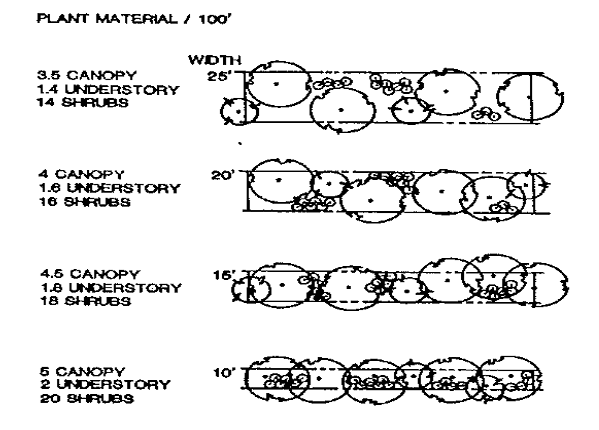
- The standard for buffer zones is set out in the following illustration that specifies the number of plants required per 100 linear feet. To determine the total number of plants required, the length of each side of the property requiring a buffer shall be divided by 100 and multiplied by the number of plants shown in the illustration. The plants shall be spread reasonably evenly along the length of the buffer. The developer may choose among the width/planting options shown below.
LANDSCAPE STANDARD
- The foregoing buffer shall be provided between abutting parcels as follows:
Buffer to be provided by this use AG COM IND PUB REC RES-LOW RES-MED AG N Y N N N N N COM N N Y N Y Y Y IND N N N N Y Y Y PUB N Y Y N N Y Y REC N Y Y Y N Y Y RES-LOW N Y Y Y Y N N RES-MED N Y Y Y Y N N Key: AG: Agricultural COM: Commercial IND: Industrial PUB: Public REC: Recreational RES–LOW: Residential–Low Density RES–MED: Residential–Medium Density N: No buffer required Y: Buffer required - The use of existing native vegetation in buffer zones is preferred. If a developer proposes to landscape a buffer zone with existing native vegetation, the reviewing agency may allow a variance from the strict planting requirements of this section if:
- The variance is necessary to prevent harm to the existing native vegetation; and
- The buffering and/or aesthetic purposes of the buffer zone are substantially fulfilled despite the variance.
- Where the use that is required to provide a buffer is subject to approval by a Special Use Permit, the buffer requirements of this section may be increased or decreased as a condition of a Special Use Permit upon good cause supported by written findings in the final order.
- In any case where a buffer is required, the buffer may be crossed by driveways, trails, or other features of the development designed to provide connectivity or recreational opportunities.
6.06.01 Requirements For All Developments
- Generally. The following basic utilities are required for all developments subject to the criteria listed herein.
- Electricity. Every principal use and every lot within a subdivision shall have available to it a source of electric power adequate to accommodate the reasonable needs of such use and every lot within such subdivision.
- Telephone. Every principal use and every lot within a subdivision shall have available to it a telephone service cable adequate to accommodate the reasonable need of such use and every lot within such subdivision.
- Water. Every principal use and every lot within a subdivision shall have central potable water whenever required by the City Comprehensive Plan.
- Sewer. Every principal use and every lot within a subdivision shall have wastewater hookup whenever required by the City Comprehensive Plan.
- Fire Hydrants. All developments served by a central water system shall include a system of fire hydrants.
6.07.01 Performance Standards
All developments must be designed, constructed, and maintained to meet the following performance standards:
- While development activity is underway and after it is completed, the characteristics of stormwater runoff shall approximate the rate, volume, quality, and timing of storm water runoff that occurred under the site's natural unimproved or existing state, such that the development is in conformance with the Level of Service (LOS) Standard set forth in Chapter IV, Policy IV - 3.1.1, of the Comprehensive Plan.
- The proposed development and development activity shall not violate the water quality standards as set forth in Chapter 17-3, Florida Administrative Code.
6.07.02 Design Standards
To comply with the foregoing performance standards the proposed stormwater management system shall conform to the following design standards:
- To the maximum extent practicable, natural systems shall be used to accommodate stormwater.
- The proposed stormwater management system shall be designed to accommodate the stormwater that originates within the development and stormwater that flows onto or across the development from adjacent lands.
- The proposed stormwater management system shall be designed to function properly for a minimum twenty 20-year life.
- No surface water may be channeled or directed into a sanitary sewer.
- The proposed stormwater management system shall be compatible with the stormwater management facilities on surrounding properties or streets, taking into account the possibility that substandard systems may be improved in the future.
- The banks of detention and retention areas should be sloped to accommodate, and should be planted with, appropriate vegetation.
- Dredging, clearing of vegetation, deepening, widening, straightening, stabilizing, or otherwise altering natural surface waters shall be minimized and performed in accordance with the administrative rules and guidelines of the Suwannee Water Management District.
- Natural surface waters shall not be used as sediment traps during or after development.
- For aesthetic reasons and to increase shoreline habitat, the shorelines of detention and retention areas shall be sinuous rather than straight.
- Water reuse and conservation shall, to the maximum extent practicable, be achieved by incorporating the stormwater management system into irrigation systems serving the development.
- Vegetated buffers of sufficient width to prevent erosion shall be retained or created along the shores, banks, or edges of all natural or man-made surface waters.
- In phased developments the stormwater management system for each integrated stage of completion shall be capable of functioning independently as required by this Code.
- All detention and retention basins, except natural water bodies used for this purpose, shall be accessible for maintenance from a street or public right-of-way.

