
Walsenburg City Zoning Code
ARTICLE 7
- SIGN REGULATIONS
Sec. 16-7-10. - Purpose.
(a)
The purpose of this Article is to protect the safety and orderly development of the community through the regulation of signs and sign structures.
(b)
The regulations in this Article are intended to coordinate the use, placement, physical dimensions, and design of all slides within the city. The purpose of these regulations is to:
(1)
Recognize that signs are necessary means of visual communication for the convenience of the public and provide flexibility within the sign review/approval process to allow for unique circumstances and creativity.
(2)
Recognize and ensure the right of those concerned to identify businesses, services and other activities using signs, and limits signs to those which are accessory and incidental to the use on the premises where such signs are located.
(3)
Provide a reasonable balance between the right of an individual to identify his or her business and the right of the public to be protected against the visual discord resulting from the unrestricted proliferation of signs and similar devices.
(4)
Protect the public from damage or injury caused by signs that are poorly designed or maintained and from distractions or hazards to pedestrians or motorist caused by the indiscriminate placement or use of signs.
(5)
Ensure signs are well designed and contribute in a positive way to the City's visual environment, express local character, and help develop a distinctive image for the City.
(6)
Encourage signs that are responsive to the aesthetics and character of the particular location, adjacent buildings and uses, and the surrounding neighborhood. Ensure signs are compatible and integrated with the building's architectural design and with other signs on the property.
(7)
Ensure signs are appropriate for the type of street on which they are located.
(8)
Bring nonconforming signs into compliance with these regulations.
(Ord. No. 1009, § a, 4-3-2012)
Sec. 16-7-20. - Definitions.
The following words and terms shall, for the purposes of this Article and as used elsewhere in this Code, have the meanings shown herein.
Abandoned sign means a sign structure that has ceased to be used and the owner intends to no longer use for the display of sign copy, or as otherwise defined by ordinance.
Advertising device means any outdoor sign, display, device, figure, painting, drawing, message, placard, poster, billboard or any other contrivance designed, intended or used to advertise or to give information in the nature of advertising and having the capacity of being visible from the travel way of any state highway, except any advertising device on a vehicle using the highway. The term vehicle using the highway does not include any vehicle parked near said highway for advertising purposes.
Animated sign means a sign employing actual motion or the illusion of motion. Animated signs, which are differentiated from changeable signs as defined and regulated by this Article, include the following types:
(1)
Electrically activated. Animated signs producing the illusion of movement by means of electronic, electrical or electro-mechanical input and/or illumination capable of simulating movement through employment of the characteristics of one or both of the classifications noted below:
a.
Flashing. Animated signs or animated portions of signs whose illumination is characterized by a repetitive cycle in which the period of illumination is either the same as or less than the period of non-illumination. For the purposes of this Article, flashing will not be defined as occurring if the cyclical period between on-off phases of illumination exceeds four seconds.
b.
Patterned illusionary movement. Animated signs or animated portions of signs whose illumination is characterized by simulated movement through alternate or sequential activation of various illuminated elements for the purpose of producing repetitive light patterns designed to appear in some form of constant motion.
(2)
Environmentally activated. Animated signs or devices motivated by wind, thermal changes or other natural environmental input; includes spinners, pinwheels, pennant strings, and/or other devices or displays that respond to naturally occurring external motivation.
(3)
Mechanically activated. Animated signs characterized by repetitive motion and/or rotation activated by a mechanical system powered by electric motors or other mechanically induced means.
Architectural projection means any projection that is not intended for occupancy and that extends beyond the face of an exterior wall of a building, but that does not include signs as defined herein. See also Awning, Backlit awning,Canopy (attached) and Canopy (freestanding).
Awning means an architectural projection or shelter projecting from and supported by the exterior wall of a building and composed of a covering of rigid or non-rigid materials and/or fabric on a supporting framework that may be either permanent or retractable, including such structures that are internally illuminated by fluorescent or other light sources.
Awning sign means a sign displayed on or attached flat against the surface of an awning. See also Wall or fascia sign.
Backlit awning means an awning with a translucent covering material and a source of illumination contained within its framework.
Banner means a flexible substrate on which copy or graphics may be displayed.
Banner sign means a sign utilizing a banner as its display surface.
Billboard. See Outdoor advertising sign.
Building elevation means the entire side of a building, from ground level to the roofline, as viewed perpendicular to the walls on that side of the building.
Canopy (attached) means a multi-sided overhead structure or architectural projection supported by attachments to a building on one or more sides and either cantilevered from such building or also supported by columns at additional points. The surface and/or soffit of an attached canopy may be illuminated by means of internal or external sources of light.
Canopy (freestanding) means a multi-sided overhead structure supported by columns, but not enclosed by walls. The surface and/or soffit of a freestanding canopy may be illuminated by means of internal or external sources of light.
Canopy sign means a sign affixed to the visible surface of an attached or freestanding canopy. For reference, see Section 16-7-30 of this Article.
Changeable sign means a sign with the capability of content change by means of manual or remote input, including signs which are:
(1)
Electrically activated. A changeable sign whose message copy or content can be changed by means of remote electrically energized on-off switching combinations of alphabetic or pictographic components arranged on a display surface. Illumination may be integral to the components, such as characterized by lamps or other light-emitting devices; or it may be from an external light source designed to reflect off the changeable component display. See also Electronic message sign or center.
(2)
Manually activated. A changeable sign whose message copy or content can be changed manually.
Combination sign means a sign that is supported partly by a pole and partly by a building structure.
Copy means those letters, numerals, figures, symbols, logos and graphic elements comprising the content or message of a sign, excluding numerals identifying a street address only.
Development complex sign means a freestanding sign identifying a multiple-occupancy development, such as a shopping center or planned industrial park, which is controlled by a single owner or landlord, approved in accordance with Section 16-7-420(b) of this Article.
Directional sign means any sign that is designed and erected for the purpose of providing direction and/or orientation for pedestrian or vehicular traffic.
Double-faced sign means a sign with two faces, back to back.
Electric sign means any sign activated or illuminated by means of electrical energy.
Electronic message sign or center means an electrically activated changeable sign whose variable message capability can be electronically programmed.
Exterior sign means any sign placed outside a building.
Fascia sign. See Wall or fascia sign.
Flashing sign. See Animated sign, electrically activated.
Freestanding sign means a sign principally supported by a structure affixed to the ground and not supported by a building, including signs supported by one or more columns, poles or braces placed in or upon the ground. For visual reference, see Section 16-7-30 of this Article.
Frontage (building) means the length of an exterior building wall or structure of a single premises orientated to the public way or other properties that it faces.
Frontage (property) means the length of the property line of any single premises along either a public way or other properties on which it borders.
Ground sign. See Freestanding sign.
Highway District means all areas located within the City of Walsenburg and within the Zoning Districts C-1, L-1 and H-I, that lie within 600 feet of the Colorado Department of Transportation right-of-way measured perpendicularly from the boundary of the highway right-of-way for I-25, U.S. 85-87, Colorado State Highway 69 and Colorado State Highway 10.
Illuminated sign means a sign characterized by the use of artificial light, either projecting through its surface (internally illuminated); or reflecting off its surface (externally illuminated).
Interior sign means any sign placed within a building, but not including window signs as defined in this Section. Interior signs, with the exception of window signs, are not regulated by this Article.
Mansard means an inclined decorative roof-like projection that is attached to an exterior building facade.
Marquee. See Canopy (attached).
Marquee sign. See Canopy sign.
Menu board means a freestanding sign orientated to the drive-through lane for a restaurant that advertises the menu items available from the drive-through window, and which has no more than 20 percent of the total area for such a sign utilized for business identification.
Multiple-faced sign means a sign containing three or more faces.
Off-premises sign. See Outdoor advertising sign.
On-premises sign means a sign erected, maintained or used in the outdoor environment for the purpose of the display of messages appurtenant to the use of, products sold on, or the sale or lease of the property on which it is displayed.
Outdoor advertising sign means a permanent sign erected, maintained or used in the outdoor environment for the purpose of the display of commercial or noncommercial messages not appurtenant to the use of, products sold on, or the sale or lease of the property on which it is displayed.
Parapet means the extension of a building facade above the line of the structural roof.
Pole sign. See Freestanding sign.
Political sign means a temporary sign intended to advance a political statement, cause or candidate for office. A legally permitted outdoor advertising sign shall not be considered to be a political sign.
Portable sign means any sign not permanently attached to the ground or to a building or building surface.
Projecting sign means a sign other than a wall sign that is attached to or projects more than 18 inches (457 mm) from a building face or wall or from a structure whose primary purpose is other than the support of a sign. For visual reference, see Section 16-7-30 of this Article.
Real estate sign means a temporary sign advertising the sale, lease or rental of the property or premises upon which it is located.
Revolving sign means a sign that revolves 360 degrees (6.28 rad) about an axis. See also Animated sign, mechanically activated.
Roof line means the top edge of a peaked roof or, in the case of an extended facade or parapet, the uppermost point of said facade or parapet.
Roof sign means a sign mounted on, and supported by, the main roof portion of a building, or above the uppermost edge of a parapet wall of a building, and which is wholly or partially supported by such building. Signs mounted on mansard facades, pent eaves and architectural projections, such as canopies or marquees, shall not be considered to be roof signs. For a visual reference and a comparison of differences between roof and fascia signs, see Section 16-7-30 of this Article.
Sandwich board sign means two usually hinged boards designed for hanging from the shoulders with one board before and one behind and used especially for advertising, or a portable A-frame or otherwise freestanding type sign that sits on the sidewalk.
Sign means any device visible from a public place that displays either commercial or noncommercial messages by means of graphic presentation of alphabetic or pictorial symbols or representations. Noncommercial flags or any flags displayed from flagpoles or staffs will not be considered to be signs.
Sign area means the area of the smallest geometric figure, or the sum of the combination of regular geometric figures, which comprise the sign face. The area of any double-sided or "V" shaped sign shall be the area of the largest single face only. The area of a sphere shall be computed as the area of a circle. The area of all other multiple-sided signs shall be computed as 50 percent of the sum of the area of all faces of the sign.
Sign copy means those letters, numerals, figures, symbols, logos and graphic elements comprising the content or message of a sign, exclusive of numerals identifying a street address only.
Sign face means the surface upon, against or through which the sign copy is displayed or illustrated, not including structural supports, architectural features of a building or sign structure, nonstructural or decorative trim or any areas that are separated from the background surface upon which the sign copy is displayed by a distinct delineation, such as a reveal or border. See Section 16-7-30 of this Article.
(1)
In the case of panel or cabinet-type signs, the sign face shall include the entire area of the sign panel, cabinet or face substrate upon which the sign copy is displayed or illustrated, but not open space between separate panels or cabinets.
(2)
In the case of sign structures with routed areas of sign copy, the sign face shall include the entire area of the surface that is routed, except where interrupted by a reveal, border or contrasting surface or color.
(3)
In the case of signs painted on a building, or individual letters or graphic elements affixed to a building or structure, the sign face shall comprise the sum of the geometric figures or combination of regular geometric figures drawn closest to the edge of the letters or separate graphic elements comprising the sign copy, but not the open space between separate groupings of sign copy on the same building or structure.
(4)
In the case of sign copy enclosed within a painted or illuminated border or displayed on a background contrasting in color with the color of the building or structure, the sign face shall comprise the area within the contrasting background or within the painted or illuminated border.
Sign structure means any structure supporting a sign.
Temporary sign means a sign intended to display either commercial or noncommercial messages of a transitory or temporary nature. Portable signs or any sign not permanently embedded in the ground, or not permanently affixed to a building or sign structure that is permanently embedded in the ground, are considered temporary signs.
Under-canopy sign or under-marquee sign means a sign attached to the underside of a canopy or marquee.
V sign means a sign containing two faces of approximately equal size, erected upon a common or separate structure, positioned in a "V" shape, with an interior angle between faces of not more than 90 degrees (1.57 rad) with the distance between the sign faces not exceeding five feet (1,524 mm) at their closest point.
Wall or fascia sign means a sign that is in any manner affixed to any exterior wall of a building or structure and that projects not more than 18 inches (457 mm) from the building or structure wall, including signs affixed to architectural projections from a building, provided that the copy area of such sign remains on a parallel plane to the face of the building facade or to the face of the architectural projection to which it is affixed. For a visual reference and a comparison of differences between wall or fascia signs and roof signs, see Section 16-7-30 of this Article.
Window sign means a sign affixed to the surface of a window with its message intended to be visible to and readable from the public way or from adjacent property.
(Ord. No. 1009, § b, 4-3-2012; Ord. No. 1082, § 1, 1-5-2016)
Sec. 16-7-30. - General sign types.
Sign types and the computation of sign area shall be as depicted in Figures 16-7(1) through 16-7(3).
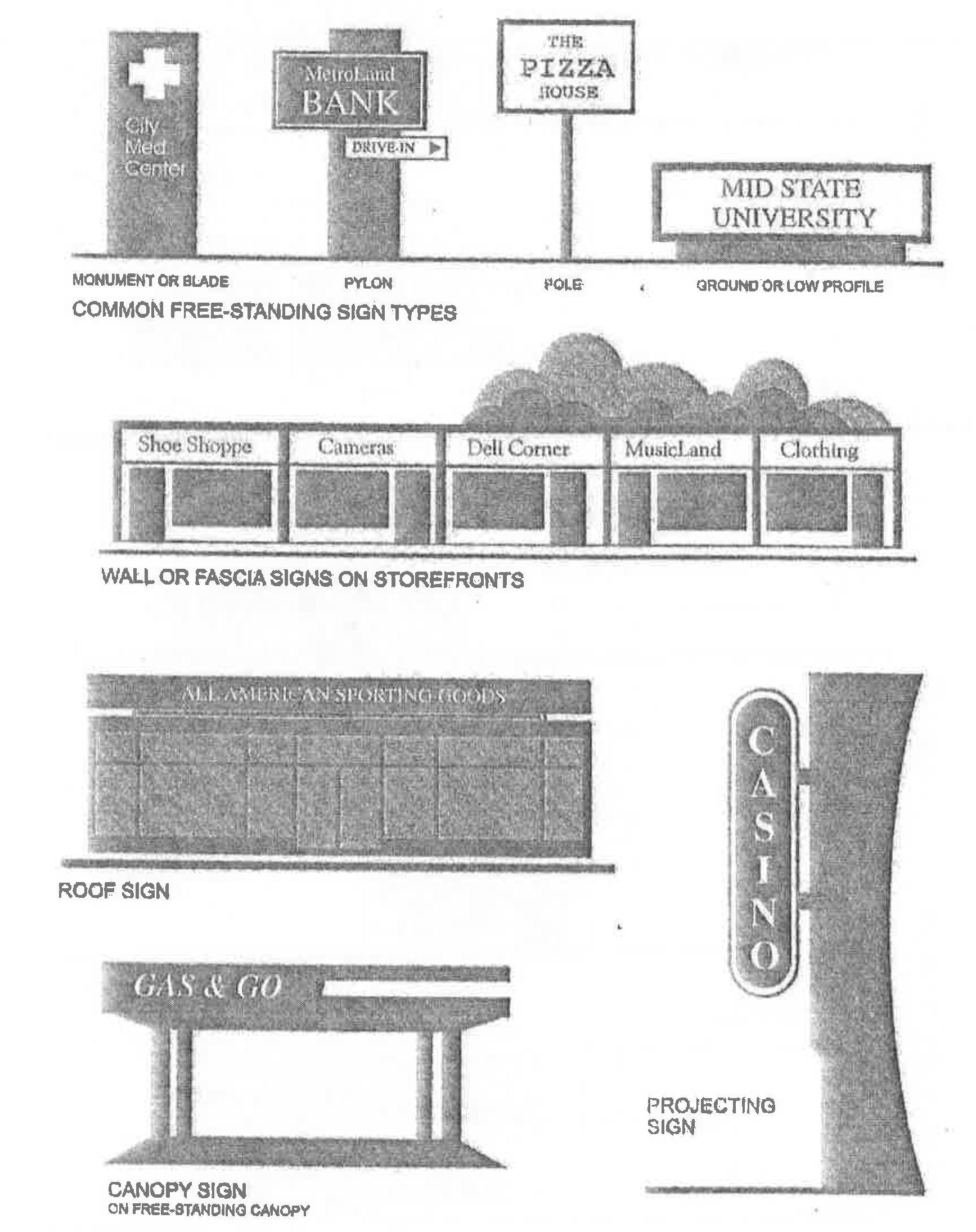
FIGURE 16-7(1)
GENERAL SIGN TYPES
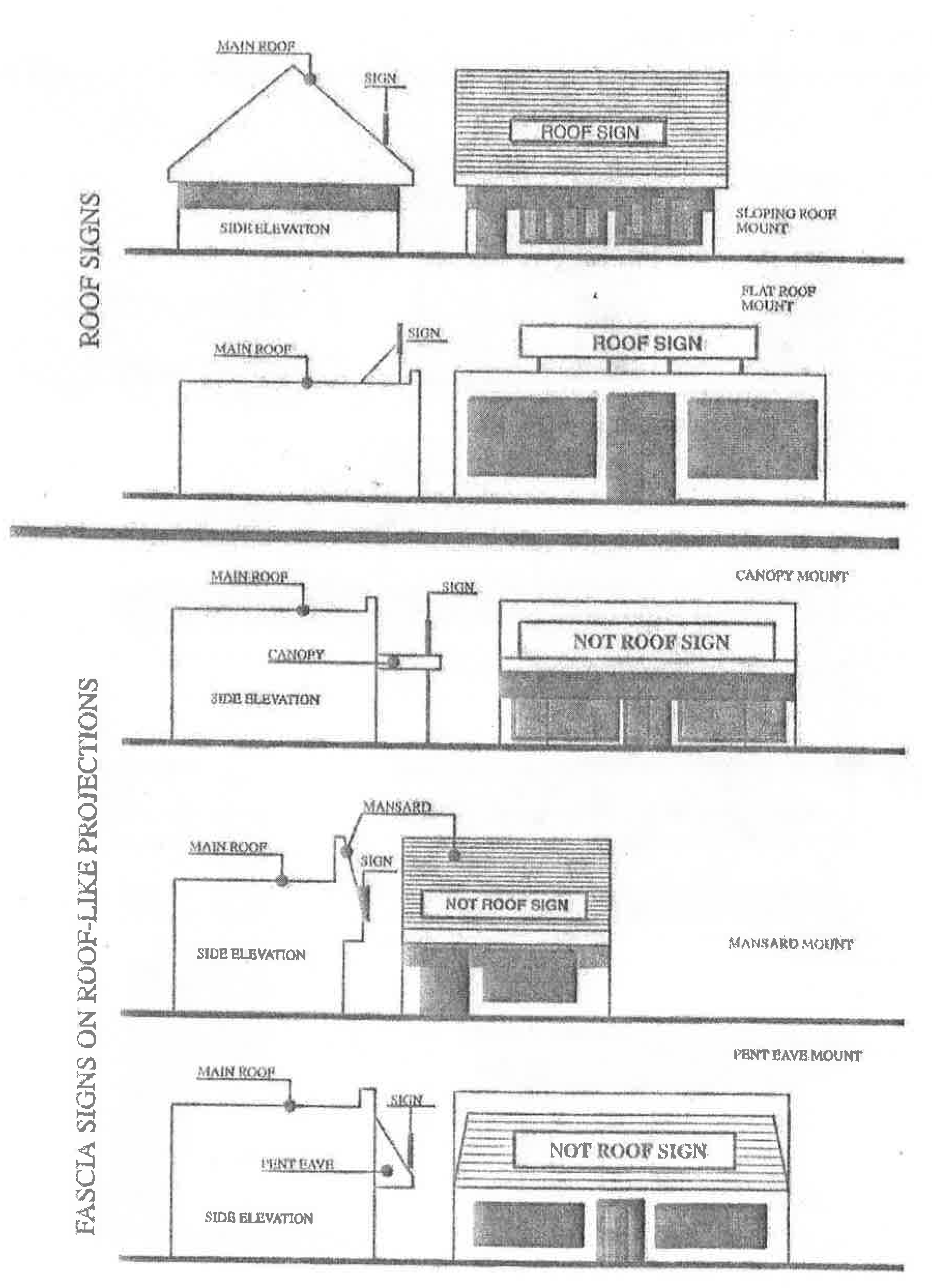
FIGURE 16-7(2)
COMPARISON - ROOF AND WALL OR FASCIA SIGNS
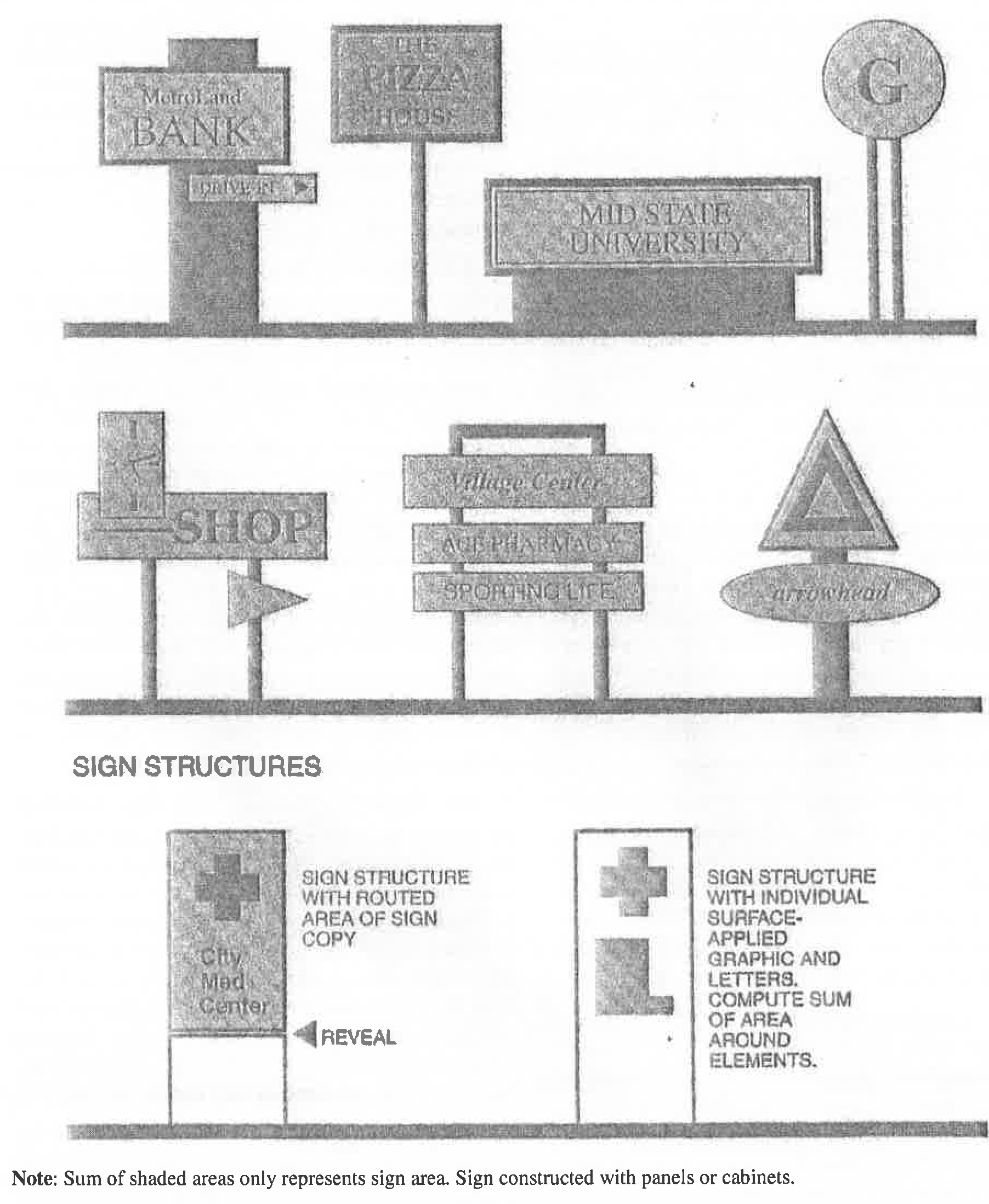
FIGURE 16-7(3)
SIGN AREA - COMPUTATION METHODOLOGY
(Ord. No. 1009, § c, 4-3-2012)
Sec. 16-7-40. - General provisions.
(a)
Conformance to codes. Any sign erected after the effective date of the initial ordinance codified herein shall conform to the provisions of this Article, of the International Building Code adopted by the City and of any other ordinance or regulation within the City.
(b)
Signs in rights-of-way. No sign other than an official traffic sign or similar sign shall be erected within two feet (610 mm) of the lines of any street or within any public way, unless specifically authorized by other ordinances or regulations of the City or by specific written authorization of the Zoning Enforcement Officer.
(c)
Projections over public ways. Signs projecting over public walkways shall be permitted to do so only subject to the projection and clearance limits either defined herein or, if not so defined, at a minimum height of eight feet from grade level to the bottom of the sign. Signs, architectural projections or sign structures projecting over vehicular access areas must conform to the minimum height clearance limitations imposed by the City for such structures.
(d)
Traffic visibility. No sign or sign structure shall be erected at the intersection of any street in such a manner as to obstruct free and clear vision, nor at any location where, by its position, shape or color, it may interfere with, obstruct the view of or be confused with any authorized traffic sign, signal or device.
(e)
Computation of frontage. If a premises contains walls facing more than one property line or encompasses property frontage bounded by more than one street or other property usages, the sign area for each building wall or property frontage will be computed separately for each building wall or property line facing a different frontage. The sign area thus calculated shall be permitted to then be applied to permitted signs placed on each separate wall or property line frontage.
(f)
Animation and changeable messages. Animated signs, except as prohibited in Section 16-7-60 of this Article, are permitted in commercial and industrial zones only. Changeable signs, manually activated, are permitted for nonresidential uses in all zones. Changeable signs, electrically activated, are permitted in all nonresidential zones.
(g)
Maintenance, repair and removal. Every sign permitted by this Article shall be kept in good condition and repair. When any sign becomes insecure, is in danger of falling or is otherwise deemed unsafe by the Zoning Enforcement Officer, or if any sign is unlawfully installed, erected or maintained in violation of any of the provisions of this Article, the owner thereof or the person using the same shall, upon written notice by the Zoning Enforcement Officer, forthwith in the case of immediate danger, and in any case within not more than ten days, make such sign conform to the provisions of this Article, or shall remove it. If, within ten days, the order is not complied with, the Zoning Enforcement Officer shall be permitted to remove or cause such sign to be removed at the expense of the owner and/or the user of the sign.
(h)
Obsolete sign copy. Any sign copy that no longer advertises or identifies a use conducted on the property on which said sign is erected must be covered or removed within 80 days after written notification from the Building Inspector; and upon failure of the owner to comply with such notice, the Zoning Enforcement Officer is hereby authorized to cause the removal of such sign copy, and any expense incident thereto shall be paid by the owner of the building, structure or ground on which the sign is located.
(i)
Nonconforming signs. Any sign legally existing on the effective date of the initial ordinance codified herein that does not conform in use, location, height or size with the regulations of the zone district in which such sign is located shall be considered a legal nonconforming use or structure and shall be permitted by the Zoning Enforcement Officer and allowed to continue in such status until such time as it is either abandoned or removed by its owner, subject to the following limitations:
(1)
Structural alterations, enlargement or re-erection are permissible only where such alterations will not increase the degree of nonconformity of the signs.
(2)
Any legal nonconforming sign shall be removed or rebuilt without increasing the existing height or area if it is damaged, or removed if allowed to deteriorate to the extent that the cost of repair or restoration exceeds 50 percent of the replacement cost of the sign as determined by the Zoning Enforcement Officer.
(3)
Nonconforming sign permits. Within 120 days of the effective date of the initial ordinance codified herein, the owner or possessor of a nonconforming sign shall file an application for a permit for a nonconforming sign. The application shall include, at a minimum, the location of the sign, the current owner and address of the current owner, the estimated date of sign construction and a photograph of each side of the sign. The City shall not require an application fee for the nonconforming sign application or permit. The permit for the nonconforming sign need not be renewed unless the sign is modified or altered. The City Clerk shall maintain a file containing all nonconforming sign applications and permits. When the City Clerk has no application and no permit has been issued, a presumption shall exist that the sign is not a nonconforming sign.
(Ord. No. 1009, § d, 4-3-2012)
Sec. 16-7-50. - Exempt signs.
The following signs shall be exempt from the provisions of this Article. No sign shall be exempt from Section 16-7-40(d) of this Article. All such signs (except Government signs) shall be located outside a street right-of-way. Evidence of the owner's permission to install sign may be required if the City checks for the sign's compliance with this Article. All other signs shall be allowed only with permit and upon proof of compliance with this Article.
(1)
Official notices authorized by a court, public body or public safety official.
(2)
Directional, warning or information signs authorized by federal, state or municipal governments.
(3)
Memorial plaques and building cornerstones when cut or carved into a masonry surface or when made of noncombustible material and made an integral part of the building or structure.
(4)
The flag of a government or noncommercial institution, such as a school.
(5)
Religious symbols and seasonal decorations within the appropriate public holiday season.
(6)
Works of fine art displayed in conjunction with a commercial enterprise where the enterprise does not receive direct commercial gain, and integral decorative or architectural features of the building so long as such features or works do not contain letters, trademarks, moving parts or lights.
(7)
Signs not visible beyond the boundaries of the lot or parcel upon which they are located and/or from any public thoroughfare or right-of-way shall be exempt from the provisions of this article, except that such signs shall be the subject to the safety regulations of the International Building Code and the National Electrical Code.
(8)
Address. Non-illuminated signs not to exceed two square feet in an area which identify the address and/or occupants of the dwelling unit or of an establishment.
(9)
Architectural features. Integral decorative or architectural features of buildings so long as such features do not contain letters, trademarks, moving parts or lights.
(10)
Banners. Banners applied to paper, plastic or fabric used to decorate or attract attention to a business establishment, provided:
a.
The signs are displayed in conjunction with the grand opening celebration for a period not to exceed 30 days.
b.
The signs are displayed in conjunction with the special sale for a period not to exceed 30 days.
c.
The signs are displayed no more than two times per calendar year per establishment.
d.
The banner shall be securely attached to the wall of the establishment, freestanding signs or light poles on private property.
e.
Only one banner per street frontage per establishment shall be permitted.
(11)
Building identification, historical markers. Non-illuminated signs constructed of metal or masonry which are permanently affixed to buildings or structures for the purpose of identifying the name of the building, date of corrections or other historical information as approved by the city.
(12)
Bulletin board. Bulletin board signs not exceeding 15 square feet in gross surface area accessory to a church, school, or public or nonprofit institution.
(13)
Construction. Temporary construction signs.
(14)
Street address signs and combination nameplate and street address signs that contain no advertising copy and which do not exceed six square feet (0.56 m2) in area.
(Ord. No. 1009, § e, 4-3-2012)
Sec. 16-7-60. - Prohibited signs.
The following devices are inconsistent with the purposes and standards in this article and are prohibited in all zoning districts:
(1)
Signs located in such a manner as to obstruct or otherwise interfere with an official traffic sign, signal or device, or obstruct or interfere with a driver's view of approaching, merging or intersecting traffic.
(2)
Except as provided for elsewhere in this Article, signs encroaching upon or overhanging the public right-of-way. No sign shall be attached to any utility pole, light standard, street tree or any other public facility located within the public right-of-way.
(3)
Signs which blink, flash or are animated by lighting in any fashion that would cause such signs to have the appearance of traffic safety signs and lights or municipal vehicle warnings from a distance.
(4)
Portable signs, except as allowed for temporary signs.
(5)
Any sign attached to, or placed on, a vehicle or trailer parked on public or private property, except for signs meeting the following conditions:
a.
The primary purpose of such a vehicle or trailer is not the display of signs.
b.
The signs are magnetic, decals or painted upon an integral part of the vehicle or equipment as originally designed by the manufacturer and do not break the silhouette of the vehicle.
c.
The vehicle or trailer is in operating condition, currently registered and licensed to operate on public streets when applicable and actively used or available for use in the daily function of the business to which such signs relate.
d.
Vehicles and trailers are not used primarily as static displays, advertising a product or service, or utilized as storage, shelter or distribution points for commercial products or services for the general public.
(6)
Balloons, streamers or pinwheels, except those temporarily displayed as part of a special sale, promotion or community event. For the purposes of this Subsection, temporarily means no more than 20 days in any calendar year.
(7)
Mechanical or electrical appurtenances, such as "revolving begins", that are designed to compel attention.
(8)
Roof signs.
(9)
Off-premises advertising signs or any other sign not pertinent and clearly incidental to the permitted use on the property were located, except for temporary subdivision directional signs and political signs.
(10)
Any sign which interferes with free passage from or obstructs any fire escape, downspout, window, door, stairway, ladder or opening intended as a means of ingress or egress or providing light or air.
(11)
Any sign located in such a way as to intentionally deny adjoining property owner visual access is to an existing sign.
(12)
Rotating signs.
(13)
Searchlights.
(14)
Signs with optical illusion of movement by means of a design which presents a pattern capable of reversible perspective, giving the illusion of motion or changing of copy.
(15)
Inflatable freestanding signs or tethered balloons.
(16)
Fabric signs, flags, pennants or banners when used for commercial advertising purposes except as permitted in this Article as an exempt sign.
(17)
Wind signs.
(18)
Any sign (together with a supporting structure) now or hereafter existing which, 90 days or more after the premises have been vacated, advertises an activity, business, product or service no longer produced or conducted upon the premises upon which such sign is located. If the sign or sign structure is covered or the identifying symbols or letters removed, an extension of time may be granted by the building official upon good cause for such extension being shown. (This provision shall not apply to permanent signs accessory to businesses which are open only on a seasonal basis, provided there is clear intent to continue operation of the business).
(19)
Any sign or sign structure which:
a.
Is structurally unsafe;
b.
Constitutes a hazard to safety or health by reason of an adequate maintenance or dilapidation;
c.
Is not kept in good repair;
d.
Is capable of causing electrical shocks.
(20)
Any sign or sign structure which:
a.
In any other way obstructs the view of, may be confused with or purports to be an official traffic sign, signal or device or any other official signs;
b.
Uses any words, phrases, symbols or characters implying the existence of danger or the need for stopping or maneuvering a motor vehicle;
c.
Creates in any other way an unsafe distraction for motor vehicle operator; or
d.
Obstructs the view of motor vehicle operators entering a public roadway from any parking area, service drive, private driveway, alley or other thoroughfare.
(Ord. No. 1009, § f, 4-3-2012)
Sec. 16-7-110. - Permit required.
With the exception of window signs and signs exempted in this Article, unless specifically exempted in writing, a permit must be obtained from the Zoning Enforcement Officer for the erection, moving, altering, reconstruction, repair and maintenance of all signs erected or maintained within the City and in accordance with other ordinances of the City. Exemptions from the necessity of securing a permit, however, shall not be construed to relieve the owner of the sign involved from responsibility for its erection and maintenance in a safe manner and in a manner in accordance with all the other provisions of this Article. In multiple tenant buildings, a separate permit shall be required for each business entities sign(s). Separate building and electrical permits may be required for signs and will be determined on a case-by-case basis. Changing or replacing a copy on an existing lawful sign should not require a permit, provided the copy change does not change the nature of the sign or render the sign in violation of this article.
(Ord. No. 1009, § g, 4-3-2012)
Sec. 16-7-120. - Application.
An application for a sign permit must be filed with the Zoning Enforcement Officer prior to construction or placement of any sign or advertising device controlled by this Article within the City limits, except window signs. No application shall be deemed complete without a drawing of the proposed sign or advertising device and payment of the appropriate permit fee. The applicant shall bear the burden of proof by a preponderance of the evidence that all conditions for the permit have been satisfied.
(Ord. No. 1009, § g, 4-3-2012)
Sec. 16-7-130. - Certification.
The Zoning Enforcement Officer shall review the application to assure that the sign or advertising device design submitted and proposed location comply with this Article and other provisions of this Chapter. Upon determining compliance, the Zoning Enforcement Officer shall certify that the sign or advertising device design as submitted and the proposed location comply with this Article and all other regulations. This certification may be used by the applicant in the applicant's application for a Colorado Department of Transportation ("CDOT") permit pursuant to Section 43-1-408(1)(f), C.R.S. When CDOT requires an amendment or modification of an advertising device design or location, the applicant must submit the amendment or modification to the Zoning Enforcement Officer to assure that the amendment or modification complies with this Article and this Chapter prior to construction or installation of the advertising device.
(Ord. No. 1009, § g, 4-3-2012)
Sec. 16-7-140. - Issuance of permit.
The applicant shall notify the Zoning Enforcement Officer upon completion of the sign or advertising device construction or installation. The Zoning Enforcement Officer shall inspect the sign or advertising device. Upon determination that the sign or advertising device conforms with the submitted design, any approved amendments or modifications and the submitted proposed location, the Zoning Enforcement Officer shall issue a City sign permit.
(Ord. No. 1009, § g, 4-3-2012)
Sec. 16-7-150. - Permit and renewal fees.
The fees for a new sign permit, a new sign for off-premises signs where the business is not located within the City limits and for annual renewal of a sign permit are set forth in Appendix A to this Code. All fees may be amended from time to time by the City Council by ordinance or resolution.
(Ord. No. 1009, § g, 4-3-2012)
Sec. 16-7-160. - Construction documents.
Before any permit is granted for the erection of a sign or sign structure requiring such permit, construction documents shall be filed with the Zoning Enforcement Officer showing the dimensions, materials and required details of construction, including loads, stresses, anchorage and any other pertinent data. The permit application shall be accompanied by the written consent of the owner or lessee of the premises upon which the sign is to be erected and by engineering calculations signed and sealed by a registered design professional where required by the International Building Code as adopted by the City.
(Ord. No. 1009, § g, 4-3-2012)
Sec. 16-7-170. - Changes to signs.
No sign shall be structurally altered, enlarged or relocated, except in conformity to the provisions herein, or until a proper permit, if required, has been secured. The changing or maintenance of movable parts or components of an approved sign that is designed for such changes, or the changing of copy, business name, lettering, sign face, colors, display and/or graphic matter, or the content of any sign, shall not be deemed a structural alteration.
(Ord. No. 1009, § g, 4-3-2012)
Sec. 16-7-180. - Variances.
The procedure for variances is set forth in Section 16-3-240 of this Chapter.
(Ord. No. 1009, § g, 4-3-2012)
Sec. 16-7-210. - Identification signs.
The requirements for identification signs shall be in accordance with Sections 16-7-220 through 16-7-240 below.
(Ord. No. 1009, § g, 4-3-2012)
Sec. 16-7-220. - Wall signs.
Every single-family residence, multi-family residential complex, commercial or industrial building, and every separate nonresidential building in a residential zone district, may display wall signs per street frontage subject to the limiting standards set forth in Table 16-7-1 below.
(Ord. No. 1009, § g, 4-3-2012)
Sec. 16-7-230. - Freestanding signs.
In addition to any allowable wall signs, every single-family residential subdivision, multi-family residential complex, commercial or industrial building, and every separate nonresidential building in a residential zone district, shall be permitted to display freestanding or combination signs per street frontage, subject to the limiting standards set forth in Table 16-7-2 below.
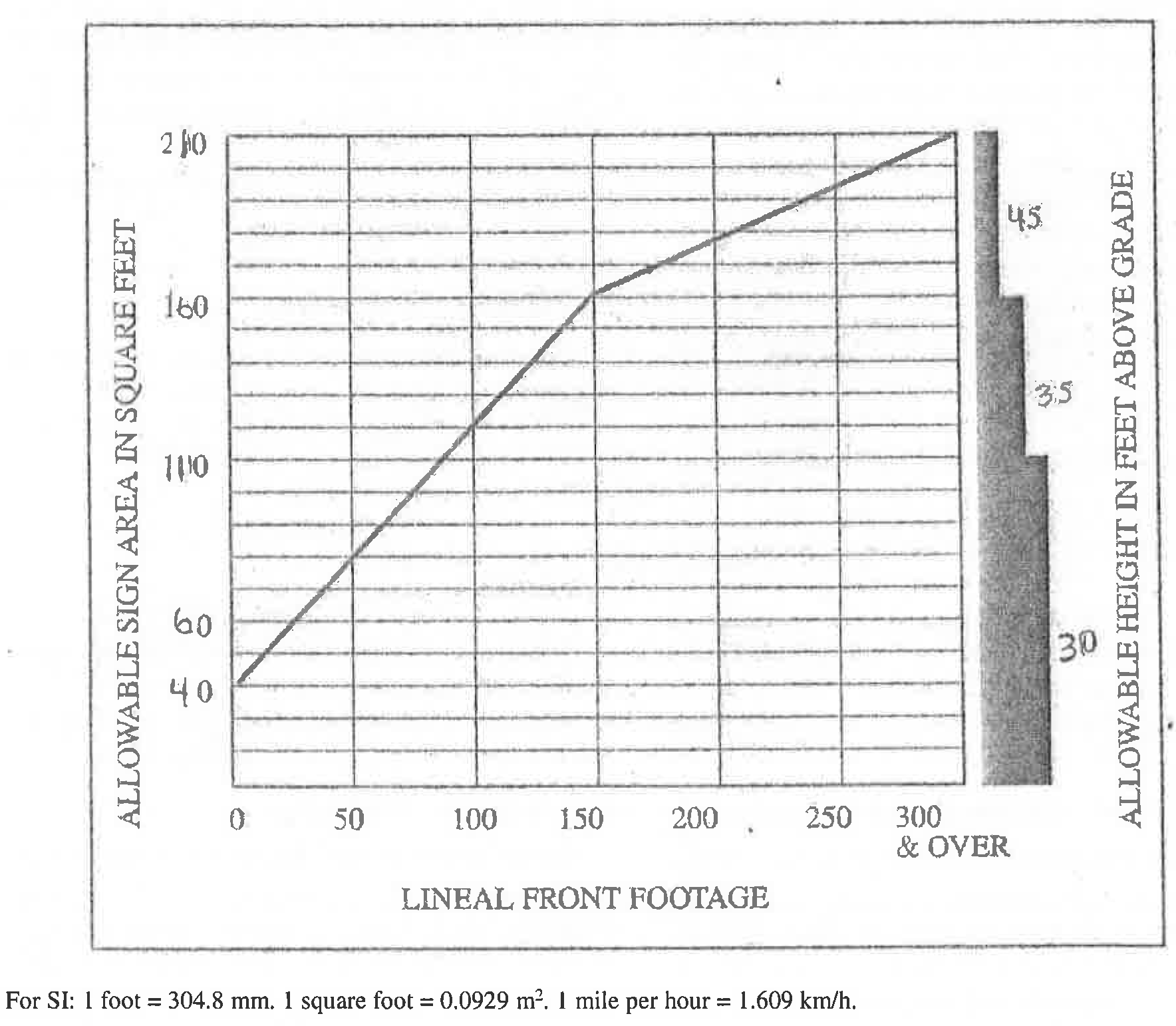
FIGURE 16-7(4)
ON-PREMISES FREESTANDING SIGNS/COMMERCIAL AND INDUSTRIAL ZONES
VEHICULAR SPEED SUBJECT TO POSTED LIMITS UNDER 35 MILES PER HOUR
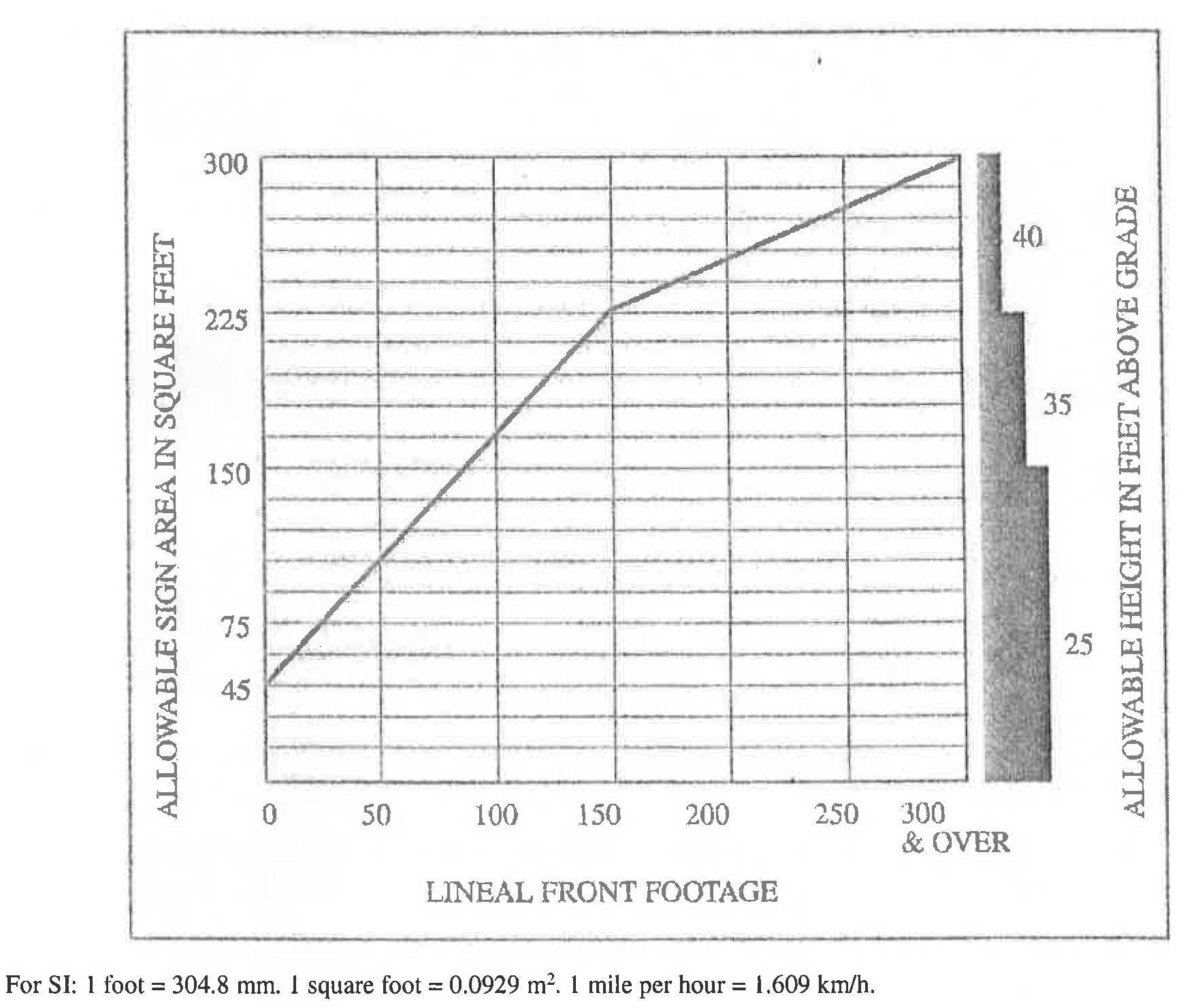
FIGURE 16-7(5)
ON-PREMISES FREESTANDING SIGNS/COMMERCIAL AND INDUSTRIAL ZONES
VEHICULAR SPEED SUBJECT TO POSTED LIMITS BETWEEN 35 AND 55 MILES PER HOUR (INCLUSIVE)
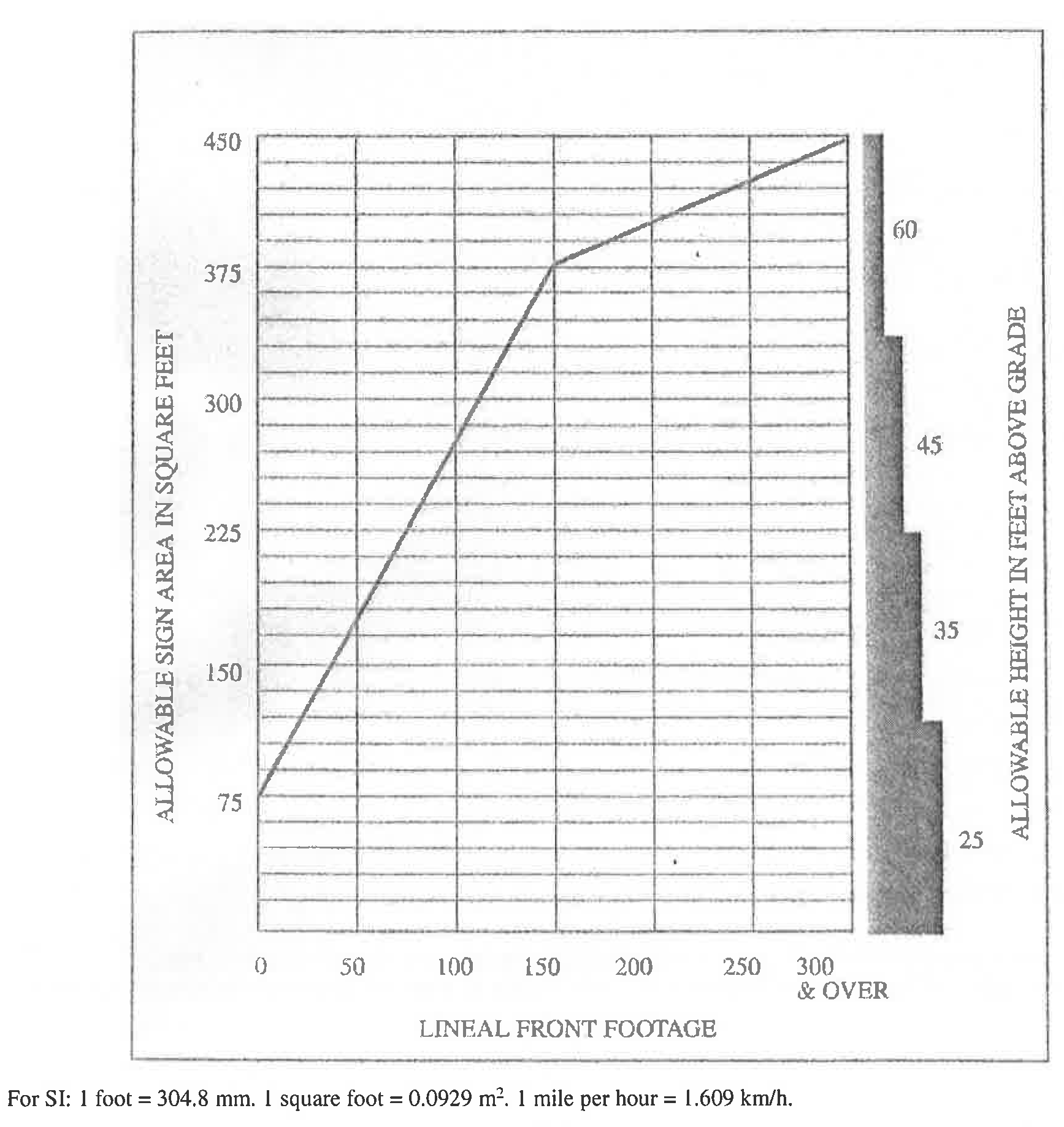
FIGURE 16-7(6)
ON-PREMISES FREESTANDING SIGNS/COMMERCIAL AND INDUSTRIAL ZONES
VEHICULAR SPEED SUBJECT TO POSTED LIMITS ABOVE 55 MILES PER HOUR
TABLE 16-7-1
IDENTIFICATION SIGN STANDARDS
WALL SIGNS
For SI: 1 square foot = 0.0929 m2.
TABLE 16-7-2
SIGN AREA
For SI: 1 foot = 304.8 mm.
(Ord. No. 1009, § g, 4-3-2012)
Sec. 16-7-240. - Directional signs.
No more than two directional signs shall be permitted per street entrance to any lot. There shall be no limit to the number of directional signs providing directional information interior to a lot. In residential zones, the maximum area for directional signs shall be two square feet. For all other zones, the maximum area for any directional sign visible from adjacent property or rights-of-way shall be four square feet. Not more than 25 percent of the area of any directional sign shall be permitted to be devoted to business identification or logo, which area shall not be assessed as identification sign area.
(Ord. No. 1009, § g, 4-3-2012)
Sec. 16-7-250. - Temporary signs.
The provisions for temporary signs are set out in Sections 16-7-260 through 16-7-320 below.
(Ord. No. 1009, § g, 4-3-2012)
Sec. 16-7-260. - Real estate signs.
Real estate signs shall be permitted in all zoning districts, subject to the following limitations:
(1)
Real estate signs located on a single residential lot shall be limited to two signs.
(2)
Real estate signs advertising the sale of lots located within a subdivision shall be limited to one sign per entrance to the subdivision. All signs permitted under this Section shall be removed within ten days after the sale of the last original lot.
(3)
Real estate signs advertising the sale or lease of space shall be limited to one sign per street front.
(4)
Real estate signs advertising the sale or lease of vacant commercial or industrial land shall be limited to one sign per street front.
(5)
Real estate signs shall be removed not later than ten days after execution of a lease agreement in the event of a lease, or the closing of the sale in the event of a purchase.
(Ord. No. 1009, § g, 4-3-2012)
Sec. 16-7-270. - Development and construction signs.
Signs temporarily erected during construction to inform the public of the developer, contractors, architects, engineers, the nature of the project or anticipated completion dates shall be permitted in all zoning districts, subject to the following limitations:
(1)
Such signs on a single residential lot shall be limited to one sign.
(2)
Such signs for a residential subdivision or multiple residential lots shall be limited to one sign at each entrance to the subdivision or on one of the lots to be built upon, and shall be no greater than 50 square feet.
(3)
Such signs for nonresidential uses in residential districts shall be limited to one sign and shall be no greater than 15 square feet.
(4)
Such signs for commercial or industrial projects shall be limited to one sign per street front, not to exceed 50 feet in height and not to exceed the roof line.
(5)
Development and construction signs may not be displayed until after the issuance of construction permits by the Building Inspector and must be removed not later than 24 hours following issuance of an occupancy permit for any or all portions or the project.
(Ord. No. 1009, § g, 4-3-2012)
Sec. 16-7-280. - Special promotion, event and grand opening signs.
Signs temporarily displayed to advertise special promotions, events and grand openings shall be permitted for nonresidential uses in a residential district and for all commercial and industrial districts, subject to the following limitations:
(1)
Such signs shall be limited to one sign per street front.
(2)
Such signs may be displayed not more than 180 days in any calendar year. The signs shall be erected no more than 15 days prior to the event or grand opening and shall be removed not more than one day after the event or grand opening.
(Ord. No. 1009, § g, 4-3-2012)
Sec. 16-7-290. - Special event signs in public ways.
Signs advertising a special community event shall not be prohibited in or over public rights-of-way, subject to approval by the Zoning Enforcement Officer as to the size, location and method of erection. The Zoning Enforcement Officer may not approve any special event signage that would impair the safety and convenience of use of public rights-of-way or obstruct traffic visibility.
(Ord. No. 1009, § g, 4-3-2012)
Sec. 16-7-300. - Portable signs.
Portable signs shall be permitted only in the C-1, C-2, H-I and L-I Districts, as designated in this Chapter, subject to the following limitations:
(1)
No more than one such sign may be displayed on any property, shall not exceed an area of 32 square feet and shall be secure.
(2)
Any electrical portable signs shall comply with most current electrical code, as adopted by the City.
(3)
No portable sign shall be displayed prior to obtaining a sign permit.
(4)
Sandwich board signs are allowed so long as they allow for safe pedestrian traffic.
(Ord. No. 1009, § g, 4-3-2012)
Sec. 16-7-310. - Sidewalk signs.
(a)
Sidewalk signs must be removed from the sidewalk when the business is not open for business.
(b)
Business owners must provide the City with proof of liability insurance for damage to persons or property caused by sidewalk signs.
(c)
Sidewalk signs cannot be permanently attached in any way to any permanent structure.
(d)
Sign bases cannot exceed three feet by three feet in dimension, and signs cannot be wider than the base and cannot exceed four feet in height.
(Ord. No. 1009, § g, 4-3-2012)
Sec. 16-7-320. - Political signs.
Political signs shall be permitted in all zoning districts, subject to the following limitations:
(1)
Such signs for election candidates or ballot propositions shall be displayed only for a period of 60 days preceding the election and shall be removed within ten days after the election, provided that signs promoting successful candidates or ballot propositions in a primary election may remain displayed until not more than ten days after the general election.
(2)
Such signs shall not be placed in any public right-of-way or obstruct traffic visibility.
(Ord. No. 1009, § g, 4-3-2012)
Sec. 16-7-330. - Requirements for specific sign types.
Signs of specific type shall be in accordance with Sections 16-7-340 through 16-7-380 of this Article.
(Ord. No. 1009, § g, 4-3-2012)
Sec. 16-7-340. - Canopy and marquee signs.
(a)
The permanently affixed copy area of canopy or marquee signs shall not exceed an area equal to 60 percent of the face area of the canopy, marquee or architectural projection upon which such sign is affixed or applied.
(b)
Graphic striping, patterns or color bands on the face of a building, canopy, marquee or architectural projection shall not be included in the computation of sign copy area.
(Ord. No. 1009, § g, 4-3-2012)
Sec. 16-7-350. - Awning signs.
(a)
The copy area of awning signs shall not exceed an area equal to 60 percent of the background area of the awning or awning surface to which such a sign is affixed or applied, or the permitted area for wall or fascia signs, whichever is less.
(b)
Neither the background color of an awning nor any graphic treatment or embellishment thereto, such as striping, patterns or valances, shall be included in the computation of sign copy area.
(c)
Awnings must be engineered.
(d)
Awnings that extend over the sidewalk that require support poles must locate the support poles within the same plane as existing poles on the sidewalk. Awnings must not extend beyond the curb line.
(e)
Awnings must be compliant with Subsection 16-7-40(c) of this Article.
(Ord. No. 1009, § g, 4-3-2012)
Sec. 16-7-360. - Projecting signs.
(a)
Projecting signs shall be permitted in lieu of freestanding signage on any street frontage, limited to one sign per occupancy along any street frontage with a public entrance to such an occupancy, and shall be limited in height and area to three-tenths square foot of area of the building front.
(b)
No such sign shall extend vertically above the highest point of the building facade upon which it is mounted.
(c)
Such sign may extend up to four feet over a public sidewalk.
(d)
Such sign shall maintain a clear vertical distance above any public sidewalk a minimum of nine feet.
(e)
No projecting sign shall be displayed unless the building to which it is attached is 20 feet or more in width, and no projecting sign shall be closer than 30 feet to another projecting sign.
(f)
The sign shall not extend higher than the roof or parapet of the building to which it is attached.
(Ord. No. 1009, § g, 4-3-2012)
Sec. 16-7-370. - Roof signs.
(a)
Roof signs shall be permitted in commercial, agricultural and industrial districts only on buildings fronting streets or highways with a speed limit of 40 miles per hour or greater.
(b)
Such signs shall be limited to a height above the roofline of the elevation parallel to the sign face of no more than 15 feet above maximum roof height.
(c)
The sign area for roof signs shall be assessed against the aggregate permitted area for wall signs on the elevation of the building most closely parallel to the face of the sign.
(Ord. No. 1009, § g, 4-3-2012)
Sec. 16-7-380. - Window signs.
Window signs shall be permitted for any nonresidential use in a residential district, and for all commercial and industrial districts, subject to the following limitations:
(1)
The aggregate area of all such signs shall not exceed 50 percent of the window area on which such signs are displayed. Window panels separated by muntins or mullions shall be considered as one continuous window area.
(2)
Window signs shall not be assessed against the sign area permitted for other sign types.
(Ord. No. 1009, § g, 4-3-2012)
Sec. 16-7-390. - Highway District Signs.
(a)
No sign shall be erected that interferes with overhead or is over underground utilities. The minimum setback is five feet from all property lines.
(b)
Sign limitations within the Highway District for free-standing high-rise signs are as follows:
(1)
Maximum area per sign: 600 square feet.
(2)
Maximum number of signs per structure: four.
(3)
Maximum combined sign face per structure: 2,000 square feet.
(4)
Maximum height: 150 feet.
(Ord. No. 1082, § 1, 1-5-2016)
Sec. 16-7-410. - Menu boards.
Menu board signs shall not be permitted to exceed 50 square feet (4.6 m2) in area.
(Ord. No. 1009, § g, 4-3-2012)
Sec. 16-7-420. - Signs for development complexes.
(a)
Master sign plan required. All landlord or single-owner controlled multiple-occupancy development complexes on parcels exceeding eight acres (32,376 m2) in size, where a PUD plan is submitted to the City, shall submit to the Zoning Enforcement Officer, as part of the PUD plan, a master sign plan prior to issuance of new sign permits. The master sign plan shall be approved following the process established for approval of a PUD. The master sign plan shall establish standards and criteria for all signs in the complex that require permits and shall address, at a minimum, the following:
(1)
Proposed sign locations.
(2)
Materials.
(3)
Type of illumination.
(4)
Design of freestanding sign structures.
(5)
Size.
(6)
Quantity.
(7)
Uniform standards for nonbusiness signage, including directional and informational signs.
(b)
Development complex sign. In addition to the freestanding business identification signs otherwise allowed by this Article, every multiple-occupancy development complex shall be entitled to one freestanding sign per street front, at the maximum size permitted for business identification freestanding signs, to identify the development complex. No business identification shall be permitted on a development complex sign. Any freestanding sign otherwise permitted under this Article may identify the name of the development complex.
(c)
Compliance with master sign plan. All applications for sign permits for signage within a multiple-occupancy development complex shall comply with the master sign plan.
(Ord. No. 1009, § g, 4-3-2012)
Sec. 16-7-430. - Off-premises signs (outdoor advertising).
(a)
Location. Off-premises signs will be allowed only in the following zones: A-O, L-I, H-I, C-1 and C-2. The building on which the sign is to be located must be within 25 feet of a named street or road that runs parallel to the wall on which the sign is to be located.
(b)
Size. Wall signs are limited in size to six-tenths square foot per one square foot of building wall area upon which the sign is to be located.
(c)
Billboards and banners. Off-premises billboard or banner type signs may be placed in government, county or municipal owned properties, such as recreational complexes, with the authorization of the proprietor.
(Ord. No. 1009, § g, 4-3-2012)
Sec. 16-7-440. - Special sign districts.
(a)
Northlands.
(1)
Definition. The term Northlands means that area included within the boundaries of the Northlands General Improvement District.
(2)
Existing utilities and setback. No sign shall be erected that interferes with overhead utilities or is over underground utilities. The minimum setback is five feet from all property lines.
(3)
Size. The height is restricted to no taller than 150 feet.
(4)
Engineering. All freestanding sign applications must include stamped engineered design documents.
(5)
Figures 16-7(5) and 16-7(6) are not applicable to the Northlands.
(b)
Southern Gateway. Until this Subsection is amended to provide otherwise, this Article shall apply to the Southern Gateway area located at Interstate 25 at Exit 49.
(Ord. No. 1009, § g, 4-3-2012)

