
Wauconda City Zoning Code
SUPPLEMENTARY ZONE
REGULATIONS
Sec. 155.040. - Scope.
These supplementary regulations are listed or described in this chapter rather than repeated several times throughout this chapter, since they apply to several zones. These regulations pertain to certain specific uses, authorize certain exemptions or relate to unusual conditions. Uses in any zoning district shall comply with the supplementary regulations which follow this chapter and the subsections thereunder in addition to other regulations set forth elsewhere in this chapter.
(1978 Code, § 5-3-1; Ord. 1969-O-1, passed 1-21-1969)
Sec. 155.041. - Industrial performance standards.
(a)
It is the purpose of this section to establish regulations and standards for the installation and operation of industrial uses, based upon consideration of the objectionable characteristics of such uses and the zones in which they are permitted. Further, this section is intended to prescribe procedures and methods of measurement of industrial characteristics subject to such standards.
(b)
Any use permitted in the LI Zone, whether such use is permitted as a principal use or as an accessory use, shall be subject to these standards.
(1)
Permit procedure.
a.
Before a building permit is issued for a use in an LI Zone, the applicant shall furnish the Zoning Officer sufficient information to enable the Zoning Officer to assure himself that all performance standards and site development standards set forth in the Zoning Code can and will be complied with at all times. All information and evidence submitted in applications to indicate conformity to performance standards shall constitute a certification and an agreement on the part of the applicant that the proposed use can and will conform to such standards at all times.
b.
The Zoning Officer, in order to determine whether or not the applicant will meet such standards, may require the applicant to submit the following information:
1.
A plot plan showing the location of all present and proposed structures, drives, parking lots, waste disposal areas, bulk storage areas, streets, streams or other significant features on or within 200 feet of the proposed site;
2.
A description of the activity to be conducted regarding waste products, external effects or other conditions which are regulated herein; provided, however, that the applicant shall not be required to reveal any trade secrets of sufficient detail with regard to a process which would cause any secret process or manufacturing procedure for a closely guarded proprietary compound or product to become public knowledge and be available to competitors;
3.
The type and location of abatement devices to control or recording instruments to measure conformance with required standards, not including devices and instruments which are inherent in the manufacturing process;
4.
Such other data and certification as may reasonably be required by the Zoning Officer to reach a determination.
(c)
When a new or altered use in an LI Zone is proposed that may, in the opinion of the Zoning Officer, involve a possible violation of the regulations in Part Four, Section 1, B of the Lake County Zoning Ordinance, the Zoning Officer shall, as a condition precedent to issuing a building permit, require the deposit in escrow of $500.00 for a period of one year from the date of the new or altered use or occupancy. The Zoning Officer shall notify the Zoning Board of Appeals of such required deposit in escrow. Escrow deposits or remainders of escrow deposits shall be returned to the depositors at the expiration of the escrow period.
(2)
Performance standards. In the LI Zone the standards for the similarly named zone in Part Four, Section 1, B of the Lake County, Illinois, Zoning Ordinance shall apply.
(3)
Enforcement. The Zoning Officer shall enforce the provisions of this section.
a.
If, during the one-year period that the escrow deposit is held, the Zoning Officer believes there is a reasonable probability that the regulations of this section are being violated, he may employ a qualified technician or technicians to perform investigations, measurements and analyses to determine whether or not the regulations are being violated and may pay their reasonable fees out of the aforementioned escrow deposit, regardless of the outcome of the investigations. If the reasonable fees of such technician or technicians exceed the amount of any available escrow deposit, and if a violation of this section is discovered, the fees may be recovered as a penalty in the same manner as, and in addition to, the penalty specified in section 155.999.
b.
In cases not covered by escrow deposit but in which, in the opinion of the Zoning Officer, there is a reasonable probability that any use or occupancy violates the regulations of this section, he is empowered to employ a qualified technician or technicians to perform investigations, measurements and analyses to determine whether or not the regulations of this section are being violated. In the event that a violation is found to exist, the violators shall be liable for the reasonable fees of the technicians employed to perform such investigations, measurements and analyses. Such fees may be recovered as a penalty in the same manner as, and in addition to, the penalties specified in section 155.999.
c.
In addition, the village may require the installation, maintenance and operation by the offending industry of continuous measuring or recording instruments to demonstrate the operation and to ensure continuous compliance with the prescribed standards.
(4)
Outdoor bulk material storage. Outdoor storage areas for bulk material shall be regulated as follows:
a.
Storage areas shall be confined to the rear yard or side yard within the required setbacks for the Limited Industrial Zoning District. In no event shall the bulk material exceed ten feet in height;
b.
Storage areas shall be enclosed by a screened wall, berm or fence and shall completely obscure the view of the material from the public right-of-way and adjoining properties. The height of the wall, berm or fence shall be a minimum of six feet, not to exceed eight feet;
c.
Storage areas for bulk material which may leach or spill onto adjacent property shall provide a means of containment as approved by the Zoning Enforcement Officer.
(Ord. 1969-O-1, passed 1-21-1969; 1978 Code, § 5-3-2; Ord. 1996-ZO-16, passed 5-7-1996)
Sec. 155.042. - Standards for conditional uses.
(a)
In order to accomplish the general purposes of the Plan, certain unusual uses need special consideration. They need special regulations to achieve compatibility with the existing development or in the case of murals, promote and enhance the character and collective cultural experience of the village. Often the effects of these uses on the surrounding environment cannot be foreseen until a specific site has been proposed. They must be given special consideration and located relative to the existing development pattern. They are not permitted automatically but are subject to the regulations of this section and the conditions imposed in a conditional use permit under section 155.095(a).
(b)
No conditional use permit shall be issued unless the following standards are met.
(1)
Location. The site shall be so situated that the proposed use is compatible with the existing or planned future development of the area.
(2)
Zone requirements. All regulations of the zone in which a conditional use is located shall apply to such uses, except where specifically amended by the conditions under which the conditional use permit is granted.
(3)
Lot area. A conditional use shall be located on a lot or a zoning lot which conforms to the zone regulations, unless the area requirement is specified in this chapter.
(4)
Application requirements. An application for a conditional use permit shall be accompanied by the following information and exhibits:
(a)
A plot plan of the proposed site and of the surrounding area within 300 feet of the site showing the location and name of all streets, easements and railroad or utility rights-of-way; the location of any subdivided lands; and the location of any parks, other public open spaces or uses, residences or other permanent structures. However, an application for a mural conditional use permit need show only the surrounding area within 150 feet of the site;
(b)
A drawing showing the proposed development of the site;
(c)
Any additional information specified in this chapter for the particular use.
(1978 Code, § 5-3-3; Am. Ord. 2023-ZO-28, passed 12-5-2023)
Sec. 155.043 - Specific uses, requirements.
The following uses shall be subject to the regulations of this chapter and to any additional requirements imposed in the public interest to cover circumstances unique to the selected site.
(a)
Airports and heliports.
(1)
The area shall be sufficient and the site otherwise adequate to meet the standards of the Federal Aviation Agency and the Illinois Department of Aeronautics for the class of airport proposed, in accordance with the published Rules and Regulations.
(2)
There shall be an adequate number of off-street parking spaces at least equal to the number of spaces in the hangars plus tie-down spaces, plus spaces for accessory uses.
(3)
Any proposed runway or landing strip shall be situated so that the approach zones are free of any flight obstructions such as towers, chimneys, other tall structures or natural obstructions outside the airport site.
(4)
There shall be sufficient distance between the end of each usable landing strip and the airport boundary to satisfy the requirements of the Federal Aviation Agency. If air rights or easements have been acquired from the owners of abutting properties in which approach zones fall, satisfactory evidence thereof shall be submitted with the application.
(b)
Cemetery.
(1)
The site proposed for a cemetery shall not interfere with the development of a system of collector and larger streets in the vicinity. In addition, the site shall have direct access to a public thoroughfare.
(2)
Any new cemetery shall be located on a site containing at least 20 acres.
(3)
All burial buildings shall be set back at least 80 feet from any street bounding the cemetery; and there shall be two side yards and a rear yard of at least 55 feet each. A burial building is any building used for the interment of bodies or other remains of persons who have died, including mausoleums, vaults or columbaria.
(4)
All graves or burial lots shall be set back at least 30 feet from any street bounding the cemetery, and there shall be two side yards and a rear yard of at least 25 feet each.
(5)
Existing cemeteries may continue to operate in a manner consistent with the existing development in the area presently covered by a conditional use permit. Any expansion to land not covered by an existing conditional use permit must comply with the requirements of this subsection.
(c)
Drive-in theater, tent theater.
(1)
The site shall contain at least five acres.
(2)
The site shall have direct access to a major street.
(3)
All structures, viewing area and seating areas shall be set back at least 100 feet from any street or boundary line.
(4)
All parking areas and access ways shall be adequately lighted; provided however, that such lighting shall be shielded to prevent glare or reflection onto neighboring properties or public streets.
(5)
Off-street parking spaces shall be provided in accordance with the provisions in the Zoning Code.
(6)
An amusement park, kiddyland, refreshment stand or souvenir stand may be permitted as accessory uses incidental to, and limited to, patrons of the principal use.
(7)
For any drive-in theater:
(a)
The theater screen shall not be visible from any collector or larger street within 2,500 feet. The viewing area shall be screened in such a manner that it cannot be observed from outside the property.
(b)
Off-street space for automobiles of patrons awaiting admission to the theater shall be equal to no less than 30 percent of the capacity of the viewing area. All entrances and exits shall be separated, and internal circulation shall be laid out to provide one-way traffic.
(d)
Extraction of earth products.
(1)
An application for extractive operations shall be accompanied by a map or maps drawn at a scale of one inch equals 100 feet showing the general plan for proposed operations and rehabilitation of the site, including the following:
a.
Existing topography at two-foot vertical contour intervals with an outline of the area to be excavated;
b.
Locations of existing and proposed watercourses and drainage systems, including lakes, ponds and retention areas;
c.
The schedule of rehabilitation measures;
d.
The proposed locations of sorting, grading, crushing and similar equipment necessary to the operation and initial distribution of the excavated products;
e.
The proposed locations of any buildings, scale-house or equipment storage areas.
(2)
The operation and rehabilitation of extractive products areas shall be in accordance with the following conditions:
a.
Excavation shall not take place within 30 feet of any street or boundary line;
b.
Buildings, structures and storage or repair areas shall be located in conformance with yard requirements of the zone in which they are located;
c.
Access ways and roads shall be maintained in a dust-free condition either by oiling or by spraying with calcium chloride;
d.
The operation shall be surrounded by a solid fence at least six feet high;
e.
All operations shall be conducted in a safe manner, especially with respect to hazards to persons, damage to adjacent lands or improvements, and damage to any street by slides, sinking or collapse of supporting soil adjacent to an excavation. No extractive operation shall be conducted in a manner so as to lower the water table on surrounding properties;
f.
No excavation or removal shall be permitted if the finished condition would have pits with side slopes of greater than 30 degrees from the horizontal plane, serious erosion problems which could extend to the neighboring properties, or drainage problems which adversely affect the neighboring properties;
g.
After completion of operations, and in accordance with the approved rehabilitation map, the premises shall be cleared of debris and a layer of soil capable of supporting vegetation shall be spread over the premises to a depth of at least six inches (except for areas under water) and shall be seeded with grass or other ground cover to prevent erosion.
(3)
A corporate surety bond shall be furnished to the municipality to assure compliance with the approved rehabilitation map. The bond shall be in the amount of $10,000.00 plus $50.00 per acre of land to be excavated. A termination date for the completion of operations and the rehabilitation of the tract shall be imposed at the time of approval based upon the estimated length of time the operation will be necessary.
(e)
Fairgrounds or exposition grounds.
(1)
The site shall contain at least 20 acres and shall have direct access to a major street.
(2)
All yards shall be at least 50 feet each.
(3)
Adequate vacant area must be available on the site to provide parking space sufficient to handle all anticipated crowds.
(4)
Accessory uses consistent with the operation of the grounds shall be permitted to the extent that they do not constitute a general retail sales outlet.
(f)
Murals.
(1)
Murals are allowed only in the following zoning districts: CR; CB; RB; CB; LI; OR.
(2)
Murals may not be placed on the primary facade of the structure. Exceptions can be applied for, reviewed by the Plan Commission, and approved by the Village Board when the nature of the structure and its location presents creative or unique artistic opportunity or other special conditions or circumstances exist.
(3)
Murals may only be placed directly on exterior walls of buildings and shall not cover or run through openings such as doors and windows. Exceptions can be applied for, reviewed by the Plan Commission, and approved by the Village Board when the nature of the structure and its location presents creative or unique artistic opportunity or other special conditions or circumstances exist. Installation of panels, tiles, metal work and materials other than paints, shall, where applicable comply with all applicable building and structural codes.
(4)
The surface on which the mural is to be applied must have appropriate structural integrity to support the chosen application method.
(5)
The mural shall be applied with materials manufactured with the expectation of long-term durability and exposure to the elements.
(6)
The mural shall be cleaned, when needed, and maintained in good condition at the expense of the property owner. If the mural becomes unsightly or is damaged, vandalized, or has had graffiti placed on it, the mural must be removed or restored to its original condition by the property owner. An unsightly mural which is not restored within 60 days of the date of the notice to the property owner must be removed by the property owner.
(7)
Murals shall not create a danger for motorists or pedestrians, nor shall it limit the use or enjoyment of an adjacent property or a property with a clear line of sight to the mural.
(8)
Murals shall not contain commercial messaging or commercial lettering but may contain on its face or within three feet of the mural, one small sign area for identification of sponsorship which shall be no larger than two square feet in area. The individual artist's name may be included in this allowed area.
(g)
Public and private utilities, public services. Buildings and structures not included in the Illinois utility exemption and not specifically permitted as a matter of right in the various zones, pertaining to water, sewerage, gas, telephone and electric utilities, and police, fire, radio and television stations, including broadcasting antennae:
(1)
Lake County Health Department report. Applications for permission to operate waterworks or sewage treatment plants shall be accompanied by a report and a recommendation from the Lake County Health Department, source of water, standards for testing and sampling, and standards for the quality of effluent shall be incorporated in the conditional use permit.
(2)
Lot area and location. The required lot area and location shall be specified as part of the conditional use permit and be determined in relation to the proposed use, the intensity of such use, and the effects of such use upon the environment.
(3)
Fencing or screening. If findings indicate that a hazard may result or that interference with the development or use and enjoyment of surrounding properties may ensue, fencing or screening with a densely planted hedge or other shielding material may be required in a manner consistent with such findings.
(h)
Recreational accessory use.
(1)
Notwithstanding the provisions elsewhere, the following uses are permitted as accessory uses to permitted recreational uses only after the issuance of a conditional use permit:
a.
Cocktail lounge and dining area;
b.
Dining facilities and kitchen;
c.
Game rooms and outdoor game courts.
(2)
The location, size and intensity of these accessory uses shall be restricted and determined in relation to the effects of such uses upon the environment, including effect upon traffic. The restrictions shall be incorporated in the required conditional use permit.
(3)
In no case shall a recreational accessory use predate the installation and operation of the principal use. When the principal use ceases to operate, the accessory use shall immediately cease.
(i)
Shopping centers. The purpose of these regulations is to encourage the effective and timely development of land for commercial purposes in accordance with the objectives and policies of the Wauconda Comprehensive Plan; to assure suitable design in order to protect the property values and the residential environment of adjacent neighborhoods; and to minimize traffic congestion on the public streets.
(1)
Application. In addition to the general application requirements provided in section 155.041, the applicant shall furnish the following information and exhibits to the Zoning Board of Appeals concerning his proposed development:
a.
Ownership. All land in the proposed shopping center shall be held in either one single ownership or in a single unified control and shall contain no public streets or alleys. A shopping center site cannot lie on two sides of a public street or alley.
b.
Existing conditions:
1.
Boundary line of proposed shopping center and the total acreage encompassed thereby;
2.
The size and location of existing sewers, water mains, culverts, manholes and other underground facilities within the tract.
c.
Proposed conditions. Preliminary sketches shall show the following:
1.
Location, general layout and dimensions of principal and accessory buildings;
2.
Traffic circulation within the confines of the shopping center;
3.
Location, arrangement and dimensions of automobile parking bays; aisles and loading spaces; vehicular drives, entrances, exits; acceleration and deceleration lanes; pedestrian entrances, exits, walks; truck loading and unloading spaces; docks; and fire lanes;
4.
Preliminary architectural drawings for the proposed buildings;
5.
Drainage and sanitary systems.
d.
Market analysis. A market analysis, prepared and signed by a recognized independent market analyst acceptable to the Plan Commission, containing the following determination:
1.
Trade area of proposed shopping center;
2.
Present and projected population and effective buying power in the trade area;
3.
Net potential customer buying power for stores in the proposed shopping center, and on the basis of such buying power, the recommended store types and store floor area;
4.
Residual amount of buying power and how it may be expected to be expended in existing business areas serving the proposed trade area;
5.
Statement of financial responsibility.
(2)
Procedure. A public hearing shall be held in accordance with section 155.095(a), and the Village Board shall pass a resolution accepting or rejecting the application. If the application is accepted, the Plan Commission shall have the administrative power and duty, in accordance with the requirements of the Zoning Code, to review the preliminary and final site plans for proposed shopping centers and make a written report to the Board. The Board shall then act upon the accepted application in accordance with section 155.095(a). The Zoning Officer shall grant no building permit or certificate of occupancy except for construction and occupancy in strict compliance with a conditional use permit and a final site plan approved by the Village Board. The building permits must be requested within one year after the date of approval of the conditional use permit.
a.
Preliminary site plan submission. A preliminary site plan for the development of such property shall be presented to the Plan Commission for review. The preliminary site plan shall show the following, together with appropriate dimensions:
1.
Proposed name, legal description, and area of the proposed shopping center;
2.
Names and addresses of applicant and designer;
3.
Scale of plan, date and north arrow;
4.
Contours at two-foot intervals;
5.
Location, widths and names of all existing or prior platted streets, railroad and utility rights-of-way, parks and other public open spaces, permanent buildings and structures, houses or permanent easements, and section and municipal boundary lines, within 500 feet of the tract;
6.
Existing sewers, water mains, culverts and other underground facilities within the tract, indicating pipe sizes, grades, manholes and location;
7.
Location, arrangement and dimensions of automobile parking bays; aisles and loading spaces; vehicular drives, entrances, exits; acceleration and deceleration lanes; pedestrian entrances, exits, walks, truck loading and unloading spaces; and docks;
8.
Drainage system and sanitary sewer;
9.
Location, height and materials of walls, fences and screen plantings;
10.
Ground cover, finished grades, slopes, banks and ditches;
11.
Location, size, height and orientation of all signs other than signs flat on building facades;
12.
Preliminary architectural drawings for all buildings;
13.
If it is proposed to restrict signs or to establish an association of merchants by means of lease provisions or covenants, the text of such provisions;
14.
The stages, if any, to be followed in the construction of the shopping center;
15.
A traffic flow chart showing circulation patterns within the confines of the shopping center.
b.
Action on preliminary site plan. Within a reasonable period after receipt of the preliminary site plan, the Plan Commission shall determine whether the proposed shopping center would comply with all the requirements of the Zoning Code, and on such basis, shall:
1.
Approve the preliminary plan. The applicant may then proceed to file a final site plan; or
2.
Notify the applicant in writing how the plan must be amended to comply with the requirements of the Zoning Code. The applicant may, within 30 days thereafter or within such further period as may be agreed to by the Plan Commission, submit an amended preliminary plan containing the required changes. If an amended preliminary plan is not filed within the prescribed period, the original preliminary plan shall be considered disapproved. If an amended preliminary plan is filed within the prescribed period, the Plan Commission shall approve or disapprove the plan within 30 days after the date of filing, or within such further period as may be agreed to by the applicant; or
3.
Notify the Village Board and the applicant in writing that the plan does not comply with the requirements of the Zoning Code and is not susceptible to amendment. The applicant may then apply to the Board for a review of the decision of the Plan Commission.
c.
Final site plan submission. Within one year after approval of the preliminary site plan, the applicant shall submit to the Plan Commission a final site plan of either: the entire shopping center; or the first stage that is to be constructed. Such plan shall contain all information required by the Zoning Code for a preliminary plan, shall contain final architectural drawings for all buildings included in the final site plan, and shall contain additional information required by the Plan Commission at the time of the preliminary plan.
1.
Stage construction. If development of the shopping center is to be carried out in progressive stages, each stage shall be so planned that the requirements and intent of the Zoning Code shall be fully complied with at the completion of each stage. No final plan for the initial stage of development of any shopping center shall be approved unless such stage comprises a total ground floor area of at least 25,000 square feet and at least three of the designated principal uses.
2.
Action on final site plan, compliance with preliminary site plan. Not more than 30 days after receipt of a final site plan for a shopping center or for any stage thereof, the Plan Commission shall determine whether such final plan is in compliance with the preliminary plan as approved by the Commission. If the final plan is determined to be in compliance and if all applicable requirements of this subsection are also complied with, the Commission shall recommend to the Village Board approval of the final plan. In all other instances, the Commission shall recommend disapproval of the final plan and shall so notify the applicant in writing. The applicant may then apply to the Village Board for a review of the decision of the Plan Commission. A 3/4 vote of all members of the Village Board shall be required to override a denial by the Plan Commission. If the final plan is disapproved because of noncompliance with the preliminary plan, the final plan may thereafter be submitted to the Commission as an amended preliminary plan. The procedure for the consideration of such amended preliminary plan shall be the same as that for the consideration of an original preliminary plan.
(3)
Standards for development.
a.
Permitted uses. Any use permitted in the CB Zone, except dwellings and dwelling units, is permitted as a principal use of land in a shopping center.
b.
Site area. A shopping center shall be located on a zoning lot having an area of at least ten acres.
c.
Floor area ratio. The combined floor area ratio for all principal buildings, together with accessory buildings, shall not exceed 0.35 on any zoning lot.
d.
Maximum lot coverage. The total ground area occupied by principal buildings, together with accessory buildings, shall not exceed 25 percent of the total area of the zoning lot.
e.
Building setback line. Each zoning lot shall have a building setback from all street rights-of-way of at least 80 feet. A strip 20 feet deep along the front line shall be maintained as a landscaped buffer strip. The remaining area may be used for parking.
f.
Side and rear yards. Each zoning lot shall have side and rear yards of at least 50 feet in width. A strip 20 feet in width or depth alongside and rear lot lines shall be maintained as a landscaped buffer strip. The remainder of the area may be used for parking.
g.
Height restriction. No principal building shall exceed five stories or 55 feet in height.
h.
Special buffer requirement adjacent to residential areas. Along any boundary line adjacent to a residential area, a buffer yard shall be provided which shall be at least 100 feet in depth or more if the nature of the proposed use requires such greater restriction.
i.
Access and traffic control.
1.
Access barrier. Each zoning lot, with its buildings, other structures and parking and loading areas, shall be physically separated from each adjoining street by a curb or other suitable barrier against unchanneled motor vehicle ingress and egress. Such barrier shall be located at the edge of, or within, a 20 foot deep strip along the property line. Except for the access ways permitted by subsection two below, the barrier shall be continuous for the entire length of the property line.
2.
Access ways. Each zoning lot shall have not more than two access ways to any one street unless unusual circumstances demonstrate the need for additional access points. Each access way shall comply with the following requirements:
a.
The width of any access way leading to a public street shall not exceed 25 feet at its intersection with the property line. Curb returns shall have a minimum radius of 30 feet;
b.
At its intersection with the property line, no part of any access way shall be nearer than 100 feet to the intersection of any two street right-of-way lines, nor shall any such part be nearer than 50 feet to any side or rear property line;
c.
The location and number of access ways shall be so arranged that they will reduce traffic hazards as much as possible.
j.
Off-street parking areas. All off-street parking spaces and servicing drives shall be located within the boundaries of the property being developed as a shopping center. Off-street parking spaces shall be provided at the rate of at
least three square feet of parking area to one square foot of gross floor area. Spaces provided behind the stores or shops shall not be considered usable by the public and shall not be considered in calculating the minimum space required; provided, however, that if the shopping center is so designed that all of the shops and stores face upon a central mall and all sections of the parking area are provided with adequate connecting internal drives, the location of parking areas may completely surround such shops and stores. Parking stalls shall be a minimum of 200 square feet.
k.
Off-street loading areas.
1.
Each shop or store shall have a rear or side entrance that is accessible to a loading area and service drive. Service drives shall be a minimum of 26 feet in width and shall be in addition to and not part of the drives or circulation system used by the vehicles of shoppers.
2.
The arrangement of truck loading and unloading facilities for each shop or store shall be such that in the process of loading or unloading no truck will block or extend into any other private or public drive or street used for vehicular circulation. Loading and delivery zones shall be clearly marked.
l.
Lighting. All parking areas and access ways shall be floodlighted at night during business hours. All outside lighting shall be arranged and shielded to prevent glare or reflection, nuisance, inconvenience or hazardous interference of any kind on adjoining streets or residential properties.
m.
Waste pens. Each building shall be provided with an enclosed waste pen of sufficient size to accommodate all trash and waste stored on the premises.
n.
Trash burners and incinerators. There shall be no trash burner or incinerator or any burning of trash or rubbish on the premises.
(j)
Solid waste disposal sites.
(1)
An application to operate a solid waste disposal site shall be accompanied by the following information:
a.
A location map showing existing development within 1,000 feet of the boundaries of the proposed site;
b.
A plot plan showing street names, right-of-way widths, and sidewalks; houses, barns or other structures; and public lands and buildings within 500 feet of the boundaries of the proposed site.
(2)
The operation and rehabilitation of any solid waste disposal site for which a conditional use permit is issued shall be in accordance with the Lake County Board of Health Ordinance, Article VIII, Regulation of Solid Waste Disposal Sites.
(k)
Mobile home (trailer) parks and subdivisions.
(1)
Any new trailer park or subdivision shall be located on a site containing at least ten acres.
(2)
Any new trailer park or subdivision shall provide the water and sewerage facilities as expected in the zone in which it is located.
(l)
Title insurance company offices.
(1)
Title insurance company offices are defined as offices that contain a business that examines the records of the Recorder of Deeds to determine whether a party has good title to a parcel of property, prepares an abstract of documents examined, and/or issues title insurance insuring that a party has proper title in a parcel of property. In addition to real estate title plant and abstracting services, title insurance company offices shall include, but not be limited to, offices that provide closing services, offices that provide escrow services and offices that provide financing services.
(2)
All title insurance company office uses in the LI zone shall be restricted to single unit, stand-alone structures and shall not be permitted in multi-use structures. Uses that involve only title plant and title abstracting shall be permitted anywhere in the LI zone, including multi-unit structures.
(3)
All title insurance company office uses shall comply with all parking regulations contained within the Development Ordinance and the Zoning Code of the village.
(m)
Cannabis business establishments. All cannabis business establishments must comply with the requirements of this chapter.
(1)
Compliance with state regulations and rules. All cannabis business establishments must comply with all applicable state and local laws, including the Cannabis Regulation and Tax Act, as amended, the Compassionate Use of Medical Cannabis Program Act, as amended, and applicable administrative rules.
(2)
Submittal requirements. After a pre-application meeting with the Zoning Enforcement Officer, an applicant for a conditional use shall be required to submit plans and documents as deemed necessary, including, but not limited to, a plat of survey, a site plan, engineering plan, architectural plans and elevations, building material samples, lighting plan, signage plan, business and operational plan, security plan, traffic impact statement, and any document required for a state license submittal application.
(3)
Minimum setbacks from incompatible land uses. As measured from a cannabis business establishment's property lines, the following minimum setbacks from incompatible uses shall apply:
a.
A cannabis dispensary may not be located within 500 feet of the property line of any sensitive places, which shall include: schools, parks, substance abuse treatment clinics or centers, churches (house of worship), and child care facilities.
b.
A cannabis dispensary may not be located within 1,500 feet of the property line of another cannabis dispensary.
(4)
Parking and loading.
a.
Cannabis dispensary:
1.
A minimum of 25 parking spaces or as many spaces as determined by the Village Board to meet the parking demand of the facility.
2.
A minimum of one fully enclosed secure delivery bay capable of accommodating delivery vehicles to drive completely into the facility.
b.
Cannabis cultivation center, cannabis craft growers, cannabis processors, cannabis infusers, and cannabis transporters:
1.
One space per employee plus as many additional spaces as determined by the Village Board to meet the parking demand of the facility.
2.
A minimum of one fully enclosed secure delivery bay capable of accommodating delivery vehicles to drive completely into the facility.
c.
Parking areas shall be located in an area which is visible from a public road or a private road that is accessible to the public.
d.
Parking areas shall be well lit and monitored by video surveillance equipment whose live images can be viewed by cannabis business establishment staff and continually recorded in a tamper proof format.
(5)
Traffic impact. The Board of Trustees may require a cannabis business establishment to submit a traffic study, if the proposed use is expected to substantially increase traffic on local streets. The Board of Trustees may deny a conditional use permit for a cannabis business establishment if a traffic study shows the proposed use would reduce the Highway Capacity Manual level of service grade to D, E or, F for any street within 250 feet of the property.
(6)
Exterior display. No cannabis business establishment shall be maintained or operated in a manner that causes, creates or allows the public viewing of cannabis, cannabis infused products or cannabis paraphernalia or similar products from any sidewalk, public or private right-of-way or any property other than the lot on which the dispensary is located. No portion of the exterior of the dispensary shall utilize or contain any flashing lights, search lights or spot lights or any similar lighting system.
(7)
Signage and advertising.
a.
Signage shall comply with the standards of the underlying zoning district and the advertising provisions of the Cannabis Regulation and Tax Act, as amended.
b.
Electronic message boards and temporary signs are not permitted.
c.
Signage should not contain cannabis imagery such as cannabis leaves, plants, smoke, paraphernalia, or cartoonish imagery oriented towards youth, or language referencing marijuana or cannabis.
(8)
Age and access limitations. Age limitations shall be set forth per the Cannabis Regulation and Tax Act, as amended, the Compassionate Use of Medical Cannabis Program Act, as amended, and applicable administrative rules.
(9)
Hours of operation. Unless otherwise prescribed by state law, the Board of Trustees may impose hours of operation for a cannabis business establishment as a condition of any conditional use permit to reduce conflicts with surrounding land uses.
(10)
Drive-through windows. A cannabis business establishment shall not have a drive-through service.
(11)
State license. Before issuance of a conditional use permit, certificate of occupancy or otherwise opening to the public, cannabis business establishments must file a copy of all required state licenses to operate as a cannabis business establishment with the Zoning Enforcement Officer.
(12)
Number. The maximum number of cannabis business establishments authorized to operate within the village corporate limits at any one time shall be limited to two dispensaries and four other establishments as defined herein for a total of six cannabis businesses establishments.
(13)
Co-location. The Board of Trustees may approve the co-location of a cannabis dispensary with a cannabis craft grower or a cannabis infuser, or both, subject to the provisions of state law, and compliance with the underlying district regulations and the conditions required by this article.
(Ord. 1969-O-1, passed 1-21-1969; 1978 Code, § 5-3-4; Ord. 1995-ZO-28, passed 9-5-1995; Ord. 2004-ZO-50, passed 10-28-2004; Ord. 2014-ZO-07, passed 4-15-2014; Ord. 2019-ZO-24, passed 12-17-2019; Am. Ord. 2023-ZO-28, passed 12-5-2023)
Sec. 155.045. - Planned unit development (P.U.D.)
(a)
Purpose and objectives.
(1)
The purpose of a planned unit development ("P.U.D.") is to encourage unique and innovative development of land, which promotes high quality of life, helps to achieve a high quality of development, is environmentally sensitive, is energy efficient and promotes economic development, and other village goals and objectives. Planned unit developments are of such substantially different character from other special or conditional uses that specific and additional standards and exceptions are hereby established to govern the actions of the Plan Commission and Village Board.
(2)
A planned unit development is a privilege to be earned and not a right which can be claimed simply upon complying with some of the standards established in this section. The provisions of this section provide for developments incorporating a single type or a variety of related uses, which are planned and developed as a unit. The Plan Commission and Village Board may require any reasonable conditions or design considerations, which will promote proper development of benefit to the community. It is not intended that the Village Board will automatically grant the maximum use exceptions or density increase in the case of each planned unit development. The Plan Commission shall recommend and Village Board may grant only such increase or latitude, which is consistent with the benefit accruing to the village as a result of the planned unit development. As a condition for approval, each planned unit development must be generally compatible with the character and objectives of the zoning district(s) within which it is located, and each planned unit development shall be consistent with the goals and objectives of the village's Comprehensive Plan. If not generally consistent with the existing zoning district standards, it may require a rezoning as part of the planned unit development process.
(3)
Through the flexibility of the planned unit development technique, the village seeks to achieve the following specific objectives:
a.
To allow for the design of developments that are architecturally and environmentally innovative and that achieve more creative utilization of land than is possible through strict application of zoning, development and design standards that are targeted primarily towards individual lot development;
b.
To allow greater latitude in providing a well-integrated mix of residential and non-residential land uses including opportunities for shopping, services, local employment, open space, and other public or quasi-public uses throughout the development and on individual lots, including a mix of housing types, lot sizes and densities;
c.
To allow combined and coordinated architectural styles, building forms, and open spaces in visual relationships to promote and enhance the character of the planned unit development and of the village;
d.
To allow for redevelopment of existing lot(s) which may not otherwise be developed due to specific site conditions, including oddly shaped parcels, topography, vegetation, and environmental features, and results in better design and construction of aesthetic amenities;
(b)
Location for a planned development. A planned unit development maybe authorized as a conditional use in any of the village zoning districts, subject to conformance with the standards contained herein.
(c)
Standards 1-13 for a planned development. Applications for a planned unit development shall include a written narrative, site plan, landscape plan, architectural plans, engineering plans, and other documents as required in subsection (f) herein in support of the following standards required of a planned unit development:
(1)
Comprehensive Plan: A planned unit development must conform to the goals and objectives of the village Comprehensive Plan.
(2)
Site and ownership: At the time of application, review, and approval of the planned unit development, the site shall be held in single ownership or unified control. As part of the review and approval process, an applicant shall submit documents to provide for continuation of common ownership and perpetual maintenance responsibilities of common areas, including recording of restrictive covenants and conditions and a P.U.D. plat of subdivision and plats of subdivisions, where appropriate when the following is proposed to occur:
a.
The entire property to be occupied by a planned unit development shall be held in single ownership or unified control if there is a single use on a single lot.
b.
Multiple principal buildings, each on their own lot, maybe separately subdivided and separately owned provided that the building and or lots remain under the control of the unified planned development.
c.
Should a mixture of uses occur within a single building, the ownership of such building and the lot on which it is located shall remain with an overall common single ownership to ensure consistent and comprehensive property management even if individual units or uses within the building are to be sold to individuals subject to the overall common ownership entity. The entire planned development property, inclusive of all lots or units which may be separately owned, shall be managed by a single entity to ensure that common areas, such as landscape, open space, stormwater management (detention) areas, parking areas, driveways, private streets, fire lanes, and recreational facilities, are properly maintained.
d.
Any departure from the ownership and management provisions set forth in this subsection (c)(2) shall require approval of the Village Board.
(3)
Compatibility: Uses permitted in a planned unit development must be of a type and so located as to exercise no undue detrimental influence upon surrounding properties.
(4)
Need: The planned unit development must be of a character and contain such uses that are needed in the community.
(5)
Density:
a.
The gross density of a planned unit development (either in dwelling unit for residential uses, or in floor area for all other uses) shall generally correspond to the gross density regulations imposed by the underlying zoning district. The gross density of the planned unit development is not necessarily required to precisely correspond with the normal gross density of the underlying zoning district, but instead should reflect the district's character through complementary building types and architectural design. On property where there exists large areas of environmental sensitivity (lakes, ponds, wetlands) that may not otherwise be suitable for development, large environmentally sensitive areas shall not be included when estimating gross density; except where the environmental area may be mitigated as part of the development plan. It is required that a zoning amendment request accompany the planned unit development application if the gross density of the proposed development:
1.
Changes the character of the underlying zoning district when compared to a similar zoning district found elsewhere within the village; or
2.
The gross density exceeds the range of density established within the village Comprehensive Plan.
(b)
Gross density or floor area ratio relief may only be granted when other requirements of this section have been found in compliance including parking and stormwater management.
(6)
Space between buildings: The minimum horizontal distance between the buildings shall be consistent with standards of the underlying district with exceptions being granted upon an individual basis given the size of the planned development, number of units, architectural style, building height and placement of buildings in a manner which reflects the goals and objectives of the village.
(7)
Building setbacks and yards: The required yards along the periphery of the planned unit development shall be at least equal in width or depth to that of the adjacent zoning district.
(8)
Building height:
a.
There shall be a maximum height limit of 60 feet for structures other than single-family dwellings. For single-family dwellings, there shall be a maximum height limit of 40 feet.
b.
Any proposed increase in height, as provided herein this section, shall require a corresponding increase in the underlying zoning district setback/yard requirements equal to two feet of increased yard for each one foot of increased building height. The concept of terraced or stepped buildings is encouraged along with buildings with gable roof systems.
(9)
Parking requirements:
a.
Adequate parking shall be provided and shall be in general conformance with the parking regulations provided for in other sections of this Zoning Code, unless changes are warranted by the particular characteristics of the proposed planned unit development.
b.
Parking shall be provided for each individual use or activity proposed as part of the planned unit development. Shared parking may be permitted on a limited basis for multi-uses and/or multi-structure planned unit developments. The amount of shared parking shall be appropriate to the mix of uses proposed and the adequacy of parking resources in the general vicinity, and shall minimize overlapping peak parking demand peculiar to the uses proposed. The applicant shall provide documentation to the Plan Commission and Village Board to justify any shared parking or any parking reduction. Such documentation must include consideration for current and/or proposed uses, guests, customers, handicapped, recreational vehicles, employees and other common storage and/or parking uses in the planned unit development.
(10)
Traffic: Adequate provision shall be made to provide ingress and egress so designed as to minimize both internal and external traffic hazards and congestion.
(11)
Design standards: The provisions of the Village of Wauconda Development Ordinance (Chapter 156 herein) and Subdivision Control Ordinance (Chapter 154 herein) shall be adhered to, unless a departure is recommended by the Plan Commission/Zoning Board of Appeals and is granted by the Village Board.
(12)
Performance standards: The performance standards for the underlying zoning district of the planned unit development shall be complied with.
(13)
Departure from standards: Departures from strict conformance with the required use, area, setbacks, yards, density, floor area, dimensions, parking, and specific regulations of the Zoning Code and Development Ordinance to the extent specified in the preliminary plat and documents authorizing the planned unit development maybe authorized so long as the planned unit development provides tangible benefits to the neighborhood and/or village. The departure of any requirements shall be the direct cause of accrual of positive benefits to the residents of the development as well as to the general village (e.g. waiver of height or yard requirements may result in more useable public or quasi-public open space). Departure from any requirement specified in this section or other ordinances and regulations is a privilege, and shall be granted only upon the recommendation of the Plan Commission and approval by the Village Board.
(d)
Findings of fact for a planned unit development.
(1)
The Plan Commission/Zoning Board of Appeals shall, after the public hearing, set forth to the Village Board of Trustees the reasons for recommendation, and recommendation shall set forth with particularity what respects the proposal would be in the public interest, including but not limited to findings of fact on the following:
a.
In what respect(s) the proposed plan is consistent with the stated purpose of the planned unit development regulations and the objectives stated in subsection (a) herein.
b.
The extent to which the proposed plan meets the standards of the planned unit development regulations as set forth in subsection (c) herein.
c.
The extent to which the proposed plan departs from the zoning, development, and subdivision ordinances otherwise applicable to the subject property, including but not limited to density, floor area, dimension, area, bulk, and use, and the reasons why such departures are deemed to be in the public interest.
d.
The method by which the proposed plan makes adequate provision for public services, provides adequate control over vehicular traffic, provides for and protects designated common open space, provides protection for sensitive or unique environment, and furthers the amenities of light and air, recreation, and visual enjoyment.
e.
The visual relationship and compatibility of the proposed plan to the adjacent properties and neighborhood.
f.
The desirability of the proposed plan as it pertains to the physical development of the village, contributes to the tax base and economic well-being of the village.
g.
How the development plan conforms to the village comprehensive planning goals and objectives.
(2)
The above standards and findings of fact for a planned unit development shall serve in place of section 155.042 Standards for Conditional Uses of this Zoning Code. Applications submitted for a planned unit development shall not be required to additionally address the standards and requirements provided by section 155.042.
(e)
Conditions and guarantees for a planned unit development. Prior to the granting of a planned unit development, the Plan Commission may recommend, and the Village Board may stipulate, such conditions and restrictions upon the establishment of the planned unit development. Such conditions and restrictions may include stipulations on permitted uses, site design or layout, building height, density, floor area, construction materials, maintenance, aesthetics, operation and other elements of the planned unit development as deemed necessary for the protection of the public interest, the adjacent area, and to secure compliance with the standards specified in subsection (c) herein. An additional condition may include a requirement to execute and comply with a Planned Unit Development Agreement. In all cases in which planned unit developments are granted, the Board of Trustees may require such evidence and guarantees as it may deem necessary, as proof that the conditions stipulated in connection with the approval of the planned unit development are being, and will be, complied with.
(f)
Application and procedures for a planned unit development. Planned unit development applications shall follow the four step (preliminary conference, concept review, preliminary review and final review) review procedures and requirements as established in the village Development Ordinance along with the public notification and public hearing procedures as established within section 155.095. Planned unit developments shall be processed as a conditional use permit. Submittal required for concept and preliminary review shall be sufficiently detailed to establish particular design, planning and zoning standards including identification of any departures from required standards and shall be considered during the conditional use permit public hearing.
(g)
Fees. Planned unit development application fees and escrow for professional fees shall be those as established by ordinance of the Village Board of Trustees.
(h)
Changes to the planned unit development. The planned unit development (P.U.D) shall be developed only according to the approved and recorded P.U.D. Final plat and supporting data and documents. The recorded P.U.D. final plat and supporting data together with all recorded amendments shall be binding on the applicants, their successors, grantees, and assigns and shall limit and control the use of premises and location of structures in the planned unit development project as set forth therein. Changes to the recorded planned unit development may be made as follows:
(1)
Major changes:
a.
Changes which alter the concept or intent of the planned unit development including changes of use, increases in density or floor area, changes in the height of buildings, reductions of proposed open space, changes in total bedroom counts of more than five percent, changes in bedroom mixes of more than five percent, changes in the development schedule, changes in road standards, or changes in the final governing agreements, provisions, or covenants, maybe approved only by submission and reconsideration of a new preliminary and/or final planned unit development plat and supporting data and following the preliminary or final plat procedure. If the major change alters data or evidence submitted during preliminary plat stage, then the resubmission must begin at the preliminary plat stage. If only final plat evidence or data is altered as a result of the major change, then the resubmission shall begin at the final plat stage.
b.
If major changes are proposed, a new public hearing shall be required during the resubmission of the preliminary or final plat.
(2)
Minor changes: The Village Board of Trustees may, in accordance with procedures established in their rules, approve minor changes in the planned unit development which do not change the concept or intent of the development. Minor changes shall be any change not defined as a major change.
(i)
Revocation and extension of the planned unit development.
(1)
A planned unit development conditional use permit shall become null and void and the subject property shall thereupon be rezoned to its most appropriate district classification, as deemed suitable by the Board of Trustees action upon the recommendation of the Plan Commission, in any case where said planned unit development has:
a.
Received preliminary plat approval and where the final plat of said planned unit development, or the first phase of the final plat, if construction is to take place in phases, has not been submitted for approval within 12 months after the date of approval of said preliminary plat; or
b.
Received final plat approval and where the construction of said planned unit development, as authorized by the issuance of a building permit, has not begun within 12 months after the date of approval of said final plat dealing with such construction.
(2)
Upon written request from the applicant for the approved planned unit development, the Village Board may grant an extension of time for the planned unit development approval under this subsection (i). The applicant shall submit the written request to the Village Zoning Administrator or designee. The Administrator will present the applicant's request to the Village Board. The Village Board may consider the applicant's request at a Village Board meeting and pass by resolution or ordinance an extension of time.
(Ord. 2013-ZO-08, passed 4-16-2013)
Sec. 155.046. - Accessory structures and uses.
(a)
Definitions. The following words, terms and phrases when used in this section, shall have the meanings ascribed to them, except where the context clearly indicates a different meaning:
Accessory means a use, activity, structure, or part of a structure that is subordinate and incidental to the main activity or structure on the site.
Accessory structure means a structure which is subordinate to and serves a principle structure; is subordinate in area, extent and purpose to the principle structure; contributes or has contributed to the comfort, convenience or necessity of the principle structure, and is located on the same parcel of property as the principle structure.
Accessory use means a use that is incidental and subordinate to that of the main building or use of land and that is located on the same lot and under the same ownership in all respects.
Impervious surface means any hard-surfaced, man-made built upon areas that does not readily absorb or retain water, including but not limited to gravel areas, paved recreational areas, decks, brick paving, building roofs, parking and driveway areas, and sidewalks.
Lot coverage means the total ground area occupied by any principal building together with all accessory buildings shall not exceed the percent of the total area of the lot (ref: 155.023 (H)).
Pervious surface means any surface or material that permits or allows precipitation from any source to infiltrate directly into the ground or permit absorption of storm water into previously unimproved land.
Principal structure (see also principal building) means the building in which the principal or primary use on the lot is conducted.
Rear yard means as depicted on exhibit the furthest point of the principal structure to the property line (ref: 155.023(D)).
Structure means any covered structure built for the support, shelter or enclosure of persons, animals, chattels or movable property of any kind, which is affixed to the land.
(b)
Examples of accessory structures and uses are as follows, but not limited to:
Detached Garage, Storage Shed, Detached Deck, Swimming Pool (above or in-ground), pergola, gazebo, pavilion and stairs.
(c)
Use, bulk, space, and yard regulations. Except as expressly provided otherwise in this section, every accessory structure and use shall comply with Table 2 — Use, Bulk, Space, and Yard Regulations made applicable to them by the regulations of the district in which the accessory is located.
(1)
Yard regulation. No accessory structure shall be located closer than five (5) feet to the side or rear lot lines or principal structure. Exception: a dedicated Public Utility and Drainage Easement (PUDE) greater than five (5) feet.
(2)
Size of accessory structure all zoning districts.
i.
The maximum allowable area for an accessory structure shall be no more than what is noted in Table 2, Item 13 of any rear yard, inclusive of all accessory structures within the rear yard.
ii.
The maximum height of a detached accessory structure shall be measured at the front of the structure and from the top of the finished floor to the highest point of the building, and shall be no taller than permitted by Table 2, Item 17. In the event there are significant grade changes on the property as to expose 18 inches or more of the foundation of the structure, a grading plan shall be a required component of the building permit application.
(3)
Rear yard only. An accessory structure or use shall only be located behind the principal structure or use in the rear yard only as defined and described herein. In the case of a corner lot, the rear yard is the area behind the principal structure or use and behind the front and corner yard setbacks.
(4)
Changes or modifications to accessory structures. Changes in structure or use of a previously approved accessory must conform to all applicable requirements of the Wauconda Municipal Code.
(d)
Surface list: Impervious, such examples are as follows:
(1978 Code, § 5-3-7; Ord. 1995-ZO-28, passed 9-5-1995; Am. Ord. No. 2022-O-03, passed 2-15-2022; Am. Ord. No. 2023-ZO-01, § II(Exh. B), 1-17-2023)
Sec. 155.047. - Off-street parking and loading.
The following regulations, applicable to all zones, are established to increase safety and lessen congestion in the public streets, to adequately provide for parking needs associated with the development of land and increased automobile usage, to set standards for the requirement of off-street parking according to the amount of traffic generated by each use, and to eliminate the on-street storage of vehicles along major traffic routes.
(a)
Number of spaces. The following required off-street parking spaces for the particular use are minimum requirements.
1 Commercial recreation uses include only the following: bowling alley, dance hall, golf driving range, health club or gymnasium, miniature golf, skating rink - ice or roller, sports arena, swimming pool, commercial trampoline center.
2 Health-medical uses include the following: child care institution, home for the aged, hospital-communicable disease and general, mental health clinic, nursing home or convalescent home, school or home for the mentally disturbed or retarded or physically handicapped, sheltered care home.
(b)
Calculation of number of spaces. In any determination of total parking requirements, any fraction less than 1/2 may be dropped and any fraction of 1/2 or more shall be counted as one parking space.
(c)
Size of spaces. Each parking space shall be at least 9 feet by 18 feet in dimension and shall be a definitely designated stall adequate for one motor vehicle. Adequate access to each stall and to the street shall be provided.
(d)
Multiple uses. If groups of buildings contain uses which vary in their parking requirements, the number of parking spaces shall be the sum of the individual requirements for each use. However, where peak parking requirements occur at distinctly different times of the day or at different times of the week as determined by the Zoning Officer, joint parking facilities may be shared by two or more uses.
(e)
Development. All parking facilities and accessways to the parking areas shall be maintained in a dust free condition. Parking areas located between a public street and the principal building on the lot shall be paved. Any lighting shall be arranged and maintained so that it does not shine directly upon any adjacent residence or street and does not produce excessive glare. Uncovered parking spaces must be at least three feet from any street right-of-way line.
(f)
Loading, unloading spaces. All uses involving receipt or distribution of goods by vehicle shall have space on the premises for pick up, delivery and service vehicles necessary for normal daily operation. Such space shall be at least 12 feet by 30 feet. This space shall be in addition to the above required parking spaces and shall be subject to subsection (e) of this section.
(g)
Surfacing. Any open off-street parking area, except those accessory to single-family dwellings, now in existence which does not conform to the paving requirements contained in appendix II of the development ordinance of the village shall be altered or repaired so as to conform with the requirements herein by April 1, 2003. For purposes of this subsection, open off-street parking area shall include all areas of the property that are used for purposes of parking motor vehicles, that are used for motor vehicle travel, and that are used for purposes of entering and exiting the property from a public or private roadway.
(Ord. 1969-O-1, passed 1-21-1969; 1978 Code, § 5-3-8; Ord. 1981-ZO-20, passed 12-15-1981; Ord. 1985-ZO-31, passed 11-19-1985; Ord. 2002-O-61, passed 9-3-2002; Am. Ord. 2012-ZO-58, passed 11-20-2012; Ord. 2014-ZO-07, passed 4-15-2014; Ord. 2014-ZO-08, passed 4-15-2014; Ord. 2019-ZO-24, passed 12-17-2019)
Editor's note— The development ordinance, Ord. 1994-O-48, is published in separate pamphlet form and is on file in the office of the Village Clerk.
Sec. 155.048. - Customary home occupations.
Any occupation which is customarily, in whole or in part, conducted in a residence may be conducted in any dwelling unit, provided all of the following criteria are met:
(a)
The use for the occupation must be clearly incidental to the use of the dwelling as a residence;
(b)
No person other than members of the immediate family residing in the dwelling unit shall be employed;
(c)
No stock in trade shall be displayed or sold upon the premises;
(d)
No structure or anything exterior to any structure shall indicate that it is being used for any nonresidential purpose, except a sign.
(1978 Code, § 5-3-9; Ord. 1969-O-1, passed 1-21-1969)
Sec. 155.049. - Temporary uses.
The following regulations govern the operation of certain transitory or seasonal uses.
(a)
Permits. Application for a temporary use permit shall be made to the Zoning Officer and shall contain the following information:
(1)
A survey or legal description of the property to be used, rented or leased for the temporary use;
(2)
A description of the proposed use, including sufficient information to determine the yard requirements, sanitary facilities and availability of parking space to serve the proposed use.
(b)
Uses. The following are temporary uses and are subject to the following specific regulations and time limits, in addition to the regulations of any zone in which the use is located.
(1)
Carnival or circus. In any zone, a temporary use permit may be issued for a carnival or circus for a period not longer than 15 days.
(2)
Christmas tree sales. In any zone, a temporary use permit may be issued for the display and open lot sale of Christmas trees for a period not longer than 45 days.
(3)
Contractor's project office and equipment sheds. In any zone, a temporary use permit may be issued for a contractor's temporary office and equipment shed incidental to a construction project. The permit shall be valid for not more than one year but is renewable. The office or shed shall be removed upon completion of the construction project.
(4)
Real estate project sales office. In any zone, a temporary use permit may be issued for a temporary real estate sales office in any new subdivision. The permit shall be valid for not more than one year but is renewable. The office shall be removed upon completion of the development of the subdivision. A model home may be used as a temporary sales office.
(5)
Seasonal sale of farm produce. In any zone, a temporary use permit may be issued for the operation of a roadside stand for the sale of farm produce grown exclusively on the premises. The permit shall be valid for not more than six months per year. No sales shall be made within 30 feet of any street right-of-way.
(6)
Tent theater or tent meeting. In any zone, a temporary use permit may be issued for a tent or other temporary structure to house religious meetings for a period of not more than 30 days.
(1978 Code, § 5-3-10; Ord. 1969-O-1, passed 1-21-1969)
Sec. 155.050. - Exceptions to zone regulations.
The following exceptions are established to provide relief from the zone regulations where applicable.
(a)
Height exceptions. The following structures or parts thereof are exempt from the height limitations set forth in the several zones; except as limited by any height restriction imposed by any airport authority, port district or other municipal corporation operating an airport, and as limited by regulations for airports and heliports, Part Four, Section II of the Lake County Zoning Ordinance.
(1)
Public utility poles, towers and wires.
(2)
Radio and television antennae and towers.
(3)
Water tanks and standpipes.
(4)
Radio and television towers may be installed, provided that such towers and antennas do not exceed the height limitations in the appropriate zone. In the event that the antennas or towers are located on a roof top, then the building height shall be included in the total height of the structure and the building and antenna and/or tower shall not exceed the height limitation for a principal use in such district.
(b)
Yard and building setback exceptions. The following structures shall be allowed to project into or to be constructed in any required yard with the limitations so specified:
(1)
Clothesline posts; rear yard only;
(2)
Driveways in accordance with section 98.46;
(3)
Fences, walls and hedges in accordance with section 155.053;
(4)
Flagpoles;
(5)
Garbage disposal equipment, nonpermanent in accordance with section 50.25;
(6)
Island and pumps for gasoline service station, minimum setback of 20 feet;
(7)
Landscape features;
(8)
Overhanging roof, eave, gutter, cornice or other architectural feature, not to exceed one foot;
(9)
Planting boxes;
(10)
Recreational equipment in accordance with section 100.02;
(11)
Sidewalks and steps;
(12)
Steps or stairs to a dwelling, nonenclosed, not to exceed four feet;
(13)
Terraces (open) and porches (nonenclosed), not to exceed four feet;
(14)
Trees, shrubs, flowers and other plants, in accordance with the vision requirements of section 155.053;
(15)
Yard and service lighting fixtures and poles;
(16)
Awnings and canopies, not to exceed three feet;
(17)
Mailboxes in accordance with section 102.01;
(18)
Marquees, not to exceed five feet;
(19)
Signs in accordance with section 155.059;
(c)
Utility exemption. In accordance with the statutes of the state, nothing in this Zoning Code shall impose restrictions on the type or location of any poles, towers, wires, cables, conduits, vaults, laterals or any other similar distributing equipment of a public utility.
(d)
Park, recreational and playground exemption. The lot area for parks and playgrounds that are dedicated to the public shall be at least one acre; however, there is no minimum area requirement for private subdivision parks and tot lots where suitable provisions ensure that such areas will not be used for building sites.
(Ord. 1969-O-1, passed 1-21-1969; 1978 Code, § 5-3-11; Ord. 1985-ZO-20, passed 8-6-1985; Am. Ord. 1995-ZO-28, passed 9-5-1995; Am. Ord. 2009-ZO-44, passed 9-15-2009; Ord. 2017-O-01, passed 1-3-2017)
Sec. 155.051. - Fallout shelters.
Fallout shelters are permitted as principal or accessory uses and structures in any zone, subject to the yard and lot coverage regulations of the zone. These shelters may contain or be contained in other structures or may be constructed separately. In addition to shelter use, they may be used for any principal or accessory use permitted in the zone, subject to the applicable zone regulations, but shall not be used for principal or accessory uses prohibited expressly or by implication in the zone.
(1978 Code, § 5-3-12; Ord. 1969-O-1, passed 1-21-1969)
Sec. 155.052. - Swimming pools.
Private swimming pools are permitted in any residential zone; provided, that a swimming pool, or part thereof, including but not limited to aprons, walks and equipment rooms may protrude into any required yard; provided, that in no case shall the pool, or part thereof, approach any closer than ten feet from an existing property line, and provided further that swimming pools shall not be permitted in any front yard, as defined in section 155.002.
(1978 Code, § 5-3-13; Ord. 1969-O-1, passed 1-21-1969)
Sec. 155.053. - Fences.
(a)
Conformity, permit required. No person shall hereafter within village erect, build or construct any fence or any section or portion thereof unless the same shall conform to these requirements and specifications and after having obtained a permit.
(b)
Definitions. For the purpose of this section, the following definitions shall apply unless the context clearly indicates or requires a different meaning.
Fence. A structure which is a barrier and is used as a boundary or means of protection, confinement or privacy.
Fence, maximum height. The height of the fence shall be the mean distance measured from the grade to the top of the fence at each of the fence posts.
Fence, natural. Same as a structure fence except that it is made of natural growth, such as shrubs, hedge, evergreen or other live vegetation.
Fence, open. A fence that is constructed such that every totally exposed horizontal or vertical board attached to the public side of the fence has a corresponding space equal in width to the top and bottom or right and left, respectively, of the board. A totally exposed horizontal or vertical board may also be attached to the non-public side of the fence as long as it lines up with the totally exposed horizontal or vertical board, respectively, on the public side of the fence. See the following illustration.
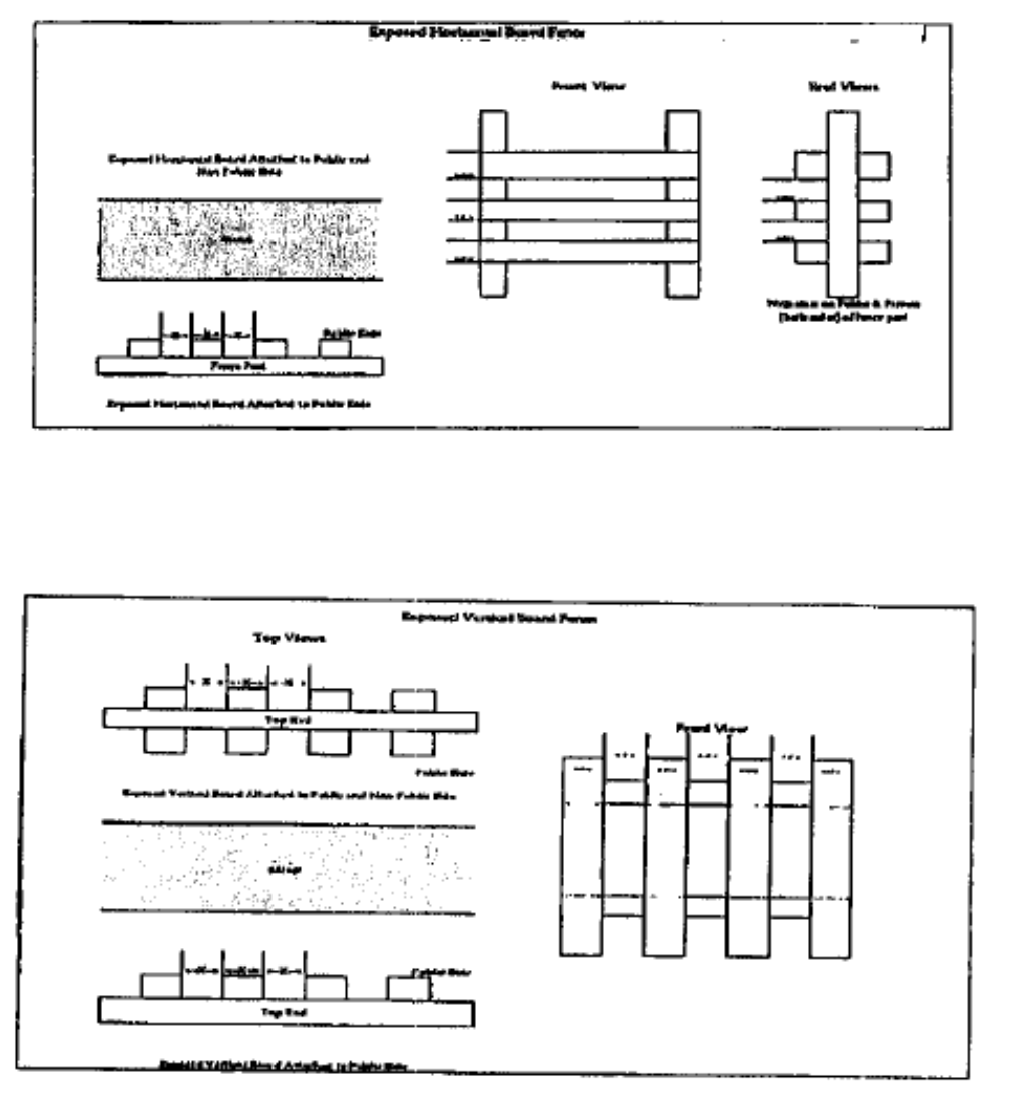
Fence, solid. A fence that is constructed such that every totally exposed horizontal or vertical board attached to the public or non-public side of the fence results in concealing the activities behind it from view of adjoining properties or streets when viewed perpendicular to the plane of the fence.
(c)
Regulations.
(1)
Fences prohibited. Electrically charged, permanent snow, chicken wire, hog and farm type, corrugated metal, plywood or other type of sheet material. Provided however, battery-charged electric fences may be permitted which meet the following requirements and standards:
i.
Unless otherwise specified herein, battery-charged fences shall be constructed or installed in conformance with the specifications set forth in the International Electro Technical Commission (IEC) Standard No. 60335-2-76;
ii.
The energizer for electric fences must be driven by a commercial storage battery not to exceed 12 volts DC. The storage battery is charged primarily by a solar panel. However the solar panel may be augmented by a commercial trickle charger.
iii.
The electric charge produced by the fence upon contact shall not exceed energizer characteristics set forth in paragraph 22.108 and as depicted in Figure 102 of IEC Standard 60335-2-76.
iv.
No electric fence shall be installed or used unless approved by the Village Board of Trustees, and which is completely surrounded by a lawfully permitted non-electrified perimeter fence or wall which is no greater than six feet in height.
v.
Electrical fences shall only be approved by the Village Board of Trustees when located on a non-residential outdoor storage area.
vi.
Electric fences shall have a maximum height of ten feet.
vii.
Electrical fences shall be clearly identified with warning signs visibly posted on the electrical fence which read: "Warning-Electrified Fence." Such warnings shall be securely and safely placed at intervals of not to exceed 30 feet.
viii.
A Knox Box controlling the electrical fence is required and shall be installed according to the standards and at the direction of the Wauconda Fire Protection District.
(2)
Temporary fence. No fence of temporary nature of any type shall be allowed unless approved by the Building Official for use as construction or for life safety requirements.
(3)
Barbed wire fences. Barbed wire fences under eight feet in height are prohibited; except that barbed wire fences being over six feet or more as of the effective date hereof may continue in existence until replaced or removed. Barbed wire fences shall be permitted only if the fence is eight feet or higher and, provided that the barbed wire shall be located on the upper-most point of the fence, shall not exceed 24 inches in height, and provided further that the barbed wire shall be fixed in place with braces which will be slanted at least 45 degrees from the vertical and which slanted braces shall overhang the interior of the property and which are prohibited from overhanging the exterior of the property being fenced.
(4)
Fences, hedges as traffic hazards. No fence or hedge shall be erected, placed, planted or allowed to grow in such a manner as to materially impede vision between a height of two and one-half feet and ten feet above the crown of the street within ten feet of the intersection of the lot lines at the intersection of any street.
(5)
Location along lot lines. A structural fence shall be erected so that the entire fence and all supporting structures are entirely on the owner's property. Fence posts and all other supporting structures as well as the rough side of the fence, if any, shall face the owner's property, except when the fence separates a residential lot from a business or industrial lot. The owner shall be solely responsible for correctly sitting the fence on his property, and no inspection by the Building Department nor any permit issued by the Building Department shall be any evidence or guarantee that the fence has been so correctly located on the subject property.
(6)
Industrial performance standards, see section 155.041(b)(4)(b).
(d)
Standards for fence placement.
(1)
On that portion of the property fronting on a public street, all fences therein shall be open fences and no fence shall exceed 48 inches in maximum height nor extend beyond the property lot line. See the following illustration.
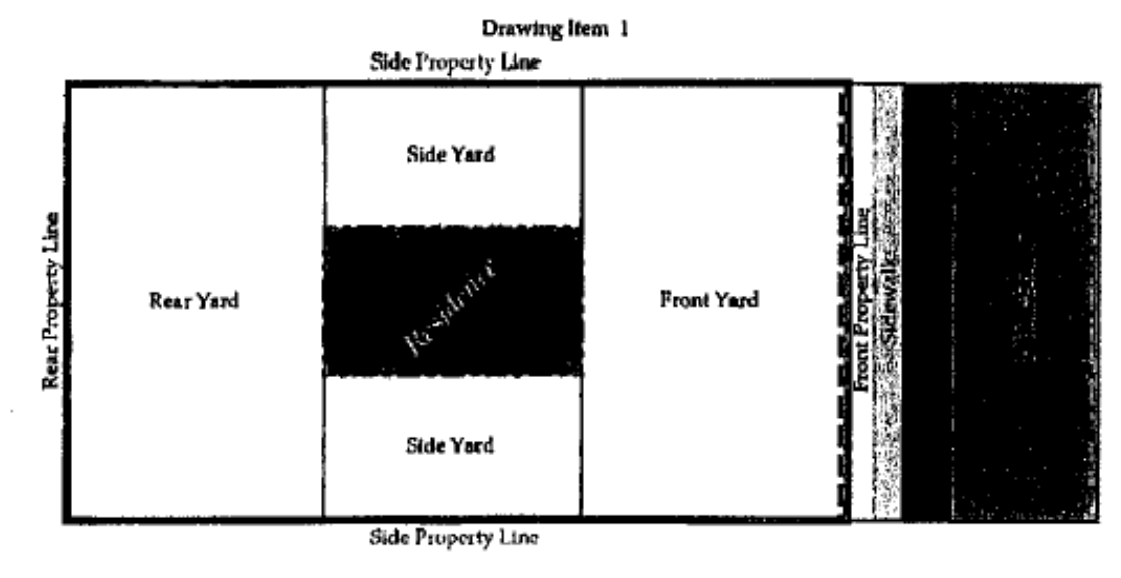
Dashed line represents the fence
(2)
On that portion of the property which constitutes the side of the property and which abuts on a public street, all fences therein shall be open fences and no fence shall exceed 48 inches in maximum height nor extend beyond the property lot line. See the following illustration.
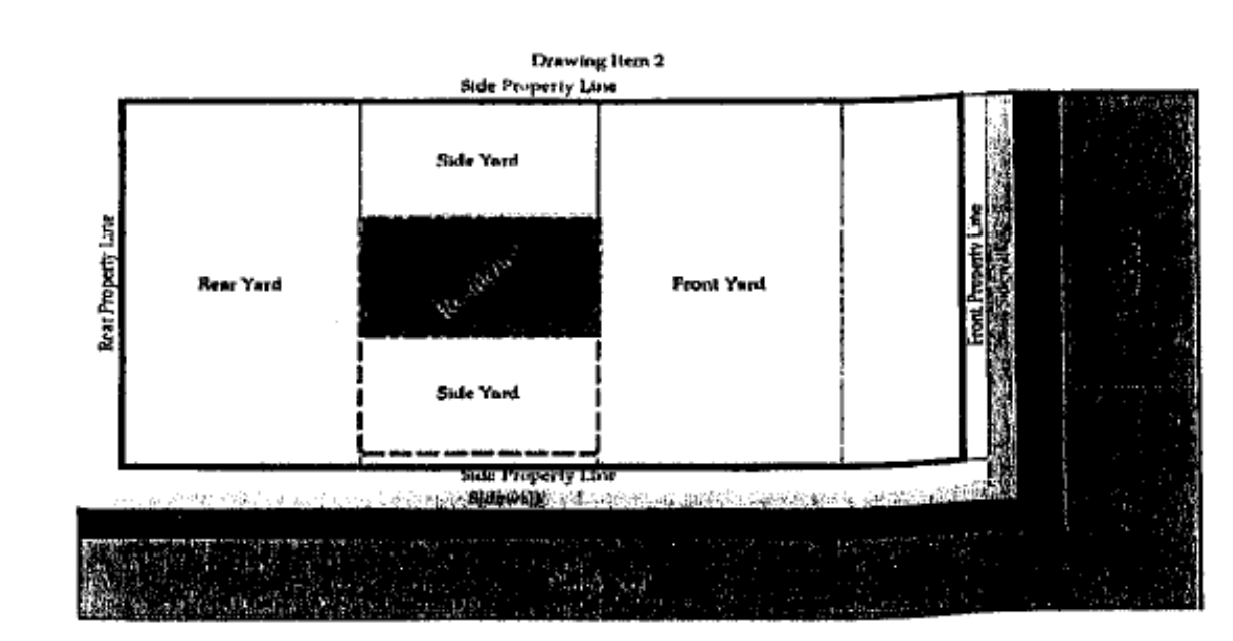
Dashed line represents the fence
(3)
On that portion of the property which constitutes the rear or side of the property, which abuts on private residential property, an open or solid fence may be constructed not to exceed six feet in maximum height and shall not extend beyond the property lot line on either side or to the rear and shall not extend further than that portion of the existing dwelling along either side of the property line that is closest to the fence. See the following illustration.
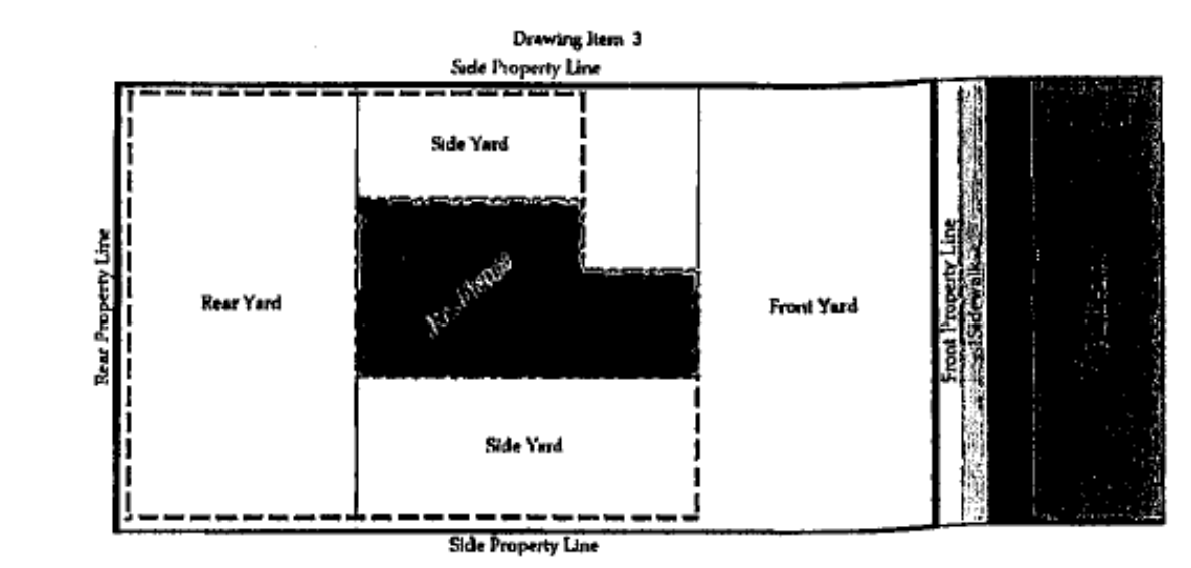
Dashed line represents the fence
(4)
On that portion of the property which constitutes the rear or side of a residential corner lot that abuts a private residential property, fences shall not exceed six feet in maximum height and may be either an open or solid fence; however, no fences shall extend beyond the building line or the front of that portion of any principal building that is closest to the fence on any adjacent lot, whichever is less. See the following illustration.
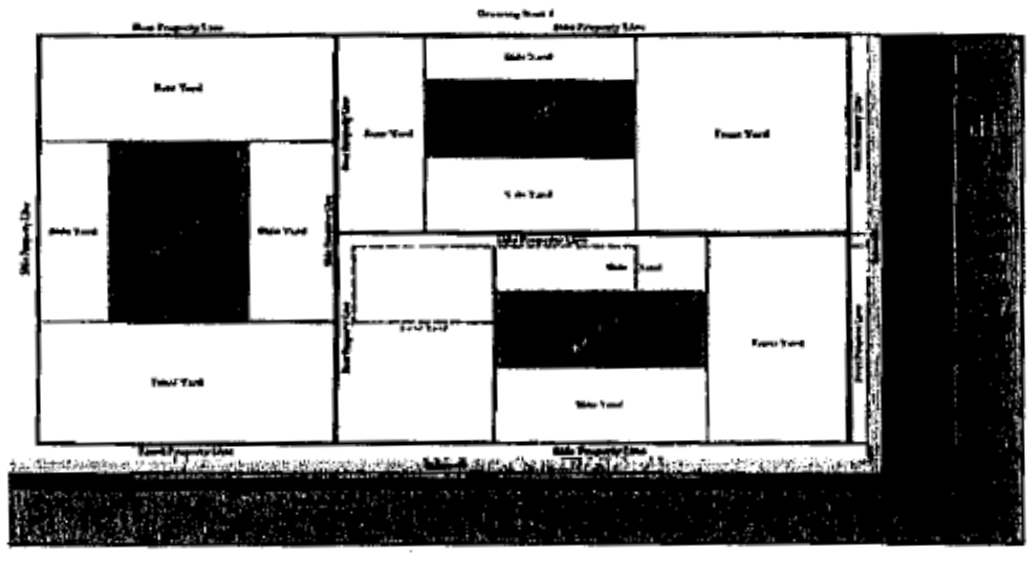
Dashed line represents the fence
(5)
On that portion of the property which constitutes the side of a residential corner lot and which abuts to adjacent private residential property and which extends from the front of the existing adjacent building to the front property line, the fences shall not exceed 48 inches in maximum height and be an open fence. Also that portion of the property which constitutes the rear of the residential corner lot and which abuts to adjacent private residential property and which extends from the front of the existing adjacent building to the side property line, the fence shall not exceed 48 inches in maximum height and be an open fence. See the following illustration.
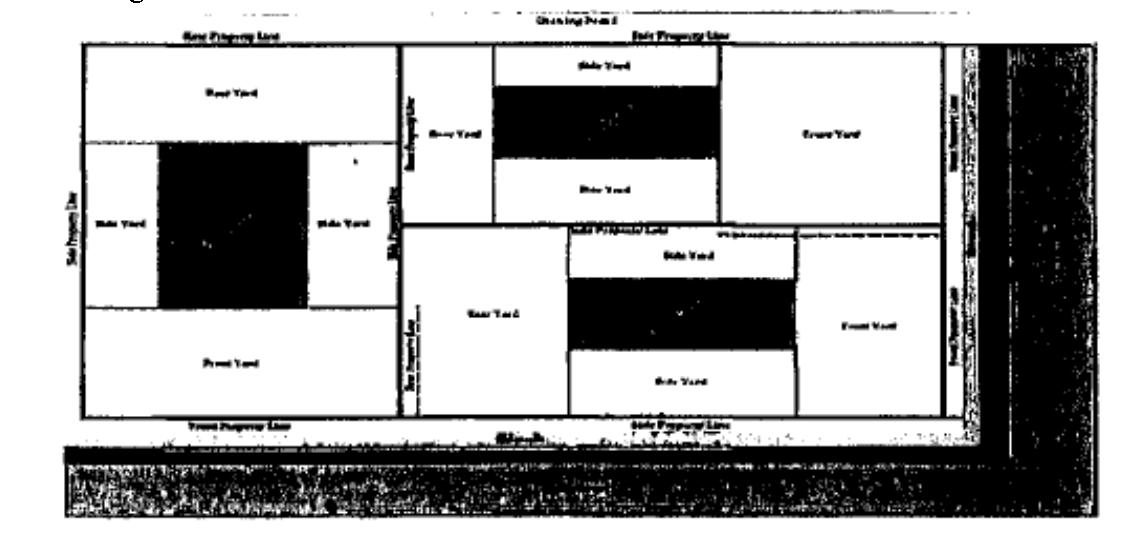
Dashed line represents the fence
(6)
a.
An exception to the above five scenarios is realized when two parallel streets occur with no street between them, and those two streets intersect a single street such that two corner lots are formed and the residential structures on those two corner lots are constructed in such a manner that the rear yards of the two structures are back-to-back.
b.
On that portion of the property which constitutes the rear or sides of a residential corner lot abutting a public street, fences shall not exceed six feet in maximum height and may be either an open or solid fence; however, no fence on the rear or sides may extend beyond the property line and the fence on the sides may not extend beyond the front of the existing building.
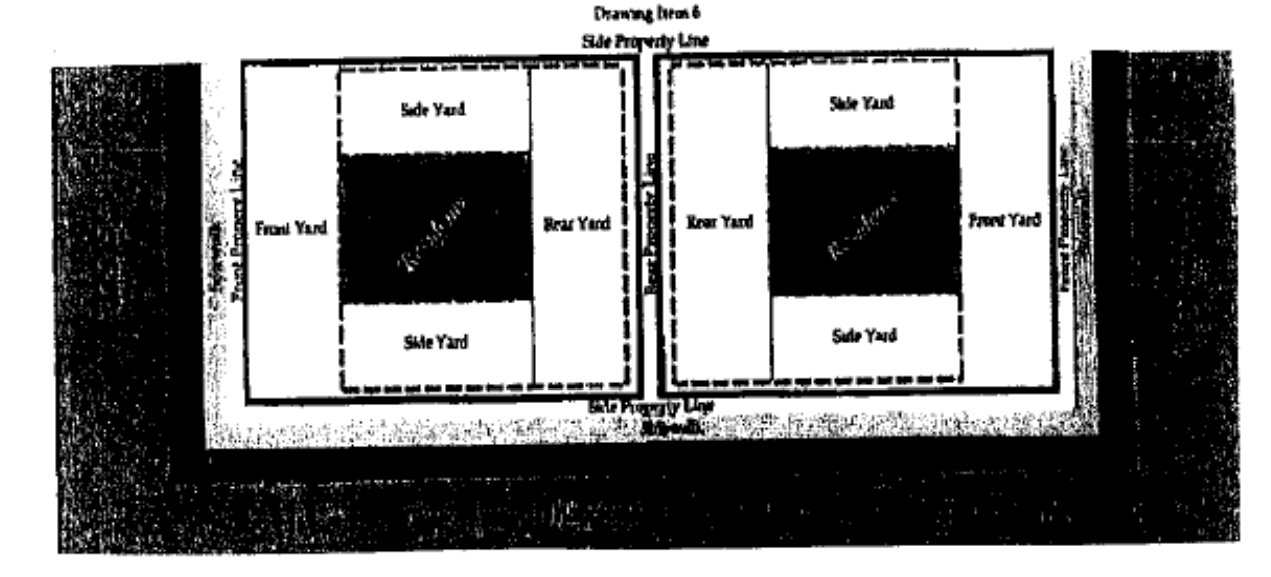
Dashed line represents the fence
(1978 Code, §§ 5-3-14-1—5-3-14-4; Ord. 1995-ZO-29, passed 9-5-1995; Am. Ord. 2009-ZO-44, passed 9-15-2009; Am. Ord. No. 2022-O-02, passed 2-15-2022)
Sec. 155.054. - Tents.
No tent shall be used, erected or maintained as living quarters. Tents used in commercial or industrial zones or tents used for camping purposes wherever permitted shall be of a temporary nature.
(1978 Code, § 5-3-15; Ord. 1969-O-1, passed 1-21-1969)
Sec. 155.055. - Number of buildings per lot.
(a)
In all zoning districts only one principal building and/or principal use shall be permitted on a zoning lot; except, where multiple buildings or uses are planned as part of conditional use permit zoning review and approval or when included as a planned unit development which requires approval of a conditional use permit.
(b)
For zoning lots with more than one principal building or use that were established prior to the date of the passage of this amendatory section (being May 15, 2012) changes in use and occupancy of a building or buildings shall be subject to review by the village Building and Zoning Department followed by a written report to the Village Board. The written report shall note any departures based on pre-existing conditions related to, but not limited to, zoning standards for setbacks, parking, lot coverage and similar zoning standards, as well as building standards such as space between buildings and access for emergency purposes. The Village Board shall review the written report from village staff regarding the building or occupancy permit and at a Village Board meeting shall either direct village staff to issue the requested permit including conditions, if any, or the Village Board shall refer the requested permit to the village Plan Commission/Zoning Board of Appeals for a public hearing for either a zoning variation or conditional use or planned unit development as may be appropriate. After the public hearing the Plan Commission/Zoning Board of Appeals shall forward its findings and recommendations to the Village Board for Village Board action. Any permit request that is forwarded to the Plan Commission/Zoning Board of Appeals by the Village Board will require the applicant to follow all application requirements including setting up and funding an escrow account with the village to secure and cover reimbursement to the village for the reasonable fees of consultants to the village who provide professional consulting services to the village on any matter pertaining to the applicant's petition or for any other action requested by the applicant from the village.
(1978 Code, § 5-3-16; Ord. 1969-O-1, passed 1-21-1969; Am. Ord. 2012-ZO-21, passed 5-15-2012)
Sec. 155.056. - Division of lot.
No recorded lot shall be divided into two or more lots unless such division results in the creation of lots each of which conforms to all of the applicable regulations of the zone in which the property is located. No further reduction in the size of a recorded lot, which would render the lot unable to meet the requirements of this Zoning Code, shall be permitted.
(1978 Code, § 5-3-17; Ord. 1969-O-1, passed 1-21-1969)
Sec. 155.057. - Principal uses without buildings.
Where a permitted use of land involves no structures, the use shall comply with all yard and minimum lot area requirements applicable to the zone in which located.
(1978 Code, § 5-3-18; Ord. 1969-O-1, passed 1-21-1969)
Sec. 155.058. - Adequate access.
Each lot shall have direct access to an improved, approved street.
(1978 Code, § 5-3-19; Ord. 1969-O-1, passed 1-21-1969)
Sec. 155.059. - Adult entertainment advertising prohibition.
(a)
Definition. For purposes of this section, adult entertainment means entertainment provided by an adult bookstore, striptease club, or pornographic movie theatre whose business is the commercial sale, dissemination, or distribution of sexually explicit materials, shows, or other exhibitions.
(b)
Advertising prohibited. It shall be unlawful for any person, partnership, corporation, association or any other entity to construct, erect, place, post or display any permanent or temporary sign, flyer, or other physical advertising medium which displays or advertises adult entertainment within 1,000 feet of the property boundaries of any school, daycare center, cemetery, public park, place of worship or residential district.
(1978 Code, § 5-3-20; Ord. 1998-O-06, passed 3-3-1998)
Sec. 155.060. - Required sewer and water services.
Community sewer and water supply systems are required in all R zones except R1.
(1978 Code, § 5-3-21; Ord. 1969-O-1, passed 1-21-1969)
Sec. 155.061. - Overnight housing, keeping and parking of certain types of vehicles in residential districts prohibited.
(a)
Overnight parking prohibited. The overnight housing, parking and keeping of semitrailers, road tractors, trailers, special mobile equipment, motor carrier vehicles, vehicles licensed with a State Class E or higher alphabetical class plate or with a gross weight, including vehicle and maximum load of 12,001 pounds or more, commercial vehicles, commuter vans, pole trailers and truck-tractors in residential districts or on property located in a residential district located within the village is hereby prohibited.
(b)
Definitions. For the purpose of this section, the following definitions shall apply unless the context clearly indicates or requires a different meaning.
Commercial vehicle. Any vehicle operated for the transportation of persons or property in the furtherance of any commercial or industrial enterprise, for hire or not for hire not including, however, a commuter van or a recreational vehicle not being used commercially.
Commuter van. A motor vehicle having a capacity of 12 or more persons owned or leased by a company or an employee organization and operated on a nonprofit basis with the primary purpose of transporting employees of the company between the employees' homes and the company's place of business or a public transportation station and in which the operation, administrative, maintenance and reasonable depreciation costs are paid principally by the persons utilizing the van.
Motor carrier vehicle. A vehicle used for hire, including, but not limited to, any vehicle, truck, truck-tractor, trailer or semitrailer propelled by mechanical power and used upon the highways of the state in the transportation of property for hire.
Overnight housing, parking or keeping. Actual parking or permission or sufferance for parking of the types of vehicles prohibited above for a period of not less than four continuous hours, which continuous hours occur after the hour of 7:00 p.m. and before the hour of 7:00 a.m. The term overnight housing, parking and keeping includes the location of the prohibited vehicle on driveways, in garages or in any form of shelter, whether completely or partially enclosed or in the public way adjacent to the real property owned or possessed or leased by the owner of the vehicle.
Road tractor. Every motor vehicle designed and used for drawing other vehicles and not so constructed as to carry any load thereon either independently or any part of the weight of a vehicle or load so drawn.
Semitrailer. Every vehicle without motive power, other than a pole trailer, designed for carrying persons or property and for being drawn by a motor vehicle and so constructed that some part of its weight and that of its load rests upon or is carried by another vehicle.
Special mobile equipment. Every vehicle not designed or used primarily for the transportation of persons or property and only incidentally operated or moved over a highway, including, but not limited to: ditch digging apparatus, well-boring apparatus and road construction and maintenance machinery such as asphalt spreaders, bituminous mixers, bucket loaders, tractors other than trucktractors, ditchers, leveling graders, finishing machines, motor graders, road rollers, scarifiers, earth moving carryalls and scrapers, power shovels and drag lines, and self-propelled cranes and earth moving equipment. The term does not include house trailers, dump trucks, truck mounted transit mixers, cranes or shovels, or other vehicles designed for the transportation of persons or property to which machinery has been attached.
Trailer. Every vehicle without motive power in operation, other than a pole trailer, designed for carrying persons or property and for being drawn by a motor vehicle and so constructed that no part of its weight rests upon the towing vehicle.
Truck-tractor. Every motor vehicle designed and used primarily for drawing other vehicles and not so constructed as to carry a load other than a part of the weight of the vehicle and load so drawn.
Vehicles licensed with a State of Illinois class e or higher alphabetical class plate or with a gross weight including vehicle and maximum load of twelve thousand one pounds or more. A vehicle so licensed by the state or as licensed by the laws of another state having a gross weight, including vehicle and maximum load of 12,001 pounds or more.
(c)
Exemptions. Nothing in the foregoing sections shall be construed to prohibit the overnight parking of large vehicles used in connection with the moving of household furnishings and furniture; provided, that those vehicles are at that time in the course of loading or unloading household goods in the course of a household move, nor shall any of the above language be construed to prohibit the keeping, parking or housing of recreational vehicles in or on property in residential districts providing that this exemption only applies if no person occupies the recreational vehicle overnight for the prohibited period; except in the case of visiting recreational vehicle owners who are nonresidents of the village whose visiting has been registered with the Building Inspector of the village and whose exemption from the provisions of this section shall not exceed 14 consecutive days.
(d)
Amortization schedule. Any use of real estate to house, park or keep overnight the vehicles described above shall terminate 12 months from the effective date of this section. It is intended by this clause that every use of the property described above which has become a legal nonconforming use by the adoption of this section shall be terminated and removed within the 12 month period. After the expiration of the 12 month period and existing nonconforming uses shall no longer be legal but shall have become illegal and subject to removal and legal process in accordance with law.
(1978 Code, §§ 5-3-22-1, 5-3-22-3, 5-3-22-4; Ord. 1979-O-32, passed 11-6-1979)
Sec. 155.062. - Wind energy systems.
Reserved.
Sec. 155.062.1. - Purpose and intent.
(a)
To establish reasonable and uniform regulations for the location, installation, operation, maintenance and decommissioning of building-mounted and free-standing wind energy systems.
(b)
To prohibit the location of large wind farms and utility wind energy systems within the village limits and within a 1.5 miles radius of the village.
(c)
To assure that any development and production of wind-generated electricity in the village is safe and to minimize any potentially adverse effects on the community and adjacent property.
(d)
Preserve the aesthetics of areas of the village in the interest of maintaining property values, public health and welfare.
(e)
To facilitate energy cost savings and economic opportunities for the village residents and businesses.
(f)
To promote the supply of sustainable and renewable energy resources, in support of national, state and local goals.
(Ord. 2012-ZO-01, passed 1-3-2012)
Sec. 155.062.2. - Definitions.
In addition to those terms defined in § 155.002, the following definitions are applicable to sections 155.062.1 through 155.062.7.
Abandonment. Any WES that has not been repaired to operating condition within 90 days of notification from the village, as provided in sections 155.062.1 through 155.062.7.
Ambient sound. The all-encompassing sound at a given location, usually a composite of sounds from many sources near and far. For the purpose of sections 155.062.1 through 155.062.7, the ambient sound level shall mean the quiescent background level, that is, the quietest of ten 10-second average sound levels measured when there are no nearby or distinctly audible sound sources (e.g., dogs, cars in line-of-sight, or jets). Daytime ambient measurements should be made during mid-morning, weekday hours while nighttime measurements should be made after midnight.
Applicant. The owner who is in the process of submitting or has submitted an application to install a WES project in the village.
Building-mounted wind energy systems (BWES). WES that are structurally attached either onto the roof of or to the side of a building and meet the height and setback requirements of sections 155.062.1 through 155.062.7.
Daytime hours. The hours of the day from 7:00 a.m. to 10:00 p.m., local time.
Decibel (dB). The unit of sound level based on a reference where zero dB represents the threshold of hearing at 1000 Hz for a healthy young adult.
Decommissioning. Once a WES has been deemed inoperable or abandoned its components must be disassembled and removed from the premises, including the foundation. Upon removal, the site shall be restored to its original pre-construction condition.
FAA. The Federal Aviation Administration of the United States Department of Transportation or any successor agency thereto.
FCC. The Federal Communications Commission or any successor agency thereto.
Financial assurance. A reasonable assurance from a credit worthy party, examples of which include a surety bond, trust instrument, cash escrow, or irrevocable letter of credit.
Free-standing wind energy systems (FWES). An FWES is monopole tower-mounted WES with a system height measuring 60 feet or less from the ground, subject to setbacks established within sections 155.062.1 through 155.062.7. FWES facilities are accessory structures that generate power for local distribution and consumption. Generators typically range from 1 kW to 100 kW in nameplate wattage.
Grid-intertie WES system. A system that converts wind energy to electrical energy that is connected to an electric circuit served by an electric utility company.
Horizontal axis wind turbine (HAWT). This is the most typical type of turbine used. They have the main rotor shaft and generator at the top of the tower, and must be pointed into the wind. Small turbines are pointed by a simple wind vane, while large turbines generally use a wind sensor coupled with a servo motor. Most have a gearbox, which turns the slow rotation of the blades into a quicker rotation that is more suitable to drive an electrical generator.
IDNR. The Illinois State Department of Natural Resources or any successor agency thereto.
MET tower. A meteorological tower with an anemometer, used for the measurement of wind speed.
Nacelle. The part containing the shaft, gear box, and generator in a typical horizontal axis turbine.
Nameplate wattage. The amount of energy produced from a WES at a maximum or optimum wind speeds within one hour, as indicated by the manufacturer.
Neighboring property. Any property within 250 feet of a WES.
Nighttime hours. The time of the day after 10:00 p.m. until 7:00 a.m., local time.
Noise. Sound that adversely affects the psychological or physiological well-being of people.
Nonparticipating property. A property that is not owned by the owner of the property on which the WES is proposed or installed.
Operational condition. WES facilities being capable of operating at full capacity while meeting all sound, shadow flicker and other permit conditions.
Operator. The entity responsible for the day-to-day operation and maintenance of the WES, including any third party subcontractors.
Owner. The person(s), or any other legal entity, who hold(s) title of the property on which a WES facility is installed.
Participating property. A property that is owned by the owner of the property on which the WES is proposed or installed.
Professional engineer. A qualified individual who is licensed as a professional engineer in the State of Illinois.
Shadow flicker. The on and off strobe light effect caused by the shadow of moving blades cast by the sun passing above the turbine. Shadow flicker intensity is defined as the difference or variation in brightness at a given location in the presence and absence of a shadow.
Silhouette. The area covered by moving blades of a WES turbine, as viewed from the front elevation, described in square feet.
Sound. A disturbance or oscillation that propagates outwardly as acoustic waves through the air.
Sound frequency. The number of oscillations per second expressed in hertz (Hz). How we perceive sound is partly dependent on frequency. High frequency sound has more oscillations per second, whereas low frequency sound has fewer. The following are four types of sound frequencies:
(1)
Audible or tonal sound. Sound frequencies between 20-20,000 Hz. With WES, this may include mechanical sounds from rotating machinery experienced as "hum" or "pitch" occurring at distinct frequencies.
(2)
Broadband. A wide range of frequencies above 100 Hz. With WES, the aerodynamics from the displacement of air from the turning blades of a wind turbine creates a "swishing" or "whooshing" sensation.
(3)
Low-frequency. Sound with frequencies below 100 Hz, including audible sound and infrasound.
(4)
Infrasound. Sound frequencies below 20 Hz, which if sufficiently intense, can be perceived by many individuals.
Sound level. The A-weighted sound pressure level in decibels (dB)(or the C-weighted level if specified) as measured using a sound level meter that meets the requirements of a Type 2 or better precision instrument according to ANSI S1.4. The "average" sound level is time-averaged over a suitable period (say one minute) using an integrating sound level meter that meets the requirements of ANSI S12.43.
Structural engineer. An engineer who is licensed and registered to practice structural engineering under the Illinois Structural Engineering Act and whose principal professional practice is in the field of structural engineering.
Structural weight. The combined weight of the tower, wind turbine generator and any other component(s) otherwise supported by the base foundation.
Substation. The apparatus that connects the electrical collection system of the WES facilities and increases the voltage for connection with the utility's transmission lines.
Sun glint. The reflection of sunlight off of a surface of the blades, tower or other component of the WES.
System height. The distance from the ground to the highest point of the WES, including the highest reach of the blades.
Tower. The structure on which the WES is mounted.
Turbine. The parts of a WES including the blades, nacelle and tail.
Utility wind energy system (UWES). A UWES is a free-standing wind energy system (FWES) that is used to produce energy primarily for commercial distribution to a local utility and includes WES of greater than 60 feet in height. A UWES does not include a wind energy system where the primary use is for on-site energy consumption and where the FWES is 60 feet or less in height. A UWES is also referred to as a "wind farm" where the principal use consists of one or more WES producing energy for distribution to a local utility.
Vertical axis wind turbine (VAWT). A small scale wind turbine in which the main rotor shaft is arranged vertically creating an "egg beater" appearance. The generator and gearbox are located near the ground so the tower does not have to support it and it is more accessible for maintenance.
WATT. (Symbol: W) A derived unit of power in the International System of Units (SI). It measures rate of energy conversion. One watt is equivalent to one joule (J) of energy per second. The kilowatt (symbol: kW) is equal to 1,000 watts. The megawatt (symbol: MW) is equal to 1,000,000 watts.
Wind energy system (WES). A wind energy production, conversion and distribution system consisting of a wind turbine, tower, and associated electronics equipment. In other publications this is known as wind energy conversion system (WECS).
(Ord. 2012-ZO-01, passed 1-3-2012)
Sec. 155.062.3. - General requirements for wind energy systems (WES).
Wind energy systems, including building-mounted (BWES) and free-standing (FWES), may be erected or installed only in accordance with this section of the village zoning ordinance and conform to all state and federal laws and regulation, as amended from time to time, concerning its use and operation, and shall be further subject to the following standards:
(a)
Accessory use:
(1)
WES shall only be permitted as an accessory use to a principal use and structure and installed primarily for the production and consumption of energy on the parcel upon which it is installed;
(2)
WES facilities shall not be constructed for the sole purpose of energy production for wholesale or retail sale purposes; it is permissible to sell excess energy that is produced by a WES to the local electric utility company.
(b)
Installation and number of WES:
(1)
One WES is permitted and shall be installed according to manufacturer specifications and in accordance with all applicable village codes and ordinances.
(2)
More than one WES may be permitted subject to the owner applying for and receiving a conditional use permit from the Village Board pursuant to standards for conditional uses of the village zoning ordinance and the standards of sections 155.062.1 through 155.062.7.
(c)
Wind velocity: WES facilities shall be designed to withstand a minimum wind velocity of 100 miles per hour, with an impact pressure of 40 pounds per square foot.
(d)
Industry standards: WES shall conform to applicable industry standards, including those of the American National Standards Institute (ANSI). Applicants shall submit certificates of design compliance that equipment manufacturers have obtained from Underwriters Laboratories (UL), National Renewable Energy Laboratories (NREL), Det Norske Veritas (DNV), Germanischer Lloyd Wind Energie (GL) or an equivalent third party.
(e)
Braking systems: WES facilities shall be equipped with an automatic and manual braking system.
(f)
Cessation of operation: The owner shall be required to immediately cease operations in the event the WES is found to be in violation of village ordinances or codes, or in the event the WES is damaged and constitutes a health and safety hazard as determined by the Village Administrator.
(g)
Tree protection: No tree(s) shall be removed to facilitate a WES performance, unless warranted for good forestry practices, as determined by the Village Arborist.
(h)
Insurance: Proof of homeowner or business liability insurance as appropriate for a WES shall be provided at such time as the WES becomes operational and such liability insurance shall be maintained during the time the WES remains in place. The applicant, when requested, shall also show that liability coverage exists for the ownership and operation of the power generating facilities.
(i)
Electrical wiring: Wiring between a WES and the principal structure shall be underground; however, if the wiring cannot be placed underground it shall be contained within conduit which matches the principal building and shall conform to all village codes.
(j)
Sound levels:
(1)
For adjacent nonparticipating properties used or zoned for residential purposes the average sound level from a WES shall not exceed 55 dB(A) during daytime hours or 45 dB(A) during nighttime hours as measured at the property line.
(2)
For adjacent nonparticipating industrial zoned properties the sound level limit is 65 dB(A) and for other neighboring nonresidential properties, the sound level limit is 60 dB(A) at any time of the day as measured at the property line.
(3)
No WES shall operate with an average sound level more than five dB(A) above the non-operational ambient level, as measured at the property line within any neighboring residentially zoned or used property.
(4)
To limit the level of low-frequency sound, the average C-weighted sound level during WES operation shall not exceed the A-weighted ambient sound level by more than 20 dB.
(5)
Sound level meters used for sound measurement must be a Type 2 or better grade per ANSI S1.4 and must have an integrating feature that meets ANSI SI.43. Procedures must meet the applicable portions of ANSI S12.9. Measurements must be made when ground level winds do not exceed five mph.
(6)
The village may require, at the owner's expense, field tests or sound propagation modeling, conducted or supervised by an acoustics specialist certified by the Institute of Noise Control Engineering as may be necessary, to determine whether a violation of said sound regulations is occurring or has occurred. The owner shall promptly remedy any such violations or discontinue operation.
(k)
Shadow flicker:
(1)
The WES facility shall be sited such that shadow flicker will not fall on any existing residential building of a non-participating property within 500 feet of the WES property for more than one hour a day.
(2)
The applicant may commit to a schedule for turning WES turbines off during periods when shadow flicker would affect any nonparticipating residential dwelling.
(3)
Subsequently constructed or modified residences shall not compromise the existing approval and operation of the WES as a legal non-conforming use, subject to the applicable village regulations.
(l)
Color and sun glint:
(1)
WES facilities shall be finished in either off-white, light gray, other neutral color, or a color as approved by the Village Administrator or designated person.
(2)
The finish shall be flat or matte so as to reduce incidence of sun glint.
(3)
The required coloration and finish shall be maintained throughout the life of the system.
(m)
Electronic interference: WES facilities shall not operate so as to cause electromagnetic degradation in performance of microwave, television, radio, internet or other wireless transmissions, including public emergency communications systems, contrary to FCC or other state or local laws.
(n)
Signage:
(1)
No WES shall have any advertising material, writing, picture or signage other than a warning, turbine tower identification or manufacturer or ownership information.
(2)
This prohibition shall include the attachment of any flag, decorative sign, streamers, pennants, ribbons, spinners or waving, fluttering or revolving devices, but not including meteorological/weather devices.
(3)
One warning sign, no less than 18 square inches and no greater than two square feet in area, shall be posted at the base of the tower. The sign shall include a notice of no trespassing, a warning of high voltage and 911 and the phone number of the owner to call in case of emergency.
(4)
Manufacturer's identification or ownership information signs shall be no larger than one square foot.
(o)
Climbing prevention: The base of the WES tower shall not be climbable unless enclosed with a six-foot tall locked fence.
(p)
Lighting:
(1)
WES facilities shall not be artificially lighted unless required by the FAA or appropriate authority.
(2)
Any required lighting shall be shielded so that no glare extends beyond the boundaries of the facility.
(q)
Aquatic resource setbacks: WES facilities may not be constructed within 50 feet of a lake, body of water or wetland and shall be subject to the village storm water management ordinance setbacks, where applicable.
(r)
Maintenance and complaints:
(1)
WES facilities shall be maintained in operational condition at all times, except for reasonable maintenance and repair outages, pursuant to manufacturer's standards.
(2)
Should a WES become inoperable, or should any part of the WES become damaged, or should a WES violate a permit condition, the owner shall cease operations immediately and remedy the condition promptly.
(s)
Decommissioning plan:
(1)
Any WES that has not been in an operable condition for 90 days or more, the Village Administrator shall notify the owner of a finding of abandonment. The owner shall remove all WES structures within 90 days of receipt of notice.
(2)
If such abandoned facility is not removed within 90 days, the village shall notify the owner by certified letter that they are in violation of sections 155.062.1 through 155.062.7 and are subject to fine, as established by sections 155.062.1 through 155.062.7.
(3)
Upon removal, the site shall be restored to its original pre-construction condition as depicted in the photos presented with project proposal.
(t)
Building permit application requirements: The following information shall be provided at a minimum when requests are made for a building permit to construct a WES.
(1)
Project proposal, including:
(a)
Name, address and phone number of owner and applicant.
(b)
Photos of existing conditions and buildings for proposed WES.
(c)
Project summary including the manufacturer's information and proposed height to the top of the turbine as measured from the ground or the highest point of a roof.
(2)
Property survey, drawn to scale, including:
(a)
Existing and proposed contours, at a minimum of two-foot intervals.
(b)
Location, setbacks, exterior dimensions and square footage of all structures on the owner's property and abutting properties within 100 feet.
(c)
Location and size of existing waterways, wetlands, 100-year floodplains, sanitary sewers, storm sewer systems and water distribution systems.
(d)
Location of any overhead or underground power lines and utility easements.
(e)
The locations and the expected duration of shadow flicker caused by the WES facility.
(3)
Engineering including:
(a)
Manufacturer's engineering specifications of the tower, turbine and foundation, detailed drawing of electrical components and installation details and expected sound level production.
(b)
For turbines greater than 20 kilowatts of nameplate capacity, an Illinois licensed structural engineer's seal shall be required.
(c)
Support data to establish that minimum wind velocity of 100 miles per hour, with an impact pressure of 40 pounds per square foot are provided.
(d)
Certificates of design compliance that equipment manufacturers have obtained from Underwriters Laboratories (UL), National Renewable Energy Laboratories (NREL), Det Norske Veritas (DNV), Germanischer Lloyd Wind Energie (GL) or an equivalent third party.
(4)
Certificate of compliance: A certificate of compliance on a form approved by the Village Administrator shall be signed and provided by the owner upon completion of the installation.
(Ord. 2012-ZO-01, passed 1-3-2012)
Sec. 155.062.4. - Additional requirements for building-mounted wind energy systems (BWES).
(a)
Installation: BWES facilities may be structurally attached either on the roof or on the side of a principal building in accordance with the village building codes and manufacturer recommendations when such principal building is located on a zoning lot with a minimum lot area of 22,000 square feet or greater.
(b)
Zoning: BWES facilities may be permitted within all zoning districts provided that the device complies with the requirements of § 155.062.3 and the codes of the village and any applicable state and federal regulations.
(c)
Maximum height: BWES facilities shall be allowed at the height of 15 feet above the highest point of the building structure, but in no case shall the BWES exceed 35 feet above the ground in a residentially zoned district.
(d)
Setbacks: No portion of the BWES facility shall be located closer to the property line than the principal building, and BWES shall not be attached on the roof or side of a building facing a street.
(Ord. 2012-ZO-01, passed 1-3-2012)
Sec. 155.062.5. - Additional requirements for free-standing wind energy systems (FWES).
(a)
Installation: FWES shall be mounted on a monopole tower and located on a zoning lot greater than 22,000 square feet. Towers requiring guy wires shall be prohibited. FWES may be combined with site lighting provided other requirements of sections 155.062.1 through 155.062.7 have been met.
(b)
Zoning: FWES facilities may be permitted within all zoning districts provided that the device complies with the requirements of § 155.062.3 and the codes of the village.
(c)
Maximum height:
(1)
FWES facilities shall be allowed at the height of 35 feet above the ground in residential and CR zoning districts.
(2)
FWES facilities shall be allowed at the height of 60 feet in the other non-residential zoning districts.
(3)
FWES facilities of a height greater than 60 feet shall be prohibited within the village and within 1.5 miles of the village.
(4)
The blade tip of an FWES, at its lowest point, shall have ground clearance of not less than 15 feet.
(d)
Setbacks:
(1)
An FWES facility shall be setback a minimum of 110 percent, or 1.1 times the system's height, from the system base to all property lines, third party transmission lines and communications towers.
(2)
FWES facilities may not be constructed within or over (including the blades) any utility, water, sewer or other type of recorded easement.
(3)
FWES facilities shall not be placed in any front or corner side yard or any yard area located between the facade of a building and a street where the building is setback a greater distance than the required yard setback. See Setback Illustration below.
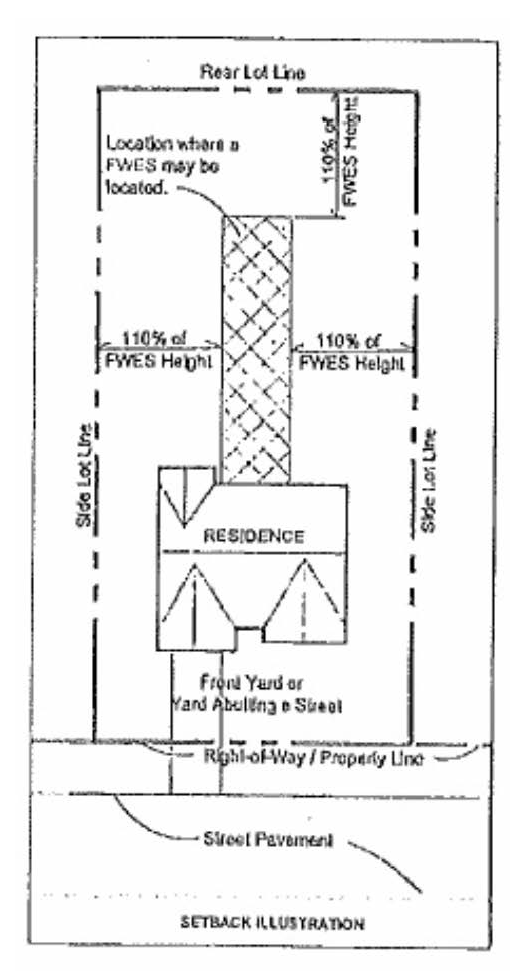
(Ord. 2012-ZO-01, passed 1-3-2012)
Sec. 155.062.6. - Utility wind energy systems (UWES).
Utility wind energy systems (UWES) shall be prohibited within the Village of Wauconda and within 1.5 miles of the village limits.
(Ord. 2012-ZO-01, passed 1-3-2012)
Sec. 155.062.7. - Penalty.
Any person who violates, disobeys, omits, neglects or fails or refuses to comply with or who resists the enforcement of any provision of this Zoning Code shall be fined as set forth in section 10.99 for each offense. Each day that a violation is permitted to exist and continue shall constitute a separate offense hereunder.
(Ord. 2012-ZO-01, passed 1-3-2012)
Sec. 155.063. - Solar energy systems.
[Reserved.]
Sec. 155.063.1. - Purpose and intent.
(a)
To establish reasonable and uniform regulations for the location, installation, operation and maintenance of solar energy systems.
(b)
To assure that any development and production of solar energy systems is safe and to minimize any potentially adverse effects on the community and adjacent properties.
(c)
To facilitate energy cost savings and economic opportunities for residents and businesses situated within the Village of Wauconda.
(d)
To promote the supply of sustainable and renewable energy resources, in support of national, state and local goals.
(Ord. 2012-ZO-01, passed 1-3-2012; Am. Ord. 2018-O-31, passed 10-16-2018)
Sec. 155.063.2. - Definitions.
For purposes of sections 155.063.1 through 155.063.7, the following definitions shall apply unless the context clearly indicates or requires a different meaning.
Building-integrated solar energy system. A structure that is part of a solar energy system that is an integral part of a principal or accessory building, rather than a separate mechanical device, replacing or substituting for an architectural or structural part of the building.
Building-integrated systems include, but are not limited to, photovoltaic or hot water systems that are contained within roofing materials, windows, skylights, external shading devices and similar architectural components.
Building-mounted solar energy system. A structure that is part of a solar energy system that is mounted on the facade or roof of either a principal or accessory structure.
Ground-mounted solar energy system. A structure that is part of a solar energy system not attached to another structure and is ground mounted.
Photovoltaic cell. A semiconductor device that converts solar energy into electricity.
Roof-mounted solar energy system. A structure that is part of a solar energy system that is mounted on a roof, that is parallel with the roof pitch, at no more than eight inches in height above the surface of the roof.
Solar energy system. A system for which the primary purpose is to convert solar energy into thermal, mechanical or electrical energy for storage or use.
Solar panel. A group of photovoltaic cells assembled on a panel.
Utility solar energy system. A solar energy system that is used to produce energy primarily for commercial distribution to a local utility. A utility solar energy system does not include a solar energy system where the primary use is for on-site energy consumption.
(Ord. 2012-ZO-01, passed 1-3-2012; Am. Ord. 2018-O-31, passed 10-16-2018)
Sec. 155.063.3. - Indemnification.
The owner of the solar energy system project shall defend, indemnify and hold harmless the Village of Wauconda and their officials from and against any and all claims, demands, losses, suits, causes of action, damages, injuries, costs, expenses and liabilities whatsoever including attorney's fees arising out of the acts or omissions of the owner concerning the operation of the solar energy system project without limitation, whether said liability is premised on contract or on tort.
(Ord. 2012-ZO-01, passed 1-3-2012; Am. Ord. 2018-O-31, passed 10-16-2018)
Sec. 155.063.4. - General requirements for solar energy systems.
(a)
Zoning: Solar energy systems are permitted in any zoning district, with the exception of utility solar energy systems, provided that all building permit requirements and general regulations are met including the Building Code, Zoning Code and the requirements referenced herein.
(b)
Accessory use: The primary purpose of solar energy systems shall be to produce energy to support the permitted use(s) on the property, with the exception of utility solar energy systems.
(c)
Sale of surplus power: It is permissible to sell excess energy that is produced by a solar energy system to the local electric utility company in accordance with all applicable federal, state and local laws and regulations.
(d)
Industry standards: Each system shall conform to applicable industry standards including those of the American National Standards Institute (ANSI), Underwriters Laboratories (UL), the American Society for Testing and Materials (ASTM), and Institute of Electrical and Electronics Engineers (IEEE).
(e)
Building permit requirement: No system shall be constructed or installed without first obtaining a municipal building permit.
(f)
Building permit application requirements:
(1)
An application for permit for all solar energy systems shall contain the following information:
a.
Name, address and telephone number of the applicant.
b.
Name, address and telephone number of the person, firm or corporation constructing and installing the solar energy system.
c.
Elevation drawing(s) (and/or photographs) and site plan showing location, size and design details of proposed system(s).
d.
Manufacturer specifications of the solar collectors and devices including: wattage capacity, dimensions of collectors, mounting mechanisms and/or foundation details and structural requirements.
e.
For a roof mounted system, plans identifying the existing roof structure, the solar panels, and the anchorage details, as well as dimensions of the installation components, along with setbacks from the edge of the roof.
f.
A certificate of compliance demonstrating that the system has been tested and approved by Underwriters Laboratories (UL) or other approved independent testing agency.
g.
Written consent of the owner of the building structure or land on which the solar energy system is to be erected.
h.
Any other information to show full compliance with this and other applicable ordinances.
i.
Structural plans of proposed installations must be prepared, signed and sealed by an Illinois licensed architect, or structural engineer.
(g)
Compliance with Building Codes: Solar energy systems must comply with the 2015 International Building Code, Chapter 15; 2015 International Residential Code, Chapters 9 and 23; 2014 National Electric Code, Article 690; and all other applicable building codes.
(Ord. 2012-ZO-01, passed 1-3-2012; Am. Ord. 2018-O-31, passed 10-16-2018)
Sec. 155.063.5. - Additional requirements for building-mounted solar energy systems.
(a)
Location and setbacks:
(1)
Building-mounted solar energy systems are allowed on permitted principal and accessory structures in any zoning district.
(2)
Only building-integrated, and/or roof mounted solar energy systems shall be used when installed on any street, yard, building elevation, or facade.
(3)
Solar energy systems shall not extend beyond any existing roof line, the building facade of the building on which the system is mounted or built and shall be parallel to the surface on which it is constructed.
(4)
All setback requirements shall apply, as regulated by the respective zoning district.
(b)
Height:
(1)
Building-mounted and roof mounted solar energy systems shall not extend more than eight inches above the surface of a pitched roof.
(2)
Building-mounted solar energy systems shall not extend more than five feet above the height of a flat roof, and provided the maximum height in the respective zoning district is not exceeded.
(Ord. 2012-ZO-01, passed 1-3-2012; Am. Ord. 2018-O-31, passed 10-16-2018)
Sec. 155.063.6. - Additional requirements for ground-mounted solar energy systems.
(a)
Location and setbacks:
(1)
In residential zoning districts, systems shall not be located in any front yard or corner side yard or beyond the line of the building facade when the building or portion of a building is setback a greater distance than the minimum building setback for the respective zoning district.
(2)
In all zoning districts, systems shall comply with the respective setback requirements, as measured from the property line to the closest edge of the system.
(b)
Lot coverage: The total solar panel surface area shall be included in the lot coverage calculations for the respective zoning district.
(c)
Height: The total height shall not exceed the height limits for accessory structures in the respective zoning district, as measured from adjoining grade at the base of the solar energy system to the highest point of the solar energy system.
(d)
Additional application requirements: In addition to the building permit requirements of section 155.063.4.
(e)
The following additional information shall be provided:
(1)
Site plan:
a.
Existing and proposed contours, at a minimum of two foot intervals.
b.
Location, setbacks, exterior dimensions and square footage of all existing and proposed structures.
c.
Location and size of existing waterways, wetlands, 100-year floodplains, sanitary sewers, storm sewers, drain tiles and water distribution systems.
d.
Location of any overhead or underground utilities and easements.
(Ord. 2012-ZO-01, passed 1-3-2012; Am. Ord. 2018-O-31, passed 10-16-2018)
Sec. 155.063.7. - Utility solar energy systems.
(a)
Principal use: Utility solar energy systems may be allowed as a principal use on a lot in the LI Zoning District subject to the issuance of a conditional use permit, provided that all building permit requirements and general regulations are met, as defined in the Village of Wauconda Building and Zoning Codes. Utility solar energy systems are not permitted on lots in any other of the village's zoning districts.
(b)
Setbacks: Utility solar energy systems shall comply with the principal building setback requirements of the respective zoning district.
(c)
Lot coverage: The total solar panel surface area shall be included in the lot coverage calculations for the respective zoning district.
(d)
Height: Shall not exceed 20 feet in height measured from adjoining grade at base to the highest elevation of the equipment.
(e)
Fencing: Systems shall be enclosed with an approved fence that restricts direct access to the public. Such fencing shall, at a minimum, encompass the entire systems facility, contain a locking mechanism, and be subject to the fence regulations of the zoning ordinance.
(f)
Additional application requirements: In addition to the building permit requirements of section 155.063.4(e) the following additional information shall be provided:
(1)
Site plan:
a.
Existing and proposed contours, at a minimum of two-foot intervals.
b.
Location, setbacks, exterior dimensions and square footage of all existing and proposed structures.
c.
Location and size of existing waterways, wetlands, 100-year floodplains, sanitary sewers, storm sewers, drain tiles and water distribution systems.
d.
Location of any overhead or underground utilities and easements.
(2)
Engineering plans in compliance with the storm water management ordinance.
(g)
Exempted solar energy systems: Solar energy systems used to generate electricity for stand-alone light fixtures including street lights, area lights and regulatory signs shall be exempt from the requirements of sections 155.063.1 through 155.063.7.
(Ord. 2012-ZO-01, passed 1-3-2012; Am. Ord. 2018-O-31, passed 10-16-2018)
Sec. 155.064. - Retail business (RB) zoning district established.
(a)
Retail Business (RB) zoning district; purpose. The purpose of the Retail Business district is to facilitate opportunities for the blending of pedestrian-friendly development that may include a mix of land uses including: retail, office, or service uses on the first floor and possible offices and/or residential uses on multiple floors above. Developments are encouraged to create a community atmosphere with character which includes: street furniture, wide sidewalks, public meeting spaces, ornamental lighting and landscape. The RB district is intended to accomplish these goals through the regulation of uses, lot and bulk standards, development guidelines, and environmental standards conducive to areas along Route 12, Route 176, Main Street and Barrington Road.
(b)
Permitted uses. Only those uses located in a building with a floor area of 10,000 square feet or less that are, specifically listed hereunder shall be considered permitted uses, and no building or lot shall be devoted to any use other than a use permitted hereunder, with the exception of uses lawfully established prior to the effective date of sections 155.064 through 155.072 and, conditional uses in compliance with the provision herein, and temporary uses in compliance with the provisions herein. After an initial use of a building 10,000 square feet or greater of floor area is established under an issued conditional use permit, the permitted uses listed below shall be also allowed. Permitted uses are:
(1)
Accounting, auditing and bookkeeping services.
(2)
Advertising agency offices.
(3)
Antique sales.
(4)
Apparel store.
(5)
Appliances, residential household, sales, repair or service.
(6)
Architectural offices.
(7)
Art gallery, art studio, sales.
(8)
Art supply store.
(9)
Bait shop.
(10)
Bakery, retail.
(11)
Banquet Facility less than 10,000 square feet.
(12)
Barbershop.
(13)
Beauty school.
(14)
Beauty shop.
(15)
Bed and breakfast inn.
(16)
Bicycle sales or repair without outdoor sales or display.
(17)
Bonding company.
(18)
Bookstore.
(19)
Business and management consulting service offices.
(20)
Business association offices.
(21)
Business, residential machine sales, repair service.
(22)
Camera shop.
(23)
Candy store.
(24)
Catalog sales office for mail.
(25)
Catering service.
(26)
Chiropractors' offices.
(27)
Cigar, cigarette, tobacco store.
(28)
Cleaning and dyeing, retail.
(29)
Clothes pressing and repair shop.
(30)
Club, indoor.
(31)
Collection service offices.
(32)
Commodity broker, dealer and exchange offices.
(33)
Community center for public use.
(34)
Computer sales and repair.
(35)
Consumer protection organization offices.
(36)
Convenience store.
(37)
Crafts, demonstrations and sales.
(38)
Credit reporting service offices.
(39)
Credit union offices.
(40)
Currency exchange.
(41)
Dairy products sales.
(42)
Day care, adults and children up to six individuals.
(43)
Dental offices.
(44)
Department store.
(45)
Detective agency.
(46)
Discount store.
(47)
Dressmaker's shop.
(48)
Dry goods store, retail.
(49)
Electrical equipment sales.
(50)
Employment office.
(51)
Engineering office.
(52)
Financial counseling service offices.
(53)
Fish market, retail.
(54)
Floor covering sales.
(55)
Florist sales.
(56)
Food locker.
(57)
Fruit and vegetable market, retail.
(58)
Funeral home, mortuary with no crematory.
(59)
Furniture sales, new.
(60)
Garden supply store without outdoor displays or sales.
(61)
General store.
(62)
Gift shop.
(63)
Greenhouse, retail without outdoor displays or sales.
(64)
Grocery store.
(65)
Hardware store, retail.
(66)
Health club or gymnasium.
(67)
Health food store.
(68)
Hearing aid sales.
(69)
Hobby shop.
(70)
Holding and investment service offices.
(71)
Household furnishings shop.
(72)
Ice cream shop.
(73)
Income tax service.
(74)
Insurance carriers, agents, brokers' offices.
(75)
Insurance office.
(76)
Interior decorating service offices.
(77)
Interior decorators.
(78)
Jewelry, retail.
(79)
Junior department store or variety store.
(80)
Labor union and similar labor organization offices.
(81)
Laundry, retail.
(82)
Leather goods sales.
(83)
Legal offices.
(84)
Library, private lending.
(85)
Library, public.
(86)
Liquor store.
(87)
Livery service office with two or less vehicles stored outdoors.
(88)
Locksmith.
(89)
Magazine and news store.
(90)
Mail order house.
(91)
Manufacturer's agent, office.
(92)
Meat market, retail.
(93)
Medical clinic.
(94)
Medical offices.
(95)
Mental health clinic.
(96)
Mirror supply, refinishing.
(97)
Motion picture theater, enclosed.
(98)
Municipal buildings.
(99)
Museum or art gallery, commercial.
(100)
Museum or art gallery, public.
(101)
Music, musical instrument and phonograph record store.
(102)
Newspaper offices.
(103)
Office equipment and supplies, retail.
(104)
Offices for executive or administrative purposes.
(105)
Optometrists' offices.
(106)
Paint and wallpaper store.
(107)
Personal loan agency.
(108)
Pet shop.
(109)
Photographic studio.
(110)
Planning office or other professional office.
(111)
Printing, copying and reproduction shop.
(112)
Professional membership organization offices.
(113)
Professional office.
(114)
Psychiatrists' offices.
(115)
Public accountant, bookkeeping service, income tax service.
(116)
Publishing offices.
(117)
Pump sales.
(118)
Radio and TV sales or repair.
(119)
Reading room.
(120)
Real estate office.
(121)
Restaurant, sit down, no drive through, no dancing, no entertainment area.
(122)
Security broker, dealer and exchange offices.
(123)
Sewing machine and embroider shop.
(124)
Shoe store.
(125)
Sign shop.
(126)
Souvenir, curio shop.
(127)
Sporting goods.
(128)
Stationary store, retail.
(129)
Surveying office.
(130)
Tailor.
(131)
Taxicab office.
(132)
Taxidermist.
(133)
Theater, enclosed in building.
(134)
Title company office including title abstracts and insurance.
(135)
Toy store.
(136)
Travel agency or ticket office.
(137)
Union hall.
(138)
Upholstery shop.
(139)
Variety store.
(140)
Watch, clock shop, sales, repair.
(141)
Water softener sales, service.
(c)
Conditional uses. The following uses are only to be allowed as conditional uses either due to the specific use and only when the use is found to comply with the conditions and standards of the RB district. Conditional uses are:
(1)
Any initial use listed in subsection (b) above as a permitted use when located in a building with 10,000 square feet or greater of floor area.
(2)
Apartment or multiple family dwelling above the first floor business use.
(3)
Appliances, commercial electric and gas, sales, repair or service.
(4)
Attached dwelling unit for owner or operator of a principal use.
(5)
Auction house.
(6)
Automobile parking garage or lot.
(7)
Automobile (car) wash.
(8)
Bank, credit union, savings loan and similar financial institutions and if drive through each station must have five vehicle stacking spaces.
(9)
Banquet facility 10,000 square feet or greater.
(10)
Bicycle sales or repair with outdoor sales or display.
(11)
Billiard parlor.
(12)
Blueprinting and photostat shop.
(13)
Boat, rentals and sales.
(14)
Bowling alley.
(15)
Business commercial machine sales and service.
(16)
Church or other place of worship.
(17)
Commercial school, trade school or other school offering training in specialized courses of study; not including trucks with a D license plate or greater.
(18)
Dance hall.
(19)
Day care, adults and children more than six individuals.
(20)
Dental laboratories.
(21)
Drugstore, with drive through each lane must stack five vehicles
(22)
Dwelling unit, apartment, condominium, other form of attached single family dwelling above the first floor business use.
(23)
Furniture sales, used.
(24)
Garden supply store including outdoor displays or sales.
(25)
Garden center.
(26)
Gasoline service station.
(27)
Heavy equipment, implement and trailer sales, indoor.
(28)
Hotel with both first floor and upper floor rooms.
(29)
Livery service office with more than two vehicles stored outdoors.
(30)
Marina.
(31)
Medical laboratory.
(32)
Micro-brewery, retail.
(33)
Micro-brewery, wholesale.
(34)
Motel.
(35)
Motorcycle sales, repair, service, indoor storage, no outdoor display.
(36)
Motorcycle sales, repair, service, indoor storage, outdoor display permitted.
(37)
Nursery school, pre-school facility.
(38)
Nursing home or convalescent home.
(39)
Ornamental ironwork shop.
(40)
Pawnshop.
(41)
Planned unit development (PUD).
(42)
Plumbing supplies and fixture sales.
(43)
Post office.
(44)
Poultry and egg dealer, retail.
(45)
Public and private utilities, public services.
(46)
Public open land, refuge or preserve.
(47)
Reducing salon, masseur, steam bath.
(48)
Rental equipment, indoor displays.
(49)
Resort.
(50)
Restaurant, sit down, no drive through, with dancing or entertainment.
(51)
Restaurant, with drive through, no dancing, no entertainment, minimum of five vehicle stacking spaces per drive thru lane.
(52)
Shopping centers.
(53)
Silk screening.
(54)
Tavern, nightclub, sports bar.
(55)
Trampoline, inflatable recreational facility within an enclosed building.
(56)
Utility installation and service.
(57)
Utility office.
(d)
Additional conditional use categories. In addition to the uses set forth herein as conditional uses, a proposed use which contains any of the following characteristics shall be required to apply for a special use permit.
(1)
Any initial use containing 10,000 square feet or greater of floor area.
(2)
Commercial establishments open 24 hours per day.
(3)
Non-residential uses incorporating a drive-through operation for pick-up or delivery of any item.
(4)
Commercial establishments using any kind of external speaker system to communicate with customers.
(5)
Commercial establishments having only one employee on the premises of the establishment after 10:00 p.m. and before 6:00 a.m.
(6)
Commercial establishments with outdoor overnight storage.
(e)
Accessory uses and temporary uses. Uses accessory and incidental to the operation of a permitted use or approved conditional use shall be allowed in the RB district.
(f)
Temporary uses.
(1)
Carnival, circus, fairs, festivals or markets.
(2)
Christmas tree sales.
(3)
Contractor's project office and equipment sheds.
(4)
Real estate project sales office.
(5)
Seasonal sale of farm produce.
(Ord. 2012-O-43, passed 8-6-2012; Ord. 2015-O-40, passed 11-17-2015)
Sec. 155.065. - Lot area, yards and bulk requirements in the RB zoning district.
(a)
Minimum lot area. No minimum lot size shall be required provided all other requirements of the district including parking are being met. When a residential dwelling is proposed a minimum lot size of 5,000 square feet shall be provided for the first dwelling unit and there shall be 2,000 square feet of additional lot area for each additional dwelling unit.
(b)
Maximum height of principal use. A maximum height of 45 feet may be permitted.
(c)
Maximum number of stories of principal use. A maximum of two-story with one to two additional stories (three to four total stories) permitted as part of a conditional use permit provided all other requirements of the district including parking and storm water management requirements are being met.
(d)
Minimum lot width. No minimum lot width shall be required.
(e)
Minimum yards.
(1)
Front yard. 25 feet is the minimum front yard when there is no parking located between the right-of-way and building. In addition for buildings over 30 feet in height the front yard shall be increased two feet for each additional one foot of building height. When parking or drive aisles are proposed in the area between the building and the property line the yard requirement shall be increased to accommodate the improvement along with other standards herein.
(2)
Corner side yard. 25 feet is the minimum comer side yard when there is no parking located between the right-of-way and building. In addition for buildings over 30 feet in height the corner side yard shall be increased two feet for each additional one foot of building height. When parking or drive aisles are proposed in the area between the building and the property line the yard requirement shall be increased to accommodate the improvement along with other standards herein.
(3)
Side yard. No minimum side yard shall be required; except stand-alone buildings shall be required to have a minimum ten-foot side yard.
(4)
Total side yard. No minimum side yard shall be required; except standalone buildings shall be required to have a minimum 20-foot total side yard.
(5)
Rear yard. No minimum rear yard shall be required; except for standalone buildings shall be required to have a minimum ten-foot rear yard.
(6)
Yard abutting a street. 25 feet is the minimum yard abutting a street when there is no parking located between the right-of-way and building. In addition for buildings over 30 feet in height the yard shall be increased two feet for each additional one foot of building height. When parking or drive aisles are proposed in the area between the building and the property line the yard requirement shall be increased to accommodate the improvement along with other standards herein.
(7)
Yard abutting a residential zone. 20 feet is the minimum yard abutting a residential zone when there is no parking located between the right-of-way and building. In addition for buildings over 30 feet in height the yard shall be increased two feet for each additional one foot of building height. When parking or drive aisles are proposed in the area between the building and the property line the yard requirement shall be increased to accommodate the improvement along with other standards herein, and the minimum side or rear landscape yard abutting a residential zone shall be ten feet in depth.
(8)
Minimum street landscape yard. A minimum street landscape yard shall be provided. Minimum street landscape yards are as follows:
a.
For that portion along Route 176 (Liberty Street) from Anderson Road east to Church Street there shall be a minimum landscape yard depth of ten feet.
b.
Route 12 (Rand Road) and Bonner Road east of Main Street shall be a minimum of 25 feet deep.
c.
Along all other streets there shall be a minimum landscape yard depth of 15 feet; except for that portion of Main Street located between Slocum Lake Road and Liberty Street there shall be no minimum street landscape yard required.
(9)
Minimum interior side and rear landscape yard. A minimum interior side and rear landscape yard of five feet in depth shall be provided for standalone buildings.
(10)
Maximum floor area ratio (F.A.R.). A maximum floor area ratio for a one-story building shall be 0.25; a two-story building 0.35; a three-story building 0.50; and, a four-story building shall be 0.60.
(11)
Maximum building lot coverage. A maximum building lot coverage of 40 percent is permitted.
(12)
Accessory building height. None, only principle buildings are permitted within the RB district.
(13)
Accessory building stories. None, only principle buildings are permitted within the RB district.
(14)
Minimum lot area per dwelling unit. A minimum lot area of 5,000 square feet shall be required for the first dwelling unit; an additional 2,000 square feet of lot area shall be required for each additional dwelling unit and all dwelling units must be located above the first floor.
(15)
Minimum lot area for a single family dwelling. Not applicable. Single-family homes shall not be permitted within the RB zoning district unless lawfully existing at the time the property is zoned RB.
(Ord. 2012-O-43, passed 8-6-2012; Ord. 2015-O-40, passed 11-17-2015)
Sec. 155.066. - Standards and design guidelines for permitted and conditional uses in the RB zoning district.
(RESERVED)
(Ord. 2012-O-43, passed 8-6-2012; Ord. 2015-O-40, passed 11-17-2015)
Sec. 155.067. - Standards for mixed use developments in the RB zoning district.
(a)
The non-residential component of a mixed-use development shall be located on the ground floor (street grade), and the residential component shall be above the ground floor. Indoor parking on the ground floor shall be permitted when the parking is interior to ground floor non-residential uses located along the street frontage.
(b)
Non-residential uses shall have customer entrances from both the front and back of the establishment to the greatest extent feasible.
(c)
Non-residential uses must be provided with private outdoor living areas for the residential component by the developer/builder. Such outdoor living area may be comprised of individual balconies or porches, a common yard area with amenities such as benches, tables, recreational equipment, etc., as may be deemed appropriate by the Village Board.
(d)
Required off-street parking shall be calculated for each individual component of the mixed use development. However, as part of a conditional use the parking plan may include provisions for shared parking if different uses have different times for parking demand and/or other parking options are appropriate for the conditional use.
(e)
The main entrance to each building shall be oriented to a street. All residential access shall be provided inside a building.
(Ord. 2012-O-43, passed 8-6-2012; Ord. 2015-O-40, passed 11-17-2015)
Sec. 155.068. - Site plan review in the RB zoning district.
To ensure compliance with the provisions of this section, site plan review by the Plan Commission and approval by the Village Board shall occur prior to the issuance of a building permit for any exterior construction that changes anything on the exterior of the building, change in use, or increase in the intensity of an existing use, including variations and conditional uses, but excluding normal maintenance activity or the changing of the copy on a sign without changing the size of dimension of the sign in the RB district. This process shall ensure that the development proposals are in compliance with applicable village codes, ordinances, standards, and policies.
(Ord. 2012-O-43, passed 8-6-2012; Ord. 2015-O-40, passed 11-17-2015)
Sec. 155.069. - Conditional use provisions in the RB zoning district.
(a)
The following provisions must be adhered to for conditional uses in the RB district:
(1)
Conditional use plan. At the time of application for conditional use a conditional use plan must be submitted which shall include, but shall not be limited to, the following:
(a)
Existing conditions survey.
1.
Base map. A base map of the subject site and all area within a minimum distance of 150 feet of the subject site shall be prepared. The base map shall indicate either directly on the map or on accompanying tables the following elements:
a.
Boundary lines and the area in square feet of the subject site.
b.
Boundary lines and the area, in square feet, of all other parcels of property within a minimum of 150 feet of said subject site.
c.
Street rights-of-way and improvements including pavement widths, parking areas, access drives; any obstructions to sight distance (topographic or other) and other related pertinent information.
d.
Existing utilities and locations including sanitary and storm sewers, water mains, gas lines, and telephone or electric poles.
e.
Location of structural improvements and use designations.
f.
Actual building setback lines in the area including front yards, rear yards, side yards, interior side yards or comer side yards.
g.
Actual floor area ratios for the subject site and improvements and actual floor area ratios for each of the other parcels in the area and their related improvements.
h.
Map data including scale, orientation and date.
(b)
Environmental statement. A statement shall be prepared which identifies any pertinent natural conditions of the site and the area within a minimum distance of 150 feet of the subject site including, but not limited to, flood plains or floodways, drainage patterns, soils with severe limitations for development or landscaping or natural vegetation amenities.
(c)
Architectural statement. A statement shall be prepared by a licensed architect, which indicates the architectural conditions of any existing improvements on the subject site and any existing improvements within the area of a minimum distance of 150 feet of the subject site. This statement should include architectural observations concerning exterior appearances, architectural styles, architectural details, building materials, facades, colors, design elements, significant historical features, or other related pertinent information. Photographs of the exteriors of the existing structures of the area may be included to aid in the illustration of the observations in the architectural statement.
(2)
Proposed improvements.
(a)
Development plan map. Using the information from the base map of the existing conditions survey, a development plan map shall be prepared at the same scale as the survey base map. Some of the information requested herein is applicable only to redevelopment of existing developed areas. The applicant shall provide the following information:
1.
Information regarding the proposed use or uses which will occur on the subject site.
2.
Any changes to the outside dimensions of the structures of the subject site.
3.
Any changes to the setback lines.
4.
Any changes to the floor area ratio.
5.
The proposed access and parking system.
6.
Any changes to the service system for utilities including sanitary and storm sewers, water mains, gas lines, and above ground or below ground service for telephone or electric service.
7.
Any proposed storm water management facility, landscaping, fencing, lighting, signage or other development detailing associated with the proposed plan.
(b)
Development plan statement. A statement shall be prepared which addresses each of the elements of the development plan map and explains the relationship of these proposed improvements to the conditions of the area as outlined in existing conditions survey, part 1 base map, part 2 environmental statement, as well as addressing any relationships with other sections of the Village of Wauconda Zoning Ordinance and Development Code including, but not limited to, parking and loading provisions, exterior lighting, landscaping and sign provisions. Any conditions, covenants, or other guarantees which are proposed to assure the implementation of the proposed development plan should also be included as part of the development plan statement.
(c)
Architectural plan. Architectural plans shall be prepared by a licensed architect with sufficient detail to permit an understanding of the relationship of the proposed Development Plan to the conditions of the area as indicated in the architectural statement of the existing conditions survey. In addition to the architectural plans of the exterior design and interior floor plans of the proposed improvements, drawings, renderings, models or other graphics, may be submitted to aid in the understanding of the relationship of the proposed improvements to the conditions of the area.
(Ord. 2012-O-43, passed 8-6-2012; Ord. 2015-O-40, passed 11-17-2015)
Sec. 155.070. - Standards for conditional use permits in the RB district.
(a)
No conditional use shall be recommended in the RB district unless the Plan Commission shall find:
(1)
That the conditional use is consistent with the general intentions of the district as indicated in the description of the district.
(2)
That any divergence from the provisions of standards and design guidelines for permitted and conditional uses are harmonious with the site and structure provisions of the area as defined by the existing conditions survey of the conditional use provisions of the district.
(3)
That any divergence from the site and structure provisions of the existing conditions survey relate to benefits for the development of the area.
(4)
That the proposed architectural improvements are consistent with the architectural observations of the area as indicated in the architectural statement of the existing conditions survey and that these improvements are consistent with the intent of the district in providing pedestrian-oriented development.
(5)
That the proposed improvements associated with the conditional use including, but not limited to, parking areas and drives, landscaping, fencing, lighting signs or other development detail, are consistent with the intent of the district in providing pedestrian-friendly development.
(Ord. 2012-O-43, passed 8-6-2012)
Sec. 155.071. - Major and minor changes in the RB zoning district.
Changes which alter the concept of the conditional use in regards to use, site and structure provisions and architectural character, may be approved by submission and reconsideration of all the requirements for the conditional use plan and standards. Changes which do not alter the concept of the use and architectural character may be submitted to the Village Board. This submission shall include a base map and development plan map, as set forth herein, and the applicable items for the development plan statement. If the Village Board finds that the changes to the conditional use do not, in the opinion of the Village Board, alter the concept of the conditional use, then the Village Board may approve, modify or deny the changes. If the Village Board finds that the changes do alter the concept of the conditional use, then the petitioner should follow the procedures for submitting a change in concept of the conditional use with all required submissions to the Plan Commission.
(Ord. 2012-O-43, passed 8-6-2012; Ord. 2015-O-40, passed 11-17-2015)
Sec. 155.072. - Other provisions in the RB zoning district.
In addition to sections herein the following additional provisions shall apply within the RB district:
(a)
Minimum size of dwellings and range of unit type. Buildings containing residential dwellings shall provide the following minimum sizes of livable floor area and shall provide multiple sizes of units within the percent range of unit types as established herein:
(1)
Efficiency units. 450 square feet, with five percent to 20 percent of the units of this size.
(2)
One-bedroom units. 600 square feet, with 20 percent to 40 percent of the units of this size.
(3)
Two-bedroom units. 700 square feet, with 30 percent to 50 percent of the units of this size.
(4)
Three+ bedroom units. At least 1,000 square feet, with zero percent to ten percent of the units of this size.
(b)
Parking and loading requirements. All uses shall conform to the applicable requirements for off-street parking and loading set forth in section 155.047 of this code. However as part of a conditional use shared parking may be included when the parking plan includes provisions for shared parking if different uses have different times for parking demand and/or other parking options are appropriate for the conditional use with a mix of use.
(c)
Sign requirements. Proposed signage shall conform to the Chapter 152 of this code, except as may be amended as part of a conditional use permit or ordinance adopted by the Village Board.
(d)
Sewer and water. Proposed developments shall conform to water and sanitary sewer provisions contained in Chapter 51 of this code.
(e)
Exterior lighting. All exterior lighting shall conform to the Village of Wauconda lighting requirements.
(f)
Business requirements.
(1)
Operation within an enclosed structure. All business, service, storage, and display of goods shall be conducted within completely enclosed structures, except for:
a.
Agricultural uses;
b.
Off-street parking and loading, as regulated by section 155.047;
c.
Sales or display of merchandise sold or offered for sale through vending machines, provided such machines do not occupy an aggregate ground area of more than 16 square feet;
d.
Temporary outdoor or sidewalk sales;
e.
Outdoor tables or seating areas accessory to restaurants;
f.
Other activities as approved as a condition of a conditional use permit.
(2)
Restriction on sales and services involving parked motor vehicles. Except for drive through uses when authorized as a conditional use, no business establishment shall offer goods or services directly to customers waiting in parked motor vehicles unless approved as a conditional use.
(3)
Performance standards. Business establishments and activities shall conform with the performance standards established for the Limited Industrial (LI) district, section 155.041 of this code provided that performance standards shall in every case be applied at the boundaries of the zoning lot in which such activities take place.
(Ord. 2012-O-43, passed 8-6-2012; Ord. 2015-O-40, passed 11-17-2015)

