
Wausau City Zoning Code
ARTICLE X
- ADMINISTRATION AND PROCEDURES
23.10.01 - Purpose.
The purpose of this article is to establish responsibilities for the administration of this title, and the enforcement procedures and penalties for non-compliance with the provisions of this Zoning Ordinance. The purpose of this article is also to establish procedural requirements for zoning text amendments, zoning map amendments, and various development approvals under this title, including but not limited to conditional use permits, temporary use permits, variances, certificates of occupancy, and site plan review and approval.
23.10.02 - Exempt activities.
The following activities do not require review or approval by the City under this title.
(1)
Official public information street graphics installed by or at the direction of a governmental unit.
(2)
The maintenance or improvement of a public road or railroad track within the boundaries of the right-of-way.
(3)
Work by any utility not involving substantial engineering redesign for the purpose of inspection, repair, renewal or construction on established rights-of-way of any sewers, mains, pipes, cables, utility tunnels, power lines, towers, poles, tracks, or the like.
23.10.10 - Zoning Administrator.
The Zoning Administrator is hereby designated as the administrative and enforcement officer(s) for the provisions of this title. The general duty of the Zoning Administrator is to interpret and administer this title. Examples of duties include:
(1)
Maintain records of this title, including, but not limited to, all maps, amendments, conditional uses, temporary uses, site plans, planned developments, Campus Master Plans, occupancy permits, variances, appeals, interpretations, and applications thereof.
(2)
Receive, review, analyze, and develop written reports on all applications for amendments to this title, zoning map amendments, conditional use permits, temporary use permits, land use permits, site plans, special area design review, group and large developments, planned developments, interpretations, variances, appeals, violations and penalties, sign permits, or other development matters.
(3)
Serve as staff to the Plan Commission, Zoning Board of Appeals, and other boards and commissions as assigned.
(4)
Issue land use permits when the requirements of this title have been met, and make and maintain records thereof.
(5)
Along with any authorized agent, issue citations for the enforcement of this title.
(6)
Coordinate official development review processes among government offices to the extent feasible.
(7)
Conduct inspections to determine compliance with the terms of this title and to take remedial action when required.
(8)
Make interpretations regarding the provisions of this title per section 23.10.50.
(9)
Investigate all complaints made relating to the location of structures and the use of structures, lands, and waters.
23.10.11 - Plan Commission.
(1)
The Plan Commission, together with its other statutory duties, shall make recommendations relating to the planning and development of the City to the Common Council, other public officials, and other interested organizations and citizens. The Plan Commission is established in title 2, chapter 60, of the City of Wausau Municipal Code.
(2)
Except where they are the final step in the review process as established by this title, the functions of the Plan Commission are recommendatory to the Common Council pursuant to guidelines set forth in this title as to various matters, and, always being mindful of the intent and purposes of this title.
(3)
See Figure 23.10.20a for a summary of the Plan Commission's role in administering this title.
23.10.12 - Common Council.
(1)
The Common Council, the governing body of the City, subject to recommendations by the Plan Commission, has ultimate authority to adopt changes and amendments to this Zoning Ordinance and the Official Zoning Map and other functions as determined by this title. The Common Council is established in title 2, chapter 4, of the City of Wausau Municipal Code.
(2)
See Figure 23.10.20a for a summary of the Common Council's role in administering this title.
23.10.13 - Board of Zoning Appeals.
A Board of Zoning Appeals is established to provide an appeal procedure for persons who deem themselves aggrieved by decisions of administrative officers in the enforcement of this title.
(1)
The Board of Zoning Appeals is established in title 2, chapter 60, of the City of Wausau Municipal Code. Refer to this title for provisions related to membership, functions, and duties of the Board.
(2)
Powers. The Board of Appeals shall have the powers established in Wis. Stats. § 59.694(7). Examples of such powers include:
(a)
Hear appeals. To hear and decide appeals where it is alleged there is an error in any order, ruling, requirement, decision, or determination made by the Zoning Administrator.
(b)
Authorize variances. To authorize upon appeal in specific cases such variance from the terms of this title as will not be contrary to the public interest where, owning to special conditions, a literal enforcement of the provisions of this title will results in practical difficulty or unnecessary hardship, so that the spirit of the title shall be observed, public safety and welfare secured, and substantial justice done.
(c)
Extend districts. To permit the extension of a district where the boundary line of a district divides a lot held in single ownership at the time of passage of this title.
(d)
Interpret ordinances. Interpret the provisions of this title in such a way as to carry out the intent and purpose of this title as shown on the Official Zoning Map where the actual street layout on the ground varies from the street layout on the aforesaid map.
(e)
Vary height and area regulations. To vary height and area regulations where this is an exceptional or unusual physical condition of the lot, which condition is not generally prevalent in the neighborhood and which condition when related to the height and area regulations of this title would present a reasonable or sensible arrangement of structures on the lot.
(f)
Vary parking regulations. To vary the parking regulations where an applicant demonstrates conclusively that the specific use of a structure would make unnecessary the parking spaces required by this title.
(3)
See Figure 23.10.20a for a summary of the role of the Board of Zoning Appeals in administering this title.
23.10.14 - Other City boards and commissions.
See title 2 chapter 60 of the City of Wausau Municipal Code for the powers and duties of the Police and Fire Commission, Airport Committee, Sustainability, Energy, and Environment Commission, Wausau Arts Commission, and other City boards and commissions.
23.10.20 - Review and approval required.
(1)
Review procedures vary depending on the type of request; however, procedures within this article generally adhere to three common elements:
(a)
Submittal of a complete application, including fee payment and appropriate supplemental information.
(b)
Review by appropriate City staff and/or officials.
(c)
Action by appropriate City officials or staff to approve, conditionally approve, or deny the request.
(2)
Figure 23.10.20a summarizes the procedures, agencies, and personnel involved in the various procedures authorized by this title. Detailed zoning procedures are discussed in section 23.10.30 through 23.10.53 of this article. Figure 23.10.20a is provided as a convenience for the City and general public. Where there are conflicts between the text of this title and Figure 23.10.20a, the text shall prevail.
Figure 23.10.20a: Review and Approval Activities and Bodies
23.10.21 - Notice of public hearings.
In order to allow owners of property and other legitimately interested parties to have a fair opportunity to be heard, adequate notice shall be given of any public hearing required by the provisions of this title.
(1)
Notice of any public hearing which the Council, Plan Commission, or Board of Appeals is required to hold under the terms of this title shall specify the date, time, and place of hearing, and the matter to be presented at the hearing.
(2)
The notice for variances shall be published as a Class 1 notice. The notice for Zoning Ordinance amendments, zoning map amendments, and conditional use permits shall be published as a Class 2 notice.
(3)
The notice of public hearing shall be published in a newspaper of general circulation in the City of Wausau before the public hearing, as prescribed by state statutes or local ordinances.
(4)
Notice of the public hearing shall be mailed to the last known address of all parties-in-interest before the hearing. Parties-in-interest shall be defined as the petitioner; the Clerk of any municipality whose boundaries are within 1,000 feet of any lands included in the petition; the owners of all lands included in the petition and all lands lying within 200 feet of lands included in the petition; and the owner or operator of an airport lying within one mile of lands included in the petition. The failure to give any notice to any property owner shall not invalidate the action taken by any of the aforementioned bodies.
(Ord. No. 61-5896, § 4, 12-14-2021)
23.10.22 - Public meetings.
(1)
For certain more complicated proposals, a public meeting may be required. Such meetings shall provide an opportunity for legitimately interested parties to thoroughly examine the proposal and allows the applicant to provide a thorough explanation of the proposal, answer questions from the public and City, and potentially amend the proposal based on public input.
(2)
Where a public meeting is required, within 90 days of filing of a complete application, the applicant shall hold a public meeting to introduce and inform property owners within 200 feet of the subject property of the proposal to solicit comments and address concerns. The City can supply a list of property owners to the applicant upon request.
(a)
The public meeting shall be held at a time and location that an average member of the public can reasonably attend, as determined by the Zoning Administrator.
(b)
The Zoning Administrator shall be notified of and invited to the public meeting in order to assist the applicant and public on the topic.
(c)
The public meeting shall be noticed in a manner consistent with City requirements.
(d)
Meeting minutes and attendance shall be recorded. The meeting invitation list, meeting minutes, attendance records, documents distributed at the meeting, and presentation materials shall be provided to the City.
(e)
The public meeting shall be held prior to review and action by the Plan Commission.
(f)
Alternative to a Public Meeting. Instead of a public meeting, notification by mail introducing and informing property owners within 200 feet of the subject property of the proposal may substitute for a public meeting, if deemed appropriate by the Zoning Administrator.
(Ord. No. 61-5896, § 5, 12-14-2021)
23.10.30 - Zoning ordinance amendment.
(1)
Purpose. The purpose of this section is to provide regulations which govern the procedure and requirements for the review and approval, or denial, of proposed amendments to the provisions of this title. Refer also to the requirements of Wis. Stats. § § 62.23(7)(d).
(2)
Initiation of request for amendment. Proceedings for an amendment of this title may be initiated by one of the following four methods:
(a)
An application by any member of the general public.
(b)
A recommendation by the Plan Commission to the Common Council.
(c)
Action of the Common Council.
(d)
A recommendation by City staff.
(3)
Application requirements. An application to amend the regulations of this title shall contain the following (digital files should be submitted whenever possible, if applicable):
(a)
The section(s) of the current provisions of this title which are proposed to be amended.
(b)
The text which is proposed to replace the current text.
(c)
As an optional requirement, the applicant may provide written justification for the proposed text amendment, consisting of the reasons why the applicant believes the proposed text amendment is in harmony with the Comprehensive Plan.
(d)
Any further information needed to facilitate appropriate review and generation of a report to the Plan Commission and Common Council.
(4)
Review by the Zoning Administrator and/or City Planner.
(a)
The Zoning Administrator and/or City Planner shall determine whether the application is complete and fulfills the requirements of this title. If the application is determined to be incomplete, the Zoning Administrator and/or City Planner shall notify the applicant and the application will not be forwarded.
(b)
The Zoning Administrator and/or City Planner and Development Review Team shall review the complete application and evaluate whether the proposed amendment:
1.
Advances the purposes of this title as outlined in section 23.01.03.
2.
Advances the purposes of the general article in which the amendment is proposed to be located.
3.
Advances the purposes of the specific section in which the amendment is proposed to be located.
4.
Is in harmony with the Comprehensive Plan.
5.
Maintains the desired overall consistency of land uses, land use intensities, and land use impacts within the pertinent zoning districts.
6.
Addresses any of the following factors that may not be addressed in the current zoning text:
a.
A change in the land market, or other factors which require a new form of development, a new type of land use, or a new procedure to meet said change(s).
b.
New methods of development or types of infrastructure.
c.
Changing governmental finances to meet the needs of the government in terms of providing and affording public services.
d.
Any other factor deemed appropriate by the City.
7.
The Zoning Administrator and/or City Planner shall prepare a written report addressing items in subsection (4)(b), above, and forward said report to the Plan Commission for the Commission's review and use in making its recommendation to the Common Council. (If the Zoning Administrator and/or City Planner determines that the proposal may be in conflict with the provisions of this title or the Comprehensive Plan, the Zoning Administrator and/or City Planner shall note this determination in the report.)
(5)
Public hearing. Within 90 days of filing of a complete application, the Plan Commission shall hold a public hearing in compliance with section 23.10.22 to consider the request. A public hearing may be held more than 90 days from the filing of the complete application when requested by the applicant in writing.
(6)
Review and recommendation by the Plan Commission.
(a)
Within 60 days of the public hearing, the Plan Commission shall make its recommendations regarding the application. Said recommendation may include a formal finding of facts developed and approved by the Plan Commission concerning the requirements of subsection (4)(b), above, and whether the public benefits outweigh any and all potential adverse impacts of the proposed amendment.
(b)
If the Plan Commission fails to make a recommendation within 60 days of the public hearing, the Common Council may hold a public hearing within 30 days after the expiration of said 60-day period. Failure to receive said recommendation from the Plan Commission shall not invalidate the proceedings or actions of the Common Council. If a public hearing is necessary, the Common Council shall provide notice per the requirements of section 23.10.22.
(7)
Review and action by the Common Council.
(a)
The Common Council shall consider the recommendation of the Plan Commission regarding the proposed amendment. The Common Council may request further information and/or additional reports from the Plan Commission, Zoning Administrator and/or City Planner, the applicant, and/or any other entity as it sees fit.
(b)
The Common Council may refer the matter back to the Plan Commission. In such cases, the Common Council shall specify the issue(s) to be addressed in further detail.
(c)
The Common Council may take final action (by ordinance) on the application at the time of its initial meeting, or may continue the proceedings by its own decision or the applicant's request. The Common Council may approve the amendment as originally proposed, may approve the proposed amendment with modifications, or may deny approval of the proposed amendment.
(d)
If the Common Council wishes to make significant changes in the proposed text amendment, as recommended by the Plan Commission, the procedure set forth in Wis. Stats. § 62.23(7)(d) shall be followed prior to Common Council action. Any action to amend the provisions of proposed amendment requires a majority vote of the Common Council.
(8)
Effect of denial. No application which has been denied (either wholly or in part) shall be resubmitted for a period of 365 days from the date of said order of denial, except on grounds of new evidence or material changes of circumstances.
23.10.31 - Zoning map amendment.
(1)
Purpose. The purpose of this section is to provide regulations which govern the procedure and requirements for the review and approval, or denial, of proposed amendments to provisions of the Official Zoning Map (rezonings).
(2)
Initiation of request for amendment. Proceedings for amendment of the Official Zoning Map may be initiated by an application of the owner(s) of the subject property or authorized agent of the owner(s) of the subject property; a recommendation of the Plan Commission; by action of the Common Council; or by City staff.
(3)
Application. An application to amend the Official Zoning Map shall contain the following (digital files should be submitted whenever possible, if applicable):
(a)
A map of the subject property to scale depicting:
1.
All lands for which the zoning is proposed to be amended and all other lands within 100 feet of the boundaries of the subject property.
2.
All parcels numbers for the subject property.
3.
Current zoning of the subject property and its environs, and the jurisdiction(s) which maintains that control.
4.
All lot dimensions of the subject property.
5.
A graphic scale and north arrow.
(b)
Legal description of the property.
(c)
Written justification for the proposed Official Zoning Map amendment, including evidence that the application is consistent with the Comprehensive Plan.
(d)
Any further information needed by the Plan Commission to facilitate the making of a comprehensive report to the Plan Commission and Common Council.
(4)
Review by Zoning Administrator and/or City Planner.
(a)
The Zoning Administrator and/or City Planner shall determine whether the application is complete. If the application is determined to be incomplete, the Zoning Administrator and/or City Planner, shall notify the applicant and the application will not be forwarded.
(b)
The Zoning Administrator and/or City Planner, shall review the complete application and evaluate whether the proposed amendment:
1.
Advances the purposes of this title as outlined in section 23.01.03 and the applicable rules of Wisconsin Department of Administration and the Federal Emergency Management Agency.
2.
Is in harmony with the Comprehensive Plan.
3.
Maintains the desired overall consistency of land uses, land use intensities, and land use impacts within the pertinent zoning districts.
4.
Addresses any of the following factors that are not properly addressed on the current Official Zoning Map:
a.
The designations of the Official Zoning Map are not in conformance with the Comprehensive Plan.
b.
A mapping mistake was made, including the omission on the Official Zoning Map of an approved zoning map amendment.
c.
Factors have changed (such as new data, infrastructure, market conditions, development, annexation, or other zoning changes), making the subject property more appropriate for a different zoning district.
d.
Growth patterns or rates have changed, creating the need for an amendment to the Official Zoning Map.
(c)
The Zoning Administrator and/or City Planner, shall prepare a written report addressing items (4)(b), above, and forward said report to the Plan Commission for the Commission's review and use in making its recommendation to the Common Council. If the Zoning Administrator and/or City Planner, determines that the proposal may be in conflict with the provisions of this title or the Comprehensive Plan, the Zoning Administrator and/or City Planner, shall note this determination in the report.
(5)
Public meeting. If proposed development is expected to have significant impact on other properties, the Zoning Administrator and/or City Planner, may require a public meeting.
(a)
Where a public meeting is required, within 90 days of filing of a complete application, the applicant shall hold a public meeting to introduce and inform property owners within 200 feet of the subject property of the proposal to solicit comments and address concerns. The City can supply a list of property owners to the applicant upon request.
1.
The public meeting shall be held at a time and location that an average member of the public can reasonably attend, as determined by the Zoning Administrator and/or City Planner
2.
The Zoning Administrator and/or City Planner shall be notified of and invited to the public meeting in order to assist the applicant and public on the topic.
3.
The public meeting shall be held prior to review and action by the Plan Commission.
4.
The public meeting shall be noticed in a manner consistent with City requirements.
5.
Meeting minutes and attendance shall be recorded. The meeting invitation list, meeting minutes, attendance records, documents distributed at the meeting, and presentation materials shall be provided to the City.
6.
Alternative to a Public Meeting. Instead of a public meeting, notification by mail introducing and informing property owners within 200 feet of the subject property of the proposal may substitute for the public meeting, if deemed appropriate by the Zoning Administrator and/or City Planner.
(6)
Public hearing. Within 90 days of filing of a complete application, the Plan Commission shall hold a public hearing in compliance with section 23.10.22 to consider the request.
(7)
Review and recommendation by the Plan Commission.
(a)
Within 60 days of the public hearing, the Plan Commission may make a written report to the Common Council and/or may state in the minutes its recommendations regarding the application. Said report and/or minutes may include a formal finding of facts developed and approved by the Plan Commission concerning the requirements of subsection (4)(b), above, and whether the public benefits outweigh any and all potential adverse impacts of the proposed amendment.
(b)
If the Plan Commission fails to make a report within 60 days after the filing of a complete application, the Common Council may hold a public hearing within 30 days after the expiration of said 60-day period. Failure to receive said written report from the Plan Commission shall not invalidate the proceedings or actions of the Common Council. If a public hearing is necessary, the Common Council shall provide notice per the requirements of section 23.10.22.
(8)
Review and action by the Common Council.
(a)
The Common Council shall consider the recommendation of the Plan Commission regarding the proposed amendment. The Common Council may request further information and/or additional reports from the Plan Commission, Zoning Administrator and/or City Planner, the applicant, and/or any other entity as it sees fit.
(b)
The Common Council may approve the amendment as originally proposed, may approve the proposed amendment with modifications, or may deny approval of the proposed amendment.
(c)
If the Common Council wishes to make significant changes in the proposed amendment to the Official Zoning Map, the procedure set forth in Wis. Stats. § 62.23(7)(d) shall be followed prior to Common Council action. Any action to amend the Official Zoning Map requires a simple majority vote of the Common Council, except that as provided in Wis. Stats. § 66.10015(3)(b).
(9)
Effect of denial. No application which has been denied (either wholly or in part) shall be resubmitted for a period of 365 days from the date of said order of denial, except on grounds of new evidence or material change of circumstances found valid by the Zoning Administrator and/or City Planner.
(Ord. No. 61-5896, § 6, 12-14-2021; Ord. No. 61-5979, § 1, 12-10-2024)
23.10.32 - Conditional use permit procedures.
(1)
Purpose. The purpose of this section is to provide regulations which govern the procedure and requirements for the review and approval, or denial, of proposed conditional uses.
(2)
Applicability. There are certain uses, which because of their unique characteristics, may have a high potential to create undesirable impacts on nearby properties, public facilities, or the community as a whole. In these cases, specific standards, regulations, or conditions may be established.
(3)
Initiation of request. Proceedings for approval of a conditional use may be initiated by an application of the owner(s) of the subject property or authorized agent of the owner(s) of the subject property.
(4)
Application. An application for a conditional use permit should contain the following (digital files should be submitted whenever possible, if applicable):
(a)
A map of the subject property to scale depicting:
1.
All lands for which the conditional use is proposed and all other lands within 100 feet of the boundaries of the subject property.
2.
Current zoning of the subject property and its environs, and the jurisdiction(s) which maintains that control.
3.
All lot dimensions of the subject property.
4.
A graphic scale and a north arrow.
(b)
Written description of the proposed conditional use including the type of activities, buildings, structures, and off-street parking proposed for the subject property and their general locations, as well as the number of employees and the hours of operation.
(c)
A site plan of the subject property if proposed for development conforming to all requirements of section 23.10.42. If the proposed conditional use is a group or large development (per section 23.06.02), a proposed preliminary plat or conceptual plat may be substituted for the required site plan, provided said plat contains all information required per section 23.10.42.
(d)
Written justification for the proposed conditional use demonstrating evidence that the application conforms to the findings described in subsection (8), is consistent with the Comprehensive Plan, and meets any additional standards required in the applicable zoning district.
(e)
Anticipated daily traffic, types and weights of vehicles, and any provisions, intersection or road improvements or other measures proposed to accommodate increased traffic.
1.
A Traffic Impact Analysis (TIA) meeting Wisconsin Department of Transportation requirements for content and format may be required by the City if deemed necessary by the Zoning Administrator.
(f)
Compliance with stormwater and erosion control standards.
(g)
Anticipated noise, odors, dust, soot, runoff, pollution, exterior storage, vibration, glare, or lighting, and measures taken to mitigate impacts to neighboring properties. Refer to article VI for all performance standards.
(h)
A listing of hazardous, toxic, or explosive materials stored on site, and any spill containment, safety, or pollution prevention measures taken.
(i)
Written description of how the proposed conditional use and all requirements established by the City relating to the conditional use are or shall be satisfied.
(5)
Review by Zoning Administrator.
(a)
The Zoning Administrator shall determine whether the application is complete. If the application is determined to be incomplete, the Zoning Administrator shall notify the applicant.
(b)
The Zoning Administrator may coordinate review with other City Departments.
(c)
The Zoning Administrator shall review the complete application and evaluate the proposed conditional use against the findings listed in subsection (8), below.
(d)
The Zoning Administrator shall prepare a written report addressing the items under subsection (8), below, to be forwarded to the Plan Commission for the Commission's review. If the Zoning Administrator determines that the proposal may be in conflict with the provisions of the Comprehensive Plan, the Zoning Administrator shall note this determination in the report.
(6)
Public hearing. Within 45 days of filing of a complete application, the Plan Commission shall hold a public hearing in compliance with section 23.10.21 to consider the request. A public hearing may be held more than 45 days from the filing of the complete application when requested by the applicant in writing.
(a)
Statements of personal preferences or speculation not based on substantial evidence must be disregarded by the Plan Commission. See subsection (7)(b)2.
1.
"'Substantial evidence' means facts and information, other than merely personal preferences or speculation, directly pertaining to the requirements and conditions an applicant must meet to obtain a conditional use permit and that reasonable persons would accept in support of a conclusion." (italic font will be used to highlight substantial evidence when it is used in the context of this section)
(b)
Standards for testimony during a Public Hearing. All Public Hearing standards and procedures shall be followed in accordance with section 23.10.32(22). During the Plan Commission hearing, due process for all interested parties must be provided and all witnesses providing testimony during said hearing must first be formally sworn in by the Plan Commission Chair.
(7)
Review and action by the Plan Commission.
(a)
The Plan Commission may request further information and/or additional reports from the Zoning Administrator, applicant, and/or from any other source.
1.
Third party consultation. If necessary expertise is not available from City Staff, public academic institutions, or from appropriate regional, state, or federal agencies, the committee may consult with a third party to effectively evaluate a conditional use permit application. The Zoning Administrator, or his/her designee, will select the consultant. The application for the conditional use permit shall bear all reasonable costs and expenses associated with such consultation. Applicants retain the right to withdraw a pending conditional use permit application if they choose not to pay consultant fees.
(b)
Final action on conditional use permits.
1.
The Plan Commission shall hear all substantial evidence regarding the proposed conditional use permit from staff, the applicant, and the public during the public hearing.
2.
Following the public hearing, staff shall compile all materials presented to be documented in a Report of Preliminary Recommended Findings. The report shall contain, at a minimum, all substantial evidence presented in the public hearing, the recommended findings, and the recommended motion to either approve the use as originally proposed, approve the proposed conditional use with modifications and/or conditions, or deny approval of the proposed conditional use.
3.
In a subsequent meeting, the Plan Commission shall discuss The Report of Preliminary Recommended Findings and any conditions or changes with the applicant. At that time, the Plan Commission may take final action by resolution on the application to either approve the conditional use as originally proposed, approve the proposed conditional use with modifications and/or conditions, or deny approval of the proposed conditional use. See section 8(b)(9) below.
4.
The City's decision to approve or deny the permit must be supported by substantial evidence. Any condition imposed by the City must be related to the purpose of the ordinance and be based on "substantial evidence" as defined in Wis. Stat. 62.23(7)(de)1.b.
5.
The conditions described under subsection 1., above, must be reasonable and, to the extent practicable, measurable and may include conditions such as the permit's duration, transfer, or renewal.
6.
The applicant must demonstrate whether the application and all requirements and conditions established by the City relating to the conditional use are or will be satisfied, both of which must be supported by substantial evidence per subsection (6)(a)(1).
7.
All other participants in the review of the conditional use permit, including but not limited to, the public, staff, Plan Commission, elected officials, and consultants, shall offer substantial evidence in their participation.
8.
If an applicant for a conditional use permit meets or agrees to meet all of the requirements and conditions specified in this Title or those imposed by the Plan Commission, the City shall grant the conditional use permit.
9.
Final action by the Plan Commission shall consist of all of the following:
a.
The formal finding of facts related to the findings listed in subsection (8), below, approved by the Plan Commission concerning the request.
b.
Description(s) of the substantial evidence that supports the Plan Commission's overall decision to approve, approve with conditions, or deny the request.
c.
Description(s) of the substantial evidence that supports all of the condition(s) imposed by the City.
d.
The City shall document these proceedings by any of the following means: written minutes, video or audio recordings, or written reports.
(8)
Findings. In reviewing and taking final action on a proposed conditional use permit, the Plan Commission shall consider whether the proposed conditional use:
(a)
Is in harmony with the Comprehensive Plan.
(b)
Would result in a substantial or undue adverse impact on nearby property, the character of the neighborhood, environmental factors, traffic factors, parking, public improvements, public property or rights-of-way, or other matters affecting the public health, safety, or general welfare.
(c)
Maintains the desired consistency of land uses, land use intensities, and land use impacts as related to the environs of the subject property.
(d)
The conditional use is located in an area that will be adequately served by, and will not impose an undue burden on, any of the improvements, facilities, utilities or services provided by public or private agencies serving the subject property.
(e)
The potential public benefits outweigh any potential adverse impacts of the proposed conditional use, after taking into consideration the applicant's proposal and any requirements recommended by the applicant to ameliorate such impacts.
(9)
Conditions. The Plan Commission shall impose, at a minimum, the following conditions on any conditional use permit:
(a)
Any conditions required for specific uses listed under article III.
(b)
The physical development and operation of the conditional use must conform, in all respects, to the approved site plan, operational plan and phasing plan.
(c)
All vehicles and equipment must access the site only at approved locations identified in the site plan and operations plan.
(d)
If the County Highway, Public Works Department or City Engineer determine that road intersection improvements are necessary to safely accommodate the conditional use, the cost of such improvements shall be born by the landowner. Costs born by the landowner shall be proportional to the incremental increase in traffic associated with the proposed conditional use.
(e)
The Zoning Administrator or designee may enter the premises of the operation in order to inspect those premises and to ascertain compliance with these conditions or to investigate an alleged violation. Zoning staff conducting inspections or investigations will comply with any applicable workplace safety rules or standards for the site.
(f)
The owner must post, in a prominent public place and in a form approved by the Zoning Administrator, a placard with the approved Conditional use permit number, the nature of the operation, name and contact information for the operator, and contact information for the City.
1.
The owner or operator must keep a copy of the conditional use permit, including the list of all conditions, on the site, available for inspection to the public during business hours.
2.
Failure to comply with any imposed conditions, or to pay reasonable City costs of investigation or enforcement of sustained violations, may be grounds for revocation of the conditional use permit. The holder of a conditional use permit shall be given a reasonable opportunity to correct any violations prior to revocation.
(g)
Other conditions. In addition to the conditions listed above, the Plan Commission may, at their discretion, impose any other conditions as necessary to meet the findings above:
1.
Expiration dates on conditional use permits, except for permits for communication towers under section 23.03.20(1). Continuation or extension of an expired conditional use requires re-application and approval by the Plan Commission.
2.
Limits on hours or days of operation, or number of events each year.
3.
Limits on numbers of employees.
4.
Limits on numbers of total people, vehicles or animals on the premises at any one time.
5.
Limits on total quantity or volume of product on the premises at any one time.
6.
Limits on square footage of buildings or outdoor areas devoted to the proposed use.
(10)
Limited effect of approval. A ruling by the Plan Commission finding a particular land use to be conditionally permitted in a specified zoning district shall be deemed to authorize only that particular use at that particular location for the period of time for which the ruling was issued. The ruling shall not be deemed to authorize any allegedly similar use for which a separate ruling has not been issued. A favorable ruling shall automatically expire and cease to be of any force or effect if the particular use for which it was issued shall, for any reason, be discontinued for a period of 365 consecutive days or more.
(a)
If the Plan Commission wishes to approve significant changes to the proposed conditional use, then the procedure set forth in Wis. Stats. § 62.23(7)(d) shall be followed prior to Plan Commission action.
(11)
Effects of denial. No application which has been denied (either wholly or in part) shall be resubmitted for a period of 365 days from the date of said order of denial, except on grounds of new evidence or material change of circumstances found valid by the Zoning Administrator.
(12)
[Appeals.] Appeals of a Plan Commission decision shall be appealed to the Zoning Board of Appeals.
(a)
Initiation of request for appeal. Proceedings for an appeal to the Zoning Board of Appeals of a Plan Commission denial of a conditional use permit, modification of a conditional use permit, or conditions added to a conditional use permit may be initiated by any person or by any officer, department, or board of the City affected by said Plan Commission decision.
(b)
Enforcement actions. All enforcement actions related to the subject property shall be held in abeyance upon appeal action of the Zoning Board of Appeals.
(c)
Time limit for filing an appeal. Any appeal to the Zoning Board of Appeals under the provisions of this section shall be made per the requirements of subsection (d), below, within a period not exceeding 45 days from the date of issuance of Plan Commission's decision regarding the conditional use permit. Failure to initiate this appeal procedure within this 45-day period shall constitute a final and binding waiver of the right to appeal the Plan Commission's decision.
(d)
Application requirements. An application for an appeal of a Plan Commission decision shall contain the following (digital files should be submitted whenever possible):
1.
A written statement from the applicant indicating the reasons why an appeal is justified, with specific reference to the findings of the Plan Commission. This statement shall be dated and signed by the applicant.
2.
All information that was supplied in the complete application described in subsection (4), above.
3.
Application filed with the City Clerk.
(e)
Review by the Zoning Administrator.
1.
The Zoning Administrator shall determine whether the application is complete and fulfills the requirements of this Title. If the application is determined to be incomplete, the Zoning Administrator shall notify the applicant.
2.
The Zoning Administrator shall review the application and evaluate and comment on the written justification for the requested appeal to the Zoning Board of Appeals as submitted by the applicant. The Zoning Administrator shall also evaluate the application to determine whether the requested appeal is in harmony with the Comprehensive Plan.
3.
The Zoning Administrator shall forward a report to the Zoning Board of Appeals for review and action. If the Zoning Administrator determines that the proposal may be in conflict with the provisions this Title or the Comprehensive Plan, the Zoning Administrator shall note this determination in the report.
(f)
Review and action by the Zoning Board of Appeals.
1.
Within 60 days after the filing of the appeal, the Zoning Board of Appeals shall make its findings. Such findings shall be based on the findings of subsection (8), above, and shall be based on substantial evidence. The Zoning Board of Appeals may request further information and/or additional reports from the Plan Commission, Zoning Administrator, the applicant, and/or any other entity as it sees fit.
2.
If the Zoning Board of Appeals fails to make a determination within 60 days after the appeal, then the request for the appeal shall be considered denied.
(g)
Effects of denial. No application for an appeal which has been denied (either wholly or in part) shall be resubmitted for a period of 365 days from the date of said order of denial, except on grounds of new evidence or material change of circumstances.
(h)
Limited effect on a favorable ruling on an appeal.
1.
No ruling by the Zoning Board of Appeals on an appeal finding a particular land use to be conditionally permitted in a specified zoning district shall be valid for a period of more than 365 days from the date of issuance of the ruling on the appeal, unless a building permit is issued and development commenced within that period, and is thereafter diligently pursued to completion, or a certificate of occupancy is obtained and a use commenced within that period.
2.
A ruling by the Zoning Board of Appeals on an appeal finding a particular land use to be conditionally permitted in a specified zoning district shall be deemed to authorize only that particular use at that particular location for which the ruling was issued. The ruling shall not be deemed to authorize any allegedly similar use for which a separate ruling has not been issued. A favorable ruling shall automatically expire and cease to be of any force or effect if the particular use for which it was issued shall, for any reason, be discontinued for a period of 365 consecutive days or more. The burden of proof shall be on the property owner to conclusively demonstrate that the subject conditional use was operational during this 365-day period of time.
(13)
Revocation of an approved conditional use.
(a)
Upon approval, the applicant must demonstrate that the proposed conditional use meets all general and specific conditional use requirements in the site plan required for initiation of development activity on the subject property per section 23.10.42. Once a conditional use is granted, no erosion control permit, site plan, certificate of occupancy, or building permit shall be issued for any development which does not comply with all requirements of this Title.
(b)
Any conditional use found not to be in compliance with the terms of this shall be considered in violation of this Title and shall be subject to all applicable procedures and penalties. A conditional use may be revoked for such a violation by majority vote of the Plan Commission, following the procedures outlined in subsections (4) through (9), above. The City shall provide the property owner with appropriate served notice to consider revocation. City staff shall provide written findings of fact in relation to the factors listed in subsection (8).
(14)
Time limits on the development of conditional use.
(a)
Unless extended as a condition of approval, the start of construction of any and all conditional uses shall be initiated within 365 days of their approval by the Plan Commission and shall be operational within 730 days of said approval. For the purposes of this section, "operational" shall be defined as the granting of a certificate of occupancy for the conditional use.
(b)
Failure to initiate development within this period shall automatically constitute a revocation of the conditional use.
(c)
Prior to such a revocation, the applicant may request an extension of this period. Said request shall require formal approval by the Zoning Administrator and shall be based upon a showing of acceptable justification, as determined by the Plan Commission. However, as a condition of approval, the 365-day and/or 730-day time limits may be extended for any specific period to accommodate phased or multi-stage development.
(15)
Discontinuing an approved conditional use. Any and all conditional uses which have been discontinued for a period exceeding 365 days shall have their conditional use invalidated automatically. The burden of proof shall be on the property owner to conclusively demonstrate that the subject conditional use was operational during this period.
(16)
Change of ownership. All requirements and conditions of the approved conditional use shall be continued regardless of ownership of the subject property.
(17)
Modification, alteration, or expansion.
(a)
Modification, alteration, or expansion of any conditional use without approval per the process in this subsection shall be considered in violation of this Title and shall be grounds for revocation of said conditional use approval per subsection (13), above.
(18)
Recording of conditional use requirements. Except for conditional use approvals for temporary uses, a certified copy of the authorizing resolution, containing identifiable description and any specific requirements of approval, shall be recorded by the City. The City shall record modifications, alterations and expansions as well as expired or revoked conditional use permits.
(19)
Formerly approved conditional uses. A use now regulated as a conditional use which was approved as a legal land use, either permitted by right or as a conditional use, prior to the effective date of this Title, shall be considered as a legal, conforming land use so long as the previously approved conditions of use and previously approved site plan are followed. Any modification of the previously approved conditions of use or site plan shall require application and City consideration under this section.
(20)
Limited conditional uses. A limited conditional use is any development, activity or operation for which a conditional use permit has been approved that is limited to a specific operator or property owner, or to a specific date or event upon which the conditional use permit either expires or is required to be reviewed and reapproved. The Plan Commission may require any proposed conditional use request to be a limited conditional use. The Plan Commission shall specify which of the following characteristics, based on substantial evidence, are present that create the need for the limited conditional use:
(a)
A particular aspect of the specific land use.
(b)
A particular aspect of the proposed operation (including, but not limited to, operating hours).
(c)
A particular aspect of the proposed location.
(d)
A particular aspect of the proposed site design.
(e)
A particular aspect of the adjacent property or of the surrounding environs.
(f)
Any other reason(s) the Plan Commission deems specifically relevant and material.
(21)
Successor conditional uses.
(a)
Definition. A successor conditional use is a land use which has been granted a conditional use permit by the City, which is proposed to undergo one or more of the following changes:
1.
Changing from the specific use originally permitted by the conditional use to another operation of the same use within 365 days of the ending of the original use. For example, changing from one restaurant to another is permitted. However, changing from a restaurant to a tavern is not permitted even though both are considered indoor commercial entertainment land uses under section 23.03.10(8). Likewise, changing from a drive-through restaurant to a drive-through bank is not permitted, even though both are considered a Drive-Through under In-Vehicle Sales and Service in section 23.03.10(10).
2.
A change in the ownership of the subject property.
3.
A change in the ownership of the business or other operator of the land use.
4.
Other changes explicitly identified in a previously issued conditional use permit that are identified as acceptable successor conditional uses.
(b)
Purpose. The purpose of these provisions is to create a process that:
1.
Reduces the costs and time needed to approve a successor conditional use.
2.
Verifies that the proposed change is a valid successor conditional use.
3.
Creates a record that the proposed change is approved.
4.
Provides the land use and City with a list of all applicable requirements.
(c)
Proposed expansions are not eligible. Any physical enlargement of a previously approved conditional use in terms of buildings, structures, activity areas, and/or any expansion of the conditions of operation beyond the limits of site plans, floor plans and conditions of operation (i.e. peak traffic) approved through the conditional use process shall not be eligible for treatment as a successor conditional use and must seek an amendment to its conditional use permit through the conditional use process.
(22)
Conditional use permit hearing procedure.
(a)
Chairman. The Chair of the Commission shall preside over the public hearing and may impose reasonable limitations on evidence or testimony, including but not limited to, reasonable time limits. The Commission shall not be bound by strict rules of evidence. However, any evidence not deemed sustainable evidence as defined in subsection (6)(a)(1), shall not be admissible. The City may appoint a hearing officer to assist the Chair or to rule on evidentiary matters.
(b)
Any party participating during a public hearing must state the party's name and address.
(c)
Public hearing procedure:
1.
The Plan Commission Chairman calls the meeting to order and takes roll call of Plan Commission members in attendance.
2.
Vote to approve, approve with changes, or deny the previous meeting's minutes.
3.
The Plan Commission Chairman opens the public hearing.
4.
City staff presents the application and related documents into the record.
a.
Plan Commission members ask questions of staff.
1.
The applicant or representative provides a statement or presentation.
a.
Plan Commission members and attendees ask questions of the applicant.
2.
Attendees provide testimony, if desired.
a.
Plan Commission members and applicant ask questions of the attendees providing testimony.
3.
Applicant may offer a rebuttal to the attendee's testimony.
4.
After all testimony has been heard, the Plan Commission Chairman closes the public hearing.
5.
A Plan Commission member must motion to:
a.
Postpone the decision or recommendation to a future meeting for further review.
b.
Add, remove, or alter the conditions.
c.
Approve the conditional use permit subject to the findings and conditions.
6.
The Plan Commission Chairman calls a rollcall vote for the approval or denial of the findings and conditions.
7.
The Plan Commission Chairman calls a rollcall vote for the approval or denial of the conditional use permit request.
23.10.40 - Temporary use permit procedures.
(1)
Purpose. The purpose of this section is to provide regulations that govern temporary uses. All temporary uses are required to meet the general requirements of this title and the requirements of the zoning district in which the subject property is located.
(2)
Review and approval by the Zoning Administrator. All temporary uses require a temporary use permit. In order to address unforeseen circumstances, the Zoning Administrator may require an applicant to submit materials including, but not limited to:
(a)
A map of the subject property to scale depicting:
1.
All lands for which the temporary use is proposed and all other lands within 100 feet of the boundaries of the subject property.
2.
Current zoning of the subject property and its environs, and the jurisdiction(s) which maintains that control.
3.
All lot dimensions of the subject property.
4.
A graphic scale and a north arrow.
(b)
A written description of the proposed temporary use describing the type of activities, buildings, and structures proposed for the subject property and their general locations.
(c)
A site plan of the subject property. Said site plan shall conform to any and all the requirements of section 23.10.42.
(d)
Additional information as may be required by the Zoning Administrator.
23.10.41 - Land use permit review and approval procedures.
(1)
Purpose. The purpose of this section is to determine compliance with this title for any new land use, any change in land use, and any development or land disturbing activity (e.g., structure, paving, grading). The purpose of this section is also to determine if other procedures are needed per the requirements of this article. A land use permit may be waived if other application processes are necessary, including some instances of building permits, site plans, and conditional use permits.
(2)
Applicability. A land use permit shall be required for any of the following activities:
(a)
The establishment of a new use of a structure or land.
(b)
A change in type of use of a structure or land.
(c)
A material increase in the intensity of use of land, such as an increase in the number of businesses, manufacturing establishments, offices or dwelling units in a structure or on land.
(d)
Commencement of mining or excavation on a parcel of land.
(e)
Deposit of refuse, solid or liquid waste, junk, or fill on a parcel of land.
(f)
Alteration of a shore, bank, or floodplain of a stream, lake, pond, or artificial body of water.
(3)
Application. Applications for a land use permit shall contain all of the following, if applicable (digital files should be submitted whenever possible, if applicable):
(a)
Name and address of the applicant, owner of the site, architect, engineer, and contractor.
(b)
Description of the subject site by lot, block, and recorded subdivision or by metes and bounds.
(c)
Address of the subject site.
(d)
Type of existing and proposed structure(s).
(e)
Existing and proposed operation or use of the structure or site.
(f)
Number of employees.
(g)
Zoning district within which the subject site lies.
(h)
Additional information as may be required by the City Engineer or Zoning Administrator.
(4)
Action by Zoning Administrator. A land use permit shall be granted or denied by the Zoning Administrator, in writing within 30 days of the application, and the applicant shall post such permit in a conspicuous place at the site. Any permit issued in conflict with the provisions of the Chapter shall be null and void.
(5)
Time limits on land use permits. The work must begin within 365 days of approval and be completed within 730 days. Time limits for conditional use permits and variances may be established at the time of approval. All other permits shall meet the timelines required at the time of issuance as listed elsewhere in this title.
23.10.42 - Site plan review and approval procedures.
(1)
Purpose. The purpose of this section is to specify the requirements and procedures for the review and approval of site plan applications. The provisions of this section are designed to ensure that proposed land uses and development activity complies with the requirements of this title.
(2)
Applicability. Site plan review and approval shall be required for changes to site characteristics in subsections (4)(c) through (i) including redevelopment, expansion, and new nonresidential development, and residential development containing three or more units, except for the following:
(a)
Residential accessory buildings, decks, and landscape features.
(b)
Fences.
(c)
Uses within a Specific Implementation Plan in a Planned Development in accordance with the procedures of section 23.10.44(3)(e), provided that the Specific Implementation Plan provides a similar level of detail and range of plans as a typical site plan submittal required under this title.
(3)
Pre-application conference. Prior to formal submittal of a site plan application, it is recommended that the applicant confer with the Zoning Administrator, in order to establish mutual understanding as to the basic concept proposed and to ensure proper compliance with the technical requirements and procedures for processing the site plan application. A timetable for project review may also be discussed.
(4)
Application. A site plan application may be considered complete if it contains all of the requirements of subsections (a) through (i), below, unless specific application requirements are waived in writing by the Zoning Administrator. Maps depicting the following information shall be prepared (digital files should be submitted whenever possible, if applicable).
(a)
Written description of the intended use describing in reasonable detail the following:
1.
Existing zoning district(s) and proposed zoning district(s), if different.
2.
Existing and proposed land uses.
3.
Projected number of residents, employees, and/or daily customers.
4.
Proposed number of dwelling units and density.
5.
Demonstration of compliance with the applicable standards and requirements of this title.
6.
Demonstration of compliance with the City's land dedication requirements in the Plats and Subdivisions Ordinance (title 21) of the City of Wausau Municipal Code.
7.
Demonstration of consistency with the Comprehensive Plan.
8.
Fencing materials (section 23.06.40).
9.
Any other information pertinent to adequate understanding of the intended use and its relation to nearby properties.
(b)
A location map showing the subject property and illustrating its relationship to the nearest street intersection.
(c)
Pre-Development Site Information. A map to scale shall depict the following information:
1.
Legal description of the subject property.
2.
Existing property lines and setback lines.
3.
Existing structures and paved areas.
4.
Existing right-of-way lines with bearings and dimensions clearly labeled.
5.
Existing easements and utilities.
6.
Existing and proposed topography with a maximum contour interval of two feet, except where existing ground is on a slope of less than two percent where one foot contours shall be shown.
7.
The outer edges of all natural resource areas as defined by this ordinance (i.e. floodplains, shorelands, wetlands, drainageways, woodlands, steep slopes).
(d)
Proposed post-development site information. A map to scale shall depict the following information:
1.
Property lines and setback lines.
2.
Location of all proposed structures and use areas, including but not limited to paved areas, building entrances, walks, drives, decks, patios, fences, utility poles, and drainage facilities.
3.
Proposed right-of-way lines with bearings and dimensions clearly labeled.
4.
Proposed access points onto public streets and access drives on the subject property.
5.
Location and dimension of all on-site parking (and off-site provisions if they are to be employed), including a summary of the number of parking stalls provided.
6.
Location of all proposed parking and traffic circulation areas.
7.
Location and configuration of all visibility triangles proposed on the subject property.
8.
Location and dimension of all loading and service areas on the subject property.
9.
Location of all outdoor storage areas and the design of all screening devices.
10.
Location of all rooftop, wall-mounted, and ground-mounted mechanical equipment, and the design of all screening devices.
11.
Location and type of all stormwater facilities and management approach to be employed.
12.
Location of snow storage areas, except for single family and two family residential.
13.
Proposed easement lines and dimensions with a key provided and explained as to ownership and purpose.
14.
Location, type, height, size, and lighting of all signage on the subject property.
15.
In the legend, include the following data for the subject property: lot area, flood area, impervious surface area, impervious surface ratio, and building heights.
(e)
Detailed landscaping plan. If required, a landscape plan depicting the location, type, and size at time of planting and maturity of all landscaping features as required in article VIII.
(f)
Grading and erosion control plan. Depicting existing and proposed grades, including retention walls and related devices, and erosion control measures per the approval of the City Engineer.
1.
Site work shall take place for a maximum of 12 months following the approval of a final phase plat or site plan approval. If site work is incomplete 12 months following approval, the applicant shall file for an extension with the Zoning Administrator.
2.
Following approval of the Grading and Erosion Plan, a Site Restoration Bond for the amount of $500.00 per 500 cubic yards of cut or fill must be submitted to the Zoning Administrator prior to any site work taking place. If the site work has begun but is left. abandoned for 12 consecutive months, the site must be restored to its original grade or the Site Restoration Bond will be forfeited.
(g)
Elevation drawings. Elevation drawings shall be to scale and shall include the following information:
1.
Elevations of proposed buildings or proposed remodeling of existing buildings showing finished exterior treatment and all rooftop, wall-mounted, and ground-mounted mechanical equipment.
2.
Depict exterior materials, texture, color, and overall appearance.
3.
Perspective renderings of the proposed project and/or photos of similar structures may also be submitted, but not in lieu of drawings showing the actual intended appearance of the building(s).
(h)
Photometric plan. The photometric plan shall be to scale and shall include the following information:
1.
Location, type, height, design, illumination power, and orientation of all exterior lighting on the subject property.
2.
Impact of lighting across the entire property to the property lines rounding to the nearest 0.10 foot candles.
(i)
Operational plan.
1.
Describe the proposed hours of operation and traffic generation.
2.
Procedures for snow removal, except for single and two family residential.
(5)
Review and approval.
(a)
The Zoning Administrator shall determine whether the site plan application is complete and fulfills the requirements of this title. If the application is determined to be incomplete, the Zoning Administrator, shall notify the applicant.
(b)
The Zoning Administrator shall coordinate review with the City's Development Review Team.
(c)
The Zoning Administrator shall review and approve or deny the site plan.
(6)
Adjustments to adopted site plans.
(a)
The following adjustments may be approved administratively by City staff and no additional process is necessary:
1.
A proposed adjustment that would add to or relocate amenity site elements which are not required such as additional non-required landscaping.
2.
A proposed adjustment that would erase approved site development components which are not required such as a building, a portion of a building, an area of non-required landscaping, or a non-required paved area.
(b)
The following adjustments that alter the required components of the approved site plan require a full site plan review process:
1.
A proposed adjustment that would erase and/or relocate approved site development components which are required such as a stormwater management feature, required landscaping, or required paved areas.
2.
A proposed adjustment that would expand and/or add any areas of development (building or paving), whether required or optional.
(c)
If a new site plan is required, and the site plan is a required component of a conditional use permit or a specific implementation plan, an amended (in essence, a new) conditional use permit or specific implementation plan is required.
(d)
If the proposed development involves adding one or more land use categories which are not permitted by right in the zoning district or under the list of permitted by right uses in a conditional use permit or general development plan, a new conditional use permit or general development plan is required.
23.10.43 - Special area design review.
(1)
Purpose and scope. The design standards of this title are intended to preserve and enhance the aesthetic qualities (historical and visual) of the community and attain a consistent visually pleasing image for the City. Special Area Design Review is designed to forward both aesthetic and economic objectives of the City by controlling the site design and exterior appearance of development within the district in a manner which is consistent with sound land use, urban design, and economic revitalization principles. The application of these standards will ensure the long-term progress and broad participation toward these principles.
(2)
Procedure for review and approval. There are three categories of review: Renovation Review, Design Alteration Review, and Project Review. These procedures do not apply to any modifications to the interior of a building or structure. See Figure 23.10.43a below for a summary of the processes.
Figure 23.10.43a: Process for Special Area Design Review
(a)
Renovation review. Applications which involve only a renovation of the exterior appearance of a property (such as repainting, re-roofing, residing or replacing with identical colors, finishes, and materials), as determined by the Zoning Administrator, are considered a Renovation Review and may proceed with the project; no additional processes are required other than a building permit.
(b)
Design alteration review. Applications which involve a change only in the exterior appearance of a nonresidential or multi-family property (such as painting, roofing, siding, architectural component substitution, fencing, paving, or signage), are considered Design Alteration Review and are subject to review and approval by the Zoning Administrator.
1.
Procedure. Design Alteration Review proposals are subject to the following procedures:
a.
The Zoning Administrator shall determine whether the Design Alteration Review application is complete and fulfills the requirements of this title. If the application is determined to be incomplete, the Zoning Administrator, shall notify the applicant.
b.
The Zoning Administrator shall coordinate review with the City's Development Review Team.
c.
The Zoning Administrator shall review and approve or deny the application.
2.
Application requirements. In addition to the application requirements for site plan review, all applications for Design Alteration Review shall be made to the Zoning Administrator, and shall be accompanied by the building permit application, and, in addition, shall be accompanied by all of the following, unless specifically waived in writing by the Zoning Administrator:
a.
A clear depiction of the existing appearance of the property. Clear color photographs are recommended for this purpose. Scaled and dimensioned drawings of existing components such as windows, doors, railings, fencing or other site components, and/or detailed building elevations which are proposed for alteration or replacement may be required by the City.
b.
A clear depiction of the proposed appearance of the property. Paint charts, promotional brochures, and/or clear color photographs of replacement architectural components are recommended for this purpose. Scaled and dimensioned drawings of proposed components such as windows, doors, railings, fencing or other site components, and/or detailed building elevations which are proposed for alteration or replacement may be required by the City.
c.
A written description of the proposed modification, including a complete listing of proposed components, materials, and colors.
d.
Written justification for the proposed alteration consisting of the reasons why the applicant believes the requested alteration is in harmony with the building design standards of the Downtown Historic Mixed-Use District (section 23-245(1)) or Riverfront Overlay District (section 23-245(2)), as applicable.
3.
At his/her discretion, the Zoning Administrator, may forward the Design Alteration Review application to the Plan Commission for Review and final determination.
(c)
Project review. Applications which involve modification to the physical configuration of a property (such as the erection of a new building, the demolition of an existing building, or the addition or removal of bulk to an existing building) are subject to Project Review by the Zoning Administrator, and the Plan Commission. The Zoning Administrator shall serve as the liaison between the applicant and the Plan Commission in facilitating the thorough and expedient review of an application and shall ensure that the technical and procedural requirements of the Zoning Ordinance are met. The Plan Commission shall serve as the final discretionary review body on aesthetics, building design, and site design, and shall focus its review on the application's compliance with sound aesthetic, land use, site design and economic revitalization practices. In part, this effort shall be guided by the Comprehensive Plan and other area plans.
1.
Procedure. Project review proposals shall follow procedures for conditional use permits; refer to section 23.10.32.
2.
Application requirements. In addition to the application requirements for conditional use permits, all applications for Project Review shall be made to the Zoning Administrator, and shall be accompanied by the building permit application, and, in addition, shall be accompanied by all of the following, unless specifically waived in writing by the Zoning Administrator:
a.
A clear depiction of the existing appearance of the property. Clear color photographs are recommended for this purpose. Scaled and dimensioned drawings of existing components such as windows, doors, railings, fencing or other site components, and/or detailed building elevations which are proposed for alteration or replacement may be required by the City.
b.
A clear depiction of the proposed appearance of the property. Paint charts, promotional brochures, and/or clear color photographs of replacement architectural components are recommended for this purpose. Scaled and dimensioned drawings of proposed components such as windows, doors, railings, fencing or other site components, and/or detailed building elevations which are proposed for alteration or replacement may be required by the City.
c.
For all projects involving a new building, or an addition exceeding 100 square feet of gross floor area that reduces or extends a building's footprint or height, a detailed, scaled site plan which provides the following information:
i.
A title block indicating name and address of the current property owner, developer and project consultants.
ii.
The date of the original plan and the latest date of revision to the plan.
iii.
A north arrow and a graphic scale.
iv.
All property lines and existing and proposed right-of-way lines with dimensions clearly labeled.
v.
All existing and proposed easement lines and dimensions with a key provided and explained as to ownership and purpose.
vi.
All existing and proposed buildings, structures, and paved areas, including walks, drives, decks, patios, fences, utility poles, drainage facilities, and walls.
vii.
All required building setback lines.
viii.
The location, type and size of all signage on the site.
ix.
The location, type and orientation of all exterior lighting on the subject property.
x.
The location of all access points, parking and loading areas on the subject property, including a summary of the number of parking stalls and labels indicating the dimension of such areas.
xi.
The location of all outdoor storage areas.
xii.
The location and type of any green space areas.
xiii.
The location of existing and proposed drainage facilities.
xiv.
In the legend, the following data for the subject property: lot area, floor area, impervious surface area, impervious surface ratio, and building height.
d.
A detailed landscaping plan depicting the location, type, and size at time of planting and maturity of all landscaping features as required in article VIII.
e.
A written description of the proposed project, including a complete listing of proposed components, materials, and colors.
f.
Written justification for the proposed alteration or new construction consisting of the reasons why the applicant believes the requested alteration or new construction is in harmony with the applicable building design standards for Special Areas in section 23.07.50.
(3)
Additional recommendations permitted under the special area design review process.
(a)
The Zoning Administrator is hereby authorized to make recommendations for, or require modifications to, a proposed application for Renovation Review, Design Alteration Review, or Project Review.
(b)
The Plan Commission is hereby authorized to make recommendations for, or require modifications to, a proposed application for Design Alteration Review and Project Review.
(c)
The Historic Preservation Commission is hereby authorized to make recommendations for, or require modifications to, a proposed application for Design Alteration Review and Project Review for locally-recognized landmarks, properties that contribute to a Local, State, or National Historic District, or properties that are individually listed on the Local, State, or National Register of Historic Places.
(4)
Appeals. Appeals from the decisions of the Zoning Administrator, and Plan Commission may be made to the Common Council per the provisions of the Municipal Code.
(5)
Penalty. Penalty for violation of the provisions of this title shall be per the provisions of section 23.10.60.
23.10.44 - Planned unit development review and approval procedure.
(1)
Purpose. The purpose of this section is to provide regulations which govern the procedures for the review and approval or denial of proposed Planned Unit Developments.
Figure 23.10.44a: Procedure for Planned Development Review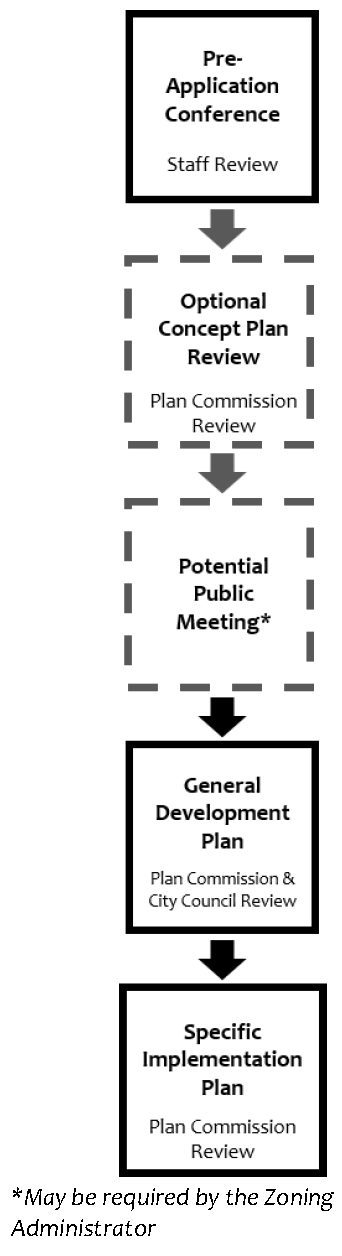
(2)
Initiation of request. Proceedings for approval of a Planned Unit Development may be initiated by any of the following:
(a)
An application by the owner(s) of the subject property or authorized agent of the owner(s) of the subject property;
(b)
A recommendation of the Plan Commission to the Common Council; or
(c)
By action of the Common Council.
(3)
Procedure for Planned Unit Development review. The procedure for zoning to a Planned Unit Development (PUD) district shall follow the Zoning Map Amendment procedure included in section 23.10.31, except that the Planned Unit Development procedure shall be subject to the following additional requirements.
(a)
Pre-application conference. Prior to formal petition for zoning to a PUD district, the applicant shall confer with appropriate City staff in order to establish mutual understanding as to the basic concept proposed and to ensure proper compliance with the requirements for processing. Points of discussion and conclusions reached in this stage of the process shall in no way be binding upon the applicant or the City, but should be considered as the informal, non-binding basis for proceeding to the next step.
(b)
Concept plan review. Upon completion of the pre-application conference, described above, the applicant may decide to prepare an optional conceptual plan for review with the Plan Commission.
1.
The Plan Commission may schedule a workshop as part of a Planned Unit Development Review. Appropriate topics for discussion may include any of the information provided in the concept plan, or other items as determined by the Plan Commission. Points of discussion and conclusions reached at this stage of the process shall be in no way binding upon the applicant or the City, but should be considered as the informal, non-binding basis for proceeding to the next step. The preferred procedure is for one or more iterations of Plan Commission review of the concept plan to occur prior to introduction of the formal application for rezoning, which accompanies the General Development Plan application (see subsection (d), below).
2.
The concept plan submittal shall include the following items (digital files should be submitted whenever possible).
a.
A location map of the subject property and its vicinity.
b.
A general written description of the proposed PUD, including:
i.
General project themes and images.
ii.
The general mix of dwelling unit types and/or land uses.
iii.
Approximate residential densities and nonresidential intensities as described by dwelling units per acre, landscaping surface ratio, and/or other appropriate measures of density and intensity.
iv.
General treatment of natural features.
v.
Relationship to nearby properties and public streets.
vi.
Relationship of the project to the Comprehensive Plan.
vii.
Description of exceptions/base standard modifications from the requirements of this title. The purpose of this information shall be to provide the Plan Commission with information necessary to determine the relative merits of the project with respect to private versus public benefit, and to evaluate the potential adverse impacts created by making exceptions to standard zoning district requirements.
c.
A conceptual drawing of the site plan layout, including the general locations of public streets and/or private drives.
d.
The Plan Commission shall accept the concept plan and inform the applicant to move on to the next step in the PUD process, General Development Plan.
(c)
Public meeting. If proposed development is expected to have significant impact on other properties, the Zoning Administrator, may require a public meeting.
1.
Where a public meeting is required, within 90 days of filing of a complete application, the applicant shall hold a public meeting to introduce and inform property owners within 200 feet of the subject property of the proposal to solicit comments and address concerns. The City can supply a list of property owners to the applicant upon request.
a.
The public meeting shall be held at a time and location that an average member of the public can reasonably attend, as determined by the Zoning Administrator.
b.
The Zoning Administrator shall be notified of and invited to the public meeting in order to assist the applicant and public on the topic.
c.
The public meeting shall be held prior to review and action by the Plan Commission.
d.
The public meeting shall be noticed in a manner consistent with City requirements.
e.
Meeting minutes and attendance shall be recorded. The meeting invitation list, meeting minutes, attendance records, documents distributed at the meeting, and presentation materials shall be provided to the City.
f.
Alternate to Public Meeting. Instead of a public meeting, notification by mail introducing and informing property owners within 200 feet of the subject property of the proposal may substitute for the public meeting, if deemed appropriate by the Zoning Administrator.
(d)
General Development Plan review. The applicant shall submit a General Development Plan (GDP) to the Zoning Administrator, for determination of completeness. Upon determination of completeness by the Zoning Administrator the GDP shall be placed on the Plan Commission agenda for review. The GDP establishes the underlying zoning for the property.
1.
The GDP submittal shall include the following items (digital files should be submitted whenever possible):
a.
General location map of the subject site depicting:
i.
All lands for which the Planned Unit Development is proposed and all other lands within 100 feet of the boundaries of the subject site.
ii.
Current zoning of the subject site and abutting properties, and the jurisdiction(s) that maintains that control.
iii.
A graphic scale and a north arrow.
b.
Generalized site plan showing the pattern or proposed land uses, including:
i.
General size, shape, and arrangement of lots and specific use areas.
ii.
Basic street pattern and pattern of internal drives.
iii.
General site grading plan showing preliminary road grades.
iv.
Basic storm drainage pattern, including proposed on-site stormwater detention.
v.
General location of recreational and open space areas, including designation of any such areas to be classified as common open space.
c.
Statistical data, including:
i.
Minimum lot sizes in the development.
ii.
Approximate areas of all lots.
iii.
Density/intensity of various parts of the development.
iv.
Building coverage.
v.
Landscaping surface area ratio of all land uses.
vi.
Expected staging.
d.
Conceptual landscaping plan, noting approximate locations of foundation, street, yard, and paving landscaping, and comparing the proposed landscaping plan to the standard landscaping requirements in article VIII.
e.
General signage plan, including all project identification signs and concepts for public fixtures and signs (such as street light fixtures and/or poles or street sign faces and/or poles) which may or may not be proposed to vary from City standards or common practices.
f.
General outline of property owner's association, covenants, easements, and deed restrictions.
g.
A written description of the proposed Planned Unit Development, including:
i.
General project themes and images.
ii.
The general mix of dwelling unit types and/or land uses.
iii.
Approximate residential densities and nonresidential intensities as described by dwelling units per acre, landscaping surface area ratio, and/or other appropriate measures of density and intensity.
iv.
General treatment of natural features.
v.
General relationship to nearby properties and public streets.
vi.
General relationship of the project to the Comprehensive Plan or other area plans.
vii.
Proposed exceptions from the requirements of this title.
h.
A Traffic Impact Analysis (TIA) that evaluates the adequacy of the existing and proposed transportation system that serves the Planned Unit Development may be required by the City, if deemed necessary by the Zoning Administrator.
i.
If required, the TIA should address all elements of the transportation system as it relates to pedestrians, bicyclists, transit, vehicular traffic, and adjacent land development.
ii.
It is noted that the Wisconsin Department of Transportation (WisDOT) has TIA requirements that must be followed if a development project has direct access to the State Trunk Highway System.
2.
The Plan Commission may waive submittal information listed above, and/or may likewise require additional information beyond that listed above.
3.
If all required application materials are provided, the GDP and SIP may be submitted and reviewed concurrently.
4.
The process for review and approval of the GDP shall be identical to that for Zoning Map Amendments per section 23.10.31.
5.
A GDP shall not expire. All portions of an approved GDP not initiated through granting of a building permit following final Common Council approval shall remain zoned PUD and the approved GDP shall remain in place.
(e)
Specific implementation plan. Upon completion of the GDP review process, described above, the applicant shall submit a Specific Implementation Plan (SIP) to the Zoning Administrator, for determination of completeness. Upon determination of completeness by the Zoning Administrator, the SIP shall be placed on the Plan Commission agenda for SIP review.
1.
The SIP submittal shall include the following items. Note that the area included in a SIP may be only a portion of the area included in a previously approved GDP (digital files should be submitted whenever possible).
a.
An existing conditions map of the subject site depicting the following:
i.
All lands for which the Planned Unit Development is proposed and all other lands within 100 feet of the boundaries of the subject site.
ii.
Current zoning of the subject property and all abutting properties, and the jurisdiction(s) that maintains that control.
iii.
Existing utilities and recorded easements.
iv.
All lot dimensions of the subject site.
v.
A graphic scale and a north arrow.
b.
A SIP map of the proposed site showing at least the following:
i.
Lot layout and the arrangements of buildings.
ii.
Public and private roads, driveways, walkways, and parking facilities.
iii.
Specific treatment and location of recreational and open space areas, including designation of any such areas to be classified as common open space.
c.
Proposed grading plan.
d.
Specific landscaping plan for the subject site, specifying the location, species, and installation size of all plantings. The landscaping plans shall include a table summarizing all proposed species.
e.
Architectural plans for any nonresidential buildings, multi-family structures, or building clusters, other than conventional single-family or two-family homes on individual lots, in sufficient detail to indicate the floor area, bulk, and visual character of such buildings.
f.
Engineering plans for all water and sewer systems, stormwater systems, roads, parking areas, and walkways.
g.
Signage plan for the project, including all project identification signs, concepts for public fixtures and signs (such as street light fixtures and/or poles or street sign faces and/or poles), and group development signage themes that may or may not vary from City standards or common practices.
h.
Specific written description of the proposed SIP including:
i.
Specific project themes and images.
ii.
Specific mix of dwelling unit types and/or land uses.
iii.
Specific residential densities and nonresidential intensities as described by dwelling units per acre, and landscaping surface area ratio and/or other appropriate measures of density and intensity.
iv.
Specific treatment of natural features, including parkland.
v.
Specific relationship to nearby properties and public streets.
vi.
Statistical data on minimum lot sizes in the development, the precise areas of all development lots and pads; density/intensity of various parts of the development; building coverage, and landscaping surface area ratio of all land uses; proposed staging; and any other plans required by the Plan Commission.
vii.
A statement of rationale as to why PUD zoning is proposed. This statement shall list the standard zoning requirements that, in the applicant's opinion, would inhibit the development project and the opportunities for community betterment that are available through the proposed PUD project.
viii.
A complete list of zoning standards that would not be met by the proposed SIP and the location(s) in which such exceptions/base standard modifications would occur.
ix.
Phasing schedule, if more than one development phase is intended.
i.
Agreements, bylaws, covenants, and other documents relative to the operational regulations of the development and particularly providing for the permanent preservation and maintenance of common open areas and amenities.
j.
A written description that demonstrates how the SIP is consistent with the approved GDP and any and all differences between the requirements of the approved GDP and the proposed SIP.
2.
The Zoning Administrator or by majority vote of the Plan Commission may waive submittal information listed above, and/or may likewise require additional information beyond that listed above.
3.
The process for review and approval of the SIP shall be identical to that for conditional use permits per section 23.10.32(5) through (9).
4.
A SIP shall not expire. All portions of an approved SIP not fully developed following final Plan Commission approval shall remain zoned PUD and the approved SIP shall remain in place.
(f)
Criteria for approval. In its review and action an application for a Planned Development district, the Plan Commission shall make findings with respect to the following criteria:
1.
The proposed Planned Unit Development project is consistent with the overall purpose and intent of this title.
2.
The proposed Planned Unit Development project is consistent with the City's Comprehensive Plan and other area plans. (It is the responsibility of the City to determine such consistency.)
3.
The proposed Planned Unit Development project would maintain the desired relationships between land uses, land use densities and intensities, and land use impacts in the environs of the subject site.
4.
Adequate public infrastructure is or will be available to accommodate the range of uses being proposed for the Planned Unit Development project, including but not limited to public sewer and water and public roads.
5.
The proposed Planned Unit Development project will incorporate appropriate and adequate buffers and transitions between areas of difference land uses and development densities/intensities.
6.
The proposed Planned Unit Development project design does not detract from areas of natural beauty surrounding the site.
7.
The proposed architecture and character of the proposed Planned Unit Development project is compatible with adjacent/nearby development.
8.
The proposed Planned Unit Development project will positively contribute to and not detract from the physical appearance and functional arrangement of development in the area.
9.
The proposed Planned Unit Development project will produce significant benefits in terms of environmental design and significant alternative approaches to addressing development performance that relate to and more than compensate for any requested exceptions/base standard modifications variation of any standard or regulation of this title.
10.
For Planned Unit Development projects that are proposed to be developed in phases, the applicant can provide a timeline for development and can demonstrate that the project would be successful even if all phases were not or could not be completed.
(g)
Changes or alterations. Any change of the PUD plans subsequent to approval of the SIP shall be submitted to the Zoning Administrator.
1.
If the Zoning Administrator, determines that the change constitutes a substantial modification, the developer will be required to amend the SIP, and if necessary, the GDP, following the procedures set forth in this section for review and approvals.
2.
If, in the opinion of the Zoning Administrator, such changes do not constitute a substantial alteration of either the GDP or SIP, the change may be accomplished by approval of the Zoning Administrator. Such approved changes or modifications shall be documented and recorded in the official file of the City on the PUD.
(Ord. No. 61-5896, § 7, 12-14-2021)
23.10.50 - Interpretations.
(1)
Purpose. The purpose of this section is to assign responsibility for the official interpretation of the provisions of this title, and to describe the required procedure for securing such interpretation.
(2)
Initiation of request for an interpretation. Proceedings for an interpretation may be initiated by any of the following 4 methods:
(a)
An application of the owner(s) of the subject property or authorized agent of the owner(s) of the subject property.
(b)
A recommendation of the Plan Commission to the Common Council.
(c)
By action of the Common Council.
(d)
By request of the Zoning Administrator.
(3)
Application. A zoning interpretation application contains all of the following:
(a)
Clear indication of the text of this title for which the interpretation is requested and the specific questions the applicant has regarding said text.
(b)
If the requested interpretation relates to the application of this title to a specific property, the additional following information may be required (digital files should be submitted whenever possible):
1.
A map of the subject property depicting:
a.
All lands for which the interpretation is requested and all other lands within 100 feet of the boundaries of the subject property.
b.
Current zoning of the subject property and its environs, and the jurisdiction(s) which maintains that control.
c.
All lot dimensions of the subject property.
d.
A graphic scale and a north arrow.
2.
A written description of the reason for the requested interpretation and how the proposed interpretation relates to type of activities, buildings, and structures currently located on, and proposed for, the subject property.
3.
A site plan of the subject property as proposed for development. Said site plan shall conform to the requirements of section 23.10.42.
(c)
If the requested interpretation relates to the classification or treatment of a particular land use under the provisions of this title, a series of written responses to the following questions:
1.
How is the subject land use in general harmony with the purposes, goals, objectives, policies and standards of the City's Comprehensive Plan, this title, and any other plan, program, or ordinance adopted, or under consideration (pursuant to official notice) by the City?
2.
How is the subject land use in harmony with the purposes, goals, objectives, policies and standards of the pertinent zoning district for which the interpretation is being sought?
(4)
Review by Zoning Administrator.
(a)
The Zoning Administrator shall determine whether the application is complete and fulfills the requirements of this title. If the application is determined to be incomplete, the Zoning Administrator, shall notify the applicant.
(b)
The Zoning Administrator shall review the application and evaluate and comment on the written justification for the proposed interpretation provided in the application to determine whether the requested variance is in harmony with the City's Comprehensive Plan.
(c)
The Zoning Administrator shall forward a report to the applicant indicating the interpretation of the Zoning Administrator. If the Zoning Administrator, determines that the proposal may be in conflict with the provisions of the Comprehensive Plan, the Zoning Administrator, shall note this determination in the report.
(5)
Standards for review. This title shall be interpreted in a manner which is consistent with the purposes intended by the Common Council as noted in this title and the Comprehensive Plan. The intent of the standards and supporting definitions of this title is to protect both individual property owners and the general public from adverse impacts that may result from a proposed, modified, or existing land use. To this end, those called upon to interpret this title shall proceed as follows:
(a)
Articulate certain public purpose(s) underlying the standard(s) for which an interpretation is required. (Rationale: Before any zoning interpretation is made, there must be an explicit discussion of certain purpose(s) for which the regulation was initially imposed. Each zoning regulation is intended to protect the interests of both present and future neighbors and the general public. Each standard is developed as a regulatory response to an identifiable potential negative impact. A sound interpretation of any standard cannot be ensured without careful analysis of the regulation and the end toward which it is directed. It is understood that there may be other public purposes underlying the interpretation which are not explicitly articulated.)
(b)
Articulate the actual impact of various proposed interpretations, permitting flexibility in design and prohibiting any interpretation that lowers the protection afforded to the public. There is a critical distinction between an interpretation which provides a greater degree of design freedom to achieve a permitted land use, and an interpretation which permits a new or not previously permitted use, or which allows a use to be enlarged, or have its intensity increased beyond the degree specified in the Chapter. Design freedom is to be encouraged while a lowering of the standards of this title is to be prohibited.
(c)
Determine whether the proposed interpretation will ensure a just balance between the rights of the landowner and all others who will be affected by that person's land use proposal. If an interpretation would merely allow a design solution that is slightly different from the one expressly stated or permitted, and if it would result in a same or greater degree of protection to any affected party (i.e. the abutting landowners, the public at large, and/or a future property owner or renter), such an interpretation may be appropriately made. Any interpretation which would result in any identifiable loss of protection for one group to the benefit of others is contrary to the spirit of this title. Similarly, any interpretation which would either increase the nuisance potential of any use or alter the purpose for which the regulation was adopted shall be considered counter to the legislative intent of this title. Any interpretation which will result in any reduction of a normally required bufferyard or increase in intensity beyond that already permitted shall only be made if the party interpreting this title has the power to impose additional restrictions or requirements.
(d)
This title has been carefully designed by the Common Council to combine maximum achievement of public goals, and the protection of abutting property owners while providing flexibility for property owners to use their land for a variety of uses consistent with the goals and objectives of the Comprehensive Plan. Great care has been taken to balance the rights of competing groups while achieving maximum protection with flexibility and a range of use options. Persons interpreting this title should not substitute their own judgments for the legislative acts of the Common Council.
(e)
In addition to the applicant's response to the questions required by subsections (5)(a) through (d), above, the following standards shall govern the decision on the requested interpretation on land use interpretation matters:
1.
No interpretation shall allow the establishment of any land use which was previously considered and rejected by the Common Council on an application for an amendment to the Zoning Ordinance, the Official Zoning Map, or a previously applied for appeal from a requested interpretation.
2.
No interpretation shall permit a land use listed as a use permitted by right, a special use, or a conditional use in another zoning district if the use is not listed as permitted or conditional in the zoning district of the subject property (see article II).
3.
No interpretation shall permit a land use in a zoning district unless evidence is presented which demonstrates that the land use will comply with any and all regulations applicable to development in the subject property's zoning district (see article II).
4.
No interpretation shall permit a land use in a particular zoning district unless such use is substantially similar to other uses permitted in that same district and is more similar to such other uses than to uses either not permitted in said district, or permitted in a more intensive district in the same zoning district category (see article II).
5.
If the proposed land use is more similar to a land use permitted only as a conditional use in the subject property's district than to a use permitted by right, then an interpretation permitting such use shall be conditioned upon the approval of a conditional use pursuant to section 23.10.32.
(6)
Effect of a favorable land use interpretation. No interpretation finding a particular land use to be permitted or conditionally permitted in a specific zoning district shall authorize either the establishment of such use or the development, construction, reconstruction, alteration, or moving of any building or structure. A favorable interpretation merely authorizes the preparation, filing, and processing of applications for any permits and approvals which may be required by this title. These permits and approvals include, but are not limited to, required site plans, special use permits, conditional uses, and certificates of occupancy.
(7)
Limitations on favorable land use interpretation.
(a)
No interpretation finding a particular land use to be permitted or conditionally permitted in a specified zoning district shall be valid for a period of more than 365 days from the date of issuance of the interpretation, unless a building permit is issued and development has begun within that period, and is thereafter diligently pursued to completion, or a certificate of occupancy is obtained and a use commenced within that period.
(b)
An interpretation finding a particular land use to be permitted or conditionally permitted in a specified zoning district shall be deemed to authorize only that particular use at that particular location for which the interpretation was issued. The interpretation shall not be deemed to authorize any allegedly similar use for which a separate interpretation has not been issued. A favorable interpretation shall automatically expire and cease to be of any force or effect if the particular use for which it was issued shall, for any reason, be discontinued for a period of 365 consecutive days or more.
23.10.51 - Variances.
(1)
Purpose. The purpose of this section is to provide regulations which enable the City to hear and decide requests for permitted variation from the terms of this title as will not be contrary to the public interest; where owing to special factors, a literal enforcement of the provisions of this title would result in practical difficulty or unnecessary hardship, so that the spirit of this title shall be observed, public safety and welfare secured, and substantial justice done; as provided for by Wis. Stats. § 62.23(7)(e)(7).
(2)
Variance types. Variances from the regulations of this title shall be granted by the Zoning Board of Appeals only in accordance with the standards established in this section. Variances may be granted only if the existing use of the building or property is a permitted use in the district where the requested variance is located or a conditional use for the activity has been approved by the Common Council. Variances may be granted only in the following instances and in no others:
(a)
To permit any yard or setback less than a yard or a setback required by the applicable regulations;
(b)
To permit the use of a lot or lots for a use otherwise prohibited solely because of the insufficient area or width of the lot or lots, but in no event shall the respective area and width of the lot or lots be less than 80 percent of the required area and width;
(c)
To permit the same off-street parking facility to qualify as required facilities for two or more uses, provided that substantial use of the facility by each user does not take place at approximately the same hours of the same days of the week;
(d)
To reduce the applicable off-street parking or loading facilities required by not more than one parking space or loading space, or 20 percent of the applicable regulations, whichever number is greater;
(e)
To increase by not more than 25 percent the maximum distance that required parking spaces are permitted to be located from the use served;
(f)
To increase by not more than ten percent the maximum gross floor area of any use so limited by the applicable regulations;
(g)
To permit a reasonable variation in the height restrictions on fences; and
(h)
To permit reconstruction, remodeling or additions necessary for the physical wellbeing of a person so handicapped as to make the structure unsuitable in its present configuration for his safe or reasonable use;
(i)
To permit a detached accessory building or structure to be constructed to a height in excess of the principal building or structure;
(j)
To permit a variance from the adopted Height Limitations Zoning Map that will not be contrary to the public interest where, owing to special conditions, a literal enforcement of this title would result in unnecessary hardship, and such relief will do substantial justice, be in accord with the spirit of title 22, and not create a hazard to the safe, normal operation of aircraft.
(3)
Initiation of request for approval of a variance. Proceedings for approval of a requested variance shall be initiated by an application of the owner(s) of the subject property or authorized agent of the owner(s) of the subject property.
(4)
Application. Variance applications shall contain the following (digital files should be submitted whenever possible, if applicable):
(a)
A map of the subject property depicting:
1.
All lands for which the variance is proposed and all other lands within 100 feet of the boundaries of the subject property.
2.
Current zoning of the subject property and its environs, and the jurisdiction(s) which maintains that control.
3.
All lot dimensions of the subject property.
4.
A graphic scale and a north arrow.
(b)
A site plan of the subject property as proposed for development. Said site plan shall conform to the requirements of section 23.10.42.
(c)
Written description of the proposed variance, including evidence that the application is consistent with the Comprehensive Plan.
(5)
Review by the Zoning Administrator.
(a)
The Zoning Administrator shall determine whether the application is complete and fulfills the requirements of this title. If the application is determined to be incomplete, the Zoning Administrator, shall notify the applicant.
(b)
The Zoning Administrator, shall review the application and prepare a written report including the following:
1.
Evaluate whether the request is in harmony with the Comprehensive Plan or other relevant plans.
2.
Evaluate the request based upon the criteria used by the Zoning Board of Appeals in their review.
(6)
Public hearing. Within 60 days of filing of a complete application, the Zoning Board of Appeals shall hold a public hearing in compliance with section 23.10.21 consider the request.
(7)
Review and action by the Zoning Board of Appeals.
(a)
Within 60 days after the holding of the public hearing, the Zoning Board of Appeals shall make its findings per the following based on Wis. Stats. § 62.23(7)(e)7:
1.
The variance will not be contrary to the public interest.
2.
Substantial justice will be done by granting the variance.
3.
The variance is needed so that the spirit of the ordinance is observed.
4.
Due to special conditions, a literal enforcement of the provisions of the Zoning Ordinance will result in unnecessary hardship.
5.
The variance will not allow any alteration of an historic structure, including its use, which would preclude its continued designation as an historic structure.
(b)
The Zoning Board of Appeals may request further information and/or additional reports from the Zoning Administrator, and/or the applicant. The Zoning Board of Appeals may take final action on said request for approval of the requested variance at time of its initial meeting, or said proceedings may be continued from time-to-time for further consideration.
(c)
If the Zoning Board of Appeals fails to make a determination within 60 days after said public hearing, then the request for the variance shall be considered denied.
(d)
Following final action by the Zoning Board of Appeals in granting a variance, the approved variance shall be valid for a period of one year from the date of the order, unless the building permit is obtained within such period and the erection or alteration of a building is started, or the use is commenced within such period.
(8)
Effect of denial. No application for a variance which has been denied (either wholly or in part) shall be resubmitted for a period of 365 days from the date of said order of denial, except on grounds of new evidence or material change of circumstances found valid by the Zoning Administrator.
(9)
Limited effect of a variance. Where the Zoning Board of Appeals has granted a variance, such approval shall neither change the use classification of the building or premises, nor give it any status as a nonconforming use other than that which it has as a result of the variance. Granting of a variance shall be considered as unique to the variance granted, and shall not be construed as precedent for any other proposed variance.
(10)
Stay of proceedings. An application for a variance shall stay all legal proceedings furthering enforcement of any provisions of this title from which the applicant is requesting a variance, unless the Zoning Administrator certifies to the Zoning Board of Appeals after the request for the variance has been filed, that by reason of the facts stated in the certificate a stay would, in his/her opinion, cause imminent peril to life or property. In such case proceedings shall not be stayed otherwise than by a restraining order which may be granted by the Zoning Board of Appeals, or by a court of record on application, on notice to the Zoning Administrator, and on due cause shown. State Law Reference: Wis. Stats. § 62.23(7)(e)5.
(11)
[Exceptions.] See title 22 of the Wausau Municipal Code for exceptions to the requirements of the "Wausau Downtown Airport Height Limitation Map."
23.10.52 - Appeals of zoning interpretations.
(1)
Purpose. The purpose of this section is to provide regulations which enable the City to hear and decide requests for appeals from the interpretations of the Zoning Administrator, per section 23.10.50 as provided for by Wis. Stats. § 62.23(7)(e)(7).
(2)
Initiation of request for appeal. Proceedings for the review of an appeal may be initiated by any person aggrieved, or by any officer, department, board, or bureau of the City affected by any decision of the Zoning Administrator.
(3)
Stay of proceedings. An appeal shall stay all legal proceedings in furtherance of the action appealed from, unless the Zoning Administrator certifies to the Zoning Board of Appeals after the request for the appeal has been filed, that, by reason of facts stated in the certificate, a stay would cause immediate peril to life or property. In such case, the proceedings shall not be stayed otherwise than by a restraining order which may be granted by the Board of Appeals or by a court of record on application and on notice to the Zoning Administrator and on due cause shown.
(4)
Time limit for filing an appeal. Any appeal under the provisions of this section shall be made per the requirements of subsection (5), below, within a period not exceeding 45 days from the date of issuance of the interpretation by the Zoning Administrator. Failure to initiate this appeal procedure within this 45-day period shall constitute a final and binding waiver of the right to appeal said interpretation.
(5)
Application requirements. An application of an appeal of a zoning interpretation shall contain the following (digital files should be submitted whenever possible):
(a)
A copy of pertinent items in the file on the matter at hand as identified by the Zoning Administrator and/or the applicant.
(b)
A written statement from the applicant indicating the reasons why an appeal is justified. This statement shall be dated and signed by the applicant.
(6)
Review by the Zoning Administrator.
(a)
The Zoning Administrator shall determine whether the application is complete and fulfills the requirements of this title. If the application is determined to be incomplete, the Zoning Administrator, shall notify the applicant.
(b)
The Zoning Administrator shall review the application and evaluate and comment on the written justification for the requested appeal to the Zoning Board of Appeals as submitted by the applicant. The Zoning Administrator shall also evaluate the application to determine whether the requested is in harmony with the Comprehensive Plan or other relevant plans.
(c)
The Zoning Administrator shall forward a report to the Board of Appeals for review and action. If the Zoning Administrator determines that the proposal may be in conflict with the provisions this title or the Comprehensive Plan or other relevant plans, the Zoning Administrator shall note this determination in the report.
(7)
Public hearing. Within 60 days of filing of a complete application, the Zoning Board of Appeals shall hold a public hearing in compliance with section 23.10.21 to consider the request.
(8)
Review and action by the Zoning Board of Appeals.
(a)
Within 60 days after the filing of the complete application, the Zoning Board of Appeals shall make its findings. The Zoning Board of Appeals may request further information and/or additional reports from the Zoning Administrator and/or the applicant. The Zoning Board of Appeals may take final action on the application for appeal at the time of its initial meeting, or may continue the proceedings at applicant's request. Said final action shall be followed by a written report or minutes which shall include a formal finding of facts developed and approved by the Zoning Board of Appeals concerning the request.
(b)
If the Zoning Board of Appeals fails to make a determination within 60 days after the filing of said complete application, then the request for the appeal shall be considered denied.
(9)
Effects of denial. No application for an appeal which has been denied (either wholly or in part) shall be resubmitted for a period of 365 days from the date of said order of denial, except on grounds of new evidence or material change of circumstances found valid by the Zoning Administrator.
(10)
Limited effect on a favorable ruling on an appeal.
(a)
No ruling by the Zoning Board of Appeals on an appeal finding a particular land use to be permitted or conditionally permitted in a specified zoning district shall be valid for a period of more than 365 days from the date of issuance of the ruling on the appeal, unless a building permit is issued and development is actually begun within that period, and is thereafter diligently pursued to completion, or a certificate of occupancy is obtained and development commenced within that period.
(b)
A ruling by the Zoning Board of Appeals on an appeal finding a particular land use to be permitted or conditionally permitted in a specified zoning district shall be deemed to authorize only that particular use at that particular location for which the ruling was issued. The ruling shall not be deemed to authorize any allegedly similar use for which a separate ruling has not been issued. A favorable ruling shall automatically expire and cease to be of any force or effect if the particular use for which it was issued shall, for any reason, be discontinued for a period of 365 consecutive days or more.
23.10.53 - Administration and enforcement of performance standards.
Determinations necessary for administration and enforcement of performance standards set forth in this article range from those which can be made with satisfactory accuracy by a reasonable person using normal senses and no mechanical equipment, to those requiring great technical competence and complex equipment for precise measurement. It is the intent of this title that:
(1)
Where determinations can be made by the Zoning Administrator, using equipment normally available to the City or obtainable without extraordinary expense, such determinations shall be so made before notice of violations is issued.
(2)
Where technical complexity or extraordinary expense makes it unreasonable for the City to maintain the personnel or equipment necessary for making difficult or unusual determinations, procedures shall be available for causing corrections or apparent violations of performance standards, for protecting individuals from arbitrary, capricious, and unreasonable administration and enforcement of performance standard regulations, and for protecting the general public from unnecessary costs for administration and enforcement.
(a)
The Zoning Administrator shall give written notice to the person or persons responsible for the alleged violations. The notice shall describe the particulars of the alleged violation and the reasons why the Zoning Administrator believes there is a violation in fact, and shall require an answer or correction of the alleged violation to the satisfaction of the Zoning Administrator.
(b)
The notice shall state that failure to reply or to correct the alleged violation to the satisfaction of the Zoning Administrator within the time limit set constitutes admission of violation of the terms of this title. The notice shall further state that upon request of those to whom it is directed, technical determination as described in this title will be made, and that if violations as alleged are found, costs of such determinations shall be charged against those responsible for the violation, in addition to such other penalties as may be appropriate, but that if it is determined that no violation exists, the cost of the determination will be paid by the City.
23.10.60 - Violations and penalties.
(1)
Violation of this title. It shall be unlawful to construct or use any land, engage in any development activity, or construct or use any structure, land or water in violation of any of the provisions of this title, or otherwise neglect, refuse or fail to comply with this title's requirements.
(2)
Penalties. See title 1 of the City of Wausau Municipal Code.
(3)
Promulgated correction of violation. In addition to any other penalty imposed for a violation of the provisions of this title, the City reserves and maintains the continued right to abate violations of this title. Costs associated with said abatement shall be charged to the owner of the property on which said violation has occurred.
23.10.61 - Fees.
Fees for procedures and permits shall be established and amended by the Common Council.

