
Wausau City Zoning Code
ARTICLE III
LAND USE REGULATIONS
23.03.01 - Purpose.
The purpose of this article is to indicate which land uses may locate in each zoning district and under what requirements; and which land uses may not locate therein. Certain land uses may locate in a given district as a matter of right upon compliance with special regulations for such a land use. A further distinction is made for land uses which may locate in a given district only upon obtaining a conditional use or temporary use permit.
23.03.02 - Regulation of allowable uses.
The allowable land uses for each zoning district are established in article II of this title. Detailed descriptions and regulations for uses are found in sections 23.03.06 through 23.03.30. Even if a land use may be indicated as permitted by right or requiring a conditional use in a particular district, such a land use may not necessarily be permitted or permissible on any or every property in such district. No land use is permitted or permissible on a property unless it can be located on it or implemented in full compliance with all of the applicable standards and regulations of this title or unless an appropriate variance has been granted pursuant to section 23.10.51. For land uses not specifically listed, the Zoning Administrator shall make an interpretation to identify a comparable use or determine if an amendment to this title is necessary.
(1)
Principal land uses permitted by right. Principal land uses listed as permitted by right (designated by the letter "P" in section 23.03.05) are permitted per the general land use requirements of this article; per the density, intensity, and bulk regulations of the specific zoning district in which they are located; per any additional requirements imposed by applicable overlay districts; per all other applicable requirements of this title; and per any and all other applicable City, county, state, and federal regulations.
(2)
Principal land uses permitted as conditional uses. Principal land uses allowed only with a conditional use permit (designated by the letter "C" in section 23.03.05) may be permitted subject to all the requirements applicable to uses permitted by right as listed in subsection (1), above, plus any additional requirements applicable to that particular land use imposed as part of the conditional use permit process established in section 23.10.32. Except for uses approved under a general development plan and specific implementation plan in a planned development (see section 23.10.44), all uses requiring a conditional use permit shall comply with the procedural requirements of section 23.10.32.
(3)
Accessory land uses. Accessory land uses are allowed subject to all the requirements and exceptions applicable to principal land uses permitted by right as listed in subsection (1), above. Accessory land uses allowed only with a conditional use permit are subject to all the requirements and exceptions applicable to principal land uses requiring a conditional use permit as listed in subsection (2), above. Accessory land uses shall also comply with the following listed regulations.
(a)
No accessory structure or use shall be constructed on any lot prior to the establishment of an allowable principal use, unless otherwise stated in this title.
(b)
Accessory land uses and structures shall not be located within the required front or street yard setback. This applies to corner, single-frontage, and double-frontage lots.
(c)
With the exception of an accessory dwelling unit, in no instance shall an accessory structure, unfinished cellar, unfinished basement, tent, or recreational trailer be used as a residence.
(4)
Temporary land uses. Temporary land uses permitted by right (designated by the letter "P" in the Table of Land Uses in section 23.03.04) are permitted on a temporary basis subject to permitting requirements of section 23.10.40 of this title. Temporary land uses permitted only with a conditional use permit (designated by the letter "C" in the Table of Land Uses) may be permitted subject to temporary use and conditional use permitting requirements of sections 23.10.40 and 23.10.32.
23.03.03 - Regulations applicable to all land uses.
All uses of land initiated within the jurisdiction of this title on, or following, the effective date of this title shall comply with all of the provisions of this title.
(1)
Land use regulations and requirements. All uses of land shall comply with all the regulations and requirements of this title. Such regulations directly relate to the protection of the health, safety, and general welfare of the residents of the City of Wausau.
(2)
Density, intensity, and bulk regulations and requirements. All development and use of land shall comply with all the applicable requirements of articles II and IV of this title.
(3)
Overlay Zoning District requirements. All land use and/or development of land shall comply with all the regulations and requirements any applicable Overlay Zoning District (see article II).
(4)
Performance standards. All development of land shall comply with all applicable requirements established in article VI.
(5)
Exterior building design standards. All new, remodeled, and expanded residential and nonresidential development shall comply with the all applicable building design guidelines as required in article VII of this title.
(6)
Landscape regulations. All development of land shall comply with all the regulations and requirements of article VIII pertaining to the provision of landscaping and bufferyards. Such requirements address issues such as minimum required landscaping of developed land and minimum required provision of bufferyards between adjoining zoning districts which are directly related to the effective bulk of a structure.
(7)
Signage regulations. All land use and/or development of land shall comply with all requirements of article IX, pertaining to the type and amount of signage permitted on property. Such requirements address issues such as the maximum area of permitted signage and the number and types of permitted signage.
(8)
Number of buildings per lot. In all zoning districts a maximum of one principal building shall be permitted on any one lot, with the exception of the following:
(a)
Group or large developments (section 23.06.02).
(b)
Planned unit developments (section 23.02.81).
(c)
Mobile home parks (section 23.03.06(4)).
(d)
Temporary buildings (section 23.03.30(11)).
(9)
Mixing residential and nonresidential uses in a building. With the exception of multiple use buildings described under section 23.03.08, and home occupation land uses, no building containing a nonresidential land use shall contain a residential land use.
(10)
Number of land uses per building. No more than one nonresidential land use shall be permitted in any building with the following exception: multiple permitted by right land uses are allowed in a multi-business building and only require a land use permit, see article II to confirm the proposed tenants are permitted. Examples include a multi-tenant office building; a strip mall; an antique mall; a downtown building mixing office, personal or professional services, and indoor sales and service land uses; and other arrangements with multiple permitted uses in one or more occupied spaces. A land use which is regulated as a conditional use may only occupy multi-tenant buildings as approved through the conditional use process (section 23.10.32) or a successor conditional use.
(11)
Accessory uses. Accessory uses may be allowed where they comply with the following conditions and requirements:
(a)
Separation from principal structures. Detached accessory buildings shall be located a minimum of five feet from a residential dwelling unit on the same lot, except where the structure will be constructed to fire-rating standards of the Uniform Dwelling Code. The "separation" distance between a dwelling unit and accessory structure is determined by measuring the perpendicular distance from wall to wall of the structures. Minor attachments such as handrails, latticework, trellises, or pergolas may be located in the required separation area and do not render the structures attached for setback purposes. No detached accessory building or buildings shall occupy more than 50 percent of the area of any required yard.
(b)
Conversion of accessory structures to dwellings. The conversion of any accessory structure into a dwelling so as to accommodate an increased number of dwelling units or families, shall be permitted only within a district in which a new building for similar occupancy would be permitted under this title. The resulting occupancy will comply with the requirements governing new construction in such district, including minimum lot size, lot area per dwelling unit, building of lot coverage, dimensions of yards and other open spaces, and off-street parking.
(c)
Accessory structures without principal structure.
1.
No accessory structure shall be erected or constructed prior to the erection or construction of the principal structure, paved areas, or below grade improvements.
2.
When an accessory structure becomes the only structure on a lot as the result of demolition of the principal building, the accessory structure shall be demolished with three months of the demolition of the principal building. The Zoning Administrator shall have the ability to extend this period by an additional three months if the property owner has a concept plan, as approved by the Zoning Administrator, to build a new principal building or otherwise redevelop the site in a manner that uses the accessory structure.
(12)
Group and large development requirements. A group or large development may include any of the land uses in this title that is permitted by right or by conditional use permit in the subject zoning district. All uses and/or development of land within a group or large development shall comply with all requirements of section 23.06.02.
(13)
Planned development requirements. All uses and/or development of land within a planned development shall comply with all requirements of section 23.02.81 and 23.10.44.
(14)
Nonconforming lots, uses, structures, and site requirements.
(a)
Land uses not in conformance with the requirements of the applicable zoning district shall be subject to the special limitations and exceptions as established in article II. Land uses located on substandard lots or on nonconforming lots or in nonconforming structures shall comply with all the regulations and requirements of article V.
(b)
Substandard lots are buildable, provided the structures meet all other requirements of this title. Substandard lots shall only be used for one single family residence (where permitted) or a permitted nonresidential use.
(15)
Land use permit review required. All uses are subject to land use permit review and approval in accordance with section 23.10.41 of this title. For new or modified developments, a site plan is required. See subsection (16) immediately below.
(16)
Site plan review required. All development involving physical modifications to a site including but not limited to new development, building additions, and additions to paving are subject to site plan review and approval in accordance with section 23.10.42 of this title, except for single family and two family dwelling units on individual lots in any zoning district.
(17)
Procedural regulations and requirements. All land use and/or development of land shall comply with all requirements of article X, pertaining to the procedures necessary to secure review and approval of land use and/or development. Such regulations and restrictions address both procedural and technical requirements.
(18)
Demolition of a principal structure. Where a principal structure has been removed, all driveways, paved areas, and below grade improvements on the lot shall be removed.
(a)
All disturbed areas shall be repaired with a minimum of 4 inches of top soil and lawn seed until site is stabilized. Best management practices shall be used for soil and erosion control.
(Ord. No. 61-5883, § 17, 5-11-2021)
23.03.04 - Detailed land use descriptions and regulations.
The land use categories employed by this title are defined in section 23.03.06 through section 23.03.30. Land use categories which are not listed in this title are not necessarily excluded from locating within any given zoning district. section 23.10.50 empowers the Zoning Administrator, to make interpretations on matters regarding specific land use proposals which are not addressed by this title.
23.03.05 - Table of land uses.
The Table of Land Uses on the following pages is provided as a convenience for the City and the general public. Where there are conflicts between the text of this title and the Table of Land Uses, the text shall prevail.
(Ord. No. 61-5883, § 18, 5-11-2021; Ord. No. 61-4057-730, § 11, 1-23-2024; Ord. No. 61-4057-751, § 1, 7-14-2026)
23.03.06 - Residential land uses.
(1)
Single family dwelling unit: This dwelling unit type consists of a fully detached single family residence which is located on an individual lot. Single family dwelling units are designed for one family and have no roof, wall, or floor in common with any other dwelling unit. A single family dwelling that contains an in-family suite is still considered a single family dwelling.
Regulations:
(a)
The dwelling unit shall be a site-built structure built in compliance with the state Uniform Dwelling Code (UDC), or may be a manufactured dwelling (modular home) as permitted by the UDC or a manufactured home that has received a Federal Manufactured Housing Certificate label.
(b)
The dwelling must be attached to a finished, permanent foundation, such as a poured concrete slab or basement meeting UDC requirements.
(c)
See section 23.07.10 for design standards for single family dwelling units.
(d)
A minimum 200 square foot garage is required and must be in similar design style as to the principal structure.
(e)
Minimum required parking: two spaces.
(f)
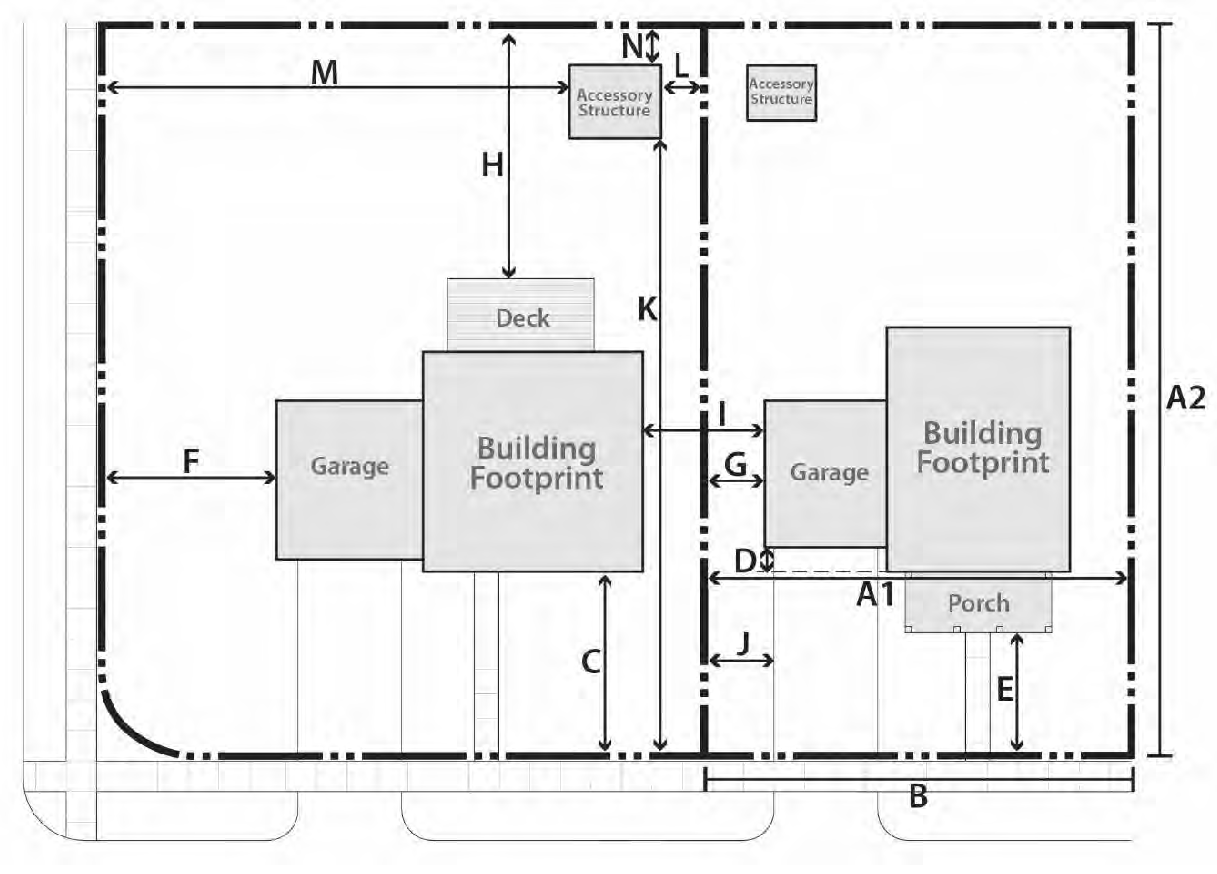
The following figure is intended to provide a graphic depiction of the setback and dimensional requirements for Single Family dwelling units. Specific requirements for Single Family dwelling units can be found in article II under the density, intensity, and bulk requirements for each residential zoning district.
Figure 23.03.06a: Single Family Dwelling Unit
(2)
Mobile home: A type of dwelling unit suitable for year-round occupancy designed to be towed as a single unit or in sections, with or without a permanent foundation, with walls of rigid, un-collapsible construction, and with water supply, sewage disposal, and electrical convenience. A Mobile Home includes both a "mobile home" and a "manufactured home" as defined by Wisconsin Statutes. Any similar dwelling unit which has its own motor or remains on wheels shall be considered a recreational vehicle. A modular home is a home meeting the Uniform Building Code that is transported to the building site in sections, does not have a permanent chassis, and is permanently mounted on a permanent foundation. A modular home is regulated as a single family dwelling unit under section 23.03.06(1).
Regulations:
(a)
No Mobile Home may be split into two or more residences.
(b)
Within 30 days of occupancy, the owner shall remove the axle and install skirting.
(c)
Development shall comply with the requirements of the housing code title 16 of the Wausau Municipal Code.
(d)
The building design standards of article VII shall not apply.
(e)
Minimum required parking: two spaces per dwelling unit.
(f)
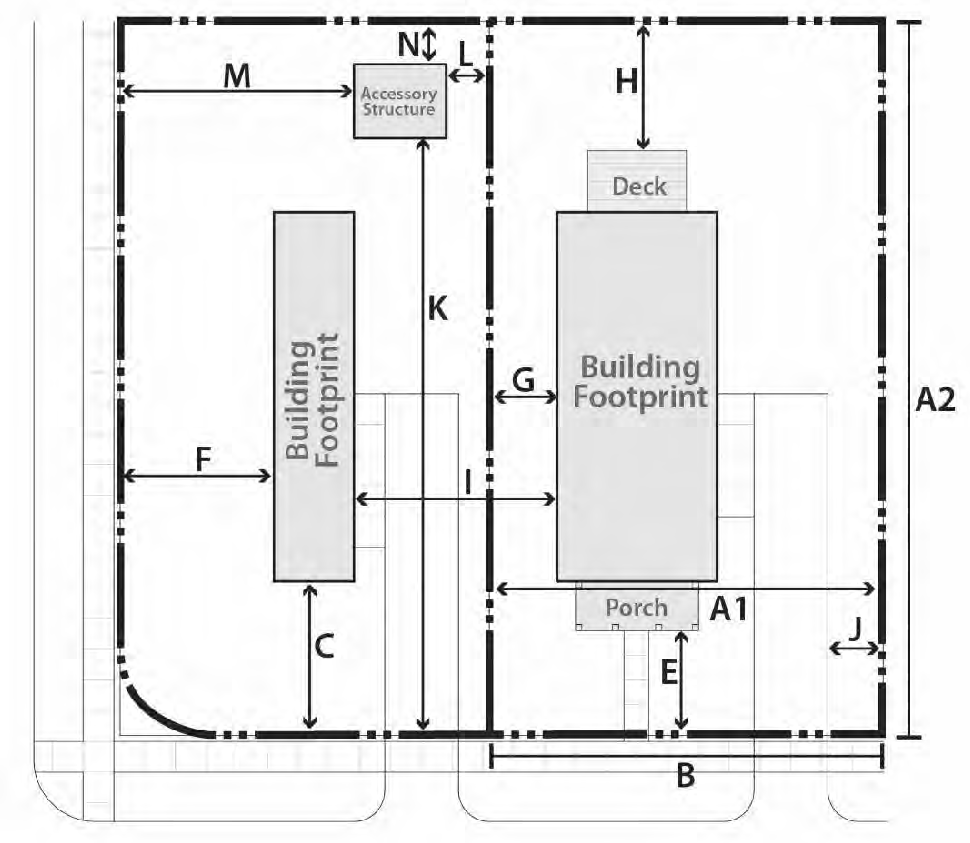
The following figure is intended to provide a graphic depiction of the setback and dimensional requirements for Mobile Home land uses. Specific requirements for Mobile Homes can be found in article II under the density, intensity, and bulk requirements for each residential zoning district.
Figure 23.03.06b: Mobile Home
(3)
Mobile home subdivision: This land use is a form of residential development which is exclusively reserved for individually sold lots containing mobile homes. Each lot and Mobile Home must meet the requirements listed under section 23.03.06(2), above.
Regulations:
(a)
Development shall be located so as to blend with adjacent residentially zoned areas to the greatest extent possible.
(b)
No access shall be permitted to local residential streets, except to the internal roadways and streets.
(c)
Development shall comply with the requirements of the Housing Code title 16 of the Wausau Municipal Code.
(d)
Specific requirements for Mobile Home Subdivisions can be found in article II under the density, intensity, and bulk requirements for each residential zoning district.
(4)
Mobile home park: This land use is a form of residential development which is exclusively reserved for individually sold or rented air right pads containing mobile homes. Each mobile home must meet the requirements listed under section 23.03.06(2), above.
Regulations:
(a)
Development shall be located so as to blend with adjacent residentially zoned areas to the greatest extent possible.
(b)
No access shall be permitted to local residential streets, except to the internal roadways and streets.
(c)
Development shall comply with the requirements of the Housing Code title 16 of the Wausau Municipal Code.
(5)
Duplex: This dwelling unit type consists of two separate Family Residential residences, each having private individual access, and no shared internal access. Similar to Twin Houses, Duplexes are attached side-by-side units, each with a ground floor and roof. Unlike Twin Houses, the two dwelling units in a Duplex are located on one lot.
Regulations:
(a)
In the case where any dwelling unit is under separate ownership, evidence that covenants specifying respective obligations with regard to any common structures, such as the shared wall, roof, and other inseparable improvements, is required.
(b)
This dwelling unit type may not be split into additional residences.
(c)
See section 23.07.10 for design standards for two family uses.
(d)
A minimum 200 square foot garage is required and must be in similar design style as to the principal structure.
(e)
Minimum required parking: two spaces per dwelling unit.
(f)
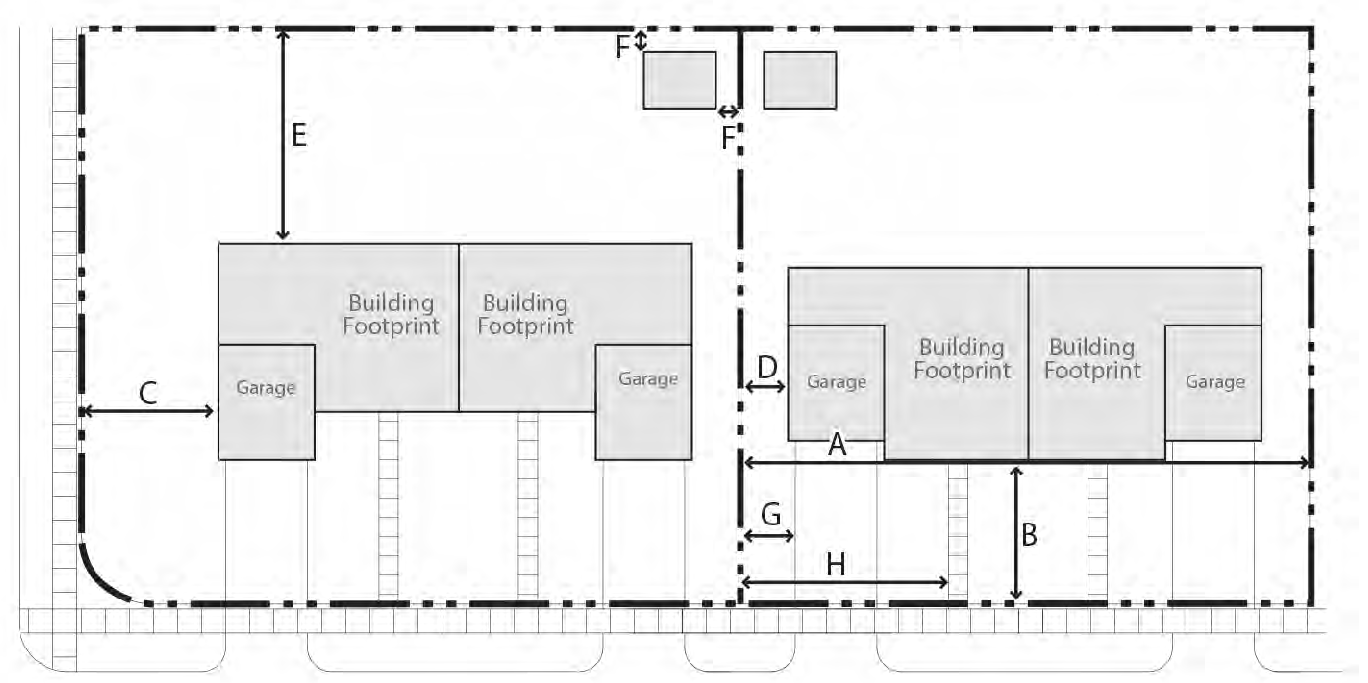
The following figure is intended to provide a graphic depiction of the setback and dimensional requirements for Duplex land uses. Specific requirements for Duplexes can be found in article II under the density, intensity, and bulk requirements for each residential zoning district.
Figure 23.03.06c: Duplex
(6)
Twin house: This dwelling unit type consists of two separate Family Residential residences, each having a private individual access and no shared internal access. Similar to Duplexes, Twin Houses are attached side-by-side units, each with a ground floor and roof. Unlike Duplexes, each dwelling unit in a Twin House is located on a separate lot.
Regulations:
(a)
In the case where any dwelling unit is under separate ownership, evidence that covenants specifying respective obligations with regard to any common structures, such as the shared wall, roof, and other inseparable improvements, is required.
(b)
This dwelling unit type may not be split into additional residences.
(c)
See section 23.07.10 for design standards for two family uses.
(d)
If no garage is provided, each dwelling unit shall provide one shed of no less than 80 square feet in order to store yard maintenance equipment or other items typically stored in a garage. Lots that are less than 60 feet wide or less than 100 feet deep shall be exempt from this requirement. Lots in which no area is available for its placement, as determined by the Zoning Administrator, shall be exempt from this requirement.
(e)
Minimum required parking: two spaces per dwelling unit.
(f)
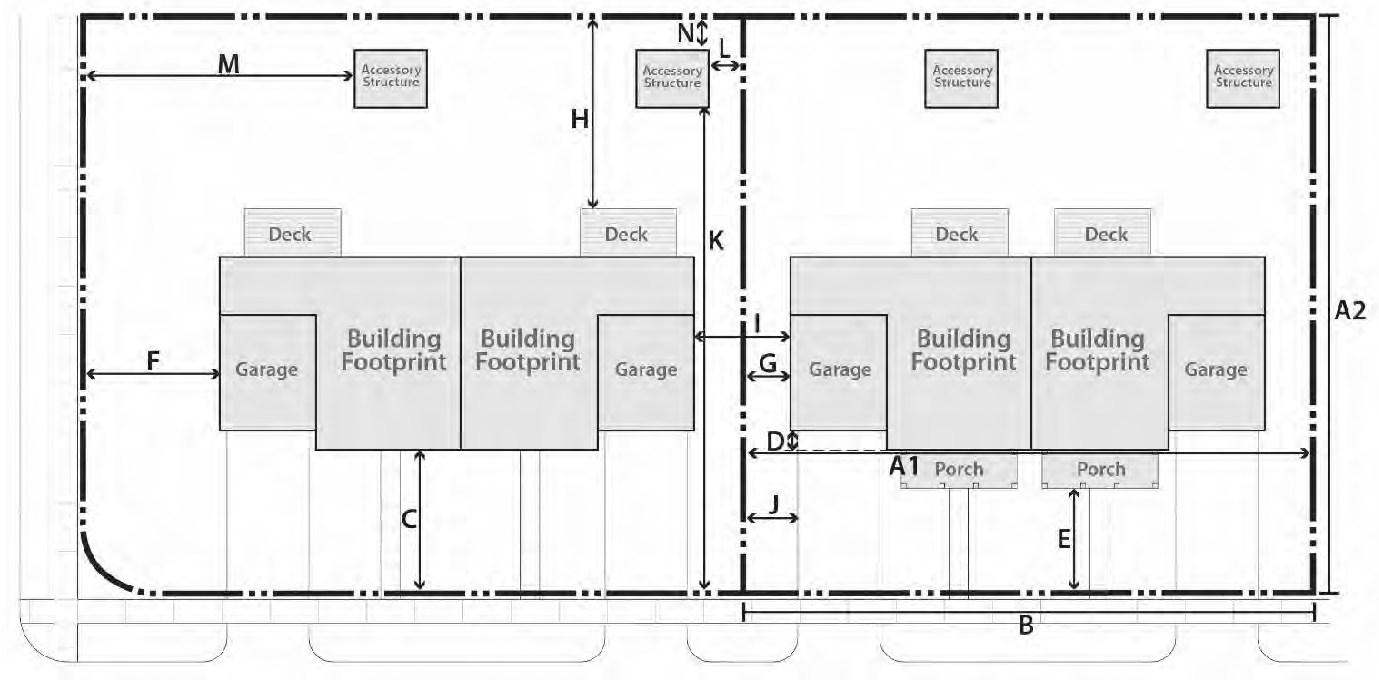
The following figure is intended to provide a graphic depiction of the setback and dimensional requirements for Twin House land uses. Specific requirements Twin Houses can be found in article II under the density, intensity, and bulk requirements for each residential zoning district.
Figure 23.03.06d: Twin House
(7)
Two flat: This dwelling unit type consists of a single structure with two separate family residential residences each having a private individual access, and no shared internal access other than entry foyers and halls. Two flats are attached units within a two-story structure with one unit above the other.
Regulations:
(a)
In the case where any dwelling unit is under separate ownership, evidence that covenants specifying respective obligations with regard to any common structures, such as the shared wall, roof, and other inseparable improvements, is required.
(b)
This dwelling unit type may not be split into more than two residences and remain a two-flat. A building with three or more residences is considered a multi-plex or apartment land use.
(c)
See section 23.07.10 for design standards for two family uses.
(d)
A minimum 200 square foot garage is required and must be in similar design style as to the principal structure.
(e)
Minimum required parking: two spaces per dwelling unit.
(f)
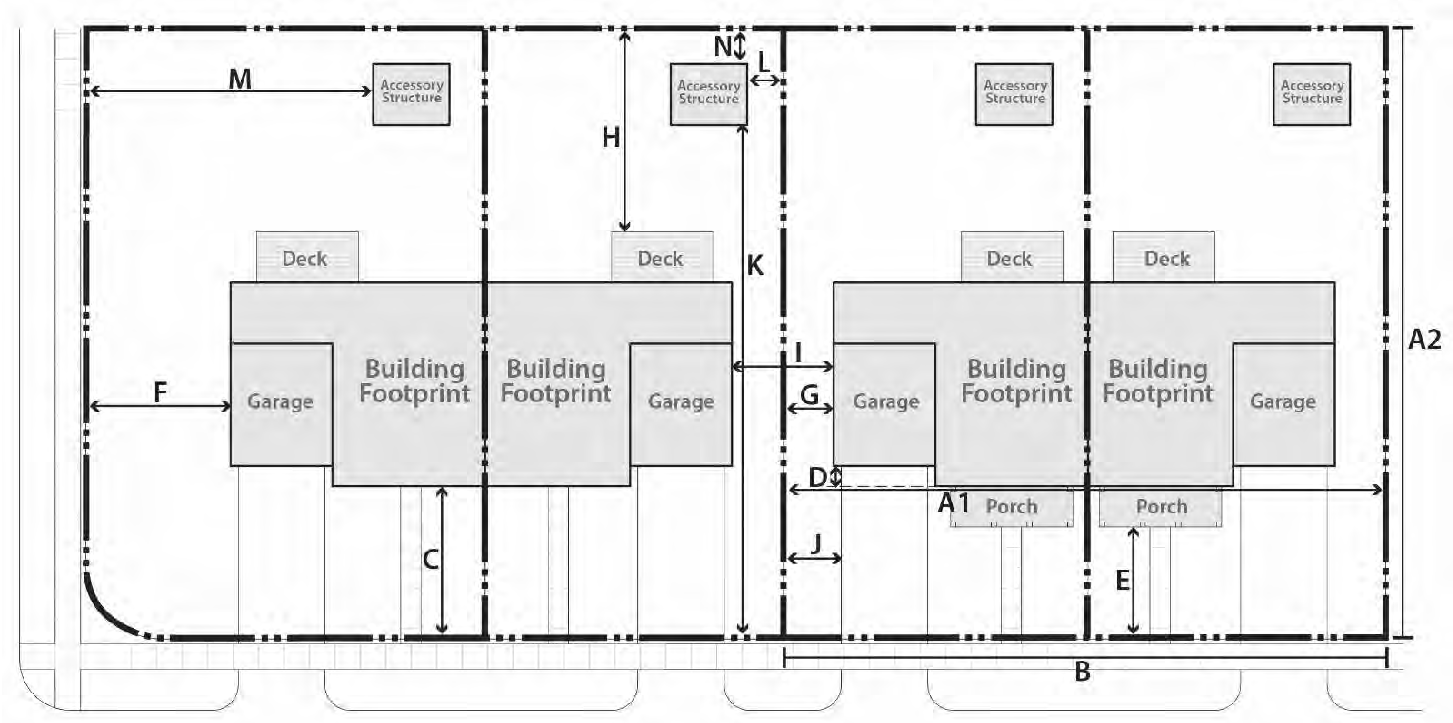
The following figure is intended to provide a graphic depiction of the setback and dimensional requirements for two flat land uses. Specific requirements for two flats can be found in article II under the density, intensity, and bulk requirements for each residential zoning district.
Figure 23.03.06e: Two Flat
(8)
Townhouse: This dwelling unit type consists of attached, two-story residences, each having a private, individual access. This dwelling unit type may be located on its own lot or within a group development. Each dwelling unit shares at least one common wall with an adjacent dwelling unit.
Regulations:
(a)
No more than ten and no less than three Townhouse dwelling units may be attached per building.
(b)
In the case where any dwelling unit is under separate ownership, evidence that covenants specifying respective obligations with regard to any common structures, such as the shared wall, roof, and other inseparable improvements, is required.
(c)
This dwelling unit type may not be split into additional residences.
(d)
See section 23.07.20 for multi-family design standards.
(e)
Minimum required parking: 1.5 spaces per dwelling unit containing zero to two bedrooms, plus 0.5 space per additional bedroom over two bedrooms per unit.
(f)
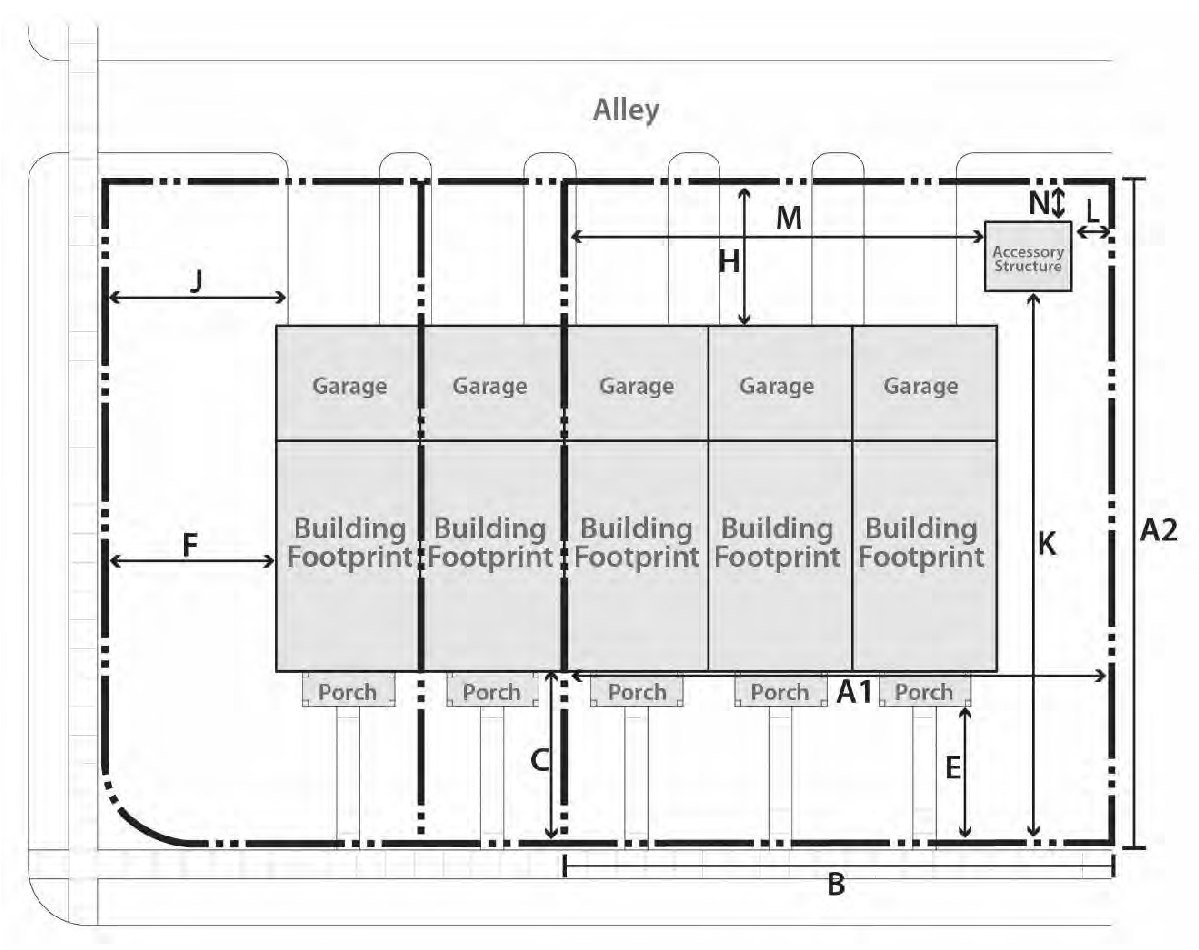
The following figure is intended to provide a graphic depiction of the setback and dimensional requirements for Townhouse land uses. Specific requirements for Townhouses can be found in article II under the density, intensity, and bulk requirements for each residential zoning district.
Figure 23.03.06f: Townhouse
(9)
Multiplex: This dwelling unit type consists of three or more individual attached dwelling units which have private, individual exterior entrances.
Regulations:
(a)
In the case where any dwelling unit is under separate ownership, evidence that covenants specifying respective obligations with regard to any common structures, such as the shared wall, roof, and other inseparable improvements, is required.
(b)
This dwelling unit type may not be split into additional residences.
(c)
See section 23.07.20 for multi-family design standards.
(d)
Minimum required parking: 1.5 spaces per dwelling unit containing zero to two bedrooms, plus 0.5 space per additional bedroom over two bedrooms per unit.
(e)
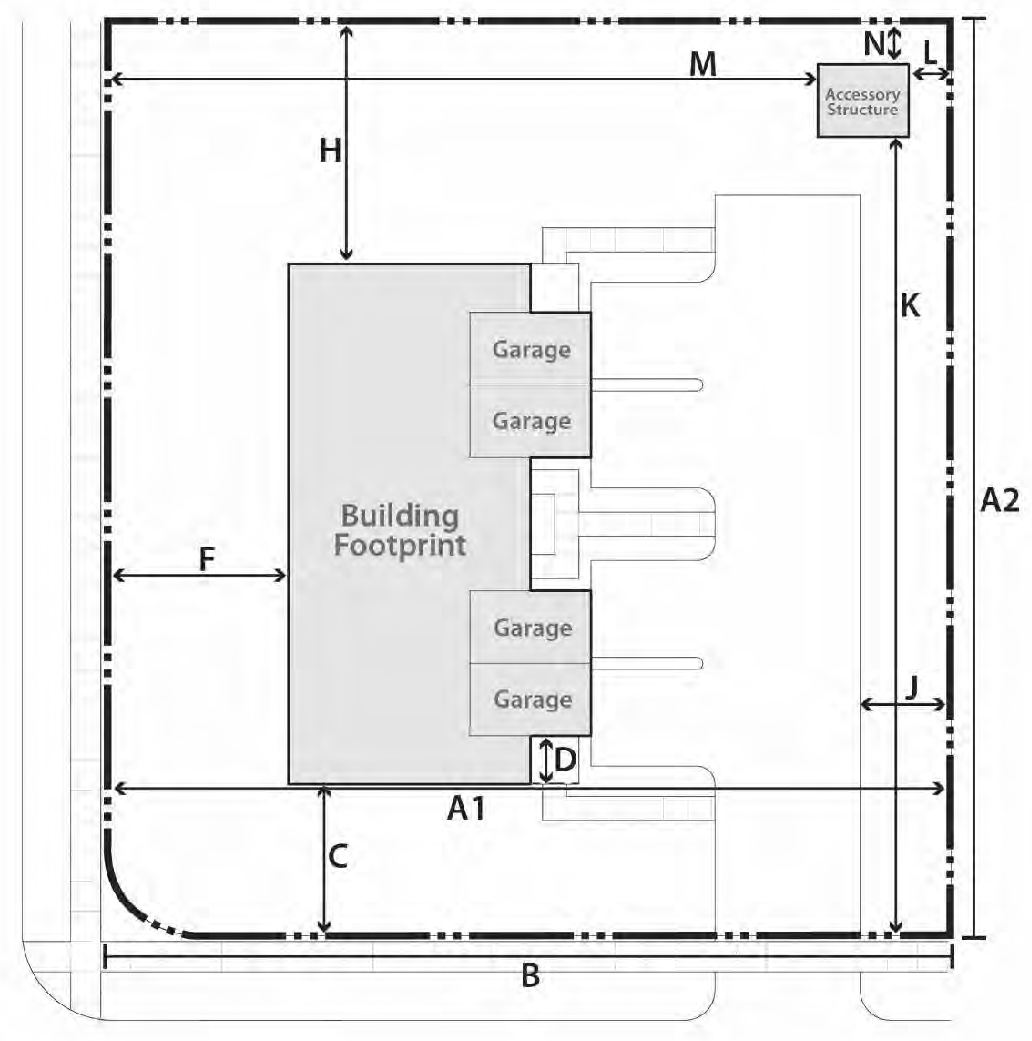
The following figure is intended to provide a graphic depiction of the setback and dimensional requirements for Multiplex land uses. Specific requirements for Multiplexes can be found in article II under the density, intensity, and bulk requirements for each residential zoning district.
Figure 23.03.06g: Multiplex
(10)
Apartment: This dwelling unit type consists of a single structure with three or more individual attached dwelling units which take access from a shared entrance or hallway.
Regulations:
(a)
In the case where any dwelling unit is under separate ownership, evidence that covenants specifying respective obligations with regard to any common structures, such as the shared wall, roof, and other inseparable improvements, is required.
(b)
Group Developments shall meet the standards of section 23.06.02. This dwelling unit type may not be split into additional residences.
(c)
See section 23.07.20 for multi-family design standards.
(d)
Minimum required parking: 1.5 spaces per dwelling unit containing zero to two bedrooms, plus 0.5 space per additional bedroom over two bedrooms per unit.
(e)
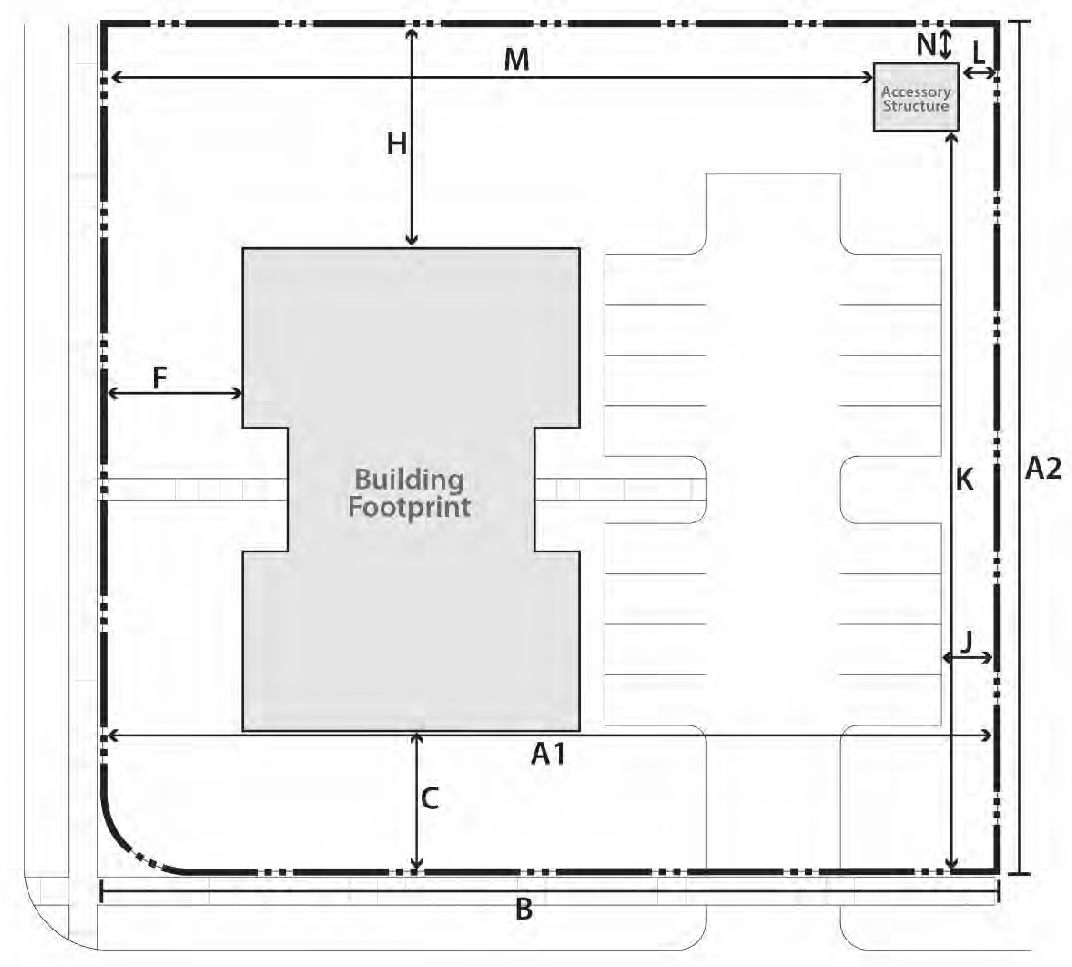
The following figure is intended to provide a graphic depiction of the setback and dimensional requirements for Apartment land uses. Specific requirements for Apartments can be found in article II under the density, intensity, and bulk requirements for each residential zoning district.
Figure 23.03.06h: Apartment
(11)
Single Family Living Arrangement: A residential land use in which occupancy of a dwelling unit is no more than one family.
(a)
Single Family Living Arrangements are distinct from Roommate Living Arrangements (occupied by four or five unrelated adult individuals) and Boarding House Living Arrangements (occupied by six or more unrelated adult individuals), which are regulated as separate land use types under sections 23.03.06(12) and 23.03.06(13).
(b)
Outdoor storage shall be restricted to rear and side yards and may include storage of such things as motorized vehicles in assigned parking spaces, bicycles, carry-in non-motorized watercraft., outdoor seating, and grills.
(c)
Minimum required parking: two spaces.
(12)
Roommate Living Arrangement: A residential land use in which occupancy of a dwelling unit is shared by four or five unrelated adult individuals.
(a)
Roommate Living Arrangements are distinct from single family living arrangements (occupied by no more than one family) and Boarding House Living Arrangements (occupied by six or more unrelated adult individuals), which are regulated as separate land use types under sections 23.03.06(11) and 23.03.06(13).
(b)
In single family and two family dwelling units, building modifications that increase the number of bedrooms in the structure are allowed only through approval of a conditional use permit.
(c)
Roommate Living Arrangements require an annual on-site exterior inspection to confirm compliance with all zoning and building code requirements.
(d)
Outdoor storage shall be restricted to rear and side yards and may include storage of such things as motorized vehicles in assigned parking spaces, bicycles, carry-in non-motorized watercraft., outdoor seating, and grills.
(e)
Minimum required parking: two per spaces per dwelling unit.
(f)
The following figure compares Roommate Residential Living Arrangement land uses to other residential land uses:
Figure 23.03.06i: Number of Unrelated Adults Permitted by Land Use
*Permitted by right in all legal dwelling units.
(13)
Boarding House Living Arrangement: A residential land use where occupancy of a dwelling unit is shared by six or more unrelated adult individuals.
(a)
Boarding House Living Arrangements are distinct from single family living arrangements (occupied by no more than one family) and roommate living arrangements (occupied by four or five unrelated adult individuals), which are regulated as separate land use types under sections 23.03.06(11) and 23.03.06(12).
(b)
Facility shall be surrounded by a bufferyard with a minimum opacity of 0.60 along all property borders abutting residentially zoned property.
(c)
Boarding House Living Arrangements require a license and an annual on-site inspection is required to confirm full compliance with all zoning and building code requirements.
(d)
Outdoor storage shall be restricted to rear yards and may include storage of such things as motorized vehicles in assigned parking spaces, bicycles, carry-in non-motorized watercraft., outdoor seating, and grills.
(e)
Minimum required parking: two spaces.
(Ord. No. 61-5883, § 19, 5-11-2021)
23.03.08 - Mixed use buildings.
(1)
Apartments with Limited Commercial: An apartment building which contains one or more principal nonresidential land uses on the ground floor.
Regulations:
(a)
This land use shall comply with all of the bulk and density requirements that apply to the most similar dwelling unit in section 23.03.06.
(b)
The principal commercial use shall be limited to the ground floor of the building and shall consist of no more than 33 percent of the gross floor area of the ground floor, or 5,000 square feet, whichever is smaller.
(c)
Minimum required parking: The parking requirements of each individual land use shall apply minus 25 percent.
(d)
Apartments with Limited Commercial shall comply with the design standards for multi-family uses. See section 23.07.20.
(2)
Mixed use building: A building containing a mix of principal commercial land uses and principal residential land uses.
Regulations:
(a)
Minimum amount of ground floor commercial. Refer to section 23.03.10 for a list of commercial uses.
1.
Residential uses shall comprise of no more than 30 percent of the gross floor area of the ground floor.
2.
In the River Edge Overlay, at least 70 percent of the building's ground floor area shall consist of commercial uses
3.
In all other districts, at least 50 percent of the building's ground floor area shall consist of commercial uses.
(b)
Minimum required parking: The parking requirements of each individual land use shall apply minus 25 percent.
(c)
Mixed use buildings shall comply with the design standards for commercial uses and mixed uses. See section 23.07.30.
(3)
Live/work building: A multi-unit building, typically arranged in a townhouse side-by-side format, in which each unit contains a commercial use on the ground floor with a residential use on upper floors, with both uses occupied by the same resident/business operator. The commercial use is typically interconnected to the residential use with an internal stair or elevator.
(a)
The live/work building shall be the primary dwelling of the occupant.
(b)
The commercial component of the live/work building is limited to the following land uses, but only if such uses are also permitted by right or by conditional use permit in the applicable zoning district:
1.
Office;
2.
Personal or professional service;;
3.
Indoor sales or service;
4.
Artisan production shop;
5.
Indoor maintenance service.
(c)
Employees who are not residents of the unit are permitted.
(d)
The commercial use is subject to the regulations of the applicable land use category in section 23.03.10.
(e)
Both uses are subject to the nonresidential density, intensity, and bulk requirements of article II.
(f)
The residential and the commercial space shall be occupied by the same tenant, and no portion of the live/work building shall be rented or sold separately.
(g)
Minimum required parking: The parking requirements of each individual land use shall apply minus 25 percent.
(h)
Live/work buildings shall comply with the design standards for commercial uses and mixed uses. See section 23.07.30.
23.03.10 - Commercial land uses.
(1)
Office: Indoor offices where the primary function is the handling of information or administrative services. Office uses do not typically provide services directly to customers on a walk-in basis.
Regulations:
(a)
Minimum required parking: One space per 400 square feet of gross floor area in excess of 2,000 square feet.
(2)
Personal or professional service: Indoor service land uses where the primary function is the provision of services directly to an individual on a walk-in or on-appointment basis. Examples of such uses include establishments where customers make an appointment, such as professional services, insurance or financial services, realty offices, small scale by-appointment medical offices and clinics, veterinary clinics, barber shops, beauty shops, and related land uses including ancillary on site production of items used in the provision of such services.
Regulations:
(a)
Minimum required parking: One space per 400 square feet of gross floor area in excess of 2,000 square feet.
(3)
Indoor sales or service: The sale and/or display of merchandise or equipment or non-personal or non-professional services, entirely within an enclosed building. Includes general merchandise stores, grocery stores, butcher, sporting goods stores, antique stores, gift. shops, laundromats, bakeries, copy and printing centers, photo processing centers, and other uses meeting this definition.
Regulations:
(a)
Minimum required parking: One space per 400 square feet of gross floor area in excess of 2,000 square feet.
(4)
Outdoor display: Land uses where the sale and display of merchandise or equipment is conducted outside of an enclosed building on more than a temporary basis. Examples include, but are not limited to, outdoor garden centers, outdoor recreation equipment sales, monument sales, flea markets, and manufactured and mobile housing sales. If the permanent outdoor display area is less than five percent of the indoor building floor area and is secondary to an indoor sales or service use, such use shall instead be considered incidental outdoor display under section 23.03.28(17). Outdoor display on a temporary basis shall be regulated by Temporary outdoor sales under section 23.03.30(2).
Regulations:
(a)
The outdoor display area shall be calculated as the area which would be enclosed by an imaginary line that would completely enclose all materials displayed outdoors in the smallest possible rectangle.
(b)
The facility shall be surrounded by a bufferyard with a minimum opacity of 0.60 along all borders of the display area abutting residentially zoned property.
(c)
The display of items shall not be permitted in required setback areas, landscape areas, or bufferyards, unless located in a parking lot.
(d)
Inoperable vehicles or equipment, or other items typically stored in a junkyard or salvage yard as defined under section 23.03.22(4), shall not be displayed.
(e)
In no event shall the display of items reduce or inhibit the use or number of parking stalls provided on the property below the requirement established by (i), below. If the number of provided parking stalls on the property is already less than the requirement, such display area shall not further reduce the number of parking stalls already present.
(f)
Display areas shall be separated from any circulation area by a minimum of ten feet. This separation shall be clearly delimited by a physical separation such as a greenway, curb, fence, or line of planters, or by a clearly marked paved area.
(g)
Signs, screening, enclosures, landscaping, or materials being displayed shall not interfere in any manner with either on-site or off-site traffic visibility, including potential vehicle/vehicle and vehicle/pedestrian conflicts. Signs, screening, enclosures, landscaping, or materials being displayed shall comply with requirements related to corner clearance, vision triangles, crosswalks, drive aisle width, parking stall dimensions, fire lanes, bike lanes, or similar requirements related to traffic and pedestrian safety.
(h)
Outdoor Display shall be permitted during the entire calendar year, however, if goods are removed from the display area all support fixtures used to display the goods shall be removed within ten calendar days of the goods' removal.
(i)
Minimum required parking: One space per 2,000 square feet of gross outdoor floor area.
(5)
Artisan production shop: A building or portion thereof used by ten or fewer artists or artisans for the creation, preparation, display and sale of unique (rather than mass-produced) individually crafted items including artwork, jewelry, custom furniture, woodwork, sculpture, glass, metal, pottery, leathercraft., hand-woven articles, and related items, as either a principal use or accessory use.
Regulations.
(a)
Minimum required parking: One space per 400 square feet of gross floor area in excess of 2,000 square feet.
(6)
Physical activity studio: All land uses which provide a facility for training, instruction, and physical activity within an enclosed building. Such activities often have operating hours which extend significantly earlier or later than most other commercial land uses, and often employ amplified music to set training tempo. Examples of such land uses include health or fitness centers, all forms of training studios (yoga, dance, art, martial arts, gymnastics, etc.), and music schools.
Regulations.
(a)
No customer entrance of any kind shall be permitted within 50 feet of a residentially zoned property.
(b)
Facility shall provide bufferyard with minimum opacity of .60 along all borders of the property abutting residentially zoned property if outdoor physical activity takes place (see section 23.08.30(5)).
(c)
Shall comply with section 23.10.32, procedures applicable to all conditional uses.
(d)
Minimum required parking: One space per every three persons at the maximum capacity of the establishment.
(7)
Commercial kitchen: A building or portion thereof used for the preparation of food that can be rented or used as a classroom by different organizations, businesses, or individuals. Products produced on site may be sold off site.
Regulations.
(a)
Shall comply with the requirements of the Health Code of Marathon County and applicable state regulations.
(b)
Minimum required parking: One space per 400 square feet of gross floor area in excess of 2,000 square feet.
(8)
Restaurants, taverns, and indoor commercial entertainment: Land uses which provide entertainment services entirely within an enclosed building. Such activities often have the potential to be associated with nuisances related to amplified music, noise, lighting, trash, and late operating hours that extend significantly later than most other commercial land uses. Examples of such land uses include, but are not limited to, restaurants, taverns, theaters, bowling alleys, arcades, roller rinks, and pool halls.
Regulations.
(a)
Customer entrances shall be located a minimum of 50 feet from residentially zoned property.
(b)
Minimum required parking: one space per five persons at the maximum capacity of the establishment.
(9)
Outdoor commercial entertainment: Land uses which provide entertainment services partially or wholly outside of an enclosed building. Such activities often have the potential to be associated with nuisances related to noise, lighting, dust, trash, and late operating hours. Outdoor commercial entertainment land uses may include, but are not limited to outdoor eating and drinking areas, sand volleyball courts, outdoor assembly areas, and outdoor swimming pools associated with another principal land use. Note that high-attendance facilities oriented to non-resident users or attendees and intensively lit tournament oriented outdoor facilities are considered intensive outdoor activity land uses (see section 23.03.11(23)).
Regulations:
(a)
Customer entrances shall be located a minimum of 50 feet from residentially-zoned property.
(b)
Activity areas shall not be located closer than 50 feet to a residentially-zoned property.
(c)
Facility shall provide bufferyard with minimum opacity of 0.40 along all borders of the outdoor activity area abutting residentially-zoned property.
(d)
Minimum required parking: One space for every three persons at the maximum capacity of the establishment.
(10)
Drive-through and in-vehicle sales or service: Land uses where sales and/or services are conducted to persons in vehicles, or to vehicles which may or may not be occupied at the time of such activity (except vehicle repair and maintenance services). Such land uses often have traffic volumes which exhibit their highest levels concurrent with peak traffic flows on adjacent roads. Examples of such land uses include, but are not limited to, drive-in facilities, drive-through facilities, fuel stations, and car washes.
Regulations:
(a)
Clearly marked pedestrian crosswalks shall be provided for each walk-in customer access to the facility.
(b)
Drive-through windows shall not be located between the principal building and the street right-of-way.
(c)
The drive-through facility shall be designed so as to not impede or impair vehicular and pedestrian traffic movement, or exacerbate the potential for pedestrian/vehicular conflicts.
(d)
In no instance shall a drive-through facility be permitted to operate which endangers the public safety, even if such land use has been permitted under the provisions of this section.
(e)
The setback of the outer edge of any overhead canopy or similar structure shall be a minimum of ten feet from all street rights-of-way lines, or the principal building setback, whichever is greater; a minimum of 20 feet from all residentially-zoned property lines; and shall be a minimum of five feet from all other property lines. The total height of any overhead canopy or similar structure shall not exceed 25 feet per the measurement of roof height.
(f)
Facility shall provide a bufferyard with a minimum opacity of 0.60 along all property borders abutting residentially zoned property.
(g)
Interior curbs shall be used to separate driving areas from exterior fixtures such as fuel pumps, vacuums, menu boards, canopy supports, and landscaped islands not part of an approved stormwater management system. Said curbs shall be a minimum of six inches high.
(h)
Minimum stacking lane length for drive-through facilities shall be as follows:
1.
Automatic car wash: 100 feet in front of the car wash entrance and 40 feet after the exit.
2.
Establishments selling food and/or drink: 100 feet in front of each order station, 55 feet between the order station and the pick-up window, and 25 [feet] after the pick-up window.
3.
All other uses: 55 feet in front of and 25 feet after each service window.
(i)
Minimum required parking: Refer to the parking requirements of the other land use activities on the site, such as Indoor Sales and Service land uses for a gas station/convenience store, or Office land uses for a bank.
(11)
Group daycare center (nine+ children): Facilities which provide childcare services for nine or more children. Such land uses may be operated in conjunction with another principal land use on the same environs, such as a church, school, business, or civic organization. In such instances, group daycare centers are considered a separate principal use and require review as such.
Regulations:
(a)
Group Daycare Centers shall not be located within a residential building.
(b)
Facility shall be surrounded by a bufferyard with a minimum opacity of 0.50 along all property borders abutting residentially zoned property.
(c)
Minimum required parking: Two spaces per ten students, plus one space for each employee on the largest work shift.
(12)
Commercial animal boarding/daycare: Facilities where short-term and/or long-term animal boarding is provided, including commercial kennels, commercial stables, pet daycare, and animal shelters. Exercise yards, fields, training areas, and trails associated with such land uses are considered accessory to and do not require separate consideration.
Regulations:
(a)
Animal containment areas shall be surrounded by a bufferyard with a minimum opacity of 0.70 along sides abutting residentially zoned property
(b)
Each animal shall be provided with an indoor containment area.
(c)
Events such as shows, exhibitions, and contests shall only be permitted when a temporary use permit has been secured.
(d)
Minimum required parking: One space per every 1,000 square feet of gross floor area, plus one space for each employee on the largest work shift.
(13)
Bed and breakfast: Bed and Breakfasts are places of lodging that provide rooms for rent in the owner's personal residence, are occupied by the owner at the time of rental, and where the only meal served to guests is breakfast.
Regulations:
(a)
Facility shall be surrounded by a bufferyard with a minimum opacity of 0.40 along all property borders abutting residentially zoned property.
(b)
The dwelling unit in which the Bed and Breakfast takes place shall be the principal residence of the operator/owner and said operator/owner shall live on the premises when the Bed and Breakfast operation is active.
(c)
The facility shall comply with the requirements of Wis. Stats. § § 254.61 Chapter DHS 197, Wis. Admin. Code.
(d)
Minimum required parking: One space per each bedroom in addition to requirements for principal residents.
(14)
Vacation rental home: A dwelling unit available for overnight, weekend or weekly stays by paying guests, which may or may not be owner-occupied for parts of the year. These uses are often referred to as vacation rentals and include timeshare units. Where such units are available for lease for periods of time longer than 14 consecutive nights, such uses shall not be considered Vacation Rental Homes, but shall instead be considered Single Family Dwelling Units, separately described and regulated under this title. Also, not included within this land use category are: Bed and Breakfast, Commercial Indoor Lodging, or Boarding House Living Arrangement.
Regulations:
(a)
Vacation Rental Homes shall not provide rooms for rent for more than 30 total nights during a 12-month period.
(b)
Occupancy shall be limited to two persons per bedroom, plus an additional two persons. At no time may the number of guests exceed eight regardless of the number bedrooms in the dwelling unit.
(c)
The maximum stay for any party other than the owner of the premises shall be 14 consecutive days.
(d)
The appearance or use of the dwelling shall not be altered in a manner that would cause the premises to differ from its residential character either by the use of colors, materials, construction, lighting, signs, or the emission of sounds, odors, dust or vibrations that carry beyond the premises.
(e)
The availability of the Vacation Rental Home to the public shall not be advertised on site.
(f)
Minimum required parking: One space per each bedroom. All guest vehicles shall be parked on site.
(g)
A driveway may contain one or more legal parking spaces. Driveways shall be considered legal "stacked" parking spaces, provided that each driveway parking space is no less than eight feet in width and 18 feet in depth.
(15)
Commercial indoor lodging: Facilities where overnight housing in individual rooms or suites of rooms is provided, with each room or suite having a private bathroom. Such land uses may provide in-room or in-suite kitchens and may also provide indoor recreational facilities. Restaurant, lounge, fitness centers, and other on-site facilities available to non-lodgers are considered principal uses and therefore require review as a separate land use.
Regulations:
(a)
Customer entrances shall be located 50 feet from residentially zoned property.
(b)
Facility shall be surrounded by a bufferyard with a minimum opacity of 0.60 along all property borders abutting residentially zoned property.
(c)
Minimum required parking: One space per room for rent.
(16)
Campground: Campgrounds include any facilities designed for overnight accommodation of persons in tents, travel trailers, or other mobile or portable shelters or recreational vehicles, including recreational vehicle overnight stays in parking lots and other similar locations not in campgrounds.
Regulations:
(a)
Campgrounds shall be surrounded by a bufferyard with a minimum opacity of 0.70 along all property borders abutting residentially zoned property.
(b)
Facility shall secure a County Health Department license.
(c)
Minimum required parking: One space per campsite.
(17)
Indoor maintenance service: Facilities where maintenance and repair service is provided and all operations are located entirely within an enclosed building, including the repair of clocks, vacuum cleaners, and small appliances. This shall not include Vehicle Sales or Vehicle Service and Repair land uses.
Regulations:
(a)
Minimum required parking: One space per 400 square feet of gross floor area in excess of 2,000 square feet.
(18)
Outdoor maintenance service: Facilities where maintenance and repair service is provided and where all or any portion of the operation is located outside of an enclosed building. This shall not include Vehicle Sales or Vehicle Service and Repair land uses.
Regulations:
(a)
All outdoor activity areas shall be completely enclosed by a minimum six feet high, solid fence. Such enclosure shall be located a minimum of 50 feet from any residentially zoned property and shall be screened from such property by a bufferyard with a minimum opacity of 0.60.
(b)
Outdoor storage of unlicensed or inoperable vehicles is prohibited outside fenced areas.
(c)
Minimum required parking: One space per 400 square feet of gross floor area in excess of 2,000 square feet.
(19)
Vehicle sales: The sale and display of vehicles for sale or rent outside of an enclosed building. Such land uses also include an ancillary repair shop associated with the vehicle display lot and sales building.
Regulations:
(a)
The display of vehicles shall not be permitted in green space areas, landscaped areas, or required bufferyards.
(b)
Facility shall be surrounded by a bufferyard with a minimum opacity of 0.60 along all borders of the display area abutting residentially zoned property.
(c)
Signs, screening, enclosures, landscaping, or materials being displayed shall not interfere in any manner with either on-site or off-site traffic visibility, including potential vehicle/vehicle and vehicle/pedestrian conflicts.
(d)
Inoperable vehicles or equipment or other items typically stored or displayed in a junkyard or salvage yard shall not be permitted.
(e)
Minimum required parking: One space per 400 square feet of gross floor area in excess of 2,000 square feet.
(20)
Vehicle service and repair: Facilities where vehicle service and/or repair is provided entirely within an enclosed building, including unlicensed or inoperable vehicles used for spare parts.
Regulations:
(a)
Facility shall be surrounded by a bufferyard with a minimum opacity of 0.60 along all borders of the display area abutting residentially zoned property.
(b)
Signs, screening, enclosures, landscaping, or materials being displayed shall not interfere in any manner with either on-site or off-site traffic visibility, including potential vehicle/vehicle and vehicle/pedestrian conflicts.
(c)
Outdoor storage of unlicensed or inoperable vehicles is prohibited outside areas fully screened by a solid fence. Outdoor storage of other items typically stored or displayed in a junkyard or salvage yard shall not be permitted.
(d)
Minimum required parking: One space per 400 square feet of gross floor area in excess of 2,000 square feet.
(21)
Water-related recreation: Lake-related or river-related recreational facilities such as marinas, yacht clubs, bait shops, boat launching ramps, boat slips, boat storage, docking facilities, boat liveries and rentals, and boat repair and maintenance facilities, including gasoline pumps for marine use.
Regulations:
(a)
Minimum required parking: Generally, one space is required per every four patrons at maximum capacity; however, the following specific requirements apply:
1.
Bait shops, marine supplies, and boat repair and maintenance facilities: One space per 300 square feet of gross floor area in excess of 2,000 square feet, plus one space per employee on the largest work shift.
2.
Boat repair and maintenance facilities: One space per 200 square feet of gross floor area in excess of 2,000 square feet.
3.
Marinas, yacht clubs, boat slips, boat docking facilities, and boat liveries and rentals: One space per watercraft. kept on site.
4.
Excursion and fishing cruises: One space is per every four patrons at maximum capacity plus one space per employee on the largest work shift.
5.
Boat launching ramps: Per Wisconsin Department of Natural Resources regulations.
(22)
Adult-oriented entertainment business: An adult bookstore, adult theater, adult massage parlor, adult sauna, adult entertainment center, adult cabaret, adult health or sport club, adult steam room or bathhouse facility, or any other business in which the primary business activity is characterized by emphasis on matters depicting, describing, or relating to nudity, sexual conduct, sexual excitement, or sadomasochistic abuse.
(a)
Findings. The Common Council of the City of Wausau hereby finds as follows:
1.
The location, siting, design, construction and use of adult-oriented entertainment businesses can have adverse impacts on the surrounding area.
2.
Adult-oriented entertainment businesses can exert a dehumanizing influence on persons attending places of worship, children attending licensed daycare homes, persons using public parks, and children and other persons attending public schools.
3.
Adult-oriented entertainment businesses can contribute to an increase in criminal activity in the area where such businesses are located, taxing local law enforcement services.
4.
Adult-oriented entertainment businesses can significantly contribute to the deterioration of residential neighborhoods and can impair the value of the residential housing in the area in which such businesses are located.
5.
The concentration of adult-oriented entertainment businesses in one area can have a substantially detrimental effect on the area in which such businesses are concentrated and on the overall quality of urban life.
6.
A cycle of decay can result from the influx and concentration of adult-oriented entertainment businesses. The presence of such businesses is perceived by others as an indication that the area is deteriorating, and the result can be devastating as other businesses and residences move out of the vicinity. Declining real estate values, which can result from the concentration of such business, erode the city's tax base.
7.
The City may enact zoning regulations to promote the public health, safety and general welfare of the citizens of the City as provided under Wis. Stats. § 62.23.
(b)
Purpose.
1.
The purpose of these regulations is to control through zoning the location and operational characteristics of Adult-Oriented Entertainment Businesses so as to minimize the detrimental effect on the character of the City's residential neighborhoods and commercial areas.
2.
These regulations are intended to establish a reasonable balance between the legitimate public purpose of protecting the health, safety, and welfare of residents and businesses in the City and the legally recognized rights of owners, operators, and employees of Adult-Oriented Entertainment Businesses by allowing such businesses to operate in locations and under circumstances that minimize the adverse effects of such businesses.
3.
These regulations shall not impose a limitation on the content of any communication materials, including sexually-oriented materials as protected by the First Amendment to the United States Constitution.
(c)
Applicability. The provisions of this title shall apply to all Adult-Oriented Entertainment Businesses.
(d)
Distance limitations. No Adult-Oriented Entertainment Business shall:
1.
Be operated or maintained within 500 feet of the boundary of any of the following zoning districts: SR-2, SR-3, SR-5, SR-7, DR-8, TF-8, TRD-12, MR-15, MRL-12, MRL-20, and MRL-50.
2.
Be operated or maintained within 300 feet of the Institutional Zoning District or an Institutional Land Use (section 23.02.50 and 23.03.12).
3.
Distance limitations set forth in this section shall be measured in a straight line from the main public entrance of the Adult-Oriented Entertainment Business to the main public entrance to the named use or, in the case of the named zoning districts from the main public entrance of the adult-oriented entertainment business to the nearest boundary of the named zoning district.
(e)
Same use restrictions. No Adult-Oriented Entertainment Business shall be located in the same building or upon the same property as another such use.
(f)
Sign limitations. Notwithstanding any other provision of this title, an Adult-Oriented Entertainment Business shall not be permitted more than one business sign. Signs advertising or promoting an adult-oriented entertainment business shall meet the following criteria:
1.
No sign shall display merchandise or pictures of the products or entertainment on the premises in any area which can be viewed from the sidewalk, street, or other public way, adjacent to the building.
2.
No sign shall be placed in any window. In addition to the business sign, a one square foot informational sign may be placed on the door to state hours of operation and admittance to adults only.
3.
No sign shall contain any flashing lights, moving elements, or mechanically changing messages.
4.
No sign shall contain any depiction of the human form, or any part thereof, nor shall it contain sexually explicit language.
5.
No Adult-Oriented Entertainment Business may have any off-premise business sign.
(g)
Operating standards. All adult-oriented entertainment businesses shall operate under the following:
1.
No employee shall solicit business outside the building in which the business is located.
2.
No male or female person, while on the premises, shall expose to public view his or her genitals, pubic area, anus, or anal cleft. Full nudity is prohibited.
3.
No person on the premises shall engage in sexual conduct or sadomasochistic abuse.
4.
Nudity is prohibited for any employee of an Adult-Oriented Entertainment Business where such person is in direct, personal contact with another person.
(h)
Building's exterior appearance. The building's exterior shall meet the following criteria:
1.
Colors shall be earth or neutral tones and primary accent colors shall be within the same color family.
2.
Stripes and geometric patterns are prohibited.
3.
A color scheme which is directly inherent to a unique recognized architectural style but not otherwise compliant with this section may be reviewed and approved by the Plan Commission.
4.
The exterior shall be adequately maintained in good condition.
(i)
Severability. If any subsection, sentence, clause or phrase of this section is for any reason held to be invalid or unconstitutional by reason of any decision of any court of competent jurisdiction, such decision shall not affect the validity of any other section, subsection, sentence, clause or phrase or portion thereof.
(j)
Minimum required parking: One space per every five expected patrons at maximum capacity.
(23)
Intensive outdoor activity: Land uses located on private or public property that require intensive lighting and generate regional traffic and noise beyond property lines. Intensive outdoor activity land uses may include, but are not limited to, amusement parks, water parks, fairgrounds, outdoor stadiums, go cart tracks, paint ball, race tracks, ski hills, drive-in theaters, miniature golf, driving ranges, and tournament-oriented athletic facilities.
Regulations:
(a)
No Intensive Outdoor Activity shall take place before 8:00 a.m. or after 10:00 p.m. except as explicitly authorized by the conditional use process.
(b)
A bufferyard with a minimum opacity of 1.0 shall be provided along all property abutting residentially zoned property and for any facility requiring night lighting.
(c)
Facilities serving a regional or community-wide function shall provide an off-street passenger loading area if the majority of the users will be children or senior citizens.
(d)
Any activity area other than parking shall be set back a minimum of 100 feet from the property line.
(e)
Minimum required parking: One space per every five expected patrons at maximum capacity. The Zoning Administrator may require a parking study to determine parking requirements.
(Ord. No. 61-4057-730, § 12, 1-23-2024)
23.03.12 - Institutional land uses.
(1)
Indoor institutional: Indoor public and not for profit recreational facilities (such as gyms, swimming pools, libraries, museums, and community centers), government facilities, schools, churches, homeless day shelters, hospitals and walk-in clinics, nonprofit clubs, nonprofit fraternal organizations, convention centers, private institutional businesses, jails, prisons, and similar land uses.
Regulations:
(a)
An off-street passenger loading area shall be provided if the majority of the users will be children or senior citizens (as in the case of a school, church, library, or similar land use).
(b)
Minimum required parking: Generally, one space per three expected patrons at maximum capacity; however, the following specific requirements may apply.
1.
Hospital: To be determined by Zoning Administrator, based on parking study.
2.
Church: One space per six seats at the maximum seating capacity in the main worship area. For benches, pews, and other similar seating facilities, 30 inches of such seating shall be counted as one seat for the purpose of this ordinance.
3.
Community or recreation center: One space per three patrons at the maximum capacity.
4.
Funeral home: One space per five persons at the maximum capacity, plus one space per employee on the largest work shift.
5.
Library or museum: One space per 800 square feet of gross floor area.
6.
Elementary and middle school: One space per two employees.
7.
Secondary school: One space per two employees, plus one space for every ten students of maximum student enrollment.
8.
College or trade school: To be determined by Zoning Administrator, based on parking study.
(2)
Outdoor open space institutional: Cemeteries, privately held permanently protected green space areas, open grassed areas not associated with any particular active recreational land use, and similar land uses.
Regulations:
(a)
Minimum required parking: No parking is required; however internal drives may be used for parking.
(3)
Passive outdoor recreation: Recreational land uses located which involve passive recreational activities, such as arboretums, natural areas, wildlife areas, hiking trails, bike trails, cross country ski trails, horse trails, picnic areas, picnic shelters, botanical gardens, fishing areas, and similar land uses.
Regulations:
(a)
Minimum required parking: One space per four expected patrons at maximum capacity for any use requiring over five spaces.
(4)
Active outdoor recreation: Recreational land uses which involve active recreational activities. Such land uses include tennis courts, basketball courts, ball diamonds, football fields, soccer fields, neighborhood parks, tot lots, outdoor swimming pools, swimming beach areas, fitness courses, public golf courses, and similar land uses.
Regulations:
(a)
Facilities using recreational facility night lighting and adjoining a residentially zoned property shall install and continually maintain a bufferyard with a minimum opacity of 0.60. Said bufferyard shall be located at the property line adjacent to said residentially zoned property.
(b)
All structures, paved areas, and active recreational improvements such as sandboxes, tot lots, tennis courts, and baseball backstops shall be located a minimum of 25 feet from any residentially zoned property.
(c)
Facilities which serve a regional or community-wide function shall provide an off-street passenger loading area if the majority of the users will be children or senior citizens.
(d)
Minimum required parking: Generally, one space is required per four expected patrons at maximum capacity for any use requiring over five spaces, however, the following specific requirements apply.
1.
Athletic facilities: one space per employee on the largest work shift., plus one space per four patrons (participants and spectators) at maximum capacity.
2.
Tot lots, fitness courses, and parks: no parking spaces required.
3.
The Zoning Administrator has the ability to require a parking study to increase or reduce parking requirements for any combination of the above uses.
(e)
An Active Outdoor Recreation Land Use that includes the following is required to obtain a Conditional use permit (23.10.32.):
1.
Any on-site exterior lighting that exceeds 10.0 foot-candles.
2.
Any on-site parking the exceeds 50 spaces.
(5)
Essential services: The erection, construction, alteration, or maintenance by public utilities or municipal or other governmental agencies and private utilities, of underground and overhead lines and pipes for gas, electric, telephone, communications, cable television, steam, public water supply, sanitary sewage collection, stormwater detention or conveyance, or other comparable utilities. Essential Services include such above-surface facilities as poles, guide wires, fire alarm boxes, water hydrants, lift. stations, utility posts, police call boxes, cabinets, vaults, and standpipes. Essential Services do not include larger utility facilities included under Large Scale Public Services and Utilities, such as electric substations, wastewater treatment plants, well houses, and water towers.
Regulations:
(a)
Essential services are exempt from density, intensity, and bulk regulations.
(b)
All structures shall be located a minimum of 20 feet from any residentially zoned property. Does not include landscaping or storm water detention facilities
(c)
Outdoor storage areas shall be located a minimum of 50 feet from any residentially zoned property.
(d)
The exterior of all buildings shall meet the requirements for exterior materials of article VII.
(e)
Minimum required parking: None.
(6)
Large scale public services and utilities: Large scale facilities such as public works facilities and garages, wastewater treatment plants, potable water treatment plants, public and/or private utility substations, water towers, well houses, and similar land uses involving buildings and/or fenced enclosures. This does not include uses listed under Essential Services.
Regulations:
(a)
All structures shall be located a minimum of 20 feet from any residentially zoned property.
(b)
Outdoor storage areas shall be located a minimum of 50 feet from any residentially zoned property.
(c)
The exterior of all buildings shall meet the requirements for exterior materials of article VII.
(d)
All outdoor storage areas adjoining a residentially zoned property shall install and continually maintain a bufferyard with a minimum opacity of 0.60. Said bufferyard shall be located at the property line adjacent to said residentially zoned property.
(e)
Minimum required parking: One space per employee on the largest work shift., plus one space per company vehicle normally stored or parked on the premises.
(7)
Community living arrangement (one to eight residents): Facilities provided for in Wis. Stats. § 62.23(7)(i), including community living arrangements for adults as defined in Wis. Stats. § 46.03(22), community living arrangements for children as defined in Wis. Stats. § 48.743(1), foster homes as defined in Wis. Stats. § 48.02(6), and adult family homes and community-based residential facilities (CBRFs) as defined in Wis. Stats. § 50.01(1g).
Community Living Arrangements do not include Roommate Residential Living Arrangements, Boarding Houses, Group Daycare Centers, nursing homes, homeless shelters, hospitals, prisons, or jails. Community Living Arrangement facilities are regulated depending upon their capacity as provided for in Wis. Stats. § 62.23(7)(i)1.—5., provided any such regulations do not violate federal or state housing or anti-discrimination laws.
Regulations:
(a)
No Community Living Arrangement shall be established within 2,500 feet of any other such facility regardless of its capacity.
(b)
The total capacity of all Community Living Arrangements (of all capacities) in the City shall not exceed one percent of the City's population. The Zoning Administrator shall make this determination.
(c)
Foster homes housing four or fewer children and licensed under Wis. Stats. § 48.62 shall not be subject to (a), above; and shall not be subject to, or count toward, the total arrived at in (b), above.
(d)
Each facility shall have a rear and side yard which is visually screened from adjacent residential properties using a bufferyard with a minimum opacity of 0.20.
(e)
Minimum required parking: One space per employee on the largest work shift.
(f)
Driveways shall be considered legal "stacked" parking spaces, provided that each parking space is no less than eight feet in width and 18 feet in depth. A driveway may contain one or more legal parking spaces.
(g)
Any application is required to disclose in writing the capacity of the community living arrangement proposed.
(8)
Community Living arrangement (nine to 15 residents): See description under subsection (7), above.
Regulations:
(a)
No Community Living Arrangement shall be established within 2,500 feet of any other such facility regardless of its capacity.
(b)
The total capacity of all Community Living Arrangements (of all capacities) in the City shall not exceed one percent of the City's population.
(c)
Foster homes housing four or fewer children and licensed under Wis. Stats. § 48.62 shall not be subject to (a), above; and shall not be subject to, or count toward, the total arrived at in (b), above.
(d)
Each facility shall have a rear and side yard which is visually screened from adjacent residential properties using a bufferyard with a minimum opacity of 0.20.
(e)
Minimum required parking: One space per employee on the largest work shift.
(f)
Any application is required to disclose in writing the capacity of the community living arrangement proposed.
(9)
Community living arrangement (16+ residents): See description under subsection (7), above.
Regulations:
(a)
No Community Living Arrangement shall be established within 2,500 feet of any other such facility regardless of its capacity.
(b)
The total capacity of all Community Living Arrangements (of all capacities) in the City shall not exceed one percent of the City's population.
(c)
Foster homes housing four or fewer children and licensed under Wis. Stats. § 48.62 shall not be subject to (a), above; and shall not be subject to, or count toward, the total arrived at in (b), above.
(d)
The minimum lot size for each district shall apply, except that the minimum lot area in square feet shall be increased 1,000 square feet for each additional two residents over 15.
(e)
Each facility shall have a rear and side yard which is visually screened from adjacent residential properties using a bufferyard with a minimum opacity of 0.20.
(f)
Minimum required parking: One space per employee on the largest work shift.
(g)
Any application is required to disclose in writing the capacity of the community living arrangement proposed.
(10)
Institutional residential: Residential development designed to accommodate Institutional Residential land uses, such as convents, monasteries, dormitories, fraternities, sororities, senior housing, retirement homes, assisted living facilities, nursing homes, hospices, convalescent homes, limited care facilities, rehabilitation centers, homeless shelters (with or without meal service), and similar land uses not considered to be Community Living Arrangements under sections 23.03.12(7) through (9) of this ordinance or under the provisions of Wis. Stats. § 62.23.
Regulations:
(a)
Project shall provide an off-street passenger loading area at a minimum of one location within the development.
(b)
Minimum required parking: The following specific parking requirements may apply.
1.
Public or private dormitory: One space per three residents plus one space per nonresident employee on the largest work shift.
2.
Monastery or convent: One space per three beds plus one space per employee on the largest work shift.
3.
Senior housing or retirement housing: One space per dwelling unit.
4.
Assisted living facility or limited care facility: One space per two dwelling units, plus one space per two employees on the largest work shift.
5.
Nursing home or hospice: One space per four patient beds, plus three spaces per four employees on the largest work shift. A plan to manage parking during shift. changes shall be provided to the Zoning Administrator.
23.03.14 - Industrial land uses.
(1)
Light Industrial: Facilities where all operations, with the exception of loading, are conducted entirely within an enclosed building. Such land uses are not associated with nuisances such as odor, noise, heat, vibration, and radiation which are detectable at the property line, and do not pose a significant safety hazard (such as danger of explosion). Examples include, but are not limited to manufacturing of clothing, furniture, cabinetry, electronic components, and mass-produced arts and crafts. Industrial land uses may conduct indoor sales as an accessory use provided that the requirements of section 23.03.28(15) are complied with.
Regulations:
(a)
All activities, except loading and unloading, shall be conducted entirely within the confines of a building.
(b)
Minimum required parking: One space per each employee on the largest work shift.
(2)
Heavy industrial: Industrial activities that may be wholly or partially located outside of an enclosed building; may have the potential to create certain nuisances which are detectable at the property line; and may involve materials which pose a significant safety hazard. Examples include, but are not limited to: meat product producers; paper, pulp or paperboard producers; chemical and allied product producers (except drug producers) including poison or fertilizer producers; petroleum and coal product producers; asphalt, concrete or cement producers; tanneries; stone, clay, or glass product producers; primary metal producers; heavy machinery producers; electrical distribution equipment producers; electrical industrial apparatus producers; transportation vehicle producers; commercial sanitary sewage treatment plants; railroad switching yards; recycling facilities not involving the on-site storage of salvage materials; and large-scale alcoholic beverage producers exceeding the production limits in Wis. Stats. ch. 125.
Regulations:
(a)
Facility shall be surrounded by a bufferyard with a minimum opacity of 1.0 along all borders of the property abutting properties which are not zoned HI.
(b)
All outdoor activity areas shall be located a minimum of 100 feet from residentially zoned property.
(c)
In no event shall the storage of items reduce or inhibit the use or number of parking stalls provided on the property below the requirement established by the provisions of (e), below. If the number of provided parking stalls on the property is already less than the requirement, such storage area shall not further reduce the number of parking stalls already present.
(d)
Minimum required parking: One space per each employee on the largest work shift.
(3)
Production greenhouse: Any business in which the principal activity is the growing and wholesaling of plants or plant byproducts such as flowers, shrubbery, trees, and horticultural and floricultural products (not including fruits and vegetables) that are grown or stored within an enclosed building or structure constructed chiefly of glass or glasslike material, cloth, or other permanent material. Such uses also often involve the seasonal display of plants and related products outdoors.
Regulations:
(a)
In no event shall the display of items reduce or inhibit the use or number of parking stalls provided on the property below the requirement established by the provisions of (e), below. If the number of provided parking stalls on the property is already less than the requirement, such display area shall not further reduce the number of parking stalls already present.
(b)
Outdoor display areas of 250 square feet or less shall comply with the requirements of Incidental Outdoor Display under section 23.03.28(14). Outdoor display greater than 250 square feet shall comply with the requirements of Outdoor Display as a principal use under section 23.03.10(4).
(c)
Outdoor Storage and/or Outdoor Display areas shall be separated from any vehicular parking or circulation area by a minimum of ten feet. This separation shall be clearly distinguished by a physical feature or barrier such as a greenway, curb, fence, or line of planters, or by a clearly marked paved area.
(d)
Signs, screening, enclosures, landscaping, or materials being displayed shall not interfere in any manner with either on-site or off-site traffic visibility, including potential traffic/traffic and traffic/pedestrian conflicts.
(e)
The facility shall be surrounded by a bufferyard with a minimum opacity of 0.60 along all borders of Outdoor Display areas abutting residentially zoned property.
(f)
Minimum required parking: One space per each employee on the largest work shift.
(4)
Indoor Food Cultivation and Farming: Any business in which the principal activity is the production and wholesaling of plants or plant byproducts including fruits and vegetables that are grown on-site within an enclosed building or structure constructed chiefly of glass or glasslike material, cloth, or other permanent material. Such uses also often involve the seasonal display of plants and related products outdoors. Indoor Food Production also includes the farming of aquatic organisms (plants and animals) under controlled conditions, and which is located entirely within an enclosed building and utilizes recirculating (closed) system technology. Such operations may also incorporate aquaponics, which is the symbiotic cultivation of plants and aquatic organisms in a recirculating system.
Regulations:
(a)
Signs, screening, enclosures, landscaping, storage, or materials being displayed shall not interfere in any manner with either on-site or off-site traffic visibility, including potential traffic/traffic and traffic/pedestrian conflicts.
(b)
Site plans shall be provided which indicate the location of all outdoor activity areas.
(c)
Outdoor activity regulations.
1.
No outdoor activity areas shall be located in bufferyard areas. No materials shall be stacked or otherwise stored so as to be visible over bufferyard screening elements.
2.
All Outdoor Storage areas shall be located no closer to a residentially-zoned property than the required minimum setback for buildings on the subject property.
3.
Outdoor Storage shall not be permitted in any landscaping areas, bufferyard areas, or permanently protected green space areas.
4.
All Outdoor Storage areas shall be completely enclosed by any permitted combination of buildings, structures, walls, and/or fencing. Such walls and fencing shall be a minimum of eight feet in height and shall be designed to completely screen all stored materials or products from view of non-industrialized areas at an elevation of five feet above the grade of all adjacent properties and rights-of-way. Said walls or fencing shall be screened from residentially zoned property by a bufferyard with a minimum opacity of 0.80.
5.
In no event shall the storage of items reduce or inhibit the use or number of parking stalls provided on the property below the requirement established by the provisions of (j), below. If the number of provided parking stalls on the property is already less than the requirement, such storage area shall not further reduce the number of parking stalls already present.
6.
Outdoor Storage and/or Outdoor Display areas shall be separated from any vehicular parking or circulation area by a minimum of ten feet. This separation shall be clearly distinguished by a physical feature or barrier such as a greenway, curb, fence, or line of planters, or by a clearly marked paved area.
7.
Outdoor display areas up to 250 square feet shall comply with the requirements of Incidental Outdoor Display under 23.03.28(14). Outdoor display greater than 250 square feet shall comply with the requirements of Outdoor Display as a principal use under section 23.03.10(4).
(d)
On-site processing of seafood is permitted; provided the activity is conducted entirely within an enclosed building and no odors are detectable from the property line.
(e)
The farming of aquatic plants and animals under controlled conditions shall take place entirely within an enclosed building.
(f)
Prior to the issuance of a conditional use permit, applicants wishing to establish indoor aquaculture operations shall prepare a report outlining the estimated average daily water usage and quantity of wastewater discharge. Such report shall be reviewed and approved by the City of Wausau Public Works Department.
(g)
Indoor aquaculture operations shall be connected to the municipal water and sanitary sewer system and all wastewater shall be discharged to the municipal sanitary sewer system.
(h)
The on-site retail sale of seafood or vegetables shall be considered Incidental Indoor Sales subject to the provisions of section 23.03.28(15), provided the area devoted to sales does not exceed 25 percent of the total area of the building(s) within which the operation is located. Retail areas that exceed 25 percent of the total area of the building(s) within which the operation is located shall be considered an Indoor Sales and Service principal land use.
(i)
On-site composting shall be permitted, subject to the following regulations:
1.
Compost areas shall be fully screened on all four sides by a combination of on-site buildings, solid fencing, and evergreen landscaping.
2.
Composting shall comply with all county, state, and federal rules, regulations, and permitting requirements.
(j)
Minimum required parking: One space per each employee on the largest work shift.
(5)
Indoor Food Production and Processing: Any business whose principal activity is the growing and wholesaling of plants or plant byproducts (not including fruits and vegetables) that are either grown or stored within an enclosed building or structure constructed chiefly of glass or glasslike material, cloth, or other permanent material. This land use also includes the following activities: the seasonal display of plants and related products outdoors; the farming of aquatic plants and animals under controlled conditions utilizing recirculating (closed) system technology; and aquaponics, which is the symbiotic cultivation of plants and aquatic organisms in a recirculating system.
Regulations:
(a)
Outdoor display areas up to 250 square feet shall comply with the requirements of Incidental Outdoor Display under 23.03.28(14). Outdoor display greater than 250 square feet shall comply with the requirements of Outdoor Display as a principal use under section 23.03.10(4).
(b)
Materials being stored shall not interfere in any manner with either on-site or off-site traffic visibility, including potential vehicle/vehicle and vehicle/pedestrian conflicts.
(c)
On-site processing of seafood is permitted; provided the activity is conducted entirely within an enclosed building and no odors are detectable from the property line.
(d)
The on-site retail sale of seafood or vegetables shall be considered Incidental Indoor Sales subject to the provisions of section 23.03.28(15), provided the area devoted to sales does not exceed 25 percent of the total area of the building(s) within which the operation is located. Retail areas that exceed 25 percent of the total area of the building(s) within which the operation is located shall be considered an Indoor Sales and Service principal land use.
(e)
The farming of aquatic plants and animals under controlled conditions shall take place entirely within an enclosed building.
(f)
On-site composting shall be permitted, subject to the following regulations:
1.
Compost areas shall be fully screened on all four sides by a combination of on-site buildings, solid fencing, and evergreen landscaping.
2.
Composting shall comply with all county, state, and federal rules, regulations, and permitting requirements.
(g)
Minimum required parking: One space per each employee on the largest work shift.
(6)
Data Center: A completely enclosed facility that houses technology infrastructure such as servers, storage, and networking equipment to process, manage, and store data. Supporting equipment typically includes cooling systems, power infrastructure and generation, and security systems for on-site activities.
Regulations:
(a)
In addition to the application requirements in section 23.10.32(4), applicants shall submit the following information:
a.
A water consumption and thermal management report which describes the following:
i.
The proposed cooling system for the Data Center and whether the Data Center will be water-cooled or air-cooled.
ii.
The estimated amount of total water that will be used by the proposed Data Center per calendar year, along with a monthly breakdown of projected water demand for each month within the year.
b.
A wastewater management report showing the projected amount of wastewater the Data Center is expected to generate per calendar year.
c.
A sound study indicating the baseline amount of noise at the project site and the nearest residential zoned area. The study shall also include a model of the estimated amount of noise on the project site and the nearest residential zoned area.
d.
An energy service report which estimates the annual and monthly demand for electric, natural gas utility services, and fiber, and assesses the future energy needs for the proposed project.
e.
A list of all state and federal permits required to construct and operate a Data Center. Applicant shall indicate whether they have obtained, applied for, or when they plan to apply for any necessary state or federal permit.
(b)
Sustainability Plan. Applicants shall prepare and submit a sustainability plan for each proposed Data Center which must outline policies and steps Applicant will take to mitigate the impact of the Data Center's energy and water consumption on local supply.
(c)
A traffic study may be required at the request of the Zoning Administrator or Plan Commission.
(d)
All activities, except loading and unloading, shall be conducted entirely within the confines of a building.
(e)
Minimum required parking: One space per each employee on the largest work shift.
(f)
Require a minimum of 200 feet from the nearest residential zoned area.
(Ord. No. 61-4057-751, § 2, 7-14-2026)
23.03.16 - Storage land uses.
(1)
Indoor storage and wholesaling: Land uses primarily oriented to the receiving, holding, and shipping of packaged materials for a single business or a single group of businesses. With the exception of loading and parking facilities, such land uses are contained entirely within an enclosed building. Examples of this land use include conventional warehouse facilities, long-term indoor storage facilities, and joint warehouse and storage facilities. Retail outlets associated with this use shall be considered accessory uses per section 23.03.28(17).
Regulations:
(a)
Minimum required parking: One space per 2,000 square feet of gross floor area.
(2)
Outdoor storage and wholesaling: Land uses primarily oriented to the receiving, holding, and shipping of packaged materials for a single business or a single group of businesses. Such a land use, in which any activity beyond loading and parking is located outdoors, is considered an Outdoor Storage and Wholesaling land use. Examples of this land use include, but are not limited to, storage yards, equipment yards, lumber yards, and coal yards.
Regulations:
(a)
All outdoor storage areas shall be completely enclosed by any permitted combination of buildings, structures, walls, and solid fencing. Such walls and fencing shall be a minimum of eight feet in height and shall be designed to completely screen all stored materials from view from non-industrialized areas. Said walls or fencing shall be screened from residentially zoned property by a bufferyard with a minimum opacity of 0.80.
(b)
Outdoor storage areas accessory to a principal land use and occupying 500 square feet or less shall be regulated as Incidental Outdoor Storage under section 23.03.28(17).
(c)
The storage of items shall not be permitted in landscaping areas, bufferyard areas, or green space areas.
(d)
In no event shall the storage of items reduce or inhibit the use or number of parking stalls provided on the property below the requirement established by the provisions of subsection (g). If the number of provided parking stalls on the property is already less than the requirement, such storage area shall not further reduce the number of parking stalls already present.
(e)
Materials being stored shall not interfere in any manner with either on-site or off-site traffic visibility, including potential vehicle/vehicle and vehicle/pedestrian conflicts.
(f)
Inoperable vehicles or equipment, or other items typically stored in a junkyard or salvage yard, shall not be stored under the provisions of this land use.
(g)
Minimum required parking: One space for every 10,000 square feet of gross storage area, plus one space per each employee on the largest work shift.
(3)
Personal Storage Facility: Also known as "mini-warehouses," these land uses are oriented to the indoor storage of items entirely within partitioned buildings having an individual access to each partitioned storage area.
Regulations:
(a)
Facility shall be surrounded by a bufferyard with a minimum opacity of 0.80 along all property borders abutting residentially zoned property.
(b)
Facility may include outdoor storage of recreational equipment including recreational vehicles, camping trailers, ice shanties, and recreational equipment stored in/on trailers. Any such outdoor storage shall require conditional use approval. All outdoor storage areas shall be completely enclosed by any permitted combination of buildings, structures, walls, and solid fencing.
(c)
Facilities without outdoor storage may use fencing no higher than eight feet. Chain link fence slats and barb wire fences are prohibited.
(d)
Minimum required parking: One space for each employee on the largest work shift. Parking for loading and unloading is permitted in drive aisles.
23.03.18 - Transportation land uses.
(1)
Transit center: A building, structure, and/or area designed and used for the purpose of loading, unloading, or transferring passengers or accommodating the movement of passengers from one mode of transportation to another. Examples include, but are not limited to, bus stations, train stations, and park and ride stations.
Regulations:
(a)
Facility shall be surrounded by a bufferyard with a minimum opacity of 1.0 along all property borders abutting residentially zoned property.
(b)
All buildings, structures, outdoor storage areas, and any other activity areas, except employee and passenger parking, shall be located a minimum of 100 feet from all lot lines abutting residentially zoned property.
(c)
Minimum required parking: To be determined by Zoning Administrator, based on parking study.
(2)
Distribution center: Facilities oriented to the short-term indoor storage and possible repackaging and reshipment of materials involving the activities and products of a single user. Retail outlets associated with this use shall be considered accessory uses per section 23.03.28(15).
Regulations:
(a)
Facility shall be surrounded by a bufferyard with a minimum opacity of 1.00 along all property borders abutting residentially zoned property.
(b)
All buildings, structures, outdoor storage areas, and any other activity areas shall be located a minimum of 100 feet from all lot lines abutting residentially zoned property.
(e)
In no instance shall activity areas be located within landscaping areas, bufferyard areas, or green space areas.
(c)
Minimum required parking: One space per each employee on the largest work shift.
(3)
Freight Terminal: Land and buildings representing either end of one or more truck carrier line(s) which may have some or all of the following facilities: yards, docks, management offices, storage sheds, buildings and/or outdoor storage areas, freight stations, and truck maintenance and repair facilities, principally serving several or many businesses requiring trans-shipment.
Regulations:
(a)
Facility shall be surrounded by a bufferyard with a minimum opacity of 1.00 along all property borders abutting residentially zoned property.
(b)
All buildings, structures, outdoor storage areas, and any other activity areas shall be located a minimum of 100 feet from all lot lines abutting residentially zoned property.
(c)
In no instance shall activity areas be located within landscaping areas, bufferyard areas, or green space areas.
(d)
Minimum required parking: One space per each employee on the largest work shift.
(4)
Airport: Transportation facilities providing takeoff, landing, servicing, storage, and other services to any type of air transportation. Takeoffs and landings of any type of air vehicle (including ultralight aircraft., hang gliders, parasails, and related equipment) within the jurisdiction of this title shall occur only in conjunction with an approved Airport.
Regulations:
(a)
Airports shall be surrounded by a bufferyard with a minimum opacity of 1.00 along all borders of the property not otherwise completely screened from activity areas by buildings or structures.
(b)
Airports shall conform to the regulations of title 22 of the Wausau Municipal Code: Airports.
(c)
Minimum required parking: One space per each employee on the largest work shift., plus one space per every five passengers based on average daily ridership.
(5)
Heliport: An area designed to be used for the landing or takeoff of helicopters including operations facilities, such as maintenance, loading and unloading, storage, fueling, or terminal facilities.
Regulations:
(a)
The Heliport shall be located at least 200 feet from any residentially used or zoned property, measured in a straight line from the closest point of the takeoff and landing area to the property line of the closest residentially used or zoned property. The application shall include an area map showing the distance between the proposed takeoff and landing area and the nearest residential property.
(b)
The Heliport shall be constructed, operated, and maintained in accordance with the rules and regulations of the Federal Aviation Administration (FAA) and State.
(6)
Off-Site Parking Lot: Off-Site Parking Lots include any areas used for the temporary surface parking of vehicles which are fully registered, licensed, and operable. See section 23.06.06 for additional parking regulations.
Regulations:
(a)
Access and vehicular circulation shall be designed so as to discourage cut-through traffic.
(7)
Off-Site Structured Parking. Commonly referred to as a parking ramp or parking garage, Off-Site Structured Parking is a type of parking structure for the temporary parking of vehicles which are fully registered, licensed, and operable. Off-Site Structured Parking is stand-alone, multi-level parking area in which one or more levels are supported above the lowest level. A parking structure may also include underground parking spaces. Parking structures that are incorporated into the same building as a separate principal land use shall be regulated as On-Site Structured Parking under section 23.03.28(12). See section 23.06.06 for additional parking regulations.
Regulations:
(a)
Parking structures may contain other commercial uses on the ground floor level. Such uses shall be limited to those permitted by right or by conditional use permit in the applicable zoning district.
(b)
Parking structures must meet all applicable bulk requirements.
(c)
Clearly-marked pedestrian connections between the parking structure and adjacent uses shall be provided.
(d)
Screening or other improvements that shield parked vehicles from view at each level of the parking structure shall be installed.
(e)
Parking structures shall comply with the landscaping requirements of article VIII.
(f)
Exterior elevations shall be designed to minimize the use of blank concrete façades and shall have an architectural treatment that is compatible with the surrounding architectural context. Exterior elevations are encouraged to be designed to replicate the regular window pattern and other architectural elements of adjacent buildings.
23.03.20 - Telecommunication land uses.
(1)
Communication Tower: Any structure that is designed and constructed for the purpose of supporting one or more antennas for communication purposes such as cellular telephones or similar, including self-supporting lattice towers, guyed towers, or monopole towers. For satellite dishes and antennas accessory to a principal use, see section 23.03.28(18) through 23.03.28(19). Height shall be measured from finished grade to the highest point on the tower or other structure, including the base pad. This definition includes the mobile service support structure, supports, and equipment buildings.
Regulations:
(a)
Applicability. This land use shall not be regulated or permitted as Essential Services, or Large Scale Public Services and Utilities. This section shall apply to the following:
1.
New towers. All new towers in the City of Wausau shall be subject to these regulations.
2.
Preexisting towers. Preexisting towers shall not be required to meet the requirements of this section, other than the requirements of subsection (b) of this section.
3.
Towers shall be considered principal uses. A different use on the same lot shall not preclude the installation of a tower on such lot.
4.
See section 23.03.28(20) for Communication Antennas, an accessory land use typically associated with Communication Towers.
(b)
Compliance with Federal Regulations. Towers shall be erected and installed in accordance with the state electrical code adopted by reference in § 10-31 et seq., National Electrical Safety Code, Federal Communications Commission, Federal Aviation Administration, and the instructions of the manufacturer. In cases of conflict, the stricter requirements shall govern.
(c)
Submittal and review procedure requirements and other requirements specific to Communication Towers must be consistent with Wis. Stats. § 66.0404.
(d)
Permit Required. A permit is required for all new Communication Towers or modifications to existing Communication Towers. The permit application shall contain all of the following information:
1.
The name and business address of, and the contact individual for, the applicant.
2.
The location of the proposed or affected support structure.
3.
The location of the proposed mobile service facility.
4.
If the application is to substantially modify an existing support structure, a construction plan which describes the proposed modifications to the support structure and the equipment and network components, including antennas, transmitters, receivers, base stations, power supplies, cabling, and related equipment associated with the proposed modifications.
5.
If the application is to construct a new mobile service support structure, a construction plan which describes the proposed mobile service support structure and the equipment and network components, including antennas, transmitters, receivers, base stations, power supplies, cabling, and related equipment to be placed on or around the new mobile service support structure.
6.
If an application is to construct a new mobile service support structure, an explanation as to why the applicant chose the proposed location and why the applicant did not choose collocation, including a sworn statement from an individual who has responsibility over the placement of the mobile service support structure attesting that collocation within the applicant's search ring would not result in the same mobile service functionality, coverage, and capacity; is technically infeasible; or is economically burdensome to the mobile service provider.
a.
The application must also include a visual analysis, which may include an annotated photo montage, field mockup, or other technique prepared by or on behalf of the applicant which identifies the potential visual impacts, location, configuration, and the design capacity of the proposed facility to the satisfaction of the Plan Commission. Consideration shall be given to views from public areas as well as from private residences. The analysis shall assess the impacts of the proposed facility and other existing telecommunication facilities in the area, and shall identify and include all feasible mitigation measures consistent with the technological requirements of the proposed personal wireless services. All costs for the visual analysis, and applicable administrative costs, shall be borne by the applicant.
(e)
All service carriers and providers that offer or provide any telecommunications services for a fee directly to the public, either within the City or outside the corporate limits from telecommunications facilities within the City, and all communication tower owners, shall register and provide to the City, pursuant to this ordinance, on forms to be provided by the Building Inspector and shall provide with each conditional use application the following information below. It shall be unlawful for any personal wireless services carrier or provider who offers or provides services within the City, or any communication tower owner who owns or operates telecommunications facilities within the City, to fail to register and provide the information required within 30 days of such a request by the City.
1.
The identity and legal status of the registrant, including any affiliates.
2.
The name, address and telephone number of the officer, agent or employee responsible for the accuracy of the registration statement.
3.
A narrative and map description of registrant's existing telecommunications facilities within the City, adjacent cities, villages and townships.
4.
Such other information as the Building Inspector may reasonably require.
(f)
Placement requirements.
1.
Towers and guyed wires shall comply with the setback requirements of the underlying zoning district in which the tower is located.
2.
The placement of towers on the roof of existing buildings must maintain a setback from residential zones or properties the same as the building setback required for new buildings.
3.
No communication tower shall be installed closer than one-quarter mile from another communication tower, measured from the base of the tower to the base of the proposed tower, unless it is a tower situated on a multi-tower zoning lot, or credible evidence to a reasonable degree of certainty acceptable to the Plan Commission is submitted showing a clear need for said new tower and the infeasibleness of co-locating it on an existing site. For the purposes of this requirement, exempt telecommunications facilities unavailable for co- location shall not be included in the one-quarter mile computation.
(g)
Structural requirements. Every telecommunication facility shall be designed and constructed so as to comply with the requirements of Secs. COMM 62.35 to 62.41, Wis. Admin. Code, amended from time to time. If, upon inspection, the Building Inspector concludes that a tower fails to comply with such codes, in effect at the time of construction, and constitutes a danger to persons or property, then upon notice being provided to the owner of the tower, the owner shall have 30 days or such time as determined by the Building Inspector to bring such tower into compliance with said codes. Failure to bring such tower into compliance within said 30 days or such time as determined by the Building Inspector shall constitute grounds for the removal of the tower or antenna at owner's expense.
(h)
Basic tower and building design. All new communication towers, except exempt facilities as defined in subdivision (i) below, shall be designed to blend into the surrounding environment to the greatest extent feasible. To this end all the following measures shall be implemented.
1.
Communication towers shall be constructed out of metal or other nonflammable material, unless specifically permitted by the City to be otherwise.
2.
Telecommunication support facilities see (i) Equipment Buildings below.
3.
The City shall have the authority to require reasonable special design (materials, architectural features and color) of the communication tower where findings of particular sensitivity are made (e.g. proximity to historic or aesthetically significant structures, views and/or community features).
4.
Communication towers shall insure that sufficient anti-climbing measures have been incorporated into the facility, as needed, to reduce potential for trespass and injury.
5.
Accessory communication antenna shall be designed to blend with its supporting structure. The color selected shall be one that in the opinion of the Plan Commission will minimize the visibility of the antennas to the greatest extent feasible.
6.
All new communication towers shall be structurally and electrically designed to accommodate at least three separate antenna arrays, unless credible evidence is presented that said construction is economically and technologically unfeasible or the Plan Commission determines that for reasons of aesthetics or to comply with the standards above, a communication tower of such height to accommodate three antenna arrays is unwarranted. Multi-user communication towers shall be designed to allow for future rearrangement of antennas and to accept antennas mounted at varying heights. Parking areas, access roads, and utility easements shall be shared by site users, at fair market rates as determined by customary industry standards, when in the determination of the Plan Commission this will minimize overall visual impact to the community.
(i)
Equipment buildings. Equipment buildings, including cabinets, used in connection with commercial communication antennas will be subject to the following conditions:
1.
Any location and impact of the equipment buildings shall be made as minimal as possible so as not to prevent the principal use of the property.
2.
Exterior storage of ground-mounted equipment or materials shall not be permitted.
3.
Equipment buildings or structures may be mounted on the roof of a building provided that such building or structure is placed as unobtrusively as possible (e.g. integrated into the roof design) and/or is screened from view from adjacent roads and properties.
4.
Any ground-mounted equipment building used for accessory equipment must either be screened from view from all adjacent residential and commercial uses and potentially incompatible municipal uses with a bufferyard with a minimum opacity of 0.40, or the equipment building must be constructed with similar materials, style, roof pitch, etc., to complement the architectural character of the surrounding neighborhood.
5.
All ground-mounted equipment buildings shall at a minimum meet the required setbacks of a principal structure for the underlying zoning district and shall meet all applicable building code requirements.
(j)
Height requirements.
1.
Tower height shall be restricted to 200 feet. District height restrictions shall not apply to commercial communication towers.
2.
Towers shall not encroach into airspace prescribed in the "Wausau Downtown Airport Height Limitation Map." See Title 22 of the Wausau Municipal Code for exceptions to the requirements.
(k)
Collocation. A proposed tower shall be structurally and electrically designed to accommodate the applicant's antenna and comparable antennas for two additional users. Towers shall be designed to allow for future rearrangement of antennas and to accept antennas mounted at varying heights.
(l)
Advertising. No form of advertising or identification, or sign is allowed on the tower other than the customary manufacturer identification plate.
(m)
Lighting. Towers shall not be artificially illuminated unless required by the FAA or any other applicable authority.
(n)
Fencing. A tower shall be enclosed by solid fencing not less than six feet in height or a bufferyard with a minimum opacity of 0.40 and secured so that it is not accessible by the general public. Fence design, materials and colors shall reflect the character of the surrounding area.
(o)
Color. The wireless communication tower and antennae shall be of a neutral color such as light gray or sky blue except as dictated by the Federal Aviation Administration (FAA) and be designed to minimize visibility and to blend into the surrounding environment. Towers with antennas shall be designed to withstand applicable wind load requirements as prescribed in the Uniform Building Code. Towers and/or antenna systems shall be constructed of, or treated with, corrosive resistant material. A regular maintenance schedule shall be followed.
(p)
Abandonment.
1.
The applicant shall provide a written agreement stating that if the tower or transmitters are unused for a period exceeding 365 days, the applicant shall remove the tower or transmitters upon request from the City.
2.
Within 30 days of the date on which the tower use ceases, the permit holder shall provide the commission written notice of the cessation of use.
3.
If unused facilities are not removed, the City may remove the items at the expense of the property owner.
(q)
Inventory and tracking system. The Zoning Administrator shall compile a list of existing telecommunications facilities within the City's jurisdiction based upon information provided by personal wireless services providers and communication tower owners. The Zoning Administrator shall maintain and update said list on a regular basis. The list shall also include the location of public facilities that may be available for co-location.
(r)
Exempt facilities.
1.
Publicly owned and operated facilities required in the public interest to provide for and maintain a radio frequency telecommunication system, including digital, analog, wireless or electromagnetic waves, for police, fire and other municipal services.
(s)
Applications and fees.
1.
All co-location applications must be processed within the timeframes set forth by the Federal Communications Commission. Any application for the co-location of small wireless facilities must be processed by the city within 60 days of receiving a completed application and any other co-location facility application must be processed within 90 days of receiving a completed application.
2.
All fees associated with small wireless facilities must be a reasonable approximation of the objectively reasonable cost associated with maintaining infrastructure or processing an application in accordance with the maximum values set forth by the Federal Communications Commission.
23.03.22 - Extraction and disposal land uses.
(1)
Extraction: Land uses involving the removal of soil, clay, sand, gravel, rock, minerals, peat, or other material in excess of that required for approved on-site development or agricultural activities.
Regulations:
(a)
The facility shall comply with all county, state, and federal regulations and provide copies of all approved county, state, and federal permits.
(b)
The facility shall provide a bufferyard with a minimum opacity of 1.00 along all borders of the property.
(c)
All buildings, structures, outdoor storage, and any other activity areas shall be located a minimum of 300 feet from all lot lines.
(d)
Required site plans shall include detailed site restoration plans, which shall include at minimum, detailed grading and re-vegetation plans, and a detailed written statement indicating the timetable for such restoration after cessation of the use. All site restoration plans must be submitted to Marathon County.
(e)
Minimum required parking: One space per each employee on the largest work shift.
(f)
Grading and Erosion Control Plan. Depicting existing and proposed grades, including retention walls and related devices, and erosion control measures per the approval of the City Engineer.
1.
Site work shall take place for a maximum of 12 months following the approval of a final phase plat or site plan approval. If site work is incomplete 12 months following approval, the applicant shall file for an extension with the Zoning Administrator.
2.
Following approval of the Grading and Erosion Plan, for any parcel exceeding 1 acre in size, a Site Restoration Bond for the amount of $500.00 per 500 cubic yards of cut or fill must be submitted to the Zoning Administrator prior to any site work taking place. If the site work has begun but is left. abandoned for 12 consecutive months, the site must be restored to its original grade or the Site Restoration Bond will be forfeited.
(2)
Composting: Land uses devoted to the collection, storage, processing, and/or disposal of vegetation.
Regulations:
(a)
Composting facilities shall comply with all county, state, and federal regulations.
(b)
Facility shall provide a bufferyard with a minimum opacity of 1.00 along all borders of the property occupied by non-agricultural land uses.
(c)
All buildings, structures, outdoor storage, and any other activity areas shall be located a minimum of 100 feet from all lot lines.
(d)
No food scraps or other vermin-attracting materials shall be processed, stored, or disposed of on-site.
(e)
Operations shall not involve the on-site holding, storage, or disposal of hazardous wastes as defined by State Statutes in any manner.
(f)
Minimum required parking: One space for each employee on the largest work shift.
(3)
Recycling and Waste Disposal: Recycling facilities not involving the on-site storage of salvage materials. Waste disposal facilities are any facilities and/or areas used for the disposal of solid wastes including those defined by Wis. Stats. § 289.01(33), but not including Composting operations.
Regulations:
(a)
Recycling and Waste Disposal facilities shall comply with all county, state, and federal regulations.
(b)
Facility shall be surrounded by a bufferyard with a minimum opacity of 1.00 along all borders of the property.
(c)
All buildings, structures, outdoor storage, and any other activity areas shall be located a minimum of 300 feet from all lot lines.
(d)
Operations shall not involve the on-site holding, storage, or disposal of hazardous materials as defined by State Statutes in any manner.
(e)
Required site plans shall include detailed site restoration plans, which shall include at minimum, detailed grading and re-vegetation plans, and a detailed written statement indicating the timetable for such restoration after cessation of the use.
(f)
Minimum required parking: One space for each employee on the largest work shift.
(4)
Salvage or Junkyard: Land or structure used for a salvaging operation including but not limited to: the above-ground, outdoor storage and/or sale of waste paper, rags, scrap metal, and any other discarded materials intended for sale or recycling; and/or the collection, dismantlement, storage, or salvage of unlicensed and/or inoperable vehicles intended for scraping or recycling. Recycling facilities involving on-site outdoor storage of salvage materials are included in this land use. This shall not include Vehicle Service and Repair.
Regulations:
(a)
Facility shall provide a bufferyard with a minimum opacity of 1.00 along all property borders abutting residentially zoned property.
(b)
All buildings, structures, outdoor storage areas, and any other activity areas shall be located a minimum of 100 feet from all lot lines.
(c)
In no instance shall activity areas be located within a landscaping or bufferyard areas.
(d)
Shall not involve the storage, handling, or collection of hazardous materials as defined by State Statutes.
(e)
Required site plans shall include detailed site restoration plans, which shall include at minimum, detailed grading and re-vegetation plans, and a detailed written statement indicating the timetable for such restoration after cessation of the use. All site restoration plans must be submitted to Marathon County.
(f)
Minimum required parking: One space for each employee on the largest work shift.
(g)
Facility shall secure a salvage dealer license as required by the State of Wisconsin.
(5)
Sand and Mineral Processing: Land or structure used for processing sand or minerals, extracted on-site or transported to the site, that removes the desired product from the mineral or enhances the characteristics of the sand or mineral.
Regulations:
(a)
Facility shall provide a bufferyard with a minimum opacity of 1.00 along all property borders abutting residentially zoned property.
(b)
All buildings, structures, outdoor storage, and any other activity areas shall be located a minimum of 100 feet from all roads and lot lines.
(c)
In no instance shall activity areas be located within a bufferyard area.
(d)
Shall not involve the storage, handling, or collection of hazardous materials as defined by State Statutes.
(e)
Required site plans shall include detailed site restoration plans, which shall include at minimum, detailed grading and re-vegetation plans, and a detailed written statement indicating the timetable for such restoration after cessation of the use. All site restoration plans must be submitted to Marathon County.
(f)
The facility shall comply with all county, state, and federal regulations and be able to provide copies of all approved county, state, and federal permits.
(a)
Minimum required parking: One space for each employee on the largest work shift.
23.03.24 - Energy production land uses and structures.
(1)
Large Wind Energy System: Equipment and associated facilities that convert and then store or transfer energy from the wind into usable forms of energy. Large Wind Energy Systems have a total installed nameplate capacity of more than 300 kW or that consist of individual wind turbines that have an installed nameplate capacity of more than 100 kW each.
(a)
This section provides the standards and procedures for issuance of conditional use permits for wind energy systems, as defined in Wis. Stats. § 66.0403(1)(m). The purpose of this section is to ensure any proposed wind energy system complies with applicable provisions of PSC 128, Wis. Admin. Code as amended, and this section.
(b)
Wind energy systems are a conditional use in every district that they are permitted. The City will apply Wis. Stats. § 66.0401 and PSC Chapter 128 of the Wis. Admin. Code as amended, in the evaluation of such requests.
1.
No restriction shall be placed, either directly or in effect, on the installation or use of a wind energy system, unless the restriction satisfies one of the following conditions:
a.
Serves to preserve or protect the public health or safety.
b.
Does not significantly increase the cost of the system or significantly decrease its efficiency.
c.
Allows for an alternative system of comparable cost and efficiency.
(2)
Large Solar Energy System: Equipment and associated facilities that directly convert and then transfer or store solar energy into usable forms of thermal or electrical energy. Large Solar Energy Systems generate energy for commercial sale off-site.
(a)
Rooftop, ground-mounted, and building-mounted large solar energy systems shall comply with the height limits and minimum required yards for principal structures.
(b)
Large solar system structures shall be finished in a rust-resistant, non-obtrusive finish, and color that is non-reflective.
(c)
All electrical connections shall be located underground or within a building.
(d)
No large solar energy system shall be lighted unless required by the Federal Aviation Administration.
(e)
Clearing of natural vegetation for the purposes of installing a large solar energy system shall be limited to that which is necessary for the construction, operation and maintenance of the large solar energy system and as otherwise prescribed by applicable laws, regulations, and ordinances.
(f)
All access doors or access ways and electrical equipment shall be lockable.
(g)
A large solar energy system shall require a building permit before installation. Building permit applications shall include the following information in addition to that required by the Building Code:
1.
A site plan drawn to scale showing the location of the proposed large solar energy system and per the requirements of section 23.10.42.
2.
Elevations of the site drawn to scale showing the height, design, and configuration of the large solar energy system and the heights of all existing structures, buildings and electrical lines in relation to property lines and their distance from the small solar energy system.
3.
A standard foundation design along with specifications for the soil conditions at the site.
4.
Specific information on the type, size, rated power output, performance, and safety characteristics of the system, including the name and address of the manufacturer, model, and serial number.
5.
A description of emergency and normal shutdown procedures.
6.
A line drawing of the electrical components of the system in sufficient detail to establish that the installation conforms to all applicable electrical codes and this subsection.
7.
Evidence that the provider of electrical service to the property has been notified of the intent to install an interconnected electricity generator, except in cases where the system will not be connected to the electricity grid.
8.
Evidence of compliance with Federal Aviation Administration requirements.
(h)
The requirements of Wisconsin Statutes, including but not limited to Wis. Stats. §§ 66.0401 and 66.0403, shall apply to all solar energy systems.
(i)
Solar energy systems are a conditional use. The City will apply Wis. Stats. §§ 66.0401 and 66.0403 of the Wis. Admin. Code as amended, in the evaluation of such requests.
1.
No restriction shall be placed, either directly or in effect, on the installation or use of a solar energy system, unless the restriction satisfies one of the following conditions:
a.
Serves to preserve or protect the public health or safety.
b.
Does not significantly increase the cost of the system or significantly decrease its efficiency.
c.
Allows for an alternative system of comparable cost and efficiency.
23.03.26 - Agricultural land uses.
(1)
Cultivation: Operations primarily oriented to the on-site, outdoor raising of plants for commercial purposes. Cultivation includes the raising of trees as a crop to be replaced with more trees after harvesting, such as in nursery or Christmas tree operations. The raising of plants for consumption by farm animals is considered Cultivation if said plants are consumed by animals which are located off-site.
Regulations:
(a)
Minimum required parking: One space per employee on the largest work shift. (See section 23.06.06(20)(b) for surfacing requirements for agricultural uses.)
(2)
Husbandry: All operations primarily oriented to the on-site raising and/or use of animals at an intensity of less than one animal unit per acre. This includes horses, cattle, sheep, goats, llamas (and related species), deer, antelope, swine, foul (including chickens, turkeys, ducks, geese, peacocks, guinea hens, game birds), aquatic species (including fish, shellfish, crustaceans, echinoderms, plants, and algae), and any animals typically hunted or trapped. Apiaries are also considered Husbandry land uses. This excludes animals typically kept as pets and commonly available at commercial pet stores (e.g., domestic dogs and cats, fish, small rodents, reptiles, amphibians, tropical/exotic birds).
Regulations:
(a)
Any building housing animals shall be located a minimum of 300 feet from any residentially zoned property, and 100 feet from all other lot lines.
(b)
All outdoor animal containments (pastures, pens, and similar areas) shall be located a minimum of 100 feet from any residentially zoned property.
(c)
Husbandry land uses are subject to the requirements of title 6 of the City of Wausau Municipal Code.
(d)
Minimum required parking: One space per employee on the largest work shift. (See section 23.06.06(20)(b) for surfacing requirements for agricultural uses.)
(3)
On-site agricultural retail: The sale of agricultural products grown exclusively on the site. The sale of products grown or otherwise produced off-site shall not be permitted within On-Site Agricultural Retail operations and shall be regulated as a distinct land use. Packaging and equipment used to store, display, package, or carry products for the convenience of the operation or its customers (such as egg cartons, baskets, containers, and bags) shall be produced off-site.
Regulations:
(a)
No structure or group of structures shall exceed 500 square feet in gross floor area.
(b)
All structures shall meet all required setbacks for nonresidential land uses.
(c)
Signage shall be limited to one on-site sign which shall not exceed 30 square feet in area.
(d)
On-Site Agricultural Retail uses, once discontinued for a period of 365 days, shall not be re-established except with the granting of a conditional use permit, and shall only be permitted in the RH-35 district.
(e)
Minimum required parking: One parking space shall be required for every 200 square feet of product display area. (See section 23.06.06(20)(b) for surfacing requirements for agricultural uses.)
(4)
Intensive agriculture: All operations primarily oriented to the on-site raising and/or use of animals at an intensity equal to or exceeding one animal unit per acre and/or agricultural activities requiring structures, equipment and/or infrastructure specific to one operation rather than to farming in general. Examples of such land uses include feed lots, hog farms, poultry operations, aquaculture, and other operations meeting this criterion.
Regulations:
(a)
New Intensive Agricultural uses shall not be located in or adjacent to an existing or platted residential subdivision.
(b)
All buildings, structures, outdoor storage areas, and outdoor animal containments (pastures, pens, and similar areas) shall be located a minimum of 300 feet from all residentially zoned property and 100 feet from all other lot lines.
(c)
Intensive Agricultural uses shall be completely surrounded by a bufferyard with a minimum opacity of 1.0.
(d)
Minimum required parking: One space per employee on the largest work shift. (Notes: customer parking shall be provided based on land use; see section 23.06.06(20)(b) for surfacing requirements for agricultural uses.)
(5)
Agricultural service: Operations pertaining to the sale, handling, transport, packaging, storage, or disposal of agricultural equipment, products, by-products, or materials primarily used or produced by agricultural operations. Examples of such land uses include, but not limited to, agricultural implement sales, storage, or repair operations; feed and seed stores; agricultural chemical dealers and/or storage facilities; animal feed storage facilities; commercial dairies; food processing facilities; canning and other packaging facilities; and agricultural waste disposal facilities (except commercial Composting uses, see section 23.03.22(2)).
Regulations:
(a)
New Agricultural Service uses shall not be located in, or adjacent to, an existing or platted residential subdivision.
(b)
All buildings, structures, outdoor storage areas, and outdoor animal containments (pastures, pens and similar areas) shall be located a minimum of 100 feet from all lot lines.
(c)
If within the RH-35 district, agricultural service uses shall be located in an area which is planned for agricultural use in the City's Comprehensive.
(d)
Once discontinued for a period of 365 days, Agricultural Service uses shall not be re-established except with the granting of a conditional use permit, and shall only be permitted in the RH-35 or HI districts.
(e)
Minimum required parking: One space per employee on the largest work shift. (Notes: customer parking shall be provided based on land use; see section 23.06.06(20)(b) for surfacing requirements for agricultural uses.)
(6)
Community garden: Community garden areas for cultivation and related activities divided into one or more plots to be cultivated by more than one operator or member. These areas may be on public or private lands.
Regulations:
(a)
All garden areas, signs, and structures shall be located a minimum of ten feet from the lot line.
(b)
A site plan shall be submitted to the Zoning Administrator, for approval. Said site plan shall list the property owner, established sponsoring organization and garden manager, and demonstrate consideration for and indicate locations of structures, materials storage, equipment storage, access for deliveries and pickups, water availability, shaded rest area, and availability of public parking.
(c)
Accessory Buildings.
1.
The following structures are permitted in Community Gardens: tool sheds, shade pavilions, restroom facilities with composting toilets, and planting preparation houses, benches, bike racks, raised/accessible planting beds, compost bins, picnic tables, seasonal farm stands, fences, garden art, rain barrel systems, and children's play areas.
2.
A combined total of 1,000 square feet of gross floor area of all accessory structures on the property is permitted by right. For lots larger than one acre, the maximum permitted combined total of gross floor area of all accessory structures on the property shall be increased by one square foot for every 100 square feet of lot area over one acre.
(d)
Signs shall be limited to identification, information, and directional signs, including sponsorship information where the sponsorship information is clearly secondary to other permitted information on any particular sign and shall comply with the regulations of article IX.
(e)
Fences shall comply with the regulations in section 23.06.40.
(f)
The applicant shall demonstrate adequate off-street parking availability, as determined by the Zoning Administrator.
(7)
Market Garden: An area for cultivation and related activities divided into one or more plots to be cultivated by more than one operator or member. These areas may be on public or private lands, with on-site sales of crops grown on-site permitted. Market Gardens shall adhere to the following listed regulations.
(a)
All activity areas, signs, and structures shall be located a minimum of ten feet from the lot line.
(b)
A site plan shall be submitted to the Zoning Administrator, for approval. Said site plan shall list the property owner, established sponsoring organization, and garden manager, and demonstrate consideration for and indicate locations of structures, materials storage, equipment storage, access for deliveries and pickups, water availability, shaded rest area, and availability of public parking.
(c)
Accessory Buildings.
1.
The following structures are permitted within Market Gardens: tool sheds, shade pavilions, rest-room facilities with composting toilets, and planting preparation houses, benches, bike racks, raised/accessible planting beds, compost bins, picnic tables, seasonal farm stands, fences, garden art, rain barrel systems, and children's play areas.
2.
A combined total of 1,200 square feet of gross floor area of all accessory structures on the property is permitted by right. For lots larger than one acre, the maximum permitted combined total of gross floor area of all accessory structures on the property shall be increased by one square foot for every 100 square feet of lot area over one acre.
(d)
Seasonal farm stands shall be removed from the premises or stored inside a building on the premises during that time of the year when the garden is not open for public use.
(e)
Signs shall be limited to identification, information, and directional signs, including sponsorship information where the sponsorship information is clearly secondary to other permitted information on any particular sign and shall comply with the regulations of article IX.
(f)
Fences shall comply with the regulations in section 23.06.40.
(g)
Minimum required parking: One space per 400 square feet of retail floor area.
23.03.28 - Accessory land uses and structures.
(1)
Minor accessory structures and obstructions: Structures are those features that are generally less than 16 feet in height and less than 120 square foot in area and which, in the opinion of the Zoning Administrator, are similar in size, character and function to those listed. Obstructions are those features that are integral to or otherwise permanently attached to the principal structure. Other integral or attached features, which in the opinion of the Zoning Administrator are not similar to those listed in this table, shall comply with the principal building setbacks.
Regulations:
(a)
All items must stay out of the vision triangle.
(b)
There are no screening or design requirements for Minor Accessory Structures.
(c)
The Zoning Administrator, Building Official, and Fire Marshall may alter any of these standards and/or impose additional requirements as necessary to achieve compliance with other codes and/or to protect the health and safety of persons on the subject property or adjoining properties.
(2)
Detached accessory building: Detached buildings accessory to a residential use including but not limited to buildings used to shelter parked passenger vehicles (including garages) and workshops, greenhouses, boathouses, and pool houses.
Regulations:
(a)
One total detached accessory building shall be permitted by right. Attached garages shall not count toward this total.
1.
A conditional use permit (section 23.10.32) shall be required for any additional detached accessory building beyond one.
(b)
Total of all garage area, attached and/or detached for dwellings containing less than 3,200 square feet of total floor area shall not exceed 900 square feet.
(c)
Total of all garage areas, attached and/or detached for dwellings containing 3,200 square feet or more of total floor area shall not exceed 1,200 square feet.
(d)
Total area of detached garages shall not exceed 900 square feet.
(e)
See article II for detached accessory building maximum building heights.
(f)
Detached accessory buildings are permitted in the rear yard and side yards only. (Detached garages are not permitted in waterfront yards.)
The construction of said garages must be architecturally compatible with that of the principal building. Private garages in excess of the above mentioned square footage may be constructed with prior approval of the Building Advisory Board.
(3)
Residential kennel: An enclosed structure designed for the keeping of dogs that is accessory to a residential use.
Regulations:
(a)
Outdoor containments for dogs shall be subject to the setback requirements for accessory structures for the district in which they are located.
(4)
Home occupation: Economic activities performed within a residential dwelling unit. Examples include personal and professional services, handicraft's, and retail conducted online. Home occupations are intended to provide a means to accommodate a small home-based family or professional business without the necessity of a rezoning from a residential to a business district. home occupations are limited to low intensity businesses and businesses with limited overlap of customer visits.
Regulations:
(a)
The home occupation shall be conducted only within the enclosed area of the dwelling unit or garage.
(b)
The home occupation shall be conducted by a resident who uses the location of the home occupation as their principal residence.
(c)
No more than two clients shall be seen at any given time.
(d)
No home occupations shall have outside employees or clients between the hours of 8:00 p.m. and 8:00 a.m.
(e)
There shall be no exterior evidence of the home occupation and no exterior alterations which change the character of the structure as a single family dwelling unit.
(f)
No storage or display of materials, goods, supplies, or equipment related to the operation of the home occupation shall be visible outside any structure located on the premises.
(g)
There shall be no adverse impact to the residential character of the neighborhood due to the emission of noise, odor, smoke, dust, gas, heat, vibration, electrical interference, traffic congestion, or other nuisances resulting from the home occupation.
(h)
The home occupation shall not involve the use of commercial vehicles for more than occasional delivery of materials to or from the premises.
(i)
No mechanical equipment or machinery shall be used other than is usually, customary, and incidental to the residence for domestic or hobby purposes.
(j)
The percentage of the gross finished floor area that may be devoted to the home occupation(s) shall not exceed 20 percent of the principal structure, or 300 square feet, whichever is less.
(k)
Home occupations shall be carried out only by members of the immediate family residing on the premises and one non-resident employee.
(l)
No structural alterations or construction involving features not customarily found in dwellings are allowed.
(m)
The home occupation shall not involve manufacturing; processing; the sales or repair of large appliances, vehicles, or motors; commodity or equipment rental; care, grooming, breeding, or keeping of animals; or construction of equipment and machinery. Restaurants, taverns, clubs, amusement or entertainment establishments, or uses that dispatch persons other than the occupant of the residence or equipment from the premises are not permitted home occupations.
(n)
Items shall not be sold or offered for sale on the premises. This provision shall not apply to online sales.
(o)
Minimum required parking: One space is required if there is a non-resident employee. Employee parking in the driveway is permitted.
(p)
Permit required.
1.
The applicant shall submit a completed application and any supporting documentation to the Department of Inspections and Zoning.
2.
A permit shall not be issued until the Zoning Administrator, determines that the proposed home occupation complies with the standards as set forth in this ordinance.
3.
A permit for home occupation is valid for 365 days annually (January to December). It must be renewed every year, subject to the provisions of this section.
(q)
Special permit provisions.
1.
Approvals/permits required by other regulatory bodies such as the Health, Police, or Fire Departments must be submitted prior to the issuance of the home occupation permit.
2.
A permit for a home occupation is issued to an individual person. It is not transferable to any other resident, address, or other occupation. Upon termination of the permit holder's residency, the home occupation permit shall be null and void.
3.
A permit for a home occupation shall be revocable by the Zoning Administrator, due to failure of the owner/operator to observe all requirements of the permit and/or Zoning Ordinance.
(5)
In-home daycare: Occupied residences in which a licensed person or persons provide childcare for four to eight children. The care of less than four children is not subject to the regulations of this title.
State Law reference— Wis. Stats. § 66.1017(1)(a).
(6)
Accessory dwelling unit: Residential dwellings located directly above the ground floor of a building used for an office, commercial, or institutional land use, or a residential dwelling unit located on the same lot as a single-family dwelling unit, either in the same building as the single-family dwelling unit or in a detached building.
Regulations:
(a)
The number of occupants of the accessory dwelling unit shall not exceed one family plus one roomer or two unrelated individuals.
(b)
Additional entrances shall not be added to the front elevation of an existing building but may be added to side or rear or street side elevations.
(c)
Accessory dwelling units shall adhere to the setback requirements and standards for the underlying zoning district.
(d)
Accessory dwelling unit entryways within a rear or side yard shall be connected to a street frontage by a paved walkway or driveway.
(e)
For accessory dwelling units located on the same lot as a single-family dwelling unit, the following additional regulations shall apply:
1.
The principal building must be owner-occupied.
2.
The accessory dwelling unit shall not be sold separately from the principal dwelling.
3.
The maximum size of an accessory dwelling unit shall not exceed 75 percent of the principal dwelling's floor area, up to a maximum size of 800 square feet.
4.
The appearance or character of the principal building must not be significantly altered so that its appearance is no longer that of a single-family dwelling.
5.
The exterior finish material must match in type, size and placement, the exterior finish material of the principal dwelling unit.
6.
The roof pitch must match the predominant roof pitch of the principal dwelling unit or structure.
7.
Exterior trim must match the trim used on the principal dwelling unit.
8.
Projecting eaves must match those of the principal dwelling unit or structure.
9.
Windows must match those in the principal dwelling unit in both proportion (relationship of width to height) and orientation (horizontal or vertical).
(7)
In-family suite: An area within a dwelling unit that may contain separate kitchen, dining, bathroom, laundry, living, and sleeping areas, including exterior porches, patios, and decks. In addition to the required internal physical connection, separate outdoor access or separate access to the garage may be provided. However, external entries serving as the primary or only access to the in-family suite are prohibited.
Regulations:
(a)
In-family suites may not be occupied by a non-family member.
(b)
In-family suites shall be considered and regulated as part of a single family dwelling unit.
(c)
The principal dwelling unit and the in-family suite shall together appear as a single family dwelling.
(d)
A separate walled garage area or driveway is not permitted.
(e)
A separate address for the in-family suite is not permitted.
(f)
A separate utility connection or meters are not permitted.
(g)
A physical all-weather connection between the main living area and the in-family suite must be present. This required connection may not occur through an attic, basement, garage, porch, or other non-living area. A door may be used to separate the In-family suite from the principal dwelling, but may not be locking, except that a locking door may be used for the bedroom and bathroom doors of the in-family suite.
(h)
When an application is submitted for a building permit to accommodate what is explicitly listed as, or could possibly serve as, an In-family suite, the building plan shall be marked as "not a separate dwelling unit or apartment," and a signed letter from the applicant stating agreement with this condition shall be filed.
(8)
Residential apiary: The assembly of one of more colonies of honey bees on a single residential lot.
(a)
Hives may be located only on lots with an occupied residential dwelling unit.
(b)
See Wausau City Code of Ordinances § 8.08.011 for additional regulations and requirements.
(9)
Tourist rooming house: Includes all lodging places and tourist cabins and cottages, other than hotels and motels, in which sleeping accommodations are offered for pay to tourists and transients. It does not include private boarding houses or rooming houses not accommodating tourists or transients, or bed and breakfast establishments regulated under ACTP 73.
(a)
Permitted by right: All zoning districts.
1.
Land use requirement. Tourist rooming house shall only be located as an accessory land use within a residential land use as defined in section 23.03.06.
2.
Property management requirements. Each tourist rooming house shall be managed consistent with the following requirements:
a.
Similar facilities in which residential land uses are available for less than four days, more than 180 days, or throughout the year, are a different land use that falls within the indoor commercial lodging and vacation rental home land use categories.
b.
The maximum number of occupants shall not exceed the total number licensed by the State of Wisconsin or two per bedroom plus two additional occupants, whichever is less.
c.
The tourist rooming house shall be operated by the property owner or by a property manager.
d.
The designated operator must reside within, or have their business located within, 25 miles of the tourist rooming house parcel.
3.
Property operational requirements. Each tourist rooming house shall be operated per the following requirements:
a.
Parking requirements:
i.
A minimum of two off-street parking spaces shall be provided on the subject property for each tourist rooming house. If the tourist rooming house provides three or more bedrooms, an additional on-site parking space is required for each additional bedroom over two.
ii.
All guest parking for vehicles and trailers shall be within a parking space designated on the site plan, on an area paved with concrete or asphalt.
iii.
All guest vehicles and trailers may only park on-site.
iv.
No parking is permitted on gravel, lawn, or planter bed areas.
b.
Site appearance requirements:
i.
Aside from a changing mix of guests and their vehicles, there shall be no evidence of the property being used as a tourist rooming house visible on the exterior of the subject property.
ii.
No exterior signage related to the tourist rooming house is permitted, other than the property address.
iii.
No outdoor storage related to the tourist rooming house land use is permitted, except for typical residential recreational equipment, seating, and outdoor cooking facilities which are permitted only within the rear yard.
iv.
No recreational vehicle, camper, tent, or other temporary lodging arrangement shall be permitted to accommodate guests.
4.
Penalties and license revocation.
a.
Violations of the requirements for tourist rooming houses and all other the requirements of the Zoning Ordinance are subject to separate daily fines per section 23.10.60. Violations will be issued to, and will be the responsibility of, the property owner.
(10)
Nonresidential accessory structure: Structures primarily used to shelter business vehicles or to store maintenance equipment of the subject property.
Regulations:
(a)
Three total structures shall be permitted by right.
(b)
Structures up to 10,000 square feet of gross floor area are permitted by right. Structures over 10,000 square feet or larger than the principal structure may be allowed by conditional use.
(c)
See article II for accessory structure maximum building heights.
(11)
On-site parking lot: On-site parking lots are any areas located on the same site as the principal land use which are used for the temporary surface parking of vehicles which are fully registered, licensed, and operable.
Regulations:
(a)
Access and vehicular circulation shall be designed to prevent cut-through traffic.
(12)
On-site structured parking: Structured parking which is accessory to a principal land use such as apartments, office, and mixed use buildings, and which is incorporated into the same building as the principal land use. Stand-alone structured parking that is not integrated with another land use shall be regulated as off-site structured parking, a principal use under section 23.03.18(7). See section 23.06.06 for additional parking regulations.
Regulations:
(a)
On-site structured parking shall comprise no more than 50 percent of the ground floor level on the primary street frontage. Underground parking that is partially above grade shall not count toward this total.
(13)
Company cafeteria: A food service operation which provides food only to company employees and their guests.
Regulations:
(a)
Company cafeterias shall meet state food service requirements.
(b)
Company cafeterias shall be located on the same property as a principal land use engaged in an operation other than food service.
(14)
Incidental outdoor display: The sale and display of merchandise or equipment outside of an enclosed building and is incidental to a principal commercial or industrial land use.
Regulations:
(a)
Incidental outdoor display land uses shall comply with all regulations of section 23.03.10(4).
(b)
The display area shall be less than one percent of the indoor building floor area. If the display area is equal to or greater than one percent of the indoor building floor area, it shall be considered outdoor display as a principal use under section 23.03.10(4).
(c)
All outdoor display areas shall be located no closer to a residentially zoned property than the required minimum setback for buildings on the subject property.
(d)
The display of items shall not be permitted in any landscaping areas, bufferyard areas, or green space areas.
(e)
In no event shall the display of items reduce or inhibit the use or number of parking stalls provided on the property below the requirements applicable to the principal use. If the number of provided parking stalls on the property is already less than the requirement, display areas shall not further reduce the number of parking stalls already present.
(f)
Outdoor display areas shall be separated from any vehicular parking or circulation area by a minimum of ten feet. This separation shall be clearly distinguished by a physical feature or barrier such as a greenway, curb, fence, line of planters, or by a clearly marked paved area.
(g)
Signs, screening, enclosures, landscaping, or materials being displayed shall not interfere in any manner with either on-site or off-site traffic visibility, including potential traffic/traffic and traffic/pedestrian conflicts.
(15)
Incidental indoor sales: Retail sales activity conducted exclusively indoors which is incidental to a principal land use such as indoor storage and wholesaling on the same site.
Regulations:
(a)
The total area devoted to sales activity shall not exceed 25 percent of the total area of the buildings on the property.
(b)
Minimum required parking: Adequate parking, per the requirements of section 23.03.10(3), shall be provided for customers. Said parking shall be in addition to that required for the principal land use.
(16)
Incidental light industrial: Light industrial activities conducted exclusively indoors which is incidental to a principal land use, such as indoor sales or service, on the same site.
Regulations:
(a)
The total area devoted to light industrial activity shall not exceed 15 percent of the total area of the buildings on the property, or 5,000 square feet, whichever is less.
(b)
Minimum required parking: Per section 23.03.14(1).
(17)
Incidental outdoor storage: Outdoor storage which is incidental to a principal land use, such as indoor sales or service, on the same site.
Regulations:
(a)
All open storage areas and open containers shall be fully screened from view by a wall and a solid gate made of wood or similar material. The exterior of the wall must match the materials and color of the principal structure and shall be a minimum of eight feet in height.
(b)
The storage area shall not exceed 500 square feet. Storage area in excess of 500 square feet shall be regulated as outdoor storage and wholesaling under section 23.03.16(2).
(18)
Satellite dish: A bowl-shaped antenna with which signals are transmitted to or received from a communications satellite. This land use applies to dishes for personal use and private use.
Regulations:
(a)
In all districts, satellite dishes less than three feet in diameter may be located anywhere on a lot, except the provided front yard or provided street side yard, or can be located on any principal or accessory building.
(b)
In the RH-35, SR-2, SR-3, SR-5, SR-7, MH-7, DR-8, TF-10, TRD-12, MRL-12, MRM-20, and MRH-50 Districts satellite dishes three feet in diameter and larger may only be located in rear yards or on the roof of a detached structure, so long as the height of the detached garage and the dish is equal to or less than the height of the principal building.
(c)
In all other districts, satellite dishes three feet in diameter and larger may be erected on the roof of any principal or accessory buildings, and in side, or rear yards; but shall not be located in street or front yards.
(d)
No advertising or graphic designs are permitted on satellite dishes in any zoning district.
(e)
In the event that a usable signal cannot be obtained by locating a satellite dish in locations permitted by this title, the Zoning Board of Appeals may grant a variance to allow the placement of a satellite dish in any location.
(19)
Personal antenna and towers: Devices used for the transmission or reception of electromagnetic waves, external to or attached to the exterior of any building. This definition includes the structure, supports, and equipment buildings. This land use applies to antenna and towers for personal use. Examples include amateur radio antenna and personal television antenna.
Regulations:
(a)
In the RH-35, SR-2, SR-3, SR-5, and SR-7 Districts, there may only be a maximum of four roof-mounted antennas and one tower per lot with a maximum of four attached antennas. In all other districts there may be one antenna for each dwelling unit or business and one tower per lot.
(b)
In all districts, freestanding towers with antennas and ground-mounted antennas may be located in the rear or interior side yard, but may not be located in a front yard or street side yard or closer to the right-of-way than the closest edge of the principal building, whichever is less.
(c)
The minimum required setback for freestanding towers with antennas shall be equal to the combined height of the tower and antenna.
(d)
Towers are restricted to 70 feet and roof-mounted antennas are restricted to 30 feet above the highest peak of the roof. If the tower or roof-mounted antenna is secured by guy wires or bracketed to the house, the maximum heights may be exceeded.
(e)
Guy wires shall not be anchored within a provided front yard or provided street side yard or closer to the right-of-way than the closest edge of the principal building, whichever is less. It shall be installed in such a manner as to protect the public safety and to minimize the visual impact on surrounding properties and from public streets.
(f)
The attachment to an antenna or tower of any flag, decorative or commercial sign, streamers, pennants, ribbons, spinners or waving, fluttering or revolving devices is prohibited.
(20)
Communication antenna: Devices used for the transmission or reception of electromagnetic waves, attached to a communication tower, building, or alternative tower structures, including associated equipment buildings/cabinets.
Regulations:
(a)
Applicability.
1.
A different use on the same lot shall not preclude the installation of an antenna or tower on such lot.
2.
This land use category includes the placement of new antennas and equipment buildings used in conjunction with an existing tower.
3.
Allowed as a permitted use in all zoning districts if the communication antenna meets all requirements in (b) below.
(b)
General requirements.
1.
Compliance with federal regulations. Towers shall be erected and installed in accordance with the State Electrical Code adopted by reference in § 10-31 et seq., National Electrical Safety Code, Federal Communications Commission, Federal Aviation Administration, and the instructions of the manufacturer. In cases of conflict, the stricter requirements shall govern.
2.
Antennas shall not encroach into airspace prescribed by FAR part 77 and the most current, "Height Limitation Zoning Map, Wausau Downtown Airport, Wausau, Wisconsin," prepared by the Wisconsin Bureau of Aeronautics.
3.
Co-location of communication antennas on communication tower and commercial building: Antennas may be placed on commercial communication towers, and commercial, institutional, and industrial buildings.
a.
Unless applicant is submitting an application to locate or co-locate upon an existing tower or structure, an analysis shall be prepared by or on behalf of the applicant; subject to the approval of the Plan Commission, which identifies all reasonable, technically feasible alternative locations and/or facilities which would be useable for the proposed personal wireless services. The intention of the alternatives analysis is to present alternative strategies which would minimize the number, size and adverse environmental impacts, including aesthetics, of facilities necessary to provide the needed services to the City and surrounding rural and urban areas. The analysis shall address the potential for co-location at an existing or a new site and the potential to locate facilities as close as possible to the intended service area. It shall also explain the rationale for selection of the proposed site in view of the relative merits of any of the feasible alternatives. Approval of the project is subject to the Plan Commission making a finding that the proposed site results in fewer or less severe environmental impacts, including aesthetics, than any feasible alternative site. The City may require independent verification by a qualified engineer of this analysis at the applicant's expense. Facilities which are not proposed to be co-located with another telecommunication facility shall provide a written explanation why the subject facility is not a candidate for co-location.
4.
Height requirements. Antenna height shall be restricted to 200 feet above grade when located on a commercial communication tower. Antenna height shall be restricted to 20 feet above the height of the commercial building roof or alternative tower structure when located on such structure. District height restrictions shall not apply to antennas.
5.
Alternative structures. Antennas may be placed on alternative tower structures such as clock towers, bell steeples, light poles, water towers, or similar structures.
6.
Advertising. No form of advertising or identification, sign or mural is allowed on the antenna other than the customary manufacturer identification plate.
7.
Structural and electrical plans showing how the proposed tower will accommodate the co-location of the applicant's antenna and comparable antennas of additional users; and, the plans and specifications whereby the proposed tower is designed to allow for future rearrangement of antennas to accommodate additional users and the mounting of additional antennas at varying heights.
8.
Stealthing requirements.
a.
Antennas and supporting electrical and mechanical equipment must be of a neutral color that is identical to, or closely compatible with, the color of the supporting structure so as to make the antenna and related equipment as visually unobtrusive as possible.
b.
A wall-mounted antenna shall be as flush to the wall as technically possible and shall not project above the wall on which it is mounted unless it must for technical reasons. The antenna and cables on roofs shall not be visible from an adjacent public right-of-way.
(c)
Equipment buildings: Equipment buildings, including cabinets, used in connection with commercial communication antennas will be subject to the following conditions:
1.
Any location and impact of the equipment buildings shall be made as minimal as possible so as not to prevent the principal use of the property.
2.
Exterior storage of ground-mounted equipment or materials shall not be permitted.
3.
Equipment buildings or structures may be mounted on the roof of a building provided that such building or structure is placed as unobtrusively as possible (e.g. integrated into the roof design) and surrounded by a bufferyard with a minimum opacity of 0.40.
4.
Any ground-mounted equipment building used for accessory equipment must either be screened from view from all abutting residential uses and potentially incompatible municipal uses with a bufferyard with a minimum opacity of 0.40, or the equipment building must be constructed with similar materials, style, roof pitch, etc., to complement the architectural character of the surrounding neighborhood.
5.
All ground-mounted equipment buildings shall at a minimum meet the required setbacks of a principal structure for the underlying zoning district, and shall be located in the side or rear yards.
(d)
Exceptions. Exceptions to the setbacks and height requirements listed above may be granted by the Zoning Board of Appeals if appropriate engineering data is submitted showing that failure characteristics of the structure will not adversely impact abutting property and the structure does not encroach into airspace prescribed by FAR part 77 and the most current, "Height Limitation Zoning Map, Wausau Downtown Airport, Wausau, Wisconsin," prepared by the Wisconsin Bureau of Aeronautics. Exceptions to the requirements of the most current, "Height Limitation Zoning Map, Wausau Downtown Airport, Wausau, Wisconsin," shall be administered by the City.
(e)
Abandonment.
1.
The applicant shall provide a written agreement stating that if the antenna or transmitters are unused for a period exceeding 365 days, the applicant shall remove the antenna or transmitters upon request from the City.
2.
Within 30 days of the date on which the antenna use ceases, the permit holder shall provide the commission written notice of the cessation of use.
3.
If unused facilities are not removed, the City may remove the items at the expense of the property owner.
(f)
Exempt facilities.
1.
Publicly owned and operated facilities required in the public interest to provide for and maintain a radio frequency telecommunication system, including digital, analog, wireless or electromagnetic waves, for police, fire and other municipal services.
(g)
Applications and fees.
1.
All co-location applications must be processed within the timeframes set forth by the Federal Communications Commission. Any application for the co-location of small wireless facilities must be processed by the city within 60 days of receiving a completed application and any other co-location facility application must be processed within 90 days of receiving a completed application.
2.
All fees associated with small wireless facilities must be a reasonable approximation of the objectively reasonable cost associated with maintaining infrastructure or processing an application in accordance with the maximum values set forth by the Federal Communications Commission.
(21)
Small wind energy system: A wind energy conversion system consisting of a wind turbine, a tower and associated control or conversion electronics which will be used primarily to reduce on-site consumption of utility power. Small wind energy systems have a total installed nameplate capacity of 300 kW or less and consist of individual wind turbines that have an installed nameplate capacity of not more than 100 kW.
(a)
This section provides the standards and procedures for issuance of conditional use permits for wind energy systems, as defined in Wis. Stats. § 66.0403(1)(m). The purpose of this section is to ensure any proposed wind energy system complies with applicable provisions of PSC 128, Wis. Admin. Code as amended, and this section.
(b)
Wind energy systems are a conditional use in every district. The City will apply Wis. Stats. § 66.0401 and PSC Chapter 128 of the Wis. Admin. Code as amended, in the evaluation of such requests.
1.
No restriction shall be placed, either directly or in effect, on the installation or use of a wind energy system, unless the restriction satisfies one of the following conditions:
a.
Serves to preserve or protect the public health or safety.
b.
Does not significantly increase the cost of the system or significantly decrease its efficiency.
c.
Allows for an alternative system of comparable cost and efficiency
(22)
Small solar energy system: Equipment and associated facilities that directly convert and then transfer or store solar energy into usable forms of thermal or electrical energy. Small solar energy systems are accessory to a principal land use on a property and are designed primarily to generate energy for said principal land use.
Regulations:
(a)
Solar energy systems (rooftop, building-mounted, and freestanding) are permitted uses in all zoning districts as accessory structures.
(b)
Freestanding solar energy systems shall comply with the requirements for accessory structures.
1.
They shall not be considered an impervious surface in the measurement of the maximum impervious surface ratio if the surface under the panels is pervious.
(c)
Rooftop and building-mounted solar energy systems shall comply with the height limits and setbacks for primary structures.
1.
Any small solar energy system attached to a sloped roof may exceed the maximum height limits of the structure by up to five feet, but in no instance shall the panel be taller than the peak of the roof.
2.
Any small solar energy system attached to a flat roof may exceed the maximum height limit of the structure by up to ten feet, but the panel must be setback from the edge of the roof a minimum height equal to or great than the height of the panel.
(d)
See article II for specific bulk, density, and intensity requirements for accessory structures in each district. There are no screening or design requirements for small solar energy systems.
(e)
The backside of any solar panel shall not face a public street, as determined by the Zoning Administrator.
(23)
Farm residence: A farm residence is a single family detached dwelling unit located on the same property as any of the principal agricultural land uses listed in section 23.03.26.
(24)
Migrant employee housing: Migrant employee housing include any facility subject to the regulation of Wis. Stats. § 103.90(3)(a).
Regulations:
(a)
Migrant employee housing shall be surrounded by a bufferyard with a minimum opacity of 0.60 along all property lines adjacent to all properties in residential or mixed use zoning districts.
(b)
Migrant employee housing shall be an accessory use to an active principal land use and under the same ownership.
(25)
Residential stable: An accessory structure that is designed for the keeping of equines for the private use of the occupants of the principal dwelling and their guests, but in no event for hire.
Regulations:
(a)
Outdoor containments for equines shall be located a minimum of 25 feet from any residentially zoned property.
(b)
A minimum lot area of 175,000 square feet (four acres) is required for a private residential stable.
(c)
A maximum of one horse per two acres of fully enclosed (by fencing and/or structures) area is permitted.
(d)
The minimum permitted size of horse or similar animal stall shall be 100 square feet.
(26)
Heliport: An area designed to be used for the landing or takeoff of helicopters including operations facilities, such as maintenance, loading and unloading, storage, fueling, or terminal facilities.
Regulations:
(a)
The heliport shall be located at least 200 feet from any residentially used or zoned property, measured in a straight line from the closest point of the takeoff and landing area to the property line of the closest residentially used or zoned property. The application shall include an area map showing the distance between the proposed takeoff and landing area and the nearest residential property.
(b)
The heliport shall be constructed, operated, and maintained in accordance with the rules and regulations of the Federal Aviation Administration (FAA) and State.
(Ord. No. 61-5883, § 20, 5-11-2021; Ord. No. 61-5896, § 3, 12-14-2021; Ord. No. 61-4057-730, § 13, 1-23-2024)
23.03.30 - Temporary uses.
All of the following temporary uses shall comply with section 23.10.40, standards and procedures applicable to all temporary uses, except as otherwise exempted in this title. Unless stated otherwise below, temporary uses are limited to 90 days per calendar year. Certain temporary uses may be extended in duration through the conditional use process.
(1)
Temporary moving container (residential). Portable storage containers designed and used primarily for the temporary storage of household goods and other such materials for use on a limited basis on residential property.
Regulations:
(a)
The container shall not exceed outside dimensions of 16 feet in length, eight feet in width, and nine feet in height.
(b)
The container shall be permitted on the property for up to 90 days associated with each change of occupancy as defined by a recorded change in property ownership or valid lease.
(c)
The container cannot encroach on the public right-of-way, neighboring property, sidewalk, or be placed in the street.
(d)
The container must be placed on asphalt, concrete, or a similar hard-paved surface.
(2)
Temporary outdoor storage container (nonresidential). Enclosed, lockable storage containers such as shipping containers, semi-trailers, storage pods, or other fully enclosed trailers for use on a limited basis on a nonresidential property. Other forms of temporary outdoor storage containers are prohibited.
Regulations:
(a)
The container must be placed on asphalt, concrete, or a similar hard-paved surface.
(b)
The container shall be permitted on the property for up to 30 days per calendar year. Containers in place for more than 30 days per calendar year shall be regulated as outdoor storage and wholesaling under section 23.03.16(2) or incidental outdoor storage under section 23.03.28(17).
(3)
Garage or estate sale (auction). Any temporary display of used household goods for sale on a property customarily used as a residence that does not exceed three days in duration and that occurs no more than three times in one calendar year. Such sales are also commonly referred to as rummage sales or yard sales.
Regulations:
(a)
Permits are not required for garage or estate sales.
(b)
Sales shall occur only during daylight hours.
(c)
Garage or estate sales shall not exceed four days in duration.
(d)
Garage or estate sales shall not be held more than four times in any 12-month period and shall not be held more than two times in any 30-day period.
(e)
Signs are not permitted within the right-of-way including the terrace and shall comply with the regulations of article IX.
(4)
Farmer's market. Farmer's markets include the temporary or occasional outdoor retail sales of farm produce, plants and flowers, bakery goods, and/or crafts from vehicles or temporary stands located within a parking lot.
Regulations:
(a)
Facility shall have vehicular access to a collector or higher classification street.
(b)
Minimum required parking: Two spaces per vendor.
(5)
Temporary farm product sales/roadside stand. This land use includes the temporary outdoor display and sales of farm products, typically from a roadside stand.
Regulations:
(a)
Display shall not obstruct pedestrian or vehicular circulation, including vehicular sight distances.
(b)
Sales and display activities shall be limited to daylight hours.
(c)
Minimum required parking: Two spaces per vendor
(6)
Temporary outdoor sales. Includes the display of any items outside the confines of a building but not in a public right-of-way, which is not a permitted or conditional use or a special event otherwise regulated by the Municipal Code. Examples of this land use include, but are not limited to, sidewalk sales, seasonal garden shops, tent sales, Christmas tree sales, fireworks sales, and food and/or beverage stands or trailers. All uses must comply with title 5 of the City of Wausau Municipal Code.
Regulations:
(a)
Temporary outdoor sales uses that exceed 90 days per calendar year shall require a conditional use permit.
(b)
Display shall not obstruct pedestrian or vehicular circulation, including vehicular sight distances.
(c)
If subject property is located adjacent to a residential zoning district, sales and display activities shall be limited to daylight hours.
(d)
The user shall provide a layout of the activities to the Zoning Administrator, for approval prior to any event or sales activity.
(e)
Minimum required parking: None.
(7)
Temporary Outdoor Assembly: Includes any organized outdoor assembly of 75 to 250 persons such as outdoor weddings, wedding receptions, or tent meetings. Refer to title 5 of the City of Wausau Municipal Code to determine whether an event is subject to the requirements of that ordinance. Temporary Outdoor Assembly uses do not require a Special Event permit if they are wholly contained on public or private property specifically designed or suited for said use, have an appropriate physical area for fire protection purposes as well as appropriate sanitation facilities and street and/or highway access, and result in no greater use of public facilities and services than on normal, non-event days. Any tent associated with a Temporary Outdoor Assembly use is required to obtain a permit in compliance with chapter 17.49 of the City of Wausau Municipal Code.
Regulations:
(a)
Temporary Outdoor Assembly uses that exceed three days per calendar year shall require a conditional use permit.
(b)
Activities shall not obstruct pedestrian or vehicular circulation, including vehicular sight distances.
(c)
If subject property is located adjacent to a residentially zoned property, activities shall be limited to daylight hours.
(8)
Temporary on-site construction storage. Includes any structure or outdoor storage area designed for the on-site storage of construction equipment and/or materials for an active construction project.
Regulations:
(a)
The temporary on-site construction storage land use shall be removed upon the expiration of the building permit associated with the active construction project. Projects requiring the land use to be in place beyond the expiration date of the building permit shall require a conditional use permit.
(b)
Projects requiring the structure to be in place for more than 365 days shall require a conditional use permit.
(c)
The storage area shall be limited to a maximum area not exceeding ten percent of the property's gross site area.
(9)
Temporary contractor's project office. Includes any structure containing an on-site construction management office for an active construction project.
Regulations:
(a)
The temporary contractor's project office land use shall be removed upon the expiration of the building permit associated with the active construction project. Projects requiring the land use to be in place beyond the expiration date of the building permit shall require a conditional use permit.
(b)
The land use shall not be used for sales activity.
(10)
Temporary on-site real estate sales office. Includes any building which serves as an on-site sales office for a development project.
Regulations:
(a)
Temporary on-site real estate sales office uses that exceed 180 days per calendar year shall require a conditional use permit.
(b)
The office shall be removed or converted to a permitted land use within ten days of the completion of sales activity.
(11)
Temporary relocatable building. Includes any manufactured building which serves as a temporary building for less than six months.
Regulations:
(a)
Facilities serving for more than six months shall be considered conditional uses and are subject to the general standards and procedures presented in section 23.10.32.
(b)
The structure shall be limited to a maximum area not exceeding ten percent of the property's gross site area.
(12)
Temporary shelter structure. These shelters are typically supported by poles, have a fabric or plastic roof and/or sides, and may be used for short term temporary storage of vehicles and other personal property. This does not include camping tents or permanent residential accessory structures. Temporary shelter structures are prohibited.
(13)
Temporary vehicle sales. Includes the sale of personal vehicles and equipment on trailers such as ATVs, snowmobiles, motorcycles horse trailers, campers, etc.
Regulations:
(a)
No more than one vehicle or trailer shall be for sale on any property at any given time.
(b)
Vehicles or trailers for sale must be licensed.
(c)
Vehicles or trailers for sale must be owned by one of the following:
1.
The property owner or lessee.
2.
An employee of the property owner or lessee, only during the hours in which the employee is working.
(d)
Vehicles or trailers for sale must be parked in a legal parking space or a residential driveway. Vehicles or trailers for sale shall not be parked on a lawn or other landscaped area.
(Ord. No. 61-4057-747, § 10, 2-24-2026)

