
Webster City Zoning Code
ARTICLE III
ZONING DISTRICT REGULATIONS2
Editor's note— Ord. No. 10-03, § 1, adopted June 1, 2010, amended Art. III to read as set out herein. Former Art. III, §§ 98-41—98-52, pertained to similar subject matter and derived from Ord. No. 98-03, § 1(Exh. A, § 3(3.01—3.011)), adopted Mar. 17, 1998; Ord. No. 98-09, §§ 1—9, 10—17, adopted June 2, 1998; Ord. No. 98-17, §§ 1, 3, 4, adopted Aug. 4, 1998; Ord. No. 98-25, §§ 2—20, adopted Oct. 6, 1998; Ord. No. 00-25, §§ 1—10, adopted July 5, 2000; Ord. No. 00-45, §§ 1—4, adopted Nov. 21, 2000; Ord. No. 08-02, § 1, 3, adopted Jan. 15, 2008; Ord. No. 08-15, § 1, adopted Aug. 19, 2008.
Sec. 98-41.- Regulations applicable to all districts.
(a)
Uses: A building or premises shall be used only for the purposes shown in table 1, herein.
(b)
Maximum height and area: All lots and structures shall comply with table 2, schedule of yards, lot dimensions, and building height/area requirements herein.
(c)
Parking: Off-street parking shall be provided in accordance with tables 3 and 4 herein, and the regulations in article VIII.
(d)
Landscaping: Requirements for landscaping are found in chapter 90, article II "Landscaping" of the Code of Ordinances.
(e)
Signs: Signs shall comply with the requirements of chapter 66 "Signs" of the Code of Ordinances of the City of Webster.
(f)
All area and security lighting shall be located to minimize glare and be oriented to prevent illumination of adjoining properties and rights-of-way.
(g)
Special access restrictions adjacent to residential areas: When any use other than single-family residential occupies a lot across the street from land zoned for or used as single-family residential, and that use has access from another street which is not across the street from single-family residential property, no access to the property shall be permitted from the street on which the residential property is located.
(h)
Outside storage: Materials, products, or equipment which are stored outside of a fully-enclosed building are considered an accessory use and shall not encompass an area greater than 20 percent of the floor area of the principal use or building to which they are related. Landscaping nurseries, auto dealers, and other land uses which may require a greater amount of outside use may exceed the 20 percent maximum with a special use permit. The site plan required by article VII, section 98-123 shall identify the location and amount of outside use on the property.
(i)
Screening requirements:
(1)
All open storage of materials, vehicles, and equipment shall be screened from view from the public street by a six-foot wood or masonry fence.
(2)
An eight-foot masonry wall must be placed on the common property line by the developer when a commercial, multifamily residential, or mixed use is developed or enlarged adjacent to a property which is zoned or used for single-family residential purposes.
(3)
Trash receptacles and dumpsters must be closed at all times except when loading garbage or refuse and, when visible from a public street, screened by a six-foot wood or masonry fence.
(j)
Maintenance of screening devices: When a wood or masonry fence or wall is required under the terms of this chapter, the developer responsible for its construction, as well as any subsequent owners of the property, are also responsible for its perpetual maintenance.
(k)
Sidewalks: Continuous sidewalks not less than four feet in width shall generally be provided along all public streets, except freeways, as defined in the Thoroughfare Plan, abutting any part of the lot or site. On NASA Parkway, these sidewalks shall be no less than six feet in width. The sidewalks shall be designed and constructed in conformance with the city sidewalk design standards. Where existing sidewalks are less than six feet in width, the developer may match the existing sidewalk width, but in no case shall any sidewalk be less than four feet in width.
(Ord. No. 10-03, § 1, 6-1-10; Ord. No. 11-02, § 1, 6-21-11)
Sec. 98-42. - R-1 Single-family Residential District.
Intent: This district is intended to be composed of single-family detached dwellings on large or intermediate sized lots to create basic neighborhood units. The "R-1" district is also considered to be the proper zoning classification for large areas of undeveloped land, and for farms involved in the growing of agricultural crops and products, excluding the raising of animals, swine or poultry. The principal use of "R-1" property in the city is for single-family dwelling use, in order to protect and encourage the continued development of such areas for such use. It is anticipated that some changes of portions of vacant land to other districts will occur as development of these open areas occurs. R-1 is considered an appropriate temporary zoning for newly annexed lands and those properties which are not being developed.
(Ord. No. 10-03, § 1, 6-1-10)
Sec. 98-43. - R-1A Enhanced Single-family Residential District.
(a)
Intent: This district is intended to provide large lots in planned subdivisions for exclusive use by single-family detached dwellings. The "R-1A" district incorporates open green space, community recreation facilities, and may include security gates and controlled access.
(b)
Special regulations: The following special conditions shall apply to uses in the R-1A district:
(1)
The principal residential structure shall contain a living area, exclusive of garages, porches, and porticos, of not less than 1,600 square feet.
(2)
The exterior walls of the principal structure shall be constructed with a minimum of 40 percent masonry. In this section, masonry means brick, stone, cementitious stucco, or a combination thereof.
(Ord. No. 10-03, § 1, 6-1-10)
Sec. 98-44. - R-2 Multifamily Residential District.
(a)
Intent: This district is intended to allow multifamily development in a medium-density, suburban environment, with an emphasis on long-term viability and minimal impact to public infrastructure. Specifically, the district is intended for development which consists of durable exterior building materials and is designed to alleviate future maintenance concerns. Further, the district regulations are intended to prevent congestion and undue strain on city utilities.
(b)
Uses: This district is designed for the following uses and as shown in table 1:
(1)
Duplexes, patio homes, townhouses, apartments and condominiums.
(2)
Accessory buildings and uses, including residential garages, swimming pools, tennis courts, play yards with or without playground equipment, garden houses, green houses and similar accessory uses customarily associated with multiple-family residential development.
(c)
Maximum height and area: Buildings on multiple-family sites shall be set back from the property line adjacent to single-family residential districts a distance of two feet for every one foot in building height. All lots and structures shall comply with table 2, herein.
(d)
Special regulations: The following special conditions apply to multiple-family structures located in this zoning district.
(1)
Density: The maximum density of multiple-family developments shall be as follows:
(2)
On any building lot, exterior walls of any dwelling structure or structures shall be separated by a minimum of at least ten feet, which shall be measured from the closest point of any wall, roof, overhang, or projection.
(3)
If one or more of the above mentioned walls comprises the front of any unit, then the walls shall be separated by a distance equal to at least ten feet plus one-half, the combined height of the two walls; however, this distance need not exceed 40 feet.
(4)
At least 65 percent of the exterior walls of all multiple-family buildings shall be of brick, stucco, or stone, exclusive of doors, windows, and patios.
(5)
Apartment developments shall have a maximum of 180 units.
(6)
New apartment developments shall not be located within 2,000 feet of apartment developments existing on the effective date of this section.
(7)
Developers of condominiums shall provide the zoning official with documentation of the recorded condominium declaration prior to the occupation of any units in the development.
(e)
Screening requirements:
(1)
Except as provided herein a steel picket fence of at least eight feet but not more than nine feet in height, shall be placed along all property lines. The fence shall be complete and in place before the property may be occupied.
(2)
All entrances and exits shall have controlled access gates with associated mechanical equipment screened from view.
(3)
All such screening devices, access control gates, and apparatus shall be kept in good repair.
(Ord. No. 10-03, § 1, 6-1-10; Ord. No. 13-10, § 1, 8-6-13)
Sec. 98-45. - O Office District.
(a)
Intent: This district is intended for use by office buildings not generally dependent upon retail trade or retail traffic for their operation. This district is designed to permit the location of offices of any recognized profession, trade, or service near their clients and minimize the effect upon residential and commercial areas. Uses in this district can generally allow locations within many neighborhoods consistent with the nature of the use and the design of the facility. The height, setbacks, sign controls and parking regulations are intended to allow maximum flexibility in design and maintain aesthetic and neighborhood quality. Under special conditions established by special use permits other designated commercial uses may be permitted to locate in the "O" district when the effects of those uses as experienced by adjacent users and neighbors is no greater than those experienced by the uses permitted as a matter of right.
(b)
Special regulations: The following special regulations shall apply to structures located in this zoning district.
(1)
No building in this district shall be constructed or altered to produce a store front, show window or display window, and there shall be no merchandise visible from the exterior of the building.
(Ord. No. 10-03, § 1, 6-1-10)
Sec. 98-46. - C-1 First Commercial District.
Intent: This district is intended to allow the smaller, neighborhood type of commercial uses to locate in the general proximity of their primary customers. Small shopping areas, convenience stores, limited automobile services, entertainment facilities, and personal services that cater to the everyday needs of residents and neighborhoods are considered compatible with this district. The regulations in this district are designed to make permissible uses compatible with adjacent residential areas, particularly of a multifamily type.
(Ord. No. 10-03, § 1, 6-1-10)
Sec. 98-47. - C-2 Second Commercial District.
Intent: This district is intended to allow larger, more community-level retail uses in general proximity to residential areas. It is particularly intended for those uses which are dependent upon higher traffic volumes and locations along or adjacent to major arterial streets. The regulations in this district are designed to provide maximum convenience and ease of access to and around such uses. This district is appropriate for the larger retail centers along major highways.
(Ord. No. 10-03, § 1, 6-1-10)
Sec. 98-48. - C-3 Third Commercial District.
(a)
Intent: This district is intended for the retail and wholesale trade in larger goods and the heavier service industries, such as auto body shops, that generate significant noise, and in general are incompatible with residential and neighborhood level commerce. The regulations in this district are intended to allow for adequate setbacks, storage, and operations of such uses while retaining a quality of design that is in keeping with the master plan.
(b)
Sexually oriented businesses: Prohibited locations. Notwithstanding any other provisions of the zoning regulations of the city, it shall be unlawful for any owner or operator to cause or permit the establishment of a sexually oriented enterprise within the city if one or more of the following conditions exist:
(1)
The enterprise is located within 1,500 feet of any school, church, licensed day care center, public park, residential structure, or any area zoned for residential use. Measurements shall be made in a straight line, without regard to intervening structures or objects, from the nearest point on the property line of the enterprise to the nearest point on the property line of such school, church, day care center, park, residential structure or residential area or lot.
(2)
The enterprise is located within 1,500 feet of any other enterprise for which there is a permit. Measurements shall be made in a straight line, without regard to intervening structures or objects, from the nearest point on the property line of the applicant's enterprise to the nearest point on the property line of any other enterprise.
(Ord. No. 10-03, § 1, 6-1-10)
Sec. 98-49. - M-1 First Industrial District.
(a)
Intent: This district is intended to accommodate those industries that do not generate great amounts of materials, noise, heat, or outside activity. Uses in this district conduct the vast majority of operations inside of buildings and are generally consistent with adjacent commercial districts. Typical uses in this district include metal fabrication, machining, mass production of assembled products and heavy service operations such as vehicle storage, material storage and the like. The regulations in this district are intended to establish adequate space and setbacks, parking, and loading, to create campus type industrial areas.
(b)
Special regulations: The following special regulations shall apply to structures located in this district:
(1)
No odors of any kind are detectable outside the building(s).
(2)
No emissions of any particulate matter, gas, fluid, or other substance regulated by either the state or the federal government, in any measurable amount using appropriate detection equipment, occur outside the confines of buildings or structures.
(Ord. No. 10-03, § 1, 6-1-10)
Sec. 98-50. - M-2 Second Industrial District.
Intent: This district is intended to allow the location of heavy industrial uses in those areas of the city where maximum flexibility and access to rail facilities and interstate highways is necessary. Performance standards consistent with those of the environmental protection agency and the occupational health and safety administration are enforced. The regulations in this district are intended to allow the placement of any lawful industrial or commercial use consistent with the requirements of this chapter.
(Ord. No. 10-03, § 1, 6-1-10)
Sec. 98-51. - PD Planned Development District.
(a)
Intent: This district is created to accommodate planned associations of uses developed as integral land use units, either of single-family and multifamily residential, mixed residential and commercial uses, or industrial and commercial uses. It is designed to permit flexibility and encourage a more creative, efficient, and aesthetically desirable design and placement of buildings, open spaces, circulation patterns, and parking facilities in order to best utilize the special features of topography, size, or shape. Although more flexible than standard zoning districts, PD districts shall include features rendering them superior in design to standard districts and shall in no instance be utilized with the intent of circumventing the standard zoning regulations.
(b)
Zoning application process: The creation of a PD district shall be initiated by the submittal of a standard rezoning application. In addition to the information normally required in an application, the applicant shall provide a list of permitted land uses or identify a standard zoning district in the city that has the same permitted uses as the proposed PD. This land use information will be included in an ordinance which is required for rezoning of the property. The decision by the commission and council to approve the ordinance/rezoning shall be predicated on the following:
(1)
Conformance with the city's comprehensive plan;
(2)
The general compatibility of the proposed uses with surrounding uses and zoning districts;
(3)
Attributes of the property lending it to PD zoning. These attributes normally include relatively large size (in no case less than 10 acres) and prominent location (on a major road or waterway, for example) and may also include other unique physical characteristics.
(c)
Development plan approval process: In order for development of a PD district to occur, a development plan must first be submitted. This may be done simultaneously with the rezoning application or separately. The plan must receive a recommendation from the planning and zoning commission and approval by the city council in order to move forward through the typical building permit process. Approval or disapproval of a plan shall be based on its possession or lack of elements rendering it superior in design compared to what would be required in a standard zoning district. At a minimum, the following information must be provided in the submittal:
(1)
Statement of intent.
(2)
General land and/or site plan.
(3)
Height regulations.
(4)
Building setback information.
(5)
Lot coverage provisions.
(6)
Parking requirements.
(7)
Driveway locations.
(8)
Fencing and screening wall locations, if applicable.
(9)
Dumpster locations and screening provisions, if applicable.
(10)
Pedestrian amenities.
(11)
Lighting plan and/or provisions.
(12)
Landscape plan.
(13)
Landscaping provisions, including trees, shrubs for parking lot screening, green space, and parking setbacks.
(14)
Building elevations, if applicable.
(15)
Building design criteria, including requirements for exterior materials and fenestration.
(16)
Signage plan.
(17)
Signage requirements.
(18)
Definitions.
(d)
Expiration: If a building permit application related to the development of the district has not been submitted within one year of the effective date of the approval of a development plan under subsection (c), the development plan expires. The PD zoning will remain in place, however, and another development plan must be submitted and approved in order for any construction to occur.
(e)
Additional PD district regulations:
(1)
Apartment developments in a PD district shall meet the following requirements:
a.
Maximum of 14 units per acre.
b.
Maximum of 180 units.
c.
Minimum of 2,000 feet from apartment developments existing on the effective date of this section.
d.
Exterior not less than 95 percent masonry exclusive of doors and windows. In this section, masonry means brick, stone, cementitious stucco, or a combination thereof. Masonry shall not be painted.
(2)
Developers of condominiums shall provide the zoning official with documentation of the recorded condominium declaration prior to the occupation of any units in the development.
(3)
Utilities:
a.
All privately owned utilities shall be placed underground.
b.
All publicly owned utilities (electrical, telephone, cable TV ext.) will be installed along the rear lot line whenever possible.
(Ord. No. 10-03, § 1, 6-1-10)
Sec. 98-52. - NP NASA Parkway District.
(a)
Intent: This district is intended for urban-scale, largely commercial development consistent with the goals and objectives of the NASA Parkway revitalization plan, adopted in 2009. In no case shall development of the district be contrary to the above intent of urban development and/or redevelopment of the NASA Parkway corridor.
(b)
District regulations:
(1)
Requirements related to land use, height, area, landscaping, lighting, access, screening, and sidewalks shall be consistent with other districts, per section 98-41, unless otherwise noted in these district regulations.
(2)
Protection of existing neighborhoods:
a.
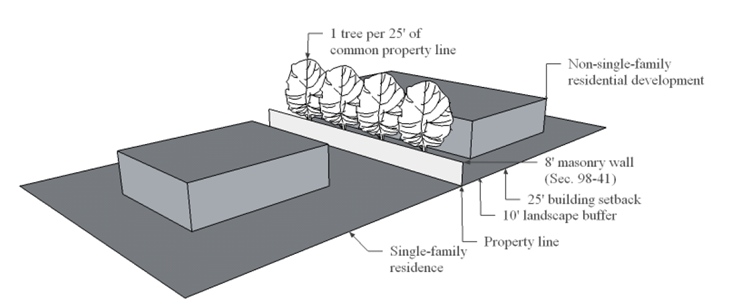
At a minimum, a ten-foot landscape buffer shall be provided adjacent to all single-family residential lot lines.
b.
In accordance with the following illustration, one tree is required for every 25 feet along a common property line with a single-family residential lot:
(Ord. No. 10-03, § 1, 6-1-10; Ord. No. 23-13, § 1, 5-16-23)
Sec. 98-53. - Principal and accessory buildings and uses.
(a)
All residential uses and buildings, and guest houses are principal uses and buildings.
(b)
Accessory buildings, except servants' quarters and guest houses, located in districts where permitted, shall not be used for dwelling purposes.
(c)
Commercial and industrial developments may include a single-family residential dwelling unit for the purpose of providing a residence for on-site management and/or full time security as an accessory or incidental use provided such dwelling unit shall not encompass greater than 25 percent of the overall building square footage and shall be approved by the commission as a special use and subject to the permit approval process as defined in article VII; and that the dwelling unit shall be totally contained within a commercial or industrial structure; and limited to the use of owners or full time employees of the owner or tenant of the property. Additionally, off-street parking on the premises of the principal use must be provided sufficient for three vehicles. These uses must be shown in the site plan of the development.
(d)
In addition to those uses listed as accessory uses in the various district regulations, the following are also accessory uses to appropriate principal uses:
(1)
Storage of goods used or produced by manufacturing activities upon the building lot occupied by such activities, unless such storage is prohibited by the district regulations.
(2)
The production, processing, cleaning, servicing, altering, testing, repairing, or storing of merchandise normally incidental to a retail service or business use if conducted by the same ownership as the principal use.
(3)
Accessory sheds, tool rooms, and similar buildings or structures provided they are not used for income producing or commercial purposes of any kind and do not exceed 20 percent of the square footage of the principal structure.
(4)
Fully enclosed weatherproof storage boxes and semitrailers may be used for temporary storage of inventory and supplies for commercial and industrial uses provided they are screened from view from the principal street of the business; they do not encroach into any required yard; are not used for direct sales of merchandise; are limited to no more than 14 days of continuous use in any 60-day period; and they are approved by the zoning official. The movement of such storage containers on the lot, or the replacement of one with another shall not result in the extension of the time limitation beyond the 14 days allowed under this section.
(e)
Conformance with regulations. All accessory uses shall comply with the regulations for the districts in which they are located.
(f)
Home occupations: All home occupations shall be subject to the following restrictions and limitations without exception:
(1)
They shall be conducted entirely within the dwelling unit which is the bona fide residence of the practitioner or entirely within an authorized accessory building.
(2)
Not more than one person other than a family member who resides in the residence shall participate in the activity on the premises.
(3)
The residential character and appearance of the lot and dwelling shall be maintained. Neither the interior or exterior shall be structurally altered to accommodate the activity, nor shall any buildings be added to accommodate the activity.
(4)
The activity shall not create customer related or delivery related vehicular traffic in excess of three vehicles in a 24-hour day in the residential neighborhood except for garage, yard or estate sales.
(5)
No outside storage of equipment, materials, supplies or inventory related to the business shall be allowed.
(6)
The activity shall not produce any external noise, vibrations, smoke, dust, odor, glare, fumes, electrical interference, or waste run-off outside the dwelling unit or on the property surrounding the dwelling unit.
(7)
No vehicle used in connection with the activity that requires a commercial driver's license to operate shall be parked on the premises or on any street adjacent to the residential property.
(8)
The activity shall not be advertised by any signs on the premises, nor shall the street address of the resident be advertised through signs, billboards, television, radio, newspaper, bulletin boards, coupon books, internet, flyers or public mailouts, except for garage, yard, and estate sales and telephone directories. Signs displayed or used upon vehicles permanently stationed or regularly used at a fixed location to serve the same or similar purpose of a permanent are not permitted.
(9)
No baby sitting is allowed where more than three children not of the household are kept.
(10)
No repair or building of automobiles, motorcycles, boats, airplanes, or any equipment with engines larger than one cylinder which are not owned, (for the purposes of this section, ownership requires title to the vehicle or equipment is in the name of the occupant) and operated by the occupant is permitted.
(11)
No more than one garage, estate or yard sale is allowed in any three-month period. These may be no longer than three consecutive days in length.
(Ord. No. 10-03, § 1, 6-1-10)
Sec. 98-54. - Government buildings' access to streets.
Federal, state, and local governmental buildings may access any public street, regardless of any contrary regulation on access to streets contained in this Code.
(Ord. No. 10-03, § 1, 6-1-10)

