
Webster City Zoning Code
ARTICLE VIII
PARKING AND LOADING STANDARDS
Sec. 98-141.- General requirements.
(a)
All parking of vehicles in R2, C1, C2, C3, O, M1, M2, NP and PD districts shall be limited to an asphalt or concrete paved area located on a lot associated with the use.
(1)
The required off-street parking spaces in R1 and R1A districts shall be limited to an asphalt or concrete paved area connected to a public street or alley by a asphalt or concrete paved driveway not less than ten feet wide.
(b)
A commercial off-street parking space is a surfaced area on a lot sufficient in size to store one automobile, connected to a public street or alley by a surfaced driveway not less than ten feet wide and so arranged as to permit entry and exit of the automobile at all times without moving any other automobile parked adjacent to the parked space.
(c)
Floor area calculations shall be based on gross floor area. Where fractional spaces result, the parking spaces required shall be construed to be the next higher whole number.
(d)
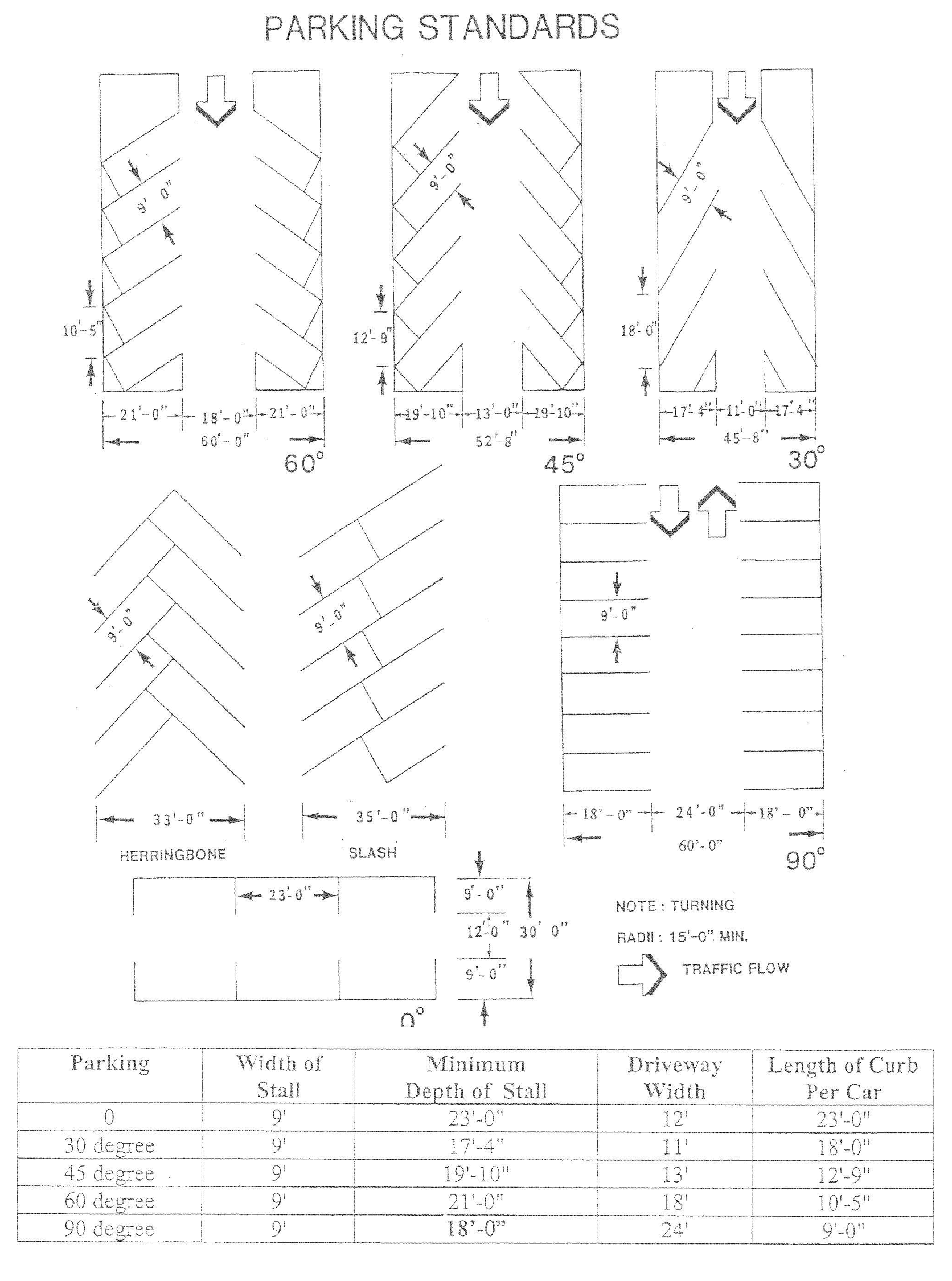
Parking spaces shall be a minimum of nine feet wide by 18 feet long, unless otherwise specified in section 98-144, Size of off-street parking space (Parking Standards Diagram).
(1)
It shall be unlawful to park a vehicle in any area not designed and designated for parking of vehicles, or to park any vehicle in such a manner that two or more parking spaces are being utilized at the same time by that vehicle.
(2)
All on-site parking, loading/unloading and collection of materials or refuse shall be accessed and conducted using an internal circulation system or an alley.
(e)
In the residential districts and in commercial or industrial districts within 50 feet of an R district, no required parking space may be located in a front yard or side yard adjacent to the residential district.
(f)
Parking spaces may be provided as follows:
(1)
In side and rear yards only in R districts.
(g)
In the commercial and industrial districts, the required parking space may be provided on a separate lot, if such lot is within 300 feet of the building or buildings for which such parking spaces are intended. Two or more owners may join together in the provision of this parking space provided that such arrangement meets all requirements identified as follows:
(1)
Where peak parking demand hours differ among different uses, it may be possible to reduce the total number of parking spaces required by allowing parking spaces to be shared among those uses. The minimum number of off-street parking spaces required when there is a parking arrangement among different uses within and among non-residential developments shall follow a shared parking credit schedule and formula.
The formula for calculating parking requirements shall utilize the above table as follows:
† Determine the minimum amount of parking required for each use as if it were required to meet all parking requirements;
† Multiply each amount by the corresponding percentage for each of the five time periods above to arrive at the minimum number of parking spaces per use required in each of the time periods;
† Calculate the total for all of the applicable uses and add the totals for each time period; and
† The highest value for all time periods represents the minimum number of spaces required for all uses.
† A non-exclusive reciprocal easement agreement, specifically setting forth the areas which will be used solely for parking shall be established and recorded as part of any shared parking arrangement concept approval.
(h)
Parking space for any use specifically permitted in an R district may be provided on a lot adjoining that use, provided there is compliance with all requirements in section 98-4 (definitions) and subsection (d) above.
(i)
Whenever a building or use constructed or established after the effective date of this chapter is changed or enlarged in floor area, the number of employees, number of dwelling units, seating capacity, or otherwise to create a need for an increase of ten percent or more in the number of existing parking spaces, such spaces shall be provided on the basis of the enlargement or change. Whenever a building or use existing prior to the effective date of this chapter is enlarged to the extent of 50 percent or more in floor area or in the area used, said building or use shall thereafter comply with the parking requirements set forth herein.
(j)
In the case of mixed or joint uses, the parking space required shall equal the sum of the requirements of the various uses computed separately.
(k)
The parking space requirement for a use not specifically mentioned herein shall be determined by the zoning board of adjustment based upon the recommendation of the zoning official.
(l)
No off-street parking or loading space shall be located, either in whole or in part, within any fire lane required by any ordinance of the city or within aisles, driveways or maneuvering areas necessary to provide reasonable access to any parking space.
(m)
No required off-street parking or loading space shall be used for sales, non-vehicular storage, repair or service activities.
(n)
The parking of recreational vehicles or boats for more than three days in an R1-A district is specifically prohibited unless such vehicle or boat is behind the required building line.
(o)
The overnight parking of commercial vehicles and/or equipment is prohibited in any residential district and the O office district at any time.
(p)
Vans and service vehicles used for work and transportation such as those customarily associated with licensed repair services, including but not limited to air conditioning, plumbing, lawn maintenance, appliance repair, and the like are not classified as commercial vehicles for the purpose of limiting their parking in residential districts. Parking of such vehicles though permitted in residential and office districts are limited to one such vehicle per residence. Tractors, tractor trailers, gooseneck trailers, and trailers of more than two axles and dump trucks may not be parked in single-family districts.
(q)
Parking in office, commercial or industrial districts shall be limited to those vehicles directly related to the permitted uses located in those districts. Within each business site such vehicles shall be parked in a designated parking space within a designated parking area that is screened from view from all public rights-of-way.
(r)
A parking analysis demonstrating compliance with this article shall be required when there is a change of use, occupancy, tenant space alteration, building expansion, shared parking arrangement/agreement/easement and/or otherwise, if alteration to an existing parking lot, space, landscaped area and/or access or circulation is requested. he parking analysis shall consist of an accurately prepared site plan for all properties involved at a scale of at least one inch to 100 feet that illustrates all existing, required and proposed parking and loading spaces, drive aisles, ingress, egress, circulation and landscaped islands, medians and peninsulas. In the instance of shopping centers and/or mixed use centers, the analysis shall contain a matrix identifying tenant usage, square footages per tenant space and the percentage of floor area dedicated to restaurants, entertainment or theaters.
(s)
Walkways shall form an on-site circulation system that minimizes the conflict between pedestrians and traffic at all points of pedestrian access to on-site parking and building entrances. Walkways shall be provided when the pedestrian access point onto the site, or any parking space, is more than 75 feet from the building entrance or principal on-site destination and as follows:
(1)
All developments which contain more than one building shall provide walkways between the principal entrances of the buildings;
(2)
All non-residential buildings set back more than 100 feet from the public right-of-way shall provide for direct pedestrian access from the building to buildings on adjacent lots; and
(3)
Walkways across parking areas shall be located as follows:
(a)
Walkways running parallel to parking rows shall be provided for every six rows.
(b)
Walkways running perpendicular to the parking rows shall be no further than twenty parking spaces.
(4)
All permitted non-residential uses shall provide pedestrian and bicycle access within and onto the site. Access points onto the site shall be provided as follows:
(a)
Approximately every 800 to 1,000 feet along existing and proposed perimeter sidewalks and walkways; and
(b)
At all arrival points to the site, including abutting street intersections and crosswalks. In addition, access points to and from adjacent lots shall be coordinated to provide circulation patterns between developments.
(Ord. No. 98-03, § 1(Exh. A, § 8(8.01)), 3-17-98; Ord. No. 99-32, § 1, 7-6-99; Ord. No. 00-43, § 1, 11-7-00; Ord. No. 02-13, § 1, 8-6-02; Ord. No. 07-10, § 2, 8-21-07; Ord. No. 07-12, § 1, 8-21-07; Ord. No. 11-13, § 1, 11-15-11)
Sec. 98-142. - Off-street parking.
* All uses listed are freestanding (stand alone) facilities, unless otherwise identified as a shopping or mixed use center.
** Minimum of five spaces.
*** Minimum of ten spaces.
**** Minimum of 20 spaces.
(Ord. No. 98-03, § 1(Exh. A, § 8(8.01)), 3-17-98; Ord. No. 98-38, § 1, 8-17-99; Ord. No. 00-44, § 1, 11-7-00; Ord. No. 06-05, § 1, 4-4-06; Ord. No. 07-10, § 2, 8-21-07; Ord. No. 10-03, § 1, 6-1-10; Ord. No. 13-10, § 1, 8-6-13; Ord. No. 15-06, § 1, 4-7-15)
Sec. 98-143. - Off-street loading regulations.
Every building or part thereof erected or occupied for retail business, service, manufacturing, storage, warehousing, hotel, mortuary, or any other use similarly involving the receipt or distribution by vehicles of material or merchandise, shall provide and maintain on the same premises loading space in accordance with the following regulations:
(1)
In the commercial and industrial districts, one loading space for each 10,000 square feet or fraction thereof, of floor area in the building.
(2)
No more than five off-street loading spaces for any commercial or industrial use shall be required, except in the case of wholesale distribution and freight terminals which shall be required to provide loading spaces in accordance with the requirements of a special use permit.
(3)
Off-street facilities shall be provided and maintained for receiving and loading of merchandise, supplies, and materials within a building or on the premises, in accordance with table 4, schedule of minimum off-street loading standards.
(4)
Required off-street loading spaces may be adjacent to a public alley or private drive, or may consist of a berth within a structure.
(5)
No portion of a loading space may extend into a public right-of-way or into an off-street parking area elsewhere herein required.
(6)
The off-street loading spaces or truck berths herein required shall have the following minimum dimensions:
a.
At least one-half shall be not less than ten feet by 40 feet.
b.
The remainder shall be not less than ten feet by 20 feet.
(Ord. No. 98-03, § 1(Exh. A, § 8(8.02)), 3-17-98)
Sec. 98-144. - Size of off-street parking space.
(Ord. No. 07-10, § 2, 8-21-07)

