
Wellington City Zoning Code
ARTICLE 3
Zoning Districts
Sec. 15-3-10. - Purpose and organization.
(a)
Purpose. This article describes each zone district and their associated dimensional requirements. In their interpretation and application, the provisions of these zoning regulations shall be held to be minimum requirements adopted for the promotion of the public health, safety, morals, convenience, comfort, prosperity and general welfare. These zoning regulations are designed to:
(1)
Encourage the most appropriate use of land through the Town and ensure logical growth of the various physical elements of the Town.
(2)
Regulate and determine the size of building lots, yards and other open spaces.
(3)
Promote good design and arrangement of buildings or clusters of buildings and uses in residential, business and industrial development.
(4)
Prevent the overcrowding of land, poor quality in development, waste and inefficiency in land use, danger and congestion in travel and transportation and any other use or development that might be detrimental to the stability and livability of the Town.
(5)
Promote the health, safety, morals and general welfare of Town residents.
(b)
Uniformity of Regulations. The regulations established by this article within each zone shall apply uniformly to each class or kind of structure or land. Unless exceptions are specified in this article, the following interpretations shall apply:
(1)
No building, structure or land shall be used or occupied, changed, constructed, moved or structurally altered unless in conformity with all of the regulations herein specified for the zone in which it is located.
(2)
No building or other structure shall be erected or altered to:
a.
Exceed the height limitations;
b.
Occupy a greater percentage of the area; or
c.
Have narrower or smaller rear yards, front yards, side yards or other open spaces.
(3)
No yard or lot existing or approved at the time of adoption of this Land Use Code shall be reduced in dimension or area below the minimum requirements set forth herein. Yards or lots created after the effective date of the ordinance codified herein shall meet at least the minimum requirements established by this article.
(c)
Zoning Districts. In order to carry out the provisions of this Code, the Town is divided into the following zoning districts:
(d)
Zoning District Map. The boundaries and classifications of districts established are as depicted on the adopted Zoning District Map bearing the most recent date of publication which has been signed by the Chair of the Planning Commission and the Mayor.
(1)
Interpretation of boundary lines. If uncertainty exists, district boundaries shall be on section lines; lot lines; the center lines of highways, streets, alleys, railroad rights-of-way, rivers, streams, or such lines extended; or municipal corporation lines; Where a lot is divided by a zoning district boundary line either zone requirements may be extended within the lot for a distance of not more than twenty-five (25) feet as approved by the Planning Director.
(2)
Amendment upon zoning or modification. Upon approval of any ordinance annexing and establishing zoning or modifying existing zoning for any property, the Town shall amend the prior existing Zone District Map to include the annexed area with the proper zoning classification or show the amended classification, as the case may be. Such updated, Zone District Map shall contain, in table form, the date and number of the ordinance amending it, the date the map was amended to reflect each amendment and the initials of the person who checked and approved the change to the map.
(3)
Cost for amending zoning. Any person who proposes zoning for property being annexed or proposes modifying existing zoning shall bear the entire cost of amending the Zone District Map, including all notification costs. The Town shall provide applicants with a copy of the current fee schedule and fee agreement form.
(4)
Public inspection; storage of original. The Zoning District Map shall be available and on display at the office of the Town Clerk during normal business hours.
(Ord. No. 07-2022, § 1(3.01), 3-22-22)
Sec. 15-3-20. - Residential zone districts.
(a)
A - Agricultural District.
(1)
Intent. The Agricultural District is an ultra low-density district intended for the pursuit of farm activities or for a transitional status. This zone is characterized by the growing of crops and related functions as well as large lot, rural, single-family detached residential dwellings and agritourism.
(2)
Principal uses. Permitted principal uses in the A District shall be as listed in Section 15-4-20 Table of Allowable Uses.
(3)
Conditional uses. Permitted conditional uses in the A District shall be as listed in Section 15-4-20 Table of Allowable Uses.
(b)
R-1 - Residential Rural Density District.
(1)
Intent. The Residential Rural Density District is a very low-density residential district intended to provide for large-lot, detached single-family development in areas more characteristically rural and on the outskirts of the planning area that are supported by neighborhood amenities and public facilities.
(2)
Principal uses. Permitted principal uses in the R-1 District shall be as listed in Section 15-4-20 Table of Allowable Uses.
(3)
Conditional uses. Permitted conditional uses in the R-1 District shall be as listed in Section 15-4-20 Table of Allowable Uses.
(c)
R-2 - Residential Low Density District.
(1)
Intent. The Residential Low Density District is intended to accommodate a variety of detached and attached single-family uses on individual lots that are supported by neighborhood amenities and public facilities. Accessory Dwelling Units (ADUs) may accompany a principal dwelling. This zone is characterized by tree-lined local streets, an interconnected pedestrian circulation system, and proximity to schools and parks.
(2)
Principal uses. Permitted principal uses in the R-2 District shall be as listed in Section 15-4-20 Table of Allowable Uses.
(3)
Conditional uses. Permitted conditional uses in the R-2 District shall be as listed in Section 15-4-20 Table of Allowable Uses.
(d)
R-3 - Residential Medium Density District.
(1)
Intent. The Residential Medium Density District is intended to accommodate an integrated mix of small lot single-family detached dwellings, single-family attached dwellings, and multi-family dwellings. Accessory Dwelling Units (ADUs) may accompany a principal dwelling. This zone is intended to provide a walkable environment supported by motorized and non-motorized transportation options, parks, and public gathering spaces that are ideal for people in all stages of life. Multi-family buildings are generally encouraged near viable business centers in order to facilitate appropriate densities. Street and open space designs in these areas shall be used to create compatibility among frontages, which encourage pedestrian interaction and discourage high automobile speeds.
(2)
Principal uses. Permitted principal uses in the R-3 District shall be as listed in Section 15-4-20 Table of Allowable Uses.
(3)
Conditional uses. Permitted conditional uses in the R-3 District shall be as listed in Section 15-4-20 Table of Allowable Uses.
(e)
R-4 - Downtown Neighborhood District.
(1)
Intent. The Downtown Neighborhood District is intended for the older neighborhoods adjacent to the downtown core that have smaller, more constrained lots than newer developments and specific architectural characteristics. These neighborhoods are intended to support a variety of housing types including detached and attached single family dwellings, as well as small-scale multi-family dwellings designed to be appropriately integrated into and that complement the area's character. Accessory Dwelling Units (ADUs) may accompany a principal dwelling. Small-scale service establishments that add vibrancy to the overall Downtown area may also be incorporated when the character of the neighborhood is maintained. These areas are intended to be supported by a traditional, highly connected gridded street system with detached sidewalks, and that incorporate pocket parks and public gathering spaces.
(2)
Principal uses. Permitted principal uses in the R-4 District shall be as listed in Section 15-4-20 Table of Allowable Uses.
(3)
Conditional uses. Permitted conditional uses in the R-4 District shall be as listed in Section 15-4-20 Table of Allowable Uses.
(4)
Design Standards. The following design standards shall apply to all new and infill development in the Downtown Neighborhood Zone District.
a.
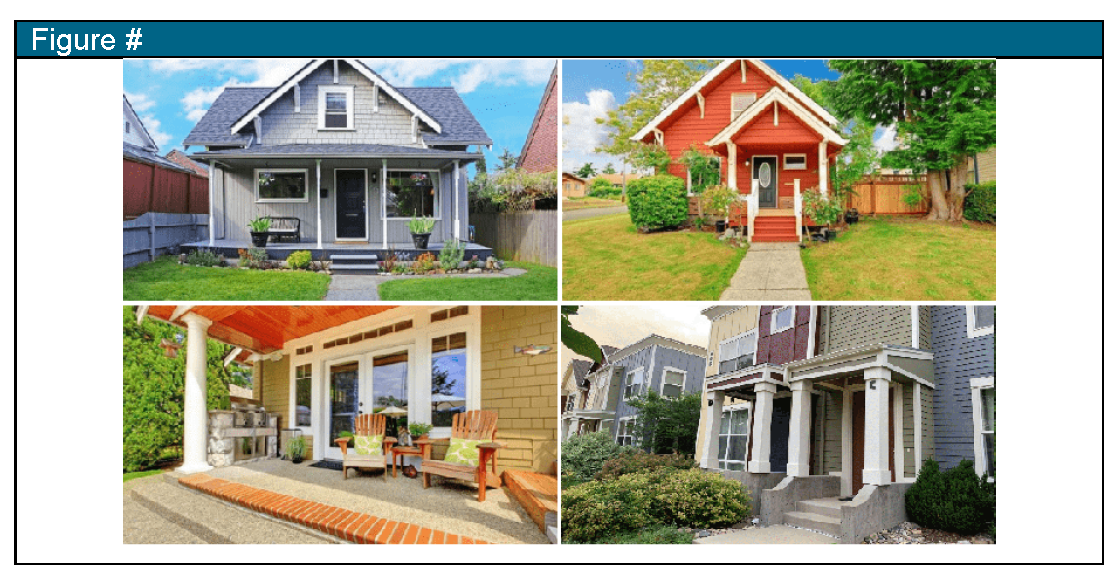
Principal residential buildings shall include a front porch on each ground floor unit to ensure new construction blends with the existing neighborhood character. Porches shall be a minimum of six (6) feet deep with a minimum overall dimension of forty-eight (48) square feet and may encroach into the required front setback by up to six (6) feet. Accessory Dwelling Units (ADUs) may, but are not required to, include a front porch.
b.
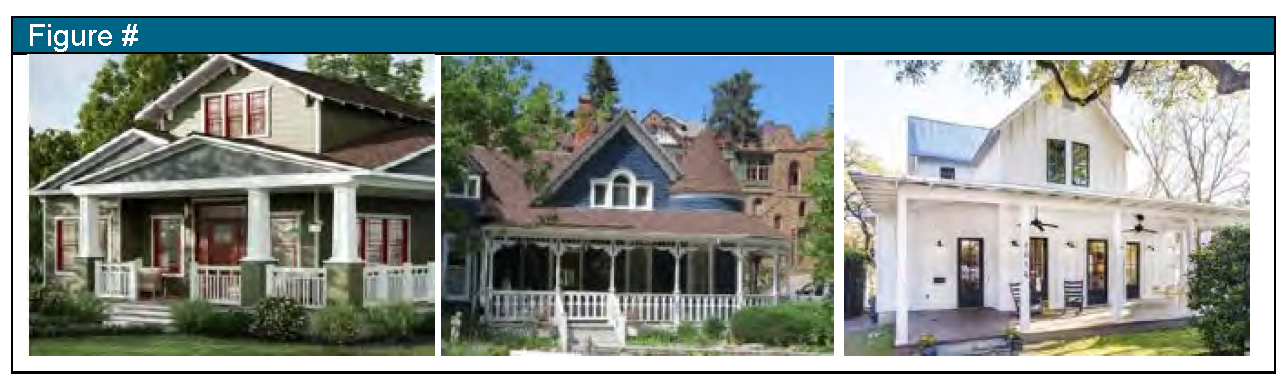
New and infill buildings (not including Accessory Dwelling Units) shall include characteristics of the traditional architectural styles of the Downtown Neighborhood Area identified as Craftsman, Victorian and Farmhouse. Such features could include:
1.
Gabled and cross-gabled rooflines;
2.
Porches running the full length of the front façade;
3.
Rear loaded or detached garages that allow the front façade of the house to be the primary focus;
4.
Steeply-pitched rooflines, curlicue trims, ornate windows, and asymmetrical designs (Victorian);
5.
Low-pitched rooflines with overhanging eaves, exposed rafters, and heavy, tapered columns (Craftsman); or
6.
Simple design focusing on wood elements, board on batten siding and hand hewn timbers with a traditionally white color palette (Farmhouse).
7.
Accessory Dwelling Units (ADUs) shall meet the Supplemental Accessory Use Standards of Section 15-4-40(e).
(f)
MH - Manufactured Home Park District.
(1)
Intent. This is a high-density residential district on a parcel of land under single ownership or control on which two (2) or more manufactured homes are occupied as residences.
(2)
Principal uses. Permitted principal uses in the MH District shall be as listed in Section 15-4-20 Table of Allowable Uses.
(3)
Application procedure.
a.
Standard process for a new mobile home park shall follow the standard rezone and Major Subdivision processes per Sections 15-2-70 and 15-2-170 of this Land Use Code.
b.
Redevelopment of an existing site with required infrastructure in place would need to follow the site plan application process per Section 15-2-120 of this Land Use Code.
(4)
Building design standards.
a.
The manufactured home must be partially or entirely manufactured in a factory.
b.
The manufactured home must be not less than twenty-four (24) feet in width and thirty-six (36) feet in length.
c.
The manufactured home must be set on an excavated, backfilled, engineered foundation enclosed at the perimeter so that the top of the perimeter wall sits no more than twelve (12) inches above finish grade. The foundation shall be similar in appearance and durability to a masonry foundation of a site-built dwelling. The foundation shall provide an anchoring system for the manufactured home that is totally concealed under the structure.
d.
The exterior siding of the manufactured home must have the same appearance as materials commonly used on residential dwellings. Metal siding must be painted or anodized.
e.
The manufactured home must have a pitched roof with a pitch of at least a nominal three (3) in twelve (12). The roof must be covered with shingles, shakes or tile. Eaves of the roof must extend at least one (1) foot from the intersection of the roof and the exterior walls.
f.
The manufactured home must have windows that are wood, vinyl-coated or anodized aluminum.
g.
The manufactured home must have color-coordinated body and trim. Colors of both the factory components and the site-built components shall be the same.
h.
The main entrance to the manufactured home must face or be oriented toward an adjacent street.
i.
The transportation mechanisms, including the wheels, axles and hitch, must be removed.
j.
No manufactured home shall be occupied for dwelling purposes unless it is properly placed in a manufactured home space and connected to water, sewerage, electric and gas utilities, as appropriate.
k.
All manufactured homes shall be certified pursuant to the National Manufactured Housing Construction and Safety Standards Act of 1974, 42 U.S.C. § 5401 et seq., or shall be certified by the Colorado Division of Housing pursuant to Section 24-32-701 et seq., C.R.S.
l.
All manufactured homes shall have an enclosed crawlspace underneath the manufactured home and shall not provide a harborage for rodents or create a fire hazard. No enclosed crawlspace shall be used for storage unless the storage area is surfaced with concrete. Adequate access and ventilation shall be provided in accordance with the Guidelines For Manufactured Housing Installation.
m.
All manufactured homes shall meet or exceed equivalent engineering standards for other single-family residences.
n.
Additions to increase the floor area of manufactured home shall not be permitted except for patios, porches, garages, decks or carports. Garages may be detached or attached.
o.
Prior to occupancy, the Building Inspector shall inspect each manufactured home to determine compliance with this Code. No occupancy shall be permitted or certificate of occupancy issued until said inspection and all connections to public utilities have been made. The owner or home builder shall pay to the Town a building permit fee for each residential structure as may be required by this Code. Installation procedures and the building permit fee shall be in accordance with the then current Guidelines for Manufactured Housing Installation, including appendices, published by the International Conference of Building Officials for manufactured homes and as adopted by the Town.
p.
All additions shall comply with minimum yard requirements, and a building permit shall be required in advance for any such addition.
(5)
Site design standards.
a.
All streets in a manufactured home park shall be dedicated to the Town and shall be maintained by the park owner or an owners' association.
b.
All streets shall be a minimum width of twenty-two (22) feet from back of curb to back of curb, including the width of gutter pans.
c.
Primary through streets shall be thirty-four (34) feet from back of curb to back of curb with a four-foot detached sidewalk on one (1) side being located six (6) feet from the back of curb.
d.
The developer shall provide for covenants or other mechanisms, which shall be approved by the Town, ensuring that streets are maintained and replaced as required.
e.
All streets within the manufactured home park shall be constructed to the Town standards.
f.
A minimum of eight percent (8%) of the gross site area shall be reserved for and devoted to improved recreation areas and facilities provided in locations convenient to all manufactured home spaces.
g.
A minimum of three hundred (300) square feet of outdoor living area shall be provided on each space.
h.
Every manufactured home space shall have two (2) off-street parking spaces adjacent to the manufactured home. There shall be one (1) additional parking space for each manufactured home space within one hundred (100) feet for use by occupants and guests.
i.
Off-street vehicle parking shall be provided for recreation facilities located within a manufactured home park. At a rate of one (1) space per two hundred fifty (250) square feet of gross floor area, plus one (1) space per employee at the maximum shift, Twenty (20) spaces are to be provided for every diamond or athletic field, or one (1) space for every four (4) spectator seats, whichever is greater. (One [1] seat is equal to two [2] feet of bench seating length.)
j.
All off-street parking shall meet the provisions of Section 15-5-50 of this Land Use Code.
k.
The developer shall provide for a system of pedestrian circulation within the development. The system shall connect with existing sidewalks, if any are adjacent to the property. The system shall be designed to link residential units with recreation facilities, school bus stops and existing sidewalks in the neighborhoods. Attached and detached sidewalks within the manufactured home park shall be a minimum of five (5) feet in width.
l.
All public utilities shall be installed in accordance with the applicable Town standards.
m.
A manufactured home park may have multiple master meters for water service.
n.
Each manufactured home space shall have its own meter for water and electrical service.
(g)
Table of Dimensional Standards for Residential Zone Districts. All principal and accessory structures are subject to the dimensional standards set forth in the table below. These general standards may be further limited or modified by other applicable sections of this Land Use Code. General rules for measurement and exceptions are in Article 9, Definitions.
1. Front porches may encroach into the front setback by up to six feet.
(Ord. No. 07-2022, § 1(3.02), 3-22-22; Ord. No. 08-2025, §§ 1—5, 4-8-25)
Sec. 15-3-30. - Commercial and mixed-use districts.
(a)
C-1 - Community Commercial District.
(1)
Intent. The Community Commercial District is intended for general commercial areas outside of downtown such as activity centers at intersections. These areas are intended to facilitate a variety of businesses that provide employment opportunities and support the retail and service needs of the community. Buildings may be located within a unified campus-like setting integrated with sidewalks, landscaped features, and public spaces that promote access to motorized and non-motorized transportation options.
(2)
Principal uses. Permitted principal uses in the C-1 District shall be as listed in Section 15-4-20 Table of Allowable Uses.
(3)
Conditional uses. Permitted conditional uses in the C-1 District shall be as listed in Section 15-4-20 Table of Allowable Uses.
(b)
C-2 - Downtown Core Commercial District.
(1)
Intent. The Downtown Core Commercial District is intended to preserve the character of the original downtown and to provide for a mixture of uses that will strengthen and expand the core community. As the Town's primary activity center, these areas are intended to be highly connected to an efficient network of motorized and non-motorized connections. Its character is based on historic and civic buildings, ample and landscaped sidewalks, groomed and activated alleys, public art, and gathering spaces - all design with a pedestrian scale perspective that gives the Downtown a unique sense of place and contributes to community pride. As property owners choose to reinvest in the Downtown, Main Street uses should encourage 'select' infill of vacant residential and commercial areas and slightly increase the height of existing buildings to support upper level residential uses.
(2)
Principal uses. Permitted principal uses in the C-2 District shall be as listed in Section 15-4-20 Table of Allowable Uses.
(3)
Conditional uses. Permitted conditional uses in the C-2 District shall be as listed in Section 15-4-20 Table of Allowable Uses.
(c)
C-3 - Mixed-Use Commercial District.
(1)
Intent.
a.
The Mixed-Use Commercial District is intended to be a setting for development of a wide range of community and regional retail uses, offices and personal and business services, and it is intended to accommodate a wide range of other uses, including multi-family housing and mixed-use dwelling units. The C-3 District should integrate various commercial and multi-family uses while transitioning from the highway to adjacent lower density neighborhoods. The intent of mixed-use areas is to cluster residential and non-residential uses in a compact, walkable setting. These areas provide ease of movement through both motorized and non-motorized transportation options offering convenient access for locals and visitors alike.
b.
While some Mixed-Use Commercial District areas may continue to meet the need for auto-related and other auto-oriented uses, it is the Town's intent that the C-3 District emphasize safe and convenient personal mobility in many forms, with planning and design that accommodate pedestrians. Further, the C-3 District is intended to function with, rather than compete with, the Downtown District.
c.
The highway corridor is a visible commercial area of the community. Attention to the architectural standards outlined in Section 15-9-90 is required for approval.
(2)
Permitted uses. Permitted principal uses in the C-3 District shall be as listed in Section 15-4-20 Table of Allowable Uses.
(3)
Conditional uses. Permitted conditional uses in the C-2 District shall be as listed in Section 15-4-20 Table of Allowable Uses.
(d)
Table of Dimensional Standards for Commercial Zone Districts. All principal and accessory structures are subject to the dimensional standards set forth in the table below. These general standards may be further limited or modified by other applicable sections of this Land Use Code. General rules for measurement and exceptions are in Article 9, Definitions.
(Ord. No. 07-2022, § 1(3.03), 3-22-22; Ord. No. 08-2025, § 6, 4-8-25)
Sec. 15-3-40. - Other non-residential zone districts.
(a)
LI - Light Industrial District.
(1)
Intent. The Light Industrial District is intended to provide locations for research and development-type offices that create minimal noise, smell, and road traffic., Development in the Light Industrial District should encourage the development of planned office and business parks that promote excellence in the design and construction of buildings, outdoor spaces, transportation facilities and streetscapes. Typically, light industrial areas should serve as a separator between heavier industrial and surrounding land uses, such as residential and commercial areas.
(2)
Principal uses. Permitted principal uses in the LI District shall be as listed in Section 15-4-20 Table of Allowable Uses.
(3)
Limitations. Any use in this District shall conform to the following requirements:
a.
Dust, fumes, odors, smoke, vapor and noise shall be confined to the site and be controlled in accordance with the state air pollution laws.
b.
Approved outdoor storage areas, equipment and refuse areas shall be concealed from view from abutting rights-of-way and from adjoining residential districts.
c.
All off-street parking areas as defined herein shall be surfaced with poured in place concrete or asphaltic concrete. Approved outdoor storage areas as defined herein may be surfaced with minimum three-quarter inch diameter crushed rock or approved alternative material to a depth of at least four (4) inches. If a crushed rock or alternative material surface is used, the subgrade of such areas shall be treated to the specifications of the Town Engineer. Areas surfaced with crushed rock or approved alternative material shall be treated with dust retardants, as needed, and kept free of weeds, trash and other debris. Appropriate fire-lane aisles and, if required, fire hydrants shall be provided.
d.
Light fixtures in parking areas shall be hooded and mounted not more than twenty-five (25) feet above the ground level and oriented in such a manner so as not to shine into residential areas. Lighting shall conform to the requirements in Section 15-5-20 of this Code.
(4)
Conditional uses. Permitted conditional uses in the LI District shall be as listed in Section 15-4-20 Table of Allowable Uses.
(b)
I - Industrial District.
(1)
Intent. The Industrial District is intended to provide a location for large-format buildings for manufacturing, warehousing and distributing, indoor and outdoor storage. Locations for this zone require good access to major arterial streets and adequate water, sewer and power. Industrial areas should generally be located interior to the large block of industrial/light industrial areas.
(2)
Principal uses. Permitted principal uses in the I District shall be as listed in Section 15-4-20 Table of Allowable Uses.
(3)
Limitations. Any use in this District shall conform to the following requirements:
a.
Dust, fumes, odors, smoke, vapor and noise shall be confined to the site and be controlled in accordance with the state air pollution laws.
b.
Approved outdoor storage areas, equipment and refuse areas shall be concealed from view from abutting rights-of-way and from adjoining residential districts.
c.
All off-street parking areas as defined herein shall be surfaced with poured in place concrete or asphaltic concrete. Approved outdoor storage areas as defined herein may be surfaced with minimum three-quarter inch diameter crushed rock or approved alternative material to a depth of at least four (4) inches. If a crushed rock or alternative material surface is used, the subgrade of such areas shall be treated to the specifications of the Town Engineer. Areas surfaced with crushed rock or approved alternative material shall be treated with dust retardants, as needed, and kept free of weeds, trash and other debris. Appropriate fire-lane aisles and, if required, fire hydrants shall be provided.
d.
Light fixtures in parking areas shall be hooded and mounted not more than twenty-five (25) feet above the ground level and oriented in such a manner so as not to shine into residential areas. Lighting shall conform to the requirements in Section 15-5-50 of this Code.
(4)
Conditional uses. Permitted conditional uses in the I District shall be as listed in Section 15-4-20 Table of Allowable Uses.
(c)
P - Public District.
(1)
Intent. The Public District is intended to identify and perpetuate the existence of public parks, playgrounds, recreation facilities and public and quasi-public buildings, whether publicly owned or leased. These areas are intended to support the community with accessible walkways, public gathering spaces, and motorized and non-motorized transportation connections and parking that accommodate a large influx of car and pedestrian traffic. Buildings may be small, mixed with other uses in Downtown, or large, providing joint facilities (library, recreation center, etc.) intermixed in residential or mixed-use areas. Civic areas should consider building design, materials, and durability; making developments timeless, and favoring form and function over cost. These areas should also leverage local public art to add beauty and pride to Wellington.
(2)
Principal uses. Principal permitted uses in the P District shall be as listed in Section 15-4-20 Table of Allowable Uses.
(3)
Conditional uses. Permitted conditional uses in the P District shall be as listed in Section 15-4-20 Table of Allowable Uses.
(d)
Table of Dimensional Standards for Light Industrial, Industrial and Public Zone Districts. All primary and accessory structures are subject to the dimensional standards set forth in the table below. These general standards may be further limited or modified by other applicable sections of this Land Use Code. General rules for measurement and exceptions are in Article 9, Definitions.
(Ord. No. 07-2022, § 1(3.04), 3-22-22)
Sec. 15-3-50. - PUD—Planned Unit Development District.
(a)
Intent.
(1)
This Planned Unit Development (PUD) Overlay District is enacted pursuant to the Planned Unit Development Act of 1972 as amended (Section 24-67-101 et seq., C.R.S.). A PUD is an area of land, controlled by one (1) or more landowners, to be developed under unified control or unified plan of development for a number of dwelling units, commercial, educational, recreational or industrial uses, or any combination of the foregoing, the plan for which does not correspond in lot size, bulk or type of use, density, lot coverage, open space or other restriction to the existing land use regulations. The PUD is intended to be used as an overlay zone district that supplements the underlying standard zone district.
(2)
The intent and purpose of this District is to permit and encourage innovative design and high quality, master-planned developments on parcels of land forty (40) acres in size or larger. This District is created to allow and encourage compatible uses to be developed in accordance with a unified development plan in harmony with the environment and surrounding neighborhood.
(3)
PUDs are expected to preserve critical environmental resources, provide above-average open space and recreational amenities, including exceptional design and provide greater efficiency in the layout and provision of roads, utilities and other infrastructure.
(4)
PUDs are intended to accommodate an integrated mix of residential housing types, lot sizes and densities. Residential portions of a PUD are expected to provide affordable housing or incorporate one or more methods of encouraging housing affordability as approved or agreed to by the Town.
(5)
PUDs are intended to allow Accessory Dwelling Units (ADUs) as a permitted accessory use on any lot where single-family detached dwellings are permitted. PUD provisions are intended to include that Accessory Dwelling Units (ADUs) are approved administratively by Town staff and the construction or conversion of Accessory Dwelling Units (ADUs) may not be restricted in ways not otherwise permitted by this Code.
(b)
Permitted uses.
(1)
Uses permitted in the PUD Overlay District shall be those uses permitted in the underlying standard zone district for the property.
(2)
An applicant for a PUD Overlay District may request modifications to the permitted uses of the underlying zone district to remove those uses that may be deemed incompatible or inappropriate for the overall PUD development. Conditional uses may be permitted if it can be demonstrated that such uses meet the conditional use review criteria for the underlying zone districts.
(Ord. No. 07-2022, § 1(3.05), 3-22-22; Ord. No. 08-2025, § 7, 4-8-25)

