
West University Place
City Zoning Code
City Zoning Code
ARTICLE 2
- DEFINITIONS AND INTERPRETATIONS
Section 2-100. - Rules of Construction.
In this ordinance:
(1)
Words used in the present tense include the future; words in the singular number include the plural number; and words in the plural number include the singular number.
(2)
The word "shall" is mandatory and not directory.
(3)
Words not specially defined in this ordinance are used in their common ordinary senses, except that special terms used in the context of criminal violations (such as "affirmative defense" and "presumption") are intended to have the same meanings as in the Texas Penal Code.
(4)
Unless otherwise indicated, all lines and boundaries shall be applied as if they were planes vertical to the surface of the earth and extending both above and below the surface at each point along the line or boundary indicated.
Section 2-101. - Intent and effect of law.
The intent of this ordinance and of the use of particular undefined words ;p0; Certain terms in this ordinance, whether capitalized or not, are defined as follows for purposes of this ordinance:
Accessory. A building, structure, or use is accessory if it is (i) subordinate and incidental to a lawful principal building and use on the same building site, and (ii) is necessary or convenient for a lawful principal use of such building. An accessory building, structure, or use can include but is not limited to, a garage, guest quarters, pool cabana, game room, or other similar use. But see, Tables 7A-1, 78-1, 7C-1, 7D-1, Note 2.
Accessory quarters (or "AQ"). A dwelling unit meeting all of the following criteria: (i) it is located on the same building site as a principal building containing a dwelling used for single-family (detached) use; and (ii) it includes no more than six hundred square feet of gross floor area.
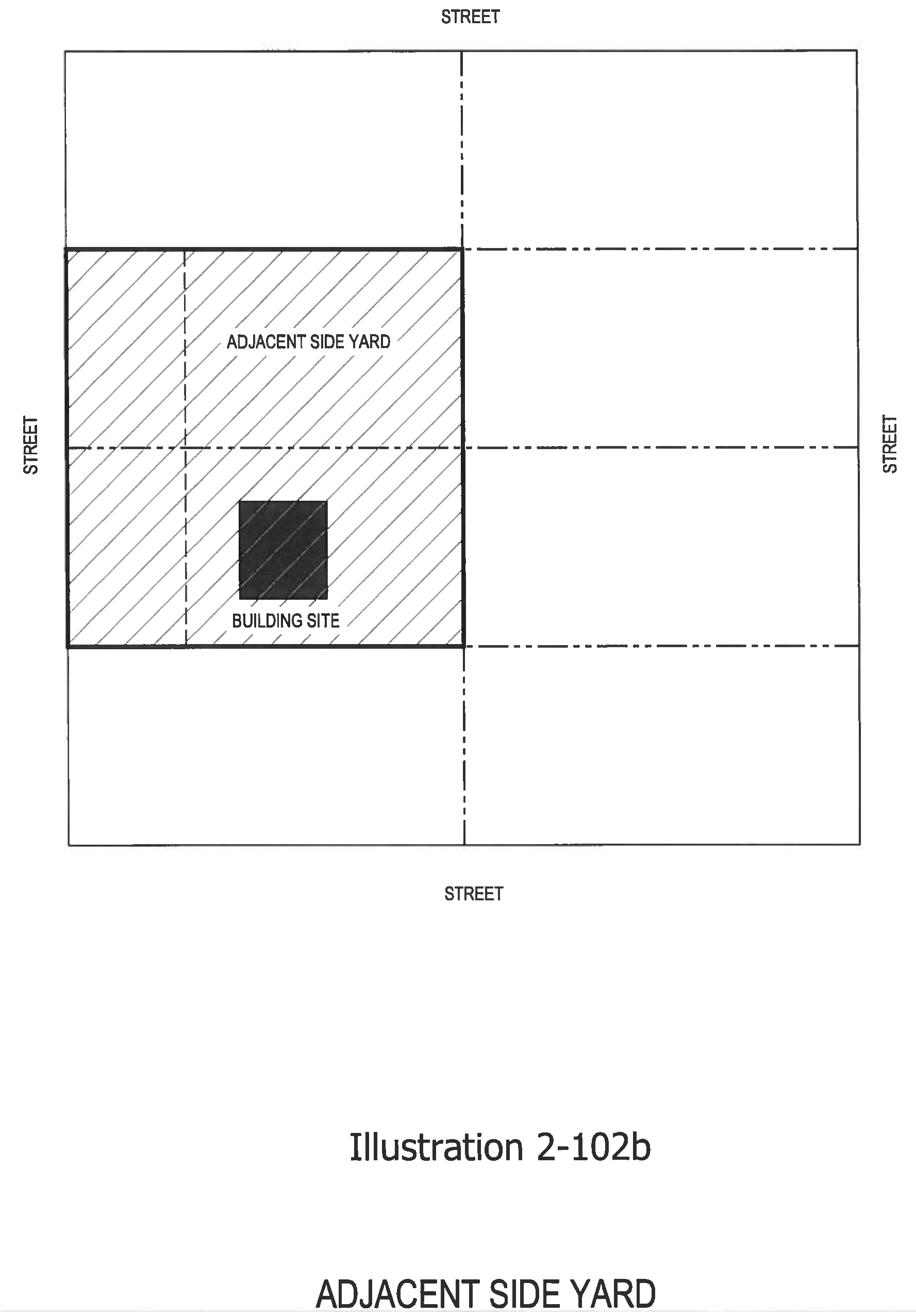
Adjacent side yard building site or lot means a building site that abuts another through a shared side property line.
Administrative official. The person designated as such by the city manager.
Attic. Unfinished space immediately beneath a roof and above any story below. In this definition, "unfinished" means that the space has none of the following: (i) air conditioning or heating for the space, (ii) wiring or cabling in excess of the minimum needed for maintenance of the structure or mechanical equipment, or (iii) sheetrock, paneling or similar wall or ceiling materials.
Auto-intensive use. Any land use where goods or services are provided to or for motor vehicles or to persons who may remain within their motor vehicles to receive such goods or services. Examples, which do not limit this definition, are gasoline fueling facilities, automobiles sales or repair facilities and "drive-through" or "drive-in" establishments.
Balcony. A platform enclosed by a wall or balustrade on the outside of a building above the first floor, with access from an upper-floor door.
Bar. Any commercial unit within which either: (i) 50 percent or more of the gross floor area is devoted primarily to the preparation or sale of alcoholic beverages for consumption on the premises; or (ii) the sale of alcoholic beverages for consumption on the premises accounts for 50 percent or more of the gross sales with such commercial unit in any month out of the three preceding months.
Block. An area bounded by street areas and occupied by or intended for occupancy by buildings.
Block face. A continuous row of parcels of land all on one block and all touching a given street.
Book sharing exchange(s). Book sharing exchange means a detached accessory structure usually consisting of an enclosed box sitting on top of a small stand which contains a door and is designed to hold a small number of books that are intended for use by members of the public. Such structures are generally known and referred to as "Little Free Libraries".
Buffer yard, SF. A yard in a non-SF District buffering an SF District. It is measured from the nearest part of an SF District. See the "Yards" table in Article 7A, Article 7B, Article 7C, and Article 7D.
Building. Any structure built for the support, shelter or enclosure of persons, animals, chattels or moveable property of any kind. Two attached buildings are considered a single building unless they are separated by a firewall unbroken by interior passageways or openings. See definition of "detached."
Building official. The person designated as such under the City's building code.
Building site. See Article 5. An "old" building site was established with its present boundaries before October 24, 1987. A "new" building site is any other building site.
C District. The Commercial District.
Certified sound emission level. This level is measured in decibels according to the Air Conditioning and Refrigeration lnstitute's reference test method ARI270-84 ("Standard for Sound Rating of Outdoor Unitary Equipment"), or an equivalent method approved by the Administrative official. See Tables 7A-7, 7B-7, 7C-7, 7D-7.
City. The City of West University Place, Texas.
City Council. The governing body of the City of West University Place, Texas.
Commercial (C) District. Includes all C and all portions of a planned development district (PDD) designated primarily for commercial uses.
Commercial unit. A building or part of a building occupied or capable of being occupied as a separate business or commercial establishment.
Commercial uses, light. Any commercial district use except an auto-intensive use or one of the other medium commercial uses. Examples include, but are not limited to: light office uses for ordinary business or professional activities, stores for the sale at retail of goods or services use (including grocery stores, convenience stores, and shopping centers), restaurant use, bank and financial services use.
Commercial uses, medium. Any commercial district use composed of one or more of the following uses: auto-intensive use, night assembly use, theater use, bar use, club use, physical fitness facilities or health care facilities use. Any use which is partially a light commercial use and partially a medium commercial use shall be deemed to be a medium commercial use for all purposes.
Common-use area. This term includes areas within street areas, easements (other than local-service easements) and other similar common-use areas. A "local-service easement" is an easement which: (i) is designed or intended to provide utility service, secondary access (but not primary access), maintenance or similar supporting service to the parcel where it lies or to an adjacent parcel; and (ii) as a practical matter, allows the fee-simple owner of the parcel to enjoy substantial use of the easement area. A flood control easement is a common-use area, not a local-service easement.
Comprehensive plan. The document adopted by the City Council by Ordinance No. 1641, passed finally on May 8, 2000, as the document is amended, from time to time.
Consanguinity or affinity. These terms are interpreted in accordance with State anti-nepotism laws.
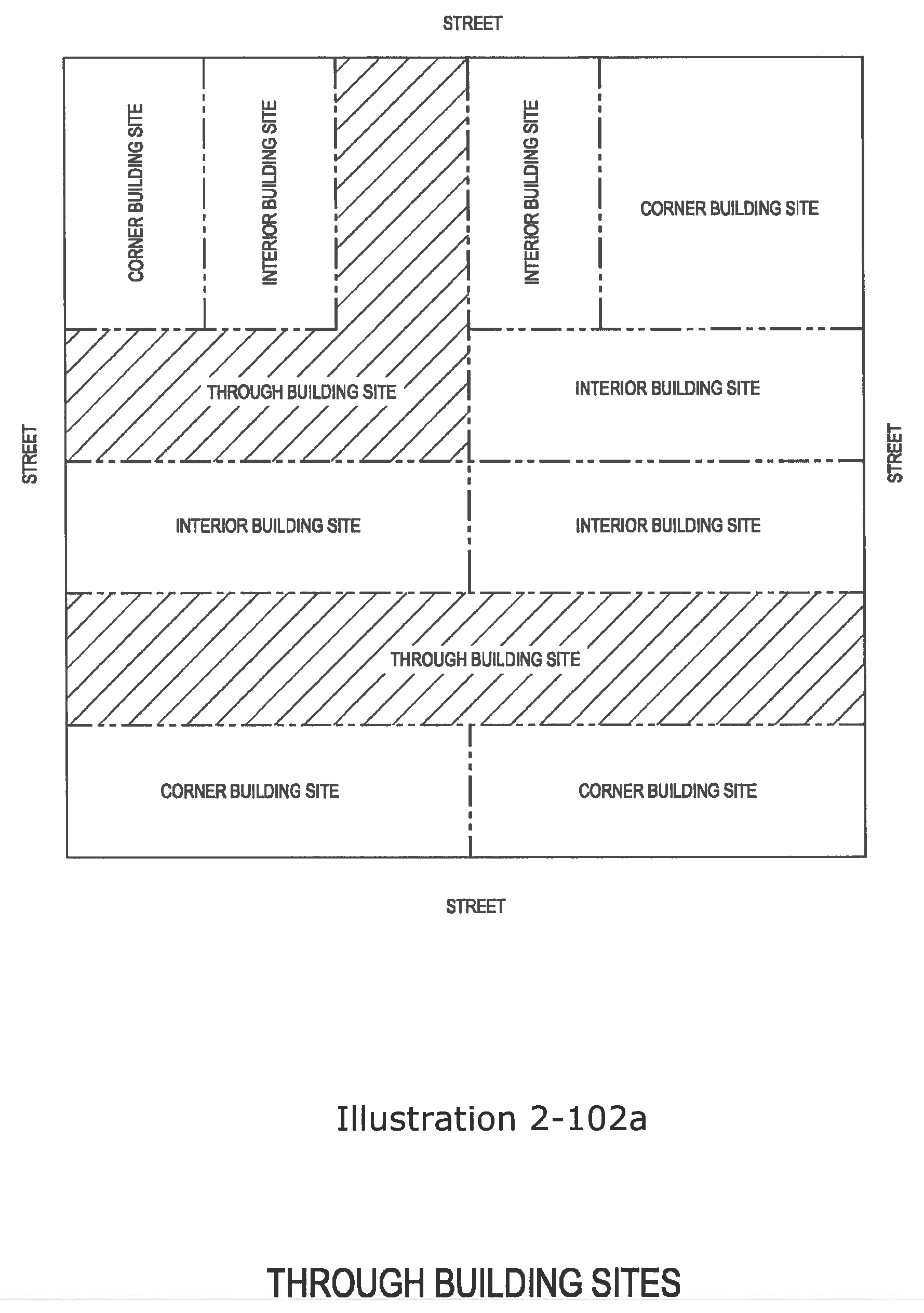
Corner building site or lot means a building site abutting two streets intersecting at an angle of not more than 135 degrees. If the angle of intersection is more than 135 degrees, the building site is an "interior lot".
Curb cut means a break in a curb intended to provide driveway access to a roadway. If there is no curb, the joint or line separating the roadway from the driveway is deemed to be a "curb cut".
Depth. With respect to the depth of an area, the average horizontal distance between the front and the rear. For irregularly-shaped building sites, the depth is deemed to be equal to the average distance from the front street line to the rear or side of the site when the distance is measured perpendicularly from points along the front street line. For purposes of determining compliance with the minimum dimensions of a building site (only), the building official may accept the nominal dimensions of a building site as shown on the current recorded plat in lieu of the actual measured dimensions, when: (i) both dimensions are obviously intended to describe the same site, and they do not differ by more than six inches, or (ii) the ZBA has issued a special exception, based upon a finding that both dimensions are intended to describe the same site and are approximately the same.
Detached. Two structures are detached if there is no physical connection between them above the ground. Exception: an accessory building attached to another building only by a covered walkway or "breezeway" open to the outdoors on the sides is deemed to be detached.
Disability is determined in accordance with the Fair Housing Act, 42 USC §3601 et. seq.
Driveway. A driveway is an outdoor area designated or improved to provide a path or route for motor vehicles.
Dwelling unit (or "DU"). A building, a single room or a group of rooms capable of being occupied and which have all of the following: (i) direct access from outside of the building or through a common hall; (ii) a kitchen area including a sink, a refrigerator and cooking equipment; and (iii) a full bathroom including a sink, a commode and either a bathtub or a shower.
Enclosed. Enclosed, when referring to porch space or building space, means that 51% or more of the perimeter of the space is enclosed by wall surfaces that are less than 75% open to outside air and light. For this purpose, ordinary insect screen are considered open to out side air and light.
Established driveway pattern. A pattern along a block face where 25 percent or more of the frontage is included in building sites upon which there are driveways. The pattern, if any, is indicated if 66 percent or more of the driveways are on one side (e.g., either the left or the right) of their respective building sites.
Face. To face directly or at an angle less than 90 degrees.
Family. One person, or a group of persons meeting any of these three criteria: (i) each member of the group is related to each of the others within four degrees of consanguinity or affinity (a "related family"); or (ii) the group includes only a related family plus one other person, all of whom live and cook together as a single housekeeping unit; or (iii) the group includes only persons who live and cook together as a single housekeeping unit, in a family-type home approved in accordance with Article 8.
Family-type home means a home for which a permit or special exception is in effect as provided in Article 8.
Fence-like hedge means an arrangement of vegetation or foliage having the characteristics of a fence and growing higher than 36 inches above standard base level.
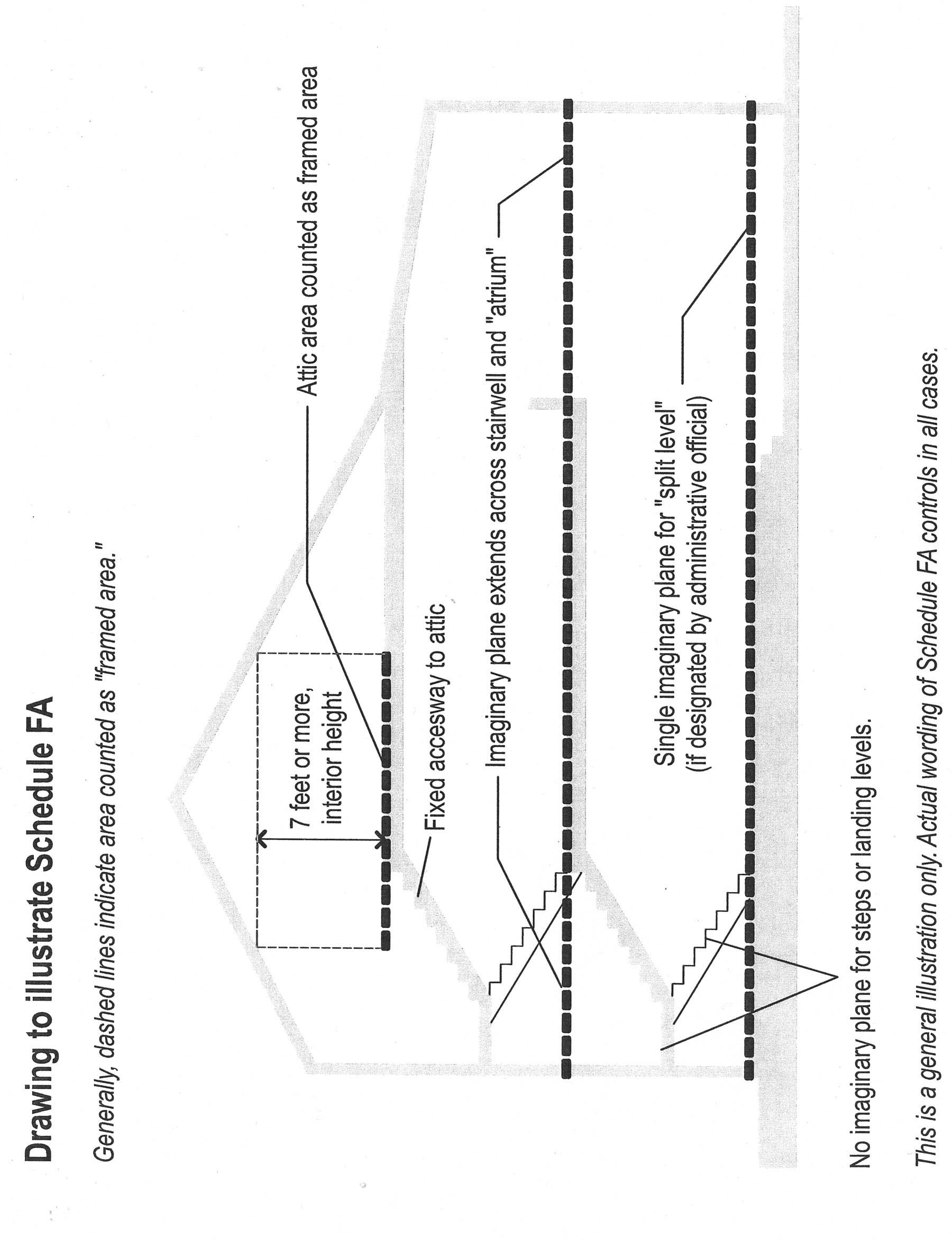
Framed area. Framed area reflects the size of a building, in square footage. It is defined and illustrated in Schedule FA.
SCHEDULE FA
(FRAMED AREA)
(a)
General rule. Framed area reflects the size of a building, in square footage. Framed area includes all floor and ground areas under a solid, fixed roof, except the uncounted areas listed in this Schedule. Floor and ground areas are measured, on each level, according to the measurement method set out below. For each building, the measured areas for each level are totaled to produce the framed area of the building.
(b)
Measurement method. For each level of a building, the framed area is the area of an imaginary, horizontal, unbroken plane immediately atop the structure supporting the floor (or immediately atop the ground, where there is no floor). Each plan extends horizontally to the outer main wall surfaces of the building, or to the outer perimeter of the structure above (whichever is outermost). For this purpose:
1.
Steps, landings, sunken areas, floor openings and similar features are not considered separate levels, so there is no plane on those levels;
2.
Each plane extends to the outer wall surfaces of bay windows, cantilevered space and similar space on the same floor, regardless of the height of the floor;
3.
If there is a "split level" or similar irregular floor level, the building official may designate either one level to define the imaginary plane for that floor, or separate planes for the separate levels; and
4.
If area (all or part) within a one-story building has an interior height exceeding 19 feet, the area is doubled to calculate framed area (and if it has a interior height exceeding 31 feet, the area is tripled).
(c)
Uncounted areas. The following areas are not counted as framed area:
1.
Attic area that cannot be reached through a fixed accessway;
2.
Attic area where there is a interior height less than seven feet;
3.
Those non-attic parts of an imaginary plane on a second or third-floor level, above which there is less than seven feet of interior height;
4.
Area beneath eaves, cornices, roof extensions, "greenhouse" or bay windows, cantilevered space and similar parts of building that project outward from the main wall of a building no more than 24 inches, if the area is on a lower floor level (or at ground level) and is otherwise completely open to the outdoors;
5.
Unenclosed porch area of a principal building, if the longest side of the porch directly faces the front street line or side street line of the building site, and the area is neither designed nor usable for motor vehicles;
6.
The area of "crawl space" at ground level;
7.
Unenclosed walkway or "breezeway" area if: (A) the area directly connects a principal building to an accessory building containing garage space located behind the principal building; (B) the total covered width of the area does not exceed eight feet; and (C) no part of the roof is higher than 14 feet;
8.
Area of recessed entries (garage or home) or windows that is completely open to the outdoors on at least one side, if: (A) each area faces the front street line or side street line of the building site, (B) each area is not larger than 100 square feet, and (C) the total of all such uncounted recessed area is less than 200 square feet; and
9.
Basement area if: (A) the floor is at least five feet lower than the standard base level of the site, and (B) the interior height does not exceed eight feet.
The rules for uncounted areas shall be strictly construed and applied to the defined areas only.
Front right-of-way area. For a given building site, the area within a street area which directly abuts the building site.
Front setback line. The line which marks the closest permissible location of a building with respect to the front street line (disregarding those projections specifically allowed by this ordinance). The front setback line is usually the edge of the front yard.
Garage space. Building space for storage of motor vehicles. Enclosed garage space must be completely within a building. Semi-enclosed garage space must have a solid or an opaque wall at least six feet high around at least one-half of its perimeter.
GR District. A general residential district.
Gross floor area. The gross floor area shall be measured by taking outside dimensions of a building or space in a building, on each floor level, excluding, however, the floor area of attached garages, basements or attics used only for storage, and opened or screened porches, except where the gross floor area of the main space is 1,100 square feet or more, in which case, half of the square footage of such opened or screened porches shall be used in computing the gross floor area.
Height. Height is measured vertically from the standard base level of a site. The height of a structure is the vertical distance to its highest point.
Height, interior. The vertical clearance between the main structural elements supporting a floor (e.g., floor joists) and the main overhead structural elements (e.g., roof rafters, ceiling joists). Where there is no floor, the interior height is measured from the imaginary plane used to measure framed area).
High-density occupancy means the use of a building or structure, or a portion thereof, for any of the types of gatherings described in Subsection A-1, A-2, A-3, A-4 or A-5, § 303, International Building Code, 2006 Ed., International Code Council, Inc., but only if the gathering exceeds any of the following parameters: (i) at least 100 people four times or more during any 12-month period, (ii) at least 50 people eight times or more in any 12-month period, or (iii) at least 25 people 16 times or more in any 12-month period.
The requirement for a special exception for a high-density occupancy is deemed to be satisfied if, before the effective date of this Ordinance, the ZBA issued a special exception for a use that, at that time, included substantially the same high-density occupancy.
Home occupation. A business activity upon a given building site which meets all of the following criteria:
(1)
It is carried on exclusively by persons who lawfully reside upon the building site without the employment of any other person, whether paid or unpaid.
(2)
It does not involve any sign or other means of advertisement on or near the building site.
(3)
It does not involve any significant storage of goods or fixtures.
(4)
It does not require any specialized building or structure, or any modification of a building or structure.
(5)
It does not involve the transmission of sound or electronic impulses other than by means of utility services.
(6)
It does not cause any significant increase in traffic or on-street parking.
(7)
It causes no noise, odor, discharge of any substance or gas, vibration or other condition detectable from outside the building site in question.
(8)
It is subordinate and incidental to a permitted principal use of the building site.
Incidental sale. A business activity (such as an occasional sale of used property, a "garage sale" or a "bake sale") which is specifically allowed under another ordinance of the City regulating such activity or which meets all of the following criteria:
(1)
The activity involves only the sale of used personal property, food or beverages.
(2)
No business activity (other than activity which is part of a home occupation) occurred on the same building site on 178 or more days out of the 180 days immediately preceding the day of the activity.
(3)
The activity is an accessory use of the building site.
Interior building site or lot means a building site abutting only one street or abutting two streets which intersect at an angle greater than 135 degrees.
Licensed day care center. A facility licensed by the State of Texas that provides care, training, education, custody, treatment or supervision for more than 12 children under 14 years of age, where such children are not related by blood, marriage or adoption to the owner or operator of the facility, for less than 24 hours a day, regardless of whether the facility is operated for a profit or charges for the services it offers.
Line, front street. The common boundary of a building site and a street area. For corner sites (and any other sites touching two or more street areas), the front street line is determined by the administrative official according to the following criteria, listed in order of precedence:
(1)
A special designation of the front street line made by the ZBA (see, e.g. Article 8), or by an approved QMDS plat or PDD site plan (if any).
(2)
A clear indication of the appropriate front street line, based upon:
(i)
Subdivision platting pattern;
(ii)
Traffic and access pattern;
(iii)
Property size and shape;
(iv)
Orientation of existing and historical development;
(v)
Probable future development; and
(vi)
Compatibility with nearby sites and their uses.
For this purpose, the administrative official shall consider any special yard depths applicable to a "rotated corner building site" (see Table 7A-2).
(3)
For sites with a SFR (as defined in Sec. 6-19) use (including undeveloped property in an SFR district or the GR-1 or GR-2 District):
(i)
If one street line is substantially shorter than all others, it is the front street line;
(ii)
Otherwise, the front street line is the line that is most compatible with nearby sites and their uses.
(4)
For sites without a SFR use bordering a major thoroughfare:
(i)
The front street line would ordinarily be the common boundary with the major thoroughfare;
(ii)
If all boundary streets are major thoroughfares, the front street line is the common boundary with the thoroughfare with the longest frontage;
(iii)
Otherwise, the front street line is the line that is most compatible with nearby sites and their uses.
(5)
For other sites without a SFR use:
(i)
If one street line is substantially longer than the others, it is the front street line;
(ii)
Otherwise, the front street line is the line that is most compatible with nearby sites and their uses.
Line, rear property. The boundary of a building site most nearly opposite the front street line. The administrative official shall designate the rear property line of irregularly shaped building sites, and the line so designated need not be straight.
Line, side property (or "SPL"). Each boundary of a building site, except the front street line, the rear property line and any side street lines.
Line, side street. Each common boundary between a building site and a street area, except the front street line.
Living space. Any living room, bedroom, dining room, study, kitchen or other living activity space. A bathroom, foyer, hallway, stairway or other utility space shall not be considered living space.
Low-impact motor court (or "LIMC") is a vehicle parking and maneuvering area in a QMDS that meets all these criteria:
(1)
One Curb Cut. Only one curb cut per 50 feet of frontage, a maximum of 12 feet wide (measured at the narrow point of the apron).
(2)
On-Street Spaces. In GR-1 or GR-2, leave at least two 18-foot curb spaces per 50 feet of frontage.
(3)
Landscaped Buffer Strips. Must include strips five feet deep along street areas, and 18 inches deep on sides. It must be landscaped with evergreen hedges or shrubs.
(4)
Street Trees. At least one per 24 feet of street frontage (round down).
(5)
Pervious Pavement. It must be used throughout.
Note— Where a LIMC as defined in Section 2-102 is allowed, internal access garages are not required; see the definition of QMDS in this section.
Major thoroughfare. Bissonnet Street, Kirby Drive or Bellaire (West Holcombe) Boulevard.
Mirrored glass. Glass with a reflectance greater than 20 percent.
Multiple utility service. Utility service provided to a person (or group of persons) on a given building site who is different from another person (or group of persons) to whom the same service is provided on the same building site.
1987 effective date. October 24, 1987, which was the effective date of the 1987 comprehensive revision.
Night assembly use means a use of a building or structure, or a portion thereof, which meets all three of these criteria: (i) it is nonresidential, (ii) it is operated between midnight and 6:00 a.m. four times or more in any 12-month period, and (iii) it involves the gathering of at least 25 people four times or more in any 12-month period.
Non-residential use. Any use other than a residential use.
Occupancy. The use or intended use of a particular area of land or a particular building or structure, or portion thereof, by proprietors or tenants.
Office use, light, means offices for conducting real estate, insurance and other similar businesses and the offices of the architectural, clerical, engineering, legal, dental, medical and other established and recognized professions, in which only such personnel are employed as are customarily required for the practice of such business or profession.
Old stock housing. One or more buildings on a SFD site meeting all the following criteria, at any given time: (i) the principal building was built before 1980, and (ii) the gross floor area of all buildings on the site (at any given time) does not exceed the greater of 3,400 square feet or 200 percent of the gross floor area of all the buildings on the site when the principal building was built.
Open area. Area unoccupied by any structure and open and unobstructed to the sky, except by natural plants or trees, and except for projections specifically permitted by the Projections Schedule (see Tables 7A-7, 7B-7, 7C-7, 7D-7) to the extent therein provided.
Park, playground or community center (public). A park, playground or community center owned or operated by a governmental entity having the power of eminent domain.
Parking area. An outdoor area designated or improved to store motor vehicles. The term includes parking "pads."
PDD. A planned development district. (See Articles 3 and 9).
Person. A natural person, partnership, corporation, sole proprietorship, representative, governmental entity, unincorporated business association or any other entity.
Pervious area. An area which: (1) is natural ground or landscaped area that receives rainwater and allows it to pass through or be absorbed, thus preventing excess water flow away from the area, or (2) is specifically designated as pervious area in the Projections Schedule.
Pervious pavement includes both: (1) specially-manufactured pavement blocks or grids that have holes filled with pervious material, and (2) stones, bricks or pavers laid with intervening gaps filled with pervious materials. Pervious pavement must have a pervious base.
Place of worship. Those spaces designed and used for actual worship by a recognized and organized religious group, having an ordained minister, priest, rabbi, or similar religious leader, including parking areas and necessary supporting facilities, but not including non-worship spaces such as residences, dormitories, schools, child care facilities or physical fitness facilities.
PNC. A prior nonconformity. See Article 12.
Porch. A roofed structure, open at the sides to the extent required by Tables 7A-7, 7B-7, 7C-7, 7D-7, note 1.2, projecting from the face of a principal building and used to protect the structure's entrance.
Practice enclosure. A practice enclosure is a permanent or semi-permanent outdoor space that is generally enclosed on all sides by netting, and which is utilized for the practice of a sports activity (e.g., batting practice, golf, etc.) which is not otherwise prohibited by law or local ordinance.
Principal building. The building on a building site housing the principal use.
PWSF or "Personal wireless service facility." A facility for the provision of personal wireless services as defined by the Telecommunications Act of 1996. See 47 U.S.C. § 332.
PWSF Use. A use that includes one or more PWSFs.
Qualified Medium Density Subdivision (or "QMDS") means a subdivision established by plat or replat that meets all the following criteria:
(1)
Certain Districts. The area lies within one or more of these Districts: TH, GR-1, GR-2, PDD-TH1, PDD-TH2, PDD-TH4, PDD-TH5 or PDD-TH7.
(2)
Internal Access Garages. It designates internal access garages for at least 80% of the lots in the subdivision with sufficient driveways, alleys, curb cuts and maneuvering areas to serve them. "Internal access garage" means an enclosed garage with a door that: (i) does not face the front street line of its lot, unless it is 40 feet or more from that line, and (ii) does not face a side street line of its lot, unless it is 20 feet or more from that line. Exception: For subdivision of an old building site (existing before October 24, 1987) with a width of 61 feet or less, there may be a low-impact motor court instead of internal-access garages.
(3)
Yards. It must designate all required yards, front, side and rear. (Notes: Yards are required only around the perimeter of the subdivision, not internally. However, easements, open areas and other restricted areas may be required internally; see below. Yards designated by QMDS plat control over general yard definitions elsewhere.)
(4)
Access, Parking, Environmental Issues. Vehicular access, driveways, maneuvering areas, streets and alleys (public or private), easements, curb cuts, parking spaces, building lines, open areas and pervious areas may be identified and restricted by the plat so that, in the judgment of the Z&PC: (i) any impact on adjacent properties or neighborhoods is minimized, (ii) routine, emergency and utility access are adequate, (iii) environmental effects (including runoff, tree impacts, bulk, light, air, etc.) are mitigated. The plat may require such areas to be larger than otherwise required by this ordinance. The Z&PC may require dedication of a public street area or alley.
(5)
Maintenance, Repair, Etc. It incorporates a permanent method for maintenance, repair, insurance and reconstruction of: (i) private streets, driveways and common areas, (ii) external features of attached dwelling units, (iii) common walls, and (iv) other common structures. The method must be either a homeowner's association with full authority to perform these functions and assess the cost to the owners, or a substantially-equivalent method approved by the Z&PC.
(6)
Easements. It includes any necessary easements for access to common areas or structures and for maintenance, repair or reconstruction of non-common structures.
(7)
Building Lines. It includes building lines approved by the Z&PC based upon the specific characteristics of the site and adjoining areas. Building lines may be deeper (or greater) than the otherwise-applicable yard areas. Areas between a building line and the street are designated and regulated as yards (front, side, etc.).
(8)
Title Block; Restrictions. The title block designates it a "qualified medium-density subdivision" and incorporates the applicable provisions of the Zoning Ordinance and Chapter 74. It must recite that all restrictions on the plat or incorporated into the plat shall "run with the land" and shall be independently enforceable by any person or entity having an interest in property included in the plat (which may include the City) and by any homeowner's association that may be created. Any such enforcement by the City is an additional, alternative remedy for the City.
Reside. To live or to intend to live at a place either indefinitely or longer than 42 days.
Residential district includes all SF, TH and GR districts and all portions of a PDD designated primarily for residential purposes.
Residential purposes (or uses). Ordinary domestic purposes (or uses), not involving any business, commercial, industrial or institutional activity, whether carried on for profit or not. Providing any good or service, or offering to provide it, on or from any premises to or for anyone who does not reside on the same premises in exchange for any money or thing of value, whether demanded or accepted, is a business activity. However, in any proceeding where the presence of a business activity under this ordinance is an issue, it shall be an affirmative defense that the alleged business activity was only an incidental sale or was part of a home occupation, but such an affirmative defense shall not apply to any alleged violation of another ordinance of the City unless the other ordinance so provides.
Residential street. Any street, other than a major thoroughfare, abutting a given building site where, within 200 feet in either direction along both sides of the street (measured from the side property lines of the given building site), 51 percent or more of the property fronting on either side of the street is within a residential district.
Residential worker. A person who is employed to perform residential services at least 25 hours per week at the same premises where the person resides. Residential services are personal services which are performed for someone who also resides on the premises and which are purely residential in nature (and not income-producing) such as cooking, cleaning, attending children or handicapped persons or maintaining the grounds.
Roadway means that portion of a street area improved, designed or ordinarily used for vehicular traffic (excluding private driveways).
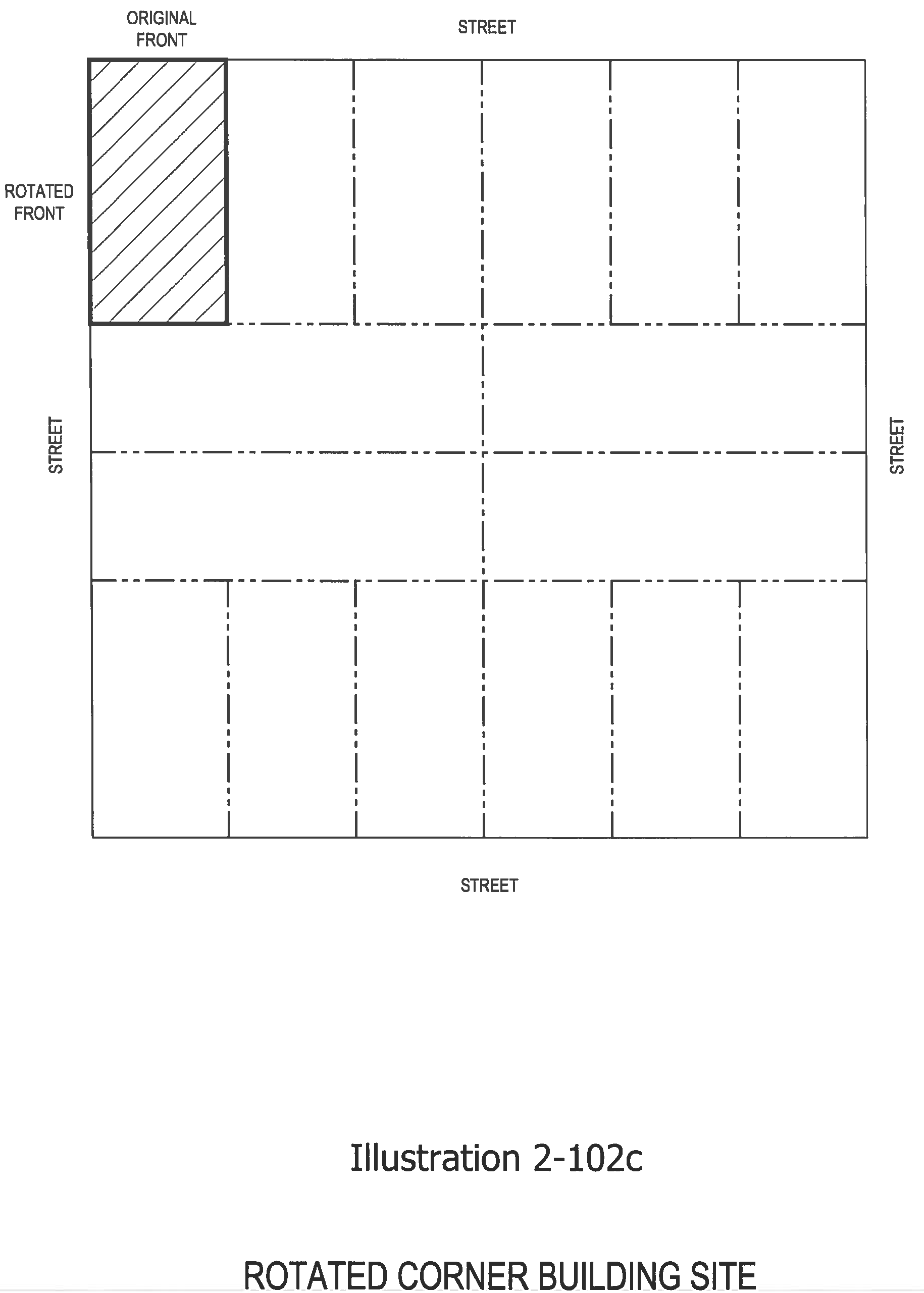
Rotated corner building site or lot means a corner building site in the Rotated Corner Overlay District (the "RCOD") which has been "rotated" from one street to the other, such that it has a front street line lying along a street that is different from the street along which the front street line of the original corner lot would lie. The original corner lot is the single subdivided lot on the same corner, as created by the plan recorded in Volume 444, Page 563 of the Deed Records of Harris County, Texas, entitled "Map Showing West University Place, a Part of the A.C. Reynolds Survey, Harris County, Texas." In the RCOD, most rotated corner building sites will be oriented north-south because most of the original corner lots were oriented east-west (except for lots along University Boulevard or Cason Street).
School. Facilities for educational and/or classroom purposes offering an academic curriculum that is generally equivalent to public primary, middle school, or high school levels. This includes, but is not limited to, study and tutorial centers, child care and limited child care centers, and vocation and trade programs that might be incidental to the operation of such schools.
School (public). A school owned by a governmental entity having the power of eminent domain.
Setback. See "yard" definitions.
SF District. This term refers collectively to the SF District, PDD-SFl, and PDD-SF2 and each of them.
Shopping center. A building or group of buildings on a single building site containing three or more commercial units, each with a separate entrance to the outdoors.
Single-family (attached) use (or "SFA"). A use of a building site which meets all of the following criteria:
(1)
Each dwelling unit is located on a plot of ground to which the occupants of the unit have exclusive access, from the ground to the sky.
(2)
No dwelling unit has any entrance or exit connecting to another dwelling unit.
(3)
No dwelling unit shares any interior hall or interior passageway with any other dwelling unit.
(4)
No more than one family resides in any dwelling unit.
(5)
The entire plot of building site is used exclusively for residential purposes (although, as provided in the definition of "residential purposes," an affirmative defense is available for a home occupation and an incidental sale).
Single-family (detached) use (or "SFD"). A use of a building site which meets all of the following criteria:
(1)
There is no more than one dwelling unit, and one accessory quarters. Other lawful accessory uses are permitted on the building site. (But see, Table 7A-4b).
(2)
There is no multiple utility service on the building site.
(3)
There is no physical connection between any building on the building site and any other building on another building site.
(4)
One family, plus up to two residential workers, reside upon the building site.
(5)
If the family includes a person not related to each of the others within four degrees of consanguinity or affinity, the unrelated person resides in the principal building with at least one of the others.
(6)
The entire building site is used exclusively for residential purposes (although, as provided in the definition of "residential purposes," an affirmative defense is available for a home occupation and an incidental sale).
Special exception. See Article 11 and Chapter 211 of the Texas Local Government Code.
Special screen. An opaque fence or wall designed, constructed and maintained to reduce risks of fire, unsanitary conditions and vandalism and to prevent the viewing of a loading dock or waste storage area, or any associated equipment, from any street area or from any other building site within a residential district. Buildings or other structures and gates may be incorporated into special screens.
Sport court. A sport court means any outdoor improved area (not including parking areas, driveways, or pools) designed for athletic or recreational purposes, including but not limited to tennis, basketball, handball, pickleball, volleyball, and racquetball courts.
Standard base level The standard base level is the average elevation of two points: the tops of the curb where the side lines of a site, if extended, would intersect the curb (but if there is no curb at either point, or if there is no curb at all, the intersections of the extended side lines with the paved crown of the street are used instead of the tops of the curb). Exception: If sufficient data are available, the Building Official shall designate a substitute standard base level for a site, which shall apply from and after the date of designation, as follows:
(1)
The substitute standard base level is the average elevation of eight points, all at ground level on the boundaries of the site, as follows: (i) four of the points are the exact corners of the site, and (ii) each of the remaining four points is the exact midpoint of one of the boundaries of the site (e.g., side street line), but (iii) if the site is irregularly shaped, or if one or more of the points cannot be measured accurately, the Building Official shall designate the eight points, using as many corners as practicable and spacing the remaining points as equally as practicable along the boundaries of the site.
(2)
The elevations of the eight points must be established by an acceptable topological survey submitted to the Building Official.
(3)
Topological surveys, to be acceptable, must meet standards set by the Building Official (including the form of the drawing and certificate), but no such survey is acceptable if three or more of the points surveyed have been disturbed by filling, demolition, construction or similar activity within the five-year period preceding the date of the survey.
SPL. See "Line, side property."
Story. The portion of a building between successive floors of such building or from the top floor to the roof.
Story, half. In the case of a two-and-one-half-story building, a third-floor level with a framed area that does not exceed 50% of the framed area of either the first or second-floor level (whichever is smaller).
Street area. All of the area within the right-of-way lines (or boundaries) of a highway, alley, street, avenue or public place or square, bridge, viaduct, underpass, overpass, tunnel or causeway dedicated or devoted to public use.
Structure. Anything made by humans which: (i) is not readily portable; (ii) is usually left in one location for an indefinite period of time; or (iii) requires either permanent or fixed location on or in the ground or attachment to something having a permanent or fixed location on or in the ground for its use. Examples of structures, which do not limit this definition, are: sculptures; lampposts; sidewalks; driveways; playground equipment and facilities; buildings; flagpoles; antennas and pools. A canopy or similar object designed or used to shelter a motor vehicle, a boat or similarly-sized items is deemed to be a structure if it remains in substantially the same place for more than ten days, regardless of whether it is readily portable, frequently moved or unattached.
Structural alteration. Any change in a supporting member of a structure, such as a bearing wall, column, beam or girder.
Subdivided lot. A lot or parcel which was: (i) created or designated by plan, plat or replat approved by the appropriate City body as required by the Texas Local Government Code or previously applicable state law, including Texas Revised Civil Statutes Annotated art. 974a; or (ii) in existence as a separately owned and separately described lot or parcel continuously since September 12, 1983.
Swimming pool. Any constructed pool for swimming or bathing over 24 inches in depth or with a surface area exceeding 200 square feet. This term includes "spas" and "hot tubs."
Through building site or lot; "rear through building site" or "lot" means a building site other than a corner building site with frontage on more than one street other than an alley.
Unenclosed. Unenclosed, when referring to porch space or building space, means the space is not "enclosed" as defined above.
Use. The term includes any use of property and any activity upon or relating to property.
Utility or service use. A use, other than PWSF use, reasonably necessary to provide any utility service to sites in the City. This use also includes production, processing, through-transmission or central facilities primarily used to provide utility or communication service to areas outside the City, only if the facilities meet all these criteria: (i) the facilities and all their uses are specifically identified and authorized by a franchise ordinance or other special permission issued by the City, and (ii) they are located underground in street or public easement areas, unless specifically authorized to be located elsewhere by such a franchise ordinance or special permission.
Utility service. Any water, sewer, garbage, electric, lighting, gas, telephone, cable television or other similar service provided by the City, a public utility, a franchisee of the City or governmental entity serving the City.
Variance. See Article 11 and Chapter 211 of the Texas Local Government Code.
Visibility triangle. This term includes both "driveway visibility triangle" and "street visibility triangle" as defined in Chapter 82 of the Code of Ordinances.
Waste storage area. Any area designed or used to store garbage, trash or other wastes, except for those areas in an SF District which serve one or two dwelling units.
Width. In the case of a building site, the length of the front street line. For purposes of determining compliance with the minimum dimensions of a building site (only), the building official may accept the nominal width of a building site as shown on the current recorded plat in lieu of the actual measured width, when: (i) both dimensions are obviously intended to describe the same site, and they do not differ by more than six inches, or (ii) the ZBA has issued a special exception, based upon a finding that both dimensions are intended to describe the same site and are approximately the same.
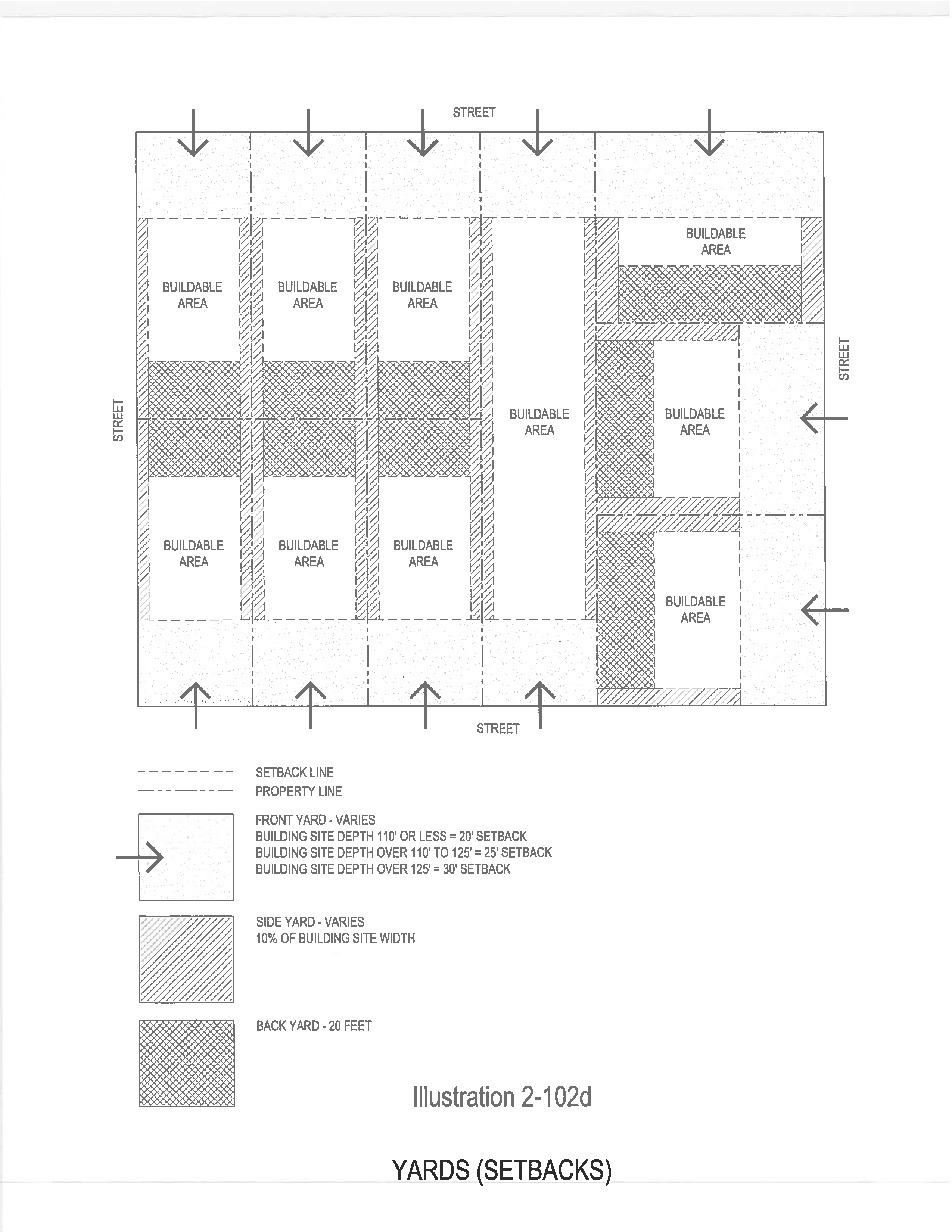
Yard, front. That part of a building site is included in the required yard (or setback area) measured street line or defined by a front building line. See "Yards" table in Article 7A, Article 7B, Article 7C, and Article 7D.
Yard, rear. That part of a building site included in the required yard (or setback area) measured from the actual property line. See "Yards" table in Article 7A, Article 7B, Article 7C, and Article 7D.
Yard, side. That part of a building site is included in the required yard (or setback area) measured from any side property line. See "Yards" table in Article 7A, Article 7B, Article 7C, and Article 7D."
Youth athletic facility. A facility that provides athletic training or athletic facilities for more than 12 children under 16 years of age, where such children are not related by blood, marriage or adoption to the owner or operator of the facility, on a typical operating day, regardless of whether the facility is operated for a profit or charges for the services it offers.
ZBA. The Zoning Board of Adjustment.
Z&PC. The Zoning & Planning Commission.
Zoning District Map. The map adopted on March 12, 2001 simultaneously with the comprehensive amendment of this ordinance, as said map may be amended, from time to time.
(Ord. No. 1770, 7-26-2004; Ord. No. 1819, 11-28-2005; Ord. No. 1820, 11-28-2005; Ord. No. 1798, § 1(ex. A), 5-23-2005; Ord. No. 1799, § 1(ex. A), 5-23-2005; Ord. No. 1802, § 1(ex. A), 5-23-2005; Ord. No. 1872, § 1(ex. A), 4-28-2008; Ord. No. 1873, § 1(ex. A), 4-28-2008; Ord. No. 1925, § 1(ex. A), 8-9-2010; Ord. No. 1939, § 1(ex. A), 2-28-2011; Ord. No. 1978, § 1(Exh. A), 5-20-2013; Ord. No. 1979, § 1(Exh. A), 5-20-2013; Ord. No. 2005, § 1(Exh. A), 3-9-2015; Ord. No. 2030, § 1(Att. A), 2-27-2017; Ord. No. 2081, § 1(Exh. A), 9-23-2019; Ord. No. 3051, § 2, 5-22-2023; Ord. No. 3066, § 2, 4-22-2024)

