
West University Place
City Zoning Code
City Zoning Code
ARTICLE 7A
- RESIDENTIAL DISTRICT-SPECIFIC REGULATIONS
Sec. 7A-100. - Purpose and applicability.
The purpose of this Article is to prescribe regulations that differ by residential and overlay district. Each regulation shall be construed to carry out the purpose and intent of this ordinance and the purpose for the district and overlay district within which it applies.
(Ord. No. 3066, § 4, 4-22-2024)
Sec. 7A-101. - Regulations, tables, etc.
(a)
In General. Every use, building site and structure must comply with the regulations set out in the following tables: Table 7A-1. Uses; Table 7A-2. Yards (or "setbacks"); Table 7A-3. Open & Pervious Areas; Table 7A-4a. Garage Space; Table 7A-4b. Buildings; Table 7A-5a. Parking, Driveways, Etc.; Table 7A-5b. Certain Structures; Table 7A-6. Building Site Dimensions.
(b)
Projections. Permissible projections into yards and details about computation of open and pervious areas are set out in Table 7A-7, the "Projections Schedule.
Note 1. High-density occupancies in SF District. High-density occupancies are allowed in SF Districts only to the extent authorized by a special exception. The ZBA may issue such a special exception if it finds and determines that the occupancy is a use that is (i) accessory to a lawful primary use and (ii) reasonably compatible with nearby sites and their uses (in addition to any other findings and determinations required for a special exception). Note: A previously-issued special exception that authorized a use with a high-density occupancy is sufficient to comply with this note.
Note 2. Private Green Space. Vineyards, gardens, landscaping, private playgrounds and other similar uses that are predominantly pervious, vegetated and non-commercial are allowed in all districts. Unless otherwise authorized by a special exception, the only structures allowed are fences, playground equipment and landscaping structures (e.g., low, retaining walls, borders, etc.). The ZBA may issue a special exception to authorize other structures. The special exception shall include a site plan specifying and limiting allowable structures. If so ordered by the ZBA, the site plan controls over any other ordinance to the contrary. However, the site plan may not specify yards (or "setbacks") different from those otherwise required, unless the ZBA finds that the different yards are: (i) necessary for efficient use of the available space and (ii) compatible with nearby sites and their uses. The special exception may allow accessory structures without a principal building.
Note 3. Accessory Uses and Structures. In the indicated districts, the ZBA may issue a special exception to authorize additional uses and structures, if the ZBA finds and determines that each additional use and structure is: (i) accessory to a lawful primary use and (ii) compatible with nearby sites and their uses. The special exception may include a site plan identifying and limiting such uses and structures.
Note 1. Through Lots or Building Sites or Rear Through Lots or Building Sites. If a lot or building site extends all the way through a block so that the front and rear both abut a street area, there is no rear yard. The site is a "through" or "rear through" lot or building site and is considered to have two front yards, one at each street frontage. The front yard (setbacks) shall be as provided in Table 7A-2. Exceptions: 1) If the site is "flag" shaped or irregular, the "flag" portion shall have the same setback as the adjoining building sites fronting that street; 2) If a through lot abuts a Major Thoroughfare and a local street and has a lot depth less than 160 feet, then the lot sha I have a front yard on the local street and a back yard on the Major Thoroughfare. Provided, further, there shall be no vehicular access to the street adjacent to the back yard; 3) If a through lot abuts Auden Street and a dead-end street, then the lot shall have a front yard on Auden Street and a back yard on the dead-end street. Provided, further, there shall be no vehicular access to the street adjacent to the back yard.
Note 2. Narrow Site "3/7" Exception. Alternate side yard areas apply to a building site meeting all five of the following criteria: (A) The building site is less than 55 feet in width and no more than 6,000 square feet in area. (B) The use Is single-family (detached) use. (C) Outside the rear yard, no main wall surface of any building is closer than 10 feet to any main wall surface of a 'prior building' on an adjacent building site. A 'prior building' is a principal building in existence, under construction or covered by a current building permit when a building permit is issued for a subsequent building. A 'subsequent building' is a principal building that was permitted for construction after an adjacent prior building was permitted, and that is located on a building site that has a common side property line with the adjacent prior building. 1) Exception: If there are prior buildings on both sides of a subsequent building, each within 7 feet of the common side property lines, the minimum separation between main wall surfaces is 8 feet. (D) The owner has designated alternate side setback areas in a form approved by the administrative official and in accordance with all of the following criteria: (1) Minimum setback, interior: 3 feet. (2) Minimum setback, street side: 5 feet. (3) Minimum setbacks, both sides combined: greater of 10 feet or 20% of the building site width. (4) On each side, the setback is uniform in width along its entire length. See Table 7A-5a regarding "alternating driveway" rule. (E) The proposed garage shall be located in the rear yard. The ZBA may issue or modify a special exception to locate the proposed garage outside the rear yard if all the following criteria are met. The special exception criteria conferred by section 11-102(b) shall not be utilized when determining whether this special exception should be granted. The scope of the decision shall be limited to criteria enumerated below: (1) Locating the proposed garage outside the rear yard will not unduly alter the character of the immediate neighborhood; (2) The location will not restrict access to the principal or neighboring properties for fire or life rescue; (3) The proposed special exception will not cause any significant increase in on-street parking, will not cause any substantial traffic congestion, will not cause any substantial increase in traffic or an unreasonable burden upon utility systems or upon any other public facility or public service; (4) A protected tree(s) that would otherwise be removed due to a garage being constructed in the rear yard would be preserved; and (5) The submission of a tree disposition plan and tree survey approved by the city's urban forester.
Note 3. Rotated Corners. For rotated corner building sites (RCOD only), the minimum side street yard width is (i) 10 feet if the building site width is 65 feet or less, (ii) 10 feet plus the distance by which the width of the building site exceed 65 feet, if the building site width is more than 65 feet but less than 75 feet, (iii) 20 feet if the building site width is 75 feet or more but less than 100 feet, or (iv) for building sites 100 feet wide or more, the side street yard width is determined by the same rules as the front yard depth, except that the "depth" of the building site is measured from the side street line.
Note 4. Major Thoroughfares. The ZBA may issue a special exception for a front yard less than 30 feet deep abutting a major thoroughfare, if the front yard prescribed is at least 10 feet deep, and if the special exception requires the greatest practicable amount of pervious area in the front yard.
Note 5. Special Exception. The ZBA may prescribe a different street side yard by special exception relating to frontage. See Article 8.
Note 1. Rear Yard Adjacent to Non-SF. The ZBA may issue a special exception to reduce the requirement for open area in a rear yard in a SF District to not less than 40%, if the rear yard abuts a non-SF District.
Note 2. Landscaping Strips. Vegetated pervious areas are required as follows:(a) minimum of five feet wide adjacent to each street area (or 3.5 ft. if located in front of a fence or wall at least 3.5 feet high), and (b) minimum 18 inches wide to separate each paved vehicular area from a fence or subdivision or replat boundary. Exception: Strips are not required along alleys or where they must be crossed by sidewalks or driveways. Strips along street areas must have live, evergreen shrubs (maximum spacing is 3.5 ft.) and live qualified trees under Chapter 82 of the Code of Ordinances (maximum spacing is 20 ft.). The administrative official may approve different spacing for shrubs or trees, upon showing that (i) the spacing is allowed by standard urban forestry criteria for the species and location and (ii) the spacing will comply with Chapter 82. The ZBA may issue a special exception to allow a landscaping strip to be located in whole or in part within a street area if the ZBA finds that the particular landscaping will, in all probability, be allowed to remain intact for at least 50 years and that it can be maintained and will function as well as a strip located completely on private property.
Note 3. Old Stock Housing. The ZBA may issue a special exception to reduce the open area requirement in the rear yard if the ZBA determines: (i) the reduction is reasonably necessary to preserve or protect old stock housing as it then exists or as it may be proposed to be remodeled or expanded (up to a total gross floor area, for all buildings on the site, that does not exceed the greater of 3,400 square feet or 200% of the gross floor area of all the buildings on the site when the principal building was built, before 1980); and (ii) there will be no substantial adverse impact upon nearby properties.
Note 4. All pervious areas in a front yard must be natural vegetation or landscaped area that receives rainwater and allows it to pass through or be absorbed. Artificial turf may be used in lieu of grass for landscaped areas, provided it is a natural green color that is consistent with the character of the neighborhood. Final approval of artificial turf shall be subject to the approval of the administrative official.
Note 1. Special Exceptions. The ZBA may issue a special exception for a parking area, garage, or driveway in another location or with a different design than prescribed by this table if it finds that (i) the other location or design will not unreasonably interfere with available light and air and will not significantly alter access for fire-fighting and similar needs; (ii) the other location or design will prevent the destruction of a qualified tree; (iii) in the case of the remodeling of a principal building, the location requested is the same as an existing parking area, garage or driveway; or (iv) the location or design requested is necessary for safety considerations.
Note 1. Antennas and Chimneys. Roof-mounted radio or television antennas on a principal building in a residential district may project up to four feet above the roof. The maximum height of chimneys attached to a principal building is 35 feet or four feet above the roof. See Section 18 149, Table 6-552 which provides additional regulations for the installation of roof mounted antennas.
Note 2. SF privacy protection. On a building site where this applies (see Figure SFP at the bottom of Appendix A), there may not be a direct sight line from any "third-floor viewpoint" to any point in an "SF privacy zone." A "third-floor viewpoint" is any viewpoint on a "third-floor area" at eye level (six feet) or lower. A "third-floor area" is any floored area (indoors or outdoors) where the floor is 18 feet or higher The "SF privacy zone" includes every point: (i) within 100 feet of the third-floor viewpoint in question, (ii) on a building site in an SF District, and (iii) below 20 feet in height.
Note 3. Height of Flood Loss Structures. The roof height of existing flood loss structures being raised to meet floodplain regulations may exceed the existing roof height by an amount equal to the distance the structure is elevated. In no case may the maximum roof height exceed 39 feet and 27 feet in the rear yard setback.
Note 1. Width measurement methods. Minimum driveway width refers to unobstructed vehicular access path and, for non-SFD use, pavement. Maximum driveway width refers to the maximum width of pavement in a front yard or street area, excluding complying curb cut aprons. Maximum curb cut width refers to the width of the driveway plus aprons, measured at the edge of the roadway.
Note 2. Grouped or shared parking.Article 10 also provides for a special exception in certain circumstances.
Note 3. Parking exclusivity (non-SFD uses). Required parking spaces must be kept open, readily accessible, and used for parking only, with no sales, dead storage, display, repair work, dismantling, or servicing of any kind. Required guest parking spaces must be kept open and reserved for that use only.
Note 4. Pavement. The administrative official may approve other pavement designs and materials if the pavement designs and materials will provide equal or better durability and satisfy the requirements of pervious pavement related to water runoff.
Note 5. Curb cuts. The ZBA may issue a special exception for additional curb cuts. Exception: The administrative official may authorize additional curb cuts for a corner site when in compliance with the requirements for two curb cuts for circular driveways specifically allowed by Chapter 70 of the Code of Ordinances. These additional curb cuts are not prohibited and do not require a special exception. (A) Circular driveways. If a SFD building site has 60 feet or greater frontage measured along the front street line, then two curb cuts for a circular driveway are permitted if: (1) Both curb cuts are on the same street and located along the front street line; (2) At the front street line, no part of the curb cuts or driveways are closer than two feet to a side property line; (3) In the street area, no part of the curb cuts or driveways cross the imaginary extension of a side property line, unless the affected neighboring owner consents in writing; (4) Measured along the edge of the main traveled roadway, the inside edges of the curb cuts and driveways at the property line are at least 24 feet apart; (5) Within the street area, the edges of each driveway are perpendicular to the edge of the main traveled roadway and; (6) The proposed driveways are no wider than what is allowed or specified in table 7-Sa in appendix A of the Code of Ordinances. (B) Corner lots. Regardless of street frontage, corner lots shall be expressly prohibited from constructing a driveway which connects two intersecting streets (i.e., cutting the corner). If a SFD building site is 60 feet or greater in width and meets the requirements for a circular driveway as specified in Table 7-Sa, Note S(a)(l-6), corner lots shall be permitted up to two curb cuts along the front street line, but in no case may exceed a total of three per building site (i.e., two curb cuts for a circular driveway along the front street line and one curb cut for a straight driveway on the side street that services a functioning garage utilized for the off-street parking of motor vehicles) if: (1) The additional curb cut(s) will not cause the building site to exceed a total of two curb cuts along the front street line; (2) Each curb cut is at least 15 feet from the intersection of the street rights-of-way and; (3) The proposed driveway will not cause the building site to exceed the maximum impervious coverage requirement stipulated in Table 7-3: Open & Pervious Areas. (Cl Through lots. Through lots shall be permitted one additional curb cut per abutting street not serving as the primary entrance to the residence. The additional curb cut(s) must service a functioning garage utilized for the off-street parking of motor vehicles. (D) Busy streets. Bissonnet Street, Buffalo Speedway, West Holcombe Boulevard, Bellaire Boulevard, and Kirby Drive shall be permitted one additional curb cut for a circular driveway if the building site is 50 feet or greater in width. (E) The ZBA may issue a special exception for additional curb cuts in a different design or location than prescribed by this ordinance.
Note 6. Route: Alternating Driveways. Each driveway must connect garage space to the street by the most direct route. On narrow sites where alternate side yard areas apply (see "Yards" table), the following special restrictions also apply: (A) there must be a driveway located as nearly as practicable to one side of the site; (B) the side is determined in accordance with the established driveway pattern for the block face in question if there is such a pattern; and (C) if there is no such pattern, and if there is an adjacent driveway on one adjoining building site but not the other, the driveway must be on the side farthest from the adjoining driveway. Exceptions: (i) this paragraph does not prohibit circular driveways specifically permitted under another ordinance of the City (see Table 7A-Sa, Note 5), and (ii) a driveway may be curved or moved away from the most direct route to the extent reasonably necessary to avoid destroying or seriously injuring a tree.
Note 7. Special Exceptions. The ZBA may issue a special exception for a parking area, garage or driveway (or other maneuvering area) in another location or with a different design than prescribed by this ordinance, if it finds that: (i) the other location or design will not unreasonably interfere with available light and air and will not significantly alter access for fire-fighting and similar needs; (ii) the other location or design will prevent the destruction of a qualified tree; (iii) in the case of the remodeling of a principal building, the location requested is the same location as an existing parking area, garage or driveway; or (iv) the location or design requested is necessary for safety considerations.
Note 1. Swimming Pools in SF Districts. Each swimming pool in an SF District must be a private accessory structure for a single building site and used for residential purposes only.
Note 2. Sport Courts in SF Districts. Each sport court in a SF District must:
(1) Be a private accessory structure for a single building site;
(2) Be used for residential purposes only;
(3) Be open to the sky but enclosed and screened by opaque fencing to a height of 8 feet on all sides. Boundary fencing may be utilized for the screening of sports courts in lieu of an interior fence enclosure;
(4) Never be directly or indirectly lighted for play;
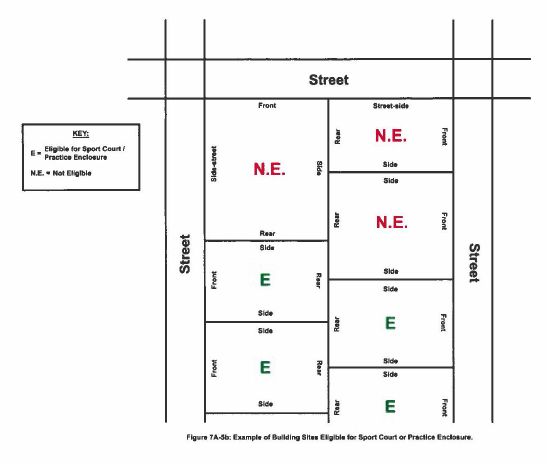
(5) Not project past the front of the principal building*;
(6) Not be located in a side yard*; and
(7) Not project into a rear yard setback area unless the rear property line of the proposed building site abuts only the rear property line(s) of one or more adjacent building site(s), in which case a ten-foot (10') projection into the rear yard setback area is permitted. Incases where the rear property line of a proposed building site is parallel and contiguous with segments of both the rear property line and the side property line of two or more adjacent building sites, no projection into the rear yard setback area is permitted. Additionally, no projection into the rear yard setback area is permitted if the side property line of the building site where a sport court is proposed is perpendicular to the side property line of any other adjacent building site.
•see Note 4 and Figure 7A-5b.
Note 3. Practice Enclosures in SF Districts.Each practice enclosure in a SF District must:
(1) Be a private accessory structure for a single building site;
(2) Be used for residential purposes only;
(3) Be enclosed on all sides by netting to a minimum height of at least 8 feet. Enclosure not to exceed 12 feet in height;
(4) Never be directly or indirectly lighted for play;
(5) Not project past the front of the principal building;
(6) Not be located in a side yard*; and
(7) Not project into a rear yard setback area unless the rear property line of the proposed building site abuts only the rear property line(s) of one or more adjacent building site(s), in which case a ten-foot (10') projection into the rear yard setback area is permitted. Incases where the rear property line of a proposed building site is parallel and contiguous with segments of both the rear property line and the side property line of two or more adjacent building sites, no projection into the rear yard setback area is permitted. Additionally, no projection into the rear yard setback area is permitted if the side property line of the building site where a practice enclosure is proposed is perpendicular to the side property line of any other adjacent building site;.
•see Note 4 and Figure 7A-5b.
Note 4. Sport Courts and Practice Enclosures. The ZBA may issue a special exception to locate a sports court or practice enclosure in a different design or location than prescribed by this ordinance. The following items may be considered by the ZBA as permissive factors when considering the merits of the special exception:
(1) The submission of a noise study which demonstrates compliance with city noise ordinances. See Chapter 54, Article II;
(2) The submission of letters of no objection from all immediately adjacent neighbors;
(3) The preservation of a Protected Tree; and
(4) Concurrent landscaping enhancements and beautification of the building site.
Note 5. Utility Poles. An ordinary utility pole owned by a franchisee of the City may be up to 43 feet high, if the administrative official certifies that the additional height is necessary to separate wires of different voltages and capacities from each other and the ground, applying standard technical codes and utility safety guidelines.
Note l. 4,500 Square Foot Exception. A structure may be located on an old building site with at least 40 feet of width and at least 4,500 square feet of total area, if the building site: (i) was improved with a principal building in existence on the 1987 effective date or for any period of twenty consecutive years prior to the 1987 effective date, under circumstances where there was no additional land used for the building site, and (ii) was created by subdivision plat and not made smaller thereafter except to provide public right of way or to accommodate physical encroachments, or as specifically allowed by Article 5.
Note 2. 4,300 Square Foot Exception. A structure may be located on an old building site with at least 40 feet of width and at least 4,300 square feet of total area, if the building site: (i) was created by subdivision plat approved by the city council or the Z&PC, (ii) has not been made smaller thereafter for any reason.
Note 3. Certain Re-Subdivisions After October 24, 1987. A subdivided lot in the SF (but not within the OBSOD) or GR-1 District may be further subdivided to produce a building site with less than seventy-five (75) feet of width or less than one hundred ten (110) feet of depth if all applicable procedures under state law and the City's ordinances, rules and regulations are followed and one of the following three sets of circumstances is present: (A) All portions of the subdivided lots ore added to adjoining subdivided lots. (B) The number of lots is not increased, and all resulting lots have: (i) a depth greater than or equal to the depth of the shallowest lot before the re-subdivision, and (ii) a width greater than or equal to the width of the narrowest lot before the re-subdivision; provided that no resulting lot is irregularly shaped (unless it was so shaped before the re-subdivision). (C) A portion of the subdivided lot is needed for City use or utility or service use.
Note 1. Porch In Front Yard. On a building site in a residential district with a front yard depth of 20 feet or more, a porch may project up to 120 inches into the front yard if it meets all the following criteria:
(i) It is neither designed nor usable for motor vehicles;
(ii) The volume of the projecting part of the porch does not exceed 50 cubic feet per foot of front street line (Example: the maximum projecting volume on a 52½-foot wide site would be 50 cubic feet x 52.5 or 2,625 cubic feet);
(iii) The porch's outside perimeter is open and unobstructed, except for the following features: (a) Ordinary window screens. (b) A solid or partially open safety rail not higher than 3.5 feet above the porch floor. (c) Supporting vertical columns if the total width of the outer faces of the columns does not exceed either 50% of the outside perimeter of the porch or 25% of the theoretical outside perimeter of a maximum-sized porch. The width of a column is measured at its thickest point above 3.5 feet above the porch floor. The "maximum-sized porch" is 120 inches deep and extends from one side yard line to the other, but the open area requirement for the front yard limits it. The "outside perimeter" of a porch is the portion of the perimeter out in the front yard; it does not include the portion of the perimeter adjacent to a building or lying along the front setback line;
(iv) At no point in the front yard does the porch have a height greater than the depth of the front yard (Example: if the depth of the front yard is 20 feet, the maximum height in the front yard is also 20 feet); and
(v) No projecting balcony or enclosed, habitable space shall be constructed or placed above the ceiling of a projected porch.
Note 2. Gas Pipeline Sites. A principal building may project into the front yard if: (a) the building site includes land in the rear of the building site subject to a gas transmission easement thirty feet or wider that is traversed by a gas transmission (not distribution) pipeline; (b) no part of the principal building, except items that are otherwise allowed to project into front setback areas, is within twenty feet of the front street line; and (c) The entrance to garage space is not closer than thirty feet to the front street line.
Note 3. Buildings In Rear Yard or SF Bufferyard. A building may be located in a rear yard or SF Bufferyard (as defined in Sec. 2-102) if it meets all of the following criteria: (a) No part of the building may be closer than five feet to the rear property line (or to any SF District, if in an SF Bufferyard). (b) Within ten feet of another building site in an SF District (whether on the side, rear or otherwise), it may have no window, door, or other opening above the ground floor (and facing the property line of the other building site), except for translucent (but not transparent), non-operable openings. (c) Space in any projecting building may only be used for single-family (detached) use. (d) A principal building may not project unless the ground floor of the projecting part is at least 51 percent garage space, and there is no more than 600 square feet of building space, other than garage space, in the projecting part. See garage restrictions in Article 10.
Note 4. Railway/Gas Sites. A building may be in a rear yard if: (a) the yard abuts land used for railway purposes or gas transmission (not distribution) pipeline purposes; (b) the building does not occupy any area subject to a utility easement or drainage easement unless each entity claiming an interest in the easement grants its consent or acquiescence to the encroachment; and (c) the building is an accessory building. If these criteria are met, the normal restrictions for rear yard projections do not apply (see notes above).
Note 5. Garages encroaching in Side Yards. A building may project toward an interior side property line (not a side street line) if it meets all the following criteria: (a) No part of the building may be closer than three feet to the side property line. Exception: Eaves may be as close as two feet. (b) The projecting part may only contain garage space and space above the garage (plus stairway and eaves). (c) Any projecting part must be at least seventy feet from the front street line. (d) Within ten feet of another building site in an SF District (whether on the side, rear, or otherwise), the building may have no window, door, or other opening above the ground floor (and facing the property line of the other building site.) Exception: There may be translucent (but not transparent), non-operable openings.
Note 6. Equipment in Rear or Side Yard.
REAR YARD: Indicated equipment may project into a rear yard only if: (a) separating the equipment from any building site across the rear lot line, there is a solid wall at least one foot higher than the highest part of the equipment; (b) if the equipment occupies any part of an easement under the control of the City, the City has issued a separate acquiescence or consent to the occupancy of the easement; (c) there has been formally granted to the city any utility easement deemed necessary by the City's chief utility official; (d) the base of the equipment is not higher than 14 inches above the ground (Exception: The base may be elevated to the minimum level of the lowest floor of the principal building, as established by the City's flood damage prevention ordinance, if that level is higher than 14 inches above the ground.); and (e) if located within five feet of any property line, the equipment is fully encased in a sound-absorbing cabinet or is otherwise designed and operated to comply with the City's noise regulations; see Chapter 54 of the Code of Ordinances.
SIDE YARD: Indicated equipment may project into an interior or street side yard (but not closer than three feet to a property line) only if it is fully encased in a sound-absorbing cabinet or is otherwise designed and operated to comply with the City's noise regulations; see Chapter 54 of the Code of Ordinances. However, equipment replacing older equipment in a side yard may project as close as 18 inches to a property line if the fire marshal determines that such projection will not significantly interfere with emergency access, either on the same site or on another site.
NEW AND REPLACEMENT EQUIPMENT: These rules apply to all new and replacement equipment. Exception: If older equipment was lawfully installed on an elevated structure in a rear yard, replacement equipment may be installed on the same structure. If the older equipment was lawfully installed without the required separating wall, the wall must be provided, but it may be either solid or at least 50% solid (e.g., lattice). All other rules apply.
Note 7. Basketball Goals. No part of the equipment may be closer than ten feet to any street line.
Note 8.1 Fences. Fences may project into front and side yards to the extent expressly required or authorized by city ordinance (e.g., provisions in Chapter 18 of the Code of Ordinances; provisions in PDD schedules for front fences). Also, in the Code of Ordinances, there are (i) requirements for emergency portals in fences (Chapter 18) and (ii) restrictions on fences, certain "fence-like hedges," and other things in visibility areas (Chapter 82). In a QMDS, low fences (3.5 feet or lower) may be located anywhere, if made of ornamental metal or pickets.
Note 8.2. Fence-like hedges. Fence-like hedges within the front yard (setback) of a building site containing no principal building are prohibited. This provision applies to all adjacent side yard building sites and rear through building sites. Visibility triangles and visibility areas, as defined by this ordinance, are subject to further restrictions as contained in Chapter 82 of the Code of Ordinances.
Note 9. Swimming Pools. Except as specified in Section 18-171.
Note 10. Lampposts. The maximum diameter of projecting posts is six inches; the maximum height is eight feet.
Note 11. Rotated Corner Fences. Notwithstanding any other provision of this ordinance or any other ordinance, no fence is allowed in the side street yard of a rotated corner building site (Rotated Corner Overlay District), except for temporary construction fences required by Chapter 18 of the Code of Ordinances.
Note 12. Old Stock Housing. The ZBA may issue a special exception to authorize the projection of buildings and attached structures into a side yard, rear yard, or an SF Bufferyard if the ZBA determines: (i) the projection is reasonably necessary to preserve or protect old stock housing as it then exists or as it may be proposed to be remodeled or expanded (up to a total gross floor area, for all buildings on the site, that does not exceed the greater of 3,400 square feet or 200% of the gross floor area of all the buildings on the site when the principal building was built, before 1980); and (ii) there will be no substantial adverse impact upon nearby properties.
Note 13. Book Sharing Exchange(s). No part of the structure may project into the Right-of-Way. Installation subject to guidance and final approval by the Administrative Official.
Note 14. Sport Courts and Practice Enclosures. Sports courts and practice enclosures may not project into a rear yard setback area unless the rear property line of the proposed building site abuts only the rear property line(s) of one or more adjacent building site(s), in which case a ten-foot (10') projection into the rear yard setback area is permitted. In cases where the rear property line of a proposed building site is parallel and contiguous with segments of both the rear property line and the side property line of two or more adjacent building sites, no projection into the rear yard setback area is permitted. Additionally, no projection into the rear yard setback area is permitted if the side property line of the building site where a sport court or practice enclosure is proposed is perpendicular to the side property line of any other adjacent building site.
(Ord. No. 3066, § 4, 4-22-2024)

