
Williamsburg City Zoning Code
ARTICLE V
- PARKING11
Cross reference— Stopping, standing and parking, § 11-146 et seq.
Sec. 21-701.- Off-street parking required.
(a)
Every use or building instituted, constructed, erected, enlarged or structurally altered after the effective date of this chapter shall provide off-street parking and loading facilities in accordance with the provisions of this article.
(b)
Such off-street parking and loading facilities shall be maintained as approved and continued as long as the main use is continued.
(c)
No owner or operator of any structure affected by this article shall discontinue, change or dispense with the required parking and loading facilities without establishing alternative vehicular parking and loading facilities which meet the requirements of this article.
(d)
No person shall utilize any building or use any parcel of land without providing the off-street parking and loading facilities as required by this article, except when a building or use is legally nonconforming as to required parking.
(e)
When a permitted use is legally nonconforming as to required parking, and said use is enlarged, additional parking shall be required only on the basis of the enlargement of the permitted use. The additional parking shall meet all applicable requirements of this article.
(f)
In lieu of compliance with the regular parking regulations contained in this article, property owners in the downtown business district B-1, Colonial Williamsburg historic area CW and/or museum support district MS may submit a parking master plan for approval as a special use permit, in accordance with article II, division 2.
(Ord. No. 862, 10-10-91)
Sec. 21-702. - Location of parking.
(a)
The off-street parking facilities required by this article shall be located on the same lot or parcel of land that they are intended to serve. Where practical difficulties prevent such location or where the public safety or the public convenience would be better served by an alternate location, the board of zoning appeals may authorize an alternate or cooperative location as a special exception. When the request is in conjunction with an application for a special use permit in accordance with article II, division 2, the city council may authorize the alternate or cooperative location as a part of the special use permit. When the request is in conjunction with an application for a site plan in accordance with article VII, planning commission may authorize the alternate or cooperative location as a part of the site plan approval. Any authorization shall be subject to the provisions of section 21-97(f) and the following:
(1)
An alternate location provides parking only for the use in question.
(2)
A cooperative location provides parking for two or more uses, and shall have combined parking spaces equal to the sum required for the separate uses.
(3)
Such parking spaces shall be conveniently and safely accessible to pedestrians.
(4)
All such parking spaces shall be on property zoned properly for the use or uses which require the parking spaces.
(5)
The right to use such property for parking shall be established by deed, easement, lease or similar recorded covenant or agreement; shall be approved as to form and content by the city attorney; shall be recorded in the clerk's office of the circuit court of the city and the County of James City so as to ensure the availability of such spaces for a minimum time period of at least five years.
(6)
Should such off-street parking spaces become unavailable for use at some future time, an equal number of parking spaces shall be constructed and provided on either the primary site or by another offsite arrangement meeting the requirements of this article. Failure to provide or construct such replacement parking spaces within 90 days from the date on which the use of the previously available off-street spaces was terminated shall be a violation of this chapter.
(7)
For churches and other permanent buildings used for religious worship, alternate or cooperative parking agreements may be approved that do not provide exclusive parking rights, provided that such agreement provides adequate parking at appropriate times to meet the parking needs of the church or other permanent building used for religious worship.
(Ord. No. 862, 10-10-91; Ord. No. 2-94, § 14, 1-13-94; Ord. No. 14-98, 5-14-98; Ord. No. 05-20, 8-11-05)
Sec. 21-703. - Prohibition of parking certain kinds of vehicles in residential districts
(1)
The parking and storage of the following types of vehicles on lots in residential districts (RS-1, RS-2, RM-1, RM-2, RDT and PDR) shall be prohibited, except while loading or unloading on the premises:
a.
Tractor trucks and semitrailers.
b.
Trucks exceeding a registered gross weight of 7,500 pounds.
(Ord. No. 01-5, 4-12-01)
Sec. 21-704. - Size of parking spaces.
(a)
Parallel spaces shall have minimum dimensions of eight feet by 22 feet.
(b)
All other parking spaces shall have minimum dimensions of nine feet by 18 feet, except as follows:
(1)
Spaces in a parking garage shall have minimum dimensions of eight and one-half feet by 18 feet.
(2)
Planning commission, as a part of the site plan review process, may approve spaces with minimum dimensions of eight and one-half feet by 18 feet for vehicle storage lots for automobile dealers, overflow parking areas and other limited use parking facilities.
(c)
Overhang over landscape areas shall not be counted toward the minimum dimensions stated above.
(Ord. No. 862, 10-10-91; Ord. No. 11-96, 5-9-96; Ord. No. 01-18, 10-11-01)
Sec. 21-705. - Access to off-street parking spaces.
(a)
Every parking space shall afford satisfactory ingress and egress for a motor vehicle without requiring another motor vehicle to be moved, except for the following:
(b)
Parking spaces for single-family detached, duplex and townhouse dwellings where the parking spaces are located on the same lot as the dwelling unit. This exception shall not include required parking spaces for bedroom rentals in single-family detached dwellings.
(Ord. No. 862, 10-10-91)
Sec. 21-705.1. - Special regulations for single-family detached dwellings.
(a)
Parking spaces and driveways shall be constructed of gravel, compacted stone, concrete, asphalt, brick or paving stones.
(b)
Parking spaces and driveways shall not occupy more than 30 percent of a front or rear yard area, and shall not occupy more than 15 percent of the total lot area for lots having a lot area of 20,000 square feet or less; more than ten percent of the total lot area for lots having a lot area of more than 20,000 square feet; nor more than 20 percent of the total lot area for lots in a cluster subdivision.
(1)
Additional lot coverage by parking spaces and driveways, and alternative paving material, may be allowed contingent upon approval as a special exception use by the board of zoning appeals, in accordance with section 21-97(f). The board of zoning appeals shall consider, in addition to the criteria listed in section 21-97(f), the following:
a.
Is the parking required for the permitted, special exception or special use permit use?
b.
Is on-street parking available adjacent to the property?
c.
Is the lot narrower, shallower or smaller than required by the ordinance, or than surrounding lots?
d.
Does the topography of the lot create difficulties with meeting these requirements?
(c)
Parking shall be allowed only in driveways or parking spaces meeting these requirements, and shall be prohibited elsewhere on the lot.
(Ord. No. 9-95, § 1, 4-13-95)
Sec. 21-706. - Calculation of number of off-street parking spaces.
(a)
In calculating the number of required parking spaces, the following rules shall govern:
(1)
Floor area shall mean the gross floor area of the specific use, measured from the exterior faces of exterior walls or from the centerline of walls separating two attached buildings. Unless otherwise specified, floor area shall include associated corridors, utility rooms and storage space.
(2)
When the units of measurements determining the number of required parking spaces results in the requirement of a fractional space, any fraction less than one-half shall be disregarded, and fractions of one-half or over one-half shall require one additional parking space.
(3)
The parking space requirement for a use not specifically mentioned shall be the same as required for a use of similar nature, as determined by the zoning administrator.
(4)
In the case of mixed uses, the parking spaces required shall equal the sum of the requirements of the various uses computed separately.
(Ord. No. 862, 10-10-91)
Sec. 21-707. - Amount of off-street parking required.
The off-street parking required by this article shall be provided and maintained on the basis of the following table, except as otherwise provided in this article:
(Ord. No. 862, 10-10-91; Ord. No. 11-94, 6-9-94; Ord. No. 11-96, 5-9-96; Ord. No. 17-97, 10-9-97; Ord. No. 7-00, 6-8-00; Ord. No. 01-19, 10-11-01; Ord. No. 02-21, 9-12-02; Ord. No. 04-23B, 10-14-04; Ord. No. 07-26, 6-14-07; Ord. No. 13-07, 4-11-13; Ord. No. 14-11, 4-10-14; Ord. No. 14-13, 6-12-14; Ord. No. 14-27, 11-13-14; Ord. No. 15-09, 4-9-15)
Sec. 21-708. - Off-street loading spaces.
(a)
Spaces designated for off-street loading shall not be counted toward the required number of off-street parking spaces.
(b)
Off-street loading spaces shall be located so that there is sufficient room for the turning and maneuvering of vehicles using said spaces.
(c)
Access to off-street loading spaces shall not be across required off-street parking spaces.
(Ord. No. 862, 10-10-91)
Sec. 21-708.1. - Reduction of amount of off-street parking required for offices (including doctors' and dentists' offices, but not including clinics and outpatient clinics).
The city council may authorize a reduction of the amount of off-street parking for offices (including doctors' and dentists' offices, but not including clinics and outpatient clinics) as a special use permit in accordance with section article II, division 2, special use permits. When the request is in conjunction with an application for a special use permit in accordance with article II, division 2, the city council may authorize a reduction as a part of the special use permit. Any reduction shall be subject to the following:
(1)
The reduction shall not exceed 15 percent of the required off-street parking.
(2)
A parking analysis shall be prepared by a qualified professional traffic consultant, and shall include:
a.
Proposed use of the property.
b.
Anticipated average and peak demand and how this is addressed by the parking proposed to be provided.
c.
Layout and location of proposed off-street parking.
d.
Pedestrian circulation.
e.
Analysis of accessibility of site to mass transit facilities.
f.
The city may, at its discretion and expense, employ a qualified professional traffic consultant to evaluate the proposed parking, and to make recommendations as to whether or not the proposed reduction of off-street parking provided should be approved.
(3)
Any approved reduction of off-street parking shall be only for the uses proposed in the special exception application.
(Ord. No. 13-98, 5-14-98; Ord. No. 15-98, 5-14-98)
Sec. 21-709. - Special parking regulations for the downtown business district B-1, economic development district ED, economic development district ED-2, Colonial Williamsburg historic area CW, museum support district MS, and planned development college district PDC.
(a)
In lieu of compliance with the regular parking regulations contained in this article, property owners in the downtown business district B-1, economic development district ED, economic development district ED-2, Colonial Williamsburg historic area CW, museum support district MS, and planned development college district PDC may submit a parking master plan for approval as a special use permit by the city council in accordance with article II, division 2, Special Use Permits.
(b)
The parking master plan shall be prepared by a qualified professional traffic consultant, and, in addition to the criteria listed in article II, division 2, Special Use Permits, shall address the following:
(1)
Anticipated average and peak demand and how this is addressed by the parking master plan.
(2)
Location of existing and proposed parking lots.
(3)
Location of existing and proposed onstreet parking.
(4)
Pedestrian circulation.
(5)
Mass transit facilities provided.
(6)
The city may, at its discretion and expense, employ a qualified professional traffic consultant to evaluate the master parking plan, and to make recommendations as to what, if any, modifications should be made to the plan.
(c)
The parking plan shall include an area map at a scale of not less than one inch equals 100 feet, showing the location of:
(1)
Major traffic generators.
(2)
Existing and proposed parking lots, including number and size of spaces and any existing or proposed limitation on use of the parking lots.
(3)
Existing and proposed onstreet parking.
(4)
Pedestrian circulation system.
(5)
Mass transit circulation system.
(6)
Geographic area to be served by the parking master plan.
(d)
The parking master plan shall include a written description of all uses to be served by the plan, a table listing the floor areas devoted to the various types of uses, and a comparison of the master parking plan with the parking normally required by this article.
(e)
The master parking plan, when approved, shall be valid only for the types of uses specifically listed in the approved plan. Any changes in types of uses, or modification of parking provided, shall require an amendment of the special use permit, in accordance with article II, division 2, Special Use Permits. However, minor changes may be approved by the planning director or, at the option of the planning director, referred to the planning commission for consideration at a regular meeting without a public hearing. A change shall be considered minor if it:
(1)
Does not change the general character of the approved master parking plan.
(2)
Does not reduce the number of parking spaces provided.
(3)
Does not increase the floor areas devoted to the various types of uses as specified in the approved master parking plan.
(4)
Does not adversely affect the development or use of adjacent properties and surrounding neighborhoods.
(Ord. No. 862, 10-10-91; Ord. No. 18-96, 10-10-96; Ord. No. 04-23C, 10-14-04; Ord. No. 05-14B, 6-9-05; Ord. No. 10-03, 4-8-10)
Sec. 21-710. - Downtown parking district.
(a)
A downtown parking district is established to recognize the special character of the downtown business area, and the location of public parking facilities within the district. It is the intent of this section to establish special parking requirements appropriate to the unique character of the downtown parking district.
(b)
The boundaries of the downtown parking district are delineated on the official Downtown Parking District map, adopted on April 11, 2013. The official Downtown Parking District map, and all notations, references and other information shown thereon, is a part of this article, and has the same force and effect as if the official Downtown Parking District map were fully set forth or described in this article.
(c)
No off-street parking shall be required for non-residential uses located in downtown parking district, except that the number of parking spaces existing on December 13, 2018 in any parking lots included in the downtown parking master plan shall not be reduced without a special use permit approved by the city council in accordance with article II, division 2, Special Use Permits.
(d)
One off-street parking space shall be required for each dwelling unit located in the downtown parking district, except that for senior housing, as defined, one off-street parking space shall be required for each two dwelling units. These spaces shall be reserved for the use of the residential dwelling units.
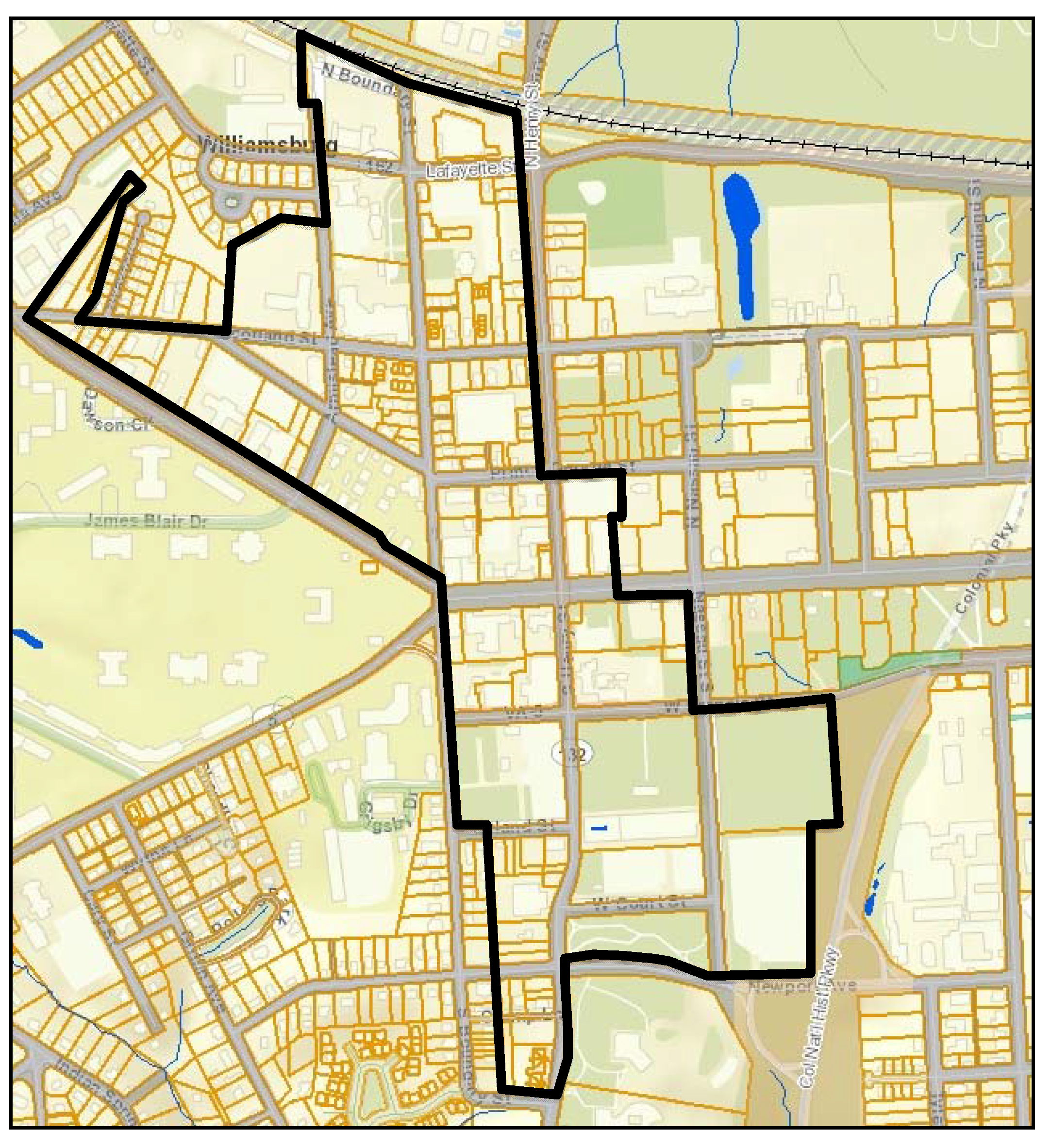
DOWNTOWN PARKING DISTRICT MAP
April 11, 2013
(Ord. No. 11-96, 5-9-96; Ord. No. 01-19, 10-11-01; Ord. No. 07-25, 6-14-07; Ord. No. 13-08, 4-11-13; Ord. No. 18-15, 12-13-18)
Sec. 21-711. - Midtown parking district.
(a)
A midtown parking district is created to establish special parking requirements appropriate to the unique character of this area, which is included in the city's Arts and Cultural District.
(b)
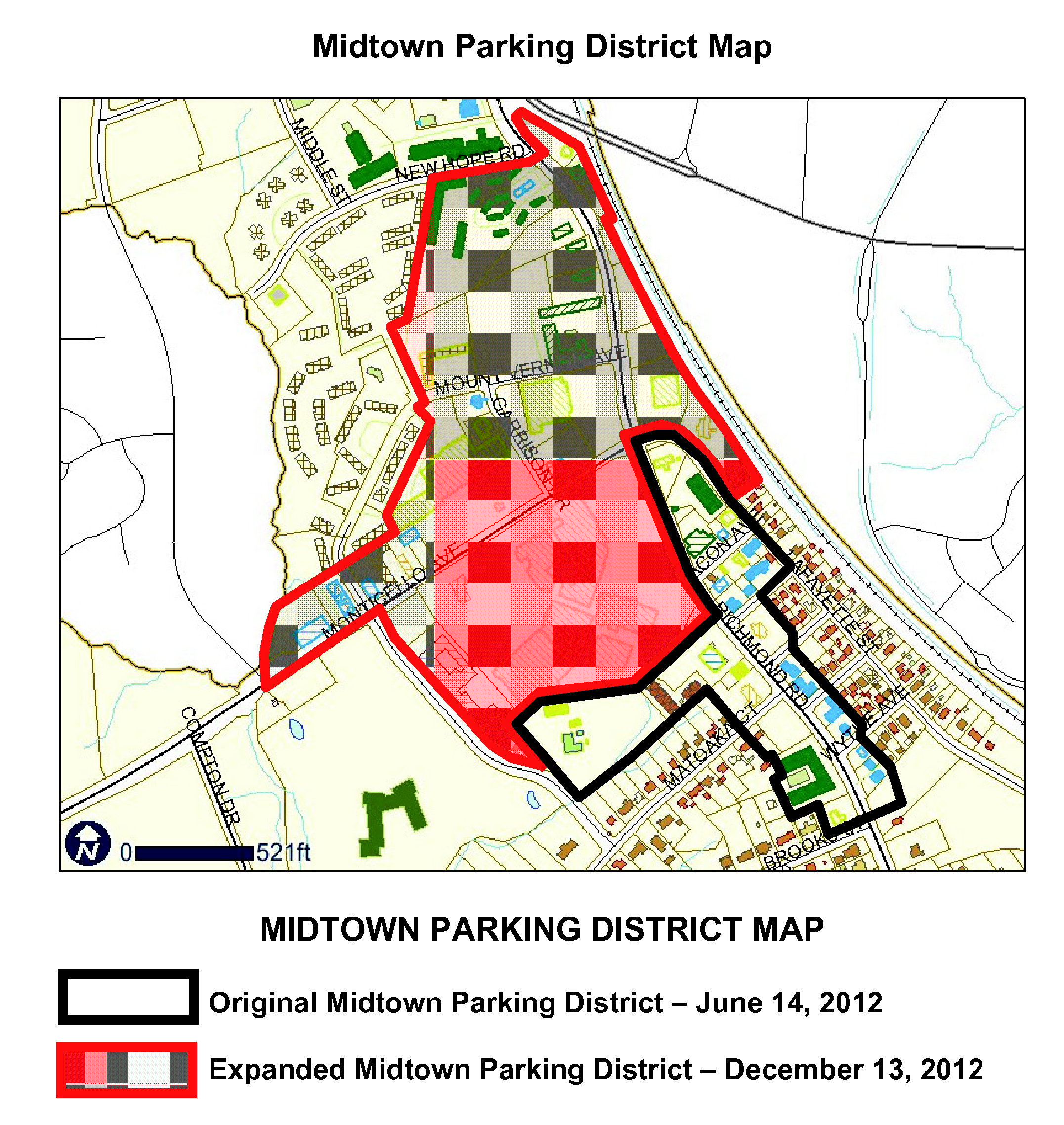
The boundaries of the midtown parking district are delineated on the official midtown parking district map, adopted on June 14, 2012 and amended on December 13, 2012. The official midtown parking district map, and all notations, references and other information shown thereon, is a part of this article, and has the same force and effect as if the official midtown parking district map were fully set forth or described in this article.
(c)
The off-street parking required for the midtown parking district shall be provided and maintained on the basis of the following table:
(Ord. No. 12-12C, 6-14-12; Ord. No. 12-35, 12-13-12)
Sec. 21-712. - Economic Development Parking District.
(a)
An Economic Development Parking District is created to establish special parking requirements appropriate to the character of the ED Economic Development District, which is designed for innovative mixed use development with an emphasis on high quality design standards.
(b)
The Economic Development Parking District shall apply to all areas of the city zoned ED Economic Development District.
(c)
The parking required for the Economic Development Parking District shall be provided and maintained on the basis of the following table:
(d)
The off-street parking facilities required by this section shall be located on the same lot or parcel of land that they are intended to serve, or on-street and located along the frontage of the adjoining public street and contiguous to the lot, except as follows:
(1)
Parking may be located off-site if located within 500 feet of any publicly accessible pedestrian entry point to a building. The right to use such property for parking shall be established by deed, easement, lease or similar recorded covenant or agreement; shall be approved as to form and content by the city attorney; shall be recorded in the clerk's office of the circuit court of the city and the County of James City so as to ensure availability of such spaces for a minimum time period of not less than 20 years.
(2)
For a residential subdivision, all on-street parking contiguous to the individual lots in the subdivision can be counted toward the required parking spaces for all of the lots, whether or not the individual parking spaces are contiguous to the individual lots. When a residential subdivision is developed in phases, each phase or combination of phases must meet the parking requirement.
(e)
Dimensions of parking spaces for on-street parking shall meet the dimensions specified by section 21-704, Size of parking spaces.
(Ord. No. 12-21, 9-13-12; Ord. No. 14-14, 6-12-14)

