
Williston City Zoning Code
ARTICLE II
SUPPLEMENTARY DISTRICT REGULATIONS
Sec. 60-31.- Scope.
Provisions set forth in this article apply to all areas subject to these land development regulations, and all zoning districts therein, unless exceptions are specifically provided relating to one or more zoning districts, or except as otherwise provided in these land development regulations.
(Ord. No. 434, § 4.2.1, 5-7-2002)
Sec. 60-32. - Accessibility for the physically disabled or handicapped.
The public interest, welfare, and safety requires that buildings and uses erected after the effective date of these land development regulations shall be accessible to the physically disabled and handicapped, in conformance with the Americans With Disabilities Act of 1990 (P.L. 101-336), 42 USC 12101 et seq.
(1)
Application. The requirements of this article shall apply to all levels and areas of buildings and uses, and to all types of uses, with the exceptions that one-family and two-family (duplex) dwellings are exempted from these requirements.
(2)
Requirements for access to buildings and uses.
a.
Accessibility to buildings and uses shall be provided from rights-of-way and parking areas by means of a pathway leading to at least one entrance generally used by the public. Such pathway shall have been cleared of all obstructions related to construction activity, prior to the opening of the building to the general public. Where curbs exist along such pathway, as between a parking lot surface and a sidewalk surface, inclined curb approaches or curb cuts having a gradient of not more than one foot in 12 feet and a width of not less than four feet shall be provided for access by wheelchairs.
b.
Except as otherwise specified herein, required off-street parking areas shall have off-street parking space reserved for the physically handicapped.
(Ord. No. 434, § 4.2.2, 5-7-2002; Ord. No. 462, § 1(2), 9-16-2003)
Sec. 60-33. - Access control.
In order to provide ease and convenience in ingress and egress to private property, but more importantly to provide the maximum safety with the least interference to the traffic flow on public streets, the number and location of vehicular access points shall be regulated relative to the intensity or size of the property served and the amount of frontage which that property has on a given street. Further, for roadways which are part of the state highway system, the number and location of vehicular access points shall be in conformance with F.A.C. chs. 14-96 and 14-97, Rules of the Florida Department of Transportation and the department's access management manual.
(1)
Number and location of vehicular access points. A vehicular access point is a driveway or any other point of access or opening for vehicles onto a public street. The number and location of vehicular access points shall be regulated as follows:
a.
One vehicular access point shall be permitted for ingress and egress purposes to a single property or development; provided, however, that more than one vehicular access point may be permitted in accordance with subsections (2)—(4) of this section.
b.
Two vehicular access points entering on a particular street from a single property or development may be permitted if the minimum distance between the two vehicular access points equals or exceeds 20 feet.
c.
Three vehicular access points entering on a particular street from a single property or development may be permitted if all other requirements of this section are met and if the minimum distance between adjacent vehicular access points equals or exceeds 100 feet.
d.
More than three vehicular access points entering on a particular street may be permitted from a single property or development where the minimum distance between adjacent vehicular access points equals or exceeds 1,000 feet.
(2)
Width of vehicular access point.
a.
The width of a vehicular access point shall be within the minimum and maximum limits as specified below:
* It should be noted that the 14-foot minimum is measured at the roadway and a minimum of ten-foot width is allowable at the property line.
b.
All vehicular access point widths shall be measured at the street right-of-way line.
c.
In no case shall a vehicular access point width be less than 12 feet.
d.
The driveway apron shall be constructed of an impervious surface (preferable asphalt or concrete). The driveway apron shall be designed to deter erosion and perform efficiently as a part of the existing stormwater system.
(3)
Areas of limited street improvements.
a.
No vehicular access point shall be constructed in the radius return (curved arc between intersecting street pavements) of an intersection.
b.
No vehicular access point shall be constructed nearer than ten feet from the intersection of street right-of-way lines.
c.
No vehicular access point shall be constructed nearer than five feet from any interior property line.
d.
To prevent vehicle overhang on private property in the vicinity of vehicular access points, off-street parking areas, and off-street loading areas, a six-inch raised curb and/or parking stops shall be constructed a minimum distance of three feet inside the street right-of-way line or property line.
e.
No vehicular access point shall be permitted to include any public facility such as traffic signal standards, catch basins, fire hydrants, utility poles, fire alarm supports, or other similar type structures.
(4)
Vehicular access point permit. No vehicular access point shall be established or altered without a permit issued by the land development regulations administrator.
(5)
Liability for injuries. The property owner is responsible for constructing, maintaining and removing obstructions from a sidewalk or driveway approach located in a sidewalk area adjacent to the owner's property and shall be liable for all personal injury or property damage arising from the property owner's fault or negligence in failing to keep clear, maintain or to properly construct a sidewalk. If the city is required to pay damages for an injury to persons or property caused by the failure to perform a duty which this section imposes, the property owner failing to perform the duty shall compensate the city for the full amount of the damages paid and all city legal fees incurred in defense of such a claim. The city may maintain an action in a court of competent jurisdiction to enforce the provisions of this section.
(Ord. No. 434, § 4.2.3, 5-7-2002; Ord. No. 567, § 1(Att. A, 4), 9-18-2007; Ord. No. 583, § 1(att. A, § 3), 4-22-2008)
Sec. 60-34. - Accessory uses and structures.
(a)
Unless otherwise provided in these land development regulations, in all districts accessory uses and structures shall not be located in front yards but may be located in side or rear yards not less than five feet from the rear lot line; provided, however, that accessory structures for the housing of persons, such as guesthouses, shall not be located in any required yard, nor shall air conditioner compressor units be located in any required yard.
(b)
No separate accessory building shall be located within five feet of any building.
(Ord. No. 434, § 4.2.4, 5-7-2002; Ord. No. 598, § 1(att. A), 5-19-2009; Ord. No. 615, § 4, 7-5-2011)
Sec. 60-35. - Alcoholic beverages.
Any regulations in this Code regarding the sale of alcoholic beverages shall not in any way be deemed to limit, qualify, or repeal any other local regulations or regulations of the state relating to the licensing, dispensing, or sale of such beverages or the location of alcoholic beverage establishments.
(Ord. No. 434, § 4.2.5, 5-7-2002)
Cross reference— Alcoholic beverages, ch. 6.
Sec. 60-36. - Automotive service and self-service stations.
The following regulations shall apply to the location, design, construction, operation, and maintenance of automotive service and self-service stations (with the exception that for automobile self-service stations where self-service gasoline pumps in conjunction with retail and commercial outlets for sale of food, hardware and drugs, there shall be no outside sales of oil, grease, parts or accessories for automobiles and no service except for self-service water, air or carwash).
(1)
Lot dimensions and area. An automotive service station lot shall be of adequate width and depth to meet all setback requirements, but in no case shall a corner lot have less than 150 feet of frontage on each street side, and an interior lot shall have a minimum width of at least 150 feet. A corner lot shall have a minimum area of not less than 20,000 square feet and an interior lot a minimum area of not less than 15,000 square feet.
(2)
Lighting. All lights and lighting for an automotive service station shall be so designed and arranged that no source of light shall be visible from any residential district.
(3)
Location of pumps and structures. No main or accessory building, no sign of any type, and no gasoline pump shall be located within 25 feet of the lot line of any property that is zoned for residential purposes. No gasoline pump shall be located within 15 feet of any street right-of-way line; where a greater street setback line has been established, no gasoline pump shall be located within 15 feet of such setback line.
(4)
Vehicular access points. A vehicular access point is a driveway or any other point of access or opening for vehicles onto a public street. The number of vehicular access points for each automotive service station shall not exceed two for each 150 feet of street frontage, each break having a width of no more than 30 feet exclusive of transitions and located not closer than 15 feet of right-of-way lines of any intersection. Vehicular access points shall not be closer than 15 feet to any other property line. There shall be a minimum distance of 20 feet between vehicular access points.
(5)
Trash storage. Adequate, enclosed trash storage facilities shall be provided on the site.
(Ord. No. 434, § 4.2.6, 5-7-2002)
Sec. 60-37. - Bed and breakfast inn requirements.
Bed and breakfast inns shall be approved by special exception (excluding RB zoning district) where provided within these land development regulations in accordance with the following criteria:
(1)
All bed and breakfast inns shall comply with the setback requirements for the R-1 district.
(2)
All bed and breakfast inns shall comply with the respective parking requirements as set forth in these land development regulations.
(3)
All bed and breakfast inns shall provide separate toilet and bathing facilities for the exclusive use of the guests.
(4)
All bed and breakfast inns shall be rented on a daily basis. The maximum stay for an individual guest shall be 30 days in a 12-month period.
(5)
No cooking facilities shall be allowed in guestrooms.
(6)
Bed and breakfast inns must comply with appropriate health permits, building and fire codes and business licenses as applicable to such use.
(7)
Signage, excepting historical markers located by federal, state, county or city agencies, shall be limited to one sign, not exceeding nine square feet in area, with characters not exceeding eight inches, nonilluminated (excepting flood lighting on each side of the sign).
(Ord. No. 434, § 4.2.7, 5-7-2002; Ord. No. 567, § 1(Att. A, 7), 9-18-2007)
Sec. 60-38. - Erection of more than one principal structure on a platted lot.
Whenever any land is subdivided, a building permit for the construction of a building or other principal structure (excluding commercial buildings under common ownership or unified control) shall not be issued for any such structure on less than a lot as platted within such subdivided land, unless provided for in this Code.
(Ord. No. 434, § 4.2.8, 5-7-2002)
Sec. 60-39. - Exclusions from height limitations.
The height limitations contained in the schedule of district regulations do not apply to spires, belfries, cupolas, antennae, water tanks, ventilators, chimneys, elevator shaft enclosures, airport control towers, observation towers, or other appurtenances usually required to be placed above the roof level and, excepting airport control towers and observation towers, not intended for human occupancy; however, the heights of these structures or appurtenances thereto shall not exceed any height limitations prescribed by the Federal Aviation Administration or airport zoning regulations within the flight-approach zone of airports.
(Ord. No. 434, § 4.2.9, 5-7-2002)
Sec. 60-40. - Future land use plan amendment for public buildings and facilities.
Public buildings and facilities, including public schools, which do not meet the definition of "essential services" as stated in chapter 46, article IV, shall require an amendment to the future land use plan map of the comprehensive plan to "public land use," prior to submission of an application for approval as a special exception.
(Ord. No. 434, § 4.2.10, 5-7-2002)
Sec. 60-41. - Fences, walls, and hedges.
Notwithstanding other provisions of these land development regulations, fences, walls, and hedges may be permitted in any required yard or along the edge of any yard provided that;
(1)
Within conservation, agricultural, residential and residential office districts, only wire or chainlink, wood, or masonry fences shall be permitted. Masonry may be painted or stucco and shall be built upon footings of a minimum 12 inches by six inches deep with reinforcing rods conforming to the provisions of the Florida Building Code, as amended, for reinforced masonry. Fences or wall located in a front yard shall not exceed four feet in height from building line to front property line and shall not exceed six feet in height from the front building line to the rear property line;
(2)
Within commercial and industrial districts, all types of fences, except electrified fences, may be erected, provided they do not exceed eight feet in height. Where such fences contain barbed wire for security purposes, they are limited to three strands which cannot extend the height of the fence more than 18 inches above ground level, with the lowest strand of barbed wire is no closer than eight feet above ground level. Further, no strand of barbed wire may extend over adjacent property;
(3)
Fences and walls at intersections and vehicular access points shall be subject to the provisions of these land development regulations; and
(4)
Should any provision of this section conflict with a prior, properly executed and recorded declaration or deed restrictions effecting any subdivision, which deed or declaration is more restrictive than this section, the prior declaration or deed restriction shall prevail.
(Ord. No. 434, § 4.2.11, 5-7-2002)
Sec. 60-42. - Home occupation requirements.
(a)
Only one additional person other than members of the family residing on the premises shall be engaged in such occupation.
(b)
The use of the dwelling unit for the home occupation shall be clearly incidental and subordinate to its use for residential purposes by its occupants, and shall under no circumstances change the residential character thereof.
(c)
There shall be no change in the outside appearance of the building or premises, or other visible evidence of the conduct of such home occupation other than one sign, not exceeding two square feet in area, nonilluminated, mounted flat against the wall of the principal building at a position not more than two feet distance from the main entrance to the residence.
(d)
In all zone districts except agricultural districts, no home occupation shall be conducted in an accessory building. In agriculture districts, home occupations may be conducted in an accessory building, provided that the floor area devoted to the home occupation does not exceed 1,000 square feet.
(e)
No home occupation shall occupy more than 25 percent of the first floor area of the residence, exclusive of the area of any open porch or attached garage or similar space not suited or intended for occupancy as living quarters. No rooms which have been constructed as an addition to the residence, nor any attached porch or garage which has been converted into living quarters, shall be considered as floor area for the purpose of this definition until two years after the date of completion thereof.
(f)
No traffic shall be generated by such home occupation in greater volumes than would normally be expected in a residential neighborhood, and any need for parking generated by the conduct of such home occupation shall be met off the street and other than in the required front yard.
(g)
No equipment or process shall be used in such home occupation which creates noise, vibration, glare, fumes, odors, or electrical interference detectable to the normal senses off the lot. In the case of electrical interference, no equipment or process shall be used which creates visual or audible interference in any radio or television receivers off the premises, or causes fluctuations in line voltage off the premises.
(h)
For purposes of illustration, the following uses shall not be considered home occupations:
(1)
Studio for group instruction;
(2)
Dining facility or restaurant;
(3)
Antique or gift shop;
(4
Photographic studio;
(5)
Outdoor repair;
(6)
Food processing;
(7)
Retail sales; and
(8)
Child care center for six children and over.
(i)
For purposes of illustration, the following uses may be considered home occupations, provided they meet all the requirements listed in subsections (a)—(h) of this section and all other provisions of these land development regulations:
(1)
The giving of individual instruction to one person at a time such as art or music teacher;
(2)
Fabrication of articles such as are commonly classified under the terms arts and handicrafts, providing no retail sales are made in the home;
(3)
Custom dressmaking, seamstress, milliner;
(4)
Tutoring for not more than one student at a time;
(5)
Answering telephone;
(6)
Barbershop or beauty shop;
(7)
Professional offices;
(8)
Computer data services; and
(9)
Child care center for five children and under.
(j)
A home occupation shall be subject to all applicable occupational licenses and other business taxes.
(Ord. No. 434, § 4.2.12, 5-7-2002)
Sec. 60-43. - Landscaped buffer areas.
The use of properly planted and maintained buffer areas may reduce and ease potential incompatibility between or among different uses of land in proximity to each other.
(1)
Requirements. Where these land development regulations require a landscaped buffer area, the following requirements shall be met:
a.
The landscaped buffer area width shall be measured at right angles to property lines and shall be established along the entire length of and contiguous to the designated property line or lines. All buffered areas shall be maintained between two and six feet above average ground level and no more than six feet wide.
b.
The area shall be so designed, planted, and maintained as to be 80 percent or more opaque when viewed horizontally; provided, however, that plantings located in the required front yard shall not exceed two and one-half feet in height.
c.
Types and numbers of plantings for landscaped buffers shall be submitted with application for building permit. No building permit shall be issued without such data, where these land development regulations require a landscaped buffer area or areas.
d.
Plantings shall be of a size and type which will ensure the meeting of the 80 percent opacity requirement within no longer than 30 months of the date of first planting. Where questions may arise as to the suitability of proposed plant materials to meet this requirement, final determination of suitability shall be made by the land development regulations administrator.
e.
The remainder of the required landscaped buffer area not covered by planting shall be landscaped with grass, ground cover, or other landscape treatment; except as otherwise provided herein, structures including buildings and off-street parking and loading areas shall not be located in any required landscaped buffer area.
f.
The landscaped buffer area shall be maintained by the property owner and successors and continued so long as the main use continues. Failure to maintain the landscaped buffer area as set out above shall be a violation of these land development regulations.
(2)
Substitution for landscaped buffer area. Except when otherwise specifically provided by these land development regulations, a masonry or wood opaque structure may be substituted for the planted buffer within these supplementary regulations; provided, however, that where the masonry or wood opaque structure is located in the required front yard it shall not exceed two and one-half feet in height.
(3)
Waiver by land development regulations administrator. When the land development regulations administrator finds that the public safety requires, he may waive or modify the buffer requirements set out in this article at street and alley frontages adjacent to any entrance; the finding of the land development regulations administrator shall be in writing and shall be filed with the approved building permit. The finding shall demonstrate that the buffer is not required for a certain number of feet back from the street or alley entrance in order to afford protection to pedestrian or vehicular traffic entering or leaving the lot on which the landscaped buffer area is required by these land development regulations.
(4)
Waiver by board of adjustment. Where by the terms of these land development regulations a nonresidential use is required to provide a landscaped buffer along a property line which is contiguous to another nonresidential use, the board of adjustment may waive the landscaped buffer requirements if evidence is presented to the board that the buffer will serve no useful purpose. Such evidence shall be heard in the same manner as a request for variances, and adjoining property owners must be notified in writing of the board of adjustment meeting when the request will be heard.
(5)
Application where these land development regulations set out different requirements. In those instances where these land development regulations set out a different buffering requirement (e.g., greater height of landscaped buffer, or a different type of buffer), then the specific provisions of these land development regulations applicable to the particular type of use shall govern.
(Ord. No. 434, § 4.2.13, 5-7-2002; Ord. No. 567, § 1(Att. A, 1), 9-18-2007)
Sec. 60-44. - Mobile home; replacement of existing mobile homes.
For the purposes of these land development regulations, the phrase "existing mobile homes" shall mean mobile homes which existed as of the effective date of adoption or amendment of these land development regulations. In those districts which do not permit the erection of new mobile homes but do permit existing mobile homes, such existing mobile homes may be removed and replaced by another mobile home, provided:
(1)
That a period of not greater than six consecutive months elapses between the removal of one mobile home and the placement of another mobile home; and
(2)
Where a mobile home is removed and is not replaced for a period greater than six consecutive months for any reason (except where governmental action impedes access to the premises), such mobile home shall not be replaced and any subsequent use shall conform to the regulations for the district in which the use is located. (See also section 44-12(c) for definitions.)
(Ord. No. 434, § 4.2.14, 5-7-2002)
Sec. 60-45. - Moving of buildings and structures.
No building or structure shall be moved from one lot to another lot, or moved to another location on the same lot, unless such building or structure shall thereafter conform to all of the applicable provisions of these land development regulations and to all other regulations and ordinances of the city.
(Ord. No. 434, § 4.2.15, 5-7-2002)
Cross reference— Buildings and building regulations, ch. 14; environment, ch. 24; streets, sidewalks and other public places, ch. 34.
Sec. 60-46. - Off-street parking and loading.
It is the intent of these land development regulations that the public interest, welfare, and safety requires that buildings and uses erected after the effective date of the ordinance from which these land development regulations are derived shall be provided with adequate off-street parking facilities (including, in certain specified cases, off-street parking facilities for the handicapped) for the use of occupants, employees, visitors, customers, or patrons. It is also the intent of these land development regulations that the public interest, welfare, and safety require that certain uses provide adequate off-street loading facilities. Such off-street parking and off-street loading facilities shall be maintained and continued so long as the main use continues. (For definitions of "loading space, off-street," "parking space, handicapped," and "parking space, off-street," see definitions, section 44-10.)
(1)
Off-street parking and off-street loading generally.
a.
Off-street parking and loading facilities shall be provided as set out in these land development regulations. Conforming buildings and uses existing as of the effective date of these land development regulations may be modernized, altered, or repaired without providing additional off-street parking or off-street loading facilities, providing there is no increase in floor area or capacity.
b.
Where a conforming building or use existed as of the effective date of these land development regulations and such building or use is enlarged in floor area, volume, capacity, or space occupied, off-street parking and off-street loading as specified in these land development regulations shall be provided for the additional floor area, volume, capacity, or space so created or used.
c.
Change in use of a building or use existing as of the effective date of these land development regulations shall require additional off-street parking and/or off-street loading facilities to the extent that the use shall provide additional parking spaces and/or off-street loading facilities amounting to the difference between the required number of parking spaces and/or off-street loading facilities for the new use and the required number of parking spaces for the previous use.
d.
The design, construction, and arrangement regulations herein set out for off-street parking and offstreet loading facilities do not apply to one-family and two-family (duplex) dwellings.
e.
Required off-street parking areas shall not be used for sales or display, dead storage, repair, dismantling, or servicing of any type or kind, nor shall areas devoted to such activities count as meeting off-street parking requirements.
f.
Unless otherwise specified and subject to meeting required landscaped buffer requirements, all required yards may be used for off-street parking.
(2)
Off-street parking and off-street loading facilities: identification, surfacing, drainage, lighting, access. The required off-street parking and off-street loading facilities shall be:
a.
Identified as to purpose and location when not clearly evident.
b.
All parking spaces shall be surfaced with paving blocks, concrete or asphalt. All driveways shall be paved with concrete or asphalt. Other types of stabilized surfaces may be substituted upon the approval of the land development regulations administrator and the city engineer provided the construction meets the minimum standards set forth in this section.
c.
Drained so as not to cause any nuisance on adjacent property.
d.
So lighted as to prevent glare or excessive light on adjacent property.
e.
Arranged for convenient access and safety of pedestrians and vehicles.
f.
Designed to conform to vehicular access point requirements (see section 60-33).
g.
So arranged that no vehicle shall be required to back from such facilities directly onto public streets.
h.
Designed to provide curbs or motor vehicle stops or similar devices so as to prevent vehicles from overhanging on or into public right-of-way or adjacent property.
i.
Required off-street parking areas for three or more automobiles shall be designed, maintained, and regulated so that no parking or maneuvering incidental to parking shall be on a public street or walk, and so that an automobile may be parked and unparked without moving another automobile.
(3)
Off-street parking location. The required off-street parking facilities shall be located on the same lot or parcel of land they are intended to serve, provided, however, that the planning and zoning commission may allow the establishment of such off-street parking facilities within 500 feet of the premises they are intended to serve when (i) practical difficulties prevent the placing of the facilities on the same lot as the premises they are designed to serve; (ii) the owner of the said parking area shall enter into a written agreement with the city with enforcement running to the city providing that the land comprising the parking area shall never be disposed of except in conjunction with the sale of the building which the parking area serves so long as the facilities are required; and (iii) the owner agrees to bear the expense of recording the agreement and agrees that the agreement shall be voided by the city if other off-street facilities are provided in accord with these land development regulations.
(4)
Off-street parking dimensional standards. Each off-street parking space, with the exception of handicapped parking spaces, shall not be less than 200 square feet excluding all driveways and entrances and exits. Minimum aisle width shall be as follows:
For purposes of rough computation, an off-street parking space and necessary access and maneuvering room may be estimated at 300 square feet. However, off-street parking requirements will be considered to be met only where actual spaces meeting the requirements above are provided and maintained, improved in the manner required by these land development regulations, and in accordance with all ordinances and regulations of the city. Where approved wheel stops are provided at the end of a stall, the paved area of the stall may be reduced two feet. The area two feet beyond the wheel stop shall be left clear from a point six inches above the grade of the back of the stall, for vehicle overhang. Vehicles shall not be allowed to overhang property lines.
(5)
Off-street parking; handicapped parking spaces.
a.
Except as otherwise specified herein, required off-street parking areas shall have a number of level parking spaces, identified by abovegrade signs as being reserved for physically handicapped persons. Parking spaces for the handicapped shall be consistent with Americans With Disabilities Act (ADA) requirements.
b.
Parking spaces for the physically handicapped shall be located as close as possible to elevators, ramps, walkways, and entrances. These parking spaces should be located so that physically handicapped persons are not compelled to wheel or walk behind parked cars to reach entrances, ramps, walkways, and elevators. (See section 60-32 for additional provisions regarding accessibility for physically handicapped persons.)
(6)
Off-street parking; plans required. A plan shall be submitted with every application for a building permit for any building or use that is required to provide off-street parking. The plan shall accurately designate the required parking spaces, access aisles, and driveways, and the relation of the off-street parking facilities to the uses or structures such facilities are designed to serve.
(7)
Combined off-street parking.
a.
Two or more owners or operators of buildings or uses requiring off-street parking facilities may make collective provision for such facilities, provided that the total of such parking spaces when combined or used together shall not be less than the sum of the requirements computed separately. Any arrangement for combined off-street parking shall be subject to the filing of a deed restriction satisfactory to the city attorney ensuring that such off-street parking will be maintained in the future so long as a use or uses requiring such off-street parking continue.
b.
No part of an off-street parking area required for any building or use shall be included as a part of an off-street parking area similarly required for another building or use unless the board of adjustment shall find that the type of use indicates that the period of usage will not overlap or be concurrent with each other.
(8)
Off-street parking; fractional measurements. When units or measurements determining number of required off-street parking spaces result in requirement of a fractional space, then such fraction equal or greater than one-half shall require a full off-street parking space.
(9)
Off-street parking; minimum requirement. Irrespective of any other requirement of these land development regulations, each and every separate individual store, office, or other business shall be provided with at least one off-street parking space, unless specific provision to the contrary is made herein.
(10)
Off-street parking; landscaping requirements. Wherever in any zoning district off-street parking facilities are provided, such off-street parking facilities shall conform to the minimum landscaping requirements set forth in this section, except that one-family and two-family (duplex) residential dwellings and multiple level parking structures shall be exempt from such requirements.
a.
Sidewalks. All sidewalks shall be separated from driveways by a landscaped strip at least 18 inches wide.
b.
Interior. Where individual parking spaces abut at the narrow end, they will be separated by a landscaped area or an internal island shall be provided. Off-street parking lots in any industrial zoning district will be exempt from this requirement.
c.
Perimeter.
1.
Islands. For parking spaces that are not abutting perimeter landscaped areas, there shall be a minimum of one landscaped island per five spaces with no more than ten spaces in a row without an island separating them. An island shall measure not less than six feet in width and may extend the required length of parking space. At least one tree shall be planted in every island. The remainder of the island shall be landscaped, and the landscaping material may include grass, ground cover, mulch, shrubs, trees or other landscaping treatment excluding sand pavement. Where two islands in abutting rows of parking spaces are contiguous with one another along their width, the islands shall be combined and may be counted as two islands, provided a minimum of two trees are planted in the combined islands. Islands shall be placed within the interior of an off-street vehicular use area as indicated below. Off-street parking lots in any industrial zoning district will be exempt from this requirement.
2.
Perimeter buffer adjacent to road right-of-way. On any parcel of land providing an off-street vehicular use area, where such area is not entirely screened from an abutting right-of-way by an intervening building or other structure, a landscaped buffer a minimum of six feet in width shall be provided between the off-street vehicular uses area and the right-of-way, except at points of access.
3.
Perimeter buffer adjacent to parking area driveway. A driveway into a parking area shall be bordered by a landscaped buffer a minimum of eight feet in width.
d.
Other perimeter buffer.
1.
Where a parking area abuts a property boundary which does not front on road right-of-way, a landscaped buffer a minimum of six feet in width and height shall be provided between the parking area and the property boundary, except at points of access.
2.
Where a parking area is adjacent to another use on the property (e.g., building, detention basin or open space), a landscaped buffer minimum of six feet in width and height shall be provided between the parking area and the other use. As an alternative to providing this perimeter buffer adjacent to a building, landscaped islands may be provided according to subsection (1)c.1 of this section.
3.
Where the off-street vehicular use area is designed for purposes other than parking such as truck delivery, loading, service station, vehicle sales lot, drive-in banking, vehicular storage or access drive, the minimum width of the landscaped perimeter buffer shall be three feet.
4.
A perimeter buffer is optional along the phase boundary of phased construction where the off-street vehicular use area does not front on road right-of-way.
e.
Terminal islands. A row of parking spaces abutting a perimeter landscaped buffer shall be terminated at an access point by a landscaped island. The island shall measure not less than six feet in width and may extend the required length of the parking space. At least one tree shall be planted in the island. The remainder of the island may be landscaped with grass, ground cover, mulch, shrubs, trees or other landscaping treatment excluding sand or pavement. Off-street parking lots in any industrial zoning district will be exempt from this requirement.
f.
Perimeter landscaping.
1.
Where the perimeter buffer minimum width requirement is six or eight feet, at least one tree for each 40 linear feet (or part thereof) of required buffer shall be planted in the buffer, with trees located to maximize shading of the off-street vehicular use area.
2.
Where an off-street vehicular use area abuts a property boundary, screening shall be provided along the length of the perimeter buffer. Screening shall be optional within building projects where the off-street vehicular uses area does not front on road right-of-way. Screening shall also be optional along an access drive adjacent to the property boundary where the access drive is not contiguous with other off-street vehicular use areas or with buildings. Appropriate screening may include existing vegetation, berms in combination with plant material, masonry walls, wood fences, evergreen hedges or any combination of the above; and shall within two years of installation reach a minimum of three feet in height and be 75 percent opaque.
3.
The remainder of the perimeter buffer shall be landscaped and the landscaping material may include grass, ground cover, mulch, shrubs, trees or other landscaping treatment excluding sand or pavement.
(11)
Off-street loading; specifications, amounts.
a.
Off-street loading facilities are required by these land development regulations so that vehicles engaged in unloading will not encroach on or interfere with public use of streets and alleys. Off-street loading facilities supplied to meet the needs of one use may not be considered as meeting the needs of another use. Off-street parking facilities may not be used or counted as meeting off-street loading requirements.
b.
When the use of a structure or land or any part thereof is changed to a use requiring off-street loading facilities, the full amount of off-street loading space required shall be supplied and maintained. When any structure is enlarged or any use extended so that the size of the resulting occupancy requires off-street loading space, the full amount of such space shall be supplied and maintained for the structure or use in its enlarged or extended size.
c.
Each off-street loading space shall be directly accessible from a street or alley without crossing or entering any other required off-street loading space. Such loading space shall be arranged for convenient and safe ingress and egress by motor truck and/or trailer combination.
(12)
Off-street loading dimensional standards. Each off-street loading space shall have clear horizontal dimensions of 12 feet by 30 feet exclusive of platforms and piers and a clear vertical dimension of 14 feet.
(13)
Off-street loading: plans required. A plan shall be submitted with every application for a building permit for any use or structure required to provide off-street loading facilities. The plan shall accurately designate the required off-street loading spaces, access thereto, dimensions, and clearance.
(14)
Combined off-street loading.
a.
Collective, joint, or combined provisions for off-street loading facilities for two or more buildings or uses may be made, provided that such off-street loading facilities are equal in size and capacity to the combined requirements of the several buildings or uses and are designed, located, and arranged to be usable thereby.
b.
Any arrangement for combined off-street loading shall be subject to the filing of a deed restriction satisfactory to the city attorney ensuring that such off-street loading will be maintained in the future so long as a use or uses requiring such off-street loading continue.
(15)
Off-street loading requirements. Off-street loading spaces shall be provided and maintained as follows:
a.
Each retail commercial store, service establishment, storage warehouse, wholesale establishment, research or industrial plant, factory, freight terminal, restaurant, dry cleaning and laundry package plant, funeral home, or similar use which has an aggregate floor area of:
Plus one additional off-street loading space for each additional 90,000 square feet over 290,000 square feet or major fraction thereof.
b.
For each multiple dwelling unit having at least 20 dwelling units but not over 50 dwelling units: two spaces. For each multiple dwelling unit having over 50 dwelling units: two spaces, plus two spaces for each additional 50 dwelling units, or major fraction thereof.
c.
For each auditorium, convention hall, exhibition hall, museum, motel, hotel, bank or financial institution, office building, sports arena, stadium, hospital, or similar use which has an aggregate floor area of: Over 10,000 square feet but not over 40,000 square feet: one space; plus for each additional 60,000 square feet over 40,000 square feet or major fraction thereof: one space.
d.
For any use not specifically mentioned, the requirements for off-street loading facilities for a use which is so mentioned and to which the unmentioned use is similar shall apply.
(Ord. No. 434, § 4.2.16, 5-7-2002; Ord. No. 567, § 1(Att. A, 1), 9-18-2007; Ord. No. 583, § 1(att. A, § 11), 4-22-2008)
Cross reference— Stopping, standing and parking, § 38-31 et seq.
Sec. 60-47. - Parking, storage, or use of major recreational equipment.
Major recreational equipment is hereby defined as including boats and boat trailers, travel trailers, pickup campers or coaches (designed to be mounted on automotive vehicles), motorized dwellings, tent trailers, houseboats, off-road vehicles and the like, and cases or boxes used for transporting recreational equipment, whether occupied by such equipment or not. No major recreational equipment shall be used for living, sleeping, or housekeeping purposes when parked or stored on a lot in a residential district, or in any other location not approved for such use for more than 14 days in a 30-day period. In residential districts, major recreational equipment may be parked or stored in a rear or side yard, but not in a required front yard; provided, however, that such equipment may be parked anywhere on residential premises for a period not to exceed 24 hours during loading and unloading.
(Ord. No. 434, § 4.2.17, 5-7-2002)
Sec. 60-48. - Parking and storage of certain vehicles.
In residential districts, automotive vehicles of any type without current license plates shall not be parked or stored other than in completely enclosed buildings or within a six-foot tall privacy fence. A maximum of two automotive vehicles may be stored outside of a building.
(Ord. No. 434, § 4.2.18, 5-7-2002)
Sec. 60-49. - Use of land in a residential district for access.
No land in a residential or residential/office district shall be used for driveway, walkway, or access purposes to any land which is in a commercial or industrial district, or used for any purpose not permitted in a residential district except for ingress and egress to an existing use which does not abut on a street.
(Ord. No. 434, § 4.2.19, 5-7-2002)
Sec. 60-50. - Visibility at intersections of a corner lot.
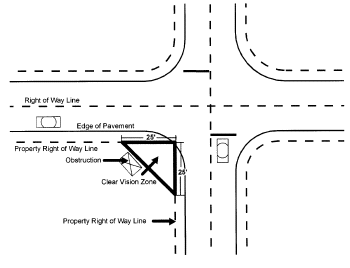
From the property corner measure 25 feet in each direction and from that point draw a line to create a triangle, which is hereby referred to as the clear vision zone. No fence, wall, hedge, landscaping, or structure shall be located inside the clear vision zone (see illustration).
(c)
Retaining walls. The requirements of this section shall not be deemed to prohibit any necessary retaining wall.
(d)
Trees. Trees shall be permitted in the clear space provided that foliage is cut away within the prescribed heights.
(Ord. No. 434, § 4.2.20, 5-7-2002; Ord. No. 583, § 1(att. A, § 14), 4-22-2008)
Sec. 60-51. - Pedestrian flow.
(a)
General provisions. Sidewalks shall be provided by the developer for all new nonresidential developments. For all new residential developments (currently unplatted, or any multifamily), sidewalks may be required by the city council, following consultation with the planning and zoning commission, on one side of any street where it is deemed essential to pedestrian movement and safety.
(b)
Locations.
(1)
Where required sidewalks will extend from the front entrance of every principal structure to within 70 feet of every parking space.
(2)
Where a sidewalk crosses a driveway or internal access road, the crosswalk area shall be marked with paint and shall be provided with stop signs for vehicular traffic.
(c)
Materials. All sidewalks shall be constructed of either poured concrete or asphalt.
(d)
Dimensions. The minimum pavement width of a sidewalk shall be 60 inches.
(e)
Separation. Pedestrian and vehicular traffic shall be separated as much as possible and conflicts there shall be kept to a minimum.
(Ord. No. 434, § 4.2.21, 5-7-2002)
Sec. 60-52. - Special right-of-way requirements.
(a)
For all new arterial and collector roadways, extra right-of-way, as provided within the Florida Department of Transportation Bicycle Facilities Planning and Design Manual, Official Standards, shall be provided for integrated or parallel bicycle ways or lanes.
(b)
All new structures shall provide a minimum setback of 50 feet as measured from the centerline of the right-of-way for new or realigned collector or arterial roads.
(Ord. No. 434, § 4.2.22, 5-7-2002)
Sec. 60-53. - Railroad right-of-way.
Existing railroad right-of-way, but not including switching, freight, or storage yards and railroad buildings or maintenance structures, is a permitted use in all zone districts. Switching, freight, or storage yards and railroad buildings or maintenance structures are permitted only where expressly allowed by these land development regulations.
(Ord. No. 434, § 4.2.23, 5-7-2002)
Sec. 60-54. - Performance standards.
All uses and activities permitted in any district within these land development regulations shall conform to the standards of performance described as follows:
(1)
Fire and explosion hazards. In any zoning district, all uses shall comply with applicable standards set forth in the rules and regulations of the state fire marshal.
(2)
Smoke, dust, dirt, visible emissions, and open burning. Regulations controlling smoke, dust, dirt, or visible emissions shall be the same as those contained in F.A.C. ch. 62-296. Regulations controlling open burning shall be the same as those contained in F.A.C. ch. 62-256.
(3)
Fumes, vapors, and gases. Regulations controlling the emission of any fumes, vapors, or gases of a noxious, toxic, or corrosive nature shall be the same as those contained in F.A.C. ch. 62-296.
(4)
Heat, cold, dampness, or movement of air. Activities which may produce any adverse effect on the temperature, motion, or humidity of the atmosphere beyond the lot line shall not be permitted, with the exception that in the industrial (I) district, this standard shall be applied at the boundaries of the I industrial district and not at the lot lines of the individual properties located within the I district.
(5)
Noise. Standards for the regulation of excessive noise shall be as set forth in the city noise regulations in chapter 24, article III.
(6)
Odor. Regulations controlling the emission of objectional odorous gases or other odorous matter, except those associated with normal agricultural practices, shall be the same as those contained in F.A.C. ch. 62-296.
(7)
Glare. There shall be no direct glare visible from any residential district caused by unshielded floodlights or other sources of high intensity lighting.
(Ord. No. 434, § 4.2.24, 5-7-2002)
Sec. 60-55. - Provisions for residential design manufactured housing.
Residential design manufactured homes as defined in section 44-10 shall be installed in accordance with the following:
(1)
Setup and anchoring according to F.A.C. ch. 15C-1;
(2)
All transportation equipment shall be removed.
(Ord. No. 434, § 4.2.25, 5-7-2002; Ord. No. 462, § 1(3), 9-16-2003)
Sec. 60-56. - Special septic tank requirements.
Existing septic tanks shall be allowed to remain in service until such time as a centralized sanitary sewer service is accessible, conditioned on the following requirements:
(1)
A building permit shall not be issued for construction of a building or facility where sanitary sewage is proposed to be disposed using an onsite sewage disposal system in an area zoned industrial on the city's zoning map, or used for industrial or manufacturing purposes, or its equivalent, where the city's centralized sanitary sewer system is available within one-quarter mile of the area used or zoned industrial or manufacturing, or where a likelihood exists that the onsite sewage disposal system may receive toxic, hazardous or industrial waste;
(2)
An occupational license shall not be issued to the owner or tenant of a building located in an area zoned industrial on the city's zoning map, or used for industrial or manufacturing purposes, or its equivalent, when such site is served by an on-site sewage disposal system without first obtaining an annual operating permit from the county health department; and
(3)
A certificate of land development regulation compliance shall not be issued to a new owner or tenant of a building located in an area zoned industrial on the city's zoning map, or used for industrial or manufacturing purposes, or its equivalent, or who operates a business which has the potential to generate toxic, hazardous or industrial wastewater, when such site is served by an onsite sewage disposal system without first obtaining an annual operating permit for an onsite sewage disposal system from the county health department.
(Ord. No. 434, § 4.2.26, 5-7-2002)
Sec. 60-57. - Requirements for residences for destitute people.
The total number of beds that may be provided in any shelter for destitute people in a 24-hour period is 15.
(Ord. No. 434, § 4.2.27, 5-7-2002)
Sec. 60-58. - Special community residential home requirements.
Homes of six or fewer residents which otherwise meet the definition of a "community residential home" and community residential homes as defined in section 44-10 shall be located in accordance with the following:
(1)
The city shall not permit homes of six or fewer residents which otherwise meet the definition of a community residential home to be located within a radius of 1,000 feet of an existing home of six or fewer residents which otherwise meets the definition of a community residential home.
(2)
The city shall permit the siting of a community residential home, unless the city determines that the site selected meets the following criteria:
a.
The site selected does not meet applicable licensing criteria established and determined by the state department of health, including requirements that the home is located to ensure the safe care and supervision of all clients in the home.
b.
The site selected would result in such a concentration of community residential homes in the area in proximity to the site selected, or would result in a combination of such homes with other residences in the community, such that the nature and character of the area would be substantially altered. (A home that would be located within a radius of 1,200 feet of another existing community residential home shall be considered to be an over concentration of such homes that substantially alters the nature and character of the area. A home that would be located within a radius of 500 feet of a one-family residential district shall be considered to substantially alter the nature and character of the area.)
(Ord. No. 434, § 4.2.28, 5-7-2002)
Sec. 60-59. - Temporary and portable buildings and structures.
Temporary and portable buildings and structures are allowed as follows:
(1)
Subdivision sales offices may be erected only after approval by the board of adjustment and code enforcement, subject to conditions as may be determined by the board to be necessary to ensure termination of the use after a reasonable period by removal or conversion to a conforming use.
(2)
Temporary and portable buildings and structures may be considered as accepted accessory structures in commercial and industrial districts if all of the following conditions are met:
a.
All district area and setback requirements are met.
b.
The accessory temporary or portable building or structure is utilized for commercial storage or warehouse use and not for commercial sales or office space.
c.
The accessory temporary or portable building or structure shall be placed in the rear of the primary building or structure and may not be attached to said primary building or structure.
d.
The accessory temporary or portable building or structure is to be anchored or secured to a permanent location on the property in such a way as to meet state standards regarding wind loads.
e.
A permit must be granted by the land development regulations administrator and a permit issued by the building official stating that the temporary or portable building or structure meets the above stated standards and will not present a hazard to adjacent or surrounding property.
(3)
Temporary and portable buildings and structures may be authorized pursuant to the requirements provided in chapter 46, article IV.
(Ord. No. 434, § 4.2.29, 5-7-2002)
Sec. 60-60. - Transitional use area requirements.
(a)
It is the intent of these requirements to ease the frictions between residential and nonresidential uses by creating a transition area in which certain intensive nonresidential uses are prohibited.
(b)
Where a commercial or industrial district adjoins a residential district, along the same frontage and without an intervening street, the following uses shall not be located within 100 feet of the residential district:
(1)
Industrial uses that create excessive noise, dust, odor, smoke, fumes, light, or vibration so as to have deleterious effects to health and general welfare.
(2)
Bars, taverns, and cocktail lounges.
(3)
Car washes.
(4)
Outdoor storage yards, wrecking yards, automobile wrecking yards, junkyards, yards used in whole or in part for scrap or salvage operations, or for processing, storage, display, or sales of any scrap, salvage, or secondhand building materials, junk automotive vehicles, or secondhand automotive parts.
(5)
Bulk storage of flammable liquids or explosives.
(Ord. No. 434, § 4.2.30, 5-7-2002)
Sec. 60-61. - Travel trailer parks and campgrounds.
The following regulations apply to the construction and operation of travel trailer parks and campgrounds:
(1)
Sites in travel trailer parks and campgrounds shall be occupied primarily by travel trailers, pickup coaches, tents, camping trailers, and other vehicular accommodations.
(2)
Each site in a travel trailer park or campground shall be at least 1,200 square feet in area. No part of a travel trailer or other unit placed on a travel trailer or campground site shall be closer than 25 feet to any lot line.
(Ord. No. 434, § 4.2.31, 5-7-2002)
Sec. 60-62. - Yard encroachments.
Every part of every required yard shall be unobstructed except as hereinafter provided or as otherwise permitted in these land development regulations:
(1)
Sills and belt courses may project not over 12 inches into a required yard.
(2)
Movable awnings may project not over three feet into a required yard, provided that where the yard is less than five feet in width, the projection shall not exceed one-half the width of the yard.
(3)
Chimneys, fireplaces, bay windows, or pilasters may project not over two feet into a required yard.
(4)
Fire escapes, stairways, and balconies which are unroofed and unenclosed may project not over five feet into a required rear yard, or not over three feet into a required side yard of a multiple dwelling, hotel, or motel.
(5)
Hoods, canopies, roof overhangs, or marquees may project not over three feet into a required yard, but shall not come closer than one foot to the lot line.
(6)
Fences, walls, hedges and trees are permitted in required yards, subject to the provisions of this section.
(7)
Cornices, eaves, or gutters may project not over three feet into a required yard, provided that where the required yard is less than six feet in width, such projection shall not exceed one-half of the width of the yard.
(8)
Except as provided herein, nothing in these land development regulations shall be so construed as to prohibit any type of landscaping or private, nonprofit, gardening on any lot.
(Ord. No. 434, § 4.2.32, 5-7-2002)
Sec. 60-63. - Parking of temporary storage trailers.
All temporary storage trailers shall remain on a construction site provided that:
(1)
Prior approval from the land development regulations administrator has been obtained.
(2)
No commercial vehicles or trailers shall be used for storage unless in conjunction with construction for no longer than 14 calendar days past the issuance of the certificate of occupancy.
(Ord. No. 583, § 1(att. A, § 1), 4-22-2008)
Sec. 60-64. - Commercial development design requirements.
(a)
Purpose. To protect and enhance quality of life in Williston, commercial development design requirements are hereby established which shall control the appearance of commercial uses.
(1)
Use of design requirements is intended to promote economic revitalization while strengthening unique physical features, design characteristics, and recognized identity and character of the city.
(2)
The positive effect of design requirements will help support property values, reduce conflicts and prevent blighting caused by incompatible and insensitive development, and promote new compatible development.
(3)
Design requirements for commercial development will help facilitate infill development and physical redevelopment of Williston.
(4)
For any structure, it is the intent of these requirements not to conflict with energy efficiency and energy conservation initiatives, green building practices, or leadership in energy and environmental design (LEED) certification.
(b)
Applicability.
(1)
The commercial development design requirements shall apply to structures where the principal use is commercial and development is located on commercially zoned parcels in the C-1 commercial district, C-2 commercial district, central business district (CBD) and residential business (RB) district within the City of Williston as shown on the city's official zoning map. All public buildings within the city shall also be subject to these design requirements.
(2)
Design requirements shall apply to new construction of any commercial building or structure located within the zoning districts outlined in section 60-64(b)(1). Design requirements shall likewise apply to the relocation of any building or structure for commercial use in any of the zoning districts outlines in section 60-64(b)(1), and exterior rehabilitation of an existing building for commercial use or structure where total cost exceeds 50 percent of the tax appraised value.
(3)
All general, supplemental, commercial, or other district requirements contained in the Williston land development regulations shall be controlling in addition to the standards set forth in this section regarding commercial development design requirements.
(4)
If conflict arises between controlling standards, either within an overlay district zoning or by means of another legally binding document, the following rules shall be used in the application land use controls:
a.
Where an unexpired permit, development order or agreement, approved site plan, court order or other legally binding document exists authorizing development prior to passage of City of Williston, Florida, Ordinance No. 635 on [Date this ordinance is adopted], then that legally binding document shall apply.
b.
In all other situations, the stricter standard shall apply.
(c)
Exemptions. The following uses shall be exempt:
(1)
Design requirements shall not apply to those activities that constitute ordinary repair and maintenance when such changes are limited to the same or similar material and design.
(2)
Nor shall design requirements for development apply on any commercially zoned lot or a lot in the residential business (RB) district where a conforming or nonconforming residential use is the principal use.
(3)
Churches shall be exempt from commercial development design requirements, but are strongly encouraged to comply.
(d)
General district provisions. The following shall apply to new development or renovation of buildings where total cost exceeds 50 percent of the tax appraised value:
(1)
The preferred architectural styles of the city's commercial districts are:
a.
Florida/Southern Vernacular (Cracker-style, or Folk Victorian).
b.
Craftsman or Bungalow Style.
c.
Spanish Mission/Spanish Revival Styles.
d.
Victorian.
While it is highly preferred that any new structures or significant improvements conform with one of the above architectural styles, it is not required. The planning and zoning department shall prepare a style guidebook that provides illustrations and examples of the above referenced styles.
(2)
No commercial building or structure shall be constructed, installed, erected or altered except in compliance with design requirements and development standards set forth in the land development regulations.
(3)
External improvement to buildings or structures must achieve compatibility with the size, scale, massing, height, rhythm, setback, color, material, building elements, site design including setbacks, and character of structures in surrounding block areas.
(4)
Only when a proposal for development within all commercial districts has obtained a certificate of design approval (CODA) will it have completed the review process thus achieving consistency with the design requirements.
(5)
The land development regulations administrator, working with the building official, shall administer and enforce the requirements of this section pursuant to the requirements of sections 46-91 to 46-100 and other impacted land development regulations.
(e)
Design requirements. To advance the purpose of the design requirements, new construction, expansion and existing structures and redevelopment within all commercial districts should yield buildings that are high-quality, long-term assets to the city. The following design requirements shall apply:
(1)
Building materials. Generally, materials of building construction shall be durable and superior in quality. The use of traditional building materials and craftsmanship is encouraged, especially as a means to add architectural detail. Utilization of locally available, natural building materials is preferred. Special consideration should be given to building materials that will be resilient to the long-term effects of wear owing to both use and the natural environment.
a.
The use of stone, masonry, wood and other natural building materials is preferred.
b.
In all cases, at least 50 percent of the non-glass face of all new commercial buildings shall consist of wood, stone or masonry materials. This requirement applies to all sides of a building fronting a public roadway. Alternative materials other than the above-listed materials may be used to enhance the facade of commercial structures if the developer demonstrates that said alternative materials are consistent with the elements or standards of the district.
c.
Likewise, the use of metal, all forms of vinyl siding, and synthetic building materials which do not imitate the appearance of natural materials is prohibited on all sides where a building is visible from public rights-of-way.
d.
Arrangement of building elements, composition and texture in materials choice must be compatible with other positive architectural elements of structures within the City.
e.
These requirements do not specify exact color choices for building exteriors, but color choice shall be consistent with the established historical character of the City. Variation from established patterns is discouraged, and the use of corporate color schemes shall be limited to trademarked or logo features of approved signage.
(2)
Lot placement. All construction shall conform to existing street patterns, block patterns and access management control. A building's front facade will orient toward the site's major street frontage. Buildings shall be constructed facing primary streets to aid pedestrian and vehicle access to a given site. Site development should consider vistas of historical structures and potential impacts to the city's viewshed.
a.
For development abutting arterial roadways, the first level of any structure should be built to the front property line where permitted or else match the current street level setback of adjacent buildings.
b.
For infill development abutting local and collector streets, building orientation and setback shall match the predominating or average setback of the same-facing block.
c.
Where existing development has defined the use of space, new development should repeat existing building-to-building and building-to-street relationships along a given block.
d.
Building orientation shall be such that service areas are placed out of view or in positions of least visual impact as seen from public rights-of-way, parking areas and adjacent properties. Unavoidable visual impact shall be mitigated by structural screening and/or landscape screening to comply with these requirements.
(3)
Structure and massing. The rhythm of buildings surfaces, wall articulation, cornices, and fenestration (doors and windows) shall be made compatible to a structure's immediate environment. When proposed architectural features are already found as positive architectural features resident on a block, then care shall be taken to match common proportion and physical characteristics. Storefront facade proportions will be compatible with other facades in the blockface. In total, building height and massing should function to create a small town atmosphere.
a.
For structures less than 5,000 square feet in gross building area on the ground floor, no uninterrupted horizontal length on street frontage shall exceed 20 linear feet.
b.
For structures greater than or equal to 5,000 square feet in gross building area on the ground floor, no uninterrupted horizontal length on street frontage, shall exceed 30 linear feet.
c.
Blank wall areas for each floor-to-floor relationship (those without relief or uninterrupted) shall incorporate the use of landscaping to break up monotonous appearance of such areas. Blank wall areas uninterrupted by landscaping shall not exceed ten feet in vertical direction or 20 feet in horizontal direction of any building facade.
d.
Elements acceptable for the interruption of blank wall surfaces are: belt courses, trim bands, and related horizontal and vertical recessed and protruding elements.
e.
Verandahs and roofed or open porches shall enhance building massing and symmetry.
f.
Massing shall not prohibit or complicate street level pedestrian connections which are necessary around, through and between large buildings.
g.
Building height, proportion and massing shall be consistent with the height of existing positive architectural examples on the same street or block.
(4)
Building exteriors and storefront. Building facades and storefronts are among the most important and visible elements of a commercial structure. Buildings shall be designed to enhance the attractiveness of the city's streetscape. Buildings shall display elements and patterns that provide visual interest from the perspective of the pedestrian and the motorist through use of architectural details and scale. While storefronts may change over the lifecycle of a building, it is necessary to see adjacent structures present complementary design choices to promote a sense of place and identify within the district by promoting small town atmosphere.
a.
Use of colors complementary to building materials and color schemes that relate well to neighboring buildings is encouraged.
b.
The use of distracting color schemes on building facades is inappropriate and discouraged.
c.
Trim elements shall adhere to building material guidance but also take appropriate form and profiles at entryways and account for fenestration. Trim emphasis should be kept simple.
d.
Utilization of darkened or shaded glass is discouraged at street level. The use of reflective glass is prohibited in all cases. Glass is prohibited lower than 18 inches from ground level, other than doors.
e.
Composition and arrangement of exterior features shall be used to help create the impression of a pedestrian-friendly streetscape, serving to keep the focus of the pedestrian more or less at eye level by creating a human-scale visual frame. This shall be accomplished by visually separating the ground floor/story from any upper portions of the building regardless of the actual number of floors/stories.
(5)
Entryways. Design of entryways shall create identifiable focal points. Effective entryway design creates a transition between public and private space. Recessed entryways are desirable.
a.
Entryways may be differentiated from the remainder of the facade through, at minimum, the use of color, change in materials, application of architectural features (arches, columns, colonnades, etc.), setbacks, offsets, level changes and like forms.
b.
Entryway design may incorporate planter materials and landscaping, and walls should be recessed to add definition.
c.
Entryway areas should be provided with structural or vegetative shading features.
d.
All public entryways shall have awnings, porches or arcades to protect customers entering and exiting the building from inclement weather. Multi-tenant building or buildings with more than one entrance shall have a continuous arcade or colonnade connecting individual entryways. The arcade shall be functional without interruptions.
(6)
Roofs and building top. Being highly significant architectural features, the following requirements shall apply to the design and composition of roofs and building tops:
a.
Roofs will be of a style, shape and slope that is similar to other structures in the vicinity. Hipped and gabled roofs are preferred, but flat roofs may be considered acceptable if that style matches similar structures on the same facing block. Out-of-character roof designs are prohibited and include A-frame, mansard, non-standard or modern geometric-solid, and curved or dome styles.
b.
Overhanging roofs can provide important pedestrian cover. When measured from the eaves and gables, any protrusion must be at least 12 inches as measured along the underside of the slant of the roof.
c.
All mechanical and utility equipment located on a roof shall be set back or screened so as to not be visible from adjacent public rights-of-way.
d.
Building composition should present a clearly defined base, middle, and top. Color, building material, texture and surface articulation techniques should all be utilized to differentiate a structure's proportions and define its volume.
(7)
Lighting. Treatment of lighting through fixture design and placement has the capacity contribute many important aesthetic benefits. Adequate lighting elevates the appearance of development and contributes to public safety. By contrast, poorly designed lighting is a visual distraction.
a.
Pedestrian walkways, onsite parking facilities, landscape features and exterior spaces should be adequately illuminated.
b.
Location of light fixtures on buildings should be provided in a way that lights neighboring pedestrian space while complementing structural elements.
c.
Accent lighting on buildings is recommended as a security feature. The use of neon lighting on buildings is not permitted as accent lighting.
d.
Placement of lighting will occur in a manner that creates positive visual effect, realizes uniform patterns, and minimizes unintended spillover/glare.
(8)
Landscape requirements. The following landscaping features and elements are permissible and encouraged in the city's commercial districts:
a.
Native plants.
b.
Xeriscape plants and features.
c.
Water features.
d.
Natural materials indigenous to the Williston area.
e.
Florida fieldstone or other stone native to the region.
f.
Antique or simulated antique paver bricks and stones.
g.
Exterior lighting of a style consistent with architectural style of primary structure.
h.
Benches or chairs of a style consistent with architectural style of primary structure.
The following landscaping features and elements are prohibited in the city's commercial districts:
i.
Invasive species as designated by the Florida Exotic Pest Plant Council's List of Invasive Species (most current edition).
j.
Landscaping materials and styles that do not coordinate with the surrounding area.
(9)
Access to entrances. All commercial development shall be required to construct sidewalks or dedicated pedestrian paths from the sidewalk located in the public right-of-way to the primary entrance or entrances of the commercial structure. See section 60-51 regarding the construction of sidewalks by the developer. Sidewalks or paths shall not be less than five feet in width and conform with Americans with Disabilities Act (ADA) standards.
For developments located on corner lots, the required sidewalks or paths shall connect with the sidewalks constructed on both streets.
(10)
Fenestration. No false fenestration shall be allowed at the ground floor.
(11)
Bicycle racks. At least one bicycle rack shall be provided per development. Bicycle racks shall be painted or colored to match the predominant color of the building.
(12)
Trash receptacles. At least one trash receptacle shall be placed at or near the entrance to all primary structures or primary public entrances to any storefronts. Trash receptacles shall be painted or colored to match the predominant color of the building or storefront.
(f)
Prohibited architectural styles. The following shall not be considered as acceptable architectural styles and are therefore prohibited:
(1)
Corporate signature or commercial prototype architecture, characterized by the use of corporate colors, shapes and styling used to overtly identify the owner or tenant of the building.
(2)
Automobile-oriented commercial strip architecture as commonly described by the urban design professions.
(3)
Any architecture having an historical reference which is so unique and different from current design philosophy that such reference is inconsistent with surrounding structures. Examples of such include igloos, tepees, caves and the like.
(4)
Any imitative architecture which does not resemble a typical structure, but resembles an exaggerated plant, animal, fish, edible food or other item such as oranges, ice cream cones, dinosaurs and like forms.
(5)
Ultra-modern architectural styles that feature curved walls, sharp angles or significantly asymmetrical building mass.
(6)
Architectural styles that can be categorized as:
a.
Usonian.
b.
Art Deco.
c.
Art Nouveau.
d.
International.
e.
Art Moderne.
f.
Tudor.
g.
French Revival.
h.
Bauhaus.
i.
Beaux-Arts.
j.
Egyptian Revival.
k.
Moorish Revival.
(g)
Design requirement approval process summary. Design review shall be incorporated into the City of Williston's concurrency management system. As a consequence, procedures for the review of development plans submitted pursuant to the requirements of this section are fully detailed in article IV, Permitting and Concurrency Management, chapter 46, sections 46-91 to 46-100 of the Williston Code of Ordinances. However, design review shall encompass the minimum process elements summarized below:
(1)
Generally. As required herein and by section 46-99, Site and Development Plan Approval, it shall be the burden of the developer to provide all documents and information necessary to allow a determination of consistency with the design requirements, controls and individual standards broadly presented in this section. Any proposal which provides insufficient or inadequate information, or which does not conform to the requirements of the commercial design requirements section, shall be deemed incomplete. No further action will be taken on such proposals until they are brought into conformity with the requirements. This information shall include, in addition to the site plan requirements as set forth in section 46-99 of the City of Williston Code of Ordinances, building elevations showing the following information:
a.
Scale.
b.
Colors, materials, and textures to be used.
c.
Building dimensions (height and width) for each elevation.
d.
Architectural treatments (entrances, windows, eaves, etc.).
e.
Proposed signs, including dimensions and copy.
f.
Architectural details of retaining walls, fences, planters.
(2)
Sanction. No building permit may be issued pursuant to sections 46-92 and 46-93 of this Code unless and until a proposed development within the city has first obtained a certificate of design approval (CODA). Moreover, it shall be equally maintained that no certificate of land development regulation compliance, as provided for in section 46-94 of this Code, shall be issued unless and until a proposed development has first obtained a CODA.
(Ord. No. 635, § 1, 3-4-2014)
Sec. 60-65. - Interconnections and shared access.
(a)
Interconnects. Adjacent commercial uses must provide interconnections for automobile, bicycle, and pedestrian traffic. All adjacent parking lots must connect. If adjacent property owner is unwilling to incorporate an interconnection at time of development, an access point shall be constructed to property line and marked with a permanent metal sign indicating a point of future interconnection.
(b)
Shared accessways. The use of shared accessways is strongly encouraged.
(c)
Parcels abutting more than one other adjacent commercial use. For developments that abut more than one other adjacent commercial use, the interconnection shall be made with the parcel furthest away from the arterial.
(Ord. No. 635, § 1, 3-4-2014)
Sec. 60-66. - Chickens.
Any residential single family property may have chickens within city limits. The keeping of chickens is subject to the following conditions:
(1)
No more than six chickens per lot; maximum of 12 chickens total on multiple lots:
(2)
Roosters (defined as a male chicken of any age and generally characterized by an ability to crow) and any other crowing chickens are prohibited:
(3)
Keeping of chickens shall adhere to chapter 10 section 12 and 13:
(4)
Covered enclosures shall meet the setback requirements for an accessory structure in the applicable zoning district:
(5)
Feed shall be kept in rodent-proof and raccoon-proof enclosed containers:
(6)
The area in which the chickens are kept shall be maintained in a sanitary condition, including the regular removal of chicken manure:
(7)
Odors from chicken-keeping shall not be detectable at property boundaries: and
(8)
Chicken products and/or by-products shall not be produced or sold on the property.
(Ord. No. 659, § 1, 11-22-2016)

