
Willits City Zoning Code
CHAPTER 17
52 - OFF-STREET PARKING AND LOADING REGULATIONS
Sections:
17.52.010 - Title and purpose.
The provisions of this chapter shall be known as the "off-street parking and loading regulations." The purpose of these provisions is to provide functionally adequate, aesthetically pleasing and secure off-street parking and loading facilities.
(Ord. 82-4 §3(part)).
17.52.020 - Application.
All uses and portions thereof erected or constructed, or hereafter altered, converted or enlarged so as to increase the floor space of the structure, the number of dwelling units, rooms, beds or seating capacity of the structure or the number of employees working at the structures shall be provided with not less than the number of parking spaces required by and constructed in accordance with this chapter.
(Ord. 87-12 §3: Ord. 82-4 §3 (part)).
17.52.030 - Required parking spaces.
A.
One-family or Two-family Dwellings, Multiple Dwellings, and Apartment Houses.
1.
Two parking spaces for each one-family dwelling or four parking spaces for each two-family dwelling;
2.
One and one-half parking spaces for each studio or efficiency dwelling unit and for each one or two bedroom dwelling unit located in a multiple dwelling or apartment house;
3.
Two parking spaces for each dwelling unit having three or more bedrooms located in multiple dwellings and apartment houses;
B.
Mobile Home Parks and Mobile Homes in Planned Developments.
1.
Two parking spaces for each mobile home unit. Parking spaces may be in tandem;
2.
One additional parking space for every five mobile home units, to be used as guest parking, located no farther than two hundred fifty feet from the mobile home it is intended to serve shall be provided in standard mobile home parks, and one additional parking space for every ten mobile home units shall be provided adjacent to open space areas;
C.
Hotels, Residential Hotels, Apartment Hotels, Resort Hotels, Clubs, Lodges, Boardinghouses, Fraternity and Sorority Houses.
1.
One parking space for each of the first twenty individual guest rooms or suites;
2.
One parking space for every two individual guestrooms or suites in excess of twenty;
D.
Motels and Tourist Courts. One parking space for each dwelling unit in a motel or tourist court;
E.
Recreational Vehicle Parks.
1.
One parking space for each recreational vehicle;
2.
One parking space for each full-time employee of the park;
3.
For the purpose of registration, spaces for temporary parking in proximity to the park office shall be provided in the following ratio:
100 occupant spaces — 3 spaces;
200 occupant spaces — 6 spaces;
300 occupant spaces — 8 spaces;
up occupant spaces — 10 or more spaces;
F.
Hospitals, Mentally Retarded Facilities, Psychiatric Facilities, Rest Homes, Sanitariums and Institutions. One parking space for every two beds;
G.
Auditoriums, Theaters, and Similar Places of Public Assembly. One parking space for every five seats. A "seat" means thirteen lineal inches of seating space when seats consist of benches or pews. For auditoriums without permanent seats, a "seat" means seven square feet of floor area;
H.
Elementary and Junior High Schools.
1.
One parking space for each employee, plus five and ten additional parking spaces for elementary and junior high schools, respectively;
2.
Auditorium parking shall be provided in accordance with subsection G of this section, provided that playground area available for parking purposes may be used to satisfy this requirement;
I.
High Schools.
1.
One parking space for each employee, plus one parking space for every two students in the eleventh and twelfth grades in the high school, plus twelve additional parking spaces;
2.
Auditorium parking shall be provided in accordance with subsection G of this section, provided that the number of spaces required for the auditorium may be reduced by the total number of spaces available for parking purposes in playground areas;
J.
Colleges.
1.
Main Campus. One parking space for each employee, plus one parking space for each student in the college (the total number of students to be determined as the maximum classroom capacity), plus ten additional spaces;
2.
Subcampuses and Off-campus Sites. One parking space for each employee, plus one space for every two students (the total number of students to be determined as the maximum classroom capacity), plus five additional spaces for subcampus administrative center;
3.
Auditorium Parking. Auditorium parking shall be provided in accordance with subsection G of this section; provided that the number of spaces required for the auditorium may be reduced by the total number of spaces required by paragraph 1 of this subsection, and by the number of spaces available for parking purposes in playground areas;
K.
Retail Business and Office Buildings. One parking space for every three hundred square feet of gross floor area, exclusive of floor area used for automobile parking space, in a retail business or office building, and one additional parking space for each staff member for medical and dental offices;
L.
Industrial, Except Mini-warehouse. One parking space for every one employee working on the largest shift, plus ten customer or visitors parking spaces.
M.
Wholesale, Storage Buildings and Warehouses. One parking space for every five hundred square feet of gross floor area.
N.
Institutions of an Educational, Philanthropic and Charitable Nature. For such institutions as may offer instruction, training or learning opportunities for students, trainees or participants, one parking space for each administrator, instructor or employee, plus one space for every two students, trainees, or participants; or one parking space for every three hundred square feet of gross floor area, whichever requires the greatest number of parking spaces;
O.
Swap Meets, Stalls, or Uses Not Enclosed in Buildings. One parking space for every three hundred square feet of gross open area or one parking space per stall, whichever shall result in the greatest number of parking spaces. Areas used to meet the parking space requirements of this subsection shall not be counted in the gross open area;
P.
Other Uses. For any use not specified above, one parking space for every two employees working on the largest shift or one parking space for every three hundred square feet of gross floor area, exclusive of floor area used for automobile parking space, whichever requires the greatest number of parking spaces;
Q.
Use Permit-parking Condition. A greater number of off-street parking and/or loading spaces may be required by the planning commission as a condition of a use permit.
(Ord. 88-9 §2; Ord. 82-4 §3 (part)).
17.52.040 - Relationship of required off-street parking to building site.
All required parking spaces shall be located on the same lot or building site with the use they are intended to serve; unless the site on which they are located meets one of the following conditions:
A.
There is a transversable pedestrian route, not more than four hundred feet in length, over and along public streets or walkways, or permanently established easements between the building or structures it is to serve and the use of the property upon which the parking spaces shall be constructed shall be secured by a written lease subject to the approval of the Willits planning commission; or
B.
A variance has been granted by the Willits planning commission in accordance with Section 17.52.110 of this chapter.
(Ord. 87-12 §4; Ord. 82-4 §3 (part)).
17.52.050 - Location of parking on building site.
A.
Covered Parking. Covered or enclosed parking spaces may be located anywhere on a building site where a structure may be located.
B.
Open Parking. Except as provided in subsection C, open parking spaces shall be outside the ultimate right-of-way of any street and shall not be located within any required front or side yard.
C.
Exceptions. A use permit may specify the location of parking in areas other than as provided in subsection B.
(Ord. 82-4 §3(part)).
17.52.060 - Design standards for off-street parking.
Off-street parking spaces and areas shall meet the following design standards:
A.
Size and Access. An off-street parking space shall be an unobstructed space or area other than a street or alley, not less than nine feet wide, twenty feet long and seven feet high. Parking lot plans shall conform to the standards tabulated below and are subject to design review.
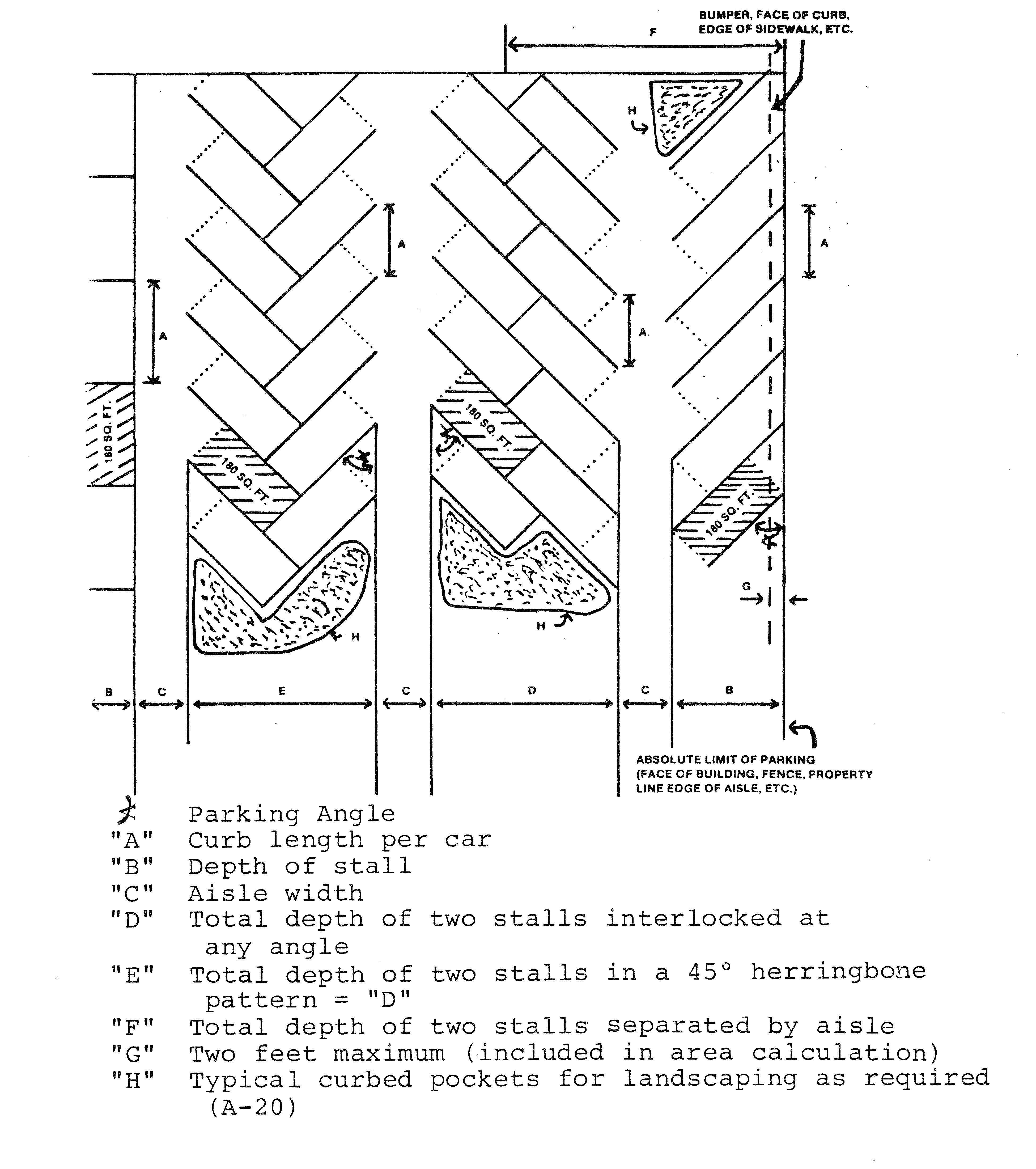
Minimum Dimensions Based On A 9′ × 20′ Parking Stall
(Except For 0 Degree Parking Angle)
B.
Paving. All parking spaces and driveways serving them shall be hard-surfaced, with a minimum of one and one-half inches of road oil mix or other surfacing of a more durable type such as asphalt concrete.
(Ord. 82-4 §3 (part)).
17.52.070 - Credit for bicycle and motorcycle parking.
Where bicycle spaces or motorcycle spaces are provided for uses in commercial and industrial zones, parking spaces otherwise required pursuant to Section 17.52.030 may be omitted in accordance with the following provisions and subject to the following limitations:
A.
One parking space may be omitted for each eight bicycle spaces provided.
B.
One parking space may be omitted for each two motorcycle spaces provided.
C.
Bicycle spaces shall measure at least two feet by seven feet and shall be located in groups of four and be equipped with locking devices for each bicycle. Bicycle spaces shall be located where access to such spaces is not hampered by physical barriers or parked vehicles.
D.
Motorcycle spaces shall measure four feet by eight feet and shall be provided with adequate unobstructed maneuvering areas to permit easy access to the space.
E.
In no instance shall credit for motorcycle or bicycle parking or combination thereof exceed five percent of the total required parking spaces.
(Ord. 82-4 §3 (part)).
17.52.080 - Collective provision of off-street parking.
A use permit may be approved to authorize collection off-street parking facilities serving two or more buildings or uses, or establishments in locations subject to commercial or industrial regulations, subject to the following requirements:
A.
The total parking spaces in such collective off-street parking facilities shall not be less than the sum of the requirements for the individual buildings, uses or establishments computed separately in accordance with the requirements of Section 17.52.030 unless the planning commission specifies another amount as a condition of granting a use permit.
B.
The permit may be conditioned upon the provision of landscaping, and other appropriate requirements.
(Ord. 82-4 §3 (part)).
17.52.090 - Loading space requirements.
All commercial and industrial buildings, hotels, hospitals and institutions hereafter erected, constructed, converted, established, or enlarged to increase their floor space, shall be provided with one loading space for the first ten thousand square feet of gross floor area or fraction thereof, and one additional loading space for each additional twenty thousand square feet of gross floor space or its fraction greater than ten percent.
A.
Minimum Size. A loading space shall be not less than ten feet wide, thirty-five feet long, and fourteen feet high.
B.
Access. A loading space shall afford adequate ingress and egress for trucks from a public street or alley.
(Ord. 82-4 §3 (part)).
17.52.100 - Elimination of on-site parking spaces prohibited.
No person shall erect, construct or hereafter alter, convert or enlarge any building or structure which eliminates any existing on-site parking spaces or otherwise would prevent the property from meeting the on-site parking requirements of the chapter.
(Ord. 87-12 §5).
17.52.110 - Parking variance procedure.
A.
When, in the judgment of the planning commission, any parcel of land within the city cannot providing parking as required by this chapter and the applicant has provided as many on-site parking spaces as is possible on the site that meet the standards established by this chapter, the planning commission may, upon application by the landowner, grant a variance from the parking requirements. In granting a variance, the planning commission shall be guided by the following criteria:
Upon a showing by the applicant and a finding thereof by the planning commission as set forth below, a variance may be granted on one or more of the following grounds:
1.
Because of special circumstances applicable to the property, including size, shape, topography, location or surroundings, the strict application of the on-site parking requirements deprive such property of privileges enjoyed by other property in the vicinity and under identical zoning classifications,
2.
Proximity to an under-utilized public parking lot which would reduce the need for on-site parking,
3.
Specific conditions exist which particularly affect the subject property as opposed to other properties in the district similarly situated; or
4.
Specific conditions exist as to the type of business enterprise or use permitted by the commission and which may affect the need for on-site parking;
B.
The burden shall be upon the applicant to demonstrate to the planning commission the grounds upon which he/she bases his/her application for variance. The planning commission shall make written findings of fact in support of its decision. The findings of fact shall demonstrate that the criteria set forth in this section have been met, shall be supported by substantial evidence in the administrative record and shall be made a part of the official minutes of the planning commission.
(Ord. 87-12 §6 (part)).
17.52.120 - Compact automobile spaces.
For uses other than residential uses, up to twenty-five percent of the required parking spaces may be devoted to compact car spaces. Such compact spaces shall be clearly labeled for compact cars in accordance with the signing standards established by the city, and grouped together in one or more locations or at regular intervals such that only compact vehicles can easily maneuver in the space. All compact spaces shall be a minimum of eight feet wide and sixteen feet long, measured along the angle of parking.
(Ord. 87-12 §6(part)).

