
Wilmington City Zoning Code
ARTICLE 6
- SUPPLEMENTAL DEVELOPMENT REGULATIONS
Sec. 18-246. - General.
This division contains supplemental development regulations for those uses and structures that are accessory to primary uses, permitted under prescribed conditions, or permitted by special use permit, as indicated in individual zoning districts.
(a)
Prescribed conditions. No use permitted under prescribed conditions shall be established or occupied without first obtaining a certificate of occupancy as set forth in Article 3. A certificate of occupancy application with information sufficient to determine if the prescribed conditions for the use are met must be completed and submitted to the city and approved before a certificate is issued. All uses permitted under prescribed conditions must also conform with all other applicable ordinance provisions before a certificate of occupancy is issued.
(b)
Special use permit prerequisites. Any prerequisites for a special use to be met at the time of application for a special use permit in one or more of the following means:
(1)
A site plan in conformance with the requirements stated in Article 3 of this chapter indicating all existing and proposed physical requirements either listed in this division or otherwise required in the review and approval process.
(2)
Written preliminary approval by any public agency either required in this division or otherwise required in the review and approval process.
(c)
All special uses in the Historic District have the same prerequisites and have been grouped as such in section 18-305.
(d)
While this division establishes conditions or requirements to be met by a special use, all special uses must conform to all other applicable ordinance provisions.
(Ord. No. O-2008-25, 4-8-08)
Sec. 18-247. - Accessory apartments, attached.
Accessory apartments shall be allowed in the R-7, R-10, R-15, R-20, and PD Districts if the following criteria are met:
(a)
Reserved;
(b)
Two (2) additional off-street parking spaces shall be required;
(c)
Only one accessory apartment, whether attached or detached, shall be permitted per lot;
(d)
Reserved;
(e)
The attached accessory apartment shall have a separate entrance screened from the public right-of-way;
(f)
There shall be no exterior changes to the principal structure noticeable from the public right-of-way;
(g)
A site plan shall be submitted for approval to the city manager; and
(h)
The accessory unit shall be a minimum of two hundred (200) square feet and a maximum of thirty-five (35) percent of the gross floor area of the principal structure in size or eight hundred (800) square feet, whichever is less.
(Ord. No. O-2008-25, 4-8-08)
Sec. 18-248. - Accessory apartments, detached.
Detached accessory apartments shall be allowed in the R-20, R-15, R-10, R-7, R-5, R-3, MF-L, MF-M, MF-MH, MF-H, HD, HD-R, and HD-MU Districts if the following criteria are met:
(a)
Lots must exceed the minimum lot area of the applicable zoning district by at least fifty (50) percent, or five thousand (5,000) square feet, whichever is less;
(b)
The entire structure shall not exceed thirty-five (35) percent of the gross total enclosed heated square footage of the existing single-family dwelling or one thousand two hundred (1,200) square feet, whichever is less;
(c)
Two (2) additional off-street parking spaces shall be required;
(d)
Detached accessory apartments shall comply with the requirements established in section 18-249, accessory buildings, except:
(1)
The side and rear setbacks for any detached accessory apartment shall be fifteen (15) feet, or the respective minimum side and rear setback of a principal structure in the zoning district in which the property is located, whichever is less. In no case shall the side or rear setback be less than five (5) feet. Corner lots shall follow the requirements set forth in section 18-249.
(2)
The detached accessory apartment shall be located completely behind the plane of the rear facade of the principal structure.
(e)
Only one (1) accessory apartment, whether attached or detached, shall be permitted per lot;
(f)
Accessory apartments may be constructed over existing detached garages provided the garage meets the accessory building regulations and the living space of the apartment does not exceed eight hundred (800) square feet;
(g)
Reserved; and
(h)
In the multiple-family districts (MF-L, MF-M and MF-H) accessory apartments shall only be allowed when constructed in connection with any single-family detached development which is allowed within the district.
(Ord. No. O-2008-25, 4-8-08; Ord. No. O-2012-53, § 1, 8-21-12)
Sec. 18-249. - Accessory buildings.
(a)
Number of accessory buildings. In the residential districts, no more than two (2) accessory buildings shall be permitted per lot, with the following exceptions:
(1)
Bona fide agricultural uses. Lots of four (4) acres or greater shall be allowed two (2) additional accessory buildings.
(2)
City approved community gardens.
a.
One (1) accessory building not exceeding twelve (12) feet in any dimension shall be permitted on lots designated as community gardens.
b.
The accessory building shall not be connected to electricity or plumbing.
c.
The accessory building shall comply with city permitting requirements and the city community garden policy.
d.
Placement of the structure shall be to the interior of the lot and subject to the approval of the planning division.
(b)
Location of accessory buildings. On all lots, accessory buildings shall be located only to the side or rear of the principal structure. An accessory building shall not extend any closer toward the front of a lot than the forwardmost projection of the principal structure including, but not limited to, porches, steps, entryways, etc. Where a typical development pattern of accessory buildings placed in front of primary buildings exists, one (1) accessory structure may be allowed in front of the primary structure subject to the following conditions:
(1)
The accessory building shall be located a minimum of two hundred (200) feet from the front property line.
(2)
The accessory building shall meet or exceed the required side setback for the principal structure.
(3)
The accessory building shall not exceed one thousand (1,000) square feet in area.
(4)
The accessory building shall be oriented toward the street and includes fenestration (doors and windows) on the front facade. Garage doors on the front facade shall be prohibited.
(5)
Corrugated metal, unparged concrete block, and plywood shall be prohibited on the exterior facade of the structure.
On corner lots accessory buildings shall be located no closer to the street than the front of the principal structure on the rear adjoining lot at a setback from the street equal to at least fifty (50) percent of the length of the common property line. If the adjoining lot does not contain a structure, or if the adjoining structure does not meet the minimum required front setback of the zoning district, an accessory building must meet the minimum front setbacks of the zoning district in which it is to be located.
(c)
Lot coverage. Accessory buildings shall not cover more than thirty (30) percent of the required side or rear yard. The gross total square footage of all accessory buildings shall not exceed one hundred (100) percent of the heated square footage of the primary structure.
(d)
Setback. Accessory buildings shall be set back at least five (5) feet from the side and rear lot lines in all districts except in the separate use historic districts. In these districts, setbacks will be reviewed and approved by the historic preservation commission or historic preservation planner through the certificate of appropriateness application process according to section 18-96. The separation between the principal structure and accessory building shall meet the state building code.
(e)
Height. The height of any accessory building shall not exceed the height of the primary structure or thirty-five (35) feet, whichever is less.
(Ord. No. O-2008-25, 4-8-08; Ord. No. O-2010-91, § 16, 12-7-10; Ord. No. O-2016-54, § 1, 7-19-16)
Sec. 18-250. - Adult establishments.
An adult bookstore, adult motion picture theater, adult cabaret, or a massage business as defined in this chapter or as permitted within certain districts shall be subject to the following restrictions:
(a)
No adult establishment shall be located within one thousand (1,000) feet of another adult establishment.
(b)
An adult establishment shall be located one thousand (1,000) feet or more from the boundary line of any district zoned R-3, R-5, R-7, R-10, R-15, R-20, MF-M, MF-MH, MF-H, MF-L, HD, HD-R, HD-MU or single-family uses within the MS-MU and MX Districts under the provisions of this chapter, or from the boundary line of any district zoned R-10, R-15 or R-20 under the provisions of the New Hanover County Zoning Ordinance.
(c)
An adult establishment shall be located one thousand (1,000) feet or more from the lot line of any school, religious institution (including accessory uses not located on the same lot, but contiguous to the principal place of worship), park or recreation facility operated by a public entity or a private nonprofit, tax exempt entity or child day care center or home. The separation requirement shall also apply to any of these uses located outside the Wilmington corporate limits.
(d)
All distances provided in this section shall be measured as follows:
(1)
With respect to the distance between a location for which an adult establishment is proposed and the location where an adult establishment exists, the distance shall be measured by following a straight line from the nearest point of the lot line on which a proposed adult establishment is to be located to the nearest point of the lot lines of the lot on which the existing adult establishment is located.
(2)
With respect to the distance from the boundary line of a zoning district as set forth in paragraph (b) above, the distance shall be measured by following a straight line from the nearest point of the lot line of the lot on which the proposed adult establishment is to be located, and to the nearest point of the district boundary line.
(3)
With respect to the distance from the lot line of any school, religious institution, single-family home in an MS-MU or MX development, park or recreation facility or child day care center or home, the distance shall be measured by following a straight line from the nearest point of the lot line of the lot on which the adult establishment is to be located, to the nearest point on the lot line of such school, religious institution, single-family home in an MS-MU or MX development, park or recreation facility, or child day care center.
(Ord. No. O-2008-25, 4-8-08)
Sec. 18-251. - Amortization of existing towing services.
Any towing services use made nonconforming by the amendments to the city zoning ordinance adopted on July 17, 2001, shall be subject to the provisions of Article 4, Nonconforming Situations, of this chapter to the extent of any nonconformity. Such businesses shall be required to screen all existing storage areas with a one hundred (100) percent opaque fence or screen in accordance with the provisions of Article 8, Division VII, Buffer Yards. PVC slats, other approved material or a five-foot landscaping strip on the outside of the fence complying with this article may be allowed for nonconforming situations with existing chain link fences. Screening of the storage areas shall be completed by December 31, 2002. All nonconforming towing services must obtain a zoning permit as required in Article 3 of this chapter.
(Ord. No. O-2008-25, 4-8-08)
Sec. 18-252. - Automobile and truck dealers, new and used.
Automobile and truck dealers, new and used shall comply with the following:
(a)
All repair work or lubrication shall be conducted within a building. All permanent storage of materials, merchandise, or repair and servicing equipment shall be contained within a building.
(b)
No outdoor work shall be performed except in areas designated on an approved site plan.
(c)
Service and customer vehicles parked on the premises shall not create traffic hazards or interfere with the vehicular maneuvering area necessary to enter or exit the site.
(d)
Outdoor work areas shall be screened with fences, walls and/or landscaping to minimize on-site and off-site noise, glare, odor, or other impacts. Chain link fencing shall be prohibited. Screening shall be a minimum of eight (8) feet in height and shall be opaque.
(e)
Vertical stacking of vehicles is prohibited.
(f)
Additional buffering and screening may be required when such use is located in proximity to residential or retail commercial uses.
(g)
Ground signage shall be limited to monument signs, not to exceed forty (40) square feet in area or six (6) feet in height, with landscaping at the base of the sign. Ground signs shall not be internally illuminated.
(h)
Building facades facing major arterials shall not be metal.
(i)
Fifty (50) percent additional streetyard landscaping shall be required where the property is adjacent to residential zoning or uses.
(j)
Outdoor paging systems utilizing loudspeakers are prohibited adjacent to residential zoning or uses.
(Ord. No. O-2007-17, § 2, 3-20-07; Ord. No. O-2008-25, 4-8-08)
Sec. 18-253. - Automobile renting and leasing.
Automobile renting and leasing shall be limited to ten (10) vehicles.
(Ord. No. O-2008-25, 4-8-08)
Sec. 18-254. - Automotive services and automotive repair, except towing.
Automotive services and repairs shall comply with the following:
(a)
All repair work or lubrication shall be conducted within the principal building. All permanent storage of materials, merchandise, or repair and servicing equipment shall be contained within the principal building.
(b)
No operator shall permit the storage of motor vehicles for a period in excess of twenty-four (24) hours unless the vehicles are enclosed in the principal building.
(c)
Service or customer vehicles shall be parked on the premises in a manner that will not create traffic hazards or interfere with the vehicular maneuvering area necessary to enter or exit the site.
(d)
The premises shall not be used for the sale of vehicles.
(e)
No outdoor work shall be performed except in areas designated for such activity on an approved site plan.
(f)
Outdoor work areas shall be fenced, walled or screened to minimize on-site and off-site noise, glare, odor or other impacts.
(g)
Additional buffering and screening may be required where such use is located in close proximity to residential or retail commercial uses.
(Ord. No. O-2008-25, 4-8-08; Ord. No. O-2014-20, § 6, 4-15-14)
Sec. 18-255. - Auxiliary uses and wares.
The manufacturing, processing or treatment of products is allowed in the CB, RB, CBD and CS Districts, provided that such activity is clearly documented as incidental and subordinate to the retail business conducted on the premises. This provision shall not impose any production limitation to those manufacturing uses specifically permitted by the table of uses for those districts; provided further that they are otherwise conforming to the City Code. Conversely, the retailing of goods or products manufactured in the CS, LI, AI and IND Districts is permitted on the premises, provided that such activity is clearly documented as incidental and subordinate to the principal use of the property.
(Ord. No. O-2008-25, 4-8-08)
Sec. 18-256. - Bowling alleys and pool halls.
Bowling alleys and pool halls shall comply with the following:
(a)
The lot size shall be no less than five thousand (5,000) square feet; and
(b)
Site lighting shall be located so as not to shine or reflect directly onto any adjacent residential property.
(Ord. No. O-2008-25, 4-8-08)
Sec. 18-257. - Commercial District Mixed Use (CDMU) within the O&I-1, CB, and RB Districts.
Multiple-family housing including townhouse development is permitted in the O&I-l, CB and RB Districts under the following conditions:
(a)
Uses.
1.
Multiple-family housing and townhouse development shall be permitted. Detached dwelling units shall not be permitted.
2.
Commercial uses assigned to the zoning district shall make up not less than twenty (20) percent of the total building square footage of the development, except as may be reduced under paragraph (b) below.
(b)
Reduction to commercial square footage requirement.
1.
For properties with less than or equal to twenty-five (25) percent of their perimeter fronting on an arterial street, the minimum commercial building square footage of the development may be reduced to ten (10) percent of the total.
2.
The building square footage of amenities that are commercial in nature (such as a spa or health club open and advertised to the public for a fee) may be counted toward the minimum commercial building square footage.
3.
In no case shall amenities for the exclusive use of residents, on-site leasing offices, or other nonresidential uses not otherwise open to the general public, count towards the minimum commercial building square footage.
4.
A site located within one-quarter (¼) mile (1,320 feet) walking distance of a full-service grocery store entrance may reduce the commercial square footage requirement by up to twenty (20) percent. The walking route(s) must be along improved, safe pedestrian facilities such as sidewalks, multi-use paths, and crosswalks.
(c)
Residential development density and density bonus for workforce housing.
1.
CDMUs shall have a base density cap of seventeen (17) residential units per acre.
2.
There shall be no cap on residential density if ten (10) percent of the total number of residential units are designated for workforce housing, as defined under HUD's High HOME rent census data, for a period of not less than fifteen (15) years.
(d)
Open space shall be provided on a sliding scale as follows:
1.
For CDMU developments with fifty (50) percent or less square footage in residential use, there shall be no open space requirement.
2.
For CDMU developments with greater than fifty (50) percent building square footage in residential use, twenty (20) percent open space shall be required as applied by code.
3.
Land designated for an open space set-aside shall have a minimum unobstructed a horizontal dimension of ten (10) feet.
4.
Areas identified as natural open space on an approved plan shall be left undisturbed in their natural vegetated condition.
5.
The following areas shall not be credited towards any open space requirements:
a.
Private yards;
b.
Street rights-of-way, including plazas;
c.
Parking areas and driveways for dwellings or other uses;
d.
Stormwater management features not configured as a site amenity;
e.
Designated outdoor storage areas;
f.
Fountains, or other similar water features;
g.
Parking lot islands or landscaping;
h.
Paved plazas or courtyards;
i.
Buildings, structures, or other impervious surface areas; and
j.
Areas obstructed by heating, ventilation, air conditioning (HVAC) equipment, electrical boxes, and other similar equipment.
6.
An open space set-aside may be active or passive and may contain objects such as play equipment, benches, boardwalks, picnic tables, and trails.
7.
Environmentally protected areas within the property such as wetlands, natural ponds, and streams may be credited for up to fifty (50) percent of the required open space.
8.
Tidal marshes may not be counted to satisfy open space requirements.
(e)
Parking shall be provided on a sliding scale as follows:
1.
For CDMU developments with forty-nine (49) percent or less square footage in residential building square footage, parking shall be provided at one (1) dedicated space per one-bedroom unit, one and a half (1½) spaces per two-bedroom unit, and two (2) spaces per three-bedroom unit.
2.
For CDMU developments with fifty (50) to seventy-five (75) percent square footage in residential building square footage, parking shall be provided at one and a quarter (1¼) dedicated spaces per one-bedroom unit, one and three-quarter (1¾) spaces per two (2) bedroom unit, and two and a quarter (2¼) spaces per three (3) bedroom unit.
3.
For CDMU developments with greater than seventy-five (75) percent square footage in residential building square footage, parking shall be provided at one and a half-dedicated spaces per one (1) bedroom unit, two (2) spaces per two (2) bedroom unit, and two and a half (2½) spaces per three (3) bedroom unit.
4.
Additional parking shall be provided for all commercial uses in accordance with parking standards for such uses. Shared use of commercial parking spaces by residential uses shall be permitted.
(f)
Building and design standards.
1.
A conceptual elevation indicating proposed architecture style shall be provided.
2.
All buildings internal to the site shall be connected via pedestrian ways. Sidewalks shall connect all buildings, parking areas, community facilities/open space, bicycle parking, and any adjacent commercial uses.
3.
Drive-through customer speaker window service for banking and saving and loan associations shall only be permitted to operate between the hours of 8:30 a.m. to 6:00 p.m. Monday through Friday.
4.
A conceptual lighting plan shall be provided.
(g)
Other standards.
1.
Residential uses shall not cause any increased setbacks or buffers on adjacent lots.
2.
Any accessory uses, including outdoor seating, if permitted in the district, shall meet the applicable accessory use standards.
(Ord. No. O-2008-25, 4-8-08; Ord. No. O-2012-85, Exh. A, § 11, 12-4-12; Ord. No. O-2018-73, § 1, 12-4-18; Ord. No. O-2020-27, § 4, 6-9-20; Ord. No. O-2020-65, § 1, 11-4-20)
Sec. 18-258. - Commercial parking lots.
Commercial parking lots shall comply with the following:
(a)
If outdoor, a three-foot high buffer with a minimum depth of ten (10) feet shall be provided in the front yard to screen parking areas from the road.
(b)
A lighting plan shall be provided showing all outdoor lighting fixtures, type and wattage. Glare shall be minimized through the use of directional fixtures.
(c)
Access shall be prohibited through residential areas.
(d)
The street yard regulations defined in the CB zoning district apply.
(e)
Six (6) percent of the gross parcel area shall be landscaped to the following standards:
(1)
Landscaped areas shall be evenly located around the perimeter of the parcel.
(2)
One (1) tree and six (6) shrubs shall be planted for every fifteen (15) parking spaces.
(3)
Fifty (50) percent of trees shall be of a shade/canopy variety as defined in this chapter.
(Ord. No. O-2008-25, 4-8-08)
Sec. 18-259. - Communication facilities.
New wireless communication towers and facilities including concealed, stealth or camouflaged communication towers shall be allowed in the O&I-1, O&I-2 and CB zoning districts only with issuance of a special use permit. Within the CBD, communication facilities shall be permitted only with collocation of antennas and equipment; no new communication towers shall be permitted in the CBD. Cellular antennas and wireless communication towers and facilities, where permitted (RB, O&I-1, O&I-2, CB, CS, AI, LI and IND Districts), are subject to the following conditions:
(a)
Height limitations: Towers may not exceed the maximum height permitted in the zoning district by more than twenty (20) feet, except pursuant to a special use permit, except for concealed, stealth or camouflaged towers, which must comply with section 18-259(n). Under no circumstances shall a tower be allowed to be constructed which is over three hundred (300) feet in height.
Airport Industrial (AI) District: In the AI District, communication facilities, including radio and TV stations, cellular telephone facilities, towers, etc., are not allowed above the height limitation established for the district by the Airport Height Zoning Ordinance.
(b)
Site plan: No tower may be constructed or permitted without a set of plans bearing a licensed professional engineer's seal having first been filed with the city manager.
(c)
Corridor Overlay District: Towers which are located on lots which are governed by a corridor overlay zone, shall also observe the use limitations imposed by the applicable overlay district. Towers located in overlay districts shall comply with the regulations contained in the underlying zoning district regulations as well as the overlay district regulations. Where there is a conflict, the more stringent regulation shall apply.
(d)
Setbacks: Any tower shall have a setback equal to one hundred (100) percent of the tower height from any adjacent property line or principal structure and, in addition, all supporting cables and anchors shall be contained within the property or site on which the tower is located. If the tower is a monopole, any setback from principal structures or adjacent property lines shall equal sixty (60) percent of their height; provided that this requirement may be waived by written consent of the affected property owner or occupant of any principal structure (if different from the property owner). The required setback may be reduced if a licensed professional engineer certifies that the tower fall-zone will not exceed the setback area should the tower fail. The form of the waiver shall be subject to review by the city attorney and a notice of waiver shall be filed with the register of deeds prior to the issuance of a building permit.
(e)
Spacing: No tower may be constructed closer than fifteen hundred (1,500) feet to any other tower. This distance shall be measured by following a straight line from the centerline of the base of the proposed tower to the centerline of the base of the existing tower; however, if a cellular communication provider can prove that no other space is available on an existing tower or surrounding structure or that an existing tower structure will not technically satisfy the specific needs of the applicant and provides an affidavit or other evidence to this effect, a variance from the board of adjustment can be requested only for a portion of the fifteen hundred-foot spacing requirement contained in this section.
(f)
Buffering requirements: The base of the tower, any guy wires, and any associated equipment, structures, shelters, cabinets, generators, or platforms shall be surrounded by a fence when all adjacent properties are zoned nonresidential. When an adjacent property is residentially zoned or used or is within view of a right-of-way, a buffer shall be provided on all sides of the base of the tower, any guy wires, and any associated equipment, including structures, shelters, cabinets, generators, or platforms. The buffer shall be installed surrounding the compound with a combination of a solid fence and ten (10) feet of landscape area. Plantings shall consist, at a minimum, of one (1) tree of the size specified in section 18-448 every fifteen (15) linear feet. If the lot on which the tower is placed contains existing vegetation sufficient to provide opacity to the adjacent parcels, then the buffer may be reduced as determined by the city manager; however, once a tower is constructed, the required landscaping around the base of the tower shall be reviewed by the city manager for each future collocation to ensure replacement of dead or missing vegetation.
(g)
Roof-top towers: Such towers if located on the top of buildings or structures shall be no more than thirty (30) percent of the building/structure height above the building/structure or fifty (50) feet above the building/structure, whichever is less. Such towers shall not require a special use permit; however, those subsections of these regulations that govern EMF emissions and reception interference shall be followed.
(h)
Collocation: Any tower that is between one hundred sixteen (116) feet and one hundred eighty (180) feet in height shall be constructed to permit the collocation of one (1) additional user. Any tower which exceeds one hundred eighty (180) feet in height shall be constructed to allow a minimum of two (2) additional uses. To further encourage collocation, additional users and associated equipment which do not add to the height of the tower or area of the compound, may be added without additional approval.
The applicant or property owner shall provide documentation from a licensed professional engineer that the tower has sufficient structural integrity to accommodate the required number of additional users as stated above. Additionally, a statement shall be submitted by the tower's owner regarding the intent of the owner to allow shared use of the tower and how many other uses can be accommodated on the tower.
Any applicant for construction of a new tower shall provide evidence to the city demonstrating that the applicant cannot co-locate its proposed facilities on any existing tower.
(i)
Lighting: When lighting for a tower is required by the Federal Aviation Administration (FAA), it shall consist of a red light at night and strobes in the day. The lighting shall be oriented so as not to project directly onto surrounding residential properties. Prior to the issuance of a building permit, the owner of the tower shall provide documentation from the FAA that the lighting is the minimum lighting required by the FAA.
(j)
Electromagnetic field (EMF) emissions: The tower owner shall provide documentation indicating that the power density levels do not exceed federally approved levels of electromagnetic radiation or American National Standards Institute (ANSI) standards, whichever provides the stricter requirements.
(k)
Reception interference: EMF emissions and tower profiles shall not interfere with radio and television reception in the vicinity of the tower.
(l)
Signs: No sign shall be permitted on the antennas or support structures unless required by the Federal Communication Commission (FCC), the Federal Aviation Administration (FAA), the City of Wilmington, or New Hanover County.
(m)
Removal of towers: Towers which are not used for a period of six (6) months or more shall be removed by the owner within ninety (90) days following written notice from the city. Towers which are not maintained for a period of six (6) months or more shall be removed by the owner within ninety (90) days following written notice from the city. To comply with these regulations, the owner of the tower must provide evidence to the city from the FCC that the tower is still in use and any evidence the city manager may deem necessary to show the tower has been maintained in accordance with all applicable building code regulations.
To assure the removal of towers which do not meet the requirements for use or maintenance, a performance bond shall be posted for each tower by the tower owner prior to the issuance of a building permit. The amount of the performance bond shall be submitted by the tower owner and reviewed and determined for sufficiency by the city engineer. Removal costs shall be charged to the tower owner and if not paid, then it shall be charged against the performance bond.
(n)
Regulations for concealed, stealth or camouflaged towers: A concealed, stealth or camouflaged communication tower which is a tower designed to blend in with its surroundings including, but not limited to, antennae located in a structure such as within a church steeple, or a bell tower a unipole with the antennae and attachments hidden within a single pole or attached to a water tower. New construction of a stealth unipole tower shall be permitted up to one hundred fifty (150) feet in height. Construction of a unipole greater than one hundred fifty (150) feet in height requires issuance of a special use permit. If meeting the definition of a concealed, stealth or camouflaged communication tower requires any addition to an existing structure, any modification to any architectural feature of a structure or the construction of a structure to conceal or help camouflage a communication tower, the planning staff shall review the plans for such changes or new construction prior to any permit being issued. If the addition or modification involves only the installation of antennae without increasing the height or changing the appearance of the existing structure, a special use permit shall not be required. In reviewing such plans, considerations shall include whether the addition, feature or new construction is architecturally harmonious in such aspects as material, height, proportion, bulk, scale and design with the building complex or surroundings of which it is part. If it is a stand-alone structure, the structure and all associated equipment shall be reviewed as to whether the structure is harmonious with the surrounding area. If a plan is denied by the city manager, this decision may be appealed to the board of adjustment.
(o)
Towers, antenna, and other associated equipment including cables and wires placed on existing structures in the 1945 corporate limits shall be harmonious with the architecture of the building and shall be disguised to the greatest extent possible.
(p)
Reasonable accommodation of amateur radio antennas: Notwithstanding the forgoing rules, regulation of amateur radio antennas and support structures for amateur radio antennas shall be in accordance with G.S. Art. 19, § 160A-383.3.
(q)
Existing communication tower modifications. The city manager may not deny, and shall approve, any minor modification of an existing wireless communication tower and facility that does not substantially change the physical dimensions of such wireless communication tower. A minor modification is further defined [as] follows:
(1)
An increase in the existing vertical height of the communication tower by no more than ten (10) percent or the height of one (1) additional antenna array, with separation from the nearest existing antenna not to exceed twenty (20) feet.
(2)
No appurtenance to the body of a wireless support structure shall protrude horizontally from the edge of the wireless support structure (i) more than twenty (20) feet or (ii) more than the width of the wireless support structure at the level of the appurtenance, whichever is greater.
Exceptions to this rule may apply where necessary to shelter the antenna from inclement weather or to connect the antenna to the communication tower via cable.
(3)
An increase in the square footage of the existing equipment compound by no more than two thousand five hundred (2,500) square feet.
(Ord. No. O-2008-25, 4-8-08; Ord. No. O-2011-67, § 4, 8-16-11; Ord. No. O-2013-65, § 1, 9-17-13; Ord. No. O-2015-12, § 1, 2-3-15)
Sec. 18-260. - Community boating facility.
(a)
The right to use a community boating facility must be conferred by a properly recorded easement appurtenant to the residential lot(s) it is intended to serve.
(b)
No commercial activities of any kind shall be allowed within the confines of the facility.
(c)
A community boating facility may be allowed in tidal waters in lieu of private individual docks provided they meet the following criteria.
(d)
Community boating facilities shall be designed and maintained without dredging in any SA waters, Outstanding Resource Waters (ORW) or Primary Nursery Areas (PNA).
(e)
Use of facilities will only be allowed by residents of the subdivision in which the community boating facility is constructed and such use may not be transferred to a nonresident or commercially let to a nonresident of the subdivision.
(f)
One (1) boat slip may be allowed per residential unit up to a maximum of ten (10) boat slips per community boating facility.
(g)
Waterfront properties included within the subdivision are prohibited from constructing private docks.
(h)
A platted subdivision may not be further subdivided and qualify for an increased allowance of boating facilities over that entitled to the original platted subdivision.
(i)
A maintenance plan shall be approved by the city that includes best management practices to prevent, control, or minimize the entry of any substances that can be toxic to aquatic biota, pose a threat to human health, or degrade water quality. Such substances that shall be controlled include, but are not limited to paint chips or sandings, oil and grease, fuel, detergents, sewage and fish waste.
(j)
Community boating facilities are required to adhere to the following restrictions and best management practices:
(1)
Facility uses are limited to mooring, landing, and storage of boats.
(2)
The number of boats maintained on the site may not exceed the number of mooring slips permitted.
(3)
No boat maintenance and no boats with heads are permitted at any community boating facility.
(4)
Exterior storage on the site is prohibited.
(5)
No underwater hull cleaning is permitted.
(6)
Manage boating activities to decrease turbidity and physical destruction of shallow water habitat by restricting boater traffic in shallow water areas; establishing and enforcing no wake zones to decrease turbidity, shore erosion and damage.
(7)
No impervious surfaces will be allowed in association with a community boating facility.
(Ord. No. O-2008-25, 4-8-08)
Sec. 18-261. - Community center.
(a)
Any such use in a residential district shall be constructed according to the development standards in the Office and Institutional-1 (O&I-1) District, subsection 18-190(f) of this chapter.
(b)
No site or building lighting shall shine directly onto adjacent properties.
(c)
Side and rear yard buffers shall be provided in accordance with the buffer yard requirements in Article 8, Division VII of this chapter.
(Ord. No. O-2008-25, 4-8-08)
Sec. 18-262. - Contractors, general or special trade.
All uses classified as contractors, general or special trade, shall comply with the following:
(a)
All work shall be conducted entirely within enclosed structures;
(b)
All storage of materials, if permitted in the underlying zoning district, must be screened in accordance with Article 8, Division VII of this chapter;
(c)
A paved or otherwise improved driveway shall be provided with access onto a major or minor thoroughfare.
(Ord. No. O-2008-25, 4-8-08)
Sec. 18-263. - Contractor's storage yard.
(a)
All outdoor storage must be screened in accordance with Article 8, Division VII of this chapter.
(b)
A paved or otherwise improved driveway shall be provided with access onto a major or minor thoroughfare.
(Ord. No. O-2008-25, 4-8-08)
Sec. 18-264. - Convenience stores.
Convenience stores shall comply with the following:
(a)
Hours of operation shall be limited to 6:00 a.m. to midnight.
(b)
Delivery hours shall be restricted to 7:00 a.m. to 9:00 p.m.
(c)
No site or building lighting shall fall onto adjacent residentially zoned property.
(d)
Outdoor storage and vending must be screened from view from the public right-of-way with either a masonry wall or wooden fence enclosure.
(e)
[Reserved.]
(f)
Payphones are not permitted on the exterior of the building.
(g)
The gross floor area of the structure shall not exceed three thousand five hundred (3,500) square feet.
(Ord. No. O-2008-25, 4-8-08)
Sec. 18-265. - Day care, adult or child.
Adult day care and child day care centers shall comply with the following:
(a)
In any residential district and in the HD and HD-MU districts, all signs shall be nonilluminated and shall not exceed four (4) square feet in area.
(b)
The construction and operation of such facilities shall comply with the provisions of the General Statutes of the State of North Carolina and any other applicable federal, state, and local laws, including, but not limited to, any licensing requirement.
(c)
An off-street drop-off/pick-up area meeting the standards of Article 11 of this chapter shall be provided.
(d)
The minimum lot size shall be three thousand (3,000) square feet.
(e)
Child day care centers licensed for six (6) to twenty-nine (29) children, inclusive, shall have seventy-five (75) square feet per child of outdoor play area for the total number of children for which the center is licensed. In addition, the total number of children on the playground shall not exceed the number the space will accommodate at seventy-five (75) square feet per child.
(f)
Child day care centers licensed for thirty (30) or more children shall have seventy-five (75) square feet per child of outdoor play area for at least one-half (½) of the total number for which the center is licensed, provided that the minimum amount of space on the outdoor play area must be enough to accommodate at least thirty (30) children. In addition, the total number of children on the playground shall not exceed the number the space will accommodate at seventy-five (75) square feet per child.
(g)
The entire play area at a child day care center or home, and any outdoor activity area provided for adult day care, shall be enclosed by a fence having a minimum height of at least four (4) feet and constructed in such a manner that maximum safety to the children/adults is ensured.
(h)
Adult day care centers shall have forty (40) square feet of indoor space for each participant in the portion of the building used for adult day care, excluding hallways, offices, and restrooms.
(i)
In any residential district and in the HD and HD-MU districts, whether contiguous or not, adult day care and child day care centers shall not be located closer than a one-half-mile radius from any existing permitted adult day care and child day care center in a residential district. This separation requirement does not apply to day care centers that are accessory to community centers, private recreation centers, religious institutions and primary and secondary schools located in any residential district and in the HD and HD-MU districts. The distance between the proposed use and the existing permitted adult day care or child day care center shall be measured by following a straight line from the nearest point of the lot line of the proposed use to the nearest point of the lot line of the lot on which the existing permitted use is located.
(Ord. No. O-2008-25, 4-8-08; Ord. No. O-2010-75, §§ 41—43, 10-5-10)
Sec. 18-266. - Dish antennae.
In addition to complying with section 18-247 above, dish antennae that are visible from the public right-of-way shall be screened to reduce their visual impact on the neighborhood; provided, however, the screening shall not prohibit the proper functioning of such antennae. Dish antennae may be placed on rooftops provided that:
(a)
If it is demonstrated by the applicant that compliance with the applicable yard requirements would result in the obstruction of the antenna's receptive window, such obstruction involves factors beyond the applicant's control;
(b)
If the height of the proposed installation does not exceed the maximum height restriction imposed upon permitted uses within the district; and
(c)
If the proposed installation is not visible to abutting residences when viewed from ground level.
(Ord. No. O-2008-25, 4-8-08)
Sec. 18-267. - Dormitory, private.
Private dormitories shall comply with the following:
(a)
The minimum lot size shall be fifteen thousand (15,000) square feet.
(b)
There shall be a floor plan showing the number of residential units and the residential quarters for the resident supervisory personnel.
(c)
There shall be no more than two (2) residents occupying a bedroom, and the usable floor space shall be no less than two hundred fifty (250) square feet per resident.
(d)
There shall be a management plan submitted with the application for a special use permit that includes at a minimum the following:
(1)
A plan of supervision that includes adequate supervision provided twenty-four (24) hours per day by full-time, compensated, on-premises resident supervisory personnel associated with the facility and said personnel shall be of a level sufficient to adequately supervise the residents and to monitor and enforce the other requirements of this section. Adequate supervision shall also be provided in accordance with any licensing requirement. If a license is not required or does not require adequate supervision, then the dormitory shall also have written operating procedures or manual, established goals and objectives for residents, and a structured system of management with a board of directors. Any more than three (3) final determinations of violations of the City Code and/or criminal convictions related to the premises within one (1) month, or six (6) within one (1) year shall constitute inadequate supervision and a violation of the special use permit. Offenders shall include property owners as well as lessees, tenants, residents, and occupants.
(2)
A plan for noise and solid waste management approved as part of the management and site plan.
(3)
Adequate provision for the recreation and laundry needs of the residents.
(4)
Projected maximum number of residents and resident supervisory personnel.
(e)
The density for private dormitories shall be that permitted for multiple-family housing units in the zoning district in which the private dormitory is located. This density shall be determined as follows: when the cooking and restroom facilities are located within the individual units of accommodation (apartment format), each individual unit of accommodation shall be deemed to be equivalent to a single housing unit; and when the individual units of accommodation are served by common cooking or restroom facilities, the equivalent density shall be based on the number of residents, with each three (3) residents being deemed equal to one (1) housing unit for density calculation purposes.
(f)
In the districts where permitted, a proposed private dormitory shall not locate closer than a one-mile radius from any existing permitted private dormitory, fraternity house, sorority house, family care home, group home supportive small, group home supportive, medium, group home supportive, large, and group home residential in a residential district. The distance between the proposed use and the existing permitted private dormitory, fraternity house, sorority house, family care home, group home supportive small, group home supportive, medium, group home supportive, large, and group home supportive residential shall be measured by following a straight line from the nearest point of the lot line of the proposed use to the nearest point of the lot line of the lot on which the existing permitted use is located.
(g)
For private dormitories located within the MF-L, MF-M, MF-MH, and MF-H zoning districts, limited restaurant, convenience food service, and personal care facilities, in the manner of internal service facilities, may be permitted, provided such facilities are designed to serve solely the residents of and occasional visitors to the private dormitory use.
(h)
The site design of private dormitories shall orient all recreational areas, front of buildings, parking facilities, and other sources of activity away from any adjoining residentially zoned areas. For new construction, the facade of the structure shall be designed to be architecturally compatible with the streetscape of the district in which it is located. Any proposed change to the facade of an existing structure shall be architecturally compatible with the surrounding neighborhood.
(i)
Private dormitories serving colleges or universities shall be located within six hundred sixty (660) feet of a city bus route, with the distance measured from the closest point of the property on which the private dormitory is located to the nearest public right-of-way containing a city bus route (private dormitories located within one thousand (1,000) feet of the college or university to be served shall be exempt from this requirement).
(j)
The private dormitory shall not be established, constructed, expanded, altered, changed, operated, or occupied, except in accordance with the Minimum Housing Code and Abandoned Structures Ordinance, and all applicable federal, state, and local regulations, including, but not limited to, any licensing requirements.
(k)
In residential districts, all signs shall be nonilluminated and shall not exceed four (4) square feet in area.
(Ord. No. O-2008-25, 4-8-08; Ord. No. O-2010-91, § 17, 12-7-10; Ord. No. O-2018-47, § 29, 6-19-18, eff. 3-1-2019)
Sec. 18-268. - Drive-up bank teller facility.
Drive-up bank teller facilities shall comply with the following: For the purpose of determining setback distances required by this chapter, the outer edge of any supportive structure (concrete or other types of bases), physically connected to the drive-up teller facility and the ground, or the facility itself (whichever results in the greater setback) shall be utilized in all setback measurements. The setback distances for drive-up bank teller facilities shall be as follows:
(Ord. No. O-2008-25, 4-8-08)
Sec. 18-269. - Evaluation of special use permits under the provisions of section 18-143, change in kind of nonconforming use.
The criteria to be used in determining compatibility of a change in kind of nonconforming use shall include but not be limited to the following:
(a)
Site lighting shall be located so as not to shine or reflect directly onto any adjacent residential property.
(b)
Hours of operation shall be evaluated and restricted where necessary, to minimize disruption to the surrounding residential area.
(c)
Off-street parking shall be provided on site as required in section 18-532. If these requirements cannot be met, a determination shall be made in conjunction with the Code enforcement staff, to include credit for on-street parking in the vicinity of the use.
(d)
Signage for the use shall be limited to four (4) square feet in area and shall be nonilluminated.
(e)
A plan for noise and solid waste management shall be submitted as part of the special use permit narrative.
(Ord. No. O-2008-25, 4-8-08)
Sec. 18-270. - Fraternity and sorority houses.
Fraternity and sorority houses shall comply with the following:
(a)
The minimum lot size shall be fifteen thousand (15,000) square feet.
(b)
There shall be a floor plan showing the number of residential units and the residential quarters for the resident supervisory personnel.
(c)
There shall be no more than two (2) residents occupying a bedroom, and the usable floor space shall be no less than two hundred fifty (250) square feet per resident.
(d)
There shall be a management plan submitted with the application for a special use permit that includes at a minimum the following:
(1)
A plan of supervision that includes adequate supervision provided twenty-four (24) hours per day by full-time, compensated, on-premises resident supervisory personnel associated with the facility and said personnel shall be of a level sufficient to adequately supervise the residents and to monitor and enforce the other requirements of this section. Adequate supervision shall also be provided in accordance with any licensing requirement. If a license is not required or does not require adequate supervision, then the fraternity or sorority house shall also have written operating procedures or manual, established goals and objectives for residents, and a structured system of management with a board of directors. Any more than three (3) final determinations of violations of the City Code and/or criminal convictions related to the premises within one (1) month, or six (6) within one (1) year shall constitute inadequate supervision and a violation of the special use permit. Offenders shall include property owners as well as lessees, tenants, residents, and occupants.
(2)
A plan for noise and solid waste management approved as part of the management and site plan.
(3)
Adequate provision for the recreation and laundry needs of the residents.
(4)
Projected maximum number of residents and resident supervisory personnel.
(e)
The density for fraternity and sorority houses shall be that permitted for multiple-family housing units in the zoning district in which the fraternity or sorority house is located. This density shall be determined as follows: when the cooking and restroom facilities are located within the individual units of accommodation (apartment format), each individual unit of accommodation shall be deemed to be equivalent to a single housing unit; and when the individual units of accommodation are served by common cooking or restroom facilities, the equivalent density shall be based on the number of residents, with each three (3) residents being deemed equal to one (1) housing unit for density calculation purposes.
(f)
In the districts where permitted, a proposed fraternity or sorority house shall not locate closer than a one-mile radius from any existing permitted private dormitory, fraternity house, sorority house, guest lodge, family care home, group home supportive small, group home supportive, medium, group home supportive, large, and group home residential in a residential district. The distance between the proposed use and the existing permitted private dormitory, fraternity house, sorority house, guest lodge, family care home, group home supportive small, group home supportive, medium, group home supportive, large, and group home supportive residential shall be measured by following a straight line from the nearest point of the lot line of the proposed use to the nearest point of the lot line of the lot on which the existing permitted use is located.
(g)
For fraternity and sorority houses located within the MF-L, MF-M, MF-MH, and MF-H zoning districts, limited restaurant, convenience food service, and personal care facilities, in the manner of internal service facilities, may be permitted, provided such facilities are designed to serve solely the residents of and occasional visitors to the fraternity or sorority house in which they are located and are clearly incidental to the residential nature of the fraternity or sorority house use.
(h)
The site design of fraternity and sorority houses shall orient all recreational areas, front of buildings, parking facilities, and other sources of activity away from any adjoining residentially zoned areas. For new construction, the facade of the structure shall be designed to be architecturally compatible with the streetscape of the district in which it is located. Any proposed change to the facade of an existing structure shall be architecturally compatible with the surrounding neighborhood.
(i)
Fraternity and sorority houses serving colleges or universities shall be located within six hundred sixty (660) feet of a city bus route, with the distance measured from the closest point of the property on which the fraternity or sorority house is located to the nearest public right-of-way containing a city bus route (fraternity and sorority houses located within one thousand (1,000) feet of the college or university to be served shall be exempt from this requirement).
(j)
The fraternity or sorority house shall not be established, constructed, expanded, altered, changed, operated, or occupied, except in accordance with the Minimum Housing Code and Abandoned Structures Ordinance, and all applicable federal, state, and local regulations, including, but not limited to, any licensing requirements.
(k)
In residential districts, all signs shall be nonilluminated and shall not exceed four (4) square feet in area.
(Ord. No. O-2008-25, 4-8-08; Ord. No. O-2010-91, § 18, 12-7-10)
Sec. 18-271. - Funeral homes or crematories.
Funeral homes or crematories shall comply with the following:
(a)
The site plan shall show stacking lanes in addition to visitor/employee parking areas.
(b)
Any building shall be located and any related operations within the crematory shall be conducted in such a way as to maximize separation from existing residential uses or areas zoned for residential use.
(c)
Any building shall be screened by large trees from adjoining residential uses or areas proposed for residential use to diminish, to the maximum extent possible, the view of the crematory, accessory smokestack, and other features which identify the use.
(Ord. No. O-2008-25, 4-8-08)
Sec. 18-272. - Furniture and other home furnishings stores.
Any warehousing and/or storage activities associated with furniture and other home furnishings stores shall be clearly designated as incidental and subordinate to the retail business conducted on the premises.
(Ord. No. O-2008-25, 4-8-08)
Sec. 18-273. - Government uses outside public rights-of-way, except offices.
(a)
Any such use in a residential district shall be constructed according to the Development Standards in the Office and Institutional-1 (O&I-1) district, subsection 18-190(f).
(b)
No site or building lighting shall fall onto adjacent properties.
(c)
Side and rear yard buffers shall be provided in accordance with the buffer yard requirements in Article 8, Division VII.
(Ord. No. O-2008-25, 4-8-08)
Sec. 18-274. - Group home supportive small, medium and large.
Any group home supportive small, group home supportive medium, and group home supportive large shall meet the following prescribed conditions:
(a)
The group home supportive shall not be established, constructed, expanded, altered, changed, operated or occupied, except in accordance with the Minimum Housing Code and Abandoned Structures Ordinance, and all applicable federal, state, and local regulations, including, but not limited to, licensing requirements.
(b)
Off-street parking must be provided in accordance with Article 9 of this chapter. Regarding the group home supportive small, the one (1) space per staff person is one (1) space per staff person or family. In the districts where permitted, a proposed group home supportive shall be located and the distance measured as set forth in section 18-276.
(c)
The group home supportive must conform to one (1) or more of the following:
(1)
It is licensed by the federal or state governments.
(2)
It is funded in part by governmental grant or loans.
(3)
It provides room and board, personal care, and habilitation services in a family environment.
(d)
For new construction, the facade of the structure shall be designed to be architecturally compatible with the streetscape for the district in which it is located. Any proposed change to the facade of an existing structure shall be architecturally compatible with the surrounding neighborhood.
(e)
Any group home supportive small, group home supportive medium or group home supportive large permitted under this section shall not cause any adjacent property to provide increased setbacks or buffers as provided for in other sections of the City Code.
(f)
No group home supportive shall be occupied or operated without a certificate of occupancy.
(Ord. No. O-2007-1, § 1, 1-9-07; Ord. No. O-2008-25, 4-8-08)
Sec. 18-275. - Group home residential, group day facility, group home supportive small, group home supportive medium and group home supportive large.
(a)
In residential districts, all signs shall be non-illuminated and shall not exceed four (4) square feet in area.
(b)
Whether the group home residential or group day facility represents the principal or an accessory use, the minimum lot size for the site on which the facility is located shall be three thousand (3,000) square feet.
(c)
The construction and operation of such facilities shall comply with the provisions of the General Statutes of the State of North Carolina and any other applicable federal, state or local codes, including but not limited to licensing requirements.
Group homes supportive that are exempt from licensure pursuant to G.S. Ch. 122C, Art. 2, § 122C-22 must recertify their exemption status annually; and
Group homes supportive for special needs persons must recertify qualification of all residents as special needs persons annually.
(d)
For new construction, the facade of the structure shall be designed to be architecturally compatible with the streetscape for the district in which it is located. Any proposed change to the facade of an existing structure shall be architecturally compatible with the surrounding neighborhood.
(e)
Any group home residential, group home supportive small, group home supportive medium or group home supportive large shall comply with section 18-276. For such overnight group homes for persons other than special needs persons, no more than two (2) persons shall occupy a bedroom.
(f)
Adequate supervision shall be provided in accordance with any licensing requirement. If a license is not required, then the group home residential and group day facility for persons other than special needs persons shall have written operating procedures or a manual, including established goals and objectives for persons receiving supervision, care, treatment or therapy, and a structured system of management with a board of directors and adequate supervision. In a group day facility, supervision shall be provided by daily on-site staff. In a group home residential, for persons other than special needs persons supervision shall be provided by resident, daily on-site or on-call staff. Resident supervisory personnel must be a person hired full time for compensation to supervise the special needs persons. A plan for staff supervision shall be provided in the application for a special use permit.
(g)
For group homes residential for persons other than special needs persons, more than three (3) final determinations of violations of the City Code and/or criminal convictions related to the premises within one (1) month, or six (6) within one (1) year, shall constitute inadequate supervision and a violation of the special use permit. Offenders shall include property owners as well as lessees, tenants and occupants.
(h)
Any group home residential or group day facility shall be subject to the landscaping regulations for the Office and Institutional (O&I) zoning district.
(i)
Any group home residential and group day facility permitted under this section shall not cause any adjacent property to provide increased setbacks or buffers as provided for in other sections of the City Code.
(Ord. No. O-2007-1, § 2, 1-9-07; Ord. No. O-2008-25, 4-8-08; Ord. No. O-2015-88, § 1, 11-4-15)
Sec. 18-276. - Group home supportive small, medium and large, family care home, group home residential; separation requirements.
(a)
A proposed family care home shall be located no closer than within a one-half-mile radius from an existing permitted family care home within any single-family residential, MHP, HD-R, HD, and HD-MU districts whether contiguous or not.
(b)
A proposed group home residential shall be located no closer than within a one-half-mile radius from any existing permitted group home residential, group home supportive small, group home supportive medium, group home supportive large, or family care home within any residential, MHP, HD-R, HD, and HD-MU districts whether contiguous or not.
(c)
A proposed group home supportive small, medium, or large shall be located no closer than within a one-half (½) mile radius from any existing permitted group home supportive small, medium or large, or family care home, and a one-mile radius from any existing permitted group home residential within any residential, RO, MHP, HD-R, HD and HD-MU districts whether contiguous or not. There shall be no separation requirement for any family care home, group home supportive small and group home supportive medium in multifamily residential districts.
(d)
With respect to the distance between the proposed use and the existing, permitted uses described in subsections (a) through (c) above, the distance shall be measured by following a straight line from the nearest point of the lot line of the proposed use to the nearest point of the lot line of the lot on which the existing facility is located.
(e)
The separation distance shall be reduced by the right-of-way of a major thoroughfare exceeding one hundred (100) feet, major topographical features, such as a major watercourse or by major nonresidential or public uses such as a park, school, or religious institution located within such districts.
(f)
The board of adjustment may grant a variance from the separation requirement if shown to be a reasonable accommodation under the Fair Housing Act.
(Ord. No. O-2008-25, 4-8-08; Ord. No. O-2010-75, §§ 44—46, 10-5-10; Ord. No. O-2010-91, § 19, 12-7-10; Ord. No. O-2012-85, Exh. A, § 12, 12-4-12)
Sec. 18-277. - Reserved.
Editor's note— Ord. No. O-2018-47, § 30, adopted June 19, 2018, effective March 1, 2019, repealed § 18-277, which pertained to guest lodging and derived from Code Ord. No. O-2008-25, adopted April 8, 2008; Ord. No. O-2012-85, Exh. A, §§ 13, 14, adopted Dec. 4, 2012.
Sec. 18-278. - Historic mixed use buildings.
Historic mixed use buildings are established specifically as a method of historic preservation efforts for buildings meeting the criteria established herein. Further, the designation and permitting of historic mixed use buildings is not intended to allow the proliferation of mixed uses in the residential districts, and should not at any time be permitted in the established Historic District-Residential.
Buildings located within the 1945 corporate limits that meet the criteria listed below are permitted by right to combine residential uses and limited nonresidential uses in the same structure in the CB, CS and O&I zoning districts. In the R-3 and R-5 zoning districts they are permitted by special use permit only. Historic mixed use buildings must meet the following criteria:
(a)
Have been constructed for nonresidential or mixed use purposes and be fifty (50) years old or older and considered eligible for National Register of Historic Places listing, or
(b)
Have been constructed for nonresidential or mixed use purposes and be located within the boundaries of the National Register Historic District and considered contributing resources. (See inventory list from the 1999—2000 Architectural Survey and/or applicable National Register nominations.)
(c)
Buildings originally constructed for the specific purpose of exclusive residential use shall not be eligible for mixed use building provisions. If there is any doubt about the original intended purpose of the building, then it is the responsibility of the applicant to provide conclusive evidence of original use as nonresidential. Buildings constructed as residences that housed accessory uses that are clearly incidental and subordinate to the residential uses, such as doctors' offices, boarding houses, home occupations or any other use accessory to the residential purpose are not eligible for this use.
(d)
Buildings proposed for mixed uses must retain the original, character-defining exterior architectural features. Original or early exterior features of mixed use buildings may be repaired, but not altered. Removal of exterior additions, features or materials not original and not appropriate to the building is permitted. When replacement of existing architectural features is necessary, such as doors, windows or roofs, replacement materials must match the existing in material texture, size, shape, color, scale and dimension. Additions to existing structures are allowed but can not exceed fifty (50) percent of the overall square footage of the original building. Further, additions must be placed in the rear or side of the building and can not exceed the height of the lowest component of the existing roof line.
(e)
Uses. Each building proposing mixed uses shall have a minimum of two (2) uses (one (1) residential, one (1) nonresidential) included in one (1) structure. A minimum of one (1) use must be dedicated for residential use. For uses in the mixed use building, at least fifty (50) percent of the total square footage must be devoted to a use permitted in the zoning district where it is located and such use shall conform to the permitted use list of this chapter.
(1)
Residential uses (including home occupations) are permitted in mixed use buildings.
(2)
The following nonresidential uses are permitted in mixed use buildings:
a.
Artist's studio.
b.
Banking and financial institutions, no drive-up windows.
c.
Business services.
d.
Laundry and dry-cleaning services, with no dry-cleaning on-site.
e.
Medical offices.
f.
Museums, art galleries.
g.
Offices, professional.
h.
Personal services.
i.
Photography studio.
j.
Post office.
k.
Restaurants, standard, no fast food, no drive-up windows.
l.
Retail sales establishments.
m.
Shoe repair shops.
n.
Spas and health clubs.
o.
Tailor or dressmaker, custom.
p.
Uses established prior to 1900 in continual operation.
q.
Watch, clock and jewelry repair.
(f)
Historic mixed use buildings in the R-3 and R-5 Districts shall comply with the following:
(1)
The request must comply with all mixed use building requirements as stated in the City Code.
(2)
In addition, the request must provide one (1) parking space per bedroom unit and one (1) space for every four hundred (400) square feet of nonresidential use. Parking must be pervious surface and parking space requirements may be decreased if a regulated tree would be required to be removed in order to accommodate a parking space.
(3)
Residential density shall not be limited; however, each unit shall be a minimum of seven hundred fifty (750) square feet.
(Ord. No. O-2008-25, 4-8-08)
Sec. 18-279. - Home occupation.
Home occupations are permitted, provided:
(a)
Only one (1) person other than members of the family residing on the premises shall be engaged in such occupation.
(b)
The use of the dwelling unit for the home occupation shall be clearly incidental and subordinate to its use for residential purposes by its occupants; up to twenty-five (25) percent of the floor area of the dwelling unit, but in no case more than four hundred (400) square feet, may be used in the conduct of the home occupation. This restriction does not apply to the bed and breakfast use (see subsection (k)(3) below).
(c)
There shall be no change in the outside appearance of the building or premises, or other visible evidence of the conduct of such home occupation other than one (1) sign, not exceeding two and one-fourth (2¼) square feet in area, nonilluminated and mounted flat against the wall of the principal building. (For bed and breakfast sign regulations, see subsection 18-577(f) of this chapter.)
(d)
With the exception of bed and breakfast uses, no home occupation shall be conducted in any accessory building.
(e)
No traffic shall be generated by such home occupation in greater volumes than would normally be expected in a residential neighborhood, and any need for parking generated by the conduct of such home occupation shall be met off the street and other than in any required yard. Vehicles used primarily as passenger vehicles including pickup trucks and step-type vans only shall be permitted in connection with the conduct of the customary home occupation. The home occupation shall not cause the elimination of required off-street parking. No more than two (2) vehicles owned by patrons of the home occupation business shall be parked on-site or off-site at any time. (For bed and breakfast regulations, see subsection (k) below.)
(f)
No equipment or process shall be used in such home occupation which creates noise, vibration, glare, fumes or electrical interference detectable to the normal senses off the lot, if the occupation is conducted in a single-family housing unit, or outside the housing unit if conducted in other than a single-family housing unit. In the case of electrical interference, no equipment or process shall be used which creates visual or audible interference in any radio or television receivers off the premises, or causes fluctuations in line voltage off the premises. For bed and breakfast establishments, no cooking facilities are permitted in the individual guest rooms.
(g)
No display of products shall be visible from the street. The selling or manufacturing of merchandise, except baking, sewing and/or home crafts normally made in the home, is prohibited and therefore cannot be the function of the home occupation;
(h)
Except for bed and breakfast establishments, home occupations shall be limited to no more than five (5) patrons per day.
(i)
No entrance or exit way shall be specifically provided in the dwelling or on the premises for the conduct of the home occupation.
(j)
No more than one (1) home occupation shall be permitted within any single dwelling unit.
(k)
Bed and breakfast: In addition to the above applicable provisions, the following shall apply:
(1)
Bed and breakfast uses are permitted in the Historic District, Historic District-Mixed Use, Historic District Residential, R-7, Historic District Overlay - Residential, and R-5, Residential District [Hemenway Redevelopment Area only (defined as that area bounded by the CSX Railroad, Third Street, Princess Street, and North Thirteenth Street)] in principal structures containing two thousand five hundred (2,500) or more square feet of gross floor area or in accessory buildings which comply with the accessory buildings regulations of this article.
(2)
No permit shall be issued to a new bed and breakfast use if the issuance of a permit would result in the creation of more than one (1) bed and breakfast use within one (1) square block or within one (1) numerical block.
(3)
The use of the dwelling unit for the bed and breakfast home occupation shall be clearly incidental and subordinate to its use as a principal residence. The maximum number of guest rooms allowed is three (3). This maximum number of guest rooms shall apply whether the principal structure or an accessory structure is used for the bed and breakfast.
(4)
No off-street parking is required.
(5)
The use provisions of this section are not subject to variance by the board of adjustment.
(6)
Any bed and breakfast use made nonconforming by the amendments to Article 15 and section 18-279 adopted on November 7, 1995, shall be subject to the provisions of Article 4, Division I, Nonconforming Situations, of this chapter to the extent of any nonconformity. The right to operate any bed and breakfast use, whether conforming or nonconforming, as a home occupation or special use shall be fully transferable with the property and shall furthermore run with the land, and such uses shall be legally permitted to operate in the future pursuant to the provisions under which they were operating or established as of November 7, 1995.
(Ord. No. O-2008-25, 4-8-08; Ord. No. O-2012-85, Exh. A, § 15, 12-4-12)
Sec. 18-280. - Kennels, commercial boarders and breeders.
Kennels (commercial boarders and breeders) shall comply with the following:
(a)
All pens shall be enclosed.
(b)
The property on which the kennel is to be located shall be no closer than one hundred (100) feet to any residential zoning district.
(c)
Limited outdoor exercise runs or facilities shall be permitted so long as their hours of use are restricted to the hours between 8:00 a.m. and 5:00 p.m.
(d)
The facility must be air conditioned.
(e)
Exercise runs or facilities shall be a minimum of four (4) feet by ten (10) feet.
(f)
The facility shall maintain a minimum total of twenty-five (25) square feet of kennel area per animal. This area may be comprised of cage area, runs, or exercise facilities.
(g)
Any outdoor areas used for animal containment or exercise shall be maintained by removing animal waste on a regular basis for proper disposal as solid waste. Within SA watershed and watershed resource protection land classification areas, outdoor animal facilities shall be separated by a vegetative buffer of not less than one hundred (100) feet from any stream, wetland, or other surface water features including wet detention ponds. In all other areas, outdoor animal facilities shall be separated by a vegetative buffer of not less than fifty (50) feet from any stream, wetland, or natural surface water feature. In lieu of meeting these setback requirements, this provision can be met by implementing a stormwater control plan designed to maximize fecal die-off, if approved by the city manager or designee.
(h)
Any runoff, wash-down water, or waste from any animal pen, kennel, containment, or exercise area shall be collected and disposed of in the sanitary sewer after straining of solids and hair and shall not be allowed to enter the stormwater drainage or surface waters. Strained solids and hair shall be properly disposed of as solid waste.
(i)
Bona fide agricultural uses shall be exempt from these regulations.
(Ord. No. O-2008-25, 4-8-08)
Sec. 18-281. - Kennels, private.
(a)
All private kennels, as defined by Article 15, must be established as an accessory use to a single-family residential use.
(b)
Accessory structures or enclosures used for the kennel must be located only in the rear yard of the site and must not occupy more than thirty (30) percent of the required rear yard.
(c)
The setback of any accessory structure or enclosure associated with the kennel shall be no closer than twenty-five (25) feet to any property line.
(d)
In the historic districts of the City of Wilmington, a certificate of appropriateness shall be required according to section 18-96 prior to the installation of any runs or kennel structures for any type of animal.
(e)
The number of animals permitted in private kennels shall be limited to one (1) animal per two thousand five hundred (2,500) square feet of lot area, or five (5) animals, whichever is greater. This regulation applies whether the animals are kept indoors or outdoors.
(f)
The area of the private kennel site shall be limited to ten (10) percent of the total area of the lot if the animals are housed outdoors and ten (10) percent of the principal structure if the animals are housed indoors.
(g)
Cages for holding individual animals shall meet the following size guidelines:
If more than one (1) animal is contained within a single cage, the minimum cage size shall be the sum of square footage required for each individual animal. Nursing mothers and their young shall be separated from other animals and shall not be required to provide additional cage area per animal as described above.
(h)
In multifamily districts private kennels shall only be allowed when accessory to a single-family development that is permitted within the district.
(i)
Private kennels shall limit animal reproduction to no more than two (2) litters per license year per female animal. Current records shall be kept by the kennel owner to verify the number of litters per female animal and shall be provided to the city manager or designee upon request.
(j)
Each animal in the private kennel shall have current and proper immunization from disease according to the animal's species and age.
(k)
Any outdoor areas used for animal containment or exercise shall be maintained by removing animal waste on a regular basis for proper disposal as solid waste. Within SA watershed and watershed resource protection land classification areas, outdoor animal facilities shall be separated by vegetative buffer of not less than one hundred (100) feet from any stream, wetland, or other surface water features including wet detention ponds. In all other areas, outdoor animal facilities shall be separated by a vegetative buffer of not less than fifty (50) feet from any stream, wetland, or natural surface water feature. In lieu of meeting these setback requirements, this provision can be met by implementing a stormwater control plan designed to maximize fecal die-off, if approved by the city manager or designee.
(l)
Any runoff, wash-down water, or waste from any animal pen, kennel, containment, or exercise area shall be collected and disposed of in the sanitary sewer after straining of solids and hair and shall not be allowed to enter the stormwater drainage or surface waters. Strained solids and hair shall be properly disposed of as solid waste.
(m)
Bona fide agricultural uses shall be exempt from these regulations.
(Ord. No. O-2008-25, 4-8-08)
Sec. 18-282. - Large-scale retail developments.
(a)
Purpose. Large-scale retail developments (defined as any building or tenant over forty thousand (40,000) square feet) require the disturbance of large amounts of land and attract substantial vehicle trips. As such, their site design determines much of the impact on the environment, the transportation network and the compatibility with surrounding properties. These regulations are intended to minimize the negative impacts of large-scale retail developments while still providing for design flexibility.
(b)
Regulations. The following additional regulations shall apply to large-scale retail developments:
(1)
All existing trees shall be saved to the maximum extent possible including relocating vehicular use areas and building footprints if necessary. Preference shall be given to preserving trees in natural clusters. The technical review committee may allow variation from landscape requirements in order to preserve natural clusters of existing trees.
(2)
The minimum required street yard shall be doubled for all large-scale retail developments.
(3)
A one hundred (100) square foot landscaped area shall be required at a minimum of fifty-foot intervals, with the exception of entry areas defined by architectural features along any building facade that faces a public right-of-way. Each landscaped area shall contain tiered landscaping including ground cover, shrubs and at least one (1) tree and should be located in a recess in the building facade.
(4)
All required trees shall be a minimum of two (2) to two and one-half (2½) inch caliper and meet the American Nurserymen Association Standards.
(5)
A minimum one hundred (100) square foot landscaped area shall be required around the base of any freestanding signs.
(6)
Public sidewalks and internal pedestrian circulation:
a.
Sidewalks at least five (5) feet in width shall be provided along all sides of the lot that abut a public street.
b.
Continuous internal pedestrian walkways, no less than five (5) feet in width, shall be provided from the public sidewalk or right-of-way to the principal customer entrance of the site. At a minimum, sidewalks shall connect focal points of pedestrian activity such as, but not limited to, transit stops, street crossings, building and store entry points, and shall feature adjoining landscaped areas that include shrubs, trees, benches, ground covers or other such materials for no less than fifty (50) percent of its length.
c.
Sidewalks, no less than eight (8) feet in width shall be provided along the full length of the building along any facade featuring a customer entrance, and along any facade abutting public parking areas.
(7)
Bicycle racks shall be required at the primary customer entrance to each anchor tenant or the primary customer entrance for a single use development.
(8)
Each large-scale retail development shall provide a landscaped patio/seating area.
(9)
Each large-scale retail development shall be designed to accommodate buses and other mass transit vehicles.
(10)
The drive aisle located immediately adjacent to the front facade of a large-scale retail development shall not be permitted to be an extension of or a continuance of a public right-of-way access. This requirement may be waived if site specific conditions do not permit an alternate access point and the reorientation of the building.
(11)
Vehicular use areas shall be subject to the following regulations:
a.
Vehicular use areas shall be designed to save trees to the maximum extent possible. The technical review committee may allow variation from the required landscaped areas in order to preserve natural clusters of existing trees.
b.
A minimum three-foot high hedge or landscaped berm with appropriate pedestrian access points shall be required along the perimeter of all vehicular use areas adjacent to a public right-of-way.
c.
Parking lots containing five hundred (500) or greater parking spaces must be broken up into a series of smaller lots of two hundred fifty (250) or fewer spaces separated by fifteen-foot wide landscape strips and crosswalks.
d.
Parking lots containing five hundred (500) or greater parking spaces shall have a main entry drive aisle through the parking lot with a minimum seven-foot wide landscaped area along the length of each side of the drive aisle or a minimum ten-foot wide landscaped area along the center of the drive aisle. These landscaped areas shall contain trees, shrubs and ground cover.
(12)
Vehicular use areas with parking in addition to minimum requirements shall meet one (1) of the following criteria:
a.
The portion of the parking area in excess of minimum required parking shall have the following:
i.
A minimum one hundred eighty (180) square foot landscaped island for every ten (10) parking spaces.
ii.
A six-foot wide landscaped strip between all head-on parking spaces that utilize wheel stops or a ten-foot landscaped strip for spaces that do not utilize wheel stops.
iii.
Each island shall be landscaped in a tiered fashion with ground cover, shrubs and trees.
b.
At a minimum, the area of the parking lot that exceeds the area necessary to meet the minimum parking requirements shall be constructed of pervious material as approved by the technical review committee.
(Ord. No. O-2008-25, 4-8-08)
Sec. 18-283. - Libraries.
Libraries shall comply with the following:
(a)
The primary means of ingress and egress shall be from a major or minor thoroughfare;
(b)
All off-street parking areas shall be screened from adjacent properties as set forth in Article 8, Division VII of this chapter;
(c)
All outdoor lighting is installed so as not to shine or reflect directly onto surrounding properties;
(d)
All signs shall be nonilluminated.
(Ord. No. O-2008-25, 4-8-08)
Sec. 18-284. - Manufactured housing parks.
Manufactured housing parks shall comply with the following:
(a)
The lot size for each manufactured housing unit must meet the minimum lot size requirements of the zoning district in which it is located;
(b)
The park shall contain at least three (3) manufactured housing units;
(c)
Off-street parking for at least two (2) automobiles must be provided on each lot;
(d)
All manufactured housing [units] must front on a public or private street;
(e)
A screening buffer shall be placed along all rear and side property lines of the manufactured housing park site. Such buffer shall meet the criteria set forth in Article 8, Division VII of this chapter.
(Ord. No. O-2008-25, 4-8-08)
Sec. 18-285. - Meeting and events center.
Meetings and events centers shall comply with the following:
(a)
The facility shall comprise at least five thousand (5,000) square feet of heated and cooled habitable space devoted to public or common use for assembly rooms, gathering rooms, meeting rooms, and hallways connecting such rooms. The area of hallways connecting only rooms that are not ordinarily open to any member of the public attending an event shall not be included in fulfillment of this requirement.
(b)
Applicant shall submit a management plan that specifies the hours of operation, types of events to be held, and maximum number of guests to be accommodated at any event.
(c)
Applicant shall either provide evidence that the proposed use will not significantly increase the on-street parking demand or that arrangements have been made to furnish off-street parking for the number of vehicles equal to at least one-half (½) the maximum number of guests ever to be accommodated by the facility. The off-street parking, when required, shall be provided within two (2) city blocks or six hundred fifty (650) feet of the facility. The off-street parking shall meet the requirements of section 18-526, subsections (c), (d) and (h).
(d)
No electronically amplified sound generated in conjunction with any event shall be audible at any time beyond the boundary of the property on which the facility is located.
(e)
If any adjoining property is used for residential purposes, no event shall be conducted outside the building housing the facility after 9:00 p.m.
(Ord. No. O-2008-25, 4-8-08)
Sec. 18-286. - Mini-warehousing.
(a)
Mini-warehousing, single- and multi-story, shall comply with the following:
(1)
The mini-warehouse units shall be used for "dead" storage only (no commercial enterprise can be conducted from an individual unit or units).
(2)
There shall be no outside storage.
(3)
There shall be no storage of hazardous or flammable materials.
(b)
Mini-warehousing, single-story shall comply with the following:
(1)
The lot size shall be a minimum of two (2) acres.
(2)
A landscaped buffer including solid fencing having a minimum width of twenty-five (25) feet shall be provided along any street frontage, and along any property line abutting a residential zoning district or O&I 1 and 2, Office and Institutional districts.
(3)
A landscape buffer having a minimum width of ten (10) feet shall be provided along all other property boundaries.
(4)
No structure shall exceed twelve (12) feet in height.
(5)
All outdoor lighting shall be installed so as not to exceed ten (10) feet in height and not to shine or reflect directly onto surrounding properties.
(c)
Mini-warehousing, multi-story shall comply with the following:
(1)
All units must be contained in a multi-story building (two (2) or more stories).
(2)
All storage units must be accessed from the interior of the building (no direct access from exterior building facades).
(3)
Facades facing the right-of-way shall be subject to the building design standards as stated in section 18-196(h) of this chapter.
(4)
All parking shall be located to the side or rear of the building when located adjacent to a main street or special character street as identified in the comprehensive plan.
(5)
Exterior lighting must be installed so as not to shine onto adjacent residentially used or zoned property.
(Ord. No. O-2008-25, 4-8-08; Ord. No. O-2017-1, § 5, 1-3-17)
Sec. 18-287. - Motels, hotels, and residential hotels in the O&I Districts.
Motels and hotels shall comply with the following:
(a)
The lot size shall be a minimum of one (1) acre;
(b)
The primary means of ingress and egress shall be via a major thoroughfare. If no direct access option exists along a major thoroughfare due to state or city technical standards, or if an adjacent public right-of-way connects to the same major thoroughfare at a signalized intersection, primary access may be permitted via that adjacent public right-of-way;
(c)
Any building on the site must be a minimum of two hundred (200) feet from any single-family residential district and one hundred (100) feet from any multifamily residential district;
(d)
When adjacent to residentially used or zoned property, outdoor lighting is required to be installed so that light will not shine or reflect directly onto the adjacent property.
(Ord. No. O-2008-25, 4-8-08; Ord. No. O-2020-48, § 1, 9-1-20)
Sec. 18-288. - Motion picture production and distribution.
Motion picture and video commercial production and distribution including limited supportive services shall be subject to the following:
(a)
There shall be no outdoor storage of materials;
(b)
The area of studio production shall be limited to one-third (⅓) of the total square footage.
(Ord. No. O-2008-25, 4-8-08)
Sec. 18-289. - Multifamily District Mixed Use (MFMU) within the MF-M, MF-MH, and MF-H Districts.
Limited commercial uses are permitted within the MF-M, MF-MH, and MF-H Districts with prescribed conditions. To insure adequate safeguards and compatibility with surrounding uses, the following minimum requirements shall be incorporated when commercial development is proposed in the MF-M, MF-MH, and MF-H zoning districts.
(a)
Commercial units shall be part of a mixed use development established to provide innovative opportunities for an integration of diverse but compatible uses into a single development. The development shall be unified by distinguishable design features with amenities and walkways to increase pedestrian activity. Such a development shall be in single ownership or unified control of a property owners' association.
(b)
Strip commercial development (characterized by single-story uncoordinated, unconnected buildings with large street frontage parking lots) is specifically prohibited. Strip malls and uncoordinated, unconnected out-parcels are prohibited. All buildings shall contain residential uses. Within the MF-M and MF-MH Districts, all nonresidential uses are limited to the ground floor of any building. Within the MF-H District, restaurants may be permitted on the top floor of a building; provided, however, that all other nonresidential uses are limited to the ground floor. All buildings must be fully integrated into the mixed use project through common design themes (including, but not limited to, lighting benches, landscaping, other decorative features but not necessarily building design), integration with a variety of uses, nonlinear arrangement, common spaces, pedestrian walkways, vehicular access connections and other features.
(c)
A conceptual elevation indicating proposed architecture style shall be provided.
(d)
Sidewalks shall be provided throughout the project connecting buildings, parking areas, open space, common areas, and other facilities and amenities.
(e)
Parking for residential uses shall be provided in accordance with Article 9 of this chapter. At least one-half (½) of the minimum required number of residential parking spaces must be available to the residents at all times and clearly designated as reserved for residential tenants only. The total number of parking spaces required for the commercial uses may be reduced to zero if an alternative parking plan is provided in accordance with section 18-528 of this chapter that demonstrates that adequate parking is provided on the site.
(f)
Community facilities and/or common area shall be provided as part of the required recreation space for multifamily developments. At least five (5) percent of the gross total acreage of the site shall be devoted to community facilities and/or common area. These may include, but are not limited to, plazas, courtyards, walking or bike paths, and other similar areas providing public gathering and interaction. Unimproved natural areas shall not be counted as common area. Any area of land or water essentially unimproved and set aside, dedicated, designated, or reserved for public or private use or enjoyment may be counted as common area, provided, however, that these natural areas do not exceed twenty-five (25) percent of the minimum required common area. Amenities such as benches, planters, lighting, fountains, art, and landscaping that further the design theme of the project and encourage interaction are required.
(g)
A conceptual lighting plan must be provided. Outdoor lighting is required to be installed so that light will not shine or reflect directly onto adjacent residentially zoned properties.
(h)
Residential density may exceed two and one-half (2½) units per acre in the Watershed Resource Protection areas if the development does not exceed a maximum of twenty-five (25) percent impervious surface area or is exceptionally designed. Exceptionally designed projects shall meet the criteria of Article 10 and shall reduce runoff from impervious surfaces through porous paving and or infiltration devices as well as managing runoff with at least one or more of the following water quality Best Management Practices (ref: NCDENR Best Management Practices Manual for design criteria): bio-retention area, filter strip, sand filter, grassed swales, or other approved LID techniques.
(i)
Commercial uses in MF-M, MF-MH, and MF-H Districts developed under this section shall not require a buffer adjacent to residential uses developed on the same parcel.
(j)
MFMU developments shall be limited to sites that have direct access to a major thoroughfare as identified in the city's Technical Standards and Specifications Manual.
(k)
Commercial uses shall be limited to the following:
1.
Amusement and recreation services, indoor, limited to ten thousand (10,000) square feet.
2.
Artist studio.
3.
Banking and financial institutions, except that drive-through windows shall be prohibited.
4.
Business services.
5.
Cultural arts center, including theaters, offices, and classrooms.
6.
Day care facilities.
7.
Grocery or market contained within a principal structure.
8.
Reserved.
9.
Internal service facilities, incidental to permitted uses, including cafeterias, snack bars, and similar retail activities.
10.
Laundry services, excluding on-site dry cleaning services and coin-operated laundries.
11.
Libraries.
12.
Marinas.
13.
Museums and art galleries.
14.
Office, medical.
15.
Office, professional.
16.
Personal services.
17.
Photography studio.
18.
Post office.
19.
Restaurants, except that drive-through windows shall be prohibited.
20.
Retail sales.
21.
Spas and health clubs.
(Ord. No. O-2006-46, § 2, 5-16-06; Ord. No. O-2008-25, 4-8-08; Ord. No. O-2018-47, § 31, 6-19-18, eff. 3-1-2019)
Sec. 18-290. - Nightclubs.
Nightclubs in the LI, Light Industrial and IND, Industrial districts shall comply with the following:
(a)
The gross floor area of the building shall not exceed two thousand (2,000) square feet.
(b)
Outdoor seating shall be prohibited.
(Ord. No. O-2008-25, 4-8-08; Ord. No. O-2010-91, § 20, 12-7-10)
Sec. 18-291. - Nonresidential off-street parking in residential districts.
Off-street parking in residential districts for any use located within nonresidential districts shall comply with the following:
(a)
Sites shall be used solely for parking in conjunction with the principal use as opposed to paid parking lots, loading facilities, etc.
(b)
Access to the lot shall be controlled as follows:
(1)
Access shall be prohibited through residential areas.
(2)
All points of entrance and exit serving the parking area must be through the lot containing the principal use.
(c)
Site location shall be controlled as follows:
(1)
The site shall have a common boundary with the principal use site for a minimum distance of twenty-five (25) feet.
(2)
No point of proposed parking site shall be further than two hundred (200) feet from the nonresidential zoning district boundary; however, the width of any intervening street right-of-way shall not be included in this measurement.
(3)
The site shall be located no closer than one hundred fifty (150) feet to any street right-of-way except the right-of-way the principal use abuts.
(4)
The site shall be under the same ownership as the principal use.
(d)
A screening buffer, in accordance with the size of the principal structure it serves and the zoning district in which the principal structure is located as specified in Article 8, Division VII of this chapter shall be provided along all side and rear property lines abutting a residential use of a district.
(e)
Site lighting shall be located so as not to shine or reflect directly onto any adjacent residential property.
(Ord. No. O-2008-25, 4-8-08)
Sec. 18-292. - Nursing homes.
Nursing homes shall comply with all applicable requirements of the North Carolina General Statutes (G.S.) and the following:
(a)
The minimum lot size shall be fifteen thousand (15,000) square feet.
(b)
There shall be a floor plan showing the number of residential units.
(c)
Reserved.
(d)
There shall be a management plan submitted with the application for a special use permit that includes at a minimum the following:
(1)
Reserved.
(2)
A plan for noise and solid waste management approved as part of the management and site plan.
(3)
Adequate provision for the recreation and laundry needs of the residents.
(4)
Projected maximum number of residents and resident supervisory personnel.
(e)
The density for nursing homes shall be that permitted for multiple-family housing units in the zoning district in which the nursing home is located. This density shall be determined as follows: when the cooking and restroom facilities are located within the individual units of accommodation (apartment format), each individual unit of accommodation shall be deemed to be equivalent to a single housing unit; and when the individual units of accommodation are served by common cooking or restroom facilities, the equivalent density shall be based on the number of residents, with each three (3) residents being deemed equal to one (1) housing unit for density calculation purposes.
(f)
The site design of nursing homes shall orient all recreational areas, front of buildings, parking facilities, and other sources of activity away from any adjoining residentially zoned areas. For new construction, the facade of the structure shall be designed to be architecturally compatible with the streetscape of the district in which it is located. Any proposed change to the facade of an existing structure shall be architecturally compatible with the surrounding neighborhood.
(g)
The nursing home shall not be established, constructed, expanded, altered, changed, operated, or occupied, except in accordance with the Minimum Housing Code and Abandoned Structures Ordinance, and all applicable federal, state, and local regulations, including, but not limited to, any licensing requirements.
(Ord. No. O-2008-25, 4-8-08; Ord. No. O-2010-75, §§ 47—54, 10-5-10)
Sec. 18-293. - Ordnance uses.
Ordnance uses shall comply with the following:
(a)
The use is located no less than one (1) mile from any residential use or zone.
(b)
Security fencing surrounds the site.
(Ord. No. O-2008-25, 4-8-08)
Sec. 18-294. - Planned unit development, residential.
The purpose of this provision is to encourage more creative and innovative design for development than is possible under the general district regulations. It is designed to promote the efficient use of land with an economic arrangement of structures, circulation systems, land use and utilities. The provision is also intended to encourage the preservation of existing natural features and site amenities in a harmonious and aesthetically pleasing manner. Planned unit development, residential (PUD-R) are available in all residential districts provided that:
(a)
All projects have a minimum site size of two (2) acres.
(b)
The density does not exceed the density level permitted in the residential district in which the PUD-R is located unless the project qualifies for any of the following density increases, in which case the density may be increased by the percentage(s) shown:
(1)
Siting for solar access: Ten (10) percent.
(2)
Internal landscaping: Six (6) percent maximum.
a.
Streetscaping: Two (2) percent.
b.
Pedestrian way treatment: Two (2) percent.
c.
Preservation of existing natural features: Two (2) percent.
(3)
Alternate transportation facilities: Six (6) percent maximum.
a.
Park and ride lot: Two (2) percent.
b.
Bicycle paths and parking facilities: Two (2) percent.
c.
Site situated on a bus line and bus shelter provided: Two (2) percent.
(4)
Recreational amenities: A minimum of ten (10) percent of open space area devoted to recreational uses; recreational uses to be approved by the city manager: Five (5) percent.
(5)
Varied design of housing types: For example, detached houses, townhouses, and patio homes as an integrated project: Ten (10) percent.
(c)
Placement of structures within the project shall be governed by the North Carolina State Building Code. The yard requirements of the district in which the PUD-R is located do not apply to the internal design of the project. Yards abutting adjacent properties at the project's periphery shall be provided in accordance with the district's requirements.
(d)
A screening buffer following the criteria as set forth in Article 8, Division VII of this chapter shall be placed along the side and rear property lines of multifamily developments abutting single-family developments.
(e)
PUD-R projects which promote affordable detached single-family housing, as specifically defined in this section, may be granted design flexibility with regard to specific development standards of the city's Technical Standards and Specifications Manual, and this chapter, upon review by the city staff, and approval by the subdivision review board, planning commission and city council. Any applicant seeking this design flexibility must demonstrate that public safety and health will not be compromised by the proposed design, that a public liability will not be created, and that an adequate level of service will be provided for the residents of the PUD-R. Affordable detached single-family housing is defined as such housing which can reasonably be expected to be purchased by persons having no more than the median family income level, based on local income levels and prevailing interest rates as provided by the U.S. Department of Housing and Urban Development. Such development may be eligible for design flexibility provided that:
(1)
The proposed PUD-R project shall be for the construction of new detached single-family residences only.
(2)
The applicant shall agree to disclose all actual costs associated with the proposed PUD-R including, but not limited to, land acquisition, public or private infrastructure, construction costs associated with the residential structures, and the developer's overhead and profit.
(3)
The maximum selling price of each residence shall conform to the definition of affordable housing and shall be established and maintained by the applicant for the initial sale of the residence.
(4)
A complete listing of all standards proposed for modification by the applicant shall be provided at the time of application.
(5)
City staff review of the above information shall indicate that the proposed PUD-R will represent a significant penetration into an affordable housing market area, based upon an examination of income levels of the projected residents of the PUD-R project and the proposed initial selling price of the residential units.
(Ord. No. O-2008-25, 4-8-08)
Sec. 18-295. - Prescribed conditions within the Main Street Mixed Use zoning district.
(a)
Assembly halls.
(1)
The gross floor area shall not exceed three thousand five hundred (3,500) square feet.
(2)
Where adjacent to residential zoning, a twenty-five (25) foot wide vegetative buffer shall be provided (as set forth in Article 8, Division VII herein).
(3)
Outdoor recreation shall be prohibited.
(4)
Off-street parking shall be provided at a ratio of one (1) space per five (5) fixed seats or one (1) space per three hundred (300) square feet of floor area available for the accommodation of movable seats. Off-street parking shall not front any street zoned MSMU.
(b)
Cultural arts center, including theaters, related offices, classrooms, etc.
(1)
The gross floor area of any cultural arts center, including accessory uses, shall not exceed three thousand five hundred (3,500) square feet.
(2)
Parking shall be provided at a ratio of one (1) space per four (4) fixed seats or one (1) space per three hundred (300) square feet of floor area of the largest gathering area.
(3)
If off-street parking is adjacent to a residential zoning district, a twenty-five (25) foot wide vegetative buffer shall be provided (as set forth in Article 8, Division VII herein).
(c)
Parks and recreation areas, municipal.
(1)
Parks and recreation areas shall be of scale to serve the surrounding neighborhoods and not draw from a regional area. Fields for team sports shall not be allowed.
(2)
Off-street parking designated specifically for any park or recreation area shall not front any street zoned MSMU.
(d)
Spas and health clubs.
(1)
The gross floor area shall not exceed three thousand five hundred (3,500) square feet.
(2)
Outdoor facilities shall not be permitted.
(3)
Where adjacent to residential zoning, a twenty-five (25) foot wide vegetative buffer shall be provided (as set forth in Article 8, Division VII herein).
(e)
Upholstery and furniture repair.
(1)
Any upholstery and furniture repair may be permitted only as an accessory use and shall be clearly incidental and subordinate to the principal use.
(2)
Any upholstery and furniture repair must be conducted indoors. No outdoor storage of materials, goods, or equipment shall be permitted.
(3)
Accessory upholstery and furniture repair shall be limited to twenty-five (25) percent of the gross floor area if it is located within the primary retail structure. If upholstery and furniture repair activities are conducted within an accessory structure, only one (1) accessory structure shall be dedicated to such uses.
(4)
If a building containing accessory upholstery and furniture repair is adjacent to residential zoning, a twenty-five (25) foot wide vegetative buffer (as set forth in Article 8, Division VII herein) and solid wood fence, at least six (6) feet in height, shall be provided.
(5)
No residential unit shall be located within the same structure where furniture repair work utilizes chemicals, paints, paint thinners, varnishes, or similar products.
(Ord. No. O-2008-25, 4-8-08)
Sec. 18-296. - Property-restricted real estate sales office.
Property-restricted real estate sales offices in residential districts shall comply with the following:
(a)
Such sales offices shall only be permitted within developments with an aggregate minimum of one thousand (1,000) units, and only where the development is governed by a common or unified property owners' association. There shall only be one (1) such sales office within any development.
(b)
At no time shall office facilities be used to market, lease, sell, or otherwise promote properties outside of the development.
(c)
Off-street parking may not be provided within the front yard and shall be provided at a ratio of one (1) space per three hundred (300) square feet, not to exceed ten (10) spaces. All off-street parking shall be screened from view with landscaping in accordance with Article 8 of this chapter.
(d)
Signage shall be limited to one (1) nonilluminated monument sign not to exceed four (4) square feet in area. The sign shall be constructed of materials similar to the building.
(e)
Such sales offices may be contained within an existing single-family home or multifamily unit or community building. Within single-family developments, offices may be freestanding. A freestanding building may be constructed subject to the following conditions:
(1)
The total square footage of the building shall not exceed the average square footage of all existing or proposed homes within the development.
(2)
The building shall be of a character similar to the existing or proposed homes within the development in terms of scale, massing, building materials, roof lines, fenestration, orientation, setbacks, and landscaping.
(3)
The building shall be designed in such a way that it may be converted for residential or community uses if it is no longer used for a sales office.
(4)
The building shall be located no more than three hundred (300) feet from the exterior boundaries of said subdivision.
(f)
If the building ceases to be used as a property-restricted real estate sales office, it shall be limited to occupancy by only those uses permitted within the zoning district. In no case shall other office uses be permitted.
(Ord. No. O-2006-2, § 4, 1-3-06; Ord. No. O-2008-25, 4-8-08)
Sec. 18-297. - Recreation facility, private.
(a)
Any such use in a residential district shall be constructed according to the development standards in the Office and Institutional-1 (O&I-1) district, subsection 18-190(f) of this chapter.
(b)
No site or building lighting shall fall onto adjacent properties.
(c)
Side and rear yard buffers shall be provided in accordance with the buffer yard requirements in Article 8, Division VII of this chapter.
(Ord. No. O-2008-25, 4-8-08)
Sec. 18-298. - Religious institutions.
Religious institutions shall comply with the following:
(a)
Reserved.
(b)
Reserved.
(c)
Religious institutions up to one thousand (1,000) or less seats are allowed in single-family residential zoning districts subject to additional restrictions as follows:
(1)
Structures are limited to a sanctuary or similar main gathering facility that may also include individual rooms for administration, dining halls and classrooms. Accessories structures for maintenance and storage purposes are permitted.
(2)
Signs shall not be internally illuminated.
(3)
Reserved.
(d)
The following are prohibited in a residential district without a special use permit:
(1)
Outdoor recreational facilities, except those associated with child care provided as part of the principal use. Such facilities shall be restricted to "tot lots" or similar play area.
(2)
Schools associated with the institution.
(3)
Indoor recreation facilities such as basketball courts or similar facilities.
(4)
Religious institutions with more than one thousand (1,000) seats. Such facilities shall only be allowed on single-family lots with access from a collector street or minor or major thoroughfare.
(e)
Primary vehicular access to the use will not be provided by way of a local (residential) street, except this provision shall not apply to property acquired on or before August 1, 1984, by the church making application for the special use permit or institutions with two hundred (200) or less seats.
(f)
In commercial districts, religious institutions are a permitted use with no seat limitations if located on a local street or minor or major thoroughfare.
(g)
Reserved.
(h)
All outdoor lighting shall be installed so as not to shine or reflect directly onto surrounding properties.
(i)
When a religious institution and any associated buildings, outdoor recreational facilities or off-street parking areas abut a single-family residential district or use, a buffer shall be provided along the side and rear yards. When a religious institution and any associated buildings, outdoor recreational facilities or off-street parking area abut any other district, the buffer yard shall be provided in accordance with the buffer yard requirements in Article 8, Division VII.
(j)
When a religious institution and any associated buildings or off-street parking areas are located within the HD, Historic District, or HD-R, Historic District-Residential, a screening buffer as set forth in Article 8, Division VII herein shall be provided.
(k)
Nothing herein shall be construed to prohibit religious worship anywhere in the city, or to prescribe any particular religion or form of religious worship, so long as the manifestations of said worship are not incompatible with or injurious to surrounding uses or properties.
(l)
When a religious institution is located within the 1945 corporate limits and was constructed in 1949 or before, expansion of the building may exceed the allowable lot coverage indicated in the dimensional standards of the appropriate zoning district.
(Ord. No. O-2008-25, 4-8-08; Ord. No. O-2012-85, Exh. A, § 16, 12-4-12)
Sec. 18-299. - Residential unit contained within a principal use.
Residential units contained within a principal use shall comply with the following:
(a)
The residential unit may be occupied solely by the person engaged in the principal use or a full-time employee, and their family members residing with them; and
(b)
The site shall provide an area of open space unobstructed by any buildings, parking or structures equal to the floor area of the residential unit; said open space shall be in addition to any required yards or buffers and be located on the same lot as the principal use; and
(c)
The amount of floor area for the residential unit shall be not more than fifty (50) percent of the total floor area of the principal use; and
(d)
The residential unit shall be located totally above the ground floor or totally to the rear of the principal use so as not to interrupt the commercial frontage; and
(e)
In addition to the required off-street parking for the principal use, two (2) off-street parking spaces shall be provided for the residential unit.
(Ord. No. O-2008-25, 4-8-08)
Sec. 18-300. - Schools.
A public or private school shall be subject to the requirements of the district in which located and the following:
(a)
All structures shall have a minimum side and rear yards of fifty (50) feet.
(b)
An off-street drop-off and pick-up area meeting the standards of this chapter shall be provided.
(c)
Directional light fixtures shall be utilized to reduce light pollution and light trespass.
(Ord. No. O-2008-25, 4-8-08)
Sec. 18-301. - Service stations.
Service stations shall comply with the following:
(a)
Delivery hours shall be restricted to 7:00 a.m. to 9:00 p.m.
(b)
Not site or building lighting shall fall onto adjacent residentially-zoned property.
(c)
Outdoor storage and vending must be screened from view from the public right-of-way with either a masonry wall or wooden fence.
(d)
Outdoor storage and vending must be screened from view from the public right-of-way with either a masonry wall or wooden fence enclosure.
(e)
Payphones are not permitted on the exterior of the building.
(f)
The gross floor area of the structure shall not exceed three thousand five hundred (3,500) square feet.
(g)
Any fuel island canopies shall be constructed with materials consistent with the materials and design of those used on the main structure.
(h)
Additional landscaping along the perimeter of the lot may be required to screen fuel pump islands and other equipment from the right-of-way.
(i)
Fuel pump islands must comply with section 18-555 of this chapter.
(Ord. No. O-2008-25, 4-8-08)
Sec. 18-302. - Shipping containers permanent off-chassis and on-site.
Shipping containers shall only be permitted as permanent storage buildings when each of the following conditions are met:
(a)
Permanent use is restricted to the following commercial zoning districts: Community Business (CB), Regional Business (RB), and Commercial Services (CS).
(b)
Permanent shipping containers shall not be permitted as a principal building.
(c)
A maximum of one (1) permanent shipping container per site shall be permitted on lots of one (1) acre or less. One (1) additional permanent shipping container per acre may be permitted for lots greater than one (1) acre.
(d)
Permanent shipping containers shall not be stacked vertically.
(e)
Permanent shipping containers shall be maintained in good condition free from structural damage, rust, and deterioration. Containers shall be painted tan, brown, dark forest green, or light gray.
(f)
Permanent shipping containers shall be used for storage purposes only.
(g)
No signs or lettering shall be permitted on permanent shipping containers.
(h)
All permanent shipping containers shall be screened from view from any public right-of-way or private street, and any residential use or residential zoning district. Screening shall be accomplished by a wooden privacy fence or a brick or stucco screen wall at a height no greater than or less than seven (7) feet. The exterior of the fence or wall shall be lined with foundation plantings that reach a minimum of three (3) feet in height at maturity and spaced appropriately for the species which must be listed in the "Approved Plantings List" in the city's Technical Standards [and Specifications Manual].
(i)
Permanent shipping containers shall meet all building setback requirements and shall be located on the rear half of the lot.
(j)
Permanent shipping containers shall not be permitted in any parking areas, required buffers or setbacks.
(k)
No permanent off-chassis shipping containers shall be permitted in loading areas.
(l)
Permanent shipping containers shall not be permitted to be rented or leased to a use not located on the same lot.
(m)
Permanent shipping containers shall not exceed the dimensions of forty (40) feet in length, eight (8) feet in width, and ten (10) feet in height.
(n)
Businesses shall submit a site plan showing any permanent container and its relationship to the overall site. The plan shall indicate how the container meets all permanent requirements, including stormwater, traffic circulation, screening requirements, other development codes and technical standards, and inspection requirements.
(Ord. No. O-2008-25, 4-8-08)
Sec. 18-303. - Shopping center.
The following provisions must be met in shopping center development; these provisions apply to new construction, and do not apply to renovation or reuse:
(a)
Minimum lot area shall be not less than two (2) acres.
(b)
The site shall be immediately adjacent to a major or minor thoroughfare.
(c)
The total ground area occupied by all buildings shall not exceed forty (40) percent of the gross land area.
(d)
All existing trees shall be saved to the maximum extent possible including relocating vehicular use areas and building footprints, if necessary. Preference shall be given to preserving trees in natural clusters. The City of Wilmington technical review committee may allow variation from landscape requirements in order to preserve natural clusters of existing trees.
(e)
A minimum one hundred-square foot landscaped area shall be required around the base of any freestanding signs.
(f)
Public sidewalks and internal pedestrian circulation:
(1)
Sidewalks at least five (5) feet in width shall be provided along all sides of the lot that abuts a public street.
(2)
Continuous internal pedestrian walkways, no less than five (5) feet in width, shall be provided from the public sidewalk or right-of-way to the principal customer entrance of the site. At a minimum, sidewalks shall connect focal points of pedestrian activity such as, but not limited to, transit stops, street crossings, building and store entry points, and shall feature adjoining landscaped areas that include shrubs, trees, benches, ground covers or other such materials for no less than fifty (50) percent of its length.
(3)
Sidewalks, no less than eight (8) feet in width shall be provided along the full length of the building along any facade featuring a customer entrance, and along any facade abutting public parking areas.
(g)
Vehicular use areas shall be subject to the following regulations:
(1)
Vehicular use areas shall be designed to save trees to the maximum extent possible. The City of Wilmington technical review committee may allow variation from the required landscaped areas in order to preserve natural clusters of existing trees.
(2)
At least one (1) of every four (4) parking aisles shall have a landscaped median between head-on parking spaces. A minimum four-foot wide landscaped strip shall be required between all head-on parking spaces that utilize wheel stops or a six-foot landscaped strip for spaces that do not utilize wheel stops. A minimum of twenty-five (25) percent of drive aisles shall have the described landscape strip.
(h)
Any portion of the parking area in excess of minimum required parking shall have the following:
(1)
A minimum two hundred sixteen (216) square feet landscaped island for every ten (10) parking spaces.
(2)
Each island shall be landscaped in a tiered fashion with ground cover, shrubs and trees.
(Ord. No. O-2008-25, 4-8-08)
Sec. 18-304. - Skating rink.
Skating rinks shall comply with the following:
(a)
The lot size shall be no less than one (1) acre.
(b)
Site lighting shall be located so as not to shine or reflect directly onto any adjacent residential property.
(Ord. No. O-2008-25, 4-8-08)
Sec. 18-305. - Special uses in the Historic Districts, with the exception of the Historic District-Mixed Use (HD-MU) and the Central Business District-Historic District Overlay (BD-HDO).
In addition to any other requirements in this chapter, special uses in the Historic Districts shall comply with the following:
(a)
Office use, if applicable, shall be of a professional nature where there is no sale of merchandise on the premises.
(b)
A screening buffer as set forth in Article 8, Division VII herein, or where this cannot be provided, an equivalent landscaped and/or fence buffer which will adequately buffer the adjacent uses from the use requiring the special use permit, shall be provided.
(c)
Adequate off-street parking is provided on sites that do not meet the criteria of subsection 18-526(i)(2).
(d)
Reserved.
(Ord. No. O-2008-25, 4-8-08; Ord. No. O-2018-47, § 32, 6-19-18, eff. 3-1-2019)
Sec. 18-306. - Special uses within the CS (CO), Commercial Services Corridor Overlay District, Dawson/Wooster Corridor Overlay.
Special uses within the commercial services district in the Dawson/Wooster Corridor Overlay District shall comply with the following:
(a)
A thirty-foot wide landscaped buffer is provided on the frontage of all properties abutting Dawson or Wooster Streets.
(b)
A ten-foot wide street yard is provided along the street frontage having the higher average daily traffic in the case of corner lots, excluding Dawson and Wooster Streets which are addressed in subsection (a) above.
(c)
A fifteen-foot wide buffer yard is provided on any street frontage, excluding the street frontages referred to in subsections (a) and (b) above, which abut residential zoning districts or uses.
(d)
There shall be no outside storage of materials.
(e)
No on-site structure shall exceed twenty (20) feet in height.
(Ord. No. O-2008-25, 4-8-08)
Sec. 18-307. - Special uses within the Wrightsville Avenue Corridor Overlay.
Special uses within the Wrightsville Avenue Corridor Overlay shall comply with the following:
(a)
The special use is evaluated in terms of its traffic generation potential, employee shift schedules and site access design, and is found not to inordinately increase traffic on Wrightsville Avenue beyond levels anticipated for permitted uses in the corridor.
(b)
All applicable site design provisions of section 18-213.2 are fully complied with.
(c)
All other applicable special use permit prerequisites are fully complied with.
(Ord. No. O-2008-25, 4-8-08)
Sec. 18-308. - Swimming pools.
Swimming pools shall be located in the side or rear yard. Swimming pool setbacks shall be measured from the property line to the apron of the pool or any permanent construction of the pool which extends closest to the property line. Swimming pools shall not extend beyond the front facade of the principal structure. For a corner lot a swimming pool shall not extend beyond the side facade of the principal structure on the street side of the structure. Swimming pools shall meet the side and rear yard setbacks of the district in which it is located, except in these residential districts, R-20, R-15, R-10, R-7, R-5 and R-3, whereby a swimming pool must be set back ten (10) feet from the rear property line, and ten (10) feet from the side property line or the minimum side yard required of the district in which it is located, whichever is less. In-ground swimming pools shall not be included as an accessory building when determining the number of accessory buildings per lot. In-ground and above-ground swimming pools and associated decking shall be included when determining maximum lot coverage requirements.
(Ord. No. O-2008-25, 4-8-08)
Sec. 18-309. - Telecommunication facility, unattended.
Telecommunication facilities, unattended, shall comply with the following:
(a)
The maximum land area for the use shall be three thousand (3,000) square feet and the minimum is one thousand one hundred (1,100) square feet;
(b)
Structures shall conform to all requirements of the district in which they are located;
(c)
A buffer screen, in accordance with Article 8, Division VII, shall be installed on the rear and side lot lines.
(Ord. No. O-2008-25, 4-8-08)
Sec. 18-310. - Tire dealers and service.
Tire
dealers and service shall comply with the following:
(a)
All permanent storage of materials, merchandise and lubrication, repair and servicing equipment shall be within the principal building.
(b)
All repair work shall be conducted within the principal building.
(c)
No operator shall permit the storage of motor vehicles for a continuous period in excess of twenty-four (24) hours unless the vehicle is enclosed in the principal building.
(d)
Accessory buildings are prohibited.
(e)
Automotive wreckers or other service vehicles shall be stored inside the principal building after business hours.
(f)
Wreckers and service or customer vehicles shall be parked on the premises in a manner which will not create traffic hazards or interfere with vehicular maneuvering areas necessary for service bays, required off-street parking spaces or access to trash storage facilities.
(g)
No operator shall use the premises for the sale or rental of new or used vehicles.
(Ord. No. O-2008-25, 4-8-08)
Sec. 18-311. - Tour service.
Tour service operations shall comply with the following:
(a)
All operations in the Central Business District shall obtain permission from the parks and recreation department is using Riverfront Park or other public space for business purposes. No permanent structure may be erected on city property for the purpose of a tour service operation.
(b)
Signage for the operation, including sandwich board signs, is permitted in accordance with Article 12 of this chapter.
(c)
Loading zones may be used for loading and unloading of bus passengers as long as the operation does not exceed the time limit permitted in the zones.
(Ord. No. O-2008-25, 4-8-08)
Sec. 18-312. - Towing services, automobile and truck.
Towing service uses that involve the storage and towing of vehicles shall comply with the following:
(a)
All repair work or lubrication shall be conducted within the principal building. All permanent storage of materials or merchandise and repair and servicing equipment shall be contained within the principal building.
(b)
Service or customer vehicles shall be parked on the premises in a manner that will not create traffic hazards or interfere with the vehicular maneuvering area necessary to enter or exit the site.
(c)
The premises shall not be used for the sale or rental of vehicles.
(d)
No outdoor work shall be performed except in areas designated for such activity on an approved site plan.
(e)
Outdoor work areas shall be fenced, walled and screened to minimize on-site and off-site noise, glare, odor, or other impacts.
(f)
Additional buffering and screening may be required where such use is located in close proximity to residential or retail commercial uses.
(g)
Storage area of vehicles shall be limited to the rear yard. If the lot is classified as a through lot, storage areas shall not be permitted since through lots do not have rear yards.
(h)
Vertical stacking of vehicles is prohibited.
(i)
All automotive and towing businesses shall obtain an annual operating permit to ensure compliance with the storage requirements as well as other applicable zoning requirements. This permit shall be renewed annually on or before March 1st beginning after the year of the original permit. See fee schedule for cost of the permit.
(Ord. No. O-2008-25, 4-8-08)
Sec. 18-313. - University administrative uses.
University administrative uses shall be permitted only in areas that are included in the Carolina Heights Historic District Overlay-Residential.
(Ord. No. O-2008-25, 4-8-08)
Sec. 18-314. - Utility stations and plants outside public rights-of-way.
The use shall be screened with security fencing or another structure, and a landscape buffer equivalent to the CB District set forth in Article 8, Division VII of this chapter.
(Ord. No. O-2008-25, 4-8-08)
Sec. 18-315. - Warehousing, general.
Uses classified as warehousing, general, shall comply with the following:
(a)
Warehousing and/or storage of live animals, explosives, flammable gases or liquids is prohibited.
(b)
There will be no outside evidence or appearance of the warehousing or storage use.
(c)
Such warehousing and/or storage use will not detract from nor otherwise be detrimental to surrounding commercial and business uses.
(Ord. No. O-2008-25, 4-8-08; Ord. No. O-2012-85, Exh. A, § 17, 12-4-12)
Sec. 18-316. - Wholesale trade, durable goods.
The prerequisites applicable to warehousing, general herein shall apply to uses classified as wholesale trade, durable goods.
(Ord. No. O-2008-25, 4-8-08)
Sec. 18-317. - Wholesale trade, nondurable goods.
Wholesale trade, nondurable goods with liquefied bulk storage of nonflammable products only shall be permitted, provided that: Screening buffer in accordance with Article 8, Division VII of this chapter shall be installed on all property lines abutting a residential use or district, regardless of any intervening rights-of-way.
(Ord. No. O-2008-25, 4-8-08)
Sec. 18-318. - Yard sales.
Yard sales shall be limited to two (2) occurrences within a twelve-month period; each occurrence may only be for one (1) day and only during daylight hours.
(Ord. No. O-2008-25, 4-8-08)
Sec. 18-319. - Prescribed and special conditions for uses within the Central Business District.
In addition to any other restrictions set forth in this chapter, the following uses in the CBD shall be subject to the following conditions:
(a)
Freestanding parking decks.
(1)
Freestanding parking structures shall have no blank walls and shall be designed as to limit the visibility of interior ramps and outside glare from interior lighting.
(2)
Facades facing the right-of-way shall be subject to the design standards as stated in section 18-196(h) of this chapter.
(3)
Commercial, retail, and/or office uses are required for a minimum depth of twenty (20) feet on the ground floor of all facades facing the right-of-way.
(4)
Vehicular access shall be located on nonprimary streets, where possible.
(b)
Automobile rental facilities.
(1)
The use of surface parking lots for storage, customer and employee parking, and/or vehicle service and maintenance shall be prohibited.
(2)
Rental vehicles may be stored off-site. Vehicles stored within the limits of the CBD shall be stored within structured parking.
(c)
Automobile services and towing services.
(1)
No outdoor work shall be performed.
(2)
Surface parking lots shall not exceed two thousand (2,000) square feet in area and shall be located to the interior of the block and/or behind buildings fronting rights-of-way so as to not interrupt the continuity of the block face where possible.
(3)
Surface parking lots shall be screened from public streets by permanent walls, shrubbery or hedges at least three (3) feet in height, not to exceed five (5) feet in height.
(4)
Surface parking shall be accessed via public or private alleyways where possible.
(d)
Mini warehousing.
(1)
Mini-warehousing shall only be permitted as part of a mixed-use building.
(2)
Commercial, retail, and/or office uses are required for a minimum depth of twenty (20) feet on the ground floor of the entire primary street fronting façade as measured from the front building façade.
(3)
Facades facing the right-of-way shall be subject to the building design standards as stated in section 18-196(h) of this chapter.
(4)
All storage units must be accessed from the interior of the building (no direct access from exterior building facades).
(5)
The mini-warehouse units shall be used for passive storage only (no commercial enterprise may be conducted from an individual unit or units).
(6)
There shall be no outside storage of materials.
(7)
There shall be no storage of hazardous or flammable materials.
(Ord. No. O-2008-72, § 2, 8-19-08; Ord. No. O-2010-91, § 21, 12-7-10; Ord. No. O-2016-36, § 2, 5-3-16)
Sec. 18-320. - Electronic gaming establishments.
In addition to any other restrictions set forth in this chapter, electronic gaming establishments shall be subject to the following conditions:
(a)
All establishments shall be separated no less than five hundred (500) feet from any place of worship, school, day care, public park, residential use or zoning district, and any other electronic gaming establishment. The distance between any proposed electronic gaming establishment and any applicable existing use shall be measured by following a straight line from the nearest point of the lot line of the proposed use to the nearest point of the lot line of the lot on which the existing permitted use is located.
(b)
All legally operating gaming operations made nonconforming by the adoption of this section shall be removed or brought into compliance with these provisions within twenty-four (24) months of the date of the adoption of this section. Any business owner affected by this amortization may petition to the City Council for an extension of the amortization period.
(c)
Parking shall be provided at a ratio of one (1) space per four hundred (400) square feet of gross floor area.
(d)
The maximum daily cash payout shall not exceed six hundred dollars ($600.00). Winnings in excess of this amount shall be paid out in the form of a check or credit.
(e)
Establishments shall not be permitted within any gateways into the city, as identified in section 18-608(d) of this chapter, nor in the area between the Cape Fear Memorial and Isabel Holmes bridges, west of 5th Avenue.
(Ord. No. O-2010-62, § 5, 8-3-10)
Sec. 18-321. - Assisted living residence.
Assisted living residences shall comply with all applicable requirements of the North Carolina General Statutes (G.S.) and the following:
(a)
The minimum lot size shall be fifteen thousand (15,000) square feet.
(b)
There shall be a floor plan showing the number of residential units.
(c)
There shall be a management plan submitted with the application for a special use permit that includes at a minimum the following:
(1)
A plan for noise and solid waste management approved as part of the management and site plan.
(2)
Adequate provision for the recreation and laundry needs of the residents.
(3)
Projected maximum number of residents and resident supervisory personnel.
(d)
The density for assisted living residences shall be determined as follows: when the cooking and restroom facilities are located within the individual units of accommodation (apartment format), each individual unit of accommodation shall be deemed to be equivalent to a single housing unit; and when the individual units of accommodation are served by common cooking or restroom facilities, the equivalent density shall be based on the number of residents, with each three (3) residents being deemed equal to one (1) housing unit for density calculation purposes.
(e)
The site design of assisted living residences shall orient all recreational areas, front of buildings, parking facilities, and other sources of activity away from any adjoining residentially-zoned areas. For new construction, the facade of the structure shall be designed to be architecturally compatible with the streetscape of the district in which it is located. Any proposed change to the facade of an existing structure shall be architecturally compatible with the surrounding neighborhood.
The assisted living residence shall not be established, constructed, expanded, altered, changed, operated, or occupied, except in accordance with the Minimum Housing Code and Abandoned Structures Ordinance, and all applicable federal, state, and local regulations, including, but not limited to, any licensing requirements.
Limited nonresidential uses, such as incidental food service and personal services, in the manner of internal service facilities, may be permitted, provided such facilities are designed to serve solely the residents of and occasional visitors to the assisted living facility use.
(Ord. No. O-2010-75, § 55, 10-5-10)
Sec. 18-322. - Prescribed and special use conditions in the Residential Office District.
(a)
Retail sales establishments shall only be permitted on a neighborhood scale. Neighborhood-scale retail establishments are small businesses that meet local, convenient retail needs. Drive-through windows and loud speakers are prohibited. Retail uses shall not exceed three thousand two hundred (3,200) square feet.
(b)
Dry cleaners shall not utilize any chemicals on site.
(c)
Additions that would bring the gross building footprint to more than two thousand one hundred (2,100) square feet shall meet the follow standards:
(1)
The minimum lot area required is twenty thousand (20,000) square feet.
(2)
In no case shall the total building footprint exceed three thousand (3,000) square feet.
(d)
All new structures and additions to existing structures shall meet the following standards:
(1)
All new construction shall maintain a residential character compatible with the area in terms of massing, scale, roof pitch, setback, building materials, building orientation, and fenestration. All new construction shall have a residential appearance that is consistent with that of the existing block face.
(2)
The building footprint for any new principal building constructed after the adoption of this ordinance may be up to two thousand one hundred (2,100) square feet. The maximum building footprint may be increased to three thousand (3,000) square feet if the lot area is a minimum of twenty thousand (20,000) square feet.
(3)
All new structures shall provide front elevations and a functional entrance facing Oleander Drive to be consistent in appearance with structures along the existing block face.
(4)
All new structures shall maintain a residential-type pattern of door and window fenestration that is consistent with the fenestration on the existing block face. Tinted or mirrored glass is prohibited. A wall-to-window opening ratio between two-to-one (2:1) and one-to-one (1:1) is required.
(5)
All new structures shall maintain a pitched roof that is consistent with the roofs along the existing block face.
(6)
Any application for an SUP for all proposed new construction shall illustrate all proposed driveways, shared/cross-access easements, and parking areas.
(e)
Any lots that are recombined to exceed a lot width of more than one hundred (100) linear feet shall meet the following standards:
(1)
The location of all existing/proposed structures, parking areas, and driveways shall be shown on the site plan.
(2)
In no case shall the lot width exceed two hundred (200) linear feet.
(Ord. No. O-2010-76, § 2, 10-5-10; Ord. No. O-2011-41, § 2, 6-7-11)
Sec. 18-323. - Spas and health clubs in the LI, Light Industrial District.
Spas and health club facilities shall occupy no more than fifty (50) percent of the gross floor area (GFA) or ten thousand (10,000) square feet of the building, whichever is less.
(Ord. No. O-2011-90, § 2, 11-1-11)
Sec. 18-324. - Prescribed and special conditions for uses within the Urban Mixed Use District.
In addition to any other restrictions set forth in this chapter, the following uses in the UMX shall be subject to the following conditions:
(a)
Freestanding structured parking decks.
(1)
Freestanding structured parking decks shall have no blank walls and shall be designed as to limit the visibility of interior ramps and outside glare from interior lighting.
(2)
Facades facing the right-of-way shall be designed in a way that is compatible with the overall design of the development.
(3)
Commercial, retail, and/or office uses are required for a minimum depth of twenty (20) feet on the ground floor of all facades facing the right-of-way.
(4)
Vehicular entrances shall be located on non-primary streets, where possible.
(5)
Ventilation from parking decks shall be directed away from residential zoning districts.
(b)
Motor vehicle dealers, including automobiles, boat dealers, motorcycles, recreational vehicles, and utility trailers.
(1)
Surface parking lots shall be located to the interior of the block and/or behind buildings fronting rights-of-way so as to not interrupt the continuity of the block face where possible.
(2)
All surface parking, include storage and display of inventory, shall be subject to the parking lot screening requirements of the UMX District.
(3)
Outdoor speakers shall not be permitted within one hundred (100) feet of any residential zoning district.
(c)
Building height exceeding by-right heights. Building heights along major arterials may be increased to seventy-five (75) feet provided that the building shall be set back at least twenty (20) feet from the side/rear property line(s) where adjacent to residentially zoned parcels.
(d)
Automobile renting and leasing facilities, services and towing services.
(1)
No outdoor work shall be performed.
(2)
Surface parking lots shall be located to the interior of the block and/or behind buildings fronting rights-of-way so as to not interrupt the continuity of the block face where possible.
(3)
Surface parking lots shall be screened from public streets by permanent walls, shrubbery or hedges at least three (3) feet in height, not to exceed five (5) feet in height.
(4)
Surface parking shall be accessed via public or private alleyways where possible.
(e)
Industrial and manufacturing uses greater than ten thousand (10,000) square feet.
(1)
Uses that produce excessive noise, odor, smoke, dust, airborne debris, and/or other impacts that may be detrimental to the health, safety, and welfare of the surrounding uses are not permitted.
(2)
The following uses shall be prohibited:
a.
Airport services.
b.
Junk and scrap yard.
c.
Manufacturing of: chemicals and allied products, including gases and glue; creosote; fats and oils; ordnance; paper and pulp products; petroleum; primary metals; tires; tobacco products.
d.
Metal coating, engraving and allied services.
e.
Slaughterhouses and meat products.
(f)
Contractor equipment or supply dealers and service and contractor storage yard.
(1)
Surface parking lots and storage shall be located to the interior of the block and/or behind buildings fronting rights-of-way so as not to interrupt the continuity of the block face, where possible.
(2)
All surface parking shall be subject to the parking lot screening requirements of the UMX District.
(3)
Inventory and equipment shall be screened from view on all sides by an opaque wood, brick, or decorative block fence and vegetation.
(g)
Drive-through services.
(1)
Drive-through speakers shall be located in the side or rear yards.
(2)
Drive-through services shall be set back a minimum of ten (10) feet from the front plane of all street-facing facades.
(3)
Driveways shall be one-way where possible.
(4)
Exterior speakers shall be designed so as to minimize sound trespass to adjacent properties, including placement/location of speakers and windows/door, and the use of vegetation.
(5)
Drive-through services shall not be located within one hundred (100) feet of any residential zoning district.
(Ord. No. O-2013-16, § 2, 3-19-13)
Sec. 18-325. - Prescribed conditions for breweries, small regional and microbreweries.
Small regional breweries and microbreweries shall not be classified as manufacturing uses or restaurants. Breweries not meeting the criteria below shall continue to be permitted in other districts subject to meeting requirements for restaurants, nightclubs, or manufacturing uses. Breweries shall be permitted in the CB, RB, CBD, CS, RFMU, MX, and UMX subject to the following location, size, and design requirements:
(a)
Small regional breweries and microbreweries within the CB, Community Business District:
(1)
Outside gathering areas shall not be located within one hundred (100) feet of a residential district; and
(2)
Shall be limited to those meeting the criteria for a microbrewery or a restaurant; and
(3)
Required parking shall be calculated based on square footage proposed for each use; and
(4)
Storage of materials, including silos, products for distribution and other items requiring long-term storage shall be allowed in areas behind building, within service alleys, in enclosed buildings, or otherwise screened from the public right-of-way or pedestrian way; and
(5)
Off-site distribution is only permitted if the truck traffic is limited to streets classified as arterial on the Wilmington Metropolitan Planning Organization Functional Classification Map.
(b)
Small regional breweries and microbreweries within the RB, Regional Business District and the CS, Commercial Services District:
(1)
Shall include one (1) or more accessory uses such as a tasting room, tap room, restaurant, retail, demonstration area, education and training facility or other use incidental to the brewery and open and accessible to the public; and
(2)
Required parking shall be calculated based on square footage proposed for each use.
(c)
Small regional breweries and microbreweries within the CBD, Central Business District:
(1)
Shall include one (1) or more accessory uses such as a tasting room, tap room, restaurant, retail, demonstration area, education and training facility or other use incidental to the brewery and open and accessible to the public; and
(2)
Shall be designed such that all newly constructed loading and unloading facilities are internal to the site or in service alleys or back of building; and
(3)
Storage of materials, including silos, products for distribution and other items requiring long-term storage shall be allowed in areas behind building, within service alleys, in enclosed buildings, or otherwise screened from the public right-of-way or pedestrian way; and
(4)
Small regional breweries in the CBD shall only be permitted north of Brunswick Street and west of 3rd Street.
(d)
Small regional breweries and microbreweries within the MX, Mixed Use, UMX, Urban Mixed Use District and RFMU, Riverfront Mixed Use District:
(1)
Shall include one (1) or more accessory uses such as a tasting room, tap room, restaurant, retail, demonstration area, education and training facility or other use incidental to the brewery and open and accessible to the public; and
(2)
Shall be designed such that all newly constructed loading and unloading facilities are internal to the site or in service alleys or back of building; and
(3)
Storage of materials, including silos, products for distribution and other items requiring long-term storage shall be allowed in areas behind building, within service alleys, in enclosed buildings, or otherwise screened from the public right-of-way or pedestrian way.
(f)
The city manager may authorize an exception to the prohibition in this section of outside storage silos provided they are consistent with the illustrative diagram and design guidelines below:
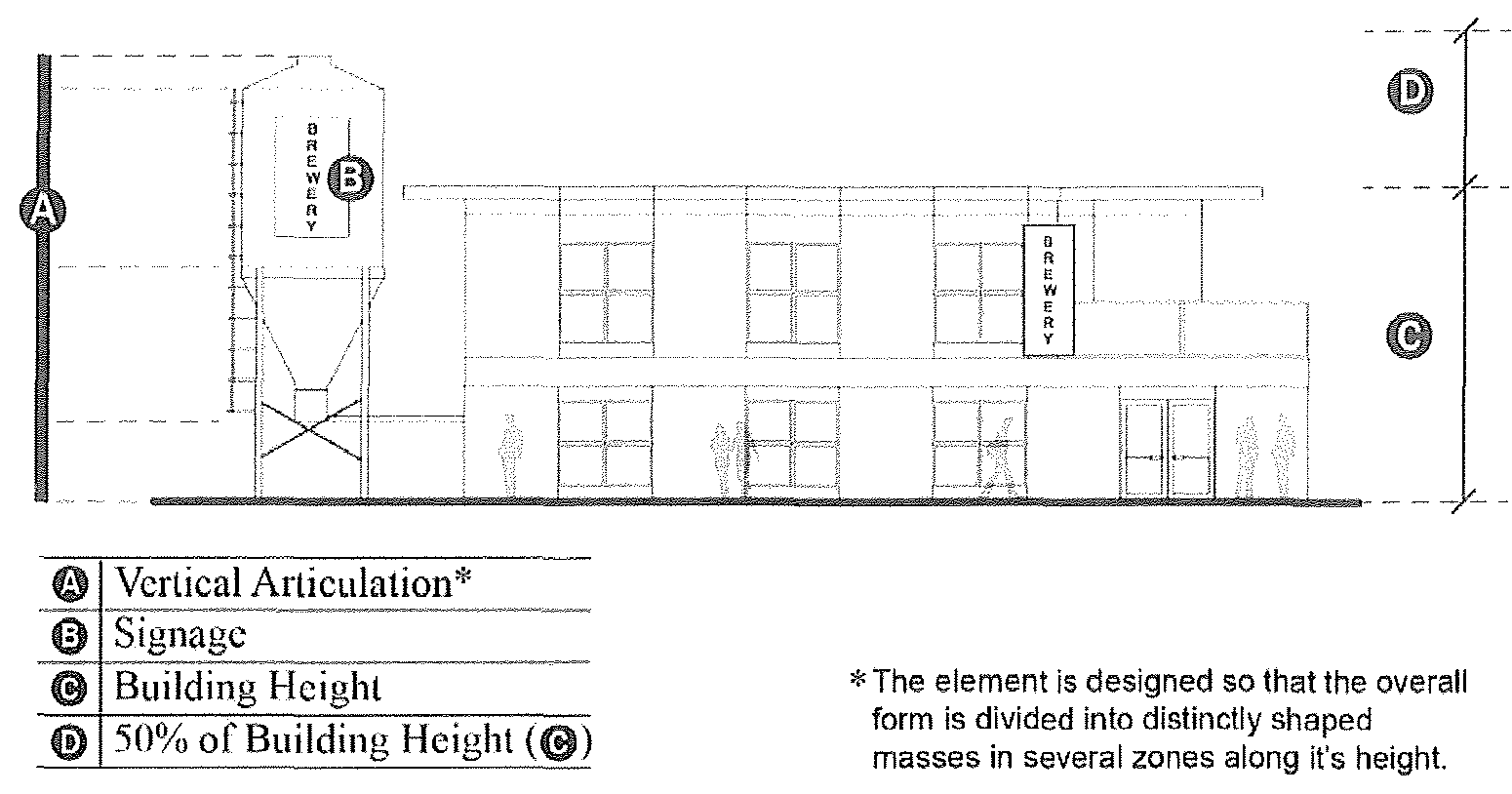
(1)
The silo shall be vertically articulated such that the overall form is divided into distinctly shaped masses in at least three (3) zones along its height; and
(2)
Signage or decorative design may be included on the face of the silo at a maximum coverage of sixty (60) percent; and
(3)
The silo and associated structures shall not exceed one hundred fifty (150) percent of the building height; and
(4)
The silo shall be consistent with the materials and context of the principal building.
(Ord. No. O-2014-68, § 15, 9-2-14)
Sec. 18-326. - Prescribed conditions for artisan food and beverage producers.
Artisan food and beverage producers with all processing, storage, and any accessory uses occupying under ten thousand (10,000) square feet, or under twenty-five thousand (25,000) square feet if adaptive reuse of a building existing at the time of the adoption of this ordinance, shall not be classified as manufacturing. Uses that create excessive noise, odor, smoke, dust, or other objectionable external impacts that might be detrimental to surrounding neighbors or other uses are not permitted. Artisan food and beverage producers not meeting the criteria of this section shall continue to be permitted in other districts subject to meeting requirements for permitted uses. Artisan food and beverage producers shall be permitted in the CB, RB, CBD, CS, RFMU, MX, and UMX subject to the following location, size, and design requirements:
(a)
Artisan food and beverage producers within the CB, Community Business District:
(1)
Shall include one or more accessory uses such as a tasting room, tap room, restaurant, retail, demonstration area, education and training facility or other use incidental to the artisan food and beverage producer and open and accessible to the public; and
(2)
Required parking shall be calculated based on square footage proposed for each use; and
(3)
Storage of materials, including silos, products for distribution and other items requiring long-term storage shall be allowed in areas behind building, within service alleys, in enclosed buildings, or otherwise screened from the public right-of-way or pedestrian way; and
(4)
Off-site distribution via tractor trailer is only permitted if the truck traffic is limited to streets classified as arterial on the Wilmington Metropolitan Planning Organization Functional Classification Map.
(b)
Artisan food and beverage producers within the RB, Regional Business District and the CS, Commercial Services District:
(1)
Shall include one or more accessory uses such as a tasting room, tap room, restaurant, retail, demonstration area, education and training facility or other use incidental to the artisan food and beverage producer and open and accessible to the public; and
(2)
Required parking shall be calculated based on square footage proposed for each use.
(c)
Artisan food and beverage producers within the CBD, Central Business District:
(1)
Shall include one or more accessory uses such as a tasting room, tap room, restaurant, retail, demonstration area, education and training facility or other use incidental to the artisan food and beverage producer and open and accessible to the public; and
(2)
Shall be designed such that all newly constructed loading and unloading facilities are internal to the site or in service alleys or at the back of the building; and
(3)
Storage of materials, including silos, products for distribution and other items requiring long-term storage shall be allowed in areas behind building, within service alleys, in enclosed buildings, or otherwise screened from the public right-of-way or pedestrian way; and
(d)
Artisan food and beverage producers within the MX, Mixed Use, UMX, Urban Mixed Use District and RFMU, Riverfront Mixed Use District:
(1)
Shall include one or more accessory uses such as a tasting room, tap room, restaurant, retail, demonstration area, education and training facility or other use incidental to the artisan food and beverage producer and open and accessible to the public; and
(2)
Shall be designed such that all newly constructed loading and unloading facilities are internal to the site or in service alleys or at the back of the building; and
(3)
Storage of materials, including silos, products for distribution and other items requiring long-term storage shall be allowed in areas behind building, within service alleys, in enclosed buildings, or otherwise screened from the public right-of-way or pedestrian way.
(f)
The city manager may authorize an exception to the prohibition in this section of outside storage silos provided they are consistent with the illustrative diagram and design guidelines below:
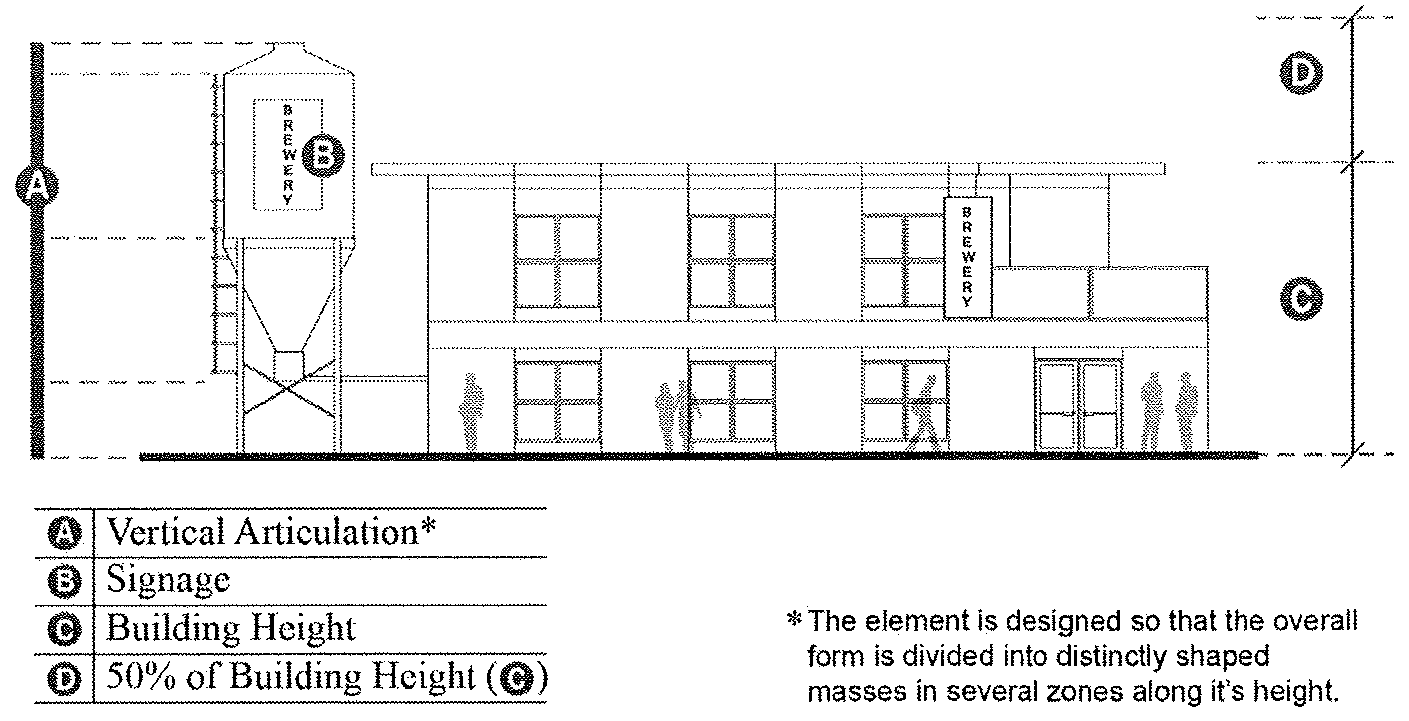
(1)
The silo shall be vertically articulated such that the overall form is divided into distinctly shaped masses in at least three zones along its height; and
(2)
Signage or decorative design may be included on the face of the silo at a maximum coverage of sixty (60) percent, but not to exceed that allowable by the sign ordinance; and
(3)
The silo and associated structures shall not exceed one hundred fifty (150) percent of the building height; and
(4)
The silo shall be consistent with the materials and context of the principal building.
(O-2015-31, § 13, 5-5-15)
Sec. 18-327. - Single-family courtyard developments.
Single-family courtyard development is a type of detached housing providing small residences for smaller households. This housing type is provided as part of the city's overall housing strategy, which seeks to meet the needs of a population diverse in age, income, household composition, and individual needs through encouraging a variety of housing types and price points, innovation and variety in housing design and site development. These developments are intended to foster a strong sense of community through shared use of common space.
Development standards for single-family courtyards are intended to create a small community of homes oriented around open space (courtyard) that is pedestrian-oriented, provides for pedestrian amenities, minimizes the visibility of off-street parking, and takes advantage of natural features on the site. The development standards are intended to maintain the traditional amenities and proportions associated with these pocket neighborhoods while ensuring that these housing developments contribute to the overall community character. Courtyard developments typically allow higher densities than are allowed in the underlying zoning districts. This increased density is possible through the use of smaller than average home sizes, clustered parking, and site design standards. Courtyard housing developments are encouraged to use low-impact development techniques to the greatest extent possible.
Performance standards for housing unit density, separation between developments, impervious surface areas, building heights and sizes are employed in cottage developments to improve predictability in the design, review, and approach of such projects. These standards also reduce the impacts of increased density, prevent overbuilding of the site, and limit the amount of off-street parking necessary to serve the development. Because of the limited building size and typically smaller household size, parking requirements are reduced; parking should be designed to minimize visibility from the street.
Development of single-family courtyard housing is a voluntary development pattern in the R-20, R-15, R-10, R-7, R-5, and R-3 zoning districts. Within the R-20 and R-15 districts, a special use permit is required. Submission of a single-family courtyard development plan for review and approval by the subdivision review board shall constitute voluntary owner consent for this optional development pattern.
(a)
Permitted uses. The uses allowed in each district as described in this chapter are allowed in the cottage developments option of the R-20, R-15, R-10, R-7, R-5, and R-3 zoning districts, except that the following uses shall be prohibited:
(1)
Golf courses, private or public, with related services, including pro-shop.
(2)
Parks and recreation areas, municipal.
(3)
Governmental uses outside public rights-of-way, except offices.
(4)
Libraries.
(5)
Religious institutions.
(6)
Telecommunication facility, unattended.
(7)
Property-restricted real estate sales office.
(8)
Accessory apartments, attached or detached.
(9)
Kennels, private.
(10)
Schools, primary, secondary, university and college.
(11)
Duplex, triplex, quadraplex.
(12)
Bed and breakfast.
(13)
University administrative offices.
(14)
Day care, adult or child.
(b)
Development Standards.
(1)
Courtyard developments are intended to foster a sense of community and shared common spaces. To help achieve this, courtyard dwelling units shall be developed in clusters or pods of at least four (4) but no more than twelve (12) dwelling units per cluster. Multiple clusters may be developed within a single courtyard development.
Lot dimensions:
(2)
Central courtyard open space. Each courtyard cluster must be oriented around a courtyard or common central open space, which is critical to the design of any single-family courtyard development. Each dwelling unit shall have the primary orientation toward this central open space. For the purpose of single-family courtyard housing developments, common courtyard open space shall be a central space that may be used by all occupants of the housing cluster.
a.
A minimum of five hundred (500) square feet of open space per dwelling unit shall be allocated to each cluster's central open space.
b.
No common central open space shall have a dimension less than thirty (30) feet. Parking areas, yard setbacks, required setback areas, private open space, and driveways do not qualify as common open space.
c.
Pedestrian connectivity shall be provided through each central courtyard open space. An improved pedestrian path or sidewalk from each cottage dwelling unit to the pedestrian facilities of the central courtyard open space shall be provided.
d.
Above-ground stormwater control measures shall not be placed in the central courtyard.
(3)
Dimensional and orientation requirements.
a.
Maximum building height shall be thirty-five (35) feet. Structures in courtyard housing developments shall be designed to be single-story, single-story plus a loft, or two-story.
b.
Front porches. All cottage dwelling units shall be provided with a covered main entry porch to create a private outdoor space protected from the weather and provide a transition from the interior private residential space to the semi-public outdoor space. Covered porches shall be usable in both design and dimension.
i.
Homes shall have a covered main entry porch with a floor area measuring at least seventy-five (75) square feet in area.
ii.
The floor of the covered main entry porch shall have minimum dimensions of not less than eight (8) feet in any direction (length or width).
c.
Building Orientation. Any structure with a street-facing facade shall contribute to the neighborhood through the use of windows, changes in materials and/or color, and views of front doors or porches. The primary orientation and front porch of some cottages may be visible from adjacent streets to provide a visual pedestrian connection with the surrounding neighborhood. All dwelling units shall be oriented to avoid blank walls or appear to have a "back" towards streets or common courtyard open spaces. Garages shall not be oriented towards the common courtyard open space, a primary street, or towards the front facade of any other courtyard dwelling unit.
d.
Lot configuration. Courtyard housing may be developed on individual lots or with a common form of ownership (townhouse or condominium-style), with all units within a development on a single lot. In either case, street frontage is only required for the parent parcel and not for each dwelling unit. When a courtyard development is subdivided for multiple ownership, a community property owner's association shall be established in accordance with the subdivision ordinance.
e.
Dwelling unit floor area. The heated ground floor area of any dwelling unit may not exceed one thousand one hundred (1,100) square feet. Covered porches shall not be included in the calculation of floor area. An engaged garage (a garage that is under the same roof as the dwelling area and serves only the dwelling unit to which it is attached) shall not be included in the calculation of the floor area; however, the total square footage of an engaged garage shall not exceed one-third (⅓) of the gross heated ground floor area of the dwelling unit or three hundred (300) square feet, whichever is less.
f.
Building setbacks. Regardless of whether courtyard developments are developed on individual lots or developed on a single parent parcel, setbacks from the front, side, and rear parent parcel lines shall be consistent with those of the zoning district
i.
The subdivision review board may approve variations from these setbacks to allow front yard averaging along public streets, to maximize preservation of significant trees, or to take advantage of unique site and topography features.
ii.
The minimum distance between buildings within a courtyard development shall be six (6) feet.
iii.
Dwelling units should be setback at least six (6) feet, but no more than eighteen (18) feet, from the common courtyard open space.
(4)
Trees and landscaping. Courtyard developments shall be designed to incorporate existing trees and natural features into the site design according to the regulations found in this section rather than Article 8 of this chapter.
a.
New trees shall be located to create amenities in the common courtyard open space and within private open spaces, to provide shade where appropriate, to enhance separation between buildings where desired, and to screen and soften the perimeter of parking areas and street-facing sides of cottage housing developments.
b.
There shall be a minimum of two (2) canopy trees per dwelling unit in each cluster. This requirement may be satisfied by the preservation of existing canopy trees or by planting new canopy trees on site.
c.
In the R-20 district and within identified resource protection areas, buildings shall be located so as to maximize natural stormwater functions. Buildings shall be clustered and parking areas shall be located to preserve as much contiguous, permanently undeveloped open space and native vegetation as possible.
d.
Foundation plantings. Foundation plantings shall be installed around each building within a courtyard development along any exposed building foundation of a building facade, except where the building facade directly abuts a sidewalk or other hardscape feature.
i.
All street-facing foundations shall have landscaping consisting primarily of shrubs, perennials, and native grasses.
ii.
In instances where a porch, stoop, or other architectural building element protrudes from the building structure, the landscaped area may be along the outer edge of the element rather than the foundation.
iii.
Buildings with facades (front or rear) that face a courtyard, street, or driveway shall plant one (1) shrub for every five (5) linear feet of facade.
iv.
Foundation plantings shall be planted within five (5) feet of the building foundation or architectural element.
(5)
Low-impact development. As soils allow, courtyard developments shall be designed to take advantage of open space, landscaped features, and natural areas to utilize low-impact development techniques, including natural filtration and on-site infiltration of stormwater.
(6)
Parking. The placement, location, and design of off-street parking shall be designed to minimize the visual and physical impacts of parking on the courtyard development and to maintain a pedestrian character for the overall development. Off-street parking shall be located and designed to be less visible from frontage streets than the cottages themselves. Off-street parking shall be located to the side or rear of dwelling units and shall not be located between dwelling units and the primary street frontage. If it is determined by the Subdivision Review Board that another design solution may meet these objectives, strict compliance with the location of parking may be waived.
a.
For the purposes of this section, "parking areas" are where two (2) or more off-street parking spaces are adjacent.
b.
Any portion of the central courtyard open space within thirty-five (35) feet of a parking space shall not be counted towards the minimum courtyard space requirement.
c.
The number of dwelling units immediately adjacent to parking areas shall be less than the number of units not located adjacent to parking areas.
d.
Parking lot landscaping shall be installed to provide one (1) canopy tree per two (2) parking spaces to provide shade (in addition to the trees and landscaping requirements above). This requirement may be satisfied with existing trees or new trees.
e.
For a depth of forty (40) feet from the street frontage of the parent parcel, driveways and parking spaces shall consume not more than one-third (⅓) of the total lot width.
f.
No more than one-third (⅓) of the total number of dwelling units may be serviced by a private driveway or engaged garage. For example, if there are nine (9) units in a development, no more than three (3) of the cottage dwelling units may have a private driveway or engaged garage.
g.
Parking areas shall be setback from parent parcel lines when adjacent to single-family zoned parcels. The subdivision review board may reduce the setback and buffer requirements when parking areas are adjacent to an alley.
h.
The requirements for off-street parking may be reduced by the subdivision review board if it can be demonstrated that sufficient on-street parking exists to meet the needs of the development. Parking shall not exceed the following ratios:
(O-2015-69, § 7, 9-1-15; Ord. No. O-2018-74, § 1, 12-4-18)
Sec. 18-328. - Freestanding parking structures.
Free standing parking structures shall comply with the following conditions:
(a)
Freestanding parking structures shall have no blank walls and shall be designed so as to limit the visibility of interior ramps and outside glare from interior lighting.
(b)
Facades facing the right-of-way shall be subject to the design standards as stated in section 18-196(h) of this chapter.
(c)
Commercial and/or office uses are required for a minimum depth of twenty (20) feet on the ground floor of all facades facing the right-of-way along all main streets and special character streets as identified in the comprehensive plan.
(d)
Vehicular access shall be located on non-primary streets, where possible.
(Ord. No. O-2016-65, § 2, 8-16-16)
Sec. 18-329. - Whole-house lodging and homestay lodging in the O&I-1, O&I-2, CB, RB, CBD, AI, RFMU, MX, MSMU, and UMX Districts.
(a)
Registration.
(1)
Property owners shall register each establishment annually with the City of Wilmington.
(2)
A registration number shall be assigned to each registered establishment, which shall be clearly noted along with any advertisement for lodging.
(b)
Any use for which there are three (3) final determinations of violations of the City Code and/or criminal convictions related to the parcel (on, adjacent to, or within the property) by a property owner, tenant, guest, host, lessee, or individual otherwise related directly to the property within any rolling three hundred sixty five (365) day period, shall constitute a violation of the terms of registration and shall terminate registration. For any registration that is terminated due to code/criminal violations, a property owner shall be ineligible for registration for a period of three (3) years.
(c)
A property owner, as well as any host/operator, shall: 1) be responsible for ensuring compliance with all federal, state, and local laws, including, but not limited to tax code, building code, fire code, and environmental health regulations for the level of occupancy of the short-term lodging; and 2) not allow any party, event, classes, weddings, receptions, or other large gatherings on the premises.
(d)
Property owners shall be responsible for keeping in full force and effect during all times the unit is used as a short-term lodging or homestay commercial general liability insurance with a total limit of not less than five hundred thousand dollars ($500,000.00) each occurrence for bodily injury and property damage.
(e)
Written notice shall be conspicuously posted inside each short-term lodging unit setting forth the following information:
(1)
The name and telephone number of the host/operator.
(2)
The address of the lodging, the maximum number of overnight occupants, and the day(s) established for garbage collection.
(3)
The non-emergency phone number of the City of Wilmington Police Department.
(4)
The annual registration documentation.
(5)
That parties, events, classes, weddings, receptions, and other large gatherings are not permitted.
(f)
The host/operator shall ensure that all refuse is stored in appropriate containers and set out for collection on the proper collection day(s) and the carts removed from the street or alley on the scheduled collection day, in accordance with section 10-14 of the City Code.
(g)
Preparation and service of food by host/operators for guests shall be prohibited. No cooking shall be permitted in individual bedrooms.
(h)
Short-term lodging uses shall be prohibited on the ground floor of street-facing facades, excluding alleys, except within any properly permitted single-family, duplex, triplex, quadraplex, and multifamily structures existing at the time of the adoption of the ordinance from which this section derives.
(Ord. No. O-2018-47, § 33, 6-19-18, eff. 3-1-2019)
Sec. 18-330. - Homestay lodging in residential, multifamily, and historic districts.
Homestay uses are permitted in single-family zoning districts, including all of the R districts, the HD, HD-R, HDMU districts, and in all of the MF districts.
Homestay lodging uses shall only be allowed in lawfully permitted dwelling units serving as the principal residence of a host. Only a property owner may register a homestay lodging; however, the principal resident may act as a host. Homestay lodging uses do not include bed and breakfast lodging uses.
(1)
Registration.
a.
A property owner shall register each establishment annually with the City of Wilmington.
b.
Registration is restricted to a property owner, who shall provide proof of possession of the registered premises, and to natural persons only. A host may be the property owner or another principal resident.
c.
A registration number shall be assigned to each registered establishment, which shall be clearly noted along with any advertisement for lodging.
d.
Active registrations shall not expire, provided that a property owner shall renew registration on an annual basis. If a property owner fails to renew a registration, the registration shall be considered terminated by the property owner.
e.
Registration does not vest the premises or property owner with any rights. Registration terminates upon transfer of the property to another owner.
f.
Any bedroom rentals for periods of twenty-nine (29) days or less not properly registered as a bed and breakfast shall register as a homestay.
(2)
The maximum number of guest rooms allowed shall be one (1) less than the total number of bedrooms in the dwelling unit, not to exceed three (3) guest rooms.
(3)
In the R-20, R-15, R-10, R-7, R-5, R-3, HD, HD-R, and HDMU districts:
a.
The host shall issue a parking placard to each guest parking on site.
b.
Guest parking shall be restricted to behind the plane of the front façade of the home, except on an existing improved parking surface existing at the time of the adoption of the ordinance from which this section derives.
c.
No more than three (3) motor vehicles owned or operated by patrons shall be parked onsite at any time.
(4)
The use provisions of this section are not subject to variance by the board of adjustment.
(5)
If there are three (3) final determinations of violations of the City Code and/or criminal convictions related to the parcel (on, adjacent to, or within the property) by a property owner, tenant, guest, host, lessee, or individual otherwise related directly to the property within any rolling three hundred sixty-five (365) day period, shall constitute a violation of the terms of registration and shall terminate registration. For any registration that is terminated due to code/criminal violations, the owner(s) of the property shall be ineligible for registration for a period of three (3) years.
(6)
Any property owner registering a homestay lodging, as well as any host, shall: 1) be responsible for ensuring compliance with all federal, state, and local laws, including, but not limited to tax code, building code, fire code, and environmental health regulations for the level of occupancy of the homestay; 2) not allow any party, event, classes, weddings, receptions, or other large gatherings on the premises.
(7)
Property owners registering a homestay lodging are responsible for keeping in full force and effect during all times the dwelling unit is used as a homestay lodging commercial general liability insurance with a total limit of not less than five hundred thousand dollars ($500,000.00) each occurrence for bodily injury and property damage.
(8)
Homestay lodging registrants and hosts shall maintain records demonstrating that the home is a host's primary residence, the dates of rental for the previous three hundred sixty-five (365) days, and the number of renters. Such records shall be made available, upon request, to the city manager.
(9)
The definition of "family" and the restriction of a minimum thirty (30) day rental period in the MF districts shall not apply to properly registered homestay lodging.
(10)
Written notice shall be conspicuously posted inside each short-term lodging unit setting forth the following information:
a.
The name and telephone number of the host.
b.
The address of the lodging, the maximum number of overnight occupants, and the day(s) established for garbage collection.
c.
The non-emergency phone number of the City of Wilmington Police Department.
d.
The annual registration documentation.
e.
That parties, events, classes, weddings, receptions, and other large gatherings are not permitted.
(Ord. No. O-2018-47, § 33, 6-19-18, eff. 3-1-2019)
Sec. 18-331. - Whole-house lodging uses in the residential, multifamily, and historic districts.
(a)
Within the R-20, R-15, R-10, R-7, R-5, R-3, MF, HD, HD-R, and HDMU districts, whole-house lodging establishments are permitted subject to the following conditions. Whole-house lodging is not permitted within the MHP district.
(b)
Each whole-house lodging establishment shall meet the minimum separation distance from any other residentially-zoned whole-house lodging establishment or any properly permitted bed and breakfast lodging also within a residential zoning district, as measured from parcel line to parcel line. In the case of a duplex, triplex, quadraplex or multifamily development, this shall be measured from the parent parcel lines. The total number of permitted uses shall be limited by a cap.
The separation distances and caps shall be:
Within the 1945 corporate limits: four hundred (400) feet, with a cap of no more than two (2) percent of the total number of residentially-zoned parcels within the 1945 corporate limits being eligible for use as whole-house lodging establishments.
Outside the 1945 corporate limits: four hundred (400) feet, with a cap of no more than two (2) percent of the total number of residentially-zoned parcels outside of the 1945 corporate limits being eligible for use as whole-house lodging establishments.
(c)
Such uses shall require a local operator, available twenty-four (24) hours per day, within twenty-five (25) miles of the subject property.
(d)
Registration.
(1)
The property owner shall register each establishment annually with the city of Wilmington.
(2)
The owner shall provide proof of possession of the registered premises.
(3)
A registration number shall be assigned to each registered establishment, which shall be clearly noted along with any advertisement for lodging.
(4)
Registration is limited to natural persons only and no person shall be eligible for more than one (1) registration for a whole-house lodging in any residential district.
(5)
Active registrations shall not expire; however, all property owners shall renew registration on an annual basis. Registrations not renewed on an annual basis shall deem the use terminated by the property owner.
(6)
Registration does not vest the premises or the property owner with any rights. Registration terminates upon the transfer of the property.
(7)
Only one (1) registration may be issued per property, either whole-house lodging or bed and breakfast lodging, at any given time.
(8)
For the initial registration process, a lottery method shall be utilized based on the cap and separation requirements. Subsequent registrations will be processed by the city manager on a first-come, first-served basis.
(e)
A minimum of one (1) off-street parking space, of an all-weather surface, per bedroom is required. Within HD, HD-R, and HDMU districts, only curb cuts existing at the time of the adoption of this section may be used to provide off-street parking. If off-street parking is not available on site, shared parking or rented spaces in a private or municipal parking deck or lot may be used to satisfy this parking requirement. Proof of a shared parking plan or rental of spaces shall be included with annual registration. A shared parking plan will be enforced through written agreement among all owners of record. An attested copy of the agreement between the owners of record must be approved by the city attorney and submitted to the city for recordation on forms made available in the office of the city attorney. Recordation of the agreement must take place before issuance of a registration for any short-term lodging use to be served by the off-site parking area. A short-term lodging registration shall be revoked if required off-street parking spaces cannot be provided.
(f)
The use provisions of this section are not subject to variance by the board of adjustment.
(g)
The definition of "family" and the restriction of a minimum thirty-day rental period in the MF districts shall not apply to property registered whole-house lodging uses.
(h)
Any use for which there are three (3) final determinations of violations of the City Code and/or criminal convictions related to the parcel (on, adjacent to, or within the property) by a property owner, tenant, guest, host, lessee, or individual otherwise related directly to the property within any rolling three hundred sixty-five-day period, shall constitute a violation of the terms of registration and shall terminate registration. For any registration that terminated due to code/criminal violations, the property owner shall be ineligible for registration for a period of three (3) years.
(i)
A property owner who terminates registration shall be ineligible for registration for a period of three (3) years at that address.
(j)
Any property owner registering a whole-house lodging shall: 1) be responsible for ensuring compliance with all federal, state, and local laws, including, but not limited to tax code, building code, fire code, and environmental health regulations for the level of occupancy of the lodging; and 2) not allow any party, event, classes, weddings, receptions, or other large gatherings on the premises.
(k)
Property owners registering a whole-house lodging are responsible for keeping in full force and effect during all times the unit is used as a whole-house lodging commercial general liability insurance with a total limit of not less than five hundred thousand dollars ($500,000.00) each occurrence for bodily injury and property damage.
(l)
Registrants shall maintain records demonstrating the local operator, the dates of rental for the previous three hundred sixty-five (365) days, and the number of renters. Such records shall be made available, upon request, to the city manager.
(m)
Registration shall terminate upon any one (1) of the following: discontinuance of use for a period of one hundred eighty (180) days or more, failure to renew annual registration, transfer of the property.
(n)
Written notice shall be conspicuously posted inside each short-term lodging unit setting forth the following information:
(1)
The name and telephone number of the operator.
(2)
The address of the lodging, the maximum number of overnight occupants permitted, and the day(s) established for garbage collection.
(3)
The non-emergency phone number of the City of Wilmington Police Department.
(4)
The annual registration number.
(5)
That parties, events, classes, weddings, receptions, and large gatherings are not permitted.
(o)
The operator shall ensure that all refuse is stored in appropriate containers and set out for collection on the proper collection day and the carts removed from the street or alley on the scheduled collection day, in accordance with section 10-14 of the City Code.
(p)
Preparation and service of food by operators for guests shall be prohibited. No cooking shall be permitted in individual bedrooms.
(q)
Any establishments existing at the time of the adoption of the ordinance from which this section derives and conforming with the regulations effective prior to adoption of this section for which registration cannot be accommodated due to the cap or the separation requirements shall have a one-year-amortization period. If, after this amortization period, the whole-house lodging establishment is unable to properly register, the use of the property as whole-house lodging must be terminated. Any such establishment shall register with temporary registration with the city manager register pursuant to section 18-330(1).
(Ord. No. O-2019-6, § 11, 2-5-19)
Sec. 18-333. - Domestic violence shelters.
(a)
Within the R-20, R-15, R-10, R-7, R-5, R-3, MF, HD, HD-R, and HDMU Districts, domestic violence shelters are permitted subject to the following conditions. Domestic violence shelters are not permitted in the MHP District.
(b)
The property shall be located within one (1) mile of a licensed hospital.
(c)
There shall be no more than two (2) unrelated residents per bedroom and the usable floor area shall be no less than two hundred (200) square feet per resident.
(d)
A management plan and a floorplan shall be submitted with the zoning permit application and shall include a plan for noise, parking, and solid waste management and the number of resident on-site supervisory personnel, if any.
(e)
Such uses shall only be permitted in structures existing upon the adoption of this ordinance and additions to such structures for the purposes of expanding the use shall not be permitted.
(Ord. No. O-2020-62, § 18, 10-20-20)
Sec. 18-340. - General.
(a)
Purpose. It is the purpose of this section to recognize that there is a need for special allowances to be granted to certain temporary uses so that they may be permitted within the community. Because of the special problems related to temporary uses, it is also necessary to provide specific, separate and distinct guidelines and standards for them. It is the express intent of these provisions to minimize any potential adverse impact of such temporary uses by eliminating, to the greatest possible extent, any major problems, threats or dangers to the public health, safety or welfare as may exist with any or all of these temporary uses.
(b)
Definitions and permitted uses. Temporary uses shall be limited to a use or uses of land, buildings or structures not intended to be of a permanent duration. Such uses shall be limited to the following:
(1)
Circuses and/or carnivals.
(2)
Evangelistic and religious related congregation.
(3)
Outdoor bazaars, cookouts, and/or similar activities by eleemosynary, churches, or other nonprofit institutions and organizations.
(4)
Open lot sales for agricultural and related products.
(5)
Open lot sales area for Christmas trees or special fundraising sales for nonprofit organizations.
(6)
Contractors' offices and/or construction sheds including mobile offices for displaced persons or contractors during construction on the site.
(7)
Temporary real estate sales office.
(8)
Temporary relocation manufactured housing for displaced persons as a result of natural or manmade disasters or public sponsored redevelopment projects in a neighborhood or area.
(9)
Temporary special sales or "flea" markets in commercial or industrial districts (occasional sidewalk or parking lot sales).
(10)
Other temporary recreational or entertainment related events or activities such as fairs or concerts.
(11)
Attendant accessory uses or facilities to the above permitted temporary uses, including, but not limited to, recreational vehicles and travel trailers designed and equipped to serve as a temporary or substitute dwelling units with sleeping and cooking accommodations.
(12)
Temporary city satellite service office.
(13)
Wireless telecommunication towers.
(14)
Mobile food unit.
(15)
Temporary family health care structure.
(16)
Temporary recreation or entertainment related use of manned aircraft with vertical take-off and landing capabilities, including helicopter tours.
(c)
Standards. The following guidelines shall apply to all the allowable temporary uses:
(1)
A letter of intent outlining the dates, location, use, duration of use, owner, operator and other pertinent information shall be submitted along with the other requirements of this chapter to the city manager prior to issuance of a certificate of occupancy. Such letter, upon final acceptance, shall be the commitment to comply with the requirements contained herein and the conditions outlined therein by the responsible party of such use.
(2)
The city manager shall inspect and approve the installation of all temporary uses prior to any use of the facility.
(3)
For circuses, carnivals, bazaars, evangelistic or religious congregations, open lot sales, fairs or special entertainment events and special sales, each permit applicant shall submit a parking and traffic plan which shall include the following:
a.
Indication of area to be used by operator's vehicles and customers;
b.
Designation of entrances and exits, traffic flow, and parking areas;
c.
Total number of parking spaces available;
d.
Estimated number of customers or participants;
e.
Plans for ensuring compliance with section 5-62 of the City Code;
f.
Traffic control measures.
The applicant shall also submit a plan for compliance with the Noise Control Ordinance as contained in Article 2 of Chapter 6 of the City Code.
Permitted hours of operation for circuses, carnivals, bazaars, fairs and special entertainment events are set forth in section 6-20 of the City Code.
(4)
If a temporary use is to be installed for six (6) months or more, the facility shall be connected to public water and sanitary sewer provided by the Cape Fear Public Utility Authority. Otherwise, approved portable toilets shall be provided.
(5)
Where a tent or similar structure is to be used, the following requirements or documentation shall be met:
a.
A limitation on the number of occupants in a structure shall be observed as per the instruction of the city manager.
b.
In conjunction with an occupancy limit, a seating plan, if seating is provided for an audience, must also be submitted and approved by the city manager.
c.
If a tent is to be used for human occupancy, a certificate of insurance must be submitted which will cover liability on the part of the applicant or sponsor in the event of an accident.
d.
A certificate of flame resistance shall be submitted which will provide assurance that the structure has been properly treated with flame retardant and has been maintained as such.
(6)
Where temporary structures, tents, mobile offices, accessory uses, existing structures or similar uses are required in connection with the temporary use, a sketch plan or layout generally drawn to scale shall be submitted and shall show the location or placement of the temporary uses, structures and accessory uses in conjunction with adjacent streets, parking, attendant accessory uses, existing or proposed structures, and traffic movement or flow pattern and entrances and exits.
(7)
The following additional conditions or requirements shall apply for each permitted temporary use:
ADDITIONAL REQUIREMENTS FOR TEMPORARY USES
Note: The use of temporary tents or similar structures in the primary fire district (CBD area) as identified and set forth in Chapter 16, section 16-57 of the Code of Ordinances may be permitted for special events if authorized by the city manager.
(8)
The following additional requirements shall apply:
a.
Temporary real estate office. The office or required accessory uses shall not be equipped or used for dwelling purposes including, but not limited to, sleeping and major cooking activities.
b.
Temporary offices or construction trailers during construction activity.
i.
Such uses shall not occupy a site within any nonresidential zoning district for more than one (1) year except by variance authorized by the board of adjustment. Such uses shall not occupy a site within any residential zoning district for more than six (6) months; however, temporary use permits may be renewed by the city manager for additional six-month periods if all provisions of this section are met.
ii.
Temporary accommodations for the displaced shall be allowed only on the construction site and for the specific purpose of providing temporary relocation of office or work/activity space required during construction activities involving renovation, expansion or reconstruction of an existing facility. Such temporary facilities for the displaced shall not apply to residential renovation, expansion or reconstruction except as allowed in this section and such facilities shall not be used for residential dwelling purposes.
iii.
Such use may be placed on the proposed construction site no earlier than one (1) month prior to construction and must be removed no later than one (1) month following completion of the construction.
iv.
Construction trailers:
a.
May be allowed only on sites where construction is ongoing and a valid building permit has been issued and remains active.
b.
Must be set back a minimum of ten (10) feet from all property lines.
v.
Construction trailers may be allowed in residential districts for initial construction only, not to include residential additions or renovations, and must be removed prior to the issuance of a final certificate of occupancy.
c.
Fairs or related temporary recreational or entertainment events. Fairs or similar events which usually occur on an annual basis and are held in the following locations shall be allowed at these locations if in compliance with subsection (c):
i.
Public parks if authorized by the city manager.
ii.
School or college grounds if authorized by the school superintendent or college president.
d.
Temporary housing; manufactured housing; nonpermanent facilities for the displaced as a result of a natural or manmade disaster or a publicly sponsored redevelopment or rehabilitation project in a neighborhood or area shall be allowed provided they meet the following requirements:
i.
The manufactured housing must be sited in accordance with the following dimensional requirements:
a.
Each manufactured housing space shall have a minimum area of four thousand (4,000) square feet;
b.
Minimum clearance between each manufactured housing unit shall be fifteen (15) feet;
c.
Each manufactured housing unit shall have a minimum setback of fifteen (15) feet from any street right-of-way, as applicable;
d.
Each manufactured housing unit shall have a minimum setback of twenty (20) feet from all exterior boundary lines of the site, as applicable;
e.
Each manufactured housing unit shall have a minimum setback of twenty (20) feet from any building within the site, as applicable.
ii.
All manufactured housing units shall be connected to public water and sanitary sewer provided by the Cape Fear Public Utility Authority.
iii.
Off-street parking to accommodate a minimum of one (1) car per manufactured housing unit must be provided on the site.
iv.
All manufactured housing units shall be removed from the site within thirty (30) days after completion of the rehabilitation work.
v.
Adequate provision shall be made for solid waste management in compliance with city ordinances and policies.
vi.
The city council has by formal action designated such area as a redevelopment area or a disaster area within specifically defined boundaries and under specific conditions as determined by the city council.
e.
Open lot sales for farm produce.
i.
Temporary lot sales of farm produce are allowed in all districts provided the produce or products for sale must have been grown, raised or produced on the land or lot where the produce sales are being conducted. Except for sales lots within the AI district, no permanent structure may be erected in connection with such farm produce lot sales. In addition, such temporary farm produce lot sales may occur at any time during the year when products grown or produced on the lot are ready for sale.
ii.
Temporary lot sales of agricultural and related products produced off the sales lot site shall be allowed in all commercial districts. However, nothing in this chapter shall prevent such temporary farm produce lot sales from being conducted upon the premises of the City of Wilmington recreation or park sites, church or school grounds regardless of their district location provided such use is authorized by the city manager. In addition, all such temporary open lot sales shall meet the following requirements:
a.
No more than five thousand (5,000) square feet of area shall be utilized for each such lot sales area;
b.
No permanent structures shall be erected in connection with the sales lot;
c.
A specific time schedule and duration of such sales, as well as a time limit for such sales shall be established for each individual use and location at the time of application approval as determined and based upon review by appropriate city officials;
d.
Final approval of such uses shall be according to this section. Appeals may be made to the board of adjustment as set forth in section 18-27 of this chapter.
f.
Temporary city satellite service office.
i.
Must be set up, anchored, and tied down in accordance with the standards and specifications that apply to manufactured housing units and as contained in the North Carolina State Building Code; skirting must be installed to cover the area between the floor of the unit and the ground.
ii.
Must meet all front, rear, and side yard setback requirements that apply to principal structures in the zoning classification where the unit is located.
iii.
Off-street parking for two (2) vehicles must be provided on the premises; in accordance with subsection 18-5(c)(4)e., the parking area need not be surfaced with concrete or asphalt, but may be surfaced with a material deemed appropriate by the city manager.
iv.
On-site lighting may not be higher than the roof of the unit, and in no case higher than ten (10) feet, and must be directed or shielded so not to shine directly into the windows or doors of adjacent structures.
v.
No trees may be removed from the premises used or occupied by a temporary city satellite service office without obtaining a tree removal permit as provided in Article 8, Divisions II and III of this chapter.
g.
Temporary, wireless telecommunication towers shall not exceed one hundred (100) feet in height. All regulations elsewhere in this chapter pertaining to setbacks, spacing, safety zones, EMF emissions, and reception interference applicable to permanent wireless communication towers shall also apply to these temporary towers.
h.
Temporary special sales or "flea markets" in commercial or industrial districts (occasional sidewalk or parking lot sales) may be permitted if they meet the following requirements:
i.
No more than five thousand (5,000) square feet of area shall be used for each such sales area.
ii.
A minimum four-foot clear pedestrian area shall be maintained along all pedestrian walkways.
iii.
No fire lanes or vehicular access ways may be obstructed or encroached upon.
iv.
Safe and clearly marked pedestrian access ways shall be required. Pedestrians shall not be compelled to walk across unmarked drive aisles or through parking spaces to reach the temporary sales area.
v.
No more than five (5) temporary sales per business or site shall be permitted in any calendar year.
vi.
There shall be a minimum forty-five (45) days between such sales in a single location or for an individual business.
vii.
No time extensions shall be granted for special sales.
viii.
These regulations shall apply to temporary uses that are accessory to an existing permitted use.
i.
Mobile food unit.
i.
All mobile food unit operators shall obtain an annual permit from the city manager, unless otherwise exempted in this chapter. Permits shall be issued for the period beginning September 1 and ending August 31 of each year. This permit shall be posted in a visible location on the mobile food unit.
ii.
Mobile food unit operators shall have the signed approval of the property owner for each location at which the mobile food unit operates. This approval must be made available for inspection upon request.
iii.
Within the central business district mobile food units are subject to the following:
a.
Mobile food units are limited to a maximum of five (5) consecutive hours at a single location.
b.
No more than one (1) mobile food unit shall operate on an individual site per day.
c.
No mobile food unit shall operate on more than two (2) individual sites per day.
iv.
The hours of operation for all mobile food units shall be limited to 6:00 a.m. to 3:00 a.m.
v.
Mobile food units shall not be located within seventy-five (75) feet of the main entrance of the nearest restaurant during the restaurant's posted hours of operation. This distance may be reduced to twenty-five (25) feet for food carts less than five (5) feet in length.
vi.
Mobile food units shall be located no less than five (5) feet from any fire hydrant, sidewalks, utility boxes, handicap ramps and building entrances. The required sidewalk setback does not apply to food carts less than five (5) feet in length.
vii.
Mobile food unit operators are responsible for the property disposal of waste and trash associated with the operation. City trash receptacles shall not be used for this purpose. Operators shall remove all waste and trash prior to leaving each location or as needed to maintain the health and safety of the public.
viii.
All associated equipment, including trash receptacles and signage, must be within three (3) feet of the mobile food unit.
ix.
No fire lanes, vehicular access ways, or pedestrian walkways may be obstructed or encroached upon by the mobile food unit.
x.
No amplified microphones or bullhorns shall be permitted as part of the mobile food unit operation.
xi.
Mobile food units shall not occupy parking spaces required to fulfill the minimum requirements of the principal use, unless the hours of operation of the principal use do not coincide with those of the mobile food unit.
xii.
Mobile food units must comply with chapter 4, article III of the Wilmington City Code, which states that no business shall take place on publicly owned or leased property.
j.
A temporary family health care structure, as defined in article 15, in single-family residential zoning districts on lots zoned for single-family detached dwellings, may be permitted if it meets the following:
1.
Any person proposing to install a temporary family health care structure shall first obtain an annual permit from the city manager. The applicant shall provide written certification of impairment from a North Carolina licensed physician and provide evidence of compliance with this section. Annual renewal of the doctor's certification will be required.
2.
The following definitions apply in this section:
a.
Activities of daily living: Bathing, dressing, personal hygiene, ambulation or locomotion, transferring, toileting, and eating.
b.
First or second degree relative: A spouse, lineal ascendant or descendant, sibling, uncle, aunt, nephew, or niece and includes half, step, and in-law relationships.
c.
Mentally or physically impaired person: A person who is a resident of this state and who requires assistance with two (2) or more activities of daily living as certified in writing by a physician licensed to practice in this state.
d.
Caregiver: An individual eighteen (18) years of age or older who (i) provides care for a mentally or physically impaired person and (ii) is a first or second degree relative of the mentally or physically impaired person for whom the individual is caring.
3.
Only one (1) temporary family health care structure shall be allowed on a lot or parcel of land. Such temporary health care structure shall comply with all setback requirements that apply to the primary structure and with any maximum floor area ratio limits that may apply to the primary structure.
4.
A temporary family health care structure shall be allowed as a permitted accessory use in the following situations:
i.
The structure is used to provide housing and care for a mentally or physically impaired person on property owned or occupied by a caregiver as the caregiver's residence; or
ii.
The structure is used to provide housing and care for a mentally or physically impaired person and is placed on property of the residence of an individual named legal guardian of the impaired person.
5.
No signage, advertising or other means of promoting the existence of the temporary health care structure shall be permitted anywhere on the lot or parcel.
6.
Any temporary family health care structure installed pursuant to this section shall be removed no more than sixty (60) days from the date on which the mentally or physically impaired person is no longer receiving or is no longer in need of the assistance provided for in this section.
j.
Temporary helicopter tours.
i.
No more than six (6) temporary helicopter tour permits shall be issued in any calendar year for any single parcel.
ii.
No more than twelve (12) total temporary helicopter tour permits shall be issued citywide in any calendar year.
iii.
There shall be a minimum of thirty (30) days between such uses in a single location or for an individual business/operator.
iv.
A specific time schedule for each use shall be established for each individual proposed location at the time of application and subject to review and approval by appropriate city officials.
v.
The applicant for such a use shall submit a plan demonstrating methods for mitigating noise and public safety concerns.
vi.
The applicant shall submit a flight plan for each proposed use for information purposes only.
(9)
The letter of intent shall also address waste management requirements or needs for the site and special maintenance efforts to insure that the site remains free from debris or a build-up of trash, weeds or other adverse conditions constituting nuisances. The sponsor, owner or manager of any such temporary use shall be responsible for insuring that the site remains free of debris or waste upon the conclusion of each day's sale or such use.
(10)
Approval procedure. The letter of intent together with any other plan or supporting documentation required by this section shall be submitted at least two (2) weeks in advance of a scheduled temporary use. The two-week review period may be waived for minor events by the city manager. This information will be reviewed by appropriate city officials who may include the city manager, chief of police, traffic engineer, and fire chief, or their designees. Upon completion of this review and satisfaction that the temporary use will meet required standards and not pose a serious problem or threat to public health, safety or welfare, then a certificate of occupancy will be issued. Where there is a readily identifiable major problem with the temporary use or location which the applicant is either unwilling to or cannot satisfactorily resolve, or the applicant does not meet the required standards, then the application for a certificate of occupancy for the temporary use shall be denied and the temporary use shall not be allowed. Appeals may be made to the board of adjustment as set forth in section 18-27 of this chapter. Applications for an extension of a temporary use must be made in the form of a letter stating the reasons for an extension. Such extension may be granted by the city manager provided all criteria of the City Code have been met by the applicant and no violations have been noted during the initial event period. Denials of extensions may be appealed to the board of adjustment as set forth in section 18-27 of this chapter. No more than one (1) extension shall be granted, limited to the specified duration of the original temporary use. Requests for extensions shall be submitted two (2) working days prior to the expiration of the use.
(d)
Annual use of single parcel.
(1)
No parcel or tract of land shall be used for a temporary use as permitted herein for a period of more than sixty (60) cumulative days during any calendar year without the issuance of a special use permit pursuant to Article 3, Division IV of this chapter. As a condition for the issuance of a special use permit, the city council shall find that the parcel or tract of land complies with all applicable city requirements for the establishment of a permanent use on the property including, but not limited to, requirements for stormwater management, landscaping, driveways, parking and utilities.
(2)
The time limitations set forth in this section shall not apply to:
a.
Temporary uses with a maximum allowed duration of ninety (90) days or more under this section; and
b.
Temporary uses that are accessory to permanent uses that met all applicable city requirements at the time of construction or occupancy provided that the accessory use does not utilize any required parking spaces or interfere with the approved traffic circulation plan for the site.
(Ord. No. O-2008-25, 4-8-08; Ord. No. O-2008-41, §§ 5, 6, 6-3-08; Ord. No. O-2009-115, §§ 1, 2, 11-4-09; Ord. No. O-2013-54, §§ 1—3, 8-20-13; Ord. No. O-2015-11, § 3, 2-3-15; Ord. No. O-2017-80, § 3, 11-21-17)
Sec. 18-341. - General.
(a)
Purpose. The purpose of the conservation resource regulations is to protect important environmental resources within the city. Protection of these resources is necessary to maintain the city's diverse and ecologically important natural systems; to preserve the city's estuarine systems important for fin fishing and shell fishing; to preserve natural open space; and to protect the resources critical to the city's economic development and tourism industry. The conservation resource regulations shall be in addition to any other regulations that may apply. In the event that the conservation resource regulations conflict with other regulations, the more stringent or higher standard shall control over the less stringent or lower standard.
(b)
Applicability. The development and improvement of property, including the subdivision of land, shall be subject to these performance controls if the parcel is associated with a conservation resource as defined in this division. A parcel is considered to be associated with a conservation resource if either the resource is contained partially or wholly on the parcel or if the resource is located next to a parcel such that a resource setback as defined herein extends into the subject parcel. If a parcel contains a resource that was defined under any previous regulations in the county or city, then it is considered to be associated with a resource under these regulations and the standards herein shall apply. It is the responsibility of the applicant for a development approval to make all necessary investigations to determine if the parcel is associated with a conservation resource. The following uses and activities, however, are exempted from these controls:
(1)
The construction of one (1) single-family detached structure or one (1) residential duplex, or the location of a manufactured home on a parcel or lot of less than one (1) acre unless the lot was part of a subdivision that was subject to conservation resource protections either under this division or any prior city or county conservation resource protection ordinances or regulations. The exemptions do not extend to any accessory structures.
(2)
Commercial, industrial, office or institutional development on a parcel less than one (1) acre in area unless the development was part of a development or subdivision that was subject to conservation resource protections either under this division or any prior city or county conservation resource protection ordinances or regulations.
(3)
The development or redevelopment of a parcel in the urban waterfront as defined by North Carolina Administrative Code 15 NCAC 07H.0209(g) that meets the following conditions:
a.
To the extent practical, the project meets the baseline criteria of article 10 for exceptionally designed projects;
b.
The project includes an extension of or connection to the Riverwalk consistent with city plans and design standards and meets ADA design standards along with a public access easement approved by the city attorney;
c.
The project includes public access traversing the project connecting to the Riverwalk with easements approved by the city attorney spaced at intervals of approximately two hundred (200) feet, or intervals dictated by established or approved street patterns. These pedestrian ways must be landscaped and integrated with public spaces along the river front; and
d.
The project contains a minimum of ten (10) percent pedestrian-oriented public space connected and integrated with the Riverwalk. Public spaces shall provide amenities for comfort and convenience for pedestrians such as seating, lighting, directional signage, bicycle racks and trash receptacles.
(c)
Conservation resources. If a parcel is associated with any one (1) of the conservation resources listed below, then the parcel shall be subject to the performance controls of this division. The city manager shall determine the presence of conservation resources regulated under this division from available information, including information submitted by the applicant regarding actual delineation of the extent of resources existing on the site by a professional soil scientist, biologist or other natural resource professional qualified to identify and delineate such resources. Such determinations are subject to revision if made more than five (5) years prior to the date of application for a development approval and evidence exists that site conditions have changed due to the dynamics of wetland migration, shoreline erosion, sea level rise, or other factors.
(1)
The following conservation resources are subject to this division (wetland types are based on the North Carolina Coastal Region Evaluation of Wetland Significance or NC CREWS):
a.
Headwater swamp/swamp forest wetlands
b.
Pocosin wetlands
c.
Savannah wetlands
d.
Natural or naturalized ponds
e.
Freshwater marsh
f.
Salt/brackish marsh
g.
Primary nursery areas
h.
Animal and plant natural areas of special significance
Except for the uses exempted from the controls in this division, if a parcel is associated with any one (1) of the conservation resources described herein, no permit shall be issued for grading and clearing, tree removal or other land disturbing activities, including permits issued under the New Hanover County Soil Erosion and Sedimentation Control Ordinance or article 8, division III, of this chapter unless the conservation resources as defined in this division have been delineated by a qualified natural resource professional as described herein and the conservation resources will be protected consistent with the terms of this division and are shown with associated buffers and setbacks on the site plan. Except as exempted herein, no person, directly or indirectly, shall engage in a land-disturbing activity or remove any tree from public or private property except in compliance with this division.
(d)
General performance controls for conservation resources. The following general performance controls shall apply to all development associated with a conservation resource that is subject to this division.
(1)
Protection. Conservation resources shall be permanently protected.
(2)
Improvements. A conservation resource shall not be cleared of vegetation, shall not have natural drainage system(s) significantly altered and shall not be developed in any manner that would negatively impact the conservation resource, except under the following conditions:
a.
Improvements that would either protect or enhance the enjoyment of the conservation resource. Such measures not causing significant impact include uncovered walkways, self-guided trails, protective fences, uncovered docks and boat ramps and improvements of similar nature and/or degree of disturbance.
b.
Access to other parts of the parcel. If part of the parcel could be developed, but would be inaccessible due to the existence of a conservation resource, a road and/or utilities may be constructed through the conservation resource. The road and/or utilities, however, shall cross at the narrowest practical point and shall be designed and constructed to the greatest extent practical to minimize impact to the conservation resource.
c.
Access to the waterfront. If the entire waterfront along a parcel is inaccessible due to the existence of a conservation resource(s), a boat ramp or uncovered pier may be built for boating facilities in the conservation resource, subject to relevant state and federal permits. The facilities, however, shall be designed and constructed to the greatest extent practical to minimize impact to the conservation resource(s).
d.
Mitigated impacts permitted by the U.S. Army Corps of engineers for infrastructure improvements.
(3)
Methods of conservation resource preservation. Conservation resources shall remain undivided and shall be permanently preserved by conservation easements, protective covenants, or similar restrictions or by any of the procedures for the dedication of park, recreation, and open space areas set forth in section 18-383(e) of this Code.
(4)
Stormwater runoff. Runoff from impervious surfaces on any part of the parcel shall not be discharged directly into natural water bodies or conservation resources without vegetated filtration and energy dissipation of a length equal to the length of the required conservation resource setback. Runoff shall be routed along vegetated swales, through filter media of vegetation, gravel, sand, or other media, or to bioretention units, constructed wetlands, infiltration devices, detention ponds or other approved devices for purposes of increasing percolation, settling and filtering out of pollutants and decreasing discharge velocity and volume.
(5)
Setbacks. All structures and impervious surfaces shall be set back from the conservation resource (whether the resource is located on the parcel or on an adjacent parcel) the minimum distance from the edge of the resource as specified in the conservation resource setback table set out below. The conservation resource setback shall be subject to the following:
a.
Improvements may be permitted to encroach into the conservation resource setbacks up to twenty-five (25) percent of the buildable area exclusive of other required setbacks provided the following conditions are met:
i.
All runoff from any impervious surface is infiltrated or otherwise treated so as to not impact the resource by using a stormwater treatment device designed to infiltrate runoff from the one-year 24-hour storm; or
ii.
Where soils allow, pervious pavement is used with sub-base infiltration capacity designed to be equivalent to the required protection; or
iii.
Any structure has a vegetated roof constructed in accordance with the state BMP manual;
iv.
The encroachment at no point extends to within one-half (½) the distance to the edge of the resource.
b.
If an expansion or new impervious surface encroaches into the setback on a lot with an existing encroachment, the existing encroachment must be included in the area that requires treatment in accordance with this section.
c.
An encroachment of five hundred (500) square feet or less may be mitigated by treating runoff from a nonencroaching impervious area located elsewhere on the lot, provided it also drains to the resource. The proposed treatment mitigation must be determined by the city manager to provide equivalent or better protection.
d.
Any treatment device used to meet the requirements of this section shall be designed in accordance with the Land Development Code stormwater requirements and Technical Standards and Specifications Manual including recordation of maintenance requirements and necessary easements.
e.
Decks may be allowed to encroach into the conservation resource setback up to six (6) feet. Raised walkways six (6) feet or less in width may encroach into the conservation resource setback. Encroaching portions of walkways and decks shall be uncovered and constructed so that the floorboards are spaced to allow water to flow through directly to the ground. The ground below the walkway or deck shall be left undisturbed or planted with ground cover or other vegetation.
f.
Reserved.
g.
In the event that a new delineation of a conservation resource on a previously subdivided parcel as required in subsection 18-341(c) shows that the resource encroached into the lot reducing its buildable area by fifty (50) percent or more, then front and side setbacks may be reduced by up to one-half (½) of the total setback width or the conservation resource setback may be reduced by up to one-half (½) of its depth along no more than one-half (½) of the length of the setback.
h.
Conservation resource setback table:
(6)
Standards for water-dependent structures:
a.
The board of adjustment may authorize a variance to allow a bulkhead, rip-rap revetment, or similar erosion control device within the required buffer or resource setback area if all of the conditions below are met:
i.
The property has an identifiable erosion problem or has unusual features, such as a steep bank;
ii.
Coastal management has documented the need for shoreline stabilization within the conservation resource buffer;
iii.
The shoreline stabilization measure extends beyond the buffer no more than necessary to: 1) resolve the hardship resulting from unusual features; 2) align with adjacent shoreline stabilization measures; or 3) allow backfill of the area eroded in the year before the date of the permit application; and
iv.
The shoreline stabilization measure will not significantly impair public trust rights or damage adjacent waterfront properties.
b.
Living shorelines permitted:
i.
If site conditions allow, the landowner should first consider a shoreline stabilization method that uses native vegetation alone.
ii.
If native vegetation is not sufficient, natural or artificial sills may be used in conjunction with the vegetation to help reduce eroding shorelines, enhance coastal habitat, and promote resource development within the conservation resource setbacks.
c.
Piers, platforms, floating docks, and other water-dependent access structures are permitted subject to the following conditions:
i.
Residential fixed piers shall be no wider than six (6) feet.
ii.
Residential lots with less than seventy (70) linear feet of shoreline are allowed an uncovered platform up to one hundred forty-four (144) square feet. Such platforms shall be raised a minimum of two (2) feet above natural vegetation.
iii.
Residential lots with seventy (70) linear feet of shoreline or more are allowed a covered platform up to two hundred (200) square feet. Such platforms shall be raised a minimum of two (2) feet above natural vegetation.
iv.
The combined square footage of all pier, platform, and floating dock area, excluding a six (6) foot wide access pier that runs generally perpendicular to the shoreline, shall not exceed four (4) square feet per linear foot of shoreline, up to a maximum of eight hundred (800) square feet. Any portion of a pier or access path that is covered shall be included in combined square footage calculation.
v.
Floating docks may exceed six (6) feet in width, up to eight (8) feet maximum, if encapsulated by a hard shell or equivalent material designed to minimally impact the resource.
vi.
Community boating facilities are allowed a covered or uncovered platform up to two hundred fifty-six (256) square feet in area and a combined square footage of all pier, platform, and floating dock area up to eight (8) square feet per linear foot of shoreline, up to a maximum of two thousand (2,000) square feet. The linear footage shall be determined by adding the lengths of shoreline of all waterfront lots within the community.
(e)
Vegetated buffer controls for conservation resources.
(1)
Purpose and intent. The establishment of a vegetated buffer is intended to promote high water quality in the creeks and sounds, to protect the public health and to ensure the protection of the natural resources within the City of Wilmington.
A properly vegetated buffer is essential to filter and biologically process nutrient rich runoff, animal wastes, and sediment before it enters coastal creeks, canals, and rivers. Buffers also function to moderate water temperatures, maintain the desired dissolved oxygen levels in the water, and stabilize the soils immediately adjoining the stream. In urban environments, the function of a buffer is especially critical to the balance of the plant and animal life in fresh and saltwater creeks. Buffers are most effective when they contain native and naturalized plants appropriate in size, adaptability (salt tolerance, wind tolerance, etc.) and hardiness for the area. Plants requiring intensive or routine maintenance should be avoided in buffer areas.
(2)
Applicability. A portion of the conservation resource setback shall be maintained as a vegetated buffer if a parcel is associated with any of the following conservation resources: salt marsh, brackish marsh, freshwater marsh, wetlands contiguous with tidal wetlands, tidal shores and/or primary nursery areas.
(3)
Standards.
a.
Buffer measurement. Buffers shall extend thirty-five (35) feet measured horizontally from the edge of the conservation resource and on a line perpendicular to and landward of the conservation resource.
b.
Recordation. Buffers shall be delineated on recorded plats along with enumeration of maintenance requirements as defined in this division.
c.
Plant materials in the buffer. The plant material in the buffer must be either retained in a natural, minimally disturbed condition, or properly managed in accordance with the management standards set forth in this division. In cases where vegetation does not exist within the buffer, the city shall require restoration efforts, including but not limited to, replanting of the vegetated buffer with plant species as recommended in the City of Wilmington Technical Standards and Specifications Manual.
d.
Development activities within the buffer. Development activities within the buffer are limited to water dependent structures, except as otherwise provided in this division. Examples of water dependent structures include docks, piers, boat ramps, navigation markers, and access channels. Shoreline stabilization structures may be allowed no closer than the upland edge of the buffer except that properly designed and permitted living shoreline stabilization features may be allowed within the conservation resource or associated buffer. In order to maintain the functional value of the buffer, excavation, grading, filling and ditching are not permitted except as otherwise provided herein.
e.
Public recreational facilities within the buffer. Passive public recreational facilities such as pervious trails and pathways, where owned by public entities or property owners' associations, or where public access easements have been granted, may be permitted within the buffer.
f.
Management activities within the buffer. Management activities compatible with the intent of these goals include, but are not limited to the following:
i.
Shoreline access paths: Pathways which provide access to the shoreline are permissible provided they are a maximum average of six (6) feet in width and follow a path that minimizes erosion within the buffer. Pathways may be vegetated with grasses and mowed, or may be surfaces such as crushed stone, shell, or mulch. Elevated wooden walkways and stairs up to six (6) feet in width may also be used, as long as there is spacing between decking boards and the walkway is elevated a minimum of two (2) feet to provide for light penetration and rainwater to drip through to allow for continued vegetation growth.
ii.
View corridor: Selective thinning and pruning of natural vegetation within the buffer may be allowed to provide for site lines and vistas of the shoreline. Alteration of the natural vegetation as provided in this division is permitted. Removal of native vegetation for planting of nonnative grasses or other exotic or invasive species is prohibited.
iii.
Safety and welfare: Selective tree removal and thinning and pruning of natural vegetation within the buffer zone will be allowed for safety and welfare concerns (e.g., removal of damaged tree(s) close enough to a dwelling that it poses a strike hazard). A permit shall be required for the removal of any tree(s) within the buffer or the conservation resource.
iv.
Shoreline erosion control: For necessary shoreline erosion control projects, trees and woody vegetation may be removed and the erosion control measure employed in a manner that is consistent with the purpose and intent of this division. Areas cleared for erosion control measures may be required to be revegetated with plant species as recommended in the City of Wilmington Technical Standards and Specifications Manual.
v.
Habitat and species management: Management of natural vegetation within the buffer to enhance wildlife habitat and to remove nuisance and non-native invasive species may be allowed.
g.
Buffer encroachments. Buffers may be encroached upon by public roads, bridges and utilities where no practical alternative exists. These structures shall be designed consistent with the purpose and intent of this division employing best management practices to minimize impacts to the resource and shall require post-construction restoration.
(f)
Savings provision. The conservation resource regulations in this division shall not affect any pending litigation or appeals involving the city's former conservation overlay district regulations (prior LDC section 18-215 et seq.). The conservation resource regulations shall not apply to any site plan application accepted by the city at the time of the adoption of this division; provided, however, the applicant submits all documentation required for approval within two (2) years of the date of the completion of any pending litigation or the date of the site plan acceptance, whichever is the later date.
(Ord. No. O-2009-22, § 6, 3-24-09; Ord. No. O-2011-40, § 1, 6-7-11; Ord. No. O-2012-85, Exh. A, § 18, 12-4-12; Ord. No. O-2013-39, § 1, 6-4-13; Ord. No. O-2019-37, §§ 2, 3, 8-6-19)

