
Woodstock City Zoning Code
ARTICLE VII
DOWNTOWN DISTRICT STANDARDS
7.710. - Purpose and Intent of the Downtown District.
The regulations set forth in the Downtown District are designed to.
1.
Preserve, protect and enhance downtown's historic and future role as the civic and economic center of Woodstock.
2.
Create an environment where residents and visitors can live, work, meet, and play.
3.
Encourage a balanced mix of retail, professional, residential, civic, entertainment, and cultural uses.
4.
Enhance the efficient utilization of parking facilities by encouraging shared, underground, and deck parking and alternative modes of transportation.
5.
Provide safe and accessible parks end plazas.
6.
Improve the aesthetics of street and built environments.
7.
Promote pedestrian safety by ensuring sidewalk-oriented buildings and attractive street-facing facades that foster pedestrian activity and liveliness.
8.
Provide accessible and sufficient parking in an unobtrusive manner.
9.
Enhance Woodstock's historic quality by ensuring that new and rehabbed buildings are compatible with the character of buildings built between 1860 and 1920.
10.
Provide increased vehicular and pedestrian access through a grid of streets that maximizes connections with and extensions of existing streets.
11.
Maintain and enhance quality of life of existing neighborhoods.
12.
Plan for and maintain first class sustainable neighborhoods.
(Ord. No. 5840-2019, § 1(Exh. A), 6-10-2019)
7.720. - Master Plan Required.
Prior to commencing any land development activities in the Downtown District, a master plan of a proposed development ("the project") shall be provided to the Community Development Department for review. This master plan, or illustrative project concept, shall at a minimum include the location of residential and commercial lots, structures, stormwater facilities, streams and floodplains, amenities, open space, parking, pedestrian facilities, buffers, landscaped areas, all applicable Downtown District standards, and any additional details necessary to complete the review, as required by the Director of Community Development.
A master plan is also required for any project proposed that requires rezoning, conditional use permit or variances. The master plan must illustrate the details of the request and accompany the public hearing application.
1.
Master Plan Standards. The Master Plan shall adhere to the following standards:
a.
Six (6) copies, provided on sheets eleven (11) inches by seventeen (17) inches or larger;
b.
Scale of one (1) inch equals forty (40) feet or as prescribed by the City Engineer;
c.
Digital copy on flash drive or by download;
d.
Preliminary engineering, including conceptual utilities and conceptual grading plan;
e.
Include calculations for total acreage, number of units, residential density, open space, and commercial square footage;
f.
Identify adjacent property zoning districts, uses, and approximate structure locations;
g.
Provide written consent from all property owners whose property is included in the Master Plan;
h.
Illustrate the extension of any Greenprints Trail, as per the adopted Greenprints Trails Plan, now and as amended;
i.
Illustrate the extension of any grid streets, as per the adopted grid streets plan, now and as amended;
j.
Explain compliance with the adopted Woodstock Town Center (LCI) Plan, now and as amended, and the Woodstock Comprehensive Plan, now and as amended.
2.
Master Plan Procedures.
a.
Compliance Review. The Community Development Department will review the master plan, providing comments regarding compliance with the following:
i.
Downtown District Standards.
ii.
Land Development Ordinance.
iii.
Woodstock Town Center Plan.
iv.
Woodstock Comprehensive Plan.
v.
All other ordinances and standards adopted by the City Council, in addition to other local, State, and Federal laws.
b.
Compliance Required. Should the master plan fail to comply with the provisions set forth in Section 7.720(2)a., the deficiencies will be listed and provided to the applicant. The applicant may then elect to pursue rezoning or variances from City Council or render changes to bring the master plan into compliance.
Once the master plan complies with the provisions set forth in Section 7.720(2), the applicant will be notified, and the master plan will be docketed on the agenda of the Development Process Committee (DPC) for review and consideration. Upon approval by the DPC, the applicant may then submit land development plans in accordance with Chapter III of the Land Development Ordinance.
In the event the master plan is included with a public hearing application, the Community Development Department will complete the review as set forth herein and the DPC will include the findings of said review in the recommendation to the Planning Commission and City Council.
c.
Exemptions. Projects or proposals may be exempted from this section if they meet any one (1) of the following conditions:
i.
The project exclusively involves the renovation or replacement of an existing structure in the same location; or
ii.
The project involves one (1) unit on one (1) lot in a platted subdivision; or
iii.
If the project is proposed on a site of one (1) acre or less and in the judgement of the Community Development Director, is in compliance.
The subdivision of property is prohibited to meet any of these requirements.
d.
Disclaimer. Compliance with this section is the responsibility of the applicant. The Community Development Department makes a good faith effort to thoroughly review each master plan tendered. Should a master plan review omit or fail to acknowledge noncompliance with this section, the applicant and the Project are in no way exempted from the provisions set forth herein.
3.
Appeals. Any person aggrieved by a decision of the DPC may appeal in writing directly to City Council in accordance with the provisions of Chapter X of the Land Development Ordinance.
(Ord. No. 5840-2019, § 1(Exh. A), 6-10-2019)
7.721. - General Requirements.
1.
Density. Maximum density far each Downtown District zoning classification can be found in Section 7.301, Establishment of Districts. The maximum density allowable on any given lot in the Downtown District may not necessarily be achieved due to infrastructure requirements and Downtown District site design requirements. The high densities allowed in this district are designed to incentivize assemblages that can comply with the Code, providing public amenities as necessary, and reach the maximum allowable density. For mixed-use projects, density can be calculated using the entire parcel/project area, including commercial areas, only if the commercial development is to be completed first or concurrently. See Section 7.721.2.b. below. If not, residential densities shall be calculated using only the residential portions of the parcel/project area.
2.
Minimum Acreage Requirement. No new residential development shall be permitted on any parcel or assemblage of parcels in the Downtown District that have a total area of less than five (5) acres.
a.
Construction that does not require the subdivision of property into more than three (3) parcels, and does not require any new streets, are exempt from this requirement.
b.
Mixed-use projects with at least thirty-five (35) percent of the land area, at ground level, dedicated to newly constructed, nonresidential uses, not including open space areas, are exempt from the minimum acreage requirement. Commercial and residential components that are part of the same project must be constructed concurrently. All commercial buildings in a project must be completed and issued a certificate of occupancy prior to eighty (80) percent of residential buildings receiving building permits.
c.
For projects proposed on less than five (5) acres, including the addition of phases to existing developments, the applicant may pursue a conditional use permit in accordance with the provisions set forth in the Land Development Ordinance. Additional criteria shall be considered during a CUP case for this exemption. Projects should be evaluated for uniqueness, character, access, and connection to existing streets, alleys, and trails.
3.
Mix of Housing Types Required for Residential Development. All new residential development in the Downtown District without at least twenty (20) percent of the land area, at ground level, dedicated to non-residential uses, not including open space, shall provide a mix of housing types. Districts DT-LR and DT-VLR are exempt from this requirement.
Housing Type Choices:
a.
Large lot single-family detached—Lots with a minimum square footage of seven thousand five hundred (7,500) square feet.
b.
Single-family detached—Lots with less than seven thousand five hundred (7,500) square feet.
c.
Single-family detached with accessory dwelling units.
d.
Townhome (Conditional Use Permit required).
e.
Duplex.
f.
Triplex.
g.
Quad—Condominium building with four (4) units.
h.
Small condo building—Five (5) to twenty (20) condominiums per building.
i.
Large condo building—Over twenty (20) units per building.
j.
Multi-family, rental (conditional use permit required).
k.
Residential over commercial.
l.
Innovative housing type which fits into none of the categories above, as approved by the Director of Community Development.
4.
Critical Mass for Redevelopment Requirement. Redevelopment of more than two (2) existing lots in a platted subdivision on the same land disturbance permit is prohibited unless a critical mass of eighty (80) percent or more contiguous lots in the subdivision are acquired and assembled, leaving the remaining twenty (20) percent of the lots as one intact subdivision. For the purposes of this section, lots are considered contiguous if they share more than half of the length of the adjoining property line for each adjacent parcel that is to be considered contiguous. The phasing of redevelopment over several LDPs as a way to subvert this section is prohibited. For the purposes of this Ordinance, a platted subdivision is a subdivision of residential lots for which a subdivision plat has been recorded in the Superior Court Clerk's Office of Cherokee County.
5.
Grading. Where future street connection locations exist within a new development, the temporary ends of these streets shall be graded in such a way that future connection is possible, as determined by the City Engineer.
(Ord. No. 5840-2019, § 1(Exh. A), 6-10-2019; Ord. No. 7205-2021, § 1(Exh. A), 6-14-2021)
7.722. - Definitions.
Accessory Dwelling Unit: A detached or attached permanent living unit which provides complete independent living facilities for one (1) or more persons. It shall include permanent provisions for living, sleeping, eating, cooking and sanitation, and shall be located on the same parcel upon with the primary single-family residence is situated.
Build-To Line: The build-to line is the line along which the building street facade is permitted to be located. The distance between the build-to line and the nearest street curb is equal to the sidewalk area width requirements, except where public or private open space is adjacent to the sidewalk area. The build-to line shall extend to the perimeter of such open space including the minimum street facade frontage of principal structures.
Downtown District: The area approved on the Downtown District map found on the official zoning map.
Greenway Trail: A concrete or asphalt trail with a width capable of accommodating pedestrians and nonmotorized vehicles. The minimum width required is ten (10) feet, unless otherwise determined by the City Engineer. Boardwalks, bridges, and pervious concrete are permitted within the floodplain and stream buffers.
Historic Overlay District: An area shown on the official zoning map, which has specific requirements that supersede certain other requirements of the Downtown District as amended.
Multi-family: A building containing more than one (1) residential unit, excluding townhouses.
Open Space: Private open space and public open space appropriately improved for pedestrian use and amenity not including detention ponds and stream buffers without greenway trails or areas used far vehicles, except for incidental service, maintenance or emergency actions only. Open space shall be exterior and computed as the total square footage of said spaces.
1.
Residential Private Open Space: Open space that is private courtyards, lawns, gardens, terraces, or balconies, or amenity areas, which restrict access to residents of adjacent development.
2.
Public Open Space: Park, plaza, or greenway trail that is open to the public during normal City park hours and sidewalk area requirements.
3.
Park: A public open space that provides recreation amenities and gathering places. A park shall have streets along a minimum of fifty (50) percent of its perimeter and shall have no more than twenty (20) percent of its area covered with impervious surfaces, with the exception of greenway trails.
4.
Plaza: A public open space that is available for civic and commercial activities, but may have access limited for the purposes of providing outdoor dining areas. A plaza shall have streets along a minimum of fifty (50) percent of its perimeter and a landscape consisting of durable pavement, trees and other plant materials.
5.
Commercial Private Open Space: Open space that is privately owned or leased space used for the purposes of a business or a directly adjacent business and is open to the public during business hours. A commercial open space may include a lawn, garden or patio and may be restricted when the business or adjacent business is closed.
Residential Treatment: An architectural treatment that:
1.
Is provided on the sidewalk level of a street facade.
2.
Provides habitable space for a minimum of the first ten (10) feet in depth behind the street facade on primary frontages.
3.
On primary frontages, provides equally sized vertical windows where the top of which and the bottom of which shall be no higher and no lower than to the top of the door frame and the bottom of door frame.
4.
Provides windows for a minimum of thirty (30) percent of the length of the built portion of the street facade, with the facade of each unit being calculated independently.
5.
Provides an entry stoop or porch at a primary pedestrian street facade entrance.
Sidewalk Area: Begins at the street curb and consists of a contiguous sidewalk landscape zone, sidewalk clear zone, and sidewalk supplemental zone including intervening driveways.
1.
Sidewalk Landscape Zone: The portion of a sidewalk area adjacent to the street curb and reserved for the placement of trees, groundcover, and street furniture including utility poles, waste receptacles, fire hydrants, traffic signs, traffic control boxes, tree grates, newspaper boxes, bus shelters, bicycle racks and similar elements in a manner that does not obstruct pedestrian access or motorist visibility.
2.
Sidewalk Clear Zone: The portion of a sidewalk area that is reserved for pedestrian passage and is unobstructed by permanent objects to a height of eight (8) feet, including but not limited to, steps and stoops, traffic control boxes, and utility structures. The sidewalk clear zone shall be adjacent and between the sidewalk landscape zone and the sidewalk supplemental zone and shall have a consistent cross-slope not exceeding two (2) percent.
3.
Sidewalk Supplemental Zone: The area between the back of the sidewalk clear zone and the build-to line. Adjacent to storefront treatments, sidewalk supplemental zones may be used for pedestrian amenity elements such as benches, merchandise display, potted plants, and decorative fountains. Outdoor dining is permitted only when adjacent to eating and drinking establishments. Elements that are prohibited in the supplemental zone include recreational areas and facilities such as swimming pools, tennis courts, fences and walls greater than forty (40) inches in height, service elements such as dumpsters, loading docks and similar elements, mechanical features, and parking. Public access may be restricted only for areas adjacent to residential treatment, and for outdoor dining areas when adjacent to storefront treatments. No element shall be attached to the sidewalk supplemental zone in any way, except for fences and walls.
Storefront Treatment: An architectural treatment that:
1.
Is provided on the sidewalk level of a street facade of flat roofed buildings. Buildings with gabled roofs shall use residential treatment.
2.
Provides habitable space for a minimum of the first twenty (20) feet in depth behind the street facade.
3.
Provides a street level facade consisting of:
a.
A non-glass base or knee wall below all windows beginning at grade and extending to a point no less than eight (8) inches but not more than twenty-four (24) inches above the sidewalk area at the build-to line. Knee wall may be waived when directly abutting a private patio.
b.
A combination of glass display windows and doors covering a minimum of seventy-five (75) percent of the area of the facade that is located along the build-to line beginning at the top of the bulkhead or knee wall, to a height not less than ten (10) feet and not more than twelve (12) feet above said sidewalk area at the build-to line below the base of the window. Such glass shall provide views into display windows that have a minimum depth of two and one-half (2.5) feet into and are accessible from the building interior for retail uses only.
c.
Primary pedestrian entrances on the street facade recessed a maximum of seven (7) feet from the exterior facade, remain unlocked during normal business hours, and have a surface area that is a minimum of seventy (70) percent glass. All other doors located along street frontage shall be of a character that matches with the surrounding downtown area.
d.
A glass transom located along the street facade of a structure above the glass display window and entry door shall have a minimum height of twenty-four (24) inches and a maximum height of thirty-six (36) inches.
e.
Provides no length of facade exceeding twenty (20) feet without intervening glass display windows or glass doors.
4.
A non-glass sign band area located above the glass transom having a minimum height of thirty-six (36) inches. The sign band area is the area between the top of the transom window and cornice line:
5.
A cornice line above the sign band a minimum height of eight (8) inches.
6.
Street address numbers, a minimum of six (6) inches in height located above the primary pedestrian entrance.
7.
Sidewalk level drop ceiling, if at a lower elevation than the top of the window, shall recess a minimum of eighteen (18) inches from the window opening for retail uses.
8.
Finished ceiling height shall be a minimum of fourteen (14) feet except in DT-RO and corner accessory commercial in DT-MR-A and B. Exterior height of single-story buildings shall be a minimum of eighteen (18) feet as measured at top of parapet. Parapet must enclose all sides of the roof.
a.
For DT-RO storefront treatments, finished ceiling height must be a minimum of twelve (12) feet, and display windows must be a minimum of eight (8) feet tall as measured from the sidewalk, with a minimum one (1) foot tall transom window.
b.
For DT-MR-A or B storefront treatments, finished ceiling height shall be a minimum of ten (10) feet, and display windows must be a minimum of eight (8) feet tall and no transom window is required.
Street Facade: The exterior wall of a building, not including extruding structures such as porches, stoops or bay windows, which is located along the build-to line or street without an intervening building or street wall.
Street Facade Frontage: The percent of street facade required along the build-to line.
Street Wall: A wall no less than seventy-five (75) percent opaque built along the build-to line and co-planer with the street facade, often for the purpose of masking a parking lot from the street. Street walls shall be a minimum of three and one-half (3.5) feet in height and constructed of a material matching the adjacent street facade or dense evergreen hedge. Street walls shall be discontinued no more than necessary to allow automobile and pedestrian access. The street wall shall have other individual openings not exceeding four (4) square feet in area at height of less than three and one-half (3.5) feet.
Townhouse: Attached single-family residential structure in which no residential unit is directly above or below another residential unit.
(Ord. No. 5840-2019, § 1(Exh. A), 6-10-2019; Ord. No. 7205-2021, § 1(Exh. A), 6-14-2021; Ord. No. 990-2024, § 7, 6-10-2024)
7.723. - General Provisions.
1.
Legally Nonconforming Buildings. Existing buildings and building facades are considered legally nonconforming, until such time remodeling and renovations occurs in accordance with these provisions, except as exempted below.
a.
The building and property shall be upgraded to comply with the Downtown District Standards once the total remodeling and renovation construction costs exceed fifty (50) percent of the total building value as shown on the current county tax assessor record within the most recent thirty-six-month period. The property owner may also submit an appraisal of the building value for consideration.
b.
Remodeling and renovations shall occur in compliance with Downtown District Standards. In no case shall any legally nonconforming building or facade be expanded, extended, enlarged, or otherwise altered in any way which increases its nonconformity.
c.
Any remodeling or renovation projects that violate the Downtown District Standards forfeit legally nonconforming status and Downtown District Standards, including, but not limited to, street and sidewalk area, open space, parking, and street facade requirements, internal renovations that do not alter the building facade or building footprint, and upgrades of building and construction materials, do not affect the legally nonconforming status.
2.
Lot of Record Lot Exemption. The lot of record lot exemption is intended to encourage redevelopment of residential structures in downtown while preserving the character of existing single-family lots and neighborhoods. A lot of record is exempt from the Downtown District Code under the following provisions:
a.
For the purposes of this amendment, a lot of record means a lot which is part of a subdivision recorded in the Superior Court Clerk's Office, or a lot described by metes and bounds, the description of which has been recorded in the Superior Court Clerk's Office prior to the adoption of this amendment, September 10, 2018. The exemption includes both residential lots with one (1) existing single-family detached structure and vacant lots that do not contain a structure which are proposed for use as a single-family residence. "New construction" means construction on a vacant lot where no structure was previously constructed, or a newly planned structure proposed on a lot.
b.
A lot cannot be subdivided to comply with this Code section.
c.
Only one (1) structure with one (1) dwelling unit can be built per lot, excluding one (1) accessory dwelling unit or accessories structure.
d.
New residential construction, structure and site. A new single-family residence and accompanying site layout proposed with one (1) dwelling unit may be constructed as long as the new structure and site proposed is substantially similar to the structure previously occupying the same lot, the structures on nearby and adjacent lots, or structures in the same subdivision.
e.
Replica. An existing structure may be demolished and replaced as long as the new structure is substantially similar to the former structure.
f.
Renovations. An existing single-family structure can be renovated or maintenance activities can be performed as long as the structure is not expanded beyond thirty (30) percent of the gross floor area and the architecture either remains consistent with the current structure, an earlier appearance of the structure, or in compliance with the architectural provisions in the Downtown District Code.
g.
In the absence of other architectural standards, as detailed in subsections d.—f. above, Downtown District architectural standards shall govern.
h.
Setbacks shall remain consistent with those recorded on the applicable subdivision plat or in effect at the time the lot was recorded, or, in the absence of recorded setbacks, shall remain consistent with the averaged setback of other primary structures situated along the same street.
i.
The installation of planned infrastructure including the extension of grid streets and trails, with new construction projects is required. The dedication of right-of-way for the future expansion of planned public improvements is required with any project taking advantage of the exemption offered in this section.
3.
Should development proposed for a site directly adjacent to an existing residential subdivision include a higher residential density and/or commercial use, the developer shall post signs along each public street frontage abutting the site, giving notice to the public of the proposed development. Signs shall be placed concurrent with the first submittal of project site plans to the City of Woodstock, in accordance with Chapter III, and remain until the first certificate of occupancy is issued for a structure on the premises. Signs shall be no less than six (6) square feet in size, including the following project details and information:
a.
Name of proposed development; and
b.
Website address for project info.
(Ord. No. 5840-2019, § 1(Exh. A), 6-10-2019; Ord. No. 6239-2020, § 1(Exh. A), 2-10-2020; Ord. No. 7205-2021, § 1(Exh. A), 6-14-2021; Ord. No. 2025-003, § 3, 1-13-2025)
7.724. - Public Infrastructure and Standard Details.
a.
In addition to Articles III and XV of the LDO, all downtown development shall comply with downtown standards as outlined in the Downtown Design Standards Policy adopted by the Mayor and City Council with resolution from time to time.
b.
Corner lots shall respect sight triangles at intersections, keeping the sight triangle clear from any obstructions of view. This triangle is formed by the intersection of two (2) thirty-five-foot lines from the point where the two (2) curbline tangents would intersect if there were no curb radius, connected by a third line to complete the triangle. There shall be no buildings, tall plantings, or other obstructions between three (3) feet and ten (10) feet in height in this area.
(Ord. No. 5840-2019, § 1(Exh. A), 6-10-2019; Ord. No. 7205-2021, § 1(Exh. A), 6-14-2021)
7.725. - Open Space Requirements.
All developments shall be required to provide open space. Location of such open space shall be approved by the City either within the confines of the development or at a proximate location. For public open spaces, parks and greenway trails, dedication or public access easements must be provided if such spaces are intended to meet these open space requirements. The minimum requirement for open space is twenty (20) percent of the parcel area.
In addition to the definition requirements, open space shall be provided, designed and constructed pursuant to the following regulations:
1.
Detention ponds and required stream buffers shall not be used in open space calculations.
2.
The owner shall submit a maintenance agreement establishing a mechanism for maintaining open space dedication located within subject development.
3.
Open space requirements shall be constructed or dedicated as part of the first phase of construction, in an amount equivalent to the first phase proportion of the total development.
4.
Open space dedication shall be guaranteed through bonds, conservation easements, land donation to the City or permanent deed restriction. In lieu of open space dedication, a cash value contribution shall be provided to the City's open space bank, which contribution shall be equivalent to the square footage value of subject land multiplied times the square footage of such open space requirement. The value of the subject land shall be equal to the land value as determined by the county assessor on the most recent property tax statement.
5.
Non-residential development shall provide Commercial Private Open Space or Public Open Space, which shall be open to the public during daylight hours and other hours as determined by the City. Residential development shall provide either public open space or private open space.
6.
Where greenway trails are required along streams, there shall be public access along such greenway trails and there shall be a minimum seventy-five (75) feet natural buffer along such streams measured from top of bank, which may include such greenway trail and such natural buffer shall be calculated towards open space requirements.
7.
Side setbacks, lot remnants, and areas not easily accessible to pedestrians are not to be considered open space to meet the minimum requirement.
8.
Open Space Privacy Buffer Option. Where new developments are adjacent to existing residential development, screening buffer areas may be used to meet up to twenty-five (25) percent of the minimum open space requirement (five (5) percent of the parcel area). To qualify, screening buffer areas must be at least seven (7) feet in depth, contain a wall or fence at least forty (40) inches in height, and contain dense plantings of evergreen trees and shrubs, to be approved by the Community Development Director or designee.
9.
Commercial Private Open Space may be counted toward the Open Space Requirement or provided pursuant to the following:
a.
Commercial Private Open Space may be located on the same or directly adjacent parcel as a business.
b.
The business may use the Commercial Private Open Space to provide seating, service, entertainment facilities or outdoor shopping spaces provided these activities do not extend onto a public sidewalk or public open space without the issuance of a Sidewalk Encroachment Permit.
c.
Patios may be permanently covered with a roof or pergola structure. Patios shall not be permanently enclosed but may utilize removable enclosures for use during inclement weather.
d.
Container buildings may be placed within Commercial Private Open Space with approval by the Development Process Committee pursuant to the following:
i.
No more than one (1) container building shall be permitted per parcel.
ii.
Unfinished container buildings are prohibited. The exterior facade of container buildings shall be improved including but not limited to cladding, living (green) walls, paint, or other exterior modifications to the satisfaction of the Development Process Committee.
iii.
The property owner shall demonstrate that restrooms are located within five hundred (500) feet of the container building.
iv.
Container buildings are generally exempt from architectural requirements except that they shall be faced with approved Downtown facade materials or metal.
v.
Container buildings' primary use shall be oriented towards the public and serve customers through a restaurant, retail, or other public-facing use. Storage for goods or materials shall only be allowed as an ancillary use to the primary occupying use.
vi.
No container building shall be located closer than five (5) feet to any other building on the same parcel. The five-foot distance shall be measured from the closest point of the building walls or structure walls.
vii.
Should a container building cease to operate as a business for a period of sixty (60) days or more, a notice of violation shall be conveyed to the container owner that states:
A.
That the container building must be occupied by a new business/tenant by a date certain, and;
B.
Should a business not be operational in the container building by the date certain, then operations shall be ceased and the container building shall be removed from the premises.
C.
An extension may be granted to this requirement by the Development Process Committee.
(Ord. No. 5840-2019, § 1(Exh. A), 6-10-2019; Ord. No. 7205-2021, § 1(Exh. A), 6-14-2021; Ord. No. 2025-014, §§ 2, 3, 7-28-2025)
7.726. - Street and Sidewalk Area Requirements.
1.
Whenever a development three (3) acres or greater is to be developed or redeveloped, maximum block sizes requirements shall apply in each subarea as indicated on the downtown site limits table.
2.
For any new development that requires a street to be constructed:
a.
The right-of-way for such portion of said street shall be platted according to specified street requirements as indicated below and on the street type tables.
b.
The owner is responsible for the dedication of the right-of-way in accordance with the provisions of the "The City of Woodstock Land Development Ordinance." The entire dedicated right-of-way shall be shown as such on a final survey plat that is submitted to and approved by the City.
c.
Measurements involving minimum lot standards shall be made at the edge of the full right-of-way.
d.
Prior to the issuance of an occupancy permit for any new development on such lot, either the street shall be constructed or guaranteed through bonds to the standards established herein.
e.
Development permission that would have otherwise been allowed within such dedicated street right-of-way shall be allowed to be developed elsewhere on the site.
3.
New streets within DT-VLR, DT-LR, DT-MR-A, and DT-MR-B shall be D1 (local residential) or D2, if an Administrative Variance is granted to allow D2. New streets within DT-RO shall be D1 (local residential) for residential frontages, or B (local mixed-use) for commercial frontages. Within all other subareas, new streets shall be B (local mixed-use) streets. See Street Type Tables in this section. All new and improved streets in the Downtown District shall use header curb with no gutter and hood-and-grate storm drains.
4.
New streets and improvements to existing streets in the Downtown District shall conform to the Downtown Street Types Table found in this section, and the Downtown Design Standards Policy found in the Council Policy Manual, which contains the Downtown Streets Map, which includes existing streets, and the A Street Standards.
5.
Planned grid streets and connections shall be installed as shown on the most recently adopted Downtown Streets Map, found in the Council Policy Manual. Grading at ends of grid streets shall be prepared for the easiest future connection by neighboring properties.
6.
A sidewalk area shall be located along all streets and shall consist of a sidewalk landscape zone with street trees, an unobstructed sidewalk clear zone, and a supplemental zone with requirements as indicated on the Downtown Street Standards Design Table. Changes to the configuration of the sidewalk area may be granted by administrative variance if there are existing trees, overhead or underground utilities, or existing buildings present in the required sidewalk area locations. Administrative variances shall be determined by the Development Process Committee (DPC). Any person aggrieved by a decision of the DPC may appeal in writing directly to City Council in accordance with the provisions of Chapter X of the Land Development Ordinance.
7.
Any paving including concrete, special or decorative paving within the sidewalk landscape zone, sidewalk clear zone, or sidewalk supplemental zone shall continue across any intervening driveway.
8.
Dead-end and cul-de-sac streets are prohibited.
a.
Prior to extending an existing street within the Downtown District, approval by City Council is required. An owner or applicant seeking to extend an existing street must first submit the request in writing to the Community Development Department. A public hearing will be scheduled before the City Council, adhering to the public hearing and public notice requirements outlined in Chapter XI, Zoning Policy and Procedures, of this Land Development Code.
b.
Should a proposed street extension accompany a rezoning request, the street extension will be evaluated and considered in conjunction with the rezoning request, following the zoning process as outlined in Chapter XI, Zoning Policy and Procedures.
9.
All on-street parking spaces must be delineated by five-inch white traffic striping. Parallel parking spaces must be a minimum twenty-two (22) feet in length. The Development Process Committee may approve twenty (20) feet long parallel parking spaces through administrative variance.
10.
Within the sidewalk landscape zone:
a.
Street trees are required as indicated in the Street Type Table—Sidewalk Area and Greenway Trail Requirements.
i.
Street trees shall be planted a maximum of fifty (50) feet on center and spaced equal distance between streetlights and in line with stripes of parallel parking spaces.
ii.
All newly planted trees shall be a minimum caliper of three and one-half (3.5) inches measured twelve (12) inches above ground, shall be limbed up to a minimum height of seven (7) feet and shall have a minimum mature height of forty (40) feet.
iii.
Trees shall have a minimum planting area of two hundred (200) square feet.
iv.
As stated by Chapter IX Tree Preservation and Replacement Standards, if existing underground utilities are present, the Director of Community Development may allow alternative proposals on a case by case basis. In the event that existing overhead power lines prohibit the planting of required overstory trees, an appropriate understory tree species may be selected and approved for required inches according to accepted horticultural standards and as approved by the impacted utility. The criteria by which cases with underground utilities shall be evaluated includes the size, location, and depth of the existing underground utilities, and the size, type, location, and appropriateness of the plantings proposed as an alternative to the required street trees.
b.
Within DT-VLR (very low-density residential) and DT-LR (low-density residential) shall be continuous trees and groundcover with exception of intervening driveways. Within all other subareas shall be groundcover, decorative paving, or tree grates with exception of intervening driveways.
c.
All street furniture and pavers, where installed, shall have a location and type subject to approval including but not limited to the following: benches, waste receptacles, bicycle racks, newspaper stands, tree grates, and street-lights. Tree grates shall be a minimum of eight (8) feet by five (5) feet. Decorative pedestrian lights shall be placed a maximum of one hundred (100) feet on center and shall be spaced equal distance between required trees. All downtown standard details are on file with the Community Development Department.
d.
Landscape zone within parking option: Street tree requirements within the sidewalk landscape zone may be met through landscape bulb-outs between on-street parking spaces on Main Street downtown, local mixed-use, and local residential streets that have on-street parking, where space is constrained, with staff approval. The final placement of all street or pedestrian lights shall be reviewed and approved by the Community Development Department.
e.
Sidewalk area width requirements may be reduced for streets with entire total lengths of one hundred fifty (150) feet or less within DT-MR-A (medium-density residential A) and DT-MR-B (medium-density residential B).
11.
Within the sidewalk supplemental zone:
a.
Terraces, porches, stoops, and stairs may encroach a maximum depth of sixty (60) percent of the total zone depth provided there is still a minimum of five (5) feet clear of encroachments, and shall have a maximum finished floor height of twenty-four (24) inches above finished-grade if encroaching. Such terraces, porches, and stoops shall not be considered street facade.
b.
Balconies and awnings may encroach a maximum depth of five (5) feet of the total zone width.
c.
DT-RO (residential/office), DT-MR-A (medium-density residential A), and DT-MR-B (medium-density residential B) shall provide landscaping for a minimum of forty (40) percent of the zone's horizontal area adjacent to sidewalk level residential treatments.
d.
Hardscaping shall be provided for a minimum of seventy-five (75) percent of the zone's horizontal area adjacent to storefront treatments on primary frontages.
e.
Buildings that existed before March 2005 with no adjacent sidewalk supplemental zone may have outdoor dining areas encroach a maximum of two (2) feet into the sidewalk clear zone, measured from the street facade.
f.
Sidewalk supplemental zone width requirements may be reduced where the sidewalk landscape zone is increased to a minimum width of ten (10) feet for purposes of locating outdoor dining.
g.
Sidewalk supplemental zone width requirements may be increased where taller buildings are proposed along narrow streets, at the discretion of the Director of Community Development. To determine the appropriate supplemental zone width, the Director shall consider the width of the street in proportion to the height of the structures proposed.
12.
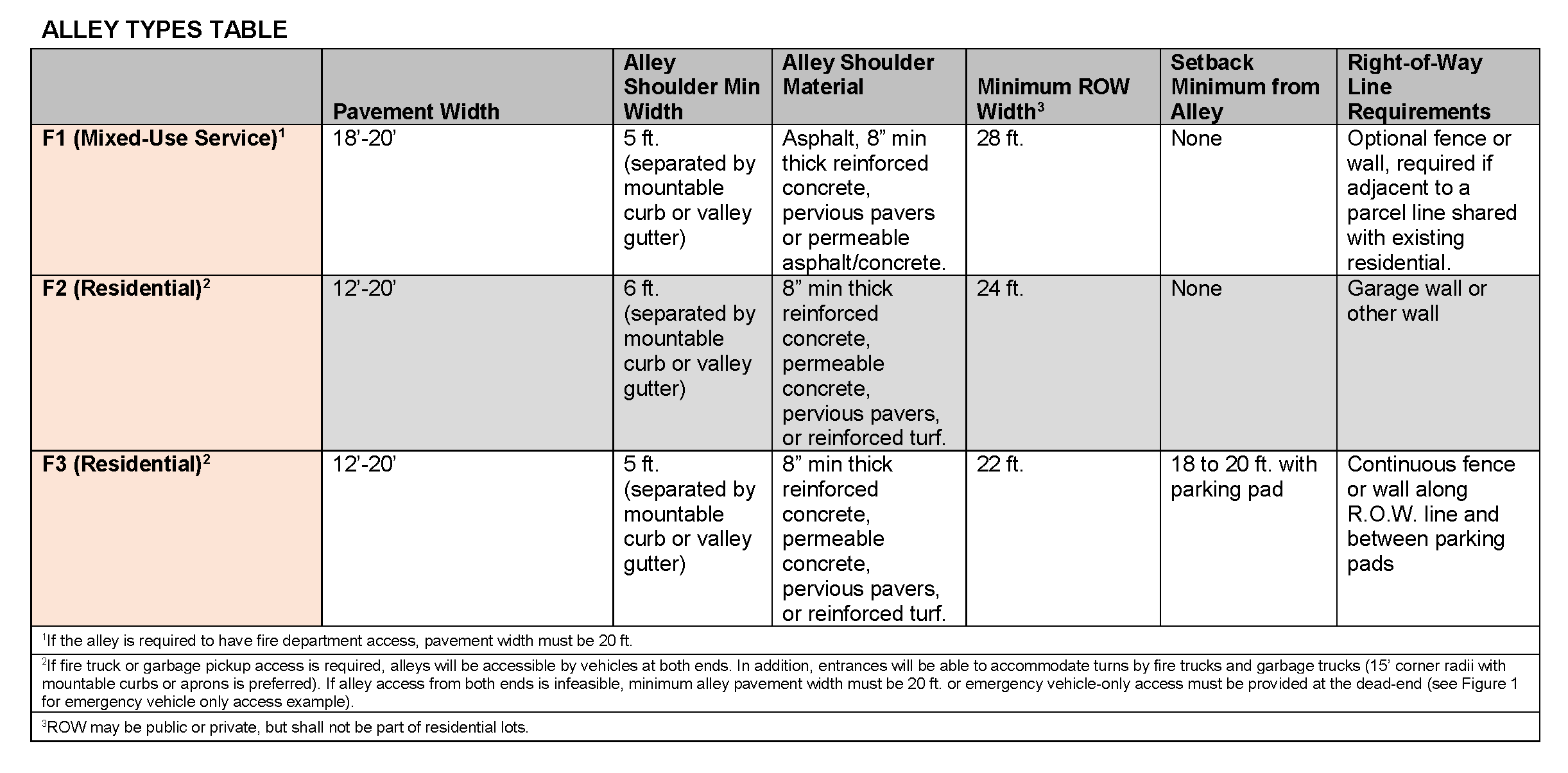
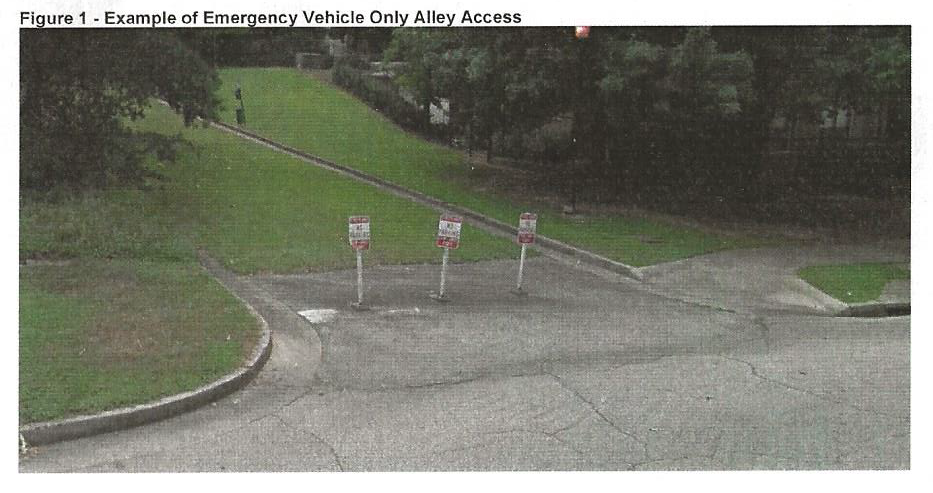
Alleys shall be designed as shown on the Downtown Street Types Table. Alley right-of-way is generally private but may be dedicated as public with staff and City Council approval. Alleys and alley right-of-way shall not be part of residential lots.
13.
Greenway design requirements shall be as shown on the Downtown Street Standards Design Table when Greenprints Trail sections are required in addition to sidewalks, or if buildings are intended to front on the trail.
(Ord. No. 5840-2019, § 1(Exhs. A, B), 6-10-2019; Ord. No. 6134-2019, §§ 1, 2, 12-9-2019; Ord. No. 7205-2021, § 1(Exh. A), 6-14-2021)
7.727. - Parking, Garage, Driveway and Access Requirements.
1.
No parking shall be permitted between a building and the street without an intervening building, except in DT-GC (General Commercial) where the street facade frontage requirements have been met.
2.
Developments are permitted a maximum of one (1) driveway curb cut per block face or one (1) curb cut per four hundred (400) linear feet of block face, whichever is greater. For the purposes of this section, two (2) curb cuts serving two (2) one-way driveways shall only be counted as one (1) curb cut. Curb cuts for a street and an alley may be installed closer than four hundred (400) linear feet, subject to final approval by the City Engineer.
3.
No curb cuts, driveways or circular drives shall be permitted on Main Street, Towne Lake Parkway, or Arnold Mill Road when access can be provided from a side or rear street. Circular drives are prohibited, with the exception of hotel and hospital uses, in the DT-CMU (Commercial Mixed-Use) and DT-GC (General Commercial) districts. Widening or improvement of an existing residential driveway on an A Street to accommodate new development is prohibited when access can feasibly be provided from another lesser order street or an alley.
4.
Driveway curb cuts on streets shall be limited to a one way maximum width of twelve (12) feet or a two way maximum width of twenty-four (24) feet. This subsection does not apply to alleys.
5.
Parking and loading requirements shall be as established in section 7.511, Parking Performance Standards, and Section 7.521, Off-Street Loading Requirements, except that:
a.
All multifamily residential uses, such as apartments/duplexes and condominiums, shall be required to provide one (1) space per bedroom, but not more than two (2) spaces; and
b.
Commercial projects, or the commercial portions of mixed-use projects, in the DT-CBD and OT-RO zoning designations, shall be exempt from the minimum off-street parking requirement. Parking in excess of specified maximums shall be subject to the requirements of Section 7.520, Standards for Parking Spaces Exceeding the Maximum. ADA-accessible spaces shall continue to be required. Loading spaces shall continue to be required per Section 7.521.
6.
Screening of Parking Areas.
a.
Any parking not screened from the street by a building shall have a minimum seven-foot wide landscaped area between such parking and the street which may be located in the Supplemental Zone. Such landscaped area shall have a minimum of one (1) shade tree per fifty (50) linear feet, groundcover, and an evergreen hedge at a maximum of thirty-six (36) inches or decorative wall or fence with a minimum height of thirty (30) inches. Trees shall be planted and street lighting placed in line with the stripes of adjacent parking spaces.
b.
Parking areas in new developments that are located within twenty-five (25) feet of existing residential structures, if not entirely screened by an intervening building, shall have a continuous, visual screen obscuring it from the residential development reaching a minimum height of six (6) feet. This screen shall consist of a compact evergreen hedge or other foliage screening, and a six-foot tall wall or fence.
7.
Where the end of a parking space has a permanent concrete or masonry curb and abuts a landscaped area that is a minimum width of six (6) feet, the depth of such space may be reduced by two (2) feet.
8.
Commercial parking lots as primary uses are not permitted except where individual businesses lease spaces under a shared parking arrangement.
9.
Paving materials used for parking and loading areas other than asphalt or concrete shall be subject to approval by administrative variance.
10.
Required parking may be provided off-site within one thousand (1,000) feet of use except in DT-VLR, DT-LR, DT-MR-A, and DT-MR-B. Public and on-street parking cannot be used to meet building requirements except for on-street parking directly adjacent to the subject property. Using on-street parking to meet parking requirements is optional.
11.
Angled or parallel on-street parking on both sides shall be permitted.
a.
Forty-five (45) degree angled parking shall require parking space length of nineteen (19) feet and two (2) travel lanes width of ten (10) feet.
b.
Sixty (60) degree angled parking shall require parking space length of twenty (20) feet and two (2) travel lanes width of eleven (11) feet.
c.
Ninety (90) degree angled parking shall require parking space length of eighteen (18) feet and two (2) travel lanes width of twelve (12) feet.
d.
Parallel parking spaces shall be eight (8) feet deep and twenty-two (22) feet long.
12.
Reduction of parking requirements may be permitted, subject to a shared parking arrangement under the following criteria:
a.
The minimum number of parking spaces for a development where shared parking is proposed shall be determined by a study prepared by the applicant following the procedures of the Urban Land Institute (ULI) Shared Parking Report or Institute of Transportation Engineers (ITE) Shared Parking Guidelines. The actual number of parking spaces required shall be based on well-recognized sources of parking data such as the ULI or ITE reports. If standard rates are not available or limited, the applicant may collect data at similar sites to establish local parking demand rates. If the shared parking plan assumes use of an existing parking facility, then field surveys shall be conducted to determine actual parking accumulation. If possible, these surveys shall consider the seasonal peak period for the combination of land uses involved;
b.
All shared parking spaces shall be clearly marked as such; and
c.
An applicant shall submit the following information as part of an application to reduce parking requirements and avoid conflicting parking demands:
i.
A to-scale map indicating location of proposed parking spaces.
ii.
Hours of business operation of nonresidential parking users.
iii.
Written consent of property owners agreeing to the shared parking arrangement (when provided off-site).
iv.
Copies of parking lease agreement, easements for parking, or notarized letter or sworn affidavit as to the intent of lease agreement, including renewed leases, shall be filed with the Department of Planning and Economic Development. Lapse of a required lease agreement shall terminate approval for shared parking.
13.
Rear alleys shall be provided to access townhouse and multi-family garages, single-family dwelling garages, and commercial loading and service areas, where such access is feasible. See Street Type Table—Alley Requirements.
14.
All required off-street parking for townhouses and multi-family dwellings, excluding accessory dwelling units, shall be met in a private, on-site, enclosed garage or in a parking structure.
15.
Bicycle or moped parking spaces are required as follows:
a.
All new nonresidential uses shall provide one (1) such space for every twenty (20) automobile spaces and new multi-family uses shall provide one (1) such space for every five (5) units, provided that no such uses shall have fewer than two (2) such spaces or be required to exceed thirty (30) spaces.
b.
Such spaces shall be located within the sidewalk landscape zone a maximum distance of one hundred (100) feet from the primary pedestrian entrance, or shall be located at least as close as the closest automobile space, except for handicapped parking spaces.
c.
Bicycle parking spaces shall include a bike rack with a metal anchor sufficient to secure the bicycle frame when used in conjunction with a user-supplied lock.
16.
Garages and carports shall not face adjacent streets except where alley access is not feasible, in which case such garages and carports shall be setback a minimum of ten (10) feet from the street facade.
(Ord. No. 5840-2019, § 1(Exh. A), 6-10-2019; Ord. No. 7205-2021, § 1(Exh. A), 6-14-2021; Ord. No. 2025-003, § 1, 1-13-2025)
7.728. - Site Limits.
1.
Where such street facade frontage requirements are satisfied by existing principal buildings, additional principal buildings shall be exempt from these requirements.
2.
Any balconies, awnings and bay windows may encroach into any sidewalk supplemental zone or required setback a maximum depth of five (5) feet.
3.
Paved walkways with a minimum width of four (4) feet shall be provided from the closest public sidewalk clear zone to the primary entrance of all buildings and structures not built to the sidewalk area, including parking structures. Other materials to create weather-proof walkways may be approved by staff if proposed.
4.
All residential lots shall be situated and graded so that the main level, or the level containing the main living space including the kitchen, is accessed by the required four-foot walkway and Sidewalk Clear Zone either at-grade or by stairs leading to the front porch or stoop. This requirement shall apply to all structures that are located on a site plan approved after the date of the adoption of this Ordinance, May 13, 2019. In the event the main level is not the sidewalk level, the sidewalk level shall have thirty (30) percent windows, as measured linear and after subtracting the area consumed by any staircase leading to the front door. This section shall be eligible for relief through administrative variance based on topography or other physical site constraints.
5.
All developments must comply with the following site limits table:
(Ord. No. 5840-2019, § 1(Exh. A), 6-10-2019; Ord. No. 7205-2021, § 1(Exh. A), 6-14-2021; Ord. No. 2025-034, § 2, 12-8-2025)
7.729. - Street Facade Requirements.
Along the street facade of all new and renovated buildings and structures the following shall apply.
1.
Sidewalk level uses shall have a primary pedestrian entrance, which faces, is visible from, and is directly adjacent to required sidewalk area or adjoining open space, including but not limited to dwelling units, multi-family lobbies, and individual business establishments.
a.
Where an individual use has a street facade on more than one (1) street, such entrance requirement shall apply along Main Street, or when on other streets, such requirement shall apply along the higher order of street shown on the Downtown District regulating plan, with "A" being the highest order and "E" being the lowest. Where both streets are the same order, entrance orientation may be to either street.
b.
Units fronting on open spaces may only do so if a street borders the opposite side of the open space, and the primary pedestrian entrance shall face and be visible from the open space and street.
2.
All buildings with more than four (4) sidewalk area level residential units along a single street shall have individual entrances to such units directly accessible from the required sidewalk area or adjoining open space except in the historic zone. All walkways providing such access shall be shared between no more than two (2) adjacent units.
3.
The first two (2) stories of building facades shall be brick, cast stone, concrete siding such as hardiplank, natural wood or stone, with the exception of pedestrian entrances and windows. In DT-CBD (central business district) such requirements shall apply to the entire building facade along Main Street, Towne Lake Parkway, and Arnold Mill Road and building facades seen from such streets.
4.
Awnings shall be of fabrics, canvas, fixed metal, or similar material. Internally lit awnings and canopies that emit light through the awning or canopy material are prohibited.
5.
Blank, windowless walls are prohibited. All building stories with the exception of storefront treatments shall have windows and doors that equal a minimum of thirty (30) percent of the total facade length with each story being calculated independently, gables are exempt. For secondary street facade frontages on corner lots, see Subsection 18.
6.
All windows shall be vertically shaped with a height greater than width, including display windows but not transoms. Windows located inside gables are exempt.
7.
Glass panels in windows and storefronts shall be clear and unpainted, and shall not be tinted such that views into the building are obstructed. False windows may be allowed by administrative variance when warranted by the interior design of the structure, such as the presence of fireplaces or stairwells blocking window locations, and when not used excessively.
8.
Entry facade window trim shall not be flush with the exterior wall and shall have a minimum relief of one-quarter (0.25) inch from the exterior wall, except on brick and stone facades. A window detail showing these dimensions shall be present on all building plans for downtown structures.
9.
Doors and windows that operate as horizontal sliders are prohibited, however, for the purposes of serving windows on storefronts, where a Sidewalk Encroachment Permit has been issued for such purpose, windows may operate on horizontal sliders, and may be combined with knee walls that are serving window height.
10.
Window frames shall be recessed a minimum of two (2) inches from the exterior facade on masonry facades. Window frames on other than masonry facades shall be trimmed with multi-dimensional trim with a minimum width of three (3) inches and include header and apron trims. Multiple dimensions can be accomplished by layering of trim or use of more detailed trim. Prior approval of details required.
11.
Porches and stoops shall not be enclosed with screen wire or glass on primary frontages.
12.
Porch and arcade columns shall be a minimum width of six (6) inches, unless otherwise determined by the Director of Community Development.
13.
Residential porches shall be covered and have a minimum depth of five (5) feet, a minimum length of eight (8) feet and a minimum area of forty (40) feet.
14.
Exterior entry steps shall have enclosed risers.
15.
Building foundations shall be brick, stone, stucco, or concrete with similar appearance.
16.
Parking structures shall conceal automobiles from visibility, shall have the appearance of a horizontal storied building on all levels, and shall be faced in brick, stone, cast stone, poured-in-place rubbed concrete, or pre-cast concrete faced in or having the appearance of brick or stone.
17.
The minimum building height as measured along the build-to line shall be eighteen (18) feet in all subareas except DT-OS (open space), where there shall be no minimum building height.
18.
Buildings on corner lots have two (2) street facades. The secondary frontage, or the facade without the primary pedestrian entrance, shall have the option, in lieu of providing minimum thirty (30) percent window coverage on each story, to provide, on a minimum of forty (40) percent of the facade on each story, a mixture of architectural elements that conform with this section, including porches, balconies, doors, a historic or unique brick pattern, or a mixture of materials and architectural accents such as ledges, moldings, millwork, and keystones. Proposals for this alternative shall be reviewed and approved by the Director of Community Development.
19.
All buildings shall have street facades with continuous storefront treatment or residential treatment requirements as indicated in the building facade and materials requirements table.
20.
See building facade and material requirements table for maximum building height requirements.
(Ord. No. 5840-2019, § 1(Exh. A), 6-10-2019; Ord. No. 7205-2021, § 1(Exh. A), 6-14-2021)
7.730. - General Requirements.
1.
Building Requirements.
a.
The primary pedestrian entrance to all sidewalk level retail and eating and drinking establishments shall remain unlocked during business hours.
b.
Primary sidewalk level pedestrian entrances to individual businesses and residential units shall be adjacent to required sidewalk area, park, plaza, or courtyard.
c.
Building facade materials shall be combined only horizontally, with the heavier below the lighter.
d.
Chimneys shall extend to the ground.
e.
All roofs shall have a minimum twenty-five (25) year roof and no visible roll roofing.
f.
Building mechanical and accessory features:
i.
Shall be located to the side or rear of the principal structure or on rooftops and shall be screened from any public open space or sidewalk area views.
ii.
When located on rooftops shall be incorporated in the design of the building and screened with materials similar to the building.
g.
Any parapet walls shall extend around all sides of the building.
h.
On residential buildings, if rear decks or porches are directly adjacent to any streets, public sidewalks, public trails, or any Open Spaces, they shall be covered with a roof or pergola, and designed with materials to match the facade and/or trim of the building.
2.
Site Requirements.
a.
The height of fences and wails located between the street facade of principal structures and a street shall not exceed forty (40) inches and in other areas shall not exceed six (6) feet.
b.
Fences and walls located along the alley right-of-way line shall be a maximum height of six (6) feet. For new development, where new alleys run along parcel lines of existing developments, a wall shall be required to screen the alley from the existing property or properties. The wall shall be four (4) to six (6) feet in height and shall be constructed with a brick, stone, or stucco veneer, or a combination of masonry materials that complement the theme of the property architecture and/or site design.
c.
No barbed wire, razor wire, chain link or similar elements shall be visible from any public park, required sidewalk area, or sidewalk area level outdoor dining area.
d.
Loading docks and dumpsters shall be entirely screened from view of any public open space or sidewalk area, with a dumpster pad enclosure. Dumpster pad enclosure is required, constructed of the same materials, and matching the architecture of the principal structure. Doors and gates shall be opaque and must remain closed while not in use. Chain-link is not an acceptable material.
e.
Utilities shall be placed underground or in alleys wherever feasible.
(Ord. No. 5840-2019, § 1(Exh. A), 6-10-2019; Ord. No. 7205-2021, § 1(Exh. A), 6-14-2021)
7.731. - Historic Overlay District (DT-HO) Requirements.
Buildings within the historic overlay shall be of a scale and character compatible with historic residential buildings as described below. Parcels within the historic zone are subject to the following regulations, in addition to other requirements of the Downtown District.
1.
The required build-to line shall match the average distance between the primary structure and the curb of the nearest two (2) adjacent buildings on the same street built before 1945.
2.
No parking shall be located between any structure and the street, and no parking shall be located to either side of any structure fronting an A or B street.
3.
This district is intended for Detached Single-family homes, even if they have a commercial use. Multiple residential dwelling units within the same building are prohibited in DT-HO. Single-family detached residential is a permitted use in DT-HO, even if fronting an A Street where commercial development is otherwise required.
4.
Detached and attached garages shall both be permitted. Attached garages shall have decorative doors which shall be located in an inconspicuous location, so as not to become the main architectural feature on structures on lots that are front-loaded. The architecture of detached garages shall match and compliment the primary structure.
5.
All exterior facades except windows shall be brick, horizontal hardiplank, natural wood or stone.
6.
Flat roofs shall be prohibited.
7.
Parking decks shall be prohibited.
8.
Roofs shall extend a minimum of eighteen (18) inches beyond exterior building walls.
9.
Exterior street facade doors shall be wood panel or fixed glass in wood frame.
10.
Primary structures shall have a residential treatment regardless of use.
11.
All windows shall be either double-hung or fixed glass in keeping with the particular architectural style described below.
12.
With the exception of stories partially contained within roofs, all above-ground stories shall be equal in floor area and shape.
13.
All street facade porches that are not a required "accessible route into and through the dwelling unit", as established by Section 804 [42 U.S.C. 3604](3)(C)(iii)(l) of the Fair Housing Act, shall be a minimum of twenty-four (24) inches above the grade of the sidewalk area.
14.
Buildings shall be one (1) of the following five (5) architectural styles and shall meet all the requirements contained herein:
a.
Craftsman, which shall provide:
i.
A rectangular building footprint, with the short end facing a street.
ii.
Gabled roofs having gables with a minimum pitch of twenty (20) degrees and a maximum pitch of forty (40) degrees from horizontal, with roof lines running parallel or perpendicular to the street.
iii.
Decorative beams or braces under gables.
iv.
Exposed roof rafters where roots overhang.
v.
Equal height windows along the entire street facade.
vi.
A symmetrical or asymmetrical street facade.
vii.
A front porch extending the entire width or one-half (0.5) the width of the building. Said porch shall include square columns not less than eight (8) inches thick that taper from bottom to top. Said columns shall be set atop stone or masonry bases extended to the ground. Square or rectangular balusters and handrails are optional.
b.
Folk, which shall provide:
i.
A building footprint that is rectangular or "L-shaped," with the end of the short leg of the "L" facing a street.
ii.
Gabled roofs having gables with a minimum pitch of thirty (30) degrees and a maximum pitch of forty-five (45) degrees from horizontal, with roof lines parallel or perpendicular to the street.
iii.
Ridge vents having a minimum size of one (1) foot by one (1) foot shall be provided along all gables facing a public street.
iv.
Equal sized windows along the entire street facade.
v.
A symmetrical street facade for buildings with rectangular footprints.
vi.
A front porch extending the entire width of the building, except with an "L-shaped" footprint. Said requirement shall not apply to the short-leg of the "L". Said porches shall include turned columns, turned balusters, handrails, and optional lace-like spandrels.
c.
Simple Queen Anne, which shall provide:
i.
A building footprint that is rectangular or "L-shaped," which may include the circular base of a tower.
ii.
Gabled roofs having steep pitch, which may be of irregular shape.
iii.
An asymmetrical front porch that is one (1) story and wraps around one (1) or both sidewalls of the building.
iv.
Porch columns that taper from the top to bottom, with decorative details at the top.
d.
Colonial Revival, which shall provide:
i.
A rectangular building footprint with the long side facing a street.
ii.
A gabled, hipped, gambrel, or second story overhang roof.
iii.
An accentuated entrance with a pediment supported by pilasters and/or an entry porch supported by slender columns.
iv.
A symmetrical street facade with a centered door and balanced rectangular windows.
v.
A cornice between the street facade and roof that extends around the entire roofline of the structure.
e.
Gothic Revival, which shall provide:
i.
A building footprint that is rectangular or "L-shaped," with the end of the short leg of the "L" facing a street.
ii.
A symmetrical street facade for buildings with rectangular footprints.
iii.
A steeply pitched centered gable, paired gable, front-gable, or asymmetrical roof.
iv.
At least one (1) window with Gothic detailing.
v.
A one (1) story front porch supported by column with Gothic detailing which either extends the entire width of the building or as an entry porch.
(Ord. No. 5840-2019, § 1(Exh. A), 6-10-2019; Ord. No. 7205-2021, § 1(Exh. A), 6-14-2021)
7.732. - Illustrations.
Graphic depictions of some of the requirements herein can be found in the Downtown Design Standards Policy, CPM 700-0009, found in the Council Policy Manual on the City's website. Unless otherwise indicated, each is intended to specifically illustrate only the indicated requirement; all other suggestions of design, such as architectural style, tree shape and aesthetics, do not constitute a requirement of this section.
(Ord. No. 5840-2019, § 1(Exh. A), 6-10-2019; Ord. No. 7205-2021, § 1(Exh. A), 6-14-2021)

