
Woodstock City Zoning Code
ARTICLE VIII
OTHER DEVELOPMENT DISTRICTS AND OVERLAY ZONING
7.801. - Intent and Purpose.
The intent of the Ridgewalk Overlay District is to set a standard for the design, form, and use of properties in the Ridgewalk Parkway corridor that will provide an appropriate transition of density and intensity, which should be situated in a decreasing pattern, radiating outward from the interstate interchange. The Overlay is intended to support commercial development and protect the integrity of the existing neighborhoods by regulating scale and creating a consistent design language articulated through streetscape, trail connections, and architectural requirements.
The regulations set forth in the Ridgewalk Overlay District are designed to:
1.
Produce well-designed, unique, and attractive commercial developments.
2.
Respect existing residential development.
3.
Produce commercial buildings that are reusable by future commercial users with different uses, and to discourage highly specialized buildings with common national brand architecture.
4.
Provide a regulatory framework to maximize commercial productivity.
5.
Result in developments that exhibit a consistent character which is unique to Woodstock and more specifically, to the Ridgewalk area.
6.
Provide accessible and sufficient parking that is not concentrated in large parking lots.
7.
Provide safe, comfortable, and unique pedestrian access complete with connected, effective transitions from one property to the next.
8.
Create and maintain an environment where commercial development can flourish and remain viable and visible in the Woodstock market.
9.
Produce a consistent streetscape that is rich with aesthetic design elements such as brick piers, fences, hedges, decorative walls, ornamental trees, canopy trees, and decorative streetlights with wide sidewalks separated from traffic.
(Ord. No. 5840-2019, § 1(Exh. A), 6-10-2019)
7.802. - Boundaries of Ridgewalk Overlay District.
The Ridgewalk Overlay District shall include those properties that are zoned GC or MC, which have property frontage along any portion of Ridgewalk Parkway and are identified on the most recently approved Zoning Map, which is on file with the City Clerk.
(Ord. No. 5840-2019, § 1(Exh. A), 6-10-2019)
7.803. - Legally Nonconforming Properties.
At the time of the adoption of this Ordinance, all previously developed properties shall be deemed to be in compliance with this Ordinance, until such time that any improvement which requires a land development or building permit is requested. Tenant finishes and minor repairs are excluded. Such permit shall only be granted if the improvements proposed meet the standards herein, and if the streetscape along any frontage adjacent to Ridgewalk Parkway is brought into compliance.
(Ord. No. 5840-2019, § 1(Exh. A), 6-10-2019)
7.804. - Definitions Related to this Overlay District.
Decorative: Requires the use of brick or stone veneer, complementing the primary structure.
Decorative Lighting: Outdoor lighting, including pole and fixture, meeting the specifications of the outdoor lighting installed on Ridgewalk Parkway at the time of adoption of this Ordinance.
Decorative Walls/Fences: Those walls and fences with brick, stone, or wood veneer.
Facade, Primary: The street-facing facade of the building which includes the main building entrance or the primary pedestrian entrance, and which faces Ridgewalk Parkway or the most primary street.
Facade, Secondary: A building facade which faces a street or civic area, without another intervening building, which is not the primary facade.
Facade, Tertiary: A building facade which does not face a street, civic area, or open space.
Fountain: An ornamental structure in a body of water from which one (1) or more jets of water are pumped into the air.
Landscaping, Additional: Trees, shrubs, and permanent plantings installed twenty-five (25) percent beyond minimum code requirements.
Multi-Tenant Building (MTB): A commercial structure containing more than one (1) suite or business.
Office or Employment Use: A use where the primary purpose is an office use, as regulated by Section 7.505, or a use with the creation of fifty (50) or more full-time-equivalent jobs in key business sectors. Key business sectors are as determined by the City of Woodstock Economic Development Department.
Open Space: Property not intended for development or reserved for preservation as open space, including waterways, stream buffers, floodplain, steep slopes, or remnants.
Plaza, Corner: A small public gathering area, delineated with decorative pavers or concrete and may include street furniture on the corner of two (2) streets.
Pocket Park: A public space providing passive recreation.
Public Art: Sculptures of at least two (2) feet in height and murals of at least one hundred sixty-five (165) square feet.
Stormwater Feature: A water quality, detention, or retention design that exceeds minimum standards, as found in the Georgia Stormwater Management Manual, creating an attractive amenity for the site.
Street Furniture: Includes benches, trash cans, and other pieces of equipment meeting City specifications as set forth in the plans for Transportation Enhancement Project PI Number 0010648.
Sustainability Measures: Measures found in Section 7.520 of the Land Development Ordinance or proposed by a developer and approved by the DPC.
Terminated Vista: A location containing a building or monument that stands at the end or in the middle of a road, so that when one is looking up the street, the view ends with the site, containing the building or monument. A building located at a terminated vista is required to be designed in response to the context.
Transportation System Improvement: A public transportation project or donation in lieu to complete a public transportation project other than roadway and pedestrian improvements required by the LDO to serve the project.
(Ord. No. 5840-2019, § 1(Exh. A), 6-10-2019; Ord. No. 6194-2020, § 6, 1-13-2020)
7.805. - Site Development Standards.
1.
For properties within the Ridgewalk Overlay District, minimum setbacks shall be as follows:
2.
A forty-five (45) foot buffer shall be required along any property line that is adjacent to any property that is part of any of the following existing platted subdivisions: Brookshire, Meridian, Montclair, Whitfield, and the Magnolias at Ridgewalk. A fifty (50) foot buffer shall be required adjacent to any USACE-owned properties. Aside from these, no other zoning buffers shall be required on properties located in the overlay. Buffers in the Overlay shall follow the design standards found in Article VI of this Chapter, Buffers.
3.
Parking.
a.
Parking minimum and maximum requirements for number of spaces shall be as required by Chapter VII, Article V.
b.
Parking areas shall be distributed around the site, rather than being concentrated in large lots, unless these lots are screened from the public right-of-way by buildings. A maximum of two (2) rows of parking may be located between the primary structure and any streets. Smaller parking lots containing no more than four (4) rows or parking spaces are permitted to be located to the side of buildings, and larger lots are permitted to be located behind buildings, generally as shown in the figure below.
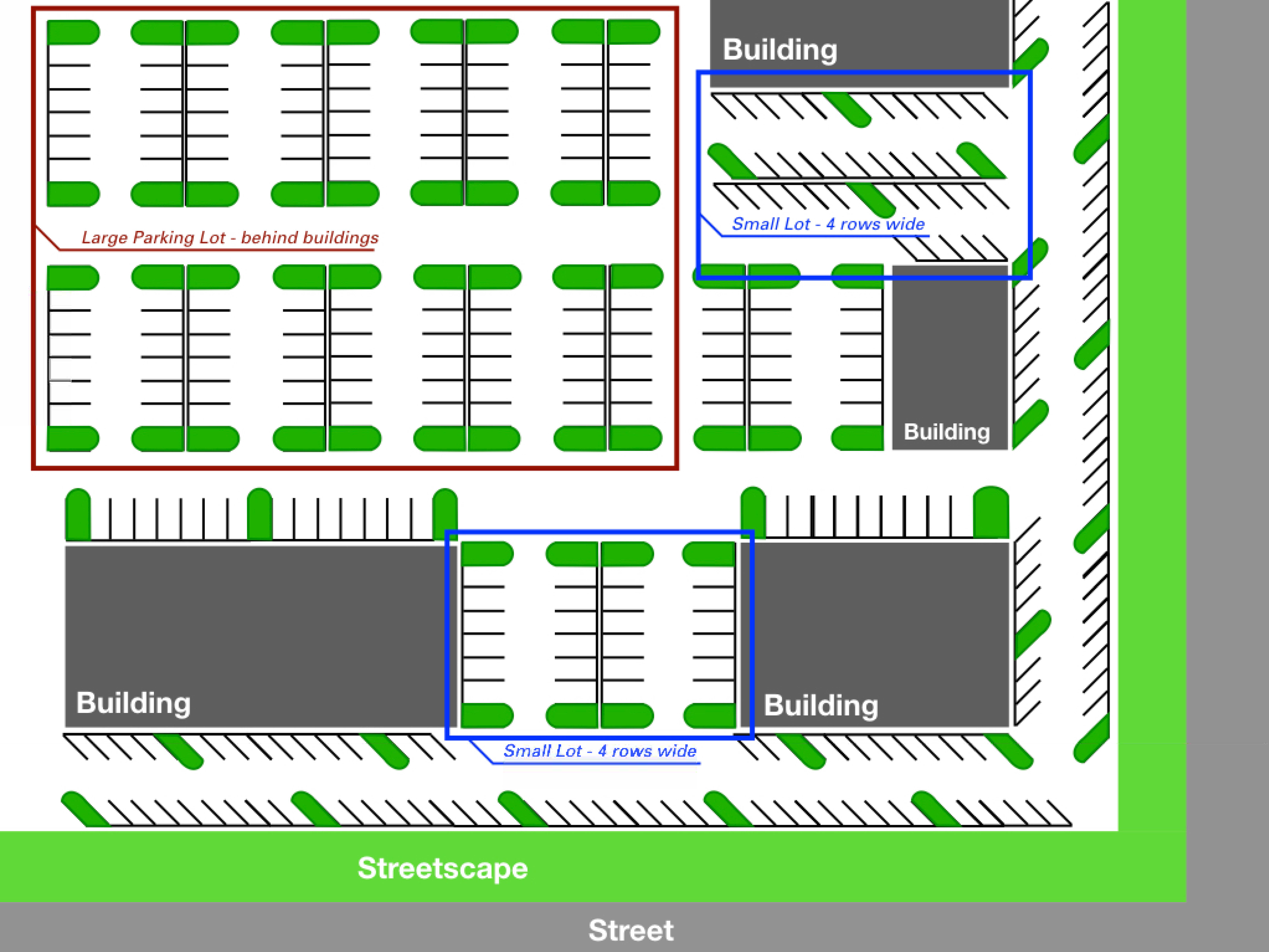
(Ord. No. 5840-2019, § 1(Exh. A), 6-10-2019; Ord. No. 7205-2021, § 1(Exh. A), 6-14-2021)
7.806. - Site Design Standards.
1.
All development within the Ridgewalk Overlay shall adhere to the required standards set forth in the points matrix below. Using the matrix, each site proposed for development must a achieve a minimum score as follows:
The DPC will review and approve the final score for each proposed development. No development shall receive a land disturbance permit (LDP) until the final score is approved by the DPC. An applicant may appeal the DPC decision directly to the City Council.
2.
Streetscape Requirements. At a minimum, each site developed must include the following:
a.
Ridgewalk Parkway:
i.
Sidewalk—Five (5) feet in width along the northside of Ridgewalk Parkway and ten (10) feet in width along the southside.
ii.
Landscape strip—Seven (7) feet between the back of curb and the sidewalk.
iii.
Decorative lighting—Every one hundred (100) feet on center (o.c.), in the landscape strip.
iv.
Street trees—Every fifty (50) feet on center (o.c.), in the landscape strip.
v.
Brick/Stone Piers—Every one hundred (100) feet on center (o.c.) with the decorative fence in between, as depicted below. The decorative fence shall be composed of pressure treated wood or composite material of a similar appearance: Six inch by six inch by four foot (6" x 6" x 4') post, set seven (7) feet on center; top and bottom horizontal rails and diagonal rails; five-fourths inch by six inch (5/4" x 6") fascia board painted black or dark brown.
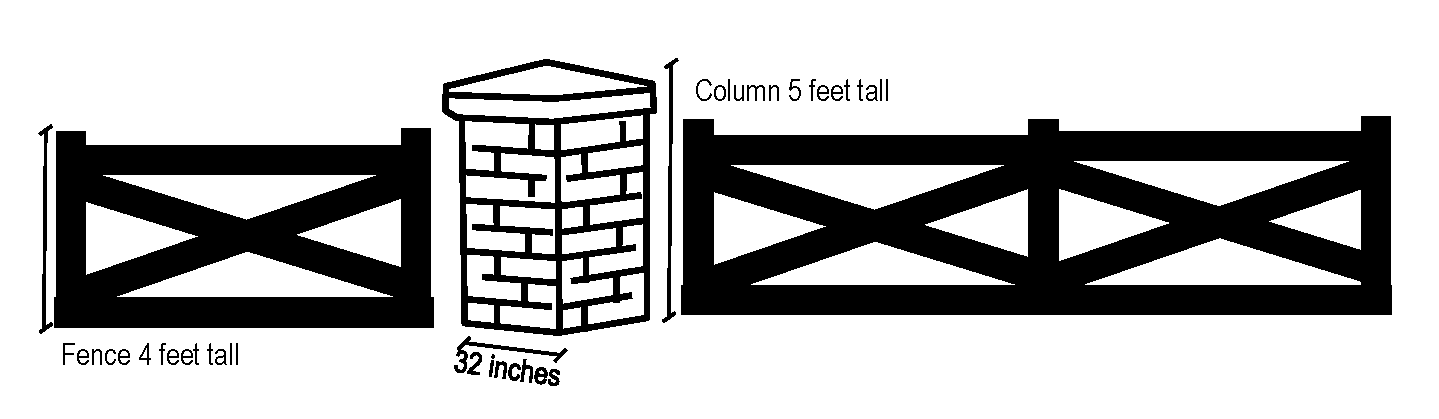
b.
Other Streets. At a minimum, a five (5) foot sidewalk is required.
i.
Parking must be screened if visible from streets by an evergreen hedge, minimum thirty-six (36) inches tall.
ii.
Alterations in streetscape requirements may be achieved with the deducts found in the matrix.
3.
Pedestrian Network.
a.
A pedestrian network interior to the site shall be composed of minimum five (5) foot wide sidewalks which shall give access from the sidewalk or trail within the streetscape, through any parking lots, to the primary entrance of each commercial or business establishment. These sidewalks shall be located outside of any drive aisles except where required to cross the drive aisle.
b.
The pedestrian network shall give access from each primary building entrance through and to any side or rear parking areas intended to serve the establishment. Pathways through large rear parking lots shall be six (6) to ten (10) feet wide.
c.
The pedestrian network shall connect each property to the next wherever there is a logical connection to be made, including connections to any open spaces or civic areas on the site or which border the site.
4.
Other Site Design Standards.
a.
Loading docks, service areas, and dumpsters shall not be located in any front yard or streetscape area and shall be screened if visible from the public right-of-way by a combination of fences, walls and landscaping, but not landscaping alone. Dumpsters shall be located in an enclosure designed to be consistent with the principal building in material, texture, and color, and shall have gates or doors which are to remain closed when not being accessed.
b.
Terminated Vista Locations Shall be Considered During Site Design. A terminated vista shall not terminate in a parking lot, to the side or back of a building, or any other unappealing area. Prominent buildings with enhanced architecture often with a vertical element, civic spaces, fountains, monuments, or sculptures are appropriate features for terminated vista areas.
(Ord. No. 5840-2019, § 1(Exh. A), 6-10-2019; Ord. No. 7205-2021, § 1(Exh. A), 6-14-2021)
7.807. - Architectural Standards.
1.
The primary facade of a proposed building shall include the main building entrance and primary pedestrian entrance, and shall face Ridgewalk Parkway, or the most primary street.
2.
The facade composition standards below shall apply to any street-facing building facade, and any building facade which faces a civic space. These are considered primary or secondary facades.
a.
Primary facades shall be articulated and designed to create additional visual interest by varying architectural details, building materials, the roof line, and building offsets.
b.
Windows and doors shall be provided for at least fifteen (15) percent of the total facade area, with each story calculated independently, including spaces between floors. The maximum contiguous area without windows or doors shall not exceed ten (10) feet in height and twenty (20) feet in width.
c.
Facades over fifty (50) feet in length shall incorporate wall projections or recesses a minimum of twelve (12) inches in depth. The combined length of said recesses and projections shall constitute at least twenty (20) percent of the total facade length.
d.
Facades over two hundred (200) feet in length shall incorporate a major articulation at least every two hundred (200) feet of facade length. Said major articulation shall occur for a minimum length of twenty (20) feet and shall be accomplished through:
i.
A change of facade material from the grade to the roof; or
ii.
A change in facade composition from the grade to the roof; or
iii.
Changes in storefront systems, varying setbacks, or similar means intended to convey the impression of separate buildings.
3.
Tertiary facades do not have window, door, or articulation requirements but shall incorporate a decorative pattern with varied materials and textures in lieu of windows or doors. For the purpose of satisfying this requirement, control and expansion joints shall not constitute a decorative pattern with varied materials and textures.
4.
Facade material standards for primary, secondary, and tertiary facades shall be as follows:
a.
Primary facades shall be composed of a majority of Tier 1 facade materials, with twenty (20) percent or less of the facade area being composed of Tier 2 facade materials, and five (5) percent or less of the facade area being composed of Tier 3 materials (intended for trim and other small architectural features).
b.
Secondary facades shall be composed completely of Tier 1 or Tier 2 facade materials, and five (5) percent or less of Tier 3 materials.
c.
Tertiary facades shall be composed of Tier 1, 2, or 3 materials, with no more than eighty (80) percent of the facade being composed of Tier 3 materials.
d.
Exposed neon or LED lighting outlining and detailing building features is prohibited.
5.
Facade materials are as follows:
a.
Tier 1 facade materials are brick, stone, cast stone, and natural wood.
b.
Tier 2 facade materials are hard-coat stucco, quik brik and similar faux brick systems, and cementitious siding.
c.
Tier 3 facade materials are Exterior Insulation and Finish System (EIFS), metal, faux wood or wood composite, and concrete. EIFS shall not be used within six (6) feet of the foundation or slab. Other composite materials may be considered Tier 3 materials, as approved by staff.
6.
Accessory structures shall be consistent with the principal building in material, texture, and color, and shall not be covered in only Tier 3 materials.
7.
Foundations, where provided, shall be constructed as a distinct building element that contrasts with the facade materials. Exposed above-ground foundations shall be coated or faced in stucco, brick, cast stone, or natural stone to contrast with facade materials. Exposed cement surfaces may be approved by administrative waiver.
8.
Flat roofs shall be screened from the view of public and private streets by a parapet with a cornice, which shall extend around all sides of the building. Roof-mounted mechanical equipment, vents, and stacks shall be screened from view from all sides. Roofing material and color shall be compatible with the building and its surroundings.
9.
Optional Approval Process for Architectural Elevations.
a.
The details of architectural elevations for any proposed building in the Ridgewalk Overlay must be approved by staff for compliance of this section, and for adherence to the intent and purpose of the overlay.
b.
In situations where the proposed architecture is not in compliance with these standards, but staff feels that with some changes, the intent and purpose of the Ridgewalk Overlay could be met, the Community Development Department reserves the right to engage an architect for review of the proposed building.
c.
The applicant, architect, and staff shall work together to reach a design that conforms to the intent and purpose of this Ordinance, which shall then be voted on for approval by the DPC.
d.
In the event that the DPC does not approve the proposed architecture, the City Council shall have the right to approve or deny architecture on a case-by-case basis.
(Ord. No. 5840-2019, § 1(Exh. A), 6-10-2019; Ord. No. 7205-2021, § 1(Exh. A), 6-14-2021)
7.808. - Zoning and Structures.
The zoning and structures requirements within this section shall govern the NC and GC Zoning Districts within the Ridgewalk Overlay. In the event of a conflict between the requirements of Section 7.506, Additional Development Regulations Required, and this section, this section shall govern.
1.
Neighborhood Commercial (NC) Requirements. In the Ridgewalk Overlay, all neighborhood commercial (NC) uses are limited to occupying a structure of a maximum square footage of eight thousand (8,000) square feet, unless otherwise stated in the structures chart below. Additionally, a multi-tenant building (MTB) cannot exceed twelve thousand (12,000) square feet. Uses proposed to occupy a structure in excess of the maximum size allowed may seek a conditional use permit (CUP) from the City Council.
2.
Structures Chart. The uses within the General Commercial (GC) and Neighborhood Commercial (NC) Zoning Districts shall adhere to the structure requirements as indicated in the chart below.
1 MTB - Multi-Tenant Building, see Section 7.804.
3.
Exemptions. Government Buildings, Park/Open Space-Public, Utilities are expressly exempt from this section.
(Ord. No. 6194-2020, § 7, 1-13-2020)
7.841. - Purpose and Intent of Senior Living.
The regulations set forth in senior living are designed to:
1.
Provide for the development of detached, attached, and multi-family dwelling units limited to those persons age fifty-five (55) and older as defined by the Fair Housing Act.
2.
Locate these developments in areas where retail, professional, civic, and cultural uses are convenient for residents to access, preferably even when they can no longer drive.
3.
Promote the concept of aging in place which provides a variety of living choices aimed at allowing residents to remain in their communities as they age. These include communities with a mix of housing type and size, active living communities, assisted living facilities and full care facilities.
4.
Promote pedestrian safety by ensuring sidewalk-oriented buildings and attractive street-facing facades that foster pedestrian activity and liveliness.
5.
Provide an adequate amount of meaningful open space within each development which creates areas for social interaction among neighbors, opportunities for recreation, and is easily accessible for all residents.
(Ord. No. 5840-2019, § 1(Exh. A), 6-10-2019)
7.844. - Residential Density Bonus.
Density bonuses will be awarded to each senior living project which incorporates affordable units, assisted living units, and/or full care facilities. These bonuses are listed in the table and are based on a percentage of the total units by project, followed by a maximum allowed density in each subarea.
(Ord. No. 5840-2019, § 1(Exh. A), 6-10-2019)
7.845. - Location Requirements.
Any project in a SL category must adhere to the following location requirements. These requirements are calculated by measuring the walkable distance on an improved surface between the main entrance of the SL neighborhood or building to the front door of the commercial facility.
1.
SL-A and SL-B must be located within a three-quarter (0.75) mile radius of commercial retail uses including but not limited to grocery stores, pharmacies, and/or medical service facilities. Projects must also maintain the scale and intensity of surrounding uses.
2.
SL-C must be located within a one-quarter (0.25) mile radius of commercial retail uses including but not limited to grocery stores, pharmacies, and/or medical service facilities. SL-C projects may be exempt from these requirements if these uses are provided on-site. Projects must also maintain the scale and intensity of surrounding uses.
(Ord. No. 5840-2019, § 1(Exh. A), 6-10-2019)
7.846. - Site Planning Requirements.
Any project in a SL category must adhere to each of the following site planning requirements:
1.
The minimum requirement for open space shall be twenty (20) percent of the project area. Required infrastructure, detention facilities and mandatory stream buffers shall not be used in open space calculations. Not more than fifty (50) percent of the total open space requirement shall be provided in the form of private open space.
2.
Each unit in SL-A and SL-B shall provide a minimum of one (1) parking space in a garage structure, not to exceed two (2) spaces. All garages must be accessed through the use of rear alleys.
3.
No parking in SL-C shall be permitted between the building(s) and the main access street in order to facilitate pedestrian access to the street. Vehicular access to the building(s) shall be provided from the rear, side, underneath or a courtyard. In addition, a main pedestrian access to each building shall be provided on the side facing the street.
(Ord. No. 5840-2019, § 1(Exh. A), 6-10-2019)
7.847. - Street Design Requirements.
1.
In order to promote a safe pedestrian environment, street design shall accommodate the use of landscape strips, a minimum six (6) foot wide sidewalk on both sides of the street, and dedicated on-street parking areas where appropriate.
2.
When a SL project fronts an existing street, the above requirements are to be applied along the existing street along the entire frontage of the property.
(Ord. No. 5840-2019, § 1(Exh. A), 6-10-2019)
7.848. - Senior Living Zoning Category Requirements.
1.
The total number of units zoned under any SL category shall not exceed more than twenty (20) percent of the total number of housing units within the City limits. The number of units that may be zoned SL will be updated as needed by the City.
2.
All SL developments shall have development plans approved by the City within eighteen (18) months of receiving SL zoning or it shall revert to the previous zoning category, following the process and procedures set forth in Article III of Chapter XI.
3.
In order to promote a pedestrian friendly environment, the following overlay standards are expressly waived in favor of the requirements in the SL site limits table lot sizes, lot widths, streetscape adjustments, setbacks, and buffers. Any overlay standards related to streetscape themes and architectural requirements shall be adhered to.
(Ord. No. 5840-2019, § 1(Exh. A), 6-10-2019; Ord. No. 6615-2020, § 2, 10-26-2020)
7.849. - Senior Living General Requirements.
1.
All other sections of the City's Land Development Ordinance shall be enforced including but not limited to tree preservation, stream buffer requirements, engineering requirements, and signage regulations.
2.
Upgrades to existing adjacent infrastructure shall be required including but not limited to the installation or upgrade of crosswalks and sidewalks, pedestrian signalization including count down timers and audio notification for the visually impaired, and/or wheelchair compatibility.
3.
The exterior of each dwelling unit and other buildings shall be brick, cast stone, concrete siding such as hardiplank, natural wood, hard coat stucco, and/or natural stone.
4.
All residential units within SL shall incorporate applicable and "Easy Living Home" standards to include:
a.
A step-free entrance into the main floor at either the front or side of the structure, or through the garage.
b.
A bedroom, kitchen, wheelchair-friendly bathroom, and entertaining area all on the main floor.
c.
Every interior door on the main floor provides a minimum thirty-two (32) inches of clear passage.
d.
Blocking installed in the bathroom(s) on the main floor to facilitate the future addition of handrails or similar accessibility features.
(Ord. No. 5840-2019, § 1(Exh. A), 6-10-2019)
7.851. - Definition and Purpose of Conservation Subdivisions.
A conservation subdivision is a residential zone that provides for the preservation of open space and greenspace for watershed protection and the nonstructural management of stormwater runoff. The purpose of the conservation subdivision is to provide flexibility of design in order to promote sustainable development of land in portions of the City already zoned for residential use. It permits the clustering of houses and structures on less environmentally sensitive lands which will reduce the amount of infrastructure, including paved surfaces and utility easements, necessary for residential development. Appropriate use of the conservation subdivision can also:
1.
Provide for the preservation of greenspace as a nonstructural stormwater runoff and watershed protection measure.
2.
Provide a residential zoning district that permits flexibility of design in order to promote environmentally sensitive and efficient uses of the land.
3.
Preserve in perpetuity unique or sensitive natural resources such as groundwater, floodplains, wetlands, streams, steep slopes, woodlands and wildlife habitat.
4.
Permit clustering of houses and structures on less environmentally sensitive soils which will reduce the amount of infrastructure, including paved surfaces and utility easements, necessary for residential development.
5.
Reduce erosion and sedimentation by minimizing land disturbance and removal of vegetation in residential development.
(Ord. No. 5840-2019, § 1(Exh. A), 6-10-2019)
7.852. - Applicability.
The conservation subdivision option is available in the residential zoning district R-2. Unless specifically noted, the development must meet all applicable requirements contained in Chapter III of this Ordinance in addition to the guidelines of this section.
Ownership of Development Site: The tract of land to be subdivided may be held in single and separate ownership or in multiple ownership. If held in multiple ownership, however, the site shall be developed according to a single plan with common authority and common responsibility.
(Ord. No. 5840-2019, § 1(Exh. A), 6-10-2019)
7.853. - Minimum Development Requirements.
(Ord. No. 5840-2019, § 1(Exh. A), 6-10-2019)
7.854. - Housing Density Determination for Conservation Subdivisions.
The maximum number of lots in the Conservation Subdivision shall be determined by either of the following methods, at the discretion of the local jurisdiction:
1.
Calculation. The maximum number of lots is determined by dividing the area of the tract of land by the minimum lot size specified in the underlying zoning. In making this calculation, the following shall not be included in the total area of the parcel:
a.
Slopes over twenty-five (25) percent of at least five thousand (5,000) square feet contiguous area;
b.
The one hundred (100) year floodplain;
c.
Bodies of open water over five thousand (5,000) square feet contiguous area;
d.
Wetlands that meet the definition of the Army Corps of Engineers pursuant to the Clean Water Act; or
e.
Anticipated right-of-way needs for roads and utilities.
2.
Yield Plan. The maximum number of lots is based on a conventional subdivision design plan, prepared by the applicant, in which the tract of land is subdivided in a manner intended to yield the highest number of lots possible. The plan does not have to meet formal requirements for a site design plan, but the design must be capable of being constructed given site features and all applicable regulations.
(Ord. No. 5840-2019, § 1(Exh. A), 6-10-2019)
7.855. - Standards to Determine Open Space.
1.
The minimum restricted open space shall comprise at least forty (40) percent of the gross tract area.
2.
The following are considered primary conservation areas and are required to be included within the open space, unless the applicant demonstrates that this provision would constitute an unusual hardship and be counter to the purposes of this article:
a.
The regulatory one hundred (100) year floodplain;
b.
Buffer zones of at least seventy-five (75) feet width along all perennial and intermittent streams;
c.
Slopes above twenty-five (25) percent of at least five thousand (5,000) square feet contiguous area;
d.
Wetlands that meet the definition used by the Army Corps of Engineers pursuant to the Clean Water Act;
e.
Populations of endangered or threatened species, or habitat for such species; and
f.
Archaeological sites, cemeteries and burial grounds.
3.
The following are considered secondary conservation areas and should be included within the open space to the maximum extent feasible:
a.
Important historic sites;
b.
Existing healthy, native forests of at least one (1) acre contiguous area;
c.
Individual existing healthy trees greater than eight (8) inches caliper, as measured from their outermost drip line;
d.
Other significant natural features and scenic view sheds such as ridge lines, peaks and rock outcroppings, particularly those that can be seen from public roads;
e.
Prime agricultural lands of at least five (5) acres contiguous area; and
f.
Existing trails that connect the tract to neighboring areas.
4.
Above-ground utility rights-of-way and small areas of impervious surface may be included within the protected open space but cannot he counted towards the forty (40) percent minimum area requirement (exception historic structures and existing trails may be counted). Large areas of impervious surface shall be excluded from the open space.
5.
At least seventy-five (75) percent of the open space shall be in a contiguous tract. The open space should adjoin any neighboring areas of open space, other protected areas, and nonprotected natural areas that would be candidates for inclusion as part of a future area of protected open space.
6.
The open space shall be directly accessible to the largest practicable number of lots within the subdivision. Nonadjoining lots shall be provided with safe, convenient access to the open space.
(Ord. No. 5840-2019, § 1(Exh. A), 6-10-2019)
7.856. - Permitted Uses of Open Space.
Uses of open space may include the following:
1.
Conservation of natural, archeological or historical resources;
2.
Meadows, woodlands, wetlands, wildlife corridors, game preserves, or similar conservation-oriented areas;
3.
Walking or bicycle trails, provided they are constructed of porous paving materials;
4.
Passive recreation areas;
5.
Active recreation areas, provided that they are limited to no more than ten (10) percent of the total open space and are not located within primary conservation areas. Active recreation areas may include impervious surfaces. Active recreation areas in excess of this limit must be located outside of the protected open space;
6.
Agriculture, horticulture, silviculture or pasture uses, provided that all applicable best management practices are used to minimize environmental impacts, and such activities are not conducted within primary conservation areas;
7.
Easements for drainage, access, and underground utility lines; or
8.
Other conservation-oriented uses compatible with the purposes of this Ordinance.
(Ord. No. 5840-2019, § 1(Exh. A), 6-10-2019)
7.857. - Prohibited uses of Open Space.
1.
Golf courses;
2.
Roads, parking lots and impervious surfaces, except as specifically authorized in the previous sections;
3.
Agricultural and forestry activities not conducted according to accepted best management practices; and
4.
Other activities as determined by the applicant and recorded on the legal instrument providing for permanent protection.
(Ord. No. 5840-2019, § 1(Exh. A), 6-10-2019)
7.858. - Ownership and Management of Open Space.
1.
The applicant must identify the owner of the open space who is responsible for maintaining the open space and facilities located thereon. If a homeowners' association is the owner, membership in the association shall be mandatory and automatic for all homeowners of the subdivision and their successors. If a homeowners' association is the owner, the homeowners' association shall have lien authority to ensure the collection of dues from all members. The responsibility for maintaining the open space and any facilities located thereon shall be borne by the owner.
2.
In the event the party responsible for maintenance of the open space fails to maintain all or any portion in reasonable order and condition, the City may assume responsibility for its maintenance and may enter the premises and take corrective action, including the provision of extended maintenance. The costs of such maintenance may be charged to the owner, homeowner's association, or to the individual property owners that make up the homeowner's association, and may include administrative costs and penalties. Such costs shall become a lien on all subdivision properties. Should the homeowner's association go defunct, responsibility falls to the actual homeowners.
3.
Legal Instrument for Permanent Protection. The open space preserved as part of the conservation subdivision shall be protected in perpetuity by a binding legal instrument that is recorded with the deed. The instrument shall be one (1) of the following:
a.
A permanent conservation easement in favor of either:
i.
A land trust or similar conservation-oriented nonprofit organization with legal authority to accept such easements. The organization shall be bona fide and in perpetual existence and the conveyance instruments shall contain an appropriate provision for retransfer in the event the organization becomes unable to carry out its functions; or
ii.
A governmental entity with an interest in pursuing goals compatible with the purposes of this Ordinance. If the entity accepting the easement is not the City, then a third right of enforcement favoring the City shall be included in the easement;
b.
A permanent restrictive covenant for conservation purposes in favor of a governmental entity; or
c.
An equivalent legal tool that provides permanent protection, if approved by the City;
d.
The instrument for permanent protection shall include clear restrictions on the use of the open space. These restrictions shall include all restrictions contained in this article, as well as any further restrictions the applicant chooses to place on the use of the open space.
(Ord. No. 5840-2019, § 1(Exh. A), 6-10-2019)
7.859. - Conservation Subdivision Application Requirements.
1.
Site Analysis Map Required. Concurrent with the submission of a site concept plan, applicant shall prepare and submit a site analysis map. The purpose of the site analysis map is to ensure that the important site features have been adequately identified prior to the creation of the site design, and that the proposed open space will meet the requirements of this article. The preliminary site plan shall include the following features:
a.
Property boundaries;
b.
All streams, rivers, lakes, wetlands and other hydrologic features;
c.
Topographic contours of no less than ten (10) foot intervals;
d.
All primary and secondary conservation areas labeled by type, as described in Section 4 of this article;
e.
General vegetation characteristics;
f.
General soil types;
g.
The planned location of protected open space;
h.
Existing roads and structures; and
i.
Potential connections with existing greenspace and trails.
2.
Open Space Management Plan Required. An open space management plan shall be prepared and submitted prior to the issuance of a land disturbance permit that:
a.
Allocates responsibility and guidelines for the maintenance and operation of the open space and any facilities located thereon, including provisions for ongoing maintenance and for long-term capital improvements;
b.
Estimates the costs and staffing requirements needed for maintenance and operation of, and insurance for, the open space and outlines the means by which such funding will be obtained or provided;
c.
Provides that any changes to the plan be approved by the City Council; and
d.
Provides for enforcement of the plan.
3.
Instrument of Permanent Protection Required. An instrument of permanent protection, as described in Section 7.858(3)(d) shall be placed on the open space concurrent with the issuance of a land disturbance permit.
4.
Other Requirements. The applicant shall adhere to all other applicable requirements of the underlying zoning.
(Ord. No. 5840-2019, § 1(Exh. A), 6-10-2019; Ord. No. 7205-2021, § 1(Exh. A), 6-14-2021)
7.862. - Purpose Statement.
1.
Overlay zoning serves as a development standard for specific areas identified within the City. These development standards provide for a uniform landscape and design theme in these areas. The specific design and land use policies are an extensive plan for these areas of the City.
2.
Overlay zoning is intended to generate quality development through the use of design standards and other requirements specific to those areas defined within the specific overlay zoning districts. The use of overlay zoning is designed to promote economic, cultural, open space and safety features to aid the public's general welfare. This orderly planning system is intended to attract future development and provides for mixed-use options to encourage development consistent with the comprehensive plan of the City.
3.
The addition of overlay zoning to those areas identified within the City will be by subsequent zoning map amendment and will be in the form of an "overlay" zoning. Those properties located within these areas will retain the rights conferred by their existing zoning classifications. Moreover, new property rights will be conferred on those properties on the corridor that meet the criteria established herein.
4.
Nothing in the Ordinance precludes the filing for a map amendment to any zoning classification allowed by the City of Woodstock Zoning Ordinance. However, it is the express legislative intent of the City that strip or single lot commercial development will undermine the objective sought through the adoption and implementation of this Ordinance. Accordingly, while this Ordinance seeks to confer additional rights without depriving any property of its existing rights, the passage of this Ordinance should not be interpreted as an endorsement of traditional commercial zoning.
(Ord. No. 5840-2019, § 1(Exh. A), 6-10-2019)
7.863. - Existing Conditions.
It is the desire of the City and its citizens and private property owners cooperating in the creation of this Ordinance to implement it as rapidly as possible and to do so in a fair manner. Existing conditions need not change immediately upon the adoption of this Ordinance. While this Ordinance will become effective immediately for new development, construction and renovation, some flexibility is provided in the implementation of the other elements.
(Ord. No. 5840-2019, § 1(Exh. A), 6-10-2019)
7.864. - Application of Overlay Standards.
After adoption by the Mayor and the City Council of the City, this Ordinance will apply to all applications for land disturbance and/or building permits submitted after the effective date of this Ordinance's adoption.
(Ord. No. 5840-2019, § 1(Exh. A), 6-10-2019)
7.865. - Exterior Renovations.
Exterior renovations to a building must comply with the Ordinance requirements. The structural aspects of this Ordinance will not be triggered by standard maintenance activities not requiring a building permit.
(Ord. No. 5840-2019, § 1(Exh. A), 6-10-2019)
7.866. - Continuation of a Nonconforming Use.
The lawful use of any building structure or tract of land existing at the time of the adoption of this Ordinance or amendment of this Ordinance may be continued, even though such use does not conform with the provisions of this Ordinance, except that the nonconforming use shall not be:
1.
Extended to occupy a greater area of land.
2.
Extended to occupy a greater area of a building or structure unless such additional area of the building or structure existed at the time of the passage or amendment of this Ordinance and was clearly designated to house the same use as the nonconforming use occupying the other portion of the building or structure.
3.
Reestablished after discontinuation for sixty (60) days within a nonresidential district or reestablished at all after discontinuance in a residential district.
4.
Changed to another nonconforming use.
(Ord. No. 5840-2019, § 1(Exh. A), 6-10-2019)
7.867. - Continuation of a Building Occupied by a Nonconforming Use.
A building occupied by a nonconforming use at the time of the adoption of this Ordinance or amendment of this Ordinance may be retained except that:
1.
No building other than a single-family detached dwelling may be enlarged, altered, or rebuilt except in conformance with this Ordinance, but it may repaired to the extent necessary to maintain it in a safe and sanitary condition.
2.
No building other than a single-family detached dwelling, when replaced within six (6) months, shall be rebuilt, altered, or repaired after damage exceeding fifty (50) percent of its replacement cost at the time of destruction, except in conformity with this Ordinance, provided that such damage occurred as a result of fire, flood, wind, earthquake, or other natural disaster.
(Ord. No. 5840-2019, § 1(Exh. A), 6-10-2019)
7.868. - Coordination with Other Ordinances.
These design guidelines supersede other ordinances, codes and laws of the City, only so far as they exceed the requirements of those documents or as specifically stated herein. Compliance with these guidelines does not negate any responsibility to comply with other ordinances and codes not superseded by this Ordinance.
(Ord. No. 5840-2019, § 1(Exh. A), 6-10-2019)
7.870. - Severability.
It is hereby declared to be the intention of the City Council that the sections, paragraphs, sentences, clauses, and phrases of this Ordinance are severable, and if any phrase, clause, sentence, paragraph, or section of this Ordinance be declared unconstitutional or invalid, it shall not affect any of the remaining phrases, clauses, sentences, paragraphs, and sections of this Ordinance.
(Ord. No. 5840-2019, § 1(Exh. A), 6-10-2019)
7.872. - Legislative Purpose.
This Ordinance shall be known as the Parkway Overlay District Ordinance and shall serve to encourage developing as one (1) project, tracts of land that are sufficiently large to allow a mixed-use development consisting of uses permitted under this article, and, when developed pursuant to this Ordinance, only such permitted uses, while maintaining compatibility with the existing areas and creating an attractive, efficient and stable environment. It encourages a mixture of prominently sited office/institutional, commercial establishments, civic or community buildings and housing types to provide a balanced mix of activities and public spaces.
(Ord. No. 5840-2019, § 1(Exh. A), 6-10-2019)
7.873. - Legislative Objective.
1.
The Parkway Overlay District Ordinance serves as a development standard for the Highway 92 corridor. This development standard provides for a uniform landscape and design theme along this improved road. The specific design and land use policies are a comprehensive plan for the Highway 92 corridor of the City.
2.
The Parkway Overlay District Ordinance calls for a pattern of commercial and office buildings constructed in eighteenth and nineteenth century architectural styles. The regulations recognize and are intended to protect and preserve the established residential areas located to the north and south of the improved road. The incorporation of buffering techniques seeks to assist in the preservation of adjoining residential areas by providing a unique transition zone rather than the traditional descending density theory.
3.
The Parkway Overlay District Ordinance is intended to generate quality development along the expanded Highway 92 thoroughfare while promoting economic, cultural, open space and safety features to promote the public welfare. This orderly planning system is intended to attract quality development as described in the permitted uses of this Ordinance.
(Ord. No. 5840-2019, § 1(Exh. A), 6-10-2019)
7.874. - Establishment of Parkway Overlay District Boundary.
The boundaries of the Parkway Overlay District shall extend one thousand (1,000) feet to the north of the centerline of Highway 92 and one thousand (1,000) feet to the south of the centerline of Highway 92 from the eastern City limits to the western City limits. All parcels lying within the specified boundaries, except those listed in Section 7.876 shall be governed by the requirements set forth.
(Ord. No. 5840-2019, § 1(Exh. A), 6-10-2019)
7.875. - Parcels Split by Boundary.
Application may be made to extend the boundary of the Parkway Overlay District to include an entire parcel which is divided by the specified boundary of the Parkway Overlay District. Refer to Section 11.202 of the City of Woodstock's Land Development Ordinance for application procedures.
(Ord. No. 5840-2019, § 1(Exh. A), 6-10-2019)
7.876. - Exemptions from Parkway Overlay District Ordinance.
Parcels within the Downtown District are expressly exempted from the requirements of the Parkway Overlay District.
(Ord. No. 5840-2019, § 1(Exh. A), 6-10-2019)
7.879. - Site Development Standards.
All projects developed within the Parkway Overlay District shall meet the following minimum site development standards:
1.
The intent of buffers is to provide a year-round visual screen, such as evergreen trees, between adjacent properties and new development, except for the five (5) foot buffer required between commercial/institutional uses which may be landscaped at the discretion of the property owner in compliance with other provisions of the Land Development Code.
2.
Access to Highway 92 must comply with all City, County and State traffic access requirements established by the City Engineer and the Georgia Department of Transportation. Internal roadways or vehicular connections making developments accessible to each other shall be used whenever possible to discourage traffic congestion on Highway 92.
3.
All utilities shall be located underground.
(Ord. No. 5840-2019, § 1(Exh. A), 6-10-2019)
7.880. - Streetscape Zone Standards.
All projects developed within the Parkway Overlay District shall meet the following streetscape zone standards:
1.
Streetscape zone requirements shall include landscaping along the entire property frontage, except where driveways may be required, for the minimum depth required.
2.
Landscaping shall utilize fences, berms, connecting sidewalks, trees, and other plantings to comply with the requirements set forth.
a.
An approved street tree with a minimum three-inch DBH, as indicated in the Tree Preservation Ordinance, shall be required every forty (40) feet on center along the entire property frontage within the streetscape zone.
b.
A landscaped berm of no less than three (3) feet in height or evergreen landscape plantings of no less than three (3) feet in height shall be provided to screen vehicular parking areas, loading areas, and dumpsters from view of Highway 92.
(Ord. No. 5840-2019, § 1(Exh. A), 6-10-2019; Ord. No. 2025-003, § 2, 1-13-2025)
7.881. - Architectural Standards.
All projects developed within the Parkway Overlay District shall meet the following architectural standards:
1.
Buildings shall be designed to substantially resemble eighteenth and nineteenth century architectural styles.
2.
Building mass shall be broken up to give the appearance of individual buildings or places of business, presenting a village appearance.
3.
Buildings shall have no less than eighty (80) percent of the non-glass area of three (3) exterior sides faced with brick or natural stone of a natural color and texture that simulates historic types of brickwork. If a building has more than four (4) planar areas, seventy-five (75) percent of these areas shall be faced in brick.
4.
Large areas of uninterrupted brickwork shall be broken up through the use of trellises, arcades, blind windows, archways, or other patterns.
5.
Window areas shall not extend down to the floor line. A wall of not less than two (2) feet in height shall separate the floor from the bottom of the window frame.
6.
Multi-pane windows shall be used in individual window openings, rather than large glass sheets.
7.
Mirrored glass with a reflection greater than twenty (20) percent and glass curtain walls are prohibited.
8.
Paint colors shall be of traditional, historic types which are generally muted tones such as ivory, cream, beige, white, and pastel colors. Colors which are not permitted include, but are not limited to, bright or vibrant colors of orange, pink, purple, bright green, or violet, which are considered to be inconsistent with the district. The exterior color scheme shall be approved by the Director of Planning and Economic Development.
9.
In a mixed-use project, all residential uses will be designed in traditional styles that will complement the office/commercial uses.
10.
All buildings shall have a pitched roof with a minimum pitch of four and one-half (4.5) inches vertical elevation per one (1) foot of horizontal distance, except as otherwise provided herein.
11.
Commercial building styles without a pitched roof shall have a detailed parapet and cornice, in keeping with eighteenth and nineteenth century architectural styles.
12.
All roofing materials shall be of a consistent style and pattern. Pitched roofs shall be finished in either architectural or dimensional shingles, or standing seam metal roofs.
13.
Renovations to preexisting nonconforming buildings which require a building permit shall include monument signage and ivy on trellises on the exterior of buildings.
(Ord. No. 5840-2019, § 1(Exh. A), 6-10-2019)
7.883. - Legislative Purpose.
1.
The Technology Park Overlay Ordinance serves as a development standard for the development of a mixed-use office and technology park combined with commercial and residential uses along the Woodstock Parkway, Ridge Trail, and Olde Rope Mill Park Road roadways. This Ordinance is designed to set a standard for development that fully integrates those uses that will create a vibrant activity center in a unique style that complements and enhances the natural environment and existing development pattern of the surrounding areas of Woodstock and Cherokee County.
2.
The Technology Park Overlay District calls for a combination of light industrial, technology oriented commercial, office uses, and a mixture of low, medium and high density residential uses combined with natural preserve areas in a style that uses modern forms and patterns with influences based upon historic styles and models. The Technology Park Overlay District is oriented towards an exclusive office park environment targeted toward long-term corporate clientele, with an emphasis toward corporate clientele, with an emphasis toward corporate headquarters and campuses. The Technology Park Overlay is intended to maintain the natural surroundings and give the appearance and feel of an area completely unique to the City. This Ordinance is intended to provide for mixed-use options to encourage development consistent with the City's comprehensive plan.
3.
Nothing in the Ordinance precludes the filing for a map amendment to any zoning classification allowed by the City of Woodstock Zoning Ordinance. While this Ordinance seeks to confer additional rights without depriving any property of its existing rights, the passage of this Ordinance should not be interpreted as an endorsement of the traditional commercial zoning.
(Ord. No. 5840-2019, § 1(Exh. A), 6-10-2019)
7.884. - Establishment of Technology Park Overlay District Boundary.
The general boundaries of the Technology Park Overlay District shall be those properties that are currently zoned light industrial that are located along Old Highway 5/Canton Highway, Woodstock Parkway, Rope Mill Road and Ridgewalk Parkway. The specific boundaries are drawn on the approved zoning map by the City Council, and the approved map resides with the City Clerk. These boundaries shall not include any properties zoned for and used as a general commercial use.
(Ord. No. 5840-2019, § 1(Exh. A), 6-10-2019)
7.885. - Permitted Use Standards.
The following uses shall be permitted, in addition to those uses permitted under light industrial zoning (LI) within any development permitted pursuant to this Ordinance:
1.
Eating and drinking establishments, including coffee shop, ice cream and yogurt shops, restaurant—sit down, restaurant—fast food, restaurant with alcoholic beverages, small cafe.
2.
Institutional, including auditorium assembly hall, civic center, community center, cultural facility, government building, library, museum, park and recreation facility, school facility.
3.
Medical, including group care facility, hospital, hospice, medical office, residential board/care facility.
4.
Residential, including single-family home, fee simple townhome, independent retirement living, residential condominium over commercial.
5.
Retail local, including bakery—retail store only, florist—retail store only, grocery store [limited to fifty-five thousand (55,000) square feet], retail store—common merchandise, newsstand.
6.
Services local, including bank and financial institutions, barber and beauty shop, clinic—public/private, carpet/rug sales and storage, day care facility, equipment supply, dry cleaning—pick up/drop off, dry cleaning—on premises, hotel.
(Ord. No. 5840-2019, § 1(Exh. A), 6-10-2019)
7.886. - Prohibited Use Standards.
Any uses not specifically listed in Section 7.885 shall not be permitted within the Technology Park Overlay District and in addition, the following uses shall be prohibited:
1.
Adult video/novelty shop, advertising display/sales, agricultural business—cooperation, amusement park, automobile garage/repair shop including oil and lube, automobile sales—new/used, automobile salvage lot/scrap yard, billiard parlor, boat sales/service/repair facility, bottled gas/storage/distribution center, bottling plant, builder supply—storage, cesspool builder—service, check cash service, communication towers, contractor equipment/material storage, curio/souvenir shop, drive-in theater, electric substation, farm equipment sales/service, gas regulation station, go kart/motor bike track, kennel—commercial, manufacturing facility, meat processing facility, mini-warehouse facility, manufactured home sales, nude/semi-clothed dancing establishment, pawn shop, petroleum products—bulk storage, planned industrial park, produce stands, recreational vehicle sales/service/repair facility, storage yard, truck terminal, tire sales/repair shop.
(Ord. No. 5840-2019, § 1(Exh. A), 6-10-2019)
7.887. - Residential Development Standards.
1.
The intent of this overlay is to allow for a variety of different housing types. Housing above and immediately adjoining office and retail space, creating a lively mix of uses and a twenty-four (24) hour community is encouraged. The ideal inclusion of residential uses is within a building that also contains commercial and/or residential uses. A mix of low density, medium density to high density residential housing shall be permitted immediately adjoining these mixed-use buildings. A low density shall be designed up to three (3) units per acre, a medium density shall be up to six (6) units per acre, and a high density shall be up to twelve (12) units per acre. Higher densities shall be governed by the adjacent land use and a logical transition of land use from a more intense use to a less intense, low density residential use. For purposes of determining a logical transition, the depth of the property as measured between commercial and other residential uses shall be divided into proportionate parts. The section nearest commercial may have the higher density, and the section nearest other residential will have the least density.
a.
The total number of residential units will not exceed two thousand (2,000). The grass land area allocated to residential use will not exceed forty-two (42) percent of the total land area in the Technology Park Overlay at the time of site plan application.
b.
Residential uses are not to be of a density less than two (2) units per acre, with a total density not more than twelve (12) units per acre.
2.
The orientation of residential and mixed-use buildings should be along public roads and nature preserves with only one (1) side or face of the building overlooking a parking area. The creation of courtyards and enclosed parking area are strongly encouraged. The architecture of any mixed-use or purely residential building should conform with the design standards previously set forth in this Ordinance.
3.
Residential units shall not be separated from office and/or retail uses but fully integrated as part of a greater whole. Separation would include but not be limited to the fencing or enclosing of a residential area with restricted vehicular or pedestrian access to any residential area. This restriction of separation is not designated to endanger any resident or impair the security of any resident. Rather than creating a fortress-like residential environment, security can and should be provided at the entrance points to buildings or in enclosed secure parking areas that are restricted from public view.
(Ord. No. 5840-2019, § 1(Exh. A), 6-10-2019)
7.888. - Site Development Standards.
1.
Setbacks shall not be less than ten (10) feet from any right-of-way. Other setbacks shall be per Article IV, Zone District Performance Standards of Chapter VII, Zone District Standards of the Land Development Ordinance of the City for the underlying zoning classification or the most closely related category for the proposed use.
2.
Impervious surface in the Technology Park Overlay District, not including street parking, shall not exceed seventy (70) percent of the total lot area. This calculation must be included on the site plan provided for the addition of off-street parking spaces.
3.
A plan for any additional outdoor lighting shall be reviewed and approved by the Department of Planning and Economic Development to ensure that unnecessary glare shall not be cast on adjacent property. Unnecessary glare shall be defined at one-tenth (0.1) foot candle at the property line between the commercial and residential property.
4.
A term or hedgerow type evergreen landscape feature, no less than three (3) feet in height, shall be provided to shield vehicular parking area from view of any publicly accessible area. This screening is not designed to restrict safe viewing areas or driving lanes.
(Ord. No. 5840-2019, § 1(Exh. A), 6-10-2019)
7.889. - Streetscape Zone Standards.
1.
The streetscape zone shall include broom finished sidewalks with hand troweled joints directing pedestrian connections to the main entrance of existing or new buildings. Landscaping utilizing fences, berms, connection sidewalks, trees and other plantings, well maintained from landscape area, appropriate landscaping, mature trees, hedgerow plantings, brick piers, period style lighting, and the minimization of parking and driveway areas to comply with the City's comprehensive plan. The streetscape zone is measured from the edge of pavement.
a.
Front yard landscaping areas along the Woodstock Parkway/Rope Mill Connector shall be a minimum of forty (40) feet in depth along the entire property frontage except where driveways or other openings may be required.
b.
A major tree not less than two (2) inch DBH as indicated in the Tree Ordinance shall be planted every twenty (20) feet on center along the entire roadway frontage of the property within the landscape strip.
2.
An upgraded sidewalk shall be added from the street to the main entrance of all structures on Woodstock Parkway. Upgraded sidewalks should incorporate brick, stone or other material that will tie in and compliment the building architecture and landscape. The intent is to eventually have sidewalks fronting any structure along Woodstock Parkway. The project design shall provide pedestrian connectivity through sidewalks and/or multiuse trails, to the other activities centers such as, but not limited to, library, city hall, downtown and school to the maximum possible extent.
(Ord. No. 5840-2019, § 1(Exh. A), 6-10-2019)
7.890. - Architectural Standards.
All projects developed within the Technology Park Overlay District shall meet the following architectural standards:
1.
Building mass shall be broken up to give the appearance of individual buildings or places of business, presenting a village appearance.
2.
Large areas of uninterrupted brickwork shall be broken up through the use of trellises, arcades, blind windows, archways, or other patterns.
3.
Window areas shall not extend down to the floor line. A wall of not less than two (2) feet in height shall separate the floor from the bottom of the window frame.
4.
In a mixed-use project all residential uses will be designed in traditional styles that will complement the office/commercial uses.
5.
Buildings shall have no less than eighty (80) percent of the non-glass area of three (3) exterior sides faced with brick or natural stone of a natural color and texture that simulates historic types of brickwork. If a building has more than four (4) planar areas, seventy-five (75) percent of these areas shall be faced in brick.
6.
Multi-pane windows shall be used in individual window openings, rather than large glass sheets.
7.
Mirrored glass with a reflection greater than twenty (20) percent and glass curtain walls are prohibited.
8.
Paint colors shall be of traditional, historic types which are generally muted tones such as ivory, cream, beige, white, and pastel colors. Colors which are not permitted are bright or vibrant colors of orange, pink, purple, bright green, or violet, which are considered to be inconsistent with the district. The exterior color scheme shall be approved by the Director of Planning and Economic Development.
(Ord. No. 5840-2019, § 1(Exh. A), 6-10-2019)
7.892. - Legislative Purpose.
1.
The Gateway District Ordinance serves as a development standard for the areas along Main Street, Towne Lake Parkway, Eagle Drive, and Arnold Mill Road. The specific design and land use policies are an extensive plan for the areas of the central business district of the City, including the Main Street, Towne Lake Parkway, Eagle Drive, and Arnold Mill Road corridors.
2.
The Gateway District calls for a pattern of commercial and office buildings constructed in a style reminiscent of nineteenth and early twentieth century architectural styles. The Gateway District is intended to generate quality development along the Main Street, Towne Lake Parkway, Eagle Drive, and Arnold Mill Road thoroughfares while promoting economic, cultural, open space and safety features to aid the public's general welfare. This orderly planning system is intended to attract future development and provides for mixed use options to encourage development consistent with the comprehensive plan of the City.
(Ord. No. 5840-2019, § 1(Exh. A), 6-10-2019; Ord. No. 7205-2021, § 1(Exh. A), 6-14-2021)
7.893. - Establishment of Gateway District Overlay Boundary.
The general boundaries of the Gateway District shall be those properties along Main Street, Towne Lake Parkway, Eagle Drive, and Arnold Mill Road within the limits of the City. The specific boundaries are drawn on the approved map by the City Council and reside with the City Clerk and Department of Planning and Economic Development.
(Ord. No. 5840-2019, § 1(Exh. A), 6-10-2019; Ord. No. 7205-2021, § 1(Exh. A), 6-14-2021)
7.894. - Exemptions from Gateway District Ordinance.
Parcels zoned within the Downtown District are expressly exempted from the requirements of the Gateway Overlay District.
(Ord. No. 5840-2019, § 1(Exh. A), 6-10-2019)
7.897. - Site Development Standards.
All exterior buffers and setbacks will be in accordance with Article VI of Chapter VII of the Land Development Ordinance of the City.
(Ord. No. 5840-2019, § 1(Exh. A), 6-10-2019)
7.898. - Streetscape Zone Standards.
1.
The appearance for this area shall incorporate sidewalks, brick piers, period style lighting and other appropriate elements to establish a consistent look along these road frontages.
2.
Landscaping shall utilize hedgerow plantings, picket fences, trees and other methods to comply with the City's streetscape theme. Where parking areas front the roadway, a planted berm or evergreen landscaping shall be provided to screen vehicular parking areas, loading areas, and dumpsters from the view from the thoroughfare or streets stated herein.
3.
The width of this landscaped area shall not be less than five (5) feet.
4.
This buffer area should include piers not less than three (3) feet in height constructed of brick or stone placed no less than forty (40) feet on center.
5.
Fencing that approximates the look of wrought iron fencing should connect the piers if a hedgerow is not used.
6.
Trees shall not be disturbed to any maximum possible extent than absolutely necessary to construct any building or other improvements in the opinion of the Director, Planning and Economic Development.
7.
Existing (undisturbed) land forms and other elements such as berms with asymmetrical clumps of plants, trees and shrubs indigenous to the area and region of Georgia are preferred for the landscape area.
(Ord. No. 5840-2019, § 1(Exh. A), 6-10-2019)
7.899. - Architectural Standards.
All projects within the Gateway Overlay District shall meet the following architectural standards:
1.
Buildings shall be designed to substantially resemble eighteenth and nineteenth century architectural styles with the exception of single-family detached residential development.
2.
Building mass shall be broken up to give the appearance of individual buildings or places of businesses, presenting a village appearance.
3.
Buildings shall have no less than eighty (80) percent of the non-glass area of three (3) exterior sides faced with brick or natural stone of a natural color and texture that simulates historic types of brickwork. If a building has more than four (4) planar areas, seventy-five (75) percent of these areas shall be faced in brick.
4.
Large areas of uninterrupted brickwork shall be broken up through the use of trellises, arcades, blind windows, archways, or other patterns.
5.
Window areas shall not extend down to the floor line. A wall of not less than two (2) feet in height shall separate the floor from the bottom of the window frame.
6.
Multi-pane windows shall be used in individual window openings, rather than large glass sheets.
7.
Mirrored glass with a reflection greater than twenty (20) percent and glass curtain walls are prohibited.
8.
Paint colors shall be of traditional, historic types which are generally muted tones such as ivory, cream, beige, white, and pastel colors. Colors which are not permitted are bright or vibrant colors of orange, pink, purple, bright green, or violet, which are considered to be inconsistent with the district. The exterior color scheme shall be approved by the Director of Planning and Economic Development.
9.
All buildings shall have a pitched roof with a minimum pitch of four and one-half (4.5) inches vertical elevation per one (1) foot of horizontal distance, except as otherwise provided herein.
10.
Commercial building styles without a pitched roof shall have a detailed parapet and cornice, in keeping with eighteenth and nineteenth century architectural styles.
11.
All roofing materials shall be of a consistent style and pattern. Pitched roofs shall be finished in either architectural or dimensional shingles, or standing seam metal roofs.
(Ord. No. 5840-2019, § 1(Exh. A), 6-10-2019)

