
York City Zoning Code
SECTION XV
- GENERAL AND SUPPLEMENTAL REGULATIONS9
Editor's note— See editor's note to Sec. X.
1. - Residential special conditions.
[The purpose, permitted uses, and procedure for residential special conditions are as follows:]
A.
Purpose: The intent of this section [section XV] is to identify certain residential areas that presently do not comply with the square footage requirements of lot size in zones R-15, R-7, or R-5. In the event of a disaster or act of God, such as fire, flood, or total destruction of the residence, a hardship would result to the resident, due to the inability to replace the dwelling on the present lot which does not comply in total square footage with the ordinance.
B.
Permitted uses: In the event the dwelling is destroyed, special permission may be granted by the York Planning Commission to replace the residence on the same noncompliant lot, provided that:
1.
The building is used as a private residence;
2.
The occupant of the residence is the owner or a member of the immediate family that owns the lot and building; [and]
3.
A hardship would result if the dwelling could not be replaced on the noncompliant lot.
C.
Procedure: Each case must be presented before the York Planning Commission at one of its regular, scheduled meetings. If the commission rules that the particular situation meets the criteria stated, a special permit will be issued under the RS zoning regulation.
(Ord. No. 17-589, § 3, 5-7-2019)
2. - Group developments.
Group developments: A group housing development consisting of two or more structures on a parcel of land which has not been subdivided. Customary streets and lots have unified design of buildings and coordinated organization of open residentially zoned districts permitting such use.
Purpose: To permit the creation of a more desirable living environment than would be possible through the development of smaller parcels. To encourage development of creative approaches in residential development. To encourage efficient, aesthetic, and desirable patterns of development.
1.
Minimum area. Not less than one acre.
2.
Building heights. Not to exceed two stories.
3.
Yard requirements. Must conform to the required front, side, and rear yard setbacks of residential lot lines established for the district in which the building is located.
4.
Density. May not contain more dwelling units than are permitted in the district in which the development is located.
5.
Off-street parking. Must conform to the provisions in accordance with section XII [off-street parking requirements].
(Ord. No. 17-589, § 3, 5-7-2019)
3. - Cluster housing.
The intent of this subsection 3. [of section XV] is to define cluster housing and the uses and restrictions.
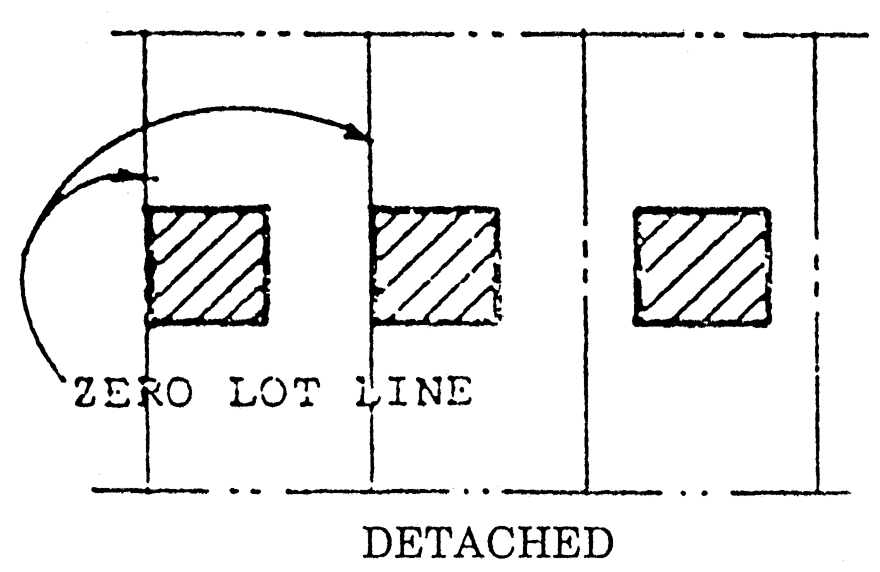
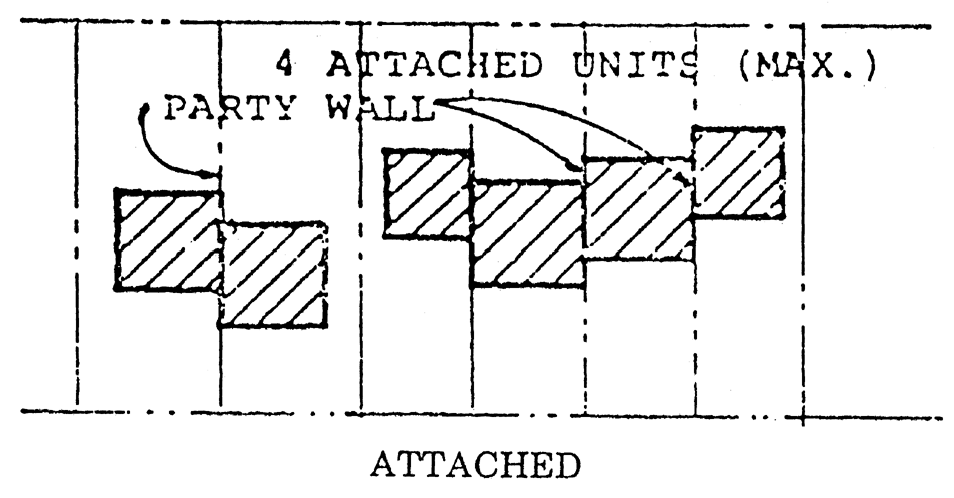
A cluster house may be a townhouse, condominium, duplex, or other single-family dwelling. A cluster house is a single-family dwelling not more than two stories in height available for separate ownership and located in a complex containing not less than two dwellings with each single-family dwelling located on a separate lot having its own front and rear access to the outside at ground level with no dwelling located over another dwelling and with each dwelling separated from any other dwelling by one or more fire resistant walls. See illustration [in] this [sub]section [3. Cluster housing].
The lot size shall be in accordance with that defined in each district.
1.
Permitted activities and building types. Planned cluster developments shall provide for individual lots which are permitted one dwelling unit in a single structure. Up to four units may be attached (party wall, see following diagram). Mobile homes are excluded from consideration as a planned cluster development except in MH district. The following diagram is illustrative of the dwelling cluster developments:
2.
Density and recreation area.
a.
The maximum overall density for a planned cluster development shall be in terms of the number of dwelling units per gross acre of land within the development, as provided in the table below.
b.
The minimum total recreation area (that part of the living space which is any large contiguous area for recreation purposes) shall be provided at no less than a minimum ratio of recreation space area per total floor area, as provided in the table below. Recreation areas shall be of common ownership.
c.
If a planned cluster development embraces one or more zone districts requiring different maximum permitted overall densities and recreation area ratios, these values shall be calculated separately for each distinct district and a weighted average (weighing the area in each zone district in proportion to its share of the total area of said development in such district) of each of these values shall be applied to said development.
3.
Yards. Except as required in the following, there shall be no minimum yard size within planned cluster developments; however, the planning commission shall have review authority for all yard designations and may require larger or smaller yard sizes based upon the particular site plans submitted for a specific development.
a.
A perimeter boundary setback of 30 feet measured from the structures to the property line shall be maintained uniformly for the total area within the planned cluster development.
b.
Fewer than ten units shall abide by the setback requirements of the zoning district in which the development is planned.
4.
Minimum lot size. There shall be no required minimum lot size within planned cluster developments; however, the planning commission shall have review authority for all lot designations and may require larger, smaller or replatted lot sizes and/or shapes based upon the particular site plans submitted for a specific development.
5.
Required accessory off-street parking. A minimum of two off-street parking spaces per dwelling unit shall be required in all planned cluster developments. All streets and parking areas shall be bordered with concrete curb and gutter. Curbs shall be six inches high.
6.
Area maintenance. Provisions shall be made for the perpetual maintenance of areas designated for use by the residents of a planned cluster development. This may be accomplished through a homeowners association established in accord with and chartered by the state under the applicable regulations, or by any other means acceptable to the planning commission. Such association charter or declaration of incorporation shall be submitted with the preliminary plat for approval by the planning commission.
7.
Procedure for approval of a planned cluster development. A planned cluster development shall follow the same rules and procedures for subdivision approval as outlined in the City of York Subdivision Regulations. However, the submission for preliminary plat approval must include the following additional information:
a.
Transportation routes, including streets, driveways, sidewalks, pedestrian ways and bikeways, and off-street parking and loading areas.
b.
Location and dimensions of structures, including height and bulk, and the utilization of structures, including activities and the number of dwelling units.
c.
Density of the development.
d.
A tabulation of the area to be devoted to various uses and activities as needed to calculate requirements of subsection 4 [minimum lot size].
e.
The substance of covenants, grants or easements or other restrictions to be imposed upon the use of the land, buildings or other structures, including proposed documents as required by subsection 6 [area maintenance] for area maintenance.
f.
When it is proposed that the development be constructed in stages, a development schedule for the project is required.
(Ord. No. 17-589, § 3, 5-7-2019)
4. - Home occupations.
A home occupation, as defined in section I [III. Definitions], shall be permitted in residential districts, provided that such occupation:
1.
Is conducted by no other person than members of the family residing on the premises;
2.
Is conducted entirely within the principal building;
3.
Utilizes not more than 25 percent of the total floor area of the principal building;
4.
Produces no alteration or change in the character or exterior appearance of the principal building from that of a dwelling;
5.
Involves no sale or offering for sale of any article not produced or assembled by members of the family, or any service not entirely performed by members of the family residing on the premises;
6.
Creates no disturbing or offensive noise, vibration, smoke, dust, odor, heat, glare, traffic hazard, unhealthy or unsightly condition;
7.
Is not visibly evident from outside the dwelling, except for one nonilluminated sign two square feet or smaller in area, mounted against a wall of the principal building; and
8.
Provides adequate off-street parking for the maximum number of vehicles encountered in the conduct of the occupation in a manner and at such a location so as not to detract from the appearance of the premises or to inconvenience the neighboring residents.
(Ord. No. 08-483, 9-2-2008; Ord. No. 21-646, 2-2-2021)
5. - Accessory uses.
In addition to the principal uses which are designated herein as being permitted within the several zoning districts established by the [zoning] ordinance, it is intended that certain uses customarily incidental or accessory to such principal uses shall also be permitted.
For the purposes of this [zoning] ordinance, therefore, each of the following uses is considered to be a customary accessory use and, as such, may be situated on the same lot with the principal use or uses to which it serves as an accessory:
1.
Uses customarily accessory to dwellings:
a.
Private garages.
b.
Open storage space or parking area for noncommercial motor vehicles. Not more than one commercial vehicle, with a gross weight limited to one and one-half tons, may be housed or regularly parked on any lot.
c.
Shed or tool room for the storage of equipment used in grounds or building maintenance.
d.
Children's playhouse and play equipment.
e.
Private kennel for family pets, provided they are of the type authorized by city ordinance.
f.
Private swimming pool and bathhouse, cabana, or tennis court.
g.
Structures designed and used for purposes of shelter in the event of manmade or natural catastrophes.
h.
Noncommercial flower, ornamental shrub or vegetable garden greenhouse or slat house not more than eight feet in height.
2.
Uses customarily accessory to church buildings:
a.
Religious education buildings.
b.
Parsonage, pastorium or parish house, together with any use accessory to a dwelling, as listed under paragraph [subsection] 1 of this subsection [5. Accessory uses].
c.
Off-street parking area for the use, without charge, of members and visitors to the church.
3.
Uses customarily accessory to retail businesses, offices and commercial recreation facilities:
a.
Off-street parking or storage area for customer, client or employee-owned vehicles.
b.
Completely enclosed building for the storage of supplies, stock or merchandise.
c.
Light manufacturing and/or repair facility incidental to the principal use; provided that dust, odor, smoke, noise vibration, heat or glare produced as a result of such manufacturing or repair operation shall not be perceptible from any boundary line of the lot on which such principal and accessory uses are located; and provided that such operation is not otherwise specifically prohibited in the district in which the principal use is located.
d.
One single-family dwelling for a miniwarehouse development, provided that the dwelling must be used by an individual employed for the purpose of providing security for the miniwarehouse development. Manufactured homes (mobile homes) are prohibited from use for the above-referenced residential purpose.
e.
Offices shall be allowed when associated with apartment complexes.
4.
Commercial kitchen as an accessory use to permitted uses in the B-1 - central business zoning district and MU - mixed use zoning district.
Setback and other yard requirements, for accessory uses. In any district, other than residential, all accessory uses operated in structures above ground level shall observe all setbacks, yards and other requirements set forth for the district within which they are located. In any district, an accessory drive to an accessory garage, parking area or truck loading space may be located within a required side yard.
Off-street parking and off-street loading requirements. All uses and establishments commenced hereafter shall provide the minimum number of off-street parking spaces required in this section. Minimum dimensions for each parking space shall be ten feet by 20 feet. There shall be adequate access to each parking space from a public street. Three hundred square feet per car, which includes aisles, shall be allotted.
(Ord. No. 02-362, 4-25-2002; Ord. No. 22-672, 6-7-2022)
6. - Communications towers.
[Definitions, general requirements, standards for approval, required application, appeals, and other criteria concerning communication towers are as follows:]
1.
Definitions.
a.
The appeal authority is the board of zoning appeals, approval authority is the building official, and plan review authority is the planning commission.
b.
A communications tower or tower is a structure more than 60 feet tall used primarily for the support of one or more antennae erected on the ground or a similar structure more than 20 feet tall erected on a building. The height of the tower shall include any antenna that extends above the top of the tower.
c.
A communications antenna is an antenna operated by a communications provider. This definition does not include receiving antennae, including antennae less than one meter in diameter used for space-based services, for residences; or antennae less than two meters in diameter used in nonresidential areas for space-based services; or antennae legally operated by FCC-licensed amateurs.
d.
A communications provider is any entity required to be licensed by the FCC.
2.
General requirements. General requirements for all structures are applicable to communications towers. All applicable health, nuisance, noise, fire, building, and safety code requirements shall apply in addition to the conditions of this [zoning] ordinance. Regulations covering visibility, fencing, screening, landscaping, parking, access, lot size, exterior illumination, sign, storage, and all other general zoning district regulations except those specifically superseded by this [sub]section [6. Communication towers] shall apply to the use.
3.
Standards for approval of communications towers.
a.
A communications tower shall be permitted by the approval authority upon determination that all of the applicable conditions in this [sub]section are met.
b.
Height limitations.
(1)
Height limitations for ground-mounted freestanding or guyed towers, or the overall height of a tower mounted on an existing structure:
(a)
Industrial and major commercial districts—GI General Industrial, HC Highway Commercial, 350 [feet].
(b)
Residential, office, and light commercial districts—R15, R7, R7-MH, R5, TU, BI, IU, MH, 100 feet, provided that in residential districts communications towers shall be permitted only on parcels with existing legal nonresidential uses. Examples of such uses are schools, churches, and utility sites.
(c)
Planned development districts—as determined in the development plan.
(d)
All other districts—prohibited.
(2)
The height limitation for communication towers mounted on existing structures, including buildings, water tanks, and other structures: one-half the height of the existing structure or 90 feet, whichever is less. For purposes of this subsection, a tower is not considered a structure on which another tower may be erected. This subsection shall not apply if the total height of a communications tower and the existing structure on which it is mounted does not exceed the height limit in subsection 3.b.(1) above.
c.
If applicant proposes to establish a new tower within 1,200 feet of an existing tower, applicant shall submit a statement that each such tower does not meet applicant's structural specifications or technical design requirements or that space on such other tower is not available at fair market value. Applicant may present evidence that multiple towers not more than 66 percent of the highest permitted tower height in such district would better serve the public interest. The plan review authority shall afford the owner(s) of such existing tower(s) an opportunity for comment before making a decision.
d.
New tower locations shall be determined according to the following hierarchy. No site on a lower level of the hierarchy may be used unless the plan review authority determines, based on the application and other information, that higher priority locations are unsuitable for operation of the facility under FCC regulations and applicant's requirements or are not available at fair market value.
(1)
Publicly owned property, e.g., property owned by a city, town, or county, a school or other special purpose district, state or federal government, which the owner determines may be used for a tower.
(2)
Private or public land within the height of the proposed tower from an existing high voltage transmission line, electric substation, elevated water tank, interstate scale billboard, smokestack, or other existing use taller than 45 feet.
(3)
Other available privately owned sites in nonresidential districts.
(4)
A residential district, provided that the applicant must show that the area cannot be served by a facility placed in a nonresidential district for valid technical reasons.
e.
Applicant shall use its best efforts to design any new tower to accommodate its own present and projected future needs, as well as a reasonable projection of one other comparable user's needs. Any unused tower space, not reserved for applicant's own use, shall be made available at fair market value. Unused tower space does not have to be offered to third parties whose proposed use is likely to interfere technically or mechanically with the existing users of said tower. This requirement may be reduced by the plan review authority.
f.
License to operate: If applicant is a communications provider, it shall have a current business license for all such services offered by any means to any customer located in the municipality. If applicant is not a communications provider, it shall obtain a business license under class 7. If the tower is used solely for noncommercial services, e.g., amateur radio, no business license shall be required.
g.
Communications towers shall be a blending color such as light gray, unless required to be painted otherwise by the Federal Aviation Administration. Properly maintained unpainted galvanized steel color shall meet this condition.
h.
Communications towers shall not be lighted unless required by the Federal Aviation Administration or for safety reasons as determined by the plan review authority. When required, lights shall be strobe in daytime. After dusk and before dawn, lights shall be red. If allowed by federal authorities, lights shall be shaded to minimize visibility from the ground.
i.
The proposed installation shall meet all applicable FCC rules and shall be operated in accordance therewith.
j.
A tower shall satisfy the most stringent of the following setbacks:
(1)
A tower must be set back from all lot lines a distance equal to the district or use setback requirements. For guyed towers, the setback shall be measured from a line connecting the outermost anchor points for guy wires. For self-supporting towers, the setback shall be measured from the foundation plus one-tenth the height of the tower.
(2)
A tower must be a minimum distance equal to one-half the height of the tower from property officially designated historic or architecturally significant.
k.
A single sign, approximately two square feet in size, shall be placed in a visible location on or near the tower identifying the owner, the street address, and owner's identification code of the tower and an all-hours emergency telephone number. Such sign may also identify other users of the tower.
l.
Communications towers and associated buildings shall be secured from unauthorized access. Towers and associated buildings shall be protected by a security fence. Six-foot chain link fencing topped with barbed or razor wire shall meet this requirement. Other methods for providing security may be provided to the plan review authority for review and approval.
4.
Application required. Any person desiring to obtain a zoning permit for construction of a communications tower or placement of a telecommunications antenna on an existing structure shall file an application and fee with the building official. Said application shall include the following information and/or documents:
a.
A copy of FCC form 854, Application for Antenna Structure Registration, or the same information in a similar format if the tower is not subject to FCC registration. Any information on said form may be referenced on other documents.
b.
Application fee (building and other permit fees shall be in addition to the tower application fee): $250.00, except that for a tower to be used solely for noncommercial services, e.g., amateur radio, the fee shall be $50.00. The fee for an application for adding an antenna to an existing structure under [sub]section 6 [5. Addition or change of antennae to existing structures, including towers] shall be $50.00.
c.
Complete plans and specifications for the proposed communications tower including foundation, wind and ice loading, antennae and appurtenances, and any accessory building(s) as required by the building code.
d.
A site plan showing property boundaries, zoning district and required setbacks, existing structures, latitude and longitude, zoning and uses of adjacent property. The site plan shall also indicate the proposed tower location, site elevation, tower height, guy anchors, driveway and parking, fencing and landscaping.
e.
A map showing all of applicant's antenna sites that serve the city.
f.
A list of other users of the proposed tower.
g.
Written authorization from the owner of the site, if the applicant is not the owner.
h.
A copy of the FCC license or other evidence of FCC approval of the proposed installation. If applicant has not applied for FCC license(s), applicant shall indicate what service(s) are to be provided by reference to FCC designation(s). If no FCC license is required, applicant shall indicate the purpose of the tower.
i.
A check list covering applicable conditions in [sub]section 4 above, including documentation of 4.d.(1—4).
j.
All information required for any other applicable code and any additional information required by the building official for determination that all applicable zoning regulations are met.
5.
Addition or change of antennae to existing structures, including towers.
a.
This [sub]section [5.] applies to the following cases:
(1)
An antenna to be added to an existing communications tower by a communications provider not previously using such tower.
(2)
Transfer of ownership of an existing antenna to a provider not already using the communications tower.
(3)
Installation or substitution of an antenna which exceeds the current structural/wind loading calculations.
b.
Any person subject to this [sub]section [5.] shall submit an application in the same manner as an application for construction of a new communications tower. Such application shall include only the information required by this [sub]section [5.] in addition to the permit application, if any, required under the electrical or building codes.
c.
Information required by [sub]section 4 [application required] hereof to the extent that such information has changed from previous submittal(s) or is applicable to the use of an existing structure.
d.
Information showing:
(1)
That the additional loading on the tower or other structure will not exceed its design, or
(2)
Changes that will be made to the tower or other structure to accommodate the additional antenna(e).
[6.
Reserved.]
7.
Appeals. An applicant may appeal as follows:
a.
If the approval authority or plan review authority has denied a permit or failed to act on an application within 45 days, unless extended by agreement.
b.
Following opportunity for public input and findings of fact based on the following criteria, the appeal authority may grant a variance or special exception:
(1)
Applicant has satisfied all requirements and conditions required by this [zoning] ordinance, except requirements for which a variance is permitted and sought.
(2)
If requesting additional height beyond that permitted in the district, applicant has demonstrated that such additional height is necessary to serve the citizens of the City of York.
(3)
Setback requirements and such additional conditions established by the appeal authority, as it deems necessary to remove danger to health and safety, and to protect adjacent property.
(4)
There is insufficient cause to deny the permit under section 704 of the Telecommunications Act of 1996, which requires substantial evidence contained in a written record.
8.
Applicability.
a.
A tower shall not be allowed unless it is used to support operating antennae or is itself an antenna. If any tower is not used for a period of more than 90 days, the upon notice in writing given to the owner or his agent by the building official, said tower shall be removed if use is not resumed with 180 days of such notice, provided that for any tower on which antenna(e) have been installed in preparation for offering a new service, the total time allowed by this subsection shall be one year. The appeal authority may grant additional time to the tower owner.
b.
Existing towers shall be registered within 30 days of the effective date of this [zoning] ordinance. For purposes of this subsection, registration shall mean submission of information required by subsections 5.a., 5.d., 5.g., and 5.h. of this [zoning] ordinance. License fees required by section 4.f. shall be prorated until the next regular renewal date of such licenses.
c.
The tower owner shall comply with subsections 4.g., 4.h., 4.i., 4.k., and 4.l. Towers which do not meet the requirements of this [zoning] ordinance shall be a permitted nonconforming use to the extent of the location, height, and setbacks of such towers. Any addition to such towers shall not increase its nonconformity, except that existing public broadcasting facilities, because of the unique high frequency, unidirectional and line of sight nature of their facility, may increase their height to that allowed under the highway commercial district.
d.
Owners of existing towers which do not meet the requirements of this [zoning] ordinance who do not register their towers according to subsection 8.b. [of subsection 8. Applicability] shall cause such towers to conform to this [zoning] ordinance within three years of the effective date hereof.
7. - Relocated housing units.
[Any residential unit to be relocated into or within the city limits shall meet the following requirements;]
1.
The minimum heated floor area shall be 1000 square feet, and
2.
For units relocated within the city limits, the unit shall be relocated in a district that is equally or less restrictive than the original districts (in order of descending restrictiveness: R-15, R-12, R-7, R-5); and
3.
A state licensed general contractor or residential home builder shall obtain a permit for the setup and renovation of the unit; and
4.
A state licensed mechanical subcontractor shall conduct all work related to plumbing, electrical, HVAC, systems, etc.; and
5.
The residential unit shall be renovated to meet the standards of the Standard Housing Code, 1994 edition and Standard Building Code (as determined by the planning director).
6.
In particular, the electrical, plumbing, HVAC, roof, foundation, window, and insulation systems shall be brought into compliance with adopted codes.
Exceptions:
1.
The unit was owner-occupied at its former location and will be owner-occupied at its proposed location.
2.
Manufactured housing units that meet all other requirements of the city zoning ordinance.
(Ord. No. 00-339, 3-6-2001)
8. - Manufactured housing.
1.
A manufactured housing unit must be a 1976 or newer HUD-approved unit (at construction) in order to be set up within the city limits. A manufactured housing unit older than 1976 may be set up, upon provision of the following:
a.
Documentation confirming that the housing unit was legally permitted and legally connected to power (with power usage) in the city within a six-month period immediately preceding the permit application; and
b.
Documentation confirming that the housing unit was owner-occupied at the previous and proposed locations.
2.
A manufactured housing unit must be set up in accordance with the South Carolina Uniform Standards Code for Manufactured Housing or in accordance with manufacturer specifications, whichever is stricter.
3.
All single-family residential structures, except manufactured housing units located in grandfathered manufactured housing parks, must be underpinned with permanent brick, block, stucco, stone, Z-brick or equivalent. Mobile homes located in manufactured housing parks of manufactured housing units measuring less than 20 feet in width will be allowed to use manufactured housing vinyl underpinning kits. Underpinning must be vented in accordance with the Building Code. If underpinning is to be Z-brick or equivalent, the underpinning must be installed by the manufacturer's specifications. Vinyl manufactured housing kits must be installed as follows:
a.
All vertical framing members and horizontal framing members not at ground level must be a minimum of two-inch by four-inch galvanized steel studs.
b.
Horizontal framing members at ground level must be four-inch galvanized steel tracks.
c.
Vertical framing members must be placed not more than eight feet on center.
d.
Horizontal framing members must be at ground level, at the center of the distance between ground level and the bottom of the housing unit if the bottom of the unit is more than 36 inches from the ground.
e.
Horizontal framing members at ground level must be spiked at least 12 inches into the ground at not more than four-foot intervals.
Note: When the manufactured housing unit is more than six feet off the ground, a professional engineer must design the footings. The design must be sealed by a South Carolina registered professional engineer. In no case can a manufactured housing unit setup exceeding six feet in height be underpinned with vinyl.
Exception to the above: Housing units placed in a floodplain must meet the floodplain ordinance requirements.
4.
All single-family structures must have all entrances completed in accordance with the building code prior to issuance of the certificate of occupancy.
9. - Sexually oriented businesses.
A.
Purpose and intent of section. It is the purpose of this section to ensure reasonable protection against the ripple effect upon the community of the commercialization of sex and sexual activity, to regulate sexually oriented businesses to promote the health, safety, morals and general welfare of the citizens of the city, and to establish reasonable and uniform regulations to prevent the deleterious location and concentration of sexually oriented businesses within the city. The provisions of this section have neither the purpose nor the effect of imposing a limitation or restriction on the content of any communicative materials, including sexually oriented materials. Similarly, it is not the intent or effect of this section to restrict or deny access by adults to sexually oriented materials protected by the First Amendment, or to deny access by the distributors and exhibitors of sexually oriented materials to their intended market. Neither is it the intent of this section to condone or legitimize the distribution of obscene material.
B.
Definitions. Whenever any provision of this section shall prohibit or restrict an activity or condition used in this subsection to define the various types of sexually oriented businesses, the fact that such activity or condition is used purely for definitional purposes shall not be construed as a contradiction or inconsistency with the substantive provisions of this section, and the described activity shall be prohibited or restricted as provided by the substantive provisions.
Adult arcade means any place to which the public is permitted or invited wherein coin-operated or slug-operated or electronically, electrically, or mechanically controlled still or motion picture machines, projectors, or other image-producing devices are maintained to show images to five or fewer persons per machine at any one time, and where the images so displayed are distinguished or characterized by the depicting or describing of "specified sexual activities" or "specified anatomical areas."
Adult bookstore, adult novelty store or adult video store means a commercial establishment which has as a significant or substantial portion of its stock in trade, or derives a significant or substantial portion of its revenues from, or devotes a significant or substantial portion of its interior business or advertising to, the sale or rental, for any form of consideration, of any one or more of the following:
1.
Books, magazines, periodicals or other printed matter, or photographs, films, motion pictures, video cassettes or video reproductions, slides, or other visual representations which depict or describe "specified sexual activities" or "specified anatomical areas," or
2.
Instruments, devices, or paraphernalia which are designed for use in connection with "specified sexual activities."
An establishment may have other principal business purposes that do not involve the offering for sale, rental or viewing of materials depicting or describing specified sexual activities or specified anatomical areas, and still be categorized as an adult bookstore, adult novelty store or adult video store. Such other business purposes will not serve to exempt such establishments from being categorized as an adult bookstore, adult novelty store or adult video store so long as one of its principal business purposes is offering for sale or rental, for some form of consideration, the specified materials which depict or describe "specified anatomical areas" or "specified sexual activities."
Adult cabaret means a nightclub, bar, restaurant, or similar commercial establishment which regularly features:
1.
Persons who appear in a state of nudity; or
2.
Live performances which are characterized by the exposure of "specified anatomical areas" or by "specified sexual activities"; or
3.
Films, motion pictures, video cassettes, slides, or other photographic reproductions which are characterized by the description of "specified sexual activities" or "specified anatomical areas."
Adult motel means a hotel, motel or similar commercial establishment which:
1.
Offers accommodations to the public for any form of consideration; provides patrons with closed-circuit television transmissions, films, motion pictures, video cassettes, slides, or other photographic reproductions which are characterized by the depiction or description of "specified sexual activities" or "specified anatomical areas"; and has a sign visible from the public right-of-way which advertises the availability of this adult type of photographic reproductions; or
2.
Offers a sleeping room for rent for a period of time that is less than ten hours; or
3.
Allows a tenant or occupant of a sleeping room to sub-rent the room for a period of time that is less than ten hours.
Adult motion picture theater means a commercial establishment where, for any form of consideration, films, motion pictures, video cassettes, slides, or similar photographic reproductions are regularly shown which are characterized by the depiction or description of "specified sexual activities" or "specified anatomical areas."
Adult theater means a theater, concert hall, auditorium, or similar commercial establishment which regularly features persons who appear in a state of nudity or live performances which are characterized by the exposure of "specified anatomical areas" or by "specified sexual activities."
Escort means a person who, for consideration, agrees or offers to act as a companion, guide, or date for another person, or who agrees or offers to privately model lingerie or to privately perform a striptease for another person.
Escort agency means a person or business association who furnishes, offers to furnish, or advertises to furnish escorts as one of its primary business purposes for a fee, tip, or other consideration.
Employee means a person who works or performs in and/or for a sexually oriented business, regardless of whether or not the person is paid a salary, wage or other compensation by the operator of the business.
Establishment means and includes any of the following:
1.
The opening or commencement of any sexually oriented business as a new business;
2.
The conversion of an existing business, whether or not a sexually oriented business, to any sexually oriented business;
3.
The addition(s) of any sexually oriented business to any other existing sexually oriented business; or
4.
The relocation of any sexually oriented business.
Introductory service means any person who, for financial consideration, offers to assist any person meet any other person for social or personal purposes not connected with or forming a part of another lawful business or professional activity.
Nude model studio means any place where a person who appears in a state of nudity or displays "specified anatomical areas" is provided to be observed, sketched, drawn, painted, sculptured, photographed, or similarly depicted by other persons who pay money or any form of consideration.
Nudity or a state of nudity means the appearance of a human bare buttock, anus, male genitals, female genitals, or female breast.
Operator means and includes the owner, permit holder, custodian, manager, operator or person in charge of any permitted or licensed premises.
Permitted or licensed premises means any premises that requires a license and/or permit and that is classified as a sexually oriented business.
Permittee and/or licensee means a person in whose name a permit and/or license to operate a sexually oriented business has been issued, as well as the individual listed as an applicant on the application for a permit and/or license.
Public building means any building owned, leased or held by the United States, the state, the county, the city, any special purpose district, a school district, or any other agency or political subdivision of the state or the United States, where building is used for governmental or other public purposes.
Public park or recreation area means public premises which have been designated for park or recreational activities, including but not limited to parks, playgrounds, nature trails, swimming pools, gymnasiums, recreational centers, reservoirs, athletic fields, basketball or tennis courts, pedestrian or bicycle paths, open space, wilderness areas or similar public premises within the city that are under the control, operation or management of the city park and recreation authorities or the equivalent state, county or recreation district authorities.
Religious institution means any church, synagogue, mosque, temple or building which is used primarily for religious worship and related religious activities.
Residential district means a geographical area recognized under the city zoning ordinance as primarily occupied by dwelling units for single-family, two-family, multiple-family or manufactured-home parks or subdivisions and campgrounds. It does not include other zoned districts intended primarily for industrial, service, commercial or office use but that permit residential uses.
Residential use means the lawful utilization of any structure as a dwelling unit for single-family, two-family or multiple-family occupation.
School means any public or private educational facility, including, but not limited to, child day care facilities, nursery schools, preschools, kindergartens, elementary schools, primary schools, intermediate schools, junior high schools, middle schools, high schools, vocational schools, secondary schools, continuation schools, special education schools, technical colleges, junior colleges, colleges and universities. The term "school" includes the school grounds, but does not include facilities used primarily for another purpose and only incidentally as a school.
Semi-nude means a state of dress in which clothing covers no more than the genitals, pubic region of either sex, and areola of the female breast, as well as portions of the body covered by supporting straps or devices.
Sexually oriented business means an adult arcade, adult bookstore or adult video store, adult cabaret, adult motel, adult motion picture theater, adult theater, escort agency, nude model studio, sexual encounter center, or introductory service.
Specified anatomical areas means the male genitals and/or the vulva or more intimate parts of the female genitals.
Specified sexual activities means and includes any of the following:
1.
The fondling or other erotic touching of human genitals, pubic region, buttocks, anus, or female breasts;
2.
Sex acts, normal or perverted, actual or simulated, including intercourse, oral copulation, or sodomy;
3.
Masturbation, actual or simulated;
4.
Human genitals in a state of sexual stimulation, arousal or tumescence; or
5.
Excretory functions as part of or in connection with any of the activities set forth in 1. through 3., above.
Substantial enlargement of a sexually oriented business means the increase in floor areas occupied by the business by more than 25 percent as the floor areas existing on the date of adoption of this ordinance.
Transfer of ownership or control of a sexually oriented business means and includes any of the following:
1.
The sale, lease, or sublease of the business;
2.
The transfer of securities which constitute a controlling interest in the business, whether by sale, exchange, or similar means; or
3.
The establishment of a trust, gift, or other similar legal device which transfers the ownership or control of the business, except for transfer by bequest or other operation of law upon the death of the person possessing the ownership or control.
Youth activity center means a boys' club, a girls' club or any other facility that is not a school but which provides entertainment, recreation, crafts, tutorials or other quality of life enhancements for minors, whether a nonprofit facility or otherwise.
C.
Misdemeanors.
1.
A person commits a misdemeanor if he operates or causes to be operated a sexually oriented business in violation of the City Code.
2.
A person commits a misdemeanor if he operates or causes to be operated a sexually oriented business within 1,500 feet of:
a.
A church;
b.
A boundary of any residential district;
c.
A public park adjacent to any residential district;
d.
The property line of a lot devoted to residential use; or
e.
A public or private elementary or secondary school.
3.
A person commits a misdemeanor if he causes or permits the operation, establishment, substantial enlargement, or transfer of ownership or control of a sexually oriented business within 1,000 feet of another sexually oriented business.
4.
A person commits a misdemeanor if he causes or permits the operation, establishment, or maintenance of more than one sexually oriented business in the same building, structure, or portion thereof, or the increase of floor areas of any sexually oriented business in any building, structure, or portion thereof containing another sexually oriented business.
For the purpose of this section, measurement shall be made in a straight line, without regard to intervening structures or objects, from the nearest portion of the building or structure used as a part of the premises where a sexually oriented business is conducted, to the nearest property line of the premises of a church or public or private elementary or secondary school, or to the nearest boundary of an affected public park, residential district, or residential lot.
For purposes of this ordinance, the distance between any two sexually oriented businesses shall be measured in a straight line, without regard to intervening structures or objects, from the closest exterior wall of the structure in which each business is located.
Any sexually oriented business lawfully operating on the date of adoption of this ordinance that has thereafter continuously lawfully operated, and which is in violation of this ordinance shall be deemed a nonconforming use. The nonconforming use will be permitted to continue for a period not to exceed two years, unless sooner terminated for any reason or voluntarily discontinued for a period of six months or more. Such nonconforming uses shall not be increased, enlarged, extended or altered except that the use may be changed to a conforming use. If two or more sexually oriented businesses are within 1,000 feet of one another and otherwise in a permissible location, the sexually oriented businesses which was first established and continuously operating at a particular location is the conforming use and the later-established business(es) is nonconforming. Further, the provisions of this ordinance relating to nonconforming uses shall not apply to businesses governed by the terms of this section.
A sexually oriented business lawfully operating as a conforming use is not rendered a nonconforming use by the location, subsequent to the grant or renewal of the sexually oriented business permit and/or license, of a church, public park, residential district or a residential lot within 1,500 feet of the sexually oriented business or within 1,500 feet of a public or private elementary or secondary school. This provision applies only to the renewal of a valid permit and/or license, and does not apply when an application for a permit and/or license is submitted after a permit and/or license has expired or has been revoked.
D.
Permit required; application for permit.
1.
Permit required. No person shall establish or operate a sexually oriented business without first obtaining a valid permit issued by the city for the operation of a sexually oriented business, which permit shall be in addition to any other permit or license required by municipal ordinance. A person commits a misdemeanor if he operates a sexually oriented business without a valid permit issued by the municipality.
2.
Filing of application. An application for a permit must be made on a form provided by the city. Any person desiring to operate a sexually oriented business shall file with the city an original and two copies of a sworn permit application on the standard application form supplied by the city.
3.
Contents of application. The completed application shall contain the following information and shall be accompanied by the following documents:
a.
If the applicant is an individual, the individual shall state the applicant's legal name and any aliases and submit satisfactory proof that he/she is at least 18 years of age. If the applicant is a partnership, the partnership shall state its complete name, and the names of all partners, and whether the partnership is general or limited, and shall provide a copy of the partnership agreement, if any. If the applicant is a corporation, the corporation shall state its complete name, the date of its incorporation, evidence that the corporation is in good standing under the laws of the state, the names and capacity of all officers, directors and principal stockholders, and the name of the registered corporate agent and the address of the registered office for service of process. Any person having a ten percent or greater interest in the application shall be listed in the application.
b.
If the applicant intends to operate the sexually oriented business under a name other than that of the applicant, he must state the sexually oriented business's fictitious name and submit the required registration documents.
c.
The application shall state whether the applicant or any of the other individuals whose identity is addressed in section D.3.a. has had a previous permit under this section or other similar sexually oriented business ordinances from another city or county denied, suspended or revoked. If so, the applicant shall include the name and location of the sexually oriented business for which the permit was denied, suspended or revoked; the date of the denial, suspension or revocation; and the name of governmental entity by which the permit was denied, suspended or revoked. The application shall also state whether the applicant or any other individual listed pursuant section D.3.a. of this section has been a partner in a partnership or an officer, director or principal stockholder of a corporation that is permitted under this section whose permit has previously been denied, suspended or revoked. If so, the applicant shall include the name and location of the sexually oriented business for which the permit was denied, suspended or revoked as well as the date of denial, suspension or revocation.
d.
The application shall state whether the applicant or any other individual listed pursuant to this holds any other permits and/or licenses under this section or another similar sexually oriented business ordinance from another city or county and, if so, the names and locations of such other permitted businesses.
e.
The application shall state the location of the proposed sexually oriented business, including a legal description of the property, street address, and telephone number.
f.
The application shall state the applicant(s) mailing addresses and residential addresses.
g.
A recent photograph of the applicant(s) shall be included.
h.
The application shall state the applicant's driver's license number, social security number, and state or federally issued tax identification number.
i.
The applicant shall submit a sketch or diagram showing the configuration of the premises, including a statement of total floor space occupied by the business. The sketch or diagram need not be professionally prepared, but it must be drawn to a designated scale or drawn with marked dimensions of the interior of the premises to an accuracy of plus or minus six inches.
j.
The applicant shall submit a current certificate and straight-line drawing prepared within 30 days prior to application by a South Carolina registered land surveyor depicting the property lines and the structures on premises located within 1,500 feet of the property to be certified. The applicant shall by separate document identify all existing or established uses within 1,500 feet of the property line of the premises for which a permit is sought. For purposes of this section, a use shall be considered existing or established if it is in existence at the time the application is submitted.
k.
Application fee. The applicant shall be required to pay a nonrefundable application fee at the time of an application under this section. The application fee shall be in addition to the annual permit fee otherwise required. The application fee shall be fixed from time to time by the city council and is set forth in the fee schedule of the City Code (initial fee of $500.00).
l.
Persons holding other licenses not exempt from permit. The fact that a person possesses other types of state, county or city permits and/or licenses does not exempt him from the requirement of obtaining a sexually oriented business permit.
m.
Consent to regulation. By applying for a permit under this section, the applicant shall be deemed to have consented to the provisions of this section and to the exercise by the city's police department and all other city agencies charged with enforcing the laws, ordinances and codes applicable in the city of their respective responsibilities under this section.
n.
List of employees. The applicant shall be required to provide the city with the names of any and all employees who are required to be licensed, this shall be a continuing requirement even after a permit is granted or renewed.
E.
Issuance or denial of permit.
1.
If the board of zoning appeals approves a special exception request for a sexually oriented business application, the city shall approve issuance of a permit to an applicant unless it finds one or more of the following to be true.
a.
An applicant is under 18 years of age.
b.
An applicant or other person residing in the applicant's household or the applicant's spouse is overdue in payment to the city of taxes, fees, fines or penalties assessed or imposed in relation to a sexually oriented business.
c.
An applicant has failed to provide information required by this section for the issuance of the permit or has falsely answered a question or request for information on the application form.
d.
An applicant is residing with a person who has been denied a permit by the city to operate a sexually oriented business within the preceding 12 months, or residing with a person whose permit to operate a sexually oriented business has been revoked within the preceding 12 months.
e.
The premises to be used for the sexually oriented business have not been approved by the health department, the fire department and the building official or other governmental agency having jurisdiction over the premises as being in compliance with applicable laws and ordinances.
f.
The application or permit fees required by this section have not been paid.
g.
An applicant of the proposed establishment is in violation of or is not in compliance with one or more of the provisions of this section.
h.
The applicant has a permit under this section which has been suspended or revoked.
i.
An applicant has been convicted of a specified criminal act for which:
1)
Less than two years have elapsed since the date of conviction or the date of release from confinement, whichever is the later date, if the conviction is of an offense with a potential jail or prison term of one year or less, for these specified criminal acts; sexual crimes against children, sexual abuse, rape, or crimes connected with another sexually oriented business, including but not limited to distribution of obscenity or material harmful to minors, prostitution, pandering, or tax violations.
2)
Less than five years have elapsed since the date of conviction or the date of release from confinement, whichever is the later date, if the conviction is of an offense with a potential prison term of more than one year, for these specified criminal acts; sexual crimes against children, sexual abuse, rape, or crimes connected with another sexually oriented business, including but not limited to distribution of obscenity or material harmful to minors, prostitution, pandering, or tax violations.
3)
Less than five years have elapsed since the date of conviction or the date of release from confinement, whichever is the later date, of the most recent conviction of two or more offenses with potential jail or prison terms of one year or less, for these specified criminal acts; sexual crimes against children, sexual abuse, rape, or crimes connected with another sexually oriented business, including but not limited to distribution of obscenity or materials harmful to minors, prostitution, pandering or tax violations, for offenses occurring within any 24-month period.
The fact that a conviction is being appealed shall have no effect on disqualification of the applicant. An applicant who has been convicted of the specified criminal acts described in this section may qualify for a sexually oriented business permit only when the time period required in this subsection has elapsed.
j.
An applicant operating a sexually oriented business in the city, at the time of application for another permit, or a renewal, knowingly has in his employment an unlicensed employee who is subject to the licensing provisions of this section.
2.
The permit, if granted, shall state on its face the name(s) of the person(s) to whom it is granted, the expiration date, and the address of the sexually oriented business. The permit shall be posted in a conspicuous place at or near the entrance to the sexually oriented business so that it may be easily read at any time.
3.
If the city denies the application, it shall notify the applicant of the denial and state the reasons for the denial.
4.
If a person applies for a permit for a particular location within a period of 12 months from the date of denial of a previous application for a permit at the location, and there has not been an intervening change in the circumstances which could reasonably be expected to lead to a different decision regarding the former reasons for denial, the application shall be denied.
F.
Permit fee. No sexually oriented business permit shall be issued without the owner or operator having first paid the annual sexually oriented business permit fee, nor shall any permit be renewed without the same fee first having been paid. The sexually oriented business permit fee shall be in addition to any other fee or tax which may be due in connection with the operation of a business within the city. The sexually oriented business permit fee shall be fixed from time to time by the city council and set forth in the standard fee schedule (initial fee of $500.00). Each applicant shall be required to have a background check. Charges for background checks shall be in addition to other fees and be paid in accordance with the city police department policy.
G.
Suspension of permit.
1.
The city shall suspend a permit issued under this section for a period not to exceed 30 days if it determines that a permittee, or an employee of a permittee, has:
a.
Violated or is not in compliance with any subsection of this section;
b.
Engaged in excessive use of alcoholic beverages while on the sexually oriented business premises;
c.
Refused to allow an inspection of sexually oriented business premises as authorized by this section;
d.
Knowingly permitted gambling by any person on the sexually oriented business premises;
e.
Operated the sexually oriented business in violation of a building, fire, health or zoning statute, code, ordinance or regulation, whether federal, state or local, such determination being based on investigation by the division, department or agency charged with enforcing such rules or laws. In the event of such statute, code, ordinance or regulation violation, the city or its designee shall promptly notify the permittee of the violation and shall allow the permittee a seven-day period in which to correct the violation. If the permittee fails to correct the violation before the expiration of the seven-day period, the city shall forthwith suspend the permit and shall notify the permittee of the suspension. In the event of an emergency or other situation which is potentially life threatening, the time period provided in this subsection shall not apply and the city may take such immediate action as shall be appropriate;
f.
Engaged in permit transfer contrary to this section. If the city suspends a permit on the grounds that a permittee engaged in a permit transfer contrary to this section, the city shall forthwith notify the permittee of the suspension. The suspension shall remain in effect until the applicable section of this section has been satisfied;
g.
Operated the sexually oriented business in violation of the hours of operation provided in this section; or
h.
Knowingly employs a person who does not have a valid license as required in this section or knowingly permitted any patron, customer or member of the public to appear nude or nearly nude on the premises.
Such determination may be based upon information obtained by the enforcement officer from other inspection or enforcement officers of the city.
2.
If, at the end of the period of suspension, the violation has not been corrected, the suspension shall remain in effect until the violation of the statute, code, ordinance or regulation in question has been corrected.
H.
Revocation of permit.
1.
The city shall revoke a permit if a cause of suspension listed in this section occurs and the permit has been suspended within the preceding 12 months.
2.
The city shall revoke a permit if it determines that:
a.
A permittee gave false or misleading information in the material submitted during the application process when the permittee knew or should have known the correct information;
b.
A permittee or an employee has knowingly allowed possession, use or sale of controlled substances in or on the premises;
c.
A permittee or an employee has knowingly allowed prostitution or solicitation for prostitution on the premises;
d.
A permittee or an employee knowingly operated the sexually oriented business during a period of time when the permittee's permit was suspended;
e.
A permittee has been convicted of a specified criminal act for which the time period required in this section has not elapsed;
f.
On two or more occasions within a 12-month period, a person committed an offense, occurring in or on the permitted premises, constituting a specified act for which a conviction has been obtained, and the person was an employee of the sexually oriented business at the time the offenses were committed. The fact that a conviction is being appealed shall have no effect on the revocation of the permit;
g.
A permittee is delinquent by more than 30 days in payment to the city, county or state for any taxes or fees due;
h.
A permittee or an employee has knowingly allowed any act of sexual intercourse, sodomy, oral copulation, masturbation or any other specified sexual activities to occur in or on the permitted premises;
i.
A permittee has been operating more than one sexually oriented business under a single roof, except as may be addressed for preexisting nonconforming uses under provisions of the city zoning ordinance relating to the sexually oriented businesses; or
j.
A permittee knowingly permitted an owner, operator, employee or agent to appear nude or nearly nude on the premises.
3.
When the city revokes a permit, the revocation shall continue for one year and the permittee shall not be issued a sexually oriented business permit for one year from the date revocation becomes effective. If, subsequent to revocation, the city finds that the basis for revocation has been corrected, the applicant, for good cause, may be granted a permit if at least 90 days have elapsed since the date revocation became effective.
I.
Transfer of permit; conduct of business at other than specified location.
1.
A permittee shall not operate a sexually oriented business under the authority of a permit at any place other than the address designated in the permit, nor shall a permit be granted for any place other than that identified in the application.
2.
A permittee shall not transfer his permit to another.
3.
Any attempt to transfer a permit either directly or indirectly in violation of this section is hereby declared void and, in addition to any other penalties, the permit shall be deemed revoked as of the date of the attempted transfer.
J.
Employee license.
1.
Required fee. Each employee to be employed in a sexually oriented business shall be required to obtain a sexually oriented business employee license. Each applicant shall pay a fee as fixed from time to time by the city council and as set forth in the standard fee schedule. The fee is to cover reasonable administrative costs of the licensing application process.
2.
Application. Before any applicant may be issued a sexually oriented business employee license, the applicant shall submit, on a form to be provided by the city, the following information:
a.
The applicant's name and any other names, including stage names or aliases used by the individual.
b.
Age, date and place of birth.
c.
Height, weight, hair and eye color.
d.
Present residence address and telephone number.
e.
Present business address and telephone number.
f.
State driver's license or identification number.
g.
Social security number.
h.
Acceptable written proof that the individual is at least 18 years of age.
i.
Attached to the application form, a color photograph of the applicant clearly showing the applicant's face, and the applicant's fingerprints on a form provided by the police department. Any fees for the photographs and fingerprints shall be paid by the applicant.
j.
A statement detailing the license or permit history of the applicant for the five years immediately preceding the date of the filing of the application, including whether such applicant, previously operating or seeking to operate in this city or any other city, county, state or country, has ever had a license, permit or authorization to do business denied, revoked or suspended, or had any professional or vocational license or permit denied, revoked or suspended. In the event of any such denial, revocation or suspension, the applicant shall state the date and the name of the issuing or denying jurisdiction, and describe in full the reasons for the denial, revocation or suspension. A copy of any order of denial, revocation or suspension shall be attached to the application.
k.
Whether the applicant has been convicted of a specified criminal act as defined in this section. This information shall include the date, place and nature of each conviction or plea of nolo contendere and identify the convicting jurisdiction.
3.
Investigation, issuance. The city shall refer the sexually oriented business employee license application to the police department for an investigation to be made of such information as is contained on the application. The application process shall be completed within ten days from the date the completed application is filed. After the investigation, the city shall issue a license unless the information gathered establishes that one or more of the following findings is true:
a.
The applicant has knowingly made any false, misleading or fraudulent statement of a material fact in the application for a license, or in any report or record required to be filed with the police department or other department of the city.
b.
The applicant is under 18 years of age.
c.
The applicant has been convicted of a specified criminal act as defined in section C. and the prescribed time period has not yet passed the from date of conviction or release from confinement, whichever is later.
d.
The sexually oriented business employee license is to be used for employment in a business prohibited by local or state law, statute, rule or regulation, or prohibited by particular provisions of this section.
e.
The applicant has had a sexually oriented business employee license revoked by the city within two years of the date of the current application.
4.
Renewal.
a.
A license granted pursuant to this section shall be subject to annual renewal by the city upon the written application of the applicant and a finding by the city in accord with the procedures of this section that the applicant has not been convicted of any specified criminal act as defined in this section or committed any act during the existence of the previous license period which would be grounds to deny the initial permit application.
b.
The renewal of the license shall be subject to payment of a fee as set by a resolution of the city council.
K.
Additional regulations for adult motels. Evidence that a sleeping room in a hotel, motel, or a similar commercial establishment has been rented and vacated two or more times in a period of time that is less than ten hours creates a rebuttable presumption that the establishment is an adult motel as that term is defined in this ordinance.
A person commits a misdemeanor if, as the person in control of a sleeping room in a hotel, motel, or similar commercial establishment that does not have a sexually oriented permit and/or license, he rents or sub-rents a sleeping room to a person and, within ten hours from the time the room is rented, he rents or sub-rents the same sleeping room again.
For purposes of this section, the terms "rent" or "sub-rent" mean the act of permitting a room to be occupied for any form of consideration.
L.
Exhibition of films or videos in video booths.
1.
A person who operates or causes to be operated a video arcade or other sexually oriented business, other than a sexually oriented motel, which exhibits on the premises, in a viewing room of less than 150 square feet of floor space, a film, videocassette or other video reproduction which depicts "specified sexual activities" or "specified anatomical areas," shall comply with the following requirements:
a.
Upon application for a sexually oriented business permit, the application shall be accompanied by a diagram of the premises showing a plan thereof specifying the location of one or more manager's stations and the location of all overhead lighting fixtures, and designating any portion of the premises in which patrons will not be permitted. A manager's station may not exceed 32 square feet of floor area, with no dimension greater than eight feet. The diagram shall also designate the place at which this permit will be conspicuously posted, if granted. A professionally prepared diagram in the nature of an engineer's or architect's blueprint shall not be required; however, each diagram should be oriented to the north or to some designated street or object and should be drawn to a designated scale with marked dimensions sufficient to show the various internal dimensions of all areas of the interior of the premises to an accuracy of plus or minus six inches. The city may waive the requirement for this diagram for renewal applications if the applicant adopts a diagram that was previously submitted and certifies that the configuration of the premises has not been altered since it was prepared.
b.
The application shall be sworn to be true and correct by the applicant.
c.
No alteration in the configuration of the premises as shown may be made without the prior approval of the city.
d.
It is the duty of the owners, operators and permittees to ensure that at least one employee is on duty and situated at each manager's station at all times that any patron is present inside the premises.
e.
The interior of the premises shall be configured in such a manner that there is an unobstructed view from a manager's station of every area of the premises to which any patron is permitted access for any purpose, excluding restrooms. Restrooms may not contain video reproduction equipment. If the premises have two or more manager's stations designated, then the interior of the premises shall be configured in such a manner that there is an unobstructed view of each area of the premises to which any patron is permitted access for any purpose from at least one of the manager's stations. The view required in this subsection must be by direct line of sight from the manager's station.
f.
It shall be the duty of the owners, operators and permittees, and it shall also be the duty of any agents and employees present on the premises, to ensure that the view area specified in this section remains unobstructed by any doors, walls, merchandise, display racks or other materials or person at all times and to ensure that no patron is permitted access to any area of the premises which has been designated as an area in which patrons will not be permitted in the application filed pursuant to subsection a. of this section.
g.
No viewing room may be occupied by more than one person at any one time. No holes, commonly known as "glory holes," shall be allowed in the walls or partitions which separate each viewing room from an adjoining viewing room or restroom.
h.
The premises shall be equipped with overhead lighting fixtures of sufficient intensity to illuminate every place to which patrons are permitted access with an illumination of not less than 1.0 foot candle as measured at the floor level.
i.
It shall be the duty of the owners, operators and permittees, and it shall also be the duty of any agents and employees present on the premises, to ensure that the illumination described in this article is maintained at all times that any patron is present on the premises.
2.
A person having a duty under this article commits a violation of this Code if he knowingly fails to fulfill that duty.
M.
Prohibited conduct.
1.
No person shall perform or permit to be performed at a sexually oriented business a dance or other physical performance for entertainment in which the performer is nude or nearly nude, nor shall any person in the performance of his duties or activities as operator or employee of a sexually oriented business carry out such duties nude or nearly nude.
2.
Any person, otherwise appropriately attired in accord with this Code, who performs a dance or other physical performance for entertainment at a sexually oriented business establishment shall at no time during the performance have physical contact with any patron, invitee or member of the public. No operator of a sexually oriented business shall permit to be performed such dance or other physical performance that allows physical contact with any patron, invitee or member of the public, or knowingly encourage, permit any patron, invitee or member of the public to have physical contact with the performer during the performance.
3.
No patron of a sexually oriented business shall knowingly have physical contact with a dancer or person providing any other physical performance for entertainment while the performance is being presented, regardless of the amount of clothing worn by the patron or dancer or other performer.
4.
All operators of sexually oriented businesses at which dances or other physical performances for entertainment are provided shall post, in a conspicuous place near the performance area, a sign using at least three-inch lettering which states "CITY ORDINANCE: PATRONS SHALL HAVE NO PHYSICAL CONTACT WITH PERFORMERS DURING PERFORMANCE, PENALTY: $500.00 FINE, THIRTY (30) DAYS IN JAIL, OR BOTH."
5.
Nothing in this section shall be deemed to prohibit nudity or near nudity incidental to a theatrical performance or presentation which is part of a business operation which is not otherwise subject to a defined activity qualifying as a sexually oriented business under the provisions of this Code.
N.
Prohibitions regarding minors. No person shall operate or cause to be operated a sexually oriented business and, knowingly or with reasonable cause to know, permit, suffer or allow:
1.
Admittance of a person under 18 years of age to the business premises unless accompanied by a parent or guardian;
2.
A person under 18 years of age to remain at the business premises unless accompanied by a parent or guardian at all times;
3.
A person under 18 years of age to purchase goods or services at the business premises without the specific consent of a parent or guardian; or
4.
A person who is under 18 years of age to work at the business premises as an employee.
O.
Hours of operation. No sexually oriented business shall open to do business before 10:00 a.m. Monday through Saturday or remain open after 12:00 midnight Monday through Saturday. No sexually oriented business shall open for business on a Sunday. This section shall not apply to an adult motel or to a business whose hours of operation are regulated by state law.
P.
Advertising; visibility of interior; exterior lighting.
1.
No person shall operate or cause to be operated a sexually oriented business and advertise the presentation of any activity prohibited by any applicable state statute or local ordinance.
2.
No person shall operate or cause to be operated a sexually oriented business and display or otherwise exhibit the materials and/or performances at such sexually oriented business in any advertising which is visible outside the premises. This prohibition shall not extend to advertising of the existence or location of such sexually oriented business.
3.
No owner, operator, permittee or employee of a sexually oriented business shall allow any portion of the interior premises to be visible from outside the premises.
4.
All off-street parking areas and premises entries of the sexually oriented business shall be illuminated from dusk to closing hours of operation with a lighting system which provides an average maintained horizontal illumination of one footcandle of light on the parking surface and/or walkways. This required lighting level is established in order to provide sufficient illumination of the parking areas and walkways serving the sexually oriented business for the personal safety of patrons and employees and to reduce the incidence of vandalism and criminal conduct. The lighting shall be shown on the required sketch or diagram of the premises.
Q.
Inspections.
1.
An applicant or permittee under this article shall permit representatives of the police department, health department, fire department, building codes department, zoning department, or other city departments or agencies or such county and state agencies as may have jurisdiction to inspect the premises of a sexually oriented business for the purpose of ensuring compliance with the law at any time it is occupied or open for business.
2.
Regardless of whether or not a permit has been issued for the business under this ordinance, any person who operates a sexually oriented business or his agent or employee commits a violation of this Code if he refuses to permit such lawful inspection of the premises at any time that it is occupied or open for business.
R.
Distribution of sexual devices prohibited.
1.
It is unlawful for anyone to distribute anywhere within the city for commercial purposes, including free distribution for advertising, sale or offering for sale, any device, instrument or paraphernalia designed or marketed primarily for stimulation of human genital organs or for sadomasochistic use or abuse of themselves or others.
2.
Such devices, instruments or paraphernalia include but are not limited to phallic shaped vibrators, dildos, muzzles, whips, chains, bather restraints, racks, non-medical enema kits, body piercing implements (excluding earrings or other decorative jewelry) or other tools of sadomasochistic abuse.
S.
Exemptions and defenses.
1.
A person appearing in a state of nudity or nearly nude and doing so in a modeling class is exempt from the provisions of this section and any other municipal ordinance prohibiting appearance in the nude, provided that the modeling class is:
a.
At a proprietary school licensed by the state, or a college, junior college or university supported entirely or partly by taxation;
b.
At a private college or university which maintains and operates educational programs in which credits are transferable to a college, junior college or university supported entirely or partly by taxation; or
c.
In a structure:
1)
Which has no sign visible from the exterior of the structure and no other advertising that indicates a nude person is available for viewing;
2)
Where, in order to participate in a class, a student must enroll at least three days in advance of the class; and
3)
Where no more than one nude model is on the premises at any one time.
2.
It is a defense to prosecution for a violation of this section that an employee of a sexually oriented business, regardless of whether or not it is permitted under this section, exposed any "specified anatomical area" during the employee's bona fide use of a restroom, or during the employee's bona fide use of a dressing room which is accessible only to employees.
T.
Enforcement.
1.
The city manager shall be responsible for enforcement of this section by and through such officers and employees as he may designate from time to time to act on behalf of the city for purposes of application review, permit suspension or revocation, inspection, and any other act or assessment by the city provided for in this section.
2.
The city personnel charged with enforcement of this section and related state and local laws and codes shall be immune from prosecution for reasonable, good faith trespass upon a sexually oriented business while acting within the scope of authority conferred by this section.
U.
Injunction. A person who operates or causes to be operated a sexually oriented business without a valid permit and/or license or in violation of any section of this ordinance is subject to a suit for injunction as well as prosecution for criminal violations. Such violations shall be punishable by a fine of $500.00 plus court costs or 30 days imprisonment.
V.
Appeal procedure. An appeal of any requirement of this ordinance shall be done in accordance with the general appeal procedures of the zoning ordinance.
(Ord. No. 00-336, 3-6-2001; Ord. No. 05-422, 9-6-2005)
10. - Solar farms requirements.
A.
Setbacks. All buildings, structures, equipment, and parking areas related to the solar energy facility shall be setback at least:
1.
Seventy-five feet from all property lines;
2.
Seventy-five feet from all public rights-of-way; and
3.
Five hundred feet from all public rights-of-way along a designated South Carolina Scenic Byway.
B.
Height. The maximum height of all equipment shall not exceed 20 feet above the average site grade.
C.
Bufferyards and screening.
1.
Visual buffer plan. The applicant must provide a visual buffer plan using Type B or Type C bufferyards as described in City of York Code of Ordinances. The site plan must show all property lines as well as water features and contour lines. The plan must also show the placement, species, and initial and mature heights of proposed plantings within the vegetative buffer, as well as the location and details of proposed fences and/or walls on the property. Applicants must also submit a tree survey, berm contour lines, or graphic evidence of topographic features that reduce visual impacts of a solar energy facility, as applicable.
2.
[Screening.] Solar energy facilities must be screened from adjacent properties and rights-of-way with an opaque vegetative buffer and fence or wall per the following specifications and in accordance with City of York Code of Ordinances:
a.
A vegetative buffer with a minimum depth of 25 feet that adequately mitigates the visual impact of the solar energy facility on surrounding properties. The type of buffer should be based on the context and characteristics of the specific site; and
b.
The vegetative buffer shall also include a row of evergreens which shall reach a height of ten feet within three years of planting and which at maturity will form an intermittent visual barrier to a height of 12 feet. The evergreens shall be comprised of native species which are acclimated to the Carolina Piedmont; and
c.
A separate row of shrubs that are dense, low-lying, continuous, and planted so as to visually fill-in a large percentage of the low-lying gaps between the evergreens. Shrubs shall be a species native to the Carolina Piedmont; and
d.
A minimum six-foot tall security fence or wall that is constructed in a durable fashion of chain link, brick, vinyl, stone, wood posts and planks or any combination of these materials.
3.
Alternative compliance by special exception. The zoning board of appeals may modify the buffer and screening requirements where alternative compliance is proposed in the visual buffer plan as follows:
a.
There are existing vegetated areas located on the same property as the solar energy facility that are within or includes the required bufferyard, and are of sufficient height, length, and depth, and contain adequate and sufficient healthy vegetation to meet the intent of this section; or
b.
There are topographical features located on the subject and/or adjacent properties that reduce the visual impact of the solar energy facility on adjacent properties and rights-of-way so that required buffers and screening is not necessary to meet the intent of this section; or
c.
There are water features located on the subject property that would be adversely impacted by buffer and screening requirements; or
d.
The applicant proposes to construct a berm in lieu of the required fence or wall, provided that the height and location of the berm meet the intent of this section.
4.
All other applicable requirements for bufferyards and fencing in this ordinance that are not referenced by this section must be adhered to.
D.
Glare standards.
1.
The design and construction of solar energy facilities shall not produce light emissions, either direct or indirect (reflective), that would interfere with pilot vision and/or traffic control operations of airports located within five nautical miles of the proposed solar energy facility.
2.
Solar energy facilities equipment is to be designed and located in a way to avoid directing glare or reflection onto adjacent properties and roadways, and shall not interfere with vehicle traffic or create a safety hazard.
E.
Environmental standards.
1.
Improved areas shall not be located in wetlands, nor within a special flood hazard area (SFHA) as shown on the effective flood insurance rate map.
2.
Environmentally friendly vegetative management practices must be employed; use of herbicides, not typically used in agriculture in the local area, should be avoided; provided however, spot herbicide treatment may occasionally be applied to deter growth of new trees on the site. Soil sterilants shall not be used on the site.
F.
Additional requirements.
1.
An attached sign meeting the dimensional standards of the ordinance shall be posted and maintained at the entrance(s), which lists the name and phone number of the operator. Freestanding signs are prohibited.
2.
On-site electrical interconnections and power lines shall be installed underground to the extent feasible. Existing above ground utility lines shall be allowed to remain in their current location.
3.
All access roads and storage areas shall be established on a minimum 20-foot wide easement to a public right-of-way.
4.
Any other relevant studies, reports, certificates and approval as may be reasonably required by the City of York.
5.
A site plan for the project that meets all city requirements shall be submitted to the city for review and approval.
G.
Aviation notification.
1.
For consideration of potential impacts to civilian flight paths for airport operations located within five nautical miles from an airport listed in the National Plan of Integrated Airport Systems, notification of intent to construct a solar energy facility shall be sent to the airport manager or designated official and the appropriate Federal Aviation Administration's (FAA) Airport District Office (ADO). Notification shall include location of solar energy facility (i.e. map, latitude and longitude coordinates, address or parcel ID), technology (i.e. roof-mounted solar photovoltaic, ground-mounted fixed PV, tracked PV, solar thermal, etc.) and the area of system (e.g. ten acres). Proof of delivery of notification and date of delivery shall be submitted with permit application. The airport must be given 30 days for review.
2.
In addition to providing notification of intent to construct a solar energy facility, the proponent of the solar energy facility shall use the latest version of the Solar Glare Hazard Analysis Tool (SGHAT), per its user's manual, to evaluate the solar glare aviation hazard on airports meeting the criteria described above. The full report for each flight path and observation point, as well as the contact information for the planning director, shall be sent to the authorities described above at least 30 days prior to site plan approval. Proof of delivery of notification and date of delivery shall be submitted with permit application.
3.
Any applicable solar energy facility design changes (e.g. module tilt, module reflectivity, etc.) after initial submittal must be rerun in the SGHAT tool and the new full report must be sent without undue delay to the contact specified in subsection (1) above for accurate records of the as-built system.
H.
Decommissioning. The performance guarantee and decommissioning plan requirements below insure costs associated with the restoration or stabilization of a site for future use after a solar energy facility use has been discontinued.
1.
Performance guarantee.
a.
Prior to issuance of building permit, the applicant must provide the city with a performance guarantee in the form of a bond, irrevocable letter of credit and agreement, or other financial security acceptable to the city in the amount of 150 percent of the estimated decommission cost minus the salvageable value, or $50,000.00, whichever is greater. Estimates shall be determined by an engineer licensed to practice in South Carolina.
b.
All performance bonds must renew automatically; provide a minimum 90-day notice to the city prior to cancellation; be approved by the city attorney or his/her designee; and be provided by a company on the U.S. Department of Treasury's Listing of Certified Companies.
c.
The city may request a new engineer's estimate of probable cost of decommissioning every five years from the initial submission. The bond, letter of credit, or other financial security acceptable to the city shall be adjusted upward or downward, as necessary.
2.
Decommissioning plan. A decommissioning plan addressing the following items and signed by both the party responsible for decommissioning and the landowner (if different) shall be recorded in the York County Register of Deeds prior to the issuance of a building permit. The decommissioning plan shall be reviewed by staff for compliance with the requirements below prior to any party signatures and recordation of the document in the register of deeds.
a.
List the type of panels, storage facilities, and materials to be installed at the site.
b.
Restoration plan to properly restore or stabilize the property for future use, as determined by the planning director.
c.
Removal of solar panels, buildings, cabling, electrical components, roads, and any other associated facilities down to 36 inches below grade.
d.
Defined conditions upon which decommissioning will be initiated (i.e. end of land lease, no power production for 12 months, abandonment, etc.).
e.
The timeframe for completion of decommissioning activities. The maximum time permitted for decommissioning and restoring the site shall be six months.
f.
Description of any agreement (e.g. lease) with landowner regarding decommissioning and acknowledgment by the land owner, that he or she shall be held ultimately responsible for decommissioning.
g.
The identification of the party currently responsible for decommissioning.
h.
Estimated cost of site restoration prepared by an engineer licensed to practice in South Carolina.
i.
Plans for periodically updating the decommissioning plan.
I.
Abandonment.
1.
Should a solar energy facility cease to produce energy on a continuous basis for 12 months, it will be considered abandoned unless the current responsible party (or parties) with ownership interest in the solar energy facility provides substantial evidence (updated every three months after 12 months of no energy production) to the planning director or his/her designee of the intent to maintain and reinstate the operation of that facility.
2.
Upon determination of abandonment, the planning director or his/her designee shall notify the party (or parties) responsible that they must remove the solar energy facility and properly restore or stabilize the property for future use, as determined by the planning director, within six months of the notice.
3.
If the responsible party (or parties) fails to comply after six months from the date of notice has passed, the city may pursue all actions available at law or in equity, including, but not limited to: Breach of contract, specific performance, mandatory injunctions, fines, abatement, nuisance, liens, assessments and judicial sale of the property.
J.
Definitions.
1.
Solar energy facility. An energy generating facility or area principally used to convert solar energy to electricity, which includes, but is not limited to, the use of one or more solar energy systems. This definition shall exclude those facilities that are installed on the roof of a building, where the primary purpose of such building is not for the commercial production of solar energy.
2.
Abandonment. To give up, discontinue, withdraw from. Any solar energy facility that ceases to produce energy on a continuous basis for 12 months will be considered abandoned.
3.
Decommissioning plan. A document that details the planned shut down or removal of a solar energy facility from operation or usage.
K.
Enforcement. Any person found to be in violation of any provision of this section shall be subject to the penalties described in Chapter 1, Section 11 of the City of York, South Carolina Code of Ordinances.
(Ord. No. 20-612, § 2, 2-3-2020)

