
Yuba City City Zoning Code
ARTICLE 61
- Off-Street Parking and Loading
Sec. 8-5.6101.- Applicability.
At the time of the installation, erection, enlargement or increase in capacity of any building, or change in type or expansion of use, or at the time there is a change in the nature of occupancy which would require increased parking requirements, or expansion of use of property, there shall be provided the following minimum off-street parking and loading spaces, together with provisions for ingress and egress in accordance with this section.
(§ 8-5.6101, Ord. 010-94, eff. January 5, 1995; § 1, Ord. 10-96, eff. December 19, 1996)
Sec. 8-5.6102. - Number of parking spaces required.
(a)
On-street parking adjacent to commercial and industrial properties in the C and M Districts may be counted towards the amount of required on-site parking. If provided parking exceeds by 10% or more the amount of parking required for the use then orchard parking at a ratio of one tree for each four parking spaces shall be installed. Fractional space requirements shall be rounded to the nearest whole space. The following minimum number of on-site parking spaces shall be provided for each use.
(1) Outdoor dining allowed in accordance with the Outdoor Dining Ordinance per Article 49 (Outdoor Dining) of Chapter 5 (Zoning) of Title 8 (Planning and Zoning).
Note: "sf." refers to square feet and "gfa." refers to gross floor area.
(b)
Requirements for uses not specifically set forth in the article shall be determined by the Planning Director based upon the requirements for comparable uses.
(§ 8-5.6102, Ord. 010-94, eff. January 5, 1995; § 1, Ord. 07-95, eff. August 31, 1995; Ord. No. 004-21, § 4, 7-20-2021; Ord. No. 006-22, § 12, 3-15-2022)
Sec. 8-5.6103. - Handicapped requirements.
Handicapped parking and accessibility shall be provided in accordance with the standards established by the California State Handicapped Access Regulations.
(§ 8-5.6103, Ord. 010-94, eff. January 5, 1995)
Sec. 8-5.6104. - Design and dimensional standards.
(a)
Standard space. Each parking space shall be a minimum of 9 ft. in width and 18 ft. in length, exclusive of aisles and access drives. Each parallel parking space shall be a minimum of 9 ft. in width and 24 ft. in length, exclusive of aisles and access drives. All parking areas shall be completely paved with asphalt or Portland cement concrete surfacing.
(b)
Compact spaces. Compact spaces are not permitted for nonresidential uses. Parking lots existing on April 1, 1985, and designed to include compact car spaces shall be deemed to contain the number of parking spaces provided, including such compact car spaces, and shall not be required to eliminate compact car spaces upon a change of use or occupancy.
Parking lots in residential districts, containing six or more spaces, may have 35% of all required spaces, compact. These spaces shall be dispersed throughout the parking lot and marked as compact car parking only.
Each compact parking space shall be a minimum of 7 ft. 6 in. in width and 16 ft. in length, exclusive of aisles and access drives.
(c)
One- and two-family residential standards.
(1)
Parking in yards. The parking of any vehicle is prohibited in any portion of a required front or street side yard, except on a driveway leading to required parking or to an improved parking space (see Section 8-5.6104(7)). Any driveway leading to a garage, carport or required parking space shall not be less than 20 ft. in length measured from the back of an existing or planned sidewalk.
(2)
Boat, utility trailer and recreational vehicle parking. A boat, utility trailer and recreational vehicle may only be parked on the portions of a lot behind the front wall of the residence facing each street or right-of-way. The recreational vehicle shall be screened to a height of 6 ft. from view from any public right-of-way. A recreational vehicle used as daily transportation may be parked overnight on recognized parking areas.
(3)
Alternative standards. As an alternative to the requirement of Section 8-5.6104(c)(2), a single trailered boat, utility trailer or recreational vehicle may be parked in the front yard of the residence only when in conformance with all of the following standards:
(i)
The parking area shall be developed to a similar standard as the existing established driveway (i.e., concrete, asphalt concrete, pavers, or gravel). Strip driveways utilizing concrete, asphalt or pavers may be installed under each wheel from the edge of right-of-way to a designated parking area.
(ii)
The parking area shall connect with the public right-of-way consistent with City standards under approval of an encroachment permit, if applicable.
(iii)
New parking areas shall not result in stormwater runoff onto neighboring properties.
(iv)
Parking areas shall not be located in front of an existing residence's living area and shall occur in front of an existing garage or front side yard area. The parking area shall be approximately perpendicular to the existing street and shall not be angled.
(v)
A parked recreational vehicle, utility trailer or boat shall be setback a minimum of twelve (12) inches from the back of side walk or edge of the public right-of-way and shall not be artificially raised or angled in order to meet this requirement.
(vi)
A parked recreational vehicle, utility trailer or boat shall not exceed twelve (12) feet in height.
(vii)
A recreational vehicle, utility trailer or boat exceeding 8 feet in height shall be setback a minimum of 5 feet from an adjoining side yard property line.
(viii)
Utility connections (electricity, water, wastewater) shall be temporary for servicing only (up to 7 days).
(ix)
Covers shall be fitted and in good order and untorn; tarps are prohibited.
(x)
Parking areas shall be kept free of accumulation of leaves, cobwebs, weeds, or miscellaneous debris.
(xi)
Parking areas shall not create a site distance hazard to neighboring property owners or users of streets or sidewalks.
(xii)
Parking areas shall be maintained so as not to create a public nuisance as defined by this Code.
(xiii)
On lots greater than 0.3 of an acre, alternative parking locations and surfacing may be approved by the Planning Director.
(xiv)
On lots greater than 0.5 of an acre, a second recreational vehicle, utility trailer or boat may be stored within a front yard area and alternative parking locations and surfacing may be approved by the Planning Director.
(xv)
A front fence screening a side or rear yard shall not be removed in order to accommodate a larger boat, utility trailer or recreational vehicle.
(d)
Multiple-family residential, commercial and industrial uses.
(1)
Location. All vehicular parking and maneuvering areas shall be located on-site. Use of the public right-of-way to exit an on-site parking space is prohibited.
(2)
Entrances and exits. The location and design of all street and alley entrances and exits to off-street parking facilities shall be subject to the approval of the Public Works Director.
(3)
Aisles. Aisle widths serving off-street parking areas in all districts shall be not less than the following schedule:
(i)
For one-way traffic serving two or more spaces: 12 ft.
(ii)
For two-way traffic serving two to four spaces: 12 ft.
(iii)
For two-way traffic serving five to eight spaces: 16 ft.
(iv)
For two-way traffic serving nine or more spaces: 24 ft.
(4)
Overhang. Parking space lengths, except for parallel spaces, may be reduced by 2½ ft. when the space abuts a minimum 5 ft. wide landscaped area bordered by a 6-in. high by 6-in. wide continuous concrete curb or sidewalk a minimum of 2½ ft. wider than the minimum width required by the California State Handicapped Access regulations.
(5)
Off-street parking layout. See Figure 61-01 at the end of this article.
(6)
Shopping cart storage. When there are businesses that utilize shopping carts, adequate close-by temporary shopping cart storage areas shall be provided throughout the parking lots. No storage of shopping carts shall be allowed on walkways outside of buildings.
(7)
Surfacing. All parking areas and accesses to such parking areas, as well as all outdoor sale display areas, shall be completely surfaced with asphalt or Portland cement concrete surfacing. Adequate drainage shall be provided in accordance with the requirements of the City Engineer.
(§ 8-5.6104, Ord. 010-94, eff. January 5, 1995; § 1, Ord. 07-95, eff. August 31, 1995; § 1, Ord. 10-96, eff. December 19, 1996; § 1, Ord. 08-99, eff. July 1, 1999; § 1, Ord. 03-00, eff. June 15, 2000; Ord. No. 007-24, § 3, 5-21-2024)
Sec. 8-5.6105. - Off-street loading areas.
(a)
Location. All loading areas shall be located so as to prevent truck back-up maneuvering within any public right-of-way.
(b)
Size. Loading spaces shall not be less than 12 ft. in width, 40 ft. in length, and 14 ft. in height, exclusive of aisles and access drives.
(c)
Screening.
(1)
Residential. When adjacent to or across the street from a residential zone district the following standards shall apply:
(i)
A bermed 15 ft. wide street perimeter landscape strip shall be required with sufficient tree and shrub vegetation to produce a 75% opaque screen within five years of installation. It shall be the responsibility of the owner to maintain such landscaping to ensure adequate sight distance at points of ingress and egress.
(ii)
A minimum eight ft. high masonry wall shall be constructed at the back of the landscape strip required in the subsection (c)(1)(i) above, with design to be approved by the Planning Director.
(§ 8-5.6105, Ord. 010-94, eff. January 5, 1995)
Sec. 8-5.6106. - Joint use of common parking facilities.
(a)
The Planning Commission may grant a use permit (Section 8-5.7003) for reduction in the total number of parking spaces when the joint use of a parking facility has divergent needs in relation to user on the basis of non-use by one user during a period of use by another such as during nighttime in relation to daytime hours, or weekdays in relation to Saturdays or Sundays.
(b)
Conditions for allowing joint uses:
(1)
The buildings or uses shall be within 500 ft. of the nearest point by walking distance to a parking facility;
(2)
The applicant shall show there is minimal conflict in the principal operating hours of the buildings or uses for which the joint parking facilities are proposed; and
(3)
The parties concerned in the joint use of off-street parking facilities shall show evidence of an agreement for such joint use by a proper legal instrument. Such instrument when approved as conforming to the provisions of this section shall be recorded in the office of the County Recorder and copies thereof filed with the Building and Planning Departments of the City.
(§ 8-5.6106, Ord. 010-94, eff. January 5, 1995)
Sec. 8-5.6107. - Off-site parking.
The Planning Commission may grant a use permit, pursuant to Section 8-5.7003 of this chapter, for off-site parking provided the following conditions are met:
(a)
The site is within 500 ft. (walking distance) of the use and is not separated from the use by any feature which would make pedestrian access inconvenient or hazardous.
(b)
The site on which the parking is located shall be owned, leased or otherwise controlled by the party controlling the use.
(c)
The site is surfaced as required by this article and is landscaped in conformance with Article 60 of this chapter.
(§ 8-5.6107, Ord. 010-94, eff. January 5, 1995)
Sec. 8-5.6108. - Required bicycle parking facilities.
(a)
Amount of bicycle parking spaces required.
(b)
Requirements for bicycle parking facilities.
(1)
Location. Bicycle parking facilities shall be located on the same lot or building site as the building or use incurring these requirements, or shall be located on an adjacent, contiguous lot. Bicycle facilities shall be located so as to be at least as convenient as the majority of vehicular parking areas, and as closely oriented to adjacent bikeways as possible.
(2)
Bicycle facilities standards.
(i)
Bicycle parking facilities shall include provisions for storage and locking of bicycles, either in lockers or secured racks or equivalent installations in which the bicycle frame and wheels may be locked by the user. Racks or lockers shall be anchored so that they cannot be easily removed. It is recommended that bicycle facilities be covered and/or located so that they are protected from the elements.
(ii)
Bicycle racks and lockers shall be designed with respect to safety, convenience, and security.
(iii)
Bicycle racks shall be designed and located to ensure that they relate well to the remainder of the facilities, are architecturally consistent with the site and structures, and are located in the most appropriate location.
(3)
Maintenance. Bicycle parking facilities as required herein shall be maintained for the duration of the use incurring said requirements and shall not be used for other purposes.
(§ 8-5.6108, Ord. 010-94, eff. January 5, 1995)
Sec. 8-5.6109. - Waiver of on-site parking requirements.
An existing building that lacks adequate required on-site parking and has lost its nonconforming status, may be reoccupied with a permitted use allowed in the district it is located if a use permit (Section 8-5.7003) is first secured.
In those cases where a building is to be erected, enlarged, or increased in intensity of use, to a level of intensity similar to neighboring properties, parking standards may be reduced or waived to a level typically found in the vicinity if a use permit is first secured.
In either case a finding must be made that adequate mitigations are proposed or that conditions exist such that neighboring property's on-site parking will not be unduly impacted.
(§ 8-5.6109, Ord. 010-94, eff. January 5, 1995)
Sec. 8-5.6110. - Maintenance.
All required parking facilities, including striping, handicapped parking and bicycle parking areas shall be well maintained, and kept free of litter and debris.
(§ 8-5.6110, Ord. 010-94, eff. January 5, 1995)
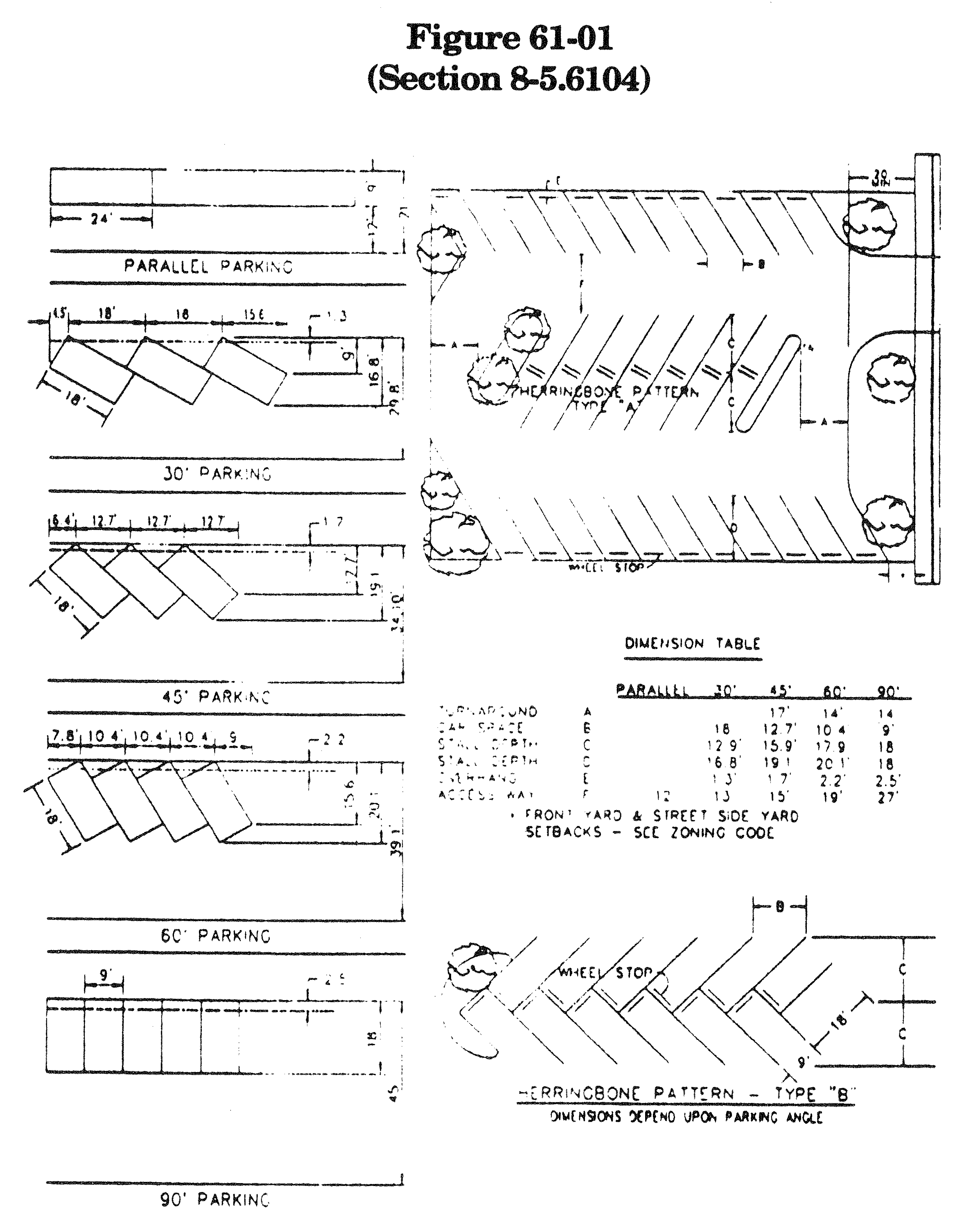
OFF-STREET PARKING LAYOUT

