
Yuba City City Zoning Code
ARTICLE 80
- Definitions
Sec. 8-5.8001.- Scope of article provisions.
For the purposes of this chapter, certain words and phrases used are defined in this article. If they are not defined herein or as provided in the following articles, then reference shall be made to a standard dictionary for the common definition.
(§ 8-5.8001, Ord. 010-94, eff. January 5, 1995)
Sec. 8-5.8002. - Accessory dwelling unit.
See Section 8-5.5004(b).
(Ord. No. 006-22, § 13, 3-15-2022; Ord. No. 010-24, § 3, 11-19-2024)
Sec. 8-5.8002a. - Accessory use.
A use that is incidental or subordinate to the existing primary use, is located upon the same lot, and does not alter the character of the principal use.
(§ 8-5.8002, Ord. 010-94, eff. January 5, 1995; Ord. No. 006-22, § 13, 3-15-2022)
Editor's note— Formerly codified as § 8-5.8002, which was renumbered by Ord. No. 006-22 as herein set out above.
Sec. 8-5.8003. - Alley.
A public or private right-of-way or easement not more than 30 ft. wide that primarily provides secondary access to abutting property.
(§ 8-5.8003, Ord. 010-94, eff. January 5, 1995)
Sec. 8-5.8004. - Apartment.
See Section 8-5.8051, "Residence, multiple-family."
(§ 8-5.8004, Ord. 010-94, eff. January 5, 1995)
Sec. 8-5.8004a. - Bars and drinking places.
Includes establishments within a building where alcoholic beverages are sold for on-site consumption, that are not a part of a restaurant. Includes bars, sport bars, taverns, pubs, brew pubs, and similar establishments where any food service is subordinate to the sale of alcoholic beverages.
(§ 3, Ord. 006-08, eff. September 4, 2008; § 3, Ord. 008-09, eff. August 18, 2009; § 1, Ord. 008-10, eff. September 16, 2010)
Sec. 8-5.8005. - Bed and breakfast inn.
A one-family residence that provides guest rooms, without individual kitchen facilities, for temporary sleeping accommodations for overnight guests. It may also include meal service limited to overnight guests.
(§ 8-5.8005, Ord. 010-94, eff. January 5, 1995)
Sec. 8-5.8006. - Billboard.
See Section 8-5.8056, "Sign types, Off-site sign."
(§ 8-5.8006, Ord. 010-94, eff. January 5, 1995)
Sec. 8-5.8007. - Boarding house.
A dwelling where lodging or lodging and meals are provided for compensation for four or more persons. "Boarding house" does not include a residential care facility.
(§ 8-5.8007, Ord. 010-94, eff. January 5, 1995)
Sec. 8-5.8008. - Building.
Any structure having a roof supported by columns or walls, used for or intended to be used for the shelter or housing of persons, animals, goods or property of any kind.
(§ 8-5.8008, Ord. 010-94, eff. January 5, 1995)
Sec. 8-5.8009. - Building frontage.
The lineal measurement of building walls which face upon a road or a primary customer parking area.
(§ 8-5.8009, Ord. 010-94, eff. January 5, 1995)
Sec. 8-5.8010. - Building, accessory.
A detached subordinate building, the use of which is incidental to the main building or to the main land use, and is located on the same building site as the main building or use.
(§ 8-5.8010, Ord. 010-94, eff. January 5, 1995)
Sec. 8-5.8011. - Building, main.
A building within which is conducted the principal use of the lot upon which it is situated. In any residential district any dwelling shall be deemed to be a main building upon the lot.
(§ 8-5.8011, Ord. 010-94, eff. January 5, 1995)
Sec. 8-5.8012. - Building site.
One or more lots under common ownership or control, occupied or to be occupied by a main building or buildings, and accessory buildings or by a use, together with all the yards, parking areas and other required open space areas.
(§ 8-5.8012, Ord. 010-94, eff. January 5, 1995)
Sec. 8-5.8013. - City.
The City of Yuba City.
(§ 8-5.8013, Ord. 010-94, eff. January 5, 1995)
Sec. 8-5.8014. - City council.
The City Council of the City of Yuba City.
(§ 8-5.8014, Ord. 010-94, eff. January 5, 1995)
Sec. 8-5.8015. - Condominium.
An estate in real property consisting of an undivided interest in common in a portion of real property, together with a separate interest in space in a residential, commercial, or industrial building on the real property. In addition, a condominium may include a separate interest in other portions of the real property.
(§ 8-5.8015, Ord. 010-94, eff. January 5, 1995)
Sec. 8-5.8016. - Convalescent hospital.
See Section 8-5.8057, "Skilled nursing/Intermediate care facility."
(§ 8-5.8016, Ord. 010-94, eff. January 5, 1995)
Sec. 8-5.8017. - Day care center.
Any child care facility other than a small or large day care home.
(§ 8-5.8017, Ord. 010-94, eff. January 5, 1995)
Sec. 8-5.8018. - Day care home, large.
A residence for which the occupants regularly provide non-medical supervision for seven to 12 children for a period of less than 24 hours per day. "Children" includes the children of the licensee under the age of 12 and all other children under the age of 18.
(§ 8-5.8018, Ord. 010-94, eff. January 5, 1995)
Sec. 8-5.8019. - Day care home, small.
A residence for which the occupants regularly provide non-medical supervision for six or fewer children, for a period of less than 24 hours per day. "Children" includes the children of the licensee under the age of 12 and all other children under the age of 18.
(§ 8-5.8019, Ord. 010-94, eff. January 5, 1995)
Sec. 8-5.8020. - Duplex.
See Section 8-5.8050, "Residence, two-family."
(§ 8-5.8020, Ord. 010-94, eff. January 5, 1995)
Sec. 8-5.8020a. - Eating and drinking establishments—Full-service restaurant.
Includes establishments primarily engaged in the preparation and retail sale of food and beverages, where food is ordered and served at a table, and which may include sales of alcoholic beverages as an accessory or secondary service. A full-service restaurant does not include a place where food service is incidental to the service of alcoholic beverages, constituting less than 60% of sales. Upon request by City officials, the owner/operator of a business shall submit evidence of total food service sales to the City to verify compliance with this definition. In the event that it is determined that food service is less than 60%, the subject business/use shall be considered a "bar and dining place" as defined in Section 8-5.8004(a). For purposes of this chapter, to the extent that a restaurant is open after 11:00 p.m. on Sundays through Thursdays and/or after 12:00 a.m. on Fridays and Saturdays and is incorporating any components of "entertainment" as defined herein, the restaurant shall be considered a nightclub and a use permit shall be required.
(§ 3, Ord. 006-08, eff. September 4, 2008; § 3, Ord. No. 008-09, eff. August 18, 2009; § 1, Ord. 008-10, eff. September 16, 2010)
Sec. 8-5.8021. - Family.
One or more persons occupying a residence and living as a single housekeeping unit as distinguished from a group occupying a boarding house or hotel.
(§ 8-5.8021, Ord. 010-94, eff. January 5, 1995)
Sec. 8-5.8022. - Frontage, building.
See Section 8-5.8009, "Building frontage."
(§ 8-5.8022, Ord. 010-94, eff. January 5, 1995)
Sec. 8-5.8023. - General plan.
The Yuba City Urban Area General Plan, as adopted or amended by the City Council.
(§ 8-5.8023, Ord. 010-94, eff. January 5, 1995)
Sec. 8-5.8024. - Guest house.
A residential accessory building with living and sleeping quarters, but without kitchen facilities, located on the same premises with a main building, for the use of family, nonpaying guests or servants of the occupants thereof and not rented or otherwise used as a separate dwelling.
(§ 8-5.8024, Ord. 010-94, eff. January 5, 1995)
Sec. 8-5.8025. - Halfplex.
Two one-family residences, attached by a common wall, each being on separate lots (a duplex with each unit being under separate ownership).
(§ 8-5.8030, Ord. 010-94, eff. January 5, 1995; § 1, Ord. 10-96, eff. December 19, 1996)
Sec. 8-5.8026. - Height, structure.
The vertical distance measured from the average level of the highest and lowest point of that portion of the lot covered by the building to the highest point of the roof, ridge, or parapet wall.
(§ 8-5.8025, Ord. 010-94, eff. January 5, 1995; § 1, Ord. 10-96, eff. December 19, 1996)
Sec. 8-5.8027. - Home occupation.
An income producing activity customarily conducted within a residence or residential accessory building, only by the inhabitants thereof, which use is incidental to and does not change the character of the residential use of the property.
(§ 8-5.8026, Ord. 010-94, eff. January 5, 1995; § 1, Ord. 10-96, eff. December 19, 1996)
Sec. 8-5.8028. - Hotel.
Any building, or portion thereof, containing six or more guest rooms intended or designed to be used, let, or hired out to be occupied or which are occupied by six or more guests upon payment of a compensation.
(§ 8-5.8027, Ord. 010-94, eff. January 5, 1995; § 1, Ord. 10-96, eff. December 19, 1996)
Sec. 8-5.8029. - Junior accessory dwelling unit.
See Section 8-5.5004(b).
(Ord. No. 006-22, § 14, 3-15-2022; Ord. No. 010-24, § 4, 11-19-2024)
Sec. 8-5.8029a. - Junk.
Any cast-off, damaged, discarded, junked, obsolete, salvage, scrapped, unusable, worn-out, inoperable or wrecked object, vehicle, thing or material composed in whole or in part of asphalt, brick, metal, paper, plaster, plaster of Paris, rubber, terra cotta, wool, cotton, cloth, canvas, organic matter or other substance, having no reasonably realistic market value or requiring reconditioning in order to be used for its original purpose.
(§ 8-5.8028, Ord. 010-94, eff. January 5, 1995; § 1, Ord. 10-96, eff. December 19, 1996; § 1, August 16, 2001; Ord. No. 006-22, § 14, 3-15-2022)
Editor's note— Formerly codified as § 8-5.8029, which was renumbered by Ord. No. 006-22 as herein set out above.
Sec. 8-5.8030. - Junkyard.
The use, except within an enclosed building, of either more than 200 square ft. of the area of any lot, or of any portion of the front half of any lot, from on or which any junk is abandoned, bailed, bartered, bought, brought, bundled, deposited, disassembled, disposed of, exchanged, handled, kept, packed, processed, scattered, shipped, sold, stored or transported, regardless of whether or not such activity is done for profit.
(§ 8-5.8029, Ord. 010-94, eff. January 5, 1995; § 1, Ord. 07-95, eff. August 31, 1995; § 1, Ord. 10-96, eff. December 19, 1996)
Sec. 8-5.8031. - Kennel.
Any lot, building, structure, enclosure, or premises whereon or wherein five or more dogs aged ten weeks or older are kept.
(§ 8-5.8031, Ord. 010-94, eff. January 5, 1995)
Sec. 8-5.8032. - Kitchen.
Any room or area intended or designed to be used for the preparation and cooking of food.
(§ 8-5.8032, Ord. 010-94, eff. January 5, 1995)
Sec. 8-5.8033. - Lot.
A parcel of land under one ownership, including a building site together with such yards and other spaces as are required pursuant to the provisions of this chapter.
(§ 8-5.8033, Ord. 010-94, eff. January 5, 1995)
Sec. 8-5.8034. - Lot coverage.
The area of all buildings on a lot, including all projections except eaves and patio covers pursuant to Section 8-5.5001(d) of this chapter and residential accessory buildings with less than 120 square feet of roof area.
(§ 8-5.8034, Ord. 010-94, eff. January 5, 1995)
Sec. 8-5.8035. - Lot lines.
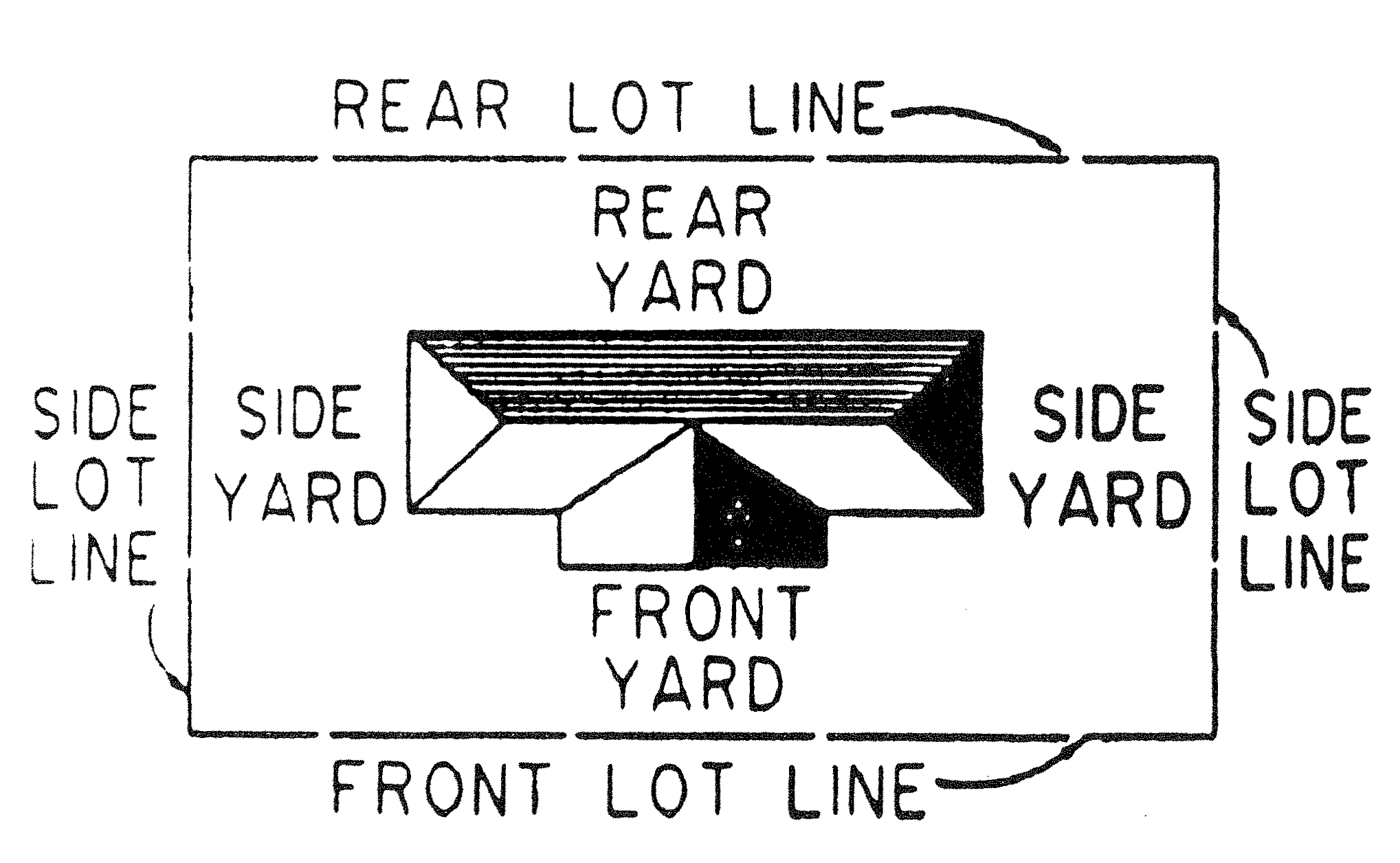
Front lot line. The lot line abutting the road. In the case of corner lots, the property owner may choose the front lot line. In the case of through lots it shall be the lot line on the street primarily used as the front lot line by neighboring lots.
Rear lot line. The lot line, not intersecting a front lot line, which is most distant from and most closely parallel to the front lot line.
Side lot line. Any lot line that is not a front or rear lot line.
Note: See Section 8-5.8068, "Yard types" for an illustration showing lot lines.
(§ 8-5.8035, Ord. 010-94, eff. January 5, 1995)
Sec. 8-5.8036. - Lot types.
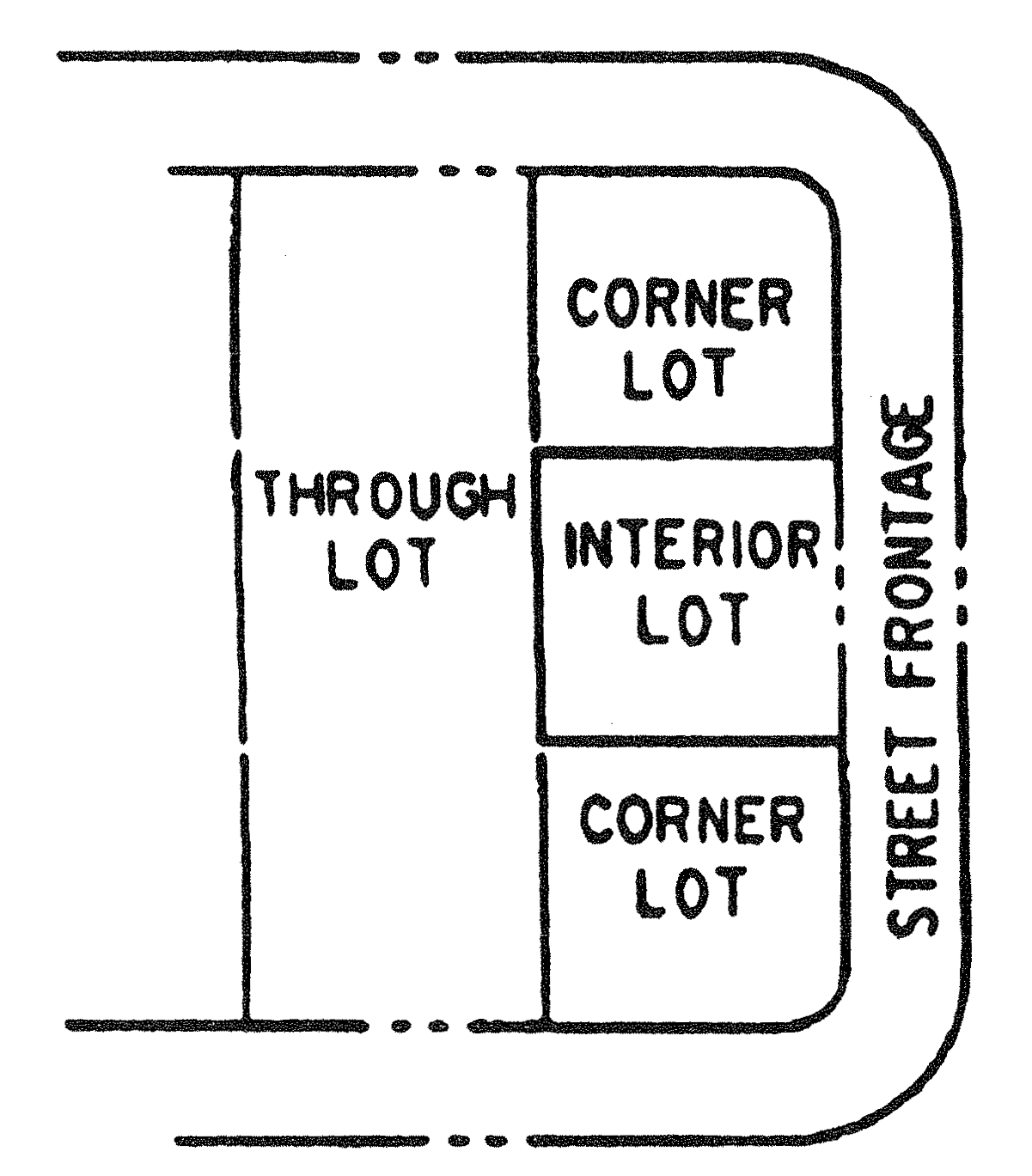
Corner lot. A lot located at the junction of two or more streets or upon two parts of the same street, and such streets or parts of the same street form an interior angle of less than 135 degrees.
Interior lot. A lot other than a corner lot.
Through lot. A lot having frontage upon two parallel or nearly parallel streets.
(§ 8-5.8036, Ord. 010-94, eff. January 5, 1995)
Sec. 8-5.8037. - Manufactured home.
See Section 8-5.8038, "Mobile home."
(§ 8-5.8037, Ord. 010-94, eff. January 5, 1995)
Sec. 8-5.8038. - Mobile home.
A structure designed to be used as a residence and certified under the National Mobile Home Construction and Safety Act of 1974. "Mobile home" does not include recreational vehicle, trailer or motor home.
(§ 8-5.8038, Ord. 010-94, eff. January 5, 1995)
Sec. 8-5.8039. - Mobile home park.
A building site where two or more mobile homes or mobile home sites or any combination thereof are rented or leased, or offered for rent or lease.
(§ 8-5.8039, Ord. 010-94, eff. January 5, 1995)
Sec. 8-5.8039a. - Monopole.
A monopole is a wireless communication facility which consists of a monopolar structure, erected on the ground to support wireless communication antennas and connecting appurtenances.
(§ 1, Ord. 04-97, eff. December 4, 1997)
Sec. 8-5.8040. - Motel.
See Section 8-5.8027, "Hotel."
(§ 8-5.8040, Ord. 010-94, eff. January 5, 1995)
Sec. 8-5.8040a. - Nightclubs.
Includes establishments or places of entertainment within a building, open primarily at night, usually but not necessarily serving alcohol, and providing amplified live or recorded music, and/or a space reserved for dancing. Does not include adult entertainment businesses which are prohibited. Nightclub uses shall not be located within 500 ft. of a residential zone district as measured from the residential zone district boundary to the structure where the nightclub use is proposed.
(§ 3, Ord. 006-08, eff. September 4, 2008; § 3; Ord. 008-09, eff. August 18, 2009; § 1, Ord. 008-10, eff. September 16, 2010)
Sec. 8-5.8041. - Nonconforming structure.
A structure, portion of a structure or site on which the structure is located that was lawfully constructed, erected or altered, but does not conform to the subsequently enacted site development standards of this chapter.
(§ 8-5.8041, Ord. 010-94, eff. January 5, 1995)
Sec. 8-5.8042. - Nonconforming use.
A use of property and/or a structure which was lawful at the time of its establishment, but which under subsequently enacted zoning regulations is no longer a permitted use or is permitted only if a use permit (Section 8-5.7003) is first secured.
(§ 8-5.8042, Ord. 010-94, eff. January 5, 1995)
Sec. 8-5.8043. - Parcel.
See Section 8-5.8033, "Lot."
(§ 8-5.8043, Ord. 010-94, eff. January 5, 1995)
Sec. 8-5.8044. - Person.
Any individual, firm, co-partnership, joint venture, association, social club, fraternal organization, company, joint stock association, corporation, estate, trust, organization, business, business trust, public agency, school district, State of California and its political subdivisions, receiver, syndicate or any group or combination thereof, acting as a unit, including any trustee, receiver or assignee.
(§ 8-5.8044, Ord. 010-94, eff. January 5, 1995)
Sec. 8-5.8045. - Planning Commission.
The Planning Commission of the City of Yuba City.
(§ 8-5.8045, Ord. 010-94, eff. January 5, 1995)
Sec. 8-5.8046. - Planning Director.
The Planning Director of the City of Yuba City.
(§ 8-5.8046, Ord. 010-94, eff. January 5, 1995)
Sec. 8-5.8046.5. - Recreational vehicle (RV).
A motor home, converted bus, travel trailer, truck camper or camping trailer, designed for temporary human habitation for recreation or emergency occupancy, which, when transported upon a public roadway, measures 8 feet or less in width and 40 feet or less in length and which is either self-propelled, truck-mounted or permanently towable on the highway without a permit. A recreational vehicle does not include utility trailers.
(Ord. No. 007-24, § 4, 5-21-2024)
Sec. 8-5.8047. - Residence.
A building or portion thereof designed for occupancy by one family for living purposes, having only one kitchen.
(§ 8-5.8047, Ord. 010-94, eff. January 5, 1995)
Sec. 8-5.8048. - Residence, group.
Two or more detached one-family, two-family, or multiple-family residences, other than mobile home parks, located upon a building site, together with all open spaces as required by the provisions of this chapter.
(§ 8-5.8048, Ord. 010-94, eff. January 5, 1995)
Sec. 8-5.8049. - Residence, one-family.
A detached building containing not more than one residence.
(§ 8-5.8049, Ord. 010-94, eff. January 5, 1995)
Sec. 8-5.8050. - Residence, two-family.
A building containing two residences.
(§ 8-5.8050, Ord. 010-94, eff. January 5, 1995)
Sec. 8-5.8051. - Residence, multiple-family.
A building containing three or more residences.
(§ 8-5.8051, Ord. 010-94, eff. January 5, 1995)
Sec. 8-5.8052. - Residential care home, small.
A home for up to six children, elderly, and/or mentally or physically disabled persons, not including members of the family or employees of the operator, that is certified, authorized, or licensed by the State of California.
(§ 8-5.8052, Ord. 010-94, eff. January 5, 1995; § 1, Ord. 04-97, eff. December 4, 1997)
Sec. 8-5.8052a. - Residential care home, large.
A home for seven to 12 children, elderly, and/or mentally or physically disabled persons, not including members of the family or employees of the operator, that is certified, authorized, or licensed by the State of California.
(§ 1, Ord. 04-97, eff. December 4, 1997)
Sec. 8-5.8053. - Second unit.
A second residential dwelling unit, other than an accessory dwelling unit or junior accessory dwelling unit, on a parcel with one and only one existing residential unit that is not an accessory dwelling unit or junior accessory dwelling unit.
(Ord. No. 006-22, § 15, 3-15-2022)
Sec. 8-5.8053a. - Senior congregate care facility.
A facility providing residence for senior citizens 60 years of age or more or handicapped people of any age. Care may include central kitchen and dining, laundry, recreational activities, etc. with separate bedrooms or living quarters. Nursing is not provided on a 24-hour basis.
(§ 8-5.8053, Ord. 010-94, eff. January 5, 1995; Ord. No. 006-22, § 15, 3-15-2022)
Editor's note— Formerly codified as § 8-5.8053, which was renumbered by Ord. No. 006-22 as herein set out above.
Sec. 8-5.8054. - Setback.
See Section 8-5.8067, "Yard."
(§ 8-5.8054, Ord. 010-94, eff. January 5, 1995)
Sec. 8-5.8055. - Sign.
Any visual device or representation designed or used for communicating a message, or identifying or attracting attention to a premise, product, service, person, organization, business, or event.
(§ 8-5.8055, Ord. 010-94, eff. January 5, 1995)
Sec. 8-5.8056. - Sign types.
Address sign. The numeric reference of a structure or use to a street.
A-frame sign. A free standing sign usually hinged at the top or attached in a similar manner, and widening at the bottom to form a shape similar to the letter "A."
Animated sign. A sign with messages that visually change, or images that move or appear to move, more frequently than once every 24 hours, regardless of the method by which the visual change is affected. This definition does not include traditional barber poles, hand-held signs, personally attended signs, commercial mascots, scoreboards, or signs which merely display time or temperature.
Awning sign. A nonelectric sign that is printed on, painted on, or attached to an awning, canopy, or marquee.
Banner. Any sign of lightweight fabric or similar material that is mounted to a pole or a building at one or more edges. Flags are not within this definition.
Cabinet sign. A sign that contains all the text and/or logo symbols within a single enclosed cabinet and may or may not be illuminated.
Canopy sign. See "Awning sign."
Changeable copy sign. A sign designed to allow the changing of copy through manual [or] mechanical means, including date, time, and temperature. This does not include an electric message board.
Civic event sign. A temporary sign, other than a commercial sign, posted to advertise a civic event sponsored by a public agency or similar noncommercial organization.
Developer/contractor sign. A temporary sign erected on a parcel on which construction is taking place, indicating the names of the architects, engineers, landscape architects, contractors, and similar artisans, and the owner, financial supporters, sponsors, and similar individuals of firms having a major role or interest with respect for the structure or project.
Directional sign. Signs limited to directional messages for pedestrian or vehicular traffic, such as "one-way," "entrance," and "exit."
Directory sign. A sign listing the tenants or occupants and their suite numbers of a building or center.
Face. That portion of a sign upon which the copy is mounted or displayed.
Flag. Any fabric or banner containing distinctive colors, patterns, or design that displays the symbol(s) of a nation, state, local government, company, organization, belief system, idea, or other meaning.
Freestanding sign. A permanent sign that is self-supporting in a fixed location and not attached to a building. Freestanding signs are of two types: monument and pole. Monument signs are connected or attached to a sign structure, fence, or wall that is not an integral part of a building. Pole signs are mounted on a pole(s) or other support(s) that are placed on and anchored in the ground or on a base and that is independent from any building or other structure. Flag poles are not within this definition.
Master sign program. A coordinated sign plan which includes details of all signs (not including exempt or temporary signs) which are or will be placed on a site, including master identification, individual business, and directory signs.
Monument sign. A freestanding sign erected to rest on the ground or to rest on a monument base designed as an architectural unit. The width of the base of a monument sign is at least 75% of the width of the top of the sign.
Name plate. A sign that identifies an occupant and/or address.
Off-site sign. A sign that advertises or informs in any manner, businesses, services, goods, persons, or events at a building site other than upon which the sign is located. Off-premises sign, billboard, and outdoor advertising sign are equivalent terms.
Pennant. Any lightweight plastic, fabric, or other material, whether or not containing a message of any kind, attached to a rope, wire, or string, usually in a series, designed to move in the wind and attract attention. Flags and banners are not within this definition.
Pole sign. A freestanding sign mounted on freestanding poles, columns, or other supports.
Political sign. A temporary sign directly associated with national, State, or local elections.
Projecting sign. Any sign that is perpendicular to the face of a building and projects more than 18 in. from the face. This category includes awning and under canopy signs.
Real estate sign. Any sign, temporary in nature, with copy which concerns a proposed sale, rent, lease, or exchange of real property. This definition does not include occupancy signs at establishments offering transient occupancy, such as hotels, motels, and "bed and breakfast" facilities.
Roof sign. A sign erected, constructed, or placed upon or above a roof of a building.
Roofline. The top edge of a roof or building parapet, whichever is higher, excluding any cupolas, pylons, chimneys, or minor projections.
Sign. Any identification, description, illustration, or device illuminated or non-illuminated, which is visible to the general public from any exterior public right-of-way, and directs attention to a product, service, place, activity, person, institution, business, or solicitation, including any permanently installed or situated merchandise; or any emblem, painting, banner, pennant, or placard designed to advertise, identify, or convey information. A display, device, or thing need not contain lettering to be a sign. Notwithstanding the generality of the foregoing, the following are not within this definition:
•
Architectural features. Decorative or architectural features of buildings (not including lettering, trademarks, or moving parts), that do not perform a communicative function;
•
Fireworks, etc. The legal use of fireworks, candles, and artificial lighting not otherwise regulated by this Code;
•
Foundation stones, cornerstones;
•
Grave markers, grave stones, headstones, mausoleums, shrines, and other markers of the deceased;
•
Personal appearance. Items or devices of personal apparel, decoration, or appearance, including tattoos, makeup, wigs, costumes, and masks, but not including commercial mascots or hand-held signs; and
•
Symbols embedded in architecture. Symbols of noncommercial organizations or concepts, including, but not limited to, religious or political symbols, when such are permanently integrated into the structure of a permanent building, including stained glass windows on churches, carved or bas relief doors or walls, bells, and religious statuary.
Sign area. The area contained within a single continuous perimeter enclosing all parts of such sign copy, excluding any structural elements outside the limits of the sign required to support the sign.
Snipe sign. A sign made of any material when such sign is tacked, nailed, posted, pasted, glued or otherwise attached to trees, poles, fences or other objects, and the advertising matter appearing thereon is not applicable to the present use of the premises upon which such sign is located.
Special event sign. A sign including but not limited to banners, flags, pennants, or balloons intended to be erected on a temporary basis, and displayed for a limited period of time, to promote a new business, the sale of new products, new management, new hours of operation, a new service, or to promote a special sale.
Suspended sign. A sign that is suspended from the underside of a canopy, portico or like structure.
Temporary sign. A structure or device used for the public display of visual messages or images, which is typically made of lightweight or flimsy materials which is not intended for or suitable for long-term or permanent display.
Vehicle sign. A sign which is attached to, or painted on or carried in a vehicle, the principal purpose of which is to attract attention to a product sold or an activity or business.
Wall sign. Any sign attached to, erected against, or painted upon the wall of a building or structure, the face of which is in a single plane parallel to the plane of the wall. Wall signs also include signs on a false or mansard roof.
Window sign. Any sign painted, etched, or otherwise affixed to an exterior window of a building, or in the interior of the building, within 3 ft. of a window, intended to be viewed from the exterior of such building. On-site advisory signs are not considered window signs.
(§ 8-5.8056, Ord. 010-94, eff. January 5, 1995; § 1, Ord. 10-96, eff. December 19, 1996; § 3, Ord. 004-06, eff. June 15, 2006; Ord. No. 006-16, § 2(Att. A), 5-17-2016)
Sec. 8-5.8057. - Skilled nursing/intermediate care facility.
A facility or part of a hospital which provides 24-hour inpatient care which may include skilled nursing, physician and pharmaceutical services.
(§ 8-5.8057, Ord. 010-94, eff. January 5, 1995)
Sec. 8-5.8058. - Story.
That portion of a building between the surface of any floor and the surface of the floor next above it, or if there is no floor above it, then the space between the floor and the ceiling above it.
(§ 8-5.8058, Ord. 010-94, eff. January 5, 1995)
Sec. 8-5.8059. - Street, general plan.
Any street or highway shown in the general plan as an existing or proposed State highway, arterial or collector.
(§ 8-5.8059, Ord. 010-94, eff. January 5, 1995)
Sec. 8-5.8060. - Street, local.
Any street not shown in the general plan and that is not an alley.
(§ 8-5.8060, Ord. 010-94, eff. January 5, 1995)
Sec. 8-5.8061. - Structure.
Anything constructed or erected, the use of which requires a permanent location upon the ground or attachment to something on the ground.
(§ 8-5.8061, Ord. 010-94, eff. January 5, 1995)
Sec. 8-5.8062. - Structural alterations.
Any change of the supporting members of a building, such as bearing walls, columns, beams or girders, floor joists, ceiling joists, or roof rafters.
(§ 8-5.8062, Ord. 010-94, eff. January 5, 1995)
Sec. 8-5.8063. - Trailer.
See Section 8-5.8038, "Mobile home."
(§ 8-5.8063, Ord. 010-94, eff. January 5, 1995)
Sec. 8-5.8063.5. - Trailer, utility.
A trailer used for the transportation of the user's personal property, commerce, or designed to be used for transportation of livestock, and does not exceed a gross weight of 10,000 pounds or a manufacturer's gross vehicle weight rating (GVWR) of 10,000 pounds.
(Ord. No. 007-24, § 5, 5-21-2024)
Sec. 8-5.8064. - Transitional housing.
Housing for the homeless where shelter is provided for an extended period of time (up to 18 months) and generally includes the opportunity for training and counseling to acquire the needed skills (such as home management or job-training) to assist in the transition to self-sufficiency through the acquisition of permanent income and housing.
(§ 8-5.8064, Ord. 010-94, eff. January 5, 1995)
Sec. 8-5.8064a. - Two-unit development.
The simultaneous development of two new residential dwelling units on a parcel with no existing residential dwelling units other than an accessory dwelling unit.
(Ord. No. 006-22, § 16, 3-15-2022)
Sec. 8-5.8065. - Use.
The purpose for which a structure or premises is designed, arranged, or intended, or for which they may be occupied or maintained.
(§ 8-5.8065, Ord. 010-94, eff. January 5, 1995)
Sec. 8-5.8066. - Reserved.
Editor's note— Ord. No. 006-22, § 17, adopted Mar. 15, 2022, deleted § 8-5.8066 entitled "Use, accessory," which derived from Ord. 010-94, § 8-5.8066, eff. Jan. 5, 1995.
Sec. 8-5.8067. - Yard.
Land surrounding a building site which is unoccupied and unobstructed by any structure from the ground upward except for encroachments permitted by the provisions of this chapter.
(§ 8-5.8067, Ord. 010-94, eff. January 5, 1995)
Sec. 8-5.8068. - Yard types.
Front yard. A yard extending across the full width of the lot measured from either the existing or future street right-of-way line or back of sidewalk, whichever is closest to private property and to a depth required by the district in which said lot is located.
Interior side yard. A yard on the interior side(s) of a lot extending from the front lot line to the rear lot line, and to a width required by the district in which said lot is located.
Rear yard. A yard extending along the width of the rear lot line, and to a depth required by the district in which said lot is located.
Street side yard. A yard in a corner lot, extending along the width of the street measured from either the existing or future right-of-way line, or back of sidewalk, whichever is closest to private property and to a depth required by the district in which said lot is located.
(§ 8-5.8068, Ord. 010-94, eff. January 5, 1995; § 1, Ord. 06-01, eff. August 16, 2001)
Sec. 8-5.8070. - Zero lot line.
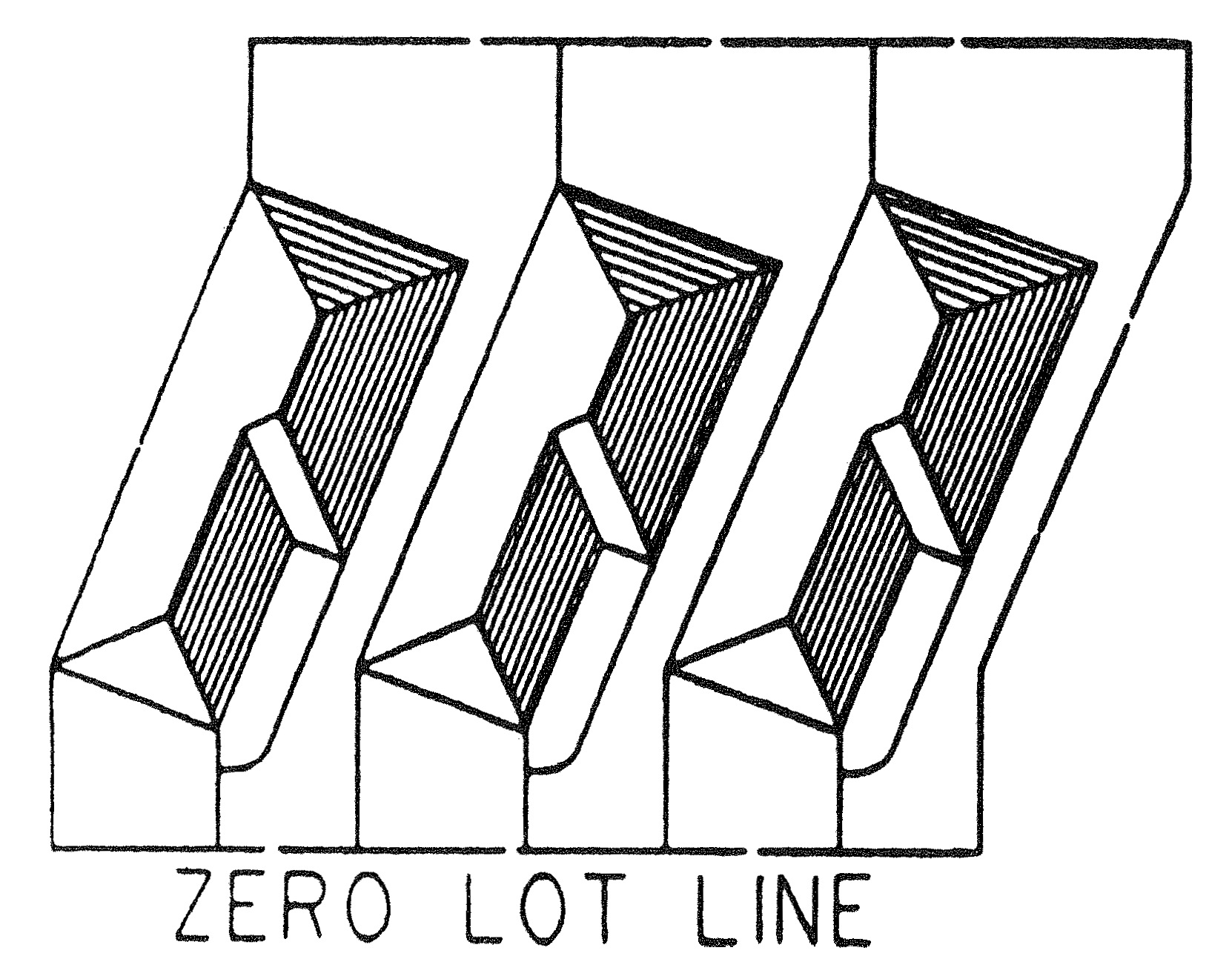
A one-family residence with an exterior wall located along a property line.
(§ 8-5.8070, Ord. 010-94, eff. January 5, 1995)

