
Abilene City Zoning Code
CHAPTER 5
- DEFINITIONS
Section 5.1.1.1 - Usage and Interpretation
(a)
Usage. The following definitions are intended to provide descriptions for words and terms used within this LDC. Absent any conflict, words and terms used in this LDC shall have the meanings ascribed thereto in this Chapter 5.
(b)
Conflicts. When words and terms are defined herein, and are also defined in other ordinance(s) of the City, shall be read in harmony unless there exists an irreconcilable conflict, in which case the definition contained in this Chapter 5 shall control.
(c)
Present and Past Tenses. Words used in the present tense include the future; words in the singular number include the plural number, and words used in the plural number include the singular number.
(d)
Specific Word Usage. The word shall is mandatory and not directory. The word building includes the word structure[.]
(e)
Words Not Defined. For any definition not listed in this Chapter 5 of this LDC, the definition found within the latest edition of Webster's Dictionary shall be used.
(Ord. No. 8-2010, pt. 1(Exh. A), 4-22-10)
Section 5.1.1.2 - Definitions in Other Locations Within the LDC
(a)
For the purpose of this LDC, certain terms and words are to be used and interpreted as defined within the articles, divisions, or sections of this LDC wherein they apply to certain regulations. These sections include:
(1)
Chapter 1, Article 3, Division 3, Dormant Projects, specifically within Section 1.3.3.8.
(2)
Chapter 3, Article 1 [2], Division 11, Stormwater Management Requirements, specifically within Section 3.2.11.1.
(3)
Chapter 2, Airport Zoning.
(Ord. No. 8-2010, pt. 1(Exh. A), 4-22-10)
Section 5.1.1.3 - Land Use Definitions
(a)
Land Use Definitions & Matrix Correlation. The symbol "{x}" denotes that the definition is reflected as a use in the Land Use Matrix in Chapter 2, Article 4, Division 2.
Land Use Definitions - A
(.5)
ABUTTING CARPORT or PATIO COVER: A carport or patio cover situated within six inches measured edge to edge of respective roof coverings.
(1)
ACCESSORY DWELLING: {x} A subordinate building that is detached from the primary on-site structure, is used as a residence, is incidental to the main structure (i.e., the building area must be significantly less than that of the main structure), and is not involved in the conduct of a business.
(2)
ACCESSORY SHELTER: A housing shelter in an accessory building: 1) located on the same site as a principal building, or 2) located on a site owned and operated by religious, civic, fraternal, social, institutional or governmental agency providing free accessory lodging for indigent individuals and/or families with no regular home or residential address. An accessory shelter may house no more than 15 individuals at any one time and operates up to a maximum of two (2) days/nights per week.
(3)
ACCESSORY STRUCTURE: A subordinate building that is detached from the primary on-site building and is clearly secondary and incidental to the main use.
(4)
ADULT ENTERTAINMENT ENTERPRISE: Any business activity whether in public, semi-public or private premises, which offers the opportunity to feel, handle, touch, paint, be in the presence of, or be entertained by the unclothed body or the unclothed portion of the body of another person, or to observe, view, or photograph any such activity. Except as specifically provided otherwise herein, nothing in this section is intended to regulate:
a.
Any business operated by or employing psychologists, physical therapists, athletic trainers, licensed masseuse, cosmetologists, or barbers, licensed by the State of Texas, performing functions authorized under the licenses held.
b.
Any business operated by or employing physicians, osteopaths, chiropractors or nurses, licensed by the State of Texas, engaged in practicing the healing arts.
c.
Any retail establishment whose major business is the offering of wearing apparel for sale to customer.
Adult Entertainment Enterprises furthermore include, but are not limited to, the following:
a.
Adult Bookstore/Film Store. An establishment or commercial enterprise having 10% or more of its stock in trade; videos, tapes, cassettes, photographs, books, magazines and other periodicals which are distinguished by a predominant emphasis on matter(s) depicting, describing, or relating to "specific sexual activities" or "specified anatomical areas" as defined below.
b.
Movie Arcade. Any business wherein is operated a film or videotape viewing device. A film or videotape viewing device or booth subject to these provisions is defined as:
1.
Viewing Booths/Arcades. An establishment or commercial enterprise which has within its structure any electrical or mechanical device, which projects or displays any film, videotape or reproduction into a viewing area obscured by a curtain, door, or wall, or other enclosure which is designed for occupancy by no more than five persons, and is used for presenting material distinguished or characterized by a predominant emphasis on matters depicting, describing, or relating to "specified sexual activities" or "specified anatomical areas" for observation by five (5) or fewer persons.
2.
Adult Motion Picture Theater. An establishment or commercial enterprise which has an enclosed building with a capacity of more than five (5) persons and is used for presenting material distinguished or characterized by a predominant emphasis on matter depicting, describing or relating to "specified sexual activities" or "specified anatomical areas" for observation by patrons.
c.
Adult Cabaret. An establishment whose portion of business is the offering to customers of live entertainment which is intended to provide sexual stimulation or sexual gratification to such customers, including but not limited to dancing, posing, modeling, acting, and which is distinguished by or characterized by a predominant emphasis on matter depicting, describing, or relating to "specified sexual activities," or "specified anatomical areas."
d.
Adult Encounter Parlor. An establishment whose business consists of premises where customers either congregate, associate, or consort with employees who engage in "specified sexual activities" with or in the presence of such customers, or who display "specified anatomical areas" in the presence of such customers, with the intent of providing sexual stimulation or sexual gratification to such customers.
e.
Adult Lounge. An "adult cabaret" as defined above which is permitted or licensed pursuant to the Alcoholic Beverage Code where alcoholic beverages may be served or sold.
f.
Adult Drive-In Theater. A drive-in theater used for presenting motion picture films, videocassettes, cable television, or any other such visual media, distinguished or characterized by a predominant emphasis on matter depicting, describing or relating to "specified sexual activities" or "specified anatomical areas."
g.
Adult Retail Store. This is a retail establishment in which:
1.
Ten percent or more of the "stock in trade" consists of items, products or equipment distinguished or characterized by an emphasis on "specified sexual activities" or "specified anatomical areas"; or
2.
Any person is excluded by virtue of age from all or part of the premises generally held open to the public where products or equipment [is displayed] distinguished or characterized by an emphasis on "specified sexual activities" or "specified anatomical areas."
h.
Specified Sexual Activities. For the purpose of defining Adult Entertainment Enterprise, the following shall be considered specified sexual activities:
1.
Human genitals in a state of sexual stimulation or arousal; or
2.
Acts of human masturbation, sexual intercourse, sodomy, acts of bestiality;
3.
Fondling or other erotic touching of human genitals, pubic region, buttock or female breast.
i.
Specified Anatomical Areas. For the purpose of defining Adult Entertainment Enterprise, the following shall be considered specified anatomical areas:
1.
Less than completely and opaquely covered:
(a)
Human genitals, pubic region;
(b)
Buttock;
(c)
Female breast below a point immediately above the top of the areola; and
(d)
Human genitals in a discernibly erect state, even if completely and opaquely covered.
j.
Stock in Trade. For the purpose of defining Adult Entertainment Enterprise, Stock in Trade shall be defined as the total volume or number of items, products or equipment available for purchase, rental, viewing or use by patrons of the establishment, excluding material located in any storeroom or other portion of the premises not regularly open to patrons.
(5)
AIRCRAFT AND ACCESSORIES: Any contrivance now known or hereafter invented for use in or designed for navigation or flight in the air and accessories with such aircraft.
(6)
AIRPORT, HELIPORT: {x} An area reserved or improved for the landing or take-off of aircraft, including rotary wing aircraft, which may include fueling or servicing facilities for such craft.
(7)
AMBULANCE SERVICE: {x} Provision of private (not operated by the City of Abilene) emergency transportation which may include mobile medical care, and the storage and maintenance of vehicles.
(8)
AMENITIZED DETENTION/RETENTION POND: An area that is designed to capture, store and release stormwater and that is designed as a site amenity by being aesthetically pleasing, by providing recreational or aesthetic value, and by being constructed to seem natural (i.e., without visible concrete). Such areas have a natural edge and are designed to resemble a naturally created lake or pond. Also refer to the definition of Amenity below.
(9)
AMUSEMENT FACILITY, PERMANENT: {x} An amusement enterprise offering entertainment or games of skill to the general public for a fee or charge, wherein portions of the activity may take place in or out of doors, including a bowling alley, ice skating rink, racquetball/handball club, indoor tennis courts/club, indoor swimming pool or scuba diving facility, and billiard parlor, a golf driving range, archery range, miniature golf course, batting cages, go-cart tracks, and amusement park.
(10)
AMUSEMENT FACILITY, TEMPORARY: {x} An amusement enterprise that is in operation on a temporary basis (i.e., one (1) month or less) offering entertainment or games of skill to the general public for a fee or charge. Activity may take place in or out of doors. Examples include a carnival, circus, or haunted house.
(11)
ANIMAL LOT: {x} Any area for quartering any ungulated or hoofed (even-toed and odd-toed) animals including horses, cows, sheep, goats, etc. This may also include a facility for the keeping of such animals, such as a stable.
(12)
ANTIQUE SHOP: {x} A business which sells items whose value is greater than original purchase price because of age or extrinsic value.
(13)
APARTMENT: See Dwelling, Multifamily.
(14)
ART GALLERY: {x} Where objects of art are created or displayed for the public enrichment or where said objects of art are displayed for sale (including the teaching of both painting and sculpting).
(15)
ARTS SCHOOL: Schools providing teaching and training in the performing arts, fine arts, and martial arts.
(16)
ASSISTED LIVING FACILITY: {x} A type of Personal Care Facility (see definition) in which four (4) or more elderly (over 55 years of age) persons, regardless of legal relationship, live and who need limited assistance with daily living activities. A limited number of support services such as meals, laundry, housekeeping, transportation, social/recreational activities, hairdressing, etc., may be provided or associated with the assisted living facility. Units may be attached or detached, single- or double-occupancy, and may include limited or full kitchen facilities. Full-time medical or nursing care is not provided by the facility, but may be privately arranged for by individual residents on a part-time or temporary basis (e.g., visiting nurses, etc.).
(16.5)
ATTACHED CARPORT or PATIO COVER: A carport or patio cover fastened or affixed to the principal building.
(17)
ATM, SELF-SERVICE KIOSK AND SIMILAR FACILITIES: Various self-service facilities where a product or service is dispensed through a machine. Such uses have no employees on the site except to periodically maintain and restock the machines. These facilities may be walk-up or drive-up in nature. Examples include fuel stations and ATMs.
(18)
AUTOMOBILE PARTS AND SUPPLIES (RETAIL SALES ONLY): {x} The use of any building or other premises for the primary inside display and sale of new or used accessories and/or parts, including tires, for automobiles, panel trucks or vans, trailers, or recreation vehicles. This definition expressly does not include a "Wrecking or Salvage Yard"; this is separately defined herein.
(19)
AUTOMOBILE AND SMALL TRUCK RENTAL AND LEASING: {x} A business establishment that provides for the renting of automobiles and light trucks on a short-term basis (differentiated from leasing, which is on a long-term basis). This may also involve the incidental storage of the automobiles and light trucks being rented.
(20)
AUTOMOBILE AND SMALL TRUCK REPAIR (MAJOR): {x} General repair or reconditioning of engines, air-conditioning systems and transmissions for motor vehicles; wrecker service; collision repair services including body, frame or fender straightening or repair; customizing; painting; vehicle steam cleaning; undercoating and rustproofing; those uses listed under Automobile Repair (Minor); and other similar uses.
(21)
AUTOMOBILE AND SMALL TRUCK REPAIR (MINOR): {x} Minor repair or replacement of parts, tires, tubes and batteries; diagnostic services; minor maintenance services such as grease, oil, spark plug and filter changing; tune-ups; emergency road service; replacement of starters, alternators, hoses and brake parts; automobile washing and polishing; performing state inspections and making minor repairs necessary to pass said inspection; normal servicing of air-conditioning systems; and other similar minor services for motor vehicles except heavy load vehicles, but not including any operation named under Automobile Repair (Major) or any other similar use.
(22)
AUTOMOBILE AND SMALL TRUCK SALES AND/OR SERVICE: {x} A paved area for the display for sale of motorized and non-motorized vehicles accompanied by an on-site office with staffing during normal business hours, which may include the service of vehicles on-site.
(23)
AUTOMOBILE PARKING LOT OR STRUCTURE (Commercial): {x} An area, enclosed or unenclosed, used for the parking or storage of motor vehicles as a business enterprise. A fee may be charged to users of the parking area.
(24)
AUTOMOBILE WASH, FULL-SERVICE: {x} Washing, waxing or cleaning of automobiles or light duty trucks where the employees of the establishment wash, dry, wax and/or detail vehicles for a fee.
(25)
AUTOMOBILE WASH, SELF-SERVICE: {x} Washing, waxing or cleaning of automobiles or light duty trucks where the owner of the vehicle causes the vehicle to become washed. One type of unattended car wash facility utilizes automated self-service (drive-through/rollover) wash bays and apparatus in which the vehicle owner inserts money or tokens into a machine, drives the vehicle into the wash bay, and waits in the vehicle while it is being washed. The other type of unattended facility is comprised of wand-type self-service (open) wash bays in which the vehicle owner drives the vehicle into the wash bay, gets out of the vehicle, and hand washes the vehicle with a wand-type apparatus by depositing coins or tokens into a machine.
Land Use Definitions - B
(26)
BAKERY, RETAIL TRADE: {x} Includes only those bakeries that produce on the premises some or all of the products sold on premises, primarily for retail distribution, or those which do not produce on the premises the bakery goods which are sold.
(27)
BAKERY, WHOLESALE TRADE: {x} Includes only those bakeries that manufacture bakery goods primarily for wholesale distribution.
(28)
BANKING SERVICES: {x} An establishment for the custody, loan, exchange and/or issue of money, the extension of credit, and/or facilitating the transmission of funds, examples of which include banks, saving and loans, and credit unions. The establishment may or may not have the ability to provide services via a drive-up window, also known as motor bank services.
(29)
BANKING SERVICES, REMOTE AUTOMATIC: {x} An automated device that performs banking or financial functions at a location remote from the controlling financial institution.
(30)
BED AND BREAKFAST: {x} A dwelling in which sleeping accommodations are provided in not more than five (5) rooms for transient guests and one (1) or more meals are provided (for guests only), both for compensation. Guest rooms do not have kitchen facilities. The period during which accommodations and breakfast are provided generally does not exceed seven (7) days.
(31)
BLUEPRINTING AND/OR PHOTOCOPYING SERVICE: {x} An establishment which primarily reproduces, in printed form, individual orders from a business, profession, service, industry or government organization. Offset, letterpress, and duplicating equipment are used, but no rotary presses or linotype equipment are used. Related services might include faxing, digitizing, graphic reproducing, and report assembling.
(32)
BOARDING AND/OR ROOMING HOUSE: {x} An establishment where lodging is provided for compensation: a) by prearrangement, b) in rooms without kitchen facilities, c) for four (4) to nineteen (19) roomers or boarders, d) for periods of one week or longer, and e) with or without meals, available for guests only.
(33)
BROADCAST STUDIO: An establishment containing one or more broadcasting studios for over-the-air, cable, or satellite delivery of radio or television programs or studios for the audio or video recording of musical performances, radio or television programs or motion pictures. This term does not include an antenna tower.
Land Use Definitions - C
(34)
CAMPGROUND: Any area of land on which is located a cabin, tent or other type of shelter suitable and intended for use in a temporary, seasonal manner. Also see Vacation Travel Trailer Park.
(35)
CEMETERY, CREMATORIUM, AND MAUSOLEUM: Land used or intended to be used for the burial of the dead and dedicated for cemetery purposes including columbariums, crematoriums, mausoleums, and funeral establishments, or any combination thereof.
(36)
CHILD DAY-CARE OPERATION: This is a general definition that means the care, supervision, training, or education of an unrelated child or children under fourteen (14) years old for less than twenty-four (24) hours per day that occurs in a place other than the child's own home. This definition includes child day-care provided to school-age children before and/or after the customary school day. This definition also encompasses each of the following two separate categories of use, for the purpose of Zoning Regulations:
a.
Day-Care Operation, Center-Based. An operation providing care for children under 14 years of age, for less than 24 hours per day, and at a location other than the caregivers' or permit holder's home.
b.
Day-Care Operation, Home-Based. An operation providing care for children under 14 years of age, for less than 24 hours per day, and at the caregiver's home.
State Law reference— Tex. Admin. Code Ch. 745, subch. B, Licensing.
(37)
CHURCH or PLACE OF WORSHIP: {x} A building for regular assembly for religious public worship which is used primarily for and designed for such purpose, along with accessory activities which are customarily associated therewith, such as a place of residence for ministers, priests, nuns or rabbis on the premises, and that is tax exempt as defined by State law. For the purposes of this ordinance, Bible study and other similar activities which occur in a person's primary residence shall not apply to this definition.
(38)
CIVIC, SOCIAL & FRATERNAL ORGANIZATION: {x} Any association, club, organization, unincorporated, not required to be licensed by the Texas Alcoholic Beverage Commission and organized for the purpose of social, civic, fraternal or recreational purposes.
(39)
CONTRACTOR SERVICES: Businesses that construct and repair buildings, roads and other pavement; install landscaping, fences, swimming pools, and other structures; as well as what are often referred to as subcontractors that do installation, service repair such as electrical, plumbing, and mechanical.
(40)
COMMERCIAL STABLE: A structure and/or land use in or on which large animals are kept for one or more of the following purposes: sale, hire, breeding, boarding, or training. Also see Stable.
(41)
COMMERCIAL TRADE SCHOOL: {x} A for-profit business that offers vocational instruction and training in trades such as the computer industry, welding, brick laying, machinery operation/repair, cosmetology, beauty/barber school and similar trades.
(42)
COMMERCIAL USE: A type of nonresidential land use that has one or more of the following characteristics: 1) the use is service-oriented; 2) the use does not primarily sell retail items; 3) the use sells goods or products on a wholesale basis; or 4) the use has or has the need for open storage areas or warehouses its products. Such uses include motels, auto dealerships, welding shops, manufactured home sales, self-storage units, funeral homes, automobile repair shops, and air-conditioning and/or heating services.
(43)
COMMON OPEN SPACE: A parcel or parcels of land, or an area of water in combination with land, within a site designed and intended for the use and enjoyment of residents and owners belonging to an association as defined herein. Common open space may contain such complementary structures and improvements as are necessary and appropriate for the benefit and enjoyment of residents and owners belonging to an association. Also may be referred to as Common Area.
(44)
COMMUNITY HOME: {x} A place where not more than six (6) physically or mentally impaired or handicapped persons (regardless of legal relationship) are provided room and board, as well as supervised care and rehabilitation by not more than two (2) persons. Such home and the persons that reside therein shall meet all the specifications and requirements of the Community Homes for Disabled Persons Disabilities Act, Chapter 123 of the Texas Human Resources Code. Also may be referred to as a Family Home (refer to V.T.C.A., Property Code Ch. 202).
(45)
CORRECTION, DETENTION OR PENAL FACILITIES: A facility housing persons awaiting trial or persons serving a sentence after being found guilty of a criminal offense.
(46)
COURTYARD: An open space bounded on more than two (2) sides by the walls of a building.
(47)
CULTURAL FACILITIES: Nonprofit, institutional, and governmental uses located within buildings that provide educational, cultural fine arts and performing arts to patrons. Examples of such uses include galleries, live theaters for performing arts, museums, studios for the arts, and libraries.
Land Use Definitions - D
(48)
DEPARTMENT STORE: {x} A store selling a wide variety of goods, which are arranged into departments.
(49)
DETENTION/RETENTION POND: As defined within the City of Abilene Standard Specifications for Construction (ASSC).
(50)
DISASTER SHELTER: A shelter facility that provides temporary housing to people and/or families during times of severe life-threatening weather conditions (including, but not limited to, hurricanes, natural disasters, extreme temperatures) or other emergency conditions.
(51)
DORMITORY: {x} Any structure specifically designed to house student tenants associated with a university, college or school, public or private. Rooming units do not have individual kitchen facilities. A dormitory may contain common food preparation and eating facilities primarily for the use of the occupants of these buildings.
(52)
DRAG STRIP or COMMERCIAL RACING: {x} An establishment where a pre-established race course, including courses for mini-bikes and motorcycles, of at least ¼ mile in length is located.
(53)
DRIVE-IN THEATER: {x} An open lot with its appurtenant facilities devoted primarily to the showing of motion pictures or theatrical productions on a paid admission basis to patrons seated in automobiles.
(54)
DRIVE-THROUGH FACILITY: A building opening, including windows, doors, or mechanical devices attached to or detached from the building, through which occupants of a motor vehicle receive or obtain a product or service.
(55)
DWELLING/DWELLING UNIT: Any building or portion thereof which is designed or used exclusively for residential purposes by one family for living, sanitary, and sleeping purposes.
(56)
DWELLING, DUPLEX: {x} A residential building on a single lot containing two attached dwelling units, each designed to be occupied by one family (i.e., the building is occupied by not more than two families) and each having a separate entrance.
(57)
DWELLING, INDUSTRIALIZED HOUSING UNIT: {x} (Also called Modular Prefabricated Structure or Modular Home.) A structure that is manufactured at a location other than the homesite, utilizing assembly-line type production techniques or other construction methods unique to the manufacturing process. The structure or modules are transported from the manufacturing plant in one or more sections on a temporary chassis or other conveyance device and designed to be used as a permanent dwelling when installed on a permanent foundation. The term includes the plumbing, heating, air-conditioning, and electrical systems contained in the structure. All modules shall bear a permanently affixed "decal" issued by the Texas Department of Labor and Standards and indicating compliance with the standards, rules and regulations established by the Department for modular homes. The term shall not include nor apply to the following:
a.
"Sectional" or "panelized" housing where the basic components assembled at the homesite are not at least three-sided modules,
b.
A home which is singly and separately constructed for relocation, and built to the city building code,
c.
Modules incorporating concrete or masonry as primary structural component,
d.
A HUD-Code manufactured home as defined in this LDC,
e.
A mobile home as defined herein this LDC.
(58)
DWELLING, INSTITUTIONAL: Residential development designed to accommodate institutional residential uses such as retirement homes, nursing homes, convents, dormitories, and sorority & fraternity houses.
(59)
DWELLING, MANUFACTURED HOME (HUD-CODE): {x} A structure constructed on or after June 15, 1976, according to the rules of the United States Department of Housing and Urban Development, transportable in one or more sections, which, in the traveling mode, is eight (8) body feet or more in width or forty (40) body feet or more in length, or when erected on-site, is three hundred and twenty (320) or more square feet, and which is built on a permanent chassis and designed to be used as a dwelling with or without a permanent foundation when connected to the required utilities, and includes the plumbing, heating, air-conditioning, and electrical systems.
(60)
DWELLING, MOBILE HOME: {x} A structure that was constructed before June 15, 1976, transportable in one or more sections, which, in the traveling mode, is eight (8) body feet or more in width or forty (40) body feet or more in length, or when erected on-site is three hundred and twenty (320) or more square feet, and which is built on a permanent chassis and designed to be used as a dwelling with or without a permanent foundation when connected to the required utilities and includes the plumbing, heating, air-conditioning, and electrical systems.
(61)
DWELLING, MULTIPLE-FAMILY: {x} A residential building containing three (3) or more dwelling units that are designed for occupancy by three or more families, with the number of families not to exceed the number of dwelling units. The residential building contains dwelling units that are designed to be occupied by families living independently of one another. The term includes cooperative apartments, condominiums, and the like. For the purpose of these regulations, regardless of how rental units are equipped, any multifamily dwelling in which units are available for rental periods less than one (1) week shall be considered a hotel or motel.
(62)
DWELLING, PATIO HOME: {x} A type of detached, single-family dwelling on a separately platted lot which is designed such that one side yard is reduced to zero feet, and which permits the construction of a detached single-family dwelling with one side (i.e., wall) of such dwelling placed on the side property line.
(63)
DWELLING, SINGLE-FAMILY: A residential building, other than a mobile home, designed for occupancy by one family or individual. The term is general and includes such specialized types such as single-family detached, single-family attached (townhomes), and patio homes. For regulatory purposes, the term shall not be construed to mean manufactured homes, mobile homes, industrialized homes, travel trailers, housing mounted on self-propelled or drawn vehicles, tents, or other forms of portable or temporary housing.
(64)
DWELLING, SINGLE-FAMILY DETACHED: {x} A single-family dwelling unit with no attached wall(s) or dwelling unit(s) that is designed for occupancy by one family or individual and that is entirely separated from structures on adjacent lots.
(65)
DWELLING, TOWNHOME: {x} One of a group of no less than three (3) nor more than twelve (12) attached dwelling units, separated by a fire-rated wall.
Land Use Definitions - E
(66)
EDUCATIONAL AND SCIENTIFIC RESEARCH: Research, development, and testing laboratories that do not involve the mass manufacture, fabrication, processing or sale of products.
(67)
ELECTRICAL APPLIANCE REPAIR: {x} The maintenance and rehabilitation of appliances that are customarily used in the home including, but not limited to, washing and drying machines, refrigerators, dishwashers, trash compactors, ovens and ranges, countertop kitchen appliances, vacuum cleaners, etc., but not including appliances/equipment which have internal combustion engines.
(68)
EXTENDED STAY HOTEL/MOTEL: {x} A multi-unit, extended stay lodging facility consisting of efficiency units or suites with complete kitchen facilities and which is suitable for long-term occupancy. Customary hotel services such as linens and housekeeping, telephones, and upkeep of furniture shall be provided. Meeting rooms, club house, and recreational facilities intended for the use of residents and their guests are permitted.
Land Use Definitions - F
(69)
FAIRGROUNDS/RODEO: An indoor or outdoor area used for agricultural related offices, animal shows and judging, carnivals, circuses, concerts, food booths and stands, games, rides, and rodeos.
(70)
FARM, AGRICULTURAL: {x} An area used for the production thereon of farm crops such as vegetables, fruit trees, cotton, or grain, and the storage of such crops.
(71)
FARM, RANCHING AND LIVESTOCK: {x} An area used for the raising thereon of the usual farm animals such as horses, chickens, cattle, and sheep and including the necessary accessory uses for raising, treating, and storing animals on the premises, but not including the commercial feeding of offal or garbage to swine or other animals and not including any type of husbandry specifically prohibited by ordinance or law.
(72)
FEEDLOT, COMMERCIAL: {x} Confined areas where cattle or other livestock are held for extended periods of time for the purpose of weight increase by feeding of high percentage grain feed.
(73)
FIELD OFFICE OR CONSTRUCTION OFFICE (temporary): A mobile home or temporary building used to provide on-site office space at an active construction site.
(74)
FLEA MARKET: A periodic market held in an open area or within a structure, where groups of individual sellers offer their goods for sale to the public. Flea markets are typically characterized by no long-term lease arrangements between individual sellers and flea market operators.
(75)
FRATERNITY OR SORORITY HOUSE: {x} A building other than a hotel/motel or a boarding/rooming house that is occupied only by individuals enrolled in a college or university located within the City and persons to attend the house and supervise activities of the fraternity or sorority. Except for the attendants, each resident is a member of a fraternity or sorority that is recognized by the college or university and chartered by a state or national organization.
(76)
FREIGHT CONTAINER: {x} Any structure or storage receptacle designed or built and generally intended for the shipment or transportation of products or goods; however, shall not include trucks, trailers, or rail cars.
(77)
FUEL SALES: The retail sale of flammable liquids, combustible liquids, liquid flammable gas, or flammable gas, where such fuel is dispensed into tanks for motor vehicles.
(78)
FUNERAL HOME OR MORTUARY: {x} A place for the storage of human bodies prior to their burial or cremation, which may also be used for the preparation of the deceased for burial and the display of the deceased and ceremonies connected therewith before burial or cremation.
Land Use Definitions - G
(79)
GARAGE SALE: {x} An occasional market open to the public and conducted on a residential premise for the purpose of disposing of personal property. The term includes, but is not limited to, all sales entitled "lawn," "yard," "room," "backyard," "patio" or "rummage." The term does not include a situation where no more than three (3) specific items are offered for sale and all advertisements of such sale specifically name those products to be sold.
(80)
GOLF COURSE: {x} An area of twenty (20) acres or more improved with trees, greens, fairways, hazards, and which may include clubhouses, and which is owned and operated by a public or private entity.
(81)
GROCERY STORE, CONVENIENCE-TYPE: {x} Retail establishment selling food for off-premises consumption and a limited selection of groceries and sundries, including possibly gasoline, if pumps are provided. Does not include or offer any automobile repair services.
(82)
GROCERY STORE, SUPERMARKET: {x} A retail market primarily selling consumable goods that are not to be eaten on the premises. Prepared food and other items and/or services may be sold only in limited quantities as a secondary or accessory use.
(83)
GROUP HOME: {x} A residential arrangement, other than a residential care facility, operated by the Texas Department of Mental Health and Mental Retardation or a community center (as defined in the referenced Health and Safety Code) in which not more than fifteen (15) persons with mental retardation voluntarily live and, under appropriate supervision, may share responsibilities for the operation of the living unit. This definition shall include foster homes, halfway houses, and day-care facilities for persons with mental retardation. Such home and the persons that reside therein shall meet all the specifications and requirements of the Persons with Mental Retardation Act, V.T.C.A., Health and Safety Code Ch. 591.
Land Use Definitions - H
(84)
HALFWAY HOUSE: A facility owned or operated by an agency or an individual authorized to provide housing, food, treatment or supportive services for individuals on supervised release from the criminal justice system and who have been assigned by a court to a residential home in lieu of placement in a correctional institution; or for individuals who have been institutionalized and released from the criminal justice system or who have had alcohol or drug problems which make operation in society difficult and who require the protection of a supervised group setting.
(85)
HARDWARE STORE: {x} A store in which the primary items offered for sale are wares such as fittings, tools, machinery, utensils and other similar objects.
(86)
HEAD SHOP: Any retail establishment open to the public that presents, displays, or offers for sale paraphernalia, items, equipment, or products commonly used, intended to be used, or commonly known to be used, for the ingestion, inhalation, preparation, or injection of illegal substances, to include any device which has been fabricated, constructed, altered, adjusted, or marked especially for use in the smoking or ingestion of marijuana, hashish, cocaine, methamphetamine, any other "controlled substance," "controlled substance analogue," "synthetic controlled substance," or substance or chemical that mimics the effect of THC such as synthetic cannabinoids or other controlled substances, or any other substance that violates local, State, or Federal law, and is adapted to that purpose by virtue of a distinctive feature or combination of features associated with drug paraphernalia, notwithstanding that it might also be possible to use the device for some other purpose.
(87)
HOBBY SHOP: {x} An establishment for the purpose of supplying limited specialty items for hobbies and other similar activities that may include: antiques, art objects and supplies, ceramic supplies, books, camera and photo supplies, candy, florist, gifts, greeting cards, framing, stamps and coins, stationery, and tobacco.
(88)
HOME IMPROVEMENT CENTER: {x} The sale of building materials, lumber, tools, and/or hardware customarily used in the construction of buildings and other structures, including facilities for storage of materials for retail sales.
(89)
HOME OCCUPATION: {x} An occupation carried on in a dwelling unit and which is clearly incidental and secondary to the use of the premises for residential purposes.
(90)
HOMELESS SHELTER: A facility that provides free lodging to one or more of the following supportive services for indigent individuals and/or families with no regular home or residential address, on a nonprofit basis. Supportive services include, but are not limited to: provision of meals; assistance in obtaining permanent housing; medical counseling, treatment, and/or supervision; psychological counseling, treatment, and/or supervision; assistance in recuperating from the effects of or refraining from, the use of drugs and/or alcohol; nutritional counseling; employment counseling; job training and placement; and child care.
(91)
HOSPITAL: {x} A building or portion thereof, used or designed for the housing or treatment of sick or injured patients where they are given medical or surgical treatment intended to restore them to health and an active life, and which is licensed by the State of Texas. This definition does not include rooms in any residential dwelling, hotel, or apartment hotel not ordinarily intended to be occupied by said persons.
(92)
HOTEL/MOTEL: {x} A facility offering temporary lodging accommodations or guest rooms on a daily rate to the general public and possibly providing additional services, such as restaurants, meeting rooms, housekeeping service and recreational facilities, on an accessory use basis. Guest rooms may have individual outside entrances. For the purposes of this definition, a guest room shall be defined as a room designed for the overnight lodging of hotel guests for an established rate or fee. (For establishments providing lodging one week or longer, see Extended Stay Hotel/Motel and Boarding House and/or Rooming House.)
Land Use Definitions - I
(93)
ITINERANT BUSINESS: {x} Establishment of any business on a temporary basis where the business does not occur in a permanent structure, in a structure for which a temporary permit has been obtained, or in association with another temporary use such as a carnival, fair, parade or festival. The term further does not apply to garage sales, businesses that are operated or owned by the same person or entity that owns the property, or businesses that hold a lease term on the property of at least one (1) year.
Land Use Definitions - J
(None included.)
Land Use Definitions - K
(94)
KENNEL (WITHOUT OUTDOOR PENS): {x} A commercial establishment in which four (4) domestic animals over the age of ten (10) weeks (such as dogs and cats) are housed, groomed, bred, boarded, trained, sold, or provided other health and well-being related services, for a fee or compensation. This term along with the parenthetical phrase "without outdoor pens" means that all of the establishment's activities occur indoors, except outdoor exercise under supervision for a limited period of time (e.g., one-half to one hour at a time).
(95)
KENNEL (WITH OUTDOOR PENS): {x} A commercial establishment in which four (4) domestic animals over the age of ten (10) weeks (such as dogs and cats) are housed, groomed, bred, boarded, trained, sold, or provided other health and well-being related services, for a fee or compensation. This term along with the parenthetical phrase "with outdoor pens" means that any of the establishment's activities may occur outdoors for an extended period of time.
(96)
KINDERGARTEN OR CHILD CARE CENTER: See Child Day-Care Center, Center-Based Operations.
Land Use Definitions - L
(97)
LABORATORY: See Medical and Dental Laboratory.
(98)
LAUNDRY, DRY CLEANING, DYEING AND LINEN SERVICE: {x} An industrial commercial facility where fabrics are laundered or cleaned with solvents and/or pressed on a commercial or wholesale basis. Alterations and garment repair may also be offered in relation to this use. Retail customers do not frequent this use.
(99)
LAUNDRY/DRY CLEANING SERVICES & FACILITIES: Retail and customer oriented services providing laundering, dry-cleaning, pressing, and other similar service. This also includes self-service laundry facilities typically referred to as Laundromats.
(100)
LIQUOR STORE: {x} Any entity selling alcohol or required to be licensed by the Texas Alcoholic Beverage Commission, and which may be classified as one of the following:
a.
Liquor Store, On-Premises Consumption means an establishment selling alcohol for, or having a license permitting, any consumption of alcohol at or on the premises.
b.
Liquor Store, Off-Premises Consumption Unrestricted means an establishment conducting, or having a license permitting, retail sales of all types of alcohol but prohibiting any consumption of alcohol on or at the premises.
c.
Liquor Store, Off-Premises Consumption, Beer and Wine means an establishment conducting, or having a license restricting, the retail sale of alcohol to beer and/or wine but prohibiting any consumption of alcohol on or at the premises.
d.
Liquor Store, Off-Premises Consumption Manufacturer means an establishment conducting or having a license allowing the manufacturing of alcohol, except as may be allowed by the holder of a brewpub license (from the Texas Alcoholic Beverage Commission) and at a Restaurant, Brewpub as defined herein this code.
(101)
LIQUOR WHOLESALE/DISTRIBUTION: A liquor store (off-premises consumption) where liquor is sold in bulk to retailers or other wholesalers.
(102)
LIVESTOCK AUCTION: A facility for the auctioning of cattle or other livestock where confinement of animals is normally for a period of less than one (1) week and where feed of a filler-type is primarily provided. Animal turnover is expected to be continuous. ({x} Shown within the Land Use Matrix in Chapter 2 under Stockyards, Livestock Auctions, and Livestock Hauling.)
(103)
LIVESTOCK HAULING: A business expressly involved with the transportation of cattle and other livestock, where the temporary confinement of animals may be necessary. If confinement is not required, this use will be interpreted to be a freight-hauling service. ({x} Shown within the Land Use Matrix in Chapter 2 under Stockyards, Livestock Auctions, and Livestock Hauling.)
Land Use Definitions - M
(104)
MANUFACTURED HOME: See Dwelling, Manufactured Home (HUD-Code).
(105)
MANUFACTURED HOME, CAMPING, AND/OR TRAVEL TRAILER SALES: {x} The offering for sale of new or previously owned (i.e., used) manufactured housing units (e.g., mobile homes/trailers, HUD-Code homes, industrialized homes), camping trailers, and/or vacation travel trailers on a parcel of land, but excluding the use of such facilities as dwellings either on a temporary or permanent basis.
(106)
MANUFACTURED/MOBILE HOME PARK: Any tract of land, four (4) acres or more, under single ownership, where accommodation is provided for nontransient manufactured/mobile home use.
(107)
MANUFACTURED/MOBILE HOME SUBDIVISION: A tract of land, laid out in accordance with this LDC of the City of Abilene, intended for the specific purpose of providing individual lots for the placement of manufactured/mobile homes.
(108)
MANUFACTURING (heavy): The manufacturing, compounding, processing, assembling, packaging or testing of goods or equipment, where one or more of the following characteristics exists: (1) activities other than loading are conducted outside of an enclosed building; (2) detection of nuisances such as odor, noise, heat, vibration, and radiation are more than negligible at the property lines; or (3) activities that may pose a significant safety hazard, such as danger of explosion.
(109)
MANUFACTURING (incidental): An establishment where Manufacturing (light) uses are conducted exclusively indoors and are incidental to a principal land use such as retail sales on the same site. In no case shall such use exceed 15% of the building square footage and the manufactured product should be primarily sold on the same site.
(110)
MANUFACTURING (light): The manufacturing, compounding, processing, assembling, packaging or testing of goods or equipment, where: (1) all activities except loading are conducted entirely within an enclosed building; (2) detection of nuisances such as odor, noise, heat, vibration, and radiation are negligible at the property lines; and (3) activities do not pose a significant safety hazard, such as danger of explosion.
(111)
MEDICAL and DENTAL CLINIC or OFFICE: {x} Establishments not enclosed within a hospital structure, primarily engaged in furnishing direct medical services to human outpatients, including an office or group of offices for one or more physicians or dentists for the examination and treatment of ill and afflicted persons, but not including facilities providing surgical services requiring general anesthesia and/or a period of post-operative observation to patients whose admission for an overnight stay is not anticipated to be medically necessary.
(112)
MEDICAL and DENTAL LABORATORY: {x} A facility operated for the primary purpose of performing medical, dental or optical research, testing, and analytical work having a direct relationship to the provision of health services.
(113)
MILITARY BASE AND RESERVATION: {x} The installations used by both the active military as well as the Reserve and the National Guard.
(114)
MINING: The extraction of mineral including: solids, such as coal and ores; liquids, such as crude petroleum; gases such as natural gases. The term also includes quarrying; well operation; milling, such as crushing, screening, washing and floatation; and other preparation customarily done at the mine site or as part of a mining activity.
(115)
MOBILE HOME: See Dwelling, Mobile Home.
(116)
MANUFACTURED HOME or TEMPORARY OFFICE BUILDING (office for sales and service): A manufactured home or other temporary building used as an incidental sales or service office to a manufactured home sales business.
(117)
MANUFACTURED HOME (permanent security residence): A manufactured home used as an accessory dwelling on a permanent basis that is incidental to a nonresidential use where there is outdoor storage of equipment or merchandise.
(118)
MANUFACTURED HOME (temporary security residence): A manufactured home used as an accessory dwelling on a temporary basis during active construction on the same site.
(119)
MOTORIZED RACING: A place where motorized vehicles (including cars, trucks and motorcycles) race on a defined course and which may include facilities such as grandstands, concessions, restrooms, offices, and other functions typical to racing facilities. This definition does not include go-cart tracks where patrons can drive go-carts for recreational purposes (see Outdoor Recreation (active) for recreational go-carts).
Land Use Definitions - N
(120)
NURSING HOME: {x} An extended care facility licensed to provide full-time, convalescent or chronic care, including lodging and meals for three (3) or more individuals who, by reason of infirmity, are unable to care for themselves and who need ongoing health supervision but not hospitalization.
Land Use Definitions - O
(121)
OFFICE (general, professional, financial): An exclusively indoor use where information is handled, administrative tasks are conducted, and professional services are provided including, medical, dental, financial, and investments.
(122)
OPEN SPACE: Property designated for recreational use, including a private park, play lot, plaza or ornamental area intended for use or enjoyment by people. Open space does not include streets, alleys, utility easements, public parks or required setbacks; an area that is open and unobstructed to the sky except for the ordinary projections of cornices and eaves.
(123)
OPEN SPACE, PRIVATE: Private property under common ownership designated for recreational use, including a private park, play lot, plaza or ornamental area intended for use or enjoyment of property owners within a subdivision. Open space does not include streets, alleys, utility easements, public parks or required setbacks.
(124)
OPEN SPACE, PUBLIC: The same as Open Space, Private, except that the property is owned by or dedicated to the City.
(125)
OPEN SPACE (USABLE): An open area or recreational facility that is designed and intended to be used for outdoor, active or passive, recreation purposes. An area of usable open space has a slope that does not exceed ten percent (10%), and no dimension of less than ten feet (10'). An area of usable open space may also include landscaping elements (e.g., trees, ground cover), trails, recreational facilities, water features and decorative objects such as art or fountains.
(126)
OUTSIDE DISPLAY: Any use of a premises whereon goods, materials, or merchandise is displayed for the purpose of sale on a temporary basis for not more than twenty-four (24) hours.
(127)
OUTSIDE STORAGE: The keeping, displaying or storing, outside a building, of any goods, materials, merchandise or equipment on a lot or tract on a generally permanent basis for more than twenty-four (24) hours.
Land Use Definitions - P
(128)
PARK AND/OR PLAYGROUND: {x} A publicly or privately operated recreation facility, including any land area, which is designed to serve the recreation needs of Abilene citizens. Such park or playground may be private, used for the exclusive use of private residents or neighborhood groups and their guests and not for use by the general public. Such park or playground may be public, used by the general public without membership or affiliation.
(129)
PASSENGER GROUND TRANSPORTATION TERMINAL: An establishment or business location where passengers can switch from one mode of transportation to another and where customers can obtain tickets and route information, board and depart a vehicle, and where incidental services are provided such as waiting areas, food service and indoor retail sales of products. Such terminals may include bus, train, taxi and other surface transportation services, but not any type of air transportation.
(130)
PAWNSHOP: {x} An establishment where articles are traded in exchange for money plus a right to redeem such articles within a given amount of time upon repayment of such money with interest. The establishment may also be involved in the retail sale of primarily used items is also allowed [sic], provided that the sale of such items complies with local, State and Federal regulations.
(131)
PERSONAL CARE FACILITY: {x} An establishment that furnishes, in one or more facilities, food and shelter to four (4) or more persons who are unrelated to the proprietor of the establishment, and provides personal care services. For the purposes of this definition, personal care services means:
a.
Assistance with meals, dressing, movement, bathing, or other personal needs or maintenance;
b.
The administration of medication by a person licensed to administer medication or the assistance with or supervision of medication; or
c.
General supervision or oversight of the physical and mental well-being of a person who needs assistance to maintain a private and independent residence in a personal care facility or who needs assistance to manage the person's personal life, regardless of whether a guardian has been appointed for the person.
Such facility and the persons that reside therein shall meet all the specifications and requirements of the Personal Care Facility Licensing Act, V.T.C.A., Health and Safety Code Ch. 247.
(132)
PERSONAL SERVICES: Establishments that provide services to individuals, usually on an appointment basis, not otherwise listed as a permitted use in this ordinance. Personal Services includes uses such as barber/beauty shops, travel arranging, tailoring, massage therapy, fortune-telling, portrait studios, etc.
(133)
PETROLEUM OR GAS WELL: The drilling, extraction and transportation of subterranean fossil gas and petroleum, and necessary attendant uses and structures, but excluding refining, processing or manufacturing.
(134)
POST OFFICE: An entity that provides retail packaging and mail services, and provides mailboxes for lease.
(135)
PRINTING, COPYING, REPRODUCTION, PUBLISHING: An establishment where sound recordings, video recordings, literature, graphics, and other printed materials may be created, published, printed, copied, or reproduced.
(136)
PROPANE SALES (RETAIL): {x} Retail sales of gaseous substances commonly used for household purposes such as propane or butane; does not include the storage, sale or distribution of other types of combustible substances or alternative fuels such as containerized natural gas, liquid propane, etc.
(137)
PROTECTIVE SHELTER: A shelter or facility that provides temporary housing, protection, counseling, and pre-placement to people and/or families during times of abuse.
(138)
PUBLIC SAFETY FACILITY: Facilities operated by public agencies including fire stations, other firefighting and fire prevention facilities, and police and sheriff stations and headquarters.
(139)
PUBLIC UTILITY FACILITY: A structure or facility used by a public or quasi-public utility agency to store, distribute, or pump a utility service such as electricity, natural gas, telecommunications, water or sewer. This use does not include facilities to generate, treat, or produce such utilities.
Land Use Definitions - Q
(None included.)
Land Use Definitions - R
(140)
RAILROAD SWITCHING AND MARSHALLING YARD: An area of land, a portion of which is covered by a system of tracks, that provides for the making up of trains by one or more railroads, or private industry concerns. Functions include but are not limited to the classifying, switching, storing, assembling, distributing, consolidating, moving, repairing, weighing, or transferring of cars, trains, engines, locomotives and rolling stock.
(141)
RECREATION, OUTDOORS (active): Recreational activities that take place outdoors and use athletic fields (such as baseball diamonds), play courts (such as tennis courts), swimming pools, carnival-type games and rides, go-carts, golfing facilities, campgrounds and other similar uses. These may include accessory structures for restrooms, concessions, dressing, offices, and associated ticket/equipment purchase or rental.
(142)
RECREATION, OUTDOORS (passive): Recreational activities that are passive in nature including hiking trails, bicycle trails, picnic areas (including picnic shelters), gardens, fishing areas, and other open spaces not associated with active recreational uses.
(143)
RECREATION AND COMMERCIAL ENTERTAINMENT, INDOOR: An establishment where commercial recreational and entertainment uses occur entirely within an enclosed building. Examples of such uses include roller rinks, bowling alleys, pool halls, theaters, arcades, and physical fitness businesses.
(144)
RECYCLING COLLECTION AND PROCESSING CENTER: {x} A facility that is not a salvage yard and in which recoverable resources, such as newspapers, glassware, and metal cans, are collected, stored, flattened, crushed or bundled, essentially by hand or machine.
(145)
RECYCLING COLLECTION POINT: {x} Any accessory use that serves as a neighborhood drop-off point for the temporary storage of recoverable resources. No processing of such items occurs in relation to this use. Such a facility would be generally located in an easily accessed area where no reduction in any required parking would result. Such a facility would be reasonably free from noxious odors, rodents, insects and refuse.
(146)
REHABILITATION FACILITY: {x} A residential facility that is operated by an agency of the State, a political subdivision of the State, or a private vendor operating under a contract with an agency of the State or a political subdivision of the State and that houses persons convicted of misdemeanors or felonies or houses children found to have engaged in delinquent conduct, regardless of whether the persons are housed in the residential facility:
a.
While serving a sentence of confinement following conviction of an offense;
b.
As a condition of probation, parole, or mandatory supervision; or
c.
Under a court order for out-of-home placement under V.T.C.A., Family Code title 3, other than in a foster home operated under contract with the juvenile board of the county in which the foster home is located or under a contract with the Texas Youth Commission.
Such facility and the persons that reside therein shall meet all the specifications and requirements of V.T.C.A., Local Government Code Ch. 244.
(147)
REPAIR AND MAINTENANCE SERVICES (indoor): Land uses which perform maintenance and repair services where all operations are contained entirely within an enclosed building. This definition shall not include maintenance and repair of motor vehicles.
(148)
REPAIR AND MAINTENANCE SERVICES (outdoors): Land uses which perform maintenance and repair services where all or any portion of the operations are located outside of an enclosed building. This definition shall not include maintenance and repair of motor vehicles.
(149)
REPAIR AND MAINTENANCE SERVICES (truck and other large motor vehicles): All types of repair, maintenance and reconditioning of trucks, buses, RVs, and other large vehicles.
(150)
RESIDENTIAL USE: A dwelling unit or group of dwelling units; includes dwelling units within the upper story or stories of a building wherein other parts of the building are used for a nonresidential purpose or purposes, such as a retail establishment or office.
(150.5)
RESTAURANT, BREWPUB: {x} Any establishment defined by all the following characteristics:
a.
A principal business is selling food and beverages to customers in a ready-to-consume state, and where customers (normally provided with an individual menu) are served food and beverages by a restaurant employee at same table or counter where said items are consumed, or in a cafeteria-type operation where food and beverages generally are consumed within the restaurant building; and
b.
Where the holder of a brewpub license from the Texas Alcoholic Beverage Commission and specifically for those premises may manufacture, brew, bottle, can, package and label malt liquor, ale or beer; and
c.
Where the holder of that brewpub license may sell or offer without charge, on the premises of the brewpub and to ultimate consumers for consumption on or off those premises, malt liquor, ale or beer produced by the holder, in or from a lawful container, to the extent the sales or offers are allowed under the holder's other permits or licenses from the Texas Alcoholic Beverage Commission.
(151)
RESTAURANT, DRIVE-IN: {x} Any establishment whose principal business is the sale of foods, frozen desserts, or beverages to the customer in a ready-to-consume state, and whose design, method of operation, or any portion of whose business includes one or both of the following characteristics:
a.
Foods, frozen desserts, or beverages are served directly to the customer in a motor vehicle either by a carhop or by other means which eliminate the need for the customer to exit the motor vehicle.
b.
The consumption of foods, frozen desserts, or beverages within a motor vehicle parked upon the premises, or at other facilities on the premises outside the restaurant building, is encouraged or permitted.
(152)
RESTAURANT, FAST-FOOD: {x} Any establishment whose principal business is the sale of foods, frozen desserts, or beverages to the customer in a ready-to-consume state for consumption either within the restaurant building or for carry-out with consumption off the premises, and whose design or principal method of operation includes two (2) or more of the following characteristics:
a.
Foods, frozen desserts, or beverages usually served in paper, plastic, or other disposable containers.
b.
The restaurants are self-service. Customers wait on themselves.
c.
The menu is posted rather than printed.
d.
Customers are encouraged, if not required, to order prepared food and either take it out or eat it quickly.
e.
Customers are encouraged, if not required, to do the bussing.
(153)
RESTAURANT, FAST-FOOD (DRIVE-THROUGH ONLY): {x} Any establishment whose principal business is the sale of foods, frozen desserts or beverages to the customer in a ready-to-consume state for off-premises consumption only and whose design, method of operation of any portion of whose business includes all of the following:
a.
Foods, frozen desserts or beverages which are served directly to the customer in a motor vehicle through a service window or similar means.
b.
No on-site interior or exterior seating shall be provided.
(154)
RESTAURANT, STANDARD: {x} Any establishment whose principal business is the sale of foods, frozen desserts, or beverages to the customer in a ready-to-consume state, and whose design or principal method of operation includes one or both of the following characteristics:
a.
Customers, normally provided with an individual menu, are served their foods, frozen desserts, or beverages by a restaurant employee at the same table or counter at which said items are consumed.
b.
A cafeteria-type operation where foods, frozen desserts, or beverages generally are consumed within the restaurant building.
(155)
RETAIL BUSINESS, GENERAL: {x} The sale of commodities to consumers that is not otherwise regulated or defined within this LDC, including the sale of cameras and photographic supplies, tableware, clothing and apparel accessories, dairy products, and eyewear.
(156)
RETAIL SALES/RENTAL (automobile/small truck): {x} A paved area for the display for sale, rental or lease of automobiles and light trucks accompanied by an on-site office with staffing during normal business hours, which may include the service of vehicles on-site.
(157)
RETAIL SALES/RENTAL (indoor): Land uses that conduct the sale, lease, or rental of merchandise or equipment entirely within an enclosed building with the exception of "outdoor display" as specifically permitted in certain zoning districts. A land use with outdoor display exceeding 15% of the total sales area of the building shall be considered Retail Sales/Rental (outdoors).
(158)
RETAIL SALES/RENTAL (outdoors, non-vehicle): Land uses that conduct the sale, lease, or rental of merchandise that does not otherwise qualify as Retail Sales/Rental (indoors) or any other listed land use.
(159)
RETAIL SALES/RENTAL (trucks and other large vehicles and equipment): A paved area for the display for sale, rental or lease of trucks, mobile homes, RVs, and motorized heavy equipment accompanied by an on-site office with staffing during normal business hours, which may include the service of vehicles on-site.
Land Use Definitions - S
(160)
SANITARY LANDFILL: The disposal and burial of non-hazardous and non-medical, farm, residential, commercial, institutional, or industrial waste.
(161)
SATELLITE DISH ANTENNA: A device, which at its widest dimension exceeds 36 inches, is used to transmit or receive signals from orbiting satellites and other extraterrestrial sources.
(162)
SCALES (public): A facility where trucks, trailers and other large equipment are weighed.
(163)
SCHOOL, PUBLIC, PRIVATE, OR DENOMINATIONAL: {x} A learning facility for enrolled students that is owned and operated by a public school district or that is under the sponsorship of a private agency or corporation, including a religious agency, which offers elementary, secondary, or high school curriculum for the purpose of educating pupils generally between the ages of five (5) and eighteen (18).
(164)
SCRAP AND WASTE MATERIAL: A place where discarded or salvaged materials are stored, sold, exchanged, baled, packed, disassembled, or handled, including auto wrecking yards, used lumber yards, and yards for storage of salvaged house wrecking and structural steel materials and equipment. Any manufactured articles or parts rejected or discarded and useful only as material for reprocessing. The term shall not include pawnshops and other establishments for the sale or storage of used furniture and household equipment when conducted entirely within a completely enclosed building, or the sale of used cars in operable conditions.
(165)
SECONDHAND MERCHANDISE STORE: {x} The term shall include surplus stores, rummage shops and flea markets.
(166)
SHELTER FOR HOMELESS INDIVIDUALS: {x} A supervised private facility that provides temporary living accommodations for homeless individuals. Such facility and the persons that reside or stay therein shall meet all the specifications and requirements of V.T.C.A., Local Government Code Ch. 244.
(167)
SHOPPING CENTER: {x} A commercial development such as a strip center, mall, or multi-tenant retail building, in which two (2) or more separate retail businesses occupy a single or multiple structures which share on-site parking and common driveways.
(168)
SOCIAL SERVICE FACILITY: A nonprofit facility intended to provide basic needs to individuals and families including job training, food, and temporary shelter.
(169)
SOCIAL SERVICE ORGANIZATION FACILITY: A facility operated by an organization which provides services such as training, counseling, health, or the distribution of food or clothing. This term includes but is not limited to, a facility offering life skills training, substance abuse counseling, housing services, or a neighborhood recovery center. This term does not include any use which provides for housing.
(170)
SPECIAL EDUCATION AND REHABILITATION CENTER: {x} Any facility in which persons live while receiving therapy, training and/or counseling, on- or off-premises, for any of the following purposes or combination of purposes:
a.
To assist them in recuperating from the effects of drugs or alcohol.
b.
To assist them to adjust to living with the handicaps of emotional or mental disorder, mental retardation or physical disability.
c.
Housing under supervision as an alternative to institutionalization including, but not limited to pre-release, work release and probationary programs.
(171)
STABLE: A structure with a capacity for more than four (4) horses or mules. Also see Commercial Stable.
(172)
STOCKYARDS: Confined areas where cattle or other livestock are held for short periods of time, are fed filler-type feed, and are generally awaiting transport ({x} under Stockyards, Livestock Auctions, and Livestock Hauling).
(173)
STORAGE, SELF-SERVICE UNITS: {x} Small individual storage units for rent or lease, restricted solely to the storage of items, such as motor vehicles, trailers, boats, bulky household goods, and sundry personal property. There is no conduct of sales, business or any other activity within the individual storage units.
(174)
SUBDIVISION SALES OFFICE (temporary): A structure used to sale [sell] real estate that is located within the same subdivision as the real estate being sold. Such office must be removed when 90% of the real property is leased or sold, or when the associated temporary permit expires.
(175)
SURGICAL CENTER: {x} A facility not enclosed within a hospital structure, providing surgical services requiring anesthesia and/or a period of post-operative observation for patients whose admission for overnight stay is not anticipated to be medically necessary. Generally excluded are surgical services ordinarily performed by physicians in their private offices or in a hospital's outpatient or emergency department.
(176)
SWIMMING POOL, PRIVATE: {x} A swimming pool constructed for the exclusive use of the residents of a one-family, two-family or multiple-family subdivision and located, fenced and built in accordance with all applicable standards of the City of Abilene. A private swimming pool is not operated as a business nor maintained in a manner to be hazardous or obnoxious to adjacent property owners.
(177)
SWIMMING POOL, PUBLIC: {x} A swimming pool constructed for use by the general public, including those operated as a business and those constructed and maintained by the City or county, and which is fenced and built in accordance with all applicable standards of the City of Abilene.
Land Use Definitions - T
(178)
TATTOO PARLOR: {x} Any room or space where tattooing is practiced, or where the business of tattooing is conducted, except when tattooing is an accessory use, it shall not be considered a tattoo parlor and shall fall under the zoning regulations pertaining to the primary use to which it is accessory.
(179)
TENNIS COURT, PRIVATE (accessory to residential use): See LDC definition of Swimming Pool (acc to res use) and insert tennis court in place of swimming pool.
(180)
THEATER or PLAYHOUSE (INDOOR): {x} An indoor establishment charging admission to the general public for the privilege of observing a live, televised, or motion picture performance.
(181)
TRADE/BUSINESS SCHOOL: Schools that provide teaching and training in business, technical and other trades.
(182)
TRAILER COURT: A vacation travel trailer park (see definition).
(183)
TRANSITIONAL HOUSING: A housing shelter that provides free lodging and limited supportive services for indigent individuals and/or families with no regular home or residential address, on a nonprofit basis. The shelter provides services for an extended period, often as long as 18 months, and is generally integrated with other social services and counseling programs to assist in the transition to self-sufficiency through the acquisition of a stable income and permanent housing. A transitional housing shelter serves as a transition from a homeless shelter to permanent housing and does not provide for a full range of services and programs.
(184)
TRAVEL ARRANGING AND TICKET SERVICE: {x} The ticket office of any transportation system when such office is a separate and distinct activity, not located within a transportation terminal.
(185)
TRAVEL TRAILERS (accessory to hospitals): Recreational vehicles used for temporary living quarters at hospitals exclusively for nonresident visitors to Abilene with family members under the care of the hospital.
Land Use Definitions - U
(186)
UNIVERSITY/COLLEGE: A post-secondary institution for higher learning that grants associate or bachelor's degrees and may also have research facilities and/or professional schools that grant master and doctoral degrees.
(187)
URBAN GARDEN: {x} A private or public facility for cultivation of fruits, flowers, vegetables, herbs, or ornamental plants.
(188)
USE: The classification of the purpose or activity for which land or buildings are designated, arranged, intended, occupied or maintained.
(189)
USE, RESIDENTIAL: See Residential Use.
(190)
UTILITY: A business that provides an essential commodity or service, such as electric, gas transmission, and local telephone, and that is generally under government regulations.
(191)
UTILITY GENERATION, PRODUCTION, TREATMENT: A structure or facility used by a public or quasi-public utility agency to generate, produce or treat a utility such as electricity, natural gas, water or sanitary sewer.
Land Use Definitions - V
(192)
VACATION TRAVEL TRAILER (OR MOTOR HOME): {x} A vehicular portable structure designed for temporary or short-term occupancy for travel, recreational or vacation uses. Such a vehicle is also typically:
(a)
Built on a single chassis;
(b)
Four hundred (400) square feet or less when measured at the largest horizontal projection;
(c)
Designed to be self-propelled or permanently towable by a light-duty truck; and
(d)
Designed primarily not for use as a permanent dwelling but as temporary or short-term occupancy as living quarters for recreational, camping, travel or seasonal use.
Such a vehicle shall include vacation travel trailer, pickup camper, motor home, converted bus, tent trailer, or small device used for temporary portable housing. The term shall be used interchangeably with the term Recreational Vehicle or (RV).
(193)
VACATION TRAVEL TRAILER PARK: {x} Any tract of land under single ownership, two (2) or more acres in size where accommodation is provided for transient residence in vacation travel trailers. For the purpose of this definition, "transient residence" means a maximum three (3) month time period of consistent stay, with at least two (2) weeks in between stays.
(194)
VARIETY STORE: {x} A retail store that sells a variety of merchandise. Such merchandise is generally similar in nature to, but lower in value and smaller in selection than, that found in department stores.
(195)
VETERINARY SERVICE, ALL SIZE ANIMALS: {x} A place where a veterinarian maintains treatment facilities for the medical or surgical treatment of diseased or injured animals, including boarding facilities.
(196)
VETERINARY SERVICE, SMALL ANIMAL: {x} A place where a veterinarian maintains treatment facilities for the medical or surgical treatment of diseased or injured animals, including boarding facilities. All operations occur indoors. For the purpose of this definition, small animal shall be defined as any animal that is no larger than the largest breed of dogs, including fish, birds, and mammals.
Land Use Definitions - W
(197)
WATER STORAGE: {x} Impounded surface water areas or surface tanks used for storage.
(198)
WHOLESALE TRADE: An establishment or place of business primarily engaged in the selling and/or distributing merchandise in quantity to retailers; to industrial, commercial, institutional, or professional business users, or to other wholesalers; or engaged in acting as agents or brokers and buying merchandise for, or selling merchandise to, such individuals or companies.
a.
Wholesale Trade, General—Group 1: {x} Group 1 shall be defined as including the following specific uses:
1.
Candy and related products
2.
Clothing and apparel accessories
3.
Drugs, druggist supplies, and sundries
4.
Fabric
5.
Furniture and home furnishings
6.
Groceries and related products
7.
Petroleum and related products (not to exceed 100,000 gallons storage capacity)
8.
Textiles and textile products
b.
Wholesale Trade, General—Group 2: {x} Group 2 shall be defined as including the following specific uses:
1.
Electrical appliances (including television and radio)
2.
Hardware
3.
Heating, ventilation, and air-conditioning equipment
4.
Plumbing supplies
c.
Wholesale Trade, General—Group 3: {x} Group 3 shall be defined as including the following specific uses:
1.
Auction, Wholesale (On-Premises)
2.
Automobiles and Other Motor Vehicles
3.
Automobiles and Other Motor Vehicle Equipment
4.
Electrical Equipment, Wiring Supplies, and Other Similar Construction Material
5.
Electronic Parts and Equipment
6.
Hardware
7.
Lumber and Other Building Materials
8.
Oilfield Equipment and Supplies (other than chemicals and tubular goods)
d.
Wholesale Trade, General—Group 4: {x} Group 4 shall be defined as including the following specific uses:
1.
Commercial and industrial machinery, equipment and supplies
2.
Dairy products
3.
Farm machinery and equipment
4.
Farm products (raw materials)
5.
Meat and meat products
6.
Paint, varnishes, and related products
7.
Produce
(199)
WHOLESALING AND STORAGE (indoor): An establishment or place of business primarily engaged in the storage or warehousing of items; and/or engaged in selling or distributing of merchandise in quantity to retailers, industrial, commercial, institutional, professional business users, or other wholesalers; engaged in acting as agents or brokers buying merchandise for, or selling merchandise to, such individuals or companies; or where merchandise is transferred from one mode of transportation to another. With the exception of parking and loading areas, all activities related to such an establishment must take place entirely within an enclosed structure.
(200)
WHOLESALING AND STORAGE (outdoors): An establishment or place of business primarily engaged in the storage or warehousing of items; and/or engaged in selling or distributing of merchandise in quantity to retailers, industrial, commercial, institutional, professional business users, or other wholesalers; engaged in acting as agents or brokers buying merchandise for, or selling merchandise to, such individuals or companies; or where merchandise is transferred from on [one] mode of transportation to another; where any activity beyond parking and loading takes place outside of an enclosed building. This does not include any use otherwise specifically permitted by this ordinance.
(201)
WRECKER/TOWING: An establishment or place of business engaged in vehicle wrecking and towing, including the temporary storage of vehicles. However, this use does not include long-term vehicle storage or salvage operations.
Land Use Definitions - X
(None included.)
Land Use Definitions - Y
(None included.)
Land Use Definitions - Z
(202)
ZOO: An area, building, or structures which contain wild animal exhibits for view by the public.
(Ord. No. 8-2010, pt. 1(Exh. A), 4-22-10; Ord. No. 12-2010, pt. A (Exh. A), 6-10-10; Ord. No. 49-2012, pt. 1(Exh. A), 10-11-12; Ord. No. 03-2013, pt. 1(Exh. A), 1-10-13; Ord. No. 23-2013, pt. 1 (Ex. A), 6-13-13; Ord. No. 62-2018, pts. 1, 2, 10-9-18)
Section 5.1.1.4 - General Definitions
(a)
General Definitions. The following general definitions shall be used for wording and interpretation of wording throughout this LDC.
General Definitions A
(1)
ABANDONMENT: As related to nonconforming uses and structures, having been abandoned as described in Section 2.7.3.6 [2.6.3.6] of this LDC.
(2)
ABILENE COMPREHENSIVE PLAN: The Comprehensive Plan of the City of Abilene, or any individual element thereof, as adopted and amended by the Abilene City Council. Also see Comprehensive Plan.
(3)
ABUTTING: Having property or district lines in common, or two objects in immediate contact.
(3.5)
ABUTTING CARPORT or PATIO COVER: A carport or patio cover situated within six inches measured edge to edge of respective roof coverings.
(4)
ACCESS: Means of approaching or entering a property. Includes a right of passage to and from an adjacent street, alley, or property.
(5)
ACCESSORY: Being secondary or subordinate to something else.
(6)
ACCESSORY USE: A use that is clearly and customarily incidental and secondary to the permitted and/or principal use of land or building(s), and that is under the same ownership as and located upon the same lot as the principal use, and which does not change the character thereof. The land/building area that is used for the accessory use is significantly less than that used for the primary use.
(7)
ADJACENT: Contiguous, abutting or touching, and to be separated only by common property lines or an alley.
(8)
ALL-WEATHER SURFACE: Paving material that provides a hard base for automobile use. The all-weather surface shall be composed of asphaltic or Portland cement bind pavement or other pavement material approved by the City Engineer, so as to provide a durable and dustless surface.
(9)
ALLEY: A public way which is used primarily for vehicular access to the back or side of properties, and affords only secondary means of access to property abutting thereon.
(10)
AMENITY: Aesthetic or other characteristics of a development that increase its desirability visually, desirability to the City of Abilene, and/or its marketability to the public. Amenities may vary according to the type and nature of development, but examples include a naturalized retention/detention pond (refer to definition herein), a recreational facility, landscaping, or large trees.
(11)
APPEAL: A request for review of and relief from any decision applying a provision of this Code and which is authorized pursuant to Chapter 1, Article 3.
(12)
ARCHITECTURAL FEATURE: See Significant Architectural Feature.
(13)
AREA OF LOT: See Lot Size.
(14)
AREA REGULATIONS: The regulations controlling minimum lot area, minimum lot depth and width, maximum building area or coverage, as well as required front, side and rear yards.
(15)
ARTICULATION: An interruption/differentiation of the building wall plane with either a recess (concavity) or an offset (convexity) that projects away from the building wall plane by a measurable distance.
(16)
AS-BUILT/RECORD DRAWINGS: A group of drawings that depicts the final configuration of the installed or constructed improvements of a development, improvements which have been verified by the contractor as their installation or construction occurs during development. The as-built or record drawings should reflect the construction plans (or working drawings) used, corrected, and/or clarified in the field. For the purposes of this LDC, the terms "as-built drawing" and "record drawing" shall be interchangeable.
(17)
ASSOCIATION: Usually a homeowners' (HOA) or property owners' association (POA). An incorporated nonprofit organization operating under recorded land agreements through which: (a) each lot owner in a planned development or other described land area is automatically a member; (b) each lot is automatically subject to a charge for a proportionate share of expenses for the organization's activities such as maintaining common property; and (c) the charge, if unpaid, becomes a lien against the property.
(17.5)
ATTACHED CARPORT or PATIO COVER: A carport or patio cover fastened or affixed to the principal building.
General Definitions B
(18)
BARRICADE: An area of undisturbed ground left around an existing tree during construction to help stabilize the root structure and prevent damage to the bark and limbs. It is suggested that a two inch (2") thick cover of mulch or wood chips are used to preserve moisture in the barricaded area.
(19)
BASEMENT: That portion of a building having one-half (½) or more of its floor-to-ceiling height below grade level and having a floor-to-ceiling height of not less than six and one-half feet (6-½'). A basement shall not be counted in computing the number of stories permitted by this LDC.
(20)
BLOCK: An area enclosed by streets. A block is determined by the streets along its boundary which surround one or more lots. The streets used to determine a block shall be through streets, not cul-de-sac streets. A group of lots adjacent to a cul-de-sac shall not be counted as a block. Refer to the blue-shaded area shown in Figure 5-1.
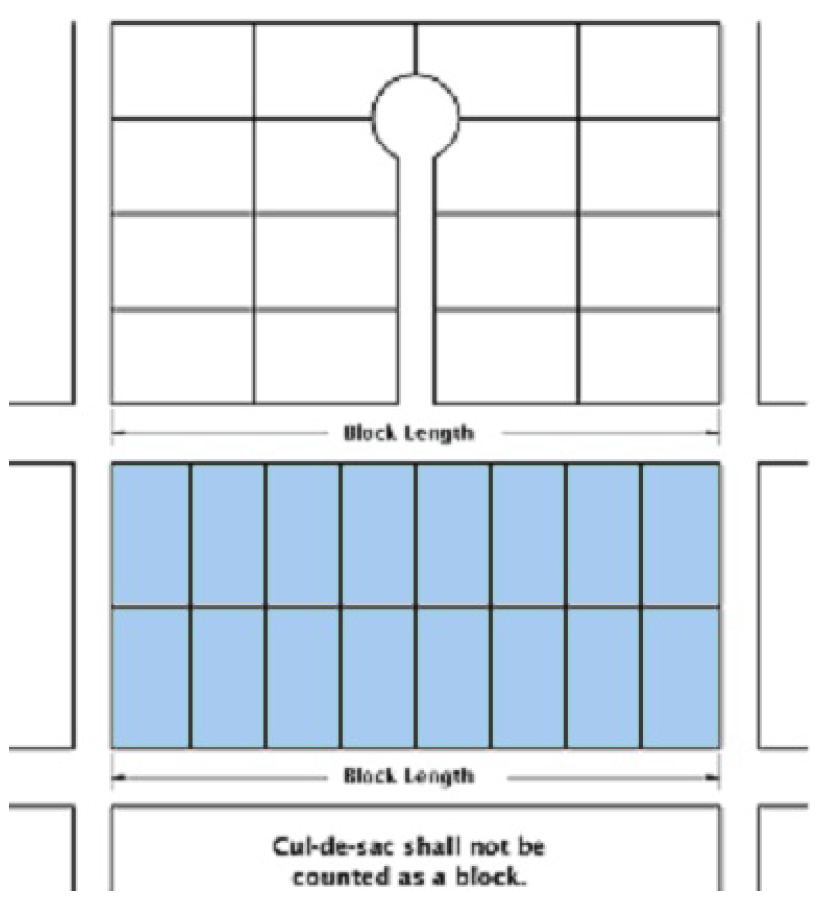
Figure 5-1: Block & Block Length
(21)
BLOCK LENGTH: The distance along a side of a street between two (2) intersecting streets[.] If the street is a dead-end type, the distance between the nearest street and the end of such dead-end street. Such distances shall be measured along the street centerline from one end of a row or group of lots to the other end. Refer to the illustration of block length shown in Figure 5-1.
(22)
BOARD OF ADJUSTMENT: The Board of Adjustment of the City of Abilene, as created by this LDC and appointed by the City Council. Also may be referred to with the acronym BOA. The composition, powers and duties of the Board of Adjustment are set forth in Chapter 1, Article 1, Division 5 of this LDC.
(23)
BREEZEWAY: A small corridor with a roof, with no structure above it, and that is a maximum of five feet (5') in width (but may be of any length and height). The corridor provides a walking path between a main building and an accessory building, usually a garage or carport, and is unenclosed (i.e., is open to the outside).
(24)
BUFFER: An area of land that is intended to mitigate negative impacts between land uses and/or along roadways. A buffer may be landscaped and may also include berms, walls, and/or fences.
(25)
BUILDING: Any structure built for the support, shelter, or enclosure of persons, chattels or movable property of any kind and which is affixed to the land. When separated by an absolute fire separation, each portion of such structure so separated is deemed a separate building. This definition includes structures wholly or partly enclosed with an exterior wall and roof.
(26)
BUILDING MAIN, PRIMARY, OR PRINCIPAL: A building in which the permitted and/or principal use of the lot on which such use is situated is conducted.
(27)
BUILDING AREA: Area of the building site left to be built upon after the required setbacks and easements have been provided.
(28)
BUILDING CODE: All building regulations adopted under the Abilene Code of Ordinances.
(29)
BUILDING HEIGHT: The vertical distance measured from grade at the front of the building to the highest point of a flat roof, to the deck line of a mansard roof, or to the mean height level between eaves and ridge for a gable, hip, or gambrel roof.
(30)
BUILDING LINE: A line parallel or approximately parallel to the street line at a specified distance from there, marking the minimum distance from the street line that a building may be erected.
(31)
BUILDING OFFICIAL: That individual that is the head of the Building Inspection Division and who ensures compliance with the Building Code of the City of Abilene, Texas, and with any applicable regulations within this LDC. This definition also includes any designee of the Building Official.
(32)
BUILDING PERMIT: An instrument in writing signed by the Building Official or other designated responsible official authorizing described construction on a particular lot.
General Definitions C
(33)
CALIPER: Diameter of the tree trunk measured at a specified height above the ground.
(34)
CARPORT: A roof-covered structure designed and used for storing motor vehicles.
(35)
CENTERLINE, STREETS OR ALLEYS: An imaginary line drawn midway between the bounding right-of-way lines of a street or alley. Where the bounding right-of-way lines are irregular, the centerline is be determined by the City Engineer.
(36)
CERTIFICATE OF OCCUPANCY: A written instrument executed by the Building Official authorizing a described use of a lot or building as set forth in the Building Code and in this LDC within in Chapter 4, Article 1, Division 4 [Division 3].
(37)
CITY: The City of Abilene, Texas.
(38)
CITY ENGINEER: The Abilene City Engineer, or an authorized representative.
(39)
CITY MANAGER: That person holding the office of City Manager under the terms of the Abilene Charter, or an authorized representative.
(40)
CITY PLANNER: See Director of Planning.
(41)
CITY SECRETARY: That person holding the office of City Secretary under the terms of the Abilene Charter, or an authorized representative.
(42)
CITY STANDARDS: All of the City's technical standards and specifications that apply to development, together with all tables, drawings, and other attachments. All City standards described or referred to in this Land Development Code are adopted by reference and are a part of this Land Development Code in the same way as if they were set out at length herein. See also the 2001 City of Abilene Standard Specifications for Construction (ASSC).
(43)
CLUSTER DEVELOPMENT: A method of development for land that permits variation in lot sizes without an increase in the overall density of population or development.
(44)
CO-LOCATION: The use of a single support structure and/or site by more than one communications provider.
(45)
COMMENCE(ING) CONSTRUCTION: The initial disturbance of soils associated with clearing, grading, or excavating activities or other construction or development.
(46)
COMMERCIAL or BUSINESS MESSAGE: A message that contains or conveys commercial context or information or advertising for any business, commodity, service, entertainment, product or other attraction or event.
(47)
COMMERCIAL VEHICLE/TRUCK: See Heavy Load Vehicle definition herein.
(48)
COMMISSION: The City of Abilene Planning and Zoning Commission.
(49)
COMMUNICATIONS OPERATIONS (NONCOMMERCIAL/AMATEUR): The transmission, retransmission or reception of radio, television, electromagnetic, or microwave signals for private or personal use, and not for the purpose of operating a business and/or for financial gain.
(50)
COMMUNICATIONS OPERATIONS (COMMERCIAL): The transmission, retransmission, or reception of radio, television, electromagnetic, or microwave signals primarily for the purpose of operating a business and/or for financial gain.
(51)
COMPATIBILITY: The characteristics of different land uses or activities that permit them to be located near each other in harmony and without conflict.
(52)
COMPLETE APPLICATION: An application that meets the standards of Chapter 1, Article 2, Division 1, Section 1.2.1.2 of this LDC, and has been deemed complete by the City in accordance with the V.T.C.A., Local Government Code, Ch. 245, or successor statute.
(53)
COMPREHENSIVE PLAN: The City of Abilene's long-range plan intended to guide the growth and development of a community and including analysis and recommendations concerning the community's population, economy, housing, transportation, community facilities and land use. This includes any portion thereof that is separately adopted and any amendment to the Comprehensive Plan or portion thereof.
(54)
CONCEPT PLAN: A component of the regulations for a Planned Development District that complies with the requirements of Chapter 2, Article 2, Division 2 [Chapter 2, Article 3, Division 4] of this Land Development Code that illustrates elements of the proposed Planned Development District, such as the location and arrangement of uses, the relationship of such uses to base zoning districts, development phasing, planned public improvements, open space, proposed amenities and the overall design of the development.
(55)
CONDITIONAL USE PERMIT (CUP): A permit authorizing the establishment of a use that may be suitable only in certain locations in a zoning district, or that is allowed only when subject to standards and conditions that assure compatibility with adjoining uses. Such permit complies with Chapter 2, Article 2, Division 3 [Chapter 1, Article 4, Division 3] of this LDC, and related regulations of uses are within Chapter 2, Article 5 [Article 4], Division 2 (Land Use Matrix) of this LDC.
(56)
CONSERVATION DISTRICT: See Neighborhood Conservation District.
(57)
CONSTRUCTION: With respect to a building, construction is the assembly of materials into a structure, or the rehabilitation or replacement of a structure which has been damaged, altered or removed or which is proposed to be altered or removed to an extent exceeding fifty percent (50%) of the area of the structure at the time of the damage, alteration or removal. For the purposes of this definition, construction includes the installation of a parking lot.
(58)
CONSTRUCTION PLANS: The drawings and technical specifications that conform to Chapter 3, Article 1, Division 8 of this LDC. Construction plans, including bid documents and contract conditions, where applicable, provide a graphic and written description of the character and scope of the work to be performed in construction of a development.
(59)
CONTRIBUTING PROPERTY: A historic property that is considered to be historically significant by local, State, or Federal governments that rank historic properties and generally follow the guidelines of the National Park Service, Department of the Interior, for listing on the National Register of Historic Places.
(60)
CORNER LOT: See Lot, Corner.
(61)
COUNCIL: The City of Abilene City Council.
(62)
COVERAGE: The percent of a lot area which is covered by a roof, floor, or other structure, which is not open to the sky, and which prevents the infiltration of water into the soil.
a.
Roof eaves extending two feet (2') and ordinary projections from the building not exceeding twelve inches (12") are not considered in computing coverage.
b.
Wooden decking, planks of wood with gaps (approximately ¼ inch) in between, is not considered in computing coverage.
c.
Any outside area that is covered with a roof structure, whether fully enclosed or not, are considered in computing coverage.
d.
Typical outdoor surfaces that do not allow for water infiltration, such as exposed aggregate surfacing or concrete porches, are considered in computing coverage.
e.
Swimming pools are not considered in computing coverage.
(63)
CUL-DE-SAC: A local street having one (1) inlet/outlet to another street and terminated on the opposite end by a vehicular turnaround.
General Definitions D
(64)
DENSITY: The number of dwelling units per acre; the relationship of dwelling units or other buildings to the area of the lot upon which such dwellings or other buildings are located or erected.
(65)
DEPTH OF LOT: See Lot Depth.
(66)
DEVELOPED AREA: That portion of a plot or parcel upon which a building, structure, pavement or other improvements have been placed.
(67)
DEVELOPER: An individual, partnership, corporation or governmental entity undertaking the division or improvement of land and other activities covered by this Land Development Code, including the preparation of a plat showing the layout of the land and the public improvements involved therein. The term "developer" is intended to include the term "subdivider."
(68)
DEVELOPMENT: Initiation of any activities related to the platting of land or construction of buildings or structures, the construction of impervious surfaces (e.g., parking lots), the installation of utilities, roadways, drainage facilities or other infrastructure; or any disturbance of the surface or subsurface of the land in preparation for such construction activities, including without limitation removal of vegetation, grading, clearing, filling, or removal of soil.
(69)
DEVELOPMENT APPLICATION: Either a petition for a legislative decision, such as a zoning amendment, or an application for a development permit, such as a plat.
(70)
DEVELOPMENT PERMIT: A decision by the Commission, Board or responsible official designated by this LDC, acting in an administrative or quasi-judicial capacity, that authorizes the holder of the permit to undertake one or more development activities or to file further applications needed to initiate or continue development activities authorized under the Land Development Code. The filing of a complete application for a development permit may or may not stay the City from adopting new standards applicable to the permit or any subordinate permit, depending on the nature of the standards.
(71)
DEVELOPMENT STANDARDS: All regulations, design standards, requirements and restrictions that apply to a development.
(72)
DIRECTOR OF PLANNING: The Director of the City Department of Planning and Development Services, or an authorized designee.
(73)
DIRECTOR OF PUBLIC WORKS: The Director of the City Department of Public Works, or an authorized designee.
(74)
DISTRICT: A zoning district under this Land Development Code.
(75)
DRIVEWAY: An entranceway serving primarily vehicles that allows for access to a lot or facility.
(76)
DUMPSTER: See Refuse Container.
General Definitions E
(77)
EASEMENT: An interest in land granted to the City, to the public generally and/or to a private entity.
(78)
ENFORCING OFFICER: The designated official of the City of Abilene or his designated representative that ensures that regulations are adhered to and standards required are met.
(79)
ENGINEER: A person duly licensed under the Texas Engineering Practice Act, to practice the profession of engineering.
(80)
ENVIRONMENTAL PROTECTION AGENCY (EPA): The U.S. Environmental Protection Agency, or, where appropriate, the administrator or other duly authorized official of that agency.
(81)
ERECT: To construct, reconstruct, install or build.
(82)
ETJ: Extraterritorial jurisdiction. See definition of Extraterritorial Jurisdiction herein.
(83)
EXCAVATION: Any digging, trenching, scraping or other activity that disturbs natural soil or rock to a depth of two feet (2') or more, other than soil disturbance incidental to the removal of trees or vegetation.
(84)
EXTERIOR ALTERATION: Any change or addition to the dimensions, materials, configuration, character, or appearance of [a structure or building] including the floor, exterior walls, columns, porches, doors, or windows of a structure or building.
(85)
EXTRATERRITORIAL JURISDICTION: The unincorporated area, not a part of any other municipality, which is contiguous to the corporate limits of the City of Abilene, the outer limits of which are measured from the extremities of the corporate limits of the City outward for the distances as may be stipulated in Chapter 42 of the Texas Local Government Code in accordance with the population of the City of Abilene, and in which area the City may enjoin violation of certain provisions of this Land Development Code.
General Definitions F
(86)
FACADE: The entire area of a side (the elevation) of a building or structure that extends from ground level to the top of a parapet, wall or eave(s) and from one corner to another. The area of a facade is defined by the outer limits of all of its visible exterior elements.
(87)
FAMILY: Any number of persons living together as a single housekeeping unit who are related by blood, legal adoption, or marriage, or not more than three (3) unrelated persons living as a single housekeeping unit, except for the following instances:
a.
Domestic servants, employed on the premises, may be housed on the premises without being counted as a family or families.
b.
No more than two (2) unrelated individuals may also room and/or board with a family composed wholly of related individuals.
For four (4) or more roomers, see definition for Boarding and/or Rooming House. The term family shall not be construed to mean a fraternity, sorority, club or institutional group.
(88)
FINAL PLAT: The plat of a subdivision for which platting is required which, when authorized, submitted and approved as regulated by Chapter 3, Article 1, Division 3 [Division 4] of this Land Development Code, will be recorded in the official public records.
(89)
FLOOR AREA: The square footage of total floor area of all floors (all stories) within a building or buildings on a lot, measured from the interior face of exterior walls.
(90)
FLOOR AREA RATIO: The total floor area of a main building or buildings on a lot, divided by the lot area. Any maximum FAR permitted shall be calculated by dividing the gross square footage of the building(s) to the net (after right-of-way dedication) area of the lot (measured in square feet). Any below-grade mechanical rooms, parking garages, or other non-occupied areas shall not be included in the gross square footage of the building(s) for the purposes of this calculation.
(91)
FREEWAY: See definition of Street, Freeway.
(92)
FRONT (OF A BUILDING): The side of a building on which the main entrance (front door) is located.
(93)
FRONTAGE, LOT: The length of street frontage between property lines.
(94)
FRONTAGE, STREET: The linear distance of the property line measured along all abutting street rights-of-way; the length of all property on one (1) side of a street between two (2) intersecting streets measured along the line of the street, or if the street is a dead-end, then the length of all property abutting on one (1) side between an intersecting street and the end of the dead-end street.
General Definitions G
(95)
GRADE: The average elevation of the highest and lowest elevation measured at the finished surface of the ground at any of the exterior corners of the building or structure.
(96)
GROSS LEASABLE AREA (GLA): Total floor area designed for tenant occupancy and exclusive use including basements, mezzanines, and upper floors, if any; expressed in square feet and measured from the centerline of joint partitions and from outside wall faces.
(97)
GROUNDCOVER: A spreading plant, including sods and grasses less than 18 inches in height, used mainly for erosion control.
(98)
RESERVED.
General Definitions H
(99)
HEAVY LOAD VEHICLE: A self-propelled vehicle having a manufacturer's recommended Gross Vehicle Weight (GVW) of greater than 16,000 pounds (including trailers), such as large recreational vehicles (originally manufactured as RVs, not converted), tractor-trailers, buses, vans, and other similar vehicles. The term "truck" shall be construed to mean "Heavy Load Vehicle" unless specifically stated otherwise.
(100)
HEIGHT (OF AN ANTENNA OR TOWER): The distance measured from the finished grade of the lot or parcel to the highest point on the support structure or other structure, including the base pad and any antennae. Also see Chapter 2, Article 5 [Article 4], Division 6, Telecommunications Towers and Antennas.
(101)
HISTORIC DISTRICT OVERLAY: An overlay zoning district that promotes historic preservation in business districts and neighborhoods. It can be for individual sites, buildings, structures, objects, and districts. Property that has this zoning may be eligible for a City property tax reduction (refer to the Abilene City Code). Like in any overlay district, the base zoning regulations remain the same and are enforceable in addition to the Historic District Overlay. Refer to Chapter 2, Section 2.4.4.3 [2.3.4.4] for specific information on Abilene's Historic Overlay District.
(102)
HISTORIC SURVEY: For the purposes of this LDC, this term shall mean a survey initiated and/or approved by Federal, State or local government to determine what properties from a specific time period or geographic area are considered historically significant. A survey may rate (high, medium, low priority) a historic property or simply list them. A survey usually attempts to date buildings or may provide other information.
General Definitions I
(103)
IMPERVIOUS COVER: See Coverage.
(104)
IMPROVED LOT OR TRACT: A lot or tract that has a structure or other improvement on it that causes an impervious coverage of the soil under the structure or improvement.
(105)
INTERESTED PERSON: A person who is impacted by a final decision of the City to the extent that such impact exceeds the impact of the decision on a member of the general public. An interested person may include any officer or agency of the City.
General Definitions J
(None included.)
General Definitions K
(None included.)
General Definitions L
(106)
LANDMARK: Any area, site, structure, district, building, or object which has special historical, architectural or cultural interest, reflects the development, heritage, or cultural characteristics of the community and which the City Council determines shall be preserved in the interests of the general welfare of the community.
(107)
LANDSCAPING: An area devoted to and maintained predominantly with living plant material including lawn, groundcover, trees, shrubs, and other plant materials; and also including accessory decorative outdoor landscape elements such as fountains, paved or decorated surfaces (excluding driveways, parking, loading, or storage areas), and sculptural elements. Also may be referred to as Landscaped Area.
(108)
LOT: An undivided tract or parcel of land shown and designated with a tract or lot number on a duly recorded subdivision or development plat. A lot, which is designated as a distinct and separate tract, and which is identified by a tract, lot number, or symbol in a duly approved plat that has been properly filed of record, is or may be offered for sale, conveyance, transfer or development.
(109)
LOT AREA: The square foot area or the acreage of a lot within the bounding property lines and exclusive of dedicated streets and alleys, but may include easements.
(110)
LOT, CORNER: A lot abutting upon two (2) or more streets at their intersection(s).
(111)
LOT COVERAGE: See Coverage.
(112)
LOT DEPTH: The distance between the midpoints of straight lines connecting the foremost points of the side lot lines in front and the rearmost points of the side lot lines in the rear (the mean horizontal distance between the front and rear lot line).
(113)
LOT, DOUBLE-FRONTAGE: Any lot, not a corner lot, with frontage on two streets that are essentially parallel to each other or are within forty-five (45) degrees of being parallel to each other.
(114)
LOT, FLAG-SHAPED: An irregularly shaped lot that takes its sole access via a long, narrow strip of land connecting the principal building site to a public street.
(115)
LOT, INTERIOR: A lot other than a corner lot.
(116)
LOT, KEYED: Any lot having an essentially trapezoidal shape, with a rear boundary greater in width than the front boundary and located on a street curve having a centerline radius less than two hundred fifty feet (250').
(117)
LOT LINE: A property (ownership) boundary of a lot, as defined herein.
(118)
LOT WIDTH: The horizontal distance between straight lines connecting front and rear lot lines at each side of the lot, measured across the rear of the required front yard.
General Definitions M
(119)
MINOR PLAT: A plat dividing land into no more than four (4) lots that meets the submission and approval requirements of Chapter 3, Article 1, Division 6 [Division 5] of this Land Development Code.
(120)
MOBILE RECREATION EQUIPMENT: Any vacation travel trailer, as defined herein this chapter, as well as any boat; any trailer designed or intended by its manufacturer primarily for transportation of a boat; and any semi-trailer or self-propelled motor vehicle which is designed, constructed and equipped for human habitation as a temporary dwelling place or sleeping place.
General Definitions N
(121)
NEIGHBORHOOD CONSERVATION DISTRICT: A district established to provide a means of preserving an area's distinctive atmosphere or character by protecting or enhancing its significant architectural or cultural attributes. Refer to Chapter 2, Section 2.4.4.2 [2.3.4.3] for specific information on Abilene's Neighborhood Conservation Overlay (NCO) zoning district.
(122)
NONCONFORMING: A use or structure was lawful at the time it was begun, but could not presently be so begun, used, or constructed under current LDC regulations.
(123)
NONCONFORMING LOT: Any platted lot that does not conform with the regulations of this Code and that is regulated by Chapter 2, Article 7 [Article 6], Division 2, and specifically Section 2.7.2.3 [2.6.2.3].
(124)
NONCONFORMING STRUCTURE: Any structure, building or physical improvement existing on land which does not conform to the regulations, relative to its size, height or location, within the zoning district in which it is located.
(125)
NONCONFORMING USE: Any activity or use of land which was lawful prior to the enactment of this LDC, which does not conform to the regulations of the zoning district in which it is located.
(126)
NONCONTRIBUTING PROPERTY: A noncontributing property is a property that is considered not to be historically significant by local, State, or Federal governments that rank historic properties and generally follow the guidelines of the National Park Service, Department of the Interior, for listing on the National Register of Historic Places. A noncontributing property would not meet one or more to [of] the criteria in Section 2.4.4.3(c) [2.3.4.4(c)] (Historic Overlay District criteria) of this LDC.
General Definitions O
(127)
OCCUPANCY: Any utilization of real property.
(128)
OFFICIAL FILING DATE: The date an applicant delivers the application or plan to the City or deposits the application or plan with the United States Postal Service by certified mail addressed to the City with all required fees and documents as stated on the application form, as described by Section 1.2.1.4 of this LDC. The official filing date is also subject to complete application provisions within this LDC; see the definition of Complete Application as well as requirements within Section 1.2.1.2 of this LDC.
(128.5)
OPEN-SIDED: Having a side or sides open.
(129)
OPEN SPACE RATIO/PERCENTAGE: The square foot amount of open space for each square foot of floor area within lot boundaries. This may be expressed as a percentage of open space within lot boundaries.
(130)
OVERLAY ZONING DISTRICT: A zoning district that establishes regulations that combine with the regulations of an underlying (base) zoning district. The purposes of an overlay district shall be to prohibit uses otherwise allowed in the base district, to establish additional or different conditions for such uses, or to authorize special uses, together with standards for such uses, not otherwise allowed in the base district. Overlay zones shall be designated in the same manner and are subject to the same rezoning procedures as any zoning district.
General Definitions P
(131)
PARKING AREA: An area containing multiple parking spaces together with accompanying maneuvering area and driveway access, usually off-street and always composed of all-weather surface material, for the storage of motor vehicles. Parking in the area may be free, may be for compensation, or may be provided as an accommodation for clients or customers.
(132)
PARKING SPACE: Generally, a storage area or stall for parking of an individual motor vehicle. An off-street parking space is one not located on a dedicated right-of-way, but is instead characterized by an all-weather surface together with an all-weather driveway connecting the parking space with a street or alley. An on-street parking space is one that may be located along a dedicated right-of-way in a designated location.
(133)
PARKWAY: That portion of the public right-of-way lying primarily between the edge of the pavement or curb and the private property line.
(133.5)
PATIO COVER: A roof-covered and often open-sided platform usually attached to or part of and with direct access to the principal building on a lot or tract of land.
(134)
PERMITTED USE: A use specifically allowed in one (1) or more of the various zoning districts by right, meaning that no zoning amendment is necessary to allow the use within a designated zoning district. This term does not include uses permitted with a Conditional Use Permit (CUP).
(135)
PERFORMANCE STANDARD: Standards specified for the operating characteristics of different activities and related to noise, smoke, airborne particulate matters, odors, toxic and noxious matter, glare, exterior illumination, and vibration.
(136)
PERSON: A human being, his heirs, executors, administrators, or assigns and also includes a firm, partnership, or corporation, its or their successors or assigns, or the agent of any of the aforesaid.
(137)
PERSONAL PROPERTY: For the purpose of regulating garage sales, the term shall mean property which is owned, utilized and maintained by an individual or members of his or her household and acquired in the normal course of living or maintaining a residence. The term does not include merchandise which was purchased for resale or obtained on consignment.
(138)
PETITION FOR A LEGISLATIVE DECISION: A request for approval of an action authorized under this Land Development Code requiring action by the City Council acting in its legislative capacity.
(139)
PETITION FOR CHANGE IN NONCONFORMING STATUS: A request by a property owner to the City of Abilene Board of Adjustment (BOA) under Chapter 2, Article 2, Division 5 [Chapter 2, Article 6, Division 3] of this Land Development Code for a change in the status of a nonconforming use or structure to allow for modification to the use or property owned.
(140)
PETITION FOR RELIEF FROM DEDICATION OR CONSTRUCTION REQUIREMENT: A request for relief from a requirement imposed under this Land Development Code to dedicate or construct a public improvement based on constitutional standards, and that is reviewed and decided under Chapter 1, Article 3, Division 2 of this Land Development Code.
(141)
PLANNED DEVELOPMENT (PD) DISTRICT: A land development project comprehensively planned which permits flexibility in building siting, mixtures of housing types and land uses, usable open spaces, and the preservation of significant natural features. Such district adheres to the standards of Chapter 2, Article 2, Division 2 [Chapter 2, Article 3, Division 4] of this LDC.
(142)
PLANNING DIRECTOR: The Director of Planning as stated in Section 85 of the City Charter of Abilene.
(143)
PLAT: A map, drawing, chart or plan showing the exact layout and proposed construction of a proposed development into one or more lots, blocks, streets, parks, school sites, commercial or industrial sites, easements, alleys and/or any other elements as required by this Land Development Code and which a subdivider shall submit for approval in accordance with this Land Development Code.
(144)
PORCH: A roofed space open on three (3) sides, one (1) or more stories in height, the roof of which is an extension of the roof of a building to which the porch is attached. The purpose of such space is to shelter people or objects, not including vehicles, from the sun, rain and general weather.
(145)
PRELIMINARY DEVELOPMENT PLAN: The initial plat for a subdivision to be developed in phases that delineates the sequence and timing of development within the proposed subdivision, and that is reviewed and decided under Chapter 3, Article 1, Division 2 [sic] of this Land Development Code.
(146)
PRELIMINARY PLAT: A plat that illustrates and thereby assures the general layout of a proposed subdivision, the adequacy of public facilities needed to serve the proposed subdivision, and the overall compliance of the land division with applicable requirements of the Land Development Code and that is reviewed and decided prior to approval of a Final Plat. This type of plat is authorized under Chapter 3, Article 1, Division 3 of this Land Development Code.
(147)
PUBLIC RIGHT-OF-WAY: A strip of land used or intended to be used, wholly or in part, as a public street, alley, crosswalk way, sidewalk, path or drainageway.
(148)
PUBLIC VIEW: Areas that can be seen from any public street.
General Definitions Q
(None included.)
General Definitions R
(149)
RADIO, TELEVISION OR MICROWAVE TOWER: See "Antenna, Microwave Reflector & Antenna Support Structure."
(150)
RECORD DRAWINGS: See As-Built/Record Drawings.
(151)
RECORDED PLAT: A plat that has been finally approved by the City and that has been filed with the applicable County after meeting all City requirements for recordation under Chapter 3, Article 1, Division 4 of this Land Development Code.
(152)
RECREATIONAL VEHICLE (RV): Refer to Vacation Travel Trailer.
(153)
REFUSE CONTAINER: Any container used for the temporary storage of routinely collected waste that is specifically designed to be emptied by heavy machinery. Also may be referred to as a dumpster or trash receptacle.
(154)
REMAINDER TRACT: Land that is part of a larger parcel that is not subject to a subdivision plat affecting the parcel.
(155)
RESIDENCE: A building occupied as the dwelling place of one (1) or more persons in which the use and management of sleeping quarters, all appliances for cooking, ventilating, heating, or lighting are under one (1) control, including any type of dwelling defined herein.
(156)
RESPONSIBLE OFFICIAL: The City staff person who has been designated to accept a type of development application for filing, to review and make recommendations concerning such applications, and where authorized, to initially decide such applications, to initiate enforcement actions, and to take all other actions necessary for administration of the provisions of this Land Development Code with respect to such development applications. Also includes any designee of the designated City staff person.
(157)
RETAIL TRADE: The sale of commodities in relatively small quantities directly to consumers.
General Definitions S
(158)
SCREENING: Fencing, walls, planted berms, or densely planted vegetation which acts as a buffer or visibility.
(159)
SERVICE: Activity which involves the provision of useful labor to supply some public demand, but does not produce a tangible commodity.
(160)
SETBACK LINE: A line defining an area on the lot between the property line and the building line within which no building shall be constructed, encroach or project, except as specifically authorized in an adopted City ordinance or within this LDC.
a.
Exterior Side Setback Line: A side setback adjacent to a street right-of-way line.
b.
Front Setback Line: A line parallel to the street right-of-way line which the building takes its primary access from and faces.
c.
Interior Side Setback Line: A side setback that is not adjacent to a street right-of-way.
d.
Side Setback Line: A line parallel to an adjacent lot, property line, or street right-of-way on a corner lot, up to which the building sides.
e.
Rear Setback Line: A line parallel to an adjacent lot, alley or street, for double-frontage lots, to which the building backs up and from which it has its rear or secondary access.
(161)
SIGNIFICANT ARCHITECTURAL FEATURE: That quality in buildings and structures, or parts thereof, which represents characteristics of a style or period of design and construction and which reflect, through integrity of location, design, materials, and workmanship, and the community's heritage, including its historical, architectural and cultural values.
(162)
SITE: A tract of property that is the subject of a development application.
(163)
SITE DEVELOPMENT PLAN: The final step of the development process within a PD district, if required by the ordinance adopting the PD. Refer to Section 2.2.2.10 [2.3.4.5] of this LDC.
(164)
SITE PLAN: A scaled and detailed drawing that conforms to the requirements of this LDC, specifically Chapter 4, Article 1, Division 1 [Division 2], and that shows the roads, parking, footprints of all buildings, existing trees, proposed landscaping, parkland, open space, grading and drainage, and similar features needed to verify compliance with the City's approved Comprehensive Plan and development standards.
(165)
SITE PREPARATION PERMIT: A permit that is issued under Chapter 4, Article 1, Division 2, Section 4.1.2.2 [4.1.3.2] of this Land Development Code, that authorizes site preparatory activities other than construction or placement of a structure on the land under one or more site plans and that, upon approval, authorizes the property owner to apply for a construction permit.
(166)
SPECIAL EXCEPTION: A modification of zoning standards authorized by the City Board of Adjustment that is applicable to particular types of development within any zoning district in a manner consistent with the overall intent of the zoning regulations and for which express standards are prescribed in Chapter 2, Article 2, Division 5, Section 2.2.5.1 [1.4.4.1] of this LDC.
(167)
STORY: That portion of a building included between the surface of any floor and the surface of the floor next above it, or if there is no floor above it, then the space between such floor and the ceiling.
(168)
STREET: The entire width between property lines when any part thereof is open to the use of the public, as a matter of right, for the purpose of vehicular traffic. This definition shall include public as well as private streets. An "Alley" is not considered to be a street, and is separately defined herein.
(169)
STRUCTURE: Anything constructed or erected on the ground or attached to the ground, that has a permanent location on the ground in some definite manner, and that is covered by a roof. Examples include buildings, sheds, cabins, mobile homes and other similar items. Also see Building.
(170)
SUBDIVIDE:
a.
Is the following when done for the purpose of sale or building development:
1.
The division of any tract of land into two (2) or more tracts or lots; or
2.
The assembly of two (2) or more tracts of land into one (1) tract or lot.
b.
Is the following with regard to changes to a recorded plat:
1.
A resubdivision of all or part of the subdivision;
2.
Any change of lot size or lot lines; or
3.
The relocation of any street.
(171)
SUBDIVIDER: Any person or any agent of the person dividing or proposing to divide land so as to constitute a subdivision, as that term is defined in this section. In any event, the term "subdivider" is restricted to include only the owner, equitable owner or authorized agent of the owner or equitable owner of land to be subdivided.
(172)
SUBDIVISION: Pertaining to land for which a plat has been recorded, subdivision means an area of subdivided lots; pertaining to the act of subdividing land, see the definition of Subdivide herein.
(173)
SUBSTANTIAL IMPROVEMENT: The total of all repairs, reconstruction or improvements of a structure which have occurred less than twelve (12) months prior to application for a permit for a proposed repair, reconstruction, or improvement; which increases the floor area of an existing structure by fifty percent (50%) or more, or the cost of which equals fifty percent (50%) or more of the market value of an existing structure, either:
a.
Before the improvement or repair is started, or
b.
If the structure has been damaged, and is being restored, before the damage occurred.
For the purposes of this definition, "substantial improvement" is considered to occur when the first alteration of any wall, ceiling, floor, or other structural part of the building commences, whether or not the alteration affects the external dimensions of the structure. The term does not, however, include either:
a.
Any project for improvement of a structure to comply with existing or local health, sanitary, or safety code specifications which are solely necessary to assure safe living conditions, or
b.
Any alteration of a structure listed on the National Register of Historic Places or a State Inventory of Historic Places.
(174)
SURVEYOR: A licensed state land surveyor or a registered professional land surveyor, as authorized by State statutes, to practice the profession of surveying.
General Definitions T
(175)
TCEQ: The acronym for the Texas Commission on Environmental Quality.
(176)
TELECOMMUNICATIONS FACILITY, TOWER, OR STRUCTURE: See "Antenna, Microwave Reflector & Antenna Support Structure."
(177)
TEXAS LOCAL GOVERNMENT CODE (TLGC): The legislative statutes of State of Texas, as amended, that involve various rules and laws governing the functioning of municipalities, including zoning and subdivision regulations.
(178)
THOROUGHFARE, MAJOR: The primary road within the boundaries of the Corridor Overlay District (the regulations for this district are contained within Chapter 2, Article 4, Division 4).
(179)
TIE-DOWN: Any device designed for the purpose of anchoring a mobile home or manufactured home to ground anchors, as required by V.T.C.A., Occupations Code Ch. 1201.
(180)
TEMPORARY/MOBILE ANTENNA: An antenna and any associated support structure or equipment, including, but not limited to, a support pole, a vehicle that is placed and/or used on a temporary basis only not intended to be permanent, usually in conjunction with a special event, news coverage or emergency situation, or in case of equipment failure or temporary augmentation of permanent communications equipment.
(181)
TREE, CANOPY: Any self-supporting woody plant with one well-defined trunk and a distinct and definite formed crown which attains a height of at least twenty feet (20" [sic]).
(182)
TREE, EXISTING: Any self-supporting woody plant with a caliper of two inches (2") in diameter or greater which is in healthy condition.
(183)
TREE, NON-CANOPY: Any self-supporting woody plant with a two-inch (2") caliper and one (1) or more trunks which attains a height of at least ten feet (10').
(184)
TRUCK: See Heavy Load Vehicle.
(185)
TXDOT: The acronym for the Texas Department of Transportation.
General Definitions U
(186)
UTILITY: A business that provides an essential commodity or service, such as electric, gas transmission, and local telephone, and that is generally under government regulations.
General Definitions V
(187)
VARIANCE: Authorization to deviate from or vary one or more standards applicable to a development application that is reviewed and decided under Chapter 2, Article 2, Division 5, Section 2.2.5.2 [1.4.4.2] of this Land Development Code.
(188)
VESTED RIGHTS PETITION: A request for relief from one or more standards of this Land Development Code based on an assertion that the petitioner has acquired a vested right requiring the City to review and decide the application under standards in effect prior to the effective date of the standards of this Land Development Code. Such petition is regulated under Chapter 1, Article 3, Division 3.
(189)
VIOLATION: The failure of a use, structure or other development to fully comply with this Land Development Code.
General Definitions W
(190)
WAIVER: Authorization to deviate from or vary one or more standards applicable to a development application; such authorization is applied for, reviewed, and decided under Chapter 1, Article 3, Division 4 of this Land Development Code.
(191)
WATER STORAGE: {x} Impounded surface water areas or surface tanks used for storage.
(192)
WIRELESS COMMUNICATION TOWER OR STRUCTURE: See "Antenna, Microwave Reflector & Antenna Support Structure."
General Definitions X
(None included.)
General Definitions Y
(193)
YARD: Open space on the lot or building plot on which a building is situated, between the property line and the setback line, which is open and unobstructed to the sky by any structure except as herein provided.
(194)
YARD, FRONT: The open (unoccupied, unobstructed) space located in front of the front building line of the principal building(s), calculated as the minimum horizontal distance between the front property line and the front building line of the principal building(s). Refer to Chapter 2, Article 6 [Article 5], Division 1, Figure 2-1 [Figure 2-2], for a diagram related to this definition.
(195)
YARD, PRIVATE: An open space within a residential lot, unoccupied and unobstructed by any portion of a structure other than a porch.
(196)
YARD, REAR: The open space (unoccupied and unobstructed except for accessory buildings or dwellings) located behind the rear building line of the principal building(s), calculated as the minimum horizontal distance between the rear property line and the rear building line of the principal building(s). Refer to Chapter 2, Article 6 [Article 5], Division 1, Figure 2-1 [Figure 2-2], for a diagram related to this definition.
(197)
YARD, SIDE: The open (unoccupied, unobstructed) space located on either side of the principal building(s), calculated as the minimum horizontal distance between the side property line and the side building line of the principal building(s). Any lot line which is not a front or rear lot line is a side lot line. Where a lot has only three (3) lot lines, those lot lines which do not front upon a street shall be deemed side lot lines. Refer to Chapter 2, Article 6 [Article 5], SDivision 1, Figure 2-1 [Figure 2-2], for a diagram related to this definition.
General Definitions Z
(198)
ZONING DISTRICT: A classification within which the regulations specified are uniform and which is assigned to a particular area of the City by delineation upon the Zoning District Map, which is a part of this LDC.
(199)
ZONING DISTRICT MAP: The officially certified map or maps, on which the boundaries of the various zoning districts are shown, and which are an integral part of the zoning regulations of this LDC.
(Ord. No. 8-2010, pt. 1(Exh. A), 4-22-10; Ord. No. 12-2020, pt. 1(Exh. A), 3-12-20)

