
Agoura Hills City Zoning Code
CHAPTER 2
RESIDENTIAL LAND USE DISTRICTS
PART 2. - RESERVED[4]
Editor's note— Ord. No. 11-388, § 4, adopted Dec. 14, 2011, repealed Pt. 2 in its entirety. Former Pt. 2, §§ 9211—9214.1, pertained to RR residential-rural district and derived from Ord. No. 132, § 1, adopted Aug. 26, 1987; Ord. No. 196, § 2, adopted July 24, 1991; Ord. No. 199, § 1, adopted Feb. 12, 1992; Ord. No. 205, § 1, adopted Mar. 25, 1992; Ord. No. 240, § 3, adopted Sept. 8, 1993; Ord. No. 03-320, §§ 2—4, adopted May 28, 2003; Ord. No. 04-326, § 3, adopted Oct. 27, 2004; Ord. No. 07-343, § 3, adopted Feb. 28, 2007; Ord. No. 09-358, § 3, adopted Jan. 18, 2009.
PART 7. - RESERVED[5]
Editor's note— Ord. No. 11-388, § 7, adopted Dec. 14, 2011, repealed Pt. 7 in its entirety. Former Pt. 7, §§ 9261—9264.1, pertained to RMH residential-medium high density district and derived from Ord. No. 132, § 6, adopted Aug. 26, 1987; Ord. No. 225, §§ 2, 4, 5, adopted April 14, 1993; Ord. No. 240, §§ 8, 9, adopted Sept. 8, 1993; Ord. No. 03-320, §§ 12, 13, adopted May 28, 2003; Ord. No. 04-326, § 3, adopted Oct. 27, 2004; Ord. No. 07-343, § 8, adopted Feb. 28, 2007.
9201.- Purpose.
The residential land use districts are included in zoning regulations to achieve the following purposes:
A.
To reserve appropriately located areas for family living at a range of population densities consistent with the general plan and sound standards of public health and safety;
B.
To ensure adequate light, air, privacy, and open space for each dwelling;
C.
To provide space for semipublic facilities needed to complement developed residential areas and for institutions that require a residential environment;
D.
To minimize traffic congestion and to avoid the overloading of utilities by preventing the construction of buildings of excessive size in relation to the land around them;
E.
To preserve the high quality of the city's existing residential areas;
F.
To maintain the rural character of the community;
G.
To protect and enhance the natural and important features of the community;
H.
To provide necessary space for off-street parking of automobiles and other vehicles and when appropriate for off-street loading of trucks;
I.
To adequately buffer residential properties from the hazards, noise, and congestion created by commercial and business park development;
J.
To protect residential properties from noise, illumination, unsightliness, odors, dust, dirt, smoke, vibration, heat, glare, and other objectionable influences;
K.
To facilitate the provision of utility services and other public facilities commensurate with anticipated population densities and service requirements;
L.
To ensure that structures and uses are compatible within each category for the purpose of the living environment;
M.
To permit the necessary accessory structures and uses associated with such living areas;
N.
To encourage superior site planning and environmental design.
9221.- Purpose.
The RV district is intended for large lot development suitable for equestrian and agricultural oriented uses as well as areas with twenty-five (25) percent or greater slope which require careful design consideration to minimize grading and visual impact. Only those uses which are complimentary to and can exist in harmony with such limitations shall be permitted.
9222. - Uses established.
The limitations in the RV land use district, as to uses and structures, shall be as follows.
9222.1. - Permitted uses.
Subject to the provisions of chapter 6, the following are permitted uses and structures in the RV district:
A.
One (1) single-family dwelling unit per lot or a mobile home used as a caretakers unit;
B.
Crops - field, tree, bush, berry and row, including nursery stock;
C.
Day care for children, small family day care home;
D.
Home for aged persons, foster family;
E.
Light agricultural uses subject to the limitations of section 9224.1;
F.
One (1) manufactured home (mobile home) on a permanent foundation, as a single-family dwelling, subject to the provisions of section 9675;
G.
Community care facilities, small;
H.
Employee housing, small.
(Ord. No. 225, § 2, 4-14-93; Ord. No. 11-383, § 6, 3-9-2011; Ord. No. 14-406, § 5, 5-14-2014)
9222.2. - Accessory uses.
Subject to the provisions of section 9281 et seq. and chapter 6, the following accessory uses and accessory structures shall be permitted:
A.
Accessory buildings, accessory uses and accessory structures;
B.
Domestic animals;
C.
Home occupations;
D.
Garage sales, not to exceed two (2) in any calendar year;
E.
Private greenhouses, horticultural collections, flower and vegetable gardens.
F.
Accessory dwelling units, subject to the provisions of section 9283 et seq.
(Ord. No. 03-320, § 4, 5-28-2003; ; Ord. No. 434, § 9, 1-10-2018; Ord. No. 21-456, § 4, 8-25-2021)
9222.3. - Uses subject to director's review and approval.
Subject to the provisions of chapter 6, the following uses may be permitted subject to the approval of the director:
A.
Access to a lawfully permitted use in another land use district;
B.
Stands for the display and sale of any agricultural products lawfully produced on said lot;
C.
Private equestrian and hiking trails;
D.
Private recreation clubs;
E.
Riding academies and stables;
F.
Temporary structures such as model homes, real estate sales offices, construction trailers and mobile homes used as residence during construction of a project when a valid building permit is in force;
G.
Temporary storage of materials and construction equipment related to a city public works project;
H.
Retaining walls two (2) feet or higher in height containing fill located within a required setback or within fifty (50) feet of an existing residence subject to the issuance of a site plan architectural review permit. This section shall apply only to retaining walls that face an abutting property;
I.
Day care for children, large family day care home, subject to the issuance of a large family day care permit pursuant to the provisions of section 9285;
J.
Motion picture filming not exceeding seven (7) consecutive days.
(Ord. No. 224, § 2, 3-24-93; Ord. No. 225, § 4, 4-14-93; Ord. No. 04-326, § 3, 10-27-2004; Ord. No. 07-343, § 4, 2-28-2007)
9222.4. - Conditional uses.
The following uses may be permitted subject to a conditional use permit:
A.
Arboretum and horticultural gardens;
B.
Campgrounds, picnic areas, trails with overnight camping;
C.
Churches, temples or other places used exclusively for religious worship, including related incidental educational and social activities;
D.
Convents and monasteries;
E.
Reserved;
F.
Day nursery, children;
G.
Development of property with an average slope of ten (10) percent or greater, subject to the provisions of section 9652 et seq.;
H.
Grange halls;
I.
Guest ranches;
J.
Health retreats;
K.
Homes for aged person, small group care;
L.
Homes for children, special boarding;
M.
Institutions for aged persons, private;
N.
Institutions for children, private;
O.
Lighted tennis courts;
P.
Manufactured homes (mobile homes) on a permanent foundation, as a single-family dwelling, subject to the provisions of section 9675, if more than ten (10) years have elapsed between the date of manufacture of the manufactured home and the date of the application for the issuance of a permit to install the manufactured home;
Q.
Community care facilities, large.
(Ord. No. 132, § 2, 8-26-87; Ord. No. 199, § 1, 2-12-92; Ord. No. 225, § 5, 4-14-93; Ord. No. 240, § 4, 9-8-93; Ord. No. 03-320, § 5, 5-28-2003; Ord. No. 11-383, § 7, 3-9-2011)
9222.5. - Prohibited uses.
All uses and structures not specifically provided for in section 9222.1 et seq. are strictly prohibited in the RV land use district.
9223. - Development standards.
Subject to the provisions of section 928 and chapter 6, the following development standards shall apply in the RV land use district.
9223.1. - Minimum lot specifications.
Except for permanent open space lots, the minimum lot area shall be one (1) acre.
9223.2. - Yards.
The minimum yards shall be as follows:
A.
The minimum front yard setback shall be twenty-five (25) feet;
B.
The minimum side yard setback shall be twelve (12) feet;
C.
The minimum rear yard setback shall be twenty-five (25) feet.
Note: Reference section 9605.1, relating to yard requirements and exceptions.
(Ord. No. 196, § 2, 7-24-91)
9223.3. - Main building, accessory building or structure.
Main buildings, accessory buildings or structures, and all impermeable surfaces including but not limited to driveways, patios, sports courts (such as tennis courts, basketball courts, racquetball courts), pools, spas, and gazebos shall conform to the following requirement: The combined maximum site coverage of main and all accessory buildings or structures shall not exceed twenty-five (25) percent. The planning commission shall have discretion in excluding all or portions of impermeable surface driveways for flag lots, fire department-required turnaround areas or other special circumstances from the maximum site coverage. These driveways and turnaround areas must be designed consistent with the Old Agoura Residential Design Guidelines.
(Ord. No. 94-247, § 1, 7-13-94; Ord. No. 09-358, § 4, 1-18-2009)
9223.4. - Building height.
The maximum building height shall be two (2) stories or thirty-five (35) feet, whichever is less. Vertical design projections may not exceed a height of thirty-five (35) feet as measured vertically from the finished grade to the top of said projection.
(Ord. No. 09-358, § 4, 1-18-2009)
9223.5. - Off-street parking and loading requirements.
All parking and loading shall comply with the provisions of chapter 6.
9223.6. - Utilities.
All utilities shall be in compliance with chapter 6.
9223.7. - Signs.
All signs shall be in compliance with chapter 6.
9223.8. - Site plan review.
All uses and additions not requiring any other discretionary approvals shall not be permitted unless a site plan review is obtained pursuant to the provisions of chapter 6. Notwithstanding the foregoing, the following additions to an existing residence may be permitted subject to the administrative site plan review process:
(1)
Where the gross floor area of the residence as originally constructed exceeds thirty-six hundred (3,600) square feet: additions that do not exceed thirty (30) percent of the original gross floor area of the residence.
OR
(2)
Where the gross floor area of the residence as originally constructed was thirty-six hundred (3,600) square feet or less; additions that do not exceed thirty (30) percent of the original gross floor area or additions that do not exceed the square footage necessary to make the existing residence thirty-six hundred (3,600) square feet, whichever is greater.
(3)
A one (1) time addition of two hundred (200) square feet or less shall be permitted to any existing residence without either a site plan review or an administrative site plan review.
(Ord. No. 92-247, § 2, 7-13-94; Ord. No. 00-301, § 1, 3-22-2000)
9223.9. - Substantial remodels.
All substantial remodels shall require review by the planning commission. Substantial remodels on lots with an average slope of ten (10) percent or less shall require a site plan review. Substantial remodels on lots with an average slope of ten (10) percent or greater shall require a conditional use permit.
(Ord. No. 09-358, § 4, 1-18-2009)
9224. - Special standards.
In any RV land use district, the following special standards shall apply.
(Ord. No. 11-388, § 5, 12-14-2011)
9224.1. - Livestock and poultry raising standards.
Livestock and poultry raising shall conform to the following requirements:
A.
Poultry, fowl and rabbits not to exceed fifty (50) birds and twenty-four (24) rabbits;
B.
Pigeons not to exceed twelve (12) per parcel;
C.
A maximum of any combination of horses and other equines, cattle, llamas, alpacas, sheep or goats not to exceed eighteen (18) per acre.
1.
The raising, maintaining, keeping or grazing of horses and other equines, and cattle, including the breeding and training thereof shall be limited to a maximum of eight (8) adult animals per acre:
a.
No raising or grazing of any animals shall occur as a part of, nor shall be conducted in conjunction with, any dairy, livestock feed yard, livestock sales yard or commercial riding academy located on the same premises;
2.
A maximum of any combination of adult llamas or alpacas not to exceed ten (10) per acre;
3.
A maximum of any combination of adult sheep or goats not to exceed ten (10) per acre;
D.
Hogs or pigs shall be permitted, provided:
1.
That said animals are, as a condition of use, located not less than fifty (50) feet from any street and not less than fifty (50) feet from the side or rear lines of any lot parcel of land or buildings used for human habitation;
2.
That said animals shall not be fed any market refuse or similar imported ingredient or anything other than table refuse from meals consumed on the same lot or parcel of land, or grain;
3.
That no more than two (2) weaned hogs or pigs are kept, except for 4-H projects;
4.
That said animals shall be penned;
E.
No animals or fowl, except dogs and cats kept as domestic pets, shall be housed, stalled, lodged, maintained or confined in a building or structure within thirty-five (35) feet of any street or structure designed for human habitation. This provision excludes corrals;
F.
All animals shall be maintained and controlled in a safe and healthy manner so as to not cause any private or public nuisance.
(Ord. No. 205, § 1, 3-25-92)
9224.2. - Preservation of natural drainage courses.
No substantial development shall occur which results in the substantial alteration of any known drainage course. The following shall apply to all property in the RV land use district which contains established drainage courses:
A.
No development shall result in the alteration of a known drainage course except when it can be proved that said development will correct conditions which are hazardous to the public health and safety;
B.
No structures or parts of structures shall overhang, project, or protrude into any known drainage course;
C.
Fences and other structures, culverts and bridges, which must be constructed within drainage courses, shall be designed to the requirements of the city so as to prevent an obstruction or division of drainage flows and to minimize adverse effects to natural riparian vegetation and ecosystems;
D.
Any fill of designated drainage courses shall be limited to the amount necessary to resolve health or safety hazards;
E.
All development shall, to the extent possible, enhance the natural amenities of a known drainage course;
F.
No development shall occur without adequate provisions for the maintenance of known drainage courses.
9224.3. - Flag lot design requirements.
Subject to the provisions of chapter 6, lots may be created in the RV land use district with as small as fifteen (15) feet of frontage on a private or public street, subject to the following:
A.
No more than four (4) lots shall be served from the same private drive;
B.
A minimum of a fifteen-foot-wide drive shall be provided for one (1) flag lot and a minimum of a twenty-foot drive with adequate turnaround at the terminus of the flag portion of the lot shall be provided for more than one (1) lot using the same drive. Whenever possible all drives shall be placed adjacent to each other;
C.
All flag lots shall have a permanent all-weather driveway access;
D.
The front side and rear yard setbacks shall be established from the main portion of the flag portion of the lot, exclusive of the access strip;
E.
Permanent, adequate notice of the address for each flag lot shall be provided along the required street frontage;
F.
Adequate easements and agreements shall be provided to guarantee the preservation of the required access.
9224.4. - Special access requirements.
Development in the RV land use district may be served by private streets, provided that:
A.
Irrevocable offer to dedicate shall be made as a part of all development;
B.
Evidence is provided that easements exist to provide adequate access to all development served from said private street;
C.
Evidence is provided that adequate agreements exist to guarantee the on-going maintenance of said private streets;
D.
The width of said private streets comply with city standards for public streets;
E.
The improvements of said private streets is acceptable to the city in terms of providing adequate access to protect the health and safety of the ultimate occupants;
F.
Other assurance shall be provided to guarantee the health and safety of the ultimate occupants.
9231.- Purpose.
The RL district is intended to include large lots which with adequate design standards can provide for equestrian uses in conjunction with residential and related development.
9232. - Uses established.
The limitations in the RL land use district, as to uses and structures, shall be as follows.
9232.1. - Permitted uses.
Subject to the provisions of chapter 6, the following are permitted uses and structures in the RL land use district:
A.
One (1) single-family dwelling unit per lot or a mobile home uses as a caretakers unit;
B.
Day care for children, small family day care home;
C.
Home for aged persons, foster family;
D.
Homes for children, foster family;
E.
One (1) manufactured home (mobile home) on a permanent foundation, as a single-family dwelling, subject to the provisions of section 9675;
F.
Community care facilities, small;
G.
Employee housing, small.
(Ord. No. 225, § 2, 4-14-93; Ord. No. 11-383, § 8, 3-9-2011; Ord. No. 14-406, § 6, 5-14-2014)
9232.2. - Accessory uses.
Subject to the provision of section 9281 et seq. and chapter 6, the following accessory uses and structures shall be permitted:
A.
Accessory buildings, uses and structures;
B.
Domestic animals;
C.
Accessory dwelling units, subject to the provisions of section 9283 et seq.;
D.
Home occupations;
E.
Livestock and poultry raising for private, noncommercial use and private kennels and stables, subject to the limitations of section 9234.1;
F.
One (1) room rental in the principal structure;
G.
Garage sales, not to exceed two (2) in any calendar year;
H.
Private greenhouses, horticultural collections, flowers and vegetable gardens.
(Ord. No. 03-320, § 6, 5-28-2003; Ord. No. 434, § 10, 1-10-2018; Ord. No. 21-456, § 5, 8-25-2021)
9232.3. - Uses subject to director's review.
Subject to the provisions of chapter 6, the following uses may be permitted subject to the approval of the director:
A.
Access to a lawfully permitted use in another land use district;
B.
Temporary structures such as model homes, real estate sales offices, construction trailers and mobile homes used as residence during construction of a project when a valid building permit is in force;
C.
Temporary storage of materials and construction equipment related to a city public works project;
D.
Retaining walls two (2) feet or higher in height containing fill located within a required setback or within fifty (50) feet of an existing residence subject to the issuance of a site plan architectural review permit. This section shall apply only to retaining walls that face an abutting property;
E.
Day care for children, large family day care home, subject to the issuance of a large family day care permit pursuant to the provisions of section 9285;
F.
Motion picture filming not exceeding seven (7) consecutive days.
(Ord. No. 224, § 2, 3-24-93; Ord. No. 225, § 4, 4-14-93; Ord. No. 04-326, § 3, 10-27-2004; Ord. No. 07-343, § 5, 2-28-2007)
9232.4. - Conditional uses.
The following uses may be permitted subject to a conditional use permit:
A.
Churches, temples or other places used exclusively for religious worship, including related incidental educational and social activities;
B.
Convents and monasteries;
C.
Reserved;
D.
Day nursery, children;
E.
Development of property with an average slope of ten (10) percent or greater, subject to the provisions of section 9652 et seq.;
F.
Homes for aged person, small group care;
G.
Homes for children, special boarding;
H.
Neighborhood recreation facilities, where operated by a nonprofit corporation for the use of the surrounding residents;
I.
Schools, private, accredited through grade twelve (12), including appurtenant facilities;
J.
Lighted tennis courts;
K.
Manufactured homes (mobile homes) on a permanent foundation, as a single-family dwelling, subject to the provision of section 9675, if more than ten (10) years have elapsed between the date of manufacture of the manufactured home and the date of the application for the issuance of a permit to install the manufactured home;
L.
Community care facilities, large.
(Ord. No. 132, § 3, 8-26-87; Ord. No. 225, § 5, 4-14-93; Ord. No. 240, § 5, 7-8-93; Ord. No. 03-320, § 7, 5-28-2003; Ord. No. 11-383, § 9, 3-9-2011)
9232.5. - Prohibited uses.
All uses not specifically permitted in section 9232 et seq. shall be strictly prohibited within the RL land use district.
9233. - Development standards.
Subject to the provisions of section 9281 et seq. and chapter 6, the following development standards shall apply in the RL land use district.
9233.1. - Minimum lot specifications.
The minimum lot area shall be twenty thousand (20,000) square feet or larger as shown on the zoning map. In addition:
A.
The minimum lot depth shall be two hundred (200) feet;
B.
The minimum lot width shall be seventy-five (75) feet.
9233.2. - Yards.
The minimum yards shall be as follows:
A.
The minimum front yard setback shall be one and one-quarter (1¼) feet per every vertical foot in building height with a minimum front yard setback of twenty-five (25) feet. Parcels subdivided into three (3) or more parcels must have varied front yard setbacks as determined by the planning commission. In calculating yard setback requirements, any fraction shall be rounded up to the nearest whole number;
B.
The minimum side yard setbacks shall have a minimum twelve (12) feet per each side or one-half-foot setback per every one (1) foot in vertical building height, whichever is greater;
C.
The minimum rear yard setback shall be twenty-five (25) feet.
Note: Reference section 9605.1, relating to yard requirements and exceptions.
(Ord. No. 196, § 2, 7-24-91; Ord. No. 211, § 1, 3-25-92)
9233.3. - Main building, accessory building or structure.
Main buildings, accessory buildings or structures, and all impermeable surfaces including but not limited to driveways, patios, sports courts (such as tennis courts, basketball courts, racquetball courts), pools, spas, and gazebos shall conform to the following requirement: The combined maximum site coverage of main and all accessory structures shall not exceed thirty-five (35) percent. The planning commission shall have discretion in excluding all or portions of impermeable surface driveways for flag lots, fire department-required turnaround areas and other special circumstances from the maximum site coverage. These driveways and turnaround areas must be designed consistent with the Old Agoura Design Guidelines.
(Ord. No. 211, § 2, 5-27-92; Ord. No. 09-358, § 5, 1-18-2009)
9233.4. - Building height.
The maximum building height shall be thirty (30) feet, or two (2) stories, whichever is less. Vertical design projections may not exceed a height of thirty-five (35) feet as measured vertically from the finished grade to the top of said projection.
(Ord. No. 211, § 3, 5-27-92; Ord. No. 09-358, § 5, 1-18-2009)
9233.5. - Off-street parking and loading requirements.
All parking and loading shall comply with the provisions of chapter 6.
9233.6. - Utilities.
All utilities shall be provided as required by chapter 6.
9233.7. - Signs.
All signs shall be in compliance with chapter 6.
9233.8. - Site plan review.
All uses and additions not requiring any other discretionary approvals shall not be permitted unless a site plan review is obtained pursuant to the provisions of chapter 6. Notwithstanding the foregoing, the following additions to an existing residence may be permitted subject to the administrative site plan review process:
(1)
Where the gross floor area of the residence as originally constructed exceeds three thousand (3,000) square feet: additions that do not exceed thirty (30) percent of the original gross floor area of the residence.
OR
(2)
Where the gross floor area of the residence as originally constructed was three thousand (3,000) square feet or less: additions that do not exceed thirty (30) percent of the original gross floor area or additions that do not exceed the square footage necessary to make the existing residence three thousand (3,000) square feet, whichever is greater.
(3)
A one (1) time addition of two hundred (200) square feet or less shall be permitted to any existing residence without either a site plan review or an administrative site plan review.
(Ord. No. 211, § 4, 5-27-92; Ord. No. 00-301, § 2, 3-22-2000)
9233.9. - Substantial remodels.
All substantial remodels shall require review by the planning commission. Substantial remodels on lots with an average slope of ten (10) percent or less shall require a site plan review. Substantial remodels on lots with an average slope of ten (10) percent or greater shall require a conditional use permit.
(Ord. No. 09-358, § 5, 1-18-2009)
9234. - Special standards.
In any RL land use district, the following special standards shall apply.
9234.1. - Livestock and poultry raising standards.
Livestock and poultry raising shall conform to the following requirements:
A.
Poultry and rabbits not to exceed fifty (50) birds and twenty-four (24) rabbits;
B.
Pigeons not to exceed twelve (12) per parcel;
C.
A maximum of any combination of horses and other equines, cattle, llamas, alpacas, sheep or goats not to exceed eighteen (18) per acre.
1.
The raising, maintaining, keeping or grazing of horses and other equines, and cattle, including the breeding and training thereof shall be limited to a maximum of eight (8) adult animals per acre:
a.
No raising or grazing of any animals shall occur as a part of, nor shall be conducted in conjunction with, any dairy, livestock feed yard, livestock sales yard or commercial riding academy located on the same premises.
2.
A maximum of any combination of adult llamas or alpacas not to exceed ten (10) per acre.
3.
A maximum of any combination of adult sheep or goats not to exceed ten (10) per acre.
D.
Hogs or pigs shall be permitted, provided:
1.
That said animals are, as a condition of use, located not less than fifty (50) feet from any street and not less than fifty (50) feet from the side or rear lines of any lot parcel of land or buildings used for human habitation;
2.
That said animals shall not be fed any market refuse or similar imported ingredient or anything other than table refuse from meals consumed on the same lot or parcel of land, or grain;
3.
That no more than two (2) weaned hogs or pigs are kept, except for 4-H projects;
4.
That said animals shall be penned;
E.
No animals or fowl, except dogs and cats kept as domestic pets, shall be housed, stalled, lodged, maintained or confined in a building or structure within thirty-five (35) feet of any street or structure designed for human habitation. This provision excludes corrals;
F.
All animals shall be maintained and controlled in a safe and healthy manner so as to not cause any private or public nuisance.
(Ord. No. 205, § 1, 3-25-92)
9234.2. - Preservation of natural drainage courses.
No substantial development shall occur which results in the substantial alteration of any known drainage course. The following shall apply to all property in the RL land use district, which contains established drainage courses:
A.
No development shall result in the alteration of a known drainage course, except when it can be proved that said development will correct conditions which are hazardous to the public health and safety;
B.
No structures or parts of structures shall overhang, project, or protrude into any known drainage course;
C.
Fences and other structures, culverts and bridges, which must be constructed within drainage courses, shall be designed to the requirements of the city so as to prevent an obstruction or division of drainage flow and to minimize adverse effects to natural riparian vegetation and ecosystems;
D.
Any fill of designated drainage courses shall be limited to the amount necessary to resolve health or safety hazards;
E.
All development shall, to the extent possible, enhance the natural amenities of a known drainage course;
F.
No development shall occur without adequate provision for the maintenance of known drainage courses.
9234.3. - Flag lot design requirements.
Subject to the provisions of chapter 6, lots may be created in the RL land use district with as small as fifteen (15) feet of frontage on a private or public street, subject to the following:
A.
No more than four (4) lots shall be served from the same private drive;
B.
A minimum of a fifteen-foot-wide drive shall be provided for one (1) flag lot and a minimum of a twenty-foot drive with adequate turnaround at the terminus of the flag portion of the lot shall be provided for more than one (1) lot using the same drive. Whenever possible all drives shall be placed adjacent to each other;
C.
All flag lots shall have a permanent paved all-weather driveway access;
D.
The front, side and rear yard setbacks shall be established on the main portion of the flag portion of the lot, exclusive of the access strip;
E.
Permanent, adequate notice of the address for each flag lot shall be provided along the required street frontage;
F.
Adequate easements and agreements shall be provided to guarantee the preservation of the required access.
9234.4. - Special access requirements.
Development in the RL land use district may be served by private streets, provided that:
A.
Irrevocable offers to dedicate shall be made as a part of all development;
B.
Evidence is provided that easements exist to provide adequate access to all development served from said private street;
C.
Evidence is provided that adequate agreements exist to guarantee the on-going maintenance of said private streets;
D.
The width of said private streets comply with city standards for public streets;
E.
The improvement of said private streets is acceptable to the city in terms of providing adequate access to protect the health and safety of the ultimate occupants;
F.
Other assurance shall be provided to guarantee the health and safety of the ultimate occupants.
9241.- Purpose.
The RS district is intended to encourage the development of conventional single-family detached residential development, with related compatible uses and full community levels of service and public improvements.
The regulations are also intended to ensure that new homes or additions to an existing home in established residential neighborhoods are designed in a manner that is compatible with the neighborhood character.
(Ord. No. 09-358, § 6, 1-18-2009)
9242. - Uses established.
The limitations in the RS land use district, as to uses and structures, shall be as follows.
9242.1. - Permitted uses.
Subject to the provisions of chapter 6, the following are permitted uses and structures in the RS district:
A.
One (1) single-family dwelling unit per lot or a mobile home uses as a caretakers unit;
B.
Day care for children, small family day care home;
C.
Home for aged persons, foster family;
D.
Homes for children, foster family;
E.
One (1) manufactured home (mobile home) on a permanent foundation, as a single-family dwelling, subject to the provisions of section 9675;
F.
Community care facilities, small;
G.
Employee housing, small.
(Ord. No. 225, § 2, 4-14-93; Ord. No. 11-383, § 10, 3-9-2011; Ord. No. 14-406, § 7, 5-14-2014)
9242.2. - Accessory uses.
Subject to the provisions of section 9281 et seq. and chapter 6, the following accessory uses and structures shall be permitted:
A.
Accessory buildings, uses and structures;
B.
Domestic animals;
C.
Home occupations;
D.
Livestock and poultry raising for private, noncommercial use and private kennels and stables on a minimum lot size of fifteen thousand (15,000) square feet, subject to the limitations of section 9244.1;
E.
Private greenhouses, horticultural collections, flower and vegetable gardens;
F.
One (1) room rental in the principal structure;
G.
Garage sales, not to exceed two (2) in any calendar year;
H.
Accessory dwelling units, subject to the provisions of section 9283 et seq.
(Ord. No. 03-320, § 8, 5-28-2003; Ord. No. 434, § 11, 1-10-2018; Ord. No. 21-456, § 6, 8-25-2021)
9242.3. - Uses subject to director's review.
Subject to the provisions of chapter 6, the following uses may be permitted subject to the approval of the director:
A.
Congregate housing;
B.
Any on-or off-site transport, grading projects of more than twenty-five thousand (25,000) cubic yards;
C.
Temporary structures such as model homes, real estate sales offices, construction trailers and mobile homes used as a residence during construction of a project when a valid building permit is in force;
D.
Temporary storage of materials and construction equipment related a city public works project;
E.
Day care for children, large family day care home, subject to the issuance of a large family day care permit pursuant to the provisions of section 9285;
F.
Motion picture filming not exceeding seven (7) consecutive days.
(Ord. No. 225, § 4, 4-14-93; Ord. No. 04-326, § 3, 10-27-2004; Ord. No. 07-343, § 6, 2-28-2007)
9242.4. - Conditional uses.
The following uses may be permitted subject to a conditional use permit:
A.
Churches, temples or other places used exclusively for religious worship, including related incidental educational and social activities;
B.
Convents and monasteries;
C.
Reserved;
D.
Day nursery, children;
E.
Development of property with an average slope of ten (10) percent or greater, subject to the provisions of section 9652 et seq.;
F.
Golf courses, including the customary clubhouse and appurtenant facilities;
G.
Homes for aged person, small group care;
H.
Homes for children, special boarding;
I.
Manufactured homes (mobile homes) on a permanent foundation, as a single-family dwelling, subject to the provisions of section 9675, if more than ten (10) years have elapsed between the date of manufacture of the manufactured home and the date of the application for the issuance of a permit to install the manufactured home;
J.
Neighborhood recreation facilities, where operated by a nonprofit corporation for the use of the surrounding residents;
K.
Schools, private, accredited through grade twelve (12), including appurtenant facilities;
L.
Lighted tennis courts;
M.
Community care facilities, large.
(Ord. No. 132, § 4, 8-26-87; Ord. No. 225, § 5, 4-14-93; Ord. No. 240, § 6, 9-8-93; Ord. No. 03-320, § 9, 5-28-2003; Ord. No. 09-358, § 6, 1-18-2009; Ord. No. 11-383, § 11, 3-9-2011)
9242.5. - Prohibited uses.
All uses not specifically permitted within section 9242 et seq. shall be strictly prohibited within the RS residential district.
9243. - Development standards.
Subject to the provisions of section 9281 et seq. and chapter 6, the following development standards shall apply in the RS district.
9243.1. - Maximum density.
The maximum density shall be as shown on the zoning map as a number of dwelling units per gross acre following the zoning symbol RS. However, said designation shall be limited to the range of two (2) through six (6) dwelling units per acre. For example, RS-6 means residential single-family land use district with a maximum of six (6) dwelling units per gross acre.
9243.2. - Minimum lot sizes.
The following minimum lot sizes shall apply in the RS district and shall be designated on the zoning map following density designation:
A.
RS-2-15,000: Fifteen thousand square feet;
B.
RS-3-10,000: Ten thousand square feet;
C.
RS-4-8,000: Eight thousand square feet;
D.
RS-5-7,000: Seven thousand square feet;
E.
RS-6-6,000: Six thousand square feet.
9243.3. - Development standards for lots ten thousand square feet or larger.
All developments on lots ten thousand (10,000) square feet or larger, as shown on the zoning map, shall comply to the following standards:
A.
Minimum public street frontage: Seventy-five (75) feet;
B.
Minimum lot depth: One hundred (100) feet;
C.
Minimum lot width: Ninety (90) feet;
D.
Minimum front yard: Twenty-five (25) feet;
E.
Minimum rear yard: Twenty-five (25) feet;
F.
Minimum side yard: Twenty-two (22) feet combined with not less than ten (10) feet on one (1) side;
G.
Minimum street side yard: Fifteen (15) feet;
H.
Maximum building coverage: Thirty-five (35) percent.
Note: Reference section 9605.1, relating to yard requirements and exceptions.
(Ord. No. 196, § 2, 7-24-91)
9243.4. - Development standards for lots less than ten thousand square feet.
All developments on lots less than ten thousand (10,000) square feet, as shown on the zoning map, shall comply with the following standards:
A.
Minimum public street frontage: Thirty-five (35) feet;
B.
Minimum lot depth: Seventy-five (75) feet;
C.
Minimum lot width: Sixty (60) feet;
D.
Minimum front yard: Twenty (20) feet;
E.
Minimum rear yard: Twenty (20) feet;
F.
Minimum side yard: Eighteen (18) feet combined with not less than eight (8) feet on any one (1) side;
G.
Minimum street side yard: Fifteen (15) feet;
H.
Maximum building coverage: Fifty (50) percent.
Note: Reference section 9605.1, relating to yard requirements and exceptions.
(Ord. No. 196, § 2, 7-24-91)
9243.5. - Building height.
The maximum building height shall be thirty-five (35) feet, or two (2) stories, whichever is less.
9243.6. - Utilities.
All utilities shall be provided as required by chapter 6.
9243.7. - Signs.
All signs shall be in compliance with chapter 6.
9243.8. - Off-street parking and loading.
All parking and loading shall comply with the provisions of chapter 6.
9243.9. - Site plan review.
A.
All uses not requiring any other discretionary approvals shall not be permitted unless a site plan review is obtained pursuant to the provisions of chapter 6.
B.
The reviewing authority for all site plan review requests for new single family homes and additions shall be as set forth below:
1.
The director of planning and community development shall be the reviewing authority for administrative site plan reviews for the projects listed below. The director may refer any project to the planning commission.
a)
One-story additions greater than thirty (30) percent of the original gross floor area.
b)
Additions to existing second story that do not result in the second story exceeding seventy-five (75) percent of the existing first story.
2.
The planning commission shall be the reviewing authority for site plan reviews for the projects listed below.
a.
A new single-family dwelling on a vacant lot.
b.
A new single-family dwelling that is proposed to replace an existing residence.
c.
A substantial remodel to an existing single-family dwelling.
d.
Any second story addition to an existing one-story single-family dwelling.
e.
Additions to an existing second story that result in the second story exceeding seventy-five (75) percent of the existing first story.
C.
Exemptions. The following shall be exempt from the site plan review process unless the director determines that the addition has the potential to be incompatible with the predominant adjacent structures and the surrounding neighborhood character and should be referred to the planning commission.
(a)
First story additions to a single-family residence that are less than thirty (30) percent of the original gross floor area.
D.
Findings for project approval. The reviewing authority shall make the following findings, in addition to the findings listed in section 9677.5, for additions to existing single-family dwellings and new single-family dwellings proposed in existing neighborhoods.
1.
The mass and bulk of the design is reasonably compatible with the predominant adjacent structures and the surrounding neighborhood character.
2.
The proposed buildings and structures are designed with quality architectural details.
3.
New buildings and structures or substantial remodels are not disproportionately larger than, or out of scale with, the neighborhood character.
4.
The project is consistent with the Neighborhood Compatibility Guidelines found in the City's Architectural Design Standards and Guidelines.
(Ord. No. 09-358, § 6, 1-18-2009)
9244. - Special standards.
In any RS land use district, the following special standards shall apply.
9244.1. - Livestock and poultry raising standards.
Livestock and poultry raising shall conform to the following requirements:
A.
Poultry, fowl, and rabbits not to exceed fifty (50) birds and twenty-four (24) rabbits;
B.
Pigeons not to exceed twelve (12) per parcel;
C.
A maximum of any combination of horses and other equines, cattle, llamas, alpacas, sheep or goats not to exceed eighteen (18) per acre.
1.
The raising, maintaining, keeping or grazing of horses and other equines, and cattle, including the breeding and training thereof shall be limited to a maximum of eight (8) adult animals per acre:
a.
No raising or grazing of any animals shall occur as a part of, nor shall be conducted in conjunction with, any dairy, livestock feed yard, livestock sales yard or commercial riding academy located on the same premises;
2.
A maximum of any combination of adult llamas or alpacas not to exceed ten (10) per acre;
3.
A maximum of any combination of adult sheep or goats not to exceed ten (10) per acre;
D.
Hogs or pigs shall be permitted, provided:
1.
That said animals are, as a condition of use, located not less than fifty (50) feet from any street and not less than fifty (50) feet from the side or rear lines of any lot parcel of land or buildings used for human habitation;
2.
That said animals shall not be fed any market refuse or similar imported ingredient or anything other than table refuse from meals consumed on the same lot or parcel of land, or grain;
3.
That no more than two (2) weaned hogs or pigs are kept, except for 4-H projects;
4.
That said animals shall be penned;
E.
No animals or fowl, except dogs and cats kept as domestic pets, shall be housed, stalled, lodged, maintained or confined in a building or structure within thirty-five (35) feet of any street or structure designed for human habitation. This provision excludes corrals;
F.
All animals shall be maintained and controlled in a safe and healthy manner so as to not cause any private or public nuisance.
(Ord. No. 205, § 1, 3-25-92)
9244.2. - Preservation of natural drainage courses.
No substantial development shall occur which results in the substantial alteration of any known drainage course. The following shall apply to all property in the RS land use district, which contains established drainage courses:
A.
No development shall result in the alteration of a known drainage course, except when it can be proved that said development will correct conditions which are hazardous to the public health and safety;
B.
No structures or parts of structures shall overhang, project, or protrude into any known drainage course;
C.
Fences and other structures, culverts and bridges, which must be constructed within drainage courses, shall be designed to the requirements of the city so as to prevent an obstruction or division of drainage flow and to minimize adverse effects to natural riparian vegetation and ecosystems;
D.
Any fill of designated drainage courses shall be limited to the amount necessary to resolve health or safety hazards;
E.
All development shall, to the extent possible, enhance the natural amenities of a known drainage course;
F.
No development shall occur without adequate provision for the maintenance of known drainage courses.
9251.- Purpose.
The RM district is intended for residential development consisting of single-family residences on small lot subdivisions, duplexes, townhomes, and apartments to be established in appropriate areas at a medium range of population density consistent with sound standards of public health and safety.
(Ord. No. 22-461, § 4, 8-24-2022)
9252. - Uses established.
The limitations in the RM district, as to uses and structures, shall be as follows.
9252.1. - Permitted uses.
Subject to the provisions of chapter 6, the following are permitted uses and structures in the RM district:
A.
Single-family and multi-family dwelling units in combinations of attached or detached dwellings, including single-family dwelling units, duplexes, and townhomes.
B.
Congregate housing;
C.
Day care for children, small family day care home;
D.
Home for aged persons, foster family;
E.
Homes for children, foster family;
F.
One (1) manufactured home (mobile home) per lot, on a permanent foundation, as a single-family dwelling, subject to the provisions of section 9675;
G.
Community care facilities, small;
H.
Transitional housing, when such use is in a single or two-family dwelling;
I.
Supportive housing, when such use is in a single or two-family dwelling;
J.
Employee housing, small.
(Ord. No. 225, § 2, 4-14-93; Ord. No. 11-383, § 12, 3-9-2011; Ord. No. 14-406, § 8, 5-14-2014; Ord. No. 22-461, § 4, 8-24-2022)
9252.2. - Accessory uses.
Subject to the provisions of section 9281 et seq. and chapter 6, the following accessory uses and structures shall be permitted:
A.
Accessory buildings, uses and structures;
B.
Domestic animals;
C.
Home occupations;
D.
Private greenhouses, horticultural collections, flower and vegetable gardens;
E.
One (1) room rental in the principal structure;
F.
Garage sales, not to exceed two (2) in any calendar year;
G.
Accessory dwelling units, subject to the provisions of section 9283 et seq.
(Ord. No. 03-320, § 10, 5-28-2003; Ord. No. 434, § 12, 1-10-2018; Ord. No. 21-456, § 7, 8-25-2021)
9252.3. - Uses subject to director's review.
Subject to the provisions of chapter 6, the following uses may be permitted subject to the approval of the director:
A.
Temporary structures such as model homes, real estate sales offices, and construction trailers during construction of a project when a valid building permit is in force;
B.
Any on-or off-site transport, grading projects of more than twenty-five thousand (25,000) cubic yards;
C.
Temporary storage of materials and construction equipment related to a city public works project;
D.
Day care for children, large family day care home, subject to the issuance of a large family day care permit pursuant to the provisions of section 9285;
E.
Motion picture filming not exceeding seven consecutive (7) days.
(Ord. No. 225, § 4, 4-14-93; Ord. No. 04-326, § 3, 10-27-2004; Ord. No. 07-343, § 7, 2-28-2007)
9252.4. - Conditional uses.
The following uses may be permitted subject to a conditional use permit:
A.
Apartment houses provided that the density shall not exceed the designation shown on the zoning map;
B.
Churches, temples or other places used exclusively for religious worship, including related incidental educational and social activities;
C.
Convents and monasteries;
D.
Reserved;
E.
Day nursery, children;
F.
Development of property with an average slope of ten (10) percent or greater, subject to the provisions of section 9652 et seq.;
G.
Golf courses, including the customary clubhouse and appurtenant facilities;
H.
Homes for aged person, small group care;
I.
Homes for children, special boarding;
J.
Manufactured homes (mobile homes) on a permanent foundation, as a single-family dwelling, subject to the provisions of section 9675, if more than ten (10) years have elapsed between the date of manufacture of the manufactured home and the date of the application for the issuance of a permit to install the manufactured home;
K.
Neighborhood recreation facilities, where operated by a nonprofit corporation for the use of the surrounding residents;
L.
Schools, private, accredited through grade twelve (12), including appurtenant facilities;
M.
Lighted tennis courts;
N.
Transitional housing, when such use is in an apartment building;
O.
Supportive housing, when such use is in an apartment building;
P.
Community care facilities, large.
(Ord. No. 132, § 5, 8-26-87; Ord. No. 225, § 5, 4-14-93; Ord. No. 240, § 7, 9-8-93; Ord. No. 03-320, § 11, 5-28-2003; Ord. No. 11-383, § 13, 3-9-2011)
9252.5. - Prohibited uses.
All uses not specifically permitted within section 9252 et seq. shall be strictly prohibited within the RM district.
9253. - Development standards.
Subject to the provisions of section 9281 et seq. and chapter 6, the following development standards shall apply in the RM district; provided, however, that where the provisions of section 9281 et seq. or chapter 6 conflict with the provisions of this part, the provisions of this part shall apply.
(Ord. No. 22-461, § 4, 8-24-2022)
9253.1. - Maximum density.
The maximum density shall be as shown on the zoning map as a number of dwelling units per gross acre following the zoning symbol RM. However, said designation shall be limited to the range of six (6) through fifteen (15) dwelling units per acre. For example, RM-10 means residential-medium density land use district with a maximum of ten (10) dwelling units per acre.
(Ord. No. 13-399, § 3, 2-27-2013)
9253.2. - Minimum lot size.
The minimum lot area shall be six thousand (6,000) square feet or larger as shown on the zoning map.
9253.3. - Minimum lot specifications.
The minimum lot specifications shall be as follows:
A.
Public street frontage: Thirty (30) feet;
B.
Minimum lot depth: Seventy-five (75) feet;
C.
Minimum lot width: Fifty (50) feet;
D.
Minimum front yard: Fifteen (15) feet;
E.
Minimum rear yard: Fifteen (15) feet;
F.
Minimum side yard: Seven (7) feet;
G.
Minimum street side yard: Twelve (12) feet.
Note: Reference section 9605.1, relating to yard requirements and exceptions.
(Ord. No. 196, § 2, 7-24-91)
9253.4. - Minimum lot area per dwelling unit.
The minimum lot area per dwelling unit shall be as follows:
A.
RM-6: Six thousand (6,000) square feet;
B.
RM-7: Five thousand (5,000) square feet;
C.
RM-8: Four thousand five hundred (4,500) square feet;
D.
RM-9: Four thousand (4,000) square feet;
E.
RM-10: Three thousand six hundred (3,600) square feet.
F.
RM-11: Three thousand two hundred (3,200) square feet;
G.
RM-12: Three thousand (3,000) square feet;
H.
RM-13: Two thousand seven hundred (2,700) square feet;
I.
RM-14: Two thousand five hundred (2,500) square feet;
J.
RM-15: Two thousand four hundred (2,400) square feet.
(Ord. No. 11-388, § 6, 12-14-2011)
9253.5. - Building site coverage.
The maximum building coverage shall be sixty (60) percent.
9253.6. - Building height.
The maximum building height shall be thirty-five (35) feet, or two (2) stories, whichever is less.
9253.7. - Off-street parking and loading requirement.
All parking and loading shall comply with the provisions of chapter 6.
9253.8. - Utilities.
All utilities shall be provided as required by chapter 6.
9253.9. - Signs.
All signs shall be in compliance with chapter 6.
9253.10. - Minimum group recreational open space.
The minimum on-site group recreational open space shall be two hundred fifty (250) square feet per dwelling unit.
(Ord. No. 22-461, § 4, 8-24-2022)
9254. - Special standards.
In any RM land use district, the following special standards shall apply.
9254.1. - Site plan review.
All uses not requiring any other discretionary approvals, and not requiring ministerial approval, shall not be permitted unless a site plan review is obtained pursuant to the provisions of chapter 6.
(Ord. No. 22-461, § 4, 8-24-2022)
9254.2. - Design standards.
Design standards in the RM district are as set forth in section 9663 et seq.
(Ord. No. 22-461, § 4, 8-24-2022)
9271.- Purpose.
The RH district is intended to provide for higher density condominiums, apartments and related uses at appropriate locations consistent with sound standards of public health and safety.
9272. - Uses established.
The limitations in the RH district as to uses and structures shall be as follows.
9272.1. - Permitted uses.
Subject to the provisions of chapter 6, the following are permitted uses and structures in the RH district:
A.
Combinations of attached or detached dwellings, including duplexes, apartments, dwelling groups, congregate housing and town-houses;
B.
Multifamily dwellings;
C.
One (1) manufactured home (mobile home) per lot, on a permanent foundation, as a single-family dwelling, subject to the provisions of section 9675;
D.
Community care facilities, small;
E.
Transitional housing;
F.
Supportive housing.
(Ord. No. 225, § 3, 4-14-93; Ord. No. 04-326, § 4, 10-27-2004; Ord. No. 11-383, § 14, 3-9-2011)
9272.2. - Accessory uses.
Subject to the provisions of section 9281 et seq. and chapter 6, the following accessory uses and structures shall be permitted:
A.
Accessory buildings, uses and structures;
B.
Domestic animals;
C.
Home occupations;
D.
Private greenhouses, horticultural collections, flower and vegetable gardens;
E.
Signs;
F.
Utilities ancillary to residential development;
G.
Garage sales, not to exceed twice in any calendar year;
H.
Accessory dwelling units, subject to the provisions of section 9283 et seq.;
(Ord. No. 03-320, § 14, 5-28-2003; Ord. No. 434, § 13, 1-10-2018; Ord. No. 21-456, § 8, 8-25-2021)
9272.3. - Uses subject to director's review.
Subject to the provisions of chapter 6, the following uses may be permitted subject to the approval of the director:
A.
Temporary structures such as model homes, real estate sales offices, and constructiontrailers when a valid building permit is in force;
B.
Temporary storage of material and construction equipment related to a city public works project;
C.
Any on-or off-site transport, grading projects of more than one hundred thousand (100,000) cubic yards;
D.
Day care for children, large family day care home, subject to the issuance of a large family day care permit pursuant to the provisions of section 9285;
E.
Motion picture filming not exceeding seven (7) consecutive days.
(Ord. No. 225, § 4, 4-14-93; Ord. No. 04-326, § 3, 10-27-2004; Ord. No. 07-343, § 9, 2-28-2007)
9272.4. - Conditional uses.
The following uses may be permitted subject to a conditional use permit:
A.
Churches, temples or other places used exclusively for religious worship, including related incidental educational and social activities;
B.
Convents and monasteries;
C.
Reserved;
D.
Reserved;
E.
Day nursery, children;
F.
Development of property with an average slope of ten (10) percent or greater, subject to the provisions of section 9652 et seq.;
G.
Golf courses, including the customary clubhouse and appurtenant facilities;
H.
Homes for aged persons, foster family;
I.
Homes for aged person, small group care;
J.
Homes for children, special boarding;
K.
Microwave stations;
L.
Neighborhood recreation facilities, when operated by a nonprofit corporation for the use of the surrounding residents;
M.
Schools, private, accredited through grade twelve (12), including appurtenant facilities;
N.
Lighted tennis courts;
O.
Manufactured homes (mobile homes) on a permanent foundation, as a single-family dwelling, subject to the provision of section 9675, if more than ten (10) years have elapsed between the date of manufacture of the manufactured home and the date of the application for the issuance of a permit to install the manufactured home;
P.
Community care facilities, large.
(Ord. No. 132, § 7, 8-26-87; Ord. No. 225, §§ 5, 6, 4-14-93; Ord. No. 240, § 10, 9-8-93; Ord. No. 11-383, § 15, 3-9-2011)
9272.5. - Prohibited uses.
All uses not specifically permitted within section 9272 et seq. shall be strictly prohibited within the RH district.
9273. - Development standards.
Subject to the provisions of chapter 6, the following development standards shall apply in the RH district.
9273.1. - Maximum density.
The maximum density shall be as shown on the zoning map as a number of dwelling units per gross acre following the zoning symbol RH. However, said designation shall be fifteen (15) through twenty-five (25) dwelling units per acre. For example, RH-25 means residential high density land use district with a maximum of twenty-five (25) dwelling units per gross acre.
9273.2. - Minimum lot specifications.
The minimum lot specifications shall be as follows:
A.
The minimum lot area shall be seventeen thousand five hundred (17,500) square feet or larger as shown on the zoning map;
B.
The minimum lot depth shall be one hundred (100) feet;
C.
The minimum lot width shall be one hundred (100) feet.
9273.3. - Minimum lot area per dwelling unit.
The minimum lot area per dwelling unit shall be as follows:
A.
RH-15: Two thousand four hundred (2,400) square feet;
B.
RH-16: Two thousand two hundred (2,200) square feet;
C.
RH-17: Two thousand one hundred (2,100) square feet;
D.
RH-18: Two thousand (2,000) square feet;
E.
RH-19: One thousand nine hundred (1,900) square feet;
F.
RH-20: One thousand eight hundred (1,800) square feet;
G.
RH-21: One thousand seven hundred (1,700) square feet;
H.
RH-22: One thousand six hundred (1,600) square feet;
I.
RH-23: One thousand five hundred fifty (1,550) square feet;
J.
RH-24: One thousand five hundred (1,500) square feet;
K.
RH-25: One thousand four hundred fifty (1,450) square feet.
9273.4. - Building site coverage.
The maximum building coverage shall not exceed fifty (50) percent.
9273.5. - Building height.
The maximum building height shall be thirty-five (35) feet or two (2) stories, whichever is less.
9273.6. - Yards.
The yards in the RH district shall be as follows:
A.
The minimum front yard shall be fifteen (15) feet;
B.
The minimum rear yard shall be ten (10) feet;
C.
The minimum side yard shall be seven (7) feet;
D.
The minimum street side yard shall be ten (10) feet.
9273.7. - Minimum open space.
The minimum group usable outdoor developed open space shall be three hundred (300) square feet per dwelling unit.
9273.8. - Off-street parking and loading requirements.
All parking and loading shall comply with the provisions of chapter 6.
9273.9. - Utilities.
All utilities shall be provided as required by chapter 6.
9273.10. - Signs.
All signs shall be in compliance with chapter 6.
9274. - Special standards.
In any RH land use district, the following special standards shall apply.
9274.1. - Site plan review.
All uses not requiring any other discretionary approval, and not requiring ministerial approval, shall not be permitted unless a site plan review is obtained pursuant to the provisions of chapter 6.
(Ord. No. 22-461, § 5, 8-24-2022)
9274.2 - Design standard.
Design standards in the RH district are as set forth in section 9663 et seq.
(Ord. No. 22-461, § 5, 8-24-2022)
9281.- Special use standards; purpose.
The purpose of the following special use standards is to provide specific criteria for the development of the indicated uses.
9281.1. - Application.
The provisions of these sections shall apply to the conversion of existing dwelling units to condominiums. The term condominium shall include row houses, townhouses, and stock cooperatives.
9281.2. - Application content.
Recognizing that the conversion of existing structures which have been previously occupied and constructed as rental units presents unique problems to present tenants and future buyers, the application for a conditional use permit for a condominium conversion project shall include the following information in addition to that required by other sections of this Code:
A.
The proposed organizational documents, including the covenants, conditions and restrictions to be recorded pursuant to Section 1350 et seq. of the Civil Code. The organizational documents shall provide for the following:
1.
Transfer of title to each unit;
2.
Assignment of parking for each owner, and provisions for parking of recreational vehicles;
3.
The management of common areas within the project, and the complex generally;
4.
The antidiscrimination provisions set forth in section 9281.7C;
5.
A maintenance program and proposed budget.
B.
A property report. A property report shall be prepared by an engineer, which shall describe the condition and estimate the remaining useful life of each of the following elements of each structure situated within the project proposed for conversion: roofs, foundations, exterior paint, insulation, paved surfaces, mechanical systems, electrical systems, plumbing systems, sewage systems, sprinkler systems for landscaping, utility delivery systems, central or community heating and air conditioning systems, fire protection systems including any automatic sprinkler systems, alarm systems, standpipe systems, structural elements, and drainage systems.
The property report shall state what the sound transmission class and sound impact class of the existing floor-to-ceiling and wall-to-wall assemblies of sample units are. The report shall also explain, in nontechnical terms, what the class ratings mean and state what measures, if any, the applicant should and will take to improve sound attenuation between units. Projects constructed after July 1, 1979, that were in total compliance with the Building Code at the time of construction shall be exempt from the property report requirement.
The property report shall list each built-in appliance to be contained in each or any unit offered for sale and shall state whether the appliance is or will be new or used when the unit is first offered for sale. The report shall also state the terms and nature of the warranty offered by the applicant on each such appliance.
Each portion of the property report shall be prepared by an appropriately licensed engineer.
C.
A structural pest control report.
D.
A building history report identifying the date of construction of all elements of the project.
E.
A report identifying all characteristics of the building not in compliance with this article or applicable building or housing codes.
F.
A rental history report detailing the size, in square footage, of the building or buildings and each unit; the current or last rental rate; the name and address of each present tenant; the monthly rental rate for the preceding three (3) years for each unit; the average monthly vacancy over the preceding three (3) years. In addition, evidence in writing certified under penalty of perjury shall be submitted that shows that tenants have been notified and have acknowledged the applicants' intent to file a request for conversion for a period of at least ninety (90) days prior to the initial filing of an application for a conversion conditional use permit and/or tentative subdivision map, and have received all other notices.
Failure to provide any information required by (B) through (F), above, shall be accompanied by an affidavit or declaration given under penalty of perjury, setting forth in detail all efforts undertaken to discover the information and all reasons why the information could not be obtained.
G.
A detailed report describing the relocation and moving assistance information to be given to each tenant, and the steps the applicant will take to ensure the successful relocation of each tenant. The report should state in detail what assistance will be provided for special category tenants, including a discussion of long-term or life-term leases and provisions to allow such tenants to continue renting after conversion until comparable housing is located and their move can be completed.
H.
A survey of all the tenants in the conversion project indicating how long each tenant had been a resident of the project, how long each tenant had planned to live in the project, whether or not each tenant would be interested in purchasing a unit, to which area would each tenant choose to relocate if the conversion took place and the tenant did not purchase a unit, and the extent of tenant approval in principle of the conversion. This survey shall include the applicant's best estimate of the sales price for each unit, not including inflation and adjustments that would take place during conversion.
To comply with this provision, the applicant shall provide a tenant rights handout and a questionnaire, in a form approved by the city, to each tenant with an envelope, postage prepaid, addressed to the planning and community development department. The questionnaire shall direct the tenant to return the completed form directly to such department.
I.
The director may require additional information necessary to assist in evaluating said conversion project in order to make proper findings in accordance with the purposes and objectives set forth in the adopted general plan. Such information may include, but shall not be limited to:
1.
A report comparing the units in the conversion project, as both rentals and ownership units, with housing available within the areas affected by the project;
2.
A report on the availability of comparable rental units at similar rental rates remaining within the Conejo Valley, including vacancy rate information;
3.
A report outlining the available low and moderate income housing units (rental and sales housing) within the affected areas.
J.
The conversion project shall be subject to the inclusionary housing requirements stipulated in section 9133 et seq., and shall be required to submit, as part of the application, any materials identified in the aforementioned section.
(Ord. No. 11-383, § 16, 3-9-2011)
9281.3. - Ownership association.
The applicant shall submit to the planning department a copy of the proposed maintenance program and budget by a homeowners' association or other such enforceable means that will ensure maintenance of common areas, landscaping, private streets, parking areas, and recreational facilities, and a proposed budget detailing sources and application of fund.
9281.4. - Building code requirements.
A building proposed for conversion, and each unit within the building, shall comply at a minimum with all applicable building code standards in effect at the time of the last alteration, repair, relocation, or reconstruction of the building, requiring compliance with the Building Code, or, if none, at the time of first construction.
Cross reference— Building code, § 8100 et seq.
9281.5. - Exceptions.
No building shall be permitted to be converted to condominium ownership unless the building was constructed and subject to a building permit issued under the provisions of the 1952 Uniform Building Code, or a subsequently adopted Uniform Building Code, unless it is found by the city that the building constructed prior to 1952 is decent, safe and sanitary.
A.
No building constructed after May 10, 1980, shall be permitted to be converted to condominium ownership unless the building was constructed in full compliance with all applicable building codes and the development standards applicable to new condominium construction, in effect at the time of the last alteration, repair, relocation, or reconstruction of the building, or, if none, at the time of first construction.
9281.6. - Building inspection.
After reviewing the property report required pursuant to section 9281.2(B) to (E) and after inspecting the structures within the project when deemed necessary, the building official shall identify and make available to the planning commission all items evidenced by such reports or inspection to be in noncompliance with applicable building and housing codes or to be hazardous to the life, health or safety of any occupant of the units within the project or the general public. In addition, a report shall be prepared depicting conformance with the present Uniform Building Codes. All such items shall be corrected to the satisfaction of the building official. An appropriate fee to cover the cost of the review and inspection by the department of building and safety may be collected.
A.
Performance bond. If the proposed project does not comply with the conversion requirements relating to utilities, personal safety or Building Code compliance, or if the building official identifies items to be corrected as provided in this section, any conditional use permit approving such conversion shall require the developer to furnish a performance bond or other means of security, approved by the city attorney, in an amount to be determined by the building official to be the reasonable estimated cost to bring the project into compliance with said codes and to make all necessary repairs. The bond shall run in favor of individual purchasers and the homeowners' association, both of whom should be named on said bond, and the bond shall provide for reasonable attorney's fees in the event of default by the principal.
9281.7. - Consumer protection provisions.
In addition to the tenant protection provisions set forth in the Subdivision Map Act, the applicant shall comply with the following provisions, as conditions of any conditional use permit for a condominium conversion project approved pursuant to these sections:
A.
Sales and lease termination. The tenants of the project on the date of application shall be offered the first right of refusal to purchase units. The offer shall run for sixty (60) days. A tenant of any project proposed for conversion on the date of application for each conversion may terminate any lease after giving thirty (30) days' notice.
B.
Relocation assistance. The applicant shall offer to each eligible tenant a plan for relocation to comparable housing, as approved by the city.
The relocation plan shall provide, at a minimum, for the following:
1.
Assistance to each eligible tenant in locating comparable housing, including but not limited to, providing availability reports and transportation, where necessary.
2.
Payment of a relocation fee to each tenant who does not choose to stay. The payment shall be a cash payment of at least one thousand five hundred dollars ($1,500.00). A tenant is not entitled to a relocation fee pursuant to this subsection if the tenant has been evicted for just cause. Cash payment minimums will be adjusted annually, in accordance with the Consumer Price Index for all urban consumers published by the United States Bureau of Labor Statistics for the Los Angeles-Long Beach-Anaheim metropolitan area. In addition, a cash payment of actual deposit costs not to exceed one hundred dollars ($100.00) shall be made for utility deposits and hook-up costs.
3.
In the case of eligible tenants who are senior citizen, handicapped, low income, or single heads of households living with one (1) or more minor children, the following additional provisions must be made:
a.
Payment, not to exceed one thousand dollars ($1,000.00), of the first two (2) months' rent in the new complex, if required upon moving in; and the transfer to the new complex of all key, utility, and pet deposits to which the tenant is entitled upon vacating the unit. Cleaning and security deposits, minus damages, shall be refunded to the tenant upon vacating the unit.
b.
In lieu of the transfer of deposits to the new complex, the tenant may, at his or her option, elect to be refunded all deposits to which he or she is entitled.
c.
If the amount of deposits and other fees required upon moving into the new complex exceed the amounts refunded to the tenant and transferred to the new complex, plus damages deducted therefrom, the applicant shall pay the difference.
d.
If the amount of damage to any unit exceeds the deposit, the excess may be subtracted from the relocation assistance payment.
e.
Life-term and long-term leases. The applicant shall offer eligible tenants leases for a term of:
i.
Fifty-nine (59) years when the tenant is elderly or handicapped and also qualifies as being low income. Such leases shall provide that annual rent increases shall not exceed the percentage change in HUD's defined fair market rent.
ii.
Fifty-nine (59) years when the tenant is elderly or handicapped with a moderate income or greater. Rents may be increased at the prevailing market rate.
iii.
An annually renewable lease for a term not to exceed five (5) years for low income households when the planning commission finds that comparable units are not available for the relocation of low income persons. Such agreements shall be certified for tenant eligibility each calendar year. Qualification for the federal Section 8 program or its successor shall constitute certification.
4.
The offer to each eligible tenant of a plan for relocation shall be free of any coercion, intimidation, inducement or promise not herein specified and shall not cause the tenant to vacate in advance of, a timetable or schedule for relocation as approved in its application for approval of conversion.
C.
Antidiscrimination. The applicant or owner of any condominium unit within a project shall not discriminate in the sale, or in the terms and conditions of sale, of any dwelling unit against any person who is or was a lessee or tenant of any such dwelling unit because such person opposed, in any manner, the conversion of such building into a condominium. In a like manner, the applicant or owner shall not discriminate in the sale, or in the terms and conditions of sale of any dwelling unit against any person or family based upon age or family size, when family size does not exceed HUD's standard for overcrowding of one and one-fourth (1.25) persons per room. This antidiscrimination section shall be included in the conditions, covenants and restrictions for the project.
D.
Preconversion protection. From the date of application for a conditions use permit to convert, or until relocation takes place or the application is denied or withdrawn, but in no event for more than two (2) years, no tenant shall be unjustly evicted and no tenant's rent shall be increased (1) more frequently than once every six (6) months, nor (2) in an amount greater than the annual increase in utility costs and insurance costs, plus increased operating costs not to exceed two (2) percent per year. This limitation shall not apply if rent increases are expressly provided for in leases or contracts in existence prior to the filing date of the conditional use permit for the conversion.
E.
Appliance warranties. The applicant shall provide free of charge to the first individual purchaser of each unit a one-year warranty on each built-in appliance contained in the unit, whether new or used.
9281.8. - Development standards.
The following development standards shall apply to all applications for a conditional use permit for condominium conversion:
A.
Utilities:
1.
Gas. Each condominium unit shall have a separate gas service where gas is a necessary utility. If this provision places unreasonable economic burden on the applicant, the planning commission may approve an alternative.
2.
Electricity. Each condominium unit shall have a separate electrical service, with separate meters and disconnects, and ground fault interrupters where ground fault interrupters are required by present building codes.
3.
Telephone company access. The telephone company serving the location proposed for conversion shall have the right to construct and maintain (place, operate, inspect, repair, replace and remove) communication facilities as it may from time-to-time require (including access) in or upon any portion of the common area, including the interior and exterior of the buildings as necessary to maintain communication service within the project. This provision may not be amended or terminated without the consent of the serving telephone company.
B.
Parking. The required parking for condominiums shall be provided for all conversion projects.
9281.9. - Findings required for approval.
The commission shall not approve a conditional use permit for a conversion unless it finds:
A.
That the proposed conversion is consistent with the general plan, particularly with the objectives, policies, and programs of the housing element of the general plan designed to provide affordable housing to all economic segments of the population.
B.
That the average rental vacancy rate in multiple-family units of similar size in a ten-mile radius during the twelve (12) months preceding the filing of the application is greater than five (5) percent; provided, that a conditional use permit may be approved where the vacancy rate is equal to or less than five (5) percent if the applicant has proposed measures which the commission finds would effectively mitigate the displacement of tenants and any adverse effects upon the housing stock in a ten-mile radius which would be caused by the proposed conversion.
In evaluating the average rental vacancy rate in the affected areas and in the building proposed for conversion, the commission shall consider the rental history of the building, including the number of evictions and increases in rent over the preceding three (3) years. In addition, the following sources of vacancy rates statistics may be used: (1) department of finance (State of California), (2) postal service, and (3) HUD vacancy rates. Notwithstanding any other provision of this section, the commission may deny a conditional use permit if it finds that vacancies in the building have been created by unjust evictions and unreasonable rent increased in order to qualify a project for conversion under this subsection.
C.
That the applicant unconditionally offered to each eligible tenant an adequate plan for relocation to comparable housing. In determining whether the housing to which the applicant proposes relocation is "comparable," the commission must find that the housing is decent, safe, and sanitary, and in compliance with all local and state housing codes; and, that the housing is open to all persons regardless of race, creed, age, national origin, ancestry, religion, marital status, or gender. In addition, the commission shall consider the following factors in determining whether the relocation housing is comparable:
1.
Whether the housing is provided with facilities equivalent to that provided by the landlord in the dwelling unit in which the tenant then resides in regard to each of the following:
a.
Apartment size including number of rooms;
b.
Rent range;
c.
Major kitchen and bathroom facilities;
d.
Special facilities for the handicapped, infirmed or senior citizens;
e.
Willingness to accept families with children.
2.
Whether the housing is located in an area that is comparable with the area in which the tenant then resides in regard to:
a.
Accessibility to the tenant's place of employment;
b.
Accessibility to community and commercial facilities;
c.
Accessibility to schools; and
d.
Accessibility to public transportation.
A unit is not comparable if it is located in a building for which a notice of intent to convert has been given, except where the rental units of the building will not be offered for sale as condominium units within two (2) years.
9282. - Institutional uses; purposes.
The purpose of these sections is to establish the appropriate criteria for institutional-oriented uses that require a conditional use permit in the various residential land use districts. Such uses include churches, large day care centers, homes for aged persons, homes for children, convents and monasteries, private schools, and similar uses.
9282.1. - Location criteria.
The following locations are considered appropriate for institutional uses:
A.
On major, fully improved public through streets, particularly on corners;
B.
On larger lots so that the impacts can be mitigated;
C.
On lots with good access and adequate areas for parking and open space.
9283. - Accessory dwelling units and junior accessory dwelling units: Purpose.
This section provides standards for the development and maintenance of accessory dwelling units (ADU) and junior accessory dwelling units (JADU), in accordance with California Government Code Sections 65852.2 and 65852.22. A substantial portion of the City of Agoura Hills is located in a designated "very high fire hazard severity zone" and this chapter ensures that ADUs and JADUs are developed and operated on adequate sites, at proper and desirable locations, and that the goals and objectives of the general plan are observed.
(Ord. No. 21-456, § 12, 8-25-2021)
Editor's note— Ordinance No. 21-456, § 12, adopted August 25, 2021, repealed the former section 9283, and enacted a new section 9283 as set out herein. The former section pertained to "accessory dwelling units; purpose" and derived from Ord. No. 434, § 14, 1-10-2018.
9283.1 - Accessory dwelling units and junior accessory dwelling units: Approvals.
An application for a new ADU or JADU that satisfies each of the applicable standards below shall be approved by the city following a ministerial review for compliance.
1.
Building permit only. An ADU or JADU that complies with each of the general requirements in section 9283.3 and 9283.4 is allowed with only a building permit in the following scenarios:
a.
Conversions on single-family lots: One ADU and one JADU on a lot with a proposed or existing single-family dwelling on it, where the ADU or JADU:
i.
Is either: within the space of a proposed single-family dwelling; within the existing space of an existing single-family dwelling; or in the case of an ADU only, within the existing space of an existing accessory structure, plus up to one hundred fifty (150) additional square feet if the expansion is limited to accommodating ingress and egress;
ii.
Has exterior access that is independent of that for the single-family dwelling; and
iii.
Has side and rear setbacks sufficient for fire and safety, as dictated by applicable building and fire codes.
b.
A newly constructed detached adu on single-family lots: One (1) detached, new-construction ADU on a lot with a proposed or existing single-family dwelling (in addition to any JADU that might otherwise be established on the lot under subsection 1.a. above), if the detached ADU satisfies the following limitations:
i.
The side- and rear-yard setbacks are at least four (4) feet;
ii.
The gross floor area is eight hundred (800) square feet or smaller; and
[iii.]
The roof peak height above grade is sixteen (16) feet or less.
c.
Conversions on lots with existing multifamily dwellings: Multiple ADUs within portions of existing multifamily dwelling structures that are not used as livable space, including but not limited to storage rooms, boiler rooms, passageways, attics, basements, or garages, if each converted ADU complies with state building standards for dwellings. The applicant may build at least one ADU within an existing multifamily dwelling, and up to the number of ADUs that equals twenty-five (25) percent of the existing number of multifamily dwelling units in the structure.
d.
Detached ADUs on lots with existing multifamily dwellings: No more than two (2) detached ADUs on a lot that has an existing multifamily dwelling if each detached ADU satisfies the following limitations:
i.
The side- and rear-yard setbacks are at least four (4) feet;
ii.
The gross floor area is eight hundred (800) square feet or smaller; and
iii.
The roof peak height above grade is sixteen (16) feet or less.
2.
ADU permit/building permit projects. Except as allowed under subsection 1. above, no ADU may be created without an ADU permit and a building permit. The ADUs developed under this section shall comply with the development standards set forth in section 9283.5. An application for an ADU permit for an ADU that satisfies the requirements of this section shall be ministerially approved by the community development director (or the director's designee) within sixty (60) days after receipt of a complete application consistent with Government Code Section 65852.2.
3.
When an application to create a JADU is submitted with a permit application to create a new single-family dwelling on the lot, the city may delay acting on the permit application for the JADU until the city acts on the permit application to create the new single-family dwelling, but the application to create the JADU will still be considered ministerially without discretionary review or a hearing.
(Ord. No. 21-456, § 12, 8-25-2021)
Editor's note— Ordinance No. 21-456, § 12, adopted August 25, 2021, repealed the former section 9283.1, and enacted a new section 9283.1 as set out herein. The former section 9283.1 pertained to "accessory dwelling unit standards" and derived from Ord. No. 03-320, § 15, 5-28-2003; Ord. No. 11-388, § 8, 12-14-2011; Ord. No. 14-406, § 9, 5-14-2014; Ord. No. 434, § 15, 1-10-2018.
9283.2 - Accessory dwelling units: Very high fire hazard severity zone.
1.
Where a lot or any portion thereof is located within a very high fire hazard severity zone, only one (1) ADU or JADU shall be permitted on the lot unless the lot has two (2) distinct means of vehicular access (a street) such that the two (2) distinct means of vehicular access, as measured from the lot to the point of intersection with a street, shall not overlap with each other.
a.
An applicant wishing to build an ADU on a property which does not satisfy the requirements of subsection 1. above may submit their application to construct an ADU for a fire safety review. As part of a fire safety review, the director shall review the application to determine whether the application contains sufficient alternative fire safety measures to allow the construction of an ADU despite the lack of two (2) distinct means of vehicular access. The director may consider any of the following when determining whether an application contains sufficient fire safety measures to satisfy the fire safety review:
i.
Additional parking beyond those required by this section;
ii.
Additional side, rear, or front setbacks beyond those required by this section;
iii.
Additional fire safety features such as sprinklers, fire retardant construction materials, etc.;
iv.
Location of fire hydrant and fire flow;
v.
Distance of ADU from street;
vi.
Any other aspect of the application or property which allows for the safe construction of an accessory dwelling unit.
2.
Detached ADUs built within a very high fire hazard severity zone must maintain a ten (10)-foot separation between the accessory dwelling unit and any other structure.
3.
Detached ADUs located within a very high fire hazard severity zone shall provide a minimum setback of five (5) feet from the side and rear lot lines.
4.
For a garage, carport, or covered parking structure located within a very high fire hazard severity zone that is converted to an ADU, onsite replacement parking spaces shall be required that comply with the minimum number of spaces stated in section 9654.6. However, the replacement parking spaces need not be enclosed.
(Ord. No. 21-456, § 12, 8-25-2021)
9283.3 - Accessory dwelling units and junior accessory dwelling units: Site requirements.
1.
Permitted ADU and JADU locations. ADUs and JADUs are permitted in the RV (residential-very low density), RL (residential-low density), RS (residential-single-family), RM (residential-medium density), RH (residential-high density), CS-MU (commercial shopping center-mixed use), and OS-R (open space-restricted) zones or in any zone designation where residential development is allowed.
An ADU shall be located on the same lot as a detached or multifamily residential building.
2.
ADU or JADU covenant.
a.
For each new ADU approved through the building permit only process, the property owner shall record a covenant in accordance with subsection b. below except the property owner shall not be required to reside in either the ADU or primary dwelling unit.
b.
For each new ADU or JADU approved through the building permit only process, the property owner shall record a city attorney-approved declaration of restrictions that specifies the size and attributes of the ADU or JADU, and that places the following restrictions on the property, the property owner, and all successors in interest:
i.
The ADU or JADU shall be rented only for terms longer than thirty (30) consecutive days,
ii.
The ADU or JADU shall not be sold or conveyed separately from the primary residence,
iii.
The property owner (other than a governmental entity, land trust or housing organization) shall reside in either the JADU or in the remaining portion of the single-family residence,
iv.
The ADU or JADU and the property shall be maintained in accordance with all applicable laws, and
v.
Any violation will be subject to penalties as provided in the Municipal Code.
(Ord. No. 21-456, § 12, 8-25-2021)
9283.4 - Junior accessory dwelling units.
1.
The maximum gross floor area of any new JADU shall not exceed five hundred (500) square feet.
2.
JADUs shall have exterior access that is independent from the primary dwelling.
3.
A junior accessory dwelling unit is required to include an efficiency kitchen which shall include all of the following: A) A cooking facility with appliances and B) A food preparation counter and storage cabinets that are of reasonable size in relation to the size of the junior accessory dwelling unit.
(Ord. No. 21-456, § 12, 8-25-2021)
9283.5 - Accessory dwelling units: Development standards for ADU permit projects.
An ADU requiring an ADU permit is subject to the following requirements:
1.
Lot size. All new ADUs are exempt from compliance with the minimum lot size requirements.
2.
Lot coverage. All new ADUs shall conform to the lot coverage requirements for the zoning district in which the ADU is located, except that the lot coverage requirement shall not prevent the approval of an eight hundred (800) square foot ADU that meets the four (4)-foot side and rear yard setbacks and sixteen (16)-foot height limit.
3.
Size. The maximum gross floor area of any new ADU shall not exceed the following:
a.
New detached ADU: Eight hundred fifty (850) square feet for a studio or one (1)-bedroom unit; or one thousand (1,000) square feet for an ADU with more than one (1) bedroom.
b.
New attached ADU: Eight hundred fifty (850) square feet for a studio or one (1)-bedroom unit; or one thousand (1,000) square feet for an ADU with more than one (1) bedroom; or fifty (50) percent of the primary residence's living area, whichever is less.
c.
New detached ADU in an existing legally established accessory structure: Eight hundred fifty (850) square feet for a studio or one (1)-bedroom unit; or one thousand (1,000) square feet for an ADU with more than one (1) bedroom.
4.
Height. The maximum height of any new ADU shall not exceed the following:
a.
New detached ADU: A new detached ADU shall not exceed a roof peak height of sixteen (16) feet above grade.
b.
New attached ADU: A new attached ADU shall not exceed the height limit applicable to the primary residence or the actual height of the existing primary residence, whichever is less. An ADU not to exceed a roof peak height of sixteen (16) feet above grade shall be allowed if the actual height of the primary residence is less than sixteen (16) feet.
5.
Setbacks. An ADU shall comply with all front yard setback requirements applicable to the lot's primary residence. Unless otherwise provided in this section, any new attached or detached ADUs shall have a minimum setback of four (4) feet from the rear property line and four (4) feet from the side property line.
a.
Notwithstanding these provisions, in the Old Agoura Design Overlay District, a detached ADU may be erected in the required minimum front yard provided it does not exceed more than twenty-five (25) percent of the minimum required front yard.
b.
Notwithstanding the above, no setback shall be required for an ADU that is within an existing structure or constructed in the same location and within the same dimensions as an existing legally established structure.
c.
A detached ADU must maintain a ten (10)-foot separation from any primary dwelling unit on the lot.
6.
Design and other improvements.
a.
The ADU's exterior building materials and colors should match those of the single-family residence.
b.
If an automatic sprinkler system is required for the primary residence, the ADU or JADU shall also have an automatic sprinkler system.
c.
Attached ADUs shall have exterior access that is independent from the primary dwelling. No internal access between the attached ADU and the primary residence is allowed.
d.
ADUs shall be constructed on a permanent foundation and shall be built in compliance with the California Building Code or California Residential Code.
7.
Parking requirements. One (1) off-street parking space shall be provided for an ADU, in addition to the parking required for the primary residence. No parking shall be required for a JADU. The required parking space for the ADU may be provided as tandem parking on an existing driveway.
a.
Parking exemption. Notwithstanding subsection 7 above, no additional parking space is required for an ADU that satisfies any of the following:
i.
The ADU is located within one-half (½) mile walking distance of "public transit" within the meaning of Government Code Section 65852.2;
ii.
The ADU is located within an architecturally and historically significant district;
iii.
The ADU is part of the existing or proposed primary residence or built in an existing accessory structure;
iv.
The ADU is located in an area where on-street parking permits are required, but not offered to an ADU occupant;
v.
The ADU is located within one (1) block of a city-approved and dedicated parking space for a car share vehicle.
b.
Replacement parking. When an existing garage, carport, or covered parking structure is demolished in conjunction with the construction an ADU or is converted into an ADU, replacement parking for the primary dwelling unit shall not be required.
8.
Horse-keeping area. To endeavor to minimize impacts of ADUs on horse keeping uses located in the Equestrian Overlay Zone, notwithstanding section 9592(a), the community development director shall have the discretion to make the minimum horse keeping area optional if the size of the lot is under ten thousand eight hundred ninety (10,890) square feet or if the lot has an average slope over twenty-five (25) percent.
9.
Notwithstanding the standards pertaining to allowable lot coverage, allowable site coverage, minimum side and rear yard setback distances, and minimum horse-keeping area, one (1) ADU shall be allowed when that unit occupies eight hundred (800) square feet or less in gross floor area, the unit does not exceed sixteen (16) feet in height, and the unit would be located on a lot such that the rear and side yard setback distances are not less than four (4) feet consistent with section 9283.1(1) regarding building permit only ADUs.
(Ord. No. 21-456, § 12, 8-25-2021)
9283.6 - Accessory dwelling units: Fees and utility connections.
1.
ADUs constructed with a single-family dwelling shall be subject to standard utility-connection requirements and fees.
2.
Converted ADUs and JADUs or ADUs in an existing accessory structure on a single-family lot, created under 9283.1(1) are not required to have a new or separate utility connection directly between the ADU or JADU and the utility. Nor is a connection fee or capacity charge required unless the ADU or JADU is constructed with a new single-family home.
3.
All ADUs and JADUs not covered by 9283.1(1) require a new, separate utility connection directly between the ADU or JADU and the utility. The connection is subject to a connection fee or capacity charge that is proportionate to the burden created by the ADU or JADU, based on either the gross floor area or the number of drainage-fixture units (DFU) values, as defined by the Uniform Plumbing Code, upon the water or sewer system. The fee or charge may not exceed the reasonable cost of providing this service.
4.
If the ADU will use a private sewage disposal system, the property owner shall obtain approval by the local environmental health officer prior to submitting an application with the city.
5.
The city shall not impose any development impact fees upon the development of an accessory dwelling unit less than seven hundred fifty (750) square feet. Any development impact fees charged for an accessory dwelling unit of seven hundred fifty (750) square feet or more shall be charged proportionately in relation to the square footage of the accessory dwelling unit.
(Ord. No. 21-456, § 12, 8-25-2021)
9284. - Mobile homes alternate—Purpose.
The purpose of the following standards is to establish criteria for the utilization of mobile homes as certified under the National Mobile Home Construction and Safety Standards Act of 1974, in lieu of standard construction. These standards shall not apply to mobile home parks.
9284.1. - Same—Standards.
All mobile homes hereafter proposed to be installed on a lot in the RV, RL, RS, RM, and RH land use districts shall conform to the following standards:
A.
Said mobilehome shall be installed on a slab;
B.
Said mobilehome shall conform to all the provisions of the land use district in which it is to be located;
C.
Said mobilehome shall have a sloping roof with eave projections of at least twelve (12) inches constructed with fire-resistant roofing material as approved by the planning commission;
D.
Said mobilehome shall have an exterior siding of wood, nonreflective metal, or equivalent materials as approved by the planning commission;
E.
Said mobilehome shall have skirting constructed of a material designed to correspond to or compliment the mobilehome's exterior design, extending from the exterior wall to the ground and fulling [fully] screening the mobilehome's undercarriage from all directions;
F.
Said mobilehome shall be provided with a minimum of a two-car enclosed garage;
G.
Landscaping necessary to achieve the same standards of development as are characteristic of the surrounding properties, as specified by the planning commission, shall be provided;
H.
Each mobilehome shall have front, side and rear yards of not less than those required for a conventional single-family residence in the district in which it is located;
I.
The granting of a mobilehome permit shall not relieve the applicant, his assigns or successors in interest, from complying with all other applicable statutes, ordinances, rules and regulations.
(Ord. No. 225, § 7, 4-14-93; Ord. No. 240, § 11, 9-8-93; Ord. No. 11-388, § 9, 12-14-2011)
9285. - Large family day care permit; purpose.
The purpose of this section is to set forth performance standards for the operation and licensing of large family day care homes for children. These standards are intended to ensure that large family day care homes for children in residential districts do not adversely impact the adjacent neighborhood.
(Ord. No. 225, § 8, 4-14-93)
9285.1. - Performance standards.
The following standards shall apply unless otherwise modified by the zoning administrator upon a showing by the applicant that the proposal as modified complies with the intent of this section:
A.
Shall be state licensed and shall be operated according to all applicable state, county and local regulations.
B.
Shall not be located within three hundred (300) linear feet of another large day care home located on the same street. This standard shall not apply to any existing large family day care home which was licensed by the state prior to enactment of Ordinance No. 225.
C.
Shall provide a site plan which indicates location of the house, all yard areas, fencing and proposed play areas and/or equipment.
D.
Shall have two (2) off-street parking spaces, which may be tandem in the driveway, for loading and unloading.
E.
If child care activities are conducted in the garage, a twenty-foot by twenty-foot inside clear parking area must be maintained free of any obstructions to allow parking of vehicles during the hours the child care facility is not in operation.
F.
For purposes of noise abatement, outdoor activities may only be conducted between the hours of 9:00 a.m. and 7:00 p.m. or local sunset, whichever is earlier.
G.
All large family day care facilities shall comply with the exterior noise standards specified in Section 9656.2 of the Agoura Hills Municipal Code.
H.
No play structures shall be located in a front yard, within five (5) feet of a side yard or ten (10) feet of a rear lot line.
(Ord. No. 225, § 8, 4-14-93)
9285.2. - Permitting requirements.
If an application complies with the performance standards above, the zoning administrator shall provide ten (10) days' written notice to all property owners within a one hundred-foot radius of the proposed large family day care home that he or she will make a determination on the application for the use permit. Unless the applicant or an affected party requests a hearing, none shall be held. If a hearing is requested, all properties within the one hundred-foot radius shall be notified of said hearing.
Notwithstanding any other provision of the Code, an application for a large family day care permit shall be considered complete when all of the information as determined by the director of planning and community development is submitted. This shall include but not be limited to a completed application form, application fee, and site plan.
(Ord. No. 225, § 8, 4-14-93)
9285.3. - Amortization period.
All existing large family day care homes in the city shall comply with this section within six (6) months of the date of adoption except as noted in 9285.1(b).
(Ord. No. 225, § 8, 4-14-93)
9286. - Home occupations; purpose.
The conduct of business in residential units may be permitted under the provisions of this section. It is the intent of this section to:
A.
Ensure the compatibility of home occupations with other uses permitted in the residential districts;
B.
Maintain and preserve the character of residential neighborhoods; and
C.
Promote the efficient use of public services and facilities by assuring these services are provided to the residential population for which they were planned and constructed, rather than commercial uses.
9286.1. - Home occupation regulations.
Home occupations allowed by the provisions of these sections shall be allowed provided the home occupation complies with the following regulations:
A.
There shall be no stock in trade other than products manufactured on the premises.
B.
A home occupation shall be conducted in a dwelling and shall be clearly incidental to the use of the structure as a dwelling.
C.
A home occupation shall not be conducted in an accessory structure, and there shall be no storage of equipment or supplies in an accessory structure or outside the dwelling.
D.
There shall be no external alteration of the dwelling in which a home occupation is conducted, related to said occupants, and the existence of a home occupation shall not be apparent beyond the boundaries of the site, except for a nameplate which shall be in accord with the provisions of section 9655 et seq.
E.
No one other than a resident of the dwelling shall be employed in the conduct of a home occupation.
F.
No motor shall exceed one (1) horsepower, and the total horsepower of all motors within the dwelling shall not exceed two (2) horsepower.
G.
A home occupation shall not create any radio or television interference or create noise audible beyond the boundaries of the site.
H.
No smoke, odor, liquid, gaseous or solid waste shall be emitted.
[I.
Reserved.]
J.
No mechanical equipment is to be utilized except that which is necessarily, customarily or ordinarily used for household or leisure purposes.
K.
No process is used which is hazardous to public health, safety, morals or welfare.
L.
Visitors, customers or deliveries shall not exceed that normally and reasonably occurring for a residence including not more than two (2) business visitors an hour and eight (8) a day and not more than two (2) deliveries of products or materials a week.
M.
The home occupation shall not displace or impede use of parking spaces required by this title including any business storage in required garage parking areas.
N.
No advertisement shall be placed in any media containing the address of the property.
O.
Not more than two (2) vehicles shall be utilized in the business.
9287. - Animals as pets; purpose.
The following regulations are intended to provide guidelines for the maintenance of animals as pets in all land use districts.
Cross reference— Animal control, § 3300 et seq.
9287.1. - Wild animals prohibited; exceptions.
A person shall not keep or maintain any wild animal of any age in any residential district, whether such wild animal is kept or maintained for the personal use of the occupant or otherwise, except that for each dwelling unit the occupant may keep for his personal use:
A.
The following wild animals, as long as such do not constitute a nuisance or health hazard:
Tropical fish, excluding caribe
White mice and rats, up to a maximum total of ten (10)
Canaries
Finches
Guinea pigs
Hamsters
Parakeets
B.
The following wild animals, but in no event more than three (3) such animals in any combination on a lot or parcel of land:
Chinchillas
Chipmunks
Gopher snakes
King snakes
Marmoset monkeys
Mynah birds
Parrots, amazons, cockateels, cockatoos, lories, lorikeets, love birds, macaws, and similar birds of the psittacine family
Pigeons
Ravens
Squirrel monkeys
Toucans
White doves
9287.2. - Dogs and domestic cats.
A person shall not keep or maintain any dog or domestic cat over four (4) months of age in any district, whether kept or maintained for the personal use of such person or otherwise, except that for each dwelling unit the occupant may keep for his personal use not more than three (3) of each such animals.
9288.- Special accessory use development standards; purpose.
The purpose of the following standards are to establish specific criteria for ancillary uses related to both residential and commercial use structures.
9288.1. - Reserved.
Editor's note— Ord. No. 03-320, § 16, adopted May 28, 2003, deleted § 9288.1, which pertained to granny flat dwelling units. This section bore no history note.
9288.2. - Exterior illumination.
All exterior lights shall be directed down and away from adjacent property.
9288.3. - Satellite dish standards.
Since satellite dish antennas of any configuration have the important purpose of screening and/or transmitting communication or other signals from and/or to orbiting satellites, but also have an effect on property values, the level of attractiveness of the community and the public peace, safety and general welfare, the following standards shall be met for all installations of satellite dishes:
A.
All ground mounted dish antennas shall be located in the rear yard and conform to the following setbacks for accessory buildings:
Rear yard: Five (5) feet;
Side yard: Five (5) feet;
Maximum height: Fifteen (15) feet or the height of an adjacent building on the same lot, whichever is less.
All dish antennas shall not exceed a maximum of twenty-five (25) percent of the required rear yard setback.
B.
All roof mounted dish antennas shall be located in a roofwell or at a location screened by a parapet wall so as not to be seen from any adjacent streets; however, such antennas shall not exceed the height of the existing roof.
C.
All dish antennas shall be color coordinated to harmonize with the dominant background materials and colors.
D.
All accessory equipment related to dish antennas shall conform to the same provisions as the antennas.
E.
Satellite dishes located on parcels adjacent to public streets shall be screened from view to block sightlines from any point within such adjacent public streets.
F.
Prior to the installation of all satellite antennas, the location and design shall be subject to the approval of the director of planning and community development after an on-site inspection.
G.
The provisions of this section 9288.3. shall not be applied in such a manner as to preclude reception of signals by dish antennas.
Cross reference— Satellite dish standards, § 9394.1.
9288.4. - Ham radio antennas—General.
Amateur radio antennas, structures and masts that comply with the development standards specified in section 9288.6 are permitted as accessory use in all residential zoning districts subject to the issuance of any other appropriate permits. Amateur radio antennas, structures and masts which do not conform to section 9288.6 shall require a variance.
(Ord. No. 235, § 1, 8-4-93)
9288.5. - Same—Definitions.
A.
Amateur radio antenna shall mean any antenna which is used for the purpose of transmitting and receiving radio signals in conjunction with an amateur radio station license by the Federal Communications Commission.
B.
Antenna structure refers collectively to an antenna and its supporting mast or tower, if any.
C.
Mast shall mean a pole of wood or metal, or a tower fabricated of metal, used to support an amateur radio antenna and maintain it at the proper elevation.
D.
Whip antenna shall mean an antenna consisting of a single, slender, rod-like element, less than one (1) wave length long, which is supported only at or near its base.
(Ord. No. 235, § 1, 8-4-93)
9288.6. - Same—Development standards.
A.
Lowering device. All amateur radio antennas, capable of a maximum extended height in excess of forty-five (45) feet, with the exception of whip antennas, shall be equipped with a motorized device or mechanical device, capable of lowering the antenna to the maximum permitted height when not in operation.
B.
Permitted height.
(1)
The height of an antenna shall be measured from the finished grade at the point the mast touches, or if extended would touch, the ground.
(2)
When in operation, no part of any amateur radio antenna, may extend to a height of more than sixty-five (65) feet above the finished grade of the site on which the antenna is installed.
(3)
When not in operation, no part of any amateur radio antenna, excepting whip antennas, shall extend to a height of more than forty (40) feet measured above the finished grade of the site on which the antenna is installed or ten (10) feet above the highest point of the roof if mounted on a building.
C.
Number of support structures permitted. One (1) ground mounted amateur radio antenna support structure shall be permitted on each building site.
D.
Siting/setbacks. The antenna structure shall be located on the site in a manner which will minimize the extent to which the structure is visible to nearby residents and members of the general public. No portion of any antenna, antenna structure or mast shall be located in the area between the front property line and the house. All ground mounted antenna support structures shall be located in the buildable area of the lot.
E.
Safety/radio frequency interference. All antenna structures shall meet minimum standards of the Uniform Building Code, National Electrical Code, and the manufacturer's installation specifications. Every antenna must be adequately grounded.
F.
Colors. Antenna support structures and appurtenant structural surfaces shall have subdued colors which blend with surroundings.
(Ord. No. 235, § 1, 8-4-93)
9288.7. - Same—Nonconforming antennas.
Amateur radio antennas, antenna structures, and masts in existence as of the effective date of sections 9288.4 through 9288.7 may continue to be used without complying with the provisions of section 9288.4 through 9288.7 except as herein provided and shall be considered a legal nonconforming use. Amateur radio antennas, antenna structures, and masts that are a legal nonconforming use shall comply with the provisions of section 9288.6 B (Permitted height) to the extent that they are capable of doing so without modification. Amateur radio antennas, antenna structures, and masts may be enlarged, expanded or relocated only if brought into compliance with the provisions of sections 9288.4 through 9288.7.
(Ord. No. 235, § 1, 8-4-93)
9293.- Senate Bill 9 housing development standards: Purpose.
This part provides objective development and design standards and permit processing procedures for housing development projects containing no more than two (2) residential units within single-family residential zones (RS, RL, and RV zoning districts) in accordance with Government Code Section 65852.21.
(Ord. No. 23-471, § 3, 7-12-2023)
9293.1. - Definitions.
For the purposes of this section, the following words, phrases, or terms shall be defined as follows:
A.
Contains two (2) residential units. A housing development contains two (2) residential units if the development proposes no more than two (2) new units, or if it proposes to add one (1) new unit to one (1) existing unit.
B.
Existing structure. "Existing structure" shall mean a structure that has been constructed legally and has received all required final permits and clearances prior to the submittal of a housing development application.
C.
Earth tone. "Earth tone" shall mean colors found in nature that have a variety of hues that have brown undertones, including rust, marigold, burnt sienna brown, terracotta, sage, and turmeric. For the purposes of this definition, brown shall mean a hue with a hexadecimal RGB code of 964B00.
D.
Impermeable surface. "Impermeable surface" shall refer to any surface that does not allow water or other fluids to pass through.
E.
Convex lot. "Convex lot" shall mean a parcel of land with a bowl-shaped formation in which the midpoint elevation of the property is higher than the elevation of the front and rear lot lines.
(Ord. No. 23-471, § 3, 7-12-2023)
9293.2. - Applicability.
The standards contained within this part of the supplement are in addition to the development standards for the applicable zoning district in which a proposed project is located. If a conflict occurs between this part and other provisions contained within article IX of the Agoura Hills Municipal Code, this part shall govern.
This part shall be applicable to a proposed housing development containing no more than two (2) residential units which meets the following requirements:
A.
The project is located on a parcel with a zoning designation of RS, RL, or RV.
B.
The parcel satisfies the requirements specified in subparagraphs (B) to (K), inclusive, of paragraph (6) of subdivision (a) of Section 65913.4 of the California Government Code.
C.
Notwithstanding any provision of this section or any local law, the proposed housing development would not require demolition or alteration of any of the following types of housing:
1.
Housing that is subject to a recorded covenant, ordinance, or law that restricts rents to levels affordable to persons and families of moderate, low, or very low income.
2.
Housing that is subject to any form of rent or price control through a public entity's valid exercise of its police power.
3.
Housing that has been occupied by a tenant in the last three (3) years.
D.
The parcel subject to the proposed housing development is not a parcel on which an owner of residential real property has exercised the owner's rights under Chapter 12.75 (commencing with Section 7060) of Division 7 of Title 1 to withdraw accommodations from rent or lease within fifteen (15) years before the date that the development proponent submits an application.
E.
The proposed housing development does not allow the demolition of more than twenty-five (25) percent of the existing exterior structural walls, unless the site has not been occupied by a tenant in the last three (3) years.
F.
The development is not located within a historic district or property included on the State Historic Resources Inventory, as defined in Section 5020.1 of the Public Resources Code, or any local City of Agoura Hills historic resources registry that may be established.
(Ord. No. 23-471, § 3, 7-12-2023)
9293.3. - Application and review process.
A.
By-right approval. Projects that comply with the requirements of this part are permitted by right.
B.
Review and approval. An application for a project pursuant to this part shall be completed on a form provided by the planning and community development department for an administrative review. The administrative review application shall be reviewed by the director and shall be granted if it is found that the application complies with all of the requirements of this part.
C.
Grounds for denial. Notwithstanding section 9293.3.B, the director may deny a proposed housing development project if the building official makes a written finding, based upon a preponderance of the evidence, that the proposed housing development project would have a specific, adverse impact, as defined and determined in paragraph (2) of subdivision (d) of Section 65589.5 of the California Government Code, upon public health and safety or the physical environment and for which there is no feasible method to satisfactorily mitigate or avoid the specific, adverse impact.
D.
Application checklist. The requirements for submittal of an administrative review application pursuant to this part shall be listed on a form provided by the planning and community development department.
E.
Expiration. If the owner has not obtained a certificate of occupancy within three (3) years of the approval date for the administrative review application, the approval shall expire and become null and void. Prior to the expiration of the administrative approval, the applicant may request an extension for a period of time not exceeding twelve (12) months. An extension shall be granted by the director if the applicant is diligently working toward obtaining all necessary approvals from other agencies.
(Ord. No. 23-471, § 3, 7-12-2023)
9293.4. - Development standards for all projects.
All housing development applications submitted pursuant to this part shall comply with the following development standards:
A.
Parking. Off-street parking of one (1) space per dwelling unit is required, except that no off-street parking spaces are required in either of the following instances:
1.
The parcel is located within one-half (½) mile walking distance of either a high-quality transit corridor, as defined in Section 21155(b) of the Public Resources Code, or a major transit stop, as defined in Section 21064.3 of the Public Resources Code.
2.
There is a car share vehicle located within one (1) block of the parcel.
B.
Septic. For residential units connected to an onsite wastewater treatment system, a percolation test must have been completed within the last five (5) years, or, if the percolation test has been recertified, within the last ten (10) years.
C.
Setbacks. Side and rear setbacks shall be a minimum of four (4) feet, except that no setback shall be required for an existing structure, or a structure constructed in the same location and to the same dimensions as an existing structure.
D.
Fencing. All fencing shall meet the requirements listed in section 9606.2. No fencing or other barriers shall be established that prevent public access to trails or trailheads.
E.
Private streets. Developments may be served by private streets, provided that:
1.
Unless prohibited by Government Code Section 66411.7(b)(3) as amended, an irrevocable offer to dedicate shall be made as a part of all development;
2.
Evidence is provided that easements required for the provision of public services and facilities exist to provide adequate access to all development served from said private street;
3.
Evidence is provided that adequate agreements exist to guarantee the ongoing maintenance of said private streets; and
4.
The width of said private streets comply with the city's standards for public streets.
F.
Accessory dwelling units. Accessory dwelling units shall not be permitted on parcels that have been created through an urban lot split or are proposed to be created through an urban lot split, and proposed housing developments containing no more than two (2) residential units pursuant to this part.
G.
Utilities. All utilities shall be provided as required by chapter 6.
H.
Right-of-way improvements. Unless prohibited by Government Code Section 66411.7(b)(3), all projects adjacent to a public street shall be designed and constructed to full public right-of-way improvements along the project frontages in accordance with the Committee of Public Works Standards, Inc.'s standard plans for public works construction and any applicable specific plans.
I.
Drainage courses. No structures or parts of structures shall overhang, project, or protrude into any known drainage course.
1.
Fences and other structures, culverts and bridges, and any other improvements which must be constructed within drainage courses, shall be designed to the requirements of the city to prevent an obstruction or division of drainage flows and to minimize adverse effects to natural riparian vegetation and ecosystems.
J.
Landscaping. All projects shall meet the following landscape standards:
1.
Landscaping shall be provided in all front yard areas visible to the public from any adjacent rights-of-way that are not specifically used for parking, driveways, walkways, patios, gardens, or other recreational purposes. Existing native vegetation or landscaping in front yard areas may be used to satisfy this standard.
2.
All manufactured slopes or the face of cut-and-fill slopes shall be planted or otherwise protected from the effects of storm runoff and erosion, and such planting or protection must occur within thirty (30) days after completion of grading.
3.
All new landscaping shall use at least fifty (50) percent native, drought-tolerant species selected from those listed by the California Native Plant Society in the Calscape website specific to Agoura Hills.
4.
No plants on the California Invasive Plant Council's list of invasive species may be used in the project landscaping.
5.
Artificial turf is discouraged in landscape areas to reduce the urban heat island effect, fire danger, and environmental impacts including waste materials and microplastic pollution.
6.
New required landscape areas shall provide at least five (5) different shrubs and groundcovers to provide foliage, texture, and color.
7.
Palm trees are prohibited in new landscape areas.
8.
Planted berms and slopes shall be no steeper than 2:1, and 3:1 is preferred to provide greater planting opportunities.
9.
Landscape design shall conform to stormwater design and low impact development (LID) requirements.
10.
Landscape plans shall meet the requirements of the Los Angeles Fire Department, Fuel Modification Unit for fire safety.
11.
Landscape and irrigation plans subject to the California State Model Water Efficient Landscape Ordinance (MWELO) shall conform to the requirements therein to achieve water efficient landscaping.
K.
Oak tree report. The city's oak tree ordinance (section 9657 et seq.) shall not apply to a project seeking approval under this part, except for the following sections:
1.
Section II. (Definitions) of appendix A of article IX.
2.
Items D, E, F.2, and F.3 of section IV (oak tree permit) of appendix A of article IX.
3.
Items A.3 and A.4 of section V (standards for performance of required work) of appendix A of article IX.
4.
Item E (oak tree report) of section 9657.5 of the Agoura Hills Municipal Code.
L.
Oak tree standards. A project seeking approval under this part shall comply with the following standards:
1.
No more than ten (10) percent of the total estimated tree canopy or root structure of all protected oak trees on a property shall be removed.
2.
Protected oak trees may only be removed, relocated, or altered if the removal, relocation, or alteration is necessary because the continued existence at their present location(s) prevents the proposed use of the subject property to such an extent that alternative development plans cannot achieve the same permitted density or that the cost of such alternative would be prohibitive.
3.
If a project involves the removal of or encroachment greater than twenty (20) percent into the root zone or canopy zone of a protected oak tree that is 48 inches in diameter or less per the city's oak tree ordinance and guidelines (oak trees of the genus Quercus), one (1) 36-inch-box oak tree, two (2) 24-inch-box oak trees, and one (1) 15-gallon oak tree of the same species shall be planted on the site as mitigation for each oak tree removed or impacted. For scrub oak species protected per the city's oak tree ordinance and guidelines, on-site replacement for removal shall be equal to four (4) times the square footage of the area removed, with scrub oaks of the same species planted to a five-foot on center spacing within the replacement area.
4.
The removal of or encroachment greater than twenty (20) percent into the root zone or canopy zone of a protected "landmark" oak tree (trees whose diameter exceeds forty-eight (48) inches) is prohibited.
5.
For established oak trees, no planting, soil disturbance, or irrigation shall occur within a distance of six (6) feet or twenty-five (25) percent of the total canopy width from the trunk in any direction, whichever is greater. For newly planted oak trees, no planting shall occur within four (4) feet of the tree trunk.
M.
Lighting. All outdoor lighting shall be shielded and downward facing to avoid direct illumination of neighboring properties.
N.
Rental term. A rental of any unit created pursuant to this part shall be for a term longer than thirty (30) days.
O.
Connected structures. Adjacent or connected dwelling units shall be allowed provided that the structures meet building code safety standards and are sufficient to allow separate conveyance.
(Ord. No. 23-471, § 3, 7-12-2023)
9293.5. - Development standards for projects in the RS zoning district.
The following development standards apply to all parcels in the RS zoning district:
A.
For lots ten thousand (10,000) square feet or larger, the following standards shall apply:
1.
The minimum front setback shall be twenty-five (25) feet.
2.
The maximum building coverage shall be thirty-five (35) percent.
B.
For lots less than ten thousand (10,000) square feet, the following standards shall apply:
1.
The minimum front setback shall be twenty (20) feet.
2.
The maximum building coverage shall be fifty (50) percent.
C.
The maximum building height in the RS zoning district shall be thirty-five (35) feet or two (2) stories, whichever is less.
(Ord. No. 23-471, § 3, 7-12-2023)
9293.6. - Development standards for projects in the RL zoning district.
The following development standards apply to all parcels in the RL zoning district:
A.
The minimum front yard setback shall be one and one-quarter (1.25) feet per every vertical foot in building height with a minimum front yard setback of twenty-five (25) feet.
B.
The maximum site coverage of all impermeable surfaces shall not exceed thirty-five (35) percent. Surface driveways for flag lots and fire department-required turnaround areas shall be excluded from the impermeable surface coverage.
C.
The maximum building height shall be thirty (30) feet, or two (2) stories, whichever is less. Vertical design projections may not exceed a height of thirty-five (35) feet as measured vertically from the finished grade to the top of said projection.
(Ord. No. 23-471, § 3, 7-12-2023)
9293.7. - Development standards for projects in the RV zoning district.
The following development standards apply to all parcels in the RV zoning district:
A.
The minimum front yard setback shall be twenty-five (25) feet.
B.
The maximum site coverage of all impermeable surfaces shall not exceed twenty-five (25) percent. Surface driveways for flag lots and fire department-required turnaround areas shall be excluded from the impermeable surface coverage.
C.
The maximum building height shall be thirty-five (35) feet, or two (2) stories, whichever is less. Vertical design projections may not exceed a height of thirty-five (35) feet as measured vertically from the finished grade to the top of said projection.
(Ord. No. 23-471, § 3, 7-12-2023)
9293.8. - Development standards for hillside lots.
The hillside standards in division 2 of part 2 of chapter 6 of article IX shall not apply to housing development applications submitted pursuant to this part. Instead, development on any parcel having an average slope of greater than ten (10) percent shall meet the following standards:
A.
In determining the average slope of a property, areas with a slope percentage greater than thirty-five (35) percent shall be excluded, and no development or soil disturbance activities shall occur on slopes greater than thirty-five (35) percent unless it is required to provide access roads to a dwelling unit.
B.
All manufactured slopes or the face of cut-and-fill slopes shall be planted or otherwise protected from the effects of storm runoff and erosion within thirty (30) days after the completion of grading.
C.
Where the average elevation of the rear lot line is higher than the average elevation of the front lot line, no building or structure shall exceed a height of fifteen (15) feet above the average finished grade of the rear yard lot line. Where the average elevation of the rear lot line is below the average elevation of the front lot line, no building or structure shall exceed a height of fifteen (15) feet above the average elevation of the front lot line. The purpose of this standard is to locate development lower on hillsides in order to preserve viewsheds. On uniquely shaped convex lots where the strict application of this standard would prohibit the reasonable development of the lot, this standard shall not apply.
D.
Structures shall be located with a minimum building setback of twenty (20) feet from the top of a slope greater than ten (10) percent.
E.
Stilt and cantilevered structures are prohibited in the very high fire hazard severity zone (VHFHSZ).
F.
Any necessary upgrades or construction of new stormwater drainage facilities shall be designed in compliance with Los Angeles County Flood Control District (County Public Works Department) objective standards, and in compliance with state and federal law.
G.
The average slope of a parcel of land shall be calculated using the methodology outlined in section 9652.12.B. of the Agoura Hills Municipal Code.
(Ord. No. 23-471, § 3, 7-12-2023)
9293.9. - Old Agoura Overlay District Standards.
All housing development projects in the Old Agoura Overlay District shall meet the following standards:
A.
Floor Area.
1.
The maximum residential floor area shall be eight thousand (8,000) square feet, regardless of lot size.
2.
The following are exempt from FAR calculations:
a.
Space for a three-car garage if one (1) dwelling unit is proposed (two hundred thirty (230) square feet per space up to a maximum of six hundred ninety (690) square feet), or space for two (2) two-car garages if two (2) dwelling units are proposed (two hundred thirty (230) square feet per space up to a maximum of nine hundred twenty (920) square feet).
b.
Attic space under six (6) feet in height.
c.
A basement with no exposed sides in which the finished floor of the level above the basement level, at any point, is not more than three (3) feet above adjacent natural or finished grade, whichever is lower. Such floor area may abut light wells which may occupy not more than forty (40) percent of the lineal perimeter of that level of the building.
d.
Roofed porches attached to the primary residence, and facing the street, with no enclosure between the height of three (3) feet and seven (7) feet except for the building face to which it is attached.
e.
Unenclosed roofed structures for the keeping or maintaining of horses up to three hundred (300) square feet in area and one (1) detached one (1) story barn for the keeping or maintaining of horses up to five hundred seventy-six (576) square feet in area.
3.
The floor area ratio of all lots shall conform to the maximum allowable FAR in Table 1. Hillside lots shall have their maximum allowable FAR reduced based on the slope factor of the lot as shown in Table 2.
a.
In no scenario may a lot's allowable FAR be reduced below one thousand six hundred (1,600) square feet.
b.
In determining the average slope of a property, areas with a slope percentage greater than thirty-five (35) percent shall be excluded, and no development or soil disturbance activities shall occur on slopes greater than thirty-five (35) percent unless it is required to provide access roads to a dwelling unit.
Table 1 - Old Agoura Maximum Floor Area Ratio (FAR)
Table 2 - Slope Factor as Related to a Lot's Average Slope
B.
Fencing. If fencing is proposed in front yard areas, the use of equestrian style fencing using white or natural wood is encouraged. All fencing shall meet the requirements listed in section 9606.2.
C.
Hardscape and driveways.
1.
Permeable and semi-permeable paving surfaces are encouraged wherever possible to reduce runoff and augment ground water recharging. Preferred materials are:
a.
Decomposed granite or other natural appearing aggregates such as gravel
b.
Natural flat stone
c.
Interlocking concrete manufactured pavers
d.
Grasscrete
2.
If concrete is used, it shall be stained or stamped concrete, or exposed aggregate concrete.
3.
The use of asphalt is prohibited. Chip seal may be used as an alternative.
(Ord. No. 23-471, § 3, 7-12-2023)
9293.10. - Indian Hills Overlay District Standards.
All housing development projects in the Indian Hills Overlay District shall meet the following standards:
A.
All systems shall be connected to the public sewer system unless, except as prohibited by Government Code Section 66411.7(b)(3), such connection requires an offsite improvement, in which case the newly created lot shall provide a private wastewater system that is fully contained within the new parcel boundaries.
B.
No property shall be developed without fully improved public street access and full underground utility improvements within the public street right-of-way including, but not limited to, power, water, sewer, and storm drain improvements.
(Ord. No. 23-471, § 3, 7-12-2023)
9293.11. - Equestrian Overlay District Standards.
All housing development projects in the Equestrian Overlay District shall meet the following standards:
A.
Lots equal to or greater than ten thousand eight hundred ninety (10,890) square feet shall contain at least one thousand five hundred (1,500) square feet of usable area to dedicate toward the stabling and servicing of horses. This provision does not apply to lots with an average slope greater than twenty-five (25) percent. Lots under ten thousand eight hundred ninety (10,890) square feet are not required to maintain a horse keeping area.
B.
Useable area for horse keeping shall be defined as an area with an average slope no greater than ten (10) percent. Proposed development projects shall demonstrate that the horse keeping area is able to viably site, at a minimum, the following horse facilities:
1.
Stall: Twelve (12) feet by twelve (12) feet or a minimum one hundred forty-four (144) square feet per horse with a minimum ten-foot interior clearance.
2.
Paddock (corral): A 24-foot by 48-foot (1,152 square foot) paddock area with length for running shall be provided. Paddocks refer to pens, exercise areas, or pasture often adjacent to horse stalls.
3.
Access for feed delivery, manure management and veterinary access.
4.
A minimum area of one hundred fifty (150) square feet for hay and tack storage.
C.
The dedicated horse keeping area, if not actually supporting horses, may be developed to the extent that any activity (such as landscaping) or structures may be easily removed without any loss of value to the entire property. Site improvements consisting of landscaping and irrigation; detached trellises, patio covers or gazebos; above-grade/portable spas; barbeques and fire pits; temporary (as defined by the building code) non-habitable accessory structures that are no more than one hundred twenty (120) square feet in size and private sewage disposal systems shall be permitted within the horse keeping area. Orchards, vineyards and specimen trees are not considered landscaping for the purposes of this section and would be prohibited within the horse keeping area. Any improvements in the horse keeping area shall have a permeable foundation.
D.
Barns and other similar roofed structures for stabling or servicing horses shall be permitted to encroach up to thirty (30) percent into the required front yard setback of the underlying district.
E.
Unless prohibited by Government Code Section 66411.7(b)(3), all lots adjacent to a proposed equestrian trail shall provide the public equestrian trails in accordance with city plans and policies.
(Ord. No. 23-471, § 3, 7-12-2023)
9293.12. - Design standards.
For the purpose of defining architectural styles as set forth in this part, the reference guide shall be the most currently published version of A Field Guide to American Houses: the definitive guide to identifying and understanding America's domestic architecture by Virginia Savage McAlester.
All housing development applications submitted pursuant to this part shall comply with the following design standards:
A.
Entry features. Dwellings visible from a public or private street shall have front entry features oriented to such street. Where a site is located along two (2) or more public streets, the primary building entry shall be oriented toward the street with the highest classification. If a parcel fronts two (2) public streets of equal classification, either frontage may be used to meet the standard.
B.
Architectural style. When a new dwelling unit is proposed on a lot with an existing unit, the new dwelling unit shall have the same architectural style as the existing unit. Using the building design reference document identified in section 9293.12, project plans shall identify an architectural design style and include at least five (5) of the following features consistent with the descriptions of the following elements of a single specific style, with roof type and characteristic pitch required to be at least one (1) of the five (5) features.
1.
Roof type and characteristic pitch;
2.
Roof rake, eve overhang and cornice detail;
3.
Wall façade symmetry or asymmetry and detail;
4.
Wall material and arrangement relative to the roof;
5.
Window type, relative proportion, shape, and detail;
6.
Door type, relative proportion, shape, and detail;
7.
Porch type, relative proportion, shape, and detail.
C.
Roof treatments.
1.
Visual interest shall be created through the integration of a minimum of two (2) different roof forms (orientation, pitch, height) and designs along a building façade. Such roof forms shall be used on all sides of the building.
2.
Roof lines shall be vertically articulated along the street frontage by at least two (2) of the following architectural elements:
a.
Varying cornices;
b.
Clerestory windows;
c.
Varying roof heights;
d.
Varying roof form.
3.
Gutters and other means to collect rainwater from roof runoff shall be integrated into roofing design and in colors and styles consistent with the roofing materials.
D.
Weather protection. Weather protection shall be provided at individual residential unit entries using treatments such as overhangs, awnings, porch roofs, trellises, or canopies.
E.
Garage doors. Garage doors shall include at least one (1) detail treatment, such as windows, paneled surfaces, or use of multiple colors or textures.
F.
Color and materials.
1.
An earth-tone color palette shall be required for all structures.
2.
The use of fluorescent or neon colors, as well as vinyl siding, mirrored glass, gloss tiles, and T1-11 plywood is prohibited.
3.
The number of colors appearing on the entire building exterior shall be limited to a maximum of four (4) colors (or four (4) tones of the same color), including trim and accent colors.
G.
Required screening. Mechanical equipment, storage, trash areas, and utilities shall be screened from public view. Screening shall be provided pursuant to any provisions located in chapter 6 of the Agoura Hills Municipal Code.
H.
Second story design. Two-story homes shall incorporate the following design features to reduce the visual prominence of the second floor and to address privacy concerns.
1.
Building façades facing the public right-of-way shall provide second floor offsets or step backs from the first floor to avoid an unrelieved two-story wall. For corner lots, the building façade containing front entry features shall be required to provide the second story step backs.
2.
Where a dwelling is visible from the public right-of-way, the façade containing front entry features shall break up the massing of the dwelling using a combination of at least two (2) of the following approaches:
a.
Varying the roofline, including using different roof pitches, angles, and heights to create visual interest;
b.
Incorporating dormers to break up large roof expanses;
c.
Creating depth with recessed or protruding windows;
d.
Incorporating at least two (2) changes in color and texture along wall surfaces;
e.
Creating depth with varying setbacks in the façade, which may include porches, balconies, or recessed entryways.
3.
Second story decks or balconies with a direct line of sight into neighboring residential side or rear yards shall not be allowed unless landscaping is provided which screens the views into the neighboring property. If the balcony is located at least forty (40) feet from the property line of the adjacent residential property, this standard shall not apply.
4.
Windows within forty (40) feet and facing an existing residential use on an adjacent property shall be placed to avoid direct lines of site to windows on the adjacent property, as shown in the image below.
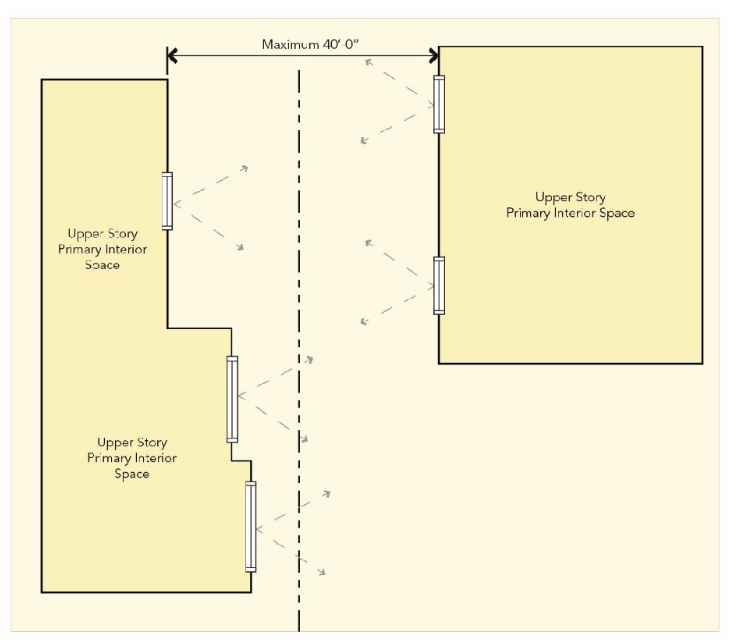
(Ord. No. 23-471, § 3, 7-12-2023)
9293.13. - Exceptions.
All applicable objective standards within this part shall be met unless such objective standard would have the effect of physically precluding the construction of up to two (2) units or would physically preclude either of the two (2) units from being at least eight hundred (800) square feet in floor area.
If the application of an objective standard would have the effect of physically precluding either or both units from being at least eight hundred (800) square feet in floor area, such standard shall be waived or reduced only to the extent necessary to allow construction of the affected unit(s) to a size no greater than eight hundred (800) square feet in floor area.
(Ord. No. 23-471, § 3, 7-12-2023)

