
Agoura Hills City Zoning Code
CHAPTER 6
REGULATORY PROVISIONS
DIVISION 5. - SIGN REGULATIONS[17]
Editor's note— Ord. No. 19-444, § 3, adopted Oct. 23, 2019, amended Div. 5 in its entirety, in effect repealing and reenacting said division to read as set out herein. The former Div. 5, §§ 9655—9655.13, pertained to similar subject matter and derived from Ord. No. 05-330, § 1, adopted May 11, 2005; Ord. No. 06-340, § 1, adopted Dec. 13, 2006; Ord. No. 08-354, § 3, adopted Sept. 10, 2008; and Ord. No. 15-415, § 2, adopted Feb. 25, 2015.
DIVISION 10. - MARIJUANA[18]
Editor's note— Ord. No. 17-429, § 3, adopted August 23, 2017, amended division 10 in its entirety to read as herein set out. Former division 10, § 9660, pertained to medical marijuana dispensaries prohibited, and derived from Ord. of 08-355, § 1, 9-10-2008; Ord. No. 16-423, § 2, 4-27-2016.
DIVISION 12. - MASSAGE ESTABLISHMENTS AND MASSAGE PRACTITIONERS AND THERAPISTS[19]
Editor's note— Ord. No. 16-422, § 4, adopted April 27, 2016, amended Div. 12 in its entirety to read as herein set out. The former Div. 12, §§ 9662—9662.6, pertained to massage establishments and practitioners and derived from Ord. No. 11-392, § 8, adopted Jan. 11, 2012.
DIVISION 3. - UNDERGROUND FACILITIES[16]
Editor's note— Ord. No. 10-380, § 1, adopted Jan. 12, 2011, amended div. 3, §§ 9603—9603.4, in its entirety as set out herein. The former div. 3 pertained to similar subject matter.
9651.- Purpose.
The purpose of the special regulations chapter is to establish the criteria for development within sensitive areas and to provide standard criteria for specialized uses and accessory uses.
9652.- Hillside management and significant ecological areas—Purpose.
Natural hillside terrain dominate the landscape of a major portion of the city. Significant ecological areas (SEA) provide a unique resource. Together they provide an atmosphere and character that residents have expressed a desire to protect. Therefore, special regulations are hereby established that will protect these two (2) resources from incompatible development and preserve the natural terrain, quality environment, and aesthetic character while encouraging creative, innovative and safe residential development.
9652.5. - Policy.
Either a conditional use permit or an architectural review approval shall be obtained before the issuance of any building or grading permit, approval of minor land division or subdivision, importation of fill material for the purpose of altering natural terrain, or commencement of any construction or enlargement of any building or structure on any parcel that is in, or partly in, a hillside area or SEA. In addition to preserving the natural character of the hillsides and valleys within the City of Agoura Hills and ensuring the preservation of the scenic viewshed, hillside development regulations are designed to protect residents from geologic hazards, such as unstable soils and erosion, and the possible loss of life and destruction of property.
The intention and policy of the city is to:
1.
Encourage minimal grading which relates to the natural contours of the land as opposed to padding or stairstep grading;
2.
Require the retention of trees and other vegetation which stabilize hillsides, retain moisture, prevent erosion, and enhance the natural scenic beauty, and, when necessary, require additional landscaping to promote the above;
3.
Require immediate planting whenever appropriate to maintain cut-and-fill slopes;
4.
Encourage a variety of building types and design to reduce grading and disturbance of the natural character of the area; and
5.
Require the retention of natural landmarks and prominent natural features which enhance the character of a specific area.
A.
Permitted uses. Subject to the provisions of site plan review, the following shall be permitted uses in hillside and significant ecological areas:
1.
Accessory buildings and structures less than five hundred (500) square feet in gross floor area related to existing dwellings or commercial development;
2.
Other additions or modifications to existing structures provided said area does not exceed the lesser of seven hundred (700) square feet in gross floor area, or thirty (30) percent of the existing gross floor area and does not increase the number of families that can reside therein.
9652.10. - Same—Additional regulations.
Except as specified in section 9652.5, prior to the issuance of any building or grading permits, approval of a minor land division or subdivision, or the commencement of any construction or enlargement of any building or structure on a lot or parcel of land which is in or partly in an area designated in the general plan and related maps as a significant ecological area or within a hillside area as defined herein, either a conditional use permit or architectural review approval shall be obtained as provided by this section. Development standards, lot size, height and setbacks may be modified by the planning commission in order to achieve the purposes of this chapter.
A.
A conditional use permit shall be required in the following cases:
1.
In hillside areas where the parcel of land contains an area of five (5) acres or greater;
2.
In hillside areas where the parcel of land contains an area of less than five (5) acres whenever the density or open space requirements of this section would prohibit the use of such parcel otherwise permitted by this chapter;
3.
In hillside areas whenever a major slope failure occurs on a developed parcel of land regardless of the size of such parcel; and
4.
In significant ecological areas regardless of the size of the parcel of land.
B.
Architectural review approval pursuant to sections of the Agoura Hills Municipal Code shall be required in hillside areas not subject to the requirement of a conditional use permit pursuant to subsection A, above.
9652.12. - Definition.
The following definitions shall be applicable in hillside and significant ecological areas:
A.
"Concave lot" shall mean a parcel of land with a bowl-shaped depression or formation in which the midpoint elevation of the property is lower than the average elevation of the property lines that are located adjacent to a street.
B.
"Hillside area" shall mean a parcel of land, not subject to recorded development restrictions, having an average slope before grading, of greater than ten (10) percent. The average slope of a parcel of land is the relationship between the change in elevation of the land and the horizontal distance over which that change in elevation occurs and shall be computed by the application of the following formula to a contour map of the natural slope of such land:
S = IL × 100
A
*The area of any existing private or public streets shall be excluded in calculating the net area of the property proposed for development.
In determining the average slope of property, property may be divided into smaller areas based upon percentage of slope and any areas with a percentage of slope greater than thirty-five (35) percent may be excluded before the average slope formula is applied. These excluded areas shall be designated as open space and not considered as a part of the development. If this approach is utilized, the dwelling density table may be applied to each of the designated smaller areas and the sum of the smaller areas shall be the designated density for the total property. A conditional use permit shall be required for this process to allow deletion, when appropriate of slope areas greater than thirty-five (35) percent from the average slope calculation. In reviewing the conditional use permit, the overall size of the property, viability, visual value, aesthetic value, location and any other relevant factors of the proposed open space area in relation to the adjacent open space areas shall be considered.
C.
"Major slope failure" means the movement of an existing slope that results in a hazard to an existing habitable structure as determined by the building official.
D.
"Natural slope" means the natural or existing contours of the land, including the natural or existing vegetation.
E.
"Recorded development restrictions" means a grant by an instrument whereby the owner relinquishes to the public, either in perpetuity or for a term of years, the right to construct improvements upon the land except as may be expressly reserved in the instrument and which contains covenants with the city, running with the land, either in perpetuity or for a term of (1) not to construct or permit the construction of any improvements, except as such right is expressly reserved in the instrument and except for public service facilities installed for the benefit of the land subject to such covenant or public service facilities installed pursuant to an authorization by the city council or the public utilities commission; and (2) against the extraction of natural resources or other activities which may destroy the unique physical and scenic characteristics of the land including but not limited to the cutting of trees and other natural growth, except as may be required for fire prevention, elimination of diseased growth and similar protective measures. Any subsequent reservation shall not permit any action which will materially impair the open space character of the land.
(Ord. No. 189, § 1, 7-17-91; Ord. No. 11-388, § 54, 12-14-2011)
9652.13. - General design and development standards.
Subject to the limitations of the underlying district, as it relates to potential uses and except as modified by the planning commission in a manner consistent with the purposes of this section, any development of a hillside area shall be in conformity with the following design and development standards:
A.
Dwelling density. The maximum number of dwelling units permitted on a parcel of land shall be determined according to the following table:
With respect to parcels of land five (5) acres or larger in size, the dwelling units shall be clustered on the flatter portions of such parcels when appropriate.
In the event that the foregoing density limitations would prohibit the use of a parcel of land otherwise permitted by this chapter, one (1) residential dwelling unit shall be permitted on such parcel provided that:
(a)
Such parcel was lawfully created prior to the adoption of this section; and
(b)
A change in ownership of such parcel occurring after the adoption of this section has not resulted in such parcel no longer being considered part of a larger parcel of land under this chapter; and
(c)
A private septic system will not be installed for any dwelling unit located on a parcel of land consisting of less than one (1) acre in area; and
(d)
A conditional use permit authorizing such dwelling unit is granted in accordance with the requirements of this section.
B.
Development area. For properties zoned residential or open space, a minimum percentage of a parcel of land shall remain in open space. The minimum percentage shall be determined based upon the following table:
In the event that the foregoing open space limitations would prohibit the use of a parcel of land otherwise permitted by this chapter, one (1) residential dwelling unit shall be permitted on such parcel provided that:
(a)
Such parcel was lawfully created prior to the adoption of this section;
(b)
A change in ownership occurring after the adoption of this section has not resulted in such parcel no longer being considered part of a larger parcel of land under this chapter;
(c)
A private septic system will not be installed for any dwelling unit located on a parcel of land consisting of less than one (1) acre in area;
(d)
A conditional use permit authorizing such dwelling unit is granted in accordance with the requirements of this section. The terms of such conditional use permit shall specify the minimum percent of required open space on such parcel of land.
For properties zoned commercial and business park, the maximum allowable floor area ratio (ratio of square footage of building floor to square footage of lot) shall be determined based on the following table:
Pre-graded pads that existed prior to January 1, 1999 shall be exempted from the above maximum allowable floor area ratio limitations. The director of planning and community development has the discretion to exclude concave lots with an average slope greater than ten (10) percent from the above maximum floor area ratio limitations.
C.
Circulation.
1.
Streets within any project proposed in a hillside area shall be designed and constructed to accomplish the following purposes:
(a)
Minimize grading so as to compliment the natural features of the hillsides and reflect a rural rather than an urban character.
(b)
Permit safe and efficient travel for motor vehicles, bicycles and pedestrians, and to provide access for emergency vehicles.
2.
In order to accomplish the purposes of this subsection, all streets in a hillside area development shall be designed, where possible, to:
(a)
Parallel the natural contours and natural grades of the land. Streets running perpendicular to the grade of the slope shall be avoided, when feasible, to reduce grading and aid in drainage. When streets must cut across grade contours, the principle of grading shall be half cut/half fill at locations not visible to a large area. Bridges shall be provided when streets must cross drainage ways and ravines of exceptional environmental setting.
(b)
Use split level streets when access to abutting parcels of land is from other streets to avoid excess cut-and-fill and minimize scarring effects of hillside development.
(c)
Provide a minimum sight distance of one hundred fifty (150) feet for all horizontal and vertical curves. The minimum centerline curve radius on residential streets shall be one hundred (100) feet. Reversed curves shall be connected with tangents as long as practicable. All major streets shall be designed to incorporate curves greater than the minimum to provide for increased traffic flow.
(d)
Have a maximum centerline grade for streets of fifteen (15) percent except at intersections and areas of transition where the gradient shall be zero to two (2) percent. Maximum grade for major streets shall be less than twelve (12) percent. Changes in grade of more than five-tenths of one (1) percent shall be connected by vertical curves conforming to standard sight distances.
(e)
Provide adequate private off-street parking to minimize the need for parking on narrow hillside streets. Parallel parking on the hillside streets may be eliminated in order to reduce road width in critical areas in which even parking spaces shall be provided in off-street bays at more suitable locations.
(f)
Provide sidewalks and walkways in accordance with a pedestrian circulation plan that is not dependent upon and identical to the plan for vehicular circulation.
(g)
Provide bicycle and equestrian trails where appropriate.
(h)
Provide hillside public streets with street lighting designed to lessen the impact on views.
(i)
Discourage the protrusion of streets on ridgelines.
D.
View preservation. View preservation shall take into consideration existing residences, views from scenic roadways, and the freeways. Such provisions as increased setbacks to minimize mass, utilizing natural earth and berms to reduce prominence in viewshed, and the retention of natural land form features shall be used. In addition, viewshed in a hillside area shall be protected by:
1.
Facing dwelling units onto open, green or view areas;
2.
Locating dwelling units in such a manner as to avoid obstructing the view from other dwelling units;
3.
Locating structures with a minimum building setback of thirty (30) feet to the top of the slope, for properties zoned commercial or business park. Pre-graded pads which existed prior to January 1, 1999 shall be exempted from this provision.
E.
Fire protection. The following requirements shall apply in a hillside area:
1.
Clearance of brush or vegetative growth from the vicinity of structures and roadways shall be in accordance with the Fire Code and approved by the city;
2.
Roofs shall be of fire retardant material in accordance with the requirements of the Building Code. Block walls or other fire resistant walls shall be constructed between a dwelling and any adjacent areas of known fire hazard such as open space areas;
3.
All easements for firebreaks shall be dedicated in writing for this purpose and recorded with the Los Angeles County recorder;
4.
Special design restrictions shall apply in brush fire areas where narrow canyons act as chimneys, funneling hot winds up the canyons to the ridge. Stilt and cantilevered structures proposed to be constructed on canyon slopes shall be discouraged. Any single-family residential dwelling built on a ridge at the top of such a canyon shall be set back thirty (30) feet from the slope of the canyon rim.
F.
Erosion control.
1.
All manufactured slopes shall be planted or otherwise protected from the effects of storm runoff and erosion within thirty (30) days after completion of any grading. Such planting shall be designed to blend with the surrounding terrain and the character of development;
2.
The face of cut-and-fill slopes shall be prepared and maintained by the developer so as to control erosion until such time as the parcel of land is occupied. Such control measures may consist of effective planting or soil reinforcement. The protection for the slopes shall be installed as soon as practicable after the completion of any grading but in no event later than thirty (30) days thereafter;
3.
Other erosion devices, when necessary, such as check drains, debris basins, cribbing, or other devices or methods to control erosion and provide safety, shall be installed or implemented at the direction of the building official.
G.
Drainage control.
1.
All drainage and terracing in a hillside area shall meet or exceed the requirements of existing standards and codes;
2.
Drainage devices shall be placed on graded slopes as inconspicuously as possible. In addition:
(a)
Down drains shall be placed in swales;
(b)
Sides of any drain which are visible from a public way shall be concealed as much as possible. Vegetation landscaping also shall be used, when feasible, to conceal drains and terraces;
(c)
Concrete in any drain or terrace shall be tinted to blend with the landscape;
(d)
Drain slope gradients may become steeper as the drain moves down the slope. However, all drain gradients shall be approved by the city;
(e)
All drainage facilities shall be designed to carry water to the nearest practicable drainage way approved by the city;
(f)
Erosion shall be prevented by installation of nonerosive down drains or other drain devices;
(g)
Each building pad shall have a drainage gradient of at least two (2) percent toward the street or toward an approved engineered drainage facility;
(h)
Interceptor drains shall be installed along the top of all cut slopes where the tributary drainage area slopes toward the cut, and has a drainage path greater than forty (40) feet measured horizontally. Interceptor drains shall be paved with a minimum of three (3) inches of reinforced concrete or gunite, be at least one (1) foot in depth and at least thirty (30) inches in width. All slopes of drain terraces and interceptor drains, shall be approved by the building official;
3.
Streets and sidewalk drains shall be designed to contain and control the one-hundred-year frequency storm including debris production in accordance with the Los Angeles County flood control district design manual and to be usable during the maximum design storm. All developed properties shall drain toward the street or a storm drain;
4.
Terracing for cut-and-fill slopes shall be in conformance with the provisions of the city's grading ordinances and the following:
(a)
Terraces at least eight (8) feet wide shall be constructed on all cut-and-fill slopes that are twenty-five (25) feet or less in height, in order to control surface drainage and debris. Where only one (1) terrace is required, however, it shall be at midheight of the slope.
(b)
If higher slopes are ever permitted by whatever method, the following shall be permitted: cut or fill slopes of greater than twenty-five (25) feet and less than one hundred (100) feet in vertical height shall be constructed with a minimum of one (1) terrace of not less than twelve (12) feet in width at midheight of the slope. The spacing and width of terraces on cut or fill slopes greater than one hundred (100) feet in height shall be designed by a civil engineer.
(c)
All swales or ditches located on a terrace shall be a minimum of one (1) foot in depth and a minimum of five (5) feet in width and shall have a gradient of between four (4) percent and twelve (12) percent. Every swale and ditch shall be paved with concrete not less than three (3) inches thick reinforced with six-inch by six-inch, ten-gauge welded wire fabric or equivalent reinforcement.
(d)
A single runoff swale or ditch shall not collect runoff from a contributing area in excess of thirteen thousand five hundred (13,500) square feet without discharge into a structured downdrain system.
(e)
Subsurface drainage of cut-and-fill slopes shall be required if in the opinion of a geologist and/or soil engineer such drainage is necessary.
(f)
Subdrains shall be designed and constructed when fill is to be placed in natural drainage courses or in other areas where seepage is evident.
H.
Ridgelines. The development of primary and secondary ridgelines as specified in the city's general plan shall be discouraged. This prohibition shall include, all buildings, solid fencing or walls, paved roads, exotic landscaping, water tanks, and the like which would noticeably detract from the natural skyline.
I.
Building Design.
1.
Architectural enrichments and variations in roof massing are encouraged. Roofs shall minimize their visual impact by keeping a low profile and the roof pitch shall follow the slope of the hillside instead of being perpendicular to the hillside or opposing the hillside slope. Upper stories should not be cantilevered out in the opposite direction of the hillside slope.
2.
Avoid large expanses of a single material on walls, roofs, or paving areas. Create interesting, small scale patterns by breaking up building mass, varying building materials, and through design and placement of windows and doors.
3.
Provide architectural treatment to all sides of a structure. Elements of architectural treatment used on the front facade shall be repeated on all sides of a structure with additional emphasis on those elevations visible from adjacent properties or public rights-of-way.
4.
Building materials and color schemes shall blend with the natural landscape. Colors shall be earth tones and the specific hues shall be compatible with the surrounding natural environment.
J.
Landscaping.
1.
Native or naturalized plants, or other plant species that blend naturally with the landscape shall be used.
2.
Natural landform planting shall be used to soften the impact of development and provide erosion control. These landscape techniques shall serve to reintroduce landscape patterns that occur in nature including concentrating trees and shrubs in concave areas while convex portions are planted mainly with ground cover.
3.
Trees and shrubs are to be arranged in informal masses and shall be placed selectively to reduce the scale of long, steep slopes.
4.
Berming shall be incorporated into the grading plans to help soften the appearance of buildings from public view.
(Ord. No. 99-293, § 2, 2-10-99; Ord. No. 11-388, § 55, 12-14-2011)
9652.14. - Contents of applications.
In addition to the normal application for a conditional use permit or architectural review, the following additional information shall be provided for such applications in hillside or SEA areas:
A.
Accurate topographic maps indicating the following:
1.
Natural topographic features with an overlay of the proposed contours of the land after completion of the proposed grading;
2.
Existing land contours with a maximum five-foot contour interval and a slope analysis showing the following slope categories:
10%—15%
16%—20%
21%—25%
26%—30%
31%—35%
36% and over;
3.
Elevations of existing topographic features and the elevations of any proposed building pads, street centerlines and property corners;
4.
Locations and dimensions of all proposed cut-and-fill operations;
5.
Locations and details of existing and proposed drainage patterns, structures and retaining walls;
6.
Locations of disposal sites for excess or excavated material;
7.
Locations of existing trees, other significant vegetation and biological features;
8.
Locations of all significant geological features, including bluffs, ridgelines, cliffs, canyons, rock outcroppings, fault lines and waterfalls;
9.
Locations and sizes of proposed building areas and lot patterns;
10.
Any other information required by the director of community development.
B.
Site plans, architectural drawings, and colored renderings illustrating the following:
1.
Architectural characteristics of proposed buildings;
2.
Vehicular and pedestrian circulation patterns, including street widths and grades and other easements of public rights-of-way;
3.
Utility lines and other service facilities, including water, gas, electricity and sewage lines;
4.
Landscaping, irrigation and exterior lighting plans;
5.
Locations and design of proposed fences, screens, enclosures and structures, including drainage facilities;
6.
Any other information required by the director of community development.
C.
Reports and surveys with recommendations from soil engineers and engineering geologists based upon surface and subsurface exploration stating land capabilities; including soil types, soil openings, hydrologic groups, slopes, runoff potential, percolation data, soil depth, erosion potential and natural drainage patterns.
D.
Archaeological studies in areas where existing evidence indicates that significant artifacts or historic sites are likely to be encountered in order to ensure that these artifacts and/or sites are not inadvertently destroyed.
E.
Additional information to include:
1.
Average natural slope of the land;
2.
Acreage and square footage calculations;
3.
Ratio of structures to total land area;
4.
Ratio of parking spaces to building square footage;
5.
Ratio of parking area to total land area;
6.
Ratio of open space to total land area;
7.
Description of maintenance program for proposed developments involving joint or common ownership;
8.
Any other specific information determined by the director of community development to be relevant to the applicant's proposal.
F.
In significant ecological areas, the following additional information:
1.
Identification and location of the resources constituting the basis for classification of such area as a significant ecological area where not provided by the environmental assessment or the initial study for an environmental document;
2.
Proposed natural open areas, buffer areas, or other methods to be used to protect resource areas from the proposed use;
3.
Such other information as the director of community development determines to be necessary for adequate evaluation.
9652.15. - Required burden of proof.
The applicant for a conditional use permit required by this section shall have the burden of proving the following facts:
A.
Hillside areas:
1.
That the proposed project is located and designed so as to protect the safety of current and future community residents, and will not create significant threats to life and/or property due to the presence of geologic, seismic, slope instability, fire, flood, mud flow, erosion hazards, or other hazards;
2.
That the proposed project is compatible with the natural, biotic, cultural, scenic and open space resources of the area;
3.
That the proposed project can be provided with essential public services and is consistent with the objectives and policies of the general plan; and
4.
That the proposed development will complement the community character and benefit current and future community residents.
B.
Significant ecological areas:
1.
That the proposed project is designed to be highly compatible with the biotic resources present, including the setting aside of appropriate and sufficient undisturbed areas;
2.
That the proposed project is designed to maintain water bodies, watercourses, and their tributaries in a natural state;
3.
That the proposed project is designed so that wildlife movement corridors (migratory paths) are left in an undisturbed and natural state;
4.
That the proposed project retains sufficient natural vegetation cover and/or open spaces to buffer critical resource areas from such project;
5.
That where necessary, fences or walls are provided to buffer important habitat areas from development; and
6.
That roads and utilities serving the proposed project are located and designed so as not to conflict with critical resources, habitat areas or migratory paths.
9652.16. - Hearings.
A public hearing shall be held on all applications for a conditional use permit required by this section in accordance with the provisions of section 9804 et seq. Where a conditional use permit is filed and processed as a single application with a land division case, the public hearings on each matter shall be held concurrently.
9652.17. - Director's report.
In all cases where a public hearing is required, the director of community development shall prepare a report to the planning commission containing, but not limited to, the following:
A.
Review of the applicant's development proposal, including:
1.
Appraisal of measures proposed to avoid or mitigate identified natural hazards;
2.
Appraisal of measures taken to protect scenic, biotic and other resources;
3.
Recommended changes in the proposed development necessary or desirable to achieve compliance with the findings required by section 9652.15 A and B and the provisions of the general plan; and
4.
Recommended conditions to be imposed to ensure that the proposed development will be in accord with the findings required by section 9652.18 and the provisions of the general plan.
B.
In cases where the proposed development would impact significant ecological areas and where such information is not included in the environmental document, identification and location of the resources constituting the basis or classification of such area as a significant ecological area.
1.
The director, in developing such a report and recommendation, shall consult with appropriate agencies and shall compile the recommendations and comments of such agencies, including any recommendation of SEATAC.
9652.18. - Findings and decision.
The planning commission shall not approve an application for a conditional use permit required by this section unless it finds that the proposal is consistent with the general plan and further finds:
A.
In hillside areas:
1.
That the burden of proof set forth in section 9652.15.A has been met by the applicant, and
2.
That the proposed development is consistent with the general design and construction standards provided in this section;
B.
In significant ecological areas, that the burden of proof set forth in section 9652.15.B, has been met by the applicant.
9652.19. - Conditions.
Every conditional use permit required by this section shall be subject to the following conditions. All of the following conditions shall be deemed to be conditions of every such conditional use permit regardless of whether such conditions are set forth expressly in the permit. The planning commission, in granting a conditional use permit under this section, may impose additional conditions, but may not change or modify any of the following conditions except as otherwise provided herein;
A.
Hillside areas.
1.
Open space. Open space shall comprise not less than the area determined by application of the table in subsection 9652.13.B. Subject to the approval of the commission, such open space may include one (1) or more of the following:
a.
Undisturbed natural areas;
b.
Open space for passive recreation;
c.
Private yards, provided that all construction rights will be dedicated;
d.
Parks and open recreational areas;
e.
Riding, hiking and bicycle trails;
f.
Landscaped areas adjacent to streets and highways;
g.
Greenbelts;
h.
Areas graded for rounding of slopes to contour appearance; and
i.
Such other areas as the commission deems appropriate.
2.
Landscaping. A plan for landscaping common or open space areas not to be left in a natural state shall be submitted to and approved by the commission.
3.
Utilities. Satisfactory evidence shall be produced that the applicant has made arrangements with the serving utilities to install underground all new facilities necessary to furnish service in the development, including any necessary agreements to join any proposed assessment districts.
4.
Residential density. The commission shall designate the maximum number of dwelling units permitted in a residential development consistent with subsection 9652.13.A.
5.
Architectural features. Where not submitted to the commission as part of an application under this section, exterior elevation drawings indicating building heights and major architectural features shall be submitted to and approved by the planning commission prior to the issuance of any building permit.
B.
Significant ecological areas.
1.
Any necessary conditions to guarantee that the proposed project is highly compatible with the biotic resources present;
2.
The preservation in a natural state of any designated watercourse;
3.
The provisions of all necessary measures to preserve in a natural state any designated wildlife movement corridors;
4.
Adequate provisions to buffer any development from any designated unique resource and/or habitat area; and
5.
Adequate requirements to prevent conflicts between any proposed roads or utilities and unique resources, habitat areas, or migratory paths.
(Ord. No. 11-388, § 56, 12-14-2011)
9653 - Transfer of development regulations; purpose.
To provide a procedure whereby development credits may be transferred from open space parcels which, because of visibility, access, geology, slope or other factors, are desirable to retain as open space, to other parcels not located in a hillside area or SEA and, furthermore, to provide conditions for ownership and use of open space.
9653.1. - Definitions.
A.
Donor parcel. Parcel from which development credits are transferred.
B.
Receiver parcel. Parcel to which development credits are transferred.
C.
Development credit. A development credit is a potential entitlement to construct one (1) dwelling unit on property in the OS district, which can only be exercised when the development credit has been transferred pursuant to the provisions of this section from a donor to a receiver parcel and all other requirements of law are fulfilled.
9653.2. - Applicability.
The transfer of development credits may be authorized when the following conditions are met:
A.
Donor parcels are within the OS district;
B.
Receiver parcels are in the RS, RM, RMH or RH districts;
C.
The city council, after recommendation by the planning commission, finds the receiver parcel has sufficient area designated in the general plan to accommodate development otherwise permitted under city regulations plus the development credits to be transferred, and that such total development meets all of the applicable requirements of the city's general plan and regulations.
9653.3. - Procedure.
The transfer of development credits shall be authorized as part of a development agreement. A development agreement application shall include both the donor and receiver parcels.
9653.4. - Provisions governing donor parcel.
A.
When development credits are transferred, all such credits for a parcel shall be transferred and they are thereafter extinguished with regard to the donor parcel.
B.
The number of development credits which may be transferred shall not exceed the number of dwelling units provided for in section 9652.13.
C.
The fee title to the donor parcel may, upon approval of the city, be retained by the owner of the donor parcel, be transferred to the receiver parcel, be transferred to a quasi-public agency or private institution or body, or be transferred to a public body. Approval by the city must be based on findings that the option is consistent with the general plan and provides for the longterm maintenance of the property as open space.
D.
The donor parcel, after development credits have been extinguished, shall be kept in a natural condition. However, the city may, pursuant to a conditional use permit, authorize the following uses if it deems they are compatible with maintaining the natural condition of the property and are consistent with the general plan:
1.
Watershed
2.
Pasture
3.
Trails
4.
Other uses of a similar nature
5.
Such accessory uses as are necessary to support those uses specified in the above subparagraphs.
E.
Parcels 1 and 4 above, from which development credits have been transferred shall be made subject to open space easements dedicated to the city or other agreements with the city, which ensure that such parcels remain as open space in perpetuity.
9653.5. - Provisions governing receiver parcel.
A.
The maximum number of allowable dwelling units that may be transferred to a receiver parcel shall not be in excess of twenty (20) percent of the density otherwise prescribed for that parcel.
B.
These provisions shall not affect the receiver parcel and shall comply with all low-moderate income housing requirements of this article.
C.
The transfer shall not unduly increase the mass, population density or intensity of use on the receiver parcel to the detriment of neighboring properties.
9653.6. - Findings.
Before approving the transfer of development rights, the city must find that:
A.
The transfer will result in the dedication, protection, and preservation of open space;
B.
Appropriate guarantees exist and will be provided to ensure that the transfer conforms to the intent and purposes of the general plan;
C.
The transfer will not result in a detrimental effect on the area surrounding the receiver parcel.
9653.7. - Example of transfer of development rights from donor parcel to receiver parcel.
Donor parcel, located within the OS district, is entitled "X" number of dwelling units. Receiver parcel, located within either the RS, RM, RMH or RH districts is entitled "Y" number of units. Subject to prior city approval the donor parcel can transfer its "X" number of units to the receiver parcel. Receiver parcel may be approved for its "Y" number of units, plus the "X" number of units not to exceed twenty (20) percent more than the density otherwise prescribed for the receiver.
9653.8. - Rules and procedures.
The council may adopt those rules and procedures it considers necessary to implement these provisions to facilitate the transfer of allowable development. Such rules and procedures shall be adopted by resolution.
9654.- Parking standards; purpose.
The intent and purpose of this section is to provide adequate and properly designed parking areas. The parking standards imposed hereunder are intended to promote vehicular and pedestrian safety; compatibility between parking areas and surrounding neighborhoods, protect property values by providing such amenities as landscaping, walls, and setbacks, and improve the appearance of the city.
9654.1. - Definitions.
Notwithstanding the provisions of section 9120 et seq. of this article, for the purposes of this division, the following words and phrases are defined as follows:
A.
Alternative transportation means the use of modes of transportation other than the single passenger motor vehicle, but not limited to carpools, vanpools, buspools, public transit, walking and bicycling, motorcycles, mopeds, and electric powered vehicles are excluded from this definition.
B.
Applicable development means any development project that is determined to meet or exceed the project size threshold criteria contained in section 9654.4 (Transportation demand management).
C.
Buspool means a vehicle carrying sixteen (16) or more passengers commuting on a regular basis to and from work with a fixed route, according to a fixed schedule.
D.
Carpool means a vehicle carrying two (2) to six (6) persons commuting together to and from work on a regular basis.
E.
Developer means the builder who is responsible for the planning, design and construction of an applicable development project. A developer may be responsible for implementing the provisions of this section as determined by the property owner.
F.
Development means the construction or cumulative additions of new building square footage. Existing square footages shall be exempt from these requirements. All calculations shall be based on gross square footage.
G.
Employee parking area means the portion of total required parking at a development used by on-site employees. Unless specified in this article, employee parking shall be calculated as follows:
H.
Preferential parking means parking spaces designated or assigned, through use of a sign or painted space markings for carpool and vanpool vehicles carrying commute passengers on a regular basis that are provided in a location more convenient to a place of employment than parking spaces provided for single occupant vehicles.
I.
Property owner means the legal owner of a development who serves as the lessor to a tenant. The property owner shall be responsible for complying with the provisions of this section either directly or indirectly or by delegating such responsibility as appropriate to a tenant and/or his (her) agent.
J.
Tenant means the lease of facility space at an applicable development project.
K.
Total area means the area of all floors or levels included within exterior walls of a building or structure. If a building or structure does not have exterior walls, the "total area" of the building or structure shall be the useable floor area of the building or structure, or the usable area under the horizontal projection of the roof.
L.
Transportation demand management (TDM) means the alteration of travel behavior, usually on the part of the commuters, through programs of incentives, services, and policies. TDM addresses alternatives to single occupant vehicles such as carpooling and vanpooling, and changes in work schedules that move trips out of the peak period or eliminate them altogether (as is the case in telecommuting or compressed workweeks).
M.
Trip reduction means reduction in the number of work-related trips made by single occupant vehicles.
N.
Vanpool means a vehicle carrying seven (7) or more persons commuting together to and from work on a regular basis, usually in a vehicle with a seating arrangement designed to carry seven (7) to fifteen (15) adult passengers, and on a prepaid subscription basis.
O.
Vehicle means any motorized form of transportation, including but not limited to automobiles, vans, buses and motorcycles.
(Ord. No. 93-226U, § 3, 3-10-93)
9654.2. - General standards.
Accessible off-street parking areas shall be provided and maintained as set forth in this section. Parking access areas shall provide parking and maneuvering room for motor vehicles and for pedestrian safety based on the anticipated occupancy of the related building, structure or area of land or water. Where there is a combination of principal uses in any one (1) facility, the sum of the parking requirements of these uses shall be provided unless otherwise provided. If the calculation of parking requirements results in the requirement for a fraction of a parking space, such parking space need not be provided unless the fraction exceeds fifty (50) percent. This section shall not be construed to prohibit the installation and maintenance of more parking spaces than the minimum required.
A.
Seats or seating capacity. Where the standards for parking set forth in this section are based upon seating capacity, the capacity shall be determined by reference to the actual seating capacity of the subject area based upon the number of seats or one (1) seat per eighteen (18) inches of bench or pew length and one (1) seat per twenty-four (24) inches of booth length for dining, but in no case shall seating be less than as required by the Uniform Building Code. For other areas where seats are not fixed, the seating capacity shall be determined in accordance with the Uniform Building Code.
B.
Planter or landscaped areas. Where the standards set forth in this section or elsewhere in this Code require the installation of planters or landscaped areas within or adjacent to parking areas, such planters or landscaped areas shall be planted, irrigated and maintained with live landscaping such as lawn, ground cover, trees or shrubs, and surrounded by a six-inch-high curb. The landscaped areas shall not be less than the width specified excluding any perimeter curbing. Parking in the oak tree drip lines shall be discouraged and regulated by the provisions of section 9657 et seq.
C.
Building permit. Plans submitted for a building permit to construct a building which has public parking areas shall include the design of the required parking area drawn to scale. Such plans shall include all parking spaces and maneuvering areas, curb cuts, landscaping and other improvements. The building permit shall not be issued until such parking plans have been approved by the director of planning and community development or his or her designee and no final completion inspection shall be approved until the parking spaces and required landscaping are installed.
D.
Change of occupancy. Whenever the parking demand is increased due to a change of occupancy which does not involve any new construction requiring a building permit, the director of planning and community development or his or her designee shall review the parking requirements of the proposed use if new business license is required for the change of use. In such case no new business license shall be issued until the department of planning and community development has approved the parking plan. Two (2) copies of such plan drawn to scale shall be submitted to the director of planning and community development or his or her designee for approval. The plan shall show the entire subject property and shall show the means of ingress and egress, location of the building, parking spaces, landscaping, barrier curbs, irrigation system, lights and any other proposed facilities. The plan shall be approved if it conforms to the intent and provisions of this part.
E.
Parking reductions. A proponent of a business or industrial project may provide alternative facilities or programs which serve to reduce parking demand or return for a reduction in vehicle parking requirements, subject to the provisions below. Vehicle parking requirements shall be reduced in accordance with the following provisions:
1.
Preferred carpool/vanpool parking spaces. The parking requirements for developments which guarantee preferred parking spaces (e.g., covered, shaded, or near building entrance) to employees who participate regularly in a carpool or vanpool shall be reduced by one (1) vehicle space for every one (1) space which is marked and reserved for carpools/vanpools at a preferred location provided that the maximum reduction shall not exceed two (2) percent of the required parking.
2.
Request for special review of parking. Parking reductions exceeding the maximums specified in subparagraph (1) above, or modifications of parking improvement requirements, may be granted by the planning commission, whenever such reduction or modification is considered in connection with a review of site plans by the commission, or is heard in connection with a rezoning, use permit, or variance. Such reduction or modifications shall only be permitted in unusual circumstances. The project proponent shall submit with the request whatever evidence and documentation is necessary to demonstrate that unusual conditions warrant a parking reduction, such as the multiple use of a parking area by uses having peak parking demands which occur at different times; floor plans which indicate that the floor area devoted to customer or employee use is less typical for the building proposed; or that other programs will be implemented by the developer or tenant(s) which will result in a demand for parking at the site which is less than would otherwise occur, such as the provision of monetary incentives to employees who regularly utilize public transit or participate in a carpool or vanpool.
The recordation of agreements or covenants, prior to issuance of a building permit, which ensures that appropriate programs are implemented for the life of the use shall be required as a condition of approval of the parking reduction.
F.
Existing facilities. Any building or use for which parking facilities become substandard by the adoption of this part shall be considered a nonconforming use. Such nonconforming use may continue, but no enlargement or expansion shall be made in such use or building, unless the required number of parking spaces or parking areas imposed by this part are provided. Any change of occupancy or use in an existing building or lot which requires more parking space shall provide the additional parking areas required by this section.
G.
Parking of nonregistered vehicles. Automotive vehicles or trailers of any kind or type without current registration shall not be parked or stored in the front yard or side street yard of any lot.
H.
Change of parking requirements. The amendment of the parking requirements set forth in this section shall not render a use previously approved in accordance with the provisions of this section nonconforming.
I.
Tandem parking. Except where specifically permitted by this section, parking spaces shall not be in tandem. All parking spaces shall be free of obstructions, and parking shall be accomplished in a continuous forward movement. Tandem parking shall mean one (1) parking space located behind another parking space which has no direct access to the driveway or street.
J.
Provisions for residential uses.
1.
Parking locations. Off-street parking spaces for single-family detached dwellings shall be located on the same lot or parcel on which the dwelling is located. Off-street parking spaces for all other dwellings shall be located on the same development site and on the same lot or parcel or not more than two hundred (200) feet from the lot or parcel on which the dwelling is located.
2.
Senior citizen parking. The planning commission may reduce the total number of parking spaces required for senior citizen housing by up to twenty-five (25) percent, based upon a finding that the proposed development is located within five hundred (500) feet of a shopping center or is served adequately by a transportation system. The number of spaces which are required to be covered may be reduced by up to fifty (50) percent, based upon evidence submitted by the developer that the reduction is directly related toward providing dwelling units to meet the needs of low and moderate income senior citizen households as defined and provided for in the housing element of the General Plan. In no instance shall the number of covered parking spaces be fewer than one (1) per four (4) dwelling units.
3.
Commercial vehicles in residential zones. No vehicle which is registered for commercial purposes pursuant to applicable provisions of the Vehicle Code, which exceeds five thousand five hundred (5,500) pounds in unladen gross weight, shall be parked or such vehicles left standing on any residentially zoned property in excess of thirty (30) consecutive minutes, unless the actual loading or unloading of such vehicle is in progress on such property, or is fully screened from view from any public street. Violation of this section is an infraction and shall be punishable as provided in section 1200(b) of the Agoura Hills Municipal Code.
4.
Assigned spaces. One (1) of the required parking spaces for each multifamily dwelling unit shall be an assigned parking space, not more than two hundred (200) feet away from the unit to be served.
K.
Provisions for commercial uses.
1.
Parking locations. In commercial zones off-street parking shall be located on the same lot as, or on a lot contiguous to, the building, structure, or use to be served.
2.
Spaces not for repair, servicing or storage. Required parking spaces shall not be used, or be permitted to be used, for the repair, servicing, or storage of vehicles or for the storage of materials.
3.
Racks not counted as parking spaces. For auto repair shops or other similar uses, the racks and pump blocks shall not be considered in calculating the required parking spaces.
4.
Uses not specified. Commercial parking requirements for uses not specified in this part shall be based upon a standard of one (1) space per two hundred fifty (250) square feet of gross floor area, unless the director of planning and community development or planning commission approve a different parking requirement, based on the most comparable uses specified in this part.
5.
Shared parking. For the purposes of this section, "shopping center" shall mean a group of architecturally unified commercial and retail establishments built on a site which is planned, developed, and managed as an operating unit.
For shopping centers containing at least 25,000 and up to 50,000 square feet of total building area, where office spaces exceed ten (10) percent of the total gross floor area, that portion in excess of ten (10) percent of the gross floor area shall be calculated at one (1) parking space per three hundred (300) square feet.
Where cinema spaces exceed ten (10) percent of the total gross floor area, that portion in excess of ten (10) percent of the gross floor area shall be calculated at one (1) parking space per one hundred (100) square feet.
Where restaurant, café, or other food and beverage service uses exceed ten (10) percent of the total gross floor area, that portion in excess of ten (10) percent of the total gross floor area shall be calculated at one (1) parking space per one hundred (100) square feet.
For shopping centers containing 50,000 square feet or more of total building area, a shared parking reduction shall be allowed for the shopping centers based on the following:
TABLE I: SHARED PARKING
L.
Provisions for industrial uses.
1.
Parking locations. For industrial uses, all parking shall be on the same site. Off-site parking may be permitted by a conditional use permit if the applicant can demonstrate the need therefor and a covenant running with the off-site parking lot is executed and recorded to ensure that the required parking will be provided for the life of the use. The off-site parking may be located up to five hundred (500) feet from the lot to be served, but no more than fifty (50) percent of the required off-street parking spaces may be located off the site.
2.
Spaces not for repair, servicing or storage. Required parking spaces shall not be used or be permitted to be used for the repair, servicing, or storage of vehicles or for the storage of materials.
3.
Racks not counted as parking spaces. For auto repair shops or other similar uses, the racks and pump blocks shall not be considered in calculating the required parking spaces.
(Ord. No. 142, § 2, 12-9-87; Ord. No. 226U, § 2, 3-10-93; Ord. No. 12-395, § B.3, 3-14-2012)
9654.3. - Design standards.
A.
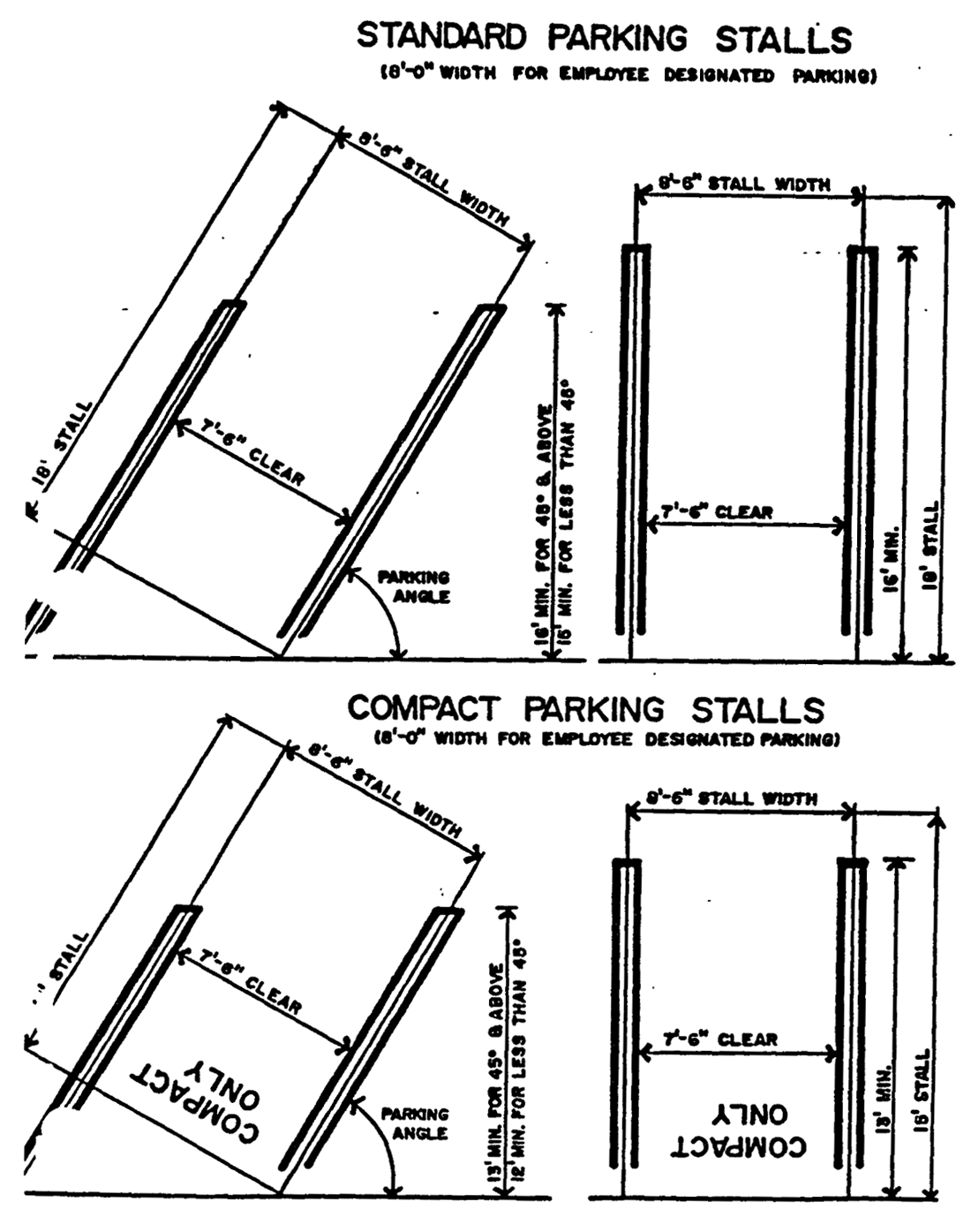
Parking stall sizes. Each standard off-street parking space shall be at least the following minimum sizes:
Unless approved by the planning commission, compact off-street parking spaces are not permitted. The planning commission may allow no more than thirty (30) percent of the required number of parking spaces to be sized for compact vehicles in instances where on-site design constraints, such as irregular topography, lot configurations, or parcel size necessitate the use [of] compact parking spaces. The planning commission may also allow no more than thirty (30) percent of the required number of parking spaces to be sized for compact vehicles in instances where additional on-site landscaping is provided beyond the requirement for the zoning district and the provisions of section 9654.5 et seq. The additional landscaping shall be equal in size to at least fifty (50) percent of the parking area saved by installing compact parking spaces in lieu of standard parking spaces. For purposes of this section, additional landscaping located in required yard areas shall not apply.
All compact off-street parking spaces approved by the planning commission shall be at least the following minimum sizes:
All compact off-street parking spaces approved by the planning commission shall be clearly marked "Compact Cars Only." Compact spaces shall not be permitted for automotive repair facilities.
All standard and compact parking stalls shall be clearly pinstriped.
B.
Handicapped requirements. Off-street parking spaces shall be provided for handicapped persons. The number of parking spaces to be provided therefor shall be as follows:
All parking spaces for the physically handicapped shall be located in proximity to curb ramps or other pedestrian walks providing the most direct access to the primary entrance(s) of the building(s) served by the parking lot.
Each handicapped off-street parking space shall be at least fourteen (14) feet wide and striped to provide a nine-foot parking area and a five-foot loading and unloading area. When more than one (1) space is provided, in lieu of providing a fourteen-foot space for each parking space, two (2) spaces can be provided within a twenty-three-foot wide area striped to provide a nine-foot-wide parking area on each side of a five-foot loading and unloading area in the center. The minimum length of each stall shall be eighteen (18) feet.
Each handicapped parking space shall be clearly marked with the international symbol of accessibility in white paint, at least three (3) feet in size.
C.
Covered parking spaces. Covered off-street parking spaces provided for commercial and industrial uses shall follow the minimum size standards as outlined in subsection A. Covered off-street parking spaces provided for residential uses shall be at least ten (10) feet by twenty (20) feet inside clear space.
D.
Access and circulation. Each entrance and exit to a parking area shall be constructed and maintained so that any vehicle entering or leaving the parking area shall be clearly visible at a distance of not less than ten (10) feet to a person approaching such entrance or exit on any pedestrian walk or footpath shall be visible to each other. Speed bumps shall be considered for parking areas over one hundred (100) parking spaces.
All exits from parking lots shall be clearly posted with stop signs, and stop bars, and appropriate directional signs shall be maintained when necessary and as required by the director of planning and community development.
1.
Residential access. Driveway access to parking spaces for a single-family dwelling unit shall not be less than fifteen (15) feet in width. Driveway access used to serve more than two (2) dwelling units shall not be less than twenty (20) feet in width. Driveway access to all uses other than residential shall have a width of not less than fourteen (14) feet if one-way, or not less than twenty-six (26) feet for a two-way, combined entrance and exit, access.
2.
Commercial access. Additional limited time parking shall be provided in conjunction with the placement of automatic tellers and similar structures or facilities.
E.
Paving. All areas used for parking and accesses to such parking areas shall be completely paved with asphalt or concrete surfacing, or such other alternative materials as approved by the city engineer. Further, all parking areas and accesses shall be provided with adequate drainage as approved by the city engineer. Any portion of the parking area not paved shall be landscaped.
F.
Aisle width. Minimum aisle widths shall be as follows:
Where two-way traffic is permitted, the minimum aisle width shall be twenty-six (26) feet.
G.
Wall. A parking area which abuts a residentially zoned parcel or lot shall be separated therefrom by a six-foot-high solid masonry wall. Such wall shall be reduced to three (3) feet in height within the front yard area of an abutting residential zone. Along the freeway a combination of a mounded, enlarged landscaped area and a three and one-half (3½) foot wall shall be provided.
A parking area which is separated by a street from a parcel or lot in a residential zone or a freeway shall have a solid masonry wall or mounded landscaping averaging three and one-half (3½) feet in height along such street.
H.
Parking structure standards. Parking structures, underground parking, subterranean parking, and similar parking facilities shall be permitted only upon planning commission approval. Underground and subterranean parking is encouraged to increase landscaping and minimize hillside grading.
All parking spaces within such facilities shall be restricted for the exclusive use of property owners, tenants, employees, and other users of the building which such facilities serve. Such restrictions shall be implemented through the installation of appropriate signing and circulation and controlled access devices.
Appropriate security measures shall be incorporated into the design of such facilities including but not limited to security gates, fencing, and lighting.
I.
Parking lot illumination. Parking lot illumination shall be directed away from residential areas and public streets so as not to produce a glare as seen from such areas in order to ensure the general safety of other vehicular traffic and the privacy and well being of the residential areas.
All light poles, standards, and fixtures shall be a maximum of sixteen (16) feet in height.
J.
Parking lot slope. Parking lots shall not have a slope exceeding four and one-half (4.5) percent, except for access ramps or driveways which shall not exceed a slope of ten (10) percent.
K.
Wheel stop standards. Wheel stops shall be installed two (2) feet from the edges of the required sidewalks, planters, and landscaped areas for all parking spaces in order to protect the required sidewalks, planters and landscaped areas from vehicular overhang and to protect any structure from vehicular damage. The regular planter curb may function as the wheel stop but the planter shall be a minimum of six (6) feet in width. All wheel stops shall be maintained in good condition.
L.
Bicycle parking standard. A stationary bicycle rack or facility designed to secure the frame and both wheels of the bicycle, where the bicyclist supplies only a locking device, shall be provided at the ratio of one (1) bicycle space for every twenty-five (25) parking spaces. A fully enclosed bicycle space or locker which is accessible only to the owner or operator of the bicycle and protects the bicycle from inclement weather may be provided, but not in-lieu of the required bicycle rack(s). Specific facilities and location (i.e. provision of racks, lockers, or locked room) shall subject to approval by the City."
M.
Off-street loading and unloading spaces. General office uses shall have the following off-street loading and unloading spaces:
Retail/commercial and industrial/manufacturing uses shall have the following off-street loading and unloading spaces:
Each loading space for general office uses and for retail/commercial uses less than thirty thousand (30,000) square feet shall be located off the street and shall be twelve (12) feet in width by twenty-five (25) feet in width by twenty-five (25) feet in depth by fourteen (14) feet in vertical clearance. All other loading spaces, regardless of use, shall be twelve (12) feet in width by fifty (50) feet in depth by fourteen (14) feet in height.
(Ord. No. 223, § 2, 1-27-93; Ord. No. 226U, §§ 2, 5, 3-10-93; Ord. No. 96-265, § 1, 1-15-97)
9654.4. - Transportation demand management.
A.
Transportation demand and trip reduction measures.
1.
Applicability of requirements. Prior to approval of any development project, the applicant shall make provision for, as a minimum, all of the following applicable transportation demand management and trip reduction measures. All facilities and improvements constructed or otherwise required shall be maintained in a state of good repair.
2.
Development standards.
a.
Nonresidential development of twenty-five thousand (25,000) square feet or more shall provide, to the satisfaction of the city, a bulletin board, display case, or kiosk displaying transportation information located where the greatest number of employees are likely to see it. Information in the area shall include, but is not limited to, the following:
1.
Current maps, routes and schedules for public transit serving the site;
2.
Telephone numbers for referrals on transportation information including numbers for the regional ridesharing agency and local transit operators;
3.
Ridesharing promotional material supplied by commuter-oriented organizations;
4.
Bicycle route and facility information, including regional/local bicycle maps and bicycle safety information;
5.
A listing of facilities available for carpoolers, vanpoolers, bicyclists, transit riders and pedestrians at the site.
b.
Nonresidential development of fifty thousand (50,000) square feet or more shall comply with section 9654.3.A.2.a. above and shall provide all of the following measures to the satisfaction of the city:
1.
Not less than fifteen (15) percent of employee parking area, shall be located as close as is practical to the employee entrance(s), and shall be reserved for use by potential carpool/vanpool vehicles, without displacing handicapped and customer parking needs. This preferential carpool/vanpool parking area shall be identified on the site plan upon application for a building permit, to the satisfaction of the city. A statement that preferential carpool/vanpool spaces for employees are available and a description of the method for obtaining such spaces must be included on the required transportation information board. Spaces will be signed/marked as demand warrants.
2.
Preferential parking spaces reserved for vanpools must be accessible to vanpool vehicles. When located within a parking structure, a minimum vertical interior clearance of seven (7) feet, two (2) inches shall be provided for those spaces and accessways to be used by such vehicles. Adequate turning radii and parking space dimensions shall also be included in vanpool parking areas.
c.
Nonresidential development of one hundred thousand (100,000) square feet or more shall comply with sections 9654.3.A.2.a. and 9654.3.A.2.b. above, and shall provide all of the following measures to the satisfaction of the city:
1.
A safe and convenient zone in which vanpool and carpool vehicles may deliver or board their passengers.
2.
Sidewalk or other designated pathways following direct and safe routes from the external pedestrian circulation system to each building in development.
3.
If determined necessary by the city to mitigate the project impact, bus stop improvements must be provided. The city will consult with any public agency which provides or is authorized by law to provide transit services to the general public in the project area for the purpose of determining whether or not such plans or permits shall include provisions for transit waiting shelter(s). The building inspector shall not issue any building permits or approve any improvement plans for any applicable project unless (s)he has received one of the following from the transit agency;
(a)
Written certification that adequate provisions have been made for the construction and/or placement of a transit waiting shelter at the public right-of-way adjacent to the project, including the granting of any easement necessary to accommodate the shelter, or
(b)
Written notification that no transit waiting shelter is needed adjacent to the project.
This section shall not be interpreted to require the construction or placement of transit waiting shelters at a distance of more than one hundred (100) feet from the perimeter of the project site. When locating bus stops and/or planning building entrances, entrances must be designed to provide safe and efficient access to nearby transit stations/stops.
4.
Safe and convenient access from the external circulation system to bicycle parking facilities onsite.
B.
Monitoring. All facilities and improvements required to be constructed pursuant to Ordinance No. 226U shall be shown on building plans for the development. The building owner shall submit annual reports to the director of planning and community development which indicate the participation rate of the tenant(s) and the implementation procedures used in the transportation demand management program. The first report shall be submitted one (1) year after a certificate of occupancy has been issued by the department of building and safety, and annually thereafter.
C.
Enforcement. A violation of the provisions of this chapter shall be punishable as provided in chapter 2, article I of this Code, and/or any other remedy provided by the law.
(Ord. No. 226U, § 4, 3-10-93)
9654.5. - Parking lot landscaping.
A.
Purpose. The intent and purpose of this section is to provide an enhanced pedestrian experience and exterior visual interest of non-residential properties regulating size, placement, and design of landscaping and other amenities accessible to the public. Together, landscaping and other outdoor amenities are intended to enhance the visual environment, promote public safety, moderate the temperature, and reduce noise and glare.
B.
Area requirements. Fifteen (15) percent of the total parking area, including the driveway areas, shall be landscaped. Such landscaped areas shall be distributed throughout the entire parking area, as evenly as possible, in a manner approved by the director of planning and community development.
In addition, except for approved access ways, a twenty-foot-wide fully landscaped planter shall be provided along the full property lines adjacent to any public or private street or highway whenever the parking area abuts a public or private street. The planning commission may allow for up to ten (10) feet of parking space encroachment within this landscape planter where it can be adequately demonstrated that the encroachment is necessitated due to on-site design constraints such as irregular lot configurations or parcel size, or would result in an improved site design. No more than fifty (50) percent of the length of the required twenty-foot-wide fully landscaped planter located along the full property lines adjacent to a public or private street or highway may be encroached upon. Any reduction in the landscape area due to parking encroachment shall be substituted for an equal amount of landscaping elsewhere on the property.
A ten-foot-wide fully landscaped planter shall be provided along the property lines adjacent to properties zoned residential, whenever the parking area abuts such properties.
C.
Special landscape design standards.
1.
Parking lot landscaping shall include shade trees, from an approved list, placed so as to cover fifty (50) percent of the total parking area with tree canopies within fifteen (15) years after the issuance of the building permit for the related building, structure or other improvement.
2.
Canopy reduction option for retail developments—Planning Commission Review.
A.
For any new retail developments, any exterior remodel of existing retail developments that includes changes to the parking lot, or any other parking lot remodel at existing retail developments, the fifty (50) percent tree canopy coverage requirement of subsection 9654.5.C.1 may be reduced by up to twenty (20) percent provided that the parking area, including driveways, are enhanced with pedestrian amenities with an equivalent square foot coverage area to offset the reduction of tree canopy coverage. The request for reduction in the fifty (50) percent tree canopy coverage requirement in subsection 9654.5.C.1 shall be reviewed by the planning commission.
(a)
The pedestrian amenities shall include:
i.
Shade structures such as carports, trellises, and arbors;
ii.
Other amenities such as decorative paving and walkways in the parking lot, raised landscape planter seats, benches, fountains, art pieces, and other pedestrian amenities of similar intent approved by the city.
(b)
Calculation of the coverage:
i.
Shade structures defined in subsection 9654.C.2.A.(a).i.: The total square footage of shade structures shall apply toward equivalent tree canopy coverage.
ii.
Other amenities defined in subsection 9654.5.C.2.A.(a).ii: One-half (½) of the square footage of coverage of other amenities shall apply toward equivalent tree canopy coverage.
(c)
Parking lot plan review: An application for a site plan review application shall be filed with the department of planning and community development along with a parking lot plan. The parking lot plan shall show the existing and proposed landscaping with the proposed pedestrian amenities and any other pertinent information deemed applicable for the planning commission to render a decision.
B.
In the event that an applicant's development cannot meet the requirements of subsections 9654.5.C.1, and 9654.5.C.2, such applicant may request the option of paying an in-lieu fee, in amount established by resolution of the city council, Only those properties that cannot meet the requirements of subsections 9654.5.C.1 and 9654.5.C.2 are eligible for the option of the payment of said in-lieu fee only if all of the following findings can be made by the planning commission.
(a)
Because of special circumstances applicable to the subject property, including size, shape, topography, location or surroundings, the strict application of subsections 9654.5.C.1 and 9654.5.C.2 deprives such property of privileges enjoyed by other property in the vicinity and other retail developments.
(b)
The granting of the in-lieu fee payment request will not constitute a grant of special privileges inconsistent with the limitations upon other properties in the vicinity and other retail developments.
(c)
The strict interpretation and enforcement of subsections 9654.5.C.1 and 9656.5.C.2 of the zoning ordinance would result in practical difficulty or unnecessary hardship inconsistent with the objectives of this article; and
(d)
The granting of the in-lieu fee payment request will not be detrimental to the public health, safety or welfare, or materially injurious to the subject property or adjacent properties.
(Ord. No. 226U, § 2, 3-10-93; Ord. No. 265, § 2, 1-15-97; Ord. No. 11-386, §§ 3, 4, 6-8-2011)
9654.6. - Parking allocation.
A.
Purpose. The intent and purpose of this section is to provide properly designed off-street parking areas adequate in capacity, location and design to prevent traffic congestion.
The allocation of off-street parking is intended to provide a sufficient number of off-street parking spaces that are in proportion to the need created by the particular land use.
B.
Parking spaces required. The number of off-street parking spaces shall be no less than the following:
*Based on the average parking rate for fast casual, quality, high turnover-sit down, and fast-food with drive-through categories within the Institute of Transportation Engineers (ITE) Parking Generation Manual 5 th edition.
(Ord. No. 169, § 1, 4-11-90; Ord. No. 177, § 1, 11-14-90; Ord. No. 203, § 3, 10-9-91; Ord. No. 223, § 1, 1-27-93; Ord. No. 226U, § 2, 3-10-93; Ord. No. 240, § 13, 9-8-93; Ord. No. 00-305 § 4, 1-10-2001; Ord. No. 03-317, § 1, 3-12-2003; Ord. No. 12-395, § B.3., 3-14-2012; Ord. No. 14-406, § 10, 5-14-2014; Ord. No. 21-456, § 11, 8-25-2021; Ord. No. 23-470, § 5, 6-28-2023)
9655.- Intent.
The purpose and intent of these regulations is to establish uniform sign regulations to:
A.
Preserve and enhance the unique character and visual appearance of the city;
B.
Assure proper expression through visual communications involving signs that are compatible with the character and environment of the community;
C.
Enhance the visual quality of the city's scenic highways;
D.
Promote fairness in competition and retain identity in the business community while recognizing the importance of well-designed business signs;
E.
Recognize the integral part played by signs in the overall appearance of the city;
F.
Reduce possible traffic and safety hazards by prohibiting signs that are distracting to motorists;
G.
Recognize the function and importance of signs for businesses and the benefit of well-designed business signs to the community as a whole;
H.
Provide guidance and direction for sign users and sign designers as to what constitutes appropriate signs in the city;
I.
Implement the goals of the city's general plan, with particular regard to developing a city that is visually attractive and to preserving and enhancing the visual quality of the community's streets and highways; and
J.
Safeguard the life, health, property, and public welfare by regulating and controlling the design, quality of materials and construction, illumination, location, and maintenance of all signs in a content-neutral manner, while providing functional flexibility and promoting good design.
(Ord. No. 19-444, § 3, 10-23-2019)
9655.1. - Applicability.
No person shall place, erect, modify, alter or repaint, or permit the placement, erection, modification, alteration or repainting of any sign, unless otherwise specifically exempted by this part, without first obtaining a sign permit in accordance with the provisions of this division. All signs shall be erected and maintained in conformity with this division. The standards regarding number and size of signs regulated by this division are maximum standards unless otherwise stated.
(Ord. No. 19-444, § 3, 10-23-2019)
9655.2. - Definitions.
Notwithstanding the provisions of section 9120 et seq. of this article, for the purposes of this part, the following words and phrases are defined as follows:
A.
Area, sign means the area in square feet determined by drawing a line around the outer perimeter of the writing, representation, emblem, or any figure of similar character, together with any material or color forming an integral part of the display or used to differentiate such sign from the background against which it is placed. If the sign consists of more than one (1) section or module, all of the area, including the area between the sections or modules, shall be included in the computation of sign area. Supporting framework or bracing that is clearly incidental to the display itself shall not be computed as sign area. Only one (1) face of a double-faced sign with parallel opposing faces, and bearing identical copy shall be used in computing the area of a sign.
B.
Awning sign means any sign or graphic attached to, painted on or applied to an awning or awning canopy.
C.
Banner means a strip of cloth, thin plastic or other flexible material on which a sign is painted, printed, or otherwise displayed.
D.
BUG rating means the type and amount of light spillage from the fixture's source. The B in BUG represents the backlight. Backlight is the amount of stray light behind the light source. The U represents uplight, which is the amount of light that passes vertically beyond a horizontal plane of the light source, and G stands for glare, which is the light cast within a person's field of view where glare is produced.
E.
Candelas (cd) means the System of Units (SI) used to measure the brightness of a source of light (its luminous intensity).
F.
Candela per meter2(cd/m2) means the units of luminous intensity in the International System of Units (SI), defined as the luminous intensity per unit area.
G.
Changeable copy sign means a sign or portion of a sign where it is possible to change the copy on a frequent basis.
H.
Commercial or business park complex means a group of two (2) or more tenants which are situated as an integral unit, on either a single parcel of land or separate parcels of land, where such businesses utilize common off-street parking or access.
I.
Director means the director of planning and community development or such director's designee.
J.
Externally lighted sign means a sign whose immediate source of illumination is not enclosed by the surface of the sign structure.
K.
Flag means a piece of fabric, usually rectangular in shape, that is usually displayed hanging free from a staff or pole, to which it is attached by edge so that it will float, play, or shake in an air current.
L.
Frontage, building means the exterior building wall facing or oriented towards a public or private right-of-way. The amount of frontage shall be measured continuously along such building wall for the entire length of the subject business or use.
M.
Frontage, primary means the frontage, which provides the subject building with its main or principal orientation to a public or private right-of-way, whether or not such frontage has a public entrance to the building. In shopping centers or multiple tenant buildings, the primary frontage shall be established as part of a sign program.
N.
Frontage, secondary means any frontage, other than the primary frontage, that has a public entrance to the subject building.
O.
Fully shielded (light fixture) means a light fixture constructed in such a manner that all light emitted by the fixture, either directly from the lamp or a diffusing element, or indirectly by reflection or refraction from any part of the fixture, is projected below the horizontal. Any structural part of the light fixture providing this shielding must be permanently affixed, and part of the fixture, not part of any surrounding building or architectural elements.
P.
Halo illumination means a form of internal illumination where channel lettering is used and the light source is hidden behind and glows around the edges of letters or symbols giving the effect of a light halo.
Q.
Illuminance means the amount of light falling onto a unit area of the surface (luminous flux per unit area) - measured in foot candles.
R.
Inflatable sign means an object made of an airtight material, generally greater than eighteen (18) inches in diameter at its widest point, filled with air or gas to form a three (3) dimensional shape and used as a sign.
S.
Internally illuminated means illumination produced by a light source contained within a sign and not directly visible to the eye.
T.
Legal nonconforming sign means a sign that was originally erected or installed in compliance with all structural, locational, design, building, and electrical regulations at the time of its erection or installation, but which no longer conforms to the provisions of this division.
U.
Logo means an individual sign, separated from the business letters, consisting of any name, symbol, trademark, letter style, words, figures, or decorative motifs.
V.
Lumen means the unit of luminous flux; used to measure the amount of light emitted by lamps.
W.
Luminance means the intensity of light reflected or emitted from a unit area of surface, such as a sign face - measured in cd/m 2 .
X.
Monument sign means a sign that is a ground-mounted sign, completely self-supporting, with a solid base separating the sign copy from the grade. A monument sign can be single-sided or double-sided and only back-to-back faces shall constitute one (1) monument sign.
Y.
Neon sign means an illuminated sign affected by a colorless, odorless light source consisting of a neon or gas tube, which is bent to form letters, symbols or other shapes.
Z.
Outdoor advertising display, structure or sign means a commercial sign placed for the purpose of advertising products or advertising services that are not produced, stored, or sold on the property upon which the sign is located. This shall also mean a billboard.
AA.
Pole sign means a freestanding sign that is supported by one (1) or more poles or uprights on the ground.
BB.
Portable sign means any sign that is not permanently attached to the ground or any structure and is capable of being moved, including but not limited to "A-frame," "H-frame" or "sandwich board" type signs. A portable sign is not a temporary window sign as provided in section 9655.10.A.
CC.
Projecting sign means a sign other than a wall sign suspended from or supported by a building or structure and projecting outward more than twelve (12) inches therefrom and perpendicular to the building.
DD.
Revolving sign means a sign that turns around or rotates, as on an axis.
EE.
Roof sign means a sign that is mounted on the roof of a building, or which is dependent upon a building for support, and which projects above the highest point of a building with a flat roof, the eave line of a building with a gambrel, gable, or hip roof, or the deck line of a building with a mansard roof. Signs placed on flat surface integrated into the mansard roof design shall not be considered roof signs.
FF.
Sign means any name, figure, painting, character, outline, spectacle, display, delineation, announcement, advertising, billboard, signboard, device, appliance or any other thing of similar nature to attract attention outdoors or on the face, wall or window of any building, and shall include all parts, portions, units and materials composing the same, together with the frame, background, support and anchorage therefor which is visible from outside the property. For the purpose of this part, a sign is not a sign if it is inside a building, located more than three (3) feet behind a window, and not facing a window in such a way as to be viewed from an outside public area.
GG.
Sign face means the surface or that portion of a sign that is visible from a single point as a flat surface or a plane and considered as such together with the frame and the background.
HH.
Single tenant building means a building used by one (1) occupant for an individual business.
II.
Temporary sign means any sign addressed in section 9655.10 and capable of being viewed from any public right-of-way, parking area, or neighboring property. A temporary sign is any sign consisting of cloth, canvas, light fabric, cardboard, wallboard, poster board, paint or other dispensable materials, with or without frames, and mounted or painted, if on a window, in a nonpermanent manner.
JJ.
Under canopy sign means a sign attached to or suspended from the underside of a projecting canopy protruding over a public or private sidewalk or right-of-way.
KK.
Wall sign means a sign attached to or erected on the exterior wall of the building or structure with the exposed face of the sign in a plane approximately parallel to the plane of the exterior wall.
LL.
Window sign means a temporary or permanent sign painted or attached to or within three (3) feet of the inside of the window upon the premises where the sign is displayed.
MM.
Yard sign means a temporary sign placed in the ground or attached to posts, or poles and is not attached to any building. A yard sign is not a portable sign as defined in section 9655.2.BB.
(Ord. No. 19-444, § 3, 10-23-2019; Ord. No. 23-472, § 4, 5-22-2024)
9655.3. - Prohibited signs.
Except as otherwise provided in this division, the following signs are prohibited:
A.
Outdoor advertising displays, structures or signs.
B.
Portable signs.
C.
Exposed neon, flashing, or scintillating signs.
D.
Revolving signs.
E.
Any placard, bill, card, poster, sticker, banner, flag, sign, or other device affixed or attached to or located upon any public right-of-way area including street, walkway, crosswalk, curb, lamppost, hydrant, tree, telephone booth or pole, lighting system or any fixture of the police or fire alarm system. This prohibition does not apply to required government signs.
F.
Devices projecting or otherwise producing the image of a sign, as defined in section 9655.2.FF., on any surface or object.
G.
Signs that project or encroach into any existing or future public right-of-way.
H.
Automatic changing signs or electronic message signs.
I.
Streamers, banners, balloons, flares, flags, pennants, propellers, twirlers, and similar attention-getting displays or devices except as allowed by section 9655.10 (temporary signs).
J.
Pole signs, except for on-site directional signs.
K.
Signs or sign structures which by colors, wording, or location resemble or conflict with traffic control signs or devices.
L.
Signs that create a safety hazard by obstructing the view of pedestrian or vehicular traffic.
M.
Sign structures and supports no longer in use, for a period of sixty (60) days, by the owner, tenant, or lessee.
N.
Signs painted directly on an exterior wall, fence, fascia or parapet.
O.
Signs that display an obscene message or graphic representation of nudity or sexual acts.
P.
Roof signs.
Q.
Awnings that are internally illuminated.
R.
Inflatable signs.
S.
Signs that are installed after this date that do not conform to the provisions of these sections are prohibited.
(Ord. No. 19-444, § 3, 10-23-2019; Ord. No. 23-472, § 5, 5-22-2024)
9655.4. - General provisions.
A.
Sign area. The maximum allowable sign area shall be determined by drawing a line around the outer perimeter of the writing, representation, emblem, or any figure of similar character, together with any material or color forming an integral part of the display or used to differentiate such sign from the background against which it is placed. If the sign consists of more than one (1) section or module, all of the area, including the area between the sections or modules, shall be included in the computation of sign area. Supporting framework or bracing that is clearly incidental to the display itself shall not be computed as sign area. Only one (1) face of a double-faced sign with parallel opposing faces, and bearing identical copy shall be used in computing the area of a sign.
B.
Sign height for ground-mounted signs. The maximum allowable sign height for ground-mounted signs shall be measured by the distance from the average adjacent ground level within five (5) feet of the base of the sign to the top of the sign.
C.
Sign lighting. No sign shall be illuminated after 11:30 p.m. or close of business, whichever occurs last.
D.
Owner's consent required. The consent of the property owner or person in control or possession of the property is required before any sign may be erected on any private property in the city.
E.
Obstruction of public passage. No signs shall be installed so as to obstruct any window, door, fire escape or other emergency exit of any building.
F.
Maintenance of signs. All signs shall be maintained in a neat and attractive, well-repaired condition. The display surface of all signs shall be kept clean, neatly painted and free from rust, cracking, peeling, corrosion or other states of disrepair.
G.
Prohibited locations. No signs shall be located in such a manner as to face in the direction of or be visible to property in a residential district when such sign would be less than two hundred (200) feet from such residential property unless such sign faces and is parallel to a public right-of-way.
H.
Any noncommercial message may be substituted for the copy of any commercial sign allowed by this chapter. Any sign displaying a noncommercial message shall be deemed to be on-site.
(Ord. No. 19-444, § 3, 10-23-2019; Ord. No. 23-472, § 6, 5-22-2024)
9655.5. - Application and review procedures for permanent signs.
A.
Sign permit. Permanent signs shall only be constructed, displayed or altered with sign permit approval by the director or appropriate decision-making body. Sign permits shall be prepared, filed, processed, and approved or denied in compliance with this section. In addition to a sign permit, permanent signs may be subject to the issuance of a building permit if required by the Building Code.
B.
Application. An application for a sign permit shall be made on the form provided by the department of planning and community development and shall be accompanied by the required fee. Such application shall set forth and contain the following information and materials:
1.
The location and size of any existing or proposed buildings or structures on the property, which are or will be under the ownership or control of the applicant.
2.
When applicable, the location of off-street parking facilities, including major points of entry and exit for motor vehicles where signs are proposed.
3.
The position of the proposed sign and its relationship to existing or proposed adjacent buildings and structures, which are or will be under the ownership or control of the applicant.
4.
The proposed design, size, exact colors, materials, orientation, and location of the sign or sign structure.
5.
The method of attachment to any structure.
6.
A statement showing sizes and dimensions of all other signs existing on the property under the ownership or control of the applicant.
7.
A statement showing the size and color relationships of such sign or sign structure to the appearance and design of existing or proposed buildings and structures on the property.
8.
Photographs of all sides of any building and renderings or photo simulations of proposed buildings.
9.
Such other information as the department of planning and community development may require to secure compliance with this division.
C.
Review and approval authority. A sign permit shall be approved or disapproved by the director in compliance with the criteria set forth in subsection D below and the provisions of this division.
D.
Criteria. The following criteria shall be the only criteria used in reviewing an application for a sign permit:
1.
That the sign is consistent with the provisions of this division;
2.
That the location and orientation of the proposed sign, as well as the design of its visual elements (lettering, words, figures, colors, decorative motifs, spacing, and proportions), are legible under normal viewing conditions prevailing where the sign is to be installed;
3.
That the proposed sign is consistent with the sign standards found in sections 9655.6 and 9655.7;
4.
That the proposed sign is consistent with the adopted sign design guidelines available at the planning and community development public counter.
E.
Findings for denial. If a sign permit application is denied, specific and detailed findings setting forth the reasons why the proposed sign violates the criteria set forth above in subsection D. or other provisions of this division shall be prepared in writing and mailed to the applicant or their agent and sign contractor within thirty (30) calendar days.
F.
Appeals. Any decision made by the director or the planning commission may be appealed in accordance with section 9655.14. The decision of the city council on any appeal shall be final.
(Ord. No. 19-444, § 3, 10-23-2019; Ord. No. 23-472, § 7, 5-22-2024)
9655.6. - General sign standards for permanent signs.
A.
Sign integration requirement. All permanent signs shall be designed as an integral part of the total building design.
B.
Number of colors. All permanent signs, except as hereinafter provided, shall contain no more than three (3) different colors. Different shades shall be considered separate colors. The planning commission may consider a sign program with a multi-color sign palette utilizing a maximum of five (5) colors. For the purposes of this section, black and white shall be considered colors. Logos with registered trademarked colors are exempt from this provision.
C.
Types of material. The types of materials for sign structures shall, if possible and practicable, be compatible with materials used in the related buildings.
D.
Illumination of signs.
1.
Director review. Unless otherwise prohibited by this part, signs may be illuminated subject to the review and approval of the director to ensure that such illumination does not create any public safety hazards. The approval of any illuminated sign shall not be final until thirty (30) days after installation during which period the director may order the dimming of any illumination found to be excessively bright. Illumination shall be considered excessively bright when it prevents the perception of objects or buildings beyond or in the vicinity of the sign. In no case shall an illuminated sign or lighting device be placed or directed as to permit the beams and/or illumination therefrom to be directed or beamed upon a public street, walkway, or adjacent properties so as to cause glare or reflection that may constitute a traffic or safety hazard.
2.
Standards for illumination of signs. Sign lighting shall be subject to the standards below:
a.
Externally illuminated signs.
i.
Externally mounted light fixtures shall be fully shielded to eliminate unnecessary backlight, uplight, or glare (BUG) and have an uplight (U) BUG Rating of U=0.
ii.
Externally illuminated light fixtures shall not exceed a color temperature of 3000 Kelvin (K)
iii.
Externally illuminated light fixtures shall be restricted to white bulbs only.
b.
Internally illuminated signs.
i.
Signs can be halo or concealed internally illuminated. Internal illumination can be used only when it is limited to lighting the sign letters and any state and/or federal registered trademark.
ii.
Lighting used for internally illuminated signs shall be restricted to white bulbs only.
iii.
Halo-illuminated signs shall not exceed a color temperature of 3000 Kelvin (K).
iv.
Internally illuminated signs shall not exceed a color temperature of 4000 Kelvin (K).
c.
Sign brightness.
i.
The maximum luminance value for any portion of a sign shall be 700 cd/m 2 . This includes any point within a sign face no matter the color and is inclusive of glare points on externally illuminated signs.
ii.
Average Brightness. The maximum average luminance within a sign face shall be 300 cd/m 2 . The average luminance within a sign face shall be calculated by adding together the luminance value of each unique illuminated sign feature or color, and then dividing the total luminance value by the total number of unique illuminated sign features or colors. (e.g., if a sign's lettering is entirely red with a luminance value of 200 cd/m 2 , while the sign's logo is entirely green with a luminance value of 300 cd/m 2 , the average luminance of the sign would be 250 cd/m 2 ).
iii.
For the purpose of compliance with this section, luminance values shall be measured fifty (50) feet from the face of a sign.
d.
Automatic dimmer control. All sign lighting must be equipped with:
i.
An automatic dimmer control to produce the illumination change required by subsection (c) of this section; and
ii.
A means to immediately turn off the display or lighting if the illuminated sign malfunctions.
E.
Screening. To minimize the visual mass and projection of the sign, all electrical transformer boxes and raceways shall be concealed from public view. If a raceway cannot be mounted internally behind the finished exterior wall, the exposed metal surfaces of the raceway shall be finished to match the background wall, or integrated into the overall design of the sign. All exposed conduit shall also be concealed from public view.
(Ord. No. 19-444, § 3, 10-23-2019; Ord. No. 23-472, § 8, 5-22-2024)
9655.7. - Standards for specific types of permanent signs.
The following standards are in addition to the standards set forth in section 9655.6 above.
A.
Wall signs.
1.
Location. The sign shall not be placed to obstruct any portion of a window, doorway, transom, or other architectural detail.
2.
Maximum area and height. The maximum area and height shall be as defined in section 9655.8, permanent sign entitlement by land use. In no case shall the sign project above the edge of the roof of a structure.
3.
Projection from wall. The sign shall not project from the surface upon which it is attached more than required for construction purposes and in no case more than twelve (12) inches.
B.
Monument signs.
1.
Location. The sign shall be located a minimum of five (5) feet from any property line abutting a public or private street and shall comply with city standards for vehicular sight distance at the driveway intersection with the frontage street as determined by the city traffic engineer.
2.
Maximum area. The sign shall be a maximum of forty-eight (48) square feet in area. Only one (1) side of a double-faced (back to back) sign shall be included when calculating sign area. Sign area calculations shall not include architectural treatments or support structures.
3.
Maximum height. The maximum height of a monument sign shall be six (6) feet. Architectural treatments or support structures shall be included in the height measurement. The maximum allowable sign height shall be measured as the vertical distance from grade adjacent to the base of the sign footing, to the top of the sign, including the support structure and any design elements. In no case shall an artificial grade be established for the sole purpose of elevating the grade adjacent to the base of the sign footing for purposes of sign measurement.
4.
Materials and lighting. The use of plastic material as a background is not permitted. The sign background material shall be opaque, which means that any interior light source shall not penetrate the material and illuminate the background but shall be limited to illuminating the sign letters.
5.
Landscape requirements. Landscaping shall be provided at the base of the supporting structure equal to twice the area of one (1) face of the sign. The director may reduce or waive this requirement on sites with existing landscaped setbacks pursuant to division 6 (section 9676 through 9676.7) and section 9655.12.C.
C.
Awning and canopy signs. Signs on awnings and canopy signs may be allowed only as an integral part of the awning or canopy to which they are attached or applied, as follows.
1.
Location. Signs may be placed only on awnings that are located on first story building frontages, including those fronting a parking lot or pedestrian way.
2.
Maximum area. The sign area devoted to awning and canopy signs shall be included in calculation of the maximum allowable wall sign area pursuant to section 9655.8 B.1.
3.
Overhead clearance. No structural element of an awning or canopy shall be located lower than eight (8) feet above finished grade.
4.
Sign text or logo area shall not occupy more than thirty (30) percent of the awning panel.
5.
Lighting. Awnings shall not be internally illuminated. Lighting directed downwards that does not illuminate the awning is allowed.
6.
Required maintenance. Awning and canopy signs shall be regularly cleaned and kept free of dust and visible defects.
D.
Under canopy signs.
1.
Location. The sign shall be placed or hung only on a ground floor facade, near the main entrance of each leasable tenant space.
2.
Overhead clearance. The lowest point of an under canopy sign shall be no lower than eight (8) feet above finished grade.
3.
Sign structure. Sign supports and brackets shall be compatible with the design and scale of the sign.
E.
Projecting signs.
1.
Maximum area. The sign area devoted to projecting signs shall be included the calculation of the maximum allowable wall sign area pursuant to section 9655.8 B.1. Size uniformity should be maintained along street frontages to the greatest extent possible. The text, copy and logo should not exceed seventy-five (75) percent of the sign background.
2.
Overhead clearance. The lowest point of a projecting sign shall not be lower than eight (8) feet above the ground level.
3.
Sign structure. Sign supports and brackets shall be compatible with the design and scale of the sign.
F.
Window signs. Window signs that are permanent and either painted on or affixed to the window, and which are visible from the public right-of-way or public areas, shall be allowed in addition to the total authorized sign area pursuant to section 9655.8 B.1. The cumulative sign area of this type of window sign shall not exceed five (5) square feet of the total window area. The total window area shall include the aggregate square footage of the vertical glass areas in the windows and entry doors in each individual storefront or tenant space. Exposed neon illumination, exposed fluorescent illumination and scintillating, flashing, animating or revolving signs are prohibited. Window signs are not subject to a sign permit.
(Ord. No. 19-444, § 3, 10-23-2019; Ord. No. 23-472, § 9, 5-22-2024)
9655.8. - Permanent sign entitlement by land use.
A.
Residential land use districts.
1.
Multi-family developments. One (1) monument sign, maximum forty-eight (48) square feet and six (6) feet in height, may be erected on each public street frontage upon which the complex has public access. In addition, interior signs which are visible from any public right-of-way, may be approved by the director provided that such signs do not exceed six (6) square feet in area and four (4) feet in height. Interior signs not visible from any public right-of-way shall not be subject to the requirements of this paragraph.
B.
Commercial, business park and planned development land use districts.
1.
Wall signs for business park, office and retail uses. Each tenant shall be limited to one (1) wall sign per primary frontage integrated into the design of the building. Except as otherwise provided by this part, the following sign area limitations shall also apply:
a.
Office buildings shall be limited to one (1) sign.
b.
One (1) square foot of signage is allowed per each linear foot of storefront, tenant space, or primary building frontage.
c.
For each tenant located within one hundred (100) feet of any public or private street the maximum sign area shall not exceed fifty (50) square feet. For each tenant located more than one hundred (100) feet from any public or private street, the maximum sign area shall not exceed seventy (70) square feet.
d.
For tenants located in a multi-tenant building or center, the maximum sign length shall not exceed sixty-five (65) percent of the length of the tenant space in order to provide clear definition between signs and avoid a crowded appearance. Each sign shall be generally centered over the storefront or tenant space.
e.
Major tenants in shopping centers. The maximum allowable wall sign area for major tenants in shopping centers, which have a frontage greater than one hundred (100) feet, shall not exceed one (1) square foot of sign area for each foot of primary building frontage. In no event, however, shall the sign exceed two hundred (200) square feet.
f.
Businesses located on second floor in shopping centers. Businesses maintained exclusively on the second floor of a two-story commercial center building may be allowed one (1) wall sign, provided that the square footage of the wall sign not exceed one-quarter of the tenant frontage, or a maximum of ten (10) square feet, whichever is greater.
g.
Frontage on two (2) or more streets. A business located in a commercial or business park building having frontage on more than one (1) street may use the applicable maximum allowable wall sign area in section 9655.8.B.1. on one (1) frontage and one-half of the allowance on the second frontage. Said allowance shall only be utilized on the frontage on which the allowance is based.
h.
Two (2) or more public entrances. A business with a public entrance on a secondary frontage on a parking lot may have a sign located on such frontage which does not exceed ten (10) square feet.
i.
Freeway facing signage. Subject to approval of a sign program, all buildings in commercial, business park, or planned development land use districts, which either directly back or side upon Highway 101, may be permitted a total of one (1) freeway-facing sign, which shall not exceed twenty-five (25) square feet in size . The freeway-facing sign may be increased up to fifty (50) square feet in size in lieu of a sign intended to be on the primary frontage. A maximum of one (1) freeway-facing sign shall be allowed for a tenant occupying multiple buildings in a business park or commercial complex. This provision does not apply to those buildings or uses, which are separated by a public frontage road from the freeway.
2.
Monument Signs. In addition to the wall sign allowances in section 9655.8.B.1, monument signs are allowed as follows:
a.
Commercial center and business park with common name. Any commercial center and business park that has a common name is permitted one (1) monument sign.
b.
Commercial centers and business parks with frontage on two (2) or more streets. Any commercial center or business park with an access driveway on a public street frontage is permitted one (1) monument sign for each public street frontage with an access driveway.
c.
Single tenant building or office building. For a single business totally occupying a building, which is not part of a larger complex, project, center or park, one (1) freestanding monument sign is permitted.
3.
Other signs. In addition to the wall sign allowances in section 9655.8.B.1., the following signs on awnings, projecting signs, under canopy signs, permanent window signs, and signs at drive-thru lanes or windows are allowed:
a.
Signs on awnings. Painted, non-illuminated signs may be permitted on the borders of marquees, canopies, awnings, arcades, or similar structures or attachments. Such signs shall be counted toward the maximum wall sign area allowance pursuant to section 9655.8.B.1.
b.
Projecting signs and under canopy signs. One (1) projecting sign or under canopy sign shall be permitted. Such signs shall be counted towards the maximum wall sign area allowance pursuant to section 9655.8.B.1.
c.
Permanent window signs. Window signs are allowed pursuant to section 9655.7.F. as permanent signs. Window signs are not subject to a sign permit.
d.
Signs at a drive-thru lane or window. For a drive-thru facility, in addition to the signs allowed by section 9655.8.B., two (2) changeable copy signs with a maximum area of thirty (30) square feet each, a maximum height of seven (7) feet, and oriented internally away from the street are permitted.
C.
Gasoline service stations. Gasoline service stations are allowed the following signs, in accordance with state law:
1.
One (1) monument sign as allowed in section 9655.8.B.2. and one (1) changeable copy sign per street frontage, placed on the ground, not to exceed twenty (20) square feet in area and six (6) feet in height. Such sign shall comply with Business and Professions Code Section 13530 et seq. Digital lighting used for the text of changeable copy signs shall be restricted to white bulbs only. The changeable copy sign may be integrated into a monument that complies with the provisions of section 9655.8.B.2.
2.
Two (2) accessory wall signs. One accessory wall sign shall not exceed fifteen (15) square feet in size and the other accessory wall sign shall not exceed ten (10) square feet in size.
3.
Sign at fuel dispenser. A maximum of one (1) sign shall be allowed on or above the actual fuel dispensers not to exceed two (2) square feet in area.
4.
One (1) island canopy sign per street frontage. The sign shall not exceed the height of the fascia and ten (10) square feet in size.
D.
See chapter 5, part 6, for sign regulations for properties located in the Old Agoura Design Overlay District.
(Ord. No. 19-444, § 3, 10-23-2019; Ord. No. 23-472, § 10, 5-22-2024)
9655.9. - Sign program.
A.
Purpose. A sign program is intended to (1) integrate the design of the signs proposed for a development project with the design of the structures, into a unified architectural statement; and (2) provide a means for defining common sign regulations for multi-tenant projects and other users of multiple signs, in order to encourage maximum incentive and latitude in the design and display of multiple signs, and to achieve, not circumvent, the intent of this chapter. For the purposes of this provision, a development project is a project involving the construction or remodeling of improvements on privately-owned property.
B.
Applicability. The approval of a sign program shall be required under the following circumstances, or whenever an applicant applying for a land use entitlement requests the approval of a sign program:
1.
New multi-tenant developments of three (3) or more separate tenants that share either the same parcel or structure and use common access and parking facilities.
2.
Whenever five (5) or more permanent signs are proposed for a new or existing development in the multi-family, business park, commercial, or planned development zones;
3.
When an existing shopping center requests an increase in the size, height, location, and number of monument signs pursuant to a landscape management agreement as specified in section 9655.12.C.
4.
Freeway facing signs pursuant to section 9655.8.B.1.i.
5.
Certain monument signs and sign materials pursuant to section 9553.5.A. and C. in the Old Agoura Design Overlay.
6.
Increase in the number of sign colors allowed pursuant to section 9655.6.B.
7.
The director determines that a sign program is needed to ensure compliance with the provisions of this chapter.
C.
Review and approval authority. The planning commission shall have the authority to review and approve a sign program.
D.
Application requirements. An application for a sign program shall include all information and materials listed in section 9655.5 and the filing fee set by the city's fee resolution.
E.
Standards. A sign program shall comply with the criteria established in section 9655.5.D. and the following standards:
1.
The program shall comply with the purpose of this chapter;
2.
The program shall be designed in a manner to be able to accommodate future revisions that may be required because of changes in use or tenants; and
3.
The program shall comply with the standards of this chapter, except that a variance or modification is allowed with regard to sign area, number, location, or height to the extent that the comprehensive sign program will enhance the overall development and will more fully accomplish the intent of this division.
F.
Public hearing on proposed sign program.
1.
A public hearing shall be scheduled and notice shall be provided pursuant to section 9804 et seq.
2.
The planning commission may approve, conditionally approve or deny a proposed sign program. The planning commission shall not approve the application unless the following findings are made:
a.
The location of the proposed signs and the design of their visual elements are legible under normal viewing conditions prevailing where the sign is to be installed. Legibility shall be determined based solely on the elements of lettering, colors, decorative motifs, spacing, and proportion.
b.
The location and design of the proposed signs, their size, shape, illumination, and color are compatible with the visual characteristics of the surrounding area. Compatibility shall be determined based solely on the relationships of the elements of form, proportion, scale, color, materials, surface treatment, overall sign size, and the size and style of lettering. c. The proposed sign program is consistent with the City's adopted sign design guidelines and any applicable design guidelines in any adopted specific plan.
G.
Revisions to sign programs. Revisions to an existing sign program determined to be minor in nature may be approved by the director with a standard sign permit if the intent of the original approval is not affected. Revisions that would substantially deviate from the original approval shall require the approval of a new comprehensive sign program approved by the planning commission.
(Ord. No. 19-444, § 3, 10-23-2019; Ord. No. 23-472, § 11, 5-22-2024)
9655.10. - Temporary signs.
A.
Temporary window signs. Temporary non-illuminated window signs are allowed in the commercial, business park, and planned development zones and are allowed in addition to the total authorized sign area but shall not exceed twenty-five (25) percent of the total window area; shall not exceed one (1) sign per window panel; and shall not exceed fifty (50) percent of any individual window panel. The total window area shall include the square footage of the aggregate vertical glass areas of windows and entry doors in each individual storefront or tenant space that are parallel to the primary street frontage serving the property. If more than one (1) street frontage serves the property, for purposes of displaying temporary window signs the primary street frontage may be determined by the business owner. Said signs may be displayed on any window; shall be measured as defined for sign area in this article; and shall be compatible in terms of colors with the permanent signs, except fluorescent colors shall be prohibited. A sign permit is not required for these signs.
B.
Yard signs.
1.
Residential and open space zones. A maximum of two (2) yard signs per lot not exceeding six (6) square feet in area and six (6) feet in height for each sign are allowed in the residential and open space restricted zones for a period not exceeding one hundred twenty (120) days in twelve (12) consecutive months. The planning director may approve an additional one hundred twenty (120) days for the display of yard signs during the time of residential real estate marketing upon submittal of evidence of active sale, rent, or lease by the property owner. A sign permit is not required for these signs.
2.
Commercial, business park, and planned development zones, with the approval of a sign permit. During the time that valid building permits exist for new construction or remodel, up to two (2) temporary yard signs, one not exceeding thirty-two (32) square feet in area and another not exceeding twenty-five (25) square feet, are permitted on the lot per street frontage. Such signs shall not exceed six (6) feet in height and removed before notice of completion is issued for the building(s) being constructed.
C.
Charitable or community events. For a maximum thirty-day period prior to a charitable or community event occurring within the boundaries of the city and three (3) days after such event, one (1) temporary sign or banner not exceeding twenty (20) square feet may be displayed at a commercial complex in the commercial shopping center - mixed use (CS-MU) zone along each street frontage for a maximum of thirty-three (33) days per event. In addition, such sign or banner may be displayed at the site of the event. Such signs and banners are in addition to all other signage allowed in this chapter. Such signs and banners shall not be illuminated or posted on trees, fence posts or public utility poles, or located within any public right-of-way. A sign permit is not required for these signs or banners.
D.
New tenancies.
1.
During a period of ninety (90) consecutive days from the issuance of the sign permit, the director may approve one (1) banner not exceeding twenty (20) square feet in area for any pending or recent occupancies of new tenant spaces on a parcel in which the tenancy is located in the commercial, business park, and planned development land use districts. Such signs may consist of one (1) banner on the exterior wall of the building within which the subject tenancy is located. The content of the banner may be changed during the ninety-day period.
2.
In addition, during the first four (4) days of a grand opening event, captive balloons, without regard to number, may be permitted provided that such balloons do not extend beyond the lowest point of the roofline of the business, obstruct other business in the vicinity, or interfere with pedestrian or vehicle traffic. No mylar or metallic balloons are allowed.
E.
Commercial and industrial real estate marketing period.
1.
Temporary on-site signs are allowed on properties in the commercial, business park, and planned development land use districts during the period of time when such properties are for sale, lease or rent on that parcel, if the property owner obtains a sign permit pursuant to the following requirements:
a.
One (1) sign per parcel; or
b.
One (1) sign per street frontage.
c.
Ground mounted signs shall not exceed three (3) feet by three (3) feet, or a total of nine (9) square feet in area and four (4) feet in height if attached to the ground by a pole(s) or other support structure.
d.
Wall or window signs shall not exceed two (2) feet by two (2) feet, or a total of four (4) square feet in area. Each sign shall be designed and located in a manner satisfactory to the director. No sign shall be illuminated and no banners are allowed. No other temporary yard signs shall be allowed beyond those allowed by this provision.
F.
Election periods. During the period from thirty (30) days before and seven (7) days after a local, state, or national election, additional temporary signs, not exceeding six (6) square feet in sign area and six (6) feet in height, are allowed on private property in all zones. A sign permit shall not be required for a temporary sign during this period.
(Ord. No. 19-444, § 3, 10-23-2019; Ord. No. 23-472, § 12, 5-22-2024)
9655.11. - Exempt signs.
The following are exempt from the requirements of this division.
A.
Government-maintained signs. Government-maintained signs include signs erected and maintained by the City of Agoura Hills, the State of California or the County of Los Angeles and used for public safety, temporary traffic control, public works or utility construction and maintenance.
B.
Flags. Flags that meet the following criteria are exempt from the requirements of this division:
1.
A maximum vertical dimension of five (5) feet;
2.
A maximum horizontal dimension of eight (8) feet;
3.
A maximum cumulative square footage of a flag on a parcel of forty (40) feet (one (1) side);
4.
A maximum of one (1) flag pole per developed site; and
5.
A maximum height of thirty-five (35) feet in the commercial, business park, and planned development zones and a maximum height of twenty-five (25) feet in the residential and open space-restricted zones. Flag poles are subject to the issuance of a building permit.
C.
Required signs. Official notices required to be posted by law, court, or other government agency.
(Ord. No. 19-444, § 3, 10-23-2019; Ord. No. 23-472, § 13, 5-22-2024)
9655.12. - Administration and enforcement.
A.
Duty to enforce. The director shall have the duty to enforce the provisions of this part.
B.
Modifications to sign standards.
1.
The director may administratively approve up to a ten-percent increase in the size of wall signs and the size and height of monument signs. This approval shall not be subject to the requirements in sections 9676 through 9676.7.
2.
Where an applicant is faced with exceptional circumstances related to the type or location of its business or is trying to achieve a special design effect the director may approve a sign modification for an increase from eleven (11) to fifteen (15) percent in the size of wall signs and the size and height of monument signs.
3.
The applicant shall have the burden of proving that:
a.
The sign is or will not be detrimental to surrounding uses or properties or the community in general; and
b.
The approval of such modification is consistent with the purposes of the general plan and this part, the sign criteria set forth in section 9655.5.D., and the adopted sign design guidelines and/or the design guidelines in any adopted specific plans.
4.
A sign modification shall be processed pursuant to division 6 (section 9676 through 9676.7).
5.
A request for an increase in size or height of a wall or monument sign by more than fifteen (15) percent, a request for additional signs, or a request to allow the relocation of signs shall be made as an application for a variance.
C.
Special consideration for additional signs with landscape maintenance agreement. To avoid conflicts between the visibility of signs in existing shopping centers and the city's parking lot shade coverage requirements, the planning commission may approve a modification to an existing sign program or a new sign program for an existing retail center or complex to allow modifications to the size, height, number, and location of monument signs if the property owner enters into a landscape maintenance agreement with the city. The landscape maintenance agreement shall among other items, include a provision to ensure that proper tree trimming methods are utilized. All proposed signage shall meet the following criteria:
1.
The sign shall not be detrimental to surrounding uses or properties or the community in general; and
2.
The approval of such modification shall be consistent with the purposes of the general plan and this part, the sign criteria set forth in subsection 9655.5 D. and the adopted sign guidelines.
D.
Removal of unsafe signs. Any sign that presents an immediate danger to the public health or safety may be removed by the city without prior notice. Alternatively, the director may issue a notice of violation and give the permit holder, property owner, or person in possession and control of the property forty-eight (48) hours to cure the violation. In the case of an unsafe sign removed by the city, the costs of such removal and storage shall be borne by the permit holder, property owner, or person in possession and control of the property, as applicable and may be collected by the city in the same manner as it collects any other debt or obligation. No unsafe sign, which has been removed and stored by the city, shall be released until the costs of removal and storage have been paid. If an unsafe sign remains unclaimed for a period of thirty (30) days after notice of removal is sent to the permit holder, property owners, or person in possession and control of the property, it shall be deemed to be unclaimed personal property and disposed of in accordance with the law.
E.
Removal of illegal signs on public property. The director shall remove or cause to be removed any sign unlawfully placed or located on public property or in a public right-of-way. The director shall notify the owner of such sign, if such owner is known, that its sign is being held at city hall and that it will be destroyed if not claimed by the owner within ten (10) days after the date of such notice. In the event that the owner does not claim such sign within said ten-day period, the director may destroy or otherwise dispose of such sign.
F.
Violations. Violation of this chapter is a misdemeanor unless otherwise charged by the prosecuting attorney as an infraction and shall be punishable as provided in section 1200(b) of this Code.
(Ord. No. 19-444, § 3, 10-23-2019; Ord. No. 23-472, § 14, 5-22-2024)
9655.13. - Nonconforming signs.
This section recognizes that the eventual elimination of existing signs that are not in conformity with the provisions of this chapter is as important as the prohibition of new signs that would violate these regulations.
A.
Continuation of a legal nonconforming sign. A legally established sign that does not conform to the provisions of this chapter may continue to be used, except that the sign shall not be:
1.
Structurally altered to extend its useful life;
2.
Expanded, moved, or relocated;
3.
Re-established after a business has been discontinued for sixty (60) days or more; or
4.
Re-established after damage or destruction of more than fifty (50) percent of the sign value, as determined by the director.
B.
Sign copy changes. The sign copy and sign faces of a nonconforming sign may be changed upon obtaining a sign permit provided that the change does not include a structural change in the display.
C.
Correction of nonconformities required. Approval of any buildings on a site or a change in the land use on a site shall require that all nonconforming signs on the site be brought into conformity with this chapter.
D.
Within sixty (60) days after a tenant vacancy in any commercial or industrial zone, all signs and support structures related to the prior tenant shall be removed.
(Ord. No. 19-444, § 3, 10-23-2019; Ord. No. 23-472, § 15, 5-22-2024)
9655.14. - Appeal of approval or denial of sign permit.
A.
Any person seeking to appeal any decision of the director or planning commission must file a written notice of appeal with the city clerk and pay the applicable appeal fee established by city council resolution no later than fifteen (15) days after the date of the notice of the decision. The appeal notice shall state, with specificity, the factual and legal basis of the appeal. The city clerk shall expeditiously schedule a hearing before the city council and notify the appellant, in writing, of the day, time and location of the hearing, which shall be held not later than thirty (30) days after the notice of appeal is received by the city; provided, however, the hearing may be held after such thirty-day period upon the request or concurrence of the appellant. The time for compliance of any original order shall be stayed during the pendency of the hearing before the city council.
B.
The city council or planning commission shall provide the appellant with a written decision within ten (10) working days of the conclusion of the hearing. In the event any such sign approval, denial or revocation, or remediation or removal order is upheld by the city council, the approval, denial, revocation or order shall be effective on the date of the action by the city council, and that action shall be final and conclusive.
(Ord. No. 19-444, § 3, 10-23-2019)
9656.- Noise regulations; purpose.
In order to control unnecessary, excessive and annoying sounds emanating from within areas of the city, it is hereby declared to be the policy of the city to prohibit such sounds generated from all sources as specified in these provisions.
It is determined that certain noise levels are detrimental to the public health, welfare and safety and contrary to the public interest. Therefore, the city council does ordain and declare that creating, maintaining, causing or allowing to create, maintain or cause any noise in a manner prohibited by or not in conformity with the provisions of these sections, is a public nuisance and shall be punishable as such.
Cross reference— Building construction noise, §§ 4100—4104; noise standards, § 9305.
9656.1. - Designated noise zone.
All residential properties are hereby assigned to the following noise zones:
A.
Noise zone 1: All properties located in residential zone districts.
9656.2. - Exterior noise standards.
A.
The following noise standards, unless otherwise specifically indicated, shall apply to all residential property within a designated noise zone.
Noise Standards in Noise Zone 1
In the event the alleged offensive noise consists entirely of impact noise, simple tone noise, speech, music, or any combination thereof, each of the above noise levels shall be reduced by five (5) db(A).
B.
It shall be unlawful for any person at any location within the city to create any noise, or to allow the creation of any noise on property owned, leased, occupied, or otherwise controlled by such person, when the foregoing causes the noise level, when measured on any other residential property, either incorporated or unincorporated, to exceed:
1.
The noise standard for a cumulative period of more than fifteen (15) minutes in any hour; or
2.
The noise standard plus five (5) db(A) for a cumulative period of more than ten (10) minutes in any hour; or
3.
The noise standard plus ten (10) db(A) for a cumulative period of more than five (5) minutes in any hour; or
4.
The noise standard plus fifteen (15) db(A) for a cumulative period of more than one (1) minute in any hour; or
5.
The noise standard plus twenty (20) db(A) for any period of time.
C.
In the event the ambient noise level exceeds any of the noise limit categories above, the noise level applicable to said category shall be increased to reflect said ambient noise level.
9656.3. - Interior noise standards.
A.
The following interior noise standards, unless otherwise specifically indicated, shall apply to all residential property within a designated noise zone:
Interior Noise Standards in Noise Zone 1
In the event the alleged offensive noise consists entirely of impact noise, simple tone noise, speech, music, or any combination thereof, each of the above noise levels shall be reduced by five (5) db(A).
B.
It shall be unlawful for any person at any location within the city to create any noise, or to allow the creation of any noise on property owned, leased occupied, or otherwise controlled by such person, when the foregoing causes the noise level when measured within any other dwelling unit on any residential property, either incorporated or unincorporated, to exceed:
1.
The interior standard for a cumulative period of more than five (5) minutes in any hour; or
2.
The interior noise standard plus five (5) db(A) for a cumulative period of more than one (1) minute in any hour; or
3.
The interior noise standard plus ten (10) db(A) for any period of time.
C.
In the event the ambient noise level exceeds either of the first two (2) noise limit categories above, the cumulative period applicable to said category shall be increased to reflect said ambient noise level. In the event the ambient noise level exceeds the third noise limit category, the maximum allowable noise level under said category shall be increased to reflect the maximum ambient noise level.
9656.4. - Special provisions.
The following activities shall be exempted from the provisions of these sections:
A.
Activities conducted on the grounds of any public or private nursery, elementary, intermediate or secondary school or college.
B.
Public dances, provided said events are conducted pursuant to a permit issued by the city.
C.
Activities conducted on any authorized park or playground provided such park or playground is owned and operated by a public entity.
D.
Any mechanical device, apparatus or equipment used, related to or connected with any emergency machinery, vehicle or work.
E.
Noise sources associated with construction, repair, remodeling, or grading of any real property, provided said activities do not take place between the hours of 8:00 p.m. and 7:00 a.m. on weekdays, including Saturday, or at any time on Sunday or a legal holiday.
F.
Mobile noise sources associated with agricultural operations provided such operations do not take place between the hours of 8:00 p.m. and 7:00 a.m. on weekdays, including Saturday, or at any time on Sunday or a legal holiday.
G.
Noise sources associated with the maintenance of real property provided said activities take place between the hours of 7:00 a.m. and 8:00 p.m. on any day except Sunday or a legal holiday, or between the hours of 9:00 a.m. and 8:00 p.m. on Sunday or a legal holiday.
H.
Any activity to the extent regulation thereof has been preempted by state or federal law.
9656.5. - Schools, hospitals and churches; special provisions.
It shall be unlawful for any person to create any noise which causes the noise level at any school, hospital or church while the same is in use, to exceed the noise limits as specified in section 9656.2, prescribed for the assigned noise zone in which the school, hospital or church is located, or which noise level unreasonably interferes with the use of such institution or which unreasonably disturbs or annoys patients in a hospital provided conspicuous signs are displayed in three (3) separate locations within one-tenth of a mile of the institution indicating the presence of a school, church or hospital.
9656.6. - Air conditioning and refrigeration; special provisions.
9656.7. - Noise level measurement.
The location selected for measuring exterior noise levels shall be at any point within the city limits, including property that is the noise source. Interior noise measurements shall be made within the affected dwelling unit. The measurement shall be made at a point at least four (4) feet from the wall, ceiling, or floor nearest the alleged offensive noise source and may be made with the windows of the affected unit open.
9656.8. - Manner of enforcement.
The Los Angeles County health officer and his duly authorized representatives are directed to enforce the provisions of these sections. The county health officer and his duly authorized representatives are authorized, pursuant to Penal Code Section 836.5, to arrest any person without a warrant when they have reasonable cause to believe that such person has committed a misdemeanor in their presence.
No person shall interfere with, oppose or resist any authorized person charged with enforcement of these provisions while such person is engaged in the performance of his duty.
9656.9. - Variance procedure.
The owner or operator of a noise source which violates any of the provisions of these sections may file an application with the health officer for a variance from the provisions thereof wherein said owner or operator shall set forth all actions taken to comply with said provisions, the reasons why immediate compliance cannot be achieved, a proposed method of achieving compliance, and a proposed time schedule for its accomplishment. Said application shall be accompanied by a fee in the amount of specified by city council resolution. A separate application shall be filed for each noise source; provided, however, that several mobile sources under common ownership, or several fixed sources on a single property may be combined into one (1) application. Upon receipt of said application and fee, the health officer shall refer it with his recommendation thereon within thirty (30) days to the director for action thereon in accordance with the provisions of these sections.
An applicant for a variance shall remain subject to prosecution under the terms of this section until a variance is granted and shall refrain from exceeding the noise level permitted during such proceedings.
A.
Zoning administrator. The director shall evaluate all applications for variances from the requirements of these sections and may grant said variances with respect to time for compliance, subject to such terms, conditions and requirements as it may deem reasonable to achieve maximum compliance with the provisions of these sections. Said terms, conditions and requirements may include, but shall not be limited to limitation on noise levels and operating hours. Each such variance shall set forth in detail the approved method of achieving maximum compliance and a time schedule for its accomplishment. In its determinations, the director shall consider the magnitude of the nuisance caused by the offensive noise; the uses of property within the areas of impingement by the noise; the time factors related to the study, design, financing and construction of remedial work; the economic factors related to the age and useful life of equipment; and the general public interest and welfare. Any variance granted by said administrator shall be in writing and shall be transmitted to the health officer for enforcement. Any violation of the terms of variance shall be unlawful.
B.
Appeals. Within fifteen (15) days following the decision of the director on an application, the applicant, the health officer, or any member of the city council, may appeal the decision to the city council by filing a notice of appeal with the director of community development. In the case of an appeal by the applicant for a variance, the notice of appeal shall be accompanied by a fee to be computed by the director on the basis of the estimated cost of preparing the materials referred to be forwarded to the city council as discussed hereafter, and shall be mailed to all property owners within five hundred (500) feet. If the actual cost of such preparation differs from the estimated cost, appropriate payments shall be made to the city.
Within fifteen (15) days following receipt of a notice of appeal and the appeal fee, the director shall forward to the city council copies of the variance application; the recommendation of the health officer; the notice of appeal; all evidence concerning said application received by the director and its decision thereon. The city clerk shall mail to the applicant a notice of the date set for hearing of the appeal. The notice shall be mailed at least ten (10) days prior to the hearing date.
Within sixty (60) days following its receipt of the notice of the appeal, the city council shall either affirm, modify or reverse the decision of the director. As part of its decision, the city council may direct the director to conduct further proceedings on said application. Failure of the city council to affirm, modify or reverse the decision of the director within said sixty (60) day period shall constitute an affirmance of the decision.
9657.- Oak tree preservation regulations; purpose.
The city lies in the County of Los Angeles in the Conejo Valley, the beauty of which is greatly enhanced by the presence of large numbers of majestic oak trees. At one time, the area was almost completely covered by an oak forest; however, development of the city has resulted in the removal of a great number of these trees. Further, uncontrolled and indiscriminate destruction of oak trees would detrimentally affect the safety and welfare of the citizens of Agoura Hills.
The purpose of these sections is to protect and preserve oak trees in recognition of their historical, aesthetic and environmental value to the citizens of Agoura Hills, present and future, and to provide regulatory measures designed to accomplish this purpose.
The following sections set forth the policy of the city to require the preservation of all healthy oak trees unless compelling reasons justify the removal, cutting, pruning and/or encroachment into the protected zone of an oak tree. Such sections are subject to all other applicable ordinances, and the oak tree preservation guidelines adopted by the city council [and set out in Appendix A to this article].
9657.1. - Oak tree preservation.
No person, partnership, firm, corporation, government agency, or other legal entity shall cut, prune, remove, relocate, endanger or damage any tree protected by this section on any public or private land located within the incorporated areas of the City of Agoura Hills except in accordance with the conditions of a valid oak tree permit issued by the department of planning and community development or the planning commission pursuant to the provisions of section 9657 through 9657.5.
9657.2. - Oak tree policy.
It shall be the policy of the City of Agoura Hills to require the preservation of all healthy oak trees unless compelling reasons justify the removal of such trees. This policy shall apply to the removal, pruning, cutting and/or the encroachment into the protected zone of oak trees. The department of planning and community development shall have the primary and overall responsibility to administer, evaluate and monitor this policy.
9657.3. - Nonliability of city.
Nothing in these sections shall be deemed to impose any liability upon the City of Agoura Hills or upon any of its officers or employees, or agents, nor to relieve the owner and occupant of any private property from the duty to keep oak trees upon such property or under his control, in a safe condition.
9657.4. - Exemptions.
The provisions of section 9657.1 shall not apply to the following:
A.
Emergencies. In cases of emergencies, including but not limited to, thunderstorms, windstorms, floods or other natural disasters, or potential safety hazards, the requirements of section 9657.1 may be waived as follows: If upon a visual inspection, an oak tree is determined to be in a hazardous or dangerous condition, any member of law enforcement or a law enforcement agency or the Los Angeles County fire department may order or allow the removal of a protected tree. Prior notice to the department of planning and community development shall be provided, if possible. Subsequent to the emergency action, written notification shall be provided to the department of planning and community development describing the action taken and the nature of the emergency.
B.
Routine maintenance as defined in the oak tree preservation guidelines.
C.
Oak trees planted, grown and/or held for sale by licensed nurseries or the removal or transplanting of same pursuant to, and as a part of, the operation of a licensed nursery business. This exemption is limited to trees with main trunks under ten (10) inches in diameter.
D.
When removal is determined necessary by fire department personnel actively engaged in fighting a fire.
9657.5. - Oak tree permit.
Except as otherwise provided in section 9657.4, no person shall cut, prune, remove, endanger or encroach into the protected zone or relocate any oak tree on any public or private property within the city unless a valid oak tree permit has been issued from the director of planning and community development or the planning commission pursuant to the provisions of these sections and the oak tree preservation guidelines, by filing the proper form and paying the appropriate fee. The accuracy of all required information submitted shall be the responsibility of the applicant.
A.
Administrative approvals. The department of planning and community development has jurisdiction to approve a request for the removal of one (1) oak tree on a single parcel. Except for dead trees, subsequent requests for the removal of trees beyond the number of one (1) on a single parcel of record will be referred to the planning commission for review and approval.
B.
Planning commission approval. When two (2) or more trees are being requested for removal on an original application, the case will be referred to the planning commission.
C.
Oak tree permit approval process. The director of planning and community development or the planning commission may approve an oak tree permit when one (1) of the following findings can be made, after city inspection of the tree and property.
1.
The condition or location of the protected trees requires cutting or pruning to maintain or remedy its health, balance or structure.
2.
The condition of the tree(s) with respect to disease, danger of falling, proximity to existing structures, high pedestrian traffic areas such as parking lots, pedestrian walkways or interference with utility services cannot be controlled or remedied through reasonable preservation and/or preventive procedures and practices.
3.
It is necessary to remove, relocate, prune, cut or encroach into the protected zone of an oak tree when, after a determination by the planning commission or director, it is found that the continued existence totally prevents the development of the subject property. An oak tree permit shall not be granted pursuant to this subparagraph 3 unless all the following additional findings are made:
a.
That the proposed construction or proposed use will be accomplished without endangering the health of the remaining trees on the subject property;
b.
That the removal or relocation of the oak tree(s) proposed will not result in soil erosion through the diversion or increased flow of surface waters which cannot be satisfactorily mitigated;
c.
That the removal or relocation of the oak tree(s) proposed is necessary because the continued existence at present location(s) prevents the planned improvement or proposed use of the subject property to such an extent that alternative development plans cannot achieve the same permitted density or that the cost of such alternative would be prohibitive; or that the placement of such tree(s) precludes the reasonable and efficient use of such property for a use otherwise authorized; or that the oak tree(s) proposed for removal or relocation interferes with utility services or streets and highways, either within or outside of the subject property, and no reasonable alternative to such interference exists other than removal of the tree(s).
If the applicant has met the above criteria, an oak tree permit may be issued subject to the following limitations:
(a)
Not more than ten (10) percent of the total estimated tree canopy or root structure of all trees on the subject property has been requested to be removed.
(b)
In certain exceptional cases, the removal of up to twenty (20) percent of the total tree's canopy or root system may be removed. However, such approval is predicated upon the recommendation of the city's oak tree preservation consultant stating that the viability of the oak tree will not be adversely affected.
(c)
In no case shall less than four (4) native oaks be provided for any oak tree removed or relocated.
D.
Conditions on removal. Conditions may be imposed on the permit at the discretion of the decisionmaker, including but not limited to, any of the following:
1.
A condition requiring the replacement or placement of additional trees on the subject property to offset the impacts associated with the loss of a tree or its limbs or encroachment into the protected zone of an oak tree;
2.
The relocating of trees on-site or off-site, or the planting of a new tree off-site to offset the loss of a tree;
3.
A condition requiring an objectively observable maintenance and care program to be initiated to insure the continued health and care of oak tree(s) on the property;
4.
Payment of a fee or donation of a potted tree to the city or other public agency to be used elsewhere in the city should a suitable replacement location for a tree not be possible on-site or off-site.
E.
Oak tree report. The director shall cause, at the applicant's expense, the preparation of an oak tree report by a city-approved oak tree consultant.
F.
Oak tree preservation guidelines. In granting an oak tree permit, the director of planning and community development or the planning commission shall require the permit to comply with provisions of the adopted "Oak Tree Preservation Guidelines" and may impose such conditions necessary to carry out the intent of this article and said guidelines. However, in no case shall less than four (4) native oaks be provided for any oak tree removed or relocated.
G.
Notice of permit decision. Upon completion of the processing of an oak tree permit, the director of planning and community development or the planning commission may approve, conditionally approve or deny the application for an oak tree permit and notice of such decision shall be mailed to the applicant, city council, and planning commission.
H.
Appeals. Within twenty (20) calendar days of the notice of decision, the applicant, city council, or planning commission may appeal the decision of the director of planning and community development to the planning commission or the decision of the planning commission to the city council.
I.
Enforcement.
1.
Additional remedies. Any person who cuts, damages, moves, or removes any oak tree within the city or encroaches into the drip line of an oak tree in violation of this chapter shall be subject to the following remedies in addition to any penalties provided by the Municipal Code:
(a)
A suspension of any building permits until all mitigation measures specified by the city are satisfactorily completed.
(b)
Completion of all mitigation measures as established by the city.
2.
Restitution. It has been determined that the oak trees within the city are valuable assets to the citizens of this community and to the citizens of the County of Los Angeles and as a result of the loss or damage to any of these trees, the public should be recompensed.
Any person violating the provisions this chapter shall be responsible for proper restitution and may be required to replace the oak tree(s) so removed or damaged, by the donation of or by replanting two (2) or more oak trees of reasonable equivalent size and value to the tree damaged or removed. The number, size and location of said equivalent replacement oak trees shall be determined by the director of planning and community development.
The value shall be established as provided in the tree evaluation formula, as prepared by the Council of Tree and Landscape Appraisers.
9658.- Guidelines for landscaping, planting and irrigation plans; purpose.
The purpose of these regulations is to clearly define the manner in which landscape plans shall be submitted to satisfy the landscaping requirements of the city. It is the intent of these regulations to offer the applicant as much latitude as possible in designating the project landscaping, while at the same time meeting the minimum landscape standards of the city. All applicants are encouraged to take full advantage of the wide range of landscape materials and design possibilities within the framework established by these regulations. These regulations describe the procedure for landscape plan approval, the requirements for submittal of landscape plans, the minimum landscape standards, the proper use of landscaping, and a suggested plant list of native and exotic plant materials.
9658.1. - Processing procedures.
Any permit issued under this article shall be conditioned to require landscaping. The procedure for processing and review of landscape plans shall be as follows:
A.
Presubmittal meeting. The presubmittal meeting is a recommended, rather than mandatory first step in securing landscape plan approval for the proposed project. The purpose of this meeting is to familiarize the applicant with the city's review process, identify the information and materials necessary to file landscape plans, and discuss various planting materials.
B.
Plan submittal. Upon payment of the required fee, the applicant may formally submit its landscape plan to the city for approval.
C.
Plan review. Upon receipt of the landscape plans, in conformity with section 9658.2, the planning department shall review the plans for completeness and forward the plans, if complete, to the city's landscape consultant for review. The consultant's review shall consist of an on-site inspection and determination as to the compatibility of selected plant materials, the adequacy of irrigation, and the consistency with standards. Upon completion of such review, the consultant shall submit the plans to the planning department with his/her findings and recommendations.
D.
Approval. Based upon the finding and recommendations of the city's landscape consultant, the planning director may approve or require modification of the project's landscape plans.
E.
Guarantee/surety. If the landscaping will not be installed prior to occupancy (nonsloped areas of residential projects only), the planning director may, at his/her discretion, allow the applicant to post with the planning department adequate surety, as determined by the planning director, to ensure the completion of the required landscaping. Such surety shall be submitted to the city prior to issuance of building occupancy.
F.
Installation and inspection. Landscape plantings and accompanying irrigation for commercial, industrial and sloped areas shall be installed prior to issuance of a certificate of occupancy by the department of building and safety. Landscaping and irrigation for residential projects (nonsloped area only) shall be installed within the time frame established by the conditions of the permit or approved landscape plans. The applicant's landscape architect shall be required to certify in writing to the planning director that all work has been completed in accordance with the approved plans and specifications. The city's landscape consultant shall conduct the final inspection after receipt of this certification.
G.
Exoneration of surety. If, upon final landscape inspection, it is determined that the landscaping and irrigation have been installed in accordance with the approved plans, the planning department shall return after a one-year maintenance period the surety deposited with the city to the applicant.
(Ord. No. 15-420, § 2, 11-10-2015)
9658.2. - Submittal requirements.
The project's landscape plans shall be prepared by a California registered landscape architect, unless such requirement is waived by the director. In order to be able to evaluate the project's landscape plans in a comprehensive and complete manner, submittals shall include the following:
A.
Plan check fee. The applicant shall pay a fee to cover landscape review and inspection.
B.
Planting plan. The planting plan shall be drawn on clear and legible base sheets prepared specifically for the landscape submittal. Three (3) copies shall be submitted at the time of filing, which satisfy the following requirements:
1.
Size. Plans shall not exceed thirty (30) inches by forty-two (42) inches, or be less than twenty-two (22) inches by thirty-six (36) inches in size.
2.
Scale. The scale shall not be smaller than one (1) inch equals twenty (20) feet, unless otherwise approved by the director for large areas not requiring detail. In no case shall the scale be less than one (1) inch equals thirty (30) feet.
3.
Title block. All plans shall indicate the names, addresses and phone numbers of the applicant and landscape architect. Also, the project identification number shall be specified.
4.
Physical characteristics. The landscape plans accurately and clearly depict the following existing (to be retained) and proposed features:
Landscape materials, trees, shrubs, ground cover and any other landscaping;
Property lines;
Streets, street rights-of-way, access easements and/or public or private driveways, walkways, bike paths, and any other paved areas;
Buildings and structures;
Parking areas, including lighting, striping and wheel stops;
General contour lines;
Grading areas, including top and toe of slopes and slope direction;
Utilities, including street lighting and fire hydrants (if available);
Natural features, including watercourses and rock outcroppings; planting plans may include design elements such as boulders, mounds, signs and sculptures. All items shall be indicated as to the size (at maturity in the case of plant materials) in scale with the proposed project.
Planting symbols shall be clearly drawn and plants labeled or abbreviated (three-letter minimum) on each sheet by botanic name. Numeric or graphic definition alone is not acceptable. Container size and/or spacing and quantities shall be clearly indicated for each group of plants. Sizes of plants at planting time shall be adequate to meet specific conditions of project approval.
C.
Irrigation plan. Irrigation plans shall be drawn in a legible manner, separate from, but utilizing the same format as, the planting plan. Plans shall be concise and accurate, including, but not limited to:
1.
Design pressure, as well as static pressure.
2.
Point of connection (location and size).
3.
Backflow protection, as approved by the department of building and safety.
4.
Valves, piping, controllers, heads, quick couplers, and gallonage requirements for each valve on the plan, shall be shown.
The legend shall include equipment manufacturer, type of equipment, model number, gallons per minute (gpm) demand, pounds per square inch (psi) demand, radius/diameter of coverage, remarks or special notes and a reference to the corresponding detail number. All equipment shall be designed for installation per manufacturer's recommendation, the latest version of the California Green Building Code, the California Plumbing Code, and all local regulations.
Specific site conditions and proposed landscape materials will determine the design of the irrigation system. Irrigation systems shall comply with the latest version of the State Model Water Efficient Landscape Ordinance. Further, when considering design alternatives, the following criteria shall be utilized:
1.
Sprinklers shall not overspray water off of the property onto public areas or into nonplanted areas.
2.
Plastic (PVC) mainline piping requires placement not less than eighteen (18) inches below final grade, with lateral lines requiring twelve (12) inches. Galvanized lines on slope area may not be above ground.
3.
Utilization of reclaimed water as an alternative.
D.
Written specifications/applicable details. Three (3) copies of the details and specifications shall be provided for all aspects of the landscape project, including planting, soil preparation, tree staking and guying, separation of different types of planting areas, installation details, and post installation maintenance.
E.
Site plan. One (1) copy of the city-approved site plan for the proposed project shall be provided in order for the city landscape consultant (board) to have a clear and accurate portrayal of the project and project site.
F.
Architectural elevations. One (1) copy of the proposed project's elevations shall be submitted in order to review compatibility of proposed plant materials with architectural design elements.
G.
Grading plan. One (1) copy of the approved grading plan shall be provided in order to review height of graded slopes, pad elevations, and finish grade.
H.
Photographs. One (1) colored photograph of proposed major landscaping elements, particularly the trees.
I.
Conditions of approval. One (1) copy of the approved project conditions, with the signature of the applicant's landscape architect thereon, shall be submitted with the landscape plans so that the applicant's landscape architect is ensured of having seen the conditions and so that the city's landscape consultant (board) can review the proposed landscape plans for consistency with the specific conditions.
(Ord. No. 15-417, § 2, 8-12-2015; Ord. No. 15-420, § 3, 11-10-2015)
9658.3. - Landscape standards.
Proposed plant materials shall relate to architectural design elements of the structures on the site and shall be compatible with the character of adjacent landscaping, provided the quality of the adjacent landscaping meets the standards set forth in this section. The following landscape standards for permanent landscaping are minimum requirements.
A.
Minimum site coverage. Landscape percentages shall be computed on the basis of the net project site area which includes the area of all structures, drives, walks, and parking on the site, but not areas dedicated for public right-of-way. The required percentages of landscaping relative to site area are set forth in the provisions relating to each land use district.
B.
Minimum planter width. Landscaped areas shall be a minimum of four (4) feet wide (including curbs).
C.
Perimeter planting. The area within required setbacks of commercial or business projects, not used for other permitted purposes, shall be landscaped.
D.
Parking areas. The landscape requirements for parking lots are set forth in the provisions relating to off-street parking.
E.
Screening. Landscaping should be used to screen storage areas, trash enclosures, parking areas, public utilities, and other similar land uses or elements which do not contribute to the aesthetic enhancement of the surrounding areas. Landscape screening shall be of a height and density so that it provides the desired effect within five (5) years growing time.
F.
Street trees. Street trees may be required as a condition of any permit granted or issued under this article. No street tree will be approved for planting where its growth will cause interference, obstruction, damage, or injury (either directly or indirectly) to the use of a sidewalk or street right-of-way. Street trees shall be planted according to the following standards:
1.
Trees shall not be planted within thirty (30) feet of the curb return of a street intersection.
2.
Trees shall not be planted closer than four (4) feet from any public walkway or public sidewalk, except where tree wells or parkways are provided in the sidewalk area.
3.
Trees shall not be located closer than ten (10) feet from any driveway, utility pole, fire plug or to the rear of any street or directional sign; fifteen (15) feet from light standards, and twenty-five (25) feet from the front of any traffic or directional sign.
4.
Trees shall be spaced an average of forty (40) feet apart, but not less than one (1) per lot and two (2) per corner lots.
5.
Trees that typically grow taller than twenty (20) feet in height shall not be encouraged under utility wires.
9658.4. - Use of plant materials.
The scope of a project will ultimately determine landscape plant selection. In order for landscaping to relate to architectural design, the following criteria shall apply:
A.
Evergreen trees are encouraged against buildings to soften the appearance of bland expanses of walls, and to visually screen neighboring projects and subdivided exterior spaces.
B.
Deciduous trees are effectively used for solar control in summer and winter. Some such trees are flowering and are desirable as accents.
C.
Large shrubs are effectively used to screen undesirable views and act as an intermediate height element to bring buildings into human scale.
D.
Medium/low shrubs are ornamental and provide foliage, texture and color to landscape themes.
E.
Vines and espalier are effective screens in visually softening walls and fences. Many vines provide excellent flower color to brighten narrow planters against buildings and walls.
F.
Applicable native plant materials and drought tolerant species are encouraged for water conservation.
9658.5. - Ground cover.
Irrigated and nonirrigated ground covers shall be as follows:
A.
Irrigated ground cover. Low growing spreading shrubs that are drought tolerant are the preferred choice of ground cover planting.
B.
Nonirrigated ground cover. In certain situations, temporary plantings may be required where irrigation is not economically feasible nor desirable. Nonirrigated hydromulch seeds are acceptable for natural or undisturbed slopes. Hydromulch seeds should be applied following the first measurable rainfall in the fall of the year or a temporary irrigation method shall be provided to ensure germination and minimum growth. If the natural rainfall fails to provide adequate moisture for germination, supplemental irrigation may be required.
(Ord. No. 15-420, § 4, 11-10-2015)
9658.6. - Water efficient landscaping.
The city adopts by reference the California State Model Water Efficient Landscaping Ordinance, and any amendments thereto, as the law of the city. One (1) copy of the California State Model Water Efficient Landscaping Ordinance is filed in the office of the planning department, and the ordinance is adopted by reference as if incorporated and set out in this chapter. The requirements of this chapter shall apply in addition to the applicable requirements of the California Model Water Efficient Landscaping Ordinance.
Landscape and irrigation plans subject to the California State Model Water Efficient Landscape Ordinance shall conform to the requirements of the California State Model Water Efficient Landscape Ordinance to achieve water efficient landscaping. In the event of a conflict between the California State Model Efficient Landscape Ordinance and another provision of this division, the provision that contains the more stringent water efficiency requirement(s), as determined by the planning director, shall control.
For those sites where the installation of reclaimed water systems is feasible and meets all regulatory requirements, recycled water irrigation systems (dual distribution systems) shall be installed to allow for the current and future use of reclaimed water and shall be designed and operated in accordance with local and state codes.
All public and private properties shall prevent water waste resulting from inefficient landscape irrigation by minimizing runoff, low head drainage, overspray or other similar conditions where irrigation water flows or drifts onto adjacent property, nonirrigated areas, walks, roadways or structures.
(Ord. No. 220, § 1, 4-14-93; Ord. No. 15-420, § 5, 11-10-2015)
9659.- Exterior aesthetic improvements requirement.
No certificate of occupancy shall be issued for any building with a floor area greater than or equal to thirty thousand (30,000) square feet, for the alteration or repair of fifty (50) percent or more of the floor area of such building, or for any building that is part of the development of a subdivision of forty (40) or more lots unless exterior aesthetic improvements have been installed and conform to an arts plan that has been approved by the director of planning and community development.
If the exterior aesthetic improvements required by this section are not maintained in good condition, or are altered without the permission of the director of planning and community development so that the improvements no longer conform to the arts plan approved by the director, the certificate of occupancy for the building served by the improvement, or the certificate of occupancy for any building in the subdivision served by the improvement may be revoked and the owner of the property on which the improvement is located shall be deemed to have committed a misdemeanor.
(Ord. No. 157, § 1, 8-8-89)
9659.1. - Exceptions.
The following development activities shall be exempt from the requirements of section 9659 and section 9659.2:
(a)
Construction, repair, or alteration of buildings to carry out publicly assisted rehabilitation of private property.
(b)
Construction, repair, or alteration of low or moderate income multi-unit housing projects.
(c)
Construction, repair, or alteration of improvements that are not buildings.
(Ord. No. 157, § 1, 8-8-89)
9659.2. - Arts plan required.
No building permit shall be issued for any building with a floor area greater than or equal to thirty thousand (30,000) square feet, for alteration or repair of fifty (50) percent or more of the floor area of such a building, or for any building that is part of the development of a subdivision of forty (40) lots or more, unless the director of planning and community development has approved an arts plan for the building or subdivision which meets the requirements set forth by resolution of the city council.
(Ord. No. 157, § 1, 8-8-89)
9659.3. - Procedures, guidelines, and requirements.
The city council shall establish, by resolution, the procedure for city review of an arts plan. The city council shall also establish, by resolution, the requirements and guidelines for exterior aesthetic improvements required by section 9659.
(Ord. No. 157, § 1, 8-8-89)
9660.- Purpose.
A.
The city council finds that federal law prohibits the possession, manufacture, distribution, and dispensing of marijuana, and in order to serve the public health, safety, and welfare of the residents and businesses within the city, the declared purpose of this division is to prohibit all commercial marijuana activity, both medical and non-medical, within the city, as provided in this section.
B.
California Business and Professions Code section 26055(d) provides that a State licensing authority shall not approve an application for a State license for a marijuana business if approval of the State license will violate the provisions of any local ordinance or regulation. California Business and Professions Code section 26200 authorizes a city to adopt and enforce local ordinances that completely prohibit the establishment or operation of one or more marijuana businesses licensed under the State, within that city.
C.
The city council finds that a prohibition on all commercial marijuana activity, for medical, non-medical, or any other purpose, is necessary for the preservation and protection of the public health, safety, and welfare for the city and its community. The city council's prohibition of such activity is within the authority conferred upon the city council by State law and is an exercise of its police powers to enact and enforce regulations for the public benefit, safety, and welfare of the city and its community.
(Ord. No. 17-429, § 4, 8-23-2017)
9660.1. - Definitions.
For purposes of this division, the following definitions shall apply.
A.
"Commercial marijuana activity" means the cultivation, possession, manufacture, distribution, processing, storing, laboratory testing, labeling, packaging, transportation, delivery or sale of marijuana and marijuana products, and includes the activities of any business licensed by the State or other government entity under Division 10 of the California Business and Professions Code, or any other provision of State law that regulates the licensing of marijuana businesses.
B.
"Concentrated cannabis" means cannabis that has undergone a process to concentrate one or more active cannabinoids, thereby increasing the product's potency. Resin from granular trichomes from a cannabis plant is a concentrate.
C.
"Cultivation" means any activity involving the planting, growing, harvesting, drying, curing, grading, or trimming of marijuana.
D.
"Delivery" means the commercial transfer of marijuana or marijuana products to a customer. "Delivery" also includes the use by a retailer of any technology platform owned and controlled by the retailer.
E.
"Distribution" means the procurement, sale, and transport of marijuana and marijuana products between entities licensed under Division 10 of the California Business and Professions Code, as the same may be amended from time to time.
F.
"Fully enclosed and secure structure" means a space within a building, greenhouse, or other structure which has a complete roof enclosure supported by connecting walls extending from the ground to the roof, which is secure against unauthorized entry, provides complete visual screening, and which is accessible only through one or more lockable doors and inaccessible to minors.
G.
"Indoors" means within a fully enclosed and secure structure.
H.
"Manufacture" means to compound, blend, extract, infuse, or otherwise make or prepare a marijuana product.
I.
"Marijuana" means all parts of the plant Cannabis sativa linnaeus, Cannabis indica, or Cannabis ruderalis, whether growing or not; the seeds thereof; the resin, whether crude or purified, extracted from any part of the plant; and every compound, manufacture, salt, derivative, mixture, or preparation of the plant, its seeds, or resin. "Marijuana" also means the separated resin, whether crude or purified, obtained from marijuana, and any product containing marijuana. "Marijuana" includes marijuana that is used for medical, non-medical, or other purposes.
"Marijuana" does not include the mature stalk of the plant, fiber produced from the stalks, oil or cake made from seeds of the plant, any other compound, manufacture, salt, derivative, mixture, or preparation of the mature stalks (except the resin extracted therefrom), fiber, oil, or cake, or the sterilized seed of the plant which is incapable of germination. "Marijuana" also does not include industrial hemp, as defined in California Health and Safety Code section 11018.5, as the same may be amended from time to time.
J.
"Marijuana accessories" means any equipment, products or materials of any kind which are used, intended for use, or designed for use in planting, propagating, cultivating, growing, harvesting, manufacturing, compounding, converting, producing, processing, preparing, testing, analyzing, packaging, repackaging, storing, smoking, vaporizing, or containing marijuana, or for ingesting, inhaling, or otherwise introducing marijuana or marijuana products into the human body.
K.
"Marijuana product" means marijuana that has undergone a process whereby the plant material has been transformed into a concentrate, including, but not, limited to concentrated cannabis, or an edible or topical product containing marijuana or concentrated cannabis and other ingredients.
L.
"MAUCRSA" means the Medical and Adult-Use Cannabis Regulation and Safety Act, as codified in Division 10 of the California Business and Professions Code, as the same may be amended from time to time.
M.
"Outdoors" means any location that is not within a fully enclosed and secure structure.
N.
"Person" means any individual, firm, co-partnership, joint venture, association, corporation, limited liability company, collective, cooperative, club, society, organization, non-profit, estate, trust, business trust, receiver, syndicate, or any other group or combination acting as a unit, and the plural as well as the singular.
O.
"Private residence" means a house, an apartment unit, a mobile home, or other similar dwelling, that is lawfully used as a residence.
(Ord. No. 17-429, § 4, 8-23-2017)
9660.2. - Prohibitions.
A.
Commercial marijuana activity, whether or not for profit, is not a permitted use anywhere in the city. The city shall not approve any application for a building permit, conditional use permit, business license, or any other entitlement authorizing the establishment, operation, maintenance, development, or construction of any use that allows for commercial marijuana activity. This section shall prohibit all activities for which a State license is required pursuant to the MAUCRSA, as the same may be amended from time to time.
B.
It shall be unlawful for any person to own, manage, establish, conduct, or operate, or to participate as a landlord, owner, employee, contractor, agent or volunteer, or in any other manner or capacity, in any commercial marijuana activity in the city.
C.
To the extent not already prohibited by subsection A above, all Deliveries of marijuana or marijuana products to or from any location in the city are expressly prohibited. No person shall conduct or perform any delivery of any marijuana or marijuana products, which delivery either originates or terminates within the city. This subsection shall not prohibit any person from transporting marijuana through the jurisdictional limits of the city for delivery or distribution to a person located outside the city, where such transport does not involve delivery or distribution within the jurisdictional limits of the city.
D.
All outdoor marijuana cultivation is prohibited in the city. Indoor marijuana cultivation is prohibited except as specified in section 9660.3(A)(5).
(Ord. No. 17-429, § 4, 8-23-2017)
9660.3. - Exceptions.
A.
To the extent that the following activities are permitted by State law, nothing in this division shall prohibit a person 21 years of age or older from:
1.
Possessing, processing, purchasing, transporting, obtaining or giving away to persons 21 years of age or older, without compensation whatsoever, not more than 28.5 grams of marijuana not in the form of concentrated cannabis;
2.
Possessing, processing, purchasing, transporting, obtaining or giving away to persons 21 years of age or older, without compensation whatsoever, up to eight grams of marijuana in the form of concentrated cannabis;
3.
Smoking or ingesting marijuana or marijuana products in a manner consistent with California Health and Safety Code section 11362.3, as the same may be amended from time to time;
4.
Possessing, transporting, purchasing, obtaining, using, manufacturing, or giving away marijuana accessories to persons 21 years of age or older without compensation whatsoever; or
5.
Engaging in the indoor cultivation of six (6) or fewer live marijuana plants within a single private residence or inside an accessory structure located upon the grounds of a private residence that is fully enclosed and secured, to the extent such cultivation is authorized by California Health and Safety Code sections 11362.1 and 11362.2, as the same may be amended from time to time.
B.
This division shall also not prohibit any commercial marijuana actvity that the city is required by State law to permit within its jurisdiction pursuant to the MAUCRSA.
(Ord. No. 17-429, § 4, 8-23-2017)
9660.4. - Violation, penalty.
Violations of this section are subject to the general penalty provisions set forth in section 1200. In any civil action brought pursuant to this division, a court of competent jurisdiction may award reasonable attorneys' fees and costs to the prevailing party. Notwithstanding the penalties set forth in section 1200 of the Agoura Hills Municipal Code, this division does not authorize a criminal prosecution, arrest or penalty inconsistent with or prohibited by Health and Safety Code Section 11362.71 et seq. or Section 11362.1 et seq., as the same may be amended from time to time. In the event of any conflict between the penalties enumerated under section 1200 of the Agoura Hills Municipal Code and any penalties set forth in state law, the maximum penalties allowable under state law shall govern.
(Ord. No. 17-429, § 4, 8-23-2017)
9661.- Purpose.
The purpose and intent of this division is to provide a uniform and comprehensive set of regulations and standards for the permitting, development, siting, installation, design, operation and maintenance of wireless telecommunications facilities in the city. These regulations are intended to prescribe clear and reasonable criteria to assess and process applications in a consistent and expeditious manner, while reducing the impacts associated with wireless telecommunications facilities. This division provides standards necessary (1) for the preservation of land uses and the public right-of-way in the city, (2) to promote and protect public health and safety, community welfare, visual resources and the aesthetic quality of the city consistent with the goals, objectives and policies of the general plan, (3) to provide for the orderly, managed and efficient development of wireless telecommunications facilities in accordance with the state and federal laws, rules and regulations, and (4) to encourage new and more efficient technology in the provision of wireless telecommunications facilities.
(Ord. No. 11-387, § 7, 8-24-2011)
9661.1. - Definitions.
[The following words, terms and phrases, when used in this division, shall have the meanings ascribed to them in this section, except where the context clearly indicates a different meaning:]
Accessory equipment means any equipment associated with the installation of a wireless telecommunications facility, including, but not limited to cabling, generators, air conditioning units, electrical panels, equipment shelters, equipment cabinets, equipment buildings, pedestals, meters, vaults, splice boxes, and surface location markers.
Antenna means that part of a wireless telecommunications facility designed to radiate or receive radio frequency signals.
Building-mounted means mounted to the side of a building, to the façade of a building, or similar structure, but not to include the roof of any structure.
Cellular means an analog or digital wireless telecommunications technology that is based on a system of interconnected neighboring cell sites.
Collocation means the addition of wireless telecommunications facilities to an existing wireless telecommunications facility so that one (1) site is shared amongst the same or different carrier.
C.O.W. means a "cell on wheels," which is a wireless telecommunications facility temporarily rolled in or temporarily installed.
Facility(ies) means both wireless telecommunications facilities and wireless telecommunications collocation facilities, unless the context specifically limits it to one or the other.
Ground-mounted means mounted to a telecommunications tower.
Modification means a change to an existing wireless telecommunications facility that involves any of the following: collocation, expansion, alteration, enlargement, intensification, reduction, or augmentation, including, but not limited to, changes in size, shape, color, visual design, or exterior material. "Modification" does not include repair, replacement or maintenance if those actions do not involve a change to the existing facility involving any of the following: collocation, expansion, alteration, enlargement, intensification, reduction, or augmentation.
Monopole means a structure composed of a single spire, pole, or tower used to support antennas or related equipment. A monopole also includes a monopine, monopalm and similar monopoles camouflaged to resemble faux trees or other faux objects attached on a monopole.
Mounted means attached or supported.
Pole means a single shaft of wood, steel, concrete or other material capable of supporting the equipment mounted thereon in a safe and adequate manner and as required by provisions of this Code.
Public right-of-way means any public street or public way now laid out or dedicated, and the space on, above or below it, and all extensions thereof, and additions thereto, under the jurisdiction of the city.
Reviewing authority means the director or the planning commission, as applicable, who has the authority to review and either grant or deny a permit required by this division prior to installation or modification of a wireless telecommunications facility or wireless telecommunications collocation facility.
Roof-mounted means mounted directly on the roof of any building or structure.
Telecommunications tower means a freestanding mast, pole, monopole, guyed tower, lattice tower, free standing tower or other structure designed and primarily used to support wireless telecommunications facility antennas.
Utility pole means any pole or tower owned by any utility company that is primarily used to support wires or cables necessary to the provision of electrical or other utility services regulated by the California Public Utilities Commission.
Wireless telecommunications collocation facility means a wireless telecommunications facility specifically designed for subsequent collocation as a permitted use as set forth in section 9661.10.
Wireless telecommunications facility means any facility that transmits and/or receives electromagnetic waves. It includes, but is not limited to, antennas and/or other types of equipment for the transmission or receipt of such signals, telecommunications towers or similar structures supporting such equipment, related accessory equipment, equipment buildings, parking areas, and other accessory development.
Exceptions: The term "wireless telecommunications facility" does not apply to the following:
(a)
A facility that qualifies as an amateur station as defined by the FCC, 47 C.F.R. Part 97, of the Commission's Rules, or its successor regulation.
(b)
Any antenna facility that is subject to the FCC Over-the-Air-Receiving Devices Rule, 47 C.F.R. Section 1.4000, or its successor regulation, including, but not limited to, direct-to-home satellite dishes that are less than one (1) meter (39.37") in diameter, TV antennas used to receive television broadcast signals and wireless cable antennas.
(c)
Portable radios and devices including, but not limited to, hand-held, vehicular, or other portable receivers, transmitters or transceivers, cellular phones, CB radios, emergency services radio, and other similar portable devices as determined by the director.
(d)
Government owned and operated telecommunications facilities.
(e)
Emergency medical care provider-owned and operated telecommunications facilities.
(f)
Mobile services providing public information coverage of news events of a temporary nature.
(g)
Any wireless telecommunications facilities exempted from this Code by federal law or state law.
Wireless telecommunications services means the provision of services using a wireless telecommunications facility or a wireless telecommunications collocation facility, and shall include, but not limited to, the following services: personal wireless services as defined in the federal Telecommunications Act of 1996 at 47 U.S.C. § 332(c)(7)(C) or its successor statute, cellular service, personal communication service, and/or data radio telecommunications.
(Ord. No. 11-387, § 7, 8-24-2011)
9661.2. - Applicability.
This division applies to all wireless telecommunications facilities and wireless telecommunications collocation facilities, as follows:
A.
All facilities for which applications were not approved prior to September 23, 2011, shall be subject to and comply with all provisions of this division.
B.
All facilities for which applications were approved by the city prior to September 23, 2011, shall not be required to obtain a new or amended permit until such time as a provision of this Code so requires. Any wireless telecommunication facility or wireless telecommunications collocation facility that was lawfully constructed prior to September 23, 2011, that does not comply with the standards, regulations and/or requirements of this division, shall be deemed a nonconforming use and shall also be subject to the provisions of section 9711.
C.
All facilities, notwithstanding the date approved, shall be subject immediately to the provisions of this division governing the operation and maintenance (section 9661.12), radio frequency emissions monitoring (section 9661.13), cessation of use and abandonment (section 9661.16), removal and restoration (section 9661.17) of wireless telecommunications facilities and wireless telecommunications collocation facilities and the prohibition of dangerous conditions or obstructions by such facilities (section 9661.14); provided, however, that in the event a condition of approval conflicts with a provision of this division, the condition of approval shall control until the permit is amended or revoked.
D.
Notwithstanding B. above, no modification shall be made to any facility that was approved prior to September 23, 2011, unless the permits required by this division have been obtained from the city.
(Ord. No. 11-387, § 7, 8-24-2011)
9661.3. - Wireless telecommunications facility permit requirements.
A.
Permit required. No wireless telecommunications facility or wireless telecommunications collocation facility shall be located within the city on any property, including the public right-of-way, unless the permits required by this division have been obtained from the city. No modification to a wireless telecommunications facility or wireless telecommunications collocation facility shall be made unless the permits required by this division have been obtained from the city.
B.
Type of permit required. Either a minor conditional use permit or a conditional use permit is required, depending upon location and type of facility proposed, as set forth in sections 9661.5, 9661.6, and 9661.10. If a facility has been permitted pursuant to a minor conditional use permit or a conditional use permit, any modification to the facility shall require either an amended permit, or if the type of permit required has changed, a new permit of the type set forth in this division.
C.
A wireless telecommunications facility, wireless telecommunications collocation facility, and/or a telecommunications tower or other wireless telecommunications support structure, which is built on speculation and for which there is no wireless tenant is prohibited within the city.
(Ord. No. 11-387, § 7, 8-24-2011)
9661.4. - Application for permit.
A.
Purpose. This section sets forth the application submittal requirements for all permits required by this division. The purpose of this section is, in part, to ensure that this division is implemented to the full extent permitted by the Telecommunications Act of 1996.
B.
Supplemental application. In addition to the information required of an applicant for a minor conditional use permit or conditional use permit, each applicant requesting approval of the installation or modification of a wireless telecommunications facility or a wireless telecommunications collocation facility, regardless of location, shall fully and completely submit to the city a written supplemental application on a form prepared by the director.
C.
Supplemental application contents. The supplemental application form shall request the following information, in addition to all other information determined necessary by the director:
1.
The name, address and telephone number of the owner and the operator of the proposed facility, if different from the applicant.
2.
The type of facility.
3.
If the applicant is an agent, a letter of authorization from the owner of the facility. If the owner will not directly provide wireless telecommunications services, a letter of authorization from the person or entity that will provide those services.
4.
If the facility will be located on the property of someone other than the owner of the facility, written authorization by any and all property owners authorizing the placement of the facility on the property owner's property.
5.
A full written description of the proposed facility, its purpose, and specifications, including the height and diameter of the facility, together with evidence that demonstrates that the proposed facility has been designed to the minimum height and diameter required from a technological standpoint for the proposed site.
6.
A detailed engineering plan of the proposed facility created by a qualified licensed engineer and in accordance with requirements set by the director, including a photograph and model name and number of each piece of equipment included.
7.
A site plan containing the exact proposed location of the facility.
8.
If the applicant requests an exception to the requirements of this division, the applicant shall provide all information and studies necessary for the city to evaluate that request.
9.
An accurate visual impact analysis showing the maximum silhouette, viewshed analysis, color and finish palette and proposed screening for the facility, including scaled photo simulations.
10.
Completion of the radio frequency (RF) emissions exposure guidelines checklist contained in Appendix A to the Federal Communications Commission's (FCC) "Local Government Official's Guide to Transmitting Antenna RF Emission Safety" to determine whether the facility will be "categorically excluded" as that term is used by the FCC.
11.
For a facility that is not categorically excluded, the applicant shall also provide a technically detailed report certified by a qualified radio frequency engineer indicating the amount of radio frequency emissions expected from the proposed facility and associated accessory equipment, as well as the cumulative impacts of the other existing facilities at the site to the extent permitted by federal law, including co-located facilities, and stating that emissions from the proposed facility individually and combined with the cumulative emissions of on-site facilities will not exceed standards set by the Federal Communications Commission.
12.
Documentation certifying that the applicant has obtained all applicable licenses or other approvals required by the Federal Communications Commission to provide the services proposed in connection with the application.
13.
A noise study prepared by a qualified acoustic engineer documenting the level of noise to be emitted by the proposed facility and its potential effects on surrounding uses.
14.
A conceptual landscape plan showing existing trees and vegetation and all proposed landscaping, concealment, screening and proposed irrigation with a discussion of how the chosen material at maturity will screen the site.
15.
A description of the maintenance and monitoring program for the facility.
16.
A written description identifying the geographic service area for the subject installation, accompanied by a master plan, including maps, that identifies the location of the proposed facility in relation to all existing and planned facilities maintained within the city by each of the applicant, operator, and owner, if different entities. The master plan shall reflect all locations anticipated for new construction and/or modifications to existing facilities, including collocation, within two (2) years of submittal of the application. Longer range conceptual plans for a period of five (5) years shall also be provided, if available.
17.
A written statement of the applicant's willingness to allow other carriers to collocate on the proposed wireless telecommunications facility wherever technically and economically feasible and aesthetically desirable.
18.
If the application is for a facility that will be located within the public right-of-way, the applicant shall certify that it is a telephone corporation or state the basis for its claimed right to enter the right-of-way. If the applicant has a certificate of public convenience and necessity (CPCN) issued by the California Public Utilities Commission, it shall provide a copy of its CPCN.
19.
An application fee, a deposit for a consultant's review as set forth in paragraph D. of this section, and a deposit for review by the city's attorney, in an amount set by resolution by the city council.
20.
Any other information and/or studies determined necessary by the director may be required.
D.
Independent expert. The director is authorized to retain on behalf of the city an independent, qualified consultant to review any application for a permit for a wireless telecommunications facility or wireless telecommunications collocation facility. The review is intended to be a review of technical aspects of the proposed wireless telecommunications facility or wireless telecommunications collocation facility and shall address any or all of the following:
1.
Compliance with applicable radio frequency emission standards;
2.
Whether any requested exception is necessary to close a significant gap in coverage and is the least intrusive means of doing so;
3.
The accuracy and completeness of submissions;
4.
Technical demonstration of the unavailability of alternative sites or configurations and/or coverage analysis;
5.
The applicability of analysis techniques and methodologies;
6.
The validity of conclusions reached or claims made by applicant;
7.
The viability of alternative sites and alternative designs; and
8.
Any other specific technical issues designated by the city.
The cost of this review shall be paid by the applicant through a deposit pursuant to an adopted fee schedule resolution.
E.
Story poles. At the discretion of the director, the applicant may be required to erect temporary story poles to demonstrate the height and mass of a potential facility.
(Ord. No. 11-387, § 7, 8-24-2011)
9661.5. - Requirements for facilities not within the public right-of-way.
The provisions of this section shall apply to wireless telecommunications facilities and wireless telecommunications collocation facilities that are located outside the public right-of-way.
A.
Permit required.
1.
BP-M district.
a.
In addition to any other permit required pursuant to this Code, the installation or modification of a wireless telecommunications facility or wireless telecommunications collocation facility, which will be building-mounted or roof-mounted in the BP-M district, or mounted to an existing telecommunications tower in the BP-M district, except for those locations listed in section 9661.20, shall require a minor conditional use permit.
b.
In addition to any other permit required pursuant to this Code, the installation or modification of a wireless telecommunications facility or wireless telecommunications collocation facility, which will be mounted to a new telecommunications tower in the BP-M district, except for those locations listed in section 9661.20, shall require a conditional use permit.
2.
BP-OR, CN, CRS, CS, CS-MU, CR, PD, U, and SH districts.
a.
In addition to any other permit required pursuant to this Code, the installation or modification of a wireless telecommunications facility or wireless telecommunications collocation facility in the BP-OR, CN, CRS, CS, CS-MU, CR, PD, U, and SH districts, except for those locations listed in section 9661.20, shall require a conditional use permit.
3.
All other districts, areas and locations.
a.
In addition to any other permit required pursuant to this Code, the installation or modification of a wireless telecommunications facility or wireless telecommunications collocation facility, which will be located in a location listed in section 9661.20A., shall require a conditional use permit and approval of an exception.
B.
Design and development standards. All wireless telecommunications facilities and wireless telecommunications collocation facilities that are located outside the public right-of-way shall be designed and maintained so as to minimize visual, noise and other impacts on the surrounding community and shall be planned, designed, located, and erected in accordance with the following:
1.
General guidelines.
a.
The applicant shall employ screening and camouflage design techniques in the design and placement of wireless telecommunications facilities and wireless telecommunication collocation facilities in order to ensure that the facility is as visually inconspicuous as possible, to prevent the facility from dominating the surrounding area, and to hide the facility from predominant views from surrounding properties, all in a manner that achieves compatibility with the community.
b.
Screening shall be designed to be architecturally compatible with surrounding structures using appropriate techniques to camouflage, disguise, and/or blend into the environment, including landscaping, color, and other techniques to minimize the facility's visual impact as well as be compatible with the architectural character of the surrounding buildings or structures in terms of color, size, proportion, style, and quality.
2.
Traffic safety. All facilities shall be designed and located in such a manner as to avoid adverse impacts on traffic safety.
3.
Blending methods.
a.
All facilities shall have subdued colors and nonreflective materials that blend with the materials and colors of the surrounding area and structures.
b.
Site location and development shall preserve the pre-existing character of the site as much as possible, and facilities shall be designed and located where the existing topography, vegetation, buildings, or other structures provide the greatest amount of screening to minimize the visual impact and be compatible with existing architectural elements, building materials and other site characteristics.
c.
Existing vegetation shall be preserved or improved, and disturbance of the existing topography of the site shall be minimized, unless such disturbance would result in less visual impact of the site on the surrounding area.
4.
Antennas. The applicant shall use the least visible antennas possible to accomplish the coverage objectives. Antenna elements shall be flush-mounted, to the extent feasible. All antenna mounts shall be designed so as not to preclude possible future collocation by the same or other operators or carriers. Antennas shall be situated as close to the ground as possible to reduce visual impact without compromising their function.
5.
Building-mounted and roof-mounted facilities. Building-mounted and roof-mounted facilities shall be designed and constructed to be camouflaged, concealed or screened in a manner compatible with the existing architecture of the building the wireless telecommunications facility or the wireless telecommunications collocation facility is mounted to in color, texture and type of material.
a.
Each building-mounted facility shall be incorporated into the design elements of the building architecture.
i.
The width and height of the facility shall be the minimum functionally necessary.
ii.
Each facility shall not exceed more than eighteen (18) inches out from the building façade or other support structure, and no cable or antenna mounting brackets or any other associated equipment or wires shall be visible above, below, or to the side of the facility.
iii.
The reviewing authority may consider a projection of more than eighteen (18) inches if the projection is architecturally integrated with the design of the building or structure or if it is otherwise designed to minimize its visibility.
iv.
Any building-mounted facility that is within one hundred (100) feet of a residential district shall be located on the building or structure as far from the nearest residential use as is feasible.
b.
Each roof-mounted facility shall be located and designed in an area of the roof where the visual impact is minimized and shall be no taller than necessary to meet the operator's service requirements.
i.
In no case shall roof-mounted equipment on a flat roof exceed the top of the parapet or the top of the mansard measured from the roofline, and on a slope roof shall not extend above the top of roofline.
ii.
Each roof-mounted facility shall also be screened from above if visible from higher elevations.
iii.
Any roof-mounted facility that is within one hundred (100) feet of a residential district shall be located on the roof of the building or structure as far from the nearest residential use as is feasible.
6.
Ground-mounted facilities.
a.
Each ground-mounted facility shall be located in close proximity to existing above-ground utilities, such as electrical tower or utility poles (which are not scheduled for removal or under grounding for at least eighteen (18) months after the date of application), light poles, trees of comparable heights, and in areas where they will not detract from the appearance of the city.
b.
Each ground-mounted facility shall be designed to be the minimum functional height and width required to adequately support the proposed facility and meet Federal Communications Commission requirements, and shall be no higher than the existing poles, structures or trees near the placement of the proposed ground-mounted facility location, unless facilities are being added to an existing ground-mounted facility, pole or similar structure and are adequately camouflaged, concealed or screened in accordance with the standards in this division. Even if existing poles, structures or trees are higher, no new ground-mounted facility shall exceed sixty (60) feet. If facilities are being added to an existing ground-mounted facility, pole or similar structure, including a pole or similar structure that serves another purpose (e.g., a light pole), the resulting ground-mounted facility may exceed sixty (60) feet, but the maximum height of any antenna shall not exceed six (6) feet above the existing height of the pole or similar structure.
c.
All installations shall be properly engineered to withstand high wind loads; an evaluation of high wind load capacity shall include the impact of modification of an existing facility.
d.
All cables, including, but not limited to, electrical and utility cables, shall be run within the interior of the telecommunications tower and/or shall be fully camouflaged or hidden.
e.
Each ground-mounted installation shall be situated so as to utilize existing natural or manmade features including topography, vegetation, buildings, or other structures to provide the greatest amount of visual screening.
f.
Monopoles and antennas and similar structures shall be no greater in diameter or other cross-sectional dimensions than is necessary for the proper functioning of the facility. The applicant shall provide documentation satisfactory to the director establishing compliance with this subsection.
g.
If a faux tree is proposed for the monopole installation, it shall be of a type of tree compatible with those existing in the immediate areas of the installation. If no trees exist within the immediate areas, the applicant shall create a landscape setting that integrates the faux tree with added species of a similar height and type. Additional camouflage of the faux tree may be required depending on the type and design of faux tree proposed.
7.
Accessory equipment. All accessory equipment associated with the operation of any wireless telecommunications facility or wireless telecommunications collocation facility shall be located and screened in a manner that is designed to minimize its visibility to the greatest extent possible, including utilizing the following screening methods for the type of installation:
a.
Accessory equipment for building-mounted or roof-mounted facilities may be located underground, inside the building, or on the roof of the building that the facility is mounted on, provided that both the equipment and screening materials are painted the color of the building, roof, and/or surroundings. All screening materials for each roof-mounted facility shall be of a quality and design that is architecturally integrated with the design of the building or structure.
b.
Accessory equipment for ground-mounted facilities shall be visually screened by locating the equipment within a nearby building or in an underground vault, with the exception of required electrical panels. If a building is not located near the facility or placement of the equipment in an existing building is not technically feasible, accessory equipment shall be located in an enclosed structure, and shall comply with the development and design standards of the zoning district in which the accessory equipment is located. The enclosed structure shall be architecturally treated and/or adequately screened from view by landscape plantings, walls, fencing or other appropriate means, selected so that the resulting screening will be visually integrated with the architecture and landscaping of the surroundings.
8.
Landscaping. Where appropriate, each facility shall be installed so as to maintain and enhance existing landscaping on the site, including trees, foliage and shrubs, whether or not utilized for screening. Additional landscaping shall be planted, irrigated and maintained by applicant where such vegetation is deemed necessary by the city to provide screening or to block the line of sight between facilities and adjacent uses.
9.
Signage. No facility shall bear any signs or advertising devices other than certification, warning or other signage required by law or permitted by the city.
10.
Lighting. No facility may be illuminated unless specifically required by the Federal Aviation Administration or other government agency. Lightning arresters and beacon lights are not permitted unless required by the Federal Aviation Administration or other government agency. Legally required lightning arresters and beacons shall be included when calculating the height of facilities. Any required lighting shall be shielded to eliminate, to the maximum extent possible, impacts on the surrounding neighborhoods, and a lighting study shall be prepared by a qualified lighting professional to evaluate potential impacts to adjacent properties.
11.
Noise.
a.
Each facility shall be operated in such a manner so as to minimize any possible disruption caused by noise.
b.
Backup generators shall only be operated during periods of power outages, and shall not be tested on weekends or holidays, or between the hours of 7:00 p.m. and 7:00 a.m.
c.
At no time shall equipment noise from any facility exceed an exterior noise level of fifty-five (55) dBA at the facility's property line if the facility is located in a business, commercial, manufacturing, utility or school zone or a planned development zone that permits those uses, provided, however, that for any such facility located within five hundred (500) feet of any property zoned residential or improved with a residential use, such equipment noise shall at no time be audible at the property line of such residential property. For any facility located within a residential zone, such equipment noise shall at no time be audible at the property line of any residentially improved or residential zoned property.
d.
All air conditioning units and any other equipment that may emit noise that would be audible from beyond the facility's property line shall be enclosed or equipped with noise attenuation devices to the extent necessary to ensure compliance with applicable noise limitations under this Code.
12.
Security. Each facility shall be designed to be resistant to, and minimize opportunities for, unauthorized access, climbing, vandalism, graffiti and other conditions that would result in hazardous situations, visual blight or attractive nuisances. The reviewing authority may require the provision of warning signs, fencing, anti-climbing devices, or other techniques to prevent unauthorized access and vandalism when, because of their location and/or accessibility, a facility has the potential to become an attractive nuisance.
13.
Modification. At the time of modification of a wireless telecommunications facility or wireless telecommunications collocation facility, existing equipment shall, to the extent feasible, be replaced with equipment that reduces visual, noise and other impacts, including, but not limited to, undergrounding the equipment and replacing larger, more visually intrusive facilities with smaller, less visually intrusive facilities.
C.
Conditions of approval. In addition to compliance with the design and development standards outlined in this section, all facilities shall be subject to the following conditions of approval, as well as any modification of these conditions or additional conditions of approval deemed necessary by the reviewing authority:
1.
The permittee shall submit an as built drawing within ninety (90) days after installation of the facility.
2.
The permittee shall submit and maintain current at all times basic contact and site information on a form to be supplied by the city. The permittee shall notify the city of any changes to the information submitted within seven (7) days of any change, including change of the name or legal status of the owner or operator. This information shall include, but is not limited to, the following:
a.
Identity, including the name, address and twenty-four-hour local or toll-free contact phone number of the permittee, the owner, the operator, and the agent or person responsible for the maintenance of the facility.
b.
The legal status of the owner of the wireless telecommunications facility, including official identification numbers and Federal Communications Commission certification.
c.
Name, address and telephone number of the property owner if different than the permittee.
3.
Upon any transfer or assignment of the permit, the director may require submission of any supporting materials or documentation necessary to determine that the proposed use is in compliance with the existing permit and all of its conditions of approval including, but not limited to, statements, photographs, plans, drawings, models, and analysis by a qualified radio frequency engineer demonstrating compliance with all applicable regulations and standards of the Federal Telecommunications Commission and the California Public Utilities Commission. If the director determines that the proposed operation is not consistent with the existing permit, the director shall notify the permittee who shall either revise the application or apply for modification of the permit pursuant to the requirements of the Agoura Hills Municipal Code.
4.
The permittee shall not place any facilities that will deny access to, or otherwise interfere with, any public utility, easement, or right-of-way located on the site. The permittee shall allow the city reasonable access to, and maintenance of, all utilities and existing public improvements within or adjacent to the site, including, but not limited to, pavement, trees, public utilities, lighting and public signage.
5.
At all times, all required notices and signs shall be posted on the site as required by the Federal Communications Commission and California Public Utilities Commission, and as approved by the city. The location and dimensions of a sign bearing the emergency contact name and telephone number shall be posted pursuant to the approved plans.
6.
At all times, the permittee shall ensure that the facility complies with the most current regulatory and operational standards including, but not limited to, radio frequency emissions standards adopted by the Federal Communications Commission and antenna height standards adopted by the Federal Aviation Administration, and shall timely submit all monitoring reports required pursuant to section 9661.13 of the Agoura Hills Municipal Code.
7.
If the director determines there is good cause to believe that the facility may emit radio frequency emissions that are likely to exceed Federal Communications Commission standards, the director may require post-installation testing, at permittee's expense, or the director may require the permittee to submit a technically sufficient written report certified by a qualified radio frequency emissions engineer at other than the regularly required intervals specified in section 9661.13 of the Agoura Hills Municipal Code, certifying that the facility is in compliance with such FCC standards.
8.
Permittee shall pay for and provide a performance bond, which shall be in effect until the facilities are fully and completely removed and the site reasonably returned to its original condition, to cover permittee's obligations under these conditions of approval and the City of Agoura Hills Municipal Code. The bond coverage shall include, but not be limited to, removal of the facility, maintenance obligations and landscaping obligations. (The amount of the performance bond shall be set by the director in an amount rationally related to the obligations covered by the bond and shall be specified in the conditions of approval.)
9.
If a nearby property owner registers a noise complaint and such complaint is verified as valid by the city, the city may hire a consultant to study, examine and evaluate the noise complaint and the permittee shall pay the fee for the consultant. The matter shall be reviewed by the director. If the director determines sound proofing or other sound attenuation measures should be required to bring the project into compliance with the Code, the director may impose that condition on the project after notice and a public hearing. (A condition incorporating the applicable noise limitations of this chapter shall also be included in the conditions of approval.)
10.
Permittee shall defend, indemnify, protect and hold harmless city, its elected and appointed council members, boards, commissions, officers, officials, agents, consultants, employees, and volunteers from and against any and all claims, actions, or proceeding against the city, and its elected and appointed council members, boards, commissions, officers, officials, agents, consultants, employees, and volunteers to attack, set aside, void or annul, an approval of the city, planning commission or city council concerning this permit and the project. Such indemnification shall include damages, judgments, settlements, penalties, fines, defensive costs or expenses, including, but not limited to, interest, attorneys' fees and expert witness fees, or liability of any kind related to or arising from such claim, action, or proceeding. The city shall promptly notify the permittee of any claim, action, or proceeding. Nothing contained herein shall prohibit [the] city from participating in a defense of any claim, action or proceeding. The city shall have the option of coordinating the defense, including, but not limited to, choosing counsel for the defense at permittee's expense.
11.
"Permittee" shall include the applicant and all successors in interest to this permit.
12.
A condition setting forth the permit expiration date in accordance with section 9661.15 shall be included in the conditions of approval.
If a wireless telecommunications collocation facility is being approved, the phrase "wireless telecommunications collocation facility" shall be substituted in the above conditions wherever the phrase "wireless telecommunications facility" appears.
(Ord. No. 11-387, §§ 4, 7, 8-24-2011)
9661.6. - Requirements for facilities within the public right-of-way.
The provisions of this section shall apply to wireless telecommunications facilities and wireless telecommunications collocation facilities that are located within the public right-of-way. For purposes of this section, "located within the public right-of-way" shall include any facility which in whole or in part, itself or as part of another structure, rests upon, in or over the public right-of-way.
A.
Permit required.
1.
In addition to any other permit required pursuant to this Code, the installation or modification of a wireless telecommunications facility or wireless telecommunications collocation facility, which will be located within the public right-of-way of arterial roadways, as identified in the general plan, except any locations listed in section 9661.20, shall require a conditional use permit.
2.
In addition to any other permit required pursuant to this Code, the installation or modification of a wireless telecommunications facility or wireless telecommunications collocation facility, which will be located within the public right-of-way and is in any location listed in section 9661.20.A., shall require a conditional use permit and approval of an exception.
3.
Only applicants who have been granted the right to enter the public right-of-way pursuant to state or federal law, or who have entered into a franchise agreement with the city permitting them to use the public right-of-way, shall be eligible for a permit to install or modify a wireless telecommunications facility or a wireless telecommunications collocation facility in the public right-of-way.
B.
Design and development standards. All wireless telecommunications facilities and wireless collocation telecommunications facilities that are located within the public right-of-way shall be designed and maintained as to minimize visual, noise and other impacts on the surrounding community and shall be planned, designed, located, and erected in accordance with the following:
1.
General guidelines.
a.
The applicant shall employ screening and camouflage design techniques in the design and placement of wireless telecommunications facilities and wireless telecommunication collocation facilities in order to ensure that the facility is as visually inconspicuous as possible, to prevent the facility from dominating the surrounding area and to hide the facility from predominant views from surrounding properties all in a manner that achieves compatibility with the community.
b.
Screening shall be designed to be architecturally compatible with surrounding structures using appropriate techniques to camouflage, disguise, and/or blend into the environment, including landscaping, color, and other techniques to minimize the facility's visual impact as well as be compatible with the architectural character of the surrounding buildings or structures in terms of color, size, proportion, style, and quality.
2.
Traffic safety. All facilities shall be designed and located in such a manner as to avoid adverse impacts on traffic safety.
3.
Blending methods. All facilities shall have subdued colors and nonreflective materials that blend with the materials and colors of the surrounding area and structures.
4.
Antenna mounts. The applicant shall use the least visible antennas possible to accomplish the coverage objectives. Antenna elements shall be flush mounted, to the extent feasible. All antenna mounts shall be designed so as not to preclude possible future collocation by the same or other operators or carriers. Unless otherwise provided in this section, antennas shall be situated as close to the ground as possible to reduce visual impact without compromising their function.
5.
Poles.
a.
Only pole-mounted antennas shall be permitted in the right-of-way. All other telecommunications towers are prohibited, and no new poles are permitted that are not replacing an existing pole.
b.
No facility shall be located on a pole that is less than twenty-five (25) feet in height.
c.
Utility poles. The maximum height of any antenna shall not exceed twenty-four (24) inches above the height of an existing utility pole, nor shall any portion of the antenna or equipment mounted on a pole be less than eighteen (18) feet above any drivable road surface. All installations on utility poles shall fully comply with the California Public Utilities Commission general orders, including, but not limited to, General Order 95, as revised.
d.
Light poles. The maximum height of any antenna shall not exceed six (6) feet above the existing height of a light pole. Any portion of the antenna or equipment mounted on a pole shall be no less than eighteen (18) feet above any drivable road surface.
e.
Replacement poles. If an applicant proposes to replace a pole in order to accommodate the facility, the pole shall match the appearance of the original pole to the extent feasible. If the replacement pole exceeds the height of the existing pole, the antenna(s) shall not extend above the top of the replacement pole for more than "X" feet, where "X" is calculated by subtracting the difference in height between the original and replacement poles from six (6) feet.
f.
Pole mounted equipment shall not exceed six (6) cubic feet in dimension.
g.
All poles shall be designed to be the minimum functional height and width required to support the proposed antenna installation and meet Federal Communications Commission requirements. Poles and antennas and similar structures shall be no greater in diameter or other cross-sectional dimensions than is necessary for the proper functioning of the facility. The applicant shall provide documentation satisfactory to the director establishing compliance with this paragraph.
h.
If an exception is granted for placement of new poles in the right-of-way, new poles shall be designed to resemble existing poles in the right-of-way near that location, including size, height, color, materials and style, with the exception of any existing pole designs that are scheduled to be removed and not replaced. Such new poles that are not replacement poles shall be located at least ninety (90) feet from any existing pole, to the extent feasible, to prevent pole clustering in the public right-of-way.
i.
All cables, including, but not limited to, electrical and utility cables, shall be run within the interior of the pole and shall be camouflaged or hidden to the fullest extent feasible without jeopardizing the physical integrity of the pole.
6.
Each facility shall be designed to occupy the least amount of space in the right-of-way that is technically feasible.
7.
Each facility shall be properly engineered to withstand high wind loads. An evaluation of high wind load capacity shall include the impact of modification of an existing facility.
8.
Each component part of a facility shall be located so as not to cause any physical or visual obstruction to pedestrian or vehicular traffic, inconvenience to the public's use of the right-of-way, or safety hazards to pedestrians and motorists and in compliance with section 9661.14.
9.
A facility shall not be located within any portion of the public right-of-way interfering with access to fire hydrants, fire stations, fire escapes, water valves, underground vaults, valve housing structures, or any other vital public health and safety facility.
10.
In no case shall any ground-mounted facility, above-ground accessory equipment, or walls, fences, landscaping or other screening methods be less than eighteen (18) inches from the front of curb.
11.
All cables, including, but not limited to, electrical and utility cables, between the pole and any accessory equipment shall be placed underground.
12.
Each facility shall be built in compliance with the Americans with Disabilities Act (ADA).
13.
Accessory equipment. With the exception of the electric meter, which shall be pole-mounted to the extent feasible, all accessory equipment shall be located underground.
a.
Unless city staff determines that there is no room in the public right-of-way for undergrounding or that undergrounding is not feasible, an exception shall be required in order to place accessory equipment above ground.
b.
When above ground is the only feasible location for a particular type of accessory equipment and cannot be pole-mounted, such accessory equipment shall be enclosed within a structure, and shall not exceed a height of five (5) feet and a total footprint of fifteen (15) square feet, and shall be fully screened and/or camouflaged, including the use of landscaping, architectural treatment, or acceptable alternate screening. Required electrical meter cabinets shall be adequately screened and/or camouflaged.
14.
Landscaping. Where appropriate, each facility shall be installed so as to maintain and enhance existing landscaping on the site, including trees, foliage and shrubs, whether or not utilized for screening. Additional landscaping shall be planted, irrigated and maintained by applicant where such vegetation is deemed necessary by the city to provide screening or to block the line of sight between facilities and adjacent uses.
15.
Signage. No facility shall bear any signs or advertising devices other than certification, warning or other signage required by law or permitted by the city.
16.
Lighting. No facility may be illuminated unless specifically required by the Federal Aviation Administration or other government agency. Lightning arresters and beacon lights are not permitted unless required by the Federal Aviation Administration or other government agency. Legally required lightning arresters and beacons shall be included when calculating the height of facilities such as towers, lattice towers and monopoles. Any required lighting shall be shielded to eliminate, to the maximum extent possible, impacts on the surrounding neighborhoods, and a lighting study shall be prepared by a qualified lighting professional to evaluate potential impacts to adjacent properties.
17.
Noise.
a.
Each facility shall be operated in such a manner so as to minimize any possible disruption caused by noise.
b.
Backup generators shall only be operated during periods of power outages, and shall not be tested on weekends or holidays, or between the hours of 7:00 p.m. and 7:00 a.m.
c.
At no time shall equipment noise from any facility exceed an exterior noise level of fifty-five (55) dBA three (3) feet from the source of the noise if the facility is located in a business, commercial, manufacturing, utility or school zone or a planned development zone that permits those uses; provided, however, that for any such facility located within five hundred (500) feet of any property zoned residential or improved with a residential use, such equipment noise shall at no time be audible at the property line of any such residential property. For any facility located within a residential zone, such equipment noise shall at no time be audible at the property line of any residentially-improved or residential-zoned property.
d.
Any equipment that may emit noise that would be audible from beyond three (3) feet from the source of the noise shall be enclosed or equipped with noise attenuation devices to the extent necessary to ensure compliance with applicable noise limitations under this Code.
18.
Security. Each facility shall be designed to be resistant to, and minimize opportunities for, unauthorized access, climbing, vandalism, graffiti and other conditions that would result in hazardous situations, visual blight or attractive nuisances. The reviewing authority may require the provision of warning signs, fencing, anti-climbing devices, or other techniques to prevent unauthorized access and vandalism when, because of their location and/or accessibility, a facility has the potential to become an attractive nuisance.
19.
Modification. At the time of modification of a wireless telecommunications facility or wireless telecommunications collocation facility, existing equipment shall, to the extent feasible, be replaced with equipment that reduces visual, noise and other impacts, including, but not limited to, undergrounding the equipment and replacing larger, more visually intrusive facilities with smaller, less visually intrusive facilities.
C.
Conditions of approval. In addition to compliance with all applicable provisions of this division, all facilities in the public right-of-way shall be subject to the conditions of approval set forth in subsection 9661.5.C., the following conditions of approval, and any modification of these conditions or additional conditions of approval deemed necessary by the reviewing authority:
1.
The wireless telecommunications facility shall be subject to such conditions, changes or limitations as are from time to time deemed necessary by the city engineer for the purpose of: (a) protecting the public health, safety, and welfare; (b) preventing interference with pedestrian and vehicular traffic; and/or (c) preventing damage to the public right-of-way or any property adjacent to it. The city may modify the permit to reflect such conditions, changes or limitations by following the same notice and public hearing procedures as are applicable to the grant of a wireless telecommunications facility permit for similarly located facilities, except the permittee shall be given notice by personal service or by registered or certified mail at the last address provided to the city by the permittee.
2.
The permittee shall not transfer the permit to any person prior to completion of construction of the facility covered by the permit.
3.
The permittee shall not move, alter, temporarily relocate, change, or interfere with any existing structure, improvement or property without the prior consent of the owner of that structure, improvement or property. No structure, improvement or property owned by the city shall be moved to accommodate a wireless telecommunications facility unless the city determines that such movement will not adversely affect the city or any surrounding businesses or residents, and the permittee pays all costs and expenses related to the relocation of the city's structure, improvement or property. Prior to commencement of any work pursuant to an encroachment permit issued for any facility within the public right-of-way, the permittee shall provide the city with documentation establishing to the city's satisfaction that the permittee has the legal right to use or interfere with any other structure, improvement or property within the public right-of-way to be affected by applicant's facilities.
4.
The permittee shall assume full liability for damage or injury caused to any property or person by the facility.
5.
The permittee shall repair, at its sole cost and expense, any damage including, but not limited to, subsidence, cracking, erosion, collapse, weakening, or loss of lateral support to city streets, sidewalks, walks, curbs, gutters, trees, parkways, street lights, traffic signals, improvements of any kind or nature, or utility lines and systems, underground utility line and systems, or sewer systems and sewer lines that result from any activities performed in connection with the installation and/or maintenance of a wireless telecommunications facility in the public right-of-way. The permittee shall restore such areas, structures and systems to the condition in which they existed prior to the installation or maintenance that necessitated the repairs. In the event the permittee fails to complete such repair within the number of days stated on a written notice by the city engineer, the city engineer shall cause such repair to be completed at permittee's sole cost and expense.
6.
Prior to issuance of a building permit, the applicant shall obtain the director's approval of a tree protection plan prepared by a certified arborist if the installation of the wireless telecommunication facility will be located within the canopy of a street tree, or a protected tree on private property, or within a ten-foot radius of the base of such a tree. Depending on site-specific criteria (e.g., location of tree, size and type of tree, etc.), a radius greater than ten (10) feet may be required by the director.
7.
Insurance. The permittee shall obtain, pay for and maintain, in full force and effect until the facility approved by the permit is removed in its entirety from the public right-of-way, an insurance policy or policies of public liability insurance, with minimum limits of two million dollars ($2,000,000.00) for each occurrence and four million dollars ($4,000,000.00) in the aggregate, that fully protects the city from claims and suits for bodily injury and property damage. The insurance must name the city and its elected and appointed council members, boards, commissions, officers, officials, agents, consultants, employees and volunteers as additional named insureds, be issued by an insurer admitted in the State of California with a rating of at least a A:VII in the latest edition of A.M. Best's Insurance Guide, and include an endorsement providing that the policies cannot be canceled or reduced except with thirty (30) days' prior written notice to the city. The insurance provided by permittee shall be primary to any coverage available to the city, and any insurance or self-insurance maintained by the city and its elected and appointed council members, boards, commissions, officers, officials, agents, consultants, employees and volunteers shall be excess of permittee's insurance and shall not contribute with it. The policies of insurance required by this permit shall include provisions for waiver of subrogation. In accepting the benefits of this permit, permittee hereby waives all rights of subrogation against the city and its elected and appointed council members, boards, commissions, officers, officials, agents, consultants, employees and volunteers. The insurance must afford coverage for the permittee's and the wireless provider's use, operation and activity, vehicles, equipment, facility, representatives, agents and employees, as determined by the city's risk manager. Before issuance of any building permit for the facility, the permittee shall furnish the city risk manager certificates of insurance and endorsements, in the form satisfactory to the city attorney or the risk manager, evidencing the coverage required by the city.
8.
Indemnification. To the fullest extent permitted by law, the permittee, and every permittee and person in a shared permit, jointly and severally, shall defend, indemnify, protect and hold the city and its elected and appointed council members, boards, commissions, officers, officials, agents, consultants, employees and volunteers harmless from and against all claims, suits, demands, actions, losses, liabilities, judgments, settlements, costs (including, but not limited to, attorney's fees, interest and expert witness fees), or damages claimed by third parties against the city for any bodily or personal injury, and for property damage sustained by any person, arising out of, resulting from, or are in any way related to the wireless telecommunications facility, or to any work done by or use of the public right-of-way by the permittee, owner or operator of the wireless telecommunications facility, or their agents, excepting only liability arising out of the sole negligence or willful misconduct of the city and its elected and appointed council members, boards, commissions, officers, officials, agents, consultants, employees and volunteers.
9.
Should any utility company offer electrical service that does not require the use of a meter cabinet, the permittee shall at its sole cost and expense remove the meter cabinet and any related foundation within thirty (30) days of such service being offered and reasonably restore the area to its prior condition.
10.
Relocation. The permittee shall modify, remove, or relocate its facility, or portion thereof, without cost or expense to city, if and when made necessary by (i) any public improvement project, including, but not limited to, the construction, maintenance, or operation of any underground or above-ground facilities including, but not limited to, sewers, storm drains, conduits, gas, water, electric or other utility systems, or pipes owned by city or any other public agency, (ii) any abandonment of any street, sidewalk or other public facility, (iii) any change of grade, alignment or width of any street, sidewalk or other public facility, or (iv) a determination by the director that the wireless telecommunications facility has become incompatible with public health, safety or welfare or the public's use of the public right-of-way. Such modification, removal, or relocation of the facility shall be completed within ninety (90) days of notification by city unless exigencies dictate a shorter period for removal or relocation. Modification or relocation of the facility shall require submittal, review and approval of a modified permit pursuant to the Code. The permittee shall be entitled, on permittee's election, to either a pro-rata refund of fees paid for the original permit or to a new permit, without additional fee, at a location as close to the original location as the standards set forth in the Code allow. In the event the facility is not modified, removed, or relocated within said period of time, city may cause the same to be done at the sole cost and expense of permittee. Further, due to exigent circumstances as provided in the Code, the city may modify, remove, or relocate wireless telecommunications facilities without prior notice to permittee provided permittee is notified within a reasonable period thereafter.
11.
Prior to the issuance of any encroachment or building permits, permittee shall enter into a right-of-way agreement with the city in accordance with Agoura Hills Municipal Code section 9661.8.
If a wireless telecommunications collocation facility is being approved, the phrase "wireless telecommunications collocation facility" shall be substituted in the above conditions wherever the phrase "wireless telecommunications facility" appears.
(Ord. No. 11-387, § 7, 8-24-2011)
9661.7. - Findings.
A.
In addition to findings necessary to approve a conditional use permit or minor conditional use permit, as applicable, no permit shall be granted for a wireless telecommunications facility or a wireless telecommunications collocation facility unless all of the following findings are made by the reviewing authority:
1.
The proposed facility has been designed and located in compliance with all applicable provisions of this division.
2.
The proposed facility has been designed and located to achieve compatibility with the community.
3.
The applicant has submitted a statement of its willingness to allow other carriers to collocate on the proposed wireless telecommunications facility wherever technically and economically feasible and where collocation would not harm community compatibility.
4.
Noise generated by equipment will not be excessive, annoying nor be detrimental to the public health, safety, and welfare and will not exceed the standards set forth in this division.
B.
In addition to the findings in [subsection] A. above, approval of a permit for a wireless telecommunications facility or a wireless telecommunications collocation facility that will be located in the public right-of-way may be granted only if the following findings are made by the reviewing authority:
1.
The applicant has provided substantial written evidence supporting the applicant's claim that it has the right to enter the public right-of-way pursuant to state or federal law, or the applicant has entered into a franchise agreement with the city permitting them to use the public right-of-way.
The applicant has demonstrated that the facility will not interfere with the use of the public right-of-way and existing subterranean infrastructure and will not interfere with the city's plans for modification of such location and infrastructure.
(Ord. No. 11-387, § 7, 8-24-2011)
9661.8. - Agreement for facilities on city-owned property or public right-of-way.
A.
No approval granted under this division for locating facilities on city-owned property or in the public right-of-way shall be effective until the applicant and the city have executed a written agreement establishing the particular terms and provisions under which the right to occupy city-owned property or the public right-of-way, or both, shall be used or maintained. Such agreement shall include, but not be limited to, the following:
1.
Inspection and maintenance requirements.
2.
Indemnification of the city.
3.
Insurance requirements.
4.
Waiver of monetary damages against the city.
5.
Removal, restoration and clean-up requirements.
6.
Requirement to pay possessory interest taxes, if any.
(Ord. No. 11-387, § 7, 8-24-2011)
9661.9. - Nonexclusive grant.
No approval granted under this division shall confer any exclusive right, privilege, license or franchise to occupy or use the public right-of-way of the city for delivery of telecommunications services or any other purposes. Further, no approval shall be construed as any warranty of title.
(Ord. No. 11-387, § 7, 8-24-2011)
9661.10. - Wireless telecommunications collocation facilities.
A.
Purpose. The purpose of this section is to comply with the requirements of California Government Code Section 65850.6. This section provides the requirements, standards and regulations for a wireless telecommunications collocation facility for which subsequent collocation is a permitted use. Only those facilities that fully comply with the eligibility requirements set forth in California Government Code Section 65850.6, or its successor provision, and which strictly adhere to the requirements and regulations set forth in this section shall qualify as a wireless telecommunications collocation facility.
B.
In addition to any other permit required by this Code, a wireless telecommunications collocation facility shall be subject to either a minor conditional use permit or a conditional use permit as provided for in this division.
C.
All requirements, regulations and standards set forth in this division for a wireless telecommunications facility shall apply to a wireless telecommunications collocation facility; provided, however, the following shall also apply to a wireless telecommunications collocation facility:
1.
The applicant for a wireless telecommunications collocation facility permit shall answer each question or request on the supplemental application provided for in section 9661.4 of this division so as to describe or depict:
a.
The wireless telecommunications collocation facility as it will be initially built, and
b.
All collocations at full build-out, including, but not limited to, all antennas, antenna support structures and accessory equipment.
2.
Any collocation shall use screening methods substantially similar to those used on the existing wireless telecommunications facilities unless other optional screening methods are specified in the conditions of approval.
3.
A wireless telecommunications collocation facility permit shall not be approved unless an environmental impact report, negative declaration, or mitigated negative declaration was prepared and approved for the wireless telecommunications collocation facility.
D.
Notwithstanding any other provision of this division, a subsequent collocation on a wireless telecommunications collocation facility shall be a permitted use if:
1.
The wireless telecommunications collocation facility:
a.
Was approved after January 1, 2007, by discretionary permit;
b.
Was approved subject to an environmental impact report, negative declaration, or mitigated negative declaration; and
c.
Otherwise complies with the requirements of Government Code Section 65850.6(b), or its successor provision, for addition of a collocation facility to a wireless telecommunications collocation facility, including, but not limited to, compliance with all performance and maintenance requirements, regulations and standards in this division and the conditions of approval in the wireless telecommunications collocation facility permit; and
d.
Provided, however, only those collocations that were specifically considered when the relevant environmental document was prepared are a permitted use.
2.
Before collocation, the applicant seeking collocation shall obtain all other applicable nondiscretionary permit(s), as required pursuant to this Code.
E.
Although subsequent collocation under the conditions specified in paragraph D. above is a permitted use, the owner of the facilities that will be collocated may voluntarily submit a wireless telecommunications facility application for the proposed collocation for the director's determination whether the collocation is a permitted use that meets the requirements of this division. Any collocation facility that does not meet the requirements of this division and is installed without first obtaining a wireless telecommunications permit is subject to immediate abatement and all other remedies available to the city pursuant to this Code.
F.
Except as otherwise provided above, approval of a new or amended facility permit shall be required when the facility is modified other than by collocation in accordance with this section, or the proposed collocation:
1.
Increases the height of the existing permitted facilities or otherwise changes the bulk, size, location, or any other physical attributes of the existing permitted wireless telecommunications collocation facility unless specifically permitted under the conditions of approval applicable to such wireless telecommunications collocation facility; or
2.
Adds any microwave dish or other antenna not expressly permitted to be included in a collocation facility by the conditions of approval.
(Ord. No. 11-387, § 7, 8-24-2011)
9661.11. - Emergency deployment.
A C.O.W. shall be permitted in all zoning districts for the duration of an emergency declared by the city or at the discretion of the director.
(Ord. No. 11-387, § 7, 8-24-2011)
9661.12. - Operation and maintenance standards.
All wireless telecommunications facilities and wireless telecommunications collocation facilities must comply at all times with the following operation and maintenance standards. All necessary repairs and restoration shall be completed by the permittee, owner, operator or any designated maintenance agent within forty-eight (48) hours (i) after discovery of the need by the permittee, owner, operator or any designated maintenance agent or (ii) after permittee, owner, operator or any designated maintenance agent receives notification from a resident or the director.
A.
Each permittee of a wireless telecommunications facility or wireless telecommunications collocation facilities shall provide the director with the name, address and twenty-four-hour local or toll-free contact phone number of the permittee, the owner, the operator and the agent responsible for the maintenance of the facility ("contact information"). Contact information shall be updated within seven (7) days of any change.
B.
All facilities, including, but not limited to, telecommunication towers, poles, accessory equipment, lighting, fences, walls, shields, cabinets, artificial foliage or camouflage, and the facility site shall be maintained in good condition, including ensuring the facilities are reasonably free of:
1.
General dirt and grease;
2.
Chipped, faded, peeling, and cracked paint;
3.
Rust and corrosion;
4.
Cracks, dents, and discoloration;
5.
Missing, discolored or damaged artificial foliage or other camouflage;
6.
Graffiti, bills, stickers, advertisements, litter and debris;
7.
Broken and misshapen structural parts; and
8.
Any damage from any cause.
C.
Graffiti shall be removed from a facility as soon as practicable, and in no instance more than twenty-four (24) hours from the time of notification by the city.
D.
All trees, foliage or other landscaping elements approved as part of the facility shall be maintained in good condition at all times, and the permittee, owner and operator of the facility shall be responsible for replacing any damaged, dead or decayed landscaping. No amendment to any approved landscaping plan may be made until it is submitted to and approved by the director.
E.
The permittee shall replace its facilities, after obtaining all required permits, if maintenance or repair is not sufficient to return the facility to the condition it was in at the time of installation.
F.
Each facility shall be operated and maintained to comply at all times with the noise standards of this Code and the facility's conditions of approval, and shall be operated and maintained in a manner that will minimize noise impacts to surrounding residents. Except for emergency repairs, any testing and maintenance activities that will be audible beyond the property line shall only occur between the hours of 7:00 a.m. and 7:00 p.m. on Monday through Friday, excluding holidays, unless alternative hours are approved by the director. Backup generators, if permitted, shall only be operated during periods of power outages or for testing.
G.
If a flagpole is used for camouflaging a wireless telecommunications facility, flags shall be flown and shall be properly maintained at all times.
H.
Each owner or operator of a facility shall routinely inspect each site to ensure compliance with the standards set forth in this section and the conditions of approval.
(Ord. No. 11-387, § 7, 8-24-2011)
9661.13. - RF emissions and other monitoring requirements.
The owner and operator of a facility shall submit within ninety (90) days of beginning operations under a new or amended permit, and every two (2) years from the date the facility began operations, a technically sufficient report ("monitoring report") that demonstrates the following:
A.
The facility is in compliance with applicable federal regulations, including Federal Communications Commission RF emissions standards, as certified by a qualified radio frequency emissions engineer;
B.
The facility is in compliance with all provisions of this section and its conditions of approval.
C.
The bandwidth of the facility has not been changed since the original application or last report, as applicable, and if it has, a full written description of that change.
(Ord. No. 11-387, § 7, 8-24-2011)
9661.14. - No dangerous condition or obstructions allowed.
No person shall install, use or maintain any wireless telecommunications facility or wireless telecommunications collocation facility which in whole or in part rests upon, in or over any public sidewalk or parkway, when such installation, use or maintenance endangers or is reasonably likely to endanger the safety of persons or property, or when such site or location is used for public utility purposes, public transportation purposes or other governmental use, or when such facility unreasonably interferes with or impedes the flow of pedestrian or vehicular traffic including any legally parked or stopped vehicle, the ingress into or egress from any residence or place of business, the use of poles, posts, traffic signs or signals, hydrants, mailboxes, permitted sidewalk dining, permitted street furniture or other objects permitted at or near said location.
(Ord. No. 11-387, § 7, 8-24-2011)
9661.15. - Permit expiration.
A.
A permit for any wireless telecommunications facility or wireless telecommunication collocation facility shall be valid for a period of ten (10) years, unless pursuant to another provision of this Code it lapses sooner or is revoked. At the end of ten (10) years from the date of issuance, such permit shall expire.
B.
A permittee may apply for extensions of its permit in increments of ten (10) years no sooner than six (6) months prior to expiration of the permit; provided, however, if a request to modify an existing permit for a facility is submitted during the last two (2) years of a ten-year permit, the permittee may request an extension at that time.
C.
If feasible at the time of permit expiration, the permittee shall (1) place above-ground wireless telecommunications facilities below ground, including, but not limited to, accessory equipment that has been mounted to a telecommunications tower or mounted on the ground, and (2) replace larger, more visually-intrusive facilities with smaller, less visually-intrusive facilities, after receiving all necessary permits and approvals required pursuant to the Agoura Hills Municipal Code.
D.
If a permit has not expired at the time application is made for an extension, the director may administratively extend the term of the permit for subsequent ten-year terms upon verification of continued compliance with the findings and conditions of approval under which the application was originally approved, as well as any other applicable provisions of this Code that are in effect at the time the permit extension is granted.
1.
At the director's discretion, additional studies and information may be required of the applicant.
2.
If the director determines that the facility is nonconforming or that additional conditions of approval are necessary to bring the facility into compliance with the provisions of this Code that are then in effect at the time of permit expiration, the director shall refer the extension request to the appropriate reviewing authority.
3.
The reviewing authority and public hearing procedures for such extension requests shall be the same as if a new permit was requested. After notice and a public hearing, the reviewing authority may approve, conditionally approve or deny the extension.
E.
The request for an extension shall be decided by the planning commission if the permit expired before the application is made for an extension or if the director refers the matter to the planning commission. After notice and a public hearing, the planning commission may approve, conditionally approve or deny the extension.
(Ord. No. 11-387, § 7, 8-24-2011)
9661.16. - Cessation of use or abandonment.
A.
A wireless telecommunications facility or wireless telecommunications collocation facility is considered abandoned and shall be promptly removed as provided herein if it ceases to provide wireless telecommunications services for ninety (90) or more consecutive days. If there are two (2) or more users of a single facility, then this provision shall not become effective until all users cease using the facility.
B.
The operator of a facility shall notify the city in writing of its intent to abandon or cease use of a permitted site or a nonconforming site (including unpermitted sites) within ten (10) days of ceasing or abandoning use. Notwithstanding any other provision herein, the operator of the facility shall provide written notice to the director of any discontinuation of operations of thirty (30) days or more.
C.
Failure to inform the director of cessation or discontinuation of operations of any existing facility as required by this section shall constitute a violation of any approvals and be grounds for:
1.
Prosecution;
2.
Revocation or modification of the permit;
3.
Calling of any bond or other assurance required by this division or conditions of approval of the permit;
4.
Removal of the facilities by the city in accordance with the procedures established under this Code for abatement of a public nuisance at the owner's expense; and/or
5.
Any other remedies permitted under this Code.
(Ord. No. 11-387, § 7, 8-24-2011)
9661.17. - Removal and restoration—Permit expiration, revocation or abandonment.
A.
Upon the expiration date of the permit, including any extensions, earlier termination or revocation of the permit or abandonment of the facility, the permittee, owner or operator shall remove its wireless telecommunications facility or wireless telecommunications collocation facility and restore the site to its natural condition except for retaining the landscaping improvements and any other improvements at the discretion of the city. Removal shall be in accordance with proper health and safety requirements and all ordinances, rules, and regulations of the city. The facility shall be removed from the property, at no cost or expense to the city. If the facility is located on private property, the private property owner shall also be independently responsible for the expense of timely removal and restoration.
B.
Failure of the permittee, owner or operator to promptly remove its facility and restore the property within thirty (30) days after expiration, earlier termination or revocation of the permit, or abandonment of the facility, shall be a violation of this Code, and be grounds for:
1.
Prosecution;
2.
Calling of any bond or other assurance required by this division or conditions of approval of permit;
3.
Removal of the facilities by the city in accordance with the procedures established under this Code for abatement of a public nuisance at the owner's expense; and/or
4.
Any other remedies permitted under this Code.
C.
Summary removal. In the event the director or city engineer determines that the condition or placement of a wireless telecommunications facility or wireless telecommunications collocation facility located in the public right-of-way constitutes a dangerous condition, obstruction of the public right-of-way, or an imminent threat to public safety, or determines other exigent circumstances require immediate corrective action (collectively, "exigent circumstances"), the director or city engineer may cause the facility to be removed summarily and immediately without advance notice or a hearing. Written notice of the removal shall be served upon the person who owns the facility within five (5) business days of removal and all property removed shall be preserved for the owner's pick-up as feasible. If the owner cannot be identified following reasonable effort or if the owner fails to pick-up the property within sixty (60) days, the facility shall be treated as abandoned property.
D.
Removal of facilities by city. In the event the city removes a facility in accordance with nuisance abatement procedures or summary removal, any such removal shall be without any liability to the city for any damage to such facility that may result from reasonable efforts of removal. In addition to the procedures for recovering costs of nuisance abatement, the city may collect such costs from the performance bond posted and to the extent such costs exceed the amount of the performance bond, collect those excess costs in accordance with this Code. Unless otherwise provided herein, the city has no obligation to store such facility. Neither the permittee, owner nor operator shall have any claim if the city destroys any such facility not timely removed by the permittee, owner or operator after notice, or removed by the city due to exigent circumstances.
(Ord. No. 11-387, § 7, 8-24-2011)
9661.18. - Appeals.
A.
Any aggrieved person may appeal a decision of the director made pursuant to this division to the planning commission.
B.
Any aggrieved person may appeal a decision of the planning commission made pursuant to this division to the city council.
(Ord. No. 11-387, § 7, 8-24-2011)
9661.19. - Exceptions.
A.
Exceptions pertaining to any provision of this division, including, but not limited to, exceptions from findings that would otherwise justify denial, may be granted by the reviewing authority at a noticed public hearing if the reviewing authority makes the finding that (i) denial of the facility as proposed would violate state and/or federal law, or (ii) a provision of this division, as applied to applicant, would deprive applicant of its rights under state and/or federal law. An applicant may only request an exception at the time of applying for a wireless telecommunications facility permit or wireless telecommunications facility collocation permit.
B.
Notwithstanding any other provision of this division, a conditional use permit shall be required for a facility when an exception is requested.
C.
The applicant shall have the burden of proving that denial of the facility as proposed would violate state and/or federal law, or the provisions of this division, as applied to applicant, would deprive applicant of its rights under state and/or federal law, using the evidentiary standards required by that law at issue. The city shall have the right to hire an independent consultant, at the applicant's expense, to evaluate the issues raised by the exception request and shall have the right to submit rebuttal evidence to refute the applicant's claim.
(Ord. No. 11-387, § 7, 8-24-2011)
9661.20. - Location restrictions.
A.
Locations requiring an exception. Wireless telecommunications facilities and wireless telecommunications collocation facilities shall not locate in any of the following districts, areas or locations without an exception:
1.
Zoning districts other than BP-M, BP-OR, CN, CRS, CS, CS-MU, CR, PD, U, and SH districts; provided however, facilities may be located in the public right-of-way of arterial roadways within those other districts without an exception;
2.
Public right-of-way of collector roadways as identified in the general plan;
3.
Public right-of-way of local streets as identified in the general plan if within the BP-M, BP-OR, CN, CRS, CS, CS-MU, CR, PD, U, and SH districts;
4.
Public right-of-way if mounted to a new pole that is not replacing an existing pole, regardless of location;
5.
Building-mounted or roof-mounted on a building owned in common by a homeowners' association, even if located in a residential zone;
6.
A ground-mounted facility that is not in the right-of-way but is within one hundred (100) feet of a residential district in the BP-M, BP-OR, CRS, CS, CR, PD, U, and SH districts; or
7.
Notwithstanding any of the above, no facility shall locate within OS-DR or OS-R zoning districts, including the public right-of-way of arterial or collector roadways within those districts, without an exception; provided, however, applicant must also obtain approval, if required by this Code, pursuant to sections 9487 and 9821.5.
B.
No exception allowed. Notwithstanding the provisions of section 9661.19, in no case shall an exception be granted for the location of a wireless telecommunications facility or wireless telecommunications collocation facility in any of the following districts, areas or locations:
1.
Any location within a residential district, with the exception of the public right-of-way of arterial or collector roadways and those locations set forth in subsection 9661.20.A.(5);
2.
Any public right-of-way location within one hundred (100) feet from a residential district, with the exception of the public right-of-way of arterial or collector roadways;
3.
Any location that would significantly obstruct or diminish views in scenic corridors;
4.
Any location on or near a ridgeline such that the facility would appear silhouetted against the sky; or
5.
Planned development zones in any location where the zone or planned development prohibits such facilities.
C.
If a district, area or location could qualify as both a permissible location and a location enumerated in this section, it shall be deemed a location covered by this section and the provisions of this section shall control. If a district, area or location could qualify as either a location requiring an exception pursuant to paragraph A. of this section or a location in which no exception is allowed pursuant to paragraph B. of this section, it shall be deemed a location covered by paragraph B. and no exception shall be granted.
(Ord. No. 11-387, §§ 4, 7, 8-24-2011)
9661.21. - Effect on other ordinances.
Compliance with the provisions of this division shall not relieve a person from complying with any other applicable provision of this Code. In the event of a conflict between any provision of this division and other sections of this Code, this division shall control.
(Ord. No. 11-387, § 7, 8-24-2011)
9661.22. - Effect of state or federal law.
A.
In the event it is determined by the city attorney that state or federal law prohibits discretionary permitting requirements for certain wireless telecommunications facilities or wireless telecommunication collocation facilities, the permits required by this division for those facilities shall be deemed to be ministerial permits. Such a determination by the city attorney shall be in writing with citations to legal authority and shall be a public record. For those facilities, in lieu of a minor conditional use permit or a conditional use permit, a ministerial permit shall be required prior to installation or modification of a wireless telecommunications facility or a wireless telecommunications collocation facility, and all provisions of this division shall be applicable to any such facility with the exception that the required permit shall be reviewed and administered as a ministerial permit by the director rather than as a discretionary permit. Any conditions of approval set forth in this provision or deemed necessary by the director shall be imposed and administered as reasonable time, place and manner rules.
If subsequent to the issuance of the city attorney's written determination pursuant to subsection A. above, the city attorney determines that the law has changed and that discretionary permitting is permissible, the city attorney shall issue such determination in writing with citations to legal authority and all discretionary permitting requirements shall be reinstated. The city attorney's written determination shall be a public record.
(Ord. No. 11-387, § 7, 8-24-2011)
9662.- Purpose.
The purpose and intent of this division is to establish comprehensive regulations governing the provision of massage services in order to protect the public health, safety, and welfare by:
(1)
Requiring a clean and safe environment for massage treatments; and
(2)
Providing minimum standards for the conduct of massages.
(Ord. No. 16-422, § 4, 4-27-2016)
9662.1 - Definitions.
[The following words, terms and phrases, when used in this division, shall have the meanings ascribed to them in this section, except where the context clearly indicates a different meaning:]
CAMTC means the California Massage Therapy Council created under Chapter 10.5 (commencing with Section 4600) of Division 2 of the California Business and Professions Code.
Massage means the application of various techniques to the muscular structure and soft tissues of the human body, including, but not limited to, any method of pressure or friction against, stroking, kneading, rubbing, tapping, compressing, pounding, vibrating, rocking or stimulating of external surfaces of the body with hands or the aid of any apparatus or other appliances or devices, with or without supplementary aids such as rubbing alcohol, liniment, antiseptic, oil, powder, cream, lotion, ointment, or other similar preparations for any consideration or compensation.
Massage establishment means a business or establishment, including a sole proprietor or independent contractor, that offers massage services at a fixed place of business, and also includes all establishments or businesses where massage is provided as an ancillary service, such as gyms, clubs, day spas and professional offices where such massage is not otherwise exempt under this division.
Massage therapist means any person who gives or administers to another person for any form of consideration whatsoever a massage as defined in this section. The terms "massage therapist," "massage technician," "massage practitioner," or any other terms used within the massage industry that refer to one who performs massage, are included within this definition. Massage therapist also includes any person to whom a current and valid "massage therapist" or "massage practitioner" certificate has been issued by the CAMTC pursuant to Sections 4601 and 4604 of the California Business and Professions Code, or any successor provision thereto, and includes massage practitioner certificates issued prior to January 1, 2015, which may be renewed by the CAMTC.
Outcall massage means any massage performed by a massage therapist outside the massage establishment where the massage therapist is employed, or a massage administered by any person who is not employed by a fixed location massage establishment in the city.
Person means any individual, firm, association, partnership, corporation, joint venture, limited liability company or partnership, or combination of individuals in whatever form or character.
Specified anatomical areas means the following human anatomical areas: genitals; pubic regions; anus; and female breasts below a point immediately above the top of the areola.
(Ord. No. 16-422, § 4, 4-27-2016)
9662.2 - CAMTC certification required.
A.
No person shall perform massage for compensation of any kind, or otherwise act as a massage therapist in the city, including a therapist providing massage at a massage establishment or performing outcall massage, unless such person possesses a current, valid massage therapist or massage practitioner certification issued by the CAMTC, and provides massage services consistent with the requirements of the California Business and Professions Code. All certified massage practitioners and massage therapists shall annually file a copy of their CAMTC certification with the director.
B.
In addition to the requirement set forth in subsection A., no person shall own or operate a massage establishment within the city unless all persons providing massage at or on behalf of the massage establishment have a current and valid CAMTC certificate.
(Ord. No. 16-422, § 4, 4-27-2016)
9662.3 - Massage establishment permit required.
A.
No person shall own or operate a massage establishment within the city without first obtaining a massage establishment permit (MEP) for the establishment, in accordance with the requirements of this division. A separate MEP shall be obtained for each establishment owned or operated by such person. Each person having any percentage of ownership interest in a massage establishment for which a MEP is applied for must comply with the requirements of this section. A MEP shall only be issued if the massage establishment complies with all requirements of this section and the Code, and the owner obtains and maintains a current and valid city business license. No MEP shall be issued at the same business address that was subject to a prior revocation or suspension within the previous two (2) years.
B.
A massage establishment owner shall obtain and continue to maintain a current and valid MEP for each massage establishment under his or her ownership in the city. A MEP is valid for a period of twelve (12) months, unless revoked or suspended, and shall be renewed annually prior to the expiration of the permit, or the permit will expire and a new permit shall be required.
C.
Each MEP application and renewal shall include the following:
1.
A complete and accurate application on a form prescribed by the director and signed by the applicant. If the applicant does not own the property upon which the massage establishment is located, then the applicant shall provide written acknowledgement signed by the owner of the property indicating the owner is aware that the applicant intends to operate a massage establishment on the owner's property.
2.
A complete list of all services to be made available at the massage establishment.
3.
Clearly legible copies of the current and valid CAMTC certificate and identification card containing a recent photograph of each massage therapist who will provide massage service, including independent contractors, at the massage establishment.
4.
A list of all current employees and independent contractors performing massage, including each such person's telephone number, date of employment, and their duties, which shall match the register of employees identified in subsection 9662.6.I., except as required by this division.
5.
A statement signed by the massage establishment owner stating, under penalty of perjury under the laws of the State of California, that all information in the application is true and correct.
6.
The director may require additional information if necessary to determine whether the applicant satisfies all requirements of this division.
D.
Each MEP and MEP renewal shall be subject to the conditions outlined in sections 9662.6 and 9662.7 below, and the following requirements:
1.
No changes in services offered by the massage establishment shall be made without submitting the changes in writing and a revised schedule of services offered to the director within ten (10) business days of the change.
2.
If, during the term of an MEP, the permittee has any change in information provided on or concerning the original application or MEP renewal application, notification shall be made to the director in writing within ten (10) business days of the change.
3.
If a massage therapist's CAMTC certification is suspended or revoked, the massage establishment shall not allow that person to provide massage services, including outcall massages, at, through, or in connection with the massage establishment.
4.
The massage establishment shall notify the director immediately upon the establishment's receipt of notice of any disciplinary action taken by the CAMTC regarding any of the establishment's massage therapists, and shall submit a copy of such notice to the director.
5.
Any act or omission of anyone providing massage or performing any other service at the massage establishment's location, whether as an employee or an independent contractor, which constitutes a violation of this division or grounds for revocation of a MEP, shall also be deemed to be an act or omission of the permittee, the massage establishment, and/or all of its owner(s).
6.
Each massage establishment shall be operated at all times in compliance with all federal, state and local laws, and the requirements of this division.
E.
Grounds for suspension or revocation. The director may suspend or revoke a MEP based on substantial evidence that any of the following has occurred:
1.
The permittee has made any false, misleading or fraudulent statement of material fact in any application, report or record filed with the city.
2.
The permittee, or an employee, independent contractor, owner, agent, partner, director, stockholder, or manager of the massage establishment business has failed to comply with any of the requirements or conditions of this division; has allowed or permitted, with or without personal knowledge, the occurrence of criminal activity on the premises of the massage establishment business; has committed a misdemeanor, felony or any violation of this division in the conduct of the massage establishment business; or has failed to abide by any disciplinary action previously imposed by the city in connection with the provision of massage.
3.
An individual who is not a certified massage therapist or practitioner, or whose CAMTC certification is suspended or revoked, has provided massage at the massage establishment while such suspension or revocation is in effect.
4.
One (1) or more acts prohibited under California Penal Code Sections 266, 266a, 266e, 266f, 266g, 266h, 266i, 266j, 315, 316, 318, 647(b), or 653.22, or any successor provisions thereto, have taken place on the premises of the massage establishment, whether or not any criminal prosecution has been pursued or conviction obtained for such acts, and whether they occurred with or without the actual knowledge of the permittee.
5.
The permittee has been subject to a permanent injunction against conducting or maintaining a nuisance pursuant to the Code or Sections 11225 through 11235 of the California Penal Code, or any similar provision of law in any jurisdiction outside the State of California.
6.
The permittee or anyone acting on behalf of the permittee has refused to permit inspection by the city to verify compliance with all requirements of the MEP and/or this division.
F.
Upon determining that grounds for MEP suspension or revocation exist, the director shall provide written notice of the suspension or revocation to the permittee. The notice shall be mailed, postage prepaid, and addressed to the last known address of the permittee, or shall be personally delivered to the permittee, and shall include reasons for the suspension or revocation.
G.
Any aggrieved person may appeal the decision of the director approving, denying, revoking or suspending a MEP to the planning commission pursuant to section 9804.5 of the Code.
(Ord. No. 16-422, § 4, 4-27-2016)
9662.4 - Business license required.
A.
A separate city business license shall be obtained, pursuant to chapter 8 of title VI of the Code, for each separate massage establishment owned or operated by the same person.
B.
No person shall provide outcall massage services within the city without first obtaining a city business license pursuant to chapter 8 of title VI of the Code.
(Ord. No. 16-422, § 4, 4-27-2016)
9662.5 - Exceptions.
A.
Except as provided in subsection B., or as otherwise provided by law, the requirements of this division do not apply to the following classes of individuals while they are engaged in the performance of their respective professions in connection with and on the premises of a business licensed to provide such professional services:
1.
Physicians, chiropractors, osteopaths, podiatrists, physical therapists, registered nurses or vocational nurses duly licensed to practice their respective profession in the State of California under the provisions of the California Business and Professions Code, while performing activities encompassed by such professional licenses.
2.
Other healthcare personnel, including acupuncturists, engaged in the healing arts that are regulated and licensed by the State of California pursuant to Division 2 of the California Business and Professions Code.
3.
Barbers or cosmetologists, including estheticians, electrologists, and manicurists carrying out their particular occupation or business, who are duly licensed by the State of California, including trainees and interns under supervision of such a licensee, provided that nothing in this subsection shall authorize such individuals to provide massage services beyond the scope of the individual's license or certificate, and such massage is limited solely to the neck, face, scalp, feet, hands, arms, and lower limbs up to the knees, of their patrons. Nothing in this subsection shall exempt any establishment from the CAMTC certification requirements provided in this chapter if massage services are provided by anyone other than a person made exempt pursuant to this subsection A.3., and who is acting within the scope of his or her license.
4.
State-licensed hospitals, nursing homes, and other state-licensed physical or mental health facilities and their employees.
5.
Athletic trainers certified by the State of California performing training services at professional, amateur or school athletic events or facilities, so long as such persons do not practice massage therapy as their primary occupation.
6.
Registered schools and their employees that provide massage therapy education or training and their students in training, provided that such students perform massage therapy only under the direct personal supervision of an instructor.
B.
Any individual who is not exempt from the requirements of this division and who is employed by any person or persons duly exempted under subsection A. of this section and administers massage services within the scope of his or her employment may not provide massage services without a massage therapist or massage practitioner certification from the CAMTC.
(Ord. No. 16-422, § 4, 4-27-2016)
9662.6 - Massage establishment operations and facilities requirements.
Each massage establishment shall comply with the following operations and facilities requirements, which shall be conditions of the MEP:
A.
Hours of operation. No massage establishment shall provide massage or be open for business between the hours of 9:00 p.m. and 7:00 a.m. Clients and visitors shall be excluded from a massage establishment during the foregoing hours.
B.
Signs. A recognizable and legible sign complying with the requirements of the Code shall be posted at the main entrance identifying the location as a massage establishment.
C.
CAMTC certificate. At the massage establishment, each massage therapist shall display his or her original certificate wherever he or she provides massage for compensation.
D.
CAMTC identification card. All massage therapists must maintain on their persons, or on the premises, their CAMTC certificate and CAMTC identification card with current photograph.
E.
Lighting. Minimum lighting shall be provided in accordance with the building code and, in addition, at least one (1) artificial light of not less than forty (40) watts (four hundred fifty (450) lumens) with a dimmer function allowed, shall be provided in each enclosed room or booth where massage services are being performed on a patron.
F.
Locking of premises.
1.
The doors to any cubicle, room, booth or other area in which massage services are provided may only be locked when staff is unavailable to assure the security of patrons and massage therapists who are behind closed doors.
2.
The exterior doors of the premises of a massage establishment, excepting entrances reserved for employees and deliveries, may only be locked during business hours if the massage establishment is owned by one (1) person with one (1) or no employees or independent contractors.
G.
Ventilation. Minimum ventilation shall be provided in accordance with the city building code.
H.
Recording of activities prohibited. No room or part of the building where massage is being conducted, and no restrooms or changing rooms, shall be equipped with any electronic, mechanical or artificial device used, or capable of being used, for recording or videotaping, for monitoring the activities, conversation, or other sounds.
I.
Register of employees. Each massage establishment must maintain a current register of all employees and independent contractors providing massage. The register must contain the names of all employees, their telephone number, date of employment and termination, if any, and their duties. All such information must be maintained in the register for a period of two (2) years following such employee's termination. Such employee register must be available for inspection at the massage establishment to representatives of the city during regular business hours. An amended copy of the written register shall be provided to the director within ten (10) days of hiring of an employee or contracting with an independent contractor and upon termination of services of each massage therapist at the establishment. Attached to the register shall be a statement, signed by the owner upon issuance of the MEP and each time the register is amended as required herein, stating under penalty of perjury under the laws of the State of California that all of the information in the written register is true and correct.
J.
Patron facilities. Adequate dressing and toilet facilities shall be provided for patrons.
K.
List of services and price rates. A list of services provided and price rates shall be prominently displayed in a location visible to customers upon entry to the business. Only services identified in the list of services displayed at the massage establishment and submitted as part of the MEP application and renewal shall be provided.
L.
All applicable ordinances, laws, rules and regulations shall be obeyed at all times.
(Ord. No. 16-422, § 4, 4-27-2016)
9662.7 - Massage establishment health, safety, and physical hygiene requirements.
Each massage establishment must comply with the following requirements, as applicable, which shall be conditions of the MEP:
A.
Therapist attire and hygiene. All employees and massage therapists shall be dressed appropriately in clean, opaque clothing that does not expose specified anatomical areas, as defined in this division, when administering massage in or upon the premises. "Dressed appropriately" shall further mean clothing which, at a minimum, provides complete coverage from mid-thigh to three (3) inches below the collarbone. Any uniforms approved or required by the massage establishment shall comply with these requirements. There shall be no nudity by employees of the establishment or massage therapists, and employees and therapists shall not reveal specified anatomical areas, as defined in this division, while customers or patrons are present. All therapists shall thoroughly wash their hands and arms with hot water and soap before and after each massage treatment.
B.
Patron attire. All patrons shall be appropriately draped with a clean, opaque cloth sufficient to cover specified anatomical areas while receiving massage services. All bathrobes or other garments provided for the use of patrons must either be disposed of after any use or laundered before their next use.
C.
Washbasins. A minimum of one (1) separate wash basin shall be provided in each massage establishment for the use of employees of any such establishment, which basin shall provide soap or detergent and hot and cold running water at all times, and shall be located within or as close as practicable to the area devoted to the performing of massage services. There shall also be provided at each washbasin sanitary towels placed in permanently installed dispensers.
D.
Maintenance of premises and equipment.
1.
All walls, ceilings, floors, pools, showers, bathtubs, saunas, steam rooms and all other physical facilities for the establishment shall be in good repair and maintained in a clean and sanitary condition. The walls in all rooms where water or steam baths, or showers, are given shall have a washable, mold-resistant surface.
2.
Wet and dry heat rooms, steam or vapor rooms, showers and toilet rooms shall be thoroughly cleaned each day the business is in operation. Bathtubs shall be thoroughly cleaned after each use.
3.
Clean and sanitary towels and linens shall be available for each person receiving massage services. No common use of towels or linens shall be permitted. Reuse of towels and linens shall be prohibited unless such towels and linens have first been laundered. Enclosures shall be provided for the separate storage of clean and soiled linen, and shall be plainly marked "clean linen" and "soiled linen."
4.
Disinfecting agents and sterilizing equipment shall be provided for any instruments used in administering any massage, and shall be disinfected and sterilized after each use.
5.
A massage table or chair must be provided in each massage room, and the massage must be performed on this massage table or chair with the exception of "Thai," "Shiatsu," or similar forms of massage, which may be provided on a padded mat on the floor. Standard or portable massage tables shall be used with a durable, washable plastic or other waterproof material as a covering. A clean sheet or other effective sanitary covering shall be placed over a padded floor mat, and any floor area upon which a patron may lie, in the course of receiving a massage. Heavy white paper may be substituted for sheets, provided that such paper is used once for each person and then discarded into a sanitary receptacle. Foam pads more than four (4) inches thick or more than four (4) feet wide may not be used. Beds, mattresses and water beds may not be used in the administration of a massage.
6.
All liquids, creams, or other preparations used on, or made available to, patrons shall be kept in clean and closed containers. Powders may be kept in clean shakers. All bottles and containers shall be distinctly and correctly labeled to disclose their contents. When only a portion of a liquid, cream, or other preparation is to be used on or made available to a patron, it shall be removed from the container in such a way as not to contaminate the remaining portion.
E.
Persons using illegal drugs or alcohol prohibited. No alcoholic beverages shall be sold, served, furnished, kept, or possessed on the premises of any massage establishment. A person shall not enter, be, or remain in any part of a massage establishment while in the possession of, consuming or using any alcoholic beverage or illegal drugs. The business licensee, manager, and every supervising employee shall not permit any such person to enter or remain upon such premises.
F.
Improper solicitation or performance of services. Except to the extent required in writing by a state-licensed medical practitioner, no massage therapy may be provided to a patron that results in intentional contact, or occasional and repetitive contact with the genitals, anus or areola of any patron. No massage therapist may offer to or perform any act of a sexual nature for compensation.
(Ord. No. 16-422, § 4, 4-27-2016)
9662.8 - Outcall massage operating requirements.
A.
Each massage therapist performing outcall massage shall maintain on his or her person the following:
1.
Current and valid CAMTC identification card with recent photograph.
2.
Copy of current and valid CAMTC certificate.
3.
Copy of current and valid city business license.
B.
No outcall massage shall be conducted between the hours of 9:00 p.m. and 7:00 a.m.
C.
No outcall massage shall be performed by a massage therapist whose CAMTC certification has been suspended or revoked, while such suspension or revocation is in effect.
D.
Each massage therapist performing outcall massage shall comply with the portions of Business and Professions Code Section 4609(a) relating to sexual acts, including not allowing certificate holders: to engage in any form of sexual activity on the premises of a massage establishment where massage is provided for compensation; to engage in sexual activity while providing massage services for compensation; to provide massage of the genitals or anal region; or to provide massage of female breasts without the written consent of the person receiving the massage and a referral from a licensed California health care provider.
E.
Outcall massage health, safety, and physical hygiene requirements.
1.
All massage therapists shall be dressed appropriately in clean, opaque clothing that does not expose specified anatomical areas, as defined in this division, when administering massage. There shall be no nudity by massage therapists while engaging in outcall massage, and therapists shall not reveal specific anatomical areas, as defined in this division, while customers or patrons are present. All therapists shall thoroughly wash their hands and arms with hot water and soap before and after each massage treatment.
2.
All patrons shall be appropriately draped with a clean, opaque cloth sufficient to cover specified anatomical areas while receiving massage services.
3.
Clean and sanitary towels and linens shall be provided for each patron receiving massage services.
4.
Disinfecting agents and sterilizing equipment shall be provided for any instruments used in administering any massage, and shall be disinfected and sterilized after each use.
5.
Standard or portable massage tables shall be used with a durable, washable plastic or other waterproof material as a covering. For "Thai," "Shiatsu," or similar forms of massage, which may be provided on a padded mat on the floor, a clean sheet or other effective sanitary covering shall be placed over a padded floor mat, and any floor area upon which a patron may lie in the course of receiving a massage. Heavy white paper may be substituted for sheets, provided that such paper is used once for each person and then discarded into a sanitary receptacle. Foam pads more than four (4) inches thick or more than four (4) feet wide may not be used. Beds, mattresses and water beds may not be used in the administration of a massage.
6.
All liquids, creams, or other preparations used on, or made available to, patrons shall be kept in clean and closed containers. Powders may be kept in clean shakers. All bottles and containers shall be distinctly and correctly labeled to disclose their contents. When only a portion of a liquid, cream, or other preparation is to be used on or made available to a patron, it shall be removed from the container in such a way as not to contaminate the remaining portion.
(Ord. No. 16-422, § 4, 4-27-2016)
9662.9 - Business name.
No person possessing a city business license and performing massage or having a MEP shall operate under any name or conduct business under any designation not specified in the license.
(Ord. No. 16-422, § 4, 4-27-2016)
9662.10 - Inspections.
Any and all investigating officials of the city, or county of Los Angeles, as applicable, shall have the right to enter massage establishments from time to time during regular business hours to make reasonable inspections to observe and enforce compliance with building, fire, electrical, plumbing, or health and safety regulations, and to ascertain whether there is compliance with the provisions of this division.
(Ord. No. 16-422, § 4, 4-27-2016)
9662.11 - Prohibited advertising practices.
A.
It is unlawful for any person who does not possess a CAMTC certification, and for any massage establishment that employs such a person, to:
1.
State or advertise or place any sign or card or any device, or to represent to the public through any print or electronic media, that such person is certified, registered, or licensed by a governmental agency as a massage therapist or practitioner.
2.
Hold one's self out as, or use the title of "certified massage therapist," "certified massage practitioner," or any other term, such as "licensed," "registered," or "CAMTC," that implies or suggests that such person holds certification issued by the CAMTC.
B.
Massage establishments and/or massage therapists shall not advertise material depicting the human body, or containing language, either of which would suggest that any other services are available other that those described in the schedule of services.
(Ord. No. 16-422, § 4, 4-27-2016)
9662.12 - Regulations nonexclusive.
The provisions of this division regulating massage establishments and massage therapists and practitioners are not intended to be exclusive, and compliance therewith shall not excuse noncompliance with any other applicable provisions of the Code or other law.
(Ord. No. 16-422, § 4, 4-27-2016)
9662.13 - Conflicts.
If the provisions of this division conflict with or contravene other provisions of the Code, the provisions of this division shall prevail as to all matters and questions arising out of the subject matter of this chapter.
(Ord. No. 16-422, § 4, 4-27-2016)
9662.14 - Applicability of regulations to existing massage establishments.
Any massage establishment that was validly permitted as of the effective date of the ordinance from which this section derived to operate a massage establishment must apply for and obtain a MEP within one hundred eighty (180) days of the effective date of said ordinance.
(Ord. No. 16-422, § 4, 4-27-2016)
9663.1.- Purpose, intent, and applicability.
A.
This chapter establishes objective design standards for new or redeveloped multi-family residential developments and/or mixed-use developments, either solely of residential use or as part of a mixed-use residential-commercial development that has at least a two-thirds residential component in terms of floor area. This includes but is not limited to duplexes, triplexes, townhouses, row houses, flats, and multi-story, mid-rise building types. The objective design standards draw from and complement existing design criteria set forth in land policy documents adopted by the city and primarily the City of Agoura Hills General Plan.
B.
These objective design standards are intended to achieve and maintain high-quality site planning and building design for neighborhood standards and districts where new development is proposed, and to facilitate development designed and constructed in a manner that conforms to community design priorities. The purpose of the objective design standards is to reduce barriers to the development of housing for very low-, low-, and moderate-income households by accelerating housing production through the clear communication of design objectives and streamlined review for qualifying multi-family and mixed-use development projects.
C.
This chapter does not apply to single-family homes, historic properties, commercial-only projects, and any other non-residential developments.
(Ord. No. 22-461, § 8, 8-24-2022)
9663.2. - Relationship to other standards and requirements.
A.
Standards for applicable zoning district. These objective design standards supplement and are in addition to the development standards for the applicable zoning district in which a proposed project is located. Article IX of the Code of Ordinances establishes the Zoning Regulations of the City of Agoura Hills. Where conflict between these objective design standards and other provisions of article IX exists, the provisions of this article IX, chapter 6, division 13 shall govern.
B.
Subdivision regulations. Article X of the Code of Ordinances establishes regulations for the subdivision of land. Where conflict exists between these objective design standards and the provisions of article X, the provisions of this article IX, chapter 6, division 13 shall govern.
(Ord. No. 22-461, § 8, 8-24-2022)
9663.3. - Definitions.
The terms used in this division 13 shall have the following meanings:
Access, primary. The entrance to a building that is oriented toward the front lot line, an abutting public or private street, or common parking area.
Access, secondary. An entrance to a building located and oriented toward a side or rear lot line.
Active open space. Any open space that is used for sports, exercise, or active play. It can include but is not limited to amenities such as playgrounds, exercise machines, and athletic fields.
Architectural articulation. The breaking up of a flat and uniform building façade by using wall indents, changes in building materials, and detailed projecting features such as stoops, bay windows, awnings, and balconies.
Earth tone. Colors found in nature that have a variety of hues that have brown undertones, including rust, marigold, burnt sienna brown, terracotta, sage, and turmeric. For the purposes of this definition, brown shall mean a hue with a hexadecimal RGB code of 964B00.
Foundation water. Water that collects around the foundation and basement/crawlspaces of structures from groundwater or drainage from stormwater runoff.
Green walls. Vertical structures that have different types of plants or other greenery attached to them, with the greenery planted in a growth medium consisting of soil, stone, or water and as needed, having an integrated irrigation system.
Habitat. The natural home or environment of an animal, plant, and/or other organism and more specifically, any such environment in the City of Agoura Hills identified in the City of Agoura Hills General Plan, by the California Department of Fish and Wildlife (CDFW), and/or by the U.S. Department of Fish and Wildlife (USDFW).
Historic property. Any real property and/or development on a real property that is included on the National Register of Historic Places, the California Register of Historical Resources, and/or any local City of Agoura Hills historic resources registry that may be established.
Low impact development (LID) infrastructure. Systems and practices related to the control of urban runoff that use or mimic natural processes, with the purpose of increasing infiltration, facilitating evapotranspiration, and allowing for productive use and reuse of stormwater to protect water quality and associated aquatic habitat.
Low-income household. A household whose income is between fifty (50) and eighty (80) percent of the area median income, as defined by the U.S. Department of Housing and Urban Development, for the county in which the household is located.
Moderate-income household. A household whose income is between eighty (80) and one hundred twenty (120) percent of the area median income, as defined by the U.S. Department of Housing and Urban Development, for the county in which the household is located.
Objective. Involving no personal subjective judgement by a public official and being uniformly verifiable by reference to an external and uniform benchmark or criterion available and knowable by both the development applicant or proponent and the public official.
Passive open space. Any open space area that is not specifically created for physical activities.
Special status plant or animal species. Shall include any state and/or federally listed plant or animal species, including those identified as candidate, sensitive, or special status species in local or regional plans, polices, or regulations, or by the CDFW or USFWS.
Very low-income household. A household whose income does not exceed fifty (50) percent of the area median income, as defined by the U.S. Department of Housing and Urban Development, for the county in which the household is located.
(Ord. No. 22-461, § 8, 8-24-2022)
9663.4. - Environmental considerations.
A.
Habitat Protection.
1.
The project shall not conflict with state or federal regulations pertaining to special status plant or animal species, unless the applicant/developer obtains the required permit(s) from the CDFW or USFWS. Where conflicts exist, federal law shall govern.
2.
The project shall provide and maintain a minimum 100-foot buffer on site from any on-site or off-site special status plant species. A minimum 50-foot buffer shall be maintained from those special status plant species identified in local or regional plans, policies, or regulations. No soil disturbance, landscaping (except that related to restoration of such plant species), or placement of structures, including buildings, driveways, pedestrian paths, or infrastructure, shall be established within the buffer. Where conflicts exist, federal law shall govern.
3.
The project shall not result in the taking of any migratory bird species protected by the Federal Migratory Bird Treaty Act without prior authorization by the USFWS. Nesting bird surveys shall be conducted by a qualified professional biologist no more than seven (7) days prior to the beginning of any project-related physical activity, such as vegetation clearance, use and transport of equipment, mobilization, and construction, likely to impact migratory songbirds or raptors that occurs between January 1 and September 15, the bird nesting season. If such project activity ceases for longer than seven (7) days, additional surveys shall be conducted prior to re-commencing the activity. If such species are identified, a no-disturbance buffer of three hundred (300) feet around active perching birds and songbirds shall be implemented. A no-disturbance buffer of five hundred (500) feet around active non-listed as threatened or endangered raptor nests and one-half (0.5) mile around active listed birds shall be implemented. The buffers shall be maintained until the breeding season has ended or until a qualified professional biologist has determined that the birds have fledged and are no longer reliant upon the nest or parental care for survival. Where conflicts exist, federal law shall govern.
B.
Visual Resources.
1.
For properties that abut an open space resource as defined in the general plan (Figure NR-1), no project shall obstruct the view of an open space resource from passersby on the site's adjacent rights-of-way by more than twenty-five (25) percent of the length of the project site. Where a site is located along two (2) or more public streets, an average of the overall frontage length shall be used. Open space resources shall be limited to include Ladyface Mountain, Strawberry Hill, Morrison Ranch Hills, Palo Comado Hills, and Simi Hills. The measurement shall be made from the nearest edge of the nearest vehicle travel lane from the project site.
2.
For properties that abut a primary or secondary ridgeline as defined in the General Plan (Figure NR-1), no project shall obstruct the view of a primary or secondary ridgeline from passerby on the site's adjacent rights-of-way by more than twenty-five (25) percent of the length of the project site. Where a site is located along two (2) or more public streets, an average of the overall frontage length shall be used. The measurement shall be made from the nearest edge of the nearest vehicle travel lane from the project site.
3.
New development shall not be constructed within three hundred (300) feet from the top of a primary and secondary ridgeline identified in Chapter 4 Natural Areas, Figure NR-1 (Open Space Resources) of the City of Agoura Hills General Plan.
4.
To preserve public view to the resources identified in subparagraphs 1 and 2 above, the location and design of developments shall incorporate a minimum of two (2) of the following approaches:
a.
Clustering on-site development;
b.
Locating buildings lower on hillside slopes;
c.
Lowering roof pitches;
d.
Increased setbacks or increased building step-backs;
e.
Providing view corridors between proposed buildings, with any one (1) corridor being not less than twenty (20) feet wide;
f.
Providing views over the tops of proposed buildings.
C.
Open space resource areas.
1.
All projects adjacent to open space resource areas shown in the general plan, chapter 4, natural areas, figure NR-1 (open space resources) shall establish and maintain a transition zone of a minimum width of one hundred (100) feet between any proposed dwelling unit and the designated open space area. The purpose of the transition shall be to protect the natural resources identified within the open space area and to allow for interconnection of adjacent open space areas, including any trails, trailheads, and parking areas identified in the general plan, chapter 3, community services, figure CS-3 (trails network).
2.
No fencing or other barriers shall be established that prevent public access to trailheads.
D.
Natural drainage ways and water quality protection.
1.
All projects shall comply with the State Water Resources Control Board (SWRCB)/Regional Water Quality Control Board (RWQCB) National Pollution Discharge Elimination System (NPDES) construction general permit/MS4 permit, and for which a stormwater pollution prevention plan (SWPPP) and standard urban stormwater mitigation plan (SUSMP) have been prepared, if required per the MS4 permit.
2.
All projects shall comply with Agoura Hills Municipal Code Section 5507 (Low Impact Development Requirements for New Development and Redevelopment).
3.
All projects shall comply with Los Angeles County Waterworks District requirements.
4.
Low-impact development (LID) infrastructure, designed and maintained to the satisfaction of the city engineer, shall be used in parking areas, accessways, and landscaped areas to promote groundwater recharge and water quality protection.
5.
Any necessary upgrades or construction of new stormwater drainage facilities shall be designed in compliance with Los Angeles County Flood Control District (county public works department) objective standards and in compliance with state and federal law.
6.
No development shall occur within a Los Angeles County flood hazard zone or special flood hazard area unless such development is consistent with the standards of article III, chapter 7 floodplain management of the Agoura Hills Municipal Code, HMC, and without prior approval of a conditional letter of map revision/letter of map revisions from Federal Emergency Management Agency, as applicable.
(Ord. No. 22-461, § 8, 8-24-2022)
9663.5. - Connectivity and pedestrian accommodation.
A.
Sidewalks, parkways, street trees, and landscaping on public property shall be provided consistent with standards established by the public works department.
B.
Pedestrian pathways that are immediately accessible from a building when exiting or entering shall be provided between the public sidewalk and such primary building entry.
C.
Within a development, sidewalks and pedestrian pathways shall be provided to connect parking areas to buildings within the development, and to connect individual buildings within a development to each other. Sidewalks and pedestrian pathways shall also be provided to connect the site to any public trails adjacent to site.
D.
For on-site sidewalks and pedestrian pathways that connect public sidewalks and/or on-site surface parking areas to primary building entrances, and where such connections are one hundred (100) lineal feet or longer, shading shall be provided either in the form of native canopy trees planted on both sides of the pathways at intervals of no less than thirty (30) feet or a trellis structure that covers the pathway.
E.
Where a parking structure is provided, pedestrian accessways shall be located a minimum of ten (10) feet distance from vehicular driveways and aisles.
F.
On-site interior sidewalks and pedestrian pathways that are not part of the public right-of-way shall be a minimum width of six (6) feet for those serving a primary access and four (4) feet for secondary access.
G.
Decorative paving materials shall be used on all interior pathways, with such paving materials consisting of stamped or scored concrete, interlocking unit pavers, tiles, stoneware, or grasscrete. Any such material used shall be slip resistant. The surface of pathways shall remain continuous even at driveways and maintain a continuous cross slope of no greater than two (2) percent.
H.
All pedestrian pathways shall be lit by lighted bollards or similar low, ground-mounted lighting fixtures at intervals of a minimum of two hundred (200) feet. All lighting fixtures shall be shielded and downward facing.
(Ord. No. 22-461, § 8, 8-24-2022)
9663.6. - Site design.
A.
Building layout and orientation. The primary orientation of a building or unit entrance in multi-family residential development or residential component of a mixed-use development shall be designed in accordance with the following standards:
1.
Buildings facing a public or private street shall have front entry features oriented to such street.
2.
The nonresidential components of a mixed-use development shall face primary street frontages and public sidewalks.
3.
Where a site is located along two (2) or more public streets, the primary building entry shall be oriented toward the street with the highest classification. If a parcel fronts two (2) public streets of equal classification, either frontage may be used to meet the standard.
4.
Buildings that are not adjacent to a public or private street shall have front entries that are oriented to interior common areas such as paseos, courtyards, and useable open space.
B.
Cul-de-sacs. Any cul-de-sac or other dead-end street—either public or private—longer than three hundred (300) feet shall be connected to other internal or external streets by a pedestrian pathway.
C.
Parking and driveways.
1.
Parking areas shall be designed to provide direct and separate pedestrian and handicap access from all building to the parking areas. This can be accomplished by using design features such as ramps, walkways with district paving, plazas, arcades, courtyards, and/or special landscape treatment areas and street sidewalks as an extension of the pedestrian circulation system within the project.
2.
Surface parking lots shall not be located between a building and a public street.
3.
Where parking standards per article IX, chapter 6, division 4, off-street parking, loading, and landscaping parking require provision of seventy-five (75) or more parking spaces, parking areas shall be divided into a series of connected small lots, with each lot containing no more than seventy-five (75) spaces.
4.
In all parking lots, the color and texture of paving materials for pedestrian pathways shall be different from the color and texture of paved vehicular areas. The purpose is to provide a clear distinction between pedestrian and vehicular travelways.
D.
Parking structures.
1.
Parking structures shall not occupy more than forty (40) percent of project site frontage onto a primary or secondary arterial street.
2.
All parking structure walls facing a public right-of-way and any other parking structure wall greater than twenty-five (25) feet in length shall include design features consisting of textured surfaces, articulation, murals, and/or landscaping covering a minimum of fifty (50) percent of the wall surface area at full growth. The design of all parking structure walls shall include the same materials, colors, and surfaces as other buildings associated with the development. For the purpose of this subsection, articulation includes faux windows, arches, grillwork, building offsets, and stone/tile building materials.
3.
Where landscaping is used on the parking structure surface, the landscaping shall be established and maintained to cover at least the lower twelve (12) feet of the parking structure wall(s).
4.
Mechanically or person-controlled entrances to structured parking shall be located a minimum of twenty (20) feet from the back of sidewalk, and the use of controlled entrances shall be limited to the portion of structured parking that provides resident-only parking spaces. At controlled residential entrances, space shall be provided to allow a vehicle to turn around without backing into the street. Access to residential guest and delivery parking spaces shall be located in an area outside of any controlled entrance point.
E.
Loading areas. Loading areas for the commercial components of mixed-use developments shall be located out of view of any public right-of-way and shall be shielded or enclosed to ensure compliance with the noise standards set forth in article IX, chapter 6, division 6 (noise regulations).
F.
Landscaping. In addition to the open space requirements of each zoning district, all multi-family residential and mixed-use developments shall design landscaped areas subject to the following standards:
1.
Landscaping shall be provided in all outdoor areas that are not specifically used for parking, driveways, walkways, patios, or required amenities. Existing native planting can be used to satisfy this standard.
2.
At least five (5) different species of shrubs and groundcovers shall be used.
3.
Where not otherwise specified in this article for the zoning district in which a project is located, trees within landscaped areas shall be provided at a minimum size of 24-inch box.
4.
Trees shall consist of both evergreen and deciduous varieties, the distribution of which shall be the applicant's choice.
5.
75 percent of all landscape plantings shall consist of native, drought-tolerant species selected from those listed by the California Native Plant Society in the Calscape website specific to Agoura Hills.
6.
For established oak trees, no planting, soil disturbance, or irrigation shall occur within a distance of six (6) feet or twenty-five (25) percent of the total canopy width from the trunk in any direction, whichever is greater. For newly planted oak trees, no planting shall occur within four (4) feet of the tree trunk.
7.
Landscape and irrigation plans subject to the California State Model Water Efficient Landscape Ordinance shall conform to the requirements of the California State Model Water Efficient Landscape Ordinance to achieve water efficient landscaping.
(Ord. No. 22-461, § 8, 8-24-2022)
9663.7. - Building design.
A.
Building design reference guide. For the purpose of defining architectural styles as set forth in this section, the reference guide shall be the most currently published version of A Field Guide to American Houses: the definitive guide to identifying and understanding America's domestic architecture by Virginia Savage McAlester.
B.
Massing and Articulation.
1.
Starting with the second floor, each building floor on the sides and front of a building shall be stepped back from the previous floor a minimum of six (6) feet starting with the first floor building plane, as shown on figures 9663.7A and 9663.7B.
2.
Intrusion into the step-back plane is allowed for up to twenty-five (25) percent of the façade plane, up to the maximum allowed building height, as shown in figure 9663.7C.
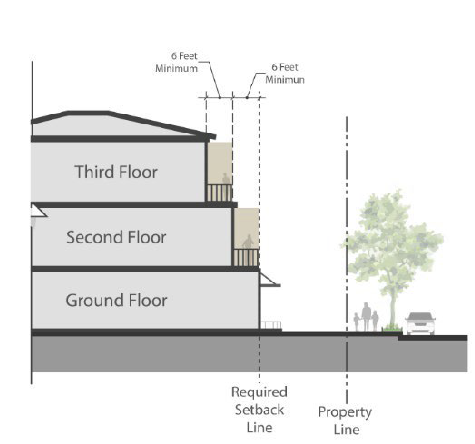
Figure 9663.7A
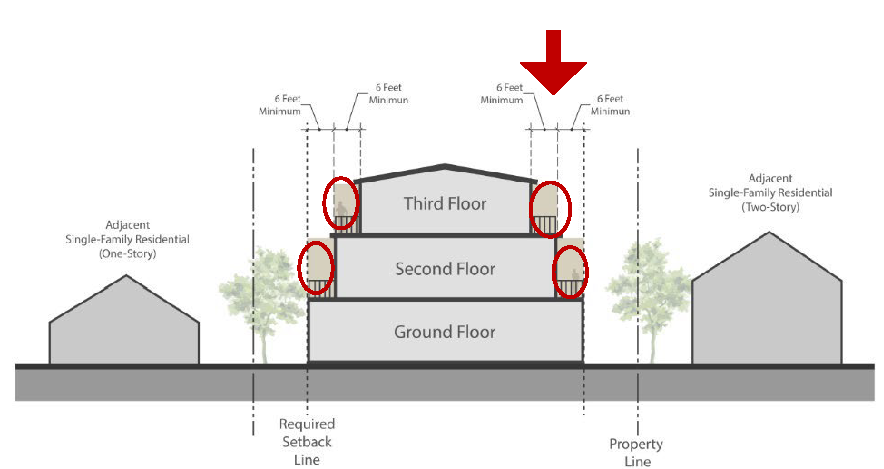
Figure 9663.7B
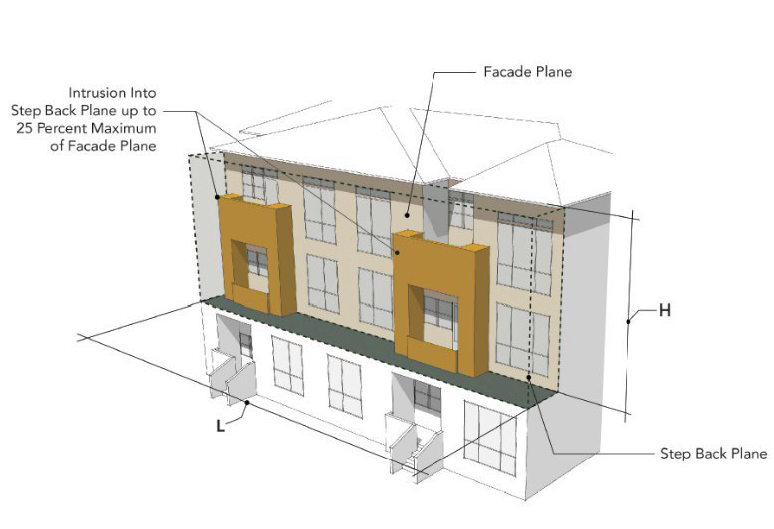
Figure 9663.7C
3.
Intrusion into the step-back plane is allowed for up to twenty-five (25) percent of the façade plane, up to the maximum allowed building height, as shown in figure 9663.7C.
4.
All building façades facing a public or private street shall be articulated for at least eighty (80) percent of each façade length. All other building façades shall be articulated for at least sixty (60) percent of each façade length. The massing of facades shall be broken up using a combination of at least three (3) of the following approaches:
a.
Use of recessed and/or protruding window openings and entrances and similar relief.
b.
Balconies.
c.
Bay windows.
d.
Recessed glazing and storefronts by at least six (6) inches.
e.
Vertical pilasters that reflect internal building structure and/or are integral to the selected architectural style.
f.
At least two (2) changes in color and texture along wall surfaces.
g.
Indented portions of walls that articulate masses in the facade.
h.
Trims, projections, and reveals along different levels of wall surfaces.
i.
Cantilevers.
5.
All side and rear building facades shall incorporate architectural detailing consisting of at least three (3) of the approaches itemized in 3.a above.
6.
Bay windows shall project at least two (2) feet but no more than three (3) feet.
7.
Balconies shall have a minimum depth of four (4) feet.
8.
The vertical emphasis of architectural design elements shall be minimized by use of a minimum of three (3) of the following approaches:
a.
Incorporate elements such as horizontal bands, reveals, trims, and overhangs along different levels of the wall surface.
b.
Limit towers or pilasters to a maximum of one (1) story in height.
c.
Limit tower elements to one (1) per building.
d.
Vary the spacing and distribution of architectural elements and details along building facades.
e.
Entry treatments should not extend above the first story of the building.
9.
Using the building design reference document identified in subsection 9663.7A, projects shall identify an architectural design style and include at least five (5) of following features consistent with the descriptions of following elements of a single specific style, with roof type and characteristic pitch required to be at least one (1) of the five (5) features:
a.
Roof type and characteristic pitch;
b.
Roof rake, eve overhang and cornice detail;
c.
Wall façade symmetry or asymmetry and detail;
d.
Wall material and arrangement relative to roof;
e.
Window type, relative proportion, shape, and detail;
f.
Door type, relative proportion, shape, and detail;
g.
Porch type, relative proportion, shape, and detail.
C.
Roof treatments.
1.
Visual interest shall be created through the integration of a minimum of two (2) different roof forms (orientation, pitch, height) and designs along a building facade. Such roof forms shall be used on all sides of the building.
2.
Mansard roofs shall be prohibited.
3.
Flat roof areas shall not be used on more than twenty-five (25) percent of the overall roof area and where used, shall match the color of the roofing material. Green roofs are exempt from this requirement and shall have no maximum limit on the overall extent of the flat roof area, and green roofs shall be of a color typical of healthy, low maintenance planting material.
4.
Barrel-shaped red tile roof materials are prohibited.
5.
Roof lines shall be vertically articulated along the street frontage by at least two (2) of the following architectural elements:
a.
Varying cornices;
b.
Clerestory windows;
c.
Varying roof height;
d.
Varying roof form.
6.
Roof-mounted mechanical units shall be incorporated into the design of roof through increased slope, screening, or enclosures. Roof-mounted equipment shall be fully screened. Screening and enclosures must match the materials, colors, and style of the building architecture.
7.
Gutters and other means to collect rainwater from roof runoff shall be integrated into roofing design and in colors and styles consistent with the roofing materials.
8.
Exterior roof ladders shall be prohibited. Access to the roof shall only be provided from the interior of a building.
9.
Green roofs may be used as described in section 9663.8 (sustainable design).
D.
Mixed-use ground floor.
1.
Mixed use buildings with ground-floor retail/commercial use.
a.
Floor-to-ceiling heights of ground-floor commercial spaces shall be at least twelve (12) feet.
b.
Ground-floor entrances for commercial uses shall be designed to be level with the elevation of the adjacent public sidewalk or at least not more than two (2) feet above or below the immediately adjacent sidewalk grade.
c.
Entries to stores and ground-floor commercial uses shall be distinct from the rest of the building façade using at least two (2) of the following:
1.
Change in scale;
2.
Contrasting materials, glazing and color;
3.
Projecting or recessed forms and awnings.
d.
Any street level façade where retail, recreational, or civic uses are planned shall consist of at least sixty (60) percent window area. Tint lower than seventy (70) percent visible light transmission (VLT), mirrored, or reflective glass shall be prohibited.
2.
Ground-floor residential use.
a.
Within mixed-use developments, ground-floor residential uses immediately adjacent to the sidewalk shall be separated from the public sidewalk by a minimum of two (2) feet and not more than three (3) feet. If the ground floor residential uses are setback at least ten (10) feet, this requirement does not apply.
b.
Where ground-floor porches are provided, the depth of the porch shall be at least three (3) feet.
c.
Residential uses on the ground floor along a primary roadway, other than residential entries and associated porches/stoops/patios, shall be prohibited.
E.
Doors and windows.
1.
Horizontal window bands greater than forty (40) feet shall be prohibited.
2.
Windows within forty (40) feet and facing a residential use on an adjacent property, shall be placed to avoid direct lines of site to windows on the adjacent property. Exceptions are allowed where the windows on the proposed development are opaque or otherwise treated to obscure views (see exhibit).
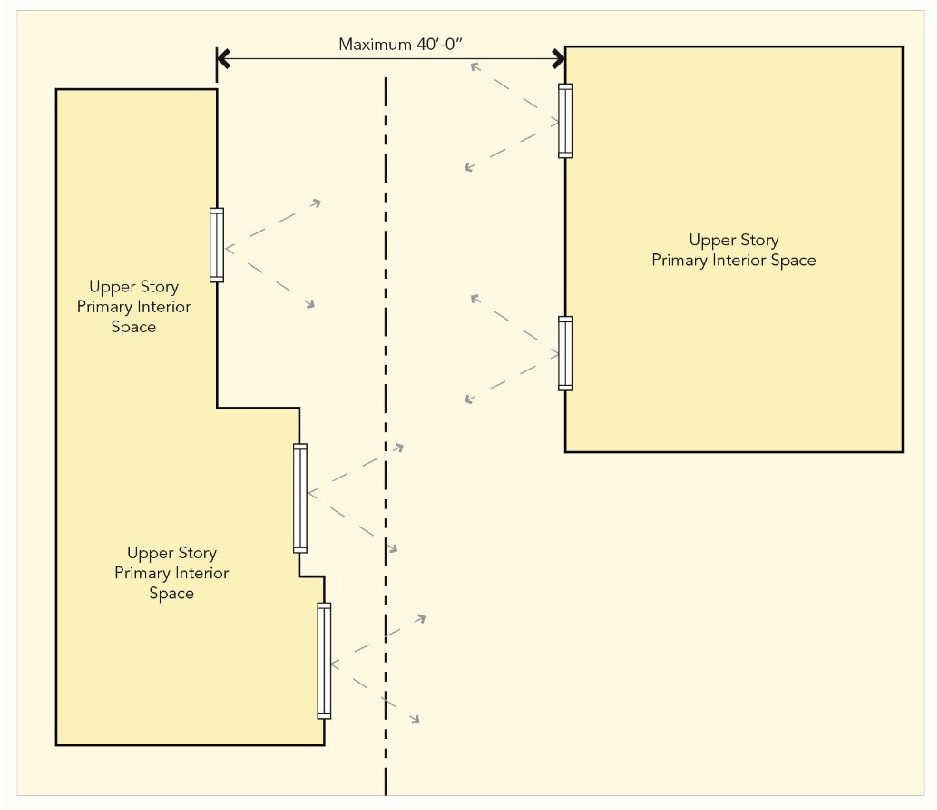
3.
Weather protection shall be provided at individual residential unit entries and primary entrances to commercial uses by providing a minimum of one (1) of the following treatments:
a.
Overhangs;
b.
Awnings;
c.
Porch roofs;
d.
Trellis;
e.
Canopy.
4.
Garage doors shall include at least one (1) detail treatments such as:
a.
Windows;
b.
Paneled surface;
c.
Use of a minimum of two (2) colors;
d.
Use of a minimum of two (2) textured surfaces.
F.
Façade materials treatments.
1.
Material transitions along any façade shall only occur on the inside corner of plane change. When material changes need to happen in the same plane, trims, cornices, or other architectural elements shall be used to create a corner for material transition.
2.
For buildings taller than two (2) stories, the use of stucco shall be limited to a maximum of sixty (60) percent of any façade that faces a street or open space.
3.
For buildings that are two (2) stories or taller, unbroken multi-story sections of the same material, texture, or color shall not be used for more than sixty-five(65) feet of façade length and more than two-thirds (⅔) of the number of floors in height, as illustrated in Figure 9663.7D.
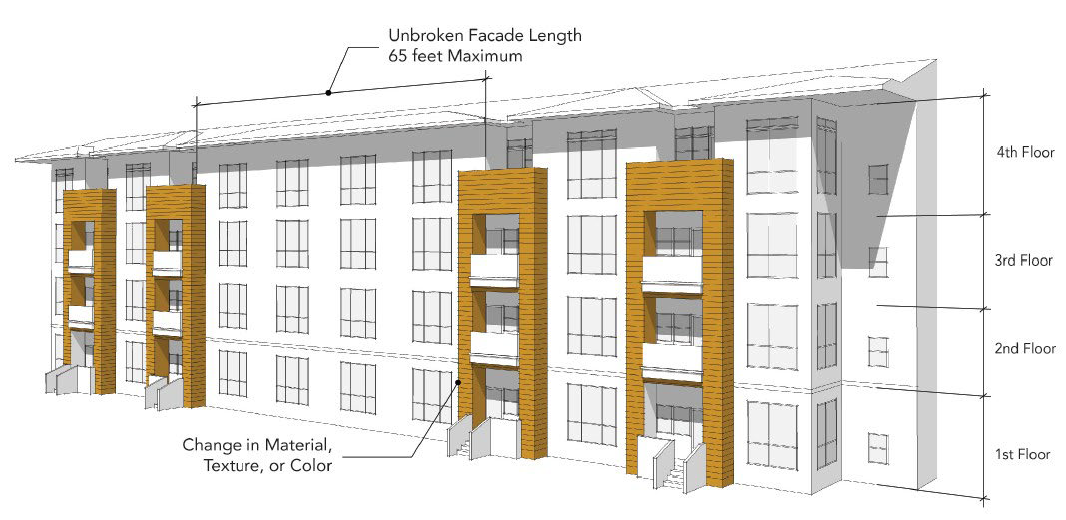
Figure 9663.7D
4.
The following materials are permitted for exterior façades and considered primary, secondary, or accent and can be used in relation to their designation (see section 9663.3, definitions). Materials listed as prohibited or omitted altogether shall be prohibited.
KEY
P: Primary or Secondary Material
S: Secondary Material Only
A: Accent Material
N: Prohibited
5.
At least two (2) materials shall be used on any building façade, in addition to glazing, railings, and trim. A primary material must constitute at a minimum of twenty (20) percent of any building façade, excluding windows and railings.
6.
Buildings with false facades or false fronts, exclusive of parapets used to shield rooftop equipment, are prohibited.
G.
Color and materials.
1.
An earth-tone color palette shall be required for all structures.
2.
The use of fluorescent or neon colors is prohibited.
3.
The number of colors appearing on the entire building exterior shall be limited to a maximum of four (4) colors (or four (4) tones of the same color), including trim and accent colors.
4.
Buildings shall utilize a minimum of two (2) colors on all facades, inclusive of trim. Changes in color due to a change in building material are not considered an additional color.
H.
Security Considerations. New development shall use each of the following crime prevention through environmental design (CPTED) standards:
1.
Lighting shall be provided within all parking lots, along pathways, at entrances, and within common open space areas so that these areas are visible to on-site residents at night. All lighting shall comply with the provisions of section 9663.9.D (lighting).
2.
Building entrances shall be located to be visible from parking lots and sidewalks.
I.
Relationship to adjacent properties.
1.
Fencing shall be used to enclose and/or screen private outdoor gathering spaces and utility and service use areas adjacent to buildings. Compliance with section 9606.2 (fences and walls) shall be required.
2.
All fences and walls designed for screening purposes shall be of a solid material. Gaps of up to one-quarter (¼) inch will be allowed at material joints.
3.
Use of untreated chain link fence and barbed wire is prohibited. Vinyl and plastic fencing materials are prohibited unless they are made to simulate the appearance of wood.
(Ord. No. 22-461, § 8, 8-24-2022)
9663.8. - Sustainable design.
A.
Solar access—Passive and active open spaces. All required passive and active open space areas shall be designed to allow for a minimum four (4) hours of natural sunlight during the winter solstice for the City of Agoura Hills latitude of 34.1533 degrees north.
B.
Water conservation.
1.
All buildings shall meet or exceed the water efficiency standards defined by state and local codes at the time of construction.
2.
Stormwater capture systems shall be incorporated into the building and site design, consisting of at least two (2) of the following:
a.
Rain barrels;
b.
Cisterns;
c.
Downspouts that drain into landscaped areas;
d.
Permeable paving materials;
C.
Green roofs and walls.
1.
Green roofs and green walls shall use regionally appropriate, native, and/or adaptive species and include key elements for successful establishment, such as sufficient structural engineering, efficient irrigation, appropriate waterproofing and root barrier, and effective drainage, as approved by the building official using standard reference materials.
2.
Green roofs shall be designed to permit solar installation where needed to support the energy strategy.
3.
Green roof species shall be selected with an emphasis on habitat creation, including a minimum of one (1) of the following:
a.
Pollinator species;
b.
Nesting species;
c.
Food sources.
(Ord. No. 22-461, § 8, 8-24-2022)
9663.9. - Other requirements.
A.
Utility and mechanical equipment.
1.
All roof-top mounted utility and mechanical equipment shall be screened from the public right-of-way as set forth in section 9663.7(B) above.
2.
Utility and mechanical equipment shall not be located within any required active open space area.
3.
Ground-mounted mechanical, electrical, and utility equipment shall be placed a minimum of ten (10) feet away from any pedestrian path and/or driveway.
B.
Mailboxes.
1.
Mailboxes shall be placed either at an on-site location adjacent to or incorporated into a common area for all residents or at individual units.
2.
In mixed-use developments, separate mailbox and package delivery/pick-up areas shall be provided for the residential and commercial components of a project.
C.
Service and refuse areas.
1.
Trash enclosures shall be located a minimum of twenty (20) feet away from any pedestrian path and/or driveway.
2.
Trash enclosures shall not be located in any front yard, street side yard, parking space, required landscaped area, or open space areas.
3.
Trash enclosures shall not be located within twenty (20) feet of any adjacent property zoned for residential use.
4.
Trash enclosures shall be designed to utilize the same materials and colors as the buildings they serve. Chain-link fencing with or without wooden/plastic slats is a prohibited material for the enclosure.
5.
Every trash enclosure shall have a non-combustible, overhanging trellis or roof cover designed to prevent precipitation from entering trash bins.
6.
Enclosures shall be designed and constructed to accommodate the collection of recyclable materials to the extent required by the responsible collection contractor.
7.
Trash enclosures shall be buffered from adjacent parking with a minimum six-foot-wide landscape planter.
D.
Lighting.
1.
Surface parking area lighting fixtures shall be fully shielded and mounted no more than sixteen (16) feet above the ground.
2.
Pedestrian-oriented lighting in areas other than parking lots shall have a maximum height of sixteen (16) feet.
3.
All lighting shall be directed downward or shielded to prevent light trespass onto adjacent properties. Light trespass onto adjacent properties shall not exceed one (1) foot-candle at the property lines, measured at ground level.
4.
Roof-mounted lights are prohibited.
(Ord. No. 22-461, § 8, 8-24-2022)
DIVISION 4. - RESIDENTIAL DENSITY BONUS[20]
Editor's note— Ord. No. 20-451, § 4, adopted June 24, 2020, amended division 4 in its entirety to read as herein set out. Former division 4, §§ 9674.1—9674.10, pertained to similar subject matter, and derived from Ord. No. 08-352, § 4, 7-9-2008.
DIVISION 5. - MOBILE HOME PERMIT[21]
Editor's note— Ord. No. 11-383, § 20, adopted March 9, 2011, amended Div. 5 in its entirety to read as set out herein. Former Div. 5, §§ 9675—9675.3, pertained to similar subject matter and derived from Ord. No. 120 adopted Feb. 3, 1983; Ord. No. 93-242, § 3, adopted Nov. 10, 1993.
9601. - Purpose.
The purpose of the general provisions is to provide additional clarification and amplification of the requirements and standards governing development in each district.
9601.1. - Conformity to general provisions.
The general provisions shall govern all uses and structures in every district in addition to the development standards in each district. No structure or use may be constructed, substantially changed, relocated, operated, occupied, established or maintained unless it conforms to the general provisions and the development standards of the district in which it is located. The provisions of chapter 7 shall regulate nonconforming uses and structures.
9602. - Provision of street dedication and improvements.
The existence of inadequate street widths and improvements in the right-of-way adjoining buildings, dwellings and other structures within the city, and the lack of adequate sidewalks, trails, curbs, gutters, tie-in pavement, drainage facilities, street lights, trees and other landscaping, and traffic signage and striping is found and declared to be dangerous to the public health, safety, and welfare of the inhabitants of the city.
9602.1. - Duty to improve.
Except as otherwise provided, every owner, lessee or other person constructing or substantially modifying or causing to be constructed or substantially modified, any building, structure or off-street parking facility in the city shall also provide for the construction of necessary curbs, gutters, drainage facilities, sidewalks, trails, pavement, street lights, trees and other landscaping, and traffic signage and striping. The improvements shall be made in accordance with city standards, specifications and design for all public and private street frontage adjoining the property upon which the construction is to be done. For the purposes of this section, substantial modification shall mean any expansion of the square footage of the building or structure, or parking facility.
9602.2. - Duty to dedicate and improve additional property.
Where it is found by the city that the proposed improvements or use of property will cause an increase in vehicular or pedestrian traffic which will constitute an additional burden upon existing streets and create the need for additional right-of-way, street extensions or other required improvements, the property owner shall dedicate sufficient right-of-way and provide the full improvements specified in section 9602.1 for the full width of the adjoining streets.
Further, the reviewing may require, as part of development, the recording of an agreement providing that the subject property will participate in any assessment district subsequently formed by the city to make improvements to the city's transportation system that will benefit such property.
9602.3. - Duty of building official.
The building official shall not conduct a final inspection of any building, structure, or other facility and shall withhold approval of permanent public utility connections thereto, other than telephone utilities, until:
A.
The provisions of 9602 through 9602.2 have been met, or a cash deposit to guarantee the required construction, has been filed with the city;
B.
Any required dedication has been made to the city, and/or the design of any required improvements have been completed and approved by the city engineer.
9602.4. - Appeal.
Any decision made under the provisions of sections 9602 through 9602.3 may be appealed directly to the city council.
9602.5. - Required transportation improvement fund participation.
Beyond the impacts of new development on adjacent streets and highways, all new uses and structures contribute cumulatively to the level of traffic and congestion on the surrounding and community-wide streets and highways. In order to mitigate said impacts, all new development or structures shall contribute to the city's transportation improvement fund, as provided by city council.
9603. - Underground facilities requirement.
The following provisions are hereby established to govern the installation of underground utilities for the conversion of existing overhead facilities within the city.
(Ord. No. 10-380, § 1, 1-12-2011)
9603.1. - Development subject to undergrounding provisions.
A.
For purposes of this division 3, the term "development" means either:
1.
The construction of new buildings or structures; or
2.
The expansion, enlargement, modernization, renovation, remodeling, repair, improvement, or alteration of existing buildings or structures for which one (1) or more approvals or permits by or from the city are required, and which adds more than two thousand (2,000) square feet of floor area.
B.
Except as provided in this chapter, all new and existing electrical distribution lines, telephone, cable television, and similar service wires or cables, which are adjacent to and provide service to a development's property, shall be installed underground as a part of development's property from the nearest existing pole not on the development's property with the following exceptions:
1.
In the development of a single-family dwelling upon an existing, subdivided lot in the OA overlay district and RS district when overhead utility distribution lines presently exist. Any new single-family dwelling shall conform to the requirements of section 9603.2 as a part of development.
2.
Temporary utilities along with the necessary service poles, wires and cables during the period when authorized construction is continuing for which valid building permits have been issued or for temporary use authorized under the provisions of the zoning ordinance, building code and other applicable regulations.
3.
Appurtenances and associated equipment, such as surface-mounted transformers, when it is determined by the planning commission that it would be economically unfeasible to underground such equipment.
(Ord. No. 10-380, § 1, 1-12-2011)
9603.2. - Recorded agreement.
In lieu of undergrounding existing distribution lines as a part of development, the planning commission may permit the recording of an agreement guaranteeing that the property will participate in any undergrounding district which is subsequently established by the city. The form of the agreement shall be approved by the city attorney and shall run with the land. This section shall not be applicable to the service lines that lead directly to the building.
(Ord. No. 10-380, § 1, 1-12-2011)
9603.3. - Responsibility for compliance.
The developer or owner shall be responsible for complying with the requirements of sections 9603 through 9603.2 and shall make the necessary arrangements with the utility company for the installation of such facilities.
(Ord. No. 10-380, § 1, 1-12-2011)
9603.4. - Nonconforming structures.
Buildings or structures which on the effective date of this chapter are nonconforming in regard to above-ground on-site utility lines, may continue to be used, altered, or enlarged in the same manner as if such nonconforming utility lines did not exist. However, when the buildings or structures are enlarged over two thousand (2,000) square feet in floor area or when alteration or enlargement require the installation of additional utility lines at new locations on the buildings and structures, the new and existing electrical distribution lines, telephone, cable television, and similar service wires or cables, which are adjacent to and provide service to the property being developed shall comply with the requirements of this division.
(Ord. No. 10-380, § 1, 1-12-2011)
9603.5. - Optional in-lieu fee for properties located in specified areas within an existing undergrounding district.
In lieu of undergrounding existing distribution lines as a condition of development, a developer or owner whose development is located in a specified area within an existing undergrounding district may request instead to pay an in-lieu fee, in an amount established by resolution of the city council, as a contribution to the future undergrounding of existing overhead utilities. Only those properties located in areas, specifically designated by resolution of the city council, within an existing undergrounding district are eligible for the option of the payment of said in-lieu fee.
(Ord. No. 10-380, § 1, 1-12-2011)
9604. - Lot standards purpose.
The purpose of the following lot standards is to amplify and clarify the provisions of the development and special standards of each district.
9604.1. - Site area and dimensions; measurements.
A.
Required front, side, and rear yards shall be measured as the minimum horizontal distance from the property line of the site or street right-of-way line to a line parallel thereto on the site; provided, that where a specific street plan has been adopted by the city council, site area and required yards shall be measured from such plan line, and no provisions of this title shall be constructed to permit a structure or use to extend beyond such line; and provided further, that where a site abuts a street having only a portion of its required width dedicated or reserved for street purposes, site area and required yards shall be measured from a line drawn on the boundary of the additional width required for street purposes abutting the site. In cases where a highway line has been established as a dashed line on a recorded subdivision map, the front yard shall be measured from said line.
B.
No site shall have less than the required lot width as prescribed in the applicable district, except lots fronting on cul-de-sac or knuckle streets may have no less than thirty-five (35) feet of frontage.
9604.2. - Width of corner lots.
Corner lots shall have extra width at least equal to the width of the minimum street side yard prescribed for a main structure in the district. In no case shall the lot width be less than eighty (80) feet.
9604.3. - Flag lots; area and width calculations.
The "staff" or fifteen-foot access strip portion of a flag lot shall be excluded when calculating the required area of such lots. In addition, the required width shall be measured at the center of the lot exclusive of the "staff" or fifteen-foot access strip portion.
9604.4. - Required area; reduced for streets; conditions.
If a lot or parcel of land has the required area, and after the creation of such lot or parcel of land a part thereof is acquired for street purposes exclusively, in any manner including dedication, condemnation or purchase, and if the remainder of such lot or parcel has seventy-five (75) percent of the required area, then such remainder shall be considered as having the required area, provided the remaining portion of said lot or parcel of land has an area of two thousand five hundred (2,500) square feet, or an area as is otherwise provided herein.
9604.5. - Required width; reduced by public use; conditions.
If a lot or parcel of land has the required width, and after the creation of such lot or parcel of land a part thereof is acquired for public use in any manner, including dedication, condemnation or condemnation or purchase, and the remainder of such lot has an average width of at least forty (40) feet, such remainder shall be considered as having the required width.
9604.6. - Conveyance or division of land; lot area and width restrictions.
Except in the case of a conveyance for public use or as otherwise provided in this part, a person shall not divide any lot or parcel of land, and shall not convey any lot or parcel of land or any portion thereof, if as a result of such division or conveyance the area or average width of any lot or parcel of land is so reduced, or a lot or parcel of land is created, which lot or parcel of land has an area or average width less than permitted.
9605. - Front yards; requirements and exceptions.
In addition to the regulations prescribed within each residential district, the following regulations shall apply: Where sites comprising forty (40) percent of the frontage on a block in a residential district are improved with buildings, the minimum front yard shall be the average of the front yard depths for structures on each developed site on such block.
9605.1. - Side and rear yards; requirements and exceptions.
In addition to the regulations prescribed within each residential district, the following regulations shall apply:
A.
On a reversed corner lot the minimum rear yard shall not be less than the minimum side yard prescribed for the district if the side yard adjoining the street is not less than the required front yard on the adjoining key lot, or twenty (20) feet, whichever is greater.
B.
On the side street side of a corner lot, the minimum side yard for a garage, carport, or off-street parking space required to serve a dwelling in a residential district shall be twenty (20) feet; provided, that if the garage, carport, or off-street parking space is entered parallel to the street, the minimum side yard shall be the same as the side yard otherwise required on the site.
C.
On any lot located in the RV, RL, RS, and RM zones, the minimum side yard requirement for single-story development additions to existing residences shall be the existing distance of the structure from the side property line, or the distance prescribed for the district, whichever is less. All single-story development additions shall not encroach in the front and rear yards prescribed for the district, and the total square footage of the residence shall not exceed the building coverage prescribed for the district. This provision shall not apply to new construction or substantial remodels which include the removal and reconstruction of square footage, as determined by the director of planning and community development.
D.
On any lot located in the RV, RL, RS, and RM zones, the minimum side yard requirement for second-story development additions shall be the existing distance of the first-story structure. The total combined side yard setback prescribed for the district shall be maintained. The combined side yard setback may be situated on any one (1) side of the property, or any combination of distances. No second-story cantilever is permitted into required side yards and all second-story development additions shall not encroach into the front and rear yards prescribed for the district. An application for a site plan review shall be required for all second-story additions which do not conform with the required yards prescribed for the district and shall be subject to the provisions of this chapter. This provision shall not apply to new construction or substantial remodels which include the removal and reconstruction of square footage, as determined by the director of planning and community development.
(Ord. No. 196, § 1, 7-24-91; Ord. No. 09-358, § 9, 1-18-2009; Ord. No. 11-388, § 53, 12-14-2011)
9605.2. - Traffic sight obstructions.
On a corner lot, no fence, wall, hedge, or other obstruction, except the natural grade of a site, within a triangular area formed by the street property lines and a line connecting points on the street property lines twenty-five (25) feet from the intersection of the projection of the streets right-of-way, shall exceed a height of three (3) feet above established grade at the edge of the street pavement on plans approved by the director of planning and community development or the existing pavement or traveled way if plans have not been approved.
9605.3. - Projections into yards.
Architectural projections, including eaves, awnings, louvers, and other similar shading devices; sills, belt courses, cornices, and similar features; and flues and chimneys may project not more than six (6) feet into a required front yard, rear yard, or street side yard and not more than two (2) feet into any interior side yard; provided that the distance between the architectural projection and a side property line shall not be less than five (5) feet. Existing dwellings shall be allowed an architectural projection of not more than eighteen (18) inches into any interior side yard; provided that the following findings are made:
A.
An unobstructed clear path shall be provided, located in the interior side yard of the projection, of at least three (3) feet and six (6) inches in width.
B.
The total number of architectural projections on a wall shall not cover more than twenty (20) percent of the length of the wall. Architectural projections which exceed twenty (20) percent of the length of the wall shall be subject to approval by the director of planning and community development. In considering the request, the director shall consider compatibility with adjoining structures relative to overall spacial separation between structures and any projections, and preservation of light, air and view.
C.
A minimum distance of eight (8) feet and six (6) inches shall be provided between an architectural projection and an adjoining structure or architectural projection.
Existing dwellings shall be allowed to project roof eaves of not more than eighteen (18) inches into any interior side yard; provided that the distance between the roof eave and a side property line shall not be less than three (3) feet and six (6) inches.
(Ord. No. 197, § 1, 9-11-91)
9605.4. - Oriel or bay windows.
Oriel or bay windows may project not more than five (5) feet into a required front yard, rear yard, or street side yard, provided that the total width of oriel or bay windows shall not exceed fifty (50) percent of the length of the wall on which they are located and the width of any individual oriel or bay window shall not exceed ten (10) feet.
9605.5. - Porches and steps.
Unroofed porches, steps, and terraces may project not more than six (6) feet into a required front yard or side yard on the street side of a corner lot, or to a point not closer than three (3) feet to an interior side or rear property line; provided, that the height including railings shall not exceed six (6) feet above the grade of the ground at the property line.
9605.6. - Balconies over six feet above ground.
Balconies, decks over one (1) foot above the ground, terraces, and other similar unroofed structures at a height including railing more than six (6) feet above the level at which a yard must be provided, may project not more than six (6) feet into a required front yard or rear yard and five (5) feet into any other required yard; provided that such structures shall not reduce any yard to less than five (5) feet except on the street side of a corner lot. Such structures shall be cantilevered or supported only by necessary columns. A balcony or deck projecting from a higher story may extend over a lower balcony or deck but shall not in such case be deemed a roof for the lower balcony or deck.
9605.7. - Open stairways.
Open, unenclosed fire escapes and fireproof outside stairways may project into any required yard with a maximum of four (4) feet; provided, that no yard shall be reduced to less than three (3) feet.
9605.8. - Covered patios.
Covered patios attached to a main structure to within ten (10) feet of the rear property line and to within three (3) feet of the side property line and the covered patios shall not cover more than fifty (50) percent of the required yard. Such patio shall remain permanently unenclosed on at least two (2) sides, except for detachable screens. A covered patio not attached to a main structure shall be deemed an accessory structure.
9605.9. - Underground structures.
Underground structures, such as swimming pools, may project without limit into any required yards; provided, that such structures shall not have a height of more than four and one-half (4½) feet and shall not be located closer than five (5) feet to any property line, or main structure.
(Ord. No. 98-291, § 1, 10-14-98)
9605.10. - Recreational vehicles and motorhomes.
Recreation vehicles and/or motorhomes that are over six (6) feet in height may project without limit into a required side yard, provided that such vehicles, if located within the RM or RS zones, shall not be parked for more than forty-eight (48) hours within five (5) feet of any side property line. No recreation vehicle or motorhome shall be located within required front or rear yards of a residential lot.
(Ord. No. 03-319, § 1, 4-9-2003)
9606. - Accessory buildings.
Except as otherwise regulated by this chapter, accessory buildings, which have been defined by this Code to exclude accessory dwelling units, shall be subject to the following regulations:
A.
Accessory buildings shall not be erected in any minimum yard requirement, except a rear yard.
B.
An accessory building, up to one (1) story or fourteen (14) feet in height may not occupy more than twenty-five (25) percent of a minimum rear yard plus forty (40) percent of the buildable area.
C.
No accessory building shall be located closer than ten (10) feet to any main building or rear lot line nor shall it be located closer than five (5) feet to any side lot line.
D.
Notwithstanding section 9606.A, in the Old Agoura Overlay District, accessory buildings may be erected in the minimum front yard, provided that they do not exceed one (1) story or fourteen (14) feet in height and not occupy more than twenty-five (25) percent of the minimum front yard plus forty (40) percent of the buildable area in combination with any other accessory buildings on the site. No accessory building shall be located closer than ten (10) feet to any main building or front property line nor shall it be located closer than five (5) feet to any side lot line.
(Ord. No. 97-279, § 1, 9-3-97; Ord. No. 434, § 16, 1-10-2018)
9606.1. - Accessory structures and equipment location and type permitted.
The following accessory structures and equipment may project into the required yard subject to the following limitations:
A.
Ground mounted pool equipment, air conditioners and built-in barbecues, provided that the equipment shall not be located closer than five (5) feet to the side property line and three (3) feet to the rear or street side property line. Ground mounted pool and air conditioning equipment must be screened by a solid wall or fence on all sides, except in cases where the equipment is located next to a dwelling, in which case the equipment must be screened on the three (3) sides not adjacent to the dwelling.
B.
Rain conductors, spouts, utility service risers, and shutoff valves may project a maximum distance of one (1) foot into any required yard.
C.
Awnings or canopies may project a maximum distance of three (3) feet into the required interior side yard and five (5) feet into the required front, rear and street side yard, provided:
1.
That such awnings or canopies are not closer than three (3) feet into any lot line;
2.
That such awnings or canopies have no vertical ground support within such yard; and
3.
That such awnings or canopies extend only over the windows or doors to be protected, and for not more than one (1) foot on either side thereof.
D.
Water heaters, water softeners and gas or electric meters, including service conduits and pipes, enclosed or in the open, may project a maximum distance of two and one-half (2½) feet into a required interior side or rear yard, provided that such structures or equipment are not closer than three (3) feet to any lot line. Gas meters, if enclosed or adequately screened from view by a structure permitted in the yard, may project a maximum distance of two and one-half (2½) feet into a required front or corner side yard, provided that such equipment is not closer than three (3) feet to any lot or highway line.
E.
Wall and window mounted air conditioners, coolers, and fans may be used in any required yard, provided that such equipment is not closer than three (3) feet to any lot line.
F.
Guard railings or fences for safety protection around depressed ramps may be placed in any yard provided such railing or fence does not exceed a height of three and one-half (3½) feet.
G.
Driveways, walkways, patio slabs and other areas constructed of concrete, asphalt or similar materials and wooden decks may be used in any required yard provided that such structures do not exceed one (1) foot above ground level. Decks over one (1) foot high shall be regulated by section 9605.6. This provision shall not exclude the use of the steps providing access between areas of different elevation on the same property.
H.
Storage sheds, including pre-fabricated units, that are used solely for the lawful and safe storage of personal property and which have less than one hundred twenty (120) square feet of projected roof area, are permissible in side or rear yards only, provided that a minimum unobstructed access of three (3) feet is provided between the shed and the property lines, have no foundation or plumbing or electrical service of any kind and do not exceed seven and one-half (7.5) feet in exterior height as measured from the ground to the top of the roof. Such sheds shall be placed behind any fence in the side yard setback area to minimize their visibility from the sidewalk or public right-of-way. If no fence exists in the side yard setback area, then the shed shall be located so as to minimize the visibility of the shed from the public right-of-way and must be at least fifteen (15) feet behind the front of the building. A maximum of three (3) such sheds shall be allowed on any one lot.
(Ord. No. 126, § 1, 6-24-87; Ord. No. 97-279, § 1, 9-3-97)
9606.2. - Fences and walls.
Fences and walls may be erected and maintained in required yards subject to the following requirements:
A.
Front yards. Fences and walls within a required front yard shall not exceed a height of three and one-half (3.5) feet.
B.
Corner side yards. Fences and walls within a required corner side yard shall not exceed three and one-half (3.5) feet in height on the property line, nor exceed six (6) feet in height when located five (5) feet or more from said property line.
C.
Interior side and rear yards. Fences and walls within a required interior side or rear yard shall not exceed six (6) feet in height except where residentially zoned properties abut commercially zoned properties, in which case, fences and walls within a required side or rear yard shall not exceed eight (8) feet in height. Notwithstanding the above, on the street or highway side of a corner lot, fences and walls shall be subject to the same requirements as for a corner side yard.
D.
Retaining walls. Retaining walls not to exceed six (6) feet in height are permitted in all yards.
E.
Retaining walls topped with walls or fences.
1.
Where a retaining wall protects a cut below the natural grade and is located on a front, side or rear lot line, such retaining wall may be topped by a fence or wall not to exceed six (6) feet in height measured from the highest natural grade. Where such retaining wall contains a fill, the height of the retaining wall built to retain the fill shall be considered as contributing to the permissible height of a fence or wall; providing, however, that in any event an open work, non-view-obstructing fence of three (3) feet may be erected at the top of the retaining wall for safety protection. In those instances where the safety fence is utilized for corral purposes, the safety fence can be increased to a maximum four and one-half (4.5) feet in height subject to the review and approval [of] an administrative site plan review by the director of planning and community development. The director's review shall include but not be limited to, impact to surrounding properties, drainage, screening, dust control, and setbacks.
F.
Tennis court fences. Tennis court fences erected outside of any required yard setback may not exceed a height of twelve (12) feet.
G.
Fences and walls exempted. Where a fence or wall exceeding the heights specified is required by any law or regulation of the State of California, a fence or wall not exceeding such required height is permitted.
H.
Measurement of fence and wall height. The height of a fence or wall shall be measured at the highest average ground level within three (3) feet of either side of said wall or fence. In order to allow for variation in topography, the height of a required fence or wall may vary by an amount up to six (6) inches; provided, however, that in no event shall the average height of such fence or wall exceed the maximum height specified.
I.
Fences or walls. Notwithstanding the other provisions of this section, the director may permit fences or walls within any required yard on flag lots or lots fifteen thousand (15,000) square feet or larger to a height not to exceed six (6) feet. However, higher fences shall only be permitted in any required front or street side yard when it can be demonstrated that it will be sufficiently open to preserve adequate visibility of vehicles entering and leaving said property.
(Ord. No. 132, § 8, 8-26-87; Ord. No. 147, §§ 1, 2, 3-23-88; Ord. No. 224, § 2, 3-24-93)
9606.3. - Trees, shrubs, flowers and other landscaping.
Trees, shrubs, flowers and plants may be placed in any required yard, provided that all height restrictions applying to fences and walls shall also apply to hedges planted within yards and forming a barrier serving the same purposes as a fence or wall.
9606.4. - Modifications.
Pursuant to section 9676 et seq., the director may grant a modification to a yard or setback regulation required by this chapter where topographic features, subdivision plans or other conditions create an unnecessary hardship or unreasonable regulation or make it obviously impractical to require compliance with the yard requirements or setback line.
9606.5. - Solid waste and recyclable material storage facilities.
Any development project for which a building permit is issued shall provide the required number storage facilities to serve the development for the accessible and convenient collection of solid waste and recyclable materials. All storage facilities shall be subject to the following standards:
A.
Development project. For the purpose of this section, a "development project" shall including the following:
1.
Any new commercial building, office building, industrial building, or residential buildings consisting of five (5) or more living units.
2.
Any single or multiple alterations to an existing commercial, office, or industrial building(s) which collectively add thirty (30) percent or more to the existing floor area of the development.
B.
Design criteria. All solid waste and recyclable material storage facilities shall be of sufficient size to accommodate the required number of solid waste and recyclable materials storage containers to serve the development, as determined by the director of planning and community development. All storage facilities shall include the following design standards:
1.
Solid decorative walls which are compatible with the architecture of the development.
2.
A solid decorative self-closing metal gate which is compatible with the architecture of the development.
3.
A six (6) inch wide interior curb abutting all interior walls.
4.
Protection against adverse environmental conditions, such as rain, which might render the collected recyclable materials unmarketable. Such protection is not required for the storage facilities when the bins protect against such adverse environmental conditions.
C.
Location. All storage facilities shall be located so as to provide for the convenient deposit, collection, and loading of solid waste and recyclable materials generated by the development project, as determined by the director of planning and community development. All driveways and/or travel aisles shall provide for the unobstructed access for collection vehicles and personnel.
Developments and driveways which are adjacent to the storage facilities shall be adequately protected from any impacts such as noise, or odor through measures including, but not limited to maintaining adequate separation, fencing, and landscaping.
D.
Maintenance. All solid waste and recyclable materials containers shall remain closed and be located completely within the closed storage facility, except during periods of loading and unloading of materials.
(Ord. No. 239, § 1, 8-25-93)
9607. - Height limitations.
The height of a structure shall be measured vertically from the finished grade to the highest point of the coping of a flat roof, or to the top of a mansard roof, or to the average height of the highest gable of a pitch or hip roof. Towers, radio, (except ham radio antennas) and television aerials and antennas, shall not exceed ten (10) feet above the height limit prescribed by the regulations for the district in which the site is located or ten (10) feet above the roof line or thirty-five (35) feet off the ground whichever is less. Utility poles and towers shall not be subject to the height limits prescribed in any district regulations.
Preserving the view-shed shall be one of the main criteria in determining whether a one- or two-story structure is best for the site. Site specific analysis should take into account all of these characteristics: Height of pad, height of structure and its size and the setback of structure.
(Ord. No. 235, § 2, 8-4-93)
9607.1. - Height limitations in hillside areas.
On lots or parcels which fall under the provisions of 9652 et seq., the following height restrictions shall apply in addition to the height limits for the underlying district:
A.
For properties zoned residential or open space, where the average elevation of the rear lot line is above the average elevation of the front lot line, no building or structure shall exceed a height of fifteen (15) feet above the average finished grade of the rear yard setback line.
B.
For properties zoned residential or open space, where the average elevation of the rear lot line is below the average elevation of the front lot line, no building or structure shall exceed a height of fifteen (15) feet above the average elevation of the front lot line.
C.
For properties zoned commercial or business park, the maximum allowable building height limit is thirty-five (35) feet. However, the limit may be exceeded provided all of the following are true:
1.
The building is stepped into the hillside such that for every fifteen (15) feet of vertical building height, the building is setback at least fifteen (15) feet horizontally;
2.
The overall building height does not exceed thirty (30) feet above the average natural grade below the building or, where a graded pad already exists, thirty (30) feet above the average finished grade below the building; and
3.
The number of stories of the building does not exceed three (3) stories, including the stepped up section.
(Ord. No. 99-293, § 1, 2-10-99)
9608. - Moving of buildings and structures; conditions.
No building or structure shall be moved from one lot or premises to another unless such building or structure shall thereupon be made to conform to all the provisions of this title relative to buildings or structures hereafter erected upon the lot or premises to which such building or structure shall have been moved.
9671. - Special permit or review; purpose.
The purpose of this part is to establish the rules, procedures and findings under which the various permits or reviews shall be considered by the city in order to guarantee due process, compatibility with the city's general plan and protection of the public health, safety and general welfare.
9672. - Procedure for change of zone.
The zoning map may be amended by changing the boundaries of any district in accordance with the procedures described in these sections.
9672.1. - Initiation.
A change in the boundaries of any district may be initiated by the owner or the authorized agent of the owner of the property by filing an application for a change in district boundaries. If the property for which a change of district is proposed is in more than one ownership, all the owners or their authorized agents shall join in the filing of the application.
A change in the boundaries of any district may additionally be initiated by planning commission or the city council.
9672.2. - Application submittal requirements.
A property owner desiring to propose a change in the boundaries of the district in which his property is located, or his authorized agent, may file with the department of planning and community development an application for a change in district boundaries on a form prescribed by the department and shall include the following information:
A.
Name and address of the applicant;
B.
Statement that the applicant is the owner or the authorized agent of the owner of the property for which the change in district boundaries is proposed; or is the plaintiff in an action of eminent domain to acquire the property;
C.
Address and legal description of the property;
D.
An accurate scaled drawing of the site and the surrounding area showing existing streets and property lines for a distance determined by the director to be necessary to illustrate the relationship to any impact on the surrounding area;
E.
[Reserved;]
F.
The filing fee as established by resolution of the city council;
G.
Such other information as is required by the director.
(Ord. No. 93-242, § 1, 11-10-93)
9672.3. - Investigation and report.
The department of planning and community development shall make an investigation of the application and shall prepare a report which shall be submitted to the panning commission and to the applicant prior to the public hearing.
9672.4. - Public hearing.
The planning commission shall hold at last one (1) public hearing on each application for a change in district boundaries. The hearing shall be set and notice given as prescribed in section 9804.4.
9672.5. - Action by the planning commission.
Within twenty-one (21) days following the closing of the public hearing, the planning commission shall determine whether the change is consistent with the objectives of this article and shall recommend that the application be granted, granted in modified form, or denied. The denial of the request by the planning commission shall be considered final unless appealed.
9672.6. - Appeal to the city council.
A decision of the planning commission involving a denial of an application for a change in district boundaries may be appealed to the city council within fifteen (15) days of the decision by the applicant or any other person as prescribed in section 9804.5.
9672.7. - Action by the city council.
The city council shall hold at least one (1) public hearing on an application within forty (40) days after receipt of the recommendation by the panning commission; provided, that no hearing shall be held on an application which has been denied by the commission unless an appeal is filed. The hearing shall be set and notice given as prescribed in section 9805.5. Within twenty-one (21) days following the close of a public hearing, the city council shall determine whether the change is consistent with the objectives of this article and the general plan. If the council finds that the change is consistent, it shall introduce and adopt an ordinance amending the zoning map. If the council finds that the change is not consistent, it shall deny the application. The city council shall not substantially modify a decision of the planning commission recommending granting of an application until it has requested and considered a report of the commission on the modification. Failure of the commission to report within forty (40) days after receipt of the council request shall be deemed concurrence with the modification. A change in district boundaries shall be indicated by listing on the zoning map the number of the ordinance amending the map.
9672.8. - New application following denial.
Following the denial of an application for a change in district boundaries, an application or request for the same or substantially the same change shall not be filed within one (1) year of the date of denial.
9672.9. - Annexed territory.
Territory annexed to the city shall, upon the date that the annexation becomes effective, be designated with the appropriate land use district subject to the following provisions:
A.
Prezoning unincorporated territory. Unincorporated territory may be prezoned by the city for the purpose of determining the land use district that will apply to such territory in the event of subsequent annexation to the city.
B.
Procedure. Consideration of the district classifications, conditional use permits or variances to be applicable to property to be annexed, shall be in accordance with the procedure provided in the case of property located in the city.
C.
Property classification. The prezoning designation as approved shall be shown on the zoning map with a UA prefix attached to the designation to indicate that upon annexation such designation shall apply to the property; for example, RM-10 (UA). Once the annexation is completed, the designation shall be removed.
D.
Annexation schedule. Any prezoning classification may be subject to a specific time table for annexation of all or part of the property to the city. The city reserves the right to review annually whether the prezoned property is being annexed to the city in conformity with the timetable and the city council may, and expressly reserves the right and power, to revoke the prezoning classification solely upon the ground that annexation has not taken place according to the timetable.
E.
Notification of the board of supervisors. In addition to any other public notice required, the city shall, as a part of any prezoning, notify the Los Angeles County board of supervisors of the proposed application of the prezoning.
9673. - Conditional use permit; purpose.
In order to give the use regulations the flexibility necessary to achieve the objectives of this article, in certain districts, conditional uses are permitted, subject to the granting of a conditional use permit. Due to their unusual or special characteristics, conditional uses require special consideration so that they may be located properly with respect to the objectives of the zoning regulations and with respect to their effects on surrounding properties. In order to achieve these purposes, the planning commission is empowered to grant or deny applications for conditional use permits for such conditional uses as are prescribed in the district regulations and to impose reasonable conditions upon the granting of conditional use permits subject to the right of appeal to the city council.
9673.1. - Application submittal requirements.
An application for a conditional use permit shall be filed with the department of planning and community development on a form prescribed by the department and shall include the following data and maps:
A.
Name and address of the applicant;
B.
Statement that the applicant is the owner or the authorized agent of the owner of the property on which the use is proposed to be located. This provision shall not apply to a proposed public utility right-of-way;
C.
Address and legal description of the property;
D.
Statement indicating the precise manner of compliance with each of the applicable provisions of this article, together with any other data pertinent to the findings prerequisite to the granting of a conditional use permit, prescribed in this chapter;
E.
[Reserved.]
F.
Plot plans and elevations, fully dimensioned, indicating the type and location of all buildings and structures, parking and landscape areas and signs. Colored renderings and photos of all four (4) sides of the building and the roof shall also be provided. Elevation plans shall be of sufficient detail to indicate the type and color of materials to be employed and methods of illumination for signs. Screening, landscape and irrigation plans, which meet the requirements of section 9658.2 shall be included in the plans;
G.
The filing fee as established by city council resolution;
H.
The department of planning and community development may require additional information or plans, if they are necessary to enable a determination as to whether a conditional use permit should be granted or denied. The director may authorize omission of any or all of the plans and drawings required by this section if they are not necessary.
(Ord. No. 93-242, § 2, 11-10-93)
9673.2. - Hearing procedures.
The following procedures shall be followed in considering a conditional use permit:
A.
Investigation and report. The department of planning and community development shall make an investigation of the application and shall prepare a report thereon which shall be submitted to the planning commission and made available to the applicant prior to the public hearing.
B.
Hearing responsibility. All conditional use permit applications required by the regulations of this article shall be heard and a determination made by the planning commission.
C.
Hearings. The planning commission shall hold at least one (1) public hearing on each application for a conditional use permit. The hearing shall be set and notice given as prescribed in section 9804.4 of this article. At the public hearing, the planning commission shall review the application and drawings submitted therewith and shall receive pertinent evidence concerning the proposed use and proposed conditions under which it would be operated or maintained.
D.
Action of the planning commission.
1.
The planning commission may grant, deny, modify or impose conditions on a conditional use permit.
2.
The planning commission may impose reasonable conditions or restrictions deemed necessary to affirmatively make the findings set forth in subsection E of this section. Such conditions may include, without limitation: requirements regarding development of the property, structures, yards, fences, walls, landscape, lighting, and signage; requirements concerning operation of the use, including hours of operation, parking, ingress and egress, noise mitigation, and security; requirements concerning ongoing maintenance of the property and the use, including any mitigation measures deemed necessary to prevent or deter nuisance conditions or activities; and such other conditions the commission determines will preserve public health, safety and welfare.
3.
Variances/modifications should be done by separate action but can be processed concurrently with the conditional use permit.
E.
Required findings. The planning commission shall grant a conditional use permit if all the following findings are made:
1.
That the proposed use is consistent with the intent and purpose of this article, the goals and objectives of the general plan and any applicable specific plan, and the purposes of the district in which the use is located;
2.
That the proposed use is compatible with the surrounding properties, based on the following land use factors:
a.
Whether the proposed use would generate offsite noise louder than ambient noise levels by considering: (i) the volume and times of day such noise would be generated; (ii) the proximity to nearby residences, schools and other sensitive uses; (iii) the topography of the surrounding area likely to affect how noise travels; and (iv) the presence of other nearby uses likely to generate offsite noise at similar times;
b.
Whether the proposed use would result in increased vehicular and/or pedestrian traffic;
c.
Whether access and off-street parking, including parking for guests, can be adequately provided such that available on-street parking for neighboring properties is not negatively impacted;
d.
Whether the proposed building and site design elements, including without limitation, structures, fences, walls, lighting, landscaping, and signage, comport with the city's architectural design standards or otherwise achieve the city's goals in harmonizing development with the natural environment;
3.
That the proposed use and the conditions under which it would be operated or maintained will not be detrimental to the public health, safety or welfare, based on the following land use factors:
a.
Whether public and private roads and driveways used to access the property can safely accommodate all vehicular traffic associated with the proposed use, including emergency vehicles, and meet all applicable requirements of the Los Angeles County Fire Code;
b.
Whether the proposed use could create harmful secondary nuisances that cannot be controlled through reasonable mitigation measures, including, without limitation: (i) littering on adjacent properties or public rights-of-way; (ii) public intoxication on adjacent properties or public rights-of-way; or (iii) increased risk of trespass, vandalism or other unlawful activity on adjacent properties or public rights-of-way;
c.
Whether the proposed use will involve activities that would increase the likelihood, spread, or intensity of fire or other life-safety emergency;
d.
Whether the proposed use involves or would result in the alteration or modification of existing drainage patterns, or increased erosion that cannot be controlled through reasonable mitigation measures;
4.
That the proposed use will comply with all applicable provisions of this article, except for approved variances or modifications;
5.
That the proposed use shall not be in violation of applicable provisions of this Code or of federal, state or local law.
F.
Specific use requirements. In the event the proposed use is subject to specific operation or development standards set forth elsewhere in this Code, such requirements shall be deemed incorporated into the conditions approved by the planning commission. In the event of a conflict between conditions and specific standards, the most restrictive shall apply.
G.
Adoption of findings. Within sixty (60) days of the planning commission's decision, the planning commission shall adopt a resolution memorializing its decision, unless this timeline is extended by the director for good cause. The resolution shall address each of the required findings identified in subsection E and provide the specific grounds why each finding was or was not made, referencing the Municipal Code, general plan, specific plan or other document where appropriate.
H.
Effective date of an approved use permit. A conditional use permit granted by the planning commission shall be effective sixteen (16) days from the date of the resolution, provided that the applicant has accepted in writing all terms and conditions of the permit within that time period. In the event the applicant does not timely accept the conditions, the conditional use permit shall not become effective.
I.
Finality of decision. The decision of the planning commission shall be final within sixteen (16) days from the date of the adoption of the resolution unless an appeal has been timely filed with the city council. If an appeal is timely filed, the decision of the city council shall be final upon the adoption of a resolution upholding, reversing or modifying the decision of the planning commission.
J.
Appeal; determination by city council. The planning commission's decision on a conditional use permit application may be appealed in accordance with the procedures set forth in this article at sections 9804 through 9804.9. An appeal of the decision of the planning commission shall be made within fifteen (15) days of the adoption of the resolution. The appeal shall be de novo. Within sixty (60) days of the city council decision, the council shall adopt a resolution memorializing its decision, unless this timeline is extended by the city manager for good cause. The resolution shall address each of the required findings identified in subsection E and provide the specific grounds why each finding was or was not made, referencing the Municipal Code, general plan, specific plan or other document where appropriate. The decision of the city council shall be final.
K.
Lapse of conditional use permit; extension.
1.
A conditional use permit shall lapse and shall become void two (2) years following the date on which the use permit became effective, unless prior to the expiration of one (1) year, a building permit is issued and construction is commenced and diligently pursued toward completion on the site which was the subject of the use permit application, or a certificate of occupancy is issued for the structure which was the subject of the use permit application, or the site is occupied for such use if no building permit or certificate of occupancy is required. Written notice of the determination by planning staff to void a lapsed conditional use permit shall be given to the applicant/permittee and/or the property owner and the determination may be appealed to the planning commission in accordance with the procedures set forth in this article at sections 9804 through 9804.9.
2.
Prior to the expiration of a conditional use permit, the applicant may request up to two (2) extensions for a period of time not exceeding twelve (12) months. Such request shall be considered by the planning commission after a public hearing.
(Ord. No. 23-475, § 2, 1-10-2024)
9673.3. - Modification of conditional use.
Section 9673.2 of this chapter shall apply to an application for modification, expansion, or other change in a conditional use; provided, that minor revisions or modifications may be approved by the director if he determines that the changes would not affect the findings prescribed in section 9673.2, and the application for revision or modification is filed within one (1) year from the date the original conditional use permit becomes final, does not change the use designated in the original conditional use permit, does not increase, reduce, or alter the size or shape of the premises to which the original conditional use permit pertained, and does not extend the time in which the actual establishment of the conditional use permit or the commencement of construction under the conditional use permit shall take place.
9673.4. - New applications.
Following the denial of a conditional use permit application or the revocation of a conditional use permit, no application for a conditional use permit for the same or substantially the same conditional use on the same or substantially the same site shall be filed within one (1) year from the date of denial or revocation of the conditional use permit.
9673.5. - Use permit to run with the land.
A conditional use permit granted pursuant to the provisions of these sections shall run with the land and shall continue to be valid upon a change of ownership of the site or structure which was the subject of the conditional use permit application. However, the city shall be notified of any change of ownership within ninety (90) days of its occurrence.
9673.6. - Use permit and change of zone filed concurrently.
Application for a conditional use permit may be made at the same time as application for a change in zone boundaries including the same property, in which case the planning commission shall hold the public hearing on the zoning classification and the use permit at the same meeting and may combine the two (2) hearings. For the purposes of this section, the commission decision on the jointly filed applications shall be a recommendation to the city council. The city council shall be the final decisionmaker on the jointly filed applications and shall consider such conditional use permit in accordance with these provisions.
9673.7. - Adult businesses; additional findings prerequisite to permit.
In addition to the findings required pursuant to section 9673.2E.4 and 6, the commission shall approve an application for a conditional use permit for an adult business where the information submitted by the applicant and/or presented at the public hearing substantiates the following findings:
A.
The requested use at the proposed location will not adversely affect the use of a church, temple or other place used exclusively for religious worship, school, park, playground or similar use within a five-hundred-foot radius;
B.
The requested use at the proposed location is sufficiently buffered by topographic conditions or public or private improvements from residentially zoned areas within the immediate vicinity so as not to adversely affect said areas;
C.
The exterior appearance of the structure will not be inconsistent with the external appearance of commercial structures already constructed or under construction within the immediate neighborhood so as to cause blight or property deterioration, or to substantially diminish or impair property values within the neighborhood;
D.
The requested use is not located in the freeway overlay land use district;
E.
The requested use is not located within a five-hundred-foot radius of another adult business.
9674.1. - Purpose.
The purpose of the provisions of this division is to provide incentives for the production of specific housing types for populations, including, but not limited to, low income, lower income, moderate income, and senior households in accordance with Government Code Section 65915, commonly referred to as the State Density Bonus Law. In enacting this division, it is the intent of the city to facilitate the development of the goals, objectives and policies of the housing element of the city's general plan.
(Ord. No. 20-451, § 4, 6-24-2020)
9674.2. - Density bonus provisions.
A.
In addition to any other review required for a proposed housing development, applications for a density bonus shall be filed with the planning director on a form approved by the director. The application shall be filed concurrently with an application for a development plan review or administrative approval. At the time the application is submitted, the applicant shall pay a density bonus application fee, established by resolution of the city council.
B.
City staff shall process the application for a density bonus in the same manner as, and concurrently with, the application for a development plan review or administrative approval that is required by this Code.
C.
The application shall clearly indicate the number of base units allowed by the city general plan and zoning regulations, the number of density bonus units requested, and the number of affordable units that will be included in the proposed project. The applicant shall submit reasonable documentation to establish eligibility for a requested density bonus, incentives or concessions, waivers or reductions of development standards, and parking ratios, to the satisfaction of the planning director.
D.
For a housing development qualifying pursuant to the requirements of Government Code Section 65915, the city shall grant a density bonus in an amount specified by Government Code Section 65915. Except as otherwise required by Government Code Section 65915, the density bonus units shall not be included when calculating the total number of housing units that qualifies the housing development for a density bonus. Except as otherwise required by Government Code Section 65915, the amount of the density bonus shall not exceed thirty-five (35) percent.
E.
For the purpose of calculating the density bonus, the "maximum allowable residential density" shall be the maximum density allowed under the zoning ordinance and land use element of the general plan, or, if a range of density is permitted, the maximum allowable density for the specific zoning range and land use element of the general plan applicable to the project. Where the density allowed under the zoning ordinance is inconsistent with the density allowed under the land use element of the general plan, the maximum density allowed in the general plan shall prevail.
F.
The City shall grant the applicant the number of incentives and concessions required by Government Code Section 65915. The city shall grant the specific concession(s) or incentive(s) requested by the applicant, unless it makes any of the relevant written findings stated in Government Code Section 65915(d). Senior citizen housing developments that qualify for a density bonus shall not receive any incentives or concessions, unless Government Code Section 65915 is amended to specifically require that local agencies grant incentives or concessions for senior citizen housing developments.
G.
Except as restricted by Government Code Section 65915, the applicant for a density bonus may submit a proposal for the waiver or reduction of development standards that have the effect of physically precluding the construction of a housing development incorporating the density bonus and any incentives or concessions granted to the applicant. A request for a waiver or reduction of development standards shall be accompanied by documentation demonstrating that the waiver or reduction is physically necessary to construct the housing development with the additional density allowed pursuant to the density bonus and incorporating any incentives or concessions required to be granted. The city shall approve a waiver or reduction of a development standard, unless it finds that:
1.
The application of the development standard does not have the effect of physically precluding the construction of a housing development at the density allowed by the density bonus and with the incentives or concessions granted to the applicant;
2.
The waiver or reduction of the development standard would have a specific, adverse impact, as defined in paragraph (2) of subdivision (d) of Section 65589.5, upon health, safety, or the physical environment, and for which there is no feasible method to satisfactorily mitigate or avoid the specific adverse impact;
3.
The waiver or reduction of the development standard would have an adverse impact on any real property that is listed in the California Register of Historical Resources; or
4.
The waiver or reduction of the development standard would be contrary to state or federal law.
H.
The applicant may request, and the city shall grant, a reduction in parking requirements in accordance with Government Code Section 65915(p), as that section may be amended from time to time.
I.
The applicant shall comply with all requirements stated in Government Code Section 65915.
J.
The applicant shall enter into an agreement with the city to ensure the continued affordability of all affordable units or the continued reservation of such units for qualifying senior citizens. Prior to receiving a building permit for any project that receives a density bonus or any incentive, concession, waiver, or reduction of development standards pursuant to this section, such agreement shall be recorded as a covenant against the property.
K.
For any development project that is granted a density bonus or other benefit pursuant to this section, the affordable units that qualify the project as eligible for a density bonus, must be constructed concurrently with or prior to the construction of any market rate units. In addition, the affordable units must be integrated with the market rate units so that there is a mix of affordable and market rate units, if any, in each building of the development project.
L.
An applicant shall not receive a density bonus or any other incentive or concession if the housing development would be excluded under Government Code Section 65915, which includes, but is not limited to, projects that fail to "replace" existing housing units, as required by state law.
M.
The provisions of this subdivision shall be interpreted to fulfill the requirements of Government Code Section 65915. Any changes to Government Code Section 65915 shall be deemed to supersede and govern any conflicting provisions contained herein.
N.
Appeals of any decision of the planning commission pursuant to section 9674.2 shall be heard by the city council in compliance with sections 9804.5—9804.9 of this article.
(Ord. No. 20-451, § 4, 6-24-2020)
9675. - Mobile home permit; purpose.
The mobile home permit is established to provide for the individual placement of a mobile home containing one (1) dwelling unit, in lieu of a single-family residence, on a lot or parcel of land where permitted in the district, subject to the area requirements of the land use district. It is the intent of this permit to recognize the modern mobile home as an alternate source of affordable factory-built housing available from the manufacturer with an exterior similar to conventionally constructed housing. The mobile home permit is intended to ensure that mobile homes so placed are compatible with surrounding uses, that the proposed site is suitable, and that the property values are protected through the imposition of appropriate regulations and conditions for placement and maintenance of such mobile homes. These provisions do not apply to mobile home parks.
(Ord. No. 11-383, § 20, 3-9-2011)
9675.1. - Application procedures.
All applications for a mobile home permit shall conform to the following procedures:
A.
Application—Information. The applicant of a mobile home permit shall substantiate to the satisfaction of the commission the following fact:
1.
That the requested mobile home has, or is capable of and will be structurally altered to present, an exterior appearance similar to conventionally constructed housing.
B.
Application—Fee. When a mobile home permit application is filed, it shall be accompanied by the filing fee as established by city council resolution.
C.
Application—Denial for lack of information. The director may deny, without a public hearing, and [an] application for a mobile home permit is [if] such application does not contain the information required by the [this] section. The director may permit the applicant to amend such application.
D.
Application—Conditions for approval. The commission shall not approve an application for a mobile home permit in lieu of a single-family residence unless they find that the information provided is correct.
E.
Effective date of permit. The decision of the commission shall become final and effective fifteen (15) calendar days after planning commission action, provided no appeal of the action has been filed.
(Ord. No. 11-383, § 20, 3-9-2011)
9675.2. - Mobile home placement conditions and specifications.
Every mobile home permit shall be subject to the following conditions. All of the following conditions shall be deemed to be conditions of every mobile home permit granted, whether such conditions are set forth in the mobile home permit or not. The commission, in granting the mobile home permit, may impose additional conditions, but may not change or modify any of the following conditions:
A.
Each mobile home shall have a sloping roof with eave projections of at least twelve (12) inches, constructed with fire-resistant roofing. Such roof must be non-reflective in nature and roll-formed-type metal roofing shall not be used.
B.
Each mobile home shall have an exterior siding of wood, metal or other equivalent material approved by the commission, siding materials used shall be non-reflective in nature.
C.
Each mobile home shall have skirting, constructed of a material designated to correspond to or complement the mobile home's undercarriage from all directions.
D.
Each mobile home shall have an enclosed garage.
E.
Landscaping necessary to achieve the same standards of development as are characteristic of the surrounding properties, as specified by the commission, shall be provided.
F.
Each mobile home shall have front, side and rear yards of not less than those required for the land use district in which it is located.
G.
The granting of a mobile home permit shall not relieve the applicant, his assigns, or his successors in interest from complying with all other applicable statutes, ordinances, rules, and regulations.
(Ord. No. 11-383, § 20, 3-9-2011)
9675.3. - Period of validity; extension authorized when; procedures.
A.
Filing an application. An application requesting a time extension for a mobile home permit where used may be filed with the director prior to the expiration of such permit, except that no application shall be filed if final action resulting in a denial of a request for such time extension has been taken within one (1) year prior thereto by the director. Said application shall conform to the provisions of section 9675.1.
(Ord. No. 11-383, § 20, 3-9-2011)
9676. - Variance and modification; purpose.
A.
Variances and modifications from the terms of this article shall be granted only when, because of special circumstances applicable to the property, including size, shape, topography, location or surroundings, the strict application of this article deprives such property of privileges enjoyed by other property in the vicinity and under identical land use classification. Any variance or modification granted shall be subject to such conditions as will assure that the modification thereby authorized shall not constitute a grant of special privileges inconsistent with the limitations upon other properties in the vicinity and district in which such property is situated.
B.
The power to grant variances and modifications does not extend to use regulations.
C.
The power to grant variances and modifications does not extend to the provisions of sections 9306 or 9497.2.
(Ord. No. 02-310, § 3E, 3-5-2002)
9676.1. - Application submittal requirements.
An application for a variance or modification shall be filed with the department of planning and community development on a form prescribed by the director and shall include the following data and maps:
A.
Name and address of applicant;
B.
Statement that the applicant is the owner or the authorized agent of the owner of the property on which the variance or modification is being requested;
C.
Address and legal description of the property;
D.
Colored renderings and photos of all four (4) sides of the building and the roof;
E.
Statement of the precise nature of the variance or modification requested and the reasons therefor, together with any other data pertinent to the findings prerequisite to the granting of a variance or modification prescribed by section 9676;
F.
An accurate scale drawing of the site, and any adjacent property affected, showing, when pertinent, the contours at intervals of not more than two (2) feet, and all existing and proposed locations of streets, property lines, uses, structures, driveways, pedestrian walks, off-street parking facilities, and landscaped areas;
G.
[Reserved;]
H.
The director may require additional information or plans, if they are necessary, to enable a determination as to whether the circumstances prescribed for the granting of a variance or modification exist. The director may authorize omission of any or all of the plans and drawings required by this chapter, if they are not necessary.
(Ord. No. 127, § 1, 6-24-87; Ord. No. 93-242, § 4, 11-10-93)
9676.2. - Application procedures.
The following procedures shall be followed in considering variance and modification applications:
A.
Investigation and report. The department of planning and community development shall make an investigation of each application that is subject to this division and shall prepare a report thereon which shall be submitted to the appropriate authority, and made available to the applicant prior to approval or denial of the request.
B.
Modifications.
1.
Review authority.
a.
Applications for modifications for the following regulations shall be considered and a determination shall be made by the director:
i.
Building site area;
ii.
Building site width;
iii.
Yards;
iv.
Off-street parking regulations;
v.
Projections into yards;
vi
An increase in the size and height of a sign;
vii.
A reduction in the amount of landscaping provided at the base of a monument sign on sites with legal nonconforming landscape setbacks.
b.
A modification is any change to the terms or requirements of this article, which, if granted, would allow the following:
i.
A decrease of not more than ten (10) percent of the required building site area or width;
ii.
A decrease of not more than twenty (20) percent of the required width of a side yard or the yard between building;
iii.
A decrease of not more than twenty (20) percent of the required rear yard;
iv.
A decrease of not more than twenty (20) percent of the distance required between the front property line and the building line;
v.
A decrease of not more than ten (10) percent of the required parking spaces;
vi.
An increase of not more than ten (10) percent of the permitted projection of steps, stairways, landings, eaves, overhangs, masonry chimneys, and fireplaces, into any required front, rear side or yard between buildings;
vii.
An increase in the size and height of new or existing signs. The increase in size or height of a sign shall not exceed fifteen (15) percent.
viii.
A decrease of not more than thirty (30) percent in the amount of landscaping provided at the base of a monument sign on sites with existing landscape setbacks.
2.
Administrative decision. The director may approve, conditionally approve, or deny, without a public hearing, all applications for a modification. The director may elect to forward the matter to the planning commission for consideration of the application. Noticing requirements for the director's consideration of a modification application for the items listed in section 9676.2.B.1.a. above shall be pursuant to section 9804.4.
3.
Modification findings. The director may grant a modification to a regulation prescribed by this article if the following findings are made:
a.
That because of special circumstances applicable to the subject property, including size, shape, topography, location or surroundings, the strict application of this article deprives such property of privileges enjoyed by thither property in the vicinity and under identical zoning classification.
b.
That the granting of the modification will not constitute a grant of special privileges inconsistent with the limitations upon other properties in the vicinity and zone in which the subject property is situated.
c.
That the strict interpretation and enforcement of the provisions of this article would result in practical difficulty or unnecessary hardship inconsistent with the objectives of this article.
d.
That the granting of the modification will not be detrimental to the public health, safety, or welfare, or materially injurious to properties or improvements in the vicinity.
e.
That the granting of the modification will be consistent with the character of the surrounding area.
4.
Sign modification findings. The director may approve a sign modification for up to a fifteen-percent increase in the size and height of new or existing signs if the following findings are made:
a.
The sign is or will not be detrimental to surrounding uses or properties in the community in general; and
b.
The approval of such modification is consistent with the purposes of the general plan, the sign criteria set forth in section 9655.5.D, and the adopted sign guidelines.
5.
Action of the director. The director may grant a modification as the modification was applied for or in modified form, or the application may be denied. A modification may be granted subject to conditions as the director may prescribe.
C.
Variances.
1.
Review authority for variances. Applications for variances shall be heard and a determination shall be made by the planning commission.
2.
Public hearing. The planning commission shall hold a public hearing on an application for a variance. At a public hearing, the commission shall review the application, statements, and drawings submitted therewith and shall receive pertinent evidence concerning the variance prescribed in section 9676.1. Public hearing notice requirements shall be made as provided in section 9804.4.
3.
Findings. The planning commission may grant a variance to a regulation prescribed by this article if the following findings are made:
a.
That because of special circumstances applicable to the subject property, including size, shape, topography, location or surroundings, the strict application of this article deprives such property of privileges enjoyed by thither property in the vicinity and under identical zoning classification.
b.
That the granting of the variance will not constitute a grant of special privileges inconsistent with the limitations upon other properties in the vicinity and zone in which the subject property is situated.
c.
That the strict interpretation and enforcement of the provisions of this article would result in practical difficulty or unnecessary hardship inconsistent with the objectives of this article.
d.
That the granting of the variance will not be detrimental to the public health, safety, or welfare, or materially injurious to properties or improvements in the vicinity.
e.
That the granting of the variance will be consistent with the character of the surrounding area.
4.
Action of the planning commission. The planning commission may grant a variance as the variance was applied for or in modified form, or the application may be denied. A variance may be granted subject to conditions as the commission may prescribe.
D.
Appeals. A decision of the planning commission on a variance may be appealed to the city council. A decision of the director on a modification may be appealed to the planning commission.
E.
Determination by city council or planning commission. The city council or planning commission shall hold a public hearing on a variance or modification as prescribed in chapter 8 if an appeal has been filed within the prescribed fifteen-day appeal period. The decision of the city council shall be final.
F.
Effective date of variance or modification. A decision of the planning commission or director on a variance or modification shall be effective fifteen (15) days after the date of the decision unless an appeal has been filed. Variance and/or modifications shall become effective immediately after they are granted by the city council.
(Ord. No. 05-330, § 1, 5-11-2005; Ord. No. 23-472, § 16, 5-22-2024)
9676.3. - Lapse of variance or modification.
A variance or modification shall lapse and shall become void one (1) year following the date on which the variance or modification became effective unless prior to the expiration of one (1) year, a building permit is issued and construction is commenced and diligently pursued toward completion on the site which was the subject of the variance or modification application, or a permit is issued authorizing occupancy of the site or structure which was the subject of the variance or modification application, or the site is occupied if no building permit or certificate occupancy is required. Prior to the expiration of a variance or modification, an applicant may request an extension for a period of time not exceeding twenty-four (24) months.
9676.4. - Revocation.
A variance or modification granted by the planning commission or director subject to conditions shall be revoked by the commission or director, respectively, if the applicant has not complied with the conditions or if the applicant is exercising the variance or modification in a manner detrimental to the public health, safety or general welfare. The decision of the commission or director revoking a variance or modification shall become effective fifteen (15) days following the date on which it was revoked unless an appeal has been filed. A variance or modification granted by the city council shall be revoked only by the city council.
9676.5. - New application.
Following the denial or revocation of a variance or modification application, no application for the same or substantially the same variance or modification on the same or substantially the same site shall be filed within one (1) year of the date of denial or revocation of the variance or modification.
9676.6. - Variance or modification related to plans submitted.
Unless otherwise specified at the time a variance or modification is granted, it shall apply only to the plans and drawings submitted as a part of the application.
9676.7. - Reserved.
Editor's note— Ord. No. 23-472, § 17, adopted May 22, 2024, repealed § 9676.7, which pertained to variance or modification relating to uses amortized pursuant to this Code and derived from Ord. No. 208, § 2, adopted March 25, 1992.
9677. - Establishment and purpose of site plan review.
In order to ensure that all proposed uses which involve new construction requiring building permits are compatible with surrounding uses and the community as a whole and include adequate public improvements and infrastructure so as to prevent any conflict with the general plan and this article, the requirement for site plan review is here established.
9677.1. - Application.
All uses involving new construction that require building permits but not any discretionary approvals under this article shall not be permitted unless a site plan is approved pursuant to the provisions of this section.
(Ord. No. 09-358, § 10, 1-18-2009)
9677.2. - Reviewing authority.
A.
The director of planning and community development shall be the reviewing authority for all administrative site plan requests.
B.
The planning commission shall be the reviewing authority for all other site plan review requests. Any determination by the director or the planning commission is subject to appeal pursuant to the provisions of this article.
(Ord. No. 09-358, § 10, 1-18-2009)
9677.3. - Application submittal requirements.
An application for site plan review and approval shall be filed with the department of planning and community development on a form prescribed by the planning department and shall include the following data and maps:
A.
Name and address of the applicant;
B.
Statement that the applicant is the owner or the authorized agent of the owner of the property on which the use is proposed to be located. This provision shall not apply to a proposed public utility right-of-way;
C.
Address and legal description of the property;
D.
Statement indicating the precise manner of compliance with each of the applicable provisions of this article together with any other data pertinent to the findings required for the approval of a site plan;
E.
Plot plans and elevations, fully dimensioned, indicating the type and location of all buildings and structures, parking, landscaping and signs. Elevation plans shall be of sufficient detail to indicate the type and color of materials to be employed and methods of illumination for signs. Colored renderings and photos of all four (4) sides of the building and the roof. Screening, landscaping and irrigation plans shall be included in the plans;
F.
The department may require additional information or plans to enable a determination as to whether a site plan should be approved. The director may authorize omissions of any or all of the plans and drawings required by this section if the director determines that such plans or drawings are not necessary.
9677.4. - Investigation and report.
The department shall make an investigation of the application and shall prepare a report thereof which shall be submitted to the reviewing authority.
9677.5. - Action of the reviewing authority.
The reviewing authority shall approve a site plan if it makes all of the findings specified in these sections. In approving a site plan, the reviewing authority may impose any reasonable conditions it deems appropriate, including but not limited to, requiring the payment of fees to mitigate or avoid adverse impacts on the community; requiring special yards, open spaces, buffers, fences, and walls; requiring installation and maintenance of landscaping; requiring street dedications and improvements; regulating traffic circulation; regulating signs; regulating hours and methods of operation, controlling potential nuisances; and prescribing development schedules and development standards. The reviewing authority shall make the following findings before approving a site plan:
A.
That the proposed use is consistent with the objectives and provisions of this article and the purposes of the land use district in which the use is located;
B.
That the proposed use and the manner in which it will be operated or maintained will not be detrimental to the public health, safety, or general welfare;
C.
That the proposed use shall not conflict with the character and design of the buildings and open space in the surrounding area;
D.
That the proposed use will comply with each of the applicable provisions of this chapter, except for approved variances or modifications;
E.
That the proposed use is consistent with the city's general plan;
F.
That the proposed use preserves and enhances the particular character and assets of the surrounding area and its harmonious development.
9677.6. - Architectural review.
An architectural review procedure is hereby established for the following purposes:
A.
To recognize the interdependence of land values and aesthetics and provide a method by which the city may implement this interdependence to its benefit;
B.
To encourage the development of private and public property in harmony with the desired character of the city and in conformance with the standards provided in this article with due regard for the public and private interests involved;
C.
To promote attainment of those sections of the general plan which specifically refer to the preservation and enhancement of the particular character and unique assets of the city and its harmonious development, through encouraging private and public interests to assist in the implementation process;
D.
To assure that the public benefits derived from expenditures of public funds for the improvements and beautification of streets and other public structures and spaces shall be protected by the exercise of reasonable controls over the character and design of buildings and open spaces to include street landscaping, median strips, parks and other amenities and aesthetic improvements.
9677.7. - Architectural review procedure.
Except as otherwise provided in this article, no building permit shall be issued with respect to any new construction or sign on property located in any district unless an architectural review application is approved for the proposed construction in accordance with the provisions of this section. In those cases where a site plan review application is also required by this chapter, architectural review shall be combined with said application. Notwithstanding the foregoing, architectural review shall not be required for the alteration or repair of the interior only of an existing building or structure.
A.
Director's duties. The director shall review all architectural review applications and, where subject to approval of the planning commission, shall make recommendations thereon to the planning commission. The purpose of such review is to ensure that all proposed developments shall preserve or enhance the physical environment and aesthetic characteristics of the city. The director's architectural review of the following applications shall be final:
1.
Alterations and repairs to existing buildings, structures or other improvements; and
2.
New signs related to existing buildings.
All other applications for architectural review shall be subject to the approval of the planning commission.
B.
Architectural review experts. The city may hire or contract with experts to assist the director and the planning commission in their review as needed. The architectural review experts may be architects, civil engineers, landscape architects or lay persons knowledgeable in the design field. The compensation of such experts may be established by contract or by resolution adopted by the city council. The experts' role may include assisting in the preapplication process, reviewing applications, providing input on applications, working with applicants, providing input in the making of required findings, attending planning commission and council meetings, and providing input in the determination that building plans conform with approved architectural plans, all as may be desirable or necessary in the discretion of the director.
C.
Planning commission duties and responsibilities. The planning commission shall review and approve or disapprove all architectural review applications not subject to final review by the director after receiving the recommendations thereon from the director. The purpose of such review is to ensure that all proposed developments preserve or enhance the physical environment and aesthetic characteristics of the city.
D.
Preapplication process. Prior to submitting a formal application, a potential applicant may, by letter, request an informal meeting with the director. Such request shall include:
1.
A fully dimensioned site plan showing:
a.
The immediate vicinity, showing the adjoining parcels and their land use;
b.
Grading and drainage, including flow arrows, cut-and-fill volumes and locations;
c.
Building footprint, planted and paved areas, and setbacks all accurately dimensioned;
d.
Building elevations of all four (4) sides of all buildings to scale, without any planting;
e.
Landscape concept plan, including areas designated for trees, shrubs and groundcover;
f.
Preliminary plant list;
g.
Site photographs from all four (4) directions, taken from the property boundaries, facing into the property;
h.
For hillside property, cross-sections to scale of the entire lot, including building(s) and streets;
i.
Written description of lighting concept, sign concepts and equipment screening concept;
j.
Additional materials as required by the director.
E.
Application information required. An application for architectural review shall be submitted to the department of planning and community development and shall include the following information and materials found to be applicable to the specific project by the department:
1.
A dimensioned site plan showing:
a.
Roof plan, at one-eighth-inch scale or larger, of building(s);
b.
Location of existing trees and structures;
c.
Location and dimensions of streets, alleys and highways;
d.
Location of off-street parking and loading facilities;
e.
Location of point of entry and exit for vehicles and internal circulation patterns;
f.
Location of walls and fences;
g.
Location of exterior lighting standards;
h.
Grading and slopes, existing and proposed;
i.
Location of existing easements, drainage and utilities;
j.
Street and road improvements.
2.
Dimensioned architectural drawings including:
a.
A plan to scale;
b.
Elevations to include all sides of the proposed project (including all buildings, structures, facilities, or other improvements) indicating materials and colors, including fully colored elevations of all building sides;
c.
Perspectives, models or other suitable graphic materials at the option of the department.
3.
A schematic landscape plan, designating areas to be landscaped, landscape materials, and sprinkler systems. Said plan shall comply with the provisions of section 9658 et seq.
4.
Site photographs in all four (4) directions.
5.
Fire protection facilities and capacities.
6.
Property owner's name and address of all abutting property, as shown on the last equalized assessment roll.
7.
Sightline studies where rooftop equipment is proposed.
F.
Scope of review. An architectural review application shall be reviewed with respect to the following:
1.
Consistency with the general plan, any specific plans, and the design standards adopted by the city council;
2.
General site utilization;
3.
General architectural considerations including a review of the following:
a.
The height, bulk, and area of the building;
b.
The colors and materials to be used;
c.
The physical and architectural relationship of the proposal with existing and proposed structures;
d.
The site layout, orientation, and location of the buildings and their relationship with open areas, topography, and line of site;
e.
Height, materials, colors, and variations in boundary walls, fences or screen planting;
f.
Appropriateness of sign design and exterior lighting.
4.
General landscape considerations.
G.
Findings. An architectural review application shall be approved if all of the following findings are made:
1.
That the proposed development is consistent with the general plan, any specific plans, and any design standards adopted by the city council;
2.
That the design and location of the proposed development and its relationship to existing or proposed developments and traffic in the vicinity thereof is such that it will not impair the desirability of investment or occupation in the neighborhood; and that it will not unreasonably interfere with the use and enjoyment of existing or proposed developments in the vicinity thereof, and that it will not create traffic hazards or congestion;
3.
That the design of the proposed development is in keeping with the character of the surrounding neighborhood is not detrimental to the harmonious, orderly, and attractive development contemplated by this ordinance and the general plan of the city;
4.
That the design of the proposed development would provide a desirable environment for its occupants, as well as for its neighbors, and that it is aesthetically of good composition, materials, textures, and colors;
5.
That the proposed use complies with all applicable requirements of the district in which it is located and all other applicable requirements;
6.
That the overall development of the subject property is designed to ensure the protection of the public health, safety, and general welfare.
H.
Conditions. In approving an architectural review application, conditions may be imposed that are deemed necessary to implement the intent and purpose of the architectural review procedure and to protect the public health, safety and general welfare.
I.
Conformity of building permit plans to architectural review approval. Any application for a building permit subject to this section shall be reviewed by the director for a determination as to whether such application conforms to the prior architectural review approval by the director or planning commission. In order that such determination can be made, the building permit application shall incorporate the information and materials required by this section. No building permit shall be issued unless the director determines that such permit conforms with such architectural review approval.
J.
Consolidation of application. Whenever feasible, the director of planning and community development or the planning commission, as the case may be, shall consider an architectural review application for a proposed development project in connection with any other applications for discretionary permits or other land use approvals for the same project.
K.
Appeals.
1.
Any decision made by the director of community development on an architectural review application may be appealed by any interested person to the planning commission, upon the payment of the required fee, provided that such appeal is filed with the department of community development in writing, stating the grounds for appeal within fifteen (15) days of the director's decision. If such appeal is made, the planning commission may affirm, reverse or modify the director's decision in accordance with the provisions of this section.
2.
Any decision made by the planning commission on an architectural review application may be appealed by any interested person to the city council, upon payment of the required fee, provided that such appeal is filed with the department of community development in writing, stating the grounds for appeal, within fifteen (15) days of the commission's decision.
Within such fifteen-day period, the city council by majority vote may elect to review any decision made by the planning commission even if an appeal is not filed. If such appeal or election is made, the city council may affirm, reverse, or modify the commission's decision in accordance with the provisions of this section.
L.
Notices. Written notice of the decision made by the director of planning and community development, the planning commission, or the city council on an architectural review application shall be provided to the applicant and any other person who has duly filed an appeal pursuant to this section.
(Ord. No. 175, § 2, 8-22-90; Ord. No. 98-283, § 1, 6-10-98; Ord. No. 09-358, § 10, 1-18-2009)
9677.8. - Certificates of occupancy.
No certificate of occupancy shall be issued unless the new construction has satisfied the architectural review requirements of this chapter.
9677.9. - Reserved.
Editor's note— Section 2 of Ord. No. 98-283, adopted June 10, 1998, repealed § 9677.9 which pertained to establishment of design standards and derived from Ord. No. 120; adopted Feb. 3, 1987 and Ord. No. 185, adopted Apr. 24, 1991.
9678. - Temporary use permit; purpose.
The temporary use permit is established because certain temporary activities may be appropriate at specific locations, but would be inappropriate on a permanent basis. The intent of the temporary use permit is to provide for such temporary activities. It is further the intent to avoid incompatibility between such temporary uses and the surrounding area by regulating such short term land use activities to prevent or mitigate adverse effects associated with or resulting from such temporary uses. The maximum period for any temporary use permit shall be one (1) year, unless otherwise indicated in section 9678.1.
(Ord. No. 07-343, § 1, 2-28-2007)
9678.1. - Uses permitted subject to temporary use permit.
The following uses require a temporary use permit:
A.
Temporary structures such as model homes, real estate sales offices, construction trailers and mobile homes used as residence during construction. These structures are allowed up to one (1) year during the construction of a project when a valid building permit is in force.
B.
Seasonal sales lots such as Christmas tree and pumpkin lots are allowed for up to three (3) months.
C.
Non-profit or community special events such as carnivals, fairs and festivals and other similar events conducted by or for a recognized nonprofit or charitable community group not over seventy-two (72) consecutive hours.
D.
Outdoor sales and special events by existing businesses in the city including parking lot sales. Only merchandise customarily sold on the premises by an existing established business shall be displayed and sold. Such events shall not exceed six (6) calendar days or two (2) events per calendar year.
E.
Storage of materials incidental to the carrying on of a City of Agoura Hills public works project.
F.
Motion picture filming not exceeding seven (7) consecutive days.
G.
Temporary parking on undeveloped adjacent lots.
H.
Recreational, cultural or civic uses that are community service oriented and benefit the community as a whole may be permitted for periods longer than one (1) year subject to approval of the planning commission.
I.
Other temporary uses, which in the opinion of the director, are compatible with the intent and purpose of this chapter.
(Ord. No. 142, § 8, 12-9-87; Ord. No. 217, § 1, 8-26-92; Ord. No. 07-343, § 1, 2-28-2007)
9678.2. - Application procedures.
Applications for a temporary use permit shall conform to the following:
A.
Application—Filing. Any person desiring a temporary use permit may file an application with the director, except that no application shall be filed or accepted if final action has been taken within six (6) months prior thereto by either the director or the planning commission to deny an application for the same or substantially the same permit.
B.
Application—Contents. An application for a temporary use permit shall include the following information and documents:
1.
The name and address of the applicant and the operator of the temporary use, if different, and if any persons designated by the applicant as his agents for service of process;
2.
The name and address of all persons owning a possessory interest in any or all of the property to be used for the temporary use;
3.
Evidence that the applicant of a temporary use permit:
a.
Is the owner of the lot or parcel of land involved; or
b.
Has written permission of the owner or owners to make such application;
4.
The location of the subject property (address or vicinity);
5.
The legal description of the subject property involved;
6.
The legal name of the organization that is conducting or sponsoring such temporary use and such other material as may be necessary to determine eligibility to file;
7.
The precise nature of the temporary use requested;
8.
A site plan of the proposed temporary use drawn to a scale satisfactory to, and in the number of copies prescribed by the director, indicating:
a.
The area and dimensions of the proposed temporary use site;
b.
The location, area and hours of operation for each activity associated with the temporary use permit;
c.
The locations and dimensions of all existing and proposed temporary buildings and structures including roads, streets, highways, parking and loading facilities, and signs, on the site where the temporary use is requested;
d.
The location of all existing roads intended to provide access to major or secondary highways and parkways;
9.
The operating practices proposed to be used by the operator to mitigate noise, dust, contaminants, garbage, and vibration associated with and as a result of the proposed temporary use;
10.
Evidence that other permits and approvals required in compliance with the provisions of other applicable ordinances have been applied for or secured;
11.
Such other information as the director may require. The director may waive the filing of one (1) or more of the above items where unnecessary to process the application of a temporary use permit.
C.
Additional information. In addition to the information required in the application, the applicant for a temporary use permit shall substantiate to the satisfaction of the director the following facts:
1.
That the operation of the requested use at the location proposed, and within the time period specified, will not jeopardize, endanger or otherwise constitute a menace to the public health, safety or general welfare;
2.
That the proposed site is adequate in size and shape to accommodate such temporary use without material detriment to the use, enjoyment or valuation of the property of other persons located in the vicinity of the site;
3.
That the proposed site is adequately served by streets or highways having sufficient width and improvements to accommodate the kind and quantity of traffic that such temporary use will or could reasonably generate.
D.
Fees required. When a temporary use permit application is filed, it shall be accompanied by the filing fee as required by city council resolution.
E.
Directors findings and determination. The director shall not approve an application for a temporary use permit unless the director finds that the information set forth above is true. In addition, the director shall also find:
1.
That adequate temporary parking to accommodate vehicular traffic to be generated by such use will be available either on-site or at acceptable alternative locations.
2.
That approval of a temporary use permit will not result in the use of a lot or parcel of land for a cumulative time period in excess of the maximum time period such temporary use may be authorized during any twelve-month period. The director shall deny an application for a temporary use permit where the information submitted by the applicant or otherwise obtained fails to substantiate such findings.
F.
Conditions of issuance.
1.
In approving an application for a temporary use permit, the director may impose such conditions as he deems necessary to insure that the permit will be in accord with the findings required by this section. These conditions may involve any pertinent factors affecting the operation of such temporary event or use including, but not limited to:
a.
Requirement of temporary parking facilities including vehicular access and egress;
b.
Regulation of nuisance factors such as, but not limited to, prevention of glare or direct illumination of adjacent properties, noise, vibrations, smoke, dust, dirt, odors, gases, garbage and heat;
c.
Regulation of temporary buildings, structures and facilities including placement, height and size, limitations on commercial rides or other equipment permitted, the location of open spaces including buffer areas and other yards, and signs;
d.
Regulation of operating hours and days including limitations on the duration of such temporary use to a shorter time period than the maximum period authorized;
e.
Requirement of a performance bond or other surety to assure that any temporary facilities or structures used for such proposed temporary use will be removed from the site within forty-eight (48) hours following such event and the property will be restored to its original and neat condition. The director may designate a different time period and/or require cleanup of additional surrounding property at his discretion;
f.
Requirement of a site plan indicating all details and data as prescribed in this article;
g.
Requirement that the approval of the requested temporary use permit is contingent upon compliance with applicable provisions of other ordinances and other public agency requirements;
h.
Such other conditions as will ensure that the operation of the proposed temporary use will be an orderly and efficient manner and in accord with the intent and purposes of this article.
2.
In addition to such other conditions as the director may impose, it shall also be deemed a condition of every temporary use permit, that such approval shall not authorize the construction, establishment, alteration or enlargement of any permanent building, structure or facility.
G.
Parking facilities; conditions.
1.
In the granting of a temporary use permit, the director may authorize the temporary use of parking and related facilities established to serve permanent uses as follows, provided that such temporary usage is specifically authorized by the permit:
a.
Joint usage of required automobile parking facilities established to serve a permanent use, provided owner or occupant of the permanent use or his authorized legal representative submits written consent, and it is determined by the director that such joint utilization will not have a substantially detrimental effect on the surrounding area;
b.
Temporary occupation by a temporary use of a portion of parking facilities or structures established to serve a permanent use provided the owner or occupant of such use or his authorized legal representative submits written consent, and it is determined that such joint utilization will not have a substantially detrimental effect on the surrounding area.
2.
The temporary reduction in required parking for such permanent use shall not be construed to require a variance with respect to the parking requirements of this article.
H.
Appeals. An applicant or any interested person may file and appeal of the director's decision with the planning commission within ten (10) calendar days of the rendering of such decision.
I.
Revocation. A temporary use permit may be revoked pursuant to section 9679.
(Ord. No. 07-343, § 1, 2-28-2007)
9679. - Revocation of permits and other approvals.
A conditional use permit, variance, site plan approval, temporary use permit or other discretionary permit or approval granted or issued under this article, may be revoked in accordance with the following procedure:
A.
Initiation. Revocation proceedings may be initiated by the city council, planning commission or director.
B.
Commission hearing and notice. The planning commission shall conduct a hearing on any proposed revocation with notice given in the same manner as for the granting of a permit, except that notice to the owner of the subject property shall be given notice by personal service or by registered or certified mail.
C.
Commission decision. After the hearing, the commission may, by resolution, revoke the permit or approval if any of the following are found:
1.
Approval was obtained by fraud, deceit or misrepresentation.
2.
The property is or has in the recent past been used or developed in violation of the conditions of approval or of other laws or regulations.
3.
The property is or has in the recent past been used or developed in a manner materially detrimental to the public health, safety or welfare, or constitutes public nuisance.
D.
Effective date and appeal. Such revocation shall become effective fifteen (15) days after the date of final action by the commission unless an appeal to the city council is filed within such period of time.
9681. - Development agreements; purpose and authority.
The purpose of this part is to establish procedures for the review and approval of development agreements pursuant to Government Code Sections 65864 through 65869.5.
9682. - Limitation.
Unless otherwise provided in this Code, these procedures in these sections are the exclusive procedures and rules relating to development agreements and, in the event of conflict, these provisions shall prevail over any other provisions of this Code.
9682.1. - Initiation.
A development agreement may be initiated by:
A.
An application of one (1) or more qualified applicants, as defined in section 9682.5;
B.
The city council;
C.
The planning commission.
9682.2. - Application.
An application for a development agreement shall be made in writing by a qualified applicant to the department of planning and community development on a form prescribed by the director. The application shall include the following data:
A.
A map drawn to scale showing the property for which the development agreement is requested and the property lines for the properties within three hundred (300) feet of the exterior boundary lines of the subject property;
B.
A clear indication of the names of all the streets and of the assessor's parcel numbers of each parcel shown on said map;
C.
The names and mailing addresses as listed on the latest equalized assessment roll of the owners of the property shown on the map;
D.
The legal description of the subject property;
E.
The assessor's parcel number or numbers and the street address of the subject property;
F.
The proposed use or uses, density or intensity of use of the property, the maximum height and size of any proposed buildings, the proposed duration of the agreement, and any proposed covenants, conditions and restrictions or tract restriction;
G.
In addition to the information above, the director may require a qualified applicant to submit additional information and supporting data as the director considers necessary to process the application.
9682.4. - Fees.
A fee shall be paid as established by the city council by resolution.
9682.5. - Qualification of applicant.
Only a qualified applicant may file an application pursuant to this part. A qualified applicant is a person who has a legal or equitable interest in the real property which is the subject of the development agreement. An applicant also includes an authorized agent of a person who has a legal or equitable interest. The director may require an applicant to submit proof of its interest in the real property and of the authority of the agent to act for the applicant. The director may require an applicant or agent to submit a title report or other evidence to verify the applicant's legal or equitable interests in the subject property.
9682.6. - Procedure for consideration of agreement.
The following shall be the procedures for approving a development agreement:
A.
Form of agreement. Each application shall be accompanied by the form of development agreement proposed by the applicant. This requirement may be met by using the city's standard form of development agreement, if such form has been approved by the city council, and including specific proposals for changes in or additions to the language of the standard form.
B.
Review of application.
1.
The director shall review the application and shall accept it for filing if it is complete and accurate.
2.
The director shall review the application and shall prepare a staff report and recommendation to the planning commission with regard to the proposed agreement.
3.
The director shall forward a copy of the agreement proposed by an applicant to the city attorney for review. The city attorney shall prepare a report to the planning commission on the proposed agreement.
C.
Environmental review. A development agreement, if it qualifies as a project under the California Environmental Quality Act and implementing regulations, shall be subject to environmental review.
D.
Public hearing required. The director shall transmit the application to the planning commission for a public hearing when all of the necessary reports and recommendations are complete. Notice of the public hearing shall be given as provided in this article. The application for a development agreement shall be considered concurrently with the other discretionary permits or approvals for the project.
E.
Planning commission action. After a public hearing has been held by the planning commission, it shall render its decision in the form of a written recommendation to the city council.
F.
Action by the city council.
1.
The city council shall hold a public hearing on any proposed development agreement.
2.
After the council completes the public hearing, it may approve, modify, or disapprove the development agreement. Matters not previously considered by a planning commission during its hearing may, but need not, be referred back to the commission for report and recommendation. The commission is not required to hold a public hearing on such referrals.
3.
The city council shall not approve a development agreement unless it finds that the proposed agreement:
a.
Is consistent with the general plan and any applicable specific plan;
b.
Is in conformity with public convenience and good land use practices;
c.
Will not be detrimental to the health, safety and general welfare;
d.
Will not adversely affect the orderly development of property or the preservation of property values;
e.
Is consistent with the provisions of Government Code 65864 through 65869.5.
G.
Required notice for public hearings.
1.
Notice of public hearings required by this article shall be given as provided in section 9804 et seq.
2.
The notice requirements referred to in subdivision 1, above, are declaratory of existing law (Government Code Sections 65867, 65854, 65854.5 and 65856). If state law prescribes a different notice requirement, notice shall be given in that manner.
3.
The failure of any person entitled to notice required by law of this chapter shall not affect the authority of the city council to enter into a development agreement.
H.
Irregularity in proceedings. No action, inaction or recommendation regarding the proposed development agreement shall be held void or invalid or be set aside by a court by reason of any error, irregularity, informality, neglect or omission ("error") as to any matter pertaining to petition, application, notice, finding, record, hearing, report, recommendation, or any matters of procedure whatever unless after an examination of the entire case, including the evidence, the court is of the opinion that the error complained of was prejudicial and that by reason of the error the complaining party sustained and suffered substantial injury, and that a different result should have been probable if the error had not occurred or existed. There is no presumption that error is prejudicial or that injury was done if error is shown.
I.
Amendment or cancellation.
1.
Either party may propose an amendment to or cancellation in whole or in part of any development agreement. Any amendment or cancellation shall be by mutual consent of the parties.
2.
Except as otherwise provided in this section, the procedure for proposing and adopting an amendment to or the canceling in whole or in part of the development agreement shall be the same as the procedure for entering into an agreement in the first instance. However, if the city initiates a proposed amendment to or a cancellation in whole or in part of the agreement, the city shall first give written notice to the party executing the agreement of its intention to initiate such proceedings not less than thirty (30) days in advance of the giving of public notice of the hearing to consider an amendment or cancellation.
3.
Any amendment to the development agreement which does not relate to the duration of the agreement, permitted uses of the property, density or intensity of the use, height or size of proposed buildings, provisions for reservation or dedication of land, or to any conditions, terms, restrictions and requirements relating to subsequent discretionary actions related to design, improvement, construction standards and specifications, or any other condition or covenant relating to the use of the property shall not require a noticed public hearing before the parties may execute an amendment to the agreement.
J.
Recordation. Within ten (10) days after the effective date of a development agreement, or any modification or the cancellation thereof, the agreement, the modification or cancellation notice shall be recorded with the county recorder.
K.
Periodic review.
1.
The director, by the terms of the development agreement, shall review the development agreement every twelve (12) months from the date the agreement is entered into.
2.
The city council may refer the matter of the periodic review to the planning commission.
L.
Procedure for periodic review.
1.
The city council or person charged in the agreement, shall conduct a review hearing at which time the property owner must demonstrate good faith compliance with the terms of the agreement. The burden of proof on this issue is upon the property owner.
2.
The city council, or any person charged with review, shall determine, upon the basis of substantial evidence, that the property owner has complied in good faith with the terms and conditions of the agreement.
3.
If the city council, or person charged with review, determines, on the basis of substantial evidence, that the property owner has complied in good faith with the terms and conditions of the agreement during the period under review, no further action is required.
4.
If the city council, or person charged with review, determines, on the basis of substantial evidence, that the property owner has not complied in good faith with the terms and conditions of the agreement during the period under review, the council, on its own motion, or upon the application of the party charged with the review, may initiate proceedings to modify or terminate the agreement.
5.
The procedure herein for periodic review is an administrative hearing and shall not require a public hearing.
M.
Modification or termination.
1.
If, upon a finding pursuant to this section, the council determines that modification of the agreement is appropriate or that the agreement should be terminated, the council shall give notice to the other party to the agreement of its intention to do so. Such notice shall provide:
a.
The time and place of the public hearing;
b.
A statement as to whether the council proposes to terminate or to modify the agreement;
c.
Such other information which the council considers appropriate to inform the other party of the nature of the proceeding.
2.
A public hearing for termination or for modification shall be conducted according to the provisions of section 9804 et seq., except that any amendment or modification which does not relate to the duration of the agreement, permitted uses of the property, density or intensity of use, height or size or proposed buildings, provisions for reservation or dedication of land, or to any conditions, terms, restrictions and requirements relating to subsequent discretionary actions relating to design, improvement, construction standards and specifications, improvement and construction standards or any other condition or covenant relating to the use of the property shall not require a noticed public hearing before the council.
3.
The city council may refer the matter to the planning commission for further proceedings or for a report and recommendation. Upon receipt of any such report and recommendation and the completion of the public hearing, if any, the council shall take final action on the modification or termination. As part of that final determination, the council may impose conditions which it considers necessary and appropriate to protect public health, safety and welfare and the interests of the city. The decision of the city council shall be final.

