
Albemarle County Unincorporated
City Zoning Code
City Zoning Code
ARTICLE I
GENERAL PROVISIONS
Sec. 1.1 - Short title.
This chapter shall be known and may be cited as the "Albemarle County Zoning Ordinance" or the "Zoning Ordinance."
(§ 18-1.1, Ord. 15-18(6), 10-11-17)
Va. Code § 15.2-2280, 15.2-2286.
Sec. 1.2 - Authority.
This chapter is adopted pursuant to Virginia Code § 15.2-2200et seq. and other titles of the Virginia Code enabling the County to regulate through its zoning regulations.
(§ 1.1, 12-10-80, § 18-1.2, Ord. 15-18(6), 10-11-17)
Va. Code §§ 15.2-2108, 15.2-2200et seq., 15.2-2280, 15.2-2286.
Sec. 1.3 - Effective date; repeal of prior zoning ordinance.
This chapter shall be effective at and after 5:15 P.M. on December 10, 1980. The zoning ordinance adopted December 22, 1969, as amended, was simultaneously repealed at 5:15 P.M. on December 10, 1980.
(§ 1.3, 12-10-80, § 1.3, Ord. 15-18(6), 10-11-17)
Va. Code § 15.2-2286.
Sec. 1.4 - Purposes.
The purposes of this chapter are to promote the public health, safety, convenience, and welfare and to accomplish the objectives of Virginia Code §§ 15.2-2200 and 15.2-2283. To these ends, this chapter is intended to:
A.
Provide for adequate light, air, convenience of access, and safety from fire, flood, impounding structure failure, crime and other dangers;
B.
Reduce or prevent congestion in the public streets;
C.
Facilitate creating a convenient, attractive and harmonious community;
D.
Facilitate providing adequate police and fire protection, disaster evacuation, civil defense, transportation, water, sewerage, flood protection, schools, parks, forests, playgrounds, recreational facilities, airports and other public requirements;
E.
Protect against destroying or encroaching upon historic areas;
F.
Protect against one or more of the following: overcrowding of land, undue density of population in relation to the community facilities existing or available, obstruction of light and air, danger and congestion in travel and transportation, or loss of life, health, or property from fire, flood, impounding structure failure, panic or other dangers;
G.
Encourage economic development activities that provide desirable employment and enlarge the tax base;
H.
Provide for preserving agricultural and forestal lands and other lands of significance for the protection of the natural environment;
I.
Protect approach slopes and other safety areas of licensed airports, including United States government and military air facilities;
J.
Promote creating and preserving affordable housing suitable for meeting the current and future needs of the County as well as a reasonable proportion of the current and future needs of the planning district within which the locality is situated;
K.
Provide reasonable protection against encroachment upon military bases, military installations, and military airports and their adjacent safety areas, excluding armories operated by the Virginia National Guard; and
L.
Protect surface water and ground water as defined in Virginia Code § 62.1-255.
(§ 1.4, 12-10-80, § 1.4, Ord. 15-18(6), 10-11-17)
Va. Code §§ 15.2-2200, 15.2-2283.
Sec. 1.5 - Implementation of the comprehensive plan.
The regulations in, and the districts established by, this chapter are intended to implement the policies, goals and objectives of the comprehensive plan.
(Amended 11-1-89)(§ 1.6, 12-10-80, 11-1-89; § 18-1.5, Ord. 15-18(6), 10-11-17)
Va. Code §§ 15.2-2200, 15.2-2283, 15.2-2284.
Sec. 1.6 - Territory and airspace subject to this chapter.
This chapter applies to the following:
A.
Unincorporated territory. All of the unincorporated land area of the County, subject to subsections (B), (C), and (D).
B.
Airspace of privately owned and certain publicly owned land. The superjacent airspace of any unincorporated land area in the County that is not owned by the Commonwealth.
C.
Airspace of any public travelways. The superjacent and subjacent airspace of any public highway, street, lane, alley, or other public travelway in the County owned by the Commonwealth that is not required for the purpose of travel or other public use.
D.
Airspace of privately occupied but publicly owned lands. The superjacent airspace of any land area in the County not provided for in subsection (C) owned by the Commonwealth or any county, city, or town, that is occupied by an entity or person other than the Commonwealth or any county, city, or town.
Va. Code §§ 15.2-2281, 15.2-2293.
Sec. 1.7 - Zoning map.
The zoning map is identified, and shall be interpreted, as follows:
A.
Zoning map identified. The zoning map is composed of the several maps and digital source files, and all dimensions, symbols, notations, and designations shown on the maps and in the digital source files, is maintained by the Department of Community Development, and is incorporated by reference as part of this chapter. The zoning map is the digital form of the zoning map adopted on December 10, 1980, as amended by all zoning map amendments after that date. The zoning map also may exist in an analog zoning map book.
B.
Zoning map establishes the location and boundaries of districts. The location and boundaries of the districts created by this chapter are hereby established as shown on the zoning map. The zoning map also includes symbols that represent the existence of conditions, including proffers, attaching to the zoning of a parcel on the zoning map.
C.
Interpretation. The zoning map shall be interpreted as follows:
1.
District lines follow lot lines and center lines; boundaries designated. The district boundaries shown on the zoning map are intended to follow the lot lines and the center lines of streets or alleys as they existed on December 10, 1980 and as hereafter amended; provided that where a district boundary obviously does not follow any lot line or center line, and is not depicted on an approved subdivision plat or site plan or described by dimensions or other means, the district boundary shall be determined by measurement using a scale.
2.
Waterways, roads, streets, alleys, highways, railroads, and other rights-of-way; boundary not designated. All waterways, roads, streets, alleys, highways, railroads, and other rights-of-way (collectively, "features"), if not otherwise specifically designated and if not part of a parcel abutting the feature, shall be deemed to be in the same district as the immediately abutting parcels, and the departing boundary lines from those abutting parcels shall be deemed to extend to the centerline of the feature. If the center line of a feature serves as a parcel boundary, the zoning of the feature, if not otherwise specifically designated, shall be deemed to be the same as that of the parcel to which it is a part.
3.
Superjacent and subjacent airspace. The superjacent and subjacent airspace of any unincorporated territory within the County shall be deemed to be within the same district as the parcel to which it pertains unless the superjacent or subjacent airspace is zoned otherwise by a zoning map amendment.
4.
Areas not otherwise designated. The intent of this chapter is to have the entire unincorporated territory of the County within a district. Except for those features identified in subsection (C)(2), any area shown on the zoning map having a white background shall be deemed to be in the Rural Areas (RA) district.
5.
Inconsistencies. If there is an inconsistency between any information shown on the zoning map and any decision made by the Board of Supervisors or an interpretation of the zoning map made by the Board of Zoning Appeals after December 10, 1980, then the decision of the Board of Supervisors or the interpretation of the Board of Zoning Appeals shall govern.
D.
Alterations and amendments. The zoning map shall not be altered or amended in any way except in compliance with the procedures and standards established by this chapter for a zoning map amendment.
(§ 1.7, 12-10-80; Ord. 12-18(7), 12-5-12, effective 4-1-13; § 1.6, Ord. 15-18(6), 10-11-17)
Va. Code §§ 15.2-2285(A), 15.2-2286(A)(7), 15.2-2300.
Sec. 2.1 - Application of district regulations.
The regulations set by this ordinance within each district shall be minimum or maximum limitations as appropriate to the case and shall apply uniformly to each class or kind of structure or land, and particularly, except as hereinafter provided:
Sec. 2.4 - Intent of bonus factor provisions.
The provision of bonus factors is intended to encourage development which reflects the goals and objectives of the comprehensive plan. To this end, bonus factors are based on development standards as recommended by the comprehensive plan.
Sec. 2.5 - Reserved.
Editor's note— Ord. 21-18(5), adopted Dec. 1, 2021, repealed § 2.5, which pertained to procedures for administrative waivers and derived from Ord. 09-18(1), adopted Jan. 14, 2009.
Sec. 3.1 - Definitions.
The following definitions shall apply in the administration of this chapter:
AIA noise impact area. "AIA noise impact area" means all land within the 65 DNL contour as delineated on the Existing Noise Contours Map (2003).
Airport protection area. "Airport protection area" means the imaginary conical, horizontal, transitional and approach surfaces as delineated and/or described on the Airport Airspace Drawing-Part 77.
"A" weighted sound level. "A" weighted sound level" means the sound pressure level in decibels as measured on a sound level meter using the A-weighting network expressed as dB(A) or dBA.
Access road. "Access road" means, for the purposes of section 4.15, a public or private street that is not a through street or provides frontage to fewer than ten parcels.
Accessory apartment. "Accessory apartment" means a separate, independent dwelling unit contained within the structure of and clearly subordinate to a single-family detached dwelling, as distinguished from a two-family dwelling.
Accessory battery energy storage facility. "Accessory battery energy storage facility" means a battery energy storage facility not exceeding a combined total area of 500 square feet.
Accessory merchandise. "Accessory merchandise" means non-agricultural merchandise that is subordinate and customarily incidental to the agricultural products sold at a farm sales use or a farmers' market such as pottery, baskets, canning jars, pumpkin carving kits, wreath making supplies, floral arranging supplies, garden accessories, hand tools for gardening and handmade crafts. For the purposes of this definition, farm machinery and equipment, building materials, furniture, and other similar items are not subordinate merchandise.
Accessory solar energy facility. "Accessory solar energy facility" means a solar energy facility that is both (a) either roof- or ground-mounted and (b) producing energy primarily for use on site.
Accessory use, building or structure. "Accessory use," "building" or "structure" means a subordinate use, building or structure customarily incidental to and located upon the same lot occupied by the primary use, building, or structure, and located upon land zoned to allow the primary use, building or structure; provided that a subordinate use, building or structure customarily incidental to a primary farm use, building or structure need not be located upon the same lot occupied by the primary farm use, building, or structure. For the purposes of section 1.7(c)(2), any street may serve any use or structure authorized by this chapter, regardless of whether the use or structure is on the same lot or in the same zoning district as the street.
Acoustic calibrator. "Acoustic calibrator" means an instrument which measures the accuracy of a sound level meter.
Address sign. "Address sign" means a sign containing the address of a structure or a site.
Advertising vehicle. "Advertising vehicle" means a motor vehicle, trailer or semi-trailer (collectively, "vehicle") having a permanent or temporary sign affixed, painted on or placed upon it, including a sign that alters the vehicle's manufacturer's profile; provided that a temporary sign affixed to an employee's private vehicle during his or her working hours is not an advertising vehicle.
Affordable housing. Affordable housing" means safe, decent housing where housing costs do not exceed 30 percent of the gross household income. For purposes of this definition, "housing costs" for homeowners are principal, interest, real estate taxes, and homeowner's insurance (PITI), and for tenants are tenant-paid rent and tenant-paid utilities with the maximum allowances for utilities being those adopted by the county's housing office for the Housing and Urban Development housing choice voucher program. For purposes of this chapter, an "affordable unit" is a dwelling unit that meets the definition of affordable housing.
Agricultural activity. "Agricultural activity" means the bona fide production or harvesting of agricultural products as defined in section 3.2-6400 of the Code of Virginia including tilling soil for raising crops; operating agricultural industries or businesses, including, but not limited to, orchards, fruit packing plants, dairies, nurseries, farm sales, farm stands and farmers' markets; or any combination of the foregoing activities but does not include the above ground application or storage of sewage sludge, or the storage or disposal of non-agricultural excavation material, waste and debris if the excavation material, waste and debris are not generated on the farm, subject to the provisions of the Virginia Waste Management Act.
Agricultural museum. "Agricultural museum" means an establishment operated as a repository or collection of curiosities or objects of agricultural interest or significance for public display.
Agricultural operation. "Agricultural operation" means any operation devoted to the bona fide production of crops, or animals, or fowl, including the production of fruits and vegetables of all kinds; meat, dairy, and poultry products; nuts, tobacco, nursery, and floral products; and the production and harvest of products from silviculture activity. This term also includes aquaculture, plant nurseries, and the housing of livestock, as that term is defined in Virginia Code § 3.2-6500.
Agricultural operation event. "Agricultural operation event" means an event conducted at, and subordinate to, an agricultural operation for up to three consecutive days comprised of: (i) agritourism-related events such as tastings not conducted in the daily course of agritourism, farm sales, or the sale of agricultural products or food products; farm-to-table dinners; agricultural festivals; and auctions or livestock shows pertaining to livestock, animals, or other agricultural products not grown or raised at that agricultural operation; (ii) events that promote the sale of agricultural or silvicultural products; (iii) events that promote the sale of food products; (iv) events that are usual and customary at Virginia agricultural operations; and (v) fundraisers and charity events.
Agricultural product sign. "Agricultural product sign" means a sign or signs identifying the produce, crops, animals or poultry raised or quartered on the property, or identifying farm sales, a farm stand, a farmers' market or a farm winery.
Agricultural products. "Agricultural products" means any livestock, aquaculture, poultry, horticultural, floricultural, viticulture, silvicultural, or other farm crops.
Agricultural service occupation. "Agricultural service occupation" means an occupation in which skill and expertise in some agriculturally related field are applied to the service of others engaged in agriculture; provided that sales of goods shall be limited to those incidental to the performing of a service.
Agriculture. "Agriculture" means an agricultural operation, the keeping of livestock or poultry, or both, regardless of whether the keeping of livestock or poultry qualifies as an agricultural operation. The term includes accessory processing facilities for agricultural products grown or raised solely on the farm on which the agriculture is located, such as fruit packing plants and dairies. The term does not include any processing facilities permitted only by special use permit.
Agritourism. "Agritourism" means any activity carried out at a farm winery, farm brewery, farm distillery, or an agricultural operation, that allows members of the general public, for recreational, entertainment, or educational purposes, to view or enjoy rural activities, including farming, wineries, ranching, historical, cultural, harvest-your-own activities, or natural activities and attractions, regardless of whether or not the participant paid to participate in the activity. These rural activities also include, but are not limited to, farm tours, tours of an individual agricultural operation, hayrides, heirloom plant and animal exhibits, crop mazes, and educational programs, workshops, or demonstrations related to agriculture or silviculture.
Alley. "Alley" means a form of vehicular travelway providing access to the rear and/or side lot line of abutting properties which front along public streets or private roads. An alley is privately owned and maintained, is intended to be used primarily by the owners and occupants of the abutting properties and persons and vehicles providing services to those properties, including emergency services vehicles, and is not intended for through traffic. An alley is neither a "private road" nor an "access easement," as those terms are defined or used in this chapter and Chapter 14.
Alteration. "Alteration" means any change in the total floor area, use, adaptability or external appearance of an existing structure.
Alternative onsite sewage system. "Alternative onsite sewage system" means a treatment works approved by the Virginia Department of Health that is not a conventional onsite sewage system and does not result in a point source discharge.
Ambient sound. "Ambient sound" means the sound derived from all sound associated with a given environment, being usually a composite of sounds from many sources.
Amenity. "Amenity" means an indoor or outdoor area of activity designed principally for, and accessible to, persons residing or working within a development. An outdoor area of activity may be a passive or an active area, including but not limited to playgrounds, pedestrian paths through natural areas, courtyards, and paved pedestrian areas for gathering. An indoor area of activity includes, but is not limited to gyms, weight rooms, indoor swimming pools, and indoor basketball courts. Amenities may be located in required green space and be included in both required green space and amenity calculations.
Amusement center. "Amusement center" means any establishment, business, or location in which there are more than three amusement devices.
Amusement device. "Amusement device" means a mechanical, electrical, or electronic coin- or token-operated machine or device which may be operated by the public for use as a game, entertainment or amusement, including but not limited to such devices as pinball machines, video games or any game utilizing a video tube to reproduce symbolic figures but excluding machines or devices which provide an electronic reading or weight, photograph, lamination or item of merchandise such as blood pressure machines, photo booths, vending machines and the like. Amusement game machines shall also include such devices as pool tables, billiard tables, carom tables, shuffle bowling, and other such devices and gaming tables whether or not the same shall be coin- or token-operated.
Animal shelter. "Animal shelter" means a facility which is used to house or contain animals and which is owned, operated, or maintained by a duly incorporated humane society, animal welfare society, society for prevention of cruelty to animals, animal rescue group, or any other such duly incorporated organization devoted to the welfare, protection, and humane treatment of animals.
Animated sign. "Animated sign" means a sign that moves or a sign that changes lighting by any mechanical, electrical or other device.
Antenna array. "Antenna array" means an orderly arrangement of antennas mounted at the same height on a tower or other structure and intended to transmit a signal providing coverage over a specific area for a single provider of personal wireless services.
Application plan. "Application plan" means the graphic depiction of a proposed development containing the information required by sections 8.5.1(e) and 20A.4. A plan designated and approved as a general development plan for a neighborhood model district between March 19, 2003 and October 14, 2009 is an application plan for the purposes of this chapter.
Assisted living facility. "Assisted living facility" means a residential facility licensed by the Virginia Department of Social Services where a level of service is provided by an adult care residence for adults who may have physical or mental impairments and require at least moderate assistance with the activities of daily living. Included in this level of service are individuals who are dependent in behavior pattern (i.e., abusive, aggressive, disruptive) as documented on the uniform assessment instrument.
Attached. "Attached" means when pertaining to structures, a physical connection to a structure by a structural element or structural feature.
Auction sign. "Auction sign" means a sign that advertises an auction to be conducted.
Avoidance area. "Avoidance area" means an area having significant resources where the initial siting of personal wireless service facilities could result in adverse impacts as follows: (i) any ridge area where a personal wireless service facility would be skylighted; (ii) a parcel within a historic district; or (iii) any location within 200 feet of any state scenic highway or by-way.
Awning. "Awning" means a covering attached to a structure, erected on or over a window or door, and typically supported by a metal frame.
Awning sign. "Awning sign" means a type of projecting sign that is painted or printed on, or attached to, the surface of an awning.
Banner. "Banner" means a temporary sign that is not a pennant, consisting of a piece of fabric or other flexible material, suspended from a fixed structure, rope, wire, string or cable.
Base flood. "Base flood" means the flood having a one percent chance of being equaled or exceeded in any given year, and also referred to as the "one hundred year flood."
Base flood elevation. "Base flood elevation" means the water surface elevation of the base flood in relation to the datum specified on the county's Flood Insurance Rate Map or the elevation determined pursuant to section 30.3.13(C).
Basement. "Basement" means a story having part but not more than one-half of its height below grade. A basement shall be counted as a story for the purpose of height regulations if it is used for business purposes, or for dwelling purposes by other than a janitor employed on the premises. For purposes of section 30.3et seq., the term "basement" means any area of a building having its floor sub-grade on all sides.
Base station. "Base station" means a structure or equipment at a fixed location that enables Federal Communications Commission-licensed or authorized wireless communications between user equipment and a communications network. The term does not include any structure that, at the time the relevant application is filed with the State or local government under this section and does not support or house equipment described in paragraphs (1) or (2) immediately below. (Code of Federal Regulations Title 47, Chapter 1, Subchapter A, Part 1, Subpart U, § 1.6100(b)(1)) The term also does not encompass a tower (as defined in this section) or any equipment associated with a tower. Examples of base stations include (but are not limited to): transmission equipment mounted on a rooftop, water tank, silo, or other above-ground structure other than a tower.
1.
Services to which the term applies. The term includes, but is not limited to, equipment associated with wireless communications services such as private, broadcast, and public safety services, as well as unlicensed wireless services and fixed wireless services such as microwave backhaul.
2.
Equipment to which the term applies and does not apply. The term includes, but is not limited to, radio transceivers, antennas, coaxial, or fiber optic cable, regular and backup power supplies, and comparable equipment, regardless of technological configuration, including distributed antenna systems and small-cell networks. The term does not include any equipment associated with a tower.
3.
Structures to which the term applies and does not apply. The term includes any structure, other than a tower, that, at the time the relevant application is filed with the county, supports or houses equipment described in paragraphs (1) and (2) of this definition that has been reviewed and approved under section 5.1.40 or the applicable zoning process in effect prior to October 13, 2004.
4.
The term does not include: (i) a tower as defined in this section; and (ii) any structure that, at the time the relevant application is filed with the county under section 5.1.40, does not support or house equipment described in paragraphs (1) and (2) of this definition.
Battery energy storage facility. "Battery energy storage facility" means a physical container or collection of containers that both (a) has a combined total area greater than 500 square feet, (b) provides secondary containment to battery cells, and (c) is equipped with cooling, ventilation, fire suppression, and related technical and safety components.
Billboard. "Billboard" means a freestanding off-site sign that exceeds 32 square feet in sign area.
Block. "Block" means an area shown on an application plan that is typically surrounded by streets and within which land use activities occur. Although blocks usually imply a grid street system, where steep topography exists blocks may exist in non-rectilinear shapes.
Board of Supervisor. "Board of Supervisors" means the governing body of the County of Albemarle, Virginia.
Boat livery. "Boat livery" means a commercial service providing boat hauling launching, and/or rental of boats, and other small watercraft, including but not limited to canoes, kayaks, and stand-up paddleboards.
Boarding camp. "Boarding camp" means a day camp except that uses and structures for the lodging of guests shall be permitted in locations appropriate for extensive outdoor recreation.
Boarding house. "Boarding house" means a use composed of a building arranged or used for lodging for 30 consecutive days or longer, with or without meals, for compensation.
Body shop. "Body shop" means a facility, other than a private garage, designed or used for the repair, replacement and/or restoration of the body and/or chassis parts of motor vehicles, including collision repairs, in which mechanical repairs are performed only as is incidental and necessary to such body work.
Bonus tenant panel. "Bonus tenant panel" means an additional sign permitted for individual tenants in shopping centers or planned developments when added to one freestanding sign for the shopping center or planned development.
Borrow area, borrow pit. "Borrow area," or "borrow pit" means a location at which soil and other related material is removed from the site for transportation to another site. Removal of soil and other related material as necessary to establish another permitted use upon the same site shall not be considered as the establishment of a borrow area or borrow pit.
Building. "Building" means any structure having a roof supported by columns or walls.
Building Code. "Building Code" means the Virginia Uniform Statewide Building Code.
Building height. "Building height" means the vertical distance measured from the level of the finished grade or the established curb grade opposite the middle of the front of the structure to the highest point of the roof if a flat roof; to the deck line of a mansard roof; or the mean height level between the eaves and ridge of a gable, hip or gambrel roof. For buildings set back from the street line, the height shall be measured from the average elevation of the ground surface along the front of the building.
Building permit. "Building permit" means a permit issued by the building official under the Building Code that is subject to the fees stated in County Code Chapter 1, Article 5.
Bundle sign. "Bundle sign" means a freestanding off-site sign that identifies two or more establishments or sites that are not part of a planned development district and share a common entrance or access road.
Canopy. "Canopy" means a permanent structure, or part thereof, that has a roof with support but no walls, and is intended as shelter. See Figure I following this section.
Canopy sign. "Canopy sign" means a type of wall sign that is attached to the fascia of a canopy.
Carport. "Carport" means any space outside a main building and contiguous thereto, wholly or partly covered by a roof, and used for the shelter of motor vehicles. An unenclosed carport is a carport with no side enclosure that is more than 18 inches in height, exclusive of screens (other than the side of the building to which the carport is contiguous).
Car wash. "Car wash" means an establishment for cleaning motor vehicles where the cleaning is performed using equipment, supplies and water provided by the establishment. The use previously identified in this chapter as "automobile laundry" is a car wash.
Caregiver. "Caregiver" means, for the purposes of temporary family health care structure regulations, an adult who provides care for a mentally or physically impaired person within the Commonwealth who is either related by blood, marriage, or adoption to or the legally appointed guardian of the mentally or physically impaired person for whom care is given.
Cemetery. "Cemetery" means any land or structure used or intended to be used for the interment of human remains, either by earth-burial, entombment in a mausoleum, inurnment in a columbarium, or a combination thereof. The sprinkling of ashes or their burial in a biodegradable container on religious assembly use grounds, or their placement in a columbarium on religious assembly use property, is not a cemetery.
Certificate of Appropriateness. "Certificate of Appropriateness" means a decision made by the Architectural Review Board or, on appeal, the Board of Supervisors, certifying that a proposed structure or site improvements, or both, located within the entrance corridor overlay district, as may be modified by terms and conditions of the certificate, are consistent with the applicable design guidelines.
Certificate of occupancy. "Certificate of occupancy" means a certificate issued by the Building Official and the Zoning Administrator after final inspections certifying that a building or structure is in compliance with the Building Code and this chapter.
Child day center. "Child day center" means an establishment operated for the purpose of providing care, protection and guidance to two or more children under the age of 13 in a facility that is not the residence of the provider or any of the children in care during the absence of a parent or guardian for less than a 24-hour period. "Child day center", includes those establishments commonly known as preschools and nursery schools. The term "child day center" does not include: (1) an establishment licensed and regulated as a summer camp pursuant to Virginia Code § 35.1-1et seq.; (2) a school extended day enrichment program; (3) a school, unless such school is operating a child day center outside of regular classes; and (4) a Sunday school conducted by a religious institution or a facility operated by a religious organization where children are cared for during short periods of time while persons responsible for such children are attending religious services. The uses previously identified in this chapter as "day care," "child care centers, "nurseries" (for children) and "nursery facilities" are child day centers.
Children's residential facility. "Children's residential facility" means a publicly or privately operated facility licensed by the Virginia Department of Social Services where 24-hour care is provided to children separated from their legal guardians. The use previously defined in this chapter as an "orphanage" is a children's residential facility.
Class A home occupation. "Class A home occupation" means an occupation, not expressly prohibited by section 5.2, conducted for profit within a dwelling unit solely by one or more members of the family residing within the dwelling unit; provided that nothing herein prohibits the occupation from engaging other persons who work off-site and do not come to the dwelling unit to engage in the occupation.
Class B home occupation. "Class B home occupation" means an occupation, not expressly prohibited by section 5.2, conducted for profit within a dwelling unit solely by one or more members of the family residing within the dwelling unit and up to two additional persons not residing within the dwelling unit, with or without the use of accessory structures; provided that nothing herein prohibits the occupation from engaging other persons who work off-site and do not come to the dwelling unit or to any accessory structure to engage in the occupation.
Clean earth fill. "Clean earth fill" means fill that (i) consists of any soil material that occurs naturally on the surface of the earth that can be dug, plowed, or planted, (ii) can be classified as a soil in accordance with the "Unified Soil Classification System", (iii) contains less than 25 percent rock fragments greater than three inches in diameter, and (iv) contains less than five percent by volume of root or woody material. Clean earth fill must be free of:
1.
Any contaminants in toxic concentrations or amounts, in accordance with all applicable laws and regulations; and
2.
Construction debris and demolition waste, including asphalt, concrete and other materials not found in naturally occurring soils.
Clean earth fill activity. "Clean earth fill activity" means the filling and placing of clean earth fill and all associated on site activities including, but not limited to access, vehicle storage, and vehicle maintenance.
Club. "Club" means any nonprofit organization organized and operated to provide facilities for dining, golf, tennis, swimming and/or other similar activities to its private self-perpetuating membership.
Cluster development. "Cluster development" means a type of development design that concentrates lots in specific areas, does not exceed the gross density allowed within the zoning district, and allows the remaining land to be used for common open space.
Code of development. "Code of development" means the development standards for a neighborhood model district that include, but are not limited to, uses delineated at the block level, densities, maximum building heights, yards or build-to lines, and architectural and landscape treatments.
Collocation. "Collocation" means the mounting or installation of transmission equipment on an eligible support structure for the purpose of transmitting and/or receiving radio frequency signals for communications purposes.
Collocation on a new base station. "Collocation on a new base station" means the mounting or installing of transmission equipment on a pre-existing structure; and/or modifying a pre-existing structure for the purpose of mounting or installing an antenna on that structure.
Collocation on an eligible support structure. "Collocation on an eligible support structure" means the mounting or installation of transmission equipment on an eligible support structure for the purpose of transmitting and/or receiving radio frequency signals for communications purposes.
Commercial kennel. "Commercial kennel" means a place designed or prepared to house, board, breed, handle or otherwise keep or care for dogs and/or cats for sale or in return for compensation except as an accessory to a single-family dwelling.
Commercial speech. "Commercial speech" means speech that is an expression related solely to the economic interests of the speaker and its audience, concerns lawful activity, and is not misleading.
Commercial stable. "Commercial stable" means a building, group of buildings, or use of land, or any combination thereof, where, for compensation, whether monetary or goods, provision is made for horses or ponies for hire or instruction in riding.
Commission. "Commission" means the Planning Commission of Albemarle County, Virginia.
Common open space. "Common open space" means land within or directly adjunct to a development, not individually owned, that is designed and intended for the common use or enjoyment of the residents of the development and may include such complementary structures and improvements as are necessary and appropriate. See also "Open Space".
Community center. "Community center" means a place, structure, area or facility used for cultural, educational and/or recreational activities, which is open to the public and intended to serve the local community. A community center is different from a neighborhood center, which is a use that is typically accessory to a residential development.
Concealed. "Concealed" means a tower, base station, or utility pole that (i) is not readily identifiable as a wireless communication facility; (ii) has all personal wireless facility antennas internal to the tower, base station, or utility pole; and (iii) is designed to be aesthetically compatible with existing and proposed buildings(s) and uses on a site or area. Concealment examples include (but are not limited to) faux dormers, chimneys, façades, parapets, steeples, and unipoles.
Concealment elements of the eligible support structure. "Concealment elements of the eligible support structure" means any condition of approval, including any applicable requirement of section 5.1.40 in effect at the time of approval, established and imposed on the personal wireless service facility as a concealment technique and which includes conditions or regulations pertaining to antenna size, color of the structure and all equipment, antenna mounting techniques, including the requirement that antennas be flush mounted, maximum tower diameters at the base and top, screening by trees including the restrictions on removing trees that are screening the tower, siting towers so that they are not skylighted, requirements as to how cables should be located on a tower, and the size, location, design, and screening for ground based equipment.
Conditional Letter of Map Revision (CLOMR). "Conditional Letter of Map Revision" ("CLOMR") means a formal review and comment by the Federal Emergency Management Agency as to whether a proposed flood protection project or other project complies with the minimum National Flood Insurance Program requirements for such projects with respect to the delineation of special flood hazard areas, but which does not revise the effective Flood Insurance Rate Map or Flood Insurance Study.
Condominium. "Condominium" means real property, and any incidents thereto or interests therein, by the recordation of condominium instruments pursuant to the provisions of the Condominium Act (Virginia Code § 55-79.39et seq.), in which the undivided interests in the common elements are vested in the unit owners.
Conservation area. The term "conservation area" means an area identified on a plan submitted for approval which contains cultural assets or natural features such as non-tidal wetlands, floodplain, slopes identified in the open space element of the comprehensive plan, or streams and riparian buffers, within which only limited disturbance or development is allowed. Uses allowed in conservation areas include, but are not limited to, utilities, greenways, pedestrian paths, streets, and stormwater management facilities, where, in the opinion of the County Engineer, no other location is reasonably available and when these improvements have the least impact possible on the environmental features of the area.
Construction sign. "Construction sign" means a sign that identifies a construction project and/or an architect, contractor, subcontractor, material supplier or lending institution participating in the construction project.
Contiguous nontidal wetlands. "Contiguous nontidal wetlands" means nontidal wetlands that lie within or adjacent to a stream channel or within the floodplain of that stream channel so that there is a hydrologic connection between the stream and the wetland, and which include impoundments of water along a natural stream channel.
Convent. "Convent" means a long-term housing facility for bona fide members of a religious order, not intended to serve primarily as a temporary religious retreat. The term "convent" also includes "Monastery."
Conventional onsite sewage system. "Conventional onsite sewage system" means a treatment works approved by the Virginia Department of Health consisting of one or more septic tanks with gravity, pumped, or siphoned conveyance to a gravity distributed subsurface drainfield.
Copy. "Copy" means the letters, figures, designs, devices, pictures, projected images, symbols, fixtures, colors, logos, emblems, or insignias displayed on a sign face.
Corner lot. "Corner lot" means a lot abutting on two or more streets at their intersection. The front of a corner lot shall be deemed to be the shortest of the sides fronting on streets except where existing development of such lot shall already have defined the front of such lot.
Cornice line. "Cornice line" means the location of a cornice along the top of a wall; or, for a wall that has no cornice, the corresponding horizontal line along the top of a wall where a cornice would traditionally be located. In all cases, the "cornice line" applies to the main walls of a building and does not apply to features that extend above the top of the main walls of a building.
Country store. "Country store" means a store whose primary use is to offer for sale a wide variety of retail merchandise.
Country store, Class A. "Class A country store" means a country store located in a historic country store building, and which may include accessory uses including those expressly authorized in section 5.1.45.
Country store, Class B. The term "class B country store" means a country store located in a non-historic country store building, and which may include accessory uses including those expressly authorized in section 5.1.45.
County-wide certificate of appropriateness. "County-wide certificate of appropriateness" means a decision made by the Architectural Review Board establishing specific design criteria consistent with applicable design guidelines for a class of structures, sites, improvements, or architectural elements. The decision applies to any structure, site, improvement or architectural element within that class that complies with the specific design criteria.
Cover. "Cover" means, as used in section 4.12.3, a form-fitted default-free cover specifically designed and manufactured for motor vehicles and which completely shields the body of an inoperable vehicle from view and, in the Rural Areas (RA) District, can include a tarpaulin or other cover that completely shields the body of an inoperable vehicle from view.
Craft shop. "Craft shop" means an establishment wherein hand-made goods are offered for sale.
Crematorium. "Crematorium" means a location containing a properly installed, certified apparatus intended for use in the act of cremation.
Critical slopes. "Critical slopes" means slopes, other than managed or preserved slopes, of 25 percent or greater as determined by reference to either current topographic mapping available from the County or a more accurate field survey certified by a professional surveyor or engineer. Slopes of 25 percent or greater which are lawfully created within a development that was approved by the County shall not be considered critical slopes.
Cultural arts center. "Cultural arts center" means an establishment for the presentation of art, scientific, cultural or historical materials, music, or live theatrical or musical productions, and which may include but are not limited to museums, noncommercial art galleries, arboreta, aquariums, botanical or zoological gardens, auditoriums, and music conservatories.
Dairy. "Dairy" means a commercial establishment for the manufacture and sale of dairy products.
Dam break inundation zone. "Dam break inundation zone" means the area downstream of a dam that would be inundated or otherwise directly affected by the failure of a dam that has been mapped as provided in Virginia Code § 10.1-606.2.
Data center. "Data center" means a facility whose primary services are the storage, management, and processing of digital data.
Data processing facility. "Data processing facility" means facilities where electronic data is processed by employees including, but not limited to, data entry, storage, conversion or analysis, subscription and credit card transaction processing, telephone sales and order collection, mail order and catalog sales, and mailing list preparation.
Day camp. "Day camp" means a lot, tract or parcel of land operated as a commercial or noncommercial enterprise in which seasonal facilities are provided for all or any of the following: camping, picnicking, boating, fishing, swimming, outdoor games and sports and activities incidental and relating to the foregoing, but not including miniature golf grounds, golf driving ranges, mechanical amusement devices, or permanent structures for housing of guests.
Daytime. "Daytime" means, for the purposes of noise regulation, that period of a day beginning at 7:00 a.m. and ending at 10:00 p.m., each day of the week.
Decibel. "Decibel" means a unit for measuring the volume of a sound equal to 20 times the logarithm to the base ten of the ratio of the pressure of the sound measured to the reference pressure, which is 20 micropascals.
Detached. "Detached" means, when pertaining to structures, the absence of a physical connection to a structure by a structural element or structural feature.
Development. "Development," as used in regulations pertaining to dam break inundation zones, means one or more lots developed or to be developed as a unit under single ownership or unified control which is to be used for any business or industrial purpose or is to contain three or more dwelling units, but does not include any lot or lots that will be principally devoted to agricultural production. For purposes of floodplain management and riparian buffer protection standards, "development" means any man-made change to improved or unimproved real estate, including, but not limited to, buildings or other structures, mining, dredging, filling, grading, paving, excavation or drilling operations or storage of equipment or materials.
Development area. "Development area" means any portion of the County designated as such in the Comprehensive Plan.
Development lot. "Development lot" means a lot within a rural preservation development, other than a rural preservation tract, created for the purpose of residential or other permitted usage.
Devoted to the bona fide production of crops, animals, or fowl. "Devoted to the bona fide production of crops, animals, or fowl" means, as used in the definition of "agricultural operation," any lot on which the production of one or more agricultural products is a primary use ("agricultural production") and the agricultural production is engaged in good faith and not merely to enable the lot to be eligible to host events and activities at an agricultural operation as provided in sections 5.1.58, 10.2.1(30), 10.2.2(56), 11.3.1(29), and 11.3.2(10). In determining whether the agricultural production is a primary use and engaged in good faith, the following factors may be considered: (i) whether the lot is subject to use value assessment because it is real estate devoted agriculture, horticulture, or silviculture; (ii) the acreage in agricultural production; (iii) the proportion of the lot's acreage in agricultural production; (iv) the crops, animals, or fowl being produced; (v) the acreage of the lot and of the site; (vi) the owner's federal tax forms including Form 1040F (Farm Expense and Income), Form 4385 (Farm Rental Income and Expenses), Form 1040E (Cash Rent for Agricultural Land), Form 1040C (Business Profit and Loss), or Form 1120 (Corporate Partnership); (vii) receipts showing gross sales over the most recent three-year period or evidence of the value of agricultural products that would have been sold but for a natural disaster; (viii) the proportion of the owner's total income derived from agricultural production on the site; (ix) evidence of participation in a federal farm subsidy program; (x) evidence of operating under a conservation farm management plan prepared by a professional; (xi) the proportion of capital investment in the site devoted to the production of agricultural products, operating, and labor expenses; (xii) Albemarle County-level United States Department of Agriculture Census of Agriculture data; and (xiii) any other relevant factors.
Digital source file. "Digital source file" means the media type and format to which an analog or digital source material is encoded, and the file is used to produce a digital derivative.
Directional sign. "Directional sign" means a freestanding off-site sign that directs vehicular or pedestrian traffic, or both, to an establishment and displays the establishment name, distance, an arrow providing direction, or any combination of the foregoing. See Figure I following this section.
District. "District" means, unless the context clearly indicates otherwise, a zoning district as referred to in Virginia Code § 15.2-2280.
Drive-in theater. "Drive-in theater" means a theater so laid out that patrons can be accommodated while remaining in their automobiles.
Drive-through window. "Drive-through window" means an accessory facility designed to provide access to commercial products and/or services for customers remaining in their motor vehicle, provided that this term does not include providing services to customers remaining in their motor vehicle while it is parked in a parking space.
Driveway. "Driveway" means a form of vehicular access from a public street, private road or alley to the interior of a lot or parcel of land.
Dwelling unit. "Dwelling unit" means a single unit providing complete, independent living facilities for one or more persons, including permanent provisions for living, sleeping, eating, cooking and sanitation.
Easement. "Easement" means a right to use the land of another in a particular manner and for a particular purpose.
Eave. "Eave" means the lower portion of a roof that overhangs the wall.
Electric message sign. "Electric message sign" means a sign on which the copy can be changed or altered by electric, electro-mechanical or electronic means.
Elevated building. "Elevated building" means a building without a basement built to have the lowest floor elevated above the ground level by means of solid foundation perimeter walls, pilings, or columns (posts and piers).
Eligible facility request. "Eligible facility request" means any request for modification of an existing tower or base station that does not substantially change the physical dimensions of such tower or base station, involving either:
1.
Collocation of new transmission equipment; or
2.
Removal of transmission equipment; or
3.
Replacement of transmission equipment.
Eligible support structure. "Eligible support structure" means any tower or base station, provided that it is existing at the time the relevant application is filed with the County.
Emergency operation. "Emergency operation" means any emergency service provided by any police, sheriff, fire or fire and rescue department, any ambulance service or any other emergency service requiring a prompt response, and any emergency repair of public facilities or public utilities.
Encroachment. "Encroachment" means the advance or infringement of uses, plant growth, fill, excavation, buildings, permanent structures or development into a floodplain, which may impede or alter the flow capacity of a floodplain.
Energy and communications transmission facilities. "Energy and communications transmission facilities" means electrical power substations, transmission lines and related towers; gas or oil transmission lines, pumping stations and appurtenances; unmanned telephone exchange centers, micro-wave and radio-wave transmission and relay towers, substations and appurtenances; but excluding personal wireless service facilities.
Energy facility. "Energy facility" means an accessory battery energy storage facility, a battery energy storage facility, an accessory solar energy facility or a solar energy facility, each as defined in this section.
Equivalent sound level (Leq). "Equivalent sound level" means the average sound level accumulated over a given period of time. The equivalent sound level is the A-weighted sound level corresponding to a steady state sound level containing the same total sound energy as the time varying signal over a given period of time, determined using a sound level meter as set forth in the American National Standards for Sound Level Meters.
Erect. "Erect" means, in the appropriate context, to affix, construct, hang, install, locate, paint, place or print.
Establishment. "Establishment" means a public or private institution or a place of business. For purposes of this definition, the number of franchises held by an automobile dealership shall not be relevant to the determination as to what is an establishment.
Exempt collocation. "Exempt collocation" means a collocation that would not result in a substantial change in the physical dimensions of an eligible support structure.
Exempt replacement. "Exempt replacement" means a replacement that would not result in a substantial change in the physical dimensions of the eligible support structure.
Existing building. "Existing building" means, as used in section 5.1.40 and any definitions pertaining to personal wireless service facilities, a building that was lawfully constructed or established and complies with the minimum applicable bulk, height, setback, floor area, and other structure requirements of the district in which the building is located.
Existing manufactured home park or subdivision. For floodplain management purposes, "existing manufactured home park or subdivision" means any manufactured home park or subdivision lawfully approved and recorded before the effective date of the Flood Insurance Rate Map or before January 1, 1975 for Flood Insurance Rate Maps effective before that date.
Existing structure. "Existing structure" means, as used in section 5.1.40 and any definitions pertaining to personal wireless service facilities, a structure, other than a flagpole or an existing personal wireless service facility that was lawfully constructed or established and complies with the minimum applicable bulk, height, setback, floor area or other structure requirements of the district in which the structure is located. For floodplain management purposes, the term "existing structure" means any structure for which the "start of construction" commenced before the effective date of the Flood Insurance Rate Map or before January 1, 1975 for Flood Insurance Rate Maps effective before that date.
Existing tower or existing base station. "Existing tower or existing base station" means as referred to in the definition of "eligible support structure," a constructed tower or base station that has been reviewed and approved under the applicable zoning process, provided that a tower that has not been reviewed and approved because it was not required to be reviewed when it was built, but was lawfully constructed, is existing for purposes of this definition.
Exploratory drilling. "Exploratory drilling" means the process of excavation, drilling, boring, or core boring of wells or other holes in the earth, by any process , for purposes of determining the presence of coal, petroleum, natural gas, sand, gravel, ore, or other minerals, other than water, and not including the extraction of any soil, rock or other material except for purposes of analysis. The term exploratory drilling shall be deemed to include all activities appurtenant or accessory thereto, including, without limitation, the construction of access roads and disposition of drilling spoil; but it shall not be deemed to include drilling of holes not more than 125 feet in depth, designed solely to determine the geologic suitability of a site for the construction of structures.
Facility vehicle. "Facility vehicle" means a van, pickup truck, car or other passenger vehicle licensed for street use, intended for daily business use by a contractor in the operation of a contracting business, and stored at the contractor's yard overnight. Loaders, backhoes, bulldozers, dump trucks and similar construction equipment are not facility vehicles.
Fake mansard roof. "Fake mansard roof" means a roof constructed in the fashion of a mansard roof, any portion of which extends below the intersection of the wall face and roof decking.
Fall zone. "Fall zone" means a zone on the surface of the ground that is a circle whose center is the proposed or standing personal wireless service facility or small wind turbine (the "facility or turbine"), where the radius is measured from the outer surface of the facility's or turbine's pole or other vertical structure immediately above its foundation, and where the radius is: (i) for facilities, equal to the height of the facility; and (ii) for turbines, equal to the height of the turbine plus a distance of 20 feet.
Family. The term "family" means:
1.
An individual; or
2.
Two or more persons related by blood, marriage, adoption, or guardianship, and/or not more than two unrelated persons living together as a single housekeeping unit in a dwelling or dwelling unit; or
3.
For the purposes of this ordinance the following shall not apply to the R-1, R-2 and R-4 residential districts: a group of not more than six persons not related by blood, marriage, adoption or guardianship living together as a single housekeeping unit in a dwelling or dwelling unit.
Family day home. "Family day home" means a child day program offered in the dwelling unit of the provider or the dwelling unit that is the home of any of the children in care for 12 or fewer children under the age of 13, exclusive of the provider's own children and any children who reside in the home, when at least one child receives care for compensation. For the purposes of this definition, a child day program is a regularly operating service arrangement for children where, during the absence of a parent or guardian, a person has agreed to assume responsibility for the supervision, protection, and well-being of a child under the age of 13 for less than a 24-hour period.
Farm. "Farm" means one or more parcels of land, whether such parcels are abutting or not, operated under the same management and whose primary use is agriculture.
Farm brewery. "Farm brewery" means an establishment located on one or more lots in the County licensed as a limited brewery under Virginia Code § 4.1-208.
Farm brewery event. "Farm brewery event" means an event that is not a wedding, a wedding reception, or "other events" as that term is defined in section 5.1.57(c)(5), conducted at a farm brewery on one or more days, where the purpose is agritourism or to promote beer sales, and which may be, but is not limited to, beer festivals; receptions where beer is sold or served; beer club meetings and activities; beer tasting educational seminars; beer tasting luncheons, business meetings, and corporate luncheons with a focus on selling beer; gatherings with the purpose of promoting sales to the trade, such as restaurants, distributors, and local chamber of commerce activities; brewmasters' dinners where beer is paired with food; agritourism promotions; and fundraisers and charity events.
Farm distillery. Farm distillery means an establishment located on one or more lots in the County to which a limited distiller's license is issued under Virginia Code § 4.1-206.
Farm distillery event. "Farm distillery event" means an event that is not a wedding, a wedding reception, or "other events" as that term is defined in section 5.1.59(c)(5), conducted at a farm distillery on one or more days, where the purpose is agritourism or to promote the sale of distilled spirits, and which may be, but is not limited to, distilled spirits festivals; receptions where distilled spirits are sold or served; distilled spirits club meetings and activities; distilled spirits tasting educational seminars; distilled spirits tasting luncheons, business meetings, and corporate luncheons with a focus on selling distilled spirits; gatherings with the purpose of promoting sales to the trade, such as restaurants, distributors, and local chamber of commerce activities; distillers' dinners where distilled spirits are paired with food; agritourism promotions; and fundraisers and charity events.
Farm sales. "Farm sales" means the sale of agricultural products, value-added products and accessory merchandise on a farm, either outdoors or within a temporary or permanent structure, where the vendor selling the products and merchandise is engaged in production agriculture on the farm on which the farm sales use is located.
Farm stand. "Farm stand" means the sale of local agricultural products and value-added products, either outdoors or within a temporary or permanent structure, where the vendor selling the products is engaged in production agriculture in the County, but not on the lot on which the farm stand is located.
Farm tour. "Farm tour" means an event organized by two or more agricultural operations or by a third party, to which the public is invited to visit two or more agricultural operations, and which may include educational programs, workshops, or demonstrations related to agriculture or silviculture.
Farm winery. "Farm winery" means an establishment located on one or more lots in Albemarle County licensed as a farm winery under Virginia Code § 4.1-207.
Farm winery event. "Farm winery event" means an event conducted at a farm winery on one or more days where the purpose is agritourism or to promote wine sales including, but not limited to, gatherings not otherwise expressly authorized as a use under section 5.1.25(a), (b)(1) and (b)(3) through (b)(10) including, but not limited to wine fairs, receptions where wine is sold or served; wine club meetings and activities; wine tasting educational seminars; wine tasting luncheons, business meetings, and corporate luncheons with a focus on selling wines; gatherings with the purpose of promoting sales to the trade, such as restaurants, distributors, and local chamber of commerce activities; winemakers' dinners where wine is paired with food; agritourism promotions; and fundraisers and charity events.
Farm worker housing, Class A. "Class A farm worker housing" means: (i) structures located on a farm that are designed and arranged to be occupied exclusively by up to ten persons employed to work on the farm on which the structures are located for seasonal agriculture work or up to ten persons including the farm workers and their immediate families; (ii) the number of such structures designed and arranged for sleeping does not exceed two; and (iii) no single structure contains all of the following: provisions for sleeping, eating, food preparation, and sanitation (bathing and/or toilets).
Farm worker housing, Class B. "Class B farm worker housing" means: (i) either structures located on a farm that are designed and arranged to be occupied exclusively by more than ten persons employed to work on the farm on which the structures are located for seasonal agriculture work or more than ten persons including the farm workers and their immediate families, or the number of such structures designed and arranged for sleeping is three or more, regardless of the number of farm workers or their family members who could sleep in such structures; and (ii) no single structure contains all of the following: provisions for sleeping, eating, food preparation, and sanitation (bathing and/or toilets).
Farmers' market. "Farmers' market" means the sale of agricultural products, value-added products, and accessory merchandise either outdoors or within a temporary or permanent structure by two or more vendors in the rural areas (RA) zoning district or by one or more vendors in any other zoning district where the use is allowed, where each vendor selling the products and merchandise is engaged in production agriculture in the County regardless of whether it is on or not on the lot on which the farmers' market is located.
Fascia. "Fascia" means one or more of the vertical faces of the roof of a canopy or structure.
Fenced area. "Fenced area" means the developed area within the fence line of a facility containing solar panels, inter-row spacing, and any equipment or design features to be located within the fence line, including stormwater management.
Flag. "Flag" means a sign consisting of a piece of fabric or other flexible material attached to a flag pole, except as otherwise authorized. A flag representing the official symbol of a national, state or local government is not a sign for the purposes of section 4.15 (for federal law pertaining to flying the flag of the United States of America, see 4 U.S.C. § 5 et seq.). A "commercial flag" is a flag that contains commercial speech. A "noncommercial flag" is a flag that contains no commercial speech, such as decorative, hospitality, and seasonal flags containing no advertising, words or logos related to a specific business, product or service, and does not represent the official symbol of a national, state or local government.
Flashing sign. "Flashing sign" means an illuminated sign of which all or part of the illumination is flashing or intermittent, or changing in degrees of intensity, brightness or color.
Flood or flooding. "Flood" or "flooding" mean either (i) a general or temporary condition of partial or complete inundation of normally dry land areas from the overflow of inland waters, the unusual and rapid accumulation or runoff of surface waters from any source; or mudflows which are proximately caused by flooding from unusual and rapid accumulation or runoff of surface waters from any source, and are akin to a river of liquid and flowing mud on the surfaces of normally dry land areas, as when earth is carried by a current of water and deposited along the path of the current; or (ii) the collapse or subsidence of land along the shore of a lake or other body of water as a result of erosion or undermining caused by waves or currents of water exceeding anticipated cyclical levels or suddenly caused by an unusually high water level in a natural body of water, accompanied by a severe storm, or by an unanticipated force of nature such as a flash flood, or by some similarly unusual and unforeseeable event which results in flooding from the overflow of inland waters.
Flood Insurance Rate Map (FIRM). "Flood Insurance Rate Map" ("FIRM") means a map of the County on which the Federal Emergency Management Agency has delineated both the special hazard areas and the risk premium zones applicable within the county.
Flood Insurance Study (FIS). "Flood Insurance Study" ("FIS") means a report by the Federal Emergency Management Agency that examines, evaluates and determines flood hazards and, if appropriate, corresponding water surface elevations, or an examination, evaluation and determination of mudflow and/or flood-related erosion hazards.
Floodplain. "Floodplain" means any land area susceptible to being inundated by water from any source.
Flood proofing. "Flood proofing" means any combination of structural and non-structural additions, changes, or adjustments to structures which reduce or eliminate flood damage to real estate or improved real property, water and sanitary facilities, structures and their contents.
Floodplain impact plan. "Floodplain impact plan" means a plan prepared by a professional engineer or other professional of demonstrated qualifications, and submitted to the floodplain administrator in sufficient detail as provided in the Design Standards Manual to allow him to conduct a complete review of the impacts to the floodplain that may be caused by an encroachment, wherein the plan is composed of hydrologic and hydraulic analyses performed in accordance with standard engineering practices and demonstrating that a proposed encroachment will not result in an increase in water surface elevation or a change in boundaries of the base flood above that allowed in the particular zone within the county during the occurrence of the base flood discharge, and studies, analyses, computations, and the plan preparer's certification that the technical methods used correctly reflect currently-accepted technical concepts.
Floodway fringe. "Floodway fringe" means the portion of the floodplain subject to a one percent or greater chance of flooding in any given year that lies between the regulatory floodway and the outer limits of the special flood hazard area depicted on the Flood Insurance Rate Map.
Floor area ratio. "Floor area ratio" is determined by dividing the gross floor area of all buildings on a lot by the area of that lot.
Freeboard. "Freeboard" means a factor of safety usually expressed in feet above a flood level for purposes of floodplain management, for the primary purpose of compensating for the many unknown factors that could contribute to flood heights greater than the height calculated for a selected size flood and floodway conditions, such as wave action, bridge openings, and the hydrological effect of urbanization in the watershed, all of which, in turn, may allow flood insurance premiums to be reduced below that which they might otherwise be.
Freeboard elevation. "Freeboard elevation" means the base flood elevation plus one foot.
Freestanding sign. "Freestanding sign" means a sign that is supported from the ground and not attached to a structure. See Figure I following this section and Figure III following section 4.15.13.
Front Yard. "Front yard" means an open space on the same lot as a building between the front line of the building (excluding steps) and the front lot or street line, and extending across the full width of the lot.
Frontage. "Frontage" means the continuous uninterrupted distance along which a parcel abuts a single adjacent road or street.
Full cutoff luminaire. "Full cutoff luminaire" means an outdoor light fixture shielded in such a manner that all light emitted by the fixture, either directly from the lamp or indirectly from the fixture, is projected below the horizontal plane.
Golf courses. "Golf courses" means any golf course, publicly or privately owned, on which the game of golf is played, including accessory uses and buildings customary thereto, but excluding golf driving ranges.
Golf driving range. "Golf driving range" means a limited area on which golf players do not walk, but onto which they drive golf balls from a central driving tee.
Governing body. The term "governing body" means the Board of Supervisors of Albemarle County, Virginia.
Governmental speech. "Governmental speech" means speech that is a message of the government.
Green space. "Green space" means an area of land covered in grass or other vegetation or a water feature required by this chapter. Uses in green space may include, but are not limited to, stormwater areas, wooded slopes, graded and revegetated slopes of 25 percent to 50 percent, required yards on both residential and non-residential lots, landscaped areas, landscaped islands in parking lots, and other land covered in vegetation. Where areas for amenities are vegetated, such as in parks and playgrounds, amenities shall be included in required green space calculations.
Gross floor area. "Gross floor area" means the sum of the total horizontal areas of the several floors of all buildings on a lot, measured from the interior faces of exterior walls. The term "gross floor area" includes basements; elevator shafts and stairwells at each story; floor space used for mechanical equipment with structural head room of six feet, six inches or more; penthouses, attic space, whether or not a floor has actually been laid, providing structural head room of six feet, six inches or more; interior balconies; and mezzanines. The gross floor area of structures devoted to bulk storage of materials, including, but not limited to grain elevators and petroleum storage tanks, shall be computed by counting each ten feet of height or fraction thereof, as being equal to one floor.
The term "gross floor area" does not include cellars or outside balconies which do not exceed a projection of six feet beyond the exterior walls of the building. Parking structures below or above grade and roof top mechanical structures are excluded from gross floor area.
Gross residential area. "Gross residential area" means the total area of land and water within a residential development.
Gross residential density. "Gross residential density" means the total number of dwelling units within a development divided by the gross residential area and expressed in dwelling units per acre.
Group home. "Group home" means, for the purposes of this chapter, a residential facility in which no more than eight individuals with mental illness, intellectual disability, or developmental disabilities reside with one or more resident or nonresident staff persons and which is licensed by the Virginia Department of Behavioral Health and Developmental Services or other licensing authority. For purposes of this definition "mental illness or developmental disability" shall not include current illegal use of or addiction to a controlled substance as defined in Virginia Code § 54.1-3401, but shall include aged or infirm persons.
Guest room. "Guest room" means a room which is intended, arranged or designed to be occupied, or which is occupied by one or more guests paying direct or indirect compensation therefor, but in which no provision is made for cooking.
Habitable space. "Habitable space" means an enclosed area having more than 20 linear feet of finished walls composed of, but not limited to, drywall, paneling, masonry, lath and plaster, or used for any purpose other than solely for parking of vehicles, building access, or storage.
Half story. "Half story" means a space under a sloping roof, which has the line of intersection of roof decking and wall face not more than three feet above the top floor level, and in which space not more than two-thirds of the floor area is finished off for use.
Heavy equipment. The term "heavy equipment" means equipment that requires an oversize/overweight permit from the Virginia Department of Motor Vehicles to be transported over public highways.
Heavy equipment and heavy vehicle parking and storage yard. "Heavy equipment and heavy vehicle parking and storage yard" means an area used for parking, storing or maintaining heavy equipment and heavy vehicles used off-site in the trade, business or other commercial or industrial activity of the owner or occupant (collectively, the "off-site activity"), and which may include storing and maintaining heavy equipment and heavy vehicles within buildings or structures and storing explosives, including blasting caps, that are used in the off-site activity, and kerosene and other volatile materials in volumes that are reasonably necessary to maintain equipment and vehicles; but which use does not include storing nuclear products, by-products or wastes.
Heavy vehicles. "Heavy vehicles" means vehicles that have more than five axles or haul heavy equipment. For the purposes of this definition, the axles of tractor trucks and their trailers shall be counted as though they are a single vehicle.
Helicopter. "Helicopter" means a rotorcraft which, for its horizontal motion, depends principally on engine driven rotors.
Heliport. "Heliport" means an area of land or water or a structure used or intended to be used for the take-off or landing of a helicopter.
Helistop. "Helistop" means a heliport without auxiliary facilities as waiting room, hangar, parking, fueling or maintenance facilities.
High intensity discharge lamp. "High intensity discharge lamp" means a mercury vapor, metal halide, or high pressure sodium lamp, and for purposes of section 4.17, a low pressure sodium lamp.
Highest adjacent grade. "Highest adjacent grade" means the highest natural elevation of the ground surface prior to construction next to the proposed walls of a structure.
Historical center. "Historical center" means one or more buildings, structures or facilities designed or used for educational or interpretative activities related to natural, cultural, or agricultural history which are open to the public and located at or adjacent to a historic resource. For purposes of this definition, a "historic resource" is a district, site, building or structure with architectural, engineering, archaeological, or cultural remains present, which possesses integrity of location, design, setting, materials, workmanship, and association, and which is associated with one or more of the following historical or cultural themes: (i) events that have made a significant contribution to the broad patterns of local, state or national history; (ii) the lives of persons significant in local, state or national history; (iii) the embodiment of distinctive characteristics of a type, period, or method of construction, or that represent the work of a master, or that possess high artistic values; or that represent a significant and distinguishable entity whose components may lack individual distinction; or (iv) yielding information important to prehistory or history.
Historic country store building. "Historic country store building" means a building whose primary use at any time on or prior to January 1, 1965 was a country store.
Historic district. "Historic district" means any historic district listed in the National Register of Historic Places or the Virginia Landmarks Register.
Historic structure or site. "Historic structure" or "historic site" means any structure or site listed on the National Register of Historic Places or the Virginia Landmarks Register. For floodplain management purposes, the term "historic structure" means any structure that is: (i) listed individually in the National Register of Historic Places (a listing maintained by the Department of Interior) or preliminarily determined by the Secretary of the Interior as meeting the requirements for individual listing on the National Register; (ii) certified or preliminarily determined by the Secretary of the Interior as contributing to the historical significance of a registered historic district or a district preliminarily determined by the Secretary to qualify as a registered historic district; (iii) individually listed on a Secretary of the Interior-approved State inventory of historic places; or (iv) individually listed on a county inventory of historic places under a county historic preservation program that has been certified by an approved State program as determined by the Secretary of the Interior.
Hog farm. "Hog farm" means a place where hogs are kept and raised primarily for sale.
Home garden. "Home garden" means an activity accessory to residential usage of a property involving the cultivation of flowers, vegetables, fruit and/or other plants primarily for the consumption or enjoyment of the residents of such property, but expressly excluding the keeping of livestock and/or poultry.
Home occupation sign. "Home occupation sign" means a sign on the premises of a dwelling unit that has an authorized Class B or major home occupation that does not exceed four square feet in sign area and only states the name of the person occupying the dwelling and identifies the product or service offered by the home occupation.
Homestay. "Homestay" means an accessory residential use providing transient lodging and rooms for dining and meetings for use by homestay guests provided that the dining and meeting rooms are subordinate to the homestay use. A homestay use may offer no more than five guest rooms for lodging.
Hospital. "Hospital" means a building or group of buildings designed, used or intended to be used, for the care of the sick, aged or infirmed, including the care of mental, drug-addiction or alcoholic cases. This terminology shall include, but not be limited to, skilled nursing facilities.
Hosted stay. "Hosted stay" means a homestay use in which at least one individual owner of the subject parcel or an approved resident manager is present overnight at the subject parcel during the entirety of a homestay rental period.
Hotel. "Hotel" means a use composed of transient lodging provided within one or more buildings having six or more guest rooms that provides transient lodging.
Hydroelectric power plant. "Hydroelectric power plant" means an establishment for the generation of electricity using water sources.
Hydrologic and hydraulic analyses. "Hydrologic analysis" and "hydraulic analysis" mean analyses performed by a licensed professional engineer, in accordance with standard engineering practices that are accepted by the Virginia Department of Conservation and Recreation and the Federal Emergency Management Agency, used to determine the base flood, other frequency floods, flood elevations, floodway information and boundaries, and flood profiles.
Illuminated sign. "Illuminated sign" means a sign, or any part of a sign, that is illuminated by an external or internal light source.
Impounding structure. "Impounding structure" means a man-made structure, whether a dam across a watercourse or other structure outside a watercourse, used or to be used to retain or store waters or other materials and includes: (i) all dams that are 25 feet or greater in height and that create an impoundment capacity of 15 acre-feet or greater; and (ii) all dams that are six feet or greater in height and that create an impoundment capacity of 50 acre-feet or greater. The term "impounding structure" does not include dams licensed by the State Corporation Commission that are subject to a safety inspection program; dams owned or licensed by the United States government; dams operated primarily for agricultural purposes which are less than 25 feet in height or which create a maximum impoundment capacity smaller than 100 acre-feet; water or silt retaining dams approved pursuant to Virginia Code § 45.1-222 or 45.1-225.1; or obstructions in a canal used to raise or lower water.
Impulse sound. "Impulse sound" means any sound of short duration with an abrupt onset and rapid decay. This includes but is not limited to explosions, drum beats, drop forge impacts, discharge of firearms and one object striking another.
Independent offices. "Independent offices" means, offices that are not "industrial offices" located within industrial districts.
Indoor athletic facility. "Indoor athletic facility" means a building or structure in which recreational, therapeutic, or athletic activities are conducted whether or not under instruction, such as but not limited to: racquet sports, court games such as basketball or pickleball, swimming, aerobics, and weightlifting but excluding such uses as: bowling alley, billiard hall, bingo, miniature golf, amusement center and dance halls.
Industrial offices. "Industrial offices" means offices that are owned and operated by the same business entity engaged in a Laboratories/Research and Development/Experimental Testing, Manufacturing/ Processing/ Assembly/Fabrication/Recycling, or a Storage/Warehousing/Distribution/Transportation use located in the County or the City of Charlottesville, where the offices provide services to the industrial use but which need not be on the same site as the industrial use. For the purposes of this definition, "Offices that are owned and operated by the same business entity" does not mean offices that are part of an entity that is in an affiliated business entity relationship or a parent-subsidiary relationship with the entity engaged in the industrial use.
Industrialized building. "Industrialized building" means a combination of one or more sections or modules, subject to state regulation, and including the necessary electrical, plumbing, heating, ventilating and other service systems, manufactured off-site and transported to the point of use for installation or erection, with or without other specified components, to comprise a finished building. For purposes of this definition, a manufactured home is not an industrialized building.
Inert materials. "Inert materials" means solid materials that are physically, chemically and biologically stable from further degradation and considered to be nonreactive, including rubble, concrete, bricks, broken bricks and blocks, and asphalt pavement.
Inert waste fill. "Inert waste fill" means brick, concrete block, broken concrete, asphalt pavement and uncontaminated minerals or clean earth fill. Inert waste is nonreactive, physically, chemically and biologically stable from further degradation, and includes fragmented solid material such as rock, concrete, broken bricks, and block.
Inert waste fill activity. "Inert waste fill activity" means the filling and placing of inert waste fill and all associated on site activities including, but not limited to, access, vehicle storage, and vehicle maintenance.
Infill. "Infill" means, as used in section 4.19, when 40 percent or more, in the aggregate, of the residentially zoned lots fronting on a street are developed within 500 feet in both directions of the subject lot having less than 120 feet of frontage on the same street at the time that it is developed, and development of the subject lot begins more than five years after the date: (i) the final subdivision plat that created the lot was recorded in the Clerk's office of the Circuit Court of the County; or (ii) the final site plan depicting the development of the lot was approved by the County.
Inoperable vehicle. "Inoperable vehicle" means any motor vehicle, trailer or semitrailer, as those vehicles are defined in Virginia Code § 46.2-100, which has one or more of the following characteristics: (i) it is not in operating condition; (ii) it does not display valid license plates if the vehicle is required by State law to display valid license plates; (iii) it does not display an inspection decal if the vehicle is required by State law to display a valid inspection decal; or (iv) it displays an inspection decal that has been expired for more than 60 days.
Interior lot. "Interior lot" means any lot other than a corner lot.
Intermittent stream. "Intermittent stream" means a natural stream or portion of a natural stream that has a defined bed and defined banks within which water flows in response to precipitation, through near surface groundwater flow, or from springs, and that is not a perennial stream.
Junk. "Junk" means any scrap, discarded, dismantled or inoperable: vehicles, including parts or machinery thereof; household furniture and appliances; construction equipment and materials; tanks, containers, drums, and the contents thereof; and tires, pipes, wire, wood, paper, metals, rags, glass, plastic, food and related types of waste material.
Junkyard. "Junkyard" means any land or structure used for the abandonment, baling, collection, dismantling, maintenance, recycling, sale, salvaging, storage, or wreckage of junk.
Laboratories/Research and Development/Experimental Testing. "Laboratories/research and development/experimental testing" means scientific research, testing, investigation or experimentation, the development of prototype products, and/or the assembly or manufacture of prototype products and including, but not limited to, bioscience and medical devices research, development and manufacturing, and information technology and defense security research, development and manufacturing; scientific or technical instruction.
Lamp. "Lamp" means the component of a luminaire that produces light. A lamp is also commonly referred to as a bulb.
Landscape contractor. "Landscape contractor" means an establishment providing landscaping services. For the purposes of this definition, "landscaping" means the modification of the landscape for an aesthetic or functional purpose.
Letter of Map Amendment (LOMA). "Letter of Map Amendment" ("LOMA") means an amendment based on technical data showing that a parcel, site or structure was incorrectly included in a designated special flood hazard area. A LOMA amends the current effective Flood Insurance Rate Map and establishes that a particular parcel or site as described by metes and bounds, or a structure, is not located in a special flood hazard area.
Letter of Map Change (LOMC). "Letter of Map Change" ("LOMC") means an official Federal Emergency Management Agency determination, by letter, that amends or revises an effective Flood Insurance Rate Map or Flood Insurance Study in the form of a Letter of Map Amendment, a Letter of Map Revision, or any other similar official Federal Emergency Management Agency determination made by letter.
Letter of Map Revision (LOMR). "Letter of Map Revision" ("LOMR") means a revision based on technical data that may show changes to flood zones, flood elevations, floodplain and regulatory floodway delineations, and planimetric features.
Letter of Map Revision Based on Fill (LOMR-F). "Letter of Map Revision Based on Fill" ("LOMR-F") means a revision based on technical data making the determination that a parcel, site or structure has been elevated by fill, authorized and placed in accordance with section 30.3 and all other requirements of this chapter, above the base flood elevation and is, therefore, no longer exposed to flooding associated with the base flood.
Livestock. "Livestock" means domestic animals normally raised on a farm such as draft horses, cows, swine, goats, sheep.
Local agricultural products. "Local agricultural products" means agricultural products grown or produced in Albemarle County or its abutting localities.
Lodge. "Lodge" means a membership organization that holds regular meetings and that may, subject to other regulations controlling such uses, maintain dining facilities, serve alcohol, or engage professional entertainment for the enjoyment of dues paying members and their guests. There are no sleeping facilities. This definition shall not include fraternities or sororities.
Lot. "Lot" means a parcel of land either shown on a plat of record or described by metes and bounds or other legal description.
Lot of record. The term "lot of record" means a lot shown on a subdivision plat or other lawful plat or legal description which is lawfully recorded in the Clerk's Office of the Circuit Court of the County
Lowest floor. "Lowest floor" means the lowest enclosed area (including basement) of a building, provided that an unfinished or flood-resistant enclosure, usable solely for parking of vehicles, building access or storage in an area other than a basement area is not considered a building's lowest floor, and further provided that the enclosed area is not built so as to render the building in violation of the applicable non-elevation design requirements of section 30.3.15 and 44 CFR § 60.3.
Lumen. "Lumen" means a standard unit of measurement of luminous flux.
Luminaire. "Luminaire" means a complete lighting unit consisting of a lamp or lamps together with the components designed to distribute the light, to position and protect the lamps, and to connect the lamps to the power supply. A luminaire is also commonly referred to as a fixture.
Main building. "Main building" means the principal building or one of the principal buildings on a lot, or the building or one of the principal buildings housing the principal use on the lot.
Maintain. "Maintain" means, for the purposes of sign regulations, the cleaning, painting, repair or replacement of defective parts of a sign in a manner that does not alter in any way, however slight, the copy, design, or the structure of the sign.
Major home occupation. "Major home occupation" means an occupation, not expressly prohibited by section 5.2A, conducted for profit within a dwelling unit solely by one or more members of the family residing within the dwelling unit and up to two additional persons not residing within the dwelling unit, with or without the use of accessory structures; provided that nothing herein prohibits the occupation from engaging other persons who work off-site and do not come to the dwelling unit or to any accessory structure to engage in the occupation.
Managed slopes. "Managed slopes" means slopes of 25 percent or greater depicted as a managed slope on the map entitled "Steep Slopes Overlay District," adopted by the Board of Supervisors on March 5, 2014.
Mansard roof. "Mansard roof" means a roof having two slopes on all sides with the lower portion having a steeper slope than the upper portion. This definition shall apply to any roof having a flat upper portion and sloped sides.
Manufacture or manufacturing. "Manufacture" or "manufacturing" means the transformation of materials into an article or a product of substantially different character or use.
Manufactured home. The term "manufactured home" means a structure subject to federal regulation which is transportable in one or more sections; is eight body feet or more in width and 40 body feet or more in length in the traveling mode, or is 320 or more square feet when erected on site; is built on a permanent chassis; is designed to be used as a single-family dwelling, with or without a permanent foundation, when connected to the required utilities; and includes the plumbing, heating, air-conditioning, and electrical systems contained in the structure. The structure and use commonly known as a "mobile home" is a manufactured home. For floodplain management purposes, "manufactured home" includes park trailers, travel trailers, and other similar vehicles placed on a site for longer than 180 consecutive days, but does not include a recreational vehicle.
Manufactured home park. "Manufactured home park" means one or more contiguous parcels of land in which three or more rental lots are provided for manufactured homes.
Manufactured home subdivision. "Manufactured home subdivision" means a subdivision of land for the purpose of providing lots for sale for manufactured homes.
Manufacturing/Processing/Assembly/Fabrication/Recycling. The term "manufacturing/processing/ assembly/fabrication/recycling" means the processing and/or converting of goods, materials or products; the assembly of components, pieces or subassemblies into articles or substances of different character, or for use for a different purpose.
Marquee. "Marquee" means a fixed covering that projects over an entrance to a theater or other building.
Marquee sign. "Marquee sign" means a type of wall sign incorporated in or attached to a marquee, and that may have changeable copy.
Medical laboratory. "Medical laboratory" means a building or part thereof devoted to bacteriological, biological, x-ray, pathological and similar analytical or diagnostic services to medical doctors or dentists including incidental pharmaceutics; and production, fitting and/or sale of optical or prosthetic appliances.
Mentally or physically impaired person. "Mentally impaired person" or "physically impaired person" means, for the purposes of temporary family health care structure regulations, a person who is a resident of Virginia and who requires assistance with two or more activities of daily living, as defined in Virginia Code § 63.2-2200, as certified in a writing provided by a physician licensed by the Commonwealth.
Menu sign. "Menu sign" means a sign designed and located to be read from a drive-thru lane.
Minor home occupation. "Minor home occupation" means an occupation, not expressly prohibited by section 5.2A, conducted for profit within a dwelling unit solely by one or more members of the family residing within the dwelling unit; provided that nothing herein prohibits the occupation from engaging other persons who work off-site and do not come to the dwelling unit to engage in the occupation.
Mitigation plan. "Mitigation plan" means a plan to address, avoid, reduce, repair, and/or minimize riparian impacts, and that meets the requirements of Section 4.23.9.
Mobile personal wireless service facility. "Mobile personal wireless service facility" means a portable self-contained personal wireless service facility site that can be moved to a location and set up to provide personal wireless services on a temporary or emergency basis.
Moving sign. "Moving sign" means a sign, any part of which moves by means of an electrical, mechanical or other device, or that is set in motion by wind.
Museum. "Museum" means an establishment devoted to the procurement, care, study and display of objects of lasting value or interest.
Multiple-family dwelling. "Multiple-family dwelling" means a structure arranged or designed to be occupied by more than two families, the structure having more than two dwelling units.
Natural Resource Extraction. "Natural resource extraction" means the process by which coal petroleum, natural gas, soil, sand, gravel, ore, or other minerals are removed from any open pit, borings or any other underground workings and produced for sale, exchange or commercial use or otherwise removed from the site, and all shafts, slopes, drifts or inclines leading thereto and including all buildings, structures and equipment above and below the surface of the ground used in connection with such process. Natural resource extraction as defined herein shall not be deemed to include: exploratory activities designed to determine the presence of coal, petroleum, natural gas, soil, sand, gravel, ore, or other minerals, including but not limited to, excavation, drilling, boring or core boring; the drilling or boring of wells for the purpose of obtaining water; nor the removal of soil and other related material as necessary to establish another permitted use upon the same site.
Natural stream. "Natural stream" means a tidal or nontidal watercourse that both: (i) is part of the natural topography, (ii) usually maintains a continuous or seasonal flow during the year, and (iii) is characterized as being irregular in cross-section with a meandering course. Constructed channels such as drainage ditches or swales are not considered natural streams. Channels designed using natural channel design concepts may be considered natural streams.
Nearby lot. "Nearby lot" means, for the purposes of calculating shared parking, a lot within one-quarter mile of the lot with which parking will be shared. Within the Downtown Crozet District (DCD), the term "nearby lot" means a lot within the DCD or a lot within one-quarter mile of the lot with which parking will be shared.
Net floor area. "Net floor area" means the sum of the total horizontal areas of the several floors of all buildings on a lot measured from the interior faces of exterior walls and from the centerline of walls separating two or more buildings. The term "net floor area" shall include outdoor display areas for the sale, rental and display of recreational vehicles, boats and boating equipment, trailers, horticultural items, farm or garden equipment and other similar products, but shall exclude areas designed for permanent uses such as toilets, utility closets, malls enclosed or not, truck tunnels, enclosed parking areas, meters, roof top mechanical structures, mechanical and equipment rooms, public and fire corridors, stairwells, elevators, escalators and areas under a sloping ceiling where the head room in 50 percent of such area is less than six feet, six inches.
Net residential area. "Net residential area" means that area of land and water within a development designed for residential purposes and unoccupied by streets, open space or parking areas, provided that individual private driveways accessory to residential uses shall not be considered streets or parking areas. "Net residential area" as defined here does not apply to comprehensive plan net residential area designations.
Net residential density. "Net residential density" means the total number of dwelling units within a development divided by the net residential area and expressed in dwelling units per acre. "Net residential density" as defined here does not apply to comprehensive plan net residential density designations.
New construction. "New construction "means, for floodplain management purposes, structures for which the start of construction commenced on or after December 16, 1980 and includes any subsequent improvements to such structures.
Nighttime. "Nighttime" means, for the purposes of noise regulation, that period of a day beginning at 10:00 p.m. and ending at 7:00 a.m., each day of the week.
Noise. "Noise" means any sound which violates the sound level standards of section 4.18, but does not include any sound which is exempt pursuant to section 4.18.05.
Noncommercial speech. "Noncommercial speech" means speech that is not commercial speech, but does not include expressions related solely to the economic interests of the speaker and its audience that do not concern lawful activity or are misleading.
Nonconforming lot. "Nonconforming lot" means a lawful lot of record existing on the effective date of the zoning regulations applicable to the district in which the lot is located, that does not comply with section 4 and the minimum applicable size, frontage, width, building site or other lot requirements of that zoning district.
Nonconforming sign. "Nonconforming sign" means a lawful sign existing on the effective date of section 4.15 that does not comply with the requirements contained herein.
Nonconforming structure. "Nonconforming structure" means a lawful structure existing on the effective date of the zoning regulations applicable to the district, including any overlay district, in which the structure is located, that does not comply with the minimum applicable bulk, height, setback, floor area or other structure requirements of that district.
Nonconforming use. "Nonconforming use" means a lawful principal use of the lot or a Class A, Class B, major or minor home occupation existing on the effective date of the zoning regulations applicable to the district in which the use is located, or a more restricted use, that does not comply with the applicable use regulations of that zoning district. A nonconforming use may have accessory uses, but an accessory use, other than a Class A, Class B, major or minor home occupation, shall not be eligible to be a nonconforming use. A use that is seasonal on the effective date of this chapter shall be eligible to be a nonconforming use. A use that is casual, intermittent, or temporary on the effective date of this chapter shall not be eligible to be a nonconforming use.
Non-historic country store building. "Non-historic country store building" means a building constructed after January 1, 1965 whose primary use at any time after that date was a country store.
Non-tidal wetland. "Non-tidal wetland means a wetland, other than a tidal wetland, that is inundated or saturated by surface or groundwater at a frequency and duration to support, and that under normal circumstances do support, a prevalence of vegetation typically adapted for life in saturated soil conditions as defined by the United States Environmental Protection Agency pursuant to section 404 of the federal Clean Water Act, in 33 C.F.R. § 328.3(b).
Off-site directional sign. "Off-site directional sign" means a type of freestanding off-site sign that directs vehicular or pedestrian traffic, or both.
On-site directional sign. "On-site directional sign" means a type of on-site freestanding or wall sign that directs vehicular or pedestrian traffic, or both, that is not erected at the road entrance to the development, and includes, but is not limited to, a sign that has non-electric changeable copy enclosed in a casement covered by a transparent material.
Off-site sign. "Off-site sign" means: (i) within a district other than a planned development district, a sign that is not located on the same lot with the use to which it pertains, but does not include a sign located in a public right-of-way; or (ii) within a planned development district, a sign that is not located within the area depicted on the application plan approved for the planned development, but does not include a sign located in a public right-of-way.
Off-street parking area. "Off-street parking area" means space provided for vehicular parking outside of any public street right-of-way.
Office. "Office" means a room or group of rooms used for conducting the affairs of a business, profession, medical or dental practice, or government. The uses previously identified in this chapter as "administrative office" and "professional office" are offices.
Onsite sewage system. "Onsite sewage system" means a conventional onsite sewage system or an alternative onsite sewage system.
On-site sign. "On-site sign" means a sign located on the same lot with the principal use to which it pertains, and includes every sign whose copy is exclusively noncommercial speech.
Opaque background. "Opaque background" means the portion of the face of a sign that lies behind the message portion of the sign, made of a material through which light cannot pass when the sign is internally illuminated at night.
Open space. "Open space" means land or water left in undisturbed natural condition and unoccupied by building lots, structures, streets, or parking lots except as otherwise specifically provided in section 4.7.
Ordinary high-water mark. "Ordinary high-water mark" means that line established by fluctuations of water and indicated by physical characteristics such as (i) a clear, natural line impressed on the bank shelving; (ii) changes in the character of soil; (iii) destruction of terrestrial vegetation; (iv) the presence of litter and debris; or (v) other appropriate means that consider the characteristics of the surrounding areas.
Outdoor. "Outdoor" means either outside a structure, or inside a structure that has open windows, doors or other openings so as to allow the activity inside the structure to be visible or audible outside the structure.
Outdoor amphitheater. "Outdoor amphitheater" means a permanent structure, whether open or enclosed, including a stage and tiered and/or sloped seating.
Outdoor drama theater. "Outdoor drama theater" means an establishment whether operated for profit or not, providing live performance recreations of events of historic significance to and having actually occurred within the locality or immediately adjacent localities.
Outdoor luminaire. "Outdoor luminaire" means a luminaire which is permanently installed outdoors including, but not limited to, devices used to illuminate any site, structure, or sign, except that it does not include an internally illuminated sign.
Outdoor performance area. "Outdoor performance area" is a place of open-air (outdoor) assembly, consisting of a central space or stage for performances, which may be open to the sky or partially covered or enclosed.
Overlay district. "Overlay district" means the zoning districts established in section 30.
Owner. "Owner" means the owner or owners of the fee simple interest of real property.
Panel zone. "Panel zone" means the area underneath solar arrays, including inter-row spacing.
Parapet. "Parapet" means that part of a wall entirely above the roof.
Parking structure. "Parking structure" means a multi-storied structure located wholly or partly above grade and designed for the purpose of garaging vehicles. A parking structure may be incorporated into one or more structures containing commercial or residential uses.
Pennant. "Pennant" means a series of two or more sections of a piece of fabric or other flexible material that is generally triangular and tapering, suspended from a fixed structure, rope, wire, string or cable and designed to move in the wind and including, but not limited to, streamers and tinsel.
Perennial stream. "Perennial stream" means any stream that is: (i) depicted as a continuous blue line on the most recent United States Geological Survey 7.5 minute topographic quadrangle maps (scale 1:24,000), (ii) determined by the Riparian Buffer Administrator to be perennial following a site-specific evaluation using the guidance entitled "Determinations of Water Bodies with Perennial Flow," dated September 2003, or latest revision, issued by the Virginia Department of Environmental Quality, or (iii) delineated as a perennial stream by the United States Army Corps of Engineers, the Virginia Department of Environmental Quality, or under the Virginia Water Protection program.
Permanent sawmill. "Permanent sawmill" means a sawmill permanently located for the purpose of processing timber without regard to point of origination.
Person. "Person" means any natural person, association, partnership, corporation or other legal entity.
Personal service shop. "Personal service shop" means shops and offices whose primary business relies on customers coming and going on a regular basis including, but not limited to, offices for some doctors, chiropractors and massage therapists, and barber/beauty shops, shoe repair shops, and dry cleaners.
Personal wireless service facility. "Personal wireless service facility" means a facility for the provision of personal wireless services, which may be composed of antennas, cables, wiring, supporting brackets and other structural equipment, grounding rods, transmission equipment, one or more ground equipment shelters, and a self-supporting monopole or tower.
Personal wireless services. "Personal wireless services" means commercial mobile services, unlicensed wireless services, common carrier wireless exchange access services, as those services are defined by federal law and, for the purposes of this chapter, unlicensed wireless broadband internet access services.
Pharmaceutical laboratory. "Pharmaceutical laboratory" means a building or part thereof devoted to the testing, analysis and/or compounding of drugs and chemicals for ethical medicine or surgery, not involving sale directly to the public.
Place of public entertainment. "Place of public entertainment" means a building or other place used primarily as a cinema, theater, amphitheater, concert hall, public hall, dance hall, restaurant or other place of entertainment open to the public, but not including a music festival authorized by a special use permit, regardless of whether the payment of money or other consideration is required for admission.
Political sign. "Political sign" means a sign that pertains to the candidacy of one or more persons for an elective office, or pertains to one or more issues to be voted upon, in an upcoming election.
Portable sign. "Portable sign" means a temporary sign that is not permanently affixed to the ground or to a permanent structure, or a sign that can be moved to another location including, but not limited to, a sign with attached wheels, or a sign consisting of A-shaped or T-shaped frames. See Figure I following section 4.15.3.
Post-FIRM structures. "Post-FIRM structures" means a structure for which construction or substantial improvement lawfully occurred on or after December 16, 1980.
Poultry. "Poultry" means domestic fowl normally raised on a farm such as chickens, ducks, geese, turkeys, peafowl, guinea fowl, and pigeons.
Pre-FIRM structures. "Pre-FIRM structures" means a structure for which construction or substantial improvement lawfully occurred before December 16, 1980.
Preservation area. "Preservation area" means an area identified on a plan submitted for approval which contains natural features such as non-tidal wetlands, floodplain, streams and stream buffers that are to be preserved in a natural state and not be developed with any manmade feature.
Preserved slopes. "Preserved slopes" means slopes of 25 percent or greater depicted as a preserved slope on the map entitled "Steep Slopes Overlay District," adopted by the Board of Supervisors on March 5, 2014.
Primary surface. "Primary surface" means, for the purposes of the airport impact overlay district, a surface longitudinally centered on a runway. The primary surface for Runway 3-21 extends 200 feet beyond each end and is 1,000 feet wide. The elevation of the primary surface is the same as the elevation of the nearest point on the runway centerline.
Private garage. "Private garage" means an accessory building designed or used for the storage of automobiles owned and used by the occupants of the building to which it is accessory.
Private road. "Private road" means any road, street, or other way or means of vehicular access to a lot that is not maintained by the Virginia Department of Transportation, regardless of ownership, approved as a private road pursuant to County Code §§ 14-232 through 14-235 or any prior ordinance regulating the subdivision of land. Any road identified on a recorded plat as a restricted road, access road or other designation which was not approved by the county as a private road pursuant to Chapter 14 or any prior ordinance of the county regulating the subdivision of land is not a private road as defined herein.
Private school. "Private school" means an institution of instruction not established and maintained at public expense, including colleges and universities, and those institutions providing art, culinary, cultural, drama, music, technical or vocational education or training. The uses previously defined in this chapter as "schools of special instruction" and "technical and trade schools" are private schools.
Proffer. "Proffer" means a written condition offered by the owner of land who has applied for a zoning map amendment that imposes a regulation or requirement in addition to the regulations otherwise applicable to the land under this chapter.
Program authority. "Program authority" means the Department of Community Development, including any officer or employee of the department authorized by the County Engineer to act pursuant to County Code Chapter 17.
Projecting sign. "Projecting sign" means a sign, other than a wall sign, that is attached to a structure but which is not mounted parallel to the structure's wall surface, and includes, but is not limited to, an awning sign. See Figure I following section 4.15.3.
Property line. "Property line" means an imaginary line along the ground surface which separates the real property owned by one person from another.
Public facility. "Public facility" means a structure or use which may be publicly or privately owned or operated and which is generally open to the public, and includes but is not limited to schools, libraries, parks, hospitals and uses of a similar character.
Public garage. "Public garage" means a building or portion thereof, other than a private garage, designed or used for servicing or repairing motor driven vehicles.
Public sewage system. "Public sewage system" means any sewerage system consisting of pipelines or conduits, pumping stations, force mains or sewerage treatment plants, or any of them, operated by, for, or under the authority of the Albemarle County Service Authority or the Rivanna Water and Sewer Authority, or both.
Public sign. "Public sign" means a sign that is erected and maintained by a town, city, county, state or federal government or an authority thereof, and any lawful road name and number sign regardless of whether it was publicly or privately erected or maintained.
Public uses. "Public uses" means public uses, buildings and structures including, but not limited to, schools, offices, parks, playgrounds and roads, owned, operated, or receiving a majority of the use's operating budget from local, state or federal agencies and including temporary or mobile facilities for these purposes; public water and sewer transmission, main or trunk lines, treatment facilities, pumping stations and similar facilities owned or operated by the Rivanna Water and Sewer Authority (reference section 5.1.12).
Public utility. "Public utility" means any plant or equipment for the conveyance of telephone messages or for the production, transmission, delivery or furnishing of heat, chilled air, chilled water, light, power or water, or sewerage facilities, either directly or indirectly, to or for the public.
Public water supply. "Public water supply" means a water supply consisting of a well, springs or other source and the necessary pipes, conduits, mains, pumping stations and other facilities in connection therewith, operated by, for, or under the authority of the Albemarle County Service Authority or the Rivanna Water and Sewer Authority, or both.
Radio frequency. "Radio frequency" means a range of frequencies suitable for use in telecommunications that are allocated to be transmitted or received through the air without wires, with the use of transmitters or receivers and associated antennas.
Rare gas illumination. "Rare gas illumination" means a sign using a rare gas such as neon, argon, helium, xenon or krypton in a glass tube for illumination.
Real estate sign. "Real estate sign" means a sign that is used to advertise the sale, lease, rental, development or other use of the property on which the sign is located.
Rear yard. "Rear yard" means an open, unoccupied space on the same lot as a building between the rear line of the building (excluding steps), the rear line of the lot and extending the full width of the lot.
Receiving zone. "Receiving zone" means, for purposes of section 4.18et seq., the zoning classification of the property receiving the noise, as shown on the official zoning maps. For property which is located within another jurisdiction, the Zoning Administrator shall determine the comparable zoning category, and be guided in making the determination by the actual use of the property. The receiving zones shall include property with the zoning classifications set forth below:
1.
Commercial receiving zone. "Commercial receiving zone" means property zoned commercial (C-1), commercial office (CO), highway commercial (HC), planned development — shopping centers (PDSC), planned development — mixed commercial (PDMC), the commercial areas of a planned unit development (PUD), and any other commercial zoning district.
2.
Industrial receiving zone. "Industrial receiving zone" means property zoned light industrial (LI), highway industrial (HI), planned development — industrial park (PDIP), the industrial areas of a planned unit development (PUD), and any other industrial zoning district.
3.
Public space or institutional receiving zone. "Public space or institutional receiving zone" means property determined by the zoning administrator to be a public facility or an institution.
4.
Rural areas and residential receiving zone. "Rural areas and residential receiving zone" means property zoned rural areas (RA), village residential (VR), residential (R-1, R-2, R-4, R-6, R-10, and R-15), planned residential development (PRD), the residential area of a planned unit development (PUD), the portions of the University of Virginia located within Albemarle County, and any other rural or residential zoning district.
Recommendations. "Recommendations" means, as used in County Code § 32, suggestions for design change as may be deemed in the public interest by Site Review Committee members in the area of their respective expertise or by the Architectural Review Board.
Recreational vehicle. "Recreational vehicle" means a vehicular type camping unit, not exceeding 400 square feet in area, certified by the manufacturer as complying with ANSI A119.2 or A119.5, and designed primarily as temporary living quarters for recreation that has either its own motive power or is mounted on or towed by another vehicle. Camping trailers, fifth wheel trailers, motor homes, park trailers, travel trailers, and truck campers are types of recreational vehicles. For floodplain management purposes, the term "recreational vehicle" means a vehicle which is: (i) built on a single chassis; (ii) 400 square feet or less when measured at the largest horizontal projection; (iii) designed to be self-propelled or permanently towable by a light duty vehicle; and (iv) designed primarily not for use as a permanent dwelling but as temporary living quarters for recreational, camping, travel, or seasonal use. The use previously defined in this chapter as a "travel trailer" is a recreational vehicle.
Recycling collection station. "Recycling collection station" means a facility providing designated containers for the collection, sorting, and temporary storage of recoverable resources such as paper, glass, metal, and plastic products until they are transported to a recycling process center or to another location.
Recycling processing center. "Recycling processing center" means a facility to recycle, process, or treat recoverable resources such as paper, glass, metal, and plastic products in order to return them to a condition in which they can be reused for production.
Reference tree. "Reference tree" means a tree designated for determining the top height of a treetop facility's monopole mounting structure. This may either be the tallest tree within 25 feet of the proposed monopole or a shorter tree that provides screening and camouflaging of the monopole from neighboring properties.
Regulatory floodway. "Regulatory floodway" means the channel of a river or other watercourse and the adjacent land areas that must be reserved in order to discharge the base flood without cumulatively increasing the water surface elevation more than one foot.
Religious assembly use. Religious assembly use" means a building or space primarily used for an assembly of persons to conduct worship or other religious ceremonies, including, but not limited to, churches, synagogues, temples, mosques or shrines.
Rendering plant. "Rendering plant" means a facility which processes animal by-product materials for the production of tallow, grease, biodiesel, high-protein meat and bone meal, and other products.
Repetitive loss structure. "Repetitive loss structure" means a building covered by a contract for flood insurance that has incurred flood-related damage on two occasions during a ten-year period ending on the date of the event for which a second claim is made, in which the cost of repairing the flood damage, on the average, equaled or exceeded 25 percent of the market value of the building at the time of each flood event.
Replacement. "Replacement" means as used in section 5.1.40 and any definitions pertaining to personal wireless service facilities, the replacement of transmission equipment of the same or lesser size in the same location as the equipment being replaced on an eligible support structure.
Requirements. "Requirements" means, as used in County Code § 32, the regulatory provisions of this chapter, including all applicable proffers, special use permits and conditions thereof, special exceptions and conditions thereof, variances and conditions thereof, application plans, codes of development and other applicable laws, and the rules, regulations and design guidelines identified by the architectural review board as being required to be satisfied in order to obtain a certificate of appropriateness.
Research and development. "Research and development" means a facility primarily used for the administration and conduct of investigation, examination, prototype production, experimentation, testing, and/or training aimed at the discovery and interpretation of facts, theories, and/or the practical application of the above to products or processes.
Residential sign. "Residential sign" means a sign erected on a lot containing a private dwelling whose copy is exclusively noncommercial speech.
Responsible agent. "Responsible agent" means for a homestay use, an owner, manager, management company, rental agent, or individual identified in the zoning clearance, whose role is to promptly address complaints regarding the homestay use.
Restaurant. "Restaurant" means an establishment wherein, for compensation, meals or beverages are served for consumption on or off the premises. The term "restaurant" includes, but is not limited to, those establishments commonly known as restaurants, fast food restaurants, coffee shops, cafeterias, cafes, lunchrooms, luncheonettes, hotel dining rooms, dinner theaters, taverns, and soda fountains. The term "restaurant" does not include a snack bar or refreshment stand at a public or nonprofit recreation facility, operated solely by the operator of the facility for the convenience of its patrons. Dancing by patrons shall be considered as entertainment accessory to a restaurant, provided the space available for such dancing shall not be more than one-eighth of that part of the floor area available for dining. Provisions for dancing made available under this definition shall be subject to the permit requirements of County Code Chapter 12.
Resubmission. For the purposes of calculating fees, "resubmission" means the submittal of additional information for review by the County in response to review comments from the County. The review comments will clearly indicate if responses to the comment constitute a resubmission. The Agent may determine whether submission of items such as additional copies of information, recorded documents, photographs, minor amendments to previously submitted items or other information constitutes a resubmission.
Retail sales area. "Retail sales area" means that portion of the net floor area of a commercial use devoted to the display and/or sale of merchandise to the public. Storage of inventory, offices, and other such areas not devoted to the sale and/or display of merchandise shall not be considered as retail sales area.
Retail stores. "Retail stores" means buildings for display and sale of merchandise at retail such as the following: drug store, newsstand, food store, candy shop, milk dispensary, dry goods and notions store, antique store and gift shop, hardware store, household appliance store, furniture store, florist, optician, music and radio store.
Ridge area. "Ridge area" means all land within 100 vertical feet of, and including, the ridgeline and peaks of a mountain or chain of mountains, as identified on a ridge area map approved by the board of supervisors.
Ridgeline. "Ridgeline" means the uppermost line created by connecting the peaks of a mountain or chain of mountains, and from which land declines in elevation on at least two sides, as identified on a ridge area map approved by the Board of Supervisors.
Riparian Buffer. "Riparian buffer" means the area extending from any applicable waterbody or wetlands as further defined in section 4.23.4.
Riparian Buffer Administrator. "Riparian Buffer Administrator" means the County Engineer or their designee, who has all necessary powers and authority to administer section 4.23.
Roof sign. "Roof sign" means a sign erected on a structure that extends, in whole or in part, above the top of the wall of the structure; except that a sign located on a fake mansard is not a roof sign, but is a wall sign.
Runway protection zone. "Runway protection zone" means an area at ground level underlying a portion of the FAR Part 77 imaginary runway approach surface and extending to a point on the ground where the elevation of the approach surface reaches 50 feet above the runway end elevation. The runway protection zone is trapezoidal in shape and centered about the extended runway centerline, with dimensions for a particular runway end defined by the type of aircraft and approach visibility minimum associated with that runway end. The runway protection zone typically begins 200 feet beyond the end of the runway area usable for takeoff and landing, and extends from the ends of the primary surface. At the Charlottesville-Albemarle Airport, the dimensions of the runway protection zone for Runway 3 are 1,000 feet (inner width), 1,750 feet (outer width) and 2,500 feet (length); the dimensions of the runway protection zone for Runway 21 are 1,000 feet (inner width), 1,510 feet (outer width) and 1,700 feet (length).
Rural preservation development. "Rural preservation development" means a subdivision of land consisting of development lots together with a rural preservation tract.
Rural preservation tract. "Rural preservation tract" means a lot, the usage and diminishment of which is restricted and protected by legal arrangements to insure its maintenance and preservation for the purpose of preservation of agricultural and forestal land and activity; water supply protection; and/or conservation of natural, scenic or historic resources.
Safety area. "Safety area" means the airport primary surface and the runway protection zone at each end of the runway as shown on the Airport Lay-Out Plan.
Sanitary landfill. "Sanitary landfill" means a place for the disposal of solid wastes approved in accordance with the regulations of the State Board of Health.
Sandwich board sign. "Sandwich board sign" means an A-frame sign with two faces that is periodically placed directly in front of the place of business that it advertises, with dimensions of no more than four feet in height, two feet in width, and eight square feet of area per sign face.
Seasonal agriculture work. "Seasonal agriculture work" means work by a person employed to work on a farm to perform either field work related to planting, cultivating, work related to keeping livestock and/or poultry, or harvesting operations, or work related to canning, packing, ginning, seed conditioning or related agriculture operations, and the work pertains to or is of the kind exclusively performed at certain seasons or periods of the year and which, from its nature, may not be continuous or carried on throughout the year. A person who moves from one seasonal activity to another while employed by the farm to perform agriculture work is engaged in seasonal agriculture work even though he or she may continue to be employed by the farm throughout the year.
Self-service storage facility. "Self-service storage facility" means a building or group of buildings consisting of individual, self-contained units leased to individuals, organizations, or businesses for self-service storage of personal property, not intended for use by heavy commercial users and not involving frequent heavy trucking. The use previously identified in this chapter as "light warehousing" is a self-service storage facility.
Service station. "Service station" means an establishment where gasoline or diesel fuel is stored, housed and sold for supply to motor vehicles, and may include accessory motor vehicle servicing within the principal building. The use identified in this chapter as "automobile service station" is a service station.
Setback. "Setback" means the distance by which any building or structure is separated from any street, road access easement, or lot line.
Shallow flooding area. "Shallow flooding area" means a special flood hazard area with base flood depths from one to three feet where a clearly defined channel does not exist, where the path of flooding is unpredictable and indeterminate, and where velocity flow may be evident, and where the flooding may be characterized by ponding or sheet flow.
Shared driveway. "Shared driveway" means a form of vehicular access to only two lots which have frontage on a public street or an approved private road and which are authorized pursuant to County Code § 14-241.
Shielded or screened from view. "Shielded or screened from view" means, as used in section 4.12.3, the inoperable vehicle is not visible by someone standing at ground level from any vantage point outside of the parcel on which the inoperable vehicle is located because of one or more of the following: (i) distance, terrain, or one or more buildings between the inoperable vehicle and the parcel boundary; (ii) evergreen vegetation; (iii) an opaque masonry wall; (iv) a wood fence of stockade, board and batten, panel or similar type design; or (v) any combination of the foregoing.
Shopping center. "Shopping center" means, for purposes of section 4.12, one or more buildings containing a minimum of 10,000 square feet of gross leasable area and eight or more retail stores, personal service shops or restaurants under the same management or association for the purpose of providing property management, parking, site coverage, advertising, promotion and other similar benefits. In addition, the building or buildings shall have one or more of the following characteristics: (1) the stores, personal service shops or restaurants are connected by party walls, partitions, canopies or similar features; or, (2) some or all of the stores, personal service shops or restaurants are located in separate buildings that are designed as a single commercial group sharing common parking areas and vehicular travelways and are connected by walkways and accessways designed to encourage customer interchange between the buildings and otherwise present the appearance of a continuous commercial area without regard to ownership. Any site within a group of uses or separate parcel involving the sale of gasoline shall be excluded from this definition of shopping center.
Side yard. "Side yard" means an open, unoccupied space on the same lot as a building between the side line of the building (excluding steps) and the side line of the lot, and extending from the front yard line to the rear yard line.
Sign. "Sign" means any object, device or structure, or any part thereof including the sign face and the sign structure, visible from beyond the boundaries of the lot on which it is located, and which has copy containing commercial speech, noncommercial speech, or governmental speech. A "sign" does not include: (i) a flag representing the official symbol of a national, state, or local government; (ii) works of art in which creative skill or imagination is expressed in a visual form, such as a painting or a sculpture, intended to beautify or provide an aesthetic influence, and which contains no copy containing commercial speech; and (iii) architectural elements incorporated into the style or function of a structure.
Sign area. "Sign area" means the area of a sign face within the smallest square, circle, rectangle, triangle, or combination thereof, that encompasses the extreme limits of the copy, together with any materials or colors forming an integral part of the background of the sign face or used to differentiate the sign from the backdrop or structure against which it is placed. See Figure II following section 4.15.12.
Sign face. "Sign face" means the area or display surface used to advertise, identify, display, or direct or attract attention. See Figure II following section 4.15.12.
Sign structure. "Sign structure" means the supports, uprights, bracings and framework of any structure, be it single-faced, double-faced, V-type or otherwise, used to exhibit a sign. See Figure I following section 4.15.3.
Silvicultural activity. Any forest management activity as defined in Virginia Code section 10.1-1181.1.
Single family dwelling. "Single family dwelling" means a building containing one dwelling unit. For the purposes of this chapter, construction and occupancy of an approved accessory apartment within a single family dwelling does not change the single family dwelling designation of a building.
Site. "Site" means one or more lots, or any part thereof, including one or more lots shown on a subdivision plat, site plan, or application plan. References in this chapter to "premises," "land," "lands," "lots" or "parcels" are to a site.
Site plan. "Site plan" means a plan satisfying the requirements of section 32 that delineates the overall scheme of development of one or more lots including, but not limited to, grading, engineering design, construction details and survey data for existing and proposed improvements. The document identified in this chapter as a site development plan is a site plan.
Skilled nursing facility. "Skilled nursing facility" means a facility in which the primary function is the provision, on a continuing basis, of nursing services and health-related services for the treatment and inpatient care of two or more nonrelated individuals, including facilities known by varying nomenclature or designation such as convalescent homes, sanitariums, skilled care facilities, intermediate care facilities, extended care facilities, and nursing or nursing care facilities.
Skylight. "Skylight" means locating a personal wireless service facility in such a way that the sky is the backdrop of any portion of the facility. Skylight has the same meaning as "skylining," as that term is used in the County's "Personal Wireless Service Facility Policy."
Skylighted. "Skylighted" means locating a personal wireless service facility in such a way that the sky is the predominant backdrop of the facility when viewed from abutting property or public streets. Skylighted has the same meaning as "skylining," as that term is used in the County's "Personal Wireless Service Facility Policy."
Slaughterhouse. "Slaughterhouse" means a facility for the slaughtering and processing of animals.
Small cell facility. "Small cell facility" is as defined in Virginia Code § 15.2-2316.3, or its equivalent successor(s).
Small wind turbine. "Small wind turbine" means a wind energy conversion system used for the generation of power to support an authorized use on the property and all components of the system including, but not limited to, the tower, guy wires, wiring, rotors and turbine blades, generators and control systems.
Solar energy facility. "Solar energy facility" means a system (other than an accessory solar energy facility) that captures and converts solar energy into electricity for distribution to the power grid. A solar energy facility includes, but is not limited to, photovoltaic solar panels; racking systems; solar inverters; access roads; associated equipment necessary to tie into the grid; fencing; and screening and buffering.
Sound level meter. "Sound level meter" means an instrument used for making sound level measurements which meets the requirements of the American National Standards Institute Type II rating.
Source sound level. "Source sound level" means the equivalent sound level of the source being measured.
Special event. "Special event" means an event authorized by section 10.2.2(50) that is typically conducted on a single day, but which may be conducted for up to three consecutive days, for which attendance is permitted only by invitation or reservation; "special events" include, but are not limited to, meetings, conferences, banquets, dinners, weddings and private parties.
Special exception. "Special exception" means an exception to the general regulations in any particular district pertaining to the size, height, area, bulk or location of structures or the areas and dimensions of land, water, and air space to be occupied by buildings, structures, and uses, and of courts, yards, and other open spaces to be left unoccupied by uses and structures, that is not permitted in any particular district except by a special exception granted under this chapter.
Special flood hazard area. "Special flood hazard area" means the land in the floodplain subject to a one percent or greater chance of flooding in any given year and which may be designated as Zone A on the Flood Hazard Boundary Map and, after detailed ratemaking has been completed in preparation for publication of the Flood Insurance Rate Map, designated as Zones A, AO, AH, A1-30, AE, A99, AR, AR/A1-30, AR/AE, AR/AO, AR/AH, or AR/A.
Special lot. "Special lot" means a lot created to be used exclusively for public or private streets, railroad rights-of-way and railroad lines, public utilities, publicly owned or operated public facilities, publicly owned or operated parks, publicly or privately owned sites for personal wireless service facilities, central water supplies and central sewerage systems as those terms are defined in Chapter 16 , stormwater management facilities, cemeteries existing on June 8, 2011, conservation areas, preservation areas, open space, and greenways.
Special use permit. "Special use permit" means a permit for a special use that is not permitted in a particular district except by a special use permit granted under this chapter.
Spring water. "Spring water" means water derived at the surface from an underground formation which flows to the surface through natural cracks and fissures under natural pressure.
Stacking. "Stacking" means an area for temporary queuing of vehicles while awaiting entry for service.
Stand alone parking. "Stand alone parking" means a parking area, including a parking structure, located on a lot other than the lot on which the use served by the parking area is located, that is the primary use for that lot.
Start of construction. "Start of construction" means the date the building permit was issued, provided the actual start of construction, repair, reconstruction, rehabilitation, addition, placement, substantial improvement or other improvement was within 180 days after the date the permit was issued; provided that: (i) "actual start" means either the first placement of permanent construction of a structure on a site, such as the pouring of slab or footings, the installation of piles, the construction of columns, or any work beyond the stage of excavation; or the placement of a manufactured home on a foundation; (ii) "permanent construction" does not include land preparation, such as clearing, grading and filling, nor the installation of streets or walkways, or both; nor any excavation for a basement, footings, piers, or foundations or the erection of temporary forms; nor the installation on the site of accessory buildings, such as garages or sheds not occupied as dwelling units or not part of the main structure; and further provided that, for a substantial improvement, the actual start of construction means the first alteration of any wall, ceiling, floor, or other structural part of a building, whether or not that alteration affects the external dimensions of the building.
Steep slopes. "Steep slopes" means critical slopes on lands outside of the steep slopes overlay district and are referred to as either managed or preserved slopes within the steep slopes overlay district.
Stepback. "Stepback" means a building setback of a specified distance that occurs at a prescribed number of stories or feet above the ground.
Storage yard. "Storage yard" means an area used for parking, storing and/or maintaining equipment, vehicles and materials used off-site in the trade, business or other commercial or industrial activity of the owner or occupant, and which may include storing and maintaining equipment, vehicles and materials within buildings or structures; but which use does not include parking, storing and/or maintaining heavy equipment and heavy vehicles, storing explosives, including blasting caps, storing nuclear products, by-products or wastes, or storing kerosene or other volatile materials except that which is reasonably necessary to maintain equipment and vehicles.
Storage/Warehousing/Distribution/Transportation. "Storage/warehousing/distribution/transportation" means an establishment used primarily for the safekeeping, selling or transferring of saleable goods or raw materials to be incorporated into saleable goods including, but not limited to, storage facilities, call centers, or transit; an establishment used as a privately owned and operated waste transfer station; and towing services and the storage of vehicles in conjunction with that service.
Stormwater management facility. "Stormwater management facility" means the system, or combination of systems, designed to treat stormwater, or collect, convey, channel, hold, inhibit, or divert the movement of stormwater on, through, and from a site. Stormwater management facilities may include storm sewers, retention or detention basins, drainage channels, drainage swales, inlet or outlet structures, or other similar facilities.
Story. "Story" means that portion of a building, having more than one-half of its height above grade, included between the surface of any floor and the surface of the floor next above it. If there be no floor above it, the space between the floor and the ceiling next above it.
Streamside management zone. "Streamside management zone" means an area of reduced management activity on both sides of the banks of perennial and intermittent streams and bodies of open water where extra precaution is used in carrying out forest practices to protect bank edges and water quality.
Street. "Street" means a public or private thoroughfare which affords vehicular access to abutting property. The term "road" as used in this chapter means a street.
Street line. "Street line" means the dividing line between a street or road right-of-way and the contiguous property.
Structure. "Structure" means anything constructed or erected, the use of which requires permanent location on the ground, or attachment to something having a permanent location on the ground. This includes, among other things, dwellings, buildings, etc. For the purpose of the determination of setback, signs shall be excluded as a structure. For floodplain management purposes, the term "structure" means a walled and roofed building, including a gas or liquid storage tank, that is principally above ground, as well as a manufactured home.
Student suites. "Student suites" means units with a common living, dining and kitchen area shared by individuals occupying leased or rented bedrooms having their own private bathrooms, and located in multi-unit residential buildings.
Subdivision sign. "Subdivision sign" means a type of freestanding sign erected at the entrance of a residential development that identifies the development.
Submit. "Submit" means to pay the applicable required fee and to have an application or other required document marked by the County as "received."
Subordinate retail sales. "Subordinate retail sales" means the retail sale of products of a Laboratories/ Research and Development/ Experimental Testing, Manufacturing/Processing/Assembly/Fabrication/ Recycling, or a Storage/ Warehousing/Distribution/Transportation use that is located on the same site as the industrial use.
Substantial change. "Substantial change" means a modification to an eligible support structure that meets one or more of the criteria of Code of Federal Regulations Title 47, Chapter 1, Subchapter A, Part 1, Subpart U, § 1.6100(b)(7), or its equivalent successor(s).
Substantial damage. "Substantial damage" means, for purposes of floodplain management, damage of any origin sustained by a structure whereby the cost of restoring the structure to its before damaged condition would equal or exceed 50 percent of the market value of the structure before the damage occurred.
Substantial impact. "Substantial impact" mean an impact that may arise from an event or activity at a farm winery, farm brewery, farm distillery, or agricultural operation that has a significant adverse effect on: (i) an abutting lot or the neighborhood, including an impact on any owner, occupant, or agricultural or silvicultural activity; or (ii) any rural road, natural resource, cultural resource, or historical resource. A substantial impact may result from a wide variety of factors including, but not limited to, the generation of traffic, noise, dust, artificial outdoor light, trash, stormwater runoff, and excessive soil compaction; the failure to provide adequate traffic controls and sanitation facilities; the cumulative effects of large numbers of events and activities occurring simultaneously, particularly when they are in close proximity to one another or require travel on the same rural roads; and events and activities that are incompatible with existing production agriculture.
Substantial improvement. "Substantial improvement" means, for the purpose of floodplain management, any reconstruction, rehabilitation, addition, or other improvement of a structure, the cost of which equals or exceeds 50 percent of the market value of the structure before the start of construction of the improvement and includes structures which have incurred substantial damage regardless of the actual repair work performed; provided that the term does not include: (i) any project for improvement of a structure to correct existing violations of state or county health, sanitary, or safety code regulations which have been identified by the zoning administrator, the building official or any other code enforcement officer and which are the minimum necessary to assure safe living conditions; or (ii) any alteration of a historic structure, provided that the alteration will not preclude the structure's continued designation as a historic structure.
Subsurface drainfield. "Subsurface drainfield" means a system installed within the soil and designed to accommodate treated sewage from a treatment works.
Supporting commercial uses. "Supporting commercial uses" means a retail or office use within an industrial district that is subordinate to and which primarily serves Laboratories/Research and Development/Experimental Testing, Manufacturing/Processing/Assembly/Fabrication/Recycling, or Storage/Warehousing/Distribution/Transportation uses or their employees including, but not limited to, restaurants such as sandwich shops, beauty salons, banks, child day centers, copy centers, private parcel shipping and delivery services, courier services, printing services, cleaners, commercial truck repair, financial services, accounting services, human resources services, employment services, and temporary employment services.
Supportive infrastructure. "Supportive infrastructure" means structures or improvements needed to protect public health, safety, or welfare, and environmental features. They include but are not limited to drainage channels, structures and facilities, best management practices, and access roads used by emergency vehicles or for maintaining stormwater management facilities or water-dependent facilities.
Temporary construction headquarters. "Temporary construction headquarters" means a building or structure used for the on-site management or oversight of construction or development activity for the duration authorized in section 5.1.18(a).
Temporary construction yard. "Temporary construction yard" means an area used for the on-site storage of construction or development materials, supplies, equipment, and tools, and the on-site stockpiling and recycling of useable construction materials and other items, for the duration authorized in section 5.1.18(b).
Temporary family health care structure. "Temporary family health care structure" means a transportable residential structure providing an environment facilitating a caregiver's provisions of care for a mentally or physically impaired person that (i) is primarily assembled at a location other than its site of installation; (ii) is limited to one occupant who shall be the mentally or physically impaired person or, in the case of a married couple, two occupants, one of whom is a mentally or physically impaired person, and the other requires assistance with one or more activities of daily living as defined in Virginia Code § 63.2-2200, as certified in writing by a physician licensed in the Commonwealth; (iii) has no more than 300 gross square feet in area; (iv) complies with the applicable provisions of the Industrialized Building Safety Law and the Uniform Statewide Building Code, as amended; and (v) is not placed on a permanent foundation.
Temporary sawmill. "Temporary sawmill" means a portable sawmill located on private property for the processing of timber cut only from that property or from property immediately contiguous and adjacent thereto, or incidental processing of timber transported from other property.
Temporary sign. "Temporary sign" means a sign that is displayed for only a limited period of time authorized in section 4.15.6, that describes or identifies participants in a seasonal, brief or particular event or activity to be or being conducted upon a lot.
This chapter. "This chapter" means Chapter 18 of the Albemarle County Code, also known as the Albemarle County zoning ordinance, and all applicable proffers, special use permits and their conditions, certificates of appropriateness and their conditions, variances and their conditions, application plans, codes of development, site plans, zoning compliance clearances, waivers, modifications and variations and their conditions, and all other approvals and their conditions authorized by this chapter.
Tier I personal wireless service facility or Tier I facility. "Tier I personal wireless service facility" or "tier 1 facility" means a personal wireless service facility that is either:
1.
Located entirely within an existing building but which may include a self-contained ground equipment shelter not exceeding 300 square feet that is not within the building or a whip antenna that satisfies the requirements of section 5.1.40(c).
2.
A concealed collocation on a new base station that is not an existing personal wireless service facility consisting of one or more antennas, other than a microwave dish, attached to an existing structure, together with associated personal wireless service equipment; or
3.
The replacement of a wooden monopole with a metal monopole that does not exceed the maximum dimensions permitted under section 5.1.40(b)(9). (See Exempt Collocation for an eligible facility request that does not exceed the definition of substantial change)
Tier II personal wireless service facility or Tier II facility. "Tier II personal wireless service facility" or "tier II facility" means a personal wireless service facility that is (i) a treetop facility not located within an avoidance area; or (ii) a non-concealed collocation on a base station that consists of one or more antennas, other than a microwave dish, attached to an existing structure, together with associated personal wireless service equipment.
Total sound level. "Total sound level" means the equivalent sound level of the source being measured and ambient sound before correction to determine the source sound level.
Tower. "Tower" means, as referred to in the definition of "eligible support structure" and "existing tower or base station," any structure built for the sole or primary purpose of supporting any Federal Communications Commission licensed or authorized antennas and their associated facilities, including structures that are constructed for wireless communications services including, but not limited to, private, broadcast, and public safety services, as well as unlicensed wireless services and fixed wireless services such as microwave backhaul, and the associated tower site. A tower may be either concealed, such as unipoles and flag poles, or non-concealed, such as:
1.
Guy—A type of tower consisting of metal cross strips or bars, which is steadied by wire guys in a radial pattern around the tower.
2.
Lattice—A vertical, multi-legged self-supporting tapered style of tower that consists of vertical and horizontal supports with cross bracing intended to support associated telecommunications equipment. This type of tower is designed to support itself without the use of guy wires or other stabilization devices.
3.
Monopole—A style of freestanding tower consisting of a single shaft usually composed of two or more stacked hollow sections that are in turn attached to a foundation. This type of tower is designed to support itself and associated telecommunications equipment without the use of guy wires or other stabilization devices. These facilities are mounted to a foundation that rests on or in the ground or on a building roof.
Townhouse. "Townhouse" means one of a series of attached single-family dwelling units, under single or multiple ownership, separated from one another by continuous vertical walls without openings from basement floor to roof.
Transient lodging. "Transient lodging" means lodging in which guest rooms are occupied for less than 30 consecutive days.
Transmission line, gas or oil. "Gas or oil transmission line" means: (1) a pipeline that conveys gas or oil for the purpose of supplying gas or oil to a system including, but not limited to, the pipelines owned and operated by the City of Charlottesville extending from the Columbia Gas Transmission System at the Buck Mountain Gate Station to the City of Charlottesville's Route 29 Substation; or (2) a pipeline that conveys gas or oil, any portion of which is within the rural areas (RA) zoning district or within a public right-of-way abutting such district, serving as a common source of supply directly from a system station or substation to: (i) two or more distribution lines within the County, the City of Charlottesville, or the Town of Scottsville; or (ii) one or more distribution lines located within a county abutting the County. For purposes of this definition, the term "distribution line" means a pipeline other than a transmission line serving as a common source of supply directly from a transmission line to a service line, or a pipeline that serves as a service line. For purposes of this definition, the term "service line" means a pipeline other than a transmission line that distributes gas or oil from a common source of supply to an individual customer, to two adjacent or adjoining residential or small commercial customers, or to multiple residential or small commercial customers served through a meter header or manifold, and which ends at the outlet of the customer meter or at the connection to a customer's piping, whichever is further downstream, or at the connection to customer piping if there is no meter. Any nonconforming transmission lines existing on February 2, 2005 shall be deemed to be distribution lines for the purpose of repair, reconstruction or replacement but not for extension or enlargement.
Treatment works. "Treatment works" means any device or system used in the storage, treatment, disposal or reclamation of sewage or combinations of sewage and industrial wastes, including but not limited to pumping, power and other equipment and appurtenances, septic tanks, and any works, including land, that are or will be: (i) an integral part of the treatment process; or (ii) used for ultimate disposal of residues or effluents resulting from such treatment.
Treetop facility. "Treetop facility" means a personal wireless service facility consisting of a self-supporting monopole having a single shaft of wood, metal or concrete no more than ten feet taller than the crown of the tallest tree within 25 feet of the monopole, measured above sea level (ASL), and includes associated antennas, mounting structures, an equipment cabinet and other essential personal wireless service equipment.
Triplex, Quadruplex. "Triplex" and "quadruplex" mean a multiple-family dwelling or series of attached single-family dwellings containing in either case three or four dwelling units, respectively.
Turnaround. "Turnaround" means an area for vehicles to reverse movement at the end of a street or travelway.
Two-family dwelling. "Two-family dwelling" means a structure arranged or designed to be occupied by two families, the structure having only two dwelling units.
Unhosted stay. "Unhosted stay" means a homestay use in which at least one individual owner of the subject parcel or an approved resident manager is not present overnight at the subject parcel during part or all of a homestay rental period.
Use. "Use" means the purpose for which any land, water, or structure is devoted or occupied, or any activity performed on land, water or in a structure.
Use buffer. "Use buffer" means an unimproved 20-foot to 30-foot area that separates Rural Areas or residentially zoned properties from commercial or industrial uses, or both, and includes screening pursuant to section 32.7.9.
Usual and customary use, event or activity. "Usual and customary use, event, or activity" means a use, event, or activity at a farm winery, farm brewery, farm distillery, or agricultural operation that is both ordinary and commonly practiced or engaged in at farm wineries, farm breweries, farm distilleries, or agricultural operations, as applicable, within the Commonwealth, as determined by objective evidence.
Value-added products. "Value-added products" means raw agricultural products that have been altered to enhance their value through baking, bottling, canning, carving, churning, cleaning, drying, freezing, weaving, or other similar processes.
Variance. "Variance" means a reasonable deviation from those provisions regulating the size or area of a lot, or the size, area, bulk or location of a structure when the strict application of this chapter would result in unnecessary or unreasonable hardship to the land owner, and the need for the variance would not be shared generally by other lots, and provided that the variance is not contrary to the intended spirit and purpose of this chapter, and would result in substantial justice being done.
Visible. "Visible" means, for the purpose of sign regulations, that which is capable of being seen, whether or not legible, by a person of normal visual acuity.
Wall sign. "Wall sign" means a sign, other than a projecting sign, that is painted on, printed on, or attached to, a wall of a building and parallel to the wall, is located on a fake mansard, or is a canopy sign or a marquee sign. See Figure I following section 4.15.3. See Figure I following this section.
Warning sign. "Warning sign" means a sign that provides a warning or a notice to persons on, or entering upon, the premises on which the sign is located including, but not limited to, signs stating that solicitations, hunting, fishing or trespassing is prohibited, that a dog is present on the property, and that the property is protected by a security or alarm system.
Watercourse. "Watercourse" means a lake, river, creek, stream, wash, channel or other topographic feature on or over which waters flow at least periodically, and includes specifically designated areas in which substantial flood damage may occur.
Water-dependent facility. "Water-dependent facility" means facilities a development that cannot exist outside of the flood hazard overlay district or riparian buffer, and must be located on the shoreline water or water's edge because of the intrinsic nature of its operation and which include, but are not limited to: (i) the intake and outfall structures of power plants, sewage treatment plants, water treatment plants, and storm sewers; (ii) public water-oriented recreation areas; and (iii) boat docks and ramps.
Water or sewer connection. "Water connection" or "sewer connection" means the provision of water and/or sewerage services to any dwelling unit or commercial or industrial establishment.
Water, sewer, energy, and communications distribution facilities. "Water, sewer, energy, and communications distribution facilities" means facilities that are: (i) electric, gas, oil and communication facilities, including their monopoles, lines, transformers, pipes, meters and related facilities for distribution of local service and owned and operated by a public utility, but excluding their towers and excluding personal wireless service facilities; (ii) water distribution and sewer collection lines, pumping stations and appurtenances owned and operated by the Albemarle County Service Authority; or (iii) central water supplies and central sewage systems in conformance with Chapter 16 and all other applicable laws, except as otherwise expressly provided.
Watershed. "Watershed" means a defined land area where all the surface water drains from a river, stream, or karst system to the same outlet point, such as a river, stream, or sinkhole in karst areas.
Water supply protection area. "Water supply protection area" means those areas of land within the County that are within the watershed of a public water supply reservoir or water supply intake.
Whole house rental. "Whole house rental" means a homestay use during which the owner is not required to be present. (See section 5.1.48).
Wholesale business. "Wholesale business" means an establishment for the sale and distribution of goods and merchandise to a retailer for resale as opposed to sale directly to the public.
Width of lot. "Width of lot" means the average horizontal distance between side lot lines.
Wildlife corridor. "Wildlife corridor" means an area of habitat that both (a) provides passage for wildlife across artificial obstacles such as dams, roads, and railways, and (b) facilitates the movement, reproduction, and migration of animals.
Window sign. "Window sign" means a permanent or temporary sign affixed to the interior or exterior of a window or door, or within three feet of the interior of the window or door; provided that the display of goods available for purchase on the premises is not a window sign.
Wooded area, forested area. "Wooded area" or "forested area" means an area containing one of the minimum number of trees of specified size, or combinations thereof, from the following table:
Yard. "Yard" means an open space on a lot other than a court unoccupied and unobstructed from the ground upward, except as otherwise provided herein.
Zero lot line. "Zero lot line" means the location of a detached dwelling unit or portion thereof on a lot in such a manner that one of the sides of the dwelling unit rests less than the distance to the side lot line otherwise required in the district and may rest directly on that side lot line.
Zero lot line development. "Zero lot line development" means a subdivision reviewed and approved by the county as a single-family detached residential or mixed use development that uses zero lot lines, and in which a minimum separation of ten feet between detached dwelling units is maintained.
Zone A. "Zone A" means, for floodplain management purposes a special flood hazard area that is subject to inundation by the one percent annual chance flood event (one hundred year flood) where detailed hydraulic analyses have not been performed and no base flood elevations or flood depths are shown.
Zone AE or A1-30. "Zone AE" or "Zone A1-30" mean, for floodplain management purposes, a special flood hazard area that is subject to inundation by the one percent annual chance flood event (one hundred year flood) determined by detailed methods where base flood elevations are shown. Zone AE is the designation replacing Zone A1-30 on new and revised Flood Insurance Rate Maps.
Zone AH. "Zone AH" means, for floodplain management purposes, a special flood hazard area that is subject to inundation by one percent annual chance (one hundred year flood) shallow flooding, usually areas of ponding, where average depths are one to three feet and base flood elevations derived from detailed hydraulic analyses are shown.
Zone AO. "Zone AO" means, for floodplain management purposes, a special flood hazard area that is subject to inundation by one percent annual chance (one hundred year flood) shallow flooding, usually sheet flow on sloping terrain, where average depths are one to three feet and average flood depths derived from detailed hydraulic analyses are shown.
Zoning Administrator. "Zoning Administrator" means the officer designated to administer and enforce this chapter, or their designee.
Zoning map amendment. "Zoning map amendment" means an amendment to the zoning map, which may include changing the boundaries of one or more districts or the district classification of one or more parcels; also sometimes referred to as a "rezoning."
Zoning text amendment. "Zoning text amendment" means an amendment to the regulations of this chapter, which may include amending, changing or supplementing the regulations.
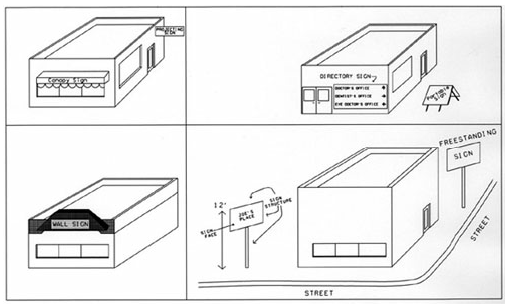
Figure I: Illustrations of Sign Type
(§ 3.1: 20-3.1, 12-10-80, 7-1-81, 12-16-81, 2-10-82, 6-2-82, 1-1-83, 7-6-83, 11-7-84, 7-17-85, 3-5-86, 1-1-87, 6-10-87, 12-2-87, 7-20-88, 12-7-88, 11-1-89, 6-10-92, 7-8-92, 9-15-93, 8-10-94, 10-11-95, 11-15-95, 10-9-96, 12-10-97; § 18-3.1, Ord. 98-A(1), 8-5-98; Ord. 01-18(6), 10-3-01; Ord. 01-18(9), 10-17-01; Ord. 02-18(2), 2-6-02; Ord. 02-18(5), 7-3-02; Ord. 02-18(7), 10-9-02; Ord. 03-18(1), 2-5-03; Ord. 03-18(2), 3-19-03; Ord. 04-18(2), 10-13-04; 05-18(2), 2-2-05; Ord. 05-18(7), 6-8-05; Ord. 05-18(8), 7-13-05; Ord. 06-18(2), 12-13-06; Ord. 07-18(1), 7-11-07; Ord. 07-18(2), 10-3-07; Ord. 08-18(3), 6-11-08; Ord. 08-18(4), 6-11-08; Ord. 08-18(6), 11-12-08; Ord. 08-18(7), 11-12-08; Ord. 09-18(3), 7-1-09; Ord. 09-18(5), 7-1-09; 09-18(8), 8-5-09; Ord. 09-18(9), 10-14-09; Ord. 09-18(10), 12-2-09; Ord. 09-18(11), 12-10-09; Ord. 10-18(3), 5-5-10; Ord. 10-18(4), 5-5-10; Ord. 10-18(5), 5-12-10; Ord. 11-18(1), 1-12-11; Ord. 11-18(5), 6-1-11; Ord. 11-18(6), 6-1-11; Ord. 12-18(3), 6-6-12; Ord. 12-18(4), 7-11-12; Ord. 12-18(6), 10-3-12, effective 1-1-13; Ord. 12-18(7), 12-5-12, effective 4-1-13; Ord. 13-18(1), 4-3-13; Ord. 13-18(2), 4-3-13; Ord. 13-18(3), 5-8-13; Ord. 13-18(5), 9-11-13; Ord. 13-18(6), 11-13-13, effective 1-1-14; Ord. 13-18(7), 12-4-13, effective 1-1-14; Ord. 14-18(2), 3-5-14; Ord. 14-18(4), 11-12-14; Ord. 15-18(1), 2-11-15; Ord. 15-18(2), 4-8-15; Ord. 15-18(4), 6-3-15; Ord. 15-18(5), 7-8-15; Ord. 15-18(10), 12-9-15; Ord. 16-18(1), 3-2-16; Ord. 16-18(7), 12-14-16; Ord. 17-18(1), 1-18-17; Ord. 17-18(2), 6-14-17; Ord. 17-18(4), 8-9-17; Ord. 17-18(5), 10-11-17; Ord. 18-18(1), 1-10-18; Ord. 18-18(4), 10-3-18; Ord. 19-18(3), 6-5-19) (§ 4.15.03: 12-10-80; 7-8-92, § 4.15.03, Ord. 01-18(3), 5-9-01; Ord. 05-18(4), 3-16-05; Ord. 10-18(1), 1-13-10; Ord. 10-18(3), 5-5-10; Ord. 10-18(5), 5-12-10; Ord. 11-18(1), 1-12-11; Ord. 12-18(2), 3-14-12; Ord. 14-18(3), 6-4-14; Ord. 15-18(3), 5-6-15; § 4.15.3; Ord. 15-18(11), 12-9-15; Ord. 17-18(4), 8-9-17) (§ 4.17.3: Ord. 98-18(1), 8-12-98; Ord. 01-18(8), 10-17-01; Ord. 17-18(5), 10-11-17) (§ 4.18.2: Ord. 00-18(3), 6-14-00; Ord. 13-18(4), 9-4-13) (§ 10.3.3.1: § 20-10.3.3.1, 11-8-89; § 18-10.3.3.1, Ord. 98-A(1), 8-5-98; Ord. 01-18(6), 10-3-01) (§ 30.2.4: § 30.2.4, 12-10-80) (§ 30.3.5: § 30.3.02.1 (part), 12-10-80; 6-10-87; Ord. 05-18(1), 1-5-05, effective 2-5-05; § 30.3.5; Ord. 14-18(1), 3-5-14; Ord. 17-18(4), 8-9-17); § 3.1, Ord. 19-18(3), 6-5-19; Ord. 19-18(6), 8-7-19; Ord. 20-18(2), 9-2-20; Ord. 20-18(3), 9-16-20; Ord. 21-18(3), 6-2-21; Ord. 22-18(2), 4-6-22; Ord. 22-18(1), 8-3-22; Ord. 23-18(3), 12-6-23; Ord. 24-A(1), 1-10-24, effective 7-1-24; Ord. 24-18(3), 9-4-24; Ord. 25-18(1), 4-2-25; Ord. 24-18(1), 9-17-24; Ord. 25-18(2), 7-16-2025; Ord. 26-18(1), 6-17-26, effective 9-1-26)
State Law reference— Va. Code § 15.2-2286(A)(4).
Sec. 3.2 - Rules of construction; general.
This chapter protects paramount public interests and shall be liberally construed to effectuate its several purposes. In addition to the rules of construction set forth in Albemarle County Code § 1-102, the following rules of construction apply to the construction of this chapter, unless the application would be contrary to the purposes of this chapter or the context clearly indicates otherwise:
A.
All references to any statute, regulation, guideline, handbook, manual, or standard are to that statute, regulation, guideline, manual, handbook, or standard as it exists on June 5, 2019, and includes any amendment thereafter or reissue in a subsequent edition.
B.
The word "current" means the point in time at which a matter is under consideration and shall not mean the date of adoption of the most recent amendment to this chapter.
C.
The word "days" means calendar days except where the regulation refers to "business days."
D.
The word "maintain" or "maintenance" also includes repair, replace and reconstruct.
E.
The word "street," when not preceded by either "public" or "private," means either a public street or a private street.
F.
All references to the "director of community development," the "director of planning," the "building official," the "county engineer," and the "zoning administrator" include his or her designees.
G.
All references to the "owner" include, in the appropriate context, the applicant or the permittee.
H.
All distances and areas shall be measured in a horizontal plane unless otherwise expressly provided.
I.
All provisions requiring that improvements be designed or constructed to prescribed standards, or otherwise comply with delineated standards, refer to the minimum standard and nothing in this chapter shall prohibit an improvement from exceeding the standard.
J.
Any word or phrase used in this chapter that is not defined in section 3.1 shall be defined as it is defined in Virginia Code § 15.2-2201. If the word or phrase also is not defined in Virginia Code § 15.2-2201, the meaning of the word or phrase shall be defined as it is in other chapters of this Code if the word or phrase is used in the same context, and if it is not defined therein, by resort to other sources determined to be appropriate.
(Ord. 19-18(3), 6-5-19)
State Law reference— Va. Code § 15.2-2286(A)(4).
Sec. 3.3 - Rules of construction; district regulations.
The district regulations set forth in sections 10 through 30.7 shall be applied as follows:
A.
Inclusive. The primary uses permitted in any zoning district are only those expressly delineated in the district regulations as permitted uses by right or by special use permit. The express identification in the district regulations of prohibited uses does not imply that any use not expressly prohibited is permitted.
B.
Requirements or minimum or maximum. The requirements of the district regulations in this chapter are the minimum or maximum requirements, as applicable.
C.
Uniform application. The requirements of the district regulations shall be applied uniformly for each class of use or structure throughout each district.
D.
Uses and structures may be established only in compliance with applicable regulations. Each primary or accessory use or structure may be established only in compliance with all applicable district regulations and with all other applicable regulations of this chapter. If the use requires a license, permit or other approval from the state or federal government, the use may not be occupied or begin operations without the required approval.
E.
Conflicts. Whenever provisions within this chapter conflict with any local, state or federal statute or regulation with respect to requirements or standards, the most severe or stringent requirement or standard shall prevail.
F.
Proffers. Any proffer heretofore accepted by the Board of Supervisors in accordance with Virginia Code § 15.2-2296et seq., is continued in effect and shall be construed to be a "local regulation" until amended or varied by the Board in accordance with law, regardless of the repeal of any previous zoning ordinance.
(Ord. 19-18(3), 6-5-19)
State Law reference— Va. Code § 15.2-2282, 15.2-2286(A)(4).
Sec. 2.1.1 - Use, occupancy and construction.
Each use, building and structure, whether primary or accessory, shall hereafter be established only in compliance with all applicable regulations of the zoning district upon which the particular use, building or structure is located, except for nonconforming uses and structures as provided in this chapter.
(Amended 10-9-02)
Sec. 2.1.2 - Height, bulk, density, lot coverage, yards and open spaces.
No building or other structure shall hereafter be erected or altered:
a.
To exceed the height or bulk;
b.
To accommodate or house a greater number of buildings, families or to have greater floor area;
c.
To occupy a greater percentage of lot area;
d.
To have narrower or smaller rear yards, front yards, side yards or other open areas than herein required; or in any other manner contrary to the provisions of this ordinance.
Sec. 2.1.3 - Required yard, open space; area, parking or loading space for one structure, or use, not to be used to meet requirements for another.
No part of a yard, or other open space, area, or off-street parking or loading space required about or in connection with any building for the purpose of complying with this ordinance shall be included as part of a yard, open space, area or off-street parking or loading space similarly required for any other building.
Sec. 2.1.4 - Reduction of lots below minimum prohibited.
The size, frontage and width of any lot of record existing on the effective date of this chapter shall not be reduced below the minimum requirements of the zoning district in which the lot is located and section 4 of this chapter except as the result of the dedication of land to public use or the exercise of eminent domain by a public entity. Any lot created after the effective date of this chapter shall satisfy at least the minimum requirements of this chapter, except for lots created for use by a public entity to the extent that the public use may be justifiable under the power of eminent domain.
(Amended 9-9-92, 12-2-09)
Sec. 2.1.5 - Reduction of yards below minimum.
No yard existing at the time of passage of this ordinance shall be reduced in dimension below the minimum requirements set forth herein, unless such yard requirements reduce the buildable area to unreasonable dimensions. In such cases, the board of zoning appeals shall determine the minimum requirements consistent with provision of adequate light and air, prevention of loss of life, health, or property from fire or other dangers, and prevention of danger in travel. Yards created after the effective date of this ordinance shall meet at least the minimum requirements established by this ordinance. This provision shall not apply to reduction of yard dimension as may result from dedication to or exercise of eminent domain by a public agency.
(Amended 9-9-92)
Sec. 2.1.6 - Reduction of required off-street parking or loading space.
No existing off-street parking or loading space, and no off-street parking or loading space hereafter provided, which meets all or part of the requirements for off-street parking or loading space set forth in these regulations, shall be reduced or eliminated so that resulting reduction results in area not meeting requirements or standards contained herein. Reductions may be permitted where spaces are no longer required by these regulations or alternative spaces meeting the requirements of these regulations are provided.
Sec. 2.1.7 - Creation and use of special lots.
A special lot shall not be subject to the requirements of this chapter for the creation of a lot including, but not limited to, the building site requirements in section 4.2.1, the frontage and lot width requirements in section 4.6.1, the area and bulk regulations of the zoning district in which the special lot is located and, for special lots in the Rural Areas zoning district, the requirement in section 10.3 that each lot less than 21 acres in size have a development right. A special lot shall be subject to the requirements of this chapter pertaining to the use of the special lot and the location of a building, structure, and improvements on a special lot.
(Added 6-1-11)
Sec. 2.2.1 - Density.
Unless precluded by other applicable regulations, the maximum number of lots within a cluster development shall be determined by multiplying the number of acres in the parcel by the permitted density within the applicable zoning district.
Sec. 2.2.2 - Minimum number of lots.
Cluster developments shall consist of at least three lots for dwelling units, except that the commission may permit a lesser number of such lots if they form a logical extension and/or addition to an existing cluster development.
Sec. 2.2.3 - Minimum open space required.
Except as otherwise provided in the PRD and PUD districts, a minimum of 25 percent of the total land area of the cluster development shall be in common open space, subject to section 4.7, regulations governing open space.
(Amended 7-17-85)
Sec. 2.4.1 - Application of bonus factors.
Bonus factors will be applied to the gross density-standard level in accordance with the regulations of the applicable district, provided that:
(a)
the resulting density may not exceed the recommended density shown in the comprehensive plan, provided that if no density range or maximum density is shown in the comprehensive plan, no bonus factor may be applied; and
(b)
the cumulative effect of all density factors may not exceed 50 percent.
Unless otherwise specifically provided, bonus factors will not be permitted for any improvement or design feature required by this ordinance, Chapter 14 of the Code of Albemarle, or any other applicable law or regulation. Where permitted, bonus factors will be applied in toto only.
(§ 20-2.4.1, 12-10-80; 8-14-85; § 18-2.4.1, Ord. 98-A(1), 8-5-98; Ord. 22-18(1), 1-12-22; Ord. 23-18(2), 11-15-23)
Sec. 2.4.2 - Procedures—Generally.
Bonus factors may be applied at the time of subdivision or site development plan approval, whichever is applicable. The applicant must submit preliminary plats or site development plans which must be of sufficient detail to permit preliminary determination of probable bonus factors by the staff.
Following the approval of a plan or plat which utilizes a bonus provision, such density increase will be reflected and retained in official County records.
(§ 20-2.4.2, 12-10-80; 8-14-85; § 18-2.4.2, Ord. 98-A(1), 8-5-98; Ord. 22-18(1), 1-12-22)
Sec. 2.4.3 - Environmental standards bonus factors.
a.
Environmental standards bonus factors apply to the following zoning districts:
(Ord. 22-18(1), 1-12-22)
Sec. 2.4.4 - Development standards bonus factors.
a.
Development standards bonus factors apply to the following zoning districts:
(Ord. 22-18(1), 1-12-22)
Sec. 2.4.5 - Affordable housing bonus factors.
a.
Affordable housing bonus factors apply to the following zoning districts, subject to the applicable standards of subsection b:
b.
Affordable housing standards.
1.
The initial sale price for sale units or the rental rate for a period of at least ten years for rental units must qualify as affordable housing under either the Virginia Housing Development Authority, USDA Rural Development program, or Housing and Urban Development housing choice voucher program.
2.
If rental units, the developer must enter into an agreement with the County of Albemarle restricting the rental rates of the affordable units for a period of at least ten years or until the units are sold as affordable units, whichever comes first.
3.
If sale units, the developer must provide the County of Albemarle with confirmation of the initial sale price for the affordable units prior to the issuance of building permits for the bonus units.
4.
Manufactured homes for rent in an approved manufactured home park may be considered rental units under this section provided they qualify as affordable housing under the Housing and Urban Development housing choice voucher program.
5.
Manufactured home lots for rent in an approved manufactured home park may qualify for this bonus provided the developer enters into an agreement with the County of Albemarle that the lots will be available for rent to manufactured home owners for a period of at least ten years.
6.
Manufactured home lots for sale in an approved manufactured home subdivision may qualify for this bonus provided the developer restricts the use of the lots to manufactured homes or other affordable housing for a period of at least ten years.
7.
The decision to extend the periods beyond the ten-year minimum provided in subsections (b)(1), (b)(2), (b)(5), and (b)(6) will be at the sole discretion of the developer.
8.
The occupancy of the affordable units must be restricted to those households with incomes at or below 80 percent of the area median income for for-sale units and at or below 60 percent of the area median income for rental units. Prior to issuance of the first certificate of occupancy for a building providing affordable rental units, the developer must enter into a rental rate agreement with the County, that delineates the terms and conditions pertaining to rental rates, occupancy and reporting during the minimum ten-year period.
(Ord. 22-18(1), 1-12-22)

