
Albemarle County Unincorporated
City Zoning Code
City Zoning Code
ARTICLE II
BASIC REGULATIONS
Sec. 4.0 - General regulations.
Except as otherwise specifically provided, the following general regulations shall apply.
Sec. 4.1 - Water supplies and sewer systems.
The water supply and sewer system serving either a development or any individual lot shall comply with the following:
A.
Public water supply and public sewer system within the services areas of the Albemarle County Service Authority. Within the services areas of the Albemarle County Service Authority (the "service areas"), each development and each lot shall be served by the public water supply and the public sewer system. Within the service areas, no building permit shall be issued for any structure if its use requires increased water consumption and/or sewage disposal, unless the structure will be connected to the public water supply and/or the public sewer system. Connection to the public water supply and/or the public sewer system is not required in the following circumstances:
1.
Existing structure damaged. When an existing structure is damaged as a result of factors beyond the control of its owner and/or occupant, the structure may be repaired or reconstructed provided that the repair or reconstruction is commenced within 12 months and completed within 24 months after the date of the damage, and further provided that the structure is not repaired or reconstructed so as to increase the number of water supply or sewage fixtures.
2.
Cost of connection to public water supply or public sewer system exceeds cost of onsite sewage system. When the director of community development, in consultation with the Albemarle County Service Authority finds that the cost of connecting the proposed development or lot to the public water supply and/or the public sewer system, exclusive of connection fees, exceeds the cost of installing an on-site well and/or an onsite sewage system.
3.
Capacity of public water supply or public sewer system is inadequate. When the director of community development, in consultation with the Albemarle County Service Authority finds that the capacity of the public water supply and/or the public sewer system is inadequate to serve the proposed development or lot.
4.
Nonconforming use or structure. The structure is used for a nonconforming use and satisfies the requirements of section 6.2(C) or the structure is nonconforming and satisfies the requirements of section 6.3.
B.
Water supply and sewer system when development or lot not connected to the public water supply and/or the public sewer system. When a development or a lot is not or will not be connected to the public water supply and/or the public sewer system, the following shall apply, except when an existing structure is damaged as provided in section 4.1(a)(1):
1.
Lots served by an alternative onsite sewage system. On any lot served by an alternative onsite sewage system, no building permit shall be issued for any structure, the use of which requires sewage disposal, without the Virginia Department of Health's approval of the location and area for the alternative onsite sewage system.
2.
Lots served by a conventional onsite sewage system. On any lot served by a conventional onsite sewage system, no building permit shall be issued for any structure, the use of which requires sewage disposal, without the Virginia Department of Health's approval of the location and area for both an original and a replacement subsurface drainfield that is adequate to serve the use. For residential uses, each subsurface drainfield shall have suitable soils of adequate area to accommodate sewage disposal from a three bedroom dwelling as determined by the current regulations of the Virginia Department of Health.
(§ 20-4.1, 12-10-80; 6-3-81; § 18-4.1, Ord. 98-A(1), 8-5-98; § 20-4.1.6, 12-10-80, 11-15-89; § 18-4.1.6, Ord. 98-A(1), 8-5-98; § 18-20.4.1, Ord. 12-18(4), 7-11-12)
Sec. 4.2 - Critical slopes and water protection.
The provisions in this section through section 4.2.5 implement the comprehensive plan by protecting and conserving steep hillsides together with public drinking water supplies and flood plain areas because of the increased potential for soil erosion, sedimentation, water pollution and sewage disposal problems associated with the disturbance of critical slopes. The disturbance of critical slopes may result in: rapid and/or large-scale movement of soil and rock; excessive stormwater run-off; siltation of natural and man-made bodies of water; loss of aesthetic resource; and in the event of onsite sewage system failure, a greater travel distance of septic effluent, all of which constitute potential dangers to the public health, safety and/or welfare. The regulations in sections 4.2.1, 4.2.2, 4.2.3 and 4.2.4 are intended to direct building and onsite sewage system locations to terrain more suitable to development and to discourage development on critical slopes, and to supplement other regulations regarding the protection of public water supplies and encroachment of development into flood plains.
Each request to waive or modify any requirement of sections 4.2.1, 4.2.2, 4.2.3 or 4.2.4 under section 4.2.5 shall be by special exception under section 33.5.
(§ 20-4.2, 12-10-80; 11-15-89; § 18-4.2, Ord. 98-A(1), 8-5-98; Ord. 12-18(4), 7-11-12; Ord. 21-18(5), 12-1-21; Ord. 26-18(1), 6-17-26, effective 9-1-26)
Editor's note— Ord. 26-18(1), adopted June 17, 2026, effective Sept. 1, 2026, amended the title of § 4.2 to read as herein set out. The former § 4.2 title pertained to critical slopes.
Sec. 4.3 - Tree cutting.
A.
In districts other than the RA, cutting of trees shall be limited to dead trees and trees of less than six inches in diameter measured at six inches above ground; except that trees may be cleared as an incident to the preparation of land for the establishment of some other use permitted in the district, provided that:
1.
Such use is exempt from the provisions of section 32 hereof; or
2.
A site development plan for such permitted use shall have been approved in accordance with the provisions of section 32 of this ordinance;
B.
The following regulation shall apply in all zoning districts:
1.
Unless otherwise specifically approved to accommodate development pursuant to section 32 hereof, no tree within 15 feet of any perennial stream or water supply impoundment may be cut, except for dead trees or trees of less than six inches in diameter measured at six inches above ground; or in order to provide access for livestock or for another permitted use;
C.
The foregoing notwithstanding, the zoning administrator may authorize cutting of trees which:
1.
Are deemed by the zoning administrator to pose a clearly demonstrable danger to buildings or other structures or otherwise a danger to public safety; or
2.
Have been specifically recommended for removal following field investigation by the Virginia Department of Forestry as being virulent or pestilent to other trees in the vicinity;
D.
For the purpose of this ordinance, the term "tree cutting" shall be deemed to include sawing, burning, bulldozing, poisoning, girdling or any other activity which could reasonably be anticipated to result in the death of a tree. Fill and waste areas shall not be deemed a permitted use but preparatory activity to establish a permitted use. (Added 9-9-92)
Sec. 4.4 - Visibility clearance at intersections.
For protection against traffic hazards, no material impediment to visibility shall be placed, allowed to grow, erected or maintained on any parcel so as to restrict sight distance at any intersection of any public street, private road or driveway, or at the intersection of any alley and public street or private road, below the minimum required by the Virginia Department of Transportation for such intersection.
(§ 20-4.4, 12-10-80, 9-9-92; § 18-4.4, Ord. 98-A(1), 8-5-98; Ord. 02-18(2), 2-6-02)
Sec. 4.7 - Open space.
Open space shall be established, used, designed and maintained as follows:
a.
Intent. Open space is intended to provide active and passive recreation, protect areas sensitive to development, buffer dissimilar uses from one another and preserve agricultural activities. The commission and the board of supervisors shall consider the establishment, use, design and maintenance of open space in their review and approval of zoning map amendments. The subdivision agent and the site plan agent (hereinafter, collectively referred to as the "agent") shall apply the following principles when reviewing open space provided on a subdivision plat or site plan.
b.
Uses permitted. Open space shall be maintained in a natural state and shall not be developed with any improvements, provided that the agent may authorize the open space to be used and improved for the following purposes: (i) agriculture, forestry and fisheries, including appropriate structures; (ii) game preserves, wildlife sanctuaries and similar uses; (iii) noncommercial recreational uses and structures; (iv) public utilities; (v) individual wells; (vi) in a cluster development, onsite sewage systems if the Department of Health determines that there are no suitable locations for a subsurface drainfield on a development lot; and (vii) stormwater management facilities and flood control devices.
c.
Design. Open space shall be designed as follows:
1.
Lands that may be required. The agent may require that open space include: (i) areas deemed inappropriate for or prohibited to development including, but not limited to, land in the 100-year flood plain and significant drainage swales, land in slopes of 25 percent or greater, public utility easements for transmission lines, stormwater management facilities and flood control devices, and lands having permanent or seasonally high water tables; (ii) areas to satisfy section 4.16, and (iii) areas to provide reasonable buffering between dissimilar uses within the development and between the development and adjoining properties.
2.
Redesign during review. The agent may require the redesign of a proposed development to accommodate open space areas as may be required under this section 4.7, provided that the redesign shall not reduce the number of dwelling units permitted under the applicable zoning district.
3.
Limitation on certain elements. If open space is required by this chapter, not more than 80 percent of the minimum required open space shall consist of the following: (i) land located within the 100-year flood plain; (ii) land subject to occasional, common or frequent flooding as defined in Table 16 Soil and Water Features of the United States Department of Agriculture Soil Conservation Service, Soil Survey of Albemarle County, Virginia, August, 1985; (iii) critical or preserved slopes; and (iv) land devoted to stormwater management facilities or flood control devices, except where the facility or feature is incorporated into a permanent pond, lake or other water feature deemed by the agent to constitute a desirable open space amenity.
d.
Ownership of open space. Open space may be privately owned or dedicated to public use. Open space in private ownership shall be subject to a legal instrument ensuring the maintenance and preservation of the open space that is approved by the agent and the county attorney in conjunction with the approval of the subdivision plat or site plan. Open space dedicated to public use shall be dedicated to the county in the manner provided by law. Open space dedicated to public use shall count toward the minimum required open space.
(§ 20-4.7, 12-10-80, § 4.7, 4.7.1, 4.7.2, 4.7.3, 4.7.4; 6-3-81, 11-15-89; § 18-4.7, Ord. 98-A(1), 8-5-98; Ord. 09-18(1), 1-14-09, § 20-4.1.7, 6-3-81, § 18-4.1.7, Ord. 98-A(1), 8-5-98; § 18-4.7, Ord. 12-18(4), 7-11-12; Ord. 14-18(2), 3-5-14)
State Law reference— Va. Code §§ 15.2-2280, 15.2-2286.
Sec. 4.9 - Handicapped access.
Notwithstanding any other regulation of this chapter, ramps or other modifications to a lot or structure, which are the minimum required under the Americans with Disabilities Act to serve handicapped persons, are authorized in all zoning districts. (Added 9-9-92; Amended 10-3-01)
(§ 4.9, 9-9-92; Ord. 01-18(6), 10-3-01)
Sec. 4.11 - Uses and structures permitted in required yards.
The following uses and structures shall be permitted in required yards, subject to the limitations established.
Sec. 4.12 - Parking, stacking and loading.
(New sections 4.12—4.12.19 adopted 2-5-03; old sections 4.12—4.13.3 repealed at the same time pursuant to Ord. 03-18(1))
Sec. 4.13 - (Repealed 2-5-03)
(Old sections 4.12 and 4.13 repealed on 2-5-03 when new sections 4.12—4.12.19 adopted pursuant to Ord. 03-18(1))
Sec. 4.14 - Performance standards.
Each use of an industrial character as determined by the zoning administrator and each use to which section 4.14 is expressly applicable to that use (referred to collectively in sections 4.14.1 through 4.14.5 as a "use of an industrial character") shall be subject to the performance standards in this section through section 4.14.5.
(§ 4.14, 12-10-80; Ord. 11-18(8), 8-3-11)
Sec. 4.16 - Recreation regulations.
Developed recreational area(s) shall be provided for every development of 30 units or more equal to or exceeding four dwelling units per acre, except for single-family and two-family dwellings developed on conventional lots. (Added 3-5-86)
Sec. 4.17 - Outdoor lighting.
Outdoor lighting regulations are set forth in sections 4.17.1, 4.17.2, 4.17.3, 4.17.4, 4.17.5 and 4.17.6. These regulations are in addition to the performance standard pertaining to glare set forth in section 4.14.3 of this chapter.
(Ord. 98-18(1), 8-12-98)
Sec. 4.18 - Noise.
The board of supervisors hereby finds and declares that noise is a serious hazard to the public health, safety, welfare, and quality of life, and that the inhabitants of the county and adjoining localities have a right to and should be free from an environment of noise. Therefore, it is the policy of the county to regulate noise as provided in this section 4.18.
(Ord. 00-18(3), 6-14-00)
State Law reference— Va. Code § 15.2-2280.
Sec. 4.19 - Setbacks and stepbacks in residential districts.
The following shall apply within the R-1, R-2, R-4, R-6, R-10, R-15, PRD, and PUD districts:
1.
Whether a site is an infill or non-infill development, and the minimum and maximum setback, will be determined by the zoning administrator as an official determination provided to the owner.
2.
Any minimum setback and any minimum building separation for a side yard, may be reduced by special exception.
3.
The maximum front setback for a non-infill development is the depth necessary to avoid existing utilities, significant existing vegetation, steep slopes, perennial and intermittent streams, riparian buffers, public spaces and public plazas shown as such on an approved site plan or subdivision plat, to satisfy a condition of a certificate of appropriateness, and in circumstances where there are multiple buildings on the same lot and prevailing development patterns. On any parcel with multiple main buildings, at least one main building must meet the maximum setback.
4.
The maximum front setback for a non-infill development may be increased by special exception to accommodate low impact design, unique parking or circulation plans, or a unique target market design.
5.
The minimum 15-foot stepback applies to all buildings on the property and may be reduced by special exception.
6.
Notwithstanding section 4.6.3, the front setbacks in the districts subject to this section shall be measured from the right-of-way or the exterior edge of the sidewalk if the sidewalk is outside of the right-of-way.
7.
On any site subject to proffered conditions accepted in conjunction with a zoning map amendment establishing minimum or maximum setbacks or stepbacks, the proffered setbacks or stepbacks shall apply.
Figures
Figures 1 through 4 are for illustration purposes only. If there is a conflict or inconsistency between a regulation in section 4.19 to which a Figure pertains and the Figure itself, the regulation is controlling. In addition, Figures 1 through 4 merely illustrate specific requirements and do not show all applicable requirements of the applicable district regulations.
Figure 1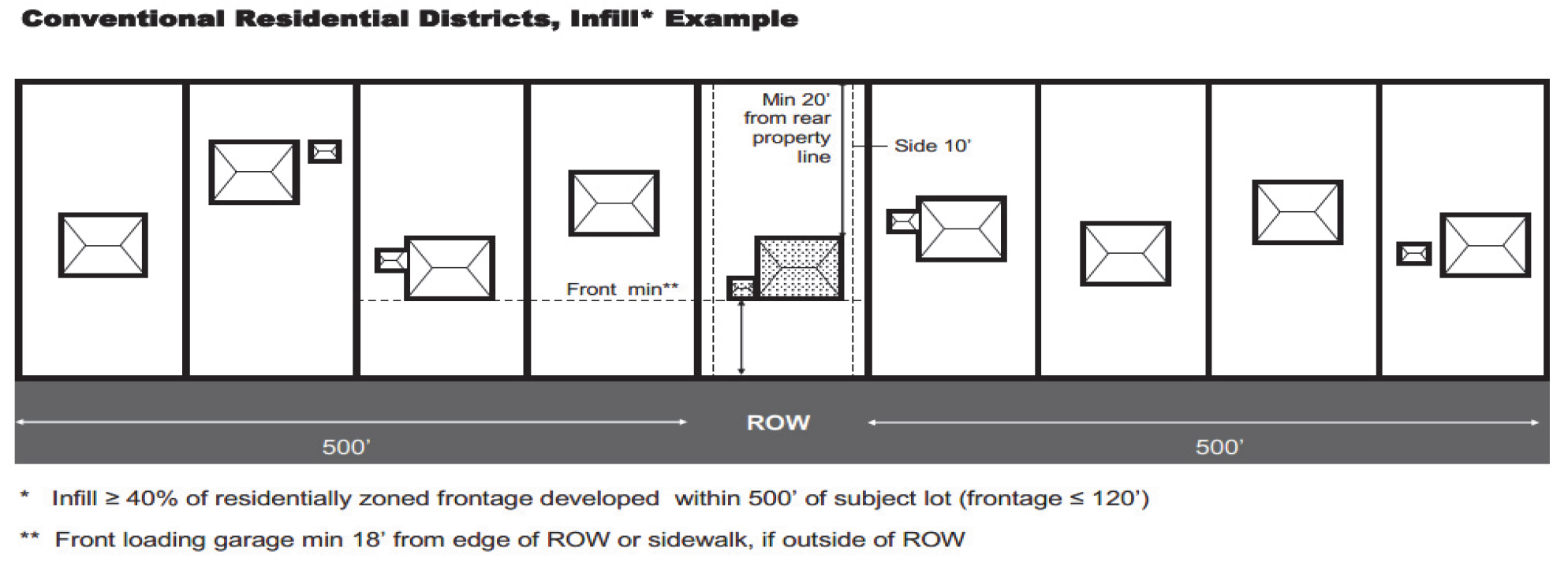
Figure 2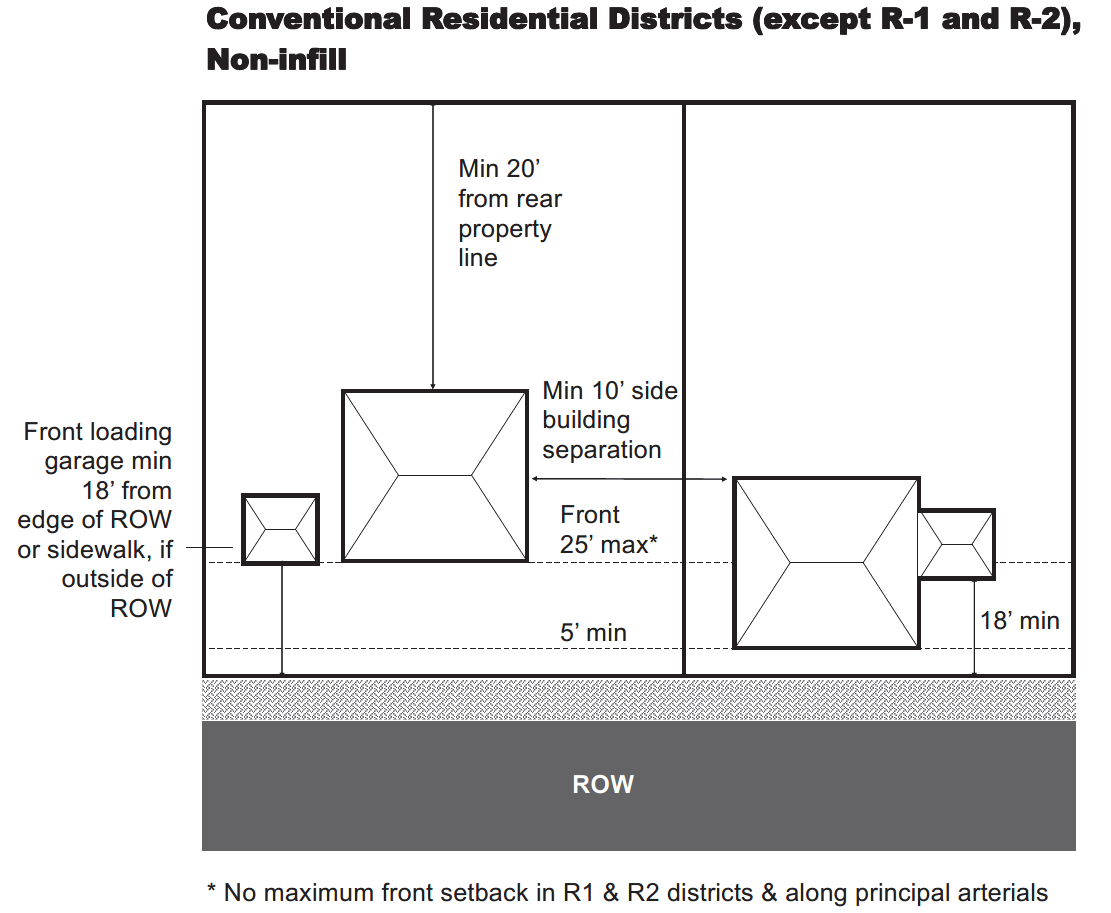
Figure 3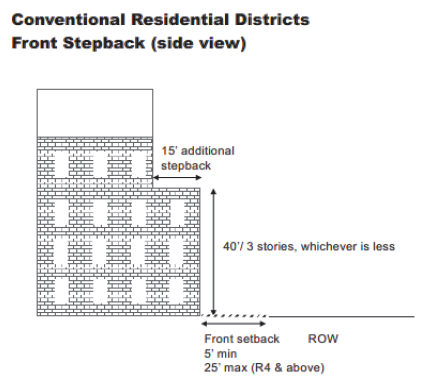
Figure 4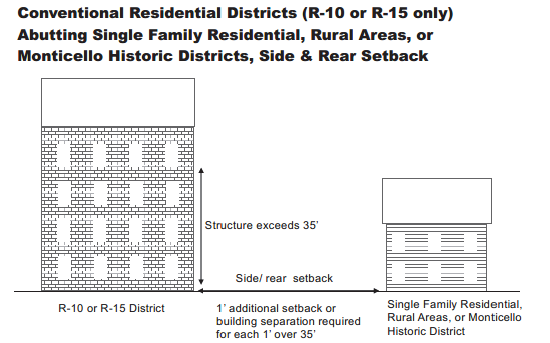
(Ord. 15-18(4), 6-3-15; Ord. 16-18(1), 3-2-16; Ord. 17-18(4), 8-9-17; Ord. 19-18(5), 7-17-19; Ord. 26-18(1), 6-17-26, effective 9-1-26)
State Law reference— Va. Code § 15.2-2280.
Sec. 4.20 - Setbacks and stepbacks in conventional commercial and industrial districts.
Setbacks and stepbacks shall be provided as follows:
A.
Conventional commercial districts. The following shall apply within the C-1, CO, and HC districts:
1.
The maximum front setback is the depth necessary to avoid existing utilities, significant existing vegetation, steep slopes, perennial and intermittent streams, riparian buffers, public spaces and public plazas shown as such on an approved site plan or subdivision plat, to satisfy a condition of a certificate of appropriateness, and in circumstances where there are multiple buildings on the same lot and prevailing development patterns. On any parcel with multiple main buildings, at least one main building must meet the maximum setback.
2.
The maximum front setback may be increased by special exception to accommodate low impact design, unique parking or circulation plans, or a unique target market design.
3.
Any minimum setback may be reduced by special exception.
4.
The minimum 15-foot stepback may be reduced by special exception.
5.
Notwithstanding section 4.6.3, the front setbacks in the districts subject to this subsection shall be measured from the right-of-way or the exterior edge of the sidewalk if the sidewalk is outside of the right-of-way.
6.
On any site subject to proffered conditions accepted in conjunction with a zoning map amendment establishing minimum or maximum setbacks or stepbacks, the proffered setbacks or stepbacks shall apply.
B.
Conventional industrial districts. The following shall apply within the LI and HI districts:
1.
Any maximum front setback may be increased by special exception.
2.
Any minimum setback may be reduced by special exception.
3.
The minimum 15-foot stepback may be reduced by special exception.
4.
Notwithstanding section 4.6.3, the front setbacks in the districts subject to this subsection shall be measured from the right-of-way or the exterior edge of the sidewalk if the sidewalk is outside of the right-of-way.
5.
On any site subject to proffered conditions accepted in conjunction with a zoning map amendment establishing minimum or maximum setbacks or stepbacks, the proffered setbacks or stepbacks shall apply.
Figures
Figures 1 through 6 are for illustration purposes only. If there is a conflict or inconsistency between a regulation in section 4.20 to which a Figure pertains and the Figure itself, the regulation is controlling. In addition, Figures 1 through 6 merely illustrate specific requirements and do not show all applicable requirements of the applicable district regulations.
Figure 1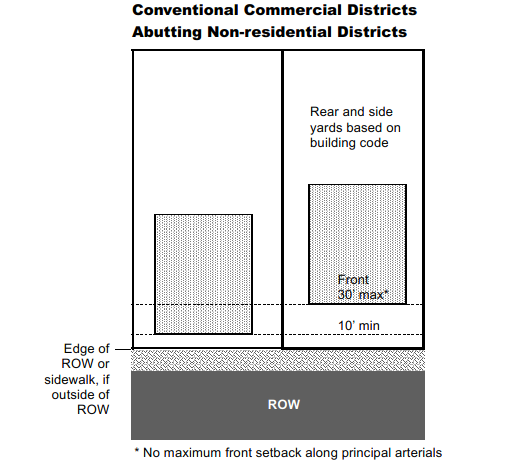
Figure 2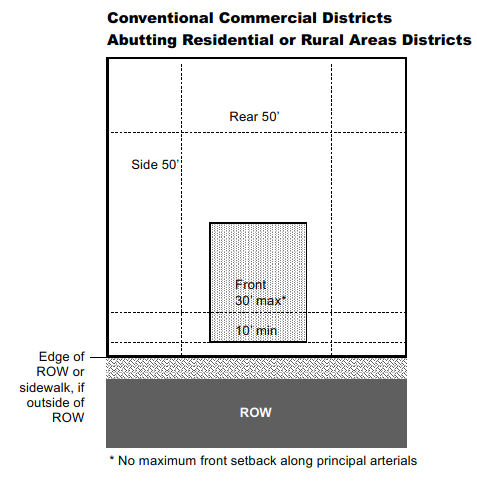
Figure 3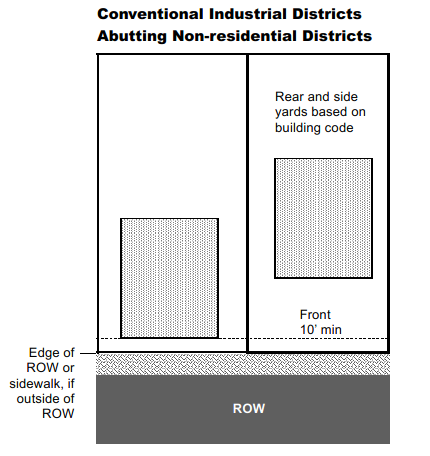
Figure 4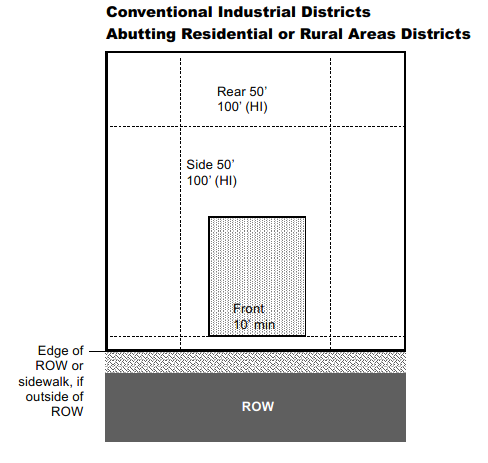
Figure 5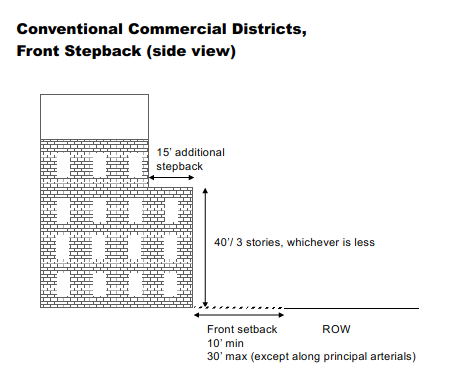
Figure 6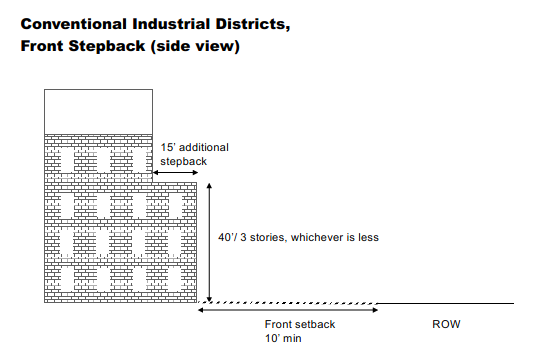
(Ord. 15-18(4), 6-3-15; Ord. 16-18(1), 3-2-16; Ord. 17-18(4), 8-9-17; Ord. 26-18(1), 6-17-26, effective 9-1-26)
State Law reference— Va. Code § 15.2-2280.
4.21 - Small cell facilities.
Small cell facilities are permitted by right in all zoning districts, provided that their installation and operation is consistent with Virginia Code § 15.2-2316.3. The wireless services provider or wireless infrastructure provider must provide notice of any small cell installation to the Zoning Administrator, as provided in Virginia Code § 15.2-2316.4.
(Ord. 24-18(3), 9-4-24)
4.22 - Accessory solar energy facility and accessory battery energy storage facility.
Accessory solar energy facilities and accessory battery energy storage facilities are permitted by right in all zoning districts, provided that they comply with section 5.1.66.
(Ord. 25-18(2), 7-16-2025)
Sec. 4.2.1 - Building site required.
No lot other than a special lot may have less than one building site, subject to the following:
A.
Composition of building site. A building site must be composed of a contiguous area of land and may not contain any area of land that is: (i) in critical or preserved slopes; (ii) within the Flood Hazard Overlay District; (iii) within any riparian buffer subject to Section 4.23; or (iv) under water during normal hydrological conditions.
B.
Special exception. Notwithstanding section 4.2.5, any requirement of section 4.2.1(a) may be waived or modified by special exception under section 33.5 upon the board of supervisors' consideration of whether the parcel has an unusual size, topography, shape, location or other unusual physical condition.
(§ 20-4.2.1, 12-10-80; 11-11-87; 9-9-92; § 18-4.2.1, Ord. 98-A(1), 8-5-98; Ord. 11-18(6), 6-1-11; Ord. 12-18(4), 7-11-12; Ord. 14-18(2), 3-5-14; Ord. 26-18(1), 6-17-26, effective 9-1-26)
State Law reference— Va. Code §§ 15.2-2280, 15.2-2286(A)(3)
Sec. 4.2.2 - Building site area and dimensions.
Each building site shall be subject to the following minimum area and dimension requirements:
A.
Uses not served by a public or central sewage system. Building sites for uses not served by a public or central sewage system shall be subject to the following:
1.
Dwelling units. Each building site for a dwelling unit shall have an area of 30,000 square feet or greater and shall be of such dimensions that no one dimension exceeds any other by a ratio of more than five to one as described by a rectangle inscribed within the building site. The building site shall have adequate area for locating two subsurface drainfields approved by the Virginia Department of Health if the lot will be served by a conventional onsite sewage system.
2.
Development subject to section 32 of this chapter. Each building site in a development subject to section 32 of this chapter shall have an area of 30,000 square feet or greater and shall be of such dimensions that no one dimension exceeds any other by a ratio of more than five to one as described by a rectangle inscribed within the building site. The building site shall have adequate area for all buildings and structures, two subsurface drainfields approved by the Virginia Department of Health if the lot will be served by a conventional onsite sewage system, parking and loading areas, storage yards and other improvements, and all earth disturbing activity related to the improvements.
3.
Special exception. Notwithstanding section 4.2.5, the rectangular shape required by subsections (1) and (2) may be waived or modified by special exception under section 33.5 upon the board of supervisors' consideration of the recommendation from the Virginia Department of Health and information provided by the developer showing that: (i) the parcel has an unusual size, topography, shape, location or other unusual physical condition; (ii) no reasonable alternative building site exists; and (iii) modifying or waiving the rectangular shape would result in less degradation of the parcel or adjacent parcels than if those dimensions were adhered to.
B.
Uses served by a central sewage system. Building sites for uses served by a central sewage system shall be demonstrated by the applicant to have adequate area, as follows:
1.
Residential development. Each building site in a residential development shall have adequate area for all dwelling unit(s) together with an area equivalent to the sum of the applicable required yard areas for the applicable zoning district and, if parking is provided in bays, the parking area.
2.
Development subject to section 32 of this chapter. Each building site in a development subject to section 32 of this chapter shall have adequate area for all structures, parking and loading areas, storage yards and other improvements, and all earth disturbing activity related to the improvements.
(§ 20-4.2.2, 12-10-80; §§ 20-4.2.2, 20-4.2.2.1, 11-15-89; §§ 18-4.22, 18-4.2.2.1, Ord. 98-A(1), 8-5-98; Ord. 01-18(7), 10-17-01; Ord. 12-18(4), 7-11-12; Ord. 21-18(5), 12-1-21)
Sec. 4.2.3 - Location of structures and improvements.
Except as otherwise provided in section 4.2.2, this section applies to the location of any structure for which a permit is required under the Uniform Statewide Building Code and to any improvement shown on a site plan pursuant to section 32 of this chapter or to the placement of clean earth fill or inert waste fill.
A.
No structure or improvement shall be located on any lot or parcel in any area other than a building site.
B.
No structure, improvement, land disturbing activity to establish a structure or improvement, or placement of clean earth fill or inert waste fill shall be located on critical or preserved slopes except as otherwise permitted under sections 4.2.5, 4.2.6, 4.3.1 and 30.7.4.
(§ 20-4.2.3, 12-10-80, 11-15-89; § 18-4.2.3, Ord. 98-A(1), 8-5-98; Ord. 01-18(7), 10-17-01; § 20-4.2.3.1, 12-10-80, 11-15-89, § 18-4.2.3.1, Ord. 98-A(1), 8-5-98; § 4.2.3.2, 12-10-80, § 18-4.2.3.2, Ord. 98-A(1), 8-5-98; § 18-4.2.3, Ord. 12-18(4), 7-11-12; Ord. 14-18(2), 3-5-14; Ord. 20-18(3), 9-16-20)
State Law reference— Va. Code § 15.2-2280.
Sec. 4.2.4 - Location of onsite sewage systems.
In the review for and issuance of a permit for the installation of an onsite sewage system, the Virginia Department of Health should be mindful of the intent of section 4.2, and particularly mindful of the intent to discourage onsite sewage systems on slopes of 20 percent or greater. Any onsite sewage system shall be located within a building site.
(§ 20-4.2.4, 12-10-80; 11-1-87; 9-9-92; § 18-4.2.4, Ord. 98-A(1), 8-5-98; Ord. 12-18(4), 7-11-12)
Sec. 4.2.5 - Modification or waiver.
Any requirement of section 4.2.1, 4.2.2, 4.2.3 or 4.2.4 may be modified or waived by special exception of the Board of Supervisors as provided in section 33.5 and herein:
A.
Modification or waiver generally. The Board of Supervisors may modify or waive any requirement as provided in subsection (b), as follows:
1.
Request. A developer or subdivider requesting a modification or waiver shall file a written request in accordance with section 32.3.5 of this chapter and identify and state how the request would satisfy one or more of the findings set forth in subsection 4.2.5(a)(3) . If the request pertains to a modification or waiver of the prohibition of disturbing slopes of 25 percent or greater (hereinafter, "critical slopes"), the request also shall state the reason for the modification or waiver, explaining how the modification or waiver, if granted, would address the rapid and/or large-scale movement of soil and rock, excessive stormwater run-off, siltation of natural and man-made bodies of water, loss of aesthetic resources, and, in the event of septic system failure, a greater travel distance of septic effluent (collectively referred to as the "public health, safety, and welfare factors") that might otherwise result from the disturbance of critical slopes.
2.
Consideration of recommendation; determination by county engineer. In reviewing a request for a modification or waiver, the Board of Supervisors shall consider the recommendation of the agent as to whether any of the findings set forth in subsection 4.2.5(a)(3) can be made by the commission. If the request pertains to a modification or waiver of the prohibition of disturbing critical slopes, the Board of Supervisors shall consider the determination by the county engineer as to whether the developer or subdivider will address each of the public health, safety and welfare factors so that the disturbance of the critical slopes will not pose a threat to the public drinking water supplies and flood plain areas, and that soil erosion, sedimentation, water pollution and septic disposal issues will be mitigated to the satisfaction of the county engineer. The county engineer shall evaluate the potential for soil erosion, sedimentation and water pollution that might result from the disturbance of slopes of 25 percent or greater in accordance with the current provisions of the Virginia Department of Transportation Drainage Manual, the Commonwealth of Virginia Erosion and Sediment Control Handbook and Virginia State Water Control Board best management practices, and where applicable, Chapter 17, Water Protection, of the Code.
3.
Findings. The Board of Supervisors may grant a modification or waiver under this subsection (a) if it finds that the modification or waiver would not be detrimental to the public health, safety or welfare, to the orderly development of the area, or to adjacent properties; would not be contrary to sound engineering practices; and at least one of the following:
a.
Strict application of the requirements of section 4.2 would not forward the purposes of this chapter or otherwise serve the public health, safety or welfare;
b.
Alternatives proposed by the developer or subdivider would satisfy the intent and purposes of section 4.2 to at least an equivalent degree;
c.
Due to the property's unusual size, topography, shape, location or other unusual conditions, excluding the proprietary interest of the developer or subdivider, prohibiting the disturbance of critical slopes would effectively prohibit or unreasonably restrict the use of the property or would result in significant degradation of the property or adjacent properties; or
d.
Granting the modification or waiver would serve a public purpose of greater import than would be served by strict application of the regulations sought to be modified or waived.
4.
Conditions. In granting a modification or waiver, the Board of Supervisors may impose conditions deemed necessary to protect the public health, safety or welfare and to insure that the development will be consistent with the intent and purposes of section 4.2.
B.
Waivers under specified circumstances. The Board of Supervisors may waive the prohibition of disturbing critical slopes on any parcel not within the Rural Areas (RA), Monticello Historic District (MHD) or Village Residential (VR) zoning districts in the following circumstances: (i) the critical slopes were created during the development of the property pursuant to a site plan approved by the county; or (ii) the critical slopes will be disturbed to replace an existing structure located on the critical slopes and the extent of the disturbance is the minimum necessary to replace the existing structure with a new structure whose footprint does not exceed the footprint of the existing structure.
The Board of Supervisors may grant a waiver under this subsection (b) if it finds that:
1.
The property is not identified in the open space plan as one having any protected resources and a field inspection has confirmed that there are no significant or critical features on the property identified for protection in the open space plan;
2.
There is no reasonable alternative that would eliminate or reduce the disturbance of critical slopes;
3.
The developer or subdivider submitted and obtained approval from the program authority of an erosion and sediment control plan, regardless of whether the area disturbed is less than 10,000 square feet; and
4.
The developer or subdivider submitted and obtained approval from the county engineer of a plan that describes how the movement of soil and rock, stormwater runoff, siltation of natural and man-made bodies of water, the loss of aesthetic resources identified in the open space element of the comprehensive plan and, in the event of the failure of a treatment works and subsurface drainfield, a greater travel distance of septic effluent, will be mitigated through design, construction techniques, revegetation, stormwater management and other best management practices.
(§ 20-4.2.5, 12-10-80, 11-15-89; § 18-4.2.5, Ord. 98-A(1), 8-5-98; Ord. 01-18(4), 5-9-01; Ord. 09-18(1), 1-14-09; Ord. 21-18(5), 12-1-21)
Sec. 4.2.6 - Exemptions.
A lot, structure, or improvement may be exempt from the requirements of section 4.2 as provided herein: (Added 10-17-01)
A.
Any structure which was lawfully in existence prior to the effective date of this chapter and which is nonconforming solely on the basis of the requirements of section 4.2, may be expanded, enlarged, extended, modified and/or reconstructed as though such structure were a conforming structure. For the purposes of this section, the term "lawfully in existence" shall also apply to any structure for which a site development plan was approved or a building permit was issued prior to the effective date of this chapter, provided such plan or permit has not expired.
B.
Any lot or parcel of record which was lawfully a lot of record on the effective date of this chapter shall be exempt from the requirements of section 4.2 for the establishment of the first single-family detached dwelling unit on such lot or parcel; provided that section 4.2.3(b) shall apply to such lot or parcel if it contains adequate land area that is not in critical slopes for the location of such structure. For the purposes of this section a manufactured home shall be deemed a single-family detached dwelling unit.
C.
Accessways, public utility lines and appurtenances, stormwater management facilities, and any other public facilities necessary to allow the use of the parcel shall not be required to be located within a building site and shall not be subject to the requirements of this section 4.2.2, provided that the applicant demonstrates that no reasonable alternative location or alignment exists. The county engineer shall require that protective and restorative measures be installed and maintained as deemed necessary to insure that the development will be consistent with the intent of section 4.2 of this chapter.
(§ 20-4.2.6, 12-10-80; § 18-4.2.6, Ord. 98-A(1), 8-5-98; Ord. 01-18(7), 10-17-01; Ord. 14-18(2), 3-5-14)
State Law reference— Va. Code §§ 15.2-2280, 15.2-2286.
Sec. 4.3.1 - Fill areas, waste areas.
Clean earth fill activity and inert waste fill activity are permitted in all zoning districts. Clean earth fill activity and inert waste fill activity are permitted only in accordance with section 5.1.28 of this ordinance.
(§ 20-4.3.1, 7-3-83; § 18-4.3.1, Ord. 98-A(1), 8-5-98; Ord. 20-18(3), 9-16-20)
Sec. 4.3.2 - Special lots.
Special lots shall be permitted in all zoning districts.
(§ 18-4.3.2, Ord. 11-18(6), 6-1-11)
Sec. 4.3.3 - Grading standards.
The following design standards apply to any land disturbing activity either (i) to establish a use permitted by right or by special use permit in the steep slopes overlay district; or (ii) requiring a soil erosion control and stormwater management.
A.
Retaining walls. Retaining walls shall meet or exceed the following minimum standards:
1.
Height. The maximum height for a single retaining wall, measured from grade to grade, shall be ten feet, except as provided in subsection (A)(3). When the overall retained height would exceed ten feet, the retaining wall shall be broken into multiple stepped walls.
2.
Multiple stepped walls; separation. A minimum horizontal distance of three feet shall be maintained between each individual wall in a stepped wall system, and shall be landscaped with screening shrubs planted on ten foot centers.
3.
Incorporation of wall into design of a building. Retaining walls may be incorporated into the design of a building so that they become part of the building. Retaining walls incorporated into the design of a building shall not be subject to height limitations of subsection (A)(1).
4.
Special exception. By special exception, the Board of Supervisors may waive or modify the standards otherwise required by this subsection (A). A special exception may be granted only for public improvements requiring a linear corridor (such as roads, sidewalks, shared-use paths, or trails) where the required standards would either:
1.
Require acquisition of right of way or easements at a cost that would not be consistent with the prudent use of public funds; or
2.
Require rerouting or redesign of the improvement(s) to an extent that the improvement(s) would not serve the intended purpose; or
3.
Significantly increase maintenance costs; or
4.
Result in a design that would be unsafe for users and/or maintenance of the improvement(s).
B.
Cuts and fills. Any cut or fill shall meet or exceed the following minimum standards:
1.
Rounding off. Any cut or fill shall be rounded off to eliminate sharp angles at the top, bottom and side of regraded slopes.
2.
Location of toe of the fill slope. The toe of any fill slope shall not be located within ten feet horizontally of the top of an existing or proposed cut slope.
3.
Tops and bottoms. Tops and bottoms of cut and fill slopes shall be located either: (i) a distance from existing and proposed property lines at least equal to the lesser of three feet plus one-fifth (⅕) of the height of the cut or fill, or ten feet; (ii) any lesser distance than provided in subsection (B)(3)(i) the zoning administrator determines would not adversely impact the abutting parcel based on information provided by the owner of the abutting parcel; or (iii) on the abutting parcel if the owner obtains an easement authorizing the slope on the abutting owner's parcel.
4.
Steepness. Cut and fill slopes shall not be steeper than a 2:1 (50 percent) slope. If the slope is to be mowed, the slope shall be no steeper than a 3:1 (33 percent) slope.
C.
Reverse slope benches or a surface water diversion. Reverse slope benches or a surface water diversion or both shall meet or exceed the following minimum standards:
1.
When required. Reverse slope benches or a surface water diversion or both shall be provided whenever: (i) the vertical interval (height) of any 2:1 (50 percent) slope exceeds 20 feet; (ii) the vertical interval (height) of any 3:1 (33 percent) slope exceeds 30 feet; or (iii) the vertical interval (height) of any 4:1 (25 percent) slope exceeds 40 feet.
2.
Width and location of benches. Reverse slope benches shall be at least six feet wide and located to divide the slope face as equally as possible and shall convey the water to a stable outlet. Benches shall be designed with a reverse slope of 6:1 (approximately 17 percent) or flatter to the toe of the upper slope and have a minimum of one foot. The bench gradient to the outlet shall be between two percent and three percent, unless accompanied by appropriate design and computations.
3.
Flow length within a bench. The flow length within a reverse slope bench shall not exceed 800 feet unless accompanied by appropriate design and computations demonstrating that the flow length is designed to be adequate to ensure the stability of the slope and prevent or minimize erosion.
4.
Surface water diversions. Surface water shall be diverted from the face of all cut or fill slopes or both, using diversions, ditches, and swales, or conveyed downslope by using a designed structure. The face of the slope shall not be subject to any concentrated flows of surface water such as from natural drainage ways, graded swales, downspouts, or similar conveyances.
(§ 30.7.5; Ord. 14-18(2), 3-5-14; § 4.3.3; Ord. 20-18(1), 7-15-20; Ord. 24-18(2), 8-7-24)
State Law reference— Va. Code §§ 15.2-2280(1), (2), 15.2-2286(A)(4).
Sec. 4.5.1 - Definitions.
For purposes of this section the meaning of all terms shall be controlled by section 55-79.41 of the Code.
Sec. 4.5.2 - Where permitted.
Condominiums shall be permitted in all zones in which is permitted any physically identical development; provided that site development plan approval shall be required for any condominium development.
Sec. 4.5.3 - Compliance with ordinance.
All condominiums and the use thereof shall in all respects comply with the provisions of this ordinance, and no vested rights shall be created upon the conversion to condominiums of the use thereof if either the condominium or the use thereof does not conform to the provisions of this ordinance. Except as otherwise specified, provisions of this ordinance applicable to condominiums shall be those provisions applicable to physically identical developments.
Sec. 4.6.1 - Frontage and lot width measurements.
Lot frontage and the minimum lot width shall be established as follows:
a.
Except as otherwise provided in sections 4.6.1 and 4.6.6, every lot shall front on an existing public street, or a street dedicated by subdivision plat and maintained or designed and built to be maintained by the Virginia Department of Transportation, except that private roads shall be permitted in accordance with section 14-514 of chapter 14 of the Code of Albemarle.
b.
Except as specifically permitted in this section, frontage shall not be less than required by the regulations of the district in which the lot or parcel is located.
1.
Frontage on a public street cul-de-sac or on a private road cul-de-sac may be reduced provided that driveway separation shall be in accordance with Virginia Department of Transportation standards.
2.
For a lot located at the end of an access easement, frontage shall not be less than the full width of such easement. For a lot served by a shared driveway or alley, frontage shall be provided along a public street or private road.
c.
Minimum lot width shall be at least the same distance as the frontage required for the district in which such lot is located. The depth of front and rear yards shall be established where minimum lot width is achievable but shall not be less in depth than required for the district in which such lot is located. Minimum lot width shall be maintained between the front and rear yard. Lot width shall not be reduced under section 4.6.1(b).
(§§ 20-4.6.1, 20-4.6.1.1, 20-4.6.1.2, 20-4.6.1.3, 12-10-80, 7-20-88, 9-9-92; §§ 18-4.6.1, 18-4.6.1.1, 18-4.6.1.2, 18-4.6.1.3, Ord. 98-A(1), 8-5-98; § 4.6.1, Ord. 02-18(2), 2-6-02)
Sec. 4.6.2 - Lots, determination of lot front.
Lot fronts shall be determined as follows:
a.
On interior lots, the lot front shall be the portion abutting the street.
b.
On corner lots, the lot front shall be both portions abutting the street.
c.
On double frontage lots, the lot front shall be determined by observing the prevailing building pattern or, if a prevailing building pattern has not been established, the prevailing lotting pattern. If neither building or lotting patterns exist, the lot front shall be the narrower boundary abutting the street.
(§ 20-4.6.2, 12-10-80; § 18-4.6.2, Ord. 98-A(1), 8-5-98; Ord. 01-18(6), 10-3-01)
Sec. 4.6.3 - Lots and yards adjacent to streets, alleys and shared driveways.
Lots and yards adjacent to streets, alleys and shared driveways are subject to the following:
a.
Front yards of the depth required in the district shall be provided across the full width of the lot adjacent to the public street or private road. The depth of a required front yard shall be measured from the right-of-way line of the public street or private road so that the building line is equidistant from the public street or private road right-of-way at all points. Areas in parking bays shall not be considered as part of the public street or private road for purposes of determining front yard setback. In addition, if a shared driveway traverses a front yard, each primary structure also shall be located at least ten feet from the edge of the shared driveway easement; if a shared driveway is concurrent with the shared lot line of the lots served by the shared driveway, each primary structure also shall be located at least six feet from the edge of the shared driveway easement.
b.
Other yards adjacent to public streets or private roads shall have a minimum depth, equal to the minimum front yard depth required in the district in which the lot is located. This provision shall apply to lots in the RA or residential districts only. The foregoing notwithstanding, section 10.4 shall apply as written and depth of individual yards to streets shall be determined by the nature of the individual street.
c.
Street line for measurement of required yards adjacent to streets. Required yards and setbacks shall be measured from a line equidistant from the public street or private road right-of-way line(s) at all points.
d.
A front yard shall be measured from the right-of-way of public streets, private roads and vehicular access easements except alley easements and shared driveway easements.
(§§ 4.6.3, 4.6.3.1, 4.6.3.2, 4.6.3.3, 4.6.3.4, 12-10-80, 7-1-81, 7-20-88, 9-9-92; § 4.6.3, Ord. 02-18(2), 2-6-02)
Sec. 4.6.4 - Rear yards on interior lots.
Rear yards on interior lots shall be provided at the depth required for the district, and shall run across the full width of the lot at the rear. The depth of a required rear yard shall be measured in such a manner that the yard is a strip of minimum depth required by district regulations with its inner edge parallel to its outer edge. If an alley abuts the rear yard, the required rear yard shall be measured from the edge of the alley right-of-way or easement.
(§ 20-4.6.4, 12-10-80; § 18-4.6.4, Ord. 98-A(1), 8-5-98; Ord. 02-18(2), 2-6-02)
Sec. 4.6.5 - Side yards on lots.
Side yards on lots are defined as running from the required front yard line to the required rear yard line. On corner lots, the required side yards shall run from the point where side yard lines intersect to required front yard lines.
(§ 20-4.6.5, 12-80-80; § 18-4.6.5, Ord. 98-A(1), 8-5-98)
Sec. 4.6.6 - Lot access requirements.
Vehicular access on a lot shall be provided as follows:
a.
In all zoning districts, a structure requiring a permit under the Uniform Statewide Building Code may be established only on a lot having frontage on a public or private street as authorized by the subdivision ordinance, except that this requirement shall not apply to lots lacking such frontage on the effective date of this chapter.
b.
In the rural areas zoning district, in addition to the requirements in subsection (a) and in order to provide public safety vehicles with safe and reasonable access to a new dwelling unit on a lot, each driveway that will serve a new dwelling unit: (1) shall not exceed a 16 percent grade; (2) shall have a travelway that is at least ten feet in width; (3) shall extend to within 50 feet of each dwelling unit on the lot; and (4) shall include a rectangular zone superjacent to the driveway that is clear of all obstructions, including any structures and vegetation, that is at least ten feet in width and 14 feet in height. The landowner shall demonstrate to the satisfaction of the county engineer that the driveway will meet the requirements of this subsection before a building permit is issued.
c.
Notwithstanding the requirements of subsection (b), the county engineer, with the recommendation of the fire marshal, may authorize a driveway having a grade that exceeds 16 percent if the landowner demonstrates to the satisfaction of the county engineer and the fire marshal that public safety vehicles would be able to access the dwelling unit even though the grade may exceed 16 percent. In considering a waiver request, the Board of Supervisors shall consider: (1) the length of the segment of the driveway that would exceed 16 percent; (2) whether the segment that would exceed 16 percent would require the public safety vehicle to travel uphill towards the dwelling unit; (3) whether fire suppression equipment such as sprinklers would be installed within the dwelling unit; and (4) whether the dwelling unit is within 50 feet of a public or private street. In authorizing such a grade, the Board of Supervisors may impose reasonable conditions to assure that the public safety vehicles may access the dwelling unit including, but not limited to, a condition limiting the maximum length any segment of the driveway may exceed 16 percent.
d.
Any lot which was lawfully a lot of record on the effective date of subsection (b) shall be exempt from the requirements of that subsection for the establishment of the first single-family detached dwelling unit on the lot if the county engineer determines that those requirements would prohibit the practicable development of the lot for that first single-family detached dwelling unit.
(§ 20-4.6.6, 12-10-80; 5-21-86; § 18-4.6.6, Ord. 98-A(1), 8-5-98; Ord. 08-18(1), 2-6-08; Ord. 21-18(5), 12-1-21)
Sec. 4.6.7 - Lot coverage by buildings.
Except as otherwise specifically provided, in computations to determine lot coverage by buildings, building coverage shall be construed as including all areas under roofs or projections from buildings on the lot.
(§ 20-4.6.7, 12-10-80; § 18-4.6.7, Ord. 98-A(1), 8-5-98)
Sec. 4.8.1 - Determinations concerning unspecified uses.
Uses other than those specified in district regulations as permitted by right or accessory uses may be added to a district on application by an owner if the commission and board of supervisors find:
a.
That there is no clear intent to exclude such uses; and
b.
That the proposed use is appropriate within the district and would have no more adverse effects on other uses within the district, or on uses in adjoining districts, than would uses of the same general character permitted in the district.
In such cases, the board of supervisors shall proceed to amend the ordinance in accord with the provisions of section 33.
(§ 4.8.1, 12-10-80; Ord. 12-18(7), 12-5-12, effective 4-1-13)
State Law reference— Va. Code §§ 15.2-2286(A)(4)
Sec. 4.8.2 - Temporary industrialized buildings.
Temporary industrialized buildings shall be permitted only in accordance with the provisions of section 5.7 and section 5.8 of this chapter. (Amended 3-5-86; 10-3-01)
(§ 20-4.8.2, 12-10-80, 3-5-86; § 18-4.8.2, Ord. 98-A(1), 8-5-98; Ord. 01-18(6), 10-3-01)
Sec. 4.8.3 - Houses displayed for advertising purposes.
Construction of a house displayed for advertising purposes, not intended to be sold or occupied as a dwelling, whether in connection with a residential development or otherwise shall not commence until a performance bond adequate to insure the removal of the structure has been posted.
Sec. 4.10.1 - Intent.
It is the intent of these height regulations to secure safety, to provide adequate light and air, and to protect the character of districts and the interests of the general public. To accomplish these purposes, the following requirements and limitations are established.
Sec. 4.10.2.1 - Fire protection.
No building exceeding 35 feet in height above grade shall be erected without certification from the Albemarle County fire official that such building, as proposed to be located, constructed and equipped, and particularly occupants of upper stories, can be properly protected in case of fire. In the case of structures other than buildings exceeding 35 feet in height, the commission may require such certification where a determination is made that there is substantial fire danger to such structure or to surrounding properties.
Sec. 4.10.2.2 - Aerial navigation.
No building or other structure shall be located in a manner or built to a height which constitutes a danger to aerial navigation. In such case where the commission believes a danger to navigation may result, such structure shall not be located or erected without certification from the Federal Aviation Administration and the Virginia Department of Aviation that such structure will not reasonably constitute a danger to air traffic. No building or structure exceeding 150 feet in height above ground level (AGL) shall be located or erected until certification for the same has been obtained from the Virginia Department of Aviation.
Sec. 4.10.3 - Height limitation—Exceptions.
The following exceptions to height limitations for certain buildings and structures shall be permitted provided that no building or structure shall be exempt from the requirements of section 4.10.2.2.
Sec. 4.10.3.1 - Exceptions—Excluded from application.
The structures identified below shall be subject to height limitations as follows:
a.
The height limitations of this chapter shall not apply to barns, silos, farm buildings, agricultural museums designed to appear as traditional farm buildings, residential chimneys, spires, flag poles, monuments, transmission towers and cables, smokestacks, water tanks, or radio or television antennas or towers.
b.
Any structure identified in subsection (a), other than one now or hereafter located on an existing public utility easement, shall not: (1) be located closer in distance to any lot line than the height of the structure; and (2) within a residential district, exceed 100 feet in height, except for telecommunications facilities owned or operated in whole or in part by the county, which shall not exceed 115 feet in height.
c.
The Board of Supervisors may modify or waive either requirement of subsection (b) in an individual case if it determines that the public health, safety or welfare would be equally or better served by the modification or waiver. In granting such modification or waiver, the Board of Supervisors may impose such conditions as it deems necessary to protect the public health, safety or welfare.
(12-10-80; 12-20-89; Ord. 01-18(4), 5-9-01; Ord. 01-18(5), 5-16-01; Ord. 21-18(5), 12-1-21)
Sec. 4.10.3.2 - Exceptions—Limited.
The following structures are excepted from the height limitations in the applicable zoning districts:
a.
Towers, gables, penthouses, scenery lofts, cupolas, similar structures and necessary mechanical appurtenances may be erected on a building to a height 20 percent greater than the limit established for the district in which the building is located, provided that no such exception shall be used for sleeping or housekeeping purposes or for any commercial or industrial purpose; and provided further that access by the general public to any such area shall be expressly prohibited.
b.
Poles that support outdoor luminaires for lighting athletic facilities, subject to approval of a modification by the Board of Supervisors as provided in section 4.17.5(a)(3).
(12-10-80; Ord. 08-18(5), 7-9-08; Ord. 21-18(5), 12-1-21)
Sec. 4.10.3.3 - Parapet walls, cornices, etc.
A parapet wall, cornice or similar projection may exceed the height limit established for the district by no more than four feet. (Amended 12-16-81; 9-9-92)
Sec. 4.10.3.4 - Accessory buildings in residential districts.
Except as permitted by the provisions of section 4.10.3.1, no accessory building in a residential district shall exceed a height of 24 feet. In no case shall a parking structure, other than a parking lot or garage located entirely at and/or below grade, be deemed to be accessory to any use in any residential district. (Amended 11-7-84)
Sec. 4.11.1 - Covered porches, balconies, chimneys and like features.
Covered porches, balconies, chimneys, eaves and like architectural features may project not more than four feet into any required yard; provided that no such feature shall be located closer than five feet from any side lot line in a non-infill development within the R-1, R-2, R-4, R-6, R-10, R-15, PRD, or PUD districts, and no closer than six feet to any lot line.
(12-10-80; 9-9-92; Ord. 19-18(5), 7-17-19)
Sec. 4.11.2 - Accessory structures in required yards.
Accessory structures are authorized in required yards as follows:
a.
Front yards. Accessory structures, including detached garages, are prohibited within the minimum front yard required by the applicable district regulations except as otherwise provided in subsection (c).
b.
Side and rear yards. Accessory structures are permitted in side and rear yards, provided that they are erected no closer than five feet from any side lot line in a non-infill development within the R-1, R-2, R-4, R-6, R-10, R-15, PRD, or PUD districts, and no closer than six feet to the side or rear property lines or, in the case of an alley or a shared driveway, no closer than three feet to the edge of the easement or right-of-way of the alley or shared driveway except as otherwise provided in subsection (c). The zoning administrator may authorize an accessory structure to be located closer to the edge of an alley easement or right-of-way if the county engineer determines that the proposed design incorporates features that assure public safety and welfare. In making the determination, the county engineer shall consider the provision of adequate access to required onsite parking and/or garages, unimpeded vehicular circulation along the alley, an adequate clear zone along the alley, and other safety issues deemed appropriate for the conditions.
c.
Accessory structures permitted in required yards. The following accessory structures are permitted in required yards provided that they comply with the visibility clearance requirements of section 4.4:
1.
Fences, including free-standing walls enclosing yards and other uncovered areas.
2.
Freestanding mail and newspaper boxes.
3.
Retaining walls.
4.
Shelters for school children traveling to and from school.
5.
Public telephone booths, provided that: (i) the telephones are equipped for emergency service to the public without prior payment; (ii) the zoning administrator determines that the location of the booth will not adversely affect the safety of the adjacent street; and (iii) the booth shall be subject to relocation at the expense of the owner, whenever relocation is determined by the zoning administrator to be reasonably necessary to protect the public health, safety and welfare or whenever relocation is necessary to accommodate the widening of the adjacent street.
6.
Automated teller machines.
d.
Accessory structures located closer than three feet to primary structure. Accessory structures for which any part is located closer than three feet to any part of a primary structure shall comply with the minimum applicable yard requirements for a primary structure.
(§ 4.11.2, 12-10-80, 3-18-81; § 4.11.2.1, 12-10-80, 1-1-83, Ord. 02-18(2), 2-6-02; § 4.11.2.2, 12-10-80, 3-18-81, § 4.11.2.3, 3-18-81; Ord. 09-18(4), 7-1-09; Ord. 19-18(5), 7-17-19)
Sec. 4.11.3 - Reduction of building separation and side yards. (Added 1-1-83, amended 6-11-08)
The minimum building separation or side yards for primary structures may be reduced or eliminated if the structure is located in an area where available fire flows are adequate under Insurance Service Offices standards to allow the reduction. Each primary structure for which the minimum building separation or side yard has been reduced or eliminated as provided in this section shall be subject to the following:
A.
In the case of a side yard reduction or elimination, the Albemarle County fire official may require a guarantee as deemed necessary to insure compliance with the provisions of this section, and this guarantee may include, but not be limited to, appropriate deed restrictions, disclosure, and other such instruments, which shall be of a substance and be in a form approved by the fire official and the county attorney, and shall be recorded in the records of the circuit court of the county;
B.
No structure may encroach within any emergency accessway required by the Albemarle County fire official;
C.
No structure may encroach on any utility, drainage or other easement, or on any feature required by this chapter or other applicable law.
D.
The subdivider shall submit with the final subdivision plat a lot development plan showing all the lots with reduced or zero setbacks and delineating the location of each affected dwelling unit;
E.
The subdivider shall establish perpetual building maintenance easement(s) adjacent to each reduced or zero setback so that, with the exception of fences, a minimum width of ten feet between dwelling units shall be kept clear of structures in perpetuity. This easement shall be shown on the final plat, shall be of a substance and be in a form approved by the director of community development and the county attorney, shall be recorded in the records of the circuit court of the county with the approved final subdivision plat, and shall be incorporated by reference in each deed transferring title to each lot that is a dominant and servient estate; and
F.
Building footings may penetrate the easement on the adjacent lot to a maximum distance of eight inches.
G.
No portion of the building, including overhangs and footings, may cross the property line.
(1-1-83; 10-15-86; Ord. 08-18(4), 6-11-08; Ord. 19-18(5), 7-17-19)
Sec. 4.11.4 - Structures within easements.
No structure shall be permitted within an easement in a way that adversely affects the easement.
(Ord. 09-18(4), 7-1-09)
Sec. 4.12.1 - Purpose and intent.
These parking, stacking and loading regulations establish minimum standards applicable to new uses, structures or parking areas, or redeveloped sites, for the purposes of: (1) maximizing the safety and functionality of parking areas; (2) providing parking and loading facilities in a reasonable proportion to one or more use's needs; (3) reducing minimum parking requirements to coincide with common usage rather than peak usage; (4) minimizing the visual and environmental impacts of parking areas on adjacent lands; and (5) supporting mass transit opportunities. These regulations also encourage the application of transportation demand management strategies and allow flexibility in design to reduce traffic congestion and the amount of land that must be devoted to parking for commercial, industrial and public facility uses.
(§ 4.12.1, 12-10-80; 6-14-89; Ord. 03-18(1), 2-5-03)
Sec. 4.12.2 - Applicability.
The regulations of section 4.12 shall apply as follows:
a.
General applicability. Except as provided in section 4.12.3, these parking, stacking and loading regulations shall apply to: (1) each new use or structure approved after the date of adoption of these regulations; and (2) each change or intensification of any use that necessitates additional parking, but only to the extent of the additional parking. Each use or structure to which these regulations apply shall be subject to the following:
1.
All parking areas having four or more spaces, regardless of whether the number of spaces exceeds the applicable minimum number required by sections 4.12.6 or 4.12.7, and all stacking and loading areas, shall satisfy the minimum specifications for parking area design required in section 4.12.15.
2.
Neither a certificate of occupancy nor a zoning compliance clearance shall be issued until the zoning administrator determines that the required parking, stacking and loading improvements have been completed and are operational for the use or structure for which the improvements are required.
3.
All parking spaces provided in excess of the minimum number of spaces required by sections 4.12.6 and 4.12.7 shall comply with the requirements of this section 4.12 and section 32.
b.
Exceptions. These parking, stacking and loading regulations shall not apply to parking, stacking or loading spaces for uses or structures approved by the county in a valid preliminary or final site plan or a valid preliminary or final subdivision plat prior to the date of adoption of section 4.12, regardless of whether those spaces have been constructed or otherwise established.
c.
Modification or waiver. The limitation on the maximum number of parking spaces required by subsection 4.12.4(a) and the design requirements in sections 4.12.15, 4.12.16, 4.12.17, 4.12.18 and 4.12.19 may be modified or waived, and in any commercial or industrial zoning district the minimum number of parking spaces required by section 4.12.6 may be modified, in an individual case if the Board of Supervisors finds that the public health, safety or welfare would be equally or better served by the modification or waiver and that the modification or waiver would not otherwise be contrary to the purpose and intent of this chapter.
1.
For each request to modify the minimum number of parking spaces required by section 4.12.6, the developer shall submit a study prepared by a transportation planner, traffic consultant, licensed engineer or architect justifying the modification. The study shall include the following: (i) a calculation of the number of off-street parking spaces required by section 4.12.6; (ii) the total square footage of all uses within the existing and proposed development and the square footage devoted to each type of use therein; (iii) trip generation rates expected for the uses within the existing and proposed development; (iv) data pertaining to a similar use or uses and the associated parking needs; (v) the developer's plan to provide alternative solutions to off-street parking on the lot; (vi) the developer's plan to provide incentives for employees to use transportation modes other than single-occupancy motor vehicles; and (vii) an amended site plan, or if no site plan exists, a schematic drawing, demonstrating that the number of off-street parking spaces required by section 4.12.6 can be established on the lot, and showing which spaces would not be established if the modification is granted.
2.
The Board of Supervisors may modify or waive a design requirement in sections 4.12.15, 4.12.16, 4.12.17, 4.12.18 and 4.12.19 only after consultation with the county engineer, who shall advise the zoning administrator whether the proposed waiver or modification would equally or better serve the public health, safety or welfare.
3.
In granting a modification or waiver, the Board of Supervisors may impose such conditions as deemed necessary to protect the public health, safety or welfare. In granting a request to modify the minimum number of parking spaces required by section 4.12.6, the Board of Supervisors may also require that the developer reserve an area on the lot equal to the reduced number of parking spaces for a specified period, and under conditions, imposed by the zoning administrator.
(§ 4.12.2, 12-10-80; Ord. 03-18(1), 2-5-03; Ord. 21-18(5), 12-1-21)
Sec. 4.12.3 - Prohibited activities in parking, stacking and loading areas.
The following activities are prohibited:
a.
In any parking, stacking or loading area:
1.
Uses. The sale, repair, dismantling or servicing of any vehicle or equipment; the storage of materials, supplies or merchandise; the storage of refuse, recycling or similar disposal containers; or other use that would prevent the parking, stacking or loading area, or any portion thereof, from being used for its intended purpose. This prohibition shall not apply to single-family dwelling units or to temporary uses or activities approved by the zoning administrator.
2.
Discontinuation, elimination or reduction of area. The discontinuation, elimination or reduction of a required parking, stacking or loading area, any part thereof, or any required parking spaces, including those in garages or provided for residential uses, so long as the use requiring such area(s) or parking spaces continues, unless an alternative equivalent area complying with these regulations are established as required by this chapter. For any use subject to a site plan, the removal of any parking spaces shall require an amendment to the site plan.
b.
On any lot, including any parking, stacking or loading area, except where expressly authorized:
1.
Parking, storage or use of major recreational equipment. No major recreational equipment shall be used for living, sleeping or other occupancy when parked or stored on any lot or in any other location not approved for such use. For purposes of this section, the term "major recreational equipment" includes, but is not limited to, travel trailers, pickup campers, motorized dwellings, tent trailers, boats and boat trailers, house-boats, and trailers, cases or boxes used for transporting such recreational equipment, whether occupied by the equipment or not.
2.
Trucks with minimum gross vehicle weight or major recreational equipment. No truck with a gross vehicle weight of 12,000 pounds or major recreational equipment shall be parked in any residential district other than the rural areas (RA) zoning district, except for purposes of making pickups or deliveries, in any location other than an off-street parking area shown on an approved site plan or subdivision plat.
3.
Parking or storage of inoperable vehicles. No inoperable vehicle shall be parked or stored on a parcel zoned for agricultural, residential, commercial or industrial purposes, except within a fully enclosed building or structure, subject to the following:
a.
Parcels in the rural areas (RA) district. On any parcel in the rural areas (RA) district, no more than two inoperable vehicles may be parked or stored outside of a fully enclosed building and each vehicle parked or stored outside of a fully enclosed building shall be shielded or screened from view or be covered.
b.
Parcels in any residential districts. On any parcel in a residential district, including Downtown Crozet District (DCD) and the residential sections of any planned development district:
1.
Number of vehicles. No more than one inoperable vehicle may be parked or stored outside of a fully enclosed building and the vehicle parked or stored outside of a fully enclosed building shall be shielded or screened from view or be covered; provided that up to two inoperable vehicles may be parked or stored outside of a fully enclosed building if the person demonstrates that he is actively restoring or repairing one of the vehicles within a consecutive 180-day period, the second vehicle is being used for the restoration or repair, and each vehicle parked or stored outside of a fully enclosed building is shielded or screened from view or is covered; the 180-day period may be extended by the zoning administrator upon the person demonstrating to the satisfaction of the zoning administrator that more than 180 days is required to actively restore or repair the vehicle.
2.
Location of vehicles. Any inoperable vehicle outside of a fully enclosed building shall be parked or stored only behind a line across the yard established by the exterior walls of the primary structure on the parcel fronting one or more streets, depicted as the shaded areas shown on Figures 1 through 6. In cases where the exterior walls fronting on a street is not a uniform distance from the street, the line shall be based on the wall or point on the wall that is closest to the street as shown on Figure 5.
c.
Authorized businesses in commercial, industrial or other districts. Subsections (b)(3)(a) and (b)(3)(b) shall not apply to any licensed business regularly engaged in business as an automobile dealer, salvage dealer, scrap processor, or public garage that is operated in compliance with this chapter, including any such business operating as a lawful nonconforming use; provided that on any parcel in any commercial or industrial district, including the commercial and industrial sections of any planned development district, and on any parcel in any other district in which any such a use has been authorized by special use permit, no inoperable vehicle may be parked or stored outside of a fully enclosed building except in the location designated for that use on an approved site plan.
4.
Nothing in this subsection shall be construed to authorize or prohibit parking or storing the vehicles and equipment described herein on a street or highway.
Figures
Figures 1 through 6 illustrate the standard in subsection (b)(3)(b)(2). If there is a conflict or inconsistency between subsection (b)(3)(b)(2) and any a figure, the regulation is controlling.
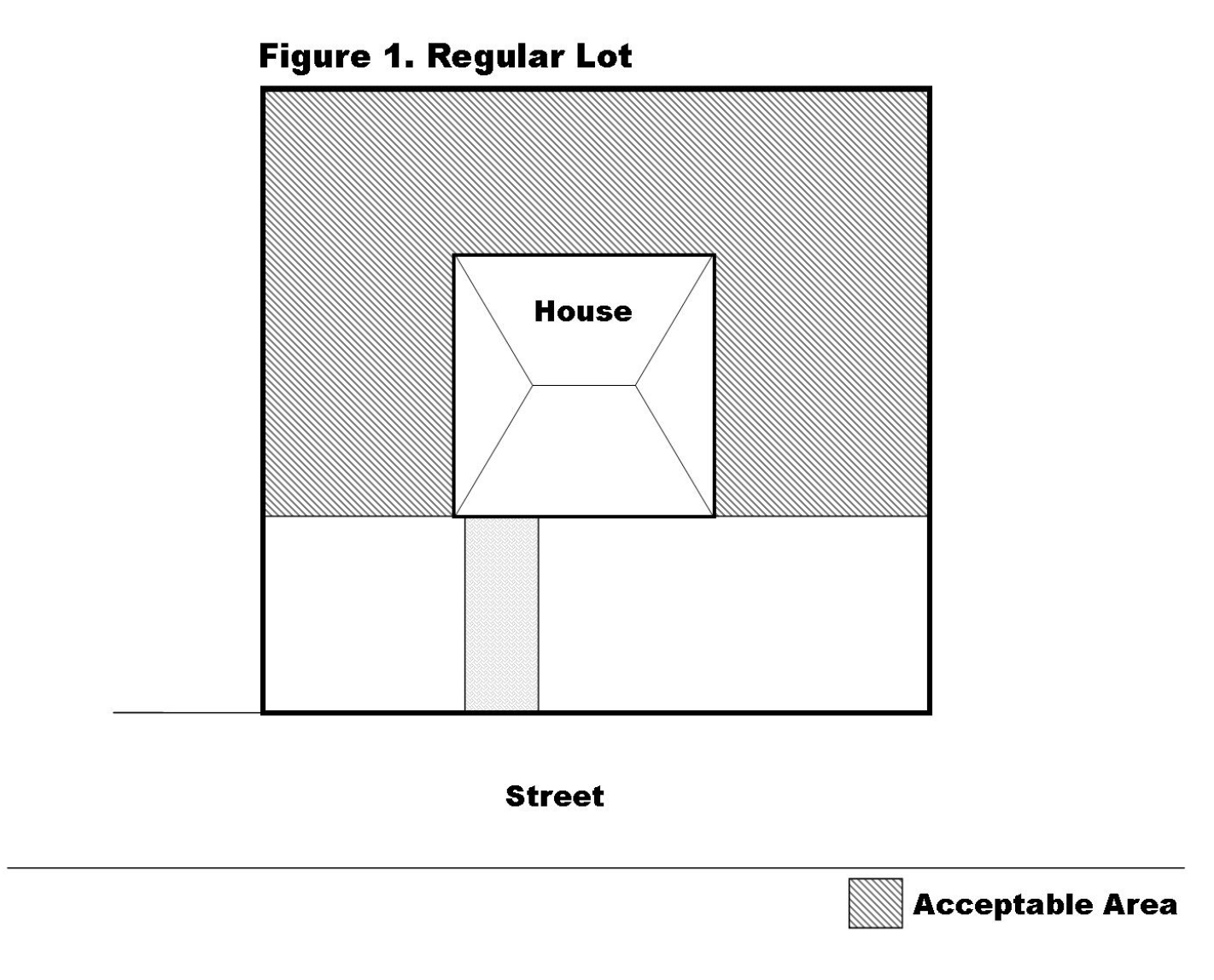
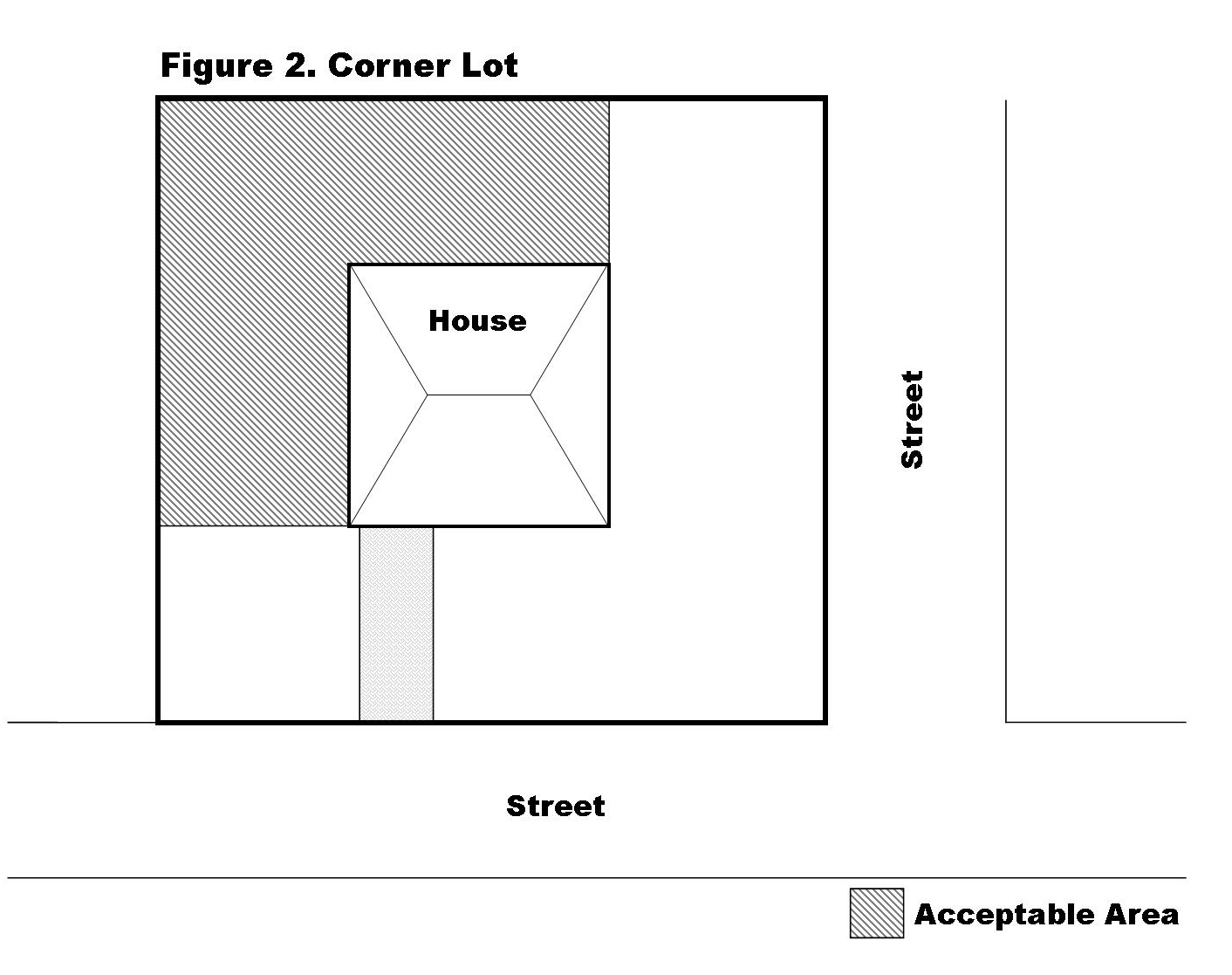
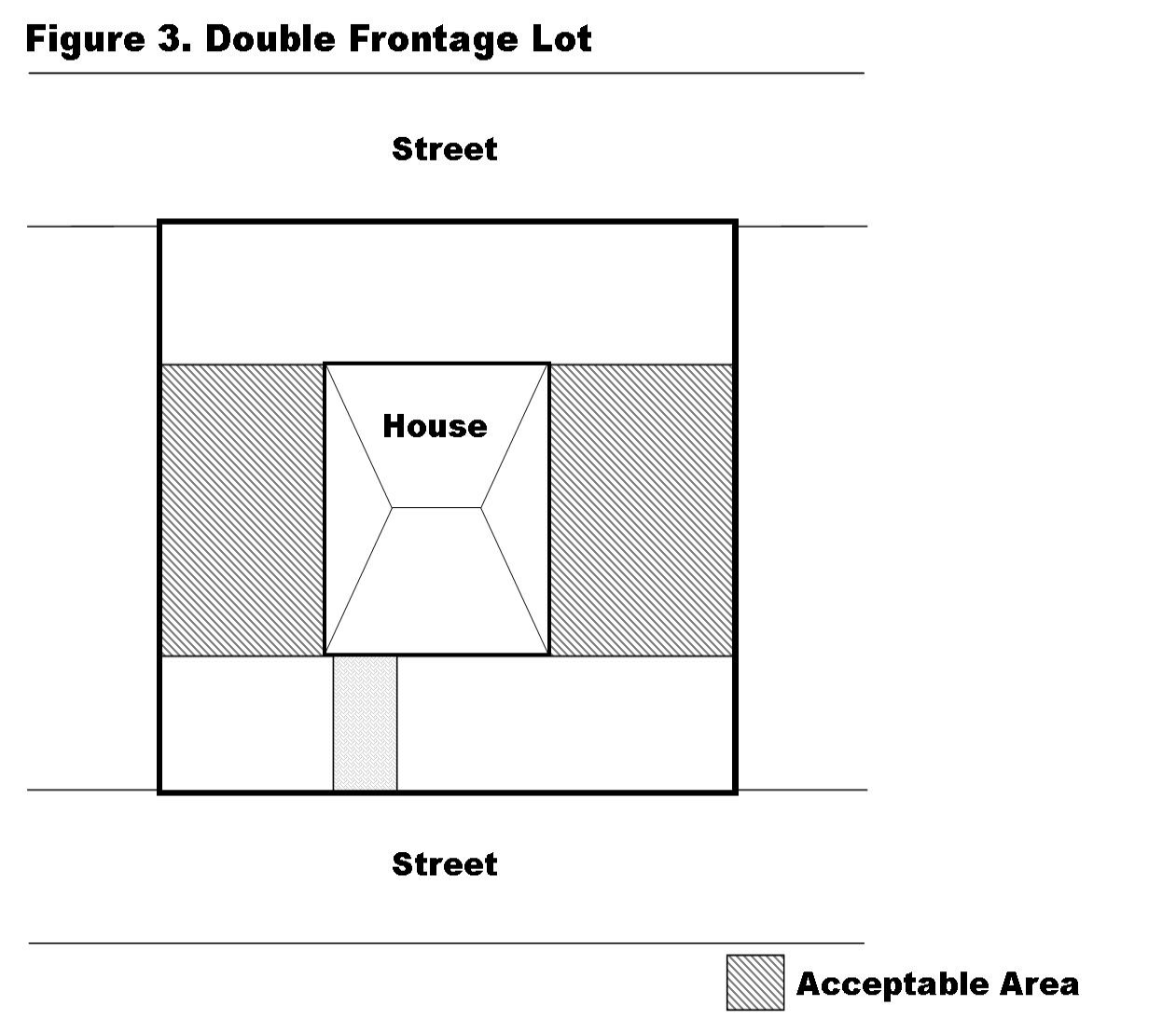
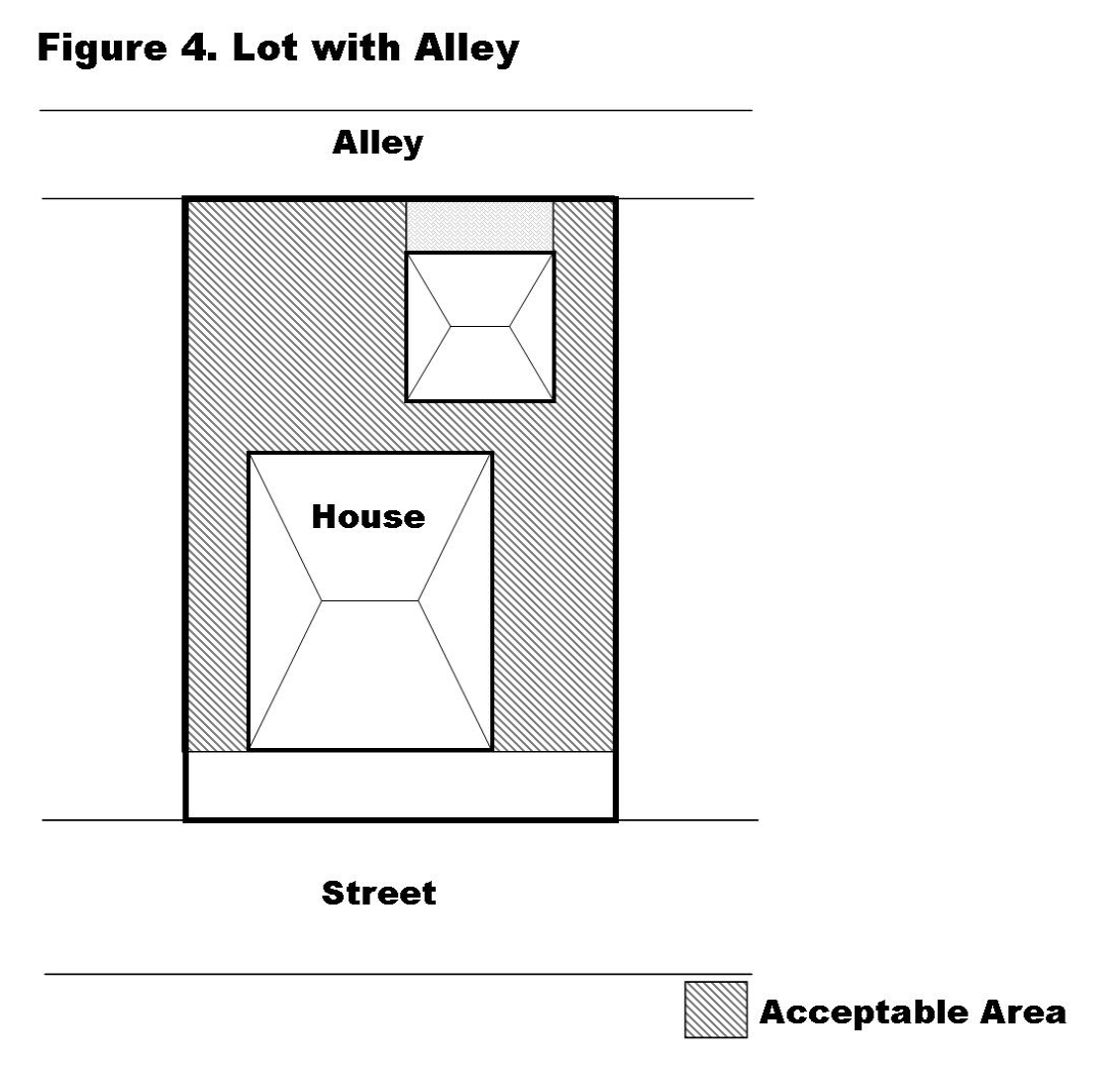
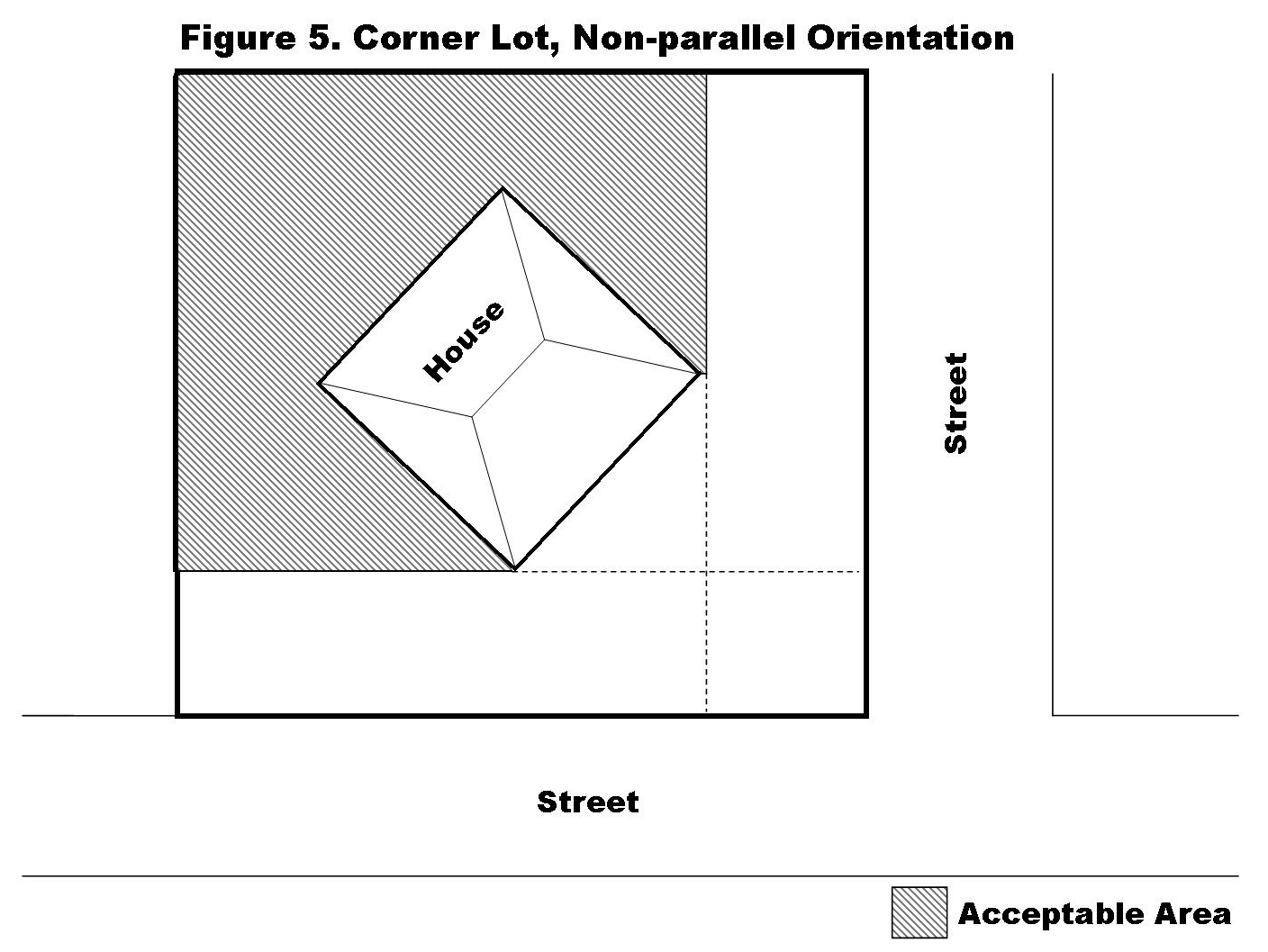
(§ 4.12.5, 12-10-80; § 4.13, 12-10-80; 1-1-84; 6-10-87; Ord. 03-18(1), 2-5-03; Ord. 13-18(6), 11-13-13, effective 1-1-14)
State Law reference— Va. Code §§ 15.2-905, 15.2-2280.
Sec. 4.12.4 - Parking areas.
The following requirements shall apply to all parking areas, except as otherwise expressly provided:
a.
Maximum number of spaces. The number of parking spaces in a parking area may not exceed the number of spaces required by this section by more than 20 percent.
b.
Spaces to satisfy minimum ADA requirements. The number, location, and dimensions of fully accessible parking spaces, and the provision of access aisles, curb ramps, signage and other specifications for those spaces shall be as required by the Americans with Disabilities Act and the current editions of the Americans with Disabilities Act Accessibility Guidelines and Virginia Uniform Statewide Building Code.
c.
Rounding off to determine minimum number of required parking spaces. When the calculation of the minimum number of required parking spaces results in something other than a whole number, the minimum required number of parking spaces shall be rounded off to the closest whole number.
d.
Garages. Garage spaces on a lot may be counted towards the minimum number of required parking spaces.
(§ 4.12.6.5(part), 12-10-80; 11-16-83; Ord. 01-18(6), 10-3-01, Ord. 03-18(1), 2-5-03)
Sec. 4.12.5 - Location of parking areas.
The following requirements shall apply to establishing the location of all parking areas, except as otherwise expressly provided:
a.
Parking areas on same lot as primary use; exception. All parking spaces shall be established on the same lot with the primary use to which it is appurtenant, except as authorized by section 4.12.8.
b.
Determining minimum yard requirements. For the purpose of determining minimum yard requirements of the various zoning districts, the term "off-street parking space" consists of the parking space or stall together with the adjacent aisle and turnaround.
(§§ 4.12.3.1, 4.12.3.2, 12-10-80; 6-14-89; Ord. 03-18(1), 2-5-03)
Sec. 4.12.6 - Minimum number of required parking spaces for scheduled uses.
Except when alternative parking is approved as provided in section 4.12.8, the following schedule shall apply to determine the number of required off-street parking spaces to be provided in a particular situation. If a particular use is not scheduled, then section 4.12.7 shall apply.
Assisted living facility: One space per three beds. (Added 2-5-03)
Assisted living facility, skilled nursing facility: one space per four beds. (See also Multi-family dwellings for the elderly.) (Added 10-11-17)
Automated teller machines (ATMs): two spaces per each outdoor walk-up type. (Added 2-5-03; Amended 3-2-16)
Automobile service station and truck repair shop: one space per each employee plus two spaces per each service stall. In addition, when accessory activities such as the rental of automobiles, trucks and trailers of all types exist on the site, there shall be provided suitable area to accommodate the highest number of rental units expected at any one time. (Amended 2-5-03)
Barber shop, beauty shop: one space per 200 square feet of gross floor area plus one space per employee.
Boarding house: one space per two beds plus one space per employee. (Amended 2-5-03)
Building Material Sales (Repealed 2-5-03)
Campground: one space per campsite; for group campsites, adequate parking space shall be provided for buses as determined by the zoning administrator.
Child day center: one space per ten children enrolled in the major class or shift plus one space per employee. In addition, a pick-up and drop-off area shall be provided on the site. (Amended 2-5-03; 6-5-19)
Club, lodge: one space per three fixed seats or per 75 square feet, whichever shall be greater. (Amended 2-5-03)
Contractor's (construction office, shop, equipment storage and materials yard): one space per employee assigned to work on-site plus one space per facility vehicle. (Amended 2-5-03)
Dental clinic: one space per 175 square feet of net floor area. (Added 2-5-03)
Drive-in restaurant: 18 spaces per each 1,000 square feet of gross floor area.
Dry cleaning: one space per 50 square feet open to the public plus one space per employee. (Added 2-5-03)
Dwellings: (Amended 2-5-03)
Single family detached (including manufactured homes): two spaces per unit, except when the Virginia Department of Transportation requires three spaces to offset the loss of ancillary onstreet parking because a reduced urban street width has been permitted in accordance with the "VDOT Subdivision Street Requirements."
Multi-family units, including two-family dwellings, single family attached, and townhouses, but excluding student suites:
In addition, if parking is provided on individual lots, such as for duplexes and single family attached townhouses, rather than in lots or bays that are shared by all units in the development, then one guest space per four units shall be provided.
Student suites: 1¼ spaces per bedroom.
Multi-family dwellings for the elderly: 1¼ spaces per unit plus one space per employee on the largest shift; provided that for an assisted living facility, one space per unit plus one space per employee on the largest shift.
Feed and seed store: one space per 400 square feet of retail sales area. (Amended 2-5-03)
Financial institution: one space per 150 square feet of gross floor area. This requirement may be reduced by 25 square feet per drive-in aisle. (Amended 2-5-03; 3-2-16)
Food store: one space per 200 square feet of gross floor area.
Funeral home: one space per three fixed seats or per 75 square feet area of assembly, whichever shall be greater. (Amended 2-5-03)
Furniture store and other large sized retail items such as appliances, carpeting, office equipment or specific building materials: one space per 400 square feet of retail sales area. (Amended 2-5-03)
Gift, craft, antique shop: one space per 200 square feet of gross floor area; provided that for any area devoted to furniture, parking shall be one space per 400 square feet of such area.
Golf Course, Driving Range: Repealed 2-5-03
Greenhouse and nursery: (Amended 2-5-03)
Sales area within a greenhouse that is not in conjunction with any other retail sales: one space per 100 square feet for the first 1,000 square feet and one space for each 500 square feet of greenhouse sales area above 1,000 square feet.
Exterior nursery sales area: one space per each 5,000 square feet of exterior nursery sales area.
Homestay: one off-street space per guest room in addition to the parking required for the dwelling unit. This use is not eligible for parking alternatives in section 4.12.8.
Hospital: The number of proposed spaces shall be shown in a parking study submitted by the hospital. The number of required spaces shall be determined by the zoning administrator. In making the determination, the zoning administrator shall consider the recommendations in the parking study, traffic generation figures either known to the industry or estimated by the Institute of Transportation Engineers, peak parking demands, and other relevant information. (Amended 2-5-03)
Hotel, motel: one space per guest room; additional spaces shall be required for restaurants, assembly rooms, and other separate uses identified herein. (Amended 2-5-03, 6-6-12)
Industrial use not otherwise identified: one space per employee on the largest shift plus one space per 500 square feet open to the public for customer parking, but in all cases a minimum of two customer parking spaces. (Added 2-5-03)
Kennel, commercial: one space per 400 square feet of gross floor area including runs, plus one space per employee.
Laundromat: one space per two washing machines.
Manufactured home, modular home, travel trailer sales: one space per 3,000 square feet of display area. (Amended 2-5-03)
Motor vehicle sales, including automobiles, farm equipment and trucks: one space per 1,500 square feet of display area. Spaces for customers shall be clearly delineated on the ground, signed and maintained for customers only. (Amended 2-5-03)
Offices, business, administrative and professional (including medical offices but not dental clinics): one space per 200 square feet of net office floor area. The term "net office floor area" shall be deemed to be: (1) 80 percent of the gross floor area; or (2) at the request of the applicant, the actual net office floor area as shown on floor plans submitted by the applicant, delineating the actual net office floor area, which plans shall be binding as to the maximum net floor area used. (Amended 2-5-03)
Over-the-counter sales: one space per 50 square feet open to the public or one space per 200 square feet of gross floor area, whichever shall be greater.
Printing and publishing facilities, including newspaper publishing: one space per employee on the largest shift, plus one space per each 500 feet of floor area open to the public for customer parking, but in all cases a minimum of two customer parking spaces. (Amended 2-5-03)
Production or Processing of Materials, Goods or Products: Repealed 2-5-03
Production, processing, testing, repairing, or servicing materials, goods or products: one space per employee on the largest shift plus one space per each 500 square feet of floor area open to the public for customer parking, but in all cases a minimum of two customer parking spaces. (Added 2-5-03)
Public assembly (indoor or outdoor) use not otherwise identified: one space per three fixed seats or one space per 75 square feet of place of assembly, whichever shall be greater. "Fixed seats," where the seating consists of pews, benches, bleachers and similar forms of seating, shall be calculated at the rate of one seat per two feet of length. A place of public assembly includes multipurpose areas that may be used either for assembly or recreation, and dance halls that are not accessory to a restaurant. (Added 2-5-03)
Recreation, commercial and residential: (Added 2-5-03)
For each recreation use not specified above, one space per 125 square feet of useable recreation area.
The minimum number of parking spaces required for a residential recreational facility within a subdivision shall be reduced by the percentage of dwelling units within the subdivision within one-quarter mile of the facility.
Recreation, public: The number of proposed spaces shall be shown on a parking study. The number of required spaces shall be determined by the zoning administrator. In making the determination, the zoning administrator shall consider the recommendations in the parking study, traffic generation figures either known to the industry or estimated by the Institute of Transportation Engineers, peak parking demands, and other relevant information. (Added 2-5-03)
Religious assembly use: In the development areas identified in the comprehensive plan, if the area of assembly seats more than 100 persons, one space per three fixed seats or per 75 square feet of area of assembly, whichever shall be greater; if the area of assembly seats 100 persons or fewer, one space per four fixed seats or per 75 square feet of area of assembly, whichever shall be greater. In the rural areas identified in the comprehensive plan, the number of proposed spaces shall be shown in a parking study submitted by the religious assembly use; the number of required spaces shall be determined by the zoning administrator, who shall consider the recommendations in the parking study, traffic generation figures either known to the industry or estimated by the Institute of Transportation Engineers, peak parking demands, and other relevant information. Nothing herein requires the parking study to be prepared by a transportation engineer. (Added 8-9-17)
Rest home, nursing home, convalescent home: (Repealed 10-11-17)
Restaurant: 13 spaces per 1,000 square feet of gross floor area including areas for accessory dancing. (Added 2-5-03; Amended 3-2-16)
Retail use not otherwise identified: one space per each 100 square feet of retail sales area for the first 5,000 square feet and one space per each 200 square feet of retail sales area above 5,000 square feet. For purposes of this paragraph, "retail sales area" shall be deemed to be: (1) 80 percent of the gross floor area; or (2) at the request of the applicant, the actual retail sales floor area as shown on floor plans submitted by the applicant delineating the actual retail sales area, which plans shall be binding as to the maximum retail sales area used. (Added 2-5-03)
Schools: The number of proposed spaces shall be shown in a parking study submitted by the school division (public schools) or the school (private schools). The number of required spaces shall be determined by the zoning administrator. In making the determination, the zoning administrator shall consider the recommendations in the parking study, traffic generation figures either known to the industry or estimated by the Institute of Transportation Engineers, peak parking demands, and other relevant information. (Amended 2-5-03)
Shopping center: (Amended 2-5-03)
Special events: one space per 2.5 participants, plus one space per employee (includes staff, caterers, musicians and vendors). (Added 7-13-05)
Testing, Repairing, Cleaning, Servicing of Material Goods or Products: Repealed 2-5-03
Theater, indoors or outdoors: one space per each three seats. (Amended 2-5-03)
Veterinary clinic: one space per 200 square feet of gross floor area exclusive of that area to house animals. (Amended 2-5-03)
Wayside stand: one space per 100 square feet of sales or display area.
Wholesaling or warehousing use not otherwise identified: one space per employee plus one space per each 500 square feet of floor area open to the public for customer parking, but in all cases a minimum of two customer parking spaces. (Added 2-5-03)
Wineries, including farm wineries: If open to the public, one space per 2.5 customers for daily use. For special events and festivals, one space per 2.5 customers, plus one space per employee (includes winery staff, caterers, musicians and vendors). The parking required for special events and festivals may be considered overflow parking and may be provided in a well-drained, suitably graded area adjacent to required parking area. (Added 2-5-03)
(§ 4.12.6.6.2, 12-10-80; 3-18-81; 7-20-88; 12-5-90; 2-6-02; Ord. 03-18(1), 2-5-03; Ord. 05-18(8), 7-13-05; Ord. 12-18(3), 6-6-12; Ord. 16-18(2), 3-2-16; Ord. 17-18(4), 8-9-17; Ord. 17-18(5), 10-11-17; Ord. 19-18(3), 6-5-19; Ord. 19-18(6), 8-7-19)
Sec. 4.12.7 - Minimum number of required parking spaces for unscheduled uses.
For uses not specifically identified in section 4.12.6, including mixed uses, or when a conflict exists between possibly applicable schedule requirements, the zoning administrator shall determine the minimum number of required parking spaces. In making this determination, the zoning administrator shall consider the characteristics of the proposed use or uses, anticipated employment, the number of residents and/or visitors, the minimum parking required for similar uses or mixes and other relevant considerations. The zoning administrator shall also consider the following:
a.
Permitted use not otherwise identified. A total number of spaces sufficient to accommodate the vehicles of all employees of the establishment plus those of all persons who may be expected to visit the same at any one time.
b.
Concurrent uses. The zoning administrator may require additional parking for concurrent uses on any site.
c.
Parking study. The zoning administrator may consider the recommendations of any parking study relevant to the request, whether it is supplied by the applicant or available from any other source, as well as traffic generation figures, including estimates by the Institute of Transportation Engineers, peak parking demands, and other relevant information.
(§ 4.12.6.6.1, 12-10-80; 11-16-83; Ord. 03-18(1), 2-5-03)
Sec. 4.12.8 - Alternatives available to provide minimum number of parking spaces.
The alternatives described herein are intended to promote more creative design, allow higher density in those zoning districts in the development areas, and reduce impervious area by allowing the parking requirements of this section to be satisfied, in whole or in part, by street parking, shared parking, and off-site stand alone parking. In addition to all other applicable requirements of this section, the following requirements shall apply to the parking alternatives provided in sections 4.12.9, 4.12.10 and 4.12.11:
a.
Types of alternatives. The parking alternatives consist of street parking, as provided in section 4.12.9, shared parking, as provided in section 4.12.10, off-site stand alone parking, as provided in section 4.12.11, and other reductions resulting from the provision of mass transit or other transportation demand management tools.
b.
Combination of alternatives. One or more parking alternatives may be used in combination with one another or with on-site parking to attain the minimum number of required parking spaces.
c.
Provision of means for safe movement. Sidewalks and other means for permitting safe movement of pedestrians between the parking area or spaces and the use or structure they serve shall be provided.
d.
Parking not to be separated from use by major roads. No parking area or spaces shall be separated from the use or structure they serve by a street whose classification is greater than a major collector, unless safe and convenient access is provided from the parking area or spaces to the use or structure and is approved by the director of planning and community development.
e.
Instrument assuring continuation of off-site parking. If stand-alone parking or off-site shared parking is to be provided, the applicant shall submit with the application for a site plan, site plan waiver or, if a site plan is not required, with an application for a zoning compliance clearance, an instrument that restricts the use of that part of the land on which parking is provided to that use, and assures that a minimum number of parking spaces as required by this section shall be established and maintained for the life of the use. The instrument shall be in a form that is suitable for recording, shall be subject to review and approval as to form and substance by the county attorney, and shall be recorded in the office of the clerk of the circuit court of the county before the site plan or site plan waiver is approved. As the parking requirements for the use or structure change, subsequent instruments may be submitted, reviewed, approved and recorded that rescind or modify the prior instrument.
(Ord. 03-18(1), 2-5-03)
Sec. 4.12.9 - Street and alley parking.
Street and alley parking may be provided as follows:
a.
Street parking consists of parking spaces located in a public or private right-of way. Each parking space that is in a public or private right-of-way abutting the lot shall count as parking space for the purpose of meeting the minimum parking space requirements in sections 4.12.6 and 4.12.7. Each parking space shall be on a paved area abutting the travelway, and if the parking space is in a public right-of-way it shall not be prohibited by the Virginia Department of Transportation.
b.
Alley parking consists of parking areas located in the alley right-of-way. A parking space in an alley may meet the minimum parking space requirements in section 4.12.6 if approved by the county engineer. In approving alley parking, the county engineer shall consider the width of the travelway, the widths of the lots abutting the alley, and the setbacks from the alley.
(Ord. 03-18(1), 2-5-03)
Sec. 4.12.10 - Shared parking.
Shared parking allows parking spaces to be shared among two or more uses that typically experience peak parking demands at different times and is located on the same lot or on nearby lots. Because parking spaces are shared, the total number of parking spaces that would otherwise be required may be reduced. In addition to all other applicable requirements of this section, the following requirements shall apply to shared parking:
a.
Authority to reduce aggregate number of parking spaces. The zoning administrator may reduce the aggregate minimum number of required parking spaces, provided that each use participating in the shared parking experiences peak parking demands at different times. The zoning administrator shall base this decision on the particular circumstances of the application.
b.
Parking study. Before making the decision to allow shared parking and to reduce the aggregate number of parking spaces, the zoning administrator may require the applicant to submit a parking study to determine the peak parking demand periods or other information needed to determine the viability of shared parking under the particular circumstances of the application.
c.
Effect of reserved parking spaces. Parking spaces reserved for specific individuals or classes of individuals shall not be counted toward the parking spaces that could be shared, except for those spaces designated and marked for use only by handicapped persons.
d.
Maximum reduction. The aggregate number of parking spaces required for all uses participating in the shared parking shall not be reduced by more than 35 percent.
(§ 4.12.4, 12-10-80; Ord. 03-18(1), 2-5-03)
Sec. 4.12.11 - Stand alone parking.
Where authorized by the applicable zoning district regulations, stand alone parking allows parking areas to be located on a lot other than the lot on which the use served by the parking areas is located. Stand alone parking is not required to be located on a lot under the same ownership as the lot on which the use served by the parking is located. In addition to all other applicable requirements of this section, the following requirements shall apply to stand alone parking:
a.
Site plan required. A site plan for the stand alone parking shall be submitted and approved under section 32.
b.
Identification of use served. At least one sign shall be posted in the parking area identifying the off-site use served by the parking area.
(§ 4.12.3.3, 12-10-80; 12-10-97; Ord. 03-18(1), 2-5-03)
Sec. 4.12.12 - Transportation demand management.
Transportation demand management ("TDM") is a set of tools that provide an alternative to parking spaces upon a demonstration that the number of vehicle trips upon which the minimum number of parking spaces required herein will be reduced. TDM tools include, but are not limited to, mass transit, car pooling, and park and ride lots.
a.
Application. An applicant seeking to reduce the number of required parking spaces through TDM shall submit to the zoning administrator a parking study demonstrating how the number of required parking spaces may be reduced through TDM.
b.
Authority to reduce. The zoning administrator may reduce the number of on-site parking spaces using TDM alternatives if the parking study submitted by the applicant demonstrates that the use of TDM tools can effectively eliminate the need for some of the required parking spaces.
(Ord. 03-18(1), 2-5-03)
Sec. 4.12.13 - Loading areas.
Off-street loading areas shall be provided as follows:
a.
Loading spaces shall be provided on the same lot with the use to which it is appurtenant and shall be adjacent to the structure it serves.
b.
Loading spaces shall be designed so as not to impede any required parking spaces, or any pedestrian or vehicular circulation.
c.
Loading spaces shall be provided in addition to and exclusive of any parking requirement on the basis of: (1) one space for the first 8,000 square feet of retail gross leasable area, plus one space for each additional 20,000 square feet of retail gross leasable area; (2) one space for the first 8,000 square feet of office space plus one space for each additional 20,000 square feet of office space; or (3) one space for the first 10,000 square feet of industrial floor area plus one space for each additional 20,000 square feet of industrial floor area.
d.
Additional loading spaces may be required or requested during review of the site plan.
e.
Each site plan that depicts a commercial or industrial building of 4,000 gross square feet or more shall provide a dumpster pad that does not impede any required parking or loading spaces, nor any pedestrian or vehicular circulation aisles.
f.
The requirements of this subsection may be modified or waived in an individual case if the Board of Supervisors, in consultation with the county engineer, finds that the public health, safety or welfare would be equally or better served by the modification or waiver; that the modification or waiver would not be a departure from sound engineering and design practice; and that the modification or waiver would not otherwise be contrary to the purpose and intent of this chapter. In granting a modification or waiver, the Board of Supervisors may impose such conditions as deemed necessary to protect the public health, safety or welfare.
(§ 4.12.7, 12-10-80; Ord. 01-18(4), 5-9-01; Ord. 03-18(1), 2-5-03; Ord. 21-18(5), 12-1-21)
Sec. 4.12.14 - Preexisting or approved parking, stacking and loading areas.
Each parking, stacking and loading area serving a use or structure lawfully established in accord with a valid final site plan or subdivision plat prior to the date of adoption of these regulations, or approved in a valid and vested preliminary site plan or subdivision plat, whose use has not changed or intensified so as to necessitate additional parking, shall be allowed to continue, subject to the following:
a.
Preexisting or approved parking spaces may be used to satisfy the number of parking spaces required for a changed or intensified use if the structure to which the parking area is accessory remains.
b.
If the structure to which the parking area is accessory is demolished, removed, or reconstructed, then all parking required or otherwise serving a new use or structure must comply with this section.
c.
Pre-existing parking structures authorized by right or by special use permit by the applicable zoning district regulations that do not comply with the requirements of section 4.12 shall be deemed to be nonconforming structures subject to section 6 of this chapter.
d.
Preexisting or approved parking, stacking or loading areas that are not parking structures as described in subsection (c), and that do not comply with the requirements of section 4.12, are accessory to a primary use and shall not obtain status as a nonconforming use or structure. However, these areas may continue and be maintained for so long as the primary use exists.
(Ord. 03-18(1), 2-5-03)
Sec. 4.12.15 - Minimum design requirements and improvements for parking areas.
The following design requirements and minimum improvements shall be provided for all off-street parking areas consisting of four or more parking spaces:
a.
Surface materials. All parking areas consisting of four or more spaces shall be surfaced. The surface materials for parking areas and access aisles shall be subject to review and approval by the county engineer, based upon the intensity of usage and Virginia Department of Transportation pavement design guidelines and specifications. The county engineer may approve the use of alternative surfaces deemed equivalent in regard to strength, durability, sustainability and long term maintenance for the intensity of the use.
b.
Grading and drainage systems. Parking area grading and drainage systems shall be designed and constructed to minimize, to the greatest extent practical, the amount of surface runoff exiting or entering through entrances to public streets.
c.
Maximum grade. The maximum grade for parking spaces, loading spaces, and access aisles abutting parking or loading spaces shall not exceed five percent in any direction.
d.
Sight distance. Minimum intersection sight distance for internal intersections of access aisles, intersections of access aisles and pedestrian ways, and access aisles around buildings shall not be less than 100 feet. The county engineer may increase this minimum, if the travel speed is anticipated to exceed ten miles per hour, to a sight distance commensurate with the anticipated travel speed. If the county engineer anticipates that travel speeds of 20 miles per hour or greater may be reasonably achieved along a primary travelway serving a development, he may require that the travelway comply with the private road horizontal and vertical standards stated in Table A of section 14-514 of the Code for the anticipated traffic volume. Sight distance shall be measured as provided in Section 602 of the Albemarle County Design Standards Manual.
e.
Accessibility to loading spaces, loading docks and dumpsters. Parking areas shall be designed so that all loading spaces, loading docks, and dumpsters are accessible by delivery and service vehicles when all parking spaces are occupied.
f.
Protective barriers and design. When deemed necessary and reasonable to assure that safe and convenient access is provided, the county engineer may require: (1) raised traffic islands at the ends of parking rows to protect parked vehicles and to prohibit parking in unauthorized areas; (2) traffic islands and other such traffic control devices; and (3) a design that provides no parking along the accessways providing the principal ingress, egress and circulation on the site.
g.
Curb and gutter in parking areas and along travelways. Curbs shall be established at the edges of parking areas or access aisles in the following circumstances: (1) in all commercial or institutional developments requiring eight or more parking spaces; (2) in all multi-family dwelling and townhouse developments requiring eight or more parking spaces; (3) where necessary to control or direct stormwater runoff; (4) where a sidewalk is located closer than four feet from the edge of an access aisle; and (5) where necessary to contain vehicular traffic to protect pedestrians and/or property. Gutters shall be required where necessary to control or direct stormwater runoff. The Board of Supervisors may waive or modify this requirement if deemed necessary to accommodate stormwater management/BMP facility design or existing uses located in the Rural Areas (RA) zoning district.
h.
Separation of parking area from public street or private road. Where off-street parking is provided, parking areas shall be established sufficiently inside the site so as to prevent queuing onto a public street or private road. The minimum required separation shall be determined by the county engineer and will be based on the intensity of traffic on the site. In any case, the minimum separation should not be less than one car length for the most minimal use.
i.
Location of handicapped parking spaces. Parking areas shall be designed so that handicapped parking spaces are located to provide persons with direct unobstructed access to buildings by the shortest practical route, and to eliminate the need to cross vehicular access aisles wherever possible.
(§ 4.12.6.3, 12-10-80; 6-14-89; § 4.12.6.5(c)(part), 12-10-80; 11-16-83; 6-14-89; Ord. 01-18(6), 10-3-01; Ord. 03-18(1), 2-5-03; Ord. 21-18(5), 12-1-21)
Sec. 4.12.16 - Minimum design requirements and improvements for parking spaces within parking areas or parking bays.
The following design requirements and minimum improvements shall be provided for all parking spaces within parking areas or parking bays:
a.
Arrangement of spaces. All parking spaces shall be perpendicular, angled, parallel or curvilinear to the vehicle access aisle. Angled parking may be provided at 60, 45 or 30 degrees from the access aisle.
b.
Design of spaces. All parking spaces shall be designed so that no part of any vehicle will extend over any lot line, right-of-way line, sidewalk, walkway, and driveway or aisle space.
c.
Minimum parking space size. Parking spaces shall be the minimum sizes, and have the minimum aisle width, provided below:
1.
Perpendicular parking. For perpendicular parking, the minimum space and aisle widths shall be:
2.
Parallel parking. For parallel parking, the minimum space shall be:
3.
Angled parking. For angled parking, the minimum space and aisle widths shall be:
All depths, widths and lengths in the tables above are stated in feet. All angled parking must have a parking envelope that is nine feet by 18 feet within each angled parking space. The dimensions of angled parking (as provided in the above tables in columns A, B, E, F, G, H and I) shall be measured as provided in Section 602.1 (Figure 6-4) of the Albemarle County Design Standards Manual.
4.
Curvilinear parking. For curvilinear parking, the minimum space and aisle widths shall be the same as for perpendicular parking, except that the width of the parking space shall be measured at the narrowest point along the length of the space, and provided that a 100-foot sight distance is maintained. The site distance shall be measured as provided in Section 602.1 (Figure 6-5) of the Albemarle County Design Standards Manual.
5.
Handicapped parking spaces. For handicapped parking, vehicular access aisle widths shall be the same as for perpendicular parking. In addition, a handicapped access aisle shall be provided adjacent to each handicapped parking space, provided that the aisle may be shared between adjacent handicapped parking spaces. The minimum space and aisle widths shall be:
6.
Minimum length reduction. Perpendicular and curvilinear parking space minimum length requirements may be reduced by not more than two feet when any of the following conditions are satisfied: (i) one or more rows of parking are separated by planting islands, median, or other such features (other than sidewalks) and allow for an unobstructed overhang, from each row, equivalent to the reduction; or (ii) one or more rows of parking adjacent to a building are separated from the building by planting islands, or other such features (other than sidewalks) and allow for an unobstructed overhang, from each row, equivalent to the reduction.
d.
Delineation of parking spaces. Parking spaces shall be delineated in a manner that identifies and preserves the required dimensions by paint striping, signage, or by another means approved by the zoning administrator. The zoning administrator may authorize that bumper blocks or posts be used to delineate parking spaces on surfaces that are not conducive to paint striping.
e.
Bumper blocks. Bumper blocks shall be provided in parking spaces in the following circumstances, unless waived by the Board of Supervisors: (1) the parking area has no curb or curb and gutter; (2) the parking has curb or curb and gutter and there is a sidewalk located closer than two feet from the edge of the parking area, except that bumper blocks shall not be required where a sidewalk has a minimum width of six feet. Bumper blocks shall be constructed of a durable material such as concrete or treated timbers. Each bumper block shall be a minimum length of six feet, a maximum height of five inches, and shall be securely anchored into the pavement in at least two places.
(§ 4.12.6.5, 12-10-80; 11-16-83; 6-14-89; Ord. 01-18(6), 10-3-01; Ord. 03-18(1), 2-5-03; Ord. 21-18(5), 12-1-21)
Sec. 4.12.17 - Minimum design requirements and improvements for vehicle access aisles.
The following design requirements and minimum improvements shall be provided for all vehicle access aisles:
a.
Grade for vehicle access aisles not adjacent to parking spaces. Vehicle access aisles that are not adjacent to parking spaces, shall not exceed a grade of ten percent. The Board of Supervisors may increase the maximum grade, upon a finding that no reasonable design alternative would reduce or alleviate the need and that the increase in grade would be in the best interest of public health, safety and welfare. The developer must request the waiver in writing and provide all information necessary to justify that no reasonable design alternative exists. In no case shall the grade exceed private road standards set forth in section 14-514 of the Code.
b.
Entrances. Entrances to parking areas from public streets or private roads shall be designed and constructed in accordance with Virginia Department of Transportation standards. An adequate landing and/or grade transition shall be provided for vehicle access aisles at the intersection with public streets or private roads to allow for the stopping of vehicles and sight distance, as deemed necessary by the county engineer to assure public safety. As a guideline, the approach grade should not exceed four percent for a distance of not less than 40 feet measured from the edge of the street or road being intersected.
c.
Vehicle access aisle standards. Vehicular access aisles that are not adjacent to parking spaces shall comply with the following:
1.
Two-way access aisles. The minimum travelway width for two-way access aisles shall be 20 feet.
2.
One-way access aisles. One-way circulation is allowed provided the circulation loop or pattern is contained within the site or sites. Public streets or private roads shall not be used as part of the circulation loop or pattern. The minimum travelway width for one-way access aisles shall be 12 feet, with the following exceptions:
(a)
Bypass traffic. A travelway width of up to 16 feet may be required to allow for bypass traffic, when deemed necessary by the county engineer. In making this determination, the county engineer shall consider the site specific factors including, but not limited to, the length of the travelway, nature of the land use, and internal traffic circulation.
(b)
Bank teller and ATM canopy and lanes. The travelway width may be reduced for bank teller and ATM canopies and lanes if the county engineer determines that a reduction is necessary to accommodate the specific architectural, structural and customer service needs of a proposed application, and the reduction will not reduce public safety.
d.
Turning radii. Turning radii shall be limited by the requirement to maintain 100-foot sight distance. Turning movements for delivery vehicles or other expected truck traffic shall be evaluated by the county engineer using AASHTO single unit truck standards or other AASHTO standard vehicle as appropriate.
(§ 4.12.6.2, 12-10-80; 6-14-89; § 4.12.6.3 (part), 12-10-80; 6-14-89; Ord. 03-18(1), 2-5-03; Ord. 21-18(5), 12-1-21)
Sec. 4.12.18 - Minimum design requirements and improvements for loading areas.
The following design requirements and minimum improvements shall be provided for all loading areas:
a.
Size. Loading spaces shall be a minimum of 12 feet in width, 14½ feet in clearance height and a length sufficient to accommodate the largest delivery trucks serving the establishment, but in no case will such length be less than 25 feet.
b.
Surface materials. All loading and unloading berths shall be surfaced with a bituminous or other dust free surface.
c.
Design of loading spaces. Loading spaces shall be designed so that no part of any vehicle will extend over any lot line, right-of-way line, sidewalk, driveway or aisle space.
d.
Delineation of loading spaces. Loading spaces shall be delineated in a manner that identifies and preserves the required dimensions with paint striping, signage, or by other means approved by the zoning administrator. The zoning administrator may authorize that bumper blocks or posts be used to delineate loading spaces on surfaces that are not conducive to paint striping.
(§ 4.12.7 (part), 12-10-80; Ord. 03-18(1), 2-5-03)
Sec. 4.12.19 - Minimum design requirements and improvements for dumpster pads.
The following design requirements and minimum improvements shall be satisfied for all vehicle access aisles:
a.
Materials. Dumpster pads shall be concrete.
b.
Design. The pad shall extend beyond the front of each dumpster so that the front wheels of a truck servicing the dumpster will rest on the concrete, but in no case shall the length of a concrete pad be less than eight feet beyond the front of the dumpster. The site shall be designed so that stormwater does not run through, and drains away from, areas where dumpsters are located in order to minimize the potential for contaminating stormwater runoff due to contact with solid waste.
c.
Screening. Dumpsters shall be screened as required by section 32.7.9 and, where applicable, section 30.6.
(Ord. 03-18(1), 2-5-03)
Sec. 4.14.1 - Noise.
Sound generated from a use of an industrial character shall comply with section 4.18.
(§ 4.14.1, 12-10-80; Ord. 00-18(3), 6-14-00; Ord. 11-18(8), 8-3-11)
Sec. 4.14.2 - Vibration.
Vibrations generated from a use of an industrial character shall be subject to the following:
a.
Method of measurement. The vibration standards delineated in this section shall be measured as follows:
1.
Measurements shall be made at or beyond the closest boundary line of an abutting lot and the zoning district boundary line closest to the source as provided below in a manner accepted by the county engineer.
2.
Ground transmitted vibration shall be measured with a seismograph or complement of instruments capable of recording vibration displacement and frequency, particle velocity or acceleration simultaneously in three mutually perpendicular directions. The term "vibration" means the periodic displacement or oscillation of the earth.
3.
The maximum particle velocity shall be the maximum vector sum of the three mutually perpendicular components recorded simultaneously. Particle velocity may be also expressed in a manner accepted by the county engineer, applying sound engineering principles.
b.
Standards. The following standards apply, as measured in inches per second, for the maximum allowable peak velocity:
(§ 4.14.2, § 4.14.2.1, § 4.14.2.2, 12-10-80; Ord. 11-18(8), 8-3-11)
Sec. 4.14.3 - Glare and heat.
Glare and heat generated from a use of an industrial character shall be subject to the following:
a.
Glare from lights, building surfaces or processes. No direct or sky reflected glare, whether from flood lights, building surfaces or from high temperature processes such as, but not limited to, combustion or welding, so as to be visible beyond the lot line, shall be permitted except for signs, parking lot lighting and other lighting authorized by this chapter or required by any other applicable law. However, any operation that would adversely affect the navigation or control of aircraft shall comply with the current regulations of the Federal Aviation Administration.
b.
Intense glare from processes. Any operation producing intense glare as determined by the zoning administrator shall be performed only within a completely enclosed building and in such a manner so as not to create a public nuisance or hazard to abutting parcels. An operation will be deemed to produce intense glare when it creates a sensation of extreme brightness within the visual field which causes squinting, discomfort or loss in visual performance and visibility in persons not suffering from light sensitivity (photophobia).
c.
Intense heat from processes. Any operation producing the emission of heat which would cause a temperature increase of one degree Fahrenheit (1º F) or greater as measured at or beyond the closest boundary line of an abutting lot shall be performed only within a completely enclosed building and in such a manner so as not to create a public nuisance or hazard to abutting parcels. No heat or heated air shall be discharged such that a temperature increase of one degree Fahrenheit (1° F) or greater is measurable at or beyond the closest boundary line of an abutting lot. Vents, chimney stacks and other devices for emitting heat or heated air from a building shall be oriented away from abutting lots within the rural areas (RA) or any residential zoning district.
(§ 4.14.3, 12-10-80; Ord. 11-18(8), 8-3-11)
Sec. 4.14.4 - Electrical disturbance.
No electrical disturbance generated from a use of an industrial character shall adversely affect any activity, including the use of any machinery or equipment, on any other lot. Any electrical disturbance that would adversely affect the navigation or control of aircraft shall comply with the current regulations of the Federal Aviation Administration.
(§ 4.14.7, 12-10-80; § 4.14.4, Ord. 11-18(8), 8-3-11)
(New sections 4.14.4, 4.14.5 and 4.14.6 adopted 8-3-11; old sections 4.14.4, 4.144.5 and 4.14.5 repealed at the same time pursuant to Ord. 11-18(8))
Sec. 4.14.5 - Certified engineer's report.
Prior to the issuance of a zoning clearance or approval of a final site plan, each prospective occupant of a use of an industrial character shall submit a certified engineer's report as follows, except as provided in subsection (c):
a.
Contents. Each certified engineer's report shall include the following information unless the county engineer determines that any such information is not necessary:
1.
Nature of the operation. A description of the proposed operation, including all machines, processes, and products.
2.
Emissions and discharges. The identification of all by-products or wastes, stating the expected levels of emissions or discharges to land, air, and/or water of any liquid, solid or gas, and the emission of electrical impulses and sound under normal operations.
3.
Control of emissions and discharges. Descriptions and specifications as to how emissions and discharges will be treated and the equipment and practices that will be used to control emissions and discharges.
4.
Other information. Any state or federal permits, readings, measurements, plans or documentation necessary to demonstrate that the proposed use will comply with this chapter, other requirements of the Code and all applicable state and federal laws, including but not limited to those pertaining to the following:
(a)
Air emissions. Air emissions subject to the applicable regulations of the State Air Pollution Control Board and the Virginia Department of Environmental Quality.
(b)
Water discharges. Water discharges subject to the applicable regulations of the State Water Control Board and the Virginia Department of Environmental Quality.
(c)
Radioactive materials and radiation emissions. Radioactive materials used in conjunction with, and radiation emissions from, a use that is subject to the applicable regulations of the State Board of Health and all applicable requirements arising from all agreements between the Commonwealth of Virginia and the United States of America, and any department or agency thereof, pertaining to radioactive materials or radiation emissions, and all interstate compacts pertaining to radioactive materials or radiation emissions to which the Commonwealth of Virginia is a party. Any radioactivity or radiation that would adversely affect the navigation or control of aircraft shall comply with the current regulations of the Federal Aviation Administration.
(d)
Flammable, hazardous and explosive materials. Flammable, hazardous and explosive materials used in conjunction with a use shall comply with the applicable requirements of the county fire marshal and the Virginia Department of Environmental Quality.
(e)
Disposal of waste and spill containment. The disposal of waste and the containment of spills in conjunction with a use shall comply with the applicable requirements of the county fire marshal. Any use required by section 5 to provide a waste management plan shall provide a plan that demonstrates that waste will be disposed of only in strict compliance with state and federal regulations.
(f)
Mosquito control plan. Any use required by section 5 to provide a mosquito control plan shall provide a plan that demonstrates how mosquitoes will be controlled.
b.
Review of report. The certified engineer's report shall be reviewed by the county engineer, who shall inform the zoning administrator as to whether the proposed use complies with the performance standards in sections 4.14 through 4.14.5. If a site plan is required, the county engineer shall review the report and inform the commission or the agent prior to action on the preliminary site plan as to whether the proposed use complies with the performance standards in sections 4.14 through 4.14.5.
c.
Document in lieu of certified engineer's report. In lieu of a certified engineer's report, the county engineer may allow a prospective occupant of a use of an industrial character to submit a document that describes the processes and activities of the proposed use and addresses the performance standards in sections 4.14 through 4.14.5. A document in lieu of a certified engineer's report: (i) is appropriate for those uses of an industrial character that are determined by the county engineer to be low impact; (ii) may be in the form of a letter, or in any other form acceptable to the county engineer, signed by the prospective occupant or its representative; and (iii) shall be reviewed by the county engineer, who shall inform the zoning administrator as to whether the proposed use complies with the performance standards in sections 4.14 through 4.14.5.
(§ 4.14.8, 12-10-80; 9-9-92; § 4.14.5, Ord. 11-18(8), 8-3-11; Ord. 13-18(1), 4-3-13)
Sec. 4.15.1 - Purpose and intent.
The purpose and intent of this section 4.15 include, but are not limited to, the following:
a.
The board of supervisors finds that signs are a separate and distinct use of the property upon which they are located and affect the uses and users of adjacent streets, sidewalks, and other areas open to the public; and that signs are an important means of communication for businesses, organizations, individuals, and government. The board also finds that signs take up space and may obstruct views, distract motorists, displace alternative uses for land, and pose other problems that legitimately call for regulation; and that the unregulated erection and display of signs constitute a public nuisance detrimental to the public health, safety, convenience, and general welfare. Therefore, the purpose of this section 4.15 is to establish reasonable regulations pertaining to the time, place, and manner in which outdoor signs and window signs may be erected and maintained in order to:
1.
Preserve the rights of free speech and expression;
2.
Promote the general health, safety and welfare, including the creation of an attractive and harmonious environment;
3.
Protect the public investment in the creation, maintenance, safety, and appearance of its streets, highways, and other areas open to the public;
4.
Improve vehicular and pedestrian safety by avoiding saturation and confusion in the field of vision and by directing and controlling vehicular traffic and pedestrians;
5.
Protect and enhance the county's attractiveness to tourists and other visitors as sources of economic development; and
6.
Protect property values.
b.
The board of supervisors finds that the regulations in this section 4.15 advance the substantial governmental interests identified herein and are the minimum amount of regulation necessary to achieve them, provided further that:
1.
The board of supervisors finds that the provisions in this section 4.15 that separately classify warning signs advance the compelling governmental interest of protecting vehicular and pedestrian safety.
2.
The board of supervisors finds that the provisions in this section 4.15 that separately classify directional signs advance the compelling governmental interest of protecting vehicular and pedestrian safety.
3.
The board of supervisors finds that the provisions in this section 4.15 that separately classify address signs advance the compelling governmental interest of ensuring that emergency vehicles are able to locate persons and buildings in emergency situations.
c.
Many of the signs allowed by this section 4.15 are situational, and the likelihood of multiple simultaneous situations arising on a lot at any particular time is remote. Therefore, the board finds that the number of signs allowed on a lot is reasonable and allows alternative channels of communication as situations arise without adversely impacting the purposes of this section 4.15.
(12-10-80; 7-8-92, § 4.15.01; Ord. 01-18(3), 5-9-01; Ord. 12-18(2), 3-14-12; Ord. 15-18(11), 12-9-15)
State Law reference— Va. Code § 15.2-2280.
Sec. 4.15.2 - Applicability.
This section 4.15 shall apply as follows:
a.
General. The requirements of section 4.15 shall apply to all outdoor signs and window signs, including all outdoor signs and window signs in the entrance corridor overlay district, that are visible from beyond the boundaries of the lots on which they are located. Each sign subject to this section 4.15 shall comply with all regulations applicable to that sign.
b.
Within the entrance corridor overlay district. In addition to all other applicable requirements of section 4.15, prior to erecting an outdoor sign or window sign that would be visible from an entrance corridor street, the owner or lessee of the lot on which the sign will be located shall obtain a certificate of appropriateness for that sign as provided in section 30.6 unless the sign is exempt from needing a certificate of appropriateness under section 30.6.5(d).
(Ord. 15-18(11), 12-9-15)
State Law reference— Va. Code § 15.2-2280.
Sec. 4.15.4 - Administration.
The following provisions apply in the administration of this section 4.15:
a.
Compliance with all requirements. Each sign authorized by section 4.15 shall comply with all applicable requirements of section 4.15 and all other applicable requirements of this chapter. No sign lawfully erected prior to December 9, 2015 shall be altered or moved, except in compliance with the provisions of section 4.15 and all other applicable requirements of this chapter.
b.
Noncommercial copy in lieu of commercial copy. Each sign authorized by section 4.15 may contain any copy that is noncommercial speech in lieu of, or in addition to, any copy that is commercial speech.
c.
Severability. It is hereby declared to be the intention of the board of supervisors that the sections, subsections, paragraphs, sentences, clauses, and phrases of section 4.15 are severable. If any section, subsection, paragraph, sentence, clause, or phrase is declared to be unconstitutional or invalid by the valid judgment or decree of a court of competent jurisdiction, the unconstitutionality or invalidity shall not affect any of the remaining sections, subsections, paragraphs, sentences, clauses, and phrases, of section 4.15. The board of supervisors further declares its intention that, if any regulations in section 4.15 pertaining to warning signs, directional signs, address signs, or signs containing copy that is commercial speech are invalidated as being content based and not justified by a compelling governmental interest, the remaining provisions of section 4.15 remain in full force and effect.
(§ 4.15.3, Ord. 01-18(3), 5-9-01; § 4.15.4, Ord. 15-18(11), 12-9-15)
State Law reference— Va. Code § 15.2-2280.
Sec. 4.15.5 - Permanent signs for which a sign permit is required; signs exempt from obtaining a sign permit.
Each permanent sign is subject to the following:
a.
Signs required to obtain sign permit. Except for those signs identified in subsection (b), a sign permit must be obtained for each sign prior to its erection, alteration, replacement, or relocation to ensure that it complies with any applicable requirements of this section 4.15, as provided herein:
1.
Application. An application for a sign permit must be submitted to the department of community development, together with payment of the fee required for the application pursuant to County Code Chapter 1, Article 5. A complete application consists of the following:
a.
A fully completed application form, provided to the applicant by the zoning administrator;
b.
A schematic legibly drawn to scale and sufficiently detailed showing the proposed location and dimensions of the sign; and
c.
Any plans, specifications and details pertaining to, among other things, the sign materials, the methods of illumination, methods of support, components, and the condition and age of the sign, as determined by the zoning administrator to be necessary for the review of the application.
2.
Application review and permit issuance. A sign permit application shall be reviewed and acted upon by the zoning administrator only as provided herein:
a.
Timing of application. An application for a sign permit may be filed at any time, and if a special use permit for the sign is required under section 4.15.7 or a certificate of appropriateness for the sign is required under section 30.6 of this chapter, the application may be filed with or any time after the application for the special use permit or certificate of appropriateness is filed.
b.
Action on application. Within 30 days after receipt of a complete sign permit application, the zoning administrator shall review the application and either: (i) approve the application; (ii) deny the application; or (iii) refer the application to the applicant for more information as may be required by subsection (a)(1)(c). An application shall be denied only if the proposed sign is a prohibited sign, does not comply with the regulations set forth in this section 4.15, the application is for a sign containing purported commercial speech related to an unlawful use under this chapter or other unlawful activity, or, a required special use permit or certificate of appropriateness for the sign was not granted. If the application is denied, the reasons shall be specified in writing.
c.
Failure to timely act. If the zoning administrator fails to take one of the actions described herein within 30 days of receipt of a complete sign permit application, the permit shall be deemed approved, provided that the sign deemed approved shall nonetheless be subject to, and shall comply with, all applicable requirements of this section 4.15.
3.
Administration. A sign permit shall become null and void if the sign is not erected within six months after the date the sign permit is issued. Upon written request by the permittee and upon good cause shown, the zoning administrator may grant an extension of the six-month period.
b.
Signs not required to obtain sign permit; subject to all other applicable requirements. Each permanent sign classified in this subsection may be erected, altered, replaced, or relocated without first obtaining a sign permit, provided that it complies with all applicable requirements of this section 4.15 and the following:
1.
Address signs. Address signs that do not exceed four square feet.
2.
Advertising vehicles. Advertising vehicles that are:
(i)
in operating condition;
(ii)
displaying valid license plates;
(iii)
displaying an inspection decal that is either valid or has not been expired for more than 60 days;
(iv)
used as transportation for the business; and
(v)
parked in an approved parking space or parking area that serves the business, or temporarily parked at another business to actively receive or provide goods or services, such as to load or unload goods, provide on-site services, receive vehicle maintenance and repair, or obtain food for the driver and passengers.
3.
Agricultural product signs. Agricultural product signs, provided that the signs do not exceed 32 square feet in total sign area, provided that if two signs are erected, neither sign shall exceed 16 square feet.
4.
Home occupation signs. Home occupation signs located on lots on which there is a class B home occupation or a major home occupation that is allowed in the applicable district under section 4.15.9, 4.15.10, or 4.15.11, and that do not exceed four square feet in sign area.
5.
Noncommercial signs. Signs containing copy that is exclusively noncommercial speech that do not exceed the maximum sign area allowed for the type of sign (e.g., freestanding, wall) in the applicable district.
6.
Warning signs. Warning signs that do not exceed four square feet.
7.
Window signs. Window signs, provided that the aggregate area of all window signs on each window or door does not exceed 25 percent of the total area of the window or door. (Amended 3-16-05, 3-14-12)
Subsection (a): (§§ 4.15.09, 4.15.09.1, 4.15.09.2, 4.15.09.3, 12-10-80; 7-8-92; § 4.15.5, Ord. 01-18(3), 5-9-01; Ord. 12-18(2), 3-14-12; § 4.15.5(a), Ord. 15-18(11), 12-9-15)
(Subsection (b): § 4.15.04, 12-10-80; 7-8-92; § 4.15.6; Ord. 01-18(3), 5-9-01; Ord. 05-18(4), 3-16-05; Ord. 10-18(4), 5-5-10; Ord. 11-18(1), 1-12-11; Ord. 12-18(2), 3-14-12; § 4.15.5(b), Ord. 15-18(11), 12-9-15; Ord. 17-18(4), 8-9-17; Ord. 23-18(3), 12-6-23; Ord. 24-A(1), 1-10-24, effective 7-1-24)
State Law reference— Va. Code §§ 15.2-2280, 15.2-2286.
Sec. 4.15.6 - Temporary signs for which a temporary sign permit is required; temporary signs exempt from obtaining temporary sign permit.
Each temporary sign is subject to the following:
a.
Signs required to obtain temporary sign permit. Except for those signs identified in subsection (b), a temporary sign permit shall be obtained for each temporary sign prior to its erection, alteration, replacement, or relocation to ensure that it complies with all applicable requirements of this section 4.15, as provided herein:
1.
Application. An application for a temporary sign permit shall be submitted to the department of community development, together with payment of the fee required for the application pursuant to section 35.1, and comply with the application requirements of subsection 4.15.5(a)(1).
2.
Application review and permit issuance. A temporary sign permit application shall be reviewed and acted upon by the zoning administrator only as provided herein:
a.
Action on application. Within seven days after receipt of a complete application, the zoning administrator shall either: (i) approve the application; (ii) deny the application; or (iii) refer the application to the applicant for more information as may be required by section 4.15.5(a)(1)(c). An application shall be denied only if the proposed temporary sign is a prohibited sign or does not comply with the regulations set forth in this section 4.15. If the application is denied, the reasons shall be specified in writing.
b.
Failure to timely act. If the zoning administrator fails to take one of the actions described herein within seven days after receipt of a complete sign application for a temporary sign, the permit shall be deemed approved as received, provided that the sign deemed approved shall nonetheless be subject to, and shall comply with, all applicable requirements of this section 4.15.
3.
Administration. The following regulations shall apply to the administration of temporary sign permits:
a.
Number of permits. No more than six temporary sign permits shall be issued by the zoning administrator to the same establishment, or lot not containing an establishment, in any calendar year, provided that a temporary sign erected to replace a permanent sign as provided in subsection (a)(3)(b)(2) shall not count toward this limit.
b.
Period of validity. Each temporary sign permit shall be valid for the following periods:
(1)
Generally. Except as provided in subsections (a)(3)(b)(2) and (a)(3)(b)(3), for a period not to exceed 15 consecutive days after the erection of the sign, provided that a temporary sign permit issued while a permanent sign is being made may be valid for longer than 15 days until the permanent sign is erected.
(2)
Within limits of VDOT construction project during construction; where existing permanent sign removed. For the period between the date the sign is erected, which shall be on or after the date the Virginia Department of Transportation ("VDOT") issues a notice to proceed for a VDOT construction project, until the date of project construction completion as evidenced by the date that is 30 days after the date VDOT issues a form C-5 or makes an equivalent written determination, or until a permanent sign to replace the removed permanent sign is installed at the establishment or on the lot, whichever occurs first, provided that: (i) the temporary sign is erected to replace a permanent sign on a lot abutting a primary arterial or other public street within the project limits of the construction project that includes the primary arterial; and (ii) the permanent sign was required by VDOT to be removed in conjunction with the construction project.
(3)
Within limits of VDOT construction project during construction. For the period between the date the sign is erected, which shall be on or after the date the Virginia Department of Transportation ("VDOT") issues a notice to proceed for a VDOT construction project, until the date of project construction completion as evidenced by the date that is 30 days after the date VDOT issues a form C-5 or makes an equivalent written determination, provided that: (i) not more than one sign authorized by this subsection per lot may be erected; (ii) the lot has an existing primary use or a structure for a pending primary use is under construction; (iii) the lot abuts a primary arterial or other public street within the project limits of the construction project that includes the primary arterial; (iv) the lot is within a district subject to section 4.15.11; and (v) the sign area of the sign shall not exceed either 32 square feet if the sign identifies three or fewer establishments, or 48 square feet if the sign identifies four or more establishments, where the establishments identified on the sign may be those located on the lot on which the sign is located and any lot that abuts the lot on which the sign is located, provided that the abutting lot is also within the project limits of the construction area and does not abut a primary arterial or other public street.
c.
Aggregate duration for temporary signs in calendar year. Temporary signs shall not be erected at an establishment for more than 60 days, in the aggregate, in a calendar year, provided that this limit shall not apply to a temporary sign authorized by subsections (a)(3)(b)(2) and (a)(3)(b)(3).
d.
Portable signs; stabilization. A temporary sign that is not permanently affixed to the ground or to a permanent structure, or a sign that can be moved to another location, shall be stabilized so as not to pose a danger to public safety. Prior to the sign being erected, the zoning administrator shall approve the method of stabilization.
b.
Temporary signs not required to obtain temporary sign permit; subject to all other applicable requirements. Each temporary sign classified in this subsection may be erected, altered, replaced, or relocated without first obtaining a temporary sign permit and is not subject to the durational limits in subsection (a)(3)(c), provided that it complies with all applicable requirements of this section 4.15 and the following:
1.
Auction signs. Auction signs on lots on which there is a pending auction, provided that the signs do not exceed four square feet, the signs are not erected for more than 30 days in a calendar year, and the signs are removed within seven days after the auction.
2.
Construction signs. Construction signs on lots on which there is an active construction project, provided that the signs do not exceed 32 square feet in sign area.
3.
Real estate signs. Real estate signs on lots where either the lot or any structure thereon, or any portion thereof, is for sale, lease, rent, or development, provided that the signs do not exceed 32 square feet in sign area.
4.
Temporary noncommercial signs. Temporary signs containing copy that is exclusively noncommercial speech that do not exceed the maximum sign area allowed for the type of sign (e.g., freestanding, wall) in the applicable district.
5.
Other. Any sign classified under section 4.15.5(b).
c.
Flags not required to obtain temporary sign permit; subject to all other applicable requirements. Any commercial flag or noncommercial flag may be erected, altered, replaced, or relocated without first obtaining a temporary sign permit and is not subject to the durational limits in subsection (a)(3)(c), provided that it complies with all applicable requirements of this section 4.15.
Subsection (a): (§ 4.15.4A, Ord. 12-18(2), 3-14-12; Ord. 15-18(3), 5-6-15; Ord. 15-18(9), 11-4-15; § 4.15.6, Ord. 15-18(11), 12-9-15)
Subsection (b): (§ 4.15.04, 12-10-80; 7-8-92, § 4.15.6; Ord. 01-18(3), 5-9-01; Ord. 05-18(4), 3-16-05; Ord. 10-18(4), 5-5-10; Ord. 11-18(1), 1-12-11; Ord. 12-18(2), 3-14-12; § 4.15.6b, Ord. 15-18(11), 12-9-15)
State Law reference— Va. Code §§ 15.2-2280, 15.2-2286.
Sec. 4.15.7 - Signs authorized by special use permit; off-site directional signs, off-site bundle signs, signs in a public right-of-way, electric message signs.
The following signs are authorized by a special use permit granted by the board of zoning appeals under section 34.5, provided that a sign permit required by section 4.15.5 is also obtained for the sign, the sign complies with all applicable requirements of this section 4.15, and the following:
a.
Off-site directional signs. A proposed off-site directional sign shall satisfy the following:
1.
Eligibility. The owner shall demonstrate to the satisfaction of the zoning administrator that it has exhausted all possible locations and sign types for an on-site directional sign, and that no on-site directional sign face located at the site entrance would be visible from the street providing direct access to the site entrance within 100 feet of the site entrance.
2.
Authorized locations. The sign shall be located only in compliance with one of the following: (i) within one-half mile from the site entrance along a street providing direct access to the site entrance; (ii) if the owner demonstrates, to the satisfaction of the zoning administrator for off-site directional signs that are public signs or the board of zoning appeals for all other off-site directional signs, that it is unable to obtain permission from an owner within one-half mile from the site entrance as provided in subdivision (i), then within one-quarter mile from the turning decision onto a street providing direct access to the site entrance; or (iii) if the owner demonstrates, to the satisfaction of the zoning administrator for off-site directional signs that are public signs or the board of zoning appeals for all other off-site directional signs, that it is unable to obtain permission as provided under subdivisions (i) and (ii), then another authorized location.
b.
Off-site bundle signs. A proposed off-site bundle sign shall satisfy the following:
1.
Eligibility. The site whose owner is requesting the bundle sign must be located within an industrial, commercial, or residential district and share a common entrance or access road with one or more other establishments or sites.
2.
Authorized locations. The sign shall be located on a lot having frontage on the intersection of a street and an access road serving all establishments or sites.
c.
Signs in a public right-of-way. A proposed sign in a public right-of-way shall satisfy the following:
1.
Eligibility. The sign: (i) shall be a either a subdivision sign or a sign at an entrance to a planned development authorized by sections 19, 20, 25, 25A, and 29; (ii) the subdivision or planned development shall abut the public right-of-way in which the sign will be located; (iii) the regulations applicable to freestanding signs for the subdivision or planned development, except for setback regulations, shall apply unless the Virginia Department of Transportation imposes more restrictive standards; and (iv) the applicant submits a written statement from the Virginia Department of Transportation stating that it will permit the sign to be located in the public right-of-way.
2.
Authorized locations. The sign shall be located only where the Virginia Department of Transportation authorizes it to be located.
d.
Electric message signs. A proposed electric message sign shall comply with all applicable requirements of section 4.15 and Virginia Code §§ 33.2-1216 and 33.2-1217.
(Ord. 15-18(11), 12-9-15)
Sec. 4.15.8 - Prohibited signs and sign characteristics.
Notwithstanding any other provision of this section 4.15, the following signs and sign characteristics are prohibited in all districts:
a.
Signs that violate state or federal law. Signs that violate state or federal law, including but not limited to:
1.
A sign that violates any law of the Commonwealth of Virginia related to outdoor advertising, including but not limited to Virginia Code §§ 33.2-1200 to 33.2-1234, inclusive, and 46.2-831.
2.
A sign that violates any law of the United States related to the control of outdoor advertising, including but not limited to 23 U.S.C. § 131.
3.
A sign that violates any state or federal law related to Virginia byways or scenic highways.
4.
A sign that violates the building code or the fire code.
b.
Signs with characteristics that create a safety hazard or are contrary to the general welfare. Signs whose construction, design, location or other physical characteristic create a safety hazard or are contrary to the general welfare, as follows:
1.
Sign that is attached to another thing. A sign, other than a public sign or a warning sign, that is nailed, tacked, painted or in any other manner attached to any tree, cliff, utility pole or support, utility tower, rack, curbstone, sidewalk, lamp post, hydrant, bridge or public property of any description.
2.
Sign that casts illumination off-site. A sign that casts illumination, directly or indirectly, on any street, or on any adjacent property within a residential district.
3.
Floating sign. A sign that is a moored balloon or other type of tethered floating sign.
4.
Lighting that illuminates outline. Lighting that outlines any structure, window, sign structure, sign, or part thereof, using rare gas illumination or other light. (Amended 3-16-05)
5.
Sign that imitates a traffic sign or signal or a road name sign. A sign that imitates an official traffic sign or signal or a road name sign, or conflicts with traffic safety needs due to its location, color, movement, shape, or illumination.
6.
Sign using exposed, bare, or uncovered rare gas illumination. A sign that uses exposed, bare, or uncovered rare gas illumination having a brightness that exceeds 30 milliamps; provided that a sign within the entrance corridor overlay district that is visible from an entrance corridor overlay street that uses exposed, bare or uncovered rare gas illumination in clear, rather than frosted, tubing, regardless of brightness, is also prohibited. (Amended 3-16-05)
7.
Sign that obstructs vision. A sign that obstructs free or clear vision, or otherwise causes a safety hazard for vehicular, bicycle, or pedestrian traffic due to its location, shape, illumination or color; and window signs whose aggregate area on a window or door exceed 25 percent of the total area of the window or door. (Amended 3-16-05)
8.
Pennants, ribbons, spinners, streamers. Pennants, ribbons, spinners, streamers or similar moving devices, whether or not they are part of a sign.
9.
Sign erected in public right-of-way. A sign, other than a public sign, erected on or over a public right-of-way unless the sign is authorized under section 4.15.7.
10.
Sign that contains or consists of searchlight, beacon or strobe light. A sign, other than a public sign, that contains or consists of a searchlight, beacon, strobe light, or similar form of illumination.
11.
Sign that produces sound. A sign that produces sound for the purpose of attracting attention regardless of whether the sign has written copy.
12.
Sign that contains or consists of strings of light bulbs. A sign that contains or consists of one or more strings of light bulbs that is not part of a decorative display.
13.
Sign with unsafe illumination. A sign that is illuminated so as to be unsafe to vehicular or pedestrian traffic.
14.
Sign erected in unsafe location. A sign that is erected in a location so as to be unsafe to vehicular or pedestrian traffic.
15.
Sign determined by official to create safety hazard. A sign whose characteristics, including but not limited to its construction, design, or location, are determined by a fire official, the building official, or a law enforcement officer, to create a safety hazard.
16.
Window sign above the first floor, exception. A commercial window sign affixed to a window or door above the first floor of the structure unless the business to which the sign pertains does not occupy any first floor space. (Added 3-16-05)
c.
Certain sign types. Signs that are:
1.
Animated signs, including signs using rare gas illumination, that give the appearance of animation. (Amended 3-16-05)
2.
Advertising vehicles that are not permitted under section 4.15.5(b)(2). (Amended 3-16-05; 8-9-17)
3.
Banners, except as an authorized temporary sign under section 4.15.6. (Amended 3-16-05)
4.
Billboards.
5.
Flashing signs.
6.
Moving signs, including signs using rare gas illumination, that give the appearance of movement, but not including flags that meet the requirements of section 4.15.3. (Amended 3-16-05)
7.
Roof signs.
(§ 4.15.06, 12-10-80; 7-8-92, § 4.15.7; Ord. 01-18(3), 5-9-01; Ord. 05-18(4), 3-16-05; Ord. 13-18(6), 11-13-13, effective 1-1-14; Ord. 15-18(3), 5-6-15; § 4.15.8, Ord. 15-18(11), 12-9-15; Ord. 17-18(4), 8-9-17)
State Law reference— Va. Code § 15.2-2280.
Sec. 4.15.9 - Maximum sign number, area, height, and minimum sign setback in the RA, MHD, VR, R-1, R-2, R-4, R-6, R-10, R-15, and PRD zoning districts.
The maximum number of signs permitted, sign area, and sign height, and the minimum sign setback are as follows for each sign within the Rural Areas (RA), Monticello Historic District (MHD), Village Residential (VR), Residential (R-1, R-2, R-4, R-6, R-10, and R-15) and Planned Residential Development (PRD) districts:
a.
The following apply to the corresponding sign types and standards for which superscript numbers are in the table above:
1.
Directional signs. The requirements in the table apply to permanent on-site directional signs and off-site directional signs. Up to two off-site directional signs are permitted by right if the signs are erected by the owner of any single 24-hour emergency medical service facility or pertain to any public sign identifying a public use, facility, or structure. Up to two off-site directional signs are permitted by special use permit under section 4.15.7(a). An off-site directional sign shall count as a freestanding sign on the lot on which the sign is located.
2.
Agricultural product signs. Agricultural product signs on lots on which there is an agricultural operation, farm sales, farm stand, farmers' market, farm winery, farm brewery, or farm distillery, and agricultural product signs erected off-site, are permitted by right, provided: (i) the signs do not exceed 32 square feet in total sign area; (ii) if two signs are erected on-site, neither sign shall exceed 16 square feet; (iii) if signs are erected off-site, no more than two such signs may be erected; and (iv) an off-site sign shall count as a freestanding sign on the lot on which the sign is located.
3.
Bundle signs. One off-site bundle sign is allowed only in the R-6, R10, R-15, and PRD districts by special use permit under section 4.15.7(b), and is not allowed in the other districts subject to this section. An off-site bundle sign shall count as a freestanding sign on the lot on which the sign is located.
4.
Projecting signs. Projecting signs are not permitted in the RA, MHD, VR, R-1, and R-2 districts.
5.
Subdivision signs; signs in public right-of-way. The requirements in the table also apply to subdivision signs and planned development signs in the public right-of-way authorized by special use permit under section 4.15.7(c).
6.
Temporary noncommercial signs. Temporary noncommercial signs are permitted as provided in subsection (b)(8) below.
7.
Additional sign area for establishments at which gasoline or diesel fuel is dispensed. Any establishment at which gasoline or diesel fuel, or both, is dispensed shall be entitled to additional sign area to display fuel prices of up to 50 percent of the primary sign area to which it is attached, or 16 square feet, whichever is less.
b.
In addition to the signs in the table, the following signs may be erected;
1.
Address signs. Up to three address signs per lot or establishment composed of: (i) one address sign attached to each official United States Postal Service mailbox; (ii) one address sign attached or printed on a building for each address; and (iii) one additional address sign.
2.
Advertising vehicles. Advertising vehicles that are permitted under section 4.15.5(b)(2). (Amended 8-9-17)
3.
Auction signs. One auction sign per lot on which there is a pending auction, provided that the sign does not exceed four square feet, the sign is not erected for more than 30 days in a calendar year, and the sign is removed within seven days after the auction.
4.
Commercial flags. Up to two commercial flags per lot, provided that: (i) not more than one flag may be flown on a lot, provided that if the lot is four acres or larger, then one additional flag may be flown; (ii) the flag shall not exceed 24 square feet in size; and (iii) the flag shall be flown on a flag pole and, if two flags may be flown, they may either be on the same or on separate flag poles. (Added 3-16-05)
5.
Construction signs. One construction sign per lot on which there is an active construction project, provided that the sign does not exceed 32 square feet in sign area.
6.
Home occupation signs. One home occupation sign per lot on which there is a class B home occupation or a major home occupation that is allowed in the applicable district under section 4.15.9, 4.15.10, or 4.15.11, and that do not exceed four square feet in sign area.
7.
Noncommercial flags. Up to three noncommercial flags per lot, provided that: (i) the flag shall not exceed 24 square feet in size; (ii) on commercial, institutional, and industrial lots, the flag shall be displayed only on flag poles or on privately owned light posts and shall be installed in a manner so that it remains taut, and flapping and movement is minimized; and (iii) on residential and agricultural lots, the flag shall be displayed from a mount on a dwelling unit or other permitted primary or accessory structure, a flag pole, a mast, or suspended from a fixed structure, rope, wire, string, or cable. (Added 3-16-05)
8.
Noncommercial signs. Up to two signs per lot containing copy that is exclusively noncommercial speech that do not exceed the maximum sign area allowed for the sign type (e.g., freestanding, wall) within the applicable district, and up to two signs per lot containing copy that is exclusively noncommercial speech that do not exceed four square feet per sign, regardless of whether the signs are permanent or temporary.
9.
Real estate signs. One real estate sign per lot on which either the lot or any structure thereon, or any portion thereof, is for sale, lease, rent, or development, provided that the sign does not exceed 32 square feet in sign area.
10.
Sandwich board signs. One sandwich board sign per establishment provided that if the sign is placed on a sidewalk or any other pedestrian right-of-way, it shall be placed in a location that provides a contiguous and unobstructed pedestrian passageway at least three feet wide; the sign shall not be located in any required off-street parking space, driveway, access easement, alley or fire lane; the sign shall not be illuminated; and the sign shall be removed during non-business hours.
11.
Warning signs. Warning signs as required by law or as determined to be necessary to protect public health or safety.
12.
Window signs. Window signs, provided that the aggregate area of all window signs on each window or door does not exceed 25 percent of the total area of the window or door. (Amended 3-16-05, 3-14-12)
((§ 4.15.8: § 4.15.12.1, 12-10-80; 7-8-92; § 4.15.8, Ord. 01-18(3), 5-9-01; Ord. 05-18(5), 6-8-05; Ord. 12-18(2), 3-14-12) (§ 4.15.9: § 4.15.12.1, 12-10-80; 7-8-92; § 4.15.9, Ord. 01-18(3), 5-9-01; Ord. 12-18(2), 3-14-12) (§ 4.15.10: § 4.15.12.3, 12-10-80; 7-8-92; Ord. 01-18(3), 5-9-01); § 4.15.9, Ord. 15-18(11), 12-9-15; Ord. 17-18(4), 8-9-17; Ord. 19-18(3), 6-5-19)
State Law reference— Va. Code § 15.2-2280.
Sec. 4.15.10 - Maximum sign number, area, and height, and minimum sign setback in the PUD, DCD, and NMD zoning districts.
The maximum number of signs permitted, sign area, and sign height, and the minimum sign setback are as follows for each sign for each sign within the Planned Unit Development (PUD), Downtown Crozet (DCD) and Neighborhood Model (NMD) districts:
a.
The following apply to the corresponding sign types and standards for which superscript numbers are in the table above:
1.
Directional signs. The requirements in the table apply to permanent on-site directional signs and off-site directional signs. Up to two off-site directional signs are permitted by right if the signs are erected by the owner of any single 24-hour emergency medical service facility or pertain to any public sign identifying a public use, facility, or structure. Up to two off-site directional signs are permitted by special use permit under section 4.15.7(a). An off-site directional sign shall count as a freestanding sign on the lot on which the sign is located.
2.
Agricultural product signs. Agricultural product signs located on lots on which there is an agricultural operation, farm sales, farm stand, farmers' market, farm winery, farm brewery, or farm distillery, and agricultural product signs erected off-site, are permitted by right, provided: (i) the signs do not exceed 32 square feet in total sign area; (ii) if two signs are erected on-site, neither sign shall exceed 16 square feet; (iii) if signs are erected off-site, no more than two such signs may be erected; and (iv) an off-site sign shall count as a freestanding sign on the lot on which the sign is located.
3.
Freestanding signs; bundle signs; electric message signs. The freestanding signage permitted may include one off-site bundle sign allowed by special use permit under section 4.15.7(b) and one electric message sign allowed by special use permit under section 4.15.7(d). An off-site bundle sign shall count as a freestanding sign on the lot on which the sign is located.
4.
Projecting signs and wall signs. Each establishment may have both a projecting sign and a wall sign. The projecting or wall signage permitted may include one electric message sign allowed by special use permit under section 4.15.7(d). See subsection (a)(11) for the allowed sign area when both sign types are erected.
5.
Subdivision signs; signs in public right-of-way. The requirements in the table also apply to subdivision signs and planned development signs in the public right-of-way authorized by special use permit under section 4.15.7(c).
6.
Temporary noncommercial signs. Temporary noncommercial signs are permitted as provided in subsection (b)(9) below.
7.
Additional sign area for establishments at which gasoline or diesel fuel is dispensed. Any establishment at which gasoline or diesel fuel, or both, is dispensed shall be entitled to additional sign area to display fuel prices of up to 50 percent of the primary sign area to which it is attached, or 16 square feet, whichever is less.
8.
Sign area for bonus tenant panels. In each shopping center exceeding 50,000 square feet in gross floor area: (i) one bonus tenant panel shall be permitted for each 50,000 square feet in gross floor area, not to exceed four bonus tenant panels at the shopping center; and (ii) no bonus tenant panel shall exceed eight square feet in sign area.
9.
Sign area for certain temporary signs within the limits of Virginia Department of Transportation construction projects. Temporary signs within the limits of Virginia Department of Transportation construction projects may have a sign area of up to 48 square feet as provided in section 4.15.6(c)(2)(c).
10.
Sign area if both projecting sign and wall sign erected. If an establishment has both projecting and wall signs, the allowed sign area of the wall sign shall be reduced by the sign area of the projecting sign.
b.
In addition to the signs in the table, the following signs may be erected;
1.
Address signs. Up to three address signs per lot or establishment composed of: (i) one address sign attached to each official United States Postal Service mailbox; (ii) one address sign attached or printed on a building for each address; and (iii) one additional address sign.
2.
Advertising vehicles. Advertising vehicles that are permitted under section 4.15.5(b)(2). (Amended 8-9-17)
3.
Auction signs. One auction sign per lot on which there is a pending auction, provided that the sign does not exceed four square feet, the sign is not erected for more than 30 days in a calendar year, and the sign is removed within seven days after the auction.
4.
Commercial flags. Up to two commercial flags per lot, provided that: (i) not more than one flag may be flown on a lot, provided that if the lot is four acres or larger, then one additional flag may be flown; (ii) the flag shall not exceed 24 square feet in size; and (iii) the flag shall be flown on a flag pole and, if two flags may be flown, they may either be on the same or on separate flag poles. (Added 3-16-05)
5.
Construction signs. One construction sign per lot on which there is an active construction project, provided that the sign does not exceed 32 square feet in sign area.
6.
Home occupation signs. One home occupation sign per lot on which there is a class B home occupation or a major home occupation that is allowed in the applicable district under section 4.15.9, 4.15.10, or 4.15.11, and that do not exceed four square feet in sign area.
7.
Menu signs. One menu sign per establishment having an approved drive-through lane that does not exceed 32 square feet.
8.
Noncommercial flags. Up to three noncommercial flags per lot, provided that: (i) the flag shall not exceed 24 square feet in size; (ii) on commercial, institutional, and industrial lots, the flag shall be displayed only on flag poles or on privately owned light posts and shall be installed in a manner so that it remains taut, and flapping and movement is minimized; and (iii) on residential and agricultural lots, the flag shall be displayed from a mount on a dwelling unit or other permitted primary or accessory structure, a flag pole, a mast, or suspended from a fixed structure, rope, wire, string or cable. (Added 3-16-05)
9.
Noncommercial signs. Up to two signs per lot containing copy that is exclusively noncommercial speech that do not exceed the maximum sign area allowed for the sign type (e.g., freestanding, wall) within the applicable district, and up to two signs per lot containing copy that is exclusively noncommercial speech that do not exceed four square feet per sign, regardless of whether the signs are permanent or temporary.
10.
Real estate signs. One real estate sign per lot on which either the lot or any structure thereon, or any portion thereof, is for sale, lease, rent, or development, provided that the sign does not exceed 32 square feet in sign area.
11.
Sandwich board signs. One sandwich board sign per establishment that does not exceed eight square feet.
12.
Warning signs. Warning signs as required by law or as determined to be necessary to protect public health or safety.
13.
Window signs. Window signs, provided that the aggregate area of all window signs on each window or door does not exceed 25 percent of the total area of the window or door. (Amended 3-16-05, 3-14-12)
(§ 4.15.12.4, 12-10-80; 7-8-92; § 4.15.11, Ord. 01-18(3), 5-9-01; Ord. 03-18(2), 3-19-03; Ord. 10-18(1), 1-13-10; Ord. 12-18(2), 3-14-12; § 4.15.10, Ord. 15-18(11), 12-9-15; Ord. 17-18(4), 8-9-17)
State Law reference— Va. Code § 15.2-2280.
Sec. 4.15.11 - Maximum sign number, area, and height, and minimum sign setback in the C-1, CO, HC, PD-SC, PD-MC, HI, LI, and PD-IP zoning districts.
The maximum number of signs permitted, sign area, and sign height, and the minimum sign setback are as follows for each sign for each sign within the Commercial (C-1), Commercial Office (CO), Highway Commercial (HC), Planned Development-Shopping Center (PD-SC) and Planned Development-Mixed Commercial (PD-MC) Heavy Industry (HI), Light Industry (LI) and Planned Development-Industrial Park (PD-IP) districts:
a.
The following apply to the corresponding sign types and standards for which superscript numbers are in the table above:
1.
Directional signs. The requirements in the table apply to permanent on-site directional signs and off-site directional signs. Up to two off-site directional signs are permitted by right if the signs are erected by the owner of any single 24-hour emergency medical service facility or pertain to any public sign identifying a public use, facility, or structure. Up to two off-site directional signs are permitted by special use permit under section 4.15.7(a). An off-site directional sign shall count as a freestanding sign on the lot on which the sign is located.
2.
Agricultural product signs. Agricultural product signs located on lots on which there is an agricultural operation, farm sales, farm stand, farmers' market, farm winery, farm brewery, or farm distillery, and agricultural product signs erected off-site, provided: (i) the signs do not exceed 32 square feet in total sign area; (ii) if two signs are erected on-site, neither sign shall exceed 16 square feet; (iii) if signs are erected off-site, no more than two such signs may be erected; and (iv) an off-site sign shall count as a freestanding sign on the lot on which the sign is located.
3.
Freestanding signs; bundle signs; electric message signs. The freestanding signage permitted may include one off-site bundle sign allowed by special use permit under section 4.15.7(b) and one electric message sign allowed by special use permit under section 4.15.7(d). An off-site bundle sign shall count as a freestanding sign on the lot on which the sign is located.
4.
Projecting signs and wall signs. Each establishment may have both a projecting sign and a wall sign. The projecting or wall signage permitted may include one electric message sign allowed by special use permit under section 4.15.7(d). See subsection (a)(11) for the allowed sign area when both sign types are erected.
5.
Subdivision signs; signs in public right-of-way. The requirements in the table also apply to subdivision signs and planned development signs in the public right-of-way authorized by special use permit under section 4.15.7(c).
6.
Temporary noncommercial signs. Temporary noncommercial signs are permitted as provided in subsection (b)(9) below.
7.
Additional sign area for establishments at which gasoline or diesel fuel is dispensed. Any establishment at which gasoline or diesel fuel, or both, is dispensed shall be entitled to additional sign area to display fuel prices of up to 50 percent of the primary sign area to which it is attached, or 16 square feet, whichever is less.
8.
Sign area for bonus tenant panels. In each shopping center exceeding 50,000 square feet in gross floor area: (i) one bonus tenant panel shall be permitted for each 50,000 square feet in gross floor area, not to exceed four bonus tenant panels at the shopping center; and (ii) no bonus tenant panel shall exceed eight square feet in sign area.
9.
Sign area for certain temporary signs within the limits of Virginia Department of Transportation construction projects. Temporary signs within the limits of Virginia Department of Transportation construction projects may have a sign area of up to 48 square feet as provided in section 4.15.6(c)(2)(c).
10.
Sign area if both projecting sign and wall sign erected. If an establishment has both projecting and wall signs, the allowed sign area of the wall sign shall be reduced by the sign area of the projecting sign.
b.
In addition to the signs in the table, the following signs may be erected;
1.
Address signs. Up to three address signs per lot or establishment composed of: (i) one address sign attached to each official United States Postal Service mailbox; (ii) one address sign attached or printed on a building for each address; and (iii) one additional address sign.
2.
Advertising vehicles. Advertising vehicles that are permitted under section 4.15.5(b)(2). (Amended 8-9-17)
3.
Auction signs. One auction sign per lot on which there is a pending auction, provided that the sign does not exceed four square feet, the sign is not erected for more than 30 days in a calendar year, and the sign is removed within seven days after the auction.
4.
Commercial flags. Up to two commercial flags per lot, provided that: (i) not more than one flag may be flown on a lot, provided that if the lot is four acres or larger, then one additional flag may be flown; (ii) the flag shall not exceed 24 square feet in size; and (iii) the flag shall be flown on a flag pole and, if two flags may be flown, they may either be on the same or on separate flag poles. (Added 3-16-05)
5.
Construction signs. One construction sign per lot on which there is an active construction project, provided that the sign does not exceed 32 square feet in sign area.
6.
Home occupation signs. One home occupation sign per lot on which there is a class B home occupation or a major home occupation that is allowed in the applicable district under section 4.15.9, 4.15.10, or 4.15.11, and that do not exceed four square feet in sign area.
7.
Menu signs. One menu sign per establishment having an approved drive-through lane that does not exceed 32 square feet.
8.
Noncommercial flags. Up to three noncommercial flags per lot, provided that: (i) the flag shall not exceed 24 square feet in size; (ii) on commercial, institutional, and industrial lots, the flag shall be displayed only on flag poles or on privately owned light posts and shall be installed in a manner so that it remains taut, and flapping and movement is minimized; and (iii) on residential and agricultural lots, the flag shall be displayed from a mount on a dwelling unit or other permitted primary or accessory structure, a flag pole, a mast, or suspended from a fixed structure, rope, wire, string, or cable. (Added 3-16-05)
9.
Noncommercial signs. Up to two signs per lot containing copy that is exclusively noncommercial speech that do not exceed the maximum sign area allowed for the sign type (e.g., freestanding, wall) within the applicable district, and up to two signs per lot containing copy that is exclusively noncommercial speech that do not exceed four square feet per sign, regardless of whether the signs are permanent or temporary.
10.
Real estate signs. One real estate sign per lot on which either the lot or any structure thereon, or any portion thereof, is for sale, lease, rent, or development, provided that the sign does not exceed 32 square feet in sign area.
11.
Sandwich board signs. One sandwich board sign per establishment that does not exceed eight square feet.
12.
Warning signs. Warning signs as required by law or as determined to be necessary to protect public health or safety.
13.
Window signs. Window signs, provided that the aggregate area of all window signs on each window or door does not exceed 25 percent of the total area of the window or door. (Amended 3-16-05, 3-14-12)
((§ 4.15.12: § 4.15.12.5, 12-10-80; 7-8-92; § 4.15.12, Ord. 01-18(3), 5-9-01; Ord. 12-18(2), 3-14-12; Ord. 12-18(5), 9-12-12; Ord. 15-18(9), 11-4-15) (§ 4.15.13: § 4.15.12.6, 12-10-80; 7-8-92; § 4.15.13, Ord. 01-18(3), 5-9-01; Ord. 12-18(2), 3-14-12; Ord. 15-18(9), 11-4-15) (§ 14.15.12.7, 12-10-80; 7-8-92; § 4.15.14, Ord. 01-18(3), 5-9-01; Ord. 12-18(2), 3-14-12); § 4.15.11, Ord. 15-18(11), 12-9-15; Ord. 17-18(4), 8-9-17)
State Law reference— Va. Code § 15.2-2280.
Sec. 4.15.12 - Maximum freestanding sign size; sign face; measuring sign area.
Each sign shall be subject to the following, as applicable:
a.
Size of freestanding signs and their support structure. The maximum combined size of a freestanding sign and its support structure shall not exceed 2½ times the maximum allowable sign size.
b.
Size of sign face. The area of a sign face shall not exceed 200 percent of the sign area.
c.
Measuring sign area. The sign area shall be measured as provided herein:
1.
Area included. The sign area shall be measured as the area of a sign face within the smallest square, circle, rectangle, triangle or combination thereof, that encompasses the extreme limits of the copy, together with any materials or colors forming an integral part of the background of the sign face or used to differentiate the sign from the backdrop or structure against which it is placed. Two-sided sign faces shall be counted as single sign face provided the angle separating them does not exceed 45 degrees. See Figure II following this section.
2.
Area not included. The sign area shall not include any supporting framework, bracing, or decorative fence or wall when such feature otherwise complies with the requirements of this section 4.15 and is clearly incidental to the sign itself.
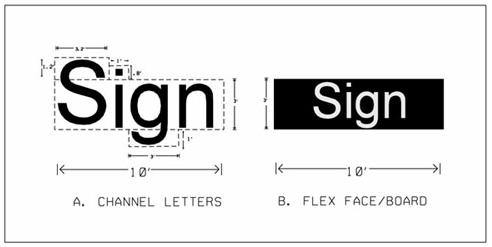
Figure II: Measuring Sign Area
(§ 4.15.07.1, 12-10-80; 7-8-92; 4.15.17, Ord. 01-18(3), 5-9-01; § 4.15.12, Ord. 15-18(11), 12-9-18)
State Law reference— Va. Code § 15.2-2280.
Sec. 4.15.13 - Measuring sign height.
The sign height shall be measured as follows:
a.
Measurement. The sign height shall be measured as the vertical distance from the normal grade directly below the sign to the highest point of the sign or sign structure, whichever is higher, and shall include the sign base, regardless of material, including earth used primarily to elevate the sign. See Figure III following this section.
b.
Determining the highest point. In determining the highest point of the sign or sign structure in subsection (a), the normal grade from which to measure the bottom of the sign height shall be that which is either existing prior to construction, or newly established after construction, depending on which grade is more consistent with the surrounding elevation of the lot on which the sign is located. Any fill or excavation that serves primarily to elevate the sign shall be included in the height of the sign.
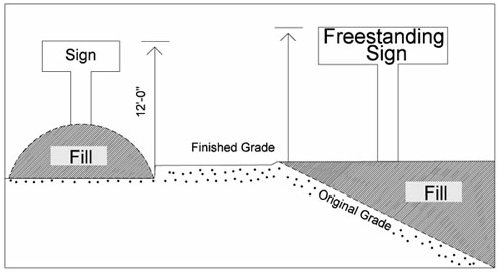
Figure III: Measuring Sign Height
(§ 4.15.07.2, 12-10-80; 7-8-92; § 4.5.18, Ord. 01-18(3), 5-9-01; § 4.15.13, Ord. 15-18(11), 12-9-15)
State Law reference— Va. Code § 15.2-2280.
Sec. 4.15.14 - Measuring sight distance triangle; signs prohibited therein.
Each sign shall be subject to the following:
a.
Measurement. The sight distance triangle shall be measured as follows:
1.
Area included. The sight distance triangle is that triangular area on a property between the two lines created by the existing or proposed right-of-way lines of intersecting exterior streets and/or street commercial entrances, and the straight line connecting them at points ten feet distant from where the right-of-way lines intersect. See Figure IV following this section.
2.
Area not included. The driveway for a single-family or two-family residence shall not be included in this calculation.
3.
Extension of sight distance triangle. The sight distance triangle may be extended to conform to minimum Virginia Department of Transportation sight distance standards.
b.
Signs in sight distance triangle prohibited. No sign shall be erected within a sight distance triangle.
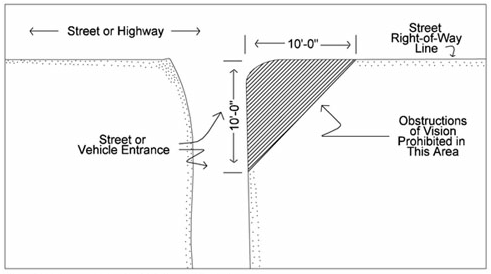
Figure IV: Determining Sight Distance Triangle
((§ 4.15.19: § 4.15.07.3, 12-10-80; 7-8-92; § 4.15.19, Ord. 01-18(3), 5-9-01) (§ 4.15.16(a)(i)); § 4.15.14, Ord. 15-18(11), 12-9-15)
State Law reference— Va. Code § 15.2-2280.
Sec. 4.15.15 - Measuring permitted wall signage based on structure frontage.
The structure frontage shall be measured to calculate the permitted wall signage as follows:
a.
Measurement. The structure frontage is the horizontal length of the outside structure wall of the establishment, in one plane, adjacent to a street.
b.
Two or more walls adjacent to a street. If an establishment has two or more walls adjacent to a street, at least one of which is an exterior wall, one of these additional walls may be used to calculate additional wall signage at one-third the rate as allowed on the structure frontage. The total permitted wall signage may then be divided to be used on any walls of the structure and/or canopy, provided that no one wall sign shall exceed the applicable maximum allowable sign area.
(§ 4.15.07.5, 12-10-80; 7-8-92; § 4.15.20, Ord. 01-18(3), 5-9-01; § 4.15.15, Ord. 15-18(11), 12-9-15)
State Law reference— Va. Code § 15.2-2280.
Sec. 4.15.16 - Measuring sign setback; signs prohibited therein.
Each sign shall be subject to the following:
a.
Measurement. For all signs other than a sign within a public right-of-way, the sign setback shall be measured from the property line or, in the case of an access easement, from the edge of the easement, to the closest point of the sign. The setback for a sign within a public right-of-way shall be measured from the edge of the travelway to the closest point of the sign. See Figure V following this section.
b.
Signs in setback prohibited. No sign shall be erected within the applicable minimum setback area in sections 4.15.9, 4.15.10, and 4.15.11.
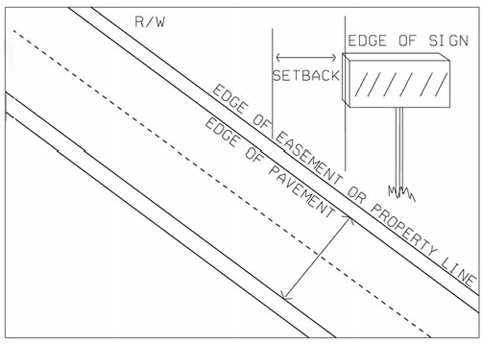
Figure V: Determining Sign Setback
((§ 4.15.21: § 4.15.07.4, 12-10-80; 7-8-92; § 4.15.21, Ord. 01-18(3), 5-9-01) (§ 4.15.16(a)(i)) ; § 4.15.16, Ord. 15-18(11), 12-9-15)
State Law reference— Va. Code § 15.2-2280.
Sec. 4.15.17 - Sign illumination.
Each sign shall be subject to the following:
a.
Illuminated signs. Signs using any form of outdoor luminaire shall comply with the requirements of section 4.17.
b.
Signs using rare gas illumination. Signs using exposed, bare, or uncovered rare gas illumination, and signs within the entrance corridor overlay district visible from an entrance corridor overlay street that use rare gas illumination covered by a transparent material, shall not have a brightness that exceeds 30 milliamps. Brightness shall be determined by the zoning administrator, who shall consider information provided by the sign manufacturer, the rated size of the sign's transformer, and any other relevant information deemed appropriate.
c.
Signs within the entrance corridor overlay district; opaque backgrounds. All internally illuminated box-style and cabinet-style signs within the entrance corridor overlay district shall have an opaque background.
(§§ 4.15.6(j), 4.15.15(c); § 4.15.17, Ord. 15-18(11), 12-9-15)
State Law reference— Va. Code § 15.2-2280.
Sec. 4.15.18 - Sign maintenance.
Each sign, including the sign structure, shall be maintained at all times in a safe structural condition and in a neat and clean condition, and shall be kept free from defective or missing parts. If the sign is illuminated, all lighting fixtures and sources of illumination shall be maintained in proper working order.
(§ 4.15.09.4(part), 12-10-80; 7-8-92; § 4.15.22, Ord. 01-18(3), 5-9-01; Ord. 05-18(4), 3-16-05; § 4.15.18, Ord. 15-18(11), 12-9-15)
State Law reference— Va. Code § 15.2-2280.
Sec. 4.15.19 - Sign alteration, repair, or removal; when required.
A sign shall be altered, repaired, or removed in any of the following cases:
a.
Alteration, repair, or removal; unsafe or endangering condition. If a sign becomes structurally unsafe, as determined by the building official, so as to become a danger to the public health or safety, the zoning administrator may order the owner or lessee of the lot on which the sign is located to alter, repair, or remove the sign within a time period determined by the zoning administrator to be appropriate under the circumstances. If the owner or lessee fails to comply with the order, the zoning administrator may cause the sign to be removed or initiate such other action as may be necessary to compel the alteration, repair or removal of the sign.
b.
Removal; unlawful erection of sign. If a sign is erected on private property in violation of this section 4.15, the zoning administrator shall order the owner or lessee of the lot on which the sign is located to remove the sign within a time period determined by the zoning administrator to be appropriate under the circumstances. If the owner or lessee fails to comply with the order, the zoning administrator may cause the sign to be removed or initiate such other action as may be necessary to compel compliance with the provisions of this section 4.15. If a sign is erected on public property, including a public right-of-way in violation of this section 4.15, any county employee may immediately remove the sign without prior notice to the owner of the sign.
c.
Removal of copy on sign face; discontinuance of pertinent use. If the use of a structure or property is discontinued, the copy on each sign face that is commercial speech shall be removed by the owner or lessee of the property on which the sign is located within two years from the date of the discontinuance of the use. If the owner or lessee fails to remove the copy, the zoning administrator may cause the copy to be removed or initiate such other action as may be necessary to compel compliance with the provisions of this section 4.15.
d.
Liability for cost of removal by county. If the zoning administrator causes a sign or copy on a sign face to be removed under the provisions of this section, the cost of such removal shall be chargeable to the owner of the sign or the owner or lessee of the lot on which the sign is located.
e.
Custody and destruction of removed signs. Cardboard and paper signs that have been removed by the county pursuant to this section shall be destroyed upon removal. All other signs which have been removed by the county shall be held for a period of 30 days and may be reclaimed by the sign owner within that time by reimbursing the county for the costs of removal. If such a sign is not reclaimed within the 30-day period, it shall be deemed to have been forfeited by the owner and shall be destroyed.
(§ 4.15.09.4 (part), 12-10-80; 7-8-92; § 4.15.23, Ord. 01-18(3), 5-9-01; § 4.15.19, Ord. 15-18(11), 12-9-15)
State Law reference— Va. Code § 15.2-2280.
Sec. 4.15.20 - Nonconforming signs.
A nonconforming sign may continue, subject to the provisions, conditions, and prohibitions set forth herein:
a.
Alteration of copy. The copy of a nonconforming sign may be altered by refacing the sign.
b.
Alteration of sign structure. A nonconforming sign shall not be structurally altered; provided that the zoning administrator may authorize a nonconforming sign to be structurally altered so that it is less nonconforming and further provided that each time the nonconforming sign is structurally altered, the sign area and sign height shall be reduced by at least 25 percent of its current area and height until the sign area and the sign height are conforming.
c.
Consolidation. Two or more nonconforming signs on a lot may be consolidated into a single sign; provided that the resulting sign area and sign height shall be reduced by at least 25 percent of its current area and height until the sign area and the sign height are conforming, and further provided that each time the resulting nonconforming sign is thereafter consolidated with another nonconforming sign on the lot, the resulting sign area and sign height shall be reduced by at least 25 percent of its current area and height, until the sign area and the sign height are conforming. A sign resulting from the consolidation of nonconforming signs shall not have greater sign height than any of the signs that were consolidated.
d.
Discontinuance of copy on sign face. A nonconforming sign without copy on its sign face for a continuous period of two years shall lose its nonconforming status and be removed by the owner of the lot on which the sign is located.
e.
Discontinuance of use or structure to which sign pertains. A nonconforming sign containing copy that is commercial speech shall lose its nonconforming status and be removed by the owner of the lot on which the sign is located if the use to which the sign pertains is discontinued for more than two years.
f.
Enlargement or extension. A nonconforming sign shall not be enlarged or extended.
g.
Maintenance. A nonconforming sign shall be maintained in good repair and condition.
h.
Relocation. A nonconforming sign shall not be moved to another location on the same lot or to any other lot; provided that the zoning administrator may authorize a nonconforming sign to be moved to a location that is more in compliance with the purpose and intent and the requirements of this section 4.15.
i.
Replacement or restoration. A nonconforming sign may be replaced or restored only as provided below:
1.
A nonconforming sign that is destroyed or damaged by the owner of the sign or the owner of the lot on which the sign is located shall not be replaced or restored unless it complies with this section 4.15.
2.
A nonconforming sign that is destroyed or damaged as a result of factors beyond the control of the owner of the sign and the owner of the lot on which the sign is located, to an extent the destruction or damage exceeds 50 percent of its appraised value, shall not be replaced or restored unless it complies with this section 4.15.
3.
A nonconforming sign that is destroyed or damaged as a result of factors beyond the control of the owner of the sign and the owner of the lot on which the sign is located, to an extent the destruction or damage is 50 percent or less of the appraised value, may be replaced or restored provided that the replacement or restoration is completed within two years after the date of the destruction or damage, and the sign is not enlarged or extended.
j.
Removal if in unsafe condition. A nonconforming sign declared to be unsafe by a public safety official because of the physical condition of the sign, including an unsafe physical condition arising from the failure of the sign to be maintained, shall be removed.
k.
Registry of nonconforming signs. The owner of any lot on which a nonconforming sign shall, upon notice from the zoning administrator, submit verification within 60 days that the sign was lawfully in existence at the time of adoption of these sign regulations. The zoning administrator shall maintain a registry of such nonconforming signs.
(§§ 4.15.09.5, 4.15.10, 12-10-80; 7-8-92; § 4.15.24, Ord. 01-18(3), 5-9-01; § 4.15.20, Ord. 15-18(11), 12-9-15)
State Law reference— Va. Code § 15.2-2280.
Sec. 4.16.1 - Minimum area.
A minimum of 200 square feet per unit of recreational area shall be provided in common area or open space on the site, this requirement not to exceed five percent of the gross site area.
The commission shall consider the appropriateness of such area for the intended purpose, using the following guidelines:
1.
Slope in active recreation areas shall not exceed ten percent. Slope and drainage shall be approved by the county engineer;
2.
The size and shape of each recreation area shall be adequate for the intended use;
3.
Groundcover shall consist of turf grass or contained mulch such as pine bark, shredded tires, or pea gravel;
4.
Existing wooded or steep areas may qualify as passive recreation area provided no other suitable area is available on the site;
5.
Access shall be adequate for pedestrians and service vehicles if necessary;
6.
Location shall be compatible with adjoining uses, convenient to users and suitable for supervision.
Sec. 4.16.2 - Minimum facilities.
The following facilities shall be provided within the recreational area:
4.16.2.1 One tot lot shall be provided for the first 30 units and for each additional 50 units and shall contain equipment which provides an amenity equivalent to:
One swing (four seats)
One slide
Two climbers
One buckabout or whirl
Two benches.
Substitutions of equipment or facilities may be approved by the director of planning and community development, provided they offer a recreational amenity equivalent to the facilities listed above, and are appropriate to the needs of the occupants.
Each tot lot shall consist of at least 2,000 square feet and shall be fenced, where determined necessary by the director of planning and community development, to provide a safe environment for young children.
4.16.2.2 One-half court for basketball shall be provided for each 100 units, consisting of a 30-foot by 30-foot area of four-inch 21-A base and 1½ inches bituminous concrete surface, and a basketball backboard and net installed at regulation height.
Sec. 4.16.3 - Additional requirements.
4.16.3.1 Equipment specifications shall be approved by the director of planning and community development on advice of the director of parks and recreation.
4.16.3.2 Recreational equipment and facilities shall be maintained in a safe condition and replaced as necessary. Maintenance shall be the responsibility of the property owner if rental units or a homeowners' association if sale units.
4.16.3.3 Recreational facilities shall be completed when 50 percent of the units have received certificates of occupancy.
Sec. 4.17.1 - Purpose.
The purposes of these outdoor lighting regulations are to protect dark skies, to protect the general welfare by controlling the spillover of light onto adjacent properties, and to protect the public safety by preventing glare from outdoor luminaires. To effectuate these purposes, these regulations regulate the direction of light emitted from certain luminaires, and limit the intensity of light on certain adjacent properties, as provided herein.
(Ord. 98-18(1), 8-12-98)
Sec. 4.17.2 - Applicability.
Except as provided in sections 4.17.4(b) and 4.17.6, these outdoor lighting regulations shall apply to each outdoor luminaire installed or replaced after the date of adoption of these regulations which is: (Amended 10-17-01)
a.
Located on property within a commercial or industrial zoning district, or is associated with a use for which a site plan is required by section 32, and is equipped with a lamp which emits 3,000 or more maximum lumens; or (Amended 10-17-01)
b.
Located on property within a residential or the rural areas zoning district and is associated with a use for which a site plan is not required by section 32, and is equipped with a high intensity discharge lamp, regardless of its maximum lumens. (Amended 10-17-01)
(Ord. 98-18(1), 8-12-98; Ord. 01-18(8), 10-17-01)
Sec. 4.17.4 - Standards.
The following standards shall apply to each outdoor luminaire:
a.
Except as provided in section 4.17.6, each outdoor luminaire subject to these outdoor lighting regulations shall be a full cutoff luminaire. (Amended 10-17-01)
1.
For each outdoor luminaire subject to these outdoor lighting regulations pursuant to section 4.17.2(a), whether a lamp emits 3,000 or more maximum lumens shall be determined from the information provided by the manufacturer of the lamp including, but not limited to, information on the lamp or on the lamp's packaging materials. (Amended 10-17-01)
2.
For each outdoor luminaire subject to these outdoor lighting regulations pursuant to section 4.17.2(a), the following rated lamp wattages shall be deemed to emit 3,000 or more maximum lumens unless the zoning administrator determines, based upon information provided by a lamp manufacturer, that the rated wattage of a lamp emits either more or less than the 3,000 maximum lumens, or is a fixture with LED lamps, the total lumens of which equals 3,000 or more: (Amended 10-17-01, 10-11-17)
a.
Incandescent lamp: 160 or more watts.
b.
Quartz halogen lamp: 160 or more watts.
c.
Fluorescent lamp: 35 or more watts.
d.
Mercury vapor lamp: 75 or more watts.
e.
Metal halide lamp: 40 or more watts.
f.
High pressure sodium lamp: 45 or more watts.
g.
Low pressure sodium lamp: 25 or more watts.
3.
If LED lamps are proposed, the applicant shall provide information from the manufacturer indicating the total lumens emitted by the fixture and, if the total lumens is 3,000 or more, the fixture shall be a full cutoff fixture. (Amended 10-17-01, 10-11-17)
4.
If the total lumens emitted by proposed LED lamps are 3,000 or greater as indicated in information provided by the manufacturer, the fixture shall be a full cutoff luminaire. (Added 10-11-17)
b.
Each parcel, except those containing only one or more single-family detached dwellings, shall comply with the following: (Added 10-17-01)
1.
The spillover of lighting from luminaires onto public roads and property in residential or rural areas zoning districts shall not exceed one-half foot candle. A spillover shall be measured horizontally and vertically at the property line or edge of right-of-way or easement, whichever is closer to the light source. (Amended 10-17-01)
2.
All outdoor lighting, regardless of the amount of lumens, shall be arranged or shielded to reflect light away from adjoining residential districts and away from adjacent roads. (Added 10-17-01)
(Ord. 98-18(1), 8-12-98; Ord. 01-18(8), 10-17-01; Ord. 17-18(5), 10-11-17)
Sec. 4.17.5 - Modification or waiver.
Modifications and waivers may be granted in an individual case as provided herein:
a.
The Board of Supervisors may modify or waive any standard set forth in section 4.17.4(a) under subsections 4.17.5(a)(1) and (2), and may modify the maximum height of poles supporting outdoor luminaires lighting athletic facilities under subsection 4.17.5(a)(3), in the following circumstances:
1.
Upon finding that strict application of the standard would not forward the purposes of this chapter or otherwise serve the public health, safety or welfare, or that alternatives proposed by the owner would satisfy the purposes of these outdoor lighting regulations at least to an equivalent degree.
2.
Upon finding that an outdoor luminaire, or system of outdoor luminaires, required for an athletic facility cannot reasonably comply with the standard and provide sufficient illumination of the facility for its safe use, as determined by recommended practices adopted by the Illuminating Engineering Society of North America for that type of facility and activity or other evidence if a recommended practice is not applicable.
3.
Upon finding that the maximum permitted height of a pole supporting an outdoor luminaire lighting an athletic facility under the applicable district regulations would prevent the luminaire from providing sufficient illumination of the facility for its safe use, as determined by the recommended practices adopted by the Illuminating Engineering Society of North America for that type of facility and activity or other evidence if a recommended practice is not applicable.
b.
Prior to considering a request to modify or waive, five days' written notice shall be provided to the owner, owner's agent or occupant of each abutting lot or parcel and each parcel immediately across the street or road from the lot or parcel which is the subject of the request. The written notice shall identify the nature of the request and the date and time the Board of Supervisors will consider the request.
c.
The Board of Supervisors may impose conditions on such a modification or waiver which it deems appropriate to further the purposes of these outdoor lighting regulations.
(Ord. 98-18(1), 8-12-98; Ord. 01-18(4), 5-9-01; Ord. 01-18(8), 10-17-01; Ord. 08-18(5), 7-9-08; Ord. 21-18(5), 12-1-21)
Sec. 4.17.6 - Exempt outdoor lighting and related acts.
The following outdoor lighting and related acts shall be exempt from the requirements of these outdoor lighting regulations:
a.
Lighting which is not subject to this chapter by state or federal law.
b.
Construction, agricultural, emergency or holiday decorative lighting, provided that the lighting is temporary, and is discontinued within seven days upon completion of the project or holiday for which the lighting was provided.
c.
Lighting of the United States of America or Commonwealth of Virginia flags and other non-commercial flags expressing constitutionally protected speech.
d.
Security lighting controlled by sensors which provides illumination for 15 minutes or less.
e.
The replacement of an inoperable lamp or component which is in a luminaire that was installed prior to the date of adoption of section 4.17.
f.
The replacement of a failed or damaged luminaire which is one of a matching group serving a common purpose.
(Ord. 98-18(1), 8-12-98)
Sec. 4.18.01 - Applicability.
This section 4.18 shall apply to sound produced by any use authorized by this chapter, including any use that is expressly authorized by a proffer, special use permit, special use permit condition, or a standard in a code of development, except as otherwise provided in section 4.18.05, regardless of whether the property in the receiving zone is within or without Albemarle County.
(Ord. 00-18(3), 6-14-00; Ord. 13-18(4), 9-4-13)
State Law reference— Va. Code § 15.2-2280.
Sec. 4.18.03 - Procedure for measuring sound.
Each sound meter reading shall be conducted as provided herein:
A.
Instrument of measurement. Each sound measurement shall be taken only from a sound level meter.
B.
Calibration of sound level meter. An acoustic calibrator authorized by the manufacturer of the sound level meter shall properly calibrate the sound level meter used for each sound measurement. The calibration shall have been performed within 12 months prior to the date of such reading. The user of the sound level meter shall also have calibrated the sound level meter within one hour prior to taking such sound measurements.
C.
Weather conditions. A windscreen shall be used on the sound level meter when sound measurements are being taken. No outdoor sound measurements shall be taken during rain or during weather conditions in which wind sound is distinguishable from, and is louder to the ear than, the sound source being tested.
D.
Scale. Each sound measurement shall be expressed in units of the sound level (dBA), in accordance with American National Standards Institute specifications for sound level meters. Each measurement shall be made using the A-weighted scale with fast response, following the manufacturer's instructions and measuring the equivalent sound level. Impulse sounds shall be measured as the maximum reading and not the equivalent sound level.
E.
Place of sound measurement. Each sound measurement shall be taken no closer to the sound source than the property lines of the receiving zone properties or the property line along which a street fronts. If the property line of a receiving zone property is not readily determinable, the sound measurement shall be taken from any point inside the nearest receiving zone property, or within an occupied structure located on receiving zone property. If the property line abutting a street is not readily determinable, the sound measurement shall be taken from the edge of the pavement which is closest to the source of the sound. Each sound measurement taken of a sound source within a multifamily structure, such as an apartment building, townhouse development and the like, may be made: (i) within the interior of another residential unit in the same structure or the same development; or (ii) from common areas.
F.
Orientation of microphone. To the extent that it is practical to do so, the microphone of the sound level meter shall be positioned four to five feet above the ground or floor. The orientation recommended by the manufacturer of the sound level meter shall supersede the foregoing orientation if the manufacturer's recommendation conflicts therewith.
G.
Duration of measurement. Each sound measurement shall be taken over a period of five continuous minutes, unless the sound being measured is an impulse sound. If the sound being measured is an impulse sound, each sound measurement shall be taken during the "impulse" or emission of that sound. The zoning administrator shall determine whether a sound is an impulse sound for purposes of determining the duration of the sound measurement.
H.
Ambient sound measurement. The ambient sound shall be measured for each sound measurement as follows:
1.
The ambient sound level shall be averaged over a period of time comparable to that for the measurement of the particular sound source being measured.
2.
In order to obtain the ambient sound level, the sound source being measured shall be eliminated by the source ceasing its sound-producing activity and the ambient sound level shall be obtained from the same location as that for measuring the source sound level. If the sound from the sound source cannot be eliminated, the ambient sound level shall be measured from an alternative location whose ambient sound level is not affected by the sound source in accordance with the following procedure:
a.
The alternative location should be as close as feasible as that for measuring the source sound level, but located so that the sound from the source has as little effect as possible on the ambient sound level measurement. Even if the source sound is audible or is sufficient to raise the sound level above that which would be measured were it inaudible at the alternative location, the reading is sufficient for the purpose of this procedure.
b.
The alternative location chosen must be such that structures in the vicinity are similar in size and distribution, and the local topography is similar in character to the location for the source sound level measurement.
c.
Traffic conditions at the time the ambient sound level is measured must be similar to those at the location for the sound source measurement.
I.
Determining source sound level. Except for new equipment for which the owner provides manufacturer's specifications related to sound levels accepted by the zoning administrator, the sound level from a sound source shall be determined by correcting the total sound level for ambient sound in accordance with the following procedure:
1.
Subtract the maximum measured ambient sound level from the minimum measured total sound level.
2.
In Row A below, find the sound level difference determined under paragraph (1) and its corresponding correction factor in Row B.
3.
Subtract the value obtained from Row B under paragraph (2) from the minimum measured total sound level to determine the source sound level.
4.
If the difference between the total sound level and the ambient sound level is greater than 10 dBA, no correction is necessary to determine the source sound level.
(Ord. 00-18(3), 6-14-00)
State Law reference— Va. Code § 15.2-2280.
Sec. 4.18.04 - Maximum sound levels.
Except as provided in section 4.18.05, it shall be unlawful for any person to operate or cause to be operated, any source such that the sound originating from that source causes a sound level that exceeds the sound levels in the receiving zone, measured pursuant to section 4.18.03, as set forth below:
(Ord. 00-18(3), 6-14-00)
State Law reference— Va. Code § 15.2-2280.
Sec. 4.18.05 - Exempt sounds.
The following sounds shall not be subject to this section 4.18:
A.
Agricultural activities. Sound produced by an agricultural activity.
B.
Animals. Sound produced by animals including, but not limited to, barking dogs; provided that this sound is otherwise subject to the animal noise regulations in chapter 4 of the Code.
C.
Bells or chimes from place of religious worship. Sound produced by bells, chimes or other similar instruments or devices from a place of religious worship.
D.
Construction, demolition and/or maintenance activities. Sound produced by construction, demolition and/or maintenance activities; provided that this sound is otherwise subject to the noise regulations in chapter 7 of the Code.
E.
Emergency operations. Sound produced in the performance of emergency operations including, but not limited to, audible signal devices which are employed as warning or alarm signals in case of fire, collision or imminent danger or sound produced by power generators during power outages and other emergency situations.
F.
Firearms. Sound produced by the lawful discharge of a firearm; provided that this exemption shall not apply to a firearm discharged at a gun club, shooting range, shooting preserve, or target, trap or skeet range.
G.
Home appliances. Sound produced by the normal use of home appliances such as generators, air conditioners, heat pumps, vacuum cleaners, washing machines, dryers and dishwashers, provided that the appliances are in good repair.
H.
Outdoor amplified music or outdoor public address systems. Sound produced by an outdoor amplified music system or outdoor public address system; provided that sound from outdoor amplified music at a farm winery is otherwise subject to the farm winery regulations in section 18-5.1.25(e), sound produced in conjunction with an outdoor music festival authorized by special use permit under this chapter shall be subject to the noise regulations in this chapter, and sound produced by an outdoor amplified music system or outdoor public address system, including any system used in conjunction with an agricultural activity, is subject to the noise regulations in chapter 7 of the Code.
I.
Parades, fireworks and similar events. Sound produced by parades, fireworks, and other similar events which are officially sanctioned, if required; provided that the exemption for fireworks shall apply only to fireworks displays duly issued a permit pursuant to chapter 6 of the Code.
J.
Person's voice. Sound produced by a person's voice.
K.
Place of public entertainment. Sound produced by a radio, tape player, television receiver, musical instrument, electronic sound amplification equipment, phonograph, compact disc player, MP3 player, or other similar device intended primarily for the production or reproduction of sound (hereinafter, collectively and singularly a "device") at a place of public entertainment; provided that this sound is otherwise subject to the noise regulations in chapter 7 of the Code.
L.
Protected expression. Sound produced by any lawful activity which constitutes protected expression pursuant to the First Amendment of the United States Constitution, but not amplified expression.
M.
Public facilities and public uses. Sounds produced by the operation of a public facility or public use including, but not limited to, any sound which would not be an exempt sound if it was produced by the operation of a non-public facility or non-public use.
N.
School athletic contests or practices, and other school activities; private schools. Sound produced by private school athletic contests or practices, and other private school activities, but only if conditions are not imposed which regulate the generation of sound including, but not limited to, conditions regulating the hours of the activity and the amplification of sound.
O.
Silvicultural activities. Sound produced during lawfully permitted bona fide silvicultural activities including, but not limited to, logging activities; provided that this sound is otherwise subject to the noise regulations in chapter 7 of the Code.
P.
Solid waste collection. Sound produced by the collection of solid waste; provided that this sound is otherwise subject to the noise regulations in chapter 7 of the Code.
Q.
Telephones. Normal sound produced by landline and wireless telephones.
R.
Transportation. Transient sound produced by transportation including, but not limited to, public and private airports (except as otherwise regulated), aircraft, railroads and other means of public transit, and sound produced by motor vehicles and motorcycles.
S.
Warning devices. Sound produced by a horn or warning device of a vehicle when used as a warning device, including back-up alarms for trucks and other equipment.
T.
Yard maintenance activities. Sound produced by routine yard maintenance activities including, but not limited to, mowing, trimming, clipping, leaf blowing and snow blowing; provided that this sound is otherwise subject to the noise regulations in chapter 7 of the Code.
(Ord. 00-18(3), 6-14-00; Ord. 13-18(4), 9-4-13)
State Law reference— Va. Code § 15.2-2280.
Sec. 4.18.06 - Existing sound sources.
Each existing sound source existing on the effective date of this section 4.18 shall be regulated as follows:
A.
Each existing sound source that complies with the maximum sound levels established in section 4.18.04 shall comply with all requirements of this section 4.18 rather than an applicable prior regulation.
B.
Each existing sound source that does not comply with the maximum sound levels established in section 4.18.04 shall not increase its sound level. Such a sound source shall comply with such sound levels whenever a building, structure, equipment or machinery thereof is expanded, enlarged, extended or replaced, unless a modification, waiver or variation is granted as provided in section 4.18.07.
(Ord. 00-18(3), 6-14-00)
State Law reference— Va. Code § 15.2-2280.
Sec. 4.18.07 - Modification or waiver.
Any standard of section 4.18.04 may be modified or waived in an individual case, as provided herein:
a.
The Board of Supervisors may modify or waive the standard set forth in section 4.18.04 in a particular case upon finding that strict application of the standard would cause undue hardship and not forward the purposes of this chapter or otherwise serve the public health, safety or welfare, or that alternatives proposed by the owner would satisfy the purposes of this section 4.18 at least to an equivalent degree.
b.
The Board of Supervisors may impose conditions on the modification or waiver that it deems appropriate to further the purposes of this chapter.
c.
Prior to considering a request to modify or waive, five days' written notice shall be provided to the owner, owner's agent or occupant of each abutting lot or parcel and each parcel immediately across the street or road from the lot or parcel which is the subject of the request. The written notice shall identify the nature of the request and the date and time the Board of Supervisors will consider the request.
(Ord. 00-18(3); Ord. 01-18(4), 5-9-01; Ord. 21-18(5), 12-1-21)
State Law reference— Va. Code § 15.2-2280.
Sec. 4.23.1 - Intent.
A.
Purpose. These riparian buffer standards are adopted pursuant to the State Water Control Law (Virginia Code § 62.1-44.2 et seq.) to:
1.
Protect existing high-quality state waters;
2.
Restore all other state waters to a condition or quality that will permit all reasonable public uses and will support the propagation and growth of all aquatic life, including game fish, which might reasonably be expected to inhabit them;
3.
Safeguard the waters of the Commonwealth from pollution;
4.
Prevent any increase in pollution;
5.
Maintain and improve riparian habitat to include preservation of mature trees or planting of trees or native vegetation as a water quality protection tool;
6.
Reduce existing pollution; and
7.
Promote water resource conservation to provide for the health, safety, and welfare of the present and future residents of Albemarle County and the Commonwealth of Virginia.
B.
Additional Intent. These standards also:
1.
Limit development and land disturbance next to surface watercourses and contiguous nontidal wetlands; and
2.
Encourage preservation of native vegetation to:
a.
Protect public and private water supplies;
b.
Trap sediment and other pollutants in runoff;
c.
Stabilize stream and river banks;
d.
Protect fish and wildlife habitat;
e.
Reduce storm and flood impacts; and
f.
Preserve scenic and recreational resources.
(§18-4.23.1, Ord. 26-18(1), 6-17-26, effective 9-1-26)
State Law reference— Va. Code §§ 62.1-44.2, 62.1-44.15:72, 62.1-44.15:73, 62.1-44.15:75, 9VAC25-830-120
Sec. 4.23.2 - Applicability.
A.
Relationship to other regulations.Section 4.23 supersedes any less-restrictive County regulations. If a riparian buffer overlaps the Flood Hazard Overlay District, the more restrictive provisions of section 30.3 apply.
B.
Pre-existing uses and improvements. Any lawful use or improvement (other than buildings or structures) existing on the effective date of this section that does not comply with section 4.23 is deemed nonconforming and may continue subject to the nonconforming provisions of section 6.2; provided that any expansion, intensification, or relocation within a riparian buffer must comply with sections 4.23.6 and 4.23.9.
C.
Buildings and structures. Any building or structure lawfully existing on February 11, 1998 may remain. Repair and in-kind replacement following casualty are permitted. Expansion or enlargement within the riparian buffer requires approval by the Riparian Buffer Administrator under section 4.23.8 and must comply sections 4.23.6, and 6.3, and section 30.3 where applicable.
(§18-4.23.2, Ord. 26-18(1), 6-17-26, effective 9-1-26)
State Law reference— Va. Code § 15.2-2307, 9VAC25-830-150
Sec. 4.23.3 - Authority, Powers, and Duties of Riparian Buffer Administrator.
A.
Designation. The County Engineer, or designee, is the Riparian Buffer Administrator.
B.
Power and duties. The Riparian Buffer Administrator has all necessary authority to administer section 4.23, including but not limited to:
1.
Interpret and make site-specific determinations of riparian buffer boundaries and stream designations under section 4.23.5;
2.
Determine whether structures, improvements, and activities are permitted under section 4.23.7 or eligible for authorization under section 4.23.8;
3.
Require surveys, delineations, and studies reasonably necessary to administer section 4.23;
4.
Maintain and update the County's Geographic Information System (GIS) layer to reflect approved site-specific determinations;
5.
Enforce section 4.23 in coordination with the Zoning Administrator, including issuance of notices of violation; and
6.
Require, review, and approve mitigation plans and surety under section 4.23.9.
C.
Appeals. Appeals of an official determination under section 4.23 must be filed in accordance with section 34.
(§18-4.23.3, Ord. 26-18(1), 6-17-26, effective 9-1-26)
State Law reference— Va. Code §§ 62.1-44.15:73, 62.1-44.15:75, 62.1-44.15:76.
Sec. 4.23.4 - Boundaries—General.
A.
Mapping. The County's GIS layer depicts approximate riparian buffer locations and is advisory only. Site-specific adjustments occur as set forth in section 4.23.5.
B.
Defined boundaries. Riparian buffers extend landward from any perennial or intermittent stream, pond, lake, or contiguous nontidal wetland to the farther of the following:
1.
Development Areas (outside any water supply protection area). One hundred feet measured horizontally from the top bank of any perennial stream and its contiguous nontidal wetlands, on each side
2.
Development Areas (within a water supply protection area). The greater of:
a.
One hundred feet measured horizontally from the top bank of any perennial or intermittent stream and its contiguous nontidal wetlands, on each side; or
b.
The limits of the Flood Hazard Overlay District;
3.
Public water-supply impoundments. Two hundred feet landward of the Flood Hazard Overlay District limits surrounding the impoundment, measured horizontally; or
4.
All other locations. The greater of:
a.
One hundred feet measured horizontally from the top of the bank; or
b.
The limits of the Flood Hazard Overlay District.
C.
Measurement.
1.
Distances from a stream are measured horizontally from the top of the bank.
2.
Distances from a pond, lake, or contiguous nontidal wetlands are measured horizontally from the ordinary high-water mark.
3.
Prior clearing, grading, or encroachments do not reduce the required riparian buffer width.
(§18-4.23.4, Ord. 26-18(1), 6-17-26, effective 9-1-26)
State Law reference— Va. Code §§ 62.1-44.15:73, 62.1-44.15:75, 62.1-44.15:76; 9VAC25-830-140; 9VAC25-890-40.
Sec. 4.23.5 - Site-Specific Determinations of Riparian Buffers.
A.
Development applications: Each application, plan, or permit proposing development must include either:
1.
A site-specific survey of riparian buffer boundaries, applying the standards in the Engineering Design Standards Manual (DSM) and as required pursuant to subsection D; or
2.
A certified statement with supporting basis (topography, hydrology, mapping) that no riparian buffer is present.
The Riparian Buffer Administrator may require the applicant to provide a site-specific survey, regardless of whether the County's GIS mapping depicts a riparian buffer or of any statement made under subsection A(2).
B.
Optional boundary determinations. An applicant may request a review and confirmation of riparian buffer boundaries at any time by submitting a site-specific survey to the Riparian Buffer Administrator.
C.
Exemption. The Riparian Buffer Administrator may exempt building permit applications for single-family detached residences in the Rural Areas (RA) zoning district from a site-specific survey if no disturbance within a riparian buffer is proposed.
D.
Survey standards. Site-specific surveys must be prepared and sealed by a Virginia-licensed engineer, land surveyor, landscape architect, or a certified scientist, or wetland delineator, and must delineate:
1.
Perennial and intermittent streams;
2.
Contiguous nontidal wetlands;
3.
Flood Hazard Overlay District limits; and
4.
Riparian buffer boundaries pursuant to section 4.23.4.
Field verification may be required.
(§18-4.23.5, Ord. 26-18(1), 6-17-26, effective 9-1-26)
State Law reference— Va. Code § 62.1-44.15:76; 9VAC25-830-120.
Sec. 4.23.6 - General Performance Standards.
A.
Landcovers. Landcover changes within riparian buffers must conform to the Permitted Landcover Change Matrix in the DSM. Increases in impervious area are prohibited except as expressly permitted under sections 4.23.7 or 4.23.8.
B.
Buffer management. Except as authorized by sections 4.23.7 or 4.23.8, riparian buffers must be managed as follows:
1.
Native vegetation within the riparian buffer must not be disturbed or removed;
2.
Buffers must be maintained in as natural a condition as possible; and
3.
The preferred vegetative cover is a native forest with ground cover, shrub/understory, and tree canopy layers.
C.
Replanting after cessation or conversion. When an activity permitted under sections 4.23.7 (A) or 4.23.7 (B) ceases or is converted to a non-permitted use, buffer vegetation must be installed at densities specified in the DSM, consistent with the current Virginia Department of Conservation and Recreation's (VDCR) Riparian Buffers Modification and Mitigation Guidance Manual.
D.
Performance standards. Any use, development, or redevelopment within a riparian buffer must meet the following performance standards:
1.
No more land may be disturbed than is necessary to provide for the proposed use or development;
2.
Native vegetation must be preserved to the maximum extent practicable, consistent with the proposed use or development;
3.
Impervious cover must be the minimum necessary for the proposed use or development;
4.
Comply with all applicable County requirements for land-disturbing activity;
5.
Be designed and constructed to minimize erosion;
E.
Common areas in subdivisions or developments. Lots should not include riparian buffers; however the Riparian Buffer Administrator may allow buffers on lots only if a permanent easement or recorded covenant ensures preservation consistent with section 4.23et seq.
F.
Signage. For subdivisions creating lots or construction requiring a site plan (other than properties used for bona fide agricultural and/or silvicultural activities), the developer must install signage marking the landward boundary of the buffer at locations and with text specified in the DSM. Signs must be installed upon final stabilization of disturbed areas and in accordance with the DSM.
G.
Prohibited practices. Fertilization or herbicide application within the buffer is prohibited except for invasive-species control approved under section 4.23.7(K).
(§18-4.23.6, Ord. 26-18(1), 6-17-26, effective 9-1-26)
State Law reference— Va. Code §§ 62.1-44.15:69, 62.1-44.15:73, 62.1-44.15:75, 9VAC25-830-130.
Sec. 4.23.7 - Permitted Structures, Improvements, and Activities.
The following are permitted within riparian buffers and must follow the performance standards in section 4.23.6 (D), and obtain all required Federal, State and County permits:
A.
Agriculture. Bona fide agricultural activities, excluding:
1.
Roads not exempt under section 17-300 (D); and
2.
New agricultural structures located within 100 feet of the top bank of any perennial or intermittent stream or its contiguous wetland.
B.
Silviculture. Silvicultural activities only when conducted in compliance with the Virginia Department of Forestry's "Best Management Practices for Water Quality," including the establishment of Streamside Management Zones.
C.
Utilities and transportation. The construction, installation, operation, and maintenance of electric, natural gas, fiber-optic, and telephone transmission lines, railroads, and public roads and accessory structures constructed by the Virginia Department of Transportation (VDOT), if they comply with:
1.
The Virginia Erosion and Stormwater Management Act and its regulations;
2.
An approved soil erosion and stormwater management plan; or
3.
Local water quality protection standards that are at least as stringent as state requirements.
D.
Local utility lines. The construction, installation, and maintenance of water, sewer, natural gas, and underground telecommunications and cable television lines owned, permitted, or both, by a local government or regional service authority if:
1.
To the degree possible, such utilities and facilities are located outside of the riparian buffer; and
2.
No more land is disturbed than is necessary to provide for the proposed utility installation; and
3.
All such construction, installation, and maintenance of such utilities and facilities must comply with all applicable County, state and federal permits and designed and conducted in a manner that protects water quality.
E.
Water-dependent structures or facilities. Permitted only when:
1.
All non-water dependent components are outside the buffer;
2.
There is only a single point of access; and
3.
The disturbance is limited to only what is necessary to build and access the water-dependent structure or facility.
F.
Passive recreation. Educational signs and kiosks, and pervious trails, paths, or boardwalks following the current VDCR Riparian Buffers Modification and Mitigation Guidance Manual, and DSM guidance. Paths serving individual lots must not exceed four feet in width except as necessary to meet ADA accessibility or emergency-services requirements.
G.
Historic and archaeological activities. Permitted with prior approval by the Riparian Buffer Administrator and the Zoning Administrator.
H.
Buffer restoration and replacement. Permitted only when:
1.
A plan or narrative is approved by the Riparian Buffer Administrator.
2.
Mature trees are preserved when possible. Any vegetation that is removed must be replaced with native vegetation that provides the same level of water quality or better quality protection and is consistent with the DSM. Trees or other vegetation that is removed must be:
a.
Replaced with native vegetation that is appropriate to site conditions and is equally effective in reducing runoff, preventing erosion, and filtering nonpoint source pollution; and
b.
Replanted in a way that maximizes the buffer's function and protects water quality.
3.
Permitted replacement and restoration activities include:
a.
Reestablishing buffers after agricultural or silvicultural land is changed to a land use other than bona fide agricultural or silvicultural activities;
b.
Restoring vegetation where forestry or agricultural best management practices recommend removing and replacing vegetation to maintain a healthy buffer;
c.
Replanting vegetation that was removed for a sightline, access path or for woodlot management; and
d.
Replacing vegetation that was removed illegally or removed beyond what was authorized.
I.
Native vegetation planting. Planting of native trees, shrubs, or other vegetation consistent with the DSM.
J.
Minor installations. Installation of fences, sign posts, and poles (telephone, electric, or other kinds of posts or poles).
K.
Limited vegetation removal. Removal of the following types of vegetation:
1.
Dead, diseased or dying trees or shrubbery;
2.
Noxious weeds or invasive plant species, to include but not be limited to Johnson grass, kudzu, and multiflora rose; or
3.
Vegetation posing an imminent threat to buildings or public health or safety.
Upon demand by the Riparian Buffer Administrator, the landowner must provide evidence that removed vegetation qualified as one of the types identified above. The Riparian Buffer Administrator may require a mitigation plan and plantings as set forth in section 4.23.9 if it is determined the vegetation removed does not meet the criteria of this section.
(§18-4.23.7, Ord. 26-18(1), 6-17-26, effective 9-1-26)
State Law reference— Va. Code §§ 62.1-44.15:69, 62.1-44.15:72, 62.1-44.15:73; 9VAC25-830-140, 9VAC25-830-150
Sec. 4.23.8 - Structures, Improvements, and Activities Subject to Approval by the Riparian Buffer Administrator.
A.
Conditions of authorization. The Riparian Buffer Administrator may authorize structures, improvements, and activities listed in section 4.23.8 (B) if:
1.
A mitigation plan is approved under section 4.23.9;
2.
The structure, improvement or activity complies with section 4.23.6 (D);
3.
All required Federal, State and local permits are obtained; and
4.
The structure, improvement or activity complies with all other applicable law.
B.
Authorized structures, improvements and activities.
1.
Temporary erosion and sediment control measures. Temporary erosion and sediment control measures within the landward (outer) 50 horizontal feet of the riparian buffer if the Riparian Buffer Administrator determines:
a.
Such measures are located outside the riparian buffer as much as practical;
b.
Disturbance of the riparian buffer are minimized; and
c.
The disturbed area of the riparian buffer will be restored after the measures are removed pursuant to an approved mitigation plan.
2.
Supportive infrastructure. Necessary supportive infrastructure located within the landward (outer) 50 feet of the riparian buffer that is:
a.
Necessary to allow reasonable use of the lot as set forth in Section 4.23.8 (B)(8); or
b.
Located along an intermittent stream within both a water supply protection area and a development area.
3.
Environmental restoration projects. Environmental restoration projects approved by the County, a soil and water conservation district, or another authorized public agency.
4.
Stream crossings. Stream crossings for roads, streets, or driveways, and related sidewalks, utilities, and drainage facilities if it meets the requirements of the DSM. In order to ensure that the encroachment into or across the riparian buffer is minimized, on or after May 7, 2008, it is presumed that one stream crossing is adequate to serve the lot(s) existing on that date and all lots created on and after that date. The Riparian Buffer Administrator will only allow one stream crossing to serve all lots, unless additional crossings are determined to be necessary as set forth in under Section 4.23.8 (B)(5).
5.
Additional stream crossings. If the Riparian Buffer Administrator determines that a riparian buffer would prohibit access to a lot, and such access is necessary for the lot to be used and developed as permitted in the underlying zoning district and under the applicable regulations of Chapter 14, then an additional stream crossing may be authorized.
6.
Agricultural roads included within a plan of development. Agricultural roads that are included within a plan of development as set forth in section 17-300 (D).
7.
Water and sewer facilities or sewage systems. On lots of record lawfully existing prior to February 11, 1998 when:
a.
Activities in the riparian buffer are limited to the construction, installation, and maintenance of those facilities or systems; and
b.
The Riparian Buffer Administrator determines that the riparian buffer would prohibit the practicable development of those facilities or systems.
8.
Single building site on pre-existing lots. On lots of record lawfully existing prior to February 11, 1998, the development of a single building site may be allowed when:
a.
The riparian buffer would eliminate a building site;
b.
The lot has no building site outside of the riparian buffer;
c.
The underlying zoning district would permit redevelopment; and
d.
Impervious areas and disturbances are minimized.
9.
Flood control or stormwater management facilities. Flood control or stormwater management facilities serving multiple developments or a watershed area if:
a.
Best management practices are used to collect or treat runoff;
b.
It complies with the Virginia Stormwater Management Act and all applicable County ordinances;
c.
The Riparian Buffer Administrator determines the location within the riparian buffer is necessary for flood or stormwater control and impacts to the riparian buffer are minimized;
d.
The facility is no larger than necessary for effective flood control or stormwater treatment; and
e.
It is part of a County-approved comprehensive stormwater management plan.
10.
Stormwater management outfalls. All such outfalls must be designed in accordance with the DSM.
11.
Passive recreation and facilities with limited impervious surfaces. Passive recreation access and facilities with impervious surfaces that are designed in accordance with the current VDCR's Riparian Buffers Modification & Mitigation Guidance Manual.
12.
Public uses. All such public uses as defined in section 3.1.
(§18-4.23.8, Ord. 26-18(1), 6-17-26, effective 9-1-26)
State Law reference— Va. Code § 62.1-44.15:73; 9VAC25-830-140, 9VAC25-890-40.
Sec. 4.23.9 - Mitigation Plan: Form, Standards, Content, Surety.
A.
Form. Mitigation plans must meet the requirements of this section and the DSM, in a format approved by the Riparian Buffer Administrator. For the development of a once single-family detached dwelling, the Riparian Buffer Administrator may accept the mitigation information with the building permit.
B.
Standards.
1.
Riparian buffers must be established or restored in accordance with section 4.23.6 and the DSM.
2.
Replanting and maintenance. If any portion of a riparian buffer is disturbed or removed, or if property zoned Rural Areas is subdivided or converted to establish a primary residential use, vegetation must be planted and maintained as follows:
a.
Planting ratio. Vegetation must be replanted at a ratio of two square feet of restored riparian buffer for every one square foot of riparian buffer that was disturbed (2:1 ratio).
b.
Vegetation. Only native species listed in the DSM may be used. Riparian buffer vegetation must be planted, established and maintained as specified in the DSM.
c.
Mitigation bond. The Riparian Buffer Administrator may require the owner post a mitigation bond until the plants are established.
3.
Multiple stream crossings. If more than one stream crossing is requested, the applicant must demonstrate:
a.
The proposed crossing is necessary for reasonable use of the lot under section 4.23.8 (B)(2)(a); or
b.
A single crossing would cause greater environmental impacts than adding another crossing. Qualifying environmental impacts include:
i.
Impacts to soil;
ii.
Soil erosion;
iii.
Stormwater runoff;
iv.
Water quality;
v.
Loss of vegetated riparian buffer;
vi.
Impacts to stream beds or banks;
vii.
Additional impervious surfaces; and
viii.
The disturbance of slopes of 25 percent or greater.
C.
Content. Each mitigation plan must identify how the proposed development will affect water quality and riparian buffers, describe proposed mitigation measures, and include any additional information required by the Riparian Buffer Administrator.
D.
Surety. When the Riparian Buffer Administrator requires a mitigation plan to have financial surety, the owner must provide it as follows:
1.
Purpose for surety; type of surety. The owner must provide a surety to guarantee the mitigation plan is completed as approved. Acceptable forms of surety include a cash escrow, certified or official check, bond with surety, letter of credit or assigned collateral funds. Surety must be provided in a form approved by the County Attorney and acceptable to the Riparian Buffer Administrator.
2.
Estimate. The owner must request an estimate of the surety amount from the Riparian Buffer Administrator. The Administrator will calculate the total cost to implement and maintain the mitigation plan, including up to 25 percent for administrative costs.
3.
Use of surety. The County may make use of monies guaranteed by the surety instrument if either: (i) the owner fails to timely renew or maintain the bond with surety, letter of credit, or assigned funds; or (ii) the Riparian Buffer Administrator determines after written notice, that the owner has failed to start, complete or maintain the approved mitigation plan.
4.
Right to collect shortfall. If the County must implement, complete or maintain the approved mitigation plan because the owner failed to do so, and the cost to the County is higher than the amount of surety held, the County may collect the difference from the owner.
5.
Release of surety. The surety may be released as follows:
a.
Partial release. In order for any surety to be partially released:
b.
Owner's request. The owner must certify that the mitigation requirements have been completed as required and pay the required fee specified in County Code Chapter 1, Article 5.
c.
Riparian Buffer Administrator's review. Within 30 days of receiving the certification, the Riparian Buffer Administrator will inspect the site and either: (i) approve the partial release, if those requirements are satisfied; or (ii) inform the owner that the requirements are not met, identifying any defects, deficiencies or further required mitigation.
d.
Release. If the Riparian Buffer Administrator grants the partial release the surety will be partially released within 60 days of receiving the owner's request. The amount released will correspond to the percentage of mitigation successfully completed as determined by the inspection.
e.
Full release. In order for any surety to be fully released:
i.
Owner's request. The owner must pay the fee for required by County Code Chapter 1, Article 5 and certify that the mitigation plan has been fully satisfied as required.
ii.
Riparian Buffer Administrator's review. Within 30 days of receiving the certification, the Riparian Buffer Administrator will either: a) approve the full release, if an inspection confirms the requirements are satisfied; or b) inform the owner that the requirements are not satisfied and specify any defects, deficiencies, or further required mitigation.
iii.
Release. If full release is approved, the County will release the surety within 60 days after receiving the owner's request.
(§18-4.23.9, Ord. 26-18(1), 6-17-26, effective 9-1-26)
Sec. 4.23.10 - Special exceptions.
A.
Scope. Waiver(s) or modification(s) of sections 4.23.6, 4.23.7 and 4.23.8 may be authorized only by the special exception(s) specifically provided in this section.
B.
Procedure. The Board of Supervisors may grant special exception(s) only after notice to abutting parcel owners.
C.
Submission requirements. The Riparian Buffer Administrator may require the applicant to submit a water quality impact assessment or other necessary information for the review of the application.
D.
Findings. Among other relevant factors, in granting a riparian buffer special exception, the Board of Supervisors may consider whether:
1.
The requested exception to the criteria is the minimum necessary to afford relief;
2.
Granting the exception will not confer upon the applicant any special privileges denied by this section to other property owners similarly situated in the vicinity;
3.
The exception is in harmony with the purpose and intent of this section and is not of substantial detriment to water quality;
4.
The exception request is not based upon conditions or circumstances that are self-created or self-imposed;
5.
Reasonable and appropriate conditions are imposed, as warranted, that will prevent the exception request from causing a degradation of water quality; and
6.
Other findings, as appropriate and required by the Board are met.
E.
Conditions and surety. The Board may impose conditions to the granting of any special exception it deems necessary in the public interest and protection of water quality. To ensure compliance with the conditions, a performance bond may be required.
(§18-4.23.10, Ord. 26-18(1), 6-17-26, effective 9-1-26)
State Law reference— 9VAC25-830-150.
Sec. 5.1 - Supplementary regulations.
The following supplementary regulations apply to referenced uses in all districts whether or not such uses are permitted by right or by special use permit. These supplementary regulations are in addition to all other requirements of this chapter, the Code, and all other applicable laws. Unless a waiver or modification is expressly prohibited, any requirement of section 5 may be modified or waived in an individual case, as provided herein:
a.
The Board of Supervisors may modify or waive any such requirement upon a finding that such requirement would not forward the purposes of this chapter or otherwise serve the public health, safety, or welfare or that a modified regulation would satisfy the purposes of this chapter to at least an equivalent degree as the specified requirement; and upon making any finding expressly required for the modification or waiver of a specific requirement; except that, in no case, shall such action constitute a modification or waiver of any applicable general regulation set forth in section 4 or any district regulation. In granting a modification or waiver, the commission may impose conditions as it deems necessary to protect the public health, safety, or welfare.
(12-10-80; 9-9-92; Ord. 01-18(4), 5-9-01; Ord. 11-18(1), 1-12-11; Ord. 21-18(5), 12-1-21)
Sec. 5.2 - Home occupations in zoning districts other than the rural areas zoning district.
Each home occupation authorized in a zoning district other than the rural areas zoning district shall be subject to the following:
a.
Purpose and intent. The purpose for authorizing home occupations in zoning districts other than the rural areas zoning district is to encourage limited home-based economic development, balanced with the need to protect and preserve the quality and character of the county's residential neighborhoods. The regulations in this section are intended to ensure that authorized home occupations will be compatible with other permitted uses and the residential neighborhood by regulating the scale, hours, external activities, external appearance and other impacts that may arise from a home occupation.
b.
Location and area occupied by a home occupation. A home occupation shall be located and sized as follows:
1.
Class A home occupations. A Class A home occupation shall be conducted entirely within the dwelling unit, provided that not more than 25 percent of the gross floor area of the dwelling unit shall be used for the home occupation and further provided that the gross floor area used for the home occupation shall not exceed 1,500 square feet.
2.
Class B home occupations. A Class B home occupation shall be conducted within the dwelling unit or an accessory structure, or both, provided that not more than 25 percent of the gross floor area of the dwelling unit shall be used for the home occupation and further provided that the cumulative gross floor area used for the home occupation shall not exceed 1,500 square feet.
c.
Exterior appearance. The exterior appearance of a parcel with a home occupation shall be subject to the following:
1.
Class A home occupations. There shall be no change in the exterior appearance of a dwelling unit or other visible evidence of the conduct of a Class A home occupation.
2.
Class B home occupations. There shall be no change in the exterior appearance of a dwelling unit or other visible evidence of the conduct of a Class B home occupation, except that one home occupation sign may be erected as authorized by section 4.15. Accessory structures shall be similar in façade to a single-family dwelling, private garage, shed, barn or other structure normally expected in a residential area and shall be specifically compatible in design and scale with other residential development in the area in which it is located. Any accessory structure that does not conform to the applicable setback and yard requirements for primary structures shall not be used for a home occupation.
d.
Sales. No home occupation shall sell goods to a customer who comes to the site except for goods that are hand-crafted on-site and goods sold that are directly related to a beauty shop or a one-chair barber shop home occupation.
e.
Traffic generated by a home occupation. The traffic generated by a home occupation shall not exceed the volume that would normally be expected by a dwelling unit in a residential neighborhood.
f.
Parking. All vehicles used in a home occupation and all vehicles of employees, customers, clients or students shall be parked on-site.
g.
Performance standards. All home occupations shall comply with the performance standards in section 4.14.
h.
Prohibited home occupations. The following uses are prohibited as home occupations: (1) tourist lodging; (2) assisted living or skilled nursing facilities; (3) child day centers; and (4) private schools.
i.
Zoning clearance required. No home occupation shall commence without a zoning clearance issued under section 31.5, subject to the following:
1.
Class A home occupations. Prior to the zoning administrator issuing a zoning clearance for a Class A home occupation, the applicant shall sign an affidavit affirming his understanding of the requirements of section 5.2.
2.
Class B home occupations. Prior to the zoning administrator issuing a zoning clearance for a Class B home occupation: (a) there shall be a valid special use permit for the Class B home occupation; (b) the applicant shall provide the zoning administrator evidence that the Virginia Department of Transportation has approved the entrance to the site; and (c) the applicant shall sign an affidavit affirming his understanding of the requirements of section 5.2.
(§ 20-5.2, 12-10-80; § 5.2.1, 12-10-80, 3-18-81; § 20-5.2.2, 12-10-80; § 18-5.2.2, Ord. 98-A91), 8-5-98; Ord. 01-18(3), 5-9-01; Ord. 11-18(1), 1-12-11; Ord. 11-18(5), 10-11-17; Ord. 19-18(3), 6-5-19)
Sec. 5.2A - Home occupations in the rural areas zoning district.
Each home occupation authorized in the rural areas zoning district shall be subject to the following:
a.
Purpose and intent. The purpose for authorizing home occupations in the rural areas zoning district is to encourage limited home-based economic development, balanced with the need to protect and preserve the quality and character of the county's agricultural areas and residential neighborhoods in the rural areas zoning district. The regulations in this section are intended to ensure that authorized home occupations will be compatible with other permitted uses, the agricultural areas, and the residential neighborhoods by regulating the scale, hours, external activities, external appearance and other impacts that may arise from a home occupation.
b.
Location and area occupied by a home occupation. A home occupation shall be located and sized as follows:
1.
Major home occupations. A major home occupation shall be conducted within the dwelling unit or accessory structures, or both, provided that not more than 25 percent of the gross floor area of the dwelling unit shall be used for the home occupation and further provided that the cumulative area used for the home occupation, including the gross floor area within the dwelling unit or any accessory structure and the area used for outdoor storage as provided in section 5.2A(g) , shall not exceed 1,500 square feet. Plants that are planted in the ground that are to be used for a major home occupation do not count toward the 1,500 square feet limitation.
2.
Minor home occupations. A minor home occupation shall be conducted entirely within the dwelling unit, provided that not more than 25 percent of the gross floor area of the dwelling unit shall be used for the home occupation and further provided that the gross floor area used for the home occupation shall not exceed 1,500 square feet.
c.
Exterior appearance. The exterior appearance of a parcel with a home occupation shall be subject to the following:
1.
Major home occupations. There shall be no change in the exterior appearance of a dwelling unit or other visible evidence of the conduct of a major home occupation, except that one home occupation sign may be erected as authorized by section 4.15. Accessory structures shall be similar in façade to a single-family dwelling, private garage, shed, barn or other structure normally expected in a residential area and shall be specifically compatible in design and scale with other residential development in the area in which it is located. Any accessory structure that does not conform to the applicable setback and yard requirements for primary structures shall not be used for a home occupation.
2.
Minor home occupations. There shall be no change in the exterior appearance of a dwelling unit or other visible evidence of the conduct of a minor home occupation.
d.
Visitors and sales. Visitors and sales related to a home occupation shall be subject to the following:
1.
Major home occupations. Customers, clients and students may visit a major home occupation. The sale of goods by the major home occupation to a customer who comes to the site is prohibited except for goods that are hand-crafted on-site and accessory goods that are directly related to a major home occupation, including but not limited to tools for pottery making and frames for artwork.
2.
Minor home occupations. No customers, clients or students may visit a minor home occupation for a purpose related to the home occupation. The sale of goods or the provision of services by the minor home occupation to a customer, client or student at the site is prohibited.
e.
Traffic generated by a major home occupation. The traffic generated by a major home occupation shall not exceed ten vehicle round trips per day or more than 30 vehicle round trips per week. For the purposes of this section, a "vehicle round trip" means one vehicle entering and exiting the site.
f.
Parking. All vehicles used in a home occupation and all vehicles of employees, customers, clients or students related to a major home occupation shall be parked on-site.
g.
Outdoor storage. The storage of goods, products, equipment other than vehicles used in a home occupation, or any materials associated with a home occupation, other than natural landscaping materials such as mulch and plants, outside of an enclosed structure is prohibited.
h.
Days and hours of operation for major home occupations. Major home occupations may operate up to six days per week and the hours of operation shall be between 7:00 a.m. and 8:00 p.m. for those home occupations that have employees, customers, clients or students visiting the site.
i.
Number of vehicles used in a home occupation. The number of vehicles that may be used in a home occupation that are parked or stored on-site shall not exceed two motor vehicles and two trailers.
j.
Number of home occupations. More than one home occupation is permitted on a parcel, provided that the area occupied and the traffic generated by the home occupations shall be considered cumulatively and all requirements of this section shall apply.
k.
Performance standards. All home occupations shall comply with the performance standards in section 4.14.
l.
Prohibited home occupations. The following uses are prohibited as home occupations: (1) any use (except landscape contractors) requiring a special use permit under section 10.2.2; (2) animal rescue centers; (3) junkyards; (4) restaurants; (5) storage yards; (6) gun sales, unless the guns are made on-site by one or more family members residing within the dwelling unit; (7) on-site pet grooming; (8) body shops; (9) equipment, trailers, vehicles or machinery rentals; (10) shooting ranges; (11) commercial stables; (12) rummage or garage sales other than those determined by the zoning administrator to be occasional; (13) veterinary clinics or hospitals; (14) pyrotechnic (fireworks or bomb) device manufacturing or sales; and (15) any other use not expressly listed that is determined by the zoning administrator to be contrary to the purpose and intent of section 5.2A .
m.
Waivers and modifications. The waiver or modification of any requirement of section 5.2A is prohibited except as provided herein:
1.
Area. The area requirements in section 5.2A(b) may be waived or modified by the Board of Supervisors, provided that the waiver or modification shall not authorize the home occupation to occupy more than 49 percent of the gross floor area of the dwelling. In granting a waiver or modification of the area requirement, the commission shall make the following findings in addition to those findings in section 5.1: (1) the nature of the home occupation requires storage or additional space within the dwelling unit to conduct the home occupation; (2) the primary use of the dwelling unit as a residence is maintained; and (3) the waiver or modification would not change the character of the neighboring agricultural area or the residential neighborhood.
2.
Traffic. The traffic limitation in section 5.2A(e) may be waived or modified. In granting a waiver or modification of the traffic limitation, the Board of Supervisors shall find, in addition to those findings in section 5.1, that the waiver or modification would not change the character of the neighboring agricultural area or the residential neighborhood.
n.
Zoning clearance required; notice of request. No home occupation shall commence without a zoning clearance issued under section 31.5. For each zoning clearance requested for a major home occupation, the zoning administrator shall provide written notice that an application for a zoning clearance has been submitted to the owner of each abutting parcel under different ownership than the parcel on which the proposed home occupation would be located. The notice shall identify the proposed home occupation, its size, its location, and whether any waiver or modification is requested. The notice shall invite the recipient to submit any comments before the zoning clearance is acted upon. The notice shall be mailed at least five days prior to the action on the zoning clearance as provided in section 32.4.2.5.
(Ord. 11-18(1), 1-12-11; Ord. 19-18(3), 6-5-19; Ord. 20-18(2), 9-2-20; Ord. 21-18(5), 12-1-21)
Sec. 5.6 - Manufactured homes on individual lots.
The County, in an effort to provide for affordable housing for all residents, permits manufactured homes to be situated on individual lots in certain districts. The following regulations shall apply:
a.
The manufactured home shall be located on a foundation approved pursuant to the Building Code;
b.
The manufactured home shall only be used as a primary residence.
(§ 20-5.6, 12-10-80; 3-5-86; 11-11-92; § 18-5.6, Ord. 98-A(1), 8-5-98; Ord. 18-18(1), 1-10-18)
Sec. 5.7 - Temporary manufactured home permit.
The Zoning Administrator may issue a temporary manufactured home permit if the manufactured home is used only as interim housing during construction of a permanent dwelling. The manufactured home shall be removed within 30 days after issuance of a certificate of occupancy for the permanent dwelling. Temporary manufactured home permits shall be subject to the following conditions:
a.
Albemarle County Building Official approval;
b.
The applicant and/or owner of the subject property shall certify the intended use of the manufactured home;
c.
Minimum frontage setback and side and rear yard setbacks shall be determined by the Zoning Administrator;
d.
Provision of potable water supply and sewerage facilities to the reasonable satisfaction of the Virginia Department of Health.
(§ 20-5.7, 12-10-80; § 18-5.7, Ord. 98-A(1), 8-5-98; Ord. 18-18(1), 1-10-18)
Sec. 5.8 - Temporary industrialized building.
A temporary industrialized building may be authorized by a zoning clearance issued by the Zoning Administrator provided the industrialized building is necessary to provide additional space for employees, students or other people as an activity area, and further provided that the building is not primarily used for storage. A temporary industrialized building also shall be subject to the following:
a.
Site plan. Before a building permit is issued for the temporary industrial building, the owner shall obtain approval of a site plan;
b.
Statement from site owner. Before the Zoning Administrator issues a zoning clearance for the temporary industrialized building, the applicant and/or owner of the site shall submit a written statement to the Zoning Administrator explaining the purpose for the temporary industrialized building, the activities to be conducted therein, and the duration that the temporary industrialized building will be located on site;
c.
Location. A temporary industrialized building shall be located on the same site as the existing primary use for which additional space is needed;
d.
Conditions. In granting a zoning clearance for a temporary industrialized building, the Zoning Administrator may impose reasonable conditions to address any impacts arising therefrom, including but not limited to, conditions limiting the duration that the temporary industrialized building will be located on the site and requiring landscaping to screen the building from abutting properties and public rights-of-way;
e.
Skirting. Skirting shall be provided from the ground level to the base of the temporary industrialized building within 60 days after the certificate of occupancy is issued;
f.
Duration and extension. No temporary industrialized building shall remain on the site for more than three years after obtaining the zoning clearance; provided that the Zoning Administrator may extend the duration of the zoning clearance beyond three years for up to two successive periods of one year each upon the owner demonstrating to the Zoning Administrator's satisfaction either: (i) expansion of the primary structure has commenced and its completion is being diligently pursued; or (ii) other good cause. If the permanent structure serving the primary use is thereafter expanded at any time while the temporary industrialized building is on the site, the temporary industrialized building shall be removed within 30 days after the issuance of a certificate of occupancy for the permanent structure;
g.
Revocation of authorization. The Zoning Administrator may revoke the zoning clearance for the temporary industrialized building after ten days written notice, at any time upon a finding that construction activities have been suspended for an unreasonable time or in bad faith.
(§ 20-5.8, 12-10-80; 3-5-86; 12-5-90; § 18-5.8, Ord. 98-A(1), 8-5-98; Ord. 17-18(4), 8-9-17; Ord. 18-18(1), 1-10-18)
Sec. 6.1 - Purpose.
The purpose of this section 6 is to regulate nonconforming uses, structures and lots in a manner consistent with sound planning and zoning principles, except for nonconforming signs regulated by section 4.15, and nonconforming uses and structures within the flood hazard overlay district regulated by section 30.3. Nonconforming uses, structures and lots are declared to be incompatible with the zoning districts in which they are located and, therefore, are authorized to continue only under the circumstances provided herein until they are discontinued, removed, changed or action is taken to conform to the zoning regulations applicable to the district in which the use, structure or lot is located.
(Ord. 00-18(4), 6-14-00)
State Law reference— Va. Code § 15.2-2307.
Sec. 6.2 - Nonconforming uses.
A nonconforming use may continue, subject to the provisions, conditions and prohibitions set forth herein.
A.
Change, enlargement or extension of area used by a nonconforming use. The area occupied or used by a nonconforming use shall not be:
1.
Occupation or use of additional area. Changed, enlarged or extended to either occupy or use an additional area of the same lot or structure other than that which existed on the effective date of the zoning regulations applicable to the district in which the use is located; except that: (i) a nonconforming use may be enlarged or extended throughout any part of a structure that was arranged or designed for such nonconforming use on the effective date of the zoning regulations applicable to the district in which the use is located, but only if the enlargement or extension does not change the character of the nonconforming use; and (ii) a nonconforming quarry or cemetery may be enlarged or extended to either occupy or use an additional area of the lot, or other abutting lots under identical ownership as the lot on which the nonconforming use exists on the effective date of this chapter; or
2.
Occupation or use of additional structure. Changed, enlarged or extended to occupy a structure not used for the nonconforming use on the effective date of the zoning regulations applicable to the district in which the use is located; or
3.
Relocation to previously unoccupied or unused area. Moved, in whole or in part, to any portion of the lot or any other lot, unoccupied or unused by the nonconforming use on the effective date of the zoning regulations applicable to the district in which the use is located; or
4.
Relocation to previously unoccupied or unused structure. Moved, in whole or in part, to another structure unoccupied or unused by the nonconforming use on the effective date of the zoning regulations applicable to the district in which the use is located.
B.
Enlargement or extension of a nonconforming use. A nonconforming use shall not be enlarged or extended such that the character of the use existing on the effective date of the zoning regulations applicable to the district in which the use is located is changed. The zoning administrator's determination of whether the character of a nonconforming use has changed shall be based on the magnitude of the change in the size and scope of the use and the effects these changes have upon the purposes of this chapter. In evaluating the change in the size and scope of the use, an increase in the volume or intensity of the use and any alteration or variation in the use, such as the provision of additional goods or services, shall be considered. A mere increase in the volume, intensity or frequency of the use that is trivial, insubstantial or reasonably customary or incidental, and that is not accompanied by an alteration or variation in the use, shall not be deemed to be an enlargement or extension of the use.
C.
Enlargement, extension, reconstruction or structural alteration of a structure. A structure that is used, in whole or in part, for a nonconforming use shall not be enlarged, extended, reconstructed or structurally altered, except in the following circumstances:
1.
Sanitary facilities. Notwithstanding any other provision of this chapter, the sole purpose of the enlargement or extension is to house a potable water supply, toilet or other sanitary facilities in a location approved by the zoning administrator, provided that: (i) the sanitary facilities are not duplicative of facilities within the existing structure; (ii) the enlargement or extension is limited to only that area which is necessary to house the sanitary facilities; and (iii) the use of the new area is devoted only to the sanitary facilities.
2.
Ordinary repairs and maintenance of structure. The repairs consist of ordinary repairs and maintenance, and the repair or replacement of nonbearing walls, fixtures, wiring or plumbing, which is necessary to keep the structure in a usable condition.
3.
Repairs to correct unsafe condition in structure. Notwithstanding any other provision of this chapter, the repairs are performed to strengthen or restore to a safe condition the structure or any part thereof that has been declared to be unsafe by a public safety official. The repairs may include improvements to provide fire safety and handicapped access, as provided in section 4.9 (buildings and structures: handicapped access) of this chapter, even though these improvements are not mandatory.
4.
Repairs or reconstruction of structure. The repairs or reconstruction are performed on a structure which is damaged as a result of factors beyond the control of the owner or occupant thereof, provided that: (i) the repairs or reconstruction commence within one year, and are completed within two years, from the date of the damage; and (ii) the structure is not enlarged or extended as a result of the repair or reconstruction.
D.
Change to more restricted nonconforming use. If a nonconforming use is changed to a more restricted nonconforming use, the original nonconforming use shall be deemed to be abandoned and the use shall not thereafter be changed back to the original nonconforming use. For purposes of this subsection, a more restricted nonconforming use is a use whose character is either less nonconforming than the original nonconforming use, or that occupies less area of the lot or the structure or structures in which it is located.
E.
Effect of change of ownership. A change of the ownership or occupancy of the nonconforming use, the structure, or the lot on which the nonconforming use is located, shall not affect the status of the nonconforming use.
F.
Termination of nonconforming status. The nonconforming status of a use shall terminate and become unlawful if the use is enlarged or extended, or the structure used for the nonconforming use is enlarged, extended, reconstructed or structurally altered, in a manner not authorized by this section. Upon termination of the nonconforming status, the use of the lot or structure shall immediately comply with the regulations set forth in this chapter applicable to the district in which the use is located.
G.
Discontinuance of a nonconforming use. A nonconforming use and all uses accessory thereto shall be discontinued, and any use of the structure or lot shall thereafter comply with the regulations set forth in this chapter applicable to the district in which the use is located, if the nonconforming use is discontinued for more than two years, regardless of whether the use was continuous or seasonal. The two-year period shall not be tolled during any period during which a structure in which the nonconforming use is conducted is extended, enlarged, repaired, reconstructed or altered as provided in this section 6.2. The continuation of a use that is accessory to the nonconforming use during the two-year period shall not continue the nonconforming use.
(§§ 6.1.1, 6.1.2, 6.1.3, 6.1.4, 6.1.5, 6.2.1, 6.2.2, 6.4.1, 6.4.3, 6.6.1, 12-10-80, 3-5-86, 9-21-88, 9-9-92; Ord. 00-18(4), 6-14-00)
State Law reference— Va. Code § 15.2-2307.
Sec. 6.3 - Nonconforming structures.
A nonconforming structure may continue, subject to the provisions, conditions and prohibitions set forth herein.
A.
Extension or enlargement of a nonconforming structure. A nonconforming structure shall not be enlarged or extended except in the following circumstances, and provided that the enlargement or extension complies with all other applicable requirements:
1.
Conforming use and compliance with setbacks. The use of the structure complies with the zoning regulations applicable to the district in which the structure is located, and otherwise complies with the front yard, rear and side setback requirements applicable to the district in which the lot is located.
2.
Structure where nonconformity is its noncompliance with requirements of section 4.2 of this chapter. The structure is a nonconforming structure solely on the basis of the requirements of section 4.2 of this chapter, and qualifies for the exemption provided in section 4.2.6.1 of this chapter.
3.
Structure where nonconformity is its noncompliance with front yard setback. The structure is a nonconforming structure because it does not comply with the front yard setback requirements of the zoning regulations applicable to the district in which the structure is located; provided that the proposed enlargement or extension: (i) is no closer to a public street or private road right-of-way than the existing nonconforming structure; (ii) is a minimum of 25 feet from the right-of-way; and (iii) the applicable rear and side yard setback requirements are complied with, unless they can be reduced pursuant to section 4.11 of this chapter.
4.
Detached single family dwelling where nonconformity is its noncompliance with setback. The detached single family dwelling is a nonconforming structure because it does not comply with any setback requirements of the zoning regulations applicable to the district in which the structure is located, and the zoning district in which the dwelling is located authorizes detached single family dwellings as a permitted use; provided that the proposed enlargement or extension is: (i) no closer to a public street or private road right-of-way than the existing nonconforming dwelling; (ii) a minimum of 25 feet from the right-of-way; (iii) a minimum of six feet from a side or rear property line; and (iv) no closer to any other the property line than the existing dwelling.
5.
Sanitary facilities. Notwithstanding any other provision of this chapter, the sole purpose of the enlargement or extension is to house a potable water supply, toilet or other sanitary facilities in a location approved by the zoning administrator, provided that: (i) the sanitary facilities are not duplicative of facilities within the existing structure; (ii) the enlargement or extension is limited to only that area which is necessary to house the sanitary facilities; and (iii) the use of the new area is devoted only to the sanitary facilities.
B.
Repairs, reconstruction or structural alterations of a nonconforming structure. A nonconforming structure shall not be reconstructed or structurally altered, except in the following circumstances:
1.
Damage caused by factors beyond control of owner or occupant. The nonconforming structure (other than a nonconforming sign) is damaged as a result of factors beyond the control of the owner or occupant thereof, provided that: (i) the repairs, reconstruction or structural alterations commence within one year, and are completed within two years, from the date of such damage; and (ii) the structure is not enlarged or extended as a result of such repair, reconstruction or structural alteration.
2.
Repair to correct unsafe condition in structure. Notwithstanding any other provision of this chapter, the nonconforming structure may be repaired to strengthen or restore the structure or any part thereof to a safe condition that has been declared to be unsafe by a public safety official. The repairs may include improvements to provide fire safety and handicapped access, as provided in section 4.9, buildings and structures: handicapped access, of this chapter, even though these improvements are not mandatory.
3.
Structural alteration reducing size of nonconforming structure. A nonconforming structure may be structurally altered to reduce its height or floor area. However, if a nonconforming structure is altered so as to reduce either the height or the floor area of the structure, the height or the floor area of the original nonconforming structure shall be deemed to be abandoned and the structure shall not thereafter be altered to the original nonconforming structure.
4.
Structure where nonconformity is its noncompliance with requirements of section 4.2 of this chapter. The structure is a nonconforming structure solely on the basis of the requirements of section 4.2 of this chapter, and qualifies for the exemption provided in section 4.2.6.1 of this chapter.
C.
Relocation of a nonconforming structure. A nonconforming structure shall not be moved to another location on the same lot or to any other lot unless the structure becomes conforming as a result of the relocation.
D.
Replacement of a nonconforming manufactured home. A nonconforming manufactured home may be replaced with another manufactured home, provided it is labeled in accordance with the current edition of the Virginia Manufactured Home Safety Regulations, and is installed in accordance with the current edition of the Virginia Uniform Statewide Building Code. Section 4.1.6 of this chapter shall apply to the replacement of the manufactured home.
E.
Effect of change of ownership. A change of the ownership or occupancy of the nonconforming structure or the lot on which the nonconforming structure is located shall not affect the status of the nonconforming structure.
F.
Termination of nonconforming status. The nonconforming status of a structure shall terminate and become unlawful if the structure is enlarged, extended, repaired, reconstructed, structurally altered or replaced in a manner not authorized by this section. Upon termination of the nonconforming status, the structure shall immediately comply with the regulations set forth in this chapter applicable to the district in which the structure is located.
G.
Discontinuance of use of nonconforming structure. Use of a nonconforming structure shall be discontinued, and the structure shall thereafter comply with the regulations set forth in this chapter applicable to the district in which the structure is located, if the occupation or use is discontinued for more than two years, regardless of whether the prior occupancy or use of the structure was continuous or seasonal. The two-year period shall be tolled during any periods during which the owner diligently and in good faith pursues obtaining an occupant or use for the structure and during the period during which the owner diligently and in good faith extends, enlarges, repairs, reconstructs or alters a structure as authorized in this section 6.3.
(§§ 6.1.1, 6.1.2, 6.1.3, 6.2.1, 6.2.2, 6.4.2, 6.6.1, 6.6.2, 12-10-80, 9-21-88, 9-9-92; Ord. 00-18(4), 6-14-00)
State Law reference— Va. Code § 15.2-2307.
Sec. 6.4 - Nonconforming lots.
A nonconforming lot may continue, subject to the provisions, conditions and prohibitions set forth herein.
A.
Uses allowed on a nonconforming lot. A nonconforming lot may be used as though it satisfies the zoning regulation that makes it nonconforming, provided that:
1.
The use is either a nonconforming use or is a use that complies with the zoning regulations applicable to the district in which the lot is located; and
2.
The zoning administrator determines that the lot may be occupied consistent with the public health, safety and general welfare.
B.
Subdivision that includes a nonconforming lot. A nonconforming lot may be subdivided as part of a subdivision provided that all of the resulting lots comply with the requirements of the zoning district in which they are located and all other applicable requirements of the Albemarle County Code.
C.
Combination of a nonconforming lot with another lot. A nonconforming lot may be combined with a conforming lot or a nonconforming lot provided the size, area or frontage of the resulting lot is increased to make it conforming or not more nonconforming.
D.
Boundary line adjustment between a nonconforming lot and a conforming lot. One or more boundary lines between a nonconforming lot and a conforming lot may be adjusted provided:
1.
The boundary line adjustment does not make the conforming lot nonconforming or the nonconforming lot more nonconforming; and
2.
If the lots are in the rural areas zoning district, the boundary line adjustment does not result in an increase in the number of lots or dwelling units that could otherwise be established on each lot.
E.
Boundary line adjustment between nonconforming lots. One or more boundary lines between two or more nonconforming lots may be adjusted provided:
1.
The boundary line adjustment does not make either nonconforming lot more nonconforming; and
2.
If the lots are in the rural areas zoning district, the boundary line adjustment does not result in an increase in the number of lots or dwelling units that could otherwise be established on each lot.
F.
Subdivision, combination, or adjustment of boundary line of nonconforming lot used by country store. A nonconforming lot may be subdivided, combined with any other lot, or have one or more of its boundary lines adjusted provided: (i) the resulting lot or lots serve a country store, Class A or B; (ii) the subdivision, combination or boundary line adjustment is required to allow the country store use to meet the requirements of the Virginia Department of Health; (iii) the location of all structures on the resulting lot or lots will not become nonconforming or more nonconforming; (iv) the size of the resulting lot or lots will not become more nonconforming.
G.
Change to nonconforming lot resulting from public dedication or eminent domain. The area of a nonconforming lot may be reduced by the dedication of land for public use or by the exercise of eminent domain.
H.
Setbacks applicable to a nonconforming lot. The current front, rear and side yard minimum setbacks applicable to the district in which the lot is located shall apply to a nonconforming lot provided that, if any such setback is thereafter reduced as a result of an amendment to the setbacks applicable to the district in which the lot is located and is in effect when an existing structure is extended or enlarged, then that reduced setback shall apply.
I.
Effect of change of ownership. A change of the ownership or occupancy of a nonconforming lot shall not affect the status of the nonconforming lot.
(§§ 20-6.1.1, 6.1.2, 6.5.1, 6.5.2, 6.5.4, 12-10-80, 4-15-81, 9-21-88, 6-14-89, 9-9-92; § 18-6.4, Ord. 98-A(1), 8-5-98; Ord. 00-18(4), 6-14-00; Ord. 08-18(7), 11-12-08; Ord. 09-18(10), 12-2-09)
State Law reference— Va. Code § 15.2-2307.
Sec. 5.1.01 - Airports; heliports; helistops.
a.
In review of a special use permit petition for an airport or heliport, the board of supervisors shall be mindful of the substantial public investment in the Charlottesville-Albemarle Airport, and shall only approve such petition upon a finding that:
1.
Equivalent or better service is not available at the Charlottesville-Albemarle Airport;
2.
Operation of the proposed airport or heliport will in no fashion interfere or compete with the physical operations of the Charlottesville-Albemarle Airport.
b.
No application shall be considered unless it is accompanied by five copies of a plan drawn to scale, showing the proposed location of the airport; boundary lines; dimensions; names of owners of abutting properties; proposed layout of runways, landing strips or areas, taxi strips, aprons, roads, parking areas, hangars, buildings and other structures and facilities; the location and height of all buildings, structures, trees and overhead wires falling within the airport approach zones and less than 500 feet horizontally and 1,000 feet longitudinally from the proposed runway; other pertinent data, such as topography and grading plan, drainage, water and sewerage, etc. Copies of the plan shall be forwarded to the Federal Aviation Administration and the Virginia Department of Aviation for comment and recommendation on the following:
1.
The area shall be sufficient to meet requirements of the Federal Aviation Administration and Virginia Department of Aviation for the class of airport proposed;
2.
There are no existing flight obstructions such as towers, chimneys or other tall structures, or natural obstructions outside the proposed airport which fall within the airport imaginary surfaces or instrument approach zones to any of the proposed runways or landing strips of the airport;
3.
There is sufficient distance between the end of each usable landing strip and the airport boundary to satisfy the requirements above. In cases where air rights or easements have been acquired from the owners of abutting properties in which the approach zones may fall, satisfactory evidence thereof shall be submitted with the application.
c.
In addition to the foregoing, the following requirements shall be met:
1.
No runway or heliport area shall be located nearer than 500 feet horizontally or 1,000 feet longitudinally to any residential structure on any adjoining property. No hangar or aircraft storage shall be located nearer than 500 feet to any residential structure on an adjoining property. Within any agricultural or residential district, commercial activities and private clubs located on the premises with a private airport, flight strip, or helipad, are expressly prohibited;
2.
Any roof top surface or touchdown pad which will be utilized as an elevated heliport shall be designed and erected in a manner sufficient to withstand the anticipated additional stress;
3.
All maintenance, repair and mechanical work, except that of an emergency nature, shall be performed in enclosed buildings;
4.
All facilities shall be located and designed so that operation thereof will not seriously affect adjacent residential areas, particularly with respect to noise levels;
5.
Except for elevated helistops, no area used by aircraft under its own power shall be located within a distance of 500 feet of any residential structure on any adjoining property. Elevated helistops shall be located in accordance with the bulk regulations of the zoning district in which located;
6.
All areas used by aircraft under its own power shall be provided with a reasonably dust free surface.
Sec. 5.1.02 - Clubs, lodges.
Each club or lodge shall be subject to the following:
a.
Regardless of any zoning district regulations, gun clubs and shooting ranges shall be permitted by special use permit only; (Amended 10-3-01)
b.
Subordinate uses and fund-raising activities such as bingo, raffles and auctions may be conducted outdoors during daylight hours and shall be conducted in an enclosed building at all other times. (Amended 6-14-00; 10-3-01)
(§ 5.1.0.2, 12-10-80, 6-14-00; Ord. 01-18(6), 10-3-01)
Sec. 5.1.03 - Commercial stable.
a.
Riding rings and other riding surfaces shall be covered and maintained with a material to minimize dust and erosion; (Amended 11-15-95)
b.
Fencing and other means of animal confinement shall be maintained at all times.
Sec. 5.1.04 - Community center.
Any such use seeking public funding shall be reviewed by the commission in accordance with section 31.2.5. Specifically, the commission shall find that the proposed service area is not already adequately served by another such facility. In addition, the commission shall be mindful that such use is appropriate to villages, communities and the urban area of the comprehensive plan.
Sec. 5.1.05 - Day camp, boarding camp.
a.
Provisions for outdoor cooking, campfires, cooking pits, etc., shall be subject to Albemarle County fire official approval whether or not a site development plan is required;
b.
All such uses shall conform to the requirements of the Virginia Department of Health Bureau of Tourist Establishment Sanitation and other applicable requirements.
Sec. 5.1.06 - Child day centers.
Each child day center shall be subject to the following:
a.
State licensure. Each child day center shall acquire and maintain the required licensure from the Virginia Department of Social Services. The owner or operator of the child day center shall provide a copy of the license to the zoning administrator. The owner or operator's failure to provide a copy of the license to the zoning administrator shall be deemed to be willful noncompliance with the provisions of this chapter.
b.
Inspections by fire official. The Albemarle County fire official is authorized to conduct periodic inspections of the child day center. The owner or operator's failure to promptly admit the fire official onto the premises to conduct an inspection in a manner authorized by law shall be deemed to be willful noncompliance with the provisions of this chapter.
c.
Relationship to other laws. The provisions of this section are supplementary to all other laws and nothing herein shall be deemed to preclude application of the requirements of the Virginia Department of Social Services, Virginia Department of Health, Virginia State Fire Marshal, or any other local, state or federal agency.
(§ 5.1.0.6, 12-10-80; Ord. 01-18(6), 10-3-01; Ord. 13-18(5), 9-11-13; Ord. 19-18(3), 6-5-19)
Sec. 5.1.07 - Group homes.
Each group home shall be subject to the following:
a.
Conditions may be imposed on such homes to insure their compatibility with other permitted uses, but such conditions shall not be more restrictive than those imposed on other dwellings in the same districts unless such additional conditions are necessary to protect the health and safety of the residents of such homes;
b.
Each group home shall be subject to Albemarle County fire official review.
(§ 5.1.07, 12-10-80; Ord. 01-18(6), 10-3-01)
Sec. 5.1.08 - Drive-in theatre.
a.
Minimum area of site shall be five acres;
b.
The site shall be adjacent to a major road or roads and entrances and exits shall be from said roads;
c.
Off-street parking or storage lanes for waiting patrons shall be available to accommodate not less than 30 percent of the vehicular capacity of the theatre unless at least six entrance lanes, each with a ticket dispenser, are provided, in which case the amount may be reduced to not less than ten percent;
d.
The screen shall be located as to be reasonably unobtrusive to view from any major street, public area or scenic look-out;
e.
A wall or fence of adequate height shall be provided to screen the patrons and cars in attendance at said theatre from the view of the surrounding property. The perimeter of said fence shall be landscaped with suitable plants and shrubbery to preserve as far as possible harmony with the appearance of the surrounding property;
f.
Individual loud speakers for each car shall be provided and no central loud speaker shall be permitted;
g.
Exits and aisles and passageways shall be kept adequately lighted at all times when open to the public. Artificial lights shall be provided whenever natural light is inadequate.
Sec. 5.1.09 - Fire, ambulance, rescue squad station (volunteer).
Each fire, ambulance or rescue squad station (volunteer) shall be subject to the following:
a.
Any such use seeking public funding shall be reviewed by the commission in accordance with section 31.2.5. Specifically, the commission shall find that the proposed service area is not already adequately served by another such facility. In addition, the commission shall consider: growth potential for the area; relationship to centers of population and to high-value property concentrations; and access to and adequacy of public roads in the area for such use. The commission may request recommendation from the Albemarle County fire official and other appropriate agencies in its review;
b.
Subordinate uses and fund-raising activities such as bingo, raffles and auctions may be conducted outdoors during daylight hours and shall be conducted in an enclosed building at all other times.
(§ 5.1.09, 12-10-80, 6-14-00; Ord. 01-18(6), 10-3-01)
Sec. 5.1.10 - Junk yards.
Each junk yard shall be subject to the following:
a.
All storage and operational areas shall be enclosed by a solid, light-tight, sightly fence not less than eight feet in height or alternative screening and/or fencing satisfactory to the zoning administrator;
b.
Any storage area and the site's access to a public road shall be maintained in a dust-free surface.
(§ 5.1.10, 12-10-80; Ord. 13-18(1), 4-3-13)
Sec. 5.1.11 - Commercial kennel, veterinary service, office or hospital, animal hospital, animal shelter.
Each commercial kennel, veterinary service, office or hospital, animal hospital and animal shelter shall be subject to the following:
a.
Except where animals are confined in soundproofed, air-conditioned buildings, no structure or area occupied by animals shall be closer than 500 feet to any agricultural or residential lot line. For non-soundproofed animal confinements, an external solid fence not less than six feet in height shall be located within 50 feet of the animal confinement and shall be composed of concrete block, brick, or other material approved by the zoning administrator;
b.
For soundproofed confinements, no such structure shall be located closer than 200 feet to any agricultural or residential lot line. For soundproofed and non-soundproofed confinements, sound measured at the nearest agricultural or residential property line shall not exceed 55 decibels;
c.
In all cases, animals shall be confined in an enclosed building from 10:00 p.m. to 6:00 a.m.
d.
In areas where such uses may be in proximity to other uses involving intensive activity such as shopping centers or other urban density locations, special attention is required to protect the public health and welfare. To these ends the commission and board may require among other things: Separate building entrance and exit to avoid animal conflicts; Area for outside exercise to be exclusive from access by the public by fencing or other means.
(§ 4.1.11, 12-10-80; 11-15-89; Ord. 00-18(3), 6-14-00; Ord. 17-18(4), 8-9-17; Ord. 17-18(5), 10-11-17)
Sec. 5.1.12 - Public utility structures/uses.
a.
The proposed use at the location selected will not endanger the health and safety of workers and/or residents in the community and will not impair or prove detrimental to neighboring properties or the development of same;
b.
Public utility buildings and structures in any residential zone shall, wherever practical, have the exterior appearance of residential buildings and shall have landscaping, screen planting and/or fencing, whenever these are deemed necessary by the commission;
In addition, trespass fencing and other safety measures may be required as deemed necessary to reasonably protect the public welfare;
In cases of earth-disturbing activity, immediate erosion control and reseeding shall be required to the satisfaction of the zoning administrator;
c.
Such structures as towers, transmission lines, transformers, etc., which are abandoned, damaged or otherwise in a state of disrepair, which in the opinion of the zoning administrator pose a hazard to the public safety, shall be repaired/removed to the satisfaction of the zoning administrator within a reasonable time prescribed by the zoning administrator;
d.
In approval of a public utility use, the commission shall be mindful of the desirability of use by more than one utility company of such features as utility easements and river crossings, particularly in areas of historic, visual or scenic value, and it shall, insofar as practical, condition such approvals so as to minimize the proliferation of such easements or crossings, as described by the comprehensive plan.
(§ 5.1.12, 12-10-80)
Sec. 5.1.13 - Assisted living facility, skilled nursing facility, children's residential facility.
a.
Such uses shall be provided in locations where the physical surroundings are compatible to the particular area;
b.
No such use shall be established in any area either by right or by special use permit until the Albemarle County fire official has determined that adequate fire protection is available to such use;
c.
Generally such uses should be located in proximity to or in short response time to emergency medical and fire protection facilities. Uses for the elderly and handicapped should be convenient to shopping, social, education and cultural uses;
d.
No such use shall be operated without approval and, where appropriate, licensing by such agencies as the Virginia Department of Welfare, the Virginia Department of Health, and other such appropriate local, state and federal agencies as may have authority in a particular case.
(§ 5.1.13, 12-10-80; Ord. 17-18(5), 10-11-17)
Sec. 5.1.14 - Sanitary landfill.
a.
The site plan review committee, as provided for in section 32.0, shall review each application for a landfill and shall furnish a report to the commission and board of supervisors;
b.
No special use permit for a landfill shall be issued unless the same has been approved by the county engineer, the State Water Control Board, the Virginia Department of Health and other appropriate agencies with respect to the suitability of the site for such use;
Every special use permit for a landfill shall be deemed to incorporate as specific conditions all other provisions of law related to such use;
Upon completion of operations, the land shall be left in a safe condition and in such a state that it can be used for development of a use permitted in the district in which such land is located. Further, sufficient drainage improvements shall be provided so as to prevent water pockets or erosion, and such improvements shall be so designed that both natural and stormwater leaves the entire property at the original natural drainage points, and the area draining to any one point is not increased;
Except for improvements necessary for the operation of a landfill, no improvements shall be constructed in or upon any landfill for a period of 20 years after the termination of the landfill operation without the prior approval of the board of supervisors. No such approval shall be granted unless the applicant demonstrates that:
1.
Any residual post-construction settlement will not affect the appearance or structural integrity of the proposed improvement;
2.
The nature and extent of corrosion-producing properties, the generation and escape of combustible gases and potential fire hazards of the constituent material, considering its state of decomposition, has been provided for adequately and will not create an unsafe or hazardous condition in or around any of said proposed improvements;
3.
There shall be an annual inspection of each landfill by the county engineer who shall report his findings to the board of supervisors. In making such report, the county engineer may request information from any appropriate governmental agency he deems necessary. Every landfill shall be subject to such additional regulations as may be required by the board of supervisors including type of debris and materials to be deposited and soil compaction adequate to support ultimate use of the property.
(§ 5.1.14, 12-10-80)
Sec. 5.1.15 - Sawmill, temporary or permanent, planing mills and wood yards.
Each temporary or permanent sawmill, planning mill and wood yard shall be subject to the following:
a.
No structure and no storage of lumber, logs, chips or timber shall be located closer than 100 feet to any lot line. Trees and vegetation within the 100 foot setback shall be maintained as a buffer to abutting properties and uses, provided that during the last three months of operation the trees may be removed.
b.
No saw, planer, chipper, conveyor, chute or other similar machinery shall be located closer than 600 feet from any dwelling on any lot other than the lot on which the sawmill, planing mill or wood yard is located.
c.
No machinery used for sawing, planing, chipping or other wood processing shall operate between 7:00 p.m. and 7:00 a.m. No wood or wood products shall be loaded or unloaded between 12:00 midnight and 7:00 a.m.
d.
All timbering and milling operations, including reforestation/restoration and the disposal of snags, sawdust and other debris, shall be conducted in accordance with Title 10.1 of the Virginia Code and the regulations of the Virginia Department of Forestry.
(§ 5.1.15, 12-10-80; Ord. 01-18(6), 10-3-01; Ord. 13-18(1), 4-3-13)
Sec. 5.1.16 - Swimming, golf, tennis clubs.
Each swimming, golf or tennis club shall be subject to the following:
a.
The swimming pool, including the apron, filtering and pumping equipment, and any buildings, shall be at least 75 feet from the nearest property line and at least 125 feet from any existing dwelling on an adjoining property, except that, where the lot upon which it is located abuts land in a commercial or industrial district, the pool may be constructed no less than 25 feet from the nearest property line of such land in a commercial or industrial district;
b.
When the lot on which any such pool is located abuts the rear or side line of, or is across the street from, any residential district, a substantial, sightly wall, fence, or shrubbery shall be erected or planted, so as to screen effectively said pool from view from the nearest property in such residential district;
c.
(Repealed 6-14-00)
d.
The board of supervisors may, for the protection of the health, safety, morals and general welfare of the community, require such additional conditions as it deems necessary, including but not limited to provisions for additional fencing and/or planting or other landscaping, additional setback from property lines, additional parking space, location and arrangement of lighting, and other reasonable requirements;
e.
Provision for concessions for the serving of food, refreshments or entertainment for club members and guests may be permitted under special use permit procedures.
(§ 5.1.16, 12-10-80; 6-14-00)
Sec. 5.1.18 - Temporary construction headquarters and temporary construction yards.
Temporary construction headquarters and temporary construction yards are permitted as follows:
a.
Temporary construction headquarters. The zoning administrator is authorized to issue a zoning clearance allowing temporary construction headquarters serving a construction project, subject to the following:
1.
Duration. The headquarters shall be authorized on the site for a period beginning no earlier than 30 days prior to the commencement of actual construction and ending no later than 30 days after completion of the last building to be constructed in the project or 30 days after active construction on the site is suspended or abandoned, whichever occurs first (hereinafter, the "ending date"). Construction shall be deemed to be suspended or abandoned if no substantive progress, characterized by approved building inspections or other evidence that substantial work has been performed in the prior 30-day period. The zoning administrator may extend the ending date, upon the written request of the owner, if the suspension or abandonment of active construction is the result of inclement weather. The headquarters shall be removed from the site by the ending date.
2.
Location. The headquarters shall be located within the same site where the construction project is located.
3.
Maintenance. The area in the vicinity of the headquarters and the access roads thereto shall be treated or maintained to prevent dust and debris from blowing or spreading onto adjacent properties and public street rights-of-way.
b.
Temporary construction yards. The zoning administrator may issue a zoning clearance allowing temporary construction yards serving a construction project, subject to the following:
1.
Duration. The yard shall be authorized on the site for a period beginning no earlier than 30 days prior to the commencement of actual construction and ending on the ending date. All materials, supplies, equipment, debris and other items composing the yard shall be removed from the site by the ending date. The zoning administrator may extend the ending date, upon the written request of the owner, if the suspension or abandonment of active construction is the result of inclement weather.
2.
Location. The yard shall be located within the same site where the construction project is located. In addition, no portion of a yard shall be located: (i) closer than 50 feet to any public street right-of-way existing prior to the recording of the subdivision plat served by the yard or existing prior to the commencement of the construction project; and (ii) closer than 150 feet to any preexisting dwelling not owned or leased by the owner of the subdivision or construction project served by the yard.
3.
Maintenance. The area in the vicinity of the yard and the access roads thereto shall be treated or maintained to prevent dust and debris from blowing or spreading onto adjacent properties and public street rights-of-way. All yards shall be maintained in a clean and orderly manner, and building material and construction residue and debris shall not be permitted to accumulate.
4.
Screening. The zoning administrator may require appropriate screening or fencing around a yard if the yard will be located in or adjacent to a residential zoning district.
(§ 5.1.18, 12-10-80; § 5.1.18.1, 12-10-80; § 5.1.18.2, 12-10-80; Ord. 09-18(4), 7-1-09)
Sec. 5.1.20 - Sale or storage of petroleum products including kerosene, gasoline, and heating oil.
The sale or storage of petroleum products, including kerosene, gasoline, and heating oil, in excess of 600 gallons shall be subject to the following:
a.
The sale or storage of the petroleum products shall satisfy the requirements established by the fire prevention code of the National Board of Fire Underwriters and the latest edition of the "Flammable and Combustible Liquids Code, NEPA 30" of the National Fire Prevention Association,
b.
No storage tanks and loading facilities shall be located closer than 100 feet from any lot line. Notwithstanding the foregoing, underground storage tanks and loading facilities on sites served by the public water supply shall not be subject to the 100-foot lot line setback.
(§ 5.1.20, 12-10-80; Ord. 13-18(1), 4-3-13; Ord. 17-18(4), 8-9-17)
Sec. 5.1.21 - On-site dwellings and sleeping quarters accessory to commercial and industrial uses.
Each on-site dwelling or sleeping quarters that is accessory to a commercial or industrial use shall be subject to the following:
a.
Dwellings and sleeping quarters may be occupied only by owners or employees of the establishments, including on-site security officers, scientists and lab technicians.
b.
Any dwelling may be detached from the establishment to which it pertains or within the same structure as the establishment, subject to Albemarle County building official and fire official approvals.
c.
Any sleeping quarters shall be located within the primary structure and shall be subordinate to the primary use.
d.
Not more than one dwelling unit or sleeping quarters shall be permitted per establishment.
e.
No manufactured home shall be permitted as a dwelling unit for a period in excess of six months.
(§ 5.1.21, 12-10-80; 3-17-82; 4-17-85: Ord. 13-18(1), 4-3-13)
Sec. 5.1.22 - Feed and seed store.
a.
All loose bulk storage of seed, grains and feed shall be in enclosed buildings;
b.
Provision shall be made for the control of dust during handling of loose bulk storage materials;
c.
No such use shall be established without Albemarle County fire official approval.
(§ 5.1.22, 12-10-80)
Sec. 5.1.24 - Subordinate retail sales.
This provision is intended to permit retail sales as subordinate to the main use. To this end, the following regulations shall apply:
a.
Retail sales area, including but not limited to showroom and outdoor display area, shall not exceed 15 percent of the floor area of the main use except as provided for in section 27.2.2.13;
b.
Retail sales shall not precede establishment of the main use. Retail sales shall be permitted only after or simultaneously with the establishment of the main use and shall not continue after discontinuance of the main use;
c.
In approval of any retail sales area the board and/or the commission may limit the areas for retail sales in both size and location;
d.
Retail sales area exceeding 15 percent of the floor area of the main use pursuant to section 27.2.2.13 is intended to allow for uses which by their nature are bulky and require nonintensive use of the land. The board and/or the commission in approval of such increased sales area shall be mindful of the intent of this section to provide for only subordinate retail sales and avoid incompatible land uses.
(§ 5.1.24, 12-2-81; 2-20-91)
Sec. 5.1.25 - Farm wineries.
Each farm winery shall be subject to the following:
A.
Operational uses permitted by right. The following operational uses, events and activities (hereinafter, collectively, "uses") are permitted at a farm winery:
1.
The production and harvesting of fruit and other agricultural products and the manufacturing of wine including, but not limited to, activities related to the production of the agricultural products used in wine, including but not limited to, growing, planting and harvesting the agricultural products and the use of equipment for those activities.
2.
The sale, tasting, including barrel tastings, or consumption of wine within the normal course of business of the farm winery.
3.
The direct sale and shipment of wine by common carrier to consumers in accordance with Title 4.1 of the Virginia Code and the regulations of the Alcoholic Beverage Control Board.
4.
The sale and shipment of wine to the Alcoholic Beverage Control Board, licensed wholesalers, and out-of-state purchasers in accordance with Title 4.1 of the Virginia Code, regulations of the Alcoholic Beverage Control Board, and federal law.
5.
The storage, warehousing, and wholesaling of wine in accordance with Title 4.1 of the Virginia Code, regulations of the Alcoholic Beverage Control Board, and federal law.
6.
The sale of wine-related items that are incidental to the sale of wine including, but not limited to, the sale of incidental gifts such as cork screws, wine glasses and t-shirts.
7.
Private personal gatherings of a farm winery owner who resides at the farm winery or on property adjacent thereto that is owned or controlled by the owner, provided that wine is not sold or marketed and for which no consideration is received by the farm winery or its agents.
B.
Agritourism uses or wine sales related uses permitted by right. The following uses are permitted at a farm winery by right, provided they are related to agritourism or wine sales:
1.
Exhibits, museums, and historical segments related to wine or to the farm winery.
2.
Guest winemakers and trade accommodations of invited guests at a farm winery owner's private residence at the farm winery.
3.
Hayrides.
4.
Kitchen and catering activities related to a use at the farm winery.
5.
Picnics, either self-provided or available to be purchased at the farm winery.
6.
Providing finger foods, soups and appetizers for visitors.
7.
Tours of the farm winery, including the vineyard.
8.
Other uses not expressly authorized that are agritourism uses or are wine sales related uses, which are determined by the zoning administrator to be similar in kind to other uses permitted by right in this subsection, which do not create a substantial impact on the public health, safety, or welfare, and at which not more than 200 persons are in attendance at any time for this use.
C.
Farm winery events, weddings, wedding receptions, and other events permitted by right and by special use permit. Farm winery events, weddings, wedding receptions, and other events are permitted by right or by special use permit at a farm winery, provided that they are related to agritourism or wine sales, as follows:
1.
Eligibility. Any farm winery use established in the county before January 18, 2017, is eligible to hold the events authorized in subsections (c)(2) and (c)(3). Any farm winery use established in the county on and after January 18, 2017, is eligible to hold the events authorized by subsections (c)(2) and (c)(3) if it has: (i) on-site fermentation and bottling processes; (ii) an on-site tasting room with regular hours in which it is open to the public; and (iii) a minimum of five acres of fruits, grains, or other agricultural products planted on-site, or on any abutting lot under the same ownership, at least one growing season each calendar year and used or to be used in the production of the establishment's beverages, provided that the five acre threshold shall not apply during periods of widespread crop damage due to pest damage, disease, frost damage, or storm damage, and further provided that none of these eligibility requirements shall apply where the sole events under this subsection (c) are holding up to four educational programs related to agriculture per calendar year at which not more than 200 persons are in attendance at any time. The eligibility requirements of this subsection (c)(1)(i) and (iii) may not be waived, modified, or varied by special exception. A special exception to subsection (c)(1)(ii) may be granted to permit tasting room hours by appointment instead of regular hours in which the tasting room is open to the public.
2.
By right. Farm winery events, weddings, wedding receptions, and other events are permitted by right at a farm winery provided that not more than 200 persons are in attendance at the farm winery at any time and the events are related to agritourism or wine sales, subject to the following:
a.
Zoning clearance. For each farm winery licensed on and after December 9, 2015, the owner shall obtain a zoning clearance under section 31.5 prior to holding any events if either the lot or the abutting lots on which the events allowed in this subsection occur is less than 21 acres in size or the use will generate more than 50 visitor vehicle trips per day; and
b.
Notice. The farm winery shall provide written notice that an application for a zoning clearance for one or more events allowed by this subsection has been submitted to the owner of each abutting lot under different ownership than the lot on which the proposed event would be located. The notice shall identify the proposed type, size, and frequency of events, and provide the name and telephone number of a contact person who will be on-site at the farm winery during each event or activity. The notice shall be mailed at least ten days prior to the action on the zoning clearance.
3.
By special use permit. Farm winery events, weddings, wedding receptions, and other events at which more than 200 persons will be in attendance at the farm winery at any time are permitted by special use permit at a farm winery, provided that they are related to agritourism or wine sales.
4.
Determining attendance at the farm winery at any time. The attendance at the farm winery at any time under subsections (c)(2) and (c)(3) shall be the aggregate of the actual or allowed attendance at any time for any farm winery event, farm brewery event, farm distillery event, wedding, wedding reception, and other events. Attendance shall not include any owner or employee of the farm winery or any employee or owner of a vendor providing goods or services to the farm winery event, wedding, wedding reception, or other event pursuant to subsections (c)(2) and (c)(3). Attendance shall not include any individual engaging or participating in activities under subsections (a) and (b).
5.
Other events. For the purposes of this subsection, the term "other events" means events that are agritourism events or are wine sales related events, which are determined by the zoning administrator to be usual and customary at farm wineries throughout the Commonwealth, which do not create a substantial impact on the public health, safety, or welfare, and which are not expressly authorized under subsection (c) as farm winery events, weddings, or wedding receptions.
D.
Information and sketch plan to be submitted with application for a special use permit. In addition to any information required to be submitted with an application for a special use permit under section 33.4, each application for one or more events authorized under section 5.1.25(c)(3) shall include the following:
1.
Information. Information pertaining to the following: (i) the proposed events; (ii) the maximum number of persons who will attend each event at any given time; (iii) the frequency and duration of the events; (iv) the provision of on-site parking; (v) the location, height and lumens of outdoor lighting for each event; (vi) the location of any stage, structure or other place where music will be performed; and (vii) a traffic management plan, which demonstrates how traffic entering and exiting the farm winery for an event will be managed to ensure safe and convenient access to and from the site, and includes planned routes of vehicular access to the farm winery, on-site circulation, the use of shuttles or other transportation services, and traffic control personnel.
2.
Sketch plan. A sketch plan, which shall be a schematic drawing of the site with notes in a form and of a scale approved by the director of planning depicting: (i) all structures that would be used for the events; (ii) how access, on-site parking, outdoor lighting, signage and minimum yards will be provided in compliance with this chapter; and (iii) how potential adverse impacts to abutting lots will be mitigated so they are not substantial.
E.
Sound from outdoor amplified music. Sound generated by outdoor amplified music shall be subject to the following:
1.
Zoning clearance. Each farm winery licensed on and after November 12, 2014 shall obtain approval of a zoning clearance under section 31.5 prior to generating any outdoor amplified music at the farm winery. The purpose of the zoning clearance shall be to verify that the sound amplification equipment at the farm winery will comply with the applicable standards in section 4.18 or that the owner has and will use a sound level meter as that term is defined in section 4.18.02 prior to and while outdoor amplified music is being played, to monitor compliance with the applicable standards in section 4.18, or both.
2.
Maximum sound level. Sound generated by outdoor amplified music shall not exceed the applicable maximum sound levels in section 4.18.04.
3.
Outdoor amplified music not an exempt sound. Outdoor amplified music shall not be deemed to be an exempt sound under section 4.18.05(A).
4.
Times of day when outdoor amplified music prohibited. Sound generated by outdoor amplified music is prohibited between 10:00 p.m. each Sunday through Thursday night and 7:00 a.m. the following morning, and between 11:00 p.m. each Friday and Saturday night and 7:00 a.m. the following morning.
F.
Yards. Notwithstanding any other provisions of this chapter, the following shall apply to each farm winery in the Rural Areas (RA) district:
1.
Permanent structures. The minimum front, side, and rear yard requirements in section 10.4 shall apply to all primary and accessory structures established after May 5, 2010.
2.
Tents and portable toilets. The minimum front, side, and rear yard shall be 125 feet from any abutting lot not under the same ownership as the farm winery for tents and portable toilets used in whole or in part to serve any permitted use at a farm winery.
3.
Off-street parking areas. Off-street parking areas established on or after January 18, 2017 shall comply with the minimum front yard requirements in section 10.4 and the minimum side and rear yards shall be 125 feet from any abutting lot not under the same ownership as the farm winery.
4.
Special exception. Any minimum yard may be reduced by special exception upon consideration of the following: (i) there is no detriment to any abutting lot; (ii) there is no harm to the public health, safety, or welfare; and (iii) written consent to the proposed reduction has been provided by the owner of any lot abutting the proposed reduced setback.
G.
Uses prohibited. The following uses are prohibited:
1.
Restaurants.
2.
Helicopter rides.
(§ 5.1.25, 12-16-81, 1-1-84; Ord. 98-20(1), 4-1-98; Ord. 01-18(6), 10-3-01; Ord. 10-18(3), 5-5-10; Ord. 11-18(3), 3-9-11; Ord. 14-18(4), 11-12-14; Ord. 15-18(10), 12-9-15; Ord. 17-18(1), 1-18-17)
Sec. 5.1.26 - Hydroelectric power generation.
A.
These provisions are intended to encourage the use of water power as a natural and replenishable resource for the generation of electrical power. While serving energy conservation and natural resource goals, these provisions are also intended to limit such use so as: not to be objectionable in the area in which it is located; not to unreasonably interfere with the passage of boats, canoes, fish and other aquatic life; not to unreasonably degrade the riverine and aquatic habitat or water quality, in general;
B.
The applicant shall submit with his application for special use permit, plans, profiles, studies and other supporting information addressing the issues in (a) above. No such application shall be approved until comment and recommendation has been received from the State Water Control Board, the Commission of Game and Inland Fisheries, and other appropriate federal, state and local agencies;
C.
Whether or not a site development plan is required, the applicant shall submit to the county engineer a certified engineer's report as described in section 4.14.8. In review of such report, the county engineer shall be particularly mindful of the requirements of section 4.14.1, noise, and section 4.14.7, electrical interference;
D.
Except as specifically permitted in a particular case, no auxiliary or accessory method of power generation shall be permitted nor shall any pump storage or rechannelization be permitted.
(§ 5.1.26, 4-28-82)
Sec. 5.1.27 - Temporary events sponsored by local nonprofit organizations.
This provision is intended to regulate for purposes of public health, safety and welfare, major events such as agricultural expositions, concerts, craft fairs, and similar activities which generally: attract large numbers of patrons; may be disruptive of the area; and occasion the need for planning in regard to traffic control, emergency vehicular access, health concerns and the like. The provision is not intended to regulate such minor events as religious assembly use bazaars, yard sales, bake sales, car washes, picnics and the like which generally are not disruptive of the area and require only minimal logistical planning; nor is it intended to permit permanent amusement facilities. Each such event shall be sponsored by one or more not-for-profit organizations operating primarily in the county and/or the city of Charlottesville.
No event shall extend for a period longer than that provided by the board of supervisors in the conditions of the special use permit. A separate special use permit shall be required for each event.
Special use permits may be issued by the board of supervisors pursuant to this section, upon finding:
A.
That the public roads serving the site are adequate to accommodate the traffic which would be expected to be generated by such event;
B.
That the character of such use will be in harmony with the public health, safety and welfare, and uses permitted by right in the district and will not be of substantial detriment to adjacent property in terms of smoke, dust, noise, hours of operation, artificial lighting or other specific identifiable conditions which may be deleterious to the existing uses of such property.
Except as the board of supervisors may expressly add or delete conditions in a particular case, each such permit shall be subject to the following conditions:
A.
A preliminary plan showing access, parking, vehicular and pedestrian circulation, and method of separation of the same shall be approved by the director of planning;
B.
Such organization shall have made adequate arrangements with the county sheriff, fire and rescue squads, and the local office of the Virginia Department of Health for the conduct of such event;
C.
Adequate arrangements have been made for the removal of trash and debris, reseeding and general restoration of the site following the event. The board of supervisors may establish and require the posting of a bond in an amount deemed by the zoning administrator to be sufficient for such purpose.
(§ 5.1.27, 7-7-82; Ord. 17-18(4), 8-9-17)
Sec. 5.1.28 - Clean earth and inert waste fill activity.
A.
Each clean earth fill activity or inert waste fill activity not established and operated in conjunction with a permitted use under section 30.4 of this chapter or established and operated in conjunction with an approved site plan or subdivision are subject to the following requirements:
1.
Each active fill area must be shaped and sloped so that no undrained pockets or stagnant pools of water are created to the maximum extent reasonably practicable as determined by the program authority. All undrained pockets and stagnant pools of water resulting from drainage must be treated as required by the Virginia Department of Health to eliminate breeding places for mosquitoes and other insects. Slope may not exceed 3:1. The height of fill may not exceed eight feet above natural grade.
2.
No fill area may be located either (a) within the flood hazard overlay district, except as authorized by section 30.3 and section 4.23 of this Chapter, (b) in any riparian buffer area as defined by section 4.23 of this Chapter or on any hydric soils as identified by the United States Department of Agriculture.
3.
Each fill area shall be reclaimed within seven days of completion of the fill activity, or such later time authorized by the program authority for reclamation activities of a seasonal nature. Reclamation shall include, but not be limited to, restoring the area so that it approximates natural contours; shaping and sloping the area to satisfy the requirements of subsection (a)(1); and establishing a permanent vegetative ground cover.
4.
Inert waste fill must be topped with clean earth fill to a minimum depth of two feet in order to allow for permanent stabilization and reclamation; and establishing a permanent vegetative ground cover; provided that the program authority may reduce the minimum depth of clean earth fill to one foot if the area is unlikely to be redeveloped.
5.
The zoning administrator, or the program authority for those fill areas subject to subsection (b), may require the owner to submit a reasonable performance bond with surety, cash escrow, letter of credit, any combination thereof, or such other legal arrangement acceptable to the county attorney, to ensure that measures could be taken by the county or the program authority at the owner's expense should the owner fail, after notice is given to perform required reclamation work specified in the notice. The amount of the bond or other surety shall be based on unit pricing for new public or private sector construction in Albemarle County, Virginia, and a reasonable allowance for estimated administrative costs and inflation which shall not exceed 25 percent of the estimated cost to initiate and complete the reclamation of the borrow, fill or waste area, and to comply with all other terms and conditions of the plan or narrative required by subsection (b). If reclamation work is required to be taken by the county or the program authority upon the failure of the owner to do so, the county or the program authority may collect the reasonable cost of the work directly from the owner, to the extent that the cost exceeds the unexpended or unobligated amount of the surety. Within 60 days after the reclamation work is completed and inspected and approved by the county engineer, the bond or other surety, or any unexpended or unobligated portion thereof, shall be refunded to the owner.
6.
Fill activity (except for access) must be set back a minimum of 150 feet from any entrance corridor street.
7.
Fill activity (except for access) must be set back a minimum of 75 feet from all property lines in the Rural Areas (RA), Village Residential (VR), Monticello Historic District (MHD), and residential zoning districts, and from all public street rights of way. Access must be set back 50 feet from property lines and 100 feet from dwellings on adjacent property. No setback is required if adjoining lots are under the same ownership. The access to a fill activity is not subject to the setback from public street right of way.
8.
Fill activity must be set back a minimum of 50 feet from all non-residential property lines. No setback is required if adjoining lots are under the same ownership.
9.
Minimum lot size for fill activity is five acres. Multiple parcels under the same ownership and with the same zoning designation may be considered as a single lot for the purpose of achieving the minimum lot size.
10.
No fill activity may occur within the drip line of any tree.
11.
The maximum area for fill activity on any parcel in existence on September 16, 2020 is two acres. Determining area for fill activity includes all locations used, or designated to be used, for fill, vehicle storage and vehicle maintenance but does not include area used for exclusively for access.
12.
Notwithstanding section 4.3 of this chapter, trees may be cut, provided a plan as required by subsection (b) is submitted. However, no tree of 36 inches or greater in diameter may be cut.
13.
If a private street, shared driveway or access easement is used, the applicant must demonstrate that the access is adequate for the proposed activity and that the applicant has the right to use the access. In order for access to be deemed adequate, the owner must limit vehicles associated with the fill activity to not more than 56,000 pounds. In addition, the access must meet the standards of section 4.6.6 of this chapter and have a surface adequate to accommodate a vehicle weighing 56,000 pounds. The owner may increase the weight of vehicles associated with the fill activity to a maximum of 80,000 pounds, provided that the access meets the standards of section 4.6.6 of this chapter and has a surface adequate to accommodate a vehicle weighing 80,000 pounds.
14.
No fill activity may occur until the Virginia Department of Transportation has approved the entrance onto the highway.
15.
Except for properties zoned Rural Areas (RA), Village Residential (VR) or Monticello Historic District (MHD), tree canopy for area(s) disturbed by fill activity must be established and maintained in compliance with section 32.7.9.8 of this chapter.
B.
Any fill activity with an aggregate area greater than 2,500 square feet requires a plan or narrative, subject to the prior approval of the program authority, that satisfies the requirements of subsection (a) and the following provisions:
1.
All materials shall be transported in compliance with section 13-301 of the Code of Albemarle. Before a transporting vehicle leaves the parcel or parcels on which the fill area is located, it shall be cleaned so that no materials outside of the vehicle's load-bed can be deposited on a public or private street.
2.
The fill area and the access roads thereto shall be treated or maintained to prevent dust or debris from blowing or spreading onto adjacent properties or public streets.
3.
Fill activity shall be limited to the hours of 7:00 a.m. to 7:00 p.m., except in cases of a public emergency as determined by the director of emergency services for the county.
4.
Fill activity shall be conducted in a safe manner that maintains lateral support, in order to minimize any hazard to persons, physical damage to adjacent land and improvements, and damage to any public street because of slides, sinking, or collapse.
5.
The placement of fill shall be completed within one year of its commencement, except for reclamation activities and any other activities associated with the final stabilization of the area. The program authority may extend the date of completion upon the written request of the applicant, demonstrating that factors beyond the control of the applicant prevented the completion within the one-year period. The program authority may then extend the permit for a period of time that, in its sole discretion, is determined adequate to complete the work.
6.
In lieu of a plan or narrative, the program authority may accept a contractual agreement between the Virginia Department of Transportation and its contractor for a public road project; provided that the program authority determines that the agreement satisfies at least to an equivalent extent the requirements and intent of this section.
C.
Inert waste fill activity is not permitted in the Rural Areas (RA), Village Residential (VR) or Monticello Historic District (MHD) zoning districts without approval of a variation or exception as permitted in section 33.43 of this chapter.
D.
The Board of Supervisors may approve a variation or exception from any requirement of this section.
1.
A variation or exception from any requirement of this section may be approved upon a finding that any of the following factors are satisfied: (i) the proposed fill activity would further agricultural use of the property; (ii) the variation or exception would allow for a more natural appearance of the site after the fill activity has occurred; (iii) a reduction in setback from the entrance corridor is recommended by the Architectural Review Board; (iv) the variation or exception is supported by the abutting owners impacted by the variation or exception; (v) approval of any variation or exception is consistent with an approved and valid initial or preliminary site plan or any other land use decision of the County; (vi) the proposed fill activity will be of limited duration (less than 90 days) and involve not more than 10,000 cubic feet of fill within any 12 months.
2.
The agent will provide written notice by first class mail or by hand at least five days before the Board hearing to the owner or owners, their agent or the occupant, of each parcel involved; to the owners, their agent or the occupant, of all abutting property and property immediately across the street or road from the property affected, including those parcels which lie in other localities of the Commonwealth; and, if any portion of the affected property is within a planned unit development, then to such incorporated property owners associations within the planned unit development that have members owning property located within 2,000 feet of the affected property as may be required by the commission or its agent.
3.
A party's actual notice of, or active participation in, the proceedings for which the written notice provided by this section is required waives the right of that party to challenge the validity of the proceeding due to failure of the party to receive the written notice required by this section.
(§ 5.1.28, 7-6-83; Ord. 01-18(6), 10-3-01; Ord. 02-18(5), 7-3-02; Ord. 20-18(3), 9-16-20; Ord. 26-18(1), 6-17-26, effective 9-1-26)
Sec. 5.1.29 - Monastery.
A.
These regulations shall apply to monasteries, convents, and other religious communities as defined in this chapter. The ownership of the monastery shall conform in all respects to the provisions of Chapter 2 of Title 57 of the Code of Virginia, as the same may be amended from time to time, or any successor statute;
B.
This provision is intended to accommodate the long term residency of nuns, monks or friars in a communal setting as opposed to transient occupancy as may be experienced in other religious retreats; provided that nothing contained herein shall be deemed to preclude temporary lodging of guests as an accessory use to the convent or monastery.
(§ 5.1.29, 7-6-83; Ord. 19-18(3), 6-5-19)
Sec. 5.1.30 - Agricultural museum.
A.
Items for display in such museum shall be directly related to past or present agricultural/forestal uses in Albemarle County;
B.
Activities may include: passive display; active demonstration including tours of processing areas; and public participation in such agricultural activity;
C.
Sale of display items and accessory items may be permitted only upon expressed approval by the board of supervisors.
(§ 5.1.30, 12-2-87)
Sec. 5.1.31 - Automobile or truck repair shops, body shops, motorcycle and off-road vehicle sales and service shops, and public garages.
Each automobile or truck repair shop, body shop, motorcycle and off-road vehicle sales and service shop, and public garage shall be subject to the following:
A.
All parts, materials and equipment shall be stored within an enclosed building.
B.
No vehicle awaiting repair shall be located on any portion of the site so as to be visible from any public street or any residential property, and shall be limited to locations designated on the approved site plan.
C.
All services shall be performed within an enclosed building.
D.
No buildings in which services are performed shall be located closer than 50 feet from any residential or agricultural district.
(§ 5.1.31, 12-7-88; Ord. 13-18(1), 4-3-13)
Sec. 5.1.32 - Towing and temporary storage of motor vehicles.
A.
This provision is intended to provide locations for the towing and/or temporary storage of collision/disabled vehicles. No body or mechanical work, painting, maintenance, servicing, disassembling, salvage or crushing of vehicles shall be permitted; except that the commission may authorize maintenance and servicing of rental vehicles in a particular case;
B.
No vehicle shall be located on any portion of such property so as to be visible from any public road or any residential property and shall be limited to locations designated on the approved site plan. (Added 6-6-90)
Sec. 5.1.33 - Spring water extraction and/or bottling.
A.
No such use shall operate without approval of the Virginia Department of Agriculture and Consumer Services;
B.
No such use shall be established without approval of a site development plan;
C.
Bottling facilities on-site shall be used only for the bottling of spring water obtained on-site. Water used for bottling shall not contain any additives or artificial carbonation other than those required by regulating agencies for purification purposes;
D.
All structures shall be similar in facade to a single-family dwelling, private garage, shed, barn or other structure normally expected in a rural or residential area and shall be specifically compatible in design and scale with other development in area in which located;
E.
These provisions are supplementary and nothing stated herein shall be deemed to preclude application of the requirements of any other local, state or federal agency. (Added 6-10-92)
Sec. 5.1.34 - Accessory apartment.
Each accessory apartment shall be subject to the following:
A.
An accessory apartment shall be permitted only within the structure of the main dwelling to which it is accessory. Usage of freestanding garage or other accessory structure for an accessory apartment is expressly prohibited. Not more than one accessory apartment shall be permitted within any single-family detached dwelling.
B.
The gross floor area devoted to an accessory apartment shall not exceed 35 percent of the total gross floor area of the structure in which it is located.
C.
The gross floor area of an accessory apartment shall not be included in calculating the gross floor area of the main dwelling unit for uses such as home occupations as provided in sections 5.2 and 5.2A and other similar uses in this chapter whose area within a dwelling unit is regulated. (Amended 1-12-11)
D.
An accessory apartment shall enjoy all accessory uses availed to the main dwelling, except that no accessory apartment shall be permitted as accessory to another accessory apartment.
E.
Any single family dwelling containing an accessory apartment shall be provided with a minimum of three off-street parking spaces, arranged so that each parking space shall have reasonably uninhibited access to the street, subject to approval of the zoning administrator.
F.
A single-family dwelling which adds an accessory apartment shall be deemed to remain a single-family dwelling and shall be considered one dwelling unit for purposes of area and bulk regulations of the district in which such dwelling is located.
G.
A guest or rental cottage shall not be deemed to be an accessory apartment, but shall be deemed to be a single-family detached dwelling, whether or not used as such, subject to area and bulk regulations of the district in which such cottage is located. No accessory apartment shall be permitted within any guest or rental cottage. (Amended 1-12-11)
H.
The owner must reside in any dwelling to which the apartment unit is accessory or the apartment unit itself.
I.
The provisions of section 4.1.6 notwithstanding, for lots not served by a central sewer system, no accessory apartment shall be established without written approval from the local office of the Virginia Department of Health of the location and area for both original and future replacement fields adequate to serve the main dwelling and accessory apartment.
J.
An accessory apartment shall be deemed to be a dwelling unit for the purposes of sections 14-234 and 14-410 of the Code. (Added 8-10-94, Amended 1-12-11)
(12-10-80; 8-10-94; Ord. 11-18(1), 1-12-11)
Sec. 5.1.37 - Outdoor amphitheater. (Amended 6-14-00)
Each outdoor amphitheater shall be subject to the following:
A.
Overnight parking or camping shall not be permitted;
B.
No such use shall be approved until adequate provisions for traffic management have been demonstrated;
C.
No such use shall be approved until adequate provisions for on-site emergency medical facilities have been demonstrated;
D.
(Repealed 6-14-00)
E.
No special use permit shall be approved without approval of a monitoring program to insure maximum sound levels are not exceeded. (Added 10-9-96)
Sec. 5.1.38 - Offsite parking for historic structures or sites. (Added 12-10-97)
In order to provide the minimum parking required by section 4.12 or to provide additional parking, off-site parking for a historic structure or site may be authorized only when (1) the provision of on-site parking would substantially degrade or detract from the historic character and setting of the historic structure or site to be served; (2) the level of use of the property on which the historic structure or site is located, which necessitates the provision of off-site parking, will not degrade or detract from the integrity of the historic structure or site or adversely change the character of the surrounding area; and (3) the provision of off-site parking does not change the character of the area surrounding the property on which the off-site parking is proposed and does not require substantial alteration to roads. To ensure that the review of each application for a special use permit for off-site parking for a historic structure or site pursuant to section 10.2.2.46 is consistent with this intent, each applicant shall comply with the following requirements:
a.
The applicant shall demonstrate that on-site parking cannot be provided without substantially degrading or detracting from the historic structure or site.
b.
The parking lot shall be located, designed and constructed to reduce or eliminate significant visual impacts from all public streets, private roads and adjacent properties, and to reduce or eliminate other significant impacts to adjacent properties resulting from vehicular noise, dust, artificial lighting, glare, runoff, degradation of water quality and other similar disturbances.
c.
The applicant shall submit a conceptual plan with its application for a special use permit. The conceptual plan shall show the approximate location of the parking lot on the property, its dimensions, its access to a public street, its distance from the historic structure or site, and shall identify how persons will be transported or will transport themselves from the off-site parking to the historic structure or site. The conceptual plan shall also show all features of the parking lot which will ensure that the parking lot will not degrade or detract from the historic structure or site to be served by the parking lot, will not adversely change the character of or significantly impact the area surrounding the property on which the parking lot is proposed, and will impact to the least extent practicable the property on which the parking lot is proposed. The features which shall be shown on the conceptual plan, and which may be required as a condition of approval of a special use permit, include:
1.
Visual and noise barriers such as earthen berms, the existing or planned terrain and/or vegetative screening;
2.
Proposed construction elements, which shall include elements which will minimize noise, light pollution, dust, glare, and runoff and which will protect water quality and protect trees designated to be preserved;
3.
A lighting plan which identifies the location and design of all outdoor light structures and fixtures, demonstrates that all outdoor lights comply with section 4.12.6.4 and demonstrates that all outdoor lights will be shielded in such a manner that all light emitted from the fixture, either directly from the lamp or indirectly from the fixture, is projected below the horizontal plane of the fixture; and
4.
Changes proposed to the entrance and public road, including any necessary road-widening, or grading and removal of trees to accommodate sight distance.
d.
The off-street parking and loading requirements set forth in section 4.12 shall apply to off-site parking for a historic structure or site, except as expressly provided otherwise therein.
Sec. 5.1.39 - Off-site employee parking for industrial use.
In order to provide the minimum parking required by section 4.12 or to provide additional parking, off-site employee parking may be authorized only when: (1) the provision of on-site parking is not physically feasible or, when considering the general public interest, as opposed to the private interest of the applicant, is not physically desirable; (2) the proposed off-site parking is limited to employee use; (3) the provision of off-site parking does not change the character of the area surrounding the property on which the off-site parking is located, and does not require substantial alteration to roads; (4) alternate transportation opportunities have not eliminated the need for additional parking; and (5) the parcel on which the off-site parking is located is either contiguous with the parcel on which the industrial use being served is located, or if the two parcels are not contiguous, they are separated only by a public street, private road, or alley. (Amended 2-6-02)
To insure that the review of each application for a special use permit for off-site employee parking is consistent with this intent, each applicant shall comply with the following requirements:
a.
The applicant shall demonstrate that additional on-site parking is not physically feasible or physically desirable due to topographic constraints such as critical slopes and natural drainage features; wooded and buffer areas; unusual configuration of the lot or remaining undeveloped area on the lot; entrance corridor and/or landscaping requirements; stormwater management improvements; the location and visibility of the site; and other physical features of the property.
b.
The applicant shall demonstrate that he has made a determined effort to reduce reliance on single occupancy vehicle use by putting in place incentives and/or employee programs to encourage alternatives to single occupancy vehicles. Where public transit reasonably could be made available, the applicant should demonstrate that efforts have been made to coordinate routes and times with the public transportation service and the workforce hours.
c.
The parking lot shall be located, designed and constructed to reduce or eliminate significant visual impacts from all public streets, private roads and adjacent properties, and to reduce or eliminate other significant impacts to adjacent properties resulting from vehicular noise, dust, artificial lighting, glare, runoff, degradation of water quality and other similar disturbances.
d.
The applicant shall submit a conceptual plan or a site plan with his application for a special use permit. The plan shall show the approximate location of the parking lot on the property, its dimensions, its access to a public street, its distance from the off-site parking to the industrial site, and shall identify how persons will be transported or will transport themselves from the off-site parking to the building or use. The plan shall also show all features of the parking lot, which will insure that the parking lot will not adversely change the character of, or significantly impact, the area surrounding the property on which the parking lot is proposed, and will impact to the least extent practicable the property on which the parking lot is proposed. The features which shall be shown on the conceptual plan or site plan, and which may be required as a condition of approval of a special use permit, include but are not limited to:
1.
Visual or noise barriers such as earthen berms, the existing or planned terrain and/or vegetative screening;
2.
Proposed construction elements, which shall include elements which will minimize noise, light pollution, dust, glare, and runoff and which will protect water quality and protect trees designated to be preserved and will result in no significant degradation to the environment;
3.
A lighting plan which identifies the location and design of all outdoor light structures and fixtures, demonstrates that all outdoor lights comply with section 4.12.6.4 and demonstrates that all outdoor lights will be shielded in such a manner that all light emitted from the fixture, either directly from the lamp or indirectly from the fixture, is projected below the horizontal plane of the fixture; and
4.
Changes proposed to the entrance and public road, including any necessary road-widening, or grading and removal of trees to accommodate sight distance.
e.
The off-site parking and loading requirements set forth in section 4.12 shall apply to the off-site parking subject to this section, except as expressly provided otherwise therein.
Sec. 5.1.40 - Personal wireless service facilities; collocation, replacement, and removal of transmission equipment.
The purpose of section 5.1.40 is to implement the personal wireless service facilities policy, adopted as part of the comprehensive plan, in a manner that complies with Section 704 of the Telecommunications Act of 1996 (47 U.S.C. § 332(c)(7)) for new personal wireless service facilities and collocations and replacements that result in a substantial change in the physical dimensions of an eligible support structure; and to implement Section 6409(a) of the Middle Class Tax Relief and Job Creation Act of 2012 (47 U.S.C. § 1455) and 47 CFR § 1.40001 for collocations and replacements that do not result in a substantial change in the physical dimensions of an eligible support structure. Each personal wireless service facility and the transmission equipment of any other wireless service is subject to the following, as applicable:
a.
Application for approval: An application providing the following information is required for each personal wireless service facility (hereinafter, "facility") and collocation on an eligible support structure:
The following abbreviations are used in this table:
I, II, and III: Refer to Tier I, Tier II, and Tier III facilities, respectively.
C/R: Refers to exempt collocations and exempt replacements of transmission equipment.
X: Refers to a requirement that applies to the corresponding facility or transmission
equipment.
b.
Development requirements. Each facility or transmission equipment may be established upon approval as provided in subsection (c) provided that the application satisfies the applicable requirements of subsection (a) and demonstrates that the facility or transmission equipment will be installed and operated in compliance with all applicable provisions of this chapter, and the following:
The following abbreviations are used in this table:
I, II, and III: Refer to Tier I, Tier II, and Tier III facilities, respectively.
C/R: Refers to exempt collocations and exempt replacements of transmission equipment.
X: Refers to a requirement that applies to the corresponding facility or transmission
equipment.
S: Refers to a special exception.
c.
Applicability of other regulations in this chapter. Except as otherwise provided in this subsection, each facility or transmission equipment is subject to all applicable regulations in this chapter:
The following abbreviations are used in this table:
I, II, and III: Refer to Tier I, Tier II, and Tier III facilities, respectively.
C/R: Refers to exempt collocations and exempt replacements of transmission equipment.
X: Refers to a requirement that applies to the corresponding facility or transmission
equipment.
d.
Performance standards and requirements for approved applications. In addition to the applicable development requirements in subsections (b) and (c), the following performance standards and requirements apply to facilities, as applicable:
The following abbreviations are used in this table:
I, II, and III: Refer to Tier I, Tier II, and Tier III facilities, respectively.
C/R: Refers to exempt collocations and exempt replacements of transmission equipment.
X: Refers to a requirement that applies to the corresponding facility or transmission
equipment.
e.
Application review and action. Each application will be reviewed and acted on as follows:
The following abbreviations are used in this table:
I, II, and III: Refer to Tier I, Tier II, and Tier III facilities, respectively.
C/R: Refers to exempt collocations and exempt replacements of transmission equipment.
X: Refers to a requirement that applies to the corresponding facility or transmission
equipment.
S: Refers to an alternative review period that applies when an application for a special
exception accompanies the application.
f.
Collocation or replacement that would result in a substantial change to an eligible support structure. Any collocation or replacement of transmission equipment that would result in a substantial change in the physical dimensions of an eligible support structure is subject to the procedures and standards for a Tier I facility. A special exception is required for any substantial change that does not satisfy the standards for a Tier I facility. Any collocation or replacement approved for an eligible support structure by special use permit prior to October 13, 2004 does not reclassify the eligible support structure as a Tier I, II, or III facility.
g.
Removal of transmission equipment on any eligible support structure. Any transmission equipment on any eligible support structure may be removed as a matter of right and regardless of any special use permit condition providing otherwise.
h.
Agent approval of increase in height of monopole based on increase in height of reference tree. Upon the written request of the applicant, the agent may authorize the height of an existing Tier II facility's monopole to be increased above its originally approved height upon finding that the reference tree has grown to a height that is relative to the requested increase in height of the monopole. The application must include a certified survey of the reference tree's new height, as well as the heights of other trees to be considered by the agent. The agent may not grant such a request if the increase in height would cause the facility to be skylighted or would increase the extent to which it is skylighted.
i.
Administration of special use permits for facilities approved prior to October 13, 2004; conditions. If any condition of a special use permit for an eligible support structure approved prior to October 13, 2004 is more restrictive than a corresponding standard in this section, the corresponding standard in this section applies. If any condition of the special use permit is less restrictive than a corresponding standard in this section and the applicant establishes that vested rights have attached to the approved facility, the special use permit conditions apply.
j.
Mobile personal wireless service facilities. Mobile personal wireless service facilities ("MPWSF") are not subject to any requirements of section 5.1.40, and are otherwise permitted by right in any zoning district, subject to the following:
1.
Zoning clearance required; temporary non-emergency event. The owner must obtain a zoning clearance under section 31.5 prior to placing a MPWSF on any site for a temporary non-emergency event. The MPWSF may be placed on the site for a maximum of seven consecutive days, and may not be placed on any site for any temporary non-emergency event more than twice in a calendar year.
2.
Zoning clearance required; declared state of emergency. If a state of emergency is declared by the President of the United States, the Governor of the Commonwealth of Virginia, or the board of supervisors, the owner must obtain a zoning clearance under section 31.5 within 45 days after placing a MPWSF on any site. The MPWSF may be placed on the site for the duration of the state of emergency.
The County of Albemarle, Virginia and the Albemarle County Board of Supervisors reserve any and all rights that it has under the United States Constitution including, but not limited to, the Commerce Clause and the Tenth Amendment.
(§ 5.1.40, Ord. 01-18(9), 10-17-01; Ord. 04-18(2), 10-13-04; Ord. 13-18(3), 5-8-13; Ord. 15-18(1), 2-11-15; Ord. 15-18(2), 4-8-15; Ord. 15-18(6), 7-8-15; Ord. 15-18(7), 7-8-15; Ord. 24-18(3), 9-4-24; Ord. 24-18(1), 9-17-24)
Sec. 5.1.41 - Parking lots and parking structures.
A site plan shall be required for each parking lot and parking structure, unless the requirement is waived as provided in section 32.2.2.
(Ord. 03-18(1), 2-5-03)
Sec. 5.1.42 - Historical centers.
Each historical center shall be subject to the following:
A.
New historical center structures. Newly constructed structures for historical centers shall be limited to 1,500 square feet in size, aggregate, including interpretative space and accessory uses within such structures.
B.
Rehabilitation or construction on historic structures or sites to be used for historical center structure. The rehabilitation of historic structures and sites to be used for historical centers shall be completed to the satisfaction of the Virginia Department of Historic Resources (DHR) as demonstrated by a letter to the county. The design and siting of any proposed accessory uses and visitor amenities at a historic structure or site shall also be approved by DHR.
C.
Minimum side and rear yards. Notwithstanding any other provision of this chapter, the minimum side yard and rear yard shall be 50 feet; provided that there shall be no minimum side yard or rear yard if the side or rear lot lines are shared with another lot that is part of the historical center; and further provided that greater side yards or rear yards may be required by the site plan agent if deemed necessary because of site-specific conditions, and that lesser side yards and rear yards may be allowed to facilitate the rehabilitation or reuse of a historic structure or site.
D.
Site plan. A site plan is required for a historical center. In addition to any requirement of section 32: (i) the site plan agent may impose additional reasonable standards of development as conditions of final site plan approval; (ii) the owner shall submit photographic documentation of existing site conditions with the preliminary site plan; and (iii) the site plan agent may require the applicant to submit a Phase 1 archaeological survey of the areas of the site proposed for the historical center use prior to final site plan approval.
E.
Items for display. Items for display shall be related to the significance of the historic resource to be interpreted and shall relate to past or present people, places, things, or events in the county.
F.
Primary uses. The educational and interpretative activities that are permitted primary uses include, but are not limited to, passive display, active demonstration including tours, public participation in activities, educational classes, and research.
G.
Accessory uses. Not more than ten percent of the total floor area of a historical center structure may be devoted to uses other than the educational and interpretive activities provided in subsection (f). A floor plan shall be submitted with the special use permit application to ensure that this requirement is met. Accessory uses may include, but are not limited to, offices, shops, and facilities such as gift shops, book stores, and accessory food sales such as luncheonettes, snack bars, or refreshment stands.
H.
Operations. The operation of each historical center shall be subject to the following: (i) daily tours of a historical center shall be permitted; (ii) the normal hours that the historical center is open to the public shall be limited to daylight hours only, dawn until dusk; and (iii) an outdoor amplified sound system shall be prohibited at all times.
I.
Special events. Special events are authorized by special use permit only, either as part of the special use permit authorizing the historical center or by a separate special use permit.
1.
For purposes of this section, a special event is an event conducted at a historical center on a single day for which attendance is allowed only by invitation or reservation and whose participants do not exceed 150 persons; special events are limited to events conducted for the purpose of promoting the mission of the historical center.
2.
In addition to all other special use permit application requirements in section 31.2.4, the application shall describe the nature of the special events.
3.
The special use permit: (i) shall identify the number of approved special events per year, which number shall not exceed 12; (ii) may authorize specific special events, classes of special events, or a combination thereof; and (iii) may include reasonable conditions relative to the special events as authorized under section 31.2.4.3.
J.
Festivals. Festivals are authorized by special use permit only, either as part of the special use permit authorizing the historical center or by a separate special use permit.
1.
For the purposes of this section, a festival is an event conducted at an historical center for up to three consecutive days which is open to the general public and conducted for the purpose of promoting the mission of the historical center.
2.
In addition to any other special use permit application requirements in section 31.2.4, the application shall describe the nature of the festivals.
3.
The special use permit: (i) shall identify the number of approved festivals per year, which number shall not exceed four; (ii) may authorize specific festivals, classes of festivals, or a combination thereof; and (iii) may include reasonable conditions relative to the festivals as authorized under section 31.2.4.3.
4.
The owner shall obtain a zoning compliance clearance prior to conducting a festival at which more than 150 persons will be allowed to attend. A single zoning compliance clearance may be obtained for one or more such festivals as provided herein:
a.
The owner shall apply for a zoning compliance clearance at least 30 days prior to the date of the first festival to be authorized by the zoning compliance clearance. The application shall be submitted to the zoning administrator, who shall forward copies of the application to the county police department, the county department of fire and rescue, and the local office of the Virginia Department of Health;
b.
The application shall describe the nature of each festival to be authorized by the zoning compliance clearance, the date or dates and hours of operation of each such festival, the facilities, buildings and structures to be used, and the number of participants allowed to attend each festival;
c.
Upon a determination that all requirements of the zoning ordinance are satisfied, and imposing all conditions of such approval required by the offices identified in subsection 5.1.42(j)(4)(a), the zoning administrator shall issue a zoning compliance clearance for one or more festivals. The zoning compliance clearance shall be conditional upon the owner's compliance with all requirements of the zoning ordinance, all conditions of the approved special use permit, the approved site plan, and all conditions imposed by the zoning compliance clearance; and
d.
The zoning administrator may issue a single zoning compliance clearance for two or more festivals if: (i) the application submitted by the owner includes the required information for each festival to be covered by the zoning compliance clearance: (ii) the zoning administrator determines that each such festival is substantially similar in nature and size; and (iii) the zoning administrator determines that a single set of conditions that would apply to each such festival may be imposed with the zoning compliance clearance.
(Ord. 05-18(7), 6-8-05; Ord. 19-18(3), 6-5-19)
Sec. 5.1.43 - Special events.
Each special event authorized by section 10.2.2(50) shall be subject to the following:
A.
Eligibility and applicability. Special events may be authorized on those parcels in the Rural Areas (RA) zoning district on which there is an existing and ongoing by-right (section 10.2.1) primary use. A special event special use permit issued under section 10.2.2(50) and this section shall not be required for special events associated with farm wineries or historical centers, or for events determined by the zoning administrator to be accessory to a primary use of the parcel.
B.
Information to be submitted with application for special use permit. In addition to any information otherwise required to be submitted for a special use permit, each application for a special use permit shall include the following:
1.
Concept plan. A preliminary schematic plan (the "concept plan") satisfying section 32.4.1. The concept plan shall identify the structure(s) to be used for the special event, include the area of the structure(s) in which the proposed special events will be conducted, the parking area, and the entrance to the site from the street. The concept plan shall address, in particular, provisions for safe and convenient access to and from the street, the location of the parking area, the location of portable toilets if they may be required, proposed screening as required by this section for parking areas and portable toilets, and information regarding the exterior appearance of the proposed site. Based on the concept plan and other information submitted, the board of supervisors may then waive the requirement for a site plan in a particular case, upon a finding that the requirement of a site plan would not forward the purposes of this chapter or otherwise serve the public interest.
2.
Information from the Virginia Department of Health. The applicant shall submit written comments from the Virginia Department of Health regarding the private water supply and the onsite sewage system that will serve the proposed special event site, the ability of the water supply and the onsite sewage system to handle the proposed events, and the need to improve the supply or the system in order to handle the proposed events.
3.
Building and fire safety. The building official and the county department of fire and rescue shall review and comment on the application, identifying all Virginia Uniform Statewide Building Code and Virginia Statewide Fire Prevention Code issues and requirements.
C.
Zoning clearance. The applicant shall obtain a zoning clearance under section 31.5 prior to conducting a special event. A single zoning clearance may be obtained for one or more such special events in a calendar year as follows:
1.
The zoning administrator may issue a single zoning clearance for more than one special event if: (i) the application submitted by the applicant includes the required information in subsection 5.1.43(c)(3) for each special event to be covered by the zoning clearance: (ii) the zoning administrator determines that each special event is substantially similar in nature and size; and (iii) the zoning administrator determines that a single set of conditions that would apply to each such special event may be imposed with the zoning clearance.
2.
The applicant shall apply for a zoning clearance at least 30 days prior to the date of the first special event to be authorized by the zoning clearance. The application shall be submitted to the zoning administrator, who shall forward copies of the application to the county police department, the county building official, the county department of fire and rescue, and the local office of the Virginia Department of Health. As part of his review, the building official shall determine whether the structure(s) proposed to be used for the special events satisfies the requirements of the Virginia Uniform Statewide Building Code for that use.
3.
The application shall describe the nature of each special event to be authorized by the zoning clearance, the date or dates and hours of operation of each such special event, the facilities, structures to be used, and the number of participants and support staff expect to attend each special event.
4.
Upon a determination that all requirements of the zoning ordinance and all conditions of the special use permit are satisfied, and imposing all conditions of such approval required by the offices identified in subsection 5.1.43(c)(2), the zoning administrator shall issue a zoning clearance for one or more special events. The validity of the zoning clearance shall be conditional upon the applicant's compliance with all requirements of the zoning ordinance, all conditions of the approved special use permit, the approved concept plan or site plan, and all conditions imposed by the zoning clearance.
D.
Special events sites and structures. In addition to all other applicable requirements of this chapter, special events sites and structures shall be subject to the following:
1.
Structures used for special events. Each structure used for a special event shall satisfy the following: (i) the structure shall have been in existence on the date of adoption of this section 5.1.43, provided that this requirement shall not apply to accessory structures less than 150 square feet in size; (ii) the structure shall be a lawful conforming structure and shall support or have supported a lawful use of the property; and (iii) modifications to farm buildings or farm structures as those terms are defined in Virginia Code § 36-97 shall allow the structure to revert to an agricultural use, as determined by the building official.
2.
Minimum yards. Notwithstanding any other provision of this chapter, the minimum front yard shall be 75 feet. The minimum side yard shall be 25 feet. The minimum rear yard shall be 35 feet. All yards shall be measured from structures and off-street parking areas. These minimum yard requirements shall apply to all accessory structures established after the effective date of this section 5.1.43 and all tents, parking areas and portable toilets used in whole or in part to serve special events.
3.
Parking. The number of off-street parking spaces for a special event shall be as required in section 4.12.6. Notwithstanding section 4.12.15(a) through (g), the additional parking area(s) for special events shall consist of or be constructed of pervious materials including, but not limited to stabilized turf, approved by the county engineer. Asphalt and impervious materials are prohibited. If the parking area is on grass or in a field, the applicant shall reseed and restore the parking area site as required by the zoning administrator. In addition to the requirements of section 4.12.5, the parking area shall be onsite and screened from abutting parcels by topography, structures or new or existing landscaping. Notwithstanding section 4.12.16(d) and (e), the delineation of parking spaces and the provision of bumper blocks shall not be required.
4.
Water and sewer. The private water supply and onsite sewage system serving a special event shall be approved by the Virginia Department of Health.
5.
Streets and access. Streets serving the site shall be adequate for anticipated traffic volume for a special event. Access from the street onto the site shall be adequate to provide safe and convenient access to the site, and applicant shall install all required improvements and provide adequate sight distance in order to provide safe and convenient access.
E.
Special events operations. In addition to all other applicable requirements of this chapter, special events operations shall be subject to the following:
1.
Number of participants. The number of participants at a special event at any one time shall not exceed 150 persons
2.
Number of special events per year. The special use permit shall identify the number of approved special events per calendar year, which number shall not exceed 24.
3.
Signs. Permanent and temporary signs advertising a special event shall be permitted as provided in sections 4.15.4, 4.15.4A and 4.15.8.
4.
Food service. No kitchen facility permitted by the Virginia Department of Health as a commercial kitchen shall be allowed on the site. A kitchen may be used by licensed caterers for the handling, warming and distribution of food, but not for cooking food, to be served at a special event.
5.
Portable toilets. If required, portable toilets are permitted on the site, provided that they comply with the yard requirements in section 5.1.43(d)(2) and shall be screened from that parcel and any street by topography, structures or new or existing landscaping.
F.
Prohibition of development to a more intensive use. A parcel subject to a special events special use permit shall not be subdivided so as to create one or more parcels, including the parent parcel, of less than 21 acres in size without first amending the special use permit to expressly authorize the subdivision. If a parcel is so subdivided without first amending the special use permit, special events shall thereafter be prohibited on the resulting parcels unless a new special use permit is obtained.
(Ord. 05-18(8), 7-13-05; Ord. 12-18(4), 7-11-12)
Sec. 5.1.44 - Farm worker housing.
Each farm worker housing facility is subject to the following provisions:
A.
Concept plan to be submitted with application for farm worker housing. Before applying for the first building permit for a farm worker housing, Class A, facility, or in addition to any other information required to be submitted for a farm worker housing, Class B, special use permit, the applicant must submit a concept plan meeting the requirements of section 5.1.44(b).
B.
Contents of concept plan. The concept plan must show the following: (i) the boundary lines of the farm (may be shown on an inset map if necessary); (ii) the location and general layout of the proposed structures at a scale of not more than one inch equals 40 feet; (iii) vehicular access, travelways and parking for the facility; (iv) topography (with a contour interval of no greater than ten feet); (v) critical slopes; (vi) streams, riparian buffers and floodplains; (vii) source(s) of water for fire suppression; (viii) building setback lines as provided in subsection 5.1.44(g) below; and (ix) outdoor lighting. The concept plan must also include a written description of each structure's construction and materials used, and the number of persons to be housed in the farm worker housing facility.
C.
Notice of receipt of concept plan to abutting owners. The zoning administrator shall send notice of the receipt of a concept plan as follows:
1.
Farm worker housing, Class A, facility: For each concept plan received for a farm worker housing, Class A, facility, the zoning administrator shall send notice to the owner of each lot abutting the parcel for which a concept plan has been received within ten days after submittal of the concept plan deemed by the zoning administrator to be complete. The notice shall include a copy of the concept plan and shall advise each recipient of the right to submit written comments within ten days of the date of the notice and the right to request planning commission review as provided in section 5.1.44(d). Notice mailed to the abutting owner shall be mailed to the last known address of the owner, and mailing the notice to the address shown on the current real estate tax assessment records of the county shall be deemed compliance with this requirement. The failure of an abutting owner to receive the notice required by this section shall not affect the validity of an approved concept plan or zoning clearance.
2.
Farm worker housing, Class B, facility: For each concept plan received for a farm worker housing, Class B, facility, notice to the owner of each lot abutting the parcel for which a concept plan has been received shall be provided in conjunction with the notice required for the special use permit.
D.
Review and action on concept plan. A concept plan shall be reviewed and acted upon as follows:
1.
Farm worker housing, Class A, facility. For a farm worker housing, Class A, facility, the concept plan shall be approved by the zoning administrator before any building permit is issued for the facility. The concept plan shall be approved by the zoning administrator if it satisfies all applicable requirements of this chapter.
2.
Farm worker housing, Class B, facility. For a farm worker housing, Class B, facility, the concept plan shall be reviewed and acted upon in conjunction with the special use permit.
E.
Farm worker housing facilities; permissible structures. Farm worker housing facilities shall not use motor vehicles or major recreational equipment, as that term is defined in section 4.12.3(b)(1) of this chapter, to provide for sleeping, eating, food preparation, or sanitation (bathing and/or toilets).
F.
Minimum yards. Notwithstanding any other provision of this chapter, the minimum front yard shall be 75 feet. The minimum side and rear yards shall be 50 feet. All yards shall be measured from the farm worker housing structures.
G.
Zoning clearance. The owner shall obtain a zoning clearance from the zoning administrator as provided in section 31.5 of this chapter before a farm worker housing facility is occupied, subject to the following additional requirements:
1.
The applicant shall apply for a zoning clearance at least 30 days prior to the first expected occupation of the farm worker housing facility. The application shall be submitted to the zoning administrator.
2.
The zoning clearance application shall include all of the following information:
a.
Written approval of the farm worker housing facility as a migrant labor camp under 12VAC5-501-10et seq., the food preparation area, the private water supply, and the onsite sewage system by the Virginia Department of Health.
b.
Approval of the access to the site from a public street by the Virginia Department of Transportation; provided that nothing herein shall be deemed to require that a commercial entrance be constructed unless such an entrance is required by the Virginia Department of Transportation.
c.
Written approval of the adequacy of the access to the site for emergency vehicles by the fire marshal.
d.
Written approval of the adequacy of the structures intended for human habitation by the building official.
3.
Upon the zoning administrator's determination that all requirements of the zoning ordinance are satisfied, that all conditions of the special use permit authorizing a farm worker housing, Class B, facility, are satisfied, and upon receipt of the approvals and documents required in section 5.1.44(h)(2), the zoning administrator shall issue a zoning clearance for the facility.
[H.
Reserved.]
I.
Use of farm worker housing facility by workers and their families only. A farm worker housing facility shall be occupied only by persons employed to work on the farm on which the structures are located for seasonal agriculture work and their immediate families as provided herein. For purposes of this section 5.1.44, the term "immediate families" means the natural or legally defined off-spring, grandchild, grandparent, or parent of the farm worker.
J.
Use of farm worker housing facility when not occupied. When not occupied by seasonal farm workers, farm worker housing facilities may be used for any use accessory to a primary agriculture use.
(Ord. 06-18(2), 12-13-06; Ord. 12-18(4), 7-11-12; Ord. 26-18(1), 6-17-26, effective 9-1-26)
Sec. 5.1.45 - Country stores.
Each country store, Classes A and B, shall be subject to the following, as applicable:
a.
Country store, Class A. Each country store, Class A, shall be subject to the following:
1.
Primary use. At least 51 percent of the gross floor area of a historic country store building shall be used as a country store, including accessory food sales and interior seating for accessory food sales as provided in section 5.1.45(a)(2)(a).
2.
Accessory uses. The following uses are permitted as accessory uses:
a.
Accessory food sales. Accessory food sales, which may include, but are not limited to, luncheonettes, snack bars, refreshment stands and other restaurant uses. Interior seating for luncheonettes, snack bars, refreshment stands and other restaurant uses shall not exceed 20 percent of the total gross floor area of the country store use. An additional 20 percent of the total gross floor area of the country store use shall be allowed as exterior seating.
b.
Single family dwelling and offices. Up to 49 percent of the gross floor area of an historic country store building may be used for one single family dwelling and/or one or more offices.
3.
Exemptions. Country stores, Class A shall be exempt from sections 4.1.2, 4.1.3, 4.12.6, 4.12.13, 4.12.14, 4.12.15, 4.12.16(a) and (b), 4.12.17, 4.12.18, 4.12.19, 6.3 (B), (F) and (G), 6.4(D), 32.7.2.7, 32.7.2.8, and 32.7.9.
4.
Building size. An historic country store building shall not exceed the gross floor area of the building as it existed on November 12, 2008 or 4,000 square feet gross floor area, whichever is greater.
5.
Front yard setback. The following minimum front yard setback shall apply:
A.
Building satisfies minimum front yard setback. If, on November 12, 2008, a historic country store building satisfies the minimum front yard setback set forth in section 10.4, then that setback shall apply.
B.
Building does not satisfy minimum front yard setback. If, on November 12, 2008, a historic country store building does not satisfy the minimum front yard setback set forth in section 10.4, the minimum front yard setback shall be the distance between the building and the street, road or access easement on November 12, 2008 and that distance shall not be thereafter reduced. An enlargement or extension of the building shall: (i) be no closer to a right-of-way than the existing structure or footprint; (ii) be set back from the street, road or access easement the minimum distance required by the Virginia Department of Transportation to provide sight distance; and (iii) comply with the rear and side yard setback requirements, unless they can be reduced pursuant to section 4.11 of this chapter.
6.
Entrances. No existing entrance for a new use shall be used until the Virginia Department of Transportation approves the entrance to the site. Except for those changes to the entrance required to meet applicable design standards, provide adequate sight distance and safe and convenient access as determined by the county engineer, each existing entrance shall retain its existing site character as determined by the director of planning.
7.
Sewage disposal systems. Notwithstanding any other provision of this chapter, if an on-site conventional sewage disposal system cannot be approved:
a.
Off-site conventional sewage disposal system. The zoning administrator may approve a conventional sewage disposal system to serve a country store and its accessory uses that is located on an abutting lot, provided that the owner obtains from the owner of the abutting lot an easement and the deed of easement is in a form acceptable to the county attorney that provides perpetual access to the sewage disposal system to allow its installation and maintenance.
b.
On-site nonconventional sewage disposal. The zoning administrator may authorize an on-site nonconventional sewage disposal system if the applicant demonstrates to the satisfaction of the zoning administrator that: (i) a conventional sewage disposal system cannot be provided on-site for the country store use only; (ii) the lot on which the country store use is located cannot be enlarged by boundary line adjustment or subdivision; (iii) a conventional sewage disposal system cannot be located on any abutting lot owned by the applicant because of a physical condition or limitation of that lot including, but not limited to, topography, soil conditions, or existing improvements on the abutting lot (hereinafter, a "physical condition or limitation"; (iv) a conventional sewage disposal system cannot be located on any abutting lot that is under different ownership than the lot on which the country store is located because of either a physical condition or limitation or the owner's refusal to grant an easement; and (v) the Virginia Department of Health approves the nonconventional sewage disposal system. In authorizing a nonconventional sewage disposal system, the zoning administrator shall require that the applicant maintain the system as recommended by the Virginia Department of Health or as required by law.
c.
Systems defined. For the purposes of this subsection, a "conventional sewage disposal system" means a sewage disposal system regulated and authorized by the Virginia Department of Health that uses a subsurface soil absorption system; a "nonconventional sewage disposal system" means a sewage disposal system regulated and authorized by the Virginia Department of Health that does not use a subsurface soil absorption system including, but not limited to, a Type III system regulated under 12VAC5-610-250(C).
B.
Country store, Class B. Each country store, Class B, shall be subject to the following:
1.
Primary use. At least 51 percent of the gross floor area of a non-historic country store building shall be used as a country store, including accessory food sales and interior seating for accessory food sales as provided in section 5.1.45(b)(2)(a).
2.
Accessory uses. The following uses are permitted as accessory uses:
a.
Accessory food sales. Accessory food sales, which may include, but are not limited to, luncheonettes, snack bars, refreshment stands and other restaurant uses. Interior seating for luncheonettes, snack bars, refreshment stands and other restaurant uses shall not exceed 20 percent of the total gross floor area of the country store use. An additional 20 percent of the total gross floor area of the country store use shall be allowed as exterior seating.
b.
Single family dwelling and offices. Up to 49 percent of the gross floor area of the non-historic country store building may be used for one single family dwelling and/or one or more offices.
3.
Exemptions. Country stores, Class B, shall be exempt from section 32.7.2.8.
4.
Building size. A non-historic country store building shall not exceed the gross floor area of the building as it existed on November 12, 2008 or 4,000 square feet gross floor area, whichever is greater.
5.
Front yard setback. The following minimum front yard setback shall apply:
a.
Existing building satisfies minimum front yard setback. If, on November 12, 2008, an existing non-historic country store building satisfies the minimum front yard setback set forth in section 10.4, then that setback shall apply.
b.
Existing building does not satisfy minimum front yard setback. If, on November 12, 2008, an existing non-historic country store building does not satisfy the minimum front yard setback set forth in section 10.4, the minimum front yard setback shall be the minimum required by the Virginia Department of Transportation to provide sight distance.
c.
New building. Each non-historic country store building established on and after November 12, 2008 shall comply with the minimum front yard set forth in section 10.4.
6.
Entrances. No existing entrance for a new use shall be used until the Virginia Department of Transportation approves the entrance to the site. Except for those changes to the entrance required to meet applicable design standards, provide adequate sight distance and safe and convenient access as determined by the county engineer, each existing entrance shall retain its existing site character as determined by the director of planning.
C.
Sale of gasoline and other fuels. If a special use permit is granted for the sale of gasoline and other fuels, the sale of gasoline from dispensers shall be limited to one multiple product dispenser or one dispenser containing no more than six nozzles, not including nozzles for diesel fuel.
D.
Pre-existing country stores. Any country store existing before and continuing on and after November 12, 2008 that was authorized by a special use permit or a conditional use permit (the "permit") granted by the board of supervisors shall be subject to the following:
1.
Country store, Class A. If the country store qualifies as a country store, Class A, the permit and its conditions shall be of no further force or effect. If the permit or a modification, waiver, variation, or a variance granted prior to November 12, 2008 authorizes what would otherwise be allowed only by a modification or waiver of the requirements of section 5.1.45, the country store, Class A and/or the historic country store building as approved shall be deemed to comply with section 5.1.45.
2.
Country store, Class B. If the country store qualifies as a country store, Class B, the permit and its conditions shall apply or not apply as follows: (i) if the permit has a condition that is more restrictive than the applicable regulations in section 5.1.45, the applicable regulations in section 5.1.45 shall apply; and (ii) if the permit or a modification, waiver, variation, or a variance granted prior to November 12, 2008 authorizes what would otherwise be allowed only by a modification or waiver of the requirements of section 5.1.45 granted under section 5.1, the country store, Class B and/or the non-historic country store building as approved, shall be deemed to comply with section 5.1.45.
3.
Gasoline fuel dispensers. Gasoline fuel dispensers established prior to November 12, 2008 may qualify as a nonconforming use under section 6.2.
E.
Continuation of accessory uses. Notwithstanding any other provision of this chapter, if a country store, Class A or Class B, use discontinues, an accessory use authorized by sections 5.1.45(a)(2) or 5.1.45(b)(2) may continue for up to two years thereafter even though a country store, Class A or Class B use is not reestablished during that period.
F.
Canopies. Canopies over gasoline fuel dispensers shall be subject to the following:
1.
Canopies existing on November 12, 2008. Canopies existing on November 12, 2008 are permitted, provided that the location, height, size, area, or bulk of a canopy existing on November 12, 2008 shall not be thereafter changed, enlarged or extended, and further provided that the height, size, area or bulk of a canopy may be reduced.
2.
Canopies established after November 12, 2008. No canopy may be established at a country store, Class A, after November 12, 2008. A canopy may be established at a country store, Class B, after November 12, 2008 as authorized by a special use permit for a country store, Class B, under section 10.2.2(22)
(Ord. 08-18(7), 11-12-08)
Sec. 5.1.46 - Small wind turbines.
The purpose of this section 5.1.46 is to authorize small wind turbines as an accessory use in order to promote renewable energy. Each small wind turbine shall be subject to the following, as applicable:
A.
Application for approval. In conjunction with the submittal of a building permit application for a small wind turbine, the applicant shall submit the following information:
1.
A plat of the parcel showing the lot lines, the location of the proposed small wind turbine and the setbacks to the lot lines.
2.
Plans that show the total height of the proposed structure, including rotors or turbine blades and that show compliance with the building code.
B.
Requirements. Each small wind turbine shall be subject to the following:
1.
Primary purpose. The primary purpose of the small wind turbine shall be to support and provide power for one or more authorized uses of the property; provided that nothing herein shall prohibit the owner from connecting the small wind turbine to a public utility and selling surplus power to the utility.
2.
Location. Notwithstanding section 4.2.3.1 of this chapter, the small wind turbine may be located in an area on a lot other than a building site. A small wind turbine shall not be located within a historic district or within a ridge area.
3.
Setbacks. The small wind turbine shall not be located closer in distance to any lot line than 150 feet. The agent may authorize a small wind turbine to be located closer to any lot line if the applicant obtains an easement or other recordable document showing agreement between the lot owners that is acceptable to the county attorney and, where applicable, that prohibits development on the portion of the abutting parcel sharing the common lot line that is within the small wind turbine's fall zone. If the right-of-way for a public street is within the fall zone, the Virginia Department of Transportation shall be included in the staff review, in lieu of recording an easement or other document.
4.
Height. The small wind turbine shall not exceed the maximum height permitted for structures within the applicable zoning district.
5.
Lighting. The small wind turbine shall have no lighting.
6.
Collocation. The small wind turbine shall not have personal wireless service facilities collocated upon it.
7.
Removal. The small wind turbine shall be disassembled and removed from the property within 90 days after the date the use(s) to which it provides power is discontinued or its use to generate power is discontinued. If the agent determines at any time that surety is required to guarantee that the small wind turbine will be removed as required, the agent may require that the owner submit a certified check, a bond with surety, or a letter of credit, in an amount sufficient for, and conditioned upon, the removal of the small wind turbine. The type and form of the surety guarantee shall be to the satisfaction of the agent and the county attorney.
C.
Approval. The agent is authorized to review and approve small wind turbines. The agent shall act on the application before the building permit application or site plan for the small wind turbine is approved. Notwithstanding subsection 5.1, no requirement of subsection 5.1.46(b) may be waived or modified for a small wind turbine.
D.
Denial. If the agent denies an application, it shall identify which requirements were not satisfied and inform the applicant of what needs to be done to satisfy each requirement.
(Ord. 09-18(11), 12-10-09)
Sec. 5.1.47 - Farm stands and farmers' markets.
Each farm stand and farmers' market shall be subject to the following, as applicable:
a.
Zoning clearance. Notwithstanding any other provision of this chapter, each farm stand or farmers' market shall obtain approval of a zoning clearance issued by the zoning administrator as provided by section 31.5 before the use is established as provided herein:
1.
Application. Each application for a zoning clearance shall include a letter or other evidence from the Virginia Department of Transportation establishing that it has approved the entrance from the public street to the proposed use and a sketch plan, which shall be a schematic drawing of the site with notes in a form and of a scale approved by the zoning administrator depicting: (i) all structures that would be used for the use; (ii) how access, on-site parking, outdoor lighting, signage and minimum yards will be provided in compliance with this section and this chapter; and (iii) how potential adverse impacts to adjoining property will be mitigated.
2.
If the zoning administrator requires information on the sketch plan or mitigation measures that the applicant objects to the applicant may appeal the requirement to the board of supervisors by submitting a written request for appeal to the clerk of the board of supervisors within ten days after the date of the zoning administrator's request. In acting on an appeal, the board shall consider the recommendation of the zoning administrator and all other relevant evidence. The board may approve or deny the request. In approving a request on an appeal, the board may impose reasonable conditions deemed necessary to protect the public health, safety or welfare.
3.
Notice. The zoning administrator shall provide written notice that an application for a zoning clearance for a farm stand or by right farmers' market has been submitted to the Virginia Department of Health and to the owner of each abutting lot under different ownership than the lot on which the proposed use would be located. The notice shall identify the proposed use and its size and location and invite the recipient to submit any comments before the zoning clearance is acted upon. The notice shall be mailed at least ten days prior to the action on the zoning clearance as provided in section 32.4.2.1(g). The review by the Virginia Department of Health shall be independent of the zoning administrator's review of the application for a zoning clearance and the approval of the zoning clearance shall not be dependent on any approval by the Virginia Department of Health. The notice requirements shall not apply to a zoning clearance required for a farmers' market that has been approved by special use permit.
b.
Structure size. Structures used in conjunction with a farm stand or farmers' market shall comply with the following:
1.
Farm stands. Any permanent structure established on and after May 5, 2010 (hereinafter, "new permanent structure") used for a farm stand shall not exceed 1,500 square feet gross floor area. Any permanent structure, regardless of its size, established prior to May 5, 2010 (hereinafter, "existing permanent structure") may be used for a farm stand provided that if the structure does not exceed 1,500 square feet gross floor area, its area may be enlarged or expanded so that its total area does not exceed 1,500 square feet gross floor area, and further provided that if the existing structure exceeds 1,500 square feet gross floor area, it may not be enlarged or expanded while it is used as a farm stand.
2.
Farmers' markets. Any new or existing permanent structure may be used for a farmers' market without limitation to its size.
c.
Yards. Notwithstanding any other provision of this chapter, the following minimum front, side and rear yard requirements shall apply to a farm stand or farmers' market:
1.
New permanent structures and temporary structures. The minimum front, side and rear yards required for any new permanent structure or temporary structure shall be as provided in the bulk and area regulations established for the applicable zoning district, provided that the minimum front yard on an existing public road in the rural areas (RA) district shall be 35 feet. The minimum required yard may be reduced by special exception upon consideration of the following: (i) there is no detriment to the abutting lot; (ii) there is no harm to the public health, safety or welfare; and (iii) written consent has been provided by the owner of the abutting lot consenting to the reduction.
2.
Existing permanent structures. If an existing permanent structure does not satisfy any minimum yard requirement under subsection 5.1.47(c)(1), the minimum yard required shall be the distance between the existing permanent structure and the street, road, access easement or lot line on May 5, 2010 and that distance shall not be thereafter reduced. An enlargement or expansion of the structure shall be no closer to a street, road, access easement or lot line than the existing structure.
d.
Parking. Notwithstanding any provision of section 4.12, the following minimum parking requirements shall apply to a farm stand or farmers' market:
1.
Number of spaces. Each use shall provide one parking space per 200 square feet of retail area.
2.
Location. No parking space shall be located closer than ten feet to any public street right-of-way.
3.
Design and improvements. In conjunction with each request for approval of a zoning clearance, the zoning administrator shall identify the applicable parking design and improvements required that are at least the minimum necessary to protect the public health, safety and welfare by providing safe ingress and egress to and from the site, safe vehicular and pedestrian circulation on the site, and the control of dust as deemed appropriate in the context of the use. The zoning administrator shall consult with the county engineer, who shall advise the zoning administrator as to the minimum design and improvements. Compliance with the identified parking design and improvements shall be a condition of approval of the zoning clearance.
e.
In addition to the foregoing, by right farmers' markets shall also comply with the following:
1.
When farmers' markets are not permitted. A property may not host a farmers' market:
(a)
More than twice in any week.
(b)
When the primary use of the property is occurring.
2.
Lights. No lighting shall be permitted at farmers' markets.
3.
Sound. No amplified sound shall be permitted at farmers' markets.
4.
Site Plans. Farmers' markets permitted by sections 10.2.1.33, 11.3.1.31, and 12.2.1.20 shall only be permitted on properties with site plans approved pursuant to section 32 for another by right use or an approved special use. Any buildings or structures utilized for the farmers' market must be shown on the approved site plan. On-site parking at farmers' markets shall only be permitted in parking areas shown on the approved site plan.
(§ 5.1.19, 12-10-80; Ord. 01-18(6), 10-3-01; § 5.1.35, Ord. 95-20(3), 10-11-95; § 5.1.36, Ord. 95-20(4), 10-11-95; § 5.1.47, Ord. 10-18(4), 5-5-10; Ord. 14-18(4), 11-12-14; Ord. 17-18(3), 8-9-17; Ord. 18-18(2), 9-5-18)
Sec. 5.1.48 - Homestays.
Each homestay is subject to the following regulations:
a.
Zoning clearance. A parcel owner must obtain a zoning clearance under section 31.5 prior to conducting a homestay.
1.
Information and sketch plan to be submitted with request for zoning clearance. The following items must be submitted with each application for a homestay zoning clearance under section 31.5:
i.
Information. The following information:
1.
The proposed use;
2.
The maximum number of guest rooms;
3.
The provision of authorized on-site parking; and
4.
The location, height, and lumens of outdoor lighting.
ii.
Schematic plan. A schematic drawing of the premises with notes in a form and of a scale approved by the Zoning Administrator, depicting:
1.
All structures to be used for the homestay;
2.
The locations of all guest rooms; and
3.
How access, on-site parking, outdoor lighting, signage and minimum yards would comply with this chapter.
2.
Signatures. An application must be signed by the responsible agent and an owner of the subject parcel(s).
3.
Residency verification. The owner must provide two forms of verification of permanent residency, such as a driver's license, voter registration card, or other document(s) that the Zoning Administrator determines provide equivalent proof of permanent residence at the subject parcel(s). These documents must be provided in person for review during the review process.
4.
Building code, fire and health approvals. Before the Zoning Administrator approves a zoning clearance under section 31.5, the owner of the parcel must obtain approval of the use from the building official, the fire official, and the Virginia Department of Health.
5.
Annual notice. The owner(s) of a homestay parcel must provide notice to the owner(s) of all abutting parcels, containing the name and contact information, including a working telephone number, of the homestay parcel's owner(s) and any other designated responsible agent. The homestay parcel's owner(s) must provide both a copy of the notice to the Zoning Administrator prior to approval of a zoning clearance and updated contact information annually thereafter.
b.
Use provisions. Each homestay use is subject to the following regulations:
1.
Accessory use. Each homestay use must be accessory to a primary residential use. A homestay use may not be accessory to an accessory apartment.
2.
Residency. At least one individual owner of the homestay parcel must reside on the subject parcel for a minimum of 180 days in a calendar year of the homestay use, provided that by special exception, the Board of Supervisors may authorize the residency of a property-managing agent to meet this requirement.
3.
Minimum yards. The minimum applicable front, side, and rear yard requirements for primary structures apply to all structures used for homestays, provided that by special exception, the Board of Supervisors may authorize the reduction or modification of the minimum yards.
4.
Parking. In addition to the parking required for a single-family dwelling, the number of off-street parking spaces required by section 4.12.6 must be provided on-site. No alternative parking under section 4.12.8 is permitted.
5.
Responsible agent. The homestay parcel owner(s) must designate a responsible agent to promptly address complaints regarding the homestay use. The responsible agent must be available within 30 miles of the homestay at all times during a homestay use. The responsible agent must respond and attempt in good faith to resolve any complaint(s) within 60 minutes of being contacted. The responsible agent may initially respond to a complaint by requesting homestay guest(s) to take such action as is required to resolve the complaint. The responsible agent also may be required to visit the homestay if necessary to resolve any complaints.
c.
Parcel-based regulations.
1.
Each homestay located on (a) a parcel of less than five acres in the Rural Areas zoning district or (b) a parcel of any size that allows residential use in the Residential zoning districts or Planned Development zoning districts is subject to the following regulations:
i.
Number of homestay uses. Any parcel may have only one homestay use.
ii.
Structure types. Homestay uses may be conducted only in a detached single-family dwelling or within its accessory apartment, provided that by special exception, the Board of Supervisors may authorize the homestay use of accessory structure(s).
iii.
Number of guest rooms. A maximum of two guest rooms used for sleeping may be permitted with each homestay use, provided that by special exception, the Board of Supervisors may authorize the homestay use of up to five guest rooms.
iv.
Hosted stays. At least one individual owner of the homestay parcel or an approved resident manager must reside on and be present overnight on the subject parcel during the homestay use.
2.
Each homestay located on a parcel of five acres or more in the Rural Areas zoning district is subject to the following regulations:
i.
Number of homestay uses. Any parcel may have up to two homestay uses, provided it has at least two single-family residences, and all other applicable requirements are met.
ii.
Structure types. Homestay uses may be conducted in a detached single-family dwelling, within its accessory apartment, or within an accessory structure built on or before August 7, 2019, provided that by special exception, the Board of Supervisors may authorize the homestay use of accessory structures built after August 7, 2019.
iii.
Number of guest rooms. A maximum of five guest rooms used for sleeping may be permitted with each homestay use.
iv.
Required development rights, density and limitation. Each single-family dwelling to which a homestay use is accessory must comply with the following regulations:
1.
On any parcel less than 21 acres in size, the single-family dwelling must have and use a development right as provided in section 10.3;
2.
On any parcel, regardless of size, the single-family dwelling must comply with the permitted density; and
3.
No single-family dwelling may have more than one accessory homestay use.
v.
Screening. Structures and parking used for homestays located less than 125 feet from any abutting lot not under the same ownership as the homestay must have screening that meets the minimum requirements of section 32.7.9.7(b)—(e).
vi.
Hosted stays. At least one individual owner of the homestay parcel or an approved resident manager must reside on and be present overnight at the subject parcel during the homestay use except during approved unhosted stays.
vii.
Unhosted stays. The owner(s) of a homestay parcel that is approved for unhosted stays may be absent during up to seven homestay rental days in any calendar month and up to 45 homestay rental days in any calendar year. The owner(s) must maintain a log of all homestay uses, including the date of each rental for which the owner(s) is/are absent. This log must be provided within five business days to the Zoning Administrator upon request.
d.
Special exceptions.
1.
Waiver(s) or modification(s) of this section may be authorized only by the special exception(s) specifically provided in this section.
2.
The Board of Supervisors may grant special exception(s) only after notice to abutting parcel owners.
3.
Among other relevant factors, in granting homestay special exception(s), the Board of Supervisors may consider whether:
i.
There would be any adverse impact(s) to the surrounding neighborhood;
ii.
There would be any adverse impact(s) to the public health, safety, or welfare;
iii.
The proposed special exception would be consistent with the Comprehensive Plan and any applicable master or small-area plan(s); and
iv.
The proposed special exception would be consistent in size and scale with the surrounding neighborhood.
e.
Uses prohibited. The following uses are not permitted as uses accessory to a homestay use: (i) restaurants; and (ii) special events serving attendees other than homestay guests.
f.
Lawfully pre-existing uses. Any bed and breakfast or tourist lodging use approved prior to August 7, 2019 may continue, subject to conditions of the prior approval(s).
(Ord. 12-18(3), 6-6-12; Ord. 19-18(6), 8-7-19; Ord. 22-18(2), 4-6-22)
Sec. 5.1.49 - Dry cleaning plants.
Each dry cleaning plant shall be subject to the following:
a.
The use of perchloroethylene is prohibited.
b.
The use of petroleum solvents is prohibited.
(§ 5.1.49, Ord. 13-18(1), 4-3-13)
Sec. 5.1.50 - Foundries.
Each foundry shall be subject to the following:
a.
The outdoor production, processing, or repair of equipment shall be located no closer than 300 feet from any residential or agricultural district. The distance shall be measured from the closest edge of the outdoor production, processing, or repair area to the boundary of the residential or agricultural district.
b.
No outdoor activity, including the location of internal access roads, shall be established, conducted or used within 100 feet of a residential or agricultural district.
c.
No activity shall be conducted outdoors between 7:00 p.m. and 7:00 a.m.
(§ 5.1.50, Ord. 13-18(1), 4-3-13)
Sec. 5.1.51 - Outdoor activities in industrial districts.
Except as otherwise expressly permitted for a particular use, each use permitted by right or by special use permit in an industrial district is subject to the following:
a.
All manufacturing, compounding, assembling, processing, packaging, or other industrial or business activity must be conducted within a completely enclosed building.
b.
No outdoor activity, including the location of internal access roads, may be established, conducted or used within 100 feet of a residential or agricultural district.
c.
No activity may be conducted outdoors between 7:00 p.m. and 7:00 a.m.
d.
The Board of Supervisors may approve a variation or exception from any requirement of this section.
1.
The agent will provide written notice by first class mail or by hand at least five days before the Board hearing to the owner or owners, their agent or the occupant, of each parcel involved; to the owners, their agent or the occupant, of all abutting property and property immediately across the street or road from the property affected, including those parcels which lie in other localities of the Commonwealth; and, if any portion of the affected property is within a planned unit development, then to such incorporated property owners associations within the planned unit development that have members owning property located within 2,000 feet of the affected property as may be required by the commission or its agent.
2.
A party's actual notice of, or active participation in, the proceedings for which the written notice provided by this section is required waives the right of that party to challenge the validity of the proceeding due to failure of the party to receive the written notice required by this section.
(§ 5.1.51, Ord. 13-18(1), 4-3-13; Ord. 21-18(1), 1-20-21)
Sec. 5.1.52 - Outdoor storage in industrial districts.
Except as otherwise expressly permitted for a particular use, the outdoor storage of parts, materials and equipment in an industrial district is subject to the following:
a.
Storage areas must be fully screened by a planting strip, existing vegetation, berm, a solid wall or fence, or a combination thereof, to the reasonable satisfaction of the agent.
b.
The parts, materials and equipment stored in a storage area may not be stacked higher than provided screening.
c.
No outdoor storage may be located within 50 feet of a residential or agricultural district.
d.
The outdoor storage of recyclable materials, other than inert materials, at a recycling collection or recycling processing center is prohibited. The outdoor storage of such inert materials must comply with the following:
1.
No inert materials may be stored within 100 feet of any agricultural or residential lot line.
2.
Trees and vegetation within 100 feet of any agricultural or residential lot line must be maintained as a buffer to abutting properties.
e.
The Board of Supervisors may approve a variation or exception from any requirement of this section.
1.
The agent will provide written notice by first class mail or by hand at least five days before the Board hearing to the owner or owners, their agent or the occupant, of each parcel involved; to the owners, their agent or the occupant, of all abutting property and property immediately across the street or road from the property affected, including those parcels which lie in other localities of the Commonwealth; and, if any portion of the affected property is within a planned unit development, then to such incorporated property owners associations within the planned unit development that have members owning property located within 2,000 feet of the affected property as may be required by the commission or its agent.
2.
A party's actual notice of, or active participation in, the proceedings for which the written notice provided by this section is required waives the right of that party to challenge the validity of the proceeding due to failure of the party to receive the written notice required by this section.
(§ 5.1.52, Ord. 13-18(1), 4-3-13; Ord. 21-18(1), 1-20-21)
Sec. 5.1.53 - Rendering facilities.
Each rendering facility shall be subject to the following:
a.
The use may be established and maintained only on a site that is at least five acres in size.
b.
In the light industry (LI) district, no building or parking area shall be located within 300 feet of any residential or agricultural district. In the heavy industry (HI) district, no building or parking area shall be located within 250 feet of any residential or agricultural district.
c.
No building shall be located within 1,000 feet of any school at the time the rendering facility is established.
d.
The certified engineer's report required by section 4.15 shall include a detailed waste management plan satisfying the requirements of that section.
e.
The outdoor storage of offal, dead animals or portions thereof, meat wastes, blood, tankage or any putrescible organic matter is prohibited.
(§ 5.1.53, Ord. 13-18(1), 4-3-13)
Sec. 5.1.54 - Slaughterhouses.
Each slaughterhouse shall be subject to the following:
a.
The gross floor area of the building shall not exceed 4,000 square feet.
b.
The use may be established and maintained only on a site that is at least three acres in size.
c.
In the light industry (LI) district, no building or parking area shall be located within 200 feet of any residential or agricultural district. In the heavy industry (HI) district, no building or parking area shall be located within 150 feet of any residential or agricultural district.
d.
No building shall be located within 1,000 feet of any school at the time the slaughterhouse is established.
e.
Outdoor holding pens for animals are prohibited.
f.
The certified engineer's report required by section 4.15 shall include a detailed waste management plan satisfying the requirements of that section.
(§ 5.1.54, Ord. 13-18(1), 4-3-13)
Sec. 5.1.55 - Tire recycling yards.
Each tire recycling yard shall be subject to the following:
a.
Tire storage piles are permitted as follows:
1.
The site may have up to four tire storage piles in which unchipped or unshredded tires may be stored.
2.
No storage pile shall be more than 100 feet in width or depth nor taller than 12 feet unless a larger or taller storage pile is permitted by the fire official.
3.
Each tire storage pile shall be surrounded by containment berms as required by the fire official.
4.
Tires stored in a storage pile shall be laced.
b.
Tires that are not stored in a storage pile shall be chipped or shredded before they may be stored onsite.
c.
Storage piles and all other outdoor storage ("storage areas") are subject to the following:
1.
Storage areas shall be screened by a solid wall or fence, including solid entrance and exit gates, not less than seven feet nor more than 12 feet in height.
2.
No wall or fence screening a storage area shall encroach into a sight distance triangle.
3.
Tires stored in a storage area shall not be stacked higher than the screening wall or fence.
4.
No storage area shall be located within 50 feet of a residential or agricultural district.
d.
The certified engineer's report required by section 4.15 shall include a mosquito control plan satisfying the requirements of that section.
e.
Appropriate firefighting apparatus, water supply, and foam suppressant shall be available on the site, and they shall be of a type and in quantities required by the fire official.
f.
Twenty-four-hour on-site caretaker(s) trained by the local fire district to provide security and first-line firefighting shall be provided or, in the alternative, a 24-hour surveillance and alarm system approved by the fire official may be used if the tire recycling yard is served by a continuously manned fire station.
g.
The site shall have paved or hard-surfaced fire access lanes and cleared areas around the exterior of the storage area and in between individual tire storage piles. The fire access lanes and cleared areas shall be established and maintained to the standards required by the fire official.
(§ 5.1.55, Ord. 13-18(1), 4-3-13)
Sec. 5.1.56 - Family day homes.
Each family day home shall be subject to the following:
a.
Care for four or fewer children. Each family day home providing care for four or fewer children under the age of 13, exclusive of the provider's own children and any children who reside in the home, shall be regulated as a single-family residential use.
b.
Care for not fewer than five but not more than 12 children. Each family day home providing care for not fewer than five but not more than 12 children under the age of 13, exclusive of the provider's own children and any children who reside in the home, shall be subject to the following:
1.
Traffic. The additional traffic generated by a family day home, excluding trips associated with the dwelling unit, shall not exceed 24 vehicle round trips per day. For the purposes of this section, a "vehicle round trip" means one vehicle entering and exiting the site. The limitation on the number of vehicle round trips per day may be waived or modified by special exception. In acting on a special exception, the board shall consider whether the waiver or modification of the number of vehicle round trips per day will change the character of the neighboring agricultural area or the residential neighborhood, as applicable, and whether the additional vehicle trips per day will be a substantial detriment to abutting lots. Notice of the application for a special exception shall be posted as provided in section 33.4(m)(2).
2.
Parking. Each family day home shall provide one parking space plus one parking space for each additional employee. The parking spaces may be located on-site, on the street where authorized by law, or in a parking lot safe and convenient to the family day home.
3.
Entrance and access. In conjunction with each application for a zoning clearance, the zoning administrator shall identify, if necessary, the applicable design and improvements required that are at least the minimum necessary to protect public health and safety by providing safe ingress and egress to and from the family day home site, safe vehicular and pedestrian circulation on the site, and the control of dust as deemed appropriate in the context of the use. The zoning administrator may consult with the county engineer or the Virginia Department of Transportation regarding the minimum design and improvements for the entrance and access.
4.
State licensure. Each family day home shall acquire and maintain the required licensure from the Virginia Department of Social Services. The owner or operator of the family day home shall provide a copy of the license to the zoning administrator. The owner or operator's failure to provide a copy of the license to the zoning administrator shall be deemed to be willful noncompliance with the provisions of this chapter.
5.
Inspections by fire official. The Albemarle County fire official is authorized to conduct periodic inspections of the family day home. The owner or operator's failure to promptly admit the fire official onto the premises and into the dwelling unit to conduct an inspection in a manner authorized by law shall be deemed to be willful noncompliance with the provisions of this chapter.
6.
Waivers or modifications by special exception. Except as provided in subsection (b)(1), no requirement of this section may be waived or modified.
7.
Zoning clearanceand notice of request. No family day home shall commence without a zoning clearance issued under section 31.5, subject to the following:
a.
Notice to abutting lot owners. At least 30 days prior to acting on the zoning clearance, the zoning administrator shall provide written notice of the application for a zoning clearance to the owner of each abutting lot under different ownership than the lot on which the proposed family day home would be located. The notice shall identify the proposed family day home, its size and capacity, its location, and whether a special exception under subsection (b)(1) is requested. The notice shall invite the recipient to submit any comments before the zoning clearance is acted upon. The notice shall be mailed or hand delivered at least 30 days prior to the action on the zoning clearance. Mailed notice shall be sent by first class mail. Notice mailed to the owner of each lot abutting the site shall be mailed to the last known address of the owner, and mailing the notice to the address shown on the current real estate tax assessment records of the county shall be deemed to be compliance with this requirement.
b.
Special exception. If the zoning administrator receives a written objection to the family day home from the owner of an abutting lot within 30 days after the notice was mailed or delivered, the zoning clearance shall not be approved until after the applicant obtains a special exception for the family day home as provided in sections 33.5 and 33.9. In acting on a special exception, the board shall consider whether the proposed use will be a substantial detriment to abutting lots.
8.
Relationship to other laws. The provisions of this section are supplementary to all other laws and nothing herein shall be deemed to preclude application of the requirements of the Virginia Department of Social Services, Virginia Department of Health, Virginia State Fire Marshal, or any other local, state or federal agency.
(§ 5.1.0.6, 12-10-80; Ord. 01-18(6), 10-3-01; § 5.1.56, Ord. 13-18(5), 9-11-13; Ord. 18-(6), 6-8-16, effective 7-1-16)
Sec. 5.1.57 - Farm breweries.
Each farm brewery shall be subject to the following:
a.
Operational uses permitted by right. The following operational uses, events and activities (hereinafter, collectively, "uses") are permitted at a farm brewery:
1.
The production and harvesting of barley and other grains, hops, fruit, and other agricultural products, and the manufacturing of beer including, but not limited to, activities related to the production of the agricultural products used in beer including, but not limited to, growing, planting, and harvesting the agricultural products and the use of equipment for those activities.
2.
The sale, tasting, or consumption of beer within the normal course of business of the farm brewery.
3.
The direct sale and shipment of beer in accordance with Title 4.1 of the Virginia Code and the regulations of the Alcoholic Beverage Control Board.
4.
The sale and shipment of beer to licensed wholesalers and out-of-state purchasers in accordance with Title 4.1 of the Virginia Code, regulations of the Alcoholic Beverage Control Board, and federal law.
5.
The storage and warehousing of beer in accordance with Title 4.1 of the Virginia Code, regulations of the Alcoholic Beverage Control Board, and federal law.
6.
The sale of beer-related items that are incidental to the sale of beer including, but not limited to, the sale of incidental gifts such as bottle openers, beer glasses, and t-shirts.
7.
Private personal gatherings of a farm brewery owner who resides at the farm brewery or on property adjacent thereto that is owned or controlled by the owner, provided that beer is not sold or marketed and for which no consideration is received by the farm brewery or its agents.
b.
Agritourism uses or beer sales related uses permitted by right. The following uses are permitted by right at a farm brewery, provided they are related to agritourism or beer sales:
1.
Exhibits, museums, and historical segments related to beer or to the farm brewery.
2.
Guest brewmasters and trade accommodations of invited guests at a farm brewery owner's private residence at the farm winery.
3.
Hayrides.
4.
Kitchen and catering activities related to a use at the farm brewery.
5.
Picnics, either self-provided or available to be purchased at the farm brewery.
6.
Providing finger foods, soups, and appetizers for visitors.
7.
Tours of the farm brewery, including the areas where agricultural products are grown.
8.
Other uses not expressly authorized that are agritourism uses or are wine sales related uses, which are determined by the zoning administrator to be similar in kind to other uses permitted by right in this subsection, which do not create a substantial impact on the public health, safety, or welfare, and at which not more than 200 persons are in attendance at any time for this use.
c.
Farm brewery events, weddings, wedding receptions, and other events permitted by right and by special use permit. Farm brewery events, weddings, wedding receptions, and other events are permitted by right or by special use permit at a farm brewery, provided that they are related to agritourism or beer sales, as follows:
1.
Eligibility. Any farm brewery use established in the county before January 18, 2017, is eligible to hold the events authorized in subsections (c)(2) and (c)(3). Any farm brewery use established in the county on and after January 18, 2017, is eligible to hold the events authorized by subsections (c)(2) and (c)(3) if it has: (i) an on-site fermentation process; (ii) an on-site tasting room with regular hours in which it is open to the public; and (iii) a minimum of five acres of fruits, grains, or other agricultural products planted on-site, or on any abutting lot under the same ownership, at least one growing season each calendar year and used or to be used in the production of the establishment's beverages, provided that the five acre threshold shall not apply during periods of widespread crop damage due to pest damage, disease, frost damage, or storm damage, and further provided that none of these eligibility requirements shall apply where the sole events under this subsection (c) are holding up to four educational programs related to agriculture per calendar year at which not more than 200 persons are in attendance at any time. Notwithstanding any other provision of this chapter, the eligibility requirements of this subsection (c)(1)(i) and (iii) may not be waived, modified, or varied by special exception. A special exception to subsection (c)(1)(ii) may be granted to permit tasting room hours by appointment instead of regular hours in which the tasting room is open to the public.
2.
By right. Farm brewery events, weddings, wedding receptions, and other events are permitted by right at a farm brewery provided that not more than 200 persons are in attendance at the farm brewery at any time and the events are related to agritourism or beer sales, subject to the following:
(a)
Zoning clearance. For each farm brewery licensed on and after December 9, 2015, the owner shall obtain a zoning clearance under section 31.5 prior to holding any events if either the lot or the abutting lots on which the events allowed in this subsection occur is less than 21 acres in size or the use will generate more than 50 visitor vehicle trips per day; and
(b)
Notice. The farm brewery shall provide written notice that an application for a zoning clearance for one or more events allowed by this subsection has been submitted to the owner of each abutting lot under different ownership than the lot on which the proposed event would be located. The notice shall identify the proposed type, size, and frequency of events, and provide the name and telephone number of a contact person who will be on-site at the farm brewery during each event. The notice shall be mailed at least ten days prior to the action on the zoning clearance.
3.
By special use permit. Farm brewery events, weddings, wedding receptions, and other events at which more than 200 persons will be in attendance at the farm brewery at any time are permitted by special use permit at a farm brewery, provided that they are related to agritourism or beer sales.
4.
Determining attendance at the farm brewery at any time. The attendance at the farm brewery at any time under subsections (c)(2) and (c)(3) shall be the aggregate of the actual or allowed attendance at any time for any farm winery event, farm brewery event, farm distillery event, wedding, wedding reception, and other events. Attendance shall not include any owner or employee of the farm winery or any employee or owner of a vendor providing goods or services to the farm winery event, wedding, wedding reception, or other event pursuant to subsections (c)(2) and (c)(3). Attendance shall not include any individual engaging or participating in activities under subsections (a) and (b).
5.
Other events. For the purposes of this subsection, the term "other events" means events that are agritourism events or are beer sales related events, which are determined by the zoning administrator to be usual and customary at farm breweries, which do not create a substantial impact on the public health, safety, or welfare, and which are not expressly authorized under subsection (c) as farm brewery events, weddings, or wedding receptions.
d.
Information and sketch plan to be submitted with application for a special use permit. In addition to any information required to be submitted with an application for a special use permit under section 33.4, each application for one or more events authorized under section 5.1.57(c)(3) shall include the following:
1.
Information. Information pertaining to the following: (i) the proposed events; (ii) the maximum number of persons who will attend each event at any given time; (iii) the frequency and duration of the events; (iv) the provision of on-site parking; (v) the location, height, and lumens of outdoor lighting for each event; (vi) the location of any stage, structure or other place where music will be performed; and (vii) a traffic management plan, which demonstrates how traffic entering and exiting the farm brewery for an event will be managed to ensure safe and convenient access to and from the site, and includes planned routes of vehicular access to the farm brewery, on-site circulation, the use of shuttles or other transportation services, and traffic control personnel.
2.
Sketch plan. A sketch plan, which shall be a schematic drawing of the site with notes in a form and of a scale approved by the director of planning depicting: (i) all structures that would be used for the events; (ii) how access, on-site parking, outdoor lighting, signage, and minimum yards will be provided in compliance with this chapter; and (iii) how potential adverse impacts to abutting lots will be mitigated so they are not substantial.
e.
Sound from outdoor amplified music. Sound generated by outdoor amplified music shall be subject to the following:
1.
Zoning clearance. Each farm brewery shall obtain approval of a zoning clearance under section 31.5 prior to generating any outdoor amplified music at the farm brewery. The purpose of the zoning clearance shall be to verify that the sound amplification equipment at the farm brewery will comply with the applicable standards in section 4.18 or that the owner has and will use a sound level meter as that term is defined in section 4.18.02 prior to and while outdoor amplified music is being played, to monitor compliance with the applicable standards in section 4.18, or both.
2.
Maximum sound level. Sound generated by outdoor amplified music shall not exceed the applicable maximum sound levels in section 4.18.04.
3.
Outdoor amplified music not an exempt sound. Outdoor amplified music shall not be deemed to be an exempt sound under section 4.18.05(A).
4.
Times of day when outdoor amplified music prohibited. Sound generated by outdoor amplified music is prohibited between 10:00 p.m. each Sunday through Thursday night and 7:00 a.m. the following morning, and between 11:00 p.m. each Friday and Saturday night and 7:00 a.m. the following morning.
f.
Yards. Notwithstanding any other provisions of this chapter, the following shall apply to each farm brewery in the Rural Areas (RA) district:
1.
Permanent structures. The minimum front, side, and rear yard requirements in section 10.4 shall apply to all primary and accessory structures established after May 5, 2010.
2.
Tents and portable toilets. The minimum front, side, and rear yard shall be 125 feet from any abutting lot not under the same ownership as the farm brewery for tents and portable toilets used in whole or in part to serve any permitted use at a farm brewery.
3.
Off-street parking areas. Off-street parking areas established on or after January 18, 2017 shall comply with the minimum front yard requirements in section 10.4 and the minimum side and rear yards shall be 125 feet from any abutting lot not under the same ownership as the farm brewery.
4.
Special exception. Any minimum yard may be reduced by special exception upon consideration of the following: (i) there is no detriment to any abutting lot; (ii) there is no harm to the public health, safety, or welfare; and (iii) written consent to the proposed reduction has been provided by the owner of any lot abutting the proposed reduced setback.
g.
Uses prohibited. The following uses are prohibited:
1.
Restaurants.
2.
Helicopter rides.
(Ord. 14-18(4), 11-12-14; Ord. 15-18(10), 12-9-15; Ord. 17-18(1), 1-18-17)
Sec. 5.1.58 - Events and activities at agricultural operations.
Each event or activity at an agricultural operation authorized below shall be subject to the following:
a.
Purpose and intent. The purpose and intent of this section 5.1.58 is to implement policies of the comprehensive plan and the requirements of Virginia Code § 15.2-2288.6. The stated elements of the county's vision for the Rural Area designated in the comprehensive plan include having a strong agricultural economy with large lots on which to produce agricultural products, opportunities to gain value from processing those products, and accessing local markets; maintaining a clearly visible rural character achieved by supporting lively rural industries and activities; having a significant tourist economy in which the rural landscape augments the visitors' experience; and having diverse, interconnected areas of viable habitat, healthy streams, sustainable supplies of unpolluted groundwater, and protected historic and cultural resources. The comprehensive plan's stated goal to protect the county's agricultural lands as a resource base for its agricultural industries and for the related benefits they contribute towards the county's rural character, scenic quality, natural environment, and fiscal health is achieved, in part, by allowing appropriately scaled low-impact events and activities on farms engaged in agricultural production as provided in this section. The comprehensive plan's stated goal to encourage creative and diverse forms of rural production and support rural land uses is achieved, in part, by allowing the events and activities such as farm sales, low-impact forms of agritourism, and other events and activities provided herein.
The comprehensive plan also recognizes that rural land uses depend on natural resources that are irreversibly lost when rural land is converted to residential and commercial uses, and that protecting rural land uses provides an opportunity to conserve natural, scenic, and historic resource - by maintaining farmland, forested areas, and other natural areas - and public fiscal resources - by limiting development and lessening the need to provide public services to wide areas of the County. In addition, the comprehensive plan recognizes that conflicts can arise not only between agricultural and residential uses, but also between different agricultural uses. Thus, to ensure that events and activities at agricultural operations do not conflict with the character of the Rural Area, to promote a vibrant rural economy while controlling the adverse impacts these events and activities may have on public fiscal resources and services, and to minimize possible adverse impacts resulting from events and activities, this section incorporates strategies provided in the comprehensive plan to address potential impacts.
This section shall be implemented and interpreted to achieve the objectives of its purpose and intent.
b.
Findings. The board hereby finds that the standards and restrictions in this section were established by considering their economic impact on agricultural operations and the agricultural nature of the events and activities authorized herein. The board further finds that one or more substantial impacts on the public health, safety, or welfare have been identified when a zoning clearance or a special use permit is required by this section. These substantial impacts, and the thresholds and standards related thereto, are based upon the comprehensive plan, study, experience from authorizing and regulating similar events and activities under this chapter, and existing state standards. In addition, the board finds that the thresholds and standards established herein are the minimum necessary in order to satisfy the relevant policies, goals, and objectives of the comprehensive plan without allowing the events, activities, and structures permitted by this section to cause substantial impacts and thereby endanger the public health, safety, or welfare.
c.
Applicability; limitations. This section applies only to the events and activities permitted by right and by special use permit under subsection (d). This section does not apply to the agricultural operation itself, to any farm winery subject to section 5.1.25, to any farm brewery subject to section 5.1.57, or to any farm distillery subject to section 5.1.59.
d.
Events and activities permitted. The following events, activities, and structures are permitted by right, permitted by right with approval of a zoning clearance, or by special use permit as set forth in the following table, provided that these events, activities, and structures are individually and in the aggregate subordinate to the agricultural operation, and subject to the applicable requirements of this section and this chapter:
1.
Eligibility for agricultural operation events. Any agricultural operation event established in the County before May 15, 2019, may continue to be held as currently authorized in subsection (d) and as defined in Section 18-3.1. Any agricultural operation event established in the county on or after May 15, 2019, may be held only if the agricultural operation to which it is subordinate has a minimum of five acres of land devoted to agricultural production on-site, or on any abutting lot under the same ownership, at least one growing season each calendar year.
2.
A special exception to the minimum acreage requirement set forth in subsection (d)(1) may be granted provided the proposed agricultural operation events are consistent with the purpose and intent of this ordinance and the comprehensive plan, and would cause no substantial detriment to abutting properties.
1.
If two or more events or activities categorized as "Agritourism" or "Other Events or Activities" are being, or will be, conducted on-site simultaneously for any duration, the number of visitor VTPD and the number of attendees shall each be aggregated, and the requirements of the more restricted event or activity shall apply. For the purposes of this provision, an event or activity requiring a special use permit is more restricted than an event or activity permitted by right, either with or without a zoning clearance, and an event or activity permitted by right with a zoning clearance is more restricted than an event or activity permitted by right.
2.
The zoning clearance shall be obtained under section 31.5 and shall include considering the matters in subsection (e).
3.
The special use permit shall be obtained under section 33 and, in addition to the requirements of that section, shall include the information required by subsection (f).
4.
The term "site," as used in this section, means one or more abutting lots under the same ownership on which the agricultural operation and the event or activity is located.
5.
A single zoning clearance may be obtained for all agricultural operations participating in a farm tour.
e.
Matters to be considered in review of request for approval of zoning clearance. In reviewing a request for approval of a zoning clearance, the zoning administrator's review shall include verifying that the proposed event or activity complies with the applicable minimum yard standards in subsection (h), Virginia Department of Transportation entrance standards, Virginia Department of Health health and sanitation standards, and shall ensure that on-site travelways can accommodate emergency vehicles, adequate on-site parking is provided in a location that complies with this chapter, environmental impacts are addressed by compliance with the applicable regulations or performance standards of this chapter and chapter 17, and that all improvements comply with the applicable requirements in section 4. In addition, for any zoning clearance for a farm tour that may have more than 200 attendees at any single agricultural operation at any time, the zoning administrator shall consider the traffic management plan submitted by the person requesting the zoning clearance. The traffic management plan shall demonstrate how traffic entering and exiting each agricultural operation participating in the farm tour will be managed to ensure safe and convenient access to and from the site and safe travel on public streets.
1.
Notice. The agricultural operation shall provide written notice that an application for a zoning clearance for agricultural events and activities allowed by this subsection has been submitted to the owner of each abutting lot under different ownership than the lot on which the proposed event would be located. The notice shall identify the proposed type, size, and frequency of events, and provide the name and telephone number of a contact person who will be on-site at the agricultural operation during each event. The notice shall be mailed at least ten days prior to the action on the zoning clearance.
f.
Information and sketch plan to be submitted with application for a special use permit. In addition to any information required to be submitted with an application for a special use permit under section 33.4, each application for one or more event or activity ("use") for which a special use permit is required under subsection (d) shall include the following:
1.
Information. Information pertaining to the following: (i) the proposed uses; (ii) the maximum number of persons who will attend each use at any given time; (iii) the frequency and duration of the uses; (iv) the provision of on-site parking; (v) the location, height, and lumens of outdoor lighting for each use; and (vi) the location of any stage, structure or other place where music will be performed.
2.
Sketch plan. A sketch plan, which shall be a schematic drawing of the site with notes in a form and of a scale approved by the director of planning, depicting: (i) all structures that would be used for the uses; (ii) how access, on-site parking, outdoor lighting, signage, and minimum yards will be provided in compliance with this chapter; and (iii) how potential adverse impacts to abutting lots will be mitigated so they are not substantial.
g.
Sound from outdoor amplified music. Sound generated by outdoor amplified music shall be subject to the following:
1.
Zoning clearance. Each agricultural operation shall obtain approval of a zoning clearance under section 31.5 prior to generating any outdoor amplified music at the agricultural operation. The purpose of the zoning clearance shall be to verify that the sound amplification equipment at the agricultural operation will comply with the applicable standards in section 4.18 or that the owner has and will use a sound level meter as that term is defined in section 4.18.02 prior to and while outdoor amplified music is being generated, to monitor compliance with the applicable standards in section 4.18, or both.
2.
Maximum sound level. Sound generated by outdoor amplified music shall not exceed the applicable maximum sound levels in section 4.18.04.
3.
Outdoor amplified music not an exempt sound. Outdoor amplified music shall not be deemed to be an exempt sound under section 4.18.05(A).
4.
Times of day when outdoor amplified music prohibited. Sound generated by outdoor amplified music is prohibited between 10:00 p.m. each Sunday through Thursday night and 7:00 a.m. the following morning, and between 11:00 p.m. each Friday and Saturday night and 7:00 a.m. the following morning
5.
Notice. The agricultural operation shall provide written notice that an application for a zoning clearance for outdoor amplified music allowed by this subsection has been submitted to the owner of each abutting lot under different ownership than the lot on which the proposed event would be located. The notice shall identify the proposed type, size, and frequency of events at which outdoor amplified music will be played, and provide the name and telephone number of a contact person who will be on-site at the agricultural operation during each event. The notice shall be mailed at least ten days prior to the action on the zoning clearance.
h.
Yards. Notwithstanding any other provision of this chapter, the following minimum front, side, and rear yard requirements shall apply to any event or activity:
1.
Structures used for agritourism, events, and sales. The minimum yards for structures used for agritourism, events, and the sale of agricultural or silvicultural products shall be as follows:
a.
New permanent structures and temporary structures. The minimum front, side, and rear yard requirements in section 10.4 shall apply to all primary and accessory structures used for agricultural operation events or agritourism and any new permanent structure or temporary structures, provided that the minimum front yard on an existing public road in the rural areas (RA) district shall be 35 feet for structures used for sales.
b.
Existing permanent structures. If an existing permanent structure does not satisfy any minimum yard requirement under subsection (h)(1)(a), the minimum yard required shall be the distance between the existing permanent structure and the street, road, access easement, or lot line on November 12, 2014, and that distance shall not be thereafter reduced. An enlargement or expansion of the structure shall be no closer to a street, road, access easement or lot line than the existing structure.
2.
Outdoor event and activity areas. The minimum front, side, and rear yards for outdoor event and activity areas shall be a minimum of 125 feet from any abutting lot not under the same ownership as the agricultural operation. These minimum standards shall not apply to any portion of the agricultural operation that is engaged in production agriculture or silviculture, even though it also is used for an agritourism activity.
3.
Parking areas, tents, and portable toilets. The minimum front, side, and rear yards for parking areas, tents, and portable toilets shall be 125 feet from any abutting lot not under the same ownership as the agricultural operation.
4.
Special exception. Any minimum yard may be reduced by special exception upon consideration of the following: (i) there is no detriment to any abutting lot; (ii) there is no harm to the public health, safety, or welfare; and (iii) written consent to the proposed reduction has been provided by the owner of any lot abutting the proposed reduced setback.
i.
Uses prohibited. The following uses are prohibited:
1.
Restaurants.
2.
Helicopter rides.
(Ord. 14-18(4), 6-4-14; Ord. 19-18(2), 5-15-19)
Sec. 5.1.59 - Farm distilleries.
Each farm distillery shall be subject to the following:
a.
Operational uses permitted by right. The following operational uses, events and activities (hereinafter, collectively, "uses") are permitted at a farm distillery:
1.
The production and harvesting of agricultural products and the manufacturing of alcoholic beverages other than wine or beer.
2.
The on-premises sale, tasting, or consumption of alcoholic beverages other than wine or beer during regular business hours in accordance with a contract between a distillery and the Alcoholic Beverage Control Board pursuant to the provisions of Virginia Code § 4.1-119(D).
3.
The sale and shipment of alcoholic beverages other than wine or beer to licensed wholesalers and out-of-state purchasers in accordance with Title 4.1 of the Virginia Code, regulations of the Alcoholic Beverage Control Board, and federal law.
4.
The storage and warehousing of alcoholic beverages other than wine or beer in accordance with Title 4.1 of the Virginia Code, regulations of the Alcoholic Beverage Control Board, and federal law.
5.
The sale of items related to alcoholic beverages other than wine or beer that are incidental to the sale of the alcoholic beverages.
b.
Agritourism uses or sales related uses permitted by right. The following uses are permitted by right at a farm distillery, provided they are related to agritourism or the sale of alcoholic beverages other than wine or beer:
1.
Exhibits, museums, and historical segments related to alcoholic beverages other than wine or beer or to the farm distillery.
2.
Guest distillers and trade accommodations of invited guests at a farm distillery owner's private residence at the farm distillery.
3.
Hayrides.
4.
Kitchen and catering activities related to a use at the farm distillery.
5.
Picnics, either self-provided or available to be purchased, at the farm distillery.
6.
Providing finger foods, soups, and appetizers for visitors.
7.
Tours of the farm distillery, including the areas where agricultural products are grown.
8.
Other uses not expressly authorized that are agritourism uses or are wine sales related uses, which are determined by the zoning administrator to be similar in kind to other uses permitted by right in this subsection, which do not create a substantial impact on the public health, safety, or welfare, and at which not more than 200 persons are in attendance at any time for this use.
c.
Farm distillery events, weddings, wedding receptions, and other events permitted by right and by special use permit. Farm distillery events, weddings, wedding receptions, and other events are permitted by right or by special use permit at a farm distillery, provided that they are related to agritourism or the sale of distilled spirits, as follows:
1.
Eligibility. Any farm distillery use established in the county before January 18, 2017 is eligible to hold the events authorized in subsections (c)(2) and (c)(3). Any farm distillery use established in the county on and after January 18, 2017 or which had not submitted an application to the United States Bureau of Alcohol, Tobacco, and Firearms for licensure in the county before January 18, 2017, is eligible to hold the events authorized by subsections (c)(2) and (c)(3) if it has: (i) on-site distillation and bottling processes; (ii) an on-site tasting room with regular hours in which it is open to the public; and (iii) a minimum of five acres of fruits, grains, or other agricultural products planted on-site, or on any abutting lot under the same ownership, at least one growing season each calendar year and used or to be used in the production of the establishment's beverages, provided that the five acre threshold shall not apply during periods of widespread crop damage due to pest damage, disease, frost damage, or storm damage, and further provided that none of these eligibility requirements shall apply where the sole events under this subsection (c) are holding up to four educational programs related to agriculture per calendar year at which not more than 200 persons are in attendance at any time. Notwithstanding any other provision of this chapter, the eligibility requirements of this subsection (c)(1)(i) and (iii) may not be waived, modified, or varied by special exception. A special exception to subsection (c)(1)(ii) may be granted to permit tasting room hours by appointment instead of regular hours in which the tasting room is open to the public.
2.
By right. Farm distillery events, weddings, wedding receptions, and other events are permitted by right at a farm distillery provided that not more than 200 persons are in attendance at the farm distillery at any time and the events are related to agritourism or the sale of distilled spirits, subject to the following:
(a)
Zoning clearance. For each farm distillery licensed on and after December 9, 2015, the owner shall obtain a zoning clearance under section 31.5 prior to holding any events if either the lot or the abutting lots on which the events allowed in this subsection occur is less than 21 acres in size or the event will generate more than 50 visitor vehicle trips per day; and
(b)
Notice. The farm distillery shall provide written notice that an application for a zoning clearance for one or more events allowed by this subsection has been submitted to the owner of each abutting lot under different ownership than the lot on which the proposed event would be located. The notice shall identify the proposed type, size, and frequency of events, and provide the name and telephone number of a contact person who will be on-site at the farm distillery during each event. The notice shall be mailed at least ten days prior to the action on the zoning clearance.
3.
By special use permit. Farm distillery events, weddings, wedding receptions, and other events at which more than 200 persons will be in attendance at the farm distillery at any time are permitted by special use permit at a farm distillery, provided that they are related to agritourism or the sale of distilled spirits.
4.
Determining attendance at the farm distillery at any time. The attendance at the farm distillery at any time under subsections (c)(2) and (c)(3) shall be the aggregate of the actual or allowed attendance at any time for any farm winery event, farm brewery event, farm distillery event, wedding, wedding reception, and other events. Attendance shall not include any owner or employee of the farm winery or any employee or owner of a vendor providing goods or services to the farm winery event, wedding, wedding reception, or other event pursuant to subsections (c)(2) and (c)(3). Attendance shall not include any individual engaging or participating in activities under subsections (a) and (b).
5.
Other events. For the purposes of this subsection, the term "other events" means events that are agritourism events or are distilled spirits sales related events, which are determined by the zoning administrator to be usual and customary at farm distilleries, which do not create a substantial impact on the public health, safety, or welfare, and which are not expressly authorized under subsection (c) as farm distillery events, weddings, or wedding receptions.
d.
Information and sketch plan to be submitted with application for a special use permit. In addition to any information required to be submitted with an application for a special use permit under section 33.4, each application for one or more events authorized under section 5.1.59(c)(3) shall include the following:
1.
Information. Information pertaining to the following: (i) the proposed events; (ii) the maximum number of persons who will attend each event at any given time; (iii) the frequency and duration of the events; (iv) the provision of on-site parking; (v) the location, height, and lumens of outdoor lighting for each event; (vi) the location of any stage, structure or other place where music will be performed; and (vii) a traffic management plan, which demonstrates how traffic entering and exiting the farm distillery for an event will be managed to ensure safe and convenient access to and from the site, and includes planned routes of vehicular access to the farm distillery, on-site circulation, the use of shuttles or other transportation services, and traffic control personnel.
2.
Sketch plan. A sketch plan, which shall be a schematic drawing of the site with notes in a form and of a scale approved by the director of planning depicting: (i) all structures that would be used for the events; (ii) how access, on-site parking, outdoor lighting, signage, and minimum yards will be provided in compliance with this chapter; and (iii) how potential adverse impacts to abutting lots will be mitigated so they are not substantial.
e.
Sound from outdoor amplified music. Sound generated by outdoor amplified music shall be subject to the following:
1.
Zoning clearance. Each farm distillery shall obtain approval of a zoning clearance under section 31.5 prior to generating any outdoor amplified music at the farm distillery. The purpose of the zoning clearance shall be to verify that the sound amplification equipment at the farm distillery will comply with the applicable standards in section 4.18 or that the owner has and will use a sound level meter as that term is defined in section 4.18.02 prior to and while outdoor amplified music is being played, to monitor compliance with the applicable standards in section 4.18, or both.
2.
Maximum sound level. Sound generated by outdoor amplified music shall not exceed the applicable maximum sound levels in section 4.18.04.
3.
Outdoor amplified music not an exempt sound. Outdoor amplified music shall not be deemed to be an exempt sound under section 4.18.05(A).
4.
Times of day when outdoor amplified music prohibited. Sound generated by outdoor amplified music is prohibited between 10:00 p.m. each Sunday through Thursday night and 7:00 a.m. the following morning, and between 11:00 p.m. each Friday and Saturday night and 7:00 a.m. the following morning.
f.
Yards. Notwithstanding any other provisions of this chapter, the following shall apply to each farm distillery in the Rural Areas (RA) district:
1.
Permanent structures. The minimum front, side, and rear yard requirements in section 10.4 shall apply to all primary and accessory structures established after May 5, 2010.
2.
Tents and portable toilets. The minimum front, side, and rear yard shall be 125 feet from any abutting lot not under the same ownership as the farm distillery for tents and portable toilets used in whole or in part to serve any permitted use at a farm distillery.
3.
Off-street parking areas. Off-street parking areas established on or after January 18, 2017 shall comply with the minimum front yard requirements in section 10.4 and the minimum side and rear yards shall be 125 feet from any abutting lot not under the same ownership as the farm distillery.
4.
Special exception. Any minimum yard may be reduced by special exception upon consideration of the following: (i) there is no detriment to any abutting lot; (ii) there is no harm to the public health, safety, or welfare; and (iii) written consent to the proposed reduction has been provided by the owner of any lot abutting the proposed reduced setback.
g.
Uses prohibited. The following uses are prohibited:
1.
Restaurants.
2.
Helicopter rides.
(Ord. 15-18(10), 12-9-15; Ord. 17-18(1), 1-18-17)
Sec. 5.1.60 - Drive-through windows.
Each drive-through window shall be subject to the following:
a.
If the building is adjacent to a public street, any drive-through windows shall be located on the side or rear of the building, away from the public street.
b.
No drive-through lane shall be located between a building and a public street unless separated from the right of way by a landscaped area that complies with section 32.7.9.5(b), (c), (d), and (e) and is at least ten feet in depth extending the length of the drive-through lane.
c.
No portion of a drive-through lane shall be located within 50 feet of a residential district, the rural areas district, the Monticello Historic district, or any part of a planned development district allowing residential uses.
d.
If any portion of a drive-through lane that is located between 50 and 100 feet of a residential district, the rural areas district, the Monticello Historic district, or any part of a planned development allowing residential uses, the drive-through window shall be open for business no earlier than 7:00 a.m. and shall be closed no later than 10:00 p.m., daily.
e.
Each drive-through lane shall be separated from any pedestrian travelway, except where a pedestrian travelway crosses the drive-through lane as provided in subsection (f), and any vehicular travel areas, by a planting strip at least five feet in width.
f.
If a pedestrian travelway crosses a drive-through lane, the owner shall provide either a five foot wide raised pedestrian travelway or a five foot wide pedestrian travelway containing a change in texture and visual markings.
g.
Each drive-through lane shall be at least 11 feet wide.
h.
No drive-through lane shall enter directly from or exit directly to any public street.
i.
Each entrance to a drive-through lane shall be more than 50 feet from any intersection with a public or private street or travelway without parking.
j.
Each drive-through lane shall be a minimum of 100 feet in length measured from the center of the first window or service point. This length may be reduced if a study is submitted and approved by the director of community development or his designee demonstrating that a shorter length will be sufficient for a particular use.
k.
Each drive-through lane shall extend at least 20 feet beyond the drive-through window.
l.
If a drive-through lane is located adjacent to an internal travelway, the direction of travel in the drive-through lane and the travelway shall be the same unless they are separated from one another by a landscaped area that complies with section 32.7.9.5(b), (c), (d), and (e) and is at least ten feet in depth extending the length of the drive-through lane.
(Ord. 16-18(2), 3-2-16)
Sec. 5.1.61 - Historic restaurants, taverns, and inns.
In addition to the factors to be considered for a special use permit under section 33.8, each application for one or more uses authorized under section 10.2.2(27)(a) shall conform to the following:
1.
The use shall be consistent with the Rural Area goals listed in the Comprehensive Plan.
2.
The location and scale of proposed structures and additions shall be complementary and proportionate to the existing structures and/or site, and additions and new structures shall be clearly subordinate to the historic structures on the site. In no event shall the proposed additions, new structures, or exterior modifications to the historic structure adversely impact the historic character or significance of the structure and/or site as determined by the director of planning or his/her designee.
3.
In no event shall the proposed additions, new structures, or exterior modifications to the historic structure result in de-listing of the structure and/or site from the National Register of Historic Places and/or Virginia Landmarks Register, as indicated in a determination by the Virginia Department of Historic Resources.
4.
The proposed additions, new structures, and exterior modifications to the historic structure shall protect archaeological resources and preserve them in place. If such resources must be disturbed, mitigation measures as determined by the director of planning or his/her designee shall be undertaken.
(Ord. 16-18(7), 12-14-16)
Sec. 5.1.62 - Temporary family health care structures.
Each temporary family health care structure shall be subject to the following:
a.
Temporary family health care structures shall be a permitted accessory use in any single family residential district on lots zoned for single family detached dwellings if the structure (i) is used by a caregiver in providing care for a mentally or physically impaired person; and (ii) is on property owned or occupied by the caregiver as his residence. For purposes of this section, "caregiver" and "mentally or physically impaired person" shall have the same meaning as defined in Virginia Code § 15.2-2292.1.
b.
Any person proposing to install the structure shall first obtain a zoning clearance.
c.
The structure must meet the following requirements:
1.
Only one such structure shall be allowed on a lot. The structure shall comply with all setback requirements that apply to the primary structure.
2.
The applicant must provide evidence of compliance with this section to the county one year after the date of installation, and every year thereafter, as long as the structure remains on the property. Evidence of compliance shall include inspections by the county of the structure at reasonable times.
3.
The applicant must comply with all applicable Virginia Department of Health requirements.
4.
No signage advertising or otherwise promoting the existence of the structure shall be permitted anywhere on the property.
5.
The structure shall be removed within 30 days after the mentally or physically impaired person is no longer receiving, or is no longer in need of, the assistance provided for in this section.
6.
The zoning administrator may revoke any zoning clearance granted hereunder if the permit holder violates any provision of this section, in addition to any other remedies that the county may seek against the permit holder, including injunctive relief or other appropriate legal proceedings to ensure compliance.
(Ord. 17-18(4), 8-9-17)
Sec. 5.1.63 - Urban beekeeping.
Urban beekeeping shall be subject to the following:
a.
It shall be unlawful for any person to keep, place, or allow a beehive to remain:
1.
Closer than ten feet to a public right-of-way or to the lot line of an adjoining lot not owned by the person maintaining the beehive; or
2.
Closer than 30 feet to any structure other than the structure of the person maintaining the beehive.
b.
All beehives shall be oriented with the entrance facing away from the adjacent lot or public right-of-way.
c.
The beehive and all related materials may only be located within the rear yard of the lot as shown in Figure 1.
Figure 1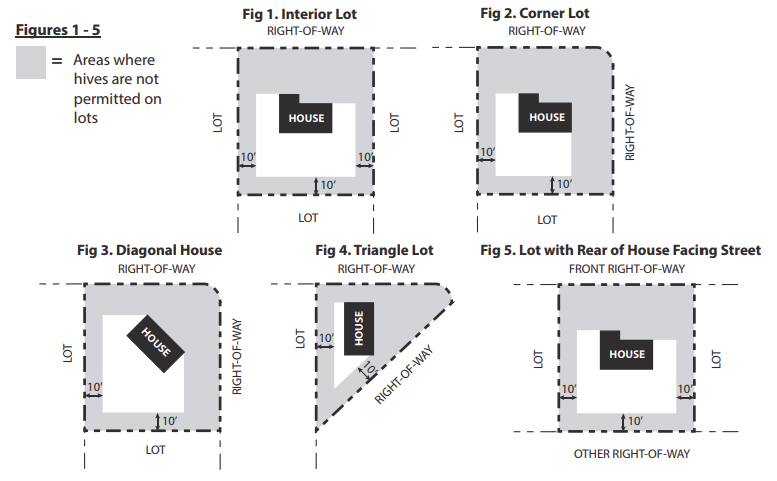
d.
If a beehive is located less than ten feet above ground level and within 30 feet of any lot line adjoining a residential lot or public right-of-way, a barrier of sufficient density to establish bee flyways above head height must separate the beehive from the lot line or public right-of-way. The barrier may be constructed of fencing or evergreen vegetation or a combination of the two. The barrier must be no less than six feet in height and extend no less than ten feet in length on either side of the beehive.
e.
If a beehive is located at least ten feet above ground level, the beehive shall be located a minimum of five feet from the side of the structure and 30 feet from any structure other than a structure of the person maintaining the beehive.
f.
The beekeeper shall conspicuously post a sign warning individuals of the presence of bees. This sign shall include the lot owner's name and a telephone number at which the beekeeper can be reached in case of emergency.
g.
The beekeeper shall provide written or verbal notice that they intend to keep bees to the owner of each abutting lot under different ownership than the lot on which beehives will be located. The notice shall identify the lot on which the beehives will be located. The notice shall be mailed or delivered at least ten days prior to the establishment of beehives on the lot.
h.
Each beekeeper shall ensure that no wax comb or other material that might encourage robbing by other bees are left on the grounds of the lot on which the beehive is located (the "apiary lot"). Once removed from the site, the wax comb or other materials shall be handled and stored in sealed containers, or placed within a building or other insect-proof container.
i.
Each beekeeper shall maintain his beekeeping equipment in good condition, including keeping the beehives painted if they have been painted but are peeling or flaking, and securing unused equipment from weather, potential theft or vandalism, and occupancy by swarms. It shall not be a defense to this section that a beekeeper's unused equipment attracted a swarm and that the beekeeper is not intentionally keeping bees. Unused equipment shall be stored in sealed containers, or placed within a building or other insect-proof container.
j.
No person may keep more than the following numbers of bee colonies on any lot, based upon the size or configuration of the apiary lot:
1.
One-half acre or smaller lot: two colonies;
2.
Larger than one-half acre and up to three-fourths acre lot: four colonies;
3.
Larger than three-fourths acre and up to one acre lot: six colonies;
4.
Larger than one acre and up to five acre lot: eight colonies;
5.
Larger than five acre lot: no restriction.
k.
If a beekeeper serves the community by removing a swarm or swarms of honey bees from locations where they are not desired, the beekeeper shall not be considered in violation of the portion of this section limiting the number of colonies if he temporarily houses the swarm on the apiary lot in compliance with the standards of practice set out in this section for no more than 30 days from the date acquired.
(Ord. 18-18(4), 10-3-18)
Sec. 5.1.64 - Religious assembly use in rural areas.
Each religious assembly use authorized below shall be subject to the following:
a.
Notice. The religious assembly shall provide written notice to the owner of each abutting lot under different ownership than the lot on which the proposed use would be located. The notice shall identify the proposed type, size, and frequency of events and assemblies, and provide the name and telephone number of a contact person who will be on-site at the religious assembly use. The notice shall be mailed at least ten days prior to the issuance of a building permit.
b.
Sound from outdoor amplified music. Sound generated by outdoor amplified music shall be subject to the following:
1.
Maximum sound level. Sound generated by outdoor amplified music shall not exceed the applicable maximum sound levels in section 4.18.04.
2.
Times of day when outdoor amplified music prohibited. Sound generated by outdoor amplified music is prohibited between 10:00 p.m. and 7:00 a.m. the following morning.
c.
Yards. Notwithstanding any other provision of this chapter, the following minimum front, side, and rear yard requirements shall apply to any event or activity:
1.
Structures used for religious assembly. The minimum yards for structures used religious assembly shall be as follows:
a.
New permanent structures and temporary structures. The minimum front, side, and rear yard requirements in section 10.4 shall apply to all permanent and temporary structures used for religious assembly.
b.
Existing permanent structures. If an existing permanent structure does not satisfy any minimum yard requirement under subsection (c)(1)(a), the minimum yard required shall be the distance between the existing permanent structure and the street, road, access easement, or lot line on December 18, 2019, and that distance shall not be thereafter reduced. An enlargement or expansion of the structure shall be no closer to a street, road, access easement or lot line than the existing structure.
2.
Parking areas. The minimum front, side, and rear yards for parking areas shall be 125 feet from any abutting lot not under the same ownership as the religious assembly use.
d.
Expansions to existing nonconforming religious uses. Notwithstanding the provisions of section 6.2(A), minor expansions to existing nonconforming religious assembly uses shall be permitted by right. These expansions are limited to picnic shelters, storage, office space, recreational equipment, and other similar additions or accessory structures that are determined by the Zoning Administrator to not increase the capacity of the nonconforming religious assembly use. Any new structure shall comply with the provisions of section 5.1.64(c).
(§ 18-5.1.64, Ord. 19-18(8), 12-18-19)
5.1.65 - Data centers.
A.
Accessory data centers.
1.
Data centers serving a permitted primary use are permitted as an accessory use if:
i.
The data center is on the same site as the primary use;
iii.
The site's primary user operates the data center for its own data; and
iii.
The aggregate area devoted to the data center and its support systems and structures does not exceed 25% of the gross floor area of the primary use.
2.
Accessory data centers are not subject to subsection (c).
B.
Minimum development requirements for data centers.
1.
Data centers must be served by public water and public sewer.
2.
Any water cooling must use a closed loop or recycled water system.
C.
Setbacks—Data center buildings and all associated equipment and accessory structures (such as generators, HVAC, and battery backup) must be set back at least (i) 200 feet from all lot lines and (ii) 500 feet from the Rural Areas zoning district.
D.
Generators.
1.
Routine generator exercise maintenance is limited to Monday—Friday between the hours of 10 a.m. and 4 p.m.
2.
Generators must be enclosed in a level 3 enclosure or other enclosure limiting sound to 70 dBA measured 23 feet from the generator. All equipment onsite must comply with Section 4.18, including maximum sound levels at all lot lines.
E.
Special exceptions. Subsections (a)(1) and (b)(1) may not be modified or waived by special exception.
(Ord. 25-18(1), 4-2-25)
5.1.66 - Energy Facility.
A.
Minimum Development Requirements for Energy Facilities.
1.
The maximum height of the lowest edge of all ground-mounted photovoltaic panels is ten feet as measured from the finished grade. The maximum height of panels, buildings, structures, and other components of a solar facility is 20 feet, as measured from the highest natural grade below each element. This limit does not apply to utility poles, substations, roof-mounted solar facilities, or the interconnection to the overhead electric utility grid.
2.
Accessory solar energy facilities, whether roof- or ground-mounted, are subject to the applicable structure setbacks of the zoning district in which the facility is located. The setback standards do not apply to parcels under common ownership.
3.
Ground-mounted accessory solar energy facilities located outside the Rural Areas (RA) zoning district are limited to 500 square feet of fenced area, or 400 square feet of panel zone when placed over existing pervious areas.
4.
By-right solar energy facilities in the Rural Areas (RA) zoning district are subject to the following separation standards from other by-right solar energy facilities.
5.
By-right ground mounted solar energy facilities in the Rural Areas (RA) zoning district are limited to a maximum of 21 acres of fenced area on any parcel in existence at the time of adoption of this ordinance. Any solar energy facility with a panel zone of one acre or greater must be fenced.
6.
Any solar energy facility with greater than one acre of fenced area within five nautical miles of a licensed airport must provide the Chief Operation Officer of the airport with both (i) written notice to stating the system's location, technology to be used, and total land coverage; and (ii) a glint/glare study.
7.
Ground-mounted solar energy facilities with greater than 21 fenced acres, are subject to the following setbacks:
a.
100 feet from adjacent parcels, not under common ownership, and all public rights-of-way; and
b.
300 feet from dwellings on adjacent parcels, not under common ownership.
8.
No energy facility may be located within riparian buffers, nontidal wetlands, and floodplains, each as defined in Chapter 17 of the Albemarle County Code.
9.
Energy facilities must maintain sufficient separation between rows of photovoltaic panels or battery energy storage facilities to provide fire access and meet clear zone requirements.
10.
All ground-mounted solar energy facilities with a fenced area of two acres or greater must obtain Gold Certified Virginia Pollinator Smart status within three years of issuance of a building permit. Gold Certified Virginia Pollinator status must be maintained for the life of the facility.
11.
Energy facilities with a fenced area of at least ten acres must be screened from public streets and abutting parcels not under common ownership. Screening provided must meet the screening level provided by a triple staggered row of evergreen trees and screening shrubs planted 15 feet on center with screening shrubs making up not more than 33 percent of the plantings and equally dispersed. The director of community development may approve any plan providing equal or greater screening. All new plantings must include a variety of species from the County's approved list.
12.
Energy Facilities must be constructed, maintained, and operated in accord with all applicable codes and standards, including (but not limited to): applicable fire, electrical, and building codes adopted by the County; the National Fire Protection Association (NFPA) 855, Standard for the Installation of Stationary Energy Storage Systems, 2023 Edition and subsequent additions; and the Underwriters Laboratories (UL) 9540A Ed. 4-2019, Standard for Test Method for Evaluating Thermal Runway Fire Propagation in Battery Energy Storage Systems and subsequent editions.
13.
Battery energy storage facilities must have the following setbacks:
a.
100 feet from adjacent parcels not under common ownership, and all public rights-of-way; and
b.
300 feet from dwellings on adjacent parcels not under common ownership.
14.
Any fencing on the interior of the buffer/screening area of ground-mounted energy facilities may not be at a height of less than 61 inches or greater than 96 inches (inclusive of razor/barbed wire). Fences of 61 inches or less in height may not include razor/barbed wire. Such fenced areas must provide wildlife corridors through the facility. All such fencing must allow for movement and migration of small wildlife species.
15.
Energy facilities are not permitted within any large forest block with a score of 4.1 or greater as shown on "Map 2: Ranking the Conservation Value of Large Forest Blocks" in the Biodiversity Action Plan.
16.
By-right projects must not disturb more than ten acres in the aggregate of habitat cores, forest blocks, or corridors connecting habitat areas, as these features are identified in the Comprehensive Plan/Biodiversity Action Plan, except that the Board of Supervisors may permit disturbance of more than ten acres by special exception. When considering impacts to habitat areas, on both special exception and special use permit applications, the Board of Supervisors should consider the Comprehensive Plan/Biodiversity Action Plan, the Virginia Department of Conservation and Recreation Natural Heritage Data Explorer, or other County-designated resources for this purpose, as well as determine the particular mix of species and composition of affected habitat areas.
17.
By-right projects must not disturb either (a) more than 10 acres of prime farmland (as determined/identified by the United States Department of Agriculture's Natural Resources Conservation Service) and/or (b) areas used for an agricultural activity within the five years preceding an application, unless portions of the parcels used for the facility will continue to be used for an agricultural activity.
18.
Notwithstanding any exemption in County Code Chapter 17, all ground-mounted energy facilities whose total land disturbance area, including the horizontal projected areas underneath panels, is at least 10,000 square feet, must comply with County Code Chapter 17.
19.
Notwithstanding section 32.2, a site plan is not required for an energy facility, but the energy facility is subject to the requirements of section 32. An applicant must submit all schematics, plans, calculations, drawings, and other information required by the director of community development to determine whether the facility complies with section 32. In making this determination, the director of community development may impose reasonable conditions authorized by section 32 in order to ensure compliance.
20.
Any new associated electrical transmission lines, whether connecting internal portions of the project or connecting to a switchyard, substation, or point of interconnection, and whether above or below ground, must be located in a manner to minimize intrusiveness and mitigate their impact to surrounding parcels.
21.
Except for any outdoor lighting required by federal law:
a.
Outdoor lighting is permitted only during maintenance periods.
b.
Regardless of the lumens emitted, each outdoor luminaire must be fully shielded to the standard of section 4.17.
B.
Special Use Permit Process.
1.
The County may engage independent consultant(s) to review any special use permit application for an energy facility and all associated documents for completeness and compliance with applicable County, state, and federal laws. Any costs associated with the review must be paid by the applicant, and are in addition to any other required fees.
2.
As part of its review of special use permit applications for energy facilities, the Commission will also conduct a Comprehensive Plan review under Virginia Code § 15.2-2232 and will specify whether the facility is in substantial accord with the County's Comprehensive Plan.
C.
Construction, Operational, and Decommissioning Requirements for Solar Energy Generating Facilities and Battery Energy Storage Facilities.
Non-accessory ground-mounted solar energy facilities must meet the following requirements both during the construction phase and throughout their operational life:
1.
Coordination of Local Emergency Services. Prior to completion of construction, the owner or operator of a facility must provide materials, education, and/or training to the County's emergency services departments on how to safely respond to on-site emergencies, and develop, implement, periodically update, and perform exercises on an emergency response plan. County emergency personnel must be provided with a key or code to access the site in case of an on-site emergency.
2.
County Inspection of Facility. The owner or operator of a facility must allow designated County representatives or employees access to a facility for inspection purposes. The County will provide the facility operator with 24-hours' notice prior to an inspection when practicable. The owner of a facility must reimburse the County the costs of any required independent inspections.
3.
Maintenance of Facility. The owner or operator of an energy facility must monitor and maintain the facility in good condition. Such monitoring and maintenance must include (but is not limited to): painting, evaluating the structural integrity of equipment, foundations, structures, fencing and security barriers, as applicable, maintenance of the buffer areas, landscaping, and cleaning of equipment. Any cleaning products used to maintain photovoltaic materials must be biodegradable. Site access must be maintained at a level acceptable to the County.
D.
Decommissioning and Site Rehabilitation.
1.
Solar facilities that have reached the end of their operation or have not been in active and continuous service for a period of six months must be removed at the owner's or operator's expense. However, the County may extend this period upon a satisfactory showing that the project is being repowered, or a force majeure event is requiring longer repairs.
2.
The owner or operator of a facility must notify the director of community development by certified mail of the proposed date of discontinued operations and plans for removal.
3.
Decommissioning must be performed in compliance with an approved decommissioning plan. The applicant, owner, lessee, or developer of the real property must submit a decommissioning plan for approval by the director of community development, prior to the issuance of a Zoning Permit. The director of community development may waive the requirement of a decommissioning plan based on the size of the solar facility. The director of community development may approve any appropriate amendments to, or modifications of, the decommissioning plan.
4.
Decommissioning must include removal of all electric systems, buildings, cabling, electrical components, security barriers, roads, foundations, pilings, and any other associated facilities, so that any agricultural ground upon which the facility and/or system was located is again tillable and suitable for agricultural uses. The site must be graded and re-seeded to restore it to as natural a condition as possible, except that the director of community development may approve a written request that access roads or other land surface areas not be restored if other conditions are determined to be more beneficial or desirable at that time.
5.
Any topsoil graded during reclamation must be returned during reclamation of land.
6.
Any exception to site restoration, such as leaving driveways, entrances, or landscaping in place, or substituting plantings, must be requested by the owner in writing, and is subject to approval of the director of community development.
7.
Hazardous material from the site must be disposed in accordance with federal and state law.
8.
When a decommissioning plan is required, the estimated cost of decommissioning must be guaranteed by the deposit of sufficient funds in an escrow account at a financial institution approved by the County.
a.
The applicant must deposit the required amount into the approved escrow account before any building permit is issued to allow construction of the solar facility.
b.
The escrow account agreement must prohibit the release of the escrow funds without the written consent of the County. The County will consent to the release of the escrow funds upon the owner's or occupant's compliance with the approved decommissioning plan. The County may approve the partial release of escrow funds as portions of the approved decommissioning plan are performed.
c.
The full amount of the estimated decommissioning cost, excluding salvage value, must be deposited in escrow.
d.
The owner or occupant must recalculate the estimated cost of decommissioning every five years. If the recalculated estimated cost of decommissioning exceeds the original estimated cost of decommissioning by at least ten percent, the owner or occupant must deposit additional funds into the escrow account to meet the new cost estimate. If the recalculated estimated cost of decommissioning is less than 90 percent of the original estimated cost of decommissioning, the County may approve reducing the amount of the escrow account to the recalculated estimate of decommissioning cost.
e.
The County may approve alternative methods to secure available funds to pay for the decommissioning of a solar facility, such as a performance bond, letter of credit, or other security approved by the County.
9.
If the owner or operator of the solar facility fails to remove the facility in accordance with this section or the facility's approved decommissioning plan, the County may collect the surety and the County or its agent(s) may enter the site and perform any work necessary to complete the decommissioning.
(Ord. 25-18(2), 7-16-2025)
Sec. 5.3.1 - Minimum size manufactured home parks.
A manufactured home park shall consist of five or more contiguous acres.
(§ 20-5.3.1, 12-10-80; repealed and reenacted 3-5-86; § 18-5.3.1, Ord. 98-A(1), 8-5-98; Ord. 18-18(1), 1-10-18)
Sec. 5.3.2 - Maximum density.
A manufactured home park shall conform to the maximum gross density requirements of the district in which it is located.
(§ 20-5.3.2, 12-10-80; § 18-5.3.2, Ord. 98-A(1), 8-5-98; Ord. 18-18(1), 1-10-18)
Sec. 5.3.3 - Minimum lot sizes.
Each manufactured home lot shall comply with the following area and width requirements:
a.
Manufactured home lots shall consist of at least 4,500 square feet, and shall have a width of at least 45 feet.
b.
Manufactured home lots served by either a central water or central sewerage system shall consist of at least 40,000 square feet, and shall have a width of at least 100 feet.
c.
Manufactured home lots served by neither a central water supply nor a central sewerage system shall consist of at least 60,000 square feet and shall have a width of at least 130 feet.
(§§ 20-5.3.3, 5.3.3.1, 5.3.3.2, 5.3.3.3, 12-10-80; §§ 18-5.3.3, 5.3.3.1, 5.3.3.2, 5.3.3.3, Ord. 98-A(1), 8-5-98; § 5.3.3, Ord. 18-18(1), 1-10-18)
Sec. 5.3.4 - Location of manufactured homes.
a.
Each manufactured home shall be located on a manufactured home lot. The lot shall provide space for outdoor living and storage areas and may provide space for a parking area.
b.
Each manufactured home lot shall front on an internal street.
c.
No manufactured home shall be located closer than 50 feet from any service or recreational structure intended to be used by more than one manufactured home.
d.
The minimum distance between manufactured homes shall be 30 feet. The Albemarle County Fire Marshal may require additional space between manufactured homes if public water is not available or is inadequate for fire protection.
(§§ 20-5.3.4, 5.3.4.1, 5.3.4.2, 5.3.4.3, 5.3.4.4, 12-10-80; §§ 18-5.3.4, 5.3.4.1, 5.3.4.2, 5.3.4.3, 5.3.4.4, Ord. 98-A(1), 8-5-98; § 5.3.4, Ord. 18-18(1), 1-10-18)
Sec. 5.3.5 - Setbacks and yards.
a.
Manufactured homes and other structures shall be set back at least 50 feet from the right-of-way of an existing public street.
b.
Manufactured homes and other structures shall be set back at least 50 feet from the manufactured home park property line when it is adjacent to a residential or rural areas district.
c.
Manufactured homes and other structures shall be set back at least 15 feet from the right-of-way of internal private streets, common walkways and common recreational or service areas. This distance may be increased to 25 feet for manufactured homes or structures at roadway intersections and along internal public streets.
d.
Manufactured homes and other structures shall be set back at least six feet from any manufactured home space lot line.
(§§ 20-5.3.5, 5.3.5.1, 5.3.5.2, 5.3.5.3, 5.3.5.4, 12-10-80; §§ 18-5.3.5, 5.3.5.1, 5.3.5.2, 5.3.5.3, 5.3.5.4, Ord. 98-A(1), 8-5-98; § 5.3.5, Ord. 18-18(1), 1-10-18)
Sec. 5.3.6 - Application plan required.
An application plan shall be submitted as part of the application for a manufactured home park. The plan shall be reviewed by the site review committee, but shall be considered an initial site plan. Following approval of the special use permit, and prior to the issuance of a building permit or any clearing of the site, a final site plan shall be approved. The final site plan shall contain all the information required on the application plan in addition to all the information required in section 32.
The application plan shall contain the following information at a scale of one inch equals 40 feet or larger:
a.
Location of the parcel by a vicinity map, and landmarks sufficient to identify the location of the property;
b.
An accurate boundary survey of the tract;
c.
Existing roads, easements and utilities; watercourses and their names; owners, zoning and present use of abutting lots, and location of residential structures on abutting lots;
d.
Location, type and size of ingress and egress to the manufactured home park;
e.
Existing and proposed topography accurately shown with a maximum contour interval of five feet; areas shown with slopes of 25 percent or greater;
f.
Flood plain limits;
g.
Proposed general road alignments and rights-of-way; general water, sewer and storm drainage lay-out; general landscape plan; common area with recreational facilities and walkways; service areas; common trash container locations; parking areas; a typical lot detail showing the manufactured home stand, outdoor living and storage areas, parking area, setbacks and utility connections; and any other information necessary to show that these requirements can be met.
(§§ 20-5.3.6, 5.3.6.1, 12-10-80; §§ 18-5.3.6, 5.3.6.1, Ord. 98-A(1), 8-5-98; § 5.3.6, Ord. 18-18(1), 1-10-18)
Sec. 5.3.7 - Improvements required—Manufactured home lots.
a.
Utilities. Each manufactured home lot shall be provided with an individual connection to an approved sanitary sewage disposal system and an individual connection to an approved central water supply or other potable water supply.
Each manufactured home lot shall be provided with electrical service installed in accordance with the National Electrical Code.
b.
Markers for manufactured home lots. Each manufactured home lot shall be clearly defined on the ground by permanent markers. There shall be posted and maintained in a conspicuous place on each lot a number corresponding to the number of each lot as shown on the site plan.
c.
Outdoor living and storage areas. An outdoor living area shall be provided on each manufactured home lot. At least 100 square feet shall be hard surfaced.
Storage buildings not to exceed 150 square feet shall be permitted in a designated area on each lot. Additional storage facilities may be provided in common areas.
d.
Additions to manufactured homes. Additions to manufactured homes are permitted, subject to the following conditions:
1.
Albemarle County Building Official approval;
2.
Applicable setbacks are met;
3.
Total roof area lot coverage shall not exceed 40 percent of the manufactured home lot.
e.
Installation of manufactured homes. Installation of manufactured homes shall comply with the requirements of the Building Code.
Skirting shall be provided around the manufactured home from ground level to the base of the manufactured home within 60 days of the issuance of a certificate of occupancy.
(§§ 20-5.3.7, 5.3.7.1, 5.3.7.2, 5.3.7.3, 5.3.7.4, 5.3.7.5, 12-10-80; §§ 18-5.3.7, 5.3.7.1, 5.3.7.2, 5.3.7.3, 5.3.7.4, 5.3.7.5, Ord. 98-A(1), 8-5-98; § 5.3.7, Ord. 18-18(1), 1-10-18)
Sec. 5.3.8 - Improvements required—Manufactured home park.
a.
Off-street parking. Off-street parking for manufactured homes, recreational uses and service areas shall be provided in accordance with section 4.12 of this ordinance. Parking for manufactured homes may be provided on individual lots, or in convenient bays, in accordance with section 4.12.16. Additional parking area for recreational vehicles shall be provided in a common area at a rate of one space per ten units.
b.
Internal Street. A minimum right-of-way width of 40 feet shall be established on internal private streets for the purpose of measuring setbacks. The right-of-way shall be maintained clear of all obstructions.
Internal private streets shall be constructed to the following minimum standards:
1.
Minimum typical section for access, entrance, or other connecting streets that do not abut manufactured home sites and for streets that do abut manufactured home sites where the lot frontage (measured at the manufactured home setback line) is an average of 85 feet or greater.
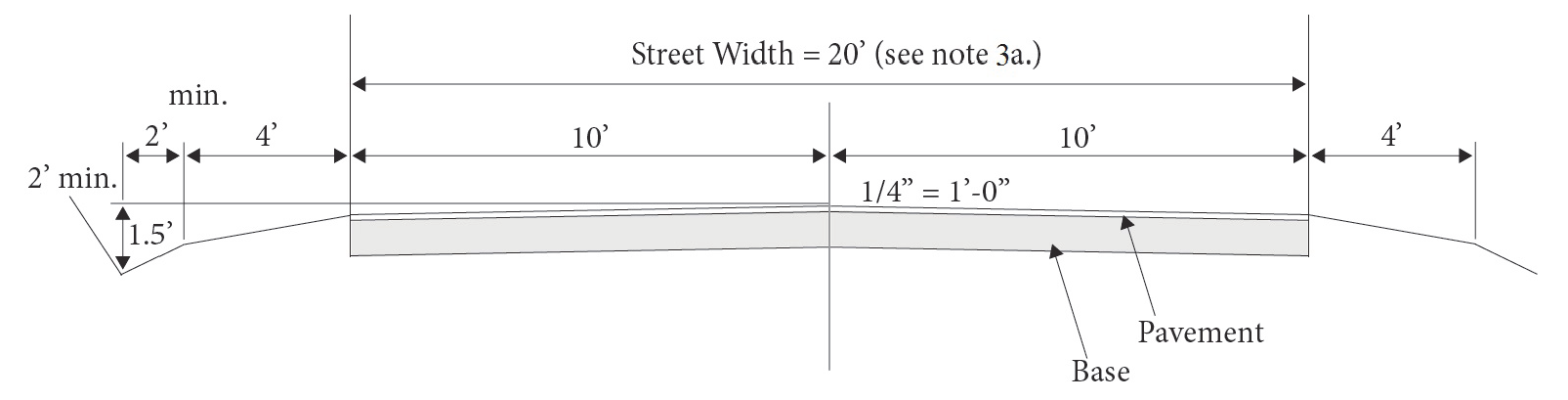
2.
Minimum typical section for all park streets that abut manufactured home sites where the lot frontage (measured at the manufactured home setback line) is an average of less than 85 feet.
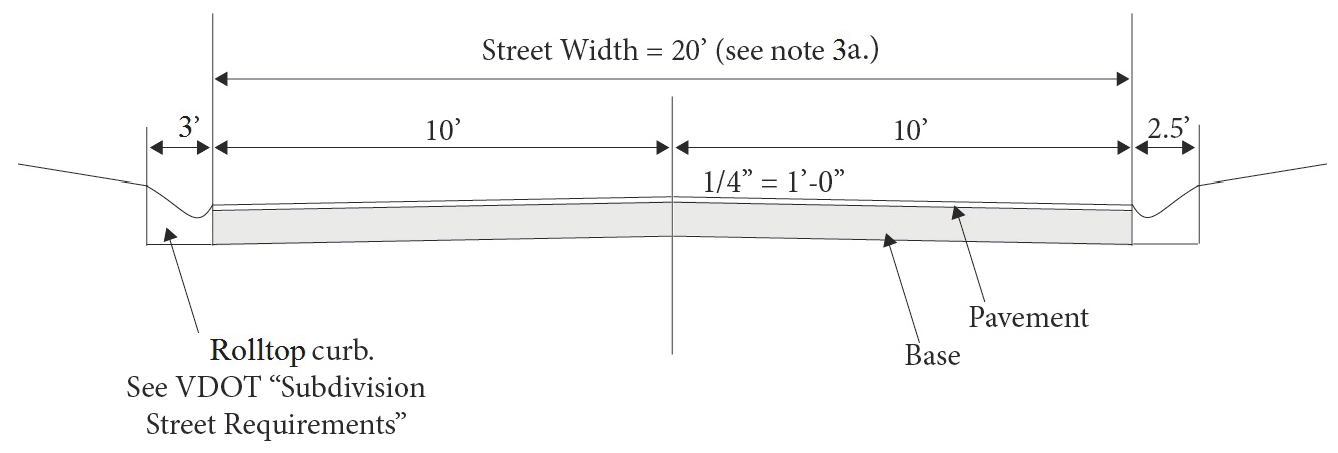
3.
General Design Notes:
(a.)
Streets with no on-street parking serving up to 50 manufactured home sites shall have a minimum width of 20 feet. Streets with no on-street parking serving more than 50 manufactured home sites shall have a minimum width of 24 feet. Streets with on-street parking shall have a minimum clear width of at least 22 feet, excluding parking space requirements.
(b.)
Pavement shall be prime and double seal bituminous surface treatment. Base shall be six inches of 21A or 21B aggregate base.
(c.)
Maximum longitudinal street grade is ten percent.
(d.)
Minimum vertical stopping sight distance is 100 feet.
(e.)
Minimum horizontal centerline curve radius is 250 feet.
(f.)
Cul-de-sacs shall have a minimum radius of 45 feet measured to the edge of pavement.
(g.)
Minimum radius of edge of pavement at intersections is 25 feet.
(h.)
Roadside ditches shall be designed to contain the ten-year storm below the shoulder using Mannings "n" of 0.06 if lined with grass, or 0.015 if lined with concrete. Ditches may be grassed if the flow from the two-year storm does not exceed three feet per second for a Mannings "n" of 0.03. If the three foot per second velocity is exceeded, the ditches shall be paved with class A-3 concrete, four inches thick, to the depth of the ten-year storm. When the depth of the required roadside ditch (measured from the shoulder to the invert) exceeds 2.5 feet, the flow shall be piped in a storm sewer system.
(i.)
Driveway entrance culverts and culverts crossing streets shall be designed to contain the ten-year storm below the road shoulder using the appropriate Virginia Department of Transportation (VDOT) nomographs. When paved ditches are smoothly transitioned into the culverts, the culverts may be sized using Mannings formula. All culverts shall be concrete. Erosion control protection (VDOT standard EC-1) shall be placed at culverts when the outlet velocity exceeds five feet per second. Driveway culverts shall be a minimum of 12 feet long.
(j.)
Driveways shall be paved the same as streets to the right-of-way line. Aggregate base may be four inches thick.
(k.)
Curb drop inlets shall be placed along the tangent portions of the street or at the points of curve at intersections. Curb drop inlets shall be sized and located to prevent overtopping of the curb during the ten-year storm. Curb drop inlets shall be VDOT DI-3A, 3B, or 3C with a type "A" nose.
(l.)
Storm sewers shall be designed in accordance with VDOT criteria.
(m.)
All construction and materials shall be in accordance with current VDOT road and bridge standards and specifications.
c.
Recreation requirements. See section 4.16.
d.
Pedestrian access. The requirements of section 32.7.2.3 shall be met.
e.
Service areas and accessory uses. Centrally located service buildings may provide common laundry facilities, office space for management and accessory uses as are customarily incidental to the operation and maintenance of a manufactured home park. Consolidation of the service building and indoor recreational facilities is permitted. Other uses may be established in accordance with the regulations of the district in which the park is located.
f.
Lighting. All proposed exterior lighting shall be shown. Lighting shall be directed away from manufactured homes, adjacent properties and roadways in a manner approved by the Zoning Administrator.
g.
Landscaping and screening. The requirements of section 32.7.9 shall be met. In addition, screening may be required in accordance with section 32.7.9.7 around the entire perimeter of the park, or part thereof, except where adequate vegetation already exists and a conservation plan has been submitted in accordance with section 32.7.9.4(b).
(§§ 20-5.3.8., 5.3.8.1, 5.3.8.2, 5.3.8.3, 5.3.8.4, 5.3.8.5, 5.3.8.6, 5.3.8.7, 12-10-80; §§ 18-5.3.8., 5.3.8.1, 5.3.8.2, 5.3.8.3, 5.3.8.4, 5.3.8.5, 5.3.8.6, 5.3.8.7, Ord. 98-A(1), 8-5-98; Ord. 01-18(6), 10-3-01; § 5.3.8, Ord. 18-18(1), 1-10-18)
Sec. 5.5.1 - Purpose.
This provision is designed primarily to benefit those who wish to acquire ownership or equity in a lot and occupy the premises themselves, but who may find it undesirable or difficult to construct a conventional single-family dwelling. Conventional single-family dwellings may be built in manufactured home subdivisions and owners of manufactured homes in these subdivisions may convert their residences from manufactured homes to single-family dwellings.
(§ 20-5.5.1, 12-10-80; § 18-5.5.1, Ord. 98-A(1), 8-5-98; Ord. 18-18(1), 1-10-18)
Sec. 5.5.2 - Application.
These regulations shall supplement and be in addition to the regulations of the district in which any such subdivision shall be located, except that no regulation which is by its nature inapplicable to manufactured homes shall apply to manufactured homes.
(§ 20-5.5.2, 12-10-80; § 18-5.5.2, Ord. 98-A(1), 8-5-98; Ord. 18-18(1), 1-10-18)
Sec. 5.5.3 - Special use permit required.
A manufactured home subdivision may be established by the Board of Supervisors by special use permit.
(§ 20-5.5.3, 12-10-80; § 18-5.5.3, Ord. 98-A(1), 8-5-98; Ord. 18-18(1), 1-10-18)
Sec. 5.5.4 - Minimum size of manufactured home subdivision.
A manufactured home subdivision shall have at least ten lots.
(§ 20-5.5.4, 12-10-80; § 18-5.5.4, Ord. 98-A(1), 8-5-98; Ord. 18-18(1), 1-10-18)
Sec. 5.5.5 - Subdivision control.
All manufactured home subdivisions shall conform to the requirements of County Code Chapters 14 and 17.
(§ 20-5.5.5, 12-10-80; § 18-5.5.5, Ord. 98-A(1), 8-5-98; Ord. 18-18(1), 1-10-18)
Sec. 5.5.6 - Application plan required.
A preliminary subdivision plat shall be submitted as part of the application for a manufactured home subdivision, and shall be reviewed by the site review committee. Following approval of the special use permit, and prior to the issuance of a building permit or any clearing of the site, a final plat shall be approved.
(§ 20-5.5.6, 3-5-86; § 18-5.5.6, Ord. 98-A(1), 8-5-98; Ord. 18-18(1), 1-10-18)
Sec. 5.7.1 - Expiration, renewal.
Any temporary manufactured home permit ("permit") issued pursuant to section 5.7 shall expire 18 months after the date of issuance unless construction has commenced and is thereafter prosecuted in good faith. The Zoning Administrator may revoke any permit after ten days written notice, at any time upon a finding that construction activities have been suspended for an unreasonable time or in bad faith. In any event, any such permit shall expire three years from the date of issuance; provided, however, that the Zoning Administrator may, for good cause shown, extend the duration of the permit beyond three years for up to two successive periods of one year each.
(§ 20-5.7.1, 12-10-80; 6-3-81; § 18-5.7.1, Ord. 98-A(1), 8-5-98; Ord. 18-18(1), 1-10-18)

