
Ardencroft City Zoning Code
ARTICLE 15
- HISTORIC RESOURCES
Division 40.15.000.- Purpose.
The preservation and protection of buildings, structures, sites, objects, districts and landscape features of historic, architectural, cultural, archeological, educational and aesthetic merit are critical to the character of the County. The preservation of these historic resources promotes the health, prosperity and welfare of all citizens of the County and enhances the quality of life for all. The regulations of this Article provide the mechanism to identify resources and provide for their long-term maintenance and preservation in a form that is as close to their historic use and character as is consistent with the economic realities of the neighborhoods and County. This is done by reviewing development plans in a manner that encourages the purposes of this Article. A historic property's current condition will be reviewed to determine feasibility of preservation and to ensure that the historic character, architecture, and site conditions are respected and enhanced in the development plan.
The purposes of this Division are to:
A.
Identify and preserve historic buildings, structures, sites, objects and landscape features which are important to the education, culture, traditions and economic values of all citizens of the County;
B.
Identify and establish historic zoning districts to ensure that the character of such districts is retained and enhanced;
C.
Retain and enhance properties in historic zoning districts which contribute to the character of such districts;
D.
Ensure that alterations of existing resources and associated land uses in historic districts are compatible with the character of the historic district;
E.
Ensure that new construction and subdivision of lots in a historic district are compatible with the character of the historic district;
F.
Encourage the historic restoration and rehabilitation of buildings, structures, sites and objects which are designated as historic or which are located within and contribute to the character of districts designated as historic;
G.
Promote the use of historic buildings, structures, sites, objects and historic districts for the education, pleasure and welfare of all citizens of the County;
H.
Encourage public participation in identifying and preserving historical architecture and cultural resources through education programs and general awareness campaigns; and
I.
Prevent the demolition by neglect, as defined in Chapter 7 ("Property Maintenance Code"), of a building, complex of buildings, structure, site, object or district designated for preservation as a historic overlay zoning district pursuant to this Article.
(Ord. No. 97-172, § 3(ch. 13, div. 15.000), 12-31-1997; Ord. No. 12-084, § 2, 5-10-2016; Ord. No. 20-071, § 8, 10-27-2020)
Sec. 40.15.010. - Applicability.
A.
On any building, structure, site, or object within an Historic overlay zone, no person shall undertake exterior alterations, demolitions, relocation, construction or reconstruction unless a permit is first obtained from the Department. The Department shall issue no permit until the Historic Review Board first reviews and approves the application for the permit.
B.
No subdivision or land development plan affecting an Historic (H) overlay zoning district or any property which is eligible to be zoned H may be approved by the Department without the prior review and recommendation of the Historic Review Board. In determining the nature of the review required by this paragraph, the Historic Review Board shall consider all features of the subdivision and/or land development plan, including the landscape plan, building design, scale and location, lot size, proposed signage, relationship to adjacent properties and buildings and archaeological potential to determine whether the subdivision or land development will be in accordance with the interest and purposes of Division 40.15.000.
(Ord. No. 97-172, § 3(ch. 13, § 15.010), 12-31-1997; Ord. No. 98-080, § 1(ch. 13, § 15.010), 9-22-1998; Ord. No. 20-071, § 8, 10-27-2020)
Division 40.15.100. - Historic (H) overlay zoning districts.
Historic (H) overlay zoning is intended to identify significant historic resources within the County that are worthy of preservation and recognition. Historic overlay zoning provides protection of, as well as incentives for the preservation of, historic resources. Properties within an Historic overlay zoning district are subject to additional review and regulation by the Historic Review Board for alterations, modifications, relocations, and demolitions. Historic overlay zoning district established pursuant to this Code shall be deemed an overlay zoning district on the otherwise applicable zoning district on the County Zoning Maps.
County Council may designate Historic (H) overlay zoning districts that encompass the boundaries of an historic resource's contextual classification in accordance with rezoning procedures in Article 31 of this Chapter.
(Ord. No. 20-071, § 9, 10-27-2020)
Editor's note— Ord. No. 20-071, § 9, adopted October 27, 2020, changed the title of Division 40.15.100 from "Designation" to "Historic (H) overlay zoning districts."
Sec. 40.15.110. - Criteria for designation.
A building, complex of buildings, structure, site, object or district may be designated for preservation as an Historic overlay zoning district if it is significant to the County as identified in this section. The resource must be at least fifty (50) years old, or exceptionally important to the County, and meet one (1) or any combination of the following criteria:
A.
Listed or determined to be eligible for the National Register of Historic Places as provided in the National Historic Preservation Act of 1966, 16 USC 470 et seq.
B.
Has significant character, interest, or value as an example of the development, heritage or cultural characteristics of the County, the State or the United States.
C.
Is the site of a significant historic event.
D.
Exemplifies the cultural, political, economic, social or historical heritage of the community.
E.
Embodies distinguishing characteristics of an architectural style or engineering specimen.
F.
Is the work of a designer, architect, landscape architect or engineer whose individual work has significantly influenced the development of the County, the State or the United States.
G.
Contains elements of design, detail, materials or craftsmanship which represent a significant innovation.
H.
Is the singular known example of a design or use of material or style of architecture within the County.
I.
Is part of the historic context of a square, park or other distinctive area which should be preserved according to a plan based on a historic, cultural or an architectural context.
J.
Is a landmark; that is, an established and familiar visual feature which assists in defining the character of the neighborhood, community or County due to its unique location or singular physical characteristic.
K.
Has yielded or is likely to yield information of importance to prehistory State's or United States' history.
L.
Is associated with the lives of persons important to the County's past.
M.
Provides the historic setting for an identified resource or historic district.
N.
Is part of a view into or out of an existing historic district and contributes to the integrity, understanding and appreciation of that existing historic district.
(Ord. No. 97-172, § 3(ch. 13, § 15.110), 12-31-1997; Ord. No. 20-071, § 9, 10-27-2020)
Sec. 40.15.120. - Contextual classification of historic resources.
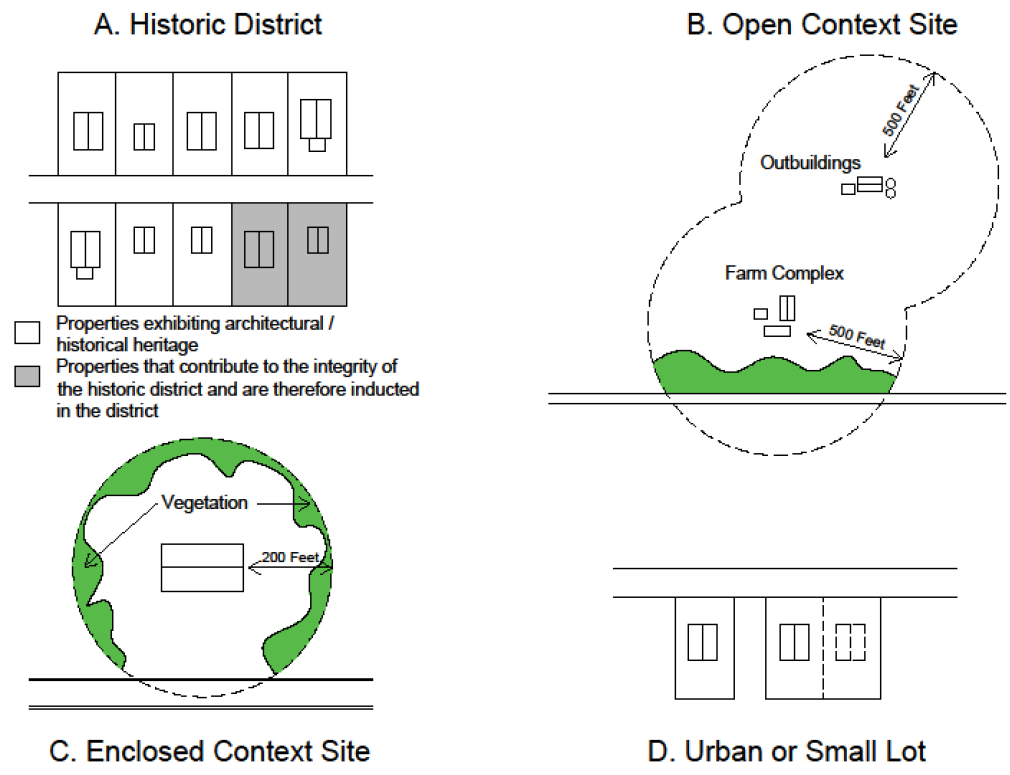
The resource proposed for Historic overlay zoning must be classified into one of the following categories as part of the rezoning process. Historic resources are classified by their viewing area as determined by their context (parcel size, vegetation, topography, and surrounding development). The goal is to preserve landscapes that are part of the view into and out of historic resources. Figure 40.15.120 illustrates the four (4) classifications.
A.
Villages and small nucleated settlements. This is an area that has a common architectural or historic heritage usually in a village or hamlet form and comprises at least four (4) separate individual properties. In designating the boundaries, land that is part of a view into or out of a historic district and contributes to the integrity, understanding and appreciation of that existing historic district shall be included within the boundaries.
B.
Open context site. This is a site where the context and value of the site is dependent on being seen in its context across relatively open land. For example, farms were surrounded by fields. A buffer of five hundred (500) feet or more around the buildings or other features shall be identified as the site and an historic buffer created.
C.
Enclosed context site. A site where the vegetation, topography and/or surrounding development limit the context of the building leaving a small viewing area. A historic buffer of two hundred (200) feet around the buildings or other features shall be identified as the site. At the discretion of the Department, a different configuration or size of the historic buffer may be considered if the preservation of the resource is enhanced.
D.
Small lot site. This is a site in a developed area, typically a village or hamlet, where the site cannot be subdivided or would permit only one (1) additional building on the property.
Figure 40.15.120. Contextual Classification of Historic Resources
(Ord. No. 97-172, § 3(ch. 13, § 15.111), 12-31-1997; Ord. No. 20-071, § 9, 10-27-2020)
Editor's note— Ord. No. 20-071, § 9, adopted October 27, 2020, redesignated the former Section 40.15.111 as Section 40.15.120 and changed the title from "Classification of historic resources" to "Contextual classification of historic resources." The historic notation has been preserved for reference purposes.
Sec. 40.15.130. - Written report.
All recommendations relating to Historic overlay zoning applications must be accompanied by a written report prepared by the Historic Review Board. Such report shall explain if the resource possesses qualities listed in Section 40.15.110 and 40.15.120 that warrant designation of such buildings, structures, sites, objects or districts as an Historic overlay zoning district. Boundary exhibits, photographs, video, drawings or other supporting data shall be included in the report.
(Ord. No. 97-172, § 3(ch. 13, § 15.120), 12-31-1997; Ord. No. 20-071, § 9, 10-27-2020)
Editor's note— Ord. No. 20-071, § 9, adopted October 27, 2020, redesignated the former Section 40.15.120 as Section 40.15.130. The historical notation has been preserved for reference purposes.
Sec. 40.15.140. - Uses.
A.
Permitted uses. All uses permitted in the underlying zoning district shall be permitted in the Historic overlay zoning district except as specified in this Section. In addition, the Department may permit additional uses in any zoning district in accordance with the adaptive reuse provisions of Section 40.15.150.
B.
Prohibited uses. All uses prohibited in the underlying zoning district are prohibited in the Historic overlay zoning district, notwithstanding the provisions of this Division. In addition, the Department may prohibit any use or rehabilitation of the resource that eliminates one or more of the characteristics that led to the property's designation.
(Ord. No. 20-071, § 9, 10-27-2020)
Sec. 40.15.150. - Adaptive reuse.
Within an Historic overlay zoning district, any significant historic resource may be converted or adapted into one of the following uses, provided it conforms to the following standards and procedures, and all other provisions of this Chapter.
A.
Standards.
1.
The building/structure shall have a minimum gross floor area of at least one thousand five hundred (1,500) square feet.
2.
Structural or decorative alterations or additions that change the exterior character and/or historical or architectural significance of the structure are prohibited.
3.
The gross floor area of any addition to the converted building/structure should not be greater than fifty (50) percent of the existing gross floor area unless determined appropriate by the Historic Review Board.
4.
Proposed uses must be located and take access from an arterial or collector street. At its discretion and with DelDOT concurrence, the Department may permit such uses to locate, expand or rebuild taking access from other streets where vehicular and pedestrian safety is not compromised and the local neighborhood is not adversely impacted.
5.
The lot upon which the structure and any permitted addition is situated must meet the minimum lot size for "other permitted use" in the underlying zoning district pursuant to Table 40.04.110 of this Chapter.
B.
Uses.
1.
Office uses.
2.
Commercial retail and service uses, not exceeding ten thousand (10,000) GFA.
a.
Permitted uses.
i.
Retail bakeries.
ii.
Furniture and home furnishing stores.
iii.
Hardware stores.
iv.
Food and beverage stores.
v.
Health and personal care stores.
vi.
Clothing and accessory stores.
vii.
Sporting goods, hobbies, books and music stores.
viii.
Postal service, local office only.
ix.
Couriers and messengers, local office only.
b.
Prohibited uses.
i.
Outside storage of materials and finished products is prohibited.
ii.
Drive-in facility.
3.
Restaurant uses, not exceeding five thousand (5,000) GFA.
In the instance that such use requires special use approval pursuant to Table 40.03.110, Board of Adjustment approval shall be sought as required by Section 40.31.430.
C.
Parking standards. To preserve and enhance the historic nature and minimize impact on surrounding context:
1.
Parking may be reduced up to twenty (20) percent of the minimum parking requirements in this Chapter.
2.
The maximum number of parking spaces shall not exceed one hundred fifteen (115) percent of the minimum parking requirements in this Chapter.
3.
These parking standards do not apply for a temporary or special event that has received approval in accordance with Section 40.03.330 of this Chapter.
D.
Signage.
1.
General sign practices. Sign usage should be reduced to avoid sign clutter and to minimize, to the greatest extent practicable, the amount of signage in the district.
2.
Prohibited signs. In addition to the prohibitions outlined in Section 40.06.040, the following signs are prohibited in an Historic overlay zoning district:
a.
Electronic variable message signs (EVMS), and
b.
Off-premises advertising. No off-premises advertising, billboards, and other off-premises signage shall be permitted.
3.
Size. All signs requiring a permit associated with a non-residential use in the Historic overlay zoning district shall be limited to fifty (50) percent of the sign area permitted in the underlying zoning district.
4.
Height. All signs requiring a permit in the Historic overlay zoning district will be limited in height to fifteen (15) feet, or one-half (½) of the maximum sign height permitted in the underlying zoning district, whichever is less.
5.
Lighting. If lit, the light source shall be exterior to the sign using shielded, low wattage, and diffuse white light. Back-lit and internally illuminated signs are prohibited.
6.
Advertising installed on the interior of window surfaces shall be considered a wall sign in the district, and shall cover no more than twenty (20) percent of the window on which it is located. Interior hung panels are permitted.
7.
Temporary signs shall be permitted in the Historic overlay zoning district in compliance with the provisions of Subsection 40.06.040.C of the Unified Development Code.
8.
Signs existing at the time of the adoption of this Article are considered nonconforming. If any nonconforming sign is hereafter relocated, replaced, removed, altered, or modernized in any way, the sign loses all nonconforming protection afforded under County law.
E.
An Historic overlay zoning district must be in place prior to establishment of the use and issuance of any permit associated with the proposed use.
F.
Further subdivision of the parcel is permitted in accordance with this Chapter provided that the site's contextual classification is retained.
(Ord. No. 20-071, § 9, 10-27-2020)
Sec. 40.15.160. - Permits within Historic overlay zoning districts.
No person shall undertake exterior historic alteration, demolition, relocation, construction or reconstruction on any building, structure, site, or object within an Historic overlay zoning district unless approval is first obtained from the Department.
A.
The Department shall issue no permit within an Historic overlay zoning district until an historic resources application has been reviewed and approved by the Historic Review Board (HRB).
1.
An historic resource application must be filed with the Department in order to be considered by the HRB.
2.
The Department shall schedule the application for the next HRB public hearing.
B.
The HRB shall approve or deny the issuance of the permit within seventy-five (75) working days after the Department's receipt of a complete Historic Resources application, whenever practicable. Failure of the HRB to make a determination within this time period shall be deemed to constitute an approval of the application, provided at least one regular meeting of the HRB, at which a quorum is present, is conducted within that time period.
1.
Where the HRB denies the historic resources application, the Department shall not issue the permit.
2.
Where the HRB approves the historic resources application, the Department shall grant the permit subject to the requirements of any applicable sections of this Chapter or this Code.
3.
Where the HRB approves the historic resources application, but its approval is subject to conditions (e.g. documentation, archaeological investigation, design standards, building materials, etc.), the Department shall grant the permit subject to any conditions of the HRB, which may include the following:
a.
Appropriate documentation, standards for which include, but are not limited to, the Historic American Buildings Survey (HABS), the Historic American Engineering Record (HAER), or the Historic American Landscape Survey (HALS) guidelines.
b.
Archaeological investigations, which must be completed in accordance with the Delaware Division of Historic and Cultural Affairs' guidelines for Archaeological Survey in Delaware.
i.
The investigation must be completed by a Registered Professional Archaeologist (RPA) in consultation with the Delaware Division of Historic and Cultural Affairs.
ii.
A report regarding the investigation must be provided to the HRB prior to any ground disturbance proposed for the project.
iii.
The HRB may require certain measures, such as data recovery or avoidance, to protect significant archaeological values identified in the report which may be encountered in the area of the permitted activity.
c.
Architectural controls to preserve and restore the character of the historic resource(s).
d.
Lighting standards that provide for lighting fixtures that imitate the brightness and style of the building's historic period. The brightness and illumination shall be in keeping with the historic nature and of the lowest levels associated with the building's use.
C.
When the HRB reviews an application for a permit required under this Section, it shall consider the following factors before reaching its decision on the application:
1.
The purposes of this Article.
2.
The historical, architectural, archaeological or aesthetic significance of the building, structure, site or object.
3.
The effect of the proposed work on the building, structure, site or object and its appurtenances.
4.
The design and compatibility of the proposed work with the character of the Historic overlay zoning district or with the character of its site, including the effect of the proposed work on neighboring structures.
5.
The Secretary of the Interior's Standards for Rehabilitation and Guidelines for Rehabilitating Historic Buildings or other similar criteria.
6.
For demolitions, the HRB shall consider whether the building, structure or object can be used for any purpose for which it is or may be reasonably adapted. To that end, the applicant must demonstrate that the sale of the property is impracticable (as documented per Subsection 7.h. below), that rental cannot provide a reasonable rate of return (as documented per Subsection 7.h. below), and that other potential uses of the property are not feasible or available. In no event will a sale be deemed impracticable, rental returns unreasonably low or other uses not feasible if the reason is deterioration of the property due to the owner, lessee, or person in charge's own intentional or gross negligence in maintaining the property.
7.
Where an application for exterior alteration, relocation, construction or reconstruction is based on financial hardship, the Historic Review Board may lessen its requirements if the applicant can demonstrate the extent of the economic hardship. In examining a claim of economic hardship, the Board will look beyond the relationship of the cost of repairs and the purchase price or the "as is" value to sort out the extent to which an economic hardship is attributable to the owner's actions or inactions, or to circumstances beyond the owner's control that would have existed in any event. When a claim of undue economic hardship is made, the owner and/or parties in interest must provide evidence during the hearing upon the claim, describing the circumstances of the hardship. Minimum evidence shall include:
a.
Nature of ownership (individual business or nonprofit) or legal session, custody or control.
b.
Financial resources of the owner or parties in interest.
c.
Cost of repairs to the subject property.
d.
Real estate taxes on the property in question for the prior two (2) years.
e.
Market value, as established by an appraisal prepared by a professional appraiser qualified to do business in the State of Delaware.
f.
Amount paid for the property, date of purchase, and party from whom purchased, including a description of the relationship between the seller and purchaser or other means of acquisition of title, such as by gift or inheritance.
g.
For income-producing property only, itemized operating and maintenance expenses for the subject property, and annual cash flow, for the prior two (2) years.
h.
Any and all listings of the property for sale or rent, price asked, and offers received for the prior two (2) years.
i.
Annual gross income on the subject property for the prior two (2) years.
j.
Annual debt service paid, if any, in the prior two (2) years.
(Ord. No. 20-071, § 9, 10-27-2020)
Sec. 40.15.161. - Work exempt from a permit within an Historic overlay zoning district.
If the property is in an Historic overlay zoning district, and proposed work is exempt from permit pursuant to Section 6.03.012 of the Code, the property owner must still submit an historic resources application to the Department describing the proposed work. If the Department determines that the proposed work does not follow the New Castle County Historic and Cultural Resource Design Guidelines, the application must be heard by the Historic Review Board (HRB). The HRB shall then determine what, if any, conditions are to be imposed upon the proposed work.
(Ord. No. 20-071, § 9, 10-27-2020)
Sec. 40.15.170. - Demolition by neglect.
The Department, consistent with Chapter 7 of the Code, will inspect properties within Historic overlay zoning districts annually to ensure compliance with the Property Maintenance Code and to ensure demolition by neglect does not occur. The Historic Review Board (HRB) and County Council shall receive an annual summary report on these inspections and details on any property within an Historic overlay zoning district which is found to be noncompliant in order to ascertain whether demolition by neglect as defined in Chapter 7 of the Code is occurring. The owner of the property will be provided an opportunity to be heard as set forth in the Code and HRB rules and regulations before a determination is made in accordance with the process outlined in Section 7.01.002, PM 102.6.1. The Department will notify all known owners of a property in an Historic overlay zoning district on an annual basis that the historic property will be subject to periodic inspection to ensure compliance with this Section.
(Ord. No. 20-071, § 9, 10-27-2020)
Sec. 40.15.180. - Historic overlay zoning of eligible New Castle county-owned property.
All property acquired by the County after May 1, 2021, including a building, complex of buildings, structure, or site, for which New Castle County secures the right, title, or interest in such property without dispute and where no other party has a viable claim, shall be reviewed by the Department of Land Use for eligibility under the criteria for designation included in Section 40.15.110.
A.
If the Department of Land Use determines a property is potentially eligible for Historic overlay zoning, an application shall be made to the Historic Review Board for consideration and recommendation on eligibility.
1.
If the Board determines the property to be eligible, the rezoning process set forth in Article 31 of this Chapter shall be initiated by the Department of Public Works within three (3) months of county acquisition.
2.
No property determined eligible for Historic overlay zoning shall be resold or otherwise transferred outside of New Castle County ownership or interest without the rezoning process having been completed.
3.
County-initiated rezoning applications will be accompanied by data to identify financial impacts for the fiscal note to be attached to the ordinance. Such data should include, but not be limited to, evaluation of the condition of the structure, cost of required repairs (if any), and adaptive reuse potential. Evaluations of historic structures must be completed by an Historic Architect meeting the minimum professional qualifications as established by the U.S. Secretary of the Interior.
B.
In the event that a property is determined to be ineligible for Historic overlay zoning by the Historic Review Board, no further action shall be taken.
(Ord. No. 20-112, § 1, 5-11-2021)
Division 40.15.200. - Historic Review Board review standards.[9]
Editor's note— Ord. No. 20-071, § 10, adopted October 27, 2020, repealed and reenacted Division 40.15.200, Sections 40.15.210—40.15.240 in its entirety to read as herein set out. Formerly, Division 40.15.200 pertained to uses, and derived from Ord. No. 97-172, § 3, adopted December 31, 1997; Ord. No. 98-080, § 1, adopted September 22, 1998; Ord. No. 99-075, § 1, adopted December 14, 1999; Ord. No. 01-112, § 1(Exh. A), adopted March 12, 2002, and Ord. No. 10-113, § 1(Exh. A), adopted January 18, 2011.
Sec. 40.15.210. - Building and demolition permit review.
Pursuant to Section 6.03.020 of the County Code, the Historic Review Board (HRB) is responsible for reviewing permit applications and associated historic resource applications for properties that are eligible for Historic overlay zoning. The following standards and procedures shall apply to the HRB's review:
A.
Building permits. The HRB makes recommendations to the applicant regarding building permits subject to Subsection 6.03.020.A. of the County Code. The HRB may consider various aspects when providing advice on building permits and may consider impacts to the landscape and historic context of the surrounding area.
1.
Items to consider for evaluation.
a.
The significance and historic context of the resource on an individual and district level;
b.
Material integrity of the resource in relation to the period of significance;
c.
Level of deterioration of the resource; and
d.
Potential presence of archaeological resources.
2.
Impact to historic character of a resource.
a.
Compatibility with the historic character of the resource regarding style, materials, scale, or location;
b.
Impact to historic objects, sites, or structures as defined in Section 40.33.300 of this Chapter;
c.
The protection, preservation, and enhancement of the character-defining features of the resource; and
d.
Proposed use of the resource.
B.
Demolition permits. The HRB shall review demolition permits for historic resources that the Department has determined to meet the criteria for designation included in Section 40.15.110. The HRB may hold a demolition permit for nine (9) months in accordance with Chapter 6, during which time alternatives to demolition shall be sought. In addition to the criteria for designation, the HRB shall consider factors such as the following when reviewing demolition applications.
1.
State of the resource.
a.
Level of deterioration and modification to original fabric of the resource.
b.
Reasons for deterioration which may include lack of maintenance, vacancy, loss of material integrity, or an act of God.
c.
Structural integrity as determined by a registered design professional licensed in the State of Delaware.
2.
Cost of rehabilitation and financial hardship.
a.
Nature of ownership (e.g., individual, for profit business, or nonprofit).
b.
Cost of repairs to the subject property demonstrated through a third-party independent cost estimate to perform the proposed work.
c.
Fair market value of the land and improvements.
d.
Amount paid for the property, date of purchase, and party from whom purchased, including a description of the relationship between the seller and purchaser or other means of acquisition of title, such as by gift or inheritance.
e.
For income-producing property only, itemized operating and maintenance expenses for the property for the prior two (2) years and annual cash flow, for the prior two (2) years.
f.
Any and all listings of the property for sale or rent, price asked, and offers received for the prior two (2) years.
3.
Documentation of the resource may be required at the discretion of the HRB prior to the Department's release of a demolition permit. Such documentation shall be in accordance with the Historic American Buildings Survey (HABS) and the Historic American Engineering Record (HAER) guidelines and may include the following:
a.
Written historical narrative. Such narrative shall include a general history of the resource, an analysis of its relationship to its surrounding environment, and the persons and events associated with its establishment and development, if applicable.
b.
Field documentation including measured drawings and digital photography.
c.
State of Delaware Cultural Resource Survey (CRS) forms.
(Ord. No. 20-071, § 10, 10-27-2020)
Sec. 40.15.220. - Land development plan review and historic resources.
The Historic Review Board (HRB) shall consider the following (as applicable) when making recommendations in accordance with Subsection 40.15.010.B on land development applications:
A.
Historic context in relation to past themes, time periods, geography, events, and cultural values.
B.
Surrounding environment and landscape:
1.
A conceptual landscape plan showing proposed plantings that enhance, or mitigate impact to, an historic resource and its historic context.
2.
Site context as defined by features such as a parcel size, vegetation, topography, surrounding character and proximity to nearby development.
3.
Potential for archaeological resources.
C.
State of extant historic resources:
1.
Level of deterioration and modification to original fabric of the resource.
2.
Reasons for deterioration which may include lack of maintenance, vacancy, loss of material integrity, or an act of God.
3.
Structural integrity as determined by a registered design professional licensed in the State of Delaware.
D.
Compatibility of the proposed development with extant historic resources:
1.
Consistency with exterior style and features of surrounding resources, as well as preservation and enhancement of character-defining attributes.
2.
Harmony between existing and proposed structures regarding massing, proportions, scale, and building orientation.
3.
Suitability of the proposed development's location and siting regarding sensitivity to historic resources.
(Ord. No. 20-071, § 10, 10-27-2020)
Sec. 40.15.221. - Archaeological resources.
The Historic Review Board (HRB) has the authority to require background and comparative research to assess for the potential of archeological resources. Research must be completed in accordance with the Delaware Division of Historic and Cultural Affairs' guidelines for Archaeological Survey in Delaware. Findings of the evaluation must be completed by a Registered Professional Archaeologist and shall be in the form of a report presented to the HRB. Based on the findings of the archaeological evaluation, the HRB may recommend the following to the Department:
A.
Additional archaeological testing to further define areas of archaeological potential.
B.
Design the proposed development to avoid areas of archaeological potential.
(Ord. No. 20-071, § 10, 10-27-2020)
Sec. 40.15.230. - National Register nominations.
The Historic Review Board (HRB) shall review nominations to the National Register of Historic Places. Upon submittal of a nomination form, the HRB shall hear a presentation by the applicant at a scheduled public hearing and consider public testimony on the nomination. At the following business meeting, the individual members of the HRB shall identify which criteria the nomination satisfies prior to voting on the nomination.
A.
Where the HRB finds the nomination acceptable, the Department of Land Use shall forward the nomination, signed by the County Executive, to the Delaware State Review Board for Historic Preservation for consideration.
B.
Where the HRB finds the nomination unacceptable, it shall provide feedback to the nominator regarding necessary changes, if applicable, to meet the required criteria.
(Ord. No. 20-071, § 10, 10-27-2020)
Division 40.15.300. - Preservation of historic resources on record plans.
This Division discusses procedures for the preservation plan.
(Ord. No. 20-071, § 11, 10-27-2020)
Sec. 40.15.310. - Preservation of historic resources on major land development plans.
Where a major land development application has an historic resource that has been, or is subsequently, determined eligible for Historic (H) overlay zoning pursuant to the criteria for designation included in this Article, the following conditions or procedures must be met:
A.
The parcel containing the historic resource must be rezoned H prior to recordation of the plan. For the purposes of this Division, a parcel containing the historic resource may be subdivided to a minimum lot size not smaller than the historic context as determined in Section 40.15.120, and in accordance with this Chapter.
B.
A detailed preservation plan must be submitted to the Department that describes the measures to be taken for the historic rehabilitation or restoration, and preservation, of the historic resource. The Department shall review the preservation plan and obtain recommendations and approval of the proposed plan from the Historic Review Board. After Department approval, a note referencing the preservation plan must be memorialized on the record plan. The preservation plan must:
1.
Contain an executive summary that describes the contents of the plan and the historic resource(s) to be managed. The ownership of resource(s) must also be identified.
2.
Identify existing conditions and describe the historic resources on-site and their context. The description shall be in accordance with the Historic American Buildings Survey (HABS), the Historic American Engineering Record (HAER), or the Historic American Landscape Survey (HALS) guidelines for Historical Reports.
3.
Identify the goals and objectives for managing the historic resource(s) on site. Such objectives must be established along with methods of measuring implementation to ensure that the goals are met.
a.
Short-term maintenance. The preservation plan must outline any emergency repairs and work necessary to address the resource's structural integrity, weather tightness, and protection from the elements, and the schedule for performing the short-term maintenance. Examples of short-term maintenance are roof, siding, exterior paint, and foundation repairs.
b.
Restoration measures. The preservation plan must outline a strategy and schedule to bring the resource(s) to a state of habitable condition that is ready for use. The plan should also identify methods or materials to be used to restore the resource(s), including architectural elements, forms, and character defining features specific to its period of significance.
c.
Long-term maintenance. The preservation plan must establish a schedule of maintenance measures that ensure the resource(s) remain in good condition consistent with the property maintenance code.
4.
Identify a dollar amount, acceptable to the Department, which will be equivalent to the cost of the short-term maintenance and restoration of the historic resource(s). The cost must be based upon a third-party estimate, or other basis acceptable to the Department. The developer must provide twenty (20) percent of this aggregate amount to the Department as a performance guarantee. The performance guarantee must be in the form of a letter of credit, or immediately available funds to be held in escrow by the County.
5.
Identify any proposed incentives or bonuses, as further discussed below in Section 40.15.320.
C.
After the Department approves the preservation plan, it must be recorded in the Office of the Recorder of Deeds and noted on the record plan.
D.
The developer shall complete the short-term maintenance obligations contained in the preservation plan prior to the Department issuing the first dwelling unit permit. The developer must complete the restoration obligations contained in the plan prior to the issuance of fifty (50) percent of the dwelling unit permits.
E.
The performance guarantee may be used by the Department if the developer fails to comply with its short-term maintenance or restoration obligations. The Department shall provide the developer with written notice of non-compliance, and a minimum of thirty (30) days to correct the items identified in the notice. Thereafter, the Department may draw down upon the performance guarantee in an amount necessary for the County to address the identified items.
F.
Upon completion of the short-term maintenance and restoration obligations contained in the preservation plan, the developer may request release of the performance guarantee by certifying to the Department that those obligations have been satisfied. The Department shall inspect the resource(s) and identify in writing any deficiencies. When the Department determines there has been compliance with those obligations, the Department shall release the performance guarantee.
G.
If the developer transfers ownership of a parcel subject to this Division, after the new owner has in place a new performance guarantee acceptable to the Department, the developer may request a complete release of its performance guarantee.
(Ord. No. 20-071, § 11, 10-27-2020)
Sec. 40.15.320. - Incentives for preservation.
The developer may propose one or more incentives in connection with its land development application and Preservation Plan, including adaptive reuse, historic preservation bonus, and Transferable Development Rights. Applications using the provisions of this Division are also eligible for reduced impact fees and special considerations regarding Moderately Priced Dwelling Unit (MPDU) provisions.
A.
Impact fee reduction. The Preservation Plan may propose that some or all of the impact fees relating to libraries, parks and special facilities, and county facilities be waived by the County. In no event shall the total economic value of the impact fee reduction exceed the aggregate amount cost estimate discussed in this Division.
B.
Historic Moderately Priced Dwelling Unit(s) (MPDU). The preservation plan may propose that an historic resource be used as one or more MPDUs (Division 40.07.500). Historic resources can be converted into any housing unit type permissible under the development option chosen, with the approval of the Historic Review Board.
(Ord. No. 20-071, § 11, 10-27-2020)

