
Ardencroft City Zoning Code
ARTICLE 22
- DRAINAGE, UTILITIES, SEPTIC SYSTEMS, PARKING, LOADING, AND LIGHTING10
Cross reference— Drainage, ch. 12; stopping, standing and parking, ch. 34, art. 2; utilities, ch. 38.
Division 40.22.000.- Purpose.
This Article provides the standards for drainage, grading, utilities (water, sewer, and stormwater), parking, loading, and lighting improvements. These standards are intended to protect the County's planned community character by ensuring that:
A.
Adequate municipal facilities are installed at the time of a project's development so that occupants and users have adequate services to protect their health and safety.
B.
The facilities will function efficiently and require minimum maintenance.
C.
Developments are functional and internally safe to the greatest degree possible without reducing the permitted density or adversely impacting the environment and adjoining properties.
(Ord. No. 97-172, § 3(ch. 13, div. 22.000), 12-31-1997)
Sec. 40.22.110. - Subsidence area.
A.
Subsidence is the collapse of underlying soil and rock due to subsurface weathering of the rock. Subsidence areas shall be those areas in the Hockessin and Pleasant Hill valleys known as the Cockeysville Formation. The boundaries of each subsidence area shall be the same as the boundaries of the Cockeysville Formation water resource protection areas.
B.
Land development plans in subsidence areas shall include a report by a professional geologist, registered in the State, evaluating the vulnerability of the subsurface to subsidence (sinkholes). Applicants shall submit percolation tests, soil borings, or other similar tests or data to support their findings. This report may be submitted by the Department to the Delaware Geological Survey for review and comment. The report and plan shall be sufficient to establish to the satisfaction of the Department that the construction methods to be employed will be adequate to minimize the potential for subsidence. If additional data or investigation of site conditions is required before the Department can formulate a decision, the Department shall have the authority to require additional percolation tests, soil borings, or other similar tests or data be provided by the applicant.
(Ord. No. 97-172, § 3(ch. 13, § 22.110), 12-31-1997; Ord. No. 01-112, § 1(Exh. A), 3-12-2002)
Sec. 40.22.120. - Fill.
A.
No clean fill area shall be located on any residential building lots.
B.
No clean fill area shall be established: within a one hundred (100) year floodplain except upon approval by the County Council of a specific floodplain fill application, federal or State-regulated wetlands, land with a natural slope in excess of twenty-five (25) percent as measured prior to commencement of land development, streets, rights-of-way, utility easements, or in a water resource protection area.
C.
The Department must give written approval before any clean fill area is established. The Department shall also:
1.
Review, for approval, the materials that will be placed in the clean fill area.
2.
Require the applicant to post adequate surety to cover the costs of repairing any subsidence caused by the fill; or
3.
Adequately ensure that the entity, or any principal thereof, who is associated with the fill operation shall remain responsible for any land subsidence occurring as a result of the fill within a ten (10) year period from the date the fill operation ceases to exist.
D.
The Department, in reviewing the land development plan where clean fill is proposed to be placed, shall give consideration to the location, size, and final grades of the clean fill area in relation to the extent of the area proposed for development and adjacent lands and uses.
E.
Only clean fill generated as a result of on-site construction may be placed in the designated clean fill area.
F.
If no clean fill is proposed to be placed within the project limits, a note to this effect shall appear on the record plan.
G.
Exemptions. The placement of clean fill as part of the following activities shall be exempt from the requirements of this Section provided the entity, or any principal thereof, who is associated with the fill operation shall remain responsible for any land subsidence occurring as a result of the fill within a ten (10) year period from the date the fill operation ceases to exist:
1.
Backfilling in conjunction with building construction, utility installation, storage tank removal, swimming pool removal or demolition for which permits have been obtained.
2.
Filling in conjunction with road construction within the limits of the right-of-way when construction plans have been approved by DelDOT or, in the case of private streets, by the Department.
3.
Filling as required for the construction of a building, structure, or parking area for which all required grading plans and permits have been approved by the Department.
4.
Filling as authorized by an approved floodplain application.
5.
Filling in conjunction with drainage work incidental to agricultural operations and irrigation.
6.
Filling in conjunction with drainage maintenance or improvements under the jurisdiction of the DelDOT, the Department, or other governmental agency.
7.
Filling of property for aesthetic purposes that does not affect existing drainage, where the volume of fill does not exceed four hundred (400) cubic yards per acre or a total of two thousand (2,000) cubic yards within the affected parcel.
(Ord. No. 97-172, § 3(ch. 13, § 22.120), 12-31-1997)
Sec. 40.22.130. - Drainageway soils.
Buildings and their foundations in areas of drainageway soils or other soils having water table within three (3) feet of the lowest floor elevation shall be waterproofed as required by Chapter 6.
(Ord. No. 97-172, § 3(ch. 13, § 22.130), 12-31-1997; Ord. No. 04-059, § 1(Exh. A), 7-13-2004; Ord. No. 10-113, § 1(Exh. A), 1-18-2011)
Sec. 40.22.210. - Storm drainage.
All stormwater management, grading and related installations shall be provided in accordance with Chapter 12, the State of Delaware Sediment and Stormwater Regulations (see 7 Del. C.ch. 40) and the following:
A.
The applicant shall utilize green technology stormwater best management practices (GTBMP) to the maximum extent feasible as part of the overall conservation design approach.
1.
Application of green technology stormwater best management practices (GTBMP) - The applicant shall utilize the most effective low impact stormwater drainage practices to address stormwater conveyance and stormwater management objectives as required in Chapter 12. GTBMP are those practices that incorporate the following:
a.
Stormwater runoff management via surface water dispersion, volume reduction and discharge at multiple points to:
i.
Maximize infiltration potential. Applicants shall utilize the natural capacity of the soils to capture and infiltrate runoff from impervious surfaces.
ii.
Maximize filtration potential. Applicants shall utilize the soil profile as well as existing and enhanced vegetation to improve the quality of the stormwater runoff.
iii.
Maintain non-erosive velocities of stormwater runoff. Applicants shall maintain post-development stormwater flow velocities to an intensity that does not adversely impact natural resources identified in Article 10.
b.
Utilization of strategies that disconnect long reaches of stormwater flowing over impervious areas, including:
i.
Addition of landscaped corridors to receive runoff.
ii.
Grading longer hydraulic flow paths through pervious conveyance facilities.
c.
Implementation of GTBMP at the source of the contributing runoff that mimic or improve the predevelopment hydrologic water balance on the project site.
d.
Utilization of other practices or techniques approved by the Department.
B.
New or improved drainage conveyance systems shall be designed and constructed to require economical maintenance. Improvements to watercourses in existing developments shall be designed and constructed to retain the character of the surrounding area as much as practicable. Adequate rights-of-way shall be provided for access for construction and maintenance thereafter.
C.
If a conflict arises between this Section and a State law, the State law requirement shall prevail if it is more restrictive.
(Ord. No. 97-172, § 3(ch. 13, § 22.210), 12-31-1997; Ord. No. 03-045, § 1(Exh. A), 7-8-2003; Ord. No. 10-113, § 1(Exh. A), 1-18-2011)
Sec. 40.22.220. - Groundwater.
Groundwater shall be handled using the appropriate measures below and utilize methods encompassed in the State of Delaware Conservation Design for Stormwater Management Guidance Manual:
A.
All buildings requiring foundation drains shall be provided with lines that discharge the drainage beyond the protective slope of structures or at least one and one-half (1½) feet below the top of grade at the foundation.
B.
If there are springs or other sources of excessive water, the foundation drains shall be taken to a natural stream channel, drainage easement, or street storm sewer.
C.
Any low areas having wet conditions shall be drained away from buildings with positive surface drainage or a storm sewer.
D.
Should any groundwater outflows, springs, or old tiles be discovered during construction, they shall be immediately marked and the Department's construction inspector immediately notified. A means shall be found to ensure the flows are directed away from buildings and to a natural stream channel.
E.
The Department may prohibit basements where severe groundwater conditions exist.
F.
The Department may require the applicant to submit an environmental assessment report prepared by a professional engineer, geologist or other certified professional in the applicable environmental discipline. The report shall characterize the condition of the shallow groundwater on the entire site, or a portion thereof, and the effect the proposed development may have on groundwater levels surrounding and down gradient of the site.
(Ord. No. 97-172, § 3(ch. 13, § 22.220), 12-31-1997)
Sec. 40.22.230. - As-built documents.
As-built drawings shall be provided in accordance with Chapter 12 and as follows:
A.
Where field modifications have been made from the approved record engineering drawings, the Department may require as-built drawings. Such drawings shall contain a topography plan showing open channels, closed drainage and stormwater facilities, together with computations that demonstrate that the channel meets design objectives.
B.
As-built plans shall be required for all stormwater management facilities.
C.
Authorization to continue construction of any building beyond construction of the building foundation shall not be issued until an as-built survey of the building foundation has been prepared and submitted to the Department. The as-built survey shall confirm that the location and elevation of the building conforms to the approved plans and the provisions of this Code.
D.
As-built surveys required by this Section shall be prepared consistent with those standards for as-built surveys established by the American Congress of Surveying and Mapping (ACSM), as may be amended from time to time.
E.
As-built plans for the sanitary sewer system, including pump stations and force mains, shall be required in accordance with standards established by the Department of Public Works. As-built plans shall be submitted to the Department of Public Works prior to construction acceptance.
(Ord. No. 97-172, § 3(ch. 13, § 22.230), 12-31-1997; Ord. No. 98-080, § 1(ch. 13, § 22.230), 9-22-1998; Ord. No. 10-113, § 1(Exh. A), 1-18-2011; Ord. No. 18-020, § 16, 7-10-2018)
Sec. 40.22.320. - Wastewater disposal connections.
A.
All lots that discharge sanitary sewage shall be permanently connected to a wastewater disposal system designed and constructed to comply with all applicable County and Delaware Department of Natural Resources and Environmental Control ("DNREC") regulations. No wastewater disposal system shall be installed upon any lot or parcel of land unless permitted by this Code. A connection fee, as determined by the Department of Public Works, shall be charged to any lot owner who is required by this Article to connect to the County sewer system unless an impact fee was incurred pursuant to Article 14.
B.
All current and future lots discharging sanitary sewage shall be connected to the public system either at the time of construction of a building, or at the time of septic system failure for an existing building, if the building is located in a recognized sewer service area, where sewer capacity is available, and where a suitable sanitary sewer line is accessible to the property as determined by the Department of Public Works.
C.
The Department of Public Works shall review all plans which propose to connect to the public sanitary sewer system and shall inspect the construction thereof. No certificates of occupancy shall be provided unless the Department of Public Works confirms that all construction conforms to approved plans and has been accepted for operation.
D.
The Department of Land Use may not accept a plan to subdivide a Suburban (S) zoned lot into more than five (5) lots unless the subdivision is served by public sewer. Where not served by public sewer, a maximum of five (5) lots may be created within the boundaries of a Suburban (S) zoned lot that legally existed prior to the adoption of Ordinance 19-078. Lots not served by sewer may transfer development rights to development(s) served by sewer consistent with provisions of Article 7 of this Chapter. As sewer service is expanded in New Castle County, Subsection D will not apply to parcels within a recognized sewer service area, where sewer capacity is available, and where a suitable sanitary sewer line is accessible to the property as determined by the Department of Public Works.
(Ord. No. 97-172, § 3(ch. 13, § 22.320), 12-31-1997; Ord. No. 98-080, § 1(ch. 13, § 22.320), 9-22-1998; Ord. No. 03-060, § 1, 9-23-2003; Ord. No. 04-038, § 4, 7-13-2004; Ord. No. 10-113, § 1(Exh. A), 1-18-2011; Ord. No. 18-031, § 70, 4-24-2018; Ord. No. 18-020, § 17, 7-10-2018; Ord. No. 19-078, § 1, 1-14-2020; Ord. No. 21-018, § 1, 8-31-2021)
Sec. 40.22.330. - Use of on-site wastewater disposal (septic) systems.
Where discharge to a sanitary sewer system is not required in accordance with Section 40.22.320, septic systems may be utilized subject to the applicable regulations of DNREC. All septic systems used in the County shall be systems that have been approved by DNREC.
(Ord. No. 97-172, § 3(ch. 13, § 22.330), 12-31-1997; Ord. No. 98-080, § 1(ch. 13, § 22.330), 9-22-1998; Ord. No. 99-075, § 1, 12-14-1999; Ord. No. 10-113, § 1(Exh. A), 1-18-2011; Ord. No. 13-097, § 1, 5-13-2014)
Secs. 40.22.340—40.22.360. - Reserved.
Editor's note— Ord. No. 13-097, § 1, adopted May 13, 2014, repealed the former Sections 40.22.340—40.22.360, which pertained to standards, maintenance and notification, and lot size and density requirements for all unsewered lots, respectively, and derived from Ord. No. 97-172, § 3(ch. 13, §§ 22.340—22.360), adopted December 31, 1997; Ord. No. 98-062, § 1(ch. 13, § 22.360), adopted September 22, 1998; Ord. No. 98-080, § 1(ch. 13, § 22.340), adopted September 22, 1998; Ord. No. 00-24, § 1, adopted June 13, 2000; Ord. No. 04-059, § 1(Exh. A), adopted July 13, 2004; Ord. No. 06-042, § 8, adopted July 25, 2006; Ord. No. 06-125, § 4, adopted January 23, 2007; Ord. No. 09-067, §§ 2, 3, adopted November 10, 2009, and Ord. No. 10-113, § 1(Exh. A), adopted January 18, 2011.
Sec. 40.22.370. - Heavy industrial sewage.
All heavy industry and nondomestic users shall have effluent types reviewed by the Department of Public Works in accordance with the New Castle County Industrial Pretreatment Regulation contained in Chapter 38.
(Ord. No. 97-172, § 3(ch. 13, § 22.370), 12-31-1997; Ord. No. 10-113, § 1(Exh. A), 1-18-2011; Ord. No. 18-031, § 71, 4-24-2018)
Sec. 40.22.410. - Public water supply.
A.
All proposed residential subdivisions containing more than twenty-five (25) lots or minimum aggregate side yard widths of less than thirty (30) feet shall provide a public or community water distribution system. The design and installation of such public or community system shall be subject to the approval of the appropriate State agencies, and the main sizes shall meet the requirements of the office of the State Fire Marshal.
B.
On-site water supply systems shall comply with the requirements of the State Department of Health and Social Services and approval must be submitted to the Department prior to record plan approval.
(Ord. No. 97-172, § 3(ch. 13, § 22.410), 12-31-1997)
Sec. 40.22.420. - Private water supply.
Where the subdivider proposes that individual on-site water supply systems are to be utilized within the subdivision, the subdivider shall either install such facilities or shall require, by deed restriction or otherwise, as a condition of the sale of each lot or parcel within the subdivision, that the facilities shall be installed by the purchaser of such lot or parcel at the time that a principal building is constructed thereon, in accordance with appropriate State requirements. Each lot shall be of a size and shape to allow for the safe location of such a system.
(Ord. No. 97-172, § 3(ch. 13, § 22.420), 12-31-1997)
Sec. 40.22.430. - Fire hydrants and fire lanes.
A.
Fire hydrants in subdivisions shall be installed within five hundred (500) feet of all houses, measured by way of accessible public thoroughfare, wherever a public or community water supply system is provided, as required by the National Association of Fire Underwriters, and within four hundred (400) feet of all commercial and industrial establishments, as approved by the State Fire Marshal.
B.
All fire hydrants shall be shown on record plans, with an indication of water main sizing connecting thereto.
C.
The need for and location of fire lanes for multi-family and row or group residential, commercial, industrial and institutional development will be determined by the State Fire Marshal in accordance with the guidelines contained in the publication Standard for Compliance with New Castle County published by the State Fire Marshal. In applying such guidelines, a fire lane shall be deemed necessary only where reasonable and direct accessibility by fire apparatus cannot be made to at least one (1) side of a structure from an all-weather hard surface, capable of bearing the weight of commonly used fire apparatus. Such fire lanes to be provided need not be paved with concrete, amesite or similar material, but may be surfaced in any suitable manner such as to provide an all-weather surface capable of performing the function and shall be signed in such a fashion as to indicate the purpose and intent thereof and to prohibit parking thereon.
D.
Where equivalent fire protection is provided by appropriately sized standpipes or similar arrangements, the requirements of Subsection C shall not be applicable.
(Ord. No. 97-172, § 3(ch. 13, § 22.430), 12-31-1997; Ord. No. 10-113, § 1(Exh. A), 1-18-2011)
Sec. 40.22.510. - Electric and communications utilities.
All electric, telephone and communication service facilities, both main and service lines, in residential developments of five (5) or more dwellings shall be provided by underground cables installed in accordance with the prevailing standards and practices of the utility or other companies providing such services, except where it is demonstrated by the subdivider or the utility company that the underground installation required in this Section is not feasible. All main underground cables that are within the right-of-way of a street shall be located as specified by the Department and DelDOT. Underground electric and telephone lines may be located in front yards. Where alleys are used, the utilities should, if possible, be located in the alleys.
(Ord. No. 97-172, § 3(ch. 13, § 22.510), 12-31-1997)
Sec. 40.22.511. - Electric and communications utilities along byways.
All electric, telephone and communication service facilities, both main and service lines, within six hundred sixty (660) feet of the right-of-way of a designated byway shall be provided by underground cables installed in accordance with the prevailing standards and practices of the utility or other companies providing such services, except where it is demonstrated by the subdivider or the utility company that the underground installation required in this Section is not feasible. All main underground cables that are within the right-of-way of a street shall be located as specified by the Department and DelDOT. Underground electric and telephone lines may be located in front yards. Where alleys are used, the utilities should, if possible, be located in the alleys.
(Ord. No. 22-072, § 9, 10-11-2022)
Sec. 40.22.520. - Gas or other underground utilities.
Gas or other underground utilities should be planned in coordination with other utilities and easements for all utility locations.
(Ord. No. 97-172, § 3(ch. 13, § 22.520), 12-31-1997)
Sec. 40.22.610. - Parking.
A.
Applicability. The standards and requirements contained in this Division shall apply to all new vehicle parking areas.
B.
Waiver of parking lot design standards. The Department may, upon request in writing, waive or reduce any of the requirements listed in this Division where the standard is determined to not be applicable, or for environmental or scenic preservation. When a particular standard is reduced:
1.
A note shall be placed on the parking facility plan or record plan identifying the reasons why a particular standard was reduced or waived.
2.
The applicant must mitigate the impacts of the waiver with proportional site improvements consistent with the Guiding Principles for Development.
(Ord. No. 97-172, § 3(ch. 13, § 22.610), 12-31-1997; Ord. No. 18-021, § 24, 7-10-2018; Ord. No. 22-072, § 10, 10-11-2022)
Sec. 40.22.611. - Parking area design standards.
A.
Surfacing. All parking spaces, aisleways and access/egress lanes shall be permanently maintained.
1.
All parking spaces, aisleways and access/egress lanes shall be paved with asphalt, concrete or any other all-weather paved surface approved by the Department.
2.
Alternative means of surfacing materials also may be authorized by the Department where the alternative means:
a.
Provide environmental or stormwater management benefits; or
b.
Are appropriate due to infrequent parking demands.
B.
Striping. All parking spaces provided in conjunction with every use, with the exception of residential units with parking in garages and driveways, shall be appropriately striped and terminated with curbs, bumper blocks, or other approved marking.
C.
Arrangements and markings. All off-street parking areas shall be arranged and marked so as to provide for the orderly and safe loading, unloading, parking and storage of vehicles, where necessary. Incidental parking spaces, aisleways, approach lanes, and maneuvering areas shall be clearly marked with directional arrows and pavement lines and other markings to properly direct traffic. All such markings shown on plans shall be provided on the site. Each space or area for specialized parking (i.e., handicapped, employee, loading/unloading) or movement (fire lanes) shall be clearly marked or signed to indicate the intended use and shall be designed in accordance with the appropriate regulations. Dead-end parking aisles shall not be permitted, unless there are no alternatives.
D.
Curbs and wheel stops. A continuous minimum six (6) inch high poured in place concrete curb shall be installed around the entire parking lot. The function of such curb shall be to:
1.
Serve as a wheel stop to prevent parked vehicles from extending beyond edges of parking lots;
2.
Serve as edging for planting areas and islands;
3.
Protect walls, buildings, and other structures;
4.
Clearly define the limits of vehicular areas;
5.
Physically delineate entrances and exits; and
6.
Functionally separate vehicular ways from pedestrian ways.
Wheel stops may be installed within individual parking spaces, but shall not be used in lieu of required curbs or to delineate required interior islands. The location and placement of curbs shall take into consideration the need to manage stormwater and site drainage.
E.
Pedestrian circulation, walkways and outdoor seating or dining areas. All parking areas shall provide attractive, direct and safe pedestrian access to all parking spaces. The layout of the parking aisles shall be perpendicular to principal building entrances, where appropriate. Such walkways and sidewalks shall be protected from vehicular encroachment by wheel stops, curbs, bollards, landscaping or other methods approved by the Department, where necessary, for pedestrian safety. When outdoor seating or dining areas are proposed adjacent to off-street parking lots, additional landscaping may be required in the form of both low-level buffers delineating and screening the seating or dining areas and an arrangement of understory or canopy trees that are appropriate for shading.
F.
Parking spaces in garages. Garages may be considered as required off-street parking spaces for all detached housing types. For attached dwellings, one (1) required off-street parking space may be considered within a garage located on the same lot.
G.
Backing movements. With the exception of single-family or single-family attached dwellings on local/minor streets, all required parking spaces shall be designed to prohibit backing directly onto a street right-of-way or sidewalk from the parking space.
H.
Structures within parking areas. All permanent or temporary structures (including but not limited to lighting standards, dumpsters, shopping cart holding facilities, HVAC equipment and signs) may be located within or abutting parking areas provided they are functionally separate and not encroaching into required parking spaces or aisles.
I.
Vehicular circulation and access. Parking areas shall be designed to safely, conveniently and efficiently accommodate the maneuvering of all vehicles including delivery, emergency and public transit vehicles where appropriate. The Department may require a conceptual drawing showing that anticipated vehicle types properly can maneuver in parking areas. For parking lots with fifty (50) or more spaces, a minimum forty (40) feet deep channeled entrance/exit driveway, free of turning movements, shall be provided as measured from property lines. To minimize off-site travel, cross-access easements may be required.
J.
Location of off-street parking spaces. All off-street parking shall be located on land zoned for the use which the parking is intended to serve. Required parking spaces shall be located not more than six hundred (600) feet from the building or use to which they are assigned. However, with the approval of the Department, a maximum of twenty-five (25) percent of the spaces may be located beyond six hundred (600) feet. Valet parking also may be located more than six hundred (600) feet away with Department approval. Where feasible, parking lots shall be separated and dispersed across a site to break up large areas of contiguous impervious cover and be placed toward the side or rear of principal structures. Design considerations for parking lots shall include integration with stormwater management, multi-modal access, resource protection, landscaping, site uses and site access.
K.
Shared parking. The parking spaces for separate buildings or uses may be combined in single parking lot(s), provided that the number of parking spaces in the lot(s) shall be equal to or greater than the sum of the parking spaces required for each building and use or if a parking demand and needs analysis (PDNA) indicates that reduced parking can accommodate multiple buildings or uses.
L.
Parking structure. Structured parking may be provided to accommodate required parking. Parking structures shall be subject to the same setback, yard and height requirements as the principal use they serve. Structural support columns shall not interfere with vehicular parking or circulation. Special design considerations and protective measures should be implemented where parking structures are in proximity to residential properties.
M.
Bicycle parking. Bicycle racks shall be located so that they are highly visible from the street or main building entrances, under cover such as a building overhang or other structure where possible, and located so that bicycles will not obstruct pedestrian access. No bicycle rack shall be installed in an isolated location. Bicycle parking areas shall be separated from motor vehicle parking areas by at least a curb barrier, which would prevent vehicles from damaging bicycles. A hard-surfaced parking area is required, and bicycle racks shall be secured and designed for the lockage of bicycle frames and wheels. For sites with multiple buildings, the required bicycle parking spaces shall be distributed in multiple locations to encourage their use. Bicycle parking areas shall be identified on plans by a label or distinct symbol shown in the legend.
N.
Park-and-ride. For parking lots with at least two hundred (200) parking spaces, up to five (5) percent of the total, whether required spaces or not, may be designated as parking for a park-and-ride facility in connection with public transportation.
O.
On-street parking. On-street parking refers to parking, in any angular configuration, that may be located along a street within or adjacent to a public right-of-way or access easement or along a vehicular cartway emulative of a public street within a variety of development types. Design and dimensional standards apply to both public streets and private cartways. Provisions for perpetual maintenance of the parking spaces shall be determined to the satisfaction of the Department or DelDOT and annotated on the record plan.
(Ord. No. 97-172, § 3(ch. 13, § 22.611), 12-31-1997; Ord. No. 04-059, § 1(Exh. A), 7-13-2004; Ord. No. 18-021, § 25, 7-10-2018)
Editor's note— Ord. No. 18-021, § 25, adopted July 10, 2018, changed the title of Section 40.22.611 from "Parking lot design standards" to "Parking area design standards." The historical notation has been preserved for reference purposes.
Sec. 40.22.612. - Parking stall dimensions.
Table 40.22.612 and Figure 40.22.612 specify the minimum dimensions for standard parking rows and aisles. If a plan proposes parking spaces at an angle other than those specified in Table 40.22.612 and Figure 40.22.612, the applicant shall provide appropriate aisle width dimensions for department approval. Other dimensional standards shall remain in effect.
A.
Parking spaces located within a parking structure shall have a vertical clearance of at least seven (7) feet.
B.
Compact parking spaces. Subject to Department approval, stall dimensions may be reduced in accordance with Table 40.22.612.B in parking lots for office, institutional, industrial/manufacturing type uses and in developments with more than seventy-five thousand (75,000) square feet of gross floor area dedicated to retail uses, for not more than twenty-five (25) percent of the total required parking spaces. These reduced stall dimension parking spaces shall be located in separate portions of a site and clearly identified with permanent signage and demarcated with special striping or symbols on the ground. The Department shall determine the location of those parking spaces that may qualify for compact parking spaces.
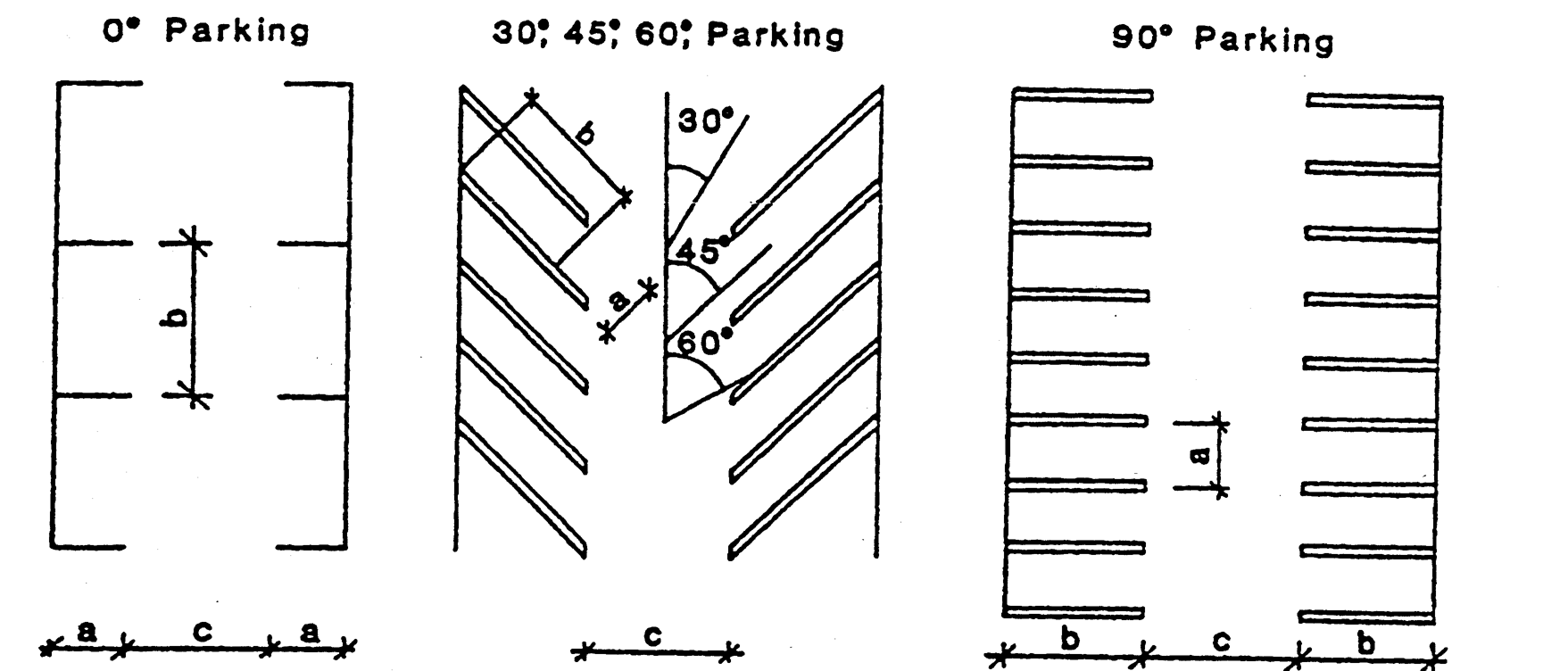
Figure 40.22.612
Table 40.22.612 A.
MINIMUM DIMENSIONS FOR REQUIRED PARKING SPACES
Table 40.22.612 B.
MINIMUM DIMENSIONS FOR OPTIONAL COMPACT PARKING SPACES
(Ord. No. 97-172, § 3(ch. 13, § 22.612), 12-31-1997; Ord. No. 98-080, § 1(ch. 13, § 22.612), 9-22-1998; Ord. No. 18-021, § 26, 7-10-2018)
Sec. 40.22.613. - Handicap parking.
All uses, other than residential served by on-lot parking, shall provide parking spaces for motor vehicles which transport disabled persons in accordance with this Section's standards and the American with Disabilities Act (ADA), or as may be amended, whichever is more restrictive.
A.
Handicap parking spaces shall be a minimum of eight (8) feet wide by eighteen (18) feet long with an adjacent parallel access aisle five (5) feet wide. The adjacent parallel access aisle may be shared by two (2) accessible parking spaces. One (1) in every eight (8) accessible spaces shall have an access aisle a minimum of eight (8) feet wide (rather than five (5) feet) and shall be signed "van accessible."
B.
Handicap parking spaces shall be located as close as possible to an entrance which allows such persons to enter and leave the parking area and building without assistance. Where feasible, this means locations where there is no need to cross vehicular access lanes or aisles. Ramps shall be provided at curbs.
C.
Handicap parking spaces shall be posted and marked with both a ground-mounted sign and pavement marking which includes the international symbol for barrier-free environments and a statement informing the public that the parking space is reserved for use by disabled persons.
Table 40.22.613
REQUIRED NUMBER OF OFF-STREET HANDICAP PARKING SPACES
D.
Residential units designed for occupancy by disabled persons shall provide one (1) handicap parking space for each dwelling unit designed for such occupancy.
E.
Off-street parking spaces required for the disabled by this Chapter shall count toward fulfilling this Chapter's total off-street parking requirements.
F.
Other Code guidelines for handicap accessibility to public facilities shall be in accordance with regulations issued by federal agencies, including the United States Department of Justice, under the Americans with Disabilities Act of 1990. More specifically, these regulations include 28 CFR Part 36 "Nondiscrimination on the Basis of Disability by Public Accommodations and in Commercial Facilities, Final Rule."
(Ord. No. 97-172, § 3(ch. 13, § 22.613), 12-31-1997)
Sec. 40.22.614. - Existing nonconforming parking.
The standards and requirements contained in this Section shall apply to all new vehicle parking areas. However, when an existing nonconforming parking lot is to incorporate additional spaces either within the confines of the existing parking lot or through construction of new parking spaces, for whatever reason, the Department shall determine the practicality of incorporating all or some of the current dimensional and design standards into the existing parking lot. The Department will balance the benefits of requiring all or some of the current dimensional and design standards with the physical restraints of the existing nonconforming parking lot to permit such an improvement. The Department shall be guided by the following circumstances and conditions:
A.
New parking area. Any new parking area (an area not within the confines of an existing parking area) shall comply with all the current parking lot dimensional and design standards regardless of the number of spaces, regardless of the reason for the new spaces and regardless of whether a plan must be reviewed by the Department. When the new parking spaces are to be added to an existing nonconforming parking area, the Department may require that all or a portion of the existing nonconforming parking area be brought into compliance with the current parking lot dimensional and design standards. The Department shall determine the practicality of which dimensional and design standards can be incorporated into the existing nonconforming parking area. The degree to which the existing parking area is to be brought into compliance shall be directly related to the proportional increase of the new parking spaces to the existing parking spaces.
B.
Restriping or reconfiguration of existing nonconforming parking areas not resulting from use changes or new buildings. The restriping or reconfiguration of an existing nonconforming parking lot with the same or fewer parking spaces may continue to exist with the same dimensional and design standards under which it was established. The restriping or reconfiguration of an existing nonconforming parking lot which proposes to apply some but not all of the current parking lot dimensional and design standards and which could result in additional parking spaces within the confines of the existing parking area shall require review and approval by the Department. The Department shall determine the degree to which an existing nonconforming parking lot can be restriped or reconfigured using some but not all of the current dimensional and design standards.
C.
Restriping or reconfiguration of existing nonconforming parking areas resulting from use changes and/or the construction of new buildings. The restriping or reconfiguration of an existing nonconforming parking lot to accommodate a use change and/or an additional building regardless of whether any additional parking spaces are created may require that all or a portion of the existing nonconforming parking area be brought into compliance with the current parking lot dimensional and design standards. When a new building is involved or when a new use requires additional parking spaces which can be accommodated within the confines of the existing nonconforming parking lot, the degree to which the existing nonconforming parking area is to be brought into compliance shall be directly related to the proportional increase of the gross floor area of the new building to the gross floor area of the existing building or to the proportional increase of the additional parking spaces to the existing parking spaces. The method which results in the greater proportional increase shall be used. The Department shall determine the practicality of which dimensional and design standards can be incorporated into the restriping or reconfiguration plan.
D.
Notwithstanding the foregoing, restriping or reconfiguration of existing nonconforming parking must comply with ADA standards.
(Ord. No. 97-172, § 3(ch. 13, § 22.614), 12-31-1997; Ord. No. 02-075, § 1(Exh. A), 10-22-2002; Ord. No. 18-021, § 27, 7-10-2018)
Sec. 40.22.615. - Parking reduction.
Where a unique situation is proposed or exists which will not generate the need for as many parking spaces as required by this Article, the applicant may petition the Department to authorize such reduction. The request for a parking reduction shall include a parking demand and needs analysis (PDNA) as described in this subsection which shall be submitted to the Department for review and approval. The Department shall be authorized to grant a reduction to the parking requirements when a PDNA shows that the requirements, as applied to the particular use, would exceed the minimum necessary to conveniently serve the customers, clients, visitors and employees. A PDNA must include the following components:
A.
A narrative discussion of the type of use and an explanation of why such use is unique from a parking needs standpoint.
B.
Basic traffic generation data such as numbers of anticipated vehicles entering and exiting the site at peak hours.
C.
Existing or proposed public transit facilities available to the site.
D.
Proposed means of parking/traffic mitigation measures such as carpools/vanpools, varied work shifts, company-operated buses or shuttles and employee incentives for utilizing alternate modes of transportation.
E.
With the exception of plans where the Comprehensive Plan identifies a site as being in either a Type 1 Commercial Corridor Development or Community Development Area, and includes elements of building design, site design and amenities identified in the applicable Character Area set forth in Appendix 7, the number of required parking spaces reduced by an approved PDNA, must be shown on-site as potential parking to accommodate future parking needs. If the proposed uses identified in the PDNA change the reductions granted will no longer be applicable.
(Ord. No. 97-172, § 3(ch. 13, § 22.615), 12-31-1997; Ord. No. 06-060, § 1(Exh. A), 9-26-2006; Ord. No. 24-057, § 6, 9-24-2024)
Sec. 40.22.616. - Parking reduction for multiple use development.
The purpose of this Section is to permit a reduction in the total number of parking spaces which would otherwise be required in instances when any land and/or building is used or occupied by two (2) or more uses which typically do not experience peak parking demands at the same time. Notwithstanding Section 40.03.522, for individual land uses, when any land or building is used for two (2) or more distinguishable purposes listed in this Section, the minimum total number of required parking spaces for land or building shall be determined by the following procedure:
A.
Multiply the minimum parking requirement for each individual use as set forth in Section 40.03.522 by the appropriate percentage as set forth in Table 40.22.616 for each of the five (5) designated time periods.
B.
Add the resulting sums for each of the five (5) vertical columns in the table.
C.
The minimum parking requirement is the highest sum among the five (5) columns resulting from the calculation in B of this Section.
D.
The factors used for the calculations are described in Table 40.22.616.
Table 40.22.616
E.
The following conditions shall apply to any parking lot for developments comprised of more than one (1) land use type:
1.
The multiple use property and shared parking lot must be located within six hundred (600) feet walking distance of the entrance to the establishment to be served.
2.
The Department shall determine at the time of parking plan approval or exploratory sketch plan approval or minor record plan approval, whichever is applicable, that shared parking is possible and appropriate at the location proposed. Particular attention is needed to ensure that sufficient and convenient short-term parking will be available to the commercial establishments during the weekday-daytime period. The shared parking spaces must be located in the most convenient and visible area of the parking facility nearest the establishment being served.
3.
A subsequent change in use requires a new certificate of use and/or occupancy and proof that sufficient parking will be available.
4.
Cross access easements shall be established and noted on the parking plan.
5.
The subdivision or land development shall contain additional open areas in amounts equivalent to that needed to accommodate the total number of parking spaces required without applying the reductions permitted by this Section.
(Ord. No. 97-172, § 3(ch. 13, § 22.616), 12-31-1997; Ord. No. 01-112, § 1(Exh. A), 3-12-2002)
Sec. 40.22.620. - Loading.
The number of loading areas shall be governed by Article 3.
A.
Site plans involving uses which require loading facilities must be designed to ensure the functional separation between loading spaces/truck turnaround areas and between vehicular/pedestrian areas.
B.
Internal site circulation lanes are to be designed with adequate turning radii to accommodate the size and efficient maneuvering of delivery vehicles.
(Ord. No. 97-172, § 3(ch. 13, § 22.620), 12-31-1997)
Sec. 40.22.621. - Outdoor loading bay area standards.
A.
Dimensions. Each outdoor loading bay area's minimum dimensions shall be twelve (12) feet wide and sixty (60) feet long. At no time shall any part of a truck or van be allowed to extend into a public thoroughfare or right-of-way while the truck or van is being loaded or unloaded. If the outdoor loading area is covered, but not totally enclosed, the minimum height of the outdoor loading bay area shall be fourteen (14) feet.
B.
Maneuvering space. Adequate off-street truck maneuvering space shall be provided on lot and not within any public street right-of-way or other public lands.
C.
Location. All loading areas are required to be located on the same lot as the building or lot served by the loading area.
D.
Obstructions. All loading spaces and maneuvering spaces shall be accessible at all times.
E.
Fire exit or emergency access. Off-street loading facilities shall be designed so as not to interfere with any fire exits or emergency access facilities to either a building or site.
F.
Screening. A loading bay, including all cartways, loading platforms, and structures shall be screened from view from adjacent residential zoning districts, residential uses, public rights-of-way and public access thoroughfares. Screening shall consist of a combination of structures, walls, and landscaping and shall provide year-round screening.
(Ord. No. 97-172, § 3(ch. 13, § 22.621), 12-31-1997; Ord. No. 18-021, § 28, 7-10-2018)
Division 40.22.700. - Exterior lighting standards.
Exterior lighting is regulated to eliminate light spillover and glare on motor vehicle operators, pedestrians, and land uses within the light source's proximity. Safety and environmental considerations are the basis of the regulations, and address potential hazards impacting the safe operation of motor vehicles due to glare or excessive light, as well as minimizing the negative ecological impacts of light pollution at night.
(Ord. No. 97-172, § 3(ch. 13, div. 22.700), 12-31-1997; Ord. No. 21-024, § 1, 8-31-2021)
Sec. 40.22.710. - Exterior lighting plan.
Any time exterior lighting is installed or substantially modified, and whenever a zoning permit is sought (as required in Section 40.31.240), an exterior lighting plan shall be submitted to the Department to determine whether this Article's requirements have been met and that adjoining property will not be adversely impacted by the proposed lighting. All exterior lighting plans submitted after January 1, 2022 shall utilize Light-Emitting Diode (LED) or other luminaire technologies that are at least as energy efficient as LEDs.
(Ord. No. 97-172, § 3(ch. 13, § 22.710), 12-31-1997; Ord. No. 21-024, § 1, 8-31-2021)
Sec. 40.22.720. - Lighting standards.
A.
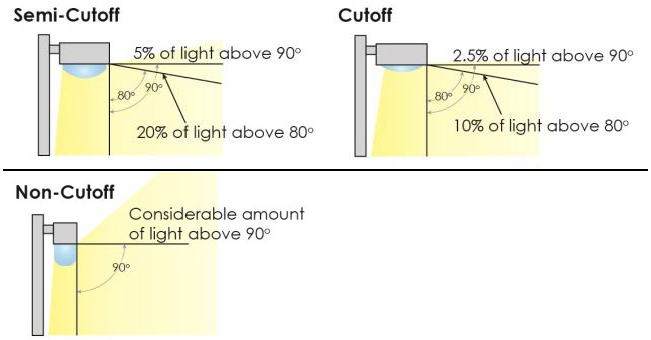
Light fixtures, or luminaires, are available in different types including (see Figure 40.22.720):
1.
Non-cutoff fixtures, which are prohibited;
2.
Semi-cutoff fixtures, which direct the light to partially limit view of the light source; and
3.
Full cutoff fixtures which shield the light source from view and prevent upward light. "Full cutoff" is the condition where the light emitted from a fixture does not extend upward beyond its bottom.
The maximum permitted illumination and luminaire height are set forth in Table 40.04.111.
Figure 40.22.720
TYPES OF LUMINAIRE
B.
All luminaire output is to be aimed downward and shall meet Illuminating Engineering Society ("IES") full-cutoff/fully shielded criteria where possible, and have no direct uplight.
C.
Luminaires with an aggregate rated lamp output not exceeding five hundred (500) lumens, e.g., the rated output of a standard non-directional 40-watt incandescent, 10-watt LED, or 10-watt compact fluorescent lamp, are exempt from the requirements of this Section.
D.
When a non-residential use is adjacent to a residential zoning district or use, the maximum illumination from the non-residential use shall not exceed one-tenth (0.1) foot candle as measured at the residential property line.
(Ord. No. 97-172, § 3(ch. 13, § 22.720), 12-31-1997; Ord. No. 99-084, § 1, 4-11-2000; Ord. No. 01-112, § 1(Exh. A), 3-12-2002; Ord. No. 10-113, § 1(Exh. A), 1-18-2011; Ord. No. 21-024, § 1, 8-31-2021; Ord. No. 23-122, § 1, 5-14-2024)
Sec. 40.22.730. - Street lights.
A.
Public street lighting shall conform to standards set by DelDOT and the Department.
B.
Streetlights in residential areas may be authorized by the establishment of a special tax assessment district by action of the County Council.
C.
Adequate lighting of driveways, parking lots, walkways and other public and semi-public and employee areas shall be provided in all commercial, industrial, and multi-family residential developments, in accordance with accepted illuminating engineering standards while recognizing that because of the higher luminous efficiency of LEDs and potential environmental and ecological impacts and cost savings, plans for exterior lighting should seek to avoid over-lighting.
D.
All street light and lighting plans regulated under this Chapter and submitted after January 1, 2022 shall:
1.
Utilize LED or other luminaire technologies that are at least as energy efficient as LED;
2.
Be fully shielded and emit no upward light;
3.
Use "warm-white" or filtered LEDs (Correlated Color Temperature (CCT) ≤ 3000K; S/P (Scotopic/Photopic) ratio ≤ 1.2) to minimize blue light emission.
(Ord. No. 97-172, § 3(ch. 13, § 22.730), 12-31-1997; Ord. No. 21-024, § 1, 8-31-2021)
Sec. 40.22.740. - Exterior lighting for outdoor recreational uses.
Ball diamonds, playing fields, and tennis courts have unique requirements for nighttime visibility and generally have limited hours of operation. These uses may meet the following limited use standards for approval of lighting in excess of the exterior lighting standards of Table 40.04.111. A special use permit shall be required when the light structure or the area to be lit is within five hundred (500) feet of a residential property where a residential use is built or where a residential dwelling can be built.
A.
The site plan meets all other Code requirements and, to the maximum extent possible, lighting is located to avoid shining at residential uses.
B.
Exterior light sources do not exceed the maximum permitted post height of eighty (80) feet.
C.
The light source or luminaire shall be cutoff fixtures. For all plans submitted after January 1, 2022, the light source or luminaire shall be equipped with LED or other luminaire technologies that are at least as energy efficient as LED. The luminaire may have a cutoff angle that extends beyond the property boundaries if:
1.
A landscaped bufferyard is provided to prevent light and glare spillover to adjacent residential property. The Department shall be able to require denser bufferyards than those in Table 40.04.111 to achieve this objective.
2.
The maximum permitted illumination shall not exceed one-tenth (0.1) footcandle at the residential property line or the street curb, whichever is less.
(Ord. No. 97-172, § 3(ch. 13, § 22.740), 12-31-1997; Ord. No. 01-112, § 1(Exh. A), 3-12-2002; Ord. No. 11-042, § 3, 11-22-2011; Ord. No. 21-024, § 1, 8-31-2021)
Sec. 40.22.741. - Sign lighting, spotlights and floodlights.
A.
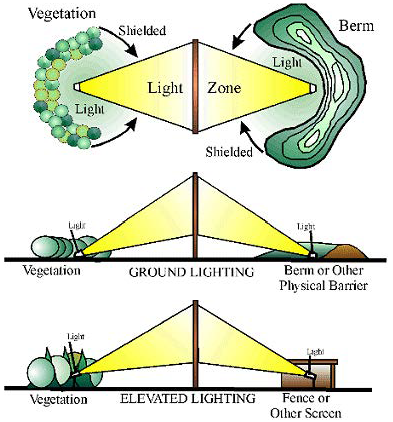
Spotlights and floodlights shall be screened by walls, berms, and/or cutoff shielding so the light source is not visible off site. In most cases, a combination of cutoff shielding and a landscape or other feature will be needed to provide the necessary screening. Figure 40.22.741 provides an example of how this objective is to be accomplished.
B.
Spotlights and floodlights are to be installed and aimed so that they do not project their output onto neighboring residential properties, past the object being illuminated, skyward, or onto a public roadway. Spotlights and floodlights installed above grade shall not be aimed out more than forty-five (45) percent from straight down. When a spotlight or floodlight creates glare, as viewed from a neighboring residential property, it shall be re-aimed and/or fitted with a shielding device, if not already in place, to block the direct view of the glare from neighboring residences.
Figure 40.22.741
SPOTLIGHTS FOR SIGNS
C.
Vegetation screens must not be the primary means for shielding. Rather, glare control shall be achieved primarily through the use of full cutoff/fully shielded luminaires, shields and baffles, and appropriate application of luminaire mounting height, wattage, aiming angle, and luminaire placement.
D.
Spotlights and floodlights with an aggregate rated lamp output not exceeding five hundred (500) lumens, e.g., the rated output of a standard nondirectional 40-watt incandescent, 6-watt LED, or 10-watt compact fluorescent lamp, are exempt from the requirements of this Section.
(Ord. No. 97-172, § 3(ch. 13, § 22.741), 12-31-1997; Ord. No. 21-024, § 1, 8-31-2021; Ord. No. 23-122, § 2, 5-14-2024)
Editor's note— Ord. No. 23-122, § 2, adopted May 14, 2024, changed the title of Section 40.22.741 from "Sign lighting, shielded spotlights" to "Sign lighting, spotlights and floodlights." The historical notation has been preserved for reference purposes.
Sec. 40.22.750. - Lighting, generally.
A.
Exterior lights shall be shielded, shaded, or directed, as best as is reasonably possible, so that light intensity and glare shall not adversely affect neighboring property owners, pedestrians, or passing motorists, consistent with Section 40.22.720, and emit no upward light. Such lighting shall be considered to adversely affect someone when the lighting would disturb a person of normal sensibilities.
B.
All exterior lights depicted in lighting plans shall utilize LED or other light emitting technologies that are at least as energy efficient as LEDs, having a light source efficacy of no less than ninety (90) lumens per watt, and utilize "warm-white" or filtered LEDs (Correlated Color Temperature (CCT)) ≤3000K; S/P (Scotopic/Photopic) ratio ≤1.2) to minimize blue light emission.
C.
Because of the higher luminous efficiency of LEDs and potential environmental and ecological impacts and cost savings, plans for exterior lighting should strive to avoid over-lighting.
(Ord. No. 97-172, § 3(ch. 13, § 22.750), 12-31-1997; Ord. No. 98-080, § 1(ch. 13, § 22.750), 9-22-1998; Ord. No. 21-024, § 1, 8-31-2021; Ord. No. 23-122, § 3, 5-14-2024)

