
Argyle City Zoning Code
PART 3
- ZONING DISTRICTS
Sec. 14.3.31. - Zoning Districts Established.
14.3.31-1 The Town of Argyle, Texas is hereby divided into the following zoning districts. The use, height, area regulations, and other standards, as set out herein apply to each district. The districts established herein shall be known as:
14.3.31-2 A summary of the area regulations for the following zoning districts is included within Section 14.3.96.
14.3.31-3 Certain terms and definitions used within this ordinance can be found in Section 14.1.5.
(Ord. No. 2010-01, § 3, 1-12-10; Ord. No. 2019-04, § 2 (Exh. A), 3-26-19)
Sec. 14.3.32. - A—Agricultural District.
14.3.32-1 General Purpose and Description. The "A"—Agricultural District is designed primarily for agricultural uses, such as keeping livestock or tending a farm, and other uses that are incidental to an agricultural use, as well as limited single-family uses.
There are two primary purposes for the "A" district. First, one purpose would be to help protect and preserve areas for agricultural uses and rural residential development. Second, another purpose would be to be a "temporary" or "holding" district. The district would function as a "temporary" or "holding" district for territory that has just been annexed into the Town until a more permanent zoning district is assigned.
The "A" district would also be appropriate for areas where development would not be appropriate at the current time due to lack of utilities or Town services, to preserve areas that are unsuitable for development due to hazards such as flooding, to provide permanent greenbelts to preserve open spaces, and to allow open space as a buffer around uses that might be objectionable or pose environmental hazards.
Developments in an "A" district may be constructed with rural street sections. Said rural street sections may be constructed with open drainage ditches and without sidewalks.
14.3.32-2 Permitted Uses. See Section 14.3.62, Use Chart Matrix for list of uses permitted within this district.
14.3.32-3 Height Regulations.
A.
Maximum Height.
1.
Two and one-half stories but not to exceed 35 feet for the main building/house.
2.
Thirty-five feet for agricultural structures (e.g., barns, silos, water towers, etc.).
3.
See Section 14.3.68 for accessory building height requirements.
4.
Other requirements (see Section 14.3.71).
14.3.32-4 Area Regulations.
A.
Size of Lots.
1.
Standard Lots.
a.
Minimum lot area. Five acres.
b.
Minimum lot width. Three hundred feet at the front property line.
c.
Minimum lot depth. Three hundred feet.
2.
Flag lots/panhandle lots.
a.
Minimum lot area. Five acres for that portion of the lot located outside of the narrow "flag" or "panhandle" portion that extends from the right-of-way.
b.
Minimum lot width. One hundred feet at the right-of-way and 300 feet at the front building line.
c.
Minimum lot depth. Three hundred feet for that portion of the lot located outside of the narrow "flag" or "panhandle" portion that extends from the right-of-way.
d.
Reserved.
e.
Maximum length of "flag" or "panhandle" portion of lot. The narrow portion of a "flag" or "panhandle lot" that extends from the right-of-way shall not exceed 900 feet as measured perpendicular to the front property line.
B.
Size of yards.
1.
Minimum front yard. Fifty feet.
2.
Minimum side yard. Fifty feet.
3.
Minimum rear yard. Fifty feet.
4.
Garages. Garage entries for motor vehicles shall not be located nearer than 50 feet to a street right-of-way or the minimum side yard or rear yard setbacks, whichever is greater.
C.
Maximum lot coverage. Twenty percent for main buildings and accessory buildings.
D.
Parking regulations.
1.
Single-family dwelling unit. A minimum of two enclosed parking spaces behind the front building line on the same lot as the main structure, plus four additional parking spaces on an all weather surface meeting the Town of Argyle standards for all-weather surfaces.
2.
Other. See Section 14.3.66, off-street parking and loading regulations.
E.
Minimum floor area per dwelling unit. One thousand six hundred square feet.
F.
Minimum exterior construction standards. See Section 14.3.70 for exterior construction standards.
14.3.32-5 Special Requirements.
A.
Driveway Spacing (Distance Between Driveways, Measured Edge-to-Edge).
1.
U.S. Highway 377: 300 feet.
2.
Arterial Street: 300 feet.
3.
Collector Street: 200 feet.
4.
Local Street: 100 feet.
B.
Recreational vehicles, travel trailers or motor homes may not be used for on-site dwelling purposes.
C.
Fencing shall comply with all requirements specified in Section 14.3.69-3.
D.
Open storage is prohibited (except for materials for the resident's personal use or consumption such as firewood, garden materials, farm equipment, etc., which cannot be stored in any required setback and which shall be screened from view of public streets and neighboring properties).
E.
Single-family homes with side-entry garages where lot frontage is only to one street (not a corner lot) shall have a minimum of 50 feet from the door face of the garage or carport to the side property line for maneuvering. The minimum setback from any garage door to a street or alley right-of-way line shall also be 50 feet.
F.
The elimination of a garage space by enclosing or converting any portion of the garage space with a stationary building wall shall be prohibited unless another garage of the same size (i.e., that has the same number of parking spaces) is built on the lot within the proper setbacks, not exceeding the maximum lot coverage, etc.
G.
Swimming pools (see the Town's Code of Ordinances).
H.
Site plan approval (see Section 14.3.25) shall be required for any nonresidential use (e.g., school, church, child care center, private recreation facility, etc.) in the A district. Any nonresidential land use which may be permitted in this district shall conform to the "OR"—Office Retail district standards with respect to building setbacks, landscaping, exterior building construction, screening requirements, lighting, signage, etc. Said site plan approval shall not be required for home occupations uses that conform to the Town's standards.
I.
Private and commercial animal lots and stables. Private and commercial animal lots or stables may be allowed subject to the following standards:
1.
Standards for private animal lots and stables.
a.
The minimum lot area for a private animal lot and/or private stable/barn shall be two and one-half acres. In no case shall more than one animal be kept for each acre of land available for grazing (excluding property used for structures and other nonagricultural uses).
b.
If animals are kept inside a building, then one sheltered stall shall be provided for each animal. A box stall shall be a minimum of ten feet by ten feet.
c.
Stables, corrals, and piles of manure, feed, and bedding shall be located at least 50 feet from any street or lot line and at least 100 feet from any adjacent existing residence. Pasture may extend to the lot line so long as runoff is controlled from entering onto an adjacent lot or tract.
2.
Standards for commercial animal lots and stables.
a.
The minimum lot size for a commercial animal lot or stable/barn shall be five acres, or one acre for each animal, whichever is greater. If animals are maintained on pasture as their primary source of feed, then in no case shall more than one animal be kept for each acre of land. If animals are kept inside a building at all times (excluding exercise), then the maximum number of animals permitted shall be limited to the building capacity to house, show, and ride said horses, but in no case shall the number of animals exceed two for each acre of land available. A stall shall be provided for each animal and each stall shall be a minimum of ten feet by ten feet.
b.
Stables, corrals, and piles of manure, feed, and bedding shall be located at least 50 feet from any street or lot line and at least 100 feet from any adjacent existing residence. Pasture may extend to the lot line so long as runoff is controlled from entering onto an adjacent lot or tract.
J.
Other Regulations. As established by Sections 14.3.66—14.3.75.
(Ord. No. 2010-01, § 3, 1-12-10; Ord. No. 2010-19, § 7, 12-14-10; Ord. No. 2011-12, 6-28-11; Ord. No. 2016-05, § 2, 3-22-16; Ord. No. 2021-22, § 2(Exh. A), 8-16-21; Ord. No. 2022-14, § 2(Exh. A), 9-6-22)
Sec. 14.3.33. - SF-2.5—Single-Family Residential Estate—2.5 District.
14.3.33-1 General Purpose and Description. The "SF-2.5" residential estate—2.5 district is intended for semi-rural, detached single-family residential development. The district is a low density development with a minimum lot size of two and one-half acres.
Areas zoned for the "SF-2.5" district shall have or shall make provision for water services from Argyle Water Supply Water Corporation. The areas with "SF-2.5" zoning will be designed to adequately accommodate storm drainage.
These areas should be buffered from nonresidential uses and protected from pollution and undesirable environmental and noise impacts.
The streets shall be paved (concrete or asphalt to minimum Town standards) with logical and efficient vehicular circulation patterns that discourage nonlocal traffic. Developments within an "SF-2.5" district may be constructed with rural street sections. The rural street sections may be constructed with open drainage ditches and without sidewalks.
14.3.33-2 Permitted Uses. See Section 14.3.62, Use Chart Matrix for list of uses permitted within this district.
14.3.33-3 Height Regulations.
A.
Maximum Height.
1.
Two and one-half stories but not to exceed 35 feet for the main building/house.
2.
Thirty-five feet for agricultural structures (e.g., barns, silos, water towers, etc.).
3.
See Section 14.3.68 for accessory building height requirements.
4.
Other requirements (see Section 14.3.71).
14.3.33-4 Area Regulations.
A.
Size of lots.
1.
Standard lots.
a.
Minimum lot area. Two and one-half acres.
b.
Minimum lot width. One hundred fifty feet at the front property line.
c.
Minimum lot depth. Three hundred feet.
2.
Flag lots/panhandle lots.
a.
Minimum lot area. Two and one-half acres for that portion of the lot located outside of the narrow "flag" or "panhandle" portion that extends from the right-of-way.
b.
Minimum lot width. Seventy-five feet at the right-of-way and 150 feet at the front building line.
c.
Minimum lot depth. Three hundred feet for that portion of the lot located outside of the narrow "flag" or "panhandle" portion that extends from the right-of-way.
d.
Reserved.
e.
Maximum length of "flag" or "panhandle" portion of lot. The narrow portion of a "flag" or "panhandle lot" that extends from the right-of-way shall not exceed 600 feet as measured perpendicular to the front property line.
B.
Size of Yards.
1.
Minimum front yard. Fifty feet.
2.
Minimum side yard. Thirty feet.
3.
Minimum rear yard. Fifty feet for the main building and accessory structures.
4.
Garages. Garage entries for motor vehicles shall not be located nearer than 24 feet to a street right-of-way or the minimum side yard or rear yard setbacks, whichever is greater.
C.
Maximum Lot Coverage. Fifteen percent including main buildings and accessory buildings.
D.
Parking Regulations.
1.
Single-family dwelling unit. A minimum of two enclosed parking spaces behind the front building line on the same lot as the main structure, plus two additional parking spaces on an all weather surface meeting the Town of Argyle standards for all-weather surfaces.
2.
Other. See Section 14.3.66, Off-street parking and loading regulations.
E.
Minimum floor area per dwelling unit. One thousand six hundred square feet.
F.
Minimum exterior construction standards. See Section 14.3.70 for exterior construction standards.
14.3.33-5 Special Requirements.
A.
Driveway spacing (distance between driveways, measured edge-to-edge).
1.
U.S. Highway 377: 300 feet.
2.
Arterial Street: 300 feet.
3.
Collector Street: 150 feet.
4.
Local Street: 50 feet.
B.
Recreational vehicles, travel trailers or motor homes may not be used for on-site dwelling purposes.
C.
Fencing shall comply with all requirements specified in Section 14.3.69-3.
D.
Open storage is prohibited (except for materials for the resident's personal use or consumption such as firewood, garden materials, farm equipment, etc., which cannot be stored in any required setback and which shall be screened from view of public streets and neighboring properties).
E.
Single-family homes with side-entry garages where lot frontage is only to one street (not a corner lot) shall have a minimum of 30 feet from the door face of the garage or carport to the side property line.
F.
The elimination of a garage space by enclosing or converting any portion of the garage space with a stationary building wall shall be prohibited unless another garage of the same size (i.e., that has the same number of parking spaces) is built on the lot within the proper setbacks, not exceeding the maximum lot coverage, etc.
G.
Swimming pools (see the Town's Code of Ordinances).
H.
Site plan approval (see Section 14.3.25) shall be required for any nonresidential use (e.g., school, church, child care center, private recreation facility, etc.) in the SF-2.5 district. Any nonresidential land use which may be permitted in this district shall conform to the "OR"—Office Retail district standards with respect to building setbacks, landscaping, exterior building construction, screening requirements, lighting, signage, etc. Said site plan approval shall not be required for home occupations uses that conform to the Town's standards.
I.
Private and Commercial Animal Lots and Stables. Private and commercial animal lots or stables may be subject to the following standards:
1.
Standards for Private Animal Lots and Stables.
a.
The minimum lot area for a private animal lot and/or private stable/barn shall be two and one-half acres. In no case shall more than one animal be kept for each acre of land available for grazing (excluding property used for structures and other nonagricultural uses).
b.
If animals are kept inside a building, then one sheltered stall shall be provided for each animal. A box stall shall be a minimum of ten feet by ten feet.
c.
Stables, corrals, and piles of manure, feed, and bedding shall be located at least 50 feet from any street or lot line and at least 100 feet from any adjacent existing residence. Pasture may extend to the lot line so long as runoff is controlled from entering onto an adjacent lot or tract.
2.
Standards for Commercial Animal Lots and Stables.
a.
The minimum lot size for a commercial animal lot or stable/barn shall be five acres, or one acre for each animal, whichever is greater. If animals are maintained on pasture as their primary source of feed, then in no case shall more than one animal be kept for each acre of land. If animals are kept inside a building at all times (excluding exercise), then the maximum number of animals permitted shall be limited to the building capacity to house, show, and ride said horses, but in no case shall the number of animals exceed two for each acre of land available. A stall shall be provided for each animal and each stall shall be a minimum of ten feet by ten feet.
b.
Stables, corrals, and piles of manure, feed, and bedding shall be located at least 50 feet from any street or lot line and at least 100 feet from any adjacent existing residence. Pasture may extend to the lot line so long as runoff is controlled from entering onto an adjacent lot or tract.
J.
Other Regulations. As established by Sections 14.3.66—14.3.75.
(Ord. No. 2010-01, § 3, 1-12-10; Ord. No. 2010-19, § 8, 12-14-10; Ord. No. 2011-12, 6-28-11; Ord. No. 2016-05, § 3, 3-22-16; Ord. No. 2021-22, § 2(Exh. A), 8-16-21; Ord. No. 2022-14, § 2(Exh. A), 9-6-22)
Sec. 14.3.34. - SF-1—Single-Family Residential Estate-1 District.
14.3.34-1 General Purpose and Description. The "SF-1" residential estate-1 district is intended for detached single-family residential development. The district is a low-density development with a minimum lot size of one acre.
Areas zoned for the "SF-1" district shall have or shall make provision for water services from Argyle Water Supply Water Corporation. The areas with "SF-1" zoning will be designed to adequately accommodate storm drainage.
These areas should be buffered from nonresidential uses and protected from pollution and undesirable environmental and noise impacts.
The streets shall be paved (concrete or asphalt to minimum Town standards) with logical and efficient vehicular circulation patterns that discourage non-local traffic. Developments within an "SF-1" district may be constructed with rural street sections. The rural street sections may be constructed with open drainage ditches and without sidewalks.
14.3.34-2 Permitted Uses. See Section 14.3.62, Use Chart Matrix for list of uses permitted within this district.
14.3.34-3 Height Regulations.
A.
Maximum Height.
1.
Two and one-half stories but not to exceed 35 feet for the main building/house.
2.
See Section 14.3.68 for accessory building height requirements.
3.
Other requirements (see Section 14.3.71).
14.3.34-4 Area Regulations.
A.
Size of Lots.
1.
Minimum Lot Area. One acre.
2.
Minimum Lot Width. One hundred fifty feet.
B.
Size of Yards.
1.
Minimum Front Yard. Fifty feet.
2.
Minimum Side Yard. Fifteen feet for an interior side yard; 15 feet from a street right-of-way line for a local street or collector street as designated on the Town of Argyle Thoroughfare Plan, as amended; 20 feet from a street right-of-way line for highway 377 or an arterial street as designated on the Town of Argyle Thoroughfare Plan; 40 feet from a street right-of-way line for a key corner lot.
3.
Minimum Rear Yard. Fifteen feet for the main building and accessory structures.
4.
Garages. Garage entries for motor vehicles shall not be located nearer than 24 feet to a street right-of-way or the minimum side yard or rear yard setbacks, whichever is greater.
C.
Maximum Lot Coverage. Twenty percent including main buildings and accessory buildings.
D.
Parking Regulations.
1.
Single-Family Dwelling Unit. A minimum of two enclosed parking spaces behind the front building line on the same lot as the main structure, plus two additional parking spaces on a paved driveway (all concrete or a similar paved surface such as turf pavers, brick pavers or asphalt).
2.
Other. See Section 14.3.66, off-street parking and loading regulations.
E.
Minimum Floor Area per Dwelling Unit. One thousand six hundred square feet.
F.
Minimum Exterior Construction Standards. See Section 14.3.70 for exterior construction standards.
14.3.34-5 Special Requirements.
A.
Recreational vehicles, travel trailers or motor homes may not be used for on-site dwelling purposes.
B.
Open storage is prohibited (except for materials for the resident's personal use or consumption such as firewood, garden materials, farm equipment, etc., which cannot be stored in any required setback and which shall be screened from view of public streets and neighboring properties).
C.
Single-family homes with side-entry garages where lot frontage is only to one street (not a corner lot) shall have a minimum of 24 feet from the door face of the garage or carport to the side property line for maneuvering. The minimum setback from any garage door to a street or alley right-of-way line shall also be 24 feet.
D.
The elimination of a garage space by enclosing or converting any portion of the garage space with a stationary building wall shall be prohibited unless another garage of the same size (i.e., that has the same number of parking spaces) is built on the lot within the proper setbacks, not exceeding the maximum lot coverage, etc.
E.
Swimming pools (see the Town's Code of Ordinances).
F.
Site plan approval (see Section 14.3.25) shall be required for any nonresidential use (e.g., school, church, child care center, private recreation facility, etc.) in the SF-1 district. Any nonresidential land use which may be permitted in this district shall conform to the "OR"—Office Retail district standards with respect to building setbacks, landscaping, exterior building construction, screening requirements, lighting, signage, etc. Said site plan approval shall not be required for home occupations uses that conform to the Town's standards.
G.
Private Animal Lots and Stables. A property zoned "SF-1" may be allowed only by issuance of an SUP to have the usual farm animals as defined under the farms general (livestock/ranch) use such as horses, cattle, and sheep. This includes the necessary accessory uses for raising. Treating, and storing products raised on the premises, but not including the commercial feeding of offal or garbage to swine or other animals and not including any type of agriculture or husbandry specifically prohibited by ordinance or law. So long as the property has a minimum one and one-half acres of land available for grazing (excluding property used for structures and other nonagricultural uses) and follows Section 2.01.014 of the Code of Ordinances for the one animal unit per acre as determined by the animal unit matrix.
Private animal lots or stables may be allowed only by issuance of an SUP and subject to the following standards:
1.
Standards for Private Animal Lots and Stables.
a.
The minimum lot area for a private animal lot and/or private stable/barn shall be one and one-half acres. In no case shall more than one animal be kept for each acre of land available for grazing (excluding property used for structures and other nonagricultural uses).
b.
If animals are kept inside a building, then one sheltered stall shall be provided for each animal. A box stall shall be a minimum of ten feet by ten feet.
c.
Stables, corrals, and piles of manure, feed, and bedding shall be located at least 50 feet from any street or lot line and at least 100 feet from any adjacent existing residence. Pasture may extend to the lot line so long as runoff is controlled from entering onto an adjacent lot or tract.
H.
Other Regulations. As established by Sections 14.3.66—14.3.75.
(Ord. No. 2010-01, § 3, 1-12-10; Ord. No. 2016-05, § 4, 3-22-16; Ord. No. 2021-22, § 2(Exh. A), 8-16-21; Ord. No. 2022-14, § 2(Exh. A), 9-6-22; Ord. No. 2025-22, § 2(Exh. A), 7-21-25)
Sec. 14.3.35. - SF-20—Single-Family Residential-20 District.
14.3.35-1 General Purpose and Description. The "SF-20" Single-Family Residential-20 District is intended for medium-density development. Such development would include detached single-family residences, churches, schools and public parks in logical neighborhood units. Minimum lot size in this District would be not less than 20,000 square feet in size.
Areas zoned for the "SF-20" District shall have or shall make provision for, Argyle Water Supply Water Corporation water and Town of Argyle sewer services. The areas with "SF-20" zoning will be designed to adequately accommodate storm drainage.
These areas should be buffered from nonresidential uses and protected from pollution and undesirable environmental and noise impacts.
The streets shall be paved in accordance with Town of Argyle Land Development Regulations and other ordinances. The streets shall have logical and efficient vehicular circulation patterns that discourage non-local traffic.
14.3.35-2 Permitted Uses. See Section 14.3.62, Use Chart Matrix for list of uses permitted within this district.
14.3.35-3 Height Regulations.
Maximum Height.
1.
Two and one-half stories but not to exceed 35 feet for the main building/house.
2.
See Section 14.3.68 for accessory building height requirements.
3.
Other requirements (see Section 14.3.71).
14.3.35-4 Area Regulations.
A.
Size of Lots.
1.
Minimum Lot Area. Twenty thousand square feet; also, the minimum average lot area shall be 22,000 square feet in order to provide diversity in lot sizes within each SF-20 neighborhood.
2.
Minimum Lot Width. One hundred feet.
3.
Minimum Lot Depth. One hundred fifty feet.
B.
Size of Yards.
1.
Minimum Front Yard. Thirty feet.
2.
Minimum Side Yard. Ten feet for an interior side yard; 15 feet from a street right-of-way line for a corner lot on a residential or collector street; 20 feet for a corner lot on an arterial street; 30 feet from a street right-of-way line for a key corner lot.
3.
Minimum Rear Yard. Fifteen feet for the main building.
4.
Garages. Garage entries for motor vehicles shall not be located nearer than 24 feet to a street right-of-way or the minimum Side Yard or Rear Yard setbacks, whichever is greater.
C.
Maximum Lot Coverage. Thirty percent including main buildings and accessory buildings.
D.
Parking Regulations.
1.
Single-Family Dwelling Unit. A minimum of two enclosed parking spaces behind the front building line on the same lot as the main structure, plus two additional parking spaces on a paved driveway (all concrete or a similar paved surface such as turf pavers, brick pavers or asphalt).
2.
Other. See Section 14.3.66, Off-Street Parking and Loading Regulations.
E.
Minimum Floor Area per Dwelling Unit. One thousand six hundred square feet.
F.
Minimum Exterior Construction Standards. See Section 14.3.70 for exterior construction standards.
14.3.35-5 Special Requirements.
A.
Recreational vehicles, travel trailers or motor homes may not be used for on-site dwelling purposes.
B.
Open storage is prohibited (except for materials for the resident's personal use or consumption such as firewood, garden materials, farm equipment, etc., which cannot be stored in any required setback and which shall be screened from view of public streets and neighboring properties).
C.
Single-family homes with side-entry garages where lot frontage is only to one street (not a corner lot) shall have a minimum of 24 feet from the door face of the garage or carport to the side property line for maneuvering. The minimum setback from any garage door to a street or alley right-of-way line shall also be 24 feet.
D.
The elimination of a garage space by enclosing or converting any portion of the garage space with a stationary building wall shall be prohibited unless another garage of the same size (i.e., that has the same number of parking spaces) is built on the lot within the proper setbacks, not exceeding the maximum lot coverage, etc.
E.
Swimming pools (see the Town's Code of Ordinances).
F.
Site plan approval (see Section 14.3.25) shall be required for any nonresidential use (e.g., school, church, child care center, private recreation facility, etc.) in the SF-20 district. Any nonresidential land use which may be permitted in this district shall conform to the "OR"—Office Retail district standards with respect to building setbacks, landscaping, exterior building construction, screening requirements, lighting, signage, etc. Said site plan approval shall not be required for home occupations uses that conform to the Town's standards.
G.
Other Regulations. As established by Sections 14.3.66—14.3.75.
(Ord. No. 2022-14, § 2(Exh. A), 9-6-22)
Sec. 14.3.36. - SF-10—Single-Family Residential-10 District.
14.3.36-1 General Purpose and Description. The "SF-10" Single-Family Residential-10 District is intended for medium-density development. Such development would include detached single-family residences, churches, schools and public parks in logical neighborhood units. Minimum lot size in this District would be not less than 10,000 square feet in size.
Areas zoned for the "SF-10" District shall have or shall make provision for, Argyle Water Supply Water Corporation water and Town of Argyle sewer services. The areas with "SF-10" zoning will be designed to adequately accommodate storm drainage.
These areas should be buffered from nonresidential uses and protected from pollution and undesirable environmental and noise impacts.
The streets shall be paved in accordance with Town of Argyle Land Development Regulations and other ordinances. The streets shall have logical and efficient vehicular circulation patterns that discourage non-local traffic.
14.3.36-2 Permitted Uses. See Section 14.3.62, Use Chart Matrix for list of uses permitted within this district.
14.3.36-3 Height Regulations.
A.
Maximum Height.
1.
Two and one-half stories but not to exceed 35 feet for the main building/house.
2.
See Section 14.3.68 for accessory building height requirements.
3.
Other requirements (see Section 14.3.71).
14.3.36-4 Area Regulations.
A.
Size of Lots.
1.
Minimum Lot Area. Ten thousand square feet; also, the minimum average lot area shall be 11,000 square feet in order to provide diversity in lot sizes within each SF-10 neighborhood.
2.
Minimum Lot Width. Eighty feet.
3.
Minimum Lot Depth. One hundred twenty feet.
B.
Size of Yards.
1.
Minimum Front Yard. Thirty feet.
2.
Minimum Side Yard. Ten feet for an interior side yard; 15 feet from a street right-of-way line for a corner lot on a residential or collector street; 20 feet for a corner lot on an arterial street; 25 feet from a street right-of-way line for a key corner lot.
3.
Minimum Rear Yard. Fifteen feet for the main building.
4.
Garages. Garage entries for motor vehicles shall not be located nearer than 24 feet to a street right-of-way or the minimum Side Yard or Rear Yard setbacks, whichever is greater.
C.
Maximum Lot Coverage. Thirty-five percent including main buildings and accessory buildings.
D.
Parking Regulations.
1.
Single-Family Dwelling Unit. A minimum of two enclosed parking spaces behind the front building line on the same lot as the main structure, plus two additional parking spaces on a paved driveway (all concrete or a similar paved surface such as turf pavers, brick pavers or asphalt).
2.
Other. See Section 14.3.66, Off-Street Parking and Loading Regulations.
E.
Minimum Floor Area per Dwelling Unit. One thousand six hundred square feet.
F.
Minimum Exterior Construction Standards. See Section 14.3.70 for exterior construction standards.
14.3.36-5 Special Requirements.
A.
Recreational vehicles, travel trailers or motor homes may not be used for on-site dwelling purposes.
B.
Open storage is prohibited (except for materials for the resident's personal use or consumption such as firewood, garden materials, farm equipment, etc., which cannot be stored in any required setback and which shall be screened from view of public streets and neighboring properties).
C.
Single-family homes with side-entry garages where lot frontage is only to one street (not a corner lot) shall have a minimum of 24 feet from the door face of the garage or carport to the side property line for maneuvering. The minimum setback from any garage door to a street or alley right-of-way line shall also be 24 feet.
D.
The elimination of a garage space by enclosing or converting any portion of the garage space with a stationary building wall shall be prohibited unless another garage of the same size (i.e., that has the same number of parking spaces) is built on the lot within the proper setbacks, not exceeding the maximum lot coverage, etc.
E.
Swimming pools (see the Town's Code of Ordinances).
F.
Site plan approval (see Section 14.3.25) shall be required for any nonresidential use (e.g., school, church, child care center, private recreation facility, etc.) in the SF-10 district. Any nonresidential land use which may be permitted in this district shall conform to the "OR"—Office Retail district standards with respect to building setbacks, landscaping, exterior building construction, screening requirements, lighting, signage, etc. Said site plan approval shall not be required for home occupations uses that conform to the Town's standards.
G.
Other Regulations. As established by Sections 14.3.66—14.3.75.
(Ord. No. 2022-14, § 2(Exh. A), 9-6-22)
Sec. 14.3.37. - SF-7—Single-Family Residential-7 District (Single-Family Detached Units on Minimum 7,000-Square-Foot Lots; Allowed as PD only).
14.3.37-1 General Purpose and Description. "SF-7" Single-Family Residential-7 District shall be allowed as Planned Developments only—no stand-alone "SF-7" Single-Family Residential-7 District zoning districts shall be allowed. "SF-7" uses shall be limited to the Special Planning Areas 1 and 2 as designated on the Town of Argyle Land Use Plan, as amended and shall be allowed as Planned Developments only.
The "SF-7" Single-Family Residential-7 District is intended for the development of detached single-family residences. Minimum lot size in this District would be not less than 7,000 square feet in size.
Areas zoned for the "SF-7" District shall have or shall make provision for, Argyle Water Supply Water Corporation water and Town of Argyle sewer services. The areas with "SF-7" zoning will be designed to adequately accommodate storm drainage.
These areas should be buffered from nonresidential uses and protected from pollution and undesirable environmental and noise impacts.
The streets shall be paved in accordance with Town of Argyle Land Development Regulations and other ordinances. The streets shall have logical and efficient vehicular circulation patterns that discourage non-local traffic.
14.3.37-2 Permitted Uses. See Section 14.3.62, Use Chart Matrix for list of uses permitted within this district.
14.3.37-3 Height Regulations.
Maximum Height.
1.
Two and one-half stories but not to exceed 35 feet for the main building/house.
2.
See Section 14.3.68 for accessory building height requirements.
3.
Other requirements (see Section 14.3.71).
14.3.37-4 Area Regulations.
A.
Size of Lots.
1.
Minimum Lot Area. Seven thousand square feet; also, the minimum average lot area shall be 8,000 square feet in order to provide diversity in lot sizes within each SF-7 neighborhood.
2.
Maximum Project Size. The maximum size of an SF-7 development shall be 40 acres. No SF-7 shall not be located within 1,500 feet to another SF-7 development.
3.
Minimum Lot Width. Fifty-five feet.
4.
Minimum Lot Depth. One hundred twenty feet.
B.
Size of Yards.
1.
Minimum Front Yard. Twenty-five feet.
2.
Minimum Side Yard. Five feet required; 15 feet from a street right-of-way line for a corner lot on a residential or collector street; 20 feet for a corner lot on an arterial street; 25 feet from a street right-of-way line for a key corner lot.
3.
Minimum Rear Yard. Twenty feet for the main building; 24 feet for rear garage entry.
4.
Garages. Garage entries for motor vehicles shall not be located nearer than 24 feet to a street right-of-way or the minimum Side Yard or Rear Yard setbacks, whichever is greater.
C.
Maximum Lot Coverage. Forty percent by main buildings and accessory buildings.
D.
Parking Regulations.
1.
Single-Family Dwelling Unit. A minimum of two enclosed parking spaces behind the front building line on the same lot as the main structure, plus two additional parking spaces on a paved driveway (all concrete or a similar paved surface such as turf pavers, brick pavers or asphalt).
2.
Visitor Parking. One-half parking space per dwelling unit (off-street) which is located within 600 feet of the dwelling unit.
3.
All driveways and parking areas shall be concrete or a similar paved surface such as turf pavers, brick pavers or asphalt.
4.
Other. See Section 14.3.66, Off-Street Parking and Loading Requirements.
E.
Minimum Floor Area per Dwelling Unit. One thousand six hundred square feet.
F.
Minimum Exterior Construction Standards. See Section 14.3.70 for exterior construction standards.
14.3.37-5 Special Requirements.
A.
Maintenance Requirements for Common Areas. A property owners' association is required for continued maintenance of common land and facilities (see the Subdivision Ordinance for POA/HOA requirements).
B.
Usable Open Space Requirements. Except as provided below, any SF-7 subdivision shall provide usable open space which equals or exceeds ten percent of the gross platted area, excluding rights-of-way for collector and larger sized streets. Usable open space shall not be required for an SF-7 development if it contains 20 or fewer lots and if the property is contiguous to or abuts a usable open space area adequate to serve the development. Said usable open space shall meet the criteria established in C. below. Properties that are separated by thoroughfares larger than a collector street and/or by drainage/utility easements in excess of 60 feet in width shall not be considered as contiguous.
C.
Specific Criteria for Usable Open Space. Areas provided as usable open space shall meet the following criteria:
1.
All residential lots must be located within 600 feet of a usable open space area as measured along a street. The Planning and Zoning Commission may recommend, and Town Council may allow, this distance to be increased to up to 1,200 feet if the shape of the subdivision is irregular or if existing trees or other natural features on the site can be preserved by increasing the distance.
2.
Individual usable open space areas shall be at least 20,000 square feet in size. Usable open space must be a minimum of 50 feet wide, and must have no slope greater than ten percent. At the time of site plan and subdivision plat approval, the Planning and Zoning Commission may recommend, and the Town Council may allow, full or partial credit for open areas that exceed the ten percent maximum slope if it is determined that such areas are environmentally or aesthetically significant and that their existence enhances the development and the surrounding area.
3.
Pools, tennis courts, walkways, patios and similar outdoor amenities may be located within areas designated as usable open space. Areas occupied by enclosed buildings (except for gazebos and pavilions), driveways, parking lots, overhead electrical transmission lines, drainage channels, and antennas may not be included in calculating usable open space.
4.
Within usable open space areas, there shall be at least one large shade tree for every 1,000 square feet of space. New trees planted to meet this requirement shall be a minimum three-inch caliper, and at least 25 percent of the trees shall be nondeciduous (for qualifying tree species, see Section 14.3.67 for the Town's Recommended Plant List).
5.
A usable open space area must have street frontage on at least 33 percent of the area's perimeter to ensure that the area is accessible to residents of the subdivision.
6.
Usable open space areas must be easily viewed from adjacent streets and homes. Side or rear yard fences along common open space areas shall be of open, wrought iron design, and shall not exceed four feet in height adjacent to the open space and for a distance of ten feet perpendicular or radial to the open space area.
D.
Credit for Off-Site Open Space. At the time of site plan and subdivision plat approval, the Planning and Zoning Commission may recommend, and the Town Council may allow, up to one-third of the required open space to be credited for off-site dedicated open space (e.g., park land) that meets the development's needs in terms of adjacency, accessibility, usability, and design integration. The granting of any off-site credit for open space is a discretionary power of the Town Council. The guidelines below may assist in considering if credit is appropriate:
1.
Adjacency: Is at least 15 percent of the SF-7 development's boundary adjacent to park land?
2.
Accessibility: Are there defined pedestrian connections between the development and the park land?
3.
Usability: Is the park land immediately adjacent to the development suitable for use and accessible by residents?
4.
Design Integration: Does the design of the development provide a significant visual and pedestrian connection to the park or other open space land?
E.
Landscaped Areas. Additional common open space and landscaped areas that do not qualify as usable open space may be provided, but shall not be counted toward the usable open space requirement.
F.
The elimination of a garage space by enclosing or converting any portion of the garage space with a stationary building wall shall be prohibited unless another garage of the same size and same parking capacity is built on the lot within the standards for the SF-7 zoning district.
G.
Recreational vehicles, travel trailers or motor homes may not be used for on-site dwelling purposes.
H.
Open storage is prohibited (except for materials for the resident's personal use or consumption such as firewood, garden materials, etc., which cannot be stored in any required setback and which shall be screened from view of public streets and neighboring properties).
I.
Single-family homes with side-entry garages where lot frontage is only to one street (not a corner lot) shall have a minimum of 24 feet from the door face of the garage or carport to the side property line for maneuvering. The minimum setback from any garage door to a street or alley right-of-way line shall also be 24 feet.
J.
Swimming pools (see the Town's Code of Ordinances).
K.
Site plan approval (see Section 14.3.25) shall be required for any nonresidential use (e.g., school, church, child care center, private recreation facility, etc.) in the SF-7 district. Any nonresidential land use which may be permitted in this district shall conform to the "OR"—Office Retail district standards with respect to building setbacks, landscaping, exterior building construction, screening requirements, lighting, signage, etc. Said site plan approval shall not be required for home occupations uses that conform to the Town's standards.
L.
Other Regulations. As established by Sections 14.3.66—14.3.75.
(Ord. No. 2022-14, § 2(Exh. A), 9-6-22)
Sec. 14.3.38. - Reserved.
Editor's note— Ord. No. 2019-04, § 2 (Exh. B), adopted March 26, 2019, repealed § 14.3.38 which pertained to 2F—Two-family residential district (duplex homes; allowed as PD only).
Sec. 14.3.39. - SFA—Single-Family Attached Residential District (Townhomes; Allowed as PD Only).
14.3.39-1 General Purpose and Description.
"SFA" Single-Family Attached Residential Districts shall be allowed as Planned Developments only—no stand-alone "SFA" Single-Family Attached Residential District zoning districts shall be allowed. "SFA" uses shall be limited to the Special Planning Areas 1 and 2 as designated on the Town of Argyle Land Use Plan, as amended and shall be allowed as Planned Developments only.
The "SFA" Single-Family Attached Residential District is intended to promote stable, quality multiple-occupancy residential development at slightly increased densities. Individual ownership of each lot and dwelling unit is encouraged. This district may provide a "buffer" or transition district between lower density residential areas and higher density or nonresidential areas or major thoroughfares.
Areas zoned for the "SFA" District shall have or shall make provision for, Argyle Water Supply Water Corporation water and Town of Argyle sewer services. The areas with "SFA" zoning will be designed to adequately accommodate storm drainage.
These areas should be buffered from nonresidential uses and protected from pollution and undesirable environmental and noise impacts.
The streets shall be paved in accordance with Town of Argyle Land Development Regulations and other ordinances. The streets shall have logical and efficient vehicular circulation patterns that discourage non-local traffic.
14.3.39-2 Permitted Uses. See Section 14.3.62, Use Chart Matrix for list of uses permitted within this district.
14.3.39-3 Height Regulations.
A.
Maximum Height.
1.
Two and one-half stories but not to exceed 35 feet for the main building/house; where a structure exceeds 25 feet in height, it shall be set back from the front property line one additional foot beyond the required front yard setback for each foot above 25 feet in height.
2.
See Section 14.3.68 for accessory building height requirements.
3.
Other requirements (see Section 14.3.71).
14.3.39-4 Area Regulations.
A.
Size of Lots.
1.
Minimum Lot Area. Five thousand square feet.
2.
Maximum Density. Six units per gross acre of land area within the development.
3.
Minimum Project Size. The minimum size of a single-family attached residential development shall be five acres.
4.
Maximum Project Size. The maximum size of a single-family attached residential development shall be 20 acres. No SFA zoning district may be located nearer than 1,500 feet to another SFA zoning district.
5.
Minimum Lot Width. Forty feet.
6.
Minimum Lot Depth. One hundred twenty feet.
B.
Size of Yards.
1.
Minimum Front Yard. Twenty-five feet; front yard setback shall be staggered in at least five-foot increments such that no more than two units have the same front setback in a row, and such that at least 30 percent of the lots along any block face are set back at least 30 feet, at least 30 percent of the lots are set back at least 35 feet, and no more than 40 percent of the lots use the minimum 25-foot front setback; no front-entry garages permitted.
2.
Minimum Side Yard.
a.
Single-family attached dwellings shall not have an interior side yard; however, a minimum 25-foot side yard is required for a key corner lot, a minimum 15-foot side yard is required on a corner lot adjacent to a residential or collector street, and a minimum 20-foot side yard is required for a corner lot adjacent to an arterial street. The ends of any two adjacent building complexes or rows of buildings shall be at least 20 feet apart. The required side yards shall be designated upon a construction plat approved by the Town Council. One side yard reduced to zero feet where the duplex units join; other side yard a minimum of ten feet required with 15 feet required on corner lots adjacent to a residential or collector street, 20 feet required on corner lots adjacent to an arterial street; and 25 feet required for a key corner lot.
b.
A complex or continuous row of attached single-family dwellings shall have a minimum length of three dwelling units (triplex), a maximum length of eight dwelling units, and shall not exceed 280 feet in length.
3.
Minimum Rear Yard. Fifteen feet for the main building; 24 feet for rear garage entry (to the face of the garage doors).
C.
Maximum Lot Coverage. Fifty percent by main and accessory buildings on each individual lot.
D.
Parking Regulations.
1.
A minimum of two enclosed parking spaces for each dwelling unit, located behind, beside or incorporated into the dwelling unit, and accessed only from the rear via an alley, and located on the same lot as each dwelling unit (see Section 14.3.66, Off-Street Parking and Loading Requirements).
2.
Designated visitor parking spaces shall be provided in off-street, common areas at a ratio of one guest/visitor space per four units.
3.
Additional parking shall be required for any recreational uses, clubhouse, office, sales offices and other similar accessory structures and uses.
4.
All driveways and parking areas shall be concrete or a similar paved surface such as turf pavers, brick pavers or asphalt.
E.
Minimum Floor Area per Dwelling Unit. One thousand two hundred square feet.
F.
Minimum Exterior Construction Standards. See Section 14.3.70 for exterior construction standards.
14.3.39-5 Special Requirements.
A.
Usable Open Space Requirements. Except as provided below, any single-family attached subdivision shall provide usable open space which equals or exceeds 20 percent of the gross platted area, excluding rights-of-way for collector and larger sized streets. Usable open space shall not be required for a SFA development if it contains 20 or fewer lots and if the property is contiguous to or abuts a usable open space area adequate to serve the development. Said usable open space shall meet the criteria established in 14.3.37-5.C. Properties that are separated by thoroughfares larger than a collector street and/or by drainage/utility easements in excess of 60 feet in width shall not be considered as contiguous. Usable open space areas shall be in conformance with Subsections 14.3.37-5.C and 14.3.37-5.D.
B.
Maintenance Requirements for Common Areas. A property owners' association is required for continued maintenance of common land and facilities.
C.
Alleys. Each attached dwelling unit within the SFA district shall be rear-entry only from an alley that is constructed along with the rest of the subdivision (i.e., at the same time as the streets, utilities, etc.) and that is in conformance with the Town's design standards for alleys (see the Subdivision Ordinance).
D.
Refuse Facilities. Every single-family attached dwelling unit shall be located within 150 feet of a refuse facility, measured along the designated pedestrian and vehicular travel way. A refuse facility shall be a dumpster or other similar container designed for receiving garbage in bulk for more than one dwelling, and all refuse containers shall be maintained in accordance with local public health and sanitary regulations. Refuse containers shall be located no closer than 30 feet to any adjacent single-family property, shall be located so as to provide safe and convenient pick-up by refuse collection agencies, and shall be screened in accordance with Subsection 14.3.69 of this Ordinance. (See Section 14.3.95, Illustration 1 for refuse container enclosure diagrams.)
E.
All utilities shall be provided separately to each lot within an SFA district so that each unit is individually metered.
F.
A swimming pool shall be provided in single-family attached developments of 50 or more units. See the Town's Code of Ordinances for additional requirements for swimming pools.
G.
Single-family detached dwellings (and their respective lots) constructed within this district shall conform to the standards as set forth in the SF-10 district.
H.
Each SFA lot shall contain a private yard with not less than 400 square feet of area (i.e., a back yard or large side yard). Private yards may include a patio cover, gazebo or other similar non-enclosed structure which does not cover more than 25 percent of the area of the private yard, and they may also include a swimming pool, swing set, play fort, or other private leisure amenity.
I.
The elimination of a garage space by enclosing or converting any portion of the garage space with a stationary building wall shall be prohibited unless another garage of the same size and same parking capacity is built on the lot within the standards specified for the SFA zoning district.
J.
Recreational vehicles, travel trailers or motor homes may not be used for on-site dwelling purposes.
K.
Open storage is prohibited (except for materials for the resident's personal use or consumption such as firewood, garden materials, etc., which cannot be stored in any required setback and which shall be screened from view of public streets and neighboring properties).
L.
Single-family and two-family homes with side-entry garages where lot frontage is only to one street (not a corner lot) shall have a minimum of 24 feet from the door face of the garage or carport to the side property line for maneuvering. The minimum setback from any garage door to a street or alley right-of-way line shall also be 24 feet.
M.
Site plan approval (see Section 14.3.25) shall be required for any single-family attached or nonresidential use (e.g., school, church, child care center, private recreation facility, etc.) in the SFA district. Any nonresidential land use which may be permitted in this district shall conform to the "OR"—Office Retail district standards with respect to building setbacks, landscaping, exterior building construction, screening requirements, lighting, signage, etc. Said site plan approval shall not be required for home occupations uses that conform to the Town's standards.
N.
Other Regulations. As established by Sections 14.3.66—14.3.75.
(Ord. No. 2022-14, § 2(Exh. A), 9-6-22)
Sec. 14.3.40. - MF—Multifamily Residential District (Apartments; Allowed as PD Only).
14.3.40-1 General Purpose and Description.
"MF" multifamily residential districts shall be allowed as planned developments only—no stand-alone "MF" multifamily residential district zoning districts shall be allowed. "MF" uses shall be limited to the special planning areas 1 as designated on the Town of Argyle land use plan, as amended and shall be allowed as planned developments only.
The "MF" district is an attached residential district intended to provide the highest residential density of eight dwelling units per acre. The principal permitted land uses will include low-rise multiple-family dwellings and garden apartments. Recreational, religious, health and educational uses normally located to service residential areas are also permitted in this district.
This district should be located adjacent to a major thoroughfare and serve as a buffer between nonresidential development or heavy motor vehicle traffic and medium- or low-density residential development.
Areas zoned for the "MF" district shall have or shall make provision for, Argyle Water Supply Water Corporation water and Town of Argyle sewer services. The areas with "MF" zoning will be designed to adequately accommodate storm drainage.
These areas should be buffered from nonresidential uses and protected from pollution and undesirable environmental and noise impacts.
The streets shall be paved in accordance with Town of Argyle land development regulations and other ordinances. The streets shall be paved concrete drive aisles with logical and efficient vehicular circulation patterns.
14.3.40-2 Permitted Uses. See Section 14.3.62, Use Chart Matrix for list of uses permitted within this district.
14.3.40-3 Height Regulations.
A.
Maximum Height.
1.
Two and one-half stories but not to exceed 35 feet for the main building(s).
2.
See Section 14.3.68 for accessory building height requirements.
3.
Other requirements (see Section 14.3.71).
14.3.40-4 Area Regulations.
A.
Size of Lots.
1.
Minimum Lot Area. Three thousand five hundred square feet per dwelling unit, not to exceed 12 dwelling units per acre (calculated on gross acreage). The minimum lot size shall be 30,000 square feet; the maximum lot size shall be ten acres.
2.
Minimum Lot Width. One hundred twenty-five feet.
3.
Minimum Lot Depth. Two hundred feet.
B.
Size of Yards.
1.
Minimum Front Yard. Fifty feet. All areas adjacent to a street shall be deemed front yards. See Section 14.3.71 for additional setback requirements.
2.
Minimum Side and Rear Yard. Twenty-five feet, unless adjacent to a single-family, duplex, or single-family attached district then side and rear setbacks shall be according to the height of the multifamily building, as follows:
a.
One-story building: 25 feet.
b.
Two-story building: 100 feet.
c.
Over two-story building: 200 feet.
3.
Building Separation.
a.
One-story buildings. Fifteen feet for buildings without openings; 20 feet for buildings with openings.
b.
Two-story buildings (or a two-story building adjacent to a one-story building). Twenty feet for buildings without openings; 25 feet for buildings with openings.
c.
Over two-story buildings (or an over two-story building adjacent to a one- or two-story building). Twenty-five feet for buildings with or without openings.
4.
Garages. Garage entries for motor vehicles shall not be located nearer than 24 feet to a street right-of-way or the minimum side yard or rear yard setbacks, whichever is greater.
C.
Minimum Floor Area per Dwelling Unit.
1.
Efficiency unit. Seven hundred square feet per unit.
2.
One-bedroom unit. Seven hundred fifty square feet per unit.
3.
Two- or more bedroom unit. Eight hundred seventy-five square feet for the first two bedrooms, plus an additional 125 square feet for every bedroom over two.
D.
Maximum Lot Coverage. Fifty percent total, including main and accessory buildings.
E.
Parking Regulations.
1.
One and one-half spaces for each efficiency or one-bedroom unit.
2.
Two spaces for each two-bedroom unit.
3.
Two and one-half spaces for each three-bedroom unit.
4.
Three spaces for each four- or more bedroom unit.
5.
The average number of parking spaces for the total development shall be no less than two spaces per dwelling unit, at least one of which shall be enclosed for each dwelling unit.
6.
No parking space may be located closer than six feet from any building.
7.
All parking areas adjacent to public streets shall be screened from view. Screening may be in the form of live plant materials, berms, low masonry walls that match the exterior finish of main buildings, or any combination of the above, and shall conform to the landscape standards specified in Section 14.3.67.
8.
All driveways and parking areas shall be concrete or a similar paved surface such as turf pavers, brick pavers or asphalt.
9.
See Section 14.3.66, Off-Street Parking and Loading Requirements, for additional requirements.
F.
Minimum Exterior Construction Standards. See Section 14.3.70 for exterior construction standards.
14.3.40-5 Special Requirements.
A.
Usable Open Space Requirements. Except as provided below, any multifamily development shall provide usable open space which equals or exceeds 15 percent of the total lot area. Usable open space areas shall be in conformance with subsections 14.3.40-5 C and 14.3-40-5 D.
B.
Landscape Area Requirements. A minimum of 20 percent of the total lot area shall be devoted to a combination of landscaping and usable open space (see above). See Section 14.3.67 for landscaping requirements.
C.
Refuse Facilities. Every multifamily dwelling unit shall be located within 150 feet of a refuse facility, measured along the designated pedestrian travel way. A refuse facility shall be a dumpster or other similar container designed for receiving garbage in bulk for more than one dwelling, and all refuse containers shall be maintained in accordance with local public health and sanitary regulations. Refuse containers shall be located no closer than 30 feet to any adjacent single-family property, shall be located so as to provide safe and convenient pick-up by refuse collection agencies, and shall be screened in accordance with subsection 14.3.69 of this ordinance. (See Section 14.3.95, Illustration 1 for refuse container enclosure diagrams.)
D.
Screening Requirements. See Section 14.3.69 for screening requirements.
E.
A swimming pool shall be provided in multifamily developments of 50 or more units. See the Town's Code of Ordinances for additional requirements for swimming pools.
F.
One playground area containing at least five pieces of play equipment shall be provided for every 100 dwelling units, or fraction thereof. The playground equipment shall be of heavy-duty construction, such as is normally used in public parks or on public school playgrounds.
G.
Single-family, duplex, or townhouse residential units constructed in this district shall conform to SF-10, SF-7 or SFA district standards, respectively.
H.
Recreational vehicles, travel trailers or motor homes may not be used for on-site dwelling purposes.
I.
Open storage is prohibited.
J.
All points on the exterior facades of all buildings shall be within 150 feet of a dedicated fire lane easement (as measured by an unobstructed pathway, or route, for fire hoses), per the Town's fire code.
K.
A four-foot wide paved walkway shall connect the front door of each ground floor unit to a parking area. The minimum width of any sidewalk adjacent to head-in parking spaces shall be six feet to accommodate a two-foot bumper overhang for vehicles.
L.
Buildings shall not exceed 200 feet in length.
M.
Boats, campers, trailers and other recreational vehicles shall be prohibited unless oversize parking areas are provided as part of the approved site plan. This parking area shall not be used to meet the minimum parking requirements and shall not be visible from a public street.
N.
All buildings containing residential units shall provide signage that clearly identifies the numbers and/or addresses of the units within each building. Signage shall be visible from entrances into the complex and/or from vehicular drive aisles within the complex such that each individual unit is easy to locate by visitors, delivery persons, and/or emergency personnel.
O.
All parking areas shall have appropriate lighting and shall be positioned such that no light adversely impacts adjacent residential areas.
P.
Site plan approval (see Section 14.3.25) shall be required for any multifamily or nonresidential use (e.g., school, church, child care center, private recreation facility, etc.) in the MF district. Any nonresidential land use which may be permitted in this district shall conform to the "OR"—office retail district standards with respect to building setbacks, landscaping, exterior building construction, screening requirements, lighting, signage, etc. Said site plan approval shall not be required for home occupations uses that conform to the Town's standards.
Q.
Other Regulations. As established by Sections 14.3.66—14.3.75.
(Ord. No. 2010-01, § 3, 1-12-10; Ord. No. 2019-04, § 4 (Exh. D), 3-26-19; Ord. No. 2022-14, § 2(Exh. A), 9-6-22)
Sec. 14.3.41. - MH—Manufactured Home District (Allowed as PD Only).
14.3.41-1 Purpose and Description. The "MH" Residential District shall be allowed as Planned Developments only—no stand-alone "MH" Districts shall be allowed.
The "MH" Manufactured Home District is a detached residential district establishing standards for the development of manufactured, HUD-code manufactured home parks and subdivisions.
Manufactured home subdivisions include individually platted lots for sale within the subdivision, for the placement of manufactured home units. A manufactured home park offers spaces for the placement of manufactured home units on a lease or rental basis. The "MH" Manufactured Home District establishes area and design requirements for parks and subdivisions, as well as yard requirements for individual lots. Both parks and subdivisions provide open space and recreational areas appropriate for the acreage and number of units contained.
Areas zoned for the "MH" District shall have or shall make provision for, Argyle Water Supply Water Corporation water and Town of Argyle sewer services. The areas with "MH" zoning will be designed to adequately accommodate storm drainage.
These areas should be buffered from nonresidential uses and protected from pollution and undesirable environmental and noise impacts.
The streets shall be paved in accordance with Town of Argyle Land Development Regulations and other ordinances. The streets shall be paved concrete drive aisles with logical and efficient vehicular circulation patterns.
14.3.41-2 Permitted Uses. See Section 14.3.62, Use Chart Matrix for list of uses permitted within this district.
14.3.41-3 Area Regulations.
A.
Size of Yards (For Each Space within Manufactured/Mobile Home Park or Subdivision).
1.
Minimum Front Yard. Twenty-five feet from a dedicated street; 15 feet from any private street or drive. See Section 14.3.71 for additional setback requirements.
2.
Minimum Side Yard. Ten feet; 20 feet between units; 20 feet from zoning district boundary line; 15 feet for a corner lot on a residential or collector street, and 25 feet for a corner lot on an arterial street.
3.
Minimum Rear Yard. Ten feet; 20 feet from any zoning district boundary line.
4.
If a garage is provided, the entry (i.e., door) side of the garage shall have a 24-foot setback as measured from any property or street right-of-way line.
B.
Size of Space (For Each Space within a Manufactured/Mobile Home Park).
1.
Minimum Lot Area. Three thousand five hundred square feet per unit.
2.
Minimum Lot Width. Forty feet.
3.
Minimum Lot Depth. Eighty feet.
C.
Minimum Floor Area per Dwelling Unit. Eight hundred square feet.
D.
Maximum Lot Coverage. Fifty percent for main building/unit plus any accessory buildings.
E.
Parking Regulations. Two covered spaces (i.e., carport or garage) per unit located on the same lot as the unit served (see Section 14.3.66, Off-Street Parking and Loading); all driveways and parking areas shall be concrete or a similar paved surface such as turf pavers, brick pavers or asphalt.
F.
Minimum Lot Area for a Manufactured Home Subdivision/Park (Manufactured Homes on Undeveloped Lots). Twenty thousand square feet per lot.
G.
Area for Manufactured Home Subdivision/Park. Minimum project area three acres; maximum project area 35 acres.
H.
Maximum Height Limit.
1.
Two and one-half stories but not to exceed 35 feet for the main building/house.
2.
See Section 14.3.68 for accessory building height requirements.
3.
Other requirements (see Section 14.3.71).
I.
Minimum Exterior Construction Standards. None.
14.3.41-4 Special Requirements for Manufactured/Mobile Home Parks.
A.
Tenant Parking. Each parking space shall be an approved paved surface (i.e., concrete or a similar paved surface such as turf pavers, brick pavers or asphalt), in accordance with Town standards, and shall be located to eliminate interference with access to parking areas provided for other manufactured/mobile homes and for public parking in the park (see Section 14.3.66, Off-Street Parking and Loading Requirements).
B.
Visitor and Supplemental Parking. In addition to parking spaces required for each manufactured home unit, there shall be paved parking provided for the manufactured/mobile home community in general (see Section 14.3.66, Off-Street Parking and Loading Requirements):
1.
Two visitor parking spaces for every three manufactured home spaces.
2.
One supplemental parking or vehicle storage space for the parking or storage of boats, campers and similar vehicles or equipment for every four manufactured home spaces.
3.
Supplemental spaces may be located anywhere within the manufactured home community provided that no manufactured home space shall be situated further than 150 feet from a visitor space.
4.
Each parking space will be not less than nine feet by 20 feet, which is not to be included in the lot size.
C.
Access. Each manufactured home community shall have direct access from an improved public street or an internal street. Where an internal private street provides access, the same shall be paved in accordance with Town standards for a public street, and it shall be dedicated to the public as an emergency access/fire lane easement to allow for the rapid and safe movement of vehicles used in providing emergency health or public safety services. Each emergency access/fire lane easement shall have a clear unobstructed width of 24 feet shall connect to a dedicated public street, and shall have a turning area and radii of a minimum of 50 feet to permit free movement of emergency vehicles. Dead-end streets are not allowed. Cul-de-sac streets shall not exceed 400 feet in length. Fire lane easements shall be maintained by the manufactured/mobile home park.
D.
Walkways. Designated concrete walkways four feet in width will be provided on both sides of roadways or streets.
E.
Street Names and Signs. Within each manufactured home park, all streets shall be named, and manufactured homes numbered in a logical and orderly fashion. Street signs shall be of a color and size contrasting with those on public streets and roadways so that there is no confusion regarding which are private and which are public streets. These signs and numbers shall be of standard size and placement to facilitate location by emergency vehicles. Street names shall be submitted to the Town Administrator, or his/her designee, along with the construction plat application, reviewed by the appropriate Town staff with respect to street naming procedures set forth within the Subdivision Ordinance and/or the Town's Code of Ordinances, and approved by the Planning and Zoning Commission and the Town Council on the construction plat for the subdivision. The street names shall be set with construction plat approval, and shall not be changed on the final plat without Town approval. All dwelling unit numbering and/or addressing shall be assigned by the Town Administrator or his/her designee.
F.
Other Signs. Along all sections of emergency access easements, the owner or agent shall erect metal signs prohibiting parking. The sign type, size, height and location shall be in accordance with the Manual of Uniform Traffic-Control Devices and approved by the Town.
G.
Intersections. Internal streets shall intersect adjoining public streets at approximately 90 degrees and at locations that will eliminate or minimize interference with traffic on those public streets.
H.
Street Lighting. Street lighting within the manufactured home park shall be provided and maintained by the owners of the manufactured/mobile home park.
I.
Electric and Telephone Service. All electrical distribution lines and all telephone/utility lines shall be underground.
J.
Drainage and Soil Protection. The ground surface in all parts of the park shall be graded and equipped to drain all surface water in a safe, efficient manner. Each manufactured home space shall provide adequate drainage for the placement of a manufactured home. Exposed ground surfaces in all parts of every manufactured home park shall be paved and/or covered with stone, brick paving, or other similar solid material, or protected with a vegetative growth (such as grass) capable of preventing soil erosion and eliminating dust.
K.
Firefighting.
1.
Approaches to all manufactured homes shall be kept clear for firefighting.
2.
The owner or agent of a manufactured home park shall be responsible for the instruction of any staff in the use of the park fire protection equipment and in their specific duties in the event of a fire. Owner shall supply standard Town fire hydrants located within 300 feet of all manufactured home spaces, measured along the drive or street.
3.
The owner or agent of a manufactured home park shall be responsible for maintaining the entire area of the park free of dry brush, leaves and weeds in excess of six inches in height.
L.
Refuse Facilities. Every manufactured home dwelling unit shall be located within 150 feet of a refuse facility, measured along the designated pedestrian travel way. A refuse facility shall be a dumpster or other similar container designed for receiving garbage in bulk for more than one dwelling, and all refuse containers shall be maintained in accordance with local public health and sanitary regulations. Refuse containers shall be located no closer than 30 feet to any adjacent single-family property, shall be located so as to provide safe and convenient pickup by refuse collection agencies, and shall be screened in accordance with Section 14.3.69 of this ordinance. (See Illustration 1 for refuse and recycling container enclosure diagrams).
M.
Anchorage of Manufactured Homes. To ensure against natural hazards such as tornados, high winds and electrical storms, anchorage for each manufactured home shall be provided according to the Town of Argyle Building Code and State law.
N.
Skirting.
1.
All manufactured home units not attached to a permanent foundation shall provide skirting from the top of the unit's frame to grade. Skirting shall totally enclose and secure from view the unit's axles and all required anchors, footings, and piers.
2.
All required skirting shall be masonry, and shall be of a color similar to the materials used in the construction of the manufactured/mobile home unit such that it blends with the overall appearance of the unit.
O.
Maintenance Requirements for Common Areas. A property owners association is required for continued maintenance of any common land and facilities provided within the manufactured home park/subdivision (see the Subdivision Ordinance for POA/HOA requirements).
14.3.41-5 Special Requirements.
A.
Single-family residential units constructed in this district shall conform to SF-20 district standards.
B.
Open storage is prohibited.
C.
Usable Open Space Requirements. Except as provided below, any manufactured home development shall provide useable open space that equals or exceeds 15 percent of the total land area within the development. Usable open space areas shall be in conformance with Sections 14.3.37-5.C and 14.3.37-5.D.
D.
A swimming pool shall be provided in manufactured home developments of 50 or more units. See the Town's Code of Ordinances for additional requirements for swimming pools.
E.
One playground area containing at least five pieces of play equipment shall be provided for every 100 dwelling units, or fraction thereof. The playground equipment shall be of heavy-duty construction, such as is normally used in public parks or on public school playgrounds.
F.
Site plan approval (see Section 14.3.25) shall be required for any mobile home park or nonresidential use (e.g., school, church, child care center, private recreation facility, etc.) in the MH district. Any nonresidential land use which may be permitted in this district shall conform to the "OR"—Office Retail district standards with respect to building setbacks, landscaping, exterior building construction, screening requirements, lighting, signage, etc. Said site plan approval shall not be required for home occupations uses that conform to the Town's standards.
G.
Other Regulations. As established by Sections 14.3.66—14.3.75.
(Ord. No. 2014-09, 6-24-14; Ord. No. 2019-26, § 2, 11-19-19; Ord. No. 2022-14, § 2(Exh. A), 9-6-22)
Sec. 14.3.42. - OR—Office Retail District.
14.3.42-1 General Purpose and Description. The "OR", Office Retail District is established to provide areas for limited low-intensity retail, office, and service uses that provide services to immediately adjacent residential neighborhoods. Motor vehicle repair and motor vehicle service businesses are not appropriate to the "OR" district.
"OR" developments should integrate landscaping and buffering in order to ensure compatibility with immediately adjacent residential uses.
The OR district should be located primarily along U.S. Highway 377, but it can also serve as a land use transition to residential areas.
14.3.42-2 Permitted Uses. See Section 14.3.62, Use Chart Matrix for list of uses permitted within this district.
14.3.42.3 Height Regulations.
A.
Maximum Height.
1.
Two stories but not to exceed 35 feet for the main building(s); an additional 20 percent in height is allowable for architectural features (i.e. domes, clocks, steeples).
2.
One story for accessory buildings.
3.
Other (Section 14.3.71).
14.3.42-4 Area Regulations.
A.
Size of Lot.
1.
Minimum Lot Area. Ten thousand square feet.
2.
Minimum Lot Width (Lots Fronting onto Highway 377 or Arterial, as Designated on the Thoroughfare Plan, as Amended). One hundred fifty feet at the front property line with shared access; 300 feet at the front property line without shared access.
3.
Minimum Lot Width (Lots other than Those Specified in 2. Above). One hundred feet at the front building line with shared access; 200 feet at the front building line without shared access.
4.
Minimum Lot Depth (Lots Fronting onto Highway 377 or Arterial, as Designated on the Thoroughfare Plan, as Amended). Two hundred feet.
5.
Minimum Lot Depth (Lots Other Than Those Specified in 4. Above). None.
6.
Minimum Lot Frontage for Cul-de-Sac Lots. Lots with frontage onto a cul-de-sac end shall provide for a minimum lot frontage of 75 feet at the front property line.
B.
Size of Yards.
1.
Maximum Front Yard. Seventy feet from ultimate right-of-way line of roadway; all yards adjacent to a street shall be considered a front yard (see Section 14.3.71 for additional setback requirements).
2.
Minimum Front Yard. Twenty-five feet from ultimate right-of-way line of roadway; all yards adjacent to a street shall be considered a front yard (see Section 14.3.71 for additional setback requirements).
3.
Minimum Side and Rear Yard. Fifteen feet unless adjacent to a residentially zoned property (see below).
4.
Interior Side Yards. When retail uses are platted adjacent to other retail uses and integrated into an overall shopping center site with lots or lease spaces abutting one another, no side yard is required provided it complies with the Town's Building Code.
5.
Minimum Side or Rear Yard Adjacent to a Residential District. Fifty feet.
C.
Maximum Lot Coverage. Forty percent including main and accessory buildings; maximum 80 percent impervious coverage, including all buildings, parking areas, sidewalks, etc.
D.
Floor to Area Ratio (FAR). The gross square footage of all structures, including primary and all accessory structures, shall not exceed an amount equal to one-half the square footage of the lot or tract in which they are located (0.5:1).
E.
Parking Requirements.
1.
As established by Section 14.3.66, Off-Street Parking and Loading Requirements.
2.
No more than ten percent of the mandatory parking spaces required pursuant to Section 14.3.66, Off-Street Parking and Loading Requirements may be located between the primary structure or building and the front property line. Said parking shall be limited to a single row of parking stalls oriented toward the primary structure or building.
F.
Minimum Design Criteria.
1.
Building Orientation.
a.
Buildings shall have their primary orientation toward a front yard. Said primary orientation shall include a main or primary entrance.
b.
For each lot or tract with frontage onto Highway 377 a minimum of 60 percent of the width of the front building line shall be occupied by the front elevation of a permanent structure.
c.
Primary Entrances:
1.
Primary entrances shall have a clearly defined, highly visible customer entrance with distinguishing features such as a canopy, portico or other prominent element of the architectural design.
2.
Buildings shall incorporate lighting and changes in mass, surface or finish to give emphasis to primary entrances.
d.
Buildings that are open to the public and are within 30 feet of the street right-of-way shall have a pedestrian walkway from the street to the primary entrance. Said pedestrian walkway shall consist of a concrete sidewalk meeting the Town's construction standards for sidewalks and measuring a minimum of four feet in width.
e.
Loading docks or loading areas are not permitted to be visible from the street and may not be accessed directly from the street.
2.
Materials.
a.
One hundred percent of the cladding of exterior walls shall be of brick, stone or cast stone construction, exclusive of doors and windows.
b.
Existing, unpainted brick shall not be painted except where necessary to provide a uniform color to hide repair work.
c.
The Town of Argyle Sign Ordinance shall govern any painting on the exterior wall of a primary structure for the advertising of goods and/or services.
d.
Colors: The dominant color of all buildings shall be shades of white, warm gray, red, green, blue, beige, brown and/or black.
e.
Glass:
1.
Use of reflective glass for displays, doors and windows shall be prohibited.
2.
Glass shall not comprise more than 50 percent of the building skin.
3.
Reflective glass shall be prohibited.
f.
Windows:
1.
Windows on walls visible from a public street shall be provided with trim.
2.
Windows shall not be flush with the exterior wall treatment.
3.
Windows shall be provided with architectural surround at the jamb.
3.
Building Articulation for Primary Structures.
a.
For every 80 feet of a building wall visible from a public street or a residentially zoned property, there shall be a change in the building footprint providing for a jog or offset measuring a minimum of three feet.
b.
Buildings shall incorporate arcades, roofs, alcoves, porticoes, and awnings as design elements for exterior walls that are visible from a public street.
4.
Display Areas, Windows, or Doorways Required. A minimum of 40 percent of the building facade along the ground floor and adjacent to a public street shall consist of display areas, windows, or doorways.
5.
Transoms. Transoms shall be constructed above each main or principal door. Transoms shall be constructed with or without glass and of a design complementary to the overall architectural design of the building.
6.
Design Features. A minimum of two of the following design features must be incorporated into the front building elevation:
a.
Columns;
b.
Quoins located at the building corners;
c.
Fluted masonry for at least 80 percent of the front building elevation;
d.
Decorative masonry course integrated into the masonry facade of the primary structure or building for at least 80 percent of the front building elevation;
e.
Canopies installed along that portion of the building located immediately adjacent to a public street and meeting the following standards:
1.
Canopies shall be constructed of permanent metal material.
2.
Canopies shall extend along 75 percent of the total building frontage.
3.
A minimum clearance of eight feet must be maintained above all sidewalks and a minimum clearance of 14 feet must be maintained above the street pavement.
7.
Flat Roofs. Building walls shall extend to parapets that enclose the roof area for flat roofs. Said parapets shall be of a sufficient height to fully screen the roof and any mechanical equipment located on the roof.
8.
Pitched Roofs.
a.
Pitched roofs shall have minimum roof slopes of seven feet of rise for every 12 feet of run (7:12).
b.
Installed roofing shingles must consist of dimensional shingles with a minimum manufacturer's rating of 20 years. Roofing systems or materials exceeding the standards established herein may be used pursuant to approval by the building official or his designee.
9.
Lighting. Lighting may be used to accent architectural details, emphasize primary entrances, accent signs, illuminate sidewalks, and illuminate parking areas and service entrances for public safety concerns. Lighting should meet the following criteria:
a.
Light fixtures and light standards visible from a public street or public right-of-way shall be of an architectural design that is compatible with the architectural design of the primary structure.
b.
A lamp that conveys the color spectrum that is similar to natural daylight is preferred. Metal halide and color-corrected sodium lamps are appropriate.
c.
Installed light sources may not use the equivalent of more than 12,000 lumens per bulb and shall be installed in such a manner so as to be shielded from public view and mitigate glare and light spill.
d.
There shall be no direct illumination of any residential use or zoning district adjacent to a proposed OR District development.
e.
Lights shall be fully shielded to minimize light trespass onto any residential zoning district. "Fully shielded" means a technique or method of construction or manufacture that does not allow any light dispersion to shine above the horizontal plane from the lowest light-emitting point of the light fixture. Any structural part of the light fixture providing this shielding shall be permanently affixed to the light fixture.
10.
Open Storage. Open storage is prohibited.
11.
Outside Display. Outside display of merchandise and seasonal items, such as Christmas trees and pumpkins, may be allowed by a Specific Use Permit and shall be limited to the following:
a.
Outside display areas shall not be placed or located more than 30 feet from the main building.
b.
Outside display areas shall not occupy any of the parking spaces that are required by this Ordinance for the primary use(s) of the property, except on a temporary basis only, which is a maximum of 30 days per display and a maximum of two displays per calendar year.
c.
Outside display areas shall not pose a safety or visibility hazard, nor impede public vehicular or pedestrian circulation, either on-site or off-site, in any way.
d.
Outside display areas shall not extend into public right-of-way or onto adjacent property.
e.
Outside display items shall be displayed in a neat, orderly manner, and the display area shall be maintained in a clean, litter-free manner.
12.
Trash and Recycling Storage Areas and Mechanical Equipment. Trash and recycling storage areas, mechanical equipment, and other such items shall not be visible from a public street and are prohibited between the primary structure and a public street. Trash and recycling storage areas, mechanical equipment, and similar items shall be fully screened with a masonry screening wall and constructed of like and similar masonry materials to those of the primary structure.
13.
Loading and Service Areas.
a.
Loading and service areas shall be located at the side or rear of the primary structure.
b.
When adjacent to residential uses, loading areas shall be fully screened from view by placement of a masonry wall measuring a minimum height of six feet. Said wall shall be constructed of masonry materials of like and similar materials to those of the primary structure.
G.
Exception to Minimum Design Criteria for Alternative Exterior Materials.
1.
Exceptions to the requirements for exterior construction materials as specified by Subsection 14.3.42-4.F.2 may be permitted on a case-by-case basis. All requests for alternative exterior building materials shall be noted and described on a site plan with elevation drawings to be submitted to the Town Council for approval after recommendation by the Planning and Zoning Commission. If requested by the Town, a sample of the material(s) proposed may be required to be submitted with the site plan.
2.
Town Council may approve alternative exterior materials if it is determined to be equivalent or better than those materials specified by Subsection 14.3.42-4.F.2.
3.
Consideration for exceptions to the exterior materials requirements may be authorized to achieve the following:
a.
Architectural design and creativity: architectural variances may be considered to achieve a specific architectural theme or design that requires the use of alternative materials than those specified (i.e. Gingerbread, Victorian, English Tudor or "Hill Country" designs); or
b.
Compatibility with surrounding developed properties.
14.3.42-5 Special Requirements.
A.
Driveway Spacing (Distance between Driveways, Measured Edge-to-Edge).
1.
U.S. Highway 377: one driveway per 300 linear feet of frontage.
2.
Arterial street: one driveway per 250 linear feet of frontage.
3.
Collector street: one driveway per 100 linear feet of frontage.
4.
Local street: one driveway per 50 linear feet of frontage.
5.
Minimum distance from driveway to street corner: 50 feet, as measured from the street corner radius point of tangency.
B.
Driveway Separation from Intersections (Distance Measured from the Centerline of the Rights-of-Way to the Pavement Edge of the Driveway).
a.
U.S. Highway 377 intersection with another street: 300 feet.
b.
Arterial street intersection with another street: 250 feet.
c.
Collector street intersection with another street: 100 feet.
d.
Residential street intersection with another street: 50 feet.
C.
Site Plan Review. Review and approval of a site plan by the Planning and Zoning Commission and the Town Council (in accordance with Section 14.3.25) shall be required for any tract/lot within the OR district. No certificate of occupancy shall be issued unless all construction and development conforms to the Site Plan as approved by the Town Council.
D.
Landscaping Requirements. See Section 14.3.67.
E.
Screening Requirements. See Section 14.3.69.
F.
Outside display of merchandise and seasonal items shall be limited to the following:
1.
Shall not be placed/located more than 30 feet from the main building.
2.
Shall not occupy any of the parking spaces that are required by this Ordinance for the primary use(s) of the property (except on a temporary basis only, which is a maximum of 30 days per display and a maximum of two displays per calendar year).
3.
Shall not pose a safety or visibility hazard, nor impede public vehicular or pedestrian circulation, either on-site or off-site, in any way.
4.
Shall not extend into public right-of-way or onto adjacent property.
5.
All outside display items shall be removed at the end of business each day (except for large seasonal items such as Christmas trees).
6.
All merchandise shall be displayed in a neat, orderly manner, and the display area shall be maintained in a clean, litter-free manner.
G.
Open storage is prohibited.
H.
Building facade or elevation plans shall be submitted for review and approval along with the Site Plan. Facade plans shall clearly show how the building(s) will look, especially as viewed from the major thoroughfare upon which the property faces and/or sides, and will portray a reasonably accurate depiction of the materials and colors to be used. The Town Administrator (or designee) may, as he/she deems appropriate, require submission of additional information and materials such as actual samples of proposed exterior building materials during the Site Plan review process.
I.
Recreational vehicles, travel trailers or motor homes may not be used for on-site dwelling or nonresidential purposes.
J.
Maintenance Requirements for Common Areas. A property owners' association is required for continued maintenance of any common land and facilities provided within the development (see the Subdivision Ordinance for POA/HOA requirements).
K.
Other Regulations. As established in the Development Standards, Sections 14.3.66—14.3.75.
(Ord. No. 2010-01, § 3, 1-12-10; Ord. No. 2010-17, § 2, 10-26-10; Ord. No. 2011-12, 6-28-11; Ord. No. 2016-17, 9-27-16; Ord. No. 2019-26, § 3, 11-19-19; Ord. No. 2020-06, § 2, 3-24-20; Ord. No. 2022-14, § 2(Exh. A), 9-6-22)
Sec. 14.3.43. - LR—Local Retail District.
14.3.43-1 General Purpose and Description. The "LR," Local Retail District is established to provide areas for smaller-scale retail, office, and service uses that are sized and oriented toward serving the entire community of Argyle. Motor vehicle repair and motor vehicle service businesses are not appropriate to the LR district.
LR developments should integrate landscaping and buffering in order to ensure compatibility with immediately adjacent residential uses.
The LR district provides for an increased intensity of uses that generate increased traffic volumes and they should be located at the intersection of major collectors or thoroughfares and in locations that afford adequate roadway capacities.
14.3.43-2 Permitted Uses. See Section 14.3.62, Use Chart Matrix for list of uses permitted within this district.
14.3.43-3 Height Regulations.
A.
Maximum Height.
1.
Two stories but not to exceed 35 feet for the main building(s); an additional 20 percent in height is allowable for architectural features (i.e. domes, clocks, steeples).
2.
One story for accessory buildings.
3.
Other (Section 14.3.71).
14.3.43-4 Area Regulations.
A.
Size of Lot.
1.
Minimum Lot Area. None.
2.
Minimum Lot Width (Lots Fronting onto Highway 377 or Arterial, as Designated on the Thoroughfare Plan, as Amended). Two hundred feet at the front property line with shared access; 300 feet at the front property line without shared access.
3.
Minimum Lot Width (Lots other than Those Specified in 2. Above). Two hundred feet at the front building line.
4.
Minimum Lot Depth (Lots Fronting onto Highway 377 or Arterial, as Designated on the Thoroughfare Plan, as Amended). Two hundred fifty feet.
5.
Minimum Lot Depth (Lots Other Than Those Specified in 4. Above). None.
6.
Minimum Lot Frontage for Cul-de-Sac Lots. Lots with frontage onto a cul-de-sac end shall provide for a minimum lot frontage of 100 feet at the front property line.
B.
Size of Yards.
1.
Maximum Front Yard. Seventy feet from ultimate right-of-way line of roadway; all yards adjacent to a street shall be considered a front yard (see Section 14.3.71 for additional setback requirements).
2.
Minimum Front Yard. Twenty-five feet from ultimate right-of-way line or roadway; all yards adjacent to a street shall be considered a front yard (see Section 14.3.71 for additional setback requirements).
3.
Minimum Side and Rear Yard Adjacent to a Street. Fifteen feet.
4.
Interior Side Yards. When retail uses are platted adjacent to other retail uses and integrated into an overall shopping center site where lots or lease spaces abut one another, no side yard is required provided it complies with the Town's Building Code.
5.
Minimum Side or Rear Yard Adjacent to a Residential District. Fifty feet.
C.
Maximum Lot Coverage. Sixty percent including main and accessory buildings; maximum 80 percent impervious coverage (including all buildings, parking areas, sidewalks, etc.).
D.
Floor to Area Ratio (FAR). The gross square footage of all structures, including primary and all accessory structures, shall not exceed an amount equal to six tenths of a square foot for every square foot of the lot or tract in which they are located (0.6:1).
E.
Parking Requirements.
1.
As established by Section 14.3.66, Off-Street Parking and Loading Requirements.
2.
No more than 15 percent of the mandatory parking spaces required pursuant to Section 14.3.66, Off-Street Parking and Loading Requirements may be located between the primary structure or building and the front property line. Said parking shall be limited to a single row of parking stalls oriented toward the primary structure or building.
F.
Minimum Design Criteria.
1.
Building Orientation.
a.
Buildings shall have their primary orientation toward a front yard. Said primary orientation shall include a main or primary entrance.
b.
For each lot or tract with frontage onto Highway 377 a minimum of 40 percent of the width of the front building line shall be occupied by the front elevation of a permanent structure.
c.
Primary Entrances:
1.
Primary entrances shall have a clearly defined, highly visible customer entrance with distinguishing features such as a canopy, portico or other prominent element of the architectural design.
2.
Buildings shall incorporate lighting and changes in mass, surface or finish to give emphasis to primary entrances.
d.
Buildings that are open to the public and are within 30 feet of the street right-of-way shall have a pedestrian walkway from the street to the primary entrance. Said pedestrian walkway shall consist of a concrete sidewalk meeting the Town's construction standards for sidewalks and measuring a minimum of four feet in width.
e.
Loading docks or loading areas are not permitted to be visible from the street and may not be accessed directly from the street.
2.
Materials.
a.
One hundred percent of the cladding of exterior walls shall be of brick, split faced block, stucco, stone or cast stone construction, exclusive of doors and windows. Brick construction is preferred; however, a minimum of 50 percent of the exterior must incorporate brick with the remainder being of split face block, stucco, stone or cast stone construction.
b.
Colors: The dominant color of all buildings shall be shades of white, warm gray, red, green, blue, beige, brown and/or black.
c.
Glass:
1.
Use of reflective glass for displays, doors and windows shall be prohibited.
2.
Glass shall not comprise more than 50 percent of the building skin.
3.
Reflective glass shall be prohibited.
d.
Windows:
1.
Windows on walls visible from a public street shall be provided with trim.
2.
Windows shall not be flush with the exterior wall treatment.
3.
Windows shall be provided with architectural surround at the jamb.
4.
Windows shall be designed with ledges that extend horizontally a minimum of two inches from the exterior building facade.
3.
Building Articulation for Primary Structures.
a.
Exterior walls visible from a public street or a residentially zoned property shall have offsets, jogs or other distinctive changes in the building facade.
b.
For every 80 feet of building wall visible from a public street or a residentially zoned property, there shall be a change in the building footprint providing for a jog or offset measuring a minimum of three feet.
c.
Buildings shall incorporate arcades, roofs, alcoves, porticoes, and awnings as design elements for exterior walls that are visible from a public street.
4.
Display Areas, Windows, or Doorways Required. A minimum of 40 percent of the building facade along the ground floor and adjacent to a public street shall consist of display areas, windows, or doorways.
5.
Transoms. Transoms shall be constructed above each main or principal door. Transoms shall be constructed with or without glass and of a design complementary to the overall architectural design of the building.
6.
Design Features. A minimum of two of the following design features must be incorporated into the front building elevation:
a.
Columns;
b.
Quoins located at the building corners;
c.
Fluted masonry for at least 80 percent of the front building elevation;
d.
Decorative masonry course integrated into the masonry facade of the primary structure or building for at least 80 percent of the front building elevation;
e.
Canopies installed along that portion of the building located immediately adjacent to a public street and meeting the following standards:
1.
Canopies shall be constructed of permanent metal material.
2.
Canopies shall extend along 75 percent of the total building frontage.
3.
Canopies may extend a maximum of eight feet into the street right-of-way.
4.
A minimum clearance of eight feet must be maintained above all sidewalks and a minimum clearance of 14 feet must be maintained above the street pavement.
7.
Flat Roofs. Building walls shall extend to parapets that enclose the roof area for flat roofs. Said parapets shall be of a sufficient height to fully screen the roof and any mechanical equipment located on the roof.
8.
Pitched Roofs.
a.
Pitched roofs shall have minimum roof slopes of seven feet of rise for every 12 feet of run (7:12).
b.
Installed roofing shingles must consist of dimensional shingles with a minimum manufacturer's rating of 20 years. Roofing systems or materials exceeding the standards established herein may be used pursuant to approval by the building official or his designee.
9.
Lighting. Lighting may be used to accent architectural details, emphasize primary entrances, accent signs, illuminate sidewalks, and illuminate parking areas and service entrances for public safety concerns. Lighting should meet the following criteria:
a.
Light fixtures and light standards visible from a public street or public right-of-way shall be of an architectural design that is compatible with the architectural design of the primary structure.
b.
A lamp that conveys the color spectrum that is similar to natural daylight is preferred. Metal halide and color-corrected sodium lamps are appropriate.
c.
Installed light sources may not use the equivalent of more than 12,000 lumens per bulb and shall be installed in such a manner so as to be shielded from public view and mitigate glare and light spill.
d.
There shall be no direct illumination of any residential use or zoning district adjacent to a proposed LR District development.
e.
Lights shall be fully shielded to minimize light trespass onto any residential zoning district. "Fully shielded" means a technique or method of construction or manufacture that does not allow any light dispersion to shine above the horizontal plane from the lowest light-emitting point of the light fixture. Any structural part of the light fixture providing this shielding shall be permanently affixed to the light fixture.
10.
Open Storage. Open storage is prohibited.
11.
Outside Display. Outside display of merchandise and seasonal items, such as Christmas trees and pumpkins, may be allowed by a Specific Use Permit and shall be limited to the following:
a.
Outside display areas shall not be placed or located more than 30 feet from the main building.
b.
Outside display areas shall not occupy any of the parking spaces that are required by this Ordinance for the primary use(s) of the property, except on a temporary basis only, which is a maximum of 30 days per display and a maximum of two displays per calendar year.
c.
Outside display areas shall not pose a safety or visibility hazard, nor impede public vehicular or pedestrian circulation, either on-site or off-site, in any way.
d.
Outside display areas shall not extend into public right-of-way or onto adjacent property.
e.
Outside display items shall be displayed in a neat, orderly manner, and the display area shall be maintained in a clean, litter-free manner.
12.
Trash and Recycling Storage Areas and Mechanical Equipment. Trash and recycling storage areas, mechanical equipment, and other such items shall not be visible from a public street and are prohibited between the primary structure and a public street. Trash and recycling storage areas, mechanical equipment, and similar items shall be fully screened with a masonry screening wall and constructed of like and similar masonry materials to those of the primary structure.
13.
Loading and Service Areas.
a.
Loading and service areas shall be located at the side or rear of the primary structure.
b.
When adjacent to residential uses, loading areas shall be fully screened from view by placement of a masonry wall measuring a minimum height of six feet. Said wall shall be constructed of masonry materials of like and similar materials to those of the primary structure.
G.
Exception to Minimum Design Criteria for Alternative Exterior Materials.
1.
Exceptions to the requirements for exterior construction materials as specified by Subsection 14.3.43-4.F.2 may be permitted on a case-by-case basis. All requests for alternative exterior building materials shall be noted and described on a site plan with elevation drawings to be submitted to the Town Council for approval after recommendation by the Planning and Zoning Commission. If requested by the Town, a sample of the material(s) proposed may be required to be submitted with the site plan.
2.
Town Council may approve alternative exterior materials if it is determined to be equivalent or better than those materials specified by Subsection 14.3.43-4.F.2.
3.
Consideration for exceptions to the exterior materials requirements may be authorized to achieve the following:
a.
Architectural design and creativity: architectural variances may be considered to achieve a specific architectural theme or design that requires the use of alternative materials than those specified (i.e. Gingerbread, Victorian, English Tudor or "Hill Country" designs); or
b.
Compatibility with surrounding developed properties.
14.3.43-5 Special Requirements.
A.
Driveway Spacing (Distance Between Driveways, Measured Edge-to-Edge.
1.
U.S. Highway 377: one driveway per 300 linear feet of frontage.
2.
Arterial street: one driveway per 250 linear feet of frontage.
3.
Collector street: one driveway per 100 linear feet of frontage.
4.
Local street: one driveway per 50 linear feet of frontage.
5.
Minimum distance from driveway to street corner: 50 feet, as measured from the street corner radius point of tangency.
B.
Driveway Separation from Intersections (Distance Measured from the Centerline of the Rights-of-Way to the Pavement Edge of the Driveway).
1.
U.S. Highway 377 intersection with another street: 300 feet.
2.
Arterial street intersection with another street: 250 feet.
3.
Collector street intersection with another street: 100 feet.
4.
Residential street intersection with another street: 50 feet.
C.
Site Plan Review. Review and approval of a site plan by the Planning and Zoning Commission and the Town Council (in accordance with Section 14.3.25) shall be required for any tract/lot within the LR district. No certificate of occupancy shall be issued unless all construction and development conforms to the Site Plan as approved by the Town Council.
D.
Landscaping Requirements. See Section 14.3.67.
E.
Screening Requirements. See Section 14.3.69.
F.
Outside display of merchandise and seasonal items shall be limited to the following:
1.
Shall not be placed/located more than 30 feet from the main building.
2.
Shall not occupy any of the parking spaces that are required by this Ordinance for the primary use(s) of the property (except on a temporary basis only, which is a maximum of 30 days per display and a maximum of two displays per calendar year).
3.
Shall not pose a safety or visibility hazard, nor impede public vehicular or pedestrian circulation, either on-site or off-site, in any way.
4.
Shall not extend into public right-of-way or onto adjacent property.
5.
All outside display items shall be removed at the end of business each day (except for large seasonal items such as Christmas trees).
6.
All merchandise shall be displayed in a neat, orderly manner, and the display area shall be maintained in a clean, litter-free manner.
G.
Open storage is prohibited.
H.
Building facade or elevation plans shall be submitted for review and approval along with the Site Plan. Facade plans shall clearly show how the building(s) will look, especially as viewed from the major thoroughfare upon which the property faces and/or sides, and will portray a reasonably accurate depiction of the materials and colors to be used. The Town Administrator (or his/her designee) may, as he/she deems appropriate, require submission of additional information and materials such as actual samples of proposed exterior building materials during the Site Plan review process.
I.
Recreational vehicles, travel trailers or motor homes may not be used for on-site dwelling or nonresidential purposes.
J.
Maintenance Requirements for Common Areas. A property owners' association is required for continued maintenance of any common land and facilities provided within the development (see the Subdivision Ordinance for POA/HOA requirements).
K.
Other Regulations. As established in the Development Standards, Sections 14.3.66—14.3.75.
(Ord. No. 2010-01, § 3, 1-12-10; Ord. No. 2010-17, § 2, 10-26-10; Ord. No. 2011-12, 6-28-11; Ord. No. 2013-10, 5-28-13; Ord. No. 2019-26, § 4, 11-19-19; Ord. No. 2020-06, § 2, 3-24-20; Ord. No. 2022-14, § 2(Exh. A), 9-6-22)
Sec. 14.3.44. - CR—Community Retail District.
14.3.44-1 General Purpose and Description. The "CR" Community Retail District is established to provide areas of large-scale office, retail, and commercial uses that serve a regional clientele that is customers that also reside beyond the community.
"CR" district should be located at major intersections along I.H. 35 to accommodate higher traffic volumes.
These uses should be located along the Town's I.H. 35 corridor since they will generate large volumes of traffic and generate glare, light, odor, and noise that are not generally considered compatible with lower-density residential uses. CR developments should integrate landscaping and buffering in order to ensure compatibility with immediately adjacent residential uses.
14.3.44-2 Permitted Uses. See Section 14.3.62, Use Chart Matrix for list of uses permitted within this district.
14.3.44-3 Height Regulations.
A.
Maximum Height.
1.
Three stories but not to exceed 50 feet for the main building(s), except maximum height shall be 25 feet for any portion of a building that is located within 150 feet of a residential zoning district.
2.
One story for accessory buildings.
3.
Other (Section 14.3.71).
14.3.44-4 Area Regulations.
A.
Size of Lot.
1.
Minimum Lot Area. None.
2.
Minimum Lot Width (Lots Fronting onto I.H. 35 or Arterial, as Designated on the Thoroughfare Plan, as Amended). Two hundred feet at the front property line with shared access; 300 feet at the front property line without shared access.
3.
Minimum Lot Width (Lots Other than Those Specified in 2. Above). One hundred feet at the front building line with shared access; 250 feet at the front building line without shared access.
4.
Minimum Lot Depth (Lots Fronting onto I.H. 35 or Arterial, as Designated on the Thoroughfare Plan, as Amended). Three hundred feet.
5.
Minimum Lot Depth (Lots Other than Those Specified in 4. Above). None.
6.
Minimum Lot Frontage for Cul-de-Sac Lots. Lots with frontage onto a cul-de-sac end shall provide for a minimum lot frontage of 100 feet at the front property line.
B.
Size of Yards.
1.
Minimum Front Yard. Twenty-five feet from ultimate right-of-way line of roadway; all yards adjacent to a street shall be considered a front yard (see Section 14.3.71 for additional setback requirements).
2.
Minimum Side and Rear Yard. Twenty feet unless adjacent to a residentially zoned property (see below).
3.
Interior Side Yards. When retail uses are platted adjacent to other retail uses and integrated into an overall shopping center site where lots or lease spaces abut one another no side yard is required provided it complies with the Town's Building Code.
4.
Minimum Side or Rear Yard Adjacent to a Residential District. One hundred feet.
C.
Maximum Lot Coverage. Sixty percent including main and accessory buildings; maximum 80 percent impervious coverage (including all buildings, parking areas, sidewalks, etc.).
D.
Floor to Area Ratio (FAR). The gross square footage of all structures, including primary and all accessory structures, shall not exceed an amount equal to the square footage of the lot or tract in which they are located (1:1).
E.
Parking Requirements. As established by Section 14.3.66, Off-Street Parking and Loading Requirements.
F.
Minimum Design Criteria.
1.
Orientation and Scale of Primary Structure(s).
a.
Buildings located within 30 feet of a street right-of-way shall have their primary orientation toward a front yard.
b.
Primary Entrances:
1.
Primary entrances shall have a clearly defined, highly visible customer entrance with distinguishing features such as a canopy, portico or other prominent element of the architectural design.
2.
Buildings shall incorporate lighting and changes in mass, surface or finish to give emphasis to primary entrances.
c.
Buildings that are open to the public and are within 30 feet of the street right-of-way shall have a pedestrian walkway from the street to the primary entrance. Said pedestrian walkway shall consist of a concrete sidewalk meeting the Town's construction standards for sidewalks and measuring a minimum of four feet in width.
d.
Loading docks or loading areas are not permitted to be visible from the street and may not be accessed directly from the street.
2.
Building Materials for Primary Structures.
a.
Seventy-five percent of any exposed exterior wall of main buildings, parking structures, and accessory buildings shall consist of glass, native stone, clay-fired brick or tile, or a combination of these materials. Other finishes and materials may be used at the sole discretion of the Town Council if adopted as a condition of the site plan and if permitted by the Town of Argyle building and fire codes.
b.
Any finish permitted by the Town of Argyle building and fire codes may be used on the remaining 25 percent of any exposed exterior wall.
c.
The Town Council may allow, at its sole discretion, the use of concrete or concrete block on exterior walls that are not visible from a public right-of-way. These finishes must be consistent in color with the remainder of the building. These would include the walls of service courts and other facilities that are secluded from view by the specific design of a building or group of buildings.
d.
Glass:
1.
All exterior building materials comprised of glass shall have a maximum exterior visible reflectance of 20 percent.
2.
Glass shall not comprise more than 70 percent of the building skin.
3.
Building Articulation for Primary Structures.
a.
Exterior walls visible from a public street or a residentially zoned property shall have offsets, jogs or other distinctive changes in the building facade.
b.
For every 80 feet of building wall visible from a public street or a residentially zoned property, there shall be a change in the building footprint providing for a jog or offset measuring a minimum of three feet.
4.
Large-Scale Projects.
a.
These design standards shall apply to developments having 40,000 square feet and more in gross floor area of building space, inclusive of all primary, secondary, and accessory structures.
b.
Large-Scale Design Criteria:
1.
Developments shall design large building masses to relate to human scale by incorporating changes in building mass or direction, sheltering roofs, a distinct pattern of divisions on surfaces, windows, trees and small-scale lighting.
2.
All on-site circulation systems shall incorporate a streetscape, which includes curbs, sidewalks, pedestrian-scale light standards, and street trees.
c.
Public Spaces:
1.
One square foot of plaza or public space shall be required for every ten square feet of gross floor area.
2.
Plazas or public spaces shall incorporate at least three of the five following elements:
a.
Sitting Space: at least one sitting space for each 250 square feet of area included in the plaza. Seating shall be a minimum of 16 inches in height and 30 inches in width. Ledge benches shall have a minimum depth of 30 inches.
b.
A mixture of areas that provide both sunlight and shade.
c.
Trees in proportion to the space at a minimum of one tree per 800 square feet that measure a minimum of three inches in diameter at 12 inches above the ground.
d.
Water features or public art.
e.
Outdoor eating areas or food vendors.
f.
Mandatory Open Space:
1.
A minimum of 40 percent of the total lot area of a project shall be devoted to open space.
2.
Minimum open space requirements may be calculated on the basis of the overall development including required bufferyard(s), provided that the minimum open space on any individual lot within the development is not less than 15 percent.
5.
On-Site Circulation.
a.
Protected, raised walkways shall be installed through parking areas of 50 or more spaces or more than 100 feet in average width or depth.
b.
Parking lots with 50 spaces or more shall be divided into separate areas divided by landscaped areas or walkways measuring a minimum of ten feet in width or by a building or group of buildings.
c.
Developments of one acre or more must provide a pedestrian circulation plan for the site. Pedestrian walkways shall be directly linked to entrances and the internal circulation of the building.
d.
Connections shall be made when feasible to any streets adjacent to the property and to any pedestrian facilities that connect to the property unless pedestrian and/or traffic hazards prohibit such connections.
6.
Trash and Recycling Storage Areas and Mechanical Equipment. Trash and recycling storage areas, mechanical equipment, and other such items shall not be visible from a public street and are prohibited between the primary structure and a public street. Trash and recycling storage areas, mechanical equipment, and similar items shall be fully screened with a masonry screening wall and constructed of like and similar masonry materials to those of the primary structure.
14.3.44-5 Special Requirements.
A.
Driveway Spacing (Distance Between Driveways, Measured Edge-to-Edge).
1.
U.S. Highway 377: one driveway per 300 linear feet of frontage.
2.
Arterial street: one driveway per 250 linear feet of frontage.
3.
Collector street: one driveway per 100 linear feet of frontage.
4.
Local street: one driveway per 50 linear feet of frontage.
5.
Minimum distance from driveway to street corner: 50 feet, as measured from the street corner radius point of tangency.
B.
Driveway Separation from Intersections (Distance Measured from the Centerline of the Rights-of-Way to the Pavement Edge of the Driveway).
1.
U.S. Highway 377 intersection with another street: 300 feet.
2.
Arterial street intersection with another street: 250 feet.
3.
Collector street intersection with another street: 100 feet.
4.
Residential street intersection with another street: 50 feet.
C.
Landscaping Requirements. See Section 14.3.67.
D.
Screening Requirements. See Section 14.3.69.
E.
Outside display of merchandise and seasonal items (e.g., Christmas trees, pumpkins, etc.) shall be limited to the following:
1.
Shall not be placed/located more than 30 feet from the main building.
2.
Shall not occupy any of the parking spaces that are required by this Ordinance for the primary use(s) of the property (except on a temporary basis only, which is a maximum of 30 days per display and a maximum of two displays per calendar year).
3.
Shall not pose a safety or visibility hazard, nor impede public vehicular or pedestrian circulation, either on-site or off-site, in any way.
4.
Shall not extend into public right-of-way or onto adjacent property.
5.
All outside display items shall be removed at the end of business each day (except for large seasonal items such as Christmas trees).
6.
All merchandise shall be displayed in a neat, orderly manner, and the display area shall be maintained in a clean, litter-free manner.
F.
Open storage is prohibited.
G.
Building facade (i.e., elevation) plans shall be submitted for review and approval along with the Site Plan. Facade plans shall clearly show how the building(s) will look, especially as viewed from the major thoroughfare upon which the property faces and/or sides, and will portray a reasonably accurate depiction of the materials and colors to be used. The Town Administrator (or his/her designee) may, as he/she deems appropriate, require submission of additional information and materials (possibly actual samples of materials to be used) during the Site Plan review process.
H.
Recreational vehicles, travel trailers or motor homes may not be used for on-site dwelling or nonresidential purposes.
I.
Maintenance Requirements for Common Areas. A property owners' association is required for continued maintenance of any common land and facilities provided within the development (see Section 14.2.20 [sic] of the Subdivision Ordinance for POA/HOA requirements).
J.
Other Regulations. As established in the Development Standards, Sections 14.3.66—14.3.75.
(Ord. No. 2010-01, § 3, 1-12-10; Ord. No. 2010-17, § 2, 10-26-10; Ord. No. 2011-12, 6-28-11; Ord. No. 2019-26, § 5, 11-19-19; Ord. No. 2020-06, § 2, 3-24-20; Ord. No. 2022-14, § 2(Exh. A), 9-6-22)
Sec. 14.3.45. - VC—Village Center District.
14.3.45-1 General Purpose and Description. The "VC" Village Center District is intended for the development of a concentrated, mixed-use focal point—e.g. at the intersection of U.S. Highway 377 and Harpole Road. The Village Center is a place for local residents to shop, conduct personal business, and reside at the same place as their business (i.e. loft apartments located above retail shops). It is also a place where neighbors meet in pocket parks, eat at local cafes, and gather in common areas for community events and festivals, and other similar activities.
Office, retail, and service establishments should be small scale, with individual businesses not to exceed 5,000 square feet in building footprint. Multi-tenant buildings are appropriate within the Village Center and should not exceed 15,000 square feet in building footprint.
Development within the "VC" district should contain design elements consistent with centers built at the turn of the 20 th Century. Additionally, public pedestrian walkways and open areas in order to promote interaction among the various land uses and to create a "pedestrian friendly" environment are encouraged.
The following are key concepts that should be acknowledged through development practices within the VC district:
• Retail uses within the "VC" district should be constructed in such a manner and at such a scale so as to be inviting to pedestrians and emphasize small, specialty shops, restaurants and professional offices;
• Traffic flows within the "VC" district should enable people to move freely without the use of an motor vehicle by becoming integrated with the Town's overall pedestrian network and by full integration with any Parks, Recreation and Open Space Master Plan as adopted by the Town from time to time; and
• Outside social gathering spaces, such as small parks and courtyards, should be an integral part of the "VC" district.
14.3.45-2 Permitted Uses. See Section 14.3.62, Use Chart Matrix for list of uses permitted within this district.
14.3.45-3 Height Regulations.
A.
Maximum Height.
1.
Two stories but not to exceed 35 feet for the main building(s); an additional 20 percent in height is allowable for architectural features (i.e. domes, clocks, steeples).
2.
One story for accessory buildings.
3.
Other (Section 14.3.71).
14.3.45-4 Area Regulations.
A.
Size of Lot.
1.
Minimum Lot Area. None specified.
2.
Minimum Lot Width. None specified.
3.
Minimum Lot Depth. None specified.
B.
Size of Yards.
1.
Maximum Front Yard. A minimum of 50 percent of the front building wall shall be located at the sidewalk line when feasible and at no point shall the building line be located further than ten feet from the property line. A front yard setback may be increased to a maximum of 20 feet to accommodate pedestrian areas such as plazas or outside eating areas.
2.
Minimum Side Yard. None specified unless the structure is located immediately adjacent to a public street or right-of-way in which case a minimum 15 foot setback shall be observed.
3.
Minimum Rear Yard. None specified unless the structure is located on a lot that immediately abuts a residential zoning district in which case a bufferyard must be provided as specified by this section (see Section 14.3.67 for bufferyard standards).
4.
Visibility Triangles. Buildings or structures shall be erected or placed in such a manner that complies with Section 14.2.90(D) of the Town of Argyle Subdivision Ordinance, as amended.
C.
Maximum Lot Coverage. Eighty percent including all primary and accessory structures.
D.
Building Size for Nonresidential Structures. The building footprint area shall not be less than 1,500 square feet nor be greater than 25,000 square feet. No individual shop, office or other nonresidential use allowed within the VC District may occupy a space greater than 10,000 square feet. Buildings of up to, but not to exceed, 35,000 square feet in size may be constructed provided that for every one additional square foot of building above 25,000 square feet three square feet of park, improved usable open space, or plaza area that is accessible to the general public must be provided. The public open space shall be provided on the same site plan as the building receiving the credit for additional size. Any building footprint over 25,000 square feet, but not exceeding 35,000 square feet, may be approved as part of the site plan approval process described in Section 14.3.25 of the Town of Argyle Zoning Ordinance.
E.
Minimum Building Separation for Nonresidential Structures. There shall be a minimum 15-foot separation, or greater if required by Fire Code, between structures that do not share a common wall.
F.
Maximum Lot Coverage. Fifty percent including main and accessory buildings; maximum 80 percent impervious coverage (including all buildings, parking areas, sidewalks, etc.).
G.
Parking Requirements.
1.
As established by Section 14.3.66, Off-Street Parking and Loading Requirements.
2.
Parking shall be prohibited between the primary structure or building and front property line.
H.
Design Criteria.
1.
Consistency with Comprehensive Plan Required. Development proposals shall be consistent with the Comprehensive Plan concept for the Old Town.
2.
Windows. Reflective glass shall not be used for windows; detailing for windows, doors and other openings shall be of wood, glass, anodized aluminum or painted aluminum.
3.
Required Massing for Nonresidential Structures. In order to ensure the aesthetic value and visual appeal of nonresidential land uses and structures, the facades of all structures that contain 90 feet or more frontage along a public street must be offset, varied and articulated, at least three feet in depth for every 30 feet in horizontal surface length.
Facade offsets shall be shown, along with calculations verifying that the building elevations meet the above requirement, on a building facade (elevation) plan submitted for Commission review and approval by the Governing Body along with the Site Plan.
4.
Primary Entryways. Primary entryways shall be recessed a minimum of three feet from the front building facade and shall be clearly defined by an architectural or landscape feature.
5.
Power Lines. New power lines to business establishments shall be placed underground.
6.
Pedestrian Streetscape. Pedestrian spaces shall be treated with amenities that are selected based upon their ability to unify the streetscape. It is important that elements such as construction materials, colors, textures and fixture design complement the OT-1 concept. These features shall be repeated throughout the streetscape so as to unify the district as a whole.
7.
Architectural Design.
a.
All building materials shall be established on architectural elevations and supporting information as approved by the Town.
b.
Exterior Appearance.
1.
Materials.
a.
One hundred percent of the cladding of exterior walls shall be of brick, stone or cast stone construction.
b.
Alternative materials for exterior cladding may be authorized by special exception. Consideration of said special exception shall be limited to one or more of the following:
1.
Use of alternative materials to provide emphasis to primary entrances. Alternative materials may provide for the appearance of wood construction for primary entryways.
2.
Alternative materials may be approved by the Town upon determination that the proposed materials will result in an appearance that is consistent with the purpose and intent of this section, any surrounding buildings, and the overall character of the VC District.
a.
Existing, unpainted brick shall not be painted except where necessary to provide a uniform color to hide repair work.
b.
The Town of Argyle Sign Ordinance shall govern any painting on the exterior wall of a primary structure for the advertising of goods and/or services.
c.
Colors:
1.
The dominant color of all buildings shall be shades of white, warm gray, red, green, blue, beige, brown and/or black.
2.
Modern, multi-color brick blends are prohibited.
2.
Reserved.
3.
Windows.
a.
Upper facade windows shall be placed symmetrically on the facade.
b.
Windows, other than display windows located on the ground floor, shall be rectangular with the proportion of the height being no smaller than two and one-half times the width and no larger than four times the width.
1.
Windows shall be of a divided light design with a minimum of two panes over two panes.
2.
Windows shall be constructed with windowsills extending a minimum of two inches from the exterior facade of the structure.
4.
Display Areas, Windows, or Doorways Required. A minimum of 40 percent of the building facade along the ground floor and adjacent to a public street shall consist of display areas, windows, or doorways.
5.
Transoms. Transoms shall be constructed above each main or principal door. Transoms shall be constructed with or without glass and of a design complementary to the overall architectural design of the building.
6.
Design Features. A minimum of three of the following design features must be incorporated into the front building elevation:
a.
Bracketed dentil course constructed along the top edge of the parapet for the entire building frontage;
b.
Secondary cornice separating the ground floor from the second floor;
c.
Quoins located at the building corners;
d.
Decorative masonry course integrated into the masonry facade of the parapet;
e.
Transoms located above second- and third-story windows;
f.
Canopies installed along that portion of the building located immediately adjacent to a public street and meeting the following standards:
1.
Canopies shall be constructed of permanent metal material.
2.
Canopies shall extend along 75 percent of the total building frontage.
3.
Canopies may extend a maximum of eight feet into the street right-of-way.
4.
A minimum clearance of eight feet must be maintained above all sidewalks and a minimum clearance of 14 feet must be maintained above the street pavement.
7.
Roofs. Building walls shall extend to parapets that enclose the roof area. Said parapets shall be of a sufficient height to fully screen the roof and any mechanical equipment located on the roof.
8.
Gazebos and Kiosks. Gazebos and kiosks shall be permitted in interior open spaces visible from a public right-of-way. They shall be consistent with or complementary to the architectural design utilized for the primary structure.
9.
Trash and Recycling Storage Areas and Mechanical Equipment. Trash and recycling storage areas, mechanical equipment, and other such items shall not be visible from a public street and are prohibited between the primary structure and a public street. Trash and recycling storage areas, mechanical equipment, and similar items shall be fully screened with a masonry screening wall and constructed of like and similar masonry materials to those of the primary structure.
10.
Loading and Service Areas.
a.
Loading and service areas shall be located at the side or rear of the primary structure.
b.
When adjacent to residential uses, loading areas shall be fully screened from view by placement of a masonry wall measuring a minimum height of six feet. Said wall shall be constructed of masonry materials of like and similar materials to those of the primary structure.
I.
Landscaping and Accessory Items. Landscaping and accessory items located between the primary structure and the property line including, but not limited to, public lighting, trash bins, park benches, decorative railings/chains, public barriers, flower boxes, public fountains and statues and yard art shall be permitted in interior open spaces visible from the public right-of-way. Such landscaping and accessory items shall be complementary to the architectural style of the primary structure. For reasons of public safety, landscaping planting on public property by private individuals or businesses shall be subject to review and approval by the Town if the plantings will exceed 30 inches upon maturity.
J.
Lighting. Lighting may be used to accent architectural details, emphasize primary entrances, accent signs, illuminate sidewalks, and illuminate parking areas and service entrances for public safety concerns. Lighting should meet the following criteria:
1.
Light fixtures and light standards visible from a public street or public right-of-way shall be of an architectural design that is compatible with the architectural design of the primary structure.
2.
A lamp that conveys the color spectrum that is similar to natural daylight is preferred. Metal halide and color-corrected sodium lamps are appropriate.
3.
Installed light sources may not use the equivalent of more than 12,000 lumens per bulb and shall be installed in such a manner so as to be shielded from public view and mitigate glare and light spill.
4.
There shall be no direct illumination of any residential use or zoning district adjacent to a proposed VC District development.
5.
Lights shall be fully shielded to minimize light trespass onto any residential zoning district. "Fully shielded" means a technique or method of construction or manufacture that does not allow any light dispersion to shine above the horizontal plane from the lowest light-emitting point of the light fixture. Any structural part of the light fixture providing this shielding shall be permanently affixed to the light fixture.
K.
Open Storage. Open storage is prohibited.
L.
Outside Display. Outside display of merchandise and seasonal items, such as Christmas trees and pumpkins, may be allowed by a Specific Use Permit and shall be limited to the following:
1.
Outside display areas shall not be placed or located more than 30 feet from the main building.
2.
Outside display areas shall not occupy any of the parking spaces that are required by this Ordinance for the primary use(s) of the property, except on a temporary basis only, which is a maximum of 30 days per display and a maximum of two displays per calendar year.
3.
Outside display areas shall not pose a safety or visibility hazard, nor impede public vehicular or pedestrian circulation, either on-site or off-site, in any way.
4.
Outside display areas shall not extend into public right-of-way or onto adjacent property.
5.
Outside display items shall be displayed in a neat, orderly manner, and the display area shall be maintained in a clean, litter-free manner.
14.3.45-5 Special Requirements.
A.
Driveway Spacing (Distance Between Driveways, Measured Edge-to-Edge).
1.
U.S. Highway 377: one driveway per 300 linear feet of frontage.
2.
Arterial street: one driveway per 250 linear feet of frontage.
3.
Collector street: one driveway per 100 linear feet of frontage.
4.
Local street: one driveway per 50 linear feet of frontage.
5.
Minimum distance from driveway to street corner: 50 feet, as measured from the street corner radius point of tangency.
B.
Driveway Separation from Intersections (Distance Measured from the Centerline of the Rights-of-Way to the Pavement Edge of the Driveway).
1.
U.S. Highway 377 intersection with another street: 300 feet.
2.
Arterial street intersection with another street: 250 feet.
3.
Collector street intersection with another street: 100 feet.
4.
Residential street intersection with another street: 50 feet.
C.
Landscaping Requirements. See Section 14.3.67.
D.
Screening Requirements. See Section 14.3.69.
E.
Outside display of merchandise and seasonal items (e.g., Christmas trees, pumpkins, etc.) shall be limited to the following:
1.
Shall not be placed/located more than 30 feet from the main building.
2.
Shall not occupy any of the parking spaces that are required by this Ordinance for the primary use(s) of the property (except on a temporary basis only, which is a maximum of 30 days per display and a maximum of two displays per calendar year).
3.
Shall not pose a safety or visibility hazard, nor impede public vehicular or pedestrian circulation, either on-site or off-site, in any way.
4.
Shall not extend into public right-of-way or onto adjacent property.
5.
All outside display items shall be removed at the end of business each day (except for large seasonal items such as Christmas trees).
6.
All merchandise shall be displayed in a neat, orderly manner, and the display area shall be maintained in a clean, litter-free manner.
F.
Open storage is prohibited.
G.
Building facade (i.e., elevation) plans shall be submitted for review and approval along with the Site Plan. Facade plans shall clearly show how the building(s) will look, especially as viewed from the major thoroughfare upon which the property faces and/or sides, and will portray a reasonably accurate depiction of the materials and colors to be used. The Town Administrator (or designee) may, as he/she deems appropriate, require submission of additional information and materials (possibly actual samples of materials to be used) during the Site Plan review process.
H.
Recreational vehicles, travel trailers or motor homes may not be used for on-site dwelling or nonresidential purposes.
I.
Maintenance Requirements for Common Areas. A property owners' association is required for continued maintenance of any common land and facilities provided within the development (see the Subdivision Ordinance for POA/HOA requirements).
J.
Other Regulations. As established in the Development Standards, Sections 14.3.66—14.3.75.
(Ord. No. 2010-01, § 3, 1-12-10; Ord. No. 2010-17, § 2, 10-26-10; Ord. No. 2011-12, 6-28-11; Ord. No. 2013-10, 5-28-13; Ord. No. 2019-26, § 6, 11-19-19; Ord. No. 2020-06, § 2, 3-24-20; Ord. No. 2022-14, § 2(Exh. A), 9-6-22)
Sec. 14.3.46. - OT-1—Old Town 1 District (Residential and Nonresidential Uses).
14.3.46-1 General Purpose and Description. The "OT-1" Old Town 1 District is intended to create a mixed-use focal point for the Town. This district is appropriate within that portion of the original dedication of the Town of Argyle that is located east and west of the centerline of U.S. Highway 377 right-of-way, west of the centerline of the right-of-way for Cypress Street.
A mixture of retail, office, governmental, and residential uses is appropriate within the "OT-1" District. Additionally, public pedestrian walkways and open areas in order to promote interaction among the various land uses and to create a "pedestrian friendly" environment are encouraged.
The following are key concepts that should be acknowledged through development practices within the "OT-1" District:
• Residential uses are encouraged in conjunction with nonresidential activities in order to create an active core area of the Town;
• Appropriate residential uses include residential dwellings located directly above nonresidential uses, townhomes, single-family attached units, and single-family detached units;
• Retail uses within the "OT-1" District should be constructed in such a manner and at such a scale so as to be inviting to pedestrians and emphasize small, specialty shops, restaurants and professional offices;
• Traffic flows within the "OT-1" District should enable people to move freely without the use of a motor vehicle by becoming integrated with the Town's overall pedestrian network and by full integration with any Parks, Recreation and Open Space Master Plan as adopted by the Town from time to time; and
• Outside social gathering spaces, such as small parks and courtyards, should be an integral part of the "OT-1" District.
14.3.46-2 Permitted Uses. See Section 14.3.62, Use Chart Matrix for list of uses permitted within this district.
14.3.46-3 Height Regulations.
A.
Dwelling, Single-Family Detached Uses. Height Regulations specified by the OT-2 District shall apply unless alternative regulations are approved through the review and approval of a site plan in accordance with Section 14.3.25 of the Town Development Standards as amended.
B.
Maximum Height All Uses Excluding Dwelling, Single-Family Detached.
1.
Thirty-five feet for the main building(s), up to a maximum of two stories. Towers and decorative ornaments shall not exceed a height greater than 20 percent of the height of the building.
2.
One story for accessory buildings. See Section 14.3.68 for accessory building height requirements.
14.3.46-4 Area Regulations.
A.
Dwelling, Single-Family Detached Uses. Area Regulations specified by the OT-2 District shall apply unless alternative regulations are approved through the review and approval of a site plan in accordance with Section 14.3.25 of the Town Development Standards as amended.
B.
All Uses Excluding Dwelling, Single-Family Detached.
1.
Size of Lot.
a.
Minimum Lot Area. None specified.
b.
Minimum Lot Width. None specified.
c.
Minimum Lot Depth. None specified.
2.
Size of Yards.
a.
Maximum Front Yard. A minimum of 50 percent of the front building wall shall be located at the sidewalk line when feasible and at no point shall the building line be located further than ten feet from the property line. A front yard setback may be increased to a maximum of 20 feet to accommodate pedestrian areas such as plazas or outside eating areas.
b.
Minimum Side Yard. None specified unless the structure is located immediately adjacent to a public street or right-of-way in which case a minimum 15 foot setback shall be observed.
3.
Minimum Rear Yard. None specified unless the structure is located on a lot that immediately abuts a residential zoning district in which case a bufferyard must be provided as specified by this section (see Paragraph f(3) [sic] for bufferyard standards).
4.
Visibility Triangles. Buildings or structures shall be erected or placed in such a manner that complies with Section 14.2.90(D) of the Town of Argyle Subdivision Ordinance, as amended.
C.
Maximum Lot Coverage. Eighty percent including all primary and accessory structures.
D.
Building Size for Nonresidential Structures. The building footprint area shall not be less than 1,500 square feet nor be greater than 15,000 square feet. No individual shop, office or other nonresidential use allowed within the OT-1 District may occupy a space greater than 5,000 square feet. Buildings of up to, but not to exceed, 25,000 square feet in size may be constructed provided that for every one additional square foot of building above 15,000 square feet three square feet of park, improved useable open space, or plaza area that is accessible to the general public must be provided. The public open space shall be provided on the same site plan as the building receiving the credit for additional size. Any building footprint over 15,000 square feet, but not exceeding 25,000 square feet, may be approved as part of the site plan approval process described in Section 14.3.25 of the Town of Argyle Zoning Ordinance.
E.
Minimum Building Separation for Nonresidential Structures. There shall be a minimum 15-foot separation, or greater if required by Fire Code, between structures that do not share a common wall.
F.
Parking Regulations.
1.
Off-Site Parking Exception Allowed. For any use that cannot provide the minimum number of required off-street parking spaces due to the size or location of the lot, the minimum parking spaces required may be provided on other property located no further than 200 feet from the site and within the same zoning district provided that the minimum off-street parking requirements for any other use are not violated. A signed, notarized letter of agreement bearing the signatures of the owner of the proposed use and the owner of the existing use must be submitted with an application for a site plan.
2.
Special Exception to Reduce Parking Spaces. The Town may grant a special exception to reduce the required number of parking spaces. In no case shall the required parking be reduced in excess of 25 percent of the required spaces, as set forth herein.
3.
Orientation of Parking Lot. Parking lots shall be prohibited between the front facade of the primary structure and the street right-of-way.
4.
Screening of Parking Lots. Where any parking lot is located immediately adjacent to a public street, it shall be screened from the public street via a landscaped edge that meets the following criteria:
a.
Landscaped Edge Required. A minimum ten foot wide landscaped edge, as measured from the property line exclusive of rights-of-way, shall be provided.
b.
Planting within the Landscaped Edge Required. The landscaped edge shall generally consist of masonry walls, trees, shrubs, ground cover, and related elements and shall meet the following criteria:
1.
A landscaped screen with a minimum height of three feet shall be required.
2.
Landscape screens shall consist of a combination of masonry walls, canopy trees and shrubbery hedges. Parking lot screens shall meet the following standards:
a.
A masonry wall measuring three feet in height and constructed of like and similar masonry materials to those of the primary structure shall be erected along the interior of the landscaped edge.
b.
A minimum of one canopy tree per 30 linear feet of street frontage containing a minimum trunk diameter of three inches as measured one foot above the ground shall be installed between the screening wall and the property line. Said canopy trees shall be of a species listed in the List of Recommended Plants contained in Section 14.5.50 of Article V "Tree Preservation." Canopy trees shall also be subject to the following:
1.
Where there are overhead power lines, tree species shall be utilized that will not interfere with the overhead power lines.
2.
Trees shall be pruned so as to maintain a minimum clearance of eight feet of clearance above sidewalks and 12 feet of clearance above roadway surfaces.
c.
A minimum of 12 shrubs shall be installed between the screening wall and the property line per 100 feet of linear street frontage. Said shrubs shall be of a species listed in the List of Recommended Plants contained in Section 14.5.50 of Article V "Tree Preservation." Each shrub shall be a minimum of five gallons in size at the time of planting or installation.
d.
Ground cover shall be installed for all areas not occupied by a canopy tree or shrubbery row and shall be of a species listed in the List of Recommended Plants contained in Section 14.5.50 of Article V "Tree Preservation."
e.
The landscaped edge must be fully irrigated via a belowground irrigation system designed by a certified irrigation designer licensed to operate within the State of Texas.
f.
Reserved.
g.
The landscape edge must conform to the Town's visibility standards.
h.
The landscaped edge and corresponding irrigation must be installed in conformance with a landscape and irrigation plan that meets the minimum criteria established in Section 14.3.67 of the Town of Argyle Zoning Ordinance as amended.
14.3.46-5 Approval Requirements.
A.
Site Plan Review. Review and approval of a site plan, in accordance with Section 14.3.25 of the Town of Argyle Zoning Ordinance as amended, shall be required for site redevelopment or the construction of any new structure within the OT-1 District. No certificate of occupancy shall be issued unless all construction and development conforms to the site plan as approved by the Governing Body. Dwelling, Single-Family Detached uses may be constructed in accordance with the OT-2 District regulations in lieu of site plan approval.
B.
For site redevelopment or new construction, other than for Dwelling, Single-Family Detached uses, building facade (elevation) plans shall be submitted along with the Site Plan. Facade plans shall clearly show how the building(s) will look, especially as viewed from the road(s) upon which the property faces and/or sides, and will portray a reasonably accurate depiction of the materials and colors to be used. Architectural style and scale of buildings within the OT-1 District shall be consistent with the purpose and intent of this section and shall be compatible with the styles and scale of any other adjacent buildings existing at the time of redevelopment or new construction.
The Town Administrator or his/her designee may, as he or she deems appropriate, require submission of additional information and materials, including actual samples of materials to be used, during the site plan review process.
C.
Site Plans must indicate how the development will meet or exceed the minimum standards specified by this Ordinance and the site must be developed in strict compliance with the approved site plan.
14.3.46-6 Special Requirements.
A.
Dwelling, Single-Family Detached Uses. Special Requirements specified within the OT-2 District shall apply unless alternative regulations are approved through the review and approval of site plan in accordance with Section 14.3.25 of the Town Development Standards as amended. The site plan shall demonstrate compliance with the Special Requirements of either the OT-1 District, the OT-2 District or a combination thereof.
B.
Design Criteria for the OT-1 District.
1.
Consistency with Comprehensive Plan Required. Development proposals shall be consistent with the Comprehensive Plan concept for the Old Town.
2.
Windows. Reflective glass shall not be used for windows; detailing for windows, doors and other openings shall be of wood, glass, anodized aluminum or painted aluminum.
3.
Required Massing for Nonresidential Structures. In order to ensure the aesthetic value and visual appeal of nonresidential land uses and structures, the facades of all structures that contain 90 feet or more frontage along a public street must be offset, varied and articulated, at least three feet in depth for every 30 feet in horizontal surface length.
Facade offsets shall be shown, along with calculations verifying that the building elevations meet the above requirement, on a building facade (elevation) plan submitted for Commission review and approval by the Governing Body along with the Site Plan.
4.
Primary Entryways. Primary entryways shall be recessed a minimum of three feet from the front building facade and shall be clearly defined by an architectural or landscape feature.
5.
Power Lines. New power lines to business establishments shall be placed underground.
6.
Pedestrian Streetscape. Pedestrian spaces shall be treated with amenities that are selected based upon their ability to unify the streetscape. It is important that elements such as construction materials, colors, textures and fixture design complement the OT-1 concept. These features shall be repeated throughout the streetscape so as to unify the district as a whole.
7.
Architectural Design.
a.
All building materials shall be established on architectural elevations and supporting information as approved by the Town.
b.
Exterior Appearance.
1.
Materials.
a.
One hundred percent of the cladding of exterior walls shall be of brick, stone or cast stone construction.
b.
Alternative materials for exterior cladding may be authorized by special exception. Consideration of said special exception shall be limited to one or more of the following:
1.
Use of alternative materials to provide emphasis to primary entrances. Alternative materials may provide for the appearance of wood construction for primary entryways.
2.
Alternative materials may be approved by the Town upon determination that the proposed materials will result in an appearance that is consistent with the purpose and intent of this section, any surrounding buildings, and the overall character of the OT-1 District.
a.
Existing, unpainted brick shall not be painted except where necessary to provide a uniform color to hide repair work.
b.
The Town of Argyle Sign Ordinance shall govern any painting on the exterior wall of a primary structure for the advertising of goods and/or services.
c.
Colors.
1.
The dominant color of all buildings shall be shades of white, warm gray, red, green, blue, beige, brown and/or black.
2.
Modern, multi-color brick blends are prohibited.
2.
Reserved.
3.
Windows.
a.
Upper facade windows shall be placed symmetrically on the facade.
b.
Windows, other than display windows located on the ground floor, shall be rectangular with the proportion of the height being no smaller than two and one-half times the width and no larger than four times the width.
1.
Windows shall be of a divided light design with a minimum of two panes over two panes.
2.
Windows shall be constructed with windowsills extending a minimum of two inches from the exterior facade of the structure.
4.
Display Areas, Windows, or Doorways Required. A minimum of 40 percent of the building facade along the ground floor and adjacent to a public street shall consist of display areas, windows, or doorways.
5.
Transoms. Transoms shall be constructed above each main or principal door. Transoms shall be constructed with or without glass and of a design complementary to the overall architectural design of the building.
6.
Design Features. A minimum of three of the following design features must be incorporated into the front building elevation:
a.
Bracketed dentil course constructed along the top edge of the parapet for the entire building frontage;
b.
Secondary cornice separating the ground floor from the second floor;
c.
Quoins located at the building corners;
d.
Decorative masonry course integrated into the masonry facade of the parapet;
e.
Transoms located above second and third story windows;
f.
Canopies installed along that portion of the building located immediately adjacent to a public street and meeting the following standards:
1.
Canopies shall be constructed of permanent metal material.
2.
Canopies shall extend along 75 percent of the total building frontage.
3.
Canopies may extend a maximum of eight feet into the street right-of-way.
4.
A minimum clearance of eight feet must be maintained above all sidewalks and a minimum clearance of 14 feet must be maintained above the street pavement.
7.
Roofs. Building walls shall extend to parapets that enclose the roof area. Said parapets shall be of a sufficient height to fully screen the roof and any mechanical equipment located on the roof.
8.
Gazebos and Kiosks. Gazebos and kiosks shall be permitted in interior open spaces visible from a public right-of-way. They shall be consistent with or complementary to the architectural design utilized for the primary structure.
9.
Trash and Recycling Storage Areas and Mechanical Equipment. Trash and recycling storage areas, mechanical equipment, and other such items shall not be visible from a public street and are prohibited between the primary structure and a public street. Trash and recycling storage areas, mechanical equipment, and similar items shall be fully screened with a masonry screening wall and constructed of like and similar masonry materials to those of the primary structure.
10.
Loading and Service Areas.
a.
Loading and service areas shall be located at the side or rear of the primary structure.
b.
When adjacent to residential uses, loading areas shall be fully screened from view by placement of a masonry wall measuring a minimum height of six feet. Said wall shall be constructed of masonry materials of like and similar materials to those of the primary structure.
C.
Landscaping and Accessory Items. Landscaping and accessory items located between the primary structure and the property line including, but not limited to, public lighting, trash bins, park benches, decorative railings/chains, public barriers, flower boxes, public fountains and statues and yard art shall be permitted in interior open spaces visible from the public right-of-way. Such landscaping and accessory items shall be complementary to the architectural style of the primary structure. For reasons of public safety, landscaping planting on public property by private individuals or businesses shall be subject to review and approval by the Town if the plantings will exceed 30 inches upon maturity.
D.
Lighting. Lighting may be used to accent architectural details, emphasize primary entrances, accent signs, illuminate sidewalks, and illuminate parking areas and service entrances for public safety concerns. Lighting should meet the following criteria:
1.
Light fixtures and light standards visible from a public street or public right-of-way shall be of an architectural design that is compatible with the architectural design of the primary structure.
2.
A lamp that conveys the color spectrum that is similar to natural daylight is preferred. Metal halide and color-corrected sodium lamps are appropriate.
3.
Installed light sources may not use the equivalent of more than 1,200 lumens per bulb and shall be installed in such a manner so as to be shielded from public view and mitigate glare and light spill.
4.
There shall be no direct illumination of any residential use or zoning district adjacent to a proposed OT-1 District development.
5.
Lights shall be fully shielded to minimize light trespass onto any residential zoning district. "Fully shielded" means a technique or method of construction or manufacture that does not allow any light dispersion to shine above the horizontal plane from the lowest light emitting point of the light fixture. Any structural part of the light fixture providing this shielding shall be permanently affixed to the light fixture.
E.
Open Storage. Open storage is prohibited.
F.
Outside Display. Outside display of merchandise and seasonal items, such as Christmas trees and pumpkins, may be allowed by a Specific Use Permit and shall be limited to the following:
1.
Outside display areas shall not be placed or located more than 30 feet from the main building.
2.
Outside display areas shall not occupy any of the parking spaces that are required by this Ordinance for the primary use(s) of the property, except on a temporary basis only, which is a maximum of 30 days per display and a maximum of two displays per calendar year.
3.
Outside display areas shall not pose a safety or visibility hazard, nor impede public vehicular or pedestrian circulation, either on-site or off-site, in any way.
4.
Outside display areas shall not extend into public right-of-way or onto adjacent property.
5.
Outside display items shall be displayed in a neat, orderly manner, and the display area shall be maintained in a clean, litter-free manner.
(Ord. No. 2019-26, § 7, 11-19-19; Ord. No. 2022-14, § 2(Exh. A), 9-6-22)
Sec. 14.3.47. - OT-2—Old Town 2 District (Residential Uses).
14.3.47-1 General Purpose and Description. The Old Town 2 District, "OT-2," is intended to create a unique residential area that is reminiscent of single-family neighborhoods built from the 1890s to the 1930s. The OT-2 District should be restricted to that portion of the original dedication of the Town of Argyle that is located east of the right-of-way for Cypress Street. Uses within the OT-2 District should be limited primarily to single-family detached structures. The following are key concepts that should be acknowledged through development practices within the OT-2 District:
• Residential development within the OT-2 District should be coordinated with the OT-1 and other surrounding districts and uses to ensure compatibility between these districts and uses and to encourage pedestrian activity within the OT-2 area. Factors to consider for development within the OT-2 District and other surrounding districts shall include but not be limited to the following:
- Roadway and sidewalk alignments,
- Building orientation and massing,
- Screening and buffering;
- Lighting, and
- Circulation and parking;
• Appropriate residential uses are single-family detached units; and
• Building design within the OT-2 District should encourage a sense of place and encourage the interaction of those residing there.
• Nonresidential Uses permitted in the OT-2 Old Town 2 District are subject to the development and design standards specified in the OT-1 District. Changes of use in existing nonresidential developments shall incorporate as many development and design standards as possible to maximize compatibility with surrounding structures.
14.3.47-2 Permitted Uses. See Section 14.3.62, Use Chart Matrix for list of uses permitted within this district.
14.3.47-3 Height Regulations.
A.
Thirty-five feet for the main building(s), up to a maximum of two and one-half stories. Decorative ornaments shall not exceed a height greater than 20 percent of the height of the building.
B.
One story for accessory buildings. See Section 14.3.68 for accessory building height requirements.
14.3.47-4 Area Regulations.
A.
Size of Lot.
1.
Minimum Lot Area. Six thousand five hundred square feet.
2.
Minimum Lot Width. Fifty feet.
3.
Maximum Lot Width. Seventy-five feet.
4.
Minimum Lot Depth. One hundred five feet.
B.
Size of Yards.
1.
Primary Structure.
a.
Minimum Front Yard. Twenty-five feet.
b.
Minimum Side Yard (Interior). Five feet.
c.
Minimum Side Yard (Street). Ten feet.
d.
Minimum Rear Yard. Fifteen feet.
C.
Accessory Structure.
1.
Minimum Front Yard. Accessory structures must be located a minimum of 12 feet behind the primary structure.
2.
Minimum Side Yard (Interior). Five feet.
3.
Minimum Side Yard (Street). Ten feet.
4.
Minimum Rear Yard. Five feet.
D.
Maximum Lot Coverage. Fifty percent including all primary and accessory structures.
E.
Minimum Building Size. A minimum dwelling square footage of 1,300 square feet of air-conditioned space, exclusive of garage, enclosed patios, and/or porches, shall be provided.
F.
Maximum Building Size. A maximum dwelling square footage of 3,000 square feet of air-conditioned space, exclusive of garage, enclosed patios, and/or porches, shall not be exceeded.
14.3.47-5 Special Requirements.
A.
Design Criteria for the OT-2 District.
1.
Front Entry Walkways. A concrete walkway with a minimum concrete paved width of three feet must be constructed from the sidewalk to the front door of each primary structure and may be attached to the driveway if the driveway is an additional three feet in concrete paved width.
2.
Garages.
a.
Garages shall be recessed from the front of the primary structure by a minimum of ten feet.
b.
Garages shall not comprise more than 50 percent of the front building elevation.
c.
A minimum setback of 20 feet shall be maintained between the garage door and a public right-of-way.
d.
Garages shall be limited to two bays, not to exceed a total of 500 square feet.
B.
Covered Porches Required. Front covered porches shall be required for each structure. These covered porches must meet the following minimum criteria.
1.
Front Porch.
a.
Covered Porch Required. A front covered porch that is permanently attached to and is an integral part of the primary structure shall be constructed of like and similar materials to those of the primary structure.
b.
Minimum Dimensions. Each front covered porch must include a minimum usable area of 40 square feet with a minimum depth of five feet from the primary structure as measured perpendicular to the front door.
C.
Minimum Design Standards.
1.
Architectural Relief Required. The outside shape of a dwelling unit shall contain a minimum of five outside corners with a minimum wall length of two feet.
2.
Minimum Elevations Required. No single building elevation shall be duplicated within six lots or tracts.
D.
Minimum Roof Pitch Required. A minimum 7:12 roof pitch is required for each primary structure.
1.
Minimum Overhang Required. Each primary structure must be constructed with a roof overhang of not less than 12 inches as measured from the finished exterior building facade to the soffit.
2.
Roofing System Required. Installed roofing shingles must consist of dimensional shingles with a minimum manufacturers rating of 20 years. Roofing systems or materials exceeding the standards established herein may be used pursuant to approval by the building official or his designee.
3.
Exterior Building Construction. The exterior of the primary structure shall be clad in masonry, smooth stucco, stone, horizontal wood, Hardiplank or other high quality wood substitute.
4.
Exterior Construction for Accessory Buildings and Detached Garages. Exterior walls for accessory buildings and detached garages shall be constructed of like and similar materials to those used for the primary structure.
E.
Architectural Design.
1.
To achieve the architectural style characteristic of homes constructed from the 1890s to the 1930s, a minimum of four of the following elements must be incorporated into the design of the primary structure:
a.
Multiple pane (divided light) windows;
b.
Decorative columns and railings within the front porch area;
c.
Gables with decorative vents and windows;
d.
Dormers;
e.
Cupolas; and
f.
Bay windows with a maximum projection of 24 inches.
2.
Walls, which face a public street other than an alley, must contain a minimum of 20 percent of the wall area in windows or doors.
3.
Windows shall be provided with trim. Windows shall not be flush with the exterior building facade and shall be provided with an architectural surround at the jamb.
14.3.47-6 Approval Requirements.
A.
Single-Family Detached Uses. Compliance with height regulations, area regulations, and special requirements shall be demonstrated at the time of building permit application unless alternative regulations and requirements are approved through the review and approval of a site plan in accordance with Section 14.3.25 of the Town Development Standards as amended. The site plan shall demonstrate compliance with the general purpose and description of the OT-2 District.
B.
Site Plan Review for All Uses Other than Single-Family Detached Uses. Review and approval of a site plan, in accordance with Section 14.3.25 of the Town Development Standards as amended, shall be required for site redevelopment or the construction of any new structure, other than Single-Family Detached uses, within the OT-2 District. No certificate of occupancy shall be issued unless all construction and development conforms to the site plan approved by the Governing Body.
(Ord. No. 2014-04, 2-25-14; Ord. No. 2022-14, § 2(Exh. A), 9-6-22; Ord. No. 2025-12, § 2(Exh. A), 3-17-25)
Sec. 14.3.48. - CF—Community Facilities District.
14.3.48-1 General Purpose and Description. The "CF," Community Facilities District is established to provide areas for public and semi-public institutions, educational facilities, health care facilities, and related uses that provide health, safety, educational, and welfare services to the community.
These uses should be located such that they will not create negative traffic impacts on immediately adjacent, lower-intensity land uses. CF developments should also integrate landscaping and buffering in order to ensure compatibility with immediately adjacent residential uses.
14.3.48-2 Permitted Uses. See Section 14.3.62, Use Chart Matrix for list of uses permitted within this district.
14.3.48-3 Height Regulations.
A.
Maximum Height.
1.
Three stories but not to exceed 50 feet for the main building(s), except maximum height shall be 25 feet for any portion of a building that is located within 150 feet of a residential zoning district.
2.
One story for accessory buildings.
3.
Other (Section 14.3.71).
14.3.48-4 Area Regulations.
A.
Size of Lot.
1.
Minimum Lot Area. None.
2.
Minimum Lot Width (Lots Fronting onto Highway 377 or Arterial, as Designated on the Thoroughfare Plan, as Amended). One hundred fifty feet at the front property line with shared access; 300 feet at the front property line without shared access.
3.
Minimum Lot Width (Lots Other than Those Specified in 2. Above). One hundred feet at the front building line with shared access; 250 feet at the front building line without shared access.
4.
Minimum Lot Depth (Lots Fronting onto Highway 377 or Arterial, as Designated on the Thoroughfare Plan, as Amended). Three hundred feet.
5.
Minimum Lot Depth (Lots Other than Those Specified in 4. Above). None.
6.
Minimum Lot Frontage for Cul-de-Sac Lots. Lots with frontage onto a cul-de-sac end shall provide for a minimum lot frontage of 100 feet at the front property line.
B.
Size of Yards.
1.
Minimum Front Yard. Twenty-five feet from ultimate right-of-way line of roadway; all yards adjacent to a street shall be considered a front yard (see Section 14.3.71 for additional setback requirements).
2.
Minimum Side and Rear Yard. Twenty feet unless adjacent to a residentially zoned property (see below).
3.
Interior Side Yards. When retail uses are platted adjacent to other retail uses and integrated into an overall shopping center site where lots or lease spaces abut one another no side yard is required provided it complies with the Town's Building Code.
4.
Minimum Side or Rear Yard Adjacent to a Residential District. One hundred feet.
C.
Maximum Lot Coverage. Sixty percent including main and accessory buildings; maximum 80 percent impervious coverage (including all buildings, parking areas, sidewalks, etc.).
D.
Floor to Area Ratio (FAR). The gross square footage of all structures, including primary and all accessory structures, shall not exceed an amount equal to the square footage of the lot or tract in which they are located (1:1).
E.
Parking Requirements. As established by Section 14.3.66, Off-Street Parking and Loading Requirements.
F.
Minimum Design Criteria.
1.
Orientation and Scale of Primary Structure(s).
a.
Buildings located within 30 feet of a street right-of-way shall have their primary orientation toward a front yard.
b.
Primary Entrances:
1.
Primary entrances shall have a clearly defined, highly visible customer entrance with distinguishing features such as a canopy, portico or other prominent element of the architectural design.
2.
Buildings shall incorporate lighting and changes in mass, surface or finish to give emphasis to primary entrances.
c.
Buildings that are open to the public and are within 30 feet of the street right-of-way shall have a pedestrian walkway from the street to the primary entrance. Said pedestrian walkway shall consist of a concrete sidewalk meeting the Town's construction standards for sidewalks and measuring a minimum of four feet in width.
d.
Loading docks or loading areas are not permitted to be visible from the street and may not be accessed directly from the street.
2.
Building Materials for Primary Structures.
a.
Seventy-five percent of any exposed exterior wall of main buildings, parking structures, and accessory buildings shall consist of glass, native stone, clay-fired brick or tile, or a combination of these materials. Other finishes and materials may be used at the sole discretion of the Town Council if adopted as a condition of the site plan and if permitted by the Town of Argyle building and fire codes.
b.
Any finish permitted by the Town of Argyle building and fire codes may be used on the remaining 25 percent of any exposed exterior wall.
c.
The Town Council may allow, at its sole discretion, the use of concrete or concrete block on exterior walls that are not visible from a public right-of-way. These finishes must be consistent in color with the remainder of the building. These would include the walls of service courts and other facilities that are secluded from view by the specific design of a building or group of buildings.
d.
Glass:
1.
All exterior building materials comprised of glass shall have a maximum exterior visible reflectance of 20 percent.
2.
Glass shall not comprise more than 70 percent of the building skin.
3.
Building Articulation for Primary Structures.
a.
Exterior walls visible from a public street or a residentially zoned property shall have offsets, jogs or other distinctive changes in the building facade.
b.
For every 80 feet of building wall visible from a public street or a residentially zoned property, there shall be a change in the building footprint providing for a jog or offset measuring a minimum of three feet.
4.
Large-Scale Projects.
a.
These design standards shall apply to developments having 40,000 square feet and more in gross floor area of building space, inclusive of all primary, secondary, and accessory structures.
b.
Large-Scale Design Criteria:
1.
Developments shall design large building masses to relate to human scale by incorporating changes in building mass or direction, sheltering roofs, a distinct pattern of divisions on surfaces, windows, trees and small-scale lighting.
2.
All on-site circulation systems shall incorporate a streetscape, which includes curbs, sidewalks, pedestrian-scale light standards, and street trees.
c.
Public Spaces:
1.
One square foot of plaza or public space shall be required for every ten square feet of gross floor area.
2.
Plazas or public spaces shall incorporate at least three of the five following elements:
a.
Sitting Space: at least one sitting space for each 250 square feet of area included in the plaza. Seating shall be a minimum of 16 inches in height and 30 inches in width. Ledge benches shall have a minimum depth of 30 inches.
b.
A mixture of areas that provide both sunlight and shade.
c.
Trees in proportion to the space at a minimum of one tree per 800 square feet that measure a minimum of three inches in diameter at 12 inches above the ground.
d.
Water features or public art.
e.
Outdoor eating areas or food vendors.
f.
Mandatory Open Space:
1.
A minimum of 40 percent of the total lot area of a project shall be devoted to open space.
2.
Minimum open space requirements may be calculated on the basis of the overall development including required bufferyard(s), provided that the minimum open space on any individual lot within the development is not less than 15 percent.
5.
On-Site Circulation.
a.
Protected, raised walkways shall be installed through parking areas of 50 or more spaces or more than 100 feet in average width or depth.
b.
Parking lots with 50 spaces or more shall be divided into separate areas divided by landscaped areas or walkways measuring a minimum of ten feet in width or by a building or group of buildings.
c.
Developments of one acre or more must provide a pedestrian circulation plan for the site. Pedestrian walkways shall be directly linked to entrances and the internal circulation of the building.
d.
Connections shall be made when feasible to any streets adjacent to the property and to any pedestrian facilities that connect to the property unless pedestrian and/or traffic hazards prohibit such connections.
6.
Trash and Recycling Storage Areas and Mechanical Equipment. Trash and recycling storage areas, mechanical equipment, and other such items shall not be visible from a public street and are prohibited between the primary structure and a public street. Trash and recycling storage areas, mechanical equipment, and similar items shall be fully screened with a masonry screening wall and constructed of like and similar masonry materials to those of the primary structure.
14.3.48-5 Special Requirements.
A.
Driveway Spacing (Distance Between Driveways, Measured Edge-to-Edge).
1.
U.S. Highway 377: one driveway per 300 linear feet of frontage.
2.
Arterial street: one driveway per 250 linear feet of frontage.
3.
Collector street: one driveway per 100 linear feet of frontage.
4.
Local street: one driveway per 50 linear feet of frontage.
5.
Minimum distance from driveway to street corner: 50 feet, as measured from the street corner radius point of tangency.
B.
Driveway Separation from Intersections (Distance Measured from the Centerline of the Rights-of-Way to the Pavement Edge of the Driveway).
1.
U.S. Highway 377 intersection with another street: 300 feet.
2.
Arterial street intersection with another street: 250 feet.
3.
Collector street intersection with another street: 100 feet.
4.
Residential street intersection with another street: 50 feet.
C.
Landscaping Requirements. See Section 14.3.67.
D.
Screening Requirements. See Section 14.3.69.
E.
Outside display of merchandise and seasonal items (e.g., Christmas trees, pumpkins, etc.) shall be limited to the following:
1.
Shall not be placed/located more than 30 feet from the main building.
2.
Shall not occupy any of the parking spaces that are required by this Ordinance for the primary use(s) of the property (except on a temporary basis only, which is a maximum of 30 days per display and a maximum of two displays per calendar year).
3.
Shall not pose a safety or visibility hazard, nor impede public vehicular or pedestrian circulation, either on-site or off-site, in any way.
4.
Shall not extend into public right-of-way or onto adjacent property.
5.
All outside display items shall be removed at the end of business each day (except for large seasonal items such as Christmas trees).
6.
All merchandise shall be displayed in a neat, orderly manner, and the display area shall be maintained in a clean, litter-free manner.
F.
Open storage is prohibited.
G.
Building facade (i.e., elevation) plans shall be submitted for review and approval along with the Site Plan. Facade plans shall clearly show how the building(s) will look, especially as viewed from the major thoroughfare upon which the property faces and/or sides, and will portray a reasonably accurate depiction of the materials and colors to be used. The Town Administrator (or his/her designee) may, as he/she deems appropriate, require submission of additional information and materials (possibly actual samples of materials to be used) during the Site Plan review process.
H.
Recreational vehicles, travel trailers or motor homes may not be used for on-site dwelling or nonresidential purposes.
I.
Maintenance Requirements for Common Areas. A property owners' association is required for continued maintenance of any common land and facilities provided within the development (see Section 4.3 [sic] of the Subdivision Ordinance for POA/HOA requirements).
J.
Other Regulations. As established in the Development Standards, Sections 14.3.66—14.3.75.
(Ord. No. 2010-01, § 3, 1-12-10; Ord. No. 2010-17, § 2, 10-26-10; Ord. No. 2011-12, 6-28-11; Ord. No. 2017-11, 5-23-17; Ord. No. 2019-26, § 8, 11-19-19; Ord. No. 2020-06, § 2, 3-24-20; Ord. No. 2022-14, § 2(Exh. A), 9-6-22)
Sec. 14.3.49. - BP—Business Park District.
14.3.49-1 General Purpose and Description. The "BP," Business Park District is intended primarily for the conduct of light manufacturing, assembling and fabrication activities, and for warehousing, research and development, wholesaling and service operations.
Such uses do require accessibility to major thoroughfares, major highways, and/or other means of transportation such as rail service.
14.3.49-2 Permitted Uses. See Section 14.3.62, Use Chart Matrix for list of uses permitted within this district.
14.3.49-3 Height Regulations.
Maximum Height.
1.
Two stories but not to exceed 35 feet for the main building(s), except maximum height shall be 25 feet for any portion of a building that is located within 150 feet of a residential zoning district.
2.
Other (Section 14.3.71).
14.3.49-4 Area Regulations.
A.
Size of Lot.
1.
Minimum Lot Area. Twenty thousand square feet, except one acre (43,560 square feet) for any site having frontage along the I.H. 35 right-of-way.
2.
Minimum Lot Width. One hundred feet, except 120 feet along I.H. 35 frontage.
3.
Minimum Lot Depth. One hundred fifty feet.
B.
Size of Yards.
1.
Minimum Front Yard. Forty feet from ultimate right-of-way line of roadway; all yards adjacent to a street shall be considered a front yard (see Section 14.3.71 for additional setback requirements).
2.
Minimum Side and Rear Yard. Twenty feet unless adjacent to a residentially zoned property (see below).
3.
Minimum Side or Rear Yard Adjacent to a Residential District. One hundred fifty feet.
C.
Maximum Lot Coverage. Fifty percent including main and accessory buildings; maximum 80 percent impervious coverage (including all buildings, parking areas, sidewalks, etc.).
D.
Maximum Floor Area Ratio (FAR). One to one (1:1).
E.
Parking Requirements.
1.
As established by Section 14.3.66, Off-Street Parking and Loading Requirements.
2.
No more than ten percent of the mandatory parking spaces required pursuant to Section 14.3.66, Off-Street Parking and Loading Requirements may be located between the primary structure or building. Said parking shall be limited to a single row of parking stalls oriented toward the primary structure or building.
F.
Minimum Design Criteria.
1.
Orientation and Scale of Primary Structure(s).
a.
Buildings shall have their primary orientation toward a front yard. Said primary orientation shall include a main or primary entrance.
b.
Primary Entrances:
1.
Primary entrances shall have a clearly defined, highly visible customer entrance with distinguishing features such as a canopy, portico or other prominent element of the architectural design.
2.
Buildings shall incorporate lighting and changes in mass, surface or finish to give emphasis to primary entrances.
3.
Buildings that are open to the public and are within 30 feet of the street right-of-way shall have a pedestrian walkway from the street to the primary entrance. Said pedestrian walkway shall consist of a concrete sidewalk meeting the Town's construction standards for sidewalks and measuring a minimum of four feet in width.
4.
Loading docks or loading areas are not permitted to be visible from the street and may not be accessed directly from the street.
5.
These requirements may be waived if the building is not accessed by pedestrians, such as warehouses, industrial buildings without attached offices.
2.
Building Materials for Primary Structures.
a.
These standards do not apply to those uses where the building or structure is located:
1.
Adjacent to a local street or Minor Collector as designated on the Thoroughfare Plan, as amended, and not within 500 feet of the I.H. 35 right-of-way or within 250 feet of the ultimate right-of-way of any arterial or Major Collector as designated on the Thoroughfare Plan, as amended.
2.
In excess of 500 feet of the I.H. 35 right-of-way or within 250 feet of the ultimate right-of-way of any arterial or Major Collector as designated on the Thoroughfare Plan, as amended.
3.
Behind another building or structure that screens the building or structure from I.H. 35 or any arterial or major collector as designated on the Thoroughfare Plan, as amended.
4.
Seventy-five percent of any exposed exterior wall of main buildings, parking structures, and accessory buildings shall consist of glass, native stone, clay-fired brick or tile, or a combination of these materials. Other finishes and materials may be used at the sole discretion of the Town Council if adopted as a condition of the site plan and if permitted by the Town of Argyle building and fire codes.
5.
Any finish permitted by the Town of Argyle building and fire codes may be used on the remaining 25 percent of any exposed exterior wall.
6.
The Town Council may allow, at its sole discretion, the use of concrete or concrete block on exterior walls that are not visible from a public right-of-way. These finishes must be consistent in color with the remainder of the building. These would include the walls of service courts and other facilities that are secluded from view by the specific design of a building or group of buildings.
7.
Glass:
a.
All exterior building materials comprised of glass shall have a maximum exterior visible reflectance of 20 percent.
b.
Glass shall not comprise more than 70 percent of the building skin.
b.
Windows:
1.
Windows on walls visible from a public street or an adjacent residentially zoned property shall be provided with trim.
2.
Windows shall not be flush with the exterior wall treatment.
3.
Windows shall be provided with architectural surround at the jamb.
3.
Building Articulation for Primary Structures.
a.
Exterior walls visible from a public street or a residentially zoned property shall have offsets, jogs or other distinctive changes in the building facade.
b.
Buildings shall incorporate arcades, roofs, alcoves, porticoes, and awnings as design elements for exterior walls that are visible from a public street or a residentially zoned property.
4.
Roofs.
a.
Flat roofs shall be screened on all sides by parapet or mansard walls.
b.
Pitched or gabled roofs shall contain a minimum 7:12 pitch (seven feet of rise for every 12 feet of run).
c.
Installed roofing shingles must consist of dimensional shingles with a minimum manufacturer's rating of 20 years. Roofing systems or materials exceeding the standards established herein may be used pursuant to approval by the building official or his designee.
5.
Trash and Recycling Storage Areas and Mechanical Equipment. Trash and recycling storage areas, mechanical equipment, and other such items shall not be visible from a public street and are prohibited between the primary structure and a public street. Trash and recycling storage areas, mechanical equipment, and similar items shall be fully screened with a masonry screening wall and constructed of like and similar masonry materials to those of the primary structure.
14.3.49-5 Special Requirements.
A.
Driveway Spacing (i.e., Distance Between Driveways, Measured Edge-to-Edge).
1.
Arterial Street. One driveway per 200 linear feet of frontage.
2.
Collector Street. One driveway per 100 linear feet of frontage.
3.
Local Street. One driveway per 50 linear feet of frontage.
4.
Minimum Distance from Driveway to Street Corner. Fifty feet, as measured from the street corner radius point of tangency.
B.
Site Plan Review. Review and approval of a site plan by the Planning and Zoning Commission and the Town Council (in accordance with Section 14.3.25) shall be required for any tract/lot within the BP district. No certificate of occupancy shall be issued unless all construction and development conforms to the Site Plan as approved by the Town Council.
C.
Landscaping Requirements. See Section 14.3.67.
D.
Screening Requirements. See Section 14.3.69.
E.
Open storage is limited to a maximum of 20 percent of the total lot area, shall not be located in front of (i.e., on the street side of) or on top of the building, and must be screened in accordance with the provisions of Section 14.3.69 (i.e., cannot be visible from any public street or adjacent property).
F.
Building facade or elevation plans shall be submitted for review and approval along with the Site Plan. Facade plans shall clearly show how the building(s) will look, especially as viewed from the major thoroughfare upon which the property faces and/or sides, and will portray a reasonably accurate depiction of the materials and colors to be used. The Town Administrator (or his/her designee) may, as he/she deems appropriate, require submission of additional information and materials (possibly actual samples of materials to be used) during the Site Plan review process.
G.
Recreational vehicles, travel trailers, motor homes or temporary buildings may not be used for on-site dwelling or permanent nonresidential purposes.
H.
Maintenance Requirements for Common Areas. A property owners' association is required for continued maintenance of any common land and facilities provided within the development (see Section 14.2.20 [sic] of the Subdivision Ordinance for POA/HOA requirements).
I.
Other Regulations. As established in the Development Standards, Sections 14.3.66—14.3.75.
(Ord. No. 2010-01, § 3, 1-12-10; Ord. No. 2010-17, § 2, 10-26-10; Ord. No. 2011-12, 6-28-11; Ord. No. 2019-26, § 9, 11-19-19; Ord. No. 2020-06, § 2, 3-24-20; Ord. No. 2022-14, § 2(Exh. A), 9-6-22)
Sec. 14.3.50. - Overlay and Special Districts.
14.3.50-1 Overlay districts shall be used in conjunction with base zoning districts where it is appropriate to do so. In the use of the following overlay zoning classifications, the base district shall remain in effect as it is already in existence unless changed by zoning amendment and in accordance with the provisions of Section 14.3.23. New base districts or changes in existing base districts may be requested at the same time overlay or special prefix districts are requested.
Sec. 14.3.51. - PD—Planned Development Overlay District.
14.3.51-1 General Purpose and Description.
A.
The Town Council of the Town of Argyle, Texas, after public hearing and proper notice to all parties affected and after recommendation from the Planning and Zoning Commission, may authorize the creation of a Planned Development (PD) overlay district.
B.
The Planned Development (PD) district is a district which accommodates planned associations of uses developed as integral land use units such as office parks, retail/commercial or service centers, shopping centers, residential developments having a mixture of housing options (e.g., single-family, multifamily, duplex, etc.), or any appropriate combination of uses which may planned, developed or operated as integral land use units either by a single owner or a combination of owners. A Planned Development district may be used to permit new or innovative concepts in compatibility of land uses, and to allow for the adjustment of changing demands to meet the current needs of the community by meeting one or more of the following purposes:
1.
To provide for a superior design on lots or buildings;
2.
To provide for increased recreation and open space opportunities for public use and enjoyment;
3.
To provide amenities or features that would be of special benefit to the property users or to the overall community;
4.
To protect or preserve natural amenities and environmental assets such as trees, creeks, ponds, floodplains, slopes, viewscapes, or wildlife habitats;
5.
To protect or preserve existing historical buildings, structures, features or places;
6.
To provide an appropriate balance between the intensity of development and the ability to provide adequate supporting public facilities and services; and
7.
To meet or exceed the standards of this Ordinance.
C.
Large Commercial/Mixed-Use PD. The Town Council of the Town of Argyle, Texas, after public hearing and proper notice to all parties affected and after recommendation from the Planning and Zoning Commission, may authorize the creation of a large commercial/mixed-use planned development (PD) overlay district if the proposed PD:
1.
Includes a minimum of 85 acres;
2.
Devotes all or a portion of the total PD acreage to commercial uses or mixed uses, such as retail, restaurants, offices, residential units above retail, and civic uses;
3.
Includes architectural design standards that provide for a superior building design;
4.
Provides for increased recreation and open space opportunities for public use and enjoyment;
5.
Provides an appropriate balance between the intensity of development and the ability to provide adequate supporting public facilities and services; and
6.
Provides amenities or features that would be of special benefit to the property users or to the overall community.
D.
While greater flexibility is given to allow special conditions or restrictions that would not otherwise allow the development to occur, procedures are established herein to ensure against misuse of increased flexibility.
14.3.51-2 Permitted Uses.
A.
An application for a PD district shall specify either the primary zoning district(s) upon which the PD is based or the proposed standards for the PD, and the use or the combination of uses proposed. PD designations shall not be attached to SUP requirements. Specific Use Permits allowed in a base zoning district(s) are allowed in a PD only if specifically identified as allowable by SUP at the time of PD approval, and if specifically cited as an "additional use" in the ordinance establishing the PD. Any use that is not specifically cited as permitted (by right or by SUP) in the applicable base zoning district(s) on the PD ordinance shall be prohibited unless the PD ordinance is amended using the procedures set forth in this Section and in Section 14.3.23 of this Ordinance.
B.
An application for a large commercial/mixed-use PD shall specify the proposed uses and standards for the PD or the combination of uses proposed. The Town Council may approve standards and uses for a large commercial/mixed-use PD that differ from the standards and uses specified in the Zoning Ordinance; however, a large commercial/mixed-use PD shall comply with the applicable provisions of this Section 14.3.51.
14.3.51-3 Planned Development Requirements.
A.
Any development requirements for a particular PD district that deviate from those of the base zoning district(s) shall be set forth in the amending ordinance granting the PD district. These shall include, but may not be limited to: allowed or additional uses, density, lot area, lot width, lot depth, yard depths and widths, building height and size, building exterior construction, lot coverage, floor area ratio, parking, access, screening, landscaping, accessory buildings, signs, lighting, project phasing or scheduling, property management associations, and other requirements as the Town Council and Planning and Zoning Commission may deem appropriate.
B.
In the PD district, uses and development standards shall conform to the standards and regulations of the base zoning district(s) unless specifically stated otherwise in the PD ordinance. Any specified base zoning district(s) shall be stated in the PD granting ordinance. All applications to the Town shall list all requested deviations from the standard requirements set forth throughout this Ordinance as applicable to each base zoning district (applications without this list will be considered incomplete). The PD district shall conform to all other regulations of the applicable base zoning district(s), as well as all other sections of the Zoning Ordinance, unless specifically changed or excluded in the ordinance establishing the PD. A PD that is based upon more than one base zoning district or specifies more than one land use area shall also include a legal description and graphic exhibit describing the proposed boundaries of each respective area and its respective zoning district standards (e.g., shown as "Proposed PD-SF-7", "Proposed PD-LR", etc.).
C.
The ordinance granting a PD district shall include a statement as to the purpose and intent of the PD district granted therein, as well as a general statement citing the reason for the PD request.
D.
The minimum acreage for a planned development request shall be as follows:
1.
Single-Family and Two-Family Development: 20 contiguous acres.
2.
Multifamily Development: ten contiguous acres.
3.
Nonresidential Development: ten contiguous acres.
14.3.51-4 Concept and Site Plans Required for Planned Development Districts.
A.
The requirements of this Section 14.3.51-4 do not apply to large commercial/mixed-use development PDs. In establishing a Planned Development district in accordance with this Section, the Town Council shall approve and file as part of the amending ordinance appropriate plans and standards for each PD district. To facilitate understanding of the request during the review and public hearing process, the concurrent submission of a concept plan shall be required along with the PD zoning application.
B.
Concept Plan. This plan shall be submitted by the applicant at the time of the Planned Development request. The plan shall show the applicant's intent for the use of the land within the proposed PD district in a graphic manner and, as may be required, supported by written documentation of proposals and standards for development. The Town may prepare application form(s) that further describe and explain the following requirements:
1.
Residential PD Concept Plan. A concept plan shall be submitted with any residential PD zoning request for a development comprised of a single-family or two-family (duplex) dwellings on individually platted lots, and shall show general uses, phasing of the development, access, thoroughfares, alleys (if proposed), preliminary lot arrangements, proposed densities, proposed screening, landscaping or private amenity areas, project scheduling, and other pertinent development data. (See Article II, Subdivisions, for additional information on concept plan submission as it relates to the platting of land.)
a.
For a single- or two-family PD (or portion of a PD): A preliminary plat (see Article II, Subdivisions) shall be submitted for approval within one year from the approval date of the concept plan. If a preliminary plat is not submitted within one year, then the PD concept plan may be subject to review by the Planning and Zoning Commission and the Town Council to determine its continued validity. If the Town determines that the PD concept plan is no longer valid or that the proposed development is no longer viable, then a new PD concept plan (along with a zoning application to amend the PD ordinance and its accompanying concept plan) must be submitted for review and approval prior to preliminary plat review/approval (and any subsequent issuance of a building permit) for any single- or two-family portion of the PD district.
2.
Nonresidential or Multifamily PD Concept Plan. A concept plan shall be submitted with any nonresidential, multifamily, single-family attached, or manufactured (mobile) home PD zoning request, and shall clearly show all pertinent aspects of the type and nature of the proposed development. The concept plan shall show the types of use(s) proposed; access, topography and boundaries of the PD area; existing physical features of the site; existing and proposed streets, alleys, easement and lot lines; location of existing or proposed public facilities; building heights and locations; parking area and ratios; fire lanes; screening and landscaped areas; project phasing and scheduling; and other pertinent development data to adequately describe the proposed development (see Section 14.3.25 of the Ordinance for concept plan requirements and procedures).
a.
For a nonresidential, multifamily, single-family attached, or manufactured (mobile) home PD (or portion of a PD): A detailed site plan shall be submitted for approval (in accordance with Section 14.3.51-6(B) below, and with Section 14.3.25 of this Ordinance) within one year from the approval date of the concept plan for all or some portion of the PD covered by the overall PD concept plan. If a detailed site plan is not submitted within one year, then the PD concept plan may be subject to review by the Planning and Zoning Commission and the Town Council to determine its continued validity. If the Town determines that the PD concept plan is no longer valid or that the proposed development is no longer viable, then a new PD concept plan (along with a zoning application to amend the PD ordinance and its accompanying concept plan) must be submitted for review and approval prior to detailed site plan review/approval (and any subsequent issuance of a building permit) for any nonresidential, multifamily, single-family attached, or manufactured (mobile) home portion of the PD district.
14.3.51-5 Large Commercial/Mixed-Use Development PD.
a.
In the event of a conflict between this Section 14.3.51-5 and Section 14.3.25, this section shall apply.
b.
A large commercial/mixed-use development PD may have a Phase One and Phase Two Concept Plan.
c.
A large commercial/mixed-use development PD may include project phasing and scheduling requirements for concept plans and detailed site plans that differ from those in Section 14.3.25.
d.
In lieu of complying with the concept plan requirements of Sections 14.3.25-1 and 14.3.51-4, an applicant may submit a Phase One Concept Plan concurrently with an application for a large commercial/mixed-use PD and may subsequently submit a Phase Two Concept Plan. The applicant may request a lesser level of detail for a Phase One Concept Plan than is required by Section 14.3.25-1. The Phase One Concept Plan shall show type of use(s) proposed; access, topography, and boundaries of existing PD area; existing physical features of the site; and other pertinent information to describe the proposed development. A construction plat may be submitted in lieu of the concept plan for single-family detached development (see Article II, Subdivisions, for submission and other requirements) if the applicant prefers to do so, and if the applicant wishes to expend the resources and funds necessary to prepare a complete preliminary plat submission, in which case no Phase Two Concept Plan shall be required for the property included in the construction plat.
e.
A Phase Two Concept Plan shall show or describe the location of existing and proposed public facilities; building heights and locations; parking area and ratios; fire lanes; screening and landscaping area; conceptual water, sewer, drainage and street layout; project phasing and scheduling; and other pertinent data for the proposed development. A Phase Two Concept Plan shall be prepared for all or a portion of the project prior to platting any portion of the project covered by a Phase One Concept Plan. A Phase Two Concept Plan must be prepared for all or a portion of the proposed development or for the first phase within two years of the approval of the Phase One Concept Plan. If the project is developed in phases, each subsequent Phase Two Concept Plan shall be approved within 18 months after the approval of the prior Phase Two Concept Plan.
f.
Upon approval of a Phase Two Concept Plan, the property covered by such plan is subject to the detailed site plan requirements of Section 14.3.51-4(B.2.a) above, although the timing in Section 14.3.51-4(B.2.a) shall not apply to a large commercial/mixed-use development PD. A Phase Two Concept Plan and a detailed site plan may be submitted concurrently, and the Town Administrator may waive the requirement for a Phase Two Concept Plan if the detailed site plan includes all of the information required on a Phase Two Concept Plan.
g.
In order to be approved, Phase Two Concept Plans and detailed site plans shall meet the applicable requirements of the Town of Argyle. The Council may impose the reasonable conditions listed in Section 14.3.25-2.F.15 on the approval of a detailed site plan or any other reasonable conditions to achieve the spirit and intent of the conditions listed in Section 14.3.25-2.F.15.
14.3.51-6 Approval Process and Procedures.
A.
The procedure for establishing a Planned Development zoning district shall follow the procedures for zoning amendments as set forth in Section 14.3.23 of this Ordinance. This procedure shall be expanded to include concurrent consideration and approval (or denial) of the concept plan that is submitted along with the PD zoning request application. The public hearings conducted for, and the subsequent actions taken upon, the PD zoning request shall also include the accompanying concept plan, and if the PD is approved then the concept plan shall become a part of the ordinance establishing the PD district.
B.
The ordinance establishing the Planned Development zoning district shall not be approved or adopted until the accompanying concept plan is approved by the Town Council, and until all other procedural requirements set forth in Sections 14.3.23 and 14.3.25 are satisfied.
14.3.51-7 When a zoning request for a Planned Development district is being considered, a written report from the Town Administrator (or his/her designee) discussing the project's impact upon planning, engineering, water utilities, electric, sanitation, building inspection, tax, police, fire and traffic, as well as written comments from applicable public agencies (such as the applicable School District and/or utility companies), may be submitted to the Planning and Zoning Commission prior to the Commission making any recommendations to the Town Council. In the event written comments and advisement are not forthcoming in a reasonable amount of time, the Commission may, at its discretion, make a recommendation to the Town Council without said comments or advisement.
14.3.51-8 All Planned Development zoning districts approved in accordance with the provisions of this Ordinance, as may be amended, shall be prefixed by a "PD" designation and assigned a unique identification number (e.g., PD-1, PD-2, PD-3, and so on), and shall also be referenced on the Zoning District Map. A list of such Planned Development districts, showing the uses permitted and any other special stipulations of each PD district shall be maintained as part of this Ordinance.
14.3.51-9 Prior Planned Development Ordinances Remaining in Effect. Prior to adoption of this Ordinance, the Town Council previously established certain Planned Development districts, some of which are to be continued in full force and effect. The ordinances or parts of ordinances approved prior to this Ordinance, specified in Section 14.3.98, shall be carried forth in full force and effect and are the conditions, restrictions, regulations and requirements which apply to the respective Planned Development districts shown on the Zoning District Map as of the effective date of this Ordinance. Each prior PD ordinance is hereby assigned a unique identification number (e.g., PD-1, PD-2, PD-3, and so on) as shown in Section 14.3.98, and subsequent PD ordinances adopted after the effective date of this Ordinance shall be similarly numbered for identification purposes.
(Ord. No. 2010-01, § 3, 1-12-10; Ord. No. 2010-17, § 2, 10-26-10; Ord. No. 2020-06, § 2, 3-24-20)
Sec. 14.3.52. - SUP—Specific Use Permits.
14.3.52-1 Purpose and Intent.
A.
Nature of Conditional Use. A conditional use is a land use which, because of its unique nature, is compatible with the permitted land uses in a given zoning district only upon a determination that the external effects of the use in relation to the existing and planned uses of adjoining property and the neighborhood can be mitigated through imposition of certain standards and conditions. This section sets forth the standards used to evaluate proposed conditional uses and the procedures for approving specific use permit applications.
B.
Permit Required. No conditional use shall be established and no building permit shall be issued for any use designated as a conditional use within any zoning district until a specific use permit (SUP) is issued in accordance with the provisions of this section. An application for an SUP shall be accompanied by a concept plan or a detailed site plan prepared in the manner described in Section 14.3.25. The concept plan or site plan shall illustrate the proposed use to be established, its relationship to adjoining properties, and how it meets the approval standards set forth in Section 14.3.25.
14.3.52-2 Status of Conditionally Permitted Uses. The following general rules apply to all conditional uses:
A.
The designation of a use in a zoning district as may be permitted by SUP of this ordinance does not constitute an authorization or assurance that such use will be approved.
B.
Approval of an SUP shall authorize only the particular use for which the SUP is issued.
C.
No use authorized by an SUP shall be enlarged, extended or relocated, nor may the number of dwelling units be increased, unless an application is made for approval of a new specific use permit in accordance with the procedures set forth in this section and Section 14.3.23 of this ordinance.
D.
Development of the use shall not be carried out until the applicant has secured all the permits and approvals required by these zoning regulations, the Town Code of Ordinances, and any permits that may be required by regional, state or federal agencies.
14.3.52-3 Application for Specific Use Permit.
A.
Application Requirements. An application for a specific use permit may be submitted by the property owner or by the property owner's designated representative to the Town. The application shall be accompanied by a concept plan or site plan prepared in accordance with the requirements of Section 14.3.25. If a base zoning district amendment is required or requested, such rezoning application shall accompany the application for a specific use permit.
B.
Subdivision Approval. If the proposed use requires a division of or the platting of land, an application for the first step in subdivision approval shall be submitted in conjunction with the application for a specific use permit (see subdivision ordinance). Approval of the specific use permit shall not become effective until final approval of the subdivision application provided that, if the land is to be divided and developed in phases, the approval of the specific use permit shall take effect upon construction plat approval of the phase of the subdivision containing the property on which the conditional use is to be located.
C.
Application Withdrawal and Inactive Cases.
1.
After an application has been accepted for review, the applicant may withdraw the application at any time by submitting a letter of withdrawal request to the Director of Community Development.
2.
If an applicant fails to respond to staff comments within 45 days, or an application is otherwise determined to by the Director of Community Development to be inactive for a period of 45 days, then the application is considered expired and no longer valid.
3.
Any new request after application withdrawal or inactive shall be deemed a "new project;" shall be submitted with a new application form, with a new filing fee, and with new plans and materials in accordance with the procedures set forth in this section; and shall be reviewed for compliance with the ordinances and regulations in effect at the time the new application is made.
(Ord. No. 2010-01, § 3, 1-12-10; Ord. No. 2010-17, § 2, 10-26-10; Ord. No. 2019-20, § 11 (Exh. J), 8-27-19)
Sec. 14.3.53. - Form-Based Zoning Districts.
14.3.53-1 Purpose and Intent. The purpose and intent of the Town of Argyle Form-Based (FB) Zoning Districts is to implement the Town's 2015 Comprehensive Plan Update and the 2010 Strategic Plan for Commercial Corridors. The goal is to proactively implement a balanced and sustainable growth policy for key undeveloped areas of the Town. Specifically, the FB Zoning Districts are intended to:
A.
Implement the Town's vision for a vibrant and sustainable approach to the development of key Land Use Districts. Within these Districts, four major catalytic areas were identified: Regional Center North and South along I-35W, the Village Center located at FM 407 and US 377, and along the Town's major corridor—US 377. These four catalytic areas have been chosen for their immediate potential to take advantage of the local and regional location and market opportunities while providing a long-term diversification of the Town's tax base;
B.
Implement development of an appropriate style reflecting Argyle's character per the Comprehensive Plan along its major approach corridors—FM 407 and US 377;
C.
Establish a high level of development standards to create development of exemplary and enduring quality that fits into the Town's vision;
D.
Encourage the development of vertical and horizontal mixed-use areas that are safe, comfortable and attractive to pedestrians while protecting significant environmentally sensitive areas;
E.
Provide flexibility on the site and with design of new development to anticipate changes in the marketplace while establishing human-scaled buildings;
F.
Leverage the frontage and access to the I-35W and regional corridors while preserving environmentally significant areas as "features" and not constraints;
G.
Create of a variety of connected community gathering places and passive open spaces with trails to make walking and biking easy from one place to another and connect to off-site trails;
H.
Include a range of residential options that reflect changing lifestyles considering both market demand and Town preferences;
I.
Provide appropriate transitions to protect adjacent neighborhoods and to promote sustained value;
J.
Encourage efficient uses of land; and
K.
Utilize existing transportation and parking assets efficiently in order to optimize both auto traffic on surrounding streets and on-site parking demand through design strategies and policy incentives that support use of multiple modes of transportation.
14.3.53-2 Relationship to the Town's Strategic Plan for Commercial Corridors and Comprehensive Plan Update. The Argyle FB Zoning Districts implement the goals of the following documents:
A.
2015 Comprehensive Plan Update.
B.
2010 Strategic Plan for Commercial Corridors.
14.3.53-3 Applicability.
A.
The Argyle FB Zoning Districts are intended to implement Regional Center, Village Center and Corridor land use categories of the Town's Comprehensive Plan. To that end, applicants in any of these areas shall request to rezone property to the appropriate FB Zoning District. The illustrative Zoning Framework Plans (Appendices A-D) shall be used to guide the zoning change and MDP applications.
B.
The provisions of the Argyle FB Zoning District (this Section), when in conflict, shall take precedence over those in the Town Development Standards (TDS), as amended, except as noted herein. Development standards not addressed in this Section shall be governed by the TDS to the extent they are not in conflict with the intent or text of the Argyle FB Zoning District standards in this Section.
14.3.53-4 FB Zoning District Structure. The following plans establish the structure within which the details of the FB Zoning Districts are calibrated to a specific MDP at the time of rezoning and development. The Zoning Framework Plans for each catalytic area establishes the recommended major street network and character zone allocations within each FB Zoning District.
A.
Zoning Framework Plans (ZFP) are the conceptual level plans that shall guide the establishment of the different character zones and street network at the time of rezoning of any of the four catalytic areas into a FB Zoning District. Using the recommended Zoning Framework Plans (ZFP) (Appendices A-D) and this Section, an applicant shall specify certain details of the development and may refine recommended ZFP elements per the criteria established in this Section during the rezoning and Master Development Plan (MDP) process.
Four Form-Based Zoning Districts are established, each of which implements specific aspects of the Town's Comprehensive Plan. The Four FB Zoning Districts established are: Regional Center North, Regional Center South, Village Center, and Corridor Districts. Each FB Zoning District is further comprised of Character Zones that are tailored to the context of the different FB Zoning Districts. The residential densities and open space requirements in the different FB Zoning Districts shall meet the recommended guidelines in the corresponding Comprehensive Plan land use classifications in the most recently adopted Comprehensive Plan.
1.
Regional Center North and Regional Center South. The Regional Center North and Regional Center South FB Zoning Districts are primarily for compact commercial and mixed-use development that takes advantage of the I-35W access and frontage along the two key interchanges at FM 407 and Crawford Road/Robson Ranch Road. The Regional Center District is intended for a continuum of development from the highest intensity mixed-use development immediately adjacent to the highway to the lowest intensity uses adjacent to existing neighborhoods. The Character Zones as per the ZFP recommended for the Regional Center North and Regional Center South (see Appendices A and B) FB Zoning Districts are:
i.
Highway Mixed Use. The Highway Mixed-Use zone is intended to be the primary location of large scale retail uses and offices for business, professional and technical uses that can take advantage of the frontage and access along I-35W. Such large scale development shall transition internally to provide for pedestrian-oriented, mixed-use development and connections to the Regional Center Transition and Neighborhood zones.
ii.
Regional Center Transition. This zone shall provide for the use and scale transitions within a walkable neighborhood context from the highest intensity Highway Mixed-Use zone to the adjoining Regional Center Neighborhood Zone. Such transitions may be in the form of smaller garden office developments, lodging uses, and urban residential uses such as stacked flats, courtyard apartments, townhomes, or live work units.
iii.
Regional Center Neighborhood. This zone shall provide for a range of single-family residential uses within a walkable, traditional neighborhood development context with appropriately designed open spaces and streets.
2.
Village Center. The Village Center FB Zoning District is intended for a mix of neighborhood-oriented commercial, residential, and public/civic land uses. It is intended to be lower in intensity than the Regional Center area and takes advantage of the intersection of regional corridors such as US 377 and FM 407. The Character Zones as per the ZFP recommended for the Village Center (see Appendix C) are:
i.
Village Center Mixed Use. This zone is intended to provide for a range of neighborhood serving retail, office, and service uses in a walkable neighborhood context. Primary automobile access shall be from US 377 or FM 407, but will also have pedestrian and automobile access within the zone and to adjacent zones. It shall be generally located closer to the US 377 or FM 407 frontage in order to take advantage of visibility from these regional roadways.
ii.
Village Center Transition. This zone shall provide for the use and scale transitions within a walkable neighborhood context from any Village Center Mixed-Use zone to the adjoining Neighborhood zone. Such transitions may be in the form of smaller garden office, live-work, and single-family residential uses.
iii.
Village Center Neighborhood. This zone shall provide for a range of single-family residential uses within a walkable, traditional neighborhood development context with appropriately designed open spaces and streets.
3.
Corridor. The Corridor FB Zoning District is intended to provide primarily for commercial uses with complementary residential and public/civic uses along its major roadway corridor — US 377. This area is intended to be lower in intensity than the Regional Center area. In addition, some key locations may be appropriate for destination entertainment and life-style uses. The Character Zones per the ZFP recommended for the Corridor FB Zoning District (see Appendix D) are:
i.
Corridor Mixed Use. This zone is intended to provide for a range of neighborhood serving retail, office, and service uses in a walkable neighborhood context. Primary automobile access shall be from US 377, but will also have pedestrian and automobile access within the zone and to adjacent zones. It shall be located closer to the US 377 frontage in order to take advantage of visibility from this regional roadway.
ii.
Destination Mixed Use. This zone is intended to provide for unique destination retail, restaurant, office, lodging, residential, and recreational uses that take advantage of a site's environmental features such as heavily wooded areas, creeks, or hills.
B.
Master Development Plan (MDP). In conjunction with a zoning change application, a Master Development Plan (MDP) shall establish the exact location of Character Zones, land uses and open spaces, blocks, lots, building and street layout, treatment of transition areas to adjacent uses and any other appropriate information required by this Section. The MDP shall illustrate the design direction of the site with dimensional standards that provide substantial certainty about the development outcomes, intensity, and phasing of the proposed development. It shall be created and submitted by the applicant/developer in conjunction with a zoning change request prior to any new development on the site (plat or building permit) in lieu of a Concept Plan requirement per Section 14.3.25-1 of the Town Development Standards. For sites 20 acres or less, a Type 2 Site Plan may be filed in lieu of an MDP application per subsection 14.3.53-4.C at the time of rezoning application. An MDP shall meet the performance and development standards as established in this Section and shall be developed for a minimum acreage as established for each FB Zoning District even if development is phased.
1.
Minimum Acreage Required. The minimum acreage required for any initial MDP (and zoning change request) shall be no smaller than one of the following: (1) all the contiguous property under one single ownership; or (2) all property under one Character Zone within any FB Zoning District per the recommended Zoning Framework Plan; or (3) all property circumscribed by any proposed new or existing streets per the Zoning Framework Plan. Smaller properties may be brought forward for a rezoning and MDP based on any of the following criteria:
i.
Need to accommodate existing buildings and uses on or adjacent to the subject property; or
ii.
Provision of cross access easements or preservation of ROW per the recommended ZFP; or
iii.
Need to accommodate adjoining property that has been developed under an approved MDP; or
iv.
The extent to which any proposed development on the subject property does not negatively impact adjoining property due to refinements to any ZFP elements.
2.
Amendments to Approved Master Development Plans. After the initial MDP approval, subsequent amendments to approved MDPs shall include the entire area of the initial MDP approval regardless of the standards in subsection 14.3.53-4.B.1 above.
C.
Site Plans. Site plans shall be the most detailed building and lot level plans and shall be required for individual lots and/or buildings prior to Building Permit approval. The approval process for site plans shall be based on the process established for Type 1 or 2 applications in subsection 14.3.53-5.B For sites 20 acres or less, a Type 2 Site Plan (see subsection 14.3.53-5.B.3.ii) may be filed in lieu of an MDP application. Such an application shall combine the requirements of an MDP with a Site Plan application.
D.
Developer's Agreements. In conjunction with any MDP application, an applicant shall also submit an application for Developer's Agreement per TDS requirements.
14.3.53-5 Administration.
A.
General. No new building or structure may be erected unless in conformity with this Section. Existing nonconforming buildings may be maintained or modified per Section 14.3.20 of the TDS.
B.
Authority for Approval (See Appendix E for a Flow Chart illustrating the Application Process):
1.
Zoning Change and Zoning Framework Plans may only be approved by Town Council after recommendation by the Planning and Zoning Commission. The process for Zoning Change applications in the TDS Section 14.3.23 shall be followed. Modifications to recommended ZFPs may also be processed in conjunction with an MDP or Type 2 Site Plan applications per subsections 14.3.53-5.B.2 and 14.3.53-5.B.3 below.
2.
Master Development Plans may only be approved by Town Council after recommendation by the Planning and Zoning Commission. The process for Concept Plan review in the TDS Section 14.3.25 shall be followed for MDP approvals. Through the zoning change and MDP process, the Planning and Zoning Commission and Town Council may modify any ZFP element and development standard established in Section 14.3.53-7 using any of the following criteria:
i.
The extent to which the proposed modifications to street layout and/or character zones impact adjoining properties with respect to continuity and adjacency predictability;
ii.
The overall purpose and intent of the FB Zoning District;
iii.
The extent to which the proposal fits the adjoining design context by providing appropriate building scale and use transitions;
iv.
The extent to which the proposal provides public benefits such as usable civic and open spaces, livable streets, a range of housing options, structured and/or shared parking, and multi-modal linkages; and
v.
The extent to which the proposal does not hinder future opportunities for higher intensity development.
3.
Site Plans. Site Plans may be classified into Type 1 and Type 2 applications.
i.
Type 1 Applications.
a.
Shall include any new or revised Site Plans consistent with the requirements of this Section, a previously approved MDP, and applicable sections of the TDS.
b.
May be approved administratively by the Director of Community Development.
ii.
Type 2 Applications.
a.
Shall include any new or revised Site Plans that are NOT consistent with the requirements of this Section, an approved MDP, or applicable sections of the TDS or propose alternative standards to the standards in this Section or an approved MDP.
b.
May only be approved by Town Council after recommendation by the Planning and Zoning Commission.
c.
The process for Type 2 Applications shall follow TDS Section 14.3.25 for Site Plans. In considering Type 2 Applications, the Planning and Zoning Commission and the Town Council may use any of the following criteria:
1)
The extent to which the proposed application impacts adjoining properties with respect to continuity and adjacency predictability;
2)
The extent to which the application meets the overall purpose and intent of the FB Zoning Districts;
3)
The extent to which the proposal fits the adjoining design context by providing appropriate building scale and use transitions;
4)
The extent to which the application provides public benefits such as usable civic and open spaces, livable streets, a range of housing options, structured and/or shared parking, and multi-modal linkages; and
5)
The extent to which the application does not hinder future opportunities for higher intensity development.
4.
Developer's Agreements may only be approved by Town Council after recommendation by the Planning and Zoning Commission in conjunction with an MDP application. The process established in the TDS shall be followed for Developer's Agreements.
C.
Master Development Plan Required. Prior to any new Site Plan application, an approved MDP shall be required unless the site is 20 acres or less; then see subsection 14.3.53-4.C. The MDP shall include the minimum area as established in the subsection 14.3.53-4.B.1.
1.
Each MDP application shall:
i.
Demonstrate compliance with purpose, intent, and development standards of the FB Zoning District;
ii.
Include exhibits meeting all the informational requirements for a Concept Plan under Section 14.3.25 of the TDS, and meeting the standards of this Section and recommended ZFP including:
a.
Delineation of the Character Zones per the ZFP (including any modifications to recommended ZFP elements);
b.
The layout of proposed blocks, major and minor streets, bikeways, sidewalks, and trails;
c.
The location and acreage of open space areas and whether each will be privately owned, a common area for residents only or dedicated to public use;
d.
Type "A" and "B" Development Frontage designations based on the standards in this Section;
e.
A conceptual level plan for the accommodation of stormwater drainage and detention and other major water and sewer infrastructure elements for the overall area included in the MDP;
f.
The location and area of retail, office, industrial, residential, civic, and open space uses;
g.
The approximate shape, size, and placement of buildings;
h.
A Lighting Plan and Design Standards Detail for all infrastructure including a photometric plan; and
i.
The general parking location relative to streets and buildings and approximate parking count, with indication of parking lot landscape areas.
iii.
Include a Street Classification Master Plan with associated with cross-sections and street classifications for the proposed MDP area (or for each phase, if it is to be developed in phases) specifying right-of-way width, minimum pavement width, on-street parking, approximate location of street trees, bikeways and sidewalks (Appendix F, ITE's Designing Walkable Urban Thoroughfares manual or NACTO's Urban Street Design Guide shall guide the development of the proposed cross sections in lieu of the street standards in the TDS. See Definitions for complete citation).
iv.
Include a report in the form of text, statistical information, tables, guidelines, and graphics that includes:
a.
A statement of the purpose and intent of the proposed development consistent with the vision and ZFP for the FB Zoning District and its Character Zones;
b.
A description of the mix of land uses and the factors which ensure compatibility both within the development site, with adjacent land uses, and compliance with the recommendations of all the adopted elements of the Comprehensive Plan;
c.
Any special standards for signage in the form of a Master Sign Plan application that provides a design palette addressing the location, size, type, lighting, colors, and materials for all signage in the proposed development unless meeting the Sign Regulations in Article IV of the TDS;
d.
Statistical information including:
1)
Gross acreage of the site, and net acreage of the site excluding jurisdictional wetlands, regulatory floodplains, and slopes over 20 percent;
2)
The amount of land devoted to open space, both in acres and as a percentage of the gross acreage of the site;
3)
The amount of land devoted to retail, office, industrial, residential, and civic uses;
4)
A plan for pedestrian, bicycle, and vehicular circulation describing the general design capacity of the system as well as access points to any regional trail system;
5)
A daily and peak hour trip generation and directional distribution report by use unless the Town Engineer finds that the traffic to be generated by the proposed development does not warrant the preparation and submission of a study;
6)
The maximum allowable building coverage and height; and
7)
The minimum and maximum building setbacks.
8)
Development standards for the proposed development that meet Section 14.3.53-7 and specifying standards for all the "flexible" elements by each Character Zone within the specific MDP area in the form of a table (see Development Standard Tables in Section 14.3.53-7 for criteria and format) (including any modifications to these standards and justification for such modifications);
9)
Building design and general architectural design standards that meet Section 14.3.53-7 for the proposed development specifying general materials and configurations permitted for facades, roofs, and openings;
10)
A landscape concept plan that includes the design direction and general approach to buffers, screening, streetscapes and public/open spaces types; and
11)
A preliminary schedule for the entire development (or for each phase, if it is to be developed by phases), which shall show generally how the applicant will complete the project containing the following information:
(i)
The proposed order of construction by section delineated on the Master Development Plan;
(ii)
The proposed schedule for construction of improvements to open space areas; and
(iii)
The proposed schedule for the installation of required public streets, utilities improvements and the dedication of public rights-of-way and/or easements.
D.
Site Plans and Minor Amendments to Approved MDPs.
1.
Site Plan Requirements. A Site Plan shall be required for all commercial and nonsingle-family residential (three or more units per lot) development. Site Plans within the FB Zoning District shall meet the submittal requirements for Site Plans established under the Section 14.3.25 of the TDS. Additional information that adequately illustrates the site plan's compliance with this Section and the applicable MDP may also be required. The process for approval of Site Plans is established in subsection 14.3.53-5.B.3.
2.
The Director of Community Development may approve minor changes and modifications to an approved MDP or site plan with the applicant's written justification for such changes. Any significant changes to and deviations from approved plans shall be regarded as an amendment to that particular plan and may be reviewed by the Director of Community Development and processed per the standards established in this Section. The Director of Community Development shall make the determination as to whether a proposed change is minor or significant, based upon consideration of the following facts:
i.
Whether the proposed change substantially alters the arrangement of character zones, buildings or changes the use of building space designated on the original plan;
ii.
Whether there is an increase in the number of residential dwelling units beyond the threshold established in the approved MDP;
iii.
Whether the proposed change substantially alters vehicular circulation or the placement/arrangement of parking areas; or
iv.
Whether the proposed change will reduce or lessen the effectiveness of open space, landscape buffers, and edges.
E.
Application and Fees. The applicant must submit all the required information for an MDP and Site Plan per the requirements of this Section including:
1.
All information deemed necessary as is shown on the completed application checklist form provided by the Town and as filled out at the applicant's pre-application meeting with staff to discuss the details of the proposed project. A written narrative description of the proposed application may be required by staff at the time of initial meeting to ensure that all parties are aware of the proposed project's nature, extent and impact.
2.
Complete applications shall be submitted and the specific number and size of copies shall be determined by the Director of Community Development.
3.
Applicant shall submit the required fees as shown on the Town adopted fee schedule.
14.3.53-6 Schedule of Uses.
A.
No Building Permit may be issued for a use that is not allowed by this Section.
B.
Use Categories. In order to regulate use, categories of uses have been established. Use categories provide a systematic basis for assigning land uses to appropriate categories with other, similar uses. Use categories classify land uses and activities based on common functional, product, or physical characteristics.
C.
Principal Uses. Allowed principal uses by FB Zoning District and character zones are listed in Table 6.1 Permitted Use Table. Principal uses are grouped into categories of uses. The example uses listed are not an exhaustive list. The Director of Community Development has the responsibility for categorizing all uses (see subsection 14.3.53-6.G Use Determination).
D.
Accessory Uses. The following standards shall apply to Accessory Uses:
1.
Unless otherwise expressly stated, accessory uses are permitted in conjunction with allowed principal uses. Accessory uses shall be accessory and customarily incidental and subordinate to a permitted principal use.
2.
No accessory use may be established on a site prior to the establishment of a permitted principal use.
3.
The Director of Community Development is authorized to determine when a structure or use meets the definition of an accessory use. In order to classify a structure or use as accessory, the Director of Community Development must determine that the use:
a.
Is subordinate to the principal use in terms of area, extent and purpose;
b.
Contributes to the comfort, convenience or necessity of occupants of the principal use served;
c.
Is located on the same lot as the principal structure or use, or on a contiguous lot in the same ownership;
d.
Does not involve operations not in keeping with the character of the principal use served; and
e.
Is not of a nature likely to attract visitors in larger numbers than would normally be expected for the principal structure or use.
E.
Home Occupations. Shall meet the standards in Section 14.3.77 of the TDS.
F.
Live-Work Uses and Structures. Live-work uses and structures are permitted per Table 6.1. A live-work structure is a mixed-use building type with a dwelling unit that is also used for work purposes, provided that the "work" character is (1) restricted to the uses of professional office, personal service, cottage industrial, artist's workshop, studio, or other similar uses, (2) is located on the street level and ground floors constructed to Commercial Ready standards, and (3) is constructed as separate units under a condominium regime or as a single unit. The "live" character may be located on the street level (behind the work character) or any other level of the building. Live-work dwelling is distinguished from a home occupation otherwise defined by this Section in that the "work" character is not required to be incidental and secondary to the "live" character. Additionally, the "work" character may employ individuals who are not residents of the "live" character.
G.
Use Determination. The Director of Community Development is responsible for categorizing all uses. If a proposed use is not listed in a use category, but is similar to a listed use, the Director of Community Development shall place the proposed use under that use category. A use not specifically listed shall be prohibited unless otherwise determined using the process established in TDS Section 14.3.61.
H.
Accessory Structures. All accessory structures shall be clearly subordinate to the principal structure on the lot. All accessory structures shall meet Section 14.3.68 of the TDS unless alternative standards are proposed by the applicant and adopted as part of the MDP approval.
I.
Schedule of Uses. See Table 6.1.
* No more than four units/lots. Building must appear to be one large house with no more than one front door, although additional side and rear doors are allowed. Parking shall be from a rear driveway or alley and garages shall not face a public street.
† Permitted south of FM 407 only in the Village Center Mixed-Use Zone.
‡ Permitted on courts, mews, eyebrows, or other similar open space improvements only.
§ Permitted south of FM 407 only in the Village Center Mixed-Use Zone.
14.3.53-7 Development Standards.
A.
Introduction. This section shall establish the overarching development standards for walkable, mixed-use development within each FB Zoning District and their Character Zones. Performance and design standards and criteria to be applied during the development of a Master Development Plan. Some standards apply to all FB Zoning Districts and other standards are specific to each FB Zoning District and/or Character Zone.
B.
General to all FB Zoning Districts.
1.
Four FB Zoning Districts are established, each of which implements specific aspects of the Town's Comprehensive Plan. They are: Regional Center North, Regional Center South, Village Center, and Corridor FB Zoning Districts. Prior to any new development within these areas and in conjunction with a zoning change application, an MDP shall be developed by the applicant/property owner or developer. Each FB Zoning District is further comprised of Character Zones per the respective recommended Zoning Framework Plan (ZFP) (Appendices A—D).
2.
Standards in the Argyle FB Districts are intended to facilitate the development of market responsive and unique pedestrian-friendly environments. To this end, design and development standards are intended to be tailored to create such an environment based on market-driven projects over a long-term development horizon. In order to provide flexibility in use and design with prescription of performance standards for specific building form outcomes, all applicable development standards for each FB Zoning District and Character Zone shall be established via the MDP for each proposed development. These standards shall be based on Section 14.3.53-7 and the criteria in the Site Development Standards Table and shall be developed at the time of MDP by the applicant. Any modifications to standards in this Section shall be included with the MDP application.
3.
General Layout Standards. In addition to meeting the recommended ZFP, any MDP within an FB Zoning District shall meet the following general standards and principles:
i.
Buildings and landscaping should contribute to the physical definition of Thoroughfares as Civic places.
ii.
Development should adequately accommodate automobiles while providing supportive design and programs/incentives to increase the use of other modes of transportation and respecting the spatial form of public areas.
iii.
Architecture and landscape design should grow from local climate, topography, history, and building practice.
iv.
Buildings should provide their inhabitants with a clear sense of geography and climate through energy efficient methods.
v.
Civic Buildings and public gathering places should be provided as locations that reinforce community identity and support self-government.
vi.
The plan should anticipate a harmonious and orderly evolution of the district based on market changes.
4.
Street Design Standards. The ZFP shall guide the layout of streets and blocks in all FB Zoning Districts. The street network depicted in these ZFPs shall be illustrative only and may be refined by an applicant through the zoning change and MDP process. Appendix F, ITE's Designing Walkable Urban Thoroughfares manual or NACTO's Urban Street Design Guide shall be used to develop the Street Design Standards for all development in the Argyle FB Districts and shall meet the following performance standards:
i.
Streets in the Argyle FB Districts shall create a localized grid of pedestrian and vehicular travel ways.
ii.
Streets shall be designed to create a pleasant walking environment with on-street parking and streetscape treatments.
iii.
Cul-de-sacs are prohibited unless natural features such as topography, floodplains or stream corridors prevent a street connection.
iv.
Blocks may be square, elongated or irregular. Block shape and size should respond to topography, existing vegetation, hydrology, and design intentions.
v.
Average blocks widths shall be between 400 feet and 600 feet. Blocks should vary in size based on the FB Zoning District and character zone.
vi.
Blocks that are longer than 1,000 feet should be bisected by a walking path.
vii.
The MDP shall establish the cross section standards for the different street types in the Argyle FB Zoning District.
viii.
The MDP shall also establish the Type "A" and Type "B" development frontage designations per the character zone standards within each Specific Focus Area.
ix.
Porte-cocheres, if used along Type "A" frontages, shall maintain the pedestrian streetscape along the edge of the street within minimal encroachments of driveways and with the utilization of street walls along the street frontage to help define the public realm.
5.
Open Space Standards. The provision of adequate and appropriate open space areas shall be integral to all development in Argyle FB Zoning districts. The minimum requirement for open space in all FB Zoning districts shall be based on the recommendations in the Comprehensive Plan for the specific land use category and shall be reviewed as a part of the zoning change and MDP application. The design of open spaces within the development shall be integrated with the design of stormwater improvements. However, no more than 25 percent of any required open space shall be used for stormwater improvements. The Planning and Zoning Commission and Town Council may amend open space requirements specific to each development as it pertains to the amount of open space in floodplain, stormwater improvements, and other nonusable areas that do not meet the intent of the open space requirement. In addition to the following standards for the design, location, and orientation of open space, site specific standards shall also apply based on the FB Zoning District context:
i.
The open space provided shall be appropriately distributed, designed and scaled in each of the FB Districts and character zones.
ii.
The following criteria shall be used to evaluate the merits of proposed open spaces in the Argyle FB District Master Development Plan:
a.
The extent to which environmental elements preserved are considered as "features" or "focal points" and integrated into and prominently featured as "front yards" in the development; adding value to the development;
b.
The extent to which emphasis has been placed on preservation of existing wooded areas, view sheds, water bodies, topography, and stream corridors in a natural and contiguous state;
c.
The extent to which pedestrian connectivity in the form of sidewalks, natural walking paths along stream and creek corridors has been accommodated; and
d.
The extent to which a range of open spaces have been provided to be contiguous with existing open spaces and to invite passive recreational uses from plazas and squares to playgrounds, parks and environmental preserves, appropriately organized within the respective character zone.
iii.
Open spaces may be in the form of plazas, pocket parks, children's play areas, squares, linear greens, parks, and environmental preserves. Active sports fields and structured recreational activities shall be limited to less than 10 percent of any required open space located in any Argyle FB Zoning District unless specifically approved as a part of an MDP.
iv.
Plazas and squares shall be permitted only in the Highway Mixed-Use, Corridor Mixed-Use, and Destination Mixed-Use character zones. A plaza which is intended to serve as open space may be located at a street intersection or a focal point and shall generally be small in scale (under one-fourth acre in size). A square which is intended to serve as open space may also be located at a street intersection or as a focal point of a development.
6.
Special Designations. The following Special Designations are optional, but if used, shall be designated on the MDP:
i.
Mandatory and/or Recommended Commercial Ready/Active Edge Requirement. Shall be designated frontages requiring active ground floor uses for a minimum depth of 25 feet (no residential uses, lodging rooms, parking, or service uses permitted) and with the ground floor facade being no less than 60 percent glazed with windows and doors (VT higher than 0.6). Permitted character zones- Highway Mixed-Use, Corridor Mixed-Use, and Destination Mixed-Use.
ii.
Designations for Mandatory and/or Recommended Gallery or Colonnade Frontage requiring or advising that a building provide a permanent cover over the sidewalk, either cantilevered or supported by columns. The Gallery or Colonnade Frontage designation may be combined with a Commercial Ready or Active Edge Frontage designation.
7.
Building Design Standards. Building design standards shall be established at the time of the MDP and shall be based on the following standards and criteria.
i.
Building Orientation.
a.
Primary Facade Orientation. Primary building facades for all nonresidential and mixed-use buildings shall be oriented towards a Type "A" frontage designation. Development standard tables in Section 14.3.53-7 shall establish the minimum amount of Type "A" block frontage required within all the character zones. A focal point such as a landscaped street, plaza, mews, court street, similar formal open space or an environmental feature shall also be considered as a Type "A" frontage for the purposes of the FB Zoning Districts.
b.
Building Frontage. Lots and blocks along Type "A" frontages shall establish a minimum standard for building frontage per the Development Standards Table for each FB Zoning District and character zone. Lots and blocks along Type "B" frontages need not have a minimum building frontage requirement. (See illustration in the Definitions section on how building frontage is to be calculated.)
c.
Building Setbacks and Build-to Zones. Buildings shall be built at or close to the sidewalk along Type "A" frontages to better define the pedestrian realm. Any surface parking frontage along Type "A" frontages shall be minimized, be located in the middle of the block, and screened by a minimum three feet high vegetative screen along such frontages. The specific minimum and maximum building setbacks shall be established by the applicant at the time of MDP application per the criteria Development Standards Table for each of the FB Zoning District character zones.
ii.
Building Facade Standards.
a.
Primary facades along Type "A" frontages shall contain the main entrance of any principal building located along that street.
b.
All principal buildings located on a Type "A" frontage shall also have doors, windows, and other architectural features facing that street. Nonresidential or mixed-use corner buildings shall have at least one customer entrance facing each street or a corner entrance instead of two entrances.
c.
The minimum ground floor height as measured from the finished sidewalk to the bottom of the second floor structural member for all Mandatory and/or Recommended Commercial Ready/Active Edge frontages shall be 12 feet.
d.
The ground floor elevation of all residential buildings (attached, detached, and stacked) located less than ten feet from the front property line shall be raised a minimum of 18 inches above the finished level of the public sidewalk/trail in front of the residential structures.
e.
All development shall provide ground floor windows on the building facade facing and adjacent to a street (with the exception of alleys) or facing onto a park, plaza, or other civic space. The required area of windows and doors on each street facade along a Type "A" frontage, park, square, green, plaza, or other civic space as a percentage of that facade shall be established by the applicant at the time of MDP based on the specific FB Zoning District and character zone criteria. The required minimum area of windows and doors on all other street facades (Type "B" frontages with the exception of alleys) may be reduced by 20 percent of the corresponding requirement along a Type "A" frontage facade. Darkly tinted windows and mirrored windows that block two-way visibility shall not be permitted along ground floor facades of Type "A" frontages.
8.
Architectural Design Standards. To ensure compatibility of building types and to relate new buildings to the building traditions of the region, architectural design shall be regulated, governed, and enforced through architectural design standards proposed by the applicant at the time of MDP. The applicant shall submit the proposed standards as a part of the MDP application for all development in the proposed MDP. The Director of Community Development shall review the proposed standards for compliance with this section and shall make a recommendation for approval or denial of the design standards for the MDP to the Planning and Zoning Commission and Town Council. Architectural design standards for a proposed development in the Argyle FB district shall:
i.
Specify the materials and configurations permitted for walls, roofs, openings, street furniture, and other elements;
ii.
Be based on traditional/historical building precedents from the region;
iii.
Include the following:
a.
Architectural compatibility among structures within the different character zones of each FB Zoning District;
b.
Human scale design;
c.
Pedestrian use of the entire FB Zoning District;
d.
Relationship to the street, to surrounding buildings, and to adjoining land uses; and
e.
Any special architectural treatment of gateways/civic buildings.
iv.
All building frontages along public and private streets (with the exception of alleys) shall break any flat, monolithic facades by including architectural elements such as bay windows, recessed entrances, or other articulations so as to provide pedestrian interest along the street level facade including discernible and architecturally appropriate features such as, but not limited to, porches, cornices, bases, fenestration, fluted masonry, bays, recesses, arcades, display windows, unique entry areas, plazas, courts, or other treatments to create visual interest, community character, and promote a sense of pedestrian scale.
v.
All buildings in any Argyle FB zoning district shall be constructed with exterior building materials and finishes of a quality to convey an impression of permanence and durability. Materials such as masonry (stone, brick, three-step stucco) and similar durable architectural materials are allowed as primary building materials and shall be approved with the MDP for the district.
vi.
Nonresidential buildings and sites shall be organized to group the utilitarian functions away from the public view of any street (with the exception of alleys). Delivery and loading operations, HVAC equipment, trash compacting and collection, and other utility and service functions shall be incorporated into the overall design of the buildings and landscaping. The visual and acoustic impacts of all mechanical, electrical, and communications equipment (ground and roof-mounted) shall not be visible from adjacent properties and public streets, and screening materials and landscape screens shall be architecturally compatible with and similar to the building materials of the principal structures on the lot.
9.
Location and Design of Parking and Service Areas. During the MDP process, the applicant shall provide standards for the quantity of off-street parking proposed (both automobile and bicycle parking) in the Argyle FB zoning districts including within each character zone based on an analysis of the parking demand and a transportation management study for the mix of uses proposed and availability of on-street parking. The MDP shall establish the parking standards based on documented parking demand and transportation management study provided by the applicant. Parking standards in TDS Section 14.3.66 shall apply if the applicant does not establish alternative parking standards during the MDP application. In addition, the location of surface parking on individual lots shall be regulated as follows:
i.
All surface parking lots for nonresidential uses shall be located at the side or rear of a building. Specifically, the frontage of surface parking lots shall be minimized along Type "A" frontage designations. If located adjacent to a Type "B" frontage or a residential use, screening shall be provided in the form of a landscaped/vegetative or combination fence which is at least three feet in height.
ii.
A surface parking lot may not be adjacent to a street intersection with a Type "A" frontage or civic space such as a plaza or square, or occupy a lot that terminates a street vista.
iii.
Shared parking facilities are encouraged for nonresidential uses in all Argyle FB Districts.
iv.
Bicycle parking shall be provided for nonresidential uses, multifamily uses, especially for schools, parks, trails, and other recreational facilities. Bicycle parking shall be provided at a rate of five percent of all off-street automobile parking spaces provided for all nonsingle-family residential uses (attached and detached). Bicycle parking may be shared between uses and should be centrally located, easily accessible, covered/protected from the elements, lit at night, and visible from streets or parking lots. They may be located between the roadway and the building facades as long as their location does not impede pedestrian walkways.
v.
Any off-street parking provided for residential uses shall be located in such a manner as to minimize the impact of garages and driveways along the residential street. All residential lots that are 40 feet or less in width shall have off-street parking and/or garages accessed from alleys. All lots wider than 50 feet may have front loaded garages, but in no case shall the width of the garage exceed 50 percent of the front facade width of the entire building or 24 feet (whichever is smaller). In addition, the garage shall be set back at least ten feet from the front facade of the home.
10.
Design of Automobile Related Site Elements (Drive-Throughs, Service Bays, etc.).
i.
Drive-through lanes, drive up windows, service bays, and other auto-related site elements shall not be located along or be visible from any Type "A" Frontages.
ii.
Along Type "B" Frontages, no more than 60 percent of the lot's frontage along a Type "B" Frontage shall be dedicated to auto-related site elements.
iii.
Drive-through lanes shall be hidden behind a screening device (min. three feet in height) along the Type "B" frontage. There shall be no limit to the number or frontage of drive-through lanes located along alleys.
iv.
All off-street loading, unloading, and trash pick-up areas shall be located along alleys only. Such uses may be located along Type "B" Frontages only if the lot has no access to an alley. Any off-street loading, unloading, or trash pick-up areas shall be screened in accordance with Section 14.3.53-7(B.9).
v.
Driveways shall be located along Type "B" Frontages unless the site has no access to a Type "B" Frontage or alley. Driveway widths shall be a maximum of 24 feet unless providing service access in which case they shall be no wider than 30 feet. Driveways shall maintain a continuous and level sidewalk across the curb cut. Driveway spacing shall be per the Town Development Standards or as approved by the Town Engineer. Driveways along US 377, FM 407 and I-35W access road are under the purview of Texas Department of Transportation (TxDOT) and shall meet TxDOT standards.
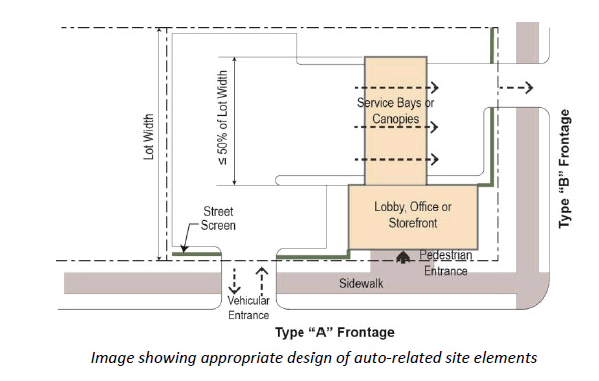
11.
Design of Parking Structures.
i.
All frontages of parking structures located on Type "A" frontages shall be lined by active edges or commercial ready frontages on the ground floor to a minimum depth of 25 feet.
ii.
Parking structure facades on all public streets (except alleys) shall be designed with both vertical (facade rhythm of 20 feet—30 feet) and horizontal (aligning with horizontal elements in the block) articulation.
iii.
Where above ground structured parking is located at the perimeter of a building, it shall be screened in such a way that cars on all parking levels are not visible from adjacent buildings or the street. Parking garage ramps shall not be visible from any public street. Ramps shall not be located along the perimeter of the parking structure with frontage along a Type "A" designation. Architectural screens shall be used to articulate the facade, hide parked vehicles, and shield car bumpers and headlights.
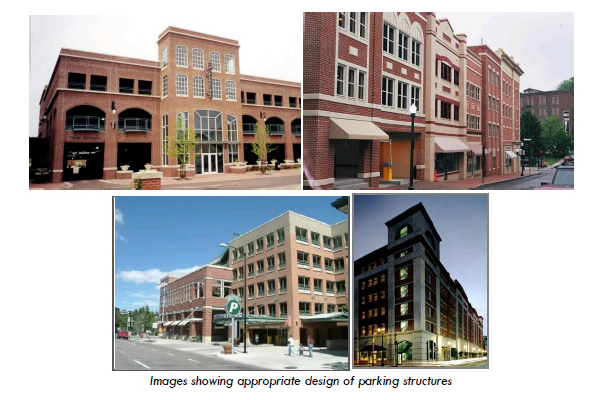
12.
Landscaping Standards.
i.
The purpose of landscaping in the Argyle FB Zoning District is to enhance pedestrian and open space areas, to help delineate active areas from passive areas, to provide a screening buffer between pedestrians and vehicular circulation, utility functions, and incompatible adjacent developments.
ii.
The applicant shall submit a landscape concept plan in conjunction with an MDP application. The landscape concept plan establishes the design direction and general schematics for all proposed landscaping including all major aspects of the public realm, streetscape treatments, open space types, and any special treatments.
iii.
Proposed landscaping concept plan shall meet the following standards:
a.
Be pedestrian oriented.
b.
Designed in such a way to not create a security or physical hazard to pedestrians, bicyclists or motorists.
c.
Enhance or complement the architectural design of the mixed-use development.
d.
Provide visual interest year-round. Utilize water conservation methods and drought tolerant planting where possible.
e.
Shall be provided between parking lots and all adjacent sidewalks.
f.
Meet the standards for Installation and Maintenance in the Town Development Standards Section 14.3.67.
iv.
Landscaping along I-35W, US 377, and FM 407. The frontages of these major roadways shall be treated differently from internal streets within the FB Zoning Districts. The following minimum standards shall apply (unless alternative standards are proposed by the applicant and approved as part of the MDP):
a.
A landscaped yard of a minimum width of 20 feet shall be required on all lots with frontage along I-35W, US 377, and FM 407.
b.
Landscaping required. The following plantings shall be required within the required yard per every 100 feet of linear frontage along the specific roadway:
1)
Three shade trees.
2)
Six ornamental trees.
3)
Eight shrubs.
4)
Ground cover, ornamental grasses, or turf grasses for the remaining unpaved areas.
c.
A minimum six foot wide sidewalk shall be required along these frontages. Such a facility may be placed within the required 20 foot yard. In lieu of a sidewalk along the I-35W frontage roads, alternative pedestrian connectivity alignments may be proposed by an applicant and approved through the MDP process.
C.
Specific to the Regional Center North and Regional Center South FB Zoning Districts.
1.
An MDP and associated standards shall be developed by the applicant/developer to meet the standards and performance criteria in this Section and the recommended ZFPs (Appendices A and B).
2.
Development Standards.
i.
Standards in the Regional Center North and South FB Zoning Districts are intended to facilitate the development of unique and pedestrian-friendly environments. To this end, design and development standards are intended to be tailored to create such an environment. In order to provide flexibility in use with prescription of the building form, all applicable development standards for each development shall be established via the MDP consistent with the requirements in this Section and the recommended ZFP. If there are any conflicts between standards in Regional Center Development Standards Table below and any other standards in the Town Development Standards, then standards in Development Standards Table below shall prevail.
ii.
The following standards shall apply to all development in the Regional Center North and South FB Zoning Districts. Most standards have a numerical range and few have a specific numerical value. Due to the inapplicability of one development standard across all developments in the Regional Center and its character zones, and to encourage a diversity of development proposals, the developer shall propose the standards indicated as "Flexible" or "Permitted/Flexible" on the following table for the proposed development at the time of MDP application submittal including any proposed modifications to standards.
** Alleys shall be required for all residential development with lots 40 feet or less in width.
D.
Specific to the Village Center FB Zoning District.
1.
An MDP and associated standards shall be developed by the applicant/developer to meet the recommended ZFP (Appendix C) and standards and performance criteria in this Section.
2.
Development Standards.
i.
Standards in the Village Center FB Zoning District are intended to facilitate the development of unique and pedestrian-friendly environments. To this end, design and development standards are intended to be tailored to create such an environment. In order to provide flexibility in use with prescription of the building form, all applicable development standards for each development shall be established via the MDP consistent with the recommended ZFP and requirements in this Section. If there are any conflicts between standards in Village Center Development Standards Table below and any other standards in the Town Development Standards, then standards in Development Standards Table below shall prevail.
ii.
The following standards shall apply to all development in the Village Center FB Zoning District. Most standards have a numerical range and few have a specific numerical value. Due to the inapplicability of one development standard across all developments in the Village Center and its character zones, and to encourage a diversity of development proposals, the developer shall propose the standards indicated as "Flexible" or "Permitted/Flexible" on the following table for the proposed development at the time of MDP application submittal including any proposed modifications to standards.
†† Alleys shall be required for all residential development with lots 40 feet or less in width.
E.
Specific to the Corridor FB Zoning District.
1.
An MDP and associated standards shall be developed by the applicant/developer to meet the recommended ZFP (Appendix D) and standards and performance criteria in this Section.
2.
Development Standards.
i.
Standards in the Corridor FB Zoning District are intended to facilitate the development of unique and pedestrian-friendly environments. To this end, design and development standards are intended to be tailored to create such an environment. In order to provide flexibility in use with prescription of the building form, all applicable development standards for each development shall be established via the MDP consistent with the recommended ZFP and requirements in this Section. If there are any conflicts between standards in Corridor Development Standards Table below and any other standards in the Town Development Standards, then standards in Development Standards Table below shall prevail.
ii.
The following standards shall apply to all development in the Corridor FB Zoning District. Most standards have a numerical range and few have a specific numerical value. Due to the inapplicability of one development standard across all developments in the Corridor FB character zones, and to encourage a diversity of development proposals, the developer shall propose the standards indicated as "Flexible" or "Permitted/Flexible" on the following table for the proposed development at the time of MDP application submittal including any proposed modifications to standards.
‡‡ Alleys shall be required for all residential development with lots 40 feet or less in width.
14.3.53-8 Definitions. Many terms used in this Section are defined in Town Development Standards. Definitions are only included here if not defined in Section 14.1.5 of the Town Development Standards), or if the definition for this Section differs from the Section 14.1.5. In case of a conflict between the definitions under this Section and the TDS, the definitions in this section shall supersede.
Build-to-Zone (BTZ) means the area between the minimum and maximum front setbacks from the property line. The principal building facade line shall be located within this area.
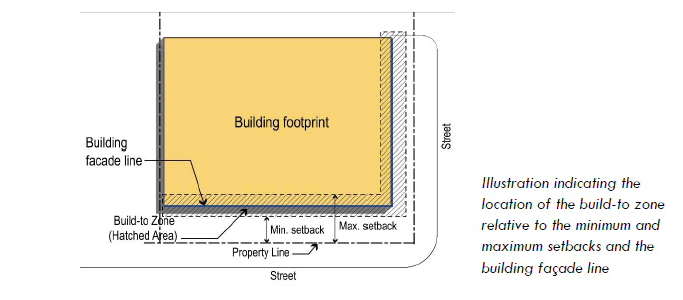
Building Facade Line means the location of the vertical plane of a building along a street frontage.
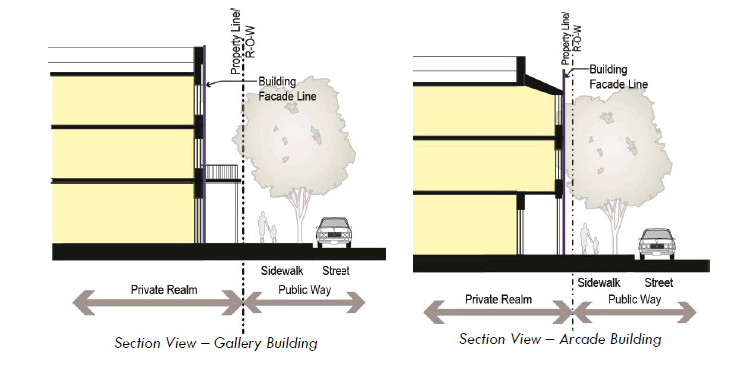
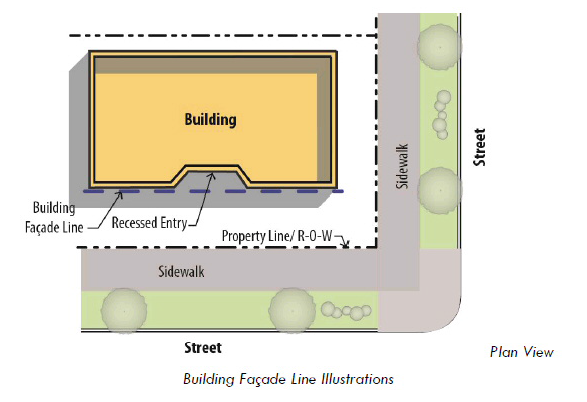
Building Frontage means the percentage of a building's facade line that is required to be located within the Build-to-Zone (BTZ) as a proportion of the lot's width along the fronting public street. Required driveways, stairs to access entrances, parks, plazas, squares, improved forecourts, and pedestrian breezeway frontages shall count towards the required building frontage.
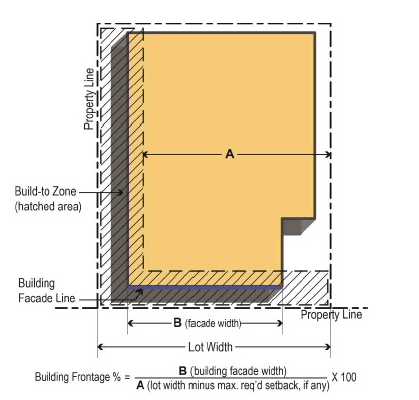
Image showing building frontage calculation
Building Step-Back means the setting back of the building facade line away from the street at a specific floor or height.
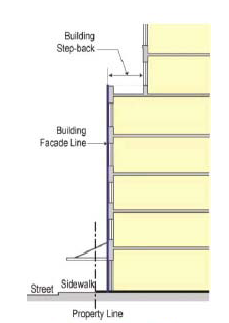
Illustration of a Building Step-back
Character Zone means an area within any Argyle FB Zoning District that is intended to preserve and/or create an urban form that is distinct from other areas. General layout of the Character Zones are identified in Zoning Framework Plan and may be refined as part of the MDP per this Section.
Colonnade means a portion of the main facade of the building that is at or near the property line and a colonnade supports the upper floors of the building. Colonnades are intended for buildings with ground floor commercial or retail uses. The ground floor area within the colonnade may be conditioned or nonconditioned space.
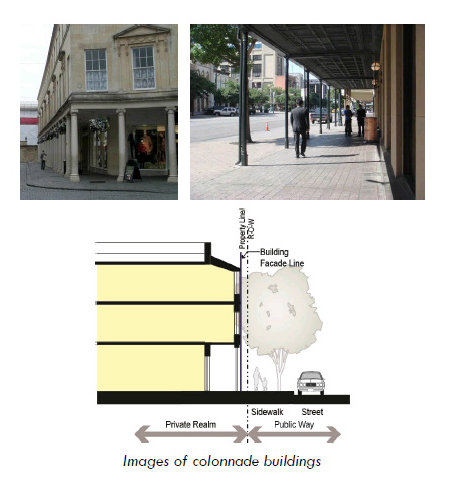
Commercial Ready or Active Edge means a ground floor space constructed with appropriate building orientation, entrance and window treatment and floor-to-floor height in order to accommodate ground floor retail/commercial uses (including but not limited to commercial, retail, restaurant, entertainment, and lobbies for civic, hotel, or multifamily uses). Standards for Commercial Ready or Active Edge frontages are to be established as part of the MDP. Prior to the issuance of a certificate of occupancy for a retail/commercial use in a Commercial Ready space, the space must comply with all building and construction Sections for commercial uses. The intent of Commercial Ready or Active Edge space is to provide the flexibility of occupying a space in accordance with market demand and allowing the use in such space to change to retail/commercial uses accordingly.
Commercial Use or Mixed-Use Building means a building in which at least the ground floor of the building is built to Commercial Ready standards and any of the floors are occupied by nonresidential or residential uses.
Comprehensive Plan means the Town of Argyle's most recently adopted comprehensive framework for informed decision making and establishes the blueprint for the long-term growth and development of the Town.
Director of Community Development means the Town of Argyle Director of Community Development or his/her designee.
Encroachment means any structural or nonstructural element such as a sign, awning, canopy, terrace, or balcony that breaks the plane of a vertical or horizontal regulatory limit, extending into a setback, into the public right-of-way, or above a height limit.
Facade Area means the surface area of a building's elevation (including all floors) not counting minor indentations fronting a particular street. Ground floor facade area is the surface area of a building's ground floor elevation not counting minor indentations fronting a particular street. Upper floor facade area is the surface area of a building's upper floor elevations not counting minor indentations fronting a particular street.
Gallery means a roofed promenade or canopy, especially one extending along the wall of a building and supported by arches or columns on the outer side. The gallery space is unenclosed (nonconditioned) space and may be two or more stories tall.
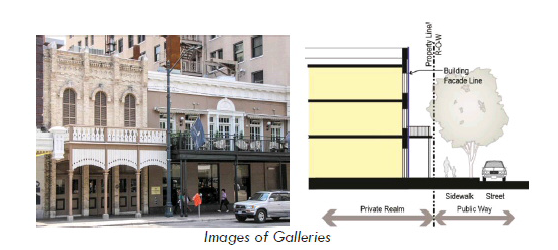
ITE's Designing Walkable Urban Thoroughfares Manual means Daisa, James M., Designing walkable urban thoroughfares: a context sensitive approach. Washington, DC: Institute of Transportation Engineers. (most recent edition)
Live-Work Unit means a dwelling unit that is also used for work purposes, provided that the "work" character is restricted to the uses of professional office, artist's workshop, studio, or other similar uses and is located on the street level and constructed as separate units under a condominium regime or as a single unit. The "live" character may be located on the street level (behind the work character) or any other level of the building. Live-work unit is distinguished from a home occupation otherwise defined by the TDS in that the work use is not required to be incidental to the dwelling unit, nonresident employees may be present on the premises and customers may be served on site.
Major Amendments means any requested amendment to any approved plan that does not meet the standards for a minor amendment per Section 14.3.53-5.D of this Section.
Master Development Plan (MDP) means a detailed plan for development that is based on the ZFP and establishes the standards and specifications for all the critical elements of the built environment based on a specific development vision per all the requirements of this Section.
Minor Amendments means a requested amendment to an approved plan (site plan or MDP) per Section 14.3.53-5.D. The Director of Community Development shall have the authority to approve or approve with conditions or deny a minor amendment to an approved plan.
NACTO's Urban Street Design Guide means Urban Street Design Guide. New York City: National Association of City Transportation Officials. (most recent edition)
Open Space means publicly accessible open space in the form of parks, courtyards, forecourts, plazas, greens, playgrounds, squares, etc. provided to meet the standards in of this Section. Open space may be privately or publicly owned and/or maintained.
Primary Entrance means the public entrance located along the front of a building facing a street or sidewalk and provides access from the public sidewalk to the building. It is different from a secondary entrance which may be located at the side or rear of a building providing private controlled access into the building from a sidewalk, parking or service area.
Residential Use Building means a building that is built to accommodate only residential uses on all floors of the building such as a detached single-family home, attached single-family home (i.e. townhome), two-family home (i.e. duplex), multiple family (three or more), apartment building (under single ownership or under multiple owners within a condominium regime).
Service-Related Site Functions means all uses that support the principal use on the site including parking access, garbage/trash collection, utility meters and equipment, loading/unloading areas, and similar uses.
Street Frontage Designation, as identified on the approved Master Development Plan, means future streets in the Argyle FB Zoning Districts are designated as Type "A" or Type "B." Each frontage designation establishes a certain development context in order to improve walkability and pedestrian orientation within the district.
Street Screen means a freestanding wall or living fence or combination fence built along the frontage line or in line with the building facade along the street. It may mask a parking lot or a loading/service area from view or provide privacy to a side yard and/or strengthen the spatial definition of the public realm.
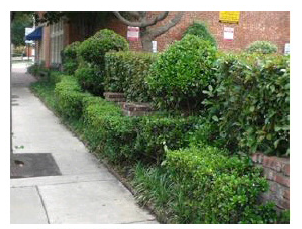
Image of a combination masonry and living street screen
Street Wall indicates the creation of a "wall" or a sense of enclosure along the street with buildings placed immediately adjacent to the street/sidewalk. A street wall has a "void" if there is a surface parking lot or service area adjacent to the sidewalk/street.
Type 1 Application means a site plan application that meets the requirements of this Section, the recommended ZFP and MDP. Appendix E summarizes the different application types and their respective processes.
Type 2 Application means a site plan application that does not meet the requirements of this Section, the recommended ZFP or an approved MDP or proposes alternative standards to the same. Appendix E summarizes the different application types and their respective processes.
Type "A" Frontage means the block frontages identified as such on the adopted MDP. Type "A" frontages are the primary pedestrian frontages and buildings along Type "A" frontages shall be held to the highest standard of pedestrian-oriented design.
Type "B" Frontage means the block frontages identified as such on the adopted MDP. Type "B" frontages are intended to primarily accommodate access to parking, service, utility, and other auto-related functions.
Zoning Framework Plan (ZFP) means the recommended guides for Argyle's FB Zoning Districts that conceptually establish the boundaries of the FB zoning districts and their character zones, major street and open space networks. They shall guide the development of the MDP and rezoning application by property owners/developers at the time of new development or redevelopment.
Appendix A. Zoning Framework Plan—Regional Center South FB Zoning District
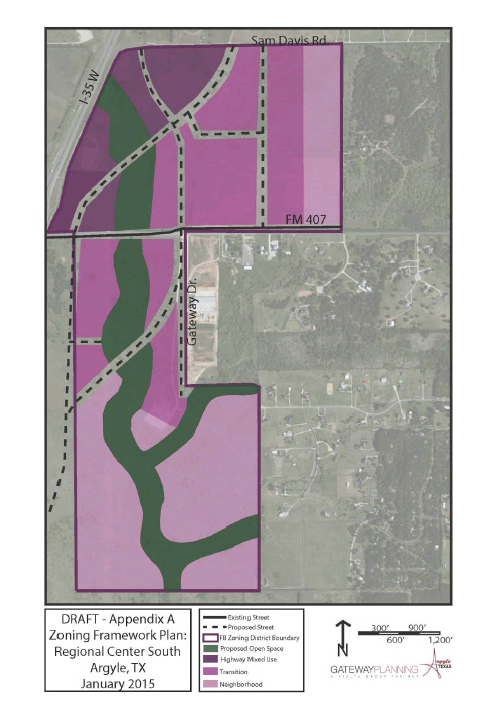
Appendix B. Zoning Framework Plan—Regional Center North FB Zoning District
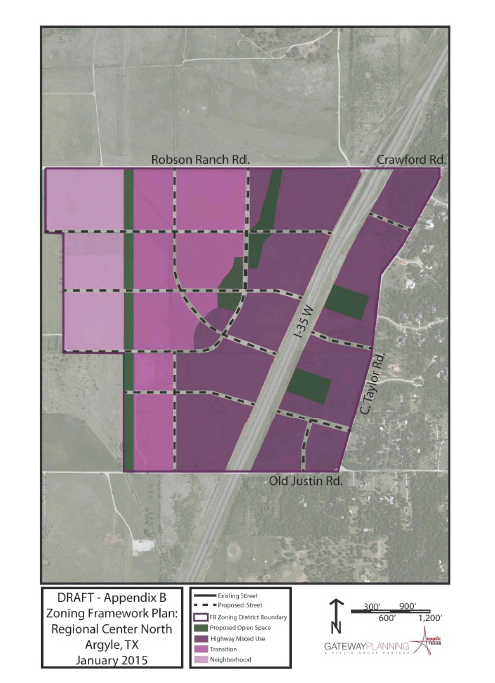
Appendix C. Zoning Framework Plan—Village Center FB Zoning District
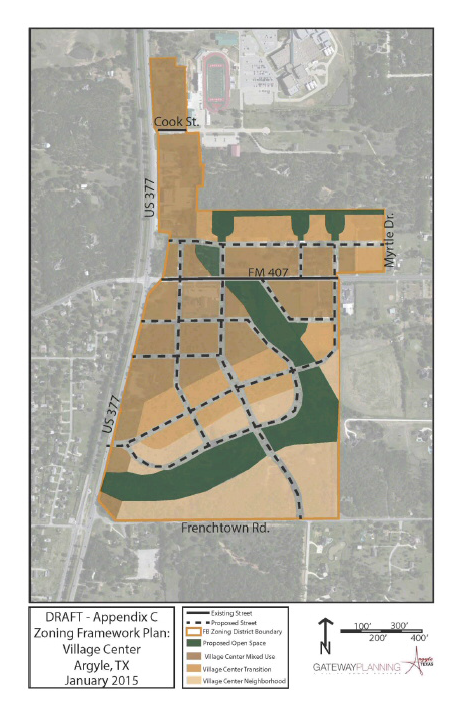
Appendix D. Zoning Framework Plan—Corridor FB Zoning District
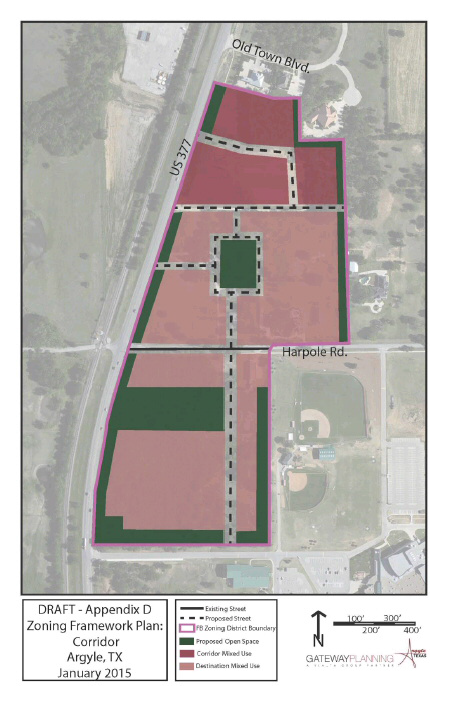
Appendix E. Development Process Flow Chart
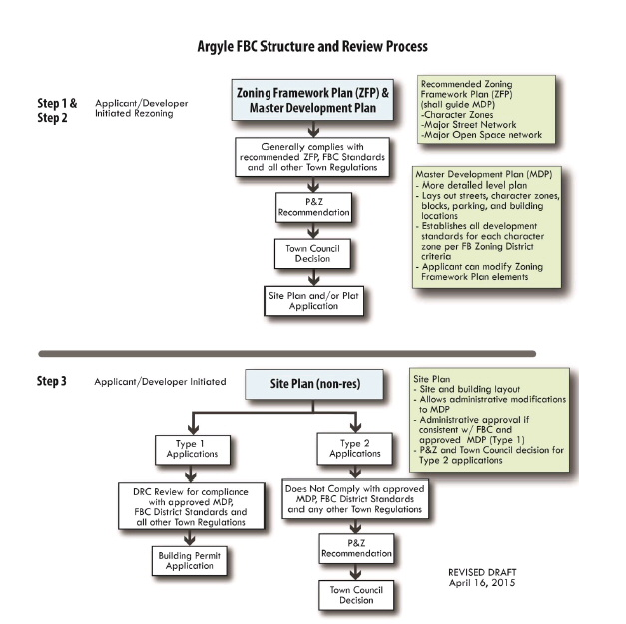
Appendix F. Street Design Standards and Typical Cross Sections
* Fire Lane Exception.
** Other Criteria Apply; for any other bike facility discuss with Town.
Appendix F. Typical Cross Sections
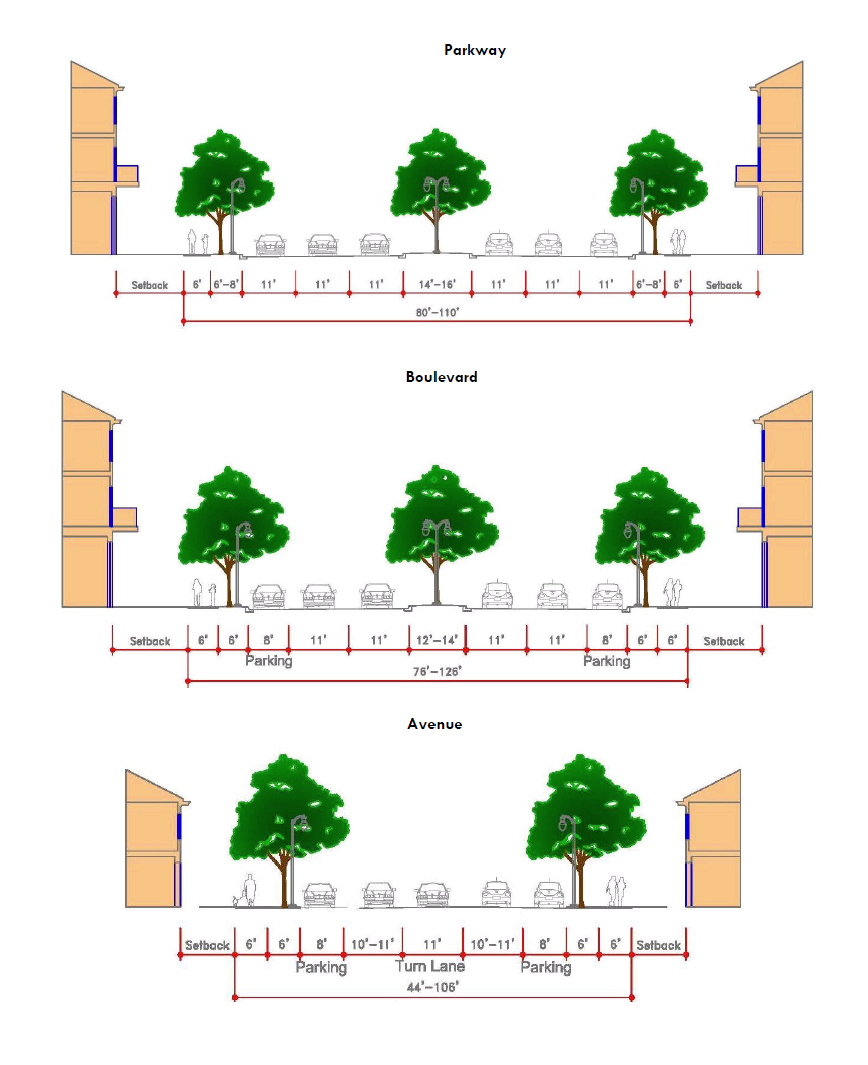
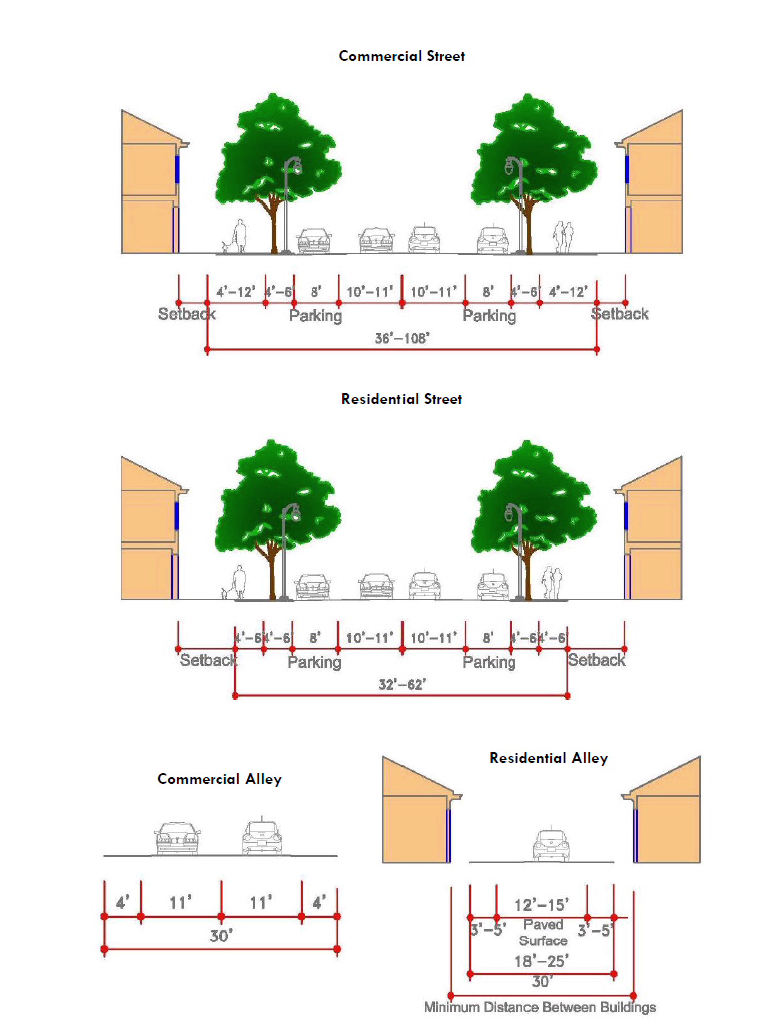
(Ord. No. 2015-13, 5-26-15; Ord. No. 2025-15, § 2(Exh. A), 3-21-25)

