
Argyle City Zoning Code
PART 5
- DEVELOPMENT STANDARDS
Sec. 14.3.66. - Off-Street Parking and Loading Requirements.
14.3.66-1 Purpose. To secure safety from fire, panic, and other dangers; to lessen congestion on public streets; to facilitate the adequate provision of transportation; to conserve the value of buildings; and to encourage the most appropriate use of land. Minimum off-street parking and loading shall be provided as set forth in the following schedules and provisions.
14.3.66-2 Residential Districts—Special Off-Street Parking Provisions.
A.
Required off-street parking shall be provided on the same lot/site as the use it is to serve.
B.
All vehicle parking areas shall be on a hard-surfaced, paved parking surface constructed of concrete or a similar all-weather surface such as turf pavers, brick pavers or asphalt. Said paving shall be installed to meet or exceed Town standards for paving. All driveways and approaches to parking spaces shall be similarly paved, except in the A district.
C.
No required parking space, garage, carport, or other motor vehicle storage space shall be used for the storage of any heavy load vehicle (see definitions for heavy load vehicle).
14.3.66-3 Nonresidential and MF Districts, and Nonresidential Uses in Residential Districts—Special Off-Street Parking Provisions.
A.
To prevent nuisance situations, all parking area lighting shall be designed and operated so as not to reflect or shine on adjacent properties and in accordance with the standards established in Section 14.3.76.
B.
For safety and firefighting purposes and for public convenience, free mutual access through to adjacent nonresidential parking areas and properties shall be provided in accordance with Section 14.3.66-10 (Fire Lanes).
C.
All off-street parking, maneuvering, fire lane, loading and storage areas shall be paved in accordance with the Town's current technical design standards.
D.
No paved parking space or area shall be designed such that a vehicle has to back up into a public street or across a public sidewalk, except for single- and two-family dwellings, which are only allowed to egress onto a local street or residential collector street.
E.
All parking spaces shall be permanently and clearly identified by stripes, buttons, tiles, curbs, barriers, or other approved methods. Non-permanent type marking, such as paint, shall be regularly maintained to ensure continuous clear identification of the space.
F.
Each standard off-street surface parking space size shall be in accordance with the design standards as shown in Section 14.3.95 for space size and design. Specific parking space sizes, exclusive of aisles, driveways and maneuvering areas shall be in accordance with the following minimum sizes:
1.
Standard: Nine feet by 20 feet—18-foot length is allowed provided that the parking space has a two-foot clear bumper overhang area that does not encroach upon a public right-of-way, a sidewalk of less than six feet in width, or adjacent property.
2.
Compact: Eight feet by 16 feet; must be clearly designated with appropriate signage and pavement markings (also see Section 14.3.66-7.H.).
3.
Parallel: Eight feet by 22 feet.
G.
The perimeter of all parking lots and driveways shall be provided with concrete curbs or other means to control traffic. All parking and loading spaces, and vehicle sales areas on private property shall have a vehicle stopping device, such as a curb or wheel stop, installed so as to prevent parking of motor vehicles in any required landscaped areas, to prevent vehicles from hitting buildings, to protect public and/or private utility structures/facilities, and to prevent parked vehicles from overhanging a public right-of-way line, public sidewalk, or adjacent private property. An extra-wide walkway on private property may be permitted so as to allow encroachment of vehicle overhang while maintaining an unobstructed four-foot minimum walkway width. Parking shall not be permitted to encroach upon the public right-of-way or upon neighboring property in any case. All vehicle maneuvering shall take place on-site. No public right-of-way shall be used for backing or maneuvering into or from a parking space, or for circulation within the parking lot. All entrances into parking lots shall be at least 24 feet in width, or a maximum of 45 feet in width (50 feet for divided entrances). Divided entrances into parking lots shall have a minimum ingress lane of 18 feet; a minimum landscaped median width of five feet for an unbroken distance of at least 100 feet into the site, and a minimum egress lane of 22 feet. If the entrance is for a fire lane, then it shall have 22-foot minimum ingress and egress lanes (same median standards as above).
H.
Refuse storage facilities placed in a parking lot shall not be located in a designated parking or loading space. Each refuse facility shall be located so as to facilitate pick-up by refuse collection agencies and ease of egress from the site without having to back up further than 20 feet and without having to go the wrong way in a traffic aisle.
I.
Parking space(s) for persons with disabilities and other associated provisions shall be provided according to building codes, State laws, and requirements of the Americans with Disabilities Act (ADA). Parking spaces for persons with disabilities shall be as close as possible to the main entrance of the building, and shall be appropriately and clearly marked.
J.
In all nonresidential and multifamily zoning categories, designated parking and loading areas shall not be used for the repair, storage, dismantling or servicing of vehicles or equipment, or for the storage of materials or supplies, or for any other use in conflict with the designated parking and loading areas.
K.
To ensure that all requirements set forth in this Section are carried forward, it will be the responsibility of the owner of the parking area to adequately maintain the facility. All off-street parking areas shall be kept free of trash, debris, vehicle repair operation or display and advertising uses. At no time after initial approval of the parking area layout can changes be made in the location and number of provided spaces without approval of a revised site plan (see Section 14.3.25).
L.
Off-street stacking requirements for drive-through facilities.
1.
A stacking space shall be an area on a site measuring eight feet by 20 feet with direct forward access to a service window or station of a drive-through facility which does not constitute space for any other circulation driveway, parking space, or maneuvering area. An escape lane, of at least eight feet in width and with negotiable geometric design, must be provided to allow vehicles to get out of stacking lane in the event of a stalled vehicle, emergency, accidental entry, etc.
2.
For financial institutions with drive-through facilities, each teller window or station, human or mechanical, shall be provided with a minimum of five stacking spaces. One escape lane shall be provided.
3.
For each service window of a drive-through restaurant, a minimum of five spaces shall be provided for the first vehicle stop (usually the menu/order board), and two spaces shall be provided for each additional vehicle stop (order/pick-up windows, etc.). One escape lane shall be provided from the beginning of the stacking lane to the first stop (e.g., menu/order board).
4.
For business operations other than those addressed by items 2. and 3. above and kiosks that provide drive-up service, a minimum of three stacking spaces for each service window shall be provided.
5.
For a full-service carwash, each vacuum or gas pump lane shall be provided with a minimum of four stacking spaces. For the finish/drying area, adequate vehicle stacking and storage space must be provided to keep finished vehicles out of circulation aisles, access easements, fire lanes, streets, etc.
6.
For each automated self-service (drive-through/rollover) carwash bay, a minimum of three stacking spaces, in addition to the wash bay itself, shall be provided. One stacking space shall be provided at the exit end of each wash bay for window-drying and other detailing.
7.
For each wand-type self-service carwash bay, a minimum of two stacking spaces, in addition to the wash bay itself, shall be provided. One stacking space shall be provided at the exit end of each wash bay for window-drying and other detailing, unless a separate area/shade structure is provided (outside of circulation aisles) for these activities.
8.
For motor vehicle quick-lube type facilities, a minimum of three stacking spaces shall be provided for each service bay in addition to the service bay itself.
M.
Dead-end parking areas shall be avoided if possible. If dead-end parking is necessary, then it shall be designed such that it is no more than three parking spaces deep unless adequate turnaround space is provided. A minimum five-foot deep hammerhead back-up space shall be provided at the end of any dead-end parking area.
N.
All parking structures must conform to the construction and design standards of the zoning district in which they are located.
14.3.66-4 Off-Street Loading Space—All Districts.
A.
All retail and other nonresidential structures shall provide and maintain off-street facilities for receiving and loading merchandise, supplies and materials within a building or on the lot or tract. All drives and approaches shall provide adequate space and clearances to allow for the maneuvering of trucks off-street. Each site shall provide a designated on-site maneuvering area for trucks (see Illustration 3 in Section 14.3.95). Such off-street loading space may be adjacent to (but not any portion of) a public alley or private service drive, or it may consist of a truck berth within the structure. The minimum dimensions of a "regular" loading space shall be ten feet by 30 feet, and a "large" loading space shall be at least ten feet by 65 feet. Loading spaces or berths shall be provided in accordance with the following schedule:
1.
Office and institutional uses, or portion(s) of building devoted to office/institutional uses.
2.
Retail/commercial and restaurant uses, or portion(s) of building devoted to retail/commercial and restaurant uses.
B.
In the CR, CF and BP zoning districts, loading docks or service/delivery entrances shall not be constructed facing any public street, and shall not be visible from any public street. Such loading areas shall be screened from view of any public street by the building itself, or by a masonry screening wing wall at least 12 feet in height with large evergreen trees and shrubs planted in front of it such that limited portions of the wing wall will be visible when the trees and shrubs are mature. Such masonry wing wall shall match the exterior construction materials and colors of the main building, shall have a textured finish, and shall be located no closer than 100 feet to any public street right-of-way line.
C.
Loading docks for any establishment which customarily receives goods between the hours of 9:00 p.m. and 8:00 a.m. and is located within 100 feet of a residential use or district shall be designed and constructed so as to enclose the loading operation on at least three sides in order to reduce the effects of the noise of the operation on adjacent residences. Other screening/buffering alternatives may be approved on the site plan provided that the Town Council makes a finding that the alternative method of screening/buffering will be adequate to protect nearby residences.
D.
Kindergartens, elementary schools, day schools, and similar child training and care establishments shall provide one paved off-street pedestrian loading and unloading space for an motor vehicle on a through, "circular" drive for each ten students cared for (excluding child care in a residence). An additional lane shall also be required to allow pass by or through traffic to move while motor vehicles waiting or parked to pick up children occupy loading/ unloading areas.
E.
Loading spaces that are adjacent and easily accessible to several buildings or uses, including buildings and uses on separate lots, shall be allowed to satisfy the loading requirements for the individual buildings or uses, subject to the following:
1.
Such arrangement(s) for loading spaces are approved by the Town Council after recommendation by the Planning and Zoning Commission;
2.
Said consideration by the Planning and Zoning Commission and Town Council shall be based on the following criteria:
a.
The number of spaces satisfies the requirements for the combined square footages for the buildings or uses in question;
b.
Any off-site loading berths shall be located on an immediately contiguous lot or tract, or on a lot or tract within 200 feet of each building or use in which it will serve; and
c.
A long-term remote loading lease agreement is provided upon approval of the Town as a condition of such use.
14.3.66-5 Parking Access From a Public Street—All Districts.
A.
In the approval of a site plan, design consideration shall be given to providing entrance/exit drives that extend into the site to provide adequate queuing of vehicles on the site.
B.
In all districts (except single-family and two-family zoning districts), the site plan and paving plans shall provide for entrance/exit drive(s) appropriately designed and located to minimize traffic congestion or conflict within the site and with adjoining public streets. Based upon analysis by the Town, if projected volumes of traffic entering or leaving a development are likely to interfere with the projected peak traffic flow volumes on adjoining streets, additional right-of-way and/or street paving improvements in the form of a deceleration lane, a turn lane, or other roadway improvements may be required of a developer in order to reduce such interference and to help ensure traffic safety and efficiency. The dedication of additional right-of-way or street paving may also be required, and shall be determined at the time of site plan and construction plat approval.
C.
Vehicular access to nonresidential uses shall not be permitted from alleys serving residential areas, and shall not be configured as "head-in" parking spaces that are accessed directly from the street.
D.
Parking space configuration, location, arrangement, size and circulation in all districts shall be constructed according to Illustration 2 in Section 14.3.95.
14.3.66-6 Parking Requirements Based Upon Use.
A.
In all districts, there shall be provided at the time any building or structure is erected or structurally altered, or change of use, off-street parking spaces in accordance with the following requirements:
1.
Bank, Savings and Loan, or Similar Institution. One space per 250 square feet of gross floor area in addition to required stacking spaces (see Subsection 14.3.66-3.L.).
2.
Bed and Breakfast Facility. One space per guest room in addition to the requirements for a normal residential use.
3.
Bowling Alley or Center. Six parking spaces for each alley or lane.
4.
Business or Professional Office (General). One space per 300 square feet of gross floor area, except as otherwise specified herein.
5.
Carwash (Self-Serve). One space per washing bay or stall in addition to the washing areas/stalls themselves and required stacking spaces; Carwash (full service): one space per 150 square feet of floor area in addition to the required stacking spaces.
6.
Church, Rectory, or Other Place of Worship. One parking space for each three seats in the main auditorium/sanctuary.
7.
Commercial Amusement (Indoor). One space per 100 square feet of gross floor area, or as follows:
a.
Racquetball or handball courts: three spaces for each court.
b.
Indoor tennis courts: six spaces for each court.
c.
Gymnasium, skating rinks, and martial arts schools: one space for each three seats at a maximum seating capacity (based upon maximum occupancy), plus one space for each 200 square feet.
d.
Swimming pool: one space for each 100 square feet of gross water surface and deck area.
e.
Weight lifting or exercise areas: one space for each 100 square feet.
f.
Indoor jogging or running tracks: one space for each 100 linear feet.
g.
Motion picture theaters (which do not include live performances): a) one space per three and one-half seats for single-screen theaters; b) one space per five seats for motion picture theaters with two or more screens.
h.
Amusement Center: one space for each game table and one space for each amusement device.
i.
All areas for subsidiary uses not listed above or in other parts of this Section (such as restaurants, office, etc.), shall be calculated in with the minimum specified for those individual uses.
8.
Commercial Amusement (Outdoor). Ten spaces plus one space for each 500 square feet over 5,000 square feet of building and recreational area.
9.
Commercial Use. One space per 250 square feet of floor area.
10.
Community Center, Library, Museum or Art Gallery. Ten parking spaces plus one additional space for each 300 square feet of floor area in excess of 2,000 square feet. If an auditorium is included as a part of the building, its floor area shall be deducted from the total and additional parking provided on the basis of one space for each four seats that it contains.
11.
Convenience Store (with Gasoline Pumps). One space per 200 square feet of floor area, plus one parking space for each side of a gasoline pump unit (a unit may have up to six nozzles for gasoline disbursement). Spaces within pump areas qualify as spaces for the parking requirement. If no gasoline sales are provided, then the parking requirements shall be the same as for a retail store. Adequate space shall be provided for waiting, stacking, and maneuvering motor vehicles for refueling.
12.
Dance/Aerobics Studio, or Assembly/Exhibition Hall without Fixed Seats. One parking space for each 100 square feet of floor area thereof.
13.
Day Nursery, Day Care Center. One space per ten pupils (based upon maximum occupancy and/or licensing capacity), plus one space per teacher, plus one space for each bus or van stored on the property (and sized to accommodate the vehicle).
14.
Defensive Driving School/Class. One space for each classroom seat.
15.
Restaurant with Drive-Through Service. One parking space per 100 square feet of gross floor area (including indoor/outdoor play areas and patio dining areas), or one space for every three seats under maximum seating arrangement, whichever is greater; required parking spaces are in addition to any stacking spaces that may be needed/provided for drive-through or drive-in facilities.
16.
Furniture or Appliance Store, Hardware Store, Wholesale Establishments, Clothing or Shoe Repair or Service. Two parking spaces plus one additional parking space for each 300 square feet of floor area over 1,000 square feet.
17.
Gasoline Station. One space per 200 square feet of floor area, plus one space for each side of a gasoline pump unit (a unit may have up to six nozzles for gasoline disbursement). Spaces within pump areas qualify as spaces for the parking requirement. Adequate space shall be provided for waiting, stacking, and maneuvering automobiles for refueling.
18.
Golf Course. Four parking spaces per hole or green plus requirements for retail, office, and clubhouse areas and one space per each two employees.
19.
Golf Driving Range. One and one-half spaces for each driving tee.
20.
Health Club, Health Spa or Exercise Club. One space per 150 square feet of floor area.
21.
Hospital. One space for each two beds or examination room, whichever is applicable; plus one space for every two employees during periods of full occupancy.
22.
Hotel or Motel. One space per guest room for the first 250 rooms and .75 space per room for each room over 250, plus one space per five restaurant/lounge area seats (based upon maximum occupancy), plus one space per 125 square feet of meeting/conference areas, plus the following:
a.
One and one-tenth spaces for any guest room containing kitchenette facilities;
b.
Two spaces for any guest room provided with full kitchen facilities; and
c.
One space for every two employees during peak time periods when the hotel/motel is fully occupied.
23.
Institutions of a Philanthropic Nature. Ten spaces plus one space for each employee.
24.
Library or Museum. Ten spaces plus one space for every 300 square feet.
25.
Lodge or Fraternal Organization. One space per 200 square feet.
26.
Lumber Yard/Home Improvement Center. One space per 400 square feet display area, plus one space per 1,000 square feet of warehouse.
27.
Manufactured/Mobile Home or Manufactured/Mobile Home Park. Two spaces for each manufactured/mobile home unit, plus visitor/supplemental parking in accordance with Subsection 14.3.41-4.B, plus additional spaces as required herein for accessory uses.
28.
Medical or Dental Office. One space per 150 square feet of floor area. Facilities over 20,000 square feet shall use the parking standards set forth for hospitals.
29.
Mini-Warehouse. Four spaces per establishment, plus two spaces for an on-site manager's residence (if applicable), plus one appropriately sized space for any type of vehicle to be stored on-site (e.g., rental trucks, boats, RVs, etc.).
30.
Mortuary or Funeral Home. One parking space for each 200 square feet of floor space in slumber rooms, parlors or individual funeral service rooms, or one space for each three seats in the auditorium/sanctuary, whichever is greater. Adequate on-site stacking spaces shall also be provided for the organization and forming of processions such that these activities do not cause excessive or extended traffic congestion/delays on a public roadway.
31.
Motor Vehicle Parts Sales (Indoors). One space per 500 square feet of indoor floor area, plus one space for each 2,000 square feet of outside sales area.
32.
Motor Vehicle Sales and New or Used Car Lots. One parking space for each 500 square feet of sales floor/office and other indoor uses, plus one parking space for each 1,000 square feet of exterior lot area used for storage, sales and parking areas, plus one parking space per repair bay in service areas (indoors or outdoors), plus one parking space per service/towing vehicle to be stored on-site (required parking spaces are in addition to those to be used for the storage/display of vehicles for sale/lease).
33.
Nursing Home, Convalescent Home, or Home for the Aged. One space per six beds; plus one parking space for each 300 square feet of floor area devoted to offices, cafeterias, exercise/therapeutic rooms, and other similar ancillary uses; plus one space for every two employees at full occupancy.
34.
Office (Administrative or Professional). One space for each 300 square feet of floor area.
35.
Outdoor Display. One space for each 600 square feet of open sales/display area.
36.
Pawnshop. One space for each 200 square feet of floor area.
37.
Places of Public Assembly not Listed. One space for each three seats provided (see Subsection 14.3.66-7.B.).
38.
Real Estate Office. One space for each 200 square feet.
39.
Restaurant, Private Club, Nightclub, Cafe or Similar Recreation or Amusement Establishment. One parking space for each 100 square feet of gross floor area (including indoor/outdoor play areas and patio dining areas), or one space for every three seats under maximum seating arrangement (i.e., occupancy), whichever is greater; required parking spaces are in addition to any stacking spaces that may be needed/provided for drive-through or drive-in facilities.
40.
Retail or Personal Service Establishment, except as Otherwise Specified Herein. One space per 200 square feet of gross floor area in addition to any required stacking spaces for drive-through facilities.
41.
Retirement Housing for the Elderly (Independent Living). One and one-half spaces for each dwelling unit, plus any additional spaces for accessory retail, office, service or recreational uses.
42.
Rooming or Boarding House, or Group Quarters. One parking space for each sleeping room, plus one parking space for each host resident or employee during maximum (i.e., peak) shift.
43.
School, Elementary (Grades K-6). One parking space for each 15 students (design capacity).
44.
School, Secondary or Middle (Grades 7-8). One parking space for each 12 students (design capacity).
45.
School, High School (Grades 9-12). One space for each three students, faculty and staff (design capacity).
46.
Storage or Warehousing, and Light Manufacturing. One space for each two employees on duty at peak shifts, or one space for each 1,000 square feet of total floor area, whichever is greater.
47.
Technical School, College, Junior College or University. One space per three students, based upon maximum enrollment or design capacity, whichever is greater.
48.
Telemarketing. One space for each 250 square feet of floor space.
49.
Terminal Facilities, Truck Terminals, Bus Depots, and Other Similar Transportation Uses. For warehouse and staging/loading areas, one space for each two employees on duty at peak shifts, or one space for each 1,000 square feet of floor area, whichever is greater; for bus depot or other human transportation use, one space per 100 square feet of passenger waiting area, plus parking spaces for any warehouse and staging/loading areas on the premises (as above).
50.
Theater, Indoor or Outdoor (Live Performances), Sports Arena, Stadium, Gymnasium or Auditorium (except School Auditorium). One parking space for each three seats or bench seating spaces.
51.
Veterinarian Clinic. One space per 300 square feet of gross floor space.
52.
Wholesale Distribution Uses. One space for each two employees on duty at peak shifts, or one space for each 1,000 square feet of total floor area, whichever is greater.
14.3.66-7 Rules for Computing Number of Parking Spaces and Miscellaneous Off-Street Parking Requirements.
In computing the number of parking spaces required for each of the above uses, the following rules shall govern:
A.
"Floor Area" shall mean the gross floor area of the specific use.
B.
"Seat" shall be interpreted as follows:
1.
For fixed (e.g., church pews, grandstands, benches, etc.) seating, one seat equals 1.75 feet of length; and
2.
For flexible (e.g., folding chairs, etc.) seating areas, one seat equals eight square feet of floor area occupied by such seating area (includes aisles).
C.
Where fractional spaces result, the parking spaces required shall be construed to be the next higher whole number.
D.
The parking space requirements for a new or unlisted use not specifically mentioned herein shall be the same as required for a use of similar nature. If the proposed use is not similar to any of the uses listed herein, a determination shall be made by the Town Administrator, or his/her designee, in accordance with the requirements for the most closely related use specified in this Section. In the event the applicant disagrees with this determination, then he/she may submit a request for determination by the Planning and Zoning Commission and the Town Council using the same process for classifying new and unlisted uses.
E.
Whenever a building or use is changed or enlarged in floor area, number of employees, number of dwelling units, seating capacity or otherwise, to create a need for an increase of ten percent or more in the number of existing parking spaces, such spaces shall be provided on the basis of the enlargement or change. If a building or use that was in existence prior to the effective date of this Ordinance is enlarged by more than 50 percent in floor area, number of employees, number of dwelling units, seating capacity or otherwise, then said building or use shall be required to conform with the parking requirements herein for the entire building or use.
F.
For buildings which have a combination of uses within the same structure or on the same premises (such as retail or office), the off-street parking requirement shall be calculated as the summation of the parking requirements for each use, and no parking space for one particular use shall be allowed to count toward the parking requirement for some other use on the premises except in the case of a shared parking arrangement (see Subsection G below).
G.
Shared parking may be allowed in the case of mixed uses (different buildings) under the following conditions: Up to 50 percent of the parking spaces required for a theater or other place of evening entertainment (after 6:00 p.m.), or for a church, may be provided and used jointly by banks, offices, and similar uses not normally open, used, or operated during evening hours. Shared parking must be on the same parking lot. Reduction due to shared parking shall only be allowed if approved on the site plan. To assure retention of the shared parking spaces, each property owner shall properly draw and execute an irrevocable mutual parking agreement document expressing the same, shall file this agreement with the County, and shall provide a copy of the filed agreement to the Town of Argyle prior to issuance of a certificate of occupancy for any use that relies upon the parking agreement.
H.
Compact Car Spaces. In the OR, LR, CR, VC, OT-1, and BP districts, compact car parking spaces may be permitted when approved as part of a detailed site plan by the Planning and Zoning Commission and the Town Council, providing at least one of the following conditions apply:
1.
Where it is necessary to preserve the natural landscape and native trees, a maximum of ten percent of required parking may be designated for compact cars.
2.
For parking lots larger than 100 spaces involving a shopping center, a maximum of 20 percent of the required parking may be for compact cars.
3.
For parking lots larger than 100 spaces involving large single-tenant industrial or office buildings, a maximum of 25 percent of the required parking may be for compact cars.
The Town shall not be responsible for policing the use of compact car spaces on private property or for citing violations thereof.
14.3.66-8 Location of Parking Spaces. All parking spaces required herein shall be located on the same lot of the building or use served, except as follows:
A.
Where an increase in the number of spaces is required by a change or enlargement of an existing use, or where such spaces are provided collectively or used jointly by two or more buildings or establishments, the required additional spaces may be located not to exceed 300 feet from any nonresidential building served.
B.
In any case where the required parking spaces are not located on the same lot with the building or use served, or where such spaces are collectively or jointly provided and used, approval by the Planning and Zoning Commission and the Town Council is required according to the following criteria:
1.
Off-site parking may be permitted on an immediately contiguous lot or tract or on a lot or tract within 200 feet of such building or structure providing:
a.
That a permanent, irrevocable easement of the parking facilities in favor of the premises to be benefited shall be dedicated and recorded as a condition of such use; or
b.
That a long-term remote parking lease agreement be provided upon approval by the Town as a condition of such use.
c.
Except for the OT-1 zoning district, municipal parking lots or municipal parking structures shall not be counted toward any off-site parking.
d.
For the OT-1 zoning district, municipal parking lots or municipal parking structures may be credited toward the off-site parking count provided that there are adequate parking spaces available in said municipal parking lot or municipal parking structure and such spaces are made available via a shared parking arrangement as approved by the Town Council.
14.3.66-9 Use of Required Parking Spaces, Nonresidential Districts.
A.
Required off-street parking and loading spaces shall be used only for these respective purposes and shall not be used for refuse containers, cart corrals, recycling kiosks, signs or sign support structures, telecommunications towers or support structures, storage or permanent display of boats, trailers, campers, motor vehicles or other goods, materials, or products for sale/lease/rent.
14.3.66-10 Fire Lanes.
A.
Fire lanes shall be provided in all multifamily, single-family attached, manufactured (mobile) home, and nonresidential developments (in all zoning districts), as required by the adopted Fire Code of the Town (also see the Subdivision Ordinance for certain fire lane regulations). Fire lanes shall be a minimum width of 24 feet of paving, and shall have a minimum inside turning radius at curves of 20 feet or as required by the Fire Code of the Town of Argyle, whichever is greater. The minimum overhead vertical clearance over fire lanes shall be 14 feet for a linear distance of 50 feet on each side (i.e., in front of and behind, as a fire apparatus would traverse underneath) of any overhead structure (e.g., canopy, roof overhang, vertical height control device, etc.).
B.
Whenever 40 percent or more of an existing, nonconforming fire lane is replaced or resurfaced within a 12 month period, the entire fire lane shall be replaced with concrete according to the Town's current paving standards.
(Ord. No. 2010-01, § 3, 1-12-10; Ord. No. 2010-17, § 2, 10-26-10; Ord. No. 2020-06, § 2, 3-24-20)
Sec. 14.3.67. - Landscape Requirements.
14.3.67-1 Purpose. Landscaping is accepted as adding value to property and is in the interest of the general welfare of the Town. The provision of landscaped areas also serves to increase the amount of a property that is devoted to pervious surface area that, in turn, helps to reduce the amount of impervious surface area, stormwater runoff, and consequent non-point pollution in local waterways. Therefore, landscaping is hereafter required of new development.
14.3.67-2 Scope and Enforcement. The standards and criteria contained within this section are deemed to be minimum standards and shall apply to all new construction or any construction that increases the existing square footage of a structure by more than 30 percent. Additionally, any use requiring a specific use permit or a PD zoning designation must comply with these landscape standards unless special landscaping standards are otherwise provided for in the ordinance establishing the SUP or PD district. The provisions of this section shall be administered and enforced by the Town Administrator or designee. The landscape standards in this section apply to nonresidential and multifamily developments (including uses such as schools and churches within a residential zoning district), and minimal front yard landscaping standards apply to single-family and duplex residential developments and individual lots.
If at any time after the issuance of a certificate of occupancy, the approved landscaping is found to be not in conformance with the standards and criteria of this section, the Town Administrator (or his/her designee) shall issue notice to the owner, citing the violation and describing what action is required to comply with this section. The owner, tenant or agent shall have 30 days from date of said notice to establish/restore the landscaping, as required. If the landscaping is not established/restored within the allotted time, then such person shall be in violation of this ordinance.
14.3.67-3 Permits. No permits shall be issued for building, paving, grading or construction until a detailed landscape plan is submitted and approved by the Town Administrator, or his/her designee, along with the site plan and engineering/construction plans. A landscape plan shall be required as part of the site plan submission, as required in Section 14.3.25. The landscape plan may be shown on the site plan (provided the site plan remains clear and legible) or may be drawn on a separate sheet. Prior to the issuance of a certificate of occupancy for any building or structure, all screening and landscaping shall be in place in accordance with the landscape plan.
In any case in which a certificate of occupancy is sought at a season of the year in which the Town Administrator, or his/her designee, determines that it would be impractical to plant trees, shrubs or ground cover, or to successfully establish turf areas, a temporary certificate of occupancy may be issued provided a letter of agreement from the property owner is submitted that states when the installation shall occur. All landscaping required by the landscaping plan shall be installed within six months of the date of the issuance of the certificate of occupancy.
14.3.67-4 Landscape Plan. Prior to the issuance of a building, paving, grading or construction permit for any use other than single-family detached or duplex dwellings, a landscape plan shall be submitted to the Town Administrator, or his/her designee. The Town Administrator, or his/her designee, shall review such plans and shall approve same if the plans are in accordance with the criteria of these regulations. If the plans are not in conformance, they shall be disapproved and shall be accompanied by a written statement setting forth the changes necessary for compliance.
Landscaping plans shall be prepared by a person knowledgeable in plant material usage and landscape design (e.g., landscape architect, landscape contractor, landscape designer, etc.) and shall contain the following minimum information:
A.
Minimum scale of one inch equals 50 feet or other such scale as approved by the Town Administrator, or his/her designee; show scale in both written and graphic form.
B.
Location, size and species of all trees to be preserved (do not use "tree stamps" unless they indicate true size and location of trees).
C.
Location of all plant and landscaping material to be used, including plants, paving, benches, screens, fountains, statues, earthen berms, ponds (to include depth of water), topography of site, or other landscape features.
D.
Species and common names of all plant materials to be used.
E.
Size of all plant material to be used (container size, planted height, etc.).
F.
Spacing of plant material where appropriate.
G.
Layout and description of irrigation, sprinkler, or water systems including location of water sources.
H.
Description of maintenance provisions.
I.
Name and address of the person(s) responsible for the preparation of the landscape plan.
J.
North arrow/symbol, and a small map showing where the property is located.
K.
Date of the landscape plan.
14.3.67-5 General Standards. The following criteria and standards shall apply to landscape materials and installation:
A.
All non-paved surfaces shall be completely covered with living plant material. Landscaping materials such as wood chips and gravel may be used under trees, shrubs and other plants, but shall not comprises significant portion of the total landscaped area. This requirement shall not apply to public or private playgrounds built in association with any nonresidential or park use.
B.
Plant materials shall conform to the standards of the approved plant list for the Town of Argyle (see Section 14.5.50 of Article V "Tree Preservation" for the approved plant list) and the current edition of the "American Standard for Nursery Stock" (as amended), published by the American Association of Nurserymen. Grass seed, sod and other material shall be clean and reasonably free of weeds and noxious pests and insects.
C.
Canopy trees required pursuant to this Section 14.3.67 shall meet the following minimum criteria:
1.
A minimum trunk diameter of six inches (measured four and one-half feet above the ground) and ten feet in height at time of planting.
2.
All new trees shall be provided with a permeable surface under the drip line a minimum of five feet by five feet.
D.
Understory/ornamental trees required pursuant to this Section 14.3.67 shall meet the following minimum criteria:
1.
A minimum of four inch (measured four and one-half feet above the ground) and ten feet in height at time of planting.
2.
All new trees shall be provided with a permeable surface under the drip line a minimum of five feet by five feet.
E.
Shrubs required pursuant to this Section 14.3.67 shall meet the following minimum criteria:
1.
Shrubs variety shall be a minimum of five gallons and two feet in height when measured immediately after planting.
2.
Hedges, where installed for buffering purposes, shall be planted and maintained so as to form a continuous, unbroken, solid visual screen which will be at least six feet high within three years after time of planting (except for parking lot/headlight screens, which shall form a continuous, solid visual screen three feet high within two years after planting).
F.
Vines not intended as ground cover shall be a minimum of two feet in height immediately after planting and may be used in conjunction with fences, screens, or walls to meet landscape screening requirements as set forth.
G.
Grass areas shall be sodded, plugged, sprigged, hydro-mulched and/or seeded, except that solid sod shall be used in swales, earthen berms or other areas subject to erosion.
H.
Ground covers used in lieu of grass in whole and in part shall be planted in such a manner as to present a finished appearance and reasonably completed coverage within one year of planting.
I.
All landscaped areas shall be equipped with an automatic, underground irrigation system with freeze and moisture sensors to prevent watering at inappropriate times. Landscaped areas having less than ten square feet in area may be irrigated by some other inconspicuous method. If appropriate xeriscape planting techniques are utilized, the Town Council may waive the requirement for an underground irrigation system at the time of site plan approval. However, the landscaping shall be required to be maintained in a healthy, living and growing condition, and any irrigation devices shall not be visible from public streets or walkways.
J.
Earthen berms shall have side slopes not to exceed 33.3 percent (three feet of horizontal distance for each one foot of vertical height). All berms shall contain necessary drainage provisions as may be required by the Town's Engineer.
K.
The planting requirements specified herein shall not be cumulative and planting materials required to meet one section of the ordinance may be credited toward the requirements to meet other sections of the ordinance. For example, tree plantings required to meet the bufferyard standards may also be credited toward the tree planting requirements for the perimeter planting requirements for off-street parking and vehicular use areas.
14.3.67-6 Minimum Landscaping Requirements for Nonresidential and Multifamily Developments.
A.
The following percentages of landscaping coverage are the minimum required for all properties that are subject to this section.
B.
Landscaped areas include all areas that are planted. Areas that are retained in a natural state may be included, if they are comprised of native or non-invasive species and are maintained in a weed-free condition.
C.
Tree canopy is measured by computing the area that the mature canopy will encompass, based on the standard tree list in Section 14.5.50 of Article V "Tree Preservation." Mature canopies shall be estimated for existing trees on-site. Any tree not on the tree list shall be estimated by use of the American standards for nursery stock.
D.
Landscaping in the adjacent public right-of-way may be counted toward meeting the overall landscaping requirements on a case-by-case basis, if approved by the Town Council.
E.
The percentages specified in this section are the minimum required. At times, more landscaping or tree canopy will be required to meet the needs of the other sections of the landscaping standards, such as screening or parking areas, landscaping of setback areas, and providing usable outdoor space.
F.
With the exception of athletic fields, golf courses, and playgrounds, all areas, which are not used for building or parking, are required to be landscaped, and where adequate room exists, all landscaped areas are required to contain trees.
G.
Landscaping design shall include a variety of deciduous and evergreen trees and shrubs and flowering plant species well adapted to the local climate.
H.
Street Trees. All development fronting on public or private streets, excepting alleys, shall be required to plant street trees in accordance with the following standards. The Town Administrator, or his/her designee, may approve alternative plans due to special conditions, which may, for reasons such as safety, affect the ability to meet these standards:
1.
Street trees shall be located between the street and sidewalk, except in cases where there is a designated planting strip in the right-of-way, or the sidewalk is greater than eight feet wide and designated to accept trees in tree wells.
2.
Spacing, Placement, and Pruning of Street Trees.
a.
Street trees shall be planted at the rate of one tree for every 30 feet, or major fraction thereof, of street frontage. Street trees shall be planted at a regular interval along the street frontage, and shall be of the same species within any specific block.
b.
Street trees shall not be planted closer than 25 feet from the curbline of intersections of streets or alleys, and no closer than ten feet from private driveways (measured at the back edge of the sidewalk), fire hydrants, or utility poles.
c.
Street trees shall not be planted closer than 20 feet to light standards. Except for public safety, no new light standard location shall be positioned closer than ten feet to any existing street tree, and preferably such locations will be at least 20 feet distant.
d.
Street trees shall not be planted closer than six feet from the face of the curb except at intersections where it shall be five feet from the curb in a curb return area.
e.
Where there are overhead power lines, tree species are to be chosen that will not interfere with those lines.
f.
Street trees shall not be planted within four feet of any permanent hard-surface paving or walkway. Sidewalk cuts in concrete for street trees shall be at least 64 inches; however, larger cuts are encouraged because they allow additional air and water into the root system and add to the health of the tree. Space between the tree and the hard surface may be permeable, non-permanent hard surfaces such as iron grates, bricks on sand, or paver blocks.
3.
Existing trees may be used as street trees if there will be no damage from the development that will kill or weaken the tree. Sidewalks of variable width and elevation may be utilized to save existing trees, subject to approval by the Development Review Committee.
4.
Street trees shall be maintained by the adjoining property owner.
5.
Street trees shall include irrigation, root barriers, and generally conform to the standards established by the Town of Argyle.
I.
Bufferyards. Bufferyards shall be required in accordance with this section to separate different land uses from each other and to eliminate or minimize potential nuisances such as dirt, litter, noise, glare, signs, and unsightly buildings or parking areas, or to provide spacing to reduce the adverse impacts of noise, odor or danger from fire or explosions. Both the amount of land and the type and amount of planting and specified structures for each bufferyard are designed to lessen nuisances between adjacent land uses or between a land use and a public road.
1.
Location. Bufferyards shall be located within and along the outer perimeter of a lot or boundary line. Bufferyards may overlap drainage and/or utility easements; however, plantings shall not impede the flow of water within a drainage easement. Bufferyards shall not be located on any portion of an existing or dedicated public street or right-of-way.
2.
Bufferyard Requirements.
a.
The table below indicates the type of bufferyard required between two adjacent parcels. The letter designations contained in the table refers to the various bufferyards described in c. below.
b.
The table below indicates the type of bufferyard required adjacent to streets. The letter designations contained in the table refers to the various bufferyards described in c. below.
In addition to the standards as specified herein, residential subdivisions that back to a collector or an arterial street shall provide an F2 screening wall along the street frontage.
c.
Required Bufferyard Elements. The tables below indicates the elements to be incorporated into each of the specified bufferyards.
| Table 2: | ||
|---|---|---|
|
Buffer Yard 'A'
• 5-foot min. width • Min. 1 canopy tree • Min. 2 understory trees • Min. 8 screening shrubs • No fence or berm required | 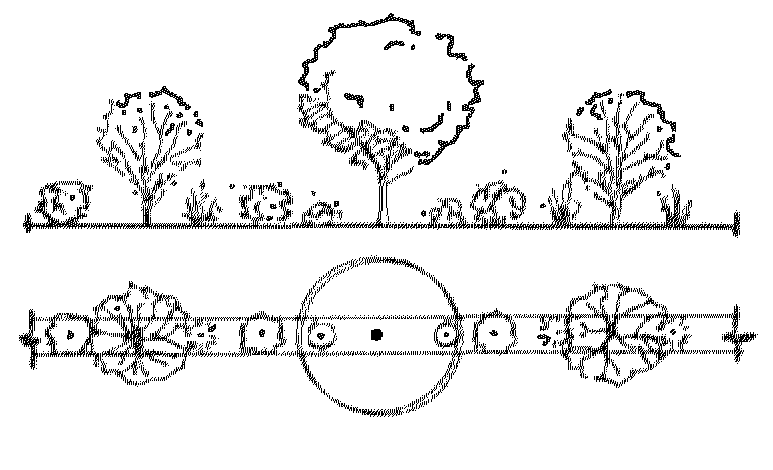 | 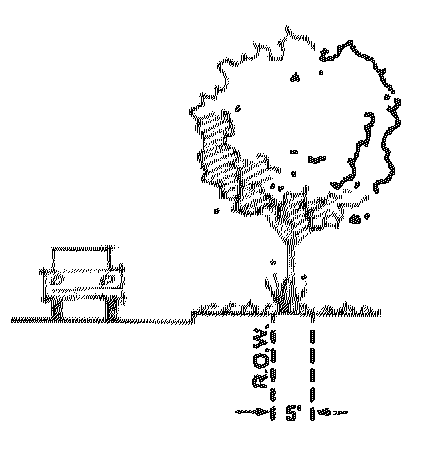 |
|
Buffer Yard 'B'
• 10-foot min. width • Min. 2 canopy trees • Min. 3 understory trees • Min. 10 screening shrubs • No fence or berm required | 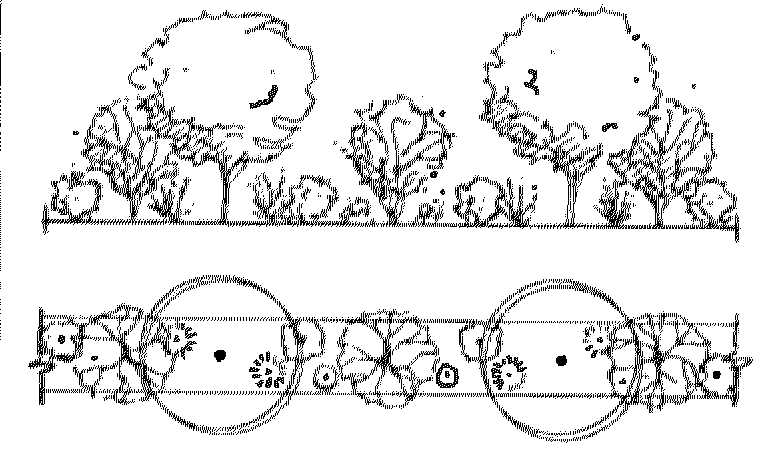 | 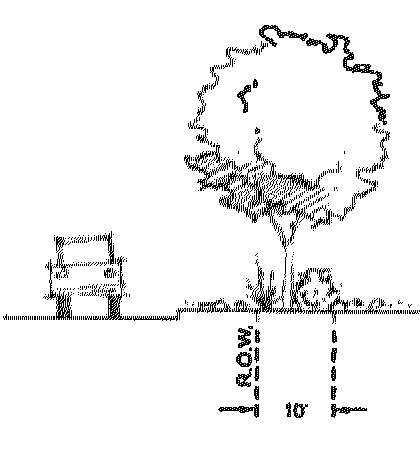 |
|
Buffer Yard 'C'
• 10-foot min. width • Min. 3 canopy trees • Min. 4 understory trees • Min. 12 screening shrubs • No fence or berm required | 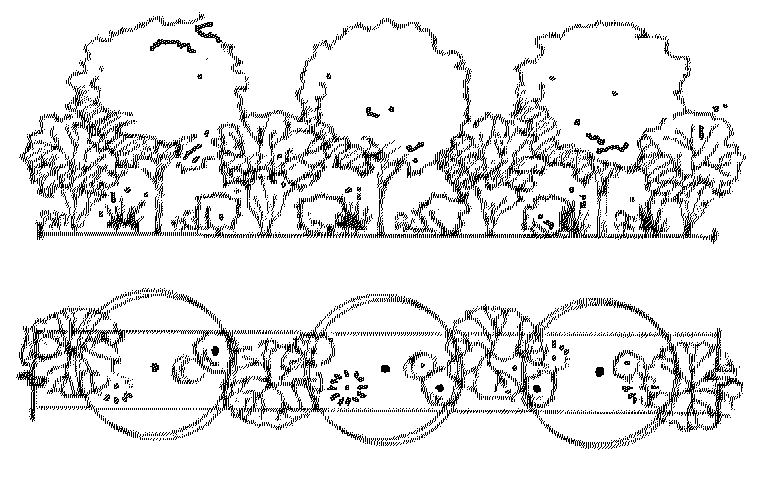 | 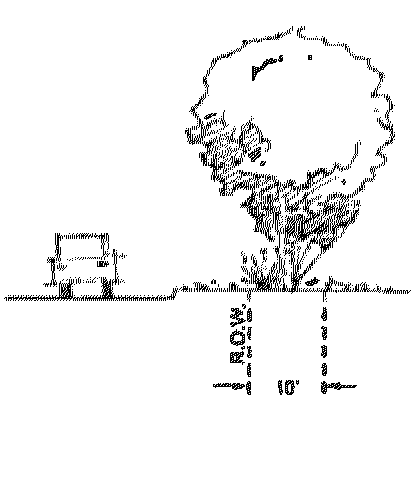 |
|
Buffer Yard 'D'
• 10-foot min. width • Min. 4 canopy trees • Min. 5 understory trees • Min. 18 screening shrubs • No fence or berm required | 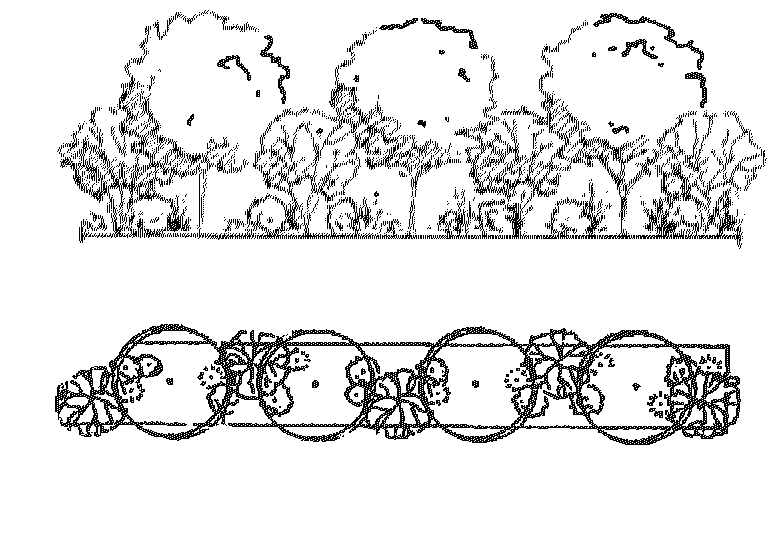 | 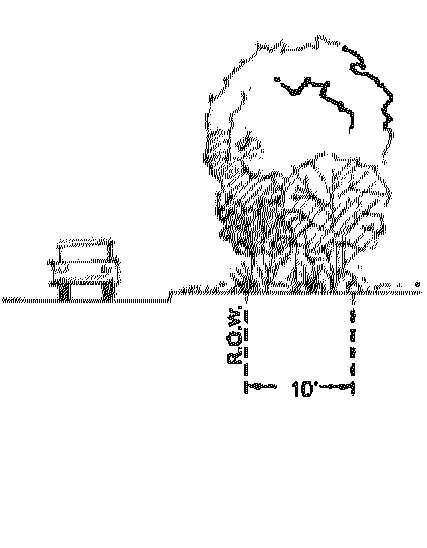 |
|
Buffer Yard 'E'
• 50-foot min. width • Min. 4 canopy trees • Min. 8 understory trees • Min. 12 shrubs • Earthen Berm, 3' high | 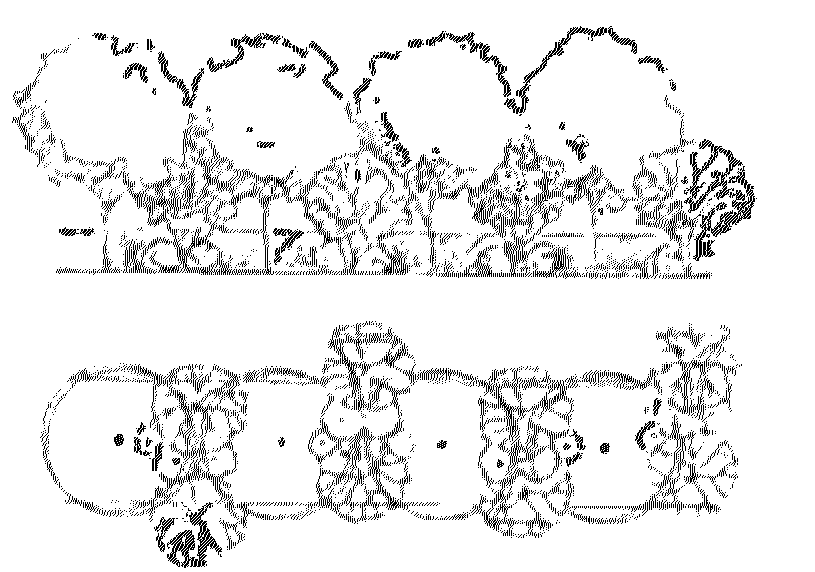 | 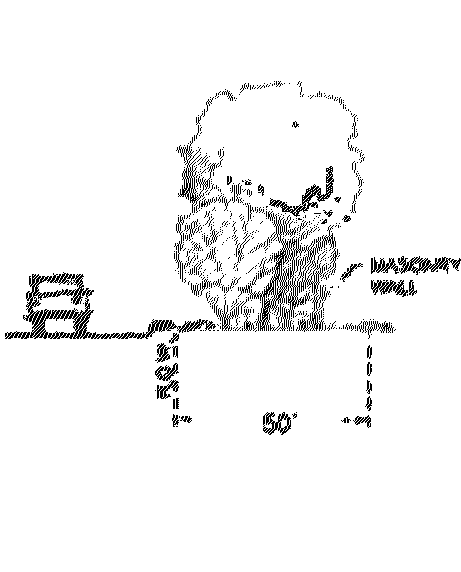 |
|
Buffer Yard 'F'
• 50 min. width • Min. 4 canopy trees • Min. 8 understory trees • Min. 12 screening shrubs • 8-ft high masonry wall required | 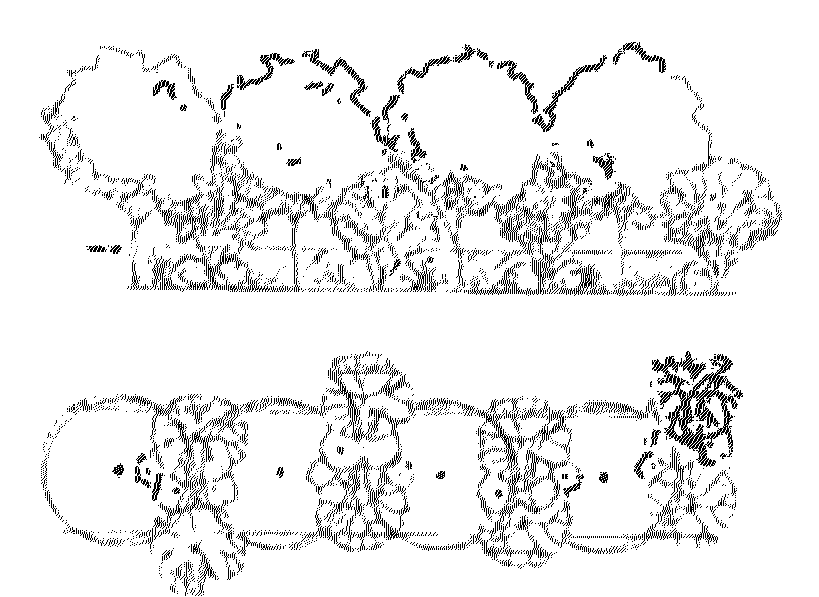 | 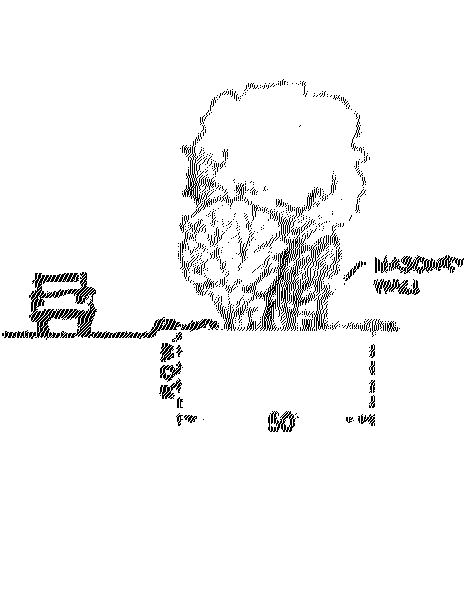 |
d.
Required Structures. Whenever a masonry wall is required within a bufferyard, it shall measure eight feet in height and be constructed in accordance with specifications set forth in the Town's design standards, including the submission of construction plans prepared and sealed by a professional engineer. An "F" fence shall be of masonry construction with like and similar masonry materials to those of the primary structure. A finished side of a masonry wall shall face the residential or less intense use it is intended to buffer or screen.
e.
Building Height in Transition Areas.
A.
Any portion of a building within 50 feet of a property zoned in a residential district, as provided in Article III zoning, shall not exceed the maximum building height allowed in the abutting residential district. Portions of buildings within 50 feet are not eligible for additional building height that may otherwise be allowed.
B.
Any portion of a building between 50 feet and 100 feet of a property zoned in a residential district, as provided in Article III zoning, shall not exceed the maximum building height allowed in the abutting residential district, plus 15 feet. Portions of buildings between 50 feet and 100 feet are not eligible for additional building height that may otherwise be allowed.
C.
Any portion of a building beyond 100 feet from a property zoned in a residential district, as provided in Article III zoning, shall not exceed the allowed building height of the zoning district where the building is located. Portions of buildings beyond 100 feet are eligible for additional building height that may otherwise be allowed.
Figure 1: Building Height in Transition Areas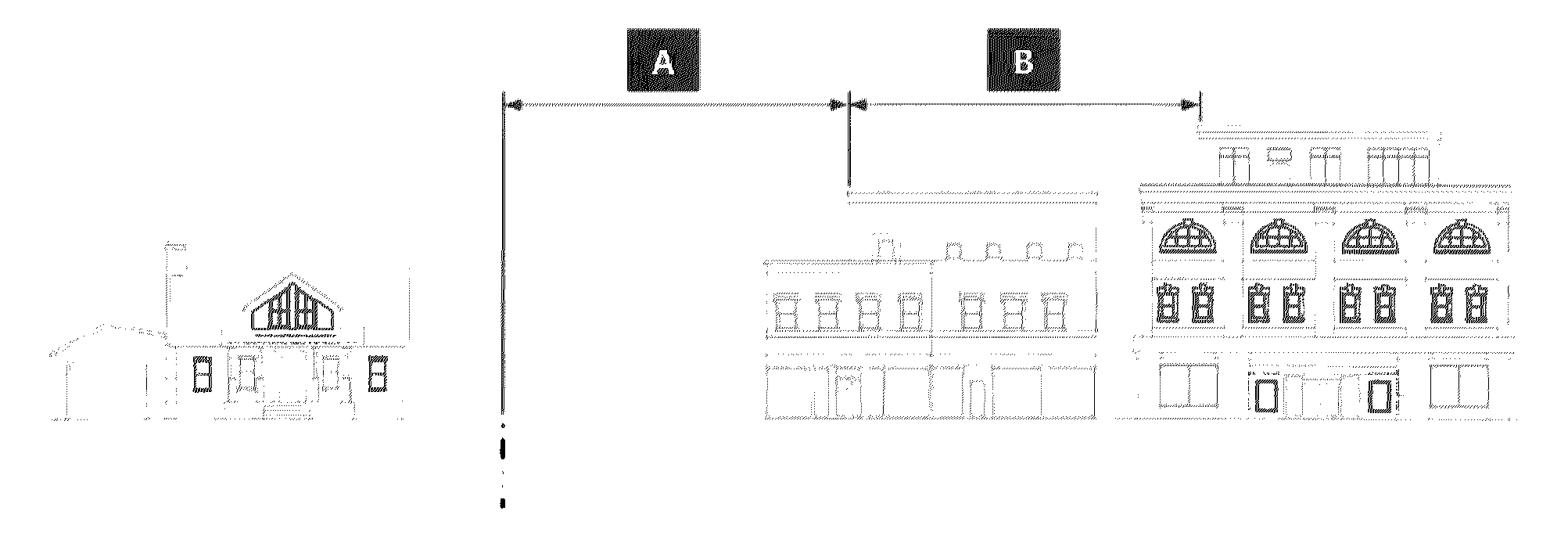
J.
Where the Street Tree requirements and Bufferyard Tree requirements overlap for canopy trees. the standard that requires the higher number of trees shall prevail.
K.
Minimum Requirements for Off-Street Parking and Vehicular Use Areas. Except for the OT-1 zoning district, parking lots, and vehicular use areas for developments within all the nonresidential zoning districts are to be effectively screened from the public view and adjacent property. Both the interior and perimeter of such areas shall be landscaped in accordance with the following criteria. Areas used for parking or vehicular storage which are under, on, or within buildings are exempt from these standards.
1.
Interior Landscaping. A minimum of ten percent of the gross parking areas shall be devoted to living landscaping that includes grass, ground cover, plants, shrubs, and trees. Gross parking area is to be measured from the edge of the parking lot and/or driveway paving and sidewalks. The following additional criteria shall apply to the interior of parking lots.
a.
Interior landscape areas shall be protected from vehicular encroachment or overhang through appropriate wheel stops or curbs.
b.
There shall be a minimum of one overstory tree planted for each 400 square feet or fraction thereof of required interior landscape area.
c.
Interior areas of parking lots shall contain planting islands located so as to best relieve the expanse of paving. Planter islands must be located no further apart than every 12 parking spaces and at the terminus of all rows of parking. Such islands shall contain at least one overstory tree. Planter islands shall not be required for lots containing less than 35,000 square feet. The remainder shall be landscaped with shrubs, lawn, ground cover, and other appropriate material not to exceed three feet in height at maturity. Interior planter islands shall have a minimum size of 16 square feet and a minimum width of eight feet as measured from back-of-curb to back-of-curb or nine feet from edge-of-pavement to edge- of-pavement if constructed without curbs.
d.
The Town may approve planter islands required by Section 14.3.67-6.J.l.c. above to be located further than apart than 12 parking spaces in order to preserve existing trees in interior parking areas. Off-street parking and drive areas located within the drip line of a tree shall be paved with permeable material approved by the Town when the drip line of an existing tree is larger than the planter islands required by Section 14.3.67-5.C.3.
2.
Perimeter Landscaping. All parking lots and vehicular use areas located between a primary structure and a public right-of-way shall be screened from all public rights-of-way with a landscape barrier. Plants and materials used in the landscaped strip shall meet the minimum specifications as established in Sections 14.3.67-5.C., 14.3.67-5.D., and 14.3.67-5.E.
Perimeter landscaping shall be designed to screen off-street parking areas and other vehicular use areas, except for driveways that provide direct connection to a public right-of-way, from public rights-of-way. Said perimeter landscaping shall include the following:
a.
Whenever an off-street parking area or vehicular use area is located between a primary structure and a public right-of-way, except a public alley, a perimeter landscape area of at least 15 feet in depth shall be maintained between the abutting public right-of-way and the off-street parking or vehicular use area. An appropriate landscape screen or barrier shall be installed in this area and the remaining area shall be landscaped with materials as specified in b. below.
b.
The following planting materials shall be required within a landscape barrier as specified herein. Plant materials as required for the mandatory bufferyards required by Section 14.3.67-6 may be counted toward the perimeter landscape requirements specified herein:
1.
One overstory tree per 30 lineal feet of frontage;
2.
Three understory trees per 30 lineal feet of frontage;
3.
Curvilinear berm measuring a minimum of three feet in height or a hedge row creating a solid vegetative screen at maturity of the plant materials. Said plant materials shall meet the minimum criteria for shrubs as specified by Section 14.3.67-5.E.; and
4.
All areas not covered by plant materials specified in items 1. through 3. above shall be covered in ground cover, which shall be selected from the approved plant list.
L.
Landscaping Requirements for Non-Vehicular Open Space. Development within the LR, CR, CF, and BP zoning districts shall meet the following landscaping standards in addition to the landscaping of off- street parking and vehicular use areas and all bufferyards required by Section 14.3.67-6. All remaining open spaces on any developed lot or parcel shall conform to the following minimum criteria:
1.
Grass, ground cover, shrubs, and other landscape materials shall be used to cover all open ground within 20 feet of any building or paving or other use such as storage.
2.
All structures shall be treated with landscaping so as to enhance the appearance of the structure and to screen any detractive or unsightly appearance.
3.
Landscaping shall be provided on each developed lot in accordance with the following standards (except for development within the OT-1 zoning district):
a.
Overstory Trees. Overstory trees shall be planted in non-vehicular open space to meet the following criteria. Existing trees that are preserved on a developed site may be credited as specified by this section.
4.
Landscaping that is in excess of the required minimum open space that is located in the rear yard of the site shall not be used to meet the minimum open space requirements for the site.
M.
Vehicular driveways from the public right-of-way and sidewalks, in accordance with Town regulations, shall be permitted through all required landscaping.
14.3.67-7 Minimum Landscaping Requirements for Single-Family and Two-Family Residential Developments.
A.
For all single-family and two-family developments, each residential lot shall be required to have one large shade tree and two small ornamental trees within the front yard. The required trees shall be installed prior to issuance of a certificate of occupancy for the premises, and shall be maintained in a living and growing condition by the owner of the premises.
14.3.67-8 Sight Distance and Visibility.
A.
Strict compliance with these landscaping requirements shall not be such as to cause visibility obstructions and/or blind corners at intersections.
B.
Landscaping, except required grass and low ground cover, shall not be located closer than three feet from the edge of any vehicular pavement.
C.
In the event other visibility obstructions are apparent in the proposed landscape plan, as determined by the Town Administrator, or designee, the requirements set forth herein may be slightly reduced, if necessary, to remove the conflict.
14.3.67-9 Maintenance.
A.
The owner, tenant and/or their agent, if any, shall be jointly and severally responsible for the maintenance of all landscaping. All required landscaping shall be maintained in a neat and orderly manner at all times. This shall include, but not to be limited to, mowing (of grass six inches or higher), edging, pruning, fertilizing, watering, weeding, and other such activities common to the maintenance of landscaping. Landscaped areas shall be kept free of trash, litter, weeds, and other such material or plants not a part of the landscaping. All plant material shall be maintained in a healthy and growing condition as is appropriate for the season of the year. Plant materials which die shall be replaced with plant material of similar variety and size, within 90 days. Trees with a trunk diameter in excess of six inches measured 24 inches above the ground may be replaced with ones of similar variety having a trunk diameter of no less than three inches measured 24 inches above the ground on a caliper-inch for caliper-inch basis. A time extension may be granted by the Town Administrator, or designee, if substantial evidence is presented to indicate abnormal circumstances beyond the control of the owner or his/her agent.
B.
It shall be the duty of any person or persons owning or occupying real property bordering on any street to prune trees next to the street in such manner that they will not obstruct or shade the streetlights, obstruct the passage of pedestrians on sidewalks, obstruct vision of traffic signs, or obstruct the view from any street or alley intersection, pursuant to the Town's visibility standards. The minimum clearance of any portion of a tree overhanging public street right-of-way shall be 14 feet, and overhanging a public sidewalk shall be eight feet.
C.
Failure to maintain any landscape area in compliance with this section is considered a violation of this section and may be subject to penalties of this ordinance.
14.3.67-10 Tree Preservation.
A.
Trees shall be preserved in accordance with Argyle's Tree Preservation Ordinance as set out in Article V.
(Ord. No. 2010-01, § 3, 1-12-10; Ord. No. 2010-17, § 2, 10-26-10; Ord. No. 2019-04, § 5 (Exh. E), 3-26-19; Ord. No. 2020-06, § 2, 3-24-20; Ord. No. 2021-21, § 2(Exh. A), 10-4-21; Ord. No. 2022-01, § 2(Exh. A), 2-7-22; Ord. No. 2024-10, § 2(Exh. A), 3-18-24; Ord. No. 2024-26, § 2(Exh. A), 9-16-24; Ord. No. 2026-16, § 2(Exh. A), 4-2-26)
Sec. 14.3.68. - Accessory Buildings, Accessory Dwellings, and Use Regulations.
14.3.68-1 Accessory Buildings.
A.
In a residential district, an accessory building is a subordinate or incidental building, attached to or detached from the main building that does not have separate kitchen facilities, is not used as a dwelling or living quarters, is not rented, and is not used for commercial purposes or financial gain except when in compliance with the home occupation ordinance, with the exception of agricultural. Accessory buildings shall not be permitted without a main building or primary use being in existence.
B.
In nonresidential districts, an accessory building is a subordinate building, the use of which is secondary to and supportive of the main building. Accessory buildings shall not be permitted without a main building or primary use being in existence.
C.
Area Regulations for Accessory Buildings in Single-Family and Two-Family Districts (including A, SF-2.5, SF-1, SF-20, SF-10, SF-7, SFA and MH).
1.
Size of Yards.
a.
Front Yard. Accessory buildings shall be required to comply with all building setback requirements in the respective zoning district.
b.
Side and Rear Yards. Accessory buildings shall be required to comply with all building setback requirements in the respective zoning district.
1.
There shall be an interior side and rear yard setback same as the main building.
2.
A side/rear setback of four feet may be used for a portable (i.e., removable) accessory building not exceeding 120 square feet in floor area, and not exceeding a total ridge height of eight and one-half feet.
3.
Garages or carports located and arranged so as to be entered from an interior side yard shall have a minimum setback same as the main building. Carports or garages arranged to be entered from a side yard, facing a public street, or from a rear or side alley shall have a minimum distance equal to the required yard for the main building or 24 feet, whichever is greater.
2.
Carports shall be measured from the posts supporting the roof nearest to the street or alley.
3.
Accessory buildings are not permitted without a main structure.
4.
A maximum height of 20 feet shall be allowed if the pitch, building materials and design of the roof of the accessory building is consistent with the pitch, building materials and design of the main structure. Taller accessory buildings may be allowed by specific use permit (SUP) if there is no adverse impact upon adjacent properties.
5.
Metal portable accessory buildings less than 120 square feet and no greater than eight and one-half feet in total ridge height are permitted, but shall not be used as an enclosed parking area or garage.
6.
See Subsection 14.3.70-2.E. for exterior construction standards for accessory buildings.
7.
See specific zoning district regulations for maximum lot coverage.
D.
Area Regulations for Accessory Buildings in Nonresidential and Multifamily Districts.
1.
Size of Yards.
a.
Front Yard. Same as for main structure.
b.
Side and Rear Yards. Same as for main structure.
2.
Carports shall be measured from the posts supporting the roof nearest to the street or alley.
3.
Accessory buildings are not permitted without a main structure.
4.
Accessory buildings shall not exceed the height allowed in the specific zoning district, except taller accessory buildings may be allowed in certain zoning districts by specific use permit (SUP) if there is no adverse impact upon adjacent properties.
5.
Metal portable accessory buildings less than 120 square feet and not greater than eight and one-half feet in total ridge height are permitted. Such metal buildings shall not be used as an enclosed parking area or garage.
6.
See Subsection 14.3.70-2.E. for exterior construction standards for accessory buildings.
7.
See specific zoning district regulations for maximum lot coverage.
14.3.68-2 Accessory Dwellings.
A.
Accessory Dwelling Units in the A and SF-2.5 Zoning Districts.
1.
Accessory dwelling units in the A and SF-2.5 zoning districts shall be allowed as an incidental residential use of a building on the same lot as the main dwelling unit and used by a bona fide caretaker, servant or farm worker actually and regularly employed by the land owner or occupant of the main building, or is a guest or family member of the owner/occupant.
2.
Accessory dwelling units shall meet the following standards:
a.
The accessory dwelling unit may be constructed only with the issuance of a building permit.
b.
The accessory dwelling unit shall be constructed with exterior cladding that meets the minimum construction standards for the zoning district in which the unit is located.
c.
The accessory dwelling unit may not be sold separately from the sale of the entire property, including the main dwelling unit, and shall not be rented.
d.
Setback requirements shall be the same as for the main structure.
e.
Accessory dwellings are not permitted without the main or primary structure.
f.
No more than one accessory dwelling unit (i.e., garage/accessory dwelling, servant/caretaker's quarters, etc.) shall be allowed on any lot within an A or SF-2.5 zoning district and shall be clearly incidental to the primary use. Additional dwelling units may be allowed but will require a specific use permit which includes site plan approval.
g.
The accessory dwelling unit may be served by a separate utility meter(s) as the primary dwelling; however, the utilities shall be under the same name as the primary dwelling.
h.
The accessory dwelling may be attached to the primary structure by way of a porte-cochere.
i.
The accessory dwelling may be attached to a barn.
B.
Accessory Dwellings in the SF-1 Zoning District.
1.
Accessory dwelling units in the SF-1 zoning district shall be allowed as an incidental residential use of a building on the same lot as the main dwelling unit and used by a bona fide caretaker or servant regularly employed by the land owner or occupant of the main building, or is a guest or family member of the owner/occupant.
2.
Accessory dwelling units shall meet the following standards:
a.
The accessory dwelling unit may be constructed only with the issuance of a building permit.
b.
The accessory dwelling unit shall be constructed with exterior cladding that meets the minimum construction standards for the SF-1 zoning district.
c.
Setback requirements shall be the same as for the main structure.
d.
Accessory dwellings are not permitted without the main or primary structure.
e.
No more than one accessory dwelling unit shall be allowed on any lot and shall be clearly incidental to the primary use.
f.
The accessory dwelling unit shall be served by the same utility meter(s) as the primary dwelling.
C.
Accessory Dwellings in all Other Zoning Categories.
1.
Accessory dwelling units may be permitted in the SF-20, SF-10, SF-7, SFA, 2F, OT-1, and OT-2 zoning districts with an approved specific use permit. Accessory dwelling units shall be an incidental residential use of a building on the same lot as the main dwelling unit and used by a bona fide caretaker or servant regularly employed by the land owner or occupant of the main building, or is a guest or family member of the owner/occupant.
1.
Accessory dwellings shall conform to the height limitations for primary structures or buildings in each zoning district.
2.
Accessory dwellings shall be constructed of like and similar materials to those of the primary structure.
3.
Accessory dwelling units shall meet the following standards:
a.
The accessory dwelling unit may be constructed only with the issuance of a building permit.
b.
The accessory dwelling unit may not be sold separately from the sale of the entire property, including the main structure and shall not be rented if located in a residentially zoned district.
c.
Setback requirements shall be the same as for the main structure.
d.
Accessory dwellings are not permitted without the main or primary structure.
e.
No more than one accessory dwelling unit (i.e., garage/accessory dwelling, servant/caretaker's quarters, etc.) shall be allowed on any lot and shall be clearly incidental to the primary use.
f.
The accessory dwelling unit shall be served by the same utility meter as the primary dwelling.
(Ord. No. 2010-01, § 3, 1-12-10; Ord. No. 2019-04, § 6 (Exh. F), 3-26-19; Ord. No. 2021-22, § 3(Exh. B), 8-16-21)
Sec. 14.3.69. - Fencing, Walls and Screening Requirements.
14.3.69-1 Purpose. To encourage the most appropriate use of land and conserve and protect the privacy and value of adjacent permitted uses. Regulations are prescribed for the location and type of various screening devices to be used when required in the various zoning districts or in this Section in accordance with the following standards.
14.3.69-2 Screening of Nonresidential, Multifamily Areas and Manufactured (Mobile) Home Parks.
A.
Except as provided in 1. and 2. below, in nonresidential, multi-family and manufactured (mobile) home districts, no fence or wall shall be erected in any front yard or side yard which is adjacent to a public street.
1.
Unless the fence/wall is required to screen the development from an adjacent residential area (particularly if the residence has, or could have, a back yard fence that would be exposed to view from the street if the required screening wall were not extended out to the street right-of-way line). In this case, the screening fence/wall shall be extended out to the street right-of-way line by the developer of the nonresidential, multi-family or manufactured (mobile) home development, and the fence/wall shall be finished on both sides in a manner/color that is compatible to the exterior finish materials used on the main buildings (except for a manufactured/mobile home park). Screening fences/walls shall be placed such that they do not impede visibility for vehicles entering or exiting the nonresidential, multi-family or manufactured (mobile) home development (see Section 14.3.71-7 for sight visibility requirements).
2.
Decorative open fences that meet all of the following are permitted in front and side yards: (a) contributes to the identification and beauty of the principle use; (b) is not erected to satisfy any other provision of the Zoning Ordinance; (c) does not function as a retaining or screening structure and is constructed with openings between the materials used for construction whereby the openings represent 75 percent or more the total front face surface of the fence (see illustrations below); (d) is constructed of material(s) that are not typically found in security applications, such as chain link or wire mesh. Specifically, chain link, woven wire mesh metal panel, or similar materials are not considered decorative fencing, and are therefore not allowed in front or side yards; (e) does not exceed 36 inches in height as measured from the finished grade to the top of the fence and is placed such that they do not impede visibility for vehicles entering or exiting the development (see Section 14.3.71-7 for sight visibility requirements); and (f) is of split rail, post and rail or ornamental iron fence design that is constructed of iron, aluminum, treated wood or other acceptable material(s) as approved by the Town Administrator, or his/her designee.
B.
All fences and walls require permits.
C.
See Section 14.3.71-7 for sight visibility requirements for fences and screening walls.
D.
Open storage of materials, commodities or equipment shall be screened with a minimum six-foot fence or wall, and shall not be visible from the street or from adjacent property.
E.
In districts permitting open storage, screening shall be required only for those areas used for open storage. A six-foot screening fence or wall shall be provided and maintained at the property line adjacent to the area to be screened by one or a combination of the following methods:
1.
Solid masonry (brick, concrete block or concrete panels).
2.
Wrought iron with solid landscape screening.
3.
Alternate equivalent screening may be approved through the site plan approval process under Section 14.3.25.
No outside storage may exceed the height of the fence. Outside storage exceeding six feet shall require a Specific Use Permit.
F.
For the MF, MH, and all nonresidential zoning districts, refuse and recycling storage areas which are not within a screened rear service area shall be visually screened by a minimum six-foot solid masonry wall on at least three sides (see Section 14.3.95, Illustration 1 for refuse and recycling container enclosure diagrams). The fourth side, which is to be used for garbage pickup service, shall provide a metal gate, painted to match the enclosure, to secure the refuse or recycling storage area, as shown in Illustration 1 of Section 14.3.95. Alternate equivalent screening methods may be approved through the site plan approval process, Section 14.3.25. Each refuse and recycling facility shall be located so as to facilitate pickup by refuse collection agencies. Adequate reinforced paved areas shall be provided for refuse and recycling facilities and their approaches for loading and unloading.
G.
Nonresidential uses that utilize curb-side garbage pickup shall store all refuse and recycling containers behind the front building line and shall screen such containers. Screening materials shall be consistent and compatible with the materials that compose the primary structure. Refuse and recycling containers are allowed to be placed adjacent to the street no earlier than 3:00 p.m. the evening before the day of garbage pickup and shall be removed no later than 7:00 p.m. the day of garbage pickup.
H.
Plans and specifications for screening and/or fencing around ground-mounted utility structures (e.g., transformers, natural gas regulating stations, etc.) shall be approved in writing by the affected utility company, and shall be submitted, along with an approval letter/document from the utility company, to the Town Administrator (or designee) for review and approval prior to construction of said screening/fencing.
14.3.69-3 Fences and Screening in Residential Areas.
A.
Permit Required. All perimeter fences require permits. Fences on the interior of a property do not require a permit except for fences required for the enclosure of swimming pools and special purpose fencing.
B.
Back Yard Fence Height. Any fence or wall located to the rear of the minimum required front yard line shall not exceed eight feet in height.
C.
Back Yard Fence Materials.
1.
Fences may be constructed of wood, decorative metal (e.g., wrought iron or tubular steel, but not hog/chicken wire), and other materials traditionally used in private fence construction are allowed.
2.
New and innovative materials such as plastics, PVCs, metal panel or metal slat, "honeycomb," cementitious fiber board (e.g., "WoodCrete"), and other similar materials may be approved for use by the Director of Community Development if the material is proven to be sturdy, durable and relatively maintenance-free.
3.
Chainlink fencing may only be used if approved for use by the Director of Community Development and if other properties in the immediate area contain existing chainlink fencing.
D.
Front Yard Fencing. Decorative fences (e.g. wrought iron, tubular steel or wood picket) with openings not less than 50 percent of the fence area and not exceeding four feet in height are permitted in front yards of single-family or duplex residential lots. Chainlink, woven wire mesh, metal panel, or similar materials are not considered decorative fencing, and are therefore not allowed in front yards unless otherwise allowed pursuant to subsection F below.
E.
Corner Lot Side Yard Fencing. No residential exterior side yard fence shall be closer than 15 feet to a public street except in cases where the side or rear building line of the yards on continuous corner lots adjoin (i.e., the side yard lot is not a key corner lot). The fence may be constructed out to the property line of said side yard such that the street side may be included as part of the lot's back yard area.
F.
Farm and Ranch Perimeter Fencing. The following types of fencing shall be allowed as perimeter fencing (including front yards) on farm and ranch properties containing two and one-half or more acres: split rail, pipe and cable, vinyl ranch fencing, underground "virtual fencing" and similar open fencing materials. Barbed wire, woven wire mesh, hog wire and field fence used in conjunction with metal or treated wood posts and rails are also acceptable materials. Electric wire or tape may be added to any of the allowed fence materials. Above ground electrical fencing, woven wire mesh, hog wire, field fence and chicken wire used independently are prohibited as perimeter fencing. Farm and ranch perimeter fencing shall not exceed eight feet in height.
G.
Vehicular Access Gates.
1.
There shall be a 24 foot setback for vehicular access gates for properties which directly access the following street classifications, as defined by Map 1—Town of Argyle, Texas Thoroughfare Plan, An Element of the Comprehensive Plan, dated December 2009, as subsequently amended:
a.
Controlled Access Freeway.
b.
Type A Major Arterial.
c.
Type B Minor Arterial.
d.
Type C Major Collector.
e.
Type D Minor Collector.
f.
Type E Rural Collector.
2.
Residential properties which do not directly access any of the above-referenced functional street classifications are not required to have a minimum set back provided the vehicular access gate location does not result in impeding vehicular or pedestrian traffic or interfere with utility access.
H.
Swimming Pool Fencing. Fences around swimming pools require a permit and shall be in conformance with this Subsection and with the Town's Code of Ordinances. Chainlink fencing shall not be used for the enclosure of swimming pools.
I.
Masonry Screening Walls and Fences. Masonry screening walls and fences shall conform to the Town's standards for sight visibility. Masonry screening walls and fences four feet in height or greater as measured from the top of the footing to the top of the fence shall be designed by a professional engineer.
J.
Special Purpose Fencing. Special purpose fencing, such as fencing around tennis courts, is allowed with a fence permit.
K.
Fence Maintenance. All fences shall be kept in good repair and shall not create urban blight. Dilapidated fences shall be repaired or replaced in accordance with the provisions of this Ordinance. Fences may be painted or stained with natural wood colors. No bright or unnatural colors are allowed.
(Ord. No. 2010-17, § 2, 10-26-10; Ord. No. 2010-19, § 6, 12-14-10; Ord. No. 2013-04, 1-22-13; Ord. No. 2019-26, § 10, 11-19-19; Ord. No. 2020-06, § 2, 3-24-20)
Sec. 14.3.70. - Exterior Construction and Design Requirements.
14.3.70-1 Definitions. For the purpose of this Ordinance, the following definitions shall apply:
A.
Masonry Construction means that form of construction composed of brick, stone, decorative concrete block or tile, or other similar building units or materials (or combination of these materials) laid up unit by unit and set in mortar, and shall exclude wall area devoted to doors and windows. As applicable to meeting the minimum requirements for the exterior construction of buildings within each zoning district, this term shall include the following materials:
1.
Hard fired brick (kiln fired clay or slate material; severe weather grade; minimum thickness of three inches when applied as a veneer; shall not include unfired or underfired clay, sand or shale brick; may include concrete brick if it conforms to the same ASTM standards, and to the above-stated additional standards, as hard fired clay brick);
2.
Stone (includes naturally occurring granite, marble, limestone, slate, river rock, and other similar hard and durable all-weather stone that is customarily used in exterior building construction; may also include cast- or manufactured-stone product, provided that such product yields a highly textured, stone-like appearance, its coloration is integral to the masonry material and shall not be painted on, and it is demonstrated to be highly durable and maintenance-free; natural or man-made stone shall have a minimum thickness of three and five-eighths inches when applied as a veneer);
3.
Decorative concrete block (highly textured finish, such as split-face, indented, hammered, fluted, ribbed or similar architectural finish; coloration shall be integral to the masonry material and shall not be painted on; minimum thickness of three and five-eighths inches when applied as a veneer; shall not include lightweight or featherweight concrete block or cinderblock units);
4.
Concrete pre-cast or tilt-wall panels (only allowed if a highly textured, architectural finish which is at least as textured in appearance and physically as face brick or stone; can be brick-like or stone-like in appearance; coloration shall be integral to the masonry material and shall not be painted on; shall not include smooth, untextured or inadequately textured finishes); and
5.
Glass blocks or tiles (of the type customarily used in exterior building construction; shall not comprise more than 30 percent of any exterior wall surface, nor more than 20 percent of the building's total exterior on all wall surfaces combined; shall not be highly reflective or mirror-like finish).
6.
Stucco.
7.
Prohibited Materials. The following materials shall not qualify nor be defined as "masonry construction" in meeting the minimum requirements for the exterior construction of buildings, unless specifically approved by the Zoning Board of Adjustments as a special exception (see Section 14.3.22-7.E) for single-family or duplex residential structures, or by the Town Council on an approved site plan for single-family attached, multifamily, institutional, office, retail, commercial, industrial, or other nonresidential structures:
1.
Exterior plaster, adobe or mortar wash surface material;
2.
PVC or other plastic based siding material; or
3.
Lightweight or featherweight concrete blocks or cinderblocks.
B.
Standard Masonry Construction. See "Masonry Construction."
14.3.70-2 Minimum Exterior Construction and Design Standards. The standards and criteria contained within this subsection are deemed to be minimum standards and shall apply to all new building construction occurring within the Town.
A.
Single-Family.
1.
Buildings shall utilize at least two of the following design features to provide visual relief along the front of the residence:
a.
Dormers,
b.
Gables,
c.
Recessed entries,
d.
Cupolas,
e.
Pillars or posts, or
f.
Bay windows (minimum 24-inch projection).
2.
The garage frontage shall not occupy more than 40 percent of the total building frontage.
3.
Garages shall be recessed from the front of the structure by at least ten feet.
4.
No more than five adjacent detached single-family homes or contiguous groups of attached single-family homes shall be of the same exterior building elevation or design.
5.
Walls that face a street other than an alley must contain a minimum of 20 percent of the wall space in windows or doors.
6.
Primary entries shall be accessed directly from the public street and sidewalk.
7.
Windows shall be provided with trim. Windows shall not be flush with the exterior wall treatment. Windows shall be provided with an architectural surround at the jamb.
8.
Flat roofs are permitted only when accompanied by a parapet wall that fully screens the roof on all sides of the structure.
9.
Exterior Finishes.
a.
A, SF-2.5, SF-1 and SF-20 Districts shall be constructed of masonry, stone, horizontal wood, Hardiplank or other comparable high quality wood substitute; in addition, accessory structures may be constructed with a minimum of 26 gauge or heavier architectural panels (wall systems). Unpainted galvanized metal siding is prohibited.
b.
SF-10, SF-7 Districts. Single-story structures shall be constructed of 100 percent masonry or stone, including chimneys; multiple-story structures shall be constructed of a minimum of 80 percent masonry or stone, including chimneys with the remainder of the structure being constructed of horizontal wood, Hardiplank or other comparable high quality wood substitute.
10.
Minimum Roof Pitch for the SF-10 and SF-7 Districts—7:12.
11.
Roofing System Requirements for the SF-10 and SF-7 Districts. Roofing systems shall include dimensional shingles with a minimum rating of 25 years.
B.
Duplex.
1.
Buildings shall utilize at least two of the following design features to provide visual relief along the front of the residence:
a.
Dormers,
b.
Gables,
c.
Recessed entries,
d.
Cupolas,
e.
Pillars or posts, or
f.
Bay windows (minimum 24-inch projection).
2.
The garage frontage shall not occupy more than 40 percent of the total building frontage.
3.
Garages shall be recessed from the front of the structure by at least ten feet.
4.
No more than five contiguous groups of attached single-family homes shall be of the same exterior building elevation or design.
5.
Walls that face a street other than an alley must contain a minimum of 20 percent of the wall space in windows or doors.
6.
Primary entries shall be accessed directly from the public street and sidewalk.
7.
Windows shall be provided with trim. Windows shall not be flush with the exterior wall treatment. Windows shall be provided with an architectural surround at the jamb.
8.
Flat roofs are permitted only when accompanied by a parapet wall that fully screens the roof on all sides of the structure.
9.
Exterior Finishes. Single-story structures shall be constructed of 100 percent masonry or stone, including chimneys; multiple-story structures shall be constructed of a minimum of 80 percent masonry or stone, including chimneys with the remainder of the structure being constructed of horizontal wood, Hardiplank or other comparable high quality wood substitute.
10.
Minimum Roof Pitch—7:12.
11.
Roofing System Requirements. Roofing systems shall include dimensional shingles with a minimum rating of 25 years.
C.
Multifamily Residential.
1.
Orientation Requirements.
a.
A minimum of 60 percent of the building face shall be located at the minimum building setback line.
b.
Buildings that are located within 40 feet of a front yard property line or within 20 feet of any yard adjacent to a street shall have at least 25 percent of the wall facing the street in window or door areas.
c.
Parking areas shall not be located between any buildings and the street.
d.
Buildings shall be directly accessed from the street and the sidewalk.
e.
Buildings shall provide a porch or balcony at the street entrance.
f.
Trash, storage areas, mechanical equipment, and similar areas are not permitted to be visible from the street nor [sic] and must be screened in an opaque manner. Said screening shall be of a minimum height to fully screen the trash, storage areas, mechanical equipment, and similar items and shall be constructed of a masonry fence or wall of like or similar materials to those of the primary structure.
2.
Private streets shall be required to contain sidewalks and street trees and meet all other public street standards.
3.
Streetscape.
a.
Street trees are required for private internal streets as well as public streets.
b.
Front yard landscaping shall contain a mixture of ground cover, shrubs, and trees. Pine straw, bark chips, granite chips, gravel and other similar ground cover may not be a major component of the mature landscaping.
c.
Sidewalks shall be placed along all street frontages and in the interior where appropriate for pedestrian circulation.
4.
Open Space.
a.
An area equal to at least eight percent of the lot area shall be dedicated to open space for recreation for use by tenants of the development for projects with more than 20 dwelling units per acre.
b.
Areas covered by shrubs, pine straw, bark mulch, and other ground covers that do not provide a suitable surface for human use may not be counted toward this requirement.
c.
Decks, patios, and similar areas are eligible for open space criteria. Play areas for children are required for projects of greater than 20 units that are not designed as age-limited or student housing.
5.
Exterior finishes shall be primarily masonry, stone, smooth stucco, horizontal wood siding, Hardiplank, or other high-quality wood substitute.
6.
Special standards for large-scale multifamily developments (more than 30 units):
a.
The same exterior design shall not be used for more than 30 units in a project. A variety of compatible exterior materials use and type, building styles, massing, composition, and prominent architectural features, such as door and window openings, porches, rooflines, should be used.
D.
Nonresidential and Institutional Buildings.
1.
Streetscape. Hardscape (paving materials), such as concrete, unit masonry, scored and colored concrete, grasscrete, or combinations of the above shall be utilized to designate "people" areas.
2.
Trash, storage areas, mechanical equipment, and similar areas are not permitted to be visible from the street nor [sic] and must be screened in an opaque manner. Said screening shall be of a minimum height to fully screen the trash, storage areas, mechanical equipment, and similar items and shall be constructed of a masonry fence or wall of like or similar materials to those of the primary structure.
E.
Accessory Buildings.
1.
In the SF-1, SF -20, SF-10, SF-7, SFA, or MH zoning districts, accessory buildings that have over 120 square feet of floor area shall conform to the minimum exterior construction standards for the main building on the lot, tract or site, and shall be compatible in exterior finishes and colors as the main building.
2.
In the A, SF-2.5, and SF-1 zoning districts, accessory buildings that contain more than 120 square feet of floor area shall be constructed with exterior materials that meet the standards for exterior materials specified by subsection 14.3.70-2 A.9.a.
3.
In a multifamily or nonresidential zoning district, accessory buildings (any size) shall conform to the minimum exterior construction standards for the main building on the lot, tract or site, and shall be architecturally compatible in design and constructed of the same exterior finishes and colors as the main building.
F.
Alternative Exterior Materials.
1.
All written requests for alternative exterior building materials shall be clearly noted and described in detail on a color facade plan that is submitted along with the site plan (for multifamily, single-family attached and nonresidential structures only). The Town may require submission of an actual sample(s) of the proposed exterior finish material(s) along with the facade plan and the site plan.
2.
The Planning and Zoning Commission may recommend, and the Town Council may approve, an alternative exterior construction material(s) if it is determined to be equivalent or better than the exterior materials otherwise required by this subsection and by the Town's building code as part of the site plan approval process.
3.
Consideration for exceptions to the above exterior construction requirements shall be based only upon the following:
a.
Architectural design, creativity and innovation;
b.
Compatibility with surrounding structures;
c.
Relative ease of maintenance of the material(s);
d.
Long-term durability and weather-resistance of the material(s); and
e.
Long-term stability in property value due to the high quality of the material(s).
(Ord. No. 2019-04, § 7 (Exh. G), 3-26-19)
Sec. 14.3.71. - Supplemental Regulations.
14.3.71-1.
A.
Measuring Setbacks. All setback measurements shall be made in accordance with Illustration 8 in Section 14.3.95.
B.
Configuration of Lots. Wherever possible, through (i.e., double frontage) lots (particularly within residential zoning districts) shall also be avoided wherever possible. (Also see Subdivision Ordinance for regulations pertaining to the configuration of lots.)
C.
Building Setbacks. All setbacks established on a recorded plat shall be enforced, even if they exceed the required setbacks in this Ordinance. Setbacks established on a recorded plat shall only be changed through replat proceedings (see Subdivision Ordinance).
14.3.71-2 Front Yard.
A.
On all corner lots, the front yard setback shall be observed along the frontage of both intersecting streets, unless approved specifically otherwise on a construction plat. Where single-family and duplex lots have double frontage, extending from one street to another, or are on a corner, the Town may determine the front yard to be on the street front that is consistent with the prevailing pattern of front yards on the street in order to maintain compatibility with the established development pattern of the street. The side and/or rear yards in the case of single-family and duplex uses shall be identified and the front of the structure shall not face the side or rear yard.
B.
Where the frontage on one side of a street between two intersecting streets is divided by two or more zoning districts, the front yard shall comply with the requirements of the most restrictive district for the entire frontage (see Section 14.3.95, Illustration 10).
C.
The front yard shall be measured from the property line to the front face of the building, to the nearest supporting member of a covered porch or terrace, or to any attached accessory building. Eaves and roof extensions or a porch without posts or columns may project into the required front yard for a distance not to exceed four feet, and subsurface structures, platforms or slabs may not project into the front yard to a height greater than 30 inches above the average grade of the yard (see Section 14.3.95, Illustration 11). Open porches extending into the front yard shall not be enclosed.
D.
Minimum lot widths for lots with predominate frontage on the curved radius of a street (e.g., cul-de-sac or "eyebrow" portion of a street) shall be measured as the linear distance of the curved front building line, and shall be shown on the subdivision plat. Lot widths for all lots shall be as set forth in the respective zoning district for each lot.
E.
Gasoline service station pump islands (and their canopy structures) that parallel a public street may be located a minimum of 20 feet to the property line adjacent to a public street. For pump islands (and canopies) that are perpendicular or diagonal to a public street, the setback shall be 30 feet in order to prevent vehicles stacking out into the street while waiting for a pump position. Pump islands (and their canopies) may extend beyond the front building line as described above (provided that all other requirements of this ordinance are met), but shall not be closer than 15 feet to any property line that is not adjacent to a public street.
F.
Where a future right-of-way line has been established for future widening or opening of a street or thoroughfare, upon which a lot abuts, then the front, side, or rear yard shall be measured from the future right-of-way line.
G.
If 50 percent or more improved with existing buildings, and if the front yard setback for these existing buildings is greater than the front yard required for that zoning district in this ordinance, then no new building shall be constructed to project beyond the least front yard depth of the existing buildings without a variance from the Zoning Board of Adjustment.
14.3.71-3 Side and Rear Yards.
A.
On a corner lot used for one- or two-family dwellings, both street exposures shall be treated as front yards on all lots platted after April 14, 1999 (pursuant to the Subdivision Ordinance, Ordinance No. 98-02, as amended), except that where one street exposure is designated as a side yard for both adjacent lots or where the two lots are separated by an alley, street right-of-way, creek/floodplain area, or other similar phenomenon. In such case, the building line may be designated as a side yard of 15 feet or more (as determined by the applicable zoning district standards). On lots that were official lots of record prior to the effective date of this Ordinance, the minimum side yard adjacent to a side street shall comply with the minimum required side yard for the respective district.
B.
Every part of a required side and rear yard shall be open and unobstructed except for the ordinary projections of window sills, belt courses, cornices, and other architectural features not to exceed 12 inches into the required side or rear yard, and roof eaves projecting not to exceed 36 inches into the required side or rear yard. Air-conditioning compressors and similar equipment are permitted in the side or rear yard. Open porches extending into a side or rear yard shall not be enclosed. A canopy may project into a required side or rear yard provided that it is not enclosed, and provided that it is at least five feet from the adjacent property line.
C.
Where a future right-of-way line has been established for future widening or opening of a street or thoroughfare, upon which a lot abuts, then the front, side, or rear yard shall be measured from the future right-of-way line.
14.3.71-4 Special Height Regulations. In districts where the height of buildings is restricted to two or more stories, cooling towers may extend for an additional height not to exceed 50 feet above the average grade line of the building.
14.3.71-5 Minimum Dwelling Unit Area. Minimum dwelling unit areas specified in this Ordinance shall be computed exclusive of breezeways, garages, open or covered porches, carports and accessory buildings. The minimum dwelling unit area shall be defined as the habitable (i.e., air-conditioned) floor area of the dwelling.
14.3.71-6 Open Storage Areas. Open storage of materials, commodities or equipment (where allowed in the specific zoning district) shall be located behind the front building line and observe all setback requirements for the main structure or building. This standard does not apply to outside display as may be authorized in each of the zoning districts.
14.3.71-7 Sight Visibility.
A.
Visual clearance shall be provided in all zoning districts so that no fence, wall, architectural screen, earth mounding, landscaping or other feature obstructs the vision of a motor vehicle driver approaching any street, alley, or driveway intersection. Whenever an intersection of a street(s), alley, and/or driveway occurs, a triangular visibility area shall be created. Landscaping, fences, walls, earthen berms and other features within the triangular visibility area shall be designed so as to provide unobstructed cross-visibility at a level between 24 inches and eight feet above the ground. The triangular areas are defined as follows:
1.
Alley intersects a public street right-of-way: The areas on both sides of the intersection of an alley and a public street shall have a triangular visibility area with two sides of each triangle being a minimum of ten feet in length from the point of intersection, and the third side being a line connecting the ends of the other two sides (see Illustration 5 in Section 14.3.95).
2.
Minor street intersection (except a street intersecting onto an arterial, see below) or intersection of private driveway onto a public street: These areas shall have a triangular visibility area with two sides of each triangle being a minimum of 25 feet in length along the right-of-way lines (or along the driveway curbline and the street right-of-way line) from the point of the intersection, and the third side being a line connecting the ends of the other two sides (see Illustration 5 in Section 14.3.95).
3.
Major street intersection: These areas shall have a triangular visibility area with two sides of each triangle being a minimum of 50 feet in length along the right-of-way lines from the point of the intersection, and the third side being a line connecting the ends of the other two sides (see Illustration 5 in Section 14.3.95).
B.
Shrubs and plant materials that are typically less than 24 inches in height at maturity may be located within sight visibility areas provided that they are kept maintained at a maximum height of 24 inches.
C.
A limited number of single-trunked trees having a clear trunk (i.e., branching) height of at least eight feet may be located within sight visibility areas provided that they are trimmed in such a manner that no limbs or foliage extend into the cross-visibility area defined above, and provided that they are spaced and positioned such that their trunks will not produce a visibility inhibiting, "picket-fence" effect when they attain mature size.
14.3.71-8 Nonresidential Structures in Residential Districts. Nonresidential structures (e.g., churches, schools, day care centers, etc.) which are permitted in residential zoning districts shall be designed and constructed such that they conform to the development standards set forth in the Office Retail (OR) zoning district (i.e., with respect to maximum height, minimum lot size, minimum front/side/rear setbacks, landscaping, screening, exterior building construction, etc.) unless otherwise stated in this Ordinance or in an ordinance establishing a PD.
14.3.71-9 Pad Sites.
A.
Pad sites for development projects within the LR, CR, and BP districts, which shall be defined as sites or lots that are no larger than one and one-half acre in size, shall not occupy more than 50 percent of any street frontage of a development.
B.
Buildings on pad sites may not block more than 25 percent of the view into a development.
14.3.71-10 Access Standards for Nonresidential and Multifamily Lots.
A.
All nonresidential lots (including pad sites) shall share driveway curb openings via mutual access easements from one lot to adjacent lots (for fire and emergency access, as well as for public convenience).
B.
All nonresidential and multifamily lots (including pad sites) shall have either direct or indirect (via mutual access/fire lane easements on adjacent property) access to a median opening if located on a median-divided roadway (existing or planned in the future). Driveways for all nonresidential and multifamily lots (including pad sites) shall align, to the greatest extent possible, with any existing or proposed driveways on the other side of any type of roadway.
14.3.71-11 Access and Frontage Standards for Residential Lots.
A.
General Rule. All residential lots shall have frontage on a dedicated public street or an approved private street in accordance with the specifications of the zoning district that the lot is located within.
B.
Exception. Minor reductions to the lot width and/or depth requirements may be considered on a final plat application by the Planning and Zoning Commission if the lot meets the area requirements of the zoning district it is located within.
C.
Exception. No more than two lots that do not meet the required frontage requirements may share a driveway located within a private access easement with the approval of a Specific Use Permit. A private access easement is defined as an area reserved for ingress and egress from a dedicated public street to no more than two residential lots by the owners or occupants of said lots, their guests and emergency/governmental/public utility vehicles. All private access easements shall be dedicated on the final plat of subject lot(s) and privately maintained. The following minimum requirements shall be met in addition to any special requirements specified by the Town Council at the time of Specific Use Permit consideration:
1.
The lots served by a private access easement shall each contain a minimum of two and one-half acres.
2.
The private access easement shall be a minimum of 30 feet in width.
3.
The driveway within the private access easement shall be a minimum of 14 feet in width.
4.
The driveway within the private access easement shall have a vertical clearance of 14 feet.
5.
The driveway within the private access easement shall be a hard surface constructed of concrete or a similar all-weather surface such as turf pavers, brick pavers or asphalt. Said paving shall be installed to meet or exceed Town standards.
6.
Provisions for drainage must be provided along the driveway within the private access easement.
7.
Utilities shall be located within separate utility easements, which may overlap with the private access easement if space does not allow for separate adjacent easements.
8.
Any homes located greater than 1,000 feet from the dedicated public street shall be equipped with an automatic fire sprinkler system.
9.
A turnaround in the form of a loop or hammer head approved by the Fire Marshal shall be provided at the end of the private access easement.
10.
The address for both residents shall be clearly posted at the intersection of the dedicated public street and the private access easement.
11.
Directional signage for each address shall be clearly posted at the point where the private access easement splits toward each lot.
12.
All required elements within the private access easement shall be maintained jointly by the two property owners in an acceptable manner for emergency vehicle access as determined by the Town Engineer, the Chief of Police and the Fire Marshal.
13.
The Planning and Zoning Commission and the Town Council may consider alternatives to the standards listed above in items 1—12 on a case-by-case basis in conjunction with Specific Use Permit approval, provided such alternatives meet the health, safety and welfare requirements of the Town.
14.
A site plan showing the location of the private access easement and the driveway, the pavement and subgrade thickness and all other required elements shall be submitted with each building permit for new home construction and approved by the Town Engineer.
15.
All requirements as stated above along with any special requirements approved as part of the Specific Use Permit by the Town Council shall appear on the face of the final plat for the two lots.
16.
A development with three lots or more shall be required to extend a dedicated public street to provide frontage to all lots within the subdivision.
14.3.71-12 Seasonal/Temporary Uses.
A.
General Rule. Temporary locations for sale of merchandise are prohibited in the Town limits of Argyle unless approved by a Specific Use Permit (SUP) except as provided below.
B.
Exceptions. The following temporary locations for the sale of merchandise are allowed, provided that a Temporary or Seasonal Use Permit is obtained and all regulations are followed:
1.
Temporary sale of merchandise may be allowed as part of a special event.
2.
Seasonal uses and sales shall be limited to Christmas trees, pumpkins, snow cones, fresh produce, bedding plants and other items which are typically only available at certain times of the year. Seasonal uses and sales are permitted for 60 days in all nonresidential zoning districts with a maximum of two renewals for 30 days each.
3.
Sales of locally grown crops and produce grown or produced on the property may be permitted on said property if the property contains a minimum of five acres for a maximum of 60 days.
C.
The following information is required for submittal to the Community Development Department for review at the time of Temporary or Seasonal Use Permit Application:
1.
The full name of the person(s) applying for a permit, address and telephone number, if any, and, if the merchant is selling on behalf of an organization, the name and address of the parent organization.
2.
A letter from the property owner which authorizes the merchant to use the property for the purpose of seasonal/temporary outdoor sales. Such letter shall bear the property owner's name, address, phone number and signature.
3.
A copy of a limited sales tax permit issued by the state for the site address or proof that the goods are not subject to such sales tax.
4.
A statement of the type of goods or merchandise to be sold.
5.
Provide a copy of a current health certificate of merchandise of edible quality is to be sold; however, this shall not apply to the sale of candy, nuts or other edibles prepared and packaged by a nationally recognized manufacturer or a Texas manufacturer meeting standards imposed by state and local health codes, if such packages are unbroken.
6.
Submittal of two sets of a site plan, drawn to scale and legible, indicating the following:
a.
Stands, shelters, trailers, tents and buildings on the property.
b.
Lighting and electrical equipment (temporary power pole, generator, etc.).
c.
Location and number of parking spaces. Indicate if parking area is paved or unpaved. Indicate all drive approaches. Curb jumping or on-street parking is prohibited.
d.
Location, type and size of signage. One temporary sign (32 square-foot maximum) per street frontage is allowed and requires a sign permit.
e.
If a tent is to be erected, the Fire Marshal may require a tent permit.
f.
Electrical permit application is required for all proposed electrical work. All electrical work shall be performed by a licensed master electrician and shall comply with the adopted building code.
g.
Plumbing permit application is required for all proposed plumbing work. All plumbing work shall be performed by a licensed master plumber and shall comply with the adopted building code.
7.
The application shall be accompanied by the fee for a Temporary or Seasonal Use Permit as set out in the Town's fee schedule.
D.
All required permits and inspections shall be completed prior to any seasonal sales lot opening for business.
E.
At no time shall any fire lane or emergency access be blocked or obstructed.
F.
Temporary, black or green, vinyl-coated chain link fencing a maximum of six feet in height may be used to secure the seasonal sales site. Barbed wire or razor wire shall not be used as or attached to temporary site fencing. Decorative open fences as described in Section 14.3.69-2(A)(2) may also be used to secure the seasonal sales site.
G.
Within ten days after the expiration of the seasonal sales permit, all merchandise, stands, equipment, trash, signs, lighting and shelters shall be removed by permit holder and the property returned to its original condition.
H.
Each temporary seasonal sales permit issued under this division shall be subject to cancellation for violation of any provisions applicable to this policy.
14.3.71-13 Special Event, Carnival, Circus or Parade (Temporary). A temporary use permit for a special event, carnival, circus or parade may be issued by the Director of Community Development, subject to the following conditions:
A.
Applications for a permit shall be made no less than ten days prior to the date such temporary special event, carnival, circus or parade shall commence operation.
B.
The fee for such permit shall be in accordance with the adopted Town Fee Schedule. Nonprofit organizations and school districts shall be exempt from paying said fee.
C.
The Special Event Permit application shall contain the following:
1.
Name, address and telephone number of person, organization or company conducting the event.
2.
Date or dates of the carnival, circus, parade or special event.
3.
Two copies of a site plan showing in detail the different component parts of the temporary carnival, circus, parade or special event, including all shows, concessions, amusements, businesses and the location of each on the property.
4.
A written lease or agreement from the owner of such property stating permission to the applicant to operate a temporary special event, carnival, circus or parade on said property.
5.
Proposed location and size of parking area. Indicate if parking area is paved or unpaved. Indicate all drive approaches. Curb jumping or on-street parking is prohibited.
6.
Location, type and quantity of sanitary facilities.
7.
If a tent is to be erected, the Fire Marshal may require a tent permit.
8.
Electrical permit is required for all proposed electrical work. All electrical work shall be performed by a licensed master electrician and shall comply with the adopted building code.
9.
Plumbing permit is required for all proposed plumbing work. All plumbing work shall be performed by a licensed master plumber and shall comply with the adopted building code.
10.
The appropriate number of persons who are attending and, if applicable, the number and types of animals and vehicles that will constitute such event.
11.
The location and orientation of loudspeakers or sound amplification devices, if any.
12.
Proof of public liability insurance with minimum combined limits of $1,000,000. However, notwithstanding the foregoing, nonprofit organizations and the Argyle Independent School District shall be exempt from providing proof of liability insurance, if there are no mechanical amusement rides or exotic animals, as defined in Code of Ordinances.
13.
Any other information that the Town shall deem necessary under the standards for issuance.
D.
Safe and orderly movement of normal traffic shall not be substantially interrupted.
E.
The special event shall not impede the movement of firefighting equipment or ambulances.
F.
Waste from animals shall be removed daily from the premises. Animals shall not be kept closer than 300 feet to any residence or commercial establishment during nonoperating hours of such event.
G.
The application shall be reviewed by the Development Review Committee for security, fire and safety related issues.
H.
The permit will be valid for a maximum of 14 days.
I.
A minimum of 60 days shall separate each special event on a particular site, excluding properties containing institutional uses.
J.
The permit hold shall be responsible for the costs associated with the temporary closure of streets and traffic control related to the special event.
K.
Any special event that exceeds the minimum requirements stated herein may be considered in any zoning district on a case-by-case basis with the submittal of a Specific Use Permit.
14.3.71-14 Asphalt or Concrete Batching Plant. Asphalt or concrete batching plants (temporary and permanent) are hereby prohibited in all zoning districts within the Town limits of Argyle.
14.3.71-15 Temporary Buildings. Temporary buildings for classrooms, offices and other activities for use by the Town of Argyle, the Argyle Independent School District and the Argyle Volunteer Fire District will be allowed with a site plan review by Town staff and a permit from the Community Development Department and shall be exempt from the Exterior Construction and Design Requirements specified in Section 14.3.70. Temporary buildings for all other uses may be allowed with the approval of a Specific Use Permit.
14.3.71-16 Garage Sales.
A.
Garage or estate sales at any given location shall be allowed no more than four times per calendar year.
B.
Community-wide/subdivision wide garage sales are allowed no more than two weekends per calendar year.
C.
Garage sale signs shall comply with the requirements specified in Section 14.4.61(A).
(Ord. No. 2010-01, § 3, 1-12-10; Ord. No. 2010-19, § 9, 12-14-10; Ord. No. 2012-06, 7-24-12; Ord. No. 2016-09, 4-26-16; Ord. No. 2022-26, § 2(Exh. B), 11-21-22)
Sec. 14.3.72. - Communications Antennas and Support Structures/Towers Regulations.
A.
Applicability.
1.
These regulations apply to all commercial and amateur antennae and support structures, unless exempted in Subsection 2 below.
2.
Direct broadcast satellite reception, multi-channel multi-point distribution (as defined by the FCC), television reception antennae, and amateur radio antennae meeting the following requirements do not require a permit unless mounted on a pole or mast that is 20 feet or more in height:
a.
In any zoning district, antennae that are one meter (i.e., 39 inches) or less in diameter;
b.
In a nonresidential zoning district, antennae that are two meters or less in diameter;
c.
In any zoning district, antennae designed to only receive television broadcasts;
d.
In any zoning district, amateur radio antennae concealed behind or located upon or within attics, eaves, gutters or roofing components of the building; and
e.
In any zoning district, amateur radio ground-mounted whips and wire antennae, unless mounted upon a pole or mast over 20 feet in height.
3.
Support structures or antennae legally installed before the effective date of this Ordinance are not required to comply with this Ordinance, but must meet all applicable State, Federal and local requirements, building codes and safety standards.
B.
Special Definitions. For the purpose of this Section, the following special definitions shall apply:
1.
Antenna, Microwave Reflector & Antenna Support Structure. An antenna is the arrangement of wires or metal rods used in transmission, retransmission and/or reception of radio, television, electromagnetic or microwave signals (includes microwave reflectors/antennae). A microwave reflector is an apparatus constructed of solid, open mesh, bar-configured, or perforated materials of any shape/configuration that is used to receive and/or transmit microwave signals from a terrestrial or orbitally located transmitter or transmitter relay. Microwave reflectors are also commonly referred to as satellite receive only earth stations (T.V.R.O.S.), or satellite dishes. An antenna support structure is any tower, mast, pole, tripod, box frame, or other structure utilized for the purpose of supporting one or more antennae or microwave reflectors.
2.
Antenna (Noncommercial/Amateur) means an antenna or antenna support structure used for the purpose of transmission, retransmission, and/or reception of radio, television, electromagnetic, or microwave signals for private or personal use and not for the purpose of operating a business and/or for financial gain. A satellite dish antenna not exceeding six feet in diameter shall also be considered as a noncommercial antenna.
3.
Antenna (Commercial) means an antenna or antenna support structure used for the purpose of transmission, retransmission, and/or reception of radio, television, electromagnetic, or microwave signals primarily for the purpose of operating a business and/or for financial gain (e.g., commercial broadcasting, cellular/wireless telecommunications, etc.). A satellite dish antenna that exceeds six feet in diameter shall also be considered as a commercial antenna.
4.
Collocation means the use of a single support structure and/or site by more than one communications provider.
5.
Communications Operations (Noncommercial/Amateur) means the transmission, retransmission and/or reception of radio, television, electromagnetic, or microwave signals for private or personal use, and not for the purpose of operating a business and/or for financial gain.
6.
Communications Operations (Commercial) means the transmission, retransmission, and/or reception of radio, television, electromagnetic, or microwave signals primarily for the purpose of operating a business and/or for financial gain.
7.
Height means the distance measured from the finished grade of the lot/parcel to the highest point on the support structure or other structure, including the base pad and any antennae.
8.
Radio, Television or Microwave Tower. See "Antenna, Microwave Reflector & Antenna Support Structure."
9.
Telecommunications Tower or Structure. See "Antenna, Microwave Reflector & Antenna Support Structure."
10.
Temporary/Mobile Antenna means an antenna and any associated support structure/equipment (including, but not limited to, a support pole, a vehicle, etc.) that is placed and/or used on a temporary basis only (i.e., not intended to be permanent), usually in conjunction with a special event, news coverage or emergency situation, or in case of equipment failure or temporary augmentation of permanent communications equipment.
11.
Wireless Communication Tower or Structure. See "Antenna, Microwave Reflector & Antenna Support Structure."
C.
General Requirements.
1.
Antennae and support structures may be considered either principal or accessory uses.
2.
Antenna installations shall comply with all other requirements of the Zoning Ordinance and the Code of Ordinances with the exception of those specifically cited within these regulations.
3.
No commercial antenna support structure shall be closer to any residential district boundary line or residential dwelling than a distance equal to twice the height of the support structure. Such setback/distance shall be measured as the shortest possible distance in a straight line from the structure to the closest point of a residential district boundary line or residential dwelling. Setbacks from residentially zoned property do not apply to antennae attached to utility structures that exceed 50 feet in height, or to antennae placed wholly within or mounted upon a building.
4.
No amateur or commercial antenna, antenna support structure, microwave reflector/antenna, or associated foundations or support wires or appurtenances shall be located within any required setback area for the front, side or rear yards.
5.
All antennae and support structures must meet or exceed the current standards and regulations of the Federal Communications Commission (FCC), the Federal Aviation Administration (FAA), and/or all other applicable Federal, State and local authorities. If those standards change, then the owner/user of an antenna or support structure must bring the antenna/structure into compliance within six months or as may otherwise be required by the applicable regulating authority.
6.
A building permit is required to erect or install an antenna, antenna support structure and related structures/equipment, unless the particular antenna is exempt from these regulations. All installations shall comply with applicable Federal, State and local building codes and the standards published by the Electronic Industries Association. Owners/users shall have 30 days after receiving notice that an installation is in violation of applicable codes in order to bring it into full compliance.
7.
Antennae (amateur or commercial) shall not create electromagnetic or other interference with the Town of Argyle's and the County's radio frequencies and public safety operations, as required by the FCC. Antennae also shall not interfere with radio or television reception of nearby property owners. In no manner shall the use of such equipment infringe upon adjoining property owners.
8.
No antenna or support structure shall be located so as to create a visual obstruction within critical visibility areas (such as at street intersections or where a private driveway enters a roadway) or a traffic safety problem.
9.
Safeguards shall be utilized to prevent unauthorized access to an antenna installation (e.g., on a water tower or utility structure, a freestanding installation, etc.). Safeguards include certain devices identified/recommended by the manufacturer of the antenna or support structure, a fence, a climbing guard, or other commercially available safety devices. Climbing spikes or other similar climbing device, if utilized, shall be removed immediately following use.
10.
Temporary antennae shall only be allowed in the following instances:
a.
In conjunction with a festival, carnival, rodeo or other special event/activity;
b.
In case of an emergency (e.g., severe weather, etc.) or a news coverage event;
c.
When needed to restore service on a temporary basis after failure of an antenna installation. The Town must be notified within 72 hours of the placement of a temporary antenna. If the temporary antenna is to be needed for more than seven days, then the owner/user must apply for and acquire a permit for the temporary installation on or before the eighth (8th) day following initial placement of the antenna.
11.
Collocation is greatly encouraged by the Town.
a.
All new support structures over 50 feet in height shall be constructed to support antennae for at least two carriers, unless the structure is an alternative or stealth design, or the support structure is replacing an existing utility structure or light standard. Sufficient area for associated structures and equipment shall also be provided.
b.
A support structure which is modified or reconstructed in order to accommodate collocation shall be of the same type, design and height as the existing structure, and it may be moved on the same property within 50 feet of its original location provided that it is not moved any closer to residentially zoned property (if the structure was allowed by SUP, then its new location shall be within the physical/land boundaries of the SUP). The original (i.e., former) support structure shall be removed from the property within 90 days following completion of the new structure.
c.
Where an additional antenna is to be attached to an existing support structure that already has an antenna mounted upon it, the new antenna shall comply with and be compatible with the design of the existing antenna on the collocated structure.
12.
Support buildings and equipment storage areas/buildings shall be screened from public view if mounted on a rooftop. When ground mounted, they shall meet all applicable front, side and rear yard setback requirements of the applicable base zoning district. They shall also be of a neutral color and shall use exterior finish colors and materials that are compatible with nearby structures. They shall be screened from public view by a dense, opaque evergreen landscaped screen with an initial planting height of three feet, and which will attain an ultimate height of six feet at maturity. A six-foot solid masonry wall may be used in lieu of the landscaped screen provided exterior finish materials are compatible with nearby structures. The use of a wood fence for screening is prohibited, and wrought iron or chain link may only be used in conjunction with a landscaped screen as specified above.
13.
Satellite dishes and other similar antennae shall be permitted on the roof of a building, as long as satellite dishes do not exceed one meter (39 inches) in diameter and antennae do not extend over ten feet above the roof of the building. A letter certifying the roof's/building's structural stability shall be written and sealed by a registered architect or engineer, and shall be submitted to the Town Administrator, or his/her designee, prior to any approval of a roof-mounted antenna. Roof-mounted antennae that comply with the provisions of these regulations do not require additional yard setbacks or setbacks from residential areas or dwellings.
14.
Only one amateur antenna/support structure shall be permitted per residential lot, except that a maximum of two satellite dishes may be allowed if both units are no larger than one meter (39 inches) in diameter (only one allowed if over one meter in diameter). Satellite dishes in any residential district shall not exceed 12 feet in diameter, and must be permitted by the Town Administrator, or designee.
15.
All commercial signs, flags, lights and attachments other than those required for emergency identification, communications operations, structural stability, or as required for flight visibility by the FAA and/or FCC shall be prohibited on any antenna or antenna support structure. However, lights may remain or be placed upon light standards that are altered or replaced in order for them to serve as antenna support structures provided that said lights are not commercial (i.e., for-profit) in nature, and provided that said lights are placed/replaced as the same size, configuration, number of bulbs, degree of luminance, etc. as they previously existed prior to support structure modification/replacement.
16.
Any publicly owned antennae or antenna support structures shall be permitted in any zoning district (e.g., public safety communications, etc.).
17.
In all residential zoning districts, commercial antennae and antenna support structures are prohibited, except as specified within this Section.
a.
A commercial antenna may be attached to a utility structure (e.g., electrical transmission/distribution tower, elevated water storage tank, etc.) provided that the utility structure exceeds 50 feet in height, and provided that the antenna does not extend more than ten feet above the height of the utility structure.
b.
A commercial antenna may be placed wholly within any building permitted in the zoning district. A commercial antenna may also be mounted flush to the exterior of a building/structure if it is painted and/or disguised to integrate into the overall architectural design and it is not readily visible/identifiable as an antenna from public roadways or from neighboring residential properties.
18.
In nonresidential zoning districts, commercial antennae and antenna support structures are allowed as follows:
a.
Commercial antenna support structures are allowed by right if they do not exceed the maximum building height allowed for the zoning district in which they are located. Structures in excess of the height allowed in the zoning district may be allowed by Specific Use Permit (SUP) provided the structure conforms in all other aspects of the base zoning district's regulations, and provided that all applicable setback requirements are satisfied. In all nonresidential zoning districts, antenna support structures must meet all setback requirements, particularly from residential zoning districts.
b.
A commercial antenna may be attached to a utility structure (e.g., electrical transmission/distribution tower, elevated water storage tank, etc.) provided that the utility structure exceeds 50 feet in height, and provided that the antenna does not extend more than ten feet above the height of the utility structure (see Subsection 14.3.72.C.3 above).
c.
A commercial antenna may be placed wholly within any building permitted in the zoning district. A commercial antenna may also be mounted flush to the exterior of a building/structure if it is painted and/or disguised to integrate into the overall architectural design, and it is not readily visible/identifiable as an antenna from public roadways or from neighboring residential properties.
(Ord. No. 2010-01, § 3, 1-12-10; Ord. No. 2010-17, § 2, 10-26-10; Ord. No. 2020-06, § 2, 3-24-20)
Sec. 14.3.73. - Alternative Energy Systems Regulations.
14.3.73-1 Wind Energy Systems.
A.
Purpose. The purpose of the Town of Argyle's Wind Energy Systems Regulations is to promote the safe, effective and efficient use of wind energy systems installed for on-site production and consumption of electricity.
B.
Definitions. In this section the following definitions apply:
1.
ANSI means the American National Standards Institute.
2.
dB(A) means the sound pressure level in decibels. Refers to the "a" weighted scale defined by ANSI. A method for weighting the frequency spectrum to mimic the human ear.
3.
Decibel means the unit of measure used to express the magnitude of sound pressure and sound intensity.
4.
Sound pressure means the average rate at which sound energy is transmitted through a unit area in a specified direction. The pressure of the sound measured at a receiver.
5.
Sound pressure level means the sound pressure mapped to a logarithmic scale and reported in decibels (dB).
6.
Tower height means the height above grade of the fixed base or foundation portion of the tower, including the wind turbine and blades.
7.
Turbine means the parts of a wind energy system including the blades, generator and tail.
8.
Utility grid wind energy system means a wind energy system designed and built to provide electricity to the electric utility grid.
9.
Wind energy system means a wind energy conversion system that converts wind energy into electricity through the use of and consisting of a bladed wind turbine, a tower, and associated control or conversion electronics, that has a rated capacity of not more than 20 kw for residential systems and not more than 100 kw for commercial systems and is intended for on-site production and consumption of electricity to serve the needs of the consumer. Energy generated in excess of the consumer's needs may be sold back to an electric utility provider.
C.
Specific Use Permit. Wind energy systems shall be permitted by specific use permit in all zoning classifications where structures of any sort are allowed, subject to the regulations set forth in this section. The procedures for consideration of an application for a specific use permit shall be as specified in Section 14.3.52 of the Town's Zoning Ordinance.
D.
General Regulations. The following general regulations apply to all wind energy systems located within any district:
1.
Utility Grid Wind Energy System. Utility grid wind energy systems are prohibited within the Town.
2.
Building Permit Required. A building permit must be obtained prior to the construction or installation of a wind energy system. An application for building permit must be accompanied by:
(a)
The appropriate permit fee as established in the Town's Fee Schedule;
(b)
Payment of professional review fee charged by an engineering consultant to address special conditions associated with the structure as may be determined by the building official;
(c)
A site plan of the proposed wind energy system at a scale of one inch equals 30 feet. The site plan should be on a single 24 inch by 36 inch sheet and include:
(i)
A survey and legal description of the subject property where the proposed wind energy system is to be located;
(ii)
A plan view layout of the proposed wind energy system clearly showing:
•
The location of the system;
•
All components of the system;
•
Distances to property lines;
•
Identification of all easements and building setbacks;
•
Required setbacks;
•
Adjacent land uses and zoning designations;
•
Existing structures on the site;
•
Natural features such as watercourses and trees.
(d)
Elevation drawings showing:
•
The design and height of the proposed wind energy system; and
•
Detailed drawings of all system components.
(e)
A line drawing of the electrical components of the system in sufficient detail to allow for a determination that the manner of installation conforms to the National Electrical Code. This information is frequently supplied by the manufacturer;
(f)
Standard installation drawings of the wind turbine structure, including the tower, base, and footings. An engineering analysis of the tower showing compliance with the Uniform Building Code and certified by a licensed professional engineer registered in the State of Texas shall also be submitted. This analysis is frequently supplied by the manufacturer. Wet stamps shall not be required.
(g)
Evidence of notice to utility company as required in Subsection 13 below.
(h)
Proof of insurance coverage as required in Subsection 17 below.
3.
Construction Standards. Wind energy system must be installed according to the manufacturer's recommendations and under the seal of a professional engineer registered in the State of Texas. Additionally, all components of a wind energy system shall comply with applicable state and local building codes. All wind energy system towers shall be of monopole design.
4.
Maximum Height.
(a)
General Rule. The tower height shall not exceed 65 feet. Additionally, no tower height shall exceed the tower height recommended by the manufacturer or the distributor of the wind energy system.
(b)
Exception. In conjunction with specific use permit approval, increased tower height may be allowed on a case-by-case basis with Town Council approval.
5.
Location and Setback; Minimum Lot Size.
(a)
Setback.
(1)
General Rule. The setback of the tower structure of the wind energy system must be at least 65 feet from any primary structure and may be no closer to the building setback line than the maximum tower height of the wind energy system.
(2)
Exception. In conjunction with specific use permit approval, reduced setbacks may be allowed on a case-by-case basis with Town Council approval.
(b)
A wind energy system shall not be placed on a lot smaller than five acres in size.
6.
Primary Structure Required on lot. Wind energy system may be erected on a lot only after a primary structure has been constructed on the lot.
7.
Limitation on Number of Systems on lot. A maximum of one wind energy system, including the tower, shall be permitted per lot. Additional wind energy systems may be allowed on a case-by- case basis with Town Council approval in conjunction with specific use permit approval. Unplatted property shall be platted in accordance with platting procedures set forth in this ordinance before a building permit application can be accepted for the wind energy system.
8.
Sound Pressure Levels. Sound pressure levels shall not exceed 50 decibels (dBA) between the hours of 7:00 a.m. and 10:00 p.m. and 35 decibels (dBA) between the hours of 10:00 p.m. and 7:00 a.m. as measured from the property line closest to the wind energy system.
9.
Lights. All lighting not required by the FAA is prohibited. When obstruction lighting is required by the FAA, such lighting shall not exceed the minimum requirements of said agency. A tower structure may be artificially lighted only with steady-burning red obstruction lights (FAA type L- 810) or flashing red obstruction lights (FAA type L-864) flashing no faster than 20 flashes per minute. Flashing red obstruction lights (FAA type L-864) flashing faster than 20 flashes per minute, medium intensity flashing white obstruction lights (FAA type L-865 or L-866), high intensity flashing white lights (FAA type L-856 or L-857) or dual flashing red obstruction lights and medium intensity flashing white obstruction lights (FAA types L-864/L-865) may be used only when the FAA specifies that the specific lighting pattern is the only lighting pattern acceptable to promote aviation safety and refuses applicant's request for authorization to use the lighting required by the Town herein. Upward lighting, flood lights or other lighting not strictly required by the FAA is prohibited. It shall be an affirmative defense to this provision that lights were needed in order to effectuate emergency repairs or maintenance to assure the safety of the system.
10.
Signs. No advertising or other signs shall be allowed on a wind energy system.
11.
Prohibited in Easements. No portion of a wind energy system shall be placed in easements unless authorized in writing by the easement holder.
12.
Other Devices. No other devices, equipment or structures shall be attached to a wind energy system.
13.
Notice to Utility Company on Grid-Interconnected Systems. No grid-interconnected wind energy system shall be installed until evidence has been given that the appropriate utility company has been informed and has approved of the customer's intent to install a grid-connected customer- owned generator. Off-grid systems shall be exempt from this requirement.
14.
Town Building Codes/Safety Standards. To ensure the structural integrity of a wind energy system, the owner of such system must ensure that it is maintained in compliance with all provisions of the Town of Argyle's building code and zoning regulations. If, upon inspection, the Town concludes that a wind energy system fails to comply with such codes and regulations or constitutes a danger to persons or property, then upon written notice to the owner of the wind energy system, the owner shall have 30 calendar days to bring such system into compliance with applicable standards. Failure to bring such system into compliance shall constitute grounds for the removal of the wind energy system at the owner's expense. This notice requirement shall not preclude immediate action by the building official as allowed by law if public safety requires such action.
15.
Compliance with National Electrical Code. Building permit applications for wind energy systems shall be accompanied by a line drawing of the electrical components in sufficient detail to allow for a determination that the manner of installation conforms to the National Electrical Code.
16.
Certification by Engineer. The application shall include a standard drawing and engineer analysis of the system's tower, and certification by a professional mechanical, structural, or civil engineer.
17.
Insurance Required. Owners of any wind energy system must provide a minimum amount of $300,000.00 liability insurance that covers the wind turbine and all other wind energy system components, and such insurance coverage must be maintained at all times. Proof of such insurance coverage must be provided to the Town at the time application is made for a building permit. Proof of insurance must be produced by wind energy system owner or operator or user upon demand of town officials at any time as long as the structure is still in existence.
18.
State or Federal Requirements. All wind energy systems must meet or exceed current standards and regulations of the FAA and any other agency of the state or federal government with the authority to regulate wind energy systems. If such standards and regulations are changed, and if the controlling state or federal agency mandates compliance, then the owners of the wind energy system governed by this ordinance shall bring such wind energy system into compliance with such revised standards and regulations within six months of the effective date of such standards and regulations, unless a different compliance schedule is mandated by the controlling state or federal agency.
19.
Maintenance. A wind energy system shall be maintained at all times, including, but not limited to, painting, fencing, maintaining structural integrity, and landscaping.
20.
Removal of Unsafe Wind Energy System. Wind energy systems that have, due to damage, lack of repair, or other circumstances, become unstable, lean significantly out-of-plumb, or pose a danger of collapse shall be removed or brought into repair within 60 days following notice given by the building official. If the wind energy system is not made safe or removed within 60 days of notification from the Town, the Town may remove the wind energy system and place a lien upon the property for the costs of the removal. However, the building official may order immediate action to prevent an imminent threat to public safety or property.
21.
Abandonment.
(a)
At such time as an owner plans to abandon or discontinue, or is required to discontinue, the operation of a wind energy system, such owner must notify the Town by certified U.S. mail of the proposed date of abandonment or discontinuation of operations. Such notice shall be given no less than 30 days prior to abandonment or discontinuation of operations.
(b)
In the event that an owner fails to give such notice, the wind energy system shall be considered abandoned if the wind energy system is not operated for a continuous period of three months, unless the owner of said wind energy system provides proof of continued maintenance on a quarterly basis.
(c)
Upon abandonment or discontinuation of use, the person who constructed the wind energy system or the person who operated the wind energy system or the property owner or occupant shall physically remove the wind energy system within 90 days from the date of abandonment or discontinuation of use. "Physically remove" shall include, but not be limited to:
(i)
Removal of the tower, turbine and all other components of the wind energy system.
(ii)
Transportation of the tower, turbine and all other components of the wind energy system to an appropriate disposal site.
(d)
The owner of the wind energy system shall pay all site reclamation costs deemed necessary and reasonable to return the site to its pre-construction condition.
(e)
If a party fails to remove a wind energy system in accordance with this section, the Town shall have the authority to enter the subject property and physically remove the wind energy system. Costs for the removal of the wind energy system shall be charged to the landowner of record in the event the Town must remove the wind energy system, and the Town may place a lien on the property for such costs of removal.
(f)
Failure to remove an abandoned wind energy system as required by this section shall constitute a violation and be subject to the penalties prescribed herein.
22.
Other Types of Wind Energy Systems. Other types of devices that use wind power for on-site production and consumption of electricity, including but not limited to roof-mounted turbines and other such devices, shall be subject to all requirements and regulations for wind energy systems as outlined in this section.
14.3.73-2 Solar Energy Systems.
A.
Purpose. The purpose of the Town of Argyle's Solar Energy Systems Regulations is to promote the safe, effective and efficient use of solar energy systems installed for on-site production and consumption of electricity.
B.
Definitions. In this section the following definitions apply:
1.
Utility grid solar energy system means a solar energy system designed and built solely to provide electricity to the electric utility grid.
2.
Solar energy system means a solar energy conversion system that converts energy from the sun into electricity including roof-mounted solar panels or reflective panels and associated control or conversion electronics, and is intended for on-site production and consumption of electricity to serve the needs of the consumer. Energy generated in excess of the consumer's needs may be sold back to a electric utility provider.
3.
Ground mounted solar energy system means devices which are freestanding and structurally mounted to the ground, not mounted on existing buildings or structures, and primarily used for solar energy generation. Solar powered ground structures such as an entrance gate, lighting fixture, or other structure in which the solar energy system is attached, shall not be defined as a ground mounted solar energy system.
C.
General Regulations. The following general regulations apply to all solar energy systems located within any district:
1.
Utility Grid Solar Energy Systems. Utility grid solar energy systems are prohibited within the Town.
2.
Ground Mounted Solar Energy Systems. Ground mounted solar energy systems shall be permitted by specific use permit in all zoning classifications where structures of any sort are allowed, subject to the regulations set forth in this section. The procedures for consideration of an application for a specific use permit shall be as specified in Section 14.3.52.
3.
Building Permit Required. A building permit must be obtained prior to the construction or installation of a solar energy system. An application for building permit must be accompanied by:
(a)
The appropriate permit fee as established in the Town's Fee Schedule;
(b)
Payment of professional review fee charged by an engineering consultant to address special conditions associated with the system as may be determined by the building official;
(c)
A site plan of the proposed solar energy system at a scale of one inch equals 30 feet. The site plan should be on a single 24 inch by 36 inch sheet and include:
(i)
A survey and legal description of the subject property where the proposed solar energy system is to be located;
(ii)
A plan view layout of the proposed solar energy system clearly showing:
•
The location of the system;
•
All components of the system;
•
Distances to property lines;
•
Identification of all easements and building setbacks;
•
Required setbacks;
•
Adjacent land uses and zoning designations;
•
Existing structures on the site;
•
Natural features such as watercourses and trees.
(d)
Elevation drawings showing:
•
The design and height of the proposed solar energy system; and
•
Detailed drawings of all system components.
(e)
A line drawing of the electrical components of the system in sufficient detail to allow for a determination that the manner of installation conforms to the National Electrical Code. This information is frequently supplied by the manufacturer;
(f)
Standard installation drawings of the solar energy structure. An engineering analysis of the system showing compliance with the adopted building code and certified by a licensed professional engineer registered in the State of Texas shall also be submitted. This analysis may be supplied by the manufacturer. Wet stamps shall not be required.
(g)
Evidence or notice to utility company as required in Subsection 9 below.
(h)
A letter of approval, in accordance with V.T.C.A., Texas Property Code, § 202.010, from the Homeowners Association having authority in the development or area of jurisdiction, if such association has been formed.
4.
Construction Standards. Solar energy systems must be installed according to the manufacturer's recommendations and under the seal of a professional engineer registered in the State of Texas. Additionally, all components of a solar energy system shall comply with applicable state and local building codes.
5.
Maximum Height.
(a)
General Rule. Components of the solar energy system shall not exceed the maximum height of structures as specified in the zoning district in which the system is located.
(b)
Exception. Increased height may be allowed on a case-by-case basis with approval from the Town Administrator, or designee upon a determination that such increase will not be detrimental to adjacent property owners or the public.
6.
Setback.
(a)
General Rule. Components of the solar energy system shall be setback in accordance with the minimum setbacks specified in the zoning district in which the system is located.
(b)
Exception. Reduced setbacks may be allowed on a case-by-case basis with approval from the Town Administrator, or designee upon a determination that such reduction will not be detrimental to adjacent property owners or the public.
7.
Primary Structure Required on Lot. A solar energy system may be erected on a lot only after a primary structure has been constructed on the lot.
8.
Signs. No advertising or other signs shall be allowed on a solar energy system.
9.
Prohibited in Easements. No portion of a solar energy system shall be placed in easements unless authorized in writing by the easement holder.
10.
Notice to Utility Company on Grid-Interconnected Systems. No grid-interconnected solar energy system shall be installed until evidence has been given that the appropriate utility company has been informed and has approved of the customer's intent to install a grid-connected customer- owned generator. Off-grid systems shall be exempt from this requirement.
11.
Town Building Codes/Safety Standards. To ensure the structural integrity of a solar energy system, the owner of such system must ensure that it is maintained in compliance with all provisions of the Town of Argyle's building code and zoning regulations. If, upon inspection, the Town concludes that a solar energy system fails to comply with such codes and regulations or constitutes a danger to persons or property, then upon written notice to the owner of the solar energy system, the owner may have 30 calendar days to bring such system into compliance with applicable standards. Failure to bring such system into compliance shall constitute grounds for the removal of the solar energy system at the owner's expense. This notice requirement shall not preclude immediate action by the building official as allowed by law if public safety requires such action.
12.
Compliance with National Electrical Code. Building permit applications for solar energy systems shall be accompanied by a line drawing of the electrical components in sufficient detail to allow for a determination that the manner of installation conforms to the National Electrical Code.
13.
State or Federal Requirements. All solar energy systems must meet or exceed current standards and regulations or any agency or the state or federal government with the authority to regulate solar energy systems. If such standards and regulations are changed, and if the controlling state or federal agency mandates compliance, then the owners of the solar energy system governed by this ordinance shall bring such solar energy system into compliance with such revised standards and regulations within six months of the effective date of such standards and regulations, unless a different compliance schedule is mandated by the controlling state or federal agency.
14.
Maintenance. A solar energy system shall be maintained at all times, including, but not limited to, maintaining structural integrity and anchoring of system components.
15.
Removal of Unsafe Solar Energy System. Solar energy systems that have, due to damage, lack of repair, or other circumstances, become unstable or pose a danger of collapse shall be removed or brought into repair within 30 days following notice given by the building official. If the solar energy system is not made safe or removed within 30 days of notification from the Town, the Town may remove the solar energy system and place a lien upon the property for the costs of the removal. However, the building official may order immediate action to prevent an imminent threat to public safety or property. ,
16.
Abandonment.
(a)
A solar energy system shall be considered abandoned if the solar energy system is not operated for a continuous period of three months, unless the owner of said solar energy system provides proof of continued maintenance on a quarterly basis.
(b)
Upon abandonment or discontinuation of use, the person who constructed the solar energy system or the person who operated the solar energy system or the property owner or occupant shall physically remove the solar energy system within 90 days from the date of abandonment or discontinuation of use. "Physically remove" shall include, but not be limited to:
(i)
Removal of the solar panels and all other components of the solar energy system.
(ii)
Transportation of the solar panels and all other components of the solar energy system to an appropriate disposal site.
(c)
The owner of the solar energy system shall pay all site reclamation costs deemed necessary and reasonable to return the site to its pre-construction condition.
(d)
If a party fails to remove a solar energy system in accordance with this section, the Town shall have the authority to enter the subject property and physically remove the solar energy system. Costs for the removal of the solar energy system shall be charged to the landowner of record in the event the Town must remove the solar energy system, and the Town may place a lien on the property for such costs of removal.
(e)
Failure to remove an abandoned solar energy system as required by this section shall constitute a violation and be subject to the penalties prescribed herein.
17.
Approval.
(a)
Upon receipt of the building permit application, the Town Administrator or designee, may take one of the following actions:
Deferral of Decision. The Town Administrator or designee may defer the approval of a building permit to the Planning and Zoning Commission for any reason. All decisions made by the Planning and Zoning Commission shall be final.
Approval. The Town Administrator or designee shall issue a building permit if it is determined that the building permit meets the standards of Section 14.3.73-2 solar energy system.
Refusal. The Town Administrator or designee shall deny a building permit if it is determined that it does not meet the standards of Section 14.3.73-2 solar energy system.
(b)
Appeal of Decision. Any decision made by the Town Administrator or designee may be appealed to the Planning and Zoning Commission. All decisions made by the Planning and Zoning Commission shall be final unless an appeal is filed to the Town Council within ten days. A super-majority vote by the Town Council shall be required to overturn a denial by the Planning and Zoning Commission.
(Ord. No. 2010-19, § 10, 12-14-10; Ord. No. 2021-16, § 2(Exh. A), 8-16-21)
Sec. 14.3.74. - Day Care Center Regulations.
A.
Site plan approval by the Planning and Zoning Commission and Town Council shall be required for all day care center sites, whether or not an SUP is required.
B.
Day care centers are a permitted use by right if operated by an organized church and within the building complex of said church. However, operation of day care facilities requires site plan approval and issuance of a Certificate of Occupancy for day care.
C.
Day care centers are permitted in nonresidential districts only when:
1.
The day care center is platted on an individual lot; or
2.
The day care center is in a multi-occupant building with direct access to the exterior of the building. Direct access must be provided to the outdoor play space, and the outdoor play space must be immediately adjacent and not separated from the day care center; or
3.
The day care center is located in an office structure or similar single-user structure with no direct access to the exterior of the building other than doorways connecting to outdoor play space, as per building code requirements; or
4.
The day care center is an accessory use that provides a service to employees, customers or patrons of the principal use. A two-square-foot identification sign may be provided; or
5.
The day care center is in an accessory building located on the same lot as the main building (e.g., an office building) and provides a service to employees, customers or patrons of the main building. A two-square-foot identification sign may be provided.
D.
All day care centers shall comply with the following standards:
1.
All passenger drop-off areas and outdoor play space shall be located so as to avoid conflict with vehicular traffic. Adequate walkways shall be provided.
2.
Outdoor play space shall be provided at a rate of 65 square feet per child (based upon the maximum design capacity). The required outdoor play space shall have no dimension of less than 30 feet. This requirement may be waived by the Planning & Zoning Commission and/or Town Council if the day care is provided for less than four hours per day for the children.
3.
No day care center shall be part of a one- or two-family dwelling.
4.
A day care center shall abut and derive its primary access from a street with a pavement width of 36 feet or greater, and shall have direct access to a median opening on a median-divided roadway (existing or planned).
5.
No portion of a day care center site shall be located within 300 feet of gasoline pumps or underground fuel storage tanks, or any other storage area/facility for explosive materials.
6.
All other aspects of a day care center site shall conform to regulations and/or guidelines established by the Texas Department of Human Resources and/or the Texas Department of Protective and Regulatory Services.
Sec. 14.3.75. - Performance Standards.
14.3.75-1 In all zoning districts, any use indicated in the permitted use list shall conform in operation, location, and construction to the performance standards as administered by County, State and/or Federal agencies. All uses, including those which may be allowed by PD or SUP, shall conform in operation, location, and construction to appropriate performance standards for noise, smoke, and particulate matter, odorous matter, fire, or explosive hazard material, toxic and noxious matter, vibration, and glare.
14.3.75-2 All Federal and State pollution, noise, and requirements for toxic waste disposal shall be observed.
14.3.75-3 Noise. At no point at the bounding property line of any use shall the sound pressure level of any operation or plant exceed the decibel limits specified in the Octave Band groups designated in the following table:
A.
Maximum Permissible Daytime* Octave Band.
Note—"A scale" levels are provided for monitoring purposes only and are not applicable to detailed sound analysis.
* "Daytime" shall refer to the hours between sunrise and sunset on any given day.
** "Bounding Property Line" shall be interpreted as being at the near side of any street, alley, stream, or other permanently dedicated open space from the noise source when such open space exists between the property line of the noise source and adjacent property. When no such open space exists, the common line between two parcels of property shall be interpreted as the bounding property line.
B.
The following corrections shall be made to the table of octave band-decibel limits in determining compliance with the noise level standards.
When noise is present at nighttime, subtract (-7 dB.).
When noise contains strong pure-tone components or is impulsive, that is when meter changes at 10 decibels or more per second, subtract (-7 dB.).
When noise is present for not more than the following, add (+10 dB):
Two minutes in any two-hour period.
One minute in any one-hour period.
Ten minutes in any two-hour period.
20 minutes in any four-hour period.
C.
Measurement of noise shall be made with a sound level meter or octave band analyzer meeting the standards prescribed by the American Standards Association.
D.
Exemptions. The following uses and activities shall be exempt from the noise level regulations herein specified.
1.
Noises not directly under control of the property user.
2.
Noises emanating from construction and maintenance activities between the hours of 7:00 a.m. and 7:00 p.m. (daylight hours).
3.
Noises of safety signals, warning devices and emergency pressure relief valves.
4.
Transient noise of moving sources such as motor vehicles, trucks, and airplanes.
14.3.75-4 Smoke and Particulate Matter. No operation or use shall cause, create, or allow the emission for more than three minutes in any one hour of air contaminants which at the emission point or within the bounds of the property are:
A.
Of such opacity as to obscure an observer's view to a degree equal to or greater than does smoke or contaminants in the standard prescribed by the ASTM except that, when the presence of uncombined water is the only reason for failure to comply or when such contaminants are emitted inside a building which prevents their escape into the atmosphere, the standards specified in 3-1302-1 and 3-1302-2 shall not apply.
B.
The emission of particulate matter from all sources shall not exceed one-half pounds per acre of property within the plant site per any one hour.
C.
Open storage and open processing operations, including on-site transportation movements which are the source of wind- or air-borne dust or other particulate matter; or which involves dust or other particulate air contaminants, generating equipment such as used in paint spraying, grain handling, sand or gravel processing or storage or sand blasting shall be so conducted that dust and other particulate matter so generated are not transported across the boundary line of the tract on which the use is located in concentrations exceeding four grains per 1,000 cubic feet of air.
14.3.75-5 Odorous Matter.
A.
No use shall be located or operated which involves the emission of odorous matter from a source of operation where the odorous matter exceeds the odor threshold at the bounding property line or any point beyond the tract on which such use or operation is located.
B.
The odor threshold as herein set forth shall be determined by observation by a person or persons. In any case, where uncertainty may arise or where the operator or owner of an odor-emitting use may disagree with the enforcing officer or where specific measurement of odor concentration is required, the method and procedures specified by American Society for Testing Materials A.S.T.M.D. 1391-57 entitled "Standard Method for Measurement of Odor in Atmospheres" shall be used and a copy of A.S.T.M.D. 1391-57 is hereby incorporated by reference.
14.3.75-6 Fire or Explosive Hazard Material.
A.
No use involving the manufacture or storage of compounds or products which decompose by detonation shall be permitted except that chlorates, nitrates, perchlorates, phosphorus, and similar substances and compounds in small quantities for use by industry, school laboratories, druggists or wholesalers may be permitted when approved by the Fire Chief of the Town of Argyle.
B.
The storage and use of all flammable liquids and materials such as pyroxylin plastics, nitrocellulose film, solvents, and petroleum products shall be permitted only when such storage or use conforms to the standards and regulations of the Town of Argyle Fire Code or are approved by the Fire Chief.
14.3.75-7 Toxic and Noxious Matter. No operation or use shall emit a concentration across the bounding property line of the tract on which such operation or use is located of toxic or noxious matter which will exceed ten percent of the concentration (exposure) considered as the threshold limit for an industrial worker as such standards are set forth by the Texas State Department of Health in "Threshold Limit Values Occupational Health Regulation No. 3," a copy of which is hereby incorporated by reference.
14.3.75-8 Vibration. No operation or use shall at any time create earth-borne vibrations which when measured at the bounding property line of the source operation exceed the limits of displacement set forth in the following table in the frequency ranges specified:
Sec. 14.3.76. - Reserved.
Editor's note— Ord. No. 2026-19, § 2, adopted April 20, 2026, repealed § 14.3.76, which pertained to Lighting and Glare Standards and derived from Ord. No. 2024-37, § 2(Exh. A), 12-16-24.
Sec. 14.3.77. - Home Occupation Regulations.
14.3.77-1 Home Occupation Defined. A home occupation is an occupation carried on in the home by a member of the occupant's family, without the use of a sign to advertise the occupation, without structural alterations to the building or any of its rooms, and which does not involve open storage and which does not create a nuisance to abutting residential property such as emission of odor, increased traffic or generation of light and smoke.
14.3.77-2 In all districts other than SF 2.5 and A, the home occupation shall not employ more than one person who is not a member of the household in which the home occupation occurs. Up to one additional employee per acre of property shall be permitted in SF 2.5 and A zoning districts, up to a maximum of five employees.
Sec. 14.3.78. - Sexually Oriented Business Regulations.
A.
Definitions.
Licensee means a person in whose name a license to operate a sexually oriented business has been issued as well as the individual listed as an applicant on the application for a license.
Sexually Oriented Businesses are classified as follows:
1.
Adult arcades;
2.
Adult bookstores or adult video stores;
3.
Adult cabarets;
4.
Adult motels;
5.
Adult motion picture theaters;
6.
Adult theaters;
7.
Nude model studios: and
8.
Sexual encounter centers.
B.
License Required.
1.
Person commits an offense if he operates a sexually oriented business without a valid license, issued by the Town for the particular type of business.
2.
Application required.
a.
An application for a license must be made on a form provided by the Town Council.
b.
The application must be accompanied by a sketch or diagram showing the configuration of the premises, including a statement of total floor space occupied by the business. The sketch or diagram need not be professionally prepared but must be drawn to a designated scale or drawn with marked dimensions of the interior of the premises to an accuracy of plus or minus six inches. Applicants who must comply with Section 14.3.78.H of this article shall submit a diagram meeting the requirements of Section 14.3.78.H.
c.
The applicant must be qualified according to the provisions of this article.
d.
An applicant for a license for a location not previously licensed shall, not later than the 60 th day before the date the application is filed, prominently post an outdoor sign at the location stating that a sexually oriented business is intended to be located on the premises and providing the name and business address of the applicant.
3.
If a person who wishes to operate a sexually oriented business is an individual, he must sign the application for a license as applicant. If a person to operate a sexually oriented business as an entity other than an individual (partnership, corporation, etc.) each individual who has a 20 percent or greater interest in the business must sign the application for a license as applicant. Each applicant must be qualified under Section 14.3.78.C and all other subsections of this section and each applicant shall be considered a licensee if a license is granted. The failure of any applicant or licensee to meet all the requirements of this section may result in the denial or revocation of the license for the business.
C.
Issuance of License.
1.
The Town Council shall make a timely review of a request for the issuance of a license by the Town. Such review shall not commence until after receipt of a complete application. If the Town Council finds one or more of the following to be true, the application shall be denied:
a.
An applicant is under 18 years of age.
b.
An applicant or an applicant's spouse is overdue in payment to the Town of taxes, fees, fines, or penalties assessed against or imposed upon the applicant or the applicant's spouse in relation to a sexually oriented business.
c.
An applicant has failed to provide information reasonably necessary for issuance of the license or has falsely answered a question or request for information on the application form.
d.
An applicant or an applicant's spouse has been convicted of a violation of a provision of this section within two years immediately preceding the application.
e.
Any fee required by the fee schedule has not been paid.
f.
An applicant has been employed in a sexually oriented business in a managerial capacity within the preceding 12 months and has demonstrated an inability to operate or manage a sexually oriented business premises in a peaceful and law-abiding manner, thus necessitating action by law enforcement officers.
g.
An applicant or the proposed establishment is in violation of or is not in compliance with this section.
h.
An applicant or an applicant's spouse has been convicted of a crime:
1.
Involving:
a.
Any of the following offenses as described in V.T.C.A., Penal Code ch. 43:
1.
Prostitution;
2.
Promotion of prostitution;
3.
Aggravated promotion of prostitution;
4.
Compelling prostitution;
5.
Obscenity;
6.
Sale, distribution, or display of harmful material to minor;
7.
Sexual performance by a child;
8.
Possession of child pornography;
9.
Employment harmful to children.
b.
Any of the following offenses as described in V.T.C.A., Penal Code ch. 21:
1.
Public lewdness;
2.
Indecent exposure;
3.
Indecency with a child;
c.
Sexual assault or aggravated sexual assault as described in V.T.C.A., Penal Code ch. 22;
d.
Incest, solicitation of a child, or harboring a runaway child as described in V.T.C.A., Penal Code ch. 25; or
e.
Criminal attempt, conspiracy, or solicitation to commit any of the foregoing offenses;
2.
For which:
a.
Less than two years have elapsed since the date of conviction or the date of release from confinement imposed for the conviction, whichever is the later date, if the conviction is of a misdemeanor offense;
b.
Less than five years have elapsed since the date of conviction or the date of release from confinement from the conviction, whichever is the later date, if the conviction is of a felony offense; or;
c.
Less than five years have elapsed since the date of the last conviction or the date of release from confinement for the last conviction, whichever is the later date, if the convictions are of two or more misdemeanor offenses or combination of misdemeanor offenses within any 24-month period.
3.
The fact that a conviction is being appealed has no effect on the disqualification of the applicant or applicant's spouse under Subsection 14.3.78.C.1.
4.
The Town Council, upon approving issuance of a sexually oriented business license, shall send the applicant, by certified mail, return receipt requested, written notice of that action and state where the applicant must pay the license fee and obtain the license. The Town Council's approval of the issuance of a license does not authorize the applicant to operate a sexually oriented business until the applicant has paid all fees required by this article and obtained possession of the license.
5.
The license, if granted, must state on its face the name of the person or persons to whom it is granted, the expiration date, and the address of the sexually oriented business. The license must be posted in a conspicuous place at or near the entrance to the sexually oriented business so that it may be easily read at any time.
D.
Inspection.
1.
An applicant or licensee shall permit representatives of the police department, the fire department, the department of streets, the code enforcement officers, and the building officials to inspect the premises of a sexually oriented business, for the purpose of ensuring compliance with the law, at any time it is occupied or open for business.
2.
A person who operates a sexually oriented business or his agent or employee commits an offense if he refuses to permit a lawful inspection of the premises by a representative of the police department, the fire department, the department of streets, the code enforcement offices, or the building officials at any time it is occupied or open for business.
3.
The provisions of this section do not apply to areas of an adult motel which are currently being rented by a customer for use as a permanent or temporary habitation.
E.
Suspension. The chief of police shall suspend a license for a period up to 30 days if the chief of police determines that a licensee or employee or designee of a licensee has:
1.
Violated or failed to comply with any requirement of this section;
2.
Engaged in excessive use of alcoholic beverages while on a sexually oriented business premises;
3.
Refused to allow an inspection of the sexually oriented business premises as authorized by this article;
4.
Knowingly permitted gambling by any person on the sexually oriented business premises;
5.
Demonstrated an inability to operate or manage a sexually oriented business in a peaceful and law-abiding manner thus necessitating action by law enforcement officers.
F.
Expiration of License. Each license expires one year from the date of issuance. A license may be renewed only by making application as provided in this section. Application for renewal should be made at least 30 days before the expiration date, and when made less than 30 days before the expiration date, the expiration of the license will not be affected by the pendency of the application.
G.
Injunction. A person who operates or causes to be operated a sexually oriented business without a valid license or in violation of this section is subject to a suit for injunction as well as prosecution for criminal violations.
H.
Regulation Pertaining to Exhibition of Sexually Explicit Films, Videos, DVDs or Other Media. A person who operates or causes to be operated a sexually oriented business, other than an adult motel, which exhibits on the premises in viewing room of less than 150 square feet of floor space, any media, including but not limited to film, videocassette, DVD or other video reproduction which depicts specified sexual activities or specified anatomical areas, shall comply with the following requirements:
1.
Upon application for a sexually oriented business license, the application shall be accompanied by a diagram of the premises showing a plan thereof specifying the location of one or more manager's stations and the location of all overhead lighting fixtures and designating any portion of the premises in which patrons will not be permitted. A manager's station may not exceed 32 square feet of floor area. The diagram shall also designate the place at which the permit will be conspicuously posted, if granted. A professionally prepared diagram in the nature of an engineer's or architect's blueprint shall not be required; however each diagram should be oriented to the north or to some designated street or object and should be drawn to a designated scale or with marked dimensions sufficient to show the various internal dimensions of all areas or the interest of the premises to an accuracy of plus or minus six inches. The Town Council may waive the foregoing diagram for renewal applications if the applicant adopts a diagram that was previously submitted and certifies that the configuration of the premises has not been altered since it was prepared.
2.
The application shall be sworn to be true and correct by the applicant.
3.
No alteration in the configuration or location of a manger's station may be made without the prior approval of the chief of police or designee.
4.
It is the duty of the owners and operator of the premises to ensure that at least one employee is on duty and situated in each manager's station at all times that any person is present inside the premises.
5.
The interior of the premises shall be configured in such a manner that there is an unobstructed view from a manager's station of every area of the premises to which any patron is permitted access for any purpose from at least one of the manager's stations. The view required in this subsection must be direct line of sight from the manager's station.
6.
It shall be the duty of the owners and operator, and it shall also be the duty of any agents and employees present in the premises to ensure that the view area specified in Subsection (5) remains unobstructed by any doors, walls, merchandise, display racks or other materials at all times that any patron is present in the premises and to ensure that no patron is permitted access to any area of the premises which has been designated as an area in which patrons will not be permitted in the application filed pursuant to Subsection (1) of this section.
7.
The premises shall be equipped with overhead lighting fixtures of sufficient intensity to illuminate every place to which patrons are permitted access at an illumination of not less than 1.0 footcandle as measured at the floor level.
8.
It shall be the duty of the owners and operator and it shall also be the duty of any agents and employees present in the premises to ensure that the illumination described above, is maintained at all times that any patron is present in the premises.
9.
A person having a duty under Subsection 1—8 above commits an offense if he knowingly fails to fulfill that duty.
I.
Revocation.
1.
The Town Council shall revoke a license if a cause of suspension occurs and the license has been suspended within the preceding 12 months.
2.
The Town Council shall revoke a license if the Town Council determines that:
a.
A licensee gave false or misleading information in the material submitted to the chief of police during the application process;
b.
A licensee or an employee has knowingly allowed possession, use, or sale of controlled substances on the premises;
c.
A licensee or an employee has knowingly allowed prostitution on the premises;
d.
A licensee or an employee knowingly operated the sexually oriented business during a period of time when the licensee's license was suspended;
e.
A licensee has been convicted of an offense listed in this section for which the time period required in this section has not expired;
f.
On two or more occasions within a 12-month period, a person or person committed an offense occurring in or on the licensed premises of a crime listed in Section 14.3.78.C.1.h for which a conviction has been obtained, and the person or persons were employees of the sexually oriented business at the time of the offense was committed;
g.
A licensee is delinquent in payment to the Town for hotel occupancy taxes, ad valorem taxes, or sales taxes related to the sexually oriented business; or
h.
A licensee has been suspended under Section 14.3.78.E of this article and the violation of Section 14.3.78.E still exists.
i.
A licensee, employee or designee of a licensee has knowingly allowed sexual contact, including but not limited to sexual intercourse, sodomy, oral copulation, masturbation, or other sexual contact to occur in a public place or within public view.
3.
The fact that a conviction is being appealed shall have no effect on the revocation of the license.
4.
When the Town Council revokes a license, the revocation shall continue for one year and the licensee shall not be issued a sexually oriented business license for one year from the date revocation became effective. If, subsequent to revocation, the Town Council finds that the basis for the revocation has been corrected or abated, the applicant may be granted a license if at least 90 days have elapsed since the date the revocation became effective. If the license was revoked under Section 14.3.78.C.1.h.1, an applicant may not be granted another license until the appropriate number of years required under Section 14.3.78.C.1.h.2 has elapsed.
J.
Appeal. If the Town Council denies the issuance or renewal of a license or revokes a license, or if the chief of police suspends a license, the chief of police shall send to the applicant or the licensee, by certified mail, return receipt requested, written notice of the action and the right to an appeal. Upon receipt of written notice of the denial, suspension, or revocation, the applicant or licensee whose application for a license or license renewal has been denied or whose license has been suspended or revoked has the right to appeal to the state district court. An appeal to the state district court must be filed within 30 days after the receipt of notice of the decision of the chief of police or the Town Council. The applicant or licensees shall bear the burden of proof in court.
K.
Transfer of License. A licensee shall not transfer his license to another, nor shall a licensee operate a sexually oriented business under the authority of a license at any place other than the address designated in the application.
L.
Location. No license for a sexually oriented business shall be issued for a location zoned residential or for a location within 1,000 feet of a location with residential zoning or within 1,000 feet of a residential neighborhood or a regular place of religious worship or a school or day care, or within 1,000 feet of another sexually oriented business. Said measurement shall be on a straight line basis, from the closest point of the edge of the property of the sexually oriented business to the closest point of the edge of the property listed above.
Sec. 14.3.79. - Word Meaning.
For the purpose of these regulations, certain terms and words are to be used and interpreted as defined in this article. Words used in the present tense shall also include the future tense; words used in the masculine gender shall also include the feminine gender; words used in the singular number shall also include the plural number; and words in the plural number shall also include the singular number, except where the natural construction of the writing indicates otherwise. The word "shall" is mandatory and not directory. For any term or use not defined herein, Webster's Dictionary (latest edition) shall be used.
Sec. 14.3.80. - Non-Fixed Food Establishments.
A.
The interpretation and application of the provisions of these regulations shall be held to be the minimum requirements for the promotion of public health, safety, and general welfare.
14.3.80-1. General.
A.
Purpose. The purpose of this Section is to define and establish regulations governing mobile food vendors (MFV), food vending vehicles, and the use of property as a mobile food vending court or mobile food vending temporary site.
B.
Definitions. The following terms, phrases, words and their derivation shall have the meaning given herein:
Food Vending Vehicle (FVV). Any vehicle that is a self-enclosed food service establishment (including catering trucks, trailers, push carts, and roadside vendors) that operates to store, prepare, display, serve, or sell food as a food service establishment and is designed to be readily movable. A food vending vehicle may be self- or otherwise-propelled or be vehicle-mounted. A food vending vehicle does not include a stand or a booth.
Host Business. A business that possesses a certificate of occupancy for permanent use and provides for an MFV temporary site.
Mobile Food Vendor (MFV). Any person who dispenses food or beverages from a food vending vehicle for immediate service or consumption. An MFV does not include any operation that is not readily moveable.
Mobile Food Vendor (MFV) Court. A development for MFV court operations on a continuous basis at the discretion of the property owner.
Mobile Food Vendor (MFV) Temporary Site. An improved, developed site that meets the requirement for business operations of FVV(s) on a temporary basis and limited duration.
Readily moveable. Able to easily move without delay or difficulty; free of alterations, attachments, additions, placement, or change in, under, or upon the mobile food unit that prevent or otherwise reduce the ability to easily move without delay or difficulty. Readily moveable also includes any other requirements set forth by the regulatory authority.
Seasonal food establishments. A food establishment that operates at a fixed location for a period greater than 14 consecutive days, but less than 30 consecutive days.
Temporary food establishments. A food establishment that operates for a period of no more than 14 consecutive days in conjunction with a single event or celebration.
C.
Allowed Zoning Districts. MFV temporary sites are permitted where authorized under the Use Chart Matrix. Reference Sec. 14.3.62. — Use Chart Matrix to find where these uses are permitted/not permitted.
D.
Exemption. The regulations in this Article shall not apply to MFV operations on public or private property when such operations are:
1.
conducted during a special event permitted under Section 14.3.71-13; or
2.
conducted during a Town-sponsored or partnered event;
3.
conducted on public or private school property or for youth athletic events on Town property.
14.3.80-2. Mobile Food Vendor (MFV) Courts.
A.
Prohibited. It shall be unlawful for a person, or business, to operate an MFV Court in the Argyle Town limits.
14.3.80-3. Mobile Food Vendor (MFV) Temporary Site.
A.
Permits Required.
1.
It shall be unlawful for a person to operate an MFV temporary site unless the site owner first obtains approval of a temporary certificate of occupancy and the temporary certificate of occupancy remains valid and in effect at all times during operation of the MFV temporary site.
2.
An MFV temporary site requires a Host Business. The host business shall be indicated on the application and signed by the host business' authorized representative.
3.
Temporary site owner shall first obtain all required permits and approvals necessary for the operation of the MFV temporary site.
B.
Location.
1.
An FVV within a MFV temporary site shall not be located within ten feet of any permanent structure, other FVV or other vehicle.
2.
An MFV temporary site shall not be located within the required front yard setback line of a property, as established by the zoning district or applicable plat, ten feet from interior property lines or 100 feet from a residential zoning district.
3.
An FVV shall not be parked in required parking spaces, fire lanes, dedicated easements, drive aisles or other vehicular or pedestrian access ways.
4.
An FVV shall not be located within 20 feet of outdoor restaurant seating areas of a restaurant establishment, other than the host business, without the written consent of the restaurant owner or owner's authorized representative.
C.
Parking. The temporary site owner shall provide off-street parking to accommodate both the host business and the MFV temporary site. Overflow parking on adjacent properties shall be permitted only with the written consent of the adjacent property owner or owner's authorized representative. Verified complaints of parking problems will result in denial of future MFV temporary site requests.
D.
Time and Duration.
1.
A temporary certificate of occupancy for an MFV Temporary site shall be valid for a maximum of two days in any one month, or 30-day period, after the temporary certificate of occupancy is issued. Once the two-day period is complete, an MFV can secure another temporary certificate of occupancy, provided the 30-day period has also been completed.
2.
A MFV temporary site shall be permitted to operate only during the posted business hours of the host business, except for mobilization and demobilization, which must be pursued with reasonable promptness.
E.
Public Thoroughfare I Right-of-Way. MFV temporary sites and parking of FVVs are not permitted on a public thoroughfare or right of way other than during Town-sponsored events as approved by the Town.
F.
Sanitary Facilities.
1.
Public sanitary toilets and public hand-washing facilities shall be required within 250 feet of an FVV. Such facilities shall be available to the public during all periods of FVV operations.
2.
In the event a host business has agreed to allow an associated MFV temporary site to use the host business' facilities for purposes of compliance with this section, then the temporary site owner shall provide written evidence of that agreement at the time of application.
G.
Refuse and Environment. Provisions for containment and removal of refuse shall be provided by the MFV or host business. MFV and temporary site owners are responsible for mitigation of all environmental impacts, including best management practices of illicit discharge elimination. A waste disposal plan detailing waste disposal is required.
14.3.80-4 Appeal.
1.
Any appeal for an administrative decision issued in connection with the requirements of this Article must be in writing and received by the Director of Community Development within 15 days after the date of the written notice of such decision.
2.
The Director shall hear and decide on an appeal that alleges error in an order, requirement, decision or determination made by an administrative official in the enforcement of this Article.
3.
An appeal for the Director's decision shall be made to the Town Manager. An appeal for the Town Manager's decision shall be made to the Town Council. The Town Council decision shall be the final determination.
(Ord. No. 2026-15, § 2(Exh. A), 4-2-26)

