
Arroyo Grande City Zoning Code
CHAPTER 16
48 - GENERAL DEVELOPMENT STANDARDS
16.48.010 - Purpose and intent.
The purpose and intent of general development standards is to ensure that new uses and development will contribute to, and be harmonious with existing and potential development in the surrounding area, as well as further the goals, objectives, policies and implementation programs of the general plan.
(Prior code § 9-10.010)
16.48.020 - Applicability.
Any permit or approval which authorizes new construction or substantial remodeling of an existing structure shall be subject to all applicable standards for the district in which it is located in addition to the standards contained in this chapter.
(Prior code § 9-10.020)
16.48.030 - Accessory structures.
Unless otherwise provided in the applicable zoning district, the following regulations apply to all accessory structures in addition to the provisions of the district in which the structure is located:
A.
Accessory Structures within Residential Districts.
1.
Accessory Living Quarters (Guest Quarters). An accessory building, whether attached or detached, which is used either wholly or in part for living purposes, shall meet all of the requirements for location of the main structure.
2.
Attached Accessory Structures. Except as otherwise provided in this chapter, an accessory structure that is attached to a main structure shall meet all the requirements for location of the main structure.
3.
Garages. Garages with front entrances shall be located not less than twenty (20) feet from the property line providing access. Garages with side entrances shall be located not less than fifteen (15) feet from the property line providing access.
4.
Canopies. Canopies or roofs attached to the main building or connecting the main building with a detached accessory building, may extend into a required rear or interior side yard; provided, that portions of such structures extending into the yard:
a.
Shall not exceed fourteen (14) feet in height or project closer than three feet to an interior side yard lot line or closer than five feet at the rear lot line; and
b.
Shall be entirely open on at least three sides except for necessary supporting columns; except that, a roof connecting a main building and an accessory building shall be open on two sides.
5.
Detached Accessory Structures.
a.
A detached structure shall meet the setback requirements of the main building for the front and street side yard areas.
b.
Detached accessory structures that are exempt from building permit requirements as set forth in the Uniform Building Code may be located within an interior side yard or rear yard.
c.
Detached accessory structures requiring a building permit shall meet the setback requirements for the interior side yard and rear yard areas.
6.
Other Structures. Porches, steps, architectural features, such as eaves, awnings, chimneys, balconies, stairways, wing walls and bay windows, may project not more than three feet into any required front or rear yard area, nor into any required side yard area more than one-half of said required side yard.
7.
Accessory buildings shall have a maximum height of fourteen (14) feet; provided, however, that the accessory building is no higher than the main structure.
B.
Accessory Structures—Nonresidential Districts.
1.
In any nonresidential district, accessory structures shall not be located in front of the main building.
2.
In any nonresidential district, accessory structures shall meet all of the setback requirements for main buildings.
3.
Eaves, roof projections, awnings, and similar architectural features when located at least eight feet above grade may project into required building setback areas a maximum distance of three feet; provided, that such feature shall be at least five feet from a property line.
4.
Fireplaces, chimneys, bay windows, balconies, fire escapes, exterior stairs and landings, and similar features may project into the required building setback area a maximum distance of two feet; provided, that such features shall not occupy more than twenty-five (25) square feet of each required building setback area, and shall be at least five feet from a property line.
5.
All Nonresidential Uses Except Public Buildings, Schools, Churches and Hospitals. Flues, chimneys, elevators and other mechanical equipment, spires, bell towers, or similar architectural, utility, or mechanical features may exceed the height limit by not more than fifteen (15) feet, provided such feature shall not be used for habitable space and appropriate screening is provided, if necessary.
6.
Public Buildings, Schools, Churches and Hospitals. Flues, chimneys, elevators and other mechanical equipment, spires, bell towers, or similar architectural, utility, or mechanical features may not exceed a height of fifty (50) feet measured from the grade average finished ground level to the highest point of such a structure.
7.
Ground mounted equipment incidental to commercial development shall be appropriately screened with solid walls and/or landscaping as set forth in Section 16.48.130.
8.
Commercial and industrial loading and trash enclosures areas shall be screened from public view and adjacent residential developments as set forth in Section 16.56.120.
9.
Roof-mounted equipment shall be completely screened from public view as set forth in Section 16.48.130.
(Prior code § 9-10.030)
(Ord. No. 2025-002, §§ 5, 6, 2-11-2025)
16.48.040 - Animal keeping provisions.
The keeping of animals is consistent with the rural lifestyle emphasized in low density residential development districts, and can enhance the small town, rural charm of these districts. To permit the keeping of animals and assure that their presence does not create an undue burden on neighboring residents, the following standards will apply, unless otherwise provided in the applicable zoning district.
A.
The keeping of cats, dogs and other household pets for noncommercial purposes is permitted in accordance with Title 6, of this Municipal Code.
B.
For noncommercial purposes, the keeping of the following animals shall be permitted in districts zoned RE, RH, RR, RS. No commercial slaughtering or processing shall be permitted in these zoning districts. The minimum site area of the parcel shall be as specified and the number of animals allowed is subject to the requirements of subsections D and E of this section.
1.
Large animals: forty thousand (40,000) square feet.
2.
Small animals: twenty thousand (20,000) square feet.
C.
All animal enclosures, including corrals, pens, feed areas, paddocks, uncovered stables and similar enclosures are subject to the following setback requirements. Setbacks shall be measured from the nearest building used for residential purposes on adjacent property.
1.
Large animals:
a.
Equine fifty (50) feet.
b.
Bovines fifty (50) feet.
c.
Swine one hundred (100) feet.
d.
Goats one hundred (100) feet.
e.
Ovines fifty (50) feet.
2.
Small animals:
a.
Poultry twenty-five (25) feet.
b.
Rabbits twenty-five (25) feet.
c.
Birds none.
D.
Animal units are described in this subdivision to further define the relationships among animals of various sizes and to determine the number of animals allowed on a given parcel.
1.
Large animals: each large animal, as defined in Section 16.04.070, is equal to one animal unit.
2.
Small animals:
a.
Ten (10) poultry equal one animal unit;
b.
Ten (10) rabbits equal one animal unit;
c.
Two turkeys or other similar size fowl equal one animal unit.
3.
The keeping of specific animals is subject to the following special standards:
a.
Swine: the maximum number allowed is three sows and one boar.
b.
Poultry: all poultry shall be contained in coops or pens and not be allowed to run free on any site. The maximum number of poultry allowed is twenty (20) (two animal units).
c.
Rabbits: all rabbits shall be contained in coops or pens and not be allowed to run free on any site. The maximum number of rabbits allowed is twenty (20) (two animal units). These restrictions do not apply to rabbits kept solely as pets.
d.
Turkeys: all turkeys shall be contained in coops or pens and not be allowed to run free. The maximum number of turkeys allowed is four (two animal units).
E.
The maximum animal density on any site is determined by the lot size.
1.
Lots twenty thousand (20,000) to thirty-nine thousand nine hundred ninety-nine (39,999) square feet in area: small animals only at a density equal to one animal unit.
2.
Lots forty thousand (40,000) square feet in area: large and small animals at a density equal to two animal units. One additional animal unit is allowed for each additional twenty thousand (20,000) square feet of lot size.
3.
All animal units are to be rounded to the next whole number. Fractional animal units are not to be used to calculate allowable density. (For example, five poultry would be rounded to one animal unit, and cannot be combined with five rabbits to equal one animal unit).
F.
Questions regarding the classification of animals not specifically mentioned are to be referred to the planning director for a determination as to their appropriate category (household pet, small animal, large animal, or exotic or wild animal).
G.
The keeping of exotic or wild animals may be permitted subject to issuance of a conditional use permit and any required fish and game permits. The keeping of animals in excess of the allowed density may be permitted subject to issuance of a conditional use permit.
(Prior code § 9-10.040)
16.48.050 - Conversion of residential structures to nonresidential use.
No structure originally designed as a residence, hotel or motel, or as an accessory structure or addition to a residence, shall be used for any commercial or office uses unless the building and site are improved to meet all code requirements for an office or commercial development. This includes but is not limited to building code, fire code, and zoning ordinance requirements. Such a conversion shall be subject to a minor use permit pursuant to Section 16.12.060.
(Ord. 544 § 3, Exh. B (part), 2003: prior code § 9-10.050)
16.48.060 - Development density.
The general plan classifications specify the maximum allowable development density per gross acre of land owned in fee by the applicant (including street right-of-way that would revert to the property owner if abandoned). Rounding up to the next whole number is not applicable when figuring density except in the multifamily district for fractional units of 0.51 or above, when calculating density for the provision of affordable housing, or for mixed use districts where rounding to the next half number is appropriate. Density for residential districts is discussed in Section 16.32.030(A). Density for mixed use districts is discussed in Section 16.36.030(C).
(Ord. 584 § 3, Exh. B (part), 2007: Ord. 544 § 3, Exh. B (part), 2003: prior code § 9-10.060)
(Ord. No. 630, § 4, 2-22-2011)
16.48.065 - Mixed use projects.
This section provides standards for the design of mixed used projects.
A.
Design Considerations. A mixed used project shall be designed to achieve the following objectives.
1.
Potential noise, odors, glare, pedestrian traffic, and other potentially significant impacts on residents shall be minimized to allow a compatible mix of residential and nonresidential uses on the same site;
2.
The design of the mixed use project shall take into consideration potential impacts on adjacent properties and shall include specific design features to minimize potential impacts;
3.
The design of a mixed-use project shall ensure that the residential units are of a residential character, and that privacy between residential units and between other uses on the site are maximized;
4.
The design of the structures and site planning shall encourage integration of the street pedestrian environment with the non-residential uses through the use of plazas, courtyards, walkways, and street furniture. Design amenities shall encourage travel by walking, bicycling and public transit;
5.
Site planning and building design shall be compatible with and enhance the adjacent and surrounding residential neighborhood in terms of scale, building design, color, exterior materials, roof styles, lighting, landscaping and signage, to preserve the rural nature and small town character of Arroyo Grande.
B.
Mix of Uses.
1.
A mixed use project may combine residential uses with any other use allowed in the applicable zoning district by Section 16.36.030, provided that where a mixed use project is proposed with a use required by Section 16.36.030 to have Minor Use Permit or Conditional Use Permit approval in the applicable zoning district, the entire mixed use project shall be subject to that permit requirement.
2.
For substandard lots, a mixed-use project that provides commercial and/or office space on the ground floor with residential units above (vertical mix) is encouraged over a project that provides commercial structures on the front portion of the lot with residential uses placed at the rear of the lot (horizontal mix).
C.
Site Layout Standards. Each proposed mixed-use project shall comply with the property development standards of the applicable zoning district, and the following requirements:
1.
Open Space. A minimum of three hundred fifty (350) feet of any combination of public or private open space shall be required for each residential unit and be permanently maintained;
2.
Loading Areas. Commercial loading areas shall be located as far as possible from residential units and shall be screened from view from the residential portion of the project to the extent feasible;
3.
Refuse and Recycling Areas. Areas for collection and storage of refuse and recyclable materials shall be located on site in locations that are convenient for both the residential and non-residential uses.
D.
Performance Standards.
1.
Lighting. Lighting for the commercial uses shall be appropriately shielded to minimize impacts on residential units.
2.
Noise. All residential units shall be designed to mitigate impacts from non-residential project noise, in compliance with the city's noise regulations.
3.
Hours of Operation. A mixed-use project proposing a commercial component within three hundred (300) feet of a residential unit, that will operate outside of the hours of from eight am to six pm shall require a minor use permit (unless the proposal involves a conditional use permit as required by Section 16.36.030(A)(1) to ensure that the commercial use will not interfere with the residential uses within the project.
E.
Requirements for Use Permit Projects. A mixed use project that requires minor use permit or conditional use permit approval in compliance with subsection (B) is subject to the following requirements:
1.
Property Development Standards. The approval of a minor use permit or planned unit development for a mixed use project may include:
a.
Conditions of approval that require provisions and standards in addition to, or instead of the property development standards of the applicable zone district to ensure compatibility of uses and surroundings; or
b.
Variation or exception to standards required by the applicable zoning district, to the extent allowed by use permit approval in other sections of these regulations, to make particular use combinations more feasible.
2.
Mandatory Findings for Approval. The approval of a minor use permit or conditional use permit for a mixed use project shall require that the review authority first make all of the following findings, in addition to the findings required for the permit approval as applicable.
a.
The mixed uses are consistent with the general plan and are compatible with their surroundings, with neighboring uses, and with each other;
b.
The design protects the public health, safety, and welfare; and
c.
The mixed uses provide greater public benefits than single-use development of the site. This finding must enumerate those benefits, such as proximity of workplaces and housing, automobile trip reduction, provision of affordable housing, or other benefits consistent with the purposes of this section.
3.
Mandatory Findings for Variation or Exception to Standards. To allow property development standards that deviate from those of the underlying zone, the review authority must make one of the following findings:
a.
Site-specific property development standards are needed to protect all proposed uses of the site, in particular residential uses; or
b.
Site-specific property development standards are needed to make the project consistent with the intent of these regulations.
(Ord. 544 § 3, Exh. B (part), 2003)
16.48.070 - Fences, walls and hedges.
Unless otherwise provided in the applicable zoning district, the following standards shall apply to fences, walls and hedges. In addition to the regulations set forth in this section, all fences, walls or hedges shall be constructed and maintained so that they do not constitute a hazard to traffic, persons or property. Where a retaining wall or other vertical element is less than eighteen (18) inches from a parallel fence or wall, the height of the fence shall include the retaining wall or the vertical element.
A.
Residential Districts.
1.
In any required front yard, a wall, hedge or fence shall not exceed three feet in height; provided, however, that wall or fences may be permitted up to a maximum height of six feet if the portion of the fence or wall above three feet in height is ninety (90) percent light emitting wrought iron, chain link or other similar material.
2.
A wall, hedge or fence not more than six feet in height may be maintained along any interior side yard, rear yard or street side yard; provided, that such wall, hedge or fence does not extend into the required front yard.
3.
For double frontage lots, it is generally recommended that a wall or fence three feet in height may be located along any street rear yard unless otherwise approved by the architectural advisory committee.
4.
A visibility clearance area shall be required on corner lots in which nothing shall be erected, placed, planted or allowed to grow exceeding two feet in height. Such area shall consist of a triangular area as described in Section 10.12.020.
B.
Commercial Districts.
1.
In any required front or street side building setback area, a wall, hedge or fence shall not exceed three feet in height.
2.
Walls for the purpose of screening commercial and industrial activities from more sensitive land uses and for sound attenuation shall be required. The height, placement and design of such walls shall be considered on the basis of required sound attenuation and/or the need for visual screening. In some instances, site specific conditions may require a variance to maximum wall height requirements in order to meet the provisions of this subsection.
3.
In any required rear or interior side building setback area, except as provided in subsection (B)(2) of this section, walls and fences shall not exceed six feet in height.
(Ord. 573 Exh. A (part), 2005; prior code § 9-10.070)
16.48.080 - Height limitations.
In any district with a height limit less than forty-five (45) feet, public buildings, schools, churches and hospitals permitted in such districts may be erected to height not exceeding forty-five (45) feet; provided, however, the front, rear and side yards shall be increased one foot for each one foot by which the building exceeds the height limit established for such district. All other uses shall not exceed the height limits established in the applicable district and in Section 16.48.030 regarding accessory structures.
(Prior code § 9-10.075)
16.48.090 - Lighting.
A.
All outdoor lighting associated with nonresidential uses shall be shielded and directed away from surrounding residential uses. Such lighting shall not exceed 0.5 foot-candles of illumination beyond the property containing the nonresidential use, and shall not blink, flash, oscillate or be of unusually high intensity of brightness.
B.
All parking areas of five or more spaces shall have an average of one-half foot-candle illumination per square foot of parking area for visibility and security during hours of darkness. Wiring for the illumination shall be underground unless existing overhead lines can serve the need without any additional overhead lines. Each parking area of five or more spaces existing prior to the effective date of this section that is enlarged, constructed, altered or changed from its previous configuration shall be subject to the above illumination requirements.
C.
The following forms of outdoor lighting usage shall be prohibited between midnight and dawn:
1.
The operation of spotlights for advertising purposes;
2.
The illumination of outdoor public recreational facilities, unless a specific recreational activity requiring the lighting is already in progress. Security lighting may be provided;
3.
Roof top lighting shall be base lighting, and overhead roof lighting shall be prohibited.
D.
Outdoor light poles within residential areas, except for street lighting, shall not exceed twelve (12) feet in height. Such lighting shall be designed to project downward and shall not create glare on adjacent properties.
(Prior code § 9-10.080)
16.48.100 - Mobilehome and manufactured home requirements.
Single mobile or manufactured home units may be permitted on individual lots in the RE, RH, RS, RR, VR and SF districts subject to the following requirements:
A.
The mobile or manufactured home is placed on a permanent foundation system in compliance with all applicable building regulations.
B.
The mobile or manufactured home construction is certified under the National Manufactured Housing Construction and Safety Standards Act of 1974. Documentation indicating certification and construction date must be submitted to the Building and Safety Division in order to secure valid building permit(s).
C.
In addition to complying with all development standards for the zoning district in which a mobile or manufactured dwelling unit is to be located, each mobile or manufactured dwelling unit fabricated off-site and installed on a parcel shall incorporate all of the following design features:
1.
A roof constructed of asphalt composition, shingle, tile, crushed rock, or similar roofing material (except metal) similar in character and appearance to other dwellings in the area;
2.
Exterior siding of brick, wood, stucco, plaster, concrete, or other material which is finished in a nonglossy and nonreflective manner similar in character and appearance to other dwellings in the area;
3.
A predominant shape and form that is compatible with the surrounding neighborhood;
4.
If an enclosed garage is required within the zoning district in which the dwelling unit is to be located, the design and materials of the garage shall be compatible with the main dwelling;
5.
Formaldehyde-based or asbestos insulation shall not be permitted.
D.
The planning director shall determine if the placement of the mobile or manufactured home is compatible with the immediate area in which it is being placed in accordance with subsection C of this section.
(Prior code § 9-10.090)
16.48.110 - Nonconforming uses, structures and lots.
A.
Purpose. This section is intended to limit the number and extent of nonconforming uses (including signs) by regulating their enlargement, their reestablishment after abandonment, and their alteration or restoration after destruction of the structures they occupy. In addition, this section is intended to limit the number and extent of nonconforming structures by prohibiting their being moved, altered or enlarged in a manner that would increase the discrepancy between existing conditions and the standards prescribed in this code. This section also is intended to limit the circumstances under which a nonconforming lot may be reduced in size.
B.
Nonconforming Uses.
1.
Right to Continue a Nonconforming Use. A use lawfully occupying a structure or a site, that does not conform with the use regulations and site area regulations for the district in which it is located shall be deemed to be a nonconforming use and may be continued, except as otherwise provided by this section. Continuation of a nonconforming use may include a change of ownership, tenancy or management if the building, structure, land use or activity is substantially unchanged.
2.
Nonconformity Due to Lack of Entitlement. Any use established at a time when permits or other entitlements were not required and is nonconforming only because of the absence of an entitlement shall not be modified, altered or expanded to occupy a greater land area without first securing approval of the required entitlement (i.e., conditional use permit). The use shall be deemed a conforming use upon securing the approval of such entitlement.
3.
Modification or Expansion of Nonconforming Uses.
a.
A nonconforming use shall not be enlarged or extended in such a way as to occupy any part of the structure or site, or any other structure of site that it did not occupy at the time it became a nonconforming use, or in such a way as to displace any conforming use occupying a structure or site, except as permitted in this section, unless a conditional use permit request is reviewed and approved by the planning commission, pursuant to Section 16.16.050 of this title and if determined necessary by city council, a term of amortization or abatement is approved.
b.
Single-Family Residences.
i.
A detached single-family residence existing as a nonconforming use in commercial or industrial zoning districts may be continued as a residential use, subject to subsection (B)(4) of this section, and may be altered; provided that no increase in the number of dwelling units or increase greater than fifty (50) percent in the usable floor area, as it existed on the effective date of this title, occurs.
ii.
A detached single-family residence existing as a nonconforming use in a multiple- family zoning district may be continued as a single family residential use and may be altered or rebuilt; provided, that the setbacks of the district in which it is located are met
c.
Signs. Signs existing prior to February 13, 1987 that do not comply with the provisions in this chapter shall be regarded as nonconforming signs and the following provisions apply
i.
Historical Signs. Upon written request by a sign owner, the city council may determine that a sign is historical based on the following findings:
(A)
The sign is more than forty (40) years old or represents an important period in the city's history;
(B)
The design of the sign is unique because its shape, colors, materials, or other aspects of sign design are indicative of the historical period within which it was constructed; or
(C)
The design of the sign is unique because it is integrated into the design of an historical building and removal of the sign would jeopardize the historical integrity of the building.
Billboards may not be considered for historical sign classification. Historical signs may be maintained, reconstructed, modified or expanded consistent with the historical nature of the sign through the administrative sign permit process. New signs proposed on the property shall comply with this title and shall be complementary to the historical sign.
ii.
Signs not qualifying for historical status shall be permitted to remain until such time as:
(A)
There is a change in the use of the property on which the sign is located and discretionary approval for the change of use is required;
(B)
There are alterations or enlargements to the site or building on the property in excess of twenty-five (25) percent or more of the existing site or building. The amount of alterations shall be cumulative over time; or
(C)
Expansion, movement or modification of the sign. A change of copy or normal maintenance and repair does not constitute grounds for modification of a nonconforming sign.
iii.
Any business with a nonconforming sign shall not be entitled to any additional signs unless the nonconforming sign is made to comply with the provisions of this chapter. This subdivision shall not apply if the existing nonconforming sign is located within the same commercial complex but at a different business location or if the existing nonconforming sign is not owned or controlled by the sign permit application or if the applicant is not the agent of the business that owns or controls the existing nonconforming sign.
4.
Discontinuation of Nonconforming Use.
a.
Whenever a nonconforming use, other than a sign, has been changed to a conforming use or has been discontinued for a continuous period of one hundred eighty (180) days or more, the nonconforming use shall not be reestablished, and the use of the structure or site thereafter shall be in conformity with the regulations for the district in which it is located. Discontinuation shall include termination of a use regardless of intent to resume the use.
b.
Whenever a nonconforming sign is located on property that becomes vacant and is unoccupied for a period of three months or longer, it shall be determined to be abandoned. Abandoned signs shall be removed.
C.
Nonconforming Structures.
1.
Prior Building Permits. Nothing contained in this title shall be deemed to require any change in the plans, construction, or designated use of any building for which a building permit has been issued prior to the effective date of this title; provided, that the permit does not lapse.
2.
Continuation and Maintenance. A structure, lawfully occupying a site, that does not conform with the standards for front yard, side yards, rear yard, height, coverage, distances between structures, and parking facilities for the district in which the structure is located, shall be deemed to be a nonconforming structure and may be used and maintained, except as otherwise provided by this section. Routine maintenance and repairs may be performed on a nonconforming structure.
3.
Alterations and Enlargements of Nonconforming Structures. A nonconforming structure shall not be altered or reconstructed so as to increase the discrepancy between existing conditions and the standards for front yard, side yards, rear yard, height of structures, distances between structures, and parking facilities as prescribed in the regulations for the district in which the structure is located.
4.
Restoration of a Damaged Structure.
a.
Whenever a structure that constitutes a nonconforming land use, while being used as a single-family residence, is destroyed by fire or other calamity, by act of God, or by the public enemy, the structure may be restored and the nonconforming use may be resumed; provided, that restoration is started within one year and diligently pursued to completion; and provided further, that the restored structured does not exceed the square footage of the original structure.
b.
Whenever any other nonconforming structure or other structure that constitutes a nonconforming land use is destroyed by fire or other calamity, by act of God, or by the public enemy to the extent of fifty (50) percent of less of the cost of replacing the entire structure, the structure may be restored, and the nonconforming use may be resumed; provided, that restoration is started within one year and diligently pursued to completion; and provided further that the restored structure does not exceed the square footage of the original structure.
c.
When the destruction of any structure, except a single-family residence, exceeds fifty (50) percent or the structure is voluntarily razed or is required by law to be razed, the structure shall not be restored except in full conformity with the regulations for the zone in which it is located and the nonconforming use shall not be resumed.
d.
When a residential structure is voluntarily razed or is required by law to be razed, the structure shall not be restored except in full conformity with the regulations for the zone in which it is located and the nonconforming use shall not be resumed.
D.
Nonconforming Lots.
1.
A nonconforming lot may be used for any use identified as an allowable or conditional use by this title, provided the minimum development standards established in this title for particular uses are satisfied.
2.
Reductions in the size of existing nonconforming lots shall only be allowed with variances and lot line adjustments to increase the size of an adjacent nonconforming lot to allow its size or dimensions to be brought closer to conformity with the provisions of this title. Under no circumstances shall lots conforming to minimum lot sizes be reduced in size to a nonconforming status.
(Ord. 573 Exh. A (part), 2005; prior code § 9-10.100)
16.48.120 - Performance standards.
A.
Purpose and Intent. The performance standards outlined in this chapter are intended to explicitly describe the location, configuration, design, amenities, operation, and other standards for proposed development projects that may impact the surrounding neighborhood. The performance standards set maximum tolerability limits on adverse environmental effects created by any use or development of land. When successfully achieved, development of these uses will be harmonious with the neighborhood's desirable character, consistent with the goals, objectives and policies of the general plan.
B.
Applicability. Unless otherwise specified, the performance standards contained within this section are intended to be applied to all applicable land uses within the city in addition to the standards of the district within which the use is located, the provisions of this Chapter and Chapter 16.52 (Specific Use Development Standards).
The following sources of nuisances are exempt from the provisions of this section.
1.
Emergency equipment, vehicles, devices and activities;
2.
Temporary construction, maintenance or demolition activities between the hours of seven a.m. and seven p.m.
C.
Air Quality. No operation or activity shall cause the emission of any smoke, fly ash, dust, fumes, vapors, gases or other forms of air pollution which can cause material damage to health, animals, vegetation, or other forms of property, or which can cause excessive soiling on any other lot. No emission shall be permitted which exceeds the requirements of the San Luis Obispo County Air Pollution Control District or the requirements of any air quality plan adopted by the city. No use, operation or activity shall cause or contribute to the violation of any state or federal ambient air quality standards.
D.
Electrical or Electronic Interference. No operation or activity shall cause any source of electrical or electronic disturbance that adversely affects persons or the operation of any equipment on any other lot and is not in conformance with the regulations of the Federal Communication Commission.
E.
Fire and Explosive Hazards. An operation or activity involving the storage of flammable or explosive materials shall be provided with adequate safety devices against the hazard of fire and explosion and adequate fire-fighting and fire suppression equipment and devices in accordance with the requirements of the Uniform Fire Code and the Arroyo Grande fire department. Burning of waste materials in an open fire is prohibited at any point.
F.
Glare. No direct or reflected glare, whether produced by floodlight, high temperature processes such as combustion or welding, or other processes, so as to be visible from any boundary line of property on which the same is produced shall be permitted. Sky-reflected glare from buildings or portions thereof shall be so controlled by such reasonable means as are practical to the end that the sky-reflected glare will not inconvenience or annoy persons or interfere with the use and enjoyment of property in and about the area where it occurs.
G.
Hazardous Materials and Wastes. No operation or activities shall be permitted which result at any time in the release or emission of any fissionable or radioactive materials into the atmosphere, the ground, or sewerage systems.
H.
Heat, Humidity and Cold. No operation or activity shall emit heat or cold which would cause a temperature increase or decrease on any adjacent property in excess of ten (10) degrees Fahrenheit, whether the change is in the air, on the ground, or in any structure.
I.
Liquid and Solid Wastes. No operation or action shall discharge at any point into any public street, public sewer, private sewage disposal system, stream, body of water or into the ground, any materials which can contaminate any water supply, interfere with bacterial processes in sewage treatment, or otherwise cause the emission of dangerous or offensive elements, except in accord with standards approved by the California Department of Health Services or other governmental agency with jurisdiction.
J.
Maintenance of Open Areas. All open areas shall be landscaped, surfaced or treated and maintained permanently in a dust-free condition.
K.
Mechanical and Electrical Equipment. All such equipment, including air conditioner, antennas, pumps, transformers, heating andventilating equipment shall be located and operated in a manner that does not materially disturb adjacent uses and activities.
L.
Odors. No operation or activity shall be permitted which emits odorous gases or other odorous matter in such quantities as to be dangerous, injurious, noxious, or otherwise objectionable to a level that is detectable without the aid of instruments at or beyond the lot line.
M.
Outdoor Storage, Trash Areas, and Service Areas. All storage areas for storage of maintenance equipment or vehicles, refuse and collection areas and service areas, shall be enclosed or effectively screened from the public view with a fence, wall, landscaping, berming or a combination thereof, as set forth in Section 16.48.130, and maintained in a litter-free condition.
N.
Smoke. No operation or activity is permitted to have operations which emit excessive smoke, fumes, or dust or which exceed the requirements or levels as specified by the San Luis Obispo County Air Pollution Control District (APCD).
O.
Vibration. No use shall be permitted which creates cause a steady-state, earth-borne oscillation which is continuous and occurring more frequently than one hundred (100) times per minute on adjacent properties. The ground vibration caused by moving vehicles, trains, aircraft, or temporary construction or demolition is exempted from these limits.
(Prior code § 9-10.110)
16.48.130 - Screening requirements.
A.
Screening of Commercial and Industrial Uses. Wherever any building or structure is erected or enlarged on any property that is zoned for commercial or industrial purposes, and which abuts a residentially zoned parcel, appropriate screening shall be erected and maintained along the property line abutting the residential zone.
1.
The screening between commercial or industrial areas and adjacent existing or future residential uses shall consist of a decorative masonry wall compatible with project's architecture and sufficient for sound attenuation, and shall have a minimum height of six feet on the commercial side of the wall. If the wall is required to be greater than six feet in height on the residential side a variance to maximum wall height requirements is necessary. The approval authority may require that landscaping be provided on the residential side of the wall as necessary to reduce the visual obtrusiveness of the wall.
2.
In addition to the required wall, sufficient landscaping shall be provided on the commercial or industrial side of the wall to provide only intermittent visual obstruction to a height of twenty (20) feet. The landscaping shall be designed so that, at maturity, the portion of the screen providing intermittent visual obstructions should not contain any completely unobstructed openings greater than ten (10) feet.
B.
Screening of Storage Areas. Where permitted, all outdoor storage of materials, wares, crates, bottles, or similar items necessary to, or part of, a permitted use within an industrial, commercial, or special district shall be screened from view on at least three sides by a solid opaque impact-resistant wall compatible with the project's architecture not less than five feet in height, and on the fourth side by a solid opaque impact-resistant gate not less than five feet in height or, alternatively, such other material or design approved by the architectural review committee.
C.
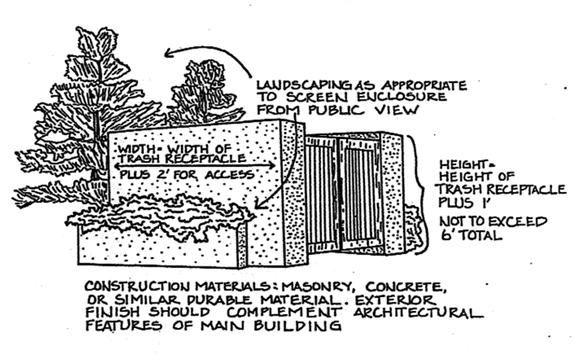
Screening of Refuse Storage Areas. Outdoor trash receptacles for clustered or attached single-family, multiple-family, and nonresidential uses shall be of sufficient size to accommodate the trash and recyclable materials generated by the uses on the parcel(s) being served. All outdoor storage of trash, garbage, refuse, and other items or material intended for discarding or collection shall be screened from public view on at least three sides by a solid decorative wall compatible with the project's architecture not less than five feet in height or, alternatively, such other material or design approved by the architectural review committee. The fourth side contains a gate, which shall be maintained in working order and remain closed except when in use.
D.
Screening of Equipment.
1.
Ground-Mounted Equipment. Equip-ment location shall be away from the front of the building, and screening must be similar to adjacent architecture and materials.
2.
Roof-Mounted Equipment.
a.
All roof screens must be solid and continuous. Equipment must be covered by continuous grills or louvers.
Figure 16.48.130-A
Trash Enclosure Standards
(Prior code § 9-10.120)
16.48.140 - Solar energy design.
A.
Purpose and Intent. These provisions are intended to incorporate, to the extent feasible, passive heating and cooling opportunities into the design or modifications of residential, commercial, and industrial developments. They are further designed to ensure that solar energy systems in residential, commercial, and industrial areas conform in appearance to the surrounding neighborhood.
B.
Design Requirements.
1.
Active Solar Design. Notwithstanding any provisions included in this title related to screening roof-mounted equipment, the following standards shall apply to the design of all solar energy systems:
a.
Roof-mounted solar collectors shall be placed in the location least visible from a public right-of-way without reducing the operating efficiency of the collectors. Wall-mounted and ground-mounted solar collectors shall be screened from public view.
b.
When feasible, collectors shall be integrated into the design of the building. Structural support for the collectors shall be screened in a manner that is compatible with the design of the building.
c.
Appurtenant equipment, including plumbing and related fixtures, shall be installed in an attic or basement, where feasible.
d.
Large accessory fixtures which must be exposed (e.g., storage tanks) shall be screened where possible through architectural features that harmonize with other design elements of the structure.
e.
Storage tanks shall not be located in any required front or side yards nor shall they be visible from any public right-of-way.
f.
Exterior surfaces shall have a matte finish, and shall be color-coordinated to harmonize with roof materials or other dominant colors of the structure.
g.
Any pool or spa facilities other than those intended for a single family detached residence shall be provided with a solar cover or solar water heating system.
2.
Passive Solar Design.
a.
All development shall provide, to the extent feasible, for future passive or natural heating or cooling opportunities in the development. Examples of passive or natural heating opportunities in subdivision design, or within other residential, commercial or industrial development for which a subdivision is not involved, include, but are not limited to:
i.
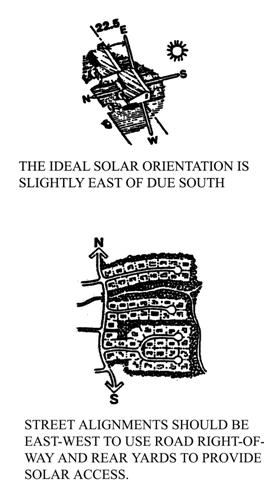
Design of lot size and configuration to permit orientation of structures in an east-west alignment for southern exposure;
ii.
Design of lot size and configuration to permit orientation of a structure to take advantage of shade or prevailing breezes.
b.
In providing for future passive or natural heating or cooling opportunities in the design of a development, consideration shall be given to local climate, contour, configuration of the parcel to be developed, and to other design and improvement requirements. However such provisions shall not result in reducing allowable densities or the applicable planning and zoning in force at the time the development application is filed.
c.
The requirements of this section do not apply to condominium projects which consist of the subdivision of airspace in an existing building when no new structures are added.
(Prior code § 9-10.130)
16.48.150 - Storage.
The following outdoor storage regulations shall apply in addition to other standards and requirements of the various districts established by this title:
A.
Material storage yards, junk yards, and salvage yards shall not be permitted in any district unless expressly specified by the regulations governing such district.
B.
The accumulation and storage of abandoned, wrecked, dismantled or inoperative vehicles, or parts thereof, on private or public property is not permitted in accordance with the provisions of Chapter 10.20.
C.
The accumulation and storage of garbage, refuse, rubbish, junk, or any other waste material shall not be permitted in accordance with the provisions of Chapter 8.32.
(Prior code § 9-10.140)
16.48.160 - Utility meters.
For any lot zoned for multiple family or single-family uses, a secondary dwelling unit may, but is not required to, have an electric, gas, or water meter, or sewer lateral, separate from the primary residence.
(Prior code § 9-10.150)
(Ord. No. 645, § 3, 8-28-2012)
16.48.170 - Structures and fences located within three feet of other habitable structures.
No structure or fence, or any portion thereof, may be located, placed or expanded within three feet of any legally nonconforming habitable structure on any adjacent property zoned for residential use.
(Ord. No. 645, § 4, 8-28-2012)
16.48.180 - Rooftop decks.
A.
Purpose and Intent. The purpose of these regulations is to ensure that new rooftop decks constructed in the city conform to the scale and character of the neighborhood in which they are located and do not unnecessarily or unreasonably infringe upon the privacy of adjacent properties.
B.
Definition. Any deck supported by a structure, with no portion cantilevered past the exterior walls of the structure it exists upon.
C.
Applicability. All rooftop decks shall comply with the design standards listed in subsection (D). Rooftop decks constructed above a second story may be permitted only with the approval of a minor use permit - viewshed review. Rooftop decks constructed above a single story are exempt from the minor use permit - viewshed review requirement.
D.
Design Standards for Rooftop Decks.
1.
Side Yard Setback. If constructed above a second story, the rooftop deck shall be setback an additional minimum of five feet from applicable side yard setbacks.
2.
Front and Rear Yard Setback. If constructed above a second story, the rooftop deck shall be setback an additional minimum of five feet from applicable front and rear yard setbacks.
3.
Rooftop Deck Access. Access to the rooftop deck shall be architecturally integrated into the structure and shall be located in such a way to minimize visual impact to neighboring properties. Interior access or concealed exterior access is encouraged.
4.
Maximum Height. Guards or guardrails as defined in the building code shall be required of all rooftop decks and shall count towards the maximum height of a structure. Furniture and other accessory items shall also count towards the maximum height of a structure. Rooftop deck guards and associated accessory items shall not exceed the maximum height identified in development standards of the underlying zoning district.
5.
Lighting. Lighting shall be designed to prevent unnecessary or excessive lighting impacts onto neighboring properties. Rooftop decks with proposed lighting shall include a lighting plan in submittals demonstrating conformance with this standard.
(Ord. No. 688, § 3, 10-24-2017)

