
Arroyo Grande City Zoning Code
CHAPTER 16
60 - SIGNS
16.60.010 - Purpose and intent.
Signs have an obvious impact on the character, quality of life and economic health of the city. As a prominent aspect of the scenery, they either attract or repel the viewing public, and may affect the safety of vehicular and pedestrian traffic. Their suitability and appropriateness helps define the character of a neighborhood and the larger community. The purpose of this chapter is to regulate signs in a manner that will benefit the public and maintain a high quality of development throughout the city. The regulations contained in this chapter are intended to:
A.
Direct persons to various activities and enterprises in order to provide for the maximum public convenience;
B.
Provide a reasonable system of regulations for signs in order to ensure the development of a high quality visual environment;
C.
Encourage signs that are well designed and pleasing in appearance, recognizing that a well-designed sign enhances a business's image and economic vitality;
D.
Provide incentive and latitude for variety, good design relationships, and spacing of signs;
E.
Encourage a desirable urban character that has a minimum of overhead clutter;
F.
Enhance the economic value of the community and each area thereof through the regulation of such things as size, number, location, design and illumination of signs;
G.
Encourage signs that are compatible with adjacent land uses and that provide pedestrian-scale atmosphere;
H.
Reduce possible traffic and safety hazards through good signage;
I.
Ensure the maintenance of signs; and
J.
Implement the community design goals, objectives, policies and programs of the general plan, design guidelines for historic districts, and other applicable city guidelines and ordinances.
This chapter establishes the legal framework for a comprehensive system for the regulation of signs. It presents a set of reasonable, nonarbitrary, and nondiscriminatory standards and controls that are designed to optimize communication between the citizens and their environment, to facilitate the protection not only of the public, but the aesthetic character of the city, and to ensure the availability to the community of adequate, high quality signs.
(Ord. 590 § 2, Exh. A (part), 2007)
16.60.020 - Administration.
Unless expressly exempted in this chapter, no sign may be erected, displayed, reconstructed or altered until a permit is approved as set forth in Sections 16.16.170, 16.16.180, 16.16.190 and 16.16.200 of this title and a building permit has been issued or building department clearance has been received.
The four separate methods of planning review are established for the following reasons:
A.
To provide a means of review appropriate to the magnitude of the proposed signage;
B.
To recognize the planned character of large or multitenant centers;
C.
To provide a means of flexible application of the sign regulations so as to encourage maximum incentive and latitude in the design and display of signs in order to achieve, not circumvent, the intent of this chapter.
1.
Planned Sign Program. Planned sign programs shall be processed in accordance with Section 16.16.190 of this title. A planned sign program shall be required for the following:
a.
Multitenant developments of nine or more separate, permitted uses, that share either the same legal parcel or building and use common access and parking facilities;
b.
Projects or developments with a total aggregate sign area exceeding one hundred fifty (150) square feet;
c.
Ground signs between twenty (20) and fifty (50) feet high;
d.
Two or more contiguous legal parcels may be combined for purposes of calculating sign area and number, with the permission of the property and business owners and at the written request of the sign applicants.
The purpose of a planned sign program shall be to integrate signs with building and landscape design into a unified architectural unit, and to ensure the magnitude of the proposed signs is consistent with existing and proposed buildings and the character of the area within which the signs are proposed. This shall be achieved by:
i.
Requiring that sign colors be generally compatible with building color;
ii.
Using the same type of cabinet supports or method of mounting for signs of the same type; by using the same type of construction material for components, such as sign copy, cabinets and supports; or by using dissimilar signing that is determined by the approval authority to be compatible;
iii.
Using the same form of illumination for all signs, or by using varied forms of illumination that have been determined by the approval authority to be compatible; and
iv.
Requiring that signs not overpower buildings, and be of appropriate scale and character with existing signs in the general area.
2.
Administrative Sign Program. Administrative sign programs shall be processed in accordance with Section 16.16.180 of this title. An administrative sign program shall be required for the following:
a.
Multitenant developments of two to eight separate, permitted uses that share either the same legal parcel or building and use common access and parking facilities;
b.
Projects or developments with a total aggregate sign area exceeding one hundred (100) square feet but less than one hundred fifty (150) square feet;
c.
Ground signs between eight and twenty (20) feet high;
d.
Minor tenant signs in older multitenant developments (regardless of the number of tenants) without an established planned sign program.
3.
Administrative Sign Permit. All signs not required to have a planned sign program or administrative sign program must receive approval of an administrative sign permit if not exempt by Section 16.60.050. Administrative sign permits shall be processed in accordance with Section 16.16.170 of this title.
4.
Mural Permit. No murals shall be painted without the approval of a mural permit in accordance with Section 16.16.200 of this title. Murals are not considered signs and shall not include the name, logo, or other representation that advertises a business, product, service or other commercial activity. Murals are considered a means to enhance the architecture or aesthetics of a building or wall and not a form of advertisement. If a mural is proposed that contains advertising materials, it shall be treated as a sign and reviewed pursuant to subsection (C)(1), (C)(2), or (C)(3) of this section and shall comply with Table 16.60.040-A. The mural permit process allows city review of murals to ensure that size, location and placement is consistent with the character of the district within which it is located; the character of the building or wall upon which it is placed; and that the mural is not detrimental to the public health, safety or welfare.
(Ord. 590 § 2, Exh. A (part), 2007)
16.60.030 - General provisions.
Unless exempt by Section 16.60.050, off-site signs shall not be allowed. Signs may be erected, altered and maintained only for those uses permitted in the zone in which they are located. Signs shall be located on the same legal parcel as the permitted use and shall be clearly incidental, customary and commonly associated with the operation of the permitted use. For the purposes of this chapter, a shopping center shall be considered a single parcel regardless of whether the center is comprised of more than one legal parcel.
A.
Determining the Number of Signs.
1.
For the purpose of determining the number of signs, a sign shall be considered to be a single display surface or display device containing sign faces physically connected and having a coterminous boundary, with the following exception: combination canopy and under-canopy signs shall be considered as one sign.
2.
A two-sided or multisided sign shall be regarded as one sign subject to the following:
a.
A "V-type" sign shall be regarded as a single sign only if the two sides are separated by no more than three feet at any point.
b.
Double-faced (back-to-back) signs shall be regarded as a single sign only if the distance between the backs of each face of the sign does not exceed two feet.
B.
Computation of Sign Surface Area and Height.
1.
All Signs Except Awning Signs.
a.
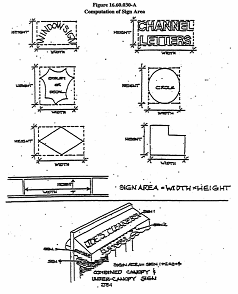
The surface area of a sign shall be the total number of square feet calculated by enclosing the extreme limits of the writing, logo, representation, emblem, or other display, together with any frame, background area, structural trim, or other material or color forming an integral part of the background of the display or used to differentiate the sign from the backdrop or surface against which it is placed, within a single continuous perimeter composed of circles, squares or rectangles. The surface area of spherical signs shall be the actual sign surface area calculated by the following formula: Area = 12.56 x r 2 ; where r = radius of the sphere. See Figure 16.60.030-A for an illustration of how surface area is calculated. Notwithstanding Figure 16.60.030-A, the community development director may allow an increase in sign area in rough proportion to the open area in a sign not comprised of squares or rectangles.
b.
Supporting framework or bracing that is clearly incidental to the display itself shall not be included as sign surface area.
c.
If the sign consists of more than one section or module, all of the area, including
the area between the sections of modules, shall be included in the computation of sign surface area. Sections or modules must touch one another to count as one sign.
d.
For multisided signs, the sign surface area shall be computed by including the total area of all sides designed to attract attention or communicate information.
e.
For two-sided signs, the sign surface area shall be computed by including the total area of only one side; provided, that double-faced (back to back) signs have a distance of two feet or less between the backs of each face; or provided, that faces of "V-type" signs are separated by no more than three feet at any point.
2.
Awning or Canopy Signs.
a.
The sign surface area of a canopy or awning sign shall be calculated by enclosing the extreme limits of the writing, logo, representation, emblem, or other display within a single continuous perimeter composed of circles, squares or rectangles.
b.
If more than one surface of the awning or canopy is utilized for signage or if an under-canopy sign is attached to the main canopy, the aggregate sign area shall be calculated by totaling the surface area of each surface.
3.
Height of Signs. The height of a sign shall be determined by measuring the distance from the average adjacent ground level within five feet of the base of the sign to the top of the sign.
Figure 16.60.030-A
Computation of Sign Area
C.
Illumination of Signs.
1.
All sign illumination shall be from the interior or by indirect lighting that shall be turned off after business hours, or at ten (10) p.m., whichever is later.
2.
Neon tubing as a sign material shall be permitted to the extent that it composes twenty (20) percent or less of the total allowable sign surface area for the use as set forth in Table 16.60.040-A. Neon tubing used as an architectural detail is prohibited in the village core and village mixed use districts. Neon tubing as an architectural detail may be used in limited quantities in the other mixed-use districts subject to approval as part of a sign application or architectural review. All neon tubing used as an architectural detail shall be integrated into the design of the building. Visible neon tubing outlining the interior of a window shall be considered a sign.
D.
Projecting Signs and Sign Clearances.
1.
All projecting signs, except awning or canopy signs, must be double-faced.
2.
An encroachment permit from the city engineer is required for signs that project more than two inches over the public right-of-way.
3.
Projection Allowed.
a.
No awning or canopy sign may project more than six feet over a public right-of-way.
b.
No projecting sign may project more than six feet over a public right-of-way; however, the sign itself may not occupy more than four feet of the projection. The remaining two or more feet may be a gap between the building wall and the sign or the distance between the edge of the sign and the sign support.
c.
The outside face of a wall sign may extend no more than twelve (12) inches from the surface of a building or wall.
4.
All signs that project more than two inches over a public right-of-way shall have a minimum height clearance of seven feet.
5.
No permit for any sign shall be issued and no sign shall be constructed or maintained that has less horizontal or vertical clearance from communication lines and energized electrical power lines than that prescribed by the laws of the state of California or rules and regulations duly promulgated by agencies thereof.
E.
Accessory Signs. Signs that advertise products sold or services provided on the premises, such as beer signs or an automated teller machine (ATM) signs, shall be considered accessory signs and do not count towards the permitted signage listed in Table 16.60.040-A if they are restricted to ten (10) percent or less of the wall area on which it is placed. Accessory signs between ten (10) and twenty (20) percent of the wall area can be allowed with a recommendation from the architectural review committee, however areas greater than ten (10) percent shall be considered toward total permitted sign area. The design, number, location and size of accessory signs shall be reviewed and approved as part of an administrative sign permit, administrative sign program, or planned sign program by the architectural review committee if the following findings are made:
1.
The proposed general design, arrangement, texture, colors, and lighting placement are consistent with the purposes and regulations of this chapter and any applicable design guidelines; and
2.
The appropriateness of the proposed accessory signs are compatible with other signs and other structures on the premises and contiguous area and do not exceed twenty (20) percent of the wall area on which they are placed.
F.
Incidental and Supplemental Signs. Signs that are incidental or supplemental to the use of the property, such as drive through menu boards or vending machine signs do not count towards the permitted signage listed in Table 16.60.040-A if they are no larger than sixteen (16) square feet. Incidental and supplemental signs between sixteen (16) and thirty-two (32) square feet can be allowed with a recommendation from the architectural review committee, however areas greater than sixteen (16) square feet shall be considered toward total permitted sign area. Incidental or supplemental signs shall not be legible to a person of average eyesight standing on any property line. The design, number, location and size of incidental or supplemental signs shall be reviewed and approved as part of an administrative sign permit, administrative sign program, or planned sign program with the recommendation from the architectural review committee if the following findings are made:
1.
The proposed general design, arrangement, texture, colors, and lighting placement are consistent with the purposes and regulations of this chapter and any applicable design guidelines; and
2.
The appropriateness of the proposed signs are compatible with other signs and other structures on the premises and contiguous area.
G.
Portable Signs ("Sandwich Board Signs") that are allowed per Section 16.60.040, Table 16.60.040. A., must meet the following criteria:
1.
Portable signs cannot block doorway, access, or Americans with Disabilities access.
2.
Portable signs must be constructed from wood or plastic and have a professional appearance.
3.
Only one portable sign is allowed per business.
4.
Portable signs cannot be located on any public right-of-way.
5.
Portable signs that are proposed for a store or restaurant located in shopping centers must be located immediately adjacent to that business.
H.
Message Substitution. Subject to the property owner's consent, a noncommercial message of any type may be substituted, in whole or in part, for any duly permitted or authorized commercial message or any duly permitted or allowed noncommercial message, provided that the sign structure or mounting device is legal without consideration of message content. Such substitution of message, if in conformance with the originally approved sign design, may be made without any additional approval or permitting. In addition, on non-residential uses, any display area for permanent signs, which is unused, may be used for display of noncommercial messages on temporary signs for a maximum of sixty (60) days in any one calendar year. The purpose of this provision is to prevent any inadvertent favoring of commercial speech over noncommercial speech, or favoring of any particular noncommercial message over any other noncommercial message. This provision:
1.
Does not create a right to increase the total amount of permanent signage on a parcel, lot or land use;
2.
Does not affect the requirement that a sign structure or mounting device be property permitted;
3.
Does not allow a change in the physical structure of a sign or its mounting device;
4.
Does not allow the substitution of an off-site commercial message in place of an on-site commercial message or noncommercial message.
However, simple face changes not involving off-site commercial advertising or changes to the physical structure or mounting device of the sign may be made without further permitting when the sign structure has already been permitted and is in full compliance with all applicable laws, rules, and regulations.
(Ord. 590 § 2, Exh. A (part), 2007)
(Ord. No. 634, §§ 5, 6, 6-28-2011; Ord. No. 692, § 3, 5-22-2018)
16.60.040 - Permitted signs.
Table 16.60.040-A lists the sign regulations for different uses and specifies if planned sign program or administrative sign program review is required. In addition to the following regulations, the requirements of any applicable design guidelines shall be incorporated into the size, design and placement of signs.
Table 16.60.040-A
Standards for Signs Requiring Planning Permits
(Ord. 590 § 2, Exh. A (part), 2007)
16.60.050 - Exempt signs.
The following signs shall be exempt from the administrative sign permit, administrative sign program, and planned sign program requirements, and shall be permitted subject to the limitations contained in this section. A greater number of signs or signs of larger size than specified below shall be prohibited, unless elsewhere specifically permitted by, and an appropriate permit obtained consistent with, the provisions of this chapter.
A.
Temporary banners, decorations and searchlights in accordance with the following provisions:
1.
Banners.
a.
Shall not exceed twenty-four (24) square-feet.
b.
Shall be professionally printed on vinyl or plastic.
c.
Shall be firmly attached to the building, below the roofline.
d.
Shall be registered with the community development department prior to display.
e.
Shall not be displayed for more than thirty (30) days in any ninety-day period.
2.
Pennants, Balloons and Flags.
a.
Shall not contain any text or other advertising message.
b.
Shall not be displayed for more than three days in any thirty-day period.
3.
Searchlights.
a.
Shall be directed upwards into the sky and not at any point on land.
b.
Shall not be displayed for more than three (3) days in any thirty-day period.
B.
Permanent window signs provided that all of the following are met:
1.
The total area of such signs does not exceed twenty (20) percent of the window area.
2.
The sign is no greater than twenty-four (24) square-feet.
3.
Signage is limited to street-facing windows.
C.
Real estate signs for sales, rental or lease subject to the following regulations:
1.
Residential dwellings offered for sale, rent or lease on an individual basis not in association with a subdivision or apartment complex, one sign per separate street frontage not exceeding six square feet each and six feet in height. Such signs shall be removed within ten (10) calendar days after the sale has been closed or the property has been rented or leased. Signs shall not create sight distance hazards.
2.
One sign per street frontage to advertise the sale, lease or rent of commercial or industrial property, provided all of the following are met:
a.
Such signs shall have a maximum area of thirty-two (32) square feet each, and be no greater than eight feet in height.
b.
Signs shall not create sight distance hazards for pedestrians or vehicles.
c.
Such signs shall be removed within ten (10) calendar days of the close of the sale or termination of the lease or rental agreement.
d.
Where a project has in excess of six hundred (600) lineal feet of street frontage, one additional sign shall be permitted for each full six hundred (600) lineal feet of street frontage.
D.
Subdivision signs subject to the following regulations:
1.
Off-site unlighted signs advertising subdivisions within the city, containing only the name of the subdivision, the name of the developer and/or agent, an identification emblem and a directional arrow shall be permitted, provided:
a.
There shall be no more than three such signs located within the city limits for each subdivision. Signs must be located on private property.
b.
The total area of each sign shall not exceed thirty-two (32) square feet.
c.
The total height of each sign shall not exceed eight feet.
d.
Directional subdivision signs may be displayed during the two years following the date of recordation of the final map or until ninety (90) percent of the lots have been sold, whichever is earlier.
2.
One on-site subdivision sign per subdivision entrance shall be permitted provided the total area per sign is not greater than thirty-two (32) square feet and sign height does not exceed eight feet. Such on-site signs shall be permitted to remain only as long as a sales office is maintained in the subdivision or until ninety (90) percent of the lots have been sold and provided that such signs are maintained in good condition as determined by the building official.
E.
Architect, contractor or construction signs, providing the name of architect(s) and/or contractor(s) working on the site, subject to the following:
1.
For residential projects greater than four dwelling units, up to two signs may be placed on the construction site; provided, that the total area of each sign shall not exceed twelve (12) square feet, maximum height shall be six feet, and the sign is located no closer than ten (10) feet to any property line.
2.
For commercial and industrial projects, up to two signs may be placed on the construction site; provided, that the total area of each sign shall not exceed thirty-two (32) square feet, maximum height shall be six feet, and the sign is located no closer than ten (10) feet to any property line.
3.
For all other projects, a total of two signs may be placed on the construction site, provided that the total area of each sign shall not exceed eight square feet, maximum height six feet, and the sign is located no closer than five feet to any property line.
F.
Future tenant identification sign to advertise the future use of an approved project on the property may be placed on vacant or developing property to give the location where information may be obtained, subject to the following:
1.
Only one future tenant identification sign per parcel may be permitted.
2.
Future tenant identification signs shall be limited to a maximum of thirty-two (32) square feet and four feet in height.
3.
The sign shall be placed no closer than ten (10) feet to any property line.
4.
Such signs shall not be erected until a building permit is issued for the development and shall be removed within one year from the date of the building permit.
5.
Where a project has in excess of six hundred (600) lineal feet of street frontage, one additional future tenant identification sign shall be permitted for each full six hundred (600) lineal feet of street frontage.
G.
Residential Signs.
1.
Multiple-family residential building identification signs limited to address and building number or letter. One wall sign per building frontage located below the roof line, limited to a maximum area of two square feet and a maximum letter height of four inches.
2.
Residential name plate: one name plate per parcel for single-family residential or agricultural uses, limited to a maximum area of two square feet and a maximum letter height of four inches.
H.
Agricultural signs identifying agricultural products grown or raised on the premises subject to the following:
1.
The number of such signs shall be limited to one per street frontage.
2.
If wall mounted, the sign shall be located below the roof line.
3.
Freestanding signs shall be no higher than six feet.
4.
Each sign shall have an area no greater than sixteen (16) square feet and shall be erected only during the growing and harvest season.
I.
Temporary Noncommercial Signs.
1.
Limited to a maximum of one sign per property, no larger than six square feet, four feet in height as measured from the ground underneath the sign, placed on private property with the express consent of the property owner, and directly affixed to the ground, located on, or located in the window of a permanent structure, and which comply with all other applicable provisions of this chapter.
2.
Up to two times per year, additional temporary noncommercial signs are permitted, with increases in sign size of no larger than sixteen (16) square feet, limited to sixty (60) days in duration. These times are typically, but not required to be, during any "election period", which shall mean the period before any national, state, or local election in which city electors may vote, up through the date of the election.
J.
Government and noncommercial flags: an official flag, except when displayed in connection with commercial promotion; provided, that such flags are no greater in size than ten (10) feet by fifteen (15) feet or as approved with a recommendation from the architectural review committee.
K.
Miscellaneous Signs.
1.
Interior signs completely within a building when not visible or readable or intended to be read from off-site or outside of the building or structure;
2.
Memorial tablets, plaques, or directional signs for community historical and cultural resources installed by the city or by a city-recognized historical society or civic organization;
3.
Official and legal notices issued by any court, public body or officer, or in furtherance of any nonjudicial process by federal, state or local laws;
4.
Public utility signs indicating danger or that serve as an aid to public safety, or that show locations of underground facilities or public telephones;
5.
Safety signs on construction sites;
6.
Public transportation vehicle signs, including, but not limited to, buses and taxi cabs;
7.
Signs on licensed commercial vehicles that are not used or intended for use as portable signs and that are not specifically prohibited by the provisions of this chapter;
8.
Change of copy within an approved planned sign program or administrative sign program that conforms to the provisions of the approved sign program;
9.
Holiday decorations to celebrate nationally recognized holidays and local celebrations;
10.
Vehicle-oriented convenience and directional signs solely for the purpose of guiding traffic and parking on private property, and not bearing advertising material, limited to a maximum area of two square feet and a maximum letter height of four inches;
11.
Directional, warning or informational signs as required or authorized by law or by any federal, state, county special district or city authority and "No Trespassing," "No Parking," "Neighborhood Watch" and similar warning signs, limited to a maximum area of two square feet and a maximum letter height of four inches;
12.
Incidental signs for auto-related uses, motels and hotels that show notices of services provided or required by law, trade affiliations, and credit cards accepted, provided such signs are attached to an otherwise approved ground sign, structure or building and limited to a maximum area of eight square feet and a maximum letter height of four inches;
13.
"Open" and "Closed" signs: one sign per entrance no larger than one square foot in area;
14.
Automobile service stations are permitted to have the following additional signs, provided they conform to the height and setback requirements of the district in which they are located:
a.
State-authorized testing centers. Four square feet per sign, wall mounted only,
b.
Price signs: one single- or double-faced sign per street frontage, twenty (20) square feet maximum per face. This exception is intended to allow for full compliance with state law for posting of gasoline prices. Portable price signs are not permitted,
c.
Pump signs: one sign for each gas pump unit not to exceed two square feet per pump face or one sign per bank of pumps, not to exceed eight square feet per face, identifying the gasoline brand and rating only.
15.
City-sponsored civic signs for community entrance, identification, direction or information.
L.
Banners in accordance with the provisions of the design guidelines and standards for design overlay district (D-2.11)—Traffic Way and Station Way.
M.
Any sign as determined by the community development director to be similar in use and size to the signs listed above.
(Ord. 590 § 2, Exh. A (part), 2007)
(Ord. No. 634, §§ 2, 3, 6-28-2011; Ord. No. 645, § 6, 8-28-2012; Ord. No. 692, § 4, 5-22-2018)
16.60.060 - Prohibited signs.
A.
Any sign not in compliance with the provisions of this code. Potential violations shall be processed pursuant to development code Section 16.08.100.
B.
Roof signs extending above the eave or parapet line, except when, in the opinion of the architectural review committee, the sign is a complementary architectural feature of the building. This provision does not apply to integral roof signs.
C.
Flashing signs, except time and temperature signs specifically permitted pursuant to a site development approval, such as but not limited to architectural review, plot plan review, conditional use permit review; or sign approval.
D.
Animated signs conveying the illusion of or actual motion.
E.
Revolving or rotating signs.
F.
Signs emitting audible sounds, odors or visible matter.
G.
Vehicle-mounted commercial signs when parked or stored on property or within the public right-of-way to identify a business or advertise a product.
H.
Portable signs not specifically permitted by the provisions of this chapter.
I.
Off-site signs not specifically permitted by the provisions of this chapter.
J.
Signs within the public right-of-way except those required by a governmental agency.
K.
Signs within the public right-of-way (including planted strips, tree wells, fences, and street medians), on public property or in any location which interferes with vehicular, bicycle, or pedestrian circulation or safety.
L.
Signs in proximity to utility lines that have less horizontal or vertical clearance from authorized communication or energized electrical power lines than that prescribed by the laws of the state of California, or rules and regulations duly promulgated by agencies thereof.
M.
Signs blocking door or window openings or fire escapes.
N.
Outdoor signs containing light bulb strings outside of the building, except for temporary uses such as, but not limited to, Christmas tree lots, carnivals, and other similar uses subject to prior approval of a temporary use permit.
O.
Sail or wing signs.
P.
Inflatable advertising devices, including hot air balloons unless approved through the temporary use permit process upon the recommendation of the architectural review committee.
Q.
Statuary (statues or sculptures) advertising products or logos of the business that are located outside of the structure that houses the business.
R.
Electric reader board signs that are not exempt by virtue of being interior signs, and that are not otherwise specifically permitted by the provisions of this chapter.
S.
Signs that purport to be or are an imitation of or resemble official traffic warning devices or signs that, by color, location or lighting, may confuse or disorient vehicular or pedestrian traffic. This prohibition shall not include traffic or directional signs installed on private property to control on-site traffic.
T.
Signs in connection with a home occupation.
U.
Strobe or revolving lights used as an attention-getting device.
V.
Off-site commercial signs, including those within the public right-of-way, held or supported by a person.
(Ord. 590 § 2, Exh. A (part), 2007)
(Ord. No. 634, § 4, 6-28-2011)
16.60.070 - Revisions.
Revisions to existing signs shall be processed as follows:
A.
Revisions to Planned Sign Programs.
1.
If the project consists of nine or more tenants or has a total aggregate sign area of more than one hundred fifty (150) square feet and revisions are proposed that increase the total number of signs by more than ten (10) percent or increase the sign area for a tenant by more than ten (10) percent, the revision shall be proposed pursuant to the provisions of a planned sign program.
2.
If the project consists of nine or more tenants or has a total aggregate sign area of more than one hundred fifty (150) square feet and revisions are proposed that increase the total number of signs by less than ten (10) percent and increase the sign area for a tenant by less than ten (10) percent, the revision shall be processed pursuant to the provisions of an administrative sign program.
3.
If the project consists of eight or fewer tenants with a total aggregate sign area of less than one hundred fifty (150) square feet, the revision shall be processed pursuant to the provisions of an administrative sign permit.
B.
Revisions to Administrative Sign Programs.
1.
If revisions are proposed that increase the total number of signs by more than ten (10) percent or increase the sign area for a tenant by more than ten (10) percent, the revision shall be processed pursuant to the provisions of an administrative sign program.
2.
If revisions are proposed that increase the total number of signs by less than ten (10) percent and increase the sign area for a tenant by less than ten (10) percent, the revision shall be processed pursuant to the provisions of an administrative sign permit.
C.
Administrative Sign Permit. Revisions to administrative sign permits require a new administrative sign permit and shall be processed pursuant to the provisions of Section 16.60.020.
D.
Nonconforming Signs. Signs existing prior to February 13, 1987 that do not comply with the provisions of this chapter shall be regarded as nonconforming signs and the following provisions apply:
1.
Historical Signs. Upon written request by a sign owner, the city council may determine that a sign is historical based on the following findings:
a.
The sign is more than forty (40) years old or represents an important period in the city's history;
b.
The design of the sign is unique because its shape, colors, materials, or other aspects of sign design are indicative of the historical period within which it was constructed; or
c.
The design of the sign is unique because it is integrated into the design of an historical building and removal of the sign would jeopardize the historical integrity of the building.
Historical signs may be maintained, reconstructed, modified or expanded consistent with the historical nature of the sign through the administrative sign permit process. New signs proposed on the property shall comply with this title and shall be complementary to the historical sign.
2.
Signs not qualifying for historical status shall be permitted to remain until such time as:
a.
There is a change in the use of the property on which the sign is located and discretionary approval for the change of use is required;
b.
There are alterations or enlargements to the site or building on the property in excess of twenty-five (25) percent or more of the existing site or building. The amount of alterations shall be cumulative over time; or
c.
Expansion, movement or modification of the sign. A change of copy or normal maintenance and repair does not constitute grounds for modification of a nonconforming sign.
3.
Any business with a nonconforming sign shall not be entitled to any additional signs unless the nonconforming sign is made to comply with the provisions of this chapter. This subdivision shall not apply if the existing nonconforming sign is located within the same commercial complex but at a different business location, or if the existing nonconforming sign is not owned or controlled by the sign permit applicant, or if the applicant is not the agent of the business that owns or controls the existing nonconforming sign.
(Ord. 590 § 2, Exh. A (part), 2007)
16.60.080 - Abandoned signs.
A.
Any sign that pertains to a business or occupation, which is no longer using the particular property or which relates to a time or event that no longer applies, constitutes false advertising/identification. In such case the sign copy shall be removed within thirty (30) days and the sign structure within ninety (90) days after the associated business or occupation has vacated the property or the associated event has ended. An abandoned sign is prohibited and the sign removal shall be the joint responsibility of the owner of the sign and the owner of the property.
B.
Any sign copy that no longer identifies the subject matter for which it was intended shall be removed or changed by the owner of the sign or the owner of the property upon which it is located within thirty (30) days of the event causing the improper identification. The structure shall be removed or replaced subject to the appropriate approvals required by this chapter.
(Ord. 590 § 2, Exh. A (part), 2007)
16.60.090 - Signs required to be removed.
Signs that are not removed in the specified time periods pursuant to the provisions of this chapter shall constitute a nuisance, and shall be subject to removal under the provisions of this title.
(Ord. 590 § 2, Exh. A (part), 2007)
16.60.100 - Construction specifications and safety.
A.
Compliance with Building Code. All signs shall comply with all applicable provisions of this code, including, but not limited to, the California Building Code relative to design and construction, structural integrity, connections and safety. Signs shall also comply with the provisions of all applicable electric codes and the additional construction standards set forth in this section.
B.
Construction of Signs.
1.
All signs shall be structurally safe; shall be made of rust inhibitive materials; and shall be fabricated, constructed, erected or installed and maintained in such a manner as will comply with the provisions of this code.
2.
Each sign hereafter erected or remodeled shall bear, in a permanent position, clearly legible identification decals stating the firm or corporation responsible for its construction and erection. Electric signs shall be marked with input amperages at the full load input.
3.
No sign shall be attached in any form, shape or manner that will interfere with an opening required for ventilation, except in circumstances when not in violation of the building or fire codes.
4.
Signs shall be located in such a way that they maintain horizontal and vertical clearance of all overhead electrical conductors in accordance with the electrical code and the regulations of the affected entity and the public utilities commission.
5.
Certain signs may be required to be properly guttered and connected with down spouts to storm drains so that water will not drip or flow into public sidewalks or streets.
6.
All permanent freestanding signs or poles shall be self-supporting structures erected on and permanently attached to concrete foundations. Such structures or poles shall be fabricated only from steel or other such materials as approved by the building official.
7.
All signs shall be constructed to withstand wind loads, acceptable to the building official.
8.
No sign shall be suspended by chains or other devices that will allow the sign to swing due to wind action. Signs shall be anchored to prevent any lateral movement that would cause wear on supporting members or connections.
C.
Maintenance of Signs.
1.
Every sign and all parts, portions, components and materials thereof shall be maintained and kept in good condition and proper repair. The display surface of all signs shall be kept clean, neatly painted, and free from rust and corrosion. Any cracked or broken surfaces and malfunctioning or damaged portions of a sign shall be repaired or replaced within thirty (30) calendar days following notification by the city. Noncompliance with such a request shall constitute a nuisance and may be abated in accordance with the provisions of this code.
2.
Any maintenance, except a change of copy not specifically exempted, shall be permitted.
(Ord. 594 § 21, 2007; Ord. 590 § 2, Exh. A (part), 2007)

