
Arroyo Grande City Zoning Code
CHAPTER 16
56 - PARKING AND LOADING REQUIREMENTS
16.56.010 - Purpose and intent.
The purpose of this chapter is to ensure the adequate provision of parking facilities proportionate to the needs created by the various land uses within the city. In providing adequate parking facilities, it is the intent of this chapter to:
A.
Alleviate or prevent on-site and off-site traffic congestion and hazards;
B.
Ensure the maneuverability of emergency and service vehicles;
C.
Provide safe, accessible, convenient, attractive, and well-maintained off-street parking areas;
D.
Protect residential neighborhoods from the effects of vehicular noise and traffic by uses in adjacent nonresidential districts; and
E.
Implement general plan circulation and energy conservation policies.
(Prior code § 9-12.010)
16.56.020 - Applicability.
A.
General Requirements. Off-street parking facilities shall be provided prior to occupancy of any structure hereafter built, enlarged, or altered in use, except as provided in subsection B of this section. Such parking shall be permanently available and marked and maintained for parking purposes.
1.
Building or other permits will be issued only after receipt of site plans clearly showing the design, location, number and dimensions of parking facilities and appurtenant features, according to the provisions of this chapter and construction standards of the city.
2.
Where it is not feasible to provide sufficient on-site parking on a parcel when a change or expansion in use is proposed in an existing building, approval of a minor exception request shall be required. Concurrent processing of all related applications shall occur in accordance with Section 16.12.070 of this title.
3.
For all development other than a single-family residence, where it is not feasible to provide sufficient on-site parking on a parcel when an addition or enlargement of an existing building is proposed, approval of a conditional use permit application shall be required for consideration of alternatives including, but not limited to, shared parking or public transit. Where it is not feasible to provide sufficient on-site parking on a parcel when an addition or enlargement of an existing single-family residence is proposed, approval of a minor exception request shall be required. Concurrent processing of all related applications shall occur in accordance with Section 16.12.070 of this title.
B.
Village Parking and Business Improvement District. For the area within the boundaries of the parking and business improvement area for the village, off-street parking facilities or the payment of in-lieu fees, as established by resolution, shall be provided as follows:
1.
Outdoor dining areas, limited to twenty-five (25) percent or less of the total gross square footage of the enclosed area of gross floor area accessible to the public use, shall be excluded from the requirements to provide off-street parking facilities or to pay in-lieu fees. For the purposes of calculating off-street parking requirements, outdoor dining area must be non-air-conditioned or heated and without wall enclosures. Any outdoor dining area in excess of twenty-five (25) percent of the total gross square footage of the enclosed area of gross floor area accessible to the public use shall be required to provide only the additional number of parking spaces for the incremental square footage over the twenty-five (25) percent.
2.
Existing buildings that are remodeled or enlarged shall not be required to provide parking if the increase in the square footage is less than three hundred (300) square feet. If the addition is greater than this amount, or if it is the construction of a new building, off-street parking shall be required consistent with the following:
a.
Off-street parking facilities consistent with requirements of Section 16.56.060;
b.
Payment of an in-lieu fee based on the total number of parking spaces required by Section 16.56.060; or
c.
A combination of off-street parking facilities and payment of an in-lieu fee may be permitted.
C.
Village Mixed Use and Historic Character Overlay District Combining District. For the area within the boundaries of the Village Mixed Use and Historic Character Overlay District (Design Overlay 2.4), off-street parking facilities or the payment of in-lieu fees, as established by resolution, shall be provided as follows:
1.
For changes in uses in existing buildings, additional off-street parking facilities required by a change of use may be reduced subject to a minor exception in accordance with Section 16.16.120(B)(5) by payment of in-lieu fees.
2.
Existing buildings that are remodeled or enlarged shall not be required to provide parking if the increase in the square footage is less than six hundred (600) sq. ft. If the addition is greater than this amount, or involves the construction of a new building, off-street parking shall be required consistent with the following:
a.
Off-street parking facilities consistent with requirements of Section 16.56.060; or
b.
A combination of off-street parking facilities and/or payment of an in-lieu fee may be permitted through a conditional use permit.
(Ord. 600 § 2, Exh. A (part), 2008; Ord. 557 § 3, Exh. C (part), 2004; Ord. 544 § 3, Exh. B (part), 2003; prior code § 9-12.020)
16.56.030 - Location.
All off-street parking facilities shall be located to the side or rear of buildings if feasible and be accessible and useable for the associated use or activity. Parking required shall be located on site, but not within any required front (street) yard nor upon any unpaved surface except on lawfully established driveways and without obstructing a public sidewalk, except as otherwise provided for in Section 16.56.050 of this chapter.
(Ord. 545 § 2, 2003: Ord. 544 § 3, Exh. B (part), 2003; Prior code § 9-12.030)
16.56.040 - Requirements for mixed occupancy developments.
When several uses occupy a single structure or parcel, the total required parking shall be the sum of the requirements for each individual use. Off-street parking facilities for one use shall not be considered as providing the required parking for any other use, except as specified under Section 16.56.050 for common parking facilities.
(Prior code § 9-12.040)
16.56.050 - Common parking facilities.
Common parking facilities may be provided in lieu of individual requirements if the total number of parking spaces is the sum of the requirements for individual uses and the parking facilities are located within five hundred (500) feet of the associated use.
1.
The total parking requirement may be reduced to eighty (80) percent of the required standard for shared uses; or seventy (70) percent of the required standard for shared uses if a parking study, prepared by a licensed engineer or architect, can clearly show that the shared uses have different hours of operation and would not conflict in their time of use. A conditional use permit shall be required to be reviewed and approved by the planning commission for such a reduction.
2.
As a condition of allowing common parking facilities, parties using common parking facilities shall provide evidence of such joint use by a proper legal agreement approved by the city attorney. Such agreements when approved shall be filed with the planning and building departments and recorded with the county recorder.
(Ord. 557 § 3, Exh. C (part), 2004; prior code § 9-12.050)
16.56.060 - Off-street parking requirements by land use.
The following off-street parking requirements shall apply to all buildings erected and new or expanded uses. Where the total requirements result in a fractional number, a fraction of 0.5 or greater shall be rounded to the higher whole number.
For any use not specifically set forth in this section, the planning commission shall determine the amount of required parking based upon similar uses, or evidence of actual demand based on traffic engineering or planning data. The applicant shall provide the necessary data and background information.
OFF-STREET PARKING REQUIREMENTS
(Ord. 600 § 2, Exh. A (part), 2008: Ord. 557 § 3, Exh. C (part), 2004; prior code § 9-12.060)
16.56.070 - Design and paving standards for off-street parking facilities.
A.
Dimensions of Parking Spaces.
1.
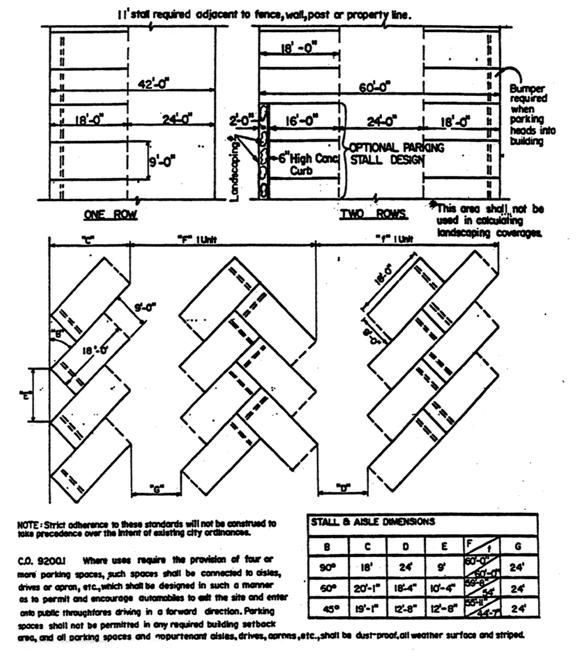
Automobile. The standard stall size is nine feet by eighteen (18) feet. Stalls shall be designed in accordance with city specifications (see Figure 16.56.070-B).
2.
Motorcycle Parking Spaces for Applicable Uses. Each motorcycle space shall have a minimum usable area of fifty-six (56) square feet.
3.
Handicapped Parking Spaces, All Applicable Uses. The number and size of handicapped spaces are specified in the California Building Code (part 2 of Title 24) Chapter 11. Each handicapped parking space shall be fourteen (14) feet wide, lined to provide a nine-foot wide parking area and a five-foot wide loading area, and shall be a minimum eighteen (18) feet in depth. If two handicapped spaces are located adjacent to each other, they may share the five-foot wide loading area, resulting in a width of twenty-three (23) feet for the two spaces (see Figure 16.56.070-A).
Figure 16.56.070-A
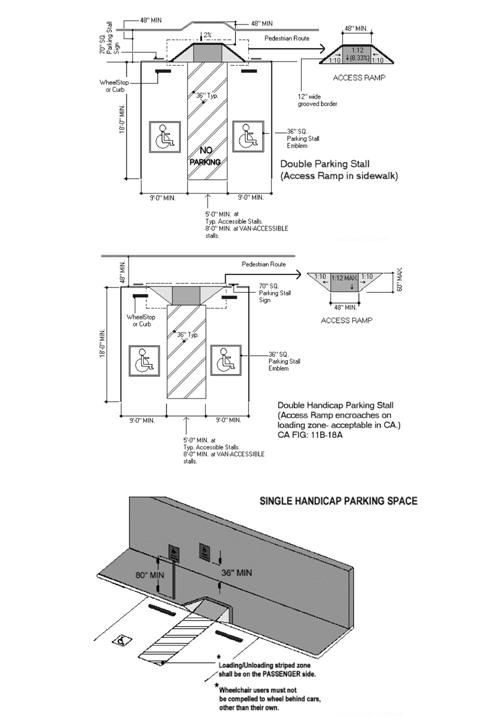
Figure 16.56.070-B
Specifications for Off-Street Parking
B.
Dimensions of Parking Bays and Aisles.
1.
Vehicular. The minimum dimensions of parking bays and maneuvering aisles shall be as set forth in Figure 16.56.070-B.
2.
Bicycle. A minimum aisle width of five feet shall be provided between rows of bicycle spaces.
C.
Standard Improvements.
1.
Directional Arrows and Signs.
a.
Within parking facilities containing twenty-one (21) or more spaces, all aisles, approach lanes, and maneuvering areas shall be clearly marked with directional arrows to simplify vehicular movement.
b.
In addition to directional arrows, the planning director may require installation of signs to ensure safe and efficient vehicular movement.
2.
Drainage. All parking facilities shall be graded and drained to dispose of surface water, subject to the approval of the city engineer. Oil separation devices may be required if feasible. Surfacing, curbing and drainage improvements shall be sufficient to prevent the free flow of water onto adjacent properties or public streets or alleys, and to avoid standing pools of water within the parking facility.
3.
Lighting.
a.
All parking facilities, except those serving two or fewer dwelling units shall be provided with night time security lighting.
b.
Parking area lighting shall be designed to reflect away from residential uses and motorists, and shall not create a glare or public nuisance to adjacent properties.
c.
Parking area lighting shall be of an energy-efficient type, such as, but not necessarily limited to, high or low pressure sodium lamps.
4.
Safety Features.
a.
Additional requirements and guidelines for parking facility safety, including design, internal layout, acceptable turning radii, pavement slope, vehicular and pedestrian circulation, and other design features may be adopted by the planning director when determined to be appropriate.
b.
Visibility of and between pedestrians, bicyclists and motorists shall be assured when entering individual parking spaces, when circulating within a parking facility, and when entering and exiting a parking facility. To the extent possible, the parking facility shall be designed so that primary pedestrian access to and from building entrances is along, rather than across parking aisles.
c.
Bicycle and automobile parking areas shall be separated by a physical barrier or sufficient identification and distance to protect parked bicycles from damage by cars.
5.
Shopping Cart Storage. Parking facilities serving uses that provide shopping carts, such as, but not necessarily limited to, supermarkets and drug stores, shall provide shopping cart storage areas. The dimensions and locations of such storage areas shall be determined by the approval body for the proposed use.
6.
Striping and Identification.
a.
All automobile parking spaces shall be clearly outlined with painted lines on the surface of the parking facility.
b.
All handicapped parking spaces shall be striped and marked according to applicable state standards.
c.
Each parking space reserved for the handicapped shall be identified by a permanently affixed reflecting sign, of a construction and material approved by the building official, displaying the international symbol of accessibility. The sign shall have a minimum size of seventy (70) square inches, and shall be centered at the interior end of the parking space at a maximum height of eighty (80) inches from the bottom of the sign to the finished grade of the parking space (see Figure 16.56.070-A).
d.
At each entrance to a parking facility containing one or more parking spaces for the handicapped, a sign with a minimum size of seventeen (17) inches by twenty-two (22) inches shall be posted, stating clearly and conspicuously in letters with a minimum height of one inch the following:
Unauthorized vehicles not displaying distinguishing placards or license plates issued for physically handicapped persons may be towed away at owner's expense.
e.
Parking spaces reserved for the handicapped shall have, in addition, to the requirements of subsection (C)(6)(c) of this section, a surface identification in blue paint of at least three square feet in size, duplicating the international symbol of accessibility.
f.
All motorcycle spaces shall have bollards installed and appropriately spaced so as to prevent automobile usage. Motorcycle spaces shall be marked so as to be clearly identified for motorcycle use.
7.
Surfacing.
a.
All permanent automobile and handicapped parking spaces, driveways, and maneuvering areas shall be paved and permanently maintained with asphalt or concrete to requirements.
b.
All bicycle parking and storage areas shall be surfaced so as to keep the area in a dust-free condition.
c.
Temporary parking facilities shall be provided with surfaces which prevent dust.
(Ord. 594 §§ 17, 18, Exh. H, 2007; prior code § 9-12.070)
16.56.080 - Motorcycle parking requirements.
Motorcycle parking spaces shall be provided for all nonresidential uses at the following rates:
A.
Uses requiring more than twenty-five (25) spaces shall provide one designated area for motorcycle parking.
B.
Uses with more than one hundred (100) spaces shall provide one designated area for motorcycle parking for each twenty-five (25) required automobile parking spaces.
C.
Motorcycle parking areas required by this title shall count toward fulfilling automobile parking spaces at the rate of one parking space per motorcycle parking area.
(Ord. 600 § 2, Exh. A (part), 2008: prior code § 9-12.080)
16.56.090 - Recreational vehicle parking spaces.
Off-street parking facilities in commercial zones may be required to provide recreational vehicle parking stalls. Such stalls may utilize auto parking stalls placed end-to-end (for a combined length of thirty-six (36) feet), provided the width of the stall is increased to ten (10) feet.
(Prior code § 9-12.090)
16.56.100 - Access for off-street parking facilities.
The location and design of all entrances and exits onto public rights-of-way shall be subject to the approval of the city engineer so as to ensure minimum interference with the traffic flow and adequate site clearance.
1.
For residential parking, a garage or carport shall have an unobstructed paved access with a twelve (12) foot minimum width for single-family development, and a sixteen (16) foot minimum width for any development exceeding three units.
2.
Parking areas for thirty (30) or more vehicles shall provide more than one driveway for entrance and exit, and shall provide designated walkways for pedestrian access.
(Ord. 600 § 2, Exh. A (part), 2008: prior code § 9-12.100)
16.56.110 - Clearance for off-street parking facilities.
All driveways shall be maintained with a vertical clearance of not less than twelve (12) feet. No encroachment into this vertical clearance shall be permitted.
(Prior code § 9-12.110)
16.56.120 - Screening for off-street parking facilities.
Off-street parking areas located adjacent to any residential district shall be enclosed and effectively screened from view. Off-street parking facilities for multifamily residential development shall be screened so as not to be directly visible from the street.
(Prior code § 9-12.120)
16.56.130 - Landscaping for off-street parking facilities.
Off-street parking areas containing five or more parking spaces shall be subject to the following landscaping requirements. Prior to the issuance of a building permit, a landscape plan shall be submitted and approved by the director of recreation and maintenance services. The plan shall show the location, size, variety of plantings, water supply and similar designations. Please refer to Chapter 16.84, Water Efficient Landscape Requirements, for rules and regulations regarding landscape and irrigation, including limitations on the percentage of turf/lawn that can be placed in landscape areas.
1.
A minimum of ten (10) percent of the gross lot area used for off-street parking and access shall be provided in landscaping in the interior of the parking area. The planting areas shall be a minimum size of twenty (20) square feet and distributed throughout the parking area.
2.
In addition to interior landscaping, parking facilities abutting a public street right-of-way shall provide a perimeter landscaped strip a minimum of five feet in width. The perimeter landscaped strip may include any required yard area and shall be continuous except for required access to the site or parking facilities.
3.
All landscaped areas required for parking facilities shall comply with the following standards:
a.
Planting areas shall be served by an adequate, water-conserving irrigation system.
b.
All planted areas shall be continuously maintained in a healthy, growing condition, shall receive regular pruning, fertilizing, mowing and trimming, and shall be kept free of weeds and debris by the owner or person in possession of such areas. Any damaged, dead or decaying plant material shall be replaced within thirty (30) days from the date of damage.
c.
Planted areas shall be protected with concrete curbs (minimum six inch) or other acceptable barriers approved by the parks and recreation director.
d.
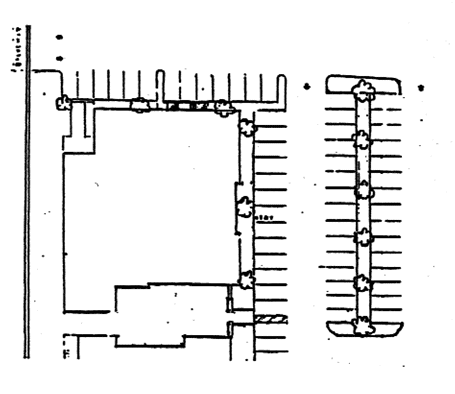
Trees and shrubs shall be provided at a ratio of one tree for every five parking spaces (see Figure 16.56.130-A). Ground cover and/or turf alone is not acceptable. Where screening is desirable, a continuation of trees and shrubs shall be used.
4.
Parking lot landscaping shall be installed prior to final occupancy of the use for which the parking lot is required. Under certain circumstances, bonding will be allowed, subject to approval of the parks and recreation director.
Figure 16.56.130-A
Landscaping Requirements for Parking Lots
(Prior code § 9-12.130)
(Ord. No. 633, § 8, 6-14-2011)
16.56.140 - Off-street parking structures.
A.
Purpose. The following standards are established to assure the architectural compatibility of parking structures with the surrounding neighborhoods and to protect the environment and the health, safety and welfare of the citizens. Any portion of a structure designed to be used for automobile parking or any structure designed totally for parking is defined to be a parking structure. This includes, but is not limited to, multilevel, subterranean and rooftop parking, but excludes at-grade residential garages and carports.
B.
General Requirements. Parking structures are subject to the following standards in addition to those standards required elsewhere in this chapter.
1.
All parking structures shall be subject to the issuance of a conditional use permit and architectural review approval.
2.
Regulations of the underlying zone in which a parking structure is located shall be adhered to, including, but not limited to, maximum allowable height, minimum building site and lot width, maximum building site coverage, and setbacks.
3.
Parking structures shall be located not more than three hundred (300) feet from the closest use it is intended to serve.
C.
Design Standards. Design and paving standards shall be subject to the requirements of Section 16.56.070 of this chapter, in addition to the following:
1.
All interior and exterior wall surfaces are to be treated or designed to resist graffiti.
2.
All parking structures of thirty (30) spaces or more, shall be serviced by a minimum of two vehicular access points for ingress and egress from the street to the structure.
3.
The floor-to-ceiling height shall be a minimum of seven feet. The vertical clearance shall be clearly posted at all entrances into the parking structure.
4.
Driveways shall be designed to allow drivers to view automobile and pedestrian traffic before merging into such traffic. Exits from driveways shall be clearly posted with a stop sign.
a.
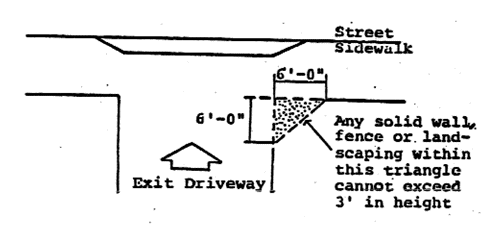
Where a driveway intersects the sidewalk a visibility clearance area shall be required. Such area shall consist of a triangular area bounded by the sidewalk and the exit driveway and a line joining points along the sidewalk and exit driveway six feet from the point of intersection (see Figure 16.56.140-A). Any solid wall, fence or landscaping within this triangle may not exceed three feet in height.
Figure 16.56.140-A
b.
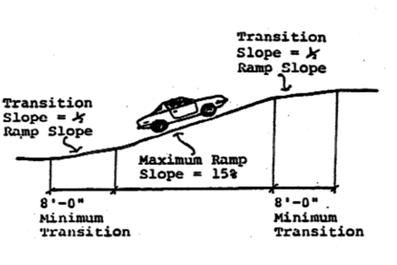
Ramp slopes shall be a maximum of fifteen (15) percent. For ramp slopes over ten (10) percent, a transition of at least eight feet shall be provided at each end of the ramp. The transition shall have a maximum slope equal to one-half of the slope of the ramp (see Figure 16.56.140-B).
Figure 16.56.140-B
5.
Parking structures shall be ventilated to avoid the buildup of exhaust gasses. Natural ventilation, by means of open walls and frontage, should be used when feasible. If mechanical ventilation is used, noise mitigation measures shall be incorporated. This includes, but is not limited to, low noise fans, insulated duct work and vibration absorbing mounting systems. Ducts shall not exhaust toward any openings or open space on any adjoining property nor toward any on-site or off-site street, place or park accessible to the public.
D.
Special Parking Types within Structures.
1.
Handicapped Parking. Handicapped parking shall be provided on the street level and located in an uncovered area. The design and provision of handicapped parking is regulated by state requirements as set forth in Section 16.56.070.
2.
Recreational Vehicles. For a parking structure where the vertical clearance is less than eleven feet, six inches (11'6″), the required number of recreational vehicle parking spaces pursuant to Section 16.56.090 shall be provided at street level and located in an uncovered area.
E.
Pedestrian Movement Within Parking Structures. Clearly marked paths exclusively for pedestrian use shall be provided throughout parking structures including, but not limited to, sidewalks along the automobile ramps and vertical movement by means of stairs and/or elevators.
1.
Pedestrian paths along automobile ramps and throughout a parking structure shall be physically established by a painted line, and where feasible, by means or a curb or railing.
2.
Stairway access to street level shall be provided where parking is located either above or below the street level. The stairs shall be located near the user's destination and are subject to compliance with the California Building Code.
3.
Elevators shall be provided in compliance with the California Building Code.
4.
No parking space shall be located further than three hundred (300) feet walking distance from any entrance to the structure.
F.
Security Within a Parking Structure. Security measures shall be incorporated into the design of all parking structures. A security plan showing all security measures including lighting, visibility into the structure, stairways, elevators, gates and fencing shall be reviewed and approved by the fire department, police department, and the planning department, prior to the issuance of a conditional use permit.
1.
Lighting.
a.
Parking structures shall be well-illuminated to provide security. The lighting shall be a minimum uniformly distributed forty (40) footcandles so that dark areas are not created. Fluorescent lighting shall be used whenever feasible.
b.
All stairways and elevator lobbies shall be well-illuminated and, if possible, visible to the outside.
2.
Open Frontage. Open frontage to streets and buildings should be provided on as many sides of a parking structure as practical to facilitate observation from passing patrol cars and the general public.
3.
Monitoring. Any parking structure with more than thirty (30) parking spaces shall be monitored by either an attendant or video monitors during the hours of operation. If the facility is not to be utilized on a twenty-four (24) hour basis, it shall be secured to prohibit entry by both vehicles and pedestrians during hours of nonoperation.
4.
Additional Security. Other security measures including, but not limited to, security gates and fencing shall be incorporated into the design of parking structures as deemed necessary by the approval body.
G.
Landscaping. The regulations set forth in this section shall supersede those in Section 16.56.130 for all parking structures. Parking structures shall be subject to the following landscaping requirements. Prior to the issuance of a building permit, a landscape plan shall be submitted and approved by the parks and recreation director and the police department. The plan shall show the location, size and variety of plantings, water supply, and similar designation.
1.
A perimeter landscaped strip of a minimum four feet in width shall be provided to help screen the structure and parked vehicles from view. The perimeter landscaped strip may include any required yard area and shall be continuous except for required access. Landscaping shall not conflict with safe visibility of automobile and pedestrian traffic.
2.
All landscaped areas required for parking structures shall comply with the following standards:
a.
Planted areas shall be served by an adequate irrigation system.
b.
All planted areas shall be continuously maintained and kept free of weeds and debris by the owner or person in possession of such area.
c.
Planted areas shall be protected with concrete curbs or other acceptable barriers.
3.
Landscaping must be installed prior to occupancy or use of the parking structure.
(Ord. 600 § 2, Exh. A (part), 2008; Ord. 594 §§ 19, 20, 2007; prior code § 9-12.140)
16.56.150 - Special off-street parking types.
1.
Handicapped Parking. The provision of handicapped parking is regulated by state requirements (see Section 16.56.070).
2.
Bicycle Parking Facilities. Bicycle facilities shall be required for the following uses. Uses not specifically listed are not required to provide bicycle facilities, but are encouraged to do so to reduce traffic congestion and air pollution problems.
(Prior code § 9-12.150)
16.56.160 - Maintenance of off-street parking facilities.
A.
Required parking spaces shall be kept available to residents, customers, patrons or employees only, and shall not be used for storage of objects, materials or fleet vehicles.
B.
No storage of dismantled or disabled vehicles is permitted in driveways or open parking areas, unless specifically permitted as a part of site approval.
C.
All parking areas shall be kept clean and free of dust, mud, or trash; pavement shall be maintained in a continuous state of good repair.
(Prior code § 9-12.160)
16.56.170 - Off-street loading areas.
A.
General Requirements. All industrial and commercially zoned developments shall be designed with truck approach and backup areas so as to prevent truck maneuvering within public rights-of-way.
B.
Approach and Backup Areas.
1.
All industrial and commercially zoned developments designed with dock-high approaches and/or truck wells shall be provided with at least one backup area to the dock or well in accordance with the following schedule. The driveway aisle between parking stalls may be used for the approach, provided that a forty-eight (48) foot wheel track turning radius is maintained.
2.
The dock approach may not be encumbered by parking stalls or physical obstructions and shall be measured perpendicular to the dock or door.
3.
The minimum dock or door overhead clearance (excluding pipes, lights, etc.) is twelve (12) feet.
C.
Loading Areas. Unless otherwise provided for in subsection (B)(1) of this section, all industrial and commercially zoned developments must provide at least one identified loading area (twelve (12) feet by ten (10) feet with ramp). Access to the loading area must be designed to provide a forty-eight (48) foot long semi-trailer truck maneuvering area. All development projects designed for sites of fourteen thousand (14,000) square feet or less are not required to comply with the loading and truck maneuvering requirements contained within this title, providing that:
1.
The project proponent can demonstrate that adequate provisions for loading facilities appropriate for the site and type of building proposed can be made;
2.
The proposed loading facilities will not adversely impact adjacent properties or traffic circulation on public streets and alleys; and
3.
Loading areas are screened from public view and residential development.
D.
Other Requirements. All developments zoned commercial or industrial shall be designed with the following:
1.
At least one driveway approach capable of accommodating a forty-eighty (48) foot wheel track turning radius;
2.
At least one on-site maneuvering area which provides a forty-eighty (48) foot wheel track turning radius through the parking area; and
3.
Parking aisles and access driveways adjacent to loading areas without dock high approaches or truck wells that have a minimum width of eight feet plus the aisle width required in Figure 16.56.070-B.
(Prior code § 9-12.170)

