
Aspen City Zoning Code
PART 500
SUPPLEMENTARY REGULATIONS
Chapter 26.505. - Wireless Communication Facilities and Equipment[5]
Editor's note— Ord. No. 3-2020, § 1, adopted April 28, 2020, repealed ch. 26.505, §§ 26.505.010—26.505.080 and enacted a new ch. 26.505 as set out herein. Former ch. 26.505 pertained to similar subject matter and derived from Ord. No. 5-2019.
Chapter 26.530. - SHORT-TERM RENTAL REGULATIONS[6]
Editor's note— Prior to the reenactment of Chapter 26.530 by Ordinance No. 9-2022, § 1, adopted June 28, 2022, said chapter was repealed by Ordinance No. 14-2007 § 1. Former Chapter 26.530 pertained to the resident multi-family replacement program and was derived from Ordinance No. 40-2002 § 2 as amended by Ordinance No. 51-2003 § 1.
Chapter 26.580. - DEMOLITION[7]
Editor's note— Prior to the reenactment of Ch. 26.580 by Ord. No. 13-2022, § 10, adopted June 28, 2022, this Chapter was repealed via Ordinance No. 42 (Series 2013).
Chapter 26.590. - TIMESHARE DEVELOPMENT[8]
Editor's note— Ord. No. 21-2002 § 1 repealed former Chapter 26.590, which pertained to similar provisions and enacted a new Chapter 26.590 as herein set out. Former Chapter 26.590 was derived from Ord. No. 5-1988 § 2 as amended by Ord. Nos. 55-2000 § 17 and 51-2001 § 2.
Sec. 26.500.010. - Purpose.
It is the purpose of this Chapter to exempt certain types of development from applicable sections, except as noted herein, of Title 26 and to establish an alternative process and standards for the review, analysis and approval of those types of developments determined to be eligible for such alternative review and analysis. The purpose in identifying and applying alternative review standards for certain developments eligible for such treatment is to provide a more flexible, streamlined, thorough and coordinated review of public projects or when it is determined by the City Council to be in the best interests of the community to do so.
(Ord. No. 11-2015, § 2)
Sec. 26.500.020. - Authority.
Public Project review of certain public and quasi-public projects is mandated by State law, including but not limited to, C.R.S. § 31-23-209. As a home rule municipality organized and operating under Article XX of the Colorado Constitution, the City of Aspen is vested with the authority and power to exempt certain types of development from the Aspen Land Use Code, Title 26 of the Aspen Municipal Code.
(Ord. No. 11-2015, § 2)
Sec. 26.500.030. - Applicability.
This Chapter shall apply to any development proposed within city limits if the Applicant for development is a governmental entity, quasi-municipal organization, or public agency providing essential services to the public and which is in the best interests of the City to be completed. The Community Development Director or City Council may authorize a private development to be reviewed as a Public Project pursuant to Section 26.500.040(d). By way of example and not limitation, Public Project development shall include:
(a)
Affordable housing projects developed by the City, a governmental entity, a quasi-municipal organization, or a public agency, by itself or in conjunction with an agent or private developer.
(b)
Public buildings, structures, and facilities developed by the City, a governmental entity, a quasi-municipal organization, or a public agency.
(c)
Park and recreational facilities development.
(d)
Development applications determined by the Community Development Director or City Council, pursuant to Section 26.500.040(d), to support important community goals and to be reasonably necessary for the convenience or welfare of the public.
Routine maintenance and upgrades within the public right-of-way are exempt from this Chapter. An application for development that is eligible for review as a Public Project is not required to be reviewed as a Public Project. The Applicant may elect to have their development proposal reviewed according to the standard procedures set forth by the Land Use Code.
(Ord. No. 11-2015, § 2)
Sec. 26.500.040. - Procedures for review.
The Community Development Director shall make a determination that the proposed development application qualifies for Administrative, Minor, or Major Public Project Review. The necessary steps for each type of review are outlined below:
(a)
Administrative Public Project Review. The following types of Public Projects may be approved, approved with conditions, or denied by the Community Development Director:
(1)
Projects necessary to achieve compliance with building, fire, or accessibility codes on an existing property or building; or
(2)
The addition of energy production systems or energy efficiency systems or equipment on an existing property or building; or
(3)
Projects that do not change the use, character, or dimensions of the property or building, or represent an insubstantial change to the use, character, or dimensions of the property or building.
The Community Development Director may seek advisory comments from the Historic Preservation Commission, Planning & Zoning Commission, City Council, neighbors, or the general public as may be appropriate.
The Community Development Director shall approve, approve with conditions, or deny an application for Administrative Public Project Review, based on the standards of review in Section 26.500.070, General Review Standards.
(b)
Minor Public Project Review. An application for Public Project review that the Community Development Director finds is generally consistent with the existing development, but does not qualify for Administrative Public Project Review, shall qualify for Minor Public Project Review. City Council, during a duly noticed public hearing, shall approve, approve with conditions, or deny an application for Minor Public Project Review, based on the standards of review in Section 26.500.070, General Review Standards. The review process is as follows:
Step One - Public Hearing before City Council.
(1)
Purpose: To determine if the application meets the standards for Minor Public Project Review.
(2)
Process: The City Council shall approve, approve with conditions or deny the proposed development, after considering the recommendations of the Community Development Director and comments and testimony from the public at a duly noticed public hearing.
(3)
Standards of review: The proposal shall comply with the review standards of Section 26.500.070.
(4)
Form of decision: City Council decision shall be by Ordinance.
(5)
Notice requirements: Posting, Mailing and Publication pursuant to Subparagraph 26.304.060(e)(3), the requirements of Section 26.304.035—Neighborhood Outreach as applicable, and the requisite notice requirements for adoption of an ordinance by City Council.
The Community Development Director may seek advisory comments from the Historic Preservation Commission, Planning & Zoning Commission, neighbors, or the general public as may be appropriate.
(c)
Major Public Project Review. An application for Public Project review that the Community Development Director finds represents a significant change to the property shall qualify for Major Public Project Review. City Council, during a duly noticed public hearing, shall approve, approve with conditions, or deny an application for Major Public Project Review, based on the standards of review in Section 26.500.070, General Review Standards. The review process is as follows:
Step One - Public Hearing before Planning & Zoning Commission or Historic Preservation Commission.
(1)
Purpose: To determine if the application meets the standards for Minor Public Project Review.
(2)
Process: The Planning and Zoning Commission, or Historic Preservation Commission if the property is designated or is located within a historic district, shall forward a recommendation of approval, approval with conditions, or denial to City Council after considering the recommendation of the Community Development Director and comments and testimony from the public at a duly noticed public hearing.
(3)
Standards of Review: The proposal shall comply with the review standards of Section 26.500.070. Private development projects authorized to be reviewed as Major Public Projects, pursuant to Section 26.500.040(d), shall also be required to comply with the review standards of Section 26.500.075.
(4)
Form of Decision: The Planning and Zoning Commission or Historic Preservation Commission recommendation shall be by resolution.
(5)
Notice requirements: Posting, Mailing and Publication pursuant to Subparagraph 26.304.060(e)(3) and the provisions of Section 26.304.035—Neighborhood Outreach as applicable.
Step Two - Public Hearing before City Council.
(1)
Purpose: To determine if the application meets the standards for Major Public Project Review.
(2)
Process: The City Council shall approve, approve with conditions or deny the proposed development, after considering recommendations of the Community Development Director, the advisory group (if applicable), and comments and testimony from the public at a duly noticed public hearing.
(3)
Standards of Review: The proposal shall comply with the review standards of Section 26.500.070. Private development projects authorized to be reviewed as Major Public Projects, pursuant to Section 26.500.040(d) shall also be required to comply with the review standards of Section 26.500.075.
(4)
Form of decision: City Council decision shall be by Ordinance.
(5)
Notice Requirements: Posting, Mailing and Publication pursuant to Subparagraph 26.304.060(e)(3), the requirements of Section 26.304.035—Neighborhood Outreach as applicable, and the requisite notice requirements for adoption of an ordinance by City Council.
(d)
Private Development Authorization. A private development project that meets the established thresholds for Administrative or Minor Public Projects and meets the criteria found in Section 26.500.040(d)(3), may be authorized for Public Project review by the Community Development Director. A private development project that does not meet the established thresholds for Administrative or Minor Public Project Review may be reviewed as a Major Public Project, pursuant to Section 26.500.040(c), only after authorization from City Council during a duly noticed public hearing. The authorization process is as follows:
Step One - Public Hearing before City Council.
(1)
Purpose: To determine if the application is eligible for Public Project Review.
(2)
Process: The City Council shall authorize or deny authorization for the proposed private development project to be reviewed as a Major Public Project, after considering recommendations of the Community Development Director, and comments and testimony from the public at a duly noticed public hearing.
(3)
Standards of Review: The proposal shall comply with the following review standards:
a.
The proposed development would provide an essential service to the public.
b.
The public project review process is in the best interest of the City to be completed.
c.
The proposed development furthers community goals as articulated in the Aspen Area Community Plan, the Civic Master Plan, or other plans adopted by the City.
(4)
Form of decision: City Council decision shall be by Resolution.
(5)
Notice Requirements: Posting, Mailing and Publication pursuant to Subparagraph 26.304.060(e)(3), the requirements of Section 26.304.035—Neighborhood Outreach, and the requisite notice requirements for adoption of a resolution by City Council.
(6)
Effect of Authorization: If City Council authorizes a private development to be reviewed as a Major Public Project, it shall be subject to the review procedures of Section 26.500.040(c), Major Private Projects, and shall be required to use an Advisory group as outlined in Section 26.500.050, Advisory Group.
(Ord. No. 11-2015, § 2)
Sec. 26.500.050. - Advisory group.
For Major Public Project Reviews, the Applicant may elect to have an advisory group review the project prior to public hearings. The members of the advisory group shall be appointed by the City Manager and shall consist of members of City boards, commissions and other interested parties (including at least two (2) members of the public at large) not already involved in the review process outlined in Section 26.500.040(c). The chair of the advisory group shall be the Community Development Director. The chair of the advisory group shall prepare meeting agendas, coordinate meeting dates for the advisory group and facilitate all meetings. The decision by the Applicant to create an advisory group shall constitute an agreement to extend the timing of the review beyond that required in Section 26.500.060, Timing Requirements.
The advisory group shall meet and review the proposed development application prior to Section 26.500.040(c), Step One. The standards of review in Section 26.500.070, General Review Standards shall be used as a guide.
Following a review of the proposed development and at such time as the Community Development Director believes that further review by the advisory group would not significantly improve the overall development proposal, the Community Development Director shall create a report of the recommendations of the advisory group to forward to P&Z, or HPC, and City Council. The Community Development Director's report shall include:
(a)
All of the land use decisions and approvals that would otherwise be required for the proposed development.
(b)
A report of the deliberations and recommendations made by the advisory group.
(c)
A recommendation to approve, approve with conditions, or deny the proposed development.
(Ord. No. 11-2015, § 2)
Sec. 26.500.060. - Timing requirements.
Unless an alternate timeframe is agreed upon between the Applicant and Community Development Director, City Council shall approve, approve with conditions, or deny an application for Public Project Review within sixty (60) days of the Community Development Director's acceptance of a complete land use application. City projects and private development projects authorized to be reviewed as Major Public Projects pursuant to Section 26.500.040(d) shall not require a decision within sixty (60) days.
(Ord. No. 11-2015, § 2)
Sec. 26.500.070. - General review standards.
The following review standards shall be used in review of any application for Public Projects:
(a)
The proposed project complies with the zone district limitations, or is otherwise compatible with neighborhood context; and
(b)
The proposed project supports stated community goals; and
(c)
The proposed project complies with all other applicable requirements of the Land Use Code; and
(d)
The proposed project receives all development allotments required by Chapter 26.470, Growth Management Quota System.
(Ord. No. 11-2015, § 2)
Sec. 26.500.075. - Review standards for private development projects.
The following review standards shall be used in review of any private development application authorized to be reviewed as a Major Public Project:
(a)
The proposed project meets all requirements of Chapter 26.470, Growth Management Quota System, and Chapter 26.480, Subdivision.
(b)
The proposed development would provide an essential service to the public.
(c)
The proposed development is in the best interest of the City to be completed.
(d)
The proposed development furthers community goals as articulated in the Aspen Area Community Plan, the Civic Master Plan, or other plans adopted by the City.
(Ord. No. 11-2015, § 2)
Sec. 26.500.080. - Application.
An application for Public Projects Review shall include the following:
(a)
The general application information required in common development review procedures set forth at Section 26.304.030.
(b)
Any documents required for recordation meeting the requirements of Chapter 26.490—Approval Documents.
(c)
Any additional materials, documentation or reports that would otherwise be required and is deemed necessary by the Community Development Director.
(Ord. No. 11-2015, § 2)
Sec. 26.500.090. - Appeals.
An applicant aggrieved by a decision made by the Community Development Director regarding administration of this Chapter may appeal such decision to the City Council, pursuant to Chapter 26.316, Appeals. Other administrative remedy may be available pursuant to C.R.S. § 31-23-209.
(Ord. No. 11-2015, § 2)
Editor's note— (Special Note: Ord. No. 9-2015 repealed Development Reasonably Necessary for the Convenience and Welfare of the Public chapter and replaced it with Public Projects chapter, past amendments include Ord. No. 7-2000, § 3; Ord. No. 1-2002, § 12; Ord. No. 27-2002, §§ 20 and 21, 2002)
Sec. 26.505.010. - Purpose.
The purpose of this Chapter is to regulate the placement, construction, and modification of towers and wireless communications facilities (WCFs) to protect the health, safety and welfare of the public, provide for managed development, installation, maintenance, modification, and removal of wireless communications infrastructure that is consistent with Aspen's small mountain town character, while at the same time not unreasonably interfering with the development of a competitive wireless communications marketplace in the city.
(Ord. No. 3-2020, § 1, 4-28-2020)
Sec. 26.505.020. - Adoption of Wireless Communications Facilities Design Guidelines.
The City Council hereby adopts design guidelines, hereinafter referred to as the Wireless Communications Facilities Design Guidelines ("Design Guidelines"), which are incorporated into the City of Aspen Land Use Code. The design guidelines set forth the design parameters to ensure safe and secure installation and minimize negative aesthetic impacts of wireless communications facilities installed on private property or in the public right-of-way. The design guidelines may be amended, updated, and expanded from time to time by City Council Resolution. At least one (1) copy shall be available for public inspection at the Community Development and Engineering Departments and on the City of Aspen's webpage.
(Ord. No. 3-2020, § 1, 4-28-2020)
Sec. 26.505.030. - Applicability.
All applications for the installation or development of WCFs and/or equipment must receive land use approval, building permits, and/or right-of-way permits, as applicable, prior to installation. Concurrent with the issuance of appropriate building and right-of-way permits, WCFs and/or equipment shall be reviewed for approval by the Community Development Director (and when applicable, the City Engineer) in conformance with the provisions and criteria of this Chapter. WCFs and equipment subject to the provisions and criteria of this Chapter include without limitation, WCFs within the Public Rights-of-Way, cellular telephone, paging, enhanced specialized mobile radio (ESMR), personal communication services (PCS), commercial mobile radio service (CMRS) and other wireless commercial telecommunication devices and all associated structures and equipment including transmitters, antennas, monopoles, towers, masts and microwave dishes, cabinets and equipment rooms. These provisions and criteria do not apply to noncommercial satellite dish antennae, radio and television transmitters and antennae incidental to residential use. All references made throughout this Chapter, to any of the devices to which this Chapter is applicable, shall be construed to include all other devices to which this Chapter is applicable
(a)
Future Amendments to Chapter 26.505. All future amendments to this Chapter shall be exempt from the requirement of Policy Resolution for code amendments (Section 26.310.020(b)(1), (2)). Future amendments may proceed directly to a First and Second Reading, pursuant to Section 26.310.020(b)(3).
(Ord. No. 3-2020, § 1, 4-28-2020)
Sec. 26.505.040. - Wireless Definitions.
All words used in this Chapter or in the Wireless Communications Facilities Design Guidelines, except where specifically defined herein, shall carry their customary meanings when not inconsistent with the context. Definitions contained elsewhere in this Code shall apply to this Section unless modified herein.
Accessory Wireless Equipment. Any equipment serving or being used in conjunction with a Wireless Communications Facility (WCF), including, but not limited to, utility or transmission equipment, power supplies, generators, batteries, cables, equipment buildings, cabinets and storage sheds, shelters or other structures.
Alternative Tower Structure. Man-made trees, clock towers, bell steeples, light poles, traffic signals, buildings, and similar alternative design mounting structures that are intended to be compatible with the natural setting and surrounding structures, and camouflage or concealment design techniques so as to make the presence of antennas or towers compatible with the surrounding area pursuant to this Chapter. This term also includes any antenna or antenna array attached to an Alternative Tower Structure and a Replacement Pole. A stand-alone Monopole in the Public Right-of-Way that accommodates Small Cell Wireless Facilities is considered an Alternative Tower Structure to the extent it meets the camouflage and concealment standards of this Chapter.
Antenna. Any device used to transmit and/or receive radio or electromagnetic waves such as, but not limited to panel antennas, reflecting discs, microwave dishes, whip antennas, directional and non-directional antennas consisting of one or more elements, multiple antenna configurations, or other similar devices and configurations. Any exterior apparatus designed for telephone, radio, or television communications through the sending and/or receiving of wireless communications signals.
Base Station. A structure or equipment at a fixed location that enables Federal Communications Commission ("FCC") licensed or authorized wireless communications between user equipment and a communications network. The definition of base station does not include or encompass a tower as defined herein or any equipment associated with a tower. Base station includes, without limitation:
(1)
Equipment associated with wireless communications services such as private broadcast, and public safety services, as well as unlicensed wireless services and fixed wireless services such as microwave backhaul that, at the time the relevant application is filed with the city pursuant to this chapter has been reviewed and approved under the applicable zoning or siting process, or under another state or local regulatory review process, even if the structure was not built for the sole or primary purpose of providing such support; and
(2)
Radio transceivers, antennas, coaxial or fiber-optic cable, regular and backup power supplied, and comparable equipment, regardless of technological configuration (including distributed antenna systems and small-cell networks) that, at the time the relevant application is filed with the city pursuant to title 26 of the Code has been reviewed and approved under the applicable zoning or siting process, or under another state or local regulatory review process, even if the structure was not built for the sole or primary purpose of providing such support.
The definition of base station does not include any structure that, at the time the application is filed with the city under this chapter, does not support or house equipment described herein in sub-paragraphs (1) and (2) of this definition.
Camouflage, Concealment, Or Camouflage Design Techniques. A Wireless Communication Facility ("WCF") is camouflaged or utilizes Camouflage Design Techniques when any measures are used in the design and siting of Wireless Communication Facilities with the intent to minimize or eliminate the visual impact of such facilities to surrounding uses. A WCF site utilizes Camouflage Design Techniques when it (i) is integrated in an outdoor fixture such as a flagpole, or (ii) uses a design which mimics and is consistent with the nearby natural, or architectural features (such as an artificial tree) or is incorporated into (including, without limitation, being attached to the exterior of such facilities and painted to match it) or is integral within, incorporated on or replaces existing permitted facilities or vertical infrastructure located in the Right-of-Way (including without limitation, stop signs or other traffic signs or freestanding light standards) so that the presence of the WCF is not readily apparent.
Collocation. (1) mounting or installing a WCF on a pre-existing structure, and/or (2) modifying a structure for the purpose of mounting or installing a WCF on that structure. Provided that, for purposes of Eligible Facilities Requests, "Collocation" means the mounting or installation of transmission equipment on an Eligible Support Structure for the purpose of transmitting and/or receiving radio frequency signals for communications purposes.
Eligible Facilities Request. Any request for modification of an Eligible Support Structure that does not Substantially Change the physical dimensions of such Eligible Support Structure involving: (i) collocation of new Transmission Equipment, (ii) removal of Transmission Equipment, or (iii) replacement and/or addition of Transmission Equipment.
Eligible Support Structure. Any Tower or Base Station as defined in this Section, provided that it is existing at the time the relevant application is filed with the city under this Section.
Existing Tower or Base Station. A constructed Tower or Base Station is existing for purposes of this Section if it has been reviewed and approved under the applicable zoning or siting process, or under another State or local regulatory review process, provided that a tower that has not been reviewed and approved because it was not in a zoned area when it was built, but was lawfully constructed, is existing for purposes of this definition.
Micro Cell Facility. A small wireless facility that is no larger than twenty-four (24) inches in length, fifteen (15) inches in width, twelve (12) inches in height, and that has an exterior antenna, if any, that is no more than eleven (11) inches in length.
Monopole. A single, freestanding pole-type structure supporting one or more Antennas.
Public Right-of Way. Any public way or public thoroughfare dedicated or devoted to public use, including street, highway, road, alley, lane, court, boulevard, sidewalk, public square, mall or like designation.
Replacement Pole. An Alternative Tower structure that is a newly constructed and permitted traffic signal, utility pole, street light, flagpole, electric distribution, or street light poles or other similar structure of proportions and of equal height to a pre-existing pole or structure in order to support a WCF or Small Cell Facility or to accommodate collocation and remove the pre-existing pole or structure.
Small Cell Facility. A WCF where each Antenna is located inside an enclosure of no more than three (3) cubic feet in volume or, in the case of an Antenna that has exposed elements, the antenna and all of its exposed elements could fit within an imaginary enclosure of no more than three (3) cubic feet; and primary equipment enclosures are no larger than seventeen (17) cubic feet in volume. The following associated equipment may be located outside of the primary equipment enclosure and, if so located, is not included in the calculation of equipment volume: electric meter, concealment, telecommunications demarcation box, ground-based enclosure, back-up power systems, grounding equipment, power transfer switch and cut-off switch. Small cells may be attached to Alternate Tower Structures, Replacement Pole, and Base Stations.
Substantial Change to a WCF. A modification substantially changes the physical dimensions of an Eligible Support Structure if after the modification, the structure meets any of the following criteria:
(1)
For Towers, other than Alternative Tower Structures or Towers in the Right-of-Way, it increases the height of the Tower by more than ten percent (10%) or by the height of one (1) additional antenna array, with separation from the nearest existing antenna not to exceed twenty feet, whichever is greater; for other Eligible Support Structures, it increases the height of the structure by more than ten percent (10%) or more than ten (10) feet, whichever is greater;
(2)
For Towers, other than Towers in the Right-of-Way, it involves adding an appurtenance to the body of the Tower that would protrude from the Tower more than twenty (20) feet, or more than the width of the Tower Structure at the level of the appurtenance, whichever is greater; for Eligible Support Structures, it involves adding an appurtenance to the body of the structure that would protrude from the side of the structure by more than six (6) feet;
(3)
For any Eligible Support Structure, it involves installation of more than the standard number of new equipment cabinets for the technology involved, but not to exceed four (4) cabinets; or
(4)
For Towers in the Right-of-Way and Base Stations, it involves installation of any new equipment cabinets on the ground if there are no pre-existing ground cabinets associated with the structure, or else involves installation of ground cabinets that are more than ten percent (10%) larger in height or overall volume than any other existing, individual ground cabinets associated with the structure;
(5)
For any Eligible Support Structure, it entails any excavation or deployment outside the current Site;
(6)
For any Eligible Support Structure, it would defeat the concealment elements of the Eligible Support Structure. For purposes of this definition, any change that undermines concealment elements of an eligible support structure shall be interpreted as defeating the concealment elements of that structure; or
(7)
For any Eligible Support Structure, it does not comply with conditions associated with the siting approval of the construction or modification of the Eligible Support Structure equipment, unless the non-compliance is due to an increase in height, increase in width, addition of cabinets, or new excavation that would not exceed the thresholds identified in paragraphs (i), (ii), (iii) and (iv) of this Definition. For purposes of determining whether a Substantial Change exists, changes in height are measured from the original support structure in cases where deployments are or will be separated horizontally, such as on buildings' rooftops; in other circumstances, changes in height are measured from the dimensions of the tower or base station, inclusive of originally approved appurtenances and any modifications that were approved prior to February 22,2012.
Tower. Any structure that is designed and constructed for the sole or primary purpose of supporting one or more any FCC-licensed or authorized Antennas and their associated facilities, including structures that are constructed for wireless communications services including, but not limited to, private, broadcast, and public safety services, as well as unlicensed wireless services and fixed wireless services such as microwave backhaul, and the associated site. The term includes self-supporting lattice towers, guyed towers, monopole towers, radio and television transmission towers, microwave towers, common carrier towers, cellular telephone towers, Alternative Tower Structures and the like.
Transmission Equipment. Equipment that facilitates transmission for any FCC licensed or authorized wireless communication service, including, but not limited to, radio transceivers, antennas, coaxial or fiber-optic cable, and regular and backup power supply. The term includes equipment associated with wireless communications services including, but not limited to, private, broadcast, and public safety services, as well as unlicensed wireless services and fixed wireless services such as microwave backhaul.
Wireless Communications Facility Or WCF. A facility used to provide personal wireless services as defined at 47 U.S.C. Section 332 (c)(7)(C); or wireless information services provided to the public or to such classes of users as to be effectively available directly to the public via licensed or unlicensed frequencies; or Smart City, Internet of Things, wireless utility monitoring and control services. A WCF does not include a facility entirely enclosed within a permitted building where the installation does not require a modification of the exterior of the building; nor does it include a device attached to a building, used for serving that building only and that is otherwise permitted under other provisions of the Code. A WCF includes an Antenna or Antennas, including without limitation, direction, omni-directional and parabolic antennas, support equipment, Alternative Tower Structures, and Towers. It does not include the support structure to which the WCF or its components are attached if the use of such structures for WCFs is not the primary use. The term does not include mobile transmitting devices used by wireless service subscribers, such as vehicle or hand-held radios/telephones and their associated transmitting Antennas, nor does it include other facilities specifically excluded from the coverage of this Chapter.
(Ord. No. 3-2020, § 1, 4-28-2020)
Sec. 26.505.050. - Operational Standards.
(a)
Federal Requirements. All WCFs shall meet the current standards and regulations of the FAA, the FCC and any other agency of the federal government with the authority to regulate WCFs, including, without limitation, the requirement that WCFs shall not present a hazard to air navigation under Part 77, Federal Aviation, Federal Aviation Regulations. If such standards and regulations are changed, then the owners of the WCF shall bring such facility into compliance with such revised standards and regulations within the time period mandated by the controlling federal agency. Failure to meet such revised standards and regulations shall constitute grounds for the removal of the WCF at the WCF owner's expense.
(b)
Radio Frequency Standards. All WCFs shall comply with federal standards for radio frequency emissions. Applicants for WCFs shall submit a letter certifying that all WCFs that are the subject of the application shall comply with federal standards for radio frequency emissions. The owner or operator of an approved WCF shall also provide the City with the FCC license for the WCF at the time the license is issued for the facility.
(c)
Signal Interference. All WCFs shall be designed and sited, consistent with applicable federal regulations, so as not to cause interference with the normal operation of radio, television, telephone and other communication services utilized by adjacent residential and non-residential properties; nor shall any such facilities interfere with any public safety communications. The Applicant shall provide a written statement from a qualified radio frequency engineer, certifying that a technical evaluation of existing and proposed facilities indicates no potential interference problems and shall allow the City to monitor interference levels with public safety communications during this process. Additionally, the Applicant shall notify the City at least ten (10) calendar days prior to the introduction of new service or changes in existing service and shall allow the City to monitor interference levels with public safety communications during the testing process.
(d)
License to Use. The Applicant may execute a license agreement with the City, granting a non-exclusive license to use the Public Right-of-Way. Attachment of WCFs on an existing traffic signal, streetlight pole, or similar structure shall require written evidence of a license, or other legal right or approval, to use such structure by its owner.
(e)
Operation and Maintenance. To ensure the structural integrity of WCFs, the owner of a WCF shall ensure that it is maintained in compliance with the standards contained in applicable local building, safety, and engineering codes. If upon inspection, the City concludes that a WCF fails to comply with such codes and constitutes a danger to persons or property, then, upon written notice being provided to the owner of the WCF, the owner shall have thirty (30) days from the date of notice to bring such WCF into compliance. Upon good cause shown by the owner, the City's Chief Building Official may extend such compliance period not to exceed ninety (90) days from the date of said notice. If the owner fails to bring such WCF into compliance within said time period, the City may remove such WCF at the owner's expense.
(f)
Abandonment and Removal. If a WCF has not been in use for a period of three (3) months, the owner of the WCF shall notify the City of the non-use and shall indicate whether re-use is expected within the ensuing three (3) months. Any WCF that is not operated for a continuous period of six (6) months shall be considered abandoned. The City, in its sole discretion, may require an abandoned WCF to be removed. The owner of such WCF shall commence removal of the same within thirty (30) days of receipt of written notice from the City. If such WCF is not removed within said thirty (30) days, the City may remove it at the owner's expense and any approved permits for the WCF shall be deemed to have expired. Additionally, the City, in its sole discretion, shall not approve any new WCF application until the Applicant who is also the owner or operator of any such abandoned WCF has removed such WCF or payment for such removal has been made to the City.
(g)
Hazardous Materials. No hazardous materials shall be permitted in association with WCFs, except those necessary for the operations of the WCF and only in accordance with all applicable laws governing such materials.
(h)
Collocation. No WCF owner or operator shall unreasonably exclude a telecommunications competitor from using the same facility or location. Upon request by the Community Development Department, the owner or operator shall provide evidence explaining why Collocation is not possible at a particular facility or site.
(i)
Compliance with Applicable Law. Notwithstanding the approval of an application for new WCFs or Eligible Facilities Request as described herein, all work done pursuant to WCF applications must be completed in accordance with all applicable building, structural, engineering, electrical, and safety requirements as set forth in the Aspen Municipal Code and any other applicable laws or regulations. In addition, all WCF applications shall comply with the following:
(1)
Comply with any permit or license issued by a local, state, or federal agency with jurisdiction of the WCF;
(2)
Comply with easements, covenants, conditions and/or restrictions on or applicable to the underlying real property;
(3)
Be maintained in good working condition and to the standards established at the time of application approval; and
(4)
Remain free from trash, debris, litter, graffiti, and other forms of vandalism. Any damage shall be repaired as soon as practicable, and in no instance more than ten (10) calendar days from the time of notification by the City or after discovery by the owner or operator of the Site. Notwithstanding the foregoing, any graffiti on WCFs located in the Public Rights-of-Way or on Public Property may be removed by the City at its discretion, and the owner and/or operator of the WCF shall pay all costs of such removal within thirty (30) days after receipt of an invoice from the City.
(Ord. No. 3-2020, § 1, 4-28-2020)
Sec. 26.505.060. - Procedures for Review.
No new WCF shall be constructed and no Collocation or modification to any WCF may occur except after a written request from an applicant, reviewed and approved by the City in accordance with this Chapter.
(a)
Review Procedures for certain WCFs, including Base Stations, Alternative Tower Structures, and Alternative Tower Structures within Public Rights-of-Way, but excepting Eligible Facilities Requests, and Small Cell Facilities in the Right-of-Way. In all zone districts, applications for these WCF facilities shall be reviewed by the Community Development Department for conformance to this Section and using the Wireless Communications Facilities Design Guidelines. For WCFs in the Rights-of-Way, except for Small Cell Facilities in the Right-of-Way, that are found to have a significant visual impact (e.g. proximity to historical sites, obstructing views), be incompatible with the structure or surrounding area, or not meet the intent of these provisions, the Community Development Department may refer the application to Planning and Zoning Commission or Historic Preservation Commission, as applicable, for a Special Review determination.
(b)
Review Procedures for Towers. In all zone districts, Towers, other than those defined or excepted in (A) above, must apply for Special Review approval. These WCFs shall be reviewed for conformance using the procedures set forth in Section 26.505.050(l) All applications for Towers shall demonstrate that other alternative design options, such as using Base Stations or Alternative Tower Structures, are not viable options as determined by the City.
(c)
Review Procedures for Eligible Facilities Requests.
(1)
In all zone districts, Eligible Facilities Requests shall be considered a permitted use, subject to administrative review. The City shall prepare, and from time to time revise, and make publicly available, an application form which shall require submittal of information necessary for the City to consider whether an application is an Eligible Facilities Request. Such required information may include, without limitation, whether the project:
a.
Constitutes a Substantial Change; or
b.
Violates a generally applicable law, regulation, or other rule codifying objective standards reasonably related to public health and safety.
The application shall not require the applicant to demonstrate a need or business case for the proposed modification or Collocation.
(2)
Upon receipt of an application for an Eligible Facilities Request pursuant to this Section, the Community Development Department shall review such application to determine whether the application so qualifies.
(3)
Timeframe for Review. Subject to the tolling provisions of subparagraph (4) below, within sixty (60) calendar days of the date on which an applicant submits a complete application seeking approval under this Section, the City shall approve the application unless it determines that the application is not covered by this Subsection, or otherwise in non-conformance with applicable codes.
(4)
Tolling of the Timeframe for Review. The 60-day review period begins to run when the application is filed, and may be tolled only by mutual agreement of the City and the applicant, or in cases where the Community Development Department determines that the application is incomplete:
a.
To toll the timeframe for incompleteness, the City must provide written notice to the applicant within thirty (30) days of receipt of the application, specifically delineating all missing documents or information required in the application;
b.
The timeframe for review begins running again the following business day after the applicant makes a supplemental written submission in response to the City's notice of incompleteness; and
c.
Following a supplemental submission, the City will notify the applicant within ten (10) days that if the supplemental submission did not provide the information identified in the original notice delineating missing information. The timeframe is tolled in the case of second or subsequent notices pursuant to the procedures identified in paragraph (a) of this subsection. In the case of a second or subsequent notice of incompleteness, the City may not specify missing information or documents that were not delineated in the original notice of incompleteness.
(5)
Failure to Act. In the event the City fails to act on a request seeking approval for an Eligible Facilities Request under this Section within the timeframe for review (accounting for any tolling), the request shall be deemed granted. The request becomes effective when the applicant notifies the City in writing after the review period has expired (accounting for any tolling) that the application has been deemed granted.
(6)
Interaction with Telecommunications Act Section 332(c)(7). If the City determines that the applicant's request is not an Eligible Facilities Request as delineated in this Chapter, the presumptively reasonable timeframe under Section 332(c)(7) of the Telecommunication Act, as prescribed by the FCC's Shot Clock order, will begin to run from the issuance of the City's decision that the application is not a covered request. To the extent such information is necessary, the City may request additional information from the applicant to evaluate the application under Section 332(c)(7) reviews.
(d)
Review Procedures for Small Cell Facilities in the Public Right-of-Way.
(1)
Small Cell Facilities in the Public Right-of-Way may be approved pursuant to a Master License Agreement or similar form of authorization or individually in accordance with the provisions of this subsection.
(2)
Within ten (10) days of receipt of the application, the Director shall provide written comments to the applicant determining completeness of the application and setting forth any modifications required to complete the application to bring the proposal into full compliance with the requirements of this Chapter.
(3)
The Director shall review the completed application for conformance with the provisions in this Chapter and may approve or deny an application within ninety (90) days of the date the application is submitted for new stand-alone facilities or sixty (60) days for facilities collocated on city infrastructure.
a.
To toll the timeframe for incompleteness, the City must provide written notice to the Applicant within ten (10) days of receipt of the application, specifically delineating all missing documents or information required in the application;
b.
The timeframe for review resets to zero (0) when the Applicant makes a supplemental written submission in response to the City's notice of incompleteness; and
c.
Following a supplemental submission, the City will notify the Applicant within ten (10) days that the supplemental submission did not provide the information identified in the original notice delineating missing information. The timeframe is tolled in the case of second or subsequent notices pursuant to the procedures identified in paragraph (a) of this subsection. In the case of a second or subsequent notice of incompleteness, the City may not specify missing information or documents that were not delineated in the original notice of incompleteness.
(4)
Consolidated applications. The City shall allow a wireless provider to file a consolidated application for up to six (6) small cell facilities and receive a single approval for the consolidated application. The City's denial of any individual small cell facility is not a basis to deny the application as a whole or any other small cell facility incorporated within the consolidated application.
(e)
General. Except for applications under subsections C and D above, pursuant to Section 26.304.020, the applicant shall conduct a pre-application conference with staff of the Community Development Department. The planner shall then prepare a pre-application summary describing the submission requirements and any other pertinent land use material, the fees associated with the reviews and the review process in general. A pre-application conference is not required, but is recommended, for Eligible Facility Requests or Small Cells in the Right-of-Way.
(f)
Administrative review. Except for applications under subsections C and D above, after the pre-application summary is received by the applicant, said applicant shall prepare an application for review and approval by staff and the Community Development Director, respectively. In order to proceed with additional land use reviews or obtain a development order, the Community Development Director shall find the submitted development application consistent with the provisions, requirements and standards of this Chapter and the Wireless Communications Facilities Design Guidelines.
(g)
Decision. Any decision to approve, approve with conditions, or deny an application for a WCF, shall be in writing and supported by substantial evidence in a written record. The applicant shall receive a copy of the decision.
(h)
Appeal of Director's determination. The Community Development Director may apply reasonable conditions to the approval as deemed necessary to ensure conformance with applicable review criteria in the Wireless Communications Facilities Design Guidelines. If the Community Development Director determines that the proposed WCFs and equipment do not comply with the review criteria and denies the application or the applicant does not agree to the conditions of approval determined by the Community Development Director, the applicant may apply for special review (Chapter 26.430) by the Planning and Zoning Commission or, if applicable, by the Historic Preservation Commission, and such application must be made within fifteen (15) calendar days of the day on which the Community Development Director's decision is rendered. All appeals shall require public hearings and shall be noticed by the applicant in accordance with Paragraphs 26.304.060(e)(3)a, b and c of this Code.
(i)
Historic Preservation Commission review. With the exception of Eligible Facilities Requests and Small Cell Facilities in the ROW, proposals for the location of WCFs or equipment on any historic site or structure, shall be reviewed by the Historic Preservation Commission (HPC). Review of applications for WCFs and/or equipment by the HPC shall replace the need for review by the Community Development Director. Likewise, if the Historic Preservation Commission determines that the proposed WCFs and equipment do not comply with the review criteria and denies the application or the applicant does not agree to the conditions of approval determined by the Historic Preservation Commission, the applicant may appeal the decision to the City Council, and such appeal must be filed within fifteen (15) calendar days of the day on which the Historic Preservation Commission's decision is rendered. All appeals shall require public hearings and shall be noticed by the applicant in accordance with Paragraphs 26.304.060(e)(3)a, b and c of this Code.
(j)
Building Permit. A Building Permit, shall be submitted concurrently with the Land Use Application. Depending on the nature of project, a full Building Permit may be necessary, or, as would be the case for most Eligible Facilities Requests, an Electrical Permit. A contractor for the proposed work must be identified with the submitted application. A Building or Electrical Permit without an identified contractor will be deemed incomplete and the application will be tolled until the contractor is identified.
(k)
Right-of-Way Permit. For all facilities located in the public Right-of-Way, a Right-of-Way Permit shall be submitted concurrently with the Land Use Application. For WCFs in the Right-of-Way, Applicants should review the checklist included in the Appendix of the Design Guidelines - that describes in detail the submittal requirements. A contractor for the proposed work must be identified with the submitted application. A Right-of-Way permit without an identified contractor will be deemed incomplete - and the application will be tolled until the contractor is identified. Additionally, an Electrical Permit shall be required for any installation that involves line voltage.
(l)
Special review. An application requesting a variance from the review standards as set forth in this chapter and the Wireless Communications Facilities Design Guidelines (except for Eligible Facilities Requests) or an appeal of a determination made by the Community Development Director, shall be processed as a special review in accordance with the common development review procedures set forth in Chapter 26.304, and the Special Review Chapter, 26.430. The special review shall be considered at a public hearing for which notice has been posted and mailed, pursuant to Paragraphs 26.304.060(e)(3)b and c.
(1)
Review is by the Planning and Zoning Commission. If the property is listed on the Aspen inventory of historic landmark sites and structures or within a Historic Overlay District and the application has been authorized for consolidation pursuant to Chapter 26.304, the Historic Preservation Commission shall consider the special review. Such special review may be approved, approved with conditions or denied based on conformance with the following criteria:
a.
Conformance with the applicable review standards of Wireless Communications Facilities Design Guidelines.
b.
If the facility or equipment is located on property listed on the Aspen inventory of historic landmark sites and structures or within any historic district, then the applicable standards of Chapter 26.415 (Development involving the Aspen inventory of historic landmark sites and structures or development in an "H," Historic Overlay District) shall apply.
c.
If the facility or equipment is located on property that is subject to the Commercial Design Standards of Chapter 26.412, those applicable standards shall apply.
d.
The applicant, in making the case for the variance, shall provide evidence that strict adherence to the standard(s) or guideline(s), shall render the proposed facility technically or practically infeasible.
e.
The applicant in making the case for the variance shall provide evidence that there are no feasible alternatives to the location and/or design of the proposed facility.
(Ord. No. 3-2020, § 1, 4-28-2020)
Sec. 26.505.070. - Application Contents.
An application for approval of new WCFs and modified or additional WCFs, Eligible Facilities Requests, and Small Cell Facilities Requests shall comply with the submittal requirements applicable to all Land Use Reviews pursuant to Chapter 26.304, Common development review. WCFs and equipment applications shall also, depending on their nature contain required materials as described in the checklist contained within the City of Aspen Wireless Development Application Packet and the Wireless Communications Facilities Design Guidelines. Additionally, depending on their nature, required Building, Electrical, and/or Right-of-Way permits shall be submitted concurrent to the Land Use Application.
(Ord. No. 3-2020, § 1, 4-28-2020)
Sec. 26.505.080. - Conditions and limitations.
The City shall reserve the right to add, modify or delete conditions after the approval of a request in order to advance a legitimate City interest related to health, safety or welfare. Prior to exercising this right, the City shall notify the owner and operator in advance and shall not impose a substantial expense or deprive the affected party of a substantial revenue source in the exercising of such right.
Approval by the Community Development Director for a WCF and/or equipment application shall not be construed to waive any applicable zoning or other regulations; and wherein not otherwise specified, all other requirements of this Code shall apply, including Title 21 (Street, Sidewalks, and other public places, and Title 29 (Engineering Design Standards). All requests for modifications of existing facilities or approvals shall be submitted to the Community Development Director for review under all provisions and requirements of this Section. If other than minor changes are proposed, a new, complete application containing all proposed revisions shall be required.
(Ord. No. 3-2020, § 1, 4-28-2020)
Sec. 26.510.010. - Purpose.
In order to preserve the City as a desirable community in which to live, vacation and conduct business, a pleasing, visually attractive environment is of foremost importance.
Toward this end, the City Council finds that the City is an historic mountain resort community that has traditionally depended on a tourist economy. Tourists, in part, are attracted to the visual quality and character of the City. Signage has a significant impact on the visual character and quality of the City.
The purpose of this Chapter is to promote a comprehensive system of reasonable, effective, consistent, content-neutral and nondiscriminatory sign standards and requirements.
These sign regulations are intended to:
(a)
Enhance the attractiveness and economic well-being of the City as a place to live, vacation and conduct business.
(b)
Work with businesses to preserve and maintain the City as a pleasing, visually attractive environment.
(c)
Address community needs relating to upgrading the quality of the tourist experience, preserving the unique natural environment, preserving and enhancing the high quality human existence, retaining the City's premier status in an increasingly competitive resort market, preserving the historically and architecturally unique character of the City, fostering the "village style" quality of the City and preserving and enhancing scenic views.
(d)
Enable the identification of places of residence and business through an appropriate balance of signage and community aesthetics.
(e)
Allow for the communication of information necessary for non-commercial and commercial purposes.
(f)
Encourage signs that are appropriate to the zone district in which they are located and consistent with the category of use to which they pertain.
(g)
Permit signs that are compatible with their surroundings and aid orientation and preclude placement in a manner that conceals or obstructs adjacent land uses or signs.
(h)
Preclude signs from conflicting with the principal permitted use of the site or adjoining sites.
(i)
Protect the public from the dangers of unsafe signs and require signs to be constructed, installed and maintained in a safe and satisfactory manner.
(j)
Lessen hazardous situations, confusion and visual clutter caused by proliferation, improper placement, illumination, animation and excessive height, area and bulk of signs which compete for the attention of pedestrian and vehicular traffic.
(k)
Regulate signs in a manner that does not interfere with, obstruct vision of or distract motorists, bicyclists or pedestrians.
(Ord. No. 17-2010, § 1; Ord. No. 14-2013, § 1;Ord. No-22-2017)
Sec. 26.510.020. - Applicability and Scope.
(a)
Generally. This Chapter applies to all signs within the City, except for signs permitted through an approved Planned Development.
(b)
No Restriction on Content. No provision of this Chapter shall be construed to regulate or restrict sign content or message. Any sign authorized in this Chapter may contain any commercial or non-commercial copy in lieu of any other copy.
(c)
Signs Required by Law. The City of Aspen is subordinate to the laws of the federal government and State of Colorado. This Chapter does not prohibit signs, sign locations, or sign characteristics that are required by state or federal law.
(Ord. No. 17-2010, § 1; Ord. No. 14-2013, § 1; Ord. No. 36-2013, § 12; Ord. No. 22-2017)
Sec. 26.510.030. - Prohibited Signs.
The following signs are prohibited for erection, construction, repair, alteration, relocation or placement in the City.
(a)
"A" Frame, Sandwich Board and Sidewalk or Curb Signs except as allowed per Section 26.510.110, Sandwich Board Signs.
(b)
Permanent Banners and Pennants except as approved by the Special Events Committee per Section 26.510.120.
(c)
Billboards and Other Off-Premises Signs. Billboards and other off-premises signs are prohibited, except as a temporary sign as provided for in Section 26.510.040(a), Signs Not Requiring a Permit. [Note: this prohibition includes security company signs, which do not comply with the regulations set forth in this Title.]
(d)
Flashing Signs. Signs with lights or illuminations which flash, move, rotate, scintillate, blink, flicker, vary in intensity, vary in color or use intermittent electrical pulsations except as permitted per Section 26.575.150, Outdoor lighting.
(e)
Moving/Variable Message Signs. Electronically controlled copy changes, or any other signs that move or use movement to emphasize text or images are prohibited. Objects independent of a sign or objects on a sign that move, rotate, or revolve and do not include text or images are permitted (see also Section 26.510.030(s), Television Monitors, and Section 26.510.070, Sign Illumination).
(f)
Neon and Neon Appearing Signs. Neon lights, similar gas-filled light tubes, and lighting made to appear as neon are prohibited, except when used for indirect illumination and in such a manner as to not be directly exposed to public view. This includes technology that simulates or mimics neon signs through the use of LED lights or other methods.
(g)
Portable and Wheeled Signs except as allowed per Section 26.510.110, Sandwich Board Signs.
(h)
Roof Signs. A sign mounted on a roof.
(i)
Search Lights or Beacons except as approved per Subsection 26.575.150(h), Outdoor Lighting, Exemptions.
(j)
Signs Causing Direct Glare. A sign or illumination that causes any direct glare into or upon any public right-of-way, adjacent lot or building other than the building to which the sign may be accessory.
(k)
Signs Containing Unprotected Speech. Signs containing material that advocates and incites imminent lawless action, obscenity, defamation, speech integral to criminal conduct, child pornography, or threats to the public health, safety and general welfare are not protected by the First Amendment to the United States Constitution or Article II, Section 10 of the Colorado Constitution and are prohibited.
(l)
Signs Creating Optical Illusion. Signs with optical illusion of movement by means of a design which presents a pattern capable of reversible perspective, giving the illusion of motion or changing of copy.
(m)
Signs Obstructing Egress. A sign which obstructs any window or door opening used as a means of ingress or egress, prevents free passage from one part of a roof to any other part, interferes with an opening required for ventilation or is attached to or obstructs any standpipe, fire escape or fire hydrant. A sign which obstructs the free movement of pedestrians on sidewalks, pedestrian malls, trails or any other public access way.
(n)
Signs on Parked Vehicles. Signs placed on or affixed to vehicles and/or trailers, including bicycles, which are parked on a public right-of-way, public property or private property so as to be visible from a public right-of-way where the apparent purpose is to advertise a product or commercial service or activity, or direct people to a business or commercial activity located on the same or nearby property. However, this is not in any way intended to prohibit signs placed on or affixed to vehicles and trailers, such as lettering on motor vehicles, where the sign is incidental to the primary use of the vehicle or trailer for transportation.
(o)
Street Blimps.
(1)
Prohibition. Street Blimps are prohibited. A "Street Blimp" means any advertising display that is attached to a motorized or non-motorized vehicle, device, or bicycle that carries, pulls, or transports a sign or billboard, and is for the primary purpose of advertising.
(2)
Exemption. A "Street Blimp" does not include a sign that is permanently affixed to the body of, an integral part of, or a fixture of a motor vehicle for permanent decoration, identification, or display and that does not extend beyond the overall length, width, or height of the vehicle. Examples include license plates installed in accordance with state law. "Permanently affixed" means any of the following: (a) painted directly on the body of a motor vehicle, (b) applied as a decal on the body of a motor vehicle, or (c) placed in a location on the body of a motor vehicle that was specifically designed by a vehicle manufacturer, in compliance with both state and federal law or guidelines, for the express purpose of containing an advertising sign.
A "Street Blimp" does not include "Human Street Blimp," which is a sign carried by a person for a fee. There shall not be more than one (1) Human Street Blimp displayed at any one (1) time in the City, and the signs shall not exceed six (6) square feet in area.
(p)
All strings of light and strip lighting shall comply with Chapter 26.512 - Outdoor lighting.
(q)
Unsafe Signs. Any sign which:
(1)
Is structurally unsafe;
(2)
Constitutes a hazard to safety or health by reason of inadequate maintenance or dilapidation;
(3)
Is not kept in good repair;
(4)
Is capable of causing electrical shocks to persons likely to come into contact with it;
(5)
In any other way obstructs the view of, may be confused with or purports to be an official traffic sign, signal or device or any other official government regulatory or informational sign;
(6)
Creates an unsafe distraction for vehicle operators or pedestrians;
(7)
Obstructs the view of vehicle operators or pedestrians entering a public roadway from any parking area, service drive, public driveway, alley or other thoroughfare;
(8)
Is located on trees, rocks, light poles or utility poles, except where required by law; or
(9)
Is located so as to conflict with the clear and open view of devices placed by a public agency for controlling traffic or which obstructs a motorist's clear view of an intersecting road, alley or major driveway.
(r)
Temporary Signs. Except as otherwise provided for in this Section, temporary signs are not allowed.
(Ord. No. 17-2010, § 1; Ord. No. 14-2013, § 1; Ord. No. 22-2017; Ord. No. 12-2023, § 4, 11-14-2023)
Sec. 26.510.040. - Signs not requiring a permit.
The following signs or sign activities do not require a sign permit. This exemption does not relieve the applicant and owner of the sign from the responsibility of complying with all applicable provisions of this Title. The exemption applies only to the requirement for a sign permit under this Section.
(a)
Ordinary Maintenance. Ordinary preventive maintenance including repainting of a lawfully existing sign, which does not involve a change of placement, size, lighting, height, or appearance.
(b)
Temporary Freestanding or Wall Signs During Construction.
(1)
In addition to signs allowed for any residential or commercial property elsewhere in this Code, one (1) freestanding or wall sign is allowed along each property lot line facing a street while a site is under construction with the specifications provided by the Building and Engineering Departments. This sign may be erected and maintained after the building permit is issued and while the permit for the property is active.
(2)
In addition to the signs listed in Subsection (1) above, up to six (6) signs displayed for the purposes of public safety and wayfinding may be located on site during the period the building permit for the property is active. These may be mounted on a screening or security fence or gate, on a job site trailer, or as stand-alone signs. The total sign area may not exceed forty percent (40%) of the dimensions of the gate, fence, trailer, or structure on which the sign is affixed. These regulations do not prevent the display of signage required for local, state and federal safety and regulatory compliance.
(c)
Designated Public Posting Signs. Signs in the public right-of-way (examples include concert announcements, special event notifications, and grand openings) can only be placed on designated public posting areas such as the ACRA kiosk adjacent to the pedestrian mall and designated areas of public buildings.
(d)
Incidental Signs. Signs, not exceeding two (2) square feet in area for an individual sign or occupying a cumulative area of no more than ten percent (10%) of the front building façade. (Note: Typical uses of these signs include those providing essential wayfinding and facilities information, identifying restrooms, public telephones, public walkways, public entrances, accessibility routes, restrictions on smoking or solicitation, delivery or freight entrances, affiliation with motor clubs, acceptance of designated credit cards and similar signs providing direction or instruction to persons using a facility including courtesy information such as "vacancy," "no vacancy," "open," "closed," and the like.) Advertising is prohibited on incidental signs. The maximum size established above does not apply to signs affixed to (and not hanging from or projecting above) ski lifts.
(e)
Temporary Announcement Signs. During the thirty (30) days prior to and after a new tenant occupies a leasable space in the CC, C-1, NC, SCI, MU, EBO, L, CL, and SKI zone districts a sign or sign box not exceeding six (6) square feet in area may be displayed along the street-facing façade of the building. This temporary sign shall not be permanently affixed to the building façade.
(f)
Additional Temporary Signs.
(1)
Applicability. Additional temporary signs containing any message may be displayed on any property from April 1 through June 15 and October 1 through November 15.
(2)
Number and size. There shall be no more than three (3) additional temporary signs not to exceed six (6) square feet each during the time period referenced in Subsection (f)(1) above. Signs which comply with this Subsection do not count against the maximum allowable sign area, or the maximum number of signs allowed under this Chapter.
(3)
Locations. The additional temporary signs shall not be located in any area prohibited for the sign type. (For example, a wall sign placed during an election period may not be located above the eave line of a building (see Section 26.510.090(g)) or in the public right-of-way.)
(4)
Structural and Design Standards. Each additional temporary sign erected during the time period referenced in Subsection (f)(1) above must meet the standards and limitations for the sign's structural category, except as follows:
a.
They need not be affixed permanently to the ground or building.
b.
They may not be illuminated, or digital signs.
(g)
Flags. Flags that are displayed for noncommercial purposes.
(h)
Yard Signs. Yard signs may be displayed:
(1)
Except as provided in Subsection (2) and (3) below, one (1) yard sign may be displayed no more than twice per year per dwelling unit for a period not to exceed three (3) days. This sign shall not exceed 4 feet in height or four (4) square feet in sign area, shall not be located in any right-of-way, and shall not be illuminated.
(2)
During the following time periods, an additional yard signs may be displayed and the total permitted area may increase by fifty percent (50%):
a.
The fourth Thursday in November to the second Monday in January, and
b.
The first week in July.
(3)
When a property is actively for sale or rent and seven (7) days after the sale or rental, an additional yard sign not to exceed three (3) square feet is permitted. When multiple units or parcels are available, the yard sign area may be combined, but no one (1) development or property shall have more than twelve (12) square feet of sign area. These signs may not be located in the right-of-way.
(4)
Yard signs must be removed at the conclusion of the time periods listed above.
(5)
Yard signs are not permitted in rights-of-way, shall be maintained in safe condition, shall not constitute a fire hazard, and (where internal illumination is permitted) shall comply with Section 26.575.150, Outdoor Lighting.
(i)
Government Signs. Signs placed or erected by governmental agencies or associations (such as signs that control traffic or that provide other regulatory or informational purposes, street signs, official messages, warning signs, railroad crossing signs, signs of public service companies indicating danger, or aids to service and safety which are erected by or for the order of government). These signs may include a variable message display.
(j)
Historic Designation. Signs placed or preserved by a public agency on or in front of a historic building or site, which sign shall not exceed six (6) square feet in area, as approved by the Historic Preservation Officer in accordance with the Commercial, Lodging, and Historic District Design Standards and Guidelines.
(k)
Incidental Signs on Vehicles. Signs placed on or affixed to vehicles or trailers and that are not defined as a "Street Blimp" in Section 26.510.030. This does not permit signs placed on or affixed to vehicles or trailers which are parked on a public right-of-way, public property or private property so as to be visible from a public right-of-way where the apparent purpose is to advertise.
(l)
Interior Signs. Signs which are fully located within an enclosed lobby or courtyard of any building, which are not visible from the public right-of-way, adjacent lots or areas outside the building.
(m)
Engraved Signs. Plaques, tablets, markers, or statuary when copy is cut into any masonry surface or when constructed of bronze or other incombustible materials. Such signs shall not exceed twelve (12) square feet.
(n)
Sign Boxes. An exterior surface mounted or pole mounted sign box in the CC, C-1, MU, L, CL, P, GCS, LO, LP, SKI, and EBO districts as follows:
(1)
One (1) sign box is permitted per use,
(2)
The sign box shall not exceed four (4) square feet in area,
(3)
The height shall not exceed four (4) feet from the point of attachment to principal building in which the use to which the sign applies is located, and
(4)
The sign box shall be located on or in front of a building within which a restaurant is located.
(o)
Theater Signs. To allow displays that are consistent with the traditional design of theater building forms, signs not to exceed thirty (30) inches by forty-two (42) inches may be located within the inner or outer lobby, court or entrance, window display, or interior or exterior poster box of a theatre. Variable message displays, televisions, or other forms of digital marquees, which may be visible from the exterior may be used if they comply with the following: only one (1) variable message display, television, or similar digital marquee may be designed to be visible exclusively from the exterior, and may be up to thirty-two (32) inches in size, and the screen shall not be mounted on the exterior of the building.
(p)
Machine Signs. Permanent, potentially internally illuminated but non-flashing signs on vending machines, gasoline pumps, ice or milk containers or similar machines. Machine signs that are internally illuminated must be located inside of a building or in a space that is not visible from the public right-of-way.
(q)
Television Signs.
(1)
A "television sign" means a television monitors, or any other electronic device that emits an image onto a screen.
(2)
Television signs shall be placed at least fifteen (15) feet set back from the storefront window.
(3)
Television signs less than one-hundred and eighty (180) square inches may be located five (5) feet from the storefront window only if oriented to not face the public right-of-way.
(4)
Television signs one-hundred and eighty (180) square inches or greater in area shall not be oriented to face the public right-of-way.
(Ord. No. 17-2010, § 1; Ord. No. 14-2013, § 1; Ord. No. 22-2017)
Sec. 26.510.050. - Procedure for sign permit approval.
(a)
Permit Required.
(1)
It is unlawful to erect, place, construct, reconstruct or relocate any sign which requires a permit without first obtaining a sign permit from the Community Development Director.
(2)
Existing signs on private property that are authorized by an approved sign permit may be maintained after the adoption of this Chapter.
(b)
Application. A development application for a sign permit shall include the following information:
(1)
That information required on the form provided by the Community Development Director;
(2)
A letter of consent from the owner of the building;
(3)
Proposed location of the sign(s) on the building or parcel and material;
(4)
A Net Leasable calculation of the applicant's commercial space per the definition in [Section] 26.575.020, along with an explanation of how this information was obtained.
(5)
Any information needed to calculate permitted sign area, height, type, placement or other requirements of these regulations.
(c)
Determination of Completeness. After a development application for a sign permit has been received, the Community Development Director shall determine whether the application is complete. If the Community Development Director determines that the application is not complete, written notice shall be provided to the applicant specifying the deficiencies. The Community Development Director shall take no further action on the application unless the deficiencies are remedied. If the application is determined complete, the Community Development Director shall notify the applicant of its completeness. A determination of completeness shall not constitute a determination of compliance with the substantive requirements of this Chapter.
(d)
Determination of Compliance. After reviewing the application and determining its compliance and consistency with the purposes, requirements and standards in this Chapter, the Community Development Director shall approve, approve with conditions or deny the development application for a sign permit.
(e)
Appeal. An applicant aggrieved by a determination made by the Community Development Director, pursuant to this Section, may appeal the decision to the Administrative Hearing Officer, pursuant to the procedures and standards of Chapter 26.316, Appeals.
(Ord. No. 17-2010, § 1; Ord. No. 14-2013, § 1; Ord. No. 22-2017)
Sec. 26.510.060. - Sign measurement and location.
(a)
Sign Setback. Signs are not subject to the setback requirements of the Zone District where they are located.
(b)
General. In calculating the area allowance for signs in all Zone Districts, there shall be taken into account all signs allowed. See Section 26.510.060(d), Sign Area for the method of measuring signs.
(c)
Two (2) or More Faces.
(1)
Where a sign has two (2) or more faces, the area of all faces shall be included in determining the area of the sign.
(2)
Where two (2) faces are placed back to back and are at no point more than two (2) feet from one another, the sign area is:
a.
the area of one (1) of the faces if the two (2) faces are of equal area, or
b.
the larger face if the two (2) faces are of unequal area.
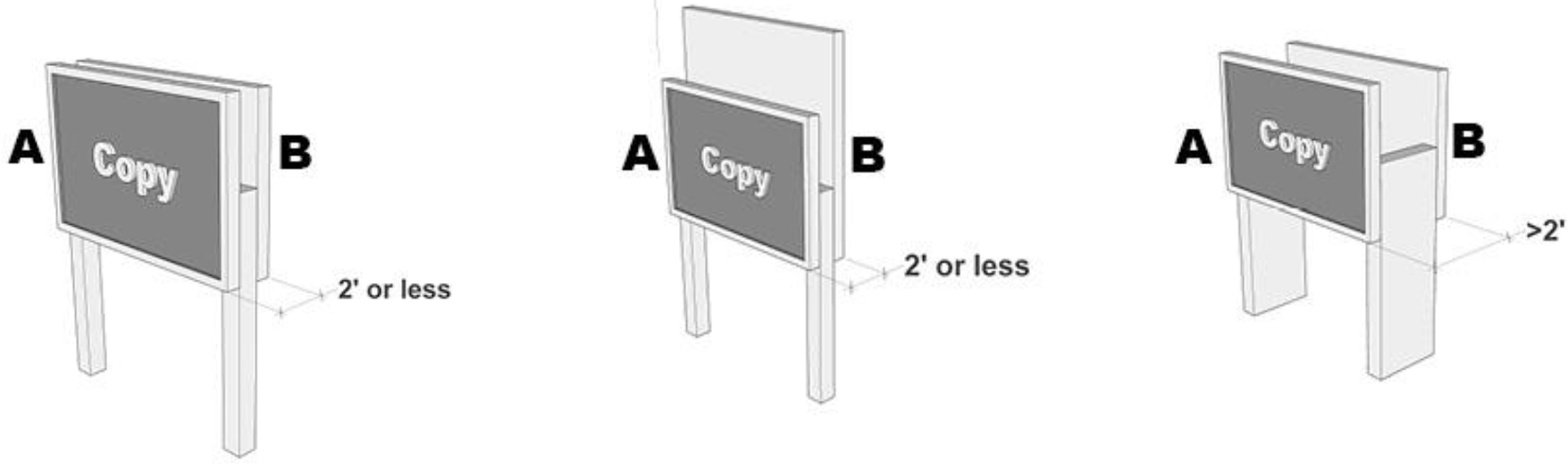
(d)
Sign Area. Sign area shall be the area of the smallest four-sided geometric figure which encompasses the facing of a sign including copy, insignia, background and borders. For residential monument signs, as provided for in Section 26.510.100(b), the measurement of sign area shall include the lettering and backing, as well as the monument upon which the sign is affixed. For residential monument signs mounted on landscape walls or fences within setback areas, the wall must comply with the standards of Section 26.575.020(e)(5)k., and the sign area shall include that area of the feature upon which the lettering and backing is located and the wall area above and below the lettering and backing.
(e)
Sign Area Measurement
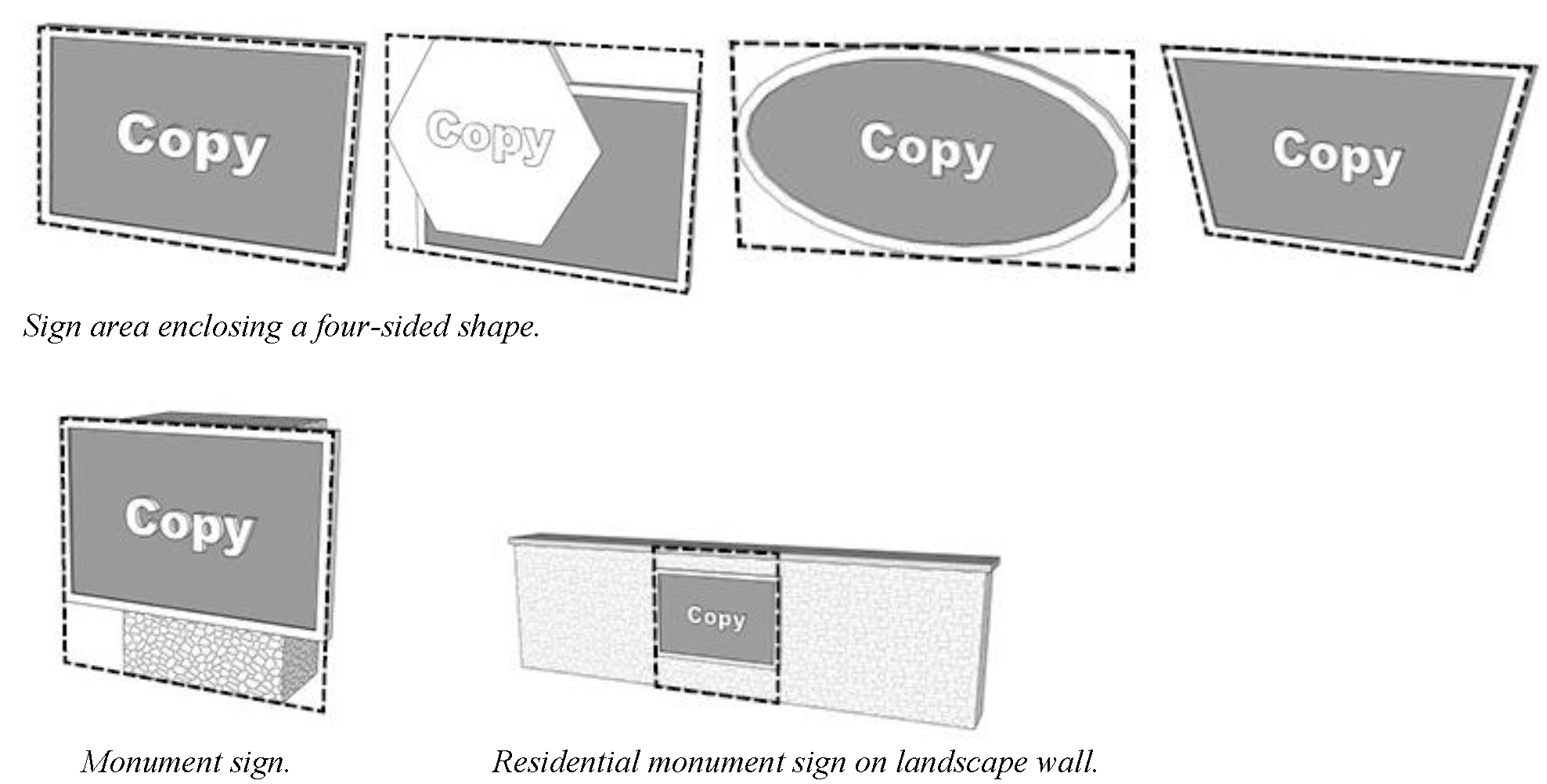
(f)
Cut-Out Letter Signs. Cut-out letter signs shall be credited toward allowable sign area at one-half (½) the measured area (see Figure 1 on the following page). The cut-out letter sign credit is given because these types of signs encourage transparency in regards to building materials and store windows, or lessen the impact of signage on awnings. To receive the credit on sign area, cut-out letter signs shall include the following:
(1)
Cut-out wall signs made out of wood, metal, stone or glass.
(2)
Cut-out window signs (such as laminate adhesive lettering).
(3)
Cut-out window signs that primarily contain text. If the cut-out letter sign contains graphics it will not receive the sign area credit.
(4)
Lettering on awnings that use the awning's primary color for the backing, for example, white lettering placed on an awning that is completely red. The credit would not be given to white lettering in front of a black background on an awning that is otherwise completely red.
(5)
Cut-out wall or window signs shall not exceed twelve (12) feet in width, or half of the total width of the street facing-building façade of the building on which it is located, whichever is smaller.
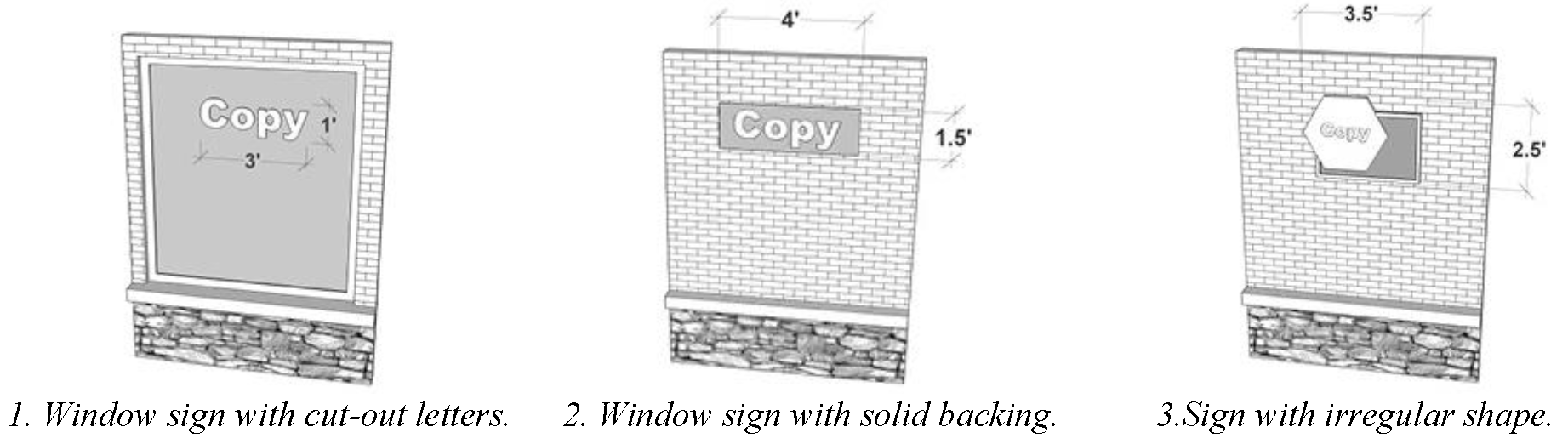
*Note: For the purposes of calculating cut-out letter signs for compliance with Section 26.510.100, Signage Allotment, the size of the cut-out letter sign shall be the final area after the reduction has been applied. For example, a two (2) by six (6) foot cut-out letter sign shall be permitted on the wall of a retail use, given that after the reduction has been applied it is only considered a six (6) square foot sign.
(g)
Sign Location and Placement.
(1)
When possible, signs shall be located at the same height on buildings with the same block face. Signs shall not obstruct or hide architectural features. Signs shall be consistent with the color, scale, and design of the building on the same lot or façade, and be proportionate to the scale of the facades. The location of a sign on a building shall correspond with the interior tenant space associated with the sign. For example, a business on the first floor of a building shall not place a sign on the second floor of the building. No sign shall be placed above the second floor of the building, or twenty-eight (28) feet above the street level, whichever is less. However, businesses on upper levels may place signage on the ground level to indicate the entrance for the business.
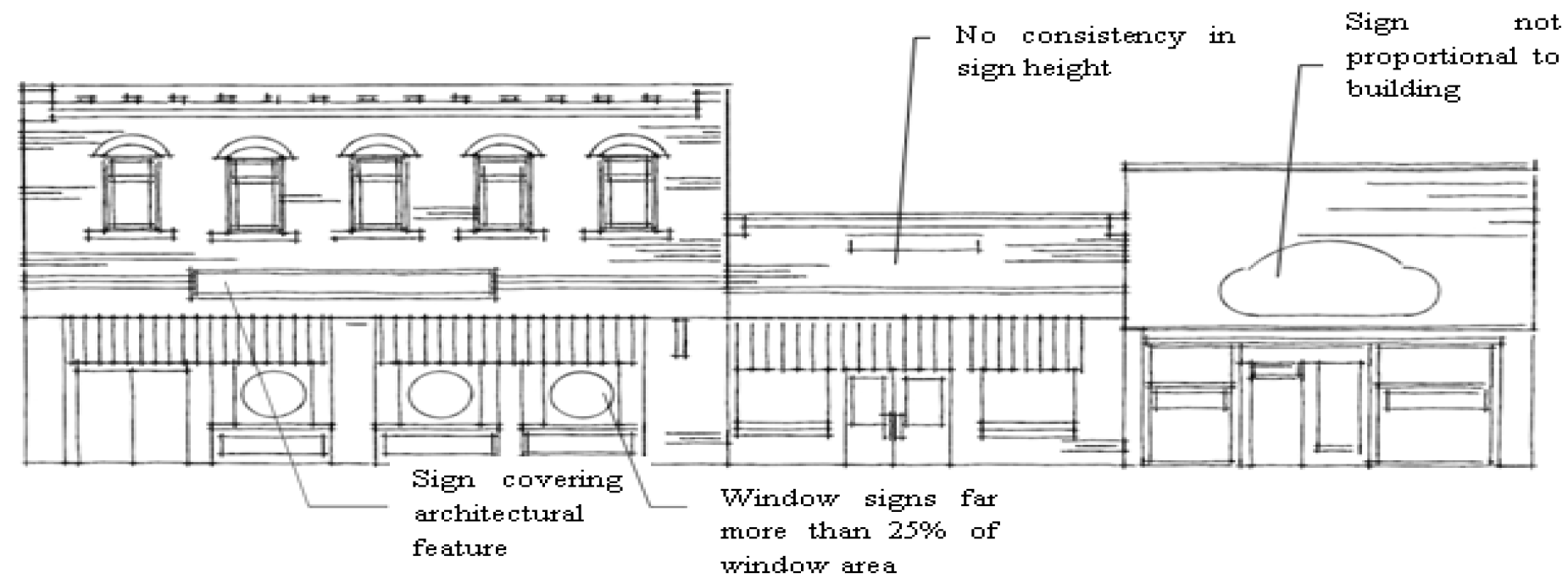
Figure 3 (above): Undesirable Style
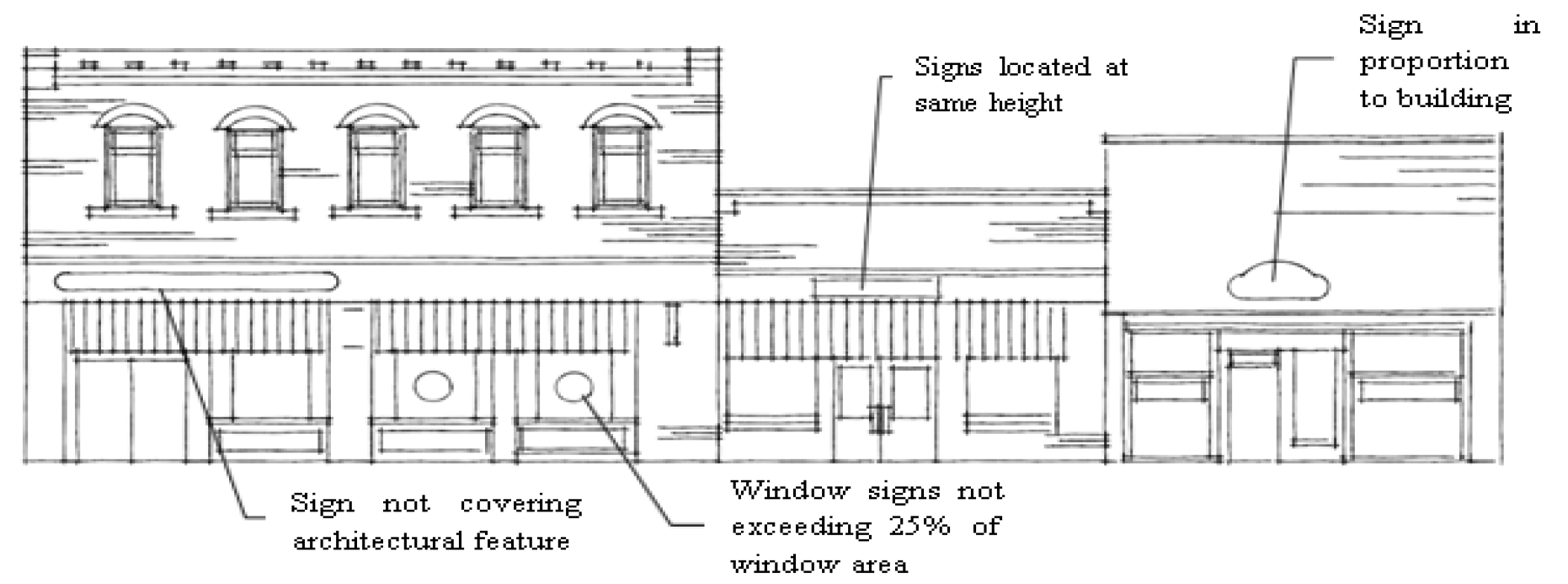
Figure 2 (above): Desired Style
(2)
Signs and sign mounting hardware placed on historic buildings shall not undermine the integrity, character or historic materials of the building as provided in the Commercial, Lodging, and Historic District Design Standards and Guidelines. Signs on historic masonry buildings should be mounted in the mortar, not the brick, and should be placed to maintain the integrity and health of historic materials. Applicants shall consult with the Historic Preservation Officer prior to receiving a sign permit to ensure the proposed sign and mounting materials do not undermine historic resources.
(Ord. No. 22-2017)
Sec. 26.510.070. - Sign illumination.
(a)
Allowed Illumination. Illumination of signs shall be designed, located, directed and shielded in such a manner that the light source is fixed and is not directly visible from and does not cast glare or direct light upon any adjacent property, public right-of-way, or motorist's vision. Illumination shall comply with Section 26.575.150, Outdoor lighting. One (1) backlit sign is permitted on buildings in which a Retail, Restaurant and Lodge uses in located if the emitted light does not create excess glare or light trespass onto other properties. Backlit signs shall be constructed of an opaque material. Illuminated channel-letter signs are allowed if the face and sides are constructed of an opaque material. Sign lighting shall be controlled by a light sensor, timer, or equivalent system in order to minimize the duration of illumination. Businesses are allowed no more than one (1) backlit or illuminated channel-letter sign.
(b)
Brightness.
(1)
Illuminated signs shall not operate at brightness levels of more than 0.3 footcandles above ambient light at the property line, as measured using a footcandle meter.
(2)
Prior to the issuance of a sign permit, the applicant shall provide written certification from the sign manufacturer that the light intensity has been factory pre-set not to exceed seven thousand (7,000) nits and that the intensity level is protected from end-user manipulation by password-protected software or other method as deemed appropriate by the director.
(c)
Prohibited Illumination. No sign shall be illuminated through the use of internal, oscillating, flickering, rear (excluding permitted backlit illumination), variable color, fluorescent illumination or neon or other gas tube illumination except when used for indirect illumination and in a manner, that directs the lighting away from the public right-of-way.
(Ord. No. 17-2010, § 1; Ord. No. 14-2013, § 1; Ord. No. 22-2017)
Sec. 26.510.080. - Sign lettering, logos and graphic designs.
(a)
Lettering. No lettering on any sign, including cut out letter signs, shall exceed twelve (12) inches in height, except that the first letter in each word shall not exceed eighteen (18) inches in height.
(b)
Logos. No logo on any sign, including cut out letter signs, shall exceed eighteen (18) inches in height and eighteen (18) inches in length.
(Ord. No. 17-2010, § 1; Ord. No. 14-2013, § 1; Ord. No. 22-2017)
Sec. 26.510.090. - Sign types and characteristics.
(a)
Awning Signs. No sign placed on an awning may project above, below, or off an awning. Signs may only be placed on awnings that meet the definition for Awning in Section 26.104.100, Definitions.
(b)
Freestanding Signs. The highest point of any part of a Freestanding sign shall not be higher than the principal building or six (6) feet, whichever is less, and cannot project into the public or pedestrian right-of-way.
(c)
Materials. Except for the Temporary Announcement Sign provided for in Section 26.510.040(e), signs shall be made primarily out of wood, glass, metal, or stone. Sandwich board signs must contain a fixed message or be made out of chalkboard. Dry erase boards are prohibited.
(d)
Monument Signs. The size and design of a monument sign shall meet the use requirements for that type of sign. The sign face must be directly connected to the base of the sign. Landscaping shall be provided so that the sign transitions naturally into the ground.
(e)
Projecting Signs. Projecting signs, also known as hanging or blade signs, shall not be higher than the eave line or parapet wall of the top of the principal building, shall have a minimum clearance of eight (8) feet above grade when located adjacent to or projecting over a pedestrian way and shall not extend more than four (4) feet from the building wall to which they are attached, except where the sign is an integral part of an approved canopy or awning.
(f)
Variable Message Display. An electronic traffic sign, which may contain a changing message, often used on roadways to give travelers information on special events or road conditions.
(g)
Wall Signs. Wall signs shall not be higher than the eave line or parapet wall of the top of the principal building and no sign part, including cut out letters, shall project more than six (6) inches from the building wall.
(h)
Window Signs. Window signs may be made of adhesive vinyl material.
(i)
Window Displays: Window displays (for example, the display of merchandise and representations thereof) are not subject to this Chapter, except as provided in this Subsection (n), and do not require a sign permit.
Businesses required to shield product displays and sales areas from public rights-of-way in order to comply with State of Colorado regulations regulating the visibility of products and sales areas must use window displays, as opposed to window wraps or other methods. These window displays shall be constructed to comply with all State requirements for visibility, shall be constructed in a good and workmanlike manner, and shall comply with the requirements of this Section.
Illumination of window displays shall be provided from full cut-off fixtures, shall not exceed three (3) footcandles at the building exterior, and shall be directed inward towards the business to minimize excess glare or light trespass on adjacent properties and public rights-of-way. The following types of illumination and signs are prohibited within window displays:
(1)
Televisions, computer monitors or other similar technological devices that create oscillating light.
(2)
Neon or other gas tube illumination, rope lighting or low-voltage strip lighting, except when used for indirect illumination and in such a manner as to not be directly exposed to public view.
(3)
Backlit or internally illuminated displays or graphics.
(Ord. No. 17-2010, §; Ord. No. 14-2013, § 1; Ord. No. 22-2017)
Sec. 26.510.100. - Sign allotment.
(a)
General Sign Allotment Rules.
(1)
Allotment. Sign allotment for all commercial businesses is based on the size of the Net Leasable Space the business occupies. How to calculate Net Leasable Commercial Space can be found in Section 26.575.020(i), Measurement of Net Leasable Commercial Space.
(2)
Projecting Sign. The area of a Projecting sign is exempt from sign allotment if:
a.
The sign is installed perpendicular to the front façade of the building.
b.
The sign is no larger than six (6) square feet per side.
(3)
Interior Signs. Interior signs placed within fifteen (15) feet of storefront windows count towards a business's signage allotment. Signs placed perpendicular to the public right-of-way or more than fifteen (15) feet from the storefront window are exempt from sign calculations.
(4)
Multi-Tenant Buildings. Buildings with four (4) or more tenants may create two (2) signs of up to ten (10) square feet in addition to the sign allotment for the individual tenants. One of the signs may be in the form of a freestanding sign.
(5)
Window Signs/Displays. Window signs and window displays are allowed only in the CC, C1, NC, SCI, CL and L zones, as follows:
a.
Window Signs and Wraps. A Window sign shall not exceed fifty percent (50%) of a window's area. Text and logos shall not exceed twenty-five percent (25%) of the window sign or wrap area.
b.
Window signs and wraps which conform to the standards in Subsection (5)a above do not count towards a business's or building's sign allotment. For window wraps and signs which exceed the standards of Subsection (5)a, the entirety of the window sign or wrap area shall be included in the calculation of sign area for the business or building.
(6)
Sandwich board signs, where permitted, do not count towards a business's sign allotment.
(b)
Sign Allotment.
(1)
Nonresidential and Mixed Use Districts. The following allotments apply to the CC, C-1, S/C/I, NC, MU, A, P, PUB, T, GCS, SKI, and EBO zone districts:
a.
The sign allotment for individual businesses is as follows:
b.
No single sign may be larger than six (6) square feet in area.
c.
Essential Public Facilities are calculated using the methodology for Net Leasable Area.
(2)
Residential Locations.
a.
Generally. A multi-family complex, subdivision entrance, or mobile home park is allotted one (1) wall, freestanding or monument sign with a maximum area of sixteen (16) square feet.
b.
Bed and Breakfast or Home Occupation. In addition to the yard signs provided for in Section 26.510.040(h), a building that includes a Bed and Breakfast or Home Occupation is allotted one (1) sign with a maximum area of six (6) square feet.
c.
Non-residential Uses in Residential Zone Districts. A nonresidential use (other than a home occupation) located in a residential zone district (R-6, R-15, R-15A, R-15B, R-30, RMF, RMFA, APHD, R-3, or RR), is allotted one (1) monument sign with a maximum area of twelve (12) square feet.
(3)
Lodge Districts. Buildings in the L, CL, LO, LP, shall receive a sign allotment of twelve (12) square feet per business.
(Ord. No. 17-2010, § 1; Ord. No. 14-2013, § 1; Ord. No. 22-2017)
Sec. 26.510.110. - Sandwich board signs.
The display of sandwich board and similar free-standing, two-sided signs on public or private property is not permitted. Sandwich board signs with a valid City of Aspen permit may be displayed until September 28, 2020. Expired sandwich board permits will not be renewed, and sandwich board signs displayed without a permit must be removed in accordance with the City of Aspen Municipal Code.
(Ord. No. 17-2010, § 1; Ord. No. 14-2013, § 1; Ord. No. 22-2017; Ord. No. 24-2018; Ord. No. 18-2019, § 1, 8-12-2018)
Sec. 26.510.120. - Policies regarding signage on public property.
The purpose of these regulations is to establish reasonable regulations for the posting of temporary signs, displays and banners on certain public property. These regulations include signs on public rights-of-way, signs in City parks, displays in City parks, and signs on public buildings. These regulations shall be read in conjunction with this Chapter and are not intended to supersede this Chapter's regulation of signs.
Temporary signs and displays provide an important medium through which individuals may convey a variety of noncommercial and commercial messages. However, left completely unregulated, temporary signs and displays can become a threat to public safety as a traffic hazard and detrimental to property values and the City's overall public welfare as an aesthetic nuisance. These regulations are intended to supplement this Chapter and to assist City staff to implement the regulations adopted by the City Council. These regulations are adopted to:
(a)
Balance the rights of individuals to convey their messages through temporary signs or displays and the right of the public to be protected against unrestricted proliferation of signs and displays;
(b)
Further the objectives of this Chapter; and
(c)
Ensure the fair and consistent enforcement of the sign and display regulations specified below.
This Section, "policies regarding signage on public property," states: "It shall be unlawful to erect or maintain any sign in, on, over or above any land or right-of-way or on any property, including light posts, belonging to the City without the permission of the City Council." Sign permits issued by the City Manager or his or her designee, that are in conformance with these regulations shall constitute City Council permission within the meaning of this Section, Signs on public rights-of-way. Applications for sign permits that do not comply with these regulations shall be forwarded to the City Council for consideration if requested by the applicant.
(a)
Definitions. Unless otherwise indicated, the definitions of words used in these regulations shall be the same as the definitions used in this Chapter, Signs. In addition, the following definitions shall apply:
(1)
Banner means any sign of lightweight fabric, plastic or similar material that is attached to any structure, pole, line or vehicle and possessing characters, letters, illustrations or ornamentations.
(2)
Banner, Light Post means any sign of lightweight fabric, plastic or similar material that is attached to a light post and possessing characters, letters, illustrations or ornamentations which meets the dimensional requirements for and is intended to be installed on municipal light posts.
(3)
Display means any symbol or object that does not meet the definition of a sign as defined in this Code, but like a sign is intended to convey a message to the public.
(4)
Flag means any fabric or bunting containing distinctive colors, patterns or symbols, which meets the dimensional requirements and is intended to be installed on municipal light posts.
(5)
Public Right-of-Way means the entire area between property boundaries which is owned by a government, dedicated to the public use or impressed with an easement for public use; which is primarily used for pedestrian or vehicular travel; and which is publicly maintained, in whole or in part, for such use; and includes without limitation the street, gutter, curb, shoulder, sidewalk, sidewalk area, parking or parking strip, pedestrian malls and any public way.
(6)
Sign means and includes the definition for sign as contained in Section 26.104.100, Definitions, of this Code. The term shall also include displays as that term is defined above.
(7)
Sign, Inflatable means any inflatable shape or figure designed or used to attract attention to a business event or location. Inflatable promotional devices shall be considered to be temporary signs under the terms of this Chapter and, where applicable, subject to the regulations thereof.
(b)
Signs on Public Rights-of-Way.
(1)
Purpose. The purpose of this policy is to regulate signs permitted to be located temporarily in the public right-of-way. Temporary signs are permitted in public rights-of-way if the following policies and procedures are followed. These regulations do not apply to banners on the Main Street light posts or hanging across Main Street that are subject to different regulations and criteria within Title 21 — Streets, Sidewalks, and Other Public Places and Title 29 — Engineering Design Standards.
(2)
Size/Number/Material. Only two (2) signs per person/event/organization are permitted. Signs shall not exceed ten (10) square feet each and banners shall not exceed fifty (50) square feet. Banners must be made of nylon, plastic or similar type material. Paper signs and banners are prohibited.
(3)
Cost/Fees/Procedures. Applicants shall be required to pay the necessary fees for approval from the Special Events Committee. Any event not requiring review by the Special Events Committee shall submit a sign plan to the Community Development Department for review and approval for a fee as outlined in Section 26.104.072, Zoning review fees, of this Code. Applications must be received a minimum of thirty (30) days prior to the event. The applicant shall also submit a refundable security deposit as outlined in the current fee schedule to be applied to any damages, repairs or the cost of removal if not corrected/removed by the applicant within three (3) days.
(4)
Duration. Temporary signs authorized pursuant to this Section shall be erected and maintained for a period not to exceed eighteen (18) days.
(5)
Maintenance. All signs and banners shall be maintained in an attractive manner, shall not impede vehicular or pedestrian traffic and shall not pose a safety risk to the public.
(6)
Exceptions. Any exceptions from the above requirements shall require City Council review and approval.
(c)
Signs in City Parks.
(1)
Purpose. Unattended signs are generally prohibited in City parks. The purpose of this policy is to regulate unattended temporary signs that are permitted in limited circumstances in City parks.
(2)
Size/Number/Material. Unattended temporary signs located in City parks shall be limited in size to three (3) feet by six (6) feet. Two (2) signs per person, organization or sponsor are allowed to face towards the event venue, and five (5) signs are allowed to face towards the public rights-of-way. These signs are not allowed to extend more than ten (10) feet above grade. Banners must be made of nylon, plastic or similar material. Paper banners and flags are prohibited. The Special Events Committee may approve one (1) inflatable per event of no more than twenty (20) feet in height if a suitable on-site location can be provided and if there is a demonstrable community benefit.
(3)
Location. Signs shall be set back at least ten (10) feet from the public right-of-way.
(4)
Cost/Fees/Procedures. Applicants shall be required to pay the necessary fees for approval from the Special Events Committee. Any event not requiring review by the Special Events Committee shall submit a sign plan to the Community Development Department for review and approval for a fee as outlined in the current fee schedule. The applicant shall also submit a refundable security deposit as outlined in the current fee ordinance to be applied to any damages, repairs or the cost of removal if not corrected/removed by the applicant within three (3) days. The applicant shall receive the necessary approval prior to the installation of any signs. Applications must be received no later than thirty (30) days prior to the event.
(5)
Duration. Unattended temporary signs may be erected and maintained only for the duration of the event or forty-eight (48) hours, whichever is less. All signs must be removed immediately following the event.
(6)
Maintenance. All signs must be maintained in an attractive manner, shall not impede vehicular or pedestrian traffic and shall not pose a safety risk to the public. A fifty dollar ($50.00) refundable security deposit will be required to ensure compliance.
(d)
Signs on Public Buildings.
(1)
Purpose. This subsection establishes a policy for the installation of sign on public buildings owned by the City.
(2)
Eligibility. Only City-owned signs are permitted on public buildings.
(3)
Size/Number/Material. All proposed signs should meet the City's specifications for size, mounting and material.
(4)
Copy. The City reserves the right to request changes to the design, color or copy in order to assist the applicant in complying with this policy.
(5)
Cost/Fees/Procedures. The cost of installation is outlined in the current fee schedule as amended from time to time. A refundable security deposit as outlined in the current fee schedule shall be required to assure replacement of damaged banners and retrieval of the banners from the City (see subsection (7) below for maintenance requirements). The applicant shall submit an application to the City Manager's office showing the dimensions, design and colors of the proposed signs.
(6)
Duration. The display of signs on public buildings shall not exceed fourteen (14) days or the duration of the event, whichever is less.
(7)
Maintenance. Prior to the placement of signs on public buildings, the applicant shall provide to the City a number of replacement signs, which matching the existing signs, to be determined by the City. These replacement signs shall be used by the City to replace signs that are stolen or damaged. The cost of replacing signs shall be deducted from the security deposit. Once signs have been removed, the applicant shall be required to pick up the signs from the City within three (3) days.
(Ord. No. 17-2010, § 1; Ord. No. 14-2013, § 1; Ord. No. 22-2017)
Sec. 26.512.010. - Intent and purpose.
(a)
Background. As the global population continues to grow, a larger percentage of people are living in urban environments, leading to expansion and development. In 2007, the global urban population exceeded the global rural population for the first time in history. According to the 2020 Census, in North America eighty-two (82) percent of people live in urban areas.
One problem associated with population growth and urban sprawl is the use of artificial light at night. This issue was first identified in the 1970s, when astronomers detected a degradation of the night sky. Continued increase in the quantity of high angle and uncontrolled reflected light has diminished the dark sky. For most of the U.S. population, a clear view of the stars is no longer possible.
Excessive, poorly designed, or poorly installed lighting at night creates issues that include skyglow, wasted energy, and unsafe or unpleasant conditions. Irresponsible light at night can also be harmful to the ecological health of flora, fauna, and humans. The City of Aspen is not excluded from these impacts. In the City of Aspen, darkness is as much a part of the natural environment as the trees, animals, and mountains. The dark night sky is currently an endangered resource. Unnecessary lighting of natural and semi-natural areas impedes our ability to connect to the natural environment of the dark night sky. When we are unable to see the stars, we become estranged from the wildness that makes the City of Aspen such a special place.
(b)
Purpose. The City of Aspen believes in the human right to access dark skies and be free from inappropriate lighting distractions at night. When the need for darkness conflicts with the need for light, good lighting design can find a workable balance between safety, aesthetics, human health, and the ecological and environmental impacts.
The City of Aspen understands that some exterior lighting is appropriate and necessary for the safety of people at night. What to light, why, and when, is a cornerstone of this lighting chapter. Because the effects of light pollution can persist as far as two hundred (200) kilometers (one hundred twenty (120) miles) from the source, local control and regional coordination is encouraged for both dark sky preservation and ecological protection. The following principles are used as a guide for responsible lighting design in the City of Aspen:
(1)
Useful — All lighting at night should have an intended purpose.
(2)
Targeted — Light should be directed only where it is needed.
(3)
Low Light Levels — Light should be no brighter than necessary for the task.
(4)
Controlled — Lighting should only be used when it is useful.
(5)
Spectrum — Lighting shall be restricted to the range of Correlated Color Temperatures (CCTs) used outdoors to reduce disruptive, shorter wavelengths while encouraging warm-white light color temperature.
(c)
Goals. In addition to the principles of responsible lighting design mentioned above, the following goals are intended to guide the City of Aspen's decision makers regarding artificial exterior light at night:
(1)
Use American National Standards Institute (ANSI)/ Illuminating Engineering Society (IES) exterior illuminance recommendations to reduce pedestrian accidents and promote the health, safety, and welfare of people;
(2)
Reduce obtrusive and glaring light that inhibit human vision and detract from enjoyment of the night sky;
(3)
Curtail light pollution, reduce sky glow metrics, and improve the nighttime environment for residents, visitors, and astronomer enthusiasts;
(4)
Avoid inappropriate and poorly designed or installed outdoor lighting;
(5)
Protect local and migrating ecological systems from the adverse effects of artificial light;
(6)
Prevent light trespass from unnecessarily disturbing people (and their sleep patterns) and from unnecessarily restricting access to nighttime darkness as a natural resource.
(Ord. No. 12-2023, § 1(Exh. A), 11-14-2023)
Sec. 26.512.020. - Lighting zone planning and designations.
(a)
Background. Introduced in the late 1990s, Lighting Zones (LZ) are a municipal planning tool to help reduce light levels, light pollution, wasted energy, and neighborly conflicts arising from excessive or poor use of light at night. LZs can achieve these goals by leveraging the adaptation of human vision in low light levels, enabling lighting solutions based on ambient conditions rather than brightly lit adjacent properties.
Knowing what to light, or not light, is an important consideration for the nighttime environment. Having a hierarchy of planned lighting can add context and visual order, improve coherency and understanding of one's surroundings, and ultimately give a pedestrian the confidence to engage with outdoor space at night. Avoiding visual distractions and glare are also key considerations for improving nighttime vision of residents, pedestrians, and motorists. This chapter will leverage the following guidance from the ANSI, the IES, and the International Dark Sky Association (IDA):
(1)
ANSI/IES LP-2 Designing Quality Light for Exterior Environments
(2)
ANSI/IES RP-43-22 Lighting Exterior Applications
(3)
ANSI/IES LP-11-20 Environmental Conditions for Outdoor Lighting
(4)
IDA Model Lighting Ordinance, 2011
(b)
Definitions. Officially defined within ANSI/IES LP-11-20 Environmental Conditions for Outdoor Lighting, LZs are briefly defined here:
(1)
NDZ — Natural Dark Zones
(2)
LZO — No Ambient Light
(3)
LZ1 — Low Ambient Light
(4)
LZ2 — Moderate Ambient Light
(5)
LZ3 — Moderately High Ambient Light
(c)
Purpose. LZ designations allow for illuminance recommendations regarding what to light and at what intensity based on the expected activities. Assigning these designations within the City of Aspen is essential to reference and use ANSI/IES recommendations for exterior lighting.
(d)
Goals. LZ designations should not be based on existing conditions, but rather the type of environment the municipality seeks to achieve.
(e)
Designations. LZs are most effective when they coordinate with, and overlay on, land use zone districts and their associated tasks. LZ designations will cross reference to the City of Aspen Zone Districts as follows:
(1)
Lighting Zone 0 (LZO): Specific City of Aspen Parks may apply
(2)
Lighting Zone 1 (LZ1): All Residential Zone Districts - AH, AH-PD, R-3, R-6, R-15, R-15A, R-15B, R-30, RR, R/MF, R/MFA
(3)
Lighting Zone 2 (LZ2): A, CC, C-1, CL, L, MU, NC, PUB, SCI, SKI
(4)
Lighting Zone 3 (LZ3): Only available for Temporary Uses, or Special Review
(5)
Planned Developments (PDs). PDs with adopted outdoor lighting regulations are not included in a LZ. All PDs without an adopted outdoor lighting regulation are subject to underlying zoning and the related LZ. In all circumstances, if a PD is silent on a particular topic related to outdoor lighting, the provisions of this Title shall apply. For new PDs, lighting requirements should be evaluated with guidance from underlying zoning and the related LZ.
(6)
City of Aspen Parks, Trails, and Open Spaces. Parks, trails, and open spaces managed by the City of Aspen are distinct use types that have distinct lighting needs based on the location and intensity of the use. City of Aspen parks, trails, and open spaces have diverse underlying zone districts based on the distribution of their locations. In most circumstances City of Aspen parks, trails, and open spaces shall be limited to the standards under NDZ, LZO, LZ1 or LZ2. See Section 26.512.090 - Parks, Trails, and Open Spaces, for guidance on outdoor lighting characteristics found across City of Aspen parks, trails, and open spaces.
(Ord. No. 12-2023, § 1(Exh. A), 11-14-2023)
Sec. 26.512.030. - Applicability.
(a)
Applicability. The lighting requirements of this chapter shall be applicable to all exterior lighting on private property within the City of Aspen. This includes use of light, hours of operation, and mitigation of light trespass.
(1)
Trespass and curfew. Trespass and curfew regulations are in effect immediately upon the passage of this chapter.
(2)
5-year Legacy Exemption. Existing outdoor lighting fixtures that do not meet the provisions of this chapter shall be considered nonconforming for five (5) years from the adoption date of this chapter.
(3)
Nonconforming lighting. Unless otherwise specified within this chapter, within five (5) years of the effective date of this chapter all outdoor lighting luminaires that do not conform to the requirements of Chapter 26.512 shall be replaced or retrofitted to comply with the provisions of this chapter. After five (5) years from the effective date of this chapter, noncompliant outdoor lighting luminaires will be considered a violation of this chapter and subject to the penalties set forth herein. The Community Development Department may issue an Administrative Notice of Violation per Section 2.02.120. - Uniform enforcement of City regulations, to any person or property owner using noncompliant outdoor lighting luminaires, and such violation shall be cured within ninety (90) days from the date of the Administrative Notice of Violation.
(b)
Compliance by development scenario.
(1)
Routine Maintenance and one-for-one replacement. Proposals fall into this category if they do not require a permit. The repaired or replaced fixture(s) shall conform with the requirements of this chapter.
(2)
Renovations and Modifications.
a.
Proposals fall into this category if a renovation or modification to outdoor lighting requires a permit, and the total lumens of replaced or added fixtures is less than forty (40) percent of the total site lumen allowance listed in Table 2 or Table 4, as applicable. Only the outdoor lighting fixtures replaced or added in the permit shall need to come into compliance with the requirements of this chapter.
b.
Proposals fall into this category if a renovation or modification to outdoor lighting requires a permit, and the total lumens of replaced or added fixtures is equal to or more than forty (40) percent of the total site lumen allowance listed in Table 2 or Table 4, as applicable. These proposals shall cause the entire property to meet the requirements of this chapter.
c.
Changes that qualify as an International Existing Building Code (IEBC) Alteration Level 3 on an existing development (e.g., square footage, occupant capacity, parking spaces) shall cause the entire property to meet the requirements of this chapter.
d.
Any re-zoning or change of use, per Title 26, shall cause the entire property to meet the requirements of this chapter.
(3)
New development and Redevelopment. If new development occurs on a vacant lot or a property is redeveloped, as defined in Section 26.104.100 - Definitions, this shall cause the entire property to meet the requirements of this chapter.
(c)
Exemptions. The following types of lighting installations shall be exempt from the requirements within this chapter.
(1)
Lawful. Lighting required by federal, state, county, municipal, or other territorial laws or regulations that conflict with this chapter.
(2)
Flags. When possible, lower and remove flags from sunset to sunrise so illumination is not needed. For flags displayed at night, nighttime illumination of the United States of America flag and the Colorado State flag is allowed. Nighttime illumination of other flags is not allowed. Nighttime illumination of flags shall follow the guidelines below:
a.
For an even distribution of light on the flag surface when fully extended, use either top of pole downward directed light, a maximum of three (3) in-ground uplights, or three (3) shielded spotlights that are surface mounted at grade. To preserve the night sky, the use of top of pole downward directed lights is encouraged.
b.
In-ground and surface mounted shielded spotlights should be narrow beam (fifteen (15) degree maximum), no more than one hundred (100) lumens per foot of height (e.g., 2,500 lumens per light for a 25-foot-tall flag), with point sources of light not to be visible outside of a 15-foot radius. Surface mounted lights should rotate and tilt and be aimed to hit the flag.
(3)
Street, Public Trails, and Roadway. Lighting installed within the public right-of-way or an easement that is for the benefit of public safety, such as emergency, traffic control, or streetlights, is not subject to this chapter. Lighting installed within the public right-of-way with a purpose of illuminating outside the public right-of-way is not exempt from the requirements of this chapter.
(4)
Signage. See Chapter 26.510 - Signs.
(d)
Special Circumstances. If a lighting plan, luminaire, or installation is proposed and does not meet the requirements of this chapter, but has a demonstrable community benefit, an exemption may be considered. The applicant shall submit additional information so the benefit to the community can be evaluated, and the lighting may then be approved by the Community Development Director. Should the Community Development Director deny an application of this nature, an applicant may pursue a Temporary Use review with City Council per Chapter 26.450 or a Special Review with Planning & Zoning Commission or the Historic Preservation Commission per Chapter 26.430.
(1)
This process shall apply to outdoor art installations involving lighting.
(2)
This process may also apply to lighting scenarios not addressed in other sections of this code, such as a clock tower in a public area.
(Ord. No. 12-2023, § 1(Exh. A), 11-14-2023)
Sec. 26.512.040. - Submittal process.
(a)
General. Unless otherwise required by this Title, evaluation of lighting shall be made at building permit review. For example, while Planned Development and Environmentally Sensitive reviews would require a lighting plan during land use review, most projects will involve the evaluation of lighting at building permit. Lighting plans shall be submitted to the Community Development Department for approval. For all submissions, either method described below is acceptable. Proposals that do not trigger a permit are exempt from submitting lighting plans and shall conform with the requirements of this chapter.
(b)
Prescriptive Method. For administrative simplicity, a project shall be charted using The City of Aspen Outdoor Lighting Permit Submission Tool containing identification for each luminaire type, quantity, lumen output, BUG rating for luminaires (if available), the total expected site lumens, and a calculated total site lumens compared to the total site lumen allowance listed in Table 2 or Table 4.
(1)
A sub-total is required for the total lumens coming from partially shielded light allowed in Table 2 or Table 4, as applicable. The total lumens coming from partially shielded lights cannot exceed twenty (20) percent of the allowable lumens.
(2)
Supporting data sheets for exact luminaires (model numbers), light distribution plots, fixture BUG ratings, luminaire locations, mounting heights, and aiming directions shall be included to the extent necessary to show compliance with requirements.
(c)
Performance Method. For larger and more complex projects, an outdoor lighting design may be analyzed using industry standard lighting software. This outdoor lighting plan shall include:
(1)
The City of Aspen Outdoor Lighting Compliance Statement signed and stamped by the architect, electrical engineer, contractor, or lighting designer verifying that the outdoor lighting plan meets the requirements of the chapter.
(2)
Luminaire locations, mounting heights, aiming directions, point-by-point calculation plan indicating average, maximum, and minimum illumination values, with isolume lines or false-color bands showing illumination levels and points of calculation ten (10) feet past the property line. The plane of calculation shall be at the ground level.
(3)
The average illuminance (in footcandles or lux) for any one (1) task should not exceed ANSI/IES standards for the applicable lighting zone, including but not limited to:
i.
Façade, building entrance, porte cochere, softscape, and perimeter barriers.
ii.
Walking paths adjacent to architecture, hardscape, exits, landscape, waterfront, stairs, and ramps.
iii.
Patios, outdoor dining, decks, terraces, pools, and pool decks.
(4)
The analysis shall utilize an enclosure comprised of calculation planes with zero reflectance values around the perimeter of the site including a top plane no less than thirty-three (33) feet (ten (10) meters) above the tallest luminaire. The illuminance on the calculation planes shall not exceed the limits of light trespass defined within this chapter.
(d)
Prior to Certificate of Occupancy, the applicant shall submit one of the following when pursuing Section 26.512.040(b) - Prescriptive Method:
(1)
The City of Aspen Outdoor Lighting Compliance Statement signed by the architect, electrical engineer, contractor, or lighting designer verifying that the outdoor lighting meets the requirements of this chapter and has not changed from the approved permit documentation; or,
(2)
If the outdoor lighting plan has changed, the City of Aspen Outdoor Lighting Compliance Statement signed by the architect, electrical engineer, contractor, or lighting designer verifying that the outdoor lighting meets the requirements of this chapter with an updated City of Aspen Outdoor Lighting Permit Submission Tool and updated supporting documents per 26.512.040(b) - Prescriptive Method.
(e)
Prior to Certificate of Occupancy, the applicant shall submit one of the following when pursuing Section 26.512.040(c) - Performance Method:
(1)
The City of Aspen Outdoor Lighting Compliance Statement signed by the architect, electrical engineer, contractor, or lighting designer verifying that the outdoor lighting meets the requirements of this chapter and has not changed from the approved permit documentation; or,
(2)
If the outdoor lighting plan has changed, the City of Aspen Outdoor Lighting Compliance Statement signed by the architect, electrical engineer, contractor, or lighting designer, and a revised lighting calculation plan and updated supporting documents per Section 512.040(c) - Performance Method.
(f)
Review. Site lighting plans shall be subject to review and approval by the City of Aspen Community Development. Site lighting plans submitted as a part of a building permit application shall be reviewed administratively by the Community Development Director. The Director shall have the authority to refer an application to the Planning and Zoning Commission or the Historic Preservation Commission if deemed appropriate per 26.430, Special Review.
(g)
Appeals. An appeal made by an applicant aggrieved by a decision made by the Community Development Director regarding administration of this Chapter may appeal such decision to the City Council, pursuant to 26.316, Appeals. Other administrative remedy may be available pursuant to C.R.S. § 31-23-209.
(h)
Future Amendments to Chapter 26.512 - Outdoor Lighting. All future amendments of a technical nature to this Chapter shall be exempt from the requirement of Policy Resolution for code amendments (Section 26.310.020(b)(1), (2)). Future amendments may proceed directly to a First and Second Reading, pursuant to Section 26.310.020(b)(3). Necessary amendments that raise policy questions shall follow the normal procedures for Land Use Code amendments per Chapter 26.310, Amendments to the Land Use Code.
(Ord. No. 12-2023, § 1(Exh. A), 11-14-2023)
Sec. 26.512.050. - Light trespass.
(a)
Background. Light trespass refers to measurable light extending beyond the boundary of its intended usage area. This causes annoyance, loss of privacy, or other nuisances. In the City of Aspen, light trespass can be a major source of frustration between neighbors. Often light trespass is referring to outdoor lighting, but light spilling outdoors through windows or other translucent surfaces in a façade also contributes to light trespass.
(b)
Requirements. All outdoor light sources in the City of Aspen shall be located and optically cutoff such that the point light source shall not be visible from adjacent property or public right-of-way during hours of curfew defined in Section 26.512.050(d). Additionally, interior point light sources shall not be visible from the property line during hours of curfew. Unless permitted otherwise by the City of Aspen, the total maximum illumination of interior and exterior light sources at any point along the property line as defined in Section 26.512.050(c) shall not exceed the requirements listed in Table 1.
Meeting these requirements will likely require mounting locations 2.5 times the luminaire height away from any property lines. Additional distance or shielding will likely be required for lighting installed along ridgelines or hillsides. Methods encouraged for interior and exterior light sources to meet these light trespass limits include shielding, dimming, timers, and window shades.
Table 1: Property Line Vertical Light Trespass: Illuminance Limits. Measured in footcandles or lux.
(c)
Measurements. To measure vertical light trespass for any property in Aspen, a light meter shall be placed at five (5) feet above grade and aimed perpendicular to the property line, pointed towards the light source. Multiple readings shall be taken to ensure compliance around the property line. When bordering with public right-of-way, the property line shall be considered five (5) feet beyond the actual property line. Any location a measurement is taken along the property line shall meet the criteria in Table 1.
(d)
Enforcement Hours. The Community Development Department may take light trespass readings within the following hours and enforce upon any light that exceeds the levels outlined in Table 1 above:
(1)
Hours of enforceable light trespass for all City of Aspen private property lighting shall be the following:
a.
Residential Uses: Curfew hours shall be 10:00 p.m. to 7:00 a.m.
b.
Non-Residential Uses: Curfew hours of 10:00 p.m. to 7:00 a.m. shall apply to all businesses unless normal operating hours end or begin within the hours of curfew. If so, the curfew applies until one (1) hour after closing or one (1) hour before opening. For example, if a business closes at 11:00 p.m., the curfew for that business shall be 12:00 a.m. to 7:00 a.m. If a business opens at 6:00 a.m., the curfew for that business shall be 10:00 p.m. to 5:00 a.m.
(Ord. No. 12-2023, § 1(Exh. A), 11-14-2023)
Sec. 26.512.060. - Requirements for all outdoor lighting.
(a)
Conformance. All outdoor lighting shall meet the requirements of this chapter, applicable electrical and energy codes, and applicable sections of the building code.
(b)
Responsible Design Criteria.
(1)
Correlated Color Temperature (CCT). In an effort to minimize potentially disruptive and/or harmful spectrum at night, all exterior lighting subject to this chapter shall have a standard CCT of 2700K up to a maximum of 3000K. A CCT of 2200K or lower is allowed for non-commercial uses provided the Color Rendering Index (CRI) is greater than sixty-five (65).
(2)
Direct Uplight. Unless otherwise allowed in Tables 3 and 5, all light sources shall be fully shielded or partially shielded. Luminaires that have a UO rating (produce zero uplight per IES TM-15) are encouraged but are not required. All luminaires shall be constructed in such a manner that all light emitted, either directly from the light source, through a diffusing element, or indirectly by reflection or refraction from any part of the luminaire, is projected no higher than the horizontal plane.
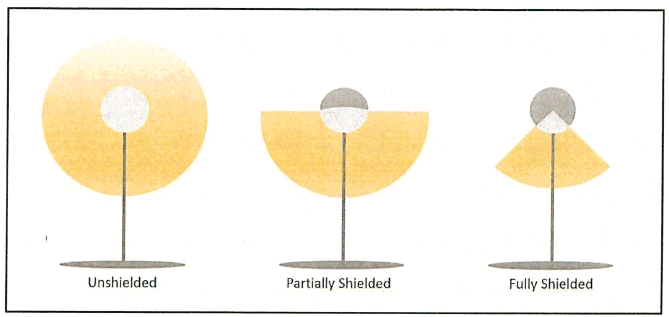
Figure 1: Unshielded, Partially Shielded, and Fully Shielded Light Emittance
(3)
Poles.
a.
Bollard, pathway, or post-top lighting taller than forty-two (42) inches from finished grade is prohibited within residential zones.
b.
Pole mounted lighting within multi-family common areas or any parking lot adjacent to a residential use are allowed up to twelve (12) feet from finished grade. This allowance shall not exceed light trespass limits.
c.
Pole mounted lighting for non-residential parking lots is allowed up to twenty (20) feet tall from finished grade, provided it is not directly adjacent to a residential property. This allowance shall not exceed light trespass limits.
(c)
Prohibitions. The following types of exterior lighting sources, luminaires and installations, and those interior lighting sources, luminaires, and installations that can be seen directly from the exterior by the public or are causing light trespass or direct glare into any property or public right-of-way, shall be prohibited in the City of Aspen.
(1)
Non-shielded and partially shielded fixtures unless identified as allowed in Tables 3 and 5.
(2)
Mercury vapor lighting.
(3)
Inefficient lamps or LED luminaires (those with an efficacy of less than forty-five (45) lumens per watt) shall be prohibited for outdoor use.
(4)
Blinking, flashing, moving, revolving, scintillating, flickering, changing intensity, and changing color lights. This prohibition does not apply to Section 26.512.110(f) - Seasonal Lighting.
(5)
Neon lighting and LED strips simulating the appearance of neon are both prohibited. This includes its usage for the outlining of buildings and for signage.
(6)
Non-shielded floodlights are prohibited. Fully shielded floodlights are subject to the lumen maximums in Tables 3 and 5. For motion sensor lights see Section 26.512.100(a) - Security.
(7)
Lighting directed towards the Roaring Fork River and its tributary streams or Hallam Lake is prohibited per Chapter 26.435 - Development in Environmentally Sensitive Areas (ESA).
(8)
No outdoor lighting shall be used in any manner that could interfere with the safe movement of motor vehicles on public thoroughfares. The following is prohibited:
a.
Any permanent light source not intended for roadway illumination that still produces direct light or glare onto a roadway that could be disturbing to the operator of a motor vehicle (e.g., pedestrian architectural lighting, landscape lighting).
b.
Any light that may be confused with or construed as a traffic control device except as authorized by State, Federal or City government.
(9)
Aerial lasers, beacons, and searchlights are prohibited except for emergency use.
(Ord. No. 12-2023, § 1(Exh. A), 11-14-2023)
Sec. 26.512.070. - Residential lighting.
(a)
Background. Lighting in residential areas provides for safe navigation to and from residences at night, adds visual character, and the ability to enjoy outdoor spaces in hours of darkness. Functional lighting of facades, landscaping, and peripheral boundaries of a residential property allows residents and guests to stay oriented within a space, which fosters an improved sense of safety and wellbeing. Decorative or excessive lighting of facades, landscaping, and peripheral boundaries of a residential property contributes to light pollution and degradation of dark sky and natural darkness goals. Any points of ingress or egress can also benefit from quality lighting for both wayfinding and threat detection. Vertical illuminance plays a critical role in addressing this need, allowing movement in silhouette or shadow to be easily detectable.
Effective lighting for these needs should be unobtrusive, avoid creating glare, and avoid excessive light which can harm the night sky and the health of people, wildlife, and landscaping. For this reason, maximum limits on lumens per site, see Table 2, and light trespass limits apply to all residential properties in the City of Aspen.
(b)
Light Output. The upper lumen limits listed below should not be the design goal. The design goal should be to use the minimum light levels that meet the requirements of the task. The total allowable site lumens for a residential property are limited to:
Table 2: Total Site Lumens Allowed: Residential Uses. Measured in lumens.
(c)
Additional Allowances. The following additional lumen allowances apply only to residential properties if the following applies:
(1)
For multi-family units in a mixed-use development, each unit shall be allotted one thousand (1,000) lumens per unit above allowances provided in Table 4. Additional lumens shall not be traded between dwelling units or to a non-residential use.
(2)
On single-family/duplex residential lots larger than one (1) acre with more than one (1) dwelling unit, an additional two thousand (2,000) lumens for each additional dwelling unit is allowed. Additional lumens shall not be traded between dwelling units.
(3)
An additional three hundred (300) lumens per parking lot space is allowed for multi-family units in one hundred (100) percent residential developments. Additional lumens shall not be traded between dwelling units.
(d)
Partially shielded and Unshielded luminaries. Partially shielded and Unshielded luminaries for the applications in Sections 26.512.070(e), (f), and (g) are permissible if the light distribution is limited to the targeted element (e.g., façade, sculpture, shrub), and if the total amount of light does not exceed twenty (20) percent of the total site lumen allowance and the individual luminaire limits listed below:
Table 3 - Maximum Unshielded and Partially Shielded Luminaire Lumens - Residential. Measured in lumens.
(e)
Light for Orientation and Reassurance. Vertical illuminance plays a critical role in allowing people to perceive the spatial perimeter and major obstacles in an area, as well as detect movement. This allows people to feel more confident navigating a space and allows for threat detection at night, especially in lower-activity residential areas. The design standards for this kind of lighting are detailed below.
(1)
Trees, Gardens, and Landscape Lighting.
a.
Tree and landscape lighting shall be no taller than twenty-five (25) feet from finished grade.
b.
Tree and landscape lighting are subject to curfew hours and shall be turned off between the hours of 10;00 p.m. and 7:00 a.m.
(2)
Walls, Stairs, Fences, and Perimeter Barriers.
a.
Perimeter fence lighting is prohibited within residential zones for residential use.
b.
Illumination of site and retaining walls shorter than six (6) feet from finished grade and directly beneath them is allowed within common areas of multi-family developments and shall meet all the other requirements of this chapter.
(f)
Light for Wayfinding, Pathways, and Stairs. Changes in grade or terrain are more hazardous when visibility is poor. Stairways, curbs, raised pavement, potholes, and slippery surfaces are all examples of possible trip and fall hazards that can require lighting at night to navigate to or from a residence safely. The design standards for this type of lighting are detailed below:
(1)
Driveway and Parking. Driveway and parking lot lighting for single-family, duplex, triplex, and four-plex residential uses shall be fully shielded so that the point light source is not visible from adjoining property lines or rights-of way. Lighting shall be included in total allowable lumens and meet Table 3 luminaire limit requirements. Building mounted lighting for driveway and parking shall be no higher than twelve (12) feet above finished grade. Non-building mounted lighting shall comply with Section 26.512.060(3).
(2)
Address Markers. Are not exempt from lumen allowance.
(3)
Entrances and Porte Cocheres. Porte cochere and covered porch lighting is allowed. Luminaires shall be aimed downward and installed such that the bottom of the luminaire or lens, whichever is lower, is recessed or fully shielded and not producing any light above the horizontal. All light emitted by an under-canopy luminaire shall be substantially confined to the posts, facades, and ground surface directly beneath the perimeter of the canopy.
(4)
Pathways, Exterior Stairs, and Steps. Luminaires in these applications shall be no taller than forty-two (42) inches from finished grade.
(g)
Light for Atmosphere and Enjoyment.
(1)
Lighting used to illuminate patios, above grade decks, balconies, or gazebos shall be fully shielded with the point light source not visible beyond the property line.
(2)
Art, monuments, and fountain features may be illuminated if they are within ten (10) horizontal feet of the residential structure. Lighting shall be turned off between the hours of 10:00 p.m. to 7:00 a.m. per Section 26.512.050(d).
(3)
Outdoor televisions may be allowed so long as the screen is directed inwards and is not visible from any property line. Television screens mounted outdoors shall be turned off during the hours of curfew defined in Section 26.512.050(d). For the use of television screens as signage please refer to Chapter 26.510 - Signs.
(Ord. No. 12-2023, § 1(Exh. A), 11-14-2023)
Sec. 26.512.080. - Non-residential lighting.
(a)
Background. Lighting in non-residential areas provides for safe navigation to and from businesses and activities at night, adds visual character, and allows for shopping and recreation in hours of darkness. Lighting facades, landscaping, and peripheral boundaries of non-residential spaces allows residents and visitors to the City of Aspen to stay oriented within a space, fostering an improved sense of safety and wellbeing. Any points of ingress or egress for non-residential spaces can also benefit from quality lighting for both wayfinding and threat detection. Vertical illuminance plays a critical role in addressing this need, allowing movement in silhouette or shadow to be easily detectable. It also helps to define spatial boundaries in busier non-residential areas and avoid conflicts between users.
Effective lighting for these needs should be unobtrusive, avoid creating glare, and avoid excessive light which can harm the night sky and the health of people and landscaping. For this reason, maximum limits on lumens per site and light trespass limits apply to all non-residential properties in the City of Aspen.
(b)
Light Output. The upper lumen limits listed below should not be the design goal. The design goal should be to use the minimum light levels that meet the requirements of the task. The total allowable site lumens for non-residential properties are based on the square footage of the facade and other elements of the developed structure, landscape buffer, and hardscape. A site shall calculate a maximum site lumen allowance by choosing a maximum of four (4) of the lighting types as identified in Table 4. Individual site lumen limits by lighting type are as follows:
Table 4 - Site Lumen Allowances: Non-Residential/Commercial Uses. Measured in lumens.
** Measured illuminance shall not exceed fifty (50) footcandles horizontal on average, measured at grade, under the canopy.
(c)
Partially shielded and Unshielded luminaries. Partially shielded and Unshielded luminaries for the applications in Sections 26.512.080(d), (e), and (f) are permissible if the light distribution is limited to the targeted element (e.g., façade, sculpture, shrub), and if the total amount of light does not exceed twenty (20) percent of the total site lumen allowance and the individual luminaire limits listed below:
Table 5 - Maximum Unshielded and Partially Shielded Luminaire Lumens Per Fixture - Non-residential. Measured in lumens.
(d)
Light for Orientation and Reassurance. Vertical illuminance plays a critical role in allowing people to perceive the spatial perimeter and major obstacles in an area, as well as detect movement. This allows people to feel more confident navigating busier non-residential areas and allows for threat detection at night. The design standards for this kind of lighting are detailed below.
(1)
Façade Lighting.
a.
The point light source shall not be visible from adjacent properties or create glare in the right-of-way.
b.
Façade lighting for a mixed-use property shall not be installed above floors with residential dwelling units.
c.
Display window lighting is allowed when it complies with the restrictions in place for point sources light trespass, and Section 26.512.090.
(2)
Trees, Gardens, and Landscape Lighting.
a.
Tree and landscape lighting is subject to curfew per Section 26.512.050.d.
(3)
Walls, Stairs, Fences, and Perimeter Barrier.
a.
Illumination of site/retaining walls within six (6) feet of finished grade is allowed within non-residential common areas, provided they are washed using approved façade or landscape lighting techniques and meet all the other requirements of this chapter.
(e)
Light for Wayfinding and Pathways. Changes in grade or terrain are more hazardous when visibility is poor. Stairways, curbs, raised pavement, potholes, and slippery surfaces are all examples of possible trip and fall hazards that can require lighting at night to navigate around safely in a non-residential area. The design standards for this type of lighting are detailed below.
(1)
Driveway and Parking. Outdoor lighting used to illuminate parking spaces, driveways, or maneuvering areas shall be fully shielded and be designed, arranged, and shielded so that the point light source is not visible from adjoining property lines or rights-of-way. Building mounted lighting for driveway and parking shall be no higher than twelve (12) feet above finished grade. Non-building mounted lighting shall comply with Section 26.512.060(3).
(2)
Entrances and Porte Cocheres. Porte cochere and covered porch lighting is allowed. Luminaires shall be aimed downward and installed such that the bottom of the luminaire or lens, whichever is lower, is recessed or fully shielded and not producing any light above horizontal. All light emitted by an under-canopy luminaire shall be substantially confined to the posts, facades, and ground surface directly beneath the perimeter of the canopy.
(3)
Pathways, Exterior Stairs, and Steps. Light luminaires in these applications shall be no taller than forty-two (42) inches from finished grade.
(f)
Light for Atmosphere and Enjoyment.
(1)
Lighting used to illuminate patios, above grade decks, balconies, or gazebos shall be fully shielded with the point light source not visible beyond the property line.
(2)
Art, monuments, and fountain features may be illuminated if they are within ten (10) horizontal feet of the residential structure. Lighting is subject to curfew per Section 26.512.050(d).
(3)
Outdoor televisions may be allowed so long as the screen is directed inwards and is not visible from any property line. Television screens mounted outdoors shall be turned off during the hours of curfew defined in Section 26.512.050(d). For the use of television screens as signage please refer to Chapter 26.510 - Signs.
(Ord. No. 12-2023, § 1(Exh. A), 11-14-2023)
Sec. 26.512.090. - Parks, trails, and open space lighting.
The following designations are informed by best practices and give guidance to the City of Aspen Parks Department in determining appropriate outdoor lighting across the City of Aspen Park system. In no circumstance shall an individual luminaire located within a park, trail or open space exceed limitations as defined in this Chapter.
(a)
Open Areas. No outdoor lighting is required within undeveloped backcountry, natural wilderness areas, or areas concerned with migration and habitat for birds and animals, or the preservation of dark sky. This use may be designated as a NDZ (Natural Dark Zone) on the lighting zone overlay. This restriction exists for environmental protection and conservation for both public and private land.
(b)
Rural Parks. Very little outdoor lighting is required for rural park amenities and terrain safety during nighttime hours of operation. Elements such as restroom entrances, visitor centers, maintenance facilities, signage, and curbs, stairs, or other hazardous changes in grade may need illumination. Illuminance criteria for these applications may follow general requirements regarding, CCT, uplight, and light trespass within this chapter, and ANSI/IES illuminance guidance for tasks within LZO.
(c)
Suburban and Urban Parks. Varied in size, and situated amongst mixed use and non-residential zone districts, suburban and urban park users at night have expectations of outdoor lighting. Elements such as signage, restroom entrances, amenity, stages, landscape, artistic features, and curbs, stairs, or other hazardous changes in grade may need illumination. Illuminance criteria for these applications may follow general requirements regarding, CCT, uplight, and light trespass within this chapter, and ANSI/IES illuminance guidance for tasks within LZ1 or LZ2. Suburban and urban parks require just enough light for the tasks required, including transitional light levels from adjacent properties to foster pedestrian reassurance.
(d)
Sport and Recreation Areas. Lighting for sport and recreational areas that do not need to obtain a Special Event Permit shall confine any illumination to the field, bleacher, track, or recreational area. Such lighting may sometimes need to exceed lighting zone illumination standards to meet requirements for play and safety per ANSI/IES RP-6 rules for amateur and recreational levels of play.
1.
Light trespass limits apply. Shielding and internal louvers may be required to prevent light trespass.
2.
Subject to curfew. Curfew hours of 10:00 p.m. to 7:00 a.m. shall apply to all scheduled events. If the scheduled event ends or begins within the hours of curfew, the curfew applies until one (1) hour after the event ends or one (1) hour before the event begins. Lighting shall be extinguished no later than one (1) hour after any scheduled event ends.
(Ord. No. 12-2023, § 1(Exh. A), 11-14-2023)
Sec. 26.512.100. - Special use.
(a)
Security Lighting. Motion sensor lights shall be permitted if they are fully shielded and aimed no higher than seventy (70) degrees from below the horizon. All motion sensor lights, or proposed security surveillance systems shall meet the following criteria. The Planning and Zoning Commission or the Historic Preservation Commission may allow lighting of a greater intensity per Chapter 26.430 - Special Review.
(1)
Multi-Family, Mixed Use, and Commercial common areas with increased density and activity may require increased illumination at primary points of entrances or exits. Light intensity shall not exceed five (5) foot-candles average at grade.
(2)
Shielded floodlights controlled by a motion sensor shall be limited to motion within the owner's property lines and turned off no more than five (5) minutes after such motion was detected.
(3)
Security lighting shall be properly installed/commissioned so it shall not be oversensitive to surroundings and be triggered repeatedly in an unreasonable or disruptive manner by naturally occurring causes (such as wind in foliage).
(b)
Lights located at Historic Landmark Structures. Luminaires that are consistent with the time period and historic character of a Historic Landmark Structure and have the specific purpose of illuminating the structure may be exempt from shielding, uplight, and light trespass requirements upon request and subsequent approval from the Historic Preservation Officer or Historic Preservation Commission (HPC). All lighting related to historic properties or located in a historic district shall be otherwise consistent with all other performance standards laid out in this chapter.
(1)
For Historic Landmark Structures, HPC may vary lighting types as appropriate to the building but shall not increase the total site lumen amount for the property.
(2)
Historic luminaires that have been previously approved for use in the City of Aspen by the HPC but do not meet the general lighting or light trespass criteria of this chapter shall be limited to one thousand (1,000) delivered lumens per luminaire.
(3)
Luminaire design elements, such as shades with translucent, perforated patterns, and diffusers, may be exempted from the fully shielded requirement provided they are less than one thousand (1,000) lumens and otherwise consistent with the provisions within this code and meet all other requirements of this chapter and demonstrate a benefit for the community.
(Ord. No. 12-2023, § 1(Exh. A), 11-14-2023)
Sec. 26.512.110. - Miscellaneous lighting types.
(a)
Temporary Use.
(1)
See Chapter 26.450 - Temporary and Seasonal Uses.
(b)
Special Review.
(1)
See Chapter 26.430 - Special Review.
(c)
Special Events.
(1)
See Chapter 14.20 - Park Rental and Special Event Permits.
(d)
Construction.
(1)
See Title 29, Engineering Design Standards.
(e)
Pool Lighting.
(1)
When approved by permit, underwater pool, spa, and pool deck lighting is allowed. Such lighting shall not exceed the minimum level needed to meet City of Aspen adopted building code. This lighting is not part of the total site lumen limit.
(f)
Seasonal Lighting. Seasonal lighting of a temporary nature is allowed between (November 15 and March 1). Seasonal lighting shall not create dangerous glare on adjacent streets or properties, shall be maintained in an attractive condition, and shall not constitute a fire hazard. Multicolored lighting is acceptable. When seasonal lighting is white, it shall not exceed a CCT of 4000K.
(1)
When seasonal lighting occurs directly adjacent to (within ten (10) horizontal feet) the Hallam Lake Bluff or Stream Margin Environmentally Sensitive Area (ESA), it shall be subject to additional restrictions.
a.
Seasonal lighting involving an ESA is not exempt from the City's curfew. Seasonal lighting shall be turned off between the hours of 10:00 p.m. and 7:00 a.m.
b.
All of a site's seasonal lighting shall remain within the relevant site lumen limit allowances shown in Table 2 or Table 4.
(2)
Seasonal lighting is not allowed within the Hallam Lake Bluff or Stream Margin Environmentally Sensitive Areas (ESA). When seasonal lighting is located outside these ESAs, the following curfews apply:
a.
Residential: 10:00 p.m. to 7:00 a.m.
b.
Non-Residential: Curfew hours of 10:00 p.m. to 7:00 a.m. shall apply to all businesses unless normal operating hours end or begin within the hours of curfew. If so, the curfew applies until one (1) hour after closing or one (1) hour before opening.
(3)
Seasonal lighting requirements apply to all Planned Developments unless otherwise stated in the Planned Development approvals.
(g)
Festoon Lighting. Also known as bistro or ping-pong lighting. Festoon lighting is allowable for outdoor installation when it is fully shielded or partially shielded and non-frosted appearance. This lighting shall not create dangerous glare on adjacent streets or properties, shall be maintained in an attractive condition, and shall not constitute a fire hazard. This is not seasonal lighting and is not intended to allow the use of other types of seasonal lighting year-round.
(1)
Festoon lighting is allowed over patios, decks, pedestrian plazas, outdoor dining, and other pedestrian walkways where permanent, decorative lighting would be beneficial.
(2)
Festoon lighting shall not be higher than twelve (12) feet. Height of the festoon lighting shall be the measured vertical distance from finished grade or from the most adjacent walking surface below the luminaire up to the centerline of the luminaire.
(3)
Festoon lighting shall not be used to wrap trees or define architectural features.
(4)
Festoon lighting is subject to the curfew requirements.
a.
Residential Uses: Curfew hours shall be 10:00 p.m. to 7:00 a.m.
b.
Non-residential Uses: Curfew hours of 10:00 p.m. to 7:00 a.m. shall apply to all businesses unless normal operating hours end or begin within the hours of curfew. If so, the curfew applies until one (1) hour after closing or one (1) hour before opening.
(5)
Festoon lighting requirements apply to all Planned Developments unless standards are otherwise stated in the planned development approvals.
(Ord. No. 12-2023, § 1(Exh. A), 11-14-2023)
Sec. 26.512.120. - Enforcement and penalty.
(a)
Enforcement and Penalty: Any lighting that does not meet the provisions of this chapter will be considered a violation. Any alleged violation of this chapter will be investigated, enforced, and penalized as allowed in Section 2.02.120. - Uniform enforcement of City regulations.
(Ord. No. 12-2023, § 1(Exh. A), 11-14-2023)
Sec. 26.512.130. - Definitions.
As used in this Chapter, unless the context otherwise requires:
BUG (Backlight, Uplight, Glare) ratings means the IES TM-15 luminaire classification system describing the amount and location of light being emitted from a luminaire.
Color Rendering Index (CRI) means a quantitative measure, on a scale of 0 to 100, of artificial light's ability to render an object's natural color, with 100 being a good match for natural light.
Correlated Color Temperature (CCT) is measured in degrees Kelvin (K). A specification for the color appearance of the light emitted by a lamp.
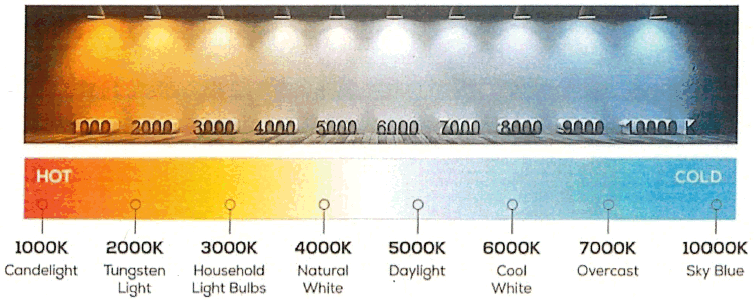
Efficacy is measured in lumens per watt (Im/w), luminous efficacy is a measure of how well a light source produces visible light for the amount of energy consumed.
Facade means the square footage of a structure's vertical and horizontal dimensions as viewed in the elevation view. Also referred to as the "vertical surface area".
Facade Lighting is a type of lighting used to light up the exterior of a building. It can be used to highlight certain building features or provide general illumination.
Festoon lighting is also referred to as market lighting, bistro lighting, or ping-pong lighting. String lighting intended for permanent installation and year-round use. Festoon lighting is not Seasonal Lighting; see Seasonal Lighting for non-permanent lighting installations.
Footcandles means a unit of illumination equal to one (1) lumen per square foot.
Fully shielded luminaire means a fully shielded light fixture has a solid barrier (cap) at the top of the fixture in which the lamp (bulb) is located. The fixture is angled so the lamp is not visible below the barrier. No light shall be visible at or above the horizontal angle (technical description: candela values at or above an angle of 90 degrees above nadir are zero). Frosted glass in a luminaire does not constitute shielding. Examples of fully shielded luminaires:
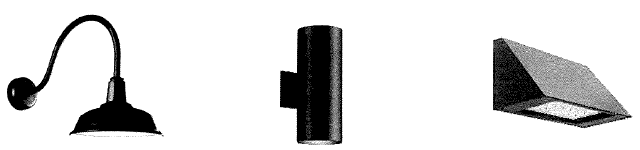
Glare means the visual sensation created by luminance (or brightness) that is significantly higher than the surrounding luminance that the eyes are adapted to, causing annoyance (discomfort glare) or loss in visual performance and visibility (disability glare).
Holiday lighting. See 'Seasonal Lighting'.
Illuminance is measured in Footcandles (Fc) or lux. The density of light falling onto a surface; commonly measured in the horizontal and vertical planes.
Light pollution means stray and uncontrolled light, directly from a luminaire or reflected from a surface, which missed its target. A common example is light being emitted upwards, increasing skyglow.
Light trespass means measurable light extending past the property line without permission, causing annoyance, loss of privacy, or other nuisances. Often measured in footcandles. For the purposes of this chapter, light trespass may also be referred to as Vertical Light Trespass.
Lumen means the measure of visible light (luminous flux) emitted from a light source.
Luminaire is used interchangeably with "fixture". A complete electric light unit including light source, housing, optics, and driver.
Luminaire height means the height of the luminaire shall be the measured vertical distance from finished grade or from the most adjacent walking surface below the luminaire up to the centerline of the luminaire.
Lux means a unit used to measure illuminance. One (1) lux is equal to one (1) lumen per square meter (lm/m2).
Non-shielded or unshielded luminaire means luminaires without shielding that prevent light emission above the horizontal. These luminaires are prohibited except where specifically allowed in Tables 3 and 5. Frosted glass in a luminaire does not constitute shielding. Examples of non-shielded or unshielded luminaires:
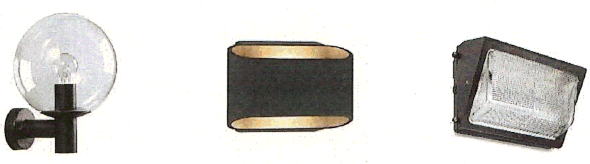
Obtrusive light means any light that is discerned from beyond the intended target area, and which by its nature or presence is disturbing to individuals, harmful to the environment, or contributes to skyglow.
Partially shielded luminaire means a luminaire with opaque top and translucent or perforated sides, designed to emit most light downwards. These luminaires are discouraged. Up to five (5) percent of the light distribution may be at or above the horizontal angle (technical description: candela values at ninety (90) degrees or above nadir do not exceed five (5) percent). Guidance for their use is provided in Tables 3 and 5. Frosted glass in a luminaire does not constitute shielding.
Point light source means the exact place from which illumination is produced from a luminaire (e.g. a light bulb filament or LED package) even when located behind a clear lens.
Seasonal lighting means string lighting meant for temporary use and displayed on buildings or landscaping.
Security lighting is intended to provide bright illumination for security surveillance. This lighting shall not be used continuously as a general deterrent during hours of darkness.
Shielded directional floodlight means a fully shielded luminaire that includes an adjustable mounting device and contains a shield, louver, or baffle to reduce direct view of lamp.
Vertical illuminance means the density of light falling onto a vertical surface.
(Ord. No. 12-2023, § 1(Exh. A), 11-14-2023)
Sec. 26.515.010. - Purpose.
This Chapter establishes unified transportation and mobility standards to promote the city's policies relating to mobility, access to employment opportunities, and sustainability. This chapter implements policies from the Aspen Area Community Plan to:
•
Limit vehicle trips into Aspen to 1993 levels, and reduce peak-hour vehicle-trips to at or below 1993 levels;
•
Use Transportation Demand Management tools to accommodate additional person trips in the Aspen Area;
•
Maintain the reliability and improve the convenience of City of Aspen transit services;
•
Expand and improve bicycle parking and storage within the Urban Growth Boundary;
•
Improve the convenience, safety, and quality of experience for bicyclists and pedestrians on streets and trails;
•
Require development to mitigate its transportation impacts; and
•
Develop a strategic parking plan that manages the supply of parking and reduces the adverse impacts of the automobile.
This Chapter establishes a variety of ways for property owners and developers to mitigate their impacts on the transportation network. As new development and growth occur, increased burdens on the transportation system can make it more difficult for the City to meet its transportation and air quality goals. To the extent that increased travel demand can shift away from automobile dependence, development and growth can be compatible with, and even support, these goals.
To promote this shift in travel behavior, the City has transformed its approach to parking requirements to focus on the promotion and expansion of mobility options, including more walkable development patterns and a more efficient parking system, as well as the provision of public and development-based mobility resources. This will directly improve the travel experience and quality of life within growth areas, while helping to maintain the City's transportation-system and air-quality standards.
This is accomplished through a new integrated approach, which incorporates the City's Transportation Impact Analysis (TIA) Guidelines with Off-Street Parking Requirements. Where the TIA serves to evaluate the potential adverse effects of proposed projects on Aspen's transportation systems, the off-street parking regulations focus on on-site mitigation needs resulting from the provision of parking.
Applicants will use a simplified, two-tiered process that:
(a)
Determines the project's TIA applicability and calculates the project's resulting "parking requirement," and
(b)
Provides a Mobility Plan that includes the applicant's parking and mobility mitigation requirements, which includes the provision of parking, utilization of cash-in-lieu, and/or provision mobility options, including TIA mitigations if applicable.
The City then reviews the project's mitigations for parking and mobility together as part of the project's land use application.
(a)
Adoption of Transportation Impact Analysis (TIA) Guidelines. Pursuant to the powers and authority conferred by the Charter of the City, there is hereby adopted and incorporated herein by reference as fully set forth those standards contained in the City of Aspen's Transportation Impact Analysis Guidelines, as may be amended, updated and expanded from time to time by City Council Resolution (referred to in this Code as the "TIA Guidelines"). At least one (1) copy of the TIA Guidelines shall be available for public inspection at the Community Development, Engineering, and Transportation Departments.
(b)
Definitions. As used in this Section, the following terms shall be defined as follows:
Mobility Measures. Specific tools, strategies, and policies approved in the Mobility Plan. These include the Transportation Demand Management (TDM) and/or Multimodal Level of Service (MMLOS) Mitigation Tools prescribed by the TIA, defined as follows:
• Transportation Demand Management (TDM) Tools, which are strategies and policies to reduce travel demand, particularly by single-occupancy vehicles, and
• Multi-Modal Level of Service (MMLOS) Tools, which are improvements to transportation service quality for travelers using a variety of modes including pedestrians, bicyclists, and transit passengers.
Mobility Plan. A complete mitigation plan for a proposed development's transportation and parking system impacts.
Parking Maximum. The maximum number of Parking Spaces provided on-site for a designated use before triggering compliance with Shared Parking Requirements.
Parking Minimum. The minimum number of Parking Spaces required on-site for a designated use.
Parking Requirement. The sum of a project's required Parking, as provided in Section 26.515.020(c).
Parking Space, Accessory. A Parking Space that is managed to limit access to individuals engaged with on-site uses (residents, tenants, and their guests/customers), but are shared between all on-site land uses across different peaks in service throughout a 24-hour/day period.
Parking Space, Guest/Loading. A Parking Space that is managed to provide 24-hour/day access to a development for guests, deliveries and loading to the public, service providers, and other nonresident visitors to a development on a non-permanent basis.
Parking Space, Municipal. A Parking Space that is provided within City of Aspen facilities, or directly managed by the City of Aspen, whether located in a private or City-owned parking facility.
Parking Space, Priced. A Parking Space - whether reserved, accessory, or public - that is priced comparable to market rates at all times of operation.
Parking Space, Public. A Parking Space that is managed to provide at least twelve (12) hours of public use in any 24-hour/day period, with approved signage to effectively identify these hours of public access.
Parking Space, Reserved. A Parking Space that is managed to limit access to specified individuals or specific on-site land uses.
Parking, Shared. Parking that is shared between multiple, distinct land uses, on the same site or between proximate sites, to make more efficient use of spaces and reduce overall supply needs. Shared Parking is required on a development which exceeds its on-site parking provision maximum standard. Shared parking can be used to reduce a project's Parking Requirement. Shared Parking may include off-site parking spaces and/or priced parking spaces.
Surplus Mobility Measures. Any additional mitigation credits remaining after TIA-subject projects have met the TIA requirements.
Transportation Impact Analysis (TIA). Technical analysis guidelines for potential transportation impacts generated by development projects within the City of Aspen.
Sec. 26.515.020. - Applicability.
This Chapter applies to all development and redevelopment which meets the definition of Demolition, or is a Change in Use, as defined in Chapter 26.470, Growth Management Quota System.
(a)
Determination of Applicability. The applicant may request a preliminary pre-application conference with staff from the Community Development Department to determine the applicability of the requirements of this Chapter for the proposed development. The following chart details the process for complying with the requirements of this Section through the creation of a mobility plan. The TIA Guidelines are available on the City of Aspen website and may be used to determine whether a project is subject to or exempt from the TIA.
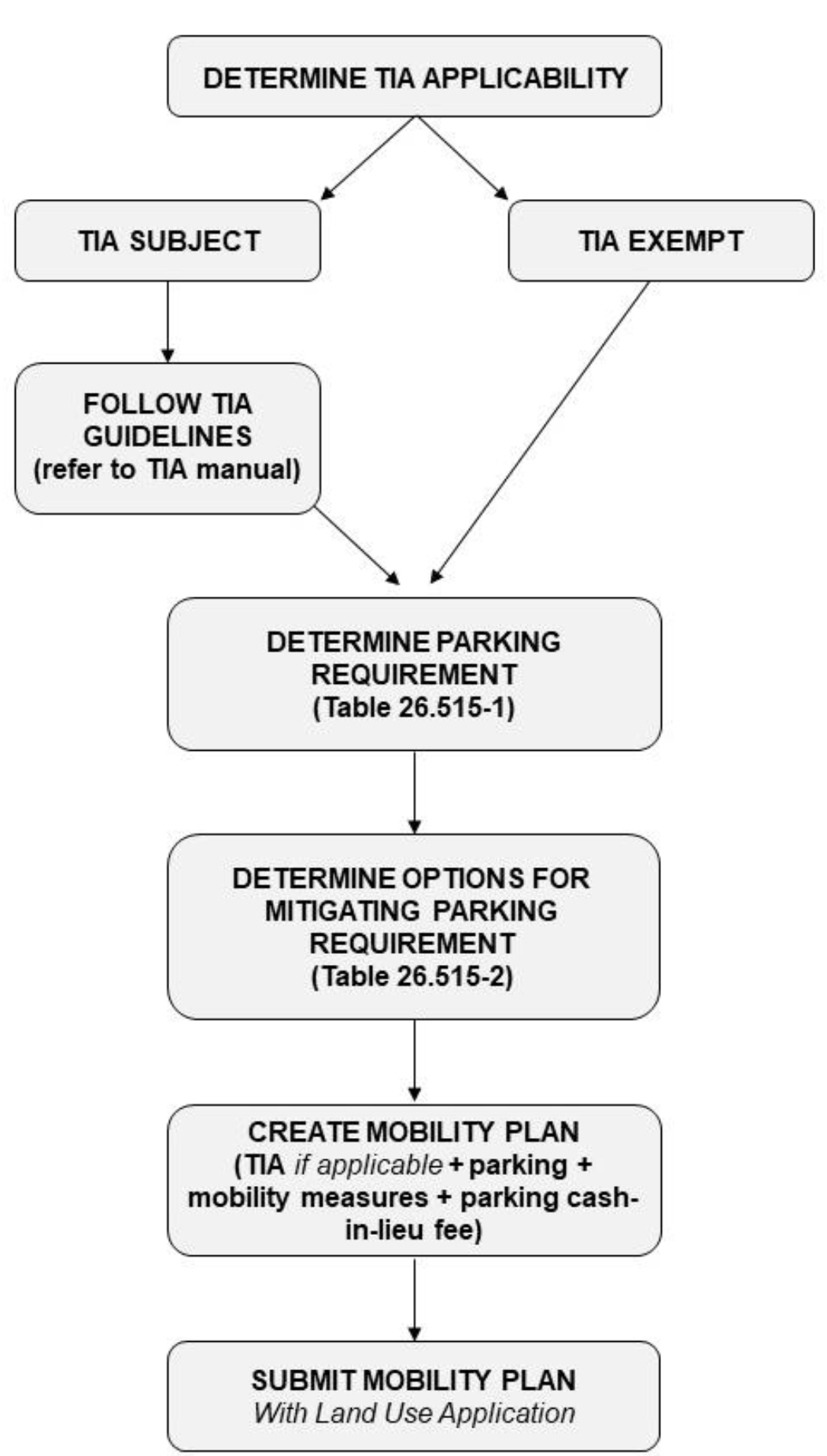
Figure 1: Applicability chart illustrating how to create a Mobility Plan.
(b)
Requirements. This Chapter requires all applicable development to submit a Mobility Plan, which addresses the following:
•
TIA applicability, and
•
TIA compliance (as applicable), and
•
The provision of parking, and
•
Cash-in-lieu of parking (as applicable), and
•
Surplus mobility measures (as applicable).
The City then reviews the project's proposed TIA and Mobility Plan together as part of the project's Land Use Application.
Sec. 26.515.030. - Transportation Mitigation.
(a)
General Requirements. All applicable development shall mitigate its projected transportation impacts as provided in this Chapter. Refer to the Transportation Impact Analysis (TIA) for project applicability. Mobility requirements shall be satisfied through use of the following approaches, either alone or in combination
(1)
Mobility Measures. Applicable development must provide Transportation Demand Management (TDM) and Multi-Modal Level of Service (MMLOS) measures as provided for in the Transportation Impact Analysis (TIA) Guidelines. These measures shall be maintained for the life of the development. All requirements shall be incorporated in the project's Development Agreement, pursuant to Chapter 26.490, Development Documents.
(2)
Surplus Mobility Measures. Upon satisfaction of TIA requirements, a development's Mobility Plan may include surplus mobility measures, where credit is provided over the minimum TIA requirements and applied towards Parking Requirements outlined in Table 26.515-1. The proportion of surplus mobility measures permitted for a development is outlined in Table 26.515-2.
Sec. 26.515.040. - Parking Requirements.
(a)
General requirements. All applicable development shall accommodate its projected parking impacts as provided in this Chapter. Parking Requirements shall be satisfied through use of the following either alone or in combination.
(1)
Parking Requirement Calculation. Parking Requirements shall be calculated for each use within a development according to Table 26.515-1.
(2)
Parking Provision Minimum. Applicable development shall satisfy the minimum Parking Provision Requirement, as calculated in Table 26.515-1. Minimum parking provisions may be reduced in combination with mobility measures and transportation system impact fees in accordance with the standards in Table 26.515-2.
(3)
Parking Provision Maximum. To create appropriate site planning and provision of parking, applicable development shall not provide on-site parking in excess of one hundred twenty-five percent (125%) of the Parking Provision Maximum requirement in the form of Reserved Parking Spaces or Accessory Parking Spaces, unless the total number of on-site spaces in excess of one hundred twenty-five percent (125%) of the Parking Provision Maximum are provided as Public Parking Spaces.
Key to Table 26.515-1:
• (1) = Up to one hundred percent (100%) of Parking Requirement, may be provided through cash-in-lieu.
• (2) = A reduction in Parking Requirement may be approved, pursuant to Chapter 26.430, Special review and according to the review criteria of Section 26.515.080
• (3) = A reduction in Parking Requirements may be approved, pursuant to Chapter 26.520, Accessory dwelling units and carriage houses.
• (4) = All Single-Family and Duplex dwelling units, as well as ADUs and Carriage Houses shall provide their Parking Requirement as off-street, on-site parking spaces.
• SF = Square feet
• NLA = Net leasable square feet of commercial space
(b)
Fractional Requirement Computed. When any calculation of Parking Requirements results in a fractional unit, that fractional unit may be paid through a cash-in-lieu payment or satisfied through one (1) whole additional on-site parking or mobility commitment credit.
Sec. 26.515.050. - Meeting Parking Requirements.
(a)
General requirements. Parking Requirements shall be satisfied through the following provisions alone or in combination and described in a project's Mobility Plan:
(1)
Cash-in-lieu. Cash-in-lieu payments may be made to satisfy Parking Requirements as outlined by zone district in Table 26.515-2, and according to Section 26.515.090.
(2)
Provision of Off-Street Parking.
a.
On-Site Parking. Off-street parking may be provided on-site in applicable zone districts to satisfy Parking Requirements, with Reserved and Accessory spaces not to exceed the Parking Maximums outlined below in Table 26.515-1. Shared parking may be counted provided that a Shared Parking Agreement and a shared-parking analysis, as approved by the Community Development Director, is executed.
b.
Off-Site Parking. Off-street parking may be provided off-site in applicable zone districts to satisfy Parking Requirements, provided that a Shared Parking Agreement and a shared-parking analysis, as approved by the Community Development Director, is executed. Off-site parking is subject to Special Review per Chapter 26.430 and Section 26.515.080.
c.
Reserved and Accessory Spaces. For both On-Site Parking and Off-Site Parking, Reserved and Accessory spaces in excess of the Parking Provision Maximums outlined below in Table 26.515-1 are subject to the Shared Parking standards in Section 26.515.040(a)(3).
(3)
Shared Parking Spaces. For both On-Site Parking and Off-Site parking, shared parking spaces may be provided contingent upon a shared parking analysis being completed and a Shared Parking Agreement being executed, as approved by the Community Development Director.
(4)
Mobility Measures. Mobility Measures, as defined in Section 26.515.010(b), may be provided, as follows:
a.
Where projects are TIA exempt, Mobility Measures may be provided to satisfy Parking Requirements as outlined by zone district in Table 26.515-2.
b.
Where projects are subject to the TIA, Surplus Mobility Measures (after the minimum TIA mitigation requirements have been met) may be provided to satisfy Parking Requirements as outlined by zone district in Table 26.515-2.
The extent to which a project may satisfy its Parking Requirements with Mobility Commitments, On-Site Parking provision, and Cash-in-Lieu will vary by location, according to Table 26.515-2 below.
Parking Requirements are subject to the following standards:
(1)
If the Parking Requirement is subject to establishment by adoption of a Planned Development final development plan, review is subject to Chapter 26.445, Planned Development.
(2)
If the Parking Requirement is established through a special review, the standards and procedures of Section 26.515.080, Special Review Standards apply.
(3)
If the Parking Requirement is met via cash-in-lieu, the standards and procedures set forth at Section 26.515.090, Cash-in-Lieu of Parking apply.
(4)
For properties listed on the Aspen Inventory of Historic Landmark Sites and Structures, a waiver of the Parking Requirement may be approved, pursuant to Chapter 26.430, Special Review, and according to the review criteria set forth below.
(5)
For lodging projects with flexible unit configurations, also known as "lock-off units," each separate "key," or rentable division, shall constitute a unit for the purposes of this Section.
(6)
The Parking Requirement for projects with multiple, distinct land uses (residential, commercial, lodging, or other) may be lowered, if the applicant submits a shared-parking analysis, approved by the Community Development Director, which results in a peak-parking-demand measure that is less than the Parking Requirement established by Table 26.515-1. The application for a shared parking analysis shall be reviewed by The Transportation, Parking, Engineering, and Community Development Departments and approved by the Planning and Zoning Commission as a Special Review (Section 26.430).
(7)
*Off-street parking provision on a parcel that abuts an Aspen Pedestrian Mall may only be provided in an on-site, subgrade parking structure. Alternatively, parcels abutting an Aspen Pedestrian Mall may provide all Parking Requirements through the payment of Cash-in-Lieu (Section 26.515.090).
Sec. 26.515.060. - Procedures for Review.
Development and redevelopment applications shall be reviewed pursuant to the following procedures, as well as standards and the Common Development Review Procedures set forth in Chapter 26.304.
(a)
Review Authority. All applications will be reviewed administratively for compliance with this Chapter and relevant guidelines in conjunction with a project's land use application, unless otherwise specified. In all circumstances, the final land use review body shall approve the TIA, after considering a recommendation from the Engineering, Transportation, and Community Development Departments.
(b)
Review Process. For all applicable development, Mobility Plan review is completed in conjunction with required land use reviews. Pursuant to Section 26.304.020, Pre-application Conference, applicants are encouraged, although not required, to meet with a member of the Community Development Department to clarify requirements of this Section and to determine applicability.
(1)
For development only subject to administrative-level land use reviews, or for development meeting a threshold established in the TIA Guidelines but not subject to a land use review, the City Engineering and Transportation Departments may, on behalf of the City of Aspen, determine that the project meets or exceeds the requirements set forth in this Chapter and the Transportation Impact Analysis Guidelines.
When development meets an established threshold, but does not require a land use review, review for compliance with this Chapter and the Guidelines shall be completed as part of the building permit application.
(2)
In all circumstances, the final land use review body shall approve the TIA, after considering a recommendation from the Engineering and Transportation Departments.
(c)
Review Criteria. All applicable projects are required to submit a Mobility Plan, which shall include and describe a project's mitigations for TIA and Parking Requirements. The Engineering, Transportation, and Community Development Department staff shall determine whether the project conforms to this Chapter requirements using the following standards:
(1)
Project TIA and the resulting mitigation program meets requirements for exempt, minor, or major project categories as outlined in the TIA Guidelines.
(2)
Project provides full mitigation for the Parking Requirements pursuant to Section 26.515.050.
(3)
If existing development is expanded, additional Parking Requirements shall be provided for that increment of the expansion.
(4)
If existing development is redeveloped, on-site parking deficits may not be maintained unless all parking, or at least twenty (20) spaces are provided as Public Parking.
Projects failing to meet the requirements of this Section may apply for a variation to the Planning and Zoning Commission through the Special Review process (Section 26.430 and Section 26.515.080).
Sec. 26.515.070. - Off-Street Parking Requirements.
(a)
Applicability. Where off-street parking spaces are provided as part of a Mobility Plan, the regulations in Sections 26.515.070(b)—(i) apply.
(b)
General. Each off-street parking space shall consist of an open area measuring eight and one half (8½) feet wide by eighteen (18) feet long and seven (7) feet high with a maximum longitudinal slope of twelve percent (12%) and a maximum cross slope of five percent (5%). For developments providing more than fifteen (15) on-site parking spaces, twenty-five percent (25%) of the on-site spaces may be provided as Compact Parking in accordance with the requirements of the Engineering Design Standards. Each parking space, except those provided for detached residential dwellings and duplex dwellings, shall have an unobstructed access to a street or alley. Off-street parking provided for multi-family dwellings which do not share a common parking area may be exempted from the unobstructed access requirement subject to special review pursuant to Chapter 26.430, Special review and the standards set forth at Section 26.515.040, Special review standards, below.
Off-street parking must be paved with all-weather surfacing or be covered with gravel. For residential development, a grass ring or grass-paver-type surface may be used. All parking shall be maintained in a usable condition at all times. All development or redevelopment must be in conformance with, or bring existing parking into conformance with, Engineering Design Standards, including but not limited to the access requirements outlined in Chapter 4 Transportation Design.
(c)
Use of off-street parking. Parking spaces shall be used for the parking of vehicles and shall not be used for non-auto related uses such as storage units or trash containers. No off-street parking area shall be used for the sale, repair, dismantling or servicing of any vehicles, equipment, materials or supplies, nor shall any such activity adjacent to off-street parking spaces obstruct required access to off-street parking areas.
(d)
Location of off-street parking. Off-street parking, except shared parking, publicly accessible parking, or off-site parking as approved as part of a mobility plan, shall be located on the same parcel as the principal use or an adjacent parcel under the same ownership as the lot occupied by the principal use. For all uses, parking shall be accessed from an alley or secondary road where one exists unless otherwise established according to this Chapter.
(e)
Detached and duplex residential dwelling parking. Off-street parking provided for detached residential dwellings and duplex dwellings is not required to have unobstructed access to a street or alley, but shall not block access of emergency apparatus to the property or to structures located on the property. This allows for "stacking" of vehicles where a vehicle is parked directly behind another.
(f)
State Highway 82 off-street parking. All parking required for uses fronting State Highway 82 shall be accessed from the alley, if an alley exists, and shall not enter from or exit onto State Highway 82.
(g)
Surface parking. Surface parking is prohibited or requires conditional use review as a principal use of a lot or parcel in some Zone Districts (See Chapter 26.710). Where surface parking is permitted and eight (8) or more spaces are provided, the parking area shall include one (1) tree with a planter area of twenty (20) square feet for each four (4) parking spaces. Planter areas may be combined but shall be proximate to the parking spaces. The Planning and Zoning Commission may waive or modify this requirement on a per case basis. Parking within structures is exempt from this landscaping provision.
(h)
Restrictions on drainage, grading and traffic impact. Off-street parking spaces shall be graded to ensure drainage does not create any flooding or water quality impacts and shall be provided with entrances and exits so as to minimize traffic congestion and traffic hazards.
(i)
Restrictions on lighting. Lighting facilities for off-street parking spaces, if provided, shall be arranged and shielded so that lights neither unreasonably disturb occupants of adjacent residential dwellings nor interfere with driver vision. All outdoor lighting shall comply with the outdoor lighting regulations, Section 26.575.150.
Sec. 26.515.080. - Special Review Standards.
Whenever the transportation, mobility, and parking impacts of a proposed development are subject to special review, an application shall be processed as a special review in accordance with the common development review procedures set forth in Chapter 26.304 and be evaluated according to the following standards. Review is by the Planning and Zoning Commission.
If the project requires review by the Historic Preservation Commission and the Community Development Director has authorized consolidation pursuant to Subsection 26.304.060(b), the Historic Preservation Commission shall approve, approve with conditions or disapprove the special review application.
A special review for establishing, varying or waiving transportation, mobility, or off-street parking requirements may be approved, approved with conditions or denied based on its conformance with all of the following criteria:
(1)
The transportation, mobility, and off-street parking needs of the residents, customers, guests and employees of the project have been met, taking into account potential uses of the parcel, the projected traffic generation of the project, any shared parking opportunities, expected schedule of parking demands, the projected impacts on the on-street parking of the neighborhood, the proximity to mass transit routes and the downtown area and any special services, such as vans, provided for residents, guests and employees.
(2)
An on-site mitigation solution meeting the requirements and guidelines is practically difficult or results in an undesirable development scenario.
(3)
Existing or planned on-site or off-site facilities adequately serve the needs of the development, including the availability of street parking.
(a)
Commercial Parking Facilities. Special Review is required for a commercial parking facility. A special review to permit a commercial parking facility may be approved, approved with conditions or denied based on conformance with its adherence to Commercial Design Standards and the policy goal of provision of publicly-accessible parking in areas with high public parking demand (in order to reduce vehicle congestion and emissions due to vehicles circling for parking) is not offset by the proposed commercial parking facility's potential adverse impacts of the City's multi-modal transportation system. For properties in zone districts where Conditional Use Review is required for a Commercial Parking Facility, Conditional Use and Special Review shall be combined.
Sec. 26.515.090. - Cash-in-lieu Requirements.
(a)
General. The City conducted a parking facility analysis in the fall of 2016 and determined the costs associated with developing new parking facilities to serve the demands of development. While not all potential facilities represented the same potential expenditure, facilities considered likely to be developed by the City required an expected thirty-eight thousand dollars ($38,000.00) per space to develop in 2016 dollars.
(b)
Cash-in-lieu. Mobility improvements serving commercial and mixed-use development are a public amenity and serves the mobility needs of the general population. As such, the mobility needs of the general population can be improved through various means other than the provision of on-site parking spaces, including cash-in-lieu. A cash-in-lieu payment, for those types of development authorized to provide parking via cash-in-lieu, may be accepted by the Community Development Director to satisfy the Parking Requirement, as described in Section 26.515.040, above.
(1)
Time of payment. The payment-in-lieu of parking shall be due and payable at the time of issuance of a building permit. All funds shall be collected by the Community Development Director and transferred to the Finance Director for deposit in a separate interest-bearing account.
(2)
Use of funds. Monies in the account shall be used solely for the construction of a public parking facility, transportation and mobility improvements, including vehicles or station improvements, transportation demand management facilities or programs, shared automobiles or programs and similar transportation or mobility-related facilities or programs as determined appropriate by the City.
(3)
Refunds. Fees collected pursuant to this Section may be returned to the then-present owner of the property for which a fee was paid, including any interest earned, if the fees have not been spent within seven (7) years from the date fees were paid, unless the Council shall have earmarked the funds for expenditure on a specific project, in which case the time period shall be extended by up to three (3) more years. To obtain a refund, the present owner must submit a petition to the Finance Director within one (1) year following the end of the seventh (7 th ) year from the date payment was received by the City.
For the purpose of this Section, payments collected shall be deemed spent on the basis of "the first payment in shall be the first payment out." Any payment made for a project for which a building permit is revoked or cancelled, prior to construction, may be refunded if a petition for refund is submitted to the Finance Director within three (3) months of the date of the revocation or cancellation of the building permit. All petitions shall be accompanied by a notarized, sworn statement that the petitioner is the current owner of the property and that the development shall not commence without full compliance with this Chapter and by a copy of the dated receipt issued for payment of the fee.
(4)
Periodic review of rate. To ensure that the payment-in-lieu rate is fair and represents current cost levels, it shall be reviewed every two (2) years. Any necessary amendments to this Section shall be initiated pursuant to Section 26.310.020, Procedure for amendment.
Sec. 26.515.100. - Amendments.
Amendments to an approved Mobility and Parking Requirement review by the Community Development Director in coordination with the Engineering and Transportation Departments as needed.
(a)
Amendments to Trip Reduction Measures. Off-site MMLOS infrastructure measures that have been implemented may not be amended at any time. Off-site MMLOS infrastructure measures that have not been implemented, and any on-site TDM and MMLOS measures, may be amended as outlined below. Changes shall be reviewed by the Engineering, Transportation, and Community Development Departments to ensure the proposed change is appropriate given the site's context.
(1)
Insubstantial Amendment. Any amendment to TDM or MMLOS measures resulting in the same or more number of trips mitigated as the original approval may be approved administratively by the Community Development Department, after considering a recommendation from the Engineering and Transportation Departments. A land use application is required, pursuant to Chapter 26.304, Common Development Review Procedures. The applicant shall demonstrate how the new measure(s) is appropriate given current site conditions.
(2)
Substantial Amendment. Any amendment to TDM or MMLOS measures that reduces the number of trips mitigated shall be reviewed by City Council, after considering a recommendation from the Community Development, Engineering, and Transportation Departments. A land use application is required, pursuant to Chapter 26.304, Common Development Review Procedures, and the review shall be conducted in a duly noticed public hearing, pursuant to Section 26.304.060(e), Public Notice. City Council shall find the following standards are met:
a.
The proposed change responds to changed site conditions or circumstances, including but not limited to changes to land uses, site topography, or site plan.
b.
The proposed changes will not adversely impact the immediate vicinity.
c.
The proposed change meets the original intent of the approved measures.
d.
The proposed changes have been approved by the Community Development Director.
Sec. 26.515.110. - Appeals.
An applicant may challenge a determination made by the City in their enforcement of the requirements of this Chapter by filing with the Community Development Director a written notice of appeal as provided in Section 26.316.030, Appeals procedures, with a full statement of the grounds for appeal. Appeals shall be reviewed by City Council, pursuant to Chapter 26.316, Appeals.
(Ord. No. 17-2005, § 1; Ord. No. 32, 2016, § 1; Ord. No. 23, 2017, § 23; Ord. No. 13-2019)
Sec. 26.520.010. - Purpose.
The purpose of the accessory dwelling unit (ADU) and carriage house program is to promote the long-standing community goal of socially, economically and environmentally responsible development patterns which balance Aspen the resort and Aspen the community. Aspen values balanced neighborhoods and a sense of commonality between local working residents and part-time residents. ADUs and carriage houses represent viable housing opportunities for working residents and allow employees to live within the fabric of the community without their housing being easily identifiable as "employee housing."
ADUs and carriage houses support local Aspen businesses by providing an employee base within the City and providing a critical mass of local residents important to preserving Aspen's character. ADUs and carriage houses allow second homeowners the opportunity to hire an on-site caretaker to maintain their property in their absence. Increased employee housing opportunities in close proximity to employment and recreation centers is also an environmentally preferred land use pattern, which reduces automobile reliance.
Detached ADUs and carriage houses emulate a historic development pattern and maximize the privacy and livability of both the ADU or carriage houses and the primary unit. Detached ADUs and carriage houses are more likely to be occupied by a local working resident, furthering a community goal of housing the workforce.
Aspen desires occupied ADUs and carriage houses; therefore, detached ADUs and carriage houses which are deed restricted as "for sale" units, according to the Aspen/Pitkin County Housing Authority Guidelines, as amended, and sold according to the procedures established in the guidelines, provide for certain floor area and affordable housing credit incentives.
(Ord. No. 53-2003, § 2; Ord. No. 35-2015, § 1)
Sec. 26.520.020. - General.
Accessory dwelling units and carriage houses are separate dwelling units incidental and subordinate in size and character to the primary residence, located on the same parcel, and which may be rented or sold to a local working resident as defined by the Aspen/Pitkin County Housing Authority Guidelines and as limited by this Chapter. A primary residence may have no more than one (1) ADU or carriage house. An ADU or carriage house may not be accessory to another ADU or carriage house. A detached ADU or carriage house may only be conveyed separate from the primary residence as a "for sale" affordable housing unit to a qualified purchaser pursuant to the Aspen/Pitkin County Housing Authority Guidelines, as amended. ADUs and carriage houses shall not be considered units of density with regard to zoning requirements. ADUs and carriage houses shall not be used to satisfy employee housing requirements of the Growth Management Quota System (GMQS), except that a detached ADU or carriage house which is deed restricted and conveyed separate from the primary residence as a "for sale" affordable housing unit to a qualified purchaser pursuant to the Aspen/Pitkin County Housing Authority Guidelines, as amended, shall qualify for issuance of a Certificate of Affordable Housing Credit, pursuant to Chapter 26.540. All ADUs and carriage houses shall be developed in conformance with this Chapter.
(Ord. No. 53-2003, § 2; Ord. No. 12, 2007, § 31; Ord. No. 35-2015, § 1; Ord. No. 12-2019)
Sec. 26.520.030. - Authority.
The Community Development Director, in accordance with the procedures, standards and limitations of this Chapter and the Common development review procedures, Chapter 26.304, shall approve, approve with conditions, or disapprove a land use application for an accessory dwelling unit or carriage house.
An appeal of the Community Development Director's determination shall be considered by the Planning and Zoning Commission and approved, approved with conditions or disapproved, pursuant to Subsection 26.520.080(d), Special Review.
A land use application requesting a variation of the ADU or carriage house design standards shall be approved, approved with conditions or disapproved by the Planning and Zoning Commission, pursuant to Subsection 26.520.080(d), Special Review.
If the land use application requesting a variation of the ADU or carriage house design standards is part of a consolidated application process, authorized by the Community Development Director, requiring consideration by the Historic Preservation Commission, the Historic Preservation Commission shall approve, approve with conditions or disapprove the variation, pursuant to Subsection 26.520.080(d), Special Review.
(Ord No. 53-2003, § 2; Ord. No. 35-2015, § 1)
Sec. 26.520.040. - Applicability.
This Chapter applies to all properties located in Zone Districts permitting an accessory dwelling unit or carriage house as specified in Chapter 26.710, Zone Districts, and to all accessory dwelling units approved prior to the adoption of Ordinance No. 46, Series of 2001.
(Ord. No. 35-2015, § 1)
Sec. 26.520.050. - Design standards.
All ADUs and carriage houses shall conform to the following design standards unless otherwise approved, pursuant to Subsection 26.520.080(d), Special Review:
(a)
An ADU must contain between three hundred (300) and eight hundred (800) net livable square feet, ten percent (10%) of which must be a closet or storage area. A carriage house must contain between eight hundred (800) and one thousand two hundred (1,200) net livable square feet, ten percent (10%) of which must be closet or storage area.
(b)
An ADU or carriage house must be able to function as a separate dwelling unit. This includes the following:
(1)
An ADU or carriage house must be separately accessible from the exterior. An interior entrance to the primary residence may be approved, pursuant to Special Review;
(2)
An ADU or carriage house must have separately accessible utility systems, controls and disconnect panels. This does not preclude shared services;
(3)
An ADU or carriage house shall contain a full-size kitchen containing at a minimum:
a.
Minimum 30-inch wide oven, 4-burner stovetop.
b.
A sink, dishwasher, and a minimum twenty (20) cubic foot refrigerator with freezer.
c.
Minimum twenty-four (24) square feet of counter space and a minimum of fifteen (15) cubic feet of cabinet space.
d.
Kitchens may not be located in a closet.
(4)
An ADU or carriage house shall contain a ¾ or larger bathroom containing, at a minimum, a sink, a toilet and a shower.
(5)
An ADU or carriage house shall contain washer/dryer hookups, with a dryer vent rough-in, to accommodate minimum 27-inch wide washer/dryer units.
(3)
One (1) parking space for the ADU or carriage house shall be provided on-site and shall remain available for the benefit of the ADU or carriage house resident. The parking space shall not be located in tandem, or "stacked," with a space for the primary residence.
(4)
The finished floor level of fifty percent (50%) or more of the unit's net livable area is at or above natural or finished grade, whichever is higher.
(5)
The ADU or carriage house shall be detached from the primary residence. An ADU or carriage house located above a detached garage or storage area or connected to the primary residence by an exterior breezeway or trellis shall still qualify as detached. No interior connections to the primary residence, or portions thereof, shall qualify the ADU or carriage house as detached.
(6)
An ADU or carriage house shall be located within the dimensional requirements of the Zone District in which the property is located.
(7)
The roof design shall prevent snow and ice from shedding upon an entrance to an ADU or carriage house. If the entrance is accessed via stairs, sufficient means of preventing snow and ice from accumulating on the stairs shall be provided.
(8)
ADUs and carriage houses shall be developed in accordance with the requirements of this Title which apply to residential development in general. These include, but are not limited to, building code requirements related to adequate natural light, ventilation, fire egress, fire suppression and sound attenuation between living units. This standard may not be varied.
(9)
All ADUs and carriage houses shall be registered with the Housing Authority and the property shall be deed restricted in accordance with Section 26.520.070, Deed restrictions and enforcement. This standard may not be varied.
(Ord. 53-2003, § 2; Ord. No. 35-2015, § 1)
Sec. 26.520.060. - Calculations and measurements.
(a)
Floor area. ADUs and carriage houses are attributed to the maximum allowable floor area for the given property on which they are developed, pursuant to Section 26.575.020, Calculations and Measurements.
(b)
Net livable square footage. ADUs and carriage houses must contain certain net livable floor area, unless varied through Special Review. The calculation of net livable area differs slightly from the calculation of floor area inasmuch as it measures the interior dimensions of the unit. Please refer to Section 26.575.020—Calculations and Measurements.
(Ord. No. 53-2003, § 2; Ord. No. 35-2015, § 1)
Sec. 26.520.070. - Deed restrictions and enforcement.
(a)
Deed restrictions. At a minimum, all properties containing an ADU or a carriage house shall be deed restricted in the following manner:
•
The ADU or carriage house shall be registered with the Aspen/Pitkin County Housing Authority.
•
Any occupant of an ADU or carriage house shall be qualified as a local working resident according to the current Aspen/Pitkin County Housing Authority Guidelines, as amended.
•
The ADU or carriage house shall be restricted to lease periods of no less then six (6) months in duration or as otherwise required by the current Aspen/Pitkin County Housing Authority Guidelines. Leases must be recorded with the Aspen/Pitkin Housing Authority.
A detached and permanently affordable Accessory Dwelling Unit or Carriage House qualifying a property for a floor area exemption, pursuant to Section 26.575.020—Calculations and Measurements, shall be deed restricted as a "for sale" affordable housing unit and conveyed to a qualified purchaser, according to the Aspen/Pitkin County Housing Authority Guidelines, as amended and according to the following sales price limitations:
•
Accessory dwelling units from three hundred (300) to five hundred (500) net livable square feet - Category 3 or lower.
•
Accessory dwelling units from five hundred one (501) to eight hundred (800) net livable square feet - Category 4 or lower.
•
Carriage houses from eight hundred (800) to one thousand (1,000) net livable square feet - Category 5 or lower.
•
Carriage houses from one thousand one (1,001) to one thousand two hundred (1,200) net livable square feet - Category 6 or lower.
Category sales prices shall be those specified in the Aspen/Pitkin County Housing Authority Guidelines, as amended. The initial developer may select the first qualified purchaser of the unit. Subsequent conveyances shall be according to the lottery sales procedures specified in the Aspen/Pitkin County Housing Authority Guidelines, as amended.
A detached and permanently affordable Accessory Dwelling Unit or Carriage House deed restricted as a "for-sale" affordable housing unit, as described above, and which is not required for mitigation purposes, shall be eligible to receive a Certificate of Affordable Housing Credit pursuant to Chapter 26.540.
Accessory dwelling units deed restricted to mandatory occupancy in exchange for a floor area bonus, prior to the adoption of Ordinance No. 46, Series of 2001, shall be continuously occupied by a local working resident, as defined by the Aspen/Pitkin County Housing Authority Guidelines, for lease periods of six (6) months or greater, unless the owner is granted approval to remove that restriction pursuant to Subsection 26.520.090(b), Removal of Mandatory Occupancy Deed Restriction.
The Aspen/Pitkin County Housing Authority shall provide a standard form for recording accessory dwelling unit or carriage house deed restrictions. The deed restriction shall be recorded with the County Clerk and Recorder prior to a Certificate of Occupancy being issued. The reception number associated with the recordation shall be noted in the building permit file.
(b)
Enforcement. The Aspen/Pitkin County Housing Authority or its designee, shall enforce the recorded deed restriction between the property owner and Aspen/Pitkin County Housing Authority.
(Ord. No. 53-2003, § 2; Ord. No. 35-2015, § 1; Ord. No. 12-2019)
Sec. 26.520.080. - Procedure.
(a)
General. Pursuant to Section 26.304.020, Pre-Application Conference, applicants are encouraged to meet with a City Planner of the Community Development Department to clarify the requirements of the ADU and carriage house program.
A development application for an ADU or carriage house shall include the requisite information and materials, pursuant to Section 26.304.030, Application and fees. In addition, the application shall include scaled floor plans and elevations for the proposed ADU or carriage house. The application shall be submitted to the Community Development Department.
Any bandit dwelling unit (a.k.a. pirate unit) which can be demonstrated to have been in existence on or prior to the adoption of Ordinance No. 44, Series of 1999, and which complies with the requirements of this Chapter may be legalized as an accessory dwelling unit, if it meets the health and safety requirements of applicable building codes, as determined by the Chief Building Official. No retroactive penalties or assessments shall be levied against any pirate or unit upon legalization.
After a development order has been issued for an ADU or carriage house, a building permit application may be submitted in conformance with Section 26.304.075, Building permit.
(b)
Administrative review. In order to obtain a development order for an ADU or carriage house, the Community Development Director shall find the ADU or carriage house in conformance with the criteria for administrative approval. If an application is found to be inconsistent with these criteria, in whole or in part, the applicant may either amend the application or apply for a Special Review to vary the design standards pursuant to Subsection (d), below.
An application for an ADU or carriage house may be approved, approved with conditions or denied by the Community Development Director based on the following criteria:
(1)
The proposed ADU or carriage house meets the requirements of Section 26.520.050, Design standards.
(2)
The applicable deed restriction for the ADU or carriage house has been accepted by the Aspen/Pitkin County Housing Authority, and the deed restriction is to be recorded prior to issuance of a Certificate of Occupancy for the ADU or carriage house.
(c)
Appeal of Director's determination. An applicant aggrieved by a decision made by the Community Development Director regarding this Chapter may appeal the decision to the Administrative Hearing Officer, pursuant to Chapter 26.316.
(d)
Special Review. An application requesting a variation of the ADU and carriage house design standards shall be processed as a Special Review in accordance with the common development review procedures set forth in Chapter 26.304. The Special Review shall be considered at a public hearing for which notice has been posted, mailed, and published pursuant to Section 26.304.060(e)(3).
Review is by the Planning and Zoning Commission. If the property is an historic landmark, on the Inventory of Historic Sites and Structures or within a Historic Overlay District, the Historic Preservation Commission shall consider the Special Review.
A Special Review for an ADU or Carriage House may be approved, approved with conditions or denied based on conformance with the following criteria:
(1)
The proposed ADU or carriage house is designed in a manner which promotes the purpose of the ADU and carriage house program, promotes the purpose of the Zone District in which it is proposed and promotes the unit's general livability.
(2)
The proposed ADU or carriage house is designed to be compatible with and subordinate in character to, the primary residence considering all dimensions, site configuration, landscaping, privacy and historical significance of the property.
(e)
Inspection and acceptance. Prior to issuance of a certificate of occupancy for an ADU or carriage house, the Aspen/Pitkin County Housing Authority or the Chief Building Official, shall inspect the ADU or carriage house for compliance with the design standards. Any unapproved variations from these standards shall be remedied or approved pursuant to this Chapter prior to issuance of a certificate of occupancy or certificate of compliance.
(Ord. 53-2003, § 2; Ord. No. 35-2015, § 1)
Sec. 26.520.090. - Amendment of an ADU or Carriage House Development Order.
(a)
Insubstantial amendment. An insubstantial amendment to an approved development order for an accessory dwelling unit or carriage house may be authorized by the Community Development Director if:
(1)
The change is in conformance with the design standards, Section 26.520.050, or does not exceed approved variations to the design standards; and
(2)
The change does not alter the deed restriction for the ADU or carriage house or the alteration to the deed restriction consistent with the Aspen/Pitkin County Housing Authority Guidelines.
(b)
Removal of Mandatory Occupancy Deed Restriction. An amendment application that proposes to remove a mandatory occupancy ADU deed restriction placed on the property prior to adoption of Ordinance No. 46, Series of 2001, may be approved by the Community Development Director if all of the following criteria are met:
(1)
The mandatory occupancy deed restriction on the ADU is replaced with the minimum ADU deed restriction allowing voluntary occupancy; and
(2)
The applicant shall either:
a.
Develop a deed restricted affordable housing unit on a site that is not otherwise required to contain such a unit or convert an existing free-market unit to affordable housing status. The replacement affordable housing unit shall be within the Aspen infill area, shall be a one-bedroom or larger sized unit, shall meet the Aspen/Pitkin County Housing Authority Guidelines (which may require certain improvements), shall be deed restricted as a Category 2, or lower, for-sale unit according to the Aspen/Pitkin County Housing Guidelines, as amended, and shall be transferred to a qualified purchaser through the Aspen/Pitkin County Housing Authority sales process; or,
b.
Extinguish a Certificate of Affordable Housing Credit, pursuant to Chapter 26.540, for 1.5 full-time equivalents (FTEs). The Certificate shall be Category 2 or lower.
(3)
The property granted the bonus floor area shall be considered to contain a legally created nonconforming structure and subject to the provisions of Chapter 26.312—Nonconformities.
(c)
Removing an ADU/Carriage House. An amendment application that proposes to physically remove an ADU or Carriage House from a property and vacate the deed restriction may be approved by the Community Development Director if all of the following criteria are met. To remove or decommission a Mandatory Occupancy ADU, the requirements of 26.520.090(b) must first be met prior to complying with this Subsection.
For an ADU or Carriage House developed prior to the adoption of Ordinance No. 35 Series 2015:
(1)
The applicant shall provide affordable housing mitigation for .38 full-time equivalents (FTEs). Mitigation shall be provided at a Category 2 rate prior to issuance of any permit required to accomplish the decommissioning or removal of the unit. This may be provided through extinguishment of a Certificate of Affordable Housing Credit (See Chapter 26.540—Certificates of Affordable Housing Credit) or by providing a fee-in-lieu payment according to the rates specified in the current Aspen/Piktin County Housing Authority Guidelines, as amended from time to time. (Commentary - The .38 figure reflects a typical ADU being a studio or one-bedroom unit housing 1.5 FTEs with an approximate twenty-five percent (25%) occupancy. 1.5 × .25 = .375, rounded to .38.)
(2)
The physical changes necessary to remove the ADU/Carriage House have been accomplished and issued a final inspection by the Chief Building Official. (Building permits are required.) Once this has been accomplished, a release of deed restriction, acceptable to the City Attorney, shall be completed and filed with the Pitkin County Clerk and Recorder.
For an ADU or Carriage House developed after the adoption of Ordinance No. 35, Series 2015 or for an ADU or Carriage House developed prior to this date which the applicant can demonstrate was not developed for affordable housing mitigation purposes or to meet the requirements of a Development Order. (In other words, the unit must have been a "voluntary" unit). Removing a voluntary unit may be approved by the Community Development Director if all of the following criteria are met.
(1)
The physical changes necessary to remove or decommission the ADU/Carriage House have been accomplished and issued a final inspection by the Chief Building Official. (Building permits are required.) Once this has been accomplished, a release of deed restriction, acceptable to the City Attorney, shall be completed and filed with the Pitkin County Clerk and Recorder. Removal or decommissioning of a voluntary unit shall not require additional affordable housing mitigation.
(d)
Other amendments. All other amendments to an approved development order for an accessory dwelling unit or carriage house shall be reviewed pursuant to the terms and procedures of this Chapter.
(Ord. No. 44-1999, § 1; Ord. No. 46-2001, § 1 (part); Ord. No. 47-2001, § 2; Ord. No. 1-2002, § 15; Ord. No. 27-2002, § 22; Ord. No. 53, 2003, § 2; Ord. No. 12-2006, § 18; Ord. No. 35-2015, § 1; Ord. No. 12-2019)
Sec. 26.530.010. - Purpose.
The purpose of this Chapter is to regulate short-term rentals (STRs) as a land use within the City of Aspen. STRs are an important component of the City's lodging bed base, support a vibrant tourist economy, and provide real property owners with STR permits significant financial benefit. STRs influence property value and occupancy patterns of residential dwelling units. STRs influence neighborhood character by introducing commercial lodging uses in residential neighborhoods. STRs require services and infrastructure to operate. STRs further reduce the potential availability of long-term rental housing to support the local economy and community.
STRs require regulation as a distinct land use to ensure the health, safety, peace, and welfare of the community through the application of zoning police powers. The following regulations support the operation of STRs balanced with community policies related to housing, development, growth management, and a sustainable economy as described in the Aspen Area Community Plan.
(Ord. No. 9-2022, § 4, 6-28-2022)
Sec. 26.530.020. - Applicability.
(a)
This Chapter applies to all STRs in the City of Aspen. STRs are required to obtain a permit in accordance with their type and operation as defined in this Section. STRs operating without a permit are subject to enforcement as defined in Section 26.530.060, Enforcement.
(b)
It shall be unlawful for any person, whether a principal or agent, clerk, or employee, either for him or herself, or for any other person for anybody, corporation or otherwise, to lease or operate an STR without first obtaining an STR permit in accordance with the provisions and procedures of this Section.
(Ord. No. 9-2022, § 4, 6-28-2022)
Sec. 26.530.030. - Permitting requirements.
(a)
Permits. Any property rented as an STR shall require a permit to operate. Permits shall be approved, approved with conditions, or denied by the Community Development Director based on the following criteria:
(1)
Permittee. Permits shall only be issued in the name of one (1) natural person who has an ownership interest in the property for which the permit is issued ("Permittee").
(2)
Permit Number. STR permits are issued a unique permit number. That permit number shall be clearly displayed in all advertising and listings of the STR, including but not limited to all digital and print advertising. The permit number must be listed in the STR, along with permittee and/or qualified owner's representative and emergency contact information as part of the in-unit Community Messaging Program described in the STR Program Guidelines.
(3)
Permit Application Contents. The following information is required for STR permit applications: the owner(s) of the property, the name and contact information of the proposed permittee; if title to the subject property is held by a corporation, partnership, association, or company, the name and contact information of any officer, director or stockholder holding ten percent (10%) or more of the interests in the corporation, partnership, association, or company; the property address, Pitkin County parcel identification number; Pitkin County owner name; number of bedrooms and pillows in the unit in its largest configuration; size of heated area of the STR residence, and all previous notices of code violations or complaints filed against the property.
(4)
Licensing. STRs are required to maintain a City of Aspen Business License and are required to remit lodging and sales tax in accordance with Municipal Code regulations and Finance Department policies. The STR-Program Guidelines include details about licensing and tax compliance standards and procedures.
(5)
Non-Transferability. Commencing October 1, 2022, STR permits shall be granted only for the property for which it is issued and solely to the permittee to whom it is issued. The permit shall not be transferable to any other person, legal entity, or residential address, with limited exemptions. If the property is owned by a partnership, corporation, association or company, a transfer shall be deemed to occur if the permittee transfers his or her interest in the property to a third-party individual or entity or if more than ten percent (10%) of the partnership, corporation, association, or company is transferred to a third-party individual or entity, even if the permittee retains an ownership interest in the property. Upon such transfer of ownership, the permit shall be deemed terminated and revoked and the new owner of the property shall be required to apply for a new STR permit if it wishes to continue the use of the property as a vacation rental. The STR permit shall include a non-transferability clause and notice that the permit shall be deemed terminated and revoked automatically upon the sale or change of ownership of the property for which a permit has been issued, as described herein.
a.
Exemptions to Non-Transferability. An STR permit may be transferred to an individual that meets the qualifications of a permittee in the following circumstances:
i.
Upon death of a permittee, an STR permit may transfer to a beneficiary who receives at least ten percent (10%) interest in the STR property by the permittee's will or decree of distribution.
ii.
Upon divorce of a permittee, an STR permit may transfer to a spouse who is awarded a ten percent (10%) or greater interest in the STR property pursuant to a divorce decree.
iii.
Expired permits shall not be transferable in any instance.
Applications for a transfer of permit shall be subject to application requirements for a new STR permit.
(b)
Permit Types. STRs shall be eligible for one (1) of four (4) permit types: Short-term Rental Classic, Owner-Occupied Short-term Rental, Lodging Exempt Short-term Rental, or Short-term Rental Temporary. The ability to obtain an STR permit is conditioned upon the permittee's consent of the eligibility, requirements, and standards for each permit type as follows:
(1)
Short-term Rental Classic (STR-C). This permit is issued only to residential units located in eligible zones and the approved use of which is not a Lodge use. (Condo-hotel properties must apply for a Lodging-Exempt STR permit.)
a.
STR-C permits shall be renewed annually and are assessed an annual permit fee in accordance with Section 26.530.080, Fees.
b.
STR-C permits are subject to the life-safety standards and the operational standards described in this Chapter and the STR Program Guidelines.
c.
There is no annual limit on the number of nights an STR-C permittee may operate the STR unit. Bedrooms, lock-offs, or portions of the residential unit, in addition to the whole residential unit, may be rented. Occupancy for the unit is limited by the standards described in Section 26.530.050.
(2)
Owner-occupied Short-term Rental (STR-OO). This permit is issued only to owner-occupied residential units, where the property is the primary residence of the permittee. Part 700 of this Title describes the zone districts where STRs are a permitted use.
a.
STR-OO rental permits shall be renewed annually and are assessed an annual permit fee in accordance with Section 26.530.080, Fees.
b.
STR-OO are subject to the life-safety standards and the operational standards for STRs described in this Chapter and the Program Guidelines, and upon application for STR-OO permit, the applicant must provide two (2) of the following valid documents indicating that the STR is the applicant's primary residence:
i.
Valid Colorado driver's license;
ii.
Valid motor vehicle registration;
iii.
Voter registration;
iv.
Federal or state tax return; or
v.
Other legal documentation deemed sufficient by the Community Development Director which is pertinent toward establishing principal residence.
(3)
Lodging Exempt Short-term Rental (STR-LE). Lodges and condo-hotels which meet the definition of Lodge are eligible for STR-LE permits.
a.
For eligible properties, only one (1) permit is required for all units under management.
b.
In addition to the limitations of the definition of Lodge and/or Condo-hotel, Lodging Exempt eligible properties must offer STR units under a unified brand and marketing model where individual ownership of units is secondary to the central brand of the property.
c.
Lodging Exempt permittees must submit an affidavit attesting to their eligibility.
d.
STR-LE permits must be renewed annually and are assessed an annual permit fee in accordance with Section 26.530.080, Fees. To ensure ongoing eligibility for the STR-LE permit, permittees are subject to the Lodging Occupancy Auditing regulations in Section 26.575.210.
(4)
Temporary Short-term Rental (STR-T). This permit is issued only to residential units in eligible zones and for the sole purpose of allowing new property owners to accommodate STR reservations made by the previous owners for limited dates after the property's sale.
a.
STR-T permits are valid for a maximum of ninety (90) days from the date of issuance and are not eligible for renewal after the permit expiration date.
b.
STR-T permits are assessed a one-time administrative permit fee in accordance with Section 26.530.080, Fees.
c.
STR-T permit applications must be submitted within fifteen (15) days of the date of transfer of property ownership. Proof of purchase or ownership transfer must be provided with the application for an STR-T permit. A list of all existing STR reservations made prior to the property sale must be provided with the application for an STR-T permit.
d.
STR-T permittees may not accept any new STR bookings for the duration of the STR-T permit.
e.
STR-T permits are subject to public notice requirements in Section 26.304.060(e)(3)b, Manner of Notice. Proof of notice is required with each STR-T permit application. A waiting period during the posted notice and prior to permit issuance is not required.
f.
STR-T permits are subject to the life-safety standards and the operational standards described in this Chapter and the STR Program Guidelines.
g.
Advertising short-term rentals at an STR-T property is not permitted. All short-term rental advertisements for an STR-T property shall be deactivated, removed, or otherwise made unavailable to prospective customers.
h.
Failure to comply with the STR-T permit requirements is a violation of the municipal code and subject to fines and penalties as stated in 26.530.070 Enforcement.
(c)
Zoning Limitations. STR-C permits are limited by number in residential zone districts. Refer to Part 700 of this Title for permitted uses by zone to assess where STR-Cs are permitted. In zones where STR is not a permitted use, it is a prohibited use.
(1)
STR-C permits are limited by number in specific zone districts as follows:
a.
RR: Two (2) permits;
b.
R-3: One (1) permit;
c.
R-6: Eighty-one (81) permits;
d.
R-15: Forty-seven (47) permits;
e.
R-15A: Eight (8) permits;
f.
R-15B: Twelve (12) permits;
g.
R-30: One (1) permit;
h.
R/MF: One hundred ninety (190) permits;
i.
R/MFA: Twelve (12) permits;
j.
AH: Nine (9) permits;
k.
MU: Thirty-nine (39) permits;
l.
NC: One (1) permit;
m.
SCI: Two (2) permits;
n.
SKI: Two (2) permits.
(2)
There is no limit to the number of STR-C permits in the following zone districts: Commercial (C-1), Commercial Core (CC), Lodge (L), Commercial Lodge (CL), Lodge Overlay (LP), Lodge Preservation Overlay (LO).
(3)
STR-OO are not limited by number in any allowable zone district. Refer to Part 700 of this Title for zone districts where STR is a permitted use.
(4)
STR-LE are not limited by number in any allowable zone district. Refer to Part 700 of this Title for zone districts where STR is a permitted or prohibited use.
(5)
STR-T are not limited by number in any allowable zone district. Refer to Part 700 of this Title for zone districts where STR is a permitted or prohibited use.
(Ord. No. 9-2022, § 4, 6-28-2022; Ord. No. 08-2025, § 2(Exh. B), 11-18-2025)
Sec. 26.530.040. - Permit procedures and standards.
Prior to the issuance of an STR permit, the permit application will be reviewed for compliance with the following standards.
(a)
Zoning Compliance. All STR permits must comply with zoning regulations for the zone district in which they are located. STR permit applications shall include the Parcel Identification Number and residential address including unit number for the property to ensure compliance with underlying zoning. Zone district STR regulations, including permitted uses and cap limitations, may change over time per City Council action. Possession of an STR permit does not supersede compliance with zone district STR regulations.
(b)
Life-safety Compliance and Inspection.
(1)
Required Noticing. All new STR-C and STR-OO applications for properties located in zone districts without caps on the number of permits shall comply with neighborhood noticing requirements per Section 26.304.060(c)(3)b.—c., Manner of Notice. All STR-T applications shal comply with neighborhood noticing requirements per Section 23.304.060(e)(3)b., Manner of Notice. STR-LE applications are exempt from this provision.
(2)
Inspections. By signing and submitting an STR permit application, and subsequently being granted a permit, the owner(s) of the property shall consent to inspections of the property by City of Aspen personnel and their agents for the purpose of determining compliance with City Codes, Regulations and Laws. No inspection will be made without first giving the permittee and, if applicable, the qualified owner's representative, forty-eight (48) hours' notice of the inspection.
(3)
Life-Safety. STRs are required to comply with all applicable life-safety standards in Municipal Code Title 8 and the STR Program Guidelines, as amended from time to time. Life-safety standards include: Fire suppression, occupancy limitations, mechanical codes, emergency contacts and procedures, and inspections.
(c)
Qualified Owner's Representative. Permittees who cannot meet requirement for regulatory compliance, in-person service, emergency response and other regulations in this title may designate a qualified owner's representative. A qualified owner's representative shall be a natural person residing in the Roaring Fork River Drainage area situated in Eagle, Pitkin, Garfield or Gunnison Counties, or within the Colorado River Drainage area from and including the unincorporated No Name area to and including Rifle. The qualified owner's representative is designated by the permittee who is the property owner as the point of contact for the permitted STR. For permittees that designate a qualified owner's representative, the qualified owner's representative shall be responsible for responding to tenant and City inquiries, complaints, enforcement actions, and other on-site needs.
(1)
If a qualified owner's representative is designated for an STR, the qualified owner's representative must have a City of Aspen business license. The qualified owner's representative shall be listed on the STR permit for the property including the qualified owner's representative's name, entity or company name, telephone number, email address, and physical address.
(2)
STR permittees who designate a qualified owner's representative are liable for compliance with applicable Land Use Code and Municipal Code regulations. The qualified owner's representative is not legally liable for violations of this Section or compliance with applicable Municipal Code regulations but is responsible for notifying the permittee when a violation has occurred.
(3)
The name, address, and telephone number(s) of the qualified owner's representative, as shown on the STR permit, shall be made available to the Community Development Department, the Aspen Police Department, and the Aspen Fire Protection District. Any change to the qualified owner's representative or permittees' contact information shall be promptly furnished to the City of Aspen via a revised STR permit application within ten (10) days. Failure of the permittee to provide or update the qualified owner's representative contact information to the City shall constitute an enforcement violation subject to actions and penalties as described in Section 26.530.070, Enforcement.
(4)
The permittee, or if designated, the qualified owner's representative, shall be available twenty-four (24) hours a day, year-round to ensure that the property is maintained and operated as required by Land Use Code standards and the STR Program Guidelines. The permittee, or if designated, the qualified owner's representative, shall respond to service or compliance inquiries from occupants and City officials, and shall be available to be at the property within two (2) hours in an emergency. Failure of the permittee, or if designated, the qualified owner's representative, to respond to a call from a tenant or the Community Development Director within twenty-four (24) hours shall result in an enforcement violation subject to actions and penalties as described in Section 26.530.070, Enforcement, against the permittee.
(d)
Permit application, fees, issuance, renewal, revocation, and abandonment.
(1)
Application. Permit applications shall be received and processed on a first come, first served basis. The Community Development Director shall deem applications complete based on the requirements of this Chapter and the standards in the STR Program Guidelines. Only complete STR permit applications shall be accepted and reviewed. An application shall only be deemed complete when all information, tasks, and administrative fee payments required for the application have been submitted by the applicant and receipt of the application by the City of Aspen can be confirmed.
(2)
Fee payment. Permit fees shall be remitted at the time of permit application and cover the cost of processing the application. Application fees are non-refundable.
(3)
Neighborhood noticing. Upon application for a new STR-C or STR-GO permit for a property located in a zone district with a cap on the number of allowable permits, the applicant shall provide neighborhood noticing in accordance with Section 26.304.060(e)(3)b.—c., Manner of Notice. Upon application for a new STR-C or STR-GO permit for a property located in a zone district without a cap on the number of allowable permits, the applicant shall provide neighborhood noticing in accordance with Section 26.304.060(e)(3)b., Manner of Notice. Upon application for a new STR-T permit, the applicant shall comply with neighborhood noticing requirements in Section 26.304.060(e)(3)b., Manner of Notice. Annual STR permit, permit renewals do not require neighborhood noticing. Permits shall be approved, approved with conditions, or denied following the notice period. STR-LE are exempt from this provision.
(4)
HOA compliance. New STR permit applications for residential properties which are in a Homeowners Association (HOA) must include HOA approval for the applicant to operate an STR in the form of a signed letter, including telephone and email contact information for the HOA, with the permit application. Permittees are required to acknowledge that they have continued approval from their HOA to operate an STR with the submission of each permit renewal application. Permittees shall immediately notify the City of Aspen if at any time during the life of an active permit their HOA has revoked or eliminated its approval for the permittee to operate an STR.
(5)
Issuance. Permits shall be approved, approved with conditions, or denied within twenty-one (21) working days of the closure of the notice period described above. The Community Development Director may issue permits with conditions based on review of the permit application and public comment. The review and issuance period for individual permit applications may be extended at the direction of the Community Development Director.
(6)
Waitlist. Once the permit limit is reached for each zone district, applicants will be placed on a waitlist for the next available permit in the order in which the application was received.
A waitlist applicant shall be a natural person. The residential address included in the waitlist application must match the residential address for which the subsequent permit is issued. Applicants who sell the property for which the permit is sought shall be removed from the waitlist. As permits become available, waitlist applications shall be reviewed and approved, approved with conditions, or denied. If the property has been found in violation of this Chapter during the waitlist period, the application shall be denied and the property shall be removed from the waitlist.
(7)
Renewal. STR permits shall be renewed annually in accordance with the procedures in the STR Program Guidelines. Only complete STR permit renewal applications will be accepted for annual STR permit renewal. An application shall only be deemed complete when all information, tasks, and administrative fee payments required for the application have been submitted by the applicant and receipt can be confirmed by the City of Aspen. Failure to renew a permit within fourteen (14) days of the permit expiration date shall result in the abandonment of the permit. STR-T permits are not eligible for renewal and become abandoned upon the permit expiration date.
(8)
Tax filing. STRs must be occupied by a short-term renter a minimum of once per year, as shown in tax filings to be eligible for renewal. Permits with one (1) year of zero tax filings from the date of permit issuance or renewal will be considered abandoned and be processed in accordance with the standards in this Chapter. STRs that are under construction or that endure an act of nature emergency may be eligible for an exemption from this provision.
(i)
Building Permit Exemptions. Permittees may apply for a one-time exemption from the tax filing requirement if the STR is uninhabitable due to construction and an active building permit is issued to the STR property. To request a building permit exemption, the permittee must notify the Community Development Director within thirty (30) days of the issue date of the building permit. Building permit exemptions are granted at the discretion of the Community Development Director with proof of a valid building permit.
(ii)
Act of Nature Exemptions. Permittees may apply for an exemption from the tax filing requirement if an act of nature, as defined in 26.104.100, Definitions, renders the STR uninhabitable. To request an act of nature exemption, the permittee must notify the Community Development Director within thirty (30) days of the act of nature incident. Act of nature exemptions are granted at the discretion of the Community Development Director with sufficient proof of uninhabitability from the permittee's homeowner's insurance.
(9)
Abandonment. STR-C and STR-OO permits shall be valid for one (1) year from the date of issuance and shall be renewed annually. Failure to renew a permit in accordance with the STR Program Guidelines will result in the abandonment of the permit. STR permits may be abandoned by permittees at any time by notifying the Community Development Director of the intent to abandon the permit. Abandoned permits will be made available to the next applicant on a first-come, first-served basis or the next applicant on the waitlist for that zone district in accordance with the STR Program Guidelines. STR-LE and STR-T permits are exempt from this provision.
(10)
Revocation. STR permits may be revoked by the Community Development Director for any of the following reasons: Three (3) violations of the requirements of this Chapter and applicable Municipal Code standards as described in the STR Program Guidelines, failure to rent the property during the term of the permit, failure to pay STR taxes and fees, or violations of the requirements of this Section.
(Ord. No. 9-2022, § 4, 6-28-2022; Ord. No. 08-2025, § 2(Exh. B), 11-18-2025)
Sec. 26.530.050. - Occupancy and operational standards.
Prior to the issuance of an STR permit, the permit application will be reviewed for compliance with the following standards.
(a)
Occupancy limits and unit size. STRs are limited to a total occupancy of two (2) occupants per bedroom plus two (2) additional occupants, and studios are limited to a total occupancy of two (2) occupants plus one (1) additional occupant. Permit applications are required to list the number of bedrooms in the unit at its largest configuration. STRs may be inspected for accuracy of bedroom count on the permit application and for compliance with these occupancy requirements. For the purpose of establishing unit occupancy, a studio shall have an occupancy of two (2) occupants plus one (1) additional occupant. Occupancy for each STR shall be included in all STR advertising, the in-unit messaging, and permit on display in each permitted STR. Bedrooms, lock-offs, or portions of the residential unit, in addition to the whole residential unit, may be rented.
(b)
Annual rental night limits. STR-OO are limited to one hundred twenty (120) short-term rental nights per year from the date of permit issuance. There is no annual limit on the number of nights per year an STR-C, STR-LE, or STR-T can be rented.
(c)
Good neighbor guide. STRs are required to operate in accordance with all applicable Municipal Code regulations protecting the health, safety, and peace of the community and supporting the maintenance of community character and values. STR owners and permittees are required to assist STR occupants in being 'good neighbors' by recognizing their obligation to follow the rules and customs of the community. To support these community goals, the Community Development Department maintains the Short-term Rental Program Guidelines, Good Neighbor Guide, and collaborates with non-governmental organizations to promote good neighbor behavior by visitors.
(1)
STR-C and STR-OO permittees, and if designated, their qualified owner's representatives must comply with the policies described in the City of Aspen Good Neighbor Guide and must provide that information at all times to occupants of the unit.
(2)
In-unit messaging is essential to assisting STR occupants in supporting the City's good neighbor policies, ensuring STRs in neighborhoods support community character, and assisting in the promotion of Aspen's community character. The following notices shall be posted in a conspicuous location inside the rental unit:
i.
A copy of the STR-C or STR-OO permit;
ii.
A copy of the STR business license;
iii.
The name, address, and telephone number(s) of the permittee or qualified owner's representative;
iv.
A statement which reads: Occupants shall comply with the City's Noise Ordinance;
v.
The location of the required parking spaces;
vi.
Wildlife protection policy;
vii.
The location of the fire extinguisher;
viii.
Information on the trash, recycling, and composting programs including:
a.
Solid waste pickup schedules;
b.
Guidelines on living with wildlife and instructions for operating wildlife containers; and
c.
A notice that trash and recycling containers must be stored indoors except between 6:00 a.m. and 6:00 p.m. on the day of scheduled trash or recycling pickup, where they may be placed at the curbside or in alleys;
ix.
City of Aspen emergency services information and contact information;
x.
The City of Aspen's Good Neighbor Guide.
(d)
Adoption of and compliance with STR program guidelines. The City Council hereby adopts the Short-term Rental Program Guidelines. The Community Development Department shall keep the STR Program Guidelines on file and make the guidelines available to STR permittees, and if applicable, qualified owner's representatives. These guidelines set forth the standards, procedures, and supplemental information necessary for the operation of an STR within the City of Aspen. The Community Development Director may use the guidelines as a basis for enforcement actions in accordance with the requirements of this Chapter. The Guidelines may be updated, amended, and expanded from time to time by City Council Resolution.
(Ord. No. 9-2022, § 4, 6-28-2022; Ord. No. 08-2025, § 2(Exh. B), 11-18-2025)
Sec. 26.530.060. - STR Advertising Requirements.
Permittees shall be responsible for ensuring that all advertisements for the STR property comply with the requirements in this Chapter. Short-term rental services shall be responsible for ensuring that all advertisements for STRs within the City of Aspen comply with the advertising requirements in this Chapter. Following the issuance of an STR permit, the permittee and all short-term rental services will be reviewed for compliance with the following standards.
(a)
Permittee Advertising Requirements. The STR permittee and if designated, the qualified owner's representative, shall ensure that any and all advertisements for the STR property list the valid City of Aspen STR permit number and maximum occupancy for the property in all listings that advertise or allow bookings for short-term rentals of the property.
(1)
The STR permit number, as found on the City of Aspen STR permit issued to the permittee, must always be visible on any STR advertisement. The permittee shall include the permit number in the advertisement title, the advertisement description, or the designated permit number field of the advertisement.
(2)
Maximum occupancy for the STR, as found on the City of Aspen STR permit issued to the permittee, must always be visible on any STR advertisement. The permittee shall include the maximum occupancy in the advertisement title, the advertisement description, or the designated occupancy field of the advertisement.
(3)
Properties on waitlists for STR-C permits shall not be advertised for short-term rentals unless or until a valid STR permit is issued to the property owner. If a waitlisted property has been found in violation of this section during the waitlist period, the application shall be denied and the property shall be removed from the waitlist.
(4)
STR-T properties shall not be advertised for short-term rentals. All short-term rental advertisements for an STR-T property shall be deactivated, removed, or otherwise made unavailable to prospective customers for the duration of the STR-T permit.
(5)
STR advertisements where the permit number or maximum occupancy are not listed, the maximum occupancy is inaccurate, the permit number listed is expired, abandoned, or revoked, or the property has a valid STR-T permit are subject to enforcement and penalties pursuant to 26.530.070(c) Enforcement and Penalties, including issuance of a Notice of Violation (NOV) and/or revocation of the existing STR permit.
(b)
Short-term Rental Service Advertising Requirements. Pursuant to C.R.S. Section 30-150-401(1)(c)(III), all short-term rental services that display short-term rental advertisements for properties in the City of Aspen shall require that each permittee or their representatives using the short-term rental service include a STR permit number issued by the City of Aspen to the property owner in any advertisement for a short-term rental on the short-term rental service platform.
(1)
A short-term rental service displaying advertisements for STR properties in the City of Aspen shall require that the STR property owner, permittee, or their representative include an STR permit number issued by the City of Aspen.
(2)
A short-term rental service shall remove any STR advertisement from the platform after receiving notification by City of Aspen that the STR permit number associated with the listing is missing, invalid, abandoned, or expired, or that the STR permit associated with the property has been revoked. The notification shall include the advertisement URL, the reason that removal of the advertisement is required, and any other identifying information available to the City of Aspen. The short-term rental service shall remove the advertisement from the platform within fourteen (14) days of receiving the notification from the City of Aspen.
(3)
A short-term rental service that fails to remove a STR advertisement from the platform within fifteen (15) or more days of receiving a removal notification from the City of Aspen shall be subject to enforcement and penalties pursuant to 26.530.070(c) Enforcement and Penalties.
(Ord. No. 08-2025, § 2(Exh. B), 11-18-2025)
Editor's note— (Ord. No. 08-2025, § 2(Exh. B), adopted Nov. 18, 2025, renumbered the former §§ 26.530.060—26.530.080 as §§ 26.530.070—26.530.090 and enacted a new § 26.530.060 as set out herein. The historical notation has been retained with the amended provisions for reference purposes.
Sec. 26.530.070. - Enforcement.
The City of Aspen actively enforces its STR regulations through inspections, citizen complaints, audits, and permitting. These measures ensure that STRs reinforce, not undermine, community policies and character. Active enforcement ensures that visitors who choose to stay in STRs are informed of the unique qualities of mountain living and enhance our community culture by being good visitors and acting as neighbors and community members during their stay. STR permittee, and if applicable, qualified owner's representative, play an essential role in supporting and advancing these policies and supporting the City's enforcement activities.
(a)
Falsifying Information. Falsifying information on an STR permit application or any related document is a violation of Municipal Code and subject to Penalties.
(b)
Complaints. Any valid complaint received regarding the STR property will first be referred to the permittee, and if applicable, qualified owner's representative for response and correction. The Community Development Director will follow up with any complaining party, the permittee, and if applicable, qualified owner's representative, for compliance or resolution. The permittee or qualified owner's representative must respond to all complaints or inquiries from City officials within twenty-four (24) hours and occupant complaints within two (2) hours. The City of Aspen is not responsible for complaints against a HOA, hotel, or condo-hotel's own guidelines outside of the City's code, rules and regulations. Failure to respond within twenty-four (24) hours shall result in a notice of violation and demand to cure. All valid complaints will be recorded and kept on-file including the address, permittee, permit number, business license number associated with the complaint, and the complainer's name and contact information.
(c)
Enforcement and Penalties. Upon receipt of a complaint, the Community Development Department shall investigate and if it is determined there are grounds to believe a violation of this Chapter or any STR rules and regulations may have occurred, the Community Development Director may issue an Administrative Notice of Violation to the permittee. The Director shall revoke the STR permit of any permittee who receives three (3) Administrative Notices of Violation within the one (1) year permit cycle, effective upon mailing notice to the permittee's address on file. The permittee may appeal the decision to revoke the STR permit by providing notice of appeal to the Community Development Director within fourteen (14) days of the date of the decision to revoke the permit. The Administrative Hearing Officer shall hear appeals brought pursuant to this subsection (b). Appeals shall be governed by the procedures set forth in Section 26.316.030.
(1)
Penalty. Any permittee that violates or allows another to violate any section of this Title shall be subject to prosecution in Municipal Court and upon conviction subject to the fines and penalties set forth in Section 1.04.080. A first offense shall be punishable by a fine of no less than five hundred dollars ($500.00). Each day of any violation of this Section shall constitute a separate offense.
(2)
Civil Remedies.
a.
The City Attorney may institute injunctive, abatement, or other appropriate action to prevent, enjoin, abate or remove a violation of this Title when it occurs. The same right of action shall accrue to any property owner who may be especially damaged by violation of this Title.
b.
In addition to the penalties and remedies set forth herein, an STR permit shall be automatically revoked by the Community Development Director upon the third conviction of a violation of this Title by the permittee of the property subject to the permit within the one (1) year.
c.
Until paid, any delinquent charges, assessments, or taxes made or levied by the City pursuant to this Title shall, as of recording, be a lien against the property on which the violation has been found to exist. If not paid within thirty (30) days from the date of assessment, the City Clerk may certify any unpaid charges, assessments, or taxes to the Pitkin County Treasurer to be collected and paid over by the Pitkin County Treasurer in the same manner as taxes are authorized to be by statute together with a ten percent (10%) penalty for costs of collection. Any lien placed against the property pursuant to this Chapter shall be recorded with the Pitkin County clerk and recorder.
(Ord. No. 9-2022, § 4, 6-28-2022; Ord. No. 08-2025, § 2(Exh. B), 11-18-2025)
Editor's note— Foremerly § 26.530.060. See editor's note following § 26.530.060.
Sec. 26.530.080. - Fees.
STR permits are assessed an annual fee per unit, remitted at the time of permit application, in accordance with the following table.
Table I: Fee Schedule
(Ord. No. 9-2022, § 4, 6-28-2022; Ord. No. 08-2025, § 2(Exh. B), 11-18-2025)
Editor's note— Foremerly § 26.530.070. See editor's note following § 26.530.060.
Sec. 26.530.090. - Appeals.
Permittees may appeal decisions made by the Community Development Director in the enforcement of this Chapter. Appeals will be heard by the Administrative Hearing Officer in accordance with Section 26.316.020(d). Appeals shall be processed in accordance with Section 26.316.030.
(Ord. No. 9-2022, § 4, 6-28-2022; Ord. No. 08-2025, § 2(Exh. B), 11-18-2025)
Editor's note— Foremerly § 26.530.080. See editor's note following § 26.530.060.
Sec. 26.535.010. - Purpose.
The purpose of this Chapter is to encourage the preservation of historic landmarks, those properties listed on the Aspen Inventory of Historic Landmark Sites and Structures and those properties identified on the AspenModern Map, within the City by permitting those property owners to sever and convey, as a separate development right, undeveloped floor area to be developed on a different property within the City. The program enables standard market forces and the demand for residential floor area, to accomplish a community goal of preserving Aspen's heritage as reflected in its built environment.
(Ord. No. 54-2003, §§ 4, 5; Ord. No. 16-2008; Ord. No. 28-2010, § 3)
Sec. 26.535.020. - Terminology.
Establishment of a TDR. The process of creating an historic TDR certificate in exchange for a property owner lessening the allowable development on an historic property (the sending site) through a permanent deed restriction.
Extinguishment of a TDR. The process of increasing the allowable development on a property (the receiver site), as permitted in the Zone District, through the redemption of an historic TDR certificate.
Historic transferable development right certificate (historic TDR certificate). An irrevocable assignable property right which allows a certain amount of development, which may be conveyed separate from the property in which it has historically been associated (the sending site) and which may be used to increase development rights on another property (the receiver site). TDR certificates shall require execution by the Mayor, pursuant to a validly adopted ordinance.
Receiver site. A property on which developments rights are increased in exchange for the City extinguishing an historic TDR certificate held by the developer of the property. Receiver sites are also referred to aslanding sites.
Sending site. The designated historic landmark property, or property identified on the AspenModern Map, being preserved by reducing its allowable floor area in exchange for the City establishing and issuing an historic TDR certificate.
(Ord. 54-2003, §§ 4, 5; Ord. No. 28-2010, § 3)
Sec. 26.535.030. - Applicability and prohibitions.
This Chapter shall apply to properties eligible for issuance of a Historic TDR Certificate, known as Sending Sites, and properties eligible for the extinguishment of a Historic TDR Certificate, known as Receiving Sites. City of Aspen Historic TDR Certificates may only be used within the city limits of the City of Aspen, as hereinafter indicated, or in unincorporated Pitkin County, if and as may be permitted by the Pitkin County land Use Code. Pitkin County TDRs are not eligible for extinguishment within the City of Aspen.
Sending Sites shall include all properties within the City of Aspen designated as a Historic Landmark, those properties listed on the Aspen Inventory of Historic Landmark Sites and Structures, and those properties identified on the AspenModern Map, in which the development of a single-family or duplex home is a permitted use, according to Chapter 26.710, Zone Districts. Properties on which such development is a conditional use shall not be eligible. Sending Sites may also be established through adoption of a Final PUD Development Plan, pursuant to Chapter 26.445.
Sending sites shall remain eligible for all benefits, bonuses, etc. allowed properties designated a Historic Landmark after establishment of transferable development rights, pursuant to Chapter 26.415.
Receiving Sites shall include all properties in the City of Aspen permitted additional development rights for extinguishment of a Historic TDR is Chapter 26.710, Zone Districts. A property may also be designated as a Receiving Site through adoption of a Final PUD Development Plan, pursuant to Chapter 26.445.
The allowable development extinguishment of a Historic TDR Certificate varies depending upon the zone district of the Receiving Site and the use of the land. Chapter 26.710, Zone Districts, describes the development allowance for each Historic TDR Certificate extinguished.
A Historic TDR Certificate may be sold, assigned, transferred, or conveyed. Transfer of Title shall be evidenced by an assignment of ownership on the actual certificate document and by recordation in the real estate records of the Pitkin County Clerk and Recorder. Upon transfer, the new owner may request the City re-issue the certificate acknowledging the new owner. Re-issuance shall not require re-adoption of an ordinance.
The market for Historic TDR Certificates is unrestricted and the City shall not prescribe or guarantee the monetary value of a Historic TDR Certificate.
The Community Development Director shall establish policies and procedures not inconsistent with this Chapter for the printing of certificates, their safe-keeping, distribution, recordation, control, and extinguishments.
(Ord. No. 54-2003, §§ 4, 5; Ord. No. 16-2008; Ord. No. 28-2010, § 3)
Sec. 26.535.040. - Authority.
The City Council, in accordance with the procedures, standards and limitations of this Chapter and of Chapter 26.304, Common development review procedures, shall approve or disapprove, pursuant to adoption of an ordinance, a land use application for the establishment of historic transferable development rights. The Mayor, in accordance with the procedures, standards and limitations of this Chapter and of Section 26.304, Common development review procedures, shall validate and issue historic TDR certificates, pursuant to a validly adopted ordinance.
The Community Development Director, in accordance with the procedures, standards and limitations of this Chapter and of Section 26.304, Common development review procedures, shall approve or disapprove a land use application for the extinguishment of historic transferable development rights.
(Ord. No. 54-2003, §§ 4, 5)
Sec. 26.535.050. - Procedure for establishing a historic transferable development right certificate.
The following steps are necessary for the issuance of a City historic transferable development right certificate:
Preapplication conference. Property owners interested in the City's historic TDR program are encouraged to meet with a member of the Community Development Department to clarify the process, benefits and limitations of the program.
Owner confirmation. An application for the issuance of a historic TDR certificate shall only be accepted by the City upon submission of a notarized affidavit from the sending site property owner signifying understanding of the following concepts:
A deed restriction will permanently encumber the sending site and restrict that property's development rights to below that allowed by right by zoning according to the number of historic TDR certificates established from that sending site.
For each certificate of development right issued by the City for the particular sending site, that property shall be allowed two hundred and fifty (250) square feet less of floor area, as permitted according to the property's zoning, as amended.
The sending site property owner shall have no authority over the manner in which the certificate of development right is used by subsequent owners of the historic TDR certificate.
Application for issuance of historic TDR certificate. An applicant shall supply the necessary application materials, identified in Section 26.535.090, Application materials, along with applicable review fees.
City review and approval of application. The Community Development Department shall review the application according to the review standards identified in Section 26.535.070, Review criteria for establishment of a historic TDR and shall forward a recommendation to the City Council. The City Council shall approve or disapprove the establishment of a historic TDR certificate by adoption of an ordinance, according to the review standards identified in Section 26.535.070, Review criteria for establishment of a historic TDR. The manner of public notice shall be publication, pursuant to Paragraph 26.304.060(e)(3)a.
Scheduling of closing date. Upon satisfaction of all relevant requirements, the City and the applicant shall establish a date on which the respective historic TDR certificates shall be validated and issued by the City, and a deed restriction on the property shall be accepted by the City and filed with the County Clerk and Recorder.
Closing. On the mutually agreed upon closing date, the Mayor shall execute and deliver the applicable number of historic TDR certificates to the property owner, and the property owner shall execute and deliver a deed restriction lessening the available development right of the sending site together with the appropriate fee for recording the deed restriction with the County Clerk and Recorder's Office.
(Ord. 54-2003, §§ 4, 5)
Sec. 26.535.060. - Procedure for extinguishing a historic transferable development right certificate.
The following steps are necessary for the extinguishment of a City historic transferable development right certificate:
Preapplication conference. Property owners interested in the City's historic TDR program are encouraged to meet with a member of the Community Development Department to clarify the process, benefits and limitations of the program. Applicants are encouraged to meet with the City Zoning Officer and review potential development plans to ensure the additional development right can be properly incorporated on the receiver site.
Associated planning reviews. An applicant must gain all other necessary approvals for the proposed development, as established by this Title.
Application for building permit. An applicant shall submit the necessary materials for a building permit, pursuant to Section 26.304.075, Building permit.
Confirmation of historic TDR certificate. The applicant shall submit the requisite historic TDR certificates, and the City shall confirm its or their, authenticity.
City review of application. The Community Development Department shall review the application according to the review standards identified in Section 26.535.070, Review standards for extinguishment of a historic TDR.
Extinguishment of historic TDR certificate. Prior to and as a condition of, issuance of a building permit for a development on a receiver site requiring the extinguishment of a historic TDR certificate, the applicant shall assign the requisite historic TDR certificates to the City whereupon the certificates shall be marked "extinguished." The property shall permanently maintain the additional development benefit of the extinguished TDR according to the development allowance for a TDR pursuant to Section 26.710, Zone Districts. The property owner may, at their discretion, record a confirmation letter from the Community Development Director acknowledging the extinguishment of the TDR(s) for the receiver site.
(Ord. No. 54-2003, §§ 4, 5)
Sec. 26.535.070. - Review criteria for establishment of a historic transferable development right.
A historic TDR certificate may be established by the Mayor if the City Council, pursuant to adoption of an ordinance, finds all the following standards met.
(a)
The sending site is a historic landmark on which the development of a single-family or duplex residence is a permitted use, pursuant to Chapter 26.710, Zone Districts. Properties on which such development is a conditional use shall not be eligible.
(b)
It is demonstrated that the sending site has permitted unbuilt development rights, for either a single-family or duplex home, equaling or exceeding two hundred and fifty (250) square feet of floor area multiplied by the number of historic TDR certificates requested.
(c)
It is demonstrated that the establishment of TDR certificates will not create a nonconformity. In cases where a nonconformity already exists, the action shall not increase the specific nonconformity.
(d)
The analysis of unbuilt development right shall only include the actual built development, any approved development order, the allowable development right prescribed by zoning for a single-family or duplex residence, and shall not include the potential of the sending site to gain floor area bonuses, exemptions or similar potential development incentives. Properties in the MU Zone District which do not currently contain a single-family home or duplex established prior to the adoption of Ordinance #7, Series of 2005, shall be permitted to base the calculation of TDRs on one hundred percent (100%) of the allowable floor area on an equivalent-sized lot in the R-6 zone district. This is only for the purpose of creating TDRs and does not permit the on-site development of one hundred percent (100%) of the allowable floor area on an equivalent-sized lot in the R-6 zone district. If the additional twenty percent (20%) of allowable floor area exceeds five hundred (500) square feet, the applicant may not request a floor area bonus from HPC at any time in the future. Any development order to develop floor area, beyond that remaining legally connected to the property after establishment of TDR Certificates, shall be considered null and void.
(e)
The proposed deed restriction permanently restricts the maximum development of the property (the sending site) to an allowable floor area not exceeding the allowance for a single-family or duplex residence minus two hundred and fifty (250) square feet of floor area multiplied by the number of historic TDR certificates established.
For properties with multiple or unlimited floor areas for certain types of allowed uses, the maximum development of the property, independent of the established property use, shall be the floor area of a single-family or duplex residence (whichever is permitted) minus two hundred fifty (250) square feet of floor area multiplies by the number of historic TDR certificates established.
The deed restriction shall not stipulate an absolute floor area, but shall stipulate a square footage reduction from the allowable floor area for a single-family or duplex residence, as may be amended from time to time. The sending site shall remain eligible for certain floor area incentives and/or exemptions as may be authorized by the City Land Use Code, as may be amended from time to time. The form of the deed restriction shall be acceptable to the City Attorney.
(f)
A real estate closing has been scheduled at which, upon satisfaction of all relevant requirements, the City shall execute and deliver the applicable number of historic TDR certificates to the sending site property owner and that property owner shall execute and deliver a deed restriction lessening the available development right of the subject property together with the appropriate fee for recording the deed restriction with the County Clerk and Recorder's office.
(g)
It shall be the responsibility of the sending site property owner to provide building plans and a zoning analysis of the sending site to the satisfaction of the Community Development Director. Certain review fees may be required for the confirmation of built floor area.
(h)
The sale, assignment, conveyance or other transfer or change in ownership of transferable development rights certificates shall be recorded in the real estate records of the Pitkin County Clerk and Recorder and must be reported by the grantor to the City of Aspen Community Development Department within five (5) days of such transfer. The report of such transfer shall disclose the certificate number, the grantor, the grantee and the total value of the consideration paid for the certificate. Failure to timely or accurately report such transfer shall not render the transferable development right certificate void.
(i)
TDR certificates may be issued at the pace preferred by the property owner.
(j)
City Council may find that the creation of TDRs is not the best preservation solution for the affected historic resource and deny the application to create TDRs. HPC shall provide Council with a recommendation.
(Ord. 54-2003, §§ 4, 5; Ord. No. 28-2010, § 3; Ord. No. 6-2019)
Sec. 26.535.080. - Review criteria for extinguishment of a historic transferable development right.
Historic TDR certificates may be extinguished to accommodate additional development if the Community Development Director finds the following standards have been met:
(a)
The receiving site is not restricted by a prescribed floor area limitation or the restricting document permits the extinguishment of historic TDR certificates for additional development rights.
(b)
The receiving site and is eligible to receive an increase in development rights as specified in Chapter 26.710, Zoning Districts, according to the Zone District and the land use or as otherwise specified in a final PUD plan for the property.
(c)
All other necessary approvals for the proposed development on the receiver site, as established by this Title, have been obtained.
(d)
The applicant has submitted the requisite authentic historic TDR certificates for redemption.
(e)
The applicant has submitted the necessary materials for a building permit on the receiver site, pursuant to Section 26.304.075, Building permit and the additional development can be accommodated on the receiver site in conformance with all other relevant requirements.
(f)
Prior to and as a condition of, issuance of a building permit for a development requiring the extinguishment of a historic TDR certificates, the applicant shall assign and deliver the authentic certificates to the City whereupon the certificates shall be marked "extinguished."
(g)
The Community Development Director shall issue a letter confirming the extinguishment of the TDR certificates and increasing the available development rights of the receiver site. The applicant may wish to record this document with the County Clerk and Recorder. The confirmation letter shall not stipulate an absolute total floor area, but shall stipulate a square footage increase from the allowable floor area, according to the Zone District and land use of the receiver site at the time of building permit submission. The receiver site shall remain subject to amendments to the allowable floor area and eligible for certain floor area incentives and/or exemptions as may be authorized by the City Land Use Code, as may be amended from time to time. The form of the confirmation letter shall be acceptable to the City Attorney.
(h)
The development allowed on the receiver site by extinguishment of historic TDR certificates shall be that allowed in Chapter 26.710, Zone Districts, according to the Zone District and the land use or as otherwise specified in a final PUD plan for the receiver site and shall not permit the creation of a nonconforming use or structure.
(Ord. No. 54-2003, §§ 4, 5; Ord. No. 16-2008)
Sec. 26.535.090. - Application materials.
(a)
The contents of a development application to establish an historic TDR certificate shall be as follows:
(1)
The general application information required in Common development review procedures, Chapter 26.304.
(2)
A notarized affidavit from the sending site property owner signifying acknowledgment of the following:
a.
A deed restriction will permanently encumber the sending site and restrict that property's development rights to below that allowed by right by zoning according to the number of historic TDR certificates established from that sending site.
b.
For each certificate of development right issued by the City for the particular sending site, that property shall be allowed two hundred and fifty (250) square feet less of floor area, as permitted according to the property's zoning, as amended.
c.
The sending site property owner shall have no authority over the manner in which the certificate of development right is used by subsequent owners of the historic TDR certificate.
(3)
A site improvement survey of the sending site depicting:
a.
Existing natural and man-made site features.
b.
All legal easements and restrictions.
(4)
Dimensioned, scaled drawings of the existing development on the sending site and a floor area analysis of all structures thereon.
(5)
A proposed deed restriction for the sending site.
(6)
Written response to each of the review criteria.
(b)
The contents of a development application to extinguish an historic TDR certificate shall be as follows:
(1)
The necessary application materials for a complete building permit submission, pursuant to Section 26.304.075, Building permit.
(2)
Written response to each of the review criteria.
(Ord. No. 54-2003, §§ 4, 5)
Sec. 26.535.100. - Appeals.
An applicant aggrieved by a determination made by the Community Development Director, pursuant to this Section, may appeal the decision to the City Council, pursuant to the procedures and standards of Chapter 26.316, Appeals.
An applicant aggrieved by a determination made by the City Council, pursuant to this Section, may appeal the decision to a court of competent jurisdiction.
(Ord. No. 54-2003, § 5)
Sec. 26.540.010. - Purpose.
There are two (2) main purposes of this Chapter: to encourage the private sector to develop affordable housing; and to establish an option for housing mitigation that immediately offsets the impacts of development. A Certificate of Affordable Housing Credit is issued to the developer of affordable housing that is not required for mitigation. Another entity can purchase such a Certificate and use it to satisfy housing mitigation requirements. Establishing this transferable Certificate creates a new revenue stream that can make the development of affordable housing more economically viable. Establishing this transferable Certificate also establishes an option for mitigation that reflects built and occupied affordable housing, thereby offsetting the impacts of development before those impacts are felt. This Chapter describes the process for establishing, transferring and extinguishing a Certificate of Affordable Housing Credit.
(Ord. No. 6-2010, § 5; Ord. No. 32-2012, § 1; Ord. No. 34-2015, § 1)
Sec. 26.540.020. - Terminology.
Certificate of Affordable Housing Credit (Credit or Certificate). A transferable document issued by the City of Aspen acknowledging and documenting the voluntary provision of affordable housing which is not otherwise required by this Title or by a Development Order issued by the City of Aspen. The Certificate documents the Category Designations and number of employees housed by the affordable housing. The Credit is irrevocable and assignable. A Certificate of Affordable Housing Credit is a bearer instrument.
Establishing a Credit. The process of the City of Aspen acknowledging the voluntary provision of affordable housing through issuance of a transferable Credit.
Extinguishing a Credit. The process of the City accepting a Credit to satisfy affordable housing requirements of a development.
Category Designation. A classification system used to reflect different sales price and rental rate restrictions of affordable housing as set forth in the Aspen/Pitkin County Housing Authority Guidelines.
(Ord. No. 6-2010, § 5; Ord. No. 32-2012, § 1)
Sec. 26.540.030. - Applicability and prohibitions.
(a)
This Chapter applies to all Certificates of Affordable Housing Credit. Housing credits may only be established from affordable housing created on a voluntary basis and designated at any Category with established cash-in-lieu rates in the Housing Guidelines, including the deed-restriction of unrestricted units (buy-down units).
(1)
City of Aspen Housing Credits may be used within the city limits of the City of Aspen as provided in this Title and may be used in other jurisdictions as may be authorized by that jurisdiction. City of Aspen Housing Credits may only be established from development within the City of Aspen boundaries.
(2)
Affordable Housing projects may establish City of Aspen Housing Credits in conjunction with other state and federal affordable housing incentive programs, such as, but not limited to the Low-Income Housing Tax Credit (LIHTC).
(3)
A Certificate of Affordable Housing Credit may be sold, assigned, transferred, or conveyed. Transfer shall be evidenced by an assignment of ownership on the actual certificate document. Upon transfer, the new owner may request the Community Development Director re-issue the Credit Certificate acknowledging the new owner.
(4)
The market for Certificates of Affordable Housing Credit is unrestricted and the City shall not prescribe or guarantee the monetary value of a Credit.
(5)
The Community Development Director shall establish policies and procedures for the printing of certificates, their safe-keeping, issuance, re-issuance, record-keeping, and extinguishments.
(6)
Projects seeking approval to develop affordable housing in exchange for Certificates of Affordable Housing Credit may be subject to additional reviews pursuant to this Title.
(7)
Fractional units are eligible for the establishment of Housing Credits if deed restricted as for-sale or are subject to an agreement with the City requiring the unit to be permanently deed restricted. For example, if a development project is required to mitigate 2.4 FTEs and is proposing on-site units that house three (3) FTEs, the additional 0.6 FTEs proposed that are not required for mitigation are eligible for establishment as a Certificate of Affordable Housing Credit.
(8)
Any affordable housing units created for the establishment of Housing Credits, including fractions thereof, which are part of a mixed-use building shall be deed restrict as for-sale. Units that are part of a one hundred percent (100%) affordable housing project may be for-rent.
(b)
This Chapter does not apply to the following:
(1)
Affordable housing created to address an obligation of a Development Order or which is otherwise required by this Title to mitigate the impacts of development.
(2)
Affordable housing units created prior to the adoption of Ordinance No. 6, Series of 2010.
(3)
Affordable housing units developed by, or in association with: the City of Aspen, Pitkin County, the Aspen/Pitkin County Housing Authority, or similar government or non-governmental organization (NGO) that receives public funds for the purpose of building affordable housing.
(4)
Dormitory units.
(5)
The creation of voluntary affordable housing units deed restricted at a Category which a cash-in-lieu rate has not been established in the Housing Guidelines.
(Ord. No. 6-2010, § 5; Ord. No. 32-2012, § 1; Ord. No. 34-2015, § 2; Ord. No. 11-2021, § 1, 5-11-2021)
Sec. 26.540.040. - Authority.
The Community Development Director, in accordance with the procedures, standards, and limitations of this Chapter and of Chapter 26.304, Common Development Procedures, shall approve, approve with conditions, or deny an application for the establishment of a Certificate of Affordable Housing Credit for projects that have been previously approved, or are being reviewed concurrently with Section 26.470.090(c). The Planning and Zoning Commission (or Historic Preservation Commission) shall approve, approve with conditions, or deny an application being reviewed concurrently with Section 26.470.100(c).
(Ord. No. 6-2010, § 5; Ord. No. 32-2012, § 1; Ord. No. 13-2022, § 8, 6-28-2022)
Sec. 26.540.050. - Application.
All applications shall include the information required under Chapter 26.304, Common Development Review Procedures. In addition, all applications must also include the following information.
(1)
The net livable square footage of each unit and proposed number of bedrooms.
(2)
If applicable, the conditions under which reductions from net minimum livable square footage requirements are requested according to Aspen Pitkin County Housing Authority Guidelines and a copy of the recommendation from APCHA related to the units.
(3)
Proposed Category designation for each unit.
(4)
Proposed Category Designation of sale or rental restriction for each unit. This should include and conditions that APCHA will require related to either the sale and/or rental of the units.
(5)
Proposed employees housed by the affordable housing units in increments of no less than one-one-hundredth (0.01) according to Section 26.470.050(d) (Table 4, FTEs Housed).
(6)
For projects that include affordable housing units within a designated structure, provide a calculation for the Credits generated within the designated structure that includes a multiplier of 1.2 × the employees housed per subsection (5), immediately above. This multiplier recognizes the additional costs related to preservation efforts of designated structures. The multiplier does not apply to units/Credits established in non-historic structures in the same project.
(7)
For projects that are converting (without demolition) existing free-market (single-family, duplex, or multi-family) units into Category, deed-restricted units for the purpose of establishing affordable housing credits, the application shall additionally contain the following:
a.
Recommendation from APCHA that identifies the development standards for a project or unit being accepted into a deed restriction by APCHA. The application should specifically reference APCHA's evaluation of the property and any necessary improvements to the property necessary to meet APCHA requirements. Eventual issuance of credits will be conditioned on fulfilling the identified development requirements.
b.
A precise evaluation, conducted by an architect or other qualified party that identifies the existing net livable area of the unit is required. If a unit is below APCHA's minimum net livable area based on the number of bedrooms (as established by APHCA's Guidelines), a four hundred (400) square feet per FTE calculation will be utilized instead of the bedroom count, in determining the number of Credits that will be generated by the project.
(Ord. No. 6-2010, § 5; Ord. No. 32-2012, § 1; Ord. No. 11-2021, § 2, 5-11-2021; Ord. No. 13-2022, § 8, 6-28-2022)
Sec. 26.540.060. - Procedures for establishing an affordable housing credit.
A development application to establish a certificate of Affordable Housing Credit shall be reviewed pursuant to the Common Development Review Procedures set forth at Chapter 26.304, and the following procedures and standards.
(a)
Administrative Review by the Community Development Director for projects that have received previous GMQS approval for the establishment of affordable housing, or in a combined review with projects that are being reviewed administratively under Section 26.470.090(d).
(1)
Purpose: To determine if the application meets the standards for authorizing establishment of a Certificate of Affordable Housing Credit.
(2)
Process: The Community Development Director shall approve, approve with conditions, or deny the application after considering the recommendation of the Community Development Director.
(3)
Standards of review:Section 26.540.070.
(4)
Form of decision: The Community Development Director decision shall be documented in a recorded Notice of Approval. The Notice of Approval may include a description or diagram of the affordable housing and any necessary conditions of approval.
(5)
Notice requirements: The requirements of Section 26.304.080 shall apply.
(b)
Planning and Zoning Commission (or Historic Preservation Commission) review for projects that are being reviewed under Section 26.470.100(c).
(1)
Purpose: To determine if the application meets the standards for authorizing establishment of a Certificate of Affordable Housing Credit.
(2)
Process: The Planning and Zoning Commission shall approve, approve with conditions, or deny the application after considering the recommendation of the Community Development Director.
(3)
Standards of review:Section 26.540.070.
(4)
Form of decision: Planning and Zoning Commission decision shall be by resolution. The resolution may include a description or diagram of the affordable housing.
(5)
Notice requirements: The requirements of Section 26.304.080 shall apply. No public hearing notice is required.
(Ord. No. 6-2010, § 5; Ord. No. 32-2012, § 1; Ord. No. 13-2022, § 8, 6-28-2022)
Sec. 26.540.070. - Review criteria for establishing an affordable housing credit.
An Affordable Housing Credit may be established by the Community Development Director or Planning and Zoning Commission if all of the following criteria are met. The proposed units do not need to be constructed prior to this review.
(a)
The proposed affordable housing unit(s) comply with the review standards of Section 26.470.080(d)(7)a.—g.
(b)
The affordable housing unit(s) are not an obligation of a Development Order and are not otherwise required by this Title to mitigate the impacts of development.
(Ord. No. 6-2010, § 5; Ord. No. 32-2012, § 1; Ord. No. 11-2021, § 3, 5-11-2021; Ord. No. 13-2022, § 8, 6-28-2022)
Sec. 26.540.080. - Procedure for issuing a certificate of affordable housing credit.
(a)
The Community Development Director Notice of Approval or the Planning and Zoning Commission Resolution in approving the establishment of Affordable Housing Credits for a project shall identify one (1) of two (2) possible paths for the eventual issuance of established credits:
(1)
Upon completion of the project and the presentation of a Certificate of Occupancy and APCHA deed restriction for the completed affordable units, one hundred (100) percent of the approved Certificates shall be issued in a form prescribed by the Community Development Director; or
(2)
Upon presentation of a performance bond, letter of credit, or other financial instrument acceptable to the City Attorney in guaranteeing the eventual completion of the project, a project developer will receive phased issuance of Affordable Housing Credits per the following schedule:
•
Thirty (30) percent of approved Credits at completion of foundation inspection
•
Thirty (30) percent of approved Credits at completion of framing/roofing inspection
•
Forty (40) percent of approved Credits at presentation of Certificate of Occupancy and the APCHA deed restriction
(3)
The bond, letter of credit, or other financial instrument shall be presented and reviewed with the submission of the building permit and will be for an amount of one hundred (100) percent of the total project valuation.
(4)
Approval of phased issuance of Affordable Housing Credits must be included in the Notice of Approval or Planning and Zoning Commission Resolution. No phased issuance shall occur until the City Attorney has reviewed and approved the provided financial instrument.
(5)
If phased issuance is approved by Notice of Approval or Resolution and the project developer determines ultimately not to pursue the phased issuance, Credits will be issued per subsection (1) at the time of the completed project.
(b)
Upon successful completion of the requirements of subsection (1) or (2) above, the issued Certificate of Affordable Housing Credit shall include the following information:
(1)
A number of the Certificate in chronological order of their issuance.
(2)
Parcel identification number, legal address and the street address of the affordable housing.
The Category Designation and number of employees housed by the affordable housing units, according to Section 26.470.050(d), Employees Housed; in increments of no less than one-one-hundredths (0.01).
(Ord. No. 6-2010, § 5; Ord. No. 32-2012, § 1; Ord. No. 34-2015, § 3; Ord. No. 11-2021, § 4, 5-11-2021; Ord. No. 13-2022, § 8, 6-28-2022)
Sec. 26.540.090. - Authority of the Certificate.
The Certificate may be utilized in whole or in part, including fractions of an FTE no less than .01 FTE, to satisfy affordable housing mitigation requirements in accordance with other applicable sections of this Title.
(Ord. No. 6-2010, § 5; Ord. No. 32-2012, § 1)
Sec. 26.540.100. - Transferability of the certificate.
(a)
A Certificate of Affordable Housing Credit may be sold, assigned, transferred, or conveyed in whole or in part, in increments no less than one-one-hundredth (.01). Transfer of Title shall be evidenced by an assignment of ownership on the actual certificate document. Upon transfer, the new owner may request the City re-issue the Certificate acknowledging the new owner. Re-issuance shall not require re-review by the Planning and Zoning Commission.
(b)
The sale, assignment, conveyance or other transfer or change in ownership of a Certificate of Affordable Housing Credit shall be recorded in the real estate records of the Pitkin County Clerk and Recorder and must be reported by the grantor to the City of Aspen Community Development Department within five (5) days of such transfer. The report of such transfer shall disclose the Certificate number, the grantor, the grantee and the total value of the consideration paid for the Certificate. Failure to timely or accurately report such transfer shall not render the Credit void.
(c)
The market for Certificates of Affordable Housing Credit is unrestricted and the City shall not prescribe or guarantee the monetary value of a Certificate of Affordable Housing Credit.
(Ord. No. 6-2010, § 5; Ord. No. 32-2012, § 1)
Sec. 26.540.110. - Converting category designation of an affordable housing certificate.
Certificates of Affordable Housing Credit represent a number of employees housed at a specific Category designation. Projects seeking extinguishment of a Credit to satisfy affordable housing mitigation standards of this Title may have a different Category Designation requirement than an existing Certificate represents. This Section sets forth a process to convert a Certificate of a certain Category Designation for a Certificate of a different Category Designation. This process amends the number of employees housed to create an equivalency. This Section relies on the Affordable Housing Dedication Fees (aka Fee-in-Lieu) stated in the Aspen Pitkin County Housing Authority Guidelines, as are amended from time to time.
To convert a Certificate of a certain Category Designation for a Certificate of a different Category Designation, the following steps are necessary:
Step 1. Multiply the employees housed stated on the existing Certificate by the per employee Fee-in-Lieu fee for the Category Designation as stated in the APCHA Guidelines.
Step 2. Divide the resulting number from step 1 by the Fee-in-Lieu fee for the Category Designation of the proposed Certificate.
The resulting number from step 2 shall be the employees housed for the proposed Certificate. The Community Development Director shall re-issue a Certificate using this number of employees housed and specifying the proposed Category Designation.
Example: An owner of a Category 3 Certificate wishes to exchange the Certificate for a Category 2 Certificate. The existing Certificate states 2.25 employees housed.
Step 1. Employees housed multiplied by Category 3 per-FTE Fee-in-Lieu.
2.25 × $217,567 = $489,525.75
Step 2. Number from step 1 divided by Category 2 per-FTE Fee-in-Lieu.
$489,525.75 / $230,583 = 2.12
In this example, the Community Development Director would re-issue a Certificate stating 2.12 employees housed and a Category 2 designation. Please note that the Aspen/Pitkin County Housing Authority Fee-in-Lieu rates change from time to time. The rates used for this calculation shall be those in effect upon request for conversion.
The conversion of a Certificate's Category Designation shall be approved by the Community Development Director and shall not require additional review by the Planning and Zoning Commission.
(Ord. No. 32-2012, § 1)
Sec. 26.540.120. - Extinguishment and Re-Issuance of a Certificate.
(a)
Unless otherwise stated in a Development Order, extinguishing all or part of a Certificate of Affordable Housing Credit shall occur prior to issuance of a Building Permit for the development for which the housing mitigation is required. Extinguishment shall be evidenced by an assignment of ownership on the actual certificate document to "the City of Aspen for extinguishment."
(b)
Certificates of Affordable Housing Credit may be extinguished to satisfy affordable housing requirements of this Title if the Community Development Director finds the following standards met:
(1)
All other necessary approvals for the proposed development, as required by this Title, have been obtained and the applicant has submitted the necessary information, pursuant to Section 26.304.075, Building Permit.
(2)
The applicant has submitted authentic Certificates of Affordable Housing Credit in the number and Category Designation required for the development.
(3)
The Certificate owner has assigned ownership of the Certificates to "the City of Aspen for extinguishment."
(c)
When all of a Certificate is extinguished, the city shall void the Certificate. When part of a Certificate is extinguished, the city shall issue a Certificate citing the remaining FTEs in increments of no less than .01 of employees housed.
(Ord. No. 32-2012, § 1)
Sec. 26.540.130. - Amendments.
Amendments to an affordable housing project that occur during additional review(s) required by this Title or other amendments which do not change the essential nature of the project may be approved by the Community Development Director. Revisions to the number or Category Designation of the affordable housing units and Credit Certificates to be issued shall be reflected in a revised development order.
Revisions to the number or Category Designation of the affordable housing units and Credit Certificates to be issued, proposed after all approvals are granted, shall require re-review pursuant to the standards and procedures of this Chapter.
(Ord. No. 32-2012, § 1)
Sec. 26.540.140. - Appeals.
An applicant aggrieved by a determination made by the Community Development Director or Planning and Zoning Commission, pursuant to this Chapter, may appeal the decision to the City Council, pursuant to the procedures and standards of Chapter 26.316, Appeals.
(Ord. No. 32-2012, § 1)
Sec. 26.575.010. - General.
Regulations specified in other Sections of this Title shall be subject to the following supplemental regulations.
Sec. 26.575.020. - Calculations and Measurements.
(a)
Purpose. This Section sets forth methods for measuring floor area, height, setbacks, and other dimensional aspects of development and describes certain allowances, requirements and other prescriptions for a range of structural components, such as porches, balconies, garages, chimneys, mechanical equipment, projections into setbacks, etc. The definitions of the terms are set forth at Section 26.104.100—Definitions.
(b)
Limitations. The prescribed allowances and limitations, such as height, setbacks etc., of distinct structural components shall not be aggregated or combined in a manner that supersedes the dimensional limitations of an individual structural component. For example, if a deck is permitted to be developed within five (5) feet of a property boundary and a garage must be a minimum of ten (10) feet from the same property boundary, a garage with a deck on top of it may not be developed any closer than ten (10) feet from the property boundary or otherwise produce an aggregated structural component that extends beyond the setback limit of a garage.
Non-conforming aspects of a property or structure are limited to the specific physical nature of the non-conformity. For example, a one-story structure which extends into the setback may not be developed with a second-story addition unless the second story complies with the required setback.
Specific non-conforming aspects of a property cannot be converted or exchanged in a manner that creates or extends a different specific non-conforming aspect of a property. For example, a property that exceeds the allowable floor area and contains deck area that exceeds the amount which may be exempted from floor area cannot convert deck space into additional interior space.
(c)
Measuring Net Lot Area. A property's development rights are derived from Net Lot Area. This is a number that accounts for the presence of steep slopes, easements, areas under water, and similar features of a property. The method for calculating a parcel's Net Lot Area is as follows:
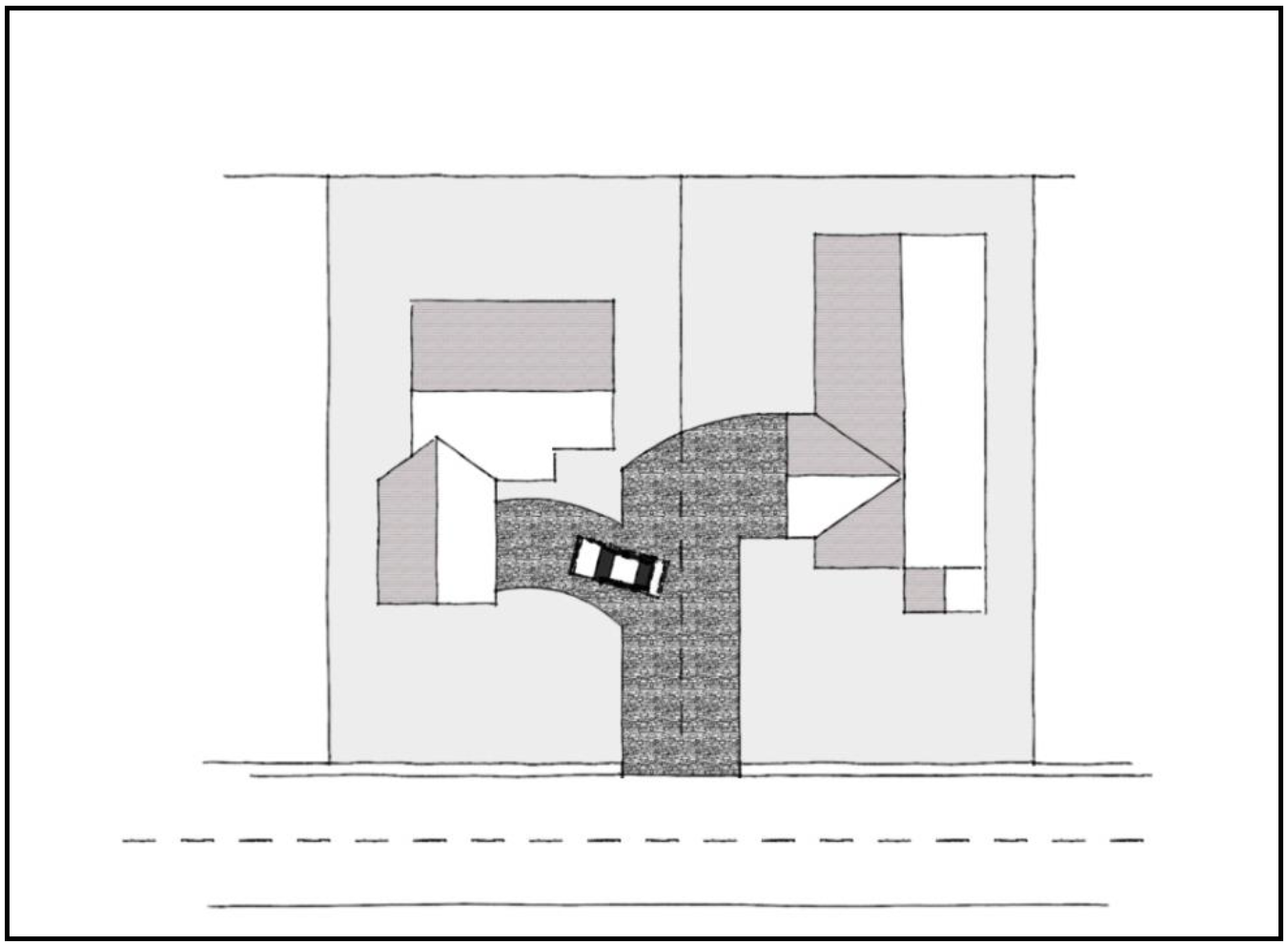
Figure 1: Shared Driveway Easement
(d)
Measuring Floor Area. In measuring Floor Areas (Inclusive of Gross, Allowable, Mitigation, and Floor Area Ratio (FAR), the following applies:
(1)
General. Floor area shall be attributed to the lot or parcel upon which it is developed. In measuring a building for the purposes of calculating Floor Areas, there shall be included all areas within the surrounding exterior walls of the building. When measuring from the exterior walls, the measurement shall be taken from the exterior face of framing, exterior face of structural block, exterior face of straw bale, or similar exterior surface of the nominal structure excluding sheathing, vapor barrier, weatherproofing membrane, exterior-mounted insulation systems, and excluding all exterior veneer and surface treatments such as stone, stucco, bricks, shingles, clapboards or other similar exterior veneer treatments. (Also, see setbacks.)
Note: In measuring Floor Area for the purposes of calculating employee generation and affordable housing mitigation for single-family, duplex, and multi-family development, a distinct calculation is made for Mitigation Floor Area. Please refer to Section 26.575.020(d)(2) below to determine which Floor Area exclusions shall be deducted from the Gross Floor area to determine the Mitigation Area total.
Measuring Allowable Floor Area shall include the following exclusions and exemptions included in Section 26.575.020(d)(3)—(15).
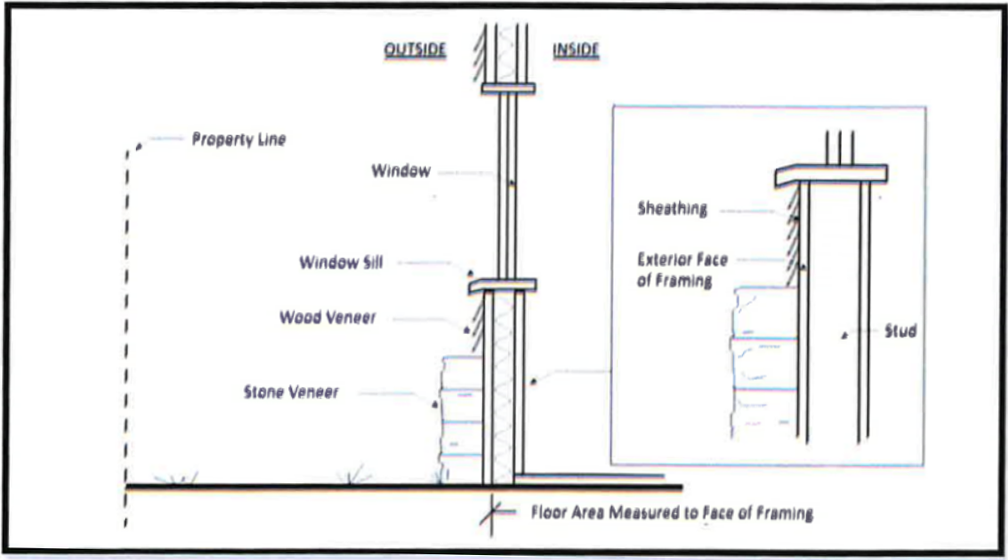
Figure 2: Measuring to Face of Framing
(2)
Floor Area Definitions and Purpose.
a.
Floor area. A general term used to describe the sum total of the gross horizontal areas of each story of the building measured from the exterior walls of the building. Floor Area is distinct from the specific definitions below, but may include Gross Floor Area, Mitigation Floor Area, Allowable Floor Area. See specific definitions of each type below for additional clarity.
i.
Floor Area, Gross. Gross floor area is the total horizontal area of all floors in a building, and of all floors in any accessory structure on the same lot, measured from the exterior face framing of the exterior walls (See Section 26.575.020(d)), or the centerline of a common wall separating two (2) buildings, but excluding unenclosed balconies. This floor area measurement is the total floor area in which Mitigation Floor area and Allowable floor area exclusions are deducted from as established in Section 26.575.020(d). None of the Floor Area Exemptions in Section 26.575.020(d) are considered in this calculation.
Gross Floor Area should be calculated and documented in any land use or building permit application.
ii.
Floor Area, Allowable. The total amount of floor area allowed on a property based on the limitations and allowances in the applicable zone district in Title 700 and calculated pursuant to Section 26.575.020(d), Calculations and Measurements. All exemptions and methodology outlined in Section 26.575.020(d)(3)—(16) apply to this calculation.
iii.
Floor Area, Mitigation—The Gross Floor Area of a structure minus exclusions included in Section 26.575.020(d). This floor area measurement is used to assess required affordable housing mitigation for a given project. For the determination of Mitigation Floor Area, a number of the calculation methodologies listed in Section 26.575.020(d)(3)—(16), below, are not taken. The following table lists the code sections that are not applied to the calculation of Mitigation Floor Area. These areas are counted in their entirety in the Mitigation Floor Area.
iv.
Floor Area, Non-unit space. The area, considering all inclusions and exclusions as calculated herein, within a lodge, hotel or mixed use building that is commonly shared. (Also see Calculations and Measurements Section 26.575.020(d)(15)).
v.
Floor area ratio (FAR). The total floor area of all structures on a lot divided by the lot area.
(3)
Vertical circulation. When calculating vertical circulation, the circulation element shall be counted as follows:
a.
For stairs and elevators, the area of the feature shall be projected down and counted on the lower of the two (2) levels connected by the element and not counted as Floor Area on the top-most interior floor served by the element.
b.
When a stairway or elevator connects multiple levels, the area of the feature shall be counted on all levels as if it were a solid floor except that the area of the feature shall not be counted as Floor Area on the top-most interior level served by the element.
c.
Mechanical and overrun areas above the top-most stop of an elevator shall not be counted as Floor Area. Areas below the lowest stop of an elevator shall not be counted as Floor Area.
(4)
Attic Space and Crawl Space. Unfinished and uninhabitable space between the ceiling joists and roof rafters of a structure or between the ground and floor framing which is accessible only as a matter of necessity is exempt from the calculation of Floor Area as described below. Drop ceilings are not included in the height measurement for crawl spaces.
a.
Crawl spaces that meet the following are exempt from Floor Area calculations:
i.
Six (6) feet or less in height measured between the hard floor structure and floor framing; and
ii.
Accessible only through an interior floor hatch, exterior access panel, or similar feature; and
iii.
Are the minimum height and size reasonably necessary for the mechanical equipment.
1.
Stacked crawl spaces do not qualify for the Floor Area exemption. Crawl spaces greater than 6 feet in height count toward Floor Area in accordance with Section 26.575.020(d)(9), Subgrade Areas.
2.
Attic space that is conveniently accessible and is either habitable or can be made habitable shall be counted in the calculation of Floor Area.
3.
Areas of an attic level with thirty (30) vertical inches or less between the finished floor level and the finished ceiling shall be exempt, regardless of how that space is accessed or used.
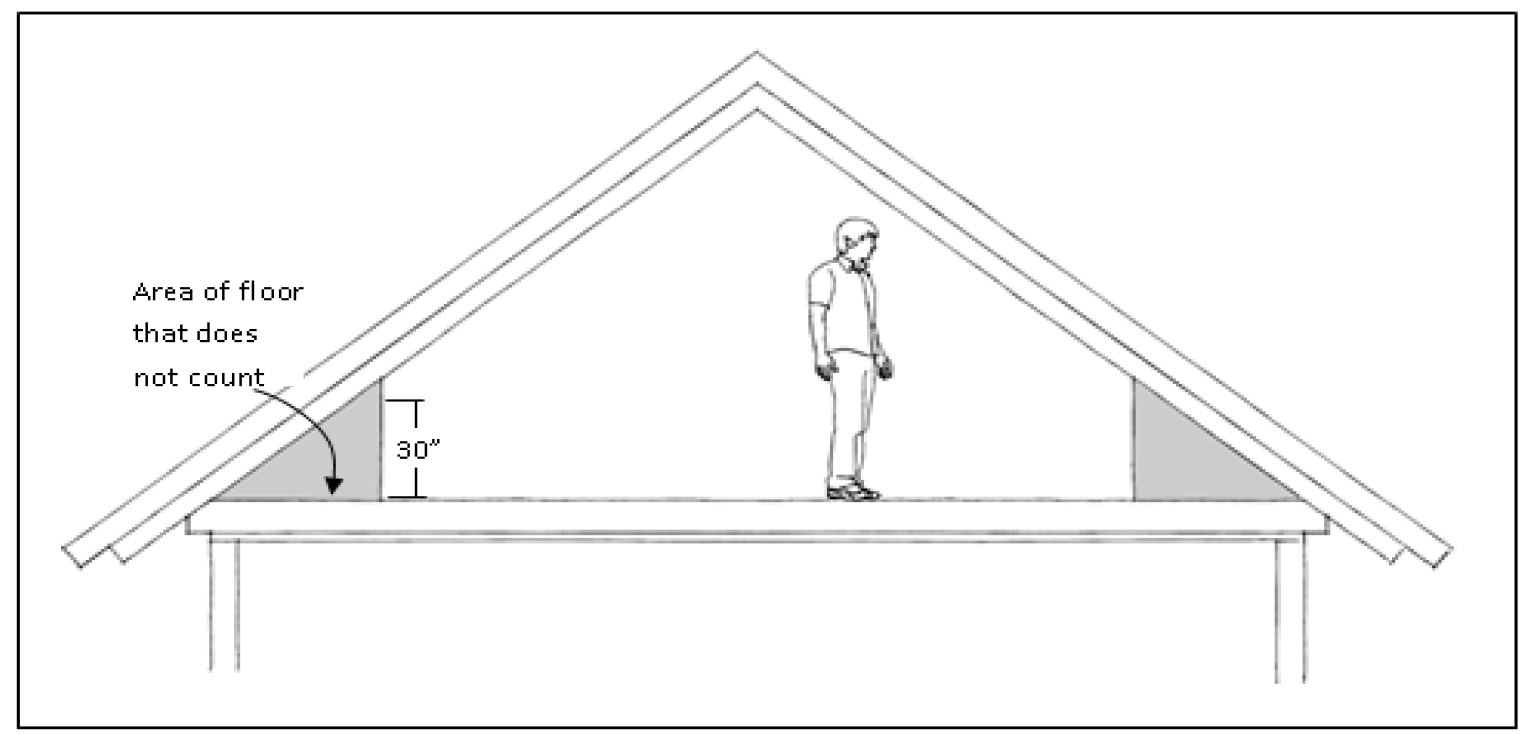
Figure 3: Thirty inch height exemption
4.
If any portion of the attic or crawl space of a structure is to be counted, then the entire room shall be included in the calculation of Floor Area.
5.
Examples of attic and crawl spaces that do and do not count toward Floor Area:
a.
An attic area created above a "hung" or "false" ceiling is exempt.
b.
A crawl space that is six (6) feet in height that is accessible only through an interior hatch counts.
c.
An attic area accessible only through an interior pull-down access ladder is exempt.
d.
An unfinished attic space or an unfinished crawl space over four (4) feet in height which has convenient access is counted.
e.
A crawl space that is six (6) feet in height, is accessible only through an interior hatch and is a reasonable size to accommodate the mechanical equipment is exempt.
(5)
Decks, Balconies, Loggias, Gazebos, Trellis, Exterior Stairways, and non-Street-facing porches.
a.
The calculation of the Floor Area of a building or a portion thereof shall not include decks, balconies, trellis, exterior stairways, non-Street facing porches, gazebos and similar features, unless the area of these features is greater than fifteen (15) percent of the allowable floor area for the property and the use and density proposed, or as otherwise exempted by this Section.
b.
If the area of these features exceeds fifteen (15) percent of the property's allowable Floor Area (for that use and density proposed) only the areas in excess of the fifteen (15) percent shall be attributed towards the allowable Floor Area for the property. The allowable Floor Area for the purpose of this calculation refers to the Floor Area calculation based on the Net Lot Area, as defined in this Chapter or as prescribed by a site-specific approval, with the following exceptions: Floor Area bonus, or established or extinguished Transferrable Development Right certificates are not included.
c.
Decks, balconies, exterior stairways, trellis, and similar features of a mixed use, commercial, or lodge building located within the Commercial Core (CC) Zone District, Mixed Use (MU) Zone District, the Commercial (C-1) Zone District, the Neighborhood Commercial (NC) Zone District, the Lodge (L) Zone District, or the Commercial Lodge (CL) Zone District shall be exempt from Floor Area calculations.
d.
For free-market residential units located within the Mixed Use (MU) Zone District, Commercial Core (CC) Zone District, and Commercial (C-1) Zone District, at-grade patios, decks (other than roof-top decks), balconies, exterior stairways, trellis, and other similar features may only be expanded up to fifteen (15) percent of the total free-market residential floor area. Such free-market units shall not be able to utilize any other exemptions to floor area outlined in Section 26.575.020(d).
e.
The area of the following features count toward deck calculation: railing, permanently fixed seating, permanently fixed grills, and similar permanently fixed features. Permanent planter boxes and green roofs that are a minimum of thirty (30) inches in height above or below the deck surface, measured from the deck surface to the bottom of the planter box or green roof surface, and that are permanently built into the structure of the roof or deck are not included in the deck calculation. Permanent planter boxes and green roofs that do not meet the minimum requirement count toward deck calculation.
f.
Unenclosed areas beneath decks, balconies, and exterior stairways shall be exempt from Floor Area calculations unless that area is used as a carport. (See provisions for garages and carports, subsection (8).) Enclosed and unconditioned areas beneath porches, gazebos, and decks or balconies when those elements have a finished floor level within thirty (30) inches of the surrounding finished grade shall be exempt from Floor Area calculations regardless of how that area is used.
(6)
Front Porches. Porches on Street-facing façade(s) of a structure developed within thirty (30) inches of the finished ground level shall not be counted towards allowable Floor Area. Otherwise, these elements shall be attributed to Floor Area as a Deck.
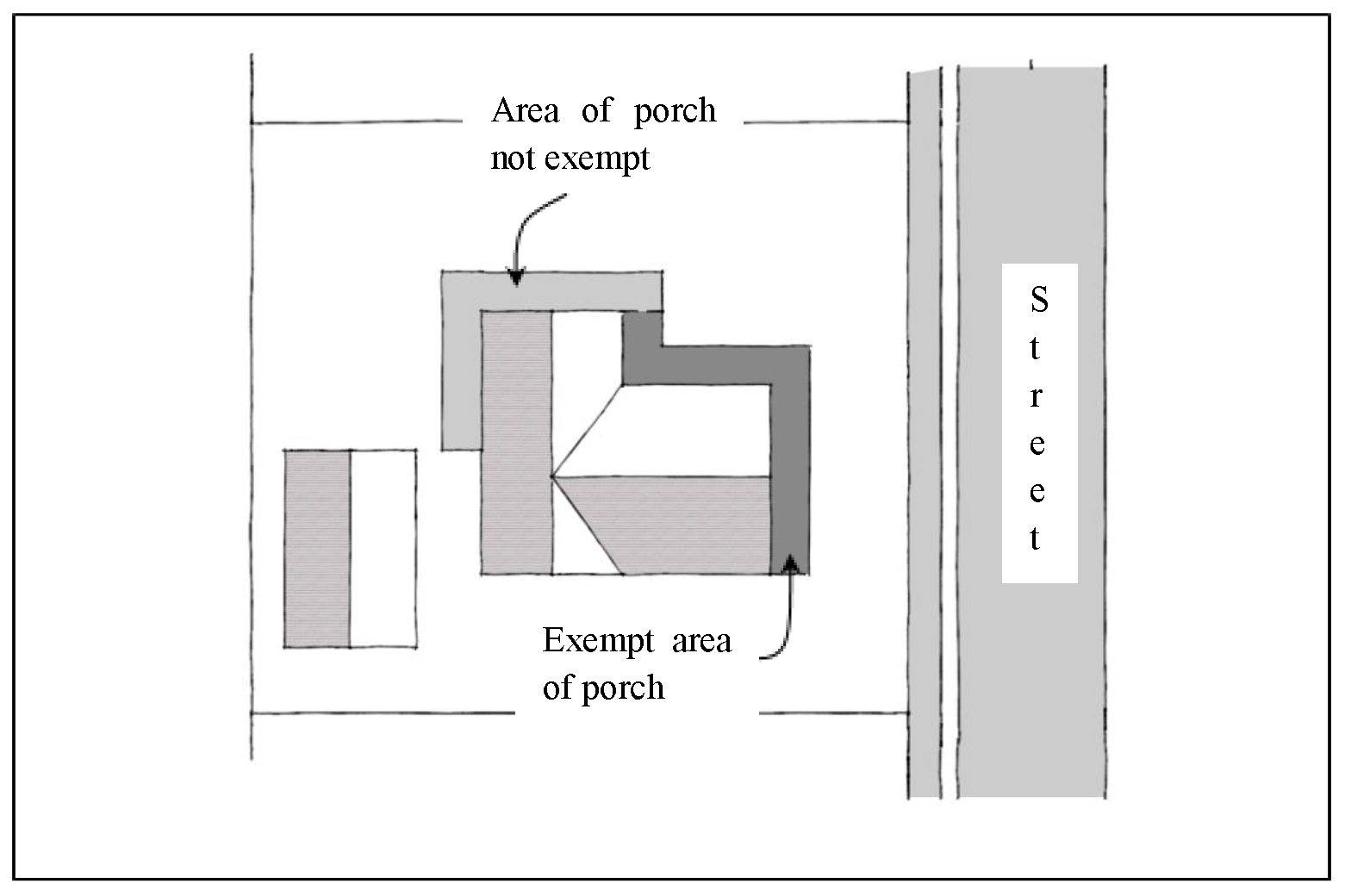
(7)
Patios. Patios developed at or within six (6) inches of finished grade shall not be counted towards Floor Area. These features may be covered by roof overhangs or similar architectural projections of up to four (4) feet, as measured from the face of the building, and remain exempt from Floor Area calculations. When roof overhangs or similar architectural projections exceed four (4) feet, the entire feature counts toward Floor Area. Railing, permanently fixed seating, permanently fixed grills, and similar permanently fixed features located on patios shall count toward deck calculation.
(8)
Garages and carports. For all multi-family buildings, parcels containing more than two (2) residential units, and residential units located within a mixed-use building, two hundred fifty (250) square feet of the garage or carport area shall be excluded from the calculation of floor area per residence on the parcel. All garage and carport area in excess of two hundred fifty (250) square feet per residence shall be attributed towards Floor Area and Floor Area Ratio with no exclusion. Garage and carport areas for properties containing no residential units shall be attributed towards Floor Area and Floor Area Ratio with no exclusion.
In the R-15B Zone District, garage and carport areas shall be excluded from the calculation of Floor Area up to a maximum exemption of five-hundred-square-foot total for the parcel.
In zone districts other than the R-15B Zone District, properties containing solely a Single-Family, two (2) single-family residences, or a Duplex, the garage and carport area shall be excluded from the calculation of Floor Area as follows:
For any property abutting an alley or private road entering at the rear or side of the property, the garage or carport area shall only be excluded from floor area calculations as described above if the garage or carport is accessed from said alley or road. If an alley or private road does exist and is not utilized for garage or carport access, the garage or carport area shall be attributed towards Floor Area calculations with no exclusion. If an alley or private road does not abut the property, the garage or carport area shall be excluded from floor area calculations as described above.
(9)
Subgrade areas. Subgrade or partially subgrade levels of a structure are included in the calculation of Floor Area based on the portion of the level exposed above grade.
The percentage of the gross area of a partially subgrade level to be counted as Floor Area shall be the surface area of the exterior walls exposed above natural or finished grade, whichever is lower, divided by the total exterior wall area of that level. Subgrade stories with no exposed exterior surface wall area shall be excluded from floor area calculations.
Example: If the walls of a two thousand (2,000) square foot level are forty (40) percent exposed above the lower of natural or finished grade then forty (40) percent of that level, eight hundred (800) square feet is counted as Floor Area.
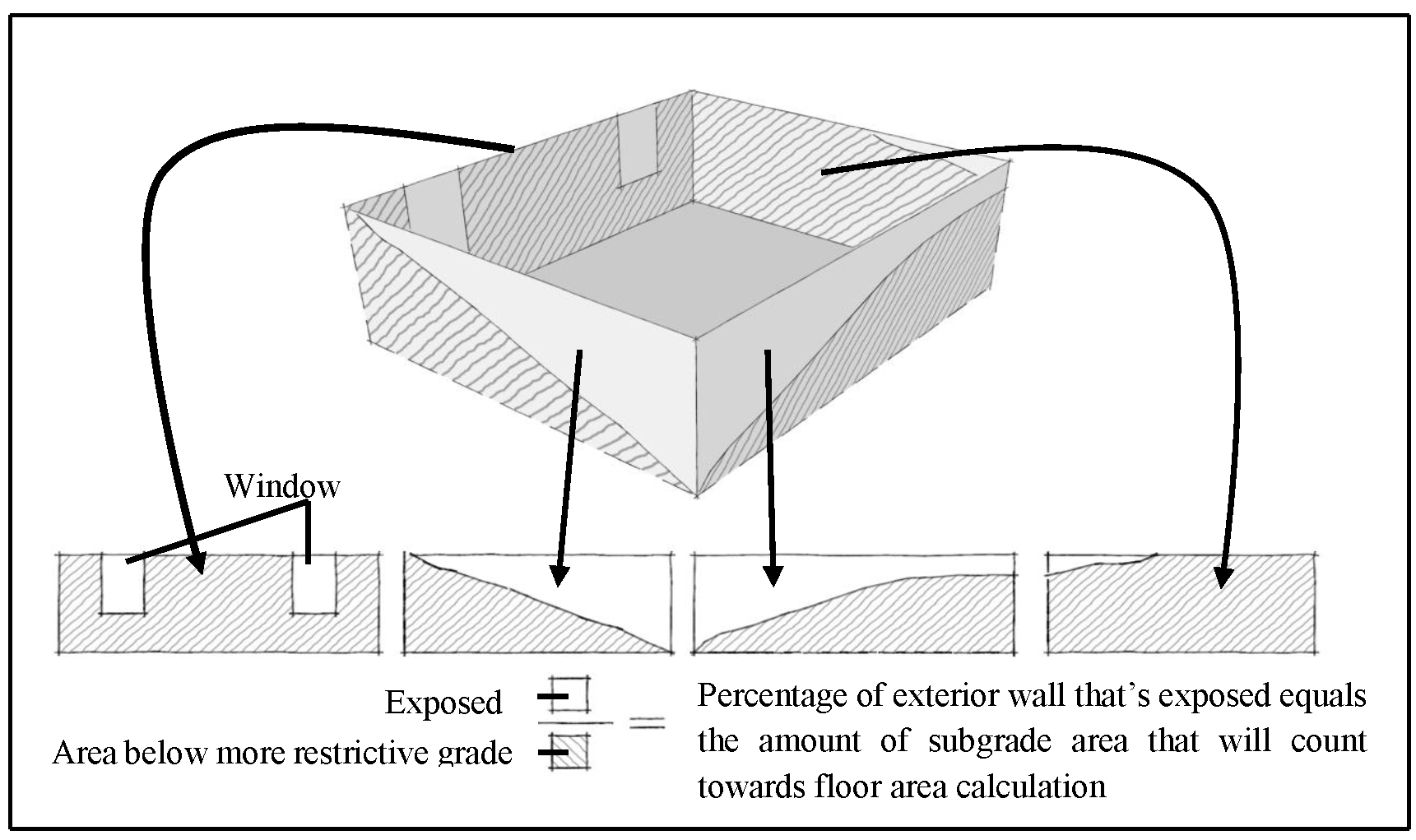
Figure 4: Determining the amount of a subgrade floor to be counted as Floor Area
For the purposes of this Section, the exterior wall area to be measured shall be the interior wall area projected outward and shall not include exterior wall areas adjacent to foundation or floors of the structure. Floor structure does not include drop ceilings.
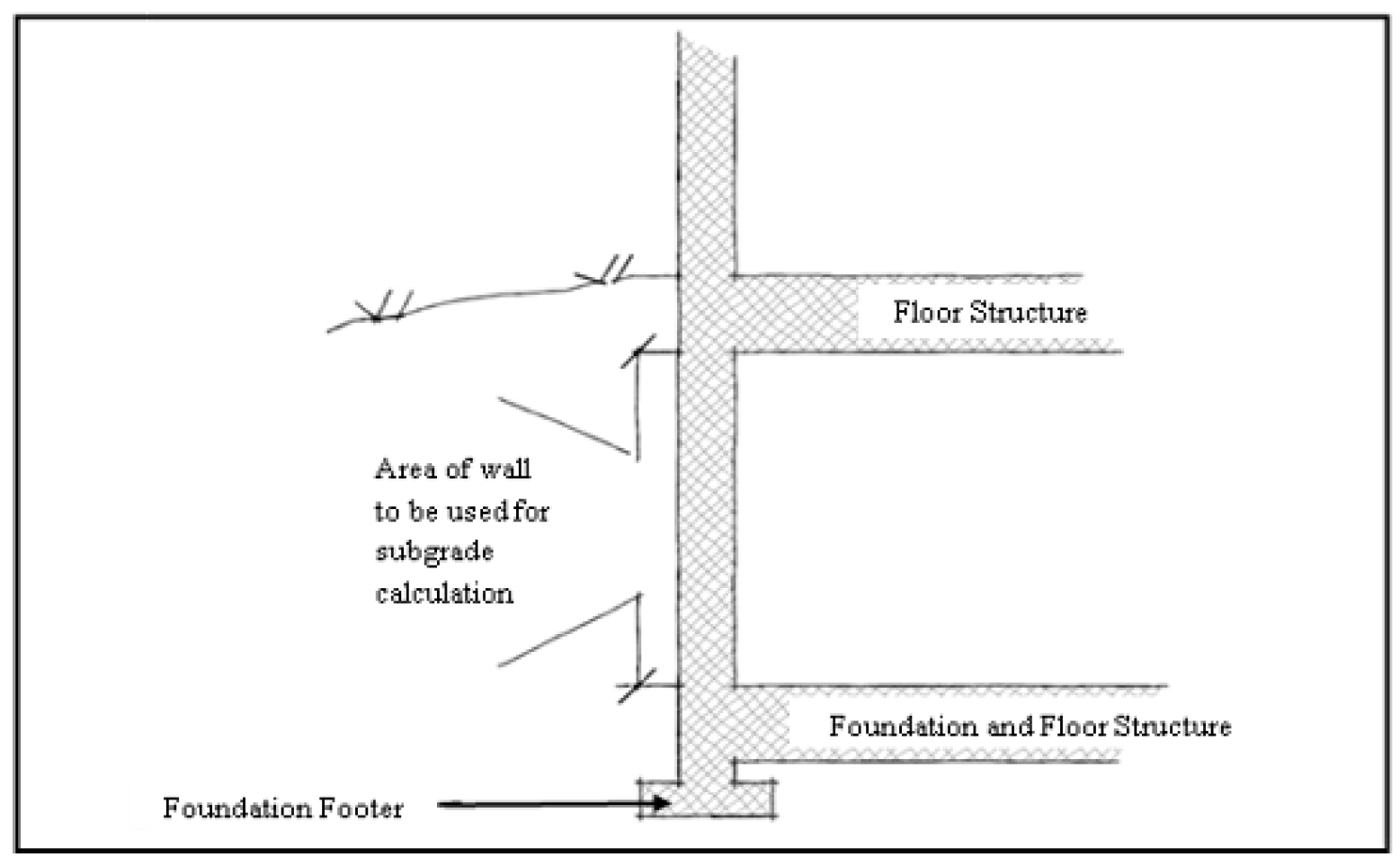
Figure 5: Measuring the Area of a Subgrade Wall
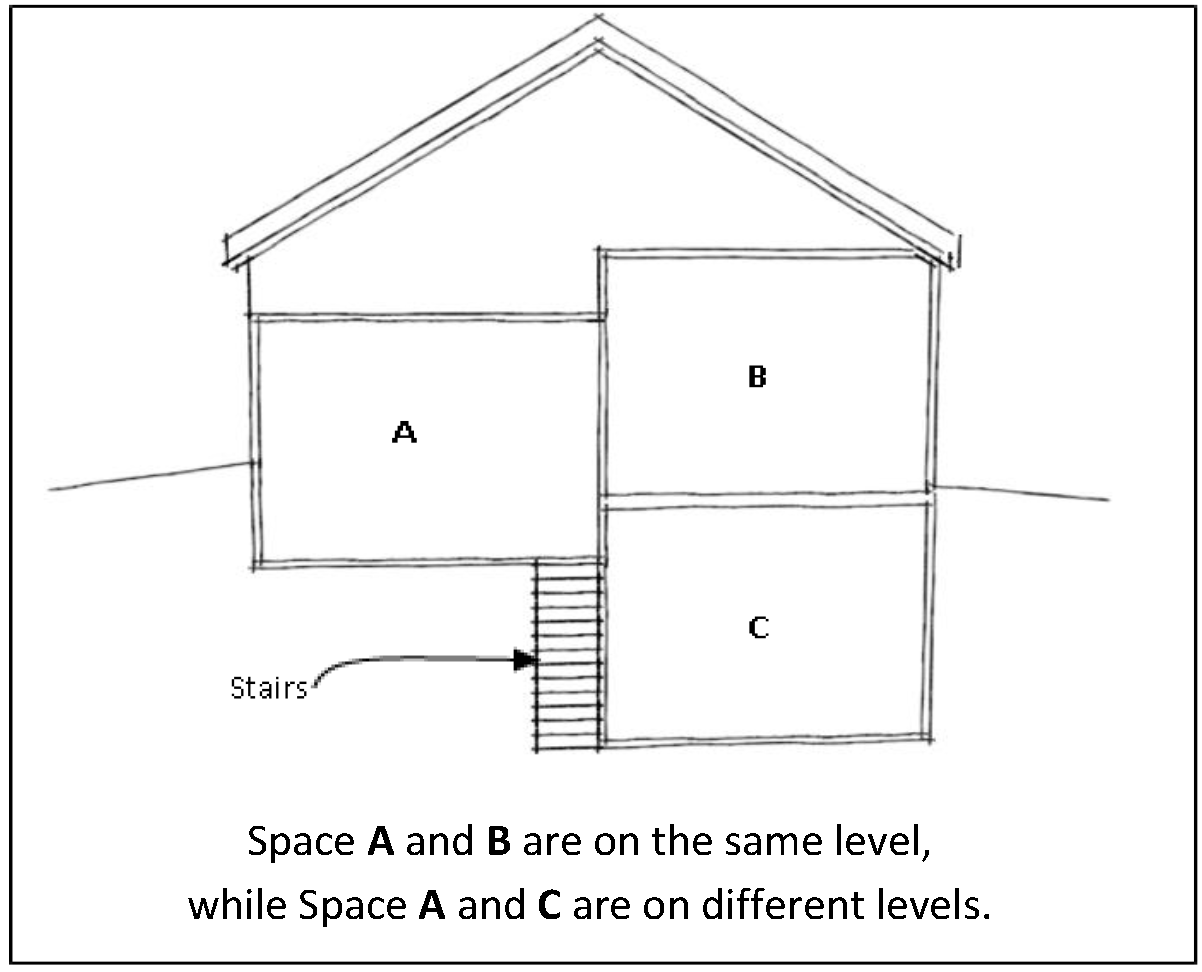
Figure 6: Determining different building levels
When considering multi-level subgrade spaces, adjacent interior spaces shall be considered on the same story if the vertical separation between the ceilings of the spaces is less than fifty (50) percent of the distance between the floor and ceiling of either space.
When a partially subgrade space also contains a vaulted ceiling within a pitched roof, the wall area shall include the area within the gable of the roof.
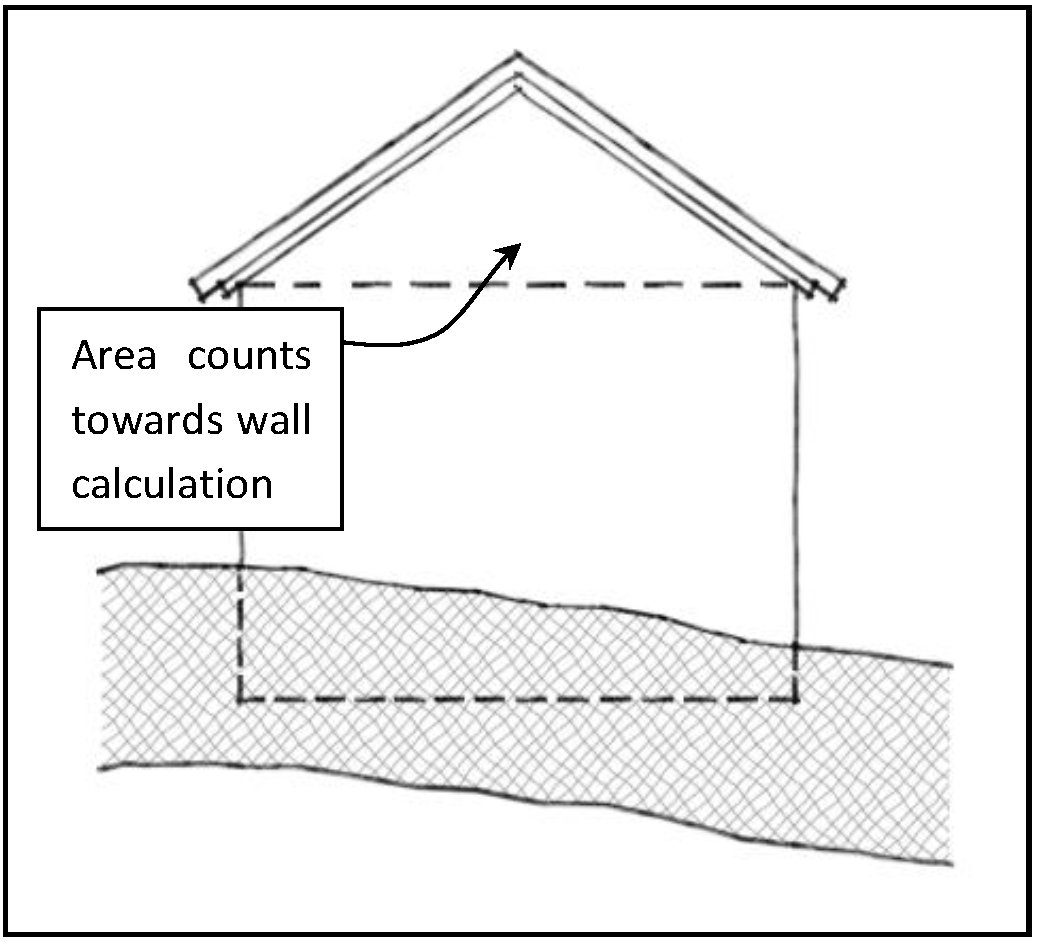
Figure 7: Pitched Roof with subgrade calculation
For garages that are part of a subgrade area, the garage exemption is taken from the total gross below-grade area prior to calculating the subgrade exemption. For example, a two thousand (2,000) square foot story containing a three hundred fifty (350) square foot garage which is forty (40) percent above grade, the calculation shall be as follows:
Garage exemption: The first two hundred fifty (250) square feet is exempt and the next one hundred (100) square feet counts fifty (50) percent or fifty (50) square feet = three hundred (300) square feet of the garage which is exempt.
Subgrade exemption: Two thousand (2,000) gross square feet minus three hundred (300) square feet of exempt garage space = one thousand seven hundred (1,700) gross square feet multiplied by forty (40) percent = six hundred eighty (680) square feet of that level which counts towards allowable Floor Area.
For subgrade spaces with adjoining crawl spaces exempt pursuant to Section 26.575.020(d)(3), a line is drawn to separate the basement space from the crawl space for the purposes of calculating the perimeter and gross area measurements. Exempt crawl space is not included in the perimeter, wall area, and floor area measurements.
Single-family and duplex structures shall contain no more than one (1) floor level below finished grade. A basement with a stepped floor is allowed. The finished floor level shall be no more than fifteen (15) feet below finished grade. A crawl space below the basement, compliant with the limitations of Section 26.575.020(d)(3), shall be exempt from this depth limitation.
When it is necessary to determine the floor area of an individual unit within a duplex or multi-family building, it shall be calculated from the exterior walls to the centerline of any party walls it shares with other units.
In order to determine the subgrade area of an individual unit in a duplex or multi-family building that applies toward Floor Area calculations, the subgrade gross square footage of an individual unit shall be multiplied by the percentage of exterior walls exposed above grade for the entire structure.
Example:
a.
The subgrade exemption for the structure is forty (40) percent (exposed wall divided by total wall).
b.
Unit A has five hundred (500) square feet below grade, measured from exterior wall to the centerline of the party walls it shares with Unit B. Unit B has nine hundred (900) square feet.
c.
0.40 (entire duplex exposed percentage) × 500 (Unit A subgrade gross square footage) = 200 square feet subgrade floor area that applies toward the total Floor Area for Unit A. 0.40 (entire duplex exposed percentage) × 900 (Unit B subgrade gross square footage) = 360 square feet subgrade floor area that applies toward the Floor Area for Unit B.
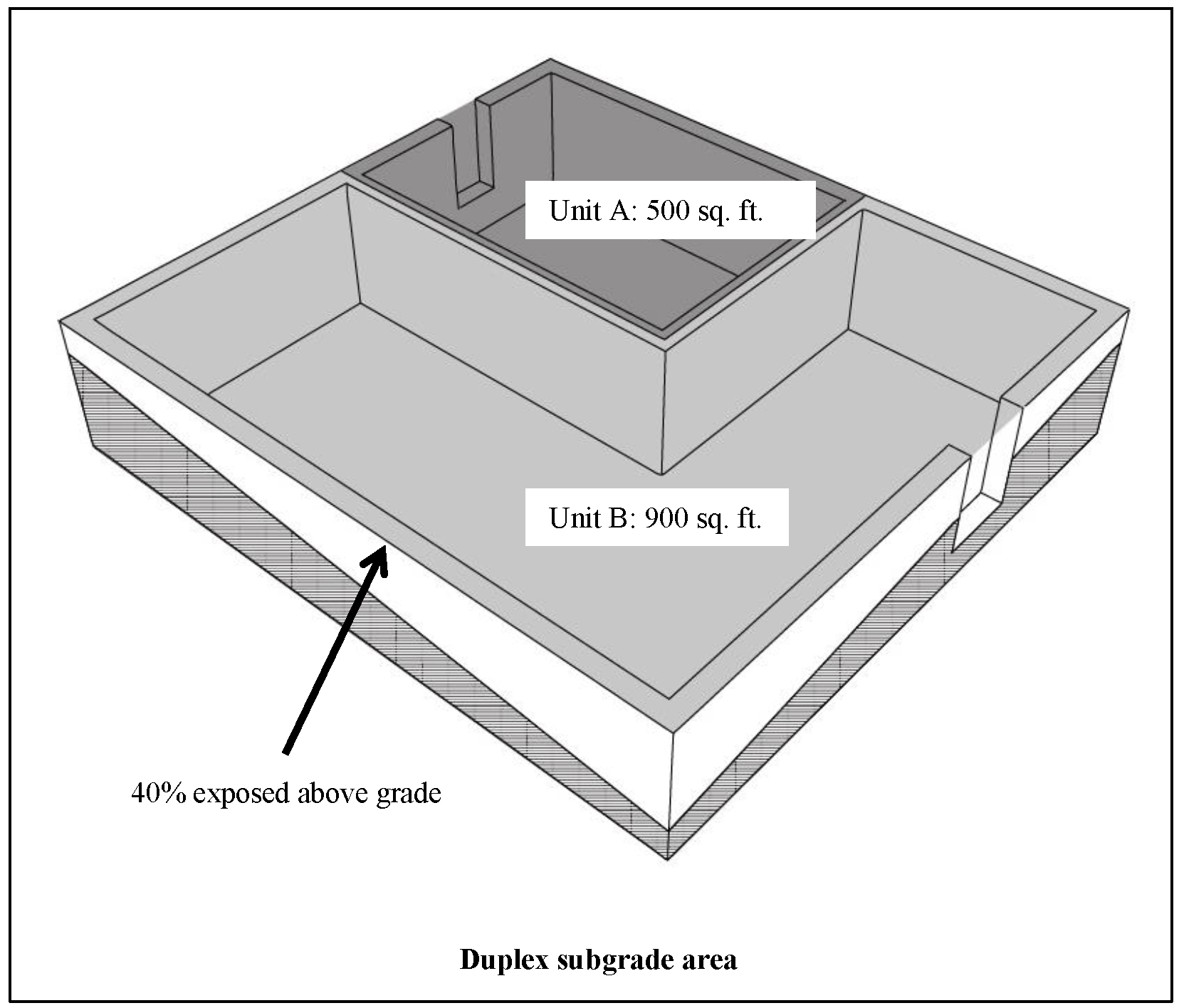
(10)
Accessory Dwelling Units and Carriage Houses. An accessory dwelling unit or carriage house shall be calculated and attributed to the allowable floor area for a parcel with the same inclusions and exclusions for calculating floor area as defined in this Section.
(11)
Permanently Affordable Accessory Dwelling Units and Carriage Houses. One hundred (100) percent of the area of an Accessory Dwelling Unit or Carriage House which is detached from the primary residence and deed-restricted as a "for sale" affordable housing unit and transferred to a qualified purchaser in accordance with the Aspen/Pitkin County Housing Authority Guidelines, as amended, shall be excluded from the calculation of floor area, up to a maximum exemption of one thousand two hundred (1,200) square feet per parcel.
In addition, the allowable floor area of a parcel containing such a permanently affordable Accessory Dwelling Unit or Carriage House shall be increased in an amount equal to fifty (50) percent of the floor area of the Accessory Dwelling Unit or Carriage House, up to a maximum bonus of six hundred (600) square feet per parcel.
(12)
Sheds, Storage Areas, and similar Accessory Structures. Sheds, storage areas, greenhouses, and similar uninhabitable accessory structures, not within a garage, are exempt from floor area limitations up to a maximum exemption of thirty-two (32) square feet per residence. Storage areas within a garage shall be treated as garage space eligible for the garage exemption only. Accessory structures thirty-six (36) inches or less in height, as measured from finished grade, shall be exempt from Floor Area calculations (also see setback limitations). Accessory structures that are both larger than thirty-two (32) square feet per primary residence and more than thirty-six (36) inches in height shall be included in their entirety in the calculation of Floor Area. Properties which do not contain residential units are not eligible for this Floor Area exemption.
(13)
Historic Sheds and Outbuildings. The Community Development Director may provide a parcel containing an uninhabitable and limited function historic shed, outbuilding, or similar historic artifact with a Floor Area exemption to accommodate the preservation of the historic resource. The shed or outbuilding must be considered a contributing historic resource of the property. Functional outbuildings, such as garages, art studios, home offices, and the like shall not be eligible for an exemption. The Director may consult the Historic Preservation Commission prior to making a determination. The Director may require the property's potential to receive Floor Area bonuses be reduced to account for the structure. The exemption shall be by issuance of a recordable administrative determination and shall be revocable if the artifact is removed from the property.
(14)
Wildlife-Resistant Trash and Recycling Enclosures. Wildlife-resistant trash and recycling enclosures located in residential zone districts are exempt from floor area requirements of the zone district regulations if the enclosure is the minimum reasonably necessary to enclose the trash receptacles in both height and footprint, is an unconditioned space not located inside other structures on the property, and serves no other purpose such as storage, garage space, or other purposes unrelated to protecting wildlife. Wildlife-resistant dumpster enclosures located in commercial, mixed-use, or lodging zone districts are not exempt from floor area requirements and shall comply with zone district requirements for Utility/Trash/Recycle areas.
Enclosures shall be located adjacent to the alley if an alley borders the property and shall not be located in a public right-of-way. Unless otherwise approved by the Historic Preservation Commission, enclosures shall not abut or be attached to an historic structure. Enclosures may abut other non-historic structures.
(15)
Allocation of Non-Unit Space in a mixed-use building. In order to determine the total floor area of individual uses in a mixed-use building, the floor area for non-unit space, which is common to all uses on the property, shall be allocated on a proportionate basis to the use categories outlined in the subject zone district's FAR schedule. To determine the non-unit space allocation in a building, a calculation of the building's Gross Floor Area is required. The building's Gross Floor Area, minus all non-unit space, shall be divided proportionately amongst the individual use categories in a building. These numbers shall then be calculated as a percent of the Gross Floor Area number.
Garages, including subgrade garages, and carports in mixed use buildings that contain residential units are considered non-unit space.
When a feature is used exclusively by one (1) use, the space shall be attributed to the floor area for that use.
Gross floor area calculation:
For instance, if a building was comprised of the following square footages:
2,000 sq. ft. commercial floor area (including 500 sq. ft. basement)
+ 4,000 sq. ft. free-market residential floor area
+ 2,000 sq. ft. affordable housing floor area
+ 1,000 sq. ft. nonunit floor area (1,250 sq. ft.- 250 sq. ft. for exempt garage)
= 9,000 sq. ft. gross floor area
Percentage of use category per building floor area:
Then the total unit floor area in the building, not including non-unit space, would be eight thousand (8,000) square feet floor area (9,000 - 1,000). Using the allocation of non-unit space standard, the uses account for the following percentages of the total unit floor area:
Commercial floor area = 25% [(2,000/8,000) × 100]
Free-market residential floor area = 50% [(4,000/8,000) × 100]
Affordable housing floor area = 25% [(2,000/8,000) × 100]
Application of use percentages to non-unit floor area:
A proportionate share of the non-unit floor area shall then be allocated towards each use category. Floor area exemptions that apply to non-unit space, for example a garage or top level of a shared stairway tower, are deducted from the total non-unit floor area before allocating to each use category. Subgrade levels that do not count toward floor area shall not be included in the use category total when calculating floor area. This provision shall apply to all zone districts permitting mixed-use buildings.
Therefore, the one thousand (1,000) square feet of non-unit space is allocated to the different uses as follows:
Commercial floor area = 25% × 1,000 sq. ft. = 250 sq. ft.
Free-market residential floor area = 50% × 1,000 sq. ft. = 500 sq. ft.
Affordable housing floor area = 25% × 1,000 sq. ft. = 250 sq. ft.
The floor area for each use is as follows:
Commercial floor area: 1,500 sq. ft. (2,000 sq. ft. total minus 500 sq. ft. exempt basement) + 250 sq. ft. = 1,750 sq. ft.
Free market residential floor area: 4,000 sq. ft. + 500 sq. ft. = 4,500 sq. ft.
Affordable housing floor area: 2,000 sq. ft. + 250 sq. ft. = 2,250 sq. ft.
Examples:
1.
Circulation features, for example hallways, that are shared (used by multiple uses) are considered non-unit space.
2.
A shared elevator that serves all levels of a mixed use building (even if the top level terminates within a residential unit) is considered non-unit space.
3.
Circulation that is specific to a use, for example a private elevator that only serves the residential component (i.e. it does NOT provide access to commercial levels), is allocated to the floor area of the specific use and is not considered non-unit space.
4.
A stairway that is interior to a single unit, which for example connects a two-level commercial space, counts toward commercial floor area.
(16)
Airlocks. Permanently installed interior airlock spaces are exempt from the calculation of Floor Area Ratio and allowable Floor Area up to a maximum exemption of one hundred (100) square feet per building. This exemption only applies to buildings containing non-residential uses and does not apply to single-family, duplex, or multi-family buildings.
(e)
Measuring Setbacks.
(1)
General. Required setbacks shall be unoccupied and unobstructed within an area extending horizontally from the parcel boundary to the setback line and vertically above and below grade, excepting allowed projections as described below.
a.
For new construction, and for redevelopment projects following a Demolition of a structure for any use type, required setbacks shall be measured perpendicularly from all points of the parcel boundary to the outermost exterior of a structure, including all exterior veneer such as brick, stone, or other exterior treatments, but excluding allowed projections as further described in subsection (e)(5), below. (See Figure 8.a)
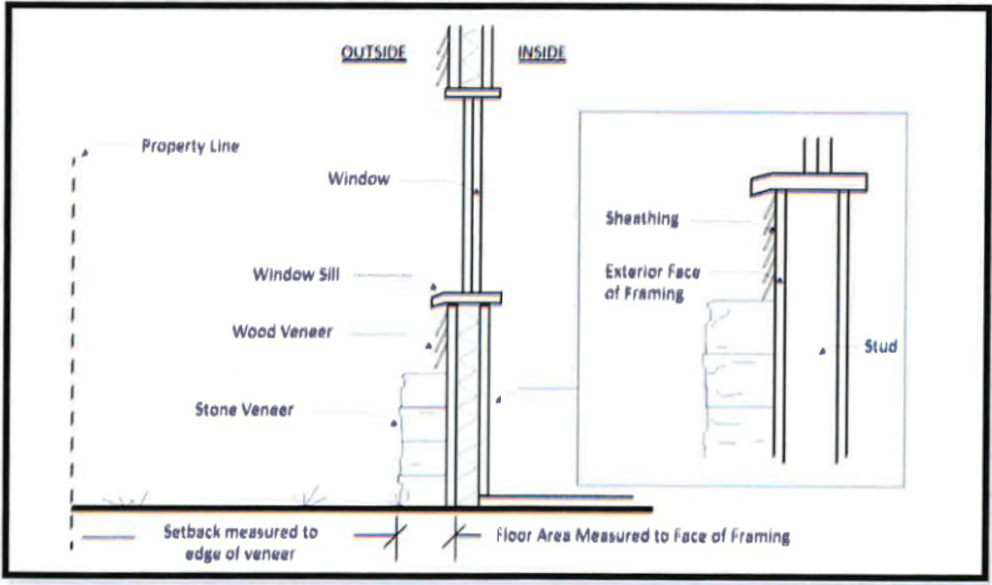
Figure 8.a: Setback Measurement
(New Construction)
b.
For existing single-family, duplex, and multi-family residential structures, that propose energy efficiency or fire protection upgrades on the exterior of the structure, required setbacks shall be measured perpendicular from all points of the parcel boundary to the exterior face of framing of a structure, to a maximum of eight (8) inches of all exterior veneer such as brick, stone or other exterior treatments, including fire proofing, exterior insulation, and any methods of attachment for insulation systems, but excluding allowed projections as further described in Section 26.575.020(e)(5), below. In any instance where the addition of exterior improvements results in a setback of five (5) feet or less, the Community Development Director shall evaluate site context to ensure the improvements are appropriate and compliant with building codes. (See Figure 8.b)
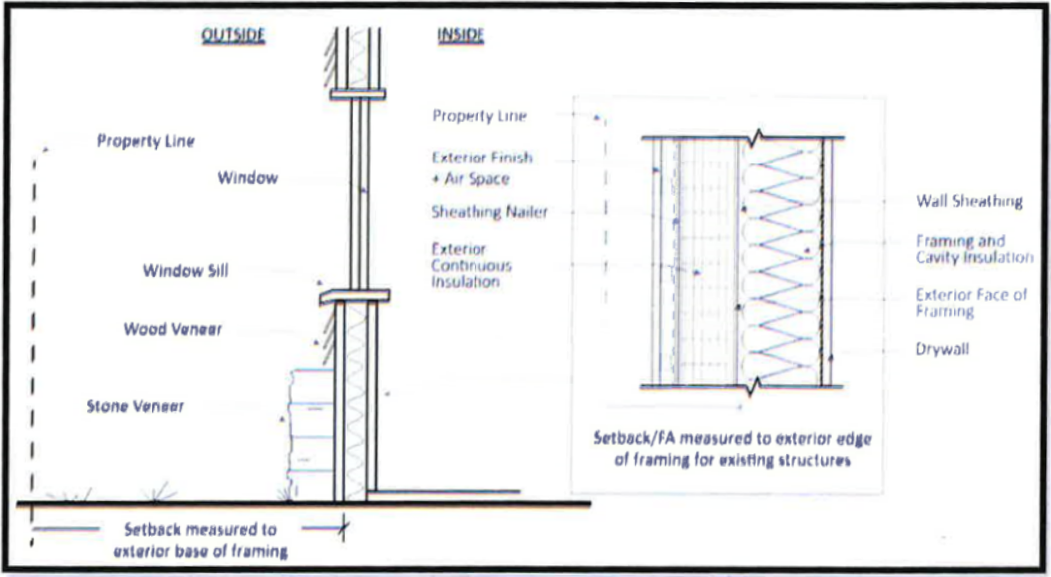
Figure 8.b: Setback Measurement
(Existing Structures)
c.
For existing single-family, duplex and multi-family residential structures that encroach into the setback and propose energy efficiency of fire protection upgrades on the exterior of the structure, a maximum of eight (8) inches of all exterior veneer such as brick, stone or other exterior treatments, including fire proofing, exterior insulation, and any methods of attachment for insulation, may be added to the wall assembly without being considered a nonconformity and triggering compliance with Chapter 26.430, Nonconformities. In any instance where the addition of exterior improvements result in a setback of five (5) feet or less, the Community Development Director shall evaluate site context to ensure the improvements are appropriate and compliant with building codes.
(2)
Determining Front, Rear, and Side Yards. The front yard setback shall be measured from the front lot line. The Front Lot Line shall be the parcel boundary closest to or dividing a lot from a Street or street right-of-way. All parcels have a front lot line. There shall not be more than one (1) front lot line.
The rear yard setback shall be measured from the rear lot line. The Rear Lot Line shall be the parcel boundary opposite the front lot line. All parcels have a rear lot line. A parcel shall have only one (1) rear lot line.
Side yard setbacks shall be measured from the side lot lines. Side lot lines shall be those parcel boundaries other than a front or rear lot line. All parcels will have at least one (1) side lot line and may have multiple side lot lines.
For corner parcels, the front lot line shall be the parcel boundary along the Street with the longest block length and the remaining boundary shall be a side lot line.
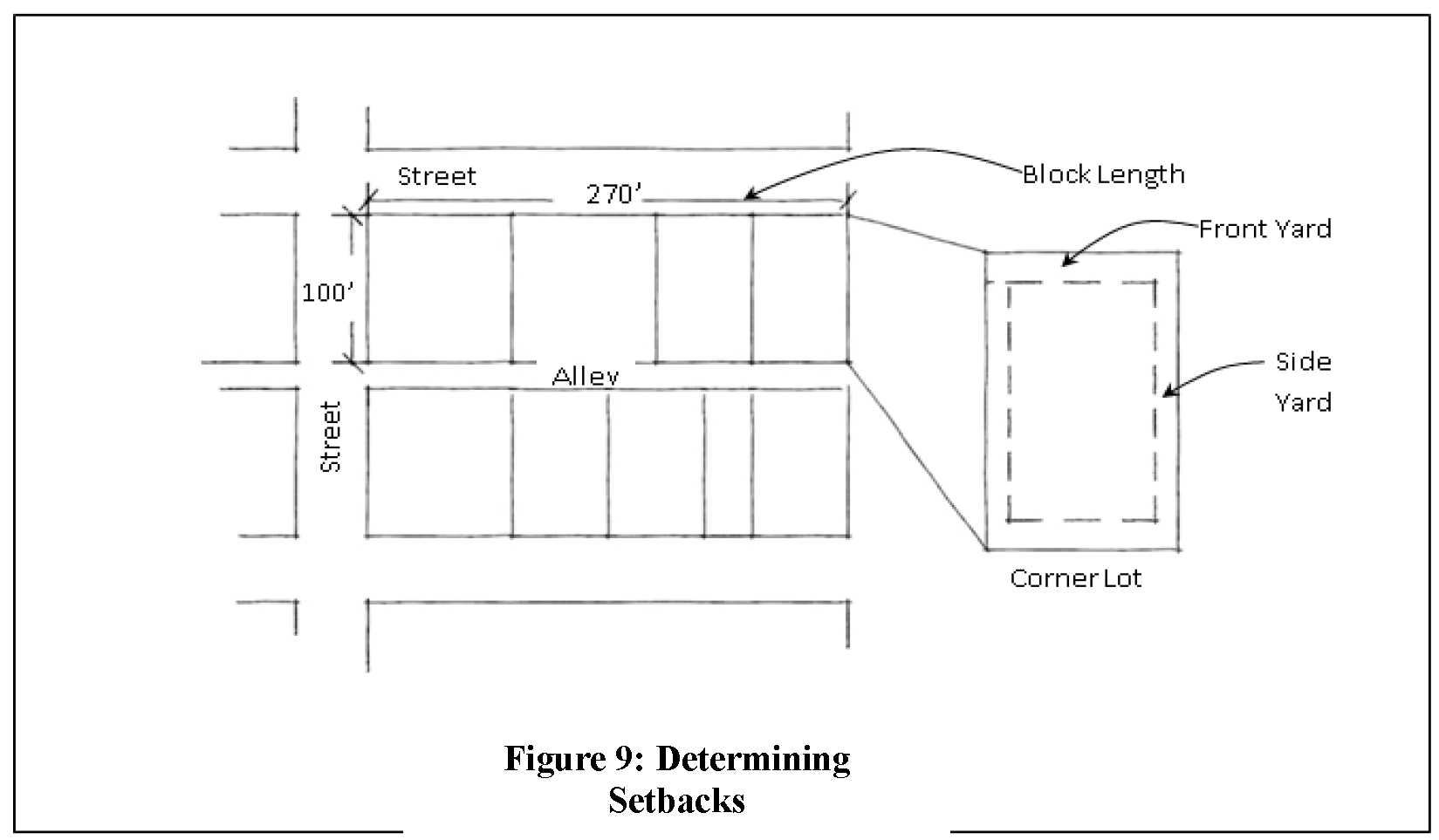
For corner parcels where the parcel boundary follows a curving Street, the midpoint of the curve shall be used to differentiate the front lot line and the side lot line. In this case, the boundary segment with the shortest Street frontage shall be the front lot line.
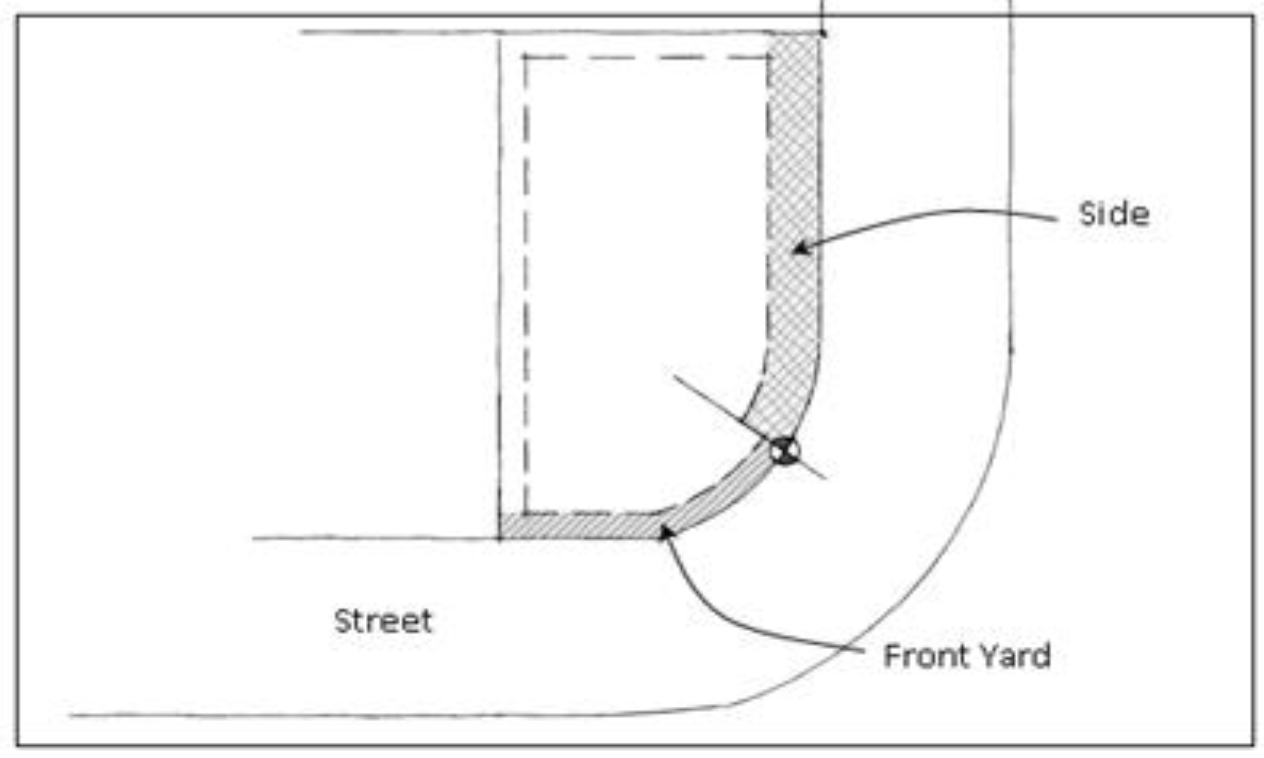
Figure 10: Corner lot with curved street
For reverse curve lots, the curved portion of the lot line shall be considered the front lot line and the two (2) opposing parcel boundaries shall be considered side lot lines.
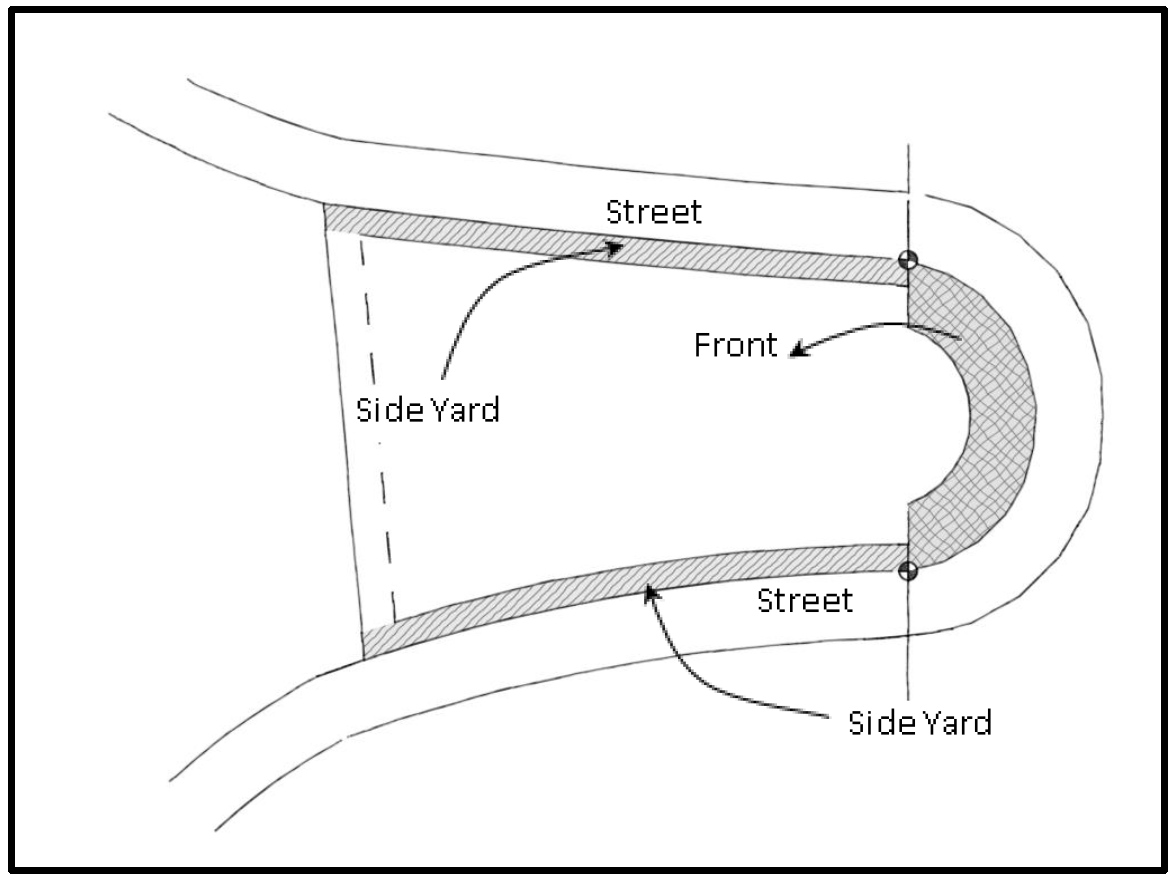
Figure 11: Reverse curve lot
For all double frontage lots with Streets on opposite sides of the parcel, except for those parcels abutting Main Street, the front lot line shall be the parcel boundary with the greatest length of Street frontage and the opposing lot boundary shall be the rear lot line.
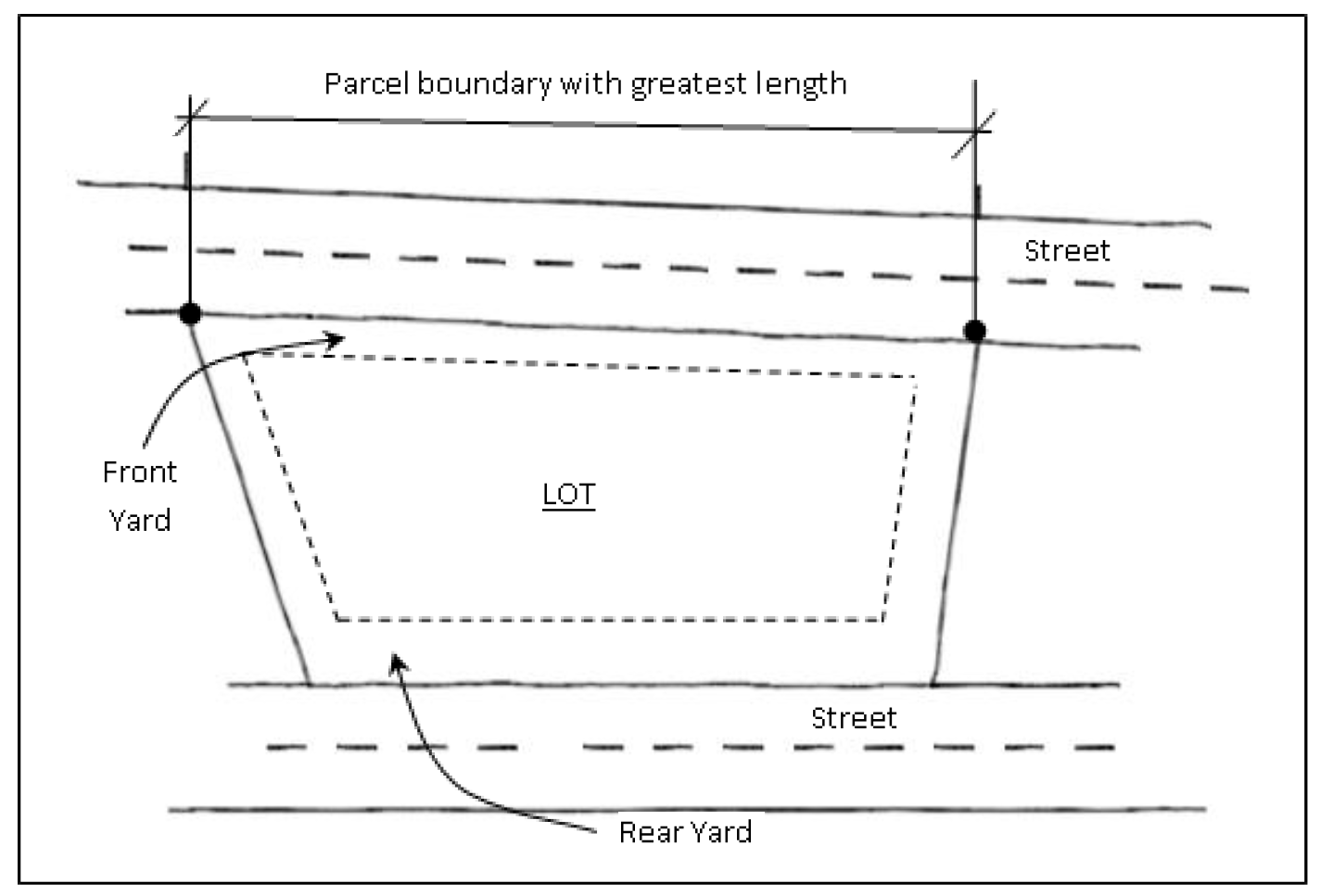
Figure 12: Double frontage lot
For double frontage lots with equal length street frontages, the front lot line shall mirror the front lot lines of the adjoining lots to the extent practical.
For double frontage lots abutting Main Street, the front lot line shall be the lot line adjoining Main Street.
The Community Development Director shall resolve any discrepancies or situations where the foregoing text does not provide definitive clarity by issuance of a recordable administrative determination.
(3)
Determining required setbacks adjacent to streets or rights-of-way. When a property does not extend into an adjacent public or private right-of-way or street easement, the required setback shall be measured from the lot line.
When a property extends into an adjacent public or private right-of-way or street easement, the required setback for that portion of the lot shall be measured from the edge of the right-of-way or street easement closest to the proposed structure.
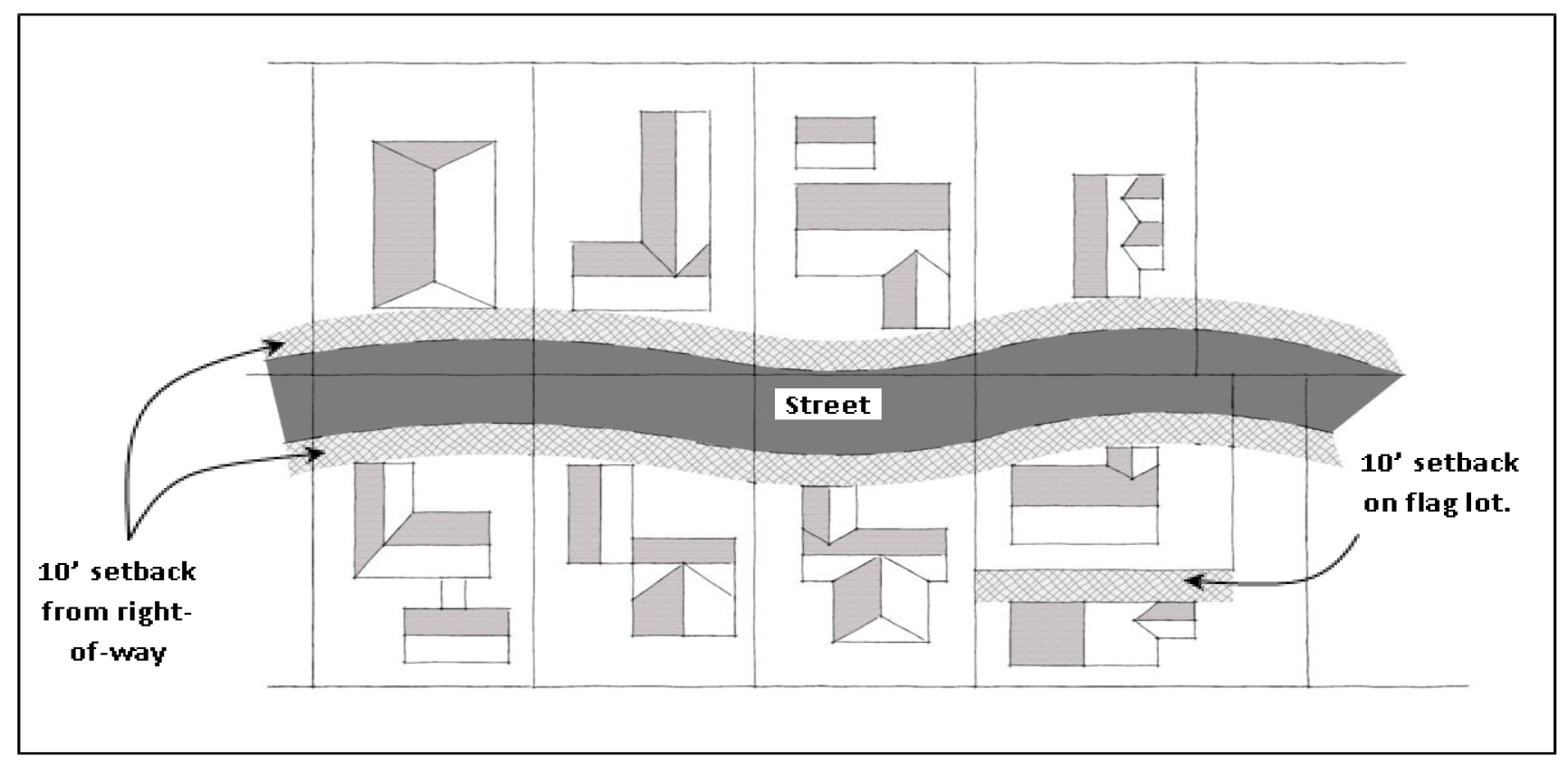
Figure 13: Required setback from a right-of-way or street easement
(4)
Combined Setbacks. Where zoning provisions require a combined yard setback (either front-rear or side-side), the narrowest point on each yard shall be the basis for measuring the combined setback. A combined yard requirement may not be met by staggering the required yard setbacks.
For example, if a lot requires a combined side-yard setback of thirty (30) feet, with a minimum of ten (10) feet on either side, Figure 14 shows compliance with the requirement - one (1) side yard is ten (10) feet, the other is twenty (20) feet, and each side yard setback is consistent from front to rear.
Given the same example, Figure 15 meets the individual ten (10) feet setback requirements, but the combined setback is staggered and is not consistent from front to rear. This example does not meet the combined setback requirement.
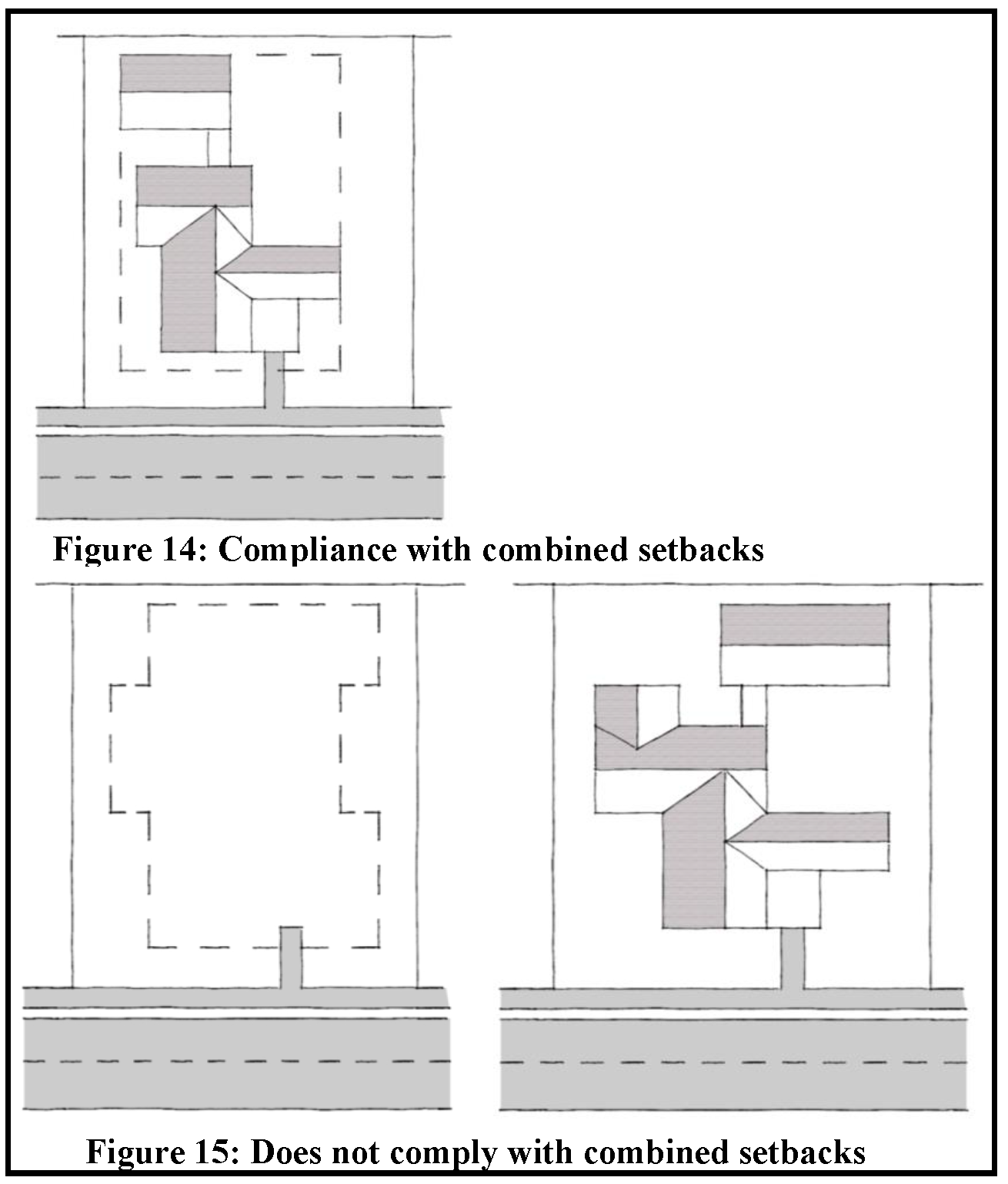
(5)
Allowed Projections into Setbacks. Setback areas shall be unobstructed above and below ground except for the following allowed projections:
a.
Above or below ground utilities, including transformers and vaults, below-grade heating or cooling conduit or infrastructure such as a ground-source heat pump system, below-grade dry wells or other at-grade or below-grade drainage infrastructure.
b.
Trees and vegetation.
c.
Artwork, sculpture, seasonal displays.
d.
Flagpoles, mailboxes, address markers.
e.
Foundation footers, soil nails or below-grade tiebacks, and similar improvements necessary for the structural integrity of a building or other structures.
f.
The minimum projection necessary to accommodate exterior mounted utility junctions, meters, cable boxes, vent flues, standpipes, and similar apparatus and including any protective structure as may be required by the utility provider.
g.
Building eaves, bay windows, window sills, and similar architectural projections up to eighteen (18) inches as measured from the setback boundary.
h.
The minimum projection necessary to accommodate light wells and exterior basement stairwells as required by adopted Building or Fire Codes as long as these features are entirely recessed behind the vertical plane established by the portion of the building façade(s) closest to any Street(s).
If any portion of the feature projects into the setback, the entire feature may be no larger than the minimum required.
Features required for adjacent subgrade interior spaces may be combined as long as the combined feature represents the minimum projection into the setback. There is no vertical depth limitation for these features.
This exemption does not apply to Areaways. This exemption does not apply to light wells and exterior basement stairwells which are not required by adopted Building or Fire Codes.
i.
The minimum projection necessary to accommodate an exterior-mount fire escape to an existing building, as may be required by adopted Building or Fire Codes.
j.
Uncovered porches, landscape terraces, slabs, patios, walks and similar features, which do not exceed six (6) inches vertically above or below the surrounding finished grade for the entire feature.
k.
Landscape walls, berms, retaining walls, stairways and similar structures, which do not exceed thirty (30) inches vertically above or below the lower of natural or finished grade. Improvements may be up to thirty (30) inches above and below grade simultaneously, for up to a sixty (60) inch total. Improvements may exceed thirty (30) inches below grade if determined to be necessary for the structural integrity of the improvement. Berms are prohibited in the front yard setback.
l.
Drainage swales, stormwater retention areas, bio retention areas, rain collection systems, and similar stormwater retention, filtration or infiltration devices or facilities are permitted in setbacks as long as the finished grade of the top of the improvement does not exceed thirty (30) inches vertically above or below the surrounding finished grade. Stormwater improvements or portions thereof may be buried and exceed thirty (30) inches below grade as long as the finished grade above the facility does not exceed thirty (30) inches vertically above or below the surrounding finished grade. These features may be up to thirty (30) inches above and below finished grade simultaneously.
m.
Hot tubs, spas, pools, water features, and permanently affixed outdoor grills, furniture, seating areas, and similar permanent structures shall have the following requirements:
1.
Prohibited between any lot line adjacent to a street and any structure; and
2.
Shall be located at least double the minimum setback for a primary structure from any lot line adjacent to a street; and
3.
If visible from the street, these features shall be screened in accordance with Section 26.575.050, Fence Materials, with natural features, or by other means determined appropriate by the Community Development Director ; and
4.
If located within a setback not adjacent to a street, these features shall not exceed thirty (30) inches above or below finished grade. These features may be up to thirty (30) inches above and below finished grade simultaneously. Improvements may exceed thirty (30) inches below grade if necessary for the structural integrity of the improvement.
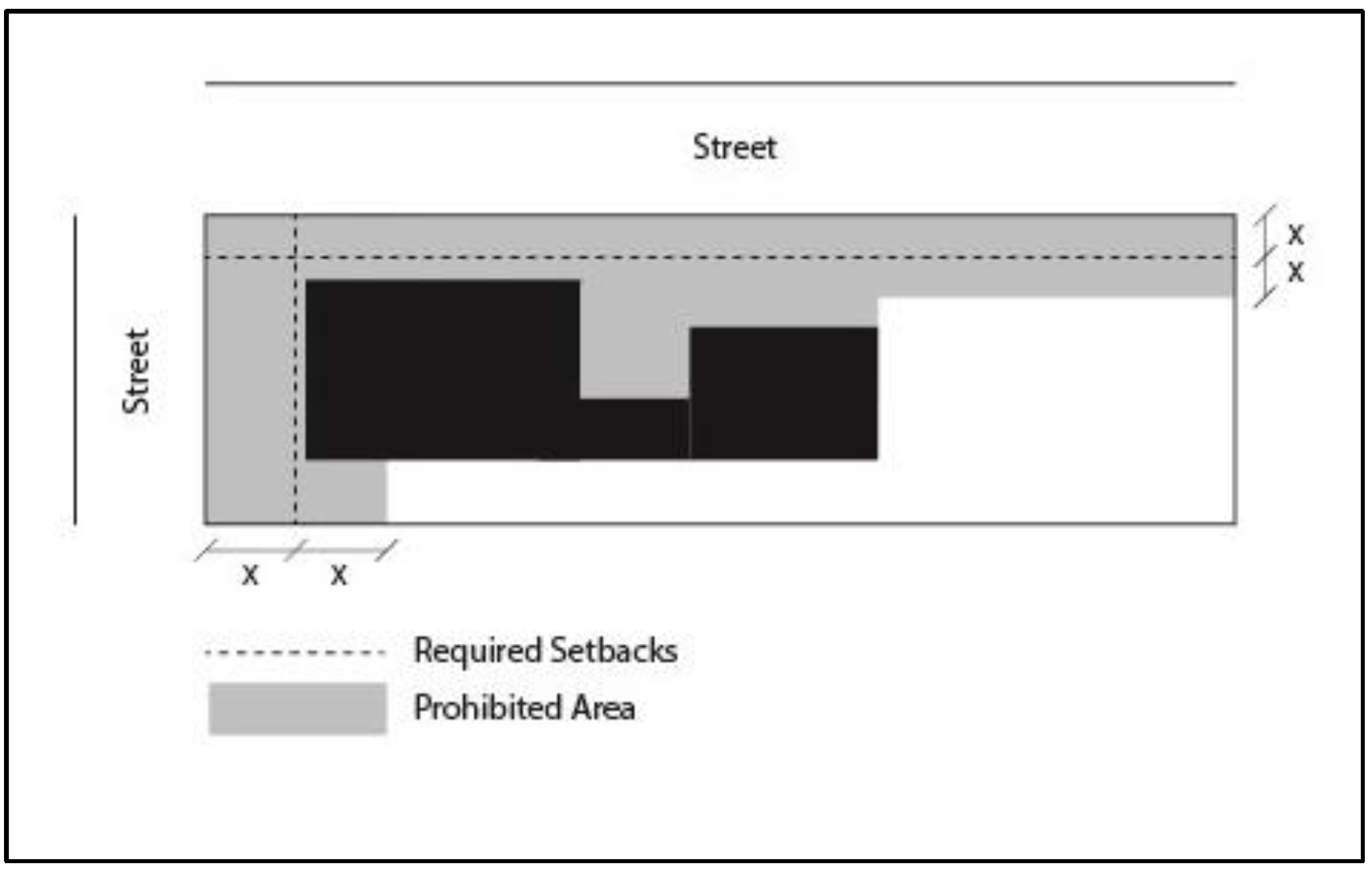
n.
Heating and air conditioning equipment and similar mechanical equipment, but excluding generators, shall have the following requirements:
1.
Prohibited between any lot line adjacent to a street and any structure; and
2.
Shall be located at least double the minimum setback for a primary structure from any lot line adjacent to a street; and
3.
If visible from the street, these features shall be screened in accordance with Section 26.575.050, Fence Materials, with natural features, or by other means determined appropriate by the Community Development Director; and
4.
If located within a setback not adjacent to a street, these features shall not exceed thirty (30) inches above and forty-eight (48)inches below finished grade. These features may be up to thirty (30) inches above and forty-eight (48) inches below finished grade simultaneously.
o.
The height and placement of energy efficiency or renewable energy production systems and equipment, which are located adjacent to or independent of a building shall be established by the Planning and Zoning Commission pursuant to the procedures and criteria of Chapter 26.430, Special Review. These systems are discouraged between any lot line adjacent to a street and any structure. For energy production systems and equipment located on top of a structure, see subsection (f)(4).
p.
The Community Development Director may approve exceptions to the requirements of subsections m., n., and o., above. The Community Development Director must first determine that the visual impact of the exemption is minimal, that no other reasonable option exists, or that there is a significant increase in efficiency gained as a result of flexibility. Approval may be granted during building permit review, or as part of a site-specific development approval.
q.
Fences and hedges less than forty-two (42) inches in height, as measured from finished grade, are permitted in all required yard setbacks. Fences and hedges up to six (6) feet in height, as measured from finished grade, are permitted only in areas entirely recessed behind the vertical plane established by the portion of the building facade which is closest to the Street. This restriction applies on all Street-facing facades of a parcel. (Also see Section 26.575.050, Supplementary Regulations for limitations on fence materials.)
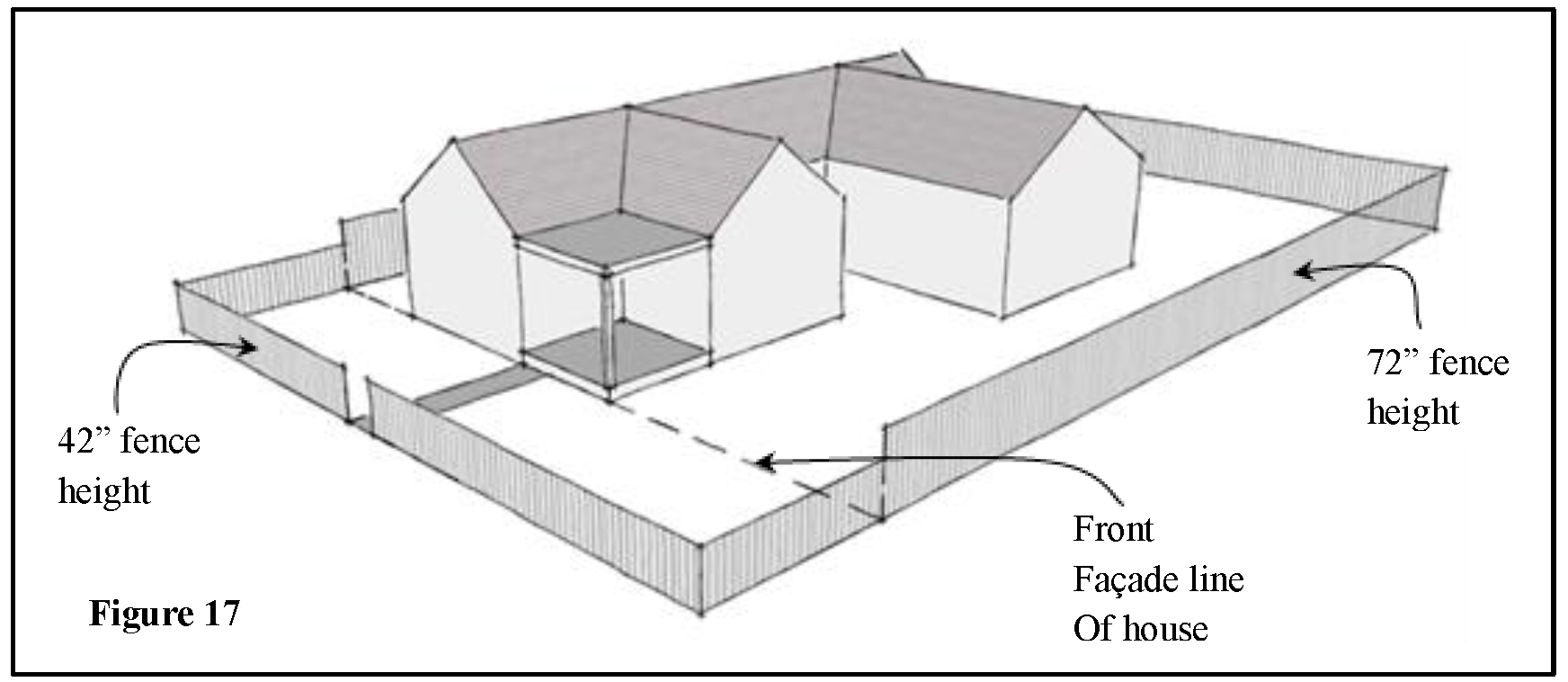
r.
Driveways not exceeding twenty-four (24) inches above or below finished grade within any setback of a yard facing a Street. Within all other required setbacks, finished grade of a driveway shall not exceed thirty (30) inches above or below finished grade.
s.
Parking may occur in required setbacks if within an established driveway or parking area and the curb cut or vehicular access is from an alleyway, if an alleyway abuts the property, or has otherwise been approved by the City.
t.
Non-permanent features which are not affixed to the ground such as movable patio furniture, outdoor seating or a picnic table, barbeque grills, children's play equipment, and similar non-permanent features which are not affixed to the ground. This exemption shall not allow storage sheds or containers.
u.
Wildlife-resistant Trash and Recycling enclosures located in residential zone districts shall be prohibited in all yards facing a Street. These facilities may be placed within non-street facing yards if the enclosure is the minimum reasonably necessary in both height and footprint, is an unconditioned space not integrated with other structures on the property, and serves no other purpose such as storage, garage space, or other purposes unrelated to protecting wildlife. Wildlife-resistant trash and recycling enclosures located in commercial, mixed-use, or lodging zone districts are not exempt from setback requirements and shall comply with zone district requirements for Utility/Trash/Recycle areas.
Temporary intermittent placement of trash and recycling containers in or along yards facing a Street is allowed. For example, on "trash day."
Enclosures shall be located adjacent to the alley where an alley borders the property and shall not be located in a public right-of-way. Unless otherwise approved by the Historic Preservation Commission, enclosures shall not abut or be attached to a historic structure. Enclosures may abut other non-historic structures.
For projects that are proposed to be, or are currently one hundred (100) percent Deed Restricted Affordable Housing, Wildlife-resistant trash and recycling enclosures shall be located along the alley, when possible. If no alley exists, the enclosure may be located in a street facing yard if located and designed in a way to minimize visual impact of the enclosure, ensure efficient use of the enclosure, and the minimum size necessary in both height and footprint to meet the requirements of Title 12 of the Municipal Code.
v.
Generators are prohibited between and structure and the street and within any setback. Exceptions may be made by the Community Development Director in accordance with Section 26.575.020(e)(5)j.
(f)
Measuring Building Heights.
(1)
For properties in the Commercial Core (CC), Commercial (Cl), Commercial Lodge (CL), Neighborhood Commercial (NC) and Service Commercial Industrial (SCI) Zone Districts, the height of the building shall be the maximum distance between the ground and the highest point of the roof top, roof ridge, parapet, or top-most portion of the structure. See subsection (3), below, for measurement method.
(2)
For properties in all other Zone Districts, the height of the building shall be measured according to the pitch of the roof as follows. See subsection (3), below, for measurement method.
a.
Flat roofs or roofs with a pitch of less than 3:12. The height of a building with a roof pitch of less than 3:12 shall be measured from the ground to the top-most portion of the structure.
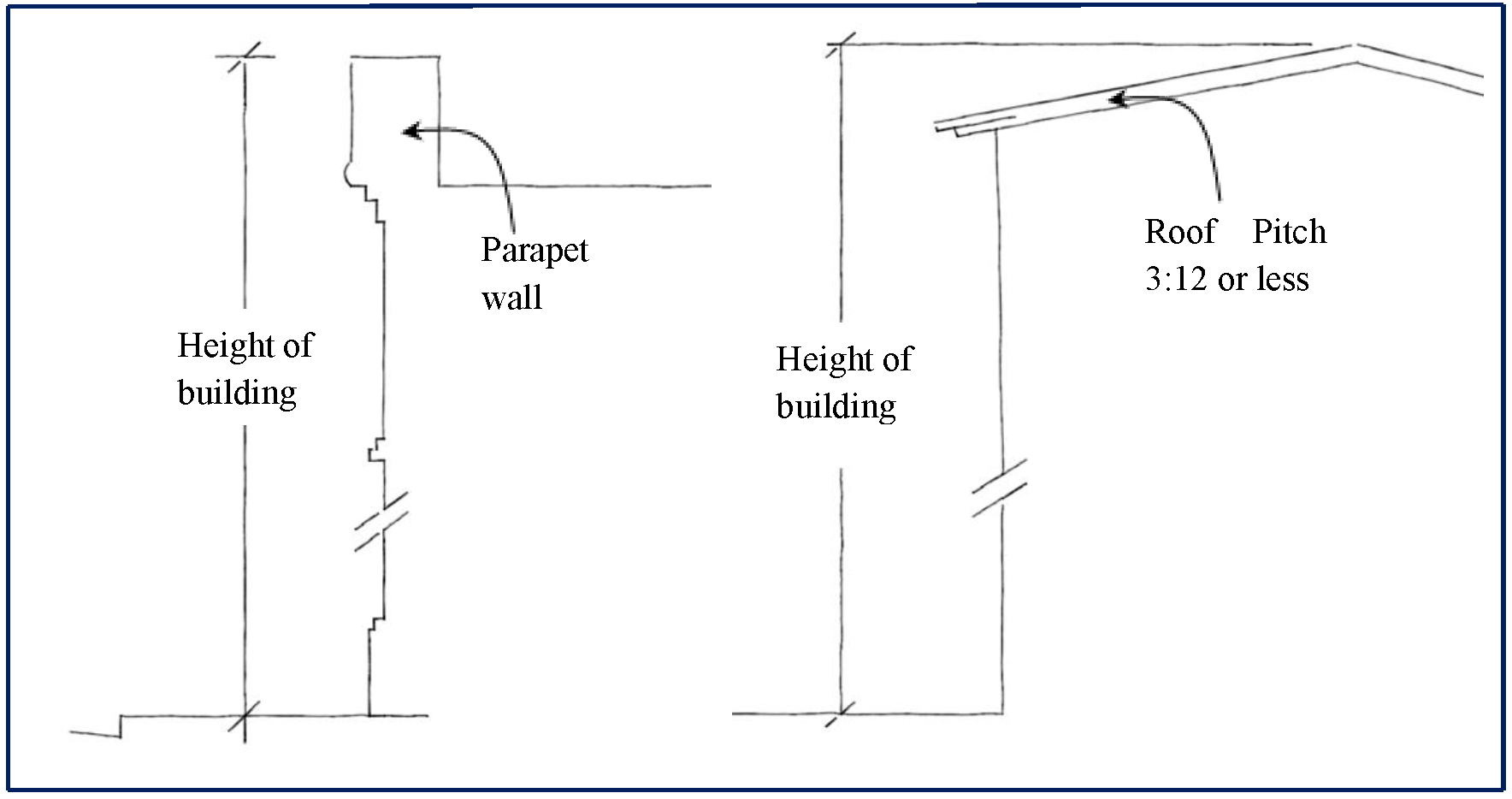
Figure 18: Measuring height for flat roofs or roofs with less than 3:12 pitch
b.
Roofs with a pitch from 3:12 to 7:12. The height of a building with a roof pitch from 3:12 to 7:12 shall be measured from the ground to the point of the roof vertically halfway between the eave point and the ridge. There shall be no limit on the height of the ridge.
c.
Roofs with a pitch greater than 7:12. The height of a building with a roof pitch greater than 7:12 shall be measured from the ground to the point of the roof vertically one-third (⅓) of the distance up from the eave point to the ridge. There shall be no limit on the height of the ridge.
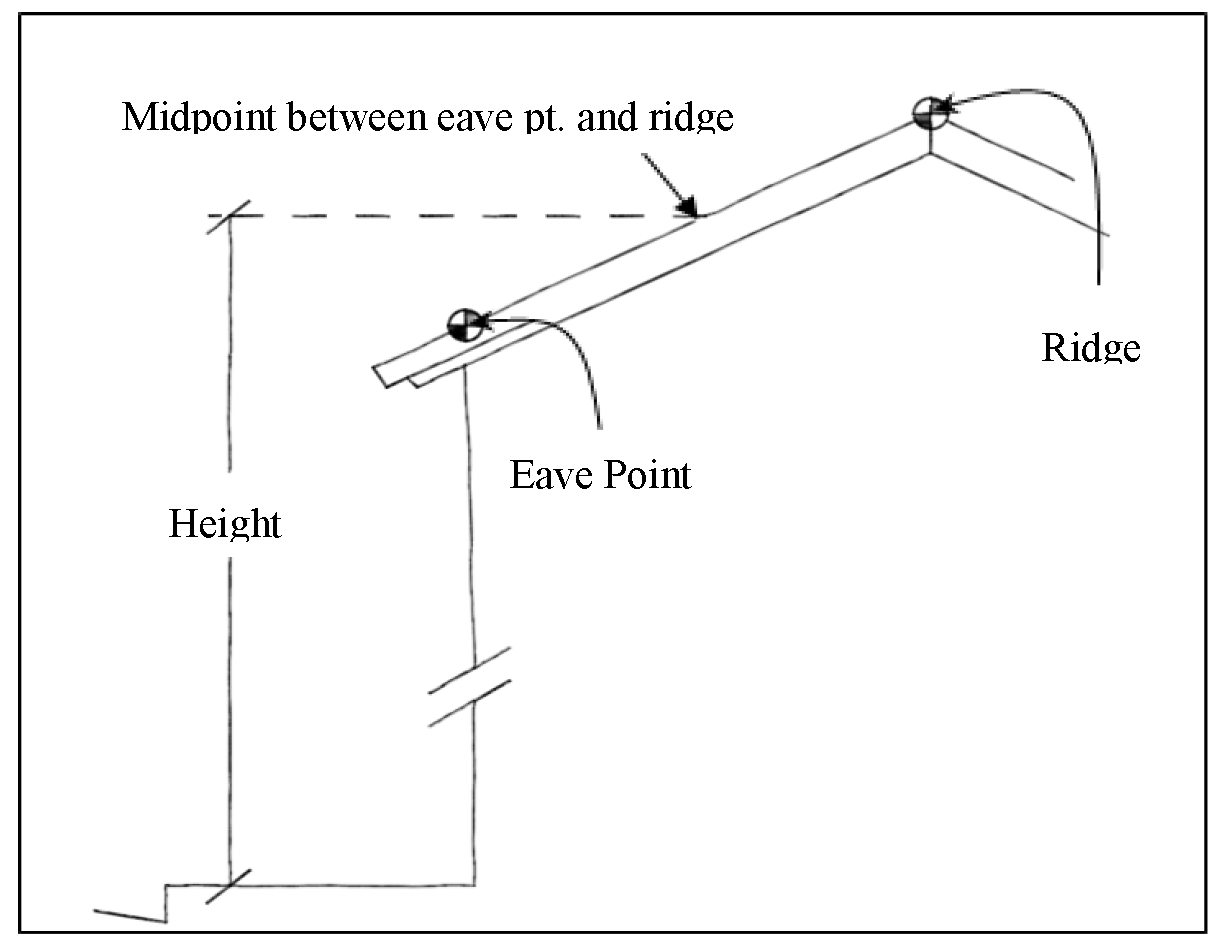
Figure 19: Measuring height for roofs with pitch from 3:12 to 7:12
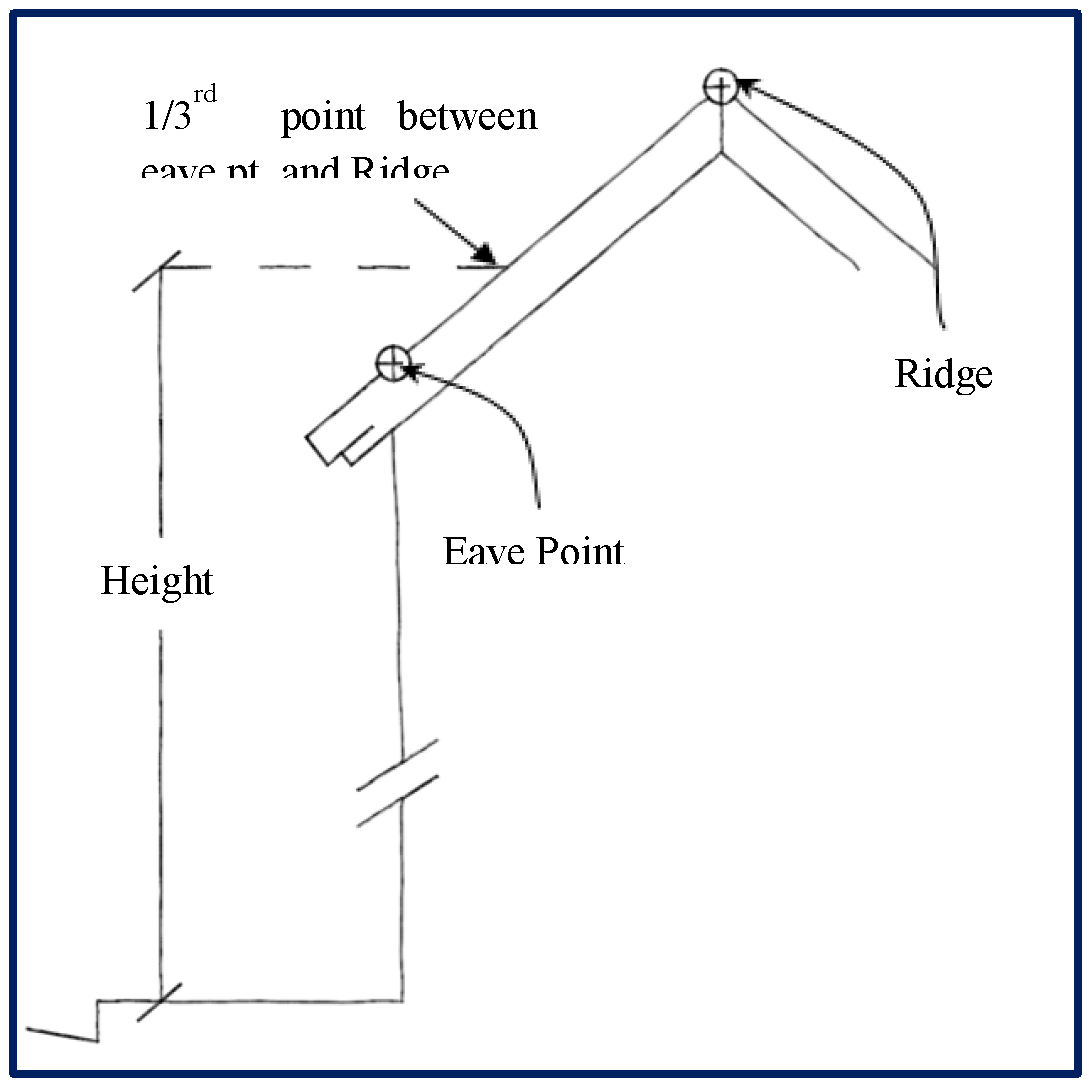
Figure 20: Eave Point and Exterior Sheathing of a Roof
For roofs with multiple pitches within one (1) vertical plane, the height of the roof shall be measured by drawing a line within a vertical section between the ridge and the Eave Point(s) and then applying the methodology for the resulting pitch of said line(s) as described above.
d.
For barrel-vault roofs, height shall be measured by drawing a line within a vertical section between the top-most point of the roof and the Eave Point(s) and then applying the methodology for the resulting pitch of said line(s) as described above.
e.
For "shed" roofs with a single-pitch, the methodology for measuring shall be the same as described above according to the slope of the roof and by using the highest point of the roof as the ridge.
f.
For mansard roofs, height shall be measured to the flat roof as described above.
g.
Dormers shall be excluded from the calculation of height if the footprint of the dormer is fifty (50) percent or less of the roof plane on which the dormer is located and the ridge of the dormer is not higher than the ridge of the roof on which it is located. If there are multiple dormers on one (1) roof plane, the aggregate footprint shall be used. Otherwise, dormers shall be included in the measurement of height according to the methods described above.
h.
Butterfly roofs shall be measured in accordance with shed roof methodology.
(3)
Height Measurement Method. In measuring a building for the compliance with height restrictions, the measurement shall be the maximum distance measured vertically from the ground to the specified point of the building located above that point, as further described below:
a.
Measuring height along the perimeter of the building. At each location where the exterior perimeter of a building meets the ground, the measurement shall be taken from the lower of natural or finished grade. Building permit plans must depict both natural and finished grades.
b.
Measuring height within the footprint of the building. For the purposes of measuring height within the footprint of a building, areas of the building within fifteen (15) horizontal feet of the building's perimeter shall be measured using the perimeter measurement, as described above. In all other areas, the natural grade of the site shall be projected up to the allowable height and the height of the structure shall be measured using this projected topography.
In instances where the natural grade of a property has been affected by prior development activity, the Community Development Director may accept an estimation of pre-development topography prepared by a registered land surveyor or civil engineer. The Director may require additional historical documentation, technical studies, reports, or other information to verify a pre-development topography.
If necessary, the Community Development Director may require an applicant document natural grade, finished grade, grade being used within the footprint of the building, and other relevant height limitation information that may need to be documented prior to construction.
c.
Measuring to the roof- The high point of the measurement shall be taken from the surface of a structure's roof inclusive of the first layer of exterior sheathing or weatherproofing membrane but excluding exterior surface treatments such as shakes, shingles, fire proofing, exterior insulation, a second layer of exterior sheeting, or other veneer treatments or ornamentation.
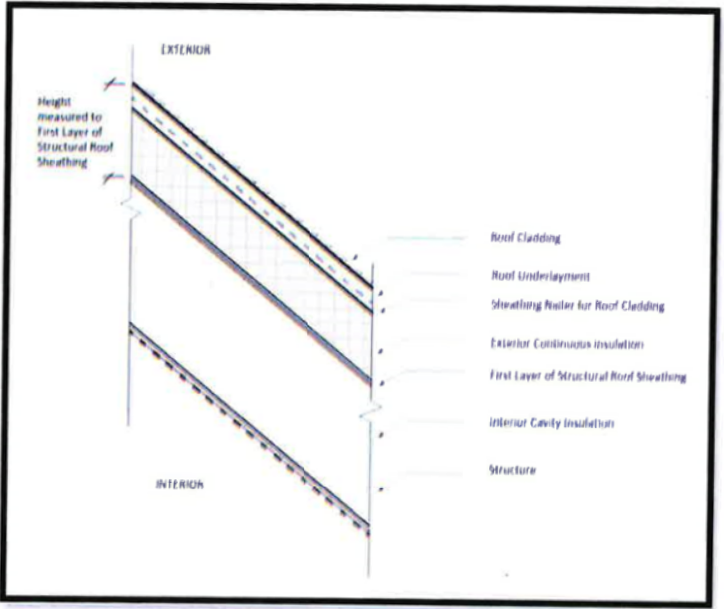
Figure 21: Roof Assembly Example
When measuring roofs to a point between the ridge and the eave point, the eave point shall be the point where the plane of a roof intersects the plane of the exterior wall. The roof and wall planes shall be of the nominal structure, excluding all exterior treatments.
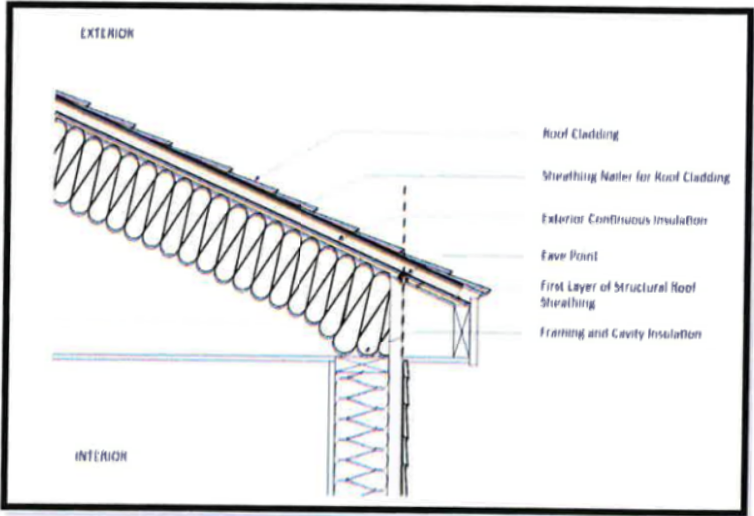
Figure 22: Eave Point and Exterior Sheathing of a Roof
(4)
Allowed Exceptions to Height Limitations.
a.
Chimneys, flues, and similar venting apparatus. Chimneys, flues, vents, and similar venting apparatus may extend no more than ten (10) feet above the height of the building at the point the device connects. For roofs with a pitch of 8:12 or greater, these elements may not extend above the highest ridge of the structure by more than required by adopted building codes or as otherwise approved by the Chief Building Official to accommodate safe venting. To qualify for this exception, the footprint of these features must be the minimum reasonably necessary for its function the features must be combined to the greatest extent practical. Appurtenances such as hoods, caps, shields, coverings, spark arrestors, and similar functional devices or ornamental do-dads shall be contained within the limitations of this height exception.
On structures other than a single-family or duplex residential building or an accessory building, all Chimneys, flues, vents, and similar venting apparatus should be set back from any Street facing façade of the building a minimum of twenty (20) feet and the footprint should be minimized and combined to the greatest extent practicable.
b.
Communications Equipment. Antennas, satellite dishes, and similar communications equipment and devices shall comply with the limitations of Section 26.575.130, Wireless Telecommunication Services Facilities and Equipment.
c.
Elevator and Stair Enclosures. On structures other than a single-family or duplex residential building or an accessory building, elevator overrun enclosures and stair enclosures may extend up to five (5) feet above the specified maximum height limit.
Elevator and stair enclosures may extend up to ten (10) feet above the specified maximum height limit if set back from any Street facing façade of the building a minimum of twenty (20) feet and the footprint of the elevators or stair enclosures are minimized and combined to the greatest extent practicable.
For single-family and duplex residential buildings and for accessory buildings, elevator and stair enclosures are not allowed a height exception.
d.
Rooftop Railings. On any structure other than a single-family or duplex residential building, rooftop railings and similar safety devices permitting rooftop access may extend up to five (5) feet above the height of the building at the point the railing connects. To qualify for this exception, the railing must be the minimum reasonably necessary to provide adequate safety and building code compliance and the railing must be fifty (50) percent or more transparent. All railings shall be set back from any Street facing facade of the building by an amount equal to the height of the railing.
For single-family and duplex residential buildings, rooftop railings shall not be allowed a height exception.
e.
Mechanical Equipment. Heating, ventilation, and air conditioning systems, and similar mechanical equipment or utility apparatus located on top of a building may extend up to six (6) feet above height of the building at the point the equipment is attached. This allowance is inclusive of any pad the equipment is placed on, as well as any screening. Mechanical equipment shall be screened, combined, and co-located to the greatest extent practicable.
On structures other than a single-family or duplex residential building or an accessory building, all mechanical equipment shall be set back from any Street facing façade of the building a minimum of fifteen (15) feet.
f.
Energy Efficiency or Renewable Energy Production Systems and Equipment. Energy efficiency systems or renewable energy production systems and equipment including solar panels, wind turbines, or similar systems and the system's associated equipment which is located on top of a building may extend up to six (6) feet above the height of the building at the point the equipment is attached.
On any structure other than a single-family or duplex residential building or an accessory building, these systems may extend up to ten (10) feet above height of the building at the point the equipment is attached if set back from any Street facing façade of the building a minimum of twenty (20) feet and the footprint of the equipment is minimized and combined to the greatest extent practicable.
The height and placement of energy efficiency or production systems which are not located on top of a building (located independent of a building) shall be established by the Planning and Zoning Commission pursuant to the procedures and criteria of Chapter 26.430, Special Review. (Also see setback requirements for these systems at subsection (e)(5).)
g.
Church spires, bell towers and like architectural projections on Arts, Cultural and Civic buildings may extend over the height limit as may be approved pursuant to Commercial Design Review.
h.
Flag poles may extend over the specified maximum height limit.
i.
Exceptions for buildings on slopes. For properties with a slope that declines by ten percent (10%) or greater from the front lot line, the maximum height of a building's front (street-facing) facade may extend horizontally for the first ten (10) feet of the building's depth.
For properties located in the geographical area bounded by Durant Street, Main Street, Monarch Street and Original Street and have a maximum elevation change of three (3) feet, the maximum height measurement as determined from the highest point of the lot may extend the entire width or length of the lot. See Figure A, below, where "X'" is the measured height.
Figure A: Measurement on a Slope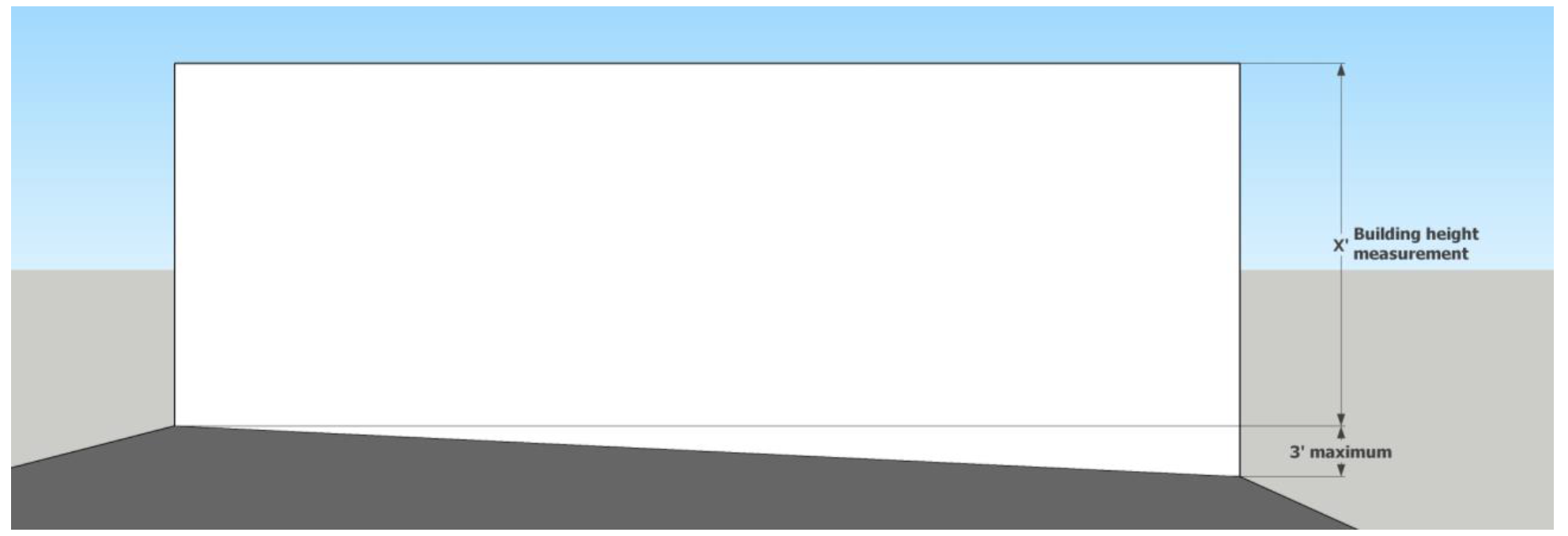
j.
Exceptions for lightwells and basement stairwells. A basement stairwell required by Building Code for egress shall not be counted towards maximum permissible height. On street facing facades the minimum size lightwell entirely recessed behind the vertical plane established by the portion of the building façade(s) closest to any Street(s), and enclosed on all sides to within eighteen (18) inches of the first floor level (e.g. not a walk-out style light well) shall not be counted towards maximum permissible height. On non-street facing facades a lightwell that is no more than one hundred (100) square feet shall not be counted towards maximum permissible height. This exception does not apply to lightwells and stairwells that are located within a setback.
For properties that contain an areaway that counts toward the pedestrian amenity requirement, the qualifying areaway shall not be counted towards maximum permissible height. See Figure B, below, where "X'" is the measured heights and "Y'" is not counted if the subgrade area counts as pedestrian amenity.
Figure B: Measurement of heights with subgrade pedestrian amenity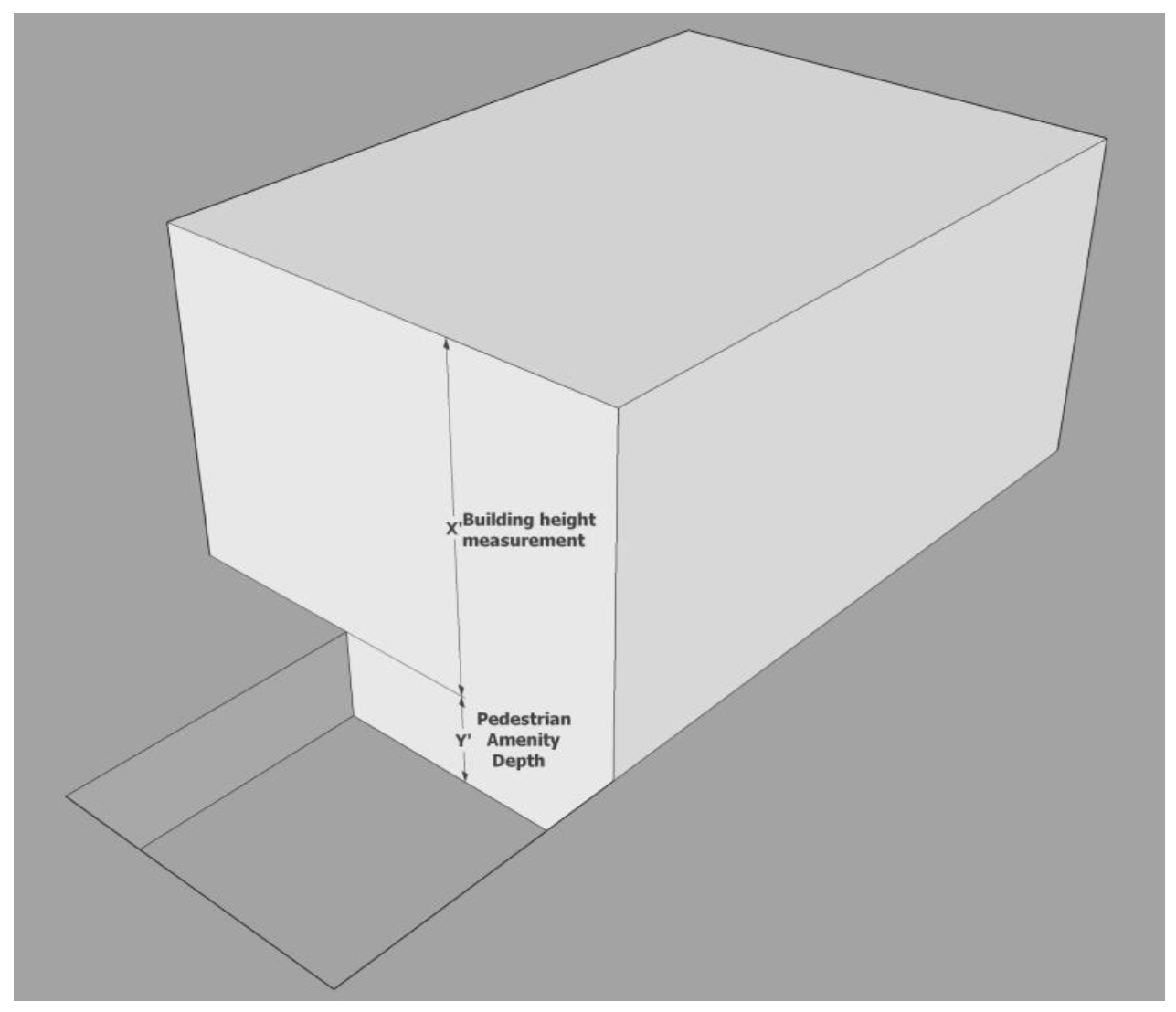
The Historic Preservation Commission is authorized to grant an exception to height for lightwells larger than one hundred (100) square feet on historic landmark properties that contain a historic resource upon a finding that the following conditions are met:
1.
Lightwell is not easily visible from the right-of-way.
2.
Approval of the exemption supports the preservation of the historic resource.
k.
For commercial, lodge, or mixed-use buildings located in the Commercial Core (CC), Commercial (C-1), or Neighborhood Commercial (NC) zone districts, decorative, non-functional architectural elements such as a parapet, cornice, spire, pediment, are exempted from height measurement up to twenty-four (24) inches only if approved by the Planning and Zoning Commission or Historic Preservation Commission as part of a Commercial Design Review. This exemption shall not be combined with any other height exemptions.
l.
Permanent Rooftop Amenities. Permanent rooftop amenities, such as built-in wet bars, built-in barbeque grills, cabinets, sinks, fire pits, pools, hot tubs, etc. shall be permanently installed and shall meet the following height and setback requirements to qualify for a height exemption. This only applies to a mixed use, lodge, or commercial building located in the Commercial Core (CC) Zone District, Mixed Use (MU) Zone District, the Commercial (C-1) Zone District, the Lodge (L) Zone District, the Neighborhood Commercial (NC) Zone District, or the Commercial Lodge (CL) Zone District. Permanent rooftop amenities may extend up to five (5) feet above height of the building at the point the equipment is attached to the roof. This allowance is inclusive of any pad the equipment is placed on. A trellis with a maximum height of ten (10) feet and a maximum floor area of no more than five (5) percent of the useable deck area is permitted. All permanent rooftop amenities shall be set back from any Street facing façade of the building by a minimum of ten (10) feet.
m.
Exceptions for skylight and light tubes. A skylight or light tube typical of industry standards and meeting minimum Building Code standards shall not be counted towards maximum permissible height.
(g)
Measuring Site coverage. Site coverage is typically expressed as a percentage. When calculating site coverage of a structure or building, the exterior walls of the structure or building at ground level should be used. When measuring to the exterior walls, the measurement shall be taken from the exterior face of framing, exterior face of structural block, or similar exterior surface of the nominal structure excluding sheathing, vapor barrier, weatherproofing membrane, exterior-mounted insulation systems, and excluding all exterior veneer and surface treatments such as stone, stucco, bricks, shingles, clapboards or other similar exterior veneer treatments. Porches, roofs or balcony overhangs, cantilevered building elements and similar features extending directly over grade shall be excluded from maximum allowable site coverage calculations.
(h)
Measurement of Net Leasable Area and Net Livable Area. The calculation of net leasable area and net livable area shall include all interior space of a building measured from interior wall to interior wall, including interior partitions. Net leasable area and net livable area shall be attributed to the lot or parcel upon which it is developed. Net leasable area includes all interior areas which can be leased to an individual tenant with the exceptions noted below. Net livable area includes those areas of a building that are used or intended to be used for habitation with the exceptions noted below. Garages and carports are exempt from net leasable area and net livable area calculations.
(1)
Permanently installed interior airlock spaces are exempt from the calculation of net leasable space up to a maximum exemption of one hundred (100) square feet. Seasonal airlocks of more than ten (10) square feet, installed on the exterior of a building, shall be considered net leasable area and shall be subject to all requirements of the Land Use Code, including employee mitigation, prorated according to the portion of the year in which it is installed.
(2)
Unless specifically exempted through other provisions of this Title, outdoor displays, outdoor vending, and similar commercial activities located outside (not within a building) shall also be included in the calculation of net leasable area. The calculation of such area shall be the maximum footprint of the display or vending apparatus. For vending carts or similar commercial activities requiring an attendant, the calculation shall also include a reasonable amount of space for the attendant. Exterior decks and exterior seating are not included in the calculation of net leasable area. Vending machines, gas pumps, and similar devices without an attendant shall not be considered net leasable area.
The calculation of net leasable area and net livable area shall exclude areas of a building that are integral to the basic physical function of the building. All other areas are attributed to the measurement of net leasable commercial space or net livable area. When calculating interior stairways or elevators, the top most interior level served by the stairway or elevator is exempt from net livable or net leasable area calculations.
Shared areas that count toward net leasable area and net livable area shall be allocated on a proportionate basis of the use category using the percentages that are generated pursuant to Section 26.575.020(d)(14), Allocation of non-unit space in a mixed use building.
Examples:
a.
A broom closet of a minimum size to reasonably accommodate the storage of janitorial supplies for the entire building is considered integral to the physical function of the building and does not count toward net leasable area.
b.
A shared commercial storage area that is larger than needed for the basic functionality of the building counts toward net leasable area because it is useable by the businesses.
c.
A shared stairway and a shared circulation corridor (that access more than one (1) use) are integral to the physical function of the building and do not count in the measurement of net livable area or net leasable area.
d.
A stairway that is entirely within one (1) residential unit counts toward the measurement of net livable area.
e.
A private elevator that serves more than one (1) residential unit, and does not provide access to other uses, does not count toward the measurement of net livable area.
f.
A private elevator that serves only one (1) residential unit, and does not provide access to other uses, counts toward the measurement of net livable area.
g.
A shared mechanical room that is larger than the minimum space required to reasonably accommodate the mechanical equipment counts toward the measurement of net livable area or net leasable area as applicable. The area of the mechanical room that is the minimum size required for the mechanical equipment does not count in net livable area or net leasable area.
(i)
Exceptions for Energy Efficiency. The Community Development Director may approve exceptions to the dimensional restrictions of this Section to accommodate the addition of energy production systems or energy efficiency systems or equipment in or on existing buildings when the site is constrained, or it's recognized flexibility is warranted to improve efficiency of the equipment or structure. The Community Development Director must first evaluate that the visual impact of the exemption is minimal and that no other reasonable way to implement energy production or efficiency exists that is more effective and less impactful. Exception for Energy Efficiency may be approved during building permit or land use review.
(j)
Exceptions for Building Code Compliance. The Community Development Director may approve exceptions to the dimensional restrictions of this Section to accommodate improvements required to achieve compliance with building, fire, energy, or accessibility codes in or on existing buildings when no other practical solution exists. The Community Development Director must first evaluate that the visual impact of the exemption is minimal and that no other reasonable way to implement code compliance exists that is more effective and less impactful. Exception for Building Code Compliance may be approved during building permit review or land use review.
(k)
Appeals. An applicant aggrieved by a decision made by the Community Development Director regarding this Calculations and Measurements Section may appeal the decision to the Administrative Hearing Officer, pursuant to Chapter 26.316.
(Ord. No. 44-1999, § 7; Ord. No. 55-2000, § 14; Ord. No. 56-2000, §§ 5, 6, 8; Ord. No. 25-2001, §§ 6, 7; Ord. No. 46-2001, § 4; Ord. No. 55, 2003, §§ 2—4; Ord. No. 12-2006, § 19; Ord. No. 12, 2007, § 32; Ord. No. 27-2010, § 1; Ord. No. 12-2012, § 3; Ord. No. 25-2012, § 4; Ord. No. 7-2014; §§ 1-9; Ord. No. 31-2014, § 2; Ord. No. 4-2015, § 1; Ord. No. 46-2015, §§ 12-20; Ord. No. 30, 2016, § 6; Ord. No. 8, 2017, § 2; Ord. No. 13-2022, § 9, 6-28-2022)
Sec. 26.575.030. - Outdoor Merchandising.
(a)
Outdoor Merchandising on Private Property. Private property may be utilized for merchandising purposes by those businesses located adjacent to and on the same parcel as the outdoor space. This shall not grant transient sales from peddlers who are not associated with an adjacent commercial operation; this includes service uses such as massage, tarot card reading, aura analysis, etc. Outdoor merchandising shall be directly associated with the adjacent business and shall not permit stand-alone operations, including, but not limited to, automated bike rental racks, movie rental kiosks, automated dog washes, or automated massage furniture. In addition, outdoor merchandising must meet the following requirements:
(1)
Merchandise must be maintained, orderly and located in front of or proximate to the storefront related to the sales.
(2)
The display of merchandise shall in no way inhibit the movement of pedestrian traffic along the public right-of-way. All merchandising shall be located on private property. A minimum of six (6) foot ingress/egress shall be maintained for building entrances and exits.
(3)
Outdoor clothing displays including, but not limited to, coats, jeans, shirts, athletic apparel, and footwear are allowed. Outside clothing displays of two (2) mannequins or one (1) clothing rack of up to six (6) feet in length, but not both, are allowed. Bins, boxes, and containers that sit directly on the ground are allowed for outdoor clothing sales, but cardboard boxes are prohibited. All outdoor merchandise displays must have a minimum height of not less than twenty-seven (27) inches from grade to prevent tripping hazards. For all other types of merchandise, the size and amount allowed shall be under the discretion of the property owner.
(4)
Umbrellas, retractable canopies, and similar devices are not permitted for outdoor merchandising. See Section 26.304.070(f)(2).
(5)
Merchandise shall be displayed for sale with the ability for pedestrians to view the item(s). Outdoor areas shall not be used solely for storage.
a.
The prohibition of storage shall be limited to merchandising on private property and shall not apply to permitted commercial activity on an abutting right-of-way or otherwise permitted by the City.
(b)
Outdoor Restaurant Seating on Private Property. Private Property may be used for commercial restaurant outdoor dining if adequate pedestrian and emergency vehicle access is maintained. Umbrellas, retractable canopies, and similar temporary, removable devices are permitted for commercial restaurant uses. For outdoor food vending in the Commercial Core District, also see Paragraph 26.470.040(b)(3), Administrative growth management review.
(Ord. No. 55-2000, § 15; Ord. No. 1-2002, § 16; Ord. No. 23-2004, § 3; Ord. No. 2-2005, § 2; Ord. No. 5, 2005, § 2; Ord. No. 13, 2007, § 2, Ord. No. 9A, 2010 § 2; Ord. No. 14 - 2013, § 2; Ord. No. 30, 2016, § 5)
Sec. 26.575.040. - Commercial Parking Facilities.
When a parking facility is proposed to function as a commercial parking facility, as such terms are used herein, review and approval shall be according to Chapter 26.430, Special Review and the review standards of Section 26.515.040, Special Review Standards. Development of such a facility may also require conditional use review in some Zone Districts. Also see definition of "Commercial parking facility," Section 26.104.100.
(Ord. No. 13-2005, § 3; Ord. No. 50-a-2005; Ord. No. 12, 2007, §§ 33, 34; Ord. No. 27-2010, § 2; Ord. No. 30, 2016, § 7)
Sec. 26.575.045. - Junkyards and service yards.
Junkyards (See Definitions, Section 25.104.100) shall be screened from the view of other lots, structures uses and rights-of-way. Service yards (See Definitions, Section 26.104.100) shall be fenced so as not to be visible from the street and such fences shall be a minimum six (6) feet high from grade. All fences shall be of sound construction and shall have not more than ten percent (10%) open area.
Sec. 26.575.050. - Fence Materials.
Fences shall be permitted in every zone district, provided that no fence shall exceed six (6) feet above finished grade or as otherwise regulated by the, Historic Preservation Design Guidelines (see Chapter 26.415), the Commercial Design Standards (see Chapter 26.412), Calculations and Measurements - setbacks (see Chapter 26.575.020(e)), or the Engineering Design Standards (see landscaping). Fences shall be constructed of wood, stone, wrought iron, concrete, metal, wire, or masonry. Chain link, plastic, vinyl or synthetic fences are prohibited.
(Ord. No. 55-2000, § 16; Ord. No. 12-2007, § 35; Ord. No. 7-2014, § 10; Ord. No. 46-2014, § 21)
Sec. 26.575.060. - Driveways.
Driveways are not permitted to be gated.
(Ord. No. 5-2005, § 3; Ord. No. 12, 2007, § 36; Ord. No. 7-2013, § 4; Ord. No. 13-2013, § 10; Ord. No. 7-2014, § 11)
Editor's note— Section 26.575.060, formerly Utility/trash/recycle service areas was repealed via Ordinance No. 13 (Series of 2013). Chapter 12.06, Waste Reduction and Recycling was amended via the above referenced ordinance to address waste and recycling areas.
Sec. 26.575.070. - Reserved (formerly Use square footage limitations).
(Ord. No. 7-2013, § 2)
Sec. 26.575.080. - Child care center.
(a)
A daycare center shall provide one (1) off-street parking space per employee, a child loading/unloading area of adequate dimensions, preferably off-street and adequately sized indoor and outdoor play areas and shall maintain minimum hours of operation of 7:30 a.m. to 5:30 p.m. from Monday through Friday.
(b)
A facility which provides regular supervision and care of five (5) or fewer children per day shall be considered a family daycare home and shall be allowed as an accessory use, subject to the following:
(1)
If the family daycare home is developed in conjunction with a residential use, it shall meet the requirements of a home occupation.
(2)
If the family daycare home is developed in conjunction with an institution or business, it shall be limited to use by the children of the employees or guests of that institution or business and shall provide one (1) off-street parking space.
Sec. 26.575.090. - Home occupations.
Home occupations are permitted in all residential dwellings in the City. To ensure home occupations are clearly incidental and secondary to the residential character of the home, a home occupation must comply with each of the following:
(a)
Employees. Employs no more than one (1) person who is a nonresident of the dwelling; and
(b)
Business License. Operates pursuant to a valid Business License for the use held by the resident of the dwelling unit; and
(c)
Signage. Any signs must comply with Chapter 26.510 Signs; and
(d)
Outdoor Storage. Any outside storage shall be screened or enclosed; and
(e)
Nuisance. Does not utilize mechanical, electrical or other equipment or items which produce noise, electrical or magnetic interference, vibration, heat, glare, smoke, dust, odor or other nuisance outside the residential building or accessory structure; and
(f)
Prohibitions. Does not include any of the following uses as a home occupation: Retail uses where the point of sale occurs within the residence (does not prohibit off-premises or internet sales); Restaurant uses, health or medical clinic, mortuary, nursing home, veterinarian's clinic, pharmacy, the sale, production, cultivation or testing of marijuana or marijuana products, child care center for six (6) or more children (see Section 26.575.080), warehousing, brewery, distillery, coffee roasting facility, liquor store, group home, dancing studio, or for the storage, sale, production, processing of flammable or volatile materials.
A home occupation license may be revoked if the use creates a substantial nuisance or hazard to neighboring residents.
(Ord. No. 7-2013, § 3; Ord. No. 23-2014, § 1)
Sec. 26.575.100. - Landscape maintenance.
Landscaping shown on any approved site development plan shall be maintained in a healthy manner for a minimum three (3) year period from the date of the receipt of the financial assurance referenced below. In the event that plant material dies, the owner of the property shall replace the plant material with similar quality within forty-five (45) days of notification by the Community Development Director. If seasonal constraints do not allow planting of the approved plant material within forty-five (45) days the owner may in writing seek permission from the Community Development Director to:
(a)
Provide financial assurances equal to one hundred twenty percent (120%) of the amount of the replacement landscaping and installation costs as approved by the Parks Department and in a form satisfactory to the City Attorney. The completion of the landscape replacement shall be accomplished no later than June 15 th of the next planting season; otherwise the financial assurances shall be forfeited to the City.
(b)
Submit for approval a revised landscape plan.
Sec. 26.575.110. - Building envelopes.
For the purposes of this Chapter, an approved building envelope shall have the same requirements and allowances as the underlying zoning setbacks, unless otherwise noted in a site-specific development plan.
For purposes of site-specific development plans, building envelopes may be established to restrict development to protect slopes, important vegetation, water courses, privacy or other considerations. Building envelopes required or designated as part of a development approval shall be described on recorded plats, site-specific development plans, ordinances, resolutions and building permit site plans.
(Ord. No. 46-2015, § 22)
Sec. 26.575.120. - Satellite dish antennas.
(a)
Satellite dish antennas twenty-four (24) inches in diameter or more must receive building permits, if required, prior to installation. Prior to the issuance of appropriate building permits, satellite dish antennas greater than twenty-four (24) inches in diameter shall be reviewed and approved by the Community Development Director in conformance with the following criteria. Any satellite dishes installed on a property listed on the Aspen Inventory of Historic Landmark Sites and Structures or in an H, Historic Overlay District shall be reviewed according to Subsection 26.415.070(b).
(1)
Use. The proposed use is consistent and compatible with the character of the immediate vicinity of the parcel proposed for development and surrounding land uses or enhances the mixture of complimentary uses and activities in the immediate vicinity of the parcel proposed for development.
(2)
Location, size and design. The location, size, design and operating characteristics of the proposed use minimizes adverse effects, including visual impacts, impacts on pedestrian and vehicular circulation, parking, trash, service delivery, noise, vibrations and odor on surrounding properties.
(3)
Area and bulk requirements. The installation of a satellite dish antenna shall not cause a violation of area and bulk requirements within the zone district in which it is located, unless a variance is granted by the Board of Adjustment.
(4)
Right-of-way. A satellite dish antenna shall not be placed on an easement or in the City right-of-way, unless an encroachment permit is secured.
(5)
Increased danger. The installation of a satellite dish antenna shall not cause any increased danger to neighboring property in the event of collapse or other failure of the antenna structure.
(6)
Visual impact. The visibility of the dish from the public way shall be reduced to the highest degree practical including, but not limited to, sensitive choice in placement of the dish, screening with fencing, landscaping, sub-grade placement or any other effective means that both screen the dish and does not appear to be unnatural on the site.
(b)
Conditions. The Community Development Director may apply reasonable conditions to the approval deemed necessary to ensure conformance with said review criteria. If the Community Development Director determines that the proposed satellite dish antenna does not comply with the review criteria and denies the application or the applicant does not agree to the conditions of approval determined by the Community Development Director, the applicant may apply for conditional use review by the Planning and Zoning Commission.
(c)
Procedures. Procedures established in Chapter 26.304, Common Development Review Procedures, shall apply to all satellite dish antennas.
(Ord. No. 1-2002 § 17)
Sec. 26.575.130. - Rescinded and replaced by 26.505 Wireless communications facilities and equipment.
(Ord. No. 1-2002 § 18; Ord. No. 52-2003, §§ 14, 15; Ord No 5-2019)
Sec. 26.575.140. - Accessory uses and accessory structures.
An accessory use shall not be construed to authorize a use not otherwise permitted in the zone district in which the principal use or structure to which it is accessory. An accessory use or structure may not be established prior to the establishment of the principal use or structure to which it is accessory. Accessory buildings or structures shall not be provided with kitchen or bath facilities sufficient to render them suitable for permanent residential occupation.
Sec. 26.575.150. - Reserved.
Editor's note— Ord. No. 12-2023, § 1, adopted Nov. 14, 2023, repealed § 26.575.150, which pertained to outdoor lighting and derived from Ord. No. 47-1999, § 1; Ord. No. 52-2003, §§ 16—20. For simialr provsions, the user's attention is directed to Ch. 26.512.
Sec. 26.575.160. - Dormitory.
Occupancy of a dormitory unit shall be limited to no more than eight (8) persons. Each unit shall provide a minimum square footage per person in accordance with the Aspen/Pitkin County Housing Authority Guidelines, as amended. Standards for use and design of such facilities shall be established by the Aspen/Pitkin County Housing Authority. A dormitory unit shall be considered the same as a multi-family unit for all requirements of the Land Use Code other than permitted and conditional uses.
(Ord. No. 46-2015, § 23)
Sec. 26.575.170. - Fuel storage tanks.
All fuel storage tanks shall be completely buried beneath the surface of the ground except that above ground storage tanks may be approved as conditional uses in the Service/Commercial/Industrial and Public Zone Districts.
Sec. 26.575.180. - Required Access.
This Section shall apply to new development and redevelopment, remodeling, or expansion following demolition. Redevelopment, remodeling, or expansion that has not triggered demolition shall comply with the provisions of this Section to the greatest extent practical.
(a)
Elevators. All commercial, mixed-use, and lodging buildings which contain an elevator shall provide elevator access to all basement and upper building levels, units and commercial tenant spaces in a manner that meets the requirements of the International Building Code Chapters 10 and 11 as adopted and amended by the City of Aspen. Alleyways (vehicular rights-of-way) may not be utilized as pathways (pedestrian rights-of-way) to meet the requirements of the International Building Code. Additional elevators may be reserved for exclusive use or to serve less than all floors or all units. An applicant unable to meet these requirements may request a variation by the Planning and Zoning Commission or Historic Preservation Commission through Commercial Design Review
(b)
Delivery Areas. All commercial, mixed-use, and lodging buildings shall provide a delivery area. The delivery area shall be located along the alley if an alley adjoins the property. The delivery area shall be accessible to all building levels and all commercial tenant spaces of the building in a manner that meets the requirements of the International Building Code Chapters 10 and 11 as adopted and amended by the City of Aspen. All non-ground floor commercial spaces shall have access to an elevator or dumbwaiter for delivery access. Alleyways (vehicular rights-of-way) may not be utilized as pathways (pedestrian rights-of-way) to meet the requirements of the International Building Code. Any truck loading facility shall be an integral component of the building. Shared facilities are highly encouraged. An applicant unable to meet these requirements may request a variation by the Planning and Zoning Commission or Historic Preservation Commission through Commercial Design Review.
(c)
Trash and Recycling Areas. All commercial, mixed-use, and lodging buildings shall provide a trash and recycling area accessible to all building levels, units, and all commercial tenant spaces of the building in a manner that meets the requirements of the International Building Code Chapters 10 and 11 as adopted and amended by the City of Aspen. Alleyways (vehicular rights-of-way) may not be utilized as pathways (pedestrian rights-of-way) to meet the requirements of the International Building Code. An applicant unable to meet these requirements may request a variation by the Planning and Zoning Commission or Historic Preservation Commission through Commercial Design Review. Location and size requirements for trash and recycling areas shall be pursuant to Chapter 12.10 - Space Allotment for Trash and Recycling Storage.
(Ord. No. 7-2013, § 5; Ord. No. 13-2013, § 11; Ord. No. 38-2015, § 1)
Editor's note— Formerly Required delivery area and vestibules for commercial buildings. Section 26.575.060 repealed via Ordinance No. 13 (Series of 2013).
Sec. 26.575.190. - Farmers' market.
A farmers' market is permitted as a conditional use in the Park (p) and Public (PUB) Zone Districts and in public parks and public rights-of-way, provided a vending agreement is obtained in accordance with Section 15.04.350. The following regulations shall apply to farmers' markets:
(a)
It shall operate no more than two (2) days per week, unless modified by the Planning and Zoning Commission under its conditional use review;
(b)
It opens to the public no earlier than 7:00 a.m. and closes no later than 2:00 p.m., unless modified by the Planning and Zoning Commission under its conditional use review; and
(c)
It shall be limited to those weeks that fall between the first Saturday in June and the weekend following the Thanksgiving holiday, inclusive, unless modified by the Planning and Zoning Commission under its conditional use review.
Sec. 26.575.200. - Group homes.
Group homes shall not be located closer than seven-hundred-fifty (750) feet from another group home, shall be used exclusively as a residence for no more than eight (8) persons and shall be in compliance with all City, State and Federal Health, Safety and Fire Code Provisions.
Sec. 26.575.210. - Lodge occupancy auditing.
The Community Development Director shall be authorized to require periodic operational audits of lodge developments to ensure compliance with the Land Use Code and requirements for lodge operations. This audit may include, but is not limited to:
•
City of Aspen business license number;
•
An occupancy report of the lodge and individual units therein;
•
Whether occupants for each unit were owners, owners' guests, or members of the public;
•
Whether occupants registered as individuals or a business structure (e.g. Limited Liability Company);
•
An ownership report of all lodge or fractional units, including a report of the names of all owners of the corporate, company or partnership interests in any entity owning a lodge or fractional unit.
•
The manner in which rooms are reserved by non-owners or owner guests;
•
Room and unit rate schedules;
•
The manner in which short-term occupancies are marketed and managed;
•
The origin of bookings, whether through owners, directly, through a third party, or other means;
•
Physical aspects of the operation, such as the number of units and pillows in the lodge, the number of employees employed on site, the number of affordable housing units provided on site, accessory uses, units and amenities on site and the number of parking spaces provided on site, and the like;
•
The dimensional characteristics of the lodge;
•
An inventory of associated uses, properties and amenities on or off-site and made available to occupants; and,
•
Any additional conditions of approval or data and characteristics which may indicate the manner in which the lodge is used.
The Community Development Director may request that information be provided in a specific time frame, and may request a site inspection as part of the audit. The lodge audit shall be in the format determined by the Director. Property owners may request that certain information, such as marketing strategies or rate schedules, be held in confidence by the City.
(Ord. No. 12, 2007, § 37; Ord. No. 23-2017)
Sec. 26.575.220. - Reserved.
Editor's note— Ord. No. 9-2022, § 3, adopted June 28, 2022, repealed former § 26.575.220 which pertained to vacation rentals and derived from Ord. No. 34-2011, § 2, and Ord. No. 13-2020, §§ 2, 3, adopted Sept. 22, 2020.
Sec. 26.580.010. - Purpose.
(a)
The purpose of the Chapter is to describe and define Demolition as it relates to all land use types in the City of Aspen. The definition of Demolition and the application of this definition is impactful to several sections of the Land Use Code including, but not limited to: Nonconformities (Chapter 26.312) and the Growth Management Quota System (Chapter 26.470). While the definitions and processes described below apply to all use types, particular attention is given to the Demolition of Single-Family and Duplex Residential Units.
(b)
The definitions and regulation in this Section and the relationship to other sections of the Land Use Code are meant to regulate impactful development activities and to mitigate negative impacts of complex and significant construction projects to protect the health, safety and welfare of the public. These negative impacts include ecological, economic, transportation, and social impacts. Ensuring impactful development activities are adequately mitigated and consistent with Aspen's small-town character furthers the City's Climate goals by improving regulatory responses to natural resource consumption, reduces traffic impacts, encourages a more sustainable diversion of solid waste from the landfill, reduces general construction impacts to the community, and ensures that Aspen continues to be a leader in efficient design practices is a key goal and purpose of this Section.
(Ord. No. 13-2002, § 10, 6-28-2022)
Sec. 26.580.020. - Future amendments to Chapter 26.580.
All future amendments to this Chapter shall be exempt from the requirement of Policy Resolution for code amendments (Section 26.310.020(b)(1)—(2)). Future amendments may proceed directly to a First and Second Reading, pursuant to Section 26.310.020(b)(3).
(Ord. No. 13-2002, § 10, 6-28-2022)
Sec. 26.580.030. - Applicability.
This Chapter applies to land use applications and building permit submissions for development within the City limits for projects that that meet or exceed the definition of Demolition, unless exempted by Section 26.580.050.
(Ord. No. 13-2002, § 10, 6-28-2022)
Sec. 26.580.040. - Measurement of demolition.
(a)
The City Zoning Officer shall determine if a building is intended to be, or has been Demolished by applying the following process of calculation:
(1)
Anytime Demolition is proposed the applicant shall calculate the area of the existing surfaces as follows:
a.
The surface area of all existing (prior to commencing development) exterior wall assemblies above finished grade. Not counted in the existing exterior surface area calculations shall be all existing fenestration (doors, windows, skylights, etc.).
b.
The surface area of all existing (prior to commencing development) roof assemblies.
(2)
The applicant shall calculate the area of existing surfaces that are proposed to be removed and determine the overall percentage that is removed.
a.
The exterior wall surface area and roof surface area, as described above, to be removed.
b.
Wall area or roof area being removed to accommodate new or relocated fenestration shall be counted as exterior surface area being removed.
(3)
If the percentage removed exceeds forty (40) percent, then the development shall be considered Demolition, pursuant to Section 26.104.100.
(4)
Demolition shall also include the removal of a dwelling unit in a multi-family or mixed-use building, its conversion to nonresidential use, or any action which penetrates demising walls or floors between Multi-Family Housing Units if such action is undertaken to combine the units. See the requirements of Section 26.470.100(d), Demolition or Redevelopment of Multi-Family Housing.
(b)
Anytime Demolition is proposed, the applicant shall prepare and submit a diagram showing the calculation. The diagram shall depict each exterior wall and roof segment as a flat plane with an area tabulation.
(1)
According to the prepared diagram and area tabulation, the surface area of all portions of the exterior to be removed shall be divided by the surface area of all portions of the exterior of the existing structure and expressed as a percentage. The Zoning Officer shall use this percentage to determine if the building is to be or has been Demolished according to the definition in Section 26.104.100, Demolition.
(2)
If portions of the building involuntarily collapse while construction is occurring, regardless of the developer's intent, that portion shall be calculated as removed and included towards Demolition.
(3)
If additional portions of an area are required to be removed for health and safety reasons (such as mold) after initial work has begun, that portion shall not be included in the calculation of Demolition. An inspection with the Chief Building Official shall be required in order to confirm removal is necessary for health of safety reasons.
(c)
For the purposes of the calculation of Demolition, the following provisions shall apply:
(1)
Exterior wall assembly and roof assembly shall constitute the exterior surface of that element including such items as studs, joists, rafters etc.
(2)
If a portion of a wall or roof stud is to be removed, the associated exterior surface area shall be diagrammed as being removed.
(3)
If a portion of a wall or roof involuntarily collapses, regardless of the developer's intent, that portion shall be calculated as removed.
(4)
Recalculation may be necessary during the process of development and the Zoning Officer may require updated calculations as a project progresses.
(5)
Replacement of fenestration shall not be calculated as wall area to be removed. New, relocated or expanded fenestration shall be counted as wall area to be removed.
(6)
Only exterior surface area above finished grade shall be used in the determination of demolition. Sub-grade elements and interior wall or structural elements, while potentially necessary for a building's integrity, shall not be counted in the computation of exterior surface area.
(7)
Replacement of exterior sheeting when the structural components of that area are to remain, does not count toward the calculation of Demolition.
(8)
It shall be the responsibility of the applicant to accurately understand the structural capabilities of the building prior to undertaking a remodel. Failure to properly understand the structural capacity of elements intended to remain may result in an involuntary collapse of those portions and a requirement to recalculate the extent of demolition. Applicant's intent or unforeseen circumstances shall not affect the calculation of actual physical demolition.
(9)
Separate Demolition calculations shall be provided for each detached structure on a parcel. For structures with multiple attached units, such as an attached duplex, Demolition calculations shall be for the entire structure, not per unit.
(10)
Additional requirements or restrictions of this Title may be required when Demolition occurs.
(d)
The calculation of Demolition shall be cumulative for a period of ten (10) years. At any point in a ten-year period, a structure on a property exceeds the threshold for Demolition, it shall be subject to the provisions of this Chapter, as amended.
(Ord. No. 13-2002, § 10, 6-28-2022)
Sec. 26.580.050. - Exemptions.
The Community Development Director may exempt projects, or a portion thereof, from the calculation of Demolition if any of the following circumstances exist. Upon a finding by the Community Development Director that a project qualifies for an exemption, the project may proceed with any other required reviews as determined by this Title or the submission of a building permit.
(a)
Dangerous Structures. Any building or structure that has been determined to be dangerous, structurally unsafe or otherwise hazardous to human life, and is required to be abated by demolition. This may include structures destroyed or damaged by fire, flood or other natural disaster. The Chief Building Official shall make this determination.
(b)
The project is a one hundred (100) percent deed restricted affordable housing, or after completion of the project will be one hundred (100) percent deed restricted affordable housing.
(c)
De Minimus Exception. The Community Development Director may waive any of the requirements of this Chapter if documentation satisfactory to the Director is provided to establish that the scope of work is minimal and that providing Demolition documentation would be inappropriate or unreasonable.
(d)
If an existing structure is to be temporarily relocated, on or off-site, and placed back on an existing or reconfigured foundation that action shall not be considered Demolition for the purposes of this Chapter.
(e)
Exception for Necessary Repairs or Life/Safety concerns. If Demolition is triggered not due to remodel or renovation activity but is determined by the Community Development Director to be required for normal maintenance as defined in Title 26 (see definition in Section 26.104.100) or to rectify life safety issues, such as replacing a failing roof or mold removal, the square footage impacted by the work shall be exempt from this Section. This provision shall not allow an increase to the height, floor area, net livable area of a building beyond what is the minimum necessary required to comply with the Building Code.
(f)
Exception for the removal of Non-Historic Additions to Designated Historic Structures. If the Historic Preservation Commission has determined that in the development of a structure that is designated on Aspen's list of Historic Landmarks, that non-historic elements of the project shall be removed in returning the historic resource to its original configuration or character, the portion of the project attributed to the non-historic elements shall not be calculated toward the forty (40) percent threshold.
(Ord. No. 13-2002, § 10, 6-28-2022)
Sec. 26.580.060. - Enforcement and penalties.
(a)
The Community Development Director, City Engineer, Construction Mitigation Officer, or their assigned staff shall have responsibility for enforcement of this Chapter and are authorized to take any and all other actions reasonable and necessary to enforce this Chapter.
(b)
Violation of any provision of this Chapter shall be subject to the provisions and penalties set forth in Section 26.104.040 of the Municipal Code unless otherwise specified.
(Ord. No. 13-2002, § 10, 6-28-2022)
Sec. 26.580.070. - Appeals.
(a)
Appeal of adverse determination by Community Development Director. An appeal made by an applicant aggrieved by a determination made by the Community Development Director that a project triggers Demolition and is subject to the requirements of this Chapter shall be to the Planning and Zoning Commission. The appeal procedures set forth at Chapter 26.316 shall apply. The Planning and Zoning Commission may reverse, affirm or modify the decision or determination of the Community Development Director based upon the application submitted to the Community Development Director and the record established by the Director's review. The decision of the Planning and Zoning Commission shall constitute the final administrative action on the matter.
(Ord. No. 13-2002, § 10, 6-28-2022)
Sec. 26.580.080. - Adoption of residential demolition and redevelopment standards for projects that meet the definition of demolition.
Pursuant to the powers and authority conferred by the Charter of the City, the City Council hereby adopts and incorporates by reference redevelopment standards, hereinafter referred to as the Residential Demolition and Redevelopment Performance Standards, which are incorporated by reference into the City of Aspen Land Use Code. The Residential Demolition and Redevelopment Standards set forth the design parameters to ensure residential redevelopment improves solid waste diversion, increases the energy efficiency of structures, and reduces negative impacts of construction. The Residential Demolition and Redevelopment Standards may be amended, updated, and expanded from time to time by City Council Resolution. The Residential Demolition and Redevelopment Standards shall be available for public inspection on the Community Development Departments web page. Projects that are pursuing a Demolition Allotment as described in Section 26.470.090(c) will be reviewed pursuant to these standards.
(Ord. No. 13-2002, § 10, 6-28-2022)
Sec. 26.590.010. - Purpose and intent.
The purpose of this Chapter is to establish the procedures and standards by which timeshare development may be permitted within the City. It is the City's intent to establish timeshare regulations that provide for the protection of the character of Aspen as a resort community and that help to promote increased tourism and vitality within the City, while also preserving community character.
(Ord. No. 21-2002 § 1 [part]; Ord. No. 36-2015 § 5)
Sec. 26.590.020. - Applicability.
The requirements of this Chapter shall apply to the division of a development, building, lodge unit, or dwelling unit into time-span estates. These requirements shall be in addition to all other applicable requirements set forth in this Title 26 and those set forth in the Colorado Statutes.
(a)
Types of timeshare development. There are two (2) types of timeshare development that may be permitted within the City, as follows:
(1)
Timeshare lodge. This is the basic form of timesharing permitted in Aspen, and applies to any application to convert lodge units or multi-family residential dwelling units to timesharing or to develop new units for timesharing. Timeshare lodge development is permitted where established prior to adoption of Ordinance 36, Series 2015, and in all zone districts that permit lodging as a use.
(2)
Timeshare residence. This is a more limited type of timesharing permitted in Aspen. The only units eligible are single-family dwelling units, or condominiumized duplex dwelling units. This form of timesharing is permitted in the Lodge (l) and the Ski Area Base (SKI) Zone Districts.
(Ord. No. 21-2002 § 1 [part]; Ord. No. 36-2015 § 5)
Sec. 26.590.030. - Prohibitions.
The owner of a time-span estate in a timeshare lodge development shall not be permitted to occupy that estate for any period in excess of thirty (30) consecutive calendar days or ninety (90) days within a calendar year. Occupancy periods for a person with no ownership interest shall not exceed ninety (90) days within a calendar year. Exchanges are not considered an ownership interest occupancy.
The owner of a time-span estate in a timeshare residence shall not have an occupancy limitation.
(Ord. No. 21-2002 § 1 [part]; Ord. No. 36-2013, § 13; Ord. No. 36-2015 § 5)
Sec. 26.590.040. - Procedure for review.
An application to establish or amend a timeshare lodge or timeshare residence shall be reviewed pursuant to the procedures and standards in this Chapter and the Common Development Review Procedures set forth at Chapter 26.304.
(a)
Administrative Review. The Community Development Director shall approve, approve with conditions, or deny the application based on the standards of review in Section 26.590.050(a), General Review Standards.
(b)
Variations. The Planning & Zoning Commission, during a duly noticed public hearing, shall review a recommendation from the Community Development Director and shall approve, approve with conditions, or deny an application for variation in a timeshare development based on the standards of review in Section 26.590.050(b), Timeshare Variations Standards. This requires a one-step review process as follows:
Step One - Public Hearing before Planning & Zoning Commission
(1)
Purpose: To determine if the application meets the standards for Timeshare Variation approval.
(2)
Process: The Planning & Zoning Commission shall approve, approve with conditions, or deny the application after considering the recommendation of the Community Development Director and comments and testimony from the public at a duly noticed public hearing.
(3)
Standards of review: The proposed timeshare shall comply with the review standards of Section 26.590.050.
(4)
Form of decision: Planning & Zoning Commission decision shall be by resolution.
(5)
Notice requirements: Posting, Mailing and Publication pursuant to Subparagraph 26.304.060(e)(3), and the requirements of Section 26.304.035 - Neighborhood Outreach.
(c)
Associated Reviews. Unless waived by the Community Development Director, after consultation with the applicant, an application for a variation from the timeshare standards shall be combined with development applications for all other associated land use reviews, pursuant to Section 26.304.050(b)(1), Combined Reviews. The Community Development Director shall inform the applicant during the pre-application conference if combining associated reviews shall be required and if any redundant submission requirements may be waived.
Whenever a proposed timeshare lodge or timeshare residence development or is subject to review under the City's Growth Management Quota System (Chapter 26.470), the development shall be considered to be a "Tourist Accommodation" or a "Lodge" under that system.
(Ord. No. 21-2002 § 1 [part]; Ord. No. 36-2013, § 14; Ord. No. 36-2015 § 5)
Sec. 26.590.050. - Timeshare review standards.
(a)
General Standards. All timeshare lodge development shall comply with the following review standards. A timeshare residence development shall comply with standards (2) through (7).
(1)
Onsite reception. Onsite reception area is required for all timeshare development in a multi-family building, a mixed use building, or a lodge building.
(2)
Management plan. A property management plan shall be submitted for a multi-family building, a mixed use building, or a lodge building. Detached and duplex dwelling units shall comply with Section 26.575.220(d)(3), Vacation Rental Standards, and provide a local owner representative. A fair procedure shall be established for the estate owners to review and approve any fee increases which may be made throughout the life of the timeshare development, to provide assurance and protection to timeshare owners that management/assessment fees will be applied and used appropriately. The applicant shall also demonstrate that there will be a reserve fund to ensure that the proposed timeshare development will be properly maintained throughout its lifetime.
(3)
Rental by the public. Timeshare estates shall be made available for short term rental to the general public when not in use by the owner or owner's guests. The covenants of the homeowners association shall permit rental of units to the general public.
(4)
Minimum number of estates per unit. A maximum of six (6) estates per unit are created per dwelling unit for a timeshare residence development. A minimum of six (6) estates are created per lodge unit for a timeshare lodge development.
(5)
Complex-wide requirement. All residential units within a multi-family building, mixed use building, or a duplex building shall be developed as timeshare estates.
(6)
Physical upgrades. Any existing project that is proposed to be converted to a timeshare development shall be upgraded and improved to meet current Building Code requirements, which includes at a minimum the physical upgrades necessary to comply with current Americans with Disabilities Act (ADA) requirements. An inspection by the Chief Building Official shall be required.
(7)
Parking requirements. The parking requirement for timeshare lodge development shall be calculated by applying the parking standard for the underlying zone district for lodge uses. The parking requirement shall be calculated based on the maximum number of proposed lock off rooms, or keys, in the development. The parking requirement for timeshare residential development shall be calculated by applying the parking standard for the underlying zone district for the applicable residential use. The owner of a timeshare estate shall be prohibited from storing a vehicle in a parking space on-site when the owner is not using that estate.
(8)
Affordable housing requirements. Whenever a timeshare lodge development is required to provide affordable housing, mitigation for the development shall be calculated by applying the standards for lodge uses. The conversion of any multi-family dwelling unit that meets the definition of residential multi-family housing to timesharing shall comply with the provisions of Section 26.470.070(c), Demolition or redevelopment of multi-family housing, even when there is no demolition of the existing multi-family dwelling unit. No other Growth Management Reviews shall be required.
(9)
CC Timeshare Lodges. A timeshare lodge in the Commercial Core (CC) Zone District shall not have any lodge rooms located on the ground floor. Instead, a timeshare lodge in the CC Zone District shall contain at least one (1) of the following elements: publically accessible bar, restaurant or retail facilities. The elements provided shall be located along the street front, shall be accessible from the street and shall be designed to serve the public, not just the occupants of the timeshare lodge.
(b)
Timeshare Variations Standards. Only variations to standards (1) (Onsite reception), (5) (complex-wide requirement), (6) (Physical upgrades), and (7) (Parking requirements) outlined above in Section 26.590.050(a) is permitted. An applicant requesting a variation shall demonstrate that the provision requested to be varied is not applicable to the proposed development or cannot be met and shall demonstrate that the proposed variation is reasonable, would not be contrary to the public interest and better implements the purpose and intent of these timeshare regulations than the codified requirement. The applicant must demonstrate that the proposed variation will result in a successful short-term rental product. The following characteristics shall be considered in meeting this standard. A project need not meet all of the following characteristics:
(1)
The development contains a sufficient level of on- or off-site recreational facilities (such as exercise equipment, a pool or spa or similar facilities) and other amenities (such as a lobby, meeting spaces and similar facilities) to serve the occupants, or provides such amenities through off-site method such as gym privileges at local work-out facilities. The extent of the facilities provided should be proportional to the size of the development. The types of facilities should be consistent with the planned method and style of operating the development.
(2)
The project includes commercial operations, or services available to the general community.
(3)
The timeshare units will use a standard palate of décor that has been established for the property.
(4)
The proposal maximizes the potential for short-term occupancies through design and operational characteristics, for instance by isolating larger residential units from high activity uses.
(5)
The proposal provides lock-off configurations to enable flexible unit configurations that may be attractive to a broader segment of guests.
(6)
The application shall demonstrate how the operation provides short-term occupancies to the general public. The City may require an annual audit to ensure operation provides accommodations to the general public and is not operating as a private residence, pursuant to Section 26.575.210, Lodge occupancy auditing.
(7)
Nightly rental rates are standardized and established by a Management Company rather than individual owners.
(8)
The management and marketing plan provides for a standard management and marketing strategy, either through Stay Aspen Snowmass, or other entity.
(9)
Any changes to Section 26.590.050(a)(7), Parking requirements, shall meet the requirements of Chapter 26.515, Transportation and Parking Management.
(Ord. No. 21-2002 § 1 [part]; Ord. No. 36-2013, § 15; Ord. No. 36-2015 § 5)
Sec. 26.590.060. - Application contents.
In addition to the general application information required in Section 26.304.030, the application for timeshare lodge development shall include the following information.
(a)
Review criteria. A written response to each of the review criteria in Section 26.590.050.
(b)
Timeshare use plan. A detailed description of the basic elements of the proposed timeshare use plan. The use plan shall describe the number of estates being created in each unit, the total number of estates to be created, the expected price for each estate and whether a purchaser is buying a specific unit for a specific time, a specific unit for a floating time or whether there is no specific unit but just a specific time. It shall also describe whether owners will be able to participate in an exchange program and if so, in which programs they will be eligible to participate.
(c)
Management plan. A plan for how the timeshare development will be managed, describing whether the applicant will manage the project or if it will be managed by a management company, a branded company or other entity and describing how the project will be operated. Single-family and duplex buildings choosing to convert to a timeshare residence are required to submit documentation of a local owner's representative in compliance with Section 26.575.220(d)(3), Vacation Rental Standards.
(d)
Developer's registration. A copy of the Developer's registration with the Colorado Real Estate Commission. If the Developer has not so registered at the time of submission of the application, then this information shall be submitted at the time the timeshare documents are submitted for recordation, pursuant to Section 26.590.090 of this Code.
(e)
Architectural drawings. Floor plans and elevations for the existing and proposed development. A depiction of the on-site reception areas, as applicable, is required. Any physical upgrades proposed to meet current building codes, as applicable, is required.
(Ord. No. 21-2002 § 1 [part]; Ord. No. 36-2015 § 5)
Sec. 26.590.070. - Timeshare documents.
A timeshare development agreement shall be reviewed and recorded in the office of the Pitkin County Clerk and Recorder, pursuant to Chapter 26.490, Approval Documents. In addition to the requirements of Chapter 26.490, as applicable, the development agreement shall include the following:
(a)
A statement that the proposed development will comply with all applicable requirements of C.R.S. tit. 12, art. 61. Upon request from the City, the applicant shall provide a copy of the documents submitted to the State for the registration and certification of the timeshare developer.
(b)
Requirement that a homeowners association be established. Responsibility for maintenance of the development shall reside with the association.
(c)
A statement ensuring the timeshare estates shall be made available for short term rental to the general public when not in use by the owner or owner's guests, including a description of the protocol for member reservations. The statement shall acknowledge that the public rental requirement is subject to occasional compliance audits by the City of Aspen.
(d)
A stipulation by the owner of the timeshare interest irrevocably designating the homeowners association as an agent for the service of legal notices for any legal action, proceed or hearing pertaining to the timeshare interest or for the service of process (in a manner sufficient to satisfy the requirements of personal service in the state, pursuant to Rule 4 C.R.C.P., as amended).
(e)
Instruments for the interval estate or time span estate including:
(1)
The legal description, street address or other description sufficient to identify the property.
(2)
Identification of timeshare time periods by letter, name, number or combination thereof.
(3)
Identification of the timeshare estate and the method whereby additional timeshare estates may be created.
(4)
The formula, fraction or percentage of the common expenses and any voting rights assigned to each timeshare estate.
(5)
Any restrictions on the use, occupancy, alteration or alienation of timeshare units.
(Ord. No. 21-2002 § 1 (part), 2002; Ord. No. 13-2005, § 5; Ord. No. 36-2013, § 16; Ord. No. 36-2015 § 5)
Sec. 26.590.080. - Amendments.
Amendments shall be processed pursuant to Section 26.590.040, Procedures for review.
(Ord. No. 21-2002 § 1 (part), 2002; Ord. No. 36-2015 § 5)
Sec. 26.590.090. - Appeals.
An applicant aggrieved by a decision made by the Community Development Director or Planning and Zoning Commission regarding administration of this Chapter may appeal the decision to the City Council, pursuant to Chapter 26.316.
(Ord. No. 21-2002 § 1 (part), 2002; Ord. No. 36-2013, § 17; Ord. No. 36-2015 § 5)

