
Augusta City Zoning Code
SECTION 4
- Off-street parking and loading.
Purpose: In order to relieve traffic congestion in the streets, to minimize any effects of off-street parking areas on adjacent properties, and to ensure the proper and uniform development of off-street parking areas throughout Augusta, off-street parking and loading spaces for every use shall be provided in accordance with the standards established in this section.
4-1
General requirements for off-street parking. Following are the general requirements for this section:
(a)
All off-street automobile storage or parking facilities shall be designed with appropriate means of vehicular access to a street or lane. Except for single-family or two-family dwellings fronting on a minor or local street, no required off-street parking facilities shall be arranged so as to require backing from the space directly onto a public street.
(b)
General off-street parking plans shall be submitted as part of a proposed site plan. Such plans shall show the proposed layout of all parking areas, the total number of off-street parking spaces to be provided, and the dimensions of the typical individual parking space. Off-street parking plans including driveways and curb cuts shall be approved by the Planning and Development Department Staff.
(c)
Individual parking spaces, except for compact parking, shall have the minimum dimensions of nine (9) feet in width and eighteen (18) feet in length unless off-street parking is to be provided in common parking bays or lots. Common parking bays or lots shall meet the minimum dimensional requirements illustrated in the following chart.
(d)
Credit for Compact Parking - Up to ten percent (10%) of the off-street parking spaces for a use requiring 25 spaces or more off-street parking spaces may be designed for compact cars subject to the following conditions:
1.
Parking spaces for compact cars shall be located so as to be as convenient as parking spaces for larger cars and shall be grouped or placed in clusters rather than being scattered simply to solve parking layout difficulties.
2.
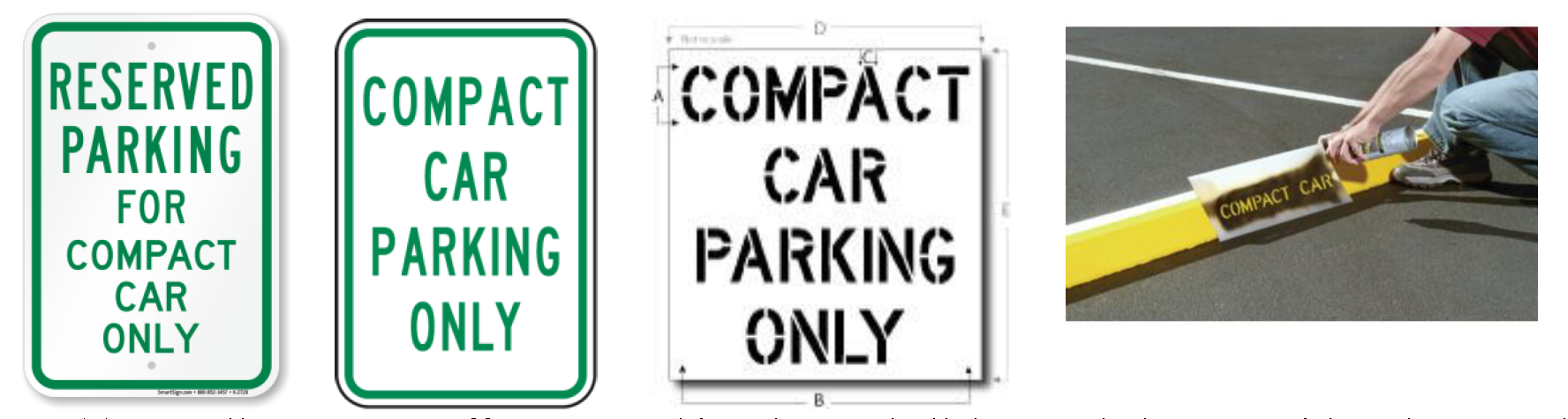
Each compact car parking space shall be clearly and distinctly marked with pavement markings and signage denoting "compact car only", and such parking spaces may be reduced to eight (8) feet by sixteen (16) feet stall sizes.
3.
Should compact car parking spaces be exclusively utilized on either side of a drive aisle, the drive aisle may be reduced in width at the discretion of the Executive Director.
 |
(e)
All common off-street parking bays shall be graded to provide adequate drainage and shall be paved with an all weather material or equivalent surface subject to the approval of the City Engineer.
(f)
Along those lot lines of an off-street parking area which abuts a residential district, a solid screen (i.e. fence, wall, or berm) of no less than six (6) feet in height shall be erected. The screen shall conform to the Augusta Tree Ordinance and continue for the entire length of the property line abutting a residential district.
(g)
A curb cut shall be located as far as practical from the intersection of the right-of-way lines of two streets, and no curb cut shall be permitted within fifty (50) feet of an intersection. Each parcel that is in ownership separate from the ownership of contiguous parcels shall be entitled to at least one curb cut per street front. Except in single-family residential zones, curb cuts shall be at least 100 feet apart where practical. Except in single-family residential zones, shared driveways are encouraged, and where practical a driveway that is not a shared driveway shall be at least fifty (50) feet from a property line.
(h)
Any light used to illuminate required parking areas shall be arranged so that the light is reflected away from adjacent properties.
(i)
No sign (permanent or temporary), light standard, or screening material shall be placed so as to inhibit the orderly use of a parking facility or in a manner which reduces the number of usable parking spaces. No sign, light standard, or screening material shall be placed so that it obstructs visibility for drivers or pedestrians.
(j)
All off-street parking spaces located in common parking bays or lots shall be marked by a durable painted stripe designating no less than the required minimum parking space area.
(k)
No motor vehicle repair work of any kind shall be permitted in conjunction with off-street parking areas except minor repair on vehicles owned by the occupant or resident of the principal use for which the off-street parking is intended.
(l)
If the required off-street parking space cannot be reasonably provided on the same lot, tract, or parcel on which the principal use is conducted, the applicant may be permitted to provide such space on other off-street property, provided such space lies within 300 feet of the property line of the principal use. Such space may be parking provided for other uses, provided the utilization of the parking area by the proposed uses does not conflict with the activities associated with the primary use, and that the applicant obtains written authorization for utilization of the parking facility on a continuing basis.
(m)
The provisions of the Augusta Tree Ordinance related to parking lots (Augusta Code Section 8-4-1) shall be complied with.
(n)
No required parking may be located within any "special setback" area per Section 3-12 of this Ordinance.
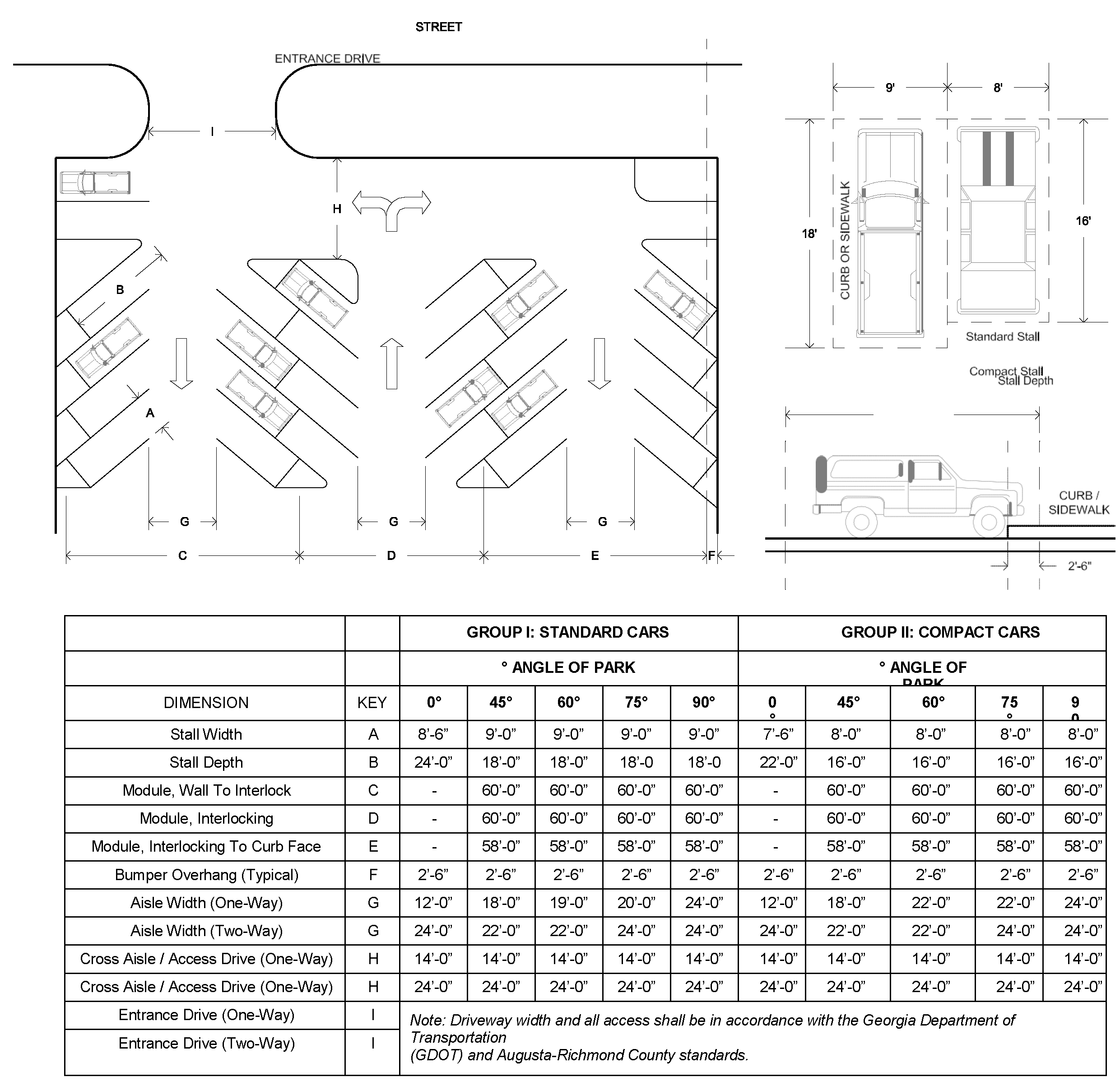
Figure 4-1: Off-Street Parking Area Design Standards (At Various Angles and in Feet
and Inches)
Last updated: July 24, 2015
4-2
Off-street parking requirements for all areas except Central Business District (CBD). Off-street automobile storage or parking space shall be provided with vehicular access to a public street and shall be equal to or greater than the minimum requirements for
_____
_____
(f)
Uses not specified. In the case of a use not specifically mentioned in Section 4-2 the requirements for off-street parking facilities shall be determined by the Staff. Such determination shall be based upon the requirements set for the most comparable use specified in Section 4-2.
(g)
Reduction in number of required off-street parking spaces. The Planning Commission may, at its discretion, reduce the minimum number of parking spaces required for a specific use by Section 4-2(a) through 4-2(e) above provided that sufficient evidence is presented justifying the need for reduction in the requirements and every effort has been made to provide off-street parking in accordance with the stipulations of this section.
(h)
Credit for certain on-street parking. Outside the Central Business District designated, marked, on-street parking spaces located contiguous to a development may reduce the off-street parking requirement at a rate of one-half off-street space per on-street space.
4-3
Off-street parking requirements for the Central Business District (CBD). Off-street parking shall be provided in the Central Business District in accordance with the following regulations:
(a)
For the purpose of this section, the Central Business District shall be defined as the area bounded by the following streets and including all lots or parcels fronting on said streets:
(1)
Levee Road from Gordon Highway to Fifteenth Street;
(2)
Fifteenth Street from Levee Road to Greene Street;
(3)
Greene Street from Fifteenth Street to Thirteenth Street;
(4)
Thirteenth Street from Greene Street to Telfair Street;
(5)
Telfair Street from Thirteenth Street to Gordon Highway;
(6)
Gordon Highway from Telfair Street to Levee Road.
(b)
Public or semipublic parking lots and garages available for general use and metered curb parking spaces within 300 feet of the proposed use may be applied toward the total off-street parking spaces needed.
(c)
All provisions set forth in Sections 4-1 and 4-2 shall apply to the above described area except as follows:
_____
_____
(d)
The Planning Commission may, at its discretion, reduce the minimum number of parking spaces required for a specific use by Section 4-3(c) provided that sufficient evidence is presented justifying the need for a reduction in the requirements and every effort has been made to provide off-street parking in accordance with the stipulations of this section.
(e)
Nonconforming Parking and Loading in the Central Business District (CBD). All uses are exempt from the parking requirements.
( Ord. No. 7630 , § I, 8-21-2018)
4-4
General requirements for off-street loading. Off-street loading and unloading space shall be provided as hereinafter required by this Ordinance. For the purposes of this section, the following general requirements are specified:
(a)
The term "off-street loading and unloading space" shall mean an area having the minimum dimensions of 14 feet in height, 12 feet in width, and 50 feet in length plus adequate maneuvering area to facilitate entry into and exit from the space. The Planning Commission may, upon sufficient demonstration that a particular loading space will be used exclusively by small trucks or vans, reduce the minimum dimension requirements accordingly.
(b)
Each required off-street loading space shall have direct access to a street or have a driveway which provides satisfactory ingress and egress for trucks. The width of the access way shall be at least 25 feet wide and shall have a minimum radius at the curb line of 25 feet.
(c)
Each required off-street loading space shall be so designated as to avoid undue interference with other vehicular or rail access, use of public streets, or other public transport systems.
(d)
All off-street loading facilities, including spaces and maneuvering area, shall be adequately drained and paved with an all-weather material or equivalent surface subject to the approval of the Public Works Department.
(e)
Along those lot lines of the loading area which abut a residential district, a solid screen of no less than five (5) feet in height shall be erected.
(f)
Any light used to illuminate required off-street loading areas shall be arranged so that the light is reflected away from adjacent properties. No light standard shall be erected within fifteen (15) feet of any curb line of a public street.
(g)
All off-street loading areas and their respective maneuvering areas shall be set back not less than ten (10) feet from a public right-of-way.
(h)
No portion of the area required for off-street parking as specified in Section 4-2 shall be used for off-street loading, unloading, or maneuvering space.
4-5
Off-street loading requirements for all use zones. Off-street loading and unloading space shall be provided with access to a public street and shall be equal to or greater than the minimum requirements set forth as follows:
_____
_____
(f)
Uses not specified. In the case of a use not specifically mentioned in Section 4-5, the requirements for off-street loading facilities shall be determined by the Planning Commission. Such determination shall be based upon the requirements set forth for the most comparable use specified in Section 4-5.
(g)
Reduction in number of required off-street loading spaces. The Planning Commission may, at its discretion, reduce the minimum number of loading spaces required for a specified use by Section 4-5(a) through 4-5(e) above provided that sufficient evidence is presented justifying the need for reduction in the requirements and every effort has been made to provide off-street loading in accordance with the stipulations of this section.
4-6
Nonconforming parking and loading spaces. Any building lawfully in use on February 4, 1974, shall constitute a nonconforming use with regard to parking. Any enlargement of a nonconforming building or expanded use of a nonconforming building must provide the required parking for the additional area or use.
4.7
Zoning classification changes. Any building on property for which the zoning classification is subsequently changed or a Special Exception is subsequently granted shall be provided with sufficient off-street parking pursuant to this section prior to occupancy.
4-8
Bicycle parking - General provisions.
4-8-1
Statement of intent. Establish and update parking standards to allow flexible parking strategies that are economical and encourage access management, mobility and accessibility for all travel modes and bicycle parking that create pedestrian friendly, environmentally sustainable and affordable developments.
4-8-2
Applicability. Bicycle parking requirements of this section shall apply to:
a)
Any new building greater than 1,200 square feet of gross floor area.
b)
Any existing building undergoing a change of use and or expansions and alterations, greater than 1,200 square feet of gross floor area.
4-8-3
Exemptions. The following uses shall not be required to provide bicycle parking:
a)
residential including one and two family dwellings
b)
fraternity and sorority houses
c)
private clubs, lodges and fraternal buildings not proving overnight accommodations
d)
automobile repair establishments
e)
convenience stores (gas/food marts) and similar establishments
f)
automobile washing and cleaning establishments
g)
automobile sales (new and used) and manufactured homes sales
h)
appliance stores
i)
furniture stores
j)
night clubs, taverns, lounges, and similar establishment
k)
mini warehouses
l)
manufacturing and industrial establishments
m)
wholesale trade establishments, warehouses
4-8-4
Required bicycle parking spaces:
a)
For all required uses, a minimum of two short-term and two long-term bicycle parking spaces shall be provided.
b)
Bicycle parking must be provided at a rate of one bike space for every ten vehicle parking spaces.
c)
Whenever a site is exempted from the vehicular parking requirements, the required bicycle parking for the site shall still be calculated based upon the amount of vehicular parking that would have been required for that site.
4-8-5
General requirement standards. The following general requirements are specified:
a)
A bicycle parking space required by this ordinance shall be at least 6 feet long and 2 feet wide with a 5 foot access aisle.
b)
All required bicycle racks and facilities must be in accordance with the Association of Pedestrian and Bicycle Professionals Bike Parking Guidelines (APBP).
c)
Whenever vehicle parking spaces are provided in a structure, all required bicycle spaces shall be located inside that structure or shall be located in other areas protected from the weather.
4-8-6
Types of bicycle parking:
a)
Short-term bicycle parking. A type of parking is generally intended to accommodate visitors, customers, messengers, and other persons expected to park for a few minutes to depart within approximately two (2) hours.
b)
Long-term bicycle parking. A type of parking is generally intended to accommodate employees, students, residents, commuters, and other persons who expect to leave their bicycle parked for more than 2 hours.
4-8-7
Bicycle parking requirements:
a)
Short-term bicycle parking. Choose properly designed bicycle racks that support a bicycle's frame and are secure. Provides secure and functional parking that can support the bicycle upright on a horizontal plane.
1.
Short-term bicycle parking shall consist of bicycle racks that support the bicycle frame at two points. Racks that support only the wheel of the bicycle are not permissible.
i.
Well-spaced racks allow for ease and efficiency of bicycle parking.
ii.
Allow front-in and back-in parking.
iii.
Racks shall allow for the bicycle frame and at least one wheel to be locked to the racks.
iv.
The bicycle rack shall allow for the use of a cable as well as a U-shaped lock.
v.
If bicycles can be locked to each side of the rack, each side shall be counted toward a required space.
vi.
Racks shall be securely anchored to an approved paved surface.
vii.
At least half of parking should be covered for short-term parking if more than ten (10) bicycles can be parked there.
b)
Long-Term Bicycle Parking. Long-term bicycle parking requires a high degree of security and weather protection, with well-designed racks in covered areas, lockers, storage rooms, or fenced areas (enclosed on all sides) with restricted access.
1.
Acceptable examples of long-term bicycle parking include bicycle lockers or cages that are well maintained and have good placement locations. Long-term bicycle parking shall be secured from the general public. Acceptable examples of some enhanced security measures may include variable levels of entry control to facilities, whereas access to bicycle facilities is restricted and or monitored parking.
4-8-8
Siting requirements. Required bicycle parking shall be provided on the same lot as the use for which it is intended to serve.
a)
Short-term bicycle parking. For new buildings, short-term bicycle parking shall be located to maximize visibility from the main entrance. For existing buildings where exterior space may be inadequate, short-term bicycle parking may be on the level of the parking garage closest to the ground floor with a direct access to a public street.
1.
Location shall be within a convenient distance of, and clearly visible from the main entrance to the building as determined by the city, but it shall not be farther than the closest automobile parking space.
2.
For buildings with more than one main pedestrian entrance, short term bicycle parking shall be split evenly among all main pedestrian entrances.
3.
Signage is required at each building entrance for bicycle parking locating within buildings or parking garages.
a)
Long-term bicycle parking. Long-term bicycle parking shall be provided in a well- lit, secure location within a convenient distance of a main entrance. A secure location is defined as one in which the bicycle parking is:
1.
A bicycle locker,
2.
A lockable bicycle enclosure,
3.
Provided within a lockable room, or
4.
All required long-term bicycle parking spaces shall be sheltered from precipitation.
4-8-9
Lighting requirements. Adequate lighting shall be provided to ensure safe access to bicycle parking facilities.
a)
Provide a well-lit path from the building entrance to both short-term and long-term bicycle parking.
b)
Clearly light short-term, long-term parking, and signage.
c)
Use direct "dark sky" compliant lighting that is consistent and glare-free to provide even light distribution.
d)
Bicycle parking provided in a structure or under cover shall be illuminated with twice the amount of light as auto parking spaces.
4-8-10
Signage. If required bicycle parking is not visible from the street or main building entrance, a sign must be posted at the main building entrance indicating the location of the parking. In parking structures, signs shall be installed to indicate the location of the bicycle parking.
4-8-11
Parking structures: Bicycle parking provided in a structure or under cover shall be:
a)
At ground level
b)
free of charge
c)
clearly marked
d)
located in a location that (1) is illuminated with twice the amount of light as auto parking spaces, (2) is separated from auto parking by some form of barrier to minimize the possibility of parked bicycles being hit by an automobile, either, no farther from the vehicular entrance/exit than the nearest vehicular parking space OR no farther from the pedestrian entrance/exit than the nearest vehicular parking space.
4-8-12
Reduction of vehicle parking for bicycle parking. The number of required off-street vehicle parking spaces may be reduced where bicycle parking is provided.
a)
Bicycle parking spaces may be used to replace new and existing vehicle parking spaces at a ratio of two bicycle parking spaces for every one vehicle parking space.
b)
Up to a maximum of 5% of the total vehicle parking spaces required, and 7% of the vehicle parking spaces required for uses related to public assembly, may be replaced with bicycle parking spaces
4-8-13
Abandoned bicycle policy. A bicycle shall be deemed abandoned if it has been parked at the same location for seven consecutive calendar days. The property owner is responsible for the removal of abandoned bicycles. Abandoned bicycles may be donated to non-profits that reuse bicycles or may be disposed of in any lawful manner.
4-8-14
Exceptions. Exceptions to the requirement to provide bicycle parking may be allowed in some cases and areas. Situations where an exception may be made include the following:
a)
Where a showing is made that it is physically not feasible to provide bicycle parking or in areas where significant levels of cycling are unlikely and where alternative means of bicycle parking are likely available. These exceptions may be approved administratively by the Augusta Planning and Development Department's Director or designee.
b)
Where a showing is made that joint bicycle parking facilities are provided for two or more establishments. Co-location of bicycle parking facilities at adjacent location.
Amended August 2017 - Nightclubs, Taverns, Breweries & Distilleries and similar establishments
Amended June 2017 - adding Amplified Entertainment
Amended March 2016 - Amend Residential Requirements and Fast Food and Sit Down Restaurant
Amended July 2015 - 4-1(c) and (d) - Compact Car parking
Amended June 2015 - Added 4-2(3) Personal Care Home parking
Amended January 2015 - Added 4-8
Amended January 2006 Entire Section 4
GENERAL PROVISIONS

