
Banning City Zoning Code
Division II
LAND USE DISTRICTS
17.16.010 - Purpose—Districts designated.
A.
The purpose of the Public Facilities districts is to provide for the orderly development of government, school and public health and safety facilities within the City. Public Facilities should be:
1.
Located in areas convenient and accessible for the public.
2.
Subject to equivalent development standards as the residential and commercial land uses in the City.
3.
Evenly distributed throughout the community.
B.
The Public Facilities districts are described below. All Public Facilities lands are mapped in the same color on the Zoning Map, and are identified by their lettered suffix.
1.
Public Facilities-Airport (PF-A). The land uses permitted in this district are specifically related to airport operations: administration offices, hangars, tie-downs, runways, restaurants and flight schools. Ancillary retail and service business relating to the airport are appropriate.
2.
Public Facilities-Government (PF-G). The district has been assigned to public buildings and facilities, including City Hall, Police Department, Community Center, library and similar governmental buildings.
3.
Public Facilities-Fire Station (PF-F). Fire station and fire administration facilities are included in this district.
4.
Public Facilities-Schools (PF-S). Existing public and private schools at all levels, including colleges are included in this district.
5.
Public Facilities-Hospital (PF-H). Existing hospital facilities are included in this district.
(Zoning Ord. dated 1/31/06, § 9104.01.)
_____
17.16.020 - Permitted, conditional and prohibited uses.
The following list represents those uses in the public facilities districts which are Permitted (P), subject to a Conditional Use Permit (C) or Prohibited (X). All uses are subject to Design Review.
Table 17.16.020
Permitted, Conditional and Prohibited Public Facilities Uses
(Zoning Ord. dated 1/31/06, § 9104.02.; Ord. No. 1507, § 3.2.4, 3-14-17; Ord. No. 1509, §, 4-11-17; Ord. No. 1530, § 4F, 9-25-18; Ord. No. 1523, § 3E, 7-10-18; Ord. No. 1531, § 3E, 11-13-18; Ord. No. 1577, § 17, 9-28-21)
17.16.030 - Land use district development standards.
Table 17.16.030
Use Specific Development Standards
16 If a public facilities zoned lot is located adjacent to a residentially zoned lot, the minimum setback shall be 10 feet.
17 If a commercially or industrially zoned lot is located adjacent to a residentially zoned lot, the minimum setback shall be 10 feet.
18 Not including control towers, communications towers, bell towers, steeples and similar architectural treatments.
A.
General Standards. Except as indicated in Table 17.16.030, Use Specific Development Standards, all uses proposed in the Public Facilities districts shall be subject to the same Standards as those provided in the Commercial and Industrial Districts. Please see Chapter 17.12.
B.
Use Specific Standards. All uses proposed in the Public Facilities districts shall be subject to the same Use Specific Standards as those provided in the Commercial and Industrial Districts. Please see Chapter 17.12.
(Zoning Ord. dated 1/31/06, § 9104.03.)
17.16.040 - Applicable regulations.
All permitted and conditionally permitted uses shall be subject to the applicable regulations of this Zoning Ordinance, including, but not limited to Chapter 17.28, Parking Standards, Chapter 17.32, Landscaping Standards, and Division IV, Administration Provisions.
(Zoning Ord. dated 1/31/06, § 9104.04.)
17.16.050 - Public facilities design guidelines.
All uses proposed in the Public Facilities districts shall be subject to the same Design Guidelines as those provided in the Commercial and Industrial Districts. Please see Chapter 17.12.
(Zoning Ord. dated 1/31/06, § 9104.05.)
17.20.010 - Purpose—Districts designated.
A.
The purpose of the Open Space districts is to preserve lands within the City for permanent open space and recreation. Lands in the Open Space districts should:
1.
Provide pleasing vistas and preserve viewsheds.
2.
Protect lands with significant hillsides or resources.
3.
Provide recreational opportunities to the City's residents and visitors.
B.
The Open Space districts are described below.
1.
Open Space - Resources (OS-R). Lands for the preservation of water, biological, visual, ridgelines, or other resources, and for flooding, geotechnical or other hazards are included in this category. Electrical transmission line easements, natural gas or fuel transmission line easements preserved as open space through the development process are also included. Non-motorized vehicle trails, roads and passive parks may be appropriate within this district.
2.
Open Space - Parks (OS-PA). Allows public and private parks and recreational facilities, including golf courses, tot lots, dog parks, neighborhood, community and regional parks, sports fields, and passive parks.
3.
Open Space - Public (OS-PU). Lands owned by the County, the state of California, United States or Tribal entities, which are preserved as natural open space are included in this land use category. Lands in this district may be available for passive or active recreation, based on the owners' rules and regulations.
4.
Open Space - Hillside Preservation (OS-H). Lands, whether in private or public ownership, which are preserved as open space, including ridgelines. Uses such as public trails, wildlife viewing areas, ranger stations, roads and passive parks may be appropriate.
(Zoning Ord. dated 1/31/06, § 9105.01.)
_____
17.20.020 - Permitted, conditional and prohibited uses.
The following list represents those uses in the Open Space districts which are Permitted (P), subject to a Conditional Use Permit (C) or Prohibited (X). All uses are subject to Design Review.
Table 17.20.020
Permitted, Conditional and Prohibited Open Space Uses
(Zoning Ord. dated 1/31/06, § 9105.02.; Ord. No. 1507, § 3.2.5, 3-14-17; Ord. No. 1509, §, 4-11-17; Ord. No. 1530, § 4G, 9-25-18; Ord. No. 1523, § 3F, 7-10-18; Ord. No. 1531, § 3F, 11-13-18; Ord. No. 1577, § 18, 9-28-21)
17.20.030 - Land use district development standards.
Table 17.20.030
Development Standards
19 Not including control towers, communications towers, bell towers, steeples and similar architectural treatments.
A.
General Standards. With the exception of the development standards listed in Table 17.20.030, all uses proposed in the Open Space districts shall be subject to the same General Standards as those provided in the Commercial and Industrial Districts. Please see Section 17.12.040.
B.
Use Specific Standards. All uses proposed in the Open Space districts shall be subject to the same Use Specific Standards as those provided in the Commercial and Industrial Districts. Please see Section 17.12.050.
(Zoning Ord. dated 1/31/06, § 9105.03.)
17.20.040 - Applicable regulations.
All permitted and conditionally permitted uses shall be subject to the applicable regulations of this Zoning Ordinance, including, but not limited to Chapter 17.28, Parking Standards, Chapter 17.32, Landscaping Standards, and Division IV, Administration Provisions.
(Zoning Ord. dated 1/31/06, § 9105.04.)
17.20.050 - Open space design guidelines.
All uses proposed in the Open Space districts shall be subject to the same Design Guidelines as those provided in the Commercial and Industrial Districts. Please see Sections 17.12.070 through 17.12.170.
(Zoning Ord. dated 1/31/06, § 9105.05.)
17.08.010 - Purpose.
A.
This chapter is intended to achieve and improve the liveability of Banning's residential neighborhoods, and to protect the property values of Banning homeowners, by:
1.
Prohibiting uses which are incompatible with quiet residential living.
2.
Creating zones and neighborhoods which differ from one another in intensity of use and density of dwellings.
3.
Welcoming a broad diversity of housing types (and people) from farm-based, to rural, to mobile homes, to multifamily dwellings and apartment buildings, to suburban style housing, and to low density, estate style residential development.
4.
Providing sufficient safeguards for the City's inhabitants through ensuring sufficient light, clean air, privacy and green space for each dwelling.
5.
Minimizing the negative impacts of traffic intensity (such as noise, polluted air, gridlock, and danger to pedestrians), in residential neighborhoods.
6.
Protecting residential neighborhoods from illumination spillage, foul or hazardous odors, smoke, and other negative by-products from non-residential segments of the city.
7.
Planning for the provision of public improvements and infrastructure to serve Banning's growing residential neighborhoods.
8.
Locating new development to retain the scale and character of existing residential neighborhoods.
9.
Improving declining and mixed use residential neighborhoods.
10.
Improving the pedestrian or equestrian connections between neighborhoods, and pedestrian access from neighborhoods to commercial areas.
11.
And by allowing the growth of the City to occur on vacant and underutilized properties in the City.
B.
There is a different purpose for each zoning district. An explanation of each of the City's residential zoning districts follows:
1.
Ranch/ Agriculture (R/A) District (1 Du/10 Acres). This district allows detached single family homes on lots of at least ten acres. Also permitted are agricultural and ranching activities, animal keeping (both personal and commercial use), and animal-keeping or agricultural related commercial enterprises, such as feed stores, commercial stables and similar uses. Bed and breakfast lodging and similar uses may be appropriate in this district, with the approval of a conditional use permit. If density transfers from the Ranch/Agriculture Residential -Hillside district are applied to a Ranch/Agriculture Residential parcel, the maximum density shall be one dwelling unit per 5 acres.
2.
Ranch/ Agriculture Residential — Hillside (RAR-H) (1 du/10 acres). This zoning district is assigned to lands in the foothills. Portions of the site exceeding 25% slope as well as the ridgelines are to be preserved as open space, but density may be transferred to developable areas. If a density transfer is applied, the maximum density for the developable lands shall be one dwelling unit per 5 acres.
3.
Rural Residential (RR) (0-1 du/acre). This zoning district allows detached single family homes on lots of at least one gross acre. Uses also permitted include agricultural and ranching activities, animal keeping (both personal use and commercial). Bed and breakfast lodging and similar uses may be appropriate with the approval of a conditional use permit. Animal-keeping or agricultural related commercial enterprises, such as feed stores, commercial stables and similar uses may be appropriate with approval of a conditional use permit.
4.
Rural Residential - Hillside (RR-H) (0-1 du/acre). This zoning district is assigned to lands in the foothills. Portions of the site exceeding 25% slope as well as the ridgelines are to be preserved as open space, but density may be transferred to developable areas. All other RR development standards apply. If a density transfer is applied, the maximum density allowable is 2 units to the acre, and the standards of the Very Low Density Residential district will be applied.
5.
Very Low Density Residential (VLDR) (0-2 du/acre). This zoning district allows detached single-family homes at a density of up to 2 units per acre. May be appropriate for bed and breakfast and similar uses. Animal keeping is permitted according to Zoning restrictions.
6.
Low Density Residential (LDR) (0-5 du/acre). This zoning district allows the development of attached and detached single family homes, in traditional subdivisions and planned communities. The clustering of condominiums and townhomes may be appropriate with the provision of common area amenities and open space, when a Specific Plan or Planned Unit Development is prepared. Bed and breakfasts and similar uses may be appropriate with the approval of a conditional use permit. Home Occupations are permitted with approval of a Home Occupation permit.
7.
Medium Density Residential (MDR) (0-10 du/acre). This zoning district allows the development of attached and detached single family homes, in traditional subdivisions and planned communities. Also allows condominiums and townhomes, garden apartments and duplexes, with the provision of common area amenities and open space. The clustering of condominiums and townhomes may be appropriate with the provision of common area amenities and open space. Bed and breakfasts and similar uses may be appropriate with the approval of a conditional use permit. Home Occupations are permitted with approval of a Home Occupation permit. May also be appropriate for convenience retail commercial ("corner store" type development such as convenience stores, grocery or green grocer, video rental, drug stores, sit down restaurants, coffee shops or coffee bars or similar uses), less than 5,000 square feet in total square footage, with approval of a conditional use permit. Mixed use projects, which combine residential and commercial uses, are appropriate with approval of a Planned Unit Development.
8.
High Density Residential (HDR) (11-23 DU/AC. Allows condominiums and townhomes, as well as apartments with the provision of common area amenities and open space. The clustering of condominiums and townhomes is appropriate with the provision of common area amenities and open space. Mobile home parks and subdivisions with the provision of common area amenities and open space may also be appropriate, with the approval of a conditional use permit. Home Occupations may be appropriate with approval of a Home Occupation permit.
9.
Mobile Home Park (MHP). The district applies to existing mobile home parks or subdivisions within the City. Only mobile parks and subdivisions are permitted.
10.
Reserved.
11.
Very High-Density Residential (VHDR) (24—30 DU/AC. Allows condominiums and townhomes, as well as apartments with the provision of common area amenities and open space. The clustering of condominiums and townhomes is appropriate with the provision of common area amenities and open space. Home occupations may be appropriate with approval of a home occupation permit.
(Zoning Ord. dated 1/31/06, § 9102.01.)
(Ord. No. 1466, § 3(3), (5), 8-13-13; Ord. No. 1482, § 3(1), 1-13-15; Ord. No. 1530, § 4L, 9-25-18; Ord. No. 1583, § 2, 10-11-22; Ord. No. 1600, § 2, 2-27-24)
_____
17.08.020 - Permitted, conditional and prohibited uses.
The following list represents those uses in the residential districts which are Permitted (P), subject to a Conditional Use Permit (C) or Prohibited (X):
Table 17.08.020
Permitted, Conditional and Prohibited Residential Uses
1 Small family day care homes are permitted by right in single-family residences located in any residential zone. Small family day care homes are not permitted in multiple-family residences.
2 Large family day care homes are conditionally permitted in single-family residences located in any residential zone. Large family day care homes are not permitted in multiple-family residences.
3 Neighborhood-oriented retail stores, as defined in the General Plan, consist of "corner store" type development such as convenience stores, grocery or green grocer, video rental, drug stores, sit down restaurants, coffee shops or coffee bars or similar uses, less than five thousand square feet in total square footage.
4 Temporary uses require temporary use permit. See Chapter 17.108 for provisions.
5 Agricultural employee housing allowed with up to twelve units or thirty-six persons, and/or up to six workers as a single-family use.
6 Cannabis Personal Cultivation must comply with the provisions of Chapter 5.34.
7 Affordable housing developments pursuant to Government Code Section 65583.2 and located within the multi-family housing zoning districts are permitted by right without a public hearing or discretionary action and, in the VHDR district, are permitted at a minimum density of 24 dwelling units to 30 dwelling units per acre.
(Zoning Ord. dated 1/31/06, § 9102.02; Ord. No. 1392, § 2.)
(Ord. No. 1466, § 3(4), (6), 8-13-13; Ord. No. 1467, §§ 4, 6, 8-13-13; Ord. No. 1482, § 3(2), 1-13-15; Ord. No. 1496, § 3(2), 5-10-16; Ord. No. 1507, § 3.2.2, 3-14-17; Ord. No. 1509, § 3, 4-11-17; Ord. No. 1510, § 3(2), 9-11-17; Ord. No. 1512, § 6, 10-10-17; Ord. No. 1523, § 3B, 7-10-18; Ord. No. 1531, § 3B, 11-13-18; Ord. No. 1552, § 5, 1-28-20; Ord. No. 1577, § 13, 9-28-21; Ord. No. 1583, §§ 3,4, 10-11-22; Ord. No. 1600, § 3, 2-27-24; Ord. No. 1605, § 2, 7-9-24)
17.08.030 - General standards.
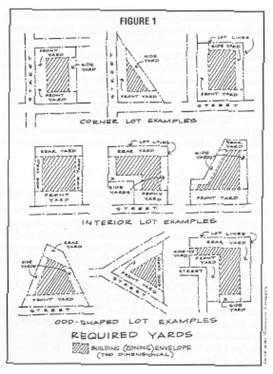
The standards shown in the table below outline the minimum standards and parameters for characteristics such as front and rear setback; building lot coverage; parcel size; structure height; the maximum number of attached dwelling units; and other aspects of residential development. Specific Plans and Planned Unit Developments may vary from these standards, as allowed by this Zoning Ordinance and the provisions of state law.
Table 17.08.030
Residential Development Standards1
1 These standards can be superseded by standards in a Specific Plan, or by the standards provided for Planned Unit Development, under Section 17.08.170.
2 The provisions for hillside development and density transfers shall apply.
3 A single family home can be built on an existing legal lot in the R/A, R/A-H, RR, RR/H, VLDR, LDR or MDR zones, providing all single family residential development standards for that zone are met.
4 Minimum lot size net of public right-of-way dedication.
5 In the LDR Zone, if no suffix is shown on the map. If a suffix is shown on the map, that suffix indicates the minimum lot size.
6 A minimum of 30% of the net site area must be provided in common outdoor space. See multi-family development standards, Section 17.08.140.
7 Maximum height only permitted if Fire Department provides written verification that they can serve.
8 Up to 240 square feet of third car garage space is exempted from lot coverage and FAR for lots over 9,500 square feet.
9 Golf cart garages are exempted from the building coverage requirements in areas that are adjacent to a golf cart path.
10 All residentially zoned lots are eligible to apply for ministerial subdivisions under the provisions of Senate Bill 9, the California Housing Opportunity and More Efficiency (HOME) Act pursuant Government Code Section 66411.7.
(Zoning Ord. dated 1/31/06, § 9102.03(1); Ord. No. 1370, § 3.)
(Ord. No. 1404, § 3, 3-10-09; Ord. No. 1492, § 3.2, 1-12-16; Ord. No. 1496, § 3(2), 5-10-16; Ord. No. 1510, § 3(2), 9-11-17; Ord. No. 1600, § 4, 2-27-24)
17.08.040 - Use specific standards.
In addition to development standards contained in other sections of this Ordinance, the following use-specific development standards shall apply to the City's residential districts:
Table 17.08.040
Use Specific Development Standards
(Zoning Ord. dated 1/31/06, § 9102.03(2).)
(Ord. No. 1509, § 3, 4-11-17; Ord. No. 1512, § 6, 10-10-17)
17.08.050 - Accessory structures.
Accessory structures in residential zoning districts shall be compatible with the materials and architecture of the primary dwelling of the property. Accessory structures may only be constructed on a lot containing a main dwelling unit. Accessory structures may be built to within five feet of the interior side and rear property lines as long as these structures are not closer than ten feet to any other structure.
(Zoning Ord. dated 1/31/06, § 9102.03(2)(A).)
(Ord. No. 1439, § 3, 9-13-11; Ord. No. 1488, § 3.2.b., 6-9-15; Ord. No. 1510, § 3(2), 9-11-17)
17.08.060 - Day care center design standards.
A.
Day Care Homes for up to six (6) children are allowed in all residential zones.
B.
Large day care homes taking care of 7 to 12 children may be located no closer than 500 feet in any direction from an existing large family day care home, measured from property line to property line, except that they may be located no closer than 250 feet measured from property line to property line from any existing large family day care home fronting on a different street.
C.
Day Care Centers are those uses with more than twelve children, and are considered a specific land use regulated by the City's zoning code. These are permitted in certain residential districts, are a conditional use in other residential districts, and are prohibited in the remaining group of residential districts. In zones where Day Care Centers are permitted or can obtain a Conditional Use Permit, these centers shall adhere to the following standards:
1.
The facility must conform to all property development standards of the land use district in which it is located.
2.
Large facilities may not be located within 500 feet of another day care center.
3.
An outdoor recreation area of 75 square feet per child is required. The outdoor play area shall be located in the rear area. Stationary play equipment shall not be located in the front yard, or in the required side yards.
4.
A six-foot high solid decorative fence or wall shall be constructed on all property lines with the exception of the front yard. No fences shall be allowed in the front yard. Materials, textures, colors and design of the fence or wall shall be compatible with on-site development and with adjacent properties. All fences or walls shall provide for safety with controlled points of entry. In cases where day care is located on a property larger than one acre, it is excessive to require as much fencing and walls as are indicated above, therefore, the this design standard may be adjusted by the Community Development Director with the approval of the Planning Commission.
5.
Landscaping of the lot consistent with that prevailing in the neighborhood, or shall be of a higher quality, and must be installed and maintained pursuant to the Landscaping Standards shown in Chapter 17.32 of the City's Zoning Ordinances.
6.
All on-site parking shall be provided pursuant to the provisions of Parking Standards shown in Chapter 17.28 of the City's Zoning Ordinances. On site vehicle turnaround or separate entrance and exit points, as well as adequate passenger loading spaces, must be provided.
7.
All on site lighting shall be stationary, directed away from adjacent properties and public rights-of-way, and of an intensity appropriate to the permitted use of the property.
8.
All on-site signage shall comply with the provisions of the City's Zoning Ordinances.
9.
The center shall contain a fire extinguisher and smoke detector devices and shall meet all standards established by the City Fire Marshall.
10.
A center within a residential land use district may operate up to 14 hours a day.
D.
Large day care homes taking care of 7 to 12 children (as opposed to Day Care Centers taking care of 13 or more children), may be located no closer than 500 feet in any direction from an existing large family day care home, measured from property line to property line, except that they may be located no closer than 250 feet measured from property line to property line from any existing large family day care home fronting on a different street.
(Zoning Ord. dated 1/31/06, § 9102.03(2)(B).)
17.08.070 - Density bonus.
Refer to Chapter 15.60 of the Banning Municipal Code.
(Zoning Ord. dated 1/31/06, § 9102.03(2)(C); Ord. No. 1461, § 2, 3-12-13.)
17.08.080 - Density transfers.
Pursuant to the policies of the General Plan, density transfers are permitted in the R/A/H and RR/H districts, based on the following provisions.
A.
A property owner may apply the density allowed on a lot, or portion of a lot, designated R/A/H or RR/H which has slopes of 25% or more, to an adjacent lot, or to that portion of the same lot designated R/A or RR having less than 25% slope.
B.
The density transfer shall only be allowed if that lot, or portion of a lot, from which the density is being taken is dedicated in perpetuity as natural open space, to an organization dedicated to that preservation, and approved by the City Council.
C.
In no case shall a density transfer result in a total density of more than 150% of the density permitted on the buildable parcel.
(Zoning Ord. dated 1/31/06, § 9102.03(2)(D).)
17.08.090 - Golf courses and related facilities standards.
Golf courses are subject to Conditional Use Permit review, and shall be constructed to at least the following standards:
A.
State of the art water conservation techniques shall be incorporated into the design and irrigation of the golf course. Likewise treated effluent shall be used for irrigation where available. Although the City does not have non-potable infrastructure, projects should include provisions for future connections to non-potable water.
B.
Drainage and storm sewer facilities should be designed with sufficiently sized and properly located storm sewers, drainage ditches, and catch basins so that runoff from rainwater and irrigation water does not at any time flow onto a public road or right-of-way.
C.
Perimeter walls or fences shall be built in an aesthetically pleasing way, which takes the view into account, while providing safety to the public along public rights-of-way.
D.
Accessory facilities such as club houses, maintenance buildings, and other structures, shall be designed and located to ensure compatibility and harmony with the golf course setting.
(Zoning Ord. dated 1/31/06, § 9102.03(2)(E).)
17.08.100 - Accessory dwelling unit standards.
A.
These standards are adopted pursuant to California Government Code sections 65852.2 and 65852.22. The purpose of these standards is to establish procedures and standards for the development of accessory dwelling units and junior accessory dwelling units in a manner that preserves the integrity of single-family and multi-family residential areas, avoids adverse impacts on such areas, and ensures a safe and attractive residential environment.
B.
Building permit application required. Applicants for accessory dwelling units or junior accessory dwelling units shall submit an application for approval of a building permit and the applicable application fee, as established by resolution of the City Council.
C.
Notwithstanding the provisions of ch. 17.112 of this title, a building permit application for an accessory dwelling unit or junior accessory dwelling unit shall be considered ministerially without discretionary review or hearing.
1.
Existing single-family or multi-family dwelling on lot. If there is an existing single-family or multi-family dwelling unit on the lot on which the accessory dwelling unit or junior accessory dwelling unit is proposed, the building permit application for the accessory dwelling unit or junior accessory dwelling unit shall acted upon within sixty days after receiving a complete building permit application, unless the sixty-day period is tolled upon the applicant's request.
2.
New single-family or multi-family dwelling on lot. If a building permit application for an accessory dwelling unit or junior accessory dwelling unit is submitted with an application to construct a new single-family or multi-family dwelling on the lot, the building permit application for the accessory dwelling unit or junior accessory dwelling unit shall be acted upon after any permits required for the single-family or multi-family dwelling have been approved.
D.
Notwithstanding the provisions of this section to the contrary, the City shall ministerially approve a building permit application within a residential or mixed-use zone to create any of the following:
1.
One accessory dwelling unit or junior accessory dwelling unit per lot with a proposed or existing single-family dwelling if all of the following apply:
a.
The accessory dwelling unit or junior accessory dwelling unit is within the proposed space of a single-family dwelling or existing space of a single-family dwelling or accessory structure and may include an expansion of not more than one hundred fifty square feet beyond the same physical dimensions as the existing accessory structure. An expansion beyond the physical dimensions of the existing accessory structure shall be limited to accommodating ingress and egress. For purposes of this section, the term "accessory structure" shall mean a structure that is accessory and incidental to a dwelling located on the same lot.
b.
The space has exterior access from the proposed or existing single-family dwelling.
c.
The side and rear setbacks are sufficient for fire and safety.
d.
The junior accessory dwelling unit complies with the requirements of Subsection (F) of this section and Government Code Section 65852.22.
2.
One detached, new construction, accessory dwelling unit that does not exceed eight hundred square feet or sixteen feet in height and has at least four-foot side and rear yard setbacks on a lot with a proposed or existing single-family dwelling. The accessory dwelling unit may be combined with a junior accessory dwelling unit described in Subsection (D)(1) of this section.
3.
At least one accessory dwelling unit within the portions of existing multi-family dwelling structures that are not used as livable space, including, but not limited to, storage rooms, boiler rooms, passageways, attics, basements, or garages, if each unit complies with state building standards for dwellings. The applicant may request and the City shall allow the number of accessory dwelling units that equal up to twenty-five percent of the number of multi-family dwelling units in the existing building.
4.
Not more than two detached accessory dwelling units that are located on a lot that has an existing multi-family dwelling so long as the units do not exceed a height of sixteen feet and have at least four-foot rear and side yard setbacks.
E.
Except for those accessory dwelling units approved pursuant to Subsection D of this section, the following standards shall apply to accessory dwelling units:
1.
General plan designation and zoning classification consistency. An accessory dwelling unit shall be consistent with the General Plan designation and the zoning classification for the lot. For purposes of this Subsection (E)(1), an accessory dwelling unit that conforms to the provisions of this section shall be deemed to be consistent with the General Plan designation and the zoning classification for the lot.
2.
Zone. The accessory dwelling unit shall be located or proposed to be located on a lot zoned to allow single-family or multi-family dwelling residential use.
3.
Density. An accessory dwelling unit shall not exceed the allowable density for the lot upon which the accessory dwelling unit is located or proposed to be located. For purposes of this Subsection (E)(3), an accessory dwelling unit that conforms to the provisions of this section shall not be considered to exceed the allowable density for the lot upon which it is located or proposed to be located.
4.
Lot location. The accessory dwelling unit shall either be attached to, or located within, the proposed or existing primary single-family or multi-family dwelling, including attached garages, storage areas, or similar uses, or an accessory structure, or detached from the proposed or existing primary single-family or multi-family dwelling and located on the same lot as the proposed or existing primary single-family or multi-family dwelling.
5.
Floor area.
a.
The minimum gross floor area of an accessory dwelling unit shall be no less than the size of a two hundred twenty square foot efficiency unit. For purposes of this Subsection (E)(5)(a), the term "efficiency unit" shall have the same meaning as defined in Health and Safety Code Section 17958.1.
b.
If there is an existing primary single-family or multi-family dwelling, the total floor area of an attached accessory dwelling unit shall not exceed fifty percent of the existing primary single-family dwelling or twenty percent lot coverage of the lot on which the existing multi-family dwelling is located.
c.
The total floor area of a detached accessory dwelling unit shall not exceed one thousand two hundred square feet.
6.
Lot coverage/floor area ratio. The total gross floor area of all covered structures, including an attached accessory dwelling unit, shall not exceed the lot coverage or floor area ratio as prescribed in the applicable zoning district, except that the lot coverage or floor area ratio prescribed in a particular zone shall not prohibit an accessory dwelling unit that is at least eight hundred square feet and sixteen feet tall, with four-foot rear yard and side yard setbacks.
7.
Setbacks.
a.
No setback shall be required for an existing living area, existing accessory structure, or a structure constructed in the same location and to the same dimensions as an existing structure that is converted to an accessory dwelling unit or to a portion of an accessory dwelling unit. For purposes of this Subsection (E)(7)(a), the term "living area" shall mean the interior habitable area of a dwelling unit, including basements and attics, but does not include a garage or any accessory structure.
b.
Any accessory dwelling unit that is not subject to Subsection (E)(7)(a) of this section shall be at least four feet from the side and rear lot lines.
8.
Height. Notwithstanding the maximum height requirements applicable to the zone in which the lot is located, the maximum height of an attached or detached accessory dwelling unit shall be sixteen feet.
9.
Parking.
a.
On-site Parking. Accessory dwelling units shall not be subject to the provisions of the Parking Standards set forth in Chapter 17.32 of this title.
b.
Replacement of On-Site Parking Not Required. The City shall not require the replacement of on-site parking spaces lost when a garage, carport, or covered parking structure is demolished in conjunction with the construction of an accessory dwelling unit or converted to an accessory dwelling unit.
10.
Local building code. Accessory dwelling units shall comply with building and fire code requirements that apply to detached dwellings, as applicable and set forth in the Building Ordinance of the City of Banning in Title 15, and the California Fire Code, as applicable and amended and codified in Chapter 8.16.
11.
Fire sprinklers. An accessory dwelling unit shall not be required to provide fire sprinklers if sprinklers are not required for the primary single-family or multi-family residence.
12.
Rental and conveyance. An accessory dwelling unit may be rented separate from the primary residence only for terms longer than thirty consecutive calendar days, but shall not be sold or otherwise conveyed separate from the primary residence.
13.
Passageways. No passageway shall be required in conjunction with the construction of an accessory dwelling unit. For purposes of this section, the term "passageway" shall mean a pathway that is unobstructed clear to the sky and extends from a street to one entrance of the accessory dwelling unit.
F.
The following standards shall apply to junior accessory dwelling units:
1.
Number. The number of junior accessory dwelling units shall be limited to one per residential lot zoned for single-family residences with a single-family residence built, or proposed to be built, on the lot.
2.
Zone. The junior accessory dwelling unit is located or proposed to be located on a lot zoned to allow single-family dwelling residential use.
3.
Lot location. A permitted junior accessory dwelling unit shall be constructed within the walls of the proposed or existing single-family residence.
4.
Floor area. A junior accessory dwelling unit shall be a maximum of five hundred square feet of gross floor area. The gross floor area of a shared sanitation facility shall not be included in the maximum gross floor area of a junior accessory dwelling unit.
5.
Access. A permitted junior accessory dwelling unit shall include a separate entrance from the main entrance to the proposed or existing single-family residence.
6.
Kitchen. The permitted junior accessory dwelling unit shall include an efficiency kitchen, which shall include all of the following:
a.
A cooking facility with appliances.
b.
A food preparation counter and storage cabinets that are of reasonable size in relation to the size of the junior accessory dwelling unit.
7.
Utilities. For purposes of providing service for water, sewer, or power, including a connection fee, a junior accessory dwelling unit shall not be considered a separate or new dwelling unit.
8.
Owner-occupancy. Owner-occupancy is required in the single-family residence in which the junior accessory dwelling unit will be permitted, unless the property owner is another governmental agency, land trust, or housing organization. The property owner may reside in either the remaining portion of the structure or the newly created junior accessory dwelling unit.
9.
Deed restriction. The property owner shall record a deed restriction, which shall run with the land, shall file the deed restriction with the City. The deed restriction shall include both of the following:
a.
A prohibition on the sale of the junior accessory dwelling unit separate from the sale of the single-family residence, including a statement that the deed restriction may be enforced against future purchasers.
b.
A restriction on the size and attributes of the junior accessory dwelling unit that conforms with this section.
G.
The following standards shall apply to accessory dwelling units described in Subsection (D) of this section:
1.
The City shall not require, as a condition for ministerial approval of a building permit application for the creation of an accessory dwelling unit or a junior accessory dwelling unit, the correction of nonconforming zoning conditions. For purposes of this Subsection (G)(1), the term "nonconforming zoning condition" shall mean a physical improvement on a property that does not conform with current zoning standards.
2.
The installation of fire sprinklers shall not be required in an accessory dwelling unit if sprinklers are not required for the primary residence.
3.
A rental of an accessory dwelling unit created pursuant to Subsection (D) of this section shall be for a term longer than thirty consecutive days.
4.
The City may require, as part of the building permit application to create an accessory dwelling unit connected to an onsite water treatment system, a percolation test completed within the last five years, or, if the percolation test has been recertified, within the last ten years.
H.
In accordance with the timelines provided in Subsection (C) of this section, the directory of community development, or designee, shall approve an application for an accessory dwelling unit or junior accessory dwelling unit upon payment of all required fees set forth in Subsection (I) of this section and if all of the following requirements are met: (1) the accessory dwelling unit or junior accessory dwelling unit is located on property that is zoned to allow single-family residential uses, multi-family residential uses, or mixed-uses, as applicable; (2) the accessory dwelling unit or junior accessory dwelling unit is located on property that includes an existing or proposed primary single-family or multi-family dwelling, as required; (3) the accessory dwelling unit or junior accessory dwelling unit satisfies all applicable standards set forth in Subsections (E), (F), and (G) of this section. For purposes of this section, the term "proposed primary single-family or multi-family dwelling" shall mean a dwelling that is the subject of a permit application and that meets the requirements for permitting.
I.
Fees and utility connections. Fees charged for accessory dwelling units and junior accessory dwelling units shall be determined in accordance with the provisions of Chapters 6 and 7 of the Mitigation Fee Act (Gov. Code, § 66000 et seq.).
1.
An accessory dwelling unit shall be considered a new residential use for the purposes of calculating connection fees or capacity charges for utilities, including water and sewer service, only if the accessory dwelling unit is constructed in conjunction with a new single-family dwelling.
2.
No impact fee shall be imposed upon the development of an accessory dwelling unit that is less than seven hundred fifty square feet. An accessory dwelling unit that is seven hundred fifty square feet or more shall be subject to impact fees in proportion to the square footage of the primary dwelling unit. For purposes of this Subsection (I)(2), the term "impact fee" shall have the same meaning as the term "fee" is defined in Government Code Section 66000(b), except that it also includes fees specified in Government Code Section 66477. The term "Impact fee" does not include any connection fee or capacity charge charged by the City.
3.
An accessory dwelling unit described in Subsection (D)(1) of this section shall not be required to install a new or separate utility connection directly between the accessory dwelling unit and the utility, or impose a related connection fee or capacity charge, unless the accessory dwelling unit was constructed with a new single-family home.
4.
An accessory dwelling unit not described in Subsection (D)(1) of this section shall install a new or separate utility connection directly between the accessory dwelling unit and the applicable utility purveyor. The Public Works Director shall determine the types and method of these connections. Consistent with Government Code Section 66013, the connection may be subject to a connection fee or capacity charge that shall be proportionate to the burden of the proposed accessory dwelling unit, based upon either its square feet or the number of its drainage fixture unit (DFU) values, as defined in the Uniform Plumbing Code adopted and published by the International Association of Plumbing and Mechanical Officials, upon the water or sewer system. This fee or charge shall not exceed the reasonable cost of providing this service.
5.
A junior accessory dwelling unit shall be subject to fees for inspection of the junior accessory dwelling unit to determine if the junior accessory dwelling unit complies with applicable building standards.
6.
A junior accessory dwelling unit shall not be considered a separate or new dwelling unit for purposes of providing service for water, sewer, or power, including a connection fee.
J.
Upon approval of an accessory dwelling unit or junior accessory dwelling unit on a lot, the lot shall not be further divided unless there is adequate area to divide the lot consistent with the general plan, zoning ordinance, the subdivision ordinance, and the Subdivision Map Act.
K.
All construction, structural alterations, or additions made to create an accessory dwelling unit or junior accessory dwelling unit shall comply with current building, electrical, fire, and plumbing codes regulations that apply to detached dwellings, as applicable.
L.
In the event of any conflicts between the standards set forth in this section and those set forth in the regulations of the applicable zoning district, the provisions of this section shall prevail.
(Zoning Ord. dated 1/31/06, § 9102.03(2)(F).)
(Ord. No. 1414, § 3(exh. A), 1-26-10; Ord. No. 1512, § 6, 10-10-17; Ord. No. 1559, § 6, 3-24-20)
Editor's note— Ord. No. 1512, § 6, adopted October 10, 2017, changed the title of § 17.08.100 from second unit standards, to read as herein set out.
17.08.110 - Minimum dwelling size standards.
A.
For new single family homes, minimum livable area in square feet shall be one thousand two hundred square feet.
B.
For apartments and multi-family units, the minimum livable area in square feet shall be:
(Zoning Ord. dated 1/31/06, § 9102.03(2)(G); Ord. No. 1510, § 3(2), 9-11-17)
17.08.120 - Mobile home and manufactured housing design standards.
Mobile homes shall be installed in the following manner:
A.
Mobile or manufactured homes are subject to the permitting requirements of Chapter 17.44, Administration—General Provisions.
B.
Mobile or manufactured homes may be used as single family dwellings if the home is certified under the National Mobile Home Construction and Safety Standards Act of 1974.
C.
Mobile or manufactured homes which are used as single family residences shall be installed on an approved permanent foundation system in compliance with applicable codes.
D.
The Community Development Director shall determine that the subject lot together with the proposed mobile or manufactured home is compatible with surrounding development. This determination shall be based on an assessment of on-site design and development standards and materials, architectural aesthetics, setbacks, roof pitch and type, building height, accessory buildings, access, off-street parking, minimum square footage requirements, and any other criteria deemed appropriate by the Director.
E.
All mobile and manufactured homes shall have a minimum eave dimension of one foot.
F.
All siding shall be non-reflective and shall be installed from the ground up to the roof.
G.
All roofs shall have a minimum pitch of 1:4.
H.
All homes shall have a minimum width (across the narrowest dimension) of twenty feet.
I.
All homes shall have a garage.
J.
All homes shall be fully landscaped.
(Zoning Ord. dated 1/31/06, § 9102.03(2)(H).)
17.08.130 - Mobile home park or subdivision design standards.
Mobile home parks or mobile home subdivisions are subject to the following design standards:
A.
Mobile home space minimum setbacks shall be measured from the edge of internal streets and space lines in the following way:
1.
Minimum Front setback - six feet.
2.
Minimum Side setback - ten feet on each side.
3.
Minimum Rear setback - six feet.
B.
Structural separation - a minimum of ten feet between dwelling units.
C.
Maximum mobile home space coverage (mobile home and its accessory structure) shall be sixty-five percent.
D.
Each mobile home shall be equipped with skirting to give the appearance of the mobile home being located on-grade.
E.
All on-site utilities shall be installed underground.
F.
The mobile home park shall be provided with parking as required by the Parking Section of the City's Zoning Ordinances (Chapter 17.28).
G.
A common recreation area which may contain a recreation building shall be provided in the park for use by all tenants and their invited guests. The area shall be provided in one common location with a minimum aggregate area of two hundred square feet of recreational space for each mobile home space.
H.
All exterior boundaries of the mobile home park shall appear similar to conventional residential developments and shall be screened by a dec-orative wall, fence or other comparable device six feet in height, with a minimum six foot wide landscaped area provided along the inside of the perimeter screen.
I.
Common open space shall be landscaped in accordance with a landscape plan approved by the review authority and in a manner consistent with the Landscaping Section of the City's Zoning Ordinances (Chapter 17.32).
J.
All mobile home parks or mobile home subdivision developments shall provide recreational amenities within the site such as a: swimming pool; spa; clubhouse; tot lot with play equipment; court game facilities for tennis, basketball or racquetball; improved softball or baseball fields; or day care facilities. The type of amenities shall be approved by the Community Development Director and provided according to the following schedule:
(Zoning Ord. dated 1/31/06, § 9102.03(2)(H).)
17.08.140 - Multi-family housing standards.
Multi-family housing is permitted in the MDR, HDR and VHDR zones, and conditionally permitted in the LDR zone; and is subject to design review. Multi-family housing shall be constructed in the following manner:
A.
All multi-family developments with more than ten units shall provide thirty percent useable open space for active and passive recreational uses. Useable open space areas may not include: rights-of-way; vehicle parking areas; areas adjacent to or between any structures less than fifteen feet apart; setbacks; detention basins or any use whose primary purpose is not intended for recreation; patio or private yards; or areas with a slope greater than eight percent.
B.
Every dwelling unit shall have a patio or balcony not less than three hundred square feet in area or twenty-five percent of the dwelling unit size, whichever is less.
C.
All multi-family developments shall provide recreational amenities within the site such as a: swimming pool; spa; clubhouse; tot lot with play equipment; court game facilities for tennis, basketball or racquetball; improved softball or baseball fields; or day care facilities. The type of amenities shall be approved by the community development director and provided according to the following schedule:
D.
Off-street parking spaces for multi-family residential developments shall be located within one hundred fifty feet from the front or rear door of the dwelling for which is parking space is designated.
E.
Each dwelling unit shall be provided at least one hundred fifty cubic feet of private enclosed storage space within the garage, carport, or immediately adjacent to the dwelling unit.
F.
Driveway approaches within multi-family developments of more than ten units shall be delineated with interlocking pavers, rough textured concrete, or stamped concrete and landscaped medians.
G.
Common laundry facilities of sufficient number and accessibility consistent with the number of living units and the uniform building code shall be provided.
H.
Every dwelling unit shall be plumbed and wired for a washing machine and a dryer.
I.
For multi-family developments of over ten units, security and management plans shall be submitted for review and approval.
(Zoning Ord. dated 1/31/06, § 9102.03(2)(J).)
(Ord. No. 1466, § 3(1), 8-13-13; Ord. No. 1496, § 3(2), 5-10-16)
17.08.150 - Multi-family housing, existing.
Whether they were built before or after any portion of these design standards or zoning ordinance, additions, alterations and expansions to multi-family housing in excess of twenty-five percent of existing structures must comply with the standards of the multi-family district in which the project is located.
(Zoning Ord. dated 1/31/06, § 9102.03(2)(K).)
17.08.160 - Neighborhood-oriented retail stores in the medium density residential zone.
Neighborhood-oriented retail stores of up to five thousand square feet are subject to Design Review, and shall be constructed and operated in the following manner:
A.
The minimum site area shall be ten thousand square feet.
B.
The site shall not have primary access on a local residential street.
C.
One access drive may be permitted for each street frontage. The design and location of the access drive(s) shall be subject to the approval of the city engineer and the planning commission.
D.
No convenience store shall be located less than one thousand feet from an existing school, as measured from one property line to another.
E.
All on-site lighting shall be energy efficient, stationary and directed away from adjoining properties and public rights-of-way.
F.
All on-site signage shall comply with the provisions of Chapter 17.36 (Sign Standards).
G.
All landscaping shall be installed and permanently maintained pursuant to the provisions of Chapter 17.32 (Landscaping Standards).
H.
Parking shall comply with the provisions of Chapter 17.28 (Off-Street Parking Standards), except that up to fifty percent of the parking may be provided on-street rather than on-site.
I.
The premises shall be kept in a neat and orderly condition at all times. Failure to maintain the project site shall be considered grounds for code enforcement action consistent with the nuisance provisions of the Banning Municipal Code, Title 8.
J.
All structures shall include a trash enclosure, constructed to the standards established by the public works department, and sufficient in size to accommodate the trash generated by the business. The trash enclosure shall include three walls and a gate, in a style compatible with the structure's architecture. The gate shall be maintained in working order and shall remain closed except when in use. Pedestrian access shall be provided.
K.
A bicycle rack shall be installed in a convenient location visible form the inside of the store.
L.
Public pay telephones provided on-site shall not be set up for incoming calls. Public telephones shall be featured with call out service only.
M.
On-site video games may not be installed or operated on the premises.
N.
A six-foot high decorative masonry wall shall be required along the property line adjacent to any residential structure.
O.
The location, style and number of newspaper stands shall be approved by the community development director.
(Zoning Ord. dated 1/31/06, § 9102.03(2)(L).)
17.08.170 - Planned unit development.
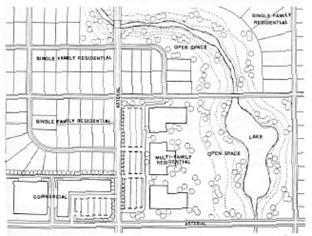
A planned unit development (PUD) generally provides amenities beyond those expected in conventional residential developments. PUDs can achieve greater flexibility in design; they can improve the quality of residential neighborhoods through good planning; and PUDs provide for appropriate use of land which is sufficiently unique in its physical characteristics, scenic beauty, or other circumstances to warrant special methods of development. PUDs can also provide mixed use development, including a mix of commercial and residential development consistent with Section 17.08.160.
The purpose of a PUD is to allow clustered residential subdivisions and small lot subdivisions in zoning districts that allow higher densities: VLDR, LDR, MDR, and HDR. PUDs are prohibited in other zones. PUDs are subject to Design Review. Single family dwellings in PUDs may be either attached or detached.
A.
Density. The underlying residential land use district shall determine the maximum number of dwelling units allowed in a PUD. Where parcels span more than one zone, the maximum number of dwelling units shall be determined by adding together the allowable density for each zone. Density transfer through the PUD project area is permitted for the promotion of clustering units in those areas suited to development, thus preserving the green space and natural features of the site.
B.
Lot Size and Site Coverage. PUDs may create lot sizes to accommodate the creation of attached singe family dwelling units or clustered subdivisions. Structures shall not occupy more than forty percent of the gross site area. Smaller lot sizes can be considered on a case-by-case basis; however, smaller lots must demonstrate unique lot orientations (e.g. clustering with open space) and must provide project amenities such as common open spaces (unencumbered by utility easements), parks, recreation facilities, etc.
C.
Number of Attached Units and Height of Structures. The maximum average number of single family units attached in any manner to form a single structure is six. Attached single family structures shall not exceed three stories or forty-two feet. Detached single family structures shall not exceed two and one-half stories, or thirty-five feet.
D.
Setbacks.
1.
Structural Setbacks from the project perimeter boundary
2.
The minimum dwelling unit side structural setback from other dwelling unit structures is fifteen feet, plus one additional foot for each fifteen feet of structure length.
E.
Open Space.
1.
All PUDs with twelve or more dwelling units shall provide at least thirty percent of the total property as useable open space for passive and active recreational uses. Useable open space shall not include:
a.
Rights-of-way;
b.
Vehicle parking areas;
c.
Areas adjacent to or between any structures which are less than fifteen feet apart;
d.
Setbacks;
e.
Patios and private yards;
f.
Or slope areas greater than eight percent.
2.
Useable open space that is encumbered by an underlying utility easement can be included in the open space requirement, but shall not be included in the required park land dedication as required in Banning Municipal Code Chapter 15.68.
F.
Amenities. All PUDs shall provide recreational amenities within the site such as a: swimming pool; spa; clubhouse; tot lot with play equipment; court game facilities for tennis, basketball or racquetball; improved softball or baseball fields; or day care facilities. The type of amenities shall be approved by the Community Development Director and provided according to the following schedule:
G.
Private Streets. Private streets shall be permitted when there is a homeowner's association established to maintain them. Streets shall be built to standards and specifications no less than those for public works construction.
H.
Covenants.
1.
Lots and dwelling units within a PUD may not be sold unless a corporation, homeowner's association, assessment district or other approved appropriate legal entity has been legally formed with the right to assess all those properties which are jointly owned or benefited to operate and maintain all of the mutually available features of the development including, but not limited to, open space, amenities, landscaping or slope maintenance landscaping (which may be on private lots adjacent to street rights-of-way).
2.
No lot or dwelling unit may be sold unless all approved and required open space, amenities, landscaping and other improvements have been completed, or if completion is assured by a bond or other financing guarantee method approved by the City Engineer and/or City Attorney.
I.
Fire Code. All parts of any structures shall be within 150 feet of paved access for single story residences, and within 50 feet of paved access for multi-story residential units.
J.
Additional Standards. In addition to the PUD development requirements, the following specific standards contained in the zoning ordinances shall apply, including but not limited to:
1.
Day care facilities;
2.
Guest houses;
3.
Lighting;
4.
Minimum room size;
5.
Minimum dwelling size;
6.
Mobile homes and manufactured housing;
7.
Mobile home park subdivision;
8.
Golf courses and related facilities;
9.
Recreational vehicle storage.
(Zoning Ord. dated 1/31/06, § 9102.03(2)(M).)
17.08.180 - Senior citizen/congregate care housing design standards
Senior group housing developments are subject to development standards contained in this section, as well as to the development permit review process. These shall be constructed in the following manner:
A.
Public Transit.
1.
Dial-a-ride transportation shuttles shall be provided, and the number of these shall be determined during the development permit review process. A bus turn-out and shelter on the on-site arterial frontage shall be dedicated if the senior citizen housing development is located on a bus route as determined by the director.
2.
A minimum of one comfortable, well constructed benches shall be provided adjacent to shuttle bus stops. Paved areas for shuttle parking shall be adequate in size and condition, and shall be suitably striped.
B.
Handicapped Accessibility. The primary pedestrian entrance to the development, to the common areas, and to the parking facility, and to each unit, shall be provided with legal, handicapped access. Indoor common areas and living units shall be handicap adaptable, and be provided with all necessary safety equipment such as safety bars, as well as with emergency signal intercom systems as determined by the Director.
C.
Regulations.
1.
Senior group housing including, but not limited to independent living, assisted living and congregate housing, shall conform with all local, state, and federal requirements. The senior group housing facility must conform to all standards of the underlying zoning district in all matters. This includes the number of dwelling units per development which is governed by the underlying zone and is specified earlier in this chapter. This also includes all landscaping and open requirements, as well as all other requirements.
2.
Residential occupancy shall be limited to single persons over 60 years of age, and to married couples or domestic partners of which one spouse or partner is over 60 years of age.
D.
Minimum Floor Area. The minimum floor for each residential unit is as follows:
E.
Lighting. Sufficient internal and external lighting including walkways shall be provided for security purposes. The lighting shall be energy efficient, the light source shall not be visible, it shall be stationary, deflected away from adjacent properties and public rights of way to minimize overspill, and of an intensity appropriate for the residential neighborhood.
F.
Laundry Facilities. Each residential unit shall be plumbed and wired for a washing machine and dryer. In addition, common laundry facilities of sufficient number and accessibility shall also be provided. The facilities shall have keyed access for tenants only.
G.
Recreation and Entertainment Activities. Common recreation and entertainment activities shall be provide, and shall be of a scale consistent with the number of living units. The minimum size shall equal 100 square feet for each living unit.
H.
Conveniences. The development may provide one or more of the following specific internal common facilities for the exclusive use of the residents:
1.
Beauty and barber shops;
2.
Central cooking and dining room;
3.
Movie theatre, stage or auditorium;
4.
Community garden;
5.
Gym, exercise facility, massage room, or aerobics room;
6.
Small scale drug store not to exceed 1,500 square feet;
7.
Small scale variety store not to exceed 1,500 square feet.
I.
Off Street Parking. Off street parking shall be provided in the following manner:
1.
Independent Living: One parking space for each dwelling unit for the exclusive use of the independent living residents, plus one space for every five units for guest parking Congregate Care: Three spaces for every four dwelling units for employee and guest use for congregate care residents.
2.
All off-street parking shall be located within 150 feet of the front door of the main entrance.
3.
Design standards related to handicapped parking, access, surfacing, striping, lighting, landscaping, shading, dimensional and other requirements shall be consistent with the standards outlined elsewhere in these Zoning Ordinances.
J.
Fire and Safety. The project shall be designed to provide maximum security for residents, guests, and employees. For convenience and for fire safety, all parts of all structures shall be within 150 feet of paved access for single-story buildings, and within 50 feet of any multi-story buildings.
K.
Trash Receptacles.
1.
Trash receptacles shall be provided on the premises. Trash receptacles shall comply with the adopted Public Works Department Standards for Banning, and shall be of sufficient size to accommodate the trash generated. The receptacles shall be screened from public view on at least three sides by a solid wall six feet in height, and on the fourth side by a gate of not less than five feet in height.
2.
The gate shall be maintained in good order and shall remain closed except when in use. The wall and gate shall be architecturally compatible with the surrounding buildings and structures. The receptacles shall be located within close proximity to the residential units which they are intended to serve.
(Zoning Ord. dated 1/31/06, § 9102.03(2)(N).)
17.08.190 - Single family housing, existing.
Whether they were built before or after any portion of these design standards or zoning ordinances, any additions, alterations and expansions of 25% or more to single family housing must comply with the most current version of the City's design standards for the district in which the home is located.
(Zoning Ord. dated 1/31/06, § 9102.03(2)(O).)
17.08.200 - Hillside development.
Development proposed in the R/A/H and RR/H districts shall conform to the following standards.
A.
All development proposals shall include a comprehensive slope analysis which includes all slopes over 5%, and separates lands with slopes of 5 to 25 percent, and slopes of 26 percent or more. The analysis shall include acreage calculations for each slope category, and any other information required by the Community Development Director.
B.
Development on lands of 25% or less slope shall be permitted at the underlying density.
C.
Development on lands of more than 25% slope is prohibited.
D.
The provisions of Section 17.08.080, Density Transfers, shall apply.
E.
Development proposed for plateaus shall include a 100 foot building setback from all ridgelines or edge of plateau. Development at the 100 foot setback shall be limited to single story or 22 feet.
(Zoning Ord. dated 1/31/06, § 9102.03(2)(P).)
17.08.201 - Boarding houses, single room occupancies and residential care facilities.
Any person who seeks to own, manage, or operate a boarding house, single room occupancy, a large residential care facility or a small, unlicensed residential care facility shall obtain a conditional use permit from the city. A boarding house, single room occupancy, large residential care facility or small, unlicensed residential care facility may only be allowed to operate with a conditional use permit in the zones indicated in Sections 17.08.020 and 17.12.020 of this zoning ordinance. No person shall own, manage, or operate a boarding house, single room occupancy, large residential care facility or small, unlicensed residential care facility without a valid conditional use permit.
A.
Application for a Conditional Use Permit. In addition to the findings for a conditional use permit required by Section 17.52.050 of this zoning ordinance, no conditional use permit for a boarding house, single room occupancy, large residential care facility or small, unlicensed residential care facility shall be granted unless the following findings are made:
1.
The fire chief and building official have determined that the premises complies with all applicable laws, ordinances and regulations.
2.
All persons directly or indirectly interested in use as an owner, partner officer, manager, employee or other person to be in charge of the use have not been convicted of a felony or any crime of moral turpitude.
B.
Operational Standards. The following standards shall apply to boarding houses, single room occupancies, large residential care facilities and small, unlicensed residential care facilities:
1.
The use shall not result in adverse effects to the health, welfare, peace, or safety of persons in the surrounding area;
2.
The use shall not jeopardize or endanger the public health, safety, or welfare of persons in the surrounding area;
3.
The use shall not adversely affect the livability of the surrounding neighborhood as a result of inadequate maintenance, prohibited activities, and/or operating characteristics;
4.
The use shall not result in nuisance activities, including, without limitation, disturbance of the peace, illegal drug activity, public drunkenness, public consumption of alcohol, harassment of passers-by, gambling, public urination, theft, assault, battery, vandalism, littering, loitering, illegal parking, loud noises, lewd conduct, or police detentions and/or arrests;
5.
The use shall not result in violation of any applicable provision of any other city, state, or federal law;
6.
The use shall not be located within three hundred feet, measured from the property lines, of any other boarding house, single room occupancy, large residential care facility or small, unlicensed residential care facility, or within three hundred feet of any elementary or secondary school, or any day care center. However, boarding houses and unlicensed residential care facilities shall not be located with one thousand feet, measured from the property lines, of any other boarding house, single room occupancy, large residential care facility or small, unlicensed residential care facility, or within one thousand feet of any elementary or secondary school, or any day care center;
7.
The use shall comply with the parking requirements in Tables 17.28.040(A) through (C).
C.
Revocation of Conditional Use Permit. Violations of any of the provisions of this section shall be grounds for revocation of the conditional use permit authorizing the use. Violation of any local, state or federal laws by individual boarder, tenant or occupant while on the premises of the boarding house, single room occupancy or residential care facility shall be grounds for revocation of the permit. The revocation procedures contained in Section 17.52.100 of this zoning ordinance shall be followed.
D.
Nonconforming Uses. All boarding houses, single room occupancies, large residential care facilities and small, unlicensed residential care facilities existing illegally prior to the effective date of the ordinance creating this section shall be required to comply with the requirements of this section within six months of the effective date. All boarding houses, single room occupancies, large residential care facilities and small, unlicensed residential care facilities existing legally prior to the effective date of the ordinance creating this section shall comply with Chapter 17.88 of the zoning ordinance.
E.
Reasonable Accommodation. Any person who seeks to operate a residential care facility in a zone where such use is not permitted, either by right or subject to conditional use permit pursuant to Sections 17.08.020 and 17.12.020 of this zoning ordinance, may request that the city allow the residential care facility to locate in such a zone as a reasonable accommodation under the federal Fair Housing Act by applying for a conditional use permit. The city shall grant the conditional use permit as a reasonable accommodation if it finds:
1.
The request for a reasonable accommodation will not impose an undue burden or expense on the city; and
2.
The proposed use will not create a fundamental alteration in the city's zoning scheme. The factors that shall be considered in making this determination include, but are not limited to, the following:
a.
Whether the proposed use is in accord with the operational standards identified in subsection B of this section,
b.
Whether the proposed location of the use is in accord with the requirements of the zone in which the site is located and complies with other relevant city regulations, policies, and guidelines,
c.
Whether the proposed location of the use and the conditions under which it will be operated and maintained will not be detrimental to the public health, safety or welfare, or to existing land uses, the operation of established sensitive land uses as defined in this chapter, the character of established neighborhood, or planned residential development in the vicinity,
d.
Whether the proposed use is consistent with the General Plan,
e.
Whether the type, intensity, sensitivity, and operating characteristics of the proposed use, and the manner in which it is located on its site, are compatible with existing land uses, the character of established neighborhoods, or planned residential development in the vicinity,
f.
Whether the site is physically suitable for the type, sensitivity, and intensity of the use as proposed, including access, utilities and absence of physical constraints.
(Ord. No. 1392, § 5.)
17.08.202 - Community Gardens.
Community Gardens are allowed in all zones, subject to the following regulations:
A.
Consent of the property owner shall be required.
B.
Site users must have an established set of operating rules addressing the governance structure of the garden, hours of operation, maintenance and security requirements and responsibilities; a garden coordinator to perform the coordinating role for the management of the community garden; and must assign garden plots in a fair and impartial manner according to the operating rules established for that garden. The operating rules along with a site plan of the Community Garden shall be kept on file with the Community Development Department and shall include the name and telephone number of the garden coordinator.
C.
All plots shall be tended on a regular (minimum weekly) basis. Gardens shall be maintained in a weed-free condition and produce must be harvested and not allowed to go to seed.
D.
Hours of Operation: Hours of operation shall be limited to daylight hours.
E.
Permitted structures. Accessory structures, such as storage sheds for tools and other supplies or greenhouses, may be allowed in a community garden pursuant to meeting zoning setback requirements and shall not exceed ten percent of the garden site lot area or one hundred twenty square feet, whichever is less. Accessory structures shall be compatible with the neighborhood and shall be approved by the Community Development Director.
F.
Parking. A minimum of two graveled parking spaces with approved access shall be provided on the lot when there is no on-street parking allowed adjacent to the community garden property.
G.
Utilities. Proposed connection to public utilities shall require permits from the City and shall meet any required City of Banning Electric Utility and City of Banning Water Utility requirements.
H.
Addressing. Addresses shall be assigned to vacant parcels for Community Gardens. The property address shall be identified using four-inch address numbers displayed in a visible location.
I.
Fencing. Fences shall not exceed six feet in height, shall be subject to any setback requirements of the zones in which they are located, shall be at least fifty percent open if they are taller than four feet, and shall be constructed of wood, vinyl, or ornamental metal. Chain link shall be permitted for community gardens.
J.
Drainage. The Community Garden Site shall be designed and maintained so that water and fertilizer do not drain onto adjacent property.
K.
Water Use. Water efficient irrigation techniques such as drip irrigation and timers to control watering times are encouraged. All hoses shall be equipped with a trigger nozzle. Mulching of planted areas is encouraged to retain plant moisture.
L.
Composting. Composting may be performed onsite within a composting container subject to all of the following:
1.
Composted materials shall be only those materials generated onsite or contributed by active members of the community garden.
2.
Composting containers shall be located a minimum of three feet from the property lines.
3.
Odors and/or fly-breeding shall not be greater than customarily found at a well-maintained residence.
M.
Organic Gardening. Organic gardening is strongly encouraged.
N.
Trash/Recycling Receptacles. Trash and recycling receptacles shall be provided onsite for the proper disposal of refuse. The receptacles shall be screened from adjacent properties by six-foot high solid fencing. Refuse shall be removed from the site weekly so that the receptacle area and the lot are kept free from litter.
O.
Personal Use Only. Food crops grown and harvested are for personal use only; commercial sale of produce is not permitted and the garden shall not be run as a profit-making venture.
P.
Prohibited plants. Planting illegal or invasive plants shall be prohibited. Plants grown must be food crops for personal consumption. Planting and cultivation of marijuana shall be prohibited.
All other applicable codes and ordinances shall apply to Community Gardens, including but not limited to grading and noise ordinances. Applicable permits from other departments may be required.
(Ord. No. 1509, § 3, 4-11-17)
17.08.210 - Applicable regulations.
All uses are subject to the pertinent regulations of the Banning Zoning Ordinance, including, but not limited to the administrative procedures of the City and the Community Development Department.
(Zoning Ord. dated 1/31/06, § 9102.04.)
17.08.220 - Purpose.
A.
These design guidelines are intended as a reference to help the developer in understanding the City's objectives for high quality residential development which retains its appearance, functionality, and value over time, and which adds to the community rather than detracting from it. The guidelines are a component of, and complement the mandatory land use district development standards in this Zoning Ordinance.
B.
These design guidelines may be interpreted with some flexibility in their application to specific projects. These design guidelines are broken out into two categories: single family residential and multi-family residential.
(Zoning Ord. dated 1/31/06, § 9102.05(1).)
17.08.230 - Applicability.
A.
The guidelines in this article shall apply to all residential development within the City, including additions, remodelling, relocation, and new construction.
B.
These design guidelines shall be followed unless there is a compelling reason as to why they cannot be followed. If a guideline is waived by the approving authority, the Mayor and City Council shall be notified. The Mayor or any City Council person may appeal the waiver within 15 days of its approval.
(Zoning Ord. dated 1/31/06, § 9102.05(2).)
17.08.240 - Single-family site planning.
A.
The single family site planning guidelines are intended to create highly functional neighborhoods, and visual variety along local streets. These guidelines encourage the incorporation of natural elements such as hills, mature trees, and streams into the fabric of residential neighborhoods. These guidelines intend to encourage:
1.
Varied footprints;
2.
Varied setbacks;
3.
Varied placement of houses on adjacent lots;
4.
Slowing vehicular traffic;
5.
Preserve the natural land forms;
6.
Prevent stark unbroken walls;
7.
And uninterrupted straight streets, where the noise and speed of the streets predominate over the quiet and safety and calm of the residences in the neighborhood.
B.
All single-family subdivision plans which include alternative lot sizes will be evaluated using the guidelines contained in this section, with emphasis on the following criteria:
1.
The placement and mix of lots;
2.
The preservation of wildlife habitat including mature trees, wildlife corridors, and natural features such as streams;
3.
The preservation of views of all natural elements of the landscape including ridgelines, hills, lakes, wetlands, streams, trees, shrubs, and wildlife habitat;
4.
The varied placement of dwelling units on a lot;
5.
Provision of amenities such as landscaping, green space, native vegetation, subdivision entrance treatments, and so on;
6.
The treatment of drainage and runoff from rain;
7.
Wall and fence treatments;
8.
And other unique amenities.
C.
Varied Front Setbacks. The varied placement of homes and garages close to the street or further back from the street, can create more interesting patterns of visible open space. Designers should strive to avoid uniform and monotonous setbacks along any street, and should vary setbacks to enhance the feeling of open space.
D.
Interruption of Straight Streets. When new streets are created, curved street designs are strongly encouraged over straight street designs. Elements such as knuckles, landscape medians, pavement enhancements should be introduced to limit the length of straight stretches. Streets should be connected and cul-de-sacs eliminated. Rear-loaded garages are encouraged.
E.
Varied Side Yard Setbacks. The distance between adjoining homes, as well as between homes and fences or walls, should be varied, as this will result in more unique and interesting types of yards, play areas, gardens, and patio areas.
F.
Attached Dwellings. Attached or clustered dwellings can create larger open areas between structures, and they can be designed to appear either attached or detached. Designers might consider using attached dwellings in certain sections of residential development.
G.
Lot Orientation. Lots which are located on curves or at corners, can often be oriented in a different direction than lots in the middle of the block. Such lots may be non-rectangular, and may be angled on the street. Structures should be oriented so that a majority of primary living spaces receive direct sunlight during daylight hours. In new developments, structures should be positioned minimize the impact of shadows on adjacent properties and within the project.
H.
Varied Lot Widths. On narrow lots, a variation of just a few feet in lot width can make a perceptible difference. Making some lots wider than average, and other lots narrower than average, can make the neighborhood more interesting, can allow for different configurations of open space, and can allow placement of different sizes and shapes of homes.
I.
Varied Garage Placement and Orientation. Lot size permitting, garages can be placed on the front side of the house and can be entered from the front or from the side. Garages can also vary in size, and can be detached or connected to the primary residence, and can be accessed from the front or year yard.
J.
Zero Lot Line Homes. Planned Unit Developments allow for homes to be placed flush against the side lot lines. Such zero lot line homes are compatible with the creation of sizes and shapes of patios, play areas, gardens, and courts, which could not occur in a traditional center plot layout.
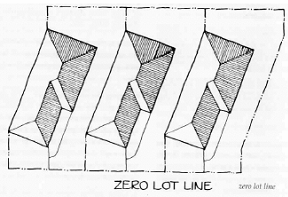
K.
Straight and Curved Streets. Although long, straight streets are often the most efficient layout, curves can provide more interesting and varied street scenes, and show harmony with the landscape and topography, and integration of a residential neighborhood into its natural surroundings. Whenever significant natural features are encountered in a development, such as hills, rivers, mature trees, chaparrals, wetlands and the like, such features should signal the designer that one or more curves may be beneficial to the street layout.
L.
Walls. Walls and fences are an important part of the streetscape and should be designed thoughtfully. Walls and fences should have the following characteristics:
1.
Both sides of all perimeter walls or fences should be architecturally treated.
2.
Walls should be of smooth stucco finish, or of plaster or of other approved masonry or stonework. They should be designed in a style, materials and color to complement the adjacent dwelling units.
3.
Additional materials may include tile insets, grillwork and wrought iron. The preferred choice for wrought iron is one inch pickets, at a maximum of six inches on center.
4.
Decorative block can be used, but should complement the adjacent dwelling unit.
5.
Chain link fences and barbed wire are not acceptable materials.
6.
Wood, wrought iron, masonry, vinyl and adobe are acceptable fence/wall materials.
7.
Decorative masonry walls, including, but not limited to, slump stone and split-face block can be used without a stucco or plaster finish, but must be architecturally treated and complement the adjacent dwelling units.
8.
All property fencing must be compatible in design and of similar materials.
M.
Garages. Garages shall be a minimum of four hundred square feet and shall exhibit the following characteristics:
1.
Garage door setbacks should allow driveway parking that keeps the sidewalk free of vehicles, and passable by pedestrians and cyclists.
2.
Angled garages may be used on curvilinear streets where they can provide an element of harmony with the flow of the street, and may be used on straight streets where they can break up the monotony of all garage doors being parallel to the street.
3.
Garages should have a single story mass at the front of the structures to provide an architectural transition in two story massing.
N.
In-Fill in Existing Neighborhoods. New single-family homes in existing neighborhoods should be integrated into the neighborhoods in characteristics such as scale, building height, architectural style, facade treatment, landscaping, setbacks and other characteristics. In many older neighborhoods, common patterns such as entries facing the street, front porches, and parking at the rear may be continued.
O.
Setbacks.
1.
Setbacks of residential projects should be either:
a.
Equal to the average setback of all residences on both sides of public streets within one hundred feet of the property lines of the new project, or
b.
Equal to the average of the two immediately adjacent residences. In either case, the new residence may be averaged in a stepping pattern between the setbacks of adjacent residences.
2.
Architectural Style. Distinctive architectural characteristics of surrounding developments such as materials, roof style and pitch, finished floor heights porches, window and door treatments, fidelity to formal traditional architectural styles, and related elements should be incorporated into new residential development when possible.
3.
Scale. Building scale and form should relate to the use of the structure as a single-family dwelling. Structures consistent with the existing neighborhood, so as not to overwhelm or dominate the neighborhood.
4.
Massing. Long uninterrupted exterior walls should be avoided on all structures. All structure walls should have relief to create an interesting blend with landscaping, structures, shadows and light. The articulation of facades and the massing of structures tends to give them richness and scale. Incorporation of varied texture, relief and design elements on building walls can soften the appearance of the residence.
P.
Grading. Graded slopes should be rounded and contoured to blend with the natural terrain. Significant natural vegetation shall be retained and incorporated into the project. Development should relate to the natural surroundings and minimize grading by following natural contours. Developers should consult with the Community Development Department early in the process to ensure compliance with this guideline.
(Zoning Ord. dated 1/31/06, § 9102.05(3); Ord. No. 1387, § 4.)
17.08.250 - Single-family architecture.
The focus of development should be on the creation of high quality residential environments. Although there is no particular required architectural style for any of Banning's neighborhoods, architecture should be compatible with surrounding character including harmonious building style, form, size, color, materials, orientation, and roofline. Residences should be compatible with one another, but each should be unique in its own way.
A.
Facade and Roof Articulation.
1.
Long uninterrupted exterior walls should be avoided on all structures. All structure walls should have relief to create an interesting blend with landscaping, structures, shadows and light. The articulation of facades and the massing of structures tends to give them richness and scale. Incorporation of varied texture, relief and design elements on building walls can soften the appearance of the residence.
2.
For sloped roofs, both vertical and horizontal articulation is encouraged. Roof articulation may be achieved by changes in plane of at least two feet and six inches, and through the use of traditional elements such as gables, hips and dormers. Flat roofs are strongly discouraged, and A-frame type roofs are generally simpler and less articulated than what would be considered ideal.
B.
Varied Structure Design. In tract developments, structures should be designed to create variety and interest. There should be a significant difference in the exterior finish, massing and composition, of adjacent houses. One design should not be repeated more often than every fourth house.
C.
Attached Dwellings.
1.
Single family attached dwellings should be designed in a way which projects an image of high quality customized homes. Preferred configurations include treatment as apparently large single family units, or as traditional row houses or town houses.
2.
Features such as walls should be incorporated to lengthen the horizontal elements of elevations and to reduce the visual impact of garage doors.
3.
Driveways should be grouped with a separate planting strip to provide maximum usable green space, lawn, and gardening areas.
4.
Garages must be set back from the street sufficiently to allow driveway parking without the intrusion of cars into the sidewalk, thus blocking the way of cyclists or pedestrians. In addition, garages should have a single story appearance at the front of the building to allow a stepped-back architectural transition for two story structures.
D.
Scale. Building scale and form should relate to the use of the structure as a single family dwelling. Structures should be built on a human scale, so as not to overwhelm or dominate the neighborhood, or the residents of the immediate dwelling or adjacent dwellings.
E.
Finish Materials.
1.
Materials to be avoided include metal or aluminum siding and roofs, reflective materials and finishes, and unfinished concrete block.
2.
The use of different materials on different planes tends to make the materials appear substantial and integral. Material changes not accompanied by changes in plane also frequently give material an insubstantial or applied quality.
3.
All structure elements should be architecturally treated. The proper choice and mix of materials on the facades of structures and garage doors, is instrumental in providing an attractive living environment. Materials should be consistently applied and should work harmoniously with adjacent materials. Piecemeal embellishment and frequent changes in materials should be avoided.
F.
Vents and Downspouts. Gutters, roof flashing, downspouts, vents and other roof features and protrusions should be finished to match the adjacent materials and/ or colors.
G.
Equipment Screening. All heating and air conditioning equipment, pool equipment, etc., must be located in the side or year yard, and must be screened. The method of screening must be architecturally compatible in terms of materials, color, finish, shape and size. The screening design should blend wit the building design. Where individual equipment is provided, a continuous screen is desirable. Landscaping of sufficient density and height may be used for equipment screening.
H.
Ancillary Structures. Ancillary structures such as guest houses, accessory dwelling units, barns, storage sheds, cabanas, and the like, should be designed to be architecturally compatible with the main structure through the use of walls, roofs, trellises, fences, wall connections, and/or landscaping.
I.
Garage Doors. Garage doors provide a major visual element of a home. They should appear to be set into the walls, rather than flush with the exterior wall, and garage door design should be kept simple, clean, and unadorned.
J.
Lighting Fixtures/Intensity. Strong and harsh lighting has been shown to be a major stressor to wildlife, places excess emphasis on a dwelling, eliminates night time views, and is intrusive to neighbors, and thus is strongly discouraged. All on site lighting shall be stationary, light source shall not be visible, carefully directed away from adjacent properties and public rights-of-way, and of no more than the intensity appropriate to the residential use of the property.
(Zoning Ord. dated 1/31/06, § 9102.05(4).)
(Ord. No. 1512, § 6, 10-10-17)
17.08.260 - Multi-family site planning.
Cluster housing and multi-family dwellings tend to create large parking areas and a decrease in private open space due to their higher densities. If not well designed, parking facilities can dominate the site and open spaces may be relegated to left over areas, which are not integrated with the structures or the people who live there.
Residential developments surrounded by long high walls, parking lots, and rows of carports along public streets are examples of practices to be avoided. Perimeter parking drives are discouraged because they eliminate so much green space; provide a poor image of a residential development; and often function as barriers between the development and the surrounding community, including other residences, businesses, and the natural environment.
A.
Building Articulation. In multi family dwellings, building facades should be broken
up and articulated to give the appearance of a collection of smaller structures. Long,
unbroken facades and box-like forms should be avoided. Each unit should be distinguishable
from adjacent units.
Differentiation of units can be accomplished with the use of varied roof heights,
colors, finish materials, balconies, setbacks, and projections which help articulate
individual dwelling units or collections of units, as well as by the pattern and rhythm
of doors and windows.
B.
Clustering of Units. The clustering of multi family units should be a standard element of site plan design. Structures which are composed of simple yet varied planes, enhance variety and compatibility in the overall building form. Design techniques to be considered and implemented whenever possible include:
1.
Staggered and jogged unit planes;
2.
Varying front setbacks within the same structure;
3.
The incorporation of varied rooflines and wall lines;
4.
The use of a variety of orientations to avoid visual monotony.
C.
Project Entries. Attention should always be given to architectural and landscape treatments of entryways to enhance the overall image of a project. Entry areas should incorporate landscaping, recreational facilities and project directories when possible.
D.
Entry Drives. Colored and textured paving treatment at entry drives is encouraged, however, stamped concrete is not permitted within public street rights of way. The principal vehicular access into a multi family housing development should be through an entry drive rather than a parking drive.
E.
On-Site Parking and Drives. Parking may be accommodated in higher density projects through the use of parking drives, parking courts, underground garages, and garages within residential buildings. Developments with long, monotonous parking drives or with large, undivided parking lots should be avoided. When parking can not be provided within residential structures, dispersed parking courts are the desired alternative. Perimeter parking drives should be minimized, and residents often like to have a view of the parking areas which they utilize.
F.
Parking Courts. Parking courts should be separated from each other by dwelling units or by a landscaped buffer of at least 30 feet in width. Ideally, parking courts should not consist of more than two or three double loaded parking bays adjacent to each other.
G.
Parking Drives.
1.
There should be no more than an average of 10 spaces of uninterrupted parking, whether in garages, carports, or open parking areas, although longer rows of parking may be necessary in larger residential developments.
2.
Each average of 10 spaces of parking should be separated from additional spaces by a substantial landscaped bulb typically not less than 10 feet wide, recreational amenities, open space areas, and project access points. Architectural elements such as trellises, porches, benches, or stairways may extend into these landscaped bulbs.
H.
Garages. Garages with parking aprons less than twenty feet in length should have automatic garage door openers and or sectional roll up doors. Individual parking garages within residential structures should be enclosed behind garage doors.
I.
Carports.
1.
Carports should not be incorporated into exterior project walls, when these walls are adjacent to streets. The ends of each cluster of carports should be landscaped to provide variety and visual stimulation. Carports can be a useful element in providing shading and cooling for automobiles.
2.
Where carports are utilized, they must follow the same criteria for spatial arrangements as parking courts, as described previously in this chapter. Carports may be incorporated with patio walls, or used to help define public and private open space.
J.
Pedestrian Access From Parking. Whenever possible, landscape bulbs should align with major building entrances to provide pedestrian access to the building entrance from a parking court or drive. When landscape bulbs are aligned with entrances, they should be at least two car spaces wide and should include a pathway, as well as vertical landscaping and architectural elements such as trees, trellises, sculpture, hedges and the like.
K.
Open Space.
1.
Open space should be maximized in all multi-family housing developments. At least 50% of open space should be grassed, landscaped or otherwise vegetated. The placement of benches is encouraged, to help people to make use of and enjoy the space.
2.
Wildlife corridors should also be considered in a residential development. Native plants and shrubs shall be preserved and incorporated into the development wherever possible.
3.
The design and orientation of open space areas should take advantage of available sunlight, and should be sheltered from the noise and traffic of adjacent streets or other incompatible uses. Required common open spaces should be conveniently located for the majority of units. Private open spaces should be contiguous to the units they serve and should be screened from public view. Whenever possible, children's play areas should be visible from the units.
L.
Landscape Areas.
1.
Good landscaping can help to bring a residential development into greater harmony with its surrounding natural environment. Landscaping can be used to frame, soften, and embellish the quality of the environment; to buffer units from noise or undesirable views; to break up large expanses of parking; and to separate frontage roads within a project from public streets.
2.
In addition to grass and groundcover, trees and tall shrubs are needed. Trees can provide a vertical design element which enhances visual interest. Trees can also be used to provide shading and climactic cooling of nearby residential units and parking spaces. Entrances to residential developments should when possible be oriented toward the green space, open space and recreational areas of the development.
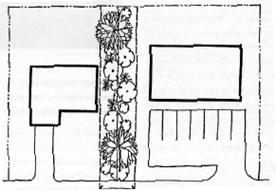
M.
Refuse Storage/Disposal.
1.
Trash bins must be fully enclosed, and block, stone and other masonry enclosures are preferred. Such enclosures shall be softened with landscaping on their most visible sides. Recommended locations for refuse storage bins include inside parking courts or at the end of the parking bays.
2.
Locations should be conveniently accessible for trash collection and maintenance and should not block access to drives during loading operations.
N.
Auxiliary Facilities. All auxiliary and support structures within multi-family residential projects such as laundry facilities, recreation buildings and sales/ lese offices should be consistent in architectural design, materials, façade treatments and landscaping, with the rest of the complex. Temporary sales offices should also be compatible with these guidelines.
O.
Mailboxes. All mailbox locations in multi-family developments must be approved by the US Postal Service. Common mailbox services shall be provided in all multi-family developments. They should be located close to the project entry and near recreational facilities. Their architectural character should be similar in form, materials and color to the surrounding buildings.
P.
Site Grading.
1.
Ideally multifamily dwellings should be placed six inches or more above the average grade of the site. Site grading should recognize existing drainage patterns, and landforms while providing appropriate transition of architectural elements to grade. Grade separations should be minimized as much as possible, as should retaining walls.
2.
Site grading should provide for an uninterrupted flow of vehicular and pedestrian traffic through the development. The plan shall direct and provide adequate flow of surface run-off to catch basins, while gracefully contouring the land to blend with existing conditions at the boundaries of the site.
3.
The use of center-swale drainage devices is strongly discouraged. Parking lots may drain into a single concrete swale at the edge of the aisle. Street drainage should be collected in curb gutters.
Q.
Security. Multi family dwellings should be designed to provide the maximum amount of security for residents and visitors. Landscaping should be planned and maintained to provide views into open space areas.
R.
Lighting Fixtures/Intensity.
1.
Strong and harsh lighting has been shown to be a major stressor to wildlife, and thus is strongly discouraged. All on site lighting shall be stationary, carefully directed away from adjacent properties and public rights-of-way, and of no more than the intensity appropriate to the residential use of the property.
2.
Strong lighting also places excess emphasis on residential developments in a manner which makes them stand apart from other residential developments and other uses, and calls attention to the development in a negative way. Some carefully directed lighting may be used in parking areas for security purposes. Lighting must be directed towards the ground, rather than toward the sky, and overspill into residences must be minimized.
(Zoning Ord. dated 1/31/06, § 9102.05(5).)
17.08.270 - Multi-family architecture.
The focus of multi-family residential development should be on the creation of high quality residential environments. Although there is no particular required architectural style for any of Banning's neighborhoods or zoning districts, architecture should be compatible with that of the surrounding residences and buildings. Compatibility should include harmonious building style, as well as form, size, scale, color, height, materials, finish orientation, and roofline.
Multi-family residences should be compatible with one another, but each should be unique in some way. Multi-family residences are often developed adjacent to single family neighborhoods, and measures should be taken to ensure that the height and bulk of higher density projects do not negatively impact these lower density residential areas. Multi-family architecture should create the appearance of individual units, and should use same the same quality of materials and treatments as single-family homes. Whenever possible, garages are encouraged over the use of carports.
A.
Facade and Roof Articulation.
1.
Long uninterrupted exterior walls should be avoided on all structures. All structure walls should have relief to create an interesting blend with landscaping, structures, shadows and light. Extremely long structures are acceptable, if they are appropriately articulated. However structures exceeding 150 feet in length are discouraged.
2.
Separations, changes in plane and height, and the inclusion of elements such as balconies, porches, arcades, dormers, and cross gables mitigate the barracks like quality of flat wall and roofs of excessive length. Secondary hipped or gabled roofs covering the entire mass of a building are preferable to segments of pitched roof applied at the structure's edge.
3.
Structures containing three or more attached dwellings in a row should incorporate at least one of the following:
a.
For each dwelling unit, at least one architectural projection not less than two feet from the wall plane and not less than four feet wide should be provided. Such projections should extend the full height of the single story structures, at least half the height of a two story building, and at least two thirds the height of a three story building.
b.
Changes in wall plane of at least three feet in depth for at least twelve feet in length for each two units should be provided.
B.
Scale.
1.
Building scale and form should relate to the use of the structure as a multi-family dwelling. Structures should be built on a human scale, so as not to overwhelm or dominate the neighborhood, or the residents of the immediate dwelling or adjacent dwellings.
2.
As multi-family developments are usually taller than one story, their bulk can be imposing on surrounding uses and on single family homes. The scale of such projects should be moderated by the context of their surroundings.
3.
Structures with more stories should be given additional setback when possible to avoid dominating the character of the neighborhood. Large projects should be broken into groups of structures, and the use of single mega structures for multi-family development shall be avoided. This pertains to developments having residents of any and all income levels.
C.
Building/Finish Materials.
1.
Materials selected for multi-family projects should be very durable and require low maintenance. Materials to be avoided include metal or aluminum siding and roofs, reflective materials and finishes, and unfinished concrete block.
2.
Materials tend to appear substantial and integral when material changes occur at changes in plane. Material changes not accompanied by changes in plane also frequently give material an insubstantial or applied quality.
3.
All structure elements in multi-family developments should be architecturally treated, and piecemeal embellishment and frequent changes in materials shall be avoided.
D.
Balconies, Porches, and Patios.
1.
Common exterior balconies, walkways and corridors which provide access to multiple dwelling units, do not require circulation past adjacent unit windows and entries. Separations in such exterior balconies and corridors can help light to filter down to the lower floors, and can add vibrancy to the exterior ground floor corridors.
2.
The incorporation of balconies, porches, and patios (whether private or accessible to use by all residents) within multi-family structures is strongly encouraged for both practical and aesthetic value. These elements should be integrated to break up large wall masses, offset floor setbacks, and add human scale to structures.
3.
Unique private nooks and niches are encouraged for the individual units within these multi-family developments.
E.
Dwelling Unit Access.
1.
Whenever possible, individual access should be created for each and every unit. Whenever possible, landscape bulbs should align with major building entrances to provide pedestrian access to the building entrance from a parking court or drive.
2.
The use of long, monotonous balconies and corridors providing access to five or more units should be avoided. Access points to units should be clustered in groups of four or less. The use of distinctive architectural elements and materials to denote prominent entrances is encouraged.
F.
Exterior Stairs.
1.
Projections of stairways which are wide, bold, and simple are encouraged to complement the architectural massing and form of the multi-family structure. The greater the width of the exterior stairways, the easier it will be for residents to move in and out, and for equipment, white goods, household appliances, and furniture, to move in and out of the development.
2.
Stairways should be of smooth stucco, plaster or block, with accent trim of complimentary colors, stone or tile work. Thin looking, open metal or wood, prefabricated stairs are discouraged as they are generally insufficient for multi-family residences.
G.
Carports, Garages and Accessory Structures.
1.
Parking garages within multi-family residential structures should be enclosed behind garage doors. Carports, detached garages, and accessory structures should be designed as an integral part of the architecture of the projects.
2.
They should be similar in materials, color and detail to the principal structures of the development. Carports may utilize flat roofs but should not project above any exterior walls adjacent to streets.
3.
Prefabricated metal carports may not be used. When garages are utilized, doors should appear set into walls, rather than flush with the exterior wall. Their design should be simple and unadorned, yet high quality materials should be used such.
H.
Gutters and Downspouts.
1.
Gutters, roof flashing, downspouts, vents and other such features and protrusions should be finished to match the adjacent materials and/or colors. Gutters and downspouts should be concealed unless they are designed as a continuous architectural feature.
2.
Exposed gutters used as architectural features should be colored to match fascia or wall material. Exposed downspouts should be colored to match the surface to which they are attached unless copper is used. Roof vents should be colored to match roofing materials or the dominant trim color of the structure.
I.
Active and Passive Solar Design. Solar panels should be integrated into the roof design flush with the roof slope, especially on those portions of the roof with eastern, western or southern exposures. Frames should be colored to match roofing materials or the dominant trim color of the structure. Aluminum or similar finishes are strongly discouraged. Any mechanical equipment should be enclosed and completely screened from view.
J.
Mechanical and Utility Equipment.
1.
Utility meters and equipment must be placed in locations which are not exposed to view from the street or from the general grounds, and they must be suitably screened or hidden by bushes, hedges or other landscaping, while still remaining accessible.
2.
All screening devices are to be compatible with the architecture and color of the adjacent structures. All mechanical equipment whether mounted on the roof or ground, must be screened from view.
K.
Antennas.
1.
All new units must be pre-wired to accommodate cable reception. All antennas should be placed in attics or building interiors.
2.
Satellite antennas are specifically prohibited on roofs, and should be considered early in the design process in terms of location and any required screening.
L.
Walls. Walls and fences are an important part of the streetscape and should be designed thoughtfully. Walls and fences should have the following characteristics:
1.
Both sides of all perimeter walls or fences should be architecturally treated.
2.
Walls should be of smooth stucco finish, or of plaster or of other approved masonry or stonework. They should be designed in a style, materials and color to complement the adjacent dwelling units.
3.
Chain link fences and barbed wire are not acceptable materials.
4.
Wood, masonry, vinyl and adobe are acceptable fence/wall materials.
5.
Decorative masonry walls, including, but not limited to, slump stone and split-face block can be used without a stucco or plaster finish, but must be architecturally treated and complement the adjacent dwelling units.
6.
All property fencing must be compatible in design and of similar materials.
(Zoning Ord. dated 1/31/06, § 9102.05(6); Ord. No. 1387, § 5.)
17.08.280 - Multi-family in-fill in single family neighborhood.
New multi-family developments should be integrated into existing neighborhoods so that they are compatible with adjacent structures and fit within thecontext of the existing neighborhood, whether that neighborhood be residential or mixed use.
A.
Front Yard Setbacks. For new multi-family projects, front yard setbacks should be equal to or greater than the average setbacks for the two adjacent properties. If one or both of the adjacent properties are vacant, then the average shall be calculated on the next adjacent occupied property.
B.
Architectural Compatibility. New multi-family residential development in existing neighborhoods should incorporate architectural characteristics and maintain the scale of existing structures on the property and surrounding development. This includes window and door detailing, facade decoration, materials, color, roof style and pitch, porches, and other elements.
C.
Site Design. New multi-family developments should be designed to continue the on-site relationships of the surrounding neighborhood and of the original structures. When it is possible to provide access from adjacent alleys, it is generally advantageous to do so.
(Zoning Ord. dated 1/31/06, § 9102.05(7).)
17.12.010 - Districts designated.
A.
This chapter is intended to support the development of a broad range of commercial and industrial businesses, by:
1.
Preventing uses which are incompatible with commercial and industrial land uses from locating in these districts.
2.
Providing for different types of commercial and industrial land uses which can locate in areas where they are assured compatible neighbors.
3.
Providing sufficient safeguards for the City's residents and workers by providing for buffers, clean industry and safe circulation.
4.
Minimizing the negative impacts of traffic intensity, such as noise, polluted air, gridlock, and danger to pedestrians.
5.
Planning for the provision of public improvements and infrastructure to serve Banning's commercial and industrial neighborhoods.
6.
Improving declining or blighted commercial and industrial areas.
B.
Each of the commercial and industrial districts being created is described below.
1.
Downtown Commercial (DC).
a.
This District occurs on Ramsey Street, between 8th Street and Hargrave Street on the west and east, by Interstate 10 on the south, and by Williams and Nicolet on the north. This area is the City's traditional commercial core, and has special significance to the community because small scale commercial retail and office uses, services, restaurants, and entertainment retail are the primary uses in this district. Mixed Use, residential land uses in combination with commercial businesses, are also encouraged. Bed and breakfasts, hotels and motels are also appropriate in this district.
b.
New auto related uses proposed after adoption of the 2005 General Plan will be prohibited. All existing auto uses in existence as of the adoption of the 2005 General Plan will be permitted until such time as the use in a particular location ceases operation for a period of six months.
c.
Special standards and permits are applied to this district, and are included under Development Standards, Article II of this chapter.
d.
Residential development standards, specific to the Downtown Commercial District, are also included under Development Standards, Article II of this chapter.
2.
General Commercial (GC).
a.
This district is the broadest of the City's commercial districts, and allows food and drug stores; home improvement; auto sales, leasing, service and repair; department and general retail outlets; merchandise leasing; neighborhood servingretail and services; restaurants; entertainment uses; gas stations; general offices (secondary to retail); mixed uses; and financial institutions.
b.
All uses in existence as of the adoption of the 2005 General Plan will be permitted until such time as the use in a particular location ceases operation for a period of six months.
3.
Highway Serving Commercial (HSC). This district allows land uses geared toward the Interstate 10 traveler, including restaurants (fast food and sit down), hotels and motels, auto related retail, repair and services, including gas stations, convenience stores and similar uses.
4.
Professional Office (PO). This district allows professional offices and social services, and financial institutions, all with only ancillary retail. Mixed use projects may also be permitted, with approval of a conditional use permit.
5.
Industrial (I). This district includes industrial parks and freestanding industrial users. Examples of permitted uses include light and medium intensity manufacturing operations, warehousing and distribution, ministorage, and associated offices. Commercial recreation facilities, auto storage and repair is also allowed. Retail uses ancillary to the industrial use are also appropriate.
6.
Airport Industrial (AI). Land uses must be focused on airport-related and transportation-related functions, including machining, manufacturing, warehousing, flight schools, restaurants and office uses. Aircraft maintenance, repair and catering services are also appropriate; and mixed-use projects may also be permitted, subject to a conditional use permit.
7.
Business Park (BP). Light industrial and office/warehouse buildings are appropriate in this district. Restaurants and retail uses ancillary to a primary use, and professional offices are also appropriate. Commercial development, such as large-scale retail (club stores, home improvement, etc.) and mixed-use project may also be permitted, subject to a conditional use permit.
8.
Industrial — Mineral Resources (I/MR). This district allows surface mining operations on lands designated by the City or the state as having significant potential for mineral resources. All the requirements of the State Department of Mining and Geology shall apply.
(Zoning Ord. dated 1/31/06, § 9103.01; Ord. No. 1448, § 5, 5-8-12; Ord. No. 1469, § 4, 10-8-13; Ord. No. 1596, § 2, 10-24-23)
17.12.020 - Permitted, Conditional, Prohibited Commercial and Industrial Uses.
The following list represents those uses in the commercial and industrial districts which are Permitted (P), subject to a Conditional Use Permit (C) or Prohibited (X).
Table 17.12.020
Permitted, Conditional and Prohibited Commercial and Industrial Uses
1 Surface mining permit required. See Chapter 17.100.
2 Mobile phones, televisions, video, audio systems, and digital cameras.
3 Refer to Section 17.12.050(B) for conditional use permit requirements.
4 A government office shall include administrative functions as well as those activities that will involve on-site customer patronage. A government office that is only administrative in nature, involving no customer patronage, can be considered a professional office.
5 When undertaken in conjunction with on-site retail as a primary use.
6 Existing mixed residential/commercial uses that are legal and nonconforming with respect to Conditional Use Permits may be reoccupied.
7 Cannabis Personal Cultivation is prohibited except in a house, an apartment unit, a mobile home, or other similar dwelling that is a legal non-conforming use and that otherwise complies with Chapter 5.34 of this Code.
8 Cannabis Retailers shall require approval of a Cannabis Conditional Use Permit by the City Council, after recommendation by the Planning Commission, and shall be subject to the requirements of Chapter 17.54.
9 Cannabis Commercial Indoor Cultivation, Cannabis Manufacturing Level 1, and Cannabis Testing Laboratory uses shall require approval of a Cannabis Conditional Use Permit by the City Council, after recommendation by the Planning Commission, and shall be subject to the requirements of Chapter 17.53.
10 A Cannabis Distribution Facility shall require approval of a Cannabis Conditional Use Permit by the City Council, after recommendation by the Planning Commission, and shall be subject to the requirements of Chapter 17.53.
11 A Cannabis Microbusiness shall require approval of a Cannabis Conditional Use Permit by the City Council, after recommendation by the Planning Commission, and shall be subject to the requirements of Chapter 17.53.
12 New Single-Family Residential Dwellings shall be prohibited on (East/West) Ramsey Street and (North/South) San Gorgonio Avenue.
(Zoning Ord. dated 1/31/06, § 9103.02; Ord. No. 1355, § 3 (part); Ord. No. 1387, § 3; Ord. No. 1392, § 3; Ord. No. 1426, § 5, 9-14-10; Ord. No. 1434, §§ 4, 14, 15, 2-8-11; Ord. No. 1448, § 7, 5-8-12; Ord. No. 1467, §§ 4, 6, 8-13-13; Ord. No. 1469, §§ 3, 8, 10-8-13; Ord. No. 1476, § 3, 1-28-14; Ord. No. 1488, § 3.2.a., 6-9-15; Ord. No. 1496, § 3(2), 5-10-16; Ord. No. 1507, § 3.2.3, 3-14-17; Ord. No. 1509, §, 4-11-17; Ord. No. 1510, § 3(2), 9-11-17; Ord. No. 1512, § 6, 10-10-17; Ord. No. 1530, §§ 4B, 4C, 9-25-18; Ord. No. 1535, § 4B, 11-13-18; Ord. No. 1523, § 3C, 7-10-18; Ord. No. 1531, § 3C, 11-13-18; Ord. No. 1547, § 3(Exh. A), 6-25-19; Ord. No. 1552, § 6—9, 1-28-20; Ord. No. 1565, §§ 9—11, 7-14-20; Ord. No. 1577, § 14, 9-28-21; Ord. No. 1596, § 2, 10-24-23; Ord. No. 1600, § 5, 2-27-24)
_____
17.12.030 - Table of commercial and industrial development standards.
Table 17.12.030
Commercial and Industrial Development Standards
12 If a commercially or industrially zoned lot is located adjacent to a residentially zoned lot, the minimum setback shall be 10 feet.
13 If a commercially or industrially zoned lot is located adjacent to a residentially zoned lot, the minimum setback shall be 10 feet.
14 Not including belltowers, steeples and similar architectural embellishments not exceeding 10% of the total building area.
15 Additional height may be permitted with approval of a Conditional Use Permit.
16 Additional height may be permitted for security as approved by the director through a technical staff review.
(Zoning Ord. dated 1/31/06, § 9103.03 (part); Ord. No. 1355, § 3 (part).)
(Ord. No. 1469, § 5, 10-8-13; Ord. No. 1596, § 2, 10-24-23)
_____
17.12.040 - General standards.
These standards apply to all development in the Commercial and Industrial districts, unless otherwise addressed in this Ordinance (all standards are minimum unless stated as maximum):
A.
All uses other than those specified as outdoor uses shall occur in a completely enclosed structure. Outside uses (e.g. patio dining areas and nursery sales) shall be approved through technical staff review.
B.
Except for the display area for sale or rent of motor vehicles, there shall be no visible storage of vehicles, trailers, airplanes, boats, recreational vehicles, or their composite parts; loose rubbish, garbage, junk, or their receptacles; tents; equipment; or building materials in any portion of a lot. Storage shall always be considered ancillary to the primary use. There shall be no storage on parcels otherwise vacant. Materials being used for the construction of a structure may be stored on the property only as long as a valid building permit is in effect.
C.
All structures within the commercial and industrial districts shall include a trash enclosure, constructed to the standards established by the public works department, and sufficient in size to accommodate the trash generated by the business. The trash enclosure shall include three walls and a gate, in a style compatible with the structure's architecture. The gate shall be maintained in working order and shall remain closed except when in use.
D.
All roof-mounted equipment, air conditioning or heating equipment, vents or ducts shall not be visible from any abutting lot, or any public street or right-of-way.
(Zoning Ord. dated 1/31/06, § 9103.03(1); Ord. No. 1448, § 8, 5-8-12)
_____
17.12.050 - Use Specific Development Standards.
The following standards apply to specific uses in the commercial and industrial districts. For residential uses in commercial districts, see Table 17.08.030, and the use specific standards contained in Section 17.08.030.
Table 17.12.050
Use Specific Development Standards
A.
Adult Entertainment. See Municipal Code.
B.
Alcohol Beverage Control "ABC" License.
1.
Alcoholic Beverage Control Board licenses are required for any business wishing to sell such beverages on- or off-site. These licenses are issued by the State of California. As indicated in Table 17.12.020, a Conditional Use Permit is required by the City in addition to the State license, except for sit-down restaurants where the on-site sale of alcoholic beverages is secondary to the primary function of the service of food. These businesses are exempt from the requirement for a Conditional Use Permit.
2.
In addition to any conditions of approval imposed by the Planning Commission, the following standards shall apply:
a.
Establishments shall not be located within 500 feet of any school or public park within the City.
b.
The license application shall be reviewed by the police department prior to planning commission approval.
3.
A bar or lounge is permitted in sit-down restaurants for the convenience of patrons. (Establishments which are primarily a bar or lounge or have a bar or lounge area as a principal or independent activity are not included in this exemption.)
C.
Automobile Dismantling. As indicated in Table 17.12.020, a conditional use permit is required for automobile wrecking/parts salvaging businesses. The following standards shall apply:
1.
The minimum site area shall be twenty thousand square feet.
2.
With the exception of structures or required landscaping areas, the site shall be entirely paved.
3.
All vehicles, parts of vehicles or vehicle parts shall be fully screened from view from adjacent properties, the public right of way, or the Interstate 10 corridor.
4.
No activity, including dismantling, service, loading or unloading shall be permitted on the adjacent public right-of-way. All such activities shall be conducted entirely within the property boundaries.
5.
Any service bays shall be oriented so as not to face the public right-of-way.
6.
Storage, use and removal of toxic substances, solid waste, and flammable liquids shall conform to all applicable federal, state and local regulations. All required licensing shall be maintained in good order at all times. Lapse or revocation of any required license shall result in the voiding of the conditional use permit.
7.
A trash enclosure shall be constructed to the standards established by the public works department, and sufficient in size to accommodate the trash generated by the business. The trash enclosure shall include three walls and a gate, in a style compatible with the structure's architecture. The gate shall be maintained in working order and shall remain closed except when in use.
8.
All exterior lighting shall be approved by the community development department. Lighting shall be limited to that necessary to light the project site. No lighting source shall be visible, or shall be permitted to spill over to adjacent properties.
9.
Outdoor hoists shall be prohibited.
10.
Exterior noise generated by the use shall not exceed 65 dBA at the property line.
11.
All signage shall comply with the provisions of Chapter 17.36 (Sign Standards).
12.
All landscaping shall be installed and permanently maintained pursuant to the provisions of Chapter 17.32 (Landscaping Standards).
13.
All parking shall comply with the provisions of Chapter 17.28 (Parking and Loading Standards).
14.
The entry shall be offset to minimize the view into the site.
D.
Automobiles Sales. Technical Staff Review shall be required for all businesses selling new or used vehicles, and all dealerships must be constructed in the following manner:
1.
The minimum site area shall be fifteen thousand square feet, except where a larger minimum area is required.
2.
All parts, accessories, etc., shall be stored within a fully enclosed building.
3.
Service and associated car storage areas shall be screened from public view.
4.
All loading and unloading of vehicles shall occur on-site and not in adjoining streets or alleys.
5.
All vehicles associated with the business shall be parked or stored on-site and not in adjoining streets and alleys.
6.
An adequate on-site queuing area for service customers shall be provided. Required parking spaces may not be counted as queuing spaces.
7.
No vehicle service or repair work shall occur except within a fully enclosed structure. Service bays with individual access from the exterior of the structure shall not directly face or front on a public right-of-way.
8.
All exterior lighting shall be approved by the community development department. Lighting shall be limited to that necessary to light the project site. No lighting source shall be visible, or shall be permitted to spill over to adjacent properties.
9.
All landscaping shall be installed and permanently maintained pursuant to the provisions of Chapter 17.32 (Landscaping Standards).
10.
All on-site signage shall comply with the provisions of Chapter 17.36 (Sign Standards).
11.
All on-site parking shall comply with provisions of Chapter 17.28 (Off-Street Parking Standards). A parking plan shall be developed as part of the permit review process.
12.
A trash enclosure shall be constructed to the standards established by the public works department, and sufficient in size to accommodate the trash generated by the business. The trash enclosure shall include three walls and a gate, in a style compatible with the structure's architecture. The gate shall be maintained in working order and shall remain closed except when in use.
13.
Automobile display area shall be paved.
14.
Chain link fence or chains are prohibited; wrought iron or decorative block walls are encouraged.
E.
Business Park Development on Ramsey Street. Development in the Business Park district which has a property line adjacent to Ramsey Street shall conform to the following criteria:
1.
At least fifty percent of the lineal frontage on Ramsey Street shall be occupied by retail commercial land uses.
2.
A minimum landscaped setback of twenty-five feet shall be provided for all property lines adjacent to, or across a street or alley from, residentially designated properties.
3.
Walls and fences may be provided in the front, sides and rear yards. Wall, fences, and gates that are to be used for screening purposes shall be decorative solid block walls, or stucco block walls, or wrought iron (open fencing shall be backed by solid or perforated metal colored to match the fence or gate) or a combination of decorative block wall and wrought iron grill work. Colors and materials for the walls and fences shall be compatible with the building architecture. The wall shall be located at the interior boundary of the landscaped setback if required in subsection 2, above.
4.
Outdoor storage, outdoor fabrication or manufacturing activities shall be completely screened from view.
5.
Loading areas and loading docks shall be located on the side of the lot to the greatest extent possible.
6.
Manufacturing activities shall be prohibited before 7:00 A.M. or after 7:00 P.M., on Saturdays and Sundays, and legal holidays.
7.
All projects which include a manufacturing component shall be required to complete an Initial Study under the California Environmental Quality Act, and may be required to prepare specialized air quality or other analyses, as determined necessary by the Director.
8.
Exterior lighting shall not spill onto adjacent properties. Lighting plans, including lighting levels at property lines, shall be submitted as part of the Design Review application.
F.
Business Park Development Not on Ramsey Street. Development in the Business Park district shall conform to the following criteria:
1.
A minimum landscaped setback of twenty-five feet shall be provided for all property lines adjacent to, or across a street or alley from, residentially designated properties.
2.
Walls and fences may be provided in the front, sides and rear yards. Wall, fences, and gates that are to be used for screening purposes shall be decorative solid block walls, or stucco block walls, or wrought iron (open fencing shall be backed by solid or perforated metal colored to match the fence or gate) or a combination of decorative block wall and wrought iron grill work. Colors and materials for the walls and fences shall be compatible with the building architecture. The wall shall be located at the interior boundary of the landscaped setback if required in subsection 1, above.
3.
Outdoor storage, outdoor fabrication or manufacturing activities shall be completely screened from view.
4.
Loading areas and loading docks shall be located on the side of the lot, away from residentially designated property, to the greatest extent possible.
5.
Hours of operation shall be determined during project review.
6.
All projects which include a manufacturing component shall be required to complete an Initial Study under the California Environmental Quality Act, and may be required to prepare specialized air quality or other analyses, as determined necessary by the Director.
7.
Exterior lighting shall not spill onto adjacent properties. Lighting plans, including lighting levels at property lines, shall be submitted as part of the Design Review application.
G.
Day Care Centers. Refer to Section 17.08.060.
H.
Downtown Commercial Development. The Downtown Commercial zoning district applies to a clearly defined and limited area of the City which represents its core and its history. The following standards shall apply to all structures and land uses in the Downtown Commercial district. Design guidelines shall be utilized in concert with these standards.
1.
All land uses permitted by right in Table 17.12.020 in the Downtown Commercial district, and proposed for an existing structure, without expanding that structure, shall require a business license. No Design Review shall be required.
2.
Multi-family/High Density residential uses shall be permitted at a density of up to 30 dwelling units per acre. Multi-family residential uses are prohibited on the ground floor on Ramsey Street and San Gorgonio within the Downtown Commercial district. Multi-family uses on Ramsey Street and San Gorgonio must occur above commercial uses. In the balance of the district, multi-family uses may occur on any level.
3.
Multi-family residential uses shall be subject to the following Design Standards:
a.
Minimum front for Multi-family/High Density Units: 15-feet
b.
Minimum interior side: 4-ft.
c.
Minimum street side: 4-ft.
d.
Minimum rear setback: 15-ft.
4.
Multi-family residential uses, for lots smaller than 3,000 sf. Or less than 35-ft. wide, shall be subject to the following Design Standards:
a.
Minimum interior side: 3-feet
b.
Minimum street side:3-feet
c.
Height Regulations
d.
Maximum height for accessory structures: 15 ft.
5.
Multi-family residential uses shall provide the following outdoor space for each unit:
a.
Private Outdoor Space. A minimum private outdoor space of forty (40) square feet shall be provided for each dwelling unit. Such private outdoor space shall be designed as a patio, deck, or balcony and shall have a minimum length or width of four (4) feet and shall be directly accessible and an integral part of the dwelling unit which it serves.
b.
Common Outdoor Space. A minimum common outdoor space of two hundred (200) square feet shall be provided per dwelling unit for the first twenty-five (25) dwelling units on a lot; a minimum common outdoor space of one hundred fifty (150) square feet shall be provided per dwelling unit for each additional dwelling unit above fifty (50) on a lot. Any common outdoor space shall have a minimum level surface dimension of ten (10) feet and a minimum area of two hundred (200) square feet. Landscaping and seating shall be permanently integrated into all required common outdoor spaces. No street front setback area of street side setback area shall be used for common outdoor space.
I.
Drive-Through Restaurants. The following standards shall apply for all drive-through restaurants.
1.
Pedestrian walkways should not intersect the drive-through aisles, but where they do, they shall have clear visibility, and they must be emphasized by enriched paving or striping.
2.
Drive-through aisles shall have a minimum 12-foot width on curves and a minimum 11-foot width on straight sections. Drive-through aisles shall be constructed with (PCC) concrete.
3.
Drive-through aisles shall provide sufficient stacking area behind menu board to accommodate a minimum of 6 cars.
4.
No drive-through aisles shall exit directly onto a public right-of-way.
5.
Parking areas and the drive-through aisle and structure shall be setback from the ultimate curb face a minimum of 25 feet.
6.
Landscaping, berming, and/or decorative walls shall screen drive-through or drive-in aisles from the public right-of-way and shall be used to minimize the visual impact of readerboard signs and directional signs. Screening shall be combined to total 6 feet in height.
7.
Menu boards shall be a maximum of 30 square feet, with a maximum height of 7 feet, and shall face away from the public right-of-way.
8.
The architectural style of a drive-through restaurant proposed within an existing shopping center shall be consistent with the architecture of that center in form, materials, colors, scale, etc. Articulation of building surfaces through the use of openings, recesses and high-relief mouldings which create texture and shadow patterns is required.
9.
All landscaping shall be installed and permanently maintained pursuant to the provisions of Chapter 17.32 (Landscaping Standards).
10.
All on-site signage shall comply with the provisions of Chapter 17.36 (Sign Standards).
11.
All on-site parking shall comply with provisions of Chapter 17.28 (Off-Street Parking Standards). A parking plan shall be developed as part of the permit review process.
12.
A trash enclosure shall be required, constructed to the standards established by the Public Works Department, and sufficient in size to accommodate the trash generated by the business. The trash enclosure shall include three walls and a gate, in a style compatible with the structure's architecture. The gate shall be maintained in working order and shall remain closed except when in use.
J.
Massage Parlors. See Banning Municipal Code.
K.
Mini-Storage. Mini-storage facilities shall meet the following standards:
1.
The minimum site area shall be 20,000 square feet.
2.
The site shall be entirely paved, except for structures and landscaping.
3.
All on-site lighting shall be energy efficient, the light source shall not be visible, shall be stationary and directed away from adjoining properties and public rights-of-way.
4.
The site shall be completely surrounded by a 6 foot high solid decorative masonry wall, except for points of ingress and egress (including emergency fire access) which shall be properly gated. The gates(s) shall be maintained in good working order and shall remain closed except when in use.
5.
Aisle width shall be a minimum of 24 feet between buildings to provide unobstructed and safe circulation.
6.
All storage shall be located within a fully enclosed structure(s), except for vehicle storage, if permitted.
7.
No flammable or otherwise hazardous materials shall be stored on-site.
8.
Residential quarters for a manager or caretaker must be provided.
9.
All landscaping shall be installed and permanently maintained pursuant to the provisions of Chapter 17.32 (Landscaping Standards).
10.
All on-site signage shall comply with the provisions of Chapter 17.36 (Sign Standards).
11.
All parking shall comply with the provisions of Chapter 17.28 (Parking Standards).
12.
All structures shall include a trash enclosure, constructed to the standards established by the Public Works Department, and sufficient in size to accommodate the trash generated by the business. The trash enclosure shall include three walls and a gate, in a style compatible with the structure's architecture. The gate shall be maintained in working order and shall remain closed except when in use.
13.
Storage facilities located adjacent to residential districts shall have their hours of operation restricted to 7:00 AM to 9:00 PM, Monday through Saturday, and 9:00 AM to 9:00 PM on Sundays.
L.
Senior Citizen/Congregate Care Housing Standards. Refer to Section 17.08.180.
M.
Service Station Standards. Service stations shall comply with the following standards:
1.
New service stations shall be permitted only at the intersections of arterials and secondary roadways.
2.
The minimum parcel size shall be 15,000 square feet.
3.
All operations shall be conducted entirely within an enclosed structure, except as follows:
a.
The dispensing of petroleum products, water and air from pump islands.
b.
The provision of emergency service of a minor nature.
4.
Pump islands shall be located whenever possible behind the main structure and have a minimum of 20 feet from a street property line. A canopy or roof structure shall be required over a pump island, and may extend up to 10 feet from the street property line.
5.
The cashier location shall provide direct visual access to the pump islands and the vehicles parked adjacent to the islands.
6.
There shall be no more than 2 points of access provided on each street, which shall be a minimum distance of 30 feet apart.
7.
No driveway may be located closer than 40 feet to the curb return.
8.
The width of a driveway may not exceed 30 feet at the sidewalk.
9.
Outside storage of motor vehicles is prohibited.
10.
No vehicles may be parked on sidewalks, parkways, driveways or alleys.
11.
No vehicle may be parked on the premises for the purpose of offering same for sale.
12.
No used or discarded automotive parts or equipment, or disabled, junked or wrecked vehicles may be located in any open area outside the main structure.
13.
All lighting, including canopy, perimeter, and flood lights shall be energy efficient, stationary and shielded or recessed within the roof canopy. Lighting shall not be of such a high intensity as to cause a traffic hazard or adversely affect adjoining properties.
14.
All landscaping shall be installed and permanently maintained pursuant to the provisions of Chapter 17.32 (Landscaping Standards).
15.
All on-site signage shall comply with the provisions of Chapter 17.36 (Sign Standards).
16.
All parking shall comply with the provisions of Chapter 17.28 (Parking Standards).
17.
All structures shall include a trash enclosure, constructed to the standards established by the Public Works Department, and sufficient in size to accommodate the trash generated by the business. The trash enclosure shall include three walls and a gate, in a style compatible with the structure's architecture. The gate shall be maintained in working order and shall remain closed except when in use.
18.
Restroom entrances visible from adjacent properties or public-rights-of-way shall be prohibited.
19.
Noise from bells or loudspeakers shall not be audible beyond the property line at any time.
N.
Service Station Conversions. A structure originally constructed as a service station and which is proposed for conversion to another allowable use shall require upgrading and remodeling for such items as, but not limited to, removal of all gasoline appurtenances, removal of canopies, removal of pump islands, removal of gas tanks, removal of overhead doors, additional street improvements or modification of existing improvements to conform to access regulations, exterior remodeling, and any additional standards as required by this Zoning Ordinance.
O.
Single Family Housing, Existing. Maintenance of non-conforming single-family units which legally existed in the commercial and industrial districts prior to the adoption of this Zoning Ordinance, shall comply with the LDR District Standards. Additions, alteration, and expansions will not be permitted.
P.
Single Family/Office Conversions. A structure constructed as a family residence and proposed for conversion to an office use shall require the following:
1.
The character of the building facade and landscaping in the front yard shall be maintained.
2.
Parking shall be provided on the side or rear of the structure. Access may be permitted from the original driveway if there is a minimum width of ten feet.
3.
If the rear property line abuts an alley, access to parking shall be provided from the alley whenever possible.
4.
Where two or more single-family residences adjacent to one another are converted to office uses, reciprocal access and parking may be required.
5.
Landscaping requirements may be reduced to five percent of the parking area to provide adequate parking.
6.
Loading spaces are not required.
7.
The structure shall conform to the provisions of the Uniform Fire Code and the Uniform Building Code for commercial structures in effect at the time the structure is converted.
8.
Trash receptacles should be placed to the rear of the structure and screened from view. Location and size of receptacles will be determined at project review.
Q.
Boarding Houses and Single Room Occupancies.
1.
All requirements outlined in Section 17.08.201 shall be complied with.
R.
Tattoo and Body Piercing Studios. As indicated in table 17.12.020, a conditional use permit is required for tattoo and/or body piercing businesses. The following standards shall apply:
1.
The business shall maintain in a sanitary condition at all times both the facilities and employees of the business. All walls, ceilings, floors, furnishings, and instruments used for tattoo and piercing shall be kept in good repair, and maintained in a clean and sanitary condition. Employees shall be required to wash their hands prior to any contact with customers.
2.
Officers of the police department, code enforcement division, and the fire department shall have the right to enter any tattoo and body piercing businesses during regular business hours to make reasonable inspection to ascertain whether the provisions of this chapter are being complied with, provided reasonable and normal business operations shall not be interfered with by said inspection.
3.
The hours of operation shall be no earlier than 7:00 a.m. and no later than 10:00 p.m.
4.
All activities shall be located indoors.
S.
Hookah and Smoking Lounge. As indicated in Table 17.12.020, a conditional use permit is required for all hookah and smoking lounge businesses. The following standards shall apply:
1.
The business shall not be located within one thousand feet of any other hookah and smoking lounge as measured from any point from the outer boundaries of the property containing the business.
2.
The business shall not be located within five hundred feet of any adult-oriented business as measured from any point from the outer boundaries of the property containing the business.
3.
The business shall not be located within one hundred feet of any residential use as measured from any point between the outer boundaries of the property containing the business and the nearest property line of a residentially occupied property.
4.
The business shall not be located within six hundred feet of a school, park or day care center/family day care home as measured from any point between the outer boundaries of the property containing the business to the nearest property line of the school, park or day care center/family day care home.
5.
An outdoor patio shall be required together with any proposed or existing hookah or smoking lounge use.
6.
The hours of operation shall be no earlier than 7:00 a.m. and no later than 11:00 p.m.
T.
Fortune-Telling. As indicated in Table 17.12.020, a conditional use permit is required for fortune-telling businesses. The following standards shall apply:
1.
The business shall not be located within one thousand feet of any other fortune-telling businesses as measured from any point from the outer boundaries of the property containing the business.
2.
The business shall not be located within five hundred feet of any adult-oriented business as measured from any point from the outer boundaries of the building lease space containing the business.
3.
The business shall not be located within one hundred feet of any residential use as measured from any point between the outer boundaries of the property containing the business and the nearest property line of a residentially occupied property.
4.
The business shall not be located within six hundred feet of any school, park or day care center/family day care home as measured from any point between the outer boundaries of the property containing the business and the nearest property line of the school, park or day care center/family day care home.
5.
The hours of operations shall be no earlier than 7:00 a.m. and no later than 10:00 p.m.
U.
[Emergency Shelters.] In addition to the development standards of the base district provided in Sections 17.12.030 and 17.12.040, emergency shelters shall comply with the following use-specific standards:
1.
Maximum of twenty-five beds.
2.
Minimum separation of three hundred feet between emergency shelters.
3.
Off-street parking ratio of one space per four beds plus one space for each staff member on duty.
4.
Management and operations plan required specifying hours of operation, staffing levels and training procedures, maximum length of stay, size and location of exterior and interior on-site waiting and intake areas, admittance and discharge procedures, provisions for on-site or off-site supportive services, house rules regarding use of alcohol and drugs, on-site and off-site security procedures, and protocols for communications with local law enforcement agencies and surrounding property owners.
U.
Community Gardens. Community Gardens in all zones shall meet the requirements of 17.08.202 Community Gardens.
V.
Commercial Cannabis Indoor Cultivation uses shall require approval of a Cannabis Conditional Use Permit by the City Council, after recommendation by the Planning Commission, and shall be subject to the requirements of Chapter 17.53.
W.
Commercial Cannabis Manufacturing Level 1 uses shall require approval of a Cannabis Conditional Use Permit by the City Council, after recommendation by the Planning Commission, and shall be subject to the requirements of Chapter 17.53.
X.
Commercial Cannabis Testing Laboratory uses shall require approval of a Cannabis Conditional Use Permit by the City Council, after recommendation by the Planning Commission, and shall be subject to the requirements of Chapter 17.53.
Y.
Cannabis Retailers shall require approval of a Cannabis Conditional Use Permit by the City Council, after recommendation by the Planning Commission, and shall be subject to the requirements of Chapter 17.54.
Z.
A Cannabis Distribution Facility shall require approval of a Cannabis Conditional Use Permit by the City Council, after recommendation by the Planning Commission, and shall be subject to the requirement of Chapter 17.53.
AA.
A Cannabis Microbusiness shall require approval of a Cannabis Conditional Use Permit by the City Council, after recommendation by the Planning Commission, and shall be subject to the requirement of Chapter 17.53.
(Zoning Ord. dated 1/31/06, § 9103.03; Ord. No. 1392, § 6.; Ord. No. 1434, §§ 5—10, 2-8-11; Ord. No. 1448, §§ 4, 6, 5-8-12; Ord. No. 1467, § 5, 8-13-13; Ord. No. 1470, §§ 3, 4, 12-10-13; Ord. No. 1509, §, 4-11-17; Ord. No. 1530, § 4A, 9-25-18; Ord. No. 1535, §§ 4C, 4D, 11-13-18; Ord. No. 1523, § 3D, 7-10-18; Ord. No. 1531, § 3D, 11-13-18; Ord. No. 1577, §§ 15, 16, 9-28-21; Ord. No. 1596, § 2, 10-24-23)
17.12.060 - Applicable regulations.
All permitted and conditionally permitted uses shall be subject to the applicable regulations of this Zoning Ordinance, including, but not limited to, Chapter 17.28, Parking Standards, Chapter 17.32, Landscaping Standards, and Division IV, Administration Provisions.
(Zoning Ord. dated 1/31/06, § 9103.04.)
17.12.070 - General.
A.
The following design guidelines are provided to assist project designers in understanding the city's goals for new development and redevelopment. Wherever possible, examples have been provided through the use of descriptions and graphics.
B.
These guidelines will be used by city staff and decision makers in their review of proposed projects, and should be adhered to whenever possible. If a specific guideline is not incorporated into a proposed project, the designer or project proponent must be prepared to provide city staff with a compelling reason for the omission or variation.
(Zoning Ord. dated 1/31/06, § 9103.05(1).)
17.12.080 - Applicability.
The provisions of this chapter shall apply to all commercial and industrial development within the city, except when the property is subject to the standards and guidelines of an approved specific plan. Any addition, remodeling, relocation, or construction requiring a building permit within any commercial or industrial district subject to review under Table 17.44.010 (Administration, Review Authority) shall adhere to the applicable guidelines.
(Zoning Ord. dated 1/31/06, § 9103.05(2).)
17.12.090 - General design principles.
A.
Desirable Elements of Project Design. Commercial and industrial buildings should include:
1.
Significant texture for building surfaces
2.
Wall articulation (insets, canopies, wing walls, trellises)
3.
Multi-planed, pitched roofs
4.
Roof overhangs, arcades and covered walkways
5.
Regular window distribution
6.
Articulated mass and bulk
7.
Significant landscape and hardscape elements
8.
Clearly identifiable access driveways
9.
Convenient and accessible parking
10.
Landscaped and screened parking
11.
Unified and complementary signage
B.
Undesirable Elements. Commercial and industrial buildings should not include:
1.
Large blank, unarticulated wall surfaces
2.
Unpainted concrete or un-stuccoed precision block walls
3.
Reflective surfaces
4.
Metal or plastic siding
5.
Square "boxlike" structures
6.
Unrelated architectural elements (e.g. Mission tower on a modern building)
7.
Visible outdoor storage, loading, and equipment areas
[8, 9.]
[Reserved.]
10.
Large parking areas without landscaping relief.
(Zoning Ord. dated 1/31/06, § 9103.05(3).)
17.12.100 - Site planning.
A.
Projects should be developed to coordinate and complement existing development on adjacent sites. When possible, pedestrian and vehicular connections to existing development should be created.
B.
New structures should be clustered when possible to create plazas and pedestrian areas within a project. When linear buildings are proposed, a visual link should be provided, such as a connecting walkway or trellis, which provides continuity to the site.
C.
Protect pedestrians from the site's circulation system whenever possible. Crosswalks and pedestrian walkways should be highlighted with enhanced paving, landscaping or other means to clearly separate them from the vehicular circulation of the site.
D.
Outdoor spaces should provide pedestrian amenities such as shade, benches, fountains, etc. which make them comfortable to pedestrians, and identify the space clearly.
E.
Outdoor displays should not impede pedestrian access, should be temporary, and located in an area that is suitable for such displays. Avoid displays on parking lots, overcrowding and stacking along the building frontage.
F.
Storefront displays are encouraged.
G.
Single use buildings should be oriented to the main street on which they are located, with the primary entry clearly located near the street.
H.
Loading facilities should not be located at the front of structures, but at the rear of the site where adequate screening can be provided.
I.
Shared parking and reciprocal parking agreements between compatible uses are encouraged.
J.
Parking pockets within multiple buildings versus large expansive parking lots are encouraged.
(Zoning Ord. dated 1/31/06, § 9103.05(4).)
17.12.110 - Parking and circulation.
A.
Pedestrian linkages between uses in commercial developments should be clearly separate from vehicular circulation patterns, and should including distinct pedestrian access.
B.
Parking aisles should be separated access driveways whenever possible.
C.
Whenever possible, the driveway's throat should be extended in order to set back the parking spaces from the street.
D.
Whenever possible, project planning should include joint driveways providing access to more than one site.
E.
Parking areas shall be landscaped in accordance with the requirements of this Zoning Ordinance.
F.
Shared parking is desirable whenever practical.
G.
Interior circulation should always incorporate logical direction of travel to avoid vehicle conflicts.
H.
Access to parking areas should be from side streets whenever possible, or from driveways to the rear or to the side (between structures) of the subject structure. When access from a primary roadway is required, enhanced paving should be provided to clearly locate sidewalks within the entry drives.
I.
The access to parking areas should be located as far from street intersections as possible. Access points should be limited to only the number necessary for efficient circulation. Public works standards for separation between driveways, and for separations between driveways and intersections shall be enforced.
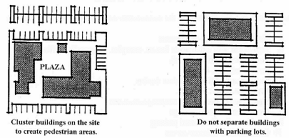
J.
Large expansive parking lots should be avoided.
K.
Pedestrian circulation should be designed to minimize the need to cross parking aisles and landscape areas.
L.
The parking area should be located behind or between existing structures and link the structures to the street sidewalks.
M.
Large parking areas should be divided into connected smaller lots by buildings and landscaping and raised concrete areas.
N.
Parking stalls should be located at least forty feet from the curb. In larger projects, this distance may be greater, in order to accommodate vehicle cueing.
O.
Whenever possible, parking areas are discouraged along the street; however, should parking be located along the street, a combination of walls, and/or berms, and/or landscape material must be provided to screen parking areas from the adjacent street. The screening should be between thirty-six inches and forty-eight inches, except when a drive-through aisle is being screened, in which case a higher screen is necessary to hide the vehicles. Lowered grades in parking lots may also be used to accomplish this.
(Zoning Ord. dated 1/31/06, § 9103.05(5); Ord. No. 1448, § 10, 5-8-12)
17.12.120 - Landscaping.
A.
Landscaping should help provide a focus on entrances to buildings and parking lots, provide transition between neighboring properties and screening for loading and equipment areas.
B.
Landscaping should be scaled to be compatible with adjacent structures.
C.
Landscaping around structures is recommended to soften the transition between the parking lot and the structure.
D.
Raised planting beds and concrete mow strips should be provided to discourage pedestrian cross-through in planting areas.
E.
Plantings in containers should be used whenever possible to soften sidewalks and plaza areas.
(Zoning Ord. dated 1/31/06, § 9103.05(6).)
17.12.130 - Walls and fences.
A.
Walls should be kept to the lowest height possible to accomplish their screening or buffering function.
B.
Walls should always be decorative, and should be designed to blend with the structure's architectural style.
C.
Security fencing should combine solid walls with wrought iron grill work. Additional height for security fencing may be approved by the director through technical staff review.
D.
Long walls should include pillars or other treatment every fifty feet to provide visual relief.
E.
Chain link and barbed wire fencing is prohibited, except as provided for below.
F.
Chain link fencing shall be allowed subject to Design Review approval by the Planning Commission within the Industrial (I) district and Airport Industrial (AI) district for projects that are at least five acres (or two hundred seventeen thousand eight hundred square feet) in size with a single business entity managing all operations within the site.
G.
Precision block walls must be stuccoed.
(Zoning Ord. dated 1/31/06, § 9103.05(7).)
(Ord. No. 1469, § 6, 10-8-13; Ord. No. 1530, § 4D, 9-25-18)
17.12.140 - Screening.
A.
Outdoor storage areas should be screened by walls of a minimum of six feet, and a maximum of eight feet in height. Chain link fencing is not acceptable.
B.
All equipment located on roofs, the side of a structure, or on the ground, shall be screened from view. The screen shall be integrated with the building architecture and the site's landscape plan.
(Zoning Ord. dated 1/31/06, § 9103.05(8).)
17.12.150 - Architectural design guidelines.
A.
The height and scale of new development should always be compatible with adjacent existing development. New development may need to transition building height in order not to overpower existing development.
B.
The appearance of large scale "big box" buildings is discouraged. Larger retail and industrial structures shall be mitigated through the use of varied roof and wall planes; varied building height; changes in colors and building materials; landscaping islands adjacent to the structure; and the use of windows, doors and trellises.
C.
Building scale should be carefully planned to relate to pedestrian areas. The scale of a large building can be reduced through the use of pedestrian oriented signs; seating areas; awnings and overhangs; color and material variations; and landscaping.
D.
Standard "corporate" architectural styles used by franchise or chain stores and restaurants is highly discouraged, and is prohibited in the Downtown Commercial district.
E.
Paint color should be carefully chosen to enhance and soften the built environment. Large areas of stark white are discouraged. The colors used on a new project should be compatible with those of adjacent existing projects.
(Zoning Ord. dated 1/31/06, § 9103.05(9).)
17.12.160 - Roofs.
A.
Articulation of roof planes should be provided at fifty-foot intervals throughout a structure.
B.
All roof top equipment shall be screened from public view.
C.
Unpainted corrugated metal, reflective surfaces or illuminated roofs should not be used.
(Zoning Ord. dated 1/31/06, § 9103.05(10).)
17.12.170 - Lighting.
A.
Lighting in commercial and industrial projects should be only the minimum required for safety and security.
B.
Light standards should be limited to eighteen to twenty-five feet. Smaller pedestrian oriented light standards are encouraged in the downtown commercial district.
C.
Lighting should be integrated into the structure's architecture to the greatest extent possible.
D.
All lighting fixtures shall not have a visible light source, must be shielded and directed downward to confine light spread within the site boundaries.
(Zoning Ord. dated 1/31/06, § 9103.05(11).)
17.12.180 - Multi-family site planning and architecture design standards.
A.
Building Articulation. In multi-family dwellings, building facades should be broken up and articulated to give the appearance of a collection of smaller structures. Long, unbroken facades and box-like forms should be avoided. Each unit should be distinguishable from adjacent units. Differentiation of units can be accomplished with the use of varied roof heights, colors, finish materials, balconies, setbacks, and projections which help articulate individual dwelling units or collections of units, as well as by the pattern and rhythm of doors and windows.
B.
Clustering of Units. The clustering of multi-family units should be a standard element of site plan design. Structures which are composed of simple yet varied planes, enhance variety and compatibility in the overall building form. Design techniques to be considered and implemented whenever possible include:
Staggered and jogged unit planes;
Varying front setbacks within the same structure;
The incorporation of varied rooflines and wall lines;
The use of a variety of orientations to avoid visual monotony.
C.
Project Entries. Attention should always be given to architectural and landscape treatments of entryways to enhance the overall image of a project. Entry areas should incorporate landscaping, recreational facilities and project directories when possible.
D.
Entry Drives. Colored and textured paving treatment at entry drives is encouraged, however, stamped concrete is not permitted within public street rights of way. The principal vehicular access into a multi-family housing development should be through an entry drive rather than a parking drive.
E.
On-Site Parking and Drives. Parking may be accommodated in higher density projects through the use of parking drives, parking courts, underground garages, and garages within residential buildings. Developments with long, monotonous parking drives or with large, undivided parking lots should be avoided. When parking cannot be provided within residential structures, dispersed parking courts are the desired alternative. Perimeter parking drives should be minimized, and residents often like to have a view of the parking areas which they utilize.
F.
Garages. Garages with parking aprons less than twenty feet in length should have automatic garage door openers and or sectional roll up doors. Individual parking garages within residential structures should be enclosed behind garage doors.
G.
Carports.
1.
Carports should not be incorporated into exterior project walls, when these walls are adjacent to streets. The ends of each cluster of carports should be landscaped to provide variety and visual stimulation. Carports can be a useful element in providing shading and cooling for automobiles.
2.
Where carports are utilized, they must follow the same criteria for spatial arrangements as parking courts, as described previously in this chapter. Carports may be incorporated with patio walls, or used to help define public and private open space.
H.
Pedestrian Access From Parking. Whenever possible, landscape bulbs should align with major building entrances to provide pedestrian access to the building entrance from a parking court or drive. When landscape bulbs are aligned with entrances, they should be at least two car spaces wide and should include a pathway, as well as vertical landscaping and architectural elements such as trees, trellises, sculpture, hedges and the like.
I.
Open Space.
1.
The design and orientation of open space areas should take advantage of available sunlight, and should be sheltered from the noise and traffic of adjacent streets or other incompatible uses. Required common open spaces should be conveniently located for the majority of units. Private open spaces should be contiguous to the units they serve and should be screened from public view. Whenever possible, children's play areas should be visible from the units.
J.
Landscape Areas.
1.
Good landscaping can help to bring a residential development into greater harmony with its surrounding natural environment. Landscaping can be used to frame, soften, and embellish the quality of the environment; to buffer units from noise or undesirable views; to break up large expanses of parking; and to separate frontage roads within a project from public streets.
2.
In addition to grass and groundcover, trees and tall shrubs are needed. Trees can provide a vertical design element which enhances visual interest. Trees can also be used to provide shading and climactic cooling of nearby residential units and parking spaces. Entrances to residential developments should when possible be oriented toward the green space, open space and recreational areas of the development.
K.
Refuse Storage/Disposal.
1.
Trash bins must be fully enclosed, and block, stone and other masonry enclosures are preferred. Such enclosures shall be softened with landscaping on their most visible sides. Recommended locations for refuse storage bins include inside parking courts or at the end of the parking bays.
2.
Locations should be conveniently accessible for trash collection and maintenance and should not block access to drives during loading operations.
L.
Auxiliary Facilities. All auxiliary and support structures within multi-family residential projects such as laundry facilities, recreation buildings and sales/ lese offices should be consistent in architectural design, materials, facade treatments and landscaping, with the rest of the complex. Temporary sales offices should also be compatible with these guidelines.
M.
Security. Multi-family dwellings should be designed to provide the maximum amount of security for residents and visitors. Landscaping should be planned and maintained to provide views into open space areas.
N.
Lighting Fixtures/Intensity.
1.
Strong and harsh lighting has been shown to be a major stressor to wildlife, and thus is strongly discouraged. All on site lighting shall be stationary, carefully directed away from adjacent properties and public rights-of-way, and of no more than the intensity appropriate to the residential use of the property.
2.
Strong lighting also places excess emphasis on residential developments in a manner which makes them stand apart from other residential developments and other uses, and calls attention to the development in a negative way. Some carefully directed lighting may be used in parking areas for security purposes. Lighting must be directed towards the ground, rather than toward the sky, and overspill into residences must be minimized.
(Ord. No. 1596, § 3, 10-24-23)
17.12.190 - Multi-family architecture.
The focus of multi-family residential development should be on the creation of high quality residential environments. Although there is no particular required architectural style for any of Banning's neighborhoods or zoning districts, architecture should be compatible with that of the surrounding residences and buildings. Compatibility should include harmonious building style, as well as form, size, scale, color, height, materials, finish orientation, and roofline.
Multi-family residences should be compatible with one another, but each should be unique in some way. Multi-family residences are often developed adjacent to single family neighborhoods, and measures should be taken to ensure that the height and bulk of higher density projects do not negatively impact these lower density residential areas. Multi-family architecture should create the appearance of individual units, and should use same the same quality of materials and treatments as single-family homes. Whenever possible, garages are encouraged over the use of carports.
A.
Facade and Roof Articulation.
1.
Long uninterrupted exterior walls should be avoided on all structures. All structure walls should have relief to create an interesting blend with landscaping, structures, shadows and light. Extremely long structures are acceptable, if they are appropriately articulated. However structures exceeding 150 feet in length are discouraged.
2.
Separations, changes in plane and height, and the inclusion of elements such as balconies, porches, arcades, dormers, and cross gables mitigate the barracks like quality of flat wall and roofs of excessive length. Secondary hipped or gabled roofs covering the entire mass of a building are preferable to segments of pitched roof applied at the structure's edge.
B.
Scale.
1.
Building scale and form should relate to the use of the structure as a multi-family dwelling. Structures should be built on a human scale, so as not to overwhelm or dominate the neighborhood, or the residents of the immediate dwelling or adjacent dwellings.
2.
As multi-family developments are usually taller than one story, their bulk can be imposing on surrounding uses and on single family homes. The scale of such projects should be moderated by the context of their surroundings.
C.
Building/Finish Materials.
1.
The building and its elements shall be unified in textures, colors, and materials to pro-vide an order and coherence within the project.
2.
The composition of materials shall avoid giving the impression of thinness. Veneers should turn corners, avoiding exposed edges.
3.
The use of artificial materials (e.g., imitation brick, stone, and other simulated materials) is not allowed.
4.
Materials shall be very durable, require low maintenance, and relate a sense of permanence.
5.
Frequent changes in materials shall be avoided.
6.
Columns, trellises, porches, colonnades, and similar elements shall use materials and colors that are compatible with the adjacent building.
7.
The use of wood fencing along a project boundary or adjacent to streets shall not be allowed.
D.
Balconies, Porches, and Patios.
1.
The incorporation of balconies, porches, and patios (whether private or accessible to use by all residents) within multi-family structures is strongly encouraged for both practical and aesthetic value. These elements should be integrated to break up large wall masses, offset floor setbacks, and add human scale to structures.
E.
Dwelling Unit Access.
1.
The use of long, monotonous balconies and corridors providing access to five or more units should be avoided. Access points to units should be clustered in groups of four or less. The use of distinctive architectural elements and materials to denote prominent entrances is encouraged.
F.
Exterior Stairs.
1.
Stairways should be of smooth stucco, plaster or block, with accent trim of complimentary colors, stone or tile work.
G.
Carports, Garages, and Accessory Structures.
1.
Parking garages within multi-family residential structures should be enclosed behind garage doors. Carports, detached garages, and accessory structures should be designed as an integral part of the architecture of the projects.
2.
Garages shall be designed similar in materials, color and detail to the principal structures of the development. Carports may utilize flat roofs but should not project above any exterior walls adjacent to streets.
3.
Prefabricated metal carports may not be used. When garages are utilized, doors shall be recessed into walls, rather than flush with the exterior wall. Their design should be simple and unadorned, yet high quality materials should be used such.
H.
Gutters and Downspouts.
1.
Gutters, roof flashing, downspouts, vents and other such features and protrusions should be finished to match the adjacent materials and/or colors. Gutters and downspouts should be concealed unless they are designed as a continuous architectural feature.
2.
Exposed gutters used as architectural features should be colored to match fascia or wall material. Exposed downspouts should be colored to match the surface to which they are attached unless copper is used. Roof vents should be colored to match roofing materials or the dominant trim color of the structure.
J.
Mechanical and Utility Equipment.
1.
Utility meters and equipment must be placed in locations which are not exposed to view from the street or from the general grounds, and they must be suitably screened or hidden by bushes, hedges or other landscaping, while still remaining accessible.
2.
All screening devices are to be compatible with the architecture and color of the adjacent structures. All mechanical equipment whether mounted on the roof or ground, must be screened from view.
K.
Antennas.
1.
All new units must be pre-wired to accommodate cable reception. All antennas should be placed in attics or building interiors.
2.
Satellite antennas are specifically prohibited on roofs, and should be considered early in the design process in terms of location and any required screening.
L.
Walls. Walls and fences are an important part of the streetscape and should be designed thoughtfully. Walls and fences should have the following characteristics:
1.
Both sides of all perimeter walls or fences should be architecturally treated.
2.
Walls should be of smooth stucco finish, or of plaster or of other approved masonry or stonework. They should be designed in a style, materials and color to complement the adjacent dwelling units.
3.
Chain link fences and barbed wire are not acceptable materials.
4.
Wood, masonry, vinyl and adobe are acceptable fence/wall materials.
5.
Decorative masonry walls, including, but not limited to, slump stone and split-face block can be used without a stucco or plaster finish, but must be architecturally treated and complement the adjacent dwelling units.
6.
All property fencing must be compatible in design and of similar materials.
(Ord. No. 1596, § 3, 10-24-23)

