
Banning City Zoning Code
Division III
DEVELOPMENT STANDARDS
17.24.010 - Purpose.
These Development Standards assure the uniform and aesthetic development of the City through careful site planning and development of desirable projects.
(Zoning Ord. dated 1/31/06, § 9106.01.)
17.24.020 - Applicability.
These standards shall apply to all new projects, redevelopment projects, and project modifications which add twenty-five percent or more to a structure's building area.
(Zoning Ord. dated 1/31/06, § 9106.02.)
17.24.030 - General standards.
A.
All permits shall conform to the following standards and regulations:
1.
Access;
2.
Additional structural setback restrictions;
3.
Antennae, vertical;
4.
Environmental resources/constraints;
5.
Fences, walls and hedges;
6.
Height determination;
7.
Lighting;
8.
Off-Street parking, off-street loading and landscaping;
9.
Projections into setbacks;
10.
Public street improvements;
11.
Refuse storage/disposal;
12.
Screening;
13.
Storage;
14.
Undergrounding utilities;
B.
These standards apply in all the districts described in Division II.
(Zoning Ord. dated 1/31/06, § 9106.03 (part).)
17.24.040 - Access.
Each structure or use shall maintain direct access to a public right-of-way. Where a structure or use is part of a larger project, such as a shopping center, all structures shall maintain reciprocal access easements through parking lots. Whenever possible, circulation systems shall inter-connect between projects, and limit access onto arterial roadways.
(Zoning Ord. dated 1/31/06, § 9106.03(1).)
17.24.050 - Additional structural setback restrictions.
In all residential districts, additional structural setbacks will be required at the following rate: one foot of additional setback for each two feet of height over thirty feet, or any portion thereof.
(Zoning Ord. dated 1/31/06, § 9106.03(2).)
17.24.060 - Antennae, vertical design standards.
All antennae, including portable units, except residential satellite dish installations, shall be installed in the following manner:
A.
The location shall conform to all development standards of the zoning district in which it is proposed.
B.
The antennae shall not be located in the following areas:
1.
Front setback;
2.
Street side setback;
3.
On any structure, unless architecturally screened and approved by the planning commission. The screening restriction on antennae may be modified by the commission, if there is no alternative to maintain line of sight clearance for satellites or radio antennas.
C.
The maximum overall height for a ground mounted antennae shall be eighty feet above grade.
D.
The antennae's operation shall not cause interference with any electrical equipment in the surrounding neighborhoods (e.g., television, radio, telephone, computer, etc.), unless exempted by Federal regulation.
E.
The antennae shall be a camouflaged (mono-palm, mono-pine or similar).
F.
The antennae shall not be visible from any state or federal highway.
(Zoning Ord. dated 1/31/06, § 9106.03(3).)
17.24.070 - Environmental resources/constraints.
A.
All development proposals shall be reviewed for compliance with the California Environmental Quality Act (CEQA). If the proposal is determined to qualify as a project under CEQA, the project proponent may be required to submit specialized studies to determine the effect on specific resources and hazards, including, but not limited to, biological resources, cultural resources, geotechnical hazards, hydrology, air quality, noise, and traffic. No project shall be approved without first satisfying the requirements of CEQA.
B.
When it is determined that an environmental impact report, or a negative declaration is required for a project, the application for that project shall not be deemed complete until the applicant has deposited with the city sufficient funds to pay the cost of completion of the environmental documents. The director shall determine the amount of funds required to be deposited with the city for the preparation and review of the environment documents and shall advise the applicant of the amount required.
(Zoning Ord. dated 1/31/06, § 9106.03(4).)
(Ord. No. 1496, § 3(2), 5-10-16)
17.24.080 - Fences, walls and hedges.
A.
Only decorative block or stucco walls and wrought iron shall be permitted around the perimeter of subdivisions or planned communities. Wood fencing is prohibited.
B.
Fences, walls, and hedges shall not exceed six feet in height, unless required by any law or regulation of the city, the State of California, federal government, or agency thereof; or, as otherwise permitted by the zoning ordinance.
C.
Fences, walls and hedges located in the front yard setback shall not exceed forty-eight inches in height in any district.
D.
On a corner lot, no fence, wall, hedge, sign or other structure, shrubbery, mounds of earth, or other visual obstruction over thirty-six inches in height above the nearest street curb elevation shall be erected, placed, planted, or allowed to grow within a traffic safety sight area. The foregoing provision shall not apply to public utility poles; trees trimmed (to the trunk) to a line at least six feet above the level of the intersection; saplings or plant species of open growth habits and not planted in the form of a hedge, which are so planted and trimmed as to leave at all seasons a clear and unobstructed cross view; supporting members of appurtenances to permanent structures existing on the date this zoning ordinance becomes effective; and official warning signs or signals.
E.
Barbed wire, electrified fences or razor wire fences are prohibited in any district unless required by any law or regulation of the city, the State of California, federal government, or agency thereof. Chain link fences are prohibited in all districts except the R/A, R/A/H, RR, RR/H if approved by the director. Agricultural and equestrian uses may use electrical fences if approved by the director.
F.
Decorative masonry walls, including, but not limited to, slump stone and split-face block can be used without a stucco or plaster finish, but must be architecturally treated and complement the adjacent dwelling units.
G.
All property fencing must be compatible in design and of similar materials.
(Zoning Ord. dated 1/31/06, § 9106.03(5); Ord. No. 1387, § 6.)
(Ord. No. 1469, § 7, 10-8-13)
17.24.090 - Height determination.
A.
The height of a building or structure shall be the distance from the base of that structure or building (as defined below) measured to the highest point of the coping of a flat roof, or to the deck line of a mansard roof, or to the top of the highest gable of a pitched or hipped roof. The base of the building shall be determined by one of two methods:
1.
The elevation of the highest adjoining sidewalk or ground surface within a five (5) foot horizontal distance of the exterior wall of the building when such sidewalk or ground surface is not more than 10 feet above lowest grade.
2.
An elevation 10 feet higher than the lowest grade when the sidewalk or ground surface described in item 1 above is more than 10 feet above lowest grade.
B.
Every structure shall conform to the height standard for the zoning district in which it is located.
(Zoning Ord. dated 1/31/06, § 9106.03(6).)
17.24.100 - Lighting
Lighting shall not be permitted which blinks, flashes, or is of unusually high intensity or brightness. Exterior lighting shall be shielded or recessed so that light is contained within the boundaries of the parcel on which the lighting is located. All lighting shall be directed downward and away from adjoining properties and public rights-of-way.
(Zoning Ord. dated 1/31/06, § 9106.03(7).)
17.24.110 - Off-street parking, off-street loading and landscaping.
All development shall comply with the provisions of Chapter 17.28, Off-Street Parking and Loading Standards; and Chapter 17.32, Landscaping.
(Zoning Ord. dated 1/31/06, § 9106.03(8).)
17.24.120 - Projections into setbacks.
A.
With the exception of the Downtown Commercial district, only the following projections are permitted in required setbacks:
1.
Front Setback: Roof overhangs, fireplace chimneys, flag poles, utility poles, awnings, patios, porches and decks 30″ in height or less.
2.
Rear Setback: Roof overhangs, patio covers, tennis courts, gazebos, flag poles, utility poles, awnings and canopies, provided there is no projection within 10 feet of the rear property line. Accessory structures may be built to within 5 feet of the side property lines.
3.
Side Setback: Roof overhangs, fireplace chimneys, awnings, flag poles, utility poles, decks 30″ in height or less, and canopies. Accessory structures may be built to within 5 feet of the side property lines.
B.
Building code requirements may further restrict the distance required to be maintained from the property lines and other structures.
(Zoning Ord. dated 1/31/06, § 9106.03(9).)
17.24.130 - Public street improvements.
A.
All new construction, as defined in this Chapter, shall be required to dedicate and improve the public right-of-way immediately adjacent to the construction for public street purposes. This requirement may be deferred through conditions of approval, as determined by the review authority.
B.
When new construction is proposed in an area where street improvements do not abut the property being developed, the project proponent will be required to improve the public right-of-way to adequately serve the new construction, to the satisfaction of the City Engineer. The project proponent may establish a reimbursement agreement for these improvements through the Public Works Department.
(Zoning Ord. dated 1/31/06, § 9106.03(10).)
17.24.140 - Refuse storage/disposal.
Every parcel with a multi-family, commercial, industrial or public facilities structure shall have a trash receptacle on the premises. The trash enclosure shall be constructed to the standards established by the Public Works Department, and shall be sufficient in size to accommodate the trash generated by the use. The trash enclosure shall include three walls and a gate, in a style compatible with the structure's architecture. The gate shall be maintained in working order and shall remain closed except when in use. Pedestrian access shall be provided.
(Zoning Ord. dated 1/31/06, § 9106.03(11).)
17.24.150 - Screening.
A.
All equipment, including utility equipment, located on the roof or side of structure, or on the ground, shall be screened. Heating and air conditioning equipment and pool equipment for single family homes must be located on the ground in the side or rear yard.
B.
The screen shall be architecturally compatible in terms of materials, color, shape, and size with the structure on or next to which it is located. Landscape screening for ground-mounted equipment shall be of sufficient size and quantity to fully screen the equipment within two years of installation.
(Zoning Ord. dated 1/31/06, § 9106.03(12).)
17.24.160 - Storage.
A.
There shall be no visible storage of motor vehicles, trailers, airplanes, boats, or their composite parts; loose rubbish, garbage, junk, or building or manufacturing materials in any portion of a lot, except as allowed under the provisions of this Zoning Ordinance. Building materials for use on the same premises may be stored on the parcel during the time that a valid building permit is in effect for construction.
B.
No storage shall occur on any vacant parcel.
C.
No vehicles may be stored or displayed for sale on any public street, vacant lot or at any business location.
(Zoning Ord. dated 1/31/06, § 9106.03(13).)
17.24.170 - Undergrounding of utilities.
A.
All utility lines located on or adjacent to a new project, as defined in this Chapter under Section 17.24.020, Applicability, shall be undergrounded at the time of development.
B.
The only exceptions to the undergrounding of utilities are:
1.
Electric utility lines over 33 kV;
2.
Transformers, pedestal-mounted terminal boxes, meter cabinets and concealed ducts used solely in connection with the underground lines may be placed above ground;
3.
Poles supporting street lights, and the electrical lines within the poles, may be situated above the surface of the ground.
(Zoning Ord. dated 1/31/06, § 9106.03(14).)
17.24.180 - Commercial cargo/storage containers.
A.
Intent. The provisions set forth in this section establish minimum development standards for the placement of commercial cargo/storage containers. These standards are designed to enhance the aesthetic appearance of the community, preserve property values and protect the public health, safety, and welfare. Special standards and provisions apply to commercial cargo/storage containers existing prior to the effective date of the ordinance codifying this section as provided in Subsection C. of this section.
B.
Permitted zoning and development standards for new commercial cargo/storage containers. Placement of commercial cargo/containers on or after the effective date of the ordinance codifying this section shall be subject to the following limitations:
1.
Temporary use of commercial cargo/storage containers, for a period not to exceed sixty days, is permitted in any zoning district, unless the commercial cargo/storage container is used for a construction project with a valid building permit, in which case the permit may be granted for up to three hundred sixty-five days.
2.
Commercial cargo/storage containers shall not be allowed as a principal use in any zoning district.
3.
In commercial and industrial zoning districts, the permanent placement of commercial cargo/storage containers, as an accessory use, is permitted provided a technical site plan review has been approved pursuant to the provisions of Section 17.104.050 or the placement has been approved as part of a design review, conditional use permit, or other approval provided by the Planning Commission.
4.
In commercial and industrial zoning districts, the permanent placement of commercial cargo/storage containers is allowed as an accessory use subject to the following development standards:
a.
Commercial cargo/storage containers shall be located on a lot that conforms to the minimum lot size of the underlying zoning district;
b.
The setback for a commercial cargo/storage container from all property lines shall be consistent with the minimum commercial or industrial development standards providing the property setbacks for buildings and structures within the applicable commercial or industrial zoning District.
c.
Commercial cargo/storage containers shall be fully screened with an opaque fence or fast-growing landscaping. Fencing may not be provided by any type of chain link fencing;
d.
Commercial cargo/storage containers shall be neutral color and compatible with the surrounding architectural theme of the immediately surrounding community;
e.
Commercial cargo/storage containers shall comply with all related Building Code requirements; and
f.
Commercial cargo/storage containers shall not be used as habitable space.
5.
In residential zones, placement of commercial cargo/storage containers is allowed as an accessory use subject to the following development standards:
a.
Commercial cargo/storage containers are permitted on lots with a minimum lot size of twenty thousand square feet;
b.
Commercial cargo/storage containers are permitted in the following zoning districts: R/A; R/A/H; RR; RR/H; and VLDR;
c.
No more than one commercial cargo/storage containers shall be permitted on any parcel;
d.
The setback for a commercial cargo/storage container from all property lines shall be consistent with the minimum residential development standards providing the property setbacks for buildings and structures within the applicable residential zoning district.
e.
Placement of commercial cargo/storage containers shall be to the rear of the main building on the rear-half of the property;
f.
Commercial cargo/storage containers shall comply with all related Building Code requirements;
g.
Commercial cargo/storage containers shall be used solely by the resident/owner of the property in which a commercial cargo/storage container is located upon.
h.
Commercial cargo/storage containers shall be neutral color and compatible with the surrounding architectural theme of the immediately surrounding community;
i.
Commercial cargo/storage containers shall not be used as habitable space.
C.
Amnesty Program.
1.
Commercial cargo/storage containers in commercial and industrial zoning districts. A pre-existing commercial cargo/storage container located on a commercial or industrial zoned property, and not in compliance with the provisions of this section upon the effective date of this section, shall not assume an illegal non-conforming status as a result of the adoption of the ordinance codifying this section, provided the pre-existing commercial cargo/storage container is registered with the Planning Division by or before August 31, 2020. Each owner of a pre-existing commercial cargo/storage container who registers within the required timeframe shall receive a notice of registration from the Planning Division. A registered pre-existing commercial cargo/storage container shall be considered a permitted or conditionally permitted use under the commercial or industrial zoning district of the subject property. The relocation, expansion, or significant modification of a registered pre-existing commercial cargo/storage container shall cause the nullification of the exemption or amnesty, and thereafter cause the pre-existing commercial cargo/storage container to be subject to the provisions of subsection B. of this section.
2.
Commercial cargo/storage containers in Residential Zoning Districts. A pre-existing commercial cargo/storage container located in the rear yard of a residential zoned property, and not in compliance with the provisions of this section upon the effective date of this section (excluding subsection B.5.e of this section), shall not assume an illegal non-conforming status as a result of the adoption of the ordinance codifying this section, provided the pre-existing commercial cargo/storage container is registered with the Planning Division by or before August 31, 2020. Each owner of a pre-existing commercial cargo/storage container who registers within the required timeframe shall receive a notice of registration from the Planning Division. A registered pre-existing commercial cargo/storage container shall be considered a permitted use under the residential zoning district of the subject property. The relocation, expansion, or significant modification of a registered pre-existing commercial cargo/storage container shall cause the nullification of the exemption or amnesty, and thereafter cause the pre-existing commercial cargo/storage container to be subject to the provisions of subsection B. of this section.
(Ord. No. 1552, § 10, 1-28-20)
17.28.010 - Purpose.
These standards are intended to achieve the following:
A.
To provide attractive, accessible, secure, properly lit, and well maintained and screened off-street parking facilities.
B.
To reduce traffic congestion and hazards.
C.
To protect residential neighborhoods from the effects of vehicular noise and traffic generated by adjacent non-residential land use districts.
D.
To eliminate the need for vehicles to stand idle with engines running, while they wait for parking spaces to become free.
E.
To assure the easy and rapid maneuverability of emergency vehicles.
F.
To provide appropriately designed parking facilities in proportion to the needs generated by various types of land uses.
(Zoning Ord. dated 1/31/06, § 9107.01.)
17.28.020 - Applicability.
Every use shall have permanently maintained off-street parking areas pursuant to the provisions of this chapter.
(Zoning Ord. dated 1/31/06, § 9107.02.)
17.28.030 - General regulations.
A.
Except in the downtown commercial district, no structure or use shall be permitted or constructed unless off-street parking spaces are provided in accordance with this chapter.
B.
The word "use" shall mean both the type and the intensity of the use, and that a change in use shall be subject to all the requirements of this chapter.
C.
Fractional space requirements shall be rounded up to the next whole space.
D.
Requirements for uses not specifically listed herein, shall be determined by the community development director, based upon the requirements for comparable uses and upon the particular characteristics of the use.
E.
In any residential use, when a garage is required, a garage door shall be provided and permanently maintained.
F.
Required guest parking in multi-family residential districts shall be designated as such and restricted to the use of guests.
G.
All parking shall occur on paved surfaces of asphalt, concrete or similar materials, and non-conforming properties shall be made conforming when new permitted improvements are constructed on the property.
H.
Recreational vehicles, trailers, boats, campers and like vehicles, except vehicles utilized for agricultural purposes, that are required to be licensed but that are not currently registered with the DMV shall not be parked or stored on any property other than in a completely enclosed building.
I.
Currently licensed recreational vehicles that are parked on property that is residentially zoned or is in current use as a residential property and are parked on such property in a location that is visible from the public right-of-way or any adjacent property shall meet the following requirements:
1.
Be demonstrably operational.
2.
Be visibly maintained in good condition. Maintained in good condition includes, but is not limited to, the vehicle shall not be under major or commercial repair, there shall be no parts of the vehicle stored in view of the public right-of-way or any adjacent property, visible surfaces of the vehicle shall not be rusted or have peeling paint, broken windows, tires shall not be flat, any covering shall not be torn and shall be properly attached.
3.
Parked on an all-weather surface. For the purpose of this section "all-weather surface" is defined as a parking surface made of a material that is impervious to water and, as installed, has sufficient strength to support the weight of the vehicle. Such surface shall be of a size at least equivalent to the footprint of the vehicle parked thereon and shall, at all times, be maintained in such a condition that it does not lose its strength or imperviousness to water.
4.
There shall be no more than two recreational vehicles parked on any parcel of one-fourth acre or less in area. There shall be no more than four recreational vehicles parked on any parcel greater than one-fourth acre in area.
5.
When a recreational vehicle is parked on a property other than a trailer park or authorized storage facility, water and power shall not be provided to the vehicle from any structure except as necessary for the maintenance of the vehicle and not for a period not to exceed twenty-four hours in a three-day period. Such recreational vehicles shall not be used for residential purposes.
6.
No recreational vehicles shall be parked on residentially zoned property if parked closer than ten feet to any curb or edge of pavement that constitutes or parallels the front property line of the parcel upon which it is parked. A recreational vehicle shall not be parked in a side yard in such a manner so as to substantially eliminate access to the rear yard.
7.
No recreational vehicle shall be parked upon any residentially zoned property for compensation except as otherwise provided by this code.
8.
No recreational vehicle may be parked or stored on any public street or right-of-way for a period of time exceeding seventy-two consecutive hours in violation of Section 10.12.045 of this code. No utilities may be connected to such temporarily parked recreational vehicle.
J.
The number of required off-street parking spaces for affordable housing may be reduced in accordance with California Government Code Section 65915 et seq., as it may be amended from time to time.
(Zoning Ord. dated 1/31/06, § 9107.03.)
(Ord. No. 1405, § 3, 3-10-09; Ord. No. 1467, § 7, 8-13-13)
17.28.040 - Number of required parking spaces.
Table 17.28.040A
Residential Parking Requirements
Table 17.28.040B
Commercial and Industrial Parking Requirements
Table 17.28.040C
Institutional Parking Requirements
(Zoning Ord. dated 1/31/06, § 9107.04; Ord. No. 1355, § 3 (part); Ord. No. 1392, § 4.)
(Ord. No. 1407, § 3, 5-26-09; Ord. No. 1530, § 4E, 9-25-18)
17.28.050 - Handicapped parking requirements.
A.
Handicapped parking requirements are established by the State of California. Any change in the State's handicapped parking requirements shall pre-empt the requirements in this section.
B.
Layout and design of handicapped parking spaces:
1.
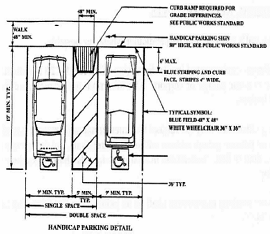
Handicapped parking spaces shall have curb ramps to minimize the effect of grade or elevation differences from the parking area to the adjacent surface. Curb ramps shall be a minimum of 48 inches wide.
2.
The walkway onto which a curb ramp leads shall also be at least 48 inches wide, and paved. Each parking space shall be at least nine feet wide and 19 feet deep, and the space between handicapped parking spaces leading to the curb ramp shall be at least 48 inches wide.
3.
The handicapped parking sign shall be 80 inches high. Each handicapped parking space shall have blue striping and curb face, and the stripes shall be four inches wide. The symbol of a white wheelchair on a blue background shall be painted or sprayed onto the parking surface of the handicapped parking space. Typically the blue background is 48″ by 48″, and the white wheelchair is 36″ by 36″.
(Zoning Ord. dated 1/31/06, § 9107.05.)
(Ord. No. 1364, § A, 7-24-07)
17.28.060 - Parking lot design standards.
Off street parking areas shall be provided in the following manner:
A.
Access.
1.
All parking areas shall provide suitable maneuvering room so that all vehicles may enter an abutting street in a forward direction. The director may approve exceptions for single family homes and other residential projects.
2.
No parking space shall be located so that a vehicle will maneuver within 25 feet of a parking entrance/vehicle entrance/parking aisle, vehicular entrance measured from the face of the curb.
B.
Dimensional Requirements. Dimensional requirements for off-street parking include the following:
1.
Parking stalls shall be non-perpendicular to the parking aisle whenever possible.
2.
A minimum unobstructed inside dimension of 20 feet by 20 feet shall be maintained, for a private two-car garage or carport. The minimum obstructed ceiling height shall be 7 feet, six inches. For single-family residential units constructed prior to February 11, 1980, a minimum unobstructed inside dimension of 10 feet by 20 feet shall be maintained for a private one-car garage or carport.
3.
Parking structures may be subject to dimensional adjustment, but in no case shall the stall width be less than eight feet and six inches. Reductions in design standards shall be subject to approval by the City Engineer and shall be discouraged.
4.
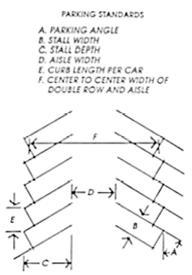
Minimum parking dimensions shall be as follows:
Parking and Loading Standards
Table 17.28.060
Parking Stall Dimensions
The Community Development Director may approve a parking adjustment to provide for a limited number of compact parking spaces at 16′ × 8′ and/or for an overall space size of 17′6" × 8′3" based on the parking adjustment findings.
C.
Drainage. Off-street parking areas shall be so designed that surface water will not drain over any sidewalk, or adjacent property.
D.
Driveways.
1.
Commercial/ Industrial/ Multi-family Residential.
a.
Commercial access standards shall be maintained by the Public Works Department.
b.
Drive aisles shall be a minimum width of 15 feet for a one-way driveway, and 24 feet for a two-way driveway.
2.
Single Family Residential.
1.
Driveways for an attached two car garage shall have a minimum width of 16 feet and a minimum length of 20 feet measured from the inside sidewalk or apron to the front of the garage. Requirements for an attached three car garage are the same, except that the minimum width shall be 24 feet.
2.
Driveways for a detached two car garage shall be a minimum width of 16 feet, with a minimum 16 foot wide by 24 foot deep back up area immediately adjacent to the garage door. Requirements for a three car detached garage are the same, except that the minimum back up area shall be 24 feet by 24 feet.
E.
Landscaping, Screening and Shading. A minimum of 15 percent of the net area of all parking areas shall be landscaped as follows:
1.
Where parking areas adjoin a public right of way, a landscaped planting strip equal to the required yard setback shall be established and continuously maintained between the public right of way and parking area.
2.
Any planting, sign, or any other structure within safety sight-distance of a driveway shall not exceed 30 inches in height.
3.
Pedestrian access shall be provided throughout the landscaped areas.
4.
At least one 24 inch box tree for every four spaces shall be included in the development of the overall landscape program. The maximum spacing between trees in parking areas shall be 30 feet; however, appropriate clustering of trees may be permitted. Landscaping islands are required at both ends of all parking rows.
5.
All areas in a parking lot not used for driveways, maneuvering areas, parking spaces or walks, shall be permanently landscaped with suitable materials and permanently maintained.
6.
A concrete curb, six inches high and six inches wide, shall abut all parking areas.
7.
All landscaped areas shall be a minimum interior dimension of six feet in width.
8.
Permanent and automatic irrigation systems shall be installed and permanently maintained in all landscaped areas, in conformance with the City's water conservation regulations in Chapter 17.32.
9.
To increase the parking lot landscaped area, a maximum of two feet of the parking stall depth may be landscaped in lieu of asphalt while maintaining the required parking dimensions. This overhang is in addition to the required yard setbacks.
10.
The landscaping plan shall provide for a variety of plant materials with an emphasis on drought tolerant species, and shall include a legend showing common names, sizes, quantities, location, dimensions of planted area, and square footage, irrigation, and percentage of parking lot landscaping.
11.
For screening purposes, all commercial, industrial and public parking areas abutting residentially designated property shall have a six foot high solid architecturally treated decorative masonry wall approved by the Community Development Director. All wall treatments shall occur on both sides.
12.
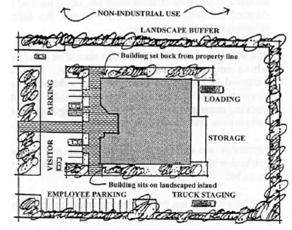
Although any reasonable combination of shading methods can be utilized, all parking areas must provide at least 30 percent permanent shading for parked vehicles within two years of planting.
13.
If trees are used, they may not thereafter be trimmed in a way which reduces the effectiveness of their shading ability.
14.
Other landscaping requirements and guidelines shall be found in the Chapter 17.32, Landscaping.
F.
Security and Lighting.
1.
All parking facilities shall be designed, constructed and maintained with security as a priority to protect the safety of the users.
2.
Adequate illumination for security and safety shall be provided in all parking areas. Lighting shall be energy efficient and in scale with the height and use of the structure. Any illumination, including security lighting, shall be shielded, visibility of light source eliminated and directed away from adjoining properties and public rights of way.
G.
Location of Required Parking Spaces.
1.
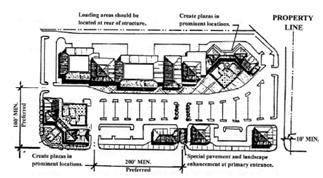
All parking spaces shall be located on the same parcel as the structure or the use, except in the Downtown Commercial district, or unless otherwise approved by the review authority. On site parking should be provided on the side or in the rear of a lot to the greatest extent possible. Off street parking spaces for multi-family residential developments shall be located within 150 feet from the front or rear door of the dwelling unit for which the parking space is provided.
2.
No parking space required by this chapter shall be located in the front, side or rear setback area of any land use district except for a detached garage or carport structure and driveways which may be located in interior (non-street) side or rear setback areas, as allowed in Section 17.08.020, General Standards.
H.
Maintenance. All required parking facilities shall be permanently maintained, free of litter and debris.
I.
Parking Structures. All parking structures shall be landscaped as follows:
1.
All landscaping shall be permanently maintained and automatically irrigated. The parking structure shall have continuous minimum ten foot perimeter landscaping with vertical elements, such as trees or climbing vines at least every 20 feet.
2.
Entries and exits of the parking structure shall include a minimum six-foot wide landscaped median island and accent paving in the driveway.
3.
Landscaped materials, excluding vertical element openings, shall be provided in planters and/or pots for at least five percent of the total surface deck area. The planters and pots shall be distributed through the top deck area, and the perimeter of intermediate decks.
4.
Lighting shall not spill beyond the surface deck, and shall not spill onto other properties. Lighting fixtures shall not exceed four feet in height.
J.
Shared Parking.
1.
Parking facilities may be shared if multiple uses cooperatively establish and operate the facilities and if these uses generate parking demands primarily during hours when the remaining uses are not in operation. (For example, a nightclub and a bank would probably have very different hours, but might share the same parking facility.)
2.
The applicant shall have the burden of proof for a reduction in the total number of required off-street parking spaces, and written documentation shall be submitted substantiating their reasons for the requested parking reduction. Shared parking may only be approved if:
a.
A sufficient number of spaces are provided to meet the greater parking demand of the participating uses;
b.
Satisfactory evidence, as determined by the Community Development Director, has been submitted by the parties operating the shared parking facility, describing the nature of the uses and times when the uses operate so as to demonstrate the lack of potential conflict between them; and
c.
Any additional covenants, deed restrictions or other agreements or documents as may be deemed necessary by the Community Development Director, are executed to assure that the required parking spaces provided are maintained, and that uses with similar hours and parking requirements, remain for the life of the commercial/industrial development.
K.
Slope.
1.
Driveways shall have no grades exceeding an eight percent slope, unless approved by the City Engineer.
2.
Parking areas shall be designed and improved with grades not to exceed a five percent slope.
L.
Striping and Surfacing
1.
All parking spaces shall be striped in accordance with City requirements. The striping shall be maintained in a clear and visible manner. Each exit from any parking area shall be clearly marked with a "STOP" sign.
2.
Driveway and parking areas should be surfaced with a minimum thickness of three inches of concrete, asphaltic concrete, or a material approved by the City Engineer with bituminous surfacing over a minimum thickness of four inches of an aggregate base material.
3.
For areas which are close to trees and shrubs, a porous surface may be used such as gravel, if this will aid in bringing rainwater to the roots of the trees, and if this is approved by the City Engineer.
M.
Curbing and Wheel Stops.
1.
Continuous concrete curbing at least six inches high and six inches wide shall be provided at least three feet from any wall, fence, property line, walkway or structure where parking and or drive aisles are located adjacent thereto. Curbing may be left out at structure access points.
2.
The space between the curb and wall, fence, property line, walkway or structure shall be landscaped. The clear width of a walkway adjacent to overhanging parked cars shall be four feet.
3.
All parking lots shall have a continuous curbing at least six inches high and six inches wide around all parking areas and aisle planters. Wheel stops shall not be used in lieu of curbing to protect landscaping, signage structures and walls.
N.
Parking Adjustment. Concurrent with an application for Design Review and/or Conditional Use Permit and application for a parking adjustment may be approved by the review authority subject to the findings:
Findings for a Parking Adjustment
1.
The zoning regulations applicable to the property do not allow a reasonable use comparable to similar developments in the same zoning district;
2.
The hardship for which the variance is requested is unique to the property area;
3.
The variance will not alter the character of the area adjacent to the property, will not impair the use of adjacent conforming property, and will not impair the purpose of the regulations of the zoning district in which the property is located;
4.
Neither present nor anticipated future traffic volumes generated by the use of the site or the sites in the vicinity require strict or literal interpretation and enforcement of the specific regulation;
5.
The granting of this parking variance will not result in the parking or loading of vehicles in public streets in such a manner as to interfere with the free flow of street traffic;
6.
The granting of this variance will not create a safety hazard or any other condition inconsistent with the objectives of this Ordinance; and
7.
The variance will run with the use or uses to which it pertains and shall not run with the site.
The parking adjustment may include any or all of the following:
A reduction in number of spaces required, subject to an approved parking study;
Approval of a limited number of compact spaces;
Recordation of a reciprocal parking agreement with nearby properties;
10 percent reduction in spaces required;
Payment of an in-lieu fee for public parking facilities.
(Zoning Ord. dated 1/31/06, § 9107.06.)
(Ord. No. 1364, § B 9107.06, 7-24-07; Ord. No. 1476, § 4, 1-28-14)
17.28.070 - Off street loading standards.
A.
Required Number of Loading Spaces.
1.
The following number of minimum spaces shall be provided for all non-residential uses:
a.
For uses with less than 10,000 square feet of gross floor area: one loading space is required in addition to whatever space requirements are added by the Community Development Director.
b.
For uses of 10,000 to 25,000 square feet of gross floor area: two spaces are required in addition to whatever space requirements are added by the Community Development Director.
c.
For uses of more than 25,000 square feet of gross floor area: three spaces are required in addition to whatever space requirements are added by the Community Development Director.
2.
Requirements for uses not specifically listed shall be determined by the Director based upon the requirements for comparable uses and upon the particular characteristics of the proposed use.
B.
Design Standards for Off Street Loading Spaces. Required freight and equipment loading spaces shall be at east 15 feet wide and 20 feet in length, or greater (if determined by the Director), with 15 feet of vertical clearance.
C.
Location. Loading spaces shall be located and designed as follows:
1.
Adjacent to or as close as possible to, the main structure
2.
Situated to ensure that all vehicular maneuvers occur in protected areas on site
3.
Situated to ensure that no loading or unloading take place within roads or other public rights of way, or within any on-site traffic areas
D.
Passenger Loading.
1.
Passenger loading spaces shall be provided in addition to any required freight and equipment loading spaces whenever required by the Department as a result of the development review process.
2.
Passenger loading spaces shall not be less than 11 feet wide and 20 feet long; shall be located in close proximity to the structure entrance; and shall not require pedestrians to cross a driveway, parking aisle, alley or street in order to reach the structure entrance.
3.
Neither required parking spaces nor required freight/equipment loading spaces, shall count toward required passenger loading spaces.
F.
Screening.
1.
All loading areas abutting residentially designated property shall have a six foot high solid architecturally treated decorative masonry wall, approved by the Director. All wall treatments shall occur on both sides.
2.
In addition, adequate area shall be provided adjacent to the public rights of way to accommodate a required four foot high permanently maintained and irrigated landscaped berm.
G.
Striping. Loading areas shall be striped indicating the loading spaces and identifying the spaces for loading only. The striping shall be permanently maintained by the owner in a clear and visible manner.
H.
Surfacing. Loading areas shall be surfaced with a minimum thickness of four inches of asphaltic concrete over a minimum thickness of six inches of an aggregate base material or an equivalent structural section to be approved by the City Engineer.
I.
Security. All loading facilities shall be designed, constructed, and maintained with security as a priority to protect the safety of the users.
J.
Wheel Stops and Curbing. Continuous concrete or stone curbing approved by the Director, at least six inches high and six inches wide, shall be provided for all loading spaces, and shall be set at least three feet from any wall, fence, property line, walkway or structure.
(Zoning Ord. dated 1/31/06, § 9107.07.)
Article III. - Landscape Design Guidelines[2]
Editor's note— Ord. No. 1510, § 3(2), adopted Sept. 11, 2017, renumbered Ch. 17.32, Art. IV as Ch. 17.32, Art. III.
17.36.010 - Purpose.
The purpose of this chapter is to establish sign regulations that are intended to:
A.
Limit and control the location, size, type and number of signs allowed in the City of Banning.
B.
To provide for a more orderly display of advertising devices, while implementing community design standards with respect to character, quality of materials, color, illumination and maintenance, which are consistent with the City's General Plan.
C.
To bring these advertising devices into harmony with the buildings, with the neighborhood, with the natural environment, and with other signs in the area.
D.
To preserve and improve the appearance of the City as a place in which to live and work, and as an attraction to nonresidents who come to visit or trade.
E.
To encourage sound signage practices as an aid to business and for the information of the public, while preventing excessive and confusing sign displays.
F.
To reduce hazards to motorists, bicyclists and pedestrians.
G.
And to promote the public health, safety, viewsheds, aesthetic values, and general welfare of the community by regulating and controlling all matters relating to signs.
(Zoning Ord. dated 1/31/06, § 9109.01.)
17.36.020 - Applicability.
A.
This chapter shall apply to all signage proposed within the community. No signs shall be erected or maintained in any land use district established by this Zoning Ordinance, except those signs specifically enumerated in this chapter. The number and area of signs as outlined in this chapter are intended to be maximum standards.
B.
In addition to the standards set forth herein, consideration shall be given to a sign's relationship to the need that it serves, and the overall appearance of the subject property as well as the surrounding community. Compatible design, simplicity, and sign effectiveness are to be used in establishing guidelines for sign approval.
(Zoning Ord. dated 1/31/06, § 9109.02.)
17.36.030 - Definitions.
Abandoned Sign. Any display remaining in place or not maintained for a period of one hundred twenty days or more which no longer advertises or identifies an on-going business, product, or service available on the business premises where the display is located.
Address Sign. The numeric reference of a structure or use to a street, included as part of a wall or monument sign.
A-Frame Sign. A free standing sign usually hinged at the top, or attached in a similar manner, and widening at the bottom to form a shape similar to the letter "A". Such signs are usually designed to be auxiliary portable commercial signage, hence they are not considered permanent signs.
Anchor Tenant. A shopping center key tenant, usually the largest or one of the largest tenants located within the shopping center, which serves to attract customers to the center through its size, product line, name, and reputation.
Animated Sign. A sign with action or motion, flashing or color changes, requiring electrical energy, electronic or manufactured sources of supply, but not including wind actuated elements such as flags or banners. Said definition shall not include displays such as time and temperature, revolving, changeable copy or public information centers.
Announcement or Bulletin Board Signs. Signs permanent in character designed to accept changeable copy, handbills, posters and matters of a similar nature.
Area of Sign. The area of a sign shall be the entire area including any type of perimeter or border which may enclose the outer limits of any writing, representation, emblem, figure or character excluding architectural features or design. The area of the sign having no such perimeter or border shall be computed by enclosing the entire area within parallelograms, triangles or circles of the smallest size sufficient to cover the entire area of the sign and computing the area of these parallelograms, triangles or circles. The area computed shall be the maximum portion or portions which may be viewed from any one direction.
Awning, Canopy, or Marquee Sign. A nonelectric sign that is printed on, painted on, or attached to an awning, canopy, or marquee and is only permitted on the vertical surface or flap.
Banner. A temporary display such as used to announce open houses, grand openings or special announcements. Often made of cloth, bunting, plastic, paper, or similar material.
Bench Sign. Copy painted on any portion of a bus stop or other bench.
Billboard. See outdoor advertising sign [structure].
Building Face and/or Frontage. The length of the single front building elevation in which the primary entrance to the business is located. If more than one business is located in a single building, then such length shall be limited to that portion which is occupied by each individual business.
Canopy Sign. Shall mean a sign attached to either the underside of the canopy, or marquee, or directly to the canopy itself.
Changeable Copy Sign. A sign designed to allow the changing of copy through manual, mechanical, or electrical means.
City Identification Sign. A freeway-oriented pylon sign that prominently displays the name of the City of Banning and that may also include within the pylon sign a billboard, outdoor advertising structure, or an electronic message center.
Civic Event Sign. A temporary sign, other than a commercial sign, posted to advertise a civic event sponsored by a public agency, school, church, civic-fraternal organization, or similar noncommercial organization.
Commercial Seasonal Sign. An "open" or "closed" window sign, posted on a seasonal basis.
Contractor's Sign/Construction Sign. A temporary sign erected on the parcel on which construction is taking place, limited to the duration of the construction, indicating the names of the architects, engineers, landscape architects, contractors, or similar artisans, and the owner, financial supporters, sponsors, and similar individuals or firms having a major role or interest with respect to the structure or project.
Directional Sign. Signs limited to on-premises directional messages, principally for pedestrian or vehicular traffic, such as "one way", "entrance", or "exit".
Directory Sign. A sign for listing the tenants or occupants and their suite numbers of a building or center.
Double-faced Sign. A single structure designed with the intent of providing copy on both sides.
Eaveline. The bottom of the roof eave or parapet.
Election Sign. A temporary sign related to or directly associated with a national, state, county or local election or referendum.
Electronic Message Center. A sign having the capability of presenting variable advertising message displays by projecting an electronically controlled light pattern against a contrasting background, and which can be programmed to change such message display periodically. An electronic message center is neither an animated sign nor a simulated motion sign.
Flags and pennants. Shall mean devices generally made of flexible materials, usually cloth, paper or plastic, and displayed on strings. They may or may not contain copy. This definition shall not include the flag of the United States or of any state.
Flags of the State and Nation. A flag of the United States or the State of California.
Flashing Sign. A sign that contains an intermittent or sequential flashing light source.
Freestanding Sign. A sign which is supported by one or more uprights, braces, poles, or other similar structural components that is not attached to a building or buildings. Flagpoles are not included in this definition.
Freeway. A highway in respect to which the owners of abutting land have no right or easement of access or in respect to which such owners have only limited or restricted right or easement of access, and which is declared to be such in compliance with the Streets and Highways Code of the State of California.
Future Tenant Identification Sign. A temporary sign which identifies a future use of a site or building.
Grand Opening. A promotional activity not exceeding thirty calendar days used by newly established businesses, within two months after occupancy, to inform the public of their location and service available to the community. Grand Opening does not mean an annual or occasional promotion of retail sales or activity by a business.
Ground Sign. A display attached to the ground, within an architecturally planned wall or structure, and not over eight feet in height.
Height of Sign. The greatest vertical distance measured from the existing grade at the mid-point of the sign support(s) that intersect the ground to the highest element of the sign.
Holiday Decoration Sign. Temporary signs, in the nature of decorations, clearly incidental to and customarily associated with holidays.
Identification Sign. A sign attached to the building and displaying only the name, type of business, and/or logo in combination, identifying a particular business establishment.
Illegal Sign. Any of the following: A sign erected without first complying with all ordinances and regulations in effect at the time of its construction and erection or use; a sign that was legally erected, but whose use has ceased, or the structure upon which the display is placed has been abandoned by its owner, not maintained, or not used to identify or advertise an ongoing business for a period of not less than one hundred twenty days; a sign that was legally erected which later became nonconforming as a result of the adoption of an ordinance, the amortization period for the display provided by the ordinance rendering the display nonconforming has expired, and conformance has not been accomplished; a sign which is a danger to the public or is unsafe; a sign which is a traffic hazard not created by relocation of streets or highways or by acts of the City or County. Abandoned signs and prohibited signs are also illegal.
Illuminated Sign. A sign with an artificial light source, either internal or external, for the purpose of lighting the sign.
Institutional Sign. A sign identifying the premises of a church, school, hospital rest home, or similar institutional facility.
Kiosk. An off-premises sign of no more than four square feet in size, used for directing people to the sales office or models of a residential subdivision project.
Logo. An established identifying symbol or mark associated with a business or business entity.
Lot or Street frontage. The linear front footage of a parcel of property abutting a dedicated public street.
Logo Sign. An established trademark or symbol identifying the use of a building.
Monument Sign. An independent structure supported from grade to the bottom of the sign with the appearance of having a solid base.
Murals. Painted wall signs which have a majority of the sign area comprised of noncommercial content, which generally have artistic, historic or cultural themes, and which are designed and painted (or supervised) by an artist who possesses demonstrated knowledge and expertise in the design, materials, and execution of murals or other art. Commercial content of murals shall be subject to all applicable sign limitations of the underlying zone district.
Non-Commercial Sign. A sign which does not promote, identify or sell a business or product.
Nonconforming Sign. A legally established sign which fails to conform to the regulations of this chapter. Otherwise conforming signs whose height exceeds the provisions of this chapter only because a special topographical circumstance results in a material impairment of the visibility of the display or the owner's ability to adequately and effectively continue to communicate with the public through the use of the display if the sign were limited to the height allowed in this chapter shall not be considered nonconforming.
Occupancy Frontage. Each individual tenant space within a building or group of buildings which faces upon a dedicated street or public parking area between such space and street.
Off-Site Sign. Any sign which advertises or informs in any manner businesses, services, goods, persons, or events at some location other than that upon which the sign is located. Off-premises sign, billboard, and outdoor advertising structure are equivalent terms.
Open House Sign. A temporary on-site sign posted to indicate a salesperson is available to represent the property subject to sale, lease, or rent.
Outdoor Advertising Structure (Billboard). Any sign with a commercial message, other than a directional sign, which directs attention to a business, commodity, service or entertainment conducted, sold or offered elsewhere than upon the premises where the sign is located, or to which it is affixed. Commercial copy on any outdoor advertising sign may be replaced with noncommercial copy. Outdoor advertising structures/billboards shall not include subdivision or tract signs (see section 17.36.080), signage affiliated with solar powered electric vehicle charging stations, or sign installed pursuant to a city sign program.
Painted Sign. Signs painted on the exterior surface of a building or structure; however, if such signs have raised borders, letters, characters, decorations or lighting appliances, they shall be considered wall signs.
Parcel or lot of real property. A parcel or lot of real property under separate ownership from any other parcel or lot and having street or highway frontage.
Political Sign. A sign other than an election sign directly associated with an ideological, political or similar noncommercial message on a sign.
Portable Sign. A sign that is not permanently attached to the ground or a building.
Projecting Sign. Any sign which is suspended from or supported by a building or wall, and which projects eighteen inches or more outward therefrom.
Promotional Sign. A sign erected on a temporary basis to promote the sale of new products, new management, new hours of operation, a new service, or to promote a special sale.
Public Information Center. Any display which is characterized by changeable copy, letters or symbols.
Pylon Sign. A freestanding sign that is permanently supported by one or more uprights, braces, or poles, or other similar structural components that are architecturally compatible with the main structure of the site.
Real Estate Sign. An on-site sign pertaining to the sale or lease of the premises.
Relocated Billboard. An existing billboard that is located in the City that is relocated through a City Council approved relocation agreement, including the replacement of a static billboard face with an electronic message center. The relocated billboard is not considered a new outdoor advertising sign.
Revolving Sign. Any sign that revolves, either by wind actuation or by electrical means.
Roof Sign. A sign erected, constructed, or placed upon or over a roof of a building, including a mansard roof and which is wholly or partly supported by such buildings.
Shopping Center. A group of four or more businesses which function as an integral unit on a single parcel or group of parcels and utilize common off-street parking and access and is identified as a shopping center.
Sign. Any structure, housing, device, figure, statuary, painting, display, message placard, or other contrivance, or any part thereof, which is designed, constructed, created, engineered, intended, or used to advertise, or to provide data or information in the nature of advertising, for any of the following purpose: to designate, identify, or indicate the name of the business of the owner or occupant of the premises upon which the advertising display is located; or, to advertise the business conducted, services available or rendered, or the goods produced, sold, or available for sale, upon the property where the advertising display is erected. This definition shall include all parts, portions, units and materials composing same, together with illumination, frame, background, structure, support and anchorage therefor.
Sign Area. The entire face of a sign, including the surface and any framing, projections, or molding, but not including the support structure. Individual channel-type letters mounted on a building shall be measured by the area enclosed by four straight lines outlining each word or grouping of words.
Sign Program. A coordinated program of one or more signs for an individual building or building complexes with multiple tenants.
Temporary Sign. A sign intended to be displayed for a limited period of time.
Time and Temperature Sign. A sign giving the time and or temperature.
Trademark. A word or name which, with a distinctive type or letter style, is associated with a business or business entity in the conduct of business.
Tract Development Sign. A sign indicating the location of a housing tract.
Tract Directional Sign. An off-premises sign indicating direction to a tract development.
Vehicle Sign. A sign which is attached to or painted on a vehicle which is parked on or adjacent to any property, the principal purpose of which is to attract attention to a product sold or an activity or business located on such property.
Wall Sign. A sign painted on or fastened to a wall and which does not project more than twelve inches from the building or structure.
Window Sign. Any sign that is applied or attached to a window or located in such a manner that it can be seen from the exterior of the structure, on a permanent or temporary basis.
(Zoning Ord. dated 1/31/06, § 9109.03; Ord. No. 1382, § 3 (part).)
(Ord. No. 1424, § 3.1, 7-13-10; Ord. No. 1493, § 3(2), 4-12-16; Ord. No. 1530, §§ 4H, 4I, 9-25-18)
17.36.040 - Sign permit required.
A.
General.
1.
No sign, or temporary sign, unless exempted by this chapter, shall be constructed, displayed or altered without a sign permit or sign program approved by the city. The community development department shall review all signs unless otherwise stated.
2.
Sign permits shall be reviewed and either approved or denied by the director within thirty days of submittal of a complete application. The determination of a complete application shall be in conformance with the California Permit Streamlining Act.
3.
Determination on sign permit applications are to be guided by the standards and criteria set forth in this article. An application will be approved whenever the proposed sign conforms to all design, size, height and other standards for signs subject to a permit requirement, as such requirements are set forth in this chapter.
4.
The director's determination shall be provided in writing, and shall include an explanation of the reasons for approval or denial. Appeal of the director's decision shall be in conformance with chapter 17.68, hearings and appeals.
B.
Sign Program. A permit for a sign program shall be required for all new commercial, office, and industrial centers consisting of three or more tenant spaces. The program shall be filed with the project application to construct the center, and shall be processed concurrently with the project application. The purpose of the program shall be to integrate signs with building and landscaping design to form a unified architectural statement. This may be achieved by:
1.
The use of the same background color, and allowing signs to be of up to three different colors per multi-tenant center.
2.
The use of the same type of cabinet supports, or method of mounting for signs, and the same type of construction material for components, such as sign copy, cabinets, returns, and supports.
3.
The use of the same form of illumination of the signs, with internally lit signs generally being preferred by the city due to the lack of overspill from such lighting.
4.
Uniform sign placement specifications, letter height, and logo height for both anchor tenants and minor tenants.
5.
Logos may be permitted and are not subject to the color restrictions specified in the program. However, no logo should exceed twenty-five percent of the allowable sign area.
(Zoning Ord. dated 1/31/06, § 9109.04.)
17.36.050 - Exempt signs.
The following signs shall be exempt from the provisions of this chapter:
A.
Window signs not exceeding two square foot [feet] and limited to business identification, hours of operation, address, and/or emergency information. (Neon signs of any size require a permit, if allowed.)
B.
Signs within a structure and not visible from the outside.
C.
Memorial signs and plaques installed by a civic organization recognized by the council, when cut in masonry or bronze tablets.
D.
Official and legal notices issued by a court or governmental agency.
E.
Official flags of the United States, the State of California, County of Riverside, or the City of Banning.
F.
Identification signs on construction sites. Such signs shall be limited to one directory or pictorial display sign identifying all contractors and other parties (including lender, realtor, subcontractors, etc.). Each sign shall not exceed twenty square feet in area and six feet in height. Each sign shall be removed prior to issuance of a certificate of occupancy.
G.
Election Signs. Election signs must comply with the following requirements:
1.
Election signs shall be limited in size to the maximum allowed in the zones where located. Any freeway oriented freestanding sign shall be required to secure all applicable permits and comply with these sign regulations including section 17.36.110.
2.
No election signs shall be permitted on public property or in the public right-of-way.
3.
There are no pre-election restrictions limiting when elections signs may be erected, but the owner of the sign must remove the sign within seven days after the applicable election has ended.
4.
For all election signs, the campaign shall be deemed the owner of the sign unless it can establish that it is not the owner of the sign. In the event the campaign establishes it is not the owner of the sign, the owner of the property on which the sign is placed, shall be deemed the owner of the sign.
5.
In the event that any such sign violates the provisions of this chapter, or if it is not removed within the period provided hereunder, it shall be subject to abatement pursuant to the procedures prescribed in section 17.36.090.
6.
Except as provided in this subsection, no permit shall be required for election signs.
H.
Real estate signs for residential sales shall be one sign not exceeding four square feet in area and five feet in height, provided it is unlit and is removed within seven days after the close of escrow or the rental or lease has been accomplished. Open house signs, for the purpose of selling a single house or condominium and not exceeding four square feet in area and five feet in height, are permitted for directing prospective buyers to property offered for sale.
I.
Real estate signs for the initial sale, rental, or lease of commercial and industrial premises: One sign not to exceed twenty square feet in area to advertise the sale, lease, or rent of the premises. No such sign shall exceed eight feet in overall height and shall be removed upon sale, lease or rental of the premises or twelve months, whichever comes first. Thereafter, one sign per premise not to exceed twelve square feet in size and five feet in height is permitted for the sale, lease or rent of the premise.
J.
Future tenant identification signs: One wall or freestanding sign may be placed on vacant or developing property to advertise the future use of an approved project on the property and where information may be obtained. Such sign shall be limited to one sign, a maximum of twenty square feet in area and eight feet in overall height. Any such signs shall be single faced and shall be removed prior to the granting of occupancy permit by the city.
K.
Incidental signs for automobile repair stores, gasoline service stations, automobile dealers with service repairs, motels and hotels, showing notices of services provided or required by law, trade affiliations, credit cards accepted, and the like, attached to the structure or building; provided that all of the following conditions exist:
1.
The signs number no more than three.
2.
No such sign projects beyond any property line.
3.
No such sign shall exceed an area per face of three square feet.
4.
Signs may be double-faced.
L.
Copy applied to fuel pumps or dispensers such as fuel identification, station logo, and other signs required by law.
M.
Agricultural signs, either wall or freestanding types, non-illuminated, and not exceeding four square feet for lots two acres or less and ten square feet for lots greater than two acres, identifying only the agricultural products grown on the premises. The number of such signs shall be one per street frontage or a maximum of two, with wall signs to be located below the roofline and freestanding signs to be no higher than six feet.
N.
Sign programs which have been approved prior to the adoption of this zoning ordinance.
O.
Municipal and traffic control signs: Directional signs to aid vehicle or pedestrian traffic provided that such signs are located on-site, have a maximum area which does not exceed three square feet, have a maximum overall height of four feet above grade, and are mounted on a monument or decorative pole. Such signs may be located in a required setback provided that a minimum distance of five feet from any property line is maintained. Directional signs to the railway, the airport or the highway are among the types of signs which fall in this category.
P.
Temporary window signs may be permitted on the inside of windows facing out which do not cover more than twenty-five percent of the individual window surface for a period not to exceed thirty days use during any sixty-day period. Temporary painted signs may be on the outside of the window.
Q.
Historic site and historic landmark, and neighborhood signs, when designed in conformance with standards of the California Historic Commission or a similar entity.
R.
Professionally made restroom, telephone and walkway signs of under one square foot.
S.
Emblems or signs of a political, civic, philanthropic, educational or religious organizations, if those signs are on the premises occupied by such organizations, and do not exceed twenty-four square feet in area, or number more than one emblem or sign in total.
T.
Political Signs. Political signs must comply with the following requirements:
1.
Political signs shall be limited in size to the maximum allowed in the zones where located. Any freeway oriented freestanding sign shall be required to secure all applicable permits and comply with these sign regulations including section 17.36.110.
2.
No political signs shall be permitted on public property or in the public right-of-way.
3.
In the event that any such sign violates the provisions of this chapter, it shall be subject to abatement pursuant to the procedures prescribed in section 17.36.090.
4.
Except as provided in this subsection, no permit shall be required for political signs.
(Zoning Ord. dated 1/31/06, § 9109.05.)
(Ord. No. 1424, § 3.2, 3.3, 7-13-10; Ord. No. 1487 § 3.2, 4-18-15)
17.36.060 - Prohibited signs.
The following signs are inconsistent with the sign standards set forth in this chapter, and are therefore prohibited:
A.
Abandoned signs.
B.
Animated, moving, flashing, blinking, reflecting, revolving, or any other similar sign, except electronic message boards.
C.
All banners, flags, and pennants in the downtown commercial zoning district and located within fifty feet of a residential property.
Billboards or outdoor advertising structures. However, notwithstanding any other provision of this chapter, and consistent with the California Business and Professions Code Outdoor Advertising Act provisions, relocated billboards or outdoor advertising structures, including electronic message centers, may be considered and constructed as part of a relocation agreement entered into between the city and a billboard and/or property owner, and city identification signs may be considered and constructed as part of a lease agreement, development agreement, or other agreement between the city, a sign, and property owner and subject to the requirements of Section 17.36.110(B)(9) and chapter 17.52 of the Banning Municipal Code. Such agreements may be approved by resolution of the City Council upon terms that are agreeable to the City, pursuant to administrative guidelines, as adopted by the City Council resolution. The execution of a relocation, lease agreement, development agreement, or other agreement shall not operate to change the status of any billboard as a nonconforming use for the purpose of this code.
D.
Electronic Outdoor Advertising Signs, approved pursuant to section 17.36.060(D) and subject to a Conditional Use Permit only within the downtown commercial land use district.
E.
Changeable copy signs and electronic message boards, except as allowed by a Conditional Use Permit for movie theaters, arenas, stadiums, or auto malls in the commercial land use districts.
F.
Reserved.
G.
Off-site signs, except as permitted elsewhere in this ordinance.
H.
Permanent sale signs.
I.
Portable signs or A-frame signs, except in the downtown commercial zone and shall not pose a hazard to pedestrians; and shall be stable under all-weather conditions or shall be removed.
J.
Roof signs.
K.
Signs on public property or the public rights-of-way, except for traffic regulation and signs permitted by a governmental agency.
L.
Signs painted on fences or roofs.
M.
Balloons and other inflated devices or signs designed to attract attention, except with temporary use permit.
N.
Signs that are affixed to vehicles, excluding permanent signs on commercial vehicles which are driven on a daily or weekly basis.
O.
Signs which simulate in color or design a traffic sign or signal, or which make use of words, symbols or characters in such a manner to interfere with, mislead, or confuse pedestrian or vehicular traffic.
P.
Signs which singly or in combination with other signs block more than five percent of the view from any window or door of any structure or dwelling used primarily as a residence.
Q.
Signs which singly or in combination with other signs, for any portion of the day, block natural sunlight from falling upon any window or door of any structure or dwelling used primarily as a residence.
R.
Signs which singly or in combination with other signs block more than 33% for solid lettering (or up to fifty percent if perforated vinyl window signs) of the view from any window or door of any structure used or occupied by people for more than an hour of a typical day, in all zoning districts of the City.
(Zoning Ord. dated 1/31/06, § 9109.06; Ord. No. 1377, § 1.)
(Ord. No. 1424, § 3.4, 7-13-10; Ord. No. 1447, § 3, 2-14-12; Ord. No. 1487, § 3.2, 4-28-15; Ord. No. 1493, § 3(2), 4-12-16; Ord. No. 1530, § 4J, 9-25-18; Ord. No. 1547, § 3(Exh. A), 6-25-19)
17.36.070 - Temporary signs.
Special event signs and civic event signs may be approved by the director for a limited period of time as a means of publicizing special events such as grand openings, carnivals, parades, charitable events and holiday sales. Such special event signs shall be limited to the following provisions:
A.
No special event sign shall be erected without a temporary use permit.
B.
Special event signs shall be limited to ninety days per event from the date of erection or date of permit, whichever occurs first.
C.
Special event signs shall not include promotional sales signs, and they must be taken down within a week after the conclusion of the special event.
D.
Special event signs may include balloons, inflated devices, search lights, beacons, pennants, and streamers.
E.
Such temporary signs may not be granted to the same business or location more than twice during any one year.
(Zoning Ord. dated 1/31/06, § 9109.07; Ord. No. 1448, § 9, 5-8-12)
17.36.080 - Off-site residential subdivision directional signs.
The following shall regulate and establish a standardized program of off-site residential subdivision directional kiosk signs for the city. For the purposes of this subsection, a residential subdivision is defined as a housing project within a recorded tract where five or more structures or dwelling units are concurrently undergoing construction.
A.
No kiosk sign structure shall be located less than three hundred feet from an existing or previously approved kiosk site, except in the case of signs on different corners of an intersection.
B.
The placement of each kiosk sign structure shall be reviewed and approved by the director.
C.
All kiosk signs shall be placed on private property with written consent of the property owner.
D.
A kiosk sign location plan shall be prepared, showing the site of each kiosk directional sign, and shall be approved by the director prior to the issuance of a sign permit.
E.
There shall be no additions, tag signs, streamers, devices, display boards, or appurtenances, added to the kiosk signs as originally approved, no other non-permitted directional signs, such as posters or trailer signs, may be used.
F.
All non-conforming subdivision kiosk directional signs associated with the subdivision in question must be removed prior to the placement of directional kiosk sign(s).
G.
Kiosk signs, or attached project directional signage, shall be removed when the subdivision is sold out. The applicant (or his/her legal successors) will be responsible for removal of panels and structures no longer needed.
(Zoning Ord. dated 1/31/06, § 9109.08.)
(Ord. No. 1424, § 3.5, 7-13-10)
17.36.090 - Abatement of abandoned or illegal temporary signs.
A.
Every temporary sign not owned by the property owner of the property on which it is erected shall be marked to indicate on the sign the identity of the sign owner, provided that for any commercial sign where not otherwise indicated it shall be presumed that the business being advertised is the owner.
B.
Any abandoned or illegal temporary sign is hereby declared to be a danger to the health, safety, and welfare of the citizens of Banning. Any sign which is (i) in deteriorating condition and not maintained in the condition in which it was originally installed, (ii) violates conditions of the sign permit, or (iii) is partially or wholly obscured by the growth of dry vegetation or weeds or by the presence of debris or litter also presents a danger to the health, safety, and welfare of the Banning community. Such signs may be abated as provided in this chapter.
C.
Any such signs as set forth above are hereby deemed to be a public nuisance. Any such sign, including any and all structural supports, shall be removed by the property owner within ten days after notice from the director, which notice shall provide an opportunity to be heard before the director on the abandonment and nuisance decision and an appeal may be taken pursuant to chapter 17.68. Any sign not removed within ten days after such notice, may be abated by the director if no appeal has been taken from the director's decision, or, if the appeal has been denied or modified. If after a reasonable effort to determine the owner of the sign, the owner cannot be found, then the city may summarily remove the sign and the same shall be stored for a period of thirty days, during which time they may be recovered by the owner.
D.
Costs of an abatement conducted pursuant to this chapter shall be assessed against the owner of the sign, and to the extent permissible under law, against the owner of the property, using the procedures established in the Banning Municipal Code.
(Zoning Ord. dated 1/31/06, § 9109.09.)
(Ord. No. 1424, § 3.6, 7-13-10)
17.36.100 - Sign construction and maintenance.
A.
Every sign, and all parts, portions, and materials shall be manufactured, assembled, and erected in compliance with all applicable state and federal laws and regulations, and city ordinances, laws, and regulations, including, but not limited to the Uniform Building Code and the California Business and Professions Code.
B.
Every sign, including those specifically exempt from this Zoning Ordinance, in respect to permits and permit fees, and all parts, portions, and materials shall be maintained and kept in good repair. The display surface of all signs shall be kept clean, neatly painted, and free from rust and corrosion. Any cracked, broken surfaces, malfunctioning lights, missing sign copy or other unmaintained or damaged portion of a sign shall be repaired or replaced within thirty calendar days following notification by the city. Noncompliance with such a request shall constitute a nuisance and may result in a city code enforcement action, or the assessment of penalties, or both, in accordance with the provisions of these zoning ordinances.
(Zoning Ord. dated 1/31/06, § 9109.10.)
(Ord. No. 1547, § 3(Exh. A), 6-25-19)
17.36.110 - Sign regulations.
Signs permitted in each of the city's land use districts are identified below. In addition to the following regulations, all signs must be in compliance with all other provisions of this chapter pertaining to signs.
Signs may have commercial or non-commercial messages. A non-commercial message may be substituted for the copy of any commercial sign allowed by this chapter.
A.
Signs in Residential Zones.
1.
Up to one flagpole, displaying the flag of the US or the State of California, up to thirty-five feet in height, unless a permit is obtained from the city to have a flagpole in a private park or public park for up to sixty-five feet in height.
2.
For single family homes, the following are allowed:
a.
Up to one sign not to exceed one square foot in area, identifying the address;
b.
Up to one unlit sign not to exceed four square feet in area, pertaining to the rental, sale or lease of the property on which the sign is located. Such signs must be temporary, and may contain no flashing, blinking or reflective objects.
3.
For apartment complexes and multifamily developments, the following are allowed:
a.
Sign(s) containing the name and/or address of the development, providing that the combined area of such signs is not exceeded as established below:
i.
Up to one wall sign
ii.
Up to one freestanding sign per street frontage (which shall be in a landscaped area at least fifteen feet from the curb face, and not closer than five feet to the property line. Freestanding signs shall have a maximum height of eight feet inclusive of supporting structures.
iii.
The maximum combined area of the signs set forth above shall not exceed 20 square feet, for complexes with one hundred twenty-five feet of frontage or less, and shall not exceed thirty square feet for complexes with over one hundred twenty-five square feet of frontage.
4.
For properties in the residential zones where farming takes place, lots may have one sign per street frontage (up to a maximum of two signs) advertising only the agricultural products grown on the premises. These signs may not be illuminated, and may be either free standing or wall signs. For lots of two acres or less, each sign may be a maximum of four square feet. For lots over two acres, each sign may be a maximum of ten square feet.
5.
No neon signs are permitted in residential areas.
B.
Signs in Commercial and Industrial Zones.
1.
No sign attached to a structure shall be placed above the roof line.
2.
Wall signs. Each business in downtown commercial zoning district shall be permitted wall signs per occupancy footage. The area devoted to such signs shall not exceed one square foot of sign area per one foot of building frontage, and shall not exceed fifty square feet of sign area. An introductory sign of a maximum of five square feet shall be allowed for twenty-five percent of the sign fee to encourage business in the downtown commercial zoning district. Each business in all other commercial and industrial zoning districts shall be permitted wall signs per the area of the wall (length times height of the wall). The area devoted to such signs shall not exceed twenty percent of the wall area. The sign area maximum for wall signs shall not apply to a freeway-oriented wall sign proposed to be located and designed in such a manner as to be viewed primarily in a direct line of sight from a main traveled roadway of a freeway or a freeway on-ramp/off-ramp and advertising onsite retail or service-oriented businesses. Freeway-oriented wall signs shall be subject to all requirements of section 17.36.110(B)(6), including requiring the approval of a conditional use permit.
3.
Monument signs. Each parcel or property shall be permitted one monument sign subject to all of the following conditions being met:
a.
One square foot of sign area for one foot of building frontage is permitted. Such sign shall not exceed fifty square feet.
b.
The buildings must be set back at least twenty-five feet from the property line.
c.
The monument sign shall be located in a landscaped planter area not less than fifty square feet, with one dimension being at least four feet.
d.
The monument sign may be no more than eight feet high.
e.
Shopping centers may have one monument sign not to exceed one square foot of display face per one foot of building frontage, not to exceed one hundred square feet, for center identification. Said sign may include reader panels, and or a bulletin or a changeable copy pane.
4.
Painted signs. Each business shall be permitted painted signs subject to the following conditions:
a.
Said signs shall be in combination with or in lieu of wall signs.
b.
The area of said painted sign shall be deducted from the total allowable wall sign.
5.
Accessory signs. Signs denoting credit cards, hours of operation, etc., shall be allowed but shall not exceed three square feet in total area.
6.
Freeway-oriented freestanding sign. Freeway-oriented freestanding signs, including city identification signs, shall be allowed subject to the following requirements:
a.
Said sign shall be located and designed in such a manner as to be viewed primarily in a direct line of sight from a main traveled roadway of a freeway or a freeway on-ramp/off-ramp. The phrase "viewed primarily in direct line of sight from" shall mean that the message may be seen with reasonable clarity for a greater distance by a person traveling on the main traveled roadway of a freeway or on-ramp/off-ramp than by a person traveling on the street adjacent to the sign.
b.
Said signs shall be limited to on-site retail or services businesses. Shopping centers may have one freeway-oriented sign and shall include city identification or city logo as approved by planning commission. Said city identification or logo shall be excluded from the display face area calculation. When the display area of the sign is used for commercial speech, the copy must qualify as onsite to the business or shopping center.
c.
Said sign shall not block another freeway-oriented freestanding sign, city identification signs. The applicant shall be responsible for providing the planning commission with a line-of-sight analysis prepared by a registered civil engineer or architect to assure satisfactory compliance with this requirement, as determined by the director.
d.
Said sign shall be located in a planter area not less than fifty square feet with one dimension being at least six feet, unless from the evidence presented to the planning commission it can be determined that the area is not visible from public street or right-of-way, or the absence of the planter shall not be detrimental to the appearance of the area.
e.
Said sign shall not exceed an overall height of eighty (80') feet.
f.
Said sign shall not exceed twelve-hundred (1,200') e square feet per display face, excluding the city identification and logo, if applicable.
g.
Said sign shall require approval of a conditional use permit pursuant to chapter 17.52, except that if said sign is a city identification sign, the sign shall be subject to the requirements of subsection (B)(9) of this section, section 17.36.060(D), and chapter 17.52, and if said sign is a relocated billboard or outdoor advertising structure, the sign shall be subject to the requirements of section 17.36.060(D). In addition to satisfying requirements set forth above in this section 17.36.110(B)(6) of the Banning Municipal Code, the following findings must be made prior to approval of a conditional use permit pursuant for a freeway-oriented freestanding sign, without consideration of message content of the proposed signs:
i.
The elevation of the freeway in relation to the elevation of the abutting properties justifies the height requested, and is the minimum necessary.
ii.
The number and spacing of freeway signs will not cause unnecessary confusion, clutter or other unsightliness in the general location.
iii.
The use identified, as well as its type, size and intensity, justifies the size, design and location of the sign requested.
iv.
The needs of the traveling public for identification and directional information justifies the sign requested.
7.
One flag pole, displaying one or more flags of the state and nation, not to exceed thirty-five feet in height.
8.
Any existing freestanding sign shall be considered legal and conforming, but shall not be altered or replaced except by approval of a conditional use permit.
9.
City identification sign. City identification signs shall be allowed subject to approval by City Council resolution and the following requirements:
a.
City identification signs shall not be permitted south of Interstate 10 from Sunset to Hargrave.
b.
The City shall have the right to place public service announcements and emergency service announcements on any such electronic messaging center so long as they are not excessive or burdensome. The limits on public service announcements will be stipulated in a City Council agreement.
c.
The use of onsite electric generators to power digital billboards for normal operations shall be prohibited.
d.
The sign face for any City identification sign shall not overhang onto Interstate 10 or any other state highway.
e.
Signs shall be shielded to prevent light or glare intrusion onto adjoining properties that are located within five hundred (500) feet.
f.
Message changes on any electronic message center shall be limited to one message every six (6) seconds, or that allowed by the California Department of Transportation, whichever is greater.
g.
No electronic message center shall simulate motion or exhibit any images or series of images that could be considered "animated" in any way, including but not limited to sequential still images that update faster than once every six (6) seconds. No electronic message center shall contain any flashing, sparkling, intermittent or moving lights. There shall be no flashing or scrolling messages. Changes in color or light intensity on a still image or message at a rate faster than once every six (6) seconds are also not permitted.
h.
Electronic message centers shall contain automatic dimmers that maintain a maximum luminance of 7,500 nits during the daylight hours, and 500 nits from dusk (official sunset) to sunrise and during times of fog (One nit is equivalent to one candela per square meter). Each electronic message center shall be equipped with a mechanism to monitor brightness.
i.
Reserved.
j.
City identification signs shall not be illuminated between the hours of 11:00 p.m. to 5:00 a.m. when located within five hundred (500) feet of an existing residential property, or residentially zoned property.
k.
The following advertising shall not be permitted: adult entertainment, mud wrestling, alcohol (except beer and wine), tobacco products of any type, or other content that could be reasonably considered sexually explicit or pornographic be community standards. Objectionable advertising shall be set forth in the City Council agreement.
l.
City identification signs shall require permit approval through the Building and Safety Division, CalTrans, the Riverside County Airport Land Use Commission if located within a compatibility zone, a beautification zone, and also require the approval of any other responsible agency, as necessary.
m.
City identification signs shall include architectural enhancements that add aesthetic appeal.
n.
City identification signs shall not exceed 55 feet in height.
o.
City identification signs shall not exceed a face area of 14 by 48 feet, inclusive of City identification.
p.
City identification signs and all parts, portions, and materials shall be manufactured, assembled, and erected in compliance with all applicable State, Federal, and City regulations and the Uniform Building Code (BMC Section 17.36.100(A)).
q.
City identification signs shall be maintained and kept in good repair. The display surface shall be kept clean, neatly maintained, and free from rust or corrosion. Any cracked, broken surfaces, malfunctioning lights, missing sign copy, or other unmaintained or damaged portion of a sign shall be repaired or replaced within 30 calendar days following notification by the City. Noncompliance with such a request shall constitute a nuisance and penalties may be assessed.
r.
Any sign agreement shall include a provision requiring the billboard owner to demonstrate that they have made reasonable efforts to solicit advertising from local businesses and nonprofits, including discounts and incentives during periods where other advertising cannot be obtained. Local businesses are defined as any business located within the City limits.
s.
Enforcement provisions shall provide for written notice of violations and the opportunity to cure breaches, the potential to recover liquidated damages, the posting of securities where repeated violations occur, and the right to recover attorney fees and costs in the event that administrative or legal action is required.
t.
Any other provisions contained in the lease agreement, development agreement, or other agreement that the City deems to be appropriate to protect the public health, safety, and welfare of the City.
(Zoning Ord. dated 1/31/06, § 9109.11; Ord. No. 1377, § 2)
(Ord. No. 1419, § 5, 1-26-10; Ord. No. 1424, § 3.7, 7-13-10; Ord. No. 1447, §§ 3—6, 2-14-12; Ord. No. 1487, § 3.2, 4-28-15; Ord. No. 1530, § 4K, 9-25-18; Ord. No. 1547, § 3(Exh. A), 6-25-19)
17.36.120 - Sign design guidelines.
A.
General. The following design guidelines shall be consulted prior to developing signs for any project. Unless there is a compelling reason, these design guidelines shall be followed. If a guideline is waived, the mayor and city council shall be notified. An appeal, which does not require a fee, may be filed by the mayor or any council person within fifteen days of the waiver approval.
1.
Use a brief message: The fewer the words, the more effective the sign. A sign with a brief, succinct message is simpler and faster to read, looks cleaner and is more attractive.
2.
Avoid hard-to-read, overly intricate typefaces: These typefaces are difficult to read and reduce the sign's ability to communicate.
3.
Avoid faddish and bizarre typefaces: Such typefaces may look good today, but soon go out of style. The image conveyed may quickly become that of a dated and unfashionable business.
4.
Sign colors and materials: should be selected to contribute to legibility and design integrity. Even the most carefully thought out sign may be unattractive and a poor communicator because of poor color selection. Day-glo colors must be avoided.
5.
Use significant contrast between the background and letter or symbol colors: If there is little contrast between the brightness or hue of the message of a sign and its background, it will be difficult to read.
6.
Avoid too many different colors on a sign: Too many colors overwhelm the basic function of communication. The colors compete with content for the viewer's attention. Limited use of the accent colors can increase legibility, while large areas of competing colors tend to confuse and disturb.
7.
Place signs to indicate the location of access to a business: Signs should be placed at or near the entrance to a building or site to indicate the most direct access to the business.
8.
Place signs consistent with the proportions of scale of building elements within the facade: Within a building facade, the sign may be placed in different areas. A particular sign may fit well on a plain wall area, but would overpower the finer scale and proportion of the lower storefront. A sign which is appropriate near the building entry may look tiny and out of place above the ground level.
9.
Place wall signs to establish rhythm across the facade, scale and proportion where such elements are weak. In many buildings that have a monolithic or plain facade, signs can establish or continue appropriate design rhythm, scale, and proportion.
10.
Avoid signs with strange shapes: Signs that are unnecessarily narrow or oddly shaped can restrict the legibility of the message. If an unusual shape is not symbolic, it is probably confusing.
11.
Carefully consider the proportion of letter area to overall sign background area: If letters take up too much sign, they may be harder to read. Large letters are not necessarily more legible than smaller ones. A general rule is that letters should not appear to occupy more than seventy-five percent of the sign panel area.
12.
Make signs smaller if they are oriented to pedestrians: The pedestrian-oriented sign is usually read from a distance of fifteen to twenty feet; the vehicle-oriented sign is viewed from a much greater distance. The closer a sign's viewing distance, the smaller that sign need be.
B.
Wall or Fascia Signs.
1.
Building wall and fascia signs should be compatible with the predominant visual elements of the building. Commercial centers, offices, and other similar facilities are required to be part of a sign program in accordance with the provisions of this chapter.
2.
Where there is more than one sign, all signs should be complementary to each other in the following ways:
a.
Type of construction materials (cabinet, sign copy, supports, etc.)
b.
Letter size and style of copy
c.
Method used for supporting sign (wall or ground base)
d.
Configuration of sign area
e.
Shape to total sign and related components
3.
The use of graphics consistent with the nature of the product to be advertised is encouraged, i.e., hammer or saw symbol for a hardware store, mortar and pestle for a drug store.
4.
Direct and indirect lighting methods are allowed provided that they are not harsh or unnecessarily bright. The use of can-type box signs with translucent backlit panels are less desirable. Panels should be opaque if a can-type sign is used and only the lettering should appear to be lighted. The overspill of light should be negligible.
5.
The use of backlit individually cut letter signs is strongly encouraged.
6.
The use of permanent sale or come-on signs is prohibited.
7.
The identification of each building or store's address in six-inch high numbers over the main entry doorway or within ten feet of the main entry is encouraged.
C.
Monument Signs.
1.
Monument signs are intended to provide street addresses, and identification for the commercial center development as a whole and for up to three major tenants.
2.
All tenant signs should be limited in size to the width of the architectural features of the sign and shall be uniform in size and color.
3.
A minimum of ten percent of the sign area of monument signs for center developments should be devoted to identification of the center or building by address or name.
4.
Monument signs should be placed perpendicular to approaching vehicular traffic.
5.
Each monument sign should be located within a planted landscaped area which is of a shape and design that will provide a compatible setting and ground definition to the sign, incorporating the following ratio of landscape area to total sign area:
a.
Monument: Four square feet of landscaped area for each square foot of sign area (one side only).
b.
Directory: Two square feet of landscaped area for each square foot of sign area.
(Zoning Ord. dated 1/31/06, § 9109.12.)
17.36.130 - Nonconforming signs.
A.
A legally established sign which fails to conform to this chapter shall be allowed continued use, except that the sign shall not be:
1.
Structurally altered so as to extend its useful life.
2.
Expanded, moved, or relocated.
3.
Re-established after a change in use.
4.
Re-established after a business has been abandoned for one hundred twenty days or more.
5.
Re-established after damage or destruction of more than fifty percent.
B.
Sign copy and sign faces may be changed on nonconforming signs when there is no change in use of the site or when only a portion of a multiple tenant sign is being changed.
C.
Any non-conforming sign shall be required to be brought into conformance or abated.
(Zoning Ord. dated 1/31/06, § 9109.13.)
17.36.140 - Removal of illegal and nonconforming signs.
A.
The director shall remove or cause the removal of any fixed, permanent sign constructed, placed or maintained in violation of this chapter, after thirty days following the date of mailing of registered or certified written notice to the owner of the sign, if known, at the last known address or to the owner of the property as shown on the latest assessment roll, or to the occupant of the property at the property address.
B.
The notice shall describe the sign and specify the violation involved, and indicate that the sign will be removed if the violation is not corrected within thirty days. If the owner disagrees with the opinion of the director, the owner may, within the said thirty-day period request a hearing before the planning commission to determine the existence of a violation.
C.
If salvageable in the opinion of the director, signs removed by the Director pursuant to this chapter shall be stored for a period of sixty days, during which time they may be recovered by the owner upon payment to the city for costs of removal and storage. If not recovered prior to expiration of the sixty-day period, the sign and supporting structures shall be declared abandoned and title thereto shall vest to the city, and the cost of removal shall be billed to the owner or lien placed on the property upon which said sign was erected.
(Zoning Ord. dated 1/31/06, § 9109.14.)
17.36.150 - Reserved.
Editor's note— Sec. 3 of Ord. No. 1447, adopted Feb. 14, 2012, repealed zoning section 9109.15 from which this section 17.36.150 derived. Former § 17.36.150 pertained to establishing compliance and was amended by Ord. 1377.
17.36.160 - Inventory and abatement—Variances—Penalties.
A.
Inventory and Abatement. Within six months from the date of adoption of this zoning ordinance, the city shall commence a program to inventory and identify illegal or abandoned signs within its jurisdiction. Within sixty days after this six-month period, the city may commence abatement of identified illegal or abandoned signs. If a previously legal sign is merely nonconforming, however, the terms of section 17.36.150 of this zoning ordinance titled "Establishing Compliance," shall apply.
B.
Variances. Variances from these sign ordinances are strongly discouraged. However, where results inconsistent with the general purposes of this ordinance would occur from its strict literal interpretation and enforcement, the planning commission may grant a variance therefrom upon such terms and conditions as it deems necessary.
C.
Penalties. Each violation of this ordinance or any regulation, order or ruling promulgated or made hereunder, shall be punishable by a fine of not more than two hundred dollars per day, with each calendar day in violation, constituting a separate offense.
(Zoning Ord. dated 1/31/06, § 9109.16.)
17.36.170 - Murals.
Murals shall be allowed by permit reviewed by the beautification and mural council of the Banning Chamber of Commerce and permitted by the city's community development department. Applications shall be on a form devised by the community development department. A permit for a mural will be granted when the following conditions have been satisfied:
A.
Completed application;
B.
Sign permit fee paid;
C.
Approved by the beautification and mural council of the Banning Chamber of Commerce;
D.
The mural shall not cause a pedestrian or vehicular safety hazard;
E.
The mural shall be applied to the wall of a building; and
F.
The mural shall be maintained.
(Ord. No. 1382, § 3 (part).)
17.36.180 - Signs within adopted specific plan areas.
Signs within adopted specific plan areas shall conform to the sign requirements as indicated within the individual specific plan. However, in the event sign requirements are not provided in the individual specific plans, all signs within the specific plan areas shall conform to the provisions of chapter 17.36. If the land use within the specific plan is not specifically identified in the zoning ordinance, the most appropriate (closely related) use of the area shall apply, as determined by the community development director.
(Ord. No. 1493, § 3(2), 4-12-16)
17.36.190 - Flags, banners and pennants on city-owned light poles.
Notwithstanding section 17.36.070, the city of Banning may install flags, banners, and/or pennants on city-owned utility poles. The city manager shall establish a written banner program to regulate the installation of flags, banners, and pennants on city-owned utility poles. Banners and pennants shall be installed in compliance with the banner program established by the city manager.
(Ord. No. 1493, § 3(2), 4-12-16)
17.40.010 - Purpose.
The purpose of these standards is to clearly define the numbers of animals allowed in each of the zoning districts. The animal keeping standards are intended to:
A.
Allow the keeping of animals as pets in all residential zones.
B.
Allow the keeping and raising of animals on lots of sufficient size to accommodate a larger number of animals.
C.
Preserve the enjoyment of their land by all property owners.
(Zoning Ord. dated 1/31/06, § 9110.01.)
17.40.020 - Applicability.
The provisions of this chapter shall apply to all zoning districts included in division II of this zoning ordinance, including both existing and new or redeveloped projects, and single-family homes, regardless of when they were constructed.
(Zoning Ord. dated 1/31/06, § 9110.02.)
17.40.030 - General standards.
A.
Animals may be kept in the residential districts only. The keeping of animals on lands designated for commercial, industrial or public facilities uses is prohibited, except for pet stores and veterinary facilities as permitted in the commercial districts.
B.
The keeping of animals shall conform to the following table:
Table 17.40.030
Animal Keeping Standards1
1 Any animal not specifically listed shall be classified by the director.
2 Unweaned offspring shall not be counted in determining the number of dogs or cats.
3 Large animals shall include goats, sheep, horses, cattle, llamas, swine, emus and ostriches. The total number allowed is cumulative.
4 On substandard lots created prior to the adoption of this zoning ordinance in the VLDR district (lots of less than twenty thousand s.f.), one large animal shall be permitted on lots of twelve thousand s.f. to sixteen thousand s.f., and two shall be permitted on lots of sixteen thousand one s.f. to nineteen thousand nine hundred ninety-nine s.f.
5 For any lot less than twenty thousand s.f. a maximum of three dogs and cats, or any combination thereof, not to exceed three, shall be permitted.
6 For lot(s) twenty thousand s.f. and larger a maximum of six dogs and cats, or any combination thereof, not to exceed six, shall be permitted.
7 A maximum of three dogs or cats, or any combination thereof, not to exceed three, shall be permitted in the LDR zone district.
8 A maximum combined total of eight dogs and/or cats per lot shall be permitted in the R/A, R/A/H, RR and RR/H zone district.
C.
All animal keeping shall comply with all laws regarding the proper care and number of animals.
D.
All animal keeping structures shall comply with the development standards of the zone in which they are located, including setbacks.
E.
All animals shall be kept in fenced enclosures at all times. Dogs and cats may be kept in fenced yards without additional enclosures, if proper shelter is provided. Pot-bellied pigs, fowl, rabbits and large animals shall be kept in appropriate enclosures within a fenced yard (pig runs, chicken coops, rabbit warrens, corrals and/or stables).
F.
Each pot-bellied pig shall be provided a minimum of seventy-five square feet in an enclosure.
G.
Each large animal shall be provided a minimum of four hundred square feet of fenced area.
H.
All facilities shall be kept in a clean and sanitary manner at all times.
I.
The offspring of large animals shall not be counted in determining the number of animals on a lot, if the offspring is within the following age range:
1.
Horses: six months;
2.
Cattle: six months;
3.
Swine: ninety days;
4.
Sheep: ninety days;
5.
Goats: ninety days;
6.
Llamas: twelve months;
7.
Emus and ostriches: four months.
J.
No person shall allow to remain on a property, an animal which habitually disturbs the peace and quiet of the inhabitants of a neighborhood by howling, barking, crying, braying, or making other similar noises.
K.
Exotic animals not listed above are prohibited.
(Zoning Ord. dated 1/31/06, § 9110.03; Ord. No. 1393, § 2.)
17.42.010 - Purpose.
It is the purpose of this chapter, pursuant to Fair Housing Laws, to provide individuals with disabilities reasonable accommodation in the application of the city's land use, zoning, and building standards, regulations, policies, and procedures and to establish relevant criteria to be used to ensure equal access to housing. The purpose of this chapter is to provide a process for individuals with disabilities to make requests for, and be provided, reasonable accommodation, when reasonable accommodation is warranted based upon sufficient evidence, from the various city laws, rules, policies, practices and/or procedures of the city, including land use and zoning regulations.
(Ord. No. 1462, § 2, 3-12-13)
17.42.020 - Applicability.
A.
Any individual with a disability, his or her representative, or a developer or provider of housing for individuals with disabilities may seek relief from any land use, zoning or building standard, regulation, policy or procedure found in titles 15 or Title 17 of this code to ensure equal access to housing and to facilitate the development of housing for individuals with disabilities by requesting a reasonable accommodation in the manner prescribed in following section 17.42.40.
B.
The city shall waive land use, zoning, and building standards, regulations, policies, and procedural requirements when such waiver is necessary to eliminate barriers to housing opportunities. Such waivers for reasonable accommodation may include, without limitation, a household's reasonable waiver of residential fence or structural height restrictions to accommodate specific disabilities, reasonable waivers of building size or set-back restrictions to accommodate necessary disability accommodations such as wheelchair ramps or expanded parking spaces.
C.
The reasonable accommodation rules set forth in this chapter apply to proposals to modify existing structures as well as new development, as when a household applies to the city in order to modify their existing residence as necessary to reasonably accommodate a specific disability, subject to the findings and requirements of this chapter. Proposals to modify structures, especially single-family homes, should respect existing development patterns if reasonably possible.
(Ord. No. 1462, § 2, 3-12-13)
17.42.030 - Definitions.
A.
"Applicant" means a person, business, or organization making a written request to the city for reasonable accommodation.
B.
"City" means the City of Banning.
C.
"Code" means the Banning Municipal Code.
D.
"Department" means the community development department.
E.
"Director" means the director of community development.
F.
"Disabled or handicapped person" means an individual with a qualifying disability under the Fair Housing Laws. Generally, any person with any mental or physical impairment, disorder or condition, which substantially limits one or more major life activities, including physical, mental and social activities and working. "Disabled or handicapped person" does not include impairments, disorders or conditions resulting from the current, illegal use of or addiction to a controlled substance, sexual behavior disorders, compulsive gambling, kleptomania, or pyromania.
G.
"Fair Housing Laws" means the "Fair Housing Amendments Act of 1988" (42 U.S.C. § 3601, et seq.), including reasonable accommodation required by 42 U.S.C. § 3604(f)(3)(B), and the "California Fair Employment and Housing Act" (California Government Code Section 12900, et seq.), including reasonable accommodation required specifically by California Government Code Sections 12927(c)(1) and 12955(l), and Civil Code § 54, as any of these statutory provisions now exist or may be amended from time to time by either legislative act or published judicial decisions.
H.
"Reasonable accommodation" means a modification or exception to the standards, regulations, policies and procedures contained in title 15 or title 17 of this code for the siting, development and use of housing or housing-related facilities, that would eliminate regulatory barriers and provide an individual with a disability equal opportunity for the use and enjoyment of housing of their choice, and that does not impose undue financial or administrative burdens on the city or require a fundamental or substantial alteration of the city's planning and zoning program.
(Ord. No. 1462, § 2, 3-12-13)
17.42.040 - Requesting reasonable accommodation.
A.
In order to make specific housing available to an individual with a disability, a disabled person or representative may request reasonable accommodation, pursuant to this chapter, relating to the application of various land use, zoning, or building laws, rules, policies, practices and/or procedures of the city.
B.
If an individual or representative needs assistance in making a request for reasonable accommodation, or appealing a determination regarding reasonable accommodation, the department will endeavor to provide the assistance necessary to ensure that the process is accessible to the applicant or representative. The applicant may be represented at all stages of the proceeding by a person designated by the applicant as his or her representative.
C.
A request for reasonable accommodation in laws, rules, policies, practices and/or procedures must be filed on an application form provided by the department, shall be signed by the owner of the property and submitted to the director, and shall include the following information:
1.
The name, address and telephone number of the applicant;
2.
The name, address and telephone number of the individual with a disability for whom the reasonable accommodation is being requested;
3.
The name, address, and telephone number of the owner of the property for which the reasonable accommodation request is being made. If the applicant is someone other than the property owner, a letter of agency or authorization signed by the property owner consenting to the application being made is required;
4.
The address and current use of the property for which the reasonable accommodation request is being made;
5.
A description of how the subject property will be used by the disabled individual(s);
6.
A description of the reasonable accommodation request and the specific land use, zoning or building standard, regulation, policy or procedure to be modified or waived;
7.
The basis for the claim that the Fair Housing Laws applies to the individual(s) and evidence satisfactory to the city supporting the claim, which may include a letter from a medical doctor or other licensed health care professional, a handicapped license, or other appropriate evidence which establishes that the individual(s) needing the reasonable accommodation is disabled/handicapped pursuant to the Fair Housing Laws;
8.
The specific reason the requested accommodation is necessary to make the particular housing unit reasonably accessible and available to the disabled individual(s);
9.
Verification by the applicant that the property is the primary residence of the person for whom reasonable accommodation is requested; and
10.
A filing fee in an amount as determined from time to time by resolution of the city council, but not to exceed the reasonable estimated costs to the city in processing the application.
(Ord. No. 1462, § 2, 3-12-13)
17.42.050 - Decision on application.
A.
The director may approve, conditionally approve, or deny an application for a reasonable accommodation for an existing use or a proposed new use that only requires a ministerial permit or approval. The director shall issue a written determination within thirty days of the date of receipt of a completed application. The director may:
1.
Grant the accommodation request in full,
2.
Grant the accommodation request subject to specified nondiscriminatory conditions that are consistent with the requested reasonable accommodation, or
3.
Deny the request.
Notice of the director's determination shall be mailed first class to the applicant and adjacent property owners within three hundred feet of the project boundary. The notice of the director's decision shall state the facts and evidence upon which the director's decision was based in connection with the findings stated in section 17.42.060.
B.
If the project for which the request for a reasonable accommodation is made requires a discretionary permit or approval, then the application for a reasonable accommodation will be heard at the same time as, and in conjunction with, the applicable discretionary permit or approval. The planning commission shall consider an application at the next reasonably available regular planning commission meeting that occurs after the application for reasonable accommodation is complete. The application for reasonable accommodation shall be heard as a public hearing item. At the conclusion of the public hearing and determination thereon by the planning commission, the director shall issue a written statement of the planning commission's determination within thirty days. The planning commission may:
1.
Grant the accommodation request,
2.
Grant the accommodation request subject to specified nondiscriminatory conditions that are consistent with the requested reasonable accommodation, or
3.
Deny the request.
Notice of the planning commission's determination (which may be in the form of a resolution adopted by the commission) shall be mailed first class to the applicant and adjacent property owners within three hundred feet of the project boundary. The notice of the planning commission's decision shall state the facts and evidence upon which the commission's decision was based in connection with the findings stated in section 17.42.060.
C.
If necessary to reach a determination on any request for reasonable accommodation, the director may request further information from the applicant after the applicant has submitted its initial application. Such request for additional information shall:
1.
Be consistent with this chapter; and
2.
Specify in detail what information is required; and
3.
Request additional information only to the extent such information is reasonably necessary to render the findings required by this chapter.
In the event that a request for further information is made, the application will not be deemed "complete" until the applicant reasonably responds to the request with responsive information.
D.
A reasonable accommodation that is granted pursuant to this chapter shall not require the approval of any variance as to the reasonable accommodation.
(Ord. No. 1462, § 2, 3-12-13)
17.42.060 - Required findings.
The following findings must be made in order to approve any request for reasonable accommodation:
A.
The housing, which is the subject of the request for reasonable accommodation, will be occupied as the primary residence by an individual protected under the fair housing laws.
B.
The request for reasonable accommodation is necessary to make specific housing available to one or more disabled individuals protected under the Fair Housing Laws.
C.
The requested reasonable accommodation will not impose an undue financial or administrative burden on the city. "Undue financial or administrative burden" is defined in the Fair Housing Laws.
D.
The requested accommodation will not require a fundamental alteration of the zoning or building laws, policies and/or procedures of the city. "Fundamental alteration" is defined in the Fair Housing Laws.
E.
The requested reasonable accommodation will not, under the specific facts of the case, result in a direct threat to the health or safety of other individuals or substantial physical damage to the property of others.
(Ord. No. 1462, § 2, 3-12-13)
17.42.070 - Conditions of approval.
In granting a request for a reasonable accommodation, the director or planning commission, as applicable, may impose any conditions of approval deemed reasonable and necessary to ensure that the reasonable accommodation would comply with the findings required by section 14.44.060, the Fair Housing Laws and the intent of this chapter. Such conditions may generally include, but are not limited to, the following restrictions:
A.
The city's general/standard conditions of approval applicable to all projects;
B.
That the reasonable accommodation shall only be applicable to particular disabled individual(s); and/or
C.
That the reasonable accommodation shall only be applicable to the specific use for which application is made.
(Ord. No. 1462, § 2, 3-12-13)
17.42.080 - Appeals.
A.
Director Decision. Any applicant who is dissatisfied by the decision made by the director on an application for a reasonable accommodation may appeal the director's decision to the planning commission. The appeal must be filed via written notice detailing the grounds for appeal, such notice must be received by the director within fifteen days of the mailing of the director's decision. Upon the filing of a notice of appeal, the director will set the matter for a public hearing before the planning commission to occur not later than sixty days from the date of filing. Notice of the appeal hearing will be given to the applicant by mail at least ten days prior to the hearing. Any person who is dissatisfied by the decision of the planning commission may make a further appeal to the city council in accordance with applicable procedures of section 17.68.090 et seq. of this code. The planning commission's decision will be final absent a timely appeal to the city council.
B.
Planning Commission Decision. A decision of the planning commission on an application for a reasonable accommodation considered concurrently with another application for a discretionary approval is subject to the same appeal rights and procedures that apply to the other discretionary approval or pursuant to section 17.68.090 et seq., as applicable.
(Ord. No. 1462, § 2, 3-12-13)
17.42.090 - Expiration, revocation, termination.
A.
Expiration. Any reasonable accommodation approved under this chapter will expire within twelve months from the effective date of approval or at such alternative time specified as a condition of approval unless:
1.
A building permit has been issued and construction has commenced;
2.
A certificate of occupancy has been issued;
3.
The use is established; or
4.
A time extension has been granted.
B.
Revocation.
1.
Director Decisions. If the director was the last reviewing authority to grant a reasonable accommodation application, the director may revoke or modify such reasonable accommodation permit if the findings required in this section can be made with the support of substantial evidence.
2.
Planning Commission and/or City Council Decisions. If the planning commission or city council was the last reviewing authority to grant a reasonable accommodation application, the planning commission may revoke or modify such reasonable accommodation permit if the findings required in this section can be made with the support of substantial evidence. The commission shall hold a public hearing to revoke or modify a reasonable accommodation granted pursuant to the provisions of this chapter. At least ten days prior to the hearing, notice shall be delivered in writing to the applicant and/or owner of the property for which the reasonable accommodation was granted. Notice shall be deemed delivered two days after being mailed, first class postage paid, to the owner as shown on the current tax rolls of the County of Riverside, and/or the project applicant.
3.
Required Findings. Any decision to modify or revoke a reasonable accommodation can be made only if at least one of the following findings can be made with the support of substantial evidence:
(a)
Circumstances have changed so that one or more of the findings contained in section 17.42.060 can no longer be made;
(b)
The reasonable accommodation was obtained by misinformation, misrepresentation or fraud; or
(c)
One or more of the conditions of the reasonable accommodation have not been met.
4.
Notice and Appeal. Written notice of any decision to revoke or modify a reasonable accommodation permit shall be mailed by first class mail to the owner as shown on the current tax rolls of the County of Riverside and/or the applicant. The determination may be appealed in accordance with section 17.42.080.
C.
Termination. If the individual with a disability who initially occupied the applicable dwelling ceases to reside at the premises, the reasonable accommodation will remain in effect only if the director determines that:
1.
The modification is physically integrated into the residential structure and cannot easily be removed or altered to comply with this code, or
2.
The accommodation is necessary to give another disabled individual an equal opportunity to enjoy the dwelling.
The director may request that any successor-in-interest to the property provide documentation that subsequent occupants are persons with disabilities. Failure to provide such documentation within ten days of the date of a written request by the director will result in the termination of a previously-approved reasonable accommodation and the applicable premises must subsequently be made to conform to code.
(Ord. No. 1462, § 2, 3-12-13)
17.42.100 - Waiver of time periods.
Notwithstanding any provisions in this chapter regarding the occurrence of any action within a specified period of time, the applicant may request additional time beyond that provided for in this chapter or may request a continuance regarding any decision or consideration by the city of the pending appeal. Extensions of time sought by applicants shall not be considered delay on the part of the city, shall not constitute failure by the city to provide for prompt decisions on applications and shall not be a violation of any required time period set forth in this chapter.
(Ord. No. 1462, § 2, 3-12-13)
17.32.010 - Purpose.
The purpose of this chapter is to establish landscaping regulations that are intended to:
A.
Protect and preserve the natural environment in the City of Banning, and to incorporate green space, vegetation, and shade into the urban landscape.
B.
Enhance the aesthetic appearance of development in all areas of the City by providing standards for quality, quantity and functional aspects of landscaping and landscape screening.
C.
Reduce the heat and glare generated by development
D.
Increase the compatibility between residential land uses and those abutting commercial and industrial land uses.
E.
Provide privacy within residential developments, and to provide privacy on the perimeter of residential areas from various residential, commercial or other uses outside of the development.
F.
Protect the public health, safety and welfare by minimizing the impact of all forms of physical and visual pollution, controlling soil erosion, screening incompatible land uses, preserving the integrity of neighborhoods, and enhancing pedestrian, cyclist and vehicular traffic and safety.
G.
Increase the liveability of the City of Banning for children, adults, and visitors.
(Zoning Ord. dated 1/31/06, § 9108.01.)
17.32.020 - Application.
A.
A concept landscaping plan shall be submitted as part of a planning permit application. The concept plan shall meet the intent of this chapter by exhibiting a generalized design layout which adequately demonstrates the desired landscaping program in terms of location, size/scale, function, theme and other attributes.
B.
The concept plan shall provide the review authority with a clear understanding of the landscaping program prior to the preparation of a detailed, comprehensive landscaping plan. All landscaping plans must take into account the preservation of natural features including hills, topography, trees, shrubs, wildlife habitat, etc. The landscaping plan should refer to such natural elements, and enhance rather than detract from such elements.
C.
Landscaping plans shall rely primarily on indigenous plant and tree species which are suitable to the local climate and soil types, rather than relying on foreign or invasive species which often compete with, and displace local species. The use of indigenous plant, shrub and tree types is also important in providing continuity of habitat for wildlife species, including local birds. The use of invasive species which have proven to be detrimental to flora species native to Southern California are strongly discouraged in all landscaping plans. Such species include the tamarisk (or salt cedar tree), and the Russian olive. Likewise many plants and trees from other areas (such as the tropics or the American southeast) have much greater water requirements than native species, and the planting and maintenance of such flora species will undermine the City's goal of water conservation.
(Zoning Ord. dated 1/31/06, § 9108.02.)
17.32.030 - General regulations.
A comprehensive landscaping plan shall be prepared following approval of the permit application by the review authority, and shall be submitted at the same time as the grading plan and related documents and reports. The landscape and irrigation plans shall be approved by the Community Development Department, and this department may obtain any necessary input from the Public Works Department. Landscaping requirements include the following:
A.
Designs shall be in harmony with the surrounding environment.
B.
Landscape design and construction shall emphasize drought-tolerant landscaping whenever and wherever possible.
C.
A comprehensive landscape and irrigation plan shall include, but not be limited to:
1.
List of all plants (common and Latin) including trees and shrubs;
2.
Size of plants;
3.
Location of plants;
4.
Irrigation plan for the plants;
5.
Hardscape;
6.
Water elements;
7.
Any other information deemed necessary by the City.
D.
Planting of trees and shrubs shall comply with the following installation requirements:
1.
Landscape areas shall include plant material and planting methods which are suitable for the soil of the site. The minimum percentage of plant sizes shall be as follows:
2.
Trees and shrubs shall be planted so that at maturity they do not interfere with service lines, traffic safety sight area, and the basic property rights of adjacent property owners.
3.
A variety of flowering trees, fragrant trees, and fruit trees, may all be included in the landscaping plan.
4.
Trees planted near public rights-of-way shall have a limited deep root system and shall be installed so as to prevent physical damage to sidewalks, curbs, gutters and other public improvements.
5.
Tree grates shall surround trees installed in paved areas or sidewalks. Trees with a deep root system shall be used in such areas.
F.
Concrete mow strips are required to separate all turf areas from other landscaped areas in the commercial and industrial districts.
G.
Inorganic groundcover shall be used in combination with live plants, and shall be used as an accent feature.
H.
All landscaping shall include a water-efficient automatic irrigation system.
I.
The front yards, and side yards visible from the public right-of-way, of all residential subdivisions shall be landscaped with trees, shrubs and groundcover. At a minimum, each front yard shall include 2 24 inch box trees, and sufficient shrubs and groundcover to provide full coverage within 2 years of installation.
(Zoning Ord. dated 1/31/06, § 9108.03.)
17.32.040 - Setback and parkway treatments.
Landscape standards for setback and parkway areas shall include, but not be limited to:
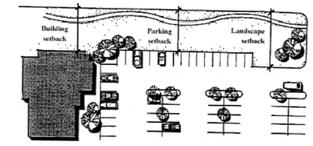
A.
Setback and parkway areas shall utilize uniform street tree plantings with complementary landscape materials.
B.
Mounding or berming shall be incorporated within the overall design, with landscaped slopes not exceeding a three to one ratio, or four feet in height. A minimum of six feet of landscaping shall be placed on the exterior of perimeter walls and fences.
C.
Walls and fences should be incorporated into the landscape design, including meandering walls, wall breaks, or openings where the design shall complement the landscaping of the adjacent development.
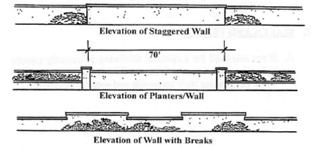
D.
All designs shall ensure compatibility with established setback and parkway areas, including transitions between landscape types and patterns.
E.
Street trees shall be 24 inch box specimens or larger.
(Zoning Ord. dated 1/31/06, § 9108.04.)
17.32.050 - Installation and maintenance.
A.
Landscaping shall be permanently maintained by the developer or his/her successors. All required landscaping shall be properly installed, irrigated, and inspected prior to the issuance of a Certificate of Occupancy.
B.
Maintenance of approved landscaping shall consist of:
1.
Regular watering;
2.
Mowing;
3.
Pruning;
4.
Fertilizing;
5.
Clearing of debris and weeds;
6.
Removal and replacement of dead plants;
7.
The repair and replacement of irrigation systems; and
8.
The repair and replacement of integrated architectural features.
(Zoning Ord. dated 1/31/06, § 9108.05.)
17.32.060 - Removal or destruction of trees.
A.
Removal of healthy, shade providing, and aesthetically valuable trees shall be strongly discouraged, and shall be in conformance with the policies and programs of the General Plan. A tree removal and replacement plan shall be required for the removal and replacement of all trees in excess of 50 years of age, unless their removal is required to protect the public health and safety.
B.
Each tree that is removed in a new subdivision is considered a part of the common wealth of the citizens of Banning, is an important component of the habitat of surrounding wildlife, and is of value to the City. Each identified tree removed shall be replaced with at least one 36 inch box specimen tree, in addition to any other required landscaping. Individual single family residential lots of less than one-half acre and commercial tree farms shall be exempt from this provision.
(Zoning Ord. dated 1/31/06, § 9108.06.)
17.32.070 - Purpose and definitions.
A.
In order to assure that the City's water resources are not significantly impacted by high water consuming landscape plans, the following standards for water efficiency shall be implemented for all landscaping plans required in this chapter, under Section 17.32.020, Applicability.
B.
Definitions.
Anti-drain valve or check valve means a valve located under a sprinkler head to hold water in the system so it minimizes drainage from the lower elevation sprinkler heads.
Application rate means the depth of water applied to a given area, measured in inches per hour. Also known as precipitation rate (sprinklers) or emission rate (drippers/microsprayers) in gallons per hour.
Applied water means the portion of water supplied by the irrigation system to the landscaping.
Automatic controller means a mechanical or solid-state timer, capable of operating valve stations to set the days and length of time of a water application.
Backflow prevention device means a safety device used to prevent pollution or contamination of the water supply due to the reverse flow of water from the irrigation system.
Conversion factor (0.62) means a number that converts the maximum applied water allowance from acre-inches per acre per year to gallons per square foot per year. The conversion factor is calculated as follows:
To convert gallons per year to 100 cubic feet per year, the common billing unit for water, divide gallons per year by 748. (748 gallons = 100 cubic feet.)
Ecological restoration project means a project where the site is intentionally altered to establish a defined, indigenous, historic ecosystem.
Effective precipitation or usable rainfall means the portion of total natural precipitation that is used by the plants.
Emitter means drip irrigation fittings that deliver water slowly from the system to the soil.
Established landscape means the point at which plants in the landscape have developed roots into the soil adjacent to the root ball.
Establishment period means the first year after installing the plant in the landscape.
Estimated annual applied water use means the portion of the estimated annual total water use that is derived from applied water. The estimated annual applied water use shall not exceed the maximum applied water allowance.
Estimated total water use means the annual total amount of water estimated to be needed to keep the plants in the landscaped area healthy. It is based upon such factors as the local evapotranspiration rate, the size of the landscaped area, the types of plants, and the efficiency of the irrigation system.
ET adjustment factor means a factor of 0.6 that, when applied to reference evapotranspiration, adjusts for plant factors and irrigation efficiency, two major influences upon the amount of water that needs to be applied to the landscape. A combined plant mix with a site-wide average 0.45 is the basis of the plant factor portion of this calculation. The irrigation efficiency for purposes of the ET adjustment factor is 0.75. Therefore, the ET adjustment factor (0.6) = (0.45/0.75).
Evapotranspiration means the quantity of water evaporated from adjacent soil surfaces and transpired by plants during a specific time.
Flow rate means the rate at which water flows through pipes and valves (gallons per minute or cubic feet per second).
Hydrozone means a portion of the landscaped area having plants with similar water needs that are served by a valve or set of valves with the same schedule. A hydrozone may be irrigated or nonirrigated. For example, a naturalized area planted with native vegetation that will not need supplemental irrigation once established is a nonirrigated hydrozone.
Infiltration rate means the rate of water entry into the soil expressed as a depth of water per unit of time (inches per hour).
Irrigation efficiency means the measurement of the amount of water beneficially used divided by the amount of water applied. Irrigation efficiency is derived from measurements and estimates of irrigation system characteristics and management practices. The minimum irrigation efficiency for purposes of this chapter is 0.75. Greater irrigation efficiency can be expected from well-designed and maintained systems.
Landscape irrigation audit means a process to perform site inspections, evaluate irrigation systems, and develop efficient irrigation schedules.
Landscaped area means the entire parcel less the building footprint, driveways, nonirrigated portions of parking lots, hardscapes such as decks and patios, and other nonporous areas. Water features are included in the calculation of the landscaped area.
Lateral line means the water delivery pipeline that supplies water to the emitters or sprinklers from the valve.
Main line means the pressurized pipeline that delivers water from the water meter to the valve or outlet.
Service line means the pressurized pipeline that delivers water from the water source to the water meter.
Maximum applied water allowance means for design purposes, the upper limit of annual applied water for the established landscaped area. It is based upon the area's reference evapotranspiration, the ET adjustment factor, and the size of the landscaped area. The estimated applied water use shall not exceed the maximum applied water allowance.
Mined-land reclamation projects means any surface mining operation with a reclamation plan approved in accordance with the Surface Mining and Reclamation Act of 1975.
Mulch means any material such as gravel, small rocks, pebbles, decorative sand, decomposed granite, bark, straw or other material left loose and applied to the soil surface for the beneficial purpose of reducing evaporation.
Operating pressure means the manufacturer's recommended pressure at which a system of sprinklers, bubblers, drippers or microsprayers is designed to operate.
Overhead sprinkler irrigation systems means those with high flow rates (pop-ups, impulse sprinklers, rotors, etc.)
Overspray means the water which is delivered beyond the landscaped area, wetting pavements, walks, structures, or other non-landscaped areas.
Plant factor means a factor that when multiplied by reference evapotranspiration, estimates the amount of water used by plants. For purposes of this chapter, the average plant factor of very low water using plants ranges from 0.01 to 0.10, for low water using plants the range is 0.10 to 0.35, for moderate water using plants the range is 0.35 to 0.60 and for high water using plants, the range is 0.60 to 0.90.
Rain sensing device means a system which automatically shuts off the irrigation system when it rains.
Record drawing or as-builts means a set of reproducible drawings which show significant changes in the work made during construction which are usually based on drawings marked up in the field and other data furnished by the contractor.
Recreational area means areas of active play or recreation such as sports fields, school yards, picnic grounds, or other areas with intense foot traffic.
Recreational turfgrass means turfgrass that serves as a playing surface for sports and recreational activities. Athletic fields, golf courses, parks and school playgrounds are all examples of areas hosting recreational turf grass.
Recreational turfgrass ET adjustment factor means a factor of 0.82 that, when applied to reference evapotranspiration, adjusts for the additional stress of high traffic on recreational turfgrass and the higher irrigation efficiencies of long range rotary sprinklers. These are the two major influences upon the amount of water that needs to be applied to a recreational landscape. A mixed cool/warm season turfgrass with a seasonal average of 0.7 is the basis of the plant factor portion of this calculation. The irrigation efficiency of long range sprinklers for purposes of the ET adjustment factor is 0.85. Therefore, the ET adjustment factor is 0.82 = 0.7/0.85.
Recycled water, reclaimed water or treated sewage effluent water means treated or recycled waste water of a quality suitable for nonpotable uses such as landscape irrigation; not intended for human consumption.
Reference evapotranspiration or ETo means a standard measurement of environmental parameters which affect the water use of plants. ETo is given in inches per day, month, or year, and is an estimate of the evapotranspiration of a large field of cool-season grass that is well watered. Reference evapotranspiration is used as a basis of determining the maximum applied water allowances so that regional differences in climate can be accommodated. For purposes of this chapter, the following ETo zone map will be used. (See map attached to the ordinance codified in this chapter.)
Rehabilitated landscape means any relandscaping project whose choice of new plant material and/or new irrigation system components is such that the calculation of the site's estimated water use will be significantly changed. The new estimated water use calculation must not exceed the maximum applied water allowance calculated for the site using a 0.6 ET adjustment factor.
Runoff means water which is not absorbed by the soil or landscape to which it is applied and flows from the planted area. For example, runoff may result from water that is applied at too great a rate (application rate exceeds infiltration rate), when there is a severe slope or when water is misapplied to hardscapes.
Soil moisture sensing device means a device that measures the amount of water in the soil.
Soil texture means the classification of soil based on the percentage of sand, silt and clay in the soil.
Sprinkler head means a device which sprays water through a nozzle.
Static water pressure means the pipeline pressure when water is not flowing.
Station means an area served by one valve or by a set of valves that operates simultaneously.
Turf means a surface layer of earth containing mowed grass with its roots. Perennial and Annual Ryegrass are cool season grasses. Hybrid and common Bermuda grass, are warm season grasses.
Valve means a device used to control the flow of water in the irrigation system.
Water conservation concept statement means a one-page checklist and a narrative summary of the project.
Water feature means any water applied to the landscape for non-irrigation decorative purposes. Fountains, streams, ponds and lakes are considered water features. Water features use more water than efficiently irrigated turf grass and are assigned a plant factor value of 1.1 for a stationary body of water and 1.2 for a moving body of water.
(Zoning Ord. dated 1/31/06, § 9108.07(1).)
17.32.080 - Applicability.
A.
Except as provided in Section 17.32.030, this article shall apply to:
1.
All new and rehabilitated landscaping for private, public, commercial and governmental development projects that require a permit; and
2.
Developer-installed landscaping in single-family tracts and multifamily projects.
B.
Projects subject to this section shall conform to the provisions in this section.
C.
This section shall not apply to resident homeowner-provided landscaping at single-family residences.
(Zoning Ord. dated 1/31/06, § 9108.07(2).)
17.32.090 - State model water efficient landscape ordinance adoption by reference.
A.
The California State Model Water Efficient Landscape Ordinance, codified at Title 23, Division 2, Chapter 2.7 (§ 490 et seq.) of the California Code of Regulations, and any amendments thereto, is hereby adopted and incorporated herein by reference as if fully set forth below, and shall be known and may be cited as the Water Efficient Landscape Ordinance of the City of Banning. One copy of the California State Model Water Efficient Landscape Ordinance shall be filed in the office of the Planning Division.
B.
The provisions of Chapter 17.32 shall apply in addition to the applicable provisions of the Water Efficient Landscape Ordinance of the City of Banning. In the event of any conflict between provisions of the Water Efficient Landscape Ordinance of the City of Banning and the provisions of Chapter 17.32, the provisions that contain the more stringent water efficient landscape requirement(s) shall control.
(Ord. No. 1556, § 1, 2-11-20)
Editor's note— Ord. No. 1556, § 1, adopted Feb. 11, 2020, amended § 17.32.090 in its entirety to read as herein set out. Former § 17.32.090, pertained to Landscape documentation package, and derived from Zoning Ord. adopted January 31, 2006, § 9108.07(3).
17.32.100 - Public education.
A.
Publications.
1.
The city will, upon request, provide information to owners of all new, single family residential homes regarding the design, installation, and maintenance of water efficient landscapes.
2.
Information about the efficient use of landscape water shall be provided to water users throughout the community.
B.
Model Homes. At least one model home that is landscaped in each project consisting of eight or more homes shall demonstrate via signs and information, the principles of water efficient landscapes described in this chapter.
1.
Signs shall be used to identify the model as an example of a water efficient landscape and featuring elements such as hydrozones, irrigation equipment, and others which contribute to the overall water efficient theme.
2.
Information shall be provided about designing, installing, and maintaining water efficient landscapes.
(Zoning Ord. dated 1/31/06, § 9108.07(4).)
17.32.110 - Provisions for existing landscapes.
A.
Water Management. All existing landscaped areas which use ground water and are over sixty thousand square feet, including golf courses, green belts, common areas, multifamily housing, schools, businesses, parks, and cemeteries shall have a landscape irrigation audit at least every five years unless granted an exemption by the City. At a minimum, the audit shall be in accordance with the California Landscape Irrigation Auditor Handbook, the entire document which is hereby incorporated by reference. (See Landscape Irrigation Audit Handbook, Department of Water Resources, Water Conservation Office (June, 1990), Version 5.5.)
B.
Water Waste Prevention. Water waste resulting from inefficient landscape irrigation including run-off, low head drainage, overspray, or other similar conditions where water flows onto adjacent property, nonirrigated areas, walks, roadways, or structures shall be discouraged. Penalties for violation of these prohibitions shall be established.
(Zoning Ord. dated 1/31/06, § 9108.07(5).)
17.32.120 - Fees for initial review and program monitoring.
A.
Fees for the purposes of meeting obligations under this chapter, the following fees are deemed necessary to review landscape documentation packages and monitor landscape irrigation audits and shall be imposed on the subject applicant, property owner or designee.
1.
A landscape documentation package review fee will be due at the time initial project application submission to the planning and development department.
2.
The project owner/developer must cause a landscape irrigation audit to be completed by a certified landscape irrigation auditor. No city fees will be due for the review of the audit by the planning and development department.
3.
If a landscape documentation package is not submitted prior to the start of landscape construction work, for those persons required to submit a package, a late submittal fee of twice the review fee shall be required.
B.
The city council, by resolution, shall establish the amount of the above fees in accordance with applicable law.
(Zoning Ord. dated 1/31/06, § 9108.07(6).)
17.32.130 - Appeals.
Decisions made by the Director may be appealed by an applicant, property owner(s), or designee(s) of any applicable project to the planning commission and thereafter the city council by an application in writing to the planning and development director and city clerk of the city council respectively within fifteen days from the date of notification of decision.
(Zoning Ord. dated 1/31/06, § 9108.07(7).)
17.32.140 - Purpose.
The design guidelines which follow are a reference to assist the designer in understanding the City's objectives for high quality landscaping. These guidelines will be utilized during the design review process to encourage the highest level of design quality while at the same time providing the necessary flexibility to encourage creativity on the part of the project designers.
(Zoning Ord. dated 1/31/06, § 9108.09(1).)
17.32.150 - Applicability.
Any addition, remodelling, relocation or construction requiring a building permit subject to review by the Community Development Department, shall adhere to these guidelines unless exempted.
(Zoning Ord. dated 1/31/06, § 9108.09(2).)
17.32.160 - General guidelines.
A.
Landscaping and open spaces should be designed as a central part of the site design, and should integrate development with the surrounding elements of the natural environment. Landscaping should enhance building design, public views and spaces, provide buffers and transitions, preserve and enhance wildlife habitat, provide shade and cooling, and provide screening from other nearby uses.
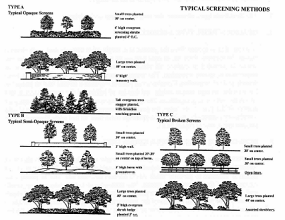
B.
Landscape design should highlight the design theme through the use of arbors and trellises.
C.
Landscaped areas should incorporate grasses and groundcovers; shrubs; and trees.
D.
The following planting design concepts should be used whenever possible:
1.
Trees to create canopies and shade, especially in parking areas;
2.
Pots, vases, wall planters and raised planters;
3.
Specimen trees used in informal groupings and rows at major focal points;
4.
The use of flowering trees in informal groups to provide color;
5.
The use of distinctive plants as focal points;
6.
Berms, plantings and low walls to screen parking areas from public rights of way.
E.
Landscaping should be installed at the base of buildings. Asphalt edges should be avoided.
F.
Plantings should be planned to create a simple, non-uniform arrangement.
(Zoning Ord. dated 1/31/06, § 9108.09(3).)
17.32.170 - Installation and maintenance.
A.
Trees, shrubs and vines should have body and fullness that is typical of the species.
B.
Herbaceous and flat plant groundcovers should be planted no more than 12 inches on center, and woody, shrub groundcover should be planted no more than 3 feet on center.
C.
Plant materials should be spaced so they do not interfere with lighting, and so they do not restrict access to fire hydrants or fire alarm boxes. Proper spacing should ensure unobstructed access for vehicles and pedestrians. The following spacing standards should be used:
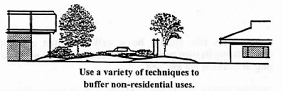
1.
25 feet from the property corner at a street intersection to the center of the first tree or large shrub.
2.
15 feet between trees and large shrubs.
3.
15 feet between trees or large shrubs and fire hydrants.
4.
10 feet between trees or large shrubs and the edge of any driveway.
(Zoning Ord. dated 1/31/06, § 9108.09(4).)

