
Basalt City Zoning Code
ARTICLE XXII
Community Priorities Scoring System
Sec. 16-481.- Purposes and intent.
(a)
Purposes of scoring system. The Community Priorities Scoring System is a tool that is intended to allow the Town to manage the development applications it receives. The scoring system provides a method by which the Town can objectively evaluate development applications to determine which projects most directly respond to the goals, objectives and recommendations that are set forth in the 2007 Basalt Master Plan. Specifically, the scoring system implements the following objectives from the 2007 Basalt Master Plan:
(1)
Control growth. Establish measures to control growth and reduce the rate of growth to a rate less than the 4.8% annual rate of population growth the Town has recently experienced;
(2)
Quality growth. Promote and support projects that provide quality growth, which are consistent with the goals, objectives and policies contained in the master plan, do not create a financial burden on the community and provide significant benefits to the community;
(3)
Balance. Determine the appropriate balance between residential and commercial development and establish policies to achieve this balance;
(4)
Community housing. Preserve existing resident housing and explore a wide range of strategies to produce community housing for local residents;
(5)
Environmental sensitivity. Establish environmentally sensitive building and development standards;
(6)
Historic landmarks. Encourage landmark designation of additional structures by property owners and consider developing additional policies for the preservation of historic structures and places; and
(7)
Gathering places. Retain and enhance significant existing community gathering places.
(b)
Overview of scoring system. The Community Priorities Scoring System establishes scoring standards that reflect adopted community priorities and a growth rate that limits the pace of development in the community. Certain types of projects must be ranked under the scoring standards, and certain projects are also subject to the growth rate limitations. Table 1 below provides an overview of how the Community Priorities Scoring System applies to different types of projects.
(1)
Exempt from scoring. The types of projects that are exempt from the scoring system and do not need to receive an eligible score are classified with a "no" in the first column of Table 1 (refer to Section 16-483 of this Article for a description of these project types).
(2)
Subject to scoring. The types of projects that are required to submit an application under the scoring system and must receive an eligible score are classified with a "yes" in the first column of Table 1 (refer to Section 16-482 of this Article for a description of these project types and to Paragraph 16-484(4) for an explanation of the meaning of the term "eligible score").
(3)
Require a growth allotment. The types of projects that are required to obtain a growth allotment are classified with a "yes" in the second column of Table 1 (refer to Paragraphs 16-484(6) and (7) for a description of the growth allotment process).
___________
Table 1
Overview of Scoring System Requirements [1]
NOTE:
1. See Section 16-482 for details of when the procedures in this article take effect or a project is required to obtain dwelling unit allotments.
(Ord. 06 §B, 2009; Ord. 10 §B.4(Exh. C.1), 2012; Ord. 30 §1(Exh. A), 2014)
___________
Sec. 16-482. - Applicability of scoring system.
(a)
Due to a low growth rate experienced by the Town after the initial adoption of the community priorities scoring system, the scoring system will not apply to any land use applications until the Town Council holds a growth management notice public hearing and votes to approve a resolution reinitiating the full CPSS process. A growth management notice may be initiated in one (1) of two (2) ways: the Town Council may vote at any time to hold a growth management notice public hearing; or alternatively, the Town Planner may schedule a growth management public notice after at least one (1) of the following has occurred:
(1)
Three (3) consecutive years in which the annual growth rate exceeds an average of 4.8 percent based on building permit activity; or
(2)
More than one hundred fifty (150) units receive building permits in any one (1) year; or
(3)
The Town approves more than two hundred fifty (250) dwelling units after approval of the ordinance.
The growth management public hearing notice will be published at least fifteen (15) days before the meeting. A land use application which is not complete upon the date the growth management public hearing notice is presented to the Town Council will be subject to the scoring system unless the Town Council fails to officially reactivate the scoring system by resolution within three (3) months of the growth management public hearing notice. The Town Council must adopt a resolution in order to reactivate the scoring system and establish the dates for review of the scoring system which can occur any time after the Planning Director's presentation of the growth management notice. The reactivation resolution will establish the submission and processing dates for the first round of land use applications subject to the scoring system which may differ from those established in Section 484, Scoring System review procedures.
Until the scoring system is reactivated by the Council, the Town Planner will score applications that otherwise would be subject to the scoring system during the standard development review process for evaluation by the Planning and Zoning Commission and Town Council. The Planning and Zoning Commission and the Town Council will review this information to:
(1)
Evaluate whether absent the scoring system, the Town is getting projects that support the goals, objectives and recommendations set forth in the then-current master plan;
(2)
Determine what changes, if any, would be appropriate to the scoring system.
(3)
Assist in evaluating whether the project is consistent with the then-current master plan since the scoring system was developed as an objective method of determining which projects most directly respond to the goals, objectives and recommendations of the master plan.
Applicants are therefore encouraged to develop projects that satisfy the scoring system standards established in this article and to provide information that assists the Town in its evaluation of any future changes. Applicants are required to provide responses to the scoring system review standards as described in Section 16-485 as part of their application for development.
(b)
Once reactivated as described in subsection (a) above, the community priorities scoring system applies to the following types of development applications on lands within the incorporated limits of the Town or that are proposed to be annexed to the Town. The development applications that qualify for an exemption from the scoring system are listed in Section 16-483 of this Article.
(1)
New residential lots and units. Any land use application that proposes to create four (4) or more new free market residential units or residential lots, including the residential component of a mixed-use development, is subject to the community priorities scoring system except for areas zoned CSC.
(2)
Net commercial square footage. Any land use application that proposes to create five thousand (5,000) square feet or more of new or additional net commercial square footage, including the commercial component of a mixed-use development, is subject to the community priorities scoring system except for areas zoned CSC. Commercial development includes, but is not limited to, retail, office, industrial and other types of businesses, but excludes hotel, lodge and similar visitor accommodation units.
(3)
Redevelopment of residential units. Any land use application that proposes to demolish and replace a multi-family residential building, a combination of multi-family residential buildings or a mobile home park containing a total of five (5) or more residential units is subject to the community priorities scoring system except for areas zoned CSC.
a.
Demolition. For purposes of this Article, a unit shall be considered to be demolished if the building in which it is located is torn down and the unit is replaced in a substantially different configuration, or if the shell of the building is not torn down, but the interior units are demolished and replaced in a substantially different configuration.
b.
Remodeling. Remodeling projects or demolition and replacement projects that involve only minor changes to the configuration of the existing units, as determined by the Town Planner, shall be exempt from the community priorities scoring system. Remodeling or replacement of existing commercial space shall also be exempt from the community priorities scoring system.
(Ord. 06 §B, 2009; Ord. 10 §B.4(Exh. C.2), 2012; Ord. 30 §1(Exh. A), 2014)
Sec. 16-483. - Exemptions from scoring system.
The following types of development applications, individually or in combination, shall be exempt from the community priorities scoring system.
(1)
Previously approved projects and projects in the land use pipeline.
a.
Basis for exemption. Any project that: (1) has received all of its necessary land use approvals prior to June 10, 2009 (the effective date of this Article); or (2) is on the list of "Exempt Pipeline Projects" that is attached as Exhibit B to Ordinance 06 of 2009, is exempt from the community priorities scoring system. If the project fails to meet any applicable deadline for submission of subsequent land use or building permit applications (as applicable) and its approval expires, or if the project is denied or is withdrawn, then any subsequent land use application for the project shall be subject to the community priorities scoring system unless the project is eligible for another exemption listed in this Section.
b.
Amendments to previously approved projects. Amendments to projects that have received all of their land use approvals prior to June 10, 2009, shall be subject to the following provisions:
1.
A minor amendment to a previously approved project shall be exempt from the community priorities scoring system.
2.
A substantial amendment to a previously approved project shall be subject to the community priorities scoring system.
3.
The determination of whether an amendment is minor or substantial shall be made by the Town Planner. In determining whether a project is minor or major the Town Planner may utilize the meaning of substantial and insubstantial as found in Section 16-65(d)(6).
4.
All other amendments to a previously approved project shall be considered to be substantial and shall require the applicant to comply with the applicable provisions of the community priorities scoring system. Any amendment that would cause a substantial change in the use or character of any portion of the project, would increase the size of the project by more than the thresholds established in Paragraph (6) of this Section or would substantially alter the project's open space, transportation or community housing commitments shall be considered to be substantial.
c.
Amendments to Exhibit B applications. Amendments to applications that are listed in Exhibit B of Ordinance 06 of 2009, shall be subject to the following provisions:
1.
Such applications may be amended to the extent authorized by the applicable Code provisions at the time of the amendment.
2.
If any application listed in Exhibit B is withdrawn or denied, then any new application for those properties shall be subject to the community priorities scoring system.
3.
If the application fails to comply with any subsequent submittal deadline, the Town Council may require the application to be subject to the then current community housing regulations.
(2)
Community housing. An application proposing the development of a project comprised of one hundred percent (100%) community housing units (as defined in Article XIX of this Chapter) is exempt from the community priorities scoring system.
(3)
Mitigation units. An application or portion of an application proposing the development of community housing units (as defined in Article XIX) that are required to mitigate the impacts of a development project is exempt from the community priorities scoring system, whether the units are on the same site as the development project or are off-site. This exemption does not qualify the free market residential units or the commercial space that generates the demand for the mitigation units to be exempt from the scoring system.
(4)
Public or nonprofit facilities. An application proposing the development of public or nonprofit facilities is exempt from the community priorities scoring system. For purposes of this Article, public or nonprofit facilities include the uses listed in Paragraph 16-28(3) of this Chapter.
(5)
Historic landmarks. An application proposing development on a property or to a structure that is designated or is proposed to be designated as a historic landmark by the Town is exempt from the community priorities scoring system. If the proposed designation is subsequently withdrawn or is denied, this exemption shall no longer apply to the application and it shall be subject to the community priorities scoring system.
(6)
Minor residential and commercial projects. An application proposing the development of no more than three (3) new residential units or lots, or less than five thousand (5,000) square feet of new or additional net commercial square footage, is exempt from the community priorities scoring system. This exemption may be used by any property (as it was configured at the time of adoption of Ordinance 6, Series of 2009) cumulatively up to no more than the three (3) units and five-thousand-square-feet thresholds.
(7)
Lodge or hotel units. An application proposing the development or redevelopment of lodge or hotel units is exempt from the community priorities scoring system. If the lodge or hotel units are part of a mixed-use project in which the other uses would be subject to the scoring system, then only the lodge or hotel portion of the project shall be exempt. (Ord. 06 §B, 2009)
(8)
An application within an area zoned CSC is exempt from the community priorities scoring system.
(Ord. 06 §B, 2009; Ord. 10 §B.4(Exh. C.3), 2012; Ord. 30 §1(Exh. A), 2014)
Sec. 16-484. - Scoring system review procedures.
(a)
The community priorities scoring system is intended to allow the Town to manage the development applications it receives by comparing the applications to one another to determine which most directly respond to the Town's adopted growth priorities and contribute to the implementation of the master plan. Applications are accepted and reviewed twice per year, and allotments are awarded to successful applicants twice per year.
(b)
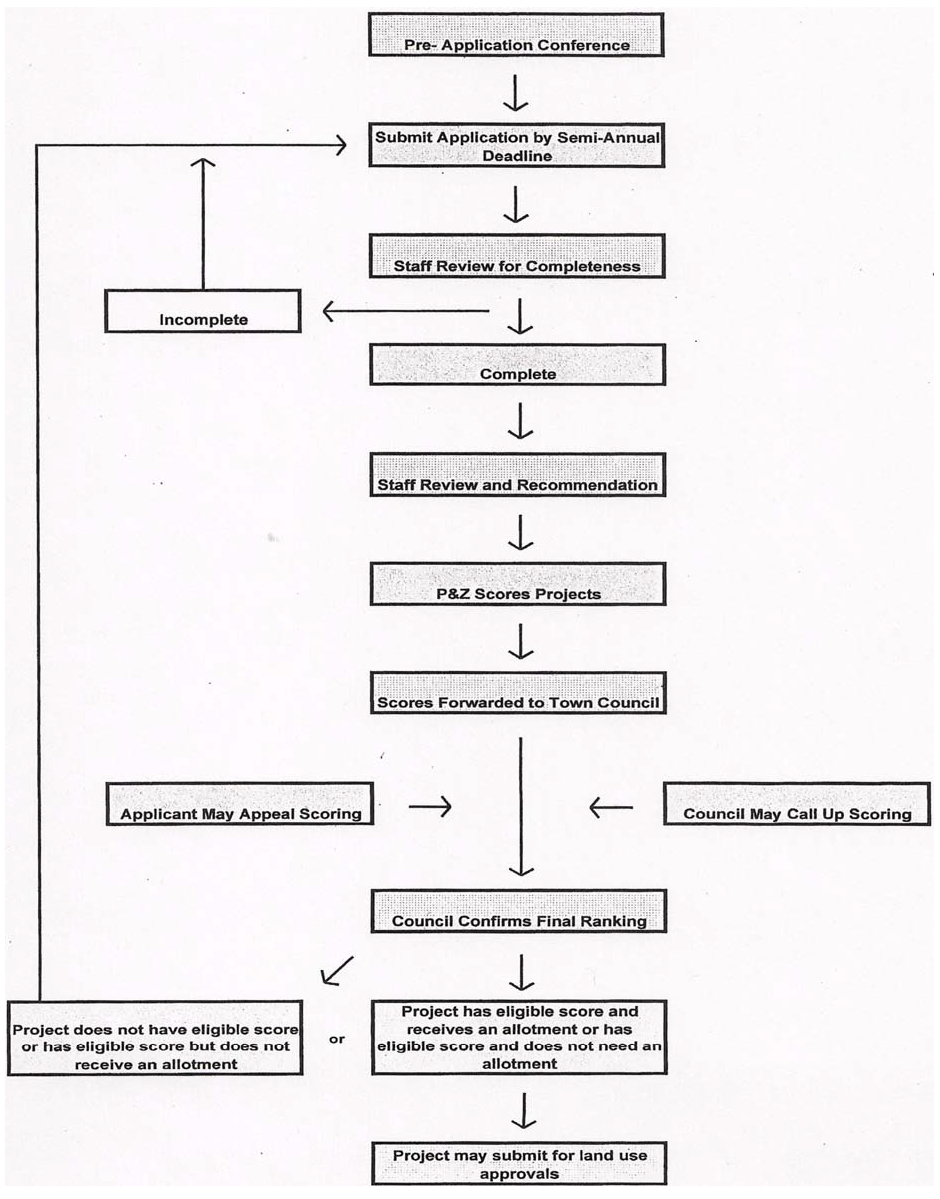
To assist applicants and members of the public in understanding how the scoring system functions, the Town has prepared a flow chart (see Figure 1 below) that illustrates the steps in the scoring system. Following is an explanation of each of these steps.
Figure 1
Scoring System Review Process
(1)
Preapplication conference. Before an applicant submits an application under the scoring system, the applicant shall hold a preapplication conference with the Town Planner. The purpose of the preapplication conference is for the applicant and the staff to review the proposed project so the applicant may become informed of how the review procedures and review standards of the scoring system will be applied to the proposal. The Town Planner may issue an informal written summary of the preapplication conference if requested to do so by the applicant, but shall only share the results of the conference with the applicant and not with other potential applicants, so as to maintain a fair competition process.
(2)
Prepare and submit application.
a.
Submission deadlines. Applications for a project to be scored shall be accepted on or before March 1 (hereinafter, the "first session") and September 1 (hereinafter, the "second session") of each year. When the submission date falls on a weekend or official holiday, the applications shall be due on the first business day after the weekend or holiday.
b.
Initial land use application. An application for project scoring shall be the initial land use application submitted for a property. This shall mean that an application for project scoring shall be submitted prior to the submission of a sketch plan application, a special review application or other land use application. For properties that are located outside of the Town limits, the application for project scoring may be submitted subsequent to submission of an annexation petition. Obtaining an eligible score and allotments (if necessary) is a prerequisite to consideration by the Town of any other application required by the Code and does not create a vested right to any such approval.
c.
Number of applications. No more than one (1) application for project scoring may be submitted at a time for any property.
d.
Submission contents. The application shall include the following items:
1.
The Town's development application form.
2.
If the applicant has a representative, a letter shall be submitted, signed by the applicant, providing authorization for the representative to submit the application and to appear on behalf of the applicant.
3.
If the applicant is not the owner of the property, a letter shall be submitted, signed by the property owner, providing authorization for the applicant to submit the application.
4.
A vicinity map, drawn to scale, showing the location and boundaries of the property in relation to the Town limits, the Town street system and significant natural features.
5.
A brief written description of the existing conditions on the property and adjacent lands. A survey or other map drawn to scale shall be provided depicting the existing conditions.
6.
A brief written summary of the proposed development, with accompanying maps and other graphics that depict the proposed development. The maps shall show all proposed buildings, streets, open spaces and other significant features and shall reflect the development proposed for the entire property.
7.
Responses to the scoring system review standards, as described in Section 16-485 of this Article.
8.
The processing fee for the application, as determined by the Town Planner, pursuant to a schedule of fees approved by the Town pursuant to Section 2-381, et seq., of this Code.
e.
Commitments are binding. Commitments made by the applicant to obtain an allotment or an exemption from the scoring system are binding upon the applicant. The subsequent land use application(s) submitted by the applicant shall demonstrate precisely how commitments made to obtain a score or an exemption will be implemented.
1.
Failure of an applicant to implement and demonstrate compliance with any such commitments shall require a determination to be made of whether that failure constitutes a major amendment to the application, pursuant to Subparagraph (8)a. of this Subsection, and would require reconsideration of the application pursuant to the scoring system. However, a commitment made by an applicant that is eliminated from the project because of a direction to do so by the Town's review bodies shall not be considered to be a major amendment to the application.
2.
If a project loses its allotments as a result of a failure to implement and demonstrate compliance with a commitment, the Town Planner may determine that the project has also lost its standing in the land use application process and must restart the process with a new initial application. The Town Planner shall consider the applicable provisions of this Chapter with respect to minor and substantial amendments to an application in making this determination.
(3)
Staff review and recommendation.
a.
Staff review for completeness. Within fifteen (15) days of the semi-annual submission deadline, the staff shall review the applications and determine whether each application is complete. If the staff determines that an application is incomplete, it shall be returned to the applicant and shall not be eligible for resubmission until the subsequent submission deadline.
b.
Technical Review Committee. The staff will refer the application to members of the Technical Review Committee. Staff will assemble the comments of the Technical Review Committee, review and evaluate each application pursuant to the scoring standards in Section 16-485 of this Article and compile a recommended score for each application.
(4)
Planning and Zoning Commission scoring of applications.
a.
Planning and Zoning Commission consideration. The Planning and Zoning Commission shall consider the recommended scoring of each complete application. The Planning and Zoning Commission shall make a good-faith effort to act on the application within sixty (60) days after the deadline for submission of applications.
b.
Scoring procedures. Each member of the Planning and Zoning Commission in attendance at the meeting shall assign scores to each application, considering the staff recommendations, information submitted by the applicant and comments by the public. Applications shall not be scored in comparison to one another, but rather shall be scored based on the degree to which each application complies with the scoring standards in Section 16-485 below. Scores awarded shall take into account the plans for the entire property. Scores shall be awarded in whole numbers only.
c.
Proportionality. When scoring an application, the Planning and Zoning Commission should consider whether the commitments being made by the applicant are proportional to the size of the allotment being requested. In other words, an applicant seeking a large number of allotments would be expected to make a proportionally greater commitment to obtain a score in any category as compared to an applicant seeking a lesser number of allotments.
d.
Ranking of Projects. At the conclusion of the scoring the staff shall tally the scores awarded by each Commission member, divide the total of all scores awarded to each project by the number of members scoring and announce the average score for each application. Once the average scores have been announced, the Planning and Zoning Commission shall rank the projects in the order of the score awarded.
1.
If there is a tie score among two (2) or more projects, then the tie shall be broken by giving the higher rank to the project that scored the greater number of points in the community housing scoring categories. If there is still a tie, then it shall be broken by giving the higher rank to the project that scored the greater number of points in the community facilities scoring categories and then, if the tie is still not broken, to the project that scored the greater total number of points in the environmental quality scoring categories.
2.
The Planning and Zoning Commission shall also identify which projects have received an eligible score and which have received a score that is below the eligible threshold. Residential projects must be awarded a minimum score of twenty (20) points to meet the eligibility threshold. Commercial projects must be awarded a minimum score of fifteen (15) points to meet the eligibility threshold.
3.
Once the ranking is established, the Planning and Zoning Commission shall forward the scores to the Town Council.
(5)
Town Council final ranking of projects. The Town Council shall consider the scores awarded by the Planning and Zoning Commission. The Town Council shall make a good-faith effort to consider the scores at a meeting held no more than thirty (30) days after the scores were forwarded. The Town Council shall accept the scores as recommended unless an applicant has submitted an appeal of the scoring or the Town Council calls up one (1) or more of the scores.
a.
Appeal. An applicant who is aggrieved by a score awarded to his or her project may submit an appeal of the score. The appeal shall be submitted in writing to the Town Planner within ten (10) days after the scores have been forwarded.
1.
The appeal shall be decided by the Town Council based solely upon the record established at the Planning and Zoning Commission hearing. An appeal shall not be granted unless there is a finding that there was a denial of due process or the Planning and Zoning Commission exceeded its jurisdiction or abused its discretion.
2.
If the appeal is granted, then the Town Council may modify the scores awarded to the successful appellant or may send the project back to the Planning and Zoning Commission for rescoring. If the project is sent back, it shall be rescored by the Planning and Zoning Commission within thirty (30) days, and the score shall be forwarded to the Town Council.
b.
Call-up. The Town Council may call up one (1) or more of the scores forwarded by the Planning and Zoning Commission.
1.
The decision to call up one (1) or more of the scores shall occur at the meeting at which the Town Council considers the scores awarded by the Planning and Zoning Commission. A majority vote of the Town Council shall be required for a score to be called up. The call-up procedure is not intended to be a way for an applicant or other interested person to petition the Town Council to reconsider the scores awarded to a project. Instead, a call-up should occur when a majority of the Town Council determines that it wishes to review one (1) or more of the scores awarded by the Planning and Zoning Commission.
2.
If the Town Council decides to call up a score, it shall consider the record that was established at the Planning and Zoning Commission hearing.
3.
At the conclusion of its consideration, the Town Council may modify the score awarded to the project, send the project back to the Planning and Zoning Commission for rescoring or confirm the recommended score. If the project is sent back, it shall be rescored by the Planning and Zoning Commission within thirty (30) days, and the score shall be forwarded to the Town Council.
c.
Final ranking. Following the conclusion of any appeals or call-up actions, the Town Council shall confirm the final project ranking and shall identify which projects have received eligible scores and which have received scores that are not eligible for an allotment.
(6)
Growth rate determination. Once the final ranking of projects has been confirmed, the Town Council shall make a determination of whether there are sufficient allotments available for the projects that have received an eligible score.
a.
Residential allotments. An annual allotment of thirty-two (32) new free market residential units is hereby established. The annual allotment equates to a simple growth rate of approximately two percent (2%), based on an existing housing inventory of almost one thousand six hundred (1,600) dwelling units in the Town, as documented in the 2009 Housing Needs Assessment, which is less than the 4.8% annual rate of growth the Town had experienced prior to the adoption of the 2007 Master Plan. The two percent allotment rate has been adopted in recognition of the fact that the new community housing units, new units built in previously approved developments and pipe-line projects are not subject to the annual allotment limit but will contribute to the Town's annual rate of population growth, so they must be accounted for in setting the number of new allotments that will be available on an annual basis.
b.
Allotments for other types of development. An annual allotment limit has not been established for new commercial space or for redevelopment of multi-family residential units or units in mobile home parks. Projects of those types are not subject to a growth rate determination and need only be awarded an eligible score to be authorized to proceed through their subsequent land use reviews.
c.
Reserve. When awarding residential allotments to eligible applicants, the Town Council shall not award more than seventy-five percent (75%) of the total annual allotments to applications submitted during the first session. Twenty-five percent (25%) of the annual allotments (plus any allotments that remain unused from the first session) shall be reserved for award for applications submitted during the second session.
d.
Allotments awarded in order of rank. The highest ranked eligible project shall receive the allotments it requested, unless it exceeds the total number of allotments available, in which case, it shall receive the number of allotments that are available. If allotments remain after the first project has received its request, then allotments shall be awarded to the second highest ranked eligible project and so on, until all allotments have been awarded or there are no eligible projects remaining to which allotments might be awarded.
(7)
Town Council award of allotments.
a.
Award by ordinance. Allotments shall be awarded to eligible projects via an ordinance that lists the projects that have and the projects that have not received an allotment.
1.
Receipt of an allotment is a determination that an application may proceed through its subsequent land use reviews and is not a determination of the outcome of those review procedures.
2.
Projects that do not receive allotments must apply during a subsequent scoring session before they may proceed through their land use reviews, unless the applicant receives an excess allotment or is granted a special exemption from the scoring system pursuant to Subparagraphs (8)b. and c. below, respectively.
b.
Carryover of unused allotments. If there are any unused allotments at the end of the first session, they shall be automatically carried over to the second session. If there are any unused allotments after the second session, the Town Council may carry them over to the next year's session or may eliminate them. The decision to carry over or to eliminate the unused allotments shall be documented in a Town Council resolution or in the ordinance that awards the allotments.
(8)
Additional scoring system procedures.
a.
Amendments to a project awarded an allotment. A minor amendment to a project awarded a scoring system allotment may be authorized by the Town Planner and shall not require reconsideration of the application pursuant to the scoring system.
1.
A minor amendment may include, but not be limited to, technical or engineering considerations discovered subsequent to the award that could not reasonably be anticipated during the scoring process or any other minor change to a project that the Town Planner finds would not substantially modify the commitments made during the scoring process.
2.
All other amendments to a project awarded a scoring system allotment shall be considered to be substantial and shall require the applicant to reapply in a subsequent session. Any amendment that requires the project to obtain additional allotments or that would alter the rank order established for the project or cause the project to fall below the eligible score threshold shall be considered to be substantial.
b.
Requests for excess allotments. Any applicant whose project has been unsuccessful in obtaining allotments for a project because the number of allotments the applicant is requesting exceeds the annual allotment that is available may petition the Town Council for an increase in that year's growth allotment. The petition shall be submitted within thirty (30) days after the Town Council has awarded the available allotments.
In making a decision as to whether to increase the number of allotments available in that year, the Town Council shall consider the extent to which the project or projects requesting excess allotments would help to achieve valued community growth priorities as specified in the Town's adopted master plan and in this scoring system. The Town Council may request that the Town Planner provide a report documenting the residential growth rate over the past three (3) years and the number of approved but unbuilt dwelling units in the Town's inventory to help in determining the appropriateness of the excess allotments. The decision as to whether to issue any excess allotments shall be in the sole discretion of the Town Council. The Town Council shall require any excess allotments that are awarded to be deducted from future years' allotments by deducting all of the excess from the next year's allotments or by apportioning the deduction over a period of two (2) or more years.
c.
Appeals by repeatedly unsuccessful applicants. Any applicant for a project located within the Town limits who has been unsuccessful in obtaining an allotment for the same property during three (3) consecutive scoring sessions due to the failure of the project to receive an eligible score or due to the lack of availability of allotments may petition the Town Council for a special exemption from the scoring system. The Town Council shall consider the petition. It shall be the applicant's responsibility to demonstrate to the Town Council why the special exemption should be granted. The decision as to whether to grant the special exemption shall be in the sole discretion of the Town Council.
d.
Expiration of allotments.
1.
An applicant shall be required to submit a land use application necessary for the project's development within one (1) year from the date of the award of an allotment or the allotment shall automatically expire. The Town may exempt a project from this requirement if it determines that multi-year allotments are necessary before a land use application can be submitted.
a)
An applicant may request an extension of the land use application submission deadline.
b)
A six-month extension of the deadline may be granted one (1) time by the Town Planner for reasonable causes shown by the applicant.
2.
If a land use application that received an allotment is withdrawn or denied at any point during its land use review process, then the allotment shall expire.
3.
Expired allotments may be added to the available allotments for the subsequent scoring session at the discretion of the Town Council, pursuant to Subparagraph (7)b. of this Subsection.
(Ord. 06 §B, 2009)
Sec. 16-485. - Scoring system review standards.
(a)
Scoring categories. There are hereby established eleven (11) scoring system scoring categories, plus a bonus scoring category that is applicable only to projects that meet the eligible score threshold. The categories represent a "menu" from which an applicant can choose the types of commitments he or she is prepared to make. Applicants are not required to provide responses in each of these categories, as certain categories may only apply to certain types of development. However, it shall be the applicant's responsibility to submit responses in a sufficient number of categories to provide an opportunity for the applicant to receive an eligible score, as specified in Subparagraph 16-484(4)d.2. of this Article. The scoring categories, available points and eligible score thresholds for residential and for commercial projects are summarized in Table 2 below.
Table 2
Scoring Categories
(b)
Standards for scoring applications. The Planning and Zoning Commission shall consider each application with respect to the following standards and shall assign points according to the schedules described below.
(1)
Community housing scoring categories.
a.
Exceed housing requirements. The Town encourages the development of projects that exceed the Town's minimum housing mitigation standards or exceed the Town's minimum standards for the quality of community housing units. Points shall be awarded to applicants who propose to exceed the Town's adopted standards as follows:
1.
Points awarded:
a)
Points shall be awarded to a project based on the extent to which the project exceeds the Town's adopted minimum residential inclusionary requirements or minimum commercial linkage requirements, as applicable, to a maximum of seven (7) points.
b)
For residential projects, the applicant shall identify which of the adopted inclusionary options is being satisfied. One (1) point shall be awarded for each one percent (1%) by which the applicant proposes to exceed the total net square footage requirement for community housing for the residential development. One (1) point shall also be awarded for each three percent (3%) by which the applicant proposes to exceed the total net square footage requirement for resident-occupied housing for the residential development. For example, a residential project for which the applicant proposes to satisfy option #1 and in which forty percent (40%) of the total net square footage of the development is community housing (five percent [5%] more than the Code requirement) would receive five (5) points. A residential project for which the applicant proposes to satisfy Option #2 and in which thirty-five percent (35%) of the total net square footage of the development is community housing (five percent [5%] more than the Code requirement = five [5] points) and sixteen percent (16%) of the development is resident-occupied housing (six percent [6%] more than the Code requirement = two [2] points) would receive seven (7) points.
c)
For commercial projects, one (1) point shall be awarded for each one percent (1%) by which the applicant proposes to exceed the minimum linkage requirement for providing community housing for the percent of employees generated by the project. For example, a commercial project that proposes to provide housing for thirty percent (30%) of the employees that it generates would receive five (5) points.
2.
Up to three (3) points may be awarded to a project based on a determination that the proposed housing mitigation plan is of exceptional quality. Proposals that would be considered to be exceptional include, but are not limited to, proposals to develop units that are bigger than or contain better features than those required by the Town's Community Housing Guidelines, units that are restricted to lower cost categories than the Town would otherwise require and similar types of creative or highly valued housing proposals.
b.
Smaller house size/maximum density. The Town encourages the development of small-scale, high-density starter housing that is affordable. Points shall be awarded to applicants who propose to place voluntary limits on the size of the free market single-family and two-family dwellings within their project or who propose to develop such dwellings in a relatively dense project. Points shall be assigned to applicants as follows:
1.
Two (2) points shall be awarded for each free market dwelling unit in the project that is restricted to a total house size of no more than two thousand five hundred (2,500) square feet, and one (1) point shall be awarded for each free market dwelling unit in the project that is restricted to a total house size of more than two thousand five hundred (2,500) square feet, but no more than three thousand five hundred (3,500) square feet, to a maximum of seven (7) points.
2.
One (1) point shall be awarded if the free market residential portion of the project attains a gross density of at least eight (8), but less than ten (10), units per acre and generally follows the principles of the "Residential Affordable Overlay" typology in the 2007 Master Plan; or
3.
Two (2) points shall be awarded if the free market residential portion of the project attains a gross density of more than ten (10) units per acre and generally follows the principles of the "Residential Affordable Overlay" typology in the 2007 Master Plan.
c.
Voluntary resident occupancy.
1.
The Town promotes the creation of a diversity of housing choices for residents who have various levels of economic and housing needs. One such housing opportunity would limit the occupancy of some of the free market residences within a project solely to persons who occupy the dwelling unit as their primary residence. The occupants shall be deemed to have qualified if at least one (1) person occupied the unit as his or her primary residence by residing in the unit a minimum of nine (9) months out of any twelve-month calendar period.
2.
One (1) point shall be awarded for each free market unit in a project that is voluntarily limited to permanent resident occupancy, to a maximum of three (3) points. Resident-occupied units may be rental or sale units and may be new or existing units, but in all cases shall be limited by a deed restriction approved by the Town Attorney. Points shall not be awarded to any unit that is otherwise limited to permanent resident occupancy or required to be a deed-restricted community housing unit.
(2)
Community facilities scoring categories.
a.
Open space/parks/trails/recreation facilities.
1.
The 2007 Master Plan identifies goals, objectives and recommended actions to improve the Town's parks and recreation facilities and to preserve desired open spaces. Applicants may be awarded points if their project accomplishes one (1) or more of the following:
a)
Build, help the Town to obtain or dedicate desired trail or sidewalk segments that link neighborhoods to schools, parks, transit systems, commercial areas and public lands or that enhance connectivity within neighborhoods or commercial areas. Trail alignments that are separated from streets, minimize impacts on sensitive natural areas and serve both commuting and recreational uses are generally preferred.
b)
Help the Town to obtain or dedicate desired open space lands that can be used for active or passive recreation or that should be protected because of their natural resource, scenic or other values.
c)
Make, or help the Town to make, desired recreation improvements to existing parks or undeveloped park lands.
2.
Points shall be awarded based on the extent to which the applicant's proposal would advance the community towards achievement of one (1) or more parks and open space goals, objectives or recommendations listed in the 2007 Master Plan. To receive points in this category, the applicant's proposals must exceed the minimum open space requirements of Subsection 16-73(c) of this Chapter and Section 17-15 of this Code. In the case of a project requesting annexation, the applicant's proposals must be more than two (2) times the minimum park land dedication and improvement requirements of Subsection 16-73(c) and Section 17-15.
3.
Up to five (5) points may be awarded to a project based on the extent to which the project will help to achieve one (1) or more parks and open space goals, objectives or recommendations. In awarding points, consideration shall be given to the extent to which the applicant's proposal will help the Town to actually complete the parks or open space goal, objective or recommendation, whether the applicant proposes to help to achieve a single or multiple goals, objectives or recommendations and whether it is a high priority or a lesser priority goal, objective or recommendation for the community to accomplish.
b.
Arts and cultural facilities and public gathering places.
1.
The 2007 Master Plan provides a definition of what "small town character" means in the Town and identifies directions in which the Town could evolve that would enhance this desired character. The Plan points out that one (1) small town characteristic is that the Town has events and places that contribute to its sense of community by allowing residents to randomly meet and to connect to each other and to the Town. While features such as this cannot be achieved within every development, there may be some developments that offer the opportunity to create or enhance a formal or informal public gathering place or that can facilitate the establishment of public or private places where arts or cultural activities can occur.
2.
Applicants may be awarded up to five (5) points if their project proposes to create or enhance a formal or informal public gathering place that contributes to the community or if their project proposes to facilitate the establishment of public or private places where arts or cultural activities can occur that contribute to the community.
c.
Transportation system enhancements.
1.
The 2007 Master Plan establishes a list of desired short-term improvements to the Town's circulation system. Applicants may be awarded up to five (5) points based on the extent to which their application would move the Town toward accomplishing one (1) or more of the listed improvements.
2.
In awarding points, consideration shall be given to the extent to which the applicant's proposal will help the Town to complete the improvement, whether the applicant proposes to contribute toward a single improvement or toward multiple improvements and whether the improvement is a high priority or a lesser priority improvement for the community to accomplish.
d.
Day care and other public facilities.
1.
The Town encourages the development of a full range of services and opportunities associated with small town character. Services and facilities that could be provided by applicants include, but are not limited to, day care facilities, meeting spaces for local groups and similar rooms or buildings intended to serve community needs.
2.
Up to three (3) points may be awarded to a project that provides such facilities, makes the facilities available to the general public and provides guarantees that the facilities will remain in operation and available to the general public for a minimum of three (3) years after the initial occupancy of the project.
(3)
Environmental quality scoring categories.
a.
LEED certification.
1.
The Town wishes to encourage developments to reduce their consumption of natural resources, utilize renewable energy sources and employ efficient building techniques. Points shall be awarded to applicants who propose to develop a project that is designed pursuant to the most recent version of the Leadership in Energy and Environmental Design (LEED) standards of the U.S. Green Building Council. Points shall be awarded as follows:
Bronze certification: 2 points.
Silver certification: 4 points.
Gold certification: 6 points.
Platinum certification: 8 points.
2.
For an applicant to obtain points in this category, the applicant must describe the elements of the project that will justify the proposed level of LEED certification. The project must receive LEED design review certification prior to completion of the land use review process and must receive LEED construction review certification before the project receives a certificate of occupancy. The applicant may be required to provide financial security to the Town to assure that the project will complete its construction at the certified level.
b.
River Master Plan implementation.
1.
The Roaring Fork River Stewardship Master Plan was adopted by the Town in 2002. This Plan lists the Town's goals and recommendations for managing the river corridor to reduce the hazards associated with it and make it more of a community amenity. Up to five (5) points may be awarded to a project based on the extent to which the project will help to accomplish one (1) or more of the Plan's recommendations.
2.
In awarding points, consideration shall be given to the extent to which the applicant's proposal will help the Town to accomplish the recommendation, whether the applicant proposes to help to achieve a single recommendation or multiple recommendations and whether it is a high priority or a lesser priority recommendation for the community to accomplish.
(4)
Land use scoring categories.
a.
Proximity to transit. The Town encourages new development to be located within walking distance of existing bus stops. Applicants shall be awarded one (1) point if the edge of their property is located no more than one-quarter (¼) mile from a designated bus stop.
b.
Substantial net fiscal benefit. (Reserved)
(5)
Bonus scoring category: Infill development. Any project that meets the eligible score threshold may receive bonus points that would count towards the project's final ranking prior to its growth rate determination (but not towards its eligibility determination). Bonus points shall be awarded to such projects based on the following schedule:
a.
Projects located within the original Basalt Townsite shall receive five (5) points.
b.
Projects located outside of the original Basalt Townsite but within the Town boundaries shall receive three (3) points.
c.
Projects located outside of the Town boundaries shall receive zero (0) points.
(Ord. 06 §B, 2009)

